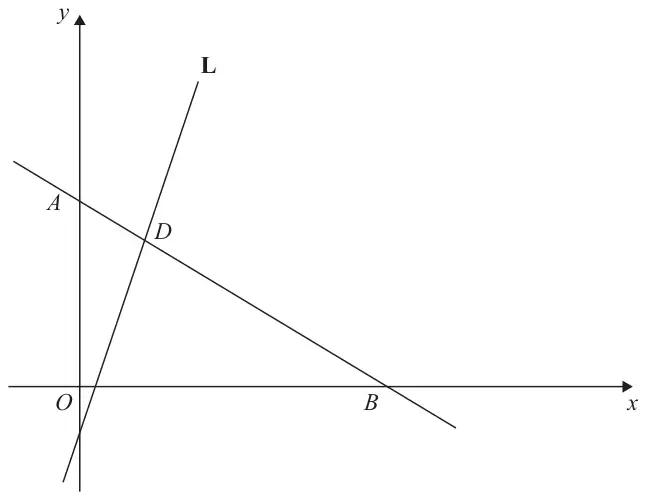
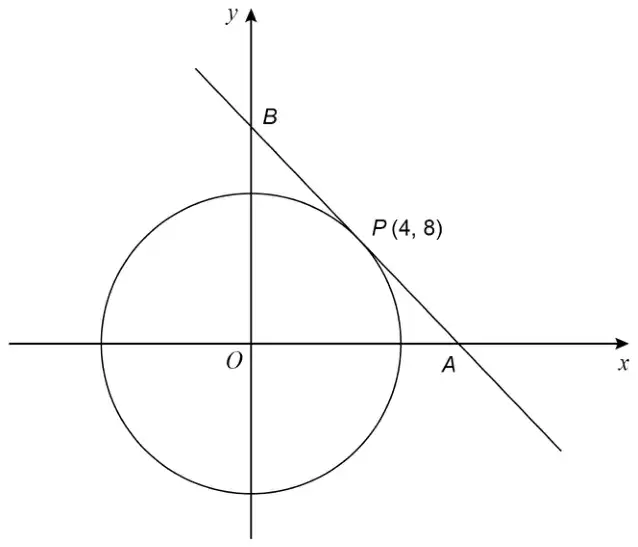
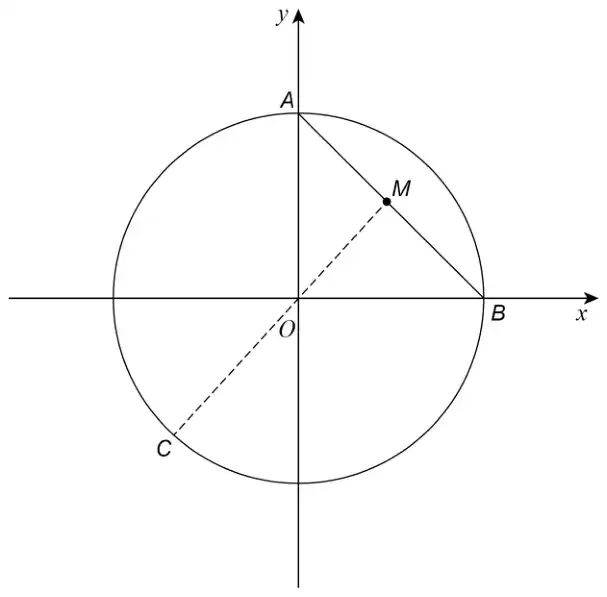
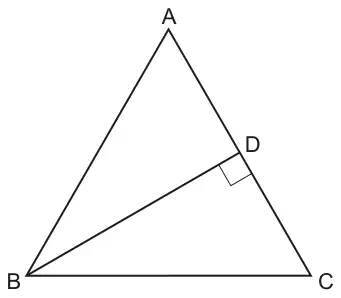
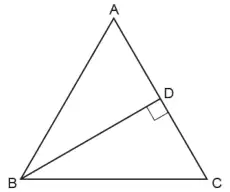
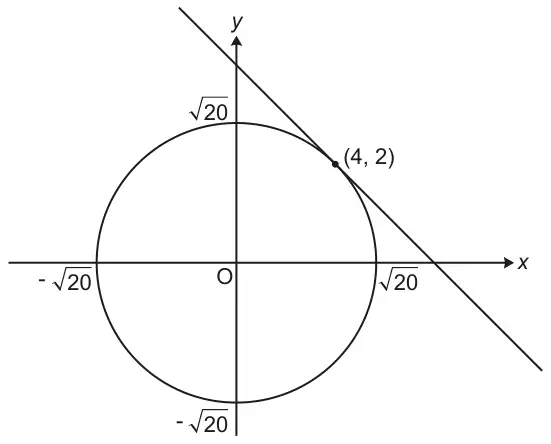
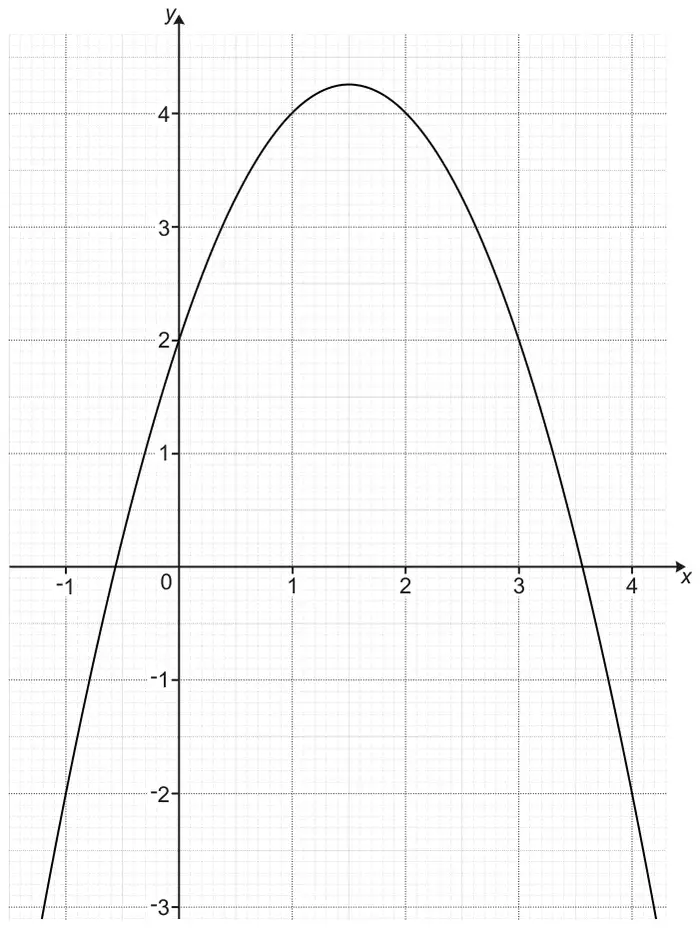
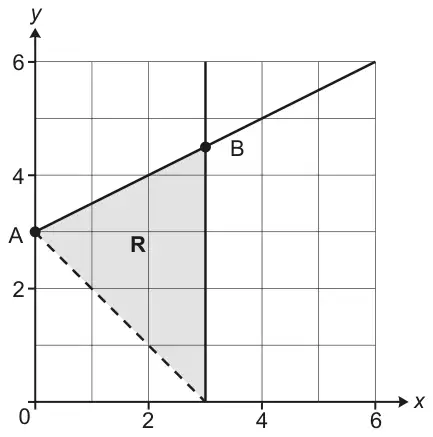
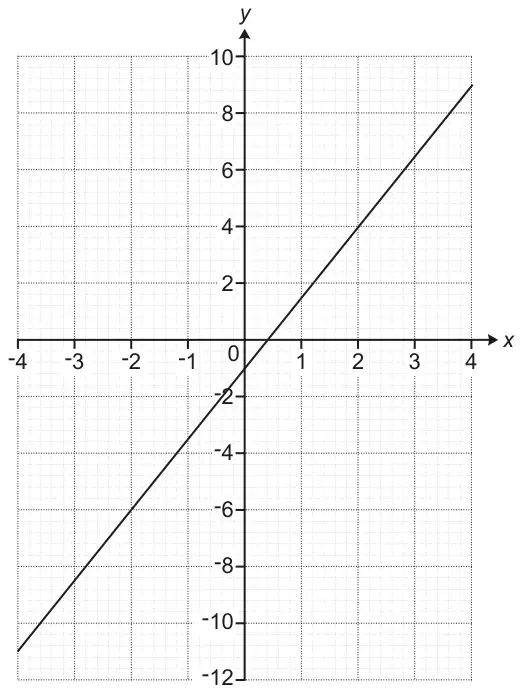
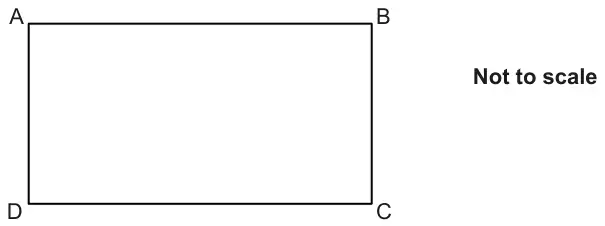
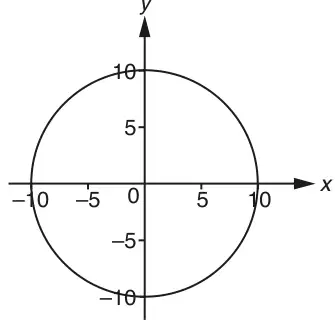
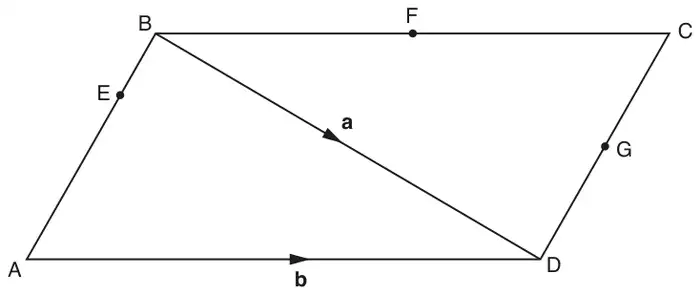
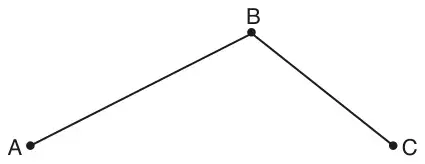
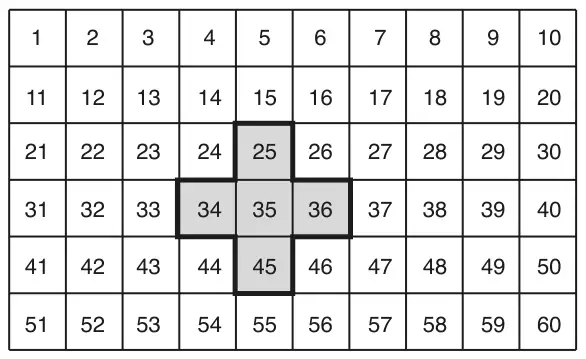
In the diagram \(A\) is the point \((0, 8)\) \(B\) is the point \((16, 0)\)
The point \(D\) divides the line segment \(AB\) in the ratio 1 : 3 The line L passes through \(D\). The gradient of L is \(\sqrt{3}\)
L passes through the point with coordinates \((-2, f)\)
Show that \(f \lt -4\) (5)
Mark scheme
Answer
Mark
Mark scheme
Shown
M1
for the method to find a coordinate of the point \(D\) eg \(\dfrac{1}{1 + 3} \times 16\ (= 4)\) or \(\dfrac{3}{1 + 3} \times 8\ (= 6)\) or (4, 6) labelled
M1
for a correct form for L, eg \(y = \sqrt{3}x + c\) OR a correct equation for the gradient of L, eg \(\dfrac{[6] - f}{[4] - -2} = \sqrt{3}\)
M1
for correct substitution to find \(c\) eg \([6] = \sqrt{3} \times [4] + c\) or \(y - [6] = \sqrt{3}(x - [4])\) or \(c = [6] - [4]\sqrt{3}\ (= -0.928\ldots)\) OR starts to rearrange equation for gradient, eg \([6] - f = ([4] - -2)\sqrt{3}\)
M1
(dep on previous M1) for the method to substitute in \(-2\), eg \(\sqrt{3} \times (-2) + [6] - \sqrt{3} \times [4]\) or \(\sqrt{3} \times (-2) + [c]\) OR a correct unevaluated expression for \(f\), eg \(f = [6] - ([4] - -2)\sqrt{3}\)
C1
accurate figure eg \(f = -4.39\ldots\) or \(-4.39\ldots \lt -4\)
Additional guidance
First two marks may be seen in either order Accept 4 or 6 stated or (6, 4)
Condone incorrect value for \(c\) when awarding this mark
[4] must be clearly identified as the \(x\)-coordinate of \(D\) if incorrect Award of this mark implies the previous mark [6] must be clearly identified as the \(y\)-coordinate of \(D\) if incorrect
[\(c\)] must be clearly what they have found to be the \(y\)-intercept of Land must have come from correct processes to evaluate
\(-4.39\ldots\) must come from correct working Accept \(-4.4\) or better
18 At the start of year \(n\), the population of deer in a park is \(D_n\) At the start of the following year, the population of the deer is \(D_{n+1}\)
\[D_{n+1} = K D_n \qquad \text{where } K \text{ is a constant.}\]
At the start of 2019, the population of the deer was 2000 At the start of 2020, the population of the deer was 2400
Show that, at the start of 2022, the population of the deer was greater than 3000 (3)
Mark scheme
Answer
Mark
Mark scheme
Shown
M1
for beginning to find \(K\) eg \(2400 = K \times 2000\) or \(K = 1.2\) oe
M1
For a correct method to find the value for 2021 or 2022, eg \(2400 \times \text{``}1.2\text{''}\ (= 2880)\) or \(2400 \times (\text{``}1.2\text{''})^2\ (= 3456)\) or \(2000 \times (\text{``}1.2\text{''})^2\ (= 2880)\) or \(2000 \times (\text{``}1.2\text{''})^3\ (= 3456)\) OR method to find rate leading to 3000 in 2022, eg \(\sqrt[3]{\dfrac{3000}{2000}}\ (= 1.144\ldots)\)
C1
for comparative figures eg 3456 (and 3000) OR \(3000 \div 2880 = 1.041\ldots\) and 1.2 OR 1.144… and 1.2
Additional guidance
M marks can be awarded in either order \(1.2^2 = 1.44\)
3000 need not be restated to award this mark If comparison made with 2023 or beyond do not award C1
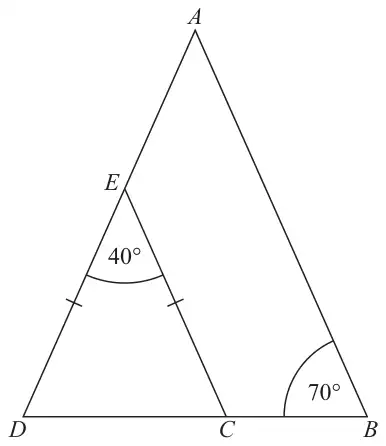
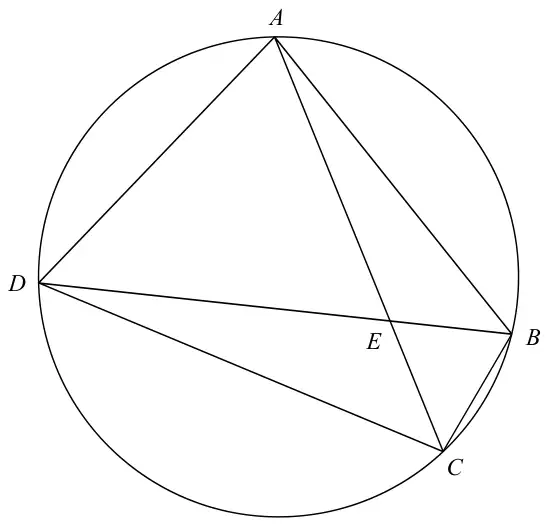
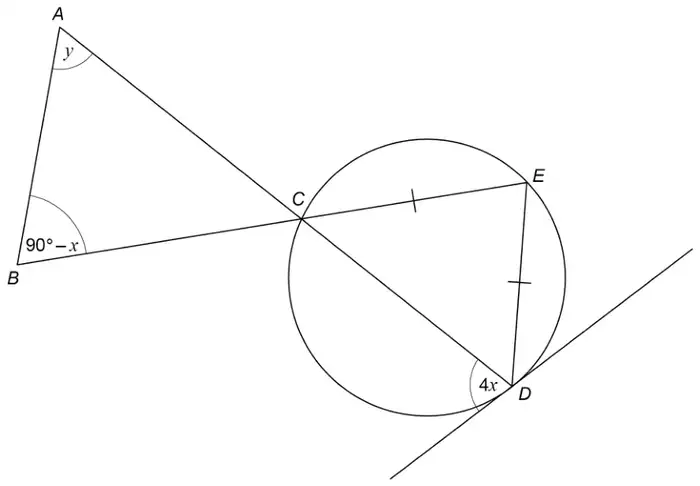
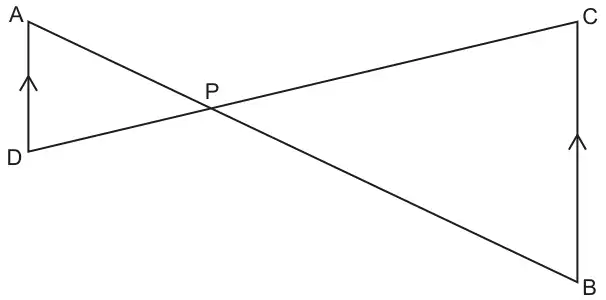
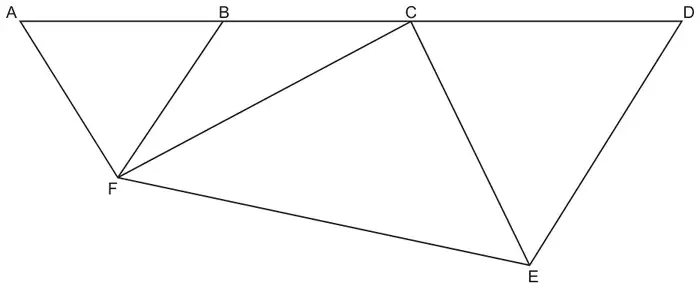
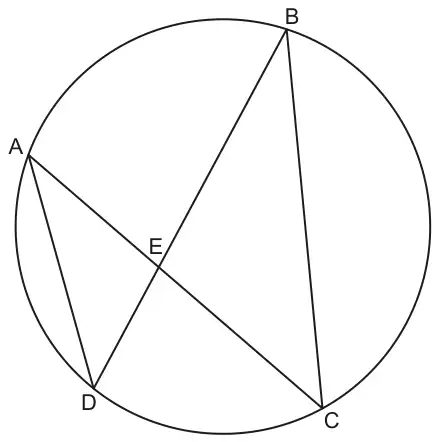
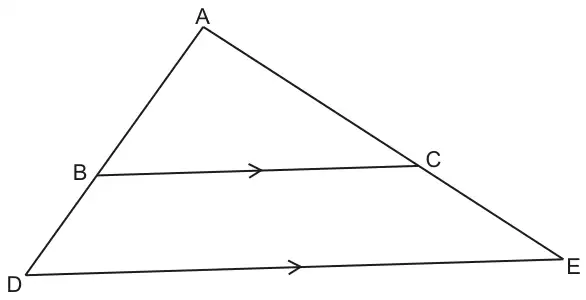
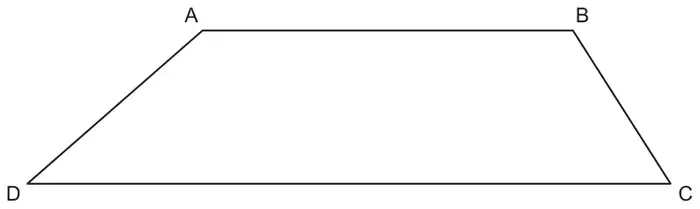
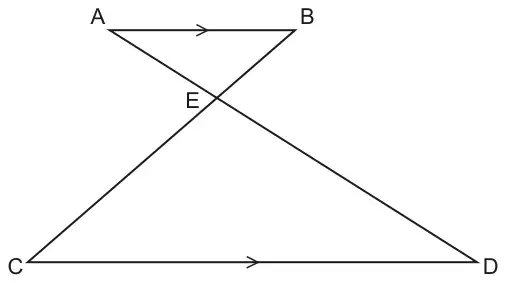
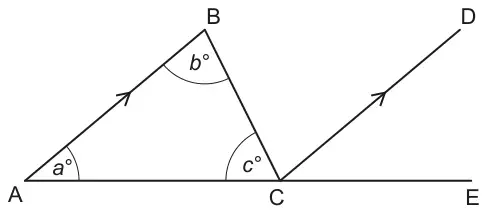
\(AED\) and \(BCD\) are straight lines. \(ED = EC\)
Show that \(EC\) is parallel to \(AB\). Give a reason for each stage of your working. (4)
Mark scheme
Answer
Mark
Mark scheme
Shown
C1
for angle \(ECD = 70\) or for angle \(ADB = 70\) and angle \(DAB = 40\)
C1
for a correct relevant reason relating to finding an angle in a triangle, eg • base angles of an isosceles triangle are equal • sum of angles in a triangle is 180
C1
for comparison of angles which would show that \(EC\) is parallel to \(AB\), eg • angle \(ECD\) = angle \(ABC\) (= 70) • angle \(BAD\) = angle \(CED\) (= 40) • angle \(BCX\) = angle \(ABC\) (= 70) • angle \(AEY\) = angle \(BAD\) (= 40) • angle \(ECB = 110\) and angle \(ECB\) + angle \(CBA = 180\) • angle \(AEC = 140\) and angle \(BAD\) + angle \(AEC = 180\) • angle \(ECD\) = angle \(ABD\) (= 70) and angle \(DAB\) = angle \(DEC\) (= 40)
C1
for a correct reason relating to angles in parallel lines which would show that \(EC\) is parallel to \(AB\), eg • corresponding angles are equal with angle \(ECD\) = angle \(ABC\) (= 70) • corresponding angles are equal with angle \(BAD\) = angle \(CED\) (= 40) • alternate angles are equal with angle \(BCX\) = angle \(ABC\) (= 70) • alternate angles are equal with angle \(AEY\) = angle \(BAD\) (= 40) • co-interior angles add to 180 with angle \(ECB\) + angle \(CBA = 180\) • co-interior angles add to 180 with angle \(BAD\) + angle \(AEC = 180\) • similar triangleswith angle \(ECD\) = angle \(ABD\) (= 70) and angle \(DAB\) = angle \(DEC\) (= 40)
Additional guidance
May be seen on the diagram
Do not award if an incorrect statement about angles in triangles seen.
Allow alternative correct labelling of angles eg angle \(ABD\) for angle \(ABC\) Must be identified in some way, not just angles written on diagram. Angles must be unambiguously identified. Where \(X\) is a point on \(EC\) extended. Where \(Y\) is a point on \(CE\) extended.
Reason must be consistent with their method. If superfluous reasons seen then we need the correct appropriate reason to be linked to the comparison of angles. Incorrect statement(s) seen is maximum 3 marks.
15 There are only 7 blue pens and 3 red pens in a box.
Raja takes at random one of the pens. He notes the colour of the pen and puts the pen back into the box.
Raja does this two more times.
Show that the probability that Raja takes at least two blue pens is \(\dfrac{98}{125}\) (4)
Mark scheme
Answer
Mark
Mark scheme
Shown
M1
for one correct product eg \(\dfrac{7}{10} \times \dfrac{7}{10} \times \dfrac{7}{10}\ \left(= \dfrac{343}{1000}\right)\) oe or \(\dfrac{7}{10} \times \dfrac{7}{10} \times \dfrac{3}{10}\ \left(= \dfrac{147}{1000}\right)\) oe or \(\dfrac{3}{10} \times \dfrac{3}{10} \times \dfrac{3}{10}\ \left(= \dfrac{27}{1000}\right)\) oe or \(\dfrac{3}{10} \times \dfrac{3}{10} \times \dfrac{7}{10}\ \left(= \dfrac{63}{1000}\right)\) oe or \(\dfrac{7}{10} \times \dfrac{7}{10}\ \left(= \dfrac{49}{100}\right)\) oe or \(\dfrac{3}{10} \times \dfrac{3}{10}\ \left(= \dfrac{9}{100}\right)\) oe
M1
for \(\dfrac{7}{10} \times \dfrac{7}{10} \times \dfrac{7}{10}\ \left(= \dfrac{343}{1000}\right)\) oe and \(\dfrac{7}{10} \times \dfrac{7}{10} \times \dfrac{3}{10}\ \left(= \dfrac{147}{1000}\right)\) oe or \(\dfrac{3}{10} \times \dfrac{3}{10} \times \dfrac{3}{10}\ \left(= \dfrac{27}{1000}\right)\) oe and \(\dfrac{3}{10} \times \dfrac{3}{10} \times \dfrac{7}{10}\ \left(= \dfrac{63}{1000}\right)\) oe or \(\dfrac{7}{10} \times \dfrac{7}{10}\ \left(= \dfrac{49}{100}\right)\) oe and \(\dfrac{7}{10} \times \dfrac{7}{10} \times \dfrac{3}{10}\ \left(= \dfrac{147}{1000}\right)\) oe or \(\dfrac{3}{10} \times \dfrac{3}{10}\ \left(= \dfrac{9}{100}\right)\) oe and \(\dfrac{3}{10} \times \dfrac{3}{10} \times \dfrac{7}{10}\ \left(= \dfrac{63}{1000}\right)\) oe
M1
for \(\dfrac{7}{10} \times \dfrac{7}{10} \times \dfrac{7}{10}\) oe and \(3 \times \dfrac{7}{10} \times \dfrac{7}{10} \times \dfrac{3}{10}\) oe or \(\dfrac{3}{10} \times \dfrac{3}{10} \times \dfrac{3}{10}\) oe and \(3 \times \dfrac{3}{10} \times \dfrac{3}{10} \times \dfrac{7}{10}\) oe or \(\dfrac{7}{10} \times \dfrac{7}{10}\) oe and \(2 \times \dfrac{7}{10} \times \dfrac{7}{10} \times \dfrac{3}{10}\) oe or \(\dfrac{3}{10} \times \dfrac{3}{10}\) oe and \(2 \times \dfrac{3}{10} \times \dfrac{3}{10} \times \dfrac{7}{10}\) oe
C1
for a complete method and chain of reasoning leading to \(\dfrac{98}{125}\) eg \(\dfrac{7}{10} \times \dfrac{7}{10} \times \dfrac{7}{10} + 3 \times \dfrac{7}{10} \times \dfrac{7}{10} \times \dfrac{3}{10} = \dfrac{98}{125}\) or \(1 - \dfrac{3}{10} \times \dfrac{3}{10} \times \dfrac{3}{10} - 3 \times \dfrac{3}{10} \times \dfrac{3}{10} \times \dfrac{7}{10} = \dfrac{98}{125}\) or \(\dfrac{7}{10} \times \dfrac{7}{10} + 2 \times \dfrac{7}{10} \times \dfrac{7}{10} \times \dfrac{3}{10} = \dfrac{98}{125}\) or \(1 - \dfrac{3}{10} \times \dfrac{3}{10} - 2 \times \dfrac{3}{10} \times \dfrac{3}{10} \times \dfrac{7}{10} = \dfrac{98}{125}\)
Additional guidance
Throughout accept probabilities given as decimals or percentages Condone sampling without replacement for the first method mark only provided it is in the form \(\dfrac{a}{10} \times \dfrac{b}{9} \times \dfrac{c}{8}\) where \(a\), \(b\), \(c\) are integers and \(a \lt 10\) and \(b \lt 9\) and \(c \lt 8\)
Condone any labelling, even if incorrect for the method marks
13 Show that \((2x + 3)(x - 1)(x + 2)\) can be written in the form \(ax^3 + bx^2 + cx + d\) where \(a\), \(b\), \(c\) and \(d\) are integers. (3)
Mark scheme
Answer
Mark
Mark scheme
Shown
M1
for a method to find the product of any two linear expressions (3 out of 4 terms correct or 4 terms ignoring signs) eg \(2x^2 - 2x + 3x - 3\ (= 2x^2 + x - 3)\) or \(x^2 - x + 2x - 2\ (= x^2 + x - 2)\) or \(2x^2 + 4x + 3x + 6\ (= 2x^2 + 7x + 6)\)
M1
(dep on M1) for a complete method to obtain all terms, half of which are correct (ft their first product) eg \(2x^3 - 2x^2 + 3x^2 + 4x^2 - 3x - 4x + 6x - 6\) or \(2x^3 - 2x^2 + 4x^2 - 4x + 3x^2 - 3x + 6x - 6\) or \(2x^3 + 4x^2 + 3x^2 + 6x - 2x^2 - 4x - 3x - 6\) or \(2x^3 + 4x^2 + x^2 - 3x + 2x - 6\) or \(2x^3 + 2x^2 + 3x^2 - 4x + 3x - 6\) or \(2x^3 - 2x^2 + 7x^2 - 7x + 6x - 6\)
C1
for \(2x^3 + 5x^2 - x - 6\) from correct working
Additional guidance
Note that, for example, \(2x^2 + x\) in the expansion of \((2x + 3)(x - 1)\) is regarded as 3 correct terms
First product must be quadratic with at least 3 terms but need not be simplified or may be simplified incorrectly
Accept \(a = 2, b = 5, c = -1, d = -6\) Condone \(-1x\)
11 Jamie drives his van for 150 minutes. He stops for a rest. Jamie then drives for a further 75 minutes.
(a) Show that Jamie drives for less than 4 hours in total. (2)
A car travels for 2 hours at a steady speed of 65 mph.
(b) Work out the distance the car travels. (2)
Mark scheme (a)
Answer
Mark
Mark scheme
Shown
M1
for a correct first step, eg method to convert, \(4 \times 60\ (= 240)\) or \(75 \div 60\ (= 1.25)\) or \(150 \div 60\ (= 2.5)\) or accurate converted time shown, eg 1(hr) 15(mins) oe or 2(hrs) 30(mins) oe or adding the two required times \(150 + 75\ (= 225)\)
C1
for accurate figures to compare, eg 240 and 225 (mins) or 3.75(hrs) or 3(hrs) 45(mins) or 15 mins spare (from \(240 - 150 - 75\))
Additional guidance
Units not required but if stated they must be correct.
Units not required but if stated they must be correct. An incorrect conversion will score C0, eg 3.75 incorrectly converted to 3hrs 75mins Figures are enough and a direct comparison to 4 hrs is not needed
10 Prove that the difference in the squares of two consecutive even numbers is always a multiple of 4 (3)
Mark scheme
Answer
Mark
Mark scheme
Proof
M1
for writing expressions for two consecutive even numbers, eg \(2n\) and \(2n + 2\) or \(2n - 2\) and \(2n\) or \(2n + 2\) and \(2n + 4\) oe (assuming \(n\) is any integer)
M1
(dep M1) for correctly expanding the squares of both expressions, eg \((2n + 2)^2 = 4n^2 + 4n + 4n + 4\) and \((2n)^2 = 4n^2\) or \((2n)^2 = 4n^2\) and \((2n - 2)^2 = 4n^2 - 4n - 4n + 4\) or \((2n + 4)^2 = 4n^2 + 8n + 8n + 16\) and \((2n + 2)^2 = 4n^2 + 4n + 4n + 4\)
or for a correct expression using the difference of two squares eg \((2n + 2 + 2n)(2n + 2 - 2n)\) oe or \((2n + 2n - 2)(2n - (2n - 2))\) oe
C1
for a complete proof without any errors leading to eg \(4(2n + 1)\) or \(4(2n - 1)\) or to a statement that eg \(8n + 4\) is a multiple of 4 because \(8n\) and 4 are both multiples of 4
Additional guidance
For both M marks accept use of linear expressions with a difference of 2, eg \(n\) and \(n + 2\) or \(n + 1\) and \(n + 3\)
A proof using eg \(n\) and \(n + 2\) must include a statement that \(n\) is even for the C mark to be awarded and a proof using eg \(n + 1\) and \(n + 3\) must include a statement that \(n\) is odd
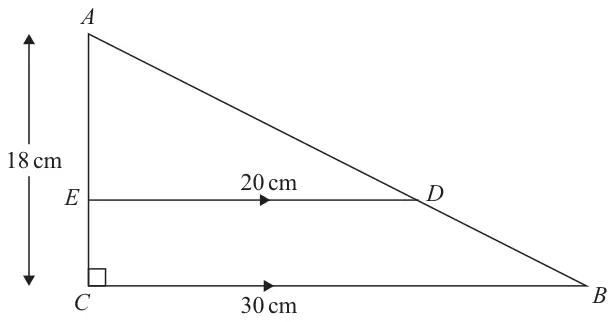
\(AEC\) and \(ADB\) are straight lines. \(ED\) is parallel to \(CB\).
(a) Prove that triangle \(ABC\) is similar to triangle \(ADE\). (2)
\(ED = 20\) cm \(CB = 30\) cm \(AC = 18\) cm
(b) Work out the length of \(EC\). (3)
Mark scheme (a)
Answer
Mark
Mark scheme
Proof
M1
for identifying angle \(A\) as common or for angle \(AED\) = angle \(ACB\) or angle \(ADE\) = angle \(ABC\) with appropriate reason(s) eg corresponding angles are equal or co-interior angles add up to 180 and angles on a straight line add up to 180
C1
for completing the proof by identifying a second pair of equal angles with appropriate reason(s) and a statement that the angles in each triangle are the same
Additional guidance
Statement can be implied by identifying a third pair of equal angles (no reason needed)
Mark scheme (b)
Answer
Mark
Mark scheme
6
P1
for a scale factor of 1.5 or \(\dfrac{2}{3}\) oe or for \(\dfrac{AE}{20} = \dfrac{18}{30}\) oe
P1
for a process to find the length of \(AE\), eg \(18 \div 1.5\ (= 12)\) oe or \((AE =)\ \dfrac{20 \times 18}{30}\) oe or for a complete process to find the length of \(EC\), eg \(18 \times \left(1 - \dfrac{2}{3}\right)\) oe
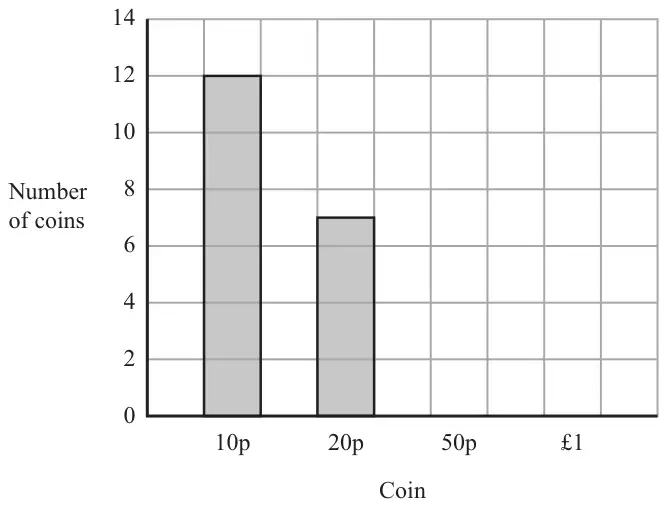
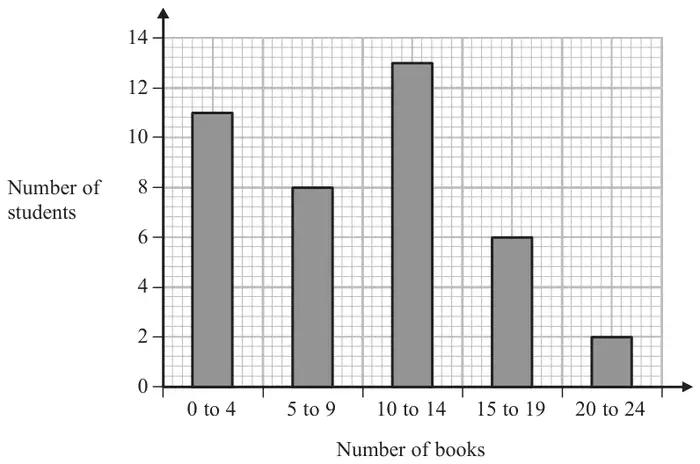
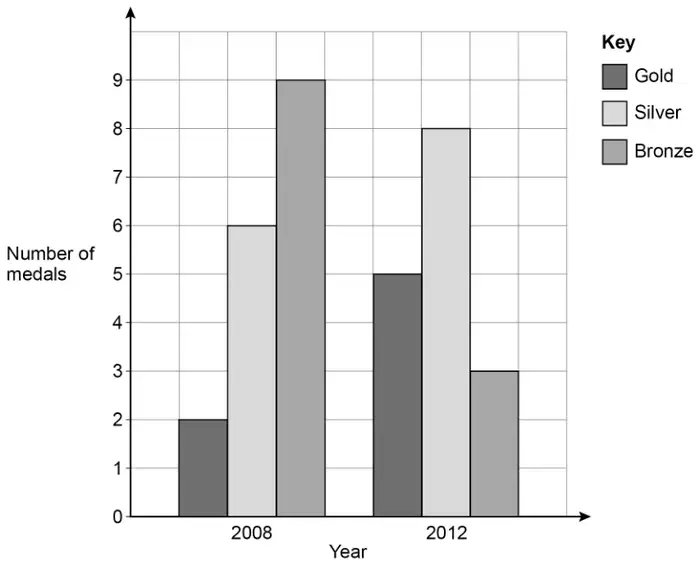
7 There are only 10p coins, 20p coins, 50p coins and £1 coins in a bag.
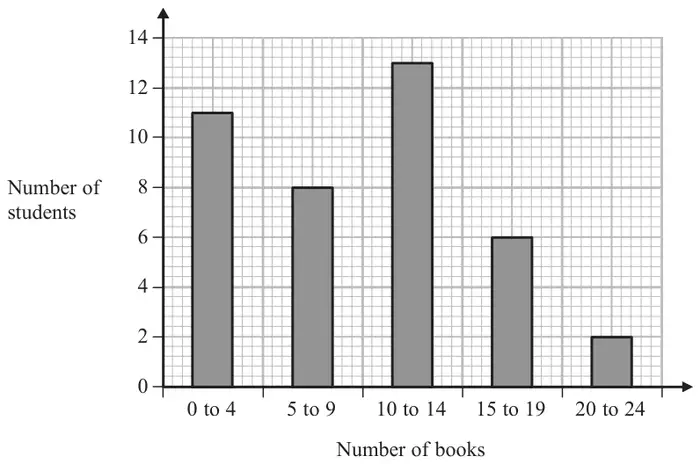
The bar chart shows information about the number of 10p coins and the number of 20p coins in the bag.
There are eight 50p coins in the bag. There are three £1 coins in the bag.
(a) Use this information to complete the bar chart. (2)
(b) Show that the total amount of money in the bag is less than £10 (3)
Mark scheme (a)
Answer
Mark
Mark scheme
Completed bar chart
B2
for a fully correct bar chart
(B1
for one bar correct, eg ‘50p’ plotted at 8 or ‘£1’ plotted at 3 or both reversed ie ‘50p’ plotted at 3 and ‘£1’ plotted at 8)
Additional guidance
Condone bars of unequal width Condone no gaps or inconsistent gaps
Mark scheme (b)
Answer
Mark
Mark scheme
Shown
M1
for method to find total amount of at least two coin types, from \(10\text{(p)} \times 12\ (= 120\text{(p)})\), \(20\text{(p)} \times 7\ (= 140\text{(p)})\), \(50\text{(p)} \times 8\ (= 400\text{(p)})\), \((\text{£})1 \times 3\ (= 300\text{(p) or (£)}3)\)
M1
for a complete method to find the total amount of money e.g. \(\text{``}120\text{''} + \text{``}140\text{''} + \text{``}400\text{''} + \text{``}300\text{''}\ (= 960)\) or \(\text{``}1.20\text{''} + \text{``}1.40\text{''} + \text{``}4\text{''} + \text{``}3\text{''}\ (= 9.60)\)
C1
(dep on method shown for totals for at least two coin types or separate correct totals for at least two coin types) showing correct comparable figures eg (£)9.6(0) or 960(p) and 1000(p) or (£)0.4(0) or 40p
Additional guidance
Accept mixed units for both method marks e.g. 10p x 12 (= 120), 20 x 7 (= 1.4), 50(p) x 8 (= 4), 1 x 3 (= 300)
Accept mixed units for both method marks e.g. 120 + 140 + 4 + 3 (= 9.60)
Answer must be in consistent units 9.60 oe alone with no working will score M1M1
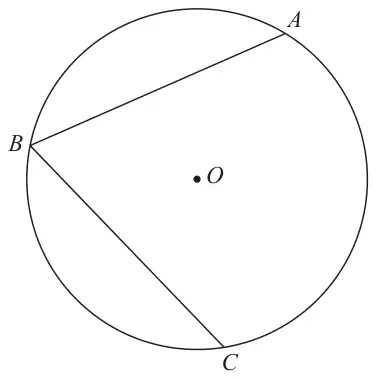
18 \(A\), \(B\) and \(C\) are three points on a circle, centre \(O\).
\(BA = BC\)
Prove that \(OB\) bisects angle \(ABC\). (3)
Mark scheme
Answer
Mark
Mark scheme
Proof
M1
begins proof to show that triangles \(ABO\) and \(CBO\) or triangles \(ABD\) and \(CBD\) are congruent by giving one pair of equal sides or equal angles with reason
M1
for different pair of equal sides or angles with reason
C1
for full proof that triangles \(ABO\) and \(CBO\) are congruent, SSS, or triangles \(ABD\) and \(CBD\) are congruent, RHS, and therefore angle \(ABO\) = angle \(CBO\)
\(AB = CB\) (given) \(BO\) (or \(BD\)) is common \(AO = CO\) radii of circle angle \(BAD\) = angle \(BCD\) angles in a semicircle are 90 (\(BO = AO = CO\) radii of circle) counts as two sides with reasons
OR
M1
draws \(OA\), \(OC\) and \(AC\) and labels angle \(OAC = x\) and angle \(OCA = x\) with reason given, \(AO = CO\) radii of circle and base angles of an isosceles triangle are equal or \(BAC = BCA\) since \(ABC\) is isosceles
M1
shows \(OAC = OCA\) and shows \(BAC = BCA\) and uses these to show \(OAB = OCB\) with all reasons given
C1
for full proof concluding with angle \(ABO = y\) and angle \(CBO = y\) with reason given, eg \(OA = OB = OC\) radii of circle and \(OBC\) and \(OAB\) are isosceles
Additional guidance
Where \(D\) is point such that \(BOD\) is diameter
17 Show that \(\dfrac{6x - y}{10xy} + \dfrac{1}{2x} - \dfrac{2y - 7x}{5xy}\) simplifies to \(\dfrac{k}{y}\) where \(k\) is an integer. (3)
Mark scheme
Answer
Mark
Mark scheme
shown
M1
for use of a common denominator for 2 correct fractions, eg 2 of \(\dfrac{6x - y}{10xy}\) or \(\dfrac{5y}{10xy}\) or \(\dfrac{2(2y - 7x)}{10xy}\) oe
M1
for a correct method to write as single fraction, eg \(\dfrac{6x - y}{10xy} + \dfrac{5y}{10xy} - \dfrac{4y - 14x}{10xy}\) or \(\dfrac{6x - y}{10xy} + \dfrac{5y}{10xy} - \dfrac{(4y - 14x)}{10xy}\) or \(\dfrac{6x - y + 5y - 4y + 14x}{10xy}\) or \(\dfrac{20x}{10xy}\) oe
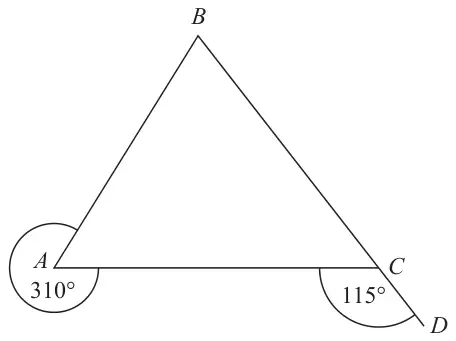
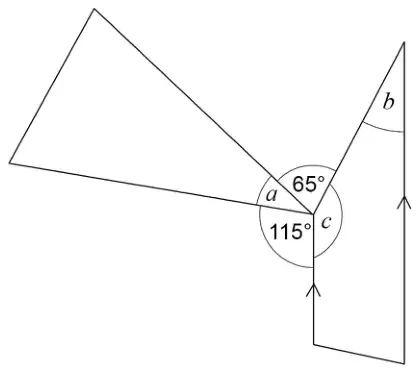
Show that triangle \(ABC\) is isosceles. Give a reason for each stage of your working. (4)
Mark scheme
Answer
Mark
Mark scheme
Shown
M1
for a method leading to the evaluation of another angle, (\(BAC =\)) \(360 - 310\ (= 50)\) or (\(ACB =\)) \(180 - 115\ (= 65)\)
M1
for a method to find at least 2 angles, eg (\(BAC =\)) \(360 - 310\ (= 50)\) and (\(ACB =\)) \(180 - 115\ (= 65)\)
C2
(dep M2) \(CBA = 65^\circ\) and statement and appropriate angle reasons, eg statement \(ACB = CBA\ (= 65^\circ)\) or two angles are equal (so it is isosceles) and angles at a point add up to 360, angles on a straight line add up to 180, angles in a triangle add up to 180,
OR (dep M2) \(CBA = 65^\circ\) and statement and appropriate angle reasons, eg statement \(ACB = CBA\ (= 65^\circ)\) or two angles are equal (so it is isosceles) and the exterior angle of a triangle is equal to the sum of the interior opposite anglesandangles on a straight line add up to 180 orangles in a triangle add up to 180
(C1
(dep on M1) for any one appropriate reason related to method shown)
Additional guidance
Angles may be seen on diagram
Underlined words need to be shown; reasons need to be linked to their method.
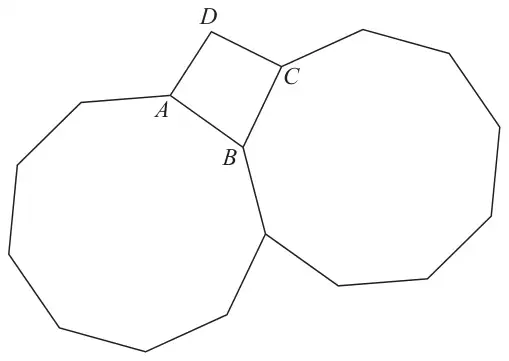
9 The diagram shows two congruent regular 9-sided polygons. \(ABCD\) is a quadrilateral.
Show that \(ABCD\) is not a square. (3)
Mark scheme
Answer
Mark
Mark scheme
shown
M1
for method to find the interior angle eg \((9 - 2) \times 180 \div 9\ (= 140)\) or exterior angle eg \(360 \div 9\ (= 40)\) of a regular nonagon
M1
for a complete method to find the interior angle \(ABC\), eg \(360 - \text{``}140\text{''} - \text{``}140\text{''}\ (= 80)\) or \(\text{``}40\text{''} \times 2\ (= 80)\) or finds the angle sum assuming a square, eg \(90 + \text{``}140\text{''} + \text{``}140\text{''}\ (= 370)\)
A1
for complete solution with correct conclusion, eg interior angle of a square is 90, not 80 or angles around a point sum to 360 not 370
Additional guidance
Angles may be shown on the diagram Any angle labelled correctly as 140 or 40 and not contradicted scores this mark
8 Junaid says that 20 is a square number because \(10^2 = 20\)
(a) Is Junaid correct? Give a reason for your answer. (1)
Chloe says,
“When you divide an even number by an even number the answer is always an even number.”
(b) Write down an example to show that Chloe is wrong. (1)
Mark scheme (a)
Answer
Mark
Mark scheme
No and reason
C1
No and reason
Acceptable examples No, because \(10^2 = 100\) or \(10^2\) is \(10 \times 10\) \(4^2 = 16\) and \(5^2 = 25\) so 20 is not a square number Junaid is wrong because \(\sqrt{20} \neq 10\) or \(\sqrt{20} = 4.47\ldots\) Incorrect because 20 is \(2 \times 10\) not \(10 \times 10\) No she multiplied by 2 instead of squaring or \(10^2\) is not \(10 \times 2\) Wrong as she added instead of multiplying
Not acceptable examples Yes…. No because 20 is \(10 \times 2\) Incorrect because 20 is not a square number No because \(10^2\) is not 20 No because she added No because a square number is when a number is multiplied by itself
Mark scheme (b)
Answer
Mark
Mark scheme
example
C1
for a correctly evaluated example, eg \(12 \div 4 = 3\) or \(10 \div 2 = 5\) or \(2 \div 4 = 0.5\)
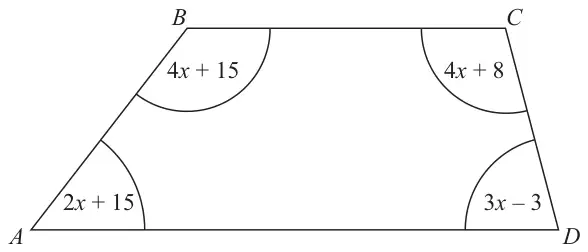
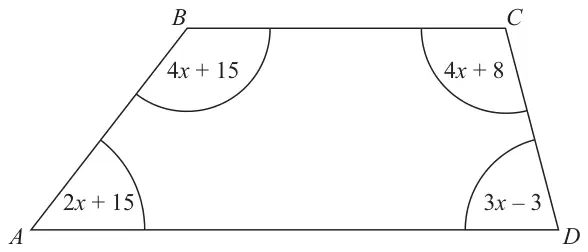
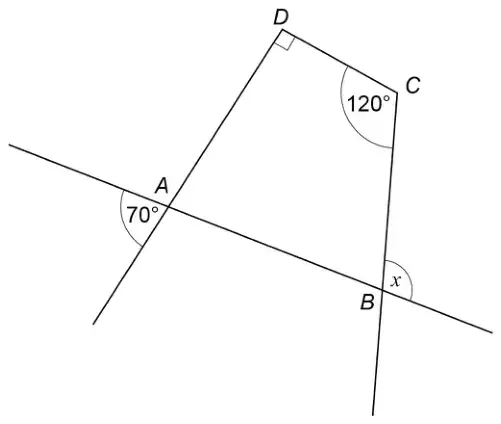
for deriving a suitable equation, eg \(4x + 15 + 2x + 15 + 4x + 8 + 3x - 3 = 360\) or \(13x + 35 = 360\) or \(4x + 15 + 2x + 15 = 180\) or \(6x + 30 = 180\) or \(4x + 8 + 3x - 3 = 180\) or \(7x + 5 = 180\)
M1
(dep) for a method to isolate terms in \(x\), eg \(4x + 2x + 4x + 3x = 360 - 15 - 15 - 8 + 3\) or \(4x + 2x = 180 - 15 - 15\) or \(4x + 3x = 180 - 8 + 3\)
A1
for solving equation to \(x = 25\)
C1
for substituting \(x = 25\) into \(A + B\) or \(C + D\) and showing \(= 180\), and gives a suitable statement, eg co-interior/allied angles (sum to 180), or since \(A + B = 180\) the lines are parallel
Additional guidance
May be seen in an equation
If starting with an equation = 180 need to substitute into the opposite pair.
Alternative solution assuming it is a trapezium
Answer
Mark
Mark scheme
Shown
M1
for deriving a suitable equation, eg \(4x + 15 + 2x + 15 = 4x + 8 + 3x - 3\) or \(6x + 30 = 7x + 5\)
M1
(dep) for a method to isolate terms in \(x\), eg \(15 + 15 - 8 + 3 = 4x + 3x - 4x - 2x\)
A1
for solving equation to \(x = 25\)
C1
for a fully correct statement, eg since \(A + B = 180\) the lines are parallel
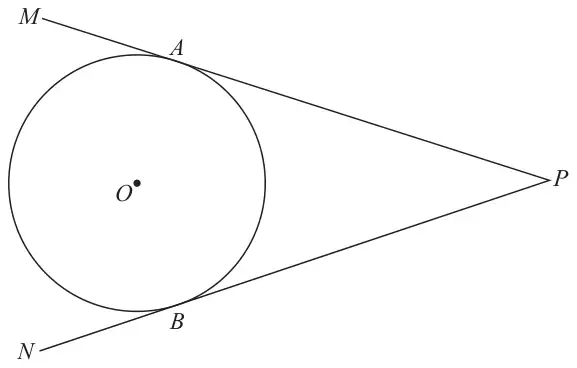
22 \(A\) and \(B\) are points on a circle, centre \(O\).
\(MAP\) and \(NBP\) are tangents to the circle.
Prove that \(AP = BP\) (4)
Mark scheme
Answer
Mark
Mark scheme
Proof
C1
for angle \(OAP\) = angle \(OBP = 90\) angle between radius and tangent is 90°
C1
for \(OA = OB\) both radii
C1
\(OP\) is common
C1
(dep on C3) for a complete proof with all reasons given, eg triangles \(OAP\) and \(OBP\) are congruent RHS so \(AP = BP\) or \(AP = \sqrt{OP^2 - OA^2}\) and \(BP = \sqrt{OP^2 - OB^2}\) and \(OA = OB\) so \(AP = BP\)
Additional guidance
May be seen as 2 separate diagrams
All reasons given must be clearly linked to the appropriate statement
Underlined words need to be shown
Alternative
Answer
Mark
Mark scheme
Proof
C1
for \(\cos AOP = \dfrac{AO}{OP} = \dfrac{r}{OP}\) or \(\cos BOP = \dfrac{BO}{OP} = \dfrac{r}{OP}\) angle between radius and tangent is 90°
C1
for \(\cos AOP = \dfrac{AO}{OP} = \dfrac{r}{OP}\) and \(\cos BOP = \dfrac{BO}{OP} = \dfrac{r}{OP}\) and \(AOP = BOP\) both radii
C1
\(OP\) is common
C1
(dep on C3) for a complete proof with all reasons given, eg triangles \(OAP\) and \(OBP\) are congruent SAS so \(AP = BP\)
May be seen as 2 separate diagrams Underlined words need to be shown
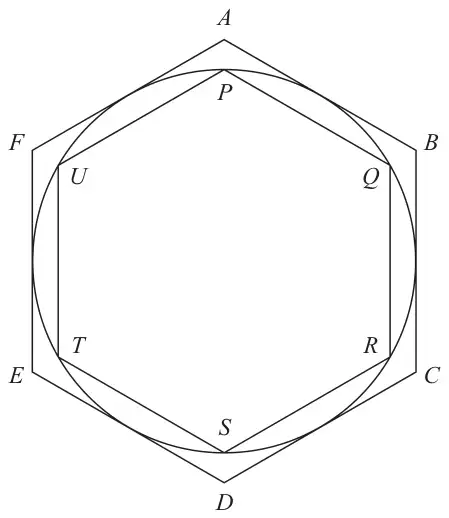
21 The diagram shows a circle, radius \(r\) cm and two regular hexagons.
Each side of the larger hexagon \(ABCDEF\) is a tangent to the circle. Each side of the smaller hexagon \(PQRSTU\) is a chord of the circle.
By considering perimeters, show that
\[3 \lt \pi \lt 2\sqrt{3}\]
(4)
Mark scheme
Answer
Mark
Mark scheme
Result shown
P1
for process to find the length of half a side or a side or the perimeter of the smaller hexagon \(PQRSTU\), eg \(r\sin 30\ \left(= \dfrac{r}{2}\right)\) oe or \(2r\sin 30\ (= r)\) oe or \(6 \times 2r\sin 30\ (= 6r)\) oe
P1
for process to find the length of half a side or a side or the perimeter of the larger hexagon \(ABCDEF\) eg Length of half side \(= r\tan 30\) or \(\dfrac{r}{\tan 60}\ \left(= \dfrac{\sqrt{3}r}{3}\right)\) oe or Length of side \(= 2r\tan 30\) or \(\dfrac{2r}{\tan 60}\) or \(\dfrac{r}{\sin 60}\) or \(\dfrac{r}{\cos 30}\ \left(= \dfrac{2\sqrt{3}r}{3}\right)\) oe or Length of perimeter \(= 6 \times 2r\tan 30\) or \(6 \times \dfrac{2r}{\tan 60}\) oe
P1
(dep P2) for process of forming a correct inequality, eg using half lengths eg \(\dfrac{r}{2} \lt \dfrac{2\pi r}{12} \lt r\tan 30\) oe or using lengths eg \(r \lt \dfrac{2\pi r}{6} \lt 2r\tan 30\) oe or using perimeters eg \(6 \times r \lt 2\pi r \lt 6 \times 2r\tan 30\) oe
C1
(dep P2) correct algebra leading to given result, \(3 \lt \pi \lt 2\sqrt{3}\)
Additional guidance
May use Sine Rule or cos60 instead of sin30
May use Sine Rule Note this mark is not for just the sight of \(\dfrac{\sqrt{3}r}{3}\) or \(\dfrac{2\sqrt{3}r}{3}\) or \(\dfrac{12\sqrt{3}r}{3}\) oe, they need to be associated with the correct length Perimeter \(= 4\sqrt{3}r\) alone does not get this mark
10 There are only red counters and yellow counters in bag A.
\[\text{number of red counters} : \text{number of yellow counters} = 3 : 5\]
There are only green counters and blue counters in bag B. The number of counters in bag B is half the number of counters in bag A.
Given that there are \(x\) red counters in bag A,
use algebra to show that the total number of counters in bag A and bag B is \(4x\) (3)
Mark scheme
Answer
Mark
Mark scheme
Result shown
M1
for method to find the number of yellow counters in bag A, eg \(x \div 3 \times 5\ \left(= \dfrac{5x}{3}\right)\) or for method to find the total number of counters in bag A eg \(x \div 3 \times 8\ \left(= \dfrac{8x}{3}\right)\) or for starting to work with ratio using algebra eg \(3y\), \(5y\)
M1
(dep) for method to find the total number of counters in bag B, eg \(\left(x + \text{``}\dfrac{5x}{3}\text{''}\right) \div 2\ \left(= \dfrac{4x}{3}\right)\) or \(\text{``}\dfrac{8x}{3}\text{''} \div 2\ \left(= \dfrac{4x}{3}\right)\) or \((3y + 5y) \div 2\ (= 4y)\)
C1
for complete method showing that total number of counters in bag A and bag B is \(4x\), eg \(\dfrac{8x}{3} + \dfrac{4x}{3} = 4x\) or \(3y + 5y + 4y = 12y\) and \(12y \div 3y \times x = 4x\)
Additional guidance
Could use any letter other than \(y\) apart from \(x\)
For the method marks condone decimals that are rounded or truncated to 1dp
For the C mark only accept values that are shown to be recurring and allow \(3.\dot{9}x = 4x\)
(c) Show that there is a number for which the output is the same as the input. (2)
Mark scheme (a)
Answer
Mark
Mark scheme
16
B1
cao
Mark scheme (b)
Answer
Mark
Mark scheme
19
M1
starts method to find input using inverse operations eg \(28 + 10\ (=38)\) or sight of \(+10\) and \(\div 2\)
A1
cao
Additional guidance
\(+10\) and \(\div 2\) could be seen in a flow diagram Working may be next to number machine.
Mark scheme (c)
Answer
Mark
Mark scheme
Shown
M1
for carrying out at least one trial or for forming a suitable equation, eg \(2x - 10 = x\) or for identifying 10
C1
for showing that an input of 10 gives an output of 10
Additional guidance
Trial can be for any value, must be correctly evaluated. Accept correct inverse function trial, correctly evaluated. If working seen on the number machine provided in the question allow for a trial other than input 13 or output 28.
The cost of ski hire is £26 per day. The cost of a lift pass is £45 per day. The cost of ski lessons is £23.50 per hour.
Lucia will pay for
ski hire for 5 days a lift pass for 4 days ski lessons for 8 hours.
Lucia has £500
Show that Lucia has enough money to pay for the total cost of ski hire, the lift pass and the ski lessons. (3)
Mark scheme
Answer
Mark
Mark scheme
Shown
P1
for a start to process of finding the total cost, eg \(5 \times 26\ (= 130)\) or \(4 \times 45\ (= 180)\) or \(8 \times 23.50\ (= 188)\) or \(26 + 45 + 23.50\ (= 94.5(0))\) or for a start to process of finding money left after paying costs, eg \(500 - 26\ (= 474)\) or \(500 - 45\ (= 455)\) or \(500 - 23.50\ (= 476.5(0))\) or \(500 - 5 \times 26\ (= 370)\) or \(500 - 4 \times 45\ (= 320)\) or \(500 - 8 \times 23.50\ (= 312)\)
(dep) for a method to isolate terms in \(x\), eg \(4x + 2x + 4x + 3x = 360 - 15 - 15 - 8 + 3\) or \(4x + 2x = 180 - 15 - 15\) or \(4x + 3x = 180 - 8 + 3\)
A1
for solving equation to \(x = 25\)
C1
for substituting \(x = 25\) into \(A + B\) or \(C + D\) and showing = 180, and gives a suitable statement, eg co-interior/allied angles (sum to 180), or since \(A + B = 180\) the lines are parallel
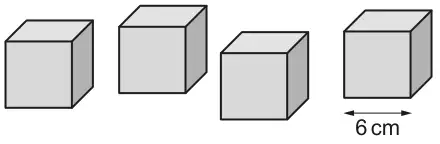
The pressure on the table due to the cube is 3.5 newtons/cm2 The force exerted by the cube on the table is 504 newtons.
Show that the total surface area of the cube is less than 900 cm2(3)
Mark scheme
Answer
Mark
Mark scheme
Shown
M1
for substitution to find area of face, eg \(3.5 = \dfrac{504}{\text{area}}\) or \(3.5 \times \text{area} = 504\) or \(\text{area} = 504 \div 3.5\ (= 144)\) or for working from surface area eg \(900 \div 6\ (= 150)\)
M1
for method to find comparable figures, eg \(\text{``}144\text{''} \times 6\ (= 864)\) or \(\text{``}150\text{''} \times 3.5\ (= 525)\) or \(504 \div \text{``}150\text{''}\ (= 3.36\ldots)\) or \(504 \div 3.5\ (= 144)\) and \(900 \div 6\ (= 150)\) or \(900 \div 144\ (= 6.25)\) and 6
C1
for correct comparable figures, eg 864 (and 900) or 144 and 150 or 525 (and 504) or 3.36… (and 3.5) or 6.25 and 6
Additional guidance
Other equivalent methods should be credited accordingly
(a) Show that the equation \(x^3 + 2x - 6 = 0\) has a solution between \(x = 1\) and \(x = 2\) (2)
(b) Show that the equation \(x^3 + 2x - 6 = 0\) can be rearranged to give \(x = \dfrac{6}{x^2 + 2}\) (1)
(c) Starting with \(x_0 = 1.45\) use the iteration formula \(x_{n + 1} = \dfrac{6}{x_n^{\,2} + 2}\) twice to find an estimate for the solution of \(x^3 + 2x - 6 = 0\) Give your answer correct to 4 decimal places. (3)
Mark scheme (a)
Answer
Mark
Mark scheme
Shown
M1
For a start to establish at least one root in [1,2], eg substitutes \(x = 1\) or \(x = 2\) into LHS, eg \(1^3 + 2 \times 1 - 6\), or \(2^3 + 2 \times 2 - 6\)
C1
For a complete argument, eg evaluates for both values of \(x\) and states since there is a sign change there must be at least one root in \(1 \lt x \lt 2\) (as f is continuous)
for showing re-arrangement; must see \(x^3 + 2x - 6 = 0\) leading to \(x(x^2 + 2) - 6 = 0\) or \(x(x^2 + 2) = 6\) or \(x = \dfrac{6}{x^2 + 2}\) leading to \(x^3 + 2x = 6\)
Mark scheme (c)
Answer
Mark
Mark scheme
1.4496
M1
for \(x_1 = \dfrac{6}{1.45^2 + 2}\ (= 1.462(522851\ldots))\)
M1
for \(x_2 = \dfrac{6}{\text{``}1.462(52\ldots)\text{''}^2 + 2}\ (= 1.449634937)\)
A1
for answer in the range 1.4496 to 1.4497
Additional guidance
If a correct value is given and then rounded or rounded incorrectly award full marks.
The pressure on the table due to the cube is 3.5 newtons/cm2 The force exerted by the cube on the table is 504 newtons.
Show that the total surface area of the cube is less than 900 cm2(3)
Mark scheme
Answer
Mark
Mark scheme
Shown
M1
for substitution to find area of face, eg \(3.5 = \dfrac{504}{\text{area}}\) or \(3.5 \times \text{area} = 504\) or \(\text{area} = 504 \div 3.5\ (= 144)\) or for working from surface area eg \(900 \div 6\ (= 150)\)
M1
for method to find comparable figures, eg \(\text{``}144\text{''} \times 6\ (= 864)\) or \(\text{``}150\text{''} \times 3.5\ (= 525)\) or \(504 \div \text{``}150\text{''}\ (= 3.36\ldots)\) or for \(504 \div 3.5\ (= 144)\) and \(900 \div 6\ (= 150)\) or for \(900 \div 144\ (= 6.25)\) and 6
C1
for correct comparable figures, eg 864 (and 900) or 144 and 150 or 525 (and 504) or 3.36… (and 3.5) or 6.25 and 6
Additional guidance
Other equivalent methods should be credited accordingly
Show that Curtis can buy all the items he needs. (4)
Mark scheme
Answer
Mark
Mark scheme
Shown
M1
for a method to find the total cost for footballs, hockey sticks or cricket bats, eg \(9.5 \times 5\ (= 47.5)\) or \((6 \div 2) \times 30\ (= 90)\) or \(23 \times 2\ (= 46)\) OR begins to work with budget, eg \(200 - 5\ (= 195)\)
M1
for a method to find the total cost for two of footballs, hockey sticks or cricket bats, eg two from \(9.5 \times 5\ (= 47.5)\) or \((6 \div 2) \times 30\ (= 90)\) or \(23 \times 2\ (= 46)\) OR works with budget and total cost for one of footballs, hockey sticks or cricket bats, eg \(200 - \text{``}47.5\text{''}\)
M1
for a complete method to find comparable figures, eg \(9.5 \times 5 + (6 \div 2) \times 30 + 23 \times 2 + 5\) or \(\text{``}47.5\text{''} + \text{``}90\text{''} + \text{``}46\text{''} + 5\) or \(200 - (9.5 \times 5 + (6 \div 2) \times 30 + 23 \times 2 + 5)\) or \(200 - \text{``}188.5\text{''}\)
C1
shows correct figures for a conclusion eg (£)188.5(0) or (£)11.5(0)
Additional guidance
Can be done with addition or subtraction, or combination
Figures need not be supported by words but must not be contradicted.
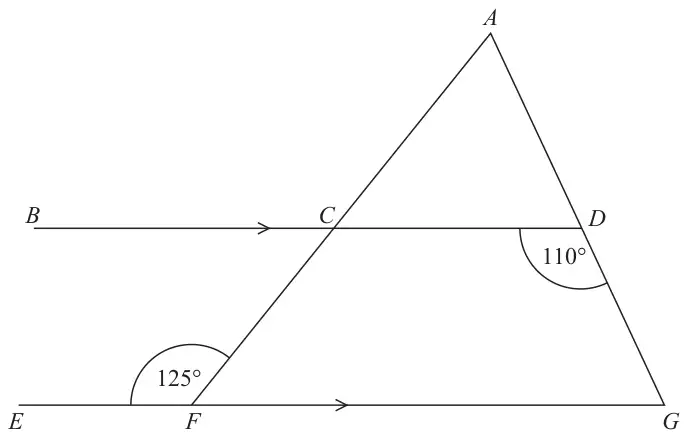
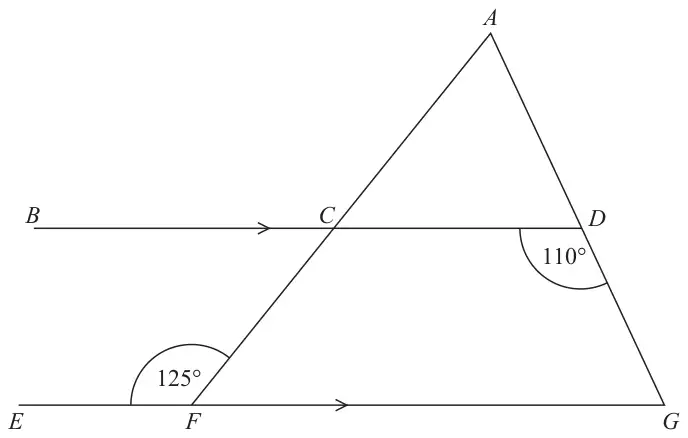
22 \(ACF\) and \(ADG\) are straight lines. \(BCD\) and \(EFG\) are parallel lines.
Show that triangle \(ACD\) is isosceles. Give a reason for each stage of your working. (5)
Mark scheme
Answer
Mark
Mark scheme
Shown with reasons
M1
for method to find \(ACD\) using parallel lines eg \(BCA = 125\) and \(ACD = 180 - 125\ (= 55)\) or \(BCF = 180 - 125\ (= 55) = ACD\) or \(FCD = 125\) and \(ACD = 180 - 125\ (= 55)\) or \(CFG = 180 - 125\ (= 55) = ACD\)
M1
for method to find \(ADC\) eg \(180 - 110\ (= 70)\) or for method to find \(CAD\) eg \(180 - (\text{``}70\text{''} + \text{``}55\text{''})\ (= 55)\) or \(110 - \text{``}55\text{''}\ (= 55)\)
A1
for \(ACD = 55\) and \(CAD = 55\)
C1
for one correct parallel lines reason linked to their method eg Corresponding angles are equal Allied angles / Co-interior angles add up to 180 Alternate angles are equal
C1
for one other reason stated linked to their method eg Angles on a straight line add up to 180 Angles in a triangle add up to 180 Vertically opposite angles are equal OR Vertically opposite angles are equal The exterior angle of a triangle is equal to the sum of the interior opposite angles. Angles in a quadrilateral add up to 360. Accept “4-sided shape”
Additional guidance
Angles must be clearly labelled on the diagram or otherwise identified. Correct method can be implied from angles on the diagram if no ambiguity or contradiction.
Underlined words need to be shown; reasons need to be linked to their method, which can be implied from correctly identified angles (stated or written on the diagram).
for start to method to find a ratio connecting 2 of \(a\), \(b\) and \(c\), eg \(a : c = 3 : 5\) oe or \(b : c = 5 : 3\) oe or for start to method to combine ratios, eg \(14a : 35c\ (= 126 : 525)\) and \(20b : 35c\ (= 500 : 525)\)
M1
for method to find \(a : b : c\), eg 9 : 25 : 15 oe or for method to write \(a + b : b + c\) in terms of one variable eg \(\dfrac{3c}{5} + \dfrac{5c}{3} : \dfrac{5c}{3} + c\)
A1
for \(a + b : b + c = 34 : 40\) oe leading to result
Additional guidance
May be expressed in fractional form Any ratios must be clearly assigned to variables
(a) Show that the equation \(x^4 - x^2 - 5 = 0\) can be written in the form \(x = \sqrt[4]{x^2 + 5}\) (1)
(b) Starting with \(x_0 = 1.5\) use the iteration formula \(x_{n+1} = \sqrt[4]{x_n^2 + 5}\) three times to find an estimate for a solution of \(x^4 - x^2 - 5 = 0\) (3)
Mark scheme (a)
Answer
Mark
Mark scheme
Shows re- arrangement
C1
for showing rearrangement, must see \(x^4 = x^2 + 5\) leading to \(x = \sqrt[4]{x^2 + 5}\)
Additional guidance
Can work backwards
Mark scheme (b)
Answer
Mark
Mark scheme
1.669763088
M1
for substitution to find \(x_1\) eg \(\sqrt[4]{1.5^2 + 5}\ (= 1.64\ldots)\)
M1
for substitution to find \(x_2\) eg \(\sqrt[4]{{\text{``}1.64\ldots\text{''}}^2 + 5}\ (= 1.66\ldots)\)
A1
for answer in the range 1.6697 to 1.6698 or 1.67(0)
Additional guidance
If a correct value is given and then rounded or rounded incorrectly award full marks
14 Show that \(\dfrac{x^2 - x - 6}{2x^2 - 5x - 3}\) can be written in the form \(\dfrac{ax + b}{cx + d}\) where \(a\), \(b\), \(c\) and \(d\) are integers. (3)
Mark scheme
Answer
Mark
Mark scheme
\(\dfrac{x + 2}{2x + 1}\)
M1
for correctly factorising one expression, eg \((x - 3)(x + 2)\) or \((x - 3)(2x + 1)\)
M1
for factorising both expressions, eg \((x - 3)(x + 2)\) and \((x - 3)(2x + 1)\)
12 Show that \((x - 1)(x + 3)(x - 5)\) can be written in the form \(ax^3 + bx^2 + cx + d\) where \(a\), \(b\), \(c\) and \(d\) are integers. (3)
Mark scheme
Answer
Mark
Mark scheme
Shown
M1
for a method to find the product of two linear expressions (3 out of 4 terms correct or 4 correct terms ignoring signs) eg \(x^2 + 3x - x - 3\) or \(x^2 + 3x - 5x - 15\) or \(x^2 - 5x - x + 5\)
M1
for a complete method to obtain all terms, half of which are correct (ft their first product) eg \(x^3 - 5x^2 - 10x + 2x^2 - 3x + 15\)
3 \(ACF\) and \(ADG\) are straight lines. \(BCD\) and \(EFG\) are parallel lines.
Show that triangle \(ACD\) is isosceles. Give a reason for each stage of your working. (5)
Mark scheme
Answer
Mark
Mark scheme
Shown with reasons
M1
for method to find \(ACD\) using parallel lines eg \(BCA = 125\) and \(ACD = 180 - 125\ (= 55)\) or \(BCF = 180 - 125\ (= 55) = ACD\) or \(FCD = 125\) and \(ACD = 180 - 125\ (= 55)\) or \(CFG = 180 - 125\ (= 55) = ACD\)
M1
for method to find \(ADC\) eg \(180 - 110\ (= 70)\) or for method to find \(CAD\) eg \(180 - (\text{``}70\text{''} + \text{``}55\text{''})\ (= 55)\) or \(110 - \text{``}55\text{''}\ (= 55)\)
A1
for \(ACD = 55\) and \(CAD = 55\)
C1
for one correct parallel lines reason linked to their method eg Corresponding angles are equal Allied angles / Co-interior angles add up to 180 Alternate angles are equal
C1
for one other reason stated linked to their method eg Angles on a straight line add up to 180 Angles in a triangle add up to 180 Vertically opposite angles are equal OR Vertically opposite angles are equal The exterior angle of a triangle is equal to the sum of the interior opposite angles. Angles in a quadrilateral add up to 360. Accept “4-sided shape”
Additional guidance
Angles must be clearly labelled on the diagram or otherwise identified. Correct method can be implied from angles on the diagram if no ambiguity or contradiction.
Underlined words need to be shown; reasons need to be linked to their method, which can be implied from correctly identified angles (stated or written on the diagram).
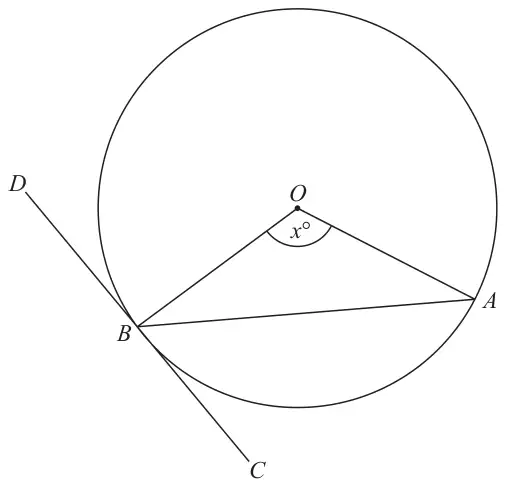
\(A\) and \(B\) are points on a circle, centre \(O\). \(DBC\) is the tangent to the circle at \(B\). Angle \(AOB = x^\circ\)
Show that angle \(ABC = \dfrac{1}{2}x^\circ\) You must give a reason for each stage of your working. (3)
Mark scheme
Answer
Mark
Mark scheme
Result shown
M1
for angle \(OBC = 90\) or for method to find angle \(OBA\) or angle \(OAB\), eg \(\dfrac{180 - x}{2}\) oe or for angle \(ABC = 90\) – angle \(OBA\), eg angle \(ABC = 90 - y\)
or marks point on circumference and draws triangle using \(A\) and \(B\) and point marked
M1
for method to find angle \(ABC\), eg \(90 - \text{``}\dfrac{180 - x}{2}\text{''}\) oe or for \(x = 180 - 2 \times\) angle \(OBA\), eg \(x = 180 - 2y\) or for angle at circumference \(= \dfrac{1}{2}x\)
C1
for correct algebra leading to angle \(ABC = \dfrac{1}{2}x\) and one circle theorem relevant to their method, eg The tangent to a circle is perpendicular to the radius
OR for \(x = 180 - 2y\) and angle \(ABC = 90 - y\) and one circle theorem relevant to their method, eg The tangent to a circle is perpendicular to the radius
OR for angle \(ABC = \dfrac{1}{2}x\) and one circle theorem relevant to their method, eg The angle at the centre of a circle is twice the angle at the circumference or Alternate segment theorem
Additional guidance
Angles must be clearly labelled on the diagram or otherwise identified. Correct method can be implied from angles on the diagram if no ambiguity or contradiction.
Underlined words need to be shown; reasons need to be linked to their method.
(a) Prove that \[(2m + 1)^2 - (2n - 1)^2 = 4(m + n)(m - n + 1)\] (3)
Sophia says that the result in part (a) shows that the difference of the squares of any two odd numbers must be a multiple of 4
(b) Is Sophia correct? You must give reasons for your answer. (1)
Mark scheme (a)
Answer
Mark
Mark scheme
Proof
M1
for expansion of \((2m + 1)^2\) or \((2n - 1)^2\), all 4 terms correct with or without signs (and no additional terms) or 3 out of 4 terms correct with signs, eg \(4m^2 + 2m + 2m + 1\) or \(4n^2 - 2n - 2n + 1\)
or for correct expansion of \(4(m + n)(m - n + 1)\) or \((m + n)(m - n + 1)\) eg \(4m^2 - 4mn + 4m + 4mn - 4n^2 + 4n\) oe or \(m^2 - mn + m + mn - n^2 + n\) oe
for yes with explanation, eg \(2m + 1\) and \(2n - 1\) are odd numbers (for any positive integer value of \(m\), \(n\)) and the right-hand side is a multiple of 4
19 Show that \(\dfrac{3x}{x + 2} - \dfrac{2x + 1}{x - 2} - 1\) can be written in the form \(\dfrac{ax + b}{x^2 - 4}\) where \(a\) and \(b\) are integers. (4)
Mark scheme
Answer
Mark
Mark scheme
\(\dfrac{-11x + 2}{x^2 - 4}\)
M1
for writing at least one of the 3 terms with a denominator of \((x^2 - 4)\) or \((x - 2)(x + 2)\) eg \(\dfrac{3x(x - 2)}{x^2 - 4}\) oe or \(\dfrac{(x + 2)(2x + 1)}{x^2 - 4}\) oe or \(\dfrac{x^2 - 4}{x^2 - 4}\)
M1
for \(\dfrac{3x(x - 2)}{x^2 - 4} - \dfrac{(x + 2)(2x + 1)}{x^2 - 4} - \dfrac{x^2 - 4}{x^2 - 4}\) oe or for \(\dfrac{x^2 - 11x - 2}{x^2 - 4}\ (-\ 1)\) or for \(\dfrac{[x^2 - 11x - 2]}{x^2 - 4} - \dfrac{x^2 - 4}{x^2 - 4}\)
M1
for a numerator of \(3x^2 - 6x - 2x^2 - 5x - 2 - x^2 + 4\)
A1
for \(\dfrac{-11x + 2}{x^2 - 4}\)
Additional guidance
Students may work with a denominator of \((x - 2)(x + 2)\) for the first 3 marks
\([x^2 - 11x - 2]\) denotes their expansion of \(3x(x - 2) - (x + 2)(2x + 1)\)
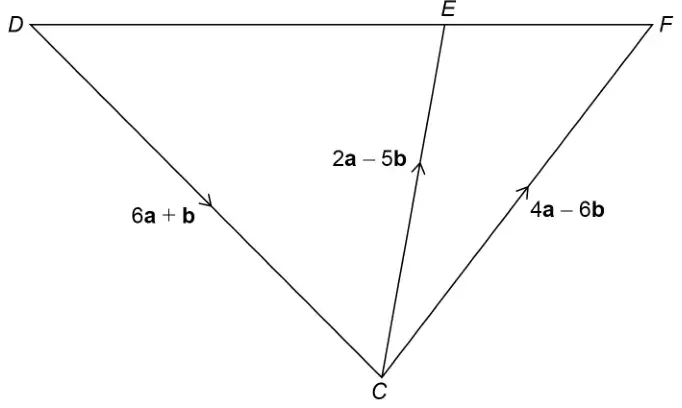
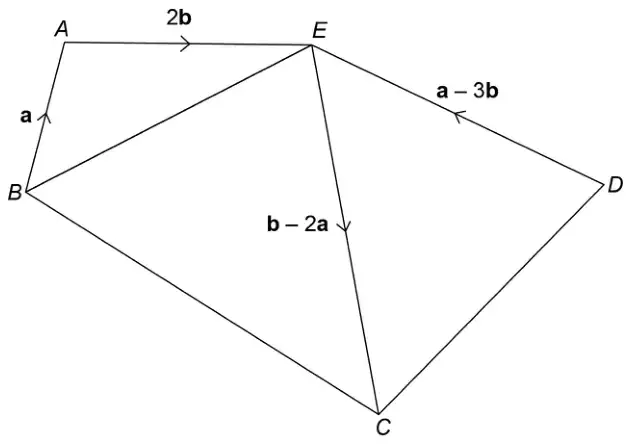
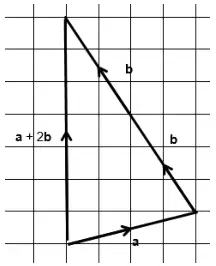
(b) Find the ratio length of \(DF\) : length of \(DE\) (3)
Mark scheme (a)
Answer
Mark
Mark scheme
\(\overrightarrow{AC} = 5\overrightarrow{AB}\) and reason
M1
for \(\overrightarrow{AC} = 5(3\mathbf{a} + 4\mathbf{b})\) or \(\overrightarrow{BC} = 4(3\mathbf{a} + 4\mathbf{b})\) or indicates that \(15\mathbf{a} + 20\mathbf{b} = 5 \times (3\mathbf{a} + 4\mathbf{b})\)
C1
for \(\overrightarrow{AC} = 5\overrightarrow{AB}\) or \(\overrightarrow{AC} = 5(3\mathbf{a} + 4\mathbf{b})\) or \(15\mathbf{a} + 20\mathbf{b} = 5(3\mathbf{a} + 4\mathbf{b})\) and a correct reason, eg \(AC\) is a multiple of \(AB\) / multiples of each other / \(AB\) is a factor of \(AC\) or they have the same gradient / are parallel / go in the same direction or they have a point in common / both start at \(A\) or \(AC\) is an enlargement of \(AB\)
Additional guidance
Do not award this mark if any incorrect working seen Could use \(AB\) and \(BC\) or \(AC\) and \(BC\)
Mark scheme (b)
Answer
Mark
Mark scheme
5 : 2
P1
for \((\overrightarrow{DF} =)\ 3\mathbf{e} + 6\mathbf{f} + (-10.5\mathbf{e} - 21\mathbf{f})\ \ (= -7.5\mathbf{e} - 15\mathbf{f})\) or for a multiplicative relationship for \(\overrightarrow{DE}\) and \(\overrightarrow{EF}\) eg \(\overrightarrow{EF} = -3.5\,\overrightarrow{DE}\) or for \((DE : EF =)\ 1 : -3.5\) oe
P1
for a multiplicative relationship for \(\overrightarrow{DF}\) and \(\overrightarrow{DE}\) eg \(\overrightarrow{DF} = -2.5\,\overrightarrow{DE}\) or for \((DF : DE =)\ -5 : 2\) oe eg \(-2.5 : 1\) or \(-7.5 : 3\) or for answer of 2 : 5 oe
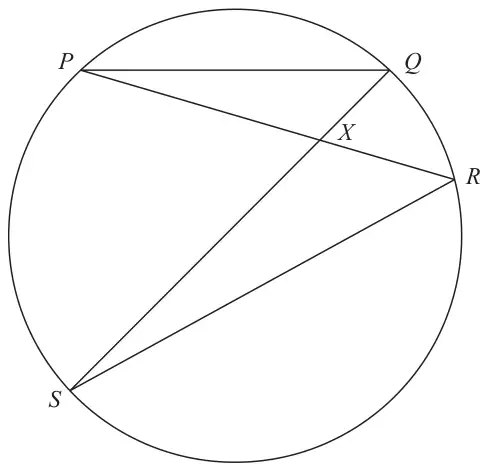
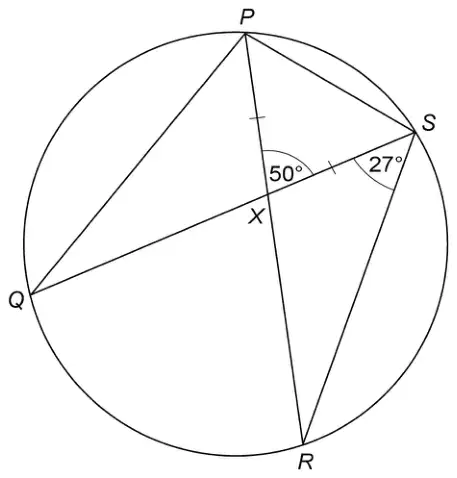
15 \(P\), \(Q\), \(R\) and \(S\) are four points on a circle.
\(PXR\) and \(SXQ\) are straight lines.
Prove that triangle \(PQX\) and triangle \(SRX\) are similar. (3)
Mark scheme
Answer
Mark
Mark scheme
Proof
C1
for angle \(PQX\) = angle \(SRX\) as angles in the same segment are equal (or angles at the circumference subtended from the same arc/chord of a circle are equal)
or angle \(QPX\) = angle \(RSX\) as angles in the same segment are equal (or angles at the circumference subtended from the same arc/chord of a circle are equal)
or angle \(PXQ\) = angle \(SXR\) as vertically opposite angles/vertically opposite angles are equal
or for identifying two pairs of corresponding equal angles with no reason given
C1
for identifying two pairs of corresponding equal angles with correct reasons given
C1
for stating that the triangles are similar because all three pairs of corresponding angles are equal with complete reasons given.
Additional guidance
Underlined words need to be shown; reasons need to be linked to their method.
Could be shown on the diagram
Note that the students third/final reason may be: Angles in a triangle add up to 180
(b) Show that \((m + 4)(2m - 5)(3m + 1)\) can be written in the form \(am^3 + bm^2 + cm + d\) where \(a\), \(b\), \(c\) and \(d\) are integers. (3)
Mark scheme (a)
Answer
Mark
Mark scheme
\(4(p - 3)(p + 3)\)
M1
for \(4(p^2 - 9)\) or partial factorisation which includes the product of 2 linear factors eg \((4p - 12)(p + 3)\) or \((p - 3)(4p + 12)\) or \((2p - 6)(2p + 6)\) or \(2(2p - 6)(p + 3)\) or \(2(2p + 6)(p - 3)\) or \(2(p - 3)2(p + 3)\)
A1
for \(4(p - 3)(p + 3)\)
Mark scheme (b)
Answer
Mark
Mark scheme
\(6m^3 + 11m^2 - 57m - 20\)
M1
for a method to find the product of two linear expressions, 3 correct terms out of 4 terms, eg \(6m^2 + 2m - 15m - 5 = 6m^2 - 13m - 5\) or \(2m^2 + 8m - 5m - 20 = 2m^2 + 3m - 20\) or \(3m^2 + 12m + m + 4 = 3m^2 + 13m + 4\)
M1
for a complete method to obtain all terms, at least half of which are correct (ft their first product), eg \(6m^3 + 2m^2 - 15m^2 + 24m^2 + 8m - 60m - 5m - 20\)
A1
for \(6m^3 + 11m^2 - 57m - 20\)
Additional guidance
Note that, for example, \(3m - 20\) is regarded as three terms in the expansion of \((m + 4)(2m - 5)\)
First product must be a 3 or 4 term quadratic but need not be simplified or may be incorrect.
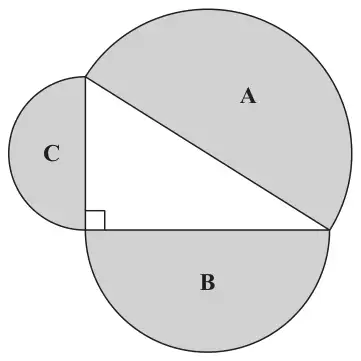
13 A right-angled triangle is formed by the diameters of three semicircular regions, A, B and C as shown in the diagram.
Show that
area of region A = area of region B + area of region C(3)
Mark scheme
Answer
Mark
Mark scheme
Relationship shown
M1
for use of Pythagoras’ theorem, eg \(d_A^{\,2} = d_B^{\,2} + d_C^{\,2}\) or \(a^2 = b^2 + c^2\) or \((2x)^2 = (2y)^2 + (2z)^2\) or \(a = \sqrt{b^2 + c^2}\) or uses a 3, 4, 5 triangle
M1
for forming correct expressions for the areas of at least 2 of the 3 semicircles, eg at least two of \(\dfrac{1}{2}\pi\left(\dfrac{a}{2}\right)^2,\ \dfrac{1}{2}\pi\left(\dfrac{b}{2}\right)^2,\ \dfrac{1}{2}\pi\left(\dfrac{c}{2}\right)^2\) or at least two of \(\dfrac{1}{2}\pi x^2,\ \dfrac{1}{2}\pi y^2,\ \dfrac{1}{2}\pi z^2\) or at least two of \(\dfrac{1}{2}\pi\left(\dfrac{5}{2}\right)^2,\ \dfrac{1}{2}\pi\left(\dfrac{3}{2}\right)^2,\ \dfrac{1}{2}\pi\left(\dfrac{4}{2}\right)^2\)
C1
for a fully correct and convincing chain of reasoning, eg showing that eg \(\dfrac{1}{2}\pi\left(\dfrac{a}{2}\right)^2 = \dfrac{1}{2}\pi\left(\dfrac{b}{2}\right)^2 + \dfrac{1}{2}\pi\left(\dfrac{c}{2}\right)^2\) can be reduced to \(a^2 = b^2 + c^2\) or that \((2x)^2 = (2y)^2 + (2z)^2\) is the same as \(\dfrac{1}{2}\pi x^2 = \dfrac{1}{2}\pi y^2 + \dfrac{1}{2}\pi z^2\)
Additional guidance
May be seen at any stage Where \(d_A\), \(a\), \(2x\), etc are their diameters
Could be any Pythagorean triple
Where \(a\), \(b\), \(c\) are their diameters Where \(2x\), \(2y\), \(2z\) are their diameters Where 3, 4, 5 are their diameters
12 The equation of the line \(\mathbf{L}_1\) is \(y = 2x + 3\) The equation of the line \(\mathbf{L}_2\) is \(5y - 10x + 4 = 0\)
Show that these two lines are parallel. (2)
Mark scheme
Answer
Mark
Mark scheme
comparison shown
M1
for starting to manipulate equation, eg \(5y = 10x + 15\) or \(5y = 10x - 4\) or \(y - 2x + \frac{4}{5} = 0\) or \(y - 2x = 3\)
A1
for statement and equation(s) which can be used to show that the gradients of the two lines are the same, eg \(5y = 10x + 15\) and \(5y = 10x - 4\) and both have the same \(x\) coefficient OR \(y = 2x - \frac{4}{5}\) and both have a gradient of 2
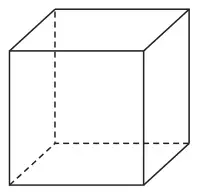
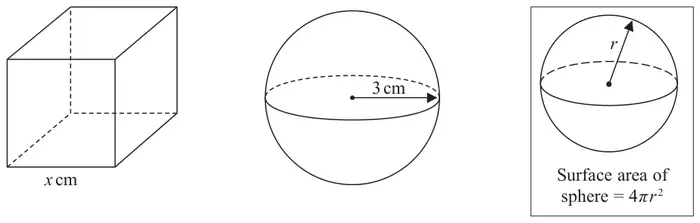
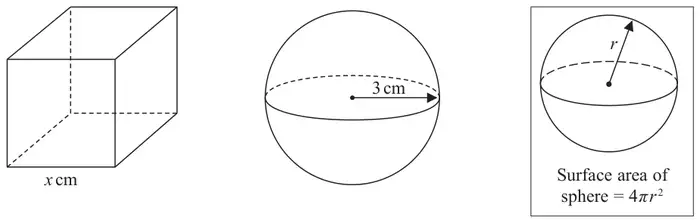
26 The diagram shows a cube with edges of length \(x\) cm and a sphere of radius 3 cm.
The surface area of the cube is equal to the surface area of the sphere.
Show that \(x = \sqrt{k\pi}\) where \(k\) is an integer. (4)
Mark scheme
Answer
Mark
Mark scheme
Shown
M1
for a correct expression for the area of one face of the cube, eg \(x^2\) or a correct expression for the surface area of the cube, eg \(6 \times x^2\)
M1
for a correct expression for the surface area of the sphere, eg \(4 \times \pi \times 3^2\ (= 36\pi)\)
M1
for forming a suitable equation, eg \(6 \times x^2 = 4 \times \pi \times 3^2\) or \(6x^2 = \text{``}36\pi\text{''}\)
A1
for completing the method to \(x = \sqrt{6\pi}\) or \(k = 6\)
Additional guidance
No marks for \(x = \sqrt{6\pi}\) without any working.
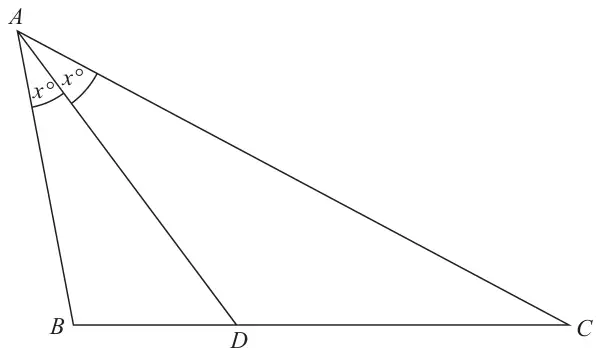
\(D\) is the point on \(BC\) such that angle \(BAD\) = angle \(DAC = x^\circ\)
Prove that \(\dfrac{AB}{BD} = \dfrac{AC}{DC}\) (4)
Mark scheme
Answer
Mark
Mark scheme
Proof (supported)
M1
for using the sine rule on triangle \(ABD\) or on triangle \(ADC\), to involve sides \(AB\), \(BD\), \(AC\), or \(DC\) eg \(\dfrac{AB}{\sin ADB} = \dfrac{BD}{\sin x}\) oe or \(\dfrac{AC}{\sin ADC} = \dfrac{DC}{\sin x}\) oe OR for an expression for the area of triangle \(ABD\) or for the area of triangle \(ADC\) eg \(\dfrac{1}{2}AB\,AD \sin x\) or \(\dfrac{1}{2}AD\,AC \sin x\) or \(\dfrac{1}{2}h\,BD\) or \(\dfrac{1}{2}h\,DC\)
M1
for using the sine rule on both triangle \(ABD\) and on triangle \(ADC\), to involve sides \(AB\), \(BD\), \(AC\), or \(DC\) eg \(\dfrac{AB}{\sin ADB} = \dfrac{BD}{\sin x}\) oe and \(\dfrac{AC}{\sin ADC} = \dfrac{DC}{\sin x}\) oe OR for two expressions for the area of either triangle \(ABD\) or for triangle \(ADC\) eg \(\dfrac{1}{2}AB\,AD \sin x\) and \(\dfrac{1}{2}h\,BD\) or \(\dfrac{1}{2}AD\,AC \sin x\) and \(\dfrac{1}{2}h\,DC\)
M1
for stating or showing \(\sin ADB = \sin ADC\), eg \(\sin y = \sin(180 - y)\) OR for using two expressions to form an equation eg \(\dfrac{\frac{1}{2}AB\,AD \sin x}{\frac{1}{2}AD\,AC \sin x} = \dfrac{\frac{1}{2}h\,BD}{\frac{1}{2}h\,DC}\) oe
C1
for a full method to arrive at the given answer
Additional guidance
Accept extra letters eg \(y\) shown on diagram for any angle used
22 Show that \(\dfrac{6x^3}{(9x^2 - 144)} \div \dfrac{2x^4}{3(x - 4)}\) can be written in the form \(\dfrac{1}{x(x + r)}\) where \(r\) is an integer. (3)
Mark scheme
Answer
Mark
Mark scheme
\(\dfrac{1}{x(x + 4)}\)
M1
inverting the fraction and multiplying eg \(\dfrac{6x^3}{(9x^2 - 144)} \times \dfrac{3(x - 4)}{2x^4}\)
15 Show that \(\dfrac{4x + 3}{2x} + \dfrac{3}{5}\) can be written in the form \(\dfrac{ax + b}{cx}\) where \(a\), \(b\) and \(c\) are integers. (3)
Mark scheme
Answer
Mark
Mark scheme
\(\dfrac{26x + 15}{10x}\)
M1
for method to write at least one of the fractions with a suitable denominator, eg \(\dfrac{4x + 3}{2x} \times \dfrac{5}{5}\ \left(= \dfrac{20x + 15}{10x}\right)\) or \(\dfrac{3}{5} \times \dfrac{2x}{2x}\ \left(= \dfrac{6x}{10x}\right)\)
M1
for method to combine the fractions, eg \(\dfrac{5(4x + 3)}{5 \times 2x} + \dfrac{3 \times 2x}{5 \times 2x}\) or \(\dfrac{5(4x + 3) + 3 \times 2x}{5 \times 2x}\) or \(\dfrac{20x + 15}{10x} + \dfrac{6x}{10x}\)
A1
for correct algebra leading to \(\dfrac{26x + 15}{10x}\) oe in form \(\dfrac{ax + b}{cx}\)
7 The diagram shows a cube with edges of length \(x\) cm and a sphere of radius 3 cm.
The surface area of the cube is equal to the surface area of the sphere.
Show that \(x = \sqrt{k\pi}\) where \(k\) is an integer. (4)
Mark scheme
Answer
Mark
Mark scheme
Shown
M1
for a correct expression for the area of one face of the cube, eg \(x^2\) or a correct expression for the surface area of the cube, eg \(6 \times x^2\)
M1
for a correct expression for the surface area of the sphere, eg \(4 \times \pi \times 3^2\ (= 36\pi)\)
M1
for forming a suitable equation, eg \(6 \times x^2 = 4 \times \pi \times 3^2\) or \(6x^2 = \text{``}36\pi\text{''}\)
A1
for completing the method to \(x = \sqrt{6\pi}\) or \(k = 6\)
Additional guidance
No marks for \(x = \sqrt{6\pi}\) without any working.
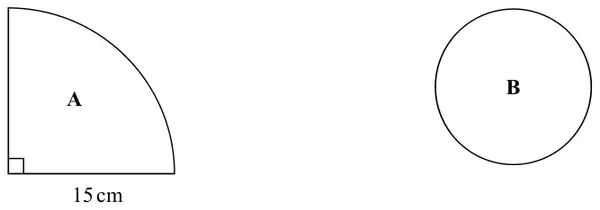
30A is in the shape of a quarter circle of radius 15 cm. B is in the shape of a circle.
The area of A is 9 times the area of B.
Show that the radius of B is 2.5 cm. (3)
Mark scheme
Answer
Mark
Mark scheme
Result shown
M1
for finding the area of A or the area of B, eg \((\pi \times 15^2) \div 4\ (=56.25\pi = 176.(7...)\) or \(177)\) or \(\pi \times 2.5^2\ (= 6.25\pi = 19.6(3...))\)
M1
for finding the area of A and the area of B, eg \((\pi \times 15^2) \div 4\) or \(\text{``}6.25\pi\text{''} \times 9\ (=56.25\pi = 176.(7...)\) or \(177)\) AND \(\pi \times 2.5^2\) or \(\text{``}56.25\pi\text{''} \div 9\ (= 6.25\pi = 19.6(3...))\)
C1
for conclusion eg, \(\sqrt{56.25\pi \div 9 \div \pi} = 2.5\) oe or \(\sqrt{\dfrac{6.25\pi \times 9 \times 4}{\pi}} = 15\) oe or \(56.25\pi \div 9 = 19.6(3...)\) and \(\pi \times 2.5^2 = 19.6(3...)\) oe or \(6.25\pi \times 9 = 176.(7...)\) or 177 and \((\pi \times 15^2) \div 4 = 176(.7..)\) or 177 oe or for \(((\pi \times 15^2) \div 4) \div (\pi \times 2.5^2) = 9\) oe
Additional guidance
May work without \(\pi\) or with an approximation of \(\pi\) Values may be rounded or truncated
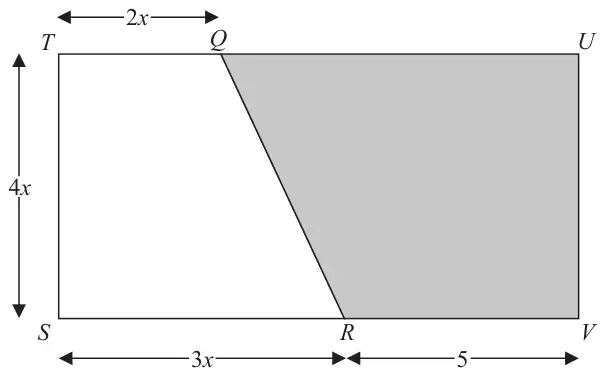
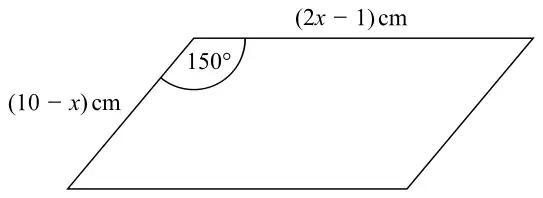
The area of the parallelogram is greater than 15 cm\(^2\)
(a) Show that \(2x^2 - 21x + 40 \lt 0\) (3)
(b) Find the range of possible values of \(x\). (3)
Mark scheme (a)
Answer
Mark
Mark scheme
Shown
C1
for a method to find the area of half of the parallelogram or of the whole parallelogram, eg \(\frac{1}{2}(2x - 1)(10 - x)\sin 150\) or \(\frac{1}{2}(2x - 1)(10 - x) \times \frac{1}{2}\) oe or \((2x - 1)(10 - x)\sin 150\) or \((2x - 1)(10 - x) \times \frac{1}{2}\) oe
C1
for a correct expansion of the whole area eg \(\frac{1}{2}(20x - 10 - 2x^2 + x)\) or \(\frac{1}{2}(-2x^2 + 21x - 10)\) or \(-x^2 + 10.5x - 5\)
C1
complete chain of reasoning with fully correct algebra dealing with the inequality eg \(x^2 - 10.5x + 5 \lt -15\) or \(x^2 - 10.5x + 20 \lt 0\) or \(2x^2 - 21x + 10 \lt -30\) which lead to \(2x^2 - 21x + 40 \lt 0\)
Mark scheme (b)
Answer
Mark
Mark scheme
\(2.5 \lt x \lt 8\)
M1
for factorising, \((2x - 5)(x - 8)\)
A1
for critical values, 2.5, 8
A1
for any statement that \(x\) is greater than 2.5 and \(x\) is less than 8
22 \(A\), \(B\), \(C\) and \(D\) are four points on a circle.
\(AEC\) and \(DEB\) are straight lines.
Triangle \(AED\) is an equilateral triangle.
Prove that triangle \(ABC\) is congruent to triangle \(DCB\). (4)
Mark scheme
Answer
Mark
Mark scheme
Proof
C1
for one correct pair of equal angles with correct reason from: angle \(ACB\) = angle \(ADB\), (angles in the same segment are equal) angle \(DBC\) = angle \(DAC\), (angles in the same segment are equal) angle \(ABD\) = angle \(ACD\), (angles in the same segment are equal) or for recognising all angles of 60 in triangle \(AED\) and in triangle \(CEB\))
C1
for one identity, with reason(s), from the following list of alternatives: Alternatives: a complete method to show that angle \(ACB\) = angle \(DBC\) (= 60), or \(BC\) being common to both triangles or \(DB = DE+EB = AE+EC = AC\) (sides of an equilateral triangle are equal) or angle \(ABC = 60 +\) angle \(ABD = 60 +\) angle \(ACD\) = angle \(DCB\) (angles in the same segment are equal) or angle \(BDC\) = angle \(CAB\) (angles in the same segment are equal)
C1
for a second identity, with reason(s), from the alternatives above
C1
for concluding the proof with a third identity, with reason(s), from the alternatives above, together with the condition for congruency, ASA or SAS or AAS
Additional guidance
Underlined words need to be shown; reasons need to be linked to their statement(s)
Pairs of equal angles may be just shown on the diagram
for factorising the numerator or denominator of the 1st fraction, eg \(\dfrac{7(x - 2)}{(x - 2)(x + 6)}\) or \(\dfrac{7(x - 2)}{x^2 + 4x - 12}\) or \(\dfrac{7x - 14}{(x - 2)(x + 6)}\)
M1
for factorising the denominator of the second fraction, eg \(\dfrac{x - 6}{x(x + 6)(x - 6)}\ \left(= \dfrac{1}{x(x + 6)}\right)\)
for \(\mathrm{f}^{-1}(x) = \sqrt[3]{\dfrac{x+4}{2}}\) OR for \(2x^3 - 4 = 50\) OR for substituting \(x = 3\) to find f(3)
C1
for substituting \(x = 50\) to show the result giving \(\mathrm{f}^{-1}(50) = 3\) OR solving for \(x\) to give \(x = 3\) OR for showing that \(\mathrm{f}(3) = 50\)
Mark scheme (b)
Answer
Mark
Mark scheme
\(x = -1\) and \(x = 2.5\)
P1
for \(\mathrm{hg}(x) = (x + 2)^2\)
P1
(dep) for start to a process to derive a quadratic equation eg. \(x^2 + 4x + 4 = 3x^2 + x - 1\)
P1
for a process to solve the quadratic equation \(2x^2 - 3x - 5 = 0\) eg \((2x - 5)(x + 1)\ (= 0)\) or \(\dfrac{--3 \pm \sqrt{(-3)^2 - 4 \times 2 \times -5}}{2 \times 2}\) or \(2\left[\left(x - \dfrac{3}{4}\right)^2 - \dfrac{9}{16} - \dfrac{5}{2}\right]\ (= 0)\)
A1
for \(x = -1\) and \(x = 2.5\)
Additional guidance
\((x + 2)^2\) must be correctly expanded
2.5 or \(2\frac{1}{2}\) or \(\frac{5}{2}\) acceptable
15 Prove algebraically that the sum of the squares of any two consecutive even numbers is always a multiple of 4 (3)
Mark scheme
Answer
Mark
Mark scheme
Proof
M1
for correct expressions for two consecutive even numbers eg \(2n\) and \(2n + 2\)
M1
(dep M1) for expanding both expressions with at least one expansion fully correct eg \(4n^2\) and \(4n^2 + 4n + 4n + 4\) or for factorising both terms and intention to square correctly eg \((2n)^2\) and \(2^2(n + 1)^2\)
(a) Show that \((2x + 1)(x + 3)(3x + 7)\) can be written in the form \(ax^3 + bx^2 + cx + d\) where \(a\), \(b\), \(c\) and \(d\) are integers. (3)
(b) Solve \((1 - x)^2 \lt \dfrac{9}{25}\) (3)
Mark scheme (a)
Answer
Mark
Mark scheme
\(6x^3 + 35x^2 + 58x + 21\)
M1
for a method to find the product of two linear expressions, 3 correct terms out of 4 terms e.g. \(2x^2 + x + 6x + 3\) or \(3x^2 + 7x + 9x + 21\) or \(6x^2 + 14x + 3x + 7\)
M1
for a complete method to obtain all terms, at least half of which are correct (ft their first product) e.g. \(6x^3 + 32x^2 + 42x + 3x^2 + 16x + 21\)
A1
cao
Additional guidance
Note that, for example, \(7x + 3\) is regarded as three terms in the expansion of \((2x + 1)(x + 3)\)
First product must be a 3 or 4 term quadratic but need not be simplified or may be simplified incorrectly
for first step of finding the square root of both sides eg \(1 - x \lt \pm\dfrac{3}{5}\) OR for writing in the form \(ax^2 + bx + c\ (\lt 0)\) eg \(x^2 - 2x + \dfrac{16}{25}\ (\lt 0)\) or \(25x^2 - 50x + 16\ (\lt 0)\)
M1
for showing critical values \(\dfrac{2}{5}\ (= 0.4)\) and \(1\dfrac{3}{5}\ (= 1.6)\) oe
A1
for \(\dfrac{2}{5} \lt x \lt 1\dfrac{3}{5}\) oe
Additional guidance
Condone use of an “=” sign; accept one square root (eg \(\tfrac{3}{5}\)) only shown.
Critical values can be stated, or shown in an expression (which may have incorrect inequality symbols)
Could be written as two separate expressions eg \(x \gt \dfrac{2}{5}\) and \(x \lt 1\dfrac{3}{5}\) oe
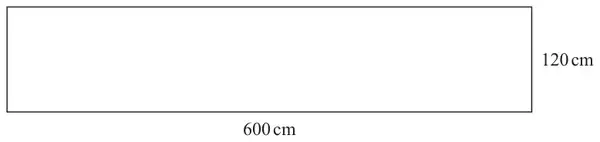
Wasim is going to cover the path with paving stones. Each paving stone is a square of side 30 cm. Each paving stone costs £2.50
Wasim has £220 to spend on paving stones.
Show that he has enough money to buy all the paving stones he needs. (4)
Mark scheme
Answer
Mark
Mark scheme
Accurate figures with supportive working
M1
for a correct first step eg \(600 \div 30\ (= 20)\) or \(120 \div 30\ (=4)\) or \(600 \times 120\ (=72\,000)\) or \(30 \times 30\ (=900)\)
M1
for finding an appropriate cost \(2.5 \times \text{``}20\text{''}\ (=50)\) or \(2.5 \times \text{``}4\text{''}\ (=10)\) OR number of tiles required \(\text{``}72\,000\text{''} \div \text{``}900\text{''}\ (=80)\) or \(\text{``}4\text{''} \times \text{``}20\text{''}\ (=80)\) OR number they can afford \(220 \div 2.5\ (=88)\)
M1
for full method to get figures to compare eg cost to tile whole area eg \(\text{``}80\text{''} \times 2.5\) OR number of tiles they need and number they can afford eg \(\text{``}72\,000\text{''} \div \text{``}900\text{''}\) and \(220 \div 2.5\)
A1
for 200 OR 80 and 88 OR 72 000 and 79 200 OR 132 (cm) OR 660 (cm)
13 Given that \(n\) can be any integer such that \(n \gt 1\), prove that \(n^2 - n\) is never an odd number. (2)
Mark scheme
Answer
Mark
Mark scheme
Proof shown
C2
for complete argument, eg \(n(n - 1)\) is the product of two consecutive integers and must be even as either \(n\) or \(n - 1\) must be even or gives correct reasoning for \(n\) odd and \(n\) even \(n\) odd: odd × odd = odd and odd − odd = even \(n\) even: even × even = even and even − even = even or \(n\) odd: \((2n + 1)^2 - (2n + 1) = 4n^2 + 2n = 2(2n^2 + n)\) \(n\) even: \((2n)^2 - (2n) = 4n^2 - 2n = 2(2n^2 - n)\)
(C1
for factorising, eg \(n(n - 1)\) OR gives correct reasoning for \(n\) odd or \(n\) even OR gives a partial explanation using \(n\) odd and \(n\) even, eg odd2 − odd = even and even2 − even = even)
13 The first term of a sequence of numbers is 24 The term-to-term rule of this sequence is ‘add 8’
Josie says,
“No number in this sequence is in the 5 times table.”
(a) Give an example to show that Josie is wrong. (1)
(b) Is 85 a number in this sequence? Give a reason for your answer. (1)
Mark scheme (a)
Answer
Mark
Mark scheme
example
C1
example given eg 40, 80, etc.
Mark scheme (b)
Answer
Mark
Mark scheme
No with reason
C1
for No with reason Acceptable examples 80 and 88 are both in the sequence 80 is in the sequence and 85 is 5 more 24, 32, ..... 80, 88, .... 85 is not in the 8 times table 85 is an odd number \(8n+16=85\) so \(n\) is not a whole number. Not acceptable examples adding 8 each time will not lead to 85 (insufficient) it goes past 85 Yes .....
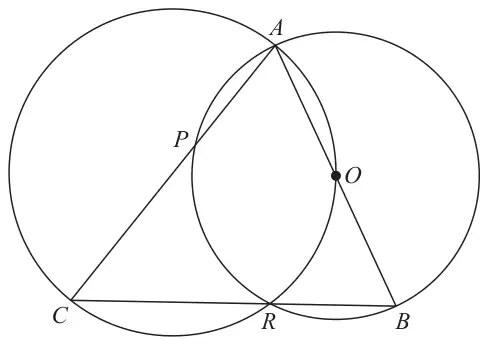
\(A\), \(B\), \(R\) and \(P\) are four points on a circle with centre \(O\). \(A\), \(O\), \(R\) and \(C\) are four points on a different circle. The two circles intersect at the points \(A\) and \(R\).
\(CPA\), \(CRB\) and \(AOB\) are straight lines.
Prove that angle \(CAB\) = angle \(ABC\). (4)
Mark scheme
Answer
Mark
Mark scheme
proof
C1
uses cyclic quad eg if \(CAB = x\) then \(CRO = 180 - x\) (Opposite angles of a cyclic quadrilateral add up to 180°.)
C1
establishes relationship outside a circle eg \(ORB = x\) (Angles on a straight line add up to 180)
C1
uses properties of a circle eg \(RO = OB\) (both radii) so \(ABC = x\) (Base angles of an isosceles triangle are equal.)
C1
Complete proof and conclusion
Additional guidance
Underlined words need to be shown; reasons need to be linked to their method; any reasons not linked do not credit.
Correct method can be implied from angles on the diagram if no ambiguity or contradiction.
Full reasons given without any redundant reasons and correct reasoning throughout.
for first step, eg \(2((x + 1)^2 - 1)\) or \(2(x^2 + 2x + 1 - 1)\) oe
C1
for fully correct chain of reasoning
Additional guidance
It is insufficient to state \(\mathrm{gf}(x) = 2x(x + 2)\) without showing the first step, and the following sequence of algebraic steps leading to it.
Mark scheme (b)
Answer
Mark
Mark scheme
4.5
M1
process to find inverse of g, eg \(g^{-1}(x) = \dfrac{1}{2}x + 1\) or for \(2(x - 1) = 7\)
A1
for 4.5 oe
Additional guidance
Could be shown in the form of a flowchart, which must show inverse operations.
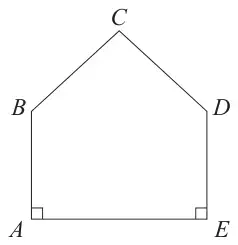
17 The diagram shows a pentagon. The pentagon has one line of symmetry.
\(AE = 4x\) \(AB = 2x + 1\) \(BC = x + 2\)
All these measurements are given in centimetres.
The perimeter of the pentagon is 18 cm.
(a) Show that \(10x + 6 = 18\) (3)
(b) Find the value of \(x\). (2)
Mark scheme (a)
Answer
Mark
Mark scheme
Full working seen
M1
for an initial step with the expressions eg doubling \(2x + 1\) or \(x + 2\) or halving \(4x\) or for identifying \(CD\) as \(x + 2\) or for identifying \(DE\) as \(2x + 1\)
M1
for an expression for the total perimeter, eg \(4x + 2 \times (2x + 1) + 2 \times (x + 2)\)
C1
for full simplification and equating to 18
Additional guidance
May be seen in working or on diagram
Mark scheme (b)
Answer
Mark
Mark scheme
1.2
M1
for isolating terms in \(x\) can ft an equation stated in (a) provided in form \(ax + b = c\)
15 Prove algebraically that the difference between the squares of any two consecutive odd numbers is always a multiple of 8 (3)
Mark scheme
Answer
Mark
Mark scheme
proof
C1
for writing an expression for an odd number, eg \(2n + 1\) or \(2n - 1\) (assuming \(n\) is any integer) or states \(n\) is even and eg \((n + 1)\) or \((n + 3)\) as odd numbers
C1
for a correct expression of the form \((2n + 1)^2 - (2n - 1)^2\) expanded eg \(4n^2 + 12n + 9 - (4n^2 + 4n + 1)\) or \(4n^2 + 4n + 1 - (4n^2 - 4n + 1)\) or \((2n + 1 + 2n - 1)(2n + 1 - (2n - 1))\) or when \(n\) is even and eg \((n^2 + 6n + 9) - (n^2 + 2n + 1)\) (\(= 4n + 8\))
C1
for a correct simplified expression as a multiple of 8 eg \(8n + 8\) or \(8n\) or when \(n\) is even and eg \(4n + 8\) and full explanation as to why \(4(n + 2)\) is always a multiple of 8
Additional guidance
Expansion of \((2n - 1)^2 - (2n + 1)^2\) oe is acceptable
14 \(y\) is inversely proportional to \(x^3\) \(y = 44\) when \(x = a\)
Show that \(y = 5.5\) when \(x = 2a\) (3)
Mark scheme
Answer
Mark
Mark scheme
Evidence of solution
M1
for constructing an equation eg \(y \propto \dfrac{1}{x^3}\) or eg \(y = \dfrac{k}{x^3}\) oe
M1
for substituting in the values \(a\) and 44 into \(y = \dfrac{k}{x^3}\)
C1
for a complete method to use the equation, the value of \(k\) and \(x = 2a\) to show \(y = 5.5\) eg \((2a)^3 y = 44a^3\) and \(y = 44a^3 \div 8a^3 = 5.5\)
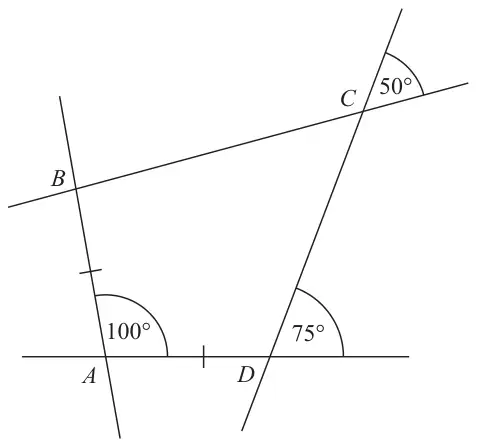
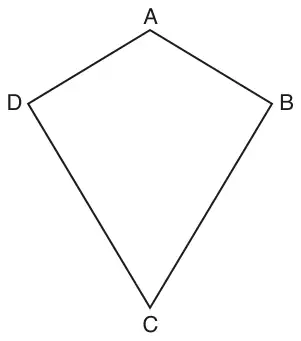
14 The diagram shows quadrilateral \(ABCD\) with each of its sides extended.
\(AB = AD\)
Show that \(ABCD\) is a kite. Give a reason for each stage of your working. (4)
Mark scheme
Answer
Mark
Mark scheme
shown
M1
for method to find angle \(ADC\), eg \(180 - 75\ (= 105)\)
M1
for angle \(BCD = 50\)
M1
for method to find angle \(ABC\), eg \(360 - 100 - 50 - \text{``}105\text{''}\)
C1
(dep M3) for angles \(ADC\), \(BCD\) and \(ABC\) correct and at least 2 appropriate reasons, eg vertically oppositeangles are equal or verticallyopposite angles are equal, angles on a straight line add to 180°, angles in a quadrilateral/kite add up to 360°; angles at a point add up to 360°
Additional guidance
Must be clear link to angle \(ADC\), may be marked on diagram
Must be clear method/explanation shown. Angle marked on diagram is not sufficient.
Underlined words need to be shown; reasons need to be linked to their method
\(ABCD\) is a parallelogram. \(ABP\) and \(QDC\) are straight lines. Angle \(ADP\) = angle \(CBQ = 90^\circ\)
(a) Prove that triangle \(ADP\) is congruent to triangle \(CBQ\). (3)
(b) Explain why \(AQ\) is parallel to \(PC\). (2)
Mark scheme (a)
Answer
Mark
Mark scheme
Proof
C1
for starting the proof, identifying a pair of relevant equal sides or angles with reasons from \(AD = BC\) (opposite sides of a parallelogram are equal) angle \(PAD\) = angle \(QCB\) (opposite angles of a parallelogram are equal) angle \(ADP\) = angle \(CBQ\) (given or both 90°)
C1
(dep C1) for complete identification of all three equal aspects with reasons
C1
(dep C2) for conclusion of congruency proof
Additional guidance
Congruency conclusion must include a reference to ASA
Mark scheme (b)
Answer
Mark
Mark scheme
Explanation
C1
for identifying a pair of equal sides or angles in \(APCQ\), with reason, eg \(AP = QC\) since triangle \(ADP\) is congruent to triangle \(CBQ\)
C1
(dep C1) for reasoning that \(APCQ\) is a parallelogram so opposite sides of a parallelogram are parallel
(a) Show that the equation \(x^3 + x = 7\) has a solution between 1 and 2 (2)
(b) Show that the equation \(x^3 + x = 7\) can be rearranged to give \(x = \sqrt[3]{7 - x}\) (1)
(c) Starting with \(x_0 = 2\), use the iteration formula \(x_{n+1} = \sqrt[3]{7 - x_n}\) three times to find an estimate for a solution of \(x^3 + x = 7\) (3)
Mark scheme (a)
Answer
Mark
Mark scheme
Correct statement
C1
for substituting both 1 and 2 into \(x^3 + x\) or into \(x^3 + x - 7\)
C1
for values 2 and 10 plus explanation that these are above and below 7, or for values \(-5\) and 3 plus explanation that there is a change of sign, thus implying a solution lies between 1 and 2
Additional guidance
All arithmetic shown must be correct. Ignore any additional trials shown.
Mark scheme (b)
Answer
Mark
Mark scheme
Correct rearrangement
C1
for correct algebraic rearrangement
Mark scheme (c)
Answer
Mark
Mark scheme
1.74
M1
for substitution of 2 into the formula eg \(\sqrt[3]{7 - 2}\) (= 1.70997…)
M1
for a substitution of \(x_1\) to give \(x_2\) (= 1.74241...)
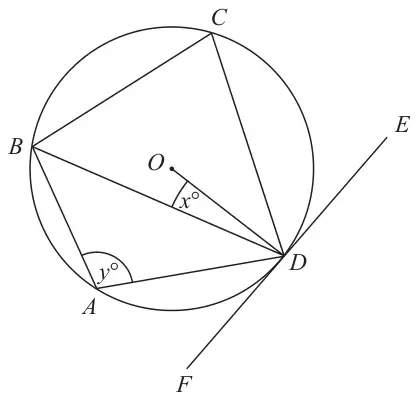
\(A\), \(B\), \(C\) and \(D\) are points on the circumference of a circle, centre \(O\). \(FDE\) is a tangent to the circle.
(a) Show that \(y - x = 90\) You must give a reason for each stage of your working. (3)
Dylan was asked to give some possible values for \(x\) and \(y\).
He said,
“\(y\) could be 200 and \(x\) could be 110, because \(200 - 110 = 90\)”
(b) Is Dylan correct? You must give a reason for your answer. (1)
Mark scheme (a)
Answer
Mark
Mark scheme
Shown
M1
for finding one missing angle eg \(BDE = y\) or \(ODE = 90\) or \(ODF = 90\) or \(DBO = x\) or \(BCD = 180 - y\) or (reflex) \(BOD = 2y\)
A1
for a complete correct method leading to \(y - x = 90\)
C1
(dep on A1) for all correct circle theorems given appropriate for their working eg The tangent to a circle is perpendicular (90°) to the radius (diameter) Alternate segment theorem OR Angle at the centre is twice the angle at the circumference Opposite angles in a cyclic quadrilateral sum to 180°
Additional guidance
Could be shown on the diagram or in working
Mark scheme (b)
Answer
Mark
Mark scheme
Explanation
C1
for explanation eg No as \(y\) must be less than 180 as it is an angle in a triangle
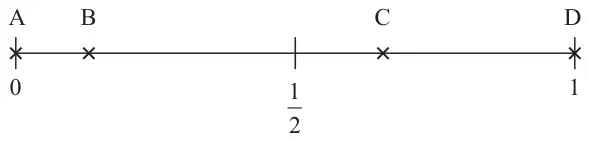
7 Here is a probability scale. It shows the probability of each of the events A, B, C and D.
(a) Write down the letter of the event that is certain. (1)
(b) Write down the letter of the event that is unlikely. (1)
There are 12 counters in a bag.
3 of the counters are red. 1 of the counters is blue. 2 of the counters are yellow. The rest of the counters are green.
Caitlin takes at random a counter from the bag.
(c) Show that the probability that this counter is yellow or green is \(\dfrac{2}{3}\) (3)
Mark scheme (a)
Answer
Mark
Mark scheme
D
B1
cao
Mark scheme (b)
Answer
Mark
Mark scheme
B
B1
cao
Mark scheme (c)
Answer
Mark
Mark scheme
Shown
M1
for number of green counters, eg \(12 - (3 + 1 + 2) = 6\) OR for \(\dfrac{3}{12}\) oe or \(\dfrac{1}{12}\) oe or \(\dfrac{2}{12}\) oe linked to the appropriate colour
M1
for \(1 - \left(\text{``}\dfrac{3}{12}\text{''} + \text{``}\dfrac{1}{12}\text{''}\right) \left(= \dfrac{8}{12}\right)\) or \(\text{``}\dfrac{2}{12}\text{''} + \dfrac{\text{``}6\text{''}}{12} \left(= \dfrac{8}{12}\right)\) OR for method to find \(\dfrac{2}{3}\) of 12, eg. \(12 \div 3 \times 2\ (= 8)\)
C1
for correct conclusion supported by accurate figures, eg \(\dfrac{8}{12} = \dfrac{2}{3}\) or \(\dfrac{2}{3}\) of \(12 = 8\) and number of yellow + green \(= 2 + 6 = 8\)
Additional guidance
This is awarded for a correct first step
This is awarded for a fully correct method from which the correct answer of \(\dfrac{2}{3}\) can be found Sight of \(\dfrac{8}{12}\) gets M2
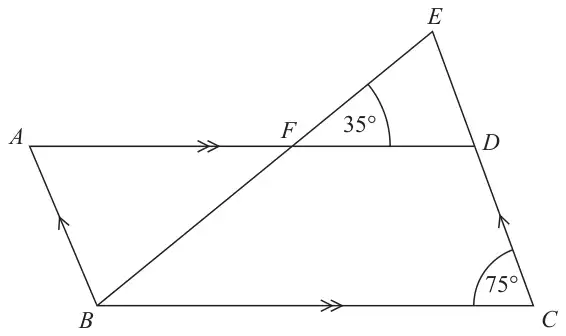
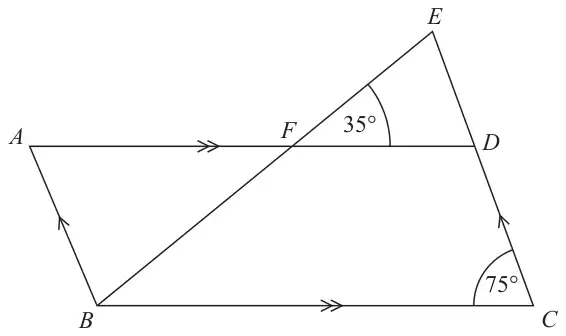
\(ABCD\) is a parallelogram. \(EDC\) is a straight line. \(F\) is the point on \(AD\) so that \(BFE\) is a straight line.
Angle \(EFD = 35^\circ\) Angle \(DCB = 75^\circ\)
Show that angle \(ABF = 70^\circ\) Give a reason for each stage of your working. (4)
Mark scheme
Working
Answer
Mark
Notes
\(CB\) extended to form \(CG\)
Reasoning
B1
for 35 or 75 or 145 or 105 or \(DEF = 70\), marked on the diagram or 3 letter description
M1
for \(180 - 70 - 35\) or \(180 - 75 - 35\) or a correct pair of angles that would lead to 75 or 70, eg \(AFB = 35\) and \(FAB = 75\) or \(AFB = 35\) and \(ABG = 75\) or \(FBC = 35\) and \(ABG = 75\) or \(EDF = 75\) and \(DEF = 70\) or \(FDC = 105\) and \(FBC = 35\) or \(ABC = 105\) and \(FBC = 35\)
C2
(dep on B1M1) All figures correct with all appropriate reasons stated. Angles must be clearly labelled or on the diagram. Full solution must be seen
(C1
(dep on B1 or M1) for one reason clearly used and stated.) Corresponding angles are equal, alternate angles are equal, opposite angles in a parallelogram are equal, angles in a triangle sum to 180, angles on a straight line sum to 180, vertically oppositeangles are equal, vertically opposite angles are equal, angles in a quadrilateral sum to 360, co-interior angles sum to 180, allied angles sum to 180, angles around a point sum to 360
(a) Given that \((\sqrt{x} - 1)\), 1 and \((\sqrt{x} + 1)\) are the first three terms of S, find the value of \(x\). You must show all your working. (3)
(b) Show that the 5th term of S is \(7 + 5\sqrt{2}\) (2)
Mark scheme (a)
Answer
Mark
Notes
2
M1
for start to express the common ratio algebraically, eg \(1/(\sqrt{x} - 1)\) or \((\sqrt{x} + 1)/1\) or \(\sqrt{x} + 1 = k \times 1\) or \(1 = k \times (\sqrt{x} - 1)\)
M1
for setting up an appropriate equation in \(x\), eg \(1/(\sqrt{x} - 1) = (\sqrt{x} + 1)/1\)
C1
for convincing argument to show \(x = 2\)
Mark scheme (b)
Answer
Mark
Notes
Shown
M1
for expressing the relationship between the common ratio, one of the first three terms of the sequence and the fifth term, eg 5th term = 3rd term × (common ratio)²
C1
for a complete explanation to include eg, \((\sqrt{2} + 1)(\sqrt{2} + 1)^2 = 7 + 5\sqrt{2}\)
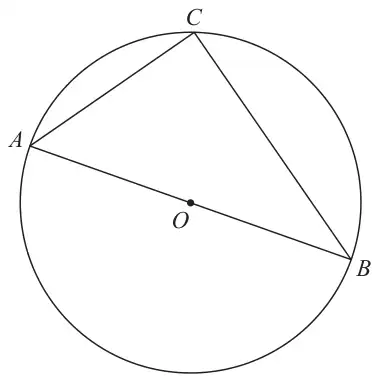
\(A\), \(B\) and \(C\) are points on the circumference of a circle, centre \(O\). \(AOB\) is a diameter of the circle.
Prove that angle \(ACB\) is \(90^\circ\) You must not use any circle theorems in your proof. (4)
Mark scheme
Answer
Mark
Notes
Proof
C1
draws \(OC\) and considers angles in an isosceles triangle (algebraic notation may be used, eg two angles labelled \(x\))
C1
finds sum of angles in triangle \(ABC\), eg \(x + x + y + y = 180\), or sum of angles at \(O\), eg \(180 - 2x + 180 - 2y\)
C1
complete method leading to \(ACB = 90\)
C1
complete proof with all reasons given, eg base angles of an isoscelestriangle are equal, angles in a triangle add up to \(180^\circ\), angles on a straight line add up to \(180^\circ\)
19 A triangle has vertices \(P\), \(Q\) and \(R\).
The coordinates of \(P\) are \((-3, -6)\) The coordinates of \(Q\) are \((1, 4)\) The coordinates of \(R\) are \((5, -2)\)
\(M\) is the midpoint of \(PQ\). \(N\) is the midpoint of \(QR\).
Prove that \(MN\) is parallel to \(PR\). You must show each stage of your working. (4)
Mark scheme
Answer
Mark
Notes
Proof (supported)
M1
for a method to find coordinates of \(M\,(-1, -1)\) or \(N\,(3, 1)\)
M1
for method to find gradient of \(MN\) or \(PR\) or for method to find column vector for \(MN\) or \(PR\) or for differences of \(x\) coordinates and differences of \(y\) coordinates for \(MN\) or \(PR\)
A1
for gradients of \(MN\) and \(PR\), ie \(\frac{1}{2}\) oe or for column vectors of \(MN\) and \(PR\), \(\overrightarrow{MN} = \begin{pmatrix}4\\2\end{pmatrix}\) and \(\overrightarrow{PR} = \begin{pmatrix}8\\4\end{pmatrix}\) or for differences of \(x\) coordinates and of \(y\) coordinates for \(MN\) and \(PR\)
19 Prove algebraically that the straight line with equation \(x - 2y = 10\) is a tangent to the circle with equation \(x^2 + y^2 = 20\) (5)
Mark scheme
Answer
Mark
Notes
Proof (supported)
M1
starts process to find point of intersection by substituting, eg \((10 + 2y)^2 + y^2\ (= 20)\)
M1
for expanding, eg \(4y^2 + 20y + 20y + 100\) (3 out of 4 terms correct)
M1
(dep M2) for 3-term quadratic equation ready for solving, eg \(5y^2 + 40y + 80 = 0\)
M1
(dep on previous M1) for method to solve an equation of the form \(ay^2 + by + c = 0\), eg by factorising or correct substitution into quadratic formula
C1
fully correct method leading to \(y = -4\) or \(x = 2\) or \((y + 4)^2 = 0\) or \((x - 2)^2 = 0\) and statement, eg only one point of intersection so the line is a tangent to the circle
Prove algebraically that the sum of \(\dfrac{1}{2}n(n + 1)\) and \(\dfrac{1}{2}(n + 1)(n + 2)\) is always a square number. (2)
Mark scheme
Answer
Mark
Notes
Completes proof
M1
Expands both expressions eg \(\dfrac{1}{2}(n^2 + n + n^2 + n + 2n + 2)\) or \(n^2 + n\) and \(n^2 + n + 2n + 2\) or factorises \(\dfrac{1}{2}(n+1)(n+n+2)\)
C1
Completes proof with explanation and reference to \((n+1)^2\)
(a) Show that the equation \(x^3 + 7x - 5 = 0\) has a solution between \(x = 0\) and \(x = 1\) (2)
(b) Show that the equation \(x^3 + 7x - 5 = 0\) can be arranged to give \(x = \dfrac{5}{x^2 + 7}\) (2)
(c) Starting with \(x_0 = 1\), use the iteration formula \(x_{n+1} = \dfrac{5}{x_n^{\,2} + 7}\) three times to find an estimate for the solution of \(x^3 + 7x - 5 = 0\) (3)
(d) By substituting your answer to part (c) into \(x^3 + 7x - 5\), comment on the accuracy of your estimate for the solution to \(x^3 + 7x - 5 = 0\) (2)
Mark scheme (a)
Answer
Mark
Notes
Shown
M1
for method to establish at least one root between \(x = 0\) and \(x = 1\), eg \(\mathrm{f}(0) = -5\) and \(\mathrm{f}(1) = 3\)
C1
for correct values and a deduction about the roots eg as there is a sign change there must be at least one root between \(x = 0\) and \(x = 1\) (as f is continuous)
Mark scheme (b)
Answer
Mark
Notes
Shown
C1
for a correct first step in rearrangement, eg \(x(x^2 + 7) - 5 = 0\) or \(x^3 + 7x = 5\)
C1
for clear and correct steps showing complete rearrangement
14 Cone A and cone B are mathematically similar. The ratio of the volume of cone A to the volume of cone B is 27 : 8
The surface area of cone A is 297 cm2
Show that the surface area of cone B is 132 cm2(3)
Mark scheme
Answer
Mark
Notes
Shown
M1
for \(\sqrt[3]{\dfrac{8}{27}}\ \left(= \dfrac{2}{3}\right)\) or \(\sqrt[3]{\dfrac{27}{8}}\ \left(= \dfrac{3}{2}\right)\) or 2 : 3 or 3 : 2
M1
for \(\left(\sqrt[3]{\dfrac{8}{27}}\right)^2\ \left(= \dfrac{4}{9}\right)\) or \(\left(\sqrt[3]{\dfrac{27}{8}}\right)^2\ \left(= \dfrac{9}{4}\right)\) or 4 : 9 or 9 : 4
\(BCD\) is a straight line. \(ABC\) is a triangle.
Show that triangle \(ABC\) is an isosceles triangle. Give a reason for each stage of your working. (4)
Mark scheme
Answer
Mark
Notes
shown
M1
for (angle \(BCA\)) \(= 180 - 117\ (= 63)\)
M1
for (angle \(CAB\)) \(= 180 - \text{``}63\text{''} - 54\ (= 63)\) or (angle \(CAB\)) \(= 117 - 54\ (= 63)\)
C2
for statement, eg. isosceles since angle \(BCA =\) angle \(CAB = 63\) with fully correct reasons, from: angles on a straight line add up to 180° angles in a triangle add up to 180° exterior angle of a triangle is equal to sum of interior opposite angles
[C1
for angle \(BCA = 63\) and angle \(CAB = 63\) and one of the above reasons]
OR
M1
for \(\dfrac{(180 - 54)}{2}\ (= 63)\)
M1
for identification of two angles in triangle \(ABC\) being “63”
C2
for statement, eg. isosceles since angle \(BCA =\) angle \(CAB = 63\) andangles on a straight line add up to 180°and fully correct reasons: base angles of an isosceles triangle are equal and angles in a triangle add up to 180°
[C1
for angle \(BCA = 63\) and angle \(CAB = 63\) and one reason from: base angles of an isosceles triangle are equal angles in a triangle add up to 180°]
\(ABCD\) is a parallelogram. \(EDC\) is a straight line. \(F\) is the point on \(AD\) so that \(BFE\) is a straight line.
Angle \(EFD = 35^\circ\) Angle \(DCB = 75^\circ\)
Show that angle \(ABF = 70^\circ\) Give a reason for each stage of your working. (4)
Mark scheme
Working
Answer
Mark
Notes
\(CB\) extended to form \(CG\)
Reasoning
B1
for 35 or 75 or 145 or 105 or \(DEF = 70\), marked on the diagram or 3 letter description
M1
for \(180-70-35\) or \(180-75-35\) or a correct pair of angles that would lead to 75 or 70, eg \(AFB = 35\) and \(FAB = 75\) or \(AFB = 35\) and \(ABG = 75\) or \(FBC = 35\) and \(ABG = 75\) or \(EDF = 75\) and \(DEF = 70\) or \(FDC = 105\) and \(FBC = 35\) or \(ABC = 105\) and \(FBC = 35\)
C2
(dep on B1M1) All figures correct with all appropriate reasons stated. Angles must be clearly labelled or on the diagram. Full solution must be seen
(C1
(dep on B1 or M1) for one reason clearly used and stated.) Corresponding angles are equal, alternate angles are equal, opposite angles in a parallelogram are equal, angles in a triangle sum to 180, angles on a straight line sum to 180, vertically oppositeangles are equal, vertically opposite angles are equal, angles in a quadrilateral sum to 360, co-interior angles sum to 180, allied angles sum to 180, angles around a point sum to 360
writes the area using algebraic terms e.g. \((x + 3) \times (x + 3)\) or at least two correct area expressions, may be written on the diagram or \(x\) given as \(\sqrt{10} - 3\)
M1
expands and includes the given 10 e.g. \(x^2 + 3x + 3x + 9 = 10\); condone one error in the four terms when expanding or \(10 - 3\sqrt{10} - 3\sqrt{10} + 9 + 6\sqrt{10} - 18\ (=1)\) condone 1 error in the 6 terms
A1
rearranges to give the given equation or shows surd expression simplifies to 1
\(ABEF\) and \(CBED\) are congruent parallelograms where \(AB = BC = x\) cm. \(P\) is the point on \(AF\) and \(Q\) is the point on \(CD\) such that \(BP = BQ = 10\) cm.
Show that these two triangles are mathematically similar. (2)
Mark scheme
Answer
Mark
Notes
Shown (supported)
M1
method to divide a pair of corresponding sides, eg \(7.5 \div 3\ (= 2.5)\) or \(3 \div 7.5\ (= 0.4)\), or states scale factor is 2.5 or 0.4 or method to work out the size of an angle, eg \(\tan^{-1}\left(\dfrac{7.5}{10}\right)\) (= 36.8 to 36.9)
C1
shows or states that all sides are enlarged by the same factor or works out a pair of corresponding angles and states that the two triangles have the same angles
19 In the diagram, \(AB\), \(BC\) and \(CD\) are three sides of a regular polygon P.
Show that polygon P is a hexagon. You must show your working. (4)
Mark scheme
Answer
Mark
Notes
Shows polygon is a hexagon
M1
for a complete method to find the interior or exterior angle of the dodecagon eg \(180 - \dfrac{360}{12}\), \(\dfrac{180}{12}(12 - 2)\) oe \((= 150)\), \(360 \div 12\ (=30)\)
M1
for a complete method to find the interior angle of polygon P eg at \(B\) or \(C\): \(360 - \text{``}150\text{''} - 90\ (= 120)\) or \(\text{``}30\text{''} + 90\ (= 120)\) or for a complete method to find the interior or exterior angle of the hexagon eg \(180 - \dfrac{360}{6}\), \(\dfrac{180}{6}(6 - 2)\) oe \((= 120)\), \(360 \div 6\ (= 60)\)
A1
for 30 and 120 or 30 and 60 or 120 and 150 or 60 and 150
C1
complete solution, fully supported by accurate figures
15 \(A\), \(B\), \(C\) and \(D\) are four points on the circumference of a circle.
\(AEC\) and \(BED\) are straight lines.
Prove that triangle \(ABE\) and triangle \(DCE\) are similar. You must give reasons for each stage of your working. (3)
Mark scheme
Answer
Mark
Notes
Proof
C1
for identifying one pair of equal angles with a correct reason, e.g. (angle) \(BAE\) = (angle) \(CDE\); angles in the same segment are equal or angles at the circumference subtended on the same arc are equal or for identifying two pairs of equal angles with no correct reasons given (angles must be within the appropriate triangles)
C1
for identifying a second pair of equal angles with a correct reason, e.g. (angle) \(AEB\) = (angle) \(DEC\); opposite angles or vertically opposite angles are equal or for identifying the three pairs of equal angles with no correct reasons given
C1
for stating the three pairs of equal angles of the two triangles e.g. \(ABE = DCE\), \(BEA = CED\), \(EAB = EDC\) with fully correct reasons
10 Show that \((x + 1)(x + 2)(x + 3)\) can be written in the form \(ax^3 + bx^2 + cx + d\) where \(a\), \(b\), \(c\) and \(d\) are positive integers. (3)
Mark scheme
Answer
Mark
Notes
\(x^3 + 6x^2 + 11x + 6\)
M1
for method to find the product of any two linear expressions (3 correct terms) e.g. \(x^2 + x + 2x + 2\) or \(x^2 + 2x + 3x + 6\) or \(x^2 + x + 3x + 3\)
M1
for method of multiplying out remaining products, half of which are correct (ft their first product) e.g. \(x^3 + x^2 + 2x^2 + 3x^2 + 2x + 3x + 6x + 6\)
5 In the diagram, \(AB\), \(BC\) and \(CD\) are three sides of a regular polygon P.
Show that polygon P is a hexagon. You must show your working. (4)
Mark scheme
Answer
Mark
Notes
Shows polygon is a hexagon
M1
for a complete method to find the interior or exterior angle of the dodecagon eg \(180 - \dfrac{360}{12}\), \(\dfrac{180}{12}(12 - 2)\) oe \((= 150)\), \(360 \div 12\ (=30)\)
M1
for a complete method to find the interior angle of polygon P eg at \(B\) or \(C\): \(360 - \text{``}150\text{''} - 90\ (= 120)\) or \(\text{``}30\text{''} + 90\ (= 120)\) or for a complete method to find the interior or exterior angle of the hexagon eg \(180 - \dfrac{360}{6}\), \(\dfrac{180}{6}(6 - 2)\) oe \((= 120)\), \(360 \div 6\ (= 60)\)
A1
for 30 and 120 or 30 and 60 or 120 and 150 or 60 and 150
C1
complete solution, fully supported by accurate figures
writes the area using algebraic terms e.g. \((x + 3) \times (x + 3)\) or at least two correct area expressions which may be written on the diagram or \(x\) given as \(\sqrt{10} - 3\)
M1
expands and includes the given 10 e.g. \(x^2 + 3x + 3x + 9 = 10\); condone one error in the four terms when expanding or \(10 - 3\sqrt{10} - 3\sqrt{10} + 9 + 6\sqrt{10} - 18\ (=1)\) condone 1 error in the 6 terms
A1
rearranges to give the given equation or shows surd expression simplifies to 1
24 Prove that \(\quad \dfrac{60x^4 - 15x^2}{-2x - 1} \times \dfrac{1}{6x - 3} \quad\) can never be positive. [4 marks]
Mark scheme
Answer
Mark
Comments
Partially or fully factorises numerator
M1
eg \(15x(4x^3 - x)\) or \(x^2(60x^2 - 15)\) or \(15x^2(2x - 1)(2x + 1)\)
Factorises at least one denominator or correct multiplication of the denominators
M1
eg \(-(2x + 1)\) and/or \(3(2x - 1)\)
eg \(-12x^2 + (6x - 6x +)\ 3\) may be in a grid
Converts numerators and denominators into terms which can be fully cancelled
M1dep
dep on M1M1 eg \(\dfrac{15x^2(2x - 1)(2x + 1)}{-(2x + 1)3(2x - 1)}\) or \(\dfrac{15x^2(2x - 1)(2x + 1)}{-(2x + 1)} \times \dfrac{1}{3(2x - 1)}\) or \(\dfrac{5x^2(12x^2 - 3)}{-(12x^2 - 3)}\) factorisation and cancelling may be done in stages
\(\dfrac{15x^2}{-3}\) or \(-5x^2\) with M3 awarded and explanation that \(x^2\) cannot be negative
A1
oe with full cancelling of algebraic terms
condone explanation that \(x^2\) must be positive
Additional guidance
\(\dfrac{20x^4 - 5x^2}{(-2x - 1)(2x - 1)}\) or \(\dfrac{20x^4 - 5x^2}{-4x^2 + 1}\) implies M1M1 as 3 has been cancelled from both
M1M1
\(\dfrac{5x^2(2x + 1)}{-(2x + 1)}\) implies complete factorisation of numerator and denominator as 3 and \((2x - 1)\) have been cancelled from both
M1 may be awarded for correct work with no answer or incorrect answer, even if this is seen amongst multiple attempts
Accept rounding or truncating of \(2.0\dot{6}\) or \(206.\dot{6}\) to at least 4 sf Accept rounding or truncating of \(2.0\dot{6}\) to 3 sf only if \(6.2 \div 3\) is seen Accept rounding or truncating of \(206.\dot{6}\) to 3 sf only if \(620 \div 3\) is seen
Accept \(2.04\dot{9}\) for 2.05
Ignore any reference to lower bounds
Ignore reference to units
2.05 or 205 may be embedded eg \(2.05 + 2.06 + 2.09 = 6.2\) with no further work or explanation
M1A0
\(2.06 + 2.06 + 2.08 = 6.2\) with no further work or explanation \(2.06 + 2.06 + 2.06 = 6.18\) with a clear reference to 2.05 and a full explanation
Use Pythagoras’ theorem to show that the value of \(x\) is between 10 and 11 [4 marks]
Mark scheme
Answer
Mark
Comments
\(12^2\) or \(13^2\)
M1
oe 144 or 169 implied by 313 or \(\sqrt{313}\) or [17.6, 17.7]
\(13^2 - 12^2\) or \(169 - 144\) or 25 or \(\sqrt{13^2 - 12^2}\) or \(\sqrt{169 - 144}\) or \(\sqrt{25}\) or 5
M1dep
oe 5 may be in correct position on the diagram
\(9^2 + (\text{their } 5)^2\) or \(81 +\) their 25 or 106 or \(\sqrt{9^2 + (\text{their } 5)^2}\) or \(\sqrt{81 + \text{their } 25}\) or \(\sqrt{106}\) or [10.2, 10.3]
M1dep
oe their 5 or their 25 must be from correct working
\(9^2 + 5^2 = 106\) and \(\sqrt{106}\) and [10.2, 10.3] or \(\sqrt{9^2 + 5^2}\) and [10.2, 10.3] or \(\sqrt{81 + 25}\) and [10.2, 10.3] or \(9^2 + 5^2 = 106\) and \(10^2 = 100\) and \(11^2 = 121\)
A1
oe
Additional guidance
Up to M2 may be awarded for correct work with no answer or incorrect answer, even if this is seen amongst multiple attempts
18 Show that \(\quad \dfrac{\sin 30^\circ \times \cos 45^\circ}{\tan 60^\circ} \quad\) can be written in the form \(\dfrac{\sqrt{a}}{b}\)
where \(a\) and \(b\) are integers. [3 marks]
Mark scheme
Answer
Mark
Comments
\(\sin 30 = \dfrac{1}{2}\) and \(\cos 45 = \dfrac{1}{\sqrt{2}}\) or \(\dfrac{\sqrt{2}}{2}\) and \(\tan 60 = \sqrt{3}\)
M2
oe eg \(\dfrac{\frac{1}{2} \times \frac{1}{\sqrt{2}}}{\sqrt{3}}\) or \(\dfrac{\frac{1}{2} \times \frac{\sqrt{2}}{2}}{\sqrt{3}}\) or \(\dfrac{1}{2\sqrt{6}}\) may be seen in a table implied by position in a calculation eg \(\dfrac{1}{2} \times \dfrac{1}{\sqrt{2}} \times \dfrac{1}{\sqrt{3}}\) is correct for M2 M1 1 or 2 correct values
\(\dfrac{\sqrt{6}}{12}\) with all three correct values seen
A1
oe in the form \(\dfrac{\sqrt{a}}{b}\) eg \(\dfrac{\sqrt{24}}{24}\) condone \(a = 6\) and \(b = 12\) with all three correct values seen
Additional guidance
Allow \(\sqrt{1}\) for 1 throughout
Allow, eg \(\dfrac{\sqrt{3}/2}{1/2}\) for tan 60
Correct answer from \(\dfrac{\frac{1}{\sqrt{2}} \times \frac{1}{2}}{\sqrt{3}}\) scores only M1 for tan 60 unless the correct values are attributed to sin 30 and cos 45 elsewhere in the working
Do not allow further work eg \(\dfrac{\sqrt{6}}{12} = \dfrac{\sqrt{1}}{2}\) (with all three correct values seen)
M1 may be awarded for correct work with no answer or incorrect answer, even if this is seen amongst multiple attempts
Accept rounding or truncating of \(2.0\dot{6}\) or \(206.\dot{6}\) to at least 4 sf Accept rounding or truncating of \(2.0\dot{6}\) to 3 sf only if \(6.2 \div 3\) is seen Accept rounding or truncating of \(206.\dot{6}\) to 3 sf only if \(620 \div 3\) is seen
Accept \(2.04\dot{9}\) for 2.05
Ignore any reference to lower bounds
Ignore reference to units
2.05 or 205 may be embedded eg \(2.05 + 2.06 + 2.09 = 6.2\) with no further work or explanation
M1A0
\(2.06 + 2.06 + 2.08 = 6.2\) with no further work or explanation \(2.06 + 2.06 + 2.06 = 6.18\) with a clear reference to 2.05 and a full explanation
\(ABCD\) and \(AEFG\) are congruent rectangles \(D\) lies on \(EF\) angle \(ADE = x\)
Not drawn accurately
Prove that \(GD\) bisects angle \(ADF\). [4 marks]
Mark scheme
Answer
Mark
Comments
Response showing that \(GD\) bisects angle \(ADF\) and all reasons
B4
B3 response showing that \(GD\) bisects angle \(ADF\) B2 correct expressions for two angles in terms of \(x\) (angles must be above \(AD\)) or two correct statements about a pair of angles (angles must be above \(AD\)) B1 correct expression for one angle in terms of \(x\) (angle must be above \(AD\)) or one correct statement about a pair of angles (angles must be above \(AD\))
Additional guidance
Correct expressions for angles (which may be seen on the diagram) include angle \(DAG = x\) angle \(ADF = 180 - x\) angle \(ADG = \dfrac{180 - x}{2}\) or \(90 - \dfrac{x}{2}\) angle \(AGD = \dfrac{180 - x}{2}\) or \(90 - \dfrac{x}{2}\) angle \(GDF = 180 - x - \dfrac{180 - x}{2}\) or \(\dfrac{180 - x}{2}\) or \(90 - \dfrac{x}{2}\) angle \(DGF = \dfrac{x}{2}\)
Expressions must be explicit eg do not accept angle \(ADF + x = 180\) unless recovered
Correct statements about a pair of angles include angle \(AGD\) = angle \(GDF\) angle \(AGD\) = angle \(ADG\) angle \(ADG\) = angle \(GDF\) angle \(AGD = 90 -\) angle \(DGF\) angle \(GDF = 90 -\) angle \(DGF\)
Accept eg angle \(AGD\) and angle \(ADG\) both labelled \(y\) as a correct statement about a pair of angles
Accept eg \(\widehat{DAG}\) for angle \(DAG\)
Do not accept a single upper case letter for an angle unless shown on the diagram
For up to B2 allow assumption that \(GD\) bisects angle \(ADF\)
Reasons needed will depend on the approach used and will include some of alternate angles (are equal) (base) angles of isosceles triangle (are equal) angles in rectangle are 90 angles of triangle (add up to 180) (adjacent) angles on a (straight) line (add to 180)
may be embedded in or implied by an inequality or equation eg \((n - 15)^2 - 15^2 + 236 = 10\) \((n - 15)^2 - 15^2 + 236 \gt 10\) \((n - 15)^2 \gt -1\)
Valid explanation with M1 seen
A1
eg M1 seen and all the terms must be 11 or more or \((n - 15)^2 \geqslant 0\) and 11 is added
Additional guidance
Condone a different letter used eg \(x\)
M2 and all the terms must be greater than 11
M2A0
M2 and the 15th term is the smallest
M2A0
Least term is 11 with no working for completing the square
M0
M2 and squaring a bracket always has two digits then adding 11 means it has at least two digits
M2A0
\((n - 15)(n - 15)\) is equivalent to \((n - 15)^2\)
\((n - 15n)^2\)
M0
Ignore incorrect work after M2 eg \((n - 15)^2 + 11 = 0\)
M2
Condone \((n - 15)^2\) is positive and 11 is added
“When two multiples of 5 are added, the answer is always a multiple of 10”
Give one example to show that he is wrong. [1 mark]
Mark scheme (a)
Answer
Mark
Comments
1, 2, 4, 5, 10, 20
B2
any order B1 5 or 6 correct values with up to 2 incorrect values or 4 correct values with 0 or 1 incorrect values or 3 correct values with 0 incorrect values
25 Show that the value of \(\quad 6\sin 30^\circ + 2\cos 30^\circ \times 4\tan 30^\circ \quad\) is an integer. [4 marks]
Mark scheme
Answer
Mark
Comments
Alternative method 1: substitutes values
\((\sin 30^\circ =)\ \dfrac{1}{2}\) or \(6\sin 30^\circ = 3\) or \((\cos 30^\circ =)\ \dfrac{\sqrt{3}}{2}\) or \(2\cos 30^\circ = \sqrt{3}\) or \((\tan 30^\circ =)\ \dfrac{1}{\sqrt{3}}\) or \(\dfrac{\sqrt{3}}{3}\) or \(4\tan 30^\circ = \dfrac{4}{\sqrt{3}}\) or \(\dfrac{4\sqrt{3}}{3}\)
M1
may be seen beside the given expression or in a table
\(6\left(\dfrac{1}{2}\right)\) and \(2\left(\dfrac{\sqrt{3}}{2}\right)\) and \(4\left(\dfrac{1}{\sqrt{3}}\right)\) or \(6\left(\dfrac{1}{2}\right)\) and \(2\left(\dfrac{\sqrt{3}}{2}\right)\) and \(4\left(\dfrac{\sqrt{3}}{3}\right)\) or \(\dfrac{6}{2}\) and \(\dfrac{2\sqrt{3}}{2}\) and \(\dfrac{4\sqrt{3}}{3}\)
M1dep
oe
Processing at least as far as \(\dfrac{6}{2} + \dfrac{8\sqrt{3}}{2\sqrt{3}}\) or \(\dfrac{6}{2} + \dfrac{8\sqrt{3}\sqrt{3}}{6}\) or \(\dfrac{6}{2} + \dfrac{24}{6}\)
Two fully simplified expressions from \((\overrightarrow{DE} =)\ 8\mathbf{a} - 4\mathbf{b}\) \((\overrightarrow{DF} =)\ 10\mathbf{a} - 5\mathbf{b}\) \((\overrightarrow{EF} =)\ 2\mathbf{a} - \mathbf{b}\) and valid indication that the vectors are parallel
A1
eg \((\overrightarrow{DE} =)\ 8\mathbf{a} - 4\mathbf{b}\) and \((\overrightarrow{FE} =)\ -2\mathbf{a} + \mathbf{b}\) and \(8\mathbf{a} - 4\mathbf{b} = -4(-2\mathbf{a} + \mathbf{b})\) or \((\overrightarrow{DF} =)\ 10\mathbf{a} - 5\mathbf{b}\) and \((\overrightarrow{EF} =)\ 2\mathbf{a} - \mathbf{b}\) and \(\overrightarrow{DF} = 5\overrightarrow{EF}\)
Additional guidance
Condone absence of vector notation
Condone eg \(\overrightarrow{DCE}\) or \(D\) to \(E\) for \(\overrightarrow{DE}\)
If the only two correct expressions are eg \(\overrightarrow{DE}\) and \(\overrightarrow{ED}\) the maximum possible mark is M1
Only combining the three given vectors
Zero
\(\overrightarrow{DF} = \overrightarrow{DE} + \overrightarrow{EF}\) is not a valid indication
Stating eg \(\overrightarrow{DF}\) is a (scalar) multiple of \(\overrightarrow{EF}\) is not enough for the final A1
\((\overrightarrow{PS} =)\ \mathbf{a} + 2\mathbf{b}\) and indication why \(PS\) is parallel to \(QR\)
A1
eg \(2(\mathbf{a} + 2\mathbf{b}) = 2\mathbf{a} + 4\mathbf{b}\) or \(5\mathbf{a} + 10\mathbf{b} = 5(\mathbf{a} + 2\mathbf{b})\) or \(\mathbf{a} + 2\mathbf{b}\) and \(\overrightarrow{QR}\) is a multiple of \(\overrightarrow{PS}\)
Additional guidance
Some or all vectors may be reversed and the final mark can be from using a negative constant eg \(\overrightarrow{RX} = -3\mathbf{a} - 6\mathbf{b}\) \(\overrightarrow{PS} = \mathbf{a} + 2\mathbf{b}\) \(-3(\mathbf{a} + 2\mathbf{b}) = -3\mathbf{a} - 6\mathbf{b}\)
numbers in the boxes on the right side of calculation can be in any order SC2 \(27 = 2 + 2 + 23\) or \(27 = 5 + 5 + 17\) or \(27 = 7 + 7 + 13\) or \(27 = 5 + 11 + 11\)
Additional guidance
SC2 is for using a repeated prime number
\(27 = 3 + 5 + 17\)
B1M1A0
\(27 = 7 + 11 + 9\)
B1M0A0
\(27 = 1 + 3 + 23\)
B1M0A0
List of prime numbers with right side boxes empty or incorrect
18 By completing the square, prove that \(\quad x^2 + 6x + 13 \quad\) is always positive. [3 marks]
Mark scheme
Answer
Mark
Comments
\((x + 3)^2\) …
M1
\((x + 3)^2 + 4\)
A1
\((x + 3)^2 + 4\) and valid argument
A1
eg \((x + 3)^2 + 4\) and \((x + 3)^2 \geqslant 0\) and adding 4 or \((x + 3)^2 + 4\) and this is \(\geqslant 4\) or correct reference to a minimum point and its position above the \(x\)-axis
Additional guidance
\((x + 3)^2 + 4\) and Even if \(x\) is negative it is squared so will be positive so the expression is always positive (no reference to the \(+ 4\))
M1A1A0
\((x + 3)^2 + 4\) and Turning point is \((-3, 4)\) which is positive on the \(y\)-axis and as \(x^2\) coefficient it is a U-shape therefore always positive
M1A1A1
Incorrect work after \((x + 3)^2 + 4\) seen, eg \((x + 3)^2 + 4 = 0\)
14 A solid trophy consists of a stand and a player.
The stand is made by removing a small pyramid from a large pyramid.
Large pyramid Square base, edge 8 cm Perpendicular height 16 cm Small pyramid Square base, edge 5 cm Perpendicular height 10 cm
Volume of a pyramid \(= \dfrac{1}{3} \times\) area of base \(\times\) perpendicular height
(a) Show that the volume of the stand is 258 cm\(^3\) [2 marks]
(b) The trophy is made from a metal of density 7.5 grams per cm\(^3\)
The total mass of the trophy is 2340 grams.
Work out the volume of the player. [2 marks]
Mark scheme (a)
Answer
Mark
Comments
\(\dfrac{1}{3} \times 8 \times 8 \times 16\) or \(\dfrac{1024}{3}\) or 341.3… or \(\dfrac{1}{3} \times 5 \times 5 \times 10\) or \(\dfrac{250}{3}\) or 83.3…
oe eg \(\dfrac{1024}{3} - 258 = \dfrac{250}{3}\) must see method or values for both pyramids must use same number of decimal places for both pyramids so their answer is exactly 258
Additional guidance
\(341.3 - 83.3 = 258\)
M1A1
\(341.33 - 83.3 = 258.03\)
M1A0
\(341 - 83 = 258\) with no correct method seen
M0A0
Mark scheme (b)
Answer
Mark
Comments
\(2340 = 7.5 \times V\) or \(\dfrac{2340}{7.5}\) or 312 or \(2340 - (7.5 \times 258)\) or \(2340 - 1935\) or 405
13 Multiplying \(y\) by 6 gives the same result as adding 15 to \(y\)
(a) Write this as an equation. [2 marks]
(b) Show that the value of \(y\) is not 4 [1 mark]
Mark scheme (a)
Answer
Mark
Comments
\(6y = y + 15\)
B2
correct single equation with \(6y\) and \(y + 15\) eg \(15 + y = y \times 6\)
B1 \(6y\) or \(y + 15\) or rearranged equation eg \(6y - 15 = y\) or \(5y = 15\) but not \(y = 3\) only
Additional guidance
B1 may be awarded for a correct term even if this is seen amongst multiple attempts or embedded in an incorrect equation or incorrect term eg \(6y + 15\) or \(6y + 15y\) or \(6(y + 15)\)
Allow any variable for B1 but must be consistent for B2
Allow unprocessed terms for B1 or B2 eg \(6 \times y\) or \(y6\)
\(6y = y + 15\) seen, but then correctly simplified or solved
B2
\(6y = y + 15\) seen, but then incorrectly simplified or solved
B1
\(6y = 18\) or \(y + 15 = 18\) or both (unless combined to a single equation)
B1
No work worth B2 or B1 and answer \(y = 3\)
B0
Mark scheme (b)
Answer
Mark
Comments
Alternative method 1: substitutes \(y = 4\) into both sides
\((6y =)\ 24\) and \((y + 15 =)\ 19\)
B1ft
oe eg \(4 \times 6 = 24\) and \(4 + 15 = 19\) correct or ft their equation if their equation has a term in \(y\) on each side
Alternative method 2: solves equation
\((y =)\ 3\)
B1ft
oe eg \(3 \times 6 = 18\) and \(3 + 15 = 18\) correct or ft their equation if their equation has a term in \(y\) on each side
Additional guidance
Allow any variable
Only allow \((y =)\ 3\) seen in (a) if referenced in (b) and not contradicted
B1
For Alt 1, accept substituting into one side and then equating and solving the other eg \(4 \times 6 = 24\) and \(24 - 15 = 9\)
(a) The probability that the student is taking a GCSE resit is 0.09
How many of the students are taking a GCSE resit? [2 marks]
(b) The probability that the student is studying
A-levels is 0.67
Core Maths is 0.48
Show that some students are studying A-levels and Core Maths. [2 marks]
Mark scheme (a)
Answer
Mark
Comments
\(0.09 \times 1400\)
M1
oe
126
A1
Additional guidance
M1 may be awarded for correct work, with no answer or incorrect answer, even if this is seen amongst multiple attempts
Do not ignore further working after 126 seen
Do not allow a misread of 0.9 for 0.09
\(1400 - 126 = 1274\) in working
M1
\(\dfrac{126}{1400}\) in working
M1
\(\dfrac{126}{1400}\) on answer line
M1A0
Mark scheme (b)
Answer
Mark
Comments
Alternative method 1
\(0.67 + 0.48 = 1.15\) and the sum (of the probabilities) is greater than 1 or \(0.67 + 0.48 = 1.15\) and 0.15 study both or \(0.67 + 0.48 = 1.15\) and more than the total number of students at school
B2
oe B1 1.15 oe or the sum (of the probabilities) is greater than 1 or 0.15 oe
Alternative method 2
\(938 + 672 = 1610\) and more than the total number of students at school or \(938 + 672 = 1610\) and the total (number of students) is greater than 1400 or 938 and 672 and 210 study both
B2
oe B1 \(0.67 \times 1400\) oe and \(0.48 \times 1400\) oe or 938 and 672 or 1610 or the total (number of students) is greater than 1400 or 210
Additional guidance
B1 may be awarded for correct work, with no answer or incorrect answer, even if this is seen amongst multiple attempts
\(938 + 672 = 1610\) and \(1610 \gt 1400\)
B2
\(938 + 672 = 1610\) and students doing both as more than the total
B2
\(0.67 + 0.48 = 1.15\) and \(1.15 \gt 1\)
B2
\(67 + 48 = 115\) and students doing both as over 100
B2
\(67 + 48 = 115\) and 15% doing both
B2
\(67 + 48 = 115\) and 15 doing both
B1
\(0.67 + 0.48 = 1.15\) and needs to add to one
B1
\(67 + 48 = 115\)
B1
\(0.67 + 0.48 = 1.15\) and students doing both as over 100 (must be consistent form for comparison)
12 Here are the subjects available in year 12 at a school.
Block 1
Block 2
Block 3
Block 4
Maths (M)
Geography (G)
English (E)
Spanish (S)
History (H)
Drama (D)
Physics (P)
Biology (B)
French (F)
Chemistry (C)
ICT (I)
Art (A)
Students choose three subjects.
They cannot choose more than one subject from a block.
Lian decides
to study Maths
not to study Geography, Chemistry, Physics or ICT.
By listing, show that there are seven groups of three subjects that Lian could choose. [3 marks]
Subject 1
Subject 2
Subject 3
Mark scheme
Answer
Mark
Comments
Maths Drama English (MDE) Maths Drama Spanish (MDS) Maths Drama Biology (MDB) Maths Drama Art (MDA) Maths English Spanish (MES) Maths English Biology (MEB) Maths English Art (MEA)
B3
any order of subjects and/or rows B2 5 or 6 rows correct B1 3 or 4 rows correct
numbers in the boxes on the right side of calculation can be in any order SC2 \(27 = 2 + 2 + 23\) or \(27 = 5 + 5 + 17\) or \(27 = 7 + 7 + 13\) or \(27 = 5 + 11 + 11\)
Additional guidance
SC2 is for using a repeated prime number
\(27 = 3 + 5 + 17\)
B1M1A0
\(27 = 7 + 11 + 9\)
B1M0A0
\(27 = 1 + 3 + 23\)
B1M0A0
List of prime numbers with right side boxes empty or incorrect
condone \(b + a\) for \(a + b\) condone \(30a + 30b\) for \(30(a + b)\)
Additional guidance
Students can gain M1M1 if they incorrectly simplify a correct expression for total time before forming the division eg \(\dfrac{30}{a} + \dfrac{30}{b} = \dfrac{60}{a + b}\) followed by \(60 \div \dfrac{60}{a + b}\)
M1M1A0
Allow correct cancellation of 60 and 30 at any stage of the working
25 Show that \(\quad \dfrac{4\sin 30^\circ - \tan 45^\circ}{2\cos 30^\circ} \quad\) can be written as \(\tan x\), where \(x\) is an acute angle. [4 marks]
Mark scheme
Answer
Mark
Comments
\(\sin 30 = \dfrac{1}{2}\) or \(\tan 45 = 1\) or \(\cos 30 = \dfrac{\sqrt{3}}{2}\)
M1
oe eg \(\tan 45 = \dfrac{\sqrt{2}}{\sqrt{2}}\) or \(4\sin 30 = 2\) or \(2\cos 30 = \sqrt{3}\) implied by position in the expression may be seen in a table
substitution of all three correct values
M1dep
eg \(\dfrac{4 \times \frac{1}{2} - 1}{2 \times \frac{\sqrt{3}}{2}}\) or \(\dfrac{2 - 1}{2 \times \frac{\sqrt{3}}{2}}\) or \(\dfrac{2 - 1}{\sqrt{3}}\)
\(\dfrac{1}{\sqrt{3}}\) or \(\dfrac{\sqrt{3}}{3}\)
M1dep
\(\left(\dfrac{1}{\sqrt{3}}\right.\) or \(\left.\dfrac{\sqrt{3}}{3} =\right)\ \tan 30\) or \(x = 30\) with full working seen for M3
A1
Additional guidance
Allow \(\sqrt{1}\) for 1 throughout
Reference to 30° being an acute angle is not required
\((x - 2)(x + 2)\) or \(x^2 - 2x + 2x - 4\) must be seen (expansion may be seen in a grid) brackets in any order if the brackets are not shown for the numerators, expansions must be correct may be seen as a single fraction
\(x^2 - 5x + 2x - 10\) or \(x^2 - 3x - 10\) or \(x^2 + 5x - 2x - 10\) or \(x^2 + 3x - 10\)
M1
correct expansion of \((x - 5)(x + 2)\) or \((x + 5)(x - 2)\) ignore denominators may be seen in a grid implied by \(2x^2 - 20\) if no errors seen in expansions
M2 seen with no errors and \(\dfrac{2x^2 - 20}{x^2 - 4}\)
A1
allow M2 seen with no errors and \(a = 2 \quad b = 20\)
Additional guidance
Missing brackets must be recovered but condone missing closing bracket at the end of a numerator or denominator eg \(\dfrac{(x - 5)(x + 2)}{(x - 2)(x + 2)} + \dfrac{(x + 5)(x - 2)}{(x + 2)(x - 2}\)
1st M1
2nd M1 is awarded for four correct terms even if subsequently simplified incorrectly
For terms seen in a grid, signs must be correct (allow eg \(2x\) for \(+\,2x\))
For 1st M1 allow multiplication signs
After M2A1 ignore incorrect values stated eg \(a = 2 \quad b = -20\)
\(\dfrac{2x^2 - 20}{x^2 - 4}\) may come from wrong working or incomplete working eg \(\dfrac{(x - 5)(x + 2)}{(x - 2)(x + 2)} + \dfrac{(x + 5)(x - 2)}{(x + 2)(x - 2)}\) \(\dfrac{x^2 - 10 + x^2 - 10}{x^2 - 4} = \dfrac{2x^2 - 20}{x^2 - 4}\)
23 A factory packs \(x\) boxes of teabags per hour.
Each box contains 80 teabags.
Show that the factory packs \(\dfrac{4x}{3}\) teabags per minute. [2 marks]
Mark scheme
Answer
Mark
Comments
\(80 \times x\) or \(80x\) or \(x \times 80\) or \(x80\) or \(x \div 60\) or \(\dfrac{x}{60}\) or \(\dfrac{1}{60}x\) or \(x\dfrac{1}{60}\) or \(80 \div 60\) or \(\dfrac{80}{60}\)
22 Show that these two rectangles are similar. [2 marks]
Not drawn accurately
Mark scheme
Answer
Mark
Comments
\(8 \div 5\) or \(19.2 \div 12\) or \(\dfrac{8}{5}\) or \(\dfrac{19.2}{12}\) or 1.6 or \(12 \div 5\) or \(19.2 \div 8\) or \(\dfrac{12}{5}\) or \(\dfrac{19.2}{8}\) or 2.4
M1
oe use of a valid pair of sides to make an appropriate calculation or value eg \(5 \div 8\) or 0.625 or \(5 \div 12\) or [0.416, 0.417]
\(8 \div 5 = 19.2 \div 12\) or \(\dfrac{8}{5} = \dfrac{19.2}{12}\) or \(12 \div 5 = 19.2 \div 8\) or \(\dfrac{12}{5} = \dfrac{19.2}{8}\)
A1
oe showing sides are in proportion eg \(5 \div 8 = 12 \div 19.2\) or \(\dfrac{5}{12} = \dfrac{8}{19.2}\)
Additional guidance
For A1 equating may be implied by two calculations or two fractions with correct evaluation eg \(8 \div 5 = 19.2 \div 12\) is implied by \(8 = 5 \times 1.6\) and \(19.2 = 12 \times 1.6\)
M1A1
For A1 equating may be implied by calculations eg1 \(8 \div 5 = 19.2 \div 12\) is implied by \(8 \div 5 = 1.6\) and \(12 \times 1.6 = 19.2\) eg2 \(8 \div 5 = 19.2 \div 12\) is implied by \(\dfrac{8}{5} \times 12 = 19.2\)
M1A1 M1A1
\(5 \times 19.2 = 8 \times 12\)
M1A1
\(5 \times 19.2 = 96\) and \(8 \times 12 = 96\)
M1A1
Non-contradictory working can be ignored eg correct response along with area calculations
M1A1
Ignore words eg references to scale factors, enlargement, angles
Working on diagrams may be seen eg1 Arrows or lines from 5 to 8 and 12 to 19.2 with \(\times\) 1.6 on them eg2 Arrows or lines from 5 to 8 and 12 to 19.2 with 1.6 on them Arrows or lines must unambiguously link relevant numbers
M1A1 M1A0
For \(8 \div 5\) or \(\dfrac{8}{5}\) allow 8 : 5 etc
Up to M2 may be awarded for correct work with no answer or incorrect answer, even if this is seen amongst multiple attempts
Condone incorrect \(y\)-intercept eg \(a = 2 \qquad y = \dfrac{3}{5}x + 4\) gradient A = 2 gradient B \(= \dfrac{3}{5}\)
M1M1 A1
It must be clear that the values 2 and \(\dfrac{3}{5}\) are being used to answer the question to award A1 eg1 gradient A = 2 and gradient B \(= \dfrac{3}{5}\) (no statement needed) eg2 \(a = 2 \qquad y = \dfrac{3}{5}x + \dfrac{4}{5}\) eg3 \(y = 2x - 1\) and \(y = \dfrac{3}{5}x + \dfrac{4}{5}\) 2 is greater than \(\dfrac{3}{5}\) eg4 \(y = 2x - 1\) and \(y = \dfrac{3}{5}x + \dfrac{4}{5}\) gradient of A \(\gt\) gradient of B
M2A1 M2A0 M2A1 M2A0
\(13 = 7x - 1\) or \(x = 2\) must be recovered to award 1st M1
Show that when the input increases by 2 the output increases by \(2a\). [2 marks]
(b) \(\text{f}(x) = kx^2 \quad\) where \(k\) is a constant.
Kai says that \(\dfrac{\text{f}(6)}{\text{f}(2)}\) is equal to \(\text{f}(3)\) because \(\dfrac{6}{2} = 3\)
Is he correct?
Show working to support your answer. [2 marks]
Mark scheme (a)
Answer
Mark
Comments
\((y =)\ ax + b\) and \((y =)\ ax + 2a + b\)
B2
any letter for \(x\) other than \(a\) or \(b\) or \(y\) B1 \((y =)\ ax + b\) or \((y =)\ a(x + 2) + b\) or \((y =)\ ax + 2a + b\) or substitution of two values for \(x\) with a difference of 2 and correct working to show that the output increases by \(2a\) eg substituting \(x = 3\) and \(x = 5\) to get \(3a + b\) and \(5a + b\)
Additional guidance
Allow \(xa\) for \(ax\) throughout
Do not allow \(a \times x + b\) for \(ax + b\) unless recovered
Allow, eg \((x + 2) \times a + b\) for \(a(x + 2) + b\)
Do not allow missing brackets unless recovered eg do not allow \(x + 2 \times a\) for \(a(x + 2)\)
Do not accept written answers without the necessary algebra eg The input has increased by 2 and will then be multiplied by \(a\), so the output will increase by \(2a\)
B0
Ignore further non-contradictory work if B2 awarded
Mark scheme (b)
Answer
Mark
Comments
Alternative method 1 – using \(k\)
\(\dfrac{\text{f}(6)}{\text{f}(2)} \left(= \dfrac{36k}{4k}\right) = 9\) or \(\text{f}(3) = 9k\)
M1
condone eg \(k36\)
\(\dfrac{\text{f}(6)}{\text{f}(2)} = 9\) and \(\text{f}(3) = 9k\) and No
A1
condone \(k9\)
Alternative method 2 – substituting a value for \(k\)
Identifies a value of \(k\) other than 1 and correctly evaluates \(\dfrac{\text{f}(6)}{\text{f}(2)}\) or \(\text{f}(3)\)
M1
eg \(k = 2\) and \(\dfrac{\text{f}(6)}{\text{f}(2)} = 9\) or \(\text{f}(3) = 18\)
Identifies a value of \(k\) other than 1 and correctly evaluates \(\dfrac{\text{f}(6)}{\text{f}(2)}\) and \(\text{f}(3)\) and No
A1
eg \(k = 2\) and \(\dfrac{\text{f}(6)}{\text{f}(2)} = 9\) and \(\text{f}(3) = 18\) and No
Additional guidance
\(9k\) from \(\dfrac{\text{f}(6)}{\text{f}(2)}\) is M0, but M1 can be awarded if accompanied by \(\text{f}(3) = 9k\)
Do not allow 9 from \(\dfrac{36}{4}\) (unless \(\dfrac{36}{4}\) is from \(\dfrac{36k}{4k}\))
Do not allow 9 from \(\dfrac{36k^2}{4k^2}\)
Students may correctly state that \(\dfrac{\text{f}(6)}{\text{f}(2)}\) and \(\text{f}(3)\) are (only) equal when \(k = 1\) This may replace ‘No’ in their answer, but does not score without \(9k\) and 9
Do not allow unprocessed values, eg \(6^2\), \(2^2\) or \(3^2\)
13 A factory packs \(x\) boxes of teabags per hour.
Each box contains 80 teabags.
Show that the factory packs \(\dfrac{4x}{3}\) teabags per minute. [2 marks]
Mark scheme
Answer
Mark
Comments
\(80 \times x\) or \(80x\) or \(x \times 80\) or \(x80\) or \(x \div 60\) or \(\dfrac{x}{60}\) or \(\dfrac{1}{60}x\) or \(x\dfrac{1}{60}\) or \(80 \div 60\) or \(\dfrac{80}{60}\)
M1
teabags per hour
boxes per minute
\(\dfrac{80x}{60} \left(= \dfrac{4x}{3}\right)\) or \(80 \div 60 \times x \left(= \dfrac{4x}{3}\right)\)
A1
oe showing 80 and 60 and \(x\) eg \(\dfrac{80 \times x}{60} \left(= \dfrac{4x}{3}\right)\) or \(x\dfrac{80}{60} \left(= \dfrac{4x}{3}\right)\) or \(\dfrac{80}{60} \times x \left(= \dfrac{4x}{3}\right)\) or \(80x \div 60 \left(= \dfrac{4x}{3}\right)\)
Additional guidance
M1 may be awarded for correct work with no answer or incorrect answer, even if this is seen amongst multiple attempts
Do not allow M1 if only seen embedded in an incorrect expression or calculation eg \(80x \times 4 = 320x\)
M0
\(60 \times \dfrac{4x}{3} = 80x\) (M1 allowed as \(80x\) is not embedded in an incorrect expression or calculation, A0 because using the given answer)
M1A0
Condone \(x = 80 \div 60\)
M1A0
\(\dfrac{80x}{60} \left(= \dfrac{4x}{3}\right)\)
M1A1
\(\dfrac{80}{60} = \dfrac{4}{3}\) and \(\dfrac{4}{3} \times x \left(= \dfrac{4x}{3}\right)\) \(\dfrac{80}{60} = \dfrac{4}{3}\) and \(\dfrac{4x}{3}\)
12 Show that these two rectangles are similar. [2 marks]
Not drawn accurately
Mark scheme
Answer
Mark
Comments
\(8 \div 5\) or \(19.2 \div 12\) or \(\dfrac{8}{5}\) or \(\dfrac{19.2}{12}\) or 1.6 or \(12 \div 5\) or \(19.2 \div 8\) or \(\dfrac{12}{5}\) or \(\dfrac{19.2}{8}\) or 2.4
M1
oe use of a valid pair of sides to make an appropriate calculation or value eg \(5 \div 8\) or 0.625 or \(5 \div 12\) or [0.416, 0.417]
\(8 \div 5 = 19.2 \div 12\) or \(\dfrac{8}{5} = \dfrac{19.2}{12}\) or \(12 \div 5 = 19.2 \div 8\) or \(\dfrac{12}{5} = \dfrac{19.2}{8}\)
A1
oe showing sides are in proportion eg \(5 \div 8 = 12 \div 19.2\) or \(\dfrac{5}{12} = \dfrac{8}{19.2}\)
Additional guidance
For A1 equating may be implied by two calculations or two fractions with correct evaluation eg \(8 \div 5 = 19.2 \div 12\) is implied by \(8 = 5 \times 1.6\) and \(19.2 = 12 \times 1.6\)
M1A1
For A1 equating may be implied by calculations eg1 \(8 \div 5 = 19.2 \div 12\) is implied by \(8 \div 5 = 1.6\) and \(12 \times 1.6 = 19.2\) eg2 \(8 \div 5 = 19.2 \div 12\) is implied by \(\dfrac{8}{5} \times 12 = 19.2\)
M1A1 M1A1
\(5 \times 19.2 = 8 \times 12\)
M1A1
\(5 \times 19.2 = 96\) and \(8 \times 12 = 96\)
M1A1
Non-contradictory working can be ignored eg correct response along with area calculations
M1A1
Ignore words eg references to scale factors, enlargement, angles
Working on diagrams may be seen eg1 Arrows or lines from 5 to 8 and 12 to 19.2 with \(\times 1.6\) on them eg2 Arrows or lines from 5 to 8 and 12 to 19.2 with 1.6 on them Arrows or lines must unambiguously link relevant numbers
M1A1 M1A0
For \(8 \div 5\) or \(\dfrac{8}{5}\) allow 8 : 5 etc
For eg \(40 - 24 = 16\) condone \(24 - 40 = 16\) or \(24 - 40 = -16\)
Condone incorrect use of equals sign eg \(1.2 \times 20 = 24 + 16 = 40\) or \(1.2 \times 20 = 24 - 40 = 16\)
B1
Correct response with irrelevant work
B1
16 from two different ways with one way incorrect is choice eg \(1.2 \times 20 = 24\) and \(40 - 24 = 16\) and \(20 \div 1.2 = 16\)
B0
Mark scheme (b)
Answer
Mark
Comments
3
B1
Correct method for gradient eg \(\dfrac{40 - 16}{15 - \text{their } 3}\) or \(\dfrac{24}{12}\)
M1
oe eg \(\dfrac{30 - 25}{10 - 7.5}\) or \(\dfrac{10}{5}\) or \(40 - 38\)
2
A1ft
correct or ft their 3
Additional guidance
Note that their 3 can be used to work out the rate but does not have to be
Values seen on graph must be used correctly eg 24 and 12 seen on the graph is M0 unless subsequently used correctly in attempt to work out the gradient
A1ft answers must be to 1 dp or better eg 3.5 \(\dfrac{40 - 16}{15 - 3.5}\) 2.1 (accept 2.08…)
B0 M1 A1ft
After B0 the method may be implied (use \(\dfrac{40 - 16}{15 - \text{their } 3}\) to check) eg 6 2.7 (accept 2.66…)
B0 M1A1ft
If the report is blank, 3 and 2 must be unambiguously identified in working to be acceptable
Prove that Q, W and X lie on a straight line. [3 marks]
Mark scheme
Answer
Mark
Comments
Any one of \((\overrightarrow{QW} =)\ \mathbf{a} + \mathbf{b} - \dfrac{1}{3}\mathbf{a}\) \((\overrightarrow{WX} =)\ \dfrac{1}{3}\mathbf{a} + \dfrac{1}{2}\mathbf{b}\) \((\overrightarrow{QX} =)\ \mathbf{a} + \mathbf{b} + \dfrac{1}{2}\mathbf{b}\)
M1
oe eg \((\overrightarrow{QW} =)\ \dfrac{2}{3}\mathbf{a} + \mathbf{b}\) or \((\overrightarrow{WX} =)\ -\dfrac{2}{3}\mathbf{a} + \mathbf{b} + \mathbf{a} - \dfrac{1}{2}\mathbf{b}\) or \((\overrightarrow{QX} =)\ \mathbf{a} + \dfrac{3}{2}\mathbf{b}\) allow use of \(\overrightarrow{WQ}\) and/or \(\overrightarrow{XW}\) and/or \(\overrightarrow{XQ}\)
Any two of \((\overrightarrow{QW} =)\ \mathbf{a} + \mathbf{b} - \dfrac{1}{3}\mathbf{a}\) \((\overrightarrow{WX} =)\ \dfrac{1}{3}\mathbf{a} + \dfrac{1}{2}\mathbf{b}\) \((\overrightarrow{QX} =)\ \mathbf{a} + \mathbf{b} + \dfrac{1}{2}\mathbf{b}\)
M1dep
oe allow use of \(\overrightarrow{WQ}\) and/or \(\overrightarrow{XW}\) and/or \(\overrightarrow{XQ}\)
Any valid pair of vectors and indication that one vector is a multiple of the other eg \(\overrightarrow{QW} = \dfrac{2}{3}\mathbf{a} + \mathbf{b}\) and \(\overrightarrow{WX} = \dfrac{1}{3}\mathbf{a} + \dfrac{1}{2}\mathbf{b}\) and \(\dfrac{2}{3}\mathbf{a} + \mathbf{b} = 2\left(\dfrac{1}{3}\mathbf{a} + \dfrac{1}{2}\mathbf{b}\right)\)
A1
eg \(\overrightarrow{QW} = \dfrac{2}{3}\mathbf{a} + \mathbf{b}\) and \(\overrightarrow{XQ} = -\mathbf{a} - \dfrac{3}{2}\mathbf{b}\) and \(3\overrightarrow{QW} = -2\overrightarrow{XQ}\) or \(\overrightarrow{QX} = \mathbf{a} + \dfrac{3}{2}\mathbf{b}\) and \(\overrightarrow{WX} = \dfrac{1}{3}\mathbf{a} + \dfrac{1}{2}\mathbf{b}\) and \(WX\) is \(\dfrac{1}{3}\) of \(QX\) and \(WX\) is parallel to \(QX\)
Additional guidance
Up to M2 may be awarded for correct work with no answer, or incorrect answer, even if this is seen amongst multiple attempts
For eg \(40 - 24 = 16\) condone \(24 - 40 = 16\) or \(24 - 40 = -16\)
Condone incorrect use of equals sign eg \(1.2 \times 20 = 24 + 16 = 40\) or \(1.2 \times 20 = 24 - 40 = 16\)
B1
Correct response with irrelevant work
B1
16 from two different ways with one way incorrect is choice eg \(1.2 \times 20 = 24\) and \(40 - 24 = 16\) and \(20 \div 1.2 = 16\)
B0
Mark scheme (b)
Answer
Mark
Comments
3
B1
Correct method for gradient eg \(\dfrac{40 - 16}{15 - \text{their } 3}\) or \(\dfrac{24}{12}\)
M1
oe eg \(\dfrac{30 - 25}{10 - 7.5}\) or \(\dfrac{10}{5}\) or \(40 - 38\)
2
A1ft
correct or ft their 3
Additional guidance
Note that their 3 can be used to work out the rate but does not have to be
Values seen on graph must be used correctly eg 24 and 12 seen on the graph is M0 unless subsequently used correctly in attempt to work out the gradient
A1ft answers must be to 1 dp or better eg 3.5 \(\dfrac{40 - 16}{15 - 3.5}\) 2.1 (accept 2.08…)
B0 M1 A1ft
After B0 the method may be implied (use \(\dfrac{40 - 16}{15 - \text{their } 3}\) to check) eg 6 2.7 (accept 2.66…)
B0 M1A1ft
If the report is blank, 3 and 2 must be unambiguously identified in working to be acceptable
When 5 is added to a negative number, the answer can be positive
Give one example to show that this is correct. [1 mark]
(b)
When 5 is added to a negative number, the answer can be negative
Give one example to show that this is correct. [1 mark]
(c)
When a number is doubled, the answer is always greater than the original number
Give one example to show that this is not correct. [1 mark]
Mark scheme (a)
Answer
Mark
Comments
One example that would give a positive answer
B1
eg \(-2 + 5\;(= 3)\) or \(5 + -2\;(= 3)\)
Additional guidance
Evaluation is not required but if given must be correct
Allow two or more correct examples eg \(-1 + 5 = 4\) and \(-4 + 5 = 1\)
B1
Do not ignore an incorrect example alongside a correct example eg1 \(-1 + 5 = 4\) and \(-7 + 5 = -2\) (\(-7 + 5\) is an incorrect example) eg2 \(-1 + 5\) and \(-7 + 5\) eg3 \(-5 + 5 = 0\) and \(-2 + 5 = 3\) (\(-5 + 5\) is an incorrect example) eg4 \(-2 + 5 = 3\) and \(-4 + 5 = -9\) (−9 is an incorrect evaluation)
B0 B0 B0 B0
Allow an example in words eg five added to negative four (is one)
B1
The number could be −2
B1
Allow brackets around negative numbers eg \(5 + (-2)\)
B1
\(5 - 2\;(= 3)\)
B1
\(-5 + 5 = 0\)
B0
Mark scheme (b)
Answer
Mark
Comments
One example that would give a negative answer
B1
eg \(-6 + 5\;(= -1)\) or \(5 + -6\;(= -1)\)
Additional guidance
Evaluation not required but if given must be correct
Allow two or more correct examples eg \(-7 + 5 = -2\) and \(-6 + 5 = -1\)
B1
Do not ignore an incorrect example alongside a correct example eg1 \(-7 + 5 = -2\) and \(-1 + 5 = 4\) (\(-1 + 5\) is an incorrect example) eg2 \(-7 + 5\) and \(-1 + 5\) eg3 \(-5 + 5 = 0\) and \(-6 + 5 = -1\) (\(-5 + 5\) is an incorrect example) eg4 \(-9 + 5 = -4\) and \(-8 + 5 = -13\) (−13 is an incorrect evaluation)
B0 B0 B0 B0
Allow an example in words eg five added to negative ten (is negative five)
B1
The number could be −6
B1
Allow brackets around negative numbers eg \(5 + (-8)\)
B1
\(5 - 6\;(= -1)\)
B1
\(-5 + 5 = 0\)
B0
Mark scheme (c)
Answer
Mark
Comments
One example that shows the statement is not correct
B1
eg \(-3 \times 2\;(= -6)\) or \(2 \times -3\;(= -6)\)
Additional guidance
Evaluation not required but if given must be correct
Allow two or more correct examples eg \(-7 \times 2 = -14\) and \(-6 \times 2 = -12\)
B1
Do not ignore an incorrect example alongside a correct example eg1 \(-5 \times 2 = -10\) and \(4 \times 2 = 8\) (\(4 \times 2\) is an incorrect example) eg2 \(-4 \times 2\) and \(4 \times 2\) eg3 \(-5 \times 2 = -10\) and \(-8 \times 2 = -10\) (−10 is an incorrect evaluation)
28 \(AB\), \(BC\) and \(CD\) are sides of a regular 12-sided polygon.
\(CDMN\) is a square.
Not drawn accurately
Prove that points \(A\), \(B\) and \(N\) lie on a straight line. [4 marks]
Mark scheme
Answer
Mark
Comments
interior angle = 150 or exterior angle = 30 or angle \(BCN\) = 120
B1
method not required may be seen on diagram
interior angle = 150 with a valid method shown or exterior angle = 30 with a valid method shown or angle \(BCN\) = 120 with a valid method shown
B1dep
angles may be seen on diagram but methods will be in working lines eg \(180 - \dfrac{360}{12} = 150\) or \(\dfrac{1800}{12} = 150\) or \(360 - 120 - 90 = 150\) or \(\dfrac{360}{12} = 30\) or \(\dfrac{180 - 120}{2} = 30\) or \(180 - 150 = 30\) or \(360 - 150 - 90 = 120\) or \(360 - 240 = 120\) or \(180 - 2 \times 30 = 120\)
interior angle = 150 with a valid method shown and exterior angle = 30 with a valid method shown and angle \(BCN\) = 120 with a valid method shown
B1dep
angles may be seen on diagram but methods will be in working lines eg \(\dfrac{1800}{12} = 150\) and \(\dfrac{180 - 120}{2} = 30\) and \(360 - 240 = 120\) angles worked out in any order
Fully correct working that must show correct progression and show all valid methods Valid methods shown must be appropriate for the approach used A reason must be included in the final step
B1dep
examples of the final step are (i) angle \(ABC\) + angle \(CBN\) = 180 (ii) interior angle = 150 in two different ways (iii) exterior angle = 30 in two different ways (iv) angle \(BCN\) = 120 in two different ways (v) sum of three angles at \(C\) = 360 (vi) sum of angles of triangle \(BCN\) = 180
interior angle may be seen as angle \(ABC\) or angle \(BCD\) exterior angle may be seen as angle \(CBN\)
It must be clear which angle they are working out eg1 Do not accept 150 if it is not correctly identified or not in the correct position on diagram eg2 Do accept 150 if it is identified as an interior angle or angle \(ABC\) or is in the correct position on the diagram
Do not accept incorrect statements eg1 exterior angle = 150 (even if 150 in correct position on the diagram) eg2 angle \(ACB\) = 150 (even if 150 in correct position on the diagram)
Ignore reasons for the first three marks
Angles on the diagram with no valid methods can score a maximum of B1B0B0B0
For the 2nd and 3rd marks the methods shown do not have to show progression
Example of fully correct working for (i)
interior angle \(= \dfrac{1800}{12} = 150\)
B1B1
angle \(BCN = 360 - 150 - 90 = 120\)
angle \(CBN = \dfrac{180 - 120}{2} = 30\)
B1
\(150 + 30 = 180 \quad\) angles on a (straight) line
27 To be rented, a bedroom must have a floor area of at least 6.51 m2
A bedroom has a rectangular floor.
The floor measures 2.4 m by 2.9 m, each correct to 2 significant figures.
Show that the bedroom can be rented. [3 marks]
Mark scheme
Answer
Mark
Comments
Alternative method 1
Sight of at least one of 2.35 or 2.45 or 2.85 or 2.95
M1
allow \(2.44\dot{9}\) for 2.45 and \(2.94\dot{9}\) for 2.95
their \(2.35 \times\) their 2.85
M1
\(2.3 \leqslant\) their \(2.35 \lt 2.4\) \(2.8 \leqslant\) their \(2.85 \lt 2.9\)
\(2.35 \times 2.85\) selected and 6.6(975)
A1
accept 6.7(0) or 6.698 with \(2.35 \times 2.85\) selected
Alternative method 2
Sight of at least one of 2.35 or 2.45 or 2.85 or 2.95
M1
allow \(2.44\dot{9}\) for 2.45 and \(2.94\dot{9}\) for 2.95
\(6.51 \div\) their 2.35 or \(6.51 \div\) their 2.85
M1
\(2.3 \leqslant\) their \(2.35 \lt 2.4\) \(2.8 \leqslant\) their \(2.85 \lt 2.9\)
\(6.51 \div 2.35\) and 2.7(7…) and 2.85 or \(6.51 \div 2.85\) and 2.2(8…) and 2.35
A1
Additional guidance
Alt 1 \(2.35 \times 2.85\) amongst other calculations eg \(2.45 \times 2.95\) and/or \(2.35 \times 2.95\) can still score the second M1 but it must be clear that they are considering \(2.35 \times 2.85 = 6.6(975)\) to show that the bedroom can be rented
oe eg \(\dfrac{x}{2} - \dfrac{5}{2}\) may be implied eg by \(12\text{f}^{-1}(x) = 6(x - 5)\) implied by \(\dfrac{y - 5}{2}\) if \(\dfrac{x - 5}{2}\) used in subsequent working
Correctly expands \(3(2x + 5) - 12 \times\) their \(\dfrac{x - 5}{2}\) to a linear expression
M1
\(6x + 15 - 6x + 30\) if M1A1 their \(\dfrac{x - 5}{2}\) must be a function of \(x\) their \(\dfrac{x - 5}{2}\) cannot be \(2x + 5\) implied by a correct linear expression or value for \(3(2x + 5) - 12 \times\) their \(\dfrac{x - 5}{2}\)
\(\dfrac{x - 5}{2}\) and 45
A1
Additional guidance
45 with no working
Zero
45 from wrong working does not score 4 marks – mark the working seen
First A1 Condone \(y = \dfrac{x - 5}{2}\) or \(\text{f} = \dfrac{x - 5}{2}\) or \(\text{f}(x) = \dfrac{x - 5}{2}\) or \(x = \dfrac{x - 5}{2}\)
For \(6x + 15 - 6x + 30\) allow \(\dfrac{12x + 30 - 12x + 60}{2}\) but not \(6x + 15 - \dfrac{12x - 60}{2}\)
\(x = 2y + 5 \qquad \dfrac{x + 5}{2}\)
M1A0
\(6x + 15 - \dfrac{12x}{2} - \dfrac{60}{2}\) (implied by \(-15\))
a cube number multiplied by a prime number between 10 and 20 [2 marks]
Mark scheme
Answer
Mark
Comments
125 and 17 or \(5^3\) and 17 or 5 and 5 and 5 and 17
B2
together in any order eg \(125 \times 17\) or \(17 \times 5^3\) or 5, 5, 5, 17 or \(2125 \div 17 = 125\) or \(2125 \div 125 = 17\) B1 at least three of 8, 27, 64, 125, 216, 343, 512, 729, 1000, 1331, 1728, 2197 etc (allow \(2^3, 3^3, 4^3\) etc) or all four of 11, 13, 17, 19 (ignore any numbers not between 10 and 20) or (cube number \(\gt 1\)) \(\times\) (prime number between 10 and 20) or \(2125 \div\) (cube number \(\gt 1\)) or \(2125 \div\) (prime number between 10 and 20)
Additional guidance
B1 may be awarded for correct work with no, or incorrect answer, even if this is seen amongst multiple attempts
B2 responses may be seen on a factor tree
B1 for three cube numbers given in index form – evaluations can be ignored eg \(4^3\ \ 5^3\ \ 6^3\) scores B1 with no evaluations or with incorrect evaluations
B1 for multiplications or divisions – evaluation can be ignored eg1 \(2^3 \times 13\) scores B1 with no evaluation or evaluated incorrectly eg2 \(2125 \div 27\) scores B1 with no evaluation or evaluated incorrectly eg3 \(2125 \div 11\) scores B1 with no evaluation or evaluated incorrectly
125 and 17 seen in multiple attempts is B2 if 2125 included eg \(125 \times 17 = 2125\) or \(2125 \div 17 = 125\) or \(2125 \div 125 = 17\) seen amongst multiple attempts
B2
125 and 17 seen in multiple attempts is B1 if 2125 not included eg \(125 \times 17\) seen amongst multiple attempts
B1
11 13 15 17 19 does not score B1 unless 11 13 17 19 selected
may be seen on diagram or angle \(OCB\) dep on 2nd M1
\(ABO\) = 180 − 28 − 62 − 62 − 7 or \(ABO\) = 21
M1dep
oe may be seen on diagram dep on M3
\(ABO\) = 21 and \(ACO\) = 7 and 21 : 7 = 3 : 1
A1
all angle values must be seen
Additional guidance
If angles are not correctly positioned on the diagram they must be correctly identified in the working, eg \(BOC\) = 56 is M0 if not correctly positioned on the diagram and not identified as acute
\(ACO\) = 7 and \(ABO\) : \(ACO\) = 21 : 7 with no other correct working
a cube number multiplied by a prime number between 10 and 20 [2 marks]
Mark scheme
Answer
Mark
Comments
125 and 17 or \(5^3\) and 17 or 5 and 5 and 5 and 17
B2
together in any order eg \(125 \times 17\) or \(17 \times 5^3\) or 5, 5, 5, 17 or \(2125 \div 17 = 125\) or \(2125 \div 125 = 17\) B1 at least three of 8, 27, 64, 125, 216, 343, 512, 729, 1000, 1331, 1728, 2197 etc (allow \(2^3\), \(3^3\), \(4^3\) etc) or all four of 11, 13, 17, 19 (ignore any numbers not between 10 and 20) or (cube number \(\gt 1\)) \(\times\) (prime number between 10 and 20) or \(2125 \div\) (cube number \(\gt 1\)) or \(2125 \div\) (prime number between 10 and 20)
Additional guidance
B1 may be awarded for correct work with no, or incorrect answer, even if this is seen amongst multiple attempts
B2 responses may be seen on a factor tree
B1 for three cube numbers given in index form – evaluations can be ignored eg \(4^3 \quad 5^3 \quad 6^3\) scores B1 with no evaluations or with incorrect evaluations
B1 for multiplications or divisions – evaluation can be ignored eg1 \(2^3 \times 13\) scores B1 with no evaluation or evaluated incorrectly eg2 \(2125 \div 27\) scores B1 with no evaluation or evaluated incorrectly eg3 \(2125 \div 11\) scores B1 with no evaluation or evaluated incorrectly
125 and 17 seen in multiple attempts is B2 if 2125 included eg \(125 \times 17 = 2125\) or \(2125 \div 17 = 125\) or \(2125 \div 125 = 17\) seen amongst multiple attempts
B2
125 and 17 seen in multiple attempts is B1 if 2125 not included eg \(125 \times 17\) seen amongst multiple attempts
B1
11 13 15 17 19 does not score B1 unless 11 13 17 19 selected
29 \(A\), \(B\) and \(C\) are three points on the circumference of a circle, centre \(O\).
\(BD\) and \(CD\) are tangents to the circle.
\(ABDC\) is a kite.
Angle \(BDC\) is \(x\)
Not drawn accurately
Prove that angle \(ABO\) is \(\quad 45^\circ - \dfrac{x}{4}\) [4 marks]
Mark scheme
Answer
Mark
Comments
Alternative method 1
\(OBD\) and \(OCD\) are right angles and \(BOC\) (obtuse) \(= 180 - x\)
M1
may be on diagram
\(BAC = 90 - \dfrac{x}{2}\)
M1dep
oe may be on diagram
\(BOC\) (reflex) \(= 180 + x\) and \(ABO + ACO = 360 - \left(90 - \dfrac{x}{2} + 180 + x\right)\) or \(90 - \dfrac{x}{2}\) and \(ABO = \dfrac{1}{2}\left(90 - \dfrac{x}{2}\right)\) \(= 45 - \dfrac{x}{4}\) with M2 scored
A1
oe \(360 - 90 + \dfrac{x}{2} - 180 - x\)
All reasons given tangent meets the radius at 90° angles in a quadrilateral add up to 360° angle at the circumference is half the angle at the centre angles around a point add to 360°
A1
Alternative method 2
\(OBD\) and \(OCD\) are right angles and \(BOC\) (obtuse) \(= 180 - x\)
M1
may be on diagram
\(BAC = 90 - \dfrac{x}{2}\)
M1dep
oe may be on diagram
\(BOC\) (reflex) \(= 180 + x\) and \(BAD = \dfrac{1}{2}\left(90 - \dfrac{x}{2}\right)\) or \(45 - \dfrac{x}{4}\) and \(ABO = 180 - \left(45 - \dfrac{x}{4}\right) - \left(90 + \dfrac{x}{2}\right)\) \(= 45 - \dfrac{x}{4}\) with M2 scored
A1
All reasons given tangent meets the radius at 90° angles in a quadrilateral add up to 360° angle at the circumference is half the angle at the centre angles in a triangle add up to 180°
A1
Alternative method 3
\(OBD\) and \(OCD\) are right angles and \(BOC\) (obtuse) \(= 180 - x\)
All reasons given tangent meets the radius at 90° angles in a quadrilateral add up to 360° angle at the circumference is half the angle at the centre angles in a triangle add up to 180° (base angles in an) isosceles triangle (are equal)
A1
Alternative method 4
\(OBD\) is a right angle and \(BDO = \dfrac{x}{2}\)
M1
may be on diagram
\(BOD = 90 - \dfrac{x}{2}\)
M1dep
may be on diagram
\(OAB + ABO = 90 - \dfrac{x}{2}\) and \(ABO = 45 - \dfrac{x}{4}\) with M2 scored
A1
All reasons given tangent meets the radius at 90° the diagram is symmetrical oe angles in a triangle add up to 180° exterior angle of a triangle is equal to the sum of the opposite interior angles \(OA\) and \(OB\) are radii, so triangle \(ABO\) is isosceles (base angles in an) isosceles triangle (are equal)
\((XF =)\ 2\left(\dfrac{1}{4}\mathbf{a} + \dfrac{3}{4}\mathbf{b}\right)\) and Yes
A1
oe using a different correct scalar multiple for \(XF\) and \(DX\)
Additional guidance
Method marks may be awarded for correct work seen on diagram or in working, with no or incorrect answer, even if this is seen amongst multiple attempts
\(\dfrac{28}{35} = 0.8\) and \(\dfrac{40}{50} = 0.8\) or \(\dfrac{35}{28} = 1.25\) and \(\dfrac{50}{40} = 1.25\) or \(\dfrac{28}{40} = 0.7\) and \(\dfrac{35}{50} = 0.7\) or \(\dfrac{40}{28} = 1.42857\ldots\) and \(\dfrac{50}{35} = 1.42857\ldots\)
B1
oe decimal values must be the same, but may be correctly rounded or truncated
Alternative method 2
\(35 \times \dfrac{40}{50} = 28\) or \(35 \div \dfrac{50}{40} = 28\) or \(28 \times \dfrac{50}{40} = 35\) or \(28 \div \dfrac{40}{50} = 35\) or \(50 \times \dfrac{28}{35} = 40\) or \(50 \div \dfrac{35}{28} = 40\) or \(40 \times \dfrac{35}{28} = 50\) or \(40 \div \dfrac{28}{35} = 50\)
B1
oe calculation including all four values eg \(\dfrac{35 \times 40}{50} = 28\)
Additional guidance
Calculations must be shown
Accept decimal truncation but truncated values must be the same eg \(\dfrac{40}{28} = 1.42\) and \(\dfrac{50}{35} = 1.42\)
B1
\(\dfrac{28}{35} = \dfrac{40}{50}\) and \(28 \times 50 = 35 \times 40\) and \(1400 = 1400\) or \(\dfrac{28}{35} = \dfrac{40}{50}\) and \(28 \times 50 = 1400\) and \(35 \times 40 = 1400\)
Use gradients to show that angle \(PQR\) is not a right angle. [3 marks]
Mark scheme
Answer
Mark
Comments
(Gradient of \(PQ\) =) \(\dfrac{14 - 8}{2 - 6}\) or \(\dfrac{8 - 14}{6 - 2}\) or \(-1.5\) or \(\dfrac{-3}{2}\) or (gradient of \(QR\) =) \(\dfrac{8 - 5}{6 - 2}\) or \(\dfrac{5 - 8}{2 - 6}\) or 0.75 or \(\dfrac{3}{4}\) or \(\dfrac{-3}{-4}\)
M1
oe
(Gradient of \(PQ\) =) \(-1.5\) or \(\dfrac{-3}{2}\) and (gradient of \(QR\) =) 0.75 or \(\dfrac{3}{4}\) or \(\dfrac{-3}{-4}\)
M1dep
oe
No and \(-1.5 \times 0.75 \ne -1\) or No and \(-1.5 \times 0.75 = -1.125\)
A1ft
oe eg No and \(\dfrac{-3}{2}\) \(\times\) \(\dfrac{3}{4}\) \(= -\)\(\dfrac{9}{8}\) ft their two gradients with M1 scored accept No and \(-1.5\) is not the negative reciprocal of 0.75
Additional guidance
Accept \(-\)\(\dfrac{3}{2}\) or \(\dfrac{3}{-2}\) for \(\dfrac{-3}{2}\)
Gradient of \(PQ\) = \(\dfrac{-3}{2}\), gradient of \(QR\) = \(\dfrac{4}{3}\), No and \(\dfrac{-3}{2}\) \(\times\) \(\dfrac{4}{3}\) \(= -2\)
M1M0A1ft
Answers involving Pythagoras’ theorem or scale drawing
14 The population of butterflies in a park is 4200
(a) Assume that the population increases by 12% each day.
Show that after 20 days the population would be greater than 40 000 [2 marks]
(b) In fact, the population
increases by 13% each day for 19 days
then
decreases by 8% for 1 day.
After the 20 days, is the actual population greater than 40 000 ?
Tick a box.
Yes
No
Show working to support your answer. [2 marks]
(c) The expected number of visitors to the park each day depends on the temperature.
Temperature
Expected number of visitors each day
Less than 21°C
700
21°C or more
900
On each of the 30 days in June
the park is open
the probability that the temperature is less than 21°C is 0.4
Work out the total number of expected visitors to the park in June. [3 marks]
Mark scheme (a)
Answer
Mark
Comments
\(4200 \times 1.12^{20}\)
M1
oe allow \(4200 \times [9.64, 9.65]\)
40 514(…) or 40 515 or 40 500 or 40 510 or 40 489 or 40 509 or 40 548
A1
Additional guidance
Day on day calculations Consistently rounding down to nearest integer leads to 40 489 Consistently rounding to nearest integer leads to 40 509 Consistently rounding up to nearest integer leads to 40 548
Mark scheme (b)
Answer
Mark
Comments
\(4200 \times 1.13^{19} \times 0.92\) or [39 402, 39 403] or 39 400 or 39 372 or 39 407 or 39 435
No and [39 402, 39 403] or No and 39 400 or No and 39 372 or No and 39 407 or No and 39 435
A1
Additional guidance
Day on day calculations Consistently rounding down to nearest integer leads to 39 372 Consistently rounding to nearest integer leads to 39 407 Consistently rounding up to nearest integer leads to 39 435
Mark scheme (c)
Answer
Mark
Comments
\(0.4 \times 700\) or 280 or \((1 - 0.4) \times 900\) or \(0.6 \times 900\) or 540 or \(30 \times 0.4\) or 12 or \(30 \times (1 - 0.4)\) or \(30 \times 0.6\) or 18
M1
oe implied by 820
\(30 \times 0.4 \times 700\) or 8400 or \(30 \times (1 - 0.4) \times 900\) or 16 200
M1dep
oe implied by \(820 \times 30\)
24 600
A1
Additional guidance
Up to M2 may be awarded for correct work, with no or incorrect answer, even if this is seen amongst multiple attempts
Prove that \(ABCD\) is not a cyclic quadrilateral. [4 marks]
Mark scheme
Answer
Mark
Comments
Alternative method 1: works out the value of \(x\) using two different methods and shows they are different
Any one of \(4x + 92 = 180\) or \(5x + 30 + x + 36 = 180\) or \(6x + 66 = 180\) or \(4x + x + 36 + 5x + 30 + 92 = 360\) or \(10x + 158 = 360\)
M1
oe
\((x =)\) 22 with M1 seen or \((x =)\) 19 with M1 seen or \((x =)\) 20.2 with M1 seen
A1
must be correct value for corresponding equation
A different one of \(4x + 92 = 180\) or \(5x + 30 + x + 36 = 180\) or \(6x + 66 = 180\) or \(4x + x + 36 + 5x + 30 + 92 = 360\) or \(10x + 158 = 360\)
M1
oe
Any two of \((x =)\) 22 with M1 seen or \((x =)\) 19 with M1 seen or \((x =)\) 20.2 with M1 seen and should be equal
A1
must be correct values for corresponding equations
oe statement
Alternative method 2: uses angle sum of quadrilateral to work out \(x\) and then shows opposite angles do not sum to 180°
\(4x + x + 36 + 5x + 30 + 92 = 360\) or \(10x + 158 = 360\)
M1
oe
\((x =)\) 20.2 with M1 seen
A1
\(4 \times\) their \(20.2 + 92\) or \(5 \times\) their \(20.2 + 30 +\) their \(20.2 + 36\)
M1dep
oe
\(4 \times 20.2 + 92 = 172.8\) and should be 180 or \(5 \times 20.2 + 30 + 20.2 + 36 = 187.2\) and should be 180
A1
oe oe statement
oe oe statement
Alternative method 3: uses angle sum of \(4x\) and 92° to work out \(x\) and then shows other angles do not sum to 180° or all angles do not sum to 360°
\(4x + 92 = 180\)
M1
oe
\((x =)\) 22 with M1 seen
A1
\(5 \times\) their \(22 + 30 +\) their \(22 + 36\) or \(4 \times\) their \(22 + 92 + 5 \times\) their \(22 + 30 +\) their \(22 + 36\)
M1dep
oe
\(5 \times 22 + 30 + 22 + 36 = 198\) and should be 180 or \(4 \times 22 + 92 + 5 \times 22 + 30 + 22 + 36 = 378\) and should be 360
A1
oe oe statement
oe oe statement
Alternative method 4: uses angle sum of \(5x + 30\) and \(x + 36\)° to work out \(x\) and then shows other angles do not sum to 180° or all angles do not sum to 360°
\(5x + 30 + x + 36 = 180\) or \(6x + 66 = 180\)
M1
oe
\((x =)\) 19 with M1 seen
A1
\(4 \times\) their \(19 + 92\) or \(5 \times\) their \(19 + 30 +\) their \(19 + 36 + 4 \times\) their \(19 + 92\)
M1dep
oe
\(4 \times 19 + 92 = 168\) and should be 180 or \(5 \times 19 + 30 + 19 + 36 + 4 \times 19 + 92 = 348\) and should be 360
A1
oe oe statement
oe oe statement
Additional guidance
Alts 1 and 2 \(x = 20.2\) with M1 not seen
Zero
Alts 1 and 3 \(x = 22\) with M1 not seen
Zero
Alts 1 and 4 \(x = 19\) with M1 not seen
Zero
Allow \(20\dfrac{1}{5}\) or \(\dfrac{101}{5}\) for 20.2, but do not allow other improper fractions for 20.2, 22 or 19 unless recovered
29 Show that the value of \(\quad 5\sin 30^\circ \times \cos 30^\circ \times 8\tan 30^\circ \quad\) is an integer. [4 marks]
Mark scheme
Answer
Mark
Comments
Alternative method 1
\((\sin 30^\circ =)\ \dfrac{1}{2}\) or \((\cos 30^\circ =)\ \dfrac{\sqrt{3}}{2}\) or \((\tan 30^\circ =)\ \dfrac{1}{\sqrt{3}}\) or \(\dfrac{\sqrt{3}}{3}\) or \(\left(\dfrac{1/2}{\sqrt{3}/2}\right)\)
M1
may be seen beside question
\(5\left(\dfrac{1}{2}\right) \times \dfrac{\sqrt{3}}{2} \times 8\left(\dfrac{1}{\sqrt{3}}\right)\) or \(5\left(\dfrac{1}{2}\right) \times \dfrac{\sqrt{3}}{2} \times 8\left(\dfrac{1/2}{\sqrt{3}/2}\right)\) or \(\dfrac{5}{2} \times \dfrac{\sqrt{3}}{2} \times \dfrac{8\sqrt{3}}{3}\)
M1dep
oe multiplication string with all correct values
\(\dfrac{40\sqrt{3}}{4\sqrt{3}}\) or \(\dfrac{40\sqrt{3}\sqrt{3}}{12}\)
M1dep
oe single fraction with roots rationalised or able to be cancelled
10 from correct working
A1
Alternative method 2: substituting \(\dfrac{\sin}{\cos}\) for tan and cancelling
CED \(= 4x\) and DCE \(= \dfrac{180 - 4x}{2}\) or ACB = \(180 - y - (90 - x)\) and DCE = \(180 - y - (90 - x)\)
M1dep
may be on diagram
allow DCE = ACB for DCE = \(180 - y - (90 - x)\)
M2 seen and \(y + 90 - x + \dfrac{180 - 4x}{2} = 180\) and \(y = 3x\) or M2 seen and \(\dfrac{180 - 4x}{2} = 180 - y - (90 - x)\) and \(y = 3x\)
A1
M2 seen and \(2(180 - y - (90 - x)) + 4x = 180\) and \(y = 3x\)
M2A1 seen and all reasons given
A1
eg alt(ernate) seg(ment theorem) and (base angles of) isos(celes) triangle (are equal) and (vertically) opp(osite) angles (are equal) and angles in a triangle (sum to 180°)
Additional guidance
Allow CE = DE for the reason (base angles of) isos(celes) triangle (are equal)
Allow \(90 - y + x\) or \(180 - y - 90 + x\) for \(180 - y - (90 - x)\)
Allow \(90 - 2x\) for \(\dfrac{180 - 4x}{2}\)
Allow clear indication of angles eg allow E for CED do not allow C for ACB unless seen on diagram
Assuming \(y = 3x\)
Zero
For 1st A1, allow equivalent equations eg For \(2(180 - y - (90 - x)) + 4x = 180\) allow \(2(180 - y - (90 - x)) = 180 - 4x\)
20 The Venn diagram shows information about some houses.
G = houses with a garage S = houses with a shed
A house is chosen at random.
(a) The house has a garage.
What is the probability that it has a shed? [1 mark]
(b) The house does not have a garage.
What is the probability that it does not have a shed? [1 mark]
(c) Show that \(\quad P(G \cap S)' > P(G \cup S')\) [2 marks]
Mark scheme (a)
Answer
Mark
Comments
\(\dfrac{8}{21}\)
B1
oe fraction, decimal or percentage
Additional guidance
Ignore attempts to convert a correct fraction to a decimal or percentage
B1
Mark scheme (b)
Answer
Mark
Comments
\(\dfrac{4}{15}\)
B1
oe fraction, decimal or percentage
Additional guidance
Ignore attempts to convert a correct fraction to a decimal or percentage
B1
Mark scheme (c)
Answer
Mark
Comments
\(\dfrac{28}{36}\) and \(\dfrac{25}{36}\) or 28 and 25
B2
oe fractions with common denominators, decimals or percentages B1 \(\dfrac{28}{36}\) or \(\dfrac{25}{36}\) or 13, 11 and 4 or 28 or 13, 8 and 4 or 25 or Venn diagrams drawn showing both correct regions
Additional guidance
28 or 25 as a numerator with an incorrect denominator
20 A map of an island is shown on a centimetre grid.
\(A\), \(B\) and \(C\) are houses.
(a) The actual distance between \(A\) and \(B\) is 1500 metres.
Show that the scale on the map is 1 : 30 000 [2 marks]
(b) Work out the actual distance between \(A\) and \(C\).
Give your answer in kilometres. [4 marks]
Mark scheme (a)
Answer
Mark
Comments
Alternative method 1 shown by valid calculation
\(1500 \times 100\) or \(30\,000 \times 5\) or \(1500 \div 5\) or \(30\,000 \div 100\) or \(5 \div 100\) or \(1500 \times 100 \div 5\) or \(30\,000 \times 5 \div 100\) or \(1500 \times 100 \div 30\,000\)
M1
must see one of these calculations but may evaluate incorrectly for M1 do not allow embedded in an invalid calculation eg \(30\,000 \times 5 \div 1000\) is M0
\(\dfrac{1500 \times 100}{5} = 30\,000\) or \(\dfrac{30\,000 \times 5}{100} = 1500\) or \(\dfrac{1500 \times 100}{30\,000} = 5\) and \(AB = 5\) or \(1500 \times 100 = 30\,000 \times 5\) or \(1500 \div 5 = 30\,000 \div 100\)
A1
must show correct use of all four of 1500, 100, 5 and 30 000 may be in two stages eg \(1500 \times 100 = 150\,000\) and \(150\,000 \div 5 = 30\,000\) or \(1500 \div 5 = 300\) and \(30\,000 \div 100 = 300\) if units shown must be correct for A1
Alternative method 2 shown by unit conversion and valid calculation
150 000 cm or 300 m or 0.05 m
M1
correct units must be shown to imply use of 100
150 000 cm and \(30\,000 \times 5 = 150\,000\) or 150 000 cm and \(150\,000 \div 5 = 30\,000\) or 150 000 cm and \(150\,000 \div 30\,000 = 5\) and \(AB = 5\) or 30 000 cm and 300 m and \(1500 \div 5 = 300\) or 30 000 cm and 300 m and \(300 \times 5 = 1500\) or 30 000 cm and 300 m and \(1500 \div 300 = 5\) and \(AB = 5\) or 0.05 m and \(1500 \div 0.05 = 30\,000\) or 0.05 m and \(30\,000 \times 0.05 = 1500\)
A1
correct units must be shown
Additional guidance
\(30\,000 \times 5\) may be seen as a correct build-up ie 30 000, 60 000, 90 000, 120 000, 150 000
Measuring \(AB\) as a value other than 5 will score M1 max
Using \(AC\) or \(BC\) can only score a max of M1 for one of the calculations or conversions that does not use \(AB\)
Allow M1 even if seen among other incorrect work but for A1 their method must be all correct and unambiguous
Must show a calculation from Alt 1 or a value with units from Alt 2 for the M1 ie 150 000 only or 300 only or 0.05 only is M0
Ignore any additional reference to the grid having 100 squares
Mark scheme (b)
Answer
Mark
Comments
Alternative method 1 working in cm
[4.4, 4.6]
B1
may be on diagram
their \([4.4, 4.6] \times 30\,000\) or [132 000, 138 000]
M1
their \(AC\) must be in the range [4, 7] and must not be 5 [132 000, 138 000] implies B1M1 if no measurement for \(AC\) given
their [132 000, 138 000] \(\div 100 \div 1000\)
M1dep
oe must be converting into km
[1.32, 1.38]
A1ft
ft B0M2
Alternative method 2 working in cm
[4.4, 4.6]
B1
may be on diagram
\(\dfrac{\text{their } [4.4, 4.6]}{5} \times 1500\) or their \([4.4, 4.6] \times 300\) or [1320, 1380]
M1
their \(AC\) must be in the range [4, 7] and must not be 5 [1320, 1380] implies B1M1 if no measurement for \(AC\) given
their [1320, 1380] \(\div 1000\)
M1dep
oe must be converting into km
[1.32, 1.38]
A1ft
ft B0M2
Alternative method 3 working in mm
[44, 46]
B1
may be on diagram
their \([44, 46] \times 30\,000\) or [1 320 000, 1 380 000] or \(\dfrac{\text{their } [44, 46]}{50} \times 1500\) or their \([44, 46] \times 30\) or [1320, 1380]
M1
their \(AC\) must be in the range [40, 70] and must not be 50 [1 320 000, 1 380 000] implies B1M1 if no measurement for \(AC\) given [1320, 1380] implies B1M1 if no measurement for \(AC\) given
their [1 320 000, 1 380 000] \(\div 10 \div 100 \div 1000\) or their [1320, 1380] \(\div 1000\)
M1dep
oe must be converting into km
[1.32, 1.38]
A1ft
ft B0M2
Additional guidance
Answer only in range [1.32, 1.38]
B1M1M1A1
Answer must match their \(AC\) if seen
Must be using the scale 1 : 30 000 or 5 : 1500
Their [4.4, 4.6] is often 4 (perhaps counting squares crossed diagonally) or 6 (perhaps 2 down and 4 across)
4 seen and answer 1.2
B0M1M1A1ft
4 seen and 120 000 (by Alt 1) or 4 seen and 1200 (by Alt 2)
B0M1M0A0
Answer 1.2 (without 4 seen)
Zero
6 seen and answer 1.8
B0M1M1A1ft
6 seen and 180 000 (by Alt 1) or 6 seen and 1800 (by Alt 2)
B0M1M0A0
Answer 1.8 (without 6 seen)
Zero
4.7 seen and answer 1.41
B0M1M1A1ft
4.7 seen and 141 000 (by Alt 1) or 4.7 seen and 1410 (by Alt 2)
B0M1M0A0
Answer 1.41 (without 4.7 seen)
Zero
Using Pythagoras gives \(AC = \sqrt{20}\) or \(2\sqrt{5}\) or 4.4(72…) or 4.5
(a) Show that \(\quad a\%\) of \(b = b\%\) of \(a\) [1 mark]
(b) Rosie says,
“160% of 40 = 140% of 60 because \(a\%\) of \(b = b\%\) of \(a\)”
Is she correct?
Tick a box.
Yes
No
Give a reason for your answer. [1 mark]
Mark scheme (a)
Answer
Mark
Comments
\(\dfrac{a}{100} \times b = \dfrac{b}{100} \times a\)
B1
oe eg both are equal to \(\dfrac{ab}{100}\)
Additional guidance
\(ab = ba\)
B0
Only numerical example(s)
B0
Mark scheme (b)
Answer
Mark
Comments
No and valid reason
B1
eg No and it should be (160% of 40 =) 40% of 160 or No and it should be 60% of 140 (= 140% of 60) or No and \(160 \ne 60\) or No and \(40 \ne 140\) or No and 64 and 84
Additional guidance
If neither box is ticked condone if No is clearly stated in working lines
\(3 \times 6 \div 4.5\) or \(4\mathbf{a} + 3\mathbf{b}\)
M1dep
oe
4
A1
Alternative method 2: scale factor from \(k\mathbf{a} + 3\mathbf{b}\) and \(6\mathbf{a} + 4.5\mathbf{b}\)
\((BC =)\ k\mathbf{a} + 3\mathbf{b}\) or \(4.5 \div 3\) or \(\dfrac{3}{2}\) or \(3 \div 4.5\) or \(\dfrac{2}{3}\) or \(4.5 \div 6\) or \(\dfrac{3}{4}\) or \(6 \div 4.5\) or \(\dfrac{4}{3}\)
M1
oe fractions or decimals
\(6 \div\) their \(\dfrac{3}{2}\) or \(6 \times\) their \(\dfrac{2}{3}\) or \(3 \div\) their \(\dfrac{3}{4}\) or \(3 \times\) their \(\dfrac{4}{3}\) or \(4\mathbf{a} + 3\mathbf{b}\)
M1dep
oe
4
A1
Alternative method 3: equal ratios from \((k + 6)\mathbf{a} + 7.5\mathbf{b}\) and \(6\mathbf{a} + 4.5\mathbf{b}\)
Alternative method 4: scale factor from \((k + 6)\mathbf{a} + 7.5\mathbf{b}\) and \(6\mathbf{a} + 4.5\mathbf{b}\)
\((BD =)\ k\mathbf{a} + 6\mathbf{a} + 7.5\mathbf{b}\) or \((BD =)\ (k + 6)\mathbf{a} + 7.5\mathbf{b}\) or \(7.5 \div 4.5\) or \(\dfrac{5}{3}\) or \(4.5 \div 7.5\) or \(\dfrac{3}{5}\) or \(4.5 \div 6\) or \(\dfrac{3}{4}\) or \(6 \div 4.5\) or \(\dfrac{4}{3}\)
M1
oe fractions or decimals
\(6 \times\) their \(\dfrac{5}{3}\) \(-\ 6\) or \(6 \div\) their \(\dfrac{3}{5}\) \(-\ 6\) or \(7.5 \div\) their \(\dfrac{3}{4}\) \(-\ 6\) or \(7.5 \times\) their \(\dfrac{4}{3}\) \(-\ 6\) or \(4\mathbf{a} + 3\mathbf{b}\)
M1dep
oe
4
A1
Additional guidance
Check the diagram for working
If working is not seen, only accept exact decimal values in place of fractions for method marks
Answer 4 with no working or no incorrect working
M1M1A1
Assumes that \(BC\) is \(3a + 2.25b\) (half the length of \(CD\)) or that \(BC\) is \(2a + 1.5b\) (one third of the length of \(CD\))
M0M0A0 M0M0A0
4a on the answer line does not get the A mark, but may have scored the method marks
A1 \(2(n + 1)\,\dfrac{n + 1}{2}\) or \(\dfrac{2(n + 1)^2}{2}\) allow \((n + 1)(n + 1)\) for \((n + 1)^2\)
Additional guidance
Only substituting in values of \(n\)
M0M0A0A0
Consistently using a different letter to \(n\) can score up to M1M1A1A1
Using two different letters consistently within the two fractions (eg \(n\) replaced by \(x\) in the first equation and \(n\) replaced by \(y\) in the second equation) can score a maximum of M1M1A0A0 unless recovered to the same letter
Multiplying fractions instead of adding can score a maximum of M2A0
Equating to \(n^2\) in working can score a maximum of M1M1A0A0 (equating to eg \(x^2\) can score up to M1M1A1A1)
\(1n\) is allowed for \(n\) throughout
Alts 2 and 3 \(\dfrac{n + 1}{2}(2n + 2)\) with M1 seen scores M2 If they attempt to expand \((n + 1)(2n + 2)\) use Alt 2 If they attempt to expand \(\dfrac{1}{2}(2n + 2)\) use Alt 3
(a) Assume that triangle \(ABC\) is isosceles with \(\quad AC = BC\)
Prove that \(AB\) is parallel to \(DC\). [4 marks]
(b) In fact, triangle \(ABC\) is equilateral.
Tick the two boxes for the statements that must be correct. [1 mark]
\(AB\) is parallel to \(DC\)
\(AC\) bisects angle \(BCD\)
\(AC\) bisects angle \(BAD\)
Mark scheme (a)
Answer
Mark
Comments
Alternative method 1: shows that \(BAC = ACD\) and alternate angles
\(ACD = ABC\)
M1
accept both with same letter on diagram
\(ABC = BAC\)
M1
accept both with same letter on diagram
\(BAC = ACD\) and alternate segment (theorem) with M2 awarded
M1dep
dep on M2
Other two correct reasons given with M3 awarded
A1
eg (base angles of) isosceles triangle and alternate angles
Alternative method 2: shows that \(ABC + BCD = 180\) and co-interior angles
\(ACD = ABC\)
M1
accept both with same letter on diagram
\(ABC = BAC\)
M1
accept both with same letter on diagram
\(BCD = 180 - (BAC + ABC) + ACD\) and \(ABC + BCD = 180\) and alternate segment (theorem) with M2 awarded
M1dep
oe dep on M2
Other two correct reasons given with M3 awarded
A1
eg (base angles of) isosceles triangle and (co-)interior angles or allied angles
Alternative method 3: line from midpoint of \(AB\) to \(C\) is perpendicular to \(AB\) and \(CD\)
Let \(M\) be the midpoint of \(AB\) and \(MC\) is perpendicular to \(AB\)
M1
any letter
\(MC\) is perpendicular to \(CD\)
M1
\(AB\) and \(CD\) are both perpendicular to \(MC\) with M2 awarded
M1dep
oe dep on M2
Three correct reasons given with M3 awarded
A1
eg (perpendicular bisector of) isosceles triangle and \(MC\) goes through the centre of the circle and tangent is perpendicular to radius
Additional guidance
Other correct methods can be found by extending one or more of the lines. For example, by extending \(BC\) it is possible to use corresponding angles as a proof instead of alternating angles. This should be reflected in the reasons required for the last mark
In the scheme, \(ACD\) (for example) means angle \(ACD\) and not triangle \(ACD\)
Accept equality of angles indicated by labelling with the same letter, but not by arcs
Accept (angle) \(B\) for angle \(ABC\) Do not accept (angle) \(A\) for angle \(BAC\) or (angle) \(C\) for angle \(ACB\) unless intention is clear from annotation of the diagram
For the third mark in alternative method 2, accept algebraic expressions for angles if clearly marked on the diagram
Do not award marks for an argument based only on assumed values of angles, but ignore 60° marked on diagram, which is for (b)
Ignore an angle marked at \(ADC\)
Ignore incorrect statements that do not affect the proof eg \(ACD\) is an isosceles triangle (but not used in proof)
Mark scheme (b)
Answer
Mark
Comments
✓ \(AB\) is parallel to \(DC\) ✓ \(AC\) bisects angle \(BCD\) ☐ \(AC\) bisects angle \(BAD\)
Alternative method 2: assumes both angles are equal and uses sum of angles in a quadrilateral
\((b =)\ 90 \div 5 \times 3\) or 54
M1
oe may be on diagram for \(b\) or \(x\)
90 + their 54 + their 54 + \(3 \times\) their 54 or 360 – 90 – their 54 – their 54 and either \(3 \times\) their 54 or their \(162 \div 3\) or their \(162 \div 54\)
M1dep
oe addition of the four angles in the quadrilateral or subtraction of 90 and the two equal angles from 360 and multiplication to work out the fourth angle or division of the fourth angle by 3 or 54 to act as a check
90 + 54 + 54 + 162 = 360 and \(54 \times 3 = 162\) or 360 – 90 – 54 – 54 = 162 and \(162 \div 3 = 54\) or \(162 \div 54 = 3\)
A1
oe
Alternative method 3: assumes both angles are equal and uses ratio to check 90°
oe Correct factorisation of their 3-term quadratic or correct substitution in formula for their 3-term quadratic or correct completion of square to expression for \(x\)
(\(x =\)) \(-2.6\)
A1
oe
\(({-2.6}, {-6.8})\)
A1
oe
Additional guidance
After scoring first M1, they substitute \(p = {-13}\) \((p - 1)(p + 13)\) or \(p = 1\) (and \(p = {-13}\))
20 \(P\), \(Q\), \(R\) and \(S\) are points on a circle.
\(PXR\) and \(QXS\) are straight lines.
\(PX = SX\)
Not drawn accurately
Prove that \(QS\) is not a diameter of the circle. [4 marks]
Mark scheme
Answer
Mark
Comments
Alternative method 1
angle \(QPR = 27\)
M1
may be seen on diagram
angle \(XPS = \dfrac{180 - 50}{2}\) or 65
M1
may be seen on diagram
angle \(QPR = 27\) and angle \(XPS = 65\) and angle \(QPS = 92\) and angle in a semicircle is a right angle
A1
oe accept \(92 \ne 90\)
all reasons for angle facts: angles in same segment (are equal) and angle sum of triangle (is 180) and base angles of isosceles triangle (are equal)
A1
oe
Alternative method 2
angle \(SXR = 180 - 50\) or 130 and angle \(XRS = 180 -\) their \(130 - 27\) and angle \(PQS =\) their 23
M1
may be seen on diagram angle \(XRS = 23\)
angle \(XSP = \dfrac{180 - 50}{2}\) or 65
M1
may be seen on diagram
angle \(SXR = 130\) and angle \(XRS = 23\) and angle \(PQS = 23\) and \(XSP = 65\) and angle \(QPS = 92\) and angle in a semicircle is a right angle
A1
oe accept \(92 \ne 90\)
all reasons for angle facts: angles on a straight line (add up to 180) and angle sum of triangle (is 180) and angles in same segment (are equal) and base angles of isosceles triangle (are equal)
Allow \(\dfrac{\sqrt{3}}{2} \times \sqrt{3} + \dfrac{1}{2}\) given as \(\dfrac{\sqrt{3}}{2} \times \sqrt{3}\), followed by their \(\dfrac{3}{2} + \dfrac{1}{2}\)
(a) Show that the lines \(\quad y = 3x + 7 \quad\) and \(\quad 2y - 6x = 8 \quad\) are parallel.
Do not use a graphical method. [3 marks]
(b) Is the point \((-5, -6)\) above, below or on the line \(\quad y = 3x + 7\) ?
Tick one box.
Above
Below
On the line
You must show your working.
Do not use a graphical method. [2 marks]
Mark scheme (a)
Answer
Mark
Comments
Alternative method 1 – Using gradients
Gradient of \(y = 3x + 7\) is 3
and \(y = 3x + 4\)
and gradient of \(2y - 6x = 8\) is 3 or \(6 \div 2\)
B3
May come from using points on line eg using (0, 7) and (1, 10) and \(\dfrac{10 - 7}{1 - 0} = 3\) or correct calculation for gradient from points on line \(2y - 6x = 8\) eg using (0, 4) and (1, 7) and \(\dfrac{7 - 4}{1 - 0} = 3\)
B2 for \(y = 3x + 4\) and lines have same gradient or \(y = 3x + 4\) and gradient of \(2y - 6x = 8\) is 3 or \(6 \div 2\) or gradient of \(y = 3x + 7\) is 3 and \(y = 3x + 4\)
B1 for gradient of \(y = 3x + 7\) is 3 or \(y = 3x + 4\) or gradient of \(2y - 6x = 8\) is 3 or \(6 \div 2\)
Alternative method 2 – Using coordinates and distances
Chooses a value for \(x\) and correctly evaluates the \(y\) value for both lines
M1
eg (0, 7) and (0, 4)
Chooses a different value for \(x\) and correctly evaluates the \(y\) value for both lines
M1dep
eg (1, 10) and (1, 7)
States that \(y\) values are a constant distance apart so parallel
A1
oe
Alternative method 3 – Using simultaneous equations
\(y = 3x + 4\) or \(y - 3x = 4\) or \(2y = 6x + 14\) or \(2y - 6x = 14\)
M1
oe Equates coefficients in any form
Any attempt to eliminate both variables from their equations
M1dep
States simultaneous equations have no (real) solution and concludes parallel
A1
Additional guidance
To award A mark on Alternative method 2, the working must be seen
\(y = 3x + 4\) and lines have gradient of \(3x\)
B2
\(y = 3x + 4\) and \(3x\) identified in both equations
B2
Both lines have gradient \(3x\)
B1
\(y = 3x + 7\), gradient 3 and \(y = 3x + 8\), gradient 3 (error in rearrangement)
B1
\(y = 3x + 8\), gradient 3 (error in rearrangement)
(\(x =\)) \(-\dfrac{1}{2}\) with no other solutions with M2A1 seen or states that as brackets are the same there is only one solution with M2A1 seen or \(b^2 - 4ac = 4^2 - 4 \times 4 \times 1 = 0\) and states there is only one solution with M2A1 seen or D(iscriminant) \(= 4^2 - 4 \times 4 \times 1 = 0\) and states there is only one solution with M2A1 seen
A1
oe allow \(b^2 - 4ac = 16 - 16 = 0\) and states there is only one solution with M2A1 seen allow D(iscriminant) \(= 16 - 16 = 0\) and states there is only one solution with M2A1 seen
(\(y =\)) \(\dfrac{3}{2}\) with no other solutions with M2A1 seen or states that as brackets are the same there is only one solution with M2A1 seen or \(b^2 - 4ac = (-12)^2 - 4 \times 4 \times 9 = 0\) and states there is only one solution with M2A1 seen or D(iscriminant) \(= (-12)^2 - 4 \times 4 \times 9 = 0\) and states there is only one solution with M2A1 seen
A1
oe allow \(b^2 - 4ac = 144 - 144 = 0\) and states there is only one solution with M2A1 seen allow D(iscriminant) \(= 144 - 144 = 0\) and states there is only one solution with M2A1 seen
Additional guidance
Alt 1 (\(x =\)) \(-\dfrac{1}{2}\) with no working or Alt 2 (\(y =\)) \(\dfrac{3}{2}\) with no working
M0M0A0A0
Alt 1 Ignore any \(y\)-coordinate whether correct \(\left(= \dfrac{3}{2}\right)\) or incorrect
Alt 2 Ignore any \(x\)-coordinate whether correct \(\left(= -\dfrac{1}{2}\right)\) or incorrect
T & I leading to \(x = -\dfrac{1}{2}\)
M0M0A0A0
To award M1dep you must see a correct expression with terms collected or a correct equation with terms collected
\(4x^2 + 5x + 3 = x + 2\) \(4x^2 + 1 = -4x\) (all \(x\) terms not collected on one side)
M1 M0dep
\(4x^2 + 5x + 3 = x + 2\) \(4x^2 + 4x + 3 = 2\) (all constant terms not collected on one side)
M1 M0dep
If using the discriminant to award A marks, you must see either \(b^2 - 4ac\) or D(iscriminant) \(b^2 - 4ac = 4^2 - 4 \times 4 \times 1\) can be implied eg \(b + \sqrt{b^2 - 4ac}\) and \(4 + \sqrt{4^2 - 4 \times 4 \times 1}\) scores first A1 For final A1 must see \(b^2 - 4ac = 4^2 - 4 \times 4 \times 1 = 0\) and statement that there is only one solution with M2A1 seen
can be written in the form \(\;\dfrac{ax + b}{cx}\;\) where \(a\), \(b\) and \(c\) are integers. [3 marks]
Mark scheme
Answer
Mark
Comments
Alternative method 1
\(\dfrac{2(x + 4)}{6x}\) or (–)\(\dfrac{15}{6x}\) or \(\dfrac{2x + 8}{6x}\) or (–)\(\dfrac{15}{6x}\)
or \(\dfrac{2x(x + 4)}{6x^2}\) or (–)\(\dfrac{15x}{6x^2}\) or \(\dfrac{2x^2 + 8x}{6x^2}\) or (–)\(\dfrac{15x}{6x^2}\)
M1
oe A correct fraction using a common denominator for one of the given fractions Accept for this mark only eg \(\;2(3x)\) for \(6x\) 3(5) for 15 \((2x)(3x)\) for \(6x^2\) First fraction can be written as separate fractions eg \(\dfrac{2x}{2(3x)} + \dfrac{8}{2(3x)}\)
\(\dfrac{2(x + 4)}{6x}\) and (–)\(\dfrac{15}{6x}\) or \(\dfrac{2x + 8}{6x}\) and (–)\(\dfrac{15}{6x}\)
or \(\dfrac{2x(x + 4)}{6x^2}\) and (–)\(\dfrac{15x}{6x^2}\) or \(\dfrac{2x^2 + 8x}{6x^2}\) and (–)\(\dfrac{15x}{6x^2}\)
A1
oe A correct fraction using a common denominator for both of the given fractions First fraction can be written as separate fractions eg \(\dfrac{2x}{6x} + \dfrac{8}{6x}\)
\(\dfrac{2x - 7}{6x}\) or \(\dfrac{2\mathrm{k}x - 7\mathrm{k}}{6\mathrm{k}x}\), where k is a constant value
A1
Accept eg \(\dfrac{2x + -7}{6x}\) Do not ignore further working
Alternative method 2
\(\dfrac{2(x + 4)}{6x}\) or (–)\(\dfrac{15}{6x}\) or \(\dfrac{2x + 8}{6x}\) or (–)\(\dfrac{15}{6x}\)
or \(\dfrac{2x(x + 4)}{6x^2}\) or (–)\(\dfrac{15x}{6x^2}\) or \(\dfrac{2x^2 + 8x}{6x^2}\) or (–)\(\dfrac{15x}{6x^2}\)
M1
oe A correct fraction using a common denominator for one of the given fractions Accept for this mark only eg \(\;2(3x)\) for \(6x\) 3(5) for 15 \((2x)(3x)\) for \(6x^2\) First fraction can be written as separate fractions eg \(\dfrac{2x}{2(3x)} + \dfrac{8}{2(3x)}\)
\(\dfrac{2x + 8 - 15}{6x}\) or \(\dfrac{2x - 7}{6x}\) or \(\dfrac{2\mathrm{k}x - 7\mathrm{k}}{6\mathrm{k}x}\), where k is a constant value
A1
Allow one error in numerator Accept eg \(\dfrac{2x + -7}{6x}\) Must be \(6x\) or a multiple of \(6x\)
\(\dfrac{2x - 7}{6x}\) or \(\dfrac{2\mathrm{k}x - 7\mathrm{k}}{6\mathrm{k}x}\), where k is a constant value
A1
Accept eg \(\dfrac{2x + -7}{6x}\) Do not ignore further working
Additional guidance
Use the method that gives the greater mark
\(\dfrac{2x^2 - 7x}{6x^2}\)
M1A1
\(\dfrac{2x - 7}{6x} = \dfrac{-5}{6x}\)
M1A1A0
\(\dfrac{15x}{6x^2} - \dfrac{2x^2 + 8x}{6x^2}\) (order of fractions reversed)
\(\dfrac{8x^2 - 8}{4x + 4} \quad\) simplifies to the form \(\quad ax + b \quad\) where \(a\) and \(b\) are integers. [3 marks]
Mark scheme
Answer
Mark
Comments
Alternative method 1
Any correct factorisation of the numerator or the denominator
M1
eg \(8(x^2 - 1)\) or \(4(x + 1)\) or \(2(4x^2 - 4)\) or \(2(2x + 2)\) or \(4(2x^2 - 2)\) or \((4x + 4)(2x - 2)\) or \((4x - 4)(2x + 2)\) or \((8x + 8)(x - 1)\) or \((8x - 8)(x + 1)\) or \(-2(-4x^2 + 4)\) does not need to be seen in a fraction may be implied eg \(\dfrac{2x^2 - 2}{x + 1}\) or \(\dfrac{4x^2 - 4}{2x + 2}\)
Correct fraction with a common algebraic factor in the numerator and the denominator
A1
eg \(\dfrac{8(x + 1)(x - 1)}{4(x + 1)}\) or \(\dfrac{2(2x + 2)(2x - 2)}{2(2x + 2)}\) or \(\dfrac{2(x + 1)(x - 1)}{(x + 1)}\) or \(\dfrac{4(x + 1)(2x - 2)}{4(x + 1)}\) or \(\dfrac{(4x + 4)(2x - 2)}{4x + 4}\)
\(2x - 2\) or \(a = 2\) and \(b = -2\) with M1A1 scored
A1
Alternative method 2
\(4ax^2 + 4ax + 4bx + 4b\)
M1
oe expands \((ax + b)(4x + 4)\) to 4 terms with at least 3 terms correct
Any 2 of \(4a = 8 \qquad 4b = -8 \qquad 4a + 4b = 0\)
A1
\(a = 2\) and \(b = -2\) and shows that third equation is satisfied with M1A1 scored
A1
Additional guidance
M1 is implied by the first A1 eg \(\dfrac{8(x + 1)(x - 1)}{4(x + 1)}\)
M1A1
\(1(8x^2 - 8)\) or \(-1(8 - 8x^2)\) etc
M0
\(2x - 2\) without M1A1 scored
M0A0A0
M1A1 scored and \(2x - 2\) followed by attempt to solve \(2x - 2 = 0\)
M1A1A1
M1A1 scored and \(2x - 2\) followed by \(2(x - 1)\)
M1A1A1
M1A1 scored followed by \(2(x - 1)\) but \(2x - 2\) not seen
(a) Show that the lines \(\quad y = 3x + 7 \quad\) and \(\quad 2y - 6x = 8 \quad\) are parallel.
Do not use a graphical method. [3 marks]
(b) Is the point \((-5, -6)\) above, below or on the line \(y = 3x + 7\) ?
Tick one box.
Above
Below
On the line
You must show your working.
Do not use a graphical method. [2 marks]
Mark scheme (a)
Answer
Mark
Comments
Alternative method 1 – Using gradients
Gradient of \(\;y = 3x + 7\;\) is 3
and \(\;y = 3x + 4\)
and gradient of \(\;2y - 6x = 8\;\) is 3 or \(6 \div 2\)
B3
May come from using points on line eg using (0, 7) and (1, 10) and \(\dfrac{10 - 7}{1 - 0} = 3\) or correct calculation for gradient from points on line \(2y - 6x = 8\) eg using (0, 4) and (1, 7) and \(\dfrac{7 - 4}{1 - 0} = 3\) B2 for \(y = 3x + 4\) and lines have same gradient
or \(\;y = 3x + 4\) and gradient of \(\;2y - 6x = 8\;\) is 3 or \(6 \div 2\)
or gradient of \(\;y = 3x + 7\;\) is 3 and \(\;y = 3x + 4\)
B1 for gradient of \(\;y = 3x + 7\;\) is 3 or \(y = 3x + 4\) or gradient of \(\;2y - 6x = 8\;\) is 3 or \(6 \div 2\)
Alternative method 2 – Using coordinates and distances
Chooses a value for \(x\) and correctly evaluates the \(y\) value for both lines
M1
eg (0, 7) and (0, 4)
Chooses a different value for \(x\) and correctly evaluates the \(y\) value for both lines
M1dep
eg (1, 10) and (1, 7)
States that \(y\) values are a constant distance apart so parallel
A1
oe
Alternative method 3 – Using simultaneous equations
\(y = 3x + 4\) or \(\;y - 3x = 4\) or \(2y = 6x + 14\) or \(\;2y - 6x = 14\)
M1
oe Equates coefficients in any form
Any attempt to eliminate both variables from their equations
M1dep
States simultaneous equations have no (real) solution and concludes parallel
A1
Additional guidance
To award A mark on Alternative method 2, the working must be seen
\(y = 3x + 4\) and lines have gradient of \(3x\)
B2
\(y = 3x + 4\) and \(3x\) identified in both equations
B2
Both lines have gradient \(3x\)
B1
\(y = 3x + 7\), gradient 3 and \(y = 3x + 8\), gradient 3 (error in rearrangement)
B1
\(y = 3x + 8\), gradient 3 (error in rearrangement)
\(2 \times 2 + 2 \times 2 = 8\) (misconception on area of rug) cannot score for \(2 \times 2\)
M0A0
\(6 \times 8 = 48\) and \(48 \times 2 = 96\) (ignore additional ‘method’ and give M1 for 48) \(6 \times 8 = 48\) and \(48 \div 2 = 24\) (ignore additional ‘method’ and give M1 for 48) \(6 \times 8 \times 2\) (ignore additional ‘method’ and give M1 for \(6 \times 8\))
M1A0
\(6 \times 8 = 48\) and \(48 \div 2 \div 2 = 12\) (equivalent to dividing by 4)
M1A1
Ignore references to perimeter or units if it is clear they are working out area
\(\left(\dfrac{6 + 0}{2}, \dfrac{0 + 6}{2}\right)\) or (3, 3)
M1
coordinates of \(M\)
gradient \(OM = 1\) (and \(y = x\)) or (0, 0) and (3, 3) (and \(y = x\))
A1
must see correct working for M1
Mark scheme (d)
Answer
Mark
Comments
\(x^2 + x^2 = 36\) or \(2x^2 = 36\) or \(y^2 + y^2 = 36\) or \(2y^2 = 36\) or (–)\(6 \cos 45°\) or (–)\(6 \sin 45°\)
M1
oe equation
(–)\(\sqrt{\dfrac{36}{2}}\) or (–)\(\sqrt{18}\) or (–)\(3\sqrt{2}\) or (–)\(\dfrac{6\sqrt{2}}{2}\) or (–)\(\dfrac{6}{\sqrt{2}}\)
M1
\(\left(-\sqrt{18}, -\sqrt{18}\right)\) or \(\left(-3\sqrt{2}, -3\sqrt{2}\right)\) or \(\left(-\dfrac{6\sqrt{2}}{2}, -\dfrac{6\sqrt{2}}{2}\right)\) or \(\left(-\dfrac{6}{\sqrt{2}}, -\dfrac{6}{\sqrt{2}}\right)\)
(\(\overrightarrow{BE}\) =) \(\mathbf{a} + 2\mathbf{b}\) and (\(\overrightarrow{CD}\) =) \(\mathbf{a} + 2\mathbf{b}\) or (\(\overrightarrow{EB}\) =) \(-\mathbf{a} - 2\mathbf{b}\) and (\(\overrightarrow{DC}\) =) \(-\mathbf{a} - 2\mathbf{b}\)
A1
Must see correct method for \(\overrightarrow{CD}\) or \(\overrightarrow{DC}\) oe eg (\(\overrightarrow{BE}\) =) \(\mathbf{a} + 2\mathbf{b}\) and (\(\overrightarrow{DC}\) =) \(-\mathbf{a} - 2\mathbf{b}\)
BE is equal and parallel to CD
A1
Must see two correct vectors for first A1 and have a statement oe eg BE is equal and parallel to DC
Alternative method 3 Shows that two pairs of opposite sides are parallel
(\(\overrightarrow{CB}\) =) \(\mathbf{a} - 3\mathbf{b}\) or (\(\overrightarrow{BC}\) =) \(3\mathbf{b} - \mathbf{a}\) or (\(\overrightarrow{BE}\) =) \(\mathbf{a} + 2\mathbf{b}\) and (\(\overrightarrow{CD}\) =) \(\mathbf{a} + 2\mathbf{b}\) or (\(\overrightarrow{EB}\) =) \(-\mathbf{a} - 2\mathbf{b}\) and (\(\overrightarrow{DC}\) =) \(-\mathbf{a} - 2\mathbf{b}\)
A1
Must see correct method for \(\overrightarrow{CB}\) or \(\overrightarrow{BC}\) or \(\overrightarrow{CD}\) or \(\overrightarrow{DC}\) oe eg (\(\overrightarrow{BE}\) =) \(\mathbf{a} + 2\mathbf{b}\) and (\(\overrightarrow{DC}\) =) \(-\mathbf{a} - 2\mathbf{b}\)
(\(\overrightarrow{CB}\) =) \(\mathbf{a} - 3\mathbf{b}\) and (\(\overrightarrow{BE}\) =) \(\mathbf{a} + 2\mathbf{b}\) and (\(\overrightarrow{CD}\) =) \(\mathbf{a} + 2\mathbf{b}\) and CB is parallel to DE and BE is parallel to CD
A1
Must see three correct vectors and have two statements oe eg (\(\overrightarrow{BC}\) =) \(3\mathbf{b} - \mathbf{a}\) and (\(\overrightarrow{BE}\) =) \(\mathbf{a} + 2\mathbf{b}\) and (\(\overrightarrow{DC}\) =) \(-\mathbf{a} - 2\mathbf{b}\) and BC is parallel to DE and BE is parallel to DC
Alternative method 4 Shows that two pairs of opposite sides are equal
(\(\overrightarrow{CB}\) =) \(\mathbf{a} - 3\mathbf{b}\) or (\(\overrightarrow{BC}\) =) \(3\mathbf{b} - \mathbf{a}\) or (\(\overrightarrow{BE}\) =) \(\mathbf{a} + 2\mathbf{b}\) and (\(\overrightarrow{CD}\) =) \(\mathbf{a} + 2\mathbf{b}\) or (\(\overrightarrow{EB}\) =) \(-\mathbf{a} - 2\mathbf{b}\) and (\(\overrightarrow{DC}\) =) \(-\mathbf{a} - 2\mathbf{b}\)
A1
Must see correct method for \(\overrightarrow{CB}\) or \(\overrightarrow{BC}\) or \(\overrightarrow{CD}\) or \(\overrightarrow{DC}\) oe eg (\(\overrightarrow{BE}\) =) \(\mathbf{a} + 2\mathbf{b}\) and (\(\overrightarrow{DC}\) =) \(-\mathbf{a} - 2\mathbf{b}\)
(\(\overrightarrow{CB}\) =) \(\mathbf{a} - 3\mathbf{b}\) and (\(\overrightarrow{BE}\) =) \(\mathbf{a} + 2\mathbf{b}\) and (\(\overrightarrow{CD}\) =) \(\mathbf{a} + 2\mathbf{b}\) and CB is equal to DE and BE is equal to CD
A1
Must see three correct vectors and have two statements oe eg (\(\overrightarrow{BC}\) =) \(3\mathbf{b} - \mathbf{a}\) and (\(\overrightarrow{BE}\) =) \(\mathbf{a} + 2\mathbf{b}\) and (\(\overrightarrow{DC}\) =) \(-\mathbf{a} - 2\mathbf{b}\) and BC is equal to DE and BE is equal to DC
Additional guidance
Choose the method that gives most marks
Ignore incorrect vectors if not contradictory
For parallel allow in the same direction or in the opposite direction
23 Show that 268 can be written as the sum of a power of 3 and a square number. [2 marks]
Mark scheme
Answer
Mark
Comments
Lists three from 3, 9, 27, 81, 243, 729 or lists three from 1, 4, 9, 16, …, 225, 256, 289 or correctly evaluating a power of 3 + a square number or correctly evaluating 268 – a power of 3 or correctly evaluating 268 – a square number
M1
eg 27 + 25 = 52 or \(3^3 + 5^2 = 52\)
eg 268 – 27 = 241
eg 268 – 49 = 219
243 + 25 or \(3^5 + 5^2\)
A1
oe Addition sign must be seen in working or on answer line
Additional guidance
\(3^5\), \(5^2\) or \(3^5\) and \(5^2\) on answer line
6 Show that 268 can be written as the sum of a power of 3 and a square number. [2 marks]
Mark scheme
Answer
Mark
Comments
Lists three from 3, 9, 27, 81, 243, 729 or lists three from 1, 4, 9, 16, …, 225, 256, 289 or correctly evaluating a power of 3 + a square number or correctly evaluating 268 − a power of 3 or correctly evaluating 268 − a square number
M1
eg \(27 + 25 = 52\) or \(3^3 + 5^2 = 52\)
eg \(268 - 27 = 241\)
eg \(268 - 49 = 219\)
\(243 + 25\) or \(3^5 + 5^2\)
A1
oe Addition sign must be seen in working or on answer line
Additional guidance
\(3^5, 5^2\) or \(3^5\) and \(5^2\) on answer line
Correct use of Pythagoras’ theorem using a square root
Alternative method 2
\(\sin E = \dfrac{8}{17}\;\) or \(\;\cos A = \dfrac{8}{17}\) or \(E = 28.(\ldots)\) or \(A = 61.9(\ldots)\) or 62 and \(\cos 28.(\ldots) = \dfrac{EM}{17}\) or \(\tan 28.(\ldots) = \dfrac{8}{EM}\) or \(\sin 61.9(\ldots) = \dfrac{EM}{17}\) or \(\tan 61.9(\ldots) = \dfrac{EM}{8}\)
M1
\(17 \cos 28.(\ldots)\) or \(8 \div \tan 28.(\ldots)\) or \(17 \sin 61.9(\ldots)\) or \(8 \tan 61.9(\ldots)\)
A1
Additional guidance
8, 15, 17 on their own
M0A0
\(EM^2 = 289 - 64 = 225,\ EM = 15\)
M1A0
Mark scheme (b)
Answer
Mark
Comments
Alternative method 1
\(30^2 + (16 \div 2)^2\) or \(\;30^2 + 8^2\) or 964
M1
oe
\(\sqrt{\text{their } 964}\) or \(2\sqrt{241}\) or [31, 31.1]
M1dep
oe CM
\(\tan x = \dfrac{15}{\text{their } [31,\ 31.1]}\)
M1dep
oe \(\;\) eg \(\;90 - \tan^{-1} \dfrac{\text{their } [31,\ 31.1]}{15}\) dep on M1 M1
[25.7, 26]
A1
Alternative method 2
\(30^2 + 17^2\) \(\;\) or \(\;\) 1189
M1
oe
\(\sqrt{\text{their } 1189}\) or [34.4, 34.5]
M1dep
oe CE
\(\sin x = \dfrac{15}{\text{their } [34.4,\ 34.5]}\)
M1dep
oe \(\;\) eg \(\;90 - \cos^{-1} \dfrac{15}{\text{their } [34.4,\ 34.5]}\) or \(\dfrac{\sin x}{15} = \dfrac{\sin 90}{\text{their } [34.4,\ 34.5]}\) dep on M1 M1
[25.7, 26]
A1
Alternative method 3
\(30^2 + (16 \div 2)^2\) or 964 or \(\;30^2 + 17^2\) or 1189
M1
oe
\(\sqrt{\text{their } 964}\) or \(2\sqrt{241}\) or [31, 31.1] or \(\sqrt{\text{their } 1189}\) or [34.4, 34.5]
M1dep
oe CM CE
\(\cos x = \dfrac{\text{their } [31,\ 31.1]}{\text{their } [34.4,\ 34.5]}\)
M1dep
oe \(\;\) eg \(\;90 - \sin^{-1} \dfrac{\text{their } [31,\ 31.1]}{\text{their } [34.4,\ 34.5]}\) dep on M1 M1
[25.7, 26]
A1
Alternative method 4
\(17^2 - (16 \div 2)^2\) or 225 or \(30^2 + (16 \div 2)^2\) or 964 or \(30^2 + 17^2\) or 1189
If (sector) 270 and (2 triangles) 240 followed by \(270 + 240 = 510\)
M4A1
Working back from 510. Apply scheme but maximum mark is M4A0
Assuming angle AEB = 72 and then using sine rule to work out BE does lead to area = 510 to 2sf but can score a maximum of M0M1M0M1depA0 \(BE = \dfrac{26}{\sin 72} \times \sin 38 = 16.8\) (or 17) \(\dfrac{108}{360} \times \pi \times 16.8^2 = 266 \qquad 2 \times \dfrac{1}{2} \times 15 \times 26 \times \sin 38 = 240.2\) \(506.2 \to 510\)
M0 M1M0depM1 A0
BE = [16.9, 17] seen with no working scores first M1 (and possibly all other marks)
\(BE = 35 \div 2 = 17.5 \to 17\) does not score first M1
Ben’s ratio of hits to misses is 5 : 1 Katy’s ratio of hits to misses is 3 : 1
Ben says,
“5 is bigger than 3, so I must have more hits than Katy.”
Give an example to show that this might not be true. [2 marks]
Mark scheme
Answer
Mark
Comments
Alternative method 1 (hits and misses)
A counter example using both ratios or using numbers of hits and misses for both players
B2
eg Katy could be 6 : 2 and Ben hit 5 eg Ben 10 hits and 2 misses and Katy 12 hits and 4 misses
B1 for a correct number of hits and misses (not 3 and 1) or a correct equivalent ratio for Katy
Alternative method 2 (hits and total throws or proportion of hits)
A counter example using total throws and number of hits for both players or using proportion of hits for both players
B2
eg Katy could have hit 6 out of 8, Ben hit 5 eg Katy could have \(\dfrac{18}{24}\) and Ben \(\dfrac{10}{12}\)
B1 for a correct number of total throws and hits (not 3 out of 4) or a correct proportion of hits (not \(\dfrac{3}{4}\)) for Katy
Additional guidance
Must use the given ratios
(Ben) 5 : 1 (Katy) 6 : 2
B2
15 : 3 and 15 : 5 (so the same hits)
B2
(Katy) 6 : 2 or (Katy) 6 hits and 2 misses
B1
List of equivalent ratios for (Ben and) Katy with no counter example chosen
B1
15 : 3 and 9 : 3
B1
Fractions of hits out of total throws oe percentages or decimals or words eg \(\dfrac{5}{6}\) and \(\dfrac{3}{4}\) eg \(\dfrac{20}{24}\) and \(\dfrac{18}{24}\) eg \(\dfrac{5}{6}\) and \(\dfrac{6}{8}\)
B0 B1 B2
Ben had (two) more throws – he had 6 and she had 4
He drives the first 9 miles in 9 minutes. He then drives at an average speed of 70 miles per hour for 1 hour 36 minutes.
He finds this information about his car.
Average speed
Miles travelled per gallon
65 miles per hour or less
50
More than 65 miles per hour
40
Use the information to show that his car uses less than 3 gallons of petrol for the drive. [5 marks]
Mark scheme
Answer
Mark
Comments
Alternative method 1
1 mile per minute or 60 miles per hour or 0.15 (hours) or 1.6 (hours) or \(1\dfrac{36}{60}\) (hours)
B1
\(9 \div 50\) or 0.18
M1
oe
\(70 \times 1\dfrac{36}{60}\) or \(70 \times 1.6\) or 112
M1
oe
their \(112 \div 40\) or 2.8
M1dep
dep on 2nd M1
2.98 or 2.8 and (3 – 0.18 =) 2.82 or 0.18 and (3 – 2.8 = ) 0.2
A1
Ignore fw
Alternative method 2
1 mile per minute or 60 miles per hour or 0.15 (hours) or 1.6 (hours) or \(1\dfrac{36}{60}\) (hours)
B1
\(9 \div 50\) or 0.18
M1
oe
\(70 \times 1\dfrac{36}{60}\) or 112 or \(70 \times 1.6\) or 112
M1
\(40 \times (3 -\) their \(0.18)\) or 112.8
M1dep
dep on 1st M1
112.8 and 112
A1
Ignore fw
Alternative method 3
1 mile per minute or 60 miles per hour or 0.15 (hours) or 1.6 (hours) or \(1\dfrac{36}{60}\) (hours)
B1
\(9 \div 50\) or 0.18
M1
oe
\(70 \div 40\) or 1.75
M1
\(70 \div 40 \times 1.6\) or 2.8 or their \(1.75 \times 1.6\)
M1dep
oe eg 1.75 + 0.875 + 0.175 dep on 2nd M1
2.98 or 2.8 and (3 – 0.18 =) 2.82 or 0.18 and (3 – 2.8 = ) 0.2
A1
Ignore fw
Additional guidance
Key facts are :
First stage: Distance travelled 9 miles (given) Time taken 9 minutes (given) or 0.15 hours Average speed 60 mph Miles per gallon 50 mpg (given), Amount of petrol \(\;9 \div 50 = 0.18\) gallons
Second stage: Distance travelled \(\;70 \times 1.6 = 112\) miles Time taken 1 hour 36 minutes (given) or 1.6 hours Average speed 70 mph (given) Miles per gallon 40 mpg (given), Amount of petrol \(\;112 \div 40 = 2.8\) gallons
An incorrect conversion of 1 hour 36 minutes to 1.36 can score: eg \(70 \times 1.36 = 95.2,\ 95.2 \div 40 = 2.38\) \(70 \times 1.36 = 95.2,\ 95.2 \div 40 = 2.38,\ 0.18 + 2.38 = 2.56\)
(a) Show that the gradient of the straight line passing through A and B is \(-2\) [2 marks]
(b)C is the point \((-301, 601)\)
Does C lie on the straight line passing through A and B?
You must show your working. [2 marks]
Mark scheme (a)
Answer
Mark
Comments
Alternative method 1
\(\dfrac{-9 - -5}{4 - 2}\) or \(\dfrac{-5 - -9}{2 - 4}\) or \((2, -5) - (4, -9) = (-2, 4)\) or \((4, -9) - (2, -5) = (2, -4)\) or \(\dfrac{\text{change in } y}{\text{change in } x}\) or \(\dfrac{\Delta y}{\Delta x}\) or triangle drawn with points A and B and side lengths of 4 and (–)2 identified or correct explanation of pattern of graph and \(\dfrac{-4}{2}\) \(= -2\) or \(\dfrac{4}{-2}\) \(= -2\)
B2
oe fraction eg \(\dfrac{-9 + 5}{4 - 2}\) or \(\dfrac{-5 + 9}{2 - 4}\) B1 for \(\dfrac{-9 - -5}{4 - 2}\) or \(\dfrac{-5 - -9}{2 - 4}\) or \((2, -5) - (4, -9) = (-2, 4)\) or \((4, -9) - (2, -5) = (2, -4)\) or \(\dfrac{\text{change in } y}{\text{change in } x}\) or \(\dfrac{\Delta y}{\Delta x}\) or triangle drawn with points A and B and side lengths of 4 and (–)2 identified or correct explanation of pattern of graph or \(\dfrac{-4}{2}\) \(= -2\) or \(\dfrac{4}{-2}\) \(= -2\)
Alternative method 2
Gives \(y = -2x + c\) and substitutes \((2, -5)\) or \((4, -9)\) to find \(c = -1\) or \(y - -5 = -2(x - 2)\) or \(y + 5 = -2(x - 2)\) or \(y - -9 = -2(x - 4)\) or \(y + 9 = -2(x - 4)\) and gives \(y = -2x - 1\) and correctly substitutes and evaluates with the other pair of coordinates to check
B2
B1 for \((2, -5)\) or \((4, -9)\) to find \(c = -1\) or \(y - -5 = -2(x - 2)\) or \(y + 5 = -2(x - 2)\) or \(y - -9 = -2(x - 4)\) or \(y + 9 = -2(x - 4)\) or gives \(y = -2x - 1\) and correctly substitutes and evaluates with one or both pair(s) of coordinates
Alternative method 3
\(-5 = 2m + c\) and \(-9 = 4m + c\) and works out \(m = -2\) using a correct algebraic method
B2
oe equations B1 for \(-5 = 2m + c\) and \(-9 = 4m + c\)
Alternative method 4
\(-5 = -2(2) + c\) and \(-9 = -2(4) + c\) and works out \(c = -1\) for both
B2
oe equations B1 for \(-5 = -2(2) + c\) and \(-9 = -2(4) + c\)
Additional guidance
In alt 1, examples of correct explanation are: 2 left and 4 up 2 right and 4 down
In alt 1, points A and B can be identified on a diagram by their coordinates
In alt 2, accept rearrangements of \(y = -2x - 1\) eg \(\;2x + y = -1\)
\(\dfrac{-5 - 9}{2 - 4}\) or \(\dfrac{-9 - 5}{4 - 2}\) \(\;(= -2\) or \(= 2)\)
B0
Mark scheme (b)
Answer
Mark
Comments
Alternative method 1 – uses given point with one from (a) to show gradient \(= -2\)
25 A bag contains only round tiles and square tiles. Each tile is either black or white.
The ratio of round tiles to square tiles is 3 : 1. 45% of all the tiles are round black tiles. 9% of all the tiles are square white tiles.
Show that the proportion of round tiles that are black is less than the proportion of square tiles that are black. [6]
Mark scheme
Answer
Marks
Part marks and guidance
Proportion of black given round found as 0.6 oe and Proportion of black given square found as 0.64 oe
B5
B4 Proportion of black given round found as 0.6 oe or Proportion of black given square found as 0.64 oe
or
B3 Number or proportion of square black tiles found
or
M1 Round to square ratio of 3 : 1 used productively M1 Number or proportion of round black and square white found (or, in the percentage method only 25 – 9 oe)
All values may be seen in working or in diagrams/tables
0.6 < 0.64 oe with both in comparable form
B1dep
Mark scheme examples
Eg working in decimals or probability
%
Black
White
Total
Round
0.45
0.75
Square
0.16
0.09
0.25
Total
1
B5 for 0.45/0.75 oe and 0.16/0.25 oe or B4 for 0.45/0.75 oe or 0.16/0.25 oe or B3 for 0.16 square black or M1 for 0.75 and 0.25 M1 0.45 and 0.09
Eg assuming number of tiles
Freq.
Black
White
Total
Round
90
150
Square
32
18
50
Total
200
B5 for 90/150 oe and 32/50 oe or B4 for 90/150 oe or 32/50 oe or B3 for 32 square black or M1 for 150 and 50 M1 for 90 and 18
Eg working in percentages
%
Black
White
Total
Round
45
75
Square
16
9
25
Total
100
B5 for 45/75 oe and 16/25 oe or B4 for 45/75 oe or 16/25 oe or B3 for 16 square black or M1 for 75 and 25 M1 for 25 – 9
(a) The width, \(w\), of the space is 70 cm, correct to the nearest centimetre.
Complete the error interval for the width, \(w\).
\[\ldots\ldots\ldots\ldots \leqslant w < \ldots\ldots\ldots\ldots\]
[2]
(b) A fridge is advertised as having a width of 69.5 cm, correct to 1 decimal place.
Show that this fridge may not fit in the space. [2]
Mark scheme (a)
Answer
Marks
Part marks and guidance
69.5 [\(\leqslant w <\)] 70.5
2
B1 for each
If 0 scored SC1 for
correct but reversed or
69.50 [\(\leqslant w <\)] 70.50
Mark scheme (b)
Answer
Marks
Part marks and guidance
Accept any correctly matched pair of values in which space < fridge from these ranges \(69.5 \leqslant\) space \(< 69.55\) and \(69.5 <\) fridge \(< 69.55\) e.g. s = 69.5 and f = 69.54
2
B1 for one value for space or fridge where \(69.5 \leqslant\) space \(< 69.55\) e.g s = 69.5 or \(69.5 <\) fridge \(< 69.55\) e.g. f = 69.51
Error interval (e.g. ...\(\leqslant\) space < ...) alone scores 0 Only mark candidate’s chosen value(s) Measurements used must be clearly associated with space and/or fridge Space < fridge does not need to be stated For B1 if one or multiple values for fridge/space seen and no clear choice all must be in correct ranges
Sign change so solution between \(x\) = 1 and \(x\) = 2
3
M2 for \(1^4 + 3(1)^2 - 2(1) - 5 = -3\) and \(2^4 + 3(2)^2 - 2(2) - 5 = 19\) or M1 for \(1^4 + 3(1)^2 - 2(1) - 5\) or \(2^4 + 3(2)^2 - 2(2) - 5\) soi by –3 or 19
Accept a minimum of 1 + 3 – 2 – 5 = –3 and 16 + 12 – 4 – 5 = 19
Accept other values of x used between 1 and 2 (see table in part (b)). For full marks, we need to see correct substitutions and evaluations that produce a sign change and a correct statement. For M2, we can see correct substitutions and evaluations, or two correct answers producing a sign change with a correct statement.
Alternative Method 1 After \(x^4 + 3x^2 - 2x = 5\) seen M2 for \(1^4 + 3(1)^2 - 2(1) = 2\) and \(2^4 + 3(2)^2 - 2(2) = 24\)
A1 for 24 > 5 and 2 < 5 so solution between \(x\) = 1 and \(x\) = 2 OR M1 for \(1^4 + 3(1)^2 - 2(1)\) or \(2^4 + 3(2)^2 - 2(2)\) soi by 2 or 24
Examples just sufficient for third mark include:
Sign change
\(-3 \lt 0 \lt 19\)
\(x\) = 1 gives an answer < 0 and \(x\) = 2 gives an answer > 0
Examples insufficient for third mark:
so \(x\) lies between 1 and 2
Alternative Method 2 SC3 for using an iterative equation that converges to a value in the range 1.25 to 1.35 and concluding statement that 1 < 1.25 to 1.35 < 2 oe or SC2 for using an iterative equation that converges to a value in the range 1.25 to 1.35
If within part (a) a candidate refers to their iterative equation work in part (b) then award marks for Alternative Method 2.
Mark scheme (b)
Answer
Marks
Part marks and guidance
Two correct evaluations for \(1.25 \leqslant x \leqslant 1.35\), one of which gives a positive answer and the other giving a negative answer
M3
M2 for two correct evaluations for \(1 \lt x \lt 2\), one which gives a positive answer and the other giving a negative answer or M1 for one correct evaluation for \(1 \lt x \lt 2\)
Likely values: accept rot to 1+sf
\(x\)
\(x^4 + 3x^2 - 2x - 5\)
1.1
-2.1059
1.2
-1.0064
1.25
-0.3710…
1.26
-0.2367…
1.27
-0.0998…
1.275
-0.0304…
1.28
0.0395…
1.285
0.1102…
1.3
0.3261
1.31
0.4732…
1.32
0.6231…
1.33
0.7757…
1.34
0.9309…
1.35
1.0890…
1.4
1.9216
1.5
3.8125
1.6
6.0336
1.7
8.6221
1.75
10.0664…
1.8
11.6176
1.9
15.0621
If a candidate refers to relevant working in part (a) then award up to full marks for part (b).
1.3
A1
OR
If 0 scored instead award SC1 for 1.3 with no worthwhile working
Alternative Method by Iteration M1 rearranges to a correct iterative formula (converging or diverging, condone missing subscripts) M1 attempts first iteration (either a substitution seen or evaluated to at least 2dp rot) M1 continues further iteration(s) to reach \(x\) in the interval \(1.25 \leqslant x \lt 1.35\) A1 for 1.3
22 The diagram shows a rectangle ABCD with diagonal AC.
Not to scale
Complete each statement to show that triangle ABC is congruent to triangle ADC.
Angle ADC = angle .................. because both angles are \(90^\circ\). Side AD = side .................. because opposite sides of a rectangle are equal. Side CD = side .................. because ......................................................
The above three statements show that triangle ABC is congruent to triangle ADC because of .................. [4]
Mark scheme
Answer
Marks
Part marks and guidance
ABC or CBA
B1
Must use 3-letter notation
CB or BC
B1
AB or BA and opposite sides of a rectangle are equal oe
B1
See Appendix 1 for comment
SAS oe
B1dep
Dependent on previous B1B1B1
isw any comment made if SAS stated See Appendix 2 for SAS oe
Appendix
Appendix 1: Q22 – All exemplars below assume AB (or BA) has been given in addition to the following:
Response
Mark
A
Opposite sides of the rectangle are equal (and parallel)
B1
B
Parallel sides of a rectangle are equal
B1
C
Opposite sides are equal
B1
D
Opposite lengths are equal
B1
E
Parallel sides are equal
B1
F
They are parallel making them equal for a rectangle (They refers to sides CD and AB)
B1
G
The long sides are equal
BOD B1
H
The top and the bottom sides are equal
BOD B1
I
Both lengths are equal in a rectangle
B0
J
They are parallel
B0
K
They are equal lengths (The candidate is stating no more than CD=AB)
B0
L
Lengths of a rectangle are equal
B0
M
It’s equal
B0
N
They’re the same length
B0
O
Opposite angles are equal
B0
P
They are opposite each other
B0
Appendix 2: Q22 – All exemplars below assume that the candidate has been awarded B1, B1, B1 in the previous three parts of the question.
Response
Mark
A
Side Angle Side
1
B
Two sides and the included angle are the same in both triangles
1
C
Two sides and the angle between these sides are equal in both triangles.
1
D
SAS – All sides and angles are equal
1 - isw
E
Right angle, Hypotenuse, Side (RHS) (not related to the three given statements)
0
F
Two equal sides and one equal angle (not stating the relationship between the sides and angles)
20 A container takes 8 minutes to be filled with water.
The graph shows the rate of flow, in litres per minute, of the water into the container during the 8 minutes.
Not to scale
(a) Show that 126 litres of water flows into the container between 0.5 minutes and 7.5 minutes. [1]
(b) Work out the average rate of flow, in litres per minute, of water into the container during the 8 minutes. [4]
Mark scheme (a)
Answer
Marks
Part marks and guidance
18 × (7.5 – 0.5) or 18 × 7
1
126/18 = 7 only scores if 7 is related to the context 126/7 = 18 only scores if 18 is related to the context
Mark scheme (b)
Answer
Marks
Part marks and guidance
16.87[5] or 16.88 or 16.9 oe
4
M3 for \(\frac{126 + 2 \times \frac{1}{2} \times 0.5 \times 18}{8}\) oe or M2 for \(126 + 2 \times \frac{1}{2} \times 0.5 \times 18\) oe may be implied by 135 or M1 for \([2\ \times]\ \frac{1}{2} \times 0.5 \times 18\) oe may be implied by 4.5 for one triangle or 9 for two triangles
If 0 scored, SC1 for \(\frac{126 + 2 \times 9}{8}\) or \(\frac{126 + 18}{8}\)
e.g. \(\frac{\frac{1}{2} \times (7 + 8) \times 18}{8}\)
e.g. \(\frac{1}{2} \times (7 + 8) \times 18\) or \(18 \times 8 - 2 \times \frac{1}{2} \times 0.5 \times 18\)
Show that point A does not lie on the circle and state, with a reason, whether it lies inside the circle or outside the circle. [3]
Mark scheme (a)
Answer
Marks
Part marks and guidance
\(x^2 + y^2 = 4^2\) oe final answer
2
B1 for \(x^2 + y^2 = k\) (\(k \ne 0\) or 16) or answer \(a^2 + b^2 = 4^2\) oe
\(k\) could be \(r^2\)
Mark scheme (b)
Answer
Marks
Part marks and guidance
\(2.3^2 + 3.3^2\) 16.18 or 16.2 or 4.02[…]
M1 B1
If they have the correct working, produce an incorrect figure they can earn M1 B0 A1FT providing their decision is correct for their figure allow the reasoning to be in the working and condone ‘above’ for ‘outside’ see appendix for some comments
a correct decision e.g. outside and (16.18 or 16.2) and 16 or 4.02[…] and 4
A1FT
A1 is dependent on awarding M1 and is a correct decision based on their figure
Appendix: exemplar responses for Q17(b)
Allow the reason to be in the working.
Decision must be outside and
Response
Mark
16.18 is greater than 16
1
\(16.18 \gt 16\)
1
16.18 and 16
1(BOD)
\(16.18 \ne 16\) and is bigger
1
\(\sqrt{16.18} = 4.02[\ldots]\) which is bigger than 4
1
Radius is \(4.02 \gt 4\)
1
above and 16.18 and 16
1
\(4 \lt 4.02[\ldots]\)
1
\(2.3^2 \gt 4^2 - 3.3^2\)
1
\(3.3 \gt \sqrt{4^2 - 2.3^2}\)
1
Exception : \(2.3^2 + 3.3^2 = 15.73\) and inside because \(15.73 \lt 16\)
M1 B0 A1FT
Note : To be outside the circle \(2.3^2 + 3.3^2 \gt 4^2\) which can be rearranged to \(2.3^2 \gt 4^2 - 3.3^2\) or \(3.3^2 \gt 4^2 - 2.3^2\) all these are valid methods.
16 The population of fish, \(P\), in a pond is predicted by the formula
\[P = 640 \times 1.025^n\]
where \(n\) is the number of years after 1st January 2020.
(a) Write down the population of fish on 1st January 2020. [1]
(b) Write down the percentage increase per year used in the formula. [1]
(c)
(i) Show that the formula predicts that the population of fish will reach 1000 between 1st January 2038 and 1st January 2039. [3]
(ii) Give one reason why this might not happen. [1]
Mark scheme (a)
Answer
Marks
Part marks and guidance
640
1
Mark scheme (b)
Answer
Marks
Part marks and guidance
2.5
1
Mark scheme (c)
Answer
Marks
Part marks and guidance
(i) 998 to 999 and 1023 to 1024
3
M2 for one of these correct or M1 for substitution of any number between 18 and 19 into the formula
e.g. \(640 \times 1.025^{18}\) and \(640 \times 1.025^{19}\) or their \(998 \times 1.025\) If they use other values, one value must be 18 and instead of 19 they can use : \(18.08 \leqslant\) other value \(\leqslant 19\) and ignore extras
(ii) Any reason suggesting that the rate will not continue
1
see appendix, if more than one statement mark the best unless one is contradictory
Appendix: exemplar responses for Q16(c)(ii)
Response
Mark
The [percentage] rate does not continue
1
It will not increase by 2.5% each year
1
Size of pond is restricted e.g. the more fish means less space so the rate will slow down
1
Pond cannot support so many fish
1
There might not be enough food
1
Catching fish [people, birds, other predators] will reduce the stock
1
There may be [more] predators
1
They could get hunted
1
There may be a [new] disease e.g cause infertility
1
Pollution may kill more fish than predicted
1
Conditions in the pond may get worse
1(BOD)
Reproduction rate may decrease
1
Environmental factors may change such as temperature
1
Some years may differ
1(BOD)
They might ban fishing so that the rate will increase and it will happen earlier
ABC is an equilateral triangle. BD is perpendicular to AC.
Prove that triangle ABD is congruent to triangle CBD. [4]
Mark scheme
Answer
Marks
Part marks and guidance
Proof of congruency e.g.
For the M marks, must be clear distinct statements involving equalities of pairs of named sides or pairs of named angles with the reason (if given) alongside the statement Throughout accept A for angle BAD and C for angle BCD.
[Angle] ADB = [Angle] CDB = 90°
BD is common oe
AB = BC equilateral [triangle] or given oe
OR
[Angle] ABD = [Angle] CBD = 30°
BD is common oe
AB = BC equilateral [triangle] or given
M3
M2 for 2 correct statements with reason[s] or 3 correct statements but incorrect/no reason[s] or M1 for 1 correct statement with reason or 2 correct but incorrect/no reasons
Do not accept ADB = 90 alone without = angle CDB, accept right angle for 90 Accept e.g. BD = BD, BD is shared, BD is in both
If more than 3 statements given, mark to candidates advantage and isw incorrect/incomplete statements alongside correct work for method marks
Accept equivalent proofs for AAS involving any two of the three angles and either BD is common or AB = BC (given) Accept [Angle] BAD= [Angle] BCD = 60 or equilateral [triangle] Do not accept AD = DC
[Triangle BDC is congruent to triangle BAD] (RHS) or (SAS)
A1
Dep on M3 and no incorrect work seen and condition must fit statements given
See Appendix 2
Appendix 2: Question 12
For the M marks, statements may be embedded within longer text but they must be clear distinct statements involving equalities of pairs of named sides or pairs of named angles with (if given) the reason alongside the statement. Do not accept annotation on the diagram as implying method. This question is also assessing clear communication of the mathematics.
Example
Candidate response
Comment
A
All sides equal Line BD is perpendicular to AC, meaning its the mid point Splitting a equilateral triangle creates 2 right angle triangles and because its equilateral it should be the same on both sides. RHS, Right angle they both have, hypotenuse is the same and the side is the same. Yes, it is congruent as said by RHS. This means they are congruent as they all have a right angle, hypotenuse is the same and side is the same as it was equilateral
Within the text there is no specific named equality of pairs of sides or pairs of angles stated. It is done in more general terms and this is not acceptable so M0
B
Equilateral = all angles are the same \(\angle ABC = \angle BAC = \angle BCA\) Each angle \(= \frac{180}{3} = 60\) \(\triangle ABD\): \(\angle ABD = 60/2 = 30°\), so \(\angle BAD = 180 - (30 + 90) = 60°\) \(\triangle CBD\): \(\angle CBD = 60/3 = 30°\), so \(\angle BCD = 180 - (30 + 90) = 60°\) → Both are right angled triangles that shares line BD → Both share the same angles of 90°, 30°, 60° → They form an equilateral triangle which has angles of the same angles (60, 60, 60) so both triangles must be equal
There are no clear distinct equality statements of pairs of sides or pairs of angles with reasons. The statement BD is shared appears in the text and earns M1
C
\(\angle DBC\) and \(\angle DBA\) both equal 30° as angle \(\angle BAD\) and \(\angle DCB\) both are 60° as triangle ABC is equilateral so with the perpendicular line creating 90° angles in order to get the full 180° they must be 30° so therefore ABD is congruent to CBD
Within the text there are two clear distinct statement of equality of angles DBC = DBA = 30 and BAD = DCB = 60 with reasons. There is no statement about equalities of pairs of sides Award M2
D
BDA = BDC so BDA is 90°. BD is the same in both triangles. SAS AC runs along both triangles so AD = AC so triangles are SAS.
BDA = BDC stated and 90 is given for BDA next to the statement BOD M1 BD is shared earns M1
11 A student has a three-sided spinner with sides labelled A, B and C. They spin the spinner a number of times and record the results.
The student works out the correct relative frequencies for the spinner landing on sides A and B. The relative frequencies are shown on this scale.
(a) Write down the relative frequency that the spinner landed on side A. [1]
(b)
(i) The student then works out the relative frequency that the spinner landed on side C is 0.4.
Explain, using a calculation, why the relative frequencies show that the student has made a mistake. [2]
(ii) On the scale above, mark with an arrow (↑) the correct relative frequency that the spinner landed on side C. [1]
(c) The student says
The probability that the spinner will land on side B on my next spin is 0.1.
What assumption is the student making? [1]
Mark scheme (a)
Answer
Marks
Part marks and guidance
0.6 or 60% or \(\dfrac{6}{10}\)
1
Accept any equivalent fraction Do not accept in words or ratio
Mark scheme (b)
Answer
Marks
Part marks and guidance
(i) 1 0.1 + their 0.6 + 0.4 or 2 1 – (0.1 + their 0.6) oe or 3 0.6 + 0.4 = 1
B1
May be fractions or percentages Case 1 or 2: An answer does not need to be seen/correct to award first B1
and A valid comment implying not equal to 1 or 0.4 matching the calculation used
B1
Dep on relevant calculation with correct answer seen
Case 1 or 2: an answer must be seen and correct to award comment Example comments 1 The total should be 1 2 It should be 0.3 (not 0.4) 3 Nothing left for B See appendix
(ii) Arrow drawn at 0.3 cao
1
No FT Mark intention
Appendix
Question 11(b)(i)
Assumption
Mark
Reason
0.1 + 0.6 = 0.7 which means it’s 0.3 He didn’t add 0.1
B0B0
Calculation is correct but incomplete B0 and final comment does not need to be considered following B0
1 + 6 + 4 adds up to 1.1 not 1
B0B0
The calculation is incorrect B0 and so the comment does not score
0.4 + 0.1 + 0.6 = 11.1 and frequencies have to add to 1
B1B0
B1 for the calculation (answer does not need to be correct for first B1) but B0 for comment as answer does need to be correct to reward this
M2 for \(\dfrac{360}{180 - \textit{their}\,160}\) oe or M1 for \(180 -\) their160 may be implied by 20
Alternative method 1: M1 for 160 as before M2 for \(180n -\) their\(160n = 360\) or M1 for \(\dfrac{(n - 2)180}{n} =\) their160 oe Alternative method 2: M2 for \(92 - 72\) or 20 M1dep for \(\dfrac{360}{\textit{their}\,20}\) dep. on M2 Trials: M1 for \(360 - 108 - 92\) or 160 M1 for each different value for the number of sides and the correct internal angle calculated to a maximum of M2
see appendix for values
Appendix: exemplars for Q7(b)
Formula = \(180 - \frac{360}{n}\) where \(n\) is the number of sides
(a) The width, \(w\), of the space is 70 cm, correct to the nearest centimetre.
Complete the error interval for the width, \(w\).
\(\ldots\ldots \leqslant w \lt \ldots\ldots\) [2]
(b) A fridge is advertised as having a width of 69.5 cm, correct to 1 decimal place.
Show that this fridge may not fit in the space. [2]
Mark scheme (a)
Answer
Marks
Part marks and guidance
69.5 [\(\leqslant w \lt\)] 70.5
2
B1 for each
If 0 scored SC1 for
correct but reversed or
69.50 [\(\leqslant w \lt\)] 70.50
Mark scheme (b)
Answer
Marks
Part marks and guidance
Accept any correctly matched pair of values in which space < fridge from these ranges 69.5 ≤ space < 69.55 e.g. s = 69.5 and 69.5 < fridge < 69.55 e.g. f = 69.54
2
B1 for one value for space or fridge where 69.5 ≤ space < 69.55 e.g s = 69.5 or 69.5 < fridge < 69.55 e.g. f = 69.51
Error interval (e.g. ...≤ space < ...) alone scores 0 Only mark candidate’s chosen value(s) Measurements used must be clearly associated with space and/or fridge Space < fridge does not need to be stated For B1 if one or multiple values for fridge/space seen and no clear choice all must be in correct ranges
6 The distance of a car race is 420 km. A car completes the first 210 km at an average speed of 150 km/h. The same car completes the final 210 km at an average speed of 100 km/h.
Show that the average speed of the car for the whole race is less than 125 km/h. [5]
Mark scheme
Answer
Marks
Part marks and guidance
\(\frac{210}{150}\) oe or 1.4
M1
implied by 1 [h] 24 [m] or 84 [m]
\(\frac{210}{100}\) oe or 2.1
M1
implied by 2 [h] 6 [m] or 126 [m]
their 1.4 + their 2.1 or 3.5
M1
their 3.5 could be 3½, 3 [h] 30[m] or 210 [m]
\(\dfrac{210 + 210}{\textit{their } 3.5}\) oe or \(125 \times\) their 3.5 oe or \(420 \div 125\)
M1
use of \(\dfrac{\text{total distance}}{\text{total time}}\) and allow total time=3.30 or in mins
120 or \(420 \lt 437.5\) oe or \(3.36 \lt 3.5\) oe
A1
A1 dep. on M4
see appendix
e.g. 420 is less distance than 437.5 e.g. 3.36 is faster than 3.5
Appendix: exemplar responses for Q6
Response
Mark
120 and no comment
A1
It takes 3 and a half hours and to be below 125 it has to be above 3 hours 21 minutes
A1
If the ave. speed is 125, it must be 3.36 h but it is 3.5 h so the ave. speed is less than 125
A1
\(120 \gt 125\)
A0
(3.5 and 3.36 shown) it is slower than if it travelled at 125
Condone poor spelling Do not allow e.g. hectagon or hectogon
(ii) 2
1
Mark scheme (b)
Answer
Marks
Part marks and guidance
1
No contradictions If sides and angles indicated mark the worst Use of arrows on sides is 0 marks The number of “lines” on equal sides must be the same. Allow 70, 70, 40 labelled as angles with correct notation. 70, 70, 40 alone is 0 marks Ignore all other additions e.g. numbers for length/angles and lines of reflection and apply the scheme
For M2 accept equivalent work with all terms in other bases e.g. 4 Accept \((2^2)^y\) for \(2^{2y}\) Allow B1 for writing one other term correctly in base 4 or base 16 e.g. [\(2^x =\)] \(4^{\frac{x}{2}}\) or [\(4^y =\)] \(16^{\frac{y}{2}}\)
\(x + 2y = 4\)
M1
M1 dep on M2
For M1 accept correct equivalent equation
one further step leading to \(y = 2 - \frac{x}{2}\)
Accept other values of \(x\) used between 2 and 3, correct to 2 figs rot, (see table in part (c)). For full marks, the two values need to produce a sign change.
and any indication of a sign change [so solution lies between 2 and 3]
A1
Dep. on at least M1 and different signs
Alternative method SC3 for using an iterative equation that converges and concluding statement that first two values lie between 2 and 3 oe
Appendix: Exemplar responses for Q20(a)
Response
Mark
Sign change …..
A1
−2 < 0 < 14
A1(BOD)
answer lies between 2 and 3
A0
answer is in the middle is insufficient
A0
\(x\)
fn
2
-2
2.1
-1.039
2.2
0.048
2.3
1.267
2.4
2.624
2.5
4.125
2.6
5.776
2.7
7.583
2.8
9.552
2.9
11.689
Mark scheme (b)
Answer
Marks
Part marks and guidance
[\(x = 2.5\)] 4.125
B1
\(2 \lt x \lt 2.5\)
B1
Condone equals signs and condone in words, allow a smaller correct interval
Mark scheme (c)
Answer
Marks
Part marks and guidance
Two correct evaluations in the range \(2 \lt x \lt 2.5\), one which gives a positive value and the other giving a negative value
M2
M1 for one correct evaluation in the range \(2 \lt x \lt 2.5\)
Working for (c) may be seen in (b)
Examples
2.05
-1.53488
2.1
-1.039
2.15
-0.51163
2.2
0.048
2.25
0.640625
2.3
1.267
2.35
1.927875
2.4
2.624
2.45
3.356125
[\(x\) =] 2.2
A1
Dependent on achieving at least M1
Alternative method M1 rearranges to a correct iterative formula (converging or diverging) and M1attempts first two iterations (either substitution seen or found to at least 2dp rot) and A1 for 2.2
OR If 0 scored SC1 for 2.2 with no worthwhile working
condone missing suffixes here e.g. \(x_{n+1} = \sqrt[3]{3x_n + 4}\) with \(x_0 = 2\), \(x_1 = 2.1544\ldots\), \(x_2 = 2.1872\ldots\)
15 Shop A and shop B have special offers on the same cupcakes.
(a) Show that the special offer cost of 6 cupcakes from Shop A is £6.25. [1]
(b) Gabi wants 25 cupcakes for a party.
Which shop will be cheapest and by how much? Show how you decide.
Shop .................. by ..................p [5]
Mark scheme (a)
Answer
Marks
Part marks and guidance
\(1.25 \times 3 + 2 \times 1.25\) oe
1
Addition implied by column with answer at bottom Accept \(1.25 \times 5\) or 1.25 + 1.25 + 1.25 + 1.25 + 1.25 Condone \(6 \times 1.25 - 1.25\) If working in pence must change 625 to 6.25
Mark scheme (b)
Answer
Marks
Part marks and guidance
A 5[p] with 23.75 and 23.8[0] seen
5
B2 for [total price A] 23.75 or M2 for \(6 \times 3 \times 1.25 + 1.25\) oe
\(3 \times 1.25 = (3.75)\) then their \(3.75 \times 6 = (22.5) + 1.25\) or \(\dfrac{1.25 \times 3}{4} \times 24 + 1.25\) oe or \(19 \times 1.25\) oe
or M1 for \(25 \div 4\) or 6 [lots] or \(\dfrac{1.25 \times 3}{4}\) soi 0.9375
May be 4+4+4+4+4+4
AND
B2 for [total price B] 23.8[0] or M2 for \(8 \times 2 \times 1.4[0] + 1.4[0]\) oe
or \(1.4[0] \times 2 = 2.8[0]\) then their \(2.80 \times 8 = (22.4) + 1.4[0]\) or \(\dfrac{2.80}{3} \times 24 + 1.40\) or \(17 \times 1.4\) oe
or M1 for \(25 \div 3\) or 8 [lots] or \(\dfrac{2.80}{3}\) soi 0.93
May be 3+3+3+3+3+3+3+3
If 0, 1 or 2 scored, instead award SC3 for Shop A and 5[p] or If 0 or 1 scored, instead award SC2 for their cheapest shop and correct difference between their prices in pence
Their two total prices must be clearly identifiable Allow £ sign added to give e.g. £2.05[p]
14 The histogram summarises the heights, \(h\) cm, of some plants in a garden centre.
(a) Show that there are 80 plants with a height in the interval \(0 \lt h \leqslant 100\). [1]
(b) The value, in pounds, of each plant depends on the plant’s height. The table below shows this information.
Height (\(h\) cm)
Value (£)
\(0 \lt h \leqslant 100\)
2.50
\(100 \lt h \leqslant 150\)
3.40
\(150 \lt h \leqslant 200\)
5.00
\(200 \lt h \leqslant 300\)
6.30
Use this information to find the total value of the plants represented in the histogram. [4]
Mark scheme (a)
Answer
Marks
Part marks and guidance
0.8 × 100
1
accept \(\frac{8}{10}\) oe fraction for 0.8
Mark scheme (b)
Answer
Marks
Part marks and guidance
1 654
4
M3 for 80 × 2.5 + 95 × 3.4 + 75 × 5 + 120 × 6.3 or 200 + 323 + 375 + 756 or M2 for the expression with two errors or B1 for one of 95, 75 and 120 or M1 for 80 × 2.5 + their95 × 3.4 + their75 × 5 + their120 × 6.3
(a) The table shows charges made by a gas company to its customers.
Cost per day
27p
PLUS
Cost per unit of gas used
8p
The owner of a flat receives a gas bill covering a period of 100 days. They have used 7000 units of gas in this period.
Show that their bill is for £587. [4]
(b) The owner of a house is supplied gas by a different gas company.
The cost per day is 25p.
They use 10 000 units of gas in 100 days.
Their bill covering the period of 100 days is £975.
Work out the cost per unit of gas used, giving your answer in pence. [4]
Mark scheme (a)
Answer
Marks
Part marks and guidance
Candidate clearly shows that: 27 + 560 = 587
4
M2 for [£]\(0.08 \times 7000\) or 8[p] \(\times\ 7000\) and [£]\(0.27 \times 100\) or 27[p] \(\times\ 100\) or M1 for [£]\(0.08 \times 7000\) or [£]\(0.27 \times 100\) or 8[p] \(\times\ 7000\) or 27[p] \(\times\ 100\)
B1 for £27 or [£]560 or for 2700[p] or 56 000[p]
“Shows that” requires evidence of at least M2, B1
For M2, M1 & B1 if units (£ or p) are given they must be correct
Mark scheme (b)
Answer
Marks
Part marks and guidance
9.5 [p]
4
B1 for \(25 \times 100\) or 2500[p] or [0].25 \(\times\ 100\) or £25
M2 for \((975 - \textit{their}\ 25) \div 100\) oe or M1 for \((975 - \textit{their}\ 25) \div 10\,000\) oe
If 0 or 1 scored, instead award SC2 for figs 95 as final answer
Condone answer of 9 or 10 after 9.5[p] or [£]0.095 seen
Ignore units for M2 and M1 M2 Implied by \(950 \div 100\) M1 implied by \(950 \div 10{,}000\) or 0.095
9 The next term in a Fibonacci sequence is found by adding together the previous two terms.
In a particular Fibonacci sequence:
the first term is 3
the second term is \(x\).
(a) Show that the fifth term in the sequence is \(6 + 3x\). [2]
(b) The sixth term in the sequence is 74. Find the value of \(x\). [4]
Mark scheme (a)
Answer
Marks
Part marks and guidance
\(3 + x\)
1
\(3 + x + 3 + 2x\) [\(= 6 + 3x\)]
1
Intent to add correct successive algebraic terms must be clearly conveyed egA list of the terms 3, \(x\), \(3 + x\), \(3 + 2x\), \(6 + 3x\) is insufficient for the second mark but scores the first mark for \(3 + x\)
Mark scheme (b)
Answer
Marks
Part marks and guidance
13 nfww
4
M2 for \(9 + 5x = 74\) or M1 for \(3 + 2x + 6 + 3x\) or better
M1 FT for [\(x =\)] \(\frac{74 - \textit{their } 9}{\textit{their } 5}\)
M2 may be subsequently implied by arithmetic working
FT must be from \(ax + b = c\) May be seen in stages as two arithmetic steps or as formal algebra
23 A garage is 5 metres long, correct to the nearest metre. A car is 4.5 metres long, correct to 1 decimal place.
Show that the car may not fit in the garage. [3]
Mark scheme
Answer
Marks
Part marks and guidance
Accept any correctly matched pair where car > garage matched pair of values or non-overlapping ranges and the values quoted are \(4.5 \leqslant \text{garage} \lt 4.55\) \(4.5 \lt \text{car} \lt 4.55\)
3
B1 for a value in \(4.5 \leqslant \text{garage} \lt 5\) B1 for a value in \(4.5 \lt \text{car} \lt 4.55\)
Ranges must not overlap for 3 marks
Values must be clearly associated with garage (or 5) or car (or 4.5) as appropriate.
For B1 if choice of values given all must be in range, unless acceptable value(s) indicated
leading to \(\frac{2}{35}\) with no errors in processing seen
3
M2 for \([2]\left(\frac{10}{50} \times \frac{7}{49}\right)\) oe or M1 for \(\frac{10}{50}\) oe and \(\frac{7}{49}\) oe or \(\frac{7}{50}\) oe and \(\frac{10}{49}\) oe seen
Award 3 marks for e.g. \(\frac{10}{50} \times \frac{7}{49} = \frac{1}{35}\) and \(\frac{1}{35} \times 2 = \frac{2}{35}\)
21 A school is deciding on a charity to support. Each student at the school votes for one of four charities, A, B, C or D. The results are to be shown in a pie chart.
This pie chart shows the sector for charity A. Twice as many students voted for charity C than charity B. Twice as many students voted for charity D than charity C.
(a)
(i) Show that the sector for charity B will have an angle of \(44^\circ\). [2]
(ii) Complete the pie chart. [3]
(b) 39 students voted for charity A.
Calculate the total number of students at the school. [2]
(c) The school asks 80 of the students to choose a new logo from three designs G, H and J. The same results are shown in a pie chart and in a bar chart.
(i) Give one advantage of using the pie chart rather than the bar chart. [1]
(ii) Give one disadvantage of using the pie chart rather than the bar chart. [1]
M1 for \(360 - 52\) or 308 or their\((360 - 52) \div (1 + 2 + 4)\)
Alternative method 1 : M2 for \(7x = 360 - 52\) or \(7x = 308\) then \(x = 44\) or M1 for \(x\), \(2x\) and \(4x\) or \(360 - 52\) or 308
Alternative method 2 : M2 for \(52 + 44 + 2 \times 44 + 4 \times 44 = 360\) oe or M1 for \(52 + 44 + 2 \times 44 + 4 \times 44\) oe
better includes \(308 \div 7\)
Mark the work in the answer space and if blank, mark any work round the diagram
Allow any letter
For M2 and M1 accept 88 for 2 x 44 and 176 for 88 x 2
(ii) Correct labelled pie chart with ruled lines and sector angles 44, 88 and 176
3
B2 for two additional correct sectors within tolerance or a correct unlabelled/incorrectly labelled pie chart with ruled lines or correct labelled pie chart with unruled lines or B1 for one correct sector within tolerance, ignore label
Use online protractor and apply an angle tolerance of \(\pm\) 2\(^\circ\). For 3 marks we need only four sectors and condone one sector unlabelled. Labels must be letters not angles
Mark scheme (b)
Answer
Marks
Part marks and guidance
270
2
M1 for any correct method e.g. \(\dfrac{39}{52} \times 360\) oe or \(39 + \dfrac{176}{\frac{52}{39}} + \dfrac{88}{\frac{52}{39}} + \dfrac{44}{\frac{52}{39}}\)
e.g. \(\dfrac{360}{\frac{52}{39}}\) or \(\dfrac{39}{52 \div 360}\) condone \(\dfrac{52}{39} = 1.3\)
Mark scheme (c)
Answer
Marks
Part marks and guidance
(i) Accept any correct advantage e.g. Information is immediately displayed as part of a whole
1
See appendix and mark best response as long as it is not contradictory or has an incorrect statement
(ii) Accept any correct disadvantage e.g. you cannot read the exact frequencies from it
1
See appendix and mark best response as long as it is not contradictory or has an incorrect statement
Appendix
Exemplar responses for Q21(c)(i)
Response
Mark
Information is immediately displayed as part of a whole
1
You can see the proportions easily
1
It shows proportions
1
Visual representation of proportions
1
Pie chart visually shows more than half the students voted G
1
It shows as a percentage of a whole
1(BOD)
Easier to tell the percentage of people who chose a design
1(BOD)
Easier to see percentage
1(BOD)
Easier to compare/ see results/ can see which one is most popular (or least popular)
0
Shows difference based on size of each part
0
Can easily compare size of sectors
0
Clear to see
0
Easier to read / understand
0
You can see the amounts compared to other amounts / can see biggest and smallest with a glance
0
It gives a better view on results
0
You can work out the percentage better
0
They give you a percentage whilst a bar chart doesn’t
0
It’s more accurate
0
Identify results quicker
0
Shows largest one without giving numbers
0
Exemplar responses for Q21(c)(ii)
Response
Mark
you cannot read the [exact] frequencies from it
1
It does not show frequencies/ the amount of people/ the number of students who chose which one
1
More difficult to work out how many students chose each logo
Allow equivalents for both M1s but it must be full and correct working and allow any correct method e.g. M1 for \(\frac{9 + 15}{2} \times 4.8 = 57.6\) M1 for \(57.6 \div 9 = 6.4\) = height A1 for 6.4
Condone 24 for \(9 + 15\) and 9 for \(\frac{1}{2} \times 18\) e.g. \(\frac{115.2}{2}\)
18 The diagram shows two straight lines AB and DC that intersect at P. DA is parallel to BC.
Complete these statements to show that triangle PAD is similar to triangle PBC.
Angle ADP = angle BCP because they are alternate angles
Angle APD = angle ................ because they are ................................ angles
Angle ................ = angle ................ because they are ................................ angles
Triangle PAD is similar to triangle PBC because ................................................ [4]
Mark scheme
Answer
Marks
Part marks and guidance
BPC or CPB and [vertically] opposite
B2
B1 for BPC or CPB
Must use 3-letter notation
DAP or PAD, CBP or PBC, alternate
B1
Must have angle and reason
Condone • A and B if clear for e.g. A for PAD and B for CBP • Changed order e.g. CBP and PAD • Use of B or C for P e.g. DAB for DAP For reason, condone poor spelling (alternative) and accept “third angle in triangle” oe
AAA oe
B1dep
Dependent on previous B2 and B1
Accept completely correct statements e.g. “All corresponding angles equal” but not “All angles equal” or “They have the same angles” See Appendix
One week Amaya works for \(40\frac{1}{3}\) hours between Monday and Friday and then for \(4\frac{1}{4}\) hours on Saturday.
(a) Amaya says
I will earn at least £900 for my work this week.
By rounding each value to the nearest integer, use estimation to show that Amaya may be correct. [5]
(b) Give one reason why your working in part (a) shows that Amaya can be certain of earning at least £900 for her work in this week. [1]
Mark scheme (a)
Answer
Marks
Part marks and guidance
Three of 20[.00], 30[.00], 40 and 4 seen
B1
B1 seen as rounding
\(40 \times 20\)
M1
for their 40 x their 20
their 40 can be \(40\frac{1}{3}\), \(40.\dot{3}\), 40.33[3…] or 41 their 20 can be 20.15 or 21 their 4 can be \(4\frac{1}{4}\), 4.25 or 5 their 30 can be 30.23 or 31
\(4 \times 30\)
M1
for their 4 x their 30
920 or 800 and 120
A2
A2 dep on B1M1M1 or A1 dep on B1M1 for 800 or 120
Mark scheme (b)
Answer
Marks
Part marks and guidance
The calculation is an underestimate
1
All values were rounded down oe
Mark best response as long as not contradictory or incorrect
See Appendix 1
Appendix
APPENDIX 1 Question 16(b)
We want the candidate to say WHY they are certain of the figure being at least £900. If TOTAL is used then this MUST be £920. IF rounded figures are used then all four must be rounded down correctly (20,30,40,4)
Response
Mark
1
It is an Underestimate
1
2
All Values were rounded down
1
3
This is correct because at minimum she will make 920 (‘at minimum’ implies rounding and is correct)
1
4
The values are rounded down meaning she earnt more than this
1
5
(40 x 20) + (4 x 30) already equal over £900
1
6
The underestimation is over £900
1
7
If you round the earnings you get over £900 (this is true for rounding both up and down)
1BOD
8
Because in my working not adding the minutes, it’s still over £900 as it’s £928.80 (incorrect)
0
9
Because I estimated it meaning she’d probably got more (probably does not mean certain)
0
10
As it has gone over £900 (not describing rounding or underestimate)
0
11
This is correct because she will make 920 (the candidate is not telling us WHY they are certain)
0
12
Because £20.15x40=£806 and £30.23 x4=120.92 + them = 926.92 not including the minimum (All rounded values not used)
0
13
If you added everything without a fraction it adds up to almost £900 (incorrect)
0
14
Because it works out that all of her work will add to over 900 (no reference to underestimate)
0
15
Because it’s over 900 (not enough, need to say WHY it is certainly over £900)
0
16
The estimation is over £900 (not enough, need to say WHY estimation is certainly over £900)
0
17
Because I rounded down (not enough- needs to be e.g. rounded all numbers down)
(a) P, Q, R and S are points on the circumference of a circle, centre O. Angle SQR = 14° and angle SPQ = 62°.
Not to scale
Find the size of angle ROQ. [3]
(b) D, E and F are points on the circumference of a circle.
Not to scale
Line GH is a tangent to the circle at F. Line DE is parallel to line GH.
Complete these statements to prove that triangle DEF is isosceles. Give reasons for your statements. You may not need all of the lines.
Angle ............... = Angle ............... because ............... Angle ............... = Angle ............... because ............... Angle ............... = Angle ............... because ............... Angle ............... = Angle ............... because ............... Angle ............... = Angle ............... because ............... Triangle DEF is isosceles because ............... [3]
Mark scheme (a)
Answer
Marks
Part marks and guidance
96
3
B1 for angle SRQ = 180 – 62 or SRQ = 118 B1 for angle RSQ = 48 B1 for angle ROQ = 2 × their 48 to maximum of B2
could be marked on the diagram, see appendix for alternative methods
Appendix: working for Q12(a)
Hence angle ROQ = 96° from which ORQ=OQR=42°, SRO=76°, OQS=28°.
Alternative method 1 Some candidates are joining OP, however ROP are not co-linear but point P can be moved so that ROP is a straight line and maintaining angle SPQ as 62°. Mark this; B1 for angle SPO = 14° B1 for angle OPQ and angle OQP = 48° B1 for angle QOP = 84° or OQR and ORQ = 42° to maximum of B2
Alternative method 2 They can draw a tangent at Q. T is the end of the tangent. B1 for SQT = 62° (alternate segment theorem), B1 for (angle OQT = 90°) so angle OQS = 28°, B1 for making angle OQR = 42° = angle ORQ. to maximum of B2 Hence angle ROQ = 180° – 42° – 42° = 96°
Mark scheme (b)
Answer
Marks
Part marks and guidance
Method 1 using angle EFH :
angle DEF = angle EFH because alternate [angle]
B1
Method 2 using angle DFG :
angle EDF = angle DFG because alternate [angle]
If extra statements mark the best two
BOD ‘alternating’ but not ‘Z-angles’
angle EDF = angle EFH because alternate segment [thm.]
B1
angle DEF = angle DFG because alternate segment [theorem]
BOD ‘alt. seg.’
therefore angle DEF = angle EDF or “they have two angles equal” oe
B1dep
dep on B2 awarded
If 0 scored SC1 for two sets of angles linked with incorrect/missing reasons e.g. DEF = EFH and EDF = EFH or EDF = DFG and DEF = DFG
Note : Angles may be written the other way round e.g. EDF is the same as FDE and they can say angle DFG = angle EDF and in marking you must use either method 1 or method 2 not both
10 Eight consecutive numbers are written in ascending order in this grid, starting from the top and working left to right.
(a) Kareem writes the numbers 5 to 12 in the grid.
Show that for Kareem’s grid, the sum of the numbers in the top half of the grid is 16 less than the sum of the numbers in the bottom half of the grid. [1]
(b)Use algebra to prove that for any set of eight consecutive numbers written in this grid in the same way, the sum of the numbers in the top half of the grid is 16 less than the sum of the numbers in the bottom half of the grid. [5]
Mark scheme (a)
Answer
Marks
Part marks and guidance
(9 + 10 + 11 + 12) – (5 + 6 + 7 + 8) = 16
1
May be shown in stages Accept 42 – 26 = 16
May be explained via sum of differences of paired cells eg 4 × 4 from (9 – 5), (10 – 6) etc
For M2 and M1 FT expressions of form \(an + b\), \(b \ne 0\) eg. Top half: \(2n + (2n + 1) + (2n + 2) + (2n + 3) = 8n + 6\) Bottom half: \((2n + 4) + (2n + 5) + (2n + 6) + (2n + 7) = 8n + 22\) Accept unsimplified or simplified for M marks
M2 for algebraic sums for top half and bottom half of grid or M1 for algebraic sum for top half or bottom half of grid
AND
A1dep for sum of bottom half – sum of top half = 16 shown algebraically or explained from correct working.
A1 is dep on B2M2 scored Condone \(\begin{array}{r} 4n + 22 \\ [-]\ 4n + 6 \\ \hline 16 \end{array}\) A0 for \(4n + 22 - 4n + 6\) or for just 22 – 6 or for use of \(2n\), \(2n + 1\), \(2n + 2\) etc as their algebraic terms
Alternative method for pairs of numbers B2 as above AND M2 for the difference of four pairs of algebraic terms from top and bottom calculated or M1 for the one pair of algebraic terms from top and bottom calculated AND A1dep for all four differences summed to 16 shown numerically or explained from correct working
eg. “difference between \(n\)+4 and \(n\) is 4”
If 0 scored, allow SC1 for a correct numerical or described example showing an overall difference of 16
9 The diagram shows a shaded sector inside a parallelogram. The sector has an angle of 30°. The parallelogram, ABCD, has length BC = 20 cm and AB = 12 cm. The perpendicular distance between BC and AD is 6 cm.
Not to scale
(a) Show that the area of the sector is \(37.7\,\text{cm}^2\), correct to 3 significant figures. [3]
(b) Work out the percentage of the parallelogram that is not shaded. [4]
Mark scheme (a)
Answer
Marks
Part marks and guidance
\(\frac{30}{360} \times \pi \times 12^2\) oe
M2
M1 for \(\pi \times 12^2\) implied by \(144\pi\) or 452.3 to 452.45
M2 oe e.g. \(\frac{360}{30} = 12\) and \(\frac{\pi \times 12^2}{12}\) Condone 3.14 or \(\frac{22}{7}\) for \(\pi\) in M marks M0 for \(12\pi\) without working
37.69 to 37.704
A1
A0 for just 37.7
Mark scheme (b)
Answer
Marks
Part marks and guidance
68.5 to 68.6 nfww
4
With area of parallelogram as 120 or from an attempt at 20 × 6:
If 120 not used, their (20 × 6) must come from attempt at 20 × 6 Note there are other methods for finding area of a parallelogram 37.7 may be their more accurate 37.69 to 37.704 from (a)
M3 for \(\frac{\textit{their}(20 \times 6) - 37.7}{\textit{their}(20 \times 6)}\) [× 100] oe or M2 for their (20 × 6) – 37.7 implied by 82.3 or for \(\frac{37.7}{\textit{their}(20 \times 6)}\) [× 100] implied by 31.4 to 31.5 or M1 for 20 × 6 implied by 120
M3 oe e.g. \(100 - \frac{37.7 \times 100}{\textit{their}(20 \times 6)}\)
If correct method for area of parallelogram is not shown or an incorrect value is used:
If \(A \gt 37.7\) SC2 for \(\frac{A - 37.7}{A}\) [× 100] oe or SC1 for \(\frac{37.7}{A}\) [× 100]
e.g SC2 for \(\frac{240 - 37.7}{240}\) [× 100] oe
For SC marks method must be shown; do not imply from an answer only
4 A school is deciding on a charity to support. Each student at the school votes for one of four charities, A, B, C or D. The results are to be shown in a pie chart.
This pie chart shows the sector for charity A. Twice as many students voted for charity C than charity B. Twice as many students voted for charity D than charity C.
(a)
(i) Show that the sector for charity B will have an angle of 44°. [2]
(ii) Complete the pie chart. [3]
(b) 39 students voted for charity A.
Calculate the total number of students at the school. [2]
(c) The school asks 80 of the students to choose a new logo from three designs G, H and J. The same results are shown in a pie chart and in a bar chart.
(i) Give one advantage of using the pie chart rather than the bar chart. [1]
(ii) Give one disadvantage of using the pie chart rather than the bar chart. [1]
M1 for 360 – 52 or 308 or their(360 – 52) \(\div\) (1 + 2 + 4)
Alternative method 1 : M2 for \(7x = 360 - 52\) or \(7x = 308\) then \(x = 44\) or M1 for \(x\), \(2x\) and \(4x\) or 360 – 52 or 308
Alternative method 2 : M2 for 52 + 44 + 2 × 44 + 4 × 44 = 360 oe or M1 for 52 + 44 + 2 × 44 + 4 × 44 oe
better includes \(308 \div 7\)
Mark the work in the answer space and if blank, mark any work round the diagram
allow any letter
For M2 and M1 accept 88 for 2 × 44 and 176 for 88 × 2
(ii) Correct labelled pie chart with ruled lines and sector angles 44, 88 and 176
3
B2 for two additional correct sectors within tolerance or a correct unlabelled/incorrectly labelled pie chart with ruled lines or correct labelled pie chart with unruled lines or B1 for one correct sector within tolerance, ignore label
Use online protractor and apply an angle tolerance of ± 2°. For 3 marks we need only four sectors and condone one sector unlabelled. Labels must be letters not angles
Mark scheme (b)
Answer
Marks
Part marks and guidance
270
2
M1 for any correct method e.g. \(\frac{39}{52} \times 360\) oe or \(39 + \dfrac{176}{\frac{52}{39}} + \dfrac{88}{\frac{52}{39}} + \dfrac{44}{\frac{52}{39}}\)
e.g. \(\dfrac{360}{\frac{52}{39}}\) or \(\dfrac{39}{52 \div 360}\) condone \(\frac{52}{39} = 1.3\)
Mark scheme (c)
Answer
Marks
Part marks and guidance
(i) Accept any correct advantage e.g. Information is immediately displayed as part of a whole
1
See appendix and mark best response as long as it is not contradictory or has an incorrect statement
(ii) Accept any correct disadvantage e.g. you cannot read the exact frequencies from it
1
See appendix and mark best response as long as it is not contradictory or has an incorrect statement
Appendix: exemplar responses for Q4(c)(i)
Response
Mark
Information is immediately displayed as part of a whole
1
You can see the proportions easily
1
It shows proportions
1
Visual representation of proportions
1
Pie chart visually shows more than half the students voted G
1
It shows as a percentage of a whole
1(BOD)
Easier to tell the percentage of people who chose a design
1(BOD)
Easier to see percentage
1(BOD)
Easier to compare/ see results/ can see which one is most popular (or least popular)
0
Shows difference based on size of each part
0
Can easily compare size of sectors
0
Clear to see
0
Easier to read / understand
0
You can see the amounts compared to other amounts / can see biggest and smallest with a glance
0
It gives a better view on results
0
You can work out the percentage better
0
They give you a percentage whilst a bar chart doesn’t
0
It’s more accurate
0
Identify results quicker
0
Shows largest one without giving numbers
0
Appendix: exemplar responses for Q4(c)(ii)
Response
Mark
you cannot read the [exact] frequencies from it
1
It does not show frequencies/ the amount of people/ the number of students who chose which one
1
More difficult to work out how many students chose each logo
(b) The angles of a triangle are \(27^\circ\), \(126^\circ\) and \(27^\circ\).
Explain how you know the triangle is isosceles. [1]
(c) The diagram shows two sides of a parallelogram drawn on a one-centimetre grid.
(i) Complete the drawing of the parallelogram. Include notation to show that the drawing is a parallelogram. [2]
(ii) Work out the area of the parallelogram. [2]
Mark scheme (a)
Answer
Marks
Part marks and guidance
133
1
Allow 131 to 135
Mark scheme (b)
Answer
Marks
Part marks and guidance
2 of the angles are equal oe
1
Must refer to angles not sides, statements must not be contradicted
Appendix
Exemplar responses for Q3b
Response
Mark
Two angles are identical and one is different.
1
Only two of the angles are the same so it cannot be equilateral.
1
Because two of the angles being the same means it is equal lines.
1
Two angles of an isosceles have to be the same.
1
27\(^\circ\) and 27\(^\circ\) are equal meaning it has two equal sides.
1
Only 2 numbers are the same and it's not all equal
1 bod
Because others don’t have same two angles
1 bod
Because others don’t have two angles the same/2 same angles
1 bod
Base angles in an isosceles triangle are always equal.
1 bod
Because isosceles triangles have equal sides and they are 27\(^\circ\).
0
Because 2 sides of the triangle are the same which is 27\(^\circ\) and the last side is different.
0
One angle is bigger than the others
0
Because they’re both 27 degree angles'
0
2 sides are the same
0
Both of isosceles have the same number
0
Mark scheme (c)
Answer
Marks
Part marks and guidance
(i)
1
Correct parallelogram drawn
Accept reasonable freehand, tolerance \(\pm\) 2mm by eye
1 dep
dep on parallelogram drawn Accept other, complete, standard notations that indicate a parallelogram eg two pairs of opposite sides have equal length or two pairs of opposite angles are equal or any combination of these properties that define a parallelogram
Mark intent
Arrows must be correct single/double and pointing in correct direction
(ii) 18 nfww
2
FTtheir parallelogram
M1 for their length \(\times\) their perpendicular height oe
e.g. \(6 + 3 + 6 + 3 = 18\) scores 0 M1 and 2 marks are dependent on a parallelogram being drawn in (i) Must be in cm\(^2\)
If not 6 and 3 their dimensions need to be verifiable eg shown on the diagram eg M0 for \(\sqrt{13}\) or 3.6… etc as their perpendicular height
oe includes two triangles + the \(4 \times 3\) rectangle or the \(8 \times 3\) rectangle – two triangles
Need to be certain that 3 is slant height to withhold the marks
Allow equivalents for both M1s but it must be full and correct working and allow any correct method e.g. M1 for \(\frac{9 + 15}{2} \times 4.8 = 57.6\) M1 for \(57.6 \div 9 = 6.4\) = height A1 for 6.4
\(\frac{9 + 15}{2} \times 4.8\) oe
M1
Condone 24 for 9 + 15 and 9 for \(\frac{1}{2} \times 18\).
23 The diagram shows a town T and a straight road AB.
Scale: 2 cm represents 1 km
A new straight road is built from town T to the road AB. The road is the shortest possible distance from town T to the road AB.
(a)Using ruler and compasses only, construct the road from town T to the road AB. [2]
(b) The new road costs £200 000 per kilometre to build. The road constructor says
The new road will cost over £600 000 to build.
Show that the road constructor is incorrect. [3]
Mark scheme (a)
Answer
Marks
Part marks and guidance
Accurate ruled perpendicular from T to AB with correct construction arcs
2
B1 for accurate ruled perpendicular from T to AB with no/incorrect construction arcs \(\pm 2^\circ\)
For 2 marks or B1 must reach/cross AB
Correct arcs could be e.g. Kite method Condone dashed/dotted lines Multiple lines treat as choice
Mark scheme (b)
Answer
Marks
Part marks and guidance
520 000 to 560 000 with correct working oe OR that would be 6 cm on the map but it only measures 5.2 to 5.6 cm oe OR This money would build 3 km but it only measures 2.6 to 2.8 km oe
3
B1FT for [road =] 5.2 to 5.6 [cm] or 2.6 to 2.8 [km] or for their (a) measured ± 2mm M1FT for (their 5.2 to 5.6) \(\div 2 \times 200\,000\) oe or for \(600\,000 \div 200\,000 \times 2\)
For 3 marks accept e.g. it will be 40 000 to 80 000 less than this
B1 may be seen on the diagram Accept FT given in km as their (a) \(\div 2\)
M1 implied by 6 cm or 3 km Method can be implied by correct figures
For 3 marks accept e.g. \(3 \times 200000\) is greater than \(2.7 \times 200000\)
(a) Show that the area of the sector ACD is \(\frac{8}{3}\pi\) m2. [6]
(b) Work out the total area of the shape ABCD.
Give your answer in the form \(\left(\dfrac{a\sqrt{k}}{b} + \dfrac{8}{3}\pi\right)\) m2. [3]
Mark scheme (a)
Answer
Marks
Part marks and guidance
[\(AC =\)] \(\dfrac{4}{\cos 30}\) oe
M2
M1 for \(\frac{4}{AC} = \cos 30\) oe or for \(\frac{\sin 60}{4} = \frac{\sin 90}{AC}\) oe
Accept any variable for AC provided not incorrect length Accept longer methods using 4 tan 30 to find BC then Pythagoras’ or sine rule M2 for AC explicit
M1 for \(\frac{1}{2} \times 4 \times \frac{8}{\sqrt{3}} \times \sin 30\) FT their AC from (a) or for \(\frac{1}{2} \times 4 \times 4 \times \tan 30\) B1 for \(\sin 30 = \frac{1}{2}\) oe or for \(\tan 30 = \frac{\sqrt{3}}{3}\) oe
Accept e.g. \(\frac{16\sqrt{3}}{6} + \frac{8}{3}\pi\) for 3 marks
16 A biologist assumes the population, \(P\), of birds on an island can be predicted using the formula
\[P = 3800 \times 1.042^n\]
where \(n\) is the number of years after the start of 2020.
(a) Write down the percentage increase per year that is used in the formula. [1]
(b) Calculate the predicted population at the start of 2024. [2]
(c)
(i) Show that the number of birds is predicted to exceed 7000 during 2034. [3]
(ii) A researcher says that between 2022 and 2030 the percentage increase per year in the population will be 2.8%.
If the researcher is correct, explain how this new information will affect the answer in part (c)(i). [1]
Mark scheme (a)
Answer
Marks
Part marks and guidance
4.2
1
Mark scheme (b)
Answer
Marks
Part marks and guidance
4479 to 4480
2
M1 for \(3800 \times 1.042^4\) oe
condone answer 4500 with M1
Mark scheme (c)
Answer
Marks
Part marks and guidance
(i) [2034=] 6759 to 6760 and [2035=] 7043 to 7044
3
B2 for 6759 to 6760 or 7043 to 7044 or M1 for \(3800 \times 1.042^{14}\) oe or \(3800 \times 1.042^{15}\) oe
Also condone values of n between 14 and 15, for 3 marks one must be below 7000 and one at or above 7000, each rot to at least the nearest integer (see appendix)
(ii) It will take longer than 2034 [ for the population to reach 7000]
1
their response must relate to the figures in (c)(i) e.g condone “decrease the number in part (c)(i)”
Sign change so solution between \(x = 3\) and \(x = 4\)
3
M2 for \(3^5 - 70 \times 3 - 150 = -117\) and \(4^5 - 70 \times 4 - 150 = 594\) or M1 for \(3^5 - 70 \times 3 - 150\) soi by −117 or \(4^5 - 70 \times 4 - 150\) soi by 594
Accept other values of \(x\) used between 3 and 4 (see table in part (b)). For full marks, the two values need to produce a sign change or values either side of 150 if using alternative method.
Examples just sufficient for third mark include: Change of sign −117 < 0 < 594 \(x = 3\) gives an answer < 0 and \(x = 4\) gives an answer > 0 Examples insufficient for third mark: so \(x\) lies between 3 and 4
Alternative method After \(x^5 - 70x = 150\) seen M2 for \(3^5 - 70 \times 3 = 33\) and \(4^5 - 70 \times 4 = 744\) A1 for 33 < 150 and 744 > 150 so solution between \(x = 3\) and \(x = 4\) OR M1 for \(3^5 - 70 \times 3\) soi by 33 or \(4^5 - 70 \times 4\) soi by 744
Alternative method SC3 for using an iterative equation that converges to a value in the range 3.25 and 3.35 and concluding statement that 3 < 3.25 to 3.35 < 4 oe or SC2 for using an iterative equation that converges to a value in the range 3.25 to 3.35
If within part (a) candidates refer to their working in part (b), award marks for this final alternative method.
Mark scheme (b)
Answer
Marks
Part marks and guidance
Examples: when \(x = 3.1\) \(y = -80[.7\ldots]\), so \(3.1 < p < 4\) when \(x = 3.5\) \(y = 130[.2\ldots]\), so \(3 < p < 3.5\) when \(x = 3.1\) \(y = -80[.7\ldots]\) and when \(x = 3.5\) \(y = 130[.2\ldots]\), so \(3.1 < p < 3.5\)
3
Dependent on achieving at least M2
M2 for one further value of \(y\) evaluated correctly, possibly rot or truncated to 2 or more sf, for a value of \(x\) such that \(3 < x < 4\)
OR
M1 for working shown to calculate one further value of \(y\) for a value of \(x\) such that \(3 < x < 4\)
Alternative method After \(x^5 - 70x = 150\) seen Award marks as for the main method, but with one evaluation being < 150 and the other being > 150
Note after SC considered in part (a): if SC2 was awarded then they must use a value of \(x\) that produces a smaller interval than \(3 < x <\) their \(x\)-value in (a) or their \(x\)-value in (a) \(< x < 4\)
If 0 scored, instead award SC1 or SC2 if evidence for M1 or M2 has not been credited in part (a)
Likely values: accept rot to 2+sf
\(x\)
\(x^5 - 70x\)
\(x^5 - 70x - 150\)
3.1
69.292
-80.708
3.2
111.544
-38.456
3.25
135.091
-14.909
3.26
140.004
-9.996
3.27
144.986
-5.014
3.28
150.038
0.038
3.29
155.16
5.16
3.3
160.354
10.354
3.31
165.62
15.62
3.32
170.958
20.958
3.33
176.369
26.369
3.34
181.854
31.854
3.35
187.414
37.414
3.4
216.354
66.354
3.5
280.219
130.219
3.6
352.662
202.662
3.7
434.44
284.44
3.75
479.077
329.077
3.8
526.352
376.352
3.9
629.242
479.242
A correct narrower range scores 0 unless accompanied by the relevant correct calculations. Calculations in support of \(x = 3\) or \(x = 4\) need not be repeated from part (a)
(a) Show that the formula \(v = u + at\) can be rearranged to \(a = \dfrac{v - u}{t}\). [1]
(b) Use the formula \(a = \dfrac{v - u}{t}\) to find the acceleration, \(a\) m/s\(^2\), when a particle takes 4 seconds to increase from an initial velocity of 3 m/s to a final velocity of 9 m/s. [2]
Mark scheme (a)
Answer
Marks
Part marks and guidance
\(v - u = at\) seen as single statement
1
Accept e.g. \(-v + u = -at\) but not e.g. \(\dfrac{v - u}{t} = at \div t\)
Mark scheme (b)
Answer
Marks
Part marks and guidance
1.5 oe
2
M1 for correct substitution \(\dfrac{9 - 3}{4}\) oe
e.g. \(1\frac{1}{2}\) or \(\frac{6}{4}\) or \(\frac{3}{2}\)
For M1 accept a two-step evaluation with an arithmetic slip eg \(9 - 3 = 5\) followed by \(5 \div 4\) Do not accept \(\dfrac{3 - 9}{4}\) for M1
8 The diagram shows four triangles that are joined together.
Not to scale
Points A, B, C and D lie on a straight line.
Triangles ABF and CDE are equilateral triangles.
Triangle BCF is an isosceles triangle with BF = BC.
Show that triangle CEF is a right-angled triangle. Give a reason for each stage of your working. Use the template below to help present your work. You may not need all of the lines.
Angle …… = ……° because ……
Angle …… = ……° because ……
Angle …… = ……° because ……
Angle …… = ……° because ……
Angle …… = ……° because ……
Angle …… = ……° because ……
Angle …… = ……° because …… [5]
Mark scheme
Answer
Marks
Part marks and guidance
ABF 60 equilateral/all angles equal
1
If 0 or 1 scored, instead award SC2 for all of these angles correct in template or on diagram
Ignore other angles Accept in any order Condone spelling
FBC 120 straight line/line adds to 180
1
BCF 30 isosceles/ BCF=BFC and angles in triangle add to 180
1
If 0 scored, instead award SC1 for two of the first four angles correct in template or on diagram
ECD 60 equilateral/all angles equal
1
For full marks, must be convinced they are working forwards and not backwards
24 A volunteer packs boxes for a charity. They can pack 5 boxes in 45 seconds.
(a) Use this information to show that they can pack 55 boxes in less than 9 minutes. [4]
(b) What assumption did you make in part (a)? [1]
Mark scheme (a)
Answer
Marks
Part marks and guidance
Correct method that would lead to 495, 60 or 8.25 oe e.g. \((55 \div 5) \times 45\) or \(55 \times (45 \div 5)\) or \(11 \times 0.75\) oe or \(540 \div (45 \div 5)\)
M2
M1 for \(55 \div 5\) or 11 or \(45 \div 5\) or 0.75 or \(60 \times 9\) oe or for repeated addition attempt at method with no more than one error
M2 may be repeated addition, done in stages etc For M2 accept e.g. \(11 \times 45\), \(45 \times 10 + 45\), \(9 \times 55\), \(540 \div 9\), \(540 \div 45 \times 5\) M2 implied by 495 or 60 or 8.25 or 8 mins 15 seconds For M2, do not accept incorrect time conversion e.g. \(0.45 \times 11\)
60 [boxes] or 8.25 oe or 495 and 540
A2
A1 for 495
Accept 8 mins 15 seconds for A2
Mark scheme (b)
Answer
Marks
Part marks and guidance
They continue to pack boxes at the same rate (or faster) oe
1
Accept any comment that implies the rate does not go slower e.g. They took no breaks They pack for 9 mins without stopping Each box took the same time to pack They don’t get tired That they were not interrupted The boxes remain the same size and consistency That they won’t make any mistakes I assumed every box took 9 seconds Do not accept e.g. I assumed one box took 9 seconds
Use of \((0, 2)\) scores 0 but may be replaced with another point (ie do not treat as a choice)
Examples of intermediate steps
\(4 = 2k - 2^2 + 2\) then \(4 = 2k - 4 + 2\) is a sufficient int step or \(4 = 2k - 2\) is a sufficient int step or \(6 = 2k\) is a sufficient int step \(3 = k\)
Mark scheme (b)
Answer
Marks
Part marks and guidance
0.4 and 2.6
2
B1 for 0.4 or 2.6
or
M1 for line \(y = 3\) drawn or for \((0.4, 3)\) and \((2.6, 3)\) indicated
Line to cut curve twice Treat \(x = 3\) drawn or multiple horizontal lines as choice unless \(y = 3\) clearly chosen Condone good freehand line eg circled or lines drawn down to \(x\)-axis
Accept any value except 17 000 for their 14 450 After M0 accept 17 000 for their 14 450
[final value =] 13 005
B1
Accept 13 000 for B1 after M3
Appendix
Non Calculator methods for percentages.
Labels only
This is when labels such as 10% = are used.
If only labels are used the final answer scores full marks if it is correct. Condone a numerical slip if the answer is correct. If there is an error in the values and so the final answer is incorrect this cannot score method marks
(a) Show that the equation \(x^3 + x^2 - 5 = 0\) has a solution between \(x = 1\) and \(x = 2\). [3]
(b) Find this solution correct to 1 decimal place. You must show calculations to support your answer. [4]
Mark scheme (a)
Answer
Marks
Part marks and guidance
[\(1^3 + 1^2 - 5\)] = \(-3\)
M1
Must indicate their input and output
Accept other values of \(x\) used between 1 and 2 (see table in part (b)). For full marks, the two values need to produce a sign change.
Acceptable answers for third mark are \(x = 1\) gives answer < 0 and \(x = 2\) gives answer >0 Note: so answer lies between 1 and 2 is not sufficient on its own or answer is in the middle is insufficient
If within part (a) a candidate refers to their working in part (b) you must award the marks for this method
[\(2^3 + 2^2 - 5\)] = 7
M1
Sign change [so solution between \(x = 1\) and \(x = 2\)] or \(-3 \lt 0 \lt 7\)
A1
Dep. on at least M1 and different signs
Alternative method 1 for \(x^3 + x^2 = 5\) M2 for \(1^3 + 1^2 = 2\) and \(2^3 + 2^2 = 12\) or M1 for \(1^3 + 1^2 = 2\) or \(2^3 + 2^2 = 12\) may be implied by 2 or 12 and A1 for e.g. 2 < 5 < 12 dep. on at least M1 and 5 lies inbetween their two values
Alternative method 2 SC3 for using an iterative equation that converges to a value between 1.35 and 1.45 and concluding statement such as 1 < 1.35 to 1.45 < 2 or SC2 for using an iterative equation that converges to a value between 1.35 and 1.45
Mark scheme (b)
Answer
Marks
Part marks and guidance
Two correct evaluations in the range \(1.35 \leqslant\) values \(\leqslant 1.49\), one which gives a positive value and the other giving a negative value
M3
M2 for two correct evaluations 1 < values < 2, one which gives a positive value and the other giving a negative value or M1 for one correct evaluation between 1 < value < 2
figures may be rot to at least 2 s.f. (table of values below)
condone missing suffixes in formula here e.g. \(x_{n+1} = \sqrt{\frac{5}{x_n + 1}}\) converges and leads to values 1.5811388… , 1.39180797… , 1.44584536…
If they refer to their working in part (a) which is relevant then award up to full marks in part (b)
1.4
A1
Dependent on achieving at least M2
Alternative method 1 See appendix for values of \(x^3 + x^2\).
Alternative method 2 M1 rearranges to a correct iterative formula (converging or diverging)
M1attempts first iteration (either substitution seen or found to at least 2dp rot)
M1 continues iteration to reach \(x\) in the range 1.35 to 1.45
A1 for 1.4 Dep. on M2
OR If 0 scored SC1 for 1.4 with no worthwhile working
18 \(\sqrt[5]{p^2} = \left(\sqrt[3]{m}\right)^2\) and \(p = m^x\), where \(p \gt 0\), \(m \gt 0\) and \(p \ne m\).
Show that the value of \(x\) is \(\frac{5}{3}\). [3]
Mark scheme
Answer
Marks
Part marks and guidance
Correct method to establish \(x = \frac{5}{3}\) e.g. \(p^{\frac{2}{5}} = m^{\frac{2}{3}}\) or better
or \(m^{\frac{2x}{5}} = m^{\frac{2}{3}}\) or \(\frac{2x}{5} = \frac{2}{3}\)
or \(p = \left(\sqrt{\left(\sqrt[3]{m}\right)^2}\right)^5\) or better
M2
M1 for \(p^{\frac{2}{5}}\) or \(m^{\frac{2}{3}}\) or [ \(\sqrt[5]{(m^x)^2}\) =] \(m^{\frac{2x}{5}}\)
or for first step in making \(p\) the subject \(p^2 = \left(\sqrt[3]{m^2}\right)^5\) or \(\sqrt[5]{p} = \sqrt{\left(\sqrt[3]{m^2}\right)}\) or better
If 0 scored, SC1 for [ \(p\) =] \(\sqrt[3]{m^5}\) written
or better e.g. \(\sqrt[5]{p} = \sqrt[6]{m^2}\)
e.g. or better for M2 \(p = \sqrt[6]{m^{10}}\)
Maximum mark is SC1 for those working backwards from \(x = \frac{5}{3}\) and this mark is for interpreting the index \(m^{\frac{5}{3}}\) as \(\sqrt[3]{m^5}\)
\(p^{\frac{1}{5}} = m^{\frac{1}{3}}\) leading to \(p = m^{\frac{5}{3}}\)
or \(\frac{2}{3} \times \frac{5}{2} = \frac{5}{3}\)
or \(6x = 10\) leading to \(\frac{5}{3}\)
or \(p = \left(\sqrt[3 \times 2]{m}\right)^{(2 \times 5)}\) or better leading to \(p = m^{\frac{5}{3}}\)
17 The number of people watching a football match is 30 000, correct to the nearest thousand.
(a) Complete the error interval for \(n\), the number of people watching the football match.\[\ldots\ldots\ldots \leqslant n \lt 30\,500\] [1]
(b) The number of people watching a rugby match is 30 500, correct to the nearest hundred.
Show that fewer people could be watching the rugby match than the football match. [2]
Mark scheme (a)
Answer
Marks
Part marks and guidance
29 500
1
Mark scheme (b)
Answer
Marks
Part marks and guidance
Accept any correctly matched pair of values in which rugby < football from these ranges rugby: 30 450 to 30 498 and football: 30 451 to 30 499
2
B1 for one value for rugby or football in these ranges rugby from 30 450 to 30 498 or football from 30 451 to 30 499
Error interval alone scores 0 Only mark candidate’s chosen value(s) Rugby < football does not need to be stated If a pair of values and rugby or football not stated assume the value on the left or below another is rugby
For B1 if one or multiple values seen and no clear choice/designation all must be in range 30 451 to 30 498
12 A box contains 200 matches, correct to the nearest ten matches.
(a) Complete the error interval for \(n\), the number of matches in the box.\[\ldots\ldots \leqslant n \leqslant \ldots\ldots\] [2]
(b) The box is a cuboid with
length 7 cm, correct to the nearest cm
width 5 cm, correct to the nearest cm
volume 248 cm3, correct to the nearest cm3.
Show that the smallest possible height of the box is 6 cm. [3]
Mark scheme (a)
Answer
Marks
Part marks and guidance
195 [\(\leqslant n \leqslant\)] 204
2
B1 for 195 or 204 in correct position or for both 195 and 204 but in wrong position
Do not accept < 205 where \(\leqslant\) has been crossed out and replaced
Mark scheme (b)
Answer
Marks
Part marks and guidance
\(\frac{247.5}{7.5 \times 5.5} = 6\)
3
Max 2 marks if answer is incorrect
B1 for 247.5
B1 for 7.5 and 5.5
M1 for \(\frac{their\ 247.5}{their\ 7.5 \times their\ 5.5}\) where \(247.5 \leqslant their\ 247.5 \leqslant 248.5\), \(6.5 \leqslant their\ 7.5 \leqslant 7.5\) and \(4.5 \leqslant their\ 5.5 \leqslant 5.5\)
May be done in stages. 6 must not come from a rounded answer or other wrong working.
If choice, mark the bounds used in the calculation. If no calculation, then 0 each time upper and lower bounds are both given
7.5 × 5.5 × 6 = 247.5 scores just the second mark. If they then explicitly state that 247.5 is the lower bound of 248 they also get the first mark but not for “247.5 rounds to 248”
(i) 2000 and 8750 are written below as the product of their prime factors.\[2000 = 2^4 \times 5^3\]\[8750 = 2 \times 5^4 \times 7\]Find the highest common factor (HCF) of 2000 and 8750. [2]
(ii) Write \(2 \times 10^{12}\) as a product of its prime factors. [2]
Mark scheme (a)
Answer
Marks
Part marks and guidance
Divisible by 5 or divisible by 19 or 95 ÷ 5 = 19 or 95 ÷ 19 = 5 or 5 × 19
1
Accept factor tree showing 95, 5 and 19 Accept 5 and 19 are factors of 95 Do not accept 5 and 19 are multiples of 95
Mark scheme (b)
Answer
Marks
Part marks and guidance
(b)(i)
250
2
B1 for 2 [×] \(5^3\)
Venn diagram on its own scores 0 unless 2 and \(5^3\) selected
(b)(ii)
\(2^{13} \times 5^{12}\)
2
M1 for \(10^k = 2^k \times 5^k\) where \(k\) is a positive integer implied by final answer of the form \(2^{k+1} \times 5^k\) or SC1 for \(2^{12} \times 5^{12}\)
Use of (0, 2) scores 0 but may be replaced with another point (ie do not treat as a choice)
Examples of intermediate steps
\(4 = 2k - 2^2 + 2\) then \(4 = 2k - 4 + 2\) is a sufficient int step or \(4 = 2k - 2\) is a sufficient int step or \(6 = 2k\) is a sufficient int step \(3 = k\)
Mark scheme (b)
Answer
Marks
Part marks and guidance
0.4 and 2.6
2
B1 for 0.4 or 2.6
or
M1 for line \(y = 3\) drawn or for (0.4, 3) and (2.6, 3) indicated
Line to cut curve twice Treat \(x = 3\) drawn or multiple horizontal lines as choice unless \(y = 3\) clearly chosen Condone good freehand line eg circled or lines drawn down to \(x\)-axis
7 A volunteer packs boxes for a charity. They can pack 5 boxes in 45 seconds.
(a) Use this information to show that they can pack 55 boxes in less than 9 minutes. [4]
(b) What assumption did you make in part (a)? [1]
Mark scheme (a)
Answer
Marks
Part marks and guidance
Correct method that would lead to 495, 60 or 8.25 oe
e.g. (55 ÷ 5) × 45 or 55 × (45 ÷ 5) or 11 × 0.75 oe or 540 ÷ (45 ÷ 5)
M2
M1 for 55 ÷ 5 or 11 or 45 ÷ 5 or 0.75 or 60 × 9 oe or for repeated addition attempt at method with no more than one error
M2 may be repeated addition, done in stages etc For M2 accept e.g. 11 × 45, 45 × 10 + 45, 9 × 55, 540 ÷ 9, 540 ÷ 45 × 5 M2 implied by 495 or 60 or 8.25 or 8 mins 15 seconds For M2, do not accept incorrect time conversion e.g. 0.45 × 11
60 [boxes] or 8.25 oe or 495 and 540
A2
A1 for 495
Accept 8 mins 15 seconds for A2
Mark scheme (b)
Answer
Marks
Part marks and guidance
They continue to pack boxes at the same rate (or faster) oe
1
Accept any comment that implies the rate does not go slower e.g. They took no breaks They pack for 9 mins without stopping Each box took the same time to pack They don’t get tired That they were not interrupted The boxes remain the same size and consistency That they won’t make any mistakes. I assumed every box took 9 seconds Do not accept e.g. I assumed one box took 9 seconds
21 The table below shows the approximate population of three countries in 2020.
Country
Population
China
\(1.44 \times 10^9\)
Kiribati
\(1.19 \times 10^5\)
Tuvalu
\(1.18 \times 10^4\)
(a) Calculate the approximate total population of Kiribati and Tuvalu in 2020.
Give your answer in standard form, correct to 3 significant figures. [4]
(b) Show that in 2020 the population of China was approximately 120 000 times the population of Tuvalu. [2]
Mark scheme (a)
Answer
Marks
Part marks and guidance
\(1.31 \times 10^5\)
4
B3 for 131000 or \(131 \times 10^3\) oe or \(1.3 \times 10^5\) or \(1.30[8] \times 10^5\) or B2 for 130800 or \(1308 \times 10^2\) oe or M1 for figs 119 + figs 118
If 0 scored SC1 for their value correctly rounded to 3 sf
Addition may be implied by figs 131 or 1308, Must clearly be their answer from attempt at addition
The unrounded value must be seen
Mark scheme (b)
Answer
Marks
Part marks and guidance
\(\dfrac{1.44 \times 10^9}{1.18 \times 10^4}\)
M1
Accept in ordinary numbers e.g. \(\dfrac{1440000000}{11800} =\)
(a) The next term in a Fibonacci sequence is found by adding together the two previous terms.
(i) The first and second terms of a particular Fibonacci sequence are \(x\) and \(y\). Show that the fourth term of the sequence can be written as \(x + 2y\). [2]
(ii) The fourth term of the same Fibonacci sequence is 7. The seventh term of the sequence is 31. Work out the value of \(x\) and the value of \(y\). You must show your working. [6]
(b) Here are the first four terms of a sequence.\[1 \qquad \sqrt{3} \qquad 3 \qquad 3\sqrt{3}\]
Write an expression for the \(n\)th term. [2]
(c) Here are the first four terms of a quadratic sequence.\[-1 \qquad 5 \qquad 13 \qquad 23\]
The \(n\)th term is \(n^2 + bn + c\).
Find the value of \(b\) and the value of \(c\). [3]
Mark scheme (a)
Answer
Marks
Part marks and guidance
(a)(i)
[\(u_3\) = ] \(x + y\)
1
[\(u_4\) = ] \(y + x + y\) [= \(x + 2y\)]
1
(a)(ii)
3 2 with correct working
6
M2 for [\(u_7\) = ] \(7 + x + y + 7 + x + y + 7\) oe or better
or M1 for [\(u_5\) = ] \(x + y + 7\) oe or better and B1 for \(x + 2y = 7\) oe B1FT for their \((2x + 2y + 21) = 31\) oe M1 for solving their equations e.g. subtracting equations to give \(x = 3\)
If 0 or 1 scored, instead award SC2 for answers [\(x\) =] 3 and [\(y\) =] 2 with no or insufficient working If 0 scored, instead award SC1 for [\(x\) =] 3 or [\(y\) =] 2 or both correct answers switched, with no or insufficient working
“Correct working” requires evidence of at least B1 B1 or M2 or M1 M1 e.g. \(2x + 2y + 21\) or \(2x + 3y + x + 2y + 2x + 3y\) or \(5x + 8y\) e.g. \(x + y + x + 2y\) or \(2x + 3y\)
e.g. \(5x + 8y = 31\) FTtheir \(u_7\) e.g. multiplying one equation and correctly adding or subtracting to eliminate one variable
correct answers with trials will score 6 marks M1 for each correct trial (value of \(x\) and a value of \(y\)) up to a maximum of M3 e.g. \(x = 1\) \(y = 4\) gives 1 4 5 9 [14 23 37]
Mark scheme (b)
Answer
Marks
Part marks and guidance
\((\sqrt{3})^{n-1}\) or \(3^{\frac{1}{2}(n-1)}\) oe
2
M1 for common ratio of \(\sqrt{3}\) implied by answer of \((\sqrt{3})^k\)
Mark scheme (c)
Answer
Marks
Part marks and guidance
3 −5
3
B2 for \(b\) = 3 OR M1 for [−1 5 13 23] − [1 4 9 16] implied by −2 1 4 7 B1 for \(c\) = −5
condone 3\(n\) for 2 marks If equations used M1 for e.g. 1 + b + c = −1 oe 4 + 2b + c = 5 oe Allow any correct method
16 A ball of dough is left to rise before it is baked. The graph shows the height of the ball of dough over the first 20 minutes.
(a) Work out the gradient of the line as a decimal, giving the units of your answer. Show how you work out your answer. [3]
(b) A baker works out the height of the ball of dough at the end of 25 minutes as 14 cm.
(i) Use your gradient to show that the baker could be correct. [2]
(ii) What assumption has the baker made? [1]
Mark scheme (a)
Answer
Marks
Part marks and guidance
0.2 or 0.19 to 0.20
2
M1 for \(\dfrac{3.8 \text{ to } 4}{20}\) oe
If 0 scored, SC1 for triangle with incorrect values marked and their \(\dfrac{\text{rise}}{\text{run}}\) or \(\dfrac{\text{rise}}{\text{run}}\) with answer in range \(0.18 \leqslant g \lt 0.19\)
e.g. \(\dfrac{1.9 \text{ to } 2}{10}\)
e.g. \(\dfrac{13}{20}\) with no triangle scores 0 e.g. \(\dfrac{13}{20}\) with 13 and 20 marked on triangle scores SC1 e.g \(\dfrac{2.1}{11.6}\) and answer 0.181... SC1
cm per minute or cm/min
1
Mark for units still available even if wrong gradient
Mark scheme (b)
Answer
Marks
Part marks and guidance
(i) \(5 \times\) their gradient
M1
FT their gradient which is a number
Alternative method M2 for \(25 \times (0.19\) to \(0.2) + 9\) with answer that rounds to 14 or M1 for 25 × their gradient + 9 with answer that does not round to 14
13 + their 1 giving answer that rounds to 14
M1
(ii) Continues to rise at same rate oe or Rises 0.2 cm every minute oe
1
FT their gradient if figures quoted
Must imply constant increase [in height] or continued pattern If figures used must be correct or from their gradient Accept The pattern continues oe The dough rises consistently oe The dough will rise I cm in 5 minutes
13 Points A, B, C and D lie on the circumference of a circle. Line AC intersects line BD at point E.
Not to scale
Prove that triangle AED is similar to triangle BEC. [3]
Mark scheme
Answer
Marks
Part marks and guidance
Angle AED = angle BEC and [vertically] opposite Angle DAE = angle EBC and same segment Angle ADE = angle ECB and same segment
M2
For M2 only two of the three statements and reasons are required M1 for one pair of angles with a reason
Allow any unambiguous labelling for angles e.g. DAE or DAC or A, but not E For reason accept e.g. opp ∠’s For same segment, accept same arc but not same chord Accept 3rd angle in triangle oe for reason with final angle if other two given correctly with correct reasons
[Triangle AED is similar to triangle BEC] [corresponding] angles are equal oe or AAA oe
OR
After two pairs of angles with reasons gives 3rd pair of equal angles with a reason
A1
With no errors or incorrect statements seen
If 0 scored, SC1 for at least two correct pairs of angles identified with no / incorrect reasons
Accept they have the ‘same/equal angles’ oe, AA and similar. Accept symbol ~ for similar
20 Reece travels to school by either walking, cycling or using a bus. The probability that Reece walks is always 0.4. The probability that Reece cycles is always 0.55.
(a) Complete the tree diagram for Monday and Tuesday.
[3]
(b) Show that the probability that Reece travels to school by the same method on Monday and Tuesday is 0.465. [3]
Mark scheme (a)
Answer
Marks
Part marks and guidance
All branches completed with 0.55 and 0.05 in correct places
3
B1 for 0.55 correctly placed at least once B1 for 0.05 correctly placed at least once
M2 for \(0.4 \times 0.4\), \(0.55 \times 0.55\) and \(0.05 \times 0.05\) may be 0.16, 0.3025, 0.0025 or M1 for \(0.4 \times 0.4\) or \(0.55 \times 0.55\) or \(0.05 \times 0.05\) may be 0.16, 0.3025, 0.0025
Answer given: for 3 marks products and additions must be explicitly seen Accept e.g. \((0.4)^2\) for \(0.4 \times 0.4\) Values may be seen on diagram in (a) If all values shown on ends of tree, must select 3 values to use for M2 and 1 value for M1 Equivalent fractions are OK but, for 3 marks must convert to the decimal
AND M1dep for \(y - 5 = \textit{their } \frac{12}{5}(x - (-12))\) oe
Dep on at least M1 oe e.g. \(5 = \textit{their } \frac{12}{5} \times -12 + c\) Do not allow M1 for e.g. grad \(-\frac{5}{12}\) used if the gradient is then changed subsequently to e.g. \(\frac{12}{5}\)
or M1dep for \(y = \textit{their } \frac{12}{5}x + c\)
Dep on at least M1 Allow ‘\(c\)’ or any value including 0
18 The graph of \(y = 2x + 1\) is drawn on this one centimetre grid.
The region \(R\) satisfies these inequalities.
\[y \leqslant 2x + 1 \qquad y \geqslant 5 \qquad x + y \leqslant 13\]
Show that the area of region \(R\) is 12 cm². [6]
Mark scheme
Answer
Marks
Part marks and guidance
E.g. Correct inequalities shown on diagram, correct region \(R\) identified and correct area calculation \(\frac{1}{2} \times 6 \times 4\) [= 12]
6
B1 for line \(y = 5\) B1 for line \(x + y = 13\)
Condone good freehand lines, which can be dashed or solid. Lines need only be one square long for line mark but they must be fit for purpose to define their region.
AND B1 for correct side of \(y = 2x + 1\) B1 for correct side of \(y = 5\) B1 for correct side of \(x + y = 13\)
Mark the region which is labelled, but if no labelling mark the single region which is shaded (or unshaded) or implied by area calculation of correct region \(R\) Use diagram for these three marks If extra lines, mark those bounding \(R\). If no \(R\), mark poorest two
AND M1dep for \(\frac{1}{2} \times 6 \times 4\) [= 12] oe
Dep on region \(R\) being correct Accept counting squares but check areas bounding \(y = 2x + 1\) Accept split into two triangles 4 and 8 oe
M2 for \(0 = -(-3)^2 - 3b + c\) and \(0 = -5^2 + 5b + c\) or M1 for \(y = -x^2 + bx + c\) or for \(0 = (-3)^2 - 3b + c\) and \(0 = 5^2 + 5b + c\)
Appendix: exemplar response for Q16(a)
Response
Judgement
Mark
\((x + 3)(x - 5)\) \(= x^2 - 2x - 15\) But the quadratic is upside down so it will be \(-x^2 + 2x + 15\) [there then was an arrow from the +15 to the intercept]
The response doesn’t quite fit the scheme but is thought worthy of full marks This line on its own scores M1 But this line makes it equivalent to the M2 and it also a correct expansion with + 15 The linking of +15 to the intercept is an added bonus
Mark scheme (b)
Answer
Marks
Part marks and guidance
The equation could be a multiple E.g. [\(y =\)] \(-k(x + 3)(x - 5)\) So the intercept could be a multiple of 15
2
B1 for giving an example in the form \(-k(x + 3)(x - 5)\) (where \(k > 0\), \(k \ne 1\), \(k\) need not be an integer) or stating that the intercept could be a multiple of 15
Allow full or part marks for a fully correct algebraic example E.g. [\(y =\)] \(-2(x + 3)(x - 5)\) would have a \(y\)-intercept of 30
15 Use algebra to prove that an odd number multiplied by a different odd number always gives an answer that is an odd number. [4]
Mark scheme
Answer
Marks
Part marks and guidance
accept any correct method e.g. \((2n + 1)(2m + 1)\)
M1
accept any letters condone poor use of brackets throughout if the terms are correct
for M1 accept e.g. \((2n + 1)(2m + 1)\) without any explanation BUT only accept e.g. \((x + 1)(x + 3)\) if they state that \(x\) is even
e.g. \(4nm + 2n + 2m + 1\) or \(4nm + 2(n + m) + 1\)
M2
correctly expanding their brackets M1 for any three terms out of the four correct (middle term of three counts as two terms)
for M1 and M2 only accept brackets that could be the product of two odd numbers e.g. M2 for \(x^2 + [1]x + 3x + 3\) or better
Statement showing that the expression is odd e.g. first three terms are even and add 1 to an even gives odd
A1
e.g. \(2(2nm + n + m) + 1\) and a short statement “even + odd = odd” A1 dep. on two method marks If 0 scored award SC1 for \(2n + 1\) etc seen or for the correct expansion of any two brackets including e.g. \(x(x + 1)\)
A1 for statement showing expression is odd e.g. \(x\) is even so \(x^2\) and \(4x\) are even so +3 makes odd
15 ABC is an equilateral triangle of side length 2 cm. M is the midpoint of AC.
Not to scale
Using this diagram, show that \(\tan 30^\circ = \dfrac{1}{\sqrt{3}}\). [4]
Mark scheme
Answer
Marks
Part marks and guidance
Correctly shows \(\tan 30^\circ = \frac{1}{\sqrt{3}}\) with supporting working
4
Using triangle MBC (mark similarly for use of triangle MBA):
B1 for MBC = 30° or MC = 1 [cm] soi by use in Pythagoras
M2 for [BM =] \(\sqrt{2^2 - 1^{[2]}}\) or \(\sqrt{4 - 1}\) [\(= \sqrt{3}\)] or for [BM2 =] \(2^2 - 1^{[2]}\) oe and \(\sqrt{3}\)
or M1 for \(\text{BM}^2 + 1^{[2]} = 2^2\) oe OR B1 for MCB = 60° or MC = 1 [cm] soi by use in cos rule
M2 for \(\sqrt{2^2 + 1^{[2]} - 2 \times 2 \times 1 \times \cos 60}\) and \(\cos 60 = \frac{1}{2}\) soi [\(= \sqrt{3}\)] or M1 for \(2^2 + 1^{[2]} - 2 \times 2 \times 1 \times \cos 60\) OR B1 for MCB = 60° soi by use in sine ratio or sine rule M2 for [\(x\) = ] 2sin 60 oe and \(\sin 60 = \frac{\sqrt{3}}{2}\) soi [\(= \sqrt{3}\)] or M1 for \(\frac{\sin 60}{x} = \frac{\sin 90}{2}\) oe AND A1dep for MBC = 30° stated/on diagram and \(\tan 30^\circ = \frac{1}{\sqrt{3}}\) and with no errors seen leading to the answer
If 0 or 1 scored, SC2 for \(\dfrac{\sin 30}{\cos 30} = \dfrac{\frac{1}{2}}{\frac{\sqrt{3}}{2}}\) and \(\tan 30 = \frac{1}{\sqrt{3}}\) May be on diagram
For M2 must show the subtraction, do not allow \(\text{BM}^2 + 1^{[2]} = 2^2\) and then \(\sqrt{3}\), this gets M1 only
11 120 new homes are built in a village. Each home is either a house or a flat. Each home either has a garage or does not have a garage. 64 of the houses have a garage and 26 of the flats have a garage.
This frequency tree shows the above information.
(a) \(\dfrac{5}{8}\) of the homes are houses.
Complete the frequency tree. [4]
(b) Show that 75% of the homes have a garage. [2]
Mark scheme (a)
Answer
Marks
Part marks and guidance
75 11
45 19
4
B1 each correct OR B1 for 75 B1 FT for 45 B1 FT for 11 and 19
Mark to candidate’s advantage, ie B1 each correct or part marks including possible FT
Negative numbers will not score. Values must be integers.
Mark scheme (b)
Answer
Marks
Part marks and guidance
\(64 + 26 = 90\) and \(\dfrac{90}{120} = 75\%\) nfww OR
\(120 \times 0.75 = 90\) and \(64 + 26 = 90\) oe
2
M1 for \(64 + 26 = 90\) OR M1 for \(120 \times 0.75 = 90\) OR M1 for \(\dfrac{90}{120} = 75\%\) nfww
Accept \(\dfrac{3}{4}\) for 75%
Allow equivalent methods using 25% or \(\dfrac{1}{4}\) for M1 or 2 If using 25% for 2 marks they must also show 100% – 25% = 75% oe
Breakdown methods must be complete and correct
Do not accept e.g. 0.75 of 120 Do not accept e.g. 75% \(\times\) 120 Do not accept 75% for 0.75 or \(\dfrac{75}{100}\) as this is a show that question
(a) A car accelerates at 4.06 m/s2 for 10.1 seconds from an initial velocity of 2.93 m/s.
Harper rounds each value to 1 significant figure. Harper uses the rounded values and the formula
\[s = ut + \tfrac{1}{2}at^2\]
to estimate the distance travelled in the 10.1 seconds. Harper’s answer is 430 metres.
Using Harper’s method, show that their answer is wrong. [4]
(b) Rearrange this formula to make \(t\) the subject.\[s = \tfrac{1}{2}at^2\]
[3]
Mark scheme (a)
Answer
Marks
Part marks and guidance
\(s = 230\) with 4, 3 and 10 or 100 seen
4
B2 for 4, 3 and 10 or 100 or B1 for two correct
For all marks condone e.g. 3.00, 4.0, 10.0 used These values may be written in the stem of the question
AND M1 for \((3 \times 10) + \tfrac{1}{2}(4 \times 10^2)\) or correct substitution of unrounded or incorrectly rounded values
If 0 scored then SC1 for sight of 230
For M1 e.g. allow a mixture \((2.93 \times 10.1) + \tfrac{1}{2}(4.1 \times 10^2)\)
Mark scheme (b)
Answer
Marks
Part marks and guidance
\(t = [\pm]\sqrt{\dfrac{2s}{a}}\) oe final answer
3
Square root must dip below fraction line in final answer unless \(\left(\frac{2s}{a}\right)\) bracketed For 3 marks oe e.g. \(t = [\pm]\sqrt{\dfrac{2 \times s}{a}}\), \(t = \sqrt{\dfrac{s}{\frac{1}{2}a}}\)
M2 for first two steps correctly completed e.g. \(\frac{2s}{a} = t^2\) or answer \([\pm]\sqrt{\dfrac{2s}{a}}\) (no \(t =\) )
M2 for e.g. \(\dfrac{s}{\frac{a}{2}} = t^2\), \(\dfrac{s}{\frac{1}{2}a} = t^2\), \(\dfrac{s}{0.5a} = t^2\)
or M1 for first step correctly completed e.g. \(2s = at^2\) or \(\frac{s}{a} = \frac{1}{2}t^2\)
Allow M1 for \(\frac{s}{0.5} = at^2\) oe
If 0 scored, SC1 for final answer \(t = [\pm]\sqrt{\dfrac{\frac{1}{2}s}{a}}\) oe
Show that the area of the circle is 42.1 cm², correct to 3 significant figures. [4]
Mark scheme
Answer
Marks
Part marks and guidance
42.09[…] with correct working
4
M3 for \(\pi \times \left(\dfrac{23}{2\pi}\right)^2\)
Correct working requires evidence of at least M1 Do not accept starting with 42.1 and working backwards Candidates should use the π button or 3.142, accept 3.14 and \(\frac{22}{7}\) for max of M3
OR M1 for \(23 \div 2\pi\) or \(23 = 2\pi r\) or \(23 = \pi d\) A1 for 3.66[…] M1 for \(\pi \times (\textit{their } 3.66)^2\)
M1 may be in two steps or seen as diameter here and diameter/2 in the area calculation their 3.66 must come from a calculation involving π
If 0 or 1 scored SC2 for 42.09[…] with no or insufficient working If 0 scored SC1 for 3.66[…], 42.08[…], 42.10[…], 42.11[…] or 168[…] with no or insufficient working
Dependent on first M1 and not from rearrangement of original equation
\(x^2\) and/or \(8x + 20\) may be written with correct shape(s)
Correctly rearranging to \(x^2 - 8x - 20 = 0\) without error
A1
Mark scheme (b)
Answer
Marks
Part marks and guidance
\(-2\) 10 nfww
3
B2 for one correct solution nfww
OR M2 for \((x + 2)(x - 10) = 0\) or M1 for \((x + a)(x + b)\) where \(ab = -20\) or \(a + b = -8\)
OR M2 for two correct trials using \(-4 \leqslant x \leqslant 0\) and two correct trials using \(8 \leqslant x \leqslant 12\) or M1 for two correct trials using \(-4 \leqslant x \leqslant 0\) or two correct trials using \(8 \leqslant x \leqslant 12\)
If 0 scored SC1 for answers 2 and −10
e.g. one trial is when \(x = 2\), \(2^2 - 8 \times 2 - 20 = -32\) Accept as trial \(x = 2\) and \(-32\) See trials table below
Guidance
Trials for Q22(b)
\(x\)
\(x^2\)
\(-8x\)
\(-20\)
total
−4
16
32
−20
28
−3
9
24
−20
13
−2
4
16
−20
0
−1
1
8
−20
−11
0
0
0
−20
−20
8
64
−64
−20
−20
9
81
−72
−20
−11
10
100
−80
−20
0
11
121
−88
−20
13
12
144
−96
−20
28
Mark scheme (c)
Answer
Marks
Part marks and guidance
Length [of square] cannot be negative
1
Dependent on negative answer in (b)
Do not accept \(x\) cannot be negative
Mark scheme (d)
Answer
Marks
Part marks and guidance
(i) 100
1
FT (their positive root from (b))\(^2\)
If two positive roots seen in (b) accept either or both used in (i) and in (ii) BUT, if one answer right and one wrong in any part, 0 marks
(ii) 25
1
FT (their positive root from (b)) \(\times 2 + 5\)
M3 for \(2n^3 + n^2 - 6n^2 + 4n^2 + 2n - 12n - 3n - 6\) oe or better or condone one error in coefficients in simplified expression \(2n^3 + 2n^2 + 8n - 6\)
\(2n^3 - n^2 - 13n - 6\) when simplified
or M2 for one correct expanded pair
or M1 for 3 correct terms out of 4 in expanded pair (term in \(n\) counts as 2 terms)
ie \(2n^2 + n - 6n - 3\) or better or \(2n^2 + 4n + n + 2\) or better or \(n^2 + 2n - 3n - 6\) or better
M1 for \(3n^2 + 21n\)
\(2(n^3 + n^2 + 4n - 3)\)
A1
Accept e.g. each term is divisible by 2 or \((2n^3 + 2n^2 + 8n - 6) \div 2 = n^3 + n^2 + 4n - 3\)
Alt method Alt method for 6 marks Fully correct reasoning with even and odds for \(n\) and for each term when \(n\) is even and when \(n\) is odd \((2n + 1)(n - 3)(n + 2)\) and \(3n(n + 7)\) e.g. if \(n\) is even, \((2n + 1)\) is odd etc
Must include e.g. if \(n\) is even, \(2n + 1\) is odd, \(n - 3\) is odd, \(n + 2\), is even then odd × odd × even = even and \(3n\) is even and \(n + 7\) is odd, even × odd = even, then even + even = even and repeat when \(n\) = odd
or M3 for fully correct reasoning with even and odds but only considering \(n\) is even or \(n\) is odd not both
19 ABC is an isosceles triangle. The sides of the triangle ABC are all tangents to a circle of radius 6 cm, centre O.
Not to scale
Angle BAC = 70° and BA = BC.
(a) Show that length BO is 17.54 cm, correct to 2 decimal places. [4]
(b) Find the area of triangle ABC. You must show your working. [5]
Mark scheme (a)
Answer
Marks
Part marks and guidance
complete correct argument e.g.
accept any correct method not using 17.54
angle ABC = 40°
B1
could be on diagram and also accept ABO = 20°, BO’T’ = 70°
[BO = ] e.g. \(\dfrac{6}{\sin 20}\)
M2
M1 for e.g \(\sin 20 = \dfrac{6}{[BO]}\)
i.e BO as subject for M2 and condone sine rule with sin 90° for M2
17.542… or 17.543
A1dep
dep. on at least M1
Mark scheme (b)
Answer
Marks
Part marks and guidance
202 or 201.5 to 201.8 with correct working
5
Accept any correct method e.g. M1 for [height=] 17.54 + 6 or 23.54… M2 for [half base =] \(\dfrac{6}{\tan 35}\) or \(\dfrac{23.54}{\tan 70}\) or M1 for \(\tan 35 = \dfrac{6}{\textit{half base}}\) or \(\tan 70 = \dfrac{23.54}{\textit{half base}}\)
“Correct working” requires evidence of at least M2 or M1M1 Condone use of 8.6 leading to an answer of 202.4… M2 implied by e.g. 8.56 to 8.57 or 17.1 to 17.2
M1 for \(\frac{1}{2}\) × their base × their height oe If 0 scored SC2 for 202 or 201.6 to 201.8 with no working or SC1 for 8.56 to 8.57 or 17.1 to 17.2 with no working
(a) Draw an accurate plan view of the prism on the one-centimetre square grid below.
[3]
(b) Show that the volume of the prism is 72 cm\(^3\). [2]
(c) A cuboid with a square base also has a volume of 72 cm\(^3\). The height of the cuboid is 2 cm. Work out the length of one side of the square base. [3]
Mark scheme (a)
Answer
Marks
Part marks and guidance
Rectangle 8 by 6 with one internal line 2 cm from longer edge
3
B1 for a rectangular base
B1 for 8 by 6 or for any rectangle with one line drawn inside parallel to longer edge
Accept in any orientation
e.g. 8 by 6 scores B1B1 8 by 6 with wrong line scores B1B1 8 by 5 scores B1B0 8 by 5 with one line scores B1B1
Mark scheme (b)
Answer
Marks
Part marks and guidance
\(6 \times 3 \times 8 \div 2\) [\(= 72\)]
M2
M1 for \(6 \times 3 \div 2\) oe or for their area or cross section \(\times 8\)
May be done in stages
Mark scheme (c)
Answer
Marks
Part marks and guidance
6
3
M2 for \(\sqrt{\dfrac{72}{2}}\) oe or M1 for \(l \times l \times 2 = 72\) oe or for \(72 \div 2\)
16 The following kinematics formulas may be used in this question.
\[v = u + at \qquad s = ut + \tfrac{1}{2}at^2 \qquad v^2 = u^2 + 2as\]
The initial velocity of a particle is 20 m/s. The acceleration of the particle is −8 m/s². After \(t\) seconds, the particle has travelled 25 m.
(a) Show that \(4t^2 - 20t + 25 = 0\). [3]
(b) Solve \(4t^2 - 20t + 25 = 0\). [3]
(c) Show that the particle is stationary when it has travelled 25 m. [3]
Mark scheme (a)
Answer
Marks
Part marks and guidance
Subst into correct formula (may be implied) and partial simplification
2
B2 for \(25 = 20t - \frac{1}{2} \times 8 \times t^2\) oe or \(25 = 20t + (-4)t^2\) or B1 for subst eg \(25 = 20t + \frac{1}{2}(-8)t^2\)
Only accept \(25 = 20t - 4t^2\) if subst seen For B1 condone ambiguity caused by missing brackets
\(25 = 20t - 4t^2\) seen and correct completion to \(4t^2 - 20t + 25 = 0\)
1dep
Dep on previous 2 marks
Mark scheme (b)
Answer
Marks
Part marks and guidance
2.5 oe
3
M2 for \((2t - 5)(2t - 5)\) or M1 for any two factors that give two correct terms when expanded or for partial factorisation \(2t(2t - 5) - 5(2t - 5)\)
OR M2 for [\(t =\)] \(\dfrac{20 \pm \sqrt{400 - 400}}{8}\) or better or M1 for [\(t =\)] \(\dfrac{-(-20) \pm \sqrt{(-20)^2 - 4 \times 4 \times 25}}{2 \times 4}\) with at most one error
eg a sign error, short fraction line, short root, but condone missing brackets
Mark scheme (c)
Answer
Marks
Part marks and guidance
Shows \(v = 0\) and concludes “stationary”
3
M1 for [\(v^2 =\)] \(20^2 + 2(-8)25\) or [\(v =\)] \(20 + (-8) \times\) their (b) A1 \(v = 0\)
If 0 scored, instead award SC2 for \(v = 0\) and other values substituted into a relevant equation as a correct check or SC1 for \(v = 0\)
(a) Show that the equation \(x^3 - 5x - 1 = 0\) has a solution between \(x = 2\) and \(x = 3\). [3]
(b) Find this solution correct to 1 decimal place. You must show your working. [4]
Mark scheme (a)
Answer
Marks
Part marks and guidance
\(2^3 - 5 \times 2 - 1 = -3\) \(3^3 - 5 \times 3 - 1 = 11\) Sign change so solution between \(x = 2\) and \(x = 3\)
3
M2 for \(2^3 - 5 \times 2 - 1 = -3\) and \(3^3 - 5 \times 3 - 1 = 11\) or M1 for \(2^3 - 5 \times 2 - 1\) or \(3^3 - 5 \times 3 - 1\) soi by −3 or 11
Accept other values of \(x\) used between 2 and 3 (see table in part (b)) For full marks the two values need to produce a sign change
Examples just sufficient for the third mark: change of sign −3 < 0 < 11 \(x = 2\) gives an answer < 0 and \(x = 3\) gives an answer > 0
Example insufficient for the third mark: so \(x\) lies between 2 and 3
Alternative method After \(x^3 - 5x = 1\) seen M2 for \(2^3 - 5 \times 2 = -2\) and \(3^3 - 5 \times 3 = 12\) A1 for −2 < 1 and 12 > 1 so solution between \(x = 2\) and \(x = 3\) OR M1 for \(2^3 - 5 \times 2\) or \(3^3 - 5 \times 3\) soi by −2 or 12
Alternative method SC3 for using an iterative equation that converges to a value in the range 2.25 to 2.35 and a concluding statement that 2 < 2.25 to 2.35 < 3 oe or SC2 for using an iterative equation that converges to a value in the range 2.25 to 2.35
If within part (a) candidates refer to their working in part (b), award marks for this final alternative method
Mark scheme (b)
Answer
Marks
Part marks and guidance
Two correct evaluations in the range 2.25 to 2.35, one which gives a positive value and the other giving a negative value
M3
M2 for two correct evaluations between 2 and 3, one positive and one negative or M1 for one correct evaluation between 2 and 3
Likely values: accept rot to 2+ sf (see table below)
and 2.3
A1dep
Dependent on achieving at least M2
Alternative method Rearranges to a correct iterative formula (converging or diverging)
M1
Condone missing subscripts
Attempts first iteration (either substitution seen or found to at least 2 dp (rot))
M1
Continues iteration(s) to reach \(x\) in the range 2.25 to 2.35
M1
2.3
A1
If 0 scored SC1 for answer 2.3 with no worthwhile working
If within part (b) candidates refer to their working in part (a), award up to full marks for part (b)
12 A conversion graph between pounds (£) and dollars ($) is shown below.
(a) Explain fully how the graph shows that the number of dollars is directly proportional to the number of pounds. [2]
(b) Use the conversion graph to change £20 into dollars. [1]
(c) Some trainers cost £170 in the UK. The same trainers cost $195 in the USA. Show that the trainers cost less in the USA. [4]
(d) If the trainers are brought from the USA there is an extra charge for tax and delivery. Alex wants to pay the lowest total amount for the trainers. Write down the maximum extra charge for tax and delivery that Alex should be willing to pay. Give your answer in dollars. [1]
Mark scheme (a)
Answer
Marks
Part marks and guidance
Straight line oe Passes through origin oe
1 1
Mark scheme (b)
Answer
Marks
Part marks and guidance
26
1
Mark scheme (c)
Answer
Marks
Part marks and guidance
$195 \(\lt\) $221 or £150 \(\lt\) £170 With correct working
4
Allow exchange rates of 1.25 to 1.35 leading to $212.5[0] to $229.5[0] or £144 to £156
M2 for \(195 \div 1.3\) or \(170 \times 1.3\) A1 for [£]150 or [$]221 or M1 for a correct exchange rate e.g. \(26 \div 20\)
OR
M2 for building up to $ equivalent of £170 or £ equivalent of $195 e.g. \(17 \times 13\) or \(8.5 \times 26\) or \(15 \times 10\) A1 for [£]150 or [$]221 or M1 for building up to £170 or $195 e.g. \(17 \times 10\) or \(8.5 \times 20\) or \(15 \times 13\) or \(170 \div 10 = 17\)
OR
M2 for \(195 \div 13\) and \(170 \div 10\) A1 for 15 and 17 or M1 for \(195 \div 13 = 15\) or \(170 \div 10 = 17\)
If 0 scored SC1 for $195 \(\lt\) ($212.5[0] to $229.5[0]) or (£144 to £156) \(\lt\) £170 with no or insufficient working, but not wrong working
Comparison in symbols or words required
Allow FT their value from (b)
Allow correctly rounded values used for M marks e.g. for £7.69 or £8 for $10 used
12 A solid metal sphere has mass 235 g. The density of the metal is 7.78 g/cm³.
Show that the surface area of this sphere is 46.9 cm², correct to 3 significant figures. You must show your working.
[For a sphere with radius \(r\): Volume \(= \dfrac{4}{3}\pi r^3\) Surface area \(= 4\pi r^2\).] [6]
Mark scheme
Answer
Marks
Part marks and guidance
Answer with at least 4 sf rounding to 46.9 with correct working
6
M1 for [vol =] 235 ÷ 7.78 [= 30.2…] AND M2 for \(r^3 = \dfrac{\textit{their } 30.2\ldots \times 3}{4 \times \pi}\) oe [= 7.2…] or M1 for their \(30.2 = \dfrac{4}{3}\pi r^3\) A1 for \(r = 1.93\ldots\) AND M1 for [SA =] \(4 \times \pi \times\) their \(1.93\ldots^2\)
If 0 scored SC1 for [\(r =\)] 1.93… with no working
“Correct working” requires evidence of at least M1 AND M1 AND M1 ie using formulas for density, volume and surface area
After their \(30.2 = \dfrac{4}{3}\pi r^3\), \(r = 1.93\ldots\) scores M2A1
Condone working in reverse for a maximum of 2 marks: M1 for \(46.9 = 4\pi r^2\) A1 for \(r = 1.93\ldots\)
B lies on AD and C lies on AE. BC is parallel to DE.
Complete these statements to show that triangles ABC and ADE are similar.
Angle ABC = angle ADE because they are corresponding angles. Angle ACB = angle ........ because ........ Angle BAC is ........ Triangles ABC and ADE are similar because ........
[3]
Mark scheme
Answer
Marks
Part marks and guidance
AED or DEA and corresponding
1
accept CED, DEC
common oe
1
accept “same as angle DAE” oe ignore any reasons
correct reason e.g. AAA or both triangles have the same angles oe
9 The width, \(w\), of a kitchen cupboard is 60 cm, correct to the nearest centimetre.
(a) Complete the error interval for the width, \(w\).\[\ldots\ldots \leqslant w < \ldots\ldots\]
[2]
(b) Six of these kitchen cupboards are to be placed side by side along a kitchen wall. The wall is 363 cm long, correct to the nearest centimetre.
(i) Show that the six cupboards may not fit along the wall. [3]
(ii) Find the upper bound of the space remaining if six cupboards do fit along the wall. [3]
Mark scheme (a)
Answer
Marks
Part marks and guidance
59.5 60.5
2
B1 for either one correct or both correct but reversed
Mark scheme (b)(i)
Answer
Marks
Part marks and guidance
Accept any correctly matched wall and 6 × cupboard where values quoted satisfy:
wall < 6 × cupboard where 362.5 ⩽ wall < 363 and 362.5 < 6 × cupboard ⩽ 363
OR wall ÷ 6 < cupboard where 362.5 ⩽ wall < 363 and \(60.41\dot{6}\) to 60.42 < cupboard ⩽ 60.5
OR wall ÷ cupboard < 6 where 362.5 ⩽ wall < 363 and \(60.41\dot{6}\) to 60.42 < cupboard ⩽ 60.5
3
B1 for 362.5 ⩽ wall value < 363 B1 for 362.5 < 6 × cupboard value ⩽ 363 or 60.416 to 60.42 < cupboard value ⩽ 60.5
Example: [lower bound of] wall is 362.5 [upper bound of] cupboard is 60.5 362.5 ÷ 60.5 = 5.9[9…] < 6
Mark scheme (b)(ii)
Answer
Marks
Part marks and guidance
6.5
3
M2 for 363.5 – 6 × their lower bound of cupboard or 363.5 – 357 or M1 for [upper bound of wall =] 363.5 or for 6 × their lower bound of cupboard or [6 cupboards =] 357
6 A shop sells the same milk in three different sized cartons. The diagram shows the price of each carton.
(a) Which carton is the best value for money? Show how you decide. [3]
(b) A student only buys milk on a Saturday morning. They use 120 ml of milk each day. Any unused milk has to be thrown away at the end of the following Friday.
Show that it is cheaper for the student to buy the milk they need in 300 ml cartons than in 500 ml cartons. [3]
Mark scheme (a)
Answer
Marks
Part marks and guidance
500 ml with three correct comparisons
3
Allow any correct comparison e.g.(converting all to 500 ml) B2 for three correct figures to compare or B1 for two correct figures OR M1 for one correct appropriate calculation e.g. 1.96 ÷ 4 or 31 × 5 ÷ 3 oe
See appendix for other values
e.g. 49[p] is sufficient for B1 as it compares to 47[p]
Appendix: Question 6(a)
Numbers should be given to sufficient accuracy to enable a decision to be made, usually 2 figures and can be truncated or rounded. These figures are in pence or ml and act as a guide. If they convert to, say 2 litres, they only need to work out two figures as one is given.
Converting all to 100 ml : 10.333…, 9.4, 9.8 Converting all to 500 ml : 51.666…, 47, 49 Converting all to 1 litre : 103.333…, 94, 98 Amount for 10p : 96.774…, 106.3829…, 102.0408…
Mark scheme (b)
Answer
Marks
Part marks and guidance
7 × 120 soi by 840
M1
accept any correct argument
Condone omitting one day so 6 × 120 soi by 720 for M1
840 ÷ 300 soi by 2.8 or 3 and 3 × 31 = 93[p]
B1
3 × 31 = 93[p] is sufficient
840 ÷ 500 soi by 1.68 or 2 and 2 × 47 = 94[p]
B1
If B0 then SC1 for 3 [of 300 ml] and 2 [of 500 ml]
(b) Show that the gradient of the line is \({}^{-}2\). [1]
(c) Write down the equation of the line. [1]
(d) The line continues to the right.
Will this line pass through the point \((50, {}^{-}103)\)? Show how you decide. [2]
Mark scheme (a)
Answer
Marks
Part marks and guidance
3
1
Accept (0, 3)
Mark scheme (b)
Answer
Marks
Part marks and guidance
Any correct reason e.g. \(({}^{-}2, 7)\) and \((4, {}^{-}5)\) [gradient=] \(\dfrac{-5-7}{4--2} = \dfrac{-12}{6}\) [= \({}^{-}2\)]
1
Points used must be on the line
Mark scheme (c)
Answer
Marks
Part marks and guidance
\(y = {}^{-}2x + 3\) oe
1
FT \(y = {}^{-}2x +\) their a
Mark scheme (d)
Answer
Marks
Part marks and guidance
No because \(y = {}^{-}97\) when \(x = 50\) oe or No because \(x = 53\) when \(y = {}^{-}103\) oe or No because \({}^{-}103 \ne {}^{-}97\) oe or No because \(50 \ne 53\) oe
2
M1 for \([y =]\ {}^{-}2 \times 50 + 3\) soi by \([y =]\ {}^{-}97\) or \({}^{-}103 = {}^{-}2x + 3\) soi by \([x =]\ 53\)
FT Award M1 for substitution seen into \(y = -2x +\) their \(c\)
(a) The masses, \(m\) kg, of some parcels are shown below.
4 15 14 11 12 3 1 18 13 2 16 10
Jack constructs this grouped frequency table to record the masses.
Mass (m kg)
Tally
Frequency
\(0 \leqslant m \leqslant 5\)
\(5 \leqslant m \leqslant 10\)
\(10 \leqslant m \leqslant 15\)
\(15 \leqslant m \leqslant 20\)
Explain why Jack’s table is unsuitable to record the masses. [1]
(b) The histogram summarises the times taken, in minutes, by some students to complete a race.
(i) Show that 70 students took between 45 and 70 minutes to complete the race. [2]
(ii) Calculate an estimate of the mean time taken to complete the race. Show your working. [5]
Mark scheme (a)
Answer
Marks
Part marks and guidance
Refers to overlapping intervals
1
eg 10 could go into 2 intervals The same number can go in 2 places Upper value in interval should be < Both inequalities are ≤ when only one should be
Mark scheme (b)
Answer
Marks
Part marks and guidance
(i) 5 × 6 and 2 × 20
2
M1 for 5 × 6 or 2 × 20
Could be written on graph Allow eg 2 × 10 + 2 × 10 for 2 × 20 Not just 30 + 40, must show products
(ii) 50.25 with correct working
5
B1 for frequencies 10, 20, 30, 40 M1 for mid-interval values 35, 42.5, 47.5, 60 soi M1 for \(\sum ft\) where \(t\) is in the interval including boundaries FT their frequencies
M1 for \(\sum ft \div \sum f\) dep on previous M1 FT their frequencies
If 0 scored, SC2 for answer 50.25 or SC1 for 5025 with no working
“Correct working” requires evidence of at least B1M1M1 Condone 1 error, could be on graph,
9 In the diagram, AB and DC are parallel lines of equal length.
Not to scale
Prove that angle DAB = angle BCD. [4]
Mark scheme
Answer
Marks
Part marks and guidance
Angle ABD = Angle CDB (alternate) BD is common oe AB = CD given oe
M3
M2 for 2 correct statements with reason[s] or 3 correct but no/incorrect reason[s] M1 for 1 correct statement with reason or 2 correct but no/incorrect reasons
If 0 scored, SC1 for any attempt to prove congruency
Not alternative angles
Accept BD = BD, BD is shared Accept same length oe for ‘given’
eg attempt to list pairs of equal sides or equal angles (2 or more even if incorrect)
SAS so triangles are congruent and Angle DAB = angle BCD
(a) Write down the mathematical name of each of these shapes.
(i) A triangle with 3 equal sides.
.................. triangle [1]
(ii) A quadrilateral with 4 equal sides and no right angles. [1]
(b) Here is a rectangle.
(i) On the diagram, draw the rectangle’s two lines of symmetry. [1]
(ii) The rectangle has rotation symmetry of order 2.
Amaya says
A rectangle is the only quadrilateral that has rotation symmetry of order 2.
Is she correct? Show how you decide. [2]
(c) Add the correct symbols to this diagram to show that line AB is parallel to line DC.
[1]
Mark scheme (a)
Answer
Marks
Part marks and guidance
(i) Equilateral
1
(ii) Rhombus
1
Mark scheme (b)
Answer
Marks
Part marks and guidance
(i) Draws both lines of symmetry correctly
1
Mark intention
(ii) She is incorrect oe and gives rhombus or parallelogram as the other quadrilateral
2
M1 for correct description of RS of any other quadrilateral e.g square has order 4
For M1 ISW other comments that do not refer to symmetry
See AG
Exemplar responses
Exemplar responses for Q5bii
Response
Mark
A rhombus has symmetry of order 2. (No decision).
1
No, other polygons have rotation symmetry of 2 eg rhombus, kite.
1
Diagram of square drawn and 4 written by the side (BOD 1 as they haven’t contradicted that the 4 isn’t order of rotation)
1
No because if you take a square or a rhombus you can also have rotation symmetry of 2 (not a completely correct statement for both marks but M1 scored for ‘rhombus….symmetry of 2’)
1
No because other quadrilaterals have rotational symmetry 2
0
No because a square has rotational symmetry 2
0
Amaya is not correct because a rectangle is not the only quadrilateral that has rotational symmetry 2. A square also has it.
0
She isn’t correct because there are a few shapes with it
0
Yes because a square is a quadrilateral but has 4 lines of symmetry
0
Squares do not have a rotational symmetry of order 2.
0
Rhombus drawn in the space provided with the correct lines of symmetry
0
No because some irregular quadrilaterals have 4 – depends on the shape if it is irregular shape
0
This because most other quadrilaterals don’t have the same sides as the others, leaving no symmetry (correct description of a scalene quadrilateral but they need to specify the shape by name)
0
Mark scheme (c)
Answer
Marks
Part marks and guidance
Arrows facing the same way added to AB and DC
1
Condone more than one arrow facing the same way on AB and DC
(a) The ratio 45 minutes to 3 hours 45 minutes can be written in the form \(1 : n\).
Find the value of \(n\). [2]
(b) Reece and Sarah share some money in the ratio 9 : 16.
Reece says that Sarah gets more than 60% of this money.
Show that Reece is correct. [3]
Mark scheme (a)
Answer
Marks
Part marks and guidance
5
2
B1 for 225 [ min] or for 0.75 and 3.75 oe seen
Mark scheme (b)
Answer
Marks
Part marks and guidance
\(\frac{9}{9 + 16}\) [x \(k\)] or \(\frac{16}{9 + 16}\) [x \(k\)] oe or better
M1
or [60% =] 0.6 oe
Where \(k\) is a chosen value
Correct method to convert their fraction to a percentage or a fraction with 100 as denominator or a decimal or correct method for 60% of 25
M1
or 0.6 × \(k\) oe
implied by 64, 0.64, \(\frac{64}{100}\), 15 and all imply previous M1 \(k\) is same value as used previously. Same \(k\) must be used in both parts to get this second mark
64[%] or 15 or a pair of other correctly calculated comparative values with a correct conclusion and no error seen
A1
eg 64 > 60 64%, so Reece is correct
accept 0.64 and 0.6[0], \(\frac{64}{100}\) and \(\frac{60}{100}\) or equivalent fractions with same denominator or with correctly evaluated values from using \(k\)
18 The diagram shows a right-angled triangular prism ABCDEF.
Length AD = 11 cm, length CD = 10 cm and length CF = 6 cm.
(a) Calculate the volume of the prism. [2]
(b) Use trigonometry to show that angle FDC = 31°, correct to the nearest degree. [2]
(c) Calculate the exact length of AF. [4]
Mark scheme (a)
Answer
Marks
Part marks and guidance
330
2
M1 for \(\frac{1}{2} \times 10 \times 6 \times 11\)
Mark scheme (b)
Answer
Marks
Part marks and guidance
tan […] = \(\frac{6}{10}\) oe
1
accept any correct method, equivalents include tan-1(0.6)
30.9[…]
1
Mark scheme (c)
Answer
Marks
Part marks and guidance
\(\sqrt{257}\) cao
4
M3 for \(\sqrt{11^2 + 10^2 + 6^2}\) or better or M2 for 112 + 102 + 62 or M1 for 112 + 102 or 102 + 62 or [FD =] \(\frac{10}{\cos 31}\) or \(\frac{6}{\sin 31}\)
implied by 16.0[3…]
implied by 257
implied by [FD =] \(\sqrt{136}\) or 11.6 to 11.7 or [AC =] \(\sqrt{221}\) or 14.8 to 14.9
18 Bob makes dry concrete by mixing cement, sand and stone in the ratio 1 : 2 : 3 by weight. He buys the cement, sand and stone in bags as shown in this table.
Weight of bag (kg)
Cost per bag (£)
Cement
25
5.50
Sand
20
2.00
Stone
15
3.90
He packs the dry concrete into 30 kg bags.
Bob buys just enough cement, sand and stone to make 50 bags of dry concrete.
(a) Show that Bob buys 500 kg of sand. [3]
(b) Bob sells the 50 bags of dry concrete for a total of £396.
Calculate Bob’s percentage profit. [5]
Mark scheme (a)
Answer
Marks
Part marks and guidance
50 × 30
1
Accept any correct method e.g. M1 for \(\dfrac{2}{1 + 2 + 3} = \dfrac{2}{6}\)
\(\dfrac{50 \times 30}{1 + 2 + 3}\) [×1, 2 or 3]
1
M1 for \(\dfrac{2}{6} \times 50\) or 50/3
watch for wrong method 50 x 20 = 1000. 1000÷2 = 500
2 × 250 = 500
1
M1 for \(\dfrac{50}{3} \times 30 = 500\) Alternative method M1 for 30 ÷ 6 = 5 M1 for their (30 ÷ 6 ) × 2 M1 for 50 × 10 = 500
Mark to candidates advantage
Mark scheme (b)
Answer
Marks
Part marks and guidance
32
5
M1 for \(\dfrac{250}{25}\) or \(\dfrac{500}{20}\) or \(\dfrac{750}{15}\) M1 for their 10 × 5.5[0] or their 25 × 2[.00] or their 50 × 3.9[0]
M1 for their 10 × 5.5[0] + their 25 × 2[.00] + their 50 × 3.9[0] M1 for \(\dfrac{396}{\textit{their } 300}\) or \(\dfrac{396 - \textit{their } 300}{\textit{their } 300}\)
Alternative method M1 for \(\dfrac{\frac{30}{6} \times 1}{25}\) or \(\dfrac{\frac{30}{6} \times 2}{20}\) or \(\dfrac{\frac{30}{6} \times 3}{15}\) or \(\dfrac{396}{50}\)
M1 for 5.5[0] × their [0].2 or 2[.00] × their [0].5 or 3.9[0] × their 1
M1 for their (5.5[0] × [0].2) + their (2[.00] ×.[0].5) + their (3.9[0] × 1)
M1 for \(\dfrac{7.92}{\textit{their } 6}\) or \(\dfrac{7.92 - \textit{their } 6}{\textit{their } 6}\)
M1 may be implied by 10 or 25 (no. of bags/part bags of cement, sand, stone)
M2 may be implied by 55 and 195 (cost of cement, sand, stone)
M3 may be implied by 300 or 6 nfww (total production cost)
M1 may be implied by 0.2, 0.5 or 1 or 7.92 (no. of bags/part bags of cement, sand, stone or price of 1 bag)
M2 may be implied by 1.1[0], 1[.00] or 3.9[0] (cost of cement, sand, stone for 1 bag)
M3 may be implied by 6 nfww (total production cost of 1 bag)
17 Show that \(\sqrt[3]{a^4} \times \dfrac{1}{a}\) can be expressed as \(a^{\frac{1}{3}}\). [3]
Mark scheme
Answer
Marks
Part marks and guidance
\(a^{\frac{4}{3}} \times a^{-1} = a^{\frac{4}{3} - 1} = a^{\frac{1}{3}}\) or \(a^{\frac{4}{3}} \div a = a^{\frac{4}{3} - 1} = a^{\frac{1}{3}}\)
3
B1 for \(a^{\frac{4}{3}}\)
B1 for \(\left[\frac{1}{a} =\right] a^{-1}\)
e.g. \(a^{\frac{4}{3}} \times a^{-1} = a^{1/3}\) scores B1B1 only but \(a^{\frac{4}{3}} \times a^{-1} = a^{1/3}\) with \(\frac{4}{3} - 1 = \frac{1}{3}\) or arrow connecting \(\frac{4}{3}\) and –1 scores full marks.
15 Andrea is 165 cm tall, correct to the nearest cm. Joel is 170 cm tall, correct to the nearest 10 cm.
Show that Andrea could be taller than Joel. [3]
Mark scheme
Answer
Marks
Part marks and guidance
Accept any correctly matched pair where Andrea > Joel and values quoted are \(165 \lt \text{Andrea} \lt 165.5\) \(165 \leqslant \text{Joel} \lt 165.5\)
3
B1 for value \(165 \lt \text{Andrea} \lt 165.5\) B1 for value \(165 \leqslant \text{Joel} \lt 170\)
For B1 if choice of values given all must be in range, unless acceptable value(s) indicated Values must be clearly associated with either Andrea or Joel as appropriate.
10 Nine consecutive numbers are written on a 3-by-3 grid. They are arranged, in ascending order, in a spiral as shown.
(a) Karen writes the numbers 3 to 11 on her grid.
3
4
5
10
11
6
9
8
7
The total of the first column is \(3 + 10 + 9 = 22\).
Karen says
The total of the first column is one less than the total of the second column.
Show that this is correct for Karen’s grid. [1]
(b) Victor says
If any nine consecutive numbers are arranged in ascending order in this spiral on a 3-by-3 grid, the total of the first column will always be one less than the total of the second column.
Prove that Victor is correct. [5]
Mark scheme (a)
Answer
Marks
Part marks and guidance
4 + 11 + 8 = 23 seen
1
Accept written as a sum in a column
Mark scheme (b)
Answer
Marks
Part marks and guidance
e.g. First column: \(n + (n + 7) + (n + 6) = 3n + 13\)
B2 for consistent algebraic terms for at least first two columns of the grid or B1 for at least 3 algebraic terms for consecutive numbers seen
AND
M1 for algebraic sum of first or second column shown M1 for algebraic sum of first and second columns shown and correctly simplified A1 for sum of second column – sum of first column = 1 calculated or explained from correct working
or
M1 for difference of one pair of algebraic terms from first and second column shown M1 for differences of two further pairs of algebraic terms from first and second column, with all three pairs correctly simplified A1 for each difference found as +1 or –1 oe and summed/explained to a difference of +1. Correct algebra and reasoning throughout
If 0 scored, allow SC1 for a correct numerical or descriptive example using either method and stating an overall difference of 1
e.g. \(n\), \((n + 7)\), \((n + 6)\) and \((n + 1)\), \((n + 8)\), \((n + 5)\)
e.g. \(n\), \((n + 1)\), \((n + 2)\)
e.g. \(n + (n + 7) + (n + 6)\) or in column e.g. \(n + (n + 7) + (n + 6) = 3n + 13\)
A1 for e.g. \(3n + 14\) and \(3n + 13\) and “second column is 1 more than the first” but A0 for e.g. \(3n + 14\) and \(3n + 13\) and “difference of 1” or for \((3n + 14) - 3n + 13 = 1\)
e.g. “the difference between \(n + 1\) and \(n\) is 1” e.g. “\(n + 1\) is 1 more than \(n\)”
4 Bob makes dry concrete by mixing cement, sand and stone in the ratio 1 : 2 : 3 by weight. He buys the cement, sand and stone in bags as shown in this table.
Weight of bag (kg)
Cost per bag (£)
Cement
25
5.50
Sand
20
2.00
Stone
15
3.90
He packs the dry concrete into 30 kg bags.
Bob buys just enough cement, sand and stone to make 50 bags of dry concrete.
(a) Show that Bob buys 500 kg of sand. [3]
(b) Bob sells the 50 bags of dry concrete for a total of £396.
Calculate Bob’s percentage profit. [5]
Mark scheme (a)
Answer
Marks
Part marks and guidance
50 × 30
1
Accept any correct method e.g. M1 for \(\frac{2}{1 + 2 + 3} = \frac{2}{6}\)
watch for wrong method 50 x 20 = 1000. 1000÷2 = 500
\(\frac{50 \times 30}{1 + 2 + 3}\) [×1, 2 or 3]
1
M1 for \(\frac{2}{6} \times 50\) or 50/3
2 × 250 = 500
1
M1 for \(\frac{50}{3} \times 30 = 500\) Alternative method M1 for 30 ÷ 6 = 5 M1 for their (30 ÷ 6 ) × 2 M1 for 50 × 10 = 500
Mark to candidates advantage
Mark scheme (b)
Answer
Marks
Part marks and guidance
32
5
M1 for \(\frac{250}{25}\) or \(\frac{500}{20}\) or \(\frac{750}{15}\) M1 for their 10 × 5.5[0] or their 25 × 2[.00] or their 50 × 3.9[0] M1 for their 10 × 5.5[0] + their 25 × 2[.00] + their 50 × 3.9[0] M1 for \(\frac{396}{\textit{their}\ 300}\) or \(\frac{396 - \textit{their}\ 300}{\textit{their}\ 300}\) Alternative method M1 for \(\frac{\frac{30}{6} \times 1}{25}\) or \(\frac{\frac{30}{6} \times 2}{20}\) or \(\frac{\frac{30}{6} \times 3}{15}\) or \(\frac{396}{50}\) M1 for 5.5[0] × their [0].2 or 2[.00] × their [0].5 or 3.9[0] × their 1 M1 for their (5.5[0] × [0].2) + their (2[.00] ×.[0].5) + their (3.9[0] × 1) M1 for \(\frac{7.92}{\textit{their}\ 6}\) or \(\frac{7.92 - \textit{their}\ 6}{\textit{their}\ 6}\)
M1 may be implied by 10 or 25 (no. of bags/part bags of cement, sand, stone) M2 may be implied by 55 and 195 (cost of cement, sand, stone) M3 may be implied by 300 or 6 nfww (total production cost)
M1 may be implied by 0.2, 0.5 or 1 or 7.92 (no. of bags/part bags of cement, sand, stone or price of 1 bag) M2 may be implied by 1.1[0], 1[.00] or 3.9[0] (cost of cement, sand, stone for 1 bag) M3 may be implied by 6 nfww (total production cost of 1 bag)
M1 for \(17150 \times 0.98^4\) or their (a) \(\times\ 0.98^4\) or for \(16807 \times 0.98^3\) and A1FT from their (a) \(\times\ 0.98^4\) correctly evaluated
Alternative methods using division M1 for \(16000 \div 0.98^4\) A1 for 17300 to 17350 is greater than 17150 OR M1 for \(16000 \div 0.98^3\) A1 for 16900 to 17000 is greater than 16807
FT from their (a), and only if method shown
Accept “[population in] 2018” for 17150
Accept “[population in] 2019” for 16807
Mark scheme (d)
Answer
Marks
Part marks and guidance
17 500 nfww
2
M1 for \(17150 \times 0.98^{-1}\) oe or their (a) \(\times\ 0.98^{-1}\) oe or \(16807 \times 0.98^{-2}\) oe
NB: M1 for \(0.98^{-1}\) = 1.02[04…] and 17150 × 1.02[04…] but M0 for 17150 × 1.02 = 17493
The probability that a ticket, chosen at random, wins a prize is 0.1.
Each winning ticket receives a prize worth £3.
Sophie says
I expect the raffle to make over £100 profit.
Show that Sophie is wrong. [4]
Mark scheme
Answer
Marks
Part marks and guidance
[expected profit is £] 80 with 200 and 120 seen
4
B1 for [£] 200 or 20 000[p] AND M2 for \(0.1 \times 400 \times 3\) soi 120 or M1 for \(0.1 \times 400\) soi 40
Alternative method B1 for [£] 200 or 20 000[p] M1 for \(\dfrac{\text{their } 200 - 100}{3}\) [prizes] soi 33[.3…] M1 for \(0.1 \times 400\) soi 40 A1 for she is giving away too many prizes oe
Alternative method B1 for [£] 200 or 20 000[p] M1 for \(\dfrac{\text{their } 200 - 100}{3}\) [prizes] soi 33[.3…] M1 for \(\dfrac{\text{their } 33[.3...]}{400}\) soi 0.08[3…] A1 for the probability of winning the game is too great oe
Apply scheme to consistent working in pence rather than £.
(a) Show that the equation \(x^4 - x^2 - 9 = 0\) has a solution between \(x = 1\) and \(x = 2\). [3]
(b) Find this solution correct to 1 decimal place. Show your working.[4]
Mark scheme (a)
Answer
Marks
Part marks and guidance
\(1^4 - 1^2 - 9 = -9\) \(2^4 - 2^2 - 9 = 3\)
Sign change, solution between \(x = 1\) and \(x = 2\)
3
M2 for \(1^4 - 1^2 - 9 = -9\) and \(2^4 - 2^2 - 9 = 3\) or M1 for \(1^4 - 1^2 - 9\) or \(2^4 - 2^2 - 9\) soi by –9 or 3
Alternative method After \(x^4 - x^2 = 9\) seen M2 for \(2^4 - 2^2 = 12\) and \(1^4 - 1^2 = 0\) A1 for 12 > 9 and 0 < 9 so solution between \(x = 1\) and \(x = 2\) OR M1 for \(2^4 - 2^2\) or \(1^4 - 1^2\) soi by 12 or 0
Alternative method SC3 for using an iterative equation that converges to a value in the range 1.85 to 1.95 and concluding statement that 1 < 1.85 to 1.95 < 2 oe or SC2 for using an iterative equation that converges to a value in the range 1.85 to 1.95
Alternative method SC3 for using quadratic formula (see (b)) leading to a value in the range 1.88 to 1.89 and concluding statement that 1 < 1.88 to 1.89 < 2 oe or SC2 for using quadratic formula (see (b)) leading to a value in the range 1.88 to 1.89
Accept other values of \(x\) used between 1 and 2 (see table in part (b)). For full marks, the two values need to produce a sign change.
Examples just sufficient for third mark include: sign change –9 < 0 < 3 \(x = 1\) gives an answer < 0 and \(x = 2\) gives an > 0 Examples insufficient for third mark: so \(x\) lies between 1 and 2
If candidates refer to their working in part (b) within part (a), award marks for any of the final 2 alternative methods.
Mark scheme (b)
Answer
Marks
Part marks and guidance
Two correct evaluations in the range 1.85 to 1.95, one which gives a positive value and the other giving a negative value
M3
M2 for two correct evaluations between 1 and 2, one which gives a positive value and the other giving a negative value or M1 for one correct evaluation between 1 and 2
Likely values: accept rot to 1 or more dp (see table below)
If candidates refer to or use their working in part (a) within part (b), award up to full marks for part (b).
1.9
A1dep
Dependent on achieving at least M2 OR SC1 for 1.9 with no worthwhile working
Alternative method by iteration M1 rearranges to a correct iterative formula (converging or diverging) M1 attempts first iteration (either substitution of \(1 \leqslant x \leqslant 2\) seen or found to at least 2dp rot) M1 continues further iteration(s) to reach \(x\) in the range 1.85 to 1.95 A1 for 1.9
Alternative method by quadratic formula M2 for [\(x^2 =\)] \(\dfrac{-(-1) \pm \sqrt{(-1)^2 - 4(1)(-9)}}{2(1)}\) soi by 3.54[1..] or M1 for this formula with at most two errors AND M1 for \(x = \sqrt{\textit{their } 3.54[1..]}\) soi by 1.88 to 1.89 A1 for 1.9
Alternative iteration method notes condone missing subscripts e.g. M1 for \(x = \sqrt{\sqrt{9 + x^2}}\) and M1 for \(\sqrt{\sqrt{9 + 1^2}}\) or 1.77[8..] or 1.78
Show that these values fit the relationship that \(y\) is inversely proportional to \(\sqrt{x}\). [2]
(b) \(a\) is inversely proportional to \(b^2\) and \(a = 3.75\) when \(b = 4\).
Find a formula linking \(a\) and \(b\). [3]
Mark scheme (a)
Answer
Marks
Part marks and guidance
any correct method e.g. two of [\(y \times \sqrt{x}\) =] \(6 \times \sqrt{4} = 12\), \(3 \times \sqrt{16} = 12\), \(2 \times \sqrt{36} = 12\) oe
or
use one pair to find \(y = \dfrac{12}{\sqrt{x}}\) and check with another pair
2
accept 6 for \(\sqrt{36}\) etc M1 for correct method with one error or omission or uses \(y = \frac{k}{\sqrt{x}}\) to find \(k = 12\) or one of [\(y \times \sqrt{x}\) =] \(6 \times \sqrt{4} = 12\), \(3 \times \sqrt{16} = 12\), \(2 \times \sqrt{36} = 12\)
alternative method : show \(x\) is × 4 and × 9 and \(y\) is ÷ 2 and ÷ 3.
Mark scheme (b)
Answer
Marks
Part marks and guidance
\(a = \dfrac{60}{b^2}\) oe
3
condone answer of \(a \propto \frac{60}{b^2}\) for 2 marks or
M1 for \(a = \dfrac{k}{b^2}\) oe implied by \(3.75 = \frac{k}{4^2}\) B1 for [\(k\) =] 60
16 A, B, C and D are points on the circumference of a circle, centre O.
Angle BAD = 112° and angle DCO = 33°.
Not to scale
(a) Show that angle \(y = 35\)°. Give reasons for each stage of your working. [4]
(b) Work out angle \(z\). Give reasons for your answer.
Angle \(z\) = ......... ° because ...... [3]
Mark scheme (a)
Answer
Marks
Part marks and guidance
[Angle DCB =] 180 – 112
M1
Must show the subtraction
Must not be associated with wrong angle
[Opposite angles in a] cyclic quadrilateral [are supplementary] oe
M1
Do not accept any incorrect statement e.g. opposite angles in a cyclic quad are equal, angles of a cyclic quad = 180. Condone issues with spelling provided clear
[Angle BCO =] 68 – 33 = 35
M1
Must show the subtraction
Must not be associated with wrong angle If [angle BCO =] 180 – 112 – 33 is shown this implies first M1 and third M1
\(y = 35\) and [triangle BOC =] isosceles with no incorrect statement
M1
For M1 must mention isosceles with \(y = 35\) stated not just shown on the diagram
Mark scheme (b)
Answer
Marks
Part marks and guidance
55 Angles in triangle [BOC sum to 180] oe
B1 M1
Accept [triangle BOC = ] isosceles
Accept triangle and 180 without ‘angle’
Angle at circumference is half angle at centreoe
M1
Must use correct terminology, angle, circumference, half oe (or double oe), centre. Accept arc for circumference If more than 2 reasons given then treat each extra reason as choice
or M1 for \(\sin 60 = \dfrac{\sqrt{3}}{2}\) or \(\cos 30 = \dfrac{\sqrt{3}}{2}\)
To award 6 marks, there must be no errors seen
Beware circular methods using \(3\sqrt{3}\) leading to 60, this can only score M1 maximum for \(\sin 60 = \dfrac{\sqrt{3}}{2}\) but ignore circular methods if alongside a correct method
13 Prove that the mean of any four consecutive even integers is an integer. [4]
Mark scheme
Answer
Marks
Part marks and guidance
\(\dfrac{(2x) + (2x + 2) + (2x + 4) + (2x + 6)}{4}\) \(= \dfrac{8x + 12}{4}\) \(= 2x + 3\) which is an integer
OR
\((2x) + (2x + 2) + (2x + 4) + (2x + 6)\) \(= 8x + 12\) \(= 4(2x + 3)\) which is divisible by 4 oe
4
M1 for \(2x\), \(2x + 2\), \(2x + 4\) and \(2x + 6\) seen and M1 for adding their four terms in \(x\), e.g. \((2x) + (2x + 2) + (2x + 4) + (2x + 6)\) and M1 for their \((8x + 12) \div 4\) or better, condoning lack of brackets, or for \(4(2x + 3)\) and A1dep (dep on M0M1M1 or M1M1M1) for correct algebraic mean for their four terms and conclusion, e.g. \(2x + 3\) is an integer or \(4(2x + 3)\) which is divisible by 4
If 0 scored, allow SC1 for a numerical example with any 4 consecutive even integers with mean correctly calculated
Or equivalent algebraic representations of 4 consecutive even numbers. In this case, \(x\) does not need to be defined as being an integer.
Using \(x\), \(x + 2\), \(x + 4\), \(x + 6\) oe does not score the first M mark unless \(x\) stated as even integer, but can score up to 3 marks for \((x) + (x + 2) + (x + 4) + (x + 6)\), their \((4x + 12) \div 4\) or better, or for \(4(x + 3)\) and the relevant conclusion
Using \(x + 1\), \(x + 3\), \(x + 5\), \(x + 7\) oe does not score the first M mark unless \(x\) stated as odd integer but can score up to 3 marks similar to above.
10 The pie chart shows how Jack spent his time one evening.
(a) On which activity did Jack spend most time? [1]
(b) Jack says
I spent \(\dfrac{1}{3}\) of my time on Gaming.
Show that he is not correct. [2]
(c) The pie chart represents 5 hours.
Find the time, in hours and minutes, that Jack spent reading. [4]
Mark scheme (a)
Answer
Marks
Part marks and guidance
Gaming
1
Mark scheme (b)
Answer
Marks
Part marks and guidance
A correct calculation or \(\dfrac{150}{360}\) oe or \(\dfrac{360}{150}\) oe
M1
\(150 \div 360\) or \(360 \div 150\) or \(360 \div 3\) or \(\dfrac{1}{3}\) of 360 or \(150 \times 3\)
For M1 oe is equivalent fraction eg \(\dfrac{5}{12}\)
Justify rejecting Jack’s assertion
A1
Must be comparison between
two fractions with common denominator or values or
two angles or
two values
Match answer to calculation or statement \(\dfrac{150}{360}\) oe and \(\dfrac{1}{3}\) oe with common denominator or 0.4[...] and 0.3[...] or 2.4 and 3 or their 450 and 360
See appendix
Appendix
Question 10b
Response
Mark
A
\(\dfrac{1}{3} \times 360 = 120\) and he has done 150 which is more than that
2 Correct calculation for M1 and A1 recognises 150 is not 120
B
Jack’s incorrect as \(\dfrac{1}{3}\) of 360 is 120 and he has done 150
2 Correct statement of a third of 360 for M1 and A1 recognises 150 is not 120
C
\(360 \div 150 = 2.4\)
1 Correct calculation (\(360 \div 150\)) for M1 but A0 as no comparison of 2.4 with 3
D
\(\dfrac{1}{3} \times 360 = 120\). The angle is supposed to be 120 if he spent a third.
1 Correct calculation (\(\dfrac{1}{3} \times 360\)) for M1 but A0 as no mention of 150
E
\(\dfrac{150}{360} = \dfrac{5}{12}\) which is more than \(\dfrac{1}{3}\)
1 Correct fraction (\(\dfrac{150}{360}\)) for M1 but A0 as no common form to compare fractions
F
She is incorrect as \(3 \times 150 = 450\).
1 Correct calculation for M1A0 as no comparison with 360
G
As 150 angle is not equivalent to a third
0 True but no \(150 \times 3\) or \(360 \div 3\) to support so M0
H
The gaming angle is 150 that’s nearly half of his time
0 No calculation so M0
Mark scheme (c)
Answer
Marks
Part marks and guidance
1 [h] 15[min]
4
B3 for 1.25 [hours] or \(1\dfrac{1}{4}\) [hours] or 75 [minutes] OR B1 for [Reading =] 90
M2 for (5 or 300) \(\times \dfrac{\text{their } 90}{360}\) oe or (5 or 300) \(\div \dfrac{360}{\text{their } 90}\) or B1 for \(\dfrac{\text{their } 90}{360}\) soi \(\dfrac{1}{4}\) or \(\dfrac{360}{\text{their } 90}\) soi 4
Working may be in hours or minutes
May be seen on diagram. Allow symbol
oe M2 for (5 or 300) \(\div\) 4
Notes
Alternative methods
M1 for [150 + 30 =] 180 M1 for (5 or 300) \(\div\) 2 M1 for their (5 or 300) \(\div\) 2 \(\div\) 2
B1 for [reading =] 90 M1 for \(360 \div 5\) soi 72 M1 for \(90 \div\) their \((360 \div 5)\)
B1 for [reading =] 90 M1 for \(300 \div 360\) or \(360 \div 300\) M1 for their \((300 \div 360) \times 90\) or \(90 \div\) their \((360 \div 300)\)
10 In 2017, the value of a house increased by 4%. In 2018, the value of the house then decreased by 3%.
Teresa says
Over the two years the value of the house increased by exactly 1% because 4 – 3 = 1.
Show that Teresa is wrong. [6]
Mark scheme
Answer
Marks
Part marks and guidance
[0].88% [increase]
6
B5 for 1.0088 or [0].0088 seen or B4 for \(1.0088x\) where \(x\) is any letter or M4 for \(k\) × 1.04 × [0].97 ÷ \(k\) oe or (\(k\) × 1.04 × [0].97 – \(k\)) ÷ \(k\) oe or M3 for \(k\) × 1.04 × [0].97 oe or M2 for \(k\) × 1.04 oe or \(k\) × [0].97 oe or M1 for 1.04 or [0].97 or 4% of \(k\) found or 3% of \(k\) found
If 0 scored then SC3 for figs 10088 or 88 seen
Accept [0].9% increase after 1.0088 found For M marks, \(k\) is any seen starting value or a letter. e.g. M4 for 1.04 × [0].97 as \(k\) assumed to be 1. e.g. M3 for 104 × [0].97 as \(k\) assumed to be 100. M2 or M1 may be embedded in an incorrect calculation, or in stages e.g. M2 for \(k\) × 1.4 × [0].97 e.g. M1 for \(k\) × 1.4 × [0].03
Alternative method The two answers are different oe dep on B5
B5 for correct answers to both \(k\) × 1.04 × [0].97 and \(k\) × 1.01 OR M3 for \(k\) × 1.04 × [0].97 oe or M2 for \(k\) × 1.04 oe or \(k\) × [0].97 oe or M1 for 1.04 or [0].97 or 4% of \(k\) found or 3% of \(k\) found and M1 for \(k\) × 1.01 oe
Alternative method Answers to these calculations must be checked
The probability that a ticket, chosen at random, wins a prize is 0.1.
Each winning ticket receives a prize worth £3.
Sophie says
I expect the raffle to make over £100 profit.
Show that Sophie is wrong. [4]
Mark scheme
Answer
Marks
Part marks and guidance
[expected profit is £] 80 with 200 and 120 seen
4
B1 for [£] 200 or 20 000[p] AND M2 for 0.1 × 400 × 3 soi 120 or M1 for 0.1 × 400 soi 40
Apply scheme to consistent working in pence rather than £.
Alternative method B1 for [£] 200 or 20 000[p] M1 for \(\dfrac{\textit{their } 200 - 100}{3}\) [prizes] soi 33[.3…] M1 for 0.1 × 400 soi 40 A1 for she is giving away too many prizes oe
Alternative method B1 for [£] 200 or 20 000[p] M1 for \(\dfrac{\textit{their } 200 - 100}{3}\) [prizes] soi 33[.3…] M1 for \(\dfrac{\textit{their } 33[.3\ldots]}{400}\) soi 0.08[3…] A1 for the probability of winning the game is too great oe
If more than one, all must be correct (condone factor products)
(iii) 23 or 29
1
Accept both
Mark scheme (b)
Answer
Marks
Part marks and guidance
Explanation based on \(\sqrt{55}\) or \(7^2\) and \(8^2\) eg \(\sqrt{55}\) is between 7 and 8 or 55 is between 49 and 64 [so it cannot be a square number] \(\sqrt{55}\) [= 7.4..] is not a whole number
2
B1 for 7.4… or \(7^2 = 49\) or \(8^2 = 64\) or \(7^2\) and \(8^2\) or 49 and 64 e.g. \(\sqrt{55} = 7.4\)
Neil knows that Packer Street is 180 m long in real life.
(a) Neil measures the map.
He says
Packer Street is 3.5 cm long. High Street is 11.2 cm long.
Therefore, I calculate that High Street is 576 m long in real life.
Use Neil’s figures to show that the answer to his calculation is correct. [3]
(b) Jodie measures the same map.
She says
I think Packer Street is longer than Neil’s measurement of 3.5 cm. Therefore, High Street must be longer than 576 m in real life.
Is Jodie’s reasoning correct? Show how you decide. [2]
(c) On another map, Packer Street is 2.4 cm long.
Express the scale of this map in the form 1 : \(n\). [2]
Mark scheme (a)
Answer
Marks
Part marks and guidance
180 \(\div\) 3.5 \(\times\) 11.2 = 576 or 180 \(\div\) 3.5 = 51.4[…] and 576 \(\div\) 11.2 = 51.4[…] or 576 \(\div\) 180 = 3.2 and 11.2 \(\div\) 3.5 = 3.2
3
M2 for 180 \(\div\) 3.5 \(\times\) 11.2 or 180 \(\div\) 3.5 and 576 \(\div\) 11.2 or 576 \(\div\) 180 and 11.2 \(\div\) 3.5 or
M1 for 180 \(\div\) 3.5 soi 51.4[…] or 576 \(\div\) 11.2 soi 51.4[…] or 576 \(\div\) 180 soi 3.2 or 11.2 \(\div\) 3.5 soi 3.2
For M marks allow figs used eg M2 for 18 \(\div\) 350 \(\times\) 112 If in two stages: For full marks, condone premature rounding if accurate and answer is stated as 576. e.g. 3 marks for 180 \(\div\) 3.5 = 51.4 and 51.4 \(\times\) 11.2 [= 575.68 or 575.7] = 576 (required) eg M2 for 180 \(\div\) 3.5 = 51.5 and 51.5 \(\times\) 11.2 = 576 Accept equivalent methods eg divisions inverted or correct use of lengths in other units.
Mark scheme (b)
Answer
Marks
Part marks and guidance
No oe and correct explanation
2
B1 for 180 \(\div\) \(k\) \(\times\) 11.2 where \(k \gt 3.5\) leading to answer \(\lt 576\) or [180 \(\div\) 3.5 =] 51.4… and 180 \(\div\) \(k\), \(k \gt 3.5\) leading to answer \(\lt 51.4(\ldots)\) or Each cm on the map will be worth fewer km in real life oe
For full marks, clear conclusion and an explanation earning B1 is needed
(a) Use this information to show that he could run 5 kilometres in less than 14 minutes. [4]
(b) Hector tries to run 5 kilometres in less than 14 minutes.
Give one reason why he might not achieve this. [1]
Mark scheme (a)
Answer
Marks
Part marks and guidance
a correct distance conversion e.g. 400 \(\div\) 1000 or [0].4 or 5 \(\times\) 1000 or 5000
M1
accept any correct method
a scale factor e.g. 5[000] \(\div\) 400 soi by figs 125 or 840 \(\div\) 66 soi by 12.727… or 12.73 or figs 127
M1
correct time conversion e.g. 14 \(\times\) 60 or 840 or 66 \(\div\) 60 or 1[m] 6[s] or 1.1 or 825 \(\div\) 60
M1
correct figures e.g. (value found, then the value it is compared with) • 13.75 or 13.7 or 13.8 compared with [14] • 5.09… or 5.1 compared with [5] • 5090[. …] or 5100 compared with 5000 • 825 compared with 840 • 12.5 compared with 12.7… • 5.95 or 5.9 or 6 compared with 6.06… or 6.1
A1
Dep on M3
Mark scheme (b)
Answer
Marks
Part marks and guidance
an acceptable response e.g. [he will not maintain this rate because] he will get tired
1
Accept any correct reason must not be contradicted.
22 In a village the ratio of males to females is 2 : 1. 40% of the people in the village are right-handed males. 25% of the people in the village are right-handed females.
Show that the proportion of females who are right-handed is greater than the proportion of males who are right-handed. [6]
Mark scheme
Answer
Marks
Part marks and guidance
accept any correct method e.g.
B1
Could be table or the correct probability notation e.g. P(R \(\cap\) M) = P(R/M) × P(M)
If they use a table see appendix based on 100 Award B3 for all five credited elements in table correct (see appendix), B2 for 3 or 4 correct, B1 for 2 correct M1 for Prop.(F) = 25 ÷ 33.333 or 0.75 M1 for Prop.(M) = 40 ÷ 66.666 or 0.6
Correct method to find the probability that a female is right-handed
\(\frac{3}{4} = 0.75 \gt \frac{3}{5} = 0.6\)
A1
Must be two figures which can be compared
Appendix: Q22 tables
Q22 tables based on 100 and 300 (the elements credited by B3, shown in red in the original, are the M and F entries of the R row and the M, F and Total entries of the Total row: 40, 25, 66.6[6..], 33.3[3..], 100 and 120, 75, 200, 100, 300)
21 Show that \(\dfrac{5x}{x + 5} + \dfrac{25}{x - 7} - \dfrac{300}{(x + 5)(x - 7)}\) simplifies to an integer. [6]
Mark scheme
Answer
Marks
Part marks and guidance
5 nfww and after \(\dfrac{5(x + 5)(x - 7)}{(x + 5)(x - 7)}\) seen
6
B1 for \((x + 5)(x - 7)\) or \(x^2 + 5x - 7x - 35\) or better seen as a common denominator of the first two fractions AND B3 for numerator \(5x^2 - 10x - 175\) or B2 for numerator \(5x^2 - 10x + 125\) or M1 for \(5x(x - 7)\) and \(25(x + 5)\) AND M1 for \(5(x^2 - 2x - 35)\) or \((5x + 25)(x - 7)\) or \((x + 5)(5x - 35)\) or \(5(x + 5)(x - 7)\)
Condone missing final bracket.
Condone numerators written without any denominators or with an incorrect common denominator
\(6x^2 + 7x + 2\), \(7x\) counts as 2 terms For B1 accept terms on a grid
[\(x(3x + 5) =\)] \(3x^2 + 5x\)
M1
\(9x^2 + 12x + 4\)
M1
FT their expansions dep on 3 term quadratic
Condone if expression ‘= 0’
\((3x + 2)^2\)
A1
For A1 accept \((3x + 2)(3x + 2)\)
which is a perfect square
A1
Mark scheme (b)
Answer
Marks
Part marks and guidance
Cannot square root a negative value oe or for \(9x^2 + 12x + 16\) [= 0] and \(b^2 - 4ac \lt 0\) with \(a\), \(b\), \(c\) substituted or values shown oe
1
Correction: the published mark scheme prints \(9x^2 + 12x + 4\) [= 0] here. Setting the expression equal to –12 gives \(9x^2 + 12x + 16 = 0\), for which \(b^2 - 4ac = 144 - 576 \lt 0\).
16 A £1 coin weighs 8.75 g, correct to the nearest 0.01 g.
Mitul weighs the contents of a large bag of £1 coins. The coins weigh 2.63 kg, correct to the nearest 10 g.
Mitul says
I am sure that the bag contains exactly £300 because, using bounds, 2625 ÷ 8.755 = 299.8 to 1 decimal place.
Show that Mitul may not be correct. [3]
Mark scheme
Answer
Marks
Part marks and guidance
There could be £301 e.g. because 2635 ÷ 8.745 = 301[.3…]
3
M2 for a calculation of (2625 to 2635) ÷ (8.745 to 8.755) oe correctly evaluated to an answer of 301(….) or for a calculation of (2632.245 to 2635) ÷ 301 oe correctly evaluated to an answer of 8.745 to 8.755 or for a calculation of 301 × (8.745 to 8.7541528…) oe correctly evaluated to an answer of 2625 to 2635 or M1 for any further calculation of (2625 to 2635) ÷ (8.745 to 8.755) or (2625 to 2635) ÷ 301 or 301 × (8.745 to 8.755) but not 2625 ÷ 8.755 or 2630 ÷ 8.75 or B1 for 2635, 2.635, 8.745 or 8745 seen
For full marks, their conclusion must follow from a relevant calculation which shows that 301 is a possible answer (either use of 301 and two weights in range, or an answer of more than 301 rounded down, and not an answer of less than 301 rounded up)
Calculations may be done in grams as shown, or converted to kg.
Common calculations for at least M2 include: 2635 ÷ 8.75 = 301.1(…) 2635 ÷ 8.745 = 301.3(…)
Common calculations scoring only M1 include: 2625 ÷ 8.75 (= 300) 2630 ÷ 8.745 = 300.7(…)
13 In the diagram, ABC is a right-angled triangle. P is a point on AB. BC = 40 m, AP = 20 m and angle ABC = 30°.
Not to scale
(a) Show that AC = 20 m. [3]
(b) Find the length of PB. Give your answer in the form \(a(\sqrt{3} - b)\), where \(a\) and \(b\) are integers. [5]
Mark scheme (a)
Answer
Marks
Part marks and guidance
AC = 40sin30
M2
M1 for \(\dfrac{\text{AC}}{40} = \sin 30\) oe
20 and evidence that sin 30 = 0.5
A1
If 0 scored, B1 for sin 30 = 0.5 oe
Mark scheme (b)
Answer
Marks
Part marks and guidance
\(20(\sqrt{3} - 1)\)
5
B4 for \(20\sqrt{3} - 20\) or \(\sqrt{1200} - 20\) or B3 for \(\sqrt{1200}\) or \(\dfrac{40\sqrt{3}}{2}\) or M2 for 40cos30 oe or M1 for \(\cos 30 = \dfrac{\text{AB}}{40}\) oe
Other methods are possible e.g. Pythag e.g. M2 for [AB =] \(\sqrt{40^2 - 20^2}\) e.g. M1 for AB² + 20² = 40²
Neil knows that Packer Street is 180 m long in real life.
(a) Neil measures the map.
He says
Packer Street is 3.5 cm long. High Street is 11.2 cm long.
Therefore, I calculate that High Street is 576 m long in real life.
Use Neil’s figures to show that the answer to his calculation is correct. [3]
(b) Jodie measures the same map.
She says
I think Packer Street is longer than Neil’s measurement of 3.5 cm. Therefore, High Street must be longer than 576 m in real life.
Is Jodie’s reasoning correct? Show how you decide. [2]
(c) On another map, Packer Street is 2.4 cm long.
Express the scale of this map in the form 1 : n. [2]
Mark scheme (a)
Answer
Marks
Part marks and guidance
180 ÷ 3.5 × 11.2 = 576 or 180 ÷ 3.5 = 51.4[…] and 576 ÷ 11.2 = 51.4[…] or 576 ÷ 180 = 3.2 and 11.2 ÷ 3.5 = 3.2
3
M2 for 180 ÷ 3.5 × 11.2 or 180 ÷ 3.5 and 576 ÷ 11.2 or 576 ÷ 180 and 11.2 ÷ 3.5 or M1 for 180 ÷ 3.5 soi 51.4[…] or 576 ÷ 11.2 soi 51.4[…] or 576 ÷ 180 soi 3.2 or 11.2 ÷ 3.5 soi 3.2
For M marks allow figs used eg M2 for 18 ÷ 350 × 112
If in two stages: For full marks, condone premature rounding if accurate and answer is stated as 576. E.g. 3 marks for 180 ÷ 3.5 = 51.4 and 51.4 × 11.2 [= 575.68 or 575.7] = 576 (required) eg M2 for 180 ÷ 3.5 = 51.5 and 51.5 × 11.2 = 576
Accept equivalent methods eg divisions inverted or correct use of lengths in other units.
Mark scheme (b)
Answer
Marks
Part marks and guidance
No oe and correct explanation
2
B1 for 180 ÷ k × 11.2 where k > 3.5 leading to answer < 576 or [180 ÷ 3.5 =] 51.4… and 180 ÷ k, k > 3.5 leading to answer < 51.4(…) or Each cm on the map will be worth fewer km in real life oe
For full marks, clear conclusion and an explanation earning B1 is needed
Prove that triangle ABC is congruent to triangle ACD. [4]
Mark scheme
Answer
Marks
Part marks and guidance
angle \(BCA = 44^\circ\) and angles [in a] triangle [\(= 180^\circ\)] or angle \(DCA = 56^\circ\) and angles [in a] triangle [\(= 180^\circ\)]
1
\(C = 44\) (or 56) is not sufficient. Accept angles shown on diagram.
0 if alternate angles is given as the reason unless the parallelogram has been justified
Best two statements from: (i) [side] \(AC\) is common (ii) [angle] \(ACB\) = [angle] \(CAD\) (iii) [angle] \(BAC\) = [angle] \(ACD\) (iv) angle \(B\) = angle \(D\) or [angle] \(ABC\) = [angle] \(CDA\)
2
B1 for each to a max of 2
Notation needed for these marks.
44 = 44 is not sufficient. 56 = 56 is not sufficient “angle” required if using just \(B\) or \(D\)
Conclusion and third statement [congruent because] ASA after stating (i), (ii), (iii) AAS after stating (i), (ii), (iv) or (i), (iii), (iv)
1
If 0 or 1 scored then, to a maximum total of 2 marks, allow: SC1 for angle \(BCA = 44^\circ\) and angle \(DCA = 56^\circ\) stated or on diagram and SC1 for a correct statement lacking precision eg “both triangles have a common side”, “both triangles have an angle of 80”, “all the angles are the same°
Final mark needs a third statement (ignore superfluous ones) and the appropriate congruence conclusion.
B1 for [\((a^3)^2\) =] \(a^6\) or \(a^3 \times a^3\)
Alternative: B2 for [\(a^5 \times (a^3)^2\) =] \(a \times a \times \ldots \times a\) [\(= a^{11}\)] or B1 for [\((a^3)^2\) =] \(a \times a \times a \times a \times a \times a\)
\(a^{5+6}\) or \(a^{5+3+3}\) or intent to add indices stated or unambiguously indicated (eg 5 + 6, add indices etc)
written in full with eleven \(a\)’s.
written in full with six \(a\)’s May be implied by \((a \times a \times a \times a \times a \times a)\) seen within an incorrect lengthier product.
Mark scheme (b)
Answer
Marks
Part marks and guidance
\(5^{15}\)
3
B1 for \(\left[\dfrac{1}{125} =\right]\) \(5^{-3}\) or [125 =] \(5^3\)
Note the first method does not require a comparison against 1 (km)
4
B1 for (minimum length =) 21.45 seen
Allow access to all marks if brick and 1 km are in consistent units.
B1 for 1 km = 100 000 cm soi oe such as ÷ 100 then ÷ 1000 or use of 1m = 100cm and 1km = 1000m if working in metres.
Allow these conversions even with their volume or surface area. eg 21.5 × 10.3 × 6.5 = 1439.425 cm/cm\(^2\)/cm\(^3\) = 0.014 394 25 km
M1 for their 21.45 × 4663 (÷ 100 000) or 100 000 ÷ their 21.45 or 100 000 ÷ 4663
their 21.45 must be in the range 21.45 to 21.55 but accept equivalent if attempting the unit conversion first eg B0B0M1 for 21.5 cm = 0.0215 km followed by 0.0215 × 4663
If M0 scored, allow SC1 for \(k\) × 4663 (÷ 100 000) or 100 000 ÷ \(k\) with \(k\) in the range 10.25 to 10.35 or 6.45 to 6.55
Thus, use of width or height of the brick may score B0,B1,SC1 whereas use of volume may score B0/1,B1,SC0
Accept equivalent if working in m or km
Mark scheme (b)
Answer
Marks
Part marks and guidance
(i) 7017 to 7020
3
B1 for 20 000 or 2.849[…] or 2.85 or 0.0028[…] seen
M1 for their 20 000 ÷ their 2.85 or 20 ÷ their 0.00285
Ignore other bound
ie a division after an attempt to reach consistent units their 2.85 must be in the range 2.75 to 2.85 inc.; their 0.00285 must be in the range 0.00275 to 0.00285. B0M0 for 20 ÷ 2.8 as no attempt to reach consistent units
(ii) The truck may not have enough room oe Safety regulations may not allow it
1
Mark their best reason. 0 for we do not know the exact weight of the bricks oe 0 for because the truck may need to carry other loads 0 there may not be enough bricks available
Accept factor trees with 2,3 and 3 and 3,3,7 at the ends
Showing there is no greater common factor
1
9 must be clearly identified as the highest factor it may be ringed or underlined. Do not accept \(3^2\) for 9. If listing factors we need to see a complete list for both 18 and 63 in order to award 2 marks
Mark scheme (b)
Answer
Marks
Part marks and guidance
126
2
M1 for listing at least 4 multiples of 18 or 2 x 3 x 3 x 7 or any common multiple of 18 and 63
12 The diagram below shows two right-angled triangles.
Not to scale
Prove that triangles PQS and QRS are similar. [5]
Mark scheme
Answer
Marks
Part marks and guidance
[\(QS\) =] \(\sqrt{80}\), \(4\sqrt{5}\) oe or 8.9[4..]
2
M2 for [\(QS\) =] \(\sqrt{4^2 + 8^2}\) oe
or
M1 for \(4^2 + 8^2\)
Accept QS on diagram First M2 may be implied by \(QP = 2\sqrt{5}\) oe or 4.47[…]
Best two from: (i) shows a pair of corresponding angles are equal (ii) shows a second pair of corrresponding angles are equal or states [angle] QRS = [angle] PQS (iii) shows two pairs of corresponding sides are in the same ratio (iv) shows the third pair of corresponding sides have the same ratio. Ratios of corresponding sides need to be seen in equiavlent form.
2
B1 for each to a max of 2 For these marks, answers to calculations are sufficient, but corresponding pairs must be either exact or the same when rot to 3sf. In (ii) accept QRS and PQS are both right angles oe (iii) and (iv) can be shown using scale factors eg QS = 1.118 × RS and PS = 1.118 × QS
Note: there is no mark for just finding QP = \(\sqrt{20}\)
Example values: angle RSQ = \(\tan^{-1}\left(\dfrac{4}{8}\right) = \cos^{-1}\left(\dfrac{8}{\sqrt{80}}\right) = \sin^{-1}\left(\dfrac{4}{\sqrt{80}}\right)\) = 26.5(…) or 26.6 angle QSP = \(\tan^{-1}\left(\dfrac{\sqrt{20}}{\sqrt{80}}\right) = \cos^{-1}\left(\dfrac{\sqrt{80}}{10}\right) = \sin^{-1}\left(\dfrac{\sqrt{20}}{10}\right)\) = 26.5(…) or 26.6
Accept as fractions or ratios. \(\dfrac{PS}{QS} = \dfrac{10}{\sqrt{80}} = \dfrac{\sqrt{5}}{2}\) =1.118[…] \(PS : QS = 10 : \sqrt{80}\) oe \(\dfrac{QS}{RS} = \dfrac{\sqrt{80}}{8}\) with any of the above \(\dfrac{PS}{QS}\) is insufficient for (iii) and (iv) as it is not clear that the ratios are the same.
Conclusion: two (or three) equal angles oe after showing (i) and (ii) or three pairs of corresponding sides in the same ratio after showing (iii) and (iv) or two pairs of corresponding sides in the same ratio and an equal angle between them oe after showing relevant combination of (i)/(ii) and (iii)
1
In all cases, it must be clear which angles and ratios are being used to support the conclusion made, usually by using labels or from values on a diagram. If it is not clear, withold the final mark. Where more than two facts are shown, allow the final mark if the conclusion is fully supported.
Prove that triangle ABC is congruent to triangle ACD. [4]
Mark scheme
Answer
Marks
Part marks and guidance
angle \(BCA\) = 44° and angles [in a] triangle [= 180°] or angle \(DCA\) = 56° and angles [in a] triangle [= 180°]
1
\(C\) = 44 (or 56) is not sufficient. Accept angles shown on diagram.
0 if alternate angles is given as the reason unless the parallelogram has been justified
Best two statements from: (i) [side] \(AC\) is common (ii) [angle] \(ACB\) = [angle] \(CAD\) (iii) [angle] \(BAC\) = [angle] \(ACD\) (iv) angle \(B\) = angle \(D\) or [angle] \(ABC\) = [angle] \(CDA\)
2
B1 for each to a max of 2
Notation needed for these marks.
44 = 44 is not sufficient. 56 = 56 is not sufficient “angle” required if using just \(B\) or \(D\)
Conclusion and third statement [congruent because] ASA after stating (i), (ii), (iii) AAS after stating (i), (ii), (iv) or (i), (iii), (iv)
1
Final mark needs a third statement (ignore superfluous ones) and the appropriate congruence conclusion.
If 0 (or 1 for statements) scored then, to a maximum total of 2 marks, allow: SC1 for angle \(BCA\) = 44° and angle \(DCA\) = 56° stated or on diagram and SC1 for a correct statement lacking precision eg “both triangles have a common side”, “both triangles have an angle of 80”, “all the angles are the same”
10 Two vectors, \(\mathbf{a}\) and \(\mathbf{b}\), are shown on the 1 centimetre grid below.
Show that the vector \(\mathbf{a} + 2\mathbf{b}\) has length 7 cm. You may use the grid below.
[3]
Mark scheme
Answer
Marks
Part marks and guidance
Correct triangle drawn with \(\mathbf{a} + 2\mathbf{b}\) labelled and with correct arrows or \(\mathbf{a}\) and \(2\mathbf{b}\) labelled and with correct arrows AND length 7cm indicated on diagram
3
M1 for vector \(2\mathbf{b}\) drawn on grid
M1 \(\mathbf{a} + k\mathbf{b}\) drawn on grid The two vectors must be joined end to end but arrows may be contradictory. \(k\mathbf{b}\) should be in the direction of \(\mathbf{b}\)
If both methods shown/started, mark the better one For M marks condone missing or incorrect arrows and labels on vectors
Mark intent: end of vectors within 2mm of of vertices of relevant square
Examples (ignore arrows): M1M1 for \(\mathbf{a} + 2\mathbf{b}\) drawn (3 marks if labelled and 7 cm indicated) M1M1 for \(\mathbf{a} - 2\mathbf{b}\) M1M0 for \(2\mathbf{b}\) or \(-2\mathbf{b}\) M0M1 for \(\mathbf{a} + \mathbf{b}\), \(\mathbf{a} - 1.5\mathbf{b}\) etc
9 The graph of \(y = x^3 - 7x - 12\) is shown below. The root of the equation \(x^3 - 7x - 12 = 0\) is \(p\).
(a) Calculate \(y\) when \(x = 3\). [1]
(b) Show that \(3 \lt p \lt 4\). [2]
(c) Find a smaller interval that contains the value of \(p\). You must show calculations to support your answer. [3]
Mark scheme (a)
Answer
Marks
Part marks and guidance
−6
1
Mark scheme (b)
Answer
Marks
Part marks and guidance
[\(x = 4\),] \(y = 24\)
Change of sign, so \(p\) lies between 3 and 4 oe
2
B1 for 24 seen
If using \(3.27 \lt x \lt 4\) rather than 4: SC2 evaluate \(y\) correctly (see table in (c)), state change of sign oe and that because \(3 \lt p \lt\) their \(x\)-value, then so \(3 \lt p \lt 4\). 0 for just evaluating y.
After \(x = 4\), \(y = 24\) scored: Examples just sufficient for second mark include: change of sign \(-6 \lt 0 \lt 24\) \(x = 3\) gives an answer < 0 and \(x = 4\) gives an \(\gt 0\) Examples insufficient for second mark: so \(p\) lies between 3 and 4
Mark scheme (c)
Answer
Marks
Part marks and guidance
Examples: when \(x = 3.5\), \(y = 6.4\), so \(3 \lt p \lt 3.5\) when \(x = 3.1\), \(y = -3.9\), so \(3.1 \lt p \lt 4\) when \(x = 3.1\), \(y = -3.9\) and when \(x = 3.5\), \(y = 6.4\), so \(3.1 \lt p \lt 3.5\)
3
M2 for one further value of \(y\) evaluated correctly, possibly rot to 2 or more sf, for a value of \(x\) such that \(3 \lt x \lt 4\)
OR
M1 for working shown to calculate one further value of \(y\) for a value of \(x\) such that \(3 \lt x \lt 4\)
Note after SC considered in (b): if SC2 was awarded then they must use a value of \(x\) that produces a smaller interval than \(3 \lt x \lt\) their x-value in (b); if SC2 was not awarded then \(3 \lt x \lt 4\) applies
If 0 scored, award SC1 or SC2 if evidence for M1 or M2 has not yet been credited in (b)
Solution is approx. 3.2670
Common values:
\(x\)
\(y\)
3.1
−3.909
3.2
−1.632
3.25
−0.422
3.26
−0.174
3.27
0.0758
3.3
0.837
3.4
3.504
3.5
6.375
3.6
9.456
3.7
12.75
3.75
14.48
3.8
16.27
3.9
20.02
A correct narrower range scores 0 unless accompanied by the relevant correct calculation(s). eg M2 only for when \(x = 3.1\), \(y = -3.9\) so \(3.1 \lt p \lt 3.5\) (as 3.5 has not been correctly justified) Calculations in support of \(x = 3\) or \(x = 4\) need not be repeated from parts (a) or (b).
8 Hannah wants to display all the possible outcomes when rolling two fair 6-sided dice.
(a) Give a reason why a tree diagram is not the best method to use. [1]
(b)
(i) Draw a sample space to display all the possible outcomes. [2]
(ii) Show that the probability of the scores on the two dice adding to 11 is \(\dfrac{1}{18}\). [2]
Mark scheme (a)
Answer
Marks
Part marks and guidance
Too many branches oe
1
Accept e.g. Takes too long oe Tree would be too big oe Too complicated oe Too hard to draw oe Tree diagrams are better for fewer outcomes oe Do not accept e.g. Trees can only have two branches
Mark scheme (b)
Answer
Marks
Part marks and guidance
(i) Attempts sample space
M1
Presented in any clear form, including list or table
For M1, accept two by two table drawn with row and column labelled 1 to 6 [with no entries or with incorrect entries]
For M1 accept as a list of at least 6 different pairs or totals
36 correct outcomes
A1
Pairs shown or accept as totals in table
with no others or no repeats If listing as pairs on table, condone e.g. (2, 1) listed as (1, 2) etc
(ii) \(\dfrac{2}{36} = \dfrac{1}{18}\)
2
M1 for (5, 6) and (6, 5) identified or for \(2\left(\dfrac{1}{6} \times \dfrac{1}{6}\right)\) oe
B1 for [\((a^3)^2\) =] \(a^6\) or \(a^3 \times a^3\)
\(a^{5+6}\) or \(a^{5+3+3}\) or intent to add indices stated or unambiguously indicated (eg 5 + 6, add indices etc)
Alternative: B2 for [\(a^5 \times (a^3)^2 =\)] \(a \times a \times \ldots \times a\) [= \(a^{11}\)] or B1 for [\((a^3)^2\) =] \(a \times a \times a \times a \times a \times a\)
written in full with eleven \(a\)’s.
written in full with six \(a\)’s May be implied by \((a \times a \times a \times a \times a \times a)\) seen within an incorrect lengthier product.
Mark scheme (b)
Answer
Marks
Part marks and guidance
\(5^{15}\)
3
B1 for \(\left[\dfrac{1}{125} =\right]\ 5^{-3}\) or [125 =] \(5^3\)
\(\overrightarrow{\mathrm{BD}}\) = \(\mathbf{a}\) and \(\overrightarrow{\mathrm{AD}}\) = \(\mathbf{b}\). F is the midpoint of BC. G is the midpoint of DC. AE = 3EB.
(a) Write down simplified expressions in terms of \(\mathbf{a}\) and \(\mathbf{b}\) for
(i) \(\overrightarrow{\mathrm{AB}}\), [1]
(ii) \(\overrightarrow{\mathrm{EB}}\). [1]
(b) Show that \(\overrightarrow{\mathrm{EF}}\) \(= \dfrac{1}{4}(3\mathbf{b} - \mathbf{a})\). [2]
(c) Prove that \(\overrightarrow{\mathrm{EF}}\) and \(\overrightarrow{\mathrm{AG}}\) are parallel. [3]
Mark scheme (a)
Answer
Marks
Part marks and guidance
(i) \(\mathbf{b} - \mathbf{a}\)
1
(ii) \(\dfrac{1}{4}(\mathbf{b} - \mathbf{a})\) or \(\dfrac{1}{4}\mathbf{b} - \dfrac{1}{4}\mathbf{a}\)
1
FT from (a)(i)
Mark scheme (b)
Answer
Marks
Part marks and guidance
\(\overrightarrow{\mathrm{EF}}\) = \(\overrightarrow{\mathrm{EB}}\) + \(\overrightarrow{\mathrm{BF}}\) = \(\dfrac{1}{4}(\mathbf{b} - \mathbf{a}) + \dfrac{1}{2}\mathbf{b}\) leading to \(\dfrac{1}{4}(3\mathbf{b} - \mathbf{a})\) as given.
2
M1 for their part (a)(ii) + \(\dfrac{1}{2}\mathbf{b}\) oe
(a)(ii) must be in terms of \(\mathbf{a}\) and \(\mathbf{b}\)
\(\overrightarrow{\mathrm{AG}}\) = 2\(\overrightarrow{\mathrm{EF}}\) oe so are parallel.
3
B2 for \(\overrightarrow{\mathrm{AG}}\) \(= \dfrac{3}{2}\mathbf{b} - \dfrac{1}{2}\mathbf{a}\) or M1 for \(\mathbf{b} + \dfrac{1}{2}\)(their part (a)(i)) oe
Allow vectors found in reverse throughout eg. \(\overrightarrow{\mathrm{GA}}\) instead of \(\overrightarrow{\mathrm{AG}}\)
Condone “AG and EF are multiples of each other”
Full marks dependent on both AG and EF in correct simplified forms
15 Luka invests £1500. At the end of the first year, 2% interest is added. At the end of the second year, after interest has been added, the investment is worth £1606.50.
Show that 5% interest has been added at the end of the second year. [4]
Mark scheme
Answer
Marks
Part marks and guidance
1500 \(\times\) 2 \(\div\) 100 oe
M1
Follow method if calculations seen Allow 1500 \(\times\) [0].02
Mark by ONE method only 1500 \(\times\) 1.02 = 1530 scores M1 B2
1500 + 30 = 1530
B2
B1 for 30 or 1530 (no addition shown)
30 or 1530 (no working) scores M0B1
1530 \(\times\) 1.05 oe leading to 1606.5[0]
M1
or (1606.50 – 1530) \(\div\) 1530 \(\times\) 100 [= 5] or 76.50 \(\div\) 1530 \(\times\) 100 [= 5]
May be seen in stages Non-calculator method must be complete to score M1 1% \(\to\) 1530 \(\div\) 100 = 15.3 5% \(\to\) 15.3 \(\times\) 5 = 76.5 1530 + 76.5 [= 1606.5]
OR Alternative marking (follow method if explanation seen)
14 The diagram shows a cross placed on a number grid.
\(L\) is the product of the left and right numbers of the cross. \(T\) is the product of the top and bottom numbers of the cross. \(M\) is the middle number of the cross.
(a) Show that when \(M = 35\), \(L - T = 99\). [2]
(b) Prove that, for any position of the cross on the number grid above, \(L - T = 99\). [5]
Mark scheme (a)
Answer
Marks
Part marks and guidance
(34 × 36) – (25 × 45) = 99
2
M1 for either 34 × 36 or 25 × 45 soi by 1224 or 1125
11 Amelia buys a new car. The expected future value of this car, £\(V\), is given by
\[V = 16000 \times 0.75^t\]
where \(t\) is the age of the car in complete years.
(a)
(i) Write down the value of the car when new. [1]
(ii) Write down the annual percentage decrease in the expected value of the car. [1]
(iii) Show that the expected value of the car when 2 years old is £9000. [2]
(b) Amelia sketches a graph to show the expected value of her car as it gets older.
Explain how you know that Amelia’s graph is incorrect. [1]
(c) Amelia assumes that her car will have no value at all after 20 years.
Explain why her assumption is mathematically incorrect. [1]
Mark scheme (a)
Answer
Marks
Part marks and guidance
(i) 16 000
1
(ii) 25
1
(iii) \(16\,000 \times 0.75^2\) oe with no subsequent error
M2
M1 for \(16\,000 \times 0.75^2\) with subsequent error or 16 000 × 0.75 oe or for their 12 000 × 0.75
M1 implied by 12000
Mark scheme (b)
Answer
Marks
Part marks and guidance
Equation does not give a straight line oe isw
1
Accept ‘There is not a constant decrease’ oe isw See AG
Appendix: exemplar responses for Q11(b)
Response
Mark
The graph should be a [decreasing] curve
1
It is 4000 for the first year and 3000 for the second year …
1
Because it would not be a steady decline
1
Mark scheme (c)
Answer
Marks
Part marks and guidance
If you calculate a value for a 20 year-old car it is greater than 0 oe
1
Accept ‘the graph will never reach the \(x\)-axis’ oe, It will have scrap value The answer is always positive etc Condone additional ‘opinion based’ information
AD = AB [given] oe CD = CB [given] oe AC = AC (common) oe Congruent SSS
M3
M2 for 2 correct statements with reason[s] or 3 correct but no/incorrect reason[s] M1 for 1 correct statement with reason or 2 correct but no/incorrect reasons
Angle ADC = angle ABC
A1
If 0 scored, SC1 for AC is a line of symmetry oe
or for triangle ADC is congruent to triangle ABC oe
Accept vertical line of symmetry or reflection see diagram as well if unsure
(b) Prove that the difference between the squares of two consecutive odd numbers is a multiple of 8. [5]
Mark scheme (a)
Answer
Marks
Part marks and guidance
\(2n\) is even and adding 1 gives an odd number oe
1
Must interpret the \(2n\) as even or not odd and then the +1 giving odd oe
Accept ‘\(2n\) is a multiple of 2’ for \(2n\) is even Accept 2 times any number is even oe for \(2n\) is even (as \(n\) is defined as an integer in the stem of question) Accept ‘next number’ or ‘odd’ for +1 Do not accept e.g. \(2n\) = even \(2n + 1\) is odd (does not interpret the 1)
Mark scheme (b)
Answer
Marks
Part marks and guidance
\((2n + 3)^2 - (2n + 1)^2\) oe
M2
Allow \((2n + a)^2 - \{2n + (a \pm 2)\}^2\) where \(a\) is odd Or M1 for \(2n - 1\) or \(2n + 3\) used with \(2n + 1\) Allow \(\{2n + (a \pm 2)\}\) used with \((2n + a)\) where \(a\) is odd
Could use alternate correct expressions for consecutive odd numbers. Allow M and A marks if correct. Could reverse the algebraic terms their\((2n + 1)^2 - (2n + 3)^2\) leading to \(-8n - 8\), allow method and accuracy marks if correct. If brackets omitted allow recovery for M2 if correct expansion
\(4n^2 + 12n + 9 - 4n^2 - 4n - 1\)
M2
Dep on M2 for expanding brackets in their expressions.
Or M1indep for one correct expansion of their brackets
If seen alone and completely correct then implies previous M2 Allow \(4n^2 + 12n + 9 - (4n^2 + 4n + 1)\)
\(8n\) or \(8n + 8 = 8(n + 1)\) Or \(8n + 8\) is a multiple of 8
A1
With no errors or omissions seen. Correct for their two consecutive odd number expressions
After 0 scored, Allow SC1 for two correctly evaluated numeric examples of subtracting consecutive odd squares isw
Accept \(-8n\) or \(-8n - 8\) oe if subtraction is reversed NB: M2M1A1 not possible – must earn all method marks for A mark
19 Kirsty either travels by bus or walks when she visits the shops. The probability that she catches the bus to the shops is 0.3. The probability that she catches the bus from the shops is 0.8.
(a) Complete the tree diagram. [2]
(b) Show that the probability that Kirsty walks at least one way is 0.76. [2]
Mark scheme (a)
Answer
Marks
Part marks and guidance
0.7
1
0.8, 0.2, 0.8, 0.2
1
Mark scheme (b)
Answer
Marks
Part marks and guidance
0.76 with a complete correct method
2
M1 for one correct product from their probabilities
e.g \(1 - 0.24 = 0.76\) or \(0.06 + 0.56 + 0.14 = 0.76\) Marks may be awarded for work on the diagram
In left-hand methods, M1M1 can be awarded if the denominator 3 is consistently omitted
\(= \dfrac{3^{\frac{4}{3}}}{3}\) or \(\dfrac{\sqrt[3]{3^3 \times 3}}{3} = \dfrac{3\sqrt[3]{3}}{3}\)
M1dep
\(= \sqrt[3]{\dfrac{81}{27}}\)
There may be other surd methods. M1 first productive step \(\sqrt[3]{81} = 81^{\frac{1}{3}}\) is not sufficiently productive as a first step M1dep second productive step from a correct first step
\(\left[= 3^{\frac{4}{3} - 1}\right] = 3^{\frac{1}{3}}\) or \(\sqrt[3]{3} = 3^{\frac{1}{3}}\)
15 The graph shows the speed, \(v\) metres per second (m/s), of a car at time \(t\) seconds.
(a) Find the speed of the car at \(t = 7\). [1]
(b) It is claimed that the car has accelerated from 0 to 60 miles per hour in the first 10 seconds. Does the graph support this claim? Show your reasoning.
Use 1 mile = 1.6 kilometres. [5]
(c) Use the graph to estimate the acceleration at \(t = 7\). [3]
(d) The speed of this car is directly proportional to the square of the time.
Find a formula linking \(v\) and \(t\). [3]
(e) Georgina says that the graph shows that the speed of the car will continue to increase after 10 seconds.
Make one comment to show that this statement is incorrect. [1]
Mark scheme (a)
Answer
Marks
Part marks and guidance
14 – 15
1
Mark scheme (b)
Answer
Marks
Part marks and guidance
30 from graph
B1
accept any correct method e.g.
Starting with their 30 (using mph) These method marks could be awarded in any order
Starting with 60 (using m/s) These method marks could be awarded in any order M1 × 1.6 soi by 96 M1 × 1000 soi M1 \(\div 60^2\) soi B1 for 30 from graph A1 for 26.6 to 26.7 and 30 so yes
(using km/hr) M1 for 60 × 1.6 soi by 96 B1 for 30 from graph Starting with their 30 These method marks could be awarded in any order M1 \(\times 60^2\) soi M1 ÷ 1000 soi A1 for 96 and 108 so yes
\(\times 60^2\) soi
M1
÷ 1000 soi
M1
÷ 1.6 soi
M1
67.5 so yes
A1
Mark scheme (c)
Answer
Marks
Part marks and guidance
Attempt at a tangent drawn at \(t = 7\)
B1
Accept answer as a fraction and tolerance on reading from graph ± ½ small square Gradient for M1 could be from a chord. Ignore any negative sign
4.0 to 4.5 oe
B2
M1 for an attempt at speed ÷ time, could be on the graph e.g. 30 ÷ 10 or their (a) ÷ 7 soi 2.07… or 2.14..
Mark scheme (d)
Answer
Marks
Part marks and guidance
\(v = kt^2\) where \(0.25 \leqslant k \leqslant 0.33\)
3
SC2 for \(v \propto kt^2\) where \(0.25 \leqslant k \leqslant 0.33\) or B1 for \(v = kt^2\) AND M1 for \(30 = k(10)^2\) or FT their reading from the graph for values of \(v\) and \(t\) or B1 for \(0.25 \leqslant k \leqslant 0.33\)
Condone use of other letters especially \(s\) for speed Can be implied by eg \(30 = k(10)^2\)
\(k\) could be a fraction e.g. \(\frac{15}{49}\)
Mark scheme (e)
Answer
Marks
Part marks and guidance
any correct comment e.g. graph only valid/information only available up to 10 secs or car will eventually reach max. speed
1
See appendix
Appendix: Exemplar responses for Q15(e)
Response
Mark
graph only valid/information only available up to 10 secs
1
car will eventually reach max. speed
1
It could stay at a constant speed
1BOD
It gains enough acceleration its speed becomes constant
(a) The mass, \(m\) tonnes, of a girder is 12.7, correct to 1 decimal place.
Complete the error interval for the mass, \(m\).
\[\ldots\ldots\ldots\ldots \leqslant m \lt \ldots\ldots\ldots\ldots\]
[2]
(b) The length of a piece of wood is given as 8 metres, correct to the nearest metre. The length of a metal rod is given as 8.5 metres, correct to 1 decimal place.
Show that the piece of wood could be longer than the metal rod. [2]
Mark scheme (a)
Answer
Marks
Part marks and guidance
12.65 12.75
2
B1 for one correct or both correct and reversed
For B1, correct value must be in correct place
Mark scheme (b)
Answer
Marks
Part marks and guidance
Accept any correctly matched pair in which wood > metal
from \(8.45 \lt \text{wood} \leqslant 8.49[9\ldots]\) and \(8.45 \leqslant \text{metal} \leqslant 8.49[9\ldots]\)
2
Wood > metal does not need to be stated but it must be clear which measurement refers to wood and which to metal
B1 for one measurement in range \(8.45 \lt \text{wood} \leqslant 8.49[9\ldots]\) seen or \(8.45 \leqslant \text{metal} \leqslant 8.49[9\ldots]\) seen
Eg “Wood 8.46 [m] but Metal 8.45 [m]” scores 2 marks
Wood or 8 Metal or 8.5
For B1, measurement must be correctly associated with either wood or metal, as appropriate
8.45 seen as end of range Eg \(8.45 \leqslant 8.5 \lt 8.55\) scores 1 mark
13 A and B are points on the circumference of a circle, centre O. CA and CB are tangents to the circle.
Not to scale
Prove that triangle OAC is congruent to triangle OBC. [4]
Mark scheme
Answer
Marks
Part marks and guidance
Three of these
OC is common or shared
OA = OB (equal) radii
\(\angle\)OAC = \(\angle\)OBC tangent perpendicular to radius
CA = CB tangents from a point [to a circle]
M3
M1 for each
After M0, B2 three pairs of these equal sides/angles with insufficient or no reasons or B1 for two pairs of these equal sides/angles identified with insufficient or no reasons
OR
After M1, B1 for two further pairs of these equal sides/angles identified with insufficient or no reasons
8 Imran joins two tiles together as shown below. One tile is a regular hexagon and the other tile is a regular pentagon.
Not to scale
(a) Show that angle \(a\) is 132°. [3]
(b) Imran thinks that another tile in the shape of a regular polygon will fit exactly into angle \(a\).
Is Imran correct? Show your reasoning. [3]
Mark scheme (a)
Answer
Marks
Part marks and guidance
360 ÷ 5 and 360 ÷ 6
M1
or for ((5 – 2) × 180) ÷ 5 oe and ((6 – 2) × 180) ÷ 6 oe
M1 allow 540 ÷ 5 and 720 ÷ 6 but not for just 108 and 120 Allow recovery of missing brackets from answers nfww for B1 do not allow if e.g. 60 is shown as int angle of hexagon