
Higher November 2019 Paper 1 Q22
22 \(A\), \(B\), \(C\) and \(D\) are four points on a circle.
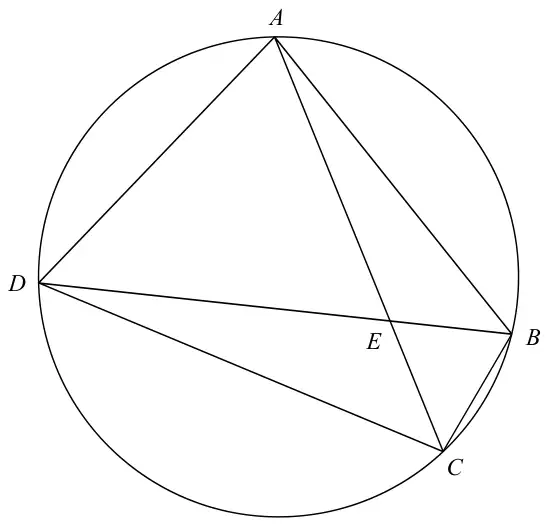
\(AEC\) and \(DEB\) are straight lines.
Triangle \(AED\) is an equilateral triangle.
Prove that triangle \(ABC\) is congruent to triangle \(DCB\). (4)
| Answer | Mark | Mark scheme |
|---|---|---|
| Proof | C1 | for one correct pair of equal angles with correct reason from: angle \(ACB\) = angle \(ADB\), (angles in the same segment are equal) angle \(DBC\) = angle \(DAC\), (angles in the same segment are equal) angle \(ABD\) = angle \(ACD\), (angles in the same segment are equal) or for recognising all angles of 60 in triangle \(AED\) and in triangle \(CEB\)) |
| C1 | for one identity, with reason(s), from the following list of alternatives: Alternatives: a complete method to show that angle \(ACB\) = angle \(DBC\) (= 60), or \(BC\) being common to both triangles or \(DB = DE+EB = AE+EC = AC\) (sides of an equilateral triangle are equal) or angle \(ABC = 60 +\) angle \(ABD = 60 +\) angle \(ACD\) = angle \(DCB\) (angles in the same segment are equal) or angle \(BDC\) = angle \(CAB\) (angles in the same segment are equal) | |
| C1 | for a second identity, with reason(s), from the alternatives above | |
| C1 | for concluding the proof with a third identity, with reason(s), from the alternatives above, together with the condition for congruency, ASA or SAS or AAS |
Additional guidance
Underlined words need to be shown; reasons need to be linked to their statement(s)
Pairs of equal angles may be just shown on the diagram