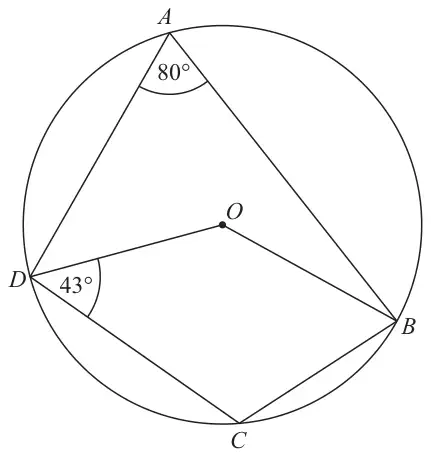
20 \(A\), \(B\), \(C\) and \(D\) are points on a circle with centre \(O\).
Find the size of angle \(OBC\). Write down any circle theorems that you use. (4)
Mark scheme
Answer
Mark
Mark scheme
57
M1
for method to find angle \(BCD\) eg \(BCD = 180 - 80\ (= 100)\)
M1
for method to find angle \(DOB\) eg \(DOB = 80 \times 2\ (= 160)\)
A1
for \(OBC = 57\)
C1
(dep on M1) for one correct circle theorem appropriate to their method eg The angle at the centre of a circle is twice the angle at the circumference or The angle at the circumference of a circle is half the angle at the centre orOpposite angles of a cyclic quadrilateral add up to 180
Additional guidance
Angles may be seen on diagram Method marks can be awarded in either order Correct method can be implied from angles on the diagram if no ambiguity or contradiction. eg Angle \(O\) = 160 is too ambiguous accept angle \(C\) = 100
Underlined words need to be shown; reasons need to be linked to their method. Accept “\(\angle\)” for “angle” and “\(\angle s\)” for “angles” Accept “4-sided shape” for “quadrilateral”
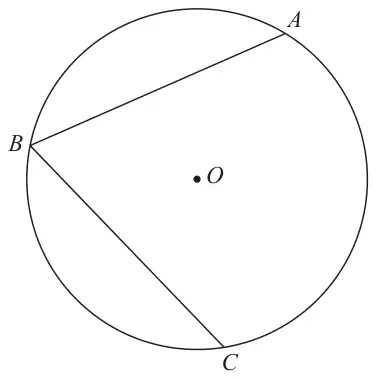
18 \(A\), \(B\) and \(C\) are three points on a circle, centre \(O\).
\(BA = BC\)
Prove that \(OB\) bisects angle \(ABC\). (3)
Mark scheme
Answer
Mark
Mark scheme
Proof
M1
begins proof to show that triangles \(ABO\) and \(CBO\) or triangles \(ABD\) and \(CBD\) are congruent by giving one pair of equal sides or equal angles with reason
M1
for different pair of equal sides or angles with reason
C1
for full proof that triangles \(ABO\) and \(CBO\) are congruent, SSS, or triangles \(ABD\) and \(CBD\) are congruent, RHS, and therefore angle \(ABO\) = angle \(CBO\)
\(AB = CB\) (given) \(BO\) (or \(BD\)) is common \(AO = CO\) radii of circle angle \(BAD\) = angle \(BCD\) angles in a semicircle are 90 (\(BO = AO = CO\) radii of circle) counts as two sides with reasons
OR
M1
draws \(OA\), \(OC\) and \(AC\) and labels angle \(OAC = x\) and angle \(OCA = x\) with reason given, \(AO = CO\) radii of circle and base angles of an isosceles triangle are equal or \(BAC = BCA\) since \(ABC\) is isosceles
M1
shows \(OAC = OCA\) and shows \(BAC = BCA\) and uses these to show \(OAB = OCB\) with all reasons given
C1
for full proof concluding with angle \(ABO = y\) and angle \(CBO = y\) with reason given, eg \(OA = OB = OC\) radii of circle and \(OBC\) and \(OAB\) are isosceles
Additional guidance
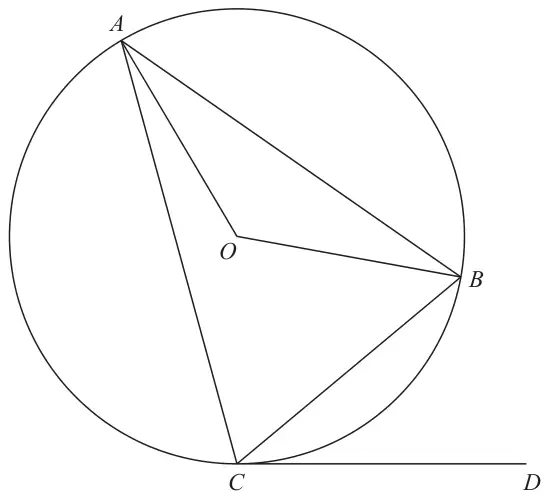
Where \(D\) is point such that \(BOD\) is diameter
Work out the size of angle \(ACD\). Write down any circle theorems that you use. (4)
Mark scheme
Answer
Mark
Mark scheme
100
M1
for angle \(BAC = 40\)
M1
for angle \(OAC\) or angle \(OCA = 10\) or angle \(OAB\) or angle \(OBA = 30\)
M1
for angle \(ACB = (180 - 30 - 30) \div 2\ (= 60)\) or angle \(OCD = 90\) or angle \(OCB = 50\)
C1
for angle \(ACD = 100\) and one correct appropriate circle theorem from alternate segment theorem angle at the centre is twice the angle at the circumference the tangent to a circle is perpendicular to the radius
Additional guidance
angle \(AOB = 120\) gets M1M1
Award M3C0 for answer of 100 with no correct appropriate circle theorem
Underlined words need to be shown Reason needs to be linked to their method, which can be implied from correctly identified angles (stated or written on the diagram)