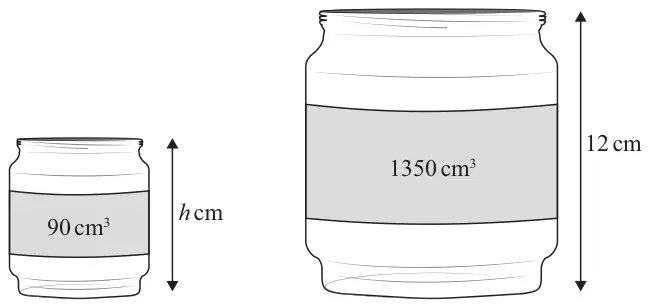
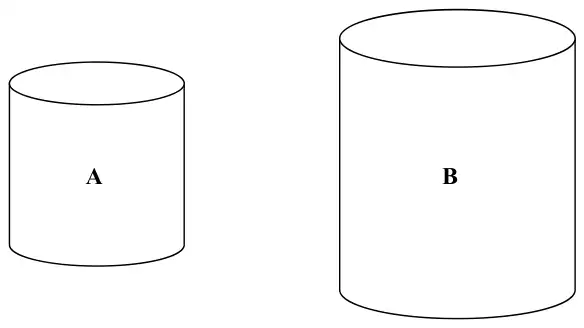
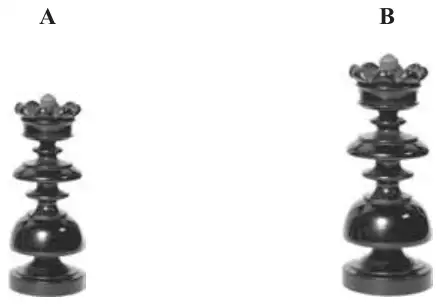
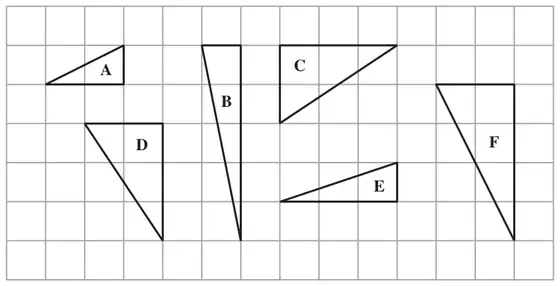
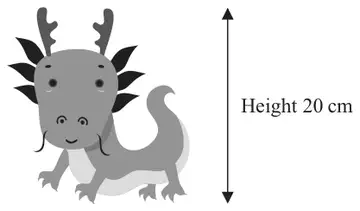
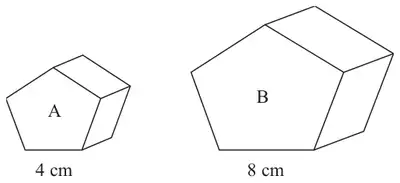
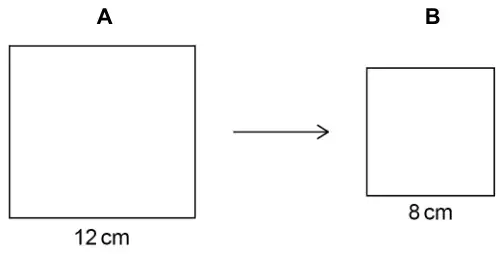
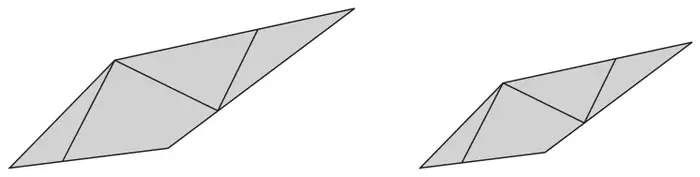
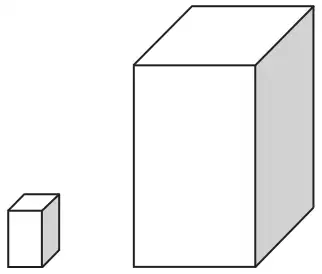
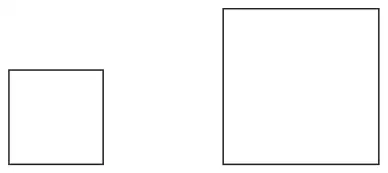
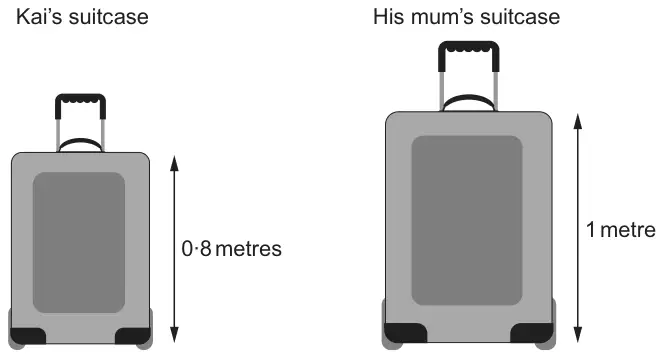
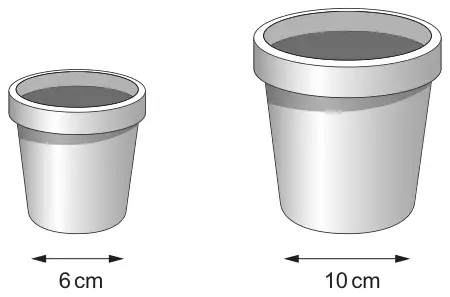
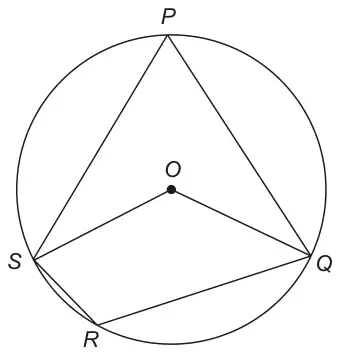
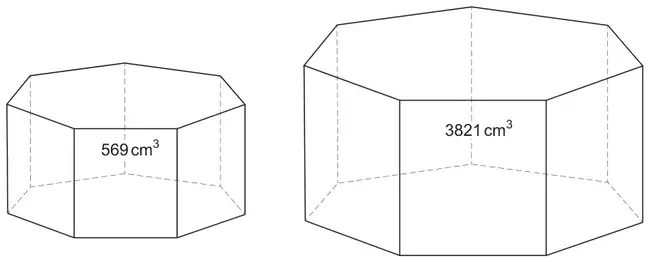
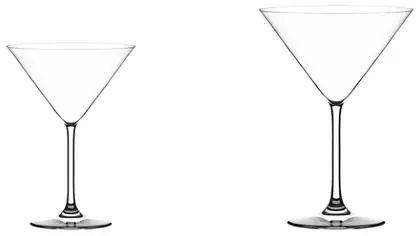
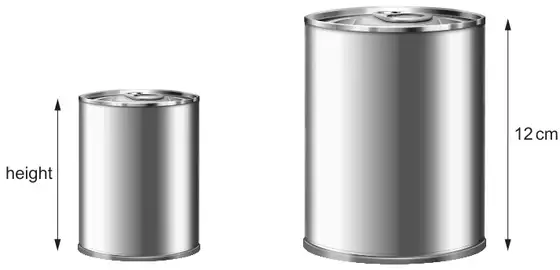
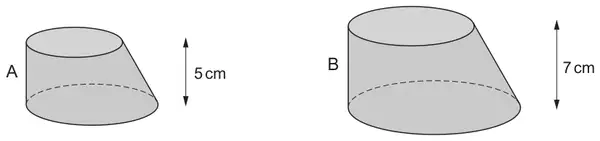
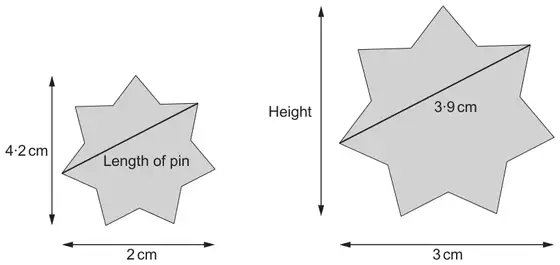
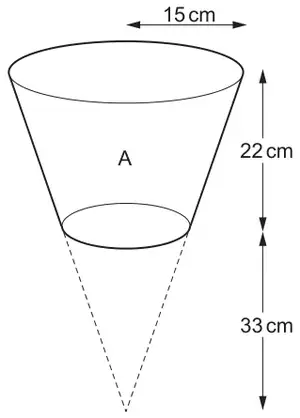
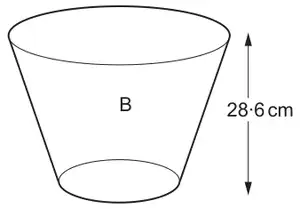
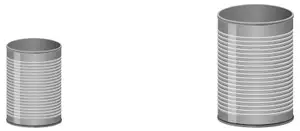
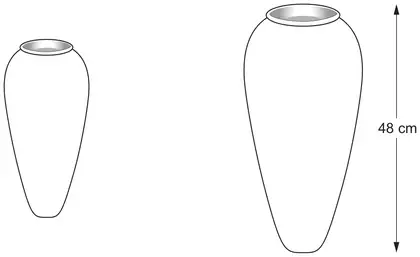
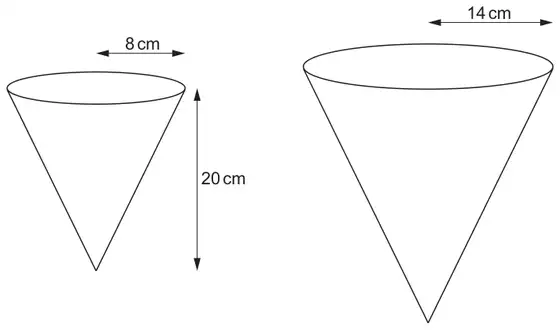
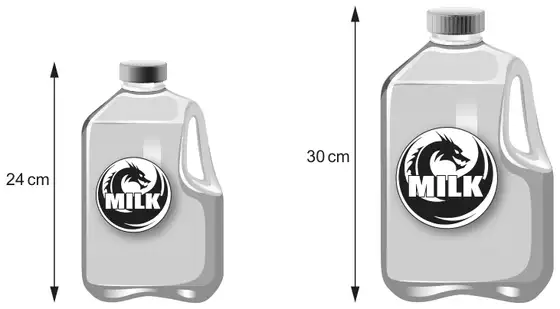
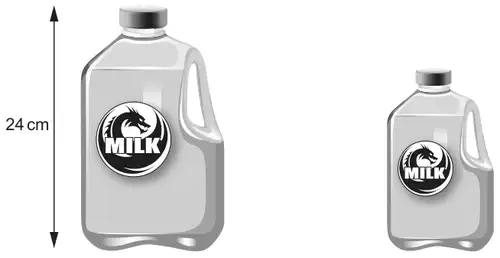
(a) Work out the height, \(h\) cm, of the smaller jar. Give your answer correct to 1 decimal place. (4)
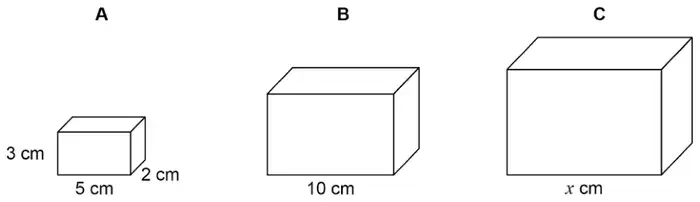
The surface area of the smaller jar is \(A\) cm2 The surface area of the larger jar is \(pA\) cm2
(b) Find the exact value of \(p\). (1)
Mark scheme (a)
Answer
Mark
Mark scheme
4.9
P1
for beginning to work with scale factors eg \(\left(\dfrac{h}{12}\right)^3\) or \(\left(\dfrac{12}{h}\right)^3\) or \(\dfrac{90}{1350}\ \left(= \dfrac{1}{15}\right)\) or \(\dfrac{1350}{90}\ (= 15)\) or 90 : 1350 oe
P1
for equating scale factors eg \(\left(\dfrac{h}{12}\right)^3 = \dfrac{90}{1350}\) or \(\left(\dfrac{12}{h}\right)^3 = \text{``}15\text{''}\) or for finding the linear scale factor, eg \(\sqrt[3]{\dfrac{90}{1350}}\) or \(\sqrt[3]{\text{``}15\text{''}}\ (= 2.46(6\ldots))\)
P1
for a complete method eg \(\sqrt[3]{12^3 \times \dfrac{90}{1350}}\) or \(12 \times \sqrt[3]{\dfrac{90}{1350}}\) or \(\dfrac{12}{\text{``}\left(\sqrt[3]{\text{``}15\text{''}}\right)\text{''}}\)
A1
for answers in the range 4.8 to 4.9
Mark scheme (b)
Answer
Mark
Mark scheme
\((15)^{\frac{2}{3}}\)
B1
for \(15^{\frac{2}{3}}\) or \(\left(\sqrt[3]{15}\right)^2\) or \(\sqrt[3]{15^2}\) or \(225^{\frac{1}{3}}\)
Additional guidance
If given in an acceptable form, then given as a decimal, isw and award
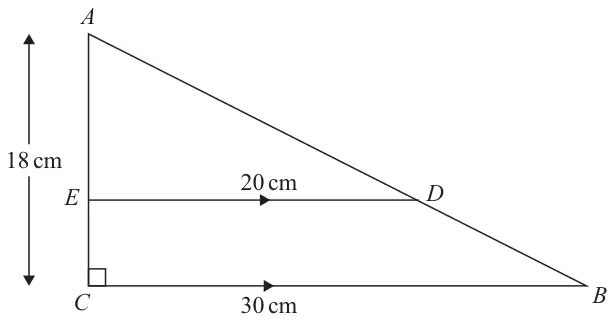
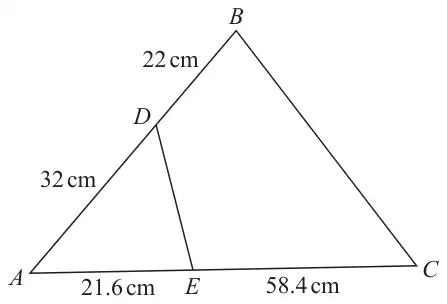
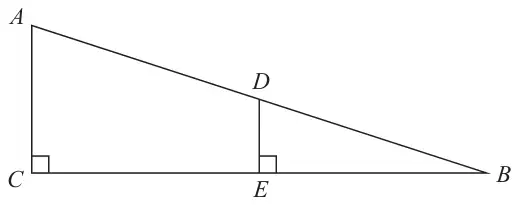
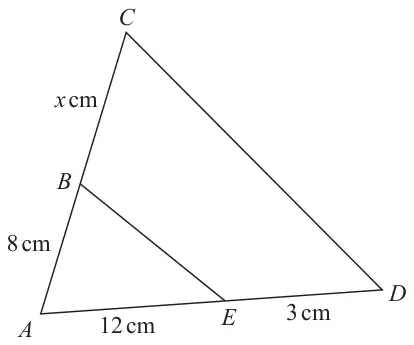
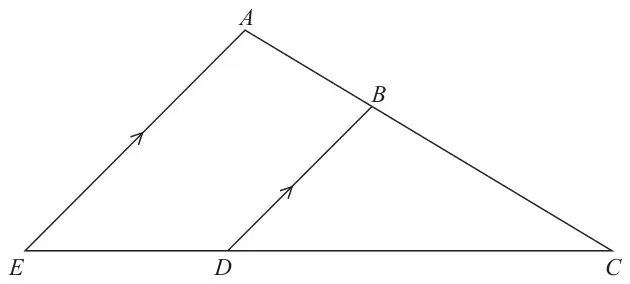
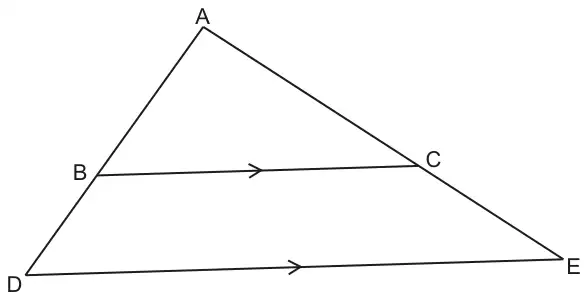
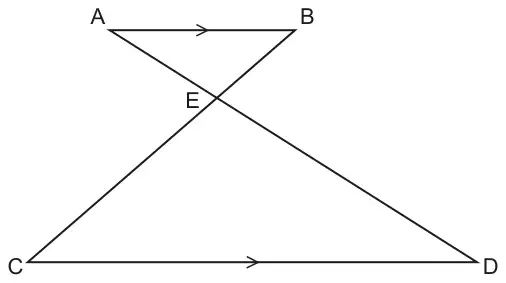
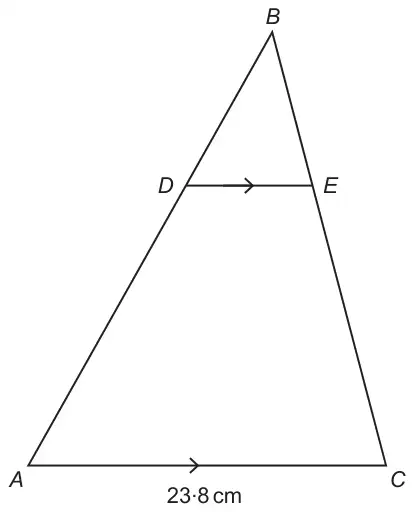
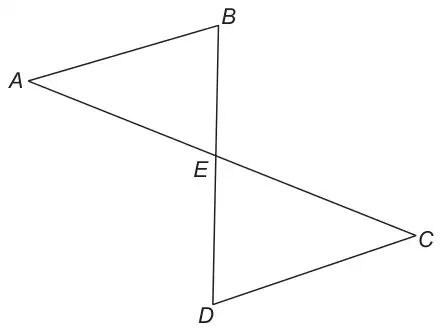
\(AEC\) and \(ADB\) are straight lines. \(ED\) is parallel to \(CB\).
(a) Prove that triangle \(ABC\) is similar to triangle \(ADE\). (2)
\(ED = 20\) cm \(CB = 30\) cm \(AC = 18\) cm
(b) Work out the length of \(EC\). (3)
Mark scheme (a)
Answer
Mark
Mark scheme
Proof
M1
for identifying angle \(A\) as common or for angle \(AED\) = angle \(ACB\) or angle \(ADE\) = angle \(ABC\) with appropriate reason(s) eg corresponding angles are equal or co-interior angles add up to 180 and angles on a straight line add up to 180
C1
for completing the proof by identifying a second pair of equal angles with appropriate reason(s) and a statement that the angles in each triangle are the same
Additional guidance
Statement can be implied by identifying a third pair of equal angles (no reason needed)
Mark scheme (b)
Answer
Mark
Mark scheme
6
P1
for a scale factor of 1.5 or \(\dfrac{2}{3}\) oe or for \(\dfrac{AE}{20} = \dfrac{18}{30}\) oe
P1
for a process to find the length of \(AE\), eg \(18 \div 1.5\ (= 12)\) oe or \((AE =)\ \dfrac{20 \times 18}{30}\) oe or for a complete process to find the length of \(EC\), eg \(18 \times \left(1 - \dfrac{2}{3}\right)\) oe
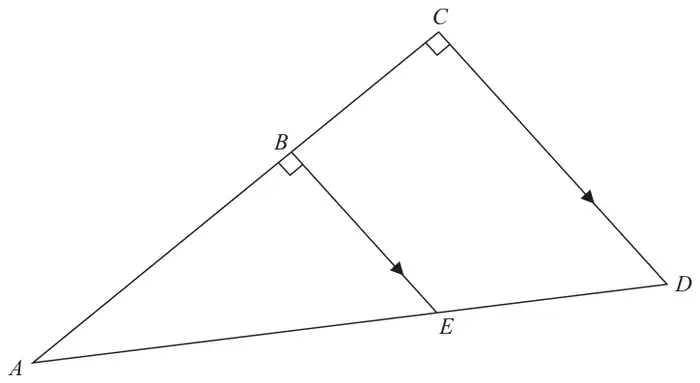
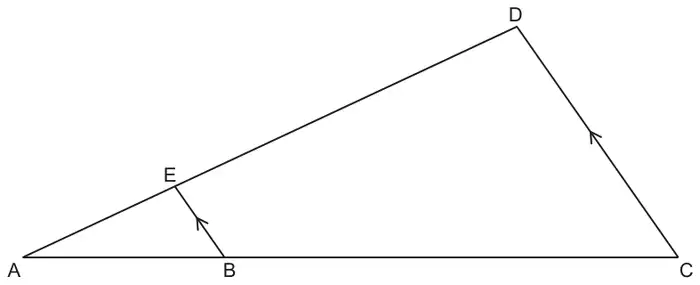
13 \(ABC\) and \(AED\) are straight lines. \(BE\) and \(CD\) are parallel.
\(BE = 4.2\) cm \(CD = 6.3\) cm \(AC = 10.8\) cm
Work out the area of trapezium \(BCDE\). (3)
Mark scheme
Answer
Mark
Mark scheme
18.9
P1
for using length scale factor to find \(AB\), eg \((AB =)\ 10.8 \div \left(\dfrac{3}{2}\right)\) or \((AB =)\ 10.8 \times \left(\dfrac{2}{3}\right)\ (= 7.2)\) or for using length scale factor to find \(BC\), eg \((BC =)\ 10.8 \div \dfrac{6.3}{6.3 - 4.2}\) or \((BC =)\ 10.8 \times \dfrac{6.3 - 4.2}{6.3}\ (= 3.6)\) or finds area scale factor, eg \(\left(\dfrac{3}{2}\right)^2\) or \(\left(\dfrac{2}{3}\right)^2\)
P1
for a complete process to find the area of trapezium, eg \(\dfrac{6.3 + 4.2}{2} \times (10.8 - \text{``}7.2\text{''})\) or \(\dfrac{(6.3 - 4.2) \times \text{``}3.6\text{''}}{2} + \text{``}3.6\text{''} \times 4.2\) or \(\dfrac{10.8 \times 6.3}{2} - \dfrac{7.2 \times 4.2}{2}\) or \(\dfrac{10.8 \times 6.3}{2} - \dfrac{10.8 \times 6.3}{2} \div \left(\text{``}\dfrac{3}{2}\text{''}\right)^2\) or \(\dfrac{10.8 \times 6.3}{2} - \dfrac{10.8 \times 6.3}{2} \times \left(\text{``}\dfrac{2}{3}\text{''}\right)^2\)
A1
accept trailing zeros eg 18.90
Additional guidance
Can use a combination of skills but must have a complete process to find \(AB\) or \(BC\) to score this mark
Sphere A has a volume of 64 cm3 Sphere B has a volume of 125 cm3
The radius of sphere C is 50% of the radius of sphere B.
Work out the ratio of the surface area of sphere A to the surface area of sphere C. Give your answer in the form \(a : b\) where \(a\) and \(b\) are integers. (4)
Mark scheme
Answer
Mark
Mark scheme
64 : 25
P1
for start of process to find ratio of lengths of A to B, eg \(\sqrt[3]{64}\ (= 4)\) or \(\sqrt[3]{125}\ (= 5)\) or 4 : 5
P1
for \(\sqrt[3]{125} \div 2\ (= 2.5)\) oe or \(\left(\text{``}\sqrt[3]{64}\text{''}\right)^2\ (= 16)\)
P1
for process to find ratio of areas of A to C, eg \(\text{``}4\text{''}^2 : \text{``}2.5\text{''}^2\ (= 16 : 6.25)\)
A1
for 64 : 25 oe in form \(a : b\) where \(a\) and \(b\) are integers
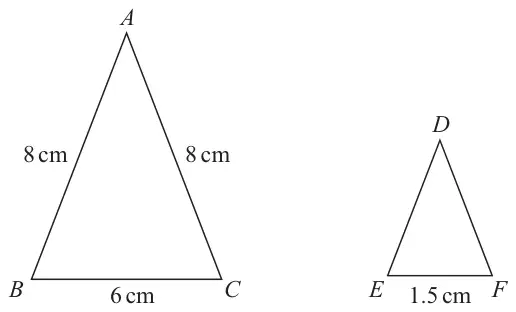
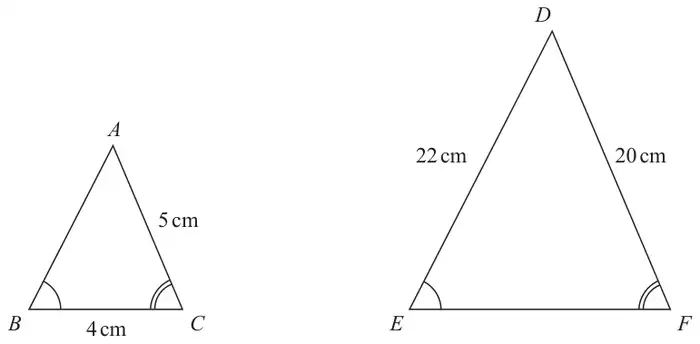
27 \(ABC\) and \(DEF\) are two similar isosceles triangles.
\(DE = DF\)
Work out the length of \(DE\). (2)
Mark scheme
Answer
Mark
Mark scheme
2
M1
for \(\dfrac{1.5}{6} \left(= \dfrac{1}{4}\right)\) or \(\dfrac{6}{1.5}\ (= 4)\) or \(\dfrac{8}{6} \left(= \dfrac{4}{3}\right)\) or \(\dfrac{6}{8} \left(= \dfrac{3}{4}\right)\) oe
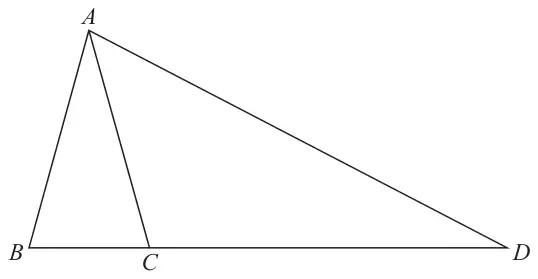
\(ABC\) and \(DAB\) are similar isosceles triangles.
\(AB = AC\) \(AD = BD\)
\(BC : CD = 4 : 21\)
Find the ratio \(AB : AD\) (3)
Mark scheme
Answer
Mark
Mark scheme
2 : 5
P1
for using similar triangles to form an equation eg \(\dfrac{AB}{BC} = \dfrac{AD}{AB}\) oe or \(\dfrac{AB}{4} = \dfrac{25}{AB}\) oe or \(\dfrac{AB}{4k} = \dfrac{25k}{AB}\) oe or \(AB : 4 = 25 : AB\) oe or \(BC \times \text{sf} = BD \div \text{sf}\) oe or \(4 \times \text{sf} = 25 \div \text{sf}\) oe or for working with the perpendicular height of triangle \(ABC\) eg \((h^2 =)\ 25^2 - 23^2\ (= 96)\) or \((h =)\ \sqrt{25^2 - 23^2}\ (= \sqrt{96})\)
P1
for process to find \(AB\) eg \((AB =)\ \sqrt{4 \times 25}\ (= 10)\) oe or \(\sqrt{\text{``}96\text{''} + 2^2}\ (= 10)\) or for process to find the scale factor eg \(\sqrt{\dfrac{25}{4}}\ \left(= \dfrac{5}{2} \text{ oe}\right)\)
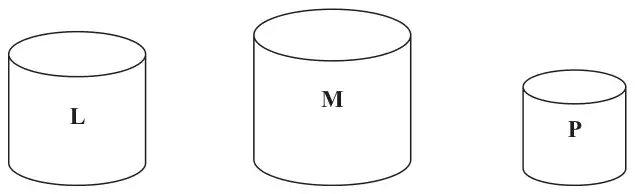
17L, M and P are three similar solid cylinders made from the same material.
L has a mass of 64 g M has a mass of 125 g
M has a total surface area of 144 cm2 P has a total surface area of 16 cm2
Work out
height of cylinder L : height of cylinder M : height of cylinder P(4)
Mark scheme
Answer
Mark
Mark scheme
12 : 15 : 5
P1
for process to find ratio of heights of L and M eg \(\sqrt[3]{64} : \sqrt[3]{125}\ (= 4 : 5)\) oe or \(\sqrt[3]{\dfrac{64}{64}} : \sqrt[3]{\dfrac{125}{64}}\ (= 1 : 1.25)\) oe or \(\sqrt[3]{\dfrac{64}{125}} : \sqrt[3]{\dfrac{125}{125}}\ (= 0.8 : 1)\) oe
P1
for process to find ratio of heights of M and P eg \(\sqrt{144} : \sqrt{16}\ (= 12 : 4 = 3 : 1)\) oe or \(\sqrt{\dfrac{144}{16}} : \sqrt{\dfrac{16}{16}}\ (= 3 : 1)\) oe or \(\sqrt{\dfrac{144}{144}} : \sqrt{\dfrac{16}{144}}\ (= 1 : 0.\dot{3})\) oe
P1
(dep on P2) for process to find ratio of heights of all 3, eg \(\text{``}(4 : 5)\text{''} \times 3\) and \(\text{``}(3 : 1)\text{''} \times 5\) or \((1 : 1.25) \times 12\) and \((3 : 1) \times 5\) or \((0.8 : 1)\) and \((1 : 0.\dot{3})\)
A1
for 12 : 15 : 5 oe
Additional guidance
Condone not written as a ratio as long as clear \(\dfrac{125}{64} = 1.953\ldots\) \(\dfrac{64}{125} = 0.512\)
Condone not written as a ratio as long as clear \(\dfrac{144}{16} = 9\) \(\dfrac{16}{144} = 0.\dot{1}\)
Can ISW incorrect simplification of a correct ratio
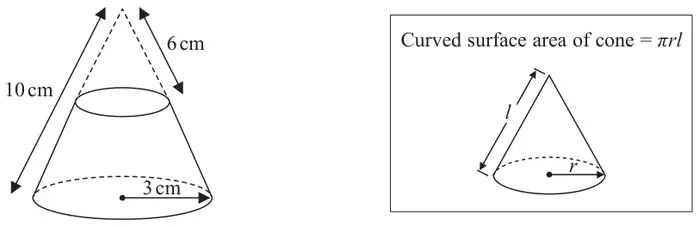
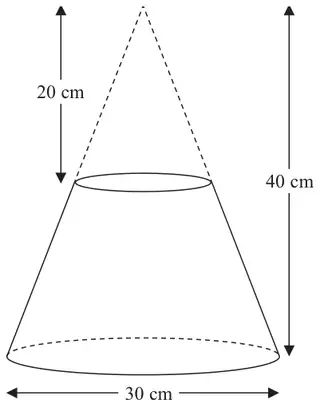
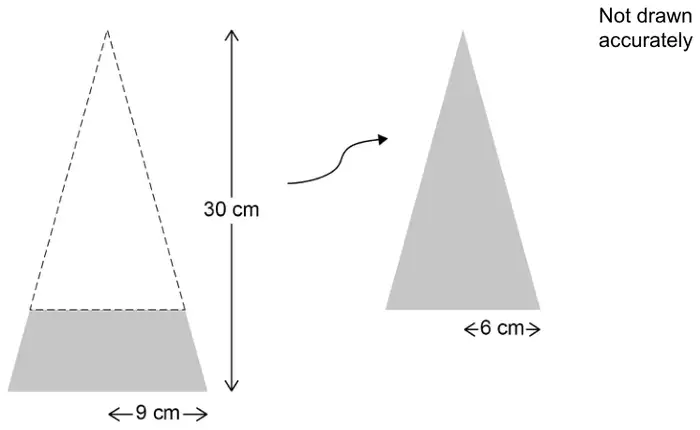
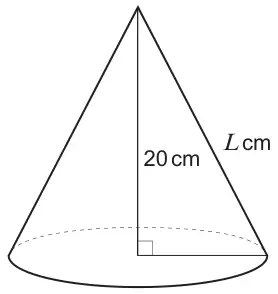
18 A solid frustum is made by removing a small cone from a large cone as shown in the diagram.
The slant height of the small cone is 6 cm. The slant height of the large cone is 10 cm. The radius of the base of the large cone is 3 cm.
Calculate the total surface area of the frustum. Give your answer correct to 3 significant figures. (5)
Mark scheme
Answer
Mark
Mark scheme
98.8
P1
for process to find the radius of the top of the frustum eg \(6 \div 10 \times 3\ (= 1.8)\)
P1
for process to find the curved surface area of the frustum eg \(3 \times \pi \times 10 - \text{``}1.8\text{''} \times \pi \times 6\ (= 60.3\ldots)\)
P1
for process to find the area of either circular face eg \(\pi \times 3^2\ (= 28.27\ldots)\) or \(\pi \times {\text{``}1.8\text{''}}^2\ (= 10.1\ldots)\)
P1
for a process to find the curved surface area + the area of at least one circular face eg \(3 \times \pi \times 10 - \text{``}1.8\text{''} \times \pi \times 6 + \pi \times 3^2\ (= 88.5\ldots)\) or \(3 \times \pi \times 10 - \text{``}1.8\text{''} \times \pi \times 6 + \pi \times {\text{``}1.8\text{''}}^2\ (= 70.49\ldots)\)
A1
for an answer in the range 98.7 to 98.8
Additional guidance
Accept rounded or truncated values Accept multiples of \(\pi\) for process marks.
If a correct answer within the range is shown in working but incorrectly rounded award full marks.
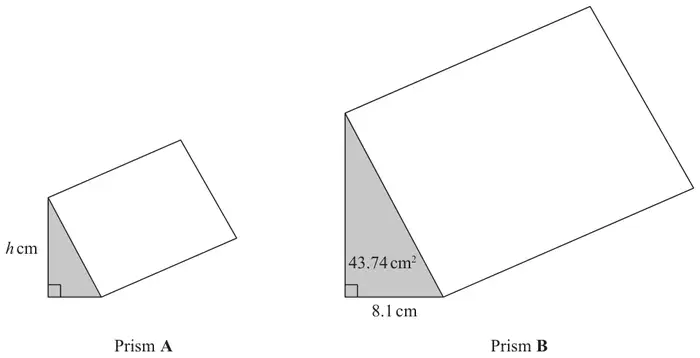
17 The diagram shows two similar solid triangular prisms, A and B.
The volume of prism A is 58.806 cm3 The volume of prism B is 1587.762 cm3
The cross section of each prism is a right-angled triangle.
For prism B: the length of the base of the triangle is 8.1 cm the area of the triangle is 43.74 cm2
The height of the triangle for prism A is \(h\) cm.
Work out the value of \(h\). (4)
Mark scheme
Answer
Mark
Mark scheme
3.6
P1
process to find the volume scale factor, eg \(1587.762 \div 58.806\ (= 27)\) or \(58.806 \div 1587.762\ (= 0.037\ldots)\)
P1
process to find the height of B, eg \(2 \times 43.74 \div 8.1\ (= 10.8)\) or process to find the area of A, eg \(43.74 \div (\sqrt[3]{\text{``}27\text{''}})^2\ (= 4.86)\) or \(43.74 \times (\sqrt[3]{\text{``}0.037...\text{''}})^2\ (= 4.86)\)
P1
complete process to find height of A, eg \(\text{``}10.8\text{''} \div \sqrt[3]{\text{``}27\text{''}}\) or \(\text{``}4.86\text{''} \times 2 \div (8.1 \div \sqrt[3]{\text{``}27\text{''}})\)
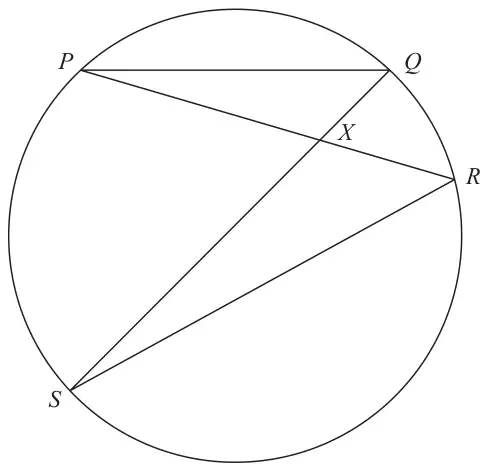
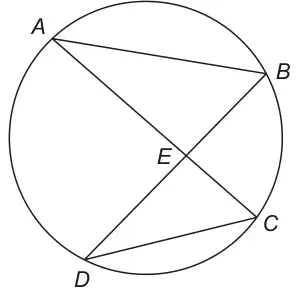
15 \(P\), \(Q\), \(R\) and \(S\) are four points on a circle.
\(PXR\) and \(SXQ\) are straight lines.
Prove that triangle \(PQX\) and triangle \(SRX\) are similar. (3)
Mark scheme
Answer
Mark
Mark scheme
Proof
C1
for angle \(PQX\) = angle \(SRX\) as angles in the same segment are equal (or angles at the circumference subtended from the same arc/chord of a circle are equal)
or angle \(QPX\) = angle \(RSX\) as angles in the same segment are equal (or angles at the circumference subtended from the same arc/chord of a circle are equal)
or angle \(PXQ\) = angle \(SXR\) as vertically opposite angles/vertically opposite angles are equal
or for identifying two pairs of corresponding equal angles with no reason given
C1
for identifying two pairs of corresponding equal angles with correct reasons given
C1
for stating that the triangles are similar because all three pairs of corresponding angles are equal with complete reasons given.
Additional guidance
Underlined words need to be shown; reasons need to be linked to their method.
Could be shown on the diagram
Note that the students third/final reason may be: Angles in a triangle add up to 180
The volume of sphere \(A\) is 125 cm\(^3\) The volume of sphere \(B\) is 27 cm\(^3\)
The ratio of the radius of sphere \(B\) to the radius of sphere \(C\) is \(1 : 2\)
Work out the ratio of the surface area of sphere \(A\) to the surface area of sphere \(C\). (3)
Mark scheme
Answer
Mark
Mark scheme
25 : 36
P1
for \(\sqrt[3]{125}\ (= 5)\) and \(\sqrt[3]{27}\ (= 3)\) oe OR for correct process to find the radius of A and radius of B (3.10… and 1.86…)
P1
for method to find values in ratio of length between \(A\) and \(C\) eg 5 and \(2 \times 3\ (= 6)\) oe or \(\text{``}3.10\ldots\text{''}\) and \(\text{``}1.86\ldots\text{''} \times 2\ (= 3.72\ldots)\) OR 25 and 36 OR for correct process to find SA of A and SA of C (120.(8…)) and (174.(0…))
A1
for 25 : 36 oe eg 1 : 1.44
Additional guidance
Accept scale factors expressed as fractions or decimals eg 1.66, 1.67, 0.6 or better Ignore units throughout
For both P marks the lengths need not be written as a ratio
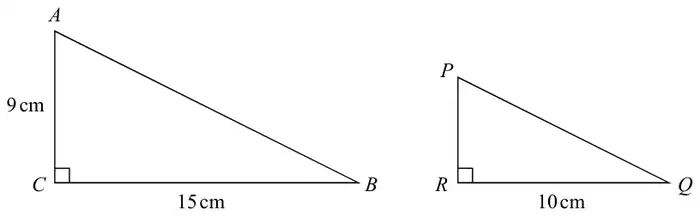
29 \(ABC\) and \(PQR\) are similar right-angled triangles.
angle \(ABC\) = angle \(PQR\)
(a) Work out the length of \(PR\). (2)
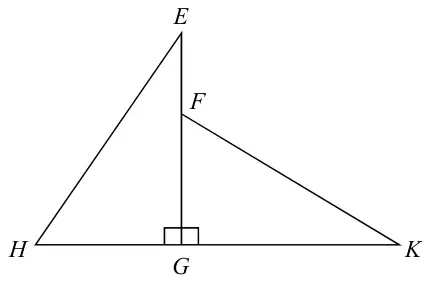
Triangle \(EGH\) is congruent to triangle \(KGF\).
\(HK = 10\) cm. \(HG = 4\) cm.
(b) Work out the length of \(EF\). (2)
Mark scheme (a)
Answer
Mark
Mark scheme
6
M1
for stating a similar triangle relationship eg \(\dfrac{AB}{PQ} = \dfrac{AC}{PR} = \dfrac{CB}{RQ}\) or equivalent set of similar triangle expressions or for substitution giving a fraction form for a scale factor eg \(\dfrac{10}{15}\left(= \dfrac{2}{3}\right)\) or \(\dfrac{15}{10}\left(= \dfrac{3}{2}\right)\) or \(\dfrac{9}{15}\left(= \dfrac{3}{5}\right)\) or \(\dfrac{15}{9}\left(= \dfrac{5}{3}\right)\)
A1
cao
Additional guidance
Accept any equivalent fractions or decimal equivalents given to at least 2 dp truncated or rounded
Mark scheme (b)
Answer
Mark
Mark scheme
2
P1
for showing understanding of the properties of congruent triangles by finding an unknown length using matching of two sides, eg \(EG\), \(KG\) and 6, or \(HG\), \(FG\) and 4 or matching corresponding angles eg \(HEG\) with \(FKG\) and \(EHG\) with \(KFG\)
A1
cao
Additional guidance
Can be shown by any complete statements that are unambiguous
Can be shown in working using algebraic statements, or given by unambiguous marking on the diagram to confirm the relationship.
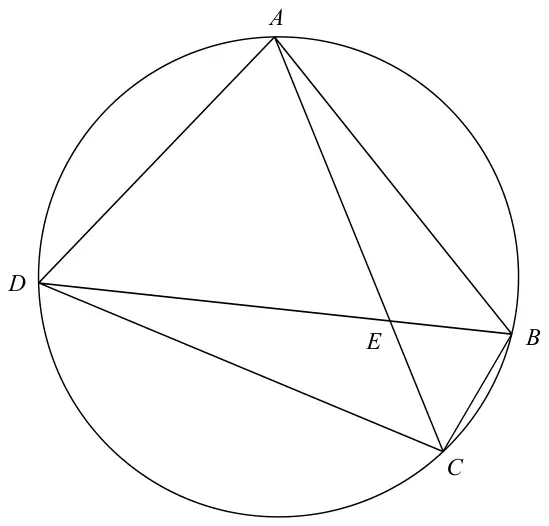
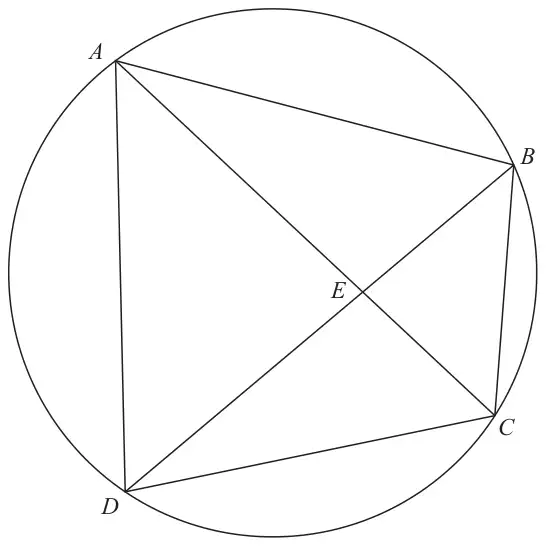
22 \(A\), \(B\), \(C\) and \(D\) are four points on a circle.
\(AEC\) and \(DEB\) are straight lines.
Triangle \(AED\) is an equilateral triangle.
Prove that triangle \(ABC\) is congruent to triangle \(DCB\). (4)
Mark scheme
Answer
Mark
Mark scheme
Proof
C1
for one correct pair of equal angles with correct reason from: angle \(ACB\) = angle \(ADB\), (angles in the same segment are equal) angle \(DBC\) = angle \(DAC\), (angles in the same segment are equal) angle \(ABD\) = angle \(ACD\), (angles in the same segment are equal) or for recognising all angles of 60 in triangle \(AED\) and in triangle \(CEB\))
C1
for one identity, with reason(s), from the following list of alternatives: Alternatives: a complete method to show that angle \(ACB\) = angle \(DBC\) (= 60), or \(BC\) being common to both triangles or \(DB = DE+EB = AE+EC = AC\) (sides of an equilateral triangle are equal) or angle \(ABC = 60 +\) angle \(ABD = 60 +\) angle \(ACD\) = angle \(DCB\) (angles in the same segment are equal) or angle \(BDC\) = angle \(CAB\) (angles in the same segment are equal)
C1
for a second identity, with reason(s), from the alternatives above
C1
for concluding the proof with a third identity, with reason(s), from the alternatives above, together with the condition for congruency, ASA or SAS or AAS
Additional guidance
Underlined words need to be shown; reasons need to be linked to their statement(s)
Pairs of equal angles may be just shown on the diagram
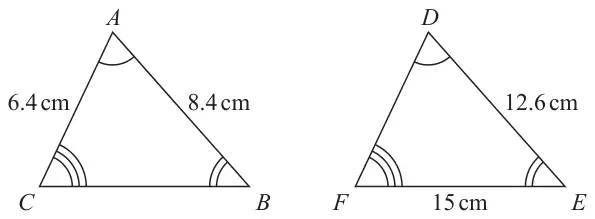
27 Triangle \(ABC\) and triangle \(DEF\) are similar.
(a) Work out the length of \(DF\). (2)
(b) Work out the length of \(CB\). (2)
Mark scheme (a)
Answer
Mark
Mark scheme
9.6
M1
for a correct ratio, eg \(\dfrac{12.6}{8.4}\ (= 1.5)\) or \(\dfrac{8.4}{12.6}\) (= 0.66..) or \(\dfrac{6.4}{8.4}\) (= 0.76..) or \(\dfrac{8.4}{6.4}\) (= 1.31) oe
A1
cao
Additional guidance
Decimal equivalents can be truncated or rounded to 2 dp Accept equivalent methods to use a sf eg \(\dfrac{6.4}{2} + 6.4\) (indicative of 1.5)
Mark scheme (b)
Answer
Mark
Mark scheme
10
M1
for \(15 \div \text{``}1.5\text{''}\) or \(15 \times \text{``}0.66..\text{''}\) or ft their ratio from part (a) oe
A1
cao
Additional guidance
Award the method mark for any (equivalent) complete method shown.
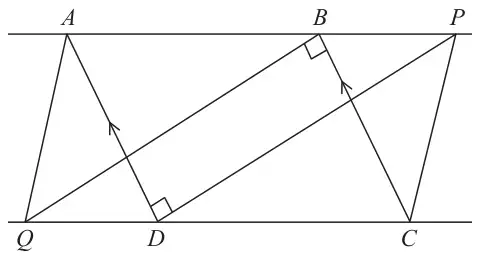
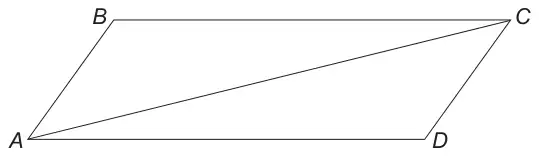
\(ABCD\) is a parallelogram. \(ABP\) and \(QDC\) are straight lines. Angle \(ADP\) = angle \(CBQ = 90^\circ\)
(a) Prove that triangle \(ADP\) is congruent to triangle \(CBQ\). (3)
(b) Explain why \(AQ\) is parallel to \(PC\). (2)
Mark scheme (a)
Answer
Mark
Mark scheme
Proof
C1
for starting the proof, identifying a pair of relevant equal sides or angles with reasons from \(AD = BC\) (opposite sides of a parallelogram are equal) angle \(PAD\) = angle \(QCB\) (opposite angles of a parallelogram are equal) angle \(ADP\) = angle \(CBQ\) (given or both 90°)
C1
(dep C1) for complete identification of all three equal aspects with reasons
C1
(dep C2) for conclusion of congruency proof
Additional guidance
Congruency conclusion must include a reference to ASA
Mark scheme (b)
Answer
Mark
Mark scheme
Explanation
C1
for identifying a pair of equal sides or angles in \(APCQ\), with reason, eg \(AP = QC\) since triangle \(ADP\) is congruent to triangle \(CBQ\)
C1
(dep C1) for reasoning that \(APCQ\) is a parallelogram so opposite sides of a parallelogram are parallel
surface area of shape A : surface area of shape B = 3 : 4
The volume of shape B is 10 cm3
Work out the volume of shape A. Give your answer correct to 3 significant figures. (3)
Mark scheme
Answer
Mark
Mark scheme
6.50
M1
for method to find ratio or scale factor of lengths or volumes eg \(\sqrt{3} : 2\) or 1 : 1.15(47....) or 0.86(60…) : 1 or \(\sqrt{27} : 8\) oe
M1
for complete method to find ratio of volumes and use to find required volume eg \(10 \div (\text{``}1.15...\text{''})^3\) or \(10 \times (\text{``}0.86...\text{''})^3\)
A1
for answer in the range 6.49 to 6.53
Additional guidance
Scale factors may just be seen as 1.15..., 0.86...etc
If an answer is given within the range then incorrectly rounded to 3 sig figs, award full marks. Accept 6.5
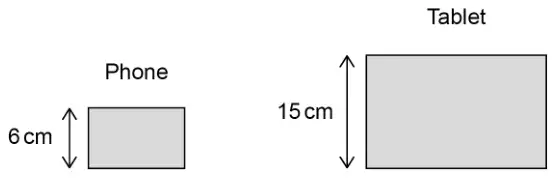
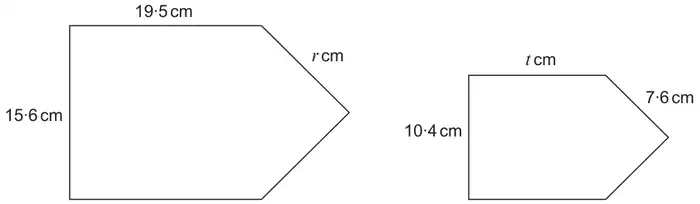
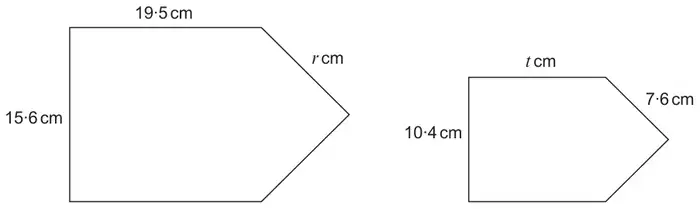
Work out each of these values. State any assumptions you make in your working. (5)
Mark scheme
Answer
Mark
Notes
2, 14.5
P1
for scale factor of \(\dfrac{12}{3}\) or \(\dfrac{3}{12}\) or \(\dfrac{15}{12}\) or \(\dfrac{12}{15}\) or \(\dfrac{8}{12}\) or \(\dfrac{12}{8}\) or \(\dfrac{15}{8}\) oe or correctly identifies 2 pairs of corresponding sides
A1
for \(x=2\)
P1
for complete method to find other value for \(x\) eg \(\dfrac{15}{8} \times 12 - 8\)
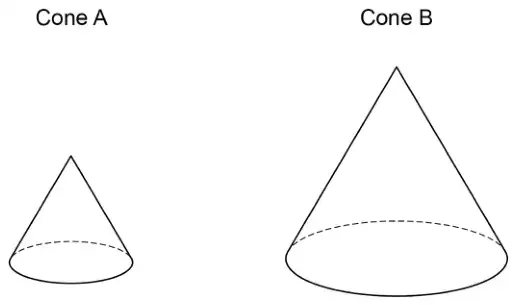
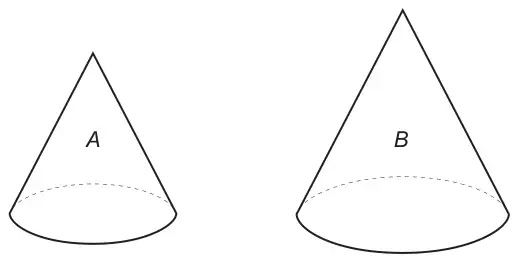
14 Cone A and cone B are mathematically similar. The ratio of the volume of cone A to the volume of cone B is 27 : 8
The surface area of cone A is 297 cm2
Show that the surface area of cone B is 132 cm2(3)
Mark scheme
Answer
Mark
Notes
Shown
M1
for \(\sqrt[3]{\dfrac{8}{27}}\ \left(= \dfrac{2}{3}\right)\) or \(\sqrt[3]{\dfrac{27}{8}}\ \left(= \dfrac{3}{2}\right)\) or 2 : 3 or 3 : 2
M1
for \(\left(\sqrt[3]{\dfrac{8}{27}}\right)^2\ \left(= \dfrac{4}{9}\right)\) or \(\left(\sqrt[3]{\dfrac{27}{8}}\right)^2\ \left(= \dfrac{9}{4}\right)\) or 4 : 9 or 9 : 4
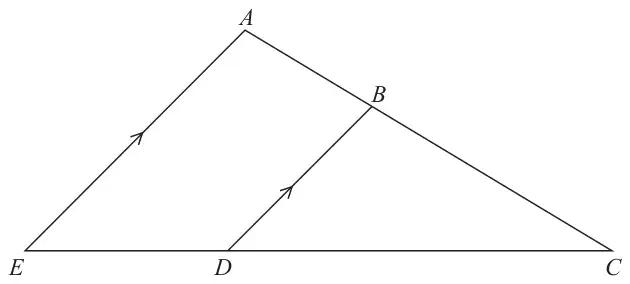
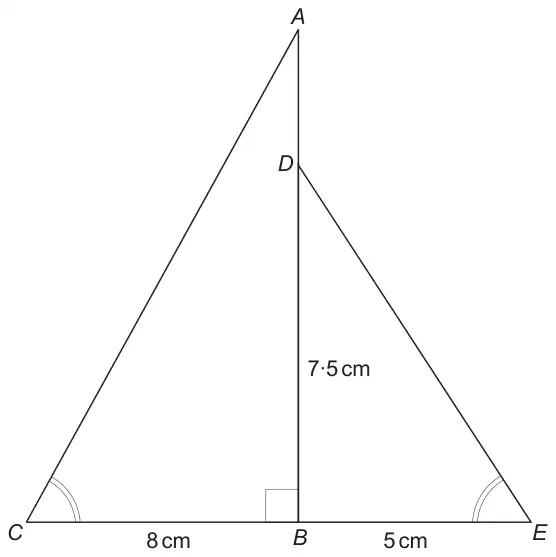
\(ABC\) and \(EDC\) are straight lines. \(EA\) is parallel to \(DB\).
\(EC = 8.1\) cm. \(DC = 5.4\) cm. \(DB = 2.6\) cm.
(a) Work out the length of \(AE\). (2)
\(AC = 6.15\) cm.
(b) Work out the length of \(AB\). (2)
Mark scheme (a)
Answer
Mark
Notes
3.9
M1
for a ratio of \(\dfrac{8.1}{5.4}\ (= 1.5)\) oe or \(\dfrac{5.4}{8.1}\ (= 0.66..)\) oe or \(\dfrac{2.6}{5.4}\ (= 0.48..)\) oe or \(\dfrac{5.4}{2.6}\ (= 2.07..)\) oe
A1
cao
Mark scheme (b)
Answer
Mark
Notes
2.05
M1
for \(\dfrac{5.4}{8.1} \times 6.15\ (= 4.1)\) or \(\dfrac{2.7}{8.1} \times 6.15\) oe or ft “scale factor” from (a)
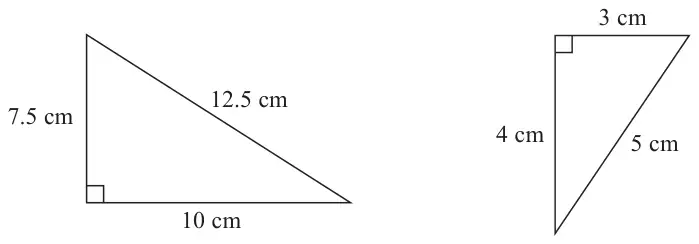
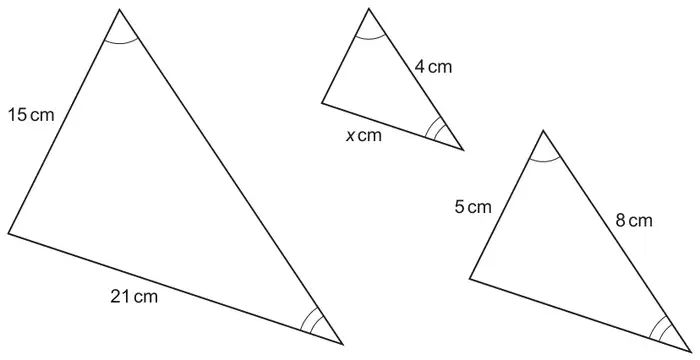
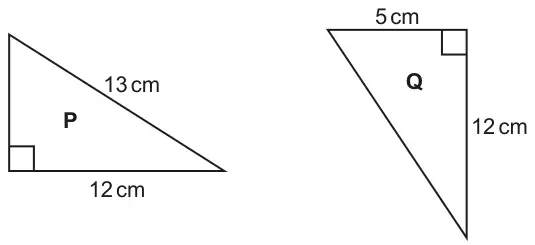
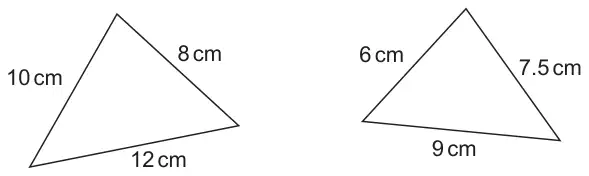
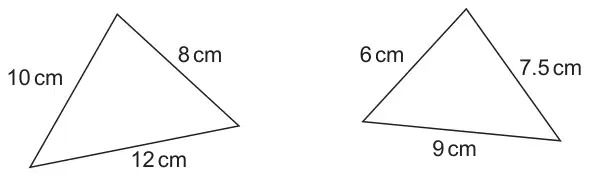
Show that these two triangles are mathematically similar. (2)
Mark scheme
Answer
Mark
Notes
Shown (supported)
M1
method to divide a pair of corresponding sides, eg \(7.5 \div 3\ (= 2.5)\) or \(3 \div 7.5\ (= 0.4)\), or states scale factor is 2.5 or 0.4 or method to work out the size of an angle, eg \(\tan^{-1}\left(\dfrac{7.5}{10}\right)\) (= 36.8 to 36.9)
C1
shows or states that all sides are enlarged by the same factor or works out a pair of corresponding angles and states that the two triangles have the same angles
15 \(A\), \(B\), \(C\) and \(D\) are four points on the circumference of a circle.
\(AEC\) and \(BED\) are straight lines.
Prove that triangle \(ABE\) and triangle \(DCE\) are similar. You must give reasons for each stage of your working. (3)
Mark scheme
Answer
Mark
Notes
Proof
C1
for identifying one pair of equal angles with a correct reason, e.g. (angle) \(BAE\) = (angle) \(CDE\); angles in the same segment are equal or angles at the circumference subtended on the same arc are equal or for identifying two pairs of equal angles with no correct reasons given (angles must be within the appropriate triangles)
C1
for identifying a second pair of equal angles with a correct reason, e.g. (angle) \(AEB\) = (angle) \(DEC\); opposite angles or vertically opposite angles are equal or for identifying the three pairs of equal angles with no correct reasons given
C1
for stating the three pairs of equal angles of the two triangles e.g. \(ABE = DCE\), \(BEA = CED\), \(EAB = EDC\) with fully correct reasons
\(ABC\) and \(EDC\) are straight lines. \(EA\) is parallel to \(DB\).
\(EC = 8.1\) cm. \(DC = 5.4\) cm. \(DB = 2.6\) cm.
(a) Work out the length of \(AE\). (2)
\(AC = 6.15\) cm.
(b) Work out the length of \(AB\). (2)
Mark scheme (a)
Answer
Mark
Notes
3.9
M1
for a ratio of \(\dfrac{8.1}{5.4}\ (= 1.5)\) oe or \(\dfrac{5.4}{8.1}\ (= 0.66..)\) oe or \(\dfrac{2.6}{5.4}\ (= 0.48..)\) oe or \(\dfrac{5.4}{2.6}\ (= 2.07..)\) oe
A1
cao
Mark scheme (b)
Answer
Mark
Notes
2.05
M1
for \(\dfrac{5.4}{8.1} \times 6.15\ (= 4.1)\) or \(\dfrac{2.7}{8.1} \times 6.15\) oe or ft “scale factor” from (a)
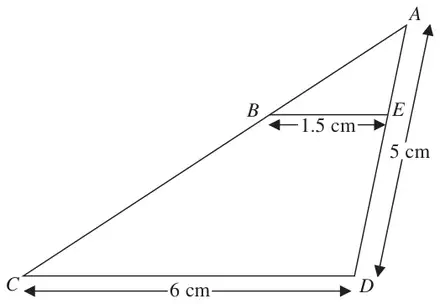
\(ABC\) and \(AED\) are straight lines. \(BE\) and \(CD\) are parallel. \(BE = 1.5\) cm. \(CD = 6\) cm. \(AD = 5\) cm.
Calculate the length of \(ED\). (3)
Mark scheme
Answer
Mark
Notes
3.75 oe
3
M1 for a correct scale factor or ratio using two corresponding sides from similar triangles or two sides from the same triangle (may be seen in an equation) e.g \(\dfrac{6}{1.5}\) oe or \(\dfrac{1.5}{6}\) oe or \(\dfrac{5}{6}\) or \(\dfrac{6}{5}\) etc. (accept these written as ratios) M1 for a complete method to find \(ED\) A1
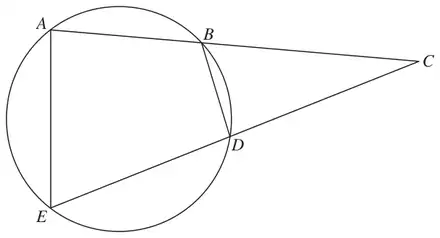
\(A\), \(B\), \(D\) and \(E\) are points on a circle. \(ABC\) and \(EDC\) are straight lines.
Prove that triangle \(BCD\) is similar to triangle \(ECA\). You must give reasons for your working. (5)
Mark scheme
Answer
Mark
Notes
Similarity and proof
5
B1 for method matching a pair of opposite angles, e.g. if \(EAB = x\), \(BDE = 180 - x\), \(EAB + BDE = 180\) B1 for linking angles between quad and triangle, e.g. if \(BDE = 180 - x\) then \(BDC = x\) B1 for stating or implying \(ACE = BCD\) (same angle) C1 for Opposite angles of a cyclic quadrilateral add up to \(180^\circ\) or statement linking three angles for similarity C1 for complete proof
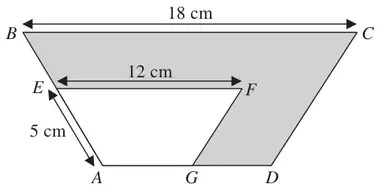
\(ABCD\) and \(AEFG\) are mathematically similar trapeziums.
\(AE = 5\) cm \(EF = 12\) cm \(BC = 18\) cm
(a) Work out the length of \(AB\). (2)
Trapezium \(AEFG\) has an area of 36 cm\(^2\).
(b) Work out the area of the shaded region. (3)
Mark scheme (a)
Answer
Mark
Notes
7.5
2
M1 for \(\dfrac{12}{18}\) oe or \(\dfrac{18}{12}\) oe or \(\dfrac{12}{5}\) oe or \(\dfrac{5}{12}\) oe A1 cao
Mark scheme (b)
Answer
Mark
Notes
45
3
M1 for \(\left(\text{``}\tfrac{3}{2}\text{''}\right)^2\) oe or \(\left(\text{``}\tfrac{2}{3}\text{''}\right)^2\) oe M1 for complete method to find area of shaded region, eg \(36 \times \text{``}1.5\text{''}^2 - 36\) A1 cao (SC B2 for 81)
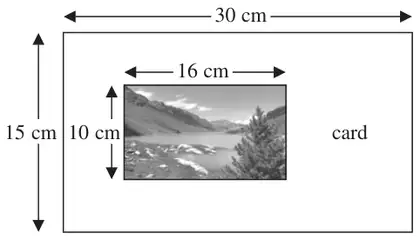
20 Steve has a photo and a rectangular piece of card.
Diagram NOT accurately drawn
The photo is 16 cm by 10 cm. The card is 30 cm by 15 cm.
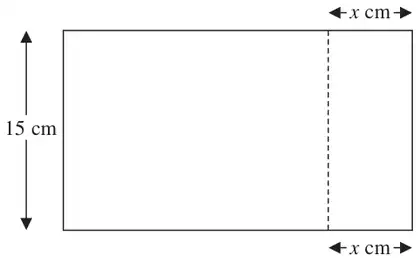
Steve cuts the card along the dotted line shown in the diagram below.
Steve throws away the piece of card that is 15 cm by \(x\) cm. The piece of card he has left is mathematically similar to the photo.
Work out the value of \(x\). (3)
Mark scheme
Answer
Mark
Notes
6
3
M1 for \(\dfrac{15}{10}\) (=1.5) or \(\dfrac{10}{15}\) (=0.66..) or \(\dfrac{16}{10}\) (=1.6) or \(\dfrac{10}{16}\) (=0.625) M1 for \(\dfrac{15}{10} \times 16\) (=24) oe A1 cao
OR
M1 for \(\dfrac{15}{16}\) (=0.9375) or \(\dfrac{16}{15}\) (=1.066…) or \(\dfrac{16}{10}\) (=1.6) or \(\dfrac{10}{16}\) (=0.625) M1 for \(\dfrac{15}{16} \times 10\) (=9.375) oe A1 20.625 oe
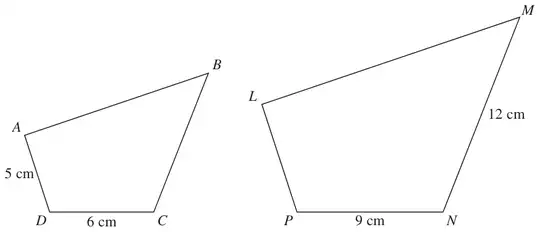
M1 for sight of \(\dfrac{9}{6}\) (=1.5) oe or \(\dfrac{6}{9}\) (=0.66..) oe or \(\dfrac{5}{6}\) (=0.83..) oe or \(\dfrac{6}{5}\) (=1.2) oe or a ratio, eg 6:9 oe or decimal, eg 1.5 oe A1 cao
Mark scheme (b)
Answer
Mark
Notes
8
2
M1 for \(12 \times \dfrac{6}{9}\) oe or \(12 \div \dfrac{9}{6}\) oe or \(\dfrac{12}{\text{``}7.5\text{''}} \times 5\) oe A1 cao
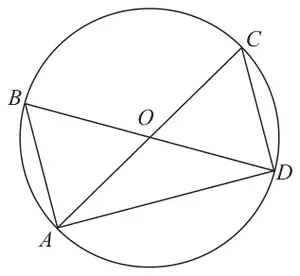
\(AOC\) and \(BOD\) are diameters of a circle, centre \(O\).
Prove that triangle \(ABD\) and triangle \(DCA\) are congruent. (3)
Mark scheme
Answer
Mark
Notes
Proof
3
M1 for one pair of equal angles or sides with reason M1 for second pair of equal angles or sides with reason C1 for proof completed correctly with full reasons and reason for congruence
Acceptable reasons: \(AD\) common (oe eg both same) Angle \(BAD\) = angle \(CDA\) (angles in a semicircle are 90°) Angle \(ABO\) = angle \(DCA\) (angles in the same segment are equal) Triangle \(ABD\) and triangle \(DCA\) are congruent - ASA
OR
\(BD = CA\) (diameters of the circle) Angle \(BAD\) = angle \(CDA\) (angles in a semicircle are 90°.) \(AD\) common Triangle \(ABD\) and triangle \(DCA\) are congruent - RHS
OR
\(BD = CA\) (diameters of the circle) \(AD\) is common Angle \(ADB\) = angle \(CAD\) (base angles of an isosceles triangle are equal.) Triangle \(ABD\) and triangle \(DCA\) are congruent - SAS
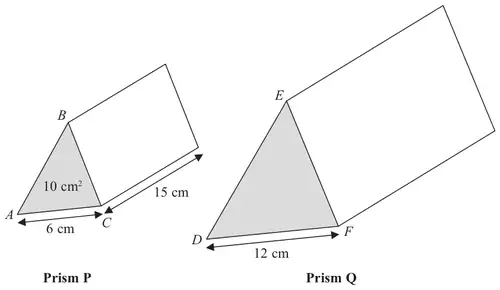
22P and Q are two triangular prisms that are mathematically similar.
Diagram NOT accurately drawn
Prism P has triangle \(ABC\) as its cross section. Prism Q has triangle \(DEF\) as its cross section.
\(AC = 6\) cm \(DF = 12\) cm
The area of the cross section of prism P is 10 cm\(^2\). The length of prism P is 15 cm.
Work out the volume of prism Q. (4)
Mark scheme
Answer
Mark
Notes
1200 cm\(^3\)
4
M1 for \(10 \times 2 \times 2\) and \(15 \times 2\) M1 for \(\text{``}40\text{''} \times \text{``}30\text{''}\) A1 for 1200 B1 (indep) for cm\(^3\)
OR
M1 for \(10 \times 15\) or \(2^3\) or 8 indicated as scale factor M1 for \(10 \times 15 \times 2 \times 2 \times 2\) A1 for 1200 B1 (indep) for cm\(^3\)
B1 for 15cm as diameter or 7.5 cm as radius of smaller cone (may be marked on diagram or used in a formula) M1 for a numerical expression for the volume of one cone eg. \(\frac{1}{3} \times \pi \times 15^2 \times 40\) (=9424...) or \(\frac{1}{3} \times \pi \times 7.5^2 \times 20\) (=1178...) M1 for \(\frac{1}{3} \times \pi \times 15^2 \times 40\) oe − \(\frac{1}{3} \times \pi \times 7.5^2 \times 20\) oe A1 for answer in the range 8240 − 8250 OR B1 for \(2^3\) M1 for a numerical expression for the volume of the large cone eg. \(\frac{1}{3} \times \pi \times 15^2 \times 40\) (=9424...) M1 volume of frustrum = \(\frac{7}{8} \times \frac{1}{3} \times \pi \times 15^2 \times 40\) oe A1 for answer in the range 8240 − 8250
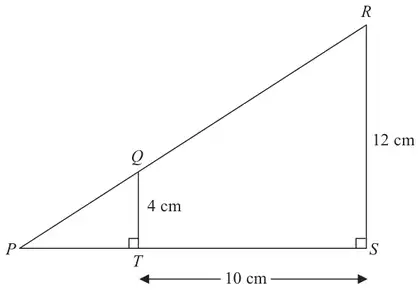
\(PQR\) and \(PTS\) are straight lines. Angle \(PTQ\) = Angle \(PSR = 90^\circ\) \(QT = 4\) cm \(RS = 12\) cm \(TS = 10\) cm
(a) Work out the area of the trapezium \(QRST\). (2)
(b) Work out the length of \(PT\). (3)
Mark scheme (a)
Working
Answer
Mark
Notes
\(\frac{1}{2} \times (4 + 12) \times 10\)
80
2
M1 for a fully correct method for area of \(QRST\) A1 cao
Mark scheme (b)
Working
Answer
Mark
Notes
For example \(\dfrac{PT + 10}{PT} = \dfrac{12}{4} = 3\) \(PT + 10 = 3PT\) \(2PT = 10\)
5
3
M1 for a correct scale factor or ratio using two corresponding sides from two similar triangles or two sides within the same triangle (may be seen within an equation) eg. \(\frac{12}{4}\) oe or 4 : 12 oe or \(\frac{PT}{4}\) or \(\frac{PS}{12}\) or \(\frac{12}{12 - 4}\) etc. M1 for a correct equation with \(PT\) or \(PS\) as the only variable or complete correct method using scale factor A1 cao
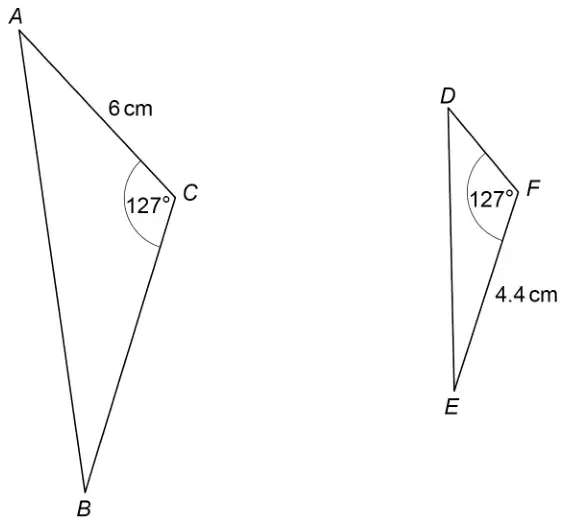
\(0.5 \times 6 \times x \times \sin 127 = 26.355\) or \(26.355 \div 6 \div \sin 127 \times 2\) or \(26.355 \div 6 \div [0.7986, 0.8] \times 2\) or [10.98, 11.001]
M1
length BC oe any letter
their \([10.98, 11.001] \div 4.4\) or [2.495, 2.50023] or \(4.4 \div\) their [10.98, 11.001] or [0.39996, 0.40073]
M1dep
length scale factor oe implied by [2.3997, 2.405] for length of DF
\(6 \div\) their [2.495, 2.50023] or \(6 \times\) their [0.39996, 0.40073] or [2.3997, 2.405] and \(0.5 \times 4.4 \times\) their [2.3997, 2.405] \(\times \sin 127\) or \(0.5 \times 4.4 \times\) their [2.3997, 2.405] \(\times\) [0.7986, 0.8] or \(26.355 \div (\text{their } [2.495, 2.50023])^2\) or \(26.355 \times (\text{their } [0.39996, 0.40073])^2\)
M1dep
length DF and area oe
area ratio and area \(26.355 \div \dfrac{[10.98, 11.001]^2}{4.4^2}\) or \(26.355 \times \dfrac{4.4^2}{[10.98, 11.001]^2}\) scores M3
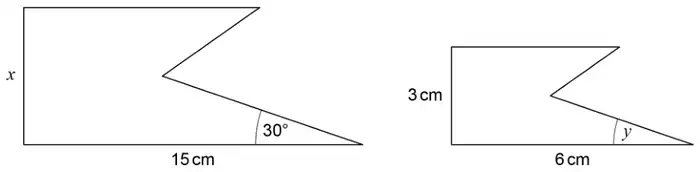
\(15 \div 6\) or 2.5 or \(6 \div 3\) or 2 or \(6 \div 15\) or 0.4 or \(3 \div 6\) or 0.5 or \(\dfrac{x}{15} = \dfrac{3}{6}\) or \(\dfrac{x}{15} = 0.5\)
M1
oe may be seen on the diagram
7.5 or \(7\dfrac{1}{2}\) or \(\dfrac{15}{2}\)
A1
Additional guidance
Accept correct answer unambiguously placed as \(x\) on the diagram provided it is not contradicted in the working space.
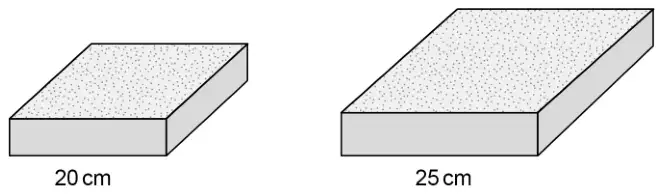
The price per cm\(^3\) is the same for both stones.
The price of the larger stone is £17.50
Work out the price of the smaller stone. [4 marks]
Mark scheme
Answer
Mark
Comments
\(\dfrac{25}{20}\) or \(\dfrac{5}{4}\) or 1.25 or \(\dfrac{20}{25}\) or \(\dfrac{4}{5}\) or 0.8 or (ratio of lengths is) 20 : 25
M1
oe
\(\left(\dfrac{25}{20}\right)^3\) or \(\left(\dfrac{5}{4}\right)^3\) or \(1.25^3\) or \(\left(\dfrac{20}{25}\right)^3\) or \(\left(\dfrac{4}{5}\right)^3\) or \(0.8^3\) or (ratio of volumes is) \(20^3 : 25^3\)
M1dep
oe eg \(\dfrac{125}{64}\) or 1.953125 or \(\dfrac{64}{125}\) or 0.512
oe eg \(4^3 : 5^3\)
\(17.5(0) \div 1.25^3\) or \(17.5(0) \times 0.8^3\)
M1dep
oe
8.96
A1
SC2 34.18
Additional guidance
Up to M2 may be awarded for correct work with no answer or incorrect answer, even if this is seen amongst multiple attempts
\(17.5(0) \times 1.25^3\) or \(17.5(0) \div 0.8^3\)
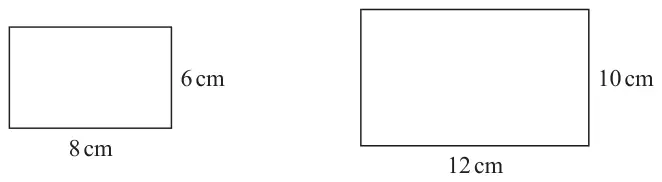
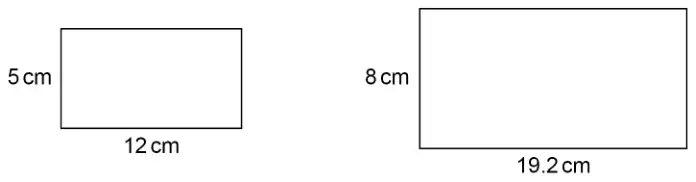
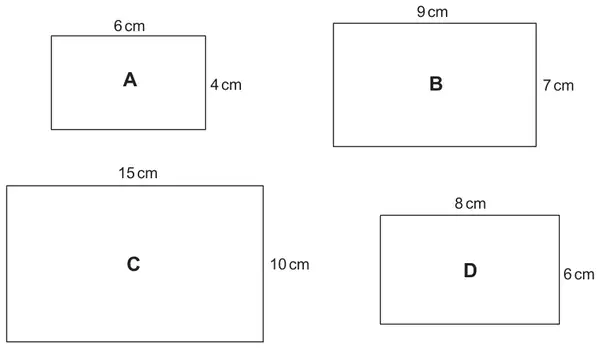
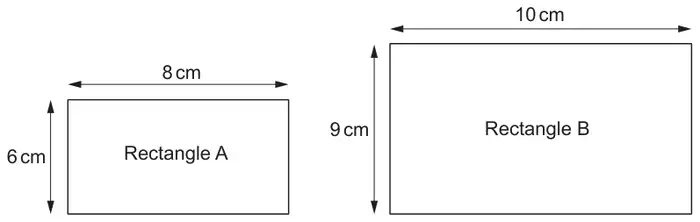
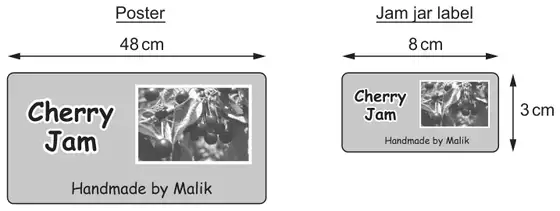
22 Show that these two rectangles are similar. [2 marks]
Not drawn accurately
Mark scheme
Answer
Mark
Comments
\(8 \div 5\) or \(19.2 \div 12\) or \(\dfrac{8}{5}\) or \(\dfrac{19.2}{12}\) or 1.6 or \(12 \div 5\) or \(19.2 \div 8\) or \(\dfrac{12}{5}\) or \(\dfrac{19.2}{8}\) or 2.4
M1
oe use of a valid pair of sides to make an appropriate calculation or value eg \(5 \div 8\) or 0.625 or \(5 \div 12\) or [0.416, 0.417]
\(8 \div 5 = 19.2 \div 12\) or \(\dfrac{8}{5} = \dfrac{19.2}{12}\) or \(12 \div 5 = 19.2 \div 8\) or \(\dfrac{12}{5} = \dfrac{19.2}{8}\)
A1
oe showing sides are in proportion eg \(5 \div 8 = 12 \div 19.2\) or \(\dfrac{5}{12} = \dfrac{8}{19.2}\)
Additional guidance
For A1 equating may be implied by two calculations or two fractions with correct evaluation eg \(8 \div 5 = 19.2 \div 12\) is implied by \(8 = 5 \times 1.6\) and \(19.2 = 12 \times 1.6\)
M1A1
For A1 equating may be implied by calculations eg1 \(8 \div 5 = 19.2 \div 12\) is implied by \(8 \div 5 = 1.6\) and \(12 \times 1.6 = 19.2\) eg2 \(8 \div 5 = 19.2 \div 12\) is implied by \(\dfrac{8}{5} \times 12 = 19.2\)
M1A1 M1A1
\(5 \times 19.2 = 8 \times 12\)
M1A1
\(5 \times 19.2 = 96\) and \(8 \times 12 = 96\)
M1A1
Non-contradictory working can be ignored eg correct response along with area calculations
M1A1
Ignore words eg references to scale factors, enlargement, angles
Working on diagrams may be seen eg1 Arrows or lines from 5 to 8 and 12 to 19.2 with \(\times\) 1.6 on them eg2 Arrows or lines from 5 to 8 and 12 to 19.2 with 1.6 on them Arrows or lines must unambiguously link relevant numbers
M1A1 M1A0
For \(8 \div 5\) or \(\dfrac{8}{5}\) allow 8 : 5 etc
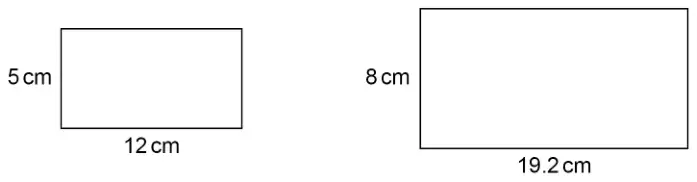
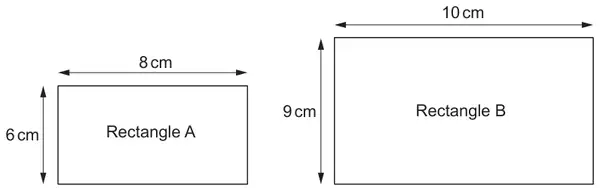
12 Show that these two rectangles are similar. [2 marks]
Not drawn accurately
Mark scheme
Answer
Mark
Comments
\(8 \div 5\) or \(19.2 \div 12\) or \(\dfrac{8}{5}\) or \(\dfrac{19.2}{12}\) or 1.6 or \(12 \div 5\) or \(19.2 \div 8\) or \(\dfrac{12}{5}\) or \(\dfrac{19.2}{8}\) or 2.4
M1
oe use of a valid pair of sides to make an appropriate calculation or value eg \(5 \div 8\) or 0.625 or \(5 \div 12\) or [0.416, 0.417]
\(8 \div 5 = 19.2 \div 12\) or \(\dfrac{8}{5} = \dfrac{19.2}{12}\) or \(12 \div 5 = 19.2 \div 8\) or \(\dfrac{12}{5} = \dfrac{19.2}{8}\)
A1
oe showing sides are in proportion eg \(5 \div 8 = 12 \div 19.2\) or \(\dfrac{5}{12} = \dfrac{8}{19.2}\)
Additional guidance
For A1 equating may be implied by two calculations or two fractions with correct evaluation eg \(8 \div 5 = 19.2 \div 12\) is implied by \(8 = 5 \times 1.6\) and \(19.2 = 12 \times 1.6\)
M1A1
For A1 equating may be implied by calculations eg1 \(8 \div 5 = 19.2 \div 12\) is implied by \(8 \div 5 = 1.6\) and \(12 \times 1.6 = 19.2\) eg2 \(8 \div 5 = 19.2 \div 12\) is implied by \(\dfrac{8}{5} \times 12 = 19.2\)
M1A1 M1A1
\(5 \times 19.2 = 8 \times 12\)
M1A1
\(5 \times 19.2 = 96\) and \(8 \times 12 = 96\)
M1A1
Non-contradictory working can be ignored eg correct response along with area calculations
M1A1
Ignore words eg references to scale factors, enlargement, angles
Working on diagrams may be seen eg1 Arrows or lines from 5 to 8 and 12 to 19.2 with \(\times 1.6\) on them eg2 Arrows or lines from 5 to 8 and 12 to 19.2 with 1.6 on them Arrows or lines must unambiguously link relevant numbers
M1A1 M1A0
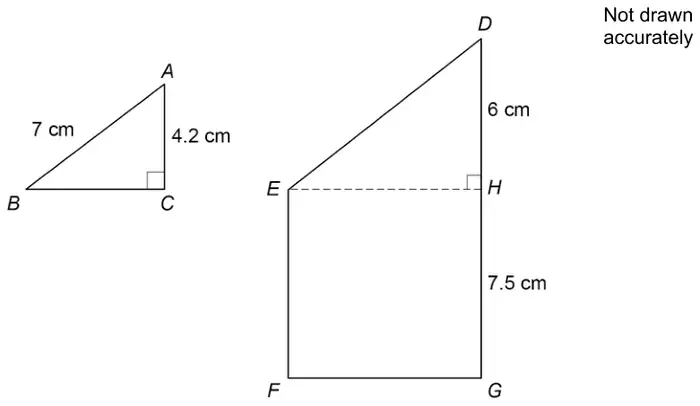
For \(8 \div 5\) or \(\dfrac{8}{5}\) allow 8 : 5 etc
Alternative method 1 – Works out \(BC\) using Pythagoras then works out \(EH\)
\(7^2\) or 49 and \(4.2^2\) or 17.64
M1
oe
\(\sqrt{7^2 - 4.2^2}\) or \(\sqrt{49 - 17.64}\) or \(\sqrt{31.36}\) or 5.6
M1dep
oe implied by 11.76 as the area of the smaller triangle may be on diagram
\(6 \div 4.2 \times\) their 5.6 or 8
M1dep
oe full method to work out \(EH\) may be on diagram as \(EH\) or \(FG\) implied by 24 as the area of the larger triangle or 60 as the area of the rectangle
\(0.5 \times\) their \(8 \times 6\) or 24 and their \(8 \times 7.5\) or 60
M1dep
oe eg \(0.5 \times\) their \(5.6 \times 4.2 \times (6 \div 4.2)^2\) and their \(8 \times 7.5\) or \(0.5 \times\) their \(8 \times (7.5 + 13.5)\)
84
A1
Alternative method 2 – Works out \(ED\) using similar triangles then works out \(EH\)
\(6 \div 4.2 \times 7\) or 10
M1
oe may be on diagram
(their \(10)^2\) or 100 and \(6^2\) or 36
M1dep
oe
\(\sqrt{(\text{their } 10)^2 - 6^2}\) or \(\sqrt{100 - 36}\) or \(\sqrt{64}\) or 8
M1dep
oe full method to work out \(EH\) may be on diagram as \(EH\) or \(FG\) implied by 24 as the area of the larger triangle or 60 as the area of the rectangle
\(0.5 \times\) their \(8 \times 6\) or 24 and their \(8 \times 7.5\) or 60
M1dep
oe eg \(0.5 \times\) their \(5.6 \times 4.2 \times (6 \div 4.2)^2\) and their \(8 \times 7.5\) or \(0.5 \times\) their \(8 \times (7.5 + 13.5)\)
84
A1
Alternative method 3 – Uses trigonometry to work out \(BC\) then works out \(EH\) or uses trigonometry to work out \(EH\)
(angle \(ABC =\)) \(\sin^{-1}\left(\dfrac{4.2}{7}\right)\) or (angle \(ABC =\)) [36.8, 36.9] or (angle \(BAC =\)) \(\cos^{-1}\left(\dfrac{4.2}{7}\right)\) or (angle \(BAC =\)) [53.1, 53.2]
M1
oe full method to work out \(ABC\) or \(BAC\)
\(7 \times \cos\) (their [36.8, 36.9]) or \(7 \times \sin\) (their [53.1, 53.2]) or 5.6 or \(\tan\) (their [36.8, 36.9]) \(= \dfrac{6}{EH}\) or \(\tan\) (their [53.1, 53.2]) \(= \dfrac{EH}{6}\)
M1dep
oe full method to work out \(BC\) or partial method to work out \(EH\)
\(6 \div 4.2 \times\) their 5.6 or 8 or \(6 \div \tan\) (their [36.8, 36.9]) or \(6 \times \tan\) (their [53.1, 53.2])
M1dep
oe full method to work out \(EH\) may be on diagram as \(EH\) or \(FG\) implied by 24 as the area of the larger triangle or 60 as the area of the rectangle
\(0.5 \times\) their \(8 \times 6\) or 24 and their \(8 \times 7.5\) or 60
M1dep
oe eg \(0.5 \times\) their \(5.6 \times 4.2 \times (6 \div 4.2)^2\) and their \(8 \times 7.5\) or \(0.5 \times\) their \(8 \times (7.5 + 13.5)\)
84
A1
Additional guidance
Up to M3 may be awarded for correct work with no answer, or incorrect answer, even if this is seen amongst multiple attempts
\(\pi\) may be seen as any value in the interval [3.14, 3.142]
Do not allow any misreads of formulae unless recovered eg \(\pi \times 24^2 \times 117\) and \(\dfrac{2}{3} \times \pi \times 24^2\)
M0
Allow dots for multiplication
For A marks allow eg \(22\,464 \times \pi\) or \(\pi \times 31\,680\)
\(31\,680\pi\) followed by incorrect evaluation attempt
M1A1M1A1
\(31\,680\pi\) followed by further work
M1A1M1A0
31 680 only
M0A0M0A0
\(\dfrac{1}{3} \times \pi \times 24^2 \times 117 = 4725 \qquad \dfrac{2}{3} \times \pi \times 24^3 = 28\,952\) \(4725 + 28\,952\) (even though 4725 is wrong the method for \(\dfrac{1}{3} \times \pi \times 24^2 \times 117\) is seen)
M1A1 M1
Mark scheme (b)
Answer
Mark
Comments
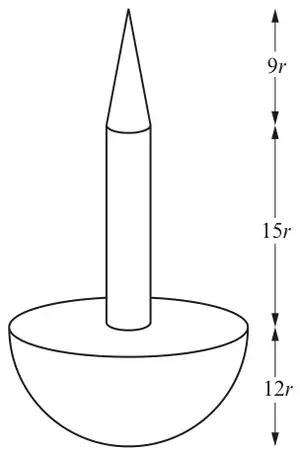
Alternative method 1 Uses volume scale factor
\(24 \div 2\) or 12
M1
oe eg \(12 \times 2 = 24\)
(their \(12)^3\)
M1dep
oe eg \(24^3 \div 2^3\) or \(13\,824 \div 8\)
1728
A1
condone 1 : 1728 or 1728 : 1 SC2 \(\dfrac{1}{1728}\)
Alternative method 2 Compares volumes of cornets (ie compares total volumes)
\(24 \div 2\) or 12
M1
oe eg \(12 \times 2 = 24\) may be implied eg (height of cone) 9.75 or (volume of cone) \(13\pi\) or (volume of cone) [40.8, 40.85] or (total volume) \(\dfrac{55}{3}\pi\) or [57.4, 57.7]
condone 1 : 1728 or 1728 : 1 SC2 \(\dfrac{1}{1728}\)
Alternative method 3 Compares volumes of cones
\(24 \div 2\) or 12
M1
oe eg \(12 \times 2 = 24\) may be implied eg (height of cone) 9.75 or (volume of cone) \(13\pi\) or (volume of cone) [40.8, 40.85] or (total volume) \(\dfrac{55}{3}\pi\) or [57.4, 57.7]
their volume of cone from (a) \(\div \left(\dfrac{1}{3}\pi \times 2^2 \times \dfrac{117}{\text{their } 12}\right)\)
M1dep
oe eg their volume of cone from (a) \(\div\) [40.8, 40.85]
1728
A1
condone 1 : 1728 or 1728 : 1 SC2 \(\dfrac{1}{1728}\)
Alternative method 4 Compares volumes of hemispheres
their volume of hemisphere from (a) \(\div \left(\dfrac{2}{3}\pi \times 2^3\right)\)
M2
oe eg their volume of hemisphere from (a) \(\div\) [16.7, 16.8]
1728
A1
condone 1 : 1728 or 1728 : 1 SC2 \(\dfrac{1}{1728}\)
Additional guidance
\(\pi\) may be seen as any value in the interval [3.14, 3.142]
Answer \(\times 1728\) or \(1728 \times\)
M1M1A1
Answer 12
M1M0A0
Answer \(12^3\) with 1728 seen
M1M1A1
Answer \(12^3\) without 1728 seen
M1M1A0
Alts 2, 3 and 4 Allow if an incorrect volume formula from (a) is used in (b) eg Alt 4 (a) \(\dfrac{1}{2} \times \dfrac{2}{3} \times \pi \times 24^3 = 4608\pi\) (b) \(\dfrac{1}{2} \times \dfrac{2}{3} \times \pi \times 2^3 = \dfrac{8}{3}\pi\) \(4608\pi \div \dfrac{8}{3}\pi\) 1728
M2 A1
Alts 2 and 3 Allow \(\dfrac{55}{3}\) rounded to 1dp or better eg allow 18.3
Alt 4 Allow \(\dfrac{16}{3}\) rounded to 1dp or better eg allow 5.3
Alts 2 and 3 2nd M1 – allow consistent omission of \(\pi\)
Alt 4 M2 – allow consistent omission of \(\pi\)
Alts 2, 3 and 4 Answer 1728 is M1M1A1 unless it comes from rounding or truncating
eg1 Alt 2 \(99\,525.655 \div 57.595 = 1728\)
M1M1A1
eg2 Alt 2 \(99\,525.655 \div 57.595 = 1728.03\) Answer 1728
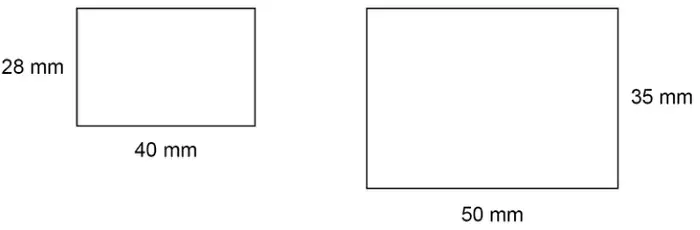
\(\dfrac{28}{35} = 0.8\) and \(\dfrac{40}{50} = 0.8\) or \(\dfrac{35}{28} = 1.25\) and \(\dfrac{50}{40} = 1.25\) or \(\dfrac{28}{40} = 0.7\) and \(\dfrac{35}{50} = 0.7\) or \(\dfrac{40}{28} = 1.42857\ldots\) and \(\dfrac{50}{35} = 1.42857\ldots\)
B1
oe decimal values must be the same, but may be correctly rounded or truncated
Alternative method 2
\(35 \times \dfrac{40}{50} = 28\) or \(35 \div \dfrac{50}{40} = 28\) or \(28 \times \dfrac{50}{40} = 35\) or \(28 \div \dfrac{40}{50} = 35\) or \(50 \times \dfrac{28}{35} = 40\) or \(50 \div \dfrac{35}{28} = 40\) or \(40 \times \dfrac{35}{28} = 50\) or \(40 \div \dfrac{28}{35} = 50\)
B1
oe calculation including all four values eg \(\dfrac{35 \times 40}{50} = 28\)
Additional guidance
Calculations must be shown
Accept decimal truncation but truncated values must be the same eg \(\dfrac{40}{28} = 1.42\) and \(\dfrac{50}{35} = 1.42\)
B1
\(\dfrac{28}{35} = \dfrac{40}{50}\) and \(28 \times 50 = 35 \times 40\) and \(1400 = 1400\) or \(\dfrac{28}{35} = \dfrac{40}{50}\) and \(28 \times 50 = 1400\) and \(35 \times 40 = 1400\)
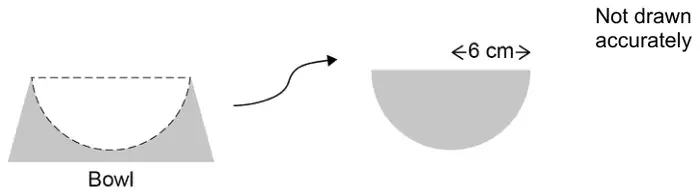
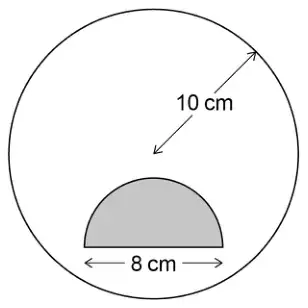
9 A shaded semicircle is inside a circle as shown.
Not drawn accurately
The radius of the circle is 10 cm
The diameter of the semicircle is 8 cm
How many times bigger is the unshaded area than the shaded area? [4 marks]
Mark scheme
Answer
Mark
Comments
Alternative method 1: areas
\(\pi \times 10^2\) or \(100\pi\)
M1
implied by [314, 314.2]
\(\pi \times (8 \div 2)^2\) or \(\pi \times 4^2\) or \(16\pi\) or \(\pi \times (8 \div 2)^2 \div 2\) or \(\pi \times 4^2 \div 2\) or \(16\pi \div 2\) or \(8\pi\)
M1
implied by [50.2, 50.3] or [25.12, 25.14] \(92\pi\) or \(84\pi\) or 92 : 8 or 8 : 92 or 84 : 16 or 16 : 84 implies M1M1
(their \(100(\pi)\) – their \(8(\pi)\)) \(\div\) their \(8(\pi)\) or \(92(\pi) \div 8(\pi)\) or their \(100(\pi) \div\) their \(8(\pi)\) (– 1) or \(12\dfrac{1}{2}\) (– 1) or 12.5 (– 1)
M1dep
dep on M2 absence of \(\pi\) must be consistent condone \(16(\pi)\) as their \(8(\pi)\) in first calculation only, ie condone (their \(100(\pi)\) – their \(16(\pi)\)) \(\div\) their \(16(\pi)\) or \(84(\pi) \div 16(\pi)\), but not their \(100(\pi) \div\) their \(16(\pi)\) (– 1)
\(11\dfrac{1}{2}\) or 11.5
A1
condone \(\dfrac{23}{2}\)
Alternative method 2: scale factor
\(\dfrac{10}{8 \div 2}\) or \(\dfrac{10}{4}\) or \(\dfrac{5}{2}\) or \(\dfrac{10 \times 2}{8}\) or \(\dfrac{20}{8}\) or 2.5
M1
oe scale factor of lengths eg \(\dfrac{2}{5}\) or 0.4 accept 2 : 5 or 5 : 2 oe ratio \(\pi\) may be present, but must be consistent in numerator and denominator
(their \(\dfrac{5}{2}\))\(^2\) or \(\dfrac{25}{4}\)
M1dep
oe scale factor of areas eg \(\dfrac{4}{25}\) accept 4 : 25 or 25 : 4 oe ratio
\(2 \times\) their \(\dfrac{25}{4}\) (– 1) or \(\dfrac{25}{2}\) (– 1) or \(12\dfrac{1}{2}\) (– 1) or 12.5 (– 1)
M1dep
oe eg \(2 \div\) their \(\dfrac{4}{25}\) (– 1)
\(11\dfrac{1}{2}\) or 11.5
A1
condone \(\dfrac{23}{2}\)
Additional guidance
Accept, for example, \(\pi 8\) or \(\pi \times 8\) or \(8 \times \pi\) for \(8\pi\)
An answer of \(11.5\pi\) with no incorrect working
M1M1M1A0
Consistent use of \(\pi d^2\) for the area of a circle gives the area of the circle as \(400\pi\), the area of the semicircle as \(32\pi\) and the area of the shaded part as \(368\pi\). This also gives the answer 11.5, but scores zero
M0M0M0A0
Irrespective of where their answer comes from and the presence of other measures such as circumference, students can gain the first two marks of alternative method 1 if it is clear that the methods or values given are for area eg 1 Big area \(= 100\pi\), little area \(= 8\pi\), big circumference \(= 20\pi\), little circumference \(= 4\pi\), \(20 \div 4 = 5\) eg 2 \(100\pi\), \(8\pi\), \(20\pi\), \(4\pi\)
M1M1M0A0
M0M0
Do not award the second mark if the value of \(8\pi\) comes from \(\pi d\) This is implied by, eg, ‘Area of circle \(= 20\pi\), area of semi-circle \(= 8\pi\)’
M?M0 M0M0
\(\dfrac{100(\pi) - 16(\pi)}{16(\pi)}\) (which may give an answer of 5.25)
M1M1M1A0
\(\dfrac{100(\pi)}{16(\pi)}\) (which may give an answer of 6.25)
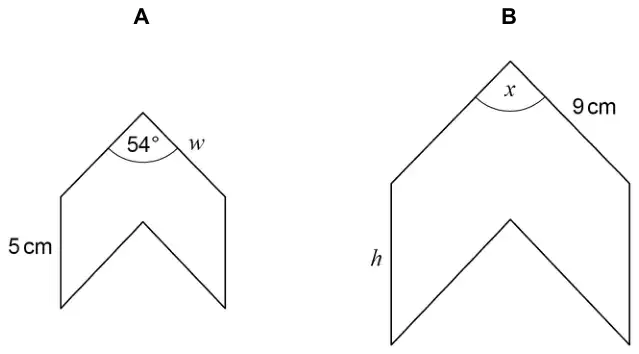
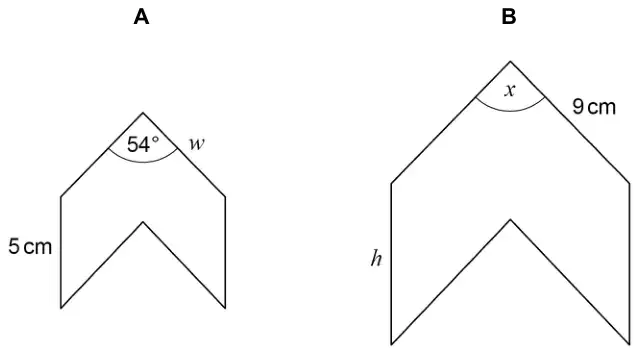
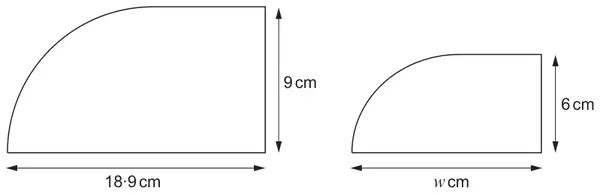
Work out the values of \(x\), \(h\) and \(w\). [3 marks]
Mark scheme
Answer
Mark
Comments
54
B1
May be on diagram
7.5 6
B2
May be on diagram B1 for 1 correct or for answers transposed
Additional guidance
If answers are in wrong position on answer lines, check working and diagram for clear indication of possible transcription errors eg \(w = 9 \div 1.5 = 6\) in working, 9 on answer line \(9 \div 1.5 = 6\) in working, 9 on answer line
B1 B0
Answer line takes precedence over diagram eg \(x = 54\) on diagram and \(x = 81\) on answer line
X has volume 64 cm\(^3\) Y has volume 343 cm\(^3\)
The surface area of X is 176 cm\(^2\)
Work out the surface area of Y. [3 marks]
Mark scheme
Answer
Mark
Comments
\(\sqrt[3]{64}\) and \(\sqrt[3]{343}\) or 4 and 7 or \(\sqrt[3]{[5.3, 5.4]}\) or [1.74, 1.754411] or \(\sqrt[3]{[0.18, 0.19]}\) or [0.56, 0.575]
M1
oe eg 4 : 7 or 7 : 4 or \(\sqrt[3]{\dfrac{343}{64}}\) or \(\dfrac{7}{4}\) or \(\sqrt[3]{\dfrac{64}{343}}\) or \(\dfrac{4}{7}\)
their \(4^2\) and their \(7^2\) or 16 and 49 or their \([1.74, 1.754411]^2\) or [3.02, 3.08] or their \([0.56, 0.575]^2\) or [0.31, 0.331]
M1dep
oe eg 16 : 49 or 49 : 16 or \(\left(\text{their } \dfrac{7}{4}\right)^2\) or \(\dfrac{49}{16}\) or \(\left(\text{their } \dfrac{4}{7}\right)^2\) or \(\dfrac{16}{49}\)
539
A1
Additional guidance
\(4^3\) and \(7^3\)
M1
\(64^{\frac{2}{3}}\) and \(343^{\frac{2}{3}}\)
M1M1
\(\left(\dfrac{343}{64}\right)^{\frac{2}{3}}\) or \(\left(\dfrac{64}{343}\right)^{\frac{2}{3}}\)
M1M1
Answer 539 with evidence of rounding to 539 scores A0
eg1 \(176 \times 3.06 = 538.56\) Answer 539
M1M1A0
eg2 \(176 \times 3.06 = 539\) (may have kept all digits on calculator)
M1M1A1
\(\left(\sqrt{176} \times \dfrac{7}{4}\right)^2\)
M1M1
\(176 \div 16 = 11\) and \(11 \times 49\)
M1M1
4 and 7 (and/or \(4^2\) and \(7^2\)) but uses different method not involving 4 and 7
Work out the values of \(x\), \(h\) and \(w\). [3 marks]
Mark scheme
Answer
Mark
Comments
54
B1
May be on diagram
7.5 6
B2
May be on diagram B1 for 1 correct or for answers transposed
Additional guidance
If answers are in wrong position on answer lines, check working and diagram for clear indication of possible transcription errors eg \(w = 9 \div 1.5 = 6\) in working, 9 on answer line \(9 \div 1.5 = 6\) in working, 9 on answer line
B1 B0
Answer line takes precedence over diagram eg \(x = 54\) on diagram and \(x = 81\) on answer line
“The volume of B is double the volume of A because the length of B is double the length of A.”
Is he correct?
Tick a box.
Yes
No
Give a reason for your answer. [1 mark]
Mark scheme
Answer
Mark
Comments
Ticks No and gives correct reason or ticks No and gives numerical counter-example for any solid
B1
eg1 (volume of) A is 8 times bigger eg2 (volume) sf \(= 2^3\) eg3 if A and B are cubes and \(l = 3\), volume of A = 27 volume of B = 216 216 is not \(27 \times 2\)
Additional guidance
Condone \(8l^3\)
B1
No, as the height/width is (also) doubled/different
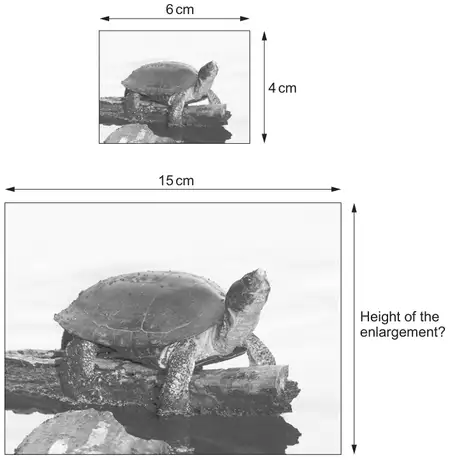
\(6 \div 3\) or 2 or \(9 \div 2\) or \(3 \div 6\) or 0.5 or \(9 \times 0.5\) or \(9 \div 6\) or 1.5 or \(3 \times 1.5\) or \(6 \div 9\) or \(\dfrac{2}{3}\) or \(3 \div \dfrac{2}{3}\)
M1
oe
4.5
A1
oe
Additional guidance
Accept embedded answer \(4.5 \times 2 = 9\)
M1A1
Ignore further working in attempt to round after answer 4.5 eg \(9 \div 2 = 4.5\) with answer 5
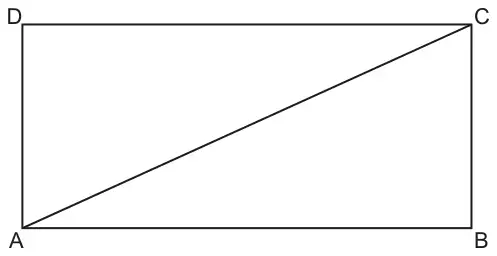
22 The diagram shows a rectangle ABCD with diagonal AC.
Not to scale
Complete each statement to show that triangle ABC is congruent to triangle ADC.
Angle ADC = angle .................. because both angles are \(90^\circ\). Side AD = side .................. because opposite sides of a rectangle are equal. Side CD = side .................. because ......................................................
The above three statements show that triangle ABC is congruent to triangle ADC because of .................. [4]
Mark scheme
Answer
Marks
Part marks and guidance
ABC or CBA
B1
Must use 3-letter notation
CB or BC
B1
AB or BA and opposite sides of a rectangle are equal oe
B1
See Appendix 1 for comment
SAS oe
B1dep
Dependent on previous B1B1B1
isw any comment made if SAS stated See Appendix 2 for SAS oe
Appendix
Appendix 1: Q22 – All exemplars below assume AB (or BA) has been given in addition to the following:
Response
Mark
A
Opposite sides of the rectangle are equal (and parallel)
B1
B
Parallel sides of a rectangle are equal
B1
C
Opposite sides are equal
B1
D
Opposite lengths are equal
B1
E
Parallel sides are equal
B1
F
They are parallel making them equal for a rectangle (They refers to sides CD and AB)
B1
G
The long sides are equal
BOD B1
H
The top and the bottom sides are equal
BOD B1
I
Both lengths are equal in a rectangle
B0
J
They are parallel
B0
K
They are equal lengths (The candidate is stating no more than CD=AB)
B0
L
Lengths of a rectangle are equal
B0
M
It’s equal
B0
N
They’re the same length
B0
O
Opposite angles are equal
B0
P
They are opposite each other
B0
Appendix 2: Q22 – All exemplars below assume that the candidate has been awarded B1, B1, B1 in the previous three parts of the question.
Response
Mark
A
Side Angle Side
1
B
Two sides and the included angle are the same in both triangles
1
C
Two sides and the angle between these sides are equal in both triangles.
1
D
SAS – All sides and angles are equal
1 - isw
E
Right angle, Hypotenuse, Side (RHS) (not related to the three given statements)
0
F
Two equal sides and one equal angle (not stating the relationship between the sides and angles)
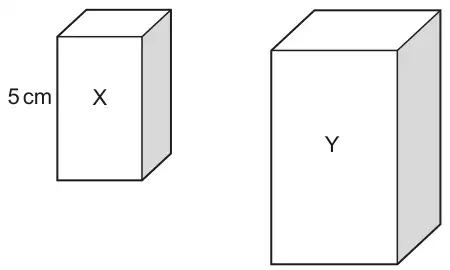
19 The diagram shows two similar cuboids, X and Y.
Not to scale
Cuboid X has a square base with area 16 cm\(^2\) and height 5 cm. Cuboid Y has a square base with area 36 cm\(^2\).
Work out the height of cuboid Y. You must show your working. [4]
Mark scheme
Answer
Marks
Part marks and guidance
7.5 with correct working
4
Correct working requires M3 or B2M1 If working in rounded decimals with 2 dp seen allow M marks but A0 if 7.5 rounded from inexact value May be implied by [5] \(\times\) 1.5 or e.g. as arrow from X to Y with “\(\times\) 1.5” on it or, in parts e.g. \(5 \times 6 = k\) then \(k \div 4\)
M3 for \(5 \times \dfrac{6}{4}\) oe or \(5 \div \dfrac{4}{6}\) oe
OR
B2 for [base lengths] 4 and 6 or B1 for [base lengths] 4 or 6 and M1 for \(5 \times \dfrac{\textit{their}\ 6}{\textit{their}\ 4}\) oe or \(5 \div \dfrac{\textit{their}\ 4}{\textit{their}\ 6}\) oe
May be on diagram 4 and 6 not number of edges so \(16 \div 4\) and \(36 \div 4\) score B0 or base edges 4 and 9 score B0
Their 4 and their 6 are their chosen base lengths and not 16 and 36
If 0 scored, SC1 for answer 7.5 with no or insufficient working
Alternative M2 for [length factor] \(\sqrt{\dfrac{36}{16}}\) or \(\dfrac{6}{4}\) oe or \(\sqrt{\dfrac{16}{36}}\) or \(\dfrac{4}{6}\) oe or M1 for area factor oe = \(\dfrac{36}{16}\) oe or \(\dfrac{16}{36}\) oe
M1 for \(5 \times \dfrac{\textit{their}\ 6}{\textit{their}\ 4}\) oe or \(5 \div \dfrac{\textit{their}\ 4}{\textit{their}\ 6}\) oe
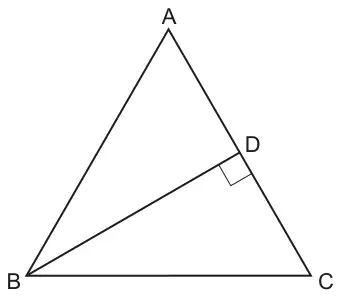
ABC is an equilateral triangle. BD is perpendicular to AC.
Prove that triangle ABD is congruent to triangle CBD. [4]
Mark scheme
Answer
Marks
Part marks and guidance
Proof of congruency e.g.
For the M marks, must be clear distinct statements involving equalities of pairs of named sides or pairs of named angles with the reason (if given) alongside the statement Throughout accept A for angle BAD and C for angle BCD.
[Angle] ADB = [Angle] CDB = 90°
BD is common oe
AB = BC equilateral [triangle] or given oe
OR
[Angle] ABD = [Angle] CBD = 30°
BD is common oe
AB = BC equilateral [triangle] or given
M3
M2 for 2 correct statements with reason[s] or 3 correct statements but incorrect/no reason[s] or M1 for 1 correct statement with reason or 2 correct but incorrect/no reasons
Do not accept ADB = 90 alone without = angle CDB, accept right angle for 90 Accept e.g. BD = BD, BD is shared, BD is in both
If more than 3 statements given, mark to candidates advantage and isw incorrect/incomplete statements alongside correct work for method marks
Accept equivalent proofs for AAS involving any two of the three angles and either BD is common or AB = BC (given) Accept [Angle] BAD= [Angle] BCD = 60 or equilateral [triangle] Do not accept AD = DC
[Triangle BDC is congruent to triangle BAD] (RHS) or (SAS)
A1
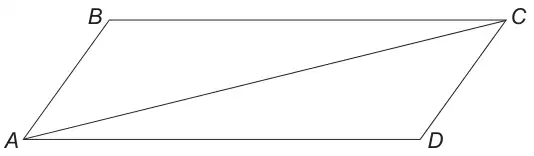
Dep on M3 and no incorrect work seen and condition must fit statements given
See Appendix 2
Appendix 2: Question 12
For the M marks, statements may be embedded within longer text but they must be clear distinct statements involving equalities of pairs of named sides or pairs of named angles with (if given) the reason alongside the statement. Do not accept annotation on the diagram as implying method. This question is also assessing clear communication of the mathematics.
Example
Candidate response
Comment
A
All sides equal Line BD is perpendicular to AC, meaning its the mid point Splitting a equilateral triangle creates 2 right angle triangles and because its equilateral it should be the same on both sides. RHS, Right angle they both have, hypotenuse is the same and the side is the same. Yes, it is congruent as said by RHS. This means they are congruent as they all have a right angle, hypotenuse is the same and side is the same as it was equilateral
Within the text there is no specific named equality of pairs of sides or pairs of angles stated. It is done in more general terms and this is not acceptable so M0
B
Equilateral = all angles are the same \(\angle ABC = \angle BAC = \angle BCA\) Each angle \(= \frac{180}{3} = 60\) \(\triangle ABD\): \(\angle ABD = 60/2 = 30°\), so \(\angle BAD = 180 - (30 + 90) = 60°\) \(\triangle CBD\): \(\angle CBD = 60/3 = 30°\), so \(\angle BCD = 180 - (30 + 90) = 60°\) → Both are right angled triangles that shares line BD → Both share the same angles of 90°, 30°, 60° → They form an equilateral triangle which has angles of the same angles (60, 60, 60) so both triangles must be equal
There are no clear distinct equality statements of pairs of sides or pairs of angles with reasons. The statement BD is shared appears in the text and earns M1
C
\(\angle DBC\) and \(\angle DBA\) both equal 30° as angle \(\angle BAD\) and \(\angle DCB\) both are 60° as triangle ABC is equilateral so with the perpendicular line creating 90° angles in order to get the full 180° they must be 30° so therefore ABD is congruent to CBD
Within the text there are two clear distinct statement of equality of angles DBC = DBA = 30 and BAD = DCB = 60 with reasons. There is no statement about equalities of pairs of sides Award M2
D
BDA = BDC so BDA is 90°. BD is the same in both triangles. SAS AC runs along both triangles so AD = AC so triangles are SAS.
BDA = BDC stated and 90 is given for BDA next to the statement BOD M1 BD is shared earns M1
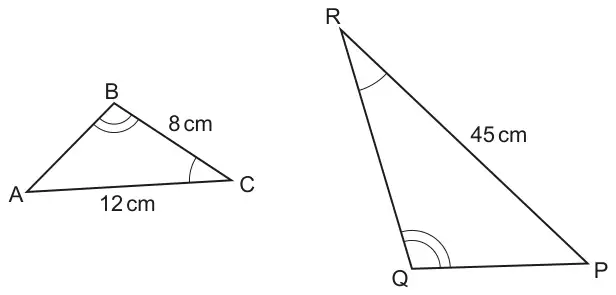
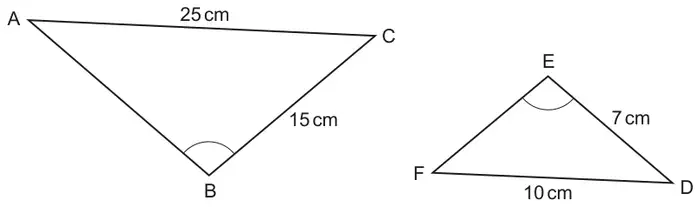
25 Triangles ABC and PQR are mathematically similar. Angle ACB = Angle PRQ. Angle ABC = Angle PQR.
Not to scale
The perimeter of triangle PQR is 99 cm.
Find the length of PQ. [4]
Mark scheme
Answer
Marks
Part marks and guidance
24
4
M2 for \(\dfrac{45}{12} \times 8\) or \(\dfrac{8}{12} \times 45\) oe or 30 or M1 for \(\dfrac{45}{12}\) or \(\dfrac{12}{45}\) or \(\dfrac{12}{8}\) or \(\dfrac{8}{12}\) oe
and
M1 for 99 – 45 – their RQ or 24 correctly placed on diagram
Equivalent factors include 3.75, \(3\dfrac{3}{4}\), \(\dfrac{4}{15}\), 0.266… , 0.267, 1.5, \(1\dfrac{1}{2}\), \(\dfrac{2}{3}\), 0.666…, 0.667 Alt.: M2 for \(99 \div \dfrac{45}{12}\) (3.75) oe or 26.4 or M1 for \(\dfrac{45}{12}\) or \(\dfrac{12}{45}\) oe and M1 for \((26.4 - 8 - 12) \times \dfrac{45}{12}\) (3.75) oe
19 Two ornaments, A and B, are mathematically similar. The table shows information about the two ornaments.
Ornament A
Ornament B
Height (m)
\(h\)
12
Surface area (m2)
216
\(A\)
Volume (m3)
240
3750
Find the value of \(h\) and the value of \(A\). You must show your working. [6]
Mark scheme
Answer
Marks
Part marks and guidance
[\(h\) =] 4.8 [\(A\) =] 1350 with correct working
6
“Correct working” requires evidence of at least M2
M2 for \(\sqrt[3]{\frac{3750}{240}}\) or 2.5 oe or \(\sqrt[3]{\frac{240}{3750}}\) or 0.4 oe or M1 for \(\frac{3750}{240}\) or 15.625 oe or \(\frac{240}{3750}\) or 0.064 oe
B2 for [\(h\) =] 4.8 or M1 for \(\frac{12}{2.5}\) oe
e.g. 12 × 0.4
B2 for [\(A\) =] 1350 or M1 for 216 × (their 2.5)2 oe
e.g. 216 ÷ (their 0.4)2 Note : Use of scale factor = \(\frac{\sqrt[3]{3750}}{\sqrt[3]{240}}\) often leads to accuracy errors so award M2 for \(\frac{\sqrt[3]{3750}}{\sqrt[3]{240}}\) M1 for \(\frac{12}{\textit{their } 2.5}\) oe (penalise accuracy once here at first occurrence) M1 A1 for 216 × (their 2.5) = answer to A involving a rounding error
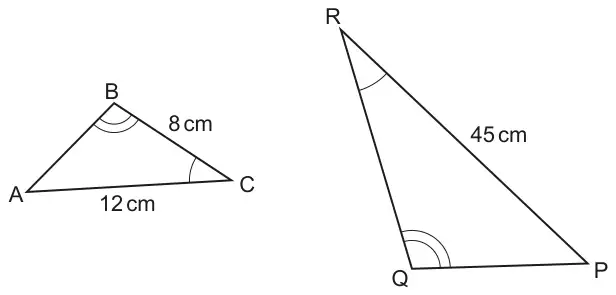
11 Triangles ABC and PQR are mathematically similar. Angle ACB = Angle PRQ. Angle ABC = Angle PQR.
Not to scale
The perimeter of triangle PQR is 99 cm.
Find the length of PQ. [4]
Mark scheme
Answer
Marks
Part marks and guidance
24
4
M2 for \(\frac{45}{12} \times 8\) or \(\frac{8}{12} \times 45\) oe or 30 or M1 for \(\frac{45}{12}\) or \(\frac{12}{45}\) or \(\frac{12}{8}\) or \(\frac{8}{12}\) oe
and
M1 for 99 – 45 – their RQ or 24 correctly placed on diagram
Equivalent factors include 3.75, \(3\frac{3}{4}\), \(\frac{4}{15}\), 0.266… , 0.267, 1.5, \(1\frac{1}{2}\), \(\frac{2}{3}\), 0.666…, 0.667 Alt.: M2 for \(99 \div \frac{45}{12}\) (3.75) oe or 26.4 or M1 for \(\frac{45}{12}\) or \(\frac{12}{45}\) oe and M1 for \((26.4 - 8 - 12) \times \frac{45}{12}\) (3.75) oe
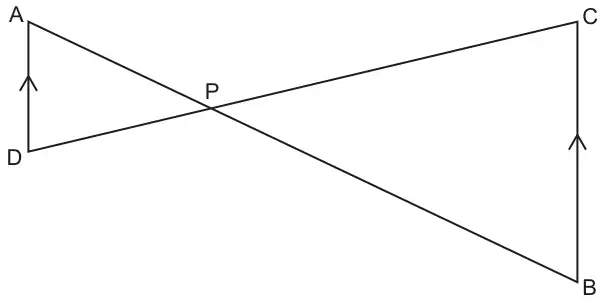
18 The diagram shows two straight lines AB and DC that intersect at P. DA is parallel to BC.
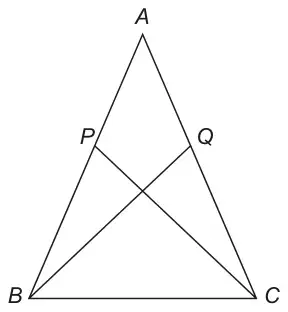
Complete these statements to show that triangle PAD is similar to triangle PBC.
Angle ADP = angle BCP because they are alternate angles
Angle APD = angle ................ because they are ................................ angles
Angle ................ = angle ................ because they are ................................ angles
Triangle PAD is similar to triangle PBC because ................................................ [4]
Mark scheme
Answer
Marks
Part marks and guidance
BPC or CPB and [vertically] opposite
B2
B1 for BPC or CPB
Must use 3-letter notation
DAP or PAD, CBP or PBC, alternate
B1
Must have angle and reason
Condone • A and B if clear for e.g. A for PAD and B for CBP • Changed order e.g. CBP and PAD • Use of B or C for P e.g. DAB for DAP For reason, condone poor spelling (alternative) and accept “third angle in triangle” oe
AAA oe
B1dep
Dependent on previous B2 and B1
Accept completely correct statements e.g. “All corresponding angles equal” but not “All angles equal” or “They have the same angles” See Appendix
The small bottle holds 0.5 litres and has a height of 35 cm. The large bottle holds 2 litres.
Calculate the height of the large bottle. [4]
Mark scheme
Answer
Marks
Part marks and guidance
55.5 to 55.6 nfww
4
M3 for \(35 \times \sqrt[3]{\frac{2}{0.5}}\) oe or \(35 \div \sqrt[3]{\frac{0.5}{2}}\) oe
or
M2 for \(\sqrt[3]{\frac{2}{0.5}}\) oe soi by 1.58 to 1.59 or \(\sqrt[3]{\frac{0.5}{2}}\) oe soi by 0.62 to 0.63 or \(\frac{h^3}{35^3} = \frac{2}{0.5}\) oe
or
M1 for \(\frac{2}{0.5}\) oe soi by 4 or \(\frac{0.5}{2}\) oe soi by \(\frac{1}{4}\)
If 0 scored then SC1 for 140 as final answer
Accept 56 as final answer after M3
May see as length ratio, eg M2 for \(\sqrt[3]{2} : \sqrt[3]{0.5}\) soi by 1.2599(…) to 1.26 : 0.7937(…) to 0.794
May see as volume ratio, eg. M1 for 2 : 0.5 oe May also be seen as part of wrong approach eg. \(35 \times 4\) scores M1
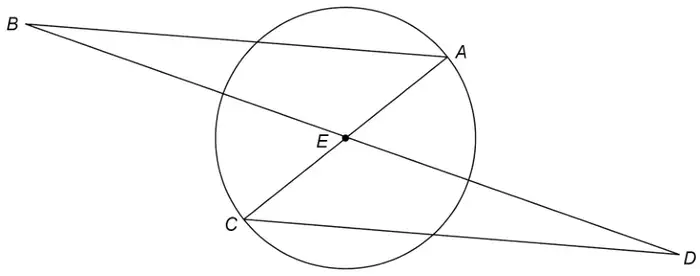
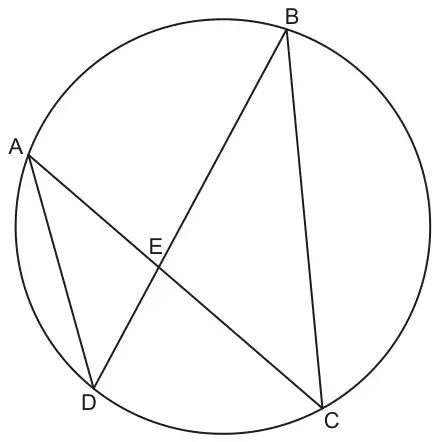
13 Points A, B, C and D lie on the circumference of a circle. Line AC intersects line BD at point E.
Not to scale
Prove that triangle AED is similar to triangle BEC. [3]
Mark scheme
Answer
Marks
Part marks and guidance
Angle AED = angle BEC and [vertically] opposite Angle DAE = angle EBC and same segment Angle ADE = angle ECB and same segment
M2
For M2 only two of the three statements and reasons are required M1 for one pair of angles with a reason
Allow any unambiguous labelling for angles e.g. DAE or DAC or A, but not E For reason accept e.g. opp ∠’s For same segment, accept same arc but not same chord Accept 3rd angle in triangle oe for reason with final angle if other two given correctly with correct reasons
[Triangle AED is similar to triangle BEC] [corresponding] angles are equal oe or AAA oe
OR
After two pairs of angles with reasons gives 3rd pair of equal angles with a reason
A1
With no errors or incorrect statements seen
If 0 scored, SC1 for at least two correct pairs of angles identified with no / incorrect reasons
Accept they have the ‘same/equal angles’ oe, AA and similar. Accept symbol ~ for similar
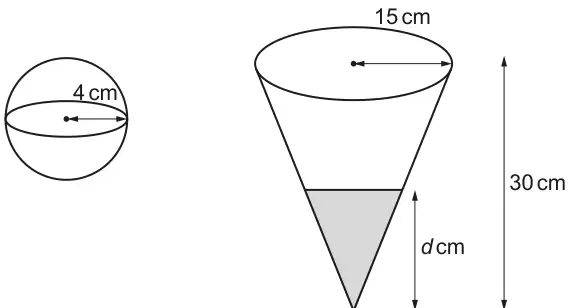
The sphere has radius 4 cm. The cone has radius 15 cm and height 30 cm.
The sphere is completely filled with water. The same amount of water is poured into the cone.
Work out the depth, \(d\) cm, of the water in the cone. You must show your working.
[The volume \(V\) of a sphere with radius \(r\) is \(V = \frac{4}{3}\pi r^3\). The volume \(V\) of a cone with radius \(r\) and height \(h\) is \(V = \frac{1}{3}\pi r^2 h\).] [6]
Mark scheme
Answer
Marks
Part marks and guidance
10.1 or 10.07 to 10.08 with correct working
6
M4 for \(\frac{4}{3}\) × π × \(4^3\) = \(\frac{1}{3}\) × π × \((\frac{1}{2}d)^2\) × \(d\) oe M1 for rearranging their equation OR M1 for \(\frac{4}{3}\) × π × \(4^3\) implied by 268.[08…] or 268.1 B1 for [radius of water =] \(\frac{1}{2}d\) M2 for \(\frac{1}{3}\) × π × \((\frac{1}{2}d)^2\) × \(d\) = their 268.08… or M1 for \(\frac{1}{3}\) × π × \((\frac{1}{2}d)^2\) × \(d\) condone one error M1 for rearranging their equation e.g. \(d^3 = \frac{their\ 268.08\ldots \times 12}{\pi}\) implied by [\(d^3\) =] 1024
Alternative method
M4 for \(\frac{\frac{256\pi}{3}}{\frac{1}{3}\pi \times 15^2 \times 30} = \left(\frac{d}{30}\right)^3\) oe M1 for rearranging their equation OR M1 for \(\frac{4}{3}\) × π × \(4^3\) implied by 268.[08…], 268.1 or \(\frac{256\pi}{3}\) M1 for \(\frac{1}{3}\)π × \(15^2\) × 30 implied by 2250π or 7068[.58…] or 7069 or 7068.6 M2 for [sf=] \(\sqrt[3]{\frac{\frac{256\pi}{3}}{\frac{1}{3}\pi \times 15^2 \times 30}}\) oe or 0.33597… rot or M1 for \(\frac{\frac{256\pi}{3}}{\frac{1}{3}\pi \times 15^2 \times 30}\) oe or 0.0379… M1 for their sf × 30
If 0 or 1 scored, instead award SC3 for answer 10.1 or 10.07 to 10.08 with no or insufficient working
allow 10 only if working supports it “Correct working” requires evidence of at least M2 or M1 M1
M1 implied by \(\frac{256\pi}{3}\)
Note they can use \(h = 2r\) so apply the scheme accordingly, 1024 will become 256
Complete method with trials giving the correct answer can score 6 marks
20 Two pyramids, A and B, are mathematically similar. Pyramid A has surface area 12 cm² and volume 8 cm³. Pyramid B has surface area 75 cm².
Work out the volume of pyramid B. You must show your working. [4]
Mark scheme
Answer
Marks
Part marks and guidance
125 with correct working
4
M3 for [8 ×] \(\left(\sqrt{\dfrac{75}{12}}\right)^3\) or \(2.5^3\) oe or M2 for \(\sqrt{\dfrac{75}{12}}\) or \(\sqrt{6.25}\) oe implied by 2.5 or \(\frac{5}{2}\) or M1 for \(\dfrac{75}{12}\) oe implied by 6.25
“correct working” requires evidence of at least M2 Accept ratios M3 for 8 : 125 oe or M2 for 2 : 5 oe or M1 for 4 : 25 oe
Alternative method: M3 for [8 ÷] \(\left(\sqrt{\dfrac{12}{75}}\right)^3\) or \(0.4^3\) oe or M2 for \(\sqrt{\dfrac{12}{75}}\) or \(\sqrt{0.16}\) oe implied by 0.4 or \(\frac{2}{5}\) or M1 for \(\dfrac{12}{75}\) oe implied by 0.16
If 0 scored, instead award SC1 for answer 125 with no or insufficient working
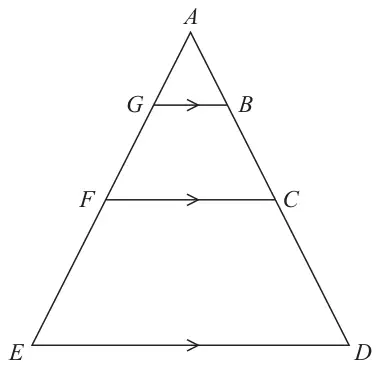
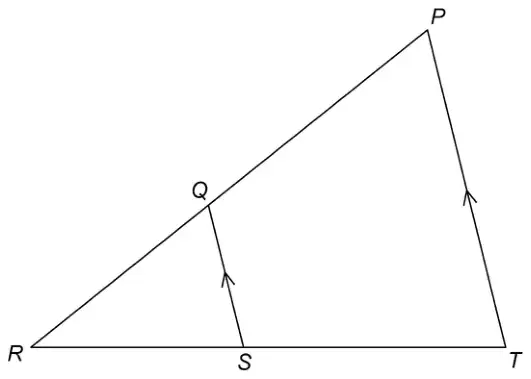
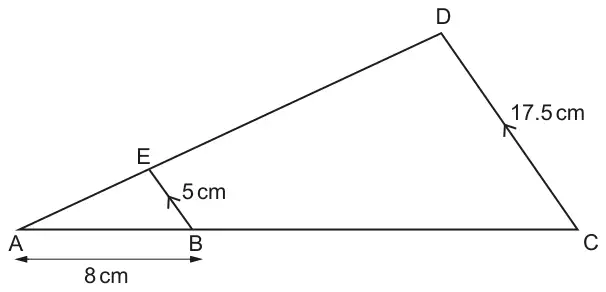
B lies on AD and C lies on AE. BC is parallel to DE.
Complete these statements to show that triangles ABC and ADE are similar.
Angle ABC = angle ADE because they are corresponding angles. Angle ACB = angle ........ because ........ Angle BAC is ........ Triangles ABC and ADE are similar because ........
[3]
Mark scheme
Answer
Marks
Part marks and guidance
AED or DEA and corresponding
1
accept CED, DEC
common oe
1
accept “same as angle DAE” oe ignore any reasons
correct reason e.g. AAA or both triangles have the same angles oe
9 In the diagram, AB and DC are parallel lines of equal length.
Not to scale
Prove that angle DAB = angle BCD. [4]
Mark scheme
Answer
Marks
Part marks and guidance
Angle ABD = Angle CDB (alternate) BD is common oe AB = CD given oe
M3
M2 for 2 correct statements with reason[s] or 3 correct but no/incorrect reason[s] M1 for 1 correct statement with reason or 2 correct but no/incorrect reasons
If 0 scored, SC1 for any attempt to prove congruency
Not alternative angles
Accept BD = BD, BD is shared Accept same length oe for ‘given’
eg attempt to list pairs of equal sides or equal angles (2 or more even if incorrect)
SAS so triangles are congruent and Angle DAB = angle BCD
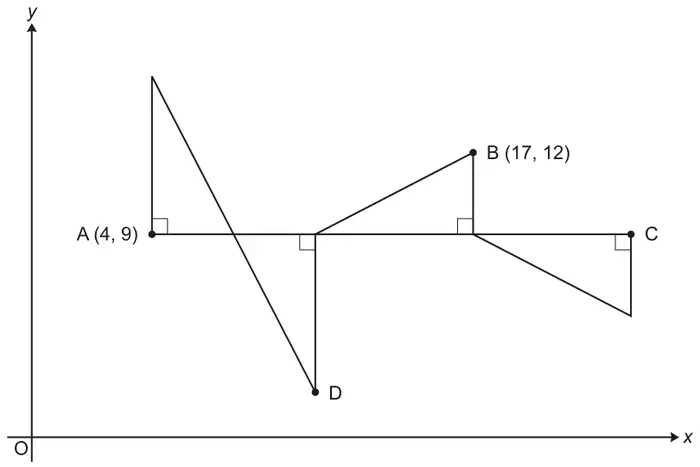
7 A pattern is made from four congruent right-angled triangles.
Not to scale
The line AC is parallel to the \(x\)-axis. The point A has coordinates (4, 9) and the point B has coordinates (17, 12).
Work out the coordinates of point C and point D. [5]
Mark scheme
Answer
Marks
Part marks and guidance
C (24, 9) D (10, 2)
5
B4 for three correct ordinates or B3 for two correct ordinates or B2 for one correct ordinate from 24, 10, 2 or for longer length of triangle = 7 soi or B1 for 9 as y-coordinate for C or for shorter length of triangle = 3 soi
OR
M1 for long = 17 – 4 – 2 × their short oe A1FT for C ((4 + 2 × their short + 2 × their long) , 9) A1FT for D (4 + 2 × their short , 9 – their long)
For part marks, check ordinates first (may be on diagram if answer line blank). If B2 or fewer check alt method and mark to candidates’ advantage
B4, B3, B2, B1 May be on diagram
For M1 and A1FT, their short and their long needs to be clear in working or on diagram
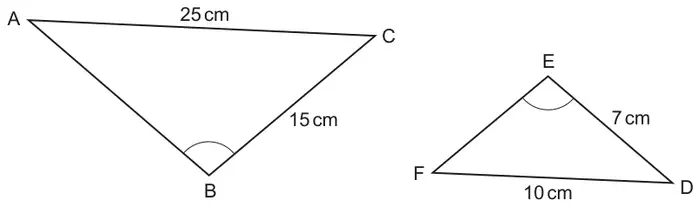
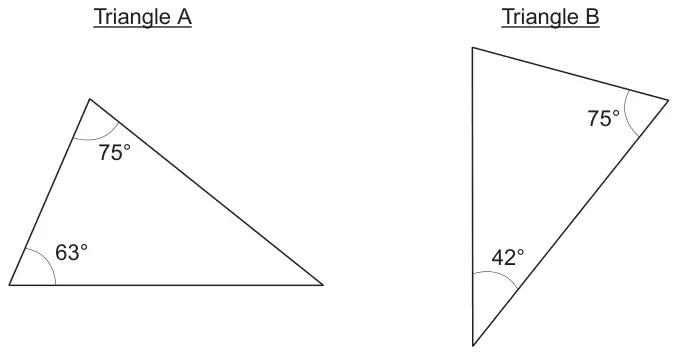
25 Are these two triangles mathematically similar? Show how you decide.
Not to scale
[3]
Mark scheme
Answer
Marks
Part marks and guidance
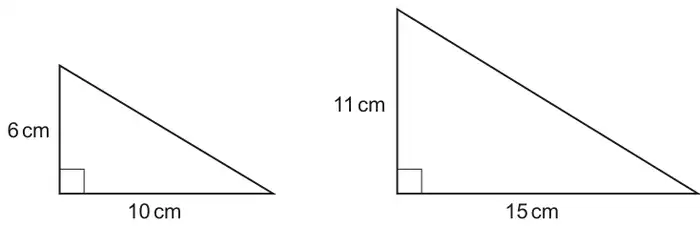
Two correct corresponding ratios evaluated correctly eg \(\dfrac{6}{10} = 0.6\) and \(\dfrac{11}{15} = 0.7[...]\)
M2
M1 for one correct ratio evaluated
\(\dfrac{11}{6} = 1.8[...]\) and \(\dfrac{15}{10} = 1.5\) \(\dfrac{6}{11} = 0.5[...]\) and \(\dfrac{10}{15} =\) 0.6 to 0.7 \(\dfrac{10}{6} =\) 1.6 to 1.7 and \(\dfrac{15}{11} =\) 1.3 to 1.4 Note. Ratios between 6 and 10 and between 15 and 11 may be seen as tangents. These give angles in left triangle of 30.9 to 31.0 or 59.0 to 59.1 and angles in right triangle of 36.2 to 36.3 or 53.7 to 53.8
or
A side calculated correctly using one ratio or scale factor and the other side
\(\left(\dfrac{15}{10} \times 6\right.\) or \(\left.\dfrac{6}{10} \times 15\right) = 9\) \(\left(\dfrac{10}{15} \times 11\right.\) or \(\left.\dfrac{11}{15} \times 10\right) = 7.3[...]\) \(\dfrac{11}{6} \times 10 = 18.3[...]\) or \(\dfrac{6}{11} \times 15 =\) 8.1 to 8.2
No + the [corresponding] ratios or sides are not the same oe or No + the 11 should be 9 oe
21 Toy building bricks are available in two sizes, small and large. The small and large bricks are mathematically similar.
A small brick has volume 8 cm\(^3\) and width 2.1 cm. A large brick has volume 15.625 cm\(^3\).
Calculate the width of a large brick. [4]
Mark scheme
Answer
Marks
Part marks and guidance
2.625 nfww
4
M3 for \(2.1 \times \sqrt[3]{\dfrac{15.625}{8}}\) oe or \(2.1 \div \sqrt[3]{\dfrac{8}{15.625}}\) or M2 for \(\sqrt[3]{\dfrac{15.625}{8}}\) soi by \(\frac{5}{4}\) or 1.25 oe or \(\sqrt[3]{\dfrac{8}{15.625}}\) soi by \(\frac{4}{5}\) or 0.8 oe or M1 for \(\dfrac{15.625}{8}\) soi by \(\frac{125}{64}\) oe or 1.95(31…) or \(\dfrac{8}{15.625}\) soi by \(\frac{64}{125}\) oe or 0.512
If 0 scored then SC1 for 4.1 to 4.11 as final answer
Accept 2.6, 2.62 or 2.63 as final answer after M3
May be done in stages, including rounding to at least 3 sig figs of intermediate steps
May see as length ratio, e.g. M2 for \(\sqrt[3]{8} : \sqrt[3]{15.625}\) soi by 2 : 2.5 oe
May see as volume ratio, e.g. M1 for 8 : 15.625 oe May also be seen as part of wrong approach e.g. \(\dfrac{15.625}{8 \div 2.1}\) seen or done in stages scores M1
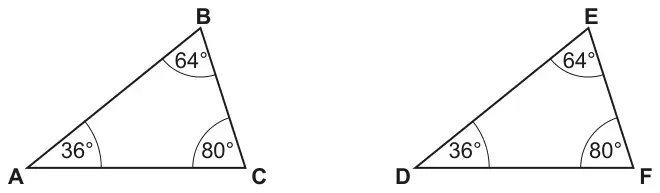
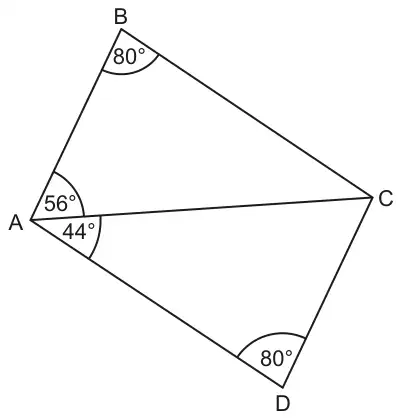
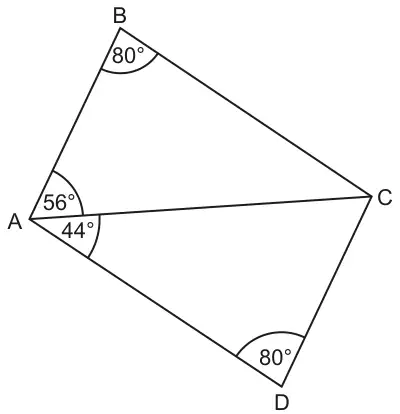
Prove that triangle ABC is congruent to triangle ACD. [4]
Mark scheme
Answer
Marks
Part marks and guidance
angle \(BCA = 44^\circ\) and angles [in a] triangle [\(= 180^\circ\)] or angle \(DCA = 56^\circ\) and angles [in a] triangle [\(= 180^\circ\)]
1
\(C = 44\) (or 56) is not sufficient. Accept angles shown on diagram.
0 if alternate angles is given as the reason unless the parallelogram has been justified
Best two statements from: (i) [side] \(AC\) is common (ii) [angle] \(ACB\) = [angle] \(CAD\) (iii) [angle] \(BAC\) = [angle] \(ACD\) (iv) angle \(B\) = angle \(D\) or [angle] \(ABC\) = [angle] \(CDA\)
2
B1 for each to a max of 2
Notation needed for these marks.
44 = 44 is not sufficient. 56 = 56 is not sufficient “angle” required if using just \(B\) or \(D\)
Conclusion and third statement [congruent because] ASA after stating (i), (ii), (iii) AAS after stating (i), (ii), (iv) or (i), (iii), (iv)
1
If 0 or 1 scored then, to a maximum total of 2 marks, allow: SC1 for angle \(BCA = 44^\circ\) and angle \(DCA = 56^\circ\) stated or on diagram and SC1 for a correct statement lacking precision eg “both triangles have a common side”, “both triangles have an angle of 80”, “all the angles are the same°
Final mark needs a third statement (ignore superfluous ones) and the appropriate congruence conclusion.
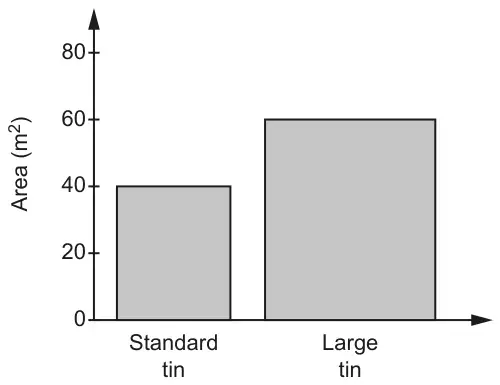
18 Percy sells paint in standard tins and large tins. The standard tin covers 40 m\(^2\) and the large tin covers 60 m\(^2\).
(a) Percy publishes this chart showing the area that can be covered with each tin of paint.
Explain why the chart is misleading. [1]
(b) The standard tin and the large tin are mathematically similar. The volume of the large tin is 50% more than the volume of the standard tin. Both tins are cylinders. The radius of the standard tin is 10 cm.
Calculate the radius of the large tin. [4]
Mark scheme (a)
Answer
Marks
Part marks and guidance
Bars are of different width oe
1
0 for large tin looks larger than it is 0 for the bars are different sizes 0 for incorrect/no \(x\)-axis
Mark scheme (b)
Answer
Marks
Part marks and guidance
11.4[...] nfww
4
B1 for 1.5 or \(\dfrac{3}{2}\) or 3 : 2 soi
AND
M2 for \(10 \times \sqrt[3]{1.5}\)
or
M1 for \(\sqrt[3]{1.5}\) soi by 1.14(47…)
If 0 scored allow SC1 for 15 as final answer or seen radius of large tin
Alternative: B1 for 0.666 to 0.667 or \(\dfrac{2}{3}\) or 2 : 3 soi AND
M2 for \(10 \div \sqrt[3]{0.666 \text{ to } 0.667}\) oe
or
M1 for \(\sqrt[3]{0.666 \text{ to } 0.667}\) oe soi 0.873(…)
12 The diagram below shows two right-angled triangles.
Not to scale
Prove that triangles PQS and QRS are similar. [5]
Mark scheme
Answer
Marks
Part marks and guidance
[\(QS\) =] \(\sqrt{80}\), \(4\sqrt{5}\) oe or 8.9[4..]
2
M2 for [\(QS\) =] \(\sqrt{4^2 + 8^2}\) oe
or
M1 for \(4^2 + 8^2\)
Accept QS on diagram First M2 may be implied by \(QP = 2\sqrt{5}\) oe or 4.47[…]
Best two from: (i) shows a pair of corresponding angles are equal (ii) shows a second pair of corrresponding angles are equal or states [angle] QRS = [angle] PQS (iii) shows two pairs of corresponding sides are in the same ratio (iv) shows the third pair of corresponding sides have the same ratio. Ratios of corresponding sides need to be seen in equiavlent form.
2
B1 for each to a max of 2 For these marks, answers to calculations are sufficient, but corresponding pairs must be either exact or the same when rot to 3sf. In (ii) accept QRS and PQS are both right angles oe (iii) and (iv) can be shown using scale factors eg QS = 1.118 × RS and PS = 1.118 × QS
Note: there is no mark for just finding QP = \(\sqrt{20}\)
Example values: angle RSQ = \(\tan^{-1}\left(\dfrac{4}{8}\right) = \cos^{-1}\left(\dfrac{8}{\sqrt{80}}\right) = \sin^{-1}\left(\dfrac{4}{\sqrt{80}}\right)\) = 26.5(…) or 26.6 angle QSP = \(\tan^{-1}\left(\dfrac{\sqrt{20}}{\sqrt{80}}\right) = \cos^{-1}\left(\dfrac{\sqrt{80}}{10}\right) = \sin^{-1}\left(\dfrac{\sqrt{20}}{10}\right)\) = 26.5(…) or 26.6
Accept as fractions or ratios. \(\dfrac{PS}{QS} = \dfrac{10}{\sqrt{80}} = \dfrac{\sqrt{5}}{2}\) =1.118[…] \(PS : QS = 10 : \sqrt{80}\) oe \(\dfrac{QS}{RS} = \dfrac{\sqrt{80}}{8}\) with any of the above \(\dfrac{PS}{QS}\) is insufficient for (iii) and (iv) as it is not clear that the ratios are the same.
Conclusion: two (or three) equal angles oe after showing (i) and (ii) or three pairs of corresponding sides in the same ratio after showing (iii) and (iv) or two pairs of corresponding sides in the same ratio and an equal angle between them oe after showing relevant combination of (i)/(ii) and (iii)
1
In all cases, it must be clear which angles and ratios are being used to support the conclusion made, usually by using labels or from values on a diagram. If it is not clear, withold the final mark. Where more than two facts are shown, allow the final mark if the conclusion is fully supported.
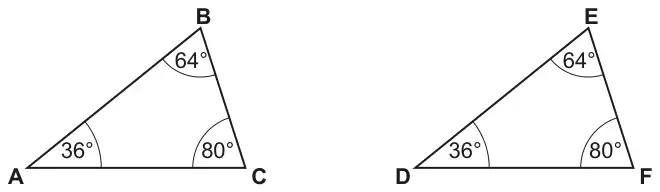
Prove that triangle ABC is congruent to triangle ACD. [4]
Mark scheme
Answer
Marks
Part marks and guidance
angle \(BCA\) = 44° and angles [in a] triangle [= 180°] or angle \(DCA\) = 56° and angles [in a] triangle [= 180°]
1
\(C\) = 44 (or 56) is not sufficient. Accept angles shown on diagram.
0 if alternate angles is given as the reason unless the parallelogram has been justified
Best two statements from: (i) [side] \(AC\) is common (ii) [angle] \(ACB\) = [angle] \(CAD\) (iii) [angle] \(BAC\) = [angle] \(ACD\) (iv) angle \(B\) = angle \(D\) or [angle] \(ABC\) = [angle] \(CDA\)
2
B1 for each to a max of 2
Notation needed for these marks.
44 = 44 is not sufficient. 56 = 56 is not sufficient “angle” required if using just \(B\) or \(D\)
Conclusion and third statement [congruent because] ASA after stating (i), (ii), (iii) AAS after stating (i), (ii), (iv) or (i), (iii), (iv)
1
Final mark needs a third statement (ignore superfluous ones) and the appropriate congruence conclusion.
If 0 (or 1 for statements) scored then, to a maximum total of 2 marks, allow: SC1 for angle \(BCA\) = 44° and angle \(DCA\) = 56° stated or on diagram and SC1 for a correct statement lacking precision eg “both triangles have a common side”, “both triangles have an angle of 80”, “all the angles are the same”
(b) The volume of a full-size train carriage is 220 m³. Trevor calculates the volume of a model train carriage to be 334 cm³ correct to 3 significant figures.
Is Trevor’s calculation correct? Show how you decide. [3]
Mark scheme (a)
Answer
Marks
Part marks and guidance
1.4355 or 1.436 or 1.44
2
M1 for 16.5 × 87 possibly soi by figs 14355, 1436 or 144
Mark scheme (b)
Answer
Marks
Part marks and guidance
Yes (Trevor is correct) because Eg \(220 \div 87^3 \times 100^3 = 334.[\ldots]\) or \(334 \times 87^3 \div 100^3 = 219.9\ldots\) to 220
3
M2 for \(220 \div 87^3 \times 100^3\) or \(334 \times 87^3 \div 100^3\)
OR
B1 for \(87^3\) or 658503 or \(100^3\) or 1000000 soi
AD = AB [given] oe CD = CB [given] oe AC = AC (common) oe Congruent SSS
M3
M2 for 2 correct statements with reason[s] or 3 correct but no/incorrect reason[s] M1 for 1 correct statement with reason or 2 correct but no/incorrect reasons
Angle ADC = angle ABC
A1
If 0 scored, SC1 for AC is a line of symmetry oe
or for triangle ADC is congruent to triangle ABC oe
Accept vertical line of symmetry or reflection see diagram as well if unsure
13 A and B are points on the circumference of a circle, centre O. CA and CB are tangents to the circle.
Not to scale
Prove that triangle OAC is congruent to triangle OBC. [4]
Mark scheme
Answer
Marks
Part marks and guidance
Three of these
OC is common or shared
OA = OB (equal) radii
\(\angle\)OAC = \(\angle\)OBC tangent perpendicular to radius
CA = CB tangents from a point [to a circle]
M3
M1 for each
After M0, B2 three pairs of these equal sides/angles with insufficient or no reasons or B1 for two pairs of these equal sides/angles identified with insufficient or no reasons
OR
After M1, B1 for two further pairs of these equal sides/angles identified with insufficient or no reasons
Enlarge triangle A with scale factor \(\frac{1}{3}\) and centre of enlargement (−1, 5). [3]
(b) Prism P and prism Q are similar.
The ratio of the surface area of prism P to the surface area of prism Q is 1 : 3.
(i) Jay says
The height of prism P is one third of the height of prism Q.
Explain why he is wrong. [1]
(ii) The volume of prism Q is 86 cm\(^3\).
Calculate the volume of prism P. [3]
Mark scheme (a)
Answer
Marks
Part marks and guidance
Triangle with vertices at (1, 6), (2, 6), (2, 4)
3
B2 for triangle correct size and orientation in wrong position
OR
B1 for enlargement centre (−1, 5) incorrect scale factor < 1 or for triangle with two vertices correct or for three rays from (−1, 5) to vertices of triangle A or for triangle correct size but wrong orientation
Mark scheme (b)
Answer
Marks
Part marks and guidance
(i) Height factor is square root of area factor oe in words or figures
1
Mark the best bit so long as no contradiction
Must include correct reference to square or square root
(ii) 16.5 to 16.6
3
B2 for \(\left(\sqrt{3}\right)^3\) oe or \(\dfrac{1}{\left(\sqrt{3}\right)^3}\) oe soi by 5.19 to 5.20 or 0.192 to 0.193
OR B1 for \(\sqrt{3}\) or \(\dfrac{1}{\sqrt{3}}\) oe soi by 1.73[…] or 0.577[…]
Accept \(\dfrac{86\sqrt{3}}{9}\) oe Note that \(\left(\sqrt{3}\right)^3 = 3\sqrt{3}\) and \(\dfrac{1}{\left(\sqrt{3}\right)^3} = \dfrac{\sqrt{3}}{9}\)
10.ABC is a triangle. The lines AC and DE are parallel. D is a point on the line AB such that AD : DB is in the ratio 5 : 2. The length of AC is 23·8 cm.
Diagram not drawn to scale
Calculate the length of DE. [2]
Mark scheme
Scheme
Marks
Comments
\(23.8 \times \frac{2}{7}\) or \(23.8 \div \frac{7}{2}\)
M1
May be seen in stages
= 6.8 (cm)
A1
Award A0 if this is given as DB in the working or on the diagram.
The board's mark scheme printed “8 ÷ 12/9 = = 6” and “9 × 10/7·5 = = 12”. Changed to “8 ÷ 12/9 = 6” and “9 × 10/7·5 = 12” because the equals sign was printed twice by mistake (in both the B2 and B1 lists). Our text already showed a single “=”.
Original: see the board's mark scheme PDF (link above).
(a) Four triangles are shown in the diagram below.
Diagram not drawn to scale
For each of the following statements choose ‘True’, ‘False’ or ‘Need more information’. Tick one box for each statement. [2]
Statement
True
False
Need more information
Triangle A is congruent to Triangle B
Triangle C is congruent to Triangle D
Triangle A is congruent to Triangle C
(b) Is it possible to draw an isosceles triangle with an exterior angle of \(60^\circ\)? Tick the appropriate box and show working to explain your reason. [2]
Yes ☐ No ☐
(c) Two triangles are shown in the diagram below.
Diagram not drawn to scale
Show that the two triangles are mathematically similar. [2]
Mark scheme (a)
Scheme
Marks
Comments
True
False
Need more information
✓
✓
✓
B2
For all three correct B1 for any two correct
Mark scheme (b)
Scheme
Marks
Comments
Yes indicated or clearly implied (with indication of one \(120^\circ\) angle) with two \(30^\circ\) angles.
B2
B1 for a clear indication of interior angle of \(120^\circ\)
OR \(\left(\frac{7.5}{10} = \frac{9}{12} = \frac{6}{8}\right)\) same scale factor \(= \frac{3}{4}\) oe
B2
B1 just for \(\frac{10}{7.5} = \frac{12}{9} = \frac{8}{6}\) OR \(\frac{7.5}{10} = \frac{9}{12} = \frac{6}{8}\)
Award no marks if the ratios of less than three pairs of sides compared.
Alternative method 1
Scheme
Marks
Comments
12:10:8 and 9:7·5:6 both simplify to 6:5:4 oe OR both equivalent to 108:90:72 oe
B2
B1 for stating 12:10:8 = 9:7·5:6 without simplifying to 6:5:4
Alternative method 2
Scheme
Marks
Comments
B2 for any one of the following: \(7.5\times\frac{12}{9} = 10\) AND \(6\times\frac{12}{9} = 8\) \(10\div\frac{12}{9} = 7.5\) AND \(8\div\frac{12}{9} = 6\) \(9\times\frac{10}{7{\cdot}5} = 12\) AND \(6\times\frac{10}{7{\cdot}5} = 8\) \(12\div\frac{10}{7{\cdot}5} = 9\) AND \(8\div\frac{10}{7{\cdot}5} = 6\) \(9\times\frac{8}{6} = 12\) AND \(7{\cdot}5\times\frac{8}{6} = 10\) \(12\div\frac{8}{6} = 9\) AND \(10\div\frac{8}{6} = 7{\cdot}5\)
B2
B1 for any one of the following: \(7.5\times\frac{12}{9} = 10\) OR \(6\times\frac{12}{9} = 8\) \(10\div\frac{12}{9} = 7.5\) OR \(8\div\frac{12}{9} = 6\) \(9\times\frac{10}{7{\cdot}5} = 12\) OR \(6\times\frac{10}{7{\cdot}5} = 8\) \(12\div\frac{10}{7{\cdot}5} = 9\) OR \(8\div\frac{10}{7{\cdot}5} = 6\) \(9\times\frac{8}{6} = 12\) OR \(7{\cdot}5\times\frac{8}{6} = 10\) \(12\div\frac{8}{6} = 9\) OR \(10\div\frac{8}{6} = 7{\cdot}5\)
(6)
Corrected by Westie's Workshop
The board's mark scheme printed “8 ÷ 12/9 = = 6” and “9 × 10/7·5 = = 12”. Changed to “8 ÷ 12/9 = 6” and “9 × 10/7·5 = 12” because the equals sign was printed twice by mistake (in both the B2 and B1 lists). Our text already showed a single “=”.
Original: see the board's mark scheme PDF (link above).
The radius of the cone is 20 cm and the height of the cone is 50 cm.
Diagram not drawn to scale
Jake pours some water into this cone. When he stops, the radius of the surface of the water is 6 cm. The surface of the water is parallel to the base of the cone.
Rhian then pours water into the cone until it is completely full. She pours the water at a rate of 1 litre per 10 seconds.
How many seconds does it take Rhian to fill the cone? [7]
Mark scheme
Scheme
Marks
Comments
(Depth of water = ) 15 (cm)
B2
May be embedded in later working B1 for \(\dfrac{6}{20} \times 50\) oe
(a) Shape \(A\) is similar to shape \(B\). The area of shape \(A\) is 128 cm2.
Calculate the area of shape \(B\). [3]
(b) Shape \(A\) is the uniform cross-section of prism \(A\). Shape \(B\) is the uniform cross-section of prism \(B\). Prism \(A\) and prism \(B\) are similar.
Write the following ratio in its simplest form.
volume of prism \(A\) : volume of prism \(B\) = ………………… : ………………… [2]
Mark scheme (a)
Scheme
Marks
Comments
Sight of \(\dfrac{10}{8}\) or \(\dfrac{8}{10}\) oe si
B1
Can be implied from \(128 \times 10 \div 8\) oe
\(128 \times \left(\frac{10}{8}\right)^2\) or \(128 \div \left(\frac{8}{10}\right)^2\) oe
M1
200 (cm2)
A1
Mark scheme (b)
Scheme
Marks
Comments
64 : 125
B2
If not B2, award B1 for any one of the following:
\(4^3 : 5^3\)
\(8^3 : 10^3\) oe
sight of 125 AND 64
\(\left(\frac{10}{8}\right)^3\) oe
FT \(128 \times 8\) : ‘their 200’ \(\times\, 10\) from (a) oe
15. The diagram shows a candle. It is made by removing a small pyramid of wax from the top of a large pyramid of wax, to expose the wick.
Diagram not drawn to scale
The perpendicular height of the large pyramid is 24 cm. The base of the large pyramid is a square with sides 12 cm. The base of the small pyramid that is removed is a square with sides 2 cm.
The density of the candle wax is 0·9 g/cm\(^3\).
Volume of pyramid = \(\dfrac{1}{3} \times\) area of base \(\times\) perpendicular height
(a) Calculate the mass of the candle. State one assumption you make. [7]
(b) Describe the impact of your assumption on your answer to part (a). [1]
Mark scheme (a)
Scheme
Marks
Comments
Mark using one method only, to the candidate’s advantage
M1 for \(\frac{1}{3} \times 24 \times 12^2\) or \(\frac{1}{3} \times 4 \times 2^2\)
\(\dfrac{3440}{3}\) or 1146.6(66…) or 1146.7
A1
FT ‘their 4’ Allow 1147 from correct working
(Mass = ) \(0.9 \times \dfrac{3440}{3}\)
M1
FT ‘their \(\dfrac{3440}{3}\)’
1032 (grams)
A1
CAO Award for 1031.9(4) to 1032.3
Valid assumption e.g. ‘No wax is lost when the wax is cut.’ or ‘The mass of the wick is negligible.’ or ‘The wick can be ignored.’ or ‘The volume of the wick is negligible.’ or ‘The wick has the same density as the wax.’
E1
Alternative Method 1 for first 6 marks (difference of masses)
FT ‘their 4’ for M2 or M1 M1 for \(0.9 \times \frac{1}{3} \times 24 \times 12^2\) or \(0.9 \times \frac{1}{3} \times 4 \times 2^2\); (1036.8 or 1037) (4.77 or 4.8)
or M2 for sight of \(\frac{1}{3} \times 24 \times 12^2 - \dfrac{1}{6^3}\left(\frac{1}{3} \times 24 \times 12^2\right)\) oe or M1 for sight of \(\dfrac{1}{6^3}\left(0.9 \times \frac{1}{3} \times 24 \times 12^2\right)\) oe
1032 (grams)
A1
CAO Award for 1031.9(4) to 1032.3
Mark scheme (b)
Scheme
Marks
Comments
Valid impact following their assumption e.g. ‘The volume of the wax may be a little less so the mass will be less.’ or ‘The density of the wick is likely to be less than the density of the wax, so in fact the mass of the candle is likely to be a bit less.’
6. The points \(A\), \(B\), \(D\) and \(E\) have been marked on the 1 cm grid below.
(a)
Write down the coordinates of \(E\). [1]
\(E\) ( ……… , ……… )
(b)
(i)
\(ABC\) is a triangle with the following properties.
Angle \(ABC\) is a right angle.
The length of \(BC\) is twice the length of \(AB\).
Mark and label the position of \(C\) on the grid. [2]
(ii)
\(D\) and \(E\) are two vertices of a triangle \(DEF\). Triangle \(DEF\) is congruent to triangle \(ABC\).
Mark and label the position of \(F\) on the grid. [1]
Mark scheme (a)
Scheme
Marks
Comments
\((-4,\ 1)\)
B1
Mark scheme (b)
Scheme
Marks
Comments
(i) \(C\) correctly marked at (1, 7)
B2
Mark intent; may be unlabelled B1 for a point that would result in a triangle and that satisfies one of the properties e.g. \((1,\ n)\) where \(n \neq 7\)
If no marks, award SC1 for a point at (4, 7).
(ii) \(F\) correctly marked at \((-4,\ 7)\)
B1
STRICT FT ‘their \(C\)’; mark intent; may be unlabelled Allow \((-7,\ 7)\) or correct FT of \((-7,\) their 7)
The walls of the shed are vertical. The shed stands on horizontal ground. The uniform cross-section has one line of symmetry.
The diagram below shows some of the measurements of the cross-section.
Diagram not drawn to scale
Calculate the size of the angle between the roof of the shed and the horizontal. [4]
(b) Petra has a mathematically similar shed.
Diagram not drawn to scale
Calculate the two missing measurements on the diagram above. You must show all your working.[3]
Mark scheme (a)
Scheme
Marks
Comments
Sight of appropriate measurements 0.8 (m) and 1.2 (m)
B1
Full method to find the correct angle, e.g. \(\tan x = 0.8 / 1.2\)
M1
FT ‘their 2.5 – 1.7’ and ‘their 2.4 ÷ 2’
\((x =)\ \tan^{-1} 0.8/1.2\)
M1
33.69...(°) or 33.7(°) or 34(°)
A1
If M0, A0 then award SC1 for an answer of 56(.3°) (or equivalent unrounded irrespective of any labelling on the diagram)
Corrected by Westie's Workshop
The board's mark scheme printed “(or equivalent unrounded irrespective of any labelling on the diagram”. Changed to “(or equivalent unrounded irrespective of any labelling on the diagram)” because a closing bracket was missing.
Original: see the board's mark scheme PDF (link above).
(a) Shabana is moving to a new house and is using boxes to pack.
(i)Shabana has two mathematically similar packing boxes and says,
“The ratio of the lengths of two of my boxes is 2 : 3 so the ratio of their volumes must be 4 : 9.”
Give a reason why Shabana is incorrect and state the correct ratio of the volumes. [2]
Reason …………… Correct ratio …… : ……
(ii)
Diagram not drawn to scale
Shabana has two different square-based boxes where:
the ratio of the lengths of the sides of the squares is 1 : 3,
the ratio of their heights is 1 : 4.
How many of the small boxes can the large box hold? [2]
(b) Shabana’s new house is further away from her workplace. She estimates that there will be a 15% increase in the cost of getting to work.
From her old house, she:
drove 945 miles per month,
used petrol at the rate of 9 miles per litre,
paid 120p per litre for petrol.
How much more will it cost her to get to work each month after she has moved? [4]
Increased cost of getting to work £ ……………
Mark scheme (a)
Scheme
Marks
Comments
(a)(i) Valid reason e.g. ‘The parts of the ratio should be cubed’ or ‘4 : 9 is the area factor not the volume factor’ or ‘Because the correct ratio is 23 : 33.’
E1
Allow e.g. ‘Squaring does not find the volume.’
8 : 27 oe
B1
ISW
(a)(ii) 36
B2
B1 for \(3\times3\ (\times4)\) oe seen
Mark scheme (b)
Scheme
Marks
Comments
\((945 \div 9 =)\ 105\) (litres per month)
B1
\(105\times120\) (p) or \(105\times\) (£)1.2(0) (=12600 (p) or (£)126)
M1
FT ‘their 105’
(15% of (£)126 =) \(12.6(0) + \tfrac12\times12.6(0)\) oe
M1
FT ‘their (£)126’ provided M1 previously awarded; may be seen in stages
(£)18.9(0) or 1890 (p) ISW
A1
FT ‘their 105’; If units are given, they must be correct
Alternative methods could increase 120p, 945 or 105 by 15%:
Scheme
Marks
Comments
\((945 \div 9 =)\ 105\) (litres per month)
B1
\(12 + \tfrac12\times12\)
M1
‘their 105’ \(\times\) ‘their 18(p)’ oe
M1
(£)18.9(0) or 1890 (p)
A1
OR
Scheme
Marks
Comments
\(94.5 + \tfrac12\times94.5\)
M1
\((141.75 \div 9 =)\ 15.75\) or \((141.75\times120 =)\ 17010\)
The board's mark scheme printed “141.75 × 20 = 17010”. Changed to “141.75 × 120 = 17010” because 141.75 × 20 is 2835; the price is 120p per litre and 141.75 × 120 = 17010.
The board's mark scheme printed “120p, 945, 105 or by 15%”. Changed to “120p, 945 or 105 by 15%” because the list had a stray “or” followed by a gap; the three alternative methods below increase 120p, 945 or 105.
The board's mark scheme printed “may been seen”. Changed to “may be seen” because “been” should be “be”.
Original: see the board's mark scheme PDF (link above).
(i) How many cones could Megan fill? You may assume that each cone is completely filled, level to the top, with ice cream. [7]
(ii) What impact does the assumption have on your answer in (a)(i)? [1]
(b) Two mathematically similar ice cream cones are shown below.
Diagram not drawn to scale
The smaller cone has a volume of 40 cm3.
Calculate the volume of the larger cone. [2]
Mark scheme (a)
Scheme
Marks
Comments
(i) \(h^2 = 15^2 - 3.5^2\)
M1
Accept \(15^2 = h^2 + 3.5^2\)
\(h^2 = 212.75\) or \(h = \sqrt{212.75}\)
A1
14.58595...(cm) or 14.6 (cm)
A1
Accept rounded answers, but NOT truncated answers FT from M1 for the correctly evaluated square root of ‘their 212.75’ provided ‘their answer’ < 15 (cm)
FT ‘their 14.58595...’ provided M1 previously awarded
Answer in the range 187.(...cm3)
A1
\(2000 \div 187.(\ldots)\)
M1
FT ‘their 187.(...)’ provided at least 3 marks previously awarded
10 (ice creams)
A1
Must be a whole number
(ii) Evaluation of results, e.g. ‘cone was full, if it wasn’t Megan could have made more ice creams’,
E1
Accept FT from reasoning behind rounding ‘their number of ice creams’ up or down
Allow, e.g. ‘inside measurements could be less, so could be 11 rather than 10 ice creams’, ‘could have extra ice cream on the top, so makes fewer’, ‘not practical, as impossible to fill to the bottom of the cone’
13. Eleri goes on holiday to visit historic gardens in Italy. In many of the gardens she notices irregular staircases. Each staircase has horizontal steps and vertical rises.
The angle of rise is measured from the horizontal upwards.
(a) The bottom step on a staircase is 26·4 cm wide with a vertical rise of 24 cm. The second step in this staircase is 39·5 cm wide and has the same angle of rise.
Diagram not drawn to scale
(i) Calculate the angle of rise. [2]
(ii) Hence use trigonometry to calculate the vertical rise of the second step in centimetres. Give your answer correct to 2 significant figures. You must show all your working. [2]
(b) Look again at the diagram and your method of using trigonometry, in part (a).
Show how the vertical rise of the second step could be calculated without the use of trigonometry. You must show all your working. (A scale drawing is not acceptable, as you are asked to calculate.)
Evaluate which was the most efficient method of calculating the vertical rise of the second step. [3]
Mark scheme (a)
Scheme
Marks
Comments
(i) \(\tan \text{rise} = 24/26.4\) or angle of rise \(= \tan^{-1} 24/26.4\)
M1
Trigonometry must be used in (a)
\(42(.27\ldots^\circ)\)
A1
(ii) \(\tan 42(.27\ldots^\circ) = 2^{\text{nd}}\text{ rise}/39.5\) or \(2^{\text{nd}}\text{ rise} = 39.5 \times \tan 42(.27\ldots^\circ)\)
M1
FT ‘their angle of rise’ provided M1 previously awarded
(\(2^{\text{nd}}\) rise =) 36 (cm)
A1
Must be 2 sig. figs. Do not accept an unsupported answer of 36 (cm), trigonometry must be seen
Mark scheme (b)
Scheme
Marks
Comments
\(2^{\text{nd}}\text{ rise}/39.5 = 24/26.4\) or \(2^{\text{nd}}\text{ rise} = 39.5 \times 24/26.4\) or \(2^{\text{nd}}\text{ rise} = 39.5 \times 0.9(090\ldots)\) or \(2^{\text{nd}}\text{ rise} = 39.5 \div 1.1\) or equivalent
M1
Must show ratio or similar triangle working, not the use of ‘tan’ Accept use of scale factor method
35.9(... cm) or 36 (cm) AND an evaluation, e.g. ‘similar triangles as fewer stages’, ‘non trigonometry method as few stages, so less chance of making a mistake’
A2
MUST FT from working A1 for 36 (cm) or 35.9(...cm) OR for an evaluation
Two similar plant pots are shown. When the smaller plant pot is full, it holds 0·4 litres of compost. Calculate how many litres of compost the larger plant pot holds when it is full. [2]
(b) Compost is sold in cylindrical cardboard drums. A drum holds 30 000 cm3 of compost. The height of the drum is four times its radius.
Calculate the radius of the drum. You must show all your working. [4]
Mark scheme (a)
Scheme
Marks
Comments
(a) \((10/6)^3 \times 0.4\)
M1
1.8(5.. litres) or 1.9(litres)
A1
Corrected by Westie's Workshop
The board's mark scheme printed “(a)(i)”. Changed to “(a)” because question 17 has no part (i); this is part (a).
Original: see the board's mark scheme PDF (link above).
Mark scheme (b)
Scheme
Marks
Comments
\(\pi \times r^2 \times 4r = 30\,000\) OR \(\pi \times (h/4)^2 \times h = 30\,000\)
M2
Accept use of letters other than ‘\(r\)’ M1 for \(\pi \times r^2 \times h = 30\,000\), or for sight of \(\pi \times r^2 \times 4r\)
Any two of \(C\hat{D}B = C\hat{A}B\) (same segment) or equivalent \(A\hat{C}D = A\hat{B}D\) (same segment) or equivalent \(D\hat{E}C = A\hat{E}B\) (vertically opposite)
B2
B1 for \(C\hat{D}B = C\hat{A}B\) same segment or equivalent or for \(A\hat{C}D = A\hat{B}D\) same segment or equivalent or for two pairs of angles eg \(C\hat{D}B = C\hat{A}B\), \(A\hat{C}D = A\hat{B}D\) with no reason/invalid reasons stated
Correct explanation e.g. ‘The triangles have the same angles (and so are similar).’
E1
May be stated or implied earlier.
Alternative method
Scheme
Marks
Comments
\(\mathrm{AE} \times \mathrm{EC} = \mathrm{BE} \times \mathrm{ED}\) or states ‘intersecting chords theorem’
B1
\(\dfrac{\mathrm{AE}}{\mathrm{DE}} = \dfrac{\mathrm{BE}}{\mathrm{CE}}\) or equivalent ratios
B1
Correct explanation e.g. ‘Corresponding sides are in the same ratio so the triangles are similar.’ or eg extending the intersecting chords theorem \(\dfrac{\mathrm{AE}}{\mathrm{DE}} = \dfrac{\mathrm{BE}}{\mathrm{CE}} = \dfrac{\mathrm{AB}}{\mathrm{DC}}\) (so the triangles are similar)
Or equivalent. May be seen in parts. Accept a method based on ratios e.g. 1 : 5 (from 3 : 75 = 1 : 25 = 1 : 5\(^2\)) then 1 : 5\(^3\) .
Award B1 for a linear scale factor \(\sqrt{\dfrac{3}{75}}\) \(\left(= \dfrac{1}{5}\right)\) or award B1 for \(\left\{\dfrac{3}{75}\right\}^3\) \(\left( = \left\{\dfrac{1}{25}\right\}^3 = \dfrac{1}{15625}\right)\).
(Volume of large solid =) 0·4 ÷ \(\left\{\sqrt{\dfrac{3}{75}}\right\}^3\) OR 0·4 × 1 / \(\left\{\sqrt{\dfrac{3}{75}}\right\}^3\) or equivalent
M1
FT ‘their derived volume scale factor’, provided that it comes from \([\sqrt{\ }]^3\).
Which one of the following statements is correct? Circle the correct answer.
The triangles must be congruent
The triangles could be congruent
The triangles cannot be congruent
You must show your working and justify your answer. [2]
Mark scheme
Scheme
Marks
Comments
Missing angle(s) is/are 42° OR 63° or stated in later reasoning AND ‘The triangles could be congruent’ circled.
B1
Check diagrams Working space takes precedence. If two angles are given, they must both be correct.
Valid explanation e.g.
having equal angles alone is not a sufficient condition for congruence
the (corresponding) side lengths could be different / same (even though the angles are equal).
E1
Dependent on B1. Accept equivalent statements, e.g.
the triangles are similar (but not necessarily congruent)
if (a pair of corresponding) side lengths were known, we could apply ASA to test for congruency.
Do not allow ‘They have the same angles’ (as need to mention sides).
If angle(s) calculated, but no statement identified, award B1E1 for a full alternative explanation e.g. the triangles are similar but not necessarily congruent.
9. NoomAir is a cargo plane company based in Nice. Two of their planes have been hired to deliver cargo to the cities of Rome, Valencia and Tunis.
(a)
(i)
One of the planes will fly from Nice to Rome, and then on to Tunis. The pilot knows the following information.
From Nice, Rome is 470 km on a bearing of 115º.
From Nice, Tunis is 805 km on a bearing of 162º.
Diagram not drawn to scale
Calculate the distance from Rome to Tunis. [4]
(ii)
The second plane will fly from Nice to Valencia, and then on to Tunis. The pilot of this plane knows the following information.
Valencia is on a bearing of 234º from Nice.
The distance between Valencia and Tunis is 970 km.
Calculate the bearing of Tunis from Valencia. [6]
(b)
NoomAir sells toy replicas of one of its cargo planes. The two replicas shown below are mathematically similar.
Diagrams not drawn to scale
The volume of a large toy plane is 6 times the volume of a small toy plane. The length of a large toy plane is 30 cm. Calculate the length of a small toy plane. [3]
(c)
NoomAir makes 200 of the large toy planes. It takes a random sample of 5 of these 200 toy planes to check the quality of their production.
The following numbers are taken from a table of random digits.
649
133
016
249
585
520
869
239
489
849
727
133
580
337
182
125
957
755
510
563
017
205
810
119
Use these numbers to choose 5 toy planes from the 200 toy planes. You must start with the first number in the list. Describe clearly how you use the numbers to select the sample. [3]
The numbers of the 5 toy planes in the sample are: …………… …………… …………… …………… ……………
From the formula list: In any triangle \(ABC\): Cosine rule \(a^2 = b^2 + c^2 - 2bc\cos A\)
Mark scheme (a)
Scheme
Mark
Comments
(i) Angle RNT = (162 – 115 =) 47 (º)
B1
May be shown on the diagram or implied in further working
FT ‘their Angle VNT = 72’ provided it is < 120 M1 for \(\dfrac{\sin(\text{Angle NVT})}{805} = \dfrac{\sin 72}{970}\) or equivalent
= 52.1(181…) (º)
A1
CAO Mark final answer Accept 52 (º) provided no incorrect work seen
(Bearing of Tunis from Valencia =) 180 – (360 – 234) + 52.1(181…) or 54 + 52.1(181…)
m1
FT ‘their 52.1(181…)’ provided M2 or M1 previously awarded
= 106(.118…)(º)
A1
On FT, if their bearing < 100, then their answer needs to be written using 3 figures, allowing decimals
Mark scheme (b)
Scheme
Mark
Comments
Appropriate sight of \(\sqrt[3]{6}\) or \(\sqrt[3]{\dfrac{1}{6}}\) (= 1.817…) (= 0.550…)
B1
May be embedded in further working
(Length of small toy plane =) 30 ÷ \(\sqrt[3]{6}\) or 30 ÷ 1.8(171…) OR 30 × \(\sqrt[3]{\dfrac{1}{6}}\) or 30 × 0.55(0321…)
M1
Or equivalent e.g. \(\sqrt[3]{4500}\) The award of M1 implies B1
= 16.5(096…) or 16.51 (cm)
A1
Penalise an answer of 16.5 if evidence of premature approximation e.g. 30 ÷ 1.82 = 16.48 with a final answer of 16.5 would be awarded B1M1A0
Mark scheme (c)
Scheme
Mark
Comments
Statements required:
Number the toy planes from (00)1 to 200
Consider successive 3-digit numbers
Use numbers in the range e.g. Use the numbers (00)1 to 200 or Do not use 000 and 201 – 999
Ignore repeats
E2
All 4 needed for E2 E1 for any 2 or 3 correct statements
The numbering (00)1 to 200 can be implied by the range of numbers they state they will choose from Any alternative numbering system e.g. (00)0 to 199 needs to be clearly stated
Allow the 2nd statement to be implied by their numbering of the toy planes (from 001) AND their use of 3-digit numbers in their answer OR 3-digit numbers used in their answer and e.g. 016 seen
Do not allow ‘Use numbers less than 201’ or ‘Ignore numbers greater than 200’ if they have numbered the toy planes from 001 to 200 without referencing ignoring 000
(Working in rows would give toy planes) 133, (0)16, 133, 182, 125, (0)17 OR (Working in columns would give toy planes) 133, (0)16, 133, (0)17, 182, 125
B1
ISW Allow these numbers in any order
Alternative
Alternative method:
Scheme
Mark
Comments
Statements required:
Number the toy planes from (00)1 to 200
Consider successive 3-digit numbers
Divide each number by 200 and use the remainder to choose a toy plane
If the remainder is 0, then toy plane 200 is chosen, and ignore repeats
E2
All 4 needed for E2 E1 for any 2 or 3 correct statements
The numbering system can be implied by the division by 200 and how they say they will deal with the remainder of (00)0
Allow the 2nd statement to be implied by their numbering of the toy planes (from 001) AND their use of 3-digit numbers in their answer OR 3-digit numbers used in their answer and e.g. 049 seen
If (00)0 to 199 used, when the remainder is 0, toy plane (00)0 is selected
(Working in rows would give toy planes) (0)49, 133, (0)16, (0)49, 185, 120 OR (Working in columns would give toy planes) (0)49, (0)89, 157, 133, (0)49, 155
6. In the diagram below, the triangles \(ABC\) and \(DBE\) are mathematically similar. \(CB\) = 8 cm, \(DB\) = 7·5 cm, \(BE\) = 5 cm and \(A\hat{C}B = D\hat{E}B\).
Diagram not drawn to scale
Calculate the length of \(AB\). [2]
Mark scheme
Scheme
Marks
Comments
(\(AB\) = ) 7·5 × \(\dfrac{8}{5}\) or \(\dfrac{AB}{7.5} = \dfrac{8}{5}\) or equivalent OR (\(AB\) = ) 7·5 ÷ \(\dfrac{5}{8}\) or \(\dfrac{7.5}{5} = \dfrac{AB}{8}\)
M1
Check diagram for answer. May be seen in stages. M1 for correct use of scale factor (e.g \(\dfrac{8}{5}\) or \(\dfrac{5}{8}\) or equivalent).
12 (cm)
A1
Mark final answer. An unsupported answer of 12 is awarded M1A1.
6. Alternative method:
Scheme
Marks
Comments
Correct use of ‘two-step’ method.
M1
A partial trigonometric method is M0.
12 (cm)
A1
Mark final answer. Allow an answer in the range \(11{\cdot}99 \leqslant AB \lt 12{\cdot}01\) (cm).
Corrected by Westie's Workshop
The board's mark scheme printed “6.(b) Alternative method:”. Changed to “6. Alternative method:” because question 6 has no part (b); this alternative method is for question 6 as a whole.
Original: see the board's mark scheme PDF (link above).
14. The two shapes below are mathematically similar.
Diagrams not drawn to scale
Calculate the value of \(w\). [2]
Mark scheme
Scheme
Marks
Comments
\((w =)\) 18·9 × \(\frac{6}{9}\) OR \(\frac{w}{18.9} = \frac{6}{9}\) or equivalent OR \((w =)\) 18·9 ÷ \(\frac{9}{6}\) OR \(\frac{18.9}{9} = \frac{w}{6}\) or equivalent
M1
May be seen in stages. M1 for correct use of scale factor \(\frac{2}{3}\) or equivalent.
11. A solid has a height of 11 cm. A similar solid has a height of 23 cm. The volume of the smaller solid is 107 cm3. Calculate the volume of the larger solid. [3]
Mark scheme
Scheme
Marks
Comments
(Volume scale factor=) \((23/11)^3\) OR \(23^3/11^3\) OR 12167/1331 (=9·14…)
B1
\((23/11)^3 \times 107\)
M1
= 978(·1…cm3)
A1
Accept an answer in the range: 976·8(…cm3) to 980(cm3) Allow an answer of: 990(·9…cm3) OR 991(cm3) from sight of \(2{\cdot}1^3 \times 107\)
Alternative method
Scheme
Marks
Comments
\((11/23)^3\) OR \(11^3/23^3\) OR 1331/12167 (=0·109…)
B1
\(107 \div (11/23)^3\)
M1
= 978(·1…cm3)
A1
Accept an answer in the range: 976·8(…cm3) to 980(cm3)
Allow an answer of: 967(·5…cm3) OR 968(cm3) from sight of \(107 \div 0{\cdot}48^3\)
9. Hang-Up is a company that makes clothes hangers. One type of hanger is made from a single length of metal wire that is bent to form the hanger.
(a)
(i) The design for the main part of the hanger is shown below. This part of the hanger is symmetrical. It has straight sections of length 24 cm and 38 cm. It also has curved sections that are arcs of a circle of radius 3 cm.
Diagram not drawn to scale
Calculate the length of metal wire needed for the main part of the hanger. Give your answer in terms of \(\pi\) in its simplest form. [4]
(ii) The length of wire needed for the hooked part of this hanger is \(0{\cdot}1\dot{3}\) of the total length of wire needed for a hanger.
Write \(0{\cdot}1\dot{3}\) as a fraction in its simplest form. [3]
(b) Hang-Up makes metal hangers in batches of 80. Every 3 hours, it randomly samples 8 hangers from one batch of 80 for quality assurance.
The following numbers are taken from a table of random digits.
299986 890791 810130 955579 268884 301244
Use these numbers to choose 8 hangers from a batch of 80 hangers. You must start with the first number in the list. Describe clearly how you use the numbers to select the sample. [3]
Hangers chosen:
(c) Hang-Up also makes plastic hangers of various sizes. Two of its plastic hangers have main parts that are mathematically similar. These are shown below.
Diagram not drawn to scale
The total surface area of the larger hanger is 1·44 times the total surface area of the smaller hanger.
The height of the smaller hanger is 9 cm. Calculate the height of the larger hanger. [3]
Mark scheme (a)
Scheme
Marks
Comments
(i) Sight of \(\dfrac{150{\times}2{\times}\boldsymbol{\pi}{\times}3}{360}\) OR \(\dfrac{300{\times}2{\times}\boldsymbol{\pi}{\times}3}{360}\) (= 2.5\(\boldsymbol{\pi}\)) (= 5\(\boldsymbol{\pi}\))
B1
Or equivalents
(Length of wire =) (2 ×) \(\dfrac{150{\times}2{\times}\boldsymbol{\pi}{\times}3}{360}\) + (2 ×) 24 + 38 or equivalent
M1
= 5\(\boldsymbol{\pi}\) + 86 (cm)
A2
CAO Mark final answer A1 for sight of any one of the following:
\(\dfrac{1800\boldsymbol{\pi}}{360}\) + 86 or equivalent
5\(\boldsymbol{\pi}\) + ….
2.5\(\boldsymbol{\pi}\) + …. or 5\(\boldsymbol{\pi}\)/2 + …. provided an attempt has been made to add the 3 straight pieces
(ii) e.g. 10x = 1.333…, 100x = 13.333… AND an attempt to subtract both sides
M1
= \(\dfrac{12}{90}\) or \(\dfrac{132}{990}\) or \(\dfrac{1332}{9990}\) or equivalent
A1
Allow A1 for e.g. 1.2/9
= \(\dfrac{2}{15}\)
A1
FT from M1A0 provided of equivalent difficulty
Alternative method (a)(ii)
Scheme
Marks
Comments
\(\dfrac{1}{10}\) + \(\dfrac{3}{90}\) or equivalent
M1
= \(\dfrac{12}{90}\) or equivalent
A1
= \(\dfrac{2}{15}\)
A1
FT from M1A0 provided of equivalent difficulty
Mark scheme (b)
Scheme
Marks
Comments
Statements required:
Number the hangers from (0)1 to 80
Consider successive 2-digit numbers
Do not use numbers outside the range e.g. Do not use 00 and 81 – 99, OR Use the numbers (0)1 to 80
Ignore repeats
E2
All 4 needed for E2 E1 for any 2 or 3 correct statements
Allow an equivalent numbering system e.g. (0)0 to 79 Their numbering system can be implied by the range of numbers they state they will choose from
Allow the 2nd statement to be implied by their numbering of the hangers (from 01) AND their use of 2-digit numbers in their answer OR 2-digit numbers used in their answer with 07 and 01 seen
Do not allow ‘Use numbers less than 81’ if they have numbered the hangers from 01 to 80, without stating that 00 will not be used
The base of a flagpole is fixed to horizontal ground. It is held vertically by a straight rod of length 3·8 m. The rod is fixed to the ground and to a point 1·5 m from the top of the flagpole. The flagpole and the rod are shown in the diagram below.
Diagram not drawn to scale
Calculate the total height of the flagpole. Give your answer correct to the nearest centimetre. [4]
(b)
Mathematically similar large, medium and small flags are made.
Diagrams not drawn to scale
(i) Calculate the length of the medium flag. [2]
Length of the medium flag is …………… cm
(ii) Calculate the height of the small flag. [2]
Height of the small flag is …………… cm
Mark scheme (a)
Scheme
Marks
Comments
(Length of the flagpole below the rod =) 3.8 × sin 55° or 3.8 × cos (90° – 55°) or 380 × sin 55° or 380 × cos (90° – 55°)
M2
Or alternative full method M1 for correct working without isolating ‘length’ \(\sin 55^\circ\) = \(\dfrac{\text{length}}{3.8}\) or \(\cos (90^\circ - 55^\circ)\) = \(\dfrac{\text{length}}{3.8}\) or \(\sin 55^\circ\) = \(\dfrac{\text{length}}{380}\) or \(\cos (90^\circ - 55^\circ)\) = \(\dfrac{\text{length}}{380}\)
3.11(2…m) or 311(.2.. cm)
A1
Allow 3.1 (m) or 310 (cm)
(Total length 1.5 + 3.11 =) 4.61 (m) or 461 (cm)
A1
Must be to the nearest cm FT provided at least M1 previously awarded, i.e. for 1.5 + ‘their 3(.)11’ correctly evaluated, to nearest cm, and ‘their 3.11’ is to at least 2 decimal places
If units are given they must be correct
Mark scheme (b)
Scheme
Marks
Comments
(i) 120 × 64 ÷ 80 or 64 × 1.5 or 120 × 0.8 or 120 ÷ 1.25 or 64 ÷ \(\dfrac{2}{3}\) or equivalent
M1
96 (cm)
A1
Answer space takes precedence
(ii) 75 × 80 ÷ 120 or 75 ÷ 1.5 or 75 × \(\dfrac{2}{3}\) or 80 ÷ 1.6 or 80 × 0.625 or 64 × 75 ÷ 96 or equivalent
5. The two shapes below are mathematically similar.
Diagrams not drawn to scale
Calculate the value of \(w\). [2]
Mark scheme
Scheme
Marks
Comments
\((w =)\) 18·9 × \(\dfrac{6}{9}\) OR \(\dfrac{w}{18{\cdot}9} = \dfrac{6}{9}\) or equivalent OR \((w =)\) 18·9 ÷ \(\dfrac{9}{6}\) OR \(\dfrac{18{\cdot}9}{9} = \dfrac{w}{6}\) or equivalent
M1
May be seen in stages. M1 for correct use of scale factor \(\dfrac{2}{3}\) or equivalent.
The base of a flagpole is fixed to horizontal ground. It is held vertically by a straight rod of length 3·8 m. The rod is fixed to the ground and to a point 1·5 m from the top of the flagpole. The flagpole and the rod are shown in the diagram below.
Diagram not drawn to scale
Calculate the total height of the flagpole. Give your answer correct to the nearest centimetre. [4]
(b)
Mathematically similar large, medium and small flags are made.
Diagrams not drawn to scale
(i) Calculate the length of the medium flag. [2]
Length of the medium flag is …………… cm
(ii) Calculate the height of the small flag. [2]
Height of the small flag is …………… cm
Mark scheme (a)
Scheme
Marks
Comments
(Length of the flagpole below the rod =) 3.8 × sin 55° or 3.8 × cos (90° – 55°) or 380 × sin 55° or 380 × cos (90° – 55°)
M2
Or alternative full method M1 for correct working without isolating ‘length’ sin 55° = \(\dfrac{\text{length}}{3.8}\) or cos (90° – 55°) = \(\dfrac{\text{length}}{3.8}\) or sin 55° = \(\dfrac{\text{length}}{380}\) or cos (90° – 55°) = \(\dfrac{\text{length}}{380}\)
3.11(2…m) or 311(.2.. cm)
A1
Allow 3.1 (m) or 310 (cm)
(Total length 1.5 + 3.11 =) 4.61 (m) or 461 (cm)
A1
Must be to the nearest cm FT provided at least M1 previously awarded, i.e. for 1.5 + ‘their 3(.)11’ correctly evaluated, to nearest cm, and ‘their 3.11’ is to at least 2 decimal places
If units are given they must be correct
Mark scheme (b)
Scheme
Marks
Comments
(i) 120 × 64 ÷ 80 or 64 × 1.5 or 120 × 0.8 or 120 ÷ 1.25 or 64 ÷ \(\dfrac{2}{3}\) or equivalent
M1
96 (cm)
A1
Answer space takes precedence
(ii) 75 × 80 ÷ 120 or 75 ÷ 1.5 or 75 × \(\dfrac{2}{3}\) or 80 ÷ 1.6 or 80 × 0.625 or 64 × 75 ÷ 96 or equivalent
(b) Four rectangles labelled A, B, C and D are shown below.
Diagrams not drawn to scale
Which two rectangles are similar? Give a reason for your choice. [2]
The two rectangles which are similar are rectangles …………… and ……………
Reason: ………………………………………
Mark scheme (a)
Scheme
Marks
Comments
\(\dfrac{x}{13.3} = \dfrac{5.2}{3.8}\) or \(\dfrac{x}{5.2} = \dfrac{13.3}{3.8}\) or equivalent
M1
M1 for correct use of scale factor 3·5 or equivalent e.g. \(x\) = 5·2 × \(\frac{7}{2}\)
\(x\) = 18·2
A1
An unsupported answer of 18·2 is awarded M1A1.
Mark scheme (b)
Scheme
Marks
Comments
A and C
B1
Answer line takes precedence.
Valid correct reason e.g.
For each (of A and C) the length is 1·5 times the width
For each (of A and C) the length is 3/2 times the width
For each (of A and C) the width is 2/3 times the length
The scale factor (of enlargement from A to C) is 2·5 (or equivalent)
The scale factor (of enlargement from C to A) is 0·4 (or equivalent)
The sides are in equal ratios e.g. \(\dfrac{15}{6} = \dfrac{10}{4}\) (= 2·5) OR \(\dfrac{6}{4} = \dfrac{15}{10}\) (= 1·5) or equivalent inverse ratios shown to be equal
The (corresponding) lengths and widths are in the same ratio of 5 : 2
The ratio of the length to the width is 3 : 2 (for each of the rectangles A and C)
6 × 2·5 = 15cm 4 × 2·5 =10cm.
E1
Dependent on B1.
Allow: Both width and height increase by a factor of 2·5
Do not allow: They have the same scale factor The scale factor is 1·5 The scale factor is 3 : 2.
(ii) Estimate the population density of Wales in 2015. [3]
Population density of Wales in 2015 was …………… people / km2
(b) Cardiff is the largest city in Wales. In 2018, the population of Cardiff was approximately 360 000. The population of Cardiff increased by 20% from 1991 to 2018. Calculate the population of Cardiff in 1991. [3]
(c) DraigYma prints Welsh flags onto stickers. Three of their mathematically similar Welsh flag stickers are shown below.
Diagrams not drawn to scale
Calculate the missing length and height in the diagrams. [4]
Length is …………… cm Height is …………… cm
Mark scheme (a)
Scheme
Marks
Comments
(i) \(1 \times 10^{5}\)
B1
(ii) A suitable calculation, including an appropriate approximation, e.g. \(\dfrac{3\,100\,000}{21\,000}\) or \(\dfrac{3\,100\,000}{20\,000}\) or \(\dfrac{3\,000\,000}{20\,000}\) or \(\dfrac{3\,000\,000}{21\,000}\) or equivalent
M2
Place value must be correct Must include an approximation
M1 for the idea to divide (in the correct order), that may also include one place value error, e.g. \(\dfrac{3.1\text{ million}}{20\,735}\), \(\dfrac{31\,000\,000}{20\,000}\), \(\dfrac{3\,100\,000}{20\,700}\)
Answer in the range 142 (people/km2) to 155 (people/km2)
A1
ISW. Allow 142.8, 142.9 and 143 rounded to 140 Accept equivalents, e.g. 150 written as \(1.5 \times 10^{2}\)
Mark scheme (b)
Scheme
Marks
Comments
Idea that 360 000 is 120%
B1
Accept from sight of trial to increase ‘their value’ by 20% provided ‘their value’ <360 000
360 000 ÷ 1.2 or equivalent
M1
Award of M1 also implies previous B1
300 000 (people)
A1
Mark scheme (c)
Scheme
Marks
Comments
(Length) 6.6 ÷ (4.2 ÷ 1.4) or 6.6 ÷ 3 or equivalent
M1
Length 2.2 (cm)
A1
(Height) 4.2 × (9.9 ÷ 6.6) or 4.2 × 1.5 or 1.4 × (9.9 ÷ 2.2) or equivalent
7. Sara and Tanvi are taking part in an orienteering race. The start and finish points of the race are the same. They will take different routes from the start point to get to the same last marker point. They then head directly back to the start/finish point.
(a)
Here is a diagram showing some information about Sara’s route.
Diagram not drawn to scale
Show that the distance Sara travels from the last marker back to the finish point is 7·7 km, correct to 1 decimal place. [3]
(b)
The diagram below shows some information about Tanvi’s route.
Diagram not drawn to scale
Tanvi started her race by running 6·3 km on a bearing of 120° to point \(A\). She then ran 2·1 km to reach the last marker. Calculate the bearing of the last marker from point \(A\). [5]
Bearing is ……………………… °
(c)
The map that Sara and Tanvi were each given before the start of the race was 33 cm long. Tanvi decided to reduce the size of her map to a mathematically similar size.
Diagram not drawn to scale
The area of Tanvi’s map is now 19% less than the area of Sara’s map.
Calculate the length of Tanvi’s map. [4]
(d)
Sara’s distance from the start, for the first part of her race, is shown in the graph below.
Estimate Sara’s speed 20 minutes after the start of the race. Give your answer in miles per hour. [5]
From the formula list: In any triangle \(ABC\): Sine rule \(\dfrac{a}{\sin A} = \dfrac{b}{\sin B} = \dfrac{c}{\sin C}\); Cosine rule \(a^2 = b^2 + c^2 - 2bc\cos A\)
M1 for \(\dfrac{x}{\sin 131^\circ}\) = \(\dfrac{5.4}{\sin 32^\circ}\) or equivalent OR M1 for \(\dfrac{7.7}{\sin 131^\circ}\) = \(\dfrac{5.4}{\sin 32^\circ}\) or equivalent
= 7.69(06…) or 7.7 (km)
A1
From M1, if 7.69(06…) seen award M2A1 From M1, if only 7.7 seen award M1A0
Mark scheme (b)
Scheme
Mark
Comments
Allow use of 7.69(06…) for 7.7 Note: Use of sine rule with the angle on the left of the triangle of 13º can lead to a bearing of 064º, if seen please escalate
124.6(5…) (º) if 7.69(06…) used Use of sine rule can lead to an answer of 124.4(29…)
(Bearing =) 125(.03…) – (180 – 120)
M1
FT ‘their 125(.03…)’ provided a clear attempt seen to use the cosine rule to calculate the angle at the bottom of the triangle
= 065 (º)
A1
Allow an answer of 065.0(3…) (º) An answer of 65 (º) implies M1A0
Alternative
7(b) Alternative method:
Scheme
Mark
Comments
Allow use of 7.69(06…) for 7.7 Note: Use of sine rule with the angle on the left of the triangle of 13º can lead to a bearing of 064º, if seen please escalate
Or percentage, fraction or ratio equivalent to 0.81 or 1.2345… May be implied in further possibly incorrect working e.g. 33×0.81, 33×(1 – 0.19), 33 – 33×0.19 (=26.73)
Accept a scale factor of 10:9 or 9:10 or equivalents
(Length of Tanvi’s map =) \(\sqrt{1 - 0.19}\) × 33 OR 33 ÷ \(\sqrt{\dfrac{1}{1 - 0.19}}\)
M1
= 29.7 (cm)
A1
CAO Accept an answer of 30 (cm) from correct working
If no marks awarded, SC1 for any one of the following:
33 × \(\sqrt{0.19}\) (= 14.3(843…cm)
33 ÷ \(\sqrt{1.19}\) (= 30.2(510…cm)
Mark scheme (d)
Scheme
Mark
Comments
Tangent drawn at time 20 minutes
M1
An appropriate tangent resulting in a gradient between 0.04 and 0.1
Idea of increase in y ÷ increase in x
m1
Differences need to be attempted for both Allow m1A0 if one difference has been incorrectly calculated An attempt may have been made to convert into miles and/or hours
Correctly evaluated gradient for their tangent (between 0.04 and 0.1)
A1
Dependent on M1m1 awarded Allow their correctly evaluated gradient to be a fraction that may include a decimal e.g. 1.3/20 May be embedded within further work Mark final answer
\(\dfrac{\text{‘their gradient’} \times 60}{1.6}\) or \(\dfrac{\text{‘their gradient’} \times 5 \times 60}{8}\) or equivalent
M1
FT ‘their gradient’ provided it’s an increase in y ÷ increase in x from an attempt made at drawing a tangent at time 20 minutes Do not award if previous incorrect attempt/s made at converting one or both differences into miles and/or hours
Correctly evaluated speed in mph for ‘their gradient’ (between 1.5 and 3.75 mph)
(b) Four rectangles labelled A, B, C and D are shown below.
Diagrams not drawn to scale
Which two rectangles are similar? Give a reason for your choice. [2]
The two rectangles which are similar are rectangles ………………… and …………………
Reason: ……………………………………………………
Mark scheme (a)
Scheme
Marks
Comments
\(\dfrac{x}{13.3} = \dfrac{5.2}{3.8}\) or \(\dfrac{x}{5.2} = \dfrac{13.3}{3.8}\) or equivalent
M1
M1 for correct use of scale factor 3·5 or equivalent e.g. \(x\) = 5·2 × \(\frac{7}{2}\)
\(x\) = 18·2
A1
An unsupported answer of 18·2 is awarded M1A1.
Mark scheme (b)
Scheme
Marks
Comments
A and C
B1
Answer line takes precedence.
Valid correct reason e.g.
For each (of A and C) the length is 1·5 times the width
For each (of A and C) the length is 3/2 times the width
For each (of A and C) the width is 2/3 times the length
The scale factor (of enlargement from A to C) is 2·5 (or equivalent)
The scale factor (of enlargement from C to A) is 0·4 (or equivalent)
The sides are in equal ratios e.g. \(\dfrac{15}{6} = \dfrac{10}{4}\) (= 2·5) OR \(\dfrac{6}{4} = \dfrac{15}{10}\) (= 1·5) or equivalent inverse ratios shown to be equal
The (corresponding) lengths and widths are in the same ratio of 5 : 2
The ratio of the length to the width is 3 : 2 (for each of the rectangles A and C)
6 × 2·5 = 15cm 4 × 2·5 =10cm.
E1
Dependent on B1.
Allow: Both width and height increase by a factor of 2·5
Do not allow: They have the same scale factor The scale factor is 1·5 The scale factor is 3 : 2.
(ii) Estimate the population density of Wales in 2015. [3]
Population density of Wales in 2015 was …………… people / km2
(b) Cardiff is the largest city in Wales. In 2018, the population of Cardiff was approximately 360 000. The population of Cardiff increased by 20% from 1991 to 2018. Calculate the population of Cardiff in 1991. [3]
(c) DraigYma prints Welsh flags onto stickers. Three of their mathematically similar Welsh flag stickers are shown below.
Diagrams not drawn to scale
Calculate the missing length and height in the diagrams. [4]
Length is …………… cm Height is …………… cm
Mark scheme (a)
(i)
Scheme
Marks
Comments
\(1 \times 10^{5}\)
B1
(ii)
Scheme
Marks
Comments
A suitable calculation, including an appropriate approximation, e.g. \(\dfrac{3\,100\,000}{21\,000}\) or \(\dfrac{3\,100\,000}{20\,000}\) or \(\dfrac{3\,000\,000}{20\,000}\) or \(\dfrac{3\,000\,000}{21\,000}\) or equivalent
M2
Place value must be correct Must include an approximation
M1 for the idea to divide (in the correct order), that may also include one place value error, e.g. \(\dfrac{3.1\ \mathit{million}}{20\,735}\), \(\dfrac{31\,000\,000}{20\,000}\), \(\dfrac{3\,100\,000}{20\,700}\)
Answer in the range 142 (people/km2) to 155 (people/km2)
A1
ISW. Allow 142.8, 142.9 and 143 rounded to 140 Accept equivalents, e.g. 150 written as 1.5 × 10²
Mark scheme (b)
Scheme
Marks
Comments
Idea that 360 000 is 120%
B1
Accept from sight of trial to increase ‘their value’ by 20% provided ‘their value’ <360 000
360 000 ÷ 1.2 or equivalent
M1
Award of M1 also implies previous B1
300 000 (people)
A1
Mark scheme (c)
Scheme
Marks
Comments
(Length) 6.6 ÷ (4.2 ÷ 1.4) or 6.6 ÷ 3 or equivalent
M1
Length 2.2 (cm)
A1
(Height) 4.2 × (9.9 ÷ 6.6) or 4.2 × 1.5 or 1.4 × (9.9 ÷ 2.2) or equivalent
(a) Explain why Rectangle A is not mathematically similar to Rectangle B. [2]
(b) Alun changes only one of the measurements of Rectangle B to make the two rectangles mathematically similar.
Write down a possible length and width of Alun’s new rectangle. You must show all your working. [2]
Length = …………………… cm Width = …………………… cm
Mark scheme (a)
Scheme
Marks
Comments
Any full valid explanation with reference to one or both correct scale factors (if fractions used, must be with a common denominator or in their simplest form) e.g. “the scale factor for one (corresponding) pair of sides is 1·5, the other is 1·25” “9/6 = 1·5 1·5 × 8 = 12 1·5 × 8 ≠ 10” “8/6 = 4/3 which is not the same as 10/9” “3/2 and 5/4 are not the same” “in A, the width is ¾ of the length, but in B it is not”
E2
Award E1 for partial explanation e.g.
“the scale factor is not the same for each pair of sides”
“10/8 is not the same as 9/6”
“10/9 ≠ 8/6”
“9 : 10 ≠ 6 : 8”
“8/10 is not the same as 6/9”
“the sides should be 12 (cm) and 9 (cm)”
“the sides should be 10 (cm) and 7·5 (cm)”
OR Award E1 for
two scale factors which can be compared (one must be correct) e.g. 1·5 and 1·3 or two fractions with a common denominator (4/2 and 3/2).
Mark scheme (b)
Scheme
Marks
Comments
Method 1 8 × \(\frac{9}{6}\) or 8 × 1·5 or equivalent
M1
Answer space takes precedence. M1 for correct use of linear ratio.
Length = 12 (cm) and Width = 9 (cm)
A1
Allow Length = 9 (cm) and Width = 12 (cm)
Method 2 6 × \(\frac{10}{8}\) or 6 × 1·25 or equivalent
M1
Answer space takes precedence. M1 for correct use of linear ratio.
Length = 10 (cm) and Width = 7·5 (cm)
A1
Allow Length = 7·5 (cm) and Width = 10 (cm)
Notes
Method 1 and Method 2 are printed in italics in the original.
Prove that triangles \(ABC\) and \(ADE\) are congruent. You must show all your working and explain your reasoning. [2]
Diagram not drawn to scale
Mark scheme
Scheme
Marks
Comments
Formally identifying (in writing) two appropriate pairs of equal angles e.g. BAC = DAE and BCA = DEA (CA = AE given) or BAC = 79˚ and DEA = 27˚ (CA = AE given) AND Explanation that the triangles are congruent due to angle, side, angle or ASA or equivalent.
E2
(Check diagram) If all three angles are used, they must all be correct. For reference:
BAC = DAE = 79° (vertically opposite angles)
BCA = DEA = 27° (alternate angles)
ABC = ADE = 74° (angles in a triangle with alternate angles)
Award E1 for one of the following:
formally identifying at least one correct pair of angles AND explanation that the triangles are congruent due to angle, side, angle or ASA or equivalent.
OR
a correctly completed diagram (at least two pairs of angles) AND Explanation that the triangles are congruent due to angle, side, angle or ASA or equivalent.
OR
formally identifying (in writing) two pairs of matching angles (with no incorrect angles) e.g. BAC = DAE and BCA = DEA (CA = AE given) or BAC = 79˚ and DEA = 27˚ (CA = AE given)
11. An old postage stamp has a width of 2 cm and a height of 2·4 cm. Frank makes a poster that is mathematically similar to the postage stamp, as shown below.
Diagrams not drawn to scale
He places a thin tape along the four edges of the poster. Calculate the total length of this tape, correct to 1 significant figure. You must show all your working. [4]
Mark scheme
Scheme
Marks
Comments
(Width of poster) 2 × \(\frac{26.4}{2.4}\) or 2 × 11 or equivalent
M1
22 (cm)
A1
Mark final answer for the width of the poster
(Perimeter of poster 2 × (22 + 26.4) =) 96.8 (cm)
A1
FT ‘their 22’ provided M1 previously awarded
100 (cm)
B1
FT provided 95 < ‘their 96.8’ <100, as 100 correct to 1 significant figure
Accept working in mm or m, units must then be given in the final answer
Do not accept an unsupported answer of 100 (cm)
Alternative method
Scheme
Marks
Comments
(Perimeter of stamp) 8.8 (cm) AND sight of \(\frac{26.4}{2.4}\) (= 11) or \(\frac{2.4}{26.4}\) (= \(\frac{1}{11}\))
B1
(Perimeter of poster) (2 + 2.4 + 2 + 2.4) × \(\frac{26.4}{2.4}\) or 8.8 × \(\frac{26.4}{2.4}\) or 8.8 × 11 or equivalent
M1
FT ‘their 2 + 2.4 + 2 + 2.4’
96.8 (cm)
A1
100 (cm)
B1
FT provided 95 < ‘their 96.8’ <100, as 100 correct to 1 significant figure
Accept working in mm or m, units must then be given in the final answer
Do not accept an unsupported answer of 100 (cm)
The alternative method is printed in italics in the original.
(a) Explain why Rectangle A is not mathematically similar to Rectangle B. [2]
(b) Alun changes only one of the measurements of Rectangle B to make the two rectangles mathematically similar.
Write down a possible length and width of Alun’s new rectangle. You must show all your working. [2]
Length = …………………… cm
Width = …………………… cm
Mark scheme (a)
Scheme
Marks
Comments
Any full valid explanation with reference to one or both correct scale factors (if fractions used, must be with a common denominator or in their simplest form) e.g. “the scale factor for one (corresponding) pair of sides is 1·5, the other is 1·25” “9/6 = 1·5 1·5 × 8 = 12 1·5 × 8 ≠ 10” “8/6 = 4/3 which is not the same as 10/9” “3/2 and 5/4 are not the same” “in A, the width is ¾ of the length, but in B it is not”
E2
Award E1 for partial explanation e.g.
“the scale factor is not the same for each pair of sides”
“10/8 is not the same as 9/6”
“10/9 ≠ 8/6”
“9 : 10 ≠ 6 : 8”
“8/10 is not the same as 6/9”
“the sides should be 12 (cm) and 9 (cm)”
“the sides should be 10 (cm) and 7·5 (cm)”
OR Award E1 for
two scale factors which can be compared (one must be correct) e.g. 1·5 and 1·3 or two fractions with a common denominator (4/2 and 3/2).
Mark scheme (b)
Scheme
Marks
Comments
Method 1 8 × \(\dfrac{9}{6}\) or 8 × 1·5 or equivalent
M1
Answer space takes precedence. M1 for correct use of linear ratio.
Length = 12 (cm) and Width = 9 (cm)
A1
Allow Length = 9 (cm) and Width = 12 (cm)
Method 2
Scheme
Marks
Comments
6 × \(\dfrac{10}{8}\) or 6 × 1·25 or equivalent
M1
Answer space takes precedence. M1 for correct use of linear ratio.
6.In this question, you will be assessed on the quality of your organisation, communication and accuracy in writing.
An old postage stamp has a width of 2 cm and a height of 2·4 cm. Frank makes a poster that is mathematically similar to the postage stamp, as shown below.
Diagrams not drawn to scale
He places a thin tape along the four edges of the poster. Calculate the total length of this tape, correct to 1 significant figure. You must show all your working. [4 + 2 OCW]
Mark scheme
Scheme
Marks
Comments
(Width of poster) 2 × \(\frac{26.4}{2.4}\) or 2 × 11 or equivalent
M1
22 (cm)
A1
Mark final answer for the width of the poster
(Perimeter of poster 2 × (22 + 26.4) =) 96.8 (cm)
A1
FT ‘their 22’ provided M1 previously awarded
100 (cm)
B1
FT provided 95 < ‘their 96.8’ <100, as 100 correct to 1 significant figure
Accept working in mm or m, units must then be given in the final answer
Do not accept an unsupported answer of 100 (cm)
Organisation and communication
OC1
For OC1, candidates will be expected to: • present their response in a structured way • explain to the reader what they are doing at each step of their response • lay out their explanations and working in a way that is clear and logical • write a conclusion that draws together their results and explains what their answer means
Writing
W1
For W1, candidates will be expected to: • show all their working • make few, if any, errors in spelling, punctuation and grammar • use correct mathematical form in their working • use appropriate terminology, units, etc.
6. Alternative method
Scheme
Marks
Comments
(Perimeter of stamp) 8.8 (cm) AND sight of \(\frac{26.4}{2.4}\) (= 11) or \(\frac{2.4}{26.4}\) (= \(\frac{1}{11}\))
B1
(Perimeter of poster) (2 + 2.4 + 2 + 2.4) × \(\frac{26.4}{2.4}\) or 8.8 × \(\frac{26.4}{2.4}\) or 8.8 × 11 or equivalent
M1
FT ‘their 2 + 2.4 + 2 + 2.4’
96.8 (cm)
A1
100 (cm)
B1
FT provided 95 < ‘their 96.8’ <100, as 100 correct to 1 significant figure
Accept working in mm or m, units must then be given in the final answer
6. A solid statue is made from an alloy of copper and tin. It has a volume of 150 cm\(^3\).
(a)
In the statue, the volume of copper and the volume of tin are in the ratio 22 : 3.
The density of copper is 8·96 g/cm\(^3\). The density of tin is 7·31 g/cm\(^3\).
Calculate the mass of the statue. You must show all your working. [4]
(b)
The height of the statue is 12 cm. A larger statue is mathematically similar to this statue. It has a height of 21·6 cm. Calculate the volume of this larger statue. [3]
Mark scheme (a)
Scheme
Marks
Comments
150 ÷ (22+3) × 22 OR 150 ÷ (22+3) × 3
M1
(Volume of copper =) 132 (cm\(^3\)) AND (Volume of tin =) 18 (cm\(^3\))
A1
May be implied in further working
(Mass of statue =) 132×8.96 + 18×7.31 (1182.72 + 131.58)
m1
Allow m1, but A0, for use of rounded or truncated values of 8.96 and 7.31 FT ‘their 132’ and ‘their 18’
(Mass of statue =) 1314(.3) (g)
A1
ISW FT provided one of their volumes is correct. Accept 1.3(143) kg from sight of 1314(.3) (g) or 1.314(3) (kg)
Alternative
6(a) Alternative method calculating mass directly:
Scheme
Marks
Comments
(Mass of statue =) 150÷(22+3)×22×8.96 + 150÷(22+3)×3×7.31
M2
Allow M2, and possible A1 only, for use of rounded or truncated values of 8.96 and 7.31
M1 for 150÷(22+3)×22×8.96 (=1182.72) OR 150÷(22+3)×3×7.31 (=131.58)
(Mass of statue =) 1314(.3) (g)
A2
ISW Accept 1.3(143) kg from sight of 1314(.3) (g) or 1.314(3) (kg) Award A1 for
1182.7(2) or 1183 OR
131.5(8) or 131.6 or 132
Mark scheme (b)
Scheme
Marks
Comments
(Volume factor =) \(\left(\dfrac{21.6}{12}\right)^3\) OR \(\left(\dfrac{12}{21.6}\right)^3\) or 1.8\(^3\) OR 0.555…\(^3\) (=5.832) (=0.171…)
B1
or \(\left(\dfrac{9}{5}\right)^3\) OR \(\left(\dfrac{5}{9}\right)^3\)
(Volume of bigger statue =) 150 × \(\left(\dfrac{21.6}{12}\right)^3\) OR 150 ÷ \(\left(\dfrac{12}{21.6}\right)^3\)
10.ABCDE is a regular pentagon with sides of length 11 cm. CDE is a sector of a circle with centre D and radius 11 cm. The two shapes are joined together, as shown below.
Diagram not drawn to scale
(a)In this part of the question, you will be assessed on the quality of your organisation, communication and accuracy in writing.
Calculate the length of the arc CE shown in the diagram. You must show all your working. [4 + 2 OCW]
(b) In a shape similar to the one shown above, the regular pentagon has sides of length 671 cm.
Complete the following statement.
Total area of new shape = ………………………… × total area of original shape
You must show all your working. [2]
Mark scheme (a)
Scheme
Marks
Comments
(Reflex angle D = ) 180 + 360/5 OR 360 – 3×180/5
M1
Or any other complete method. May be seen in stages.
= 252(°)
A1
Award for sight of 252(°) if not contradicted by further incorrect work.
(Arc length CE = ) 252/360 × \(\pi\) × 2 ×11
M1
FT for M1 for ‘their derived angle’.
48·3(…) OR 48·4 OR 77π/5 OR \(15\tfrac{2}{5}\)π OR 15·4π(cm) o.e.
A1
ISW Accept 48(cm) from correct working. 12089/250 from using 3·14 Allow a FT for this mark provided the angle used is >180°. If no marks award SC1 for sight of 108(°) OR 72(°)
Organisation and Communication
OC1
For OC1, candidates will be expected to:
present their response in a structured way
explain to the reader what they are doing at each step of their response
lay out their explanation and working in a way that is clear and logical
write a conclusion that draws together their results and explains what their answer means
Accuracy of writing
W1
For W1, candidates will be expected to:
show all their working
make few, if any, errors in spelling, punctuation and grammar
use correct mathematical form in their working
use appropriate terminology, units, etc.
Mark scheme (b)
Scheme
Marks
Comments
\(\left(\frac{671}{11}\right)^2\) (= 450241/121 ) OR \(61^2\)
M1
= 3721
A1
Answer in the sentence takes precedence. If no marks, allow SC1 for 3721/25 OR \(148\frac{21}{25}\) OR 148·84 [from (671/55)2].
(a) Dee-Odd makes cocktail glasses out of thin glass. One of their cocktail glasses is shown below. A hollow hemisphere forms the part of the glass which can hold the drink.
Diagram not drawn to scale
Before each hemisphere is attached to a stem, the surface area on the outside of each hemisphere is given a decorative coating.
The volume of each hemisphere is \(\dfrac{128\pi}{3}\) cm3.
Calculate the surface area that is given a decorative coating. Give your answer in terms of π in its simplest form. [6]
(b) Dee-Odd also makes another style of cocktail glass in two different sizes. These glasses are mathematically similar.
Diagram not drawn to scale
The ratio of the volume of the smaller glass to the volume of the larger glass is 8 : 27. The height of the larger glass is 18 cm. Calculate the height of the smaller glass. [3]
From the formula list: Volume of sphere \(= \dfrac{4}{3}\pi r^3\); Surface area of sphere \(= 4\pi r^2\)
Mark scheme (a)
Scheme
Marks
Comments
\(\dfrac{2}{3}\) × π × radius3 = \(\dfrac{128\pi}{3}\) or equivalent
M1
radius3 = \(\dfrac{128\pi \times 3}{2 \times \pi \times 3}\) or equivalent OR radius = \(\sqrt[3]{\dfrac{128\pi \times 3}{2 \times \pi \times 3}}\) or equivalent
M1
For isolating radius3 FT if the volume of a sphere used for a possible M1A1 only
(radius =) 4 (cm)
A2
CAO A1 for radius3 = 64 or (radius =) \(\sqrt[3]{64}\) OR A1 for radius3 = 32 or (radius =) \(\sqrt[3]{32}\) if the volume of a sphere used
(Surface area =) 2 × π × 42
M1
FT ‘their 4’ provided an attempt made to use the formula for the volume of a sphere to calculate the radius
= 32π (cm2)
A1
Accept 3200π mm2 or 0.0032π m2 If ‘their radius = \(\sqrt[3]{32}\)’ then their SA will be 213/3 π
If final M0A0, award SC1 for 4 × π × ‘their r2’ evaluated correctly provided an attempt made to use the formula for the volume of a sphere to calculate the radius
Mark scheme (b)
Scheme
Marks
Comments
\(\sqrt[3]{8} : \sqrt[3]{27}\) or \(\sqrt[3]{8 \div 27}\) or \(\sqrt[3]{27 \div 8}\) ( = 2 : 3) (= 2/3) (= 3/2)
B1
May be implied in further working
(Height =) 18 × \(\dfrac{2}{3}\) or 18 ÷ \(\dfrac{3}{2}\) or equivalent
M1
Implies previous B1 provided not from incorrect working FT ‘their 2/3’ or ‘their 3/2’ provided first B1 awarded
= 12 (cm)
A1
CAO
Note: 27 ÷ 18 = 1.5 followed by either 18 ÷ 1.5 = 12 or 8 × 1.5 = 12 is awarded B0M0A0
Which paper size has an area of approximately 500 000 mm\(^{2}\)? Circle your answer. [1]
A0 A1 A2 A3 A4
(b)
The mass of paper is measured in grams. The quality of paper is given by its mass per square metre of paper.
The quality of a sheet of A2 paper used for printing is stated as 120 g/m\(^{2}\). Complete the following statement. [4]
‘This sheet of A2 paper has a mass of …………………… g.’
(c)
Sheets of A4 and A5 paper are mathematically similar.
Diagram not drawn to scale
Calculate the length of the diagonal of a sheet of A5 paper. You must show all your working. [5]
(d)
The measurements for the A1 sheet of paper in the table are correct to the nearest mm. Calculate the greatest possible perimeter of an A1 sheet of paper. [3]
Mark scheme (a)
Scheme
Marks
Comments
A1
B1
Mark scheme (b)
Scheme
Marks
Comments
59.4 × 42(.0) ÷ (100 × 100) or 0.594 × 0.42
M2
For a product using the correct place value in the conversion of units (= 0.249(48 m\(^{2}\)) or 0.25 (m\(^{2}\))) Do not accept use of 59 instead of 59.4 for M2
M1 for a calculation including the product of digits 59(.4) and 42(.0), which may include error(s) due to place value
× 120
m1
FT from M2 or M1
29.9376(g) or 29.94(g) or an answer in the range 29.8 (g) to 30 (g)
A1
CAO. Statement answer space takes precedence
If incorrect size of paper selected, award SC2 for the following answers, allow suitable rounding, or truncation at 1 or more decimal place(s):
A0*
A1
A3
A4
119.993..(g)*
59.946…(g)
14.9688(g)
7.4844(g)
*Paper size A0 appropriate working or 119.9(…) must be seen OR Award SC1 for the appropriate digits with a place value error
Mark scheme (c)
Scheme
Marks
Comments
(Diagonal A4\(^{2}\) =) 21\(^{2}\) + 29.7\(^{2}\)
M1
May be shown in further working
Diagonal\(^{2}\) = 1323.09 or (Diagonal =) √1323.09
A1
(Diagonal A4 =) 36 (cm) or 36.3(7... cm) or 36.4 (cm)
A1
FT from M1 for the correctly evaluated square root of ‘their 1323.09’ provided ‘their answer’ > 29.7 (cm) Must be from correct working
(Diagonal A5) 36.37... × 21(.0) ÷ 29.7 or 36.37... × 0.7(0....) or 36.37... ÷ (29.7 ÷ 21(.0)) or 36.37… ÷ 1.4(1…)
M1
FT ‘their derived diagonal’ or ‘their stated diagonal’ provided ≠ 21 or ≠ 29.7
Answer in the range 25.2 (cm) to 26(cm)
A1
Answer must be from correct working.
Alternative
8(c) Alternative method:
Scheme
Marks
Comments
(Side of A5) 21(.0) × 21(.0) ÷ 29.7 or 21 × 0.7(0...) or 21 ÷ 1.4(1...) or 29.7 ÷ 2
Which paper size has an area of approximately 500 000 mm\(^2\)? Circle your answer. [1]
A0 A1 A2 A3 A4
(b)
The mass of paper is measured in grams. The quality of paper is given by its mass per square metre of paper.
The quality of a sheet of A2 paper used for printing is stated as 120 g/m\(^2\). Complete the following statement. [4]
‘This sheet of A2 paper has a mass of …………………………… g.’
(c)
Sheets of A4 and A5 paper are mathematically similar.
Diagram not drawn to scale
Calculate the length of the diagonal of a sheet of A5 paper. You must show all your working. [5]
(d)
The measurements for the A1 sheet of paper in the table are correct to the nearest mm. Calculate the greatest possible perimeter of an A1 sheet of paper. [3]
Mark scheme (a)
Scheme
Marks
Comments
A1
B1
Mark scheme (b)
Scheme
Marks
Comments
59.4 × 42(.0) ÷ (100 × 100) or 0.594 × 0.42
M2
For a product using the correct place value in the conversion of units (= 0.249(48 m\(^{2}\)) or 0.25 (m\(^{2}\))) Do not accept use of 59 instead of 59.4 for M2
M1 for a calculation including the product of digits 59(.4) and 42(.0), which may include error(s) due to place value
× 120
m1
FT from M2 or M1
29.9376(g) or 29.94(g) or an answer in the range 29.8 (g) to 30 (g)
A1
CAO. Statement answer space takes precedence
If incorrect size of paper selected, award SC2 for the following answers, allow suitable rounding, or truncation at 1 or more decimal place(s):
A0*
A1
A3
A4
119.993..(g)*
59.946…(g)
14.9688(g)
7.4844(g)
*Paper size A0 appropriate working or 119.9(…) must be seen OR Award SC1 for the appropriate digits with a place value error
Mark scheme (c)
Scheme
Marks
Comments
(Diagonal A4\(^{2}\) =) 21\(^{2}\) + 29.7\(^{2}\)
M1
May be shown in further working
Diagonal\(^{2}\) = 1323.09 or (Diagonal =) \(\sqrt{1323.09}\)
A1
(Diagonal A4 =) 36 (cm) or 36.3(7... cm) or 36.4 (cm)
A1
FT from M1 for the correctly evaluated square root of ‘their 1323.09’ provided ‘their answer’ > 29.7 (cm) Must be from correct working
(Diagonal A5) 36.37... × 21(.0) ÷ 29.7 or 36.37... × 0.7(0....) or 36.37... ÷ (29.7 ÷ 21(.0)) or 36.37… ÷ 1.4(1…)
M1
FT ‘their derived diagonal’ or ‘their stated diagonal’ provided ≠ 21 or ≠ 29.7
Answer in the range 25.2 (cm) to 26(cm)
A1
Answer must be from correct working.
Alternative
4(c) Alternative method:
Scheme
Marks
Comments
(Side of A5) 21(.0) × 21(.0) ÷ 29.7 or 21 × 0.7(0...) or 21 ÷ 1.4(1...) or 29.7 ÷ 2
FT ‘their derived side of A5’ or ‘their stated side of A5’ provided ≠ 21 or ≠ 29.7
Diagonal\(^{2}\) = 661.4775.... or (Diagonal =) \(\sqrt{661.4775...}\)
A1
(Diagonal A5) Answer in the range 25.2 (cm) to 26(cm)
A1
Answer must be from correct working. FT from M1 for the correctly evaluated square root of ‘their 661.4775...’ provided ‘their answer’ > 21 (cm)
Note:
Side A5
Diagonal\(^{2}\)
Answer, in cm
14
637
25.23…
14.7
657.09
25.63…
14.8
660.04
25.69.. or 25.7
14.84
661.2256
25.71...
14.85
661.5225
25.72…
14.9
663.01
25.748… or 25.75
15
666
25.8…
Mark scheme (d)
Scheme
Marks
Comments
Sight of 84.15(cm) or 841.5(mm) and 59.45 (cm) or 594.5(mm) or equivalents in m
B1
Penalise incorrect unit -1 once (withhold B or A mark) Award B1 for sight of 4 × 0.05 in an appropriate calculation Allow 0.04999(....) for 0.05, must clearly be a recurring 9 digit
2 × (84.15 + 59.45) or 2 × (84.1 + 59.4) + 4 × 0.05 or equivalent
M1
Or equivalent in mm or m If B0, FT provided unambiguously chosen: 84.1 < ‘their 84.15’ ≤ 84.2 and 59.4 < ‘their 59.45’ ≤ 59.5
2872 (mm) or 287.2 (cm) or 2.872 (m)
A1
CAO. Allow 287.1999 (cm) or equivalent (Note: Not using bounds leads to an incorrect answer of 287cm B0 M0 A0)
If incorrect size of paper selected, award SC1 for the following answers, or equivalents:
13. In the following diagram, the lines AC and BDbisect each other.
Diagram not drawn to scale
Prove that triangles ABE and CDE are congruent. You must state the condition of congruence. [3]
Mark scheme
Scheme
Marks
Comments
AE = CE (Given) BE = DE (Given) Angle AEB = Angle CED (Vertically opposite angles)
B2
All 3 stated. ‘Notches’ or ‘arcs’ (or labelling) on the diagram are insufficient. B1 for 1 or 2 stated. Additional (correct or incorrect) statements may be ignored.
SAS (therefore triangle ABE and triangle CDE are congruent)
E1
FT provided at least B1 awarded. Allow an equivalent statement e.g. ‘two sides and the included angle’ (but not e.g. ‘two sides and an angle’).
The Great Pyramid of Giza, in Egypt, is the oldest of the Seven Wonders of the Ancient World.
It is a square-based pyramid of base length 230 m. It stands on horizontal ground. Each of the sloping edges of the pyramid has a length of 217 m.
Diagram not drawn to scale
Calculate the volume of the Great Pyramid of Giza. [7]
(b)
(i)
A gift shop in Giza makes souvenir pyramids. They are based on the Great Pyramid. The shop paints all the faces of the souvenir pyramids. The base length of a souvenir pyramid is related to the total surface area to be painted by the formula:
\[b = \sqrt{\dfrac{A}{1 + \tan 58^\circ}}\]
where:
\(b\) is the base length
\(A\) is the total surface area to be painted.
Calculate the total surface area to be painted of a souvenir pyramid that has a base length of 12 cm. [3]
(ii)
The Sphinx is another ancient monument that sits next to the Great Pyramid. The shop sells two sizes of Sphinx souvenirs that are mathematically similar.
Diagrams not drawn to scale
The small souvenir has a length of 15 cm and a total surface area to be painted of 400 cm\(^2\). The large souvenir has a length of 31·5 cm. Calculate the total surface area to be painted of the large souvenir. [3]
Mark scheme (a)
Scheme
Marks
Comments
Strategy of using Pythagoras in 2 different planes to calculate the vertical height
S1
115\(^2\) + 115\(^2\) OR \(\dfrac{230^2 + 230^2}{4}\) OR 217\(^2\) − 115\(^2\)
M1
Or their square roots Note: 115\(^2\) + 115\(^2\) and \(\dfrac{230^2 + 230^2}{4}\) = 26 450, and \(\sqrt{115^2 + 115^2}\) and \(\dfrac{\sqrt{230^2 + 230^2}}{2}\) = 162.6(3…)
Awarding of M2 or M1 here implies previous S1M1 M1 for 217\(^2\) – (115\(^2\) + 115\(^2\)) or M1 for 217\(^2\) – \(\dfrac{230^2 + 230^2}{4}\) or equivalent, or M1 for 217\(^2\) = h\(^2\) + (115\(^2\) + 115\(^2\)) or M1 for 217\(^2\) = h\(^2\) + \(\dfrac{230^2 + 230^2}{4}\) or equivalent
(a) Malik has two orchards. He has apple trees and pear trees in his north orchard. He has pear trees and cherry trees in his west orchard.
In the north orchard,
Malik has a total of 35 trees
number of apple trees : number of pear trees = 4 : 3.
In the west orchard,
Malik has twice as many pear trees as he has pear trees in the north orchard
number of pear trees : number of cherry trees = 5 : 11.
How many cherry trees does Malik have? You must show all your working. [5]
(b) Malik’s crop of apples this year has a total mass of 5280 pounds. He makes apple juice from \(\frac{1}{6}\) of the mass of his apple crop. Malik makes 2 litres of apple juice from every 5 kg of apples.
Calculate the number of litres of apple juice Malik makes. [6]
(c) Malik makes cherry jam using some of the fruit from his trees.
(i) He makes and sells 200 jars of cherry jam.
It costs him £94 for all the ingredients to make the jam. Malik pays 23p for each jam jar he uses. He sells each jar of jam for £1.60.
Calculate the profit Malik makes from selling his 200 jars of jam. [5]
(ii) Malik makes a poster to advertise his jam. He also makes labels for the jars. The poster and the labels are mathematically similar.
Diagrams not drawn to scale
Calculate the height of the poster. [2]
Mark scheme (a)
Scheme
Marks
Comments
(North orchard, number of pear trees is) 3 × 35 ÷ (4 + 3) or 3 × 5 or equivalent
M1
15 (pear trees)
A1
(West orchard number of pear trees is 2 × 15) 30 (pear trees)
B1
FT ‘their derived 15’
(West orchard number of cherry trees is) 11 × 30 ÷ 5
M1
FT ‘their derived number of pear trees’ Allow M1 for a final answer of 88 (cherry trees from use of 40 apple trees as pear trees), but A0
66 (cherry trees)
A1
FT answer must be evaluated correctly and lead to a whole number
Mark scheme (b)
Scheme
Marks
Comments
(Mass of apples to make juice) 5280 ÷ 6 ÷ 2.2
M1 M1
Method may be seen in either order M0 for statement ‘1/6 of 5280’ without calculation
400 (kg)
A2
Ignore incorrect units given May be seen or implied in later working
A1 for any one of the following:
(5280 ÷ 2.2 =) 2400
(5280 ÷ 6 =) 880
a correct evaluation of ‘their 2400’ ÷ 6
a correct evaluation of ‘their 880’ ÷ 2.2
(Number of litres of juice produced) 400 × 2 ÷ 5 or 2 ÷ (5 ÷ 400) or 2 × \(\frac{400}{5}\)
M1
FT ‘their derived 400(kg)’ (not 5280) If ‘their derived 400’ is used as g (rather than kg) allow M1 for ‘their derived 400’ × 2 ÷ 5000 or 2 ÷ (5000 ÷ ‘their derived 400’), but A0
160 (litres)
A1
5(b) Alternative method
Scheme
Marks
Comments
(Mass of apples used to make juice) 5280 ÷ 6
M1
880 (lbs)
A1
(Mass of apples in 2 litres) 5 × 2.2
M1
11 (lbs)
A1
(Number of litres of juice produced) 2 × 880 ÷ 11
M1
FT ‘their derived 880’ and ‘their derived 11’
160 (litres)
A1
The alternative method is printed in italics in the original.
Mark scheme (c)
Scheme
Marks
Comments
(i) Method 1 for 200 jars (Cost of 200 jars) 200 × (0.)23 OR (Sales of 200 jars of jam) 200 × 1(.)60
M1
(Cost of 200 jars) 4600(p) or (£)46 (Sales of 200 jars of jam) 32000(p) or (£)320
A1 A1
(Cost 200 jars + jam) (£94 +£46=) (£)140 or 14000(p)
B1
FT £94 + ‘their derived £46’
(Profit £320 - £140 =) 18000(p) or (£)180
B1
If units are given they must be correct FT ‘their derived £320’ – ‘their derived £140’
(c)(i) Method 2 for 200 jars
Scheme
Marks
Comments
(Cost of jam for 200 jars) 200 × (1(.)60 – 0(.)23)
M2
M1 for 1(.)60 – 0(.)23 or (£)1.37 or 137(p)
(=) £) 274 or 27400(p)
A2
A1 for 200 × 1(.)37
(Profit £274 - £94 =)18000(p) or (£)180
B1
If units are given they must be correct FT ‘their derived £274’ – £94
(c)(i) Method for 1 jar
Scheme
Marks
Comments
(Cost of ingredients for 1 jar of jam) 94(00) ÷ 200
M1
47(p) or (£)0.47
A1
(Cost of jam and jar) (23p + 47p =) 70(p) or (£)0.7(0)
B1
FT ‘their derived 47p’ + 23p
(Profit for 1 jar of jam £1.60 – 70p =) 90(p) or(£)0.9(0)
B1
FT £1.60 - ‘their derived 70p’ May be seen or implied in later working
(Profit for 200 jars of jam) 18000(p) or (£)180
B1
If units are given they must be correct FT ‘their derived 90p’
Method 2 and the method for 1 jar are printed in italics in the original, except the comment “If units are given they must be correct”.
(a)In this part of the question, you will be assessed on the quality of your organisation, communication and accuracy in writing.
Malik has two orchards. He has apple trees and pear trees in his north orchard. He has pear trees and cherry trees in his west orchard.
In the north orchard,
Malik has a total of 35 trees
number of apple trees : number of pear trees = 4 : 3.
In the west orchard,
Malik has twice as many pear trees as he has pear trees in the north orchard
number of pear trees : number of cherry trees = 5 : 11.
How many cherry trees does Malik have? You must show all your working. [5 + 2 OCW]
(b) Malik’s crop of apples this year has a total mass of 5280 pounds. He makes apple juice from \(\frac{1}{6}\) of the mass of his apple crop. Malik makes 2 litres of apple juice from every 5 kg of apples.
Calculate the number of litres of apple juice Malik makes. [6]
(c) Malik makes cherry jam using some of the fruit from his trees. Malik makes a poster to advertise his jam. He also makes labels for the jars. The poster and the labels are mathematically similar.
Diagrams not drawn to scale
Calculate the height of the poster. [2]
Mark scheme (a)
Scheme
Marks
Comments
(North orchard, number of pear trees is) 3 × 35 ÷ (4 + 3) or 3 × 5 or equivalent
M1
15 (pear trees)
A1
(West orchard number of pear trees is 2 × 15) 30 (pear trees)
B1
FT ‘their derived 15’
(West orchard number of cherry trees is) 11 × 30 ÷ 5
M1
FT ‘their derived number of pear trees’ Allow M1 for a final answer of 88 (cherry trees from use of 40 apple trees as pear trees), but A0
66 (cherry trees)
A1
FT answer must be evaluated correctly and lead to a whole number
Organisation and communication
OC1
For OC1, candidates will be expected to: • present their response in a structured way • explain to the reader what they are doing at each step of their response • lay out their explanations and working in a way that is clear and logical • write a conclusion that draws together their results and explains what their answer means
Writing
W1
For W1, candidates will be expected to: • show all their working • make few, if any, errors in spelling, punctuation and grammar • use correct mathematical form in their working • use appropriate terminology, units, etc.
Mark scheme (b)
Scheme
Marks
Comments
(Mass of apples to make juice) 5280 ÷ 6
M1
Method may be seen in either order M0 for statement ‘1/6 of 5280’ without calculation
÷ 2.2
M1
400 (kg)
A2
Ignore incorrect units given May be seen or implied in later working
A1 for any one of the following:
(5280 ÷ 2.2 =) 2400
(5280 ÷ 6 =) 880
a correct evaluation of ‘their 2400’ ÷ 6
a correct evaluation of ‘their 880’ ÷ 2.2
(Number of litres of juice produced) 400 × 2 ÷ 5 or 2 ÷ (5 ÷ 400) or 2 × \(\dfrac{400}{5}\)
M1
FT ‘their derived 400(kg)’ (not 5280) If ‘their derived 400’ is used as g (rather than kg) allow M1 for ‘their derived 400’ × 2 ÷ 5000 or 2 ÷ (5000 ÷ ‘their derived 400’), but A0
4.In this question, you will be assessed on the quality of your organisation, communication and accuracy in writing.
Rectangular stickers with warnings written on them are often placed near water taps.
The rectangular sticker shown below warns of hot water. It has a length of 14 cm and an area of 42 cm2.
Diagram not drawn to scale
The sticker below is mathematically similar to the first sticker. It is an enlargement of the first sticker, with scale factor 4.
Diagram not drawn to scale
Calculate the length and the width of the larger sticker. You must show all your working. [4 + 2 OCW]
Mark scheme
Scheme
Marks
Comments
(Width of small sticker is) 42 ÷ 14
M1
3 (cm)
A1
Must be for the small label (check the diagram)
(Length or width of large sticker) 4 × 14 OR 4 × 3
M1
FT ‘their 42 ÷ 14’
56 (cm) AND 12 (cm)
A1
(Note: Incorrect logic 42 × 4 = 168 with 168 ÷ 56 = 3 does not give the width of the small label! M0 A0)
Organisation and communication
OC1
For OC1, candidates will be expected to: • present their response in a structured way • explain to the reader what they are doing at each step of their response • lay out their explanations and working in a way that is clear and logical • write a conclusion that draws together their results and explains what their answer means
Writing
W1
For W1, candidates will be expected to: • show all their working • make few, if any, errors in spelling, punctuation and grammar • use correct mathematical form in their working • use appropriate terminology, units, etc.
Alternative method
Scheme
Marks
Comments
(Area of large sticker) 42 × 42 (= 672cm2)
M1
(Length of large sticker) 14 × 4 (= 56cm)
M1
(Width of large sticker) \(\dfrac{42 \times 4^2}{14 \times 4}\) or \(\dfrac{672}{56}\)
M1
(Length and width of large sticker) 56 (cm) AND 12 (cm)
Solid A has a height of 5 cm. Solid B has a height of 7 cm.
Mari claims that the surface area of solid B is more than double the surface area of solid A. Is Mari correct? You must justify your answer. [2]
Mark scheme
Scheme
Marks
Comments
(Area scale factor =) Sight of \(\left(\tfrac{7}{5}\right)^2\ \left(= \tfrac{49}{25}\right)\) OR \(1{\cdot}4^2\ (= 1{\cdot}96)\)
B1
Or equivalent Accept a method based on ratios e.g. \(5^2 : 7^2 = 25 : 49 = 1 : \tfrac{49}{25}\)
\(\tfrac{49}{25}\ (< 2)\) or \(1{\cdot}96\ (< 2)\) AND ‘No (Mari is not correct)’
B1
Accept any equivalent statement. Accept \(\left(\tfrac{7}{5}\right)^2 < 2\) or \(1{\cdot}4^2 < 2\) or equivalent. B0 if evaluation of \(\left(\tfrac{7}{5}\right)^2\) or \(1{\cdot}4^2\) is incorrect.
Alternative method (using scale factor 2)
Scheme
Marks
Comments
\(5^2 \times 2\ (= 50)\)
B1
Accept a method based on ratios e.g. \(5^2 : 7^2 = 25 : 49 = \tfrac{25}{49} : 1\)
\((7^2 =)\ 49 < 50\) AND ‘No (Mari is not correct)’
B1
Accept any equivalent statement e.g. \(\sqrt{49}<\sqrt{50}\) B0 if evaluation of \(5^2\) or \(7^2\) is incorrect.
9. A fast food restaurant has staff name badges in the shape of a star. Each badge has a pin across the back, as shown in the diagram. Members of staff choose the size of badge they want to wear. The badges are mathematically similar.
Diagram not drawn to scale
The length of the pin on the larger badge is 3·9 cm.
Calculate the height of the larger badge and the length of the pin on the smaller badge. [4]
Height of the larger badge ………………… cm Length of the pin on the smaller badge ………………… cm
Mark scheme
Scheme
Marks
Comments
4.2 × (3 ÷ 2) or 4.2 × 1.5 or 4.2 ÷ \(\dfrac{2}{3}\)
M1
(Height) 6.3 (cm)
A1
3.9 ÷ (3 ÷ 2) or \(\dfrac{3.9}{1.5}\) or 3.9 × \(\dfrac{2}{3}\)
M1
(Pin length) 2.6 (cm)
A1
Do not penalise any answers reversed in the answer space
6. Hannah is opening her own gym. She has designed a logo that will be on her own brand of sports clothing. She will sell the sports clothing in the gym.
(a)
The design of the symmetrical logo is shown below. It consists of:
two sectors of circles, both of radius 1·5 cm,
a straight line of length 4 cm connecting the centres of the two sectors,
a parallel straight line of length 4 cm connecting the lower vertices of the sectors.
Diagram not drawn to scale
The logo will be stitched onto all the sports clothing. Calculate the perimeter of the logo. [4]
(b)
(i) Calculate the area of the logo shown in part (a). [3]
(ii)
An enlarged version of the logo will be painted on the front wall of the gym. All the lengths on this logo will be 200 times as long as the lengths in her original design.
Use your answer to (i) to calculate the area of the logo painted on the front wall of the gym. Give your answer in m\(^2\). [3]
(c)
For the opening week, Hannah reduces the prices of her clothing range by 20%. On the last day of the opening week, she reduces prices by a further 10%.
Opening week offer: 20% off all clothing Last day promotion: all prices reduced by a further 10%
On the last day of the opening week, Hannah has a sports top priced at £9.72. Calculate the original price of the sports top before the two reductions in price. [3]
Mark scheme (a)
Scheme
Marks
Comments
(Arc length =) \(\dfrac{145}{360}\) × \(\boldsymbol{\pi}\) × 3 × 2 or equivalent (= 29\(\boldsymbol{\pi}\)/12 or 7.58 to 7.6)
M2
M1 for \(\dfrac{145}{360}\) × \(\boldsymbol{\pi}\) × 3 or equivalent (= 29\(\boldsymbol{\pi}\)/24 or 3.79 to 3.8)
+ 1.5 + 1.5 + 4 + 4
m1
FT from M1
= 18.58 to 18.6 (cm)
A1
CAO. Accept an answer of 29\(\boldsymbol{\pi}\)/12 + 11 Allow a final answer of 19 (cm) provided 18.58 to 18.6 seen
Mark scheme (b)
(i)
Scheme
Marks
Comments
(Area of sector =) \(\dfrac{145}{360}\) × \(\boldsymbol{\pi}\) × 1.5\(^2\) (×2) (=29\(\boldsymbol{\pi}\)/16 or 5.68 to 5.7)
M1
\(\dfrac{145}{360}\) × \(\boldsymbol{\pi}\) × 1.5\(^2\) (= 29\(\boldsymbol{\pi}\)/32 or 2.84(5…) to 2.85)
+ 4 × 1.5
m1
= 11.6(9…) (cm\(^2\))
A1
CAO. Accept values in the range 11.68 to 11.7 (cm\(^2\)) Accept an answer of 29\(\boldsymbol{\pi}\)/16 + 6 Allow a final answer of 11.6 Allow a final answer of 12 (cm\(^2\)) provided 11.6 or values from 11.68 to 11.7 seen
(ii)
Scheme
Marks
Comments
11.6(9…) × 200\(^2\) ÷ 100\(^2\) or equivalent = 46.7(765…) (m\(^2\))
M1 m1 A1
FT ‘their 11.6(9…)’ from (b)(i)
Accept values in the range 46.7 to 46.8 Accept an answer of 29\(\boldsymbol{\pi}\)/4 + 24 Allow a final answer of 46.4 (from use of 11.6) Allow 47 (m\(^2\)) from correct working If no marks awarded, then ‘their 11.6(9…)’ × 4 with a place value error implies M1m0A0
4. A fast food restaurant has staff name badges in the shape of a star. Each badge has a pin across the back, as shown in the diagram. Members of staff choose the size of badge they want to wear. The badges are mathematically similar.
Diagram not drawn to scale
The length of the pin on the larger badge is 3·9 cm.
Calculate the height of the larger badge and the length of the pin on the smaller badge. [4]
Height of the larger badge …………… cm Length of the pin on the smaller badge …………… cm
Mark scheme
Scheme
Marks
Comments
4. 4.2 × (3 ÷ 2) or 4.2 × 1.5 or 4.2 ÷ \(\dfrac{2}{3}\)
M1
(Height) 6.3 (cm)
A1
3.9 ÷ (3 ÷ 2) or \(\dfrac{3.9}{1.5}\) or 3.9 × \(\dfrac{2}{3}\)
M1
(Pin length) 2.6 (cm)
A1
Do not penalise any answers reversed in the answer space
13. Two similar cones have volumes of 20 cm3 and 1280 cm3. The radius of the base of the smaller cone is 2·3 cm. Calculate the radius of the base of the larger cone. [3]
12. The Leaning Tower of Pisa stands on horizontal ground. The vertical height of the tower on the higher side is 56·7 m. The top of the tower is displaced 3·9 m horizontally.
Diagram not drawn to scale
(a) Calculate the angle, \(x\), at which the tower leans. Give your answer correct to 2 decimal places. You must show all your working. [4]
(b) Ceri plans to make a poster that is mathematically similar to the Leaning Tower of Pisa.
Diagram not drawn to scale
Calculate the height of the poster Ceri plans to make. [2]
Mark scheme (a)
Scheme
Marks
Comments
tan x = \(\dfrac{3.9}{56.7}\)
M1
(x =) tan-1 3.9/56.7 or (x =) tan-1 0.06878....
m1
(x = ) 3.93(°)
A2
A1 for (x = ) 3.9(3...°) from correct working An unsupported answer of 3.9 is M0, m0, A0
Alternative
12(a) Alternative method
Scheme
Marks
Comments
(slant height2 = 3.92 + 56.72, s = √3230.1, leading to) slant height 56.8(33... m) and either sin x = \(\dfrac{3.9}{56.8(33...)}\) or cos x = \(\dfrac{56.7}{56.8(33...)}\)
M1
(x =) sin-1(3.9/56.8(33...)) or cos-1 (56.7/56.8(33...))
m1
(x = ) 3.93(°)
A2
A1 for (x = ) 3.9(3...°) to 3.9(7...°) from correct working An unsupported answer of 3.9 is M0, m0, A0
Mark scheme (b)
Scheme
Marks
Comments
56.7 × 9.36 ÷ 3.9 or 56.7 × 2.4 or equivalent
M1
Ignore place value errors due to change of units for M1 only
136(.08 cm)
A1
If units are given they must be correct, accept answer in metres Allow answers from premature approximation in the range 136 (cm) to 136.1 (cm)
Alternative
12(b) Alternative method
Scheme
Marks
Comments
(Height of poster =) \(\dfrac{9.36}{\tan 3.9(.....^\circ)}\)
M1
FT from (a) M0 for tan 3.9(.....°) = \(\dfrac{9.36}{\text{Height of poster}}\)
Answer in the range 136 (cm) to 137.3 (cm)
A1
If units are given they must be correct, accept answer in metres
(a) A company makes a chicken run in the shape of a triangular prism, as shown below. The uniform cross-section of the chicken run is an isosceles triangle.
The run covers a rectangular ground area of 5·46 m2.
The vertical height of the run is 1·5 m.
Diagram not drawn to scale
Each face of the chicken run is to be covered in wire mesh, apart from the base. The wire mesh costs £5.60 per m2.
Calculate the cost of the wire mesh that is needed for the chicken run. [7]
Cost of the wire mesh = £ …………………………
(b) The company also makes chicken coops that are mathematically similar.
Medium coop
Capacity = 8 m3
Area of wire mesh = 3 m2
Large coop
Capacity = 27 m3
Use the above information to calculate the area of wire mesh in the large coop. [4]
Mark scheme (a)
Scheme
Marks
Comments
(Width of rectangle/Base of triangle =) 1.3 (m) (Sloping length2 =) 1.52 + 0.652 Sloping length2 = 2.6725 or
(Sloping length =) √2.6725
B1 M1 A1
May be implied by use of 0.65 in further work FT ‘their 1.3/2’
(Sloping length =) 1.63(…) (m)
A1
FT from M1 for the correctly evaluated square root of ‘their 2.6725’ provided their answer > 1.5 If trigonometry used to calculate the sloping length, M1 for base angle = tan-1(1.5/(1.3÷2)) (= 66.5(71…º)) or apex angle = tan-1((1.3÷2)/1.5) (= 23.4(28…º)) m1 for correct rearrangement of a sin or cos equation using their base or apex angle with 1.5 or 1.3÷2 A1 for (Sloping length =) 1.63(…) (m)
(Cost of wire mesh =) ( 2×0.5×1.3×1.5 + 2×1.63(…)×4.2 ) (× 5.6(0)) 2×0.5×1.3×1.5: 1.95 m2, (£) 10.92 2×1.63(…)×4.2: 13.69 to 13.73(…) m2, (£) 76.66(…) to (£) 76.91
M2
FT ‘their 1.63(…)’ provided Pythagoras or trigonometry attempted and ‘their 1.3’ M1 for
0.5×1.3×1.5 + 1.63(…)×4.2 or
…… + 2×1.63(…)×4.2 or
2×1.63(…)×4.2 × 5.6(0)
OR M1 for
2×0.5×1.3×1.5 + …… or
2×0.5×1.3×1.5 × 5.6(0)
where Pythagoras or trigonometry may not have been attempted
= (£) 87.58 to (£) 87.83
A1
FT from previous M2 only Note: A sloping length of 1.6 (m) leads to an answer of (£)86.18(4)
Mark scheme (b)
Scheme
Marks
Comments
\(\sqrt[3]{\dfrac{27}{8}}\) or \(\sqrt[3]{\dfrac{8}{27}}\) OR \(\left(\dfrac{27}{8}\right)^{2}\) or \(\left(\dfrac{8}{27}\right)^{2}\) or 3:2 or 2:3 or equivalent
B1
(= 1.5 or 0.666… OR 11.3(9…) or 0.08(7…))
\(\left(\sqrt[3]{\dfrac{27}{8}}\right)^{2}\) OR \(\left(\sqrt[3]{\dfrac{8}{27}}\right)^{2}\) or 32:22 or 22:32 or equivalent
B1
(= 2.25 OR 0.444…)
(Area of wire mesh = ) 3 × \(\left(\sqrt[3]{\dfrac{27}{8}}\right)^{2}\) or equivalent
7. In the diagrams below, ABCD is a square. Triangles ABE and KLM are congruent.
Diagrams not drawn to scale
Calculate the area of the square ABCD. [3]
Mark scheme
Scheme
Marks
Comments
AB = 13 (cm)
B1
For any indication that side of square = 13 (cm). May be seen on the diagram. No FT (but note SC1).
(Area =) 13 × 13
M1
C.A.O. Unsupported 169 (cm2) gains all 3 marks.
= 169 (cm2)
A1
If no marks gained award SC1 for a final answer of 144 (cm2)
Corrected by Westie's Workshop
The board's mark scheme printed “a final answer of144 (cm²)”. Changed to “a final answer of 144 (cm²)” because a space was missing between “of” and the number.
Original: see the board's mark scheme PDF (link above).
6. The Leaning Tower of Pisa stands on horizontal ground. The vertical height of the tower on the higher side is 56·7 m. The top of the tower is displaced 3·9 m horizontally.
Diagram not drawn to scale
(a) Calculate the angle, \(x\), at which the tower leans. Give your answer correct to 2 decimal places. You must show all your working. [4]
(b) Ceri plans to make a poster that is mathematically similar to the Leaning Tower of Pisa.
Diagram not drawn to scale
Calculate the height of the poster Ceri plans to make. [2]
Mark scheme (a)
Scheme
Marks
Comments
tan x = \(\dfrac{3.9}{56.7}\)
M1
(x =) tan-1 3.9/56.7 or (x =) tan-1 0.06878....
m1
(x = ) 3.93(°)
A2
A1 for (x = ) 3.9(3...°) from correct working An unsupported answer of 3.9 is M0, m0, A0
Alternative
6(a) Alternative method
Scheme
Marks
Comments
(slant height2 = 3.92 + 56.72, s = √3230.1, leading to) slant height 56.8(33... m) and either sin x = \(\dfrac{3.9}{56.8(33...)}\) or cos x = \(\dfrac{56.7}{56.8(33...)}\)
M1
(x =) sin-1(3.9/56.8(33...)) or cos-1 (56.7/56.8(33...))
m1
(x = ) 3.93(°)
A2
A1 for (x = ) 3.9(3...°) to 3.9(7...°) from correct working An unsupported answer of 3.9 is M0, m0, A0
Mark scheme (b)
Scheme
Marks
Comments
56.7 × 9.36 ÷ 3.9 or 56.7 × 2.4 or equivalent
M1
Ignore place value errors due to change of units for M1 only
136(.08 cm)
A1
If units are given they must be correct, accept answer in metres Allow answers from premature approximation in the range 136 (cm) to 136.1 (cm)
Alternative
6(b) Alternative method
Scheme
Marks
Comments
(Height of poster =) \(\dfrac{9.36}{\tan 3.9(.....^\circ)}\)
M1
FT from (a) M0 for tan 3.9(.....°) = \(\dfrac{9.36}{\text{Height of poster}}\)
Answer in the range 136 (cm) to 137.3 (cm)
A1
If units are given they must be correct, accept answer in metres
13. Mr Aston lives at 137 Ffordd Uchel. He is ordering some new signs for his house and for his gatepost from a website.
Diagram not drawn to scale
All the signs available on the website are mathematically similar.
He selects a rectangular sign for the front of his house. It has a length of 42 cm and a height of 24 cm. The digits 1, 3 and 7 on the sign are all 18 cm high.
The rectangular sign Mr Aston is considering for his gatepost has a height of 20 cm.
(a) Calculate the height of the digits 1, 3 and 7 on the sign Mr Aston is considering for his gatepost. [2]
Height of the digits 1, 3 and 7 is …………… cm
(b) Mr Aston’s gatepost is 30 cm wide. Will the sign he is considering fit his gatepost?
Yes ☐ No ☐
You must show all your working and give a reason for your answer. [3]
Mark scheme (a)
Scheme
Marks
Comments
18/24 ×20 or 3/4 × 20 or 20/24 × 18 or 5/6 × 18 or 18 ÷ 1.2 or 18 – 18/6 or equivalent
M1
15 (cm)
A1
Mark scheme (b)
Scheme
Marks
Comments
20/24 × 42 or 5/6 × 42 or 42 ÷ 1.2 or 42 × 15/18 or 42 ÷ 18/15 or 42 – 42 ÷ 6 or 42/24 × 20 or 7/4 × 20 or equivalent
M1
FT ‘their scale factor’ or ‘their 15’ from (a)
35 (cm)
A1
35 (cm) with ‘No’ stated or implied OR States or implies ‘No’ with a reason, e.g. ‘gatepost is only 30 cm wide’, ‘35 (cm) > 30 (cm)’,
E1
FT ‘their 35’ with appropriate interpretation provided M1 previously awarded
(ii) Solve the equation \(2x^2 + 3x - 50 = 0\) to calculate the lengths \(AB\) and \(DC\). Give your answers correct to 1 decimal place. [4]
Length of \(AB\) = …………………… cm Length of \(DC\) = …………………… cm
(b) A rhombus has an area of 36·8 cm2. The rhombus is enlarged by a scale factor of 7. Calculate the area of the enlarged rhombus. [2]
From the formula list: Area of trapezium \(= \dfrac{1}{2}(a+b)h\); The solutions of \(ax^2 + bx + c = 0\) where \(a \neq 0\) are given by \(x = \dfrac{-b \pm \sqrt{b^2 - 4ac}}{2a}\)
Mark scheme (a)
Scheme
Marks
Comments
(i) \(\dfrac{x+1+x+2}{2} \times x\) \((= 25)\)
M1
Missing brackets in the expression \(\dfrac{x(x+1+x+2)}{2}\) may be implied later from correct working.
\(x^2 + x + x^2 + 2x = 50\) OR \(x(2x + 3) = 50\) OR \(\dfrac{2x^2+3x}{2} = 25\) OR \(x^2 + 1.5x = 25\)
m1
\(2x^2 + 3x - 50 = 0\)
A1
Must be convincing. If m1 awarded for \(\dfrac{2x^2+3x}{2} = 25\), a further rearrangement, e.g. 2x2 + 3x = 50, must be seen before A1 is awarded.
7. Mr Aston lives at 137 Ffordd Uchel. He is ordering some new signs for his house and for his gatepost from a website.
137
Diagram not drawn to scale
All the signs available on the website are mathematically similar.
He selects a rectangular sign for the front of his house. It has a length of 42 cm and a height of 24 cm. The digits 1, 3 and 7 on the sign are all 18 cm high.
The rectangular sign Mr Aston is considering for his gatepost has a height of 20 cm.
(a) Calculate the height of the digits 1, 3 and 7 on the sign Mr Aston is considering for his gatepost. [2]
Height of the digits 1, 3 and 7 is …………… cm
(b) Mr Aston’s gatepost is 30 cm wide. Will the sign he is considering fit his gatepost?
Yes ☐ No ☐
You must show all your working and give a reason for your answer. [3]
Mark scheme (a)
Scheme
Marks
Comments
18/24 ×20 or 3/4 × 20 or 20/24 × 18 or 5/6 × 18 or 18 ÷ 1.2 or 18 – 18/6 or equivalent
M1
15 (cm)
A1
Mark scheme (b)
Scheme
Marks
Comments
20/24 × 42 or 5/6 × 42 or 42 ÷ 1.2 or 42 × 15/18 or 42 ÷ 18/15 or 42 – 42 ÷ 6 or 42/24 × 20 or 7/4 × 20 or equivalent
M1
FT ‘their scale factor’ or ‘their 15’ from (a)
35 (cm)
A1
35 (cm) with ‘No’ stated or implied OR States or implies ‘No’ with a reason, e.g. ‘gatepost is only 30 cm wide’, ‘35 (cm) > 30 (cm)’,
E1
FT ‘their 35’ with appropriate interpretation provided M1 previously awarded
20. Two similar solids have base areas of 47 cm2 and 199 cm2, as shown below. The volume of the smaller solid is 350 cm3.
Diagram not drawn to scale
Calculate the volume of the larger solid. [4]
Mark scheme
Scheme
Marks
Comments
Volume scale factor: \(\left(\sqrt{199/47}\right)^3\) (=8.712…) OR \(\left(\sqrt{47/199}\right)^3\) (=0.114…) or equivalent.
B2
May be seen in parts. Award B1 for a linear scale factor: \(\sqrt{(199/47)}\) (= 2.057…) OR \(\sqrt{(47/199)}\) (= 0.485…) or equivalent OR Award B1 for (199/47)3 (= 75.904…) OR (47/199)3 (= 0.013...).
Volume of larger solid \(350 \times \left(\sqrt{199/47}\right)^3\) OR \(350 \div \left(\sqrt{47/199}\right)^3\) or equivalent.
(a) The diagram shows two congruent triangles. The coordinates of each vertex are shown.
Diagram not drawn to scale
Find the value of \(a\) and the value of \(b\). [2]
\(a\) = …………… \(b\) = ……………
(b) Draw an enlargement of the rectangle below, using a scale factor of 3 and centre (1, 2). [3]
Mark scheme (a)
Scheme
Marks
Comments
\(a = -6\)
B1
Values may be seen on the diagram.
\(b = -5\)
B1
Mark scheme (b)
Scheme
Marks
Comments
Correct shape in correct position.
B3
B2 for a correct enlargement in incorrect position. B1 for one correct side in correct position. If no marks allow SC1 for showing all the ‘rays’ from (1,2).
If you double the length of each side of a rectangle, you will double its perimeter and also double its area.
Is Catrin correct? Show clearly, using an example, how you came to your decision. [5]
Mark scheme
Scheme
Marks
Comments
Two relevant (sides of one double the other) rectangles or squares considered.
M1
Sketch shown or lengths stated. If M0, only the B marks are available.
Perimeter AND area of 1st rectangle correctly calculated.
B1
Ignore missing units BUT penalise −1, once only, for incorrect units. (Applies to these B1 marks.)
Perimeter AND area of 2nd rectangle correctly calculated.
B1
Clear statement that the perimeter has been doubled but the area has not been doubled (and that Catrin is incorrect.)
A2
FT ‘their stated values’ for both perimeter and area.
If not A2, then A1 for correct perimeter statement for ‘their values’. OR A1 for correct area statement for ‘their values’. Accept statement that area is 4 times as big.
Allow for A2 ‘only the perimeter has been doubled’. (implies that the area has not been doubled.)
Also for A2. ‘The area is not doubled so Catrin is incorrect’ answers the question. In this case Award SC1 and SC1 (instead of B1 and B1) if areas correctly calculated.
Correct statements, for BOTH perimeter and area, with no supporting work gains SC1.
8. A company makes buckets in two sizes. Both sizes are in the shape of a frustum of a cone. Bucket A has the dimensions shown in the diagram below.
Diagram not drawn to scale
From the formula list: Volume of cone \(= \dfrac{1}{3}\pi r^2 h\)
(a) Show that:
the radius of the base of the bucket is 9 cm,
the volume of the bucket is 3234π cm3.
[5]
(b) Bucket B is shown below. It is mathematically similar to Bucket A.
Diagram not drawn to scale
Calculate the number of gallons Bucket B can hold when full. [6]
Remember: 1 gallon = 8 pints
Mark scheme (a)
Scheme
Marks
Comments
(radius =) 15 × 33 ÷ (22 + 33) or 15 × 3/5 (= 9) or equivalent
B2
Working MUST be shown here May be seen with appropriate tangent ratios If Pythagoras used, appropriate use of the scale factor would be needed Allow B1 for sight of 33/55 or equivalent OR 55/33 or equivalent
Accept values in the range 10154.7 to 10161.2 (cm3)
Mark scheme (b)
Scheme
Marks
Comments
(Scale factor =) \(\dfrac{\text{28.6}}{\text{22}}\) (=1.3) OR \(\dfrac{\text{22}}{\text{28.6}}\) (=0.769…)
B1
(Volume factor =) (28.6/22)3 or 1.33 OR (22/28.6)3 or 0.769…3
B1
Or 2.197 Or 0.455…
3234π × (28.6/22)3 or ÷ (22/28.6)3 OR \(\dfrac{3234\pi \times 1.75}{8 \times 1000}\)
M1
Accept numerical values for 3234π (10154.7 to 10161.2) Allow use of the conversion 1 litre = 1.75 to 1.76 pints
= 22309 to 22324.3 OR = 2.22 to 2.26 (or 7105(.098)π to 7105.1π) (or 0.707π to 0.719π)
A1
\(\dfrac{\times 1.75}{8 \times 1000}\) OR × (28.6/22)3 or ÷ (22/28.6)3
M1
Allow use of the conversion 1 litre = 1.75 to 1.76 pints FT ‘their derived 22309 to 22324.3’ OR FT ‘their 2.2(2…)’ from use of 3234π
= 4.8(8…) to 4.96(…) (gallons)
A1
Allow an answer of 5 (gallons) from correct working Allow 1.55π to 1.58π (gallons). Do not accept 1.6π
Allow the conversion into gallons for the M1 mark from any of the following also 1 pint = 567 to 570 ml: ÷ 8 ÷ (567 to 570) 1 gallon = 4.5 to 4.55 litres: ÷ 1000 ÷ (4.5 to 4.55) 1 litre = 0.219 to 0.22 gallons: ÷ 1000 × (0.219 to 0.22)
\(\dfrac{(22\,309 \text{ to } 22\,324.3) \times 1.75}{8 \times 1000}\)
M1
Allow use of the conversion 1 litre = 1.75 to 1.76 pints FT ‘their derived 22309 to 22324.3’
= 4.8(8…) to 4.96(…) (gallons)
A1
Allow an answer of 5 (gallons) from correct working Allow 1.55π to 1.58π (gallons). Do not accept 1.6π
Allow the conversion into gallons for the M1 mark from any of the following also 1 pint = 567 to 570 ml: ÷ 8 ÷ (567 to 570) 1 gallon = 4.5 to 4.55 litres: ÷ 1000 ÷ (4.5 to 4.55) 1 litre = 0.219 to 0.22 gallons: ÷ 1000 × (0.219 to 0.22)
The internal measurements of a tin of baked beans are:
radius 3·6 cm,
height 9·3 cm.
Calculate the internal volume of the tin. [2]
(ii)
Every 1 cm3 of baked beans in a tin has a mass of 1 g. A portion of baked beans is \(\frac{1}{2}\) a tin. What is the mass of a portion of baked beans? [1]
A portion of baked beans has a mass of …………… g
(b)
A mathematically similar tin of baked beans has a radius of 4·2 cm.
Diagram not drawn to scale
Calculate the height of the larger tin of beans. [2]
(c)
In a portion of baked beans there is:
1·85 g of salt,
11·7 g of sugar.
For women, the recommended daily allowance of:
salt is 6 g,
sugar is 90 g.
Consider a portion of baked beans. Is it salt or sugar that provides the greater proportion of the recommended daily allowance for women? You must show all your working. [3]
Mark scheme (a)
Scheme
Marks
Comments
(i) (Volume) π × 3.62 × 9.3
M1
Answer in the range 378.4 (cm3) to 378.7 (cm3) 378 (cm3) or 379 (cm3)
A1
Mark final answer
(ii) 189 (g) or an answer in the range 189.2 (g) to 189.5 (g)
B1
Allow rounding or truncation to whole number or a number of decimal places FT, for a similar range, ‘their 379’ accurately divided by 2
Mark scheme (b)
Scheme
Marks
Comments
(Height is) 9.3 × 4.2 ÷ 3.6 or 1.16666... × 9.3 or 9.3 ÷ (3.6 ÷ 4.2) or equivalent
M1
Allow M1 for 1.16 × 9.3 or 1.17 × 9.3 or 9.3 ÷ 0.85(7...)
10.85 (cm)
A1
Allow answers in the inclusive range 10.78 (cm) to 10.95 (cm)
Mark scheme (c)
Scheme
Marks
Comments
Comparison of salt and sugar, e.g.
(Salt) \(\dfrac{6}{1.85}\) AND (Sugar) \(\dfrac{90}{11.7}\)
(Salt)(100×) \(\dfrac{1.85}{6}\) AND (Sugar)(100×) \(\dfrac{11.7}{90}\)
(Recommend) 1 : 15 AND (Beans)1 : 11.7÷1.85
B1
Or equivalent
Ignore any units given
Conclusion SALT and an accurate calculation of comparison, e.g. 3(.24...) AND 7(.69...), 0.3(083...) AND 0.13, 30(.83....%) AND 13(%), 31(%) AND 13(%), 0.31 AND 0.13 1 : 15 AND 1 : 6(.32...)
B2
Ignore any units given and any additional statements if SALT unambiguously concluded with appropriate calculations evaluated correctly
Accept rounded or truncated answers
Ignoring units, B1 for an accurate calculation of comparison, e.g. 3(.24...) AND 7(.69...), 0.3(083...) AND 0.13, 30(.83....%) AND 13(%), 31(%) AND 13(%) 1 : 15 AND 1 : 6(.32...) OR B1 for SALT with one of the two comparative values correct (i.e. as above with ‘OR’)
Alternative
7(c) Alternative method 1:
Scheme
Marks
Comments
Conclusion SALT with evidence of a full method looking at the same number of portions, including ratio methods, e.g. 1.85 × 3 (portions) ≈ 6 (g) AND 11.7 × 8 (portions) ≈ 90 (g)
B3
Allow approximately or similar words for ‘≈’
B2 for evidence of, e.g. 1.85 × 3(portions) ≈ 6(g) and 11.7 × 8(portions) ≈ 90(g) OR B1 for conclusion SALT with evidence of, e.g. 1.85 × 3 (portions) ≈ 6 (g) or 11.7 × 8 (portions) ≈ 90 (g)
Alternative
7(c) Alternative method 2:
Scheme
Marks
Comments
Full method with one calculated proportion, compared with same proportion of the other ingredient, e.g.
31% salt with 0.31 × 90
13% sugar with 0.13 × 6
B1
Conclusion SALT and an accurate calculation of comparison, e.g.
27.9 (g) (sugar which is > 11.7 g in a portion)
0.78 (g) (salt which is < 1.85 g in a portion)
B2
Ignore any units given and any additional statements if SALT unambiguously concluded with appropriate calculations evaluated correctly
B1 for appropriate calculations evaluated correctly, with no or incorrect conclusion
(a) The diagram shows two congruent triangles. The coordinates of each vertex are shown.
Diagram not drawn to scale
Find the value of \(a\) and the value of \(b\). [2]
\(a =\) …………… \(b =\) ……………
(b) Draw an enlargement of the rectangle below, using a scale factor of 3 and centre (1, 2). [3]
Mark scheme (a)
Scheme
Marks
Comments
a = −6
B1
Values may be seen on the diagram.
b = −5
B1
Mark scheme (b)
Scheme
Marks
Comments
Correct shape in correct position.
B3
B2 for a correct enlargement in incorrect position. B1 for one correct side in correct position. If no marks allow SC1 for showing all the ‘rays’ from (1,2).
(i) The internal measurements of a tin of baked beans are:
radius 3·6 cm,
height 9·3 cm.
Calculate the internal volume of the tin. [2]
(ii) Every 1 cm3 of baked beans in a tin has a mass of 1 g. A portion of baked beans is \(\frac{1}{2}\) a tin. What is the mass of a portion of baked beans? [1]
A portion of baked beans has a mass of …………………… g
(b) A mathematically similar tin of baked beans has a radius of 4·2 cm.
Calculate the height of the larger tin of beans. [2]
(c) In a portion of baked beans there is:
1·85 g of salt,
11·7 g of sugar.
For women, the recommended daily allowance of:
salt is 6 g,
sugar is 90 g.
Consider a portion of baked beans. Is it salt or sugar that provides the greater proportion of the recommended daily allowance for women? You must show all your working. [3]
Mark scheme (a)
Scheme
Marks
Comments
(i) (Volume) π × 3.62 × 9.3 Answer in the range 378.4 (cm3) to 378.7 (cm3) or 379 (cm3)
M1 A1
Mark final answer
(ii) 189 (g) or an answer in the range 189.2 (g) to 189.5 (g)
B1
Allow rounding or truncation to whole number or a number of decimal places FT, for a similar range, ‘their 379’ accurately divided by 2
Mark scheme (b)
Scheme
Marks
Comments
(Height is) 9.3 × 4.2 ÷ 3.6 or 1.16666... × 9.3 or 9.3 ÷ (3.6 ÷ 4.2) or equivalent
M1
Allow M1 for 1.16 × 9.3 or 1.17 × 9.3 or 9.3 ÷ 0.85(7...)
10.85 (cm)
A1
Allow answers in the inclusive range 10.78 (cm) to 10.95 (cm)
Mark scheme (c)
Scheme
Marks
Comments
Comparison of salt and sugar, e.g.
(Salt) \(\dfrac{\text{6}}{\text{1.85}}\) AND (Sugar) \(\dfrac{\text{90}}{\text{11.7}}\)
(Salt)(100×) \(\dfrac{\text{1.85}}{\text{6}}\) AND (Sugar)(100×) \(\dfrac{\text{11.7}}{\text{90}}\)
(Recommend) 1 : 15 AND (Beans)1 : 11.7÷1.85
B1
Or equivalent
Ignore any units given
Conclusion SALT and an accurate calculation of comparison, e.g. 3(.24...) AND 7(.69...), 0.3(083...) AND 0.13, 30(.83....%) AND 13(%), 31(%) AND 13(%), 0.31 AND 0.13 1 : 15 AND 1 : 6(.32...)
B2
Ignore any units given and any additional statements if SALT unambiguously concluded with appropriate calculations evaluated correctly
Accept rounded or truncated answers
Ignoring units, B1 for an accurate calculation of comparison, e.g. 3(.24...) AND 7(.69...), 0.3(083...) AND 0.13, 30(.83....%) AND 13(%), 31(%) AND 13(%) 1 : 15 AND 1 : 6(.32...) OR B1 for SALT with one of the two comparative values correct (i.e. as above with ‘OR’)
Alternative
2(c) Alternative method 1:
Scheme
Marks
Comments
Conclusion SALT with evidence of a full method looking at the same number of portions, including ratio methods, e.g. 1.85 × 3 (portions) ≈ 6 (g) AND 11.7 × 8 (portions) ≈ 90 (g)
B3
Allow approximately or similar words for ‘≈’
B2 for evidence of, e.g. 1.85 × 3(portions) ≈ 6(g) and 11.7 × 8(portions) ≈ 90(g) OR B1 for evidence of, e.g. 1.85 × 3 (portions) ≈ 6 (g) or 11.7 × 8 (portions) ≈ 90 (g)
Alternative
2(c) Alternative method 2:
Scheme
Marks
Comments
Full method with one calculated proportion, compared with same proportion of the other ingredient, e.g.
31% salt with 0.31 × 90
13% sugar with 0.13 × 6
B1
Conclusion SALT and an accurate calculation of comparison, e.g.
27.9 (g) (sugar which is > 11.7 g in a portion)
0.78 (g) (salt which is < 1.85 g in a portion)
B2
Ignore any units given and any additional statements if SALT unambiguously concluded with appropriate calculations evaluated correctly
B1 for appropriate calculations evaluated correctly, with no or incorrect conclusion
12. An architect has been asked to design a square-based glass pyramid that is to be built in a park. The vertex at the top of the pyramid will be directly above the centre of the square base. The edges of the pyramid will be made from steel. Each sloping face will be made from glass.
Diagram not drawn to scale
(a)
The architect first plans to make a scale model of the pyramid. The scale model will have base sides of length 14 cm and a vertical height of 8 cm.
The architect has drawn the following diagram of the model.
Diagram not drawn to scale
Calculate the length of each sloping edge of the model.
Give your answer in the form \(a\sqrt{b}\), where a is an integer and b is a prime number. [6]
(b)
The area of each glass face on the scale model is 74 cm2. The full-size pyramid is to have a vertical height of 1·6 metres.
Use these values to calculate the area of each glass face on the full-size pyramid. Give your answer in cm2. [5]
Mark scheme (a)
Scheme
Marks
Comments
(Half base diagonal2 =) 72 + 72 OR Half base diagonal2 = 98 OR (Half base diagonal =) \(\sqrt{98}\) OR Half base diagonal = ½ \(\sqrt{14^2 + 14^2}\)
M1
Allow M1 for an appropriate 72 + 82 OR 113 OR \(\sqrt{113}\)
For B2, FT ‘their derived 162’ provided their 'b' is a prime number
For B1, FT 'their derived 162' B1 for writing 162 as a product of 2 or more factors where one of the factors OR the product of a pair of their factors is a square number e.g. 2 × 81, 3 × 3 × 18, OR B1 for writing \(\sqrt{162}\) as a product of 2 or more factors where one of the factors OR the product of a pair of their factors is a whole number e.g. \(\sqrt{2} \times \sqrt{9} \times \sqrt{9}\)
Mark scheme (b)
Scheme
Marks
Comments
(Area factor =) \(\left(\dfrac{160}{8}\right)^2\) or equivalent
M2
M1 for \(\dfrac{160}{8}\) or equivalent OR sight of 20 OR M1 for \(\left(\dfrac{160}{8}\right)^2\) with place value errors e.g. 22 or 0·04
= 400
A1
CAO. May be implied in further working
(Area of glass =) 400 × 74
M1
FT ‘their \(\left(\dfrac{160}{8}\right)^2\)’ or ‘their \(\left(\dfrac{1{\cdot}6}{8}\right)^2\)’ Must be from an area scale factor
(ii) Jade’s new suitcase weighs 3 kg. When it is packed, her suitcase must not weigh more than 25 kg altogether. What percentage of the 25 kg does Jade have left for packing? [2]
(iii) Which one of the following formulae could be used to work out the volume of Jade’s new suitcase? \(a\), \(b\) and \(c\) are measurements of the 3 dimensions of the suitcase. Circle your answer. [1]
(c) Jade needs a new passport photograph. A passport photograph must be 45 mm high by 35 mm wide.
Jade has a mathematically similar photograph that she could reduce in size to use as her new passport photograph. The height of this photograph is 9 cm. Calculate the width of this photograph. [2]
Mark scheme (a)
Scheme
Marks
Comments
(Jade saves each week) 72 × 0.21 or 7.2(0) + 7.2(0) + 0.72 (= £ 15.12)
M1
Do not accept ‘1512’ without indication of pence, unless used correctly in working
(Total savings 15.12) × 20
M1
These 2 M marks can be awarded in either order, i.e. 72 × 20 (=1440), followed by × 0.21
(£) 302.4(0)
A1
CAO
(Jade’s father pays £350 – 302.40 =) (£) 47.6(0)
B1
FT ‘their £302.40’ provided
a percentage calculation using 72 has been involved AND
provided their answer is < (£) 350
Mark scheme (b)
Scheme
Marks
Comments
(i) 65 000 cm\(^3\)
B1
(ii) \(100 - \dfrac{3}{25} \times 100\) or \(\dfrac{(25 - 3)}{25} \times 100\)
M1
Or equivalent Allow M1 for 88/100
88(%)
A1
If no marks, award SC1 for an answer of or sight of 12(%) provided it is not from incorrect working
(iii) abc + πa\(^2\)c
B1
Mark scheme (c)
Scheme
Marks
Comments
35 × 9 ÷ 45 or 35 ÷ 5 or equivalent
M1
Allow with incorrect place value from conversion of units
In this part of the question, you will be assessed on the quality of your organisation, communication and accuracy in writing.
Jade is planning a weekend break to celebrate her 21st birthday. The weekend break costs £350. Jade’s father says,
‘If you save 21% of your earnings each week for the next 20 weeks, I will give you the rest of the money you need.’
Jade earns £72 per week. How much is Jade’s father offering to pay towards her weekend break? You must show all your working. [4 + 2 OCW]
(b)
(i)
Jade’s new suitcase weighs 3 kg. When it is packed, her suitcase must not weight more than 25 kg altogether. What percentage of the 25 kg does Jade have left for packing? [2]
(ii)
Which one of the following formulae could be used to work out the volume of Jade’s new suitcase? a, b and c are measurements of the 3 dimensions of the suitcase. Circle your answer. [1]
Jade needs a new passport photograph. A passport photograph must be 45 mm high by 35 mm wide.
Jade has a mathematically similar photograph that she could reduce in size to use as her new passport photograph. The height of this photograph is 9 cm. Calculate the width of this photograph. [2]
Mark scheme (a)
Scheme
Marks
Comments
(Jade saves each week) 72 × 0.21 or 7.2(0) + 7.2(0) + 0.72 (= £ 15.12)
M1
Do not accept ‘1512’ without indication of pence, unless used correctly in working These 2 M marks can be awarded in either order, i.e. 72 × 20 (=1440), followed by × 0.21
(Total savings 15.12) × 20
M1
(£) 302.4(0)
A1
CAO
(Jade’s father pays £350 – 302.40 =) (£) 47.6(0)
B1
FT ‘their £302.40’ provided
a percentage calculation using 72 has been involved AND
provided their answer is < (£) 350
Organisation and communication
OC1
For OC1, candidates will be expected to: • present their response in a structured way • explain to the reader what they are doing at each step of their response • lay out their explanations and working in a way that is clear and logical • write a conclusion that draws together their results and explains what their answer means
Writing
W1
For W1, candidates will be expected to: • show all their working • make few, if any, errors in spelling, punctuation and grammar • use correct mathematical form in their working • use appropriate terminology, units, etc.
17. The diagrams below show two similar shapes, \(ABCD\) and \(PQRS\).
Diagrams not drawn to scale
(a) Calculate the value of \(x\). [2]
(b) Calculate the value of \(y\). [2]
(c) Explain clearly why the following statement cannot be true. [2]
‘The length of CD is 3·9 cm and the length of RS is 6·5 cm’.
Mark scheme (a)
Scheme
Marks
Comments
\(x = 3{\cdot}2 \times \dfrac{8{\cdot}4}{5{\cdot}6}\) OR \(\dfrac{x}{3{\cdot}2} = \dfrac{8{\cdot}4}{5{\cdot}6}\) or equivalent.
M1
M1 for correct use of linear ratio.
x = 4·8
A1
Mark scheme (b)
Scheme
Marks
Comments
\(y = 6{\cdot}3 \times \dfrac{5{\cdot}6}{8{\cdot}4}\) OR \(\dfrac{y}{6{\cdot}3} = \dfrac{5{\cdot}6}{8{\cdot}4}\) or equivalent.
M1
M1 for correct use of linear ratio.
y = 4·2
A1
FT a slip in the calculation (not a misuse) of the scale factor in part (a) if used again in (b).
Mark scheme (c)
Scheme
Marks
Comments
Correct strategy of comparing corresponding ratio of lengths.
S1
Sight of 3·9 / 6·5 (or 6·5 / 3·9) along with any pair of corresponding lengths or scale factor used (or corresponding FT lengths from their answers in 17(a) or 17(b)).
Indicates that \(\dfrac{3{\cdot}9}{6{\cdot}5}\) (= 0·6) is not equal to \(\dfrac{5{\cdot}6}{8{\cdot}4}\) (= 0·666…) or equivalent.
12. In the diagrams below, only two pairs of triangles are definitely congruent. Identify the two pairs. In each case, state the condition of congruency. [4]
The cross-section of the wedge is shown below. The horizontal length is 12 cm and the vertical height is 3 cm.
Diagram not drawn to scale
(i)
Calculate the length \(x\).
Give your answer correct to 3 significant figures. [4]
\(x\) = …………… cm
(ii)
The wedge must fit under Yared’s door. The angle \(y\) must be less than 15°. Show that this wedge will fit under Yared’s door. You must show all your working. [3]
(b)
Yared decides to make a larger wedge that is mathematically similar to the one shown in part (a). This wedge is to have a vertical height of 4·5 cm.
Diagram not drawn to scale
Calculate the horizontal length of this door wedge. [2]
The wedge will be …………… cm long
Mark scheme (a)
Scheme
Marks
Comments
(i) (x2 =) 32 + 122
M1
Or alternative full method
x2 = 153 or (x =) √153
A1
Or accurate first stage of alternative full method
12.4 (cm)
A2
Must be 3 s.f. A1 for sight of (x =) 12.40 or 12.3(69…cm), NOT for 12 (cm) FT from M1 for the correctly evaluated square root of ‘their 153’ provided ‘their answer’ > 12 (cm)
(ii) (y=) tan-13/12 or tan-1 0.25, or cos-1 12/12.4 or cos-1 0.967.. or cos-1 0.97.., or sin-13/12.4 or sin-10.24…,
M2
FT ‘their 12.4’ provided > 12 (cm) M1 for tany = 3/12 or cosy = 12/12.4 or siny = 3/12.4
7. The diagrams below show two similar shapes, ABCD and PQRS.
Diagrams not drawn to scale
(a) Calculate the value of \(x\). [2]
(b) Calculate the value of \(y\). [2]
(c) Explain clearly why the following statement cannot be true. [2]
‘The length of CD is 3·9 cm and the length of RS is 6·5 cm’.
Mark scheme (a)
Scheme
Marks
Comments
\(x\ =\ 3{\cdotp}2 \times \dfrac{8{\cdotp}4}{5{\cdotp}6}\) OR \(\dfrac{x}{3{\cdotp}2} = \dfrac{8{\cdotp}4}{5{\cdotp}6}\) or equivalent.
M1
M1 for correct use of linear ratio.
x = 4·8
A1
Mark scheme (b)
Scheme
Marks
Comments
\(y\ =\ 6{\cdotp}3 \times \dfrac{5{\cdotp}6}{8{\cdotp}4}\) OR \(\dfrac{y}{6{\cdotp}3} = \dfrac{5{\cdotp}6}{8{\cdotp}4}\) or equivalent.
M1
M1 for correct use of linear ratio.
y = 4·2
A1
FT a slip in the calculation (not a misuse) of the scale factor in part (a) if used again in (b).
Mark scheme (c)
Scheme
Marks
Comments
Correct strategy of comparing corresponding ratio of lengths.
S1
Sight of 3·9 / 6·5 (or 6·5 / 3·9) along with any pair of corresponding lengths or scale factor used (or corresponding FT lengths from their answers in 7(a) or 7(b)).
Indicates that \(\dfrac{3{\cdotp}9}{6{\cdotp}5}\) (= 0·6) is not equal to \(\dfrac{5{\cdotp}6}{8{\cdotp}4}\) (= 0·666…) or equivalent.
(a) The cross-section of the wedge is shown below. The horizontal length is 12 cm and the vertical height is 3 cm.
Diagram not drawn to scale
(i) Calculate the length \(x\).
Give your answer correct to 3 significant figures. [4]
\(x\) = …………………… cm
(ii) The wedge must fit under Yared’s door. The angle \(y\) must be less than 15°. Show that this wedge will fit under Yared’s door. You must show all your working. [3]
(b) Yared decides to make a larger wedge that is mathematically similar to the one shown in part (a). This wedge is to have a vertical height of 4·5 cm.
Diagram not drawn to scale
Calculate the horizontal length of this door wedge. [2]
The wedge will be …………………… cm long
Mark scheme (a)
Scheme
Marks
Comments
(i) (x2 =) 32 + 122 x2 = 153 or (x =) √153
M1 A1
Or alternative full method Or accurate first stage of alternative full method
12.4 (cm)
A2
Must be 3 s.f. A1 for sight of (x =) 12.40 or 12.3(69…cm), NOT for 12 (cm) FT from M1 for the correctly evaluated square root of ‘their 153’ provided ‘their answer’ > 12 (cm)
(ii) (y=) tan-13/12 or tan-1 0.25, or cos-1 12/12.4 or cos-1 0.967.. or cos-1 0.97.., or sin-13/12.4 or sin-10.24…,
M2
FT ‘their 12.4’ provided > 12 (cm) M1 for tany = 3/12 or cosy = 12/12.4 or siny = 3/12.4
(y =)14(.0..°) (which is < 15°)
A1
Accept 14.(59...°) from use of 12.4 cm
Mark scheme (b)
Scheme
Marks
Comments
12 × 4.5 ÷ 3 or 4.5/tan14(.0..°) 18(cm) or 18.0(… cm)
M1 A1
FT ‘their angle y’ ISW to calculate the hypotenuse
15. Two similar pyramids have volumes of 3970 cm3 and 3100 cm3 respectively. The height of the larger pyramid is 25 cm. Calculate the height of the smaller pyramid. [3]
Height = …………………… cm
Mark scheme
Scheme
Marks
Comments
(Linear scale factor=) ∛(3100/3970) OR ∛3100/∛3970 (= 0.92…)
B1
Or equivalent.
∛(3100/3970)×25
M1
FT their derived linear scale factor (from ∛ ).
= 23(.021…cm)
A1
Accept answer in the range of 22.9 to 23.05. Do not award this mark if an answer outside of this range is then rounded to 23.
Alternative method (using reciprocal of volume SF)
14. The two triangles shown below are not drawn to scale.
Which one of the following statements is correct? Give full reasons for your answer. [2]
A: the triangles must be congruent
B: the triangles could be congruent
C: the triangles cannot be congruent
The correct statement is ……………………
This is because …………………………………………
Mark scheme
Scheme
Marks
Comments
Missing angle(s) is/are 59° or 84° AND statement B (identified or implied)
B1
(Check diagrams) If two angles are given, they must both be correct.
Explanation that having equal angles is not a sufficient condition for congruency or Explanation that the (corresponding) side lengths could be different / same (even though the angles are equal)
E1
Accept valid alternatives e.g. the triangles are similar but not necessarily congruent or e.g. if (a pair of corresponding) side lengths were known, we could apply ASA to test for congruency
10. The diagram below shows two similar flasks for measuring liquid.
Diagrams not drawn to scale
The flasks are in the shape of cones. The smaller flask has a base radius of 8 cm and a vertical height of 20 cm. The larger flask has a base radius of 14 cm.
(a)
Calculate the vertical height of the larger flask. [2]
(b)
The larger flask is now partly filled with liquid up to a vertical height of 15 cm.
Diagram not drawn to scale
Calculate the volume of liquid in the flask. Give your answer in terms of π. [4]
From the formula list: Volume of cone \(= \dfrac{1}{3}\pi r^2 h\)
Mark scheme (a)
Scheme
Marks
Comments
height = 14 × 20 ÷ 8 or 14 × 2·5 or equivalent
M1
Allow M1 for \(\dfrac{\text{height}}{14} = \dfrac{20}{8}\), OR \(\dfrac{\text{height}}{20} = \dfrac{14}{8}\)
Alternative methods: If candidates clearly work with similar volumes, then B1 for \(\tfrac{3}{4}\) or \(\tfrac{4}{3}\) or equivalent B1 for \(\left(\tfrac{3}{4}\right)^3\) or \(\left(\tfrac{4}{3}\right)^3\) or equivalent M1 for \(\tfrac{1}{3} \times \pi \times 8^2 \times 20 \times \left(\tfrac{3}{4}\right)^3\) or equivalent A1 for 180π (cm3)
OR
FT ‘their 35’ throughout B1 for \(\tfrac{15}{35}\) or \(\tfrac{35}{15}\) or equivalent B1 for \(\left(\tfrac{15}{35}\right)^3\) or \(\left(\tfrac{35}{15}\right)^3\) or equivalent M1 for \(\tfrac{1}{3} \times \pi \times 14^2 \times 35 \times \left(\tfrac{15}{35}\right)^3\) or equivalent A1 for 180π (cm3)
14. SSS, SAS, ASA and RHS are notations used to describe the conditions required to prove that two triangles are congruent. [S ≡ Side, A ≡ Angle, R ≡ Right angle and H ≡ Hypotenuse.]
The following triangles are not drawn to scale. For each pair of triangles, circle the correct statement.
13. The front views of two mathematically similar milk cartons are shown below.
Diagram not drawn to scale
(a) Circle either TRUE or FALSE for each statement given below. [1]
STATEMENT
The ratio of the lengths of the cartons is the same as the ratio of the heights of the cartons.
TRUE
FALSE
The ratio of the volumes of the cartons is the same as the ratio of the heights of the cartons.
TRUE
FALSE
(b) It is claimed that the larger carton contains double the amount of milk contained in the smaller carton. Show that this claim is not true. Explain your answer. [3]
(c) Another similar milk carton has a label with an area that is one quarter of the area of the label on the carton of height 24 cm.
Diagram not drawn to scale
Calculate the height of this new carton. [3]
Mark scheme (a)
Scheme
Marks
Comments
True False
B1
Mark scheme (b)
Scheme
Marks
Comments
(lengths in ratio) 24 : 30 (= 4 : 5)
B1
Ratio can be reversed Or equivalent (e.g. scale factor = 1∙25 or 30/24 OR 0∙8 or 24/30)
(volumes in ratio) 13824 : 27000 (= 43 : 53)
B1
Ratio can be reversed Or equivalent (e.g. 'Volume scale factor' = 1∙9(53125) or 1∙253 or (30/24)3 OR 0∙512 or 0∙83 or (24/30)3
Statement e.g. ‘125 is not double 64 (so the increase is not double)', or ‘64 is not half of 125’, or ‘Increase is 95(∙3125)%’
E1
Depends on B2 provided 43 and 53 have been evaluated correctly or 1∙253, (30/24)3, 0∙83 or (24/30)3 evaluated correctly
Mark scheme (c)
Scheme
Marks
Comments
(Scale factor of heights =) \(\sqrt{4}\) or 2 OR \(\sqrt{\tfrac{1}{4}}\) or 0∙5
B1
24 ÷ \(\sqrt{4}\) OR 24 × \(\sqrt{\tfrac{1}{4}}\)
M1
= 12 (cm)
A1
Alternative method: M1 for 242 ÷ 4 A1 for height2 = 144 or (height =) √144 A1 for 12 (cm)
17. Two similar shapes have areas of 700 cm2 and 140 cm2. The perimeter of the smaller shape is 83 cm. Calculate the perimeter of the larger shape. [3]
Mark scheme
Scheme
Marks
Comments
Linear scale factor \(= \sqrt{\dfrac{700}{140}}\) (\(=\sqrt{5}\)) OR \(\sqrt{\dfrac{140}{700}}\) (\(=\dfrac{\sqrt{5}}{5}\))
B1
Or equivalent.
\(83 \times \sqrt{5}\) OR \(83 \div \dfrac{\sqrt{5}}{5}\)
9. A metal round-headed nail can be thought of as a cone sitting on top of a cylinder, which sits on top of a hemisphere. A company produces round-headed nails of different sizes, but made of the same metal. Each nail has the following dimensions:
height of cone = \(9r\),
height of cylinder = \(15r\),
radius of the hemisphere = \(12r\),
where \(r\) is the radius of the cylinder and the base radius of the cone.
Diagram not drawn to scale
A metal cuboid of volume 18 000 mm3 is melted down, and re-cast to form round-headed nails of size A, where \(r = 0{\cdot}4\) mm.
From the formula list: Volume of sphere \(= \dfrac{4}{3}\pi r^3\); Volume of cone \(= \dfrac{1}{3}\pi r^2 h\)
(a) Calculate the greatest number of round-headed nails of size A that can be produced. [6]
(b) Circle either TRUE or FALSE for each statement given below. [2]
STATEMENT
A nail double the height of a size A nail will have a total height of 28·8 mm.
TRUE
FALSE
A nail double the height of a size A nail will be 8 times the weight of a size A nail.
TRUE
FALSE
A nail 3 times the height of a size A nail will have a total surface area 6 times that of a size A nail.
TRUE
FALSE
When \(r = 0{\cdot}8\) mm, the number of nails that could be produced from the same metal cuboid will be double the number of size A nails.
TRUE
FALSE
Mark scheme (a)
Scheme
Marks
Comments
Volume of hemisphere = ⅔ × π × 4·83 OR ⅔ × π × (12r)3
(ii) The Headteacher is given a formula for working out the number of bikes, \(b\), that can be stored in a bike shed that has a base of width \(x\) metres and length \(y\) metres.
He is told the formula only works when • \(x\) and \(y\) are whole numbers • \(x\) is greater than 3 • \(y\) is greater than 5
The formula is as follows:
\[b = \frac{6xy}{5}\]
According to the formula, how many bikes can be stored in a bike shed 5 metres wide and 8 metres long? Circle your answer. [1]
3 7 42 48 240
A bike shed \(x\) metres wide and \(y\) metres long can hold \(b\) bikes. According to the details the Headteacher has been given, what is the formula for calculating the length, \(y\) metres? Circle your answer. [1]
(a) The Headteacher of Ysgol Bro Gwyn investigates building a new bike shed.
Bike sheds are built on a rectangular base of width \(x\) metres and length \(y\) metres.
The Headteacher is given a formula for working out the number of bikes, \(b\), that can be stored in a bike shed that has a base of width \(x\) metres and length \(y\) metres.
He is told the formula only works when
\(x\) and \(y\) are whole numbers
\(x\) is greater than 3
\(y\) is greater than 5
The formula is as follows:
\[b = \dfrac{6xy}{5}\]
According to the details the Headteacher has been given, what is the formula for calculating the length, \(y\) metres, of a bike shed \(x\) metres wide that can hold \(b\) bikes? Circle your answer. [1]
We'd like to use Google Analytics cookies to count visits and see which pages help most. They're optional, and the site works exactly the same either way. Privacy policy