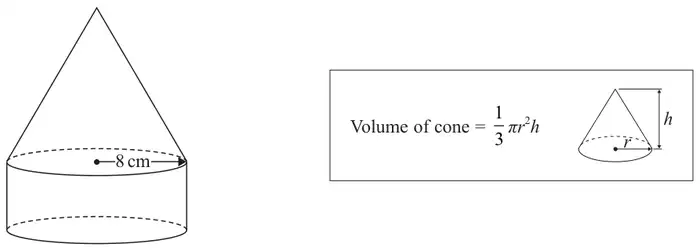
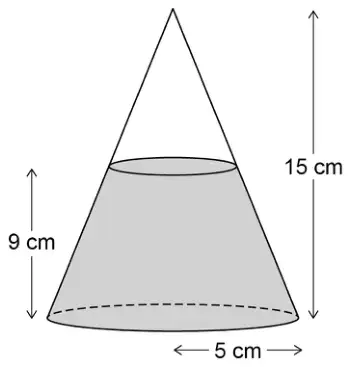
\(h\) = height of the cone \(H\) = height of the cylinder \(x\) = total height of the shape Allow any letter for \(h\), \(H\) and \(x\), does not have to be defined for the award of the marks The award of all marks requires the substitution of \(r = 8\), allow this to be done at a later stage in the question
A correct equation implies the first P1 Allow inconsistent use of \(\pi\) within their equation provided the correct volumes are seen previously
Can be an equation in the form \(ah = p\) or \(bH = q\) or \(cx = r\) where \(a\) or \(b\) or \(c\) is an integer
Award 0 marks for a correct answer with no (or incorrect) supportive working
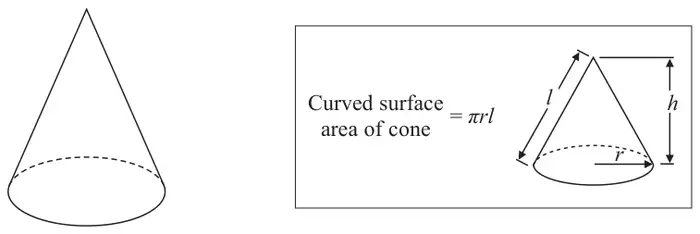
The radius of the base of the cone is \(\dfrac{3}{4}\) of the height of the cone. The total surface area of the cone is \(54\pi\) cm2
Work out the height of the cone. (4)
Mark scheme
Answer
Mark
Mark scheme
6
P1
for starting process, by defining height, radius and using Pythagoras to form an equation for the slant height \(l\) eg height \(= h\), radius \(= \frac{3}{4}h\) and \(l^2 = h^2 + \left(\dfrac{3h}{4}\right)^2 \left(= \dfrac{25}{16}h^2\right)\) or \((l =) \sqrt{h^2 + \left(\dfrac{3h}{4}\right)^2} \left(= \dfrac{5}{4}h\right)\) oe eg \(r = 3x\) and \(h = 4x\) and \(l^2 = (3x)^2 + (4x)^2\)
P1
(dep P1) for process to form a correct expression for the curved surface area in terms of a single variable, eg \(\pi \times \dfrac{3}{4}h \times \text{``}\dfrac{5}{4}h\text{''} \left(= \dfrac{15}{16}\pi h^2\right)\) or \(\pi \times 3x \times \text{``}5x\text{''}\) where \(h = 4x\)
P1
for forming and simplifying a correct equation to find height, eg \(\dfrac{24\pi}{16}h^2 = 54\pi\)
A1
cao
Additional guidance
Can use any other letter than \(h\) provided it is defined eg height \(= x\)
May include area of circle eg \(\pi \times \left(\dfrac{3}{4}h\right)^2 + \pi \times \dfrac{3}{4}h \times \text{``}\dfrac{5}{4}h\text{''} \left(= \dfrac{24}{16}\pi h^2\right)\)
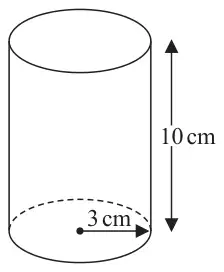
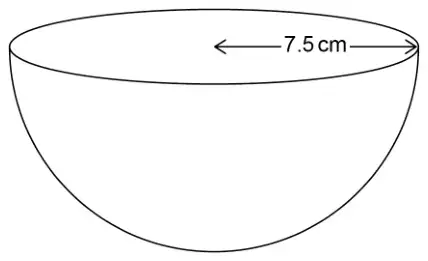
Volume of a sphere \(= \dfrac{4}{3} \times \pi \times r^3\) where \(r\) is the radius
Ria works out the volume of this hemisphere in terms of \(\pi\)
Here is her work.
\[\text{Volume of a hemisphere} = \dfrac{4}{3} \times 7.5 \times 3 \div 2 = 15\]
Write down two mistakes she has made. [2 marks]
Mark scheme
Answer
Mark
Comments
Any two of the following statements
not using \(\pi\) in the calculation
not cubing 7.5
no units
B2
oe B1 for one correct statement
Additional guidance
Ignore irrelevant statements for B1 or B2
Ignore incorrect statements or incorrect values with correct reasons, unless contradictory, for B1
Need to do \(\pi \times 7.5^3\) (calculation shows 2 mistakes)
B2
The answer should be \(281.25\pi\) (doesn’t show mistakes but a correct answer in terms of \(\pi\))
B1
Need to do \(\pi \times 7.5^3\) to get 883.6 (883.6 is not an answer in terms of \(\pi\))
B1
The answer should be [883.5, 884]
B0
15 is wrong
B0
Statements about not using \(\pi\) in the calculation She hasn’t multiplied by \(\pi\) / pi Used 3 for \(\pi\) Hasn’t used 3.14 The answer is not in terms of \(\pi\) It is not in terms of \(\pi\)
B1 B1 B0 B0 B0
Statements about not cubing 7.5 She should have done \(7.5^3\) She hasn’t cubed the radius She multiplied it by 3 Hasn’t cubed a number
B1 B1 B1 B0
Statements about no units She hasn’t given any units She should have written cm\(^3\)
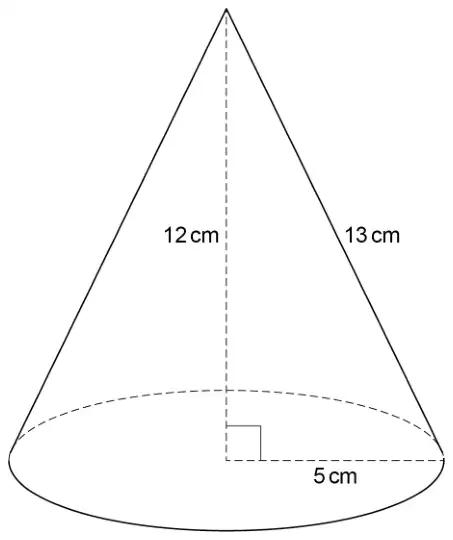
Curved surface area of a cone \(= \pi r l\) where \(r\) is the radius and \(l\) is the slant height
Beth tries to work out the curved surface area in terms of \(\pi\)
Curved surface area of the cone \(= \pi \times 5 \times 12\) \(= 60\pi\) cm\(^2\)
What mistake has she made? [1 mark]
(b) Adam uses \(\pi = 3\) to estimate the area of the base of the cone.
Work out his estimate. [2 marks]
(c) Beth uses \(\pi = 3.14\) to estimate the area of the base of the cone.
Is Beth’s estimate more than or less than Adam’s estimate?
Tick a box.
More than
Less than
Give a reason for your answer. [1 mark]
Mark scheme (a)
Answer
Mark
Comments
Correct statement
B1
eg she used the height instead of the slant height or she used the vertical height or she used 12 (instead of 13)
Additional guidance
Check diagram
For ‘vertical’ accept anything that implies she has used the wrong height
Condone ‘length’ to mean ‘height’ or ‘slant height’
12 or 13 circled on the diagram must be accompanied by a supporting statement
Indicates ‘12’ in the calculation
B1
She should have done \(\pi \times 5 \times 13\)
B1
It should be \(65\pi\)
B1
She used the wrong height / the (value of) \(l\) is wrong
B1
She hasn’t used the slant height (she used the (vertical) height)
B1
She hasn’t used the 13
B1
She hasn’t used the 13 and should be \(5 \times 12 \times 13 \times \pi\)
B0
The multiplication used the wrong number(s)
B0
She hasn’t used a value for \(\pi\)
B0
An incorrect statement with a correct statement eg she used 13 instead of 12 and didn’t square the radius
B0
Mark scheme (b)
Answer
Mark
Comments
\(\pi \times 5 \times 5\) or \(25\pi\) or \(3 \times 5 \times 5\)
M1
oe accept [3.14, 3.142] or \(\dfrac{22}{7}\) for \(\pi\)
75
A1
Additional guidance
\(\pi 25\)
M1
Mark scheme (c)
Answer
Mark
Comments
‘More than’ indicated or implied by statement and valid reason
B1
eg valid reasons 3.14 is greater (than 3) Beth’s number is bigger (than Adam’s) (the correct answer is) 78.5 (with their answer to (b) less than 78.5)
Additional guidance
If calculations are used, the outcomes must be correct
Accept 78 or 79 for 78.5 unless from incorrect working
‘Less than’ indicated
B0
Do not penalise use of the same incorrect formula in (b) and (c) eg \(3 \times 10 = 30\) in (b) and \(3.14 \times 10 = 31.4\) in (c) with ‘More than’ ticked
B1
Ignore a non-contradictory reason with a correct reason eg 3.14 is bigger than 3 and nearer the true value of pi
B1
Acceptable reasons
Adam has rounded (pi) down / Adam only used 3
B1
There is an extra 0.14 to multiply by
B1
Her number has decimal places
B1
Her number is to more significant figures
B1
Non-acceptable reasons
3.14 will give a bigger answer / 3.14 is more accurate
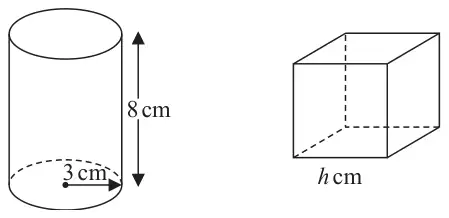
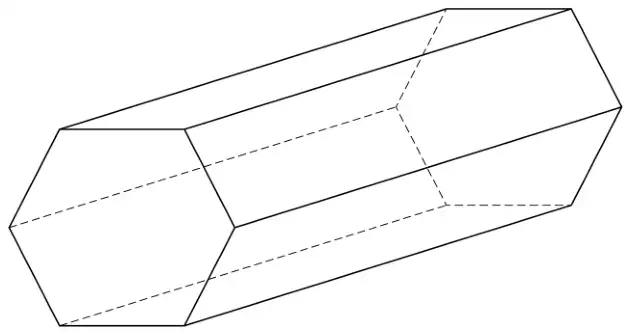
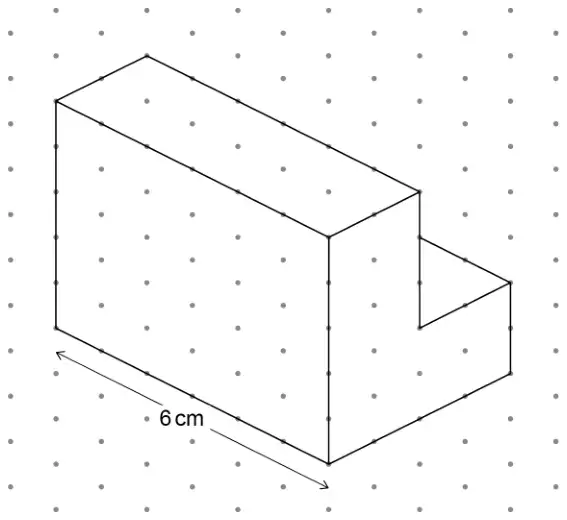
Correct method or evaluation of the area of any face or correct method or evaluation of the volume of any relevant cuboid of length 6 cm
M1
eg \(5 \times 6\) or 30 or \(2 \times 6\) or 12 or \(3 \times 6\) or 18 or \(4 \times 6\) or 24 or \(2 \times 5 + 2 \times 2\) or \(10 + 4\) or 14 or \(2 \times 5 \times 6\) or 60 or \(2 \times 2 \times 6\) or 24 or \(2 \times 3 \times 6\) or 36 or \(4 \times 2 \times 6\) or 48 or \(5 \times 4 \times 6\) or 120
Correct method for volume of prism
M1dep
eg \(2 \times 5 \times 6 + 2 \times 2 \times 6\) or \(60 + 24\) or \(14 \times 6\)
84
A1
Additional guidance
The first M1 may be awarded even if this is seen amongst multiple attempts
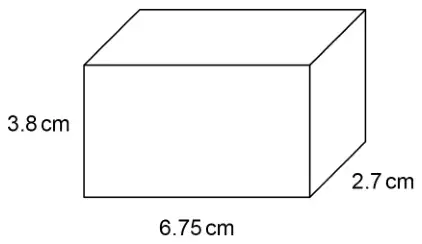
B1 \(3.8 \times 6.75 \times 2.7\) oe or \(\dfrac{13\,851}{200}\) or 69.25(5) or 69.2(6) or correct rounding to 1 dp of a number to 2 dp or more, other than 6.75