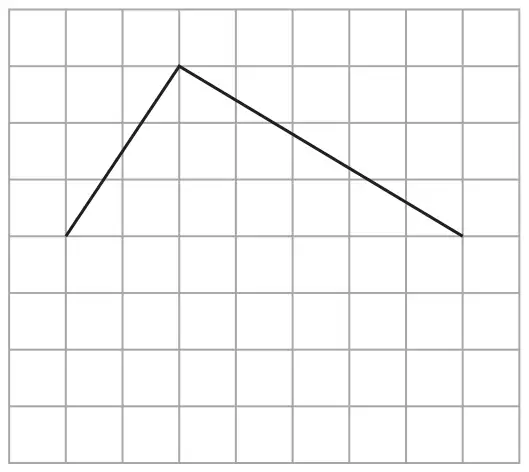
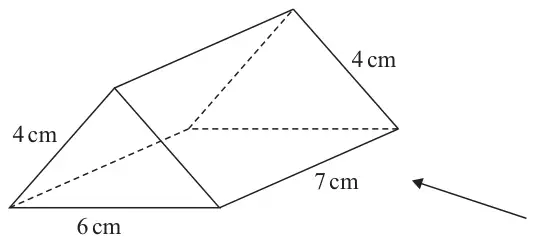
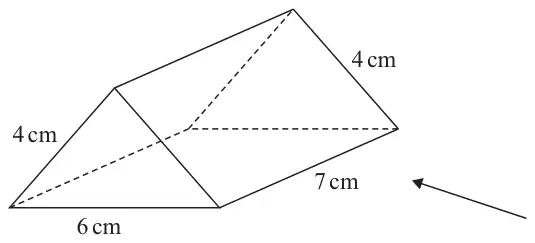
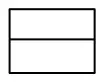
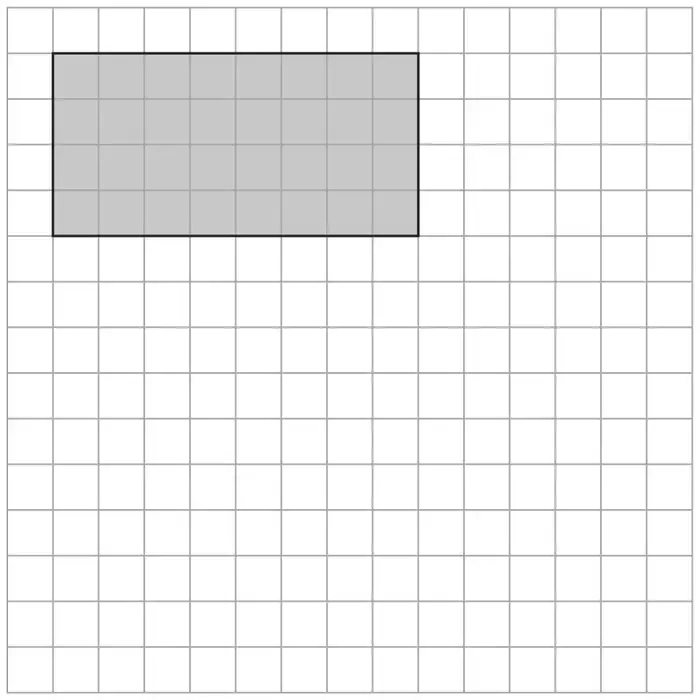
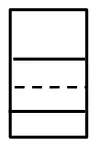
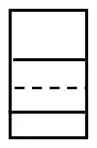
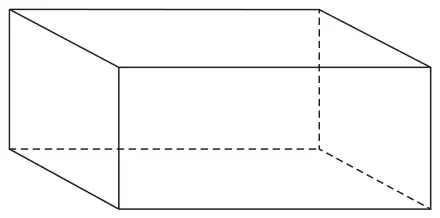
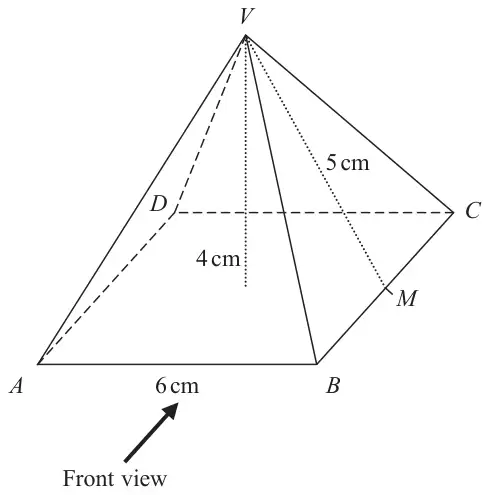
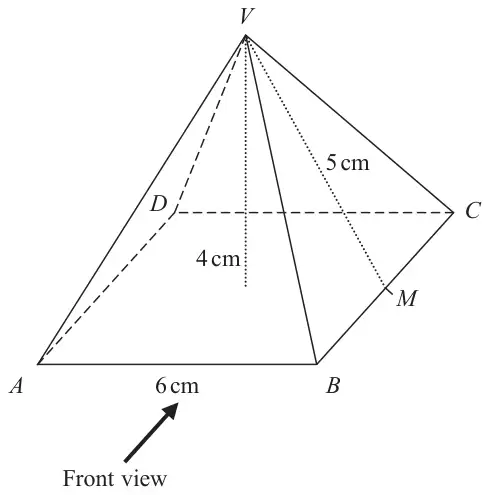
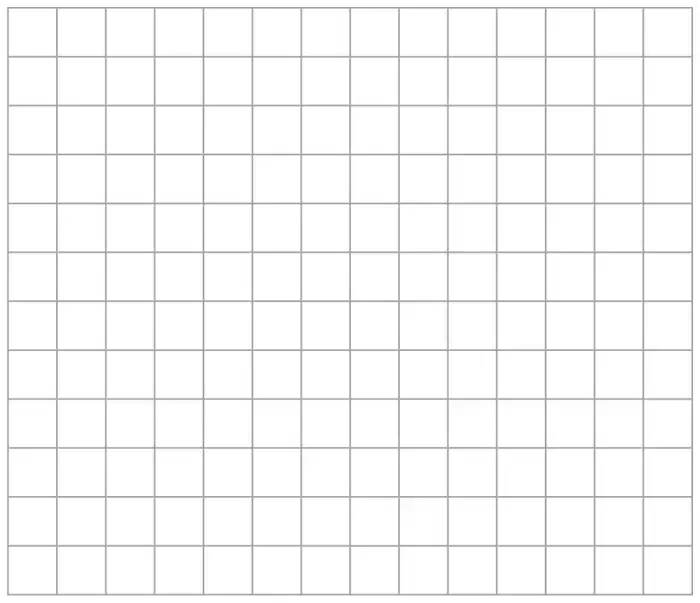
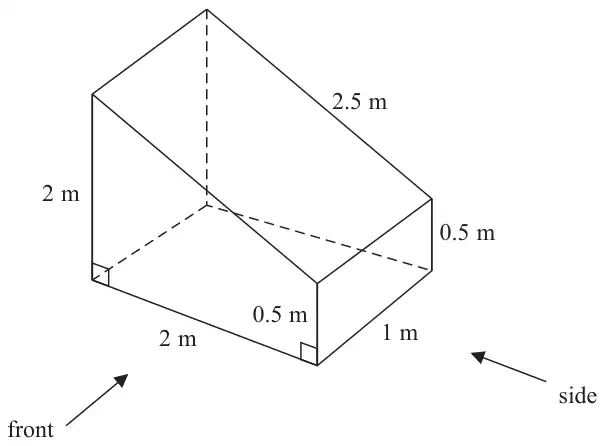
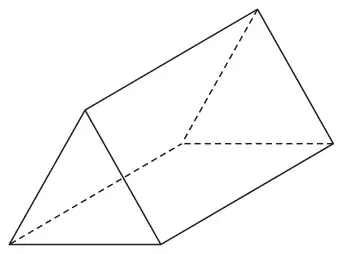
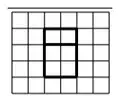
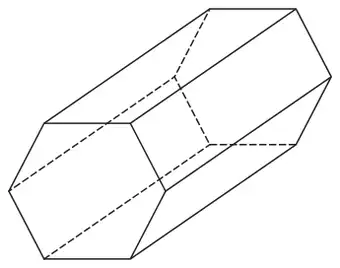
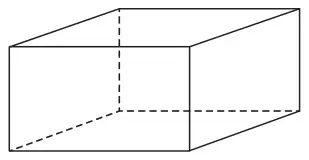
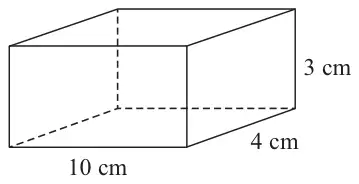
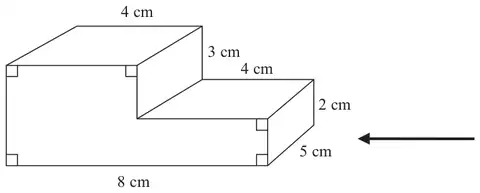
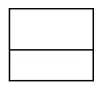
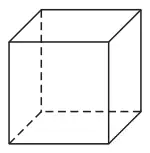
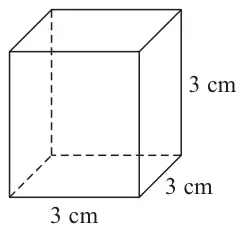
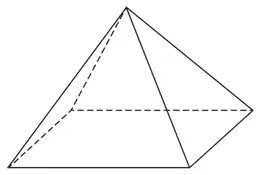
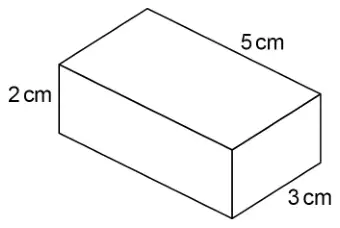
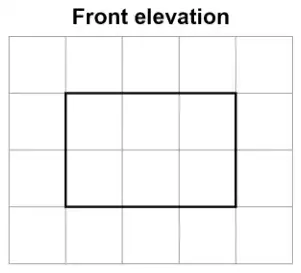
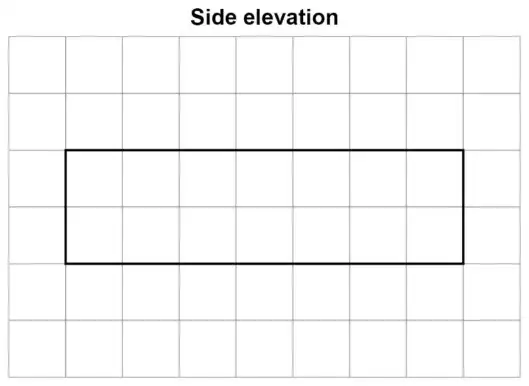
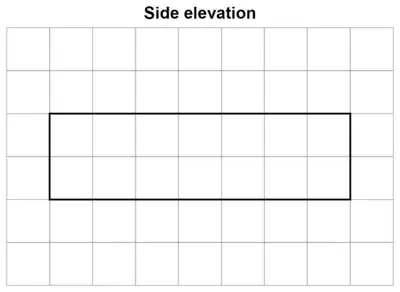
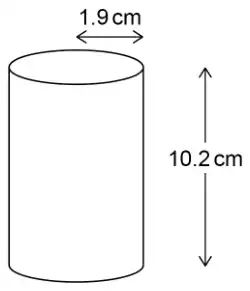
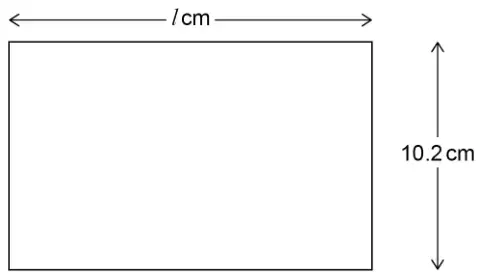
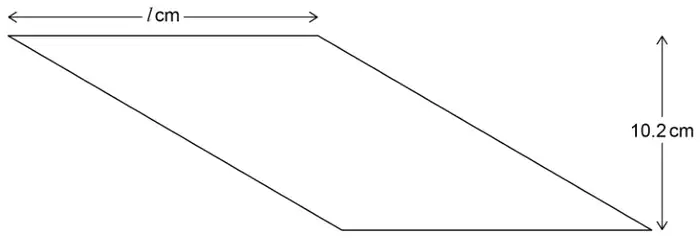
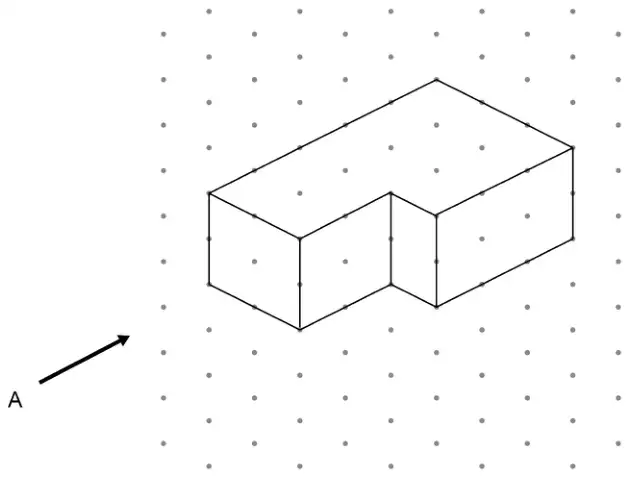
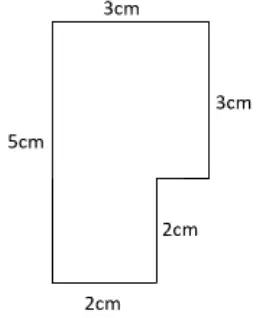
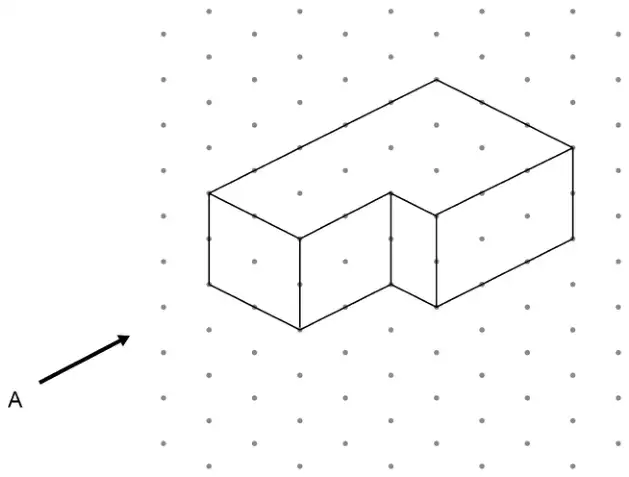
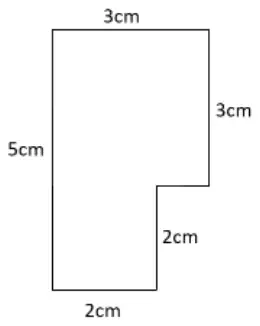
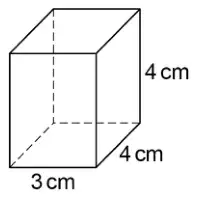
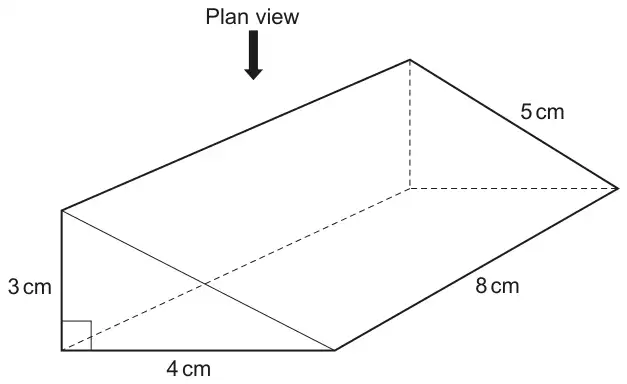
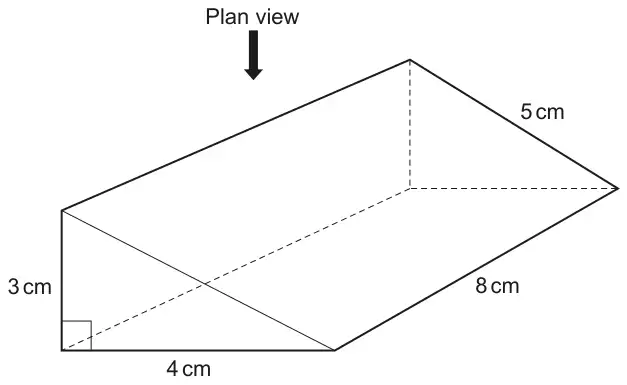
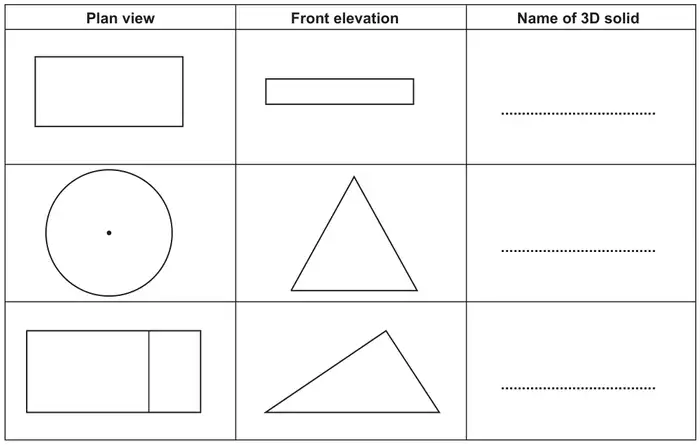
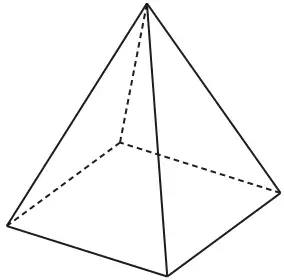
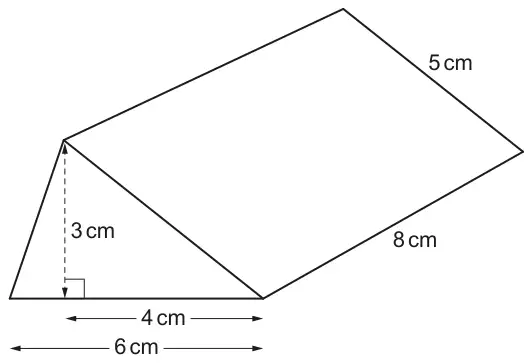
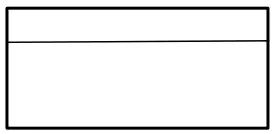
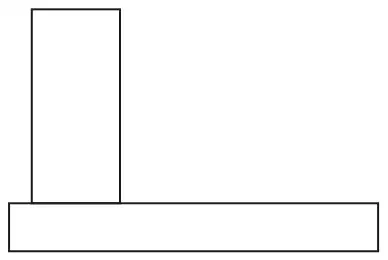
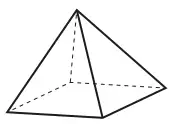
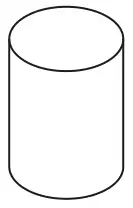
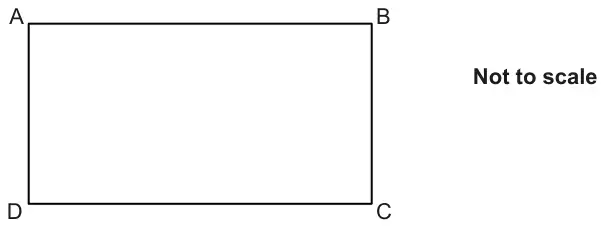
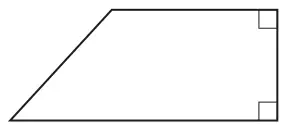
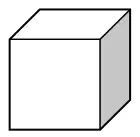
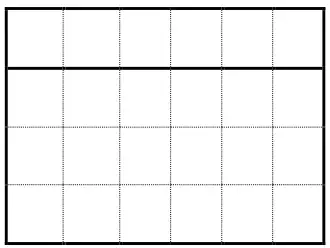
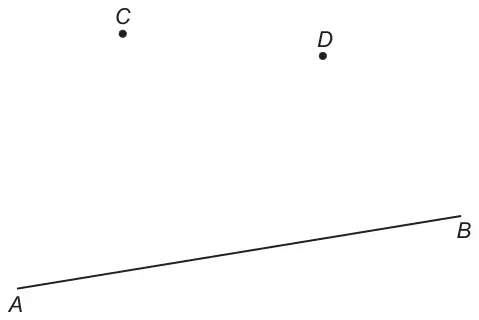
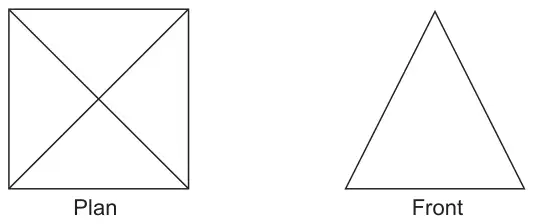
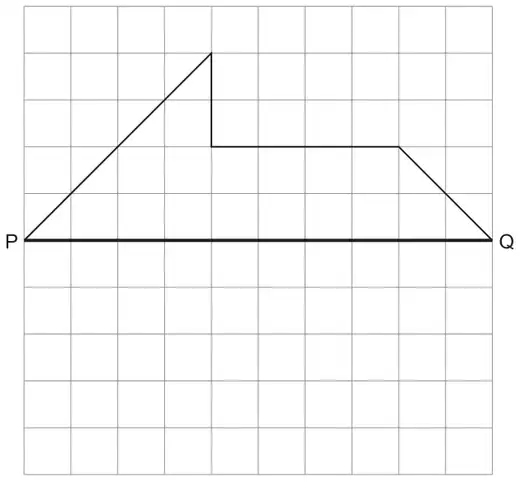
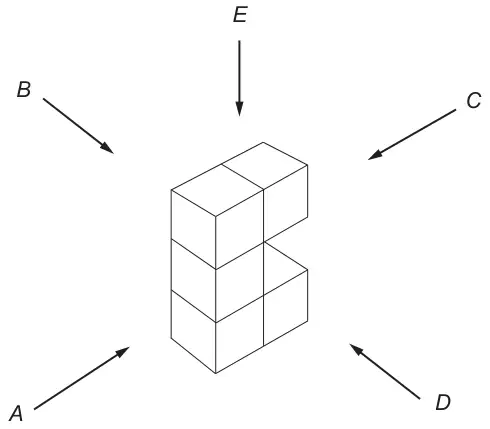
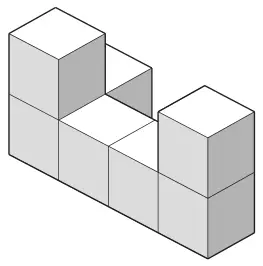
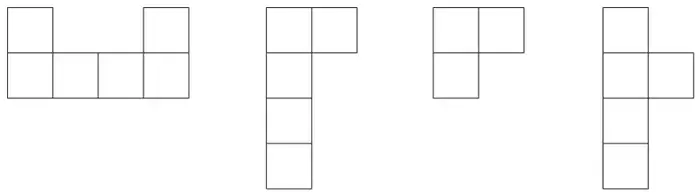
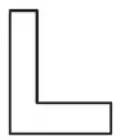
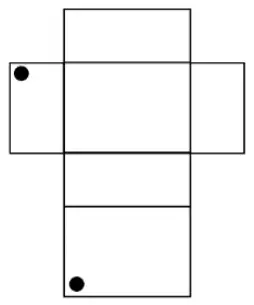
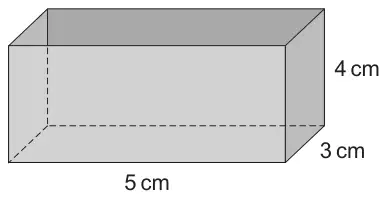
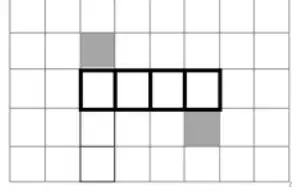
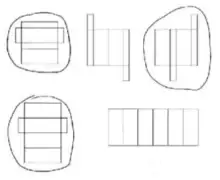
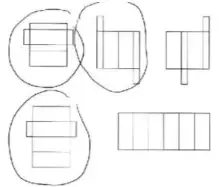
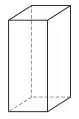
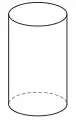
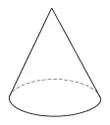
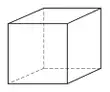
Rana is trying to draw the side elevation of the solid prism from the direction of the arrow.
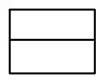
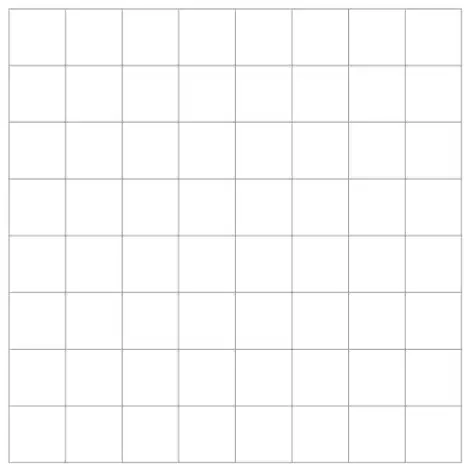
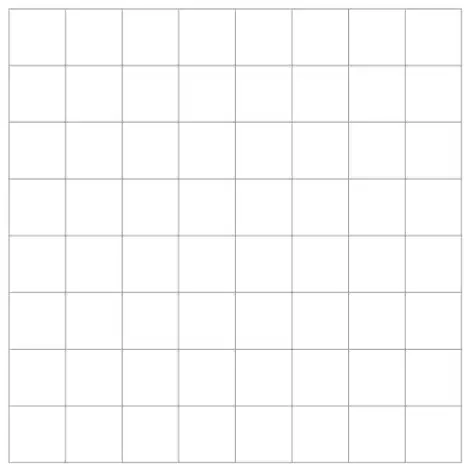
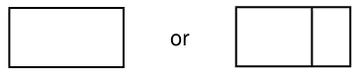
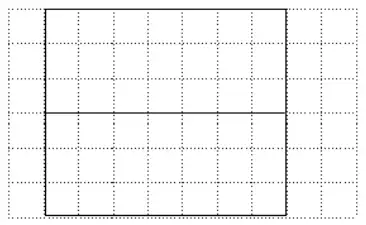
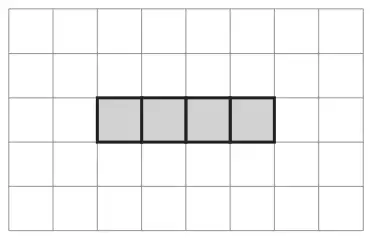
Here is her answer on a centimetre grid.
(a) Explain why Rana’s side elevation is not correct. (1)
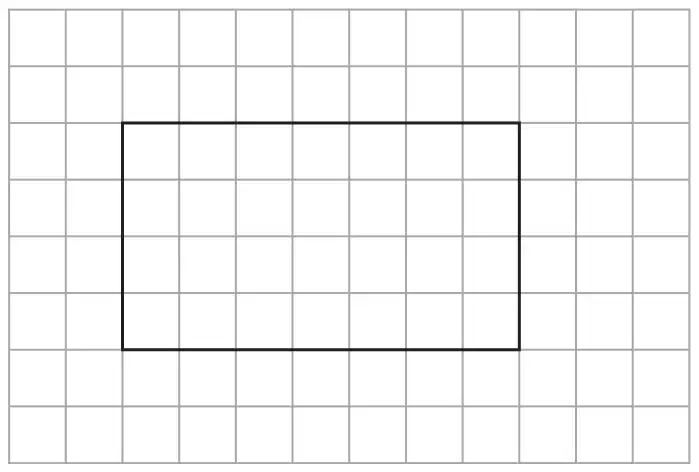
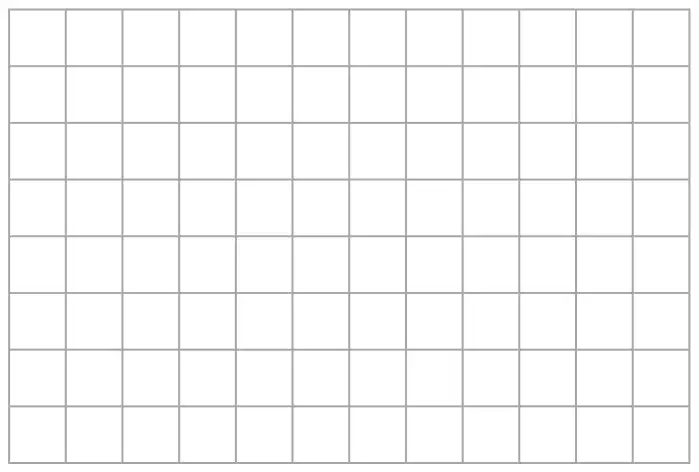
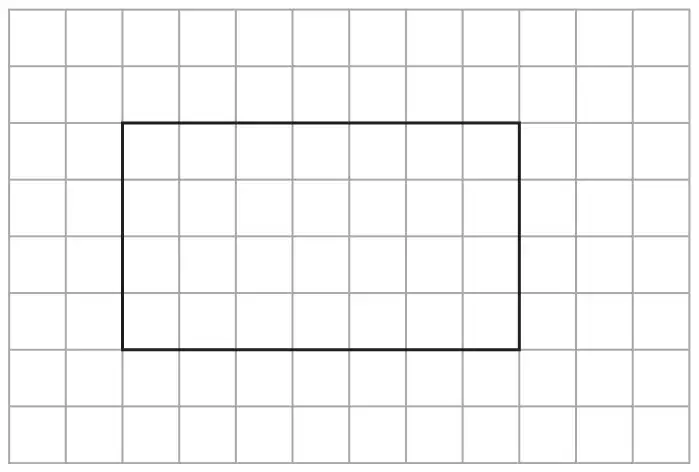
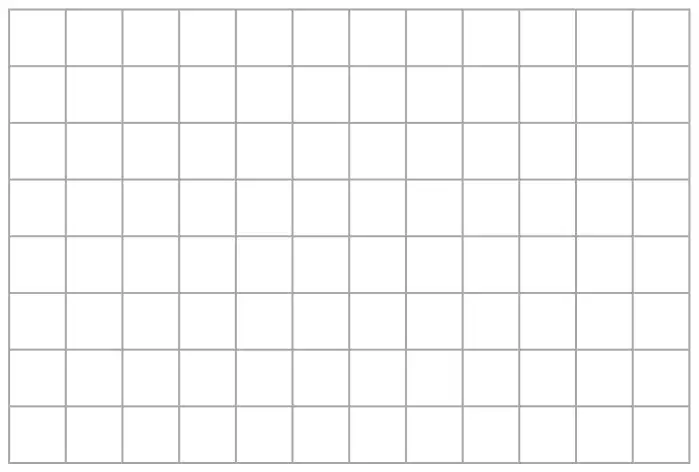
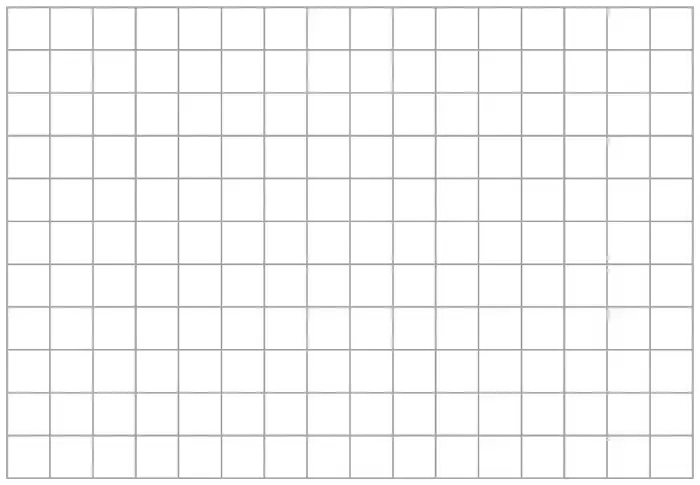
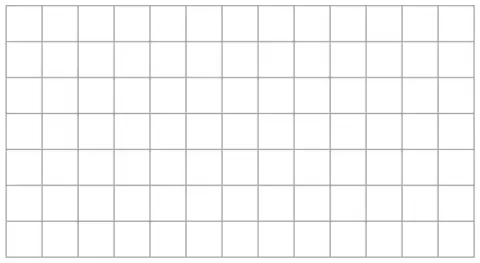
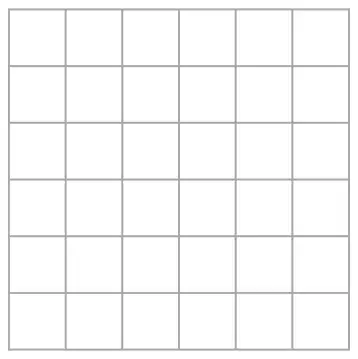
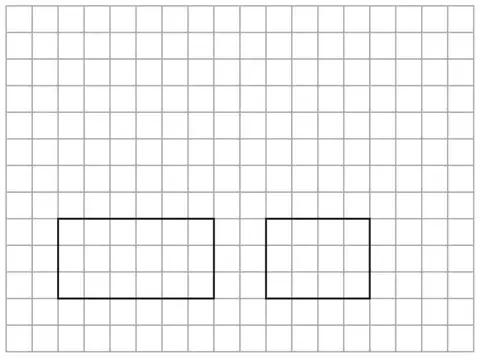
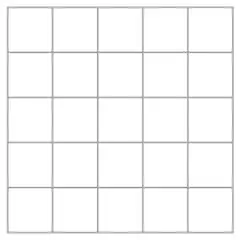
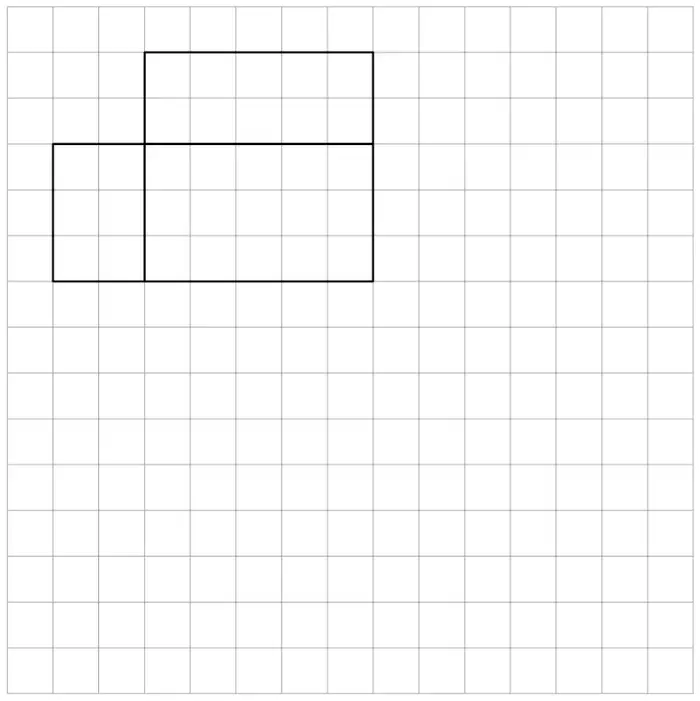
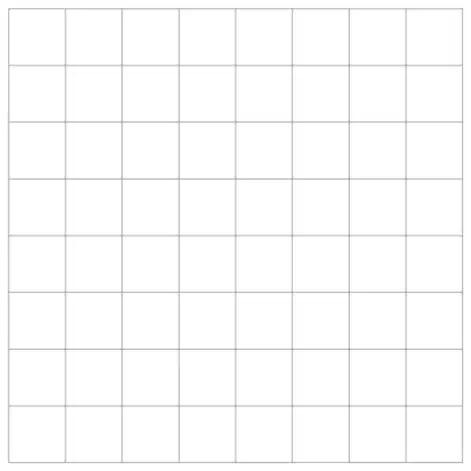
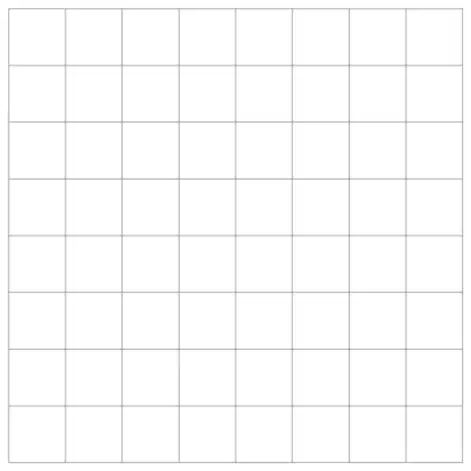
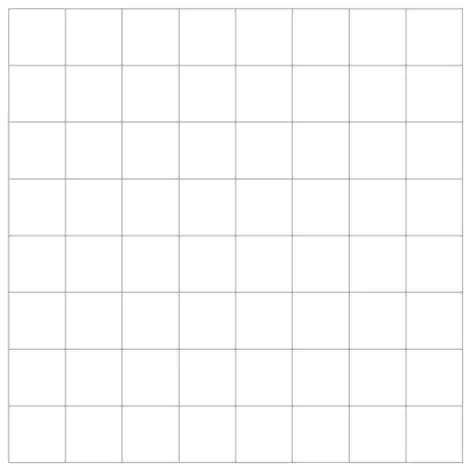
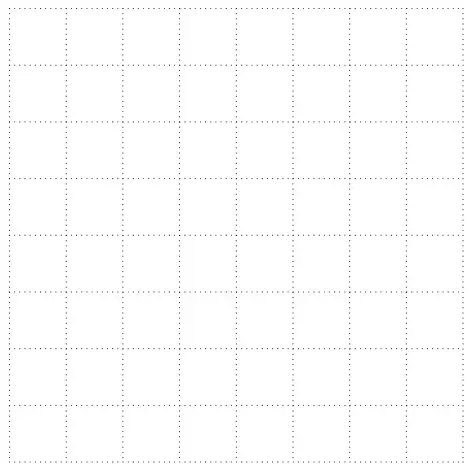
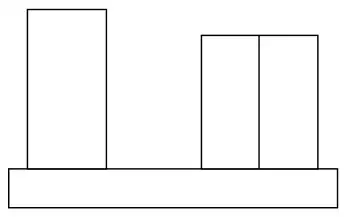
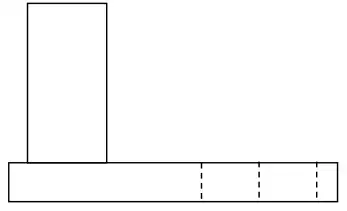
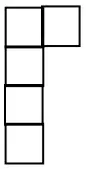
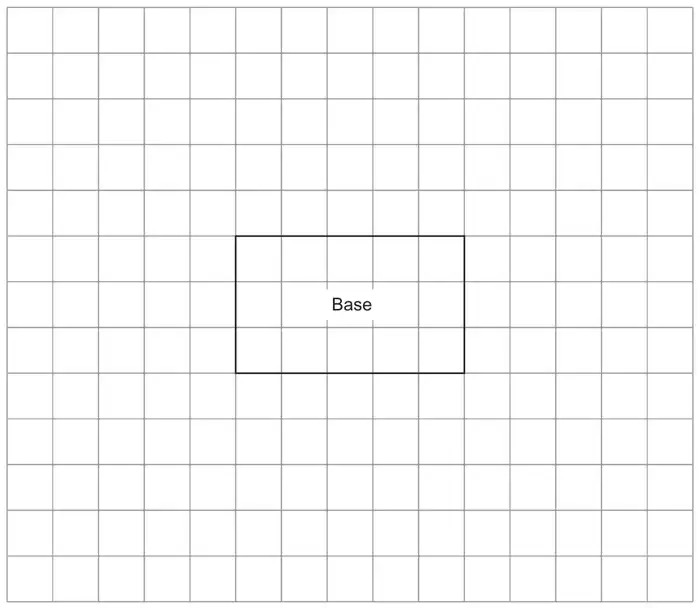
(b) On the centimetre grid below, draw a plan of the solid prism.(2)
Mark scheme (a)
Answer
Mark
Mark scheme
Explanation
C1
for explanation
Acceptable examples The height of the rectangle / it should be less than 4 cm The 4 cm sides are wrong / too long The height of the rectangle should be 2.6… / \(\sqrt{7}\) She’s drawn the slanted height / not used the perpendicular height The height is smaller / not 4cm / wrong It should be shorter as the side is at an angle It should be on an angle, so the height is smaller The length / width / side is 4cm not the height She’s drawn the face / the length and side / width of the rectangle She’s drawn the length and side / width not the (length and the) height
Not acceptable examples The rectangle should be wider The rectangle should be 6 squares high It doesn’t tell us the height It should be smaller It’s the front not the side It’s not on a slant / it should be on a slant It goes up at an angle / it doesn’t go straight up The length of the prism is 4 cm The length / width / side of the rectangle is 4 cm Side elevation is at a slant (not straight up)
Mark scheme (b)
Answer
Mark
Mark scheme
M1
for a 7 cm by 6 cm rectangle or for a 7 cm by \(n\) cm or \(m\) cm by 6 cm rectangle and dividing line which is parallel to the 7 cm or the \(m\) cm side
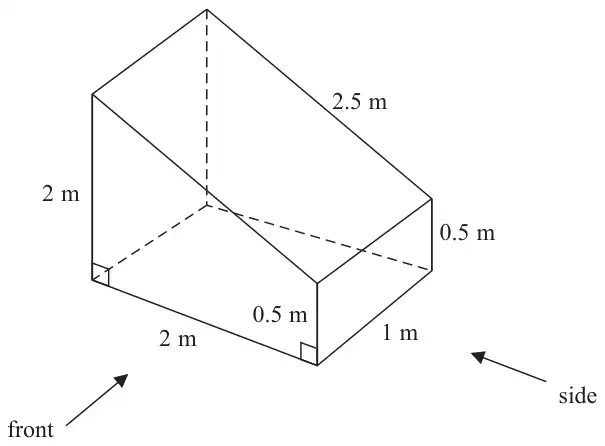
Rana is trying to draw the side elevation of the solid prism from the direction of the arrow.
Here is her answer on a centimetre grid.
(a) Explain why Rana’s side elevation is not correct. (1)
(b) On the centimetre grid below, draw a plan of the solid prism.(2)
Mark scheme (a)
Answer
Mark
Mark scheme
Explanation
C1
for explanation
Acceptable examples The height of the rectangle / it should be less than 4 cm The 4 cm sides are wrong / too long The height of the rectangle should be 2.6... / \(\sqrt{7}\) She’s drawn the slanted height / not used the perpendicular height The height is smaller / not 4 cm / wrong It should be shorter as the side is at an angle It should be on an angle, so the height is smaller The length / width / side is 4 cm not the height She’s drawn the face / the length and side / width of the rectangle She’s drawn the length and side / width not the (length and the) height
Not acceptable examples The rectangle should be wider The rectangle should be 6 squares high It doesn’t tell us the height It should be smaller It’s the front not the side It’s not on a slant / it should be on a slant It goes up at an angle / it doesn’t go straight up The length of the prism is 4 cm The length / width / side of the rectangle is 4 cm Side elevation is at a slant (not straight up)
Mark scheme (b)
Answer
Mark
Mark scheme
M1
for a 7 cm by 6 cm rectangle or for a 7 cm by \(n\) cm or \(m\) cm by 6 cm rectangle and dividing line which is parallel to the 7 cm or the \(m\) cm side
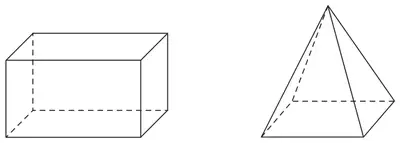
(a) Write down the number of vertices of the prism. (1)
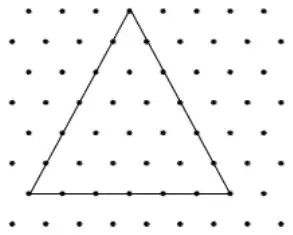
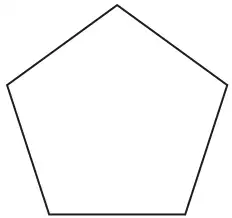
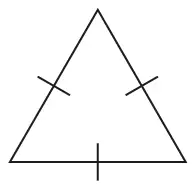
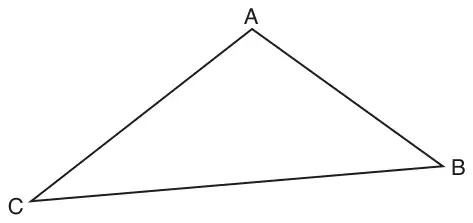
The cross section of the prism is an equilateral triangle.
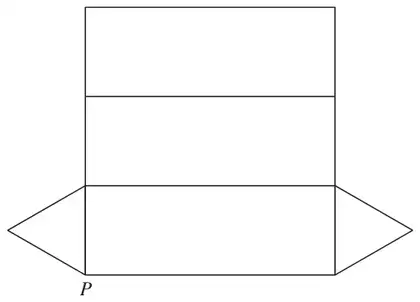
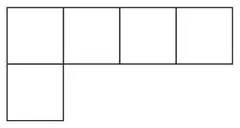
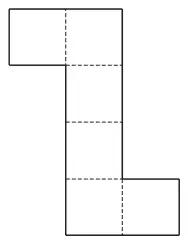
(b) In the space below, draw a sketch of a net for this prism. (2)
(c) In the space below, draw accurately an equilateral triangle of side 6.5 cm. (2)
Mark scheme (a)
Answer
Mark
Notes
6
1
B1 cao
Mark scheme (b)
Answer
Mark
Notes
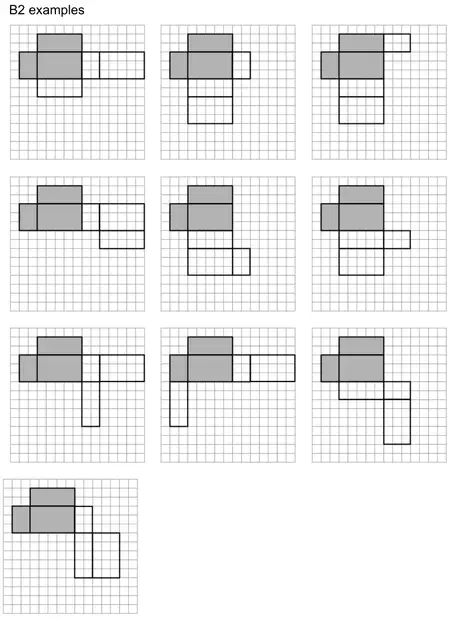
sketch of net
2
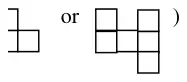
B2 for a correct sketch of a possible net. (B1 for between 3 and 5 faces (of which at least one must be a rectangle and no more than two triangles) with adjoining edges)
Mark scheme (c)
Answer
Mark
Notes
triangle drawn
2
M1 for line length 6.5 cm drawn (\(\pm\) 2mm) A1 for accurately drawn triangle (within overlay)
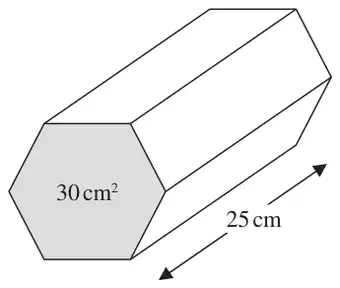
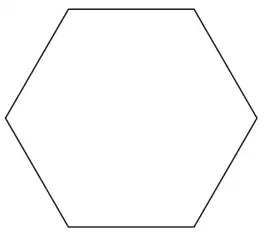
The cross section of the prism is a regular hexagon.
(b) In the space below, sketch a net of the prism. (2)
Diagram NOT accurately drawn
The area of the cross section of the prism is 30 cm2. The length of the prism is 25 cm.
(c) Work out the volume of the prism. (3)
Mark scheme (a)
Answer
Mark
Notes
(i) 12 (ii) 8
2
(i) B1 cao (ii) B1 cao
Mark scheme (b)
Answer
Mark
Notes
Sketch of net
2
M1 for attempt to draw net with 2 of the following 3 features: 6 rectangles 2 polygon faces with at least 5 edges a net with correct connections to give at least one vertex with 3 faces meeting. A1 for a correct net
Mark scheme (c)
Answer
Mark
Notes
750 cm3
3
M1 for \(30 \times 25\) A1 for 750 B1 (indep) for cm3
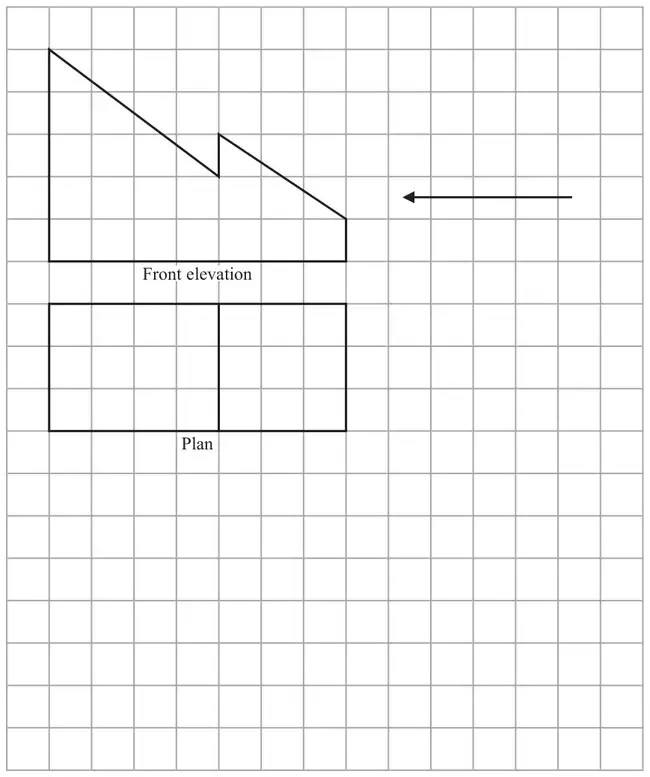
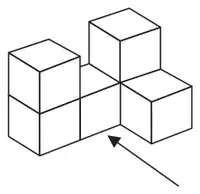
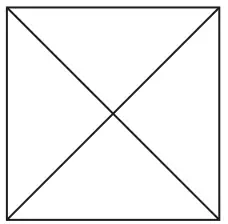
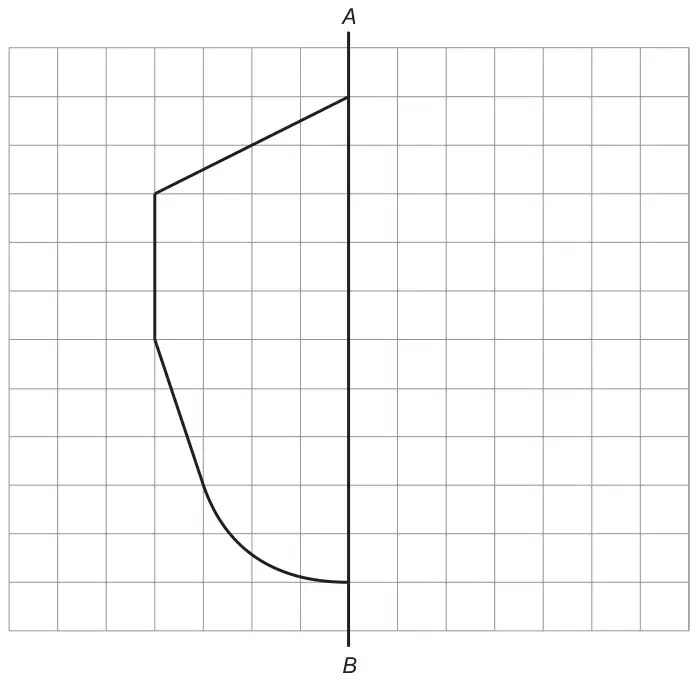
On the centimetre square grid, draw the side elevation of the solid prism from the direction shown by the arrow. (2)
Mark scheme
Answer
Mark
Notes
2
M1 for a 5cm by 5 cm square or a 5cm by 3 cm rectangle or a 5 cm by 2 cm rectangle A1 for correct elevation with dividing line NB: diagrams which appear to have a 3D element get 0 marks
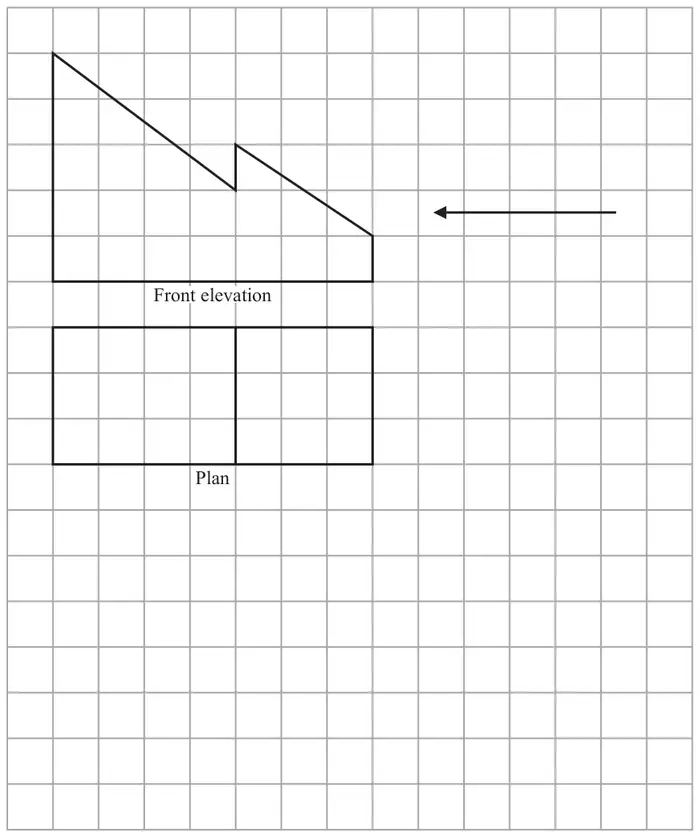
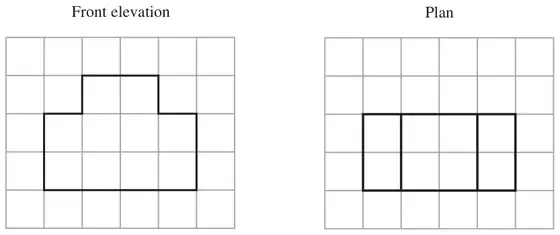
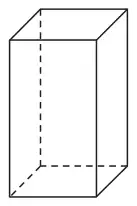
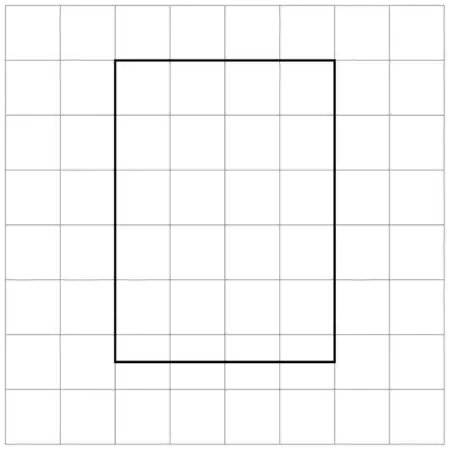
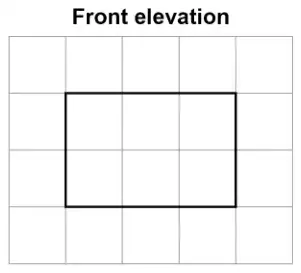
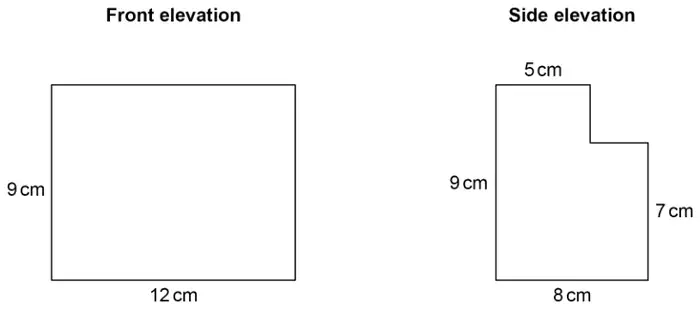
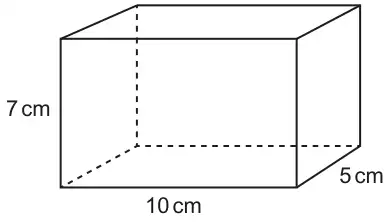
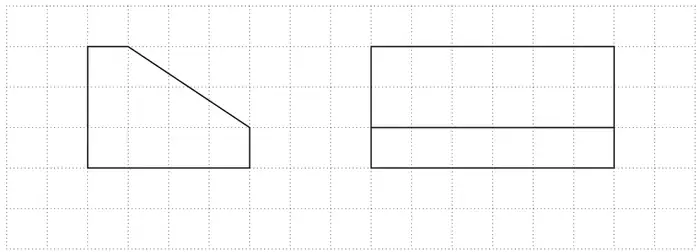
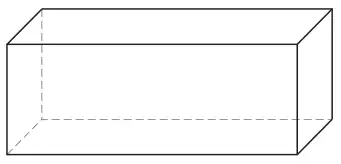
22 The front elevation and the side elevation of a cuboid are drawn on the grid.
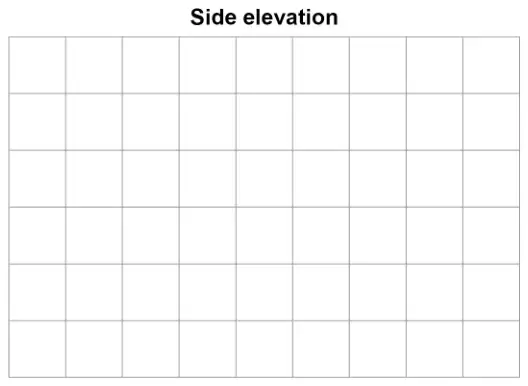
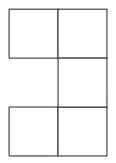
On the grid, draw the plan of the cuboid. (2)
Mark scheme
Answer
Mark
Notes
\(4 \times 6\) rectangle
2
B2 for a single \(4 \times 6\) rectangle drawn anywhere on the grid (B1 for a single \(4 \times n\) rectangle or a single \(m \times 6\) rectangle drawn anywhere on the grid) Note: All nets and 3-D sketches get NO marks
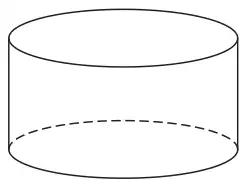
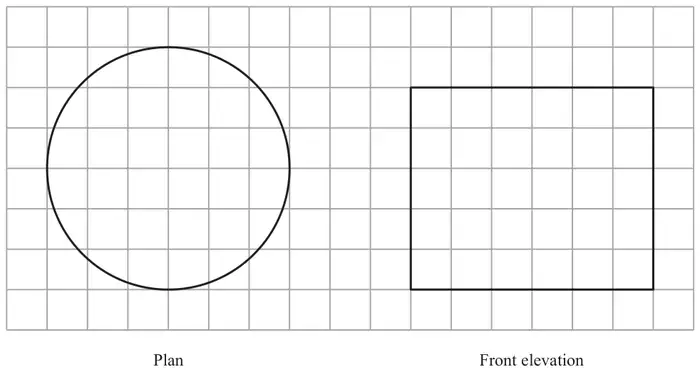
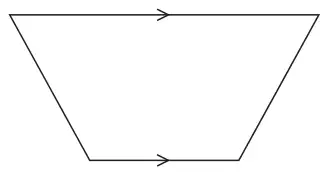
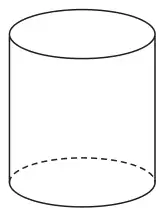
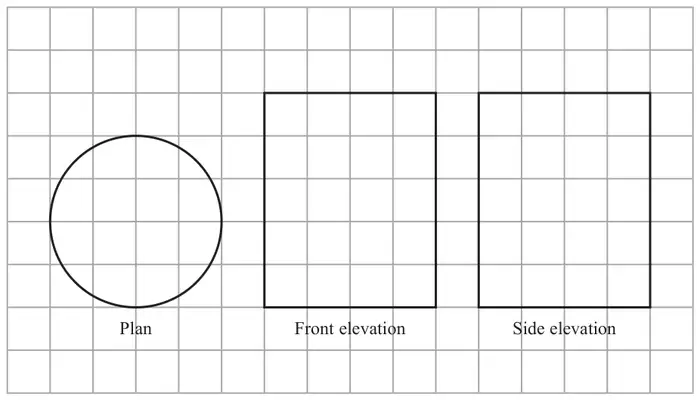
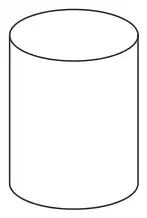
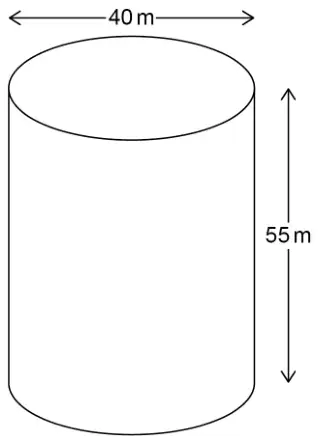
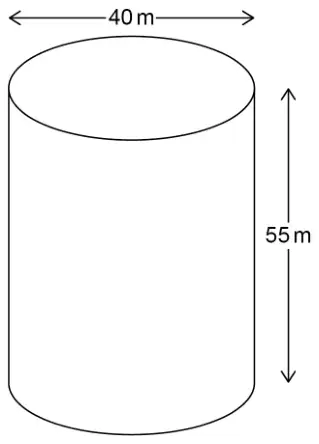
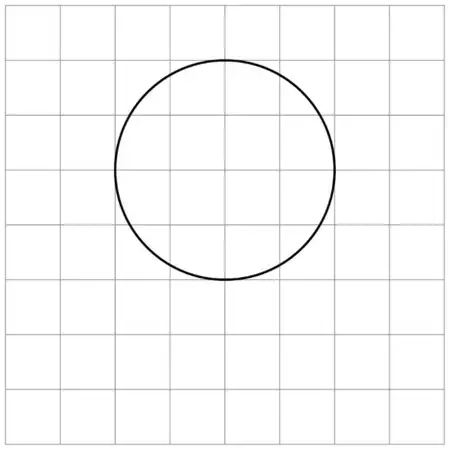
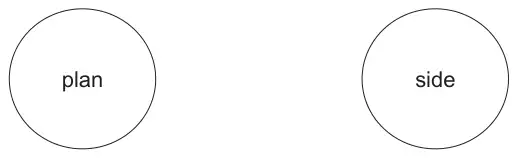
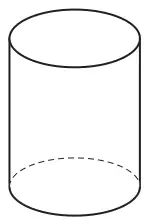
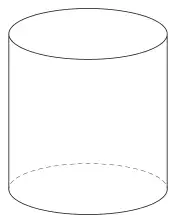
20 A building in the shape of a cylinder has diameter 40 m and height 55 m
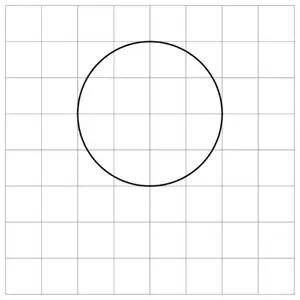
(a) On the centimetre grid, draw a plan of the building.
Use a scale of 1 cm to 10 m [2 marks]
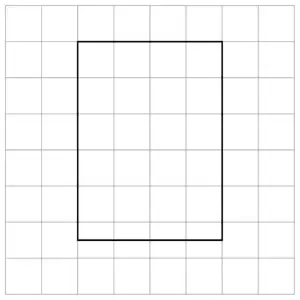
(b) On this centimetre grid, draw the front elevation of the building.
Use a scale of 1 cm to 10 m [2 marks]
Mark scheme (a)
Answer
Mark
Comments
Circle with diameter 4 cm
B2
diameter \(\pm\) 5 mm B1 for any circle or \(40 \div 10\) or 4 or (radius =) 2
Additional guidance
Can be anywhere on the grid
B2
Mark intention
Check stem and part (b) for evidence of 4 or 2
4 or 2 cannot be implied from a diagram for B1
Mark scheme (b)
Answer
Mark
Comments
Rectangle with horizontal sides 4 cm and vertical sides 5.5 cm
B2
\(\pm\) 2 mm B1 for any rectangle or \(40 \div 10\) or 4 and \(55 \div 10\) or 5.5 SC2 for correct answers in (a) and (b) reversed (award 0 in (a) and 2 in (b))
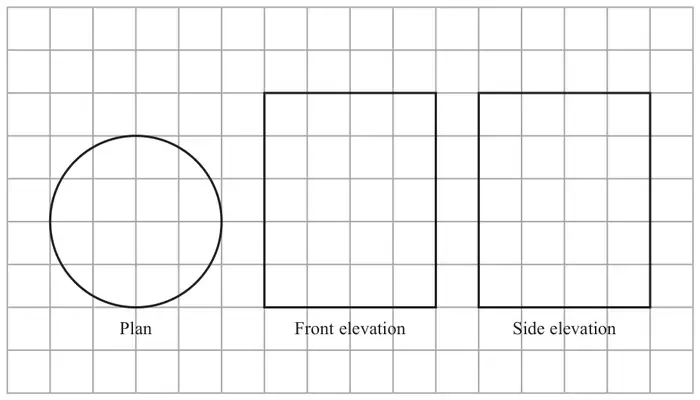
3 A building in the shape of a cylinder has diameter 40 m and height 55 m
(a) On the centimetre grid, draw a plan of the building.
Use a scale of 1 cm to 10 m [2 marks]
(b) On this centimetre grid, draw the front elevation of the building.
Use a scale of 1 cm to 10 m [2 marks]
Mark scheme (a)
Answer
Mark
Comments
Circle with diameter 4 cm
B2
diameter \(\pm\) 5 mm B1 for any circle or \(40 \div 10\) or 4 or (radius =) 2
Additional guidance
Can be anywhere on the grid
B2
Mark intention
Check stem and part (b) for evidence of 4 or 2
4 or 2 cannot be implied from a diagram for B1
Mark scheme (b)
Answer
Mark
Comments
Rectangle with horizontal sides 4 cm and vertical sides 5.5 cm
B2
\(\pm\) 2 mm B1 for any rectangle or \(40 \div 10\) or 4 and \(55 \div 10\) or 5.5 SC2 for correct answers in (a) and (b) reversed (award 0 in (a) and 2 in (b))
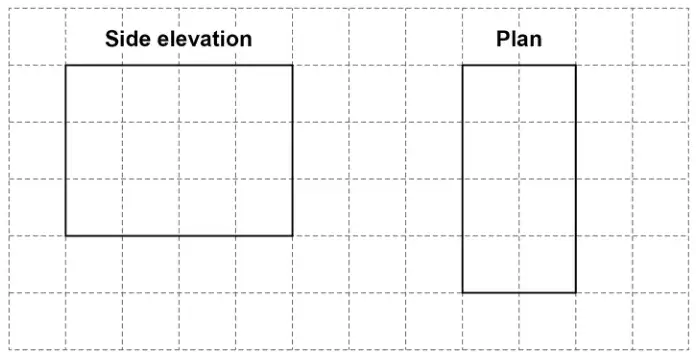
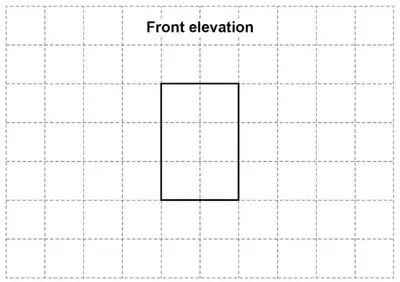
19 The side elevation and plan of a cuboid are shown on the centimetre grid.
Draw the front elevation of the cuboid on this centimetre grid. [2 marks]
Mark scheme
Answer
Mark
Comments
Rectangle with height 3 and width 2
B2
any position on the grid B1 rectangle with height 3 or width 2 or rectangle with height 2 and width 3 or cuboid with rectangular front face height 3 and width 2
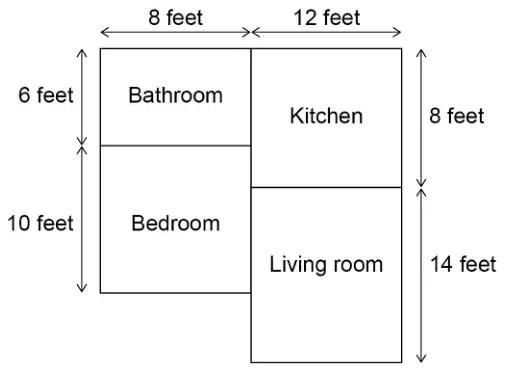
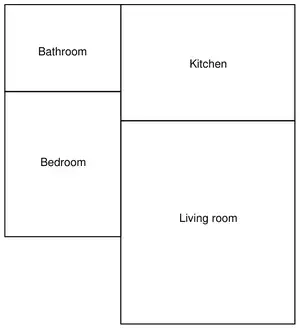
6 Here is a plan of a flat with four rectangular rooms.
Not drawn accurately
On the grid below, make an accurate scale drawing of the plan.
Label each room.
Use a scale of \(\quad\) 1 cm represents 2 feet [3 marks]
Scale: 1 cm represents 2 feet
Mark scheme
Answer
Mark
Comments
Any room correctly drawn to scale or any outline dimension correctly drawn to scale or any room dimension or outline dimension correctly scaled and clearly related
M1
± 2 mm
may be on diagram
At least two rooms correctly drawn to scale in correct position or correctly drawn outline of plan to scale
M1dep
± 2 mm
Fully correct scale drawing with correct room labels
A1
± 2 mm for outline and internal lines all lines must be ruled
Additional guidance
For 2nd method mark there should not be a gap shown between rooms correctly drawn to scale in correct position
Fully correct scale drawing with incorrect or missing room labels
M1M1A0
Check original diagram for clearly related scaled dimensions eg 8 (feet =) 4 (cm)
M1
Any correct outline dimension eg 16 (feet =) 8 (cm) or 20 (feet =) 10 (cm) or 22 (feet =) 11 (cm)
M1
Fully correct scale drawing with correct room labels
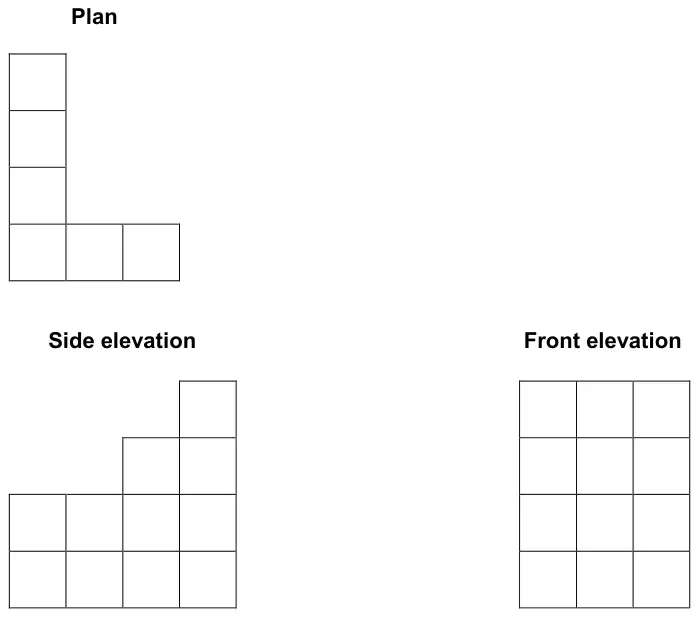
Here are the plan, side elevation and front elevation of the shape.
Centimetre cubes are added to make this cuboid.
How many cubes are added? [3 marks]
Mark scheme
Answer
Mark
Comments
29
B3
B2 answer 27, 28, 30 or 31 B1 answer 25, 26, 32 or 33 or \(4 \times 4 \times 3\) or 48 (total cubes) or \(2 \times 3 \times 4\) or 24 (missing cuboid) or 19 seen (cubes in original shape)
Additional guidance
Beware of 29 or close to 29 arising from (clear) adding of the squares in the original diagrams. This alone is B0, however B1 can still be scored for either 48, 24 or 19 (or the appropriate products leading to 48 or 24)
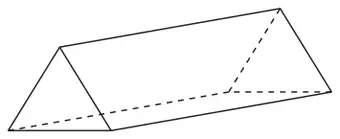
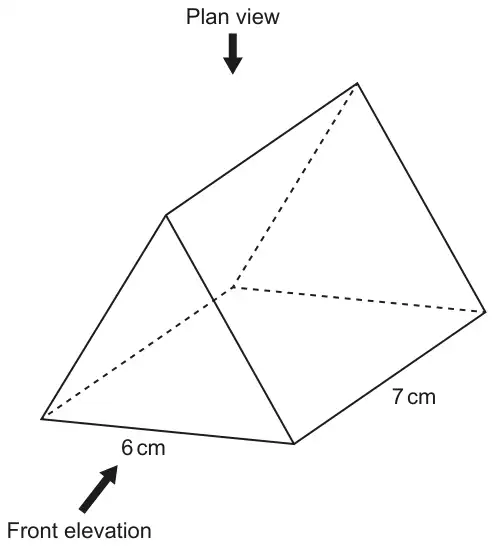
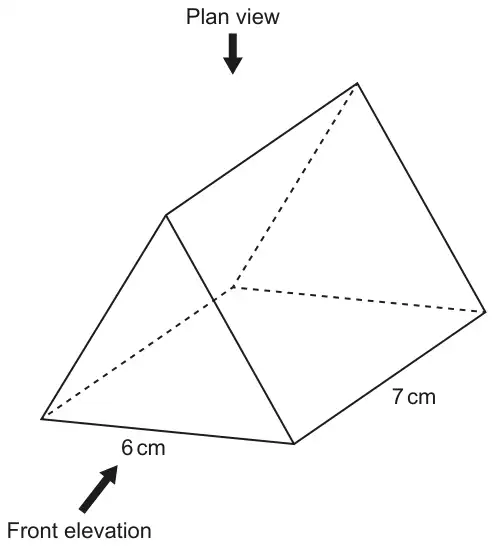
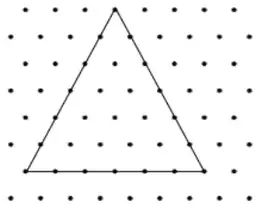
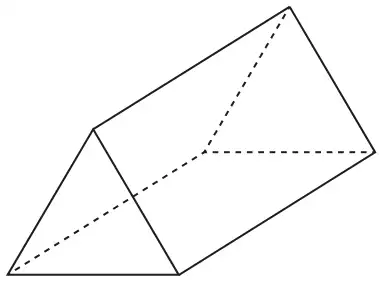
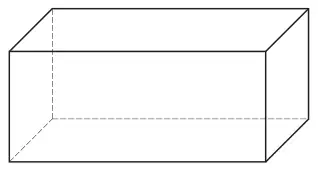
20 The diagram shows an equilateral triangular prism. Each side of the equilateral triangle is 6 cm and the length of the prism is 7 cm.
Not to scale
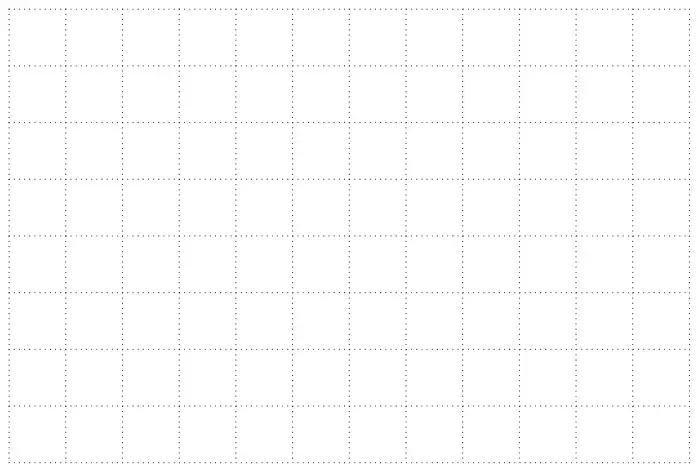
(a) Draw an accurate plan view of the prism on the one-centimetre square grid below.
[3]
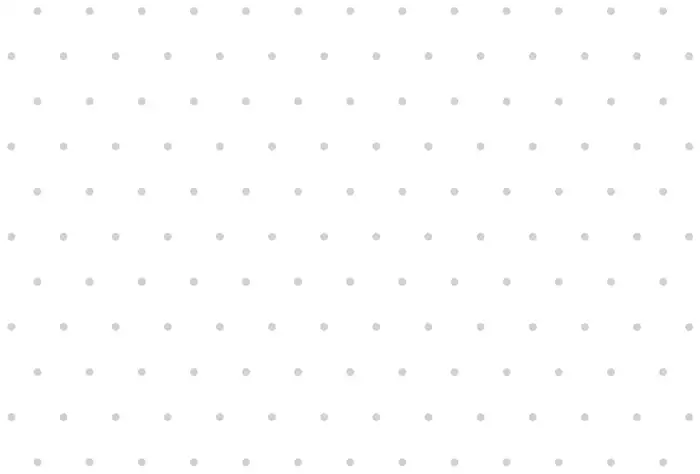
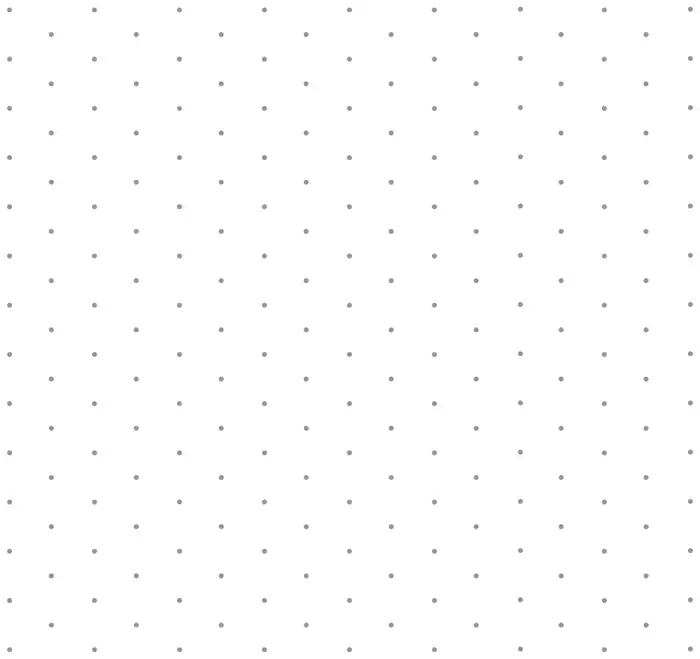
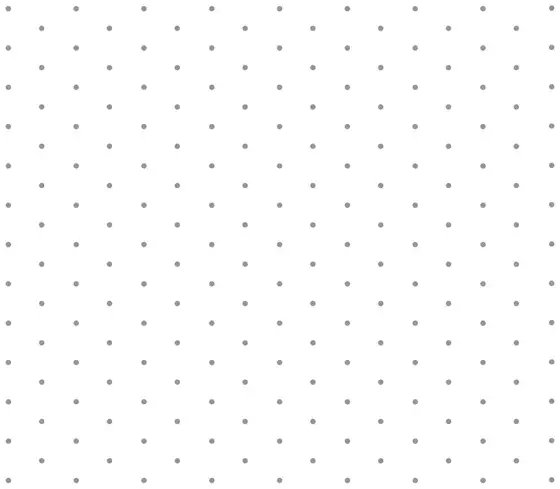
(b) Draw an accurate front elevation of the prism on the one-centimetre isometric grid below.
[2]
Mark scheme (a)
Answer
Marks
Part marks and guidance
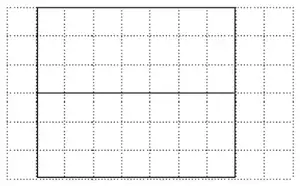
7 by 6 rectangle (not dashed) with correct dividing line
3
B2 for a 7 by 6 rectangular outline or for any rectangular outline correctly splitting the shorter side in half by one line or B1 for any rectangular outline
Outline is not a square, accept horizontally or vertically, accept freehand and for accuracy mark intention, condone dashed centre line
If the diagram uses the grid edges and the line is not drawn SC2 for an otherwise correct answer or SC1 for a 7 by 6 rectangular outline
Mark scheme (b)
Answer
Marks
Part marks and guidance
Equilateral triangle with side 6 cm and no extra lines
2
B1 for equilateral triangle but the incorrect size or a correct equilateral triangle with one extra line
Accept good freehand and for accuracy mark intention
6 The diagram shows an equilateral triangular prism. Each side of the equilateral triangle is 6 cm and the length of the prism is 7 cm.
Not to scale
(a) Draw an accurate plan view of the prism on the one-centimetre square grid below. [3]
(b) Draw an accurate front elevation of the prism on the one-centimetre isometric grid below. [2]
Mark scheme (a)
Answer
Marks
Part marks and guidance
7 by 6 rectangle (not dashed) with correct dividing line
3
B2 for a 7 by 6 rectangular outline or for any rectangular outline correctly splitting the shorter side in half by one line or B1 for any rectangular outline
outline is not a square, accept horizontally or vertically accept freehand and for accuracy mark intention, condone dashed centre line
If the diagram uses the grid edges and the line is not drawn SC2 for an otherwise correct answer or SC1 for a 7 by 6 rectangular outline
Mark scheme (b)
Answer
Marks
Part marks and guidance
Equilateral triangle with side 6 cm and no extra lines
2
B1 for equilateral triangle but the incorrect size or a correct equilateral triangle with one extra line
accept good freehand and for accuracy mark intention
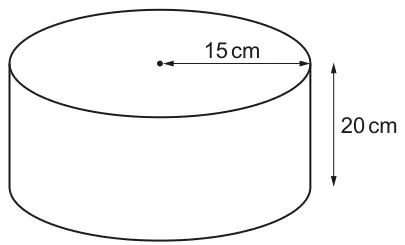
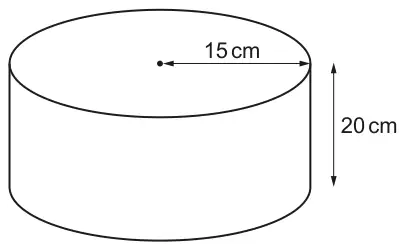
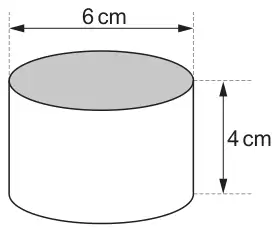
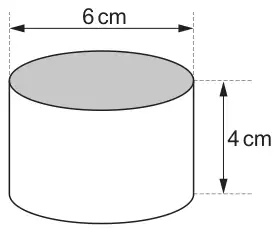
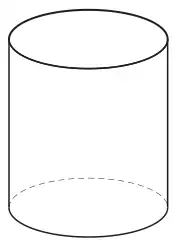
22 The diagram shows a cylinder with radius 15 cm and height 20 cm.
Not to scale
(a) On the grid below, draw the plan view of the cylinder.
Use the scale 1 cm represents 5 cm.
[2]
(b) On the grid below, draw the front elevation of the cylinder.
Use the scale 1 cm represents 5 cm.
[2]
Mark scheme (a)
Answer
Marks
Part marks and guidance
Circle radius 3 cm
2
B1 for circle any radius or for 3 indicated as the radius or for correct circle with internal lines
Allow freehand for 2 marks or for B1 If vertical and horizontal diameters are consistent
6 indicated as the diameter implies B1 B1 could be implied on a diagram but condone for 2 marks if correct circle and internal lines are diameter or radius
Mark scheme (b)
Answer
Marks
Part marks and guidance
Rectangle 6 cm (width) by 4 cm (height)
2
B1 for any rectangle with no internal lines or for correct rectangle but good freehand
All lines must be ruled for 2 marks.
If both (a) and (b) are reversed but otherwise correct allow SC2 for both correct or SC1 for one correct
(a) Draw an accurate plan view of the prism on the one-centimetre square grid below.
[3]
(b) Show that the volume of the prism is 72 cm\(^3\). [2]
(c) A cuboid with a square base also has a volume of 72 cm\(^3\). The height of the cuboid is 2 cm. Work out the length of one side of the square base. [3]
Mark scheme (a)
Answer
Marks
Part marks and guidance
Rectangle 8 by 6 with one internal line 2 cm from longer edge
3
B1 for a rectangular base
B1 for 8 by 6 or for any rectangle with one line drawn inside parallel to longer edge
Accept in any orientation
e.g. 8 by 6 scores B1B1 8 by 6 with wrong line scores B1B1 8 by 5 scores B1B0 8 by 5 with one line scores B1B1
Mark scheme (b)
Answer
Marks
Part marks and guidance
\(6 \times 3 \times 8 \div 2\) [\(= 72\)]
M2
M1 for \(6 \times 3 \div 2\) oe or for their area or cross section \(\times 8\)
May be done in stages
Mark scheme (c)
Answer
Marks
Part marks and guidance
6
3
M2 for \(\sqrt{\dfrac{72}{2}}\) oe or M1 for \(l \times l \times 2 = 72\) oe or for \(72 \div 2\)
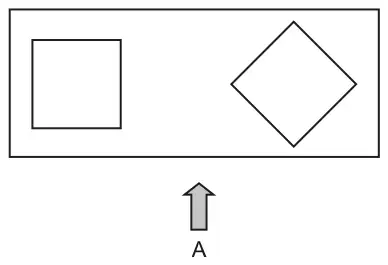
Complete the diagram below to show the front view of the 3D object from A.
[2]
Mark scheme
Answer
Marks
Part marks and guidance
Correct side view eg
2
For 2 marks: Second column any height but wider than, and right of, first with roughly middle vertical and flat top
B1 for roughly rectangular column width ± 2 mm (between inner and outer overlay circles) and no oblique top
and
B1 for approx vertical line approx central
If B0 second B1 still possible Mark intention, ruler desirable but not required If no column drawn, must be a hole with dotted lines with same constraints egUse overlay
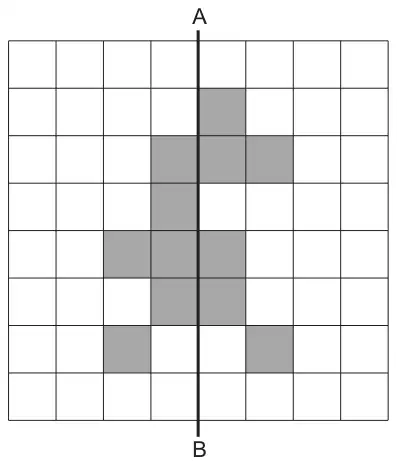
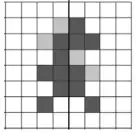
Complete the pattern below so that AB is a line of symmetry.
Shade the smallest possible number of squares. [2]
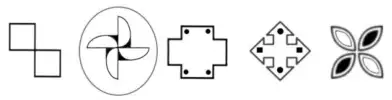
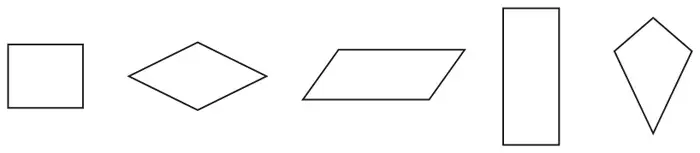
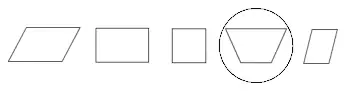
(b) Circle the shape below that has rotational symmetry of order 4. [1]
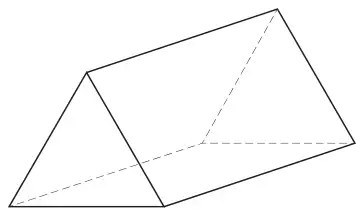
(c) The diagram below shows a triangular prism.
Diagram not drawn to scale
How many edges and vertices does the triangular prism have? [2]
Edges ………… Vertices …………
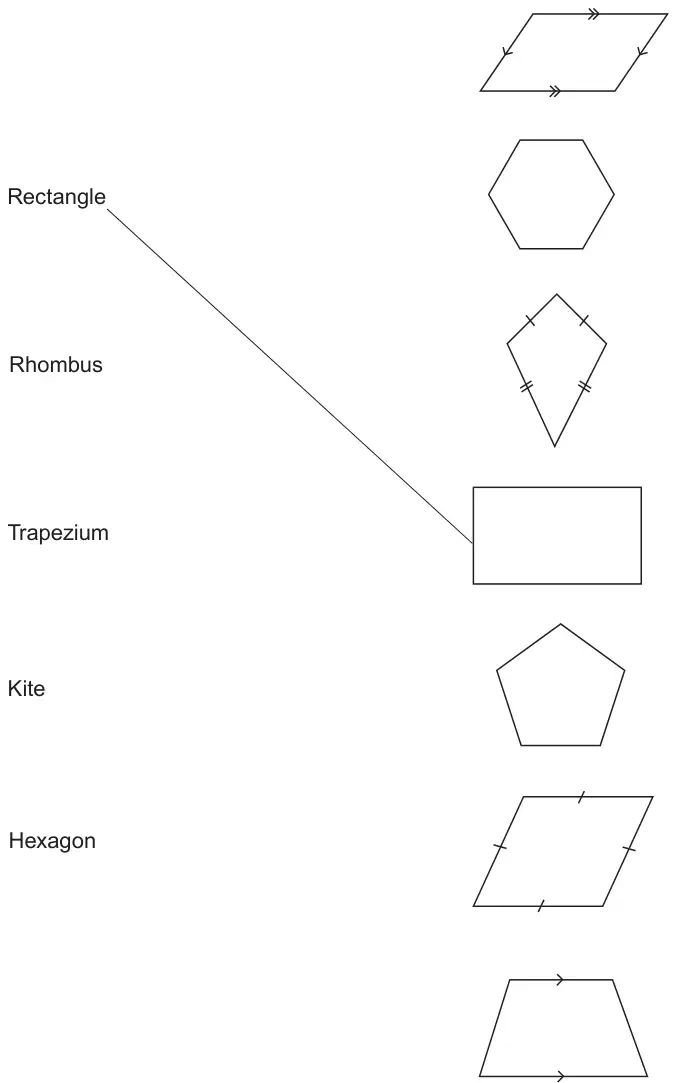
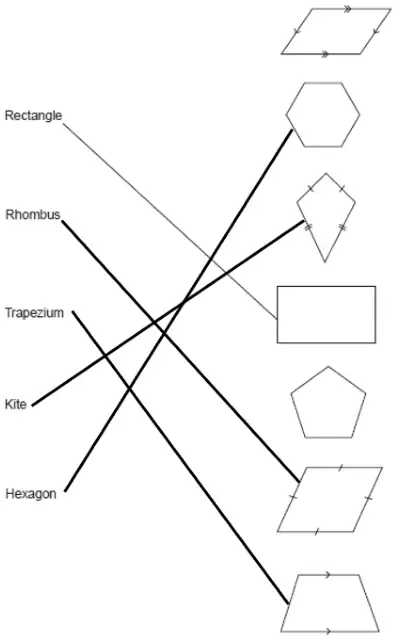
(d)
Draw one line to connect each of the following mathematical names to the correct shape. You will not need to use every shape. One has been completed for you. [2]
Mark scheme (a)
Scheme
Marks
Comments
The correct 4 squares shaded
B2
B1 for one of the following:
A symmetrical shape with the 4 correct squares and no more than 2 extra squares.
3 or 4 of the correct squares and no more than 1 incorrect square.
2 correct squares and no incorrect squares.
Mark scheme (b)
Scheme
Marks
Comments
The correct shape unambiguously indicated
B1
Mark scheme (c)
Scheme
Marks
Comments
(Edges) 9 (Vertices) 6
B2
B1 for either correct.
If no marks, award SC1 for reversed answers.
Mark scheme (d)
Scheme
Marks
Comments
All four of the remaining shapes matched correctly
B2
B1 for three of the remaining shapes matched correctly OR for 2 correct with no errors.
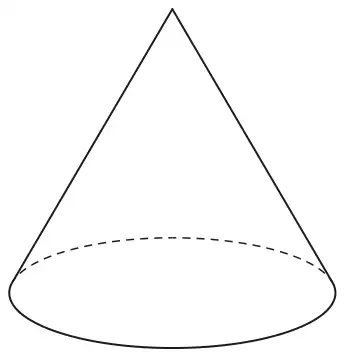
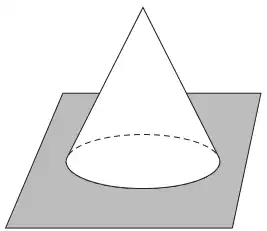
21. The diagram shows a cone placed with its circular base on a table.
It has
base radius 15 cm,
height 30 cm.
Diagram not drawn to scale
(a) Work out the volume of this cone. Give your answer as a multiple of \(\pi\). [3]
(b)
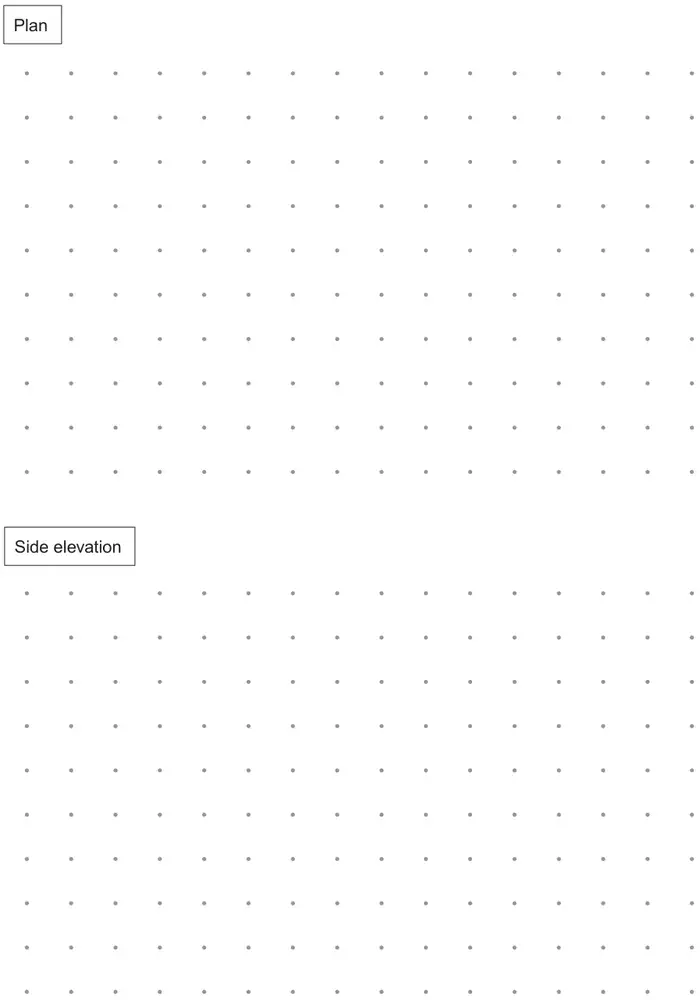
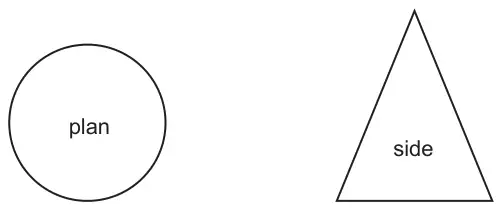
On the 1 cm grid opposite, make an accurate scale drawing of the plan and side elevation of this cone.
Use the ratio
actual cone : scale drawing = 5 : 1. [4]
Mark scheme (a)
Scheme
Marks
Comments
\(\frac{1}{3}\times\pi\times 15^2\times 30\) oe, si
M1
Allow e.g. 3.14 substituted for \(\pi\); may be in stages;
\(\frac{1}{3}\times\pi\times 225\times 30\) oe, si
A1
Allow e.g. 3.14 substituted for \(\pi\); may be in stages
\(2250\pi\) (cm3)
A1
FT ‘their 225’, M1 A0 A1 is possible; Must be a multiple of \(\pi\); do not ignore subsequent evaluation of e.g. 2250 × 3.14
Mark scheme (b)
Scheme
Marks
Comments
radius 3 cm or diameter 6 cm and height 6 cm si
B1
Correct use of the scale; may be implied by correctly drawn plan and elevation;
For the plan: draws a circle, radius 3cm and for the side elevation: draws an isosceles triangle with base 6 cm and height 6 cm
B3
FT ‘their stated radius and their stated height’ OR if no statement or calculation for radius and height, FT ‘their diameter = their height = their base’
For B3, circle must be drawn with compasses and triangle must be ruled
B2 FT for either an accurately drawn, correct plan or an accurately drawn, correct elevation FT ‘their stated radius and their stated height’ OR if no statement or calculation for radius and height, FT ‘their diameter = their base’ or ‘their base = their height’ or ‘their diameter = their height’
OR B2 FT for good sketches of both the correct plan and elevation or one sketch and one drawn accurately FT ‘their stated radius and their stated height’ OR if no statement or calculation for radius and height, FT ‘their diameter = their height = their base’
B1 for a circular plan with any radius or for a side elevation that is an isosceles triangle with any dimensions ; allow good freehand for B1 but base of triangle must not be clearly curved
If B1 B0 or B0 B0, award SC1 for an accurate plan and elevation drawn in incorrect positions
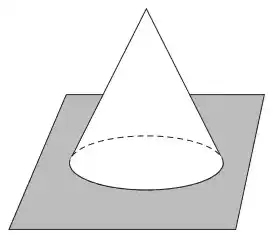
3. The diagram shows a cone placed with its circular base on a table.
It has
base radius 15 cm,
height 30 cm.
Diagram not drawn to scale
(a) Work out the volume of this cone. Give your answer as a multiple of \(\pi\). [3]
(b) On the 1 cm grid opposite, make an accurate scale drawing of the plan and side elevation of this cone. Use the ratio
actual cone : scale drawing = 5 : 1. [4]
Mark scheme (a)
Scheme
Marks
Comments
\(\dfrac{1}{3}\times\pi\times15^2\times30\) oe, si
M1
Allow e.g. 3.14 substituted for \(\pi\); may be in stages
\(\dfrac{1}{3}\times\pi\times225\times30\) oe, si
A1
Allow e.g. 3.14 substituted for \(\pi\); may be in stages
\(2250\pi\) (cm3)
A1
FT ‘their 225’, M1 A0 A1 is possible; Must be a multiple of \(\pi\); do not ignore subsequent evaluation of e.g. 2250 × 3.14
Mark scheme (b)
Scheme
Marks
Comments
radius 3 cm or diameter 6 cm and height 6 cm si
B1
Correct use of the scale; may be implied by correctly drawn plan and elevation;
For the plan: draws a circle, radius 3cm and for the side elevation: draws an isosceles triangle with base 6 cm and height 6 cm
B3
FT ‘their stated radius and their stated height’ OR if no statement or calculation for radius and height, FT ‘their diameter = their height = their base’
For B3, circle must be drawn with compasses and triangle must be ruled.
B2 FT for either an accurately drawn, correct plan or an accurately drawn, correct elevation FT ‘their stated radius and their stated height’ OR if no statement or calculation for radius and height, FT ‘their diameter = their base’ or ‘their base = their height’ or ‘their diameter = their height’
OR B2 FT for good sketches of both the correct plan and elevation or one sketch and one drawn accurately FT ‘their stated radius and their stated height’ OR if no statement or calculation for radius and height, FT ‘their diameter = their height = their base’
B1 for a circular plan with any radius or for a side elevation that is an isosceles triangle with any dimensions; allow good freehand for B1 but base of triangle must not be clearly curved
If B1 B0 or B0 B0, award SC1 for an accurate plan and elevation drawn in incorrect positions
For the plan: draws a circle, radius 3 cm and for the side elevation: draws a 4 cm by 6 cm rectangle
B3
Circle must be drawn with compasses and rectangle must be ruled.
B2 for either the plan or elevation correct or for good freehand sketches of both the correct circle and the correct rectangle or B1 for a circular plan with incorrect radius or for a rectangular side elevation with incorrect dimensions or for a good freehand circle for the plan or a good freehand rectangle for the elevation; may also have incorrect dimensions
Allow place value errors in writing the given standard form numbers in full for M2 and M1 only M1 for any one of the following calculations or evaluations:
\(\dfrac{1.2 \times 10^{8}}{2 \times 10^{7}}\) (= 0.6 × 10 (× 100) or 6(× 100) or 600(%))
500 (%)
A1
CAO Answer space completing the statement takes precedence Accept equivalents \(0.5 \times 10^{3}\) or \(5 \times 10^{2}\) Accept an unsupported correct answer or a correct answer from reverse calculations
(a) Draw an isometric representation of a cuboid measuring 7 cm by 5 cm by 3 cm. Use the grid below. [2]
(b) Calculate the volume of the cuboid. You must give the units of your answer. [3]
Mark scheme (a)
Scheme
Marks
Comments
Correct cuboid
B2
Ignore orientation of cuboid.
For B2, their cuboid must have edges of correct length along or parallel to the 3 directions usually associated with isometric paper (the two diagonals and the vertical).
Award B1 for any one edge dealt with correctly for all its three visible occurrences in a cuboid.
For any mark to be awarded the line must go ‘through the dots’ AND have both ends ‘on a dot’. Ignore attempt at handling ‘hidden lines’.
If no marks, award SC1 for a correct ‘isometric’ cuboid drawn with dimensions 6cm by 4cm by 2cm (counting dots) in any orientation.
Mark scheme (b)
Scheme
Marks
Comments
(Volume =) 7 × 5 × 3
M1
M1 must be for a complete correct method. e.g. any further manipulation to 7 × 5 × 3 is M0.
= 105
A1
CAO Unsupported final answer of 105 is awarded M1A1U0.
cm3
U1
Independent of other marks (e.g. M0 could have been previously awarded or no volume given).
(a) Draw an isometric representation of a cuboid measuring 7 cm by 5 cm by 3 cm. Use the grid below. [2]
(b) Calculate the volume of the cuboid. You must give the units of your answer. [3]
Mark scheme (a)
Scheme
Marks
Comments
Correct cuboid
B2
Ignore orientation of cuboid.
For B2, their cuboid must have edges of correct length along or parallel to the 3 directions usually associated with isometric paper (the two diagonals and the vertical).
Award B1 for any one edge dealt with correctly for all its three visible occurrences in a cuboid.
For any mark to be awarded the line must go ‘through the dots’ AND have both ends ‘on a dot’. Ignore attempt at handling ‘hidden lines’.
If no marks, award SC1 for a correct ‘isometric’ cuboid drawn with dimensions 6cm by 4cm by 2cm (counting dots) in any orientation.
Mark scheme (b)
Scheme
Marks
Comments
(Volume =) 7 × 5 × 3
M1
M1 must be for a complete correct method. e.g. any further manipulation to 7 × 5 × 3 is M0.
= 105
A1
CAO An unsupported final answer of 105 is awarded M1A1U0.
cm3
U1
Independent of other marks (e.g. M0 could have been previously awarded or no volume given).
An unsupported answer of 105cm3 is awarded M1A1U1.
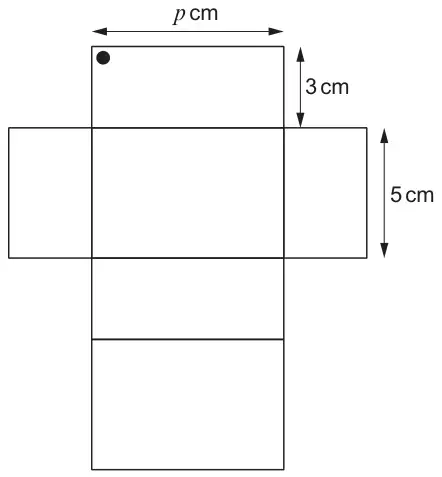
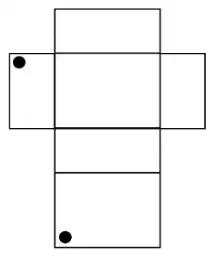
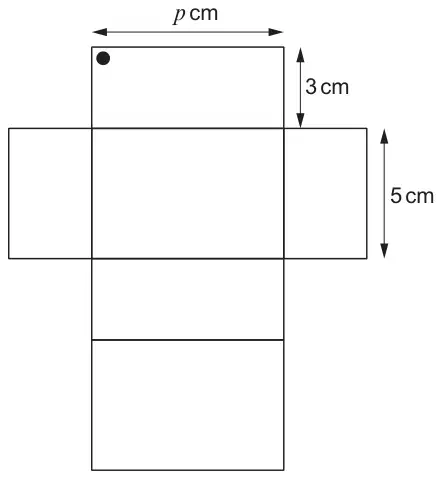
(a) The corner marked with ● meets two other corners on the net. Mark these two other corners with ●. [2]
(b) The volume of the cuboid is 90 cm3. What is the value of \(p\)? [2]
Mark scheme (a)
Scheme
Marks
Comments
B2
Accept any indication.
Award B1 for one of the following:
one correct dot with no more than one incorrect dot shown
two correct dots with one incorrect dot shown.
Mark scheme (b)
Scheme
Marks
Comments
3 × 5 × \(p\) = 90 or 90 ÷ (3 × 5) or equivalent
M1
M1 for complete method.
(\(p\) =) 6
A1
Allow M1A1 for a correct embedded answer (e.g. 3 × 5 × 6 = 90), BUT M1A0 if contradicted by \(p \ne 6\). Unsupported 6 is awarded M1A1.
Corrected by Westie's Workshop
The board's mark scheme printed “contradicted by p ≠ 6).”. Changed to “contradicted by p ≠ 6.” because the bracket that opened before “e.g.” is already closed after 90, so this closing bracket has no partner.
Original: see the board's mark scheme PDF (link above).
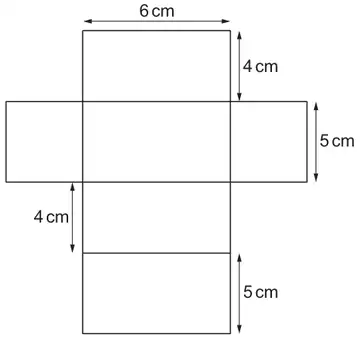
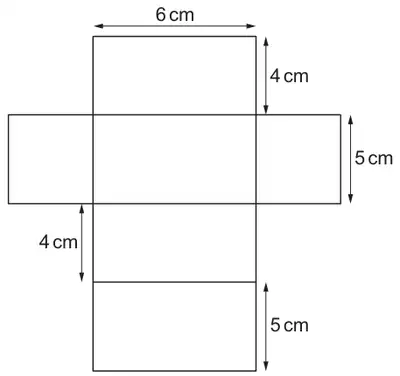
This box is 5 cm long, 3 cm wide and 4 cm high. The box does not have a lid. Complete an accurate net of the box on the centimetre-squared grid below. The base has been drawn for you. [2]
(a) He bought 40 boxes of chocolates from the internet to sell in his gift shop.
Internet Price
£5 per box Orders over £100 get 25% off the total cost
(i)
In this part of the question, you will be assessed on the quality of your organisation, communication and accuracy in writing.
How much did Mr Evans pay for the 40 boxes of chocolates? You must show all your working. [3 + 2 OCW]
(ii) Mr Evans sold all 40 boxes of chocolates in his shop.
Buy one box of chocolates for £8 Special Offer: Buy 2 boxes of chocolates for £13
20 boxes of chocolates were sold for £8 each. The remaining boxes of chocolates were sold using the special offer.
How much profit did Mr Evans make? You must show all your working. [5]
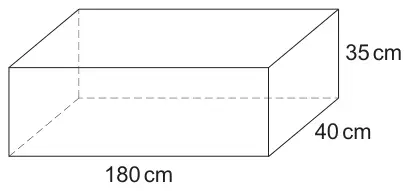
(b) Mr Evans wants to plant flowers outside the shop. He uses a wooden planter. It is in the shape of a cuboid without a lid.
A sketch of the wooden planter, with its dimensions, is shown below.
Diagram not drawn to scale
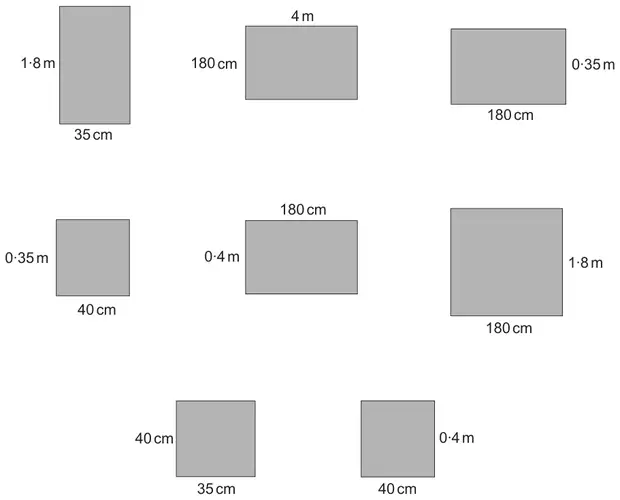
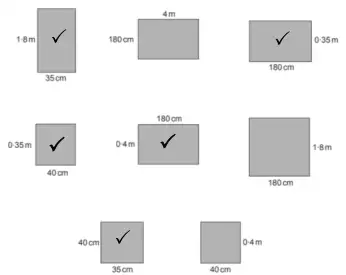
Mr Evans has 8 wooden panels. These are shown below. Circle the 5 panels that Mr Evans will need to use to make the planter. [3]
Diagrams not drawn to scale
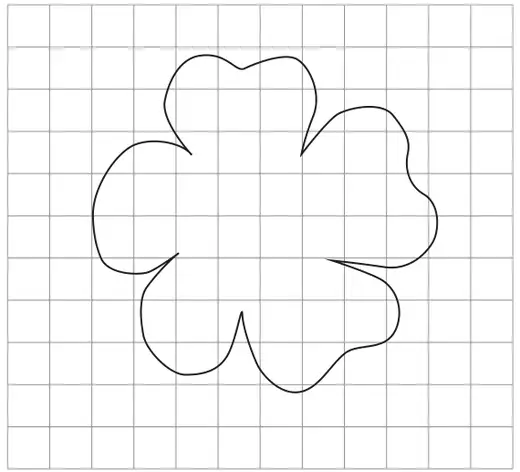
(c) Mr Evans designs a poster to place in his shop window. The poster is to advertise a local flower show. The flower used in the poster is shown on the square grid below. Each square on the grid represents 4 cm2 on the poster. Estimate the area of the flower on the poster. [3]
Area of the flower on the poster …………… cm2
Mark scheme (a)
Scheme
Marks
Comments
(i) (Price for 40 boxes is 40 × 5 = ) (£)200
B1
(Discount is 200 ÷ 4 =) (£)50
B1
FT ‘their 40 × 5’ ÷ 4 This may be seen or implied in final answer
(Mr Evans paid 200 – 50 =) (£)150
B1
FT ‘their 200’ – ‘their 50’ Award B0 for an answer of 175(%) from 200 – 25(%) unless 25 has been derived as ‘their 50’.
Organisation and communication
OC1
For OC1, candidates will be expected to: • present their response in a structured way • explain to the reader what they are doing at each step of their response • lay out their explanations and working in a way that is clear and logical • write a conclusion that draws together their results and explains what their answer means
Writing
W1
For W1, candidates will be expected to: • show all their working • make few, if any, errors in spelling, punctuation and grammar • use correct mathematical form in their working • use appropriate terminology, units, etc.
(ii) (Sells the 20 boxes for 20 × 8 =) (£)160
B1
Sells the special offer boxes for (40 – 20) ÷ 2 × 13 or 20 × 13 ÷ 2 or equivalent
M1
Equivalent methods usually: 10 × 13 or 260 ÷ 2 or 20 × 6.5
(£)130
A1
(Profit = ) 160 + 130 – 150
M1
FT ‘their 20 × 8’ + ‘their 130’ – ‘their 150 from 2ai’ provided ‘their 130’ ≤ 260
( =) (£)140
A1
If final M0 A0, then award SC1 for sight of (£)290 from 160 + 130
Note: use of 20 × 13 = 260 and then 160 + 260 – 150 = 270 gains B1M0A0M1A1
Alternative
2(a)(i) Alternative method 1
Scheme
Marks
Comments
(Price for 40 boxes is 40 × 5 =) (£)200
B1
(Mr Evans paid) 0.75 × 40 × 5 or equivalent
M1
FT ‘their 40 × 5’
(£)150
A1
2(a)(i) Alternative method 2
Scheme
Marks
Comments
(Cost of 1 discounted box ¾ × 5 =) (£)15/4 or (£)3.75
B1
(Cost of 40 boxes =) 40 × (£)15/4 or 40 × (£)3.75
M1
FT 40 × ‘their 15/4’ or 40 × ‘their 3.75’
(£)150
A1
The alternative methods are printed in italics in the original. In the original they come before the OC1 and W1 rows, which apply to any method.
Mark scheme (b)
Scheme
Marks
Comments
All 5 correct wooden panels identified with no incorrect ones.
B3
Award B2 for: 5 panels correct and 1 incorrect OR 4 panels correct and 0 or 1 incorrect OR 3 panels correct and 0 incorrect
Award B1 for: 5 or 4 panels correct and 2 incorrect OR 3 panels correct and 1 or 2 incorrect OR 2 panels correct and 0 incorrect
Mark scheme (c)
Scheme
Marks
Comments
(Area of flower) Evidence of counting squares within the shape
M1
Allow M1 for area within and some of the squares outside Award M0 if clearly working with perimeter
39 – 47 (squares)
A1
Number of squares in range with no evidence of counting award M1 A1
156 – 188 (cm2)
B1
FT ‘their number of squares’ × 4 correctly evaluated
Alternative
2(c) Alternative method
Scheme
Marks
Comments
(Area of flower) Evidence of counting squares within the shape and counting up in 4s
M2
If no evidence of counting squares, award M1 for evidence of counting up in 4s to at least 40
156 – 188 (cm2)
A1
The alternative method is printed in italics in the original.
4. A cuboid is to be drawn on the isometric grid below. Find a possible length, width and height for the cuboid, such that:
the cuboid has a volume of 12 cm3
each of the length, width and height is a whole number of centimetres.
Write the length, width and height of your cuboid in the spaces below. Use the grid below to draw an isometric representation of your cuboid. [3]
Length = ………………… cm Width = ………………… cm Height = ………………… cm
Mark scheme
Scheme
Marks
Comments
Choice of length, width and height such that length × width × height = 12 i.e. 12 × 1 × 1 6 × 2 × 1 4 × 3 × 1 3 × 2 × 2
B1
Must be whole numbers for B1. May be seen in any order. Award B1 if length, width and height are not stated but implied by the cuboid drawn.
Correct cuboid drawn
B2
Ignore orientation of cuboid. FT ‘their length, width and height’.
For B2, their cuboid must have edges along or parallel to the 3 directions usually associated with isometric paper (the two diagonals and the vertical).
Award B1 for one of the following:
any one edge dealt with correctly for all its three visible occurrences in a cuboid
a cuboid drawn with volume 12cm3 with a different length, width and height stated on answer line (e.g. 3 × 2 × 2 stated on answer lines, but 6 × 2 × 1 cuboid drawn).
For any mark to be awarded the line must go ‘through the dots’ AND have both ends ‘on a dot’. Ignore attempt at handling ‘hidden lines’.
(a) Sandwiches are made for people at a community centre.
One Saturday, the following ingredients were used to make sandwiches for 10 people.
2 loaves of bread 50 grams of butter 3 tins of tuna 14 tomatoes
Next Saturday, there will be 40 people in the community centre.
Complete the list below to show the ingredients needed to make sandwiches for the 40 people. [2]
Sandwiches for 40 people:
…………… loaves of bread …………… grams of butter …………… tins of tuna …………… tomatoes
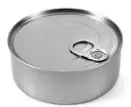
(b) What is the best description for the shape of this tin of tuna? Circle your answer. [1]
Cuboid Cylinder Cube Sphere Cone
(c)
In this part of the question, you will be assessed on the quality of your organisation, communication and accuracy in writing.
The local drama group is putting on a show in the community centre hall.
The hire charge for the hall is £10 per hour. The hall will be needed from 17:00 to 22:00.
The total costs of the event are:
hire of the hall
costumes: £250
printing tickets: £60
sound and lighting equipment: £400.
Tickets for the show are sold for £8 each.
What is the smallest number of tickets that must be sold so that the drama group does not make a loss when putting on the show? You must show all your working. [6 + 2 OCW]
Mark scheme (a)
Scheme
Marks
Comments
8 (loaves of bread) 200 (grams of butter) 12 (tins of tuna) 56 (tomatoes)
B2
Award B1 for 2 or 3 correct Lines for answers take precedence over working space.
If no marks, award SC1 for all values evaluated accurately using a consistent multiplier which is >2.
Mark scheme (b)
Scheme
Marks
Comments
Cylinder
B1
Mark scheme (c)
Scheme
Marks
Comments
(Hall hire charge = 5 × 10 = ) (£)50
B2
Award B1 for
5 (hours)
‘their hours >1’ × 10 evaluated correctly
Multiple of 10 (but not 10) which is then used in their total costs (and is extra to the given £60)
FT ‘their (£)760’ including (£)710 (without hall costs)
95
A1
On FT their answer must be a whole number rounded up if necessary
Organisation and communication
OC1
For OC1, candidates will be expected to: • present their response in a structured way • explain to the reader what they are doing at each step of their response • lay out their explanations and working in a way that is clear and logical • write a conclusion that draws together their results and explains what their answer means
Writing
W1
For W1, candidates will be expected to: • show all their working • make few, if any, errors in spelling, punctuation and grammar • use correct mathematical form in their working • use appropriate terminology, units, etc.
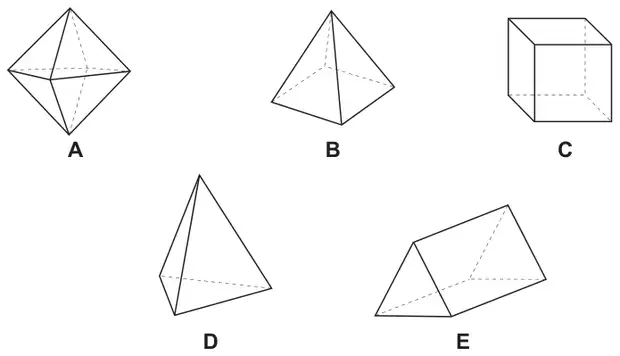
(a) She makes boxes for her chocolates in the shape of a tetrahedron. Sara uses thin card to make each box. The length of each edge of the box is 5 cm.
What is the total length of the edges of one box? Circle your answer. [1]
15 cm 30 cm 40 cm 45 cm 60 cm
(b) Each box contains 4 chocolates. Each chocolate costs Sara 7p to make. She can make 25 boxes from thin card for 50p. Sara makes just enough chocolates and boxes to sell 150 boxes of chocolates.
Sara makes 20% profit from selling all 150 boxes of chocolates. How much profit does Sara make? You must show all your working. [6]
Mark scheme (a)
Scheme
Marks
Comments
30 cm
B1
Mark scheme (b)
Scheme
Marks
Comments
For all methods
If an evaluation is given with incorrect units, award A0 on the first occasion then FT
(Cost to make 150 boxes) (150 ÷ 25) ÷ 2 or 6 × 50 or equivalent
M1
(£)3 or 300(p)
A1
(Cost of the chocolates) 150 × 4 × 7 or 600 × 7 or equivalent
M1
4200(p) or (£) 42
A1
(Profit) 0.2 × (3 + 42) or equivalent
M1
FT 0.2 × (‘their cost of boxes + their cost of chocolates’)
(£) 9 or 900(p)
A1
ISW
8(b) Alternative method 1:
Scheme
Marks
Comments
(Each box of chocolates costs) 4 × 7 + 50 ÷ 25
M1
30(p)
A1
(Each box of chocolates sells for) 30 × 1.2
M1
FT ‘their derived 30p’ (including omitting the box)
36(p)
A1
(Profit) (36 – 30) × 150
M1
FT 150 × ‘individual (sales – cost)’
(£)9 or 900(p)
A1
ISW
8(b) Alternative method 2:
Scheme
Marks
Comments
(Each box of chocolates costs) 4 × 7 + 50 ÷ 25
M1
30(p)
A1
(Profit for one box of chocolates) 30 × 0.2
M1
FT ‘their derived 30p’ (including omitting the box)
6(p)
A1
(Profit) 6 × 150
M1
FT 150 × ‘their profit per box’
(£)9 or 900(p)
A1
ISW
8(b) Alternative method 3:
Scheme
Marks
Comments
(25 boxes of chocolates cost) 4 × 7 × 25 + 50
M1
750 (p) or (£)7.50
A1
(Profit for 25 boxes of chocolates) 7(.)50 × 0.2
M1
FT ‘their derived 7(.)50’ (including omitting the box)
(£)1.50 or 150(p)
A1
(Profit) 1(.)50 × 150 ÷ 25
M1
FT ‘their profit for 25 boxes’ × 150 ÷ 25
(£)9 or 900(p)
A1
ISW
8(b) Alternative method 4:
Scheme
Marks
Comments
(25 boxes of chocolates cost) 4 × 7 × 25 + 50
M1
750 (p) or (£)7.50
A1
(Total cost to make) 7(.)50 × 150 ÷ 25
M1
FT ‘their derived 7(.)50’ (including omitting the box)
(£)45 or 4500(p)
A1
(Profit) 45 × 0.2 or 4500 × 0.2
M1
FT 0.2 × ‘their total cost to make’
(£)9 or 900(p)
A1
ISW
8(b) Alternative method 5:
Scheme
Marks
Comments
(Each box of chocolates costs) 4 × 7 + 50 ÷ 25
M1
30(p)
A1
(Total cost to make) (0.)30 × 150
M1
FT ‘their derived 30p’ (including omitting the box)
(£)45 or 4500(p)
A1
(Profit) 45 × 0.2 or 4500 × 0.2
M1
FT 0.2 × ‘their total cost to make’
(£)9 or 900(p)
A1
ISW
The alternative methods are printed in italics in the original.
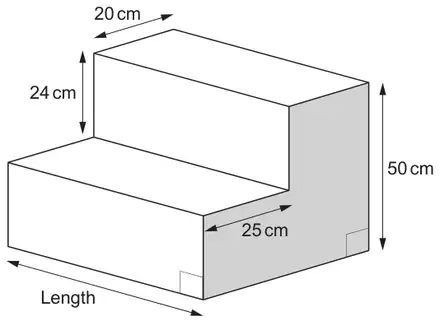
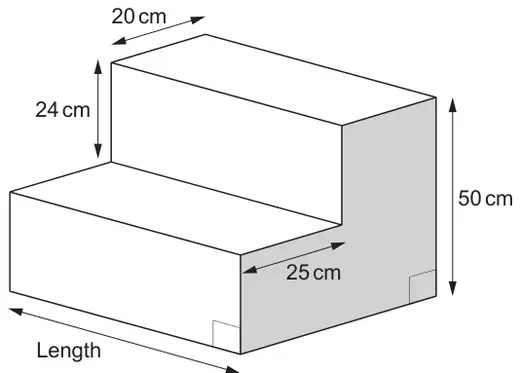
9. The picture shows a solid concrete step. The step:
stands on horizontal ground,
has all of its edges vertical or horizontal,
has a uniform cross-section.
Diagram not drawn to scale
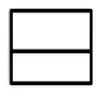
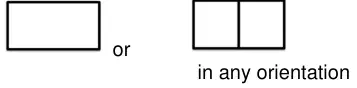
(a) Draw a sketch of the plan view of the concrete step. [1]
(b)
The volume of concrete in the step is 66 000 cm3.
From the formula list: Volume of prism = area of cross-section × length
(i)
The concrete to make the step costs 39p per litre.
A builder charges a rate of £27 per hour. Any fraction of an hour is charged as that fraction of his hourly rate. (For example, half an hour is charged at half of £27.)
It takes him 1 hour 20 minutes to make the step.
There were no other costs. Calculate the total cost of making the step. [3]
(ii) Calculate the length of the step. Give your answer in cm. You must show all your working. [5]
Mark scheme (a)
Scheme
Marks
Comments
in any orientation
B1
Allow:
intention of straight lines and right angles
two equal rectangles joined
Do not accept if end elevation also drawn, unless plan view is labelled
Mark scheme (b)
Scheme
Marks
Comments
(i) (Concrete costs) 66 × 39(p) or equivalent
M1
(=£25.74) Allow M1 for sight of a multiplication involving the digits 66... with 39(p) or equivalent
(Builder charges) 27 + ⅓ × 27 or equivalent
M1
(= £36) Allow methods breaking down the hour to find the cost for 20 minutes provided sufficient evidence seen Do not allow:
27 + 0.3 × 27 = 27 + 8.10 = £35.10
27 + ⅓ × 27 = 27 + 8.10 = £35.10
Allow 27 + 0.33 × 27 = £35.91 or better
(Total cost of making the step) (£) 61.74
A1
CAO
(ii) (Area cross-section) as sum of two products: 50 × (20+25) – 24×25 (= 2250 – 600) or (20+25) × (50–24) + 20×24 (= 1170 + 480) or 50×20 + 25×(50–24) (= 1000 + 650) OR (Area cross-section) as sum of three products: 24×20 + 26×20 + 26×25 (= 480 + 520 + 650)
M2
Check diagram for working Accept a similar method given by an equation or expressions
M1 for sight of either:
difference or sum of 2 products, with 1 correct
sum of 3 products with 2 correct
all products correct but no attempt to sum
(Area cross-section) 1650 (cm2)
A1
CAO
(Length = Volume ÷ area cross-section) 66 000 ÷ 1650
M1
FT 66000 ÷ ‘their 1650’ provided ‘their 1650’ is dimensionally correct
40 (cm)
A1
ISW FT 66000 ÷ ‘their 1650’ only allowing rounding or truncation of decimals
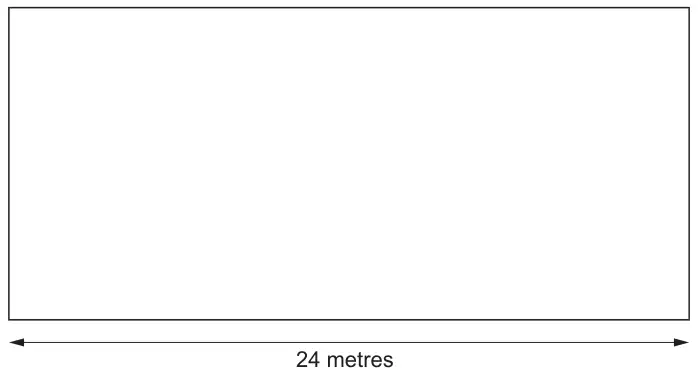
The Marine Tennis Club has 6 tennis courts. Each court is rectangular in shape.
The diagram below is a scale drawing of one of the tennis courts.
On screen this diagram may not be shown at actual size. To measure it, use the question paper (PDF) printed at 100%.
The actual length of the tennis court is 24 metres.
Using a ruler to measure the length of the scale diagram, find the actual width of the tennis court. [3]
(b)
(i)
The Marine Tennis Club and The Bay Tennis Club have already played matches against 8 other clubs this season.
The table shows the results of these matches.
Won
Lost
The Marine Tennis Club
3
5
The Bay Tennis Club
6
2
The Marine Tennis Club are playing The Bay Tennis Club in their next match.
It is not possible to tell from the information in the table which team is more likely to win the match. Give one reason why it is not possible. [1]
(ii)
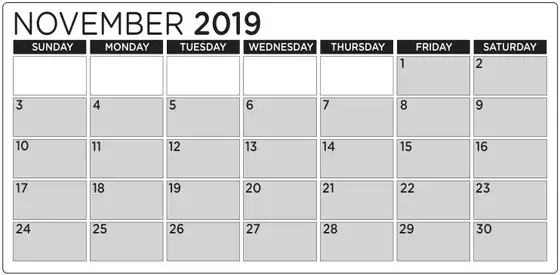
The match between the two clubs will take place on 24th November 2019.
The table shows when players are available to play. The club needs 6 players for the match.
Using the end column in the table below, tick the 6 players who should be available on 24th November. [2]
Player
Days they can play
Players available on 24th November
Caroline
Tuesday and Friday
Tracey
Every day
Lisa
Weekends
Sian
Monday, Tuesday and Friday
Jan
Every day
Heather
Monday to Friday
Alys
Wednesday and Friday
Nafeesa
Tuesday, Friday and Sunday
Molly
Wednesday and Sunday
Alicia
Tuesday and Weekends
(c)
Which of the following is the best description for the shape of a tennis ball? Circle your answer. [1]
Cone Cube Cuboid Sphere Cylinder
Mark scheme (a)
Scheme
Marks
Comments
12 (cm) or equivalent
B1
± 2 mm. Seen or implied. Award this B1 for sight of the correct scale eg 1cm represents 2m or sight of 5.5 × 2
5.5 (cm) or equivalent
B1
± 2 mm. May be seen on diagram
11 m or 11 metres or 1100 cm or equivalent with correct units
B1
Correct units must be given. FT ‘their 5.5 (cm)’ × 2 (Accept answers in the range 10.6m – 11.4m)
An answer of 11m (or in the range 10.6m –11.4m) award B3
An answer of 11 (or in the range 10.6-11.4 with no units or wrong units) award B2
Note: If answer only of 12 m award B1 Note: 6(cm) × 2 = 12 m Award B1 B0 B1
Mark scheme (b)
Scheme
Marks
Comments
(i) A suitable reason eg ‘Depends on whether they are playing home or away.’ ‘The Marine Tennis Club may have played better teams.’ ‘They played different clubs.’ ‘There were different players.’ ‘Table doesn’t show the teams they played.’ ‘It doesn’t matter about their record as you don’t know what types of players they are.’ ‘In the Bay Tennis Club, the best player could be injured.’
E1
Allow statement of different players or clubs.
Allow: ‘Because it doesn’t tell us the performance of each team’ ‘It’s not possible because until they play each other no-one will know who is better.’ ‘Because the other teams are not in the table.’ ‘Because they could have improved.’ ‘There’s not enough information.’ ‘Not enough data.’ ‘You don’t know how well they are going to do next time.’
Do not accept: ‘Because the Bay has won ½ of the matches so they only lost ½.’ ‘Because both teams would end up with similar average.’ ‘As they have won & lost while playing against them.’
(ii) Tracey, Lisa, Jan, Nafeesa, Molly and Alicia ticked/indicated.
For OC1, candidates will be expected to: • present their response in a structured way • explain to the reader what they are doing at each step of their response • lay out their explanations and working in a way that is clear and logical • write a conclusion that draws together their results and explains what their answer means
Writing
W1
For W1, candidates will be expected to: • show all their working • make few, if any, errors in spelling, punctuation and grammar • use correct mathematical form in their working • use appropriate terminology, units, etc.
Mark scheme (c)
Scheme
Marks
Comments
51 cm
B1
Mark scheme (d)
Scheme
Marks
Comments
B2
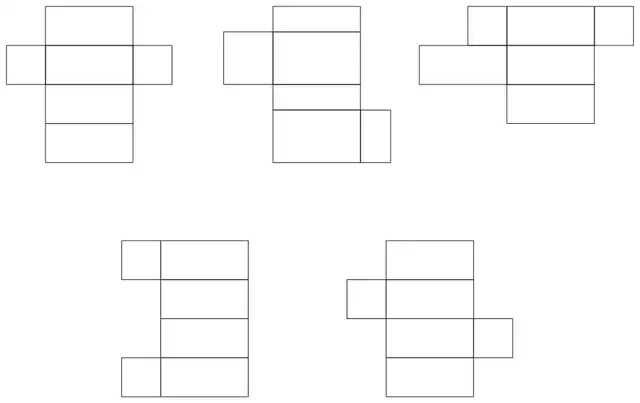
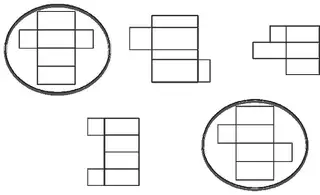
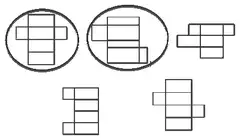
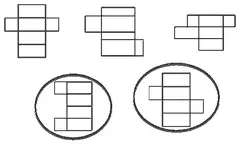
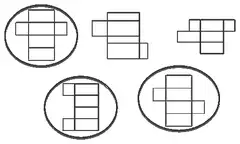
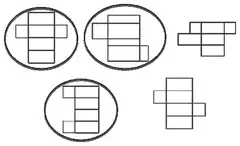
Award B1 for 1 or 2 correct nets indicated with no more than 1 incorrect net indicated E.g. Award B1ororAward B0 for
2. The picture shows a solid concrete step. The step:
stands on horizontal ground,
has all of its edges vertical or horizontal,
has a uniform cross-section.
Diagram not drawn to scale
(a) Draw a sketch of the plan view of the concrete step. [1]
(b) The volume of concrete in the step is 66 000 cm3.
(i) The concrete to make the step costs 39p per litre.
A builder charges a rate of £27 per hour. Any fraction of an hour is charged as that fraction of his hourly rate. (For example, half an hour is charged at half of £27.)
It takes him 1 hour 20 minutes to make the step.
There were no other costs. Calculate the total cost of making the step. [3]
(ii) Calculate the length of the step. Give your answer in cm. You must show all your working. [5]
Mark scheme (a)
Scheme
Marks
Comments
in any orientation
B1
Allow:
intention of straight lines and right angles
two equal rectangles joined
Do not accept if end elevation also drawn, unless plan view is labelled
Mark scheme (b)
Scheme
Marks
Comments
(i) (Concrete costs) 66 × 39(p) or equivalent
M1
(=£25.74) Allow M1 for sight of a multiplication involving the digits 66... with 39(p) or equivalent
(Builder charges) 27 + ⅓ × 27 or equivalent
M1
(= £36) Allow methods breaking down the hour to find the cost for 20 minutes provided sufficient evidence seen Do not allow:
27 + 0.3 × 27 = 27 + 8.10 = £35.10
27 + ⅓ × 27 = 27 + 8.10 = £35.10
Allow 27 + 0.33 × 27 = £35.91 or better
(Total cost of making the step) (£) 61.74
A1
CAO
(ii) (Area cross-section) as sum of two products: 50 × (20+25) – 24×25 (= 2250 – 600) or (20+25) × (50–24) + 20×24 (= 1170 + 480) or 50×20 + 25×(50–24) (= 1000 + 650) OR (Area cross-section) as sum of three products: 24×20 + 26×20 + 26×25 (= 480 + 520 + 650)
M2
Check diagram for working Accept a similar method given by an equation or expressions
M1 for sight of either:
difference or sum of 2 products, with 1 correct
sum of 3 products with 2 correct
all products correct but no attempt to sum
(Area cross-section) 1650 (cm2)
A1
CAO
(Length = Volume ÷ area cross-section) 66 000 ÷ 1650
M1
FT 66000 ÷ ‘their 1650’ provided ‘their 1650’ is dimensionally correct
40 (cm)
A1
ISW FT 66000 ÷ ‘their 1650’ only allowing rounding or truncation of decimals
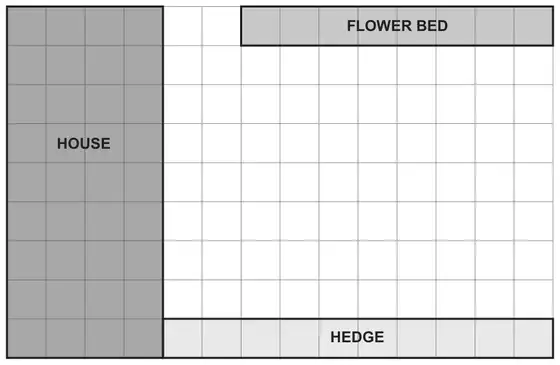
(a) The diagram below shows a plan of his garden. The scale is 1 cm represents 1 m. It shows the position of the house, the hedge and the flower bed.
Scale: 1 cm represents 1 m
The base of Elwyn’s shed is rectangular. It is 4 m long and 3 m wide.
He wants the shed to be:
at least 3 m from the house,
at least 1 m from the hedge,
exactly 2 m from the flower bed.
Draw a possible position for the shed on the diagram. [3]
(b) Elwyn wants to cover the base of the shed with carpet tiles. The carpet tiles cost £15 for each 1 m2. Calculate the total cost of the carpet tiles. [3]
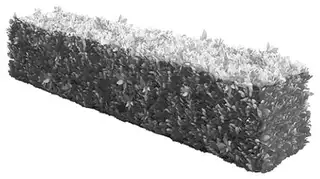
(c) This is a picture of Elwyn’s hedge.
Which of the words below best describes the shape of the hedge? Circle your answer. [1]
sphere cylinder cone cube cuboid
Mark scheme (a)
Scheme
Marks
Comments
Rectangle 4cm by 3cm drawn
B1
Rectangle drawn at least 3cm from the house AND at least 1 cm from the hedge
B1
FT ‘their rectangle’
Rectangle drawn exactly 2 cm from the flower bed
B1
FT ‘their rectangle’
Mark scheme (b)
Scheme
Marks
Comments
12 (m2)
B1
FT ‘their rectangle’. It must be a rectangle or square. This may be seen or implied in a calculation for costs.
15 × 12
M1
FT ‘their 12’ or their derived area.
(£)180
A1
FT ‘their 12’ × 15 correctly evaluated provided ‘their 12’ is 6 or more.
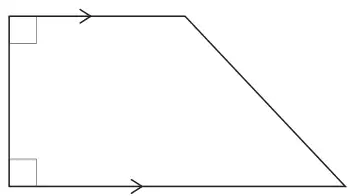
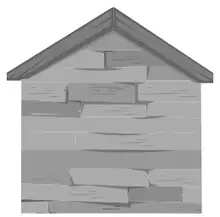
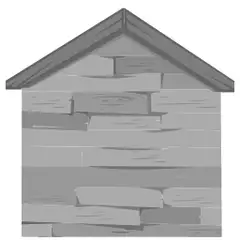
(a) Draw a sketch of the plan view of the mountain hut. [1]
(b) This mountain hut is shown on a map. The scale of the map is 1 : 50 000. On the map the mountain hut is 4·2 cm from a farmhouse. How far away is the hut from the farmhouse? Give your answer in km. [3]
Distance is …………… km
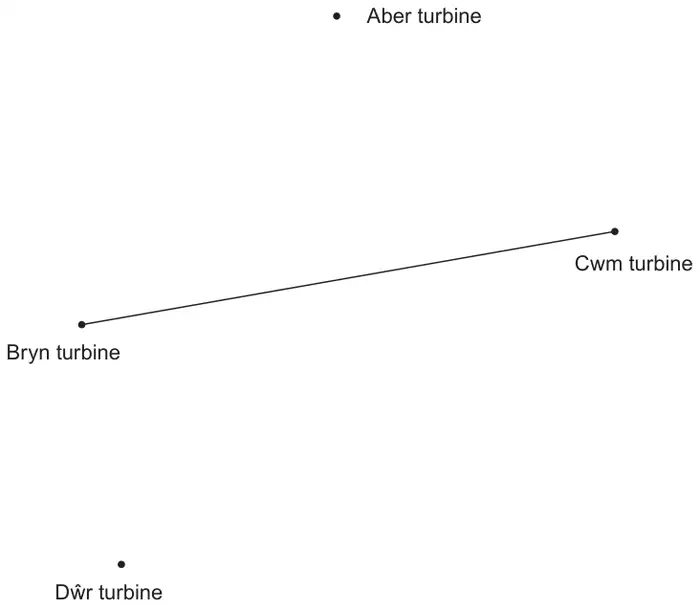
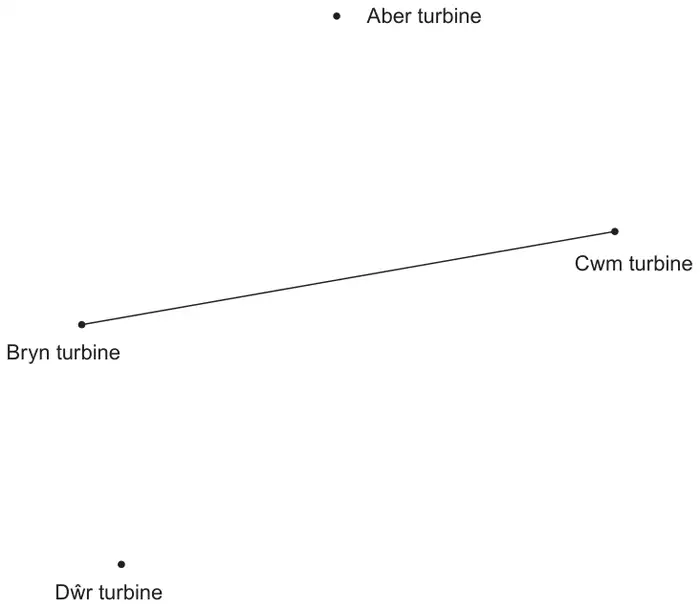
(c) The map below shows the placement of four wind turbines, and a road connecting two of the turbines.
A new wind turbine, Efail, is to be built. It is to be placed
on the road connecting Bryn turbine and Cwm turbine, and
on the perpendicular from Aber turbine to the road.
The map is drawn using a scale of 2 cm represents 1 km.
How far will Efail turbine be from Dŵr turbine? You must use constructions to answer this question, using only a pair of compasses and a ruler. [4]
Scale 2 cm represents 1 km
On screen this diagram may not be shown at actual size. To measure it, use the question paper (PDF) printed at 100%.
Distance is …………… km
Mark scheme (a)
Scheme
Marks
Comments
in any orientation
B1
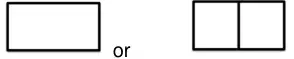
Allow intention of straight lines and right angles Do not accept if clearly two parallelograms attached rather than rectangles If the roof is split into two rectangles, they must meet along one side and intention must be to draw two identical rectangles (or squares)
Mark scheme (b)
Scheme
Marks
Comments
Sight of any of the following:
4.2 × 50000(cm)
210 000
4.2 × 500 (m)
1 cm = 0.5 km
2cm = 1 km
an answer to a product involving 4.2× ... with leading digits ‘21’
B1
Ignore inclusion of incorrect units, allow intention of × 4.2 by 50000 given, i.e. allow if leading digits ‘21’ seen
210 000 (cm) ÷ 100 ÷ 1000 or 4.2 × 0.5 or equivalent calculation that would lead to a correct answer (2.1km)
Draw a sketch of the plan view of the mountain hut. [1]
(b)
This mountain hut is shown on a map. The scale of the map is 1 : 50 000. On the map the mountain hut is 4·2 cm from a farmhouse. How far away is the hut from the farmhouse? Give your answer in km. [3]
Distance is …………… km
(c)
The map below shows the placement of four wind turbines, and a road connecting two of the turbines.
A new wind turbine, Efail, is to be built. It is to be placed
on the road connecting Bryn turbine and Cwm turbine, and
on the perpendicular from Aber turbine to the road.
The map is drawn using a scale of 2 cm represents 1 km.
How far will Efail turbine be from Dŵr turbine? You must use constructions to answer this question, using only a pair of compasses and a ruler. [4]
Scale 2 cm represents 1 km
On screen this diagram may not be shown at actual size. To measure it, use the question paper (PDF) printed at 100%.
Distance is …………… km
Mark scheme (a)
Scheme
Marks
Comments
B1
Allow intention of straight lines and right angles Do not accept if clearly two parallelograms attached rather than rectangles If the roof is split into two rectangles, they must meet along one side and intention must be to draw two identical rectangles (or squares)
Mark scheme (b)
Scheme
Marks
Comments
Sight of any of the following:
4.2 × 50000(cm)
210 000
4.2 × 500 (m)
1 cm = 0.5 km
2cm = 1 km
an answer to a product involving 4.2× ... with leading digits ‘21’
B1
Ignore inclusion of incorrect units, allow intention of × 4.2 by 50000 given, i.e allow if leading digits ‘21’ seen
210 000 (cm) ÷ 100 ÷ 1000 or 4.2 × 0.5 or equivalent calculation that would lead to a correct answer (2.1km)
14. Draw an isometric representation of a cuboid measuring 6 cm by 4 cm by 3 cm. Use the grid below. [2]
Mark scheme
Scheme
Marks
Comments
Correct cuboid
B2
For B2, their cuboid must have edges along or parallel to the 3 directions usually associated with isometric paper (the two diagonals and the vertical). B1 for any one edge dealt with correctly for all its three occurrences in a cuboid. For any mark to be awarded the line must go ‘through the dots’ AND have both ends ‘on a dot’. Ignore attempt at handling ‘hidden lines’.
(a) Draw an isometric representation of a cuboid measuring 6 cm by 4 cm by 3 cm. Use the grid below. [2]
(b) Calculate the volume of the cuboid. Give the units of your answer. [3]
Mark scheme (a)
Scheme
Marks
Comments
Correct cuboid
B2
For B2, their cuboid must have edges along or parallel to the 3 directions usually associated with isometric paper (the two diagonals and the vertical). B1 for any one edge dealt with correctly for all its three occurrences in a cuboid. For any mark to be awarded the line must go ‘through the dots’ AND have both ends ‘on a dot’. Ignore attempt at handling ‘hidden lines’.
When she started work she was given an employee number.
Her employee number is 11-17/314. This number shows that she started work in November 2017, and she was the 314th person to start working for BoxCymru.
(a) Kevin also works for the same company. His employee number is 02-15/047. In which month and year did Kevin start working for BoxCymru? [1]
Month …………………… Year ……………………
(b) Sian is the last person to have been employed by the company. How many people have BoxCymru employed since Kevin joined the company? [1]
(c) Steven is the next person to be employed by BoxCymru after Sian. He is due to start working on 8th January 2018. What will Steven’s employee number be? [2]
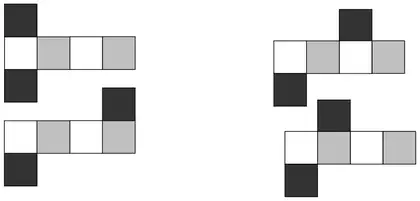
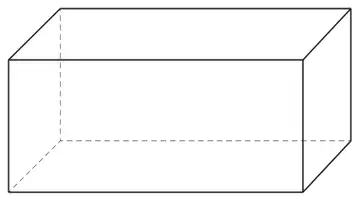
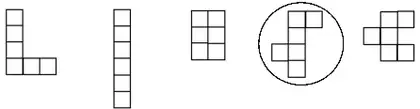
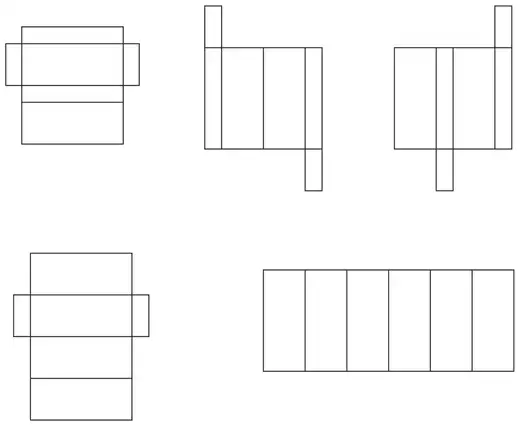
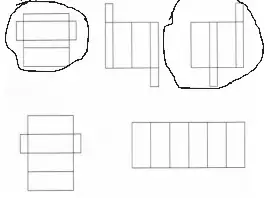
(d) Many of the boxes that BoxCymru use are cuboids. Which of the following nets can be used to make the boxes? Circle your answers. [2]
Mark scheme (a)
Scheme
Marks
Comments
February 2015
B1
Accept Feb for February and 15 for 2015 Do not accept 2, 02 or 2nd for February
Mark scheme (b)
Scheme
Marks
Comments
267
B1
Mark scheme (c)
Scheme
Marks
Comments
01-18/315
B2
Award B1 for sight of either 01(-)18 or 315(th) seen
3. Delyth runs her own business making and selling candles. She makes and sells four types of candle.
Type
Diagram
Name of the 3-D solid
Volume of candle (cm3)
A
……………
240
B
……………
283
C
CONE
270
D
CUBE
120
(a) Fill in the names of the 3-D solids in the table above. [2]
(b)
Delyth uses a formula to work out the mass of wax that is needed to make one candle.
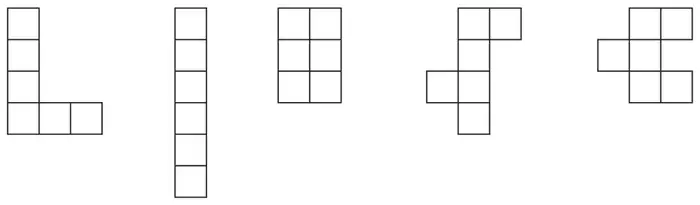
Mass of wax in grams = \(\dfrac{3 \times \text{volume of candle}}{5}\)
(i)
What mass of wax will be needed to make a candle of type C? [2]
Mass of the wax of a candle of type C is …………… grams
(ii) Delyth has enough wax to make 50 candles of type A. How many type D candles can she make with the same amount of wax? [2]
(c)
Delyth also makes small candles. One of these candles fits in a box with a lid. The box is a cube with sides of length 3 cm. Use the centimetre squared paper to draw a net of the box, including the lid. [2]
(d)
In this part of the question, you will be assessed on the quality of your organisation, communication and accuracy in writing.
It costs Delyth £2.35 to make each small candle. It costs 15p to make each box.
Delyth sells 20 candles, each in a separate box, for a total of £84. How much profit does Delyth make? You must show all your working. [3 + 2 OCW]
If no marks awarded SC1 for (3×270)= 810 or \(\left(\frac{270}{5}\right)\) = 54
(b)(ii) 100
B2
Award B1 for 2×120 or 240÷2 or use of 50 and a relationship between 120 and 240 e.g. 50÷2=25. Do not award B1 for 25 unsupported.
Mark scheme (c)
Scheme
Marks
Comments
A correct net of a cube with 6 faces. Lengths of sides of squares 3cm
B1 B1
SC1 for the net of an open box. 5 faces of correct size. Ignore the inclusion of ‘tabs’.
Mark scheme (d)
Scheme
Marks
Comments
(Total cost of 20 candles and boxes) (2.35 + (0.)15) × 20= (£)50
M1 A1
Or equivalent CAO May be implied in further work.
(Profit is £84 − £50=) (£) 34.
B1
Or equivalent FT ‘their (£)50’ provided 20 is used with candles or boxes and ‘their (£)50 < (£)84.
Organisation and communication
OC1
For OC1, candidates will be expected to: • present their response in a structured way • explain to the reader what they are doing at each step of their response • lay out their explanations and working in a way that is clear and logical • write a conclusion that draws together their results and explains what their answer means
Writing
Consistent use of £ and p.
Correct use of = sign.
W1
For W1, candidates will be expected to: • show all their working • make few, if any, errors in spelling, punctuation and grammar • use correct mathematical form in their working • use appropriate terminology, units, etc.
We'd like to use Google Analytics cookies to count visits and see which pages help most. They're optional, and the site works exactly the same either way. Privacy policy