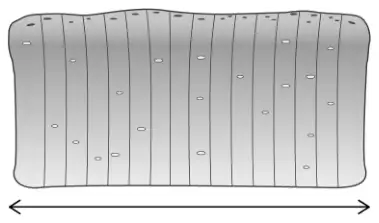
The road is shown on a map with a scale of 1 : 20 000
Work out the length, in centimetres, of this road on the map. (3)
Mark scheme
Answer
Mark
Mark scheme
8
M1
for unit conversion for \(1.6 \times 100\,000\ (= 160\,000\text{ (cm)})\) or \(1.6 \times 1000\ (= 1600\text{ (m)})\) or for \(20\,000 \div 100\,000\ (= 0.2)\) or \(20\,000 \div 100\ (= 200)\) or \(20\,000 \div 1000\ (= 20)\) or \(\text{``}0.00008\text{''} \times 1000\ (= 0.08)\) or \(\text{``}0.00008\text{''} \times 100\,000\ (= 8)\)
M1
for use of scale [distance] \(\div\, 20\,000\) or \(1.6 \div \text{``}0.2\text{''}\) or \(16 \div (\text{``}0.2\text{''} \times 10)\) or \(1.6 \div \text{``}20\text{''}\ (= 0.08)\) or \(\text{``}1600\text{''} \div \text{``}200\text{''}\ (= 8)\) or \(1.6 \div 20\,000\ (= 0.00008)\)
A1
cao
Additional guidance
ie conversions to cm or m Do not award if conversion linked to incorrect unit eg \(1.6 \times 1000 = 1600\) cm Answer of 160 000 centimetres scores M1M0A0
Where [distance] is an attempt at converting km to m or cm, ie figs 16
11 Jamie drives his van for 150 minutes. He stops for a rest. Jamie then drives for a further 75 minutes.
(a) Show that Jamie drives for less than 4 hours in total. (2)
A car travels for 2 hours at a steady speed of 65 mph.
(b) Work out the distance the car travels. (2)
Mark scheme (a)
Answer
Mark
Mark scheme
Shown
M1
for a correct first step, eg method to convert, \(4 \times 60\ (= 240)\) or \(75 \div 60\ (= 1.25)\) or \(150 \div 60\ (= 2.5)\) or accurate converted time shown, eg 1(hr) 15(mins) oe or 2(hrs) 30(mins) oe or adding the two required times \(150 + 75\ (= 225)\)
C1
for accurate figures to compare, eg 240 and 225 (mins) or 3.75(hrs) or 3(hrs) 45(mins) or 15 mins spare (from \(240 - 150 - 75\))
Additional guidance
Units not required but if stated they must be correct.
Units not required but if stated they must be correct. An incorrect conversion will score C0, eg 3.75 incorrectly converted to 3hrs 75mins Figures are enough and a direct comparison to 4 hrs is not needed
11 Elena’s height is 136 centimetres. George’s height is 1.2 metres.
Elena’s height is greater than George’s height.
How many centimetres greater? (2)
Mark scheme
Answer
Mark
Mark scheme
16
M1
for converting, eg \(1.2 \times 100\ (= 120)\) or \(136 \div 100\ (= 1.36)\) or for an answer of 0.16 or for [Elena’s height] \(-\) 1.2 or for 136 \(-\) [George’s height]
A1
cao
Additional guidance
[Elena’s height] = \(13\,600\) or 1360 or 13.6 or 1.36 [George’s height] = 120 or 12 or 0.12 or 0.012
15 A map has a scale of 1 : \(25\,000\) On the map, a road has a length of 14 cm.
Work out the real length of the road. Give your answer in kilometres. (3)
Mark scheme
Answer
Mark
Mark scheme
3.5
M1
for a correct first step, eg \(14 \times 25\,000\ (= 350\,000)\) or digits 14 \(\times\) digits 25 or \(25\,000 \div 100\,000\ (= 0.25)\) oe or \(14 \div 100\,000\ (= 0.00014)\) or [distance] \(\div\ 100\,000\)
M1
for a complete method, eg \(\text{``}350\,000\text{''} \div 100\,000\) oe or \(\text{``}0.25\text{''} \times 14\) or \(\text{``}0.00014\text{''} \times 25\,000\)
A1
for 3.5 oe
Additional guidance
[distance] is any calculated value using digits 14 and digits 25
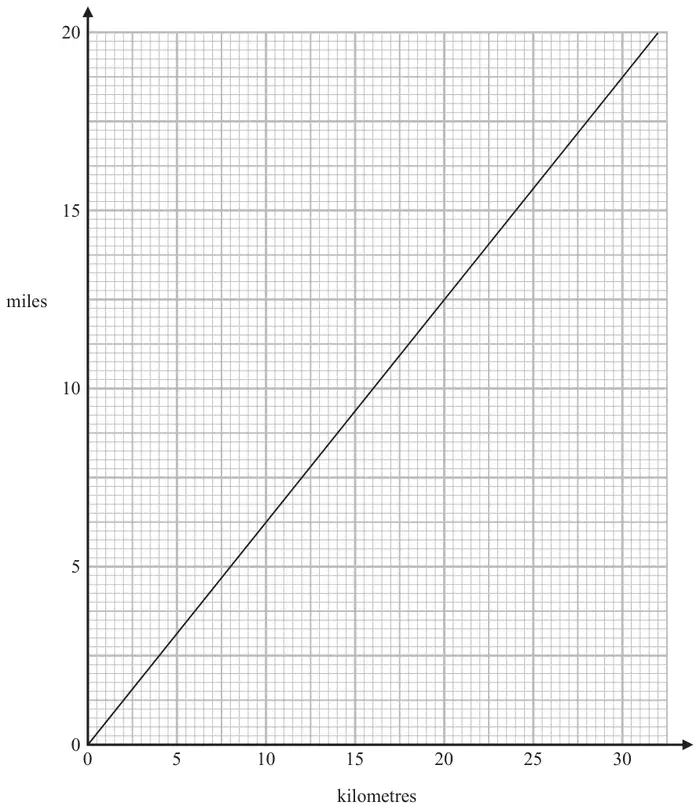
11 You can use this graph to change between miles and kilometres.
(a) Change 10 miles into kilometres. (1)
Rob drives 17 miles from Bridlington to Scarborough. He then drives 50 kilometres from Scarborough to Staithes.
(b) What is the total distance Rob drives? Give your answer in miles. (3)
Mark scheme (a)
Answer
Mark
Mark scheme
16
B1
cao
Mark scheme (b)
Answer
Mark
Mark scheme
48
M1
for taking a suitable reading from the graph that could be used to convert, eg 25 km = 15.5 miles or 17 miles = 27.2 km
M1
ft, for a complete method, eg \(\text{``}15.5\text{''} \times 2 + 17\) or \((\text{``}27.2\text{''} + 50) \div 1.6\)
A1
for an answer in the range 47 – 49.5
Additional guidance
Allow a tolerance of one small square for the reading eg 10 km = 6 – 6.5 miles 20 km = 12.25 – 12.75 miles 25 km = 15.25 – 15.75 miles 30 km = 18.5 – 19 miles for miles to km allow 1 mile = 1.6 km 17 miles = 27 – 28 km
For ft, allow use of their stated conversions but they must be conversions that could have come from graph
10 Here is part of a train timetable between Horwich and Manchester.
Horwich
07 13
07 46
08 14
08 44
09 14
Lostock
07 16
08 17
09 17
Bolton
07 21
07 54
08 22
08 52
09 22
Salford
07 36
08 05
08 36
09 05
09 36
Manchester
07 47
08 15
08 45
09 15
09 45
(a) How long should the 07 46 train from Horwich take to get to Salford? (1)
Barnie has a job interview in Manchester.
Barnie takes 6 minutes to walk from his home to the station in Lostock. He will take 8 minutes to walk from the station in Manchester to his interview.
Barnie needs to be at the interview no later than 09 00
(b) (i) What is the latest time Barnie can leave his house and be on time for the interview? (3)
The time of Barnie’s interview is changed. Now he has to be at the interview no later than 09 15
(ii) What effect does the change of time have on the latest time Barnie can leave his house? (1)
Mark scheme (a)
Answer
Mark
Mark scheme
19
B1
cao
Mark scheme (b)
Answer
Mark
Mark scheme
(i) 08 11
P1
for a correct first step, eg 09 00 – 8 (= 08 52) or for recognising which train he needs to get eg 08 17 or 08 45
P1
for a complete process to find the latest time he can leave his house, eg 08 17 – 6
A1
allow 8:11(am)
Award SCB2 for an answer of 08 08 or 08 09 if P0 or P1 scored
(ii) No effect
C1
ft, for ‘no effect’ oe eg ‘the next train would make it too late to the meeting’, allow ‘he can leave later’ oe if an earlier train was selected in (i)
Additional guidance
(ii) Reason not required but if a reason is given and it contradicts the answer, award 0 marks
(a) On Monday, Larrs swims 50 metres in 40 seconds at a constant speed.
On Tuesday, Larrs swims 1.5 kilometres.
Assume he swims at the same constant speed as on Monday.
How many minutes does he swim for on Tuesday? [5 marks]
(b) In fact, on Tuesday Larrs swims at a slower constant speed than on Monday.
What does this mean about the number of minutes he swims for on Tuesday?
Tick the correct box. [1 mark]
It is less than the answer to part (a)
It is the same as the answer to part (a)
It is greater than the answer to part (a)
It is not possible to say
Mark scheme (a)
Answer
Mark
Comments
Alternative method 1: working in metres per second or kilometres per second
1500 (metres) or 0.05 (km)
B1
implied by 30 or 1200
their \(1500 \div 50 \times 40\) or \(1.5 \div\) their \(0.05 \times 40\) or 1200
M2
oe M1 their \(1500 \div 50\) or 30 oe or \(50 \div 40\) or 1.25 oe or \(1.5 \div\) their 0.05 oe their 1500 must be using digits 15 (and zeros) their 0.05 must be using single digit 5 (and zeros)
their \(1200 \div 60\)
M1dep
oe dep on M2
20
A1ft
ft their 1500 or their 0.05
Alternative method 2: working in metres per minute or kilometres per minute
1500 (metres) or 0.05 (km)
B1
implied by 0.075
\(40 \div 60\) or \(\dfrac{2}{3}\)
M1
oe accept [0.66, 0.67]
\(50 \div (40 \div 60)\) or 75 or \(\dfrac{\text{their } 0.05}{(40 \div 60)}\) or 0.075 or their \(1500 \times (40 \div 60)\)
M1dep
oe calculation their 1500 must be using digits 15 (and zeros) their 0.05 must be using single digit 5 (and zeros)
their \(1500 \div\) their 75 or \(1.5 \div\) their 0.075 or their \(1500 \times (40 \div 60) \div 50\)
M1dep
oe
20
A1ft
ft their 1500 or their 0.05
Additional guidance
\(1500 \div 1.25\)
B1M2
\(1.5 \div 50 \times 40\) their 1500 must be using digits 15 (and zeros)
B0M2
\(1.5 \div 0.5 \times 40\) their 0.05 must be using single digit 5 (and zeros)
B0M2
\(150 \div 50\) their 1500 must be using digits 15 (and zeros)
B1 50 10 10 1 in any order without all units or set of valid coins that make 71p (with correct units or without units) eg 10 1 20 20 20 or 50 20 1
Additional guidance
Units may be seen in the working but missing on the answer line for B2
50p 10p 10p 1p in working with answer 0.50p 0.10p 0.10p 0.01p
B1
Accept £0.50, condone £0.50p Units of the form 0.50p are incorrect If all four coins are in a consistent form to show 50 10 10 1 eg 0.50p 0.10p 0.10p 0.01p condone for B1
He takes \(3\dfrac{3}{4}\) hours to finish the race.
At what time does he finish? [2 marks]
(b) Rachel has a target time of 4 hours 10 minutes.
She has been running for 186 minutes.
To meet her target, how many minutes does she have left to finish the race? [3 marks]
Mark scheme (a)
Answer
Mark
Comments
3 h 45 min or \(9.15 + 3 + 45\) or \(9.15 + 4 - 15\) or 1.15 (pm) \(-\) 15 or \(9\dfrac{1}{4} + 3\dfrac{3}{4}\) or 13(.00 am) or 1 (o’clock) or 1(.00 am)
M1
oe condone mixed units
13.00 or 1(.00) pm
A1
Additional guidance
Condone 13.00 pm
M1A1
\(9.15 + 3\dfrac{3}{4}\) or \(12.15 + \dfrac{3}{4}\) without valid further working
M0A0
Mark scheme (b)
Answer
Mark
Comments
Alternative method 1 – working in minutes
\(4 \times 60 + 10\) or 250
M1
oe
their \(250 - 186\)
M1
oe their 250 must be \(\gt 186\)
64
A1
SC2 69 SC1 224
Alternative method 2 – working in hours
\(186 \div 60\) or 3 h 6 min
M1
oe implied by 3.1 or 1 h 4 min
4 h 10 min − their 3 h 6 min or 1 h 4 min
M1
oe their 3 h 6 min must be \(\lt\) 4 h 10 min
64
A1
SC2 69 SC1 224
Additional guidance
SC2 comes from incorrect conversion of 3.1 h to 3 h 1 min SC1 comes from use of 100 min in an hour
11 A television channel shows 12 minutes of adverts in each half hour.
How many minutes of adverts does it show from 5 am to 11 pm? [3 marks]
Mark scheme
Answer
Mark
Comments
Alternative method 1
18 (hours) or 36 (half hours) or 24 (minutes per hour)
B1
their hours \(\times 2 \times 12\) implies 24
\(18 \times 2 \times 12\) or \(18 \times 24\) or their hours \(\times 2 \times 12\) or their hours \(\times 24\) or \(36 \times 12\) or their half hours \(\times 12\)
M1
oe
432
A1
Ignore fw in an attempt to convert 432 minutes to hours and minutes
Alternative method 2
Build up method using 12 minutes or 24 minutes with at least three additions
M1
36 additions using 12 minutes or 18 additions using 24 minutes
M1dep
432
A1
Ignore fw in an attempt to convert 432 minutes to hours and minutes
Additional guidance
7 hours 12 minutes with 432 in working
B1M1A1
7.2 hours or 7 hours 20 minutes with 432 in working
Condone division of their number of hours by 2 to imply an attempt to calculate their number of half hours eg 10 hours \(10 \div 2 = 5\) (half hours) \(5 \times 12\) 60