25 In London, 2 kg of carrots cost £3.75 In New York, 5 lbs of carrots cost 4.90 US dollars.
£1 = 1.20 US dollars 1 kg = 2.2 lbs
In which city are carrots better value for money, London or New York? You must show how you get your answer. (4)
Mark scheme
Answer
Mark
Mark scheme
New York (supported)
P1
for a conversion between kg and lbs, eg \(2 \times 2.2\ (= 4.4)\) or \(5 \div 2.2\ (= 2.27\ldots)\)
P1
for a conversion between pounds and US dollars, eg \(3.75 \times 1.2(0)\ (= 4.50)\) or \(4.9(0) \div 1.2(0)\ (= 4.08\ldots)\)
P1
for a process to find figures to compare, eg \(3.75 \div \text{``}4.4\text{''}\ (= 0.85\ldots)\) and \(\text{``}4.08\ldots\text{''} \div 5\ (= 0.81(6\ldots))\) or \(\text{``}4.50\text{''} \div 2\ (= 2.25)\) and \(4.9(0) \div \text{``}2.27\ldots\text{''}\ (= 2.15(6\ldots))\) or \(\text{``}4.4\text{''} \div 3.75\ (= 1.17\ldots)\) and \(5 \div \text{``}4.08\text{''}\ (= 1.22\ldots)\) or \(2 \div \text{``}4.5\text{''}\ (= 0.44\ldots)\) and \(\text{``}2.27\text{''} \div 4.9(0)\ (= 0.46\ldots)\)
C1
for New York with correct comparable figures, eg 0.85 and 0.81(6…) OR 2.25 and 2.15(6…)
Additional guidance
See page at end of mark scheme
£ per lb US dollars per kg lbs per £ kg per US dollar
Condone the incorrect assignment of units for all 3 P marks
Final comparable values can be truncated or rounded, they just need to be accurate enough to allow a comparison
Question 25 – Additional information - NOT Exhaustive
Final comparable values can be truncated or rounded and just need to be accurate enough to allow a comparison
Cost per lb in \(\$\): \(2 \times 2.2\ (= 4.4)\) \(3.75 \times 1.2(0)\ (= 4.5)\) \(\text{``}4.5\text{''} \div \text{``}4.4\text{''}\ (= 1.02\ldots)\) and \(4.9(0) \div 5\ (= 0.98)\) New York and 1.02… and 0.98
Cost per lb in £: \(2 \times 2.2\ (= 4.4)\) \(4.9(0) \div 1.2(0)\ (= 4.08\ldots)\) \(3.75 \div \text{``}4.4\text{''}\ (= 0.85\ldots)\) and \(\text{``}4.08\ldots\text{''} \div 5\ (= 0.81(6\ldots))\) New York and 0.85… and 0.81(6…)
Cost per kg in \(\$\): \(5 \div 2.2\ (= 2.27\ldots)\) \(3.75 \times 1.2(0)\ (= 4.5)\) \(\text{``}4.5\text{''} \div 2\ (= 2.25)\) and \(4.9(0) \div \text{``}2.27\ldots\text{''}\ (= 2.15(6))\) New York and 2.25 and 2.15(6)
Cost per kg in £: \(5 \div 2.2\ (= 2.27\ldots)\) \(4.9(0) \div 1.2(0)\ (= 4.08\ldots)\) \(3.75 \div 2\ (= 1.87(5))\) and \(\text{``}4.08\ldots\text{''} \div \text{``}2.27\ldots\text{''}\ (= 1.79(6\ldots))\) New York and 1.87(5) and 1.79(6…)
Number of lbs per \(\$\): \(2 \times 2.2\ (= 4.4)\) \(3.75 \times 1.2(0)\ (= 4.5)\) \(\text{``}4.4\text{''} \div \text{``}4.5\text{''}\ (= 0.97(7\ldots))\) and \(5 \div 4.9(0)\ (= 1.02\ldots)\) New York and 0.97(7…) and 1.02…
Number of lbs per £: \(2 \times 2.2\ (= 4.4)\) \(4.9(0) \div 1.2(0)\ (= 4.08\ldots)\) \(\text{``}4.4\text{''} \div 3.75\ (= 1.17\ldots)\) and \(5 \div \text{``}4.08\ldots\text{''}\ (= 1.22\ldots)\) New York and 1.17… and 1.22…
Number of kg per \(\$\): \(5 \div 2.2\ (= 2.27\ldots)\) \(3.75 \times 1.2(0)\ (= 4.5)\) \(2 \div \text{``}4.5\text{''}\ (= 0.44\ldots)\) and \(\text{``}2.27\ldots\text{''} \div 4.9(0)\ (= 0.46\ldots)\) New York and 0.44… and 0.46…
Number of kg per £: \(5 \div 2.2\ (= 2.27\ldots)\) \(4.9(0) \div 1.2(0)\ (= 4.08\ldots)\) \(2 \div 3.75\ (= 0.53\ldots)\) and \(\text{``}2.27\ldots\text{''} \div \text{``}4.08\ldots\text{''}\ (= 0.55(6\ldots))\) New York and 0.53… and 0.55(6…)
Cost of 5 lb in \(\$\): \(2 \times 2.2\ (= 4.4)\) \(3.75 \times 1.2(0)\ (= 4.5)\) \(\text{``}4.5\text{''} \div \text{``}4.4\text{''} \times 5\ (= 5.11\ldots)\) New York and 5.11…
Cost of 5 lb in £: \(2 \times 2.2\ (= 4.4)\) \(4.9(0) \div 1.2(0)\ (= 4.08\ldots)\) \(3.75 \div \text{``}4.4\text{''} \times 5\ (= 4.26\ldots)\) New York and 4.08… and 4.26…
Cost of 2 kg in \(\$\): \(5 \div 2.2\ (= 2.27\ldots)\) \(3.75 \times 1.2(0)\ (= 4.5)\) \(4.9(0) \div \text{``}2.27\ldots\text{''} \times 2\ (= 4.31\ldots)\) New York and 4.5 and 4.31…
Cost of 2 kg in £: \(5 \div 2.2\ (= 2.27\ldots)\) \(4.9(0) \div 1.2(0)\ (= 4.08\ldots)\) \(\text{``}4.08\ldots\text{''} \div \text{``}2.27\ldots\text{''} \times 2\ (= 3.59\ldots)\) New York and 3.59…
22 There are 280 chocolates in a box. There are only dark chocolates, milk chocolates and white chocolates.
\(\dfrac{1}{7}\) of the 280 chocolates are dark chocolates.
The number of milk chocolates : the number of white chocolates = 1 : 3
The number of white chocolates : the number of dark chocolates = \(n : 1\)
(a) Work out the value of \(n\). You must show all your working. (5)
10 milk chocolates from the box are eaten.
(b) Does this affect your answer to part (a)? Give a reason for your answer. (1)
Mark scheme (a)
Answer
Mark
Mark scheme
4.5
P1
for a process to find the number of dark chocolates, eg \(280 \times \dfrac{1}{7}\) oe (= 40)
P1
for a process to find one part of the ratio for milk chocolates to white chocolates eg \((280 - \text{``}40\text{''}) \div (1 + 3)\ (= 60)\)
P1
for process to find the number of white chocolates, eg \(\text{``}60\text{''} \times 3\ (= 180)\) or \(280 - \text{``}40\text{''} - \text{``}60\text{''}\ (= 180)\)
P1
for a ratio of white chocolates : dark chocolates eg \(\text{``}180\text{''} : \text{``}40\text{''}\) oe or for a process to find the value of \(n\) eg \(\text{``}180\text{''} \div \text{``}40\text{''}\)
A1
(dep P3) for 4.5 oe
Additional guidance
Condone milk, white incorrectly labelled
Labels not required for this mark, but if seen must be correct Must be a 2-part ratio. Allow \(\text{``}40\text{''} : \text{``}180\text{''}\) if labelled as dark chocolate : white chocolate oe
A correct answer with no supportive working gets 0 marks Condone answer of 4.5:1
Mark scheme (b)
Answer
Mark
Mark scheme
No with reason
C1
for No with reason Acceptable examples No, the number of dark chocolates and white chocolates has not changed No, the ratio of \(n\):1 only involved white and dark chocolates No, eating milk chocolates doesn’t change the rest No, the ratio of dark to white chocolates doesn’t change. Not acceptable examples Yes,… No, it doesn’t matter how many milk chocolates are eaten No, the number of white chocolates doesn’t change No, the number of dark chocolates doesn’t change
Additional guidance
Reason must refer to or imply both dark and white chocolates
21 Sid, Tam and Musa share £6900 in the ratio 2 : 3 : 5
Work out how much money each person receives. (3)
Mark scheme
Answer
Mark
Mark scheme
1380 2070 3450
M1
for beginning to work with ratio, eg \(6900 \div (2 + 3 + 5)\ (= 690)\) or \(6900 \div 2\ (= 3450)\) or \(6900 \div 5\ (= 1380)\) or one accurate value correctly assigned
M1
for full method to find the value for two people, eg two of: \(\text{``}690\text{''} \times 2\ (= 1380)\) or \(\text{``}690\text{''} \times 3\ (= 2070)\) or \(\text{``}690\text{''} \times 5\ (= 3450)\) or \((6900 - \text{``}3450\text{''}) \div 5 \times 2\ (= 1380)\) or \((6900 - \text{``}3450\text{''}) \div 5 \times 3\ (= 2070)\) or \((6900 - \text{``}1380\text{''}) \div 8 \times 3\ (= 2070)\) or \((6900 - \text{``}1380\text{''}) \div 8 \times 5\ (= 3450)\) or \(6900 \div 2\ (= 3450)\) and \(6900 \div 5\ (= 1380)\)
A1
for Sid (£) 1380 Tam (£) 2070 Musa (£) 3450
If M1M0, award SCB2 for Sid (£) 3450 Tam (£) 2070 Musa (£) 1380
Additional guidance
Award M0 for a correct value assigned to an incorrect person
Award M0 for a correct value assigned to an incorrect person
Correct values not assigned or assigned to an incorrect person, coming from an incorrect method, eg (Sid =) \(6900 \div 2 = 3450\) and (Tam =) \(6900 \div 3 = 2300\) and (Musa =) \(6900 \div 5 = 1380\) will score no marks
17 Sam wants to use this recipe to make 15 pancakes.
Ingredients for 10 pancakes
100 g flour 200 m\(l\) milk 40 g butter 2 eggs
Sam has 200 g flour 250 m\(l\) milk 70 g butter 5 eggs
Does Sam have enough flour, enough milk, enough butter and enough eggs to make 15 pancakes? You must show all your working. (3)
Mark scheme
Answer
Mark
Mark scheme
No, not enough milk (supported)
Process to find amount needed (starting from recipe quantities)
P1
for a correct process to find amount needed of one ingredient, eg \(100 \div 10 \times 15\) oe (= 150) or \(200 \div 10 \times 15\) oe (= 300) or \(100 \div 2 + 100\ (= 150)\) or \(200 \div 2 + 200\ (= 300)\) or \(40 \div 2 \times 3\) oe (= 60) or \(2 \div 2 \times 3\) oe (= 3) or scale factor of 1.5 seen
P1
for a correct process to find amount needed of all the ingredients, eg \(100 \div 10 \times 15\) oe (= 150) and \(200 \div 10 \times 15\) oe (= 300) and \(40 \div 10 \times 15\) oe (= 60) and \(2 \div 10 \times 15\) oe (= 3)
C1
for statement that there is not enough milk with supporting evidence
OR Process to find quantity of pancakes that can be made (working from the quantities of ingredients available)
P1
for a correct process to find the number of pancakes that can be made with one ingredient, eg \(200 \div 100 \times 10\) oe (= 20) or \(250 \div 200 \times 10\) oe (= 12.5) or \(70 \div 40 \times 10\) oe (= 17.5) or \(5 \div 2 \times 10\) oe (= 25)
P1
for a correct process to find the number of pancakes all ingredients could produce eg \(200 \div 100 \times 10\) oe (= 20) and \(250 \div 200 \times 10\) oe (= 12.5) and \(70 \div 40 \times 10\) oe (= 17.5) and \(5 \div 2 \times 10\) oe (= 25)
C1
for statement that there is not enough milk with supporting evidence
Additional guidance
C1 (both methods): Must have correct figures for all ingredients, but it is not necessary to comment on the other ingredients. Any comment on the other ingredients must be correct.
Second method, first P1: Award this mark for a complete process to find the amount of ingredients for a quantity of pancakes that uses all of one of the ingredients eg process to find amount of ingredients for 20 pancakes (flour).
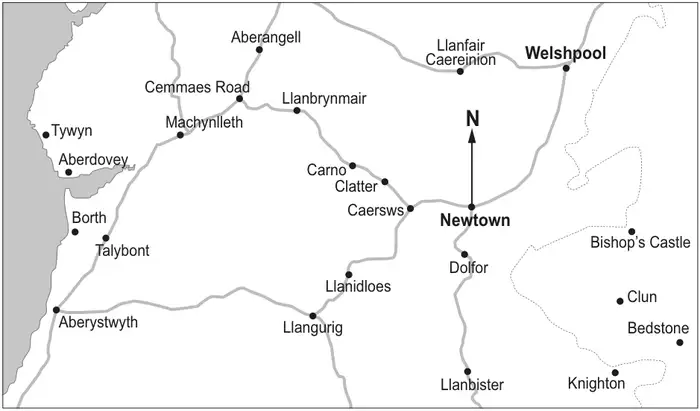
The road is shown on a map with a scale of 1 : 20 000
Work out the length, in centimetres, of this road on the map. (3)
Mark scheme
Answer
Mark
Mark scheme
8
M1
for unit conversion for \(1.6 \times 100\,000\ (= 160\,000\text{ (cm)})\) or \(1.6 \times 1000\ (= 1600\text{ (m)})\) or for \(20\,000 \div 100\,000\ (= 0.2)\) or \(20\,000 \div 100\ (= 200)\) or \(20\,000 \div 1000\ (= 20)\) or \(\text{``}0.00008\text{''} \times 1000\ (= 0.08)\) or \(\text{``}0.00008\text{''} \times 100\,000\ (= 8)\)
M1
for use of scale [distance] \(\div\, 20\,000\) or \(1.6 \div \text{``}0.2\text{''}\) or \(16 \div (\text{``}0.2\text{''} \times 10)\) or \(1.6 \div \text{``}20\text{''}\ (= 0.08)\) or \(\text{``}1600\text{''} \div \text{``}200\text{''}\ (= 8)\) or \(1.6 \div 20\,000\ (= 0.00008)\)
A1
cao
Additional guidance
ie conversions to cm or m Do not award if conversion linked to incorrect unit eg \(1.6 \times 1000 = 1600\) cm Answer of 160 000 centimetres scores M1M0A0
Where [distance] is an attempt at converting km to m or cm, ie figs 16
4 There are 280 chocolates in a box. There are only dark chocolates, milk chocolates and white chocolates.
\(\dfrac{1}{7}\) of the 280 chocolates are dark chocolates.
The number of milk chocolates : the number of white chocolates = 1 : 3
The number of white chocolates : the number of dark chocolates = \(n : 1\)
(a) Work out the value of \(n\). You must show all your working. (5)
10 milk chocolates from the box are eaten.
(b) Does this affect your answer to part (a)? Give a reason for your answer. (1)
Mark scheme (a)
Answer
Mark
Mark scheme
4.5
P1
for a process to find the number of dark chocolates, eg \(280 \times \dfrac{1}{7}\) oe (= 40)
P1
for a process to find one part of the ratio for milk chocolates to white chocolates eg \((280 - \text{``}40\text{''}) \div (1 + 3)\ (= 60)\)
P1
for a process to find the number of white chocolates, eg \(\text{``}60\text{''} \times 3\ (= 180)\) or \(280 - \text{``}40\text{''} - \text{``}60\text{''}\ (= 180)\)
P1
for a ratio of white chocolates : dark chocolates eg \(\text{``}180\text{''} : \text{``}40\text{''}\) oe or for a process to find the value of \(n\) eg \(\text{``}180\text{''} \div \text{``}40\text{''}\)
A1
(dep P3) for 4.5 oe
Additional guidance
Condone milk, white incorrectly labelled
Labels not required for this mark, but if seen must be correct Must be a 2-part ratio Allow \(\text{``}40\text{''} : \text{``}180\text{''}\) if labelled as dark chocolate : white chocolate oe
A correct answer with no supportive working gets 0 marks Condone answer of 4.5 : 1
Mark scheme (b)
Answer
Mark
Mark scheme
No with reason
C1
for No with reason Acceptable examples No, the number of dark chocolates and white chocolates has not changed No, the ratio of \(n\):1 only involved white and dark chocolates No, eating milk chocolates doesn’t change the rest No, the ratio of dark to white chocolates doesn’t change Not acceptable examples Yes,… No, it doesn’t matter how many milk chocolates are eaten No, the number of white chocolates doesn’t change No, the number of dark chocolates doesn’t change
Additional guidance
Reason must refer to or imply both dark and white chocolates
4 In London, 2 kg of carrots cost £3.75 In New York, 5 lbs of carrots cost 4.90 US dollars.
£1 = 1.20 US dollars 1 kg = 2.2 lbs
In which city are carrots better value for money, London or New York? You must show how you get your answer. (4)
Mark scheme
Answer
Mark
Mark scheme
New York (supported)
P1
for a conversion between kg and lbs, eg \(2 \times 2.2\ (= 4.4)\) or \(5 \div 2.2\ (= 2.27\ldots)\)
P1
for a conversion between pounds and US dollars, eg \(3.75 \times 1.2(0)\ (= 4.50)\) or \(4.9(0) \div 1.2(0)\ (= 4.08\ldots)\)
P1
for a process to find figures to compare, eg \(3.75 \div \text{``}4.4\text{''}\ (= 0.85\ldots)\) and \(\text{``}4.08\ldots\text{''} \div 5\ (= 0.81(6\ldots))\) or \(\text{``}4.50\text{''} \div 2\ (= 2.25)\) and \(4.9(0) \div \text{``}2.27\ldots\text{''}\ (= 2.15(6\ldots))\) or \(\text{``}4.4\text{''} \div 3.75\ (= 1.17\ldots)\) and \(5 \div \text{``}4.08\text{''}\ (= 1.22\ldots)\) or \(2 \div \text{``}4.5\text{''}\ (= 0.44\ldots)\) and \(\text{``}2.27\text{''} \div 4.9(0)\ (= 0.46\ldots)\)
C1
for New York with correct comparable figures, eg 0.85… and 0.81(6…) OR 2.25 and 2.15(6…)
Additional guidance
See page at end of mark scheme
£ per lb US dollars per kg lbs per £ kg per US dollar
Condone the incorrect assignment of units for all 3 P marks
Final comparable values can be rounded or truncated, they just need to be accurate enough to allow a comparison.
Question 4 – Additional information NOT Exhaustive
Final comparable values, can be truncated or rounded, they just need to be accurate enough to allow a comparison
Cost per lb in \(\$\): \(2 \times 2.2\ (= 4.4)\) \(3.75 \times 1.2(0)\ (= 4.5)\) \(\text{``}4.5\text{''} \div \text{``}4.4\text{''}\ (= 1.02\ldots)\) and \(4.9(0) \div 5\ (= 0.98)\) New York and 1.02… and 0.98
Cost per lb in £: \(2 \times 2.2\ (= 4.4)\) \(4.9(0) \div 1.2(0)\ (= 4.08\ldots)\) \(3.75 \div \text{``}4.4\text{''}\ (= 0.85\ldots)\) and \(\text{``}4.08\ldots\text{''} \div 5\ (= 0.81(6\ldots))\) New York and 0.85… and 0.81(6…)
Cost per kg in \(\$\): \(5 \div 2.2\ (= 2.27\ldots)\) \(3.75 \times 1.2(0)\ (= 4.5)\) \(\text{``}4.5\text{''} \div 2\ (= 2.25)\) and \(4.9(0) \div \text{``}2.27\ldots\text{''}\ (= 2.15(6))\) New York and 2.25 and 2.15(6)
Cost per kg in £: \(5 \div 2.2\ (= 2.27\ldots)\) \(4.9(0) \div 1.2(0)\ (= 4.08\ldots)\) \(3.75 \div 2\ (= 1.87(5))\) and \(\text{``}4.08\ldots\text{''} \div \text{``}2.27\ldots\text{''}\ (= 1.79(6\ldots))\) New York and 1.87(5) and 1.79(6…)
Number of lbs per \(\$\): \(2 \times 2.2\ (= 4.4)\) \(3.75 \times 1.2(0)\ (= 4.5)\) \(\text{``}4.4\text{''} \div \text{``}4.5\text{''}\ (= 0.97(7\ldots))\) and \(5 \div 4.9(0)\ (= 1.02\ldots)\) New York and 0.97(7…) and 1.02…
Number of lbs per £: \(2 \times 2.2\ (= 4.4)\) \(4.9(0) \div 1.2(0)\ (= 4.08\ldots)\) \(\text{``}4.4\text{''} \div 3.75\ (= 1.17\ldots)\) and \(5 \div \text{``}4.08\ldots\text{''}\ (= 1.22\ldots)\) New York and 1.17… and 1.22…
Number of kg per \(\$\): \(5 \div 2.2\ (= 2.27\ldots)\) \(3.75 \times 1.2(0)\ (= 4.5)\) \(2 \div \text{``}4.5\text{''}\ (= 0.44\ldots)\) and \(\text{``}2.27\ldots\text{''} \div 4.9(0)\ (= 0.46\ldots)\) New York and 0.44… and 0.46…
Number of kg per £: \(5 \div 2.2\ (= 2.27\ldots)\) \(4.9(0) \div 1.2(0)\ (= 4.08\ldots)\) \(2 \div 3.75\ (= 0.53\ldots)\) and \(\text{``}2.27\ldots\text{''} \div \text{``}4.08\ldots\text{''}\ (= 0.55(6\ldots))\) New York and 0.53… and 0.55(6…)
Cost of 5 lb in \(\$\): \(2 \times 2.2\ (= 4.4)\) \(3.75 \times 1.2(0)\ (= 4.5)\) \(\text{``}4.5\text{''} \div \text{``}4.4\text{''} \times 5\ (= 5.11\ldots)\) New York and 5.11…
Cost of 5 lb in £: \(2 \times 2.2\ (= 4.4)\) \(4.9(0) \div 1.2(0)\ (= 4.08\ldots)\) \(3.75 \div \text{``}4.4\text{''} \times 5\ (= 4.26\ldots)\) New York and 4.08… and 4.26…
Cost of 2 kg in \(\$\): \(5 \div 2.2\ (= 2.27\ldots)\) \(3.75 \times 1.2(0)\ (= 4.5)\) \(4.9(0) \div \text{``}2.27\ldots\text{''} \times 2\ (= 4.31\ldots)\) New York and 4.5 and 4.31…
Cost of 2 kg in £: \(5 \div 2.2\ (= 2.27\ldots)\) \(4.9(0) \div 1.2(0)\ (= 4.08\ldots)\) \(\text{``}4.08\ldots\text{''} \div \text{``}2.27\ldots\text{''} \times 2\ (= 3.59\ldots)\) New York and 3.59…
2 Sid, Tam and Musa share £6900 in the ratio 2 : 3 : 5
Work out how much money each person receives. (3)
Mark scheme
Answer
Mark
Mark scheme
1380 2070 3450
M1
for beginning to work with ratio, eg \(6900 \div (2 + 3 + 5)\ (= 690)\) or \(6900 \div 2\ (= 3450)\) or \(6900 \div 5\ (= 1380)\) or one accurate value correctly assigned
M1
for full method to find the value for two people, eg two of: \(\text{``}690\text{''} \times 2\ (= 1380)\) or \(\text{``}690\text{''} \times 3\ (= 2070)\) or \(\text{``}690\text{''} \times 5\ (= 3450)\) or \((6900 - \text{``}3450\text{''}) \div 5 \times 2\ (= 1380)\) or \((6900 - \text{``}3450\text{''}) \div 5 \times 3\ (= 2070)\) or \((6900 - \text{``}1380\text{''}) \div 8 \times 3\ (= 2070)\) or \((6900 - \text{``}1380\text{''}) \div 8 \times 5\ (= 3450)\) or \(6900 \div 2\ (= 3450)\) and \(6900 \div 5\ (= 1380)\)
A1
for Sid (£) 1380 Tam (£) 2070 Musa (£) 3450
If M1M0, award SCB2 for Sid (£) 3450 Tam (£) 2070 Musa (£) 1380
Additional guidance
Award M0 for a correct value assigned to an incorrect person
Award M0 for a correct value assigned to an incorrect person
Correct values not assigned or assigned to an incorrect person, coming from an incorrect method, eg (Sid =) \(6900 \div 2 = 3450\) and (Tam =) \(6900 \div 3 = 2300\) and (Musa =) \(6900 \div 5 = 1380\) will score no marks
In London, a 200 g Choci bar costs £3.50 In Zurich, a 360 g Choci bar costs 7.20 Swiss francs.
The exchange rate is £1 = 1.25 Swiss francs.
In which city is the Choci bar the better value for money, in London or in Zurich? You must show how you get your answer. (3)
Mark scheme
Answer
Mark
Mark scheme
Zurich (supported)
P1
for one process to compare, eg eg Currency conversion, \(3.5 \times 1.25\ (= 4.375)\) or \(7.20 \div 1.25\ (= 5.76)\) or finds 1g in one place £3.50 \(\div 200\ (= 0.0175)\) or \(7.20 \div 360\ (= 0.02)\) or finds 200g in Zurich, \(7.2 \div 360 \times 200\ (= 4.0)\) or finds 360g in London, \(3.5 \div 200 \times 360\ (= 6.30)\) or finds grams per unit cost, \(200 \div 3.50\ (= 57.1\ldots)\) or \(360 \div 7.20\ (= 50)\)
P1
for a complete process to find comparable figures in the same currency, eg comparing 200g in £ or francs \(3.5 \times 1.25\ (= 4.375)\) and \(7.2 \div 360 \times 200\ (= 4.0)\) or \(\text{``}4.0\text{''} \div 1.25\ (= 3.20)\)
OR comparing 360g in £ or francs \(\text{``}6.30\text{''} \times 1.25\ (= 7.875)\) or \(3.5 \div 200 \times 360\ (= 6.30)\) and \(7.20 \div 1.25\ (= 5.76)\)
OR comparing 1g in £ or francs \(\text{``}0.0175\text{''} \times 1.25\ (= 0.0218\ldots)\) and \(7.20 \div 360\ (= 0.02)\) or £3.50 \(\div 200\ (= 0.0175)\) and \(\text{``}0.02\text{''} \div 1.25\ (= 0.016)\)
OR comparing quantity per unit cost in £ or francs \(200 \div 3.50\ (= 57.1\ldots)\) and \(360 \div \text{``}5.76\text{''}\ (= 62.5)\) or \(200 \div \text{``}4.375\text{''}\ (= 45.7\ldots)\) and \(360 \div 7.20\ (= 50)\)
C1
for Zurich supported by correct comparable values, eg 4.3(75 F) and 4(.0 F) or (£)3.2(0) or 7.8(75 F) or (£)6.3(0) and (£)5.76 or 0.021(8… F) and 0.02 (F) or (£)0.017(5) and (£)0.016 or 57(.1… g/£) and 62(.5 g/£) or 45(.7… g/F) and 50 (g/F)
Additional guidance
Accept figures rounded or truncated to 2sf throughout
Accept working in pence Ignore incorrect units for P marks Award of this mark implies the previous mark
Clear indication that bar is better value for money in Zurich supported by correct values for comparison Units not needed but if stated must be correct. Table with examples at end of mark scheme
21 Robyn buys a total of 240 pens and pencils, where
number of pens : number of pencils = 3 : 5
Robyn pays 9p for each pen. She sells each pen for 11p.
Robyn pays 6p for each pencil. She sells each pencil for 10p.
Robyn sells all of the pens and pencils.
Work out Robyn’s percentage profit. Give your answer correct to 1 decimal place. You must show all your working. (5)
Mark scheme
Answer
Mark
Mark scheme
45.6
P1
for a process to start to work with the ratio, eg \(240 \div (3 + 5)\ (= 30)\) or pens \(= 3n\) and pencils \(= 5n\) where \(n\) is a positive integer
P1
for a complete process to find the number of pens and pencils, eg \(\text{``}30\text{''} \times 3\ (= 90)\) and \(\text{``}30\text{''} \times 5\ (= 150)\) OR for process to find one cost or amount to sell for one item eg \([\text{pens}] \times 9\ (= 810)\) or \([\text{pens}] \times 11\ (= 990)\) or \([\text{pencils}] \times 6\ (= 900)\) or \([\text{pencils}] \times 10\ (= 1500)\) OR for process to find the profit for one pen or one pencil eg \(11 - 9\ (= 2)\) or \(10 - 6\ (= 4)\)
P1
for a process to find the total cost to buy or the total amount to sell for both, eg \([\text{pens}] \times 9 + [\text{pencils}] \times 6\ (= 1710)\) or \([\text{pens}] \times 11 + [\text{pencils}] \times 10\ (= 2490)\) OR process to find the profit for one item eg \([\text{pens}] \times 11 - [\text{pens}] \times 9\ (= 180)\) or \([\text{pens}] \times (11 - 9)\ (= 180)\) or \([\text{pencils}] \times 10 - [\text{pencils}] \times 6\ (= 600)\) or \([\text{pencils}] \times (10 - 6)\ (= 600)\)
P1
for a complete process to find the profit as a percentage or a decimal, eg \(\dfrac{[2490] - [1710]}{[1710]} \times 100\) or \(\dfrac{[2490] - [1710]}{[1710]}\ (= 0.456\ldots)\) or for a process to find the amount to sell as a percentage of the cost eg \(\dfrac{[2490]}{[1710]} \times 100\ (= 145.6\ldots)\)
A1
answer in the range 45.6 to 45.62
Additional guidance
Can work in £ or pence but must be consistent, 90 or 150 imply P1 This mark can be awarded at any stage
[pens] could be \(\text{``}30\text{''} \times 3\) or their number of pens [pencils] could be \(\text{``}30\text{''} \times 5\) or their number of pencils [pens], [pencils] \(\neq 1\)
180 or 600 or 780 implies P3
[2490] is their amount to sell for both pens and pencils [1710] is their cost of pens and pencils [2490] – [1710] may be [180] + [600]
If an answer is given in the range in working and then rounded incorrectly award full marks. A correct answer with no supportive working gets 0 marks
18 Maria wants to find an estimate for the number of frogs in a lake.
On Saturday she catches 40 of the frogs. She puts a tag on each frog and releases them.
On Monday she catches 55 of the frogs. 11 of the frogs have tags.
(a) Work out an estimate for the total number of frogs in the lake. You must show all your working. (3)
(b) State one assumption you have made. (1)
Mark scheme (a)
Answer
Mark
Mark scheme
200
P1
for \(\frac{55}{11}\ (= 5)\) or \(\frac{11}{55}\ (= 0.2)\) or \(\frac{40}{11}\ (= 3.63..)\) or \(\frac{11}{40}\ (= 0.275)\) or for starting to use ratio eg tagged : untagged = 11 : 44 oe
P1
for \(\frac{11}{55} = \frac{40}{n}\) or \(\frac{11}{40} = \frac{55}{n}\) or \(\frac{55 \times 40}{11}\) oe or for process to find the number of untagged frogs eg \(\dfrac{55 - 11}{11} \times 40\ (= 160)\)
A1
cao
Additional guidance
Allow decimal values truncated or rounded to at least 2dp
May be seen in ratio eg 40 : 160
A correct answer with no supportive working gets 0 marks.
Mark scheme (b)
Answer
Mark
Mark scheme
Assumption
C1
for a suitable assumption,
Acceptable examples no frogs have left/arrived at the lake no tags have fallen off / no lost tags sample of frogs taken was a random sample / this is a representative sample tagged frogs are distributed around the lake no baby frogs / no frogs have died There are (still) 4 untagged for every tagged frog. The tagged frogs had time to blend into the population. It is a closed environment There aren’t any more frogs in the lake No other frogs in the lake
Not acceptable examples She has caught all the frogs There are lots of frogs. This is the same lake
17 Gita wants to make 24 litres of green paint. She is going to mix blue paint, yellow paint and white paint in the ratio 4 : 3 : 1
She has 12 litres of blue paint 7 litres of yellow paint 5 litres of white paint.
Does Gita have enough blue paint, yellow paint and white paint to make 24 litres of green paint? You must show how you get your answer. (3)
Mark scheme
Answer
Mark
Mark scheme
No, with correct figures
P1
for start to process to find amount of each paint colour needed eg \(24 \div (4 + 3 + 1)\ (= 3)\) or 8 : 6 : 2
or for start to process to simplify 12 : 7 : 5 to a ratio that can be compared to 4 : 3 : 1 eg \(12 \div 4\ (= 3)\) or \(7 \div 3\ (= 2.3\ldots)\) or \(5 \div 1\ (= 5)\)
P1
for complete process to find amount of each paint colour needed eg \(\text{``}3\text{''} \times 4\ (= 12)\) and \(\text{``}3\text{''} \times 3\ (= 9)\) and \(\text{``}3\text{''} \times 1\ (= 3)\) or 12 : 9 : 3
or for complete process to cancel 12 : 7 : 5 to a ratio that can be compared to 4 : 3 : 1 eg 12 : 7 : 5 as \(4 : \text{``}\tfrac{7}{3}\text{''} : \text{``}\tfrac{5}{3}\text{''}\) or \(4 : \text{``}2.3\ldots\text{''} : \text{``}1.6\ldots\text{''}\) or 12 : 7 : 5 as \(\text{``}5\tfrac{1}{7}\text{''} : 3 : \text{``}2\tfrac{1}{7}\text{''}\) or \(\text{``}5.14\ldots\text{''} : 3 : \text{``}2.14\ldots\text{''}\) or 12 : 7 : 5 as \(\text{``}2\tfrac{2}{5}\text{''} : \text{``}1\tfrac{2}{5}\text{''} : 1\) or \(\text{``}2.4\text{''} : \text{``}1.4\text{''} : 1\)
C1
No, with correct figure(s) for comparison. eg No with 12 : 9 : 3 No, 9 litres of yellow needed No with \(4 : 2.3\ldots : 1.6\ldots\)
15 A map has a scale of 1 : \(25\,000\) On the map, a road has a length of 14 cm.
Work out the real length of the road. Give your answer in kilometres. (3)
Mark scheme
Answer
Mark
Mark scheme
3.5
M1
for a correct first step, eg \(14 \times 25\,000\ (= 350\,000)\) or digits 14 \(\times\) digits 25 or \(25\,000 \div 100\,000\ (= 0.25)\) oe or \(14 \div 100\,000\ (= 0.00014)\) or [distance] \(\div\ 100\,000\)
M1
for a complete method, eg \(\text{``}350\,000\text{''} \div 100\,000\) oe or \(\text{``}0.25\text{''} \times 14\) or \(\text{``}0.00014\text{''} \times 25\,000\)
A1
for 3.5 oe
Additional guidance
[distance] is any calculated value using digits 14 and digits 25
5 Robyn buys a total of 240 pens and pencils, where
number of pens : number of pencils = 3 : 5
Robyn pays 9p for each pen. She sells each pen for 11p.
Robyn pays 6p for each pencil. She sells each pencil for 10p.
Robyn sells all of the pens and pencils.
Work out Robyn’s percentage profit. Give your answer correct to 1 decimal place. You must show all your working. (5)
Mark scheme
Answer
Mark
Mark scheme
45.6
P1
for a process to start to work with the ratio, eg \(240 \div (3 + 5)\ (= 30)\) or pens \(= 3n\) and pencils \(= 5n\) where \(n\) is a positive integer
P1
for a complete process to find the number of pens and pencils, eg \(\text{``}30\text{''} \times 3\ (= 90)\) and \(\text{``}30\text{''} \times 5\ (= 150)\) OR for process to find one cost or amount to sell for one item eg \([\text{pens}] \times 9\ (= 810)\) or \([\text{pens}] \times 11\ (= 990)\) or \([\text{pencils}] \times 6\ (= 900)\) or \([\text{pencils}] \times 10\ (= 1500)\) OR process to find the profit for one pen or one pencil eg \(11 - 9\ (= 2)\) or \(10 - 6\ (= 4)\)
P1
for a process to find the total cost to buy or the total amount to sell for both, eg \([\text{pens}] \times 9 + [\text{pencils}] \times 6\ (= 1710)\) or \([\text{pens}] \times 11 + [\text{pencils}] \times 10\ (= 2490)\) OR process to find the profit for one item eg \([\text{pens}] \times 11 - [\text{pens}] \times 9\ (= 180)\) or \([\text{pens}] \times (11 - 9)\ (= 180)\) or \([\text{pencils}] \times 10 - [\text{pencils}] \times 6\ (= 600)\) or \([\text{pencils}] \times (10 - 6)\ (= 600)\)
P1
for a complete process to find the profit as a percentage or a decimal, eg \(\dfrac{[2490] - [1710]}{[1710]} \times 100\) or \(\dfrac{[2490] - [1710]}{[1710]}\ (= 0.456\ldots)\) or for a process to find the amount to sell as a percentage of the cost eg \(\dfrac{[2490]}{[1710]} \times 100\ (= 145.6\ldots)\)
A1
answer in the range 45.6 to 45.62
Additional guidance
Can work in £ or pence but must be consistent, 90 or 150 imply P1 This mark can be awarded at any stage
[pens] could be \(\text{``}30\text{''} \times 3\) or their number of pens [pencils] could be \(\text{``}30\text{''} \times 5\) or their number of pencils [pens], [pencils] \(\neq 1\)
180 or 600 or 780 implies P3
[2490] is their amount to sell for both pens and pencils [1710] is their cost of pens and pencils [2490] – [1710] may be [180] + [600]
If an answer is given in the range in working and then rounded incorrectly award full marks. A correct answer with no supportive working gets 0 marks
In London, a 200 g Choci bar costs £3.50 In Zurich, a 360 g Choci bar costs 7.20 Swiss francs.
The exchange rate is £1 = 1.25 Swiss francs.
In which city is the Choci bar the better value for money, in London or in Zurich? You must show how you get your answer. (3)
Mark scheme
Answer
Mark
Mark scheme
Zurich (supported)
P1
for one process to compare, eg eg Currency conversion, \(3.5 \times 1.25\ (= 4.375)\) or \(7.20 \div 1.25\ (= 5.76)\) or finds 1g in one place £3.50 \(\div 200\ (= 0.0175)\) or \(7.20 \div 360\ (= 0.02)\) or finds 200g in Zurich, \(7.2 \div 360 \times 200\ (= 4.0)\) or finds 360g in London, \(3.5 \div 200 \times 360\ (= 6.30)\) or finds grams per unit cost, \(200 \div 3.50\ (= 57.1\ldots)\) or \(360 \div 7.20\ (= 50)\)
P1
for a complete process to find comparable figures in the same currency, eg comparing 200g in £ or francs \(3.5 \times 1.25\ (= 4.375)\) and \(7.2 \div 360 \times 200\ (= 4.0)\) or \(\text{``}4.0\text{''} \div 1.25\ (= 3.20)\)
OR comparing 360g in £ or francs \(\text{``}6.30\text{''} \times 1.25\ (= 7.875)\) or \(3.5 \div 200 \times 360\ (= 6.30)\) and \(7.20 \div 1.25\ (= 5.76)\)
OR comparing 1g in £ or francs \(\text{``}0.0175\text{''} \times 1.25\ (= 0.0218\ldots)\) and \(7.20 \div 360\ (= 0.02)\) or £3.50 \(\div 200\ (= 0.0175)\) and \(\text{``}0.02\text{''} \div 1.25\ (= 0.016)\)
OR comparing quantity per unit cost in £ or francs \(200 \div 3.50\ (= 57.1\ldots)\) and \(360 \div \text{``}5.76\text{''}\ (= 62.5)\) or \(200 \div \text{``}4.375\text{''}\ (= 45.7\ldots)\) and \(360 \div 7.20\ (= 50)\)
C1
for Zurich supported by correct comparable values, eg 4.3(75 F) and 4(.0 F) or (£)3.2(0) or 7.8(75 F) or (£)6.3(0) and (£)5.76 or 0.021(8… F) and 0.02 (F) or (£)0.017(5) and (£)0.016 or 57(.1… g/£) and 62(.5 g/£) or 45(.7… g/F) and 50 (g/F)
Additional guidance
Accept figures rounded or truncated to 2sf throughout
Accept working in pence Ignore incorrect units for P marks Award of this mark implies the previous
Clear indication that bar is better value for money in Zurich supported by correct values for comparison Units not needed but if given must be correct Table with examples at end of mark scheme
26 Kasim has some small jars, some medium jars and some large jars. He has a total of 400 jars.
\(\dfrac{3}{8}\) of the 400 jars are empty.
For the empty jars,
\(\qquad\) number of small jars : number of medium jars = 3 : 4 \(\qquad\) number of medium jars : number of large jars = 1 : 2
Work out the percentage of Kasim’s jars that are empty small jars. (5)
Mark scheme
Answer
Mark
Mark scheme
7.5
P1
for process to find the number of empty jars eg \(3 \div 8 \times 400\) oe \((= 150)\)
P1
for start of process to deal with ratios eg 3 : 4 and 4 : 8 or 3 : 4 : 8 oe
P1
for process to find the number of empty small jars eg \(\frac{3}{3+4+8} \times \text{``}150\text{''}\) oe \((= 30)\) or 30 : 40 : 80
P1
for process to find percentage, eg \(\frac{\text{``}30\text{''}}{400} \times 100\) oe or \(\frac{\text{``}7.5\text{''}}{100}\)
A1
for 7.5 or \(7\dfrac{1}{2}\) oe
OR
P1
for start of process to deal with ratios eg 3 : 4 and 4 : 8 or 3 : 4 : 8 oe
P1
for process to find the proportion of the empty jars that are small eg \(\dfrac{3}{3+4+8}\ \left(= \dfrac{1}{5}\right)\)
P1
for process to find the proportion of Kasim’s jars that are empty small jars eg \(\frac{3}{8} \times \text{``}\frac{1}{5}\text{''}\ \left(= \frac{3}{40}\right)\)
P1
for process to find percentage, eg \(\text{``}\frac{3}{40}\text{''} \times 100\) oe or \(\frac{\text{``}7.5\text{''}}{100}\)
25 Andy, Luke and Tina share some sweets in the ratio \(\ 1 : 6 : 14\)
Tina gives \(\dfrac{3}{7}\) of her sweets to Andy.
Tina then gives \(12\dfrac{1}{2}\)% of the rest of her sweets to Luke.
Tina says,
“Now all three of us have the same number of sweets.”
Is Tina correct? You must show how you get your answer. (4)
Mark scheme
Answer
Mark
Mark scheme
Yes, supported by correct figures
P1
for a process to find the number of sweets Tina gives to Andy, eg \(14 \div 7 \times 3\ (= 6)\) or for a process to work with fractions of the total to find fraction given to Andy, eg \(\dfrac{14}{21} \times \dfrac{3}{7} \left(= \dfrac{2}{7}\right)\) or for dividing a given number (eg 441) in the ratio 1 : 6 : 14 (= 21 : 126 : 294)
P1
for a process to find number for Andy and Tina after first exchange, eg \(A = 1 + \text{``}6\text{''}\ (=7)\) and \(T = 14 - \text{``}6\text{''}\ (=8)\) or for a process to find the number of sweets Tina gives to Luke eg \((\text{``}14\text{''} - \text{``}6\text{''}) \times \dfrac{12.5}{100}\ (= 1)\) or for a process to work with fractions of the total to find fraction given to Luke, eg for \(\dfrac{(14 - \text{``}6\text{''})}{21} \times \dfrac{12.5}{100}\) or process to work out the number of sweets given to Andy and Luke for their total, eg \(\text{``}294\text{''} \div 7 \times 3\ (= 126)\) and \((\text{``}294\text{''} - \text{``}126\text{''}) \times \dfrac{12.5}{100}\ (= 21)\)
P1
for a process to find the final amounts or final shares for at least two of Andy, Luke and Tina eg two of \(1 + \text{``}6\text{''}\ (= 7)\), \(6 + \text{``}1\text{''}\ (= 7)\), \(14 - \text{``}6\text{''} - \text{``}1\text{''}\ (= 7)\) or \(\dfrac{1}{21} + \text{``}\dfrac{2}{7}\text{''} \left(= \dfrac{7}{21}\right)\), \(\dfrac{6}{21} + \text{``}\dfrac{1}{21}\text{''} \left(= \dfrac{7}{21}\right)\), \(\dfrac{14}{21} - \text{``}\dfrac{2}{7}\text{''} - \text{``}\dfrac{1}{21}\text{''} \left(= \dfrac{7}{21}\right)\) or \(\text{``}21\text{''} + \text{``}126\text{''}\ (= 147)\), \(\text{``}126\text{''} + \text{``}21\text{''}\ (= 147)\), \(\text{``}294\text{''} - \text{``}126\text{''} - \text{``}21\text{''}\ (= 147)\)
C1
Yes, supported by full working and accurate figures for Andy, Luke and Tina
Additional guidance
May work with an equivalent ratio, eg 21 : 126 : 294 and do \(294 \div 7 \times 3\ (= 126)\) as a first step
May work in multiples of \(x\) for all marks
Accurate figures with no supportive working scores 0
17 Here are the ingredients needed to make 20 shortbread biscuits.
Ingredients for 20 shortbread biscuits
120 g
of butter
200 g
of flour
50 g
of sugar
Heidi wants to make 30 shortbread biscuits.
How much of each ingredient will Heidi need? (3)
Mark scheme
Answer
Mark
Mark scheme
180, 300, 75
M1
for complete method to find amount needed for 30 biscuits for one ingredient, eg \(120 \div 20 \times 30\ (= 180)\) oe eg \(120 + 120 \div 2\ (= 180)\) or for method to find a scale factor, eg \(30 \div 20\ (= 1.5 \text{ oe})\) or for method to find amount needed for 10 biscuits for at least 2 ingredients eg \(120 \div 2\ (= 60)\) or \(200 \div 2\ (= 100)\) or \(50 \div 2\ (= 25)\) or for method to find amount needed for 1 biscuit for at least 2 ingredients eg \(120 \div 20\ (= 6)\) or \(200 \div 20\ (= 10)\) or \(50 \div 20\ (= 2.5)\)
M1
for complete method to find amount needed for 30 biscuits for at least 2 ingredients, eg at least 2 of \(120 \div 20 \times 30\ (= 180)\) or \(200 \div 20 \times 30\ (= 300)\) or \(50 \div 20 \times 30\ (= 75)\) oe or eg at least 2 of \(120 \times \text{``}1.5\text{''}\ (= 180)\) or \(200 \times \text{``}1.5\text{''}\ (= 300)\) or \(50 \times \text{``}1.5\text{''}\ (= 75)\) or eg at least 2 of \(120 + \text{``}60\text{''}\ (= 180)\) or \(200 + \text{``}100\text{''}\ (= 300)\) or \(50 + \text{``}25\text{''}\ (= 75)\) or eg at least 2 of \(30 \times \text{``}6\text{''}\ (= 180)\) or \(30 \times \text{``}10\text{''}\ (= 300)\) or \(30 \times \text{``}2.5\text{''}\ (= 75)\)
16 Batteries are sold in packs of 4, in packs of 8 and in packs of 12
A pack of 4 batteries costs £1.80 A pack of 8 batteries costs £3.20 A pack of 12 batteries costs £6.00
Which pack gives the best value for money? You must show how you get your answer. (3)
Mark scheme
Answer
Mark
Mark scheme
Pack of 8 (supported)
P1
for a process (for at least 2 packs) of division of price by quantity eg at least 2 of \(180 \div 4\ (= 45)\) or \(320 \div 8\ (= 40)\) or \(600 \div 12\ (= 50)\)
OR any other process that could lead to a comparison of 2 packs eg \(180 \times 2\ (= 360)\) or \(320 \div 8\ (= 40)\) and \(\text{``}40\text{''} \times 12\ (= 480)\)
P1
for a complete process to give values that can be used for comparison of all 3 packs eg \(180 \div 4\ (= 45)\) and \(320 \div 8\ (= 40)\) and \(600 \div 12\ (= 50)\) OR \(3.20 \div 8\ (= 0.40)\) and \(\text{``}0.40\text{''} \times 4\ (= 1.60)\) and \(\text{``}0.40\text{''} \times 12\ (= 4.80)\) OR \(1.80 \times 6\ (= 10.80)\) and \(3.20 \times 3\ (= 9.60)\) and \(6.00 \times 2\ (= 12.00)\)
A1
for ‘pack of 8’ and correct values that can be used to compare all 3 packs
Additional guidance
Calculations could be in pounds or in pence
4 pack
8 pack
12 pack
1
0.45
0.40
0.50
2
0.90
0.80
1.00
4
1.80
1.60
2.00
8
3.60
3.20
4.00
12
5.40
4.80
6.00
16
7.20
6.40
8.00
24
10.80
9.60
12.00
Condone incorrect units.
Pairwise comparison are possible, but check to see that this allows for a decision to be made. Check process. Assuming correct figures found:
Comparisons
Conclusion possible
4 vs 8
8 vs 12
Yes
4 vs 8
4 vs 12
Yes
4 vs 12
8 vs 12
No
Correct answer with no supportive working scores 0 marks.
Do not allow A mark where inconsistent units would prevent comparison e.g. 0.40p and 45p
10 There are only red counters and yellow counters in bag A.
\[\text{number of red counters} : \text{number of yellow counters} = 3 : 5\]
There are only green counters and blue counters in bag B. The number of counters in bag B is half the number of counters in bag A.
Given that there are \(x\) red counters in bag A,
use algebra to show that the total number of counters in bag A and bag B is \(4x\) (3)
Mark scheme
Answer
Mark
Mark scheme
Result shown
M1
for method to find the number of yellow counters in bag A, eg \(x \div 3 \times 5\ \left(= \dfrac{5x}{3}\right)\) or for method to find the total number of counters in bag A eg \(x \div 3 \times 8\ \left(= \dfrac{8x}{3}\right)\) or for starting to work with ratio using algebra eg \(3y\), \(5y\)
M1
(dep) for method to find the total number of counters in bag B, eg \(\left(x + \text{``}\dfrac{5x}{3}\text{''}\right) \div 2\ \left(= \dfrac{4x}{3}\right)\) or \(\text{``}\dfrac{8x}{3}\text{''} \div 2\ \left(= \dfrac{4x}{3}\right)\) or \((3y + 5y) \div 2\ (= 4y)\)
C1
for complete method showing that total number of counters in bag A and bag B is \(4x\), eg \(\dfrac{8x}{3} + \dfrac{4x}{3} = 4x\) or \(3y + 5y + 4y = 12y\) and \(12y \div 3y \times x = 4x\)
Additional guidance
Could use any letter other than \(y\) apart from \(x\)
For the method marks condone decimals that are rounded or truncated to 1dp
For the C mark only accept values that are shown to be recurring and allow \(3.\dot{9}x = 4x\)
7 Kasim has some small jars, some medium jars and some large jars. He has a total of 400 jars.
\(\dfrac{3}{8}\) of the 400 jars are empty.
For the empty jars,
number of small jars : number of medium jars = 3 : 4 number of medium jars : number of large jars = 1 : 2
Work out the percentage of Kasim’s jars that are empty small jars. (5)
Mark scheme
Answer
Mark
Mark scheme
7.5
P1
for process to find the number of empty jars eg \(3 \div 8 \times 400\) oe (= 150)
P1
for start of process to deal with ratios eg 3 : 4 and 4 : 8 or 3 : 4 : 8 oe
P1
for process to find the number of empty small jars eg \(\dfrac{3}{3 + 4 + 8} \times \text{``}150\text{''}\) oe (= 30) or 30 : 40 : 80
P1
for process to find percentage, eg \(\dfrac{\text{``}30\text{''}}{400} \times 100\) oe or \(\dfrac{\text{``}7.5\text{''}}{100}\)
A1
for 7.5 or \(7\dfrac{1}{2}\) oe
OR
P1
for start of process to deal with ratios eg 3 : 4 and 4 : 8 or 3 : 4 : 8 oe
P1
for process to find the proportion of the empty jars that are small eg \(\dfrac{3}{3 + 4 + 8}\ \left(= \dfrac{1}{5}\right)\)
P1
for process to find the proportion of Kasim’s jars that are empty small jars eg \(\dfrac{3}{8} \times \text{``}\dfrac{1}{5}\text{''}\ \left(= \dfrac{3}{40}\right)\)
P1
for process to find percentage, eg \(\text{``}\dfrac{3}{40}\text{''} \times 100\) oe or \(\dfrac{\text{``}7.5\text{''}}{100}\)
6 Andy, Luke and Tina share some sweets in the ratio 1 : 6 : 14
Tina gives \(\dfrac{3}{7}\) of her sweets to Andy.
Tina then gives \(12\dfrac{1}{2}\)% of the rest of her sweets to Luke.
Tina says,
“Now all three of us have the same number of sweets.”
Is Tina correct? You must show how you get your answer. (4)
Mark scheme
Answer
Mark
Mark scheme
Yes, supported by correct figures
P1
for a process to find the number of sweets Tina gives to Andy, eg \(14 \div 7 \times 3\ (= 6)\) or for a process to work with fractions of the total to find fraction given to Andy, eg \(\dfrac{14}{21} \times \dfrac{3}{7}\ \left(= \dfrac{2}{7}\right)\) or for dividing a given number (eg 441) in the ratio 1 : 6 : 14 (= 21 : 126 : 294)
P1
for a process to find number for Andy and Tina after first exchange, eg A = \(1 + \text{``}6\text{''}\ (= 7)\) and T = \(14 - \text{``}6\text{''}\ (= 8)\) or for a process to find the number of sweets Tina gives to Luke eg \((14 - \text{``}6\text{''}) \times \dfrac{12.5}{100}\ (= 1)\) or for a process to work with fractions of the total to find fraction given to Luke, eg for \(\dfrac{(14 - \text{``}6\text{''})}{21} \times \dfrac{12.5}{100}\) or process to work out the number of sweets given to Andy and Luke for their total, eg \(\text{``}294\text{''} \div 7 \times 3\ (= 126)\) and \((\text{``}294\text{''} - \text{``}126\text{''}) \times \dfrac{12.5}{100}\ (= 21)\)
P1
for a process to find the final amounts or final shares for at least two of Andy, Luke and Tina eg two of \(1 + \text{``}6\text{''}\ (= 7)\), \(6 + \text{``}1\text{''}\ (= 7)\), \(14 - \text{``}6\text{''} - \text{``}1\text{''}\ (= 7)\) or \(\dfrac{1}{21} + \dfrac{\text{``}2\text{''}}{7}\ \left(= \dfrac{7}{21}\right)\), \(\dfrac{6}{21} + \text{``}\dfrac{1}{21}\text{''}\ \left(= \dfrac{7}{21}\right)\), \(\dfrac{14}{21} - \text{``}\dfrac{2}{7}\text{''} - \text{``}\dfrac{1}{21}\text{''}\ \left(= \dfrac{7}{21}\right)\) or \(\text{``}21\text{''} + \text{``}126\text{''}\ (= 147)\), \(\text{``}126\text{''} + \text{``}21\text{''}\ (= 147)\), \(\text{``}294\text{''} - \text{``}126\text{''} - \text{``}21\text{''}\ (= 147)\)
C1
Yes, supported by full working and accurate figures for Andy, Luke and Tina
Additional guidance
May work with an equivalent ratio, eg 21 : 126 : 294 and do \(294 \div 7 \times 3\ (= 126)\) as a first step
May work in multiples of \(x\) for all marks
Accurate figures with no supportive working scores 0
Chloe has a large number of hair bands. Each hair band costs 8p.
She buys 100 g of wool for £3
Chloe uses 1 hair band and 5 g of wool to make each scrunchy. She makes as many scrunchies as she can.
Work out the total cost of each scrunchy that she makes. Give your answer in pence. (4)
Mark scheme
Answer
Mark
Mark scheme
23
P1
for finding the number of scrunchies possible eg \(100 \div 5\ (= 20)\) or the cost of 1 g of wool eg \(300 \div 100\ (= 3)\)
P1
for working out the cost of wool per scrunchie eg \(3 \div \text{``}20\text{''}\ (= 0.15)\) or \(300 \div \text{``}20\text{''}\ (= 15)\) or \(\text{``}3\text{''} \times 5\ (= 15)\) or the cost of all hair bands eg \(\text{``}20\text{''} \times 8\ (= 160)\) or \(\text{``}20\text{''} \times 0.08\ (= 1.6(0))\)
P1
for complete process eg \((\text{``}0.15\text{''} + 0.08) \times 100\) or \(\text{``}15\text{''} + 8\) or \((300 + \text{``}160\text{''}) \div \text{``}20\text{''}\) or \((3 + \text{``}1.6(0)\text{''}) \div \text{``}20\text{''} \times 100\)
A1
accept £0.23
Additional guidance
P1 (cost of wool per scrunchie): award of this mark implies the previous mark 460 implies P2
11 The floor plan of a house is drawn using a scale of \(1 : 50\) On the plan, a room in the house has a floor area of 48 cm2
Work out the real area of the floor of this room. Give your answer in m2(3)
Mark scheme
Answer
Mark
Mark scheme
12
P1
for process of working with area scale factor, eg area SF \(= 50^2\ (= 2500)\) or \(0.5 \times 0.5\ (= 0.25)\) or \(48 \times 50 \times 50\ (= 120\,000)\)
or
for process which uses 1 (m2) = 10 000 (cm2), eg \(\dfrac{48}{10\,000}\)
P1
for complete process, eg \(\dfrac{\text{``}120\,000\text{''}}{100 \times 100}\) or \(\text{``}0.25\text{''} \times 48\)
10 Here are the ingredients needed to make 20 peanut butter cookies.
Makes 20 cookies
250 g peanut butter 200 g sugar 2 small eggs
Derek wants to make 60 cookies.
He has 900 g of peanut butter.
Does Derek have enough peanut butter to make 60 cookies? You must show how you get your answer. (3)
Mark scheme
Answer
Mark
Mark scheme
Yes and 750
P1
for beginning to work with proportion eg \(60 \div 20\ (= 3)\) or \(900 - 250\ (= 650)\) or \(250 \div 20\ (= 12.5 \text{ oe})\) or \(900 \div 60\ (= 15)\)
P1
for a complete process to see if there is enough peanut butter eg \(\text{``}3\text{''} \times 250\ (= 750)\) or \(900 \div \text{``}3\text{''}\ (= 300)\) or \(\text{``}650\text{''} - 250 - 250\ (= 150)\) oe or \(\text{``}12.5\text{''} \times 60\ (= 750)\)
or for a complete process to work out how many cookies he can make eg \(900 \div \text{``}12.5\text{''}\ (= 72)\)
or for process to work out how much peanut butter is needed for one cookie and how much peanut butter he can use per cookie eg \(250 \div 20\ (= 12.5 \text{ oe})\) and \(900 \div 60\ (= 15)\)
C1
Yes and accurate figure to compare eg 750 (g needed) or 150 (g over) or 300 (g per batch available)
or 72 (cookies can be made)
or 12.5 (g peanut butter per cookie needed) and 15 (g peanut butter per cookie available)
Additional guidance
Sugar = 600 (g) or Small eggs = 6 (eggs) implies P1
5 Chris, Debbie and Errol share some money in the ratio \(3 : 4 : 2\) Debbie gets £120
Chris then gives some of his share to Debbie and some of his share to Errol. The money that Chris, Debbie and Errol each have is now in the ratio \(2 : 5 : 3\)
How much money did Chris give to Errol? (4)
Mark scheme
Answer
Mark
Mark scheme
21
P1
for process to work correctly with initial ratio, eg \(120 \div 4 \times 9\ (= 270)\) or \(90 + 120 + 60\ (= 270)\)
P1
for process to find the value of 1 part in the new ratio, eg \(\text{``}270\text{''} \div (2 + 5 + 3)\ (= 27)\)
P1
for complete process to find both values for Errol, eg \(\text{``}27\text{''} \times 3\ (= 81)\) and \(120 \div 4 \times 2\ (= 60)\)
A1
cao
Additional guidance
Can be implied by \(90 : 120 : 60\) or by a second ratio that totals 270
25 Last year a family recycled 800 kg of household waste. 57% of this waste was paper and glass.
weight of paper recycled : weight of glass recycled = 12 : 7
Calculate the weight of glass the family recycled. (3)
Mark scheme
Answer
Mark
Mark scheme
168
P1
for a start to the process, eg \(\dfrac{57}{100} \times 800\ (= 456)\) or \(57 \div (12 + 7)\ (= 3)\) or \(800 \div (12 + 7)\ (= 42.1...)\) or \([\text{amount}] \times \dfrac{57}{100}\) or \([\text{amount}] \times \dfrac{7}{12 + 7}\)
P1
for a complete process to find the weight of glass, eg \(\dfrac{57}{100} \times 800 \times \dfrac{7}{12 + 7}\) oe
A1
for an answer in the range 167.9 to 168
SCB2 for an answer of 288
Additional guidance
May be seen as part of other calculations, eg \(\dfrac{7}{12 + 7} \times 57\ (= 21)\) or \(\dfrac{7}{12 + 7} \times 800\ (= 294.7...)\)
[amount] can be any figure considered as being 57% of 800 or 43% calculated incorrectly or a figure calculated from using full or partial ratio incorrectly as a first step
22 There are 48 counters in a bag. There are only red counters and blue counters in the bag.
number of red counters : number of blue counters = 1 : 2
Helen has to work out how many red counters are in the bag.
She says,
“There are 24 red counters in the bag because 1 is half of 2 and 24 is half of 48”
Is Helen correct? You must give a reason for your answer. (1)
Mark scheme
Answer
Mark
Mark scheme
No with reason
C1
for No and valid reason, eg compares \(\dfrac{1}{3}\) with \(\dfrac{1}{2}\) or 16 (with 24)
Acceptable examples No, \(\dfrac{1}{3}\) are red not \(\dfrac{1}{2}\) There are 16 red counters (not 24) No as she has used the ratio 1:1 (not 1:2) Incorrect as it is 16 : 32 No as she should divide by 3 (as \(1 + 2 = 3\)) No as they would both be 24 so it doesn’t fit in the ratio 1 : 2 No because \(24 + 48 = 72\)
Not acceptable examples Yes, … No as the number of red counters would be lower There is 1 red for every 2 blue
18 7 kg of carrots and 5 kg of tomatoes cost a total of 480p
cost of 1 kg of carrots : cost of 1 kg of tomatoes = 5 : 9
Work out the cost of 1 kg of carrots and the cost of 1 kg of tomatoes. (4)
Mark scheme
Answer
Mark
Mark scheme
(\(c\)) 30 (\(t\)) 54
P1
for setting up an equation, eg \(7c + 5t = 480\) or \(c : t = 5 : 9\) or \(\dfrac{c}{t} = \dfrac{5}{9}\) or \(9c = 5t\)
or for starting to work with ratio of total costs,
eg \(7 \times 5\ (= 35)\) and \(5 \times 9\ (= 45)\) or \(7 \times \dfrac{5}{14}\) and \(5 \times \dfrac{9}{14}\) or 35 : 45 or 7 : 9
P1
for a process to eliminate \(c\) or \(t\) from correct equations, eg \(7c + 9c = 480\) or \(7 \times \dfrac{5t}{9} + 5t = 480\) or \(7c + \dfrac{9c}{5} \times 5 = 480\)
or for \(480 \div (\text{``}35\text{''} + \text{``}45\text{''})\ (= 6)\)
or for a process to find total cost of carrots or total cost of tomatoes, eg \(480 \div (\text{``}7\text{''} + \text{``}9\text{''}) \times 7\ (= 210)\) or \(480 \div (\text{``}7\text{''} + \text{``}9\text{''}) \times 9\ (= 270)\)
P1
for a process to isolate \(t\) or \(c\), eg \(16c = 480\) or \(80c = 2400\) oe or \(80t = 4320\) oe
or for one value correct eg \(c = 30\) or \(t = 54\)
or for a process to find cost of 1 kg of carrots or 1 kg of tomatoes, eg \(5 \times \text{``}6\text{''}\ (= 30)\) or \(9 \times \text{``}6\text{''}\ (= 54)\) or \(\text{``}210\text{''} \div 7\ (= 30)\) or \(\text{``}270\text{''} \div 5\ (= 54)\)
for start to method to find a ratio connecting 2 of \(a\), \(b\) and \(c\), eg \(a : c = 3 : 5\) oe or \(b : c = 5 : 3\) oe or for start to method to combine ratios, eg \(14a : 35c\ (= 126 : 525)\) and \(20b : 35c\ (= 500 : 525)\)
M1
for method to find \(a : b : c\), eg 9 : 25 : 15 oe or for method to write \(a + b : b + c\) in terms of one variable eg \(\dfrac{3c}{5} + \dfrac{5c}{3} : \dfrac{5c}{3} + c\)
A1
for \(a + b : b + c = 34 : 40\) oe leading to result
Additional guidance
May be expressed in fractional form Any ratios must be clearly assigned to variables
The cans are sold in packs. There are 12 cans in each pack. Each pack costs £3
(a) Work out the total cost of the cola Asha buys. (3)
Ethan buys a box of 24 cans of lemonade for £7 There are 330 ml of lemonade in each can.
(b) Work out the cost of 100 ml of lemonade. Give your answer correct to the nearest penny. (3)
Mark scheme (a)
Answer
Mark
Mark scheme
45
P1
for a valid start to the process, eg \(180 \div 12\ (= 15)\) or \(3(.00) \div 12\ (= 0.25)\)
P1
for complete process, eg \(\text{``}15\text{''} \times 3(.00)\) or \(180 \times \text{``}0.25\text{''}\)
A1
for 45(.00)
Additional guidance
Calculations can be in £ or p or a combination for both process marks
Mark scheme (b)
Answer
Mark
Mark scheme
9
P1
for a valid start to the process, eg cost of each can, eg \(7(.00) \div 24\ (= 0.2916...)\) or \(700 \div 24\ (= 29.16...)\) or total volume of 24 cans, eg \(330 \times 24\ (= 7920)\) or proportion of ml, eg \(330 \div 100\ (= 3.3)\)
P1
for complete process, eg \(\dfrac{100}{330} \times \text{``}0.2916...\text{''}\ (= 0.08838...)\) or \(\dfrac{100}{330} \times \text{``}29.16...\text{''}\ (= 8.838...)\) or \(\dfrac{100}{\text{``}7920\text{''}} \times 7(.00)\ (= 0.08838...)\) or \(7(.00) \div 24 \div \dfrac{330}{100}\ (= 0.08838...)\) or \(7(.00) \div \dfrac{\text{``}7920\text{''}}{100}\ (= 0.08838...)\)
How much cheaper? Give your answer in pence correct to 1 decimal place. (4)
Mark scheme
Answer
Mark
Mark scheme
1.3
M1
for working with boxes or bags eg \(600 \div 120\ (= 5)\) or \(1000 \div 270\ (= 3.7(037..))\) \(6 \div 120\ (=0.05)\) or \(10 \div 270\ (= 0.037(037..))\)
M1
for working with bags and boxes where they are working to the same quantities of boxes and bags eg \(600 \div 120\ (= 5)\) and \(1000 \div 270\ (= 3.7(037..))\) \(6 \div 120\ (=0.05)\) and \(10 \div 270\ (= 0.037(037..))\)
M1
for finding the difference eg \(\text{``}5\text{''} - \text{``}3.7(037..)\text{''}\ (= 1.29.. \text{ to } 1.3)\) or \(\text{``}0.05\text{''} - \text{``}0.037(037..)\text{''}\ (= 0.0129.. \text{ to } 0.013)\)
A1
for answer in the range 1.29 to 1.3
Additional guidance
Cost ÷ quantity For the M marks allow working in £ instead of p.
Other values are possible where they are using alternative quantities of boxes and bags, but these must be the same quantities of each.
Must have consistent units for this mark.
If an answer is given in the range in working and then rounded incorrectly award full marks.
6 Last year a family recycled 800 kg of household waste. 57% of this waste was paper and glass.
weight of paper recycled : weight of glass recycled = 12 : 7
Calculate the weight of glass the family recycled. (3)
Mark scheme
Answer
Mark
Mark scheme
168
P1
for a start to the process, eg \(\dfrac{57}{100} \times 800\ (= 456)\) or \(57 \div (12 + 7)\ (= 3)\) or \(800 \div (12 + 7)\ (= 42.1\ldots)\) or [amount] \(\times \dfrac{57}{100}\) or [amount] \(\times \dfrac{7}{12 + 7}\)
P1
for a complete process to find the weight of glass, eg \(\dfrac{57}{100} \times 800 \times \dfrac{7}{12 + 7}\) oe
A1
for an answer in the range 167.9 to 168 SCB2 for an answer of 288
Additional guidance
May be seen as part of other calculations, eg \(\dfrac{7}{12 + 7} \times 57\ (= 21)\) or \(\dfrac{7}{12 + 7} \times 800\ (= 294.7\ldots)\) [amount] can be any figure considered as being 57% of 800 or 43% of 800 calculated incorrectly or a figure calculated using a full or partial ratio incorrectly as a first step
3 There are 48 counters in a bag. There are only red counters and blue counters in the bag.
number of red counters : number of blue counters = 1 : 2
Helen has to work out how many red counters are in the bag.
She says,
“There are 24 red counters in the bag because 1 is half of 2 and 24 is half of 48”
Is Helen correct? You must give a reason for your answer. (1)
Mark scheme
Answer
Mark
Mark scheme
No with reason
C1
for No and valid reason, eg compares \(\dfrac{1}{3}\) with \(\dfrac{1}{2}\) or 16 (with 24) Acceptable examples No, \(\dfrac{1}{3}\) are red not \(\dfrac{1}{2}\) There are 16 red counters (not 24) No as she has used the ratio 1:1 (not 1:2) Incorrect as it is 16 : 32 No as she should divide by 3 (as \(1 + 2 = 3\)) No as they would both be 24 so it doesn’t fit in the ratio 1 : 2 No because \(24 + 48 = 72\)
Not acceptable examples Yes, … No as the number of red counters would be lower There is 1 red for every 2 blue
22 Rob has been asked to divide 120 in the ratio \(\;3 : 5\)
Here is his working.
\[120 \div 3 = 40 \qquad 120 \div 5 = 24\]
Rob’s working is not correct.
Describe what Rob has done wrong. (1)
Mark scheme
Answer
Mark
Mark scheme
Description
C1
Identifies a mistake in the working
Acceptable examples Rob should divide by 8 He should have added the 3 and 5 first He divided 120 by 3 and 5 instead of 8 He did not do it as \(120 \times \dfrac{3}{8}\) and \(120 \times \dfrac{5}{8}\) He did not add the two ratios first
Not acceptable examples He has done it in two parts but he should do it in one The answer should be 45 : 75 They do not add up to 120 He is supposed to add his numbers 40 + 24 does not equal 120
20 Here is a list of ingredients for making 10 scones.
Ingredients for 10 scones
80 g butter 350 g self-raising flour 30 g sugar 2 eggs
Martin has
100 g butter 1 kg self-raising flour 50 g sugar 4 eggs
Martin wants to make 25 scones. He has not got enough of some of the ingredients.
Work out how much more of each of these ingredients he needs. (4)
Mark scheme
Answer
Mark
Mark scheme
100g butter 25g sugar 1 egg
P1
for process to find the amount needed of one ingredient for 25 scones
P1
for process to find the amount needed for at least three ingredients for 25 scones or for process to find the correct amount more for at least two of butter, sugar, eggs
P1
for complete process to find amount more for each of butter, sugar, eggs
C1
for correct amounts more shown for butter, sugar, eggs
18 There are 240 cans of drink on a shelf. Each can contains cola or lemonade or orange.
the number of cans of cola : the number of cans of lemonade : the number of cans of orange = 5 : 3 : 2
\(\dfrac{1}{2}\) of the cans of lemonade and \(\dfrac{1}{12}\) of the cans of orange are removed from the shelf.
Work out the number of cans of cola as a percentage of the total number of cans of drink remaining on the shelf. (5)
Mark scheme
Answer
Mark
Mark scheme
60
P1
for \(240 \div (5 + 3 + 2)\ (= 24)\)
P1
for complete process to find the number of cans of each drink eg \(5 \times \text{``}24\text{''}\ (= 120)\) and \(3 \times \text{``}24\text{''}\ (= 72)\) and \(2 \times \text{``}24\text{''}\ (= 48)\)
P1
for process to find the number of cans removed eg \(\text{``}72\text{''} \div 2\ (= 36)\) and \(\text{``}48\text{''} \div 12\ (= 4)\)
P1
for process to find percentage eg \(\dfrac{\text{``}120\text{''}}{240 - (\text{``}36\text{''} + \text{``}4\text{''})} \times 100\) or \(\dfrac{\text{``}120\text{''}}{\text{``}120\text{''} + (\text{``}72\text{''} - \text{``}36\text{''}) + (\text{``}48\text{''} - \text{``}4\text{''})} \times 100\)
A1
cao
Alternative
P1
for process to find proportion of lemonade and orange cans removed, eg \(3 \times \dfrac{1}{2}\ (= 1\tfrac{1}{2})\) and \(2 \times \dfrac{1}{12}\ (= \tfrac{1}{6})\)
P1
for process to find proportion of lemonade and orange cans remaining, eg \(3 - \text{``}1\tfrac{1}{2}\text{''} + 2 - \text{``}\tfrac{1}{6}\text{''}\ (= 3\tfrac{1}{3})\)
P1
for \(5 + \text{``}3\tfrac{1}{3}\text{''}\ (= 8\tfrac{1}{3})\)
P1
for process to find percentage eg \((5 \div \text{``}8\tfrac{1}{3}\text{''}) \times 100\)
15 Faiza is studying the population of rabbits in a park.
She wants to estimate the number of rabbits in the park.
On Monday she catches a random sample of 20 rabbits in the park, marks each rabbit with a tag and releases them back into the park.
On Tuesday she catches a random sample of 42 rabbits in the park. 12 of the rabbits are marked with a tag.
(a) Find an estimate for the number of rabbits in the park. (3)
Albie is studying the population of rabbits in a wood.
One day, he catches 55 rabbits and finds that 40 of these rabbits are marked with a tag.
Albie estimates there are 50 rabbits in the wood.
(b) Explain why Albie’s estimate cannot be correct. (1)
Mark scheme (a)
Answer
Mark
Mark scheme
70
P1
for \(\dfrac{20}{12}\ (= 1.66..)\) or \(\dfrac{12}{20}\ (= 0.6)\) or \(\dfrac{12}{42}\ (= 0.2857..)\) or \(\dfrac{42}{12}\ (= 3.5)\)
P1
for \(\dfrac{20}{n} = \dfrac{12}{42}\) or \(\dfrac{12}{20} = \dfrac{42}{n}\) or \(\dfrac{20 \times 42}{12}\)
A1
cao
Additional guidance
Decimal values truncated or rounded to 2 dp or more
Mark scheme (b)
Answer
Mark
Mark scheme
Explanation
C1
for explanation
Acceptable examples the sample size cannot be greater than the population the population is greater than the sample size there are more than 50 rabbits he catches 55 rabbits
Not acceptable examples the sample size is too small some of the tags could fall off he has underestimated
14 Jenny drives from London to Swindon at an average speed of 54 miles per hour. She drives for \(1\dfrac{1}{2}\) hours.
(a) Work out the distance from London to Swindon. (2)
Aleksy is using a map. The map has a scale of \(\;1 : 25\,000\) On the map a road has a length of 6 cm.
(b) Work out the length, in kilometres, of the real road. (3)
Mark scheme (a)
Answer
Mark
Mark scheme
81
M1
for \(54 \times [\text{time}]\) eg \(54 \times 1\dfrac{1}{2}\) oe, or \(54 + 54 \div 2\) oe
A1
cao
Additional guidance
[time] could be \(1\dfrac{1}{2}\) oe or any other time that has been changed from \(1\dfrac{1}{2}\), eg 90 (mins) or 1.30 or 130
Mark scheme (b)
Answer
Mark
Mark scheme
1.5
P1
for use of scale eg \(6 \times 25\,000\ (= 150\,000)\) or for \(25\,000 \div 100\,000\ (= 0.25)\) or \(25\,000 \div 100\ (= 250)\) or \(25\,000 \div 1000\ (= 25)\)
P1
for \(\text{``}150\,000\text{''} \div 100\,000\ (= 1.5)\) or \(\text{``}150\,000\text{''} \div 100\ (= 1500)\) or \(\text{``}150\,000\text{''} \div 1000\ (= 150)\) or for \([0.25] \times 6\ (= 1.5)\)
A1
for 1.5 oe
Additional guidance
[0.25] could be found by dividing 25 000 by 100 (= 250) or dividing 25 000 by 1000 (= 25)
13 A shop has two different special offers on milk.
Which offer gives the better value for money? You must show how you get your answer. (4)
Mark scheme
Answer
Mark
Mark scheme
4 pint with correct figures
P1
for a process to find the price for one deal, eg 6 pints on 1st deal, \(75 \times 2\ (= 150)\) or 8 pints on 2nd deal, \(128 \times 1.5\ (= 192)\) oe
P1
for a process to find the price for both deals, eg 6 pints on 1st deal, \(75 \times 2\ (= 150)\) and 8 pints on 2nd deal, \(128 \times 1.5\ (= 192)\) oe
P1
for a process to find the cost per pint for both deals, eg \(\text{``}150\text{''} \div 6\ (= 25)\) and \(\text{``}192\text{''} \div 8\ (= 24)\) or for prices for a consistent number of pints for both deals eg for 2 pints \(\text{``}1.5\text{''} \div 3\ (=0.5)\) and \(\text{``}1.92\text{''} \div 4\ (= 0.48)\) or a comparison using a unit price eg \(\text{``}150\text{''} \div 6 \times 8\ (= 200)\) and \(128 \times 1.5\ (= 192)\) oe
C1
“4 pint” with two correct comparative costs calculated making full use of both offers
Additional guidance
Accept in mixed units of pence and pounds Might look at a price difference for a consistent number of pints
“4 pint” can be indicated in words or other indication
12 Amol, Gemma and Harry each have a number of sweets.
The number of sweets that Gemma has is 6 times the number of sweets that Amol has. The number of sweets that Harry has is half the number of sweets that Gemma has.
Write down the ratio
the number of sweets that Amol has : the number of sweets that Gemma has : the number of sweets that Harry has
(2)
Mark scheme
Answer
Mark
Mark scheme
1 : 6 : 3
M1
for any two algebraic statements from \(x\), \(6x\), \(6x/2\) oe or any two numbers as a correct ratio eg 1 : 6 or 6 : 3 or 1 : 3 oe or any 3-term ratio using the numbers 1, 6 and 3
6 Rizwan writes down three numbers \(a\), \(b\) and \(c\)
\(a : b = 1 : 3\) \(b : c = 6 : 5\)
(a)
(i) Find \(a : b : c\) (2)
(ii) Express \(a\) as a fraction of the total of the three numbers \(a\), \(b\) and \(c\) (2)
Emma writes down three numbers \(m\), \(n\) and \(p\)
\(n = 2m\) \(p = 5n\)
(b) Find \(m : p\) (2)
Mark scheme (a)
Answer
Mark
Mark scheme
(i) 2 : 6 : 5
P1
for process to compare ratios, eg \(a : b = 2 : 6\) or \(b : c = 3 : 2.5\)
A1
for 2 : 6 : 5 oe
(ii) \(\dfrac{2}{13}\)
M1
for process to find fraction, eg \(\dfrac{[2]}{[2 + 6 + 5]}\) or for \(\dfrac{a}{a + b + c}\)
A1
for \(\dfrac{2}{13}\) oe or ft (a)(i)
Additional guidance
(i) Could use 3 or any common multiple of 3 and 6
Mark scheme (b)
Answer
Mark
Mark scheme
1 : 10
P1
for process to express all numbers in terms of one number, eg \(p = 5 \times 2m\ (= 10m)\) or \(m = \dfrac{n}{2}\) or for \(2m = \dfrac{p}{5}\) or for assigning values in the ratio given, eg \(m = 1\), \(n = 2\), \(p = 10\) or for \(n : m : p = 2 : 1 : 10\) oe or 10 : 1 oe
27 In Spain, Sam pays 27 euros for 18 litres of petrol. In Wales, Leo pays £40.80 for 8 gallons of the same type of petrol.
1 euro
= £0.85
4.5 litres
= 1 gallon
Sam thinks that petrol is cheaper in Spain than in Wales.
Is Sam correct? You must show how you get your answer.(4)
Mark scheme
Answer
Mark
Mark scheme
No (supported)
P1
for a conversion with litres and gallons, eg \(18 \div 4.5\ (= 4)\) or \(8 \times 4.5\ (= 36)\)
P1
for a conversion with £ and euros, eg \(27 \times 0.85\ (= 22.95)\) or \(40.8 \div 0.85\ (= 48)\)
P1
for finding the unit price, eg \(27 \div 18\ (= 1.5)\) OR finding proportionality for fuel eg \((\text{``}36\text{''} \div 18)\ (= 2)\)
C1
for No with comparative figures, eg No with 20.4 and 22.95 or No with 1.275 and 1.133..
Additional guidance
See below (additional information)
May compare cost per gallon or cost in euros May be seen in a calculation or given in a description Accept comparative figures rounded or truncated No is implied by eg Wales is cheaper
Question 27 – Additional information NOT Exhaustive
Cost per litre in £: \(27 \times 0.85\ (=22.95)\) \(\text{``}22.95\text{''} \div 18\ (=1.275)\) \(8 \times 4.5\ (=36)\) No and \(40.8 \div \text{``}36\text{''} = 1.133..\) (cost per litre in £ in Wales) compared to 1.275 (cost per litre in £ in Spain).
Cost per litre in euros: \(27 \div 18\ (=1.5)\) \(8 \times 4.5\ (=36)\) \(40.8 \div 0.85\ (= 48)\) No and \(\text{``}48\text{''} \div \text{``}36\text{''} = 1.333..\) (cost per litre in euros in Wales) compared to 1.5 (cost per litre in euros in Spain).
Cost per gallon in £: \(40.8 \div 8\ (=5.1)\) \(27 \times 0.85\ (=22.95)\) \(18 \div 4.5\ (= 4)\) No and \(\text{``}22.95\text{''} \div \text{``}4\text{''} = 5.7375\) (cost per gallon in £ in Spain) compared to 5.1(0) (cost per gallon in £ in Wales).
Cost per gallon in euros: \(40.8 \div 0.85\ (=48)\) \(\text{``}48\text{''} \div 8\ (= 6)\) \(18 \div 4.5\ (=4)\) No and \(27 \div \text{``}4\text{''} = 6.75\) (cost per gallon in euros in Spain) compared to 6 (cost per gallon in euros in Wales).
Note: “2” comes from \(8 \div \text{``}4\text{''}\) or \(\text{``}36\text{''} \div 18\)
Cost of 8 gallons in £: \(18 \div 4.5\ (= 4)\) \(27 \times 0.85\ (=22.95)\) \(\text{``}22.95\text{''} \times \text{``}2\text{''}\ (=45.90)\) No and 45.90 (total cost in £ in Spain) compared to 40.80 (total cost in £ in Wales given).
Cost of 8 gallons in euros: \(18 \div 4.5\ (=4)\) \(40.8 \div 0.85\ (=48)\) \(27 \times \text{``}2\text{''}\ (= 54)\) No and 54 (cost for 8 gallons in euros in Spain) compared to 48 (cost of 8 gallons in euros in Wales).
Cost of 18 litres in £: \(8 \times 4.5\ (= 36)\) \(40.8 \div \text{``}2\text{''}\ (= 20.4)\) \(27 \times 0.85\ (= 22.95)\) No and 22.95 (cost for 18 litres in £ in Spain) compared to 20.40 (cost of 18 litres in £ in Wales). OR \(18 \div 4.5\ (= 4)\) \(27 \times 0.85\ (= 22.95)\) \(40.8 \div \text{``}2\text{''}\ (= 20.4)\) No and 22.95 (cost for 18 litres in £ in Spain) compared to 20.40 (cost of 18 litres in £ in Wales).
25 The points \(L\), \(M\) and \(N\) are such that \(LMN\) is a straight line.
The coordinates of \(L\) are \((-3, 1)\) The coordinates of \(M\) are \((4, 9)\)
Given that \(LM : MN = 2 : 3\), find the coordinates of \(N\). (4)
Mark scheme
Answer
Mark
Mark scheme
14.5, 21
P1
for process to work with coordinates, eg \(4 - (-3)\ (= 7)\) or \(9 - 1\ (= 8)\)
P1
for process to use ratio, eg \(\text{``}7\text{''} \div 2\ (= 3.5)\) or \(\text{``}8\text{''} \div 2\ (= 4)\) or \(\text{``}7\text{''} \times 3\ (= 21)\) or \(\text{``}8\text{''} \times 3\ (= 24)\)
P1
for complete process to find either the \(x\) or the \(y\) coordinate of \(N\), eg \(\text{``}3.5\text{''} \times 3 + 4\) or \(\text{``}4\text{''} \times 3 + 9\) or \(\text{``}3.5\text{''} \times 5 - 3\) or \(\text{``}4\text{''} \times 5 + 1\) OR to find both the required distances eg \(\text{``}3.5\text{''} \times 3\ (= 10.5)\) and \(\text{``}4\text{''} \times 3\ (= 12)\) or \(\text{``}21\text{''} \div 2\ (= 10.5)\) and \(\text{``}24\text{''} \div 2\ (= 12)\) or \(\text{``}3.5\text{''} \times 5\ (= 17.5)\) and \(\text{``}4\text{''} \times 5\ (= 20)\)
A1
oe
Additional guidance
Accept in reverse order eg \(-3 - 4\ (= -7)\) and negative distances throughout
Here is some information about the cost of rolls of wallpaper from each of two shops.
Jo wants to buy the 15 rolls of wallpaper as cheaply as possible.
Should Jo buy the wallpaper from Chic Decor or from Style Papers? You must show how you get your answer. (4)
Mark scheme
Answer
Mark
Mark scheme
Chic Decor (supported)
P1
for process to find cost of 15 rolls from Chic Decor, eg \(\dfrac{15}{3} \times 36\ (= 180)\) or for process to find cost of 15 rolls from Style Papers at normal price, eg \(\dfrac{15}{5} \times 70\ (= 210)\) or for process to find cost of 1 roll from Chic Decor, eg \(36 \div 3\ (= 12)\) or for process to find cost of 1 roll from Style Papers, eg \(70 \div 5\ (= 14)\) or for process to find the cost of 5 rolls from Chic Decor, eg \(\dfrac{36}{3} \times 5\ (= 60)\)
P1
for any first step in using the discount at Style Papers, eg \(0.12 \times \text{``}210\text{''}\ (= 25.2(0))\) or \(0.12 \times \text{``}14\text{''}\ (= 1.68)\) or \(0.12 \times 70\ (= 8.4(0))\) or \(1 - 0.12\ (= 0.88)\)
P1
for full process to find cost from Style Papers, eg \(\text{``}210\text{''} - \text{``}25.2\text{''}\) oe \((= 184.8(0))\) or \(\text{``}0.88\text{''} \times \text{``}210\text{''}\) or for \(\text{``}14\text{''} - \text{``}1.68\text{''}\) oe \((= 12.32)\) or \(\text{``}0.88\text{''} \times \text{``}14\text{''}\) or for \(70 - \text{``}8.4(0)\text{''}\) oe \((= 61.6(0))\) or \(\text{``}0.88\text{''} \times 70\)
C1
for Chic Decor with fully correct figures eg 180 and 184.8(0) or 12 and 12.32 or 60 and 61.6(0)
16 On a scale drawing, a building has length 12.4 cm and width 9.4 cm. The real length of the building is 62 metres.
Work out, in metres, the real width of the building. (3)
Mark scheme
Answer
Mark
Mark scheme
47
P1
for process to find scale factor eg \(62 \div 12.4\ (= 5)\) or \(12.4 \div 62\ (= 0.2)\) or \(9.4 \div 12.4\ (= 0.758...)\) or \(12.4 \div 9.4\ (= 1.31..)\)
P1
for process to use the scale factor eg \(\text{``}5\text{''} \times 9.4\) or \(9.4 \div \text{``}0.2\text{''}\) or \(62 \times \text{``}0.758..\text{''}\) or \(62 \div \text{``}1.31..\text{''}\)
A1
Accept answers in the range 46.5 to 47.7
Additional guidance
Note 1:500 is an acceptable scale factor
Accept working in mixed units or with inconsistent units eg \(620 \div 12.4\ (= 50)\) for process marks only
15 The ratio of Marta’s hourly pay to Khalid’s hourly pay is 6 : 5
Both Marta and Khalid get an increase of £1.50 in their hourly pay.
The ratio of Marta’s hourly pay to Khalid’s hourly pay after this increase is 13 : 11
Work out the hourly pay before the increase for Marta and for Khalid. (4)
Mark scheme
Answer
Mark
Mark scheme
(M) 18, (K) 15
P1
for start of process, eg \((6x + 1.5)\) and \((5x + 1.5)\) or \((6x + 1.5)\) and \((11x + 3)\) or \(a + 1.5\) and \(b + 1.5\) OR starts to work with ratio, eg 6 : 5 = 12 : 10
P1
for setting up an equation, eg \(\dfrac{6x + 1.5}{5x + 1.5} = \dfrac{13}{11}\) or \(66x + 16.5 = 65x + 19.5\) or \(\dfrac{6x + 1.5}{11x + 3} = \dfrac{13}{24}\) or \(144x + 36 = 143x + 39\) or \(\dfrac{a}{b} = \dfrac{6}{5}\) and \(\dfrac{a + 1.5}{b + 1.5} = \dfrac{13}{11}\) or \(5a = 6b\) and \(11a + 16.5 = 13b + 19.5\) oe OR for comparing 12 : 10 to 13 : 11 and deducing 1 part = 1.5
P1
for isolating in terms of \(x\), eg \(66x - 65x = 19.5 - 16.5\) or \(144x - 143x = 39 - 36\) or \(x = 3\) or for eliminating \(a\) or \(b\), eg \(55a = 66b\) and so \(66b = 65b + 15\) OR for process to find values for M and K, eg \(12 \times 1.5\) and \(10 \times 1.5\)
11 Cormac has some sweets in a bag. The sweets are lime flavoured or strawberry flavoured or orange flavoured.
In the bag
number of lime flavoured sweets : number of strawberry flavoured sweets : number of orange flavoured sweets = 9 : 4 : \(x\)
Cormac is going to take at random a sweet from the bag.
The probability that he takes a lime flavoured sweet is \(\dfrac{3}{7}\)
Work out the value of \(x\). (3)
Mark scheme
Answer
Mark
Mark scheme
8
P1
for a start to the process, eg \(\dfrac{9}{9 + 4 + x}\) or \(\left(\dfrac{3}{7} =\right) \dfrac{9}{21}\) or states that the total number of sweets is 21
P1
for forming a correct equation without fractions, eg \(9 \times 7 = 3(9 + 4 + x)\) or \(21 = 9 + 4 + x\) OR for \(21 - 9 - 4\) oe or \(1 - \dfrac{9}{21} - \dfrac{4}{21}\ \left(= \dfrac{8}{21}\right)\)
7 In Spain, Sam pays 27 euros for 18 litres of petrol. In Wales, Leo pays £40.80 for 8 gallons of the same type of petrol.
1 euro = £0.85 4.5 litres = 1 gallon
Sam thinks that petrol is cheaper in Spain than in Wales.
Is Sam correct? You must show how you get your answer. (4)
Mark scheme
Answer
Mark
Mark scheme
No (supported)
P1
for a conversion with litres and gallons, eg \(18 \div 4.5\ (= 4)\) or \(8 \times 4.5\ (= 36)\)
P1
for a conversion with £ and euros, eg \(27 \times 0.85\ (= 22.95)\) or \(40.8 \div 0.85\ (= 48)\)
P1
for finding the unit price, eg \(27 \div 18\ (= 1.5)\) OR finding proportionality for fuel eg \((\text{``}36\text{''} \div 18)\ (= 2)\)
C1
for No with comparative figures, eg No with 20.4 and 22.95 OR No with 1.275 and 1.133…
Additional guidance
See additional information below
May compare cost per gallon or cost in euros May be seen in a calculation or given in a description
Accept comparative figures rounded or truncated No is implied by eg Wales is cheaper
Question 7 – Additional information NOT Exhaustive
Cost per litre in £: \(27 \times 0.85\ (= 22.95)\) \(\text{``}22.95\text{''} \div 18\ (= 1.275)\) \(8 \times 4.5\ (= 36)\) No and \(40.8 \div \text{``}36\text{''} = 1.133..\) (cost per litre in £ in Wales) compared to 1.275 (cost per litre in £ in Spain).
Cost per litre in euros: \(27 \div 18\ (= 1.5)\) \(8 \times 4.5\ (= 36)\) \(40.8 \div 0.85\ (= 48)\) No and \(\text{``}48\text{''} \div \text{``}36\text{''} = 1.333..\) (cost per litre in euros in Wales) compared to 1.5 (cost per litre in euros in Spain).
Cost per gallon in £: \(40.8 \div 8\ (= 5.1)\) \(27 \times 0.85\ (= 22.95)\) \(18 \div 4.5\ (= 4)\) No and \(\text{``}22.95\text{''} \div \text{``}4\text{''} = 5.7375\) (cost per gallon in £ in Spain) compared to 5.1(0) (cost per gallon in £ in Wales).
Cost per gallon in euros: \(40.8 \div 0.85\ (= 48)\) \(\text{``}48\text{''} \div 8\ (= 6)\) \(18 \div 4.5\ (= 4)\) No and \(27 \div \text{``}4\text{''} = 6.75\) (cost per gallon in euros in Spain) compared to 6 (cost per gallon in euros in Wales).
Note: “2” comes from \(8 \div \text{``}4\text{''}\) or \(\text{``}36\text{''} \div 18\)
Cost of 8 gallons in £: \(18 \div 4.5\ (= 4)\) \(27 \times 0.85\ (= 22.95)\) \(\text{``}22.95\text{''} \times \text{``}2\text{''}\ (= 45.90)\) No and 45.90 (total cost in £ in Spain) compared to 40.80 (total cost in £ in Wales given).
Cost of 8 gallons in euros: \(18 \div 4.5\ (= 4)\) \(40.8 \div 0.85\ (= 48)\) \(27 \times \text{``}2\text{''}\ (= 54)\) No and 54 (cost for 8 gallons in euros in Spain) compared to 48 (cost of 8 gallons in euros in Wales).
Cost of 18 litres in £: \(8 \times 4.5\ (= 36)\) \(40.8 \div \text{``}2\text{''}\ (= 20.4)\) \(27 \times 0.85\ (= 22.95)\) No and 22.95 (cost for 18 litres in £ in Spain) compared to 20.40 (cost of 18 litres in £ in Wales). OR \(18 \div 4.5\ (= 4)\) \(27 \times 0.85\ (= 22.95)\) \(40.8 \div \text{``}2\text{''}\ (= 20.4)\) No and 22.95 (cost for 18 litres in £ in Spain) compared to 20.40 (cost of 18 litres in £ in Wales).
Cost of 18 litres in euros: \(18 \div 4.5\ (= 4)\) \(40.8 \div 0.85\ (= 48)\) \(\text{``}48\text{''} \div \text{``}2\text{''}\ (= 24)\) No and 24 (cost for 18 litres in euros in Wales) compared to 27 (cost of 18 litres in euros in Spain given). OR \(8 \times 4.5\ (= 36)\) \(40.8 \div \text{``}2\text{''}\ (= 20.4)\) \(\text{``}20.4\text{''} \div 0.85\ (= 24)\) No and 24 (cost for 18 litres in euros in Wales) compared to 27 (cost of 18 litres in euros in Spain given).
5 The points \(L\), \(M\) and \(N\) are such that \(LMN\) is a straight line.
The coordinates of \(L\) are \((-3, 1)\)
The coordinates of \(M\) are \((4, 9)\)
Given that \(LM : MN = 2 : 3\),
find the coordinates of \(N\). (4)
Mark scheme
Answer
Mark
Mark scheme
14.5, 21
P1
for process to work with coordinates, eg \(4 - (-3)\ (= 7)\) or \(9 - 1\ (= 8)\)
P1
for process to use ratio, eg \(\text{``}7\text{''} \div 2\ (= 3.5)\) or \(\text{``}8\text{''} \div 2\ (= 4)\) or \(\text{``}7\text{''} \times 3\ (= 21)\) or \(\text{``}8\text{''} \times 3\ (= 24)\)
P1
for complete process to find \(x\) or \(y\) coordinate of \(N\), eg \(\text{``}3.5\text{''} \times 3 + 4\) or \(\text{``}4\text{''} \times 3 + 9\) or \(\text{``}3.5\text{''} \times 5 - 3\) or \(\text{``}4\text{''} \times 5 + 1\) OR to find both the required distances eg \(\text{``}3.5\text{''} \times 3\ (= 10.5)\) and \(\text{``}4\text{''} \times 3\ (= 12)\) or \(\text{``}21\text{''} \div 2\ (= 10.5)\) and \(\text{``}24\text{''} \div 2\ (= 12)\) or \(\text{``}3.5\text{''} \times 5\ (= 17.5)\) and \(\text{``}4\text{''} \times 5\ (= 20)\)
A1
oe
Additional guidance
Accept in reverse order eg \(-3 - 4\ (= -7)\) and negative distances throughout
Here is some information about the cost of rolls of wallpaper from each of two shops.
Chic Decor
Style Papers
3 rolls for £36
Pack of 5 rolls normal price £70
12% off the normal price
Jo wants to buy the 15 rolls of wallpaper as cheaply as possible.
Should Jo buy the wallpaper from Chic Decor or from Style Papers? You must show how you get your answer. (4)
Mark scheme
Answer
Mark
Mark scheme
Chic Decor with correct supporting evidence
P1
for process to find cost of 15 rolls from Chic Decor, eg \(\dfrac{15}{3} \times 36\ (= 180)\) or for process to find cost of 15 rolls from Style Papers at normal price, eg \(\dfrac{15}{5} \times 70\ (= 210)\) or for process to find cost of 1 roll from Chic Decor, eg \(36 \div 3\ (= 12)\) or for process to find cost of 1 roll from Style Papers, eg \(70 \div 5\ (= 14)\) or for process to find the cost of 5 rolls from Chic Decor, eg \(\dfrac{36}{3} \times 5\ (= 60)\)
P1
for any first step in using the discount at Style Papers, eg \(0.12 \times \text{``}210\text{''}\ (= 25.2(0))\) or \(0.12 \times \text{``}14\text{''}\ (= 1.68)\) or \(0.12 \times 70\ (= 8.4(0))\) or \(1 - 0.12\ (= 0.88)\)
P1
for full process to find cost from Style Papers, eg \(\text{``}210\text{''} - \text{``}25.2\text{''}\) oe \((= 184.8(0))\) or \(\text{``}0.88\text{''} \times \text{``}210\text{''}\)
or for \(\text{``}14\text{''} - \text{``}1.68\text{''}\) oe \((= 12.32)\) or \(\text{``}0.88\text{''} \times \text{``}14\text{''}\)
or for \(70 - \text{``}8.4(0)\text{''}\) oe \((= 61.6(0))\) or \(\text{``}0.88\text{''} \times 70\)
C1
for Chic Decor with fully correct figures eg 180 and 184.8(0) or 12 and 12.32 or 60 and 61.6(0)
3 A delivery company has a total of 160 cars and vans.
the number of cars : the number of vans = 3 : 7
Each car and each van uses electricity or diesel or petrol.
\(\dfrac{1}{8}\) of the cars use electricity. 25% of the cars use diesel. The rest of the cars use petrol.
Work out the number of cars that use petrol. You must show all your working. (5)
Mark scheme
Answer
Mark
Mark scheme
30
P1
for \(160 \div (3+7)\ (= 16)\) or \(\dfrac{3}{3+7}\ \left(= \dfrac{3}{10}\right)\)
P1
for \(\text{``}16\text{''} \times 3\ (= 48)\) or \(\text{``}\dfrac{3}{10}\text{''} \times 160\ (= 48)\)
P1
for a correct step using 48 eg \(\text{``}48\text{''} \div 8\ (= 6)\) or \(\text{``}48\text{''} \times 25 \div 100\ (= 12)\) or (indep) for combining \(\dfrac{1}{8}\) and 25%, eg \(\dfrac{1}{8} + \dfrac{1}{4}\ \left(= \dfrac{3}{8}\right)\) or \(\text{``}0.125\text{''} + \text{``}0.25\text{''}\ (= 0.375)\) or “12.5”(%) + 25(%) (= 37.5(%))
P1
for a complete process to find the number of petrol cars, eg \(\text{``}48\text{''} - \text{``}6\text{''} - \text{``}12\text{''}\) oe or \(\left(1 - \text{``}\dfrac{3}{8}\text{''}\right) \times \text{``}48\text{''}\) oe or \(\text{``}\dfrac{3}{10}\text{''} \times \left(1 - \text{``}\dfrac{3}{8}\text{''}\right) \times 160\) oe
A1
cao
SC B2 for an answer of 100 if P0 scored
Additional guidance
Award no marks for a correct answer with no supportive working
17 Heidi wants to make some biscuits using this recipe.
Makes 12 biscuits
125 g butter 200 g flour 50 g sugar
Heidi thinks that she has,
500 g butter 700 g flour 250 g sugar
Assuming that these weights are correct,
(a) work out the greatest number of biscuits Heidi can make. You must show all your working. (4)
Heidi is wrong. She has more than 250 g of sugar.
(b) Does this affect the greatest number of biscuits Heidi can make? Give a reason for your answer. (1)
Mark scheme (a)
Answer
Mark
Mark scheme
42
P1
for a correct start to the process by finding the number of batches for one ingredient, eg \(500 \div 125\ (= 4)\) or \(700 \div 200\ (= 3.5 \text{ or } 3)\) or \(250 \div 50\ (= 5)\) OR for a correct start to building up number of batches of all ingredients, eg (24 biscuits or 2 batches =) 250 (butter), 400 (flour) and 100 (sugar) OR for a start to the process by finding the amount of one ingredient needed to make 1 biscuit, eg \(125 \div 12\ (= 10\tfrac{5}{12})\) or \(200 \div 12\ (= 16\tfrac{8}{12})\) or \(50 \div 12\ (= 4\tfrac{2}{12})\)
P1
for a correct process to find the number of batches for all 3 ingredients, eg \(500 \div 125\ (= 4)\) and \(700 \div 200\ (= 3.5 \text{ or } 3)\) and \(250 \div 50\ (= 5)\) OR for a build-up process reaching a point where there is not enough of one ingredient, eg (36 biscuits or 3 batches =) 375 (butter), 600 (flour) and 150 (sugar) or (48 biscuits or 4 batches =) 500 (butter), 800 (flour) and 200 (sugar) OR for a correct process to find the amount of each ingredient needed to make 1 biscuit, eg \(125 \div 12\ (= 10\tfrac{5}{12})\) and \(200 \div 12\ (= 16\tfrac{8}{12})\) and \(50 \div 12\ (= 4\tfrac{2}{12})\)
P1
(dep on P2) for a process to find the number of biscuits, eg \(\text{``}4\text{''} \times 12\ (= 48)\) or \(\text{``}3.5\text{''} \times 12\ (= 42)\) or \(\text{``}3\text{''} \times 12\ (= 36)\) or \(\text{``}5\text{''} \times 12\ (= 60)\) OR (dep on P2) for \((700 - 600) \div 200 \times 12\ (= 6)\) or \(\text{``}3\text{''} \times 12\ (= 36)\) OR (dep on P2) for a process to find the number of biscuits, eg \(500 \div \text{``}10\tfrac{5}{12}\text{''}\ (= 48)\) or \(700 \div \text{``}16\tfrac{8}{12}\text{''}\ (= 42)\) or \(250 \div \text{``}4\tfrac{2}{12}\text{''}\ (= 60)\)
A1
cao
Mark scheme (b)
Answer
Mark
Mark scheme
Explanation
C1
(dep on P3) for a correct explanation, ft (a) for the critical ingredient identified Acceptable examples No, since flour is the critical value No, since flour gives you the least number of batches No since she needs more flour to make more biscuits. Not acceptable examples Yes … No (no reason given) No, since we would need more of the other ingredients too
14 Olivia and Jessica have in total half as many sweets as Fran and Gary have in total.
Fran and Gary share their sweets in the ratio \(2 : 3\) Olivia and Jessica share their sweets in the ratio \(9 : 1\)
Fran got \(w\) sweets. Gary got \(x\) sweets. Olivia got \(y\) sweets. Jessica got \(z\) sweets.
Find, in its simplest form, \(w : x : y : z\) (4)
Mark scheme
Answer
Mark
Mark scheme
8 : 12 : 9 : 1
P1
for \(2 + 3\ (= 5)\) and \(9 + 1\ (= 10)\) OR for assigning a total number of sweets for F + G and O + J eg F + G = 100, O + J = 50
P1
for finding correct multiplier for relationship between totals for F + G and O + J eg \(\times 4\) to get from 5, 10 to 20, 10 OR for working out the number of sweets from their totals for F, G eg 40, 60 or for O, J, eg 45, 5
P1
for \(2 \times 4\ (= 8)\) and \(3 \times 4\ (= 12)\) OR for ratio in unsimplified form, eg 40 : 60 : 45 : 5
A1
cao
Additional guidance
May be in algebraic form, eg \(2a + 3a\ (= 5a)\) and \(9a + 1a\ (= 10a)\)
May be in algebraic form, eg F + G = \(5a\), O + J = \(2.5a\)
14 3 kg of carrots cost £1.80 2 kg of carrots and 5 kg of potatoes cost a total of £3.45
Work out the total cost of 4 kg of carrots and 2 kg of potatoes. You must show all your working. (4)
Mark scheme
Answer
Mark
Mark scheme
3.3(0)
P1
for a process to find cost of 1 kg of carrots, eg \(1.80 \div 3\ (= 0.60)\)
P1
for a start to a process to find cost of 1 kg of potatoes, eg \(3.45 - 2 \times \text{``}0.60\text{''}\ (= 2.25)\) or \((1.80 + 3.45) \div 5\ (= 1.05)\) OR for a process to find the cost of 4 kg of carrots, eg \(\text{``}0.60\text{''} \times 4\ (= 2.40)\)
P1
(dep on P2) for a complete process to find the cost of 4 kg of carrots and the cost of 2 kg of potatoes, eg \(\text{``}0.60\text{''} \times 4\ (= 2.40)\) and \((\text{``}2.25\text{''} \div 5) \times 2\ (= 0.90)\) or \(\text{``}0.60\text{''} \times 4\ (= 2.40)\) and \((\text{``}1.05\text{''} - \text{``}0.60\text{''}) \times 2\ (= 0.90)\)
A1
cao
Additional guidance
Could work in £ or p for P marks Condone incorrect money notation
1 kg of potatoes = (£)0.45 or 45p
Award 0 marks for a correct answer with no supportive working.
In the other group, \(\dfrac{3}{7}\) of the students are boys and the rest of the students are girls.
Ann says,
“The ratio of the number of boys to the number of girls is the same for both groups.”
Is Ann correct? You must show how you get your answer. (3)
Mark scheme
Answer
Mark
Mark scheme
Yes, supported by correct working
P1
for \(36 : 48\) oe OR \(\dfrac{36}{84}\) oe or \(\dfrac{48}{84}\) oe (relating to drama group 1)
P1
for \(\dfrac{4}{7}\) or \(3 : 4\) oe (for group 2) OR \(\left(\dfrac{36}{84} = \dfrac{3}{7}\right)\) or \(\left(\dfrac{48}{84} = \dfrac{4}{7}\right)\) or \(84 \times 3 \div 7\) (= 36 boys) or \(84 \times 4 \div 7\) (= 48 girls) or \(N \times 3 \div 7\) and \(N \times 4 \div 7\) (relating to drama group 2)
A1
for Yes with both ratios \(3 : 4\) oe or for a correct pair of fractions and stating they are equivalent.
Additional guidance
\(N\) can be any number (other than 84) of students in the 2nd group
Both equivalent forms of the ratios (fractions) must be the same “Yes” may be implied from working
21 There are 60 people in a choir. Half of the people in the choir are women.
The number of women in the choir is 3 times the number of men in the choir. The rest of the people in the choir are children.
the number of children in the choir : the number of men in the choir = \(n : 1\)
Work out the value of \(n\). You must show how you get your answer. (4)
Mark scheme
Answer
Mark
Mark scheme
2 (supported)
P1
for a process to find the number of men, eg. \((60 \div 2) \div 3\ (= 10)\)
P1
for a process to find the number of children, eg. \(60 - \text{``}30\text{''} - \text{``}10\text{''}\ (= 20)\)
P1
for a start of a process to find the value of \(n\), eg. \((\text{``}20\text{''} : \text{``}10\text{''}) \div 5\) or \(20 : 10 = 10 : 5\) or \(\text{``}20\text{''} \div \text{``}10\text{''}\)
A1
for 2 with supportive working
Additional guidance
\(60 \div 3 = 20\) scores no marks.
Any ratio must come from correct processes to find the number of children and the number of men
Award 0 marks for 2 with no correct supportive working
Award full marks for 2 : 1 given as final answer from correct supportive working
19 Here are the ingredients needed to make 16 biscuits.
Biscuits Ingredients to make 16 biscuits
175 g of butter 75 g of sugar 250 g of flour
Anna has 500 g of butter 300 g of sugar 625 g of flour
Work out the greatest number of biscuits Anna can make. (3)
Mark scheme
Answer
Mark
Mark scheme
40
P1
for a process to find the maximum number of batches for one ingredient, eg \(500 \div 175\ (= 2.85...)\) or \(300 \div 75\ (= 4)\) or \(625 \div 250\ (= 2.5)\)
OR
for a process to find the amount of one ingredient for 1 biscuit, eg \(175 \div 16\ (= 10.9375)\) or \(75 \div 16\ (= 4.6875)\) or \(250 \div 16\ (= 15.625)\)
OR
for multiples of \(175 : 75 : 250\), eg \(175 \times 2\ (= 350)\) and \(75 \times 2\ (= 150)\) and \(250 \times 2\ (= 500)\)
P1
(dep P1) identifies flour as the limiting factor
OR for a process to find the maximum number of biscuits for one ingredient, eg butter: \(\text{``}2.85\text{''} \times 16\) or \(500 \div \text{``}10.9..\text{''}\) oe \((= 45.7...)\) sugar: \(\text{``}4\text{''} \times 16\) or \(300 \div \text{``}4.6..\text{''}\) oe \((= 64)\) flour: \(\text{``}2.5\text{''} \times 16\) or \(625 \div \text{``}15.625\text{''}\) oe \((= 40)\)
14 A group of people went to a restaurant. Each person chose one starter and one main course.
starter
main course
soup
lasagne
prawns
curry
the number of people who chose soup : the number of people who chose prawns = 2 : 3
Of those who chose soup, the number of people who chose lasagne : the number of people who chose curry = 5 : 3
Of those who chose prawns, the number of people who chose lasagne : the number of people who chose curry = 1 : 5
What fraction of the people chose curry? You must show how you get your answer. (4)
Mark scheme
Answer
Mark
Mark scheme
\(\dfrac{13}{20}\)
P1
for finding the fraction who chose either soup \(\left(\dfrac{2}{5}\text{ oe}\right)\) or chose prawns \(\left(\dfrac{3}{5}\text{ oe}\right)\) or for process to share any number in the ratio 2 : 3 eg \(100 \div (2 + 3) \times 2\ (= 40)\)
P1
for a process that could lead to the proportion who chose lasagne or curry for either starter, eg sharing 40% (soup) in the ratio 5 : 3 or sharing 60% (prawns) in the ratio 1 : 5 or \(\dfrac{2}{5} \times \dfrac{5}{8}\) or \(\dfrac{2}{5} \times \dfrac{3}{8}\) or \(\dfrac{3}{5} \times \dfrac{1}{6}\) or \(\dfrac{3}{5} \times \dfrac{5}{6}\) or for continuing the process with their starting number to find the number who chose lasagne or curry for either starter
P1
for a complete process to find the proportion who chose curry for both starters, eg \(\left(\dfrac{2}{5} \times \dfrac{3}{8}\right) + \left(\dfrac{3}{5} \times \dfrac{5}{6}\right)\) or to find the number who chose curry for both starters for their starting number
14 A shop sells compost in 20 litre bags and in 40 litre bags. One day the shop had two special offers for the compost.
Which offer is the better value for money? You must show how you get your answer. (3)
Mark scheme
Answer
Mark
Mark scheme
40 litres (supported)
P1
for finding a cost linked to the correct volume for one offer eg 120 litres \(= 3 \times 3.50\) (= (£)10.5(0)) or 120 litres = (£)9
OR for finding cost per litre or litres per £ for one offer eg \(3.50 \div 40\ (= 0.0875)\) or \(9 \div 120\ (= 0.075)\) or \(40 \div 3.50\ (= 11.4...)\) or \(120 \div 9\ (= 13.3...)\)
OR for working with bags in the ratio \(2 : 1\)
P1
for finding costs linked to the same volume for both offers eg 120 litres \(= 3 \times 3.50\) (= (£)10.5(0)) and 120 litres = (£)9
OR for finding cost per litre or litres per £ for both offers eg \(3.50 \div 40\ (= 0.0875)\) and \(9 \div 120\ (= 0.075)\) or \(40 \div 3.50\ (= 11.4...)\) and \(120 \div 9\ (= 13.3...)\)
OR for a complete process to inform decision
C1
‘40 litre bags’ supported by correct comparable values
Additional guidance
120 \(l\)
£10.50
£9
80 \(l\)
£7
£6
40 \(l\)
£3.50
£3
20 \(l\)
£1.75
£1.50
Clear indication that the 40 litre bags are better value for money supported by correct values for comparison
13 Liquid A and liquid B are mixed together in the ratio 2 : 13 by volume to make liquid C.
Liquid A has density 1.21 g/cm3 Liquid B has density 1.02 g/cm3
A cylindrical container is filled completely with liquid C. The cylinder has radius 3 cm and height 25 cm.
Work out the mass of the liquid in the container. Give your answer correct to 3 significant figures. You must show all your working. (4)
Mark scheme
Answer
Mark
Mark scheme
739
P1
process to find the volume of C, eg \(\pi \times 3^2 \times 25\) (= 706.8583471 or \(225\pi\))
P1
process to find the volume of A or the volume of B, eg \(\text{``}706.8\ldots\text{''} \times \dfrac{2}{2 + 13}\) (= 94.24777961 or \(30\pi\)) or \(\text{``}706.8\ldots\text{''} \times \dfrac{13}{2 + 13}\) (= 612.6105675 or \(195\pi\)) or process to work with density and ratio, eg \((2 \times 1.21 + 13 \times 1.02)\ (= 15.68)\)
P1
process to find the mass of C, eg \(\text{``}30\pi\text{''} \times 1.21\ (= 114.0398133) + \text{``}195\pi\text{''} \times 1.02\ (= 624.8627788)\) or \(\text{``}225\pi\text{''} \times \text{``}15.68\text{''} \div (2 + 13)\)
A1
for an answer in the range 738.5 to 739
Additional guidance
For use of 3.14 Volume of C is 706.5 Volume of A is 94.2 Volume of B is 612.3 Mass of A is 113.982 Mass of B is 624.546
Do not award accuracy mark if the figure is from obvious incorrect working
11 There are \(p\) counters in a bag. 12 of the counters are yellow.
Shafiq takes at random 30 counters from the bag. 5 of these 30 counters are yellow.
Work out an estimate for the value of \(p\). (2)
Mark scheme
Answer
Mark
Mark scheme
72
M1
for \(\dfrac{5}{30} = \dfrac{12}{p}\) oe, eg \(\dfrac{12}{p} \times 30 = 5\) or \(12 \div \dfrac{5}{30}\) or \(5 : 30 = 12 : p\) or 1 in 6 (\(30 \div 5\)) counters are yellow, so \(12 \times \text{``}6\text{''}\) or using equivalent ratios to \(5 : 30\), eg. \(2 : 12\) and \(10 : 60\) and adding to give \(2 + 10 : 12 + 60\)
4 Each person in a fitness club is going to get a free gift. Stan is going to order the gifts.
Stan takes a sample of 50 people in the fitness club. He asks each person to tell him the gift they would like.
The table shows information about his results.
Gift
Number of people
sports bag
17
gym towel
7
headphones
11
voucher
15
There are 700 people in the fitness club.
(i) Work out how many sports bags Stan should order. (2)
(ii) Write down any assumption you made and explain how this could affect your answer. (1)
Mark scheme (i)
Answer
Mark
Mark scheme
238
P1
for working with proportion eg \(\dfrac{17}{50} \times 700\) oe
A1
cao
Mark scheme (ii)
Answer
Mark
Mark scheme
statement
C1
for statement Acceptable Sample is representative (otherwise answer wrong) Random sample (otherwise answer will be different) The 50 people are from the 700 (otherwise not accurate) 17 out of every 50 want a sports bag (otherwise answer will be different / wrong) There is no bias That the other 650 will want the same gifts as the 50 Not acceptable There would be more than 17 people who want the sports bag I rounded my answer 17 out of 50 want a sports bag A repeat of the calculation done in (i) Most of the people would want a sports bag References as what might change in the future (eg a change in membership) That all 700 people wanted a type of gift rather than no gift (otherwise would have changed my answer)
2 There are 60 people in a choir. Half of the people in the choir are women.
The number of women in the choir is 3 times the number of men in the choir. The rest of the people in the choir are children.
the number of children in the choir : the number of men in the choir = \(n : 1\)
Work out the value of \(n\). You must show how you get your answer. (4)
Mark scheme
Answer
Mark
Mark scheme
2 (supported)
P1
for a process to find the number of men, eg. \((60 \div 2) \div 3\ (= 10)\)
P1
for a process to find the number of children, eg. \(60 - \text{``}30\text{''} - \text{``}10\text{''}\ (= 20)\)
P1
for a start of a process to find the value of \(n\), eg. \((\text{``}20\text{''} : \text{``}10\text{''}) \div 5\) or \(20 : 10 = 10 : 5\) or \(\text{``}20\text{''} \div \text{``}10\text{''}\)
A1
for 2 with supportive working
Additional guidance
\(60 \div 3 = 20\) scores no marks
Any ratio must come from correct processes to find the number of children and the number of men
Award 0 marks for 2 with no correct supportive working
Award full marks for 2 : 1 given as a final answer from correct supportive working
27 A shop sells packs of black pens, packs of red pens and packs of green pens.
There are
2 pens in each pack of black pens 5 pens in each pack of red pens 6 pens in each pack of green pens
On Monday,
A total of 212 pens were sold.
Work out the number of green pens sold. (4)
Mark scheme
Answer
Mark
Mark scheme
96
P1
for process to find the ratio of the number of pens of each colour sold, eg \(2 \times 7 : 5 \times 3 : 6 \times 4\ (= 14 : 15 : 24)\)
P1
for process to find the proportion of green pens sold, eg \(\dfrac{212}{\text{``}14\text{''} + \text{``}15\text{''} + \text{``}24\text{''}}\) or \(\dfrac{\text{``}24\text{''}}{\text{``}14\text{''} + \text{``}15\text{''} + \text{``}24\text{''}}\)
P1
for a complete process to find the number of green pens sold, eg \(\dfrac{212}{\text{``}14\text{''} + \text{``}15\text{''} + \text{``}24\text{''}} \times \text{``}24\text{''}\) or \(\dfrac{\text{``}24\text{''}}{\text{``}14\text{''} + \text{``}15\text{''} + \text{``}24\text{''}} \times 212\)
A1
cao
Additional guidance
For the first P1: Does not have to be seen as a ratio but all three needed
For the third P1: P3 can be implied by the values 56, 60 and 96
26 £360 is shared between Abby, Ben, Chloe and Denesh.
The ratio of the amount Abby gets to the amount Ben gets is 2 : 7
Chloe and Denesh each get 1.5 times the amount Abby gets.
Work out the amount of money that Ben gets. (4)
Mark scheme
Answer
Mark
Mark scheme
168
P1
for working with ratio to find the amount for C or D eg. \(1.5 \times 2\ (=3)\) or (A, B, C, D =) 2, 7, 3, 3 oe OR for suitable expressions linking A with C or D, eg. \(A = x\), \(C = 1.5x\)
three times as much flour as sugar two times as much butter as sugar
Deon is going to make 60 biscuits.
(a) Work out the amount of flour she needs. (3)
Deon has to buy all the butter she needs to make 60 biscuits. She buys the butter in 250 g packs.
(b) How many packs of butter does Deon need to buy? (2)
Mark scheme (a)
Answer
Mark
Mark scheme
600
P1
for starting process to calculate amount of flour eg \(60 \div 15\ (= 4)\) or \(3 \times 50\ (= 150)\)
P1
for complete process eg \(\dfrac{60}{15} \times \text{``}150\text{''}\)
A1
cao
Additional guidance
4 implied by 200g of sugar
Mark scheme (b)
Answer
Mark
Mark scheme
2
P1
for process to calculate amount of butter eg \(\dfrac{60}{15} \times 2 \times 50\ (= 400)\) OR for process to calculate the number of packs of butter needed eg \([\text{butter}] \div 250\)
A1
cao
Additional guidance
For the P1: [butter] must be clearly stated or calculated, may be seen in part (a)
For the A1: 2 must not come from incorrect working
Liz wants to change £850 into South African rand. She wants to get as many 200 rand notes as possible.
The exchange rate is £1 \(=\) 18.53 rand.
Work out the greatest number of 200 rand notes that Liz can get for £850 (3)
Mark scheme
Answer
Mark
Mark scheme
78
P1
for process to find the number of rand, eg \(850 \times 18.53\ (= 15750.5)\) OR for process to find number of £, eg \(200 \div 18.53\ (= 10.79\ldots)\)
P1
(dep P1) for process to find the number of rand notes, eg \(\text{``}15750.5\text{''} \div 200\ (= 78.7...)\) OR \(850 \div \text{``}10.79..\text{''}\ (= 78.7...)\)
Machine A makes 6 parts every 10 minutes. Machine B makes 13 parts every 15 minutes.
On Monday machine A makes parts for 12 hours machine B makes parts for 10 hours
Work out the total number of parts made by the two machines on Monday. (4)
Mark scheme
Answer
Mark
Mark scheme
952
P1
for starting to work with parts, eg. \(6 \times 60 \div 10\ (= 36)\) or \(10 \div 6\ (= 1.66..)\) or \(6 \div 10\ (= 0.6)\) or \(13 \times 60 \div 15\ (= 52)\) or \(15 \div 13\ (= 1.15..)\) or \(13 \div 15\ (= 0.866..)\) OR for \(60 \div 10 \times 12\ (= 72)\) or \(10 \times 60 \div 15\ (= 40)\)
P1
for a full process to find the number of parts made by machine A eg \(\text{``}36\text{''} \times 12\ (= 432)\) or \(12 \times 60 \div \text{``}1.66..\text{''}\ (= 432)\) or \(12 \times 60 \times \text{``}0.6\text{''}\ (= 432)\) OR \(\text{``}72\text{''} \times 6\ (= 432)\)
P1
for a full process to find the number of parts made by machine B eg \(\text{``}52\text{''} \times 10\ (= 520)\) or \(10 \times 60 \div \text{``}1.15..\text{''}\ (= 520)\) or \(10 \times 60 \times \text{``}0.866..\text{''}\ (= 520)\) OR \(\text{``}40\text{''} \times 13\ (= 520)\)
17 There are some small cubes and some large cubes in a bag. The cubes are red or the cubes are yellow.
The ratio of the number of small cubes to the number of large cubes is 4 : 7 The ratio of the number of red cubes to the number of yellow cubes is 3 : 5
(a) Explain why the least possible number of cubes in the bag is 88 (1)
All the small cubes are yellow.
(b) Work out the least possible number of large yellow cubes in the bag. (3)
Mark scheme (a)
Answer
Mark
Mark scheme
Explanation
C1
for stating the LCM of (4 + 7) and (5 + 3) is 88 or there is no smaller multiple of 8 and 11 (than 88)
Mark scheme (b)
Answer
Mark
Mark scheme
23
P1
for using a scale factor appropriately eg \(4 \times 8\ (= 32)\) or \(3 \times 11\ (= 33)\) or \(7 \times 8\ (= 56)\) or \(5 \times 11\ (= 55)\) or for writing a pair of suitable fractions, eg \(\dfrac{7}{11}\) and \(\dfrac{3}{8}\), or \(\dfrac{4}{11}\) and \(\dfrac{5}{8}\), or \(\dfrac{3}{8}\) and \(\dfrac{4}{11}\)
P1
for finding the number of large cubes and red cubes, or small and yellow, or small and red eg \(7 \times 8\ (= 56)\) and \(3 \times 11\ (= 33)\), or \(4 \times 8\ (= 32)\) and \(5 \times 11\ (= 55)\), or \(4 \times 8\ (= 32)\) and \(3 \times 11\ (= 33)\) OR for a suitable fractional equation, eg \(\dfrac{7}{11} - x = \dfrac{3}{8}\) or \(\dfrac{5}{8} - x = \dfrac{4}{11}\) or \(x = 1 - \dfrac{3}{8} - \dfrac{4}{11}\) OR for a suitable pair of probabilities with a common denominator, eg \(\dfrac{56}{88}\) and \(\dfrac{33}{88}\), or \(\dfrac{32}{88}\) and \(\dfrac{55}{88}\), or \(\dfrac{33}{88}\) and \(\dfrac{32}{88}\)
A1
cao
Additional guidance
May be seen in a two-way table or probability tree (both P marks)
17 There are 84 calories in 100 g of banana. There are 87 calories in 100 g of yogurt.
Priti has 60 g of banana and 150 g of yogurt for breakfast.
Work out the total number of calories in this breakfast. (4)
Mark scheme
Answer
Mark
Mark scheme
180.9
P1
for starting to work with proportion eg. \(60 \div 100\ (= 0.6)\) or \(150 \div 100\ (= 1.5)\) OR \(100 \div 60\ (= 1.66..)\) or \(100 \div 150\ (= 0.66..)\) OR \(84 \div 100\ (= 0.84)\) or \(87 \div 100\ (= 0.87)\) or \(84 \div 10\ (= 8.4)\) or \(87 \div 10\ (= 8.7)\) or \(84 \div 2\ (= 42)\) or \(87 \div 2\ (= 43.5)\) OR \(100 \div 84\ (= 1.19..)\) or \(100 \div 87\ (= 1.14..)\)
P1
for a complete process to work out the calories in either item eg. \(\text{``}0.6\text{''} \times 84\ (= 50.4)\) or \(\text{``}1.5\text{''} \times 87\ (= 130.5)\) OR \(84 \div \text{``}1.66..\text{''}\ (= 50.4)\) or \(87 \div \text{``}0.66..\text{''}\ (= 130.5)\) OR \(\text{``}0.84\text{''} \times 60\ (= 50.4)\) or \(\text{``}0.87\text{''} \times 150\ (= 130.5)\) or \(\text{``}8.4\text{''} \times 6\ (= 50.4)\) or \(\text{``}8.7\text{''} \times 15\ (= 130.5)\) or \(\text{``}42\text{''} \times 6 \div 5\ (= 50.4)\) or \(\text{``}43.5\text{''} \times 3\ (= 130.5)\) OR \(60 \div \text{``}1.19..\text{''}\ (= 50.4)\) or \(150 \div \text{``}1.14..\text{''}\ (= 130.5)\)
P1
(dep on P2) for a complete process to find total number of calories in the breakfast, eg. \(\text{``}50.4\text{''} + \text{``}130.5\text{''}\)
17 The accurate scale diagram shows a telephone mast and a box.
The box has a real width of 1.5 metres.
Find an estimate for the real height, in metres, of the telephone mast. (2)
Mark scheme
Answer
Mark
Mark scheme
9
M1
for a method to find the scaling factor eg \(\text{``}10.8\text{''} \div \text{``}1.8\text{''}\ (= 6)\) or \(\text{``}1.8\text{''} \div 1.5\ (=1.2)\) or \(1.5 \div \text{``}1.8\text{''}\ (=0.833..)\) or a sf given from 5.5 to 6.5 or from 1.06 to 1.4 or from 0.75 to 0.94 eg used with 1.5
A1
accept an answer in the range 8 to 10
Additional guidance
Could be shown on the diagram by appropriate working eg 6 steps Allow 10.6 to 11.0 and 1.6 to 2.0 for their measured lengths.
7 £360 is shared between Abby, Ben, Chloe and Denesh.
The ratio of the amount Abby gets to the amount Ben gets is 2 : 7 Chloe and Denesh each get 1.5 times the amount Abby gets.
Work out the amount of money that Ben gets. (4)
Mark scheme
Answer
Mark
Mark scheme
168
P1
for working with ratio to find the amount for C or D eg \(1.5 \times 2\ (= 3)\) or (A, B, C, D =) 2, 7, 3, 3 oe OR for suitable expressions linking A with C or D, eg A = \(x\), C = \(1.5x\)
6 A shop sells packs of black pens, packs of red pens and packs of green pens.
There are 2 pens in each pack of black pens 5 pens in each pack of red pens 6 pens in each pack of green pens
On Monday,
number of packs of black pens sold : number of packs of red pens sold : number of packs of green pens sold = 7 : 3 : 4
A total of 212 pens were sold.
Work out the number of green pens sold. (4)
Mark scheme
Answer
Mark
Mark scheme
96
P1
for process to find the ratio of the number of pens of each colour sold, eg \(2 \times 7 : 5 \times 3 : 6 \times 4\ (= 14 : 15 : 24)\)
P1
for process to find the proportion of green pens sold, eg \(\dfrac{212}{\text{``}14\text{''} + \text{``}15\text{''} + \text{``}24\text{''}}\) or \(\dfrac{\text{``}24\text{''}}{\text{``}14\text{''} + \text{``}15\text{''} + \text{``}24\text{''}}\)
P1
for a complete process to find the number of green pens sold, eg \(\dfrac{212}{\text{``}14\text{''} + \text{``}15\text{''} + \text{``}24\text{''}} \times \text{``}24\text{''}\) or \(\dfrac{\text{``}24\text{''}}{\text{``}14\text{''} + \text{``}15\text{''} + \text{``}24\text{''}} \times 212\)
A1
cao
Additional guidance
Does not have to be seen as a ratio but all three needed
3 Hannah is planning a day trip for 195 students. She asks a sample of 30 students where they want to go. Each student chooses one place.
The table shows information about her results.
Place
Number of students
Theme Park
10
Theatre
5
Sports Centre
8
Seaside
7
(i) Work out how many of the 195 students you think will want to go to the Theme Park. (2)
(ii) State any assumption you made and explain how this may affect your answer. (1)
Mark scheme (i)
Answer
Mark
Mark scheme
65
M1
for working with proportion eg \(10 \div 30 \times 195\ (= 65)\)
A1
cao
Additional guidance
Condone use of 200 for 195
Mark scheme (ii)
Answer
Mark
Mark scheme
statement
C1
for statement Acceptable examples sample is representative (otherwise answer wrong) random sample (otherwise answer will be different) the 30 students are from the 195 (otherwise not accurate) 10 out of every 30 want to go to the Theme Park (otherwise answer will be different/wrong) there is no bias Not acceptable examples There would be more than 10 people who want to go to the Theme Park I rounded my answer
She also needs three times as much flour as sugar two times as much butter as sugar
Deon is going to make 60 biscuits.
(a) Work out the amount of flour she needs. (3)
Deon has to buy all the butter she needs to make 60 biscuits. She buys the butter in 250 g packs.
(b) How many packs of butter does Deon need to buy? (2)
Mark scheme (a)
Answer
Mark
Mark scheme
600
P1
for starting process to calculate amount of flour eg \(60 \div 15\ (= 4)\) or \(3 \times 50\ (= 150)\)
P1
for complete process eg \(\dfrac{60}{15} \times \text{``}150\text{''}\)
A1
cao
Additional guidance
4 implied by 200g of sugar
Mark scheme (b)
Answer
Mark
Mark scheme
2
P1
for process to calculate amount of butter eg \(\dfrac{60}{15} \times 2 \times 50\ (= 400)\) OR for process to calculate the number of packs of butter needed eg [butter] ÷ 250
A1
cao
Additional guidance
[butter] must be clearly stated or calculated, may be seen in part (a)
Azmol’s score was four times Ryan’s score. Kim’s score was half of Azmol’s score. Write down the ratio of Azmol’s score to Ryan’s score to Kim’s score. (2)
Mark scheme
Answer
Mark
Mark scheme
4 : 1 : 2
M1
for start to express the statements as a ratio eg 4 : 1, 1 : 4, 1 : 2 or 2 : 1 with clear and correct link to Azmol, Ryan, Kim
OR as algebraic expressions, two of \(4x\), \(x\) and \(2x\) eg \(4x : x\), \(1x : 4x\), \(1x : 2x\) or \(2x : 1x\) with clear and correct link to Azmol, Ryan, Kim
A1
4 : 1 : 2 oe
(SCB1
3 integer numbers in correct ratio but no ratio notation, eg 4, 1, 2 or 20, 5, 10)
Additional guidance
Allow any equivalent ratio, integers only May be seen as part of an incorrect answer.
May be seen as integer multiples of these algebraic expressions. Any letter may be used.
11 Jack and Sadia work for a company that sells boxes of breakfast cereal.
The company wants to have a special offer.
Here is Jack’s idea for the special offer.
Put 25% more cereal into each box and do not change the price.
Here is Sadia’s idea.
Reduce the price and do not change the amount of cereal in each box.
Sadia wants her idea to give the same value for money as Jack’s idea.
By what percentage does she need to reduce the price? (3)
Mark scheme
Answer
Mark
Mark scheme
20
P1
for start of process, eg \(\dfrac{125}{100}\) oe or \(\dfrac{100}{125}\) oe or \(\dfrac{25}{125}\)
P1
for a suitable process to develop a percentage, either 80% or 20% eg. \(\dfrac{100}{125} = \dfrac{x}{100}\) or \(\dfrac{125 - 100}{125} = \dfrac{x}{100}\) or \(\dfrac{p}{1.25m} = \dfrac{xp}{m}\) or \(\dfrac{0.25p}{1.25m} = \dfrac{xp}{m}\)
A1
cao
Additional guidance
Values of amount of cereal and cost may be used, eg. 100g of cereal costing £10 An acceptable start of a process would then be: 125g of cereal costing £10 using Jack’s idea
Ben wants to buy 20 pens and 20 folders. He only has £50
Does Ben have enough money to buy 20 pens and 20 folders? You must show how you get your answer. (4)
Mark scheme
Answer
Mark
Mark scheme
Yes with correct figures
P1
begins to work with proportion eg \(20 \div 2\) (=10) or \(20 \div 5\) (=4) or \(2.38 \div 2\) (=1.19) or \(5.60 \div 5\) (=1.12)
P1
full process to find the cost of 20 pens or 20 folders eg. \(20 \div 2 \times 2.38\) (=23.8) or \(20 \div 5 \times 5.60\) (=22.4) or \(2.38 \div 2 \times 20\) (=23.8) or \(5.60 \div 5 \times 20\) (=22.4)
P1
full process to find total price or amount remaining eg \(\text{``}23.8\text{''} + \text{``}22.4\text{''}\) (=46.2) or \(50 - \text{``}23.8\text{''} - \text{``}22.4\text{''}\) (=3.8)
C1
Yes with correct figures eg 46.2 or 3.8 (left)
Additional guidance
Throughout monetary units not required; trailing zeros not needed. Can work in pence throughout
‘Yes’ might be implied from working eg \(46.2 \lt 50\) or a statement that 3.8 is left, but 46.2 alone must also show an answer such as ‘Yes’ (may be written elsewhere). Working leading to 46.2 must be shown for this mark.
Raya pays a deposit for the van. She then pays the rest of the cost in 12 equal payments of £531.25 each month.
Find the ratio of the deposit Raya pays to the total of the 12 equal payments. Give your answer in its simplest form. (5)
Mark scheme
Answer
Mark
Mark scheme
3 : 5
P1
for process to find 20% or 120% of the cost, eg \(8500 \times 0.2\) (= 1700) oe or \(8500 \times 1.2\) (= 10 200) oe
P1
for process to find total cost of payments, eg \(12 \times 531.25\) (= 6375)
P1
for complete process to find value of deposit, eg \(\text{``}10\,200\text{''} - \text{``}6375\text{''}\) (= 3825) or \(8500 - \text{``}6375\text{''}\) ( =2125) and \(\text{``}2125\text{''} + \text{``}1700\text{''}\) ( =3825) OR the deposit as a proportion of the total cost, eg \(1 - \dfrac{\text{``}6375\text{''}}{\text{``}10200\text{''}} \left(= \dfrac{3}{8}\right)\)
P1
for finding a correct un-simplified ratio, eg “3825” : “6375” oe or 5:3 or \(1.\dot{6} : 1\) or \(\dfrac{5}{3} : 1\)
A1
Accept \(1 : 1.\dot{6}\), \(1 : \dfrac{5}{3}\)
Additional guidance
When partitioning all figures quoted must be correct or a full method shown eg 10% = \(8500 \div 10\) (=850) and 20% = \(\text{``}850\text{''} + \text{``}850\text{''}\) (=1700)
May be seen as a fraction of the total eg \(\dfrac{3825}{10200} \left(= \dfrac{3}{8}\right)\)
Figures at this stage must be expressed as part of a ratio eg 51:85, \(\dfrac{3}{8} : \dfrac{5}{8}\) Ignore consistent units
\(\dfrac{1}{4}\) of the chocolates contain nuts. The rest of the chocolates do not contain nuts.
Write down the ratio of the number of chocolates that contain nuts to the number of chocolates that do not contain nuts. Give your answer in the form \(1 : n\) (2)
Mark scheme
Answer
Mark
Mark scheme
1 : 3
M1
for \(\dfrac{1}{4} : \dfrac{3}{4}\) oe OR for any correct un-simplified ratio, eg 25 : 75
A1
cao SC: B1 for an answer of 3 : 1 or \(1 : \dfrac{1}{3}\) if M0 scored
Additional guidance
Ignore ‘units’ such as 1 nuts : 3 no nuts \(1 : 3n\) gets M1A0
17 Here is the list of ingredients for making 30 biscuits.
Ingredients for 30 biscuits
225 g butter 110 g caster sugar 275 g plain flour 75 g chocolate chips
Lucas has the following ingredients.
900 g butter 1000 g caster sugar 1000 g plain flour 225 g chocolate chips
What is the greatest number of biscuits Lucas can make? You must show your working. (3)
Mark scheme
Answer
Mark
Mark scheme
90
P1
for a process to find the number of batches for at least 2 ingredients, eg \(900 \div 225\ (= 4)\) or \(1000 \div 110\ (= 9.09..)\) or \(1000 \div 275\) (= 3.6.....) or \(225 \div 75\ (= 3)\) OR A full method to find the maximum number of biscuits for 1 ingredient eg \(900 \div 225 \times 30\) OR Amount required for 1 biscuit for at least 2 ingredients eg \(225 \div 30\ (= 7.5)\) or \(110 \div 30\ (= 3.6..)\) or \(275 \div 30\ (= 9.1..)\) or \(75 \div 30\ (= 2.5)\) OR Amount required for 3 batches for at least 2 ingredients eg \(225 \times 3\ (= 675)\) or \(110 \times 3\ (= 330)\) or \(275 \times 3\ (=825)\) or \(75 \times 3\ (= 225)\)
P1
(dep P1) for a complete process to find the maximum number of biscuits after considering at least 3 different ingredients eg \(\text{``}3\text{''} \times 30\)
A1
(dep P2) cao from fully correct working
Additional guidance
They must use their smallest multiplier after considering at least 3 different ingredients
amount of money Alan gets : amount of money Chan gets
Give your answer in the form \(a : b\) where \(a\) and \(b\) are whole numbers. (3)
Mark scheme (a)
Answer
Mark
Mark scheme
10
M1
for a start of method to find Bispah’s share, eg \(2.50 \times 8\ (= 20)\) or \(\dfrac{1}{2} \div \dfrac{1}{8}\ (= 4)\)
A1
cao
Additional guidance
Accept 10.00
Mark scheme (b)
Answer
Mark
Mark scheme
1 : 3
P1
for a process to find Chan’s share, eg \(\text{``}20\text{''} - 2.5 -\) [Bispah’s money] (=7.5) or \(1 - \dfrac{1}{8} - \dfrac{1}{2} \left(= \dfrac{3}{8}\right)\)
P1
for a correct ratio eg 2.5 : “7.5” or \(\dfrac{1}{8} : \text{``}\dfrac{3}{8}\text{''}\) or 3 : 1 oe
A1
for 1 : 3 oe eg 5 : 15
Additional guidance
Accept working in pence, or in £ given as a decimal oe NB: award this mark if the working is seen in part (a)
Accept 3:1 (correct answer in reverse order) which can also be an equivalent ratio to 3:1
Award full marks for 1 : 3 or an equivalent ratio. If an equivalent ratio to 1:3 is shown and then simplified incorrectly award full marks.
12 The diagram shows a scale drawing of a tennis court.
The scale of the drawing is 1 : 200
Work out the perimeter of the real tennis court. Give your answer in metres. (5)
Mark scheme
Answer
Mark
Mark scheme
69.2
B1
for a correct measurement of either length or width, eg 11.5 (cm) or 5.8 (cm)
P1
for process to find actual dimensions, eg [length] \(\times\ 200\ (= 2300)\) or [width] \(\times\ 200\ (= 1160)\)
P1
(indep) for process to convert to metres [length in cm] \(\div\ 100\) eg \(\text{``}2300\text{''} \div 100\ (= 23)\) or \(\text{``}1160\text{''} \div 100\ (= 11.6)\)
P1
(indep) for process to find the perimeter, eg \(\text{``}23\text{''} \times 2 + \text{``}11.6\text{''} \times 2\ (= 69.2)\) or \(\text{``}11.5\text{''} \times 2 + \text{``}5.8\text{''} \times 2\ (= 34.6)\)
A1
for an answer in the range 67.6 to 70.8
Additional guidance
Allow measurements 11.3 to 11.7 cm and 5.6 to 6.0 cm NB: could work in mm
[length] in the range 11.0 to 12.0 [width] in the range 5.0 to 6.5 NB: could work in mm
This mark can be awarded for the conversion of any amount in cm to m (ie not from an area)
calculations could be in cm or in m and could be scaled or unscaled figures
SC: award 3 marks for an answer in the range 67.6 to 70.8 using measurements outside the above ranges
8 The perimeter of a right-angled triangle is 72 cm. The lengths of its sides are in the ratio 3 : 4 : 5
Work out the area of the triangle. (4)
Mark scheme
Answer
Mark
Mark scheme
216
P1
for process to work with ratio eg \(72 \div (3 + 4 + 5)\) (= 6) or \(72 \div 12\) (= 6)
P1
for process to find length of base or height of triangle eg \(3 \times \text{``}6\text{''}\) (= 18) or \(4 \times \text{``}6\text{''}\) (= 24)
OR process to find area scale factor eg \(\text{``}6\text{''} \times \text{``}6\text{''}\) (= 36)
P1
complete process to find the area of the triangle eg \(\frac{1}{2} \times \text{``}18\text{''} \times \text{``}24\text{''}\) or \(\frac{1}{2} \times 3 \times 4 \times \text{``}6\text{''}^2\)
8 Neil buys 30 pens, 30 pencils, 30 rulers and 30 pencil cases.
Price list
pens
6 for 82p
pencils
15 for 45p
rulers
10 for £1.25
pencil cases
37p each
What is the total amount of money Neil spends? (5)
Mark scheme
Answer
Mark
Mark scheme
19.85
P1
for a start to the process eg \(30 \div 6\) (=5) or \(30 \div 15\) (=2) or \(30 \div 10\) (=3) OR \(30 \times 37\) (=1110) OR \(82 \div 6\) (=13.6 to 13.7) or \(45 \div 15\) (=3) or \(1.25 \div 10\) (=0.125)
P1
for process to find cost of 30 pens or 30 pencils or 30 rulers eg \(\text{``}5\text{''} \times 82\ (= 410)\) or \(\text{``}2\text{''} \times 45\ (= 90)\) or \(\text{``}3\text{''} \times 1.25\ (= 3.75)\) OR \(\text{``}13.6..\text{''} \times 30\) (=409.8 to 410) or \(\text{``}3\text{''} \times 30\) (=90) or \(\text{``}0.125\text{''} \times 30\) (=3.75)
P1
for a process to find cost of 2 of 30 pens or 30 pencils or 30 rulers eg any 2 of \(\text{``}5\text{''} \times 82\ (= 410)\), \(\text{``}2\text{''} \times 45\ (= 90)\), \(\text{``}3\text{''} \times 1.25\ (= 3.75)\)
P1
for adding at least 3 different costs (units may not be consistent) eg \(\text{``}410\text{''} + \text{``}90\text{''} + \text{``}3.75\text{''}\) or \(\text{``}410\text{''} + \text{``}90\text{''} + \text{``}11.10\text{''}\)
A1
cao
Additional guidance
Work may be in pence or in pounds
Intention to add not necessary eg 410, 3.75 is sufficient, or working leading to these figures Any two correct methods will imply P1P1P1
Correct working for 3 of pens, pencils, rulers and pencil cases with an intention to add, may be in a mixture of money units
Raya pays a deposit for the van. She then pays the rest of the cost in 12 equal payments of £531.25 each month.
Find the ratio of the deposit Raya pays to the total of the 12 equal payments. Give your answer in its simplest form. (5)
Mark scheme
Answer
Mark
Mark scheme
3 : 5
P1
for process to find 20% or 120% of the cost, eg \(8500 \times 0.2\) (= 1700) oe or \(8500 \times 1.2\) (= 10 200) oe
P1
for process to find total cost of payments, eg \(12 \times 531.25\) (= 6375)
P1
for complete process to find value of deposit, eg \(\text{``}10\,200\text{''} - \text{``}6375\text{''}\) (= 3825) or \(8500 - \text{``}6375\text{''}\) ( =2125) and \(\text{``}2125\text{''} + \text{``}1700\text{''}\) ( =3825) OR the deposit as a proportion of the total cost, eg \(1 - \dfrac{\text{``}6375\text{''}}{\text{``}10200\text{''}} \left(= \dfrac{3}{8}\right)\)
P1
for finding a correct un-simplified ratio, eg “3825” : “6375” oe or 5:3 or \(1.\dot{6} : 1\) or \(\dfrac{5}{3} : 1\)
A1
Accept \(1 : 1.\dot{6}\), \(1 : \dfrac{5}{3}\)
Additional guidance
When partitioning all figures quoted must be correct or a full method shown eg 10% = \(8500 \div 10\) (=850) and 20% = \(\text{``}850\text{''} + \text{``}850\text{''}\) (=1700)
May be seen as a fraction of the total eg \(\dfrac{3825}{10200} \left(= \dfrac{3}{8}\right)\)
Figures at this stage must be expressed as part of a ratio eg 51:85, \(\dfrac{3}{8} : \dfrac{5}{8}\) Ignore consistent units
20 In London, 1 litre of petrol costs 108.9p In New York, 1 US gallon of petrol costs $2.83
1 US gallon = 3.785 litres £1 = $1.46
In which city is petrol better value for money, London or New York? You must show your working. (3)
Mark scheme
Answer
Mark
Notes
New York (supported)
P1
for changing between £ and $, eg \(1.089 \times 1.46\ (= 1.58(9.))\) or \(2.83 \div 1.46\ (= 1.93(8.))\) or between litres and gallons, eg \(1.089 \times 3.785\ (= 4.12(1.))\) or \(2.83 \div 3.785\ (= 0.74(7.))\)
P1
for a complete process to give values that can be used for comparison, eg \(\text{``}1.938...\text{''} \div 3.785\ (= 0.51(2.))\) or \(\text{``}1.589...\text{''} \times 3.785\ (= 6.01(7.))\) or \(1.089 \times 3.785 = (4.12(1.))\) and \(2.83 \div 1.46\ (= 1.93(8.))\)
19 Here is a list of ingredients for making 16 flapjacks.
Ingredients for 16 flapjacks
120 g butter 140 g brown sugar 250 g oats 2 tablespoons syrup
Jenny wants to make 24 flapjacks.
Work out how much of each of the ingredients she needs. (3)
butter ............ g brown sugar ............ g oats ............ g syrup ............ tablespoons
Mark scheme
Answer
Mark
Notes
180, 210, 375, 3
M1
for \(\dfrac{24}{16}\) or 1.5 or \(\dfrac{16}{24}\) oe or 0.5 of any figure in the recipe calculated or amount of any ingredient for 1 flapjack or 3 (tablespoons)
M1
for method to scale at least one ingredient in grams eg \(120 \times 1.5\) or \(140 \times 1.5\) or \(250 \times 1.5\)
15 There are only red buttons, yellow buttons and orange buttons in a jar.
The number of red buttons, the number of yellow buttons and the number of orange buttons are in the ratio 7 : 4 : 9
Work out what percentage of the buttons in the jar are orange. (2)
Mark scheme
Answer
Mark
Notes
45
M1
for a correct first step eg \(\dfrac{9}{7+4+9}\ \left(= \dfrac{9}{20}\right)\) or \(\dfrac{100}{7+4+9}\ (= 5)\) or a full method for one of the other colours
Complete methods \(3.60 \div 2.5 \times 3.5\) or \(3.60 \div 5 \times 7\) or \(3.5 \div (2.5 \div 3.6)\) or \(\dfrac{3.5}{2.5} \times 3.6\) or \(3.6 \div \dfrac{2.5}{3.5}\)
5.04
M1
for a correct first step to find the cost of a unit of weight (eg. 1 kg or 0.5 kg) eg \(3.60 \div 2.5\ (= 1.44)\) or \(3.60 \div 5\ (= 0.72)\) or a complete alternative method
The picture shows a bus next to a building. The bus has a length of 12 m.
The bus and the building are drawn to the same scale.
Work out an estimate for the height, in metres, of the building. (2)
Mark scheme
Answer
Mark
Notes
30
M1
for 12 m = 1.9 to 2 cm or for a scale factor of 2.25 to 2.75 (comparing length of bus with height of the building) or a complete method using the height of the bus to compare with the height of the building.
2 In London, 1 litre of petrol costs 108.9p In New York, 1 US gallon of petrol costs $2.83
1 US gallon = 3.785 litres £1 = $1.46
In which city is petrol better value for money, London or New York? You must show your working. (3)
Mark scheme
Answer
Mark
Notes
New York (supported)
P1
for changing between £ and $, eg \(1.089 \times 1.46\ (= 1.58(9.))\) or \(2.83 \div 1.46\ (= 1.93(8.))\) or between litres and gallons, eg \(1.089 \times 3.785\ (= 4.12(1.))\) or \(2.83 \div 3.785\ (= 0.74(7.))\)
P1
for a complete process to give values that can be used for comparison, eg \(\text{``}1.938...\text{''} \div 3.785\ (= 0.51(2.))\) or \(\text{``}1.589...\text{''} \times 3.785\ (= 6.01(7.))\) or \(1.089 \times 3.785 = (4.12(1.))\) and \(2.83 \div 1.46\ (= 1.93(8.))\)
18 On Saturday, some adults and some children were in a theatre. The ratio of the number of adults to the number of children was 5 : 2
Each person had a seat in the Circle or had a seat in the Stalls.
\(\dfrac{3}{4}\) of the children had seats in the Stalls. 117 children had seats in the Circle.
There are exactly 2600 seats in the theatre.
On this Saturday, were there people on more than 60% of the seats? You must show how you get your answer. (5)
Mark scheme
Answer
Mark
Notes
Yes (supported)
P1
for process to work out the total number of children, e.g. \(117 \times 4\ (= 468)\)
P1
(dep P1) for process to work out total number of adults or the total number of people, e.g. \(\text{``}468\text{''} \times 5 \div 2\ (= 1170)\) or \(\text{``}468\text{''} \times 7 \div 2\ (= 1638)\)
A1
for 1170 or 1638
P1
for process to work out the percentage of theatre full, e.g. \(\dfrac{\text{``}468\text{''} + \text{``}1170\text{''}}{2600} \times 100\ (= 63)\) or for a process to work out 60% of 2600 (= 1560)
C1
for a correct conclusion supported by correct figures e.g. 63% or 1560 and 1638
OR
P1
for a process to work out 60% of 2600, eg. \(\dfrac{60}{100} \times 2600\ (= 1560)\)
P1
(dep P1) for process to work out total number of children, e.g. \(\text{``}1560\text{''} \times 2 \div 7\ (= 445(.7\ldots)\)
A1
for 445(.7...)
P1
for process to work out number of children in the circle, eg. \(\text{``}445(.7\ldots)\text{''} \div 4\ (= 111\) to \(112)\)
C1
for a correct conclusion supported by correct figures e.g. 111 to 112 [Where appropriate, accept rounded or truncated values]
OR
P1
for a process to find the maximum number of children, eg. \(2600 \times 2 \div 7\ (= 742(.8\ldots))\)
P1
for process to work out the total number of children, e.g. \(117 \times 4\ (= 468)\)
A1
for 468 and 742(.8...)
P1
for \(\dfrac{\text{``}468\text{''}}{\text{``}742(.8..)\text{''}} \times 100\ (= 63)\) or process to work out 60% of “742.8..” (= 445(7..))
C1
for a correct conclusion supported by correct figures e.g. 63% or 468 and 445(.7...) [Where appropriate, accept rounded or truncated values]
14 White shapes and black shapes are used in a game.
Some of the shapes are circles. All the other shapes are squares.
The ratio of the number of white shapes to the number of black shapes is 3 : 7 The ratio of the number of white circles to the number of white squares is 4 : 5 The ratio of the number of black circles to the number of black squares is 2 : 5
Work out what fraction of all the shapes are circles. (4)
Mark scheme
Answer
Mark
Notes
\(\dfrac{1}{3}\)
P1
process to solve the problem e.g. \(\dfrac{3}{10} \times \dfrac{4}{9} \left(= \dfrac{12}{90} = \dfrac{2}{15}\right)\) OR finds the number of white circles for their chosen number OR for 9 : 21 (or a multiple of 9 : 21)
P1
second step of the process e.g. \(\dfrac{7}{10} \times \dfrac{2}{7} \left(= \dfrac{14}{70} = \dfrac{2}{10} = \dfrac{1}{5}\right)\) OR finds the number of black circles for their chosen number OR for a multiple of 2 : 5 where the ratio parts sum to “21”
P1
for complete process e.g. \(\text{``}\tfrac{2}{15}\text{''} + \text{``}\tfrac{1}{5}\text{''} \left(= \dfrac{4}{30} + \dfrac{6}{30}\right)\) OR finds the total number of circles for their chosen number OR for 3 ratios that could be used to solve the problem eg 9 : 21 with 4 : 5 with 6 : 15
Andy stayed for 14 nights. His hotel room cost $196 per night.
Andy used wifi for 12 days. Wifi cost $5 per day.
The exchange rate was $1.90 to £1
(a) Work out the total cost of the flights, the hotel room and wifi. Give your answer in pounds. (5)
(b) If there were fewer dollars to £1, what effect would this have on the total cost, in pounds, of Andy’s holiday? (1)
Mark scheme (a)
Answer
Mark
Notes
2975.79
P1
for process to find total room cost eg \(196 \times 14\ (= 2744)\)
P1
for process to find total wifi cost eg \(5 \times 12\ (= 60)\)
P1
for using exchange rate appropriately (could be used earlier in the question), eg \(\text{``}2804\text{''} \div 1.90\) (= (£)1475.789...) or \(1500 \times 1.90\) (= ($)2850)
P1
for process to find the total cost in £, eg \(\text{``}1475.79(..)\text{''} + 1500\) or in $, eg \(\text{``}2850\text{''} + \text{``}2804\text{''}\ (= 5654)\)
A1
2975 to 2976
Working
$
£
5
2.631...
60
31.578...
196
103.157...
2744
1444.21...
2804
1475.789...
Mark scheme (b)
Answer
Mark
Notes
Statement
C1
Statement about the total price rising May comment that flights will not change but the rest will rise
12 The points \(A\), \(B\), \(C\) and \(D\) lie in order on a straight line.
\[\begin{aligned} AB : BD &= 1 : 5 \\ AC : CD &= 7 : 11 \end{aligned}\]
Work out \(AB : BC : CD\) (3)
Mark scheme
Answer
Mark
Notes
3 : 4 : 11
P1
Makes a start e.g. by using multipliers e.g. \(1 + 5 = 6\) and \(7 + 11 = 18\) and \(6 \times 3 = 18\) or \(AB : BD = 3 : 15\) or \(x = 3y\) (appropriate \(x\) and \(y\) shown) or \(\dfrac{1}{6} = \dfrac{3}{18}\)
P1
Complete process to find ratios e.g. \((7 + 11) \div (1 + 5) = 3\) and \(1 \times \text{``}3\text{''} : 7 - (\text{``}3\text{''} \times 1) : 11\)
Here is some information about the cost of envelopes in two shops.
Letters2send Pack of 25 envelopes for £3.49
Stationery World Pack of 10 envelopes for £2.10 Buy 2 packs get 1 pack free
Suha wants to buy the envelopes as cheaply as possible.
Which shop should Suha buy the 150 envelopes from? You must show how you get your answer. (4)
Mark scheme
Answer
Mark
Notes
Letters2send (supported)
P1
for the start of a process to find comparable costs at either shop, e.g. \(150 \div 25\ (= 6)\) or \(150 \div 30\ (= 5)\), \(150 \div 10\ (= 15)\), \(2.10 \div 15 = (=0.14)\)
P1
for process to find cost from Letters2send, e.g. \((150 \div 25) \times 3.49\ (= 20.94)\)
P1
for process to find cost at Stationery World, e.g. \((150 \div 30) \times 2 \times 2.10\ (= 21)\)
C1
for correct conclusion with correct values from each shop (20.94 and 21)
OR
P1
for the start of a process to find comparable costs, eg \(3.49 \div 25\ (= 0.1396)\), \(2.10 \div 10\ (= 0.21)\), \(25 \div 3.49 = (7.1\ldots)\), \(2.10 \div 15 = (= 0.14)\)
P1
for process to take into account the offer at Stationery World, eg buy 30 envelopes pay for 20,
P1
for complete process to find values that can be used for comparison, eg \(30 \times 0.13(96)\) and \(2 \times 2.10\ (= 4.2(0))\)
C1
for correct conclusion with correct values from each shop (4.1(88) and 4.2(0))
2 On Saturday, some adults and some children were in a theatre. The ratio of the number of adults to the number of children was 5 : 2
Each person had a seat in the Circle or had a seat in the Stalls.
\(\dfrac{3}{4}\) of the children had seats in the Stalls. 117 children had seats in the Circle.
There are exactly 2600 seats in the theatre.
On this Saturday, were there people on more than 60% of the seats? You must show how you get your answer. (5)
Mark scheme
Answer
Mark
Notes
Yes (supported)
P1
for process to work out the total number of children, e.g. \(117 \times 4\ (= 468)\)
P1
(dep P1) for process to work out total number of adults or the total number of people, e.g. \(\text{``}468\text{''} \times 5 \div 2\ (= 1170)\) or \(\text{``}468\text{''} \times 7 \div 2\ (= 1638)\)
A1
for 1170 or 1638
P1
for process to work out the percentage of theatre full, e.g. \(\dfrac{\text{``}468\text{''} + \text{``}1170\text{''}}{2600} \times 100\ (= 63)\) or for a process to work out 60% of 2600 (= 1560)
C1
for a correct conclusion supported by correct figures e.g. 63% or 1560 and 1638
OR
P1
for a process to work out 60% of 2600, eg. \(\dfrac{60}{100} \times 2600\ (= 1560)\)
P1
(dep P1) for process to work out this total number of children, e.g. \(\text{``}1560\text{''} \times 2 \div 7\ (= 445(.7\ldots)\)
A1
for 445(.7...)
P1
for process to work out children in the circle, eg. \(\text{``}445(.7\ldots)\text{''} \div 4\ (= 111\) to \(112)\)
C1
for a correct conclusion supported by correct figures e.g. 111 to 112 [Where appropriate, accept rounded or truncated values]
OR
P1
for a process to find the maximum number of children, eg. \(2600 \times 2 \div 7\ (= 742(.8\ldots))\)
P1
for process to work out the total number of children, e.g. \(117 \times 4\ (= 468)\)
A1
for 468 and 742(.8...)
P1
for \(\dfrac{\text{``}468\text{''}}{\text{``}742(.8..)\text{''}} \times 100\ (= 63)\) or process to work out 60% of “742.8..” (= 445(7..))
C1
for a correct conclusion supported by correct figures e.g. 63% or 468 and 445(.7...) [Where appropriate, accept rounded or truncated values]
M1 for method to convert one price to another currency, eg \(189 \div 1.39\) M1 for a complete method leading to 3 prices in the same currency or to figures that can be used to compare the 3 prices A1 for London and correct comparable figures. (accept rounded or truncated to the nearest unit)
22 Babajan makes breakfast cereal. She mixes nuts, raisins and oats in the ratio 3 : 2 : 5 by weight.
On Monday, Babajan uses 60 grams of nuts.
(a) Work out the weight of raisins and the weight of oats she uses to make the breakfast cereal. (3)
On Tuesday, Babajan makes 300 grams of the breakfast cereal. 500 grams of nuts cost £8
(b) Work out the cost of the nuts used to make 300 grams of the breakfast cereal. (3)
Mark scheme (a)
Answer
Mark
Notes
40, 100
3
M1 method to find unit weight e.g. \(60 \div 3\) (= 20) M1 for complete method to find weight of one of the other ingredients e.g. \(\text{``}20\text{''} \times 2\) (= 40) or \(\text{``}20\text{''} \times 5\) (= 100) A1 cao
Mark scheme (b)
Answer
Mark
Notes
1.44
3
M1 for a complete method to work out the weight of nuts needed e.g. \(300 \div (3 + 2 + 5) \times 3\) (= 90) or \(300 \div (60 + \text{``}40\text{''} + \text{``}100\text{''}) \times 60\) (= 90) M1 for a complete method to work out the cost eg \((800 \div 500) \times \text{``}90\text{''}\) (= 144) A1 cao
6 Babajan makes breakfast cereal. She mixes nuts, raisins and oats in the ratio 3 : 2 : 5 by weight.
On Monday, Babajan uses 60 grams of nuts.
(a) Work out the weight of raisins and the weight of oats she uses to make the breakfast cereal. (3)
On Tuesday, Babajan makes 300 grams of the breakfast cereal.
500 grams of nuts cost £8
(b) Work out the cost of the nuts used to make 300 grams of the breakfast cereal. (3)
Mark scheme (a)
Answer
Mark
Notes
40 100
3
M1 for method to find unit weight eg \(60 \div 3\) (= 20) M1 for complete method to find weight of one of the other ingredients eg \(\text{``}20\text{''} \times 2\) (= 40) or \(\text{``}20\text{''} \times 5\) (= 100) A1 cao
Mark scheme (b)
Answer
Mark
Notes
1.44
3
M1 for a complete method to work out the weight of nuts needed eg \(300 \div (3 + 2 + 5) \times 3\) (= 90) or \(300 \div (60 + \text{``}40\text{''} + \text{``}100\text{''}) \times 60\) (= 90) M1 for a complete method to work out the cost eg \((800 \div 500) \times \text{``}90\text{''}\) (= 144) A1 cao
M1 for method to convert one price to another currency, eg \(189 \div 1.39\) M1 for a complete method leading to 3 prices in the same currency or to figures that can be used to compare the 3 prices A1 for London and correct comparable figures (accept rounded or truncated to the nearest unit)
26 There are 165 counters in a bag. Each counter is either black or white. There are twice as many black counters as white counters in the bag.
Martine takes 40% of the black counters from the bag.
Work out the ratio of the number of black counters to the number of white counters now in the bag. Give your ratio in its simplest form. (4)
Mark scheme
Answer
Mark
Notes
6 : 5
4
M1 for \(\frac{2}{3} \times 165\) oe (= 110) [black counters] M1 (dep M1) for \(\frac{40}{100} \times \text{``}110\text{''}\) oe (= 44) [where 110 is their black counters] M1 (dep M2) for \((110 - \text{``}44\text{''}) : 55\) or 66 : 55 or a reversed ratio A1 cao
OR M1 for 2 : 1 M1 for \(2 \times \text{``}1 - 0.4\text{''}\) or 1.2 M1 (dep M2) for “1.2” : 1 A1 cao
OR M1 for correct method to find proportion of black counters left in the bag eg \(\frac{60}{100} \times \frac{2}{3}\ \left(= \frac{120}{300}\right)\) M1 for correct method to find proportion of white counters in the bag ie \(\frac{1}{3}\) oe M1 (dep M2) for correct method to find ratio after eg \(\text{``}\frac{120}{300}\text{''} : \text{``}\frac{1}{3}\text{''}\) A1 cao
*24 Blueberries are sold in small cartons and in large cartons.
There are 125 g of blueberries in a small carton. Each small carton costs £1.60
There are 225 g of blueberries in a large carton. Each large carton costs £2.80
Which size of carton is the better value for money? You must show your working. (3)
Mark scheme
Answer
Mark
Notes
large carton with correct calculations
3
M1 for \(1.60 \div 125\) (= 0.0128) or \(2.8 \div 225\) (= 0.0124(4…)) or \(125 \div 1.60\) (= 78(.125)(g)) or \(225 \div 2.80\) (= 80(.35…)g) or any other calculation that could lead to a comparative figure M1 for \(1.60 \div 125\) (= 0.0128) and \(2.8 \div 225\) (= 0.0124(4…)) or for \(125 \div 1.60\) (= 78(.125)(g)) and \(225 \div 2.80\) (= 80(.35…)g) or for calculations that could lead to comparative figures for the 2 cartons C1 for correct comparative figures for both cartons leading to a correctly stated comparison.
Accept any other method considered equivalent. Figures may be truncated or rounded as long as their method is clear.
20 William is building a planetary path for people to walk along. The planetary path will have a model of the Sun and models of the planets.
William uses two different scales. He uses
1 cm to 1000 km for the diameter of each planet 1 m to 1 000 000 km for the distance from the Sun to each planet
William makes a model of the planet Venus. The model has a diameter of 12.1 cm.
(a) Work out the real diameter of the planet Venus. Give your answer in standard form. (2)
William works out the distance from the model of the Sun to the model of the planet Neptune.
The real distance from the Sun to the planet Neptune is \(4.503 \times 10^9\) km.
(b) Work out the distance from the model of the Sun to the model of the planet Neptune. Give your answer in km, correct to 1 decimal place. (3)
Mark scheme (a)
Answer
Mark
Notes
\(1.21 \times 10^4\)
2
M1 for \(12.1 \times 1000\) (= 12100) oe A1 cao
Mark scheme (b)
Answer
Mark
Notes
4.5
3
M1 for \(4.503 \times 10^9 \div 10^6\) (= 4503) oe or for \(4.503 \times 10^9 \div 10^3\) (= 4503000) oe M1 for \(4.503 \times 10^9 \div 10^6 \div 10^3\) (=4.503 with no other digits) A1 for cao
*10 Blueberries are sold in small cartons and in large cartons.
There are 125 g of blueberries in a small carton. Each small carton costs £1.60
There are 225 g of blueberries in a large carton. Each large carton costs £2.80
Which size of carton is the better value for money? You must show your working. (3)
Mark scheme
Answer
Mark
Notes
large carton with correct calculations
3
M1 for \(1.60 \div 125\) (= 0.0128) or \(2.8 \div 225\) (= 0.0124(4…)) or \(125 \div 1.60\) (= 78(.125(g)) or \(225 \div 2.80\) (= 80(.35…g)) or any other calculation that could lead to a comparative figure
M1 for \(1.60 \div 125\) (= 0.0128) and \(2.8 \div 225\) (= 0.0124(4…)) or for \(125 \div 1.60\) (= 78(.125(g)) and \(225 \div 2.80\) (= 80(.35…g)) or for calculations that could lead to comparative figures for the 2 cartons
C1 for correct comparative figures for both cartons leading to a correctly stated comparison.
Accept any other method considered equivalent. Figures may be truncated or rounded as long as their method is clear.
6 Jack is building a wall. He uses 300 bricks to build part of the wall. This part of the wall is 5 metres long and 1.5 metres high.
The complete wall will be 8 metres long and 1.5 metres high.
How many more bricks does Jack need to complete the wall? (3)
Mark scheme
Answer
Mark
Notes
180
3
M1 for a correct start to the process, eg \(300 \div 5\) (= 60) or \(300 \div (5 \times 1.5)\) (= 40) or \(8 \div 5\) (= 1.6) or \(5 \div 8\) (= 0.625) M1 for a complete method that will lead to the number of bricks needed to build the wall (= 480) or for a complete method that will lead to the number of extra bricks needed to build the wall, eg \(300 \div 5 \times 3\) A1 cao
M1 for a method that would result in at least two values that could be used to compare two packs M1 for a method that would result in values that could be used to compare all three packs A1 for all fully correct figures suitable for comparison C1 ft (dep on M2) for comparison of their values with a correct conclusion from their figures
The photo has a width of 720 pixels. The photo has a height of 540 pixels.
(a) Write down the ratio of the width of the photo to the height of the photo. Give your ratio in its simplest form. (2)
Emma wants the ratio of the width of the photo to the height of the photo to be 3 : 2 She reduces the number of pixels in the height of the photo. The width of the photo is still 720 pixels.
The ratio of the width of the photo to the new height of the photo is 3 : 2
(b) Work out the new height of the photo. (2)
Mark scheme (a)
Answer
Mark
Notes
4 : 3
2
M1 for 720 : 540 oe or for 3 : 4 or 1 : \(\tfrac{4}{3}\) oe or \(\tfrac{3}{4}\) : 1 oe A1 for 4 : 3 or \(\tfrac{4}{3}\) (or 1 .33….) : 1 or 1 : \(\tfrac{3}{4}\) (or 0.75)
Mark scheme (b)
Answer
Mark
Notes
480
2
M1 for \(720 \div 3\) (= 240) or scale factor of \(\dfrac{3}{2}\) or \(\dfrac{2}{3}\) oe or 720 : 480 A1 cao
M1 for a method that would result in at least two values that could be used to compare two packs M1 for a complete method that would result in values that could be used to compare all three packs A1 for all fully correct figures suitable for comparison C1 ft (dep on M2) for comparison of their values with a correct conclusion from their figures
*27 Toothpaste is sold in three different sizes of tube.
A 50 ml tube costs £1.09 A 75 ml tube costs £1.68 A 125 ml tube costs £2.69
Which tube of toothpaste is the best value for money? You must show all your working. (4)
Mark scheme
Answer
Mark
Notes
125 ml
4
M1 for a complete method to find the cost per ml or the number of ml per £1 for one tube or for a method that results in at least two values that can be used to compare two tubes M1 for a complete method to find all three equivalent figures A1 3 correct figures suitable for comparison C1(dep on M2) for stating the correct tube size from their calculations
The picture shows a bus driver standing next to his bus. The bus driver and the bus are drawn to the same scale.
Work out an estimate for the height of the bus. You must clearly show how you get your answer. (3)
Mark scheme
Answer
Mark
Notes
3.2 m – 5 m
3
M1 man’s height seen as 1.6 m – 2 m oe or 5 ft 3 in – 6 ft 7 in oe M1 for 2 to 2.5 × ‘man’s height’ A1 for 3.2 m – 5 m oe or 10 ft 6 in – 16 ft 6 in oe (units needed)
*8 Toothpaste is sold in three different sizes of tube.
A 50 ml tube costs £1.09 A 75 ml tube costs £1.68 A 125 ml tube costs £2.69
Which tube of toothpaste is the best value for money?
You must show all your working.(4)
Mark scheme
Answer
Mark
Notes
125 ml
4
M1 for a complete method to find the cost per ml or the number of ml per £1 for one tube or for a method that results in at least 2 values that can be used to compare 2 tubes M1 for a complete method to find all three equivalent figures A1 3 correct figures suitable for comparison C1 (dep on M2) for stating the correct tube size from their calculations
5 Here are the ingredients needed to make 8 shortbread biscuits.
Shortbread biscuits makes 8 biscuits
120 g butter 60 g caster sugar 180 g flour
Tariq is going to make some shortbread biscuits. He has the following ingredients
330 g butter 200 g caster sugar 450 g flour
Work out the greatest number of shortbread biscuits that Tariq can make with his ingredients.
You must show all your working.(3)
Mark scheme
Answer
Mark
Notes
20
3
M1 for \(330 \div 120\) (=2.75) or \(200 \div 60\) \(\left(= 3\tfrac{1}{3}\right)\) or \(450 \div 180\) (=2.5) M1 for \(450 \div 180\) (=2.5) AND \(8 \times \text{``}2.5\text{''}\) A1 cao
OR M1 for \(120 \div 8\) (=15) or \(60 \div 8\) (=7.5) or \(180 \div 8\) (=22.5) M1 for \(330 \div (120 \div 8)\) [=22] or \(200 \div (60 \div 8)\) [=26.6..] or \(450 \div (180 \div 8)\) A1 cao
OR M1 for multiples of 120:60:180 M1 for multiplication linked to 450 and 8+8+4 A1 cao
21 4.5 kg of oranges and 3 kg of apples cost a total of £3.87 2.5 kg of oranges cost £1.40
Work out the cost of 1 kg of apples. (4)
Mark scheme
Answer
Mark
Notes
45
4
M1 for finding the price of 1 kg or 0.5 kg of oranges M1 for using their value to find the price of 4.5 kg of oranges M1 (dep M2) for a complete method to find the price of 1 kg of apples A1 oe
8 Sandra has a piece of string 153 cm long. She cuts the string into three lengths in the ratio 4 : 2 : 3
Work out the length, in centimetres, of each piece of string. (3)
Mark scheme
Answer
Mark
Notes
68 34 51
3
M1 for \(153 \div (4 + 2 + 3)\) (=17) or for a correct method to scale up to at least 44:22:33 without error M1 (dep M1) for “17” × 4 or “17” × 2 or “17” × 3 or for a complete method to build up to 68:34:51 with at least two of these values correct A1 for 68, 34, 51 in any order (If M0, SC B2 for two correct lengths)
*6 Coffee sachets are sold in three different sizes of box.
A small box has 12 coffee sachets and costs £5.65 A medium box has 20 coffee sachets and costs £9.20 A large box has 35 coffee sachets and costs £15.75
Work out which size of box gives the best value for money.
You must show all your working.(4)
Mark scheme
Answer
Mark
Notes
Large box
4
M1 for a complete method to find the cost per sachet or the number of sachets per £1 for one size of box M1 for a complete method to find all three comparable figures A1 for 0.47(08..), 0.46, 0.45 or 2.12(3...), 2.17(..), 2.22(2..) oe C1 (dep on M2) for a comparison of their answers leading to a correct deduction
OR M1 for 3 multiples of each of 12, 20 and 35 or a common multiple of 12, 20 and 35, eg 420 or multipliers to compare the same number of sachets from each box, eg \(\times \dfrac{35}{12}\) and \(\times \dfrac{35}{20}\) M1 for a complete method to find three comparable costs A1 for three correct costs, eg 197.75 and 193.20 and 189.00 C1 (dep on M2) for a comparison of their answers leading to a correct deduction
22 Margaret is on holiday in France. She buys an English newspaper. The cost of the newspaper is 5 euros. In England, the cost of the same newspaper is £2.50
The exchange rate is £1 = 1.16 euros.
Work out the difference between the cost of the newspaper in France and the cost of the newspaper in England. (3)
Mark scheme
Answer
Mark
Notes
2.10 euros or £1.81
3
M1 for \(2.5 \times 1.16\) (= 2.9) M1 (dep) for \(5 - \text{``}2.9\text{''}\) (= 2.1) A1 for 2.1(0) euros
OR
M1 for \(5 \div 1.16\) (= 4.31...) M1 (dep) for \(\text{``}4.31\text{''} - 2.50\) (= 1.81) A1 for £1.81
21 Suha has a full 600 ml bottle of wallpaper remover. She is going to mix some of the wallpaper remover with water.
Here is the information on the label of the bottle.
Wallpaper remover 600 ml
Mix \(\dfrac{1}{4}\) of the wallpaper remover with 4500 ml of water
Suha is going to use 750 ml of water.
How many millilitres of wallpaper remover should Suha use? You must show your working. (4)
Mark scheme
Answer
Mark
Notes
25
4
M1 for \(600 \div 4\) (= 150) M1 for \(4500 \div \text{``}150\text{''}\) (= 30) M1 for \(750 \div \text{``}30\text{''}\) A1 for 25 with supporting working
OR
M1 for \(4500 \div 750\) (= 6) M1 for \(600 \div 4\) (= 150) or \(600 \div \text{``}6\text{''}\) (= 100) M1 for \(\text{``}150\text{''} \div \text{``}6\text{''}\) or \(\text{``}100\text{''} \div 4\) A1 for 25 with supporting working
OR
M1 for \(4500 \div 750\) (= 6) or \(750 \div 4500\) (= \(\tfrac{1}{6}\)) M1 for \(\text{``}\tfrac{1}{6}\text{''} \times \tfrac{1}{4} = \tfrac{1}{24}\) M1 for \(\text{``}\tfrac{1}{24}\text{''} \times 600\) A1 for 25 with supporting working
A plane flies directly from A to B. The average speed of the plane is 300 km/h.
How long does the plane take to fly from A to B? You must show all your working. (3)
Mark scheme
Answer
Mark
Notes
4
3
B1 for 11.8 – 12.2 (cm) or 1180 – 1220 (km) M1 for \(\text{``}12\text{''} \times 100 \div 300\) oe A1 for 3.9 – 4.1 from correct figures or ft from \(\text{``}12\text{''} \times 100 \div 300\) oe
14 Suha has a full 600 ml bottle of wallpaper remover. She is going to mix some of the wallpaper remover with water.
Here is the information on the label of the bottle.
Wallpaper remover 600 ml
Mix \(\tfrac{1}{4}\) of the wallpaper remover with 4500 ml of water
Suha is going to use 750 ml of water.
How many millilitres of wallpaper remover should Suha use? You must show your working. (4)
Mark scheme
Answer
Mark
Notes
25
4
M1 for \(600 \div 4\) (=150) M1 for \(4500 \div \text{``}150\text{''}\) (=30) M1 for \(750 \div \text{``}30\text{''}\) A1 for 25 with supporting working
OR M1 for \(4500 \div 750\) (=6) or \(750 \div 4500\) \(\left(= \tfrac{1}{6}\right)\) M1 for \(600 \div 4\) (=150) or \(600 \div \text{``}6\text{''}\) (=100) or \(600 \times \text{``}\tfrac{1}{6}\text{''}\) (=100) M1 for \(\text{``}150\text{''} \div \text{``}6\text{''}\) or \(\text{``}100\text{''} \div 4\) or \(150 \times \text{``}\tfrac{1}{6}\text{''}\) A1 for 25 with supporting working
OR M1 for \(4500 \div 750\) (=6) or \(750 \div 4500\) \(\left(= \tfrac{1}{6}\right)\) M1 for \(\tfrac{1}{4} \times \dfrac{1}{\text{``}6\text{''}} \left(= \dfrac{1}{24}\right)\) M1 for \(\text{``}\tfrac{1}{24}\text{''} \times 600\) A1 for 25 with supporting working
M1 for division of price by quantity for both bottles or division of quantity by price for both bottles or a complete method to find the price of the same quantity of milk. A1 for two correct values that could be used for a comparison C1 ft (dep on M1) for comparison of their values with a correct conclusion.
*24 Miss Phillips needs to decide when to have the school sports day.
The table shows the number of students who will be at the sports day on each of 4 days. It also shows the number of teachers who can help on each of the 4 days.
Tuesday
Wednesday
Thursday
Friday
Number of students
179
162
170
143
Number of teachers
15
13
14
12
For every 12 students at the sports day there must be at least 1 teacher to help.
On which of these days will there be enough teachers to help at the sports day?
You must show all your working.(3)
Mark scheme
Answer
Mark
Notes
Tuesday and Friday
3
M1 for 179 ÷ 12 or 162 ÷ 12 or 170 ÷ 12 or 143 ÷ 12 A1 for 14.9(166…) or 15 and 13.5 or 14 and 14.1(66…) or 15 and 11.9(16…) or 12 C1 (dep M1) ft for comparison of their results for all the days with the number of teachers available leading to a correct statement Or M1 for 179 ÷ 15 or 162 ÷ 13 or 170 ÷ 14 or 143 ÷ 12 A1 for 11.9(3…) or 12 and 12.4(6…) or 13 and 12.1(4…) or 13 and 11.9(1…) or 12 C1 (dep M1) ft for comparison of their results for all the days with 12 leading to a correct statement Or M1 for 15 × 12 or 13 × 12 or 14 × 12 or 12 × 12 A1 for 180 and 156 and 168 and 144 C1 (dep M1) ft for comparison of their results for all the days with the number of students taking part leading to a correct statement
The charity put the information shown below on a poster.
Hunger appeal
£3 will buy 5 meals for one person.
£100 will buy lunches for 80 school children for 5 days.
£3 will buy 5 meals for one person.
(a) Work out the cost of one of the meals. Give your answer in pence. (2)
£100 will buy lunches for 80 school children for 5 days.
(b) Work out the cost of buying lunch for one school child for one day. (3)
Mark scheme (a)
Answer
Mark
Notes
60
2
M1 for 300 ÷ 5 or 3 ÷ 5 oe A1 cao
Mark scheme (b)
Answer
Mark
Notes
25p or £0.25
3
M1 for 100 ÷ 5 (= 20) M1 for “20” ÷ 80 or “20” × 100 ÷ 80 A1 for 25p or £0.25 OR M1 for 80 × 5 (= 400) M1 for 100 ÷ “400” or 100 × 100 ÷ “400” A1 for 25p or £0.25 OR M1 for 100 ÷ 80 (= 1.25) M1 for “1.25” ÷ 5 or “1.25” × 100 ÷ 5 A1 for 25p or £0.25 SC B2 for answer of 25 or 0.25
M1 for division of price by quantity for both bottles or division of quantity by price for both bottles or complete method to find price of same quantity of milk A1 for two correct values that could be used for a comparison C1 ft (dep on M1) for comparison of their values with a correct conclusion.
*19 Plants are sold in three different sizes of tray.
A small tray of 30 plants costs £6.50 A medium tray of 40 plants costs £8.95 A large tray of 50 plants costs £10.99
Kaz wants to buy the tray of plants that is the best value for money.
Which size tray of plants should she buy?
You must show all your working.(4)
Mark scheme
Answer
Mark
Notes
Small with correct figures for comparison
4
M1 for one calculation e.g. 6.5 ÷ 30 (=0.216...) or 8.95 ÷ 40 (=0.22375) or 10.99 ÷ 50 (=0.2198) M1 for all three calculations e.g. of 6.5 ÷ 30 (=0.216...) and 8.95 ÷ 40 (=0.22375) and 10.99 ÷ 50 (=0.2198); A1 for 0.216... and 0.22375 and 0.2198... can be rounded or truncated as long as they remain different C1 (dep on M1) for conclusion ft from three comparable figures [could use different figures relating to 30, 40, 50] OR M1 for one calculation e.g 6.5 × 20 (=130) or 8.95 × 15 (=134.25) or 10.99 × 12 (=131.88) M1 for three calculations e.g. 6.5 × 20 (=130) and 8.95 × 15 (=134.25) and 10.99 × 12 (=131.88) A1 for 130 and 134.25 and 131.88 can be rounded or truncated as long as they remain different C1 (dep on M1) for conclusion ft from three comparable figures [or any other calculations leading to comparable figures e.g. cost of 600 plants or comparing small and medium and small and large e.g. 120 plants and 150 plants separately] Or M1 for one calculation e.g 30 ÷ 6.5 (= 4.615…) or 40 ÷ 8.95 (= 4.469…) or 50 ÷ 10.99 (= 4.549…) M1 for three calculations e.g. 30 ÷ 6.5 (= 4.615…) and 40 ÷ 8.95 (= 4.469…) and 50 ÷ 10.99 (= 4.549…) A1 for 4.615… and 4.469… and 4.549… can be rounded or truncated as long as they remain different C1 (dep on M1) for conclusion ft from three comparable figures [or any other calculations leading to comparable figures]
*7 Plants are sold in three different sizes of tray.
A small tray of 30 plants costs £6.50 A medium tray of 40 plants costs £8.95 A large tray of 50 plants costs £10.99
Kaz wants to buy the tray of plants that is the best value for money.
Which size tray of plants should she buy? You must show all your working. (4)
Mark scheme
Answer
Mark
Notes
Small with correct figures for comparison
4
M1 for one calculation eg \(6.5 \div 30\) (=0.216...) or \(8.95 \div 40\) (=0.22375) or \(10.99 \div 50\) (=0.2198) M1 for all three calculations eg \(6.5 \div 30\) (=0.216...) and \(8.95 \div 40\) (=0.22375) and \(10.99 \div 50\) (=0.2198) A1 for 0.216(6...) and 0.223(75) and 0.219(8...); can be rounded or truncated as long as they remain different C1 (dep on M1) for conclusion ft from three comparable figures [could use different figures relating to 30, 40, 50]
OR
M1 for one calculation eg \(6.5 \times 20\) (=130) or \(8.95 \times 15\) (=134.25) or \(10.99 \times 12\) (=131.88) M1 for three calculations eg \(6.5 \times 20\) (=130) and \(8.95 \times 15\) (=134.25) and \(10.99 \times 12\) (=131.88) A1 for 130 and 134(.25) and 131(.88); can be rounded or truncated as long as they remain different C1 (dep on M1) for conclusion ft from three comparable figures eg cost of 600 plants or comparing small and medium and small and large e.g. 120 plants and 150 plants separately]
OR
M1 for one calculation e.g \(30 \div 6.5\) (= 4.615…) or \(40 \div 8.95\) (= 4.469…) or \(50 \div 10.99\) (= 4.549…) M1 for three calculations e.g. \(30 \div 6.5\) (= 4.615…) and \(40 \div 8.95\) (= 4.469…) and \(50 \div 10.99\) (= 4.549…) A1 for 4.6(15…) and 4.4(69…) and 4.5(49…) can be rounded or truncated as long as they remain different C1 (dep on M1) for conclusion ft from three comparable figures [or any other calculations leading to comparable figures]
1 This is a list of ingredients for making chicken soup for 4 people.
Ingredients for 4 people
60 g
butter
300 g
chicken
150 ml
cream
1
onion
640 ml
chicken stock
Bill is going to make chicken soup for 6 people.
Work out the amount of each ingredient he needs. (3)
Mark scheme
Answer
Mark
Notes
90 450 225 1.5 960
3
M1 for \(6 \div 4\) (= 1.5) or \(4 \div 6\) (= 0.66..) or \(\div 4 \times 6\) oe or sight of any one of the correct answers A1 for three correct A1 for all correct
Emma and Dave share the rest of the money in the ratio 3 : 2
What is Dave’s share of the money? (4)
Mark scheme
Answer
Mark
Notes
28% or \(\dfrac{14}{50}\)
4
M1 for 100 − 30 (=70) or \(1 - \dfrac{3}{10}\) (\(= \dfrac{7}{10}\)) M1 for ‘+70’ ÷ (3 + 2) (=14) or ‘\(\dfrac{7}{10}\)’ ÷ (3 + 2) (\(= \dfrac{7}{50}\)) M1 for ‘14’ × 2 or \(\dfrac{7}{50} \times 2\) A1 for 28% or \(\dfrac{14}{50}\) oe OR M1 for a correct method to find (100−30)% of any actual sum of money, eg 0.7×500 M1 for ‘350’ ÷ (3 + 2) (=70) M1 for ‘70’ × 2 (=140) A1 for 28% or \(\dfrac{14}{50}\) oe OR M1 for starting with a two numbers in ratio 3:2, eg 21 and 14 M1 for equating sum of their numbers to 100 – 30 (=70), eg ‘21’ + ‘14’ (=35) M1 for scaling sum of their numbers to 100%, eg ‘35’ ÷ 70 × 100 (=50) A1 for 28% or \(\dfrac{14}{50}\) oe [SC award B3 for oe answers expressed in an incorrect form eg \(\dfrac{2.8}{10}\)]
*22 Here is a list of ingredients for making 18 mince pies.
Ingredients for 18 mince pies
225 g of butter 350 g of flour 100 g of sugar 280 g of mincemeat 1 egg
Elaine wants to make 45 mince pies.
Elaine has
1 kg of butter 1 kg of flour 500 g of sugar 600 g of mincemeat 6 eggs
Does Elaine have enough of each ingredient to make 45 mince pies?
You must show clearly how you got your answer. (4)
Mark scheme
Answer
Mark
Notes
Not enough mincemeat since 600 < 700 OR Only able to make 38 mince pies since insufficient mincemeat
4
M1 for 45 ÷ 18 (= 2.5) M1 for 2.5 used as factor or divisor A1 for 562.5 and 875 and 250 and 700 and 2.5 (accept 2 or 3) OR for availables as 400 and 400 and 200 and 240 and 2.4 (accept 2 or 3) C1 ft (dep on at least M1) for identifying and stating which ingredient is insufficient for the recipe (with some supportive evidence) OR M1 for a correct method to determine the number of pies one ingredient could produce M1 for a correct method to determine the number of pies all ingredient could produce A1 for 80 and 51 and 90 and 38 and 108 C1 ft (dep on at least M1) for identifying and stating which ingredient is insufficient for the recipe (with some supportive evidence)
M1 for use of 1000 g in 1 kg eg. 1000 ÷ 200 (=5); 200 ÷ 1000 (=0.2) oe; 20%; 500g costs £2.80; 100g costs 56p M1(dep) for a fully correct method eg. 5.60 ÷ “5” (= 1.12) or 56 × 2 A1 £1.12 or 112p
17 Robert and his family are going on holiday to France.
A bank gives Robert this chart to help him to change between pounds (£) and euros (€).
pounds (£)
euros (€)
1
=
1.2
2
=
2.4
5
=
6.0
10
=
12.0
20
=
24.0
50
=
60.0
100
=
120.0
Robert changes £600 into euros (€).
(a) How many euros should Robert get? (2)
In France, a laptop costs €540 In England, the same laptop costs £460
(b) Work out the difference between the cost of the laptop in France and the cost of the laptop in England. You must show clearly how you got your answer. (3)
Mark scheme (a)
Answer
Mark
Notes
720
2
M1 for 6 × 120 or 600 × 120 ÷ 100 oe A1 for 720 oe (accept 720.0)
Mark scheme (b)
Answer
Mark
Notes
£10 or €12
3
M1 for 540 ÷ 1.2 (=450) oe, eg 4×100+50 (=450) M1(dep) for 460 – ‘450’ (=10) A1 for £10 oe (accept £10.0) OR M1 for 460 × 1.2 (=552) oe, eg 4×120+60+12 (=552) M1 (dep) for ‘552’ – 540 (=12) A1 for €12 oe (accept €12.0)
Mrs Evans wants to buy 30 pens for the cheapest possible cost.
Which shop should she buy the pens from?
You must show all your working.(4)
Mark scheme
Answer
Mark
Notes
QWC Shop B with working
4
Considering cost of all pens M1 for a correct start eg. 30 ÷ 3 or 10 or 3×10 or 30 ÷ 5 or 5×6 or 6 or list of at least six multiples of 3 or 5 M1 for complete correct method to find total cost for shop A or complete correct method to find total cost for shop B eg. for A : 30÷3×2 or 10×2 or list of multiples of 3 to 30 with (£)20 or 3×10 with (£)20 eg. for B : 30÷5×3 or 6×3 or list of multiples of 5 to 30 with (£)18 or 5×6 with (£)18 A1 for (£)20 and (£)18 C1 (dep on M1) ft for statement giving “Shop B” with two comparable figures [SC : B1 for (£)18 and (£)20 without working] OR Considering cost of one pen (or could be for 15 pens) M1 for correct method to find cost of one pen in shop A or correct method to find cost of one pen in shop B M1 for correct method to find cost of one pen in shop A and correct method to find cost of one pen in shop B A1 for 66.6...p rounded or truncated to at least 2 sig figs eg. 66(p) or 67(p) and 60(p) C1 (dep on M1) ft for statement giving “shop B” with two comparable figures [SC : B1 for 66.6...p rounded or truncated to at least 2 sig figs eg. 66(p) or 67(p) and 60(p) without working]
Emma and Dave share the rest of the money in the ratio 3 : 2
What is Dave’s share of the money? (4)
Mark scheme
Answer
Mark
Notes
28% or \(\dfrac{14}{50}\)
4
M1 for \(100 - 30\) (= 70) or \(1 - \dfrac{3}{10}\) \(\left(= \dfrac{7}{10}\right)\) M1 for “70” \(\div (3 + 2)\) (= 14) or \(\text{``}\dfrac{7}{10}\text{''} \div (3 + 2)\) \(\left(= \dfrac{7}{50}\right)\) M1 for “14” × 2 or \(\dfrac{7}{50} \times 2\) A1 for 28% or \(\dfrac{14}{50}\) oe
OR
M1 for a correct method to find (100-30)% of any actual sum of money M1 for “350” \(\div (3 + 2)\) (= 70) M1 for “70” × 2 A1 for 28% or \(\dfrac{14}{50}\) oe
OR
M1 for starting with two numbers in ratio 3:2, eg 21 and 14 M1 for equating sum of their numbers to 100 – 30 (=70%), eg ‘21’ + ‘14’ (=35) M1 for scaling sum of their numbers to 100%, eg ‘35’÷70×100 (=50) A1 for 28% or \(\dfrac{14}{50}\) oe
SC: award B3 for oe answers expressed in an incorrect form eg \(\dfrac{2.8}{10}\)
*2 Here is a list of ingredients for making 18 mince pies.
Ingredients for 18 mince pies
225 g of butter 350 g of flour 100 g of sugar 280 g of mincemeat 1 egg
Elaine wants to make 45 mince pies.
Elaine has
1 kg of butter 1 kg of flour 500 g of sugar 600 g of mincemeat 6 eggs
Does Elaine have enough of each ingredient to make 45 mince pies? You must show clearly how you got your answer. (4)
Mark scheme
Answer
Mark
Notes
Not enough mincemeat since 600<700 OR Only able to make 38 mince pies since insufficient mincemeat
4
M1 for \(45 \div 18\) (= 2.5) M1 for 2.5 used as factor or divisor A1 for ingredients as 562.5 and 875 and 250 and 700 and 2.5 (accept 2 or 3) OR for availables as 400, 400, 200 240, 2.4 (accept 2 or 3) C1 ft (dep on at least M1) for identifying and stating which ingredient is insufficient for the recipe (with some supportive evidence)
OR
M1 for a correct method to determine the number of pies one ingredient could produce M1 for a correct method to determine the number of pies all ingredient could produce A1 for 80 and 51 and 90 and 38 and 108 C1 ft (dep on at least M1) for identifying and stating which ingredient is insufficient for the recipe. (with some supportive evidence)
One of the schools sent both boys and girls. This school sent 16 boys. The ratio of the number of boys it sent to the number of girls it sent was 1 : 2
The other 4 schools sent only girls.
Each of the 5 schools sent the same number of students.
Work out the total number of students sent to the conference by these 5 schools. (4)
Mark scheme
Answer
Mark
Notes
240
4
M1 for \(16 \times 2\) (= 32 girls) M1 for \(16 + '16 \times 2'\) (= 48) M1 (dep on the previous M1) for \((16 + '32') \times 5\) or \((16 + '32') \times (4 + 1)\) A1 cao OR M1 for 1 : 2 = 3 parts M1 for 5 schools \(\times\) 3 parts (= 15 parts) M1 (dep on the previous M1) for ‘15’ parts \(\times\) 16 A1 cao SC B2 for 176 given on the answer line
Here are the weights of the ingredients needed to make a tank full of yoghurt.
Milk
80 kg
Skimmed milk powder
2 kg
Sugar
3 kg
Stabiliser
1 kg
Fruit
10 kg
The yoghurt from the tank is put into pots. Each 1 kg of the yoghurt is used to fill 8 pots.
Is there enough yoghurt in the tank to fill 750 pots? You must show all your working. (4)
Mark scheme
Answer
Mark
Notes
Yes + supporting work
4
M1 for adding the weights of all the ingredients (= 96) M1 (dep) for \('96' \times 8\) A1 cao for 768 C1 (dep on M2), ft for a correct conclusion (yes or no) from a comparison of 750 (pots) with their ‘768’ pots; units must be quoted [SC: B1 for 768 seen without working if M0M0 scored] OR M1 for adding the weights of all the ingredients (= 96) M1 for \(750 \div 8\) A1 cao for 93.75 C1(dep on M2), ft for a correct conclusion (yes or no) from a comparison of their weight of ingredients in one tank full ‘93.75’ kg with ‘96’ kg; units must be quoted [SC: B1 for 93.75 seen without working if M0M0 scored] OR M1 for adding the weights of all the ingredients (= 96) M1 (dep) for \(750 \div '96'\) A1 cao for 7.8125 C1(dep on M2), ft for a correct conclusion (yes or no) from a comparison of their number of pots, ‘7.8125’ pots with 8 (pots); units must be quoted [SC: B1 for 7.8125 seen without working if M0M0 scored]
One of the schools sent both boys and girls. This school sent 16 boys. The ratio of the number of boys it sent to the number of girls it sent was 1 : 2
The other 4 schools sent only girls.
Each of the 5 schools sent the same number of students.
Work out the total number of students sent to the conference by these 5 schools. (4)
Mark scheme
Answer
Mark
Notes
240
4
M1 for 16 × 2 (= 32 girls) M1 for 16 + ‘16 × 2’ (= 48) M1 (dep on the previous M1) for (16 + ‘32’) × 5 or (16 + ‘32’) × (4 + 1) A1 cao OR M1 for 1 : 2 = 3 parts M1 for 5 schools × 3 parts (= 15 parts) M1 (dep on the previous M1) for ‘15’ parts × 16 A1 cao SC B2 for 176 given on the answer line
Marian wants to make 20 of these cakes. She has 475 grams of flour.
Does Marian have enough flour to make 20 cakes? You must show all your working. (3)
Mark scheme
Answer
Mark
Notes
No + comparison
3
M1 for a correct start to the process eg. \(\frac{225}{9}\) or \(\frac{475}{225}\) or \(\frac{20}{9}\) or \(\frac{475}{20}\) M1 for completion of a fully correct method that will lead to an appropriate comparison C1 (dep on M2) for a correct statement with conclusion with 500 g or 25g more needed or 19 cakes or 25g and 23.75g SC : If no working then B1 for a correct statement with correct figures and units
M1 for \(180 \div (1 + 3 + 5)\) (=20) or 3 multiples of 1 : 3 : 5 M1 for \(1 \times \text{`}20\text{'}\) or \(3 \times \text{`}20\text{'}\) or \(5 \times \text{`}20\text{'}\) or 20 seen or 60 seen or 100 seen A1 for (Cement=) 20, (Sand=) 60, (Gravel=) 100 C1 ft (provided both Ms awarded) for not enough cement oe OR M1 for (\(1 \times 15\) and) \(3 \times 15\) and \(5 \times 15\) or \(9 \times 15\) or sight of the numbers 15, 45, 75 together. M1 for ‘15’ + ‘45’ + ‘75’ A1 for 135 (<180) C1 ft (provided both Ms awarded) for not enough cement oe
M1 for \(\times 24 \div 16\) oe or \(\frac{24}{16}\) or 1.5 seen or \(180 + 90\) (=270) or \(40 + 20\) (=60) or \(110 + 55\) (=165) or \(30 + 15\) (=45) or sight of any one of the correct answers A2 for all 4 correct answers (A1 for 2 or 3 correct answers)
Rob makes a model of the Sun. He also makes a model of the planet Jupiter.
Rob is going to hang the two models in the school hall. Rob wants a distance of 16 m between the two models.
The real distance between the planet Jupiter and the Sun is \(8 \times 10^8\) km.
Work out the scale Rob should use. Give your answer in the form \(1 : n\) (3)
Mark scheme
Working
Answer
Mark
Notes
16 metres : \(8 \times 10^8\) km. 16 : \(8 \times 10^8 \times 1000\) 16 : \(8 \times 10^{11}\) 1 : \(5 \times 10^{10}\) OR 2 m to \(10^8\) km 2m to 100 000 000 000m 1m to 50 000 000 000m
1 : \(5 \times 10^{10}\)
3
M1 (indep) correct method to convert to consistent units M1 \(\dfrac{\text{‘}8 \times 10^8\text{’}}{\text{‘16’}}\) (units may not be consistent) or \(5 \times 10^{10}\) oe or \(5 \times 10^7\) oe A1 1: \(5 \times 10^{10}\) or 1: 50 000 000 000 OR M1 (indep) correct method to convert to consistent units M1 \(\dfrac{\text{‘16’}}{8}\) to ‘\(10^8\)’ A1 1: \(5 \times 10^{10}\) or 1: 50 000 000 000
*16 Ashley wants to buy some tins of paint. He finds out the costs of paint at two shops.
Paint R Us
Deco Mart
Normal price £2.19 a tin
Normal price £1.80 a tin
Special Offer Buy 2 tins at the normal price and get the 3rd tin free
Special Offer 10% off the normal price
Ashley needs 9 tins of paint. Ashley wants to get all the tins of paint from the same shop. He wants to pay the cheapest possible total price.
Which of the two shops should Ashley buy the paint from? (6)
Mark scheme
Working
Answer
Mark
Notes
Paint R Us \(6 \times 2.19\) (= 13.14) Deco Mart \(9 \times 1.80\) (= 16.20) \(16.20 \times 0.9\) (= 14.58)
Paint R Us
6
Paint R Us M1 for \(\text{`}9 - 3\text{'} \times 2.19\) A1 for 13.14 Deco Mart M2 for \(\frac{90}{100} \times \text{`}16.20\text{'}\) oe (M1 for \(\frac{10}{100} \times \text{`}16.20\text{'}\) oe) A1 for 14.58 C1 (dep M1) for comparison of cost of 9 tins at Paint R Us with cost of 9 tins at Deco Mart leading to a correct deduction
He needs to mix cement, sand and gravel in the ratio 1 : 3 : 5 by weight.
Talil wants to make 180 kg of concrete mix.
Talil has 15 kg of cement 85 kg of sand 100 kg of gravel
Does Talil have enough cement, sand and gravel to make the concrete mix? (4)
Mark scheme
Working
Answer
Mark
Notes
180÷9×1 : 180÷9×3 : 180÷9×5 =20:60:100 Not enough cement (but enough sand and enough gravel) OR 1×15:3×15:5×15 =15:45:75 15+45+75=135 (<180) Not enough cement (to make 180kg of concrete)
No + reason
4
M1 for 180 ÷ (1+3+5) ( = 20) or 3 multiples of 1: 3: 5 M1 for 1×”20” or 3×”20” or 5×”20” or 20 seen or 60 seen or 100 seen A1 for (Cement =) 20, (Sand =) 60, (Gravel) = 100 C1 ft (provided both Ms awarded) for not enough cement oe OR M1 for (1×15 and) 3×15 and 5×15 or 9×15 or sight of the numbers 15, 45, 75 together. M1 for ‘15’ + ‘45’ + ‘75’ A1 for 135 (<180) C1 ft (provided both Ms awarded) for not enough cement oe
*10 In the UK, petrol cost £1.24 per litre. In the USA, petrol cost 3.15 dollars per US gallon.
1 US gallon = 3.79 litres £1 = 1.47 dollars
Was petrol cheaper in the UK or in the USA? (4)
Mark scheme
Working
Answer
Mark
Notes
For example
UK
USA
$ per US gal
($)6.90(8412)
[$3.15]
£ per litre
[£1.24]
(£)0.56(53...)
£ per US gal
(£)4.69(96)
(£)2.14(28...)
$ per litre
($)1.82(28)
($)0.83(11...)
Cost in £ per US gal of UK fuel = £1.24 × 3.79 = £4.6996 Cost in $ per US gal of UK fuel = $1.47 × 4.6996 = $6.908412 OR Cost in £ of 1 US gal of US fuel = $3.15 ÷ 1.47 = £2.14 Cost in £ per litre of US fuel = £2.14 ÷ 3.79 = £0.56(5..) OR Cost in UK in £ per US gal = £1.24 × 3.79 (=£4.6996) Cost in USA in £ per US gal = £3.15 ÷ 1.47 (=2.1428) OR Cost in UK is $ per litre = £1.24 × 1.47 (=1.8228) Cost in USA in $ per litre = 3.15 ÷ 3.79 (=0.8311...)
Cheaper in US
4
M1 for 1.24 × 3.79 (= 4.6996) or 1.24 × 1.47 (=1.8228) M1 for 1.47 × ‘4.6996’ or 3.79 × ‘1.8228’ A1 for 6.90(8412) C1 (dep on M2) for $‘6.90(8412)’ or $‘6.91’ and reaching a conclusion consistent with their calculation OR M1 for 3.15 ÷ 1.47 (=2.1428..) or 3.15 ÷ 3.79 (=0.8311) M1 for ‘2.14’ ÷ 3.79 or ‘0.8311’ ÷ 1.47 A1 for 0.56(53…) C1 (dep on M2) for £‘0.56(53...)’ or ‘£0.57’ and reaching a conclusion consistent with their calculation OR M1 1.24 × 3.79 (= 4.6996) M1 3.15 ÷ 1.47 (=2.1428..) A1 4.69(96) and 2.14(28...) C1 (dep on M2) for £‘4.69(96)’ or £‘4.70’ AND £‘2.14(28...)’ and reaching a conclusion consistent with their calculation OR M1 for 1.24 × 1.47 (=1.8228) M1 for 3.15 ÷ 3.79 (=0.8311...) A1 for 1.82(28) and 0.83(11...) C1 (dep on M2) for $‘1.82(28)’ and $‘0.83(11...)’ and reaching a conclusion consistent with their calculation
Notes
NB: Throughout values can be rounded or truncated to 1 or more decimal places. In order to award the communication mark, correct currency must be shown with the calculated value(s) but these can still be rounded or truncated to one or more decimal places as they are being used for comparison.
Work out the weight of 210 cm of the gold wire. (3)
Mark scheme
Working
Answer
Mark
Notes
17.8 ÷ 160 × 210 = 0.11125 × 210 = 23.3625 g OR 210 ÷ 160 × 17.8 = 1.3125 × 17.8 = 23.3625 g OR 210 − 160 (=50) \(\frac{17.8}{160} \times\) ‘50’ (= 5.5625) 17.8 + 5.5625
23.3(625)
3
M1 17.8 ÷ 160 (=0.11125) or 17.8 × 210 (=3738) or 210 ÷ 160 (=1.3125) M1 (dep) ‘0.11125’ × 210 or ‘3738’÷160 or ‘1.3125’× 17.8 A1 for answer in range 23.3 - 23.4 OR M1 for \(\frac{17.8}{160} \times (210 - 160)\) (= 5.5625) M1 (dep) for 17.8 + ‘5.5625’ A1 for answer in range 23.3 - 23.4 OR M1 for correct method to find weight of 2 cm or 5 cm or 10 cm M1 (dep) for complete method A1 for answer in range 23.3 - 23.4
1 Here are the ingredients needed to make 16 gingerbread men.
Ingredients to make 16 gingerbread men
180 g flour 40 g ginger 110 g butter 30 g sugar
Hamish wants to make 24 gingerbread men.
Work out how much of each of the ingredients he needs. (3)
Mark scheme
Working
Answer
Mark
Notes
180×1.5 40×1.5 110×1.5 30×1.5
Flour = 270 Ginger = 60 Butter = 165 Sugar = 45
3
M1 for ×24÷16 oe or 24/16 or 1.5 seen or 180 + 90 (=270) or 40 + 20 (=60) or 110 + 55 (=165) or 30 + 15 (=45) or sight of any one of the correct answers A2 for all 4 correct answers (A1 for 2 or 3 correct answers)
25 Linda is going on holiday to the Czech Republic. She needs to change some money into koruna. She can only change her money into 100 koruna notes.
Linda only wants to change up to £200 into koruna. She wants as many 100 koruna notes as possible.
The exchange rate is £1 = 25.82 koruna.
(a) How many 100 koruna notes should she get? (3)
Linda buys a meal in the Czech Republic. The meal costs 400 koruna.
(b) Work out the cost of the meal in pounds. (3)
Mark scheme (a)
Answer
Mark
Notes
51
3
M1 \(200 \times 25.82\) (= 5164) A1 for 5164 or 5200 or 5100 or 51.64 or 51.6(0) or 5160 or 52 A1 for 51 OR M1 for \(100 \div 25.82\) (3.87…) and \(200 \div\) ‘3.87…’ (=51.64..) A1 for 5164 or 5200 or 5100 or 51.64 or 51.6(0) or 5160 or 52 A1 for 51 cao
Mark scheme (b)
Answer
Mark
Notes
15.49
3
M1 for \(400 \div 25.82\) A1 for 15.4918… A1 for £15.49 or £15.50 OR M1 for \(4 \times\) ‘3.87…’ from (a) A1 15.4918… A1 for £15.49 or £15.50
23 Here are the ingredients needed to make 12 shortcakes.
Shortcakes Makes 12 shortcakes
50 g
of sugar
200 g
of butter
200 g
of flour
10 ml
of milk
Liz makes some shortcakes. She uses 25 ml of milk.
(a) How many shortcakes does Liz make? (2)
Robert has 500 g of sugar 1000 g of butter 1000 g of flour 500 ml of milk
(b) Work out the greatest number of shortcakes Robert can make. (2)
Mark scheme (a)
Answer
Mark
Notes
30
2
M1 for \(25 \div 10\) or 2.5 seen or \(10 \div 25\) or 0.4 seen or \(12 + 12 + 6\) oe or a complete method eg. \(25 \times 12 \div 10\) oe A1 cao
Mark scheme (b)
Working
Answer
Mark
Notes
\(1000 \div 200 \times 12\)
60
2
M1 for \(500 \div 50\) or \(1000 \div 200\) or \(500 \div 10\) or correct scale factor clearly linked with one ingredient eg 10 with sugar or 5 with butter or flour or 50 with milk or an answer of 120 or 600 A1 cao
*23 Potatoes cost £9 for a 12.5 kg bag at a farm shop. The same type of potatoes cost £1.83 for a 2.5 kg bag at a supermarket.
Where are the potatoes the better value, at the farm shop or at the supermarket? You must show your working. (4)
Mark scheme
Answer
Mark
Notes
Farm shop
4
M1 for \(12.5 \div 2.5\) (=5) M1 for ‘5’ \(\times 1.83\) or ‘5’ \(\times 183\) A1 for (£)9.15 or 915(p) C1 for decision ft working shown dep on at least M1 OR M1 for \(12.5 \div 2.5\) (=5) M1 for \(9 \div 5\) or \(900 \div\) ‘5’ A1 for (£)1.8(0) or 180(p) C1 for decision ft working shown dep on at least M1 OR M1 for \(9 \div 12.5\) (=0.72) or \(1.83 \div 2.5\) (=0.732) M1 for \(9 \div 12.5\) (=0.72) and \(1.83 \div 2.5\) (=0.732) A1 for 72(p) and 73.(2)(p) or (£)0.72 and (£)0.73(2) C1 for decision ft working shown dep on at least M1 OR M1 for \(12.5 \div 9\) (= 1.388...) oe M1 for \(2.5 \div 1.83\) ( = 1.366.)oe A1 for 1.38.... and 1.36... truncated or rounded to at least 3SF C1 for decision ft working shown dep on at least M1
22 Pat and Julie share some money in the ratio 2 : 5 Julie gets £45 more than Pat.
How much money did Pat get? (3)
Mark scheme
Working
Answer
Mark
Notes
\(45 \div (5 - 2)\) (=15) ‘15’ \(\times 2\) OR \(45 \times \frac{2}{3}\) OR
P
J
T
D
2
5
7
3
4
10
14
6
6
15
21
9
8
20
28
12
10
25
35
15
12
30
42
18
14
35
49
21
16
40
56
24
18
45
63
27
20
50
70
30
22
55
77
33
24
60
84
36
26
65
91
39
28
70
98
42
30
75
105
45
30
3
M1 for \(45 \div (5 - 2)\) M1 for ‘15’ \(\times 2\) A1 cao for 30 OR M2 for \(45 \times \frac{2}{3}\) oe (M1 for \(45 \times \frac{1}{3}\)) A1 cao for 30 OR M1 for (2, 5); 4, 10; 6, 15; 8, 20 M1 for a completly correct list up to 30, 75 A1 cao (SC If M0 then B1 for 18 given as the answer )
M2 for a fully correct method to enable a conclusion eg \(1.96 \times 2\frac{1}{4}\) OR M1 for \(4.23 \div 9\) or \(423 \div 9\) or 0.47 seen or 47 seen M1 for \(1.96 \div 4\) or \(196 \div 4\) or 0.49 seen or 49 seen OR M1 for \(4.23 \times 4\) or \(423 \times 4\) or 16.92 seen or 1692 seen M1 for \(1.96 \times 9\) or \(196 \times 9\) or 17.64 seen or 1764 seen OR M1 for \(4.23 \div 9\) or \(423 \div 9\) or 0.47 seen or 47 seen M1 for \(0.47 \times 4\) or \(47 \times 4\) or 1.88 seen or 188 seen OR M1 for \(1.96 \div 4\) or \(196 \div 4\) or 0.49 seen or 49 seen M1 for \(0.49 \times 9\) or \(49 \times 9\) or 4.41 seen or 441 seen OR M1 for \(9 \div 4.23\) or 2.12(...) seen or 2.13 seen M1 for \(4 \div 1.96\) or 2.04(...) seen
A1 for Pack of 9 and fully correct calculations NOTE: B0 for an answer of 9 not supported by working.
9 Linda is going on holiday to the Czech Republic. She needs to change some money into koruna. She can only change her money into 100 koruna notes.
Linda only wants to change up to £200 into koruna. She wants as many 100 koruna notes as possible.
The exchange rate is £1 = 25.82 koruna.
How many 100 koruna notes should she get? (3)
Mark scheme
Answer
Mark
Notes
51
3
M1 200 × 25.82 (= 5164) A1 for 5164 or 5160 or 5100 or 5200 or 51.64 or 51.6(0) or 52 A1 for 51 cao OR M1 for 100 ÷ 25.82 (= 3.87…) and 200 ÷ ‘3.87…’ (= 51.64) A1 for 5164 or 5160 or 5100 or 5200 or 51.64 or 51.6(0) or 52 A1 for 51 cao
6 Here are the ingredients needed to make 12 shortcakes.
Shortcakes
Makes 12 shortcakes
50 g of sugar 200 g of butter 200 g of flour 10 m\(l\) of milk
Liz makes some shortcakes. She uses 25 m\(l\) of milk.
(a) How many shortcakes does Liz make? (2)
Robert has 500 g of sugar 1000 g of butter 1000 g of flour 500 m\(l\) of milk
(b) Work out the greatest number of shortcakes Robert can make. (2)
Mark scheme (a)
Answer
Mark
Notes
30
2
M1 for 25 ÷ 10 or 2.5 seen or 10 ÷ 25 or 0.4 seen or 12 + 12 + 6 oe or a complete method eg. 25 × 12 ÷ 10 oe A1 cao
Mark scheme (b)
Working
Answer
Mark
Notes
1000 ÷ 200 × 12
60
2
M1 for 500÷50 or 1000÷200 or 500÷10 OR correct scale factor clearly linked with one ingredient eg. 10 with sugar or 5 with butter or flour or 50 with milk OR answer of 120 or 600 A1 cao
*6 Potatoes cost £9 for a 12.5 kg bag at a farm shop. The same type of potatoes cost £1.83 for a 2.5 kg bag at a supermarket.
Where are the potatoes the better value, at the farm shop or at the supermarket? You must show your working. (4)
Mark scheme
Answer
Mark
Notes
Farm shop
4
M1 for 12.5 ÷ 2.5 (=5) M1 for ‘5’×1.83 or ‘5’ × 183 A1 for (£)9.15 or 915(p) C1 (dep on at least M1) for decision ft working shown OR M1 for 12.5 ÷ 2.5 (=5) M1 for 9 ÷ ‘5’ or 900 ÷ ‘5’ A1 for (£)1.8(0) or 180(p) C1 (dep on at least M1) for decision ft working shown OR M1 for 9 ÷ 12.5 (=0.72) or 1.83 ÷ 2.5 (=0.732) M1 for 9 ÷ 12.5 (=0.72) and 1.83 ÷ 2.5 (=0.732) A1 for 72(p) and 73.(2)(p) or (£)0.72 and (£)0.73(2) C1 (dep on at least M1) for decision ft working shown OR M1 for 12.5 ÷ 9 (= 1.388...) M1 for 2.5 ÷ 1.83 (= 1.366...) A1 for 1.38.... and 1.36... truncated or rounded C1 (dep on at least M1) for decision ft working shown
Alternative method 1: uses values from both A and B
Method to find the cost of any mass for either packet or a correct cost stated or Method to find the number of grams for any cost for either packet or a correct mass stated or Method to find the differences between masses and costs or £1.50 and 300g stated
Fully correct method or values for two comparable/corresponding masses or costs
M1dep
eg \(1.10 \times 5\) and \(2.60 \times 2\) eg \(1.10 \div 2\) and \(2.60 \div 5\)
Packet B with correct comparable values
A1
eg B and 0.55 and 0.52 eg B and 182 and 192
Alternative method 2: scales up from A or down from B
\(\dfrac{2.6}{1.1}\) or 2.36(3…) or 2.364 or \(\dfrac{1.1}{2.6}\) or 0.423(0…) or 0.4231 or \(\dfrac{500}{200}\) or 2.5 or \(\dfrac{200}{500}\) or 0.4
M1
oe
\(\dfrac{2.6}{1.1} \times 200\) or [472, 473] or \(\dfrac{1.1}{2.6} \times 500\) or [211, 212] or \(\dfrac{500}{200} \times 1.1(0)\) or 2.75 or \(\dfrac{200}{500} \times 2.6(0)\) or 1.04
M1dep
oe
Packet B and one correct comparable value stated
A1
eg B and 472 eg B and (£)2.75
Additional guidance
Up to M2 may be awarded for correct work with no answer or incorrect answer, even if this is seen amongst multiple attempts
Working may be in pence
Two correct comparable values found for 100g followed by incorrect units being stated such as 55p \(=\) 1kg and 52p \(=\) 1kg and B
M1M1A1
Alt 1: If comparing, eg cost of 1g of each, there must be enough decimal places to enable a comparison to be made to award the A mark
Alt 1: Just repeating £1.10 and 200g or £2.60 and 500g
M0
Alt 1: Once they have a value from either A or B they may choose to use a value from the difference between the packets for comparison. eg obtains 55p for 100g for packet A £1.50 for 300g (the difference between the two packs) 50p for 100g Packet B
M1
M1 A1
Some examples of commonly seen answers awarded M1M1A1: B and 55 and 52 (cost in p per 100g) B and 0.0055 and 0.0052 (cost in £s per 1g) B and 5.2 and 5.5 (cost of 1kg of each in £) B and 181.8 and 192.3 (mass per £1 for each) B and 2.75 (cost of 500g of bag A)
total value of the numbers in Box A : total value of the numbers in Box B
Give your answer in its simplest form. [3 marks]
(b) One disc is picked at random from Box A.
Write down the probability that the number on the disc is greater than 6 [1 mark]
Mark scheme (a)
Answer
Mark
Comments
\(2 + 2 + 3 + 4 + 9\) or 20 or \(1 + 1 + 1 + 2 + 3 + 4 + 4 + 9\) or 25
M1
oe
20 : 25
A1
oe
4 : 5 or 0.8 : 1 or 1 : 1.25
A1ft
ft their ratio written in its simplest form with M1 awarded if it can be simplified SC2 5 : 4
Additional guidance
SC2 is for correct ratio reversed
Condone any ratio simplified to unitary form, with M1 awarded, for A1ft eg1 20 : 19 answer \(1 : \dfrac{19}{20}\) or \(\dfrac{20}{19} : 1\) eg2 20 : 19
M1A0A1ft M1A0A0ft
20 : 15 simplified to 4 : 3
M1A0A1ft
Mark scheme (b)
Answer
Mark
Comments
\(\dfrac{1}{5}\)
B1
oe fraction, decimal or percentage
Additional guidance
Ignore simplification or conversion attempts after correct probability seen
(a) Write \(\;\)2 weeks\(\;\) as a fraction of \(\;\)8 days.
Give your answer in its simplest form. [1 mark]
(b) Write \(\quad\) 56 centimetres : 2.73 metres \(\quad\) as a ratio in the form \(\;1 : n\) [1 mark]
(c) A : B \(= \dfrac{1}{5} : \dfrac{7}{10}\)
Write A as a fraction of B. [2 marks]
Mark scheme (a)
Answer
Mark
Comments
\(\dfrac{7}{4}\)
B1
Additional guidance
Do not accept \(1\dfrac{3}{4}\) or 1.75
B0
Mark scheme (b)
Answer
Mark
Comments
4.875 or \(\dfrac{39}{8}\) or \(4\dfrac{7}{8}\)
B1
oe decimal, fraction or mixed number eg \(\dfrac{273}{56}\) accept 4.88 or 4.9 if 4.875 seen in working
Additional guidance
\(\dfrac{2.73}{0.56}\)
B0
Units included
B0
Mark scheme (c)
Answer
Mark
Comments
\(\left(\dfrac{1}{5} =\right) \dfrac{2}{10}\) or \(\left(\dfrac{7}{10} =\right) \dfrac{3.5}{5}\) or \(\dfrac{\;\dfrac{1}{5}\;}{\dfrac{7}{10}}\) or \(\dfrac{1}{5} \times \dfrac{10}{7}\) or \(\dfrac{0.2}{0.7}\) or 2 : 7
M1
oe both fractions with a common denominator oe ratio
12 At a music festival, four types of instrument are played.
guitars keyboards drums trumpets
The total number of instruments is 80
Half of the instruments are guitars.
keyboards : drums : trumpets = 3 : 4 : 1
How many keyboards are there? [4 marks]
Mark scheme
Answer
Mark
Comments
Alternative method 1
(guitars =) \(80 \div 2\) or 40
M1
oe
their \(40 \div (3 + 4 + 1)\) or 5
M1dep
oe
\(3 \times\) their 5
M1dep
oe \(\dfrac{3}{3 + 4 + 1} \times 40\) is M3
15
A1
Alternative method 2
\(80 \div (3 + 4 + 1)\) or 10
M1
oe
\(3 \times\) their 10 or 30
M1dep
oe
their \(30 \div 2\)
M1dep
oe
15
A1
Alternative method 3
(guitars =) \(80 \div 2\) or 40
M1
oe
\(x + \dfrac{4}{3}x + \dfrac{1}{3}x =\) their 40
M1dep
oe equation with \(x\) as number of keyboards
\(\dfrac{14}{3}x =\) their 40
M1dep
oe equation in form \(ax = b\)
15
A1
Additional guidance
Up to M2 may be awarded for correct work with no answer or incorrect answer, even if this is seen amongst multiple attempts
Other algebraic approaches are possible eg (guitars =) \(80 \div 2\) or 40 M1 \(3x + 4x + x =\) their 40 but does not score 2nd M1 until \((x =)\) their \(40 \div (3 + 4 + 1)\)
21 People in a stadium are in the North Stand, East Stand, South Stand or West Stand.
Of the people in the stadium,
\(\dfrac{1}{4}\) are in the North Stand
\(\dfrac{3}{10}\) are in the East Stand
number in South Stand : number in West Stand \(= 2 : 7\)
There are 4480 people in the West Stand.
How many people are in the stadium? [4 marks]
Mark scheme
Answer
Mark
Comments
Alternative method 1: uses total and proportion in S with W
\(4480 \times \dfrac{9}{7}\) or 5760
M1
oe total in S with W eg \(640 \times 9\)
\(1 - \dfrac{1}{4} - \dfrac{3}{10}\) or \(\dfrac{9}{20}\)
M1
oe proportion in S with W eg 0.45 or 45%
their 5760 \(\div\) their \(\dfrac{9}{20}\)
M1dep
oe full method dep on M2
12 800
A1
Alternative method 2: uses total in S with W and total in N with E
\(4480 \times \dfrac{9}{7}\) or 5760
M1
oe total in S with W eg \(640 \times 9\)
\(4480 \times \dfrac{11}{7}\) or 7040
M1
oe total in N with E eg \(640 \times 11\)
their 5760 \(+\) their 7040
M1dep
oe full method eg \(640 \times 20\) dep on M2
12 800
A1
Alternative method 3: sets up an equation
\(4480 \times \dfrac{9}{7}\) or 5760
M1
oe total in S with W eg \(640 \times 9\)
\(\dfrac{1}{4}x + \dfrac{3}{10}x +\) their \(5760 = x\)
M1dep
oe equation in any variable eg \(10x + 12x + 230\,400 = 40x\)
their 5760 \(\div \left(1 - \dfrac{1}{4} - \dfrac{3}{10}\right)\)
M1dep
oe full method eg \(230\,400 \div 18\)
12 800
A1
Alternative method 4: works out proportion in W or proportion in S
\(1 - \dfrac{1}{4} - \dfrac{3}{10}\) or \(\dfrac{9}{20}\)
M1
oe proportion in S with W eg 0.45 or 45%
\(\dfrac{7}{9} \times\) their \(\dfrac{9}{20}\) or \(\dfrac{7}{20}\) or \(\dfrac{2}{9} \times\) their \(\dfrac{9}{20}\) or \(\dfrac{2}{20}\)
M1dep
oe proportion in W eg 0.35 or 35% eg \(\dfrac{7}{7 + 2} \times\) their \(\dfrac{9}{20}\) or oe proportion in S eg 0.1 or 10% eg \(\dfrac{2}{7 + 2} \times\) their \(\dfrac{9}{20}\)
\(4480 \div\) their \(\dfrac{7}{20}\) or \(4480 \times \dfrac{2}{7} \div\) their \(\dfrac{2}{20}\)
M1dep
oe full method eg \(640 \times 20\)
12 800
A1
Additional guidance
Up to M2 may be awarded for correct work with no answer or incorrect answer, even if this is seen amongst multiple attempts
Proportions can be percentages but in calculations values must be used eg Alt 1 \(5760 \div 45\%\) is awarded M2 but cannot be awarded the 3rd M1 unless \(\dfrac{9}{20}\) or 0.45 is subsequently used correctly
oe full method eg \(300\,000 \div 100 \div 1000\) or \(0.2 \times 15\) or \(0.00015 \times 20\,000\)
M1 one correct step eg \(15 \times 20\,000\) or 300 000 or \(20\,000 \div 100\) or 200 or \(20\,000 \div 1000\) or 20 or \(15 \div 100\) or 0.15 or \(15 \div 1000\) or 0.015 or \(100 \times 1000\) or 100 000
3
A1
Additional guidance
M1 may be awarded for correct work with no answer or incorrect answer, even if this is seen amongst multiple attempts
M2 will usually be seen in stages eg \(20\,000 \div 100 = 200 \quad 200 \times 15 = 3000 \quad 3000 \div 1000\)
M2
M1 may be seen embedded in more than one step (extra steps could be incorrect) eg \(15 \times 20\,000 \div 100\) or 3000 or \(15 \times 20\,000 \div 1000\) or 300 or \(20\,000 \div 100 \div 1000\) or 0.2 or \(15 \div 100 \div 1000\) or 0.00015
their \(15 \times 0.4(0) + 3 \times 1.35\) or \(6(.00) + 4.05\)
M1dep
oe working in pence their 15 can be a truncated or rounded up decimal
10.05
A1
SC2 6.05
Alternative method 3
\(0.6 \times 3\) or 1.8 or \(1.2 \times 3\) or 3.6 or \(1.3 \times 3\) or 3.9 or \(0.8 \times 3\) or 2.4 or \(1.7 \times 3\) or 5.1
M1
\(0.6 \times 3 \times 0.4\) or 0.72 or \(1.2 \times 3 \times 0.4\) or 1.44 or \(1.3 \times 3 \times 0.4\) or 1.56 or \(0.8 \times 3 \times 0.4\) or 0.96 or \(1.7 \times 3 \times 0.4\) or 2.04
oe working in pence condone one missing or incorrect distance
10.05
A1
SC2 6.05
Additional guidance
Units must be consistent unless recovered
All correct except for missing the return distance from A eg \(0.6 + 1.3 + 0.8 + 1.7\) or 4.4 \(4.4 \times 3 = 13.2\) \(13.2 \times 0.4 + 3 \times 1.35 = 9.33\)
M1M1M1A0
Example using their 15 truncated or rounded up for each mile \(0.6 + 1.3 + 0.8 + 1.7\) or 4.4 \(4.4 \times 3 = 13.2\) \(13 \times 0.4 + 3 \times 1.35 = 9.25\) or \(14 \times 0.4 + 3 \times 1.35 = 9.65\)
M1M1M1A0
\(3.6 + 3.9 + 5.1\) (BC missing)
M1M1
\(3.9 + 2.4 + 5.1\) without further working (TA and AT missing)
19 Andrew and Bruce share some money in the ratio \(\quad\) 5 : 6
Bruce gets £96
Andrew gives \(\dfrac{1}{4}\) of his share to Carl.
Bruce gives \(\dfrac{2}{3}\) of his share to Carl.
How much money does Carl receive? [4 marks]
Mark scheme
Answer
Mark
Comments
\(\dfrac{5}{6} \times 96\) or 80
M1
oe eg \(96 \div 6 \times 5\) implied by 176
\(\dfrac{1}{4} \times\) their 80 or 20
M1dep
oe eg \(80 \div 4\)
\(\dfrac{2}{3} \times 96\) or 64
M1
oe eg \(96 \div 3 \times 2\) accept 0.66 or better for \(\dfrac{2}{3}\)
84(.00)
A1
SC2 100.8(0) or [77.32, 77.34] condone incorrect money notation eg 84.0 or 84.00p
Additional guidance
SC2 for 100.8(0) is from misreading as Andrew gets £96
SC2 for [77.32, 77.34] is from \(\dfrac{2}{3}\) of 80 plus \(\dfrac{1}{4}\) of 96
Do not accept ‘\(\dfrac{5}{6}\) of 96’ or ‘\(\dfrac{1}{4}\) of 80’ or ‘\(\dfrac{2}{3}\) of 96’ for M marks unless accompanied by a correct method or value
12 Kai says that \(\;\) 3 : 2 \(\;\) is an equivalent ratio to \(\;\) 9 : 6
Jo says that \(\;\) 1.5 : 1 \(\;\) is an equivalent ratio to \(\;\) 9 : 6
Who is correct?
Tick one box.
Both of them
Kai only
Jo only
Neither of them
Give reasons for your answer. [2 marks]
Mark scheme
Answer
Mark
Comments
Ticks Both of them and gives valid reason for Kai eg references both values being divided (or multiplied) by 3 and gives valid reason for Jo eg references both values being divided (or multiplied) by 6
B2
oe valid reason eg1 \(9 \div 3 \times 2 = 6\) and \(9 \div 1.5 \times 1 = 6\) or eg2 \(9 \div 6 = 1.5\) and \(3 \div 2 = 1.5\) and \(1.5 \div 1 = 1.5\) B1 ticks Kai only and gives valid reason for Kai or ticks Jo only and gives valid reason for Jo or ticks Both of them and gives valid reason for Jo or Kai
Additional guidance
Ticks Both of them and gives correct reason for Kai or Jo and refs both values being divided (or multiplied) by 2 (to link Jo and Kai)
B2
Accept a build-up method to imply multiplying by 3 or by 6 eg all three of 3 : 2 and 6 : 4 and 9 : 6 or all six of 1.5 : 1 and 3 : 2 and 4.5 : 3 and 6 : 4 and 7.5 : 5 and 9 : 6
Condone eg 3 : 2 \(\times\) 3 = 9 : 6 to imply both values are multiplied by 3
If evaluating \(6 \div 9 = 0.66\) and \(2 \div 3 = 0.66\) and \(1 \div 1.5 = 0.66\), accept 0.66(…) or 0.67
3 is a factor of 9 and 2 is a factor of 6 (with no reference to \(\times\) 3)
B0
9 : 6 = 3 : 2 or \(\dfrac{9}{6} = \dfrac{3}{2}\) (not evaluated to 1.5 or shown \(\div\) 3)
B0
9 : 6 simplifies to 3 : 2 and 1.5 : 1 (with no reference to \(\div\) 3 or \(\div\) 6)
B0
3 : 2 and 1.5 : 1 are both equivalent to 9 : 6 (with no reference to \(\times\) 3 or \(\times\) 6)
6 Andrew and Bruce share some money in the ratio 5 : 6
Bruce gets £96
Andrew gives \(\dfrac{1}{4}\) of his share to Carl.
Bruce gives \(\dfrac{2}{3}\) of his share to Carl.
How much money does Carl receive? [4 marks]
Mark scheme
Answer
Mark
Comments
\(\dfrac{5}{6} \times 96\) or 80
M1
oe eg \(96 \div 6 \times 5\) implied by 176
\(\dfrac{1}{4} \times\) their 80 or 20
M1dep
oe eg \(80 \div 4\)
\(\dfrac{2}{3} \times 96\) or 64
M1
oe eg \(96 \div 3 \times 2\) accept 0.66 or better for \(\dfrac{2}{3}\)
84(.00)
A1
SC2 100.8(0) or [77.32, 77.34] condone incorrect money notation eg 84.0 or 84.00p
Additional guidance
SC2 for 100.8(0) is from misreading as Andrew gets £96
SC2 for [77.32, 77.34] is from \(\dfrac{2}{3}\) of 80 plus \(\dfrac{1}{4}\) of 96
Do not accept ‘\(\dfrac{5}{6}\) of 96’ or ‘\(\dfrac{1}{4}\) of 80’ or ‘\(\dfrac{2}{3}\) of 96’ for M marks unless accompanied by a correct method or value
Work out the greatest number of bottles that can be bought with £5 [2 marks]
(b) Two shops sell bottles of apple juice.
Shop X pack of 4 bottles Was £2.50 Now 10% off
Shop Z pack of 12 bottles £7
At which shop is it cheaper to buy 24 bottles?
Show working to support your answer. [4 marks]
Mark scheme (a)
Answer
Mark
Comments
\(5 \div 0.75\) or \(500 \div 75\) or 6.6(…) or 6.7 or \(75 \times 6\) or 450 or \(0.75 \times 6\) or 4.5 or \(75 \times 7\) or 525 or \(0.75 \times 7\) or 5.25
M1
oe eg build up or build down
6
A1
Additional guidance
Incorrect work seen is A0 eg \(75 \times 6 = 450\) and \(75 \times 7 = 575\) Answer 6
M1A0
Do not allow \(5 \div 75\) or \(500 \div 0.75\) unless recovered
Build up must be fully correct method, no errors, 75, 150, 225, 300, 375, 450, (525)
Build down must be fully correct method, no errors, 425, 350, 275, 200, 125, 50
Mark scheme (b)
Answer
Mark
Comments
Alternative method 1 Comparing the cost of 24 bottles
\(2.5 \times 0.1\) or 0.25 or \(1 - 0.1\) or 0.9
M1
oe eg \(2.5 \div 10\) discount or multiplier for shop X implied by \(2.5 \times 6 \times 0.1\) or 1.5 or 2.25
\((2.5 -\) their \(0.25) \times 6\) or \(2.5 \times\) their \(0.9 \times 6\) or \(2.25 \times 6\) or 13.5
M1dep
oe eg \(15 \times 0.9\) or \(15 - 1.5\) shop X
\(7 \times 2\) or 14
M1
oe shop Z
X with 13.5 and 14 seen
A1
oe
Alternative method 2 Comparing the cost of 1 bottle
\(2.5 \times 0.1\) or 0.25 or \(1 - 0.1\) or 0.9
M1
oe eg \(2.5 \div 10\) discount or multiplier for shop X implied by \(2.5 \div 4 \times 0.1\) or 0.06(25) or 2.25
\((2.5 -\) their \(0.25) \div 4\) or \(2.5 \times\) their \(0.9 \div 4\) or \(2.25 \div 4\) or 0.56(25) or 0.563
M1dep
oe eg \(0.62(5) \times 0.9\) or \(0.62(5) - 0.06(25)\) shop X
\(7 \div 12\) or 0.58(3…)
M1
oe shop Z
X with 0.56(25) or 0.563 and 0.58(3…) seen
A1
oe
Alternative method 3 Comparing the cost of 12 bottles
\(2.5 \times 0.1\) or 0.25 or \(1 - 0.1\) or 0.9
M1
oe eg \(2.5 \div 10\) discount or multiplier for shop X implied by \(2.5 \times 3 \times 0.1\) or 0.75 or 2.25
\((2.5 -\) their \(0.25) \times 3\) or \(2.5 \times\) their \(0.9 \times 3\) or \(2.25 \times 3\)
M1dep
oe eg \(7.5 \times\) their 0.9 or \(7.5 - 0.75\) shop X
X with 6.75 (and 7) seen
A2
A1 6.75 oe
Additional guidance
Up to 3 marks may be awarded for correct work with no answer or incorrect answer, even if this is seen amongst multiple attempts
Use the scheme that favours the student eg 0.56 and 0.58 followed by 13.44 and 13.92 and X (mark by Alt 2)
M3A1
Ignore incorrect money notation eg 13.5 or 14.0
All schemes can be oe in pence and allow work in a mix of pounds or pence for up to 3 marks
Condone eg answer 13.5 with 14 seen
M3A1
For \(0.1 \times 2.5\), accept \(10\% \times 2.5\) but do not accept 10% of 2.5 unless recovered
Allow variations eg Shop X £15, Shop Z £14, Shop X is £1 more but the discount is £1.50 Shop X cheaper
M1 M1M1 A1
Where the student compares eg 2, 3, 4, 6, 48 or 96 bottles apply the principles of Alt 2 – some relevant figures given below (after offer)
The motorbike uses one litre of petrol for every 14 miles.
How many litres of petrol does the motorbike use to go 168 kilometres?
Use 8 kilometres = 5 miles [3 marks]
Mark scheme (a)
Answer
Mark
Comments
\(27 \div 1.2\) or 22.5
M1
oe eg \(27 \times 0.83(3\ldots)\)
22.50
A1
Additional guidance
M1 may be awarded for correct work, with no or incorrect answer, even if this is seen amongst multiple attempts
Condone (£)22.50p
22.50 in working with answer 22.5
M1A1
22.5(0) in working with answer 22 or 23
M1A0
Answer of 22 or 23 with no working
M0A0
\(22.5(0) \times 1.2 = 27\)
M1A0
Build up must be a fully correct method
Mark scheme (b)
Answer
Mark
Comments
7.5
B3
B2 \(168 \div 8 \times 5 \div 14\) oe or \(168 \div 8 \times 5\) oe or 105 or \(168 \times 5 \div 14\) oe or 60 or \(168 \div 8 \div 14\) oe or 1.5 or \(14 \div 5 \times 8\) oe or 22.4 B1 \(168 \div 8\) or 21 or \(168 \times 5\) or 840 or \(168 \div 14\) or 12 or \(14 \div 5\) or 2.8 or \(14 \times 8\) or 112 or \(8 \div 5\) or 1.6 or \(5 \div 8\) or 0.625
Additional guidance
Up to B2 may be awarded for correct work, with no or incorrect answer, even if this is seen amongst multiple attempts
19 On a train, there are between 60 and 70 people.
The ratio of adults to children is \(\;5 : 4\)
Work out the total number of people on the train. [2 marks]
Mark scheme
Answer
Mark
Comments
Alternative method 1
Pair of integers in the ratio \(5 : 4\) between \(20 : 16\) and \(75 : 60\) or list of multiples of 9 with at least 3 correct including 63 or \(63 \div 9 = 7\) or \(63 \div 7 = 9\) or \(9 \times 7 = 63\)
M1
20 and 16 or 25 and 20 or 30 and 24 or 35 and 28 or 40 and 32 or 45 and 36 or 50 and 40 or 55 and 44 or 60 and 48 or 65 and 52 or 70 and 56 or 75 and 60
63
A1
Alternative method 2
An integer \([60, 70]\) divided in the ratio \(5 : 4\) eg \(65 \div 9 \times 5\) and \(65 \div 9 \times 4\)
M1
if no method seen, values must be rounded or truncated to at least 1 dp eg 65 and 36.1 and 28.8 or 28.9
63
A1
Additional guidance
Up to M1 may be awarded for correct work with no answer, or incorrect answer, even if this is seen amongst multiple attempts
M1 pairs of responses may be seen in a ratio
Answer \(35 : 28\)
M1A0
63 seen in list of multiples eg 27, 36, 45, 54, 63, … but not selected as the answer
M1A0
63 from incorrect method with no M1 response seen
M0A0
Alt 2 eg \(65 \div 9 = 7.2\) with 36 and 28.8 implies multiplication by 5 and 4 (because it follows through from their answer to the correct division)
M1A0
Alt 2 eg \(65 \div 9 = 7.2\) with 36.1 and 28.8 or 28.9 implies multiplication by 5 and 4 (may have kept full value on calculator)
M1A0
Alt 2 eg 65 and no working with 36 and 28.8 does not imply the method (because these are not rounded or truncated to at least 1 dp)
The actual length of the bus is 3.8 times the actual length of a car.
Work out the actual length of the car.
Give your answer in metres, to the nearest centimetre. [3 marks]
Mark scheme
Answer
Mark
Comments
Alternative method 1
\(8 \times 1.65\) or 13.2
M1
oe
their \(13.2 \div 3.8\) or [3.47, 3.474] or \([3.47, 3.474] \times 100\) or [347, 347.4]
M1
oe their 13.2 must come from a division or multiplication using 8 and 1.65 only
3.47
A1
SC2 3.4(0) or 3.5(0) SC1 50.16 or 1.27 or 1.28
Alternative method 2
\(8 \div 3.8\) or [2.1, 2.11]
M1
oe
their \([2.1, 2.11] \times 1.65\) or [3.465, 3.4815] or \([3.465, 3.4815] \times 100\) or [346.5, 348.15]
M1
oe their [2.1, 2.11] must come from a division or multiplication using 8 and 3.8 only
3.47
A1
SC2 3.4(0) or 3.5(0) SC1 50.16 or 1.27 or 1.28
Alternative method 3
\(1.65 \div 3.8\) or [0.43, 0.434211]
M1
oe
\(8 \times\) their [0.43, 0.434211] or [3.44, 3.474] or \([3.44, 3.474] \times 100\) or [344, 347.4]
M1dep
oe
3.47
A1
SC2 3.4(0) or 3.5(0) SC1 50.16 or 1.27 or 1.28
Additional guidance
Up to M2 may be awarded for correct work, with no or incorrect answer, even if this is seen amongst multiple attempts
In Alt 1 and Alt 2 the 2nd mark is not dependent In Alt 3 the 2nd mark is dependent
Answer 347 cm or 348 cm with metres crossed out
M1M1A0
Begins by multiplying or dividing by a power of 10 eg1 \(800 \times 1.65 \div 3.8\) oe with answer 3.47 (recovered) eg2 \(8 \times 165 \div 3.8\) oe with answer 347 eg3 \(800 \times 1.65\) oe with answer 1320 eg4 \(0.8 \times 165\) oe
M1M1A1 M1M1A0 M1M0 M1
3.47 in working but a different answer on the answer line, eg 1 3.47 in working but 3 on answer line eg 2 3.47 in working but 347 on answer line
16 Bag A and bag B each contain only red discs and green discs.
Bag A
Contains 28 red discs There are twice as many red discs as green discs
Bag B
Contains 20 green discs There are 3 red discs for every 5 green discs
(a) Work out the total number of discs. [3 marks]
(b) A different bag, C, is empty.
The 28 red discs from A are put into C. The 20 green discs from B are also put into C.
One disc is now picked at random from each bag.
Complete each statement. [3 marks]
The probability of red from A is \(\ldots\ldots\) The probability of red from B is \(\ldots\ldots\) The probability of red from C is \(\ldots\ldots\)
Mark scheme (a)
Answer
Mark
Comments
(green in A =) \(28 \div 2\) or 14 or (red in B =) \(20 \div 5 \times 3\) or 12 or (total in A =) \(28 \times \dfrac{3}{2}\) or (total in B =) \(20 \times \dfrac{8}{5}\)
M1
oe
14 and 12 or (total in A =) 42 or (total in B =) 32 or (total green =) 34 or (total red =) 40
A1
may be implied by final answer
74
A1
SC2 116 (using 56 green discs in A) or 26 (green in A + red in B)
Additional guidance
\(14 + 28 + 15 = 57\) (implied correct interim total for Bag A) \(14 + 28 + 15 + 20 = 77\) (implied correct interim total for Bag A) 14 and 15, with 77 on answer line (implied correct interim total for Bag A)
M1A1A0 M1A1A0 M1A1A0
\(14 + 28 + 15 + 20\), no answer (no implied correct interim total)
M1A0A0
Mark scheme (b)
Answer
Mark
Comments
0
B1
oe fraction decimal or percentage
1
B1
oe fraction decimal or percentage
\(\dfrac{28}{48}\) or \(\dfrac{14}{24}\) or \(\dfrac{7}{12}\) or 0.58(3…)
B1
oe fraction decimal or percentage
Additional guidance
Ignore incorrect simplification after correct answer seen
Do not accept probabilities written as ratios
First B1 \(\dfrac{0}{14}\) (denominator may be any value except 0) First B1 \(\dfrac{0}{0}\)
B1 B0
Second B1 \(\dfrac{12}{12}\)
B1
Do not allow if only words given eg First answer Impossible Second answer Certain
B0B0
Penalise only the first occurrence of “out of” eg 0 out of 48, 48 out of 48, 28 out of 48 eg 0, 1, 28 out of 48
B0B1B1 B1B1B0
Penalise only the first occurrence of an incorrect but consistent denominator eg \(\dfrac{0}{74}\), \(\dfrac{12}{74}\), \(\dfrac{28}{74}\) eg 0, \(\dfrac{12}{116}\), \(\dfrac{28}{74}\)
(a) \(A\), \(B\) and \(C\) are connected by paths.
The length of each path is shown.
Not drawn accurately
Nathan and Sue each walk from \(A\) to \(B\).
Nathan walks along the path \(\quad A \to B\) Sue walks along the paths \(\quad A \to C \to B\)
How much further does Sue walk than Nathan?
Give your answer in kilometres. [3 marks]
(b) A straight path between \(D\) and \(E\) passes through \(P\).
\(DE = 200\) metres \(P\) is 60 metres closer to \(E\) than to \(D\).
Not drawn accurately
Work out the ratio \(\quad DP : PE\)
Give your answer in its simplest form. [3 marks]
Mark scheme (a)
Answer
Mark
Comments
Any correct conversion using values given \(800 \div 1000\) or 0.8 or \(2.1 \times 1000\) or 2100 or \(1.9 \times 1000\) or 1900 or 2.7 (\(\times\) 1000) or 2700 or \(0.2 \times 1000\) or 200
M1
oe eg 0.800 may be seen in 2nd M1 2.7 or 4.8 or 2.9 implies 0.8 4800 implies 2100 and 1900 2900 implies 2100
\(1.9 +\) their \(0.8 - 2.1\) or their \(1900 + 800 -\) their 2100 or their \(0.8 - (2.1 - 1.9)\) or \(800 -\) (their \(2100 -\) their 1900) or 600
M1
oe allow their conversions allow mixed units eg \(1.9 + 800 - 2.1\)
0.6
A1
Additional guidance
Check diagram
600 (implies 2100 and 1900)
M1M1
Accept additional zeroes in the answer eg 0.600 or 00.6
M1M1A1
No correct unit changes or no changes attempted can score M0M1A0 but calculation must be seen eg \(190 + 800 - 210 = 780\)
M0M1A0
Up to M2 may be awarded for correct work, with no or incorrect answer, even if seen amongst multiple attempts
Mark scheme (b)
Answer
Mark
Comments
Alternative method 1
\(\dfrac{200 - 60}{2}\) or \(\dfrac{140}{2}\) or 70
M1
oe eg \(\dfrac{200}{2} - \dfrac{60}{2}\) may be seen or implied in a ratio eg n : 70 or 70 : n
130 : 70
A1
must be in correct order
13 : 7
B1ft
ft a correct and full simplification of any unsimplified ratio condone \(\dfrac{13}{7}\) : 1 or 1 : \(\dfrac{7}{13}\) SC2 7 : 13
Alternative method 2
\(\dfrac{200 + 60}{2}\) or \(\dfrac{260}{2}\) or 130
M1
oe eg \(\dfrac{200}{2} + \dfrac{60}{2}\) may be seen or implied in a ratio eg 130 : n or n : 130
130 : 70
A1
must be in correct order
13 : 7
B1ft
ft a correct and full simplification of any unsimplified ratio condone \(\dfrac{13}{7}\) : 1 or 1 : \(\dfrac{7}{13}\) SC2 7 : 13
Alternative method 3
\(200 + 60\) and \(200 - 60\) or 260 and 140
M1
260 : 140
A1
must be in correct order
13 : 7
B1ft
ft a correct and full simplification of any unsimplified ratio condone \(\dfrac{13}{7}\) : 1 or 1 : \(\dfrac{7}{13}\) SC2 7 : 13
Additional guidance
70 : 130 with answer 7 : 13
M1A0B1ft
Accept 0.53(846…) or 0.54 for \(\dfrac{7}{13}\) or 1.85(714…) or 1.86 for \(\dfrac{13}{7}\)
For the M1 in Alt1, 70 must come from working towards a ratio of 130 : 70 or 70 : 130, not from a simplification of 140 : 60 \(200 - 60 = 140\), 140 : 60, 70 : 30 \(200 - 60 = 140\), 140 : 60, 70 : 30, 7 : 3
M0A0B0ft M0A0B1ft
Ignore any units given in the answer
Algebraic approach may be seen but no marks scored until \(x = \dfrac{200 - 60}{2}\) reached oe
For any ratio, condone correct simplification to 1 : n or n : 1
a basic hourly rate for the first 30 hours worked an overtime hourly rate for any extra hours worked.
The graph shows his pay for working up to 40 hours in a week.
Work out the ratio basic hourly rate : overtime hourly rate
Give your answer in its simplest form. [3 marks]
Mark scheme
Answer
Mark
Comments
Alternative method 1: using different time periods
\(450 \div 30\) or 15 or \(250 \div 10\) or 25
M1
oe for any section of the basic rate or the overtime rate eg \(\dfrac{450 - 150}{30 - 10}\)
15 and 25
A1
implied by any ratio equivalent to 3 : 5 do not allow as a ratio in the wrong order eg 25 : 15
3 : 5 or \(\dfrac{3}{5}\) : 1 or 1 : \(\dfrac{5}{3}\)
B1ft
oe fully simplified ft full simplification of their two values
Alternative method 2: using equal time periods
Four correct readings from equal time periods of at least 5 hours from the two sections of the graph
M1
eg at 5 and 10 hours and at 35 and 40 hours if a reading from 30 is used, there may only be 3 readings a reading of 0 from 0 may be implied
15 and 25 or correct totals for their equal time periods
A1
eg 10 hours = 150 and 10 hours = 250 implied by any ratio equivalent to 3 : 5 must not be seen as a ratio in the wrong order eg 250 : 150
3 : 5 or \(\dfrac{3}{5}\) : 1 or 1 : \(\dfrac{5}{3}\)
B1ft
oe fully simplified ft full simplification of their two values
Additional guidance
In alt 2, only three readings are needed if a reading from 30 hours is included in both time periods or a reading of 0 is used eg readings of 300 from 20, 450 from 30 and 700 from 40
M1
Readings from 10, 20, 30 and 40 should be 150, 300, 450 and 700 For readings from other numbers of hours not giving a multiple of £10 allow the multiple of 10 above or below the reading or any value between, which can then be used to score all three marks eg allow [220, 230] for a reading at 15 hours
eg alt 1 readings of 70 at 5 hours, 380 at 25 hours, 450 at 30 hours and 700 at 40 hours, followed by hourly rates of 15.50 and 25 and an answer of 31 : 50
M1A1B1ft
eg alt 2 readings of 370 at 25 hours, 450 at 30 hours, 580 at 35 hours and 700 at 40 hours, followed by totals of 80 and 120 or hourly rates of 16 and 24 and an answer of 2 : 3
M1A1B1ft
For \(1\dfrac{2}{3}\) allow 1.67 or better with correct rounding
450 : 250 = 45 : 25 does not get the mark for 25, but gets the final mark if simplified to 9 : 5
Ignore units throughout eg answer £3 : £5
M1A1B1
15 : 25
M1A1B0
25 : 15 or 25 : 10 not simplified
M1A0B0
25 : 15 with answer 5 : 3 or 25 : 10 with answer 5 : 2
19 Juice and water are mixed together in the ratio 2 : 7
(a) Draw a straight line graph that shows the amounts of juice and water to mix together.
Your graph must show up to 10 litres of juice. [2 marks]
(b) How much water needs to be mixed with 5 litres of juice? [1 mark]
Mark scheme (a)
Answer
Mark
Comments
Straight line from (0, 0) to (10, 35)
B2
\(\pm \dfrac{1}{2}\) square B1 one correct point \(\pm \dfrac{1}{2}\) square from (2, 7) to (10, 35) seen or plotted or one correct ratio apart from 2 : 7 or one correct pair of amounts apart from 2 juice 7 water
Additional guidance
Mark intention
If no points plotted, a correct point from (2, 7) to (10, 35) can be implied by a straight line with positive gradient
Two points plotted with the same \(x\)-coordinate is choice unless the line is drawn through one of the points
Condone straight line from (2, 7) to (10, 35)
B2
(2, 7) seen with graph not drawn or incorrect
B1
10 : 35 seen with graph not drawn or incorrect
B1
6 juice 21 water with graph not drawn or incorrect
B1
Mark scheme (b)
Answer
Mark
Comments
Alternative method 1 – uses the given ratio
17.5
B1
Alternative method 2 – uses their graph
Correct water reading for 5 litres of juice from their straight line
Valid criticism of method indicating or implying that 30 is incorrect
B1
eg the shop was open for fewer than 30 days
Additional guidance
Valid criticism with non-contradictory statements
B1
Contradictory statements
B0
30 should be 26
B1
The answer is 115 (allow 116 or 115.4 or 115.38…)
B1
30 should be 25
B1
The answer is 120
B1
30 should be 24 (condone)
B1
The answer is 125 (condone)
B1
The answer is more than 100
B1
The shop wasn’t open for 30 days
B1
He didn’t work every day in June
B1
The shop was shut on Sundays
B1
He is open 6 days a week
B1
The shop isn’t open every day
B1
He should divide by 31
B0
He doesn’t work weekends
B0
There aren’t 30 days in June
B0
Not every month has 30 days
B0
30 should be 27
B0
The answer is less than 100
B0
Mark scheme (b)
Answer
Mark
Comments
Alternative method 1
\(3000 \div (9 + 4 + 7)\) or \(3000 \div 20\) or 150
M1
oe implied by 1350 or 600 or 1050 or 358.5(0) or 283.5(0)
\(9 \times 2.39\) or 21.51 or \(4 \times 1.89\) or 7.56 or 29.07
M1
oe may be embedded or implied eg \(9 \times 2.39 \times\) their 150 or \(4 \times 1.89 \times\) their 150 their 150 can be any number 3226.5(0) or 1134 or 4360.5(0) score M1M1
\((6660 - 9 \times 2.39 \times\) their \(150 - 4 \times 1.89 \times\) their \(150) \div (7 \times\) their \(150)\) or \((6660 - 3226.5(0) - 1134) \div 1050\) or \((6660 - 4360.5(0)) \div 1050\) or \(2299.5(0) \div 1050\)
M1dep
oe eg \((6660 - 9 \times 2.39 \times\) their \(150 - 4 \times 1.89 \times\) their \(150) \div (3000 - 9 \times\) their \(150 - 4 \times\) their \(150)\) or \(\dfrac{219}{100}\) dep on M1M1 their 150 must be from 1st M1
2.19
A1
Alternative method 2
\(3000 \div (9 + 4 + 7)\) or \(3000 \div 20\) or 150
M1
oe implied by 1350 or 600 or 1050 or 358.5(0) or 283.5(0)
\(9 \times 2.39\) or 21.51 or \(4 \times 1.89\) or 7.56 or 29.07
M1
oe may be embedded or implied eg \(9 \times 2.39 \times\) their 150 or \(4 \times 1.89 \times\) their 150 their 150 can be any number 3226.5(0) or 1134 or 4360.5(0) score M1M1
an overtime hourly rate for any extra hours worked.
The graph shows his pay for working up to 40 hours in a week.
Work out the ratio basic hourly rate : overtime hourly rate
Give your answer in its simplest form. [3 marks]
Mark scheme
Answer
Mark
Comments
Alternative method 1: using different time periods
\(450 \div 30\) or 15 or \(250 \div 10\) or 25
M1
oe for any section of the basic rate or the overtime rate eg \(\dfrac{450 - 150}{30 - 10}\)
15 and 25
A1
implied by any ratio equivalent to 3 : 5 do not allow as a ratio in the wrong order eg 25 : 15
3 : 5 or \(\dfrac{3}{5} : 1\) or \(1 : \dfrac{5}{3}\)
B1ft
oe fully simplified ft full simplification of their two values
Alternative method 2: using equal time periods
Four correct readings from equal time periods of at least 5 hours from the two sections of the graph
M1
eg at 5 and 10 hours and at 35 and 40 hours if a reading from 30 is used, there may only be 3 readings a reading of 0 from 0 may be implied
15 and 25 or correct totals for their equal time periods
A1
eg 10 hours = 150 and 10 hours = 250 implied by any ratio equivalent to 3 : 5 must not be seen as a ratio in the wrong order eg 250 : 150
3 : 5 or \(\dfrac{3}{5} : 1\) or \(1 : \dfrac{5}{3}\)
B1ft
oe fully simplified ft full simplification of their two values
Additional guidance
In alt 2, only three readings are needed if a reading from 30 hours is included in both time periods or a reading of 0 is used eg readings of 300 from 20, 450 from 30 and 700 from 40
M1
Readings from 10, 20, 30 and 40 should be 150, 300, 450 and 700 For readings from other numbers of hours not giving a multiple of £10 allow the multiple of 10 above or below the reading or any value between, which can then be used to score all three marks eg allow [220, 230] for a reading at 15 hours
eg alt 1 readings of 70 at 5 hours, 380 at 25 hours, 450 at 30 hours and 700 at 40 hours, followed by hourly rates of 15.50 and 25 and an answer of 31 : 50
M1A1B1ft
eg alt 2 readings of 370 at 25 hours, 450 at 30 hours, 580 at 35 hours and 700 at 40 hours, followed by totals of 80 and 120 or hourly rates of 16 and 24 and an answer of 2 : 3
M1A1B1ft
For \(1\dfrac{2}{3}\) allow 1.67 or better with correct rounding
450 : 250 = 45 : 25 does not get the mark for 25, but gets the final mark if simplified to 9 : 5
Ignore units throughout eg answer £3 : £5
M1A1B1
15 : 25
M1A1B0
25 : 15 or 25 : 10 not simplified
M1A0B0
25 : 15 with answer 5 : 3 or 25 : 10 with answer 5 : 2
23 Jeff and Kaz share £270 in the ratio \(\quad\) Jeff : Kaz = 2.6 : 1
How much more than Kaz does Jeff get? [3 marks]
Mark scheme
Answer
Mark
Comments
\(270 \div (2.6 + 1)\) or \(270 \div 3.6\) or 75 or \(\dfrac{2.6}{(2.6 + 1)}\) or \(\dfrac{2.6}{3.6}\) or 0.72(…) or \(2.6 - 1\) or 1.6
M1
oe
their \(75 \times 2.6\) or \(270 -\) their 75 or 195 or \(270 \times\) their 0.72(…) or their \(75 \times (2.6 - 1)\) or their \(75 \times\) their 1.6 or \(\dfrac{\text{their } 1.6}{(2.6 + 1)}\) or 0.44(…)
10 Boxes of chocolates each contain 25 chocolates.
One box costs £3.25
A shop has a special offer.
Two boxes for £5
How much cheaper per chocolate is the special offer? [3 marks]
Mark scheme
Answer
Mark
Comments
Alternative method 1
\(3.25 \div 25\) or 0.13 or \(325 \div 25\) or 13 or \(5 \div (2 \times 25)\) or \(5 \div 50\) or 0.1(0) or \(500 \div (2 \times 25)\) or \(500 \div 50\) or 10
M1
oe cost of a chocolate in a single box
cost of a chocolate from special offer
\(3.25 \div 25 - 5 \div (2 \times 25)\) or their 0.13 \(-\) their 0.1(0) or 0.03 or \(325 \div 25 - 500 \div (2 \times 25)\) or their 13 \(-\) their 10
M1dep
oe their 0.13 and their 0.1(0) must come from correct methods
their 13 and their 10 must come from correct methods
3
A1
condone £0.03 on answer line
Alternative method 2
\(2 \times 3.25 - 5\) or \(6.5(0) - 5\) or 1.5(0) or \(2 \times 325 - 500\) or \(650 - 500\) or 150
M1
difference in cost of two boxes
their \(1.5(0) \div (2 \times 25)\) or 0.03 or their \(150 \div (2 \times 25)\)
M1dep
oe \(1.5(0) \div 50\)
oe \(150 \div 50\)
3
A1
condone £0.03 on answer line
Alternative method 3
\(3.25 - 5 \div 2\) or \(3.25 - 2.5(0)\) or 0.75 or \(325 - 500 \div 2\) or \(325 - 250\) or 75
M1
difference in cost of one box
their \(0.75 \div 25\) or 0.03 or their \(75 \div 25\)
7 Jeff and Kaz share £270 in the ratio \(\quad\) Jeff : Kaz = 2.6 : 1
How much more than Kaz does Jeff get? [3 marks]
Mark scheme
Answer
Mark
Comments
\(270 \div (2.6 + 1)\) or \(270 \div 3.6\) or 75 or \(\dfrac{2.6}{(2.6 + 1)}\) or \(\dfrac{2.6}{3.6}\) or 0.72(…) or \(2.6 - 1\) or 1.6
M1
oe
their \(75 \times 2.6\) or \(270 -\) their 75 or 195 or \(270 \times\) their 0.72(…) or their \(75 \times (2.6 - 1)\) or their \(75 \times\) their 1.6 or \(\dfrac{\text{their } 1.6}{(2.6 + 1)}\) or 0.44(…)
21 Jill puts 440 sweets into small bags, medium bags and large bags.
She uses
30 small bags twice as many medium bags as large bags.
There are no sweets left over.
For the number of bags, work out the ratio small : medium : large [4 marks]
Mark scheme
Answer
Mark
Comments
Alternative method 1
\(30 \times 8\) or 240
M1
\(440 -\) their 240 or 200
M1dep
implied by 10 (medium) and 5 (large) or numbers of sweets in medium and in large totalling 200
\(12m + 16l\) where \(m\) and \(l\) are integers with \(m = 2l\) or \(12 \times 2 + 16\) or 120 (sweets in medium) and 80 (sweets in large) or 10 medium or 5 large
M1
eg \(12 \times 6 + 16 \times 3\) or \(72 + 48\) with 6 (medium) and 3 (large) shown
medium or large may be implied
30 : 10 : 5
A1
oe ratio eg 6 : 2 : 1
Alternative method 2
\(30 \times 8\) or 240
M1
\(440 -\) their 240 or 200
M1dep
implied by 10 (medium) and 5 (large) or numbers of sweets in medium and in large totalling 200
\(12 \times 2x + 16x =\) their 200 or \(x = 5\) or \(12y + 16 \times \dfrac{1}{2}y =\) their 200 or \(y = 10\)
M1dep
oe equation in terms of large bags any letter
oe equation in terms of medium bags any letter
30 : 10 : 5
A1
oe ratio eg 6 : 2 : 1
Additional guidance
Ignore incorrect simplification if 30 : 10 : 5 seen
Answer 240 : 120 : 80
M1M1M1A0
Award up to M3 even if working not subsequently used
oe ratio check diagram for area counting to 20 or 12
5 : 3
B1ft
ft if B0 awarded, a correct and full simplification of any unsimplified ratio condone \(\dfrac{5}{3} : 1\) or \(1.\dot{6} : 1\) or \(1 : \dfrac{3}{5}\) or 1 : 0.6 SC1 3 : 5
Additional guidance
5 : 3 with no working
B2
Ignore any units given with the answer
18 : 16 = 9 : 8 (perimeter)
B0B1ft
Poor unit notation can score a maximum of B1 unless recovered \(20^2\) or \(12^2\) or \(5^2 : 3^2\)
29 Saj makes Rose Pink paint and Cherry Pink paint.
He mixes red paint with white paint as shown.
Rose Pink red : white = 1 : 2
Cherry Pink red : white = 4 : 3
He makes 60 litres of Rose Pink paint.
To this Rose Pink paint he adds
80 litres of red paint and 28 litres of white paint.
Has he now made Cherry Pink paint?
You must show your working. [4 marks]
Mark scheme
Answer
Mark
Comments
Alternative method 1: total amount of each colour (judgement accepted that ratio is not 4 : 3)
\(60 \div (2 + 1)\) or 20 or 40
M1
80 + their 20 or 100
M1dep
\(28 + 2 \times\) their 20 or 68
M1dep
dep on first M1 only
100 and 68 and No
A1
Alternative method 2: total of red and how much white should have been added or how much there should have been originally or how much there should be now
\(60 \div (2 + 1)\) or 20 or 40
M1
80 + their 20 or 100
M1dep
their \(100 \div 4 \times 3\) or 75
M1dep
dep on M2
\((75 - 2 \times 20 =)\) 35 and No or 40 and \((75 - 28 =)\) 47 and No or 75 and 68 and No
A1
comparing 35 to 28
Alternative method 3: total of white and how much red should have been added or how much there should have been originally or how much there should be now
\(60 \div (2 + 1)\) or 20 or 40
M1
\(28 + 2 \times\) their 20 or 68
M1dep
their \(68 \div 3 \times 4\) or \(90\tfrac{2}{3}\) or \(\dfrac{272}{3}\)
M1dep
dep on M2
\((90\tfrac{2}{3} - 20 =)\ 70\tfrac{2}{3}\) and No or 20 and \((90\tfrac{2}{3} - 80 =)\ 10\tfrac{2}{3}\) and No or \(90\tfrac{2}{3}\) and 100 and No
A1
comparing \(70\tfrac{2}{3}\) to 80
Alternative method 4: total of red and what it should be for total amount of paint
\(60 \div (2 + 1)\) or 20 or 40
M1
80 + their 20 or 100
M1dep
\((60 + 80 + 28) \div (4 + 3) \times 4\) or 96
M1
100 and 96 and No
A1
Alternative method 5: total of white and what it should be for total amount of paint
\(60 \div (2 + 1)\) or 20 or 40
M1
\(28 + 2 \times\) their 20 or 68
M1dep
\((60 + 80 + 28) \div (4 + 3) \times 3\) or 72
M1
68 and 72 and No
A1
Additional guidance
20 from \(80 \div 4\) is incorrect
With no incorrect working, ‘He should have added 76 red and 32 white’ implies full marks
M1M1M1A1
‘No’ can be implied, eg on alt 1 accept 100 and 68 and ‘He needs 7 more white’
M1M1M1A1
Condone dubious notation eg 20 : 40 + 80 : 28 = 100 : 68, so No
M1M1M1A1
Ignore further work if 100 and 68 and No are seen
M1M1M1A1
Only works out the amounts of red and white there should be for the total amount of paint, eg, \(168 \div 7 \times 4 = 96\) and \(168 \div 7 \times 3 = 72\)
Beware of 18 coming from wrong working \(90 \div 2 = 45\) \(90 \div 5 = 18\) \(90 \div 7 = \ldots\) However, it is not incorrect to work with \(180 \div 10\)
20 A map of an island is shown on a centimetre grid.
\(A\), \(B\) and \(C\) are houses.
(a) The actual distance between \(A\) and \(B\) is 1500 metres.
Show that the scale on the map is 1 : 30 000 [2 marks]
(b) Work out the actual distance between \(A\) and \(C\).
Give your answer in kilometres. [4 marks]
Mark scheme (a)
Answer
Mark
Comments
Alternative method 1 shown by valid calculation
\(1500 \times 100\) or \(30\,000 \times 5\) or \(1500 \div 5\) or \(30\,000 \div 100\) or \(5 \div 100\) or \(1500 \times 100 \div 5\) or \(30\,000 \times 5 \div 100\) or \(1500 \times 100 \div 30\,000\)
M1
must see one of these calculations but may evaluate incorrectly for M1 do not allow embedded in an invalid calculation eg \(30\,000 \times 5 \div 1000\) is M0
\(\dfrac{1500 \times 100}{5} = 30\,000\) or \(\dfrac{30\,000 \times 5}{100} = 1500\) or \(\dfrac{1500 \times 100}{30\,000} = 5\) and \(AB = 5\) or \(1500 \times 100 = 30\,000 \times 5\) or \(1500 \div 5 = 30\,000 \div 100\)
A1
must show correct use of all four of 1500, 100, 5 and 30 000 may be in two stages eg \(1500 \times 100 = 150\,000\) and \(150\,000 \div 5 = 30\,000\) or \(1500 \div 5 = 300\) and \(30\,000 \div 100 = 300\) if units shown must be correct for A1
Alternative method 2 shown by unit conversion and valid calculation
150 000 cm or 300 m or 0.05 m
M1
correct units must be shown to imply use of 100
150 000 cm and \(30\,000 \times 5 = 150\,000\) or 150 000 cm and \(150\,000 \div 5 = 30\,000\) or 150 000 cm and \(150\,000 \div 30\,000 = 5\) and \(AB = 5\) or 30 000 cm and 300 m and \(1500 \div 5 = 300\) or 30 000 cm and 300 m and \(300 \times 5 = 1500\) or 30 000 cm and 300 m and \(1500 \div 300 = 5\) and \(AB = 5\) or 0.05 m and \(1500 \div 0.05 = 30\,000\) or 0.05 m and \(30\,000 \times 0.05 = 1500\)
A1
correct units must be shown
Additional guidance
\(30\,000 \times 5\) may be seen as a correct build-up ie 30 000, 60 000, 90 000, 120 000, 150 000
Measuring \(AB\) as a value other than 5 will score M1 max
Using \(AC\) or \(BC\) can only score a max of M1 for one of the calculations or conversions that does not use \(AB\)
Allow M1 even if seen among other incorrect work but for A1 their method must be all correct and unambiguous
Must show a calculation from Alt 1 or a value with units from Alt 2 for the M1 ie 150 000 only or 300 only or 0.05 only is M0
Ignore any additional reference to the grid having 100 squares
Mark scheme (b)
Answer
Mark
Comments
Alternative method 1 working in cm
[4.4, 4.6]
B1
may be on diagram
their \([4.4, 4.6] \times 30\,000\) or [132 000, 138 000]
M1
their \(AC\) must be in the range [4, 7] and must not be 5 [132 000, 138 000] implies B1M1 if no measurement for \(AC\) given
their [132 000, 138 000] \(\div 100 \div 1000\)
M1dep
oe must be converting into km
[1.32, 1.38]
A1ft
ft B0M2
Alternative method 2 working in cm
[4.4, 4.6]
B1
may be on diagram
\(\dfrac{\text{their } [4.4, 4.6]}{5} \times 1500\) or their \([4.4, 4.6] \times 300\) or [1320, 1380]
M1
their \(AC\) must be in the range [4, 7] and must not be 5 [1320, 1380] implies B1M1 if no measurement for \(AC\) given
their [1320, 1380] \(\div 1000\)
M1dep
oe must be converting into km
[1.32, 1.38]
A1ft
ft B0M2
Alternative method 3 working in mm
[44, 46]
B1
may be on diagram
their \([44, 46] \times 30\,000\) or [1 320 000, 1 380 000] or \(\dfrac{\text{their } [44, 46]}{50} \times 1500\) or their \([44, 46] \times 30\) or [1320, 1380]
M1
their \(AC\) must be in the range [40, 70] and must not be 50 [1 320 000, 1 380 000] implies B1M1 if no measurement for \(AC\) given [1320, 1380] implies B1M1 if no measurement for \(AC\) given
their [1 320 000, 1 380 000] \(\div 10 \div 100 \div 1000\) or their [1320, 1380] \(\div 1000\)
M1dep
oe must be converting into km
[1.32, 1.38]
A1ft
ft B0M2
Additional guidance
Answer only in range [1.32, 1.38]
B1M1M1A1
Answer must match their \(AC\) if seen
Must be using the scale 1 : 30 000 or 5 : 1500
Their [4.4, 4.6] is often 4 (perhaps counting squares crossed diagonally) or 6 (perhaps 2 down and 4 across)
4 seen and answer 1.2
B0M1M1A1ft
4 seen and 120 000 (by Alt 1) or 4 seen and 1200 (by Alt 2)
B0M1M0A0
Answer 1.2 (without 4 seen)
Zero
6 seen and answer 1.8
B0M1M1A1ft
6 seen and 180 000 (by Alt 1) or 6 seen and 1800 (by Alt 2)
B0M1M0A0
Answer 1.8 (without 6 seen)
Zero
4.7 seen and answer 1.41
B0M1M1A1ft
4.7 seen and 141 000 (by Alt 1) or 4.7 seen and 1410 (by Alt 2)
B0M1M0A0
Answer 1.41 (without 4.7 seen)
Zero
Using Pythagoras gives \(AC = \sqrt{20}\) or \(2\sqrt{5}\) or 4.4(72…) or 4.5
“There are more than three times as many goats as pigs.”
Is she correct?
Tick one box.
Yes
No
Cannot tell
Show working to support your answer. [1 mark]
Mark scheme (a)
Answer
Mark
Comments
Valid reason
B1
eg there might be 20 sheep or the number of sheep could be any multiple of 10 or the ratio may have been simplified or the numbers in the ratio do not have to be the actual numbers
Additional guidance
Ignore irrelevant statements but do not ignore contradictory statements
It doesn’t mean 10 sheep it’s just their ratio
B1
The total number of animals is unknown
B1
Could be 50 sheep
B1
Could be 20 : 6
B1
There are 10 sheep for every 3 cows we just don’t know the exact number (of sheep/cows or total)
B1
Could be 50 sheep and 18 cows (error seen)
B0
Could be 50 : 15 = 10 : 3 = 2 : 1 (error seen)
B0
It’s only a ratio
B0
There are 10 sheep for every 3 cows
B0
There could be more than 10 sheep and more than 3 cows
B0
There might be more than 10 sheep / might be more than 3 cows
B0
Mark scheme (b)
Answer
Mark
Comments
Yes and valid working
B1
eg Yes and \((4 \times 3 =)\) 12 oe or Yes and \(4 \times 3\) is less than 13 oe or Yes and \((13 \div 4 =)\) 3.25 oe or Yes and \(13 \div 4\) is more than 3 oe or Yes and \((13 \div 3 =)\) 4.3… oe or Yes and \(13 \div 3\) is more than 4 oe
Additional guidance
‘No’ or ‘Cannot tell’ ticked
B0
Ignore irrelevant statements but do not ignore contradictory statements
Allow correct reference to remainders or shortfalls in working eg Yes and \(13 \div 4 = 3\) with one (goat) left over eg Yes and \(13 \div 4 = 3\) r1 eg Yes and \(13 \div 4 = 3.1\)
B1 B1 B0
Any evaluation must be fully correct or reference a remainder or shortfall eg Yes and \(13 \div 4 = 3.2\)
B0
Any comparative statement must be true eg Yes and \(13 \div 4\) is less than 3
16 Three teams, A, B and C, play in a competition.
games won by A : games won by B = 2 : 1 games won by B : games won by C = 3 : 1
Team B has won 6 games.
In total, how many games have the three teams won? [3 marks]
Mark scheme
Answer
Mark
Comments
20
B3
B2 (A : B : C =) 12 : 6 : 2 or (A : B =) 12 : 6 and (B : C =) 6 : 2 or A = 12 and C = 2 B1 (A : B : C =) 6 : 3 : 1 oe or (A : B =) 12 : 6 or (B : C =) 6 : 2 or A = 12 or C = 2
10 Saj makes Rose Pink paint and Cherry Pink paint.
He mixes red paint with white paint as shown.
Rose Pink red : white = 1 : 2
Cherry Pink red : white = 4 : 3
He makes 60 litres of Rose Pink paint.
To this Rose Pink paint he adds
80 litres of red paint and 28 litres of white paint.
Has he now made Cherry Pink paint?
You must show your working. [4 marks]
Mark scheme
Answer
Mark
Comments
Alternative method 1: total amount of each colour (judgement accepted that ratio is not 4 : 3)
\(60 \div (2 + 1)\) or 20 or 40
M1
\(80 +\) their 20 or 100
M1dep
\(28 + 2 \times\) their 20 or 68
M1dep
dep on first M1 only
100 and 68 and No
A1
Alternative method 2: total of red and how much white should have been added or how much there should have been originally or how much there should be now
\(60 \div (2 + 1)\) or 20 or 40
M1
\(80 +\) their 20 or 100
M1dep
their \(100 \div 4 \times 3\) or 75
M1dep
dep on M2
\((75 - 2 \times 20 =)\ 35\) and No or 40 and \((75 - 28 =)\ 47\) and No or 75 and 68 and No
A1
comparing 35 to 28
Alternative method 3: total of white and how much red should have been added or how much there should have been originally or how much there should be now
\(60 \div (2 + 1)\) or 20 or 40
M1
\(28 + 2 \times\) their 20 or 68
M1dep
their \(68 \div 3 \times 4\) or \(90\dfrac{2}{3}\) or \(\dfrac{272}{3}\)
M1dep
dep on M2
\(\left(90\dfrac{2}{3} - 20 =\right) 70\dfrac{2}{3}\) and No or 20 and \(\left(90\dfrac{2}{3} - 80 =\right) 10\dfrac{2}{3}\) and No or \(90\dfrac{2}{3}\) and 100 and No
A1
comparing \(70\dfrac{2}{3}\) to 80
Alternative method 4: total of red and what it should be for total amount of paint
\(60 \div (2 + 1)\) or 20 or 40
M1
\(80 +\) their 20 or 100
M1dep
\((60 + 80 + 28) \div (4 + 3) \times 4\) or 96
M1
100 and 96 and No
A1
Alternative method 5: total of white and what it should be for total amount of paint
\(60 \div (2 + 1)\) or 20 or 40
M1
\(28 + 2 \times\) their 20 or 68
M1dep
\((60 + 80 + 28) \div (4 + 3) \times 3\) or 72
M1
68 and 72 and No
A1
Additional guidance
20 from \(80 \div 4\) is incorrect
With no incorrect working, ‘He should have added 76 red and 32 white’ implies full marks
M1M1M1A1
‘No’ can be implied, eg on alt 1 accept 100 and 68 and ‘He needs 7 more white’
M1M1M1A1
Condone dubious notation eg 20 : 40 + 80 : 28 = 100 : 68, so No
M1M1M1A1
Ignore further work if 100 and 68 and No are seen
M1M1M1A1
Only works out the amounts of red and white there should be for the total amount of paint, eg, \(168 \div 7 \times 4 = 96\) and \(168 \div 7 \times 3 = 72\)
10 A line joins \(A\) (1, 1) and \(B\) (6, 1) on a centimetre grid.
\(P\) is a point on the line \(AB\) such that
\(AP : PB = 2 : 3\)
\(C\) is a point such that
angle \(APC\) is 90° and \(PC = 4\) cm
Write down the coordinates of the two possible points for \(C\). [3 marks]
Mark scheme
Answer
Mark
Comments
(3, 1) marked on the grid or stated for \(P\)
B1
implied by (3, 5) or (3, −3)
(3, 5) and (3, −3)
B2ft
ft 4 squares vertically above their (3, 1) and 4 squares vertically below their (3, 1) with \(P\) on the line \(AB\) but not at \(A\) or \(B\) B1ft (3, 5) or (3, −3)
SC2 (3, 5) and (3, −3) correctly marked on grid SC1 (3, 5) or (3, −3) correctly marked on grid
Additional guidance
If more than one point marked on the line \(AB\) then \(P\) must be labelled or used to locate \(C\)
their \(315 \div 50\ (= 6.3(0))\) or their \(112 \div 20\ (= 5.6(0))\)
M1dep
selling price of 1 litre of either colour
their \(315 \div 50\ (= 6.3(0))\) and their \(112 \div 20\ (= 5.6(0))\)
M1dep
selling price of 1 litre of both colours
their \(6.3(0) \times 7 +\) their \(5.6(0) \times 3\) or 60.9(0)
M1dep
oe 44.1(0) + 16.8(0) dep on M3
30.45
A1
Alternative method 4 – making \(n\) litres of paint
\(225 \div 50 \times 0.7n\) or \(3.15n\) or \(80 \div 20 \times 0.3n\) or \(1.2n\)
M1
cost of blue or yellow paint in \(n\) litres of green paint
\(225 \div 50 \times 0.7n\) or \(3.15n\) and \(80 \div 20 \times 0.3n\) or \(1.2n\)
M1
cost of blue and yellow paint in \(n\) litres of green paint
their \(3.15n\) + their \(1.2n\) or \(4.35n\)
M1dep
total cost of \(n\) litres of green paint dep on M2
their \(4.35n \times 1.4\) or \(6.09n\)
M1dep
oe dep on M3
30.45
A1
Additional guidance
If the student attempts more than one method, mark each method and award the highest mark
Alt 4 value of \(n\) must be clear eg 100 litres total or 700:300 (1000 litres implied)
Alt 4 their \(4.35n \div \text{k} \times 1.4\) implies their \(4.35n \times 1.4\) where \(\div\,\text{k}\) is their attempt to scale to the cost of a 5-litre tin
18 In a bag there are blue discs, green discs and white discs.
There are four times as many blue discs as green discs. number of blue discs : number of white discs = 3 : 5
One disc is selected at random.
Work out the probability that the disc is either blue or white. [3 marks]
Mark scheme
Answer
Mark
Comments
(b : g =) 4 : 1 or (b : w =) 6 : 10 or states a number of blue discs that is four times the number of green discs or states a number of blue discs and a number of white discs that are in the ratio 3 : 5 (not 3 and 5) or \(b = 4g\) or \(\dfrac{b}{w} = \dfrac{3}{5}\)
M1
oe ratio or equation eg (b : g =) 3 : 0.75 or 4 blue 1 green or 6 blue 10 white or \(5b = 3w\) do not allow (b : w =) 3 : 5
Three numbers of the form \(12n\), \(3n\) and \(20n\) where \(n > 0\) or unsimplified fraction equivalent to \(\dfrac{32}{35}\)
A1
any order may be seen in a ratio or as numbers of discs eg 12 : 3 : 20 or 100 15 60 or 3 0.75 5 or 4 : 1 : \(\dfrac{20}{3}\) or \(\dfrac{12 + 20}{12 + 3 + 20}\) or \(\dfrac{3 + 5}{3 + 0.75 + 5}\) or \(\dfrac{8}{8.75}\) or \(\dfrac{b + \frac{5}{3}b}{b + \frac{5}{3}b + \frac{1}{4}b}\) or \(\dfrac{\frac{8}{3}b}{\frac{35}{12}b}\)
\(\dfrac{32}{35}\) or 0.91(4…) or 91.(4…)%
A1
oe fraction eg \(\dfrac{64}{70}\)
Additional guidance
Ignore conversion of a correct fraction to a decimal or percentage
Ignore incorrect simplification of a correct fraction
Answer 32 : 35
M1A1A0
Final A1 fraction answers must be \(\dfrac{\text{integer}}{\text{integer}}\)
1 : 4 only scores M1 if indicated as g : b
10 : 6 only scores M1 if indicated as w : b
1st M1 may be embedded eg1 b : g : w = 4 : 1 : 10 eg2 b : g : w = 6 : 3 : 10
M1 M1
Condone 4b : g as an indication of 4 blue and 1 green etc
A has 11 tracks. Each track on A costs the same. The total cost of downloading A is £8.80
Josh also downloads album B. B has 14 tracks.
(a) Work out the total cost of downloading B.
Assume each track costs the same as a track on A. [3 marks]
(b) In fact, compared to the cost of each track on A
the cost of 6 tracks on B is more by 5p each the cost of 8 tracks on B is less by 5p each.
What does this tell you about your answer to part (a)?
Tick one box.
The total cost is less than my answer to part (a)
The total cost is more than my answer to part (a)
The total cost is the same as my answer to part (a)
Give a reason for your decision. [2 marks]
Mark scheme (a)
Answer
Mark
Comments
Alternative method 1
\(8.8(0) \div 11\) or (0).8(0) or \(880 \div 11\) or 80
M1
oe \(8.8(0) \times 14\) or 123.2(0) or \(880 \times 14\) or 12320
their \((0).8(0) \times 3\ (+\ 8.8(0))\) or 2.4(0) (+ 8.8(0)) or their \(80 \times 3\ (+\ 880)\) or 240 (+ 880) or their \((0).8(0) \times 14\) or their \(80 \times 14\) or 11.2 or 1120
M1dep
oe their \(123.2(0) \div 11\) or their \(12320 \div 11\)
11.20
A1
Condone (£)11.20p
Alternative method 2
\(11 \div 8.8(0)\) or 1.25 or \(11 \div 880\) or 0.0125
M1
oe
\(14 \div\) their 1.25 or \(14 \div\) their 0.0125 or 11.2 or 1120
M1dep
oe
11.20
A1
Condone (£)11.20p
Additional guidance
\(8.8(0) \times \dfrac{14}{11}\) or \(8.8(0) \times 1.27(\ldots)\)
M1M1
\(\dfrac{56}{5}\) is oe for 11.2
M1M1
\(\dfrac{4}{5}\) is oe for 0.8, \(\dfrac{5}{4}\) is oe for 1.25, \(\dfrac{1}{80}\) is oe for 0.0125
M1
Mark scheme (b)
Answer
Mark
Comments
Alternative method 1 – answer in (a) correct or answer in (a) not used
Ticks the box The total cost is less than my answer to part (a) and correct reason
B2
correct reasons include more tracks cost less 10(p) (less) (costs) (£)11.1(0)
B1 Ticks the box The total cost is less than my answer to part (a)
Alternative method 2 – answer in (a) incorrect and used for comparison
Ticks the box for the correct decision for comparison with their answer in part (a) and correct reason from comparison with their answer in part (a)
B2ft
B1ft Ticks the box for the correct decision for comparison with their answer in part (a)
Additional guidance
Condone irrelevant statements with a correct reason
Do not accept an incorrect reason with a correct reason
18 Beth and Mia translate documents from Spanish into English.
A set of documents that would take Beth 8 days would take Mia 10 days.
Beth starts to translate the documents.
After 2 days Beth and Mia both work on translating the documents.
How many more days will it take to complete the work?
You must show your working. [4 marks]
Mark scheme
Answer
Mark
Comments
Alternative method 1
\(\dfrac{1}{4}\) (completed) or \(\dfrac{3}{4}\) (left)
M1
oe eg 25% (completed) or 75% (left)
\(\dfrac{1}{8} + \dfrac{1}{10}\) or \(\dfrac{9}{40}\)
M1
oe eg 12.5% + 10% or 22.5%
\(\dfrac{3}{4} \div\) their \(\dfrac{9}{40}\)
M1dep
oe eg 75% \(\div\) their 22.5% dep on M1M1
\(3\dfrac{1}{3}\) or 4 days with correct working seen
A1
oe
Alternative method 2 – assumes a number of pages (eg 80)
\(\dfrac{3}{4} \times\) their 80 or 60
M1
oe
\(\dfrac{1}{8} \times\) their 80 or 10 and \(\dfrac{1}{10} \times\) their 80 or 8
M1
oe
their \(60 \div\) (their 10 + their 8)
M1dep
oe dep on M1M1
\(3\dfrac{1}{3}\) or 4 days with correct working seen
A1
oe
Additional guidance
8 – 2 = 6, 10 – 6 = 4, answer 4
M0M0M0A0
In alt 1, for the third mark allow a build-up method in percentages, fractions or decimals showing that 3 days is not enough (and 4 is enough) eg 47.5%, 70%, 92.5%, (115%), answer 4
the 240 cows produce milk for 10 months each year each cow produces an average of 25 litres of milk per day.
Estimate the total milk production, in litres, of the 240 cows in one year.
You must show your working. [4 marks]
Mark scheme (a)
Answer
Mark
Comments
8
B1
Additional guidance
Ignore mention of bulls or cows eg condone 8 cows
B1
Condone an answer of 8 : 240
B1
8 : 240 followed by 1 : 30
B0
8 : 30
B0
Do not accept 8 from an incorrect method eg \(240 \div 31 = 7.7\ldots\) and answer 8
B0
Mark scheme (b)
Answer
Mark
Comments
Alternative method 1
\([28, 31] \times 10\) or [280, 310]
M1
appropriate days in 10-month year
their \([280, 310] \times 25\) or [7000, 7750] or their \([280, 310] \times 240\) or [67 200, 74 400]
M1dep
litres per year per cow
milkings per year for 240 cows
their \([7000, 7750] \times 240\) or their \([67\,200, 74\,400] \times 25\)
M1dep
[1 680 000, 1 860 000] with correct working
A1
accept to 1 or 2 sf with correct working
SC2 answer of [2 016 000, 2 232 000] with the only error using 12 months and working shown
Alternative method 2
\(25 \times 240\) or 6000
M1
litres per day for 240 cows may be seen embedded in a product eg \(25 \times 10 \times 240\)
their \(6000 \times [28, 31]\) or [168 000, 186 000] or \(25 \times 240\) or 6000 and \([28, 31] \times 10\) or [280, 310]
M1dep
litres per month for 240 cows
litres per day for 240 cows and appropriate days in 10-month year
their \([168\,000, 186\,000] \times 10\) or \(25 \times 240 \times [28, 31] \times 10\) or their \(6000 \times\) their [280, 310]
M1dep
[1 680 000, 1 860 000] with correct working
A1
accept to 1 or 2 sf with correct working
SC2 answer of [2 016 000, 2 232 000] with the only error using 12 months and working shown
Alternative method 3
\([28, 31] \times 25\) or [700, 775]
M1
litres per month per cow
their \([700, 775] \times 10\) or [7000, 7750] or their \([700, 775] \times 240\) or [168 000, 186 000]
M1dep
litres per year per cow
litres per month for 240 cows
their \([7000, 7750] \times 240\) or their \([168\,000, 186\,000] \times 10\)
M1dep
[1 680 000, 1 860 000] with correct working
A1
accept to 1 or 2 sf with correct working
SC2 answer of [2 016 000, 2 232 000] with the only error using 12 months and working shown
Alternative method 4
\([28, 31] \times 240\) or [6720, 7440]
M1
milkings per month for 240 cows
their \([6720, 7440] \times 10\) or [67 200, 74 400] or their \([6720, 7440] \times 25\) or [168 000, 186 000]
M1dep
milkings per year for 240 cows
litres per month for 240 cows
their \([67\,200, 74\,400] \times 25\) or their \([168\,000, 186\,000] \times 10\)
M1dep
[1 680 000, 1 860 000] with correct working
A1
accept to 1 or 2 sf with correct working
SC2 answer of [2 016 000, 2 232 000] with the only error using 12 months and working shown
Additional guidance
Use the scheme that awards the most marks and ignore choice
A value in the range [280, 310] may come from subtracting two months from a year eg uses 303 (may come from 365 – 31 – 31)
M1
The special case allows 2 marks for those using 12 months or using [336, 372] days
Allow consistent use of approximations to 1 sf throughout (this leads to an answer in the given range) ie \(30 \times 10 \times 30 \times 200 = 1\,800\,000\)
M3A1
Mark inconsistent use of approximations to 1sf as the scheme
Their final answer must be in range and correct for their product but may be given to 1 or 2 sf eg 280 days: \(28 \times 10 \times 25 \times 240 = 1\,680\,000\) 300 days: \(30 \times 10 \times 25 \times 240 = 1\,800\,000\) 310 days: \(31 \times 10 \times 25 \times 240 = 1\,860\,000\) 303 days: \(303 \times 25 \times 240 = 1\,818\,000\) 304 days: \(304 \times 25 \times 240 = 1\,824\,000\) 305 days: \(305 \times 25 \times 240 = 1\,830\,000\)
13 \(e : f = 2 : 3 \qquad \text{and} \qquad f : g = 5 : 4\)
Work out \(\quad e : g\)
Give your answer in its simplest form. [3 marks]
Mark scheme
Answer
Mark
Comments
Alternative method 1
\(2 \times 5 : 3 \times 5\) or 10 : 15 and \(5 \times 3 : 4 \times 3\) or 15 : 12
M1
oe common value for \(f\) eg 10 : 15 : 12 or \(\dfrac{2}{3} : 1 : \dfrac{4}{5}\)
10 : 12
M1dep
oe unsimplified ratio condone fractions or decimals
5 : 6
A1
Alternative method 2
\(3e = 2f\) and \(4f = 5g\)
M1
oe equations
\(6e = 5g\)
M1dep
oe equation
5 : 6
A1
Additional guidance
Variables in an otherwise correct answer: the same variable scores 2 marks, eg \(5f : 6f\) different variables do not score, unless earlier marks can be awarded, eg \(5e : 6g\) with no working worth M1 or M1M1
14 Patterns are made using straight lines and arcs.
(a)
More rows are added to Pattern B so that
number of straight lines : number of arcs \(\; = \;\) 10 : 9
How many rows are added? [2 marks]
(b) A different pattern is made using 20 straight lines and 16 arcs.
The straight lines and arcs are made from metal.
20 straight lines cost £12 cost of one straight line : cost of one arc \(\; = \;\) 2 : 3
Work out the total cost of the metal in the pattern. [3 marks]
Mark scheme (a)
Answer
Mark
Comments
At least 3 correct pairs from 15 and 16 20 and 20 25 and 24 30 and 28 35 and 32 40 and 36 or \(9(10 + 5n) = 10(12 + 4n)\) or \(9(5n) = 10(4n + 4)\) or \(9(5 + 5n) = 10(8 + 4n)\) or 7 rows added to A
M1
oe pairs may be seen as ratios
oe equation, where \(n\) is the number of new rows (correct answer is 6) oe equation, where \(n\) is the total number of rows (correct answer is 8) oe equation, where \(n\) is the number of new rows after Pattern A (correct answer is 7) not implied by answer 7
6
A1
Additional guidance
6 with no incorrect working
M1A1
7 or 8 with no working
M0A0
Multiplication of ratio with no working worthy of M1 eg 10 : 9 20 : 18 30 : 27 40 : 36
M0A0
Mark scheme (b)
Answer
Mark
Comments
Alternative method 1
\(12 \div 20\) or 0.6(0)
M1
oe
their \(0.6(0) \times 3 \div 2\) or 0.9(0) or 14.4(0) or 26.4
M1dep
oe
26.40
A1
correct money notation
Alternative method 2
\(12 \times 3 \div 2\) or 18
M1
oe
their \(18 \div 20\) or 0.9(0) or their \(18 \div 5 \times 4\) or 14.4(0) or 26.4
M1dep
oe
26.40
A1
correct money notation
Alternative method 3
\(12 \div 5 \times 4\) or 9.6(0)
M1
oe
their \(9.6(0) \times 3 \div 2\) or 14.4(0) or 26.4
M1dep
oe
26.40
A1
correct money notation
Alternative method 4
\(16 \div 2 \times 3\) or 24 or 44
M1
oe
their \(24 \times 12 \div 20\) or 14.4(0) or their \(44 \times 12 \div 20\) or 26.4
M1dep
oe
26.40
A1
correct money notation
Additional guidance
Condone 26.40p
M1M1A1
\(20 \div 12\) or 1.66… or 1.67 with no working that is worthy of M1
M0M0A0
£18 from using £12 as the cost of one line (may give a total of £528)
12 A takeaway sells 10-inch pizzas and 12-inch pizzas.
Here is some information about the numbers sold in two weeks.
Week 1
10-inch
512
12-inch
231
Total
743
Week 2
(a) In each week a proportion of the pizzas sold were 10-inch.
In which week was this proportion greater?
Show working to support your answer. [2 marks]
(b) The table shows the profit or loss the takeaway makes on each pizza.
Normal price
Offer price
10-inch
£3.74 profit
51p loss
12-inch
£5.29 profit
4p loss
In week 1 the total profit was £1895.55
At the end of week 1 the takeaway spent £175 on adverts.
Was the increase in profit in week 2 more than the cost of the adverts?
You must show your working. [4 marks]
Mark scheme (a)
Answer
Mark
Comments
Alternative method 1
\(512 \div 743\) or 0.6 or 0.68… or 0.69 or \(758 \div 1065\) or 0.7 or 0.71…
M1
oe
0.6 or 0.68… or 0.69 and 0.7 or 0.71… and Week 2
A1
Alternative method 2
\(512 \div 231\) or 2.2 or 2.21… or 2.22 or \(758 \div 307\) or 2.4 or 2.46… or 2.47 or 2.5
M1
oe
2.2 or 2.21… or 2.22 and 2.4 or 2.46… or 2.47 or 2.5 and Week 2
A1
Alternative method 3
\(\dfrac{512}{743}\) or \(\dfrac{758}{1065}\)
M1
\(\dfrac{512}{231}\) or \(\dfrac{758}{307}\)
\(\dfrac{545280}{791295}\) and \(\dfrac{563194}{791295}\) and Week 2
A1
\(\dfrac{157184}{70917}\) and \(\dfrac{175098}{70917}\) and Week 2
Additional guidance
Accept working in percentages
Proportions can be calculated using reciprocals in both Alternative method 1 and Alternative method 2 eg \(231 \div 512\)
60(%) or 68(%) or 69(%) or 70(%) or 71(%)
M1
(10% = 74.3 followed by) \(\dfrac{512}{74.3} \times 10\) or (10% = 106.5 followed by) \(\dfrac{758}{106.5} \times 10\) is oe for Alternative method 1
M1
Mark scheme (b)
Answer
Mark
Comments
\(396 \times 3.74\) or 1481.04 or \(164 \times 5.29\) or 867.56 or \(362 \times 0.51\) or 184.62 or \(143 \times 0.04\) or 5.72
M1
oe Week 2 profit on 10-inch pizzas Week 2 profit on 12-inch pizzas Week 2 loss on 10-inch pizzas Week 2 loss on 12-inch pizzas
their 1481.04 + their 867.56 or 2348.6(0) or their 184.62 + their 5.72 or 190.34 or their \(1481.04 -\) their 184.62 or 1296.42 or their \(867.56 -\) their 5.72 or 861.84
M1dep
oe Week 2 profit for both pizzas Week 2 loss for both pizzas Week 2 profit – loss on 10-inch pizzas Week 2 profit – loss on 12-inch pizzas
their \(2348.6(0) -\) their 190.34 or their 1296.42 + their 861.84 or 2158.26
M1dep
Total week 2 profit from total profit – total loss
(£)87.71 or (£)262.71 and Yes or (£)1983.26 and Yes or (£) 2158.26 and (£)2070.55 and Yes
A1
Total week 2 profit – (total week 1 profit + cost of adverts) Total week 2 profit – total week 1 profit Total week 2 profit – cost of adverts Condone eg £87.71p
Additional guidance
Accept use of inequality sign or words to imply “Yes” in final answer
Accept –184.62 and –5.72 for first M1
Accept working in pence to calculate losses for M1
2070.55 is total week 1 profit + cost of adverts
Answer of (£)87.71 does not require “Yes” to be stated as the advert cost has been subtracted
their \(8 \times 7\) and their \(8 \times 4\) or their \(8 \times 7\) and \(88 -\) their value or their \(8 \times 4\) and \(88 -\) their value or 56 and 32 or their \(8 \times (7 - 4)\) or their \(8 \times 3\)
their \(8 \times 7\) and their \(8 \times 4\) or their \(8 \times 7\) and \(88 -\) their value or their \(8 \times 4\) and \(88 -\) their value or 56 and 32 or their \(8 \times (7 - 4)\) or their \(8 \times 3\)
Ben’s ratio of hits to misses is 5 : 1 Katy’s ratio of hits to misses is 3 : 1
Ben says,
“5 is bigger than 3, so I must have more hits than Katy.”
Give an example to show that this might not be true. [2 marks]
Mark scheme
Answer
Mark
Comments
Alternative method 1 (hits and misses)
A counter example using both ratios or using numbers of hits and misses for both players
B2
eg Katy could be 6 : 2 and Ben hit 5 eg Ben 10 hits and 2 misses and Katy 12 hits and 4 misses
B1 for a correct number of hits and misses (not 3 and 1) or a correct equivalent ratio for Katy
Alternative method 2 (hits and total throws or proportion of hits)
A counter example using total throws and number of hits for both players or using proportion of hits for both players
B2
eg Katy could have hit 6 out of 8, Ben hit 5 eg Katy could have \(\dfrac{18}{24}\) and Ben \(\dfrac{10}{12}\)
B1 for a correct number of total throws and hits (not 3 out of 4) or a correct proportion of hits (not \(\dfrac{3}{4}\)) for Katy
Additional guidance
Must use the given ratios
(Ben) 5 : 1 (Katy) 6 : 2
B2
15 : 3 and 15 : 5 (so the same hits)
B2
(Katy) 6 : 2 or (Katy) 6 hits and 2 misses
B1
List of equivalent ratios for (Ben and) Katy with no counter example chosen
B1
15 : 3 and 9 : 3
B1
Fractions of hits out of total throws oe percentages or decimals or words eg \(\dfrac{5}{6}\) and \(\dfrac{3}{4}\) eg \(\dfrac{20}{24}\) and \(\dfrac{18}{24}\) eg \(\dfrac{5}{6}\) and \(\dfrac{6}{8}\)
B0 B1 B2
Ben had (two) more throws – he had 6 and she had 4
One brand B battery powers the same toy for \(5\dfrac{1}{2}\) hours.
Which brand is better value?
You must show your working. [5 marks]
Mark scheme
Answer
Mark
Comments
Alternative method 1 of 6 – cost per hour
\(3.6(0) \div 8\) or (0).45 or \(2.94 \div 6\) or (0).49
M1
\(360 \div 8\) or 45 or \(294 \div 6\) or 49
their (0).45 \(\div\) 5 or (0).09 or their (0).49 \(\div\) 5.5 or (0).08(9…)
M1dep
their 45 \(\div\) 5 or 9 or their 49 \(\div\) 5.5 or 8.(9…)
their (0).45 \(\div\) 5 and their (0).49 \(\div\) 5.5
M1dep
their 45 \(\div\) 5 and their 49 \(\div\) 5.5
(£)0.09 and (£)0.08(9…)
A1
9(p) and 8.(9…) (p)
brand B
A1ft
ft correct decision for their values with M3 scored
Alternative method 2 of 6 – cost per hour from price of pack
\(8 \times 5\) or 40 or \(6 \times 5.5\) or 33
M1
\(3.6(0) \div\) their 40 or (0).09 or \(2.94 \div\) their 33 or (0).08(9…)
M1dep
\(360 \div\) their 40 or 9 or \(294 \div\) their 33 or 8.(9…)
\(3.6(0) \div\) their 40 and \(2.94 \div\) their 33
M1dep
\(360 \div\) their 40 and \(294 \div\) their 33
(£)0.09 and (£)0.08(9…)
A1
9(p) and 8.(9…) (p)
brand B
A1ft
ft correct decision for their values with M3 scored
Alternative method 3 of 6 – number of hours per unit cost from number of batteries
\(3.6(0) \div 8\) or (0).45 or \(2.94 \div 6\) or (0).49
M1
\(360 \div 8\) or 45 or \(294 \div 6\) or 49
\(5 \div\) their (0).45 or 11.1(…) or \(5.5 \div\) their (0).49 or 11.2(…)
M1dep
\(5 \div\) their 45 or (0).111(…) or \(5.5 \div\) their 49 or (0).112(…)
\(5 \div\) their (0).45 and \(5.5 \div\) their (0).49
M1dep
\(5 \div\) their 45 and \(5.5 \div\) their 49
11.1(…) (hours) and 11.2(…) (hours)
A1
(0).111(…) (hours) and (0).112(…) (hours)
brand B
A1ft
ft correct decision for their values with M3 scored
Alternative method 4 of 6 – common number of batteries
Scaling towards a cost for a common number of batteries (eg 24 batteries) eg \(8 \times 3 \times 5\) or 120 and \(6 \times 4 \times 5.5\) or 132
M1
eg \(3 \times 3.60\) or 10.8(0) and \(4 \times 2.94\) or 11.76
M1
eg \(3 \times 360\) or 1080 and \(4 \times 294\) or 1176
eg their 10.8(0) \(\div\) their 120 or (0).09 and their 11.76 \(\div\) their 132 or (0).08(9…)
M1dep
eg their 1080 \(\div\) their 120 or 9 and their 1176 \(\div\) their 132 or 8.(9…) dependent on M1M1
(£)0.09 and (£)0.08(9…)
A1
9(p) and 8.(9…) (p)
brand B
A1ft
ft correct decision for their values with M3 scored
Alternative method 5 of 6 – number of hours per unit cost from batteries per unit cost
\(8 \div 3.6(0)\) or 2.2(…) or \(6 \div 2.94\) or 2.04(…)
M1
\(8 \div 360\) or 0.022(…) or \(6 \div 294\) or 0.0204(…)
their 2.2(…) \(\times\) 5 or 11.1(…) or their 2.04(…) \(\times\) 5.5 or 11.2(…)
M1dep
their 0.022(…) \(\times\) 5 or 0.111(…) or their 0.0204(…) \(\times\) 5.5 or 0.112(…)
their 2.2(…) \(\times\) 5 and their 2.04(…) \(\times\) 5.5
M1dep
their 0.022(…) \(\times\) 5 and their 0.0204(…) \(\times\) 5.5
11.1(…) (hours) and 11.2(…) (hours)
A1
(0).111(…) (hours) and (0).112(…) (hours)
brand B
A1ft
ft correct decision for their values with M3 scored
Alternative method 6 of 6 – cost for common number of battery hours
\(3.6(0) \div 8\) or (0).45 or \(2.94 \div 6\) or (0).49
M1
\(360 \div 8\) or 45 or \(294 \div 6\) or 49
Scaling towards a common number of battery hours (eg 55 hours) eg their (0).45 \(\times\) 11 or their (0).49 \(\times\) 10
M1dep
eg their 45 \(\times\) 11 or their 49 \(\times\) 10
eg their (0).45 \(\times\) 11 and their (0).49 \(\times\) 10
M1dep
eg their 45 \(\times\) 11 and their 49 \(\times\) 10
eg (£)4.95 and (£)4.9(0)
A1
eg 495(p) and 490(p)
brand B
A1ft
ft correct decision for their values with M3 scored
Additional guidance
For the first A mark the values must not be rounded to the same value
A1ft can be awarded after A0 for the same value for the correct decision eg 0.09 and 0.09 with decision ‘both the same’
M3A0A1ft
\(8 \times 5 = 40\) and \(40 \div 3.6(0)\) and \(6 \times 5.5 = 33\) and \(33 \div 2.94\) is equivalent to \(8 \div 3.6(0) \times 5\) and \(6 \div 2.94 \times 5.5\) on Alt 5
M3
\(8 \times 5 = 40\) and \(40 \div 3.6(0)\) is equivalent to \(8 \div 3.6(0) \times 5\) on Alt method 5
M2
\(6 \times 5.5 = 33\) and \(33 \div 2.94\) is equivalent to \(6 \div 2.94 \times 5.5\) on Alt method 5
M2
(0).45 \(\div\) 5
M1M1
(0).45 \(\div\) 5 and (0).49 \(\div\) 5.5
M1M1M1
(0).45 \(\div\) 5 and (0).415 \(\div\) 5.5 \(\qquad\) 0.415 is not from a correct method
M1M1M0
In Alt method 4 M1M1 can be awarded in either order
In Alt method 5 their 2.2(…) must be correct or from correct method their 2.04(…) must be correct or from correct method
Accept misread of 4 batteries (A) or 3 batteries (B) for up to M3A0A1ft
Accept working with minutes eg in Alt method 3 for 2nd M1dep accept \(\quad 300 \div 45 = 6.6(\ldots)\) or 6.7 or \(\;330 \div 49 = 6.7(\ldots)\) for 3rd M1dep accept \(\quad 300 \div 45\) and \(330 \div 49\) for first A mark must see 6.6(…) or 6.67 and 6.7(…) or 6.7 and 6.73(…)
25 A bag contains only round tiles and square tiles. Each tile is either black or white.
The ratio of round tiles to square tiles is 3 : 1. 45% of all the tiles are round black tiles. 9% of all the tiles are square white tiles.
Show that the proportion of round tiles that are black is less than the proportion of square tiles that are black. [6]
Mark scheme
Answer
Marks
Part marks and guidance
Proportion of black given round found as 0.6 oe and Proportion of black given square found as 0.64 oe
B5
B4 Proportion of black given round found as 0.6 oe or Proportion of black given square found as 0.64 oe
or
B3 Number or proportion of square black tiles found
or
M1 Round to square ratio of 3 : 1 used productively M1 Number or proportion of round black and square white found (or, in the percentage method only 25 – 9 oe)
All values may be seen in working or in diagrams/tables
0.6 < 0.64 oe with both in comparable form
B1dep
Mark scheme examples
Eg working in decimals or probability
%
Black
White
Total
Round
0.45
0.75
Square
0.16
0.09
0.25
Total
1
B5 for 0.45/0.75 oe and 0.16/0.25 oe or B4 for 0.45/0.75 oe or 0.16/0.25 oe or B3 for 0.16 square black or M1 for 0.75 and 0.25 M1 0.45 and 0.09
Eg assuming number of tiles
Freq.
Black
White
Total
Round
90
150
Square
32
18
50
Total
200
B5 for 90/150 oe and 32/50 oe or B4 for 90/150 oe or 32/50 oe or B3 for 32 square black or M1 for 150 and 50 M1 for 90 and 18
Eg working in percentages
%
Black
White
Total
Round
45
75
Square
16
9
25
Total
100
B5 for 45/75 oe and 16/25 oe or B4 for 45/75 oe or 16/25 oe or B3 for 16 square black or M1 for 75 and 25 M1 for 25 – 9
M4 for \(30 \div (7 - 2) \times 14\) oe or total 84 or M3 for \(30 \div (7 - 2) \times k\) oe where \(k = 1, 2, 5, 7\) or 14 or B3 for [totals] 140 and 210 or B2 for [total] 140 or 210
Accept for M4 e.g. \(12 + 30 + 42\) For all marks isw other totals/working, could use trials to reach acceptable totals M3 may be implied by 12, 30 and 42 seen
or M1 for \(30 \div (5 - 2) \times k\) oe where \(k = 1, 2, 5, 7\) or 14 or for \(30 \div (7 - 5) \times k\) oe where \(k = 1, 2, 5, 7\) or 14
If method not shown M1 may be implied by 20, 50 and 70 seen If method not shown M1 may be implied by 30, 75 and 105 seen
20 Sasha makes some cupcakes. Each cupcake is topped with red or white or yellow icing.
\(\dfrac{1}{3}\) of the cupcakes have red icing.
\(\dfrac{1}{4}\) of the cupcakes have white icing.
(a) Work out the fraction of the cupcakes that have yellow icing. [2]
(b) Sasha makes all of the icing using butter and sugar in the ratio 1 : 2. Each cupcake has 60 g of icing.
Sasha uses 0.7 kg of butter to make the yellow icing.
Find the total number of cupcakes Sasha makes. You must show your working. [5]
Mark scheme (a)
Answer
Marks
Part marks and guidance
\(\dfrac{5}{12}\) or equivalent fraction
2
M1 for [1–] \(\dfrac{1}{3} + \dfrac{1}{4}\) oe isw
M1 May be implied by \(\dfrac{7}{12}\) or 0.58[3…] M1 may be seen as decimals or percentages allowing incorrect/inexact conversions if clearly from \(\dfrac{1}{3}\) and/or \(\dfrac{1}{4}\) e.g. \(\dfrac{1}{3}\) = 1.3 and \(\dfrac{1}{4}\) = 1.4 and 1.3 + 1.4
Mark scheme (b)
Answer
Marks
Part marks and guidance
84 with correct working
5
B3 for 35 [yellow cupcakes] or 5040 [g icing] OR M2 for \((700 + 1400) \div 60\) or \(700 \div 20\) or [yellow cupcakes =] figs 35 or \((700 + 1400) \times\) their \(\dfrac{12}{5}\) FT (a)
Correct working requires evidence of at least M2 or B3 Allow in kg or \((0.7 + 1.4) \div 0.06\) or \(0.7 \div 0.02\)
or B1 for figs 14 or 20 [g of butter per cake] or 0.02 [kg of butter per cake]
May be ratio in which butter is 20 e.g. [butter : sugar] 20 : 40
AND M1 for their 35 \(\times\) their \(\dfrac{12}{5}\) FT (a) or their \(5040 \div 60\)
If 0 or 1 scored, instead award SC2 for answer 84 with no or insufficient working
Their 35 any integer understood to be the number of yellow cupcakes
M4 for 30 ÷ (7 – 2) × 14 oe or total 84 or M3 for 30 ÷ (7 – 2) × \(k\) oe where \(k\) = 1, 2, 5, 7 or B3 for [totals] 140 and 210 or B2 for [total] 140 or 210
Accept for M4 e.g. 12 + 30 + 42 For all marks isw other totals/working, could use trials to reach acceptable totals M3 may be implied by 12 , 30 and 42 seen
or M1 for 30 ÷ (5 – 2) × \(k\) oe where \(k\) = 1, 2, 5, 7 or 14 or for 30 ÷ (7 – 5) × \(k\) oe where \(k\) = 1, 2, 5, 7 or 14
If method not shown M1 may be implied by 20, 50 and 70 seen If method not shown M1 may be implied by 30, 75 and 105 seen
7 A shop assistant works for 7 hours each day for 5 days. The shop assistant is paid the same amount for each hour they work. In the 5 days, the shop assistant earns £448.
How much does the shop assistant earn per hour? [3]
Mark scheme
Answer
Marks
Part marks and guidance
12.8[0]
3
M2 for \(448 \div 5 \div 7\) oe or M1 for \(448 \div 5\) may be implied by 89.6[0] or \(448 \div 7\) may be implied by 64 or 35 [hours]
If working in minutes/pence calculations must be equivalent to award M marks Accept 1280 p as answer with £ crossed through for 3 marks
7 Each member of a tennis club is classed as a junior, an adult or a senior.
16% of the members are seniors.
The ratio of the number of juniors to the number of adults is 9 : 5.
There are 95 more juniors than seniors.
Work out the total number of members of the tennis club. You must show your working. [6]
Mark scheme
Answer
Marks
Part marks and guidance
250 with correct working
6
M2 for \(\frac{100 - 16}{9 + 5} \times 9\) oe or \(\frac{100 - 16}{9 + 5} \times 5\) oe or M1 for \(\frac{100 - 16}{9 + 5}\) oe may be implied by 6
Correct working requires evidence of at least M1 or B1 AND M1
Where there is a choice of method, mark the one that is progressed furthest
AND
B1 for 54 and 30
AND
M2 for (54 and 30 and 16) × \(\frac{95}{54 - 16}\) oe or for \(\frac{95}{54 - 16}\) × 100 oe or M1 for \(\frac{95}{54 - 16}\) oe may be implied by 2.5, 135, 75 or 40
May be seen with + signs, as a ratio, or as three separate products
Alternative second stage by trials (in addition to any marks received for the first stage) M2 for 135 : 75 : 40 or M1 for 108 : 60 : 32 and 162 : 90 : 48
If 0 or 1 scored, instead award SC2 for 250 with no or insufficient working If 0 scored, instead award SC1 for 54 or 30 with no or insufficient working
Algebra in terms of juniors j M1 for \(a = \frac{5}{9}j\) oe M1 for \(s = j - 95\) oe AND M1 for \(j - 95 = \frac{16}{100}\left(j - 95 + j + \frac{5}{9}j\right)\) oe or better A1 for \(j = 135\)
M1 for \(s = 135 - 95\) implied by 40 and \(a = \frac{5}{9} \times 135\) implied by 75
Starting from ratio j : a is 9x : 5x M2 for \(9x - 95 = 0.16(9x + 5x + 9x - 95)\) oe or better A1 for \(x = 15\) or M1 for \(s = 9x - 95\) or \(s = 0.16(9x + 5x + 9x - 95)\) oe or better
AND
M2 for 23 × 15 – 95 oe or M1 for \(a = 5 \times 15\) implied by 75 or \(j = 9 \times 15\) implied by 135 or \(s = 9 \times 15 - 95\) implied by 40
If 0 or 1 scored, instead award SC2 for 250 with no or insufficient working If 0 scored, instead award SC1 for 15 with no or insufficient working
Algebra in terms of adults a M1 for \(j = \frac{9}{5}a\) oe M1 for \(s = \frac{9}{5}a - 95\) oe AND M1 for \(\frac{9}{5}a - 95 = \frac{16}{100}\left(a + \frac{9}{5}a + \frac{9}{5}a - 95\right)\) oe or better A1 for \(a = 75\)
M1 for \(j = \frac{9}{5} \times 75\) implied by 135 and \(s = \frac{9}{5} \times 75 - 95\) implied by 40
Algebra in terms of total t M1 for \(s = 0.16t\) M1 for \(j = 0.16t + 95\) M1 for \(a = \frac{5}{9}(0.16t + 95)\) AND M2 for \(t = 0.16t + 0.16t + 95 + \frac{5}{9}(0.16t + 95)\) oe or better
Algebra in terms of seniors s M1 for \(j = s + 95\) oe M1 for \(a = \frac{5}{9}(s + 95)\) oe AND M1 for \(s = \frac{16}{100}\left(s + s + 95 + \frac{5}{9}(s + 95)\right)\) oe or better A1 for \(s = 40\)
M1 for \(j = 40 + 95\) implied by 135 and \(a = \frac{5}{9}(40 + 95)\) implied by 75
22 A bag contains only blue, green and red counters in the ratio 7 : 3 : 2. There are 76 more blue counters than green counters in the bag.
Work out the total number of counters in the bag. [4]
Mark scheme
Answer
Marks
Part marks and guidance
228
4
B3 for 133, 57 and 38 or M3 for \(\dfrac{76}{7 - 3} \times\) their \((7 + 3 + 2)\) oe or M2 for \(\dfrac{76}{7 - 3} \times n\) oe where \(n = 2\), 3 or 7
or M1 for \(\dfrac{76}{7 - 3}\) implied by 19 or correct trial with blue >76 and difference between blue and green shown
19 Felix makes craft figures at a constant rate. He can make 5 craft figures in 40 minutes.
(a) Find the number of craft figures Felix can make in 4 hours. [3]
(b) Darcie makes craft figures 10% quicker than Felix.
Work out how long Darcie takes to make 15 craft figures. [3]
Mark scheme (a)
Answer
Marks
Part marks and guidance
30
3
M2 for \(\dfrac{4 \times 60}{40} \times 5\) oe or M1 for interpreting the proportional relationship given e.g. 1 figure takes 8 mins or for \(\dfrac{4 \times 60}{40}\) [\(\times 5\)] oe or \(\dfrac{5 \times 60}{40}\) [\(\times 4\)] oe
10 figures take 80 mins, 7.5 figures take 1 hr etc
Mark scheme (b)
Answer
Marks
Part marks and guidance
108
3
M2 for \(40 \times \dfrac{15}{5} \times \dfrac{100 - 10}{100}\) oe M1 for \(\dfrac{90}{100} \times\) their time
or [their time – ] \(\dfrac{10}{100} \times\) their time seen
If 0 scored, SC1 for answer 132
M2 e.g. \(3 \times 0.9 \times 40\) or \(7.2 \times 15\)
their time = 8, 40 or 120
M1 implied by 12, 36, 4, 7.2, 0.8 seen or as part of a subtraction
11 A recipe for cookies uses only butter, flour and sugar in the ratio 2 : 4 : 1. Using this recipe, 160 g of butter is needed to make 10 cookies.
Using this recipe, work out how much flour is needed to make 25 cookies. [3]
Mark scheme
Answer
Marks
Part marks and guidance
800
3
M2 for \(160 \times 2 \times 2.5\) oe
or
M1 for [flour=] \(160 \times 2\) may be implied by 320 or [flour=] \(160 \div 10 \times 2\) may be implied by 32 or [butter=] \(160 \div 10 \times 25\) may be implied by 400
10 100 students vote in a school election. 1 vote is spoiled and is not counted. The remaining votes are for Jamal or Layla and are in the ratio 3 : 8.
How many more votes does Layla have than Jamal? [3]
Mark scheme
Answer
Marks
Part marks and guidance
45
3
M1 for [1 share =] \(\dfrac{100 - 1}{3 + 8}\) oe
and
M1 for their \(9 \times (5\) or 8 and 3) oe
or
M1 for one from
[Jamal]
[Layla]
15
40
18
48
21
56
24
64
M1 may be implied by 9
[Jamal] 27 and [Layla] 72 implies M1M1
Their 9 from \(\dfrac{100 - 1}{3 + 8}\) or \(\dfrac{100 + 1}{3 + 8}\) or \(\dfrac{100}{3 + 8}\) may be decimal
8 There is a total of 354 balls in a bag. There are white balls, red balls and green balls only.
The ratio of white balls to red balls is 3 : 4. The ratio of red balls to green balls is 5 : 6.
Work out the number of green balls in the bag. [4]
Mark scheme
Answer
Marks
Part marks and guidance
144
4
M3 for \(\frac{354}{15k + 20k + 24k} \times 24k\) oe or M2 \(\frac{354}{15k + 20k + 24k}\) or all three in a ratio e.g. \(15k : 20k : 24k\) or M1 for two ratios with a common number of red implied by \(15k\) (white) and \(24k\) (red seen, \(k \gt 0\) or for \(15k : 20k\) [\(: 24k\)] or [\(15k :\)] \(20k : 24k\)
M3 implied by 90, 120, 144 with 144 not selected
e.g. 3.75 : 5 : 6 and condone \(15k : 20k\) with \(20k : 24k\)
7 Felix makes craft figures at a constant rate. He can make 5 craft figures in 40 minutes.
(a) Find the number of craft figures Felix can make in 4 hours. [3]
(b) Darcie makes craft figures 10% quicker than Felix.
Work out how long Darcie takes to make 15 craft figures. [3]
Mark scheme (a)
Answer
Marks
Part marks and guidance
30
3
M2 for \(\frac{4 \times 60}{40} \times 5\) oe or M1 for interpreting the proportional relationship given e.g. 1 figure takes 8 mins or for \(\frac{4 \times 60}{40}\) [×5] oe or \(\frac{5 \times 60}{40}\) [×4] oe
10 figures take 80 mins, 7.5 figures take 1 hr etc
Mark scheme (b)
Answer
Marks
Part marks and guidance
108
3
M2 for \(40 \times \frac{15}{5} \times \frac{100 - 10}{100}\) oe M1 for \(\frac{90}{100} \times\) their time or [their time –] \(\frac{10}{100} \times\) their time seen
If 0 scored, SC1 for answer 132
M2 e.g. 3 × 0.9 × 40 or 7.2 × 15
their time = 8, 40 or 120
M1 implied by 12, 36, 4, 7.2, 0.8 seen or as part of a subtraction
3 A bag contains only blue, green and red counters in the ratio 7 : 3 : 2. There are 76 more blue counters than green counters in the bag.
Work out the total number of counters in the bag. [4]
Mark scheme
Answer
Marks
Part marks and guidance
228
4
B3 for 133, 57 and 38 or M3 for \(\frac{76}{7 - 3} \times\) their(7 + 3 + 2) oe or M2 for \(\frac{76}{7 - 3} \times n\) oe where \(n\) = 2, 3 or 7 or M1 for \(\frac{76}{7 - 3}\) implied by 19 or correct trial with blue > 76 and difference between blue and green shown
22 The same dog food is sold in three different sized packs. The diagram shows the price of each pack.
Which pack is the best value for money? Show how you decide. [3]
Mark scheme
Answer
Marks
Part marks and guidance
Any unambiguous indication of correct pack (5 kg) with three accurate comparable figures
3
Allow any correct comparison e.g.(converting all to 1 kg)
B2 for three accurate comparable figures or B1 for two accurate comparable figures
OR
M1 for one correct appropriate calculation e.g. \(7.70 \div 0.7\) oe or \(32.40 \div 3\) oe
See appendix for other calculations and values
Mark their figures at the most accurate
Appendix
Figures below show minimal values required, units are not required, accept some figures which may be rounded up. The figures given must be accurate enough to differentiate between the three sizes.
Cost of 1 kg
Cost of 1g
Amount for £1
Amount for 1p
Amount for £7.70
Amount for £32.4
Amount for £53.9
700g
£11
£0.011
90[.9…] to 91 g
0.90[9] to 0.91 g
700 g
2945… g
4.9 kg
3 kg
£10.8[0]
£0.0108
92.5 to 92.6 g
0.925 to 0.926 g
712… g
3000 g
4.99… kg
5 kg
£10.7[8]
£0.0107[8]
92.7… g
0.927…g
714… g
3005… g
5 kg
Cost of 700 g
Cost of 3 kg
Cost of 5 kg
Cost of 15 kg
700g
£7.7[0]
£33
£55
£165
3 kg
£7.56
£32.4[0]
£54
£162
5 kg
£7.54[6] or £7.55
£32.3[4]
£53[.90]
£161[.70]
Alternative method 2 Allow comparison in pairs e.g. Compare 3 kg and 5 kg by working out the cost of 15 kg 3 kg is £162 and 5 kg is £161.70 so 5 kg is cheaper
Now compare 700 g and 5 kg by working out the cost of 7 kg 700 g is £77 and 5 kg is £75.46
(a) Below is part of the map showing City A and City B.
Heidi is planning to walk from City A to City B for charity.
Heidi measures the straight-line distance on the map from City A to City B accurately as 5 cm. Heidi says she will walk from City A to City B at an average speed of 2.5 km/h for 10 hours per day.
(i) Use this information to work out how many days Heidi needs to complete the walk from City A to City B. [4]
(ii) Explain why the information used in part (i) is likely to give an underestimate for the number of days Heidi needs to complete the walk. [1]
(b) Yoshi writes the scale of the map, 1 cm represents 150 km, as the ratio 1 : 150.
Explain Yoshi’s error and write the scale correctly in the form 1 : \(n\). [2]
Mark scheme (a)
Answer
Marks
Part marks and guidance
(i) 30 nfww
4
M1 for \(5 \times 150\) implied by 750 [km] M2 for their \(750 \div (2.5 \times 10)\) oe or M1 for \(2.5 \times 10\) implied by 25 OR M1 for \(5 \times 150\) implied by 750 [km] M2 for their \(750 \div 2.5 \div 10\) oe or M1 for their \(750 \div 2.5\) implied by 300
Not from \(150 \div 5\) A correct answer in working, subsequently spoilt, scores max M1M1
Their 750 from attempt at \(5 \times 150\) Condone 150 for their 750
(ii) Correct reason indicating roads/paths unlikely to be straight oe
1
See Appendix
Appendix
Appendix Question 21a(ii)
Reason
Mark
Reason
In real life Heidi will not be able to walk in a straight line
1
Implies distance increases
Roads aren’t straight
1
Implies distance increases
She doesn’t consider buildings in the way of the straight line distance
1
Implies “not a straight line”
The km are estimated as 750 where it is not in real life
0
Correct but does not reference using a direct distance
She may have to go a different route
0
Doesn’t say that the overall distance may be greater (than calculated)
Do not accept
Average speed is just an estimate
0
Do not address error in method of using straight-line distance
Because it’s a decimal so doesn’t give an exact number of days
0
Because it seems unrealistic
0
She will get tired/slow down/toilet stops
0
There is not enough information
0
Rounded down
0
Mark scheme (b)
Answer
Marks
Part marks and guidance
The units are not the same oe
1
See Appendix eg should have multiplied by 100 000 or one is cm and the other is km
[1 :] 15 000 000
1
Condone: • poorly placed zero separators e.g. 150, 000, 00 • correct other forms • inclusion of units
Appendix
Appendix Question 21b
Reason
Mark
Reason
Kilometres is not the same as cm
1
BOD recognises the different units
Not converting km to cm
1
Not converting to the same units
1
“Not converting the units” is not enough
The 1 and 150 aren’t both cm
1
BOD implies different units
They are in different measurements
1
BOD condone “measurements” oe for “units”
He hasn’t used units making it seem 1 cm = 150 cm
1
BOD the missed out “the same” as explained by the example. The words before 1 cm...are not enough
If it was 1 : 150 then 1 cm would be 1.5 metres
1
Shows statement is incorrect
There are 1000 cm in 1 km so he didn’t convert
1
Incorrect factor but recognises no conversion and does link cm and km implying “between them” (The incorrect factor penalised by wrong 15 000 000)
You can’t have two different measurements in the same ratio
1
BOD condone “measurements” oe for “units”
It needs to be in cm
1
BOD “The ratio” needs to be “all” in cm
He did not convert the km to cm correctly
1
BOD references km and cm and conversion
He did not use scale correctly and so has made 150 cm and not 150 km
1
BOD Implies not in same units
He wrote it as 1 cm to 150 cm not km
1
BOD Implies not in same units
Because cm and km are / are not the same scale
0
Incorrect use of scale and the meaning is unclear
He did not convert the units
0
Needs to say “to the same units”
He undervalues the 150 km in the ratio
0
Doesn’t explain how or why
It doesn’t show the units so it would be inaccurate
14 A machine makes 15 boxes in 12 minutes. The machine works continuously.
Work out how many boxes are made by this machine in 7 hours. [4]
Mark scheme
Answer
Marks
Part marks and guidance
525
4
M3 for \(\dfrac{7 \times 60 \times 15}{12}\) oe OR M2 for \(\dfrac{7 \times 60}{12}\) oe may be implied by 35 or for \(\dfrac{60 \times 15}{12}\) oe may be implied by 75 OR M1 for \(\dfrac{15}{12}\) may be implied by 1.25 or for \(\dfrac{12}{15}\) may be implied by 0.8 or for \(7 \times 60\) may be implied by 420 or for \(\dfrac{60}{12}\) may be implied by 5
eg M3 for \(420 \times 1.25\) or \(420 \div 0.8\) or \(7 \times 75\)
They organise their stamp collections according to where the stamps come from: United Kingdom (UK), European Union (EU), Other.
The table shows the number of stamps in each collection and the ratio UK : EU : Other.
Number of stamps
Ratio UK : EU : Other
Sasha’s collection
1638
9 : 3 : 2
Taylor’s collection
660
8 : 1 : 2
When they put the two stamp collections together, Sasha and Taylor claim that at least \(\frac{2}{3}\) of all the stamps come from the UK.
Are they correct? Show how you decide. [5]
Mark scheme
Answer
Marks
Part marks and guidance
Correct statement with supporting working yes/correct oe and e.g. 1533 with 1532 or 0.667[1]… oe with 0.666… oe or \(\frac{511}{766} - \frac{2}{3} \gt 0\) or \(\frac{511}{766}\) and 510.6
5
B4 for 1533 and 1532
OR
M1 for \(\frac{1638}{9 + 3 + 2}\) [× 9] or better
implied by 117 or 1053
M1 for \(\frac{660}{8 + 1 + 2}\) [× 8] or better
implied by 60 or 480
M1 for their1053 + their480 or 1638 + 660
implied by 1533 or 2298
M1 for \(\frac{\textit{their } 1533}{\textit{their } 2298}\) or for their 2298 × \(\frac{2}{3}\) or 1532
implied by 0.667[1]… oe or \(\frac{511}{766}\)
for those that sum the columns (i.e 17 : 4 : 4); M1 for \(\frac{1638 + 660}{\textit{their}(17 + 4 + 4)}\) [× 17] or better or \(\frac{\textit{their } 17}{\textit{their}(17 + 4 + 4)}\)
implied by 91.92 or1562.64 or \(\frac{17}{25}\) or 0.68
M1 for \(\frac{\textit{their } 1562.64}{\textit{their } 2298}\) or for their 2298 × \(\frac{2}{3}\) or 1532 or \(\frac{2}{3}\) [× 25]
implied by 0.68 oe or 1532 or 16.6.. or 0.66… or \(0.\dot{6}\)
7 A bottle contains \(1\frac{3}{4}\) litres of cordial. To make orange squash, 1 part of this cordial is mixed with 7 parts of water. Cups that can hold \(\frac{1}{6}\) of a litre are completely filled with this orange squash.
Work out the maximum number of cups that can be filled from the bottle of cordial. You must show your working. [6]
Mark scheme
Answer
Marks
Part marks and guidance
84 with correct working
6
B1 for \(\frac{1}{8}\) or 8 soi
Correct working requires evidence of at least B1M3 (could be done in stages) or other alternate correct approach leading to 84 accept use of equivalent decimals throughout
M4 for \(\frac{7}{4} \times \frac{6}{1} \times \frac{8}{1}\) oe or better
e.g. M4 for 1750 ÷ 1000 × 6 × 8
or M3 for \(\frac{7}{4} \times \frac{6}{1}\) oe isw or better \(\frac{7}{4} \times \frac{8}{1}\) oe isw or better
or 1750 × 6 × 8 oe or better
M3 implied by \(\frac{42}{4}\) oe or 10.5 nfww or \(\frac{56}{4}\) oe or 14 nfww oe e.g. M3 for 1750 ÷ 1000 × 6 [or × 8] oe If \(\frac{1}{7}\) or 7 used as ratio then max mark is M3 for \(\frac{7}{4} \times \frac{6}{1}\) oe isw (leads to answer 73.5)
or M2 for \(\frac{7}{4} \div \frac{1}{6}\) oe or \(\frac{7}{4} \div \frac{1}{8}\) oe
or for equivalent improper fraction to \(\frac{7}{4}\) M2 oe for both decimal values correct e.g. 1.75 ÷ 0.167 or 1.75 ÷ 0.125, For M2, allow error in decimal e.g. 0.160 for 0.167 if 1 ÷ 6 method shown
or for \(\frac{1}{6} \times \frac{1}{8}\) oe or better or 1750 × 6 oe or 1750 × 8 oe or better
Accept 8 × 6
or M1 for \(1\frac{3}{4} \div \frac{1}{6}\) oe or \(1\frac{3}{4} \div \frac{1}{8}\) oe
Allow M1 for \(1.75 \div \frac{1}{6}\) or \(1.75 \div \frac{1}{8}\)
If 0 or 1 scored, instead award SC2 for answer 84 If 0 scored SC1 for \(\frac{7}{4} \times 7\) oe seen
Implied by \(\frac{49}{4}\) oe seen , 12.25 seen See AG
Additional guidance: Question 7
Example
Response
Comment
Example A
1.75 × 8 = 14 14 × 6 = 84
Concise complete method with decimals award 6 marks
B1 earned when they add \(12\frac{1}{4}\) and \(1\frac{3}{4}\) as ×8 implied and \(\frac{7}{4} \times 8\) oe earns M3 There is an arithmetic error but does not affect the method Division by 0.6 is incorrect, should be \(\frac{1}{6}\) Award B1M3
B1 for 8 in line 1 Works in ml and earns M4 for a correct method 1750 ÷ 1000 × 8 × 6 oe, the only error is using 160 but this comes from 1000 ÷ 6 which is correct Award B1M4
B1 for 8 in line 1 There is an error in dividing \(\frac{7}{4}\) by \(\frac{8}{1}\) After this error the remaining steps imply \(\frac{1}{6} \times \frac{1}{8}\) and earn M2 Award B1M2
Non-standard approach using ratio after \(\frac{1}{6} \times \frac{1}{8} = \frac{1}{48}\) and finding an equivalent fraction over 48 resulting in 84 cups Award 6 marks for convincing alternate approach
7 Two bags of fruit contain only apples and bananas. In bag X, the ratio of apples to bananas is 5 : 7.
In bag Y, \(\frac{5}{12}\) of the fruit are apples.
(a) Finley says
Bag X and bag Y contain the same number of apples.
Tick the correct statement.
☐ Finley is definitely correct
☐ Finley might be correct, or might not be correct
☐ Finley is definitely not correct
Show how you decided. [3]
(b) Finley adds 4 apples to bag X. The ratio of apples to bananas is now 11 : 14.
How many bananas are in bag X? [3]
Mark scheme (a)
Answer
Marks
Part marks and guidance
Both bags may have 5 apples and 7 bananas or both bags may have 5 apples and 12 fruit
1
Accept 5 : 7 and \(\frac{5}{12}\) are equivalent or 5 + 7 = 12 with \(\frac{5}{12}\) or \(\frac{5}{12}\), \(\frac{7}{12}\) with 5 : 7
See Appendix Check for working at the top of the page
A numerical example with some explanation (\(n\) fruit where \(n\) is a multiple of 12, \(n \ne 12\))
1
More than just numbers
“Finley might be correct or might not be correct”
1dep
Dep on at least one other mark
If 0 scored SC1 for explanation along lines of: don’t know how many fruit in the bag and middle box ticked
Accept single tick, cross or other highlight
Appendix: Question 7(a)
Response
Mark
Reason
5 apples : 7 bananas means the same as \(\frac{5}{12}\) of the fruit are apples. 10 apples :14 bananas also means \(\frac{5}{12}\) of the fruit are apples C&NC
1 1 1
An example with the same number of apples An example with a different number of apples with some words of explanation
Sufficient for first mark. Middle column of mark scheme. Insufficient for second mark. Some words of explanation required.
\(5 : 7 = \frac{5}{12}\). 1 × 5 = 5 apples and 1 × 7 = 7 bananas. 3 × 5 = 15 apples and 3 × 7 = 21 bananas still has the same ratio but different numbers. C&NC
1 1 1
Sufficient. Middle column of mark scheme.
Bag Y must be \(5x : 7x\) as \(\frac{5x}{12x} = \frac{5}{12}\) for the number of apples. This ratio is 5 : 7. The number of apples will only be equal if \(x = 1\). In other case the number of apples will not be equal. C&NC.
1 0 1
Not true
5 + 7 = 12. So, \(a : b = 5 : 7\) and \(a = \frac{5}{12}\) However, the amount of fruit in each bag is unknown, so it cannot be certain. C&NC.
1 0 1
Not numerical but would be SC if 0 scored
5 + 7 = 12. So, \(a = \frac{5}{12}\). C&NC.
1 NR 1
Sufficient. Middle column of mark scheme
There may be \(\frac{5}{12}\) apples in one bag but \(\frac{10}{24}\) apples in the other. C&NC.
0 1bod 1
Implies different numbers of apples but same fraction
5 : 7 means that there must be 5 apples so the fraction of apples must be \(\frac{5}{12}\). C.
1 NR 0
Not strictly true; condone use of “must”
25 apples and 35 bananas is 25 : 35 which is 5 : 7 and the fraction of apples is \(\frac{25}{60} = \frac{5}{12}\). C.
1 0 0
25 apples and 35 bananas give 5 : 7 and \(\frac{5}{12}\) 0, 1, 0 is also acceptable
If both bags have same number of fruits they will have the same proportion and the same number of apples. However, if A or B have more fruits than the other, they will have more apples than the other. C&NC.
SC1
No numbers. Correct statement and tick.
\(\frac{5}{12}\) of the fruit are apples in both bags. Both bags could have the same number of apples but they could be different as we do not know how much fruit is in each bag. C&NC.
SC1
First sentence does not refer to ratio
Bag Y is \(\frac{5}{12}\) apples so bag X is \(\frac{5}{12}\) apples. C&NC.
0 NR 0
Insufficient compared with middle column of scheme. Ticked box mark is dependent on at least one other mark
Mark scheme (b)
Answer
Marks
Part marks and guidance
56 as answer nfww
3
By ratios: B2 for both 40 : 56 and 44 : 56 identified or for 10 : 14, 11 : 14 and 44 : 56
or
B1 for 2 ratios equivalent to 5 : 7 and 11 : 14 with a common number of bananas
eg. 10 : 14 and 11 : 14 or 20 : 28 and 22 : 28
By equation: B2 for a correct equation that would lead directly to the number of bananas or B1 for a correct equation that would lead directly to the number of apples or total fruit, either before or after the addition of 4 apples
eg: \(b\) = bananas, \(a\) = apples, \(t\) = original total B2 for \(\frac{5b}{7} + 4 = \frac{11b}{14}\) oe or better or B1 for \(\frac{5t}{12} + 4 = \frac{11(t + 4)}{25}\) oe or better or for \(\frac{5a + 4}{7a} = \frac{11}{14}\) oe or better
By fractions: B2 for \(\frac{40[+4]}{96[+4]}\) and \(\frac{44}{100}\) identified or B1 for 2 fractions of the form \(\frac{5k + 4}{12k + 4}\) , where \(k\) is a positive integer
5 The same dog food is sold in three different sized packs. The diagram shows the price of each pack.
Which pack is the best value for money? Show how you decide. [3]
Mark scheme
Answer
Marks
Part marks and guidance
Any unambiguous indication of correct pack (5 kg) with three accurate comparable figures
3
Allow any correct comparison e.g.(converting all to 1 kg)
B2 for three accurate comparable figures or B1 for two accurate comparable figures
OR
M1 for one correct appropriate calculation e.g. 7.70 ÷ 0.7 oe or 32.40 ÷ 3 oe
See appendix for other calculations and values Mark their figures at the most accurate
Appendix: Question 5
Figures below show minimal values required, units are not required, accept some figures which may be rounded up. The figures given must be accurate enough to differentiate between the three sizes.
Cost of 1 kg
Cost of 1g
Amount for £1
Amount for 1p
Amount for £7.70
Amount for £32.4
Amount for £53.9
700g
£11
£0.011
90[.9…] to 91 g
0.90[9] to 0.91 g
700 g
2945… g
4.9 kg
3 kg
£10.8[0]
£0.0108
92.5 to 92.6 g
0.925 to 0.926 g
712… g
3000 g
4.99… kg
5 kg
£10.7[8]
£0.0107[8]
92.7… g
0.927…g
714… g
3005… g
5 kg
Cost of 700 g
Cost of 3 kg
Cost of 5 kg
Cost of 15 kg
700g
£7.7[0]
£33
£55
£165
3 kg
£7.56
£32.4[0]
£54
£162
5 kg
£7.54[6] or £7.55
£32.3[4]
£53[.90]
£161[.70]
Alternative method 2 Allow comparison in pairs e.g. Compare 3 kg and 5 kg by working out the cost of 15 kg 3 kg is £162 and 5 kg is £161.70 so 5 kg is cheaper
Now compare 700 g and 5 kg by working out the cost of 7 kg 700 g is £77 and 5 kg is £75.46
(a) Below is part of the map showing City A and City B.
Heidi is planning to walk from City A to City B for charity.
Heidi measures the straight-line distance on the map from City A to City B accurately as 5 cm. Heidi says she will walk from City A to City B at an average speed of 2.5 km / h for 10 hours per day.
(i) Use this information to work out how many days Heidi needs to complete the walk from City A to City B. [4]
(ii) Explain why the information used in part (i) is likely to give an underestimate for the number of days Heidi needs to complete the walk. [1]
(b) Yoshi writes the scale of the map, 1 cm represents 150 km, as the ratio 1 : 150.
Explain Yoshi’s error and write the scale correctly in the form 1 : \(n\). [2]
Mark scheme (a)
Answer
Marks
Part marks and guidance
(i) 30 nfww
4
Not from 150 ÷ 5 A correct answer in working, subsequently spoilt, scores max M1M1
M1 for 5 × 150 implied by 750 [km]
M2 for their 750 ÷ (2.5 × 10) oe or M1 for 2.5 × 10 implied by 25
Their 750 from attempt at 5 × 150; condone 150 for their 750
OR
M1 for 5 × 150 implied by 750 [km]
M2 for their 750 ÷ 2.5 ÷ 10 oe or M1 for their 750 ÷ 2.5 implied by 300
Their 750 from attempt at 5 × 150; condone 150 for their 750
(ii) Correct reason indicating roads/paths unlikely to be straight oe
1
See Appendix
Appendix: Question 4(a)(ii)
Reason
Mark
Reason
In real life Heidi will not be able to walk in a straight line
1
Implies distance increases
Roads aren’t straight
1
Implies distance increases
She doesn’t consider buildings in the way of the straight line distance
1
Implies “not a straight line”
The km are estimated as 750 where it is not in real life
0
Correct but does not reference using a direct distance
She may have to go a different route
0
Doesn’t say that the overall distance may be greater (than calculated)
Do not accept
Average speed is just an estimate
0
Do not address error in method of using straight-line distance
Because it’s a decimal so doesn’t give an exact number of days
0
Do not address error in method of using straight-line distance
Because it seems unrealistic
0
Do not address error in method of using straight-line distance
She will get tired/slow down/toilet stops
0
Do not address error in method of using straight-line distance
There is not enough information
0
Do not address error in method of using straight-line distance
Rounded down
0
Do not address error in method of using straight-line distance
Mark scheme (b)
Answer
Marks
Part marks and guidance
The units are not the same oe
1
1 : 15 000 000
1
See Appendix eg should have multiplied by 100 000 or one is cm and the other is km Condone: • poorly placed zero separators e.g. 150, 000, 00 • correct other forms • inclusion of units
Appendix: Question 4(b)
Reason
Mark
Reason
Kilometres is not the same as cm
1
BOD recognises the different units
Not converting km to cm
1
Not converting to the same units
1
“Not converting the units” is not enough
The 1 and 150 aren’t both cm
1
BOD implies different units
They are in different measurements
1
BOD condone “measurements” oe for “units”
He hasn’t used units making it seem 1 cm = 150 cm
1
BOD the missed out “the same” as explained by the example. The words before 1 cm...are not enough
If it was 1 : 150 then 1 cm would be 1.5 metres
1
Shows statement is incorrect
There are 1000 cm in 1 km so he didn’t convert
1
Incorrect factor but recognises no conversion and does link cm and km implying “between them” (The incorrect factor penalised by wrong 15 000 000)
You can’t have two different measurements in the same ratio
1
BOD condone “measurements” oe for “units”
It needs to be in cm
1
BOD “The ratio” needs to be “all” in cm
He did not convert the km to cm correctly
1
BOD references km and cm and conversion
He did not use scale correctly and so has made 150 cm and not 150 km
1
BOD Implies not in same units
He wrote it as 1 cm to 150 cm not km
1
BOD Implies not in same units
Because cm and km are / are not the same scale
0
Incorrect use of scale and the meaning is unclear
He did not convert the units
0
Needs to say “to the same units”
He undervalues the 150 km in the ratio
0
Doesn’t explain how or why
It doesn’t show the units so it would be inaccurate
18 A box contains only red, green and black pens. The ratio of red pens to green pens to black pens is 1 : 4 : 11.
(a) Work out the percentage of the pens that are green. [2]
(b) There are 24 more green pens than red pens.
Work out the total number of pens in the box. [4]
Mark scheme (a)
Answer
Marks
Part marks and guidance
25[%]
2
M1 for \(\frac{4}{1 + 4 + 11}\) [\(\times 100\)] oe
Mark scheme (b)
Answer
Marks
Part marks and guidance
128
4
M1 for \(24 \div (4 - 1)\) oe and M2 for \(8 \times (1 + 4 + 11)\) oe or for 8, 32 and 88 or M1 for their 8 \(\times (1 + 4 + 11)\) oe or their 8, \(4 \times\) their 8 and \(11 \times\) their 8 evaluated
Implied by 8 [red]
their 8 must be an integer and if 6 or 24 implied by 96 or 384
16 Dev and Emma share some money in the ratio 2 : 3.
(a) Dev says
I get \(\dfrac{2}{3}\) of the money.
What mistake has Dev made? Give the fraction of the money Dev actually receives. [2]
(b) Dev receives £100.
Work out how much money Dev and Emma shared between them. [3]
Mark scheme (a)
Answer
Marks
Part marks and guidance
Correct comment implying addition or 5 parts and \(\dfrac{2}{5}\)
2
B1 for each
Mark the best bit if no contradiction See appendix Accept denominator should be 5 Condone add them to get \(\frac{2}{5}\) Accept he hasn’t added them with 2 + 3 = 5 seen Expect no reference to numerator but, if referenced, must be 2.
Appendix
Question 16(a)
Statement
Reason
Mark
He should have used 5
Correct, though stronger with “as denominator”
1
He should have added the parts
Correct
1
2 + 3 = 5
Sufficient to highlight the mistake
1
He adds the[m] both up [he gets 2/5]
BOD as implication of addition of 2 and 3
1
He needs to add the numbers to get the bottom
BOD as implication of addition of 2 and 3
1
He adds 2 and 3 to get 5
Clear what is added
1
He didn’t add up the total amount of money given
Ignore the reference to the amount of money and mark the “adding”
1
He hasn’t added the ratios together
BOD implies adding shares/parts
1
He has only split the money into thirds [and not fifths]
Dev’s error is correctly highlighted.
1
He has not figured out the total he has based it on the ratio
BOD total implies adding
1
He has forgotten to solve out how much money there is
No implication of adding
0
He only used the numbers in the ratio
No indication of the error made
0
Mark scheme (b)
Answer
Marks
Part marks and guidance
[£]250
3
M2 for \(\frac{100}{2} \times (2 + 3)\) or 100 + 150 or M1 for \(\frac{100}{2}\) soi 50 or [Emma] 150
Accept 5 for 2 + 3
50 may be multiplier in ratio method: e.g. 2 : 3 (both \(\times 50\)) gives 100 : 150
10 Alex and Emma use this recipe to make scones. The recipe shows the ingredients needed to make 16 scones.
Ingredients to make 16 scones
400 g
flour
50 g
sugar
100 g
butter
80 g
sultanas
70 ml
milk
2
eggs
(a) Alex makes 24 scones.
He uses a tablespoon to measure the amount of milk he needs. The size of a tablespoon is 15 ml.
How many tablespoons of milk should Alex use to make 24 scones? [3]
(b) Emma has 1 kg of flour and 240 g of sultanas. She has lots of all of the other ingredients.
Work out the maximum number of scones that Emma can make. You must show your working. [4]
Mark scheme (a)
Answer
Marks
Part marks and guidance
7
3
M2 for \(70 \times \frac{24}{16} \div 15\) oe or M1 for \(70 \times \frac{24}{16}\) oe may be implied by 105 or for \(70 \div 15\) may be implied by 4.66 to 4.7
May be done in stages
Do not award 3 for answer 7 from rounded values
Mark scheme (b)
Answer
Marks
Part marks and guidance
40 with correct working
4
M1 for \(240 \div 80\) implied by 3 M1 for \(1000 \div 400\) implied by 2.5 AND M1 for \(16 \times\) their 2.5 or \(16 \times\) their 3 OR M1 for \(80 \div 16\) implied by 5 M1 for \(400 \div 16\) implied by 25 AND M1 for \(1000 \div\) their 25 or \(240 \div\) their 5 OR M3 for 240g [of sultanas] = 48 [scones] and 1000g [of flour] = 40 [scones] OR M3 for 200g [of sultanas] = 40[scones] and 1000g [of flour] = 40 [scones] OR M2 for 240g [of sultanas] = 48 [scones] and 1200g [of flour] = 48 [scones]
If 0 or 1 scored, instead award SC2 for answer 40 with no or insufficient working
Correct working requires at least the first two M1 marks
9 A large box of chocolates contains dark, milk and white chocolates. When Riley opens the box, the ratio of dark to milk to white chocolates is 3 : 2 : 4.
Riley’s family eat 6 of the dark chocolates, none of the milk chocolates and all of the white chocolates. The ratio of dark to milk chocolates is now 9 : 8.
How many white chocolates did Riley’s family eat? [4]
Mark scheme
Answer
Marks
Part marks and guidance
32 nfww
4
B3 for 24 : 16 and 18 : 16 both identified
May be expressed as dark = 24, milk = 16, etc.
or
M2 for trials leading to 24 : 16 or 18 : 16 or for two correct ratios identified with a common number of milk chocolates eg. 12 : 8 and 9 : 8
Alternative method using algebra M2 for \(\frac{3k - 6}{2k} = \frac{9}{8}\) oe or M1 for \(3k - 6\) and \(2k\)
A1dep for \(k = 8\), dep on M2
or
M1 for at least two correct trials of \(3p : 2p\) where \(p > 1\) or for two correct ratios identified with a difference of six dark chocolates eg 15 : 10 and 9 : 8
Alternative method using algebra M2 for \(\frac{9m + 6}{8m} = \frac{3}{2}\) oe or M1 for \(9m + 6\) and \(8m\)
(a) Eve, Jack and Ling share some money in the ratio 2 : 3 : 4.
Jack gets £720.
Work out how much Ling gets. [2]
(b) Amir, Beth and Casey share some money in the ratio 3 : 5 : \(c\).
Casey’s share is \(\dfrac{2}{3}\) of the total.
Find the value of \(c\). [3]
Mark scheme (a)
Answer
Marks
Part marks and guidance
960
2
M1 for \(\dfrac{720}{3}\) [\(\times\) 4] may be implied by 240
nfww
Mark scheme (b)
Answer
Marks
Part marks and guidance
16
3
accept any correct method M2 for e.g. their \((3 + 5) \times 2\) oe or \(\dfrac{2}{3}\{3 \times (3 + 5)\}\) oe or [\(c\)=] \(3(3 + 5) - (3 + 5)\) or M1 for e.g. \(\dfrac{c}{3 + 5 + c} = \dfrac{2}{3}\) oe or \(3 \times c = 2(3 + 5 + c)\) or \(c = \dfrac{2}{3}(3 + 5 + c)\) oe or \(3 + 5 = \dfrac{1}{2}c\) or \(\dfrac{1}{3}\) linked with 3 + 5
trials : M1 for each correct trial to a max of M2, we need to see the value \(c\) tried and the appropriate fraction
240 g butter 360 g sugar 2 eggs 240 g flour 170 g cranberries 100 g white chocolate
(a) How many eggs are needed to make 48 cookies? [1]
(b) How much sugar is needed to make 6 cookies? [1]
(c) Ashley has 520 g of cranberries and plenty of the other ingredients.
Ashley thinks this is enough to make at least 80 cookies.
Is Ashley correct?
Show working to support your answer. [3]
(d) Darcie makes 100 cookies. They are put into packets, each holding 6 cookies. Each packet of 6 cookies is sold for £1.35. Darcie sells all of these packets.
Work out how much money Darcie receives. [3]
Mark scheme (a)
Answer
Marks
Part marks and guidance
4
1
Mark scheme (b)
Answer
Marks
Part marks and guidance
90
1
Mark scheme (c)
Answer
Marks
Part marks and guidance
No, they need 566 to 567 [g] with correct working or No they need 46 to 47 [g] more with correct working
3
M2 for their \((80 \div 24) \times 170\) oe or M1 for \(80 \div 24\) or 3.3… or implied by repeated addition reaching 72 or \(170 \div 24\) or 7.08[3..] or implied by repeated addition reaching 168
Implied by \(170 \times 3 = 510\) and \(3 \times 24 = 72\)
OR
No, they can only make 73[.4...] with correct working
M2 for their \((520 \div 170) \times 24\) oe or M1 for \(520 \div 170\) implied by repeated addition reaching 510 or repeated subtraction reaching 10 and 3
Implied by \(170 \times 3 = 510\)
OR
No, they need 7.08[3..] [g] but they only have 6.5 [g] oe with correct working
M1 for \(520 \div 80\) or 6.5
M1 for \(170 \div 24\) or 7.08[3..] or implied by repeated addition reaching 168
Implied by repeated addition reaching 480 or repeated subtraction reaching 40 and 6
Mark scheme (d)
Answer
Marks
Part marks and guidance
21.6[0]
3
M2 for their \((100 \div 6) \times 1.35\) or M1 for \(100 \div 6\) may be implied by 16[.6…], 16.7, 17 or \(16\dfrac{2}{3}\)
(a) Write 18 : 42 as a ratio in its simplest form. [2]
(b) In a bag of sweets \(\dfrac{1}{5}\) of the sweets are green.
The rest of the sweets are red.
The ratio of the number of green sweets to the number of red sweets can be written in the form 1 : \(n\).
Find the value of \(n\). [2]
(c) A factory has a large order for copper pipe. The factory has many machines that make the copper pipe.
Each machine makes the same length of copper pipe in a day. 3 machines can make the copper pipe for this order in 25 days.
Find the number of machines needed to make this order in 15 days. [3]
Mark scheme (a)
Answer
Marks
Part marks and guidance
3 : 7
2
B1 for 9 : 21 or 6 : 14 or seen or for answer 1 : 2.3[3...] or 0.42 to 0.43 : 1
Ignore incorrect cancelling once a correct, partially simplified ratio seen
Mark scheme (b)
Answer
Marks
Part marks and guidance
4
2
M1 for \(\dfrac{1}{5} \times 5\) or \(1 \div \dfrac{1}{5}\) or \(\dfrac{4}{5}\) oe seen or B1 for equivalent ratio to 1 : 4 oe seen
0.8 or 80%
e.g. 2 : 8, \(\dfrac{1}{4}\) : 1, 0.25 : 1
Mark scheme (c)
Answer
Marks
Part marks and guidance
5 nfww
3
M2 for \((3 \times 25) \div 15\) or M1 for \((3 \times 25)\) implied by 75 or \(\dfrac{25}{15}\) implied by 1.6 to 1.7 OR
M2 for \(3 \times 5 \div 3\)
NB The following are wrong methods and score M0 \(25 \div 3 = 8.33\)... and then \(15 \div 8.33... = 1.8\) rounded to 2 So 3 + 2 = 5 Also \(15 \div 3 = 5\) and also \(25 \div 5 = 5\)
From using the inverse of 25 days \(\div 5 \times 3\) to get 15 days
9 On Heidi’s bookcase, the ratio of fiction to non-fiction books is 2 : 3. Heidi removes 2 fiction books from the bookcase. The ratio of fiction to non-fiction books is then 5 : 8.
How many books are left on the bookcase in total? [4]
Mark scheme
Answer
Marks
Part marks and guidance
78
4
Ratios: B3 for 32 : 48 and 30 : 48 identified or for 32 : 48 : 30
or M2 for \(16k : 24k\) and \(15k : 24k\) or for \(16k : 24k : 15k\) where \(k\) is a positive integer or for \(\frac{2}{3} - \frac{5}{8}\) oe implied by \(\frac{1}{24}\) or M1 for \(16k : 24k\) or \(15k : 24k\) where \(k\) is a positive integer or for \(\frac{2}{3}\) or \(\frac{5}{8}\) or \(\frac{2}{5}\) or \(\frac{3}{5}\) or \(\frac{5}{13}\) or \(\frac{8}{13}\) or their reciprocals seen or used
Listing: M3 for multiples of 13 reaching at least 78 and multiples of 5 reaching at least 80 or for reaching 39 and 40 and then doubling or M2 for listing multiples of 13 and 5 reaching at least 39 and 40 or M1 for listing at least three multiples of 13 and 5
Fractions and ratios: B3 for \(\frac{32}{80} : \frac{48}{80}\) and \(\frac{30}{78} : \frac{48}{78}\) identified or M2 for \(\frac{16}{40} : \frac{24}{40}\) and \(\frac{15}{39} : \frac{24}{39}\) or M1 for \(\frac{16}{40} : \frac{24}{40}\) or \(\frac{15}{39} : \frac{24}{39}\)
All methods: If 0 scored SC1 for answer 30, 32, 48 or 80
Alternative methods using equations: M2 for correct unsimplified equation(s) to find original or new numbers of fiction, non-fiction or total A1 for correct solution(s) of the equation(s), no FT or M1 for one correct equation involving two variables
eg using t as new total M2: \(\frac{3}{5}(t + 2) = \frac{8}{13}t\) oe \(\frac{2}{5}(t + 2) - \frac{5}{13}t = 2\) oe should lead to [\(t\) = ] 78, full marks
eg using t as old total M2: \(\frac{3}{5}t = \frac{8}{13}(t - 2)\) oe \(\frac{2}{5}t - \frac{5}{13}(t - 2) = 2\) oe A1: [\(t\) = ] 80
eg using f as new number of fiction, \(n\) as number of non-fiction M2: \(8f = 5n\) and \(3(f + 2) = 2n\) A1: \(f = 30\) and \(n = 48\)
eg using f as old number of fiction, \(n\) as number of non-fiction M2: \(8(f - 2) = 5n\) and \(3f = 2n\) A1: \(f = 32\) and \(n = 48\)
eg M1: \(8f = 5n\) or \(3(f + 2) = 2n\) or \(8(f - 2) = 5n\) or \(3f = 2n\)
9 A zoo counts its animals. The ratio of antelope to zebra is 3 : 2. The ratio of meerkats to zebra is 7 : 3.
(a) Write the number of antelope as a percentage of the number of zebra. [2]
(b) There are 15 more meerkats than antelope.
Work out the number of zebra in the zoo. [4]
Mark scheme (a)
Answer
Marks
Part marks and guidance
150
2
M1 for \(\frac{3}{2}\) [× 100] oe
M1 for answer 1.5
Mark scheme (b)
Answer
Marks
Part marks and guidance
18
4
M3 for \(\frac{15}{14 - 9} \times 6\) oe or for answer 27 : 18 : 42
or B2 for 9 : 6 and 14 : 6 or 9 : 6 and 6 : 14 oe seen or ratio of \(A\) :[Z] : \(M\) = \(9k\): [\(6k\)]: \(14k\) seen or \(\frac{7}{3}[k] - \frac{3}{2}[k] = 15\) oe or M1 for \(\frac{7}{3}[k]\) and \(\frac{3}{2}[k]\) oe or for attempt to adjust ratios using a common multiple of 2 and 3 with one correctly adjusted value
If 0 scored, SC1 for 21: 14 : 6 oe seen
If working to this question is seen in part (a) then it has to be used in part (b) to score any marks For B2 e.g. [A : Z : M = ] 9 :[ 6 ]:14 oe seen (allow in any order)
M1 for [A : Z = ] 9 : 6 seen or [M : Z = ] 14 : 6 seen or [Z : M = ] 6 : 14 seen
7 A volunteer packs boxes for a charity. They can pack 5 boxes in 45 seconds.
(a) Use this information to show that they can pack 55 boxes in less than 9 minutes. [4]
(b) What assumption did you make in part (a)? [1]
Mark scheme (a)
Answer
Marks
Part marks and guidance
Correct method that would lead to 495, 60 or 8.25 oe
e.g. (55 ÷ 5) × 45 or 55 × (45 ÷ 5) or 11 × 0.75 oe or 540 ÷ (45 ÷ 5)
M2
M1 for 55 ÷ 5 or 11 or 45 ÷ 5 or 0.75 or 60 × 9 oe or for repeated addition attempt at method with no more than one error
M2 may be repeated addition, done in stages etc For M2 accept e.g. 11 × 45, 45 × 10 + 45, 9 × 55, 540 ÷ 9, 540 ÷ 45 × 5 M2 implied by 495 or 60 or 8.25 or 8 mins 15 seconds For M2, do not accept incorrect time conversion e.g. 0.45 × 11
60 [boxes] or 8.25 oe or 495 and 540
A2
A1 for 495
Accept 8 mins 15 seconds for A2
Mark scheme (b)
Answer
Marks
Part marks and guidance
They continue to pack boxes at the same rate (or faster) oe
1
Accept any comment that implies the rate does not go slower e.g. They took no breaks They pack for 9 mins without stopping Each box took the same time to pack They don’t get tired That they were not interrupted The boxes remain the same size and consistency That they won’t make any mistakes. I assumed every box took 9 seconds Do not accept e.g. I assumed one box took 9 seconds
22 A recipe for a batch of jam needs 3 oranges, 5 lemons and 1.5 kg of sugar. A cook uses the recipe to make lots of batches of jam. They use 16 more lemons than oranges in total.
Find how much sugar the cook should use.
.................... kg [3]
Mark scheme
Answer
Marks
Part marks and guidance
12
3
B2 for 8 [batches] or M1 for at least 2 ratios or pairs equivalent to 3:5
or \(16 \div (5 - 3)\)
e.g. \(8 \times 1.5\)
Allow decimals e.g. 1:1.6 to 1.7 or 0.6:1, 6:10, 9:15, 12:20, 15:25, 18:30, 21:35, 24:40, 27:45, ... Does not need ratio symbol
Layla and Jamal share all of the sweets in the ratio 2 : 3.
(a) Write down the fraction of the sweets that Layla receives. [1]
(b) Layla eats some of her sweets.
She is then left with 18% of the sweets that were in the box.
Work out the percentage of her sweets that Layla has eaten.
.................... % [4]
Mark scheme (a)
Answer
Marks
Part marks and guidance
\(\dfrac{2}{5}\)
1
Accept any equivalent fraction
isw attempts to simplify to a fraction
Mark scheme (b)
Answer
Marks
Part marks and guidance
55[%]
4
M3 for \(1 - \left(\dfrac{18}{100} \div \textit{their } \dfrac{2}{5}\right)\) oe or for \(\dfrac{\textit{their } 40 - 18}{\textit{their } 40}\) oe
or M2 for \(\dfrac{18}{100} \div \textit{their } \dfrac{2}{5}\) oe or for their 40 – 18 oe or M1 conversion of values to a common form e.g their 40% or \(\dfrac{18}{100}\) or \(\dfrac{82}{100}\) seen or their 0.4 and 0.18 or their 0.4 and 0.82 seen
OR
Alternative method using a value for the number of sweets eg if using 50 sweets … M3 for fraction of Layla’s share \(\dfrac{20 - 9}{20}\) or M2 for Layla eats 20 – 9 or M1 for Layla receives 20 or is left with 9
M3 implied by 0.55 oe
their 40 is their (a) converted to %, accept both 40 and 18 as decimals for M3 or M2 Accept FT conversion to 2 figs rot
M2 implied by 0.45 oe, 45[%] or 22[%]
M3 for any fraction leading to 0.55
M2 for 40%FT for their (a) of their sweets – 18% of their sweets M1 for 40%FT for their (a) of their sweets or 18% of their sweets
8 A bag contains 35 balls. Each ball is either red or green. The ratio of red balls to green balls is 3 : 2.
Work out the smallest number of balls of each colour that have to be added to the bag so that the ratio of red balls to green balls becomes 7 : 3. You must show your working.
Number of red balls added to the bag = …………… Number of green balls added to the bag = …………… [5]
Mark scheme
Answer
Marks
Part marks and guidance
14 1 with correct working
5
B2 for 21 and 14 or M1 for \(\frac{35}{3 + 2}\) oe
AND
B2 for 35 and 15 OR B1 for 42 with 18 or 21 with 4 or 49 with 21 or 28 with 7 etc
If 0, 1 or 2 scored, instead award SC3 for answer 14 and 1 with no or insufficient working
If 0 or 1 scored, instead award SC2 for answer red = 14 or for answer [red=] 1 and [green=] 14 with no or insufficient working
“Correct working” requires evidence of at least the first B2
4 Layla and Jamal open a box of sweets. Layla and Jamal share all of the sweets in the ratio 2 : 3.
(a) Write down the fraction of the sweets that Layla receives. [1]
(b) Layla eats some of her sweets. She is then left with 18% of the sweets that were in the box.
Work out the percentage of her sweets that Layla has eaten. [4]
Mark scheme (a)
Answer
Marks
Part marks and guidance
\(\frac{2}{5}\)
1
Accept any equivalent fraction
isw attempts to simplify to a fraction
Mark scheme (b)
Answer
Marks
Part marks and guidance
55[%]
4
M3 for 1 − \(\left(\frac{18}{100} \div their\ \frac{2}{5}\right)\) oe or for \(\frac{their\ 40 - 18}{their\ 40}\) oe
or M2 for \(\frac{18}{100} \div their\ \frac{2}{5}\) oe or for their 40 – 18 oe or M1 conversion of values to a common form e.g their 40% or \(\frac{18}{100}\) or \(\frac{82}{100}\) seen or their 0.4 and 0.18 or their 0.4 and 0.82 seen
OR
Alternative method using a value for the number of sweets eg if using 50 sweets … M3 for fraction of Layla’s share \(\frac{20 - 9}{20}\) or M2 for Layla eats 20 – 9 or M1 for Layla receives 20 or is left with 9
M3 implied by 0.55 oe
their 40 is their (a) converted to %, accept both 40 and 18 as decimals for M3 or M2 Accept FT conversion to 2 figs rot
M2 implied by 0.45 oe, 45[%] or 22[%]
M3 for any fraction leading to 0.55
M2 for 40%FT for their (a) of their sweets – 18% of their sweets M1 for 40%FT for their (a) of their sweets or 18% of their sweets
2 A recipe for a batch of jam needs 3 oranges, 5 lemons and 1.5 kg of sugar. A cook uses the recipe to make lots of batches of jam. They use 16 more lemons than oranges in total.
Find how much sugar the cook should use, in kg. [3]
Mark scheme
Answer
Marks
Part marks and guidance
12
3
B2 for 8 [batches] or M1 for at least 2 ratios or pairs equivalent to 3:5
or 16 ÷ (5 – 3)
e.g. 8 × 1.5
Allow decimals e.g. 1:1.6 to 1.7 or 0.6:1 6:10, 9:15, 12:20, 15:25, 18:30, 21:35, 24:40, 27:45, ... Does not need to contain ratio symbol
22 A sports club has 250 members. Some of the members wish to change a club rule. To change a club rule, at least 70% of all the members must vote ‘yes’.
At a meeting of the sports club, 10 members were absent and did not vote. The other members voted yes : no : don’t know in the ratio \(11 : 3 : 1\).
Did enough members vote ‘yes’ to change the rule? Show how you decide. [5]
Mark scheme
Answer
Marks
Part marks and guidance
Yes, with full supporting evidence
5
B2 for 175 or M1 for \(250 \times 0.7\) oe
AND
M2 for \(\dfrac{250 - 10}{11 + 3 + 1} \times 11\) soi 176 or M1 for \(\dfrac{250 - 10}{11 + 3 + 1}\) soi 16
12 Frankie goes on holiday. They change £375 into euros (€) at a rate of £1 = €1.15. They spend €217.49 of this money. After the holiday, Frankie changes the remaining euros back into pounds at a rate of £1 = €1.28.
Work out how many pounds Frankie gets back. [4]
Mark scheme
Answer
Marks
Part marks and guidance
167
4
M1 for \(375 \times 1.15\) soi by 431.25
M1 for (their euros) \(-\) 217.49
M1 for their \(213.76 \div 1.28\) oe
213.76 implies M1M1 Must be linked to 375 but do not accept 375 as euros
11 Amir, Beth and Charlie work in a cafe. Customers give spare change as tips.
At the end of each week, Amir, Beth and Charlie share the total amount of tips between them in the ratio matching the number of hours they worked that week.
This week:
Amir’s share of the tips was £25.40.
Beth worked twice as many hours as Amir.
Charlie worked 5 more hours than Amir.
The total hours worked by Amir, Beth and Charlie was 85 hours.
Calculate the total amount of tips received this week. You must show your working. [6]
Mark scheme
Answer
Marks
Part marks and guidance
107.95 with correct working
6
B1 for \(2a\) or \(a + 5\) or \(4a + 5\) or 25.4[0] + 5\(x\) seen M1 for \(a + 2a + a + 5 = 85\) or better or for a trial correctly evaluated A1 for [\(a\) =] 20 [hours]
“correct working” requires at least M1ANDM1 or M2 If working in pence: • Allow up to 5 part marks for consistent working • Allow full marks if answer is clearly stated as 10795 p[ence] M1 implied by sub into \(a + 2a + a\ [+ 5]\) with evaluation B1 max possible for using \(5a\) instead of \(a + 5\)
AND M2 for \(\dfrac{25.4[0]}{\textit{their } 20} \times 85\) or 1.27 × 85 oe or 25.4[0] + 50.8[0] + \(\dfrac{25.4[0]}{\textit{their } 20} \times \textit{their } 25\) oe or 25.4[0] + 1.27 × 40 + 1.27 × 25 oe or M1 for \(\dfrac{25.4[0]}{\textit{their } 20}\) implied by 1.27 or \(\dfrac{25.4[0]}{4}\) implied by 6.35
e.g. M2 for \(\dfrac{25.4[0]}{4} \times 17\) Method marks may be earned in stages May see equivalent algebraic methods. See Appendix. Non-algebraic methods may earn up to full marks.
If 0 or 1 scored, instead award SC2 for 107.95 with no or insufficient working If 0 scored, instead award SC1 for 20 [hours] with no or insufficient working
Appendix: algebraic methods for Q11
There are possibly many algebraic methods for this question. Examiners should use the main scheme as a template, matching steps or positions in the solution as best as possible. If in doubt, contact your Team Leader. For example:
Response
Judgement
Mark
(tips): Amir : Beth : Charlie are 25.4 : 50.8 : 25.4 + 5\(x\) (where \(x\) is hourly rate of tips)
9 A local theatre is putting on a show. 50 child tickets are sold. The ratio of the number of child tickets sold to the number of adult tickets sold is 5 : 2.
The cost of a child ticket is £2.50. The cost of an adult ticket is £5.00.
Work out the total amount paid for the tickets. [4]
Mark scheme
Answer
Marks
Part marks and guidance
225
4
B1 for 20 [adults] and M2 for \(50 \times 2.5 + (\textit{their}\ 20) \times 5\) soi
For M2 and M1 their 20 must be an integer The addition may be implied by their answer
or M1 for \(50 \times 2.5\) or \((\textit{their}\ 20) \times 5\)
(a) In a recipe, the ratio of the amount of flour needed to the amount of butter needed is \(4 : 1\). Rowan mixes 4 kg of flour with 1 g of butter. Explain what Rowan has done wrong. [1]
(b) Azmi gives \(\dfrac{1}{10}\) of their earnings to charity and keeps the remainder. For Azmi’s earnings, find the ratio of the amount they give to charity to the amount they keep. Give your answer in its simplest form. [2]
Mark scheme (a)
Answer
Marks
Part marks and guidance
He has not used [masses in] the same units or correct example of amounts e.g. [4kg and] 1kg [of butter] or 4g [of flour] [and 1g]
1
See Appendix Accept amounts for masses The units are mixed/not the same Do not accept “measurements” for “units” but may be clarified later Mark the best part if no contradiction
Appendix
Exemplar responses for Question 7a
Reason
Judgement
Mark
He should have converted the kg into grams
Correct
1
He only put a gram of butter when it should have been a kilogram
Correct
1
He used kg and g and these should be the same
Allow these referring to units
1
He only used 1 g but it should be 1 kg
Correct example
1
He should have used 4 g of flour
Correct example of matching units
1
The measurements should be 4000 g and 1000 g
Correct example in correct order If order incorrect must tell us which is butter/flour
1
He should have used 4 kg and 1000 g
Correct example even though using mixed units
1
He added too little butter because he measured in different units
The first part is correct but would, on its own, not get the mark
1
Rowan has used the wrong units as he has used the ratio 4000 : 1
Allow example of the ratio he has used An alternative would be 4 : 0.001
1
He didn’t put the ratio back to the original numbers
Incorrect as “original” undefined
0
They are different amounts of measurements
Do not accept amounts or measurements for units
0
They should have made the conversions the same
Should be, Should make units the same
0
He only used 1 g of butter
No comparison
0
He used 1 g and it’s too small
No comparison
0
They got the units wrong
Does not say that the units should be the same
0
He added too much butter and he measured in different units
First part is incorrect so award 0
0
Mark scheme (b)
Answer
Marks
Part marks and guidance
\(1 : 9\)
2
B1 for \(\dfrac{1}{10} : \dfrac{9}{10}\) or \(10 : 90\) or \(2 : 18\) or \(0.1 : 0.9\) If 0 scored SC1 for answer \(9 : 1\)
23 A bag of sweets contains jellies, mints and toffees. The ratio of jellies to mints is \(n : 2\). The ratio of mints to toffees is \(5 : 3n\).
Work out the ratio of jellies to toffees. Give your answer in its simplest form. [4]
Mark scheme
Answer
Marks
Part marks and guidance
\(5 : 6\) nfww
4
B3 for \(5kn : 6kn\), \(k \gt 0\) or equivalent correct unsimplified ratio seen
OR
M1 for two ratios with a common number of mints implied by \(\ldots : 10k\) and \(10k : \ldots\) seen, \(k \gt 0\) with one correct ratio or \(2.5n : 5\) seen
A1 for \(5kn : 10k : 6kn\)
Accept for all part marks \(n\) replaced by a consistent integer
e.g. \(2.5n : 3n\) or \(5n : 6n\) or \(10 : 12\) etc
May be seen as two separate ratios e.g. \(5n : 10\) and \(10 : 6n\) or \(10 : 20\) and \(20 : 12\) etc For M1 the examples just require the common 10 or the common 20 etc
(a) The monthly rent is £760. They share the rent in the ratio \(2 : 3 : 3\). How much does Beth pay for rent each month? [2]
(b) Azmi, Beth and Callum also share the fuel bill in the ratio \(2 : 3 : 3\). Callum pays £36 for fuel each month. How much does Azmi pay for fuel each month? [2]
12 A conversion graph between pounds (£) and dollars ($) is shown below.
(a) Explain fully how the graph shows that the number of dollars is directly proportional to the number of pounds. [2]
(b) Use the conversion graph to change £20 into dollars. [1]
(c) Some trainers cost £170 in the UK. The same trainers cost $195 in the USA. Show that the trainers cost less in the USA. [4]
(d) If the trainers are brought from the USA there is an extra charge for tax and delivery. Alex wants to pay the lowest total amount for the trainers. Write down the maximum extra charge for tax and delivery that Alex should be willing to pay. Give your answer in dollars. [1]
Mark scheme (a)
Answer
Marks
Part marks and guidance
Straight line oe Passes through origin oe
1 1
Mark scheme (b)
Answer
Marks
Part marks and guidance
26
1
Mark scheme (c)
Answer
Marks
Part marks and guidance
$195 \(\lt\) $221 or £150 \(\lt\) £170 With correct working
4
Allow exchange rates of 1.25 to 1.35 leading to $212.5[0] to $229.5[0] or £144 to £156
M2 for \(195 \div 1.3\) or \(170 \times 1.3\) A1 for [£]150 or [$]221 or M1 for a correct exchange rate e.g. \(26 \div 20\)
OR
M2 for building up to $ equivalent of £170 or £ equivalent of $195 e.g. \(17 \times 13\) or \(8.5 \times 26\) or \(15 \times 10\) A1 for [£]150 or [$]221 or M1 for building up to £170 or $195 e.g. \(17 \times 10\) or \(8.5 \times 20\) or \(15 \times 13\) or \(170 \div 10 = 17\)
OR
M2 for \(195 \div 13\) and \(170 \div 10\) A1 for 15 and 17 or M1 for \(195 \div 13 = 15\) or \(170 \div 10 = 17\)
If 0 scored SC1 for $195 \(\lt\) ($212.5[0] to $229.5[0]) or (£144 to £156) \(\lt\) £170 with no or insufficient working, but not wrong working
Comparison in symbols or words required
Allow FT their value from (b)
Allow correctly rounded values used for M marks e.g. for £7.69 or £8 for $10 used
6 A shop sells the same milk in three different sized cartons. The diagram shows the price of each carton.
(a) Which carton is the best value for money? Show how you decide. [3]
(b) A student only buys milk on a Saturday morning. They use 120 ml of milk each day. Any unused milk has to be thrown away at the end of the following Friday.
Show that it is cheaper for the student to buy the milk they need in 300 ml cartons than in 500 ml cartons. [3]
Mark scheme (a)
Answer
Marks
Part marks and guidance
500 ml with three correct comparisons
3
Allow any correct comparison e.g.(converting all to 500 ml) B2 for three correct figures to compare or B1 for two correct figures OR M1 for one correct appropriate calculation e.g. 1.96 ÷ 4 or 31 × 5 ÷ 3 oe
See appendix for other values
e.g. 49[p] is sufficient for B1 as it compares to 47[p]
Appendix: Question 6(a)
Numbers should be given to sufficient accuracy to enable a decision to be made, usually 2 figures and can be truncated or rounded. These figures are in pence or ml and act as a guide. If they convert to, say 2 litres, they only need to work out two figures as one is given.
Converting all to 100 ml : 10.333…, 9.4, 9.8 Converting all to 500 ml : 51.666…, 47, 49 Converting all to 1 litre : 103.333…, 94, 98 Amount for 10p : 96.774…, 106.3829…, 102.0408…
Mark scheme (b)
Answer
Marks
Part marks and guidance
7 × 120 soi by 840
M1
accept any correct argument
Condone omitting one day so 6 × 120 soi by 720 for M1
840 ÷ 300 soi by 2.8 or 3 and 3 × 31 = 93[p]
B1
3 × 31 = 93[p] is sufficient
840 ÷ 500 soi by 1.68 or 2 and 2 × 47 = 94[p]
B1
If B0 then SC1 for 3 [of 300 ml] and 2 [of 500 ml]
6 A bag of sweets contains jellies, mints and toffees. The ratio of jellies to mints is \(n : 2\). The ratio of mints to toffees is \(5 : 3n\).
Work out the ratio of jellies to toffees. Give your answer in its simplest form. [4]
Mark scheme
Answer
Marks
Part marks and guidance
5 : 6 nfww
4
B3 for \(5kn : 6kn\), \(k > 0\), or equivalent correct unsimplified ratio seen
OR M1 for two ratios with a common number of mints implied by \(\ldots : 10k\) and \(10k : \ldots\) seen, \(k > 0\), with one correct ratio or for \(2.5n : 5\) seen A1 for \(5kn : 10k : 6kn\)
Accept for all part marks \(n\) replaced by a consistent integer eg \(2.5n : 3n\) or \(5n : 6n\) or 10 : 12 etc
May be seen as two separate ratios eg \(5n : 10\) and \(10 : 6n\) or 10 : 20 and 20 : 12 etc
For M1 the examples just require the common 10 or the common 20 etc
(a) The mass of flour used in a recipe doubles as the number of biscuits made doubles.
On the axes below, sketch a graph to show this relationship.
[2]
(b) Here are some of the ingredients for a recipe to make 10 biscuits.
To make 10 biscuits: 120 g butter 100 g sugar
Jane followed the recipe and used 432 g of butter. All of the sugar used came from a new 2 kg bag.
(i) Find the number of biscuits she made. [3]
(ii) Find the mass of the sugar, in grams, that Jane has left in the bag. [3]
Mark scheme (a)
Answer
Marks
Part marks and guidance
Straight line from (0, 0) with positive gradient
2
B1 for straight line with positive gradient
or a series of crosses in a straight line that would pass through (0, 0)
Intercept within 1 mm of (0, 0) (“centre of line” inside circle of overlay) For 1 or 2 marks, intended straight Ignore scale on axes At least three crosses
Mark scheme (b)
Answer
Marks
Part marks and guidance
(i) 36
3
M2 for \(432 \div 120 \times 10\) oe or M1 for \(432 \div 120\) soi 3.6 or \(120 \div 10\) soi 12
e.g. \(432 \div 12\)
120+120+120+60 = 420 oe
(ii) 1640
3
B1 for [2 kg =] 2000 seen
M1 for \(100 \times \dfrac{\textit{their } 36}{10}\) or \(10 \times\) their 36
B1 may be awarded for the conversion even if not used in method May be \(10 \times\) their 36 correctly evaluated or 360 seen
Bank A will change her £400 into €452. Bank B changed £250 into €280 for Sundip’s friend. It will use the same rate to change Sundip’s £400 into euros.
At which bank will Sundip receive the most euros and by how many? Show your working. [5]
Mark scheme
Answer
Marks
Part marks and guidance
[Bank] A and 4 with correct working
5
M1 for 280 ÷ 250 soi 1.12 or 0.12 M1 for 400 × their 1.12 oe soi 448 M1 for 452 – their 448 A1 dep for their A
OR
M1 for 280 ÷ 250 soi 1.12 M1 for 452 ÷ 400 soi 1.13 M1 for (their 1.13 – their 1.12) × 400 A1dep for their A
If 0 or M1 scored, SC2 for A and 4 or If 0 scored, SC1 for their A and wrong difference with subtraction seen
A1 for [Bank] A is dep M3 their A is correct bank from identified 452 – their 448 ALTERNATIVE FORM OF METHOD Reduction to common amount \(\ne 1\) Marks only for e.g. 50 common M1 for 250 ÷ 5 and 280 ÷ 5 (50/56) M1 for 400 ÷ 8 and 452 ÷ 8 (50/56.5) M1 for (their 56.5 – their 56) × 8 A1 for [Bank] A is dep M3 their A is correct bank from identified (their 1.13 – their 1.12) × 400
If there is evidence for M1 only and SC2 is available, award only SC2
A value for A – a value for B seen or A value for B – a value for A seen
Appendix
Exemplar responses for Q10
Response
Mark
ALTERNATIVE METHOD
M1 for 250 ÷ 5 = 50 and 280 ÷ 5 = 56 M1 for 400 ÷ 8 = 50 and 452 ÷ 8 = 56.5 M1 for 0.5 × 8 This is fine as the two amounts are reduced to a common amount of 50
3
M0 for 250 ÷ 5 = 50 and 280 ÷ 5 = 56 M0 for 400 ÷ 10 = 40 and 452 ÷ 10 = 45.2 M0 for (45.2 – 40) × 10 This scores no marks as the amounts reduced to are not common. We must consider the whole method to be able to award marks
(a) The ratio 45 minutes to 3 hours 45 minutes can be written in the form \(1 : n\).
Find the value of \(n\). [2]
(b) Reece and Sarah share some money in the ratio 9 : 16.
Reece says that Sarah gets more than 60% of this money.
Show that Reece is correct. [3]
Mark scheme (a)
Answer
Marks
Part marks and guidance
5
2
B1 for 225 [ min] or for 0.75 and 3.75 oe seen
Mark scheme (b)
Answer
Marks
Part marks and guidance
\(\frac{9}{9 + 16}\) [x \(k\)] or \(\frac{16}{9 + 16}\) [x \(k\)] oe or better
M1
or [60% =] 0.6 oe
Where \(k\) is a chosen value
Correct method to convert their fraction to a percentage or a fraction with 100 as denominator or a decimal or correct method for 60% of 25
M1
or 0.6 × \(k\) oe
implied by 64, 0.64, \(\frac{64}{100}\), 15 and all imply previous M1 \(k\) is same value as used previously. Same \(k\) must be used in both parts to get this second mark
64[%] or 15 or a pair of other correctly calculated comparative values with a correct conclusion and no error seen
A1
eg 64 > 60 64%, so Reece is correct
accept 0.64 and 0.6[0], \(\frac{64}{100}\) and \(\frac{60}{100}\) or equivalent fractions with same denominator or with correctly evaluated values from using \(k\)
18 Bob makes dry concrete by mixing cement, sand and stone in the ratio 1 : 2 : 3 by weight. He buys the cement, sand and stone in bags as shown in this table.
Weight of bag (kg)
Cost per bag (£)
Cement
25
5.50
Sand
20
2.00
Stone
15
3.90
He packs the dry concrete into 30 kg bags.
Bob buys just enough cement, sand and stone to make 50 bags of dry concrete.
(a) Show that Bob buys 500 kg of sand. [3]
(b) Bob sells the 50 bags of dry concrete for a total of £396.
Calculate Bob’s percentage profit. [5]
Mark scheme (a)
Answer
Marks
Part marks and guidance
50 × 30
1
Accept any correct method e.g. M1 for \(\dfrac{2}{1 + 2 + 3} = \dfrac{2}{6}\)
\(\dfrac{50 \times 30}{1 + 2 + 3}\) [×1, 2 or 3]
1
M1 for \(\dfrac{2}{6} \times 50\) or 50/3
watch for wrong method 50 x 20 = 1000. 1000÷2 = 500
2 × 250 = 500
1
M1 for \(\dfrac{50}{3} \times 30 = 500\) Alternative method M1 for 30 ÷ 6 = 5 M1 for their (30 ÷ 6 ) × 2 M1 for 50 × 10 = 500
Mark to candidates advantage
Mark scheme (b)
Answer
Marks
Part marks and guidance
32
5
M1 for \(\dfrac{250}{25}\) or \(\dfrac{500}{20}\) or \(\dfrac{750}{15}\) M1 for their 10 × 5.5[0] or their 25 × 2[.00] or their 50 × 3.9[0]
M1 for their 10 × 5.5[0] + their 25 × 2[.00] + their 50 × 3.9[0] M1 for \(\dfrac{396}{\textit{their } 300}\) or \(\dfrac{396 - \textit{their } 300}{\textit{their } 300}\)
Alternative method M1 for \(\dfrac{\frac{30}{6} \times 1}{25}\) or \(\dfrac{\frac{30}{6} \times 2}{20}\) or \(\dfrac{\frac{30}{6} \times 3}{15}\) or \(\dfrac{396}{50}\)
M1 for 5.5[0] × their [0].2 or 2[.00] × their [0].5 or 3.9[0] × their 1
M1 for their (5.5[0] × [0].2) + their (2[.00] ×.[0].5) + their (3.9[0] × 1)
M1 for \(\dfrac{7.92}{\textit{their } 6}\) or \(\dfrac{7.92 - \textit{their } 6}{\textit{their } 6}\)
M1 may be implied by 10 or 25 (no. of bags/part bags of cement, sand, stone)
M2 may be implied by 55 and 195 (cost of cement, sand, stone)
M3 may be implied by 300 or 6 nfww (total production cost)
M1 may be implied by 0.2, 0.5 or 1 or 7.92 (no. of bags/part bags of cement, sand, stone or price of 1 bag)
M2 may be implied by 1.1[0], 1[.00] or 3.9[0] (cost of cement, sand, stone for 1 bag)
M3 may be implied by 6 nfww (total production cost of 1 bag)
Each card takes the same amount of time to make. She makes 3 cards in 48 minutes.
She has an order for 80 cards.
Can she complete this order in 3 days if she works 8 hours each day? Show how you decide.
.................. because .................. [5]
Mark scheme
Answer
Marks
Part marks and guidance
Correct working leading to correct reason e.g. yes and 21.[3..] and 24 or 1280 and 1440 or [80 and] 90 or 2.6[..] or 2.7 [and 3] or 7.[1..] and 8
5
M1 for unit calculation e.g. 48 ÷ 3 M1 for scale factor e.g. 80 × 16 possibly in one stage M1 for first conversion e.g. 1280 ÷ 60 M1 for second conversion e.g. 3 × 8 possibly in one stage A1 dep on M3 or M4 for ‘Yes’ and two correct comparative figures
Accept any correct method e.g. M1 for 48 ÷ 3 may by implied 16 M1 for 80 × their 16 may by implied 1280 M1 for their 1280 ÷ 60 may by implied by 21.33… M1 for 3 × 8 may by implied by 24 A1 for yes and 21.33… < 24
7 Sundip and Emma have some money. The ratio of Sundip’s money to Emma’s money is 3 : 5. Emma spends £450 of her money. The ratio of Sundip’s money to Emma’s money is now 2 : 3.
Find how much money Sundip has. [4]
Mark scheme
Answer
Marks
Part marks and guidance
2700
4
B3 for Emma’s amount = 4500 or 4050 or old total = 7200 or new total = 6750 or M2 for \(6k : 10k\) and \(6k : 9k\) seen where \(k\) is a positive integer or for \(\frac{5}{3}\) [–] \(\frac{3}{2}\) oe seen or for correct unsimplified equation to find Emma or Sundip or the total amount
or M1 for \(6k : 10k\) or \(6k : 9k\) seen where \(k\) is a positive integer or for \(\frac{5}{3}\) or \(\frac{3}{2}\) or \(\frac{5}{8}\) or \(\frac{3}{8}\) or \(\frac{3}{5}\) or \(\frac{2}{3}\) oe seen or used
M2 implied by \(\frac{1}{6}\)
eg \(\frac{3E}{5} = \frac{2}{3}(E - 450)\) where \(E\) is Emma’s original share
6 A bag of sweets contains only mints, sherberts and toffees.
The ratio of the number of mints to sherberts is 2 : 3. The ratio of the number of sherberts to toffees is 7 : 5.
What fraction of the sweets are sherberts? [3]
Mark scheme
Answer
Marks
Part marks and guidance
\(\frac{21}{50}\)
3
M1 for two ratios with a common number of sherberts e.g. 14 : 21 or 21 : 15 or 50 and M1 for \(\frac{\textit{their}\ 21}{\textit{their}\ (14 + 21 + 15)}\) only after valid attempt to create a triple ratio eg 0 for \(\frac{3 + 7}{2 + 3 + 7 + 5}\) etc allow any correct method
Alternative : M1 for 7 ÷ 3 implied by 2.3[3…] oe or better and M1 for 5 ÷ 2.3[3…] oe implied by 2.1428…… (exact = \(\frac{15}{7}\)) or 2 × 2.3[3..] oe and e.g. 2 : 3 : their \(\frac{15}{7}\) (= 14 : 21 : 15) or their \(\frac{14}{3}\) : 7 : 5
4 Bob makes dry concrete by mixing cement, sand and stone in the ratio 1 : 2 : 3 by weight. He buys the cement, sand and stone in bags as shown in this table.
Weight of bag (kg)
Cost per bag (£)
Cement
25
5.50
Sand
20
2.00
Stone
15
3.90
He packs the dry concrete into 30 kg bags.
Bob buys just enough cement, sand and stone to make 50 bags of dry concrete.
(a) Show that Bob buys 500 kg of sand. [3]
(b) Bob sells the 50 bags of dry concrete for a total of £396.
Calculate Bob’s percentage profit. [5]
Mark scheme (a)
Answer
Marks
Part marks and guidance
50 × 30
1
Accept any correct method e.g. M1 for \(\frac{2}{1 + 2 + 3} = \frac{2}{6}\)
watch for wrong method 50 x 20 = 1000. 1000÷2 = 500
\(\frac{50 \times 30}{1 + 2 + 3}\) [×1, 2 or 3]
1
M1 for \(\frac{2}{6} \times 50\) or 50/3
2 × 250 = 500
1
M1 for \(\frac{50}{3} \times 30 = 500\) Alternative method M1 for 30 ÷ 6 = 5 M1 for their (30 ÷ 6 ) × 2 M1 for 50 × 10 = 500
Mark to candidates advantage
Mark scheme (b)
Answer
Marks
Part marks and guidance
32
5
M1 for \(\frac{250}{25}\) or \(\frac{500}{20}\) or \(\frac{750}{15}\) M1 for their 10 × 5.5[0] or their 25 × 2[.00] or their 50 × 3.9[0] M1 for their 10 × 5.5[0] + their 25 × 2[.00] + their 50 × 3.9[0] M1 for \(\frac{396}{\textit{their}\ 300}\) or \(\frac{396 - \textit{their}\ 300}{\textit{their}\ 300}\) Alternative method M1 for \(\frac{\frac{30}{6} \times 1}{25}\) or \(\frac{\frac{30}{6} \times 2}{20}\) or \(\frac{\frac{30}{6} \times 3}{15}\) or \(\frac{396}{50}\) M1 for 5.5[0] × their [0].2 or 2[.00] × their [0].5 or 3.9[0] × their 1 M1 for their (5.5[0] × [0].2) + their (2[.00] ×.[0].5) + their (3.9[0] × 1) M1 for \(\frac{7.92}{\textit{their}\ 6}\) or \(\frac{7.92 - \textit{their}\ 6}{\textit{their}\ 6}\)
M1 may be implied by 10 or 25 (no. of bags/part bags of cement, sand, stone) M2 may be implied by 55 and 195 (cost of cement, sand, stone) M3 may be implied by 300 or 6 nfww (total production cost)
M1 may be implied by 0.2, 0.5 or 1 or 7.92 (no. of bags/part bags of cement, sand, stone or price of 1 bag) M2 may be implied by 1.1[0], 1[.00] or 3.9[0] (cost of cement, sand, stone for 1 bag) M3 may be implied by 6 nfww (total production cost of 1 bag)
1 Carol makes birthday cards. Each card takes the same amount of time to make.
She makes 3 cards in 48 minutes. She has an order for 80 cards.
Can she complete this order in 3 days if she works 8 hours each day? Show how you decide. [5]
Mark scheme
Answer
Marks
Part marks and guidance
Correct working leading to correct reason e.g. yes and 21.[3..] and 24 or 1280 and 1440 or [80 and] 90 or 2.6[..] or 2.7 [and 3] or 7.[1..] and 8
5
M1 for unit calculation e.g. 48 ÷ 3 M1 for scale factor e.g. 80 × 16 possibly in one stage M1 for first conversion e.g. 1280 ÷ 60 M1 for second conversion e.g. 3 × 8 possibly in one stage A1 dep on M3 or M4 for ‘Yes’ and two correct comparative figures
Accept any correct method e.g. M1 for 48 ÷ 3 soi by 16 M1 for 80 × their 16 soi by 1280 M1 for their 1280 ÷ 60 soi by 21.33… M1 for 3 × 8 soi by 24 A1 for yes and 21.33… < 24
(a) Anne, Barry and Colin share a prize in the ratio 3 : 4 : 5.
Colin gives \(\dfrac{1}{3}\) of his share to a charity.
What fraction of the whole prize does Colin give to the charity? [3]
(b) Delia, Edwin and Freya share some money in the ratio 5 : 7 : 8. Freya’s share is £1600.
How much money did they share? [2]
Mark scheme (a)
Answer
Marks
Part marks and guidance
\(\dfrac{5}{36}\) or equivalent fraction
3
M2 for \(\dfrac{5}{3 + 4 + 5} \times \dfrac{1}{3}\) oe implied by e.g. [0].139, [0].1388…, 13.9%, 13.88..%, \(\dfrac{1.\dot{6}}{12}\), \(\dfrac{1.66[6..]}{12}\), \(\dfrac{1.67}{12}\), \(\dfrac{1.7}{12}\), \(\dfrac{5/3}{12}\) or better
OR B1 for \(\dfrac{5}{12}\) or equivalent fraction or \(0.41\dot{6}\) or better
OR M1 for \(\left(\dfrac{3}{3 + 4 + 5}\right.\) or \(\left.\dfrac{4}{3 + 4 + 5}\right) \times \dfrac{1}{3}\) oe or \(\dfrac{1}{3} \times 5\) oe, implied by \(1.\dot{6}\), 1.66[6…], 1.67 or 1.7 or better
Mark scheme (b)
Answer
Marks
Part marks and guidance
4000
2
M1 for \(1600 \div 8\) or \((5 + 7 + 8) \div 8\) implied by 200 or 2.5
(a) Anne, Barry and Colin share a prize in the ratio 3 : 4 : 5. Colin gives \(\frac{1}{3}\) of his share to a charity.
What fraction of the whole prize does Colin give to the charity? [3]
(b) Delia, Edwin and Freya share some money in the ratio 5 : 7 : 8. Freya’s share is £1600.
How much money did they share? [2]
Mark scheme (a)
Answer
Marks
Part marks and guidance
\(\frac{5}{36}\) or equivalent fraction
3
M2 for \(\frac{5}{3 + 4 + 5} \times \frac{1}{3}\) oe implied by e.g. [0].139, [0].1388…, 13.9%, 13.88..%, \(\frac{1.\dot{6}}{12}\), \(\frac{1.66[6..]}{12}\), \(\frac{1.67}{12}\), \(\frac{1.7}{12}\), \(\frac{5/3}{12}\) or better
OR B1 for \(\frac{5}{12}\) or equivalent fraction or \(0.41\dot{6}\) or better
OR M1 for \(\left(\frac{3}{3+4+5}\right.\) or \(\left.\frac{4}{3+4+5}\right) \times \frac{1}{3}\) or \(\frac{1}{3} \times 5\) oe, implied by \(1.\dot{6}\), 1.66[6…], 1.67 or 1.7 or better
Mark scheme (b)
Answer
Marks
Part marks and guidance
4000
2
M1 for 1600 ÷ 8 or (5+7+8) ÷ 8 implied by 200 or 2.5
Neil knows that Packer Street is 180 m long in real life.
(a) Neil measures the map.
He says
Packer Street is 3.5 cm long. High Street is 11.2 cm long.
Therefore, I calculate that High Street is 576 m long in real life.
Use Neil’s figures to show that the answer to his calculation is correct. [3]
(b) Jodie measures the same map.
She says
I think Packer Street is longer than Neil’s measurement of 3.5 cm. Therefore, High Street must be longer than 576 m in real life.
Is Jodie’s reasoning correct? Show how you decide. [2]
(c) On another map, Packer Street is 2.4 cm long.
Express the scale of this map in the form 1 : \(n\). [2]
Mark scheme (a)
Answer
Marks
Part marks and guidance
180 \(\div\) 3.5 \(\times\) 11.2 = 576 or 180 \(\div\) 3.5 = 51.4[…] and 576 \(\div\) 11.2 = 51.4[…] or 576 \(\div\) 180 = 3.2 and 11.2 \(\div\) 3.5 = 3.2
3
M2 for 180 \(\div\) 3.5 \(\times\) 11.2 or 180 \(\div\) 3.5 and 576 \(\div\) 11.2 or 576 \(\div\) 180 and 11.2 \(\div\) 3.5 or
M1 for 180 \(\div\) 3.5 soi 51.4[…] or 576 \(\div\) 11.2 soi 51.4[…] or 576 \(\div\) 180 soi 3.2 or 11.2 \(\div\) 3.5 soi 3.2
For M marks allow figs used eg M2 for 18 \(\div\) 350 \(\times\) 112 If in two stages: For full marks, condone premature rounding if accurate and answer is stated as 576. e.g. 3 marks for 180 \(\div\) 3.5 = 51.4 and 51.4 \(\times\) 11.2 [= 575.68 or 575.7] = 576 (required) eg M2 for 180 \(\div\) 3.5 = 51.5 and 51.5 \(\times\) 11.2 = 576 Accept equivalent methods eg divisions inverted or correct use of lengths in other units.
Mark scheme (b)
Answer
Marks
Part marks and guidance
No oe and correct explanation
2
B1 for 180 \(\div\) \(k\) \(\times\) 11.2 where \(k \gt 3.5\) leading to answer \(\lt 576\) or [180 \(\div\) 3.5 =] 51.4… and 180 \(\div\) \(k\), \(k \gt 3.5\) leading to answer \(\lt 51.4(\ldots)\) or Each cm on the map will be worth fewer km in real life oe
For full marks, clear conclusion and an explanation earning B1 is needed
22 In a village the ratio of males to females is 2 : 1. 40% of the people in the village are right-handed males. 25% of the people in the village are right-handed females.
Show that the proportion of females who are right-handed is greater than the proportion of males who are right-handed. [6]
Mark scheme
Answer
Marks
Part marks and guidance
accept any correct method e.g.
B1
Could be table or the correct probability notation e.g. P(R \(\cap\) M) = P(R/M) × P(M)
If they use a table see appendix based on 100 Award B3 for all five credited elements in table correct (see appendix), B2 for 3 or 4 correct, B1 for 2 correct M1 for Prop.(F) = 25 ÷ 33.333 or 0.75 M1 for Prop.(M) = 40 ÷ 66.666 or 0.6
Correct method to find the probability that a female is right-handed
\(\frac{3}{4} = 0.75 \gt \frac{3}{5} = 0.6\)
A1
Must be two figures which can be compared
Appendix: Q22 tables
Q22 tables based on 100 and 300 (the elements credited by B3, shown in red in the original, are the M and F entries of the R row and the M, F and Total entries of the Total row: 40, 25, 66.6[6..], 33.3[3..], 100 and 120, 75, 200, 100, 300)
She has 140 shapes. Each shape is a star or a heart. The ratio of the number of stars : number of hearts is 4 : 3.
She wants to put 5 stars and 4 hearts on each cake.
How many cakes can Liu decorate? Show full working to support your answer. [5]
Mark scheme
Answer
Marks
Part marks and guidance
15 with correct supporting working
5
M1 for 140 \(\div\) 7 soi by 20 M1 for 4 \(\times\) their 20 and 3 \(\times\) their 20 soi by 80 and 60 M1 for their 80 \(\div\) 5 or their 60 \(\div\) 4 A1 for 16 and 15
or
M1 for 140 \(\div\) 9 soi by 15.5 M1 for 15 \(\times\) 5 and 15 \(\times\) 4 soi by 75 and 60 M1 for 140 \(\div\) 7 soi by 20 M1 for 4 \(\times\) their 20 and 3 \(\times\) their 20 soi by 80 and 60
SC1 for 15 without working
Accept correct alternative methods their 20 must come from a division of 140
6 In a box of mixed nuts, the total number of almonds, cashews and peanuts is 1025. The ratio of almonds to cashews is 1 : 3. The ratio of cashews to peanuts is 5 : 7.
Calculate the number of cashews in the box. [4]
Mark scheme
Answer
Marks
Part marks and guidance
375
4
M3 for 1025 ÷ (5k + 15k + 21k) × 15koe or M2 for 1025 ÷ (5k + 15k + 21k) oe or M1 for two ratios with a common number of cashews implied by 5k (almonds) and 21k (peanuts) seen, k > 0 or for 5 : 15 [: 21] or [5 :] 15 : 21 or 41 seen
Neil knows that Packer Street is 180 m long in real life.
(a) Neil measures the map.
He says
Packer Street is 3.5 cm long. High Street is 11.2 cm long.
Therefore, I calculate that High Street is 576 m long in real life.
Use Neil’s figures to show that the answer to his calculation is correct. [3]
(b) Jodie measures the same map.
She says
I think Packer Street is longer than Neil’s measurement of 3.5 cm. Therefore, High Street must be longer than 576 m in real life.
Is Jodie’s reasoning correct? Show how you decide. [2]
(c) On another map, Packer Street is 2.4 cm long.
Express the scale of this map in the form 1 : n. [2]
Mark scheme (a)
Answer
Marks
Part marks and guidance
180 ÷ 3.5 × 11.2 = 576 or 180 ÷ 3.5 = 51.4[…] and 576 ÷ 11.2 = 51.4[…] or 576 ÷ 180 = 3.2 and 11.2 ÷ 3.5 = 3.2
3
M2 for 180 ÷ 3.5 × 11.2 or 180 ÷ 3.5 and 576 ÷ 11.2 or 576 ÷ 180 and 11.2 ÷ 3.5 or M1 for 180 ÷ 3.5 soi 51.4[…] or 576 ÷ 11.2 soi 51.4[…] or 576 ÷ 180 soi 3.2 or 11.2 ÷ 3.5 soi 3.2
For M marks allow figs used eg M2 for 18 ÷ 350 × 112
If in two stages: For full marks, condone premature rounding if accurate and answer is stated as 576. E.g. 3 marks for 180 ÷ 3.5 = 51.4 and 51.4 × 11.2 [= 575.68 or 575.7] = 576 (required) eg M2 for 180 ÷ 3.5 = 51.5 and 51.5 × 11.2 = 576
Accept equivalent methods eg divisions inverted or correct use of lengths in other units.
Mark scheme (b)
Answer
Marks
Part marks and guidance
No oe and correct explanation
2
B1 for 180 ÷ k × 11.2 where k > 3.5 leading to answer < 576 or [180 ÷ 3.5 =] 51.4… and 180 ÷ k, k > 3.5 leading to answer < 51.4(…) or Each cm on the map will be worth fewer km in real life oe
For full marks, clear conclusion and an explanation earning B1 is needed
19 The scale diagram below shows two cities, P and Q.
A plane departs from P at 09 47 and arrives at Q at 12 07.
(a) Work out the average speed, in kilometres per hour, of the plane. [5]
(b) Give one reason why your answer may be inaccurate. [1]
Mark scheme (a)
Answer
Marks
Part marks and guidance
610.7 to 632.2
5
B2 for 1425 to 1475 or B1 for 11.4 to 11.8 or M1 for their length \(\times\) 125 ANDB1 for \(2\frac{1}{3}\), 2[h] 20 or 2.33… or 140 and M1 for distance ÷ time and A1FT ft for a correct answer for their length
See additional guidance
This calculation must be seen and distance must be their measurement or their measurement \(\times\) 125. You must be convinced that it is a time as a divisor.
Mark scheme (b)
Answer
Marks
Part marks and guidance
accept any correct reason e.g. it may not have flown in a straight line or it may have been diverted
1
If more than one choose the best one. Comment about distance only, see list of exemplars.
19 Ifsaw noticed this information on her car’s dashboard at the end of her journey. She started her journey with a full tank of fuel and her miles travelled set to zero.
(a) Work out how far Ifsaw’s car can travel on a full tank of fuel. [3]
(b) What assumption have you made when answering part (a)? [1]
Mark scheme (a)
Answer
Marks
Part marks and guidance
440
3
M2 for 165 ÷ 3 \(\times\) 8 or M1 for 165 is \(1 - \dfrac{5}{8}\) soi or for 165 ÷ 3 soi
If 0 scored, SC1 for answer 264
M1 implied by 55 or 275 seen
(from 165 ÷ 5 \(\times\) 8)
Mark scheme (b)
Answer
Marks
Part marks and guidance
Correct comment
1
Any statement that implies the assumption is that the rate of petrol consumption remains constant
e.g. Speed stays the same Same type of roads The car uses fuel at the same rate Does not get stuck in traffic Weather stays the same See AG
Appendix
Exemplar responses for Q19b
Response
Mark
Travelled at same speed
1
Car burns fuel same as for first 165 miles
1
Same amount of fuel is used for each bar
1
She travels constantly and does not stop BOD (speed is constant)
BOD 1
The roads are similar without having to stop and start in traffic
1
When the arrow reaches each point, she has travelled the same distance
1
The roads were similar for the rest of the journey
1
The tank empties at a consistent rate
1
Fuel gauge reading is accurate/correct
1
She did not have a fuel leak
1
She did not stop (not enough)
0
How efficiently she drove the car
0
The speed of the car
0
Car uses same amount of fuel each time
0
Every 4 bars would travel 165 miles (4 is incorrect – OK if 3 bars mentioned)
0
There are no diversions to her route
0
The fuel is used solely on covering distance (vague)
0
There are no hills (not enough as there may have been on the first part of the journey)
18 A box contains only red, blue and green pens. The ratio of red pens to blue pens is 5 : 9. The ratio of blue pens to green pens is 1 : 4.
Calculate the percentage of pens that are blue. [4]
Mark scheme
Answer
Marks
Part marks and guidance
18 nfww
4
B1 for [green] 36 or ratio(s) equivalent to 5 : 9 : 36
AND
M2 for \(\dfrac{\textit{their}\ 9}{\textit{their}\ (5 + 9 + 36)}\)[\(\times\)100] or
M1 for their (5 + 9 + 36) soi
For B1 accept 5 : 36 or 9: 36 or ratio(s) involving a common term for blue eg 10 : 18 and 18 : 72 eg 1 : 1.8 : 7.2 eg \(\dfrac{5}{9}\) : 1 [: 4] (decimals should be accurate rot to 3 figs)
Their (5 + 9 + 36) must come from a ratio (or ratios) with a common term. 1 + 4 + 5 + 9 =19 followed by \(\dfrac{5}{19}\) scores 0.
11 A recipe for flapjacks uses only oats, butter and syrup, in the ratio 3 : 2 : 1.
(a) Pirin makes 1.5 kg of flapjacks. He uses 600 g of butter.
Has Pirin followed this recipe? Show how you decide. [4]
(b) Using this recipe, 200 g of syrup are needed to make 10 flapjacks. Find the mass of oats needed to make 15 of these flapjacks. [3]
Mark scheme (a)
Answer
Marks
Part marks and guidance
No and [butter] 500 [with 600] or [total] 1500 with 1800 or [total] [1.5 with] 1.8 or [total] 300 more [than 1500] or [total] [0].3 more [than 1.5]
4
B1 for a relevant unit conversion seen with unit given
M1 for (1500 or 1.5) ÷ 6 soi 250 or 0.25 or (600 or 0.6) ÷ 2
M1 for [butter=] their 250 oe \(\times\) 2 or [total=] their 300 oe \(\times\) 6 soi 1800 or 1.8
Must be used in solution EG 1.5[kg] = 1500g or 1800[g] = 1.8kg Accept equivalent methods See AG
May be implied by [syrup=] 300 or 0.3
Their 300 is their mass of syrup May be their 300\(\times\)3 + their 300\(\times\)2 + their 300 or 900 + 600 + 300
Mark scheme (b)
Answer
Marks
Part marks and guidance
900
3
M2 for 200 \(\times\) 3 \(\times\) 1.5 oe
or M1 for [oats =] 200\(\times\)3 soi 600 or [oats =] 200÷10\(\times\)3 soi 60 or [syrup =] 200÷10\(\times\)15 soi 300 or 15 ÷ 10 soi 1.5
Accept in kg throughout oe may be \(\dfrac{200}{10} \times 3 \times 15\) or \(\dfrac{200}{10} \times 15 = 300\) then their 300 \(\times\) 3 600g oats in 10 biscuits 60g oats in 1 biscuit 300g syrup in 15 biscuits May be seen as [...] \(\times\) 3 ÷ 2
10 Ifsaw noticed this information on her car’s dashboard at the end of her journey. She started her journey with a full tank of fuel and her miles travelled set to zero.
(a) Work out how far Ifsaw’s car can travel on a full tank of fuel. [3]
(b) What assumption have you made when answering part (a)? [1]
Mark scheme (a)
Answer
Marks
Part marks and guidance
440
3
M2 for 165 ÷ 3 × 8 or M1 for 165 is \(1 - \dfrac{5}{8}\) soi or for 165 ÷ 3 soi
If 0 scored, SC1 for answer 264
M1 implied by 55 or 275 seen
(from 165 ÷ 5 × 8)
Mark scheme (b)
Answer
Marks
Part marks and guidance
Correct comment
1
Any statement that implies the assumption that the rate of petrol consumption remains constant
e.g. Speed stays the same Same type of roads The car uses fuel at the same rate Does not get stuck in traffic Weather stays the same See AG
Appendix: exemplar responses for Q10b
Response
Mark
Travelled at same speed
1
Car burns fuel same as for first 165 miles
1
Same amount of fuel is used for each bar
1
She travels constantly and does not stop BOD (speed is constant)
BOD 1
The roads are similar without having to stop and start in traffic
1
When the arrow reaches each point, she has travelled the same distance
1
The roads were similar for the rest of the journey
1
The tank empties at a consistent rate
1
Fuel gauge reading is accurate/correct
1
She did not have a fuel leak
1
She did not stop (not enough)
0
How efficiently she drove the car
0
The speed of the car
0
Car uses same amount of fuel each time
0
Every 4 bars would travel 165 miles (4 is incorrect – OK is 3 bars mentioned)
0
There are no diversions to her route
0
The fuel is used solely on covering distance (vague)
0
There are no hills ( not enough as there may have been on the first part of the journey)
5 The scale diagram below shows two cities, P and Q.
A plane departs from P at 09 47 and arrives at Q at 12 07.
(a) Work out the average speed, in kilometres per hour, of the plane. [5]
(b) Give one reason why your answer may be inaccurate. [1]
Mark scheme (a)
Answer
Marks
Part marks and guidance
610.7 to 632.2
5
B2 for 1425 to 1475 or B1 for 11.4 to 11.8 or M1 for their length × 125 AND B1 for \(2\frac{1}{3}\), 2[h] 20 or 2.33… or 140 and M1 for distance ÷ time and A1FT ft for a correct answer for their length
See additional guidance
This calculation must be seen and distance must be their measurement or their measurement × 125. You must be convinced that it is a time as a divisor.
Mark scheme (b)
Answer
Marks
Part marks and guidance
accept any correct reason e.g. it may not have flown in a straight line or it may have been diverted
1
If more than one choose the best one. Comment about distance only, see list of exemplars.
Appendix: exemplar responses for Q5(b)
Response
Mark
it may not have flown in a straight line
1
It may not have taken a direct route
1
it may have been diverted
1
it flies up [and down]
1
I might have measured wrong
1
I am human, humans make errors
1
Because I rounded to the nearest one/ not exact
1
Not precise measurements
1
I might have worked out the distance from P to Q wrong
1
The distance could have been different
1BOD
We do not know the route the pilot took
1 BOD
The plane wouldn’t be travelling at that speed the whole journey
0
The pilot make have taken a break
0
The jet stream may have got them there faster
0
There may be a delay
0
Assumes plane travelled at the same speed the whole time/it may have been faster or slower at some points
2 A box contains only red, blue and green pens. The ratio of red pens to blue pens is 5 : 9. The ratio of blue pens to green pens is 1 : 4.
Calculate the percentage of pens that are blue. [4]
Mark scheme
Answer
Marks
Part marks and guidance
18 nfww
4
B1 for [green] 36 or ratio(s) equivalent to 5 : 9 : 36
For B1 accept 5 : 36 or 9: 36 or ratio(s) involving a common term for blue eg 10 : 18 and 18 : 72 eg 1 : 1.8 : 7.2 eg \(\frac{5}{9}\) : 1 [: 4] (decimals should be accurate rot to 3 figs)
AND
M2 for \(\dfrac{\textit{their } 9}{\textit{their } (5 + 9 + 36)}[\times 100]\) or M1 for their (5 + 9 + 36) soi
Their (5 + 9 + 36) must come from a ratio (or ratios) with a common term. 1 + 4 + 5 + 9 =19 followed by \(\frac{5}{19}\) scores 0.
or M1 for two ratios with a common number of women implied by \(8k\) (men) and \(7k\) (children) seen, \(k > 0\) or for 8 : 10 [ : 7] or [4 :] 5 : 3.5 seen
(a) Two bags each contain only red counters and yellow counters.
In Bag A, the ratio of red counters to yellow counters is 1 : 4.
In Bag B, \(\dfrac{1}{4}\) of the counters are red.
(i) Sharon says
The proportion of the counters that are red is the same in both bags.
Explain why Sharon is not correct. [1]
(ii) The number of counters in the two bags is the same.
Complete the table below to show how many counters of each colour could be in the bags.
Red counters
Yellow counters
Bag A
Bag B
[3]
(b) In another bag, Bag C, the ratio of red counters to yellow counters is 3 : 4. If 3 of the red counters are removed from Bag C, the ratio of red counters to yellow counters is 3 : 5.
How many yellow counters are in Bag C? [3]
Mark scheme (a)
Answer
Marks
Part marks and guidance
(i) \(\dfrac{1}{5}\) of Bag A’s counters [are red] or The ratio of red to yellow in Bag B is 1:3
1
Accept 1 : 4 = \(\dfrac{1}{5}\)
Accept \(\dfrac{1}{4}\) = 1 : 3
Equivalents may be percentages or decimals Eg. Bag A: 20% red, Bag B: 25% red.
(ii) Correct answer is any integer multiple of this. Bag A: Red 4, Yellow 16 Bag B: Red 5, Yellow 15
3
B1 for (Bag A) yellow = 4 \(\times\) red and A total = B total
B1 for (Bag B) yellow = 3 \(\times\) red
If 0 scored SC2 for correct figures but transposed horizontally
Eg \(\times\)2: 8, 32 and 10, 30 \(\times\)3: 12, 48 and 15, 45 \(\times\)4: 16, 64 and 20, 60 \(\times\)5: 20, 80 and 25, 75 \(\times\)6: 24, 96 and 30, 90 \(\times\)10: 40, 160 and 50, 150
Mark scheme (b)
Answer
Marks
Part marks and guidance
20 nfww
3
B1 for two ratios equivalent to 3:4
M1 for their 15:20 reduced to (15-3):20
Alternative approach
B1 for two fractions equivalent to \(\dfrac{3}{7}\)
M1 for their \(\dfrac{15}{35}\) reduced to \(\dfrac{15 - 3}{32}\)
6:8, 9:12, 12:16, 15:20,…
their 15:20 any ratio but not 3:4
using equivalent fractions:
Eg \(\dfrac{6}{14}\) or \(\dfrac{9}{21}\) or \(\dfrac{12}{28}\) or \(\dfrac{15}{35}\)
their \(\dfrac{15}{35}\) any fraction but not \(\dfrac{3}{7}\)
12 Leo, Kush and Mai share some money in the ratio 3 : 5 : 8. Kush receives £750 more than Leo.
Calculate the total amount of money that they shared. [4]
Mark scheme
Answer
Marks
Part marks and guidance
6000
4
B3 for 1125, 1875 and 3000 OR M3 for 750 \(\div\) 2 \(\times\) their (3 + 5 + 8) OR M2 for 750 \(\div\) 2 \(\times\) 3 or 750 \(\div\) 2 \(\times\) 5 or 750 \(\div\) 2 \(\times\) 8 OR M1 for 750 \(\div\) 2 soi by 375
If 0 scored SC2 for 750 + 1250 + 2000 = 4000 or 450 + 750 + 1200 = 2400 OR SC1 for 750, 1250, 2000 or 450, 750, 1200 OR SC1 for [Leo] \(x\) [Kush] \(x + 750\) [Mai] \(2x + 750\) and totals to \(4x + 1500\)
or M2 for 250 ÷ (8\(k\) +10\(k\) + 7\(k\)) oe or M1 for two ratios with a common number of women implied by 8\(k\) (men) and 7\(k\) (children) seen, \(k\) > 0 or for 8 : 10 [ :7] or [4: ] 5 : 3.5 seen
(a) Two bags each contain only red counters and yellow counters.
In Bag A, the ratio of red counters to yellow counters is 1 : 4.
In Bag B, \(\dfrac{1}{4}\) of the counters are red.
(i) Sharon says
The proportion of the counters that are red is the same in both bags.
Explain why Sharon is not correct. [1]
(ii) The number of counters in the two bags is the same.
Complete the table below to show how many counters of each colour could be in the bags.
Red counters
Yellow counters
Bag A
Bag B
[3]
(b) In another bag, Bag C, the ratio of red counters to yellow counters is 3 : 4. If 3 of the red counters are removed from Bag C, the ratio of red counters to yellow counters is 3 : 5.
How many yellow counters are in Bag C? [3]
Mark scheme (a)
Answer
Marks
Part marks and guidance
(i) \(\dfrac{1}{5}\) of Bag A’s counters [are red] or The ratio of red to yellow in Bag B is 1:3
1
Accept 1 : 4 = \(\dfrac{1}{5}\)
Accept \(\dfrac{1}{4}\) = 1 : 3
Equivalents may be percentages or decimals Eg. Bag A: 20% red, Bag B: 25% red.
(ii) Correct answer is any integer multiple of this.
Red
Yellow
Bag A
4
16
Bag B
5
15
3
B1 for (Bag A) yellow = 4 × red and A total = B total
B1 for (Bag B) yellow = 3 × red
If 0 scored SC2 for correct figures but transposed horizontally
8 32 10 30
Mark scheme (b)
Answer
Marks
Part marks and guidance
20 nfww
3
B1 for two ratios equivalent to 3:4
M1 for their 15:20 reduced to (15-3):20
Alternative approach
B1 for two fractions equivalent to \(\dfrac{3}{7}\)
M1 for their \(\dfrac{15}{35}\) reduced to \(\dfrac{15 - 3}{32}\)
6:8, 9:12, 12:16, 15:20,…
their 15:20 any ratio but not 3:4
using equivalent fractions: Eg \(\dfrac{6}{14}\) or \(\dfrac{9}{21}\) or \(\dfrac{12}{28}\) or \(\dfrac{15}{35}\)
their \(\dfrac{15}{35}\) any fraction but not \(\dfrac{3}{7}\)
19 The population of a village is in the following ratios.
men : children = 11 : 3
women : children = 5 : 2
(a) Find the ratio men : women. Give your answer in its simplest form. [2]
(b) There are 36 children in the village.
Find the total population of the village. [3]
Mark scheme (a)
Answer
Marks
Part marks and guidance
22 : 15
2
M1 for any equivalent ratio or for two correct ratios with a common number of children seen implied by \(22k\) and \(15k\) seen (\(k \gt 1\) and an integer) Or for \(\dfrac{11}{3} : \dfrac{5}{2}\) or for 11 : 7.5
\(15k : 22k\) implies M1
Accept 3.66 to 3.67 : 2.5
Mark scheme (b)
Answer
Marks
Part marks and guidance
258
3
M2 for \(\dfrac{36}{2} \times 5 + \dfrac{36}{3} \times 11\) [+36] oe or \(((2 \times 11) + (3 \times 5)) \times 36 \div 6\) [+36] oe or \(\dfrac{6}{6 + 15 + 22} \times x = 36\) oe or M1 for \(\dfrac{36}{2} \times 5\) or \(\dfrac{36}{2} \times 7\) soi or \(\dfrac{36}{3} \times 11\) or \(\dfrac{36}{3} \times 14\) soi oe
16 Last year, Katie earned £16 200. Her total loan repayments were £6400.
Katie estimates that the ratio of her loan repayments to her earnings is approximately 3 : 8.
Is she correct? Show your reasoning. [3]
Mark scheme
Answer
Marks
Part marks and guidance
A - Yes with appropriate reasoning involving rounding and correct simplification to 3 : 8 or 3 : 11 or 8 : 11 or ratios reversed OR B - Yes it is approximately correct oe and simplification of 6400 : 16200 to 32 : 81 OR C - Yes with a correctly evaluated calculation using e.g. ratio 3 : 8 with a comparison comment
OR
D - Yes and e.g. \(16200 \div 8\) and \(6400 \div 3\) correctly evaluated
3
M2 eg for showing 6000 : 16000 and reducing to 3 : 8 or for appropriate rounding at some stage in correctly simplifying ratio leading to 3 : 8 isw
or reduces 6400 : 16200 to 32 : 81 isw or reduces 6400 : 22600 to 32 : 113 isw
or for ratio calculation leading to one of the following values seen 6075, 6163 to 6165, 16436 to 16440, 17066 to 17067 or 22 275 or 23 463 to 23 467 seen isw
or for 2025 and 2133 to 2134 seen isw or 2025 and 2054 to 2055 seen isw or 2133 to 2134 and 2054 to 2055 seen isw
Or M1 for 6000 or 16 000 or 20 000 or 22 000 or 23 000 seen or for appropriate rounding of one number at some stage in simplifying ratio or for intention to find \(\dfrac{3}{8}\) of 16 200 or for \(\dfrac{8}{3}\) of 6400 or \(\dfrac{3}{11}\) of (16 200 + 6400) or \(\dfrac{8}{11}\) of (16 200 + 6400) isw
or for \(6400 \div 3\) and one of \(16\,200 \div 8\) or \((6400 + 16\,200) \div 11\) seen isw or \(16\,200 \div 8\) and \((6400 + 16\,200) \div 11\) seen isw
For all marks accept method with equivalent fractions or decimals [3sf or better] Allow equivalent methods working with the totals e.g. 3 : 11, condone 22600 rounded to 22000 For 3 or M2, allow clear ‘reverse’ methods working from e.g. 3 : 8 to 6000 and 16000 Accept clear working if not in ratio form e.g. 3.2 and 8.1 shown not in ratio
The figures in the part marks column are guidance on accuracy required for 3 marks or M2
SEE APPENDIX B
Appendix B
Exemplar responses for Q16
Response
Mark
6400 : 16200 = 64 : 162 = 32 : 81 which is roughly 30 : 80 = 3 : 8 so yes
3B
6000 + 16000 = 22000, 22000 ÷ (3 + 8) = 2000 3 × 2000 = 6000 , 8 × 2000 = 16 000 so yes she is correct Method C but better
3C
3.2 and 8.1 in working. Close as he can round the decimals to nearest whole number. Decision not clear
M2B
3 : 8 = 6 : 16 = 6000 : 16000 yes Katie is correct if she rounds to the nearest 1000 Reverse method
3A
16 200 ÷ 8 = 2040, 2040 × 3 = 6120 she is not correct Error made in calculation M2 not available
M1C
16 200 ÷ 8 = 2025, 2025 × 3 = 6075 which is close to 6400 so yes she is approximately correct
3C
16200 + 6400 = 22600, 22600 ÷ 11 =2540, 2540 × 3 Intention to find 3/11 with errors
M1C
16200 + 6400 = 22600 = 22000, 22000 ÷ 11 = 2000 M1 for one correct rounding
M1D
16200 ÷ 8 × 3 = 6075 No it is not correct Correctly evaluated calculation with ratio 3 : 8
M2C
16200 : 6400 = 81 : 32 = 8.1 : 3.2 which is approximately 8 : 3 so she is correct
3B
6000 ÷ 3 = 2000 and 16000 ÷ 8 = 2000 so yes Equivalent to 4th the method but better
3D
16000÷8 = 2000, 6400÷3 = 2138.3×11 = 23466. Approximately 400 off so No. Error in calculation
M1C/D
16200 × 3/8 =6075. No not correct as for ratio to be correct her loan would have to be £6075.
M2C
6400÷3 = 2133.33, 16200÷8 = 2025. Not correct as ratio parts are not equal.
9 George is the manager of a shoe shop. He samples 50 of his customers and asks them about the one style of shoe they would buy next. The table shows his results.
Style of shoe
Number of customers
Laced shoes
18
Boots
15
Sandals
8
Trainers
5
Other
4
George buys 1000 pairs of shoes with the number of each style based on his survey results.
How many pairs of sandals should he buy? Write down any assumption you make about his sample. [3]
Mark scheme
Answer
Marks
Part marks and guidance
160 and assumed that sample of 50 is representative oe
3
B2 for 160 or M1 for \(\frac{8}{50} \times 1000\) oe
AND
B1 for assumed that sample of 50 is representative oe
Accept: Representative, not biased, random
Ignore extra comments after correct comment given SEE APPENDIX
Appendix: Exemplar responses for Q9
Answer should refer to sample and imply the sample asked was random/representative Accept answers that refer to the proportions for 1000 being the same as the sample oe
Response
Mark
1
Assume he asked males and females
Implies sample should be representative
1
2
He did not just ask one age group
Implies sample should be representative
1
3
His sample is random
1
4
The sample is reliable for other customers
1
5
He used stratified sampling meaning it was in proportion
1
6
It stays in the same proportion
1
7
Assuming the other people say the same
1
8
Everyone has the same style as the people in the survey
1
9
I assume that the trend in his table would carry on for the next 1000 shoes.
1
10
I made the assumption that his other customers buy the same as the customers he sampled
1
11
50 customers represent the same as what 1000 customers want
1
12
For every 50 customers the variation is constant
BOD1
13
I assumed the number of people choosing sandals would remain the same
BOD1
14
He asked his consistent regular reliable customers
BOD 1
15
He only asked people visiting the shoe shop to answer his survey
This does not address the sample issue – they are all his customers
0
16
Because for every customer’s choice 20 pairs should be bought.
0
17
He only sampled 50 people so the results might not be accurate.
(a) Susumu makes apple crumble to serve 12 people.
How much flour should he use? [1]
(b) Natalie makes apple crumble for 2 people.
How much butter should she use? [1]
(c) Abena has 1.3 kg of apples and plenty of the other ingredients.
Can she make apple crumble for 15 people? Explain how you got your answer. [4]
Mark scheme (a)
Answer
Marks
Part marks and guidance
240
1
Mark scheme (b)
Answer
Marks
Part marks and guidance
10
1
Mark scheme (c)
Answer
Marks
Part marks and guidance
No, with correct supporting values and justification
4
B3 for 1.374 to 1.38 [kg] or 1374 to 1380[g] or 74 to 80[g] or 0.074 to 0.08 [kg] or 14[..people]
OR
B1 for \(1.3 \times 1000\) soi by 1300 or their \(1375 \div 1000\) and M1 for \(15 \div 6\) soi by 2.5 or \(550 \div 6\) soi by 91.6[6] or 91.7 and M1 for \(550 \times 2.5 = 1375\) or \(1300 \div\) their 91.6[6] or their 91.6[6] \(\times\) 15
7 The population of a village is in the following ratios.
men : children = 11 : 3
women : children = 5 : 2
(a) Find the ratio men : women. Give your answer in its simplest form. [2]
(b) There are 36 children in the village. Find the total population of the village. [3]
Mark scheme (a)
Answer
Marks
Part marks and guidance
22 : 15
2
M1 for any equivalent ratio or for two correct ratios with a common number of children seen implied by \(22k\) and \(15k\) seen (\(k \gt 1\) and an integer) Or for \(\frac{11}{3} : \frac{5}{2}\) or for 11 : 7.5
\(15k : 22k\) implies M1
Accept 3.66 to 3.67 : 2.5
Mark scheme (b)
Answer
Marks
Part marks and guidance
258
3
M2 for \(\frac{36}{2} \times 5 + \frac{36}{3} \times 11\) [+36] oe or \(((2 \times 11) + (3 \times 5)) \times 36 \div 6\) [+36] oe or \(\frac{6}{6 + 15 + 22} \times x = 36\) oe
M2 implied by 222 [ +36] not spoiled
90 + 132 [+ 36]
or M1 for \(\frac{36}{2} \times 5\) or \(\frac{36}{2} \times 7\) soi or \(\frac{36}{3} \times 11\) or \(\frac{36}{3} \times 14\) soi oe
4 In a school, \(\frac{2}{3}\) of the students study a language.
Of those students who study a language, \(\frac{2}{5}\) study Spanish.
Find the ratio of students who study Spanish to students who do not study Spanish. [3]
Mark scheme
Answer
Marks
Part marks and guidance
4 : 11 or exact equivalent
3
B2 for \(\frac{4}{15}\) nfww oe soi by 0.26[6…] to 0.27 or answer 11 : 4 or answer 4 : 15
OR
M1 for \(\frac{2}{3} \times \frac{2}{5}\) OR B1 for \(\frac{2n}{3}\) evaluated where \(n\) is their total number of students
Implied by eg \(\frac{4n}{15}\) evaluated where \(n\) is their total number of students NB \(0.2\dot{6} : 0.7\dot{3}\) scores 3 marks but \(0.2\dot{6} : 0.7\dot{4}\) only scores B2 NB \(\frac{4}{15}\) from \(\frac{2}{3} - \frac{2}{5}\) scores 0
Alternative method: [Spanish : Other : None] B2 4 : 6 : 5 soi OR Spanish : Other [: None] M1 2 : 3 [: 2.5]
3 Last year, Katie earned £16 200. Her total loan repayments were £6400.
Katie estimates that the ratio of her loan repayments to her earnings is approximately 3 : 8.
Is she correct? Show your reasoning. [3]
Mark scheme
Answer
Marks
Part marks and guidance
A - Yes with appropriate reasoning involving rounding and correct simplification to 3 : 8 or 3 :11 or 8 : 11 or ratios reversed OR B - Yes it is approximately correct oe and simplification of 6400 : 16200 to 32 : 81 OR C - Yes with a correctly evaluated calculation using e.g. ratio 3 : 8 with a comparison comment OR D - Yes and e.g. 16200 ÷ 8 and 6400 ÷ 3 correctly evaluated
3
M2 eg for showing 6000 : 16000 and reducing to 3 : 8 or for appropriate rounding at some stage in correctly simplifying ratio leading to 3 : 8 isw
or reduces 6400 : 16200 to 32 : 81 isw or reduces 6400 : 22600 to 32 : 113 isw
or for ratio calculation leading to one of the following values seen 6075, 6163 to 6165, 16436 to16440, 17066 to 17067 or 22 275 or 23 463 to 23 467 seen isw
or for 2025 and 2133 to 2134 seen isw or 2025 and 2054 to 2055 seen isw or 2133 to 2134 and 2054 to 2055 seen isw
Or M1 for 6000 or 16 000 or 20 000 or 22 000 or 23 000 seen or for appropriate rounding of one number at some stage in simplifying ratio or for intention to find \(\frac{3}{8}\) of 16 200 or for \(\frac{8}{3}\) of 6400 or \(\frac{3}{11}\) of (16 200 + 6400) or \(\frac{8}{11}\) of (16 200 + 6400) isw
or for 6400 ÷ 3 and one of 16 200 ÷ 8 or (6400 + 16 200) ÷ 11 seen isw or 16 200 ÷ 8 and (6400 + 16 200)÷ 11 seen isw
For all marks accept method with equivalent fractions or decimals [3sf or better] Allow equivalent methods working with the totals e.g. 3 : 11, condone 22600 rounded to 22000 For 3 or M2, allow clear ‘reverse’ methods working from e.g. 3 : 8 to 6000 and 16000 Accept clear working if not in ratio form e.g. 3.2 and 8.1 shown not in ratio
The figures in the part marks column are guidance on accuracy required for 3 marks or M2
SEE APPENDIX
Appendix: Exemplar responses for Q3
Response
Mark
1
6400 : 16200 = 64 : 162 = 32 : 81 which is roughly 30 : 80 = 3 : 8 so yes
3B
2
6000 + 16000 = 22000, 22000 ÷ (3 + 8) = 2000 3 × 2000 = 6000 , 8 × 2000 = 16 000 so yes she is correct
Method C but better
3C
3
3.2 and 8.1 in working. Close as he can round the decimals to nearest whole number.
Decision not clear
M2B
4
3 : 8 = 6 : 16 = 6000 : 16000 yes Katie is correct if she rounds to the nearest 1000
Reverse method
3A
5
16 200 ÷ 8 = 2040, 2040 × 3 = 6120 she is not correct
Error made in calculation M2 not available
M1C
6
16 200 ÷ 8 = 2025, 2025 × 3 = 6075 which is close to 6400 so yes she is approximately correct
3C
7
16200 + 6400 = 22600, 22600 ÷ 11 =2540, 2540 × 3
Intention to find 3/11 with errors
M1C
8
16200 + 6400 = 22600 = 22000, 22000 ÷ 11 = 2000
M1 for one correct rounding
M1D
9
16200 ÷ 8 × 3 = 6075 No it is not correct
Correctly evaluated calculation with ratio 3 : 8
M2C
10
16200 : 6400 = 81 : 32 = 8.1 : 3.2 which is approximately 8 : 3 so she is correct
3B
11
6000 ÷ 3 = 2000 and 16000 ÷ 8 = 2000 so yes
Equivalent to 4th the method but better
3D
12
16000÷8 = 2000, 6400÷3 = 2138.3×11 = 23466. Approximately 400 off so No.
Error in calculation
M1C/D
13
16200 × 3/8 =6075. No not correct as for ratio to be correct her loan would have to be £6075.
M2C
14
6400÷3 = 2133.33, 16200÷8 = 2025. Not correct as ratio parts are not equal.
M2D
15
16200 – 6400 = 9800, 9800 ÷ 5 × 3 = 5880 No
M2C
16
6400 × 8 = 51200, 16200 x 3 = 48600 No they are different
19. Tom, Molly and Peter work in a restaurant. Customers give them tips if they receive good service. The tips they are each given are collected in a single jar.
At the end of each week, the tips in the jar are shared in the ratio of hours they worked that week.
(a)
One week, they work the following hours:
Tom works for 7 hours
Molly works for 8 hours
Peter works for 10 hours.
Peter says,
I should receive 12% more of the tips than Tom.
Show that Peter is correct. [2]
(b)
At the end of a different week, there is £70 in the jar.
Peter works half as many hours as Tom. Molly works twice as many hours as Tom.
13. The recipe below is used to make a small pumpkin pie.
Small pumpkin pie (serves 8)
340g
shortcrust pastry
450g
pumpkin
2
large eggs
75g
brown sugar
275ml
double cream
\(\frac{1}{2}\) tsp
cinnamon
(a)
The recipe can be changed to make a large pumpkin pie to serve 12 people. Peter makes a large pumpkin pie.
How many grams of pumpkin does Peter need? [2]
(b)
Grace made a number of small pumpkin pies for a Halloween party. She used a total of 1·65 litres of double cream to make her pies.
How many small pumpkin pies did Grace make? [3]
Mark scheme (a)
Scheme
Marks
Comments
450 × 1.5 or 450 + 450 ÷ 2 or 450 ÷ 8 × 12
M1
Or equivalent. May be seen in stages. Allow equivalent work in kg for M1, but the answer must be given in grams for A1.
= 675(g)
A1
Mark scheme (b)
Scheme
Marks
Comments
1650 ÷ 275 or 1.65 ÷ 0.275 oe
M2
May be seen as a build-up method.
M1 for the correct division with an incorrect conversion or no conversion e.g. 1.65 ÷ 275 (any power of 10 multiplication or division)
= 6 (pies)
A1
CAO. Mark final answer. Allow 48 servings if 6 pies is seen.
Allow an embedded answer of 6 provided it is not contradicted e.g. Award M2 A0 for 1650 = 275 × 6 followed by 48 (if 6 is seen) or 1650 ÷ 275 = 6, 6 × 8 = 48 (if 6 is seen)
If no marks, award SC2 for an answer of 48 (calculating the number of servings) award SC1 for a fully correct method that would lead to 48 (the number of servings) provided unit conversions are correct e.g. 1650 ÷ (275 ÷ 8) or 1.65 ÷ (0.275 ÷ 8) or (1650 ÷ 275) × 8 (6 is not seen)
10.ABC is a triangle. The lines AC and DE are parallel. D is a point on the line AB such that AD : DB is in the ratio 5 : 2. The length of AC is 23·8 cm.
Diagram not drawn to scale
Calculate the length of DE. [2]
Mark scheme
Scheme
Marks
Comments
\(23.8 \times \frac{2}{7}\) or \(23.8 \div \frac{7}{2}\)
M1
May be seen in stages
= 6.8 (cm)
A1
Award A0 if this is given as DB in the working or on the diagram.
On screen this diagram may not be shown at actual size. To measure it, use the question paper (PDF) printed at 100%.
(a) Write down the coordinates of the playground. [1]
(b) There is a climbing wall at the midpoint between the bus stop and the information centre. Mark with a cross (×) the position of the climbing wall on the map. [1]
(c)
The scale on the map is:
1 cm represents 45 m
Caelan walks directly from the picnic area to the toilets in a straight line. He walks back to the picnic area along the same straight line.
How far did Caelan walk altogether? Give your answer in metres. [2]
Mark scheme (a)
Scheme
Marks
Comments
(4, 1)
B1
Mark scheme (b)
Scheme
Marks
Comments
An unambiguous cross marked at (1,3)
B1
Mark scheme (c)
Scheme
Marks
Comments
540 (m)
B2
Allow answers in the range 522 to 558 from use of 6 ± 2mm
B1 for one of the following:
2 × 6 × 45. Allow for use of 6 ± 2mm.
Appropriate sight of (6 × 45 =) 270(m). Allow for answers in the range 261 to 279 from use of 6 ± 2mm.
540 (m) seen and then spoiled by an attempt at unit conversion
If no marks, award SC1 for one of the following:
a correct evaluation of 2 × ‘their 6’ × 45 where ‘their 6’ is clearly identified
\(2c + 1.5d\) ‘\(\gt\) or \(\geqslant\) or \(\leqslant\)’ 20 (not = 20)
\(2c + 1.5d \leqslant 19(.99)\)
\(c\) and \(d\) reversed \(2d + 1.5c \lt 20\)
other letters rather than \(c\) and \(d\) in a correct inequality e.g. \(2x + 1.5y \lt 20\)
inclusion of ‘x’ signs e.g. cx2 + dx1.50 < 20
c2 + d1.5 < 20
Penalise -1 if mixed units are used e.g.
\(200c + 150d \lt 20\) B2-1 (1 mark)
\(200c + 1.5d \lt 2000\) B2-1 (1 mark)
\(2c + 150d \gt 20\) B1-1 (0 marks)
Possible B1 if using double inequality but with similar errors in notation as mentioned from B1s above (e.g. 3.5 ≤ c2 + d1.5 < 20)
Corrected by Westie's Workshop
The board's mark scheme printed “2c + 150d > 20 B1-1 B1-1 (0 marks)”. Changed to “B1-1 (0 marks)” because the mark code was printed twice by mistake; it only applies once.
Original: see the board's mark scheme PDF (link above).
15. Dexter wants to buy a games console that costs £485.
Dexter can choose from two different options to pay for the console.
Option A
Pay a deposit and the remaining balance in the following ratio:
Deposit : remaining balance = 1 : 4.
The remaining balance to be paid in 8 equal monthly payments.
Option B
Pay a 12% deposit. The remaining balance to be paid in 10 equal monthly payments.
Dexter wants the monthly payments to be as low as possible after paying a deposit. Which option should Dexter choose and how much will he pay each month?
You must show all your working.[7]
Dexter should choose option ………… Each month he will pay £ …………
Mark scheme
Scheme
Marks
Comments
(Option A) (485 ÷ (1+4) x 4) ÷ 8
or \(\left(485 - \frac{485}{1+4}\right)\) ÷ 8
or (485 ÷ (1+4)) ÷ 2
M2
M1 for 485 ÷ (1+4) x 4 or \(485 - \frac{485}{1+4}\) (= 388) or 97:388
= (£) 48.5(0)
A1
(Option B) 0.88 × 485 (÷ 10) or 485 - 0.12 × 485 (÷ 10) oe
M2
( = 426.8 (÷ 10) )
M1 for 0.12 × 485 (= 58.2) oe
= (£) 42.68
A1
B and (£) 42.68
B1
FT provided at least M1 M1 previously awarded.
(7)
Alternative
Alternative method
Scheme
Marks
Comments
(100 ÷ (1+4) x 4) ÷ 8 or \(\left(100 - \frac{100}{1+4}\right)\) ÷ 8
M2
M1 for 100 ÷ (1+4) x 4 or \(100 - \frac{100}{1+4}\) ( = 80)
On Saturday morning, Sadia captured a random sample of \(x\) eels from the lake and tagged them. She then released them back into the lake.
On Sunday morning, Sadia captured a second random sample of 150 eels from the lake. Seven of the eels in this sample were already tagged.
Use these values to calculate an estimate for \(x\), the number of eels tagged in Sadia’s first sample. [3]
Mark scheme
Scheme
Marks
Comments
\((x =)\ \dfrac{7 \times 1800}{150}\)
M2
Award M2 for \(1800 \times 0.466(66..)\) OR \(1800 \div 21.4(28\ldots)\) from premature approximation M1 for \(\dfrac{x}{1800} = \dfrac{7}{150}\) OR \(\dfrac{1800}{x} = \dfrac{150}{7}\) OR \(\dfrac{x}{7} = \dfrac{1800}{150}\)
\((x =)\ 84\)
A1
A0 for \(\dfrac{84}{1800}\) OR \(\dfrac{84}{150}\)
6. Jenny owns a drinks stand. The graph below shows the number of hot and cold drinks that she sold over a four-week period.
(a) Each hot drink costs £2.80 and each cold drink costs £1.35. What was the total income from selling drinks during week 1? [2]
(b)
What was the ratio of hot drinks to cold drinks sold during week 3? [2] Give your answer in its simplest form.
Hot drinks : Cold drinks = ………… : …………
(c) What percentage of the drinks sold during week 4 were cold drinks? [2]
(d)
Jonathan owns a different drinks stand. He uses an advertisement to promote his luxury hot chocolate drink. This is shown below.
Luxury hot chocolate drinks are twice as popular as standard hot chocolate drinks.
Explain why the advertisement is misleading. [1]
Mark scheme (a)
Scheme
Marks
Comments
200 × 2.80 + 180 × 1.35
M1
560 + 243 May be seen in stages.
= (£) 803
A1
If no marks, award SC1 for one of the following:
A correctly evaluated total cost provided one of 200 or 180 is correct.
560 and 243 both calculated correctly but not added.
An answer of 774 (from 200 × 1.35 + 180 × 2.80)
Mark scheme (b)
Scheme
Marks
Comments
7 : 5
B2
B1 for sight of an equivalent ratio not fully simplified e.g. 35:25 B0 for 350:250
If no marks, award SC1 for 5 : 7
Mark scheme (c)
Scheme
Marks
Comments
\(\dfrac{180}{180+220}\) ( × 100) oe
M1
\(\dfrac{180}{400}\) ( × 100)
= 45 (%)
A1
If no marks, award SC1 for one of the following:
A correctly evaluated percentage provided one of 220 or 180 is correct.
An answer of 55(%) (percentage of hot drinks)
Mark scheme (d)
Scheme
Marks
Comments
A correct explanation that refers to the vertical scale e.g.
‘The scale does not start at zero, (so luxury hot chocolates sales are not double standard hot chocolate sales).’
‘Standard hot chocolates are around 45 and luxury hot chocolate sales are around 55, (they are not double).’ ‘There are only around 10 ( to 15) more luxury hot chocolates.’ ‘It would be around 90 luxury hot chocolates sold and it’s just over 50.’
E1
Allow e.g. ‘The bars show that it is double, but the numbers don’t.’
Do not allow e.g. ‘The numbers on the scale are not equally spaced.’ ‘Gaps are not consistent (on the vertical scale).’ ‘Not an accurate (vertical) scale.’ ‘We don’t know how much of each was sold.’ ‘The chart doesn’t show how many were sold.’ ‘It doesn’t have many numbers.’ ‘The numbers are not clear on the scale.’ ‘Doesn’t show exact sales.’ ‘Vertical axis is wrong.’
Frank makes one drink using orange juice and lemonade in the ratio 1 : 5. He pours 390 ml of this drink into a glass.
How many ml of lemonade will there be in the glass? [2]
(b)
Frank makes a different drink using apple juice and lemonade. He pours 120 ml of apple juice into a glass. He then pours lemonade into the glass until there is 390 ml of drink.
Write down the ratio of apple juice to lemonade in the glass. Give your answer in its simplest form. [2]
Mark scheme (a)
Scheme
Marks
Comments
390 ÷ (1+5) × 5 or \(390 - \frac{390}{1+5}\)
M1
= 325 (ml)
A1
Allow M1 A1 for 65:325
Mark scheme (b)
Scheme
Marks
Comments
4 : 9
B2
B1 for sight of 120:270 or equivalent ratio that is not fully simplified.
If no marks, award SC1 for an answer of 4 : 13 (from 120 : 390)
Suzanne drives from Liverpool to Hull. She drives at an average speed of 52 miles per hour for \(2\frac{1}{2}\) hours. Calculate the distance that Suzanne travels. [2]
Suzanne travels ………… miles
(b)
Suzanne planned her journey using a map. The map has a scale of 1:200 000.
On the map, the distance between two roundabouts measures 3 cm. What is the actual distance in kilometres? [3]
The actual distance is ………… km
Mark scheme (a)
Scheme
Marks
Comments
52 × 2.5 oe
M1
May be seen in stages.
130 (miles)
A1
Mark scheme (b)
Scheme
Marks
Comments
3 × 200 000 ÷ 100 ÷ 1000 oe
M2
May be seen in stages. M1 for sight of any one of the following:
3 × 200 000 (cm)
600 000
1 cm represents 2 km
3 × 2000 (m)
Allow this M1 for use of incorrect units. e.g. 3 × 200 = 600 (m)
22. Ivy mixes lemon juice, pineapple juice and orange juice in the ratio 1 : 2 : 7 to make a fruit drink. Ivy has 330 ml of her fruit drink in a glass.
This table shows some information about these drinks.
Tea
Coffee
Milkshake
Totals
Small
5
61
Medium
6
Large
42
Totals
66
200
On that Saturday:
15% of the drinks sold were large teas.
The ratio of the number of medium teas to the number of medium milkshakes sold was 3:1.
The number of large milkshakes sold was double the number of small milkshakes sold.
Complete the table above using this information.
One of the drinks is selected at random. Find the probability that this drink was either a medium tea or a medium coffee. [6]
Mark scheme
Scheme
Marks
Comments
B4
If the values are not in in the table they must be clearly identified.
B4 for the whole table completed correctly. If not B4, award B3 for the 4 values in the shaded cells correct along with at least one circled correct pair (forming a correct total of 200):
18, 30, 20, 40, 36 and 3
18, 30, 20, 40, 53 and 81
18, 30, 20, 40, 112 and 27
If not B3, award B2 for any one of the following correct values:
18, 30, 20 and 40
18, 30, 53 and 81
30, 20, 40, 112 and 27
If not B2, award B1 for one of the following correct values:
18 and 30
18, 20 and 40
30, 20 and 40
\(\dfrac{18 + 3}{200}\) or \(\dfrac{27 - 6}{200}\)
M1
FT ‘their 18’ + ‘their 3’ provided non-zero or FT ‘their 27’ – 6, provided non-zero
20. James has been on holiday to the USA and is flying home to the UK. The price of a gift in a shop at the airport is $65. The price of the same gift online is €60 including delivery.
On the day of his flight, the exchange rates were as follows.
£0.80 = $1 £1 = €1.20
Is it cheaper to buy the gift at the airport or online?
16. Viola is arranging some paving slabs to make a path all around a rectangular pond. Some of the slabs are grey and some are white. There are no gaps between the slabs and no gaps between the slabs and the edge of the pond. The diagram shows how she positions her first three slabs.
Diagram not drawn to scale
The ratio of grey slabs : white slabs is 3 : 1.
The pond is 2·5 metres by 3·5 metres. Each slab is a square with side 50 centimetres.
A grey slab costs £5 and a white slab costs £6.
How much does it cost Viola to make her path? [6]
Mark scheme
Scheme
Marks
Comments
Finds the number of slabs for the length and width of the pond
S1
May be implied by 5 slabs or 7 slabs correct
(Number of slabs = 5 + 7 + 5 + 7 + 4 =) 28
B1
28 ÷ 4 × 3 OR 28 ÷ 4 (× 1)
M1
FT ‘their 28’ if a multiple of 4.
21 grey and 7 white si
A1
CAO
5 × 21 + 6 × 7
m1
FT ‘their 21’ and ‘their 7’
(£)147
A1
CAO
Award S1 B0 M1 A0 m1 A0 SC1 for a final answer of £126.
The base of the table has an area of \(1600\,\text{cm}^2\). Some books are also placed on the table. The books, glass of water and table exert a pressure of \(0{\cdot}1\,\text{N/cm}^2\) on the ground.
Calculate the force exerted on the ground by the books, glass of water and table. Assume that the whole of the base of the table is in contact with the ground. [2]
(c)
In fact, the assumption made in part (b) is incorrect. Part of the base of the table is not in contact with the ground.
Describe how this changes your answer to part (b). [1]
Mark scheme (a)
Scheme
Marks
Comments
\(9.6 \div 12\) (= 0.8)
M1
\(0.8 \div 8 \times 3\)
M1
FT ‘their 0.8’ including place value error from conversion of kg to g
0.3 (kg) or 300g
A1
CAO
Alternative
Scheme
Marks
Comments
88 : 3 : 5
B1
\(\dfrac{3}{88 + 3 + 5} \times 9.6\)
M1
0.3 (kg) or 300g
A1
CAO
Mark scheme (b)
Scheme
Marks
Comments
(Total force = ) \(1600 \times 0.1\)
M1
160 (N)
A1
Mark scheme (c)
Scheme
Marks
Comments
Valid impact e.g. ‘The force would be less’
E1
Ignore any extraneous comments e.g. ‘The pressure would increase, and the force will be lower’.
What is the width of a wheel on the steam train? [2]
(b)
The length of the whistle on the steam train is 375 millimetres.
What is the length of the whistle on Alan’s model train? Give your answer in centimetres. [3]
(c)
Alan’s model train has 6 wheels. Alan’s friend Mandy says,
“The steam train has 6 × 75 = 450 wheels.”
Explain why Mandy is not correct. [1]
Mark scheme (a)
Scheme
Marks
Comments
\(3 \times 75\)
M1
225 (cm) oe
A1
If units given, they must be correct.
If no marks, award M1 for an unsupported 2.25.
Mark scheme (b)
Scheme
Marks
Comments
\(375 \div 75\)
M1
5 (mm)
A1
(\(5 \div 10\) =) 0.5 (cm)
B1
FT ‘their 5’ \(\div\) 10. Correct answer implies 3 marks.
Alternative
Scheme
Marks
Comments
(\(375 \div 10\) = ) 37.5 (cm)
B1
\(37.5 \div 75\)
M1
FT ‘their 37.5’
0.5 (cm)
A1
FT
Alternative
Scheme
Marks
Comments
1cm ≡ 750mm
B1
Units may be implied in further working.
\(375 \div 750\)
M1
FT ‘their 750’.
0.5 (cm)
A1
FT
Mark scheme (c)
Scheme
Marks
Comments
Valid explanation explaining the scale factor can be used for finding lengths or that the number of wheels remains the same e.g. ‘Both the train and the model have 6 wheels’. ‘The ratio is only used for scaling lengths (not numbers of things).’
E1
Accept other correct statements e.g. ‘There will still be 6 wheels.’ Ignore superfluous statements. e.g. ‘It doesn’t make sense to multiply wheels by length of 75’.
The base of the table has an area of 1600 cm2. Some books are also placed on the table. The books, glass of water and table exert a pressure of 0·1 N/cm2 on the ground.
Calculate the force exerted on the ground by the books, glass of water and table. Assume that the whole of the base of the table is in contact with the ground. [2]
(c) In fact, the assumption made in part (b) is incorrect. Part of the base of the table is not in contact with the ground.
Describe how this changes your answer to part (b). [1]
Mark scheme (a)
Scheme
Marks
Comments
\(9.6 \div 12\ (= 0.8)\)
M1
\(0.8 \div 8 \times 3\)
M1
FT ‘their 0.8’ including place value error from conversion of kg to g
0.3 (kg) or 300g
A1
CAO
Alternative method
Scheme
Marks
Comments
88 : 3 : 5
B1
\(\dfrac{3}{88+3+5} \times 9.6\)
M1
0.3 (kg) or 300g
A1
CAO
Mark scheme (b)
Scheme
Marks
Comments
(Total force =) \(1600 \times 0.1\)
M1
160 (N)
A1
Mark scheme (c)
Scheme
Marks
Comments
Valid impact e.g. ‘The force would be less’
E1
Ignore any extraneous comments e.g. ‘The pressure would increase, and the force will be lower’.
26. Vikram wanted to find out how many moths there were in a small woodland.
One night, Vikram captured a random sample of 12 moths and marked them. He then released them back into the woodland.
The next night, Vikram captured a second random sample of 30 moths. He found that 9 of the moths in the second sample had been marked.
Vikram estimated that there were 40 moths in the woodland.
(a) Show that Vikram’s estimate of the number of moths was correct. [2]
(b) Comment on how reliable Vikram’s estimate was likely to be. [1]
Mark scheme (a)
Scheme
Marks
Comments
(Proportion of marked moths in sample is) \(\dfrac{9}{12}\left(=\dfrac{3}{4}\right)\) oe, si or (Proportion of 2nd sample marked is) \(\dfrac{9}{30}\left(=\dfrac{3}{10}\right)\) oe, si
B1
Allow for e.g. ‘9 out of 12 (marked)’ or ‘9 (marked) out of 30’ allow for sight of e.g. \(\dfrac{12\times 30}{9}\ (=40)\)
Correct completion e.g. \(\dfrac{9}{30}=\dfrac{12}{40}\) (so 40 moths) OR \(\dfrac{9}{12}=\dfrac{30}{40}\) (so 40 moths) OR 75% (of population) is 30 (moths) so 100% (of population) is 30 + 10 = 40 (moths) oe
B1
Implies the first B1; Allow for
showing ‘12 out of 40’ and ‘9 out of 30’ are both ‘3 out of 10’ or
\(\dfrac{9}{12}=\dfrac{30}{x}\) and \(9x=360,\ x=40\) oe
NB \(\dfrac{12\times 30}{9}=\dfrac{360}{9}=40\) is B2
Mark scheme (b)
Scheme
Marks
Comments
Valid comment based on sample or population size e.g. ‘It may not be very reliable as he only captured 12 moths in his first sample.’ or ‘Some of the moths may have been eaten so the results may not be accurate.’
E1
Allow e.g. ‘Not reliable because the population would be bigger at different times of the year.’
Allow comments which refer to the experiment needing to be repeated
E1 for e.g. ‘Somewhat reliable because it was done once and it could be different if repeated again’ or ‘Not reliable as he needs to do it more often.’
Must not contain contradictions/errors but may contain irrelevant statements
E0 for e.g. ‘Not very reliable as there could have been more moths.’ or ‘Unlikely (to be reliable) because it has only been tested twice’ or ‘Not reliable because he could keep catching the same moths over and over.’
(b) What fraction of the money does Pieter get? [1]
Mark scheme (a)
Scheme
Marks
Comments
2 : 6 : 3
B2
Must be in the correct order. B1 for any correct but un-simplified ratio e.g.1 : 3 : 1.5, 2x : 6x : 3x, 10 ; 30 :15
Mark scheme (b)
Scheme
Marks
Comments
\(\frac{3}{11}\) oe
B1
FT ‘their 3’ and ‘their 11’ providing the numerator and denominator in the final fraction are integers FT allowed from non-numeric answers to (a) e.g. 6x : 2x : x leading to \(\frac{1}{9}\)
Theo invests £45 000 and Jenny invests £35 000 in a new business.
(i) Write the ratio of Theo’s investment to Jenny’s investment in its simplest form. [2]
(ii)
At the end of the first year, Theo and Jenny shared the total profit made by the business in the ratio of their original investments. Jenny made £21 000 profit.
What is the difference in the amount of profit made by Theo and Jenny? [3]
(b)
The next year, the business makes a loss and Jenny decides to sell her share.
She loses all of her profit from the first year plus \(\frac{3}{10}\) of her original investment.
Calculate the amount of money Jenny loses. [2]
Mark scheme (a)
Scheme
Marks
Comments
(i) 9 : 7
B2
B1 for sight of any simplified ratio not in simplest form or for 7 : 9; allow non-integer values for B1
NB 45000 : 35000 is B0
(ii) 21 000 ÷ 7 × 9 – 21 000 ( = 27000 – 21000) oe si or 21 000 ÷ 7 × (9 – 7) ( = 3000 × 2) oe si
M2
For M2 or M1, allow 45000 and 35000 used correctly or any correct ratio whether in simplest form or not OR FT ‘their 9 : 7’ , providing B1 awarded in (a)(i)
8. Vikram wanted to find out how many moths there were in a small woodland.
One night, Vikram captured a random sample of 12 moths and marked them. He then released them back into the woodland.
The next night, Vikram captured a second random sample of 30 moths. He found that 9 of the moths in the second sample had been marked.
Vikram estimated that there were 40 moths in the woodland.
(a) Show that Vikram’s estimate of the number of moths was correct. [2]
(b) Comment on how reliable Vikram’s estimate was likely to be. [1]
Mark scheme (a)
Scheme
Marks
Comments
(Proportion of marked moths in sample is) \(\dfrac{9}{12}\left(=\dfrac{3}{4}\right)\) oe, si or (Proportion of 2nd sample marked is) \(\dfrac{9}{30}\left(=\dfrac{3}{10}\right)\) oe, si
B1
Allow for e.g. ‘9 out of 12 (marked)’ or ‘9 (marked) out of 30’ allow for sight of e.g. \(\dfrac{12\times30}{9}\ (= 40)\)
Correct completion e.g. \(\dfrac{9}{30}=\dfrac{12}{40}\) (so 40 moths) OR \(\dfrac{9}{12}=\dfrac{30}{40}\) (so 40 moths) OR 75% (of population) is 30 (moths) so 100% (of population) is 30 + 10 = 40 (moths) oe
B1
Implies the first B1; Allow for
showing ‘12 out of 40’ and ‘9 out of 30’ are both ‘3 out of 10’ or
\(\dfrac{9}{12}=\dfrac{30}{x}\) and \(9x = 360,\ x = 40\) oe
NB \(\dfrac{12\times30}{9}=\dfrac{360}{9}=40\) is B2
Mark scheme (b)
Scheme
Marks
Comments
Valid comment based on sample or population size e.g. ‘It may not be very reliable as he only captured 12 moths in his first sample.’ or ‘Some of the moths may have been eaten so the results may not be accurate.’
E1
Allow e.g. ‘Not reliable because the population would be bigger at different times of the year.’
Allow comments which refer to the experiment needing to be repeated
E1 for e.g. ‘Somewhat reliable because it was done once and it could be different if repeated again’ or ‘Not reliable as he needs to do it more often.’
Must not contain contradictions/errors but may contain irrelevant statements
E0 for e.g. ‘Not very reliable as there could have been more moths.’ or ‘Unlikely (to be reliable) because it has only been tested twice’ or ‘Not reliable because he could keep catching the same moths over and over.’
4. A circular wheel makes 42 complete turns each minute.
(a) How many degrees does it turn through in one second? [3]
(b)
(i) State one assumption you have made in your answer to part (a). [1]
(ii) How would your answer to part (a) change if this assumption was not correct? [1]
Mark scheme (a)
Scheme
Marks
Comments
\(\dfrac{42}{60} \times 360\) or \(42 \times 6\) or \(360 \times 0.7\) oe
M2
M1 for appropriate sight of \(\dfrac{42}{60}\) or 0.7 oe or \(42 \times 360\ (= 15\,120)\)
252(°)
A1
CAO
Mark scheme (b)
Scheme
Marks
Comments
(b)(i) A valid assumption e.g. ‘The wheel spins at a constant speed.’ or ‘The wheel is spinning at the same rate all the time’
E1
Allow e.g. ‘Each turn takes the same amount of time’ ‘The wheel is spinning at the same speed’ ’We do not know precisely how many degrees it turns in a second’ ‘The wheel turns every second’ ‘The wheel never stops and starts’ ‘The wheel is always spinning’.
Allow answers that state that the timing must not vary e.g. ‘Each second must be accurate’
Do not allow, ‘The wheel turns 252° each second’.
(b)(ii) A valid impact based on their valid assumption e.g. ‘If it was spinning faster, it may have turned through more degrees’ or ‘If it was spinning more slowly, it may have turned through fewer degrees.’
E1
If no valid assumption is made, then this mark cannot be awarded. Cannot award E0 E1.
Freda gets 3 times as much as Jan. Pieter gets half as much as Freda.
(a) Write down the ratio of the amounts of money that they each get. Give your answer in its simplest form. [2]
Jan : Freda : Pieter = ………… : ………… : …………
(b) What fraction of the money does Pieter get? [1]
Mark scheme (a)
Scheme
Marks
Comments
2 : 6 : 3
B2
Must be in the correct order. B1 for any correct but unsimplified ratio e.g. 1 : 3 : 1.5, 2x : 6x : 3x, 10 ; 30 :15
Mark scheme (b)
Scheme
Marks
Comments
\(\dfrac{3}{11}\) oe
B1
FT ‘their 3’ and ‘their 11’ providing the numerator and denominator in the final fraction are integers FT allowed from non-numeric answers to (a) e.g. 6x : 2x : x leading to \(\frac{1}{9}\)
FT 40 ÷ ‘their (1 + 3 + 4)’; may be in stages; sight of 1, 1.5 and 5 followed by an answer of 7 or 8 implies M2 M1 for 2 terms out of 3 correct in the sum si or for (egg, cheese, meat =) 1, 1.5, 5
7.5 or \(7\dfrac{1}{2}\)
A1
CAO; Allow \(\dfrac{15}{2}\); ignore rounding to e.g. 7 or 8 once correct answer seen;
an answer of 32.5 is a misinterpretation not a misread of the figures
(a) Write \(\sqrt{245} + \sqrt{80}\) in the form \(a\sqrt{5}\), where \(a\) is an integer. [2]
(b) The length of a thin string is to be divided into two parts so that\[\frac{\text{length of shorter part}}{\textbf{total}\text{ length of string}} = \frac{\sqrt{2}}{5 + 2\sqrt{2}}.\]
(i) Complete the following ratio. [1]
length of shorter part : length of longer part
………………………… : …………………………
(ii) The total length of the string is 17 cm.
Find the length of the shorter part of the string. Give your answer in the form \(b\sqrt{2} + c\), where \(b\) and \(c\) are integers. [5]
FT \(40 \div\) ‘their \((1 + 3 + 4)\)’; may be in stages; sight of 1, 1.5 and 5 followed by an answer of 7 or 8 implies M2 M1 for 2 terms out of 3 correct in the sum si or for (egg, cheese, meat =) 1, 1.5, 5
7.5 or \(7\dfrac{1}{2}\)
A1
CAO; Allow \(\dfrac{15}{2}\); ignore rounding to e.g. 7 or 8 once correct answer seen;
an answer of 32.5 is a misinterpretation not a misread of the figures
23. The graph shows the number of copies of a local newspaper sold over a 25-year period.
(a)
(i)
Eva uses the graph to predict that about 10 thousand newspapers will be sold in 2025.
Explain why her prediction may not be reliable. [1]
(ii)
Between 1990 and 2015, sales of the local newspaper fell from 62 000 to 26 000.
What was the percentage decrease in sales? [2]
(b)
The ratio of adults who read news online to those who do not is 16 : 9. The adult population of the UK is about 52 000 000.
Calculate an estimate of the number of adults in the UK who read news online. [2]
Mark scheme (a)
Scheme
Marks
Comments
(i) Any valid reason e.g. ‘10 years is too far ahead to predict.’ ‘the paper might not be produced if sales continue to fall’ ‘the change each time is not consistent.’
B1
If a satisfactory reason is given ignore further spurious comments.
Allow e.g. ‘because the sales may not follow the pattern of the graph.’ ‘there is not an equal; drop in numbers sold every 5 years’ ‘it’s too far in the future, we can’t tell’ ‘it could increase instead of decrease’ ‘more people may read the paper on the internet’
Do not allow statements that do not relate to the graph e.g. ‘there might be more or less than 10 000 sold in 2025’ as no reference to the trend ‘we can’t tell’ as no reference to time or trend
(ii) \((100\ \times)\ \dfrac{62(000) - 26(000)}{62(000)}\) OR \((100\ \times)\,0.58(\ldots)\) or \((100\ \times)\left(1 - \dfrac{26(000)}{62(000)}\right)\) OR (100 ×) (1 – 0.419) or (100 ×) (1 – 0.42)
M1
58(.06…%) or 58.1(%)
A1
If no marks award SC1 for an answer of 41.9(3…%), allow 42(%) from evaluation of 26000/62000 × 100 but not from trials.
Mark scheme (b)
Scheme
Marks
Comments
52000000 ÷ (16 + 9) × 16
M1
Allow a place value slip in 52 000 000 for M1 only
12. Gemma has her kitchen floor tiled. The pattern is made up of 80 cream tiles and 24 green tiles.
(a)
Write the ratio of cream tiles to green tiles in its simplest form. [2]
cream tiles : green tiles = ……… : ………
(b)
Gemma then has her hallway tiled with cream tiles. For the kitchen and hallway, the ratio of cream tiles : green tiles is 19 : 3.
How many cream tiles were used altogether to tile the kitchen and hallway? [2]
(c)
Gemma was quoted £820 to have her kitchen tiled. Tiling the hallway increased this by 70%.
By how much did her quote increase? [2]
Mark scheme (a)
Scheme
Marks
Comments
10 : 3
B2
Mark final answer B1 for any correct simplified ratio not in simplest form e.g. 40 : 12; may be in working space
If no marks, award SC1 for a final answer 3 : 10
Mark scheme (b)
Scheme
Marks
Comments
152 CAO
B2
Mark final answer B1 for 19 × (24 ÷ 3) oe, si or for finding 152 : 24 from 19 : 3 or for 152 seen and then spoiled by e.g. adding or subtracting 80 or 24
If no marks, award SC1 for final answer 72
Mark scheme (c)
Scheme
Marks
Comments
\(\dfrac{820}{10} \times 7\) or 82 × 7 or \(\dfrac{820}{100} \times 170 - 820\) oe si
M1
May be seen in stages; allow even if answer then spoiled by e.g. being added to or subtracted from 820
(£) 574 (.00) CAO
A1
Mark final answer If no marks award SC1 for final answer 1394
B1 for sight of 7476 ÷ (10 + 8 + 3) (=356) Not for 356 from 712 ÷ 2 OR 3560 OR 2848 OR 1068
Mark scheme (b)
Scheme
Marks
Comments
\(\dfrac{5}{8}\) or 2 : 1 oe
B1
Allow for \(5\times n\div8\) AND \(2\times n\div3\) where \(n\) is any value
(5 : 3 AND) 6 : 3 OR 0.62(5) AND 0.66(…) or 0.67 OR 62(.5)% AND 66(…)% or 67% OR 15/24 AND 16/24 OR 1.6(…) : 1 or 1.7 : 1 AND 2 : 1 OR 1 : 0.6 AND 1 : 0.5 AND Third match unambiguously indicated
B1
Allow for the correct evaluation of both ‘their \(5\times n\div8\) AND \(2\times n\div3\)’ AND Third match unambiguously indicated
(a) Eric currently spends £36 each week playing ten pin bowling. He wants to decrease this amount by \(\dfrac{3}{8}\). He writes:
New amount : Current amount 3 : 8 13.50 : 36
I will now spend £13.50 each week playing ten pin bowling
(i) Explain why Eric’s method is not correct. [1]
(ii) Describe what Eric's answer of £13.50 actually represents. [1]
(b) Three integers \(a\), \(b\) and \(c\) are in the ratios
\(a : b = 9 : 2\) and \(b : c = 6 : 7\).
It is known that \(a + b + c = 200\).
Find the integers \(a\), \(b\) and \(c\). [3]
Mark scheme (a)
Scheme
Marks
Comments
(i) Valid criticism of method e.g. ‘He should have used the ratio 5 : 8’ or ‘He should have divided by 8 and multiplied by 5’ or ‘He has forgotten to subtract it from 36.’
E1
Do not accept e.g. ‘Because the answer should be £22.50’ or ‘That is not 36 decreased by \(\frac{3}{8}\).’
Allow e.g. ‘He has (only) found \(\frac{3}{8}\)’ or ‘36 – 13.50 = 22.50, 13.50 is only the amount of the decrease.’
(ii) Valid description of what £13.50 is e.g. ‘He has found the amount of the reduction.’ or ‘He has found the amount decreased by \(\frac{5}{8}\)’
E1
Allow e.g. ‘He has found what \(\frac{3}{8}\) is, he needs to subtract it,’ (as implying the ‘reduction’) or ‘How much he needs to take off.’ or ‘How much he saves each week.’ or ‘It is \(\frac{3}{8}\)’
Mark scheme (b)
Scheme
Marks
Comments
\((a =)\ 135\) \((b =)\ 30\) \((c =)\ 35\)
B3
B1 for each correct value
OR B1 for \(a : b : c = 27 : 6 : 7\), oe si; and B1 FT for \(\dfrac{200}{27+6+7}\times27\) or \(\dfrac{200}{27+6+7}\times6\) or \(\dfrac{200}{27+6+7}\times7\); FT ‘their \(27 : 6 : 7\)’
OR B1 for \(2a = 9b\) and \(7b = 6c\) and finding e.g. \(a = \dfrac{9}{2}b\) and \(c = \dfrac{7}{6}b\) and B1 for solving e.g. \(\dfrac{9}{2}b + b + \dfrac{7}{6}b = 200\)
OR B1 for trials leading to 3 values in the ratio 27 : 6 : 7 and B1 for at least 2 further trials to attempt find 3 values in this ratio that sum to 200
5. The graph shows the number of copies of a local newspaper sold over a 25-year period.
(a) Eva uses the graph to predict that about 10 thousand newspapers will be sold in 2025.
Explain why her prediction may not be reliable. [1]
(b) The ratio of adults who read news online to those who do not is 16 : 9. The adult population of the UK is about 52 000 000.
Calculate an estimate of the number of adults in the UK who read news online. [2]
Mark scheme (a)
Scheme
Marks
Comments
Any valid reason e.g. ‘10 years is too far ahead to predict’ ‘the paper might not be produced if sales continue to fall’ ‘the change each time is not consistent’
B1
If a satisfactory reason is given ignore further spurious comments.
Allow e.g. ‘because the sales may not follow the pattern of the graph’ ‘there is not an equal; drop in numbers sold every 5 years’ ‘it’s too far in the future we cannot tell’ ‘it could increase instead of decrease’ ‘more people may read the paper on the internet’
Do not allow statements that do not relate to the graph e.g. ‘there might be more or less than 10 000 sold in 2025’ as no reference to the trend ‘we can’t tell’ as no reference to time or trend
Mark scheme (b)
Scheme
Marks
Comments
(52 000 000 ÷ (16 + 9)) ×16
M1
Allow a place value slip in 52 000 000 for M1 only
33 280 000
A1
Allow 33 000 000 and 33 300 000
(3)
Corrected by Westie's Workshop
The board's mark scheme printed “(52 000 000 ÷ (16 + 9) ×16”. Changed to “(52 000 000 ÷ (16 + 9)) ×16” because a closing bracket was missing; the calculation is 52 000 000 ÷ 25 × 16 = 33 280 000.
Original: see the board's mark scheme PDF (link above).
14. The organiser of a teachers’ conference provided a buffet lunch made by a catering service.
(a)
The catering service made a total of 560 cups of tea and coffee. These were served in the ratio 5 : 3 respectively.
The catering service billed the conference organiser £1 for each cup of tea and £1.50 for each cup of coffee served.
How much was the total bill for the tea and coffee? [4]
(b)
The buffet food was placed on 3 large tables, one for meat, one for vegetarian and one for vegan dishes. Teachers chose their food from one of these tables.
The numbers of teachers per minute who chose food from the table of meat dishes and the table of vegetarian dishes is shown below.
Table
Meat
Vegetarian
Vegan
Number of teachers per minute
8
4
After 5 minutes, 95 teachers had chosen their food.
How many teachers per minute chose their food from the table of vegan dishes? You may assume that the teachers chose their food at a constant rate. [3]
11. A scientist wants to find out how many coots there are on a lake.
One Monday morning, she captures a random sample of 48 coots and tags them. She then releases them back onto the lake.
The following Monday morning, she captures a second random sample of 30 coots and counts the number that are tagged.
The scientist finds that 20 of the coots in the second sample are tagged.
Assume that the number of coots on the lake remains constant.
How many coots are there likely to be on the lake? Show calculations to justify your answer. [3]
Mark scheme
Scheme
Marks
Comments
(Proportion of tagged coots in sample is) \(\dfrac{20}{48}\left(= \dfrac{5}{12}\right)\) oe or (Proportion of sample tagged is) \(\dfrac{20}{30}\left(= \dfrac{2}{3}\right)\) oe
M1
\(\dfrac{5}{12} = \dfrac{30}{72}\) or \(\dfrac{2}{3} = \dfrac{48}{72}\) or \(\dfrac{1}{12}\) (of population) is 6 (coots) oe
M1
Implies the first M1; allow \(\dfrac{30}{x} = \dfrac{20}{48}\) or \(\dfrac{48}{x} = \dfrac{20}{30}\) or \(\dfrac{30 \times 48}{20}\) oe to score M1 M1
Ratio of ingredients flour : butter : sugar 70 : 17 : 10
Nadeen has 102 g of butter and plenty of flour and sugar. Nadeen uses all this butter to make scones.
Calculate the quantity of flour and sugar Nadeen needs. [3]
(b)
Nutrition per scone
kcal
fat
carbohydrates
fibre
protein
268
10 g
41 g
1 g
6 g
Nadeen has been recommended to eat 2200 kcal per day. She eats two scones for lunch. Her breakfast was 390 kcals.
What percentage of the recommended daily kcals does Nadeen have left for meals later in the day? Give your answer correct to the nearest 0.01%. [4]
(c) Nadeen used a cutter to make her scones. The cutter has a circular cross-section, with a diameter of 5 cm. The depth of the scone mixture cut was 0·8 cm.
(i) Calculate the area of the top face of a scone. [3]
(ii) Calculate the total surface area of a scone. State any assumption you make.
A factory production line makes 275 thousand cans of drink in 5 hours. How many hours would it take for this production line to make 165 thousand cans of the same drink? You may assume each can is the same size.
Terry thinks the answer is 3 hours.
Is Terry correct?
Yes ☐ No ☐
Show how you decide. [2]
Mark scheme (a)
Scheme
Marks
Comments
Valid explanation e.g. ‘He should have divided not subtracted.’ or ‘The correct answer is 5.’ or ‘He should have worked out 30 ÷ 6’
E1
Must not contain incorrect statements
Mark scheme (b)
Scheme
Marks
Comments
275 (000) ÷ 5 = 55 (000) and
55 (000) × 3 = 165 (000) or 165(000) ÷ 3 = 55(000) or 165(000) ÷ 55(000) = 3
AND Yes indicated or implied
B2
May be in one calculation e.g. \(\dfrac{165}{275} \times 5 = \dfrac{165}{55} = 3\) or \(\dfrac{165}{275} \times 5 = \dfrac{33}{55} \times 5 = 3\)
B1 for a partially correct solution e.g. 275(000) ÷ 5 = 55(000) or 165(000) ÷ 3 = 55(000) or 55(000) seen or \(\dfrac{165}{275} \times 5\) or 275(000) ÷ 5 × 3; may be in stages
FT use of ‘their 227(.2727...)’ provided at least 1 mark previously awarded
Answer in the range (£)24.97 to (£)25.00
A1
FT for a similar range from rounding or truncation to a whole number If final M0, A0 due to 200g or 300g considered following otherwise correct working, award SC1 for answers of £22 or £33 respectively
The diagram below shows a piece of string, AB, that is 8 cm long. The string is to be cut into two pieces in the ratio 1 : 3.
How far from A should the cut be made? [1]
Cut should be made …………… cm from A.
(b)
The diagram below shows black and white counters.
Use the diagram to help you answer these questions.
(i) What fraction of the counters are black? [1]
(ii) What is the ratio of the number of black counters to the number of white counters? [1]
(iii)
What is the smallest number of extra black and white counters that need to be added to the diagram above so that the ratio of black counters to white counters is 2 : 3? [2]
Extra black …………… Extra white ……………
(c)
£85.75 is being shared between Zayn and Edith in the ratio 3 : 4.
How much money would each of them get? [3]
Mark scheme (a)
Scheme
Marks
Comments
2 or 6
B1
Mark scheme (b)
Scheme
Marks
Comments
(i) \(\frac{7}{15}\)
B1
(ii) 7:8
B1
(iii) 1 black counter and 4 white counters in the spaces or on the diagram
B2
B1 for sight of 8:12 B1 for showing an equivalent ratio of 2:3 or for two numbers that make the ratio 2:3 but are not the smallest numbers for answers of 8 and 12.
25. Mike wants to find out how many fish there are in his lake.
On Monday evening,
Mike captured a random sample of 100 fish and tagged them. He then released them back into the water.
On Tuesday evening,
Mike captured a second random sample of 50 fish and counted the number that had been tagged.
He found that 10 of the fish in the second sample had been tagged.
Mike will allow fishing at his lake when there are more than 800 fish.
You may assume that the number of fish in the lake stays the same between the two samples being taken.
Should Mike allow fishing at his lake? Show calculations to justify your decision. [3]
Decision: Allow fishing ☐ Do not allow fishing ☐
Mark scheme
Scheme
Marks
Comments
(Proportion of tagged fish in sample is) \(\frac{10}{100}\left(= \frac{1}{10}\right)\) or equivalent or (Proportion of sample tagged is) \(\frac{10}{50}\) or equivalent
M1
Allow for e.g. ’10 tagged out of 50’
\(\frac{10}{50} = \frac{100}{500}\) or \(\frac{10}{100} = \frac{50}{500}\) or 20% (of population) is 100 (fish) or equivalent
M1
Implies the first M1; allow for e.g. ‘100 tagged out of 500’; allow \(\frac{100}{x} = \frac{10}{50}\) or \(\frac{50}{x} = \frac{10}{100}\) or equivalent to score M1 M1
500 (fish) and do not allow fishing ticked or indicated
20. A length of wire is cut into 3 pieces. The 2 shortest pieces are the same length. The longest piece is 3 times the length of each of the shortest pieces.
(a) Write down the ratio of the lengths of the 3 pieces of wire. [1]
(b) What fraction of the original length of wire is the longest piece? [1]
Mark scheme (a)
Scheme
Marks
Comments
1 : 1 : 3 in any order
B1
Allow multiples of this ratio
Mark scheme (b)
Scheme
Marks
Comments
3/5 or equivalent
B1
FT \(\dfrac{\text{‘their 3’}}{\text{‘their 1 + 1 + 3’}}\)
14. Sharon is making food for a family picnic. She has 1800 grams of plain flour and plenty of all the other ingredients she needs.
(a)
She makes pieces of shortbread using this recipe.
Shortbread (makes 20 pieces)
100 grams
caster sugar
200 grams
butter
300 grams
plain flour
She uses 750 grams of her plain flour to make her shortbread mixture.
How many pieces of shortbread does Sharon make? [2]
(b)
Sharon uses the plain flour she has left to make as many apple cakes as possible. To make one apple cake, she needs 200 grams of plain flour.
How many apple cakes does Sharon make? You must show all your working. [3]
Mark scheme (a)
Scheme
Marks
Comments
750 ÷ 300 × 20 or equivalent
M1
Or 20 + 20 + 10 or for sight of 2½ (batches)
50
A1
Mark scheme (b)
Scheme
Marks
Comments
(flour left =) 1800 – 750 or 1050
M1
1050 ÷ 200 or 200 × 5 (= 1000)
m1
or equivalent; FT ‘their 1800 – 750’; may be implied by e.g. 200, 400, 600, 800, 1000
5
A1
Not from wrong working; an answer of 5.25 is M1 m1 A0 only.
(5)
Corrected by Westie's Workshop
The board's mark scheme printed “M1 M1 A0”. Changed to “M1 m1 A0” because the second method mark in this scheme is the dependent mark m1 (the total of 2 marks is the same).
Original: see the board's mark scheme PDF (link above).
(a) Albert sells bird food in 28·8 kg sacks. The bird food is a mix of millet, peanuts and sunflower seeds. It contains, by mass, the millet, peanuts and sunflower seeds in the ratio 4 : 5 : 7.
To make the bird food mix, Albert pays
95p per kg for millet,
£1.04 per kg for peanuts, and
75p per kg for sunflower seeds.
On Friday, Albert sold twelve 28·8 kg sacks of bird food for £29.99 each.
How much profit did Albert make from selling the bird food on Friday? [5]
(b) Nicole and Arthur share a house with a garden.
The probability that Nicole feeds the birds on a Saturday is 0·65. When Nicole does not feed the birds, the probability that Arthur feeds the birds is 0·72.
Arthur says to Nicole,
‘The probability that the birds are not fed in our garden on a Saturday is less than 10%.’
Show that Arthur is correct. You must show all your working. [4]
Mark scheme (a)
Scheme
Marks
Comments
4 × 95(p) + 5 × (£)1.04 + 7 × 75(p)
M1
Irrespective of place value (= £3.80 + £5.20 + £5.25 = £14.25)
\(\times\ 28.8 \div (4+5+7)\)
m1
(£)25.65
A1
If units are given they must be correct
(Profit =) ((£)29.99 − (£)25.65) × 12
m1
(=£4.34 × 12) FT use of ‘their £25.65’ provided at least M1 previously awarded
10. Mike wants to find out how many fish there are in his lake.
On Monday evening,
Mike captured a random sample of 100 fish and tagged them. He then released them back into the water.
On Tuesday evening,
Mike captured a second random sample of 50 fish and counted the number that had been tagged.
He found that 10 of the fish in the second sample had been tagged.
Mike will allow fishing at his lake when there are more than 800 fish.
You may assume that the number of fish in the lake stays the same between the two samples being taken.
Should Mike allow fishing at his lake? Show calculations to justify your decision. [3]
Decision: Allow fishing ☐ Do not allow fishing ☐
Mark scheme
Scheme
Marks
Comments
(Proportion of tagged fish in sample is) \(\dfrac{10}{100}\left(=\dfrac{1}{10}\right)\) or equivalent or (Proportion of sample tagged is) \(\dfrac{10}{50}\) or equivalent
M1
Allow for e.g. ’10 tagged out of 50’
\(\dfrac{10}{50} = \dfrac{100}{500}\) or \(\dfrac{10}{100} = \dfrac{50}{500}\) or 20% (of population) is 100 (fish) or equivalent
M1
Implies the first M1; allow for e.g. ‘100 tagged out of 500’; allow \(\dfrac{100}{x} = \dfrac{10}{50}\) or \(\dfrac{50}{x} = \dfrac{10}{100}\) or equivalent to score M1 M1
500 (fish) and do not allow fishing ticked or indicated
1. A length of wire is cut into 3 pieces. The 2 shortest pieces are the same length. The longest piece is 3 times the length of each of the shortest pieces.
(a) Write down the ratio of the lengths of the 3 pieces of wire. [1]
(b) What fraction of the original length of wire is the longest piece? [1]
Mark scheme (a)
Scheme
Marks
Comments
1 : 1 : 3 in any order
B1
Allow multiples of this ratio
Mark scheme (b)
Scheme
Marks
Comments
\(3/5\) or equivalent
B1
FT \(\dfrac{\text{‘their 3’}}{\text{‘their 1 + 1 + 3’}}\)
21. A statue in a museum is made from copper, tin and zinc in the ratio 65 : 14 : 9.
There are 27 kg of zinc in the statue.
The museum crane cannot lift more than \(\frac{1}{4}\) tonne.
Is it possible for this crane to lift this statue?
You must show all your working and give a reason for your answer. [3]
Mark scheme
Scheme
Marks
Comments
(65 + 14 + 9) × 27 ÷ 9 (=88 × 3)
M1
264 (kg)
A1
Conclusion that it is not possible as 264 > 250, e.g. ‘No as 264kg is greater than ¼ tonne’
E1
FT provided M1 awarded for an appropriate conclusion. Do not accept ¼ tonne as any amount other than correctly giving 250 kg, however it is not essential to state this conversion.
(a) 5 waiters earn a total of £2500 for 2 weeks’ work.
How much would 6 waiters earn for 3 weeks’ work at the same pay rate? You may assume that all the waiters earn the same amount each week. [3]
(b) \(x\) chefs earn a total of £\(m\) for 5 hours’ work. You may assume that all the chefs earn the same amount each hour.
(i) Find an algebraic expression for a chef’s hourly rate of pay. [1]
(ii) The chefs get a pay increase of £\(y\) per hour.
Find an expression for the amount earned by a chef who works for 7 hours at this new pay rate. [2]
Mark scheme (a)
Scheme
Marks
Comments
(£) \(2500 \times \dfrac{6}{5} \times \dfrac{3}{2}\) or equivalent
M2
Allow for sight of 6 waiters earn £1500 for 1 week or 1 waiter earns £750 for 3 weeks M1 for (£)\(2500 \times \dfrac{3}{2}\) or (£)\(2500 \times \dfrac{6}{5}\) or equivalent or for \(\dfrac{2500}{5\times2}\) or for sight of (1 waiter earns) (£)250 (per week)
(£) 4500
A1
Mark scheme (b)
Scheme
Marks
Comments
(i) (£ per hour =) \(\dfrac{m}{5x}\)
B1
Accept unsimplified e.g. \(\dfrac{m \div 5}{x}\)
(ii) (£) \(7\left(\dfrac{m}{5x} + y\right)\) or equivalent, ISW
B2
FT ‘their (b)(i)’ B1 for sight of ‘their \(\dfrac{m}{5x}\)’ \(+\ y\)
The scale drawing shows the positions of a lighthouse (L), a port (P) and a harbour (H).
A boat (B) is at sea on a bearing of 135° from the lighthouse (L) and 064° from the port (P).
Mark the position of the boat on the drawing. [3]
On screen this diagram may not be shown at actual size. To measure it, use the question paper (PDF) printed at 100%.
Scale: 1 cm represents 10 km
(b)
(i)
In normal conditions, the boat uses 1 litre of fuel to travel 5 km.
Work out how many litres of fuel the boat will use to get to the harbour (H). The scale is 1 cm represents 10 km. [3]
(ii) State any assumption you have made in answering part (b)(i). How would your answer to part (b)(i) change if you did not make this assumption? [2]
Mark scheme (a)
Scheme
Marks
Comments
Indication of bearing 135° ± 2° from L
B1
Indication of bearing 064° ± 2° from P
B1
Position of the boat marked
B1
Position may be implied by intersection of straight lines for bearings
Mark scheme (b)
Scheme
Marks
Comments
(i) 6 × 10 ÷ 5
M2
Or equivalent full method
STRICT FT ‘their position of the boat’, so ‘their 6’ × 10 ÷ 5 Tolerance ± 2 mm
M1 for ‘their 6’ in cm × 10 or ‘their 6’ in mm × 10 ÷ 5
12 (litres)
A1
FT; must follow correct use of ‘their 6’ in cm
If there is no ‘position of the boat’ marked in (a) allow SC2 for ‘a number of litres’ correctly found from ‘a length in cm’ × 10 ÷ 5 or SC1 for ‘a length in cm’ × 10 ÷ 5
(ii) Valid assumption about the conditions or straight line of the journey e.g. ‘The conditions were normal so the boat travelled 5km per litre.’ or ‘The weather was normal.’ or ‘The sea was normal.’ or ‘The weather conditions were unusually good.’ or ‘The boat travelled in a straight line to H.’
E1
Valid impact based on their assumption e.g. ‘The boat would use more fuel.’ or ‘The boat would use less fuel.’ or ‘The amount of fuel used to travel 5 km would be different, so the total amount needed would be different.’
8. Jamil is taking a group of students on a camping trip.
(a) He buys tins of soup and bottles of water. He needs to buy the same number of tins as bottles. Tins of soup are sold in packs of 12 and bottles of water are sold in packs of 15.
What is the smallest number of packs of each that Jamil can buy? [2]
Number of packs of soup ………… Number of packs of water …………
(b) Jamil buys packs of sausages and packs of burgers for the trip in the ratio 3 : 4. The cost of a pack of sausages is 75% of the cost of a pack of burgers. Jamil buys 16 packs of burgers. Each pack of burgers costs £\(x\). He spends £125 in total.
How much does Jamil pay for each pack of sausages? [4]
Each pack of sausages costs £ …………
Mark scheme (a)
Scheme
Marks
Comments
(soup =) 5 (water = ) 4
B2
B1 for sight of 3 × 4 and 3 × 5 or equivalent or for (LCM =) 60 or for a correct Venn diagram of primes factorsor for 4 and 5 ( values reversed) or for answers of \(5n\) and \(4n\) where \(n\) is an integer > 1
Mark scheme (b)
Scheme
Marks
Comments
\(12\times\tfrac34x+16\times x\ (=125)\) or equivalent, seen or implied
M2
implied by 12 × 3.75 + 16 × 5 = 125 from trials or costs in the ratio 9 : 16 seen or implied
M1 for (pack of sausages cost) \(\tfrac34x\) or equivalent or for sight of (packs of sausages =) 12 or for ‘their 12’ × ‘their \(\tfrac34x\)’ \(+\,16\times x=125\), provided ‘their \(x\)’ \(\ne 1\)
\((x =)\ 5\) or equivalent, seen or implied
A1
CAO
£3.75
B1
FT ¾ of ‘their 5’ or equivalent, provided ‘their 5’ is not an integer multiple of 4
7. A model of a house is made using the scale 1 : 50.
(a)
A window on the model is 4 cm high.
What is the height of the window on the actual house? [1]
(b)
Chris makes a door on the model 3 cm wide. The door of the actual house is 75 cm wide.
Has Chris made the door the correct width? Show how you decide. [1]
(c)
A wall in the actual house is 2 metres 50 centimetres high.
How high should this wall be in the model house? Give your answer in centimetres. [2]
Mark scheme (a)
Scheme
Marks
Comments
200 (cm) or 2 m(etres)
B1
ISW
Mark scheme (b)
Scheme
Marks
Comments
No stated or implied with valid reason e.g. ‘3 : 75 is 1 : 25 (not 1 : 50).’ or ‘3cm is 150 cm (not 75 cm).’ or ‘It should have been 1.5 cm’
E1
Allow e.g. ‘No, he needs to divide 75 by 50 to get the size of the model’s door.’ or ‘No it is twice as wide as it should be.’ or ‘3 × 25 = 75’ or ‘3 × 50 = 150’
Mark scheme (c)
Scheme
Marks
Comments
250 ÷ 50 or 2.5 ÷ 50
M1
For division by 50 Allow e.g. 2 m 50 cm ÷ 50 or for 50 × 5 = 250
(a) A bronze statue is made mainly from copper, with 12% tin and some nickel.
The quantity of nickel is \(\dfrac{1}{6}\) of the quantity of tin.
What is the ratio copper : tin : nickel in this statue? Give your answer in its simplest form. [4]
(b) A different statue in a museum is made from copper, tin and zinc in the ratio 65 : 14 : 9.
There are 27 kg of zinc in the statue.
The museum crane cannot lift more than \(\dfrac{1}{4}\) tonne.
Is it possible for this crane to lift this statue?
You must show all your working and give a reason for your answer. [3]
Mark scheme (a)
Scheme
Marks
Comments
Nickel \((\tfrac16\times12 =)\ 2\)(%)
B1
Accept sight of 0.02 or 2/100
Copper \((100 - 12 - \tfrac16 12 =)\ 86\)(%)
B1
FT ‘their \(\tfrac16 12\)’ Accept sight of 0.86 or 86/100 or equivalent
43 : 6 : 1
B2
B1 for 86 : 12 : 2 or equivalent, or B1 for 1 : 6 : 43 or in other incorrect order FT ‘their \(\tfrac16 12\)’ for B1 only unless equivalent stage(s) of simplification possible
Mark scheme (b)
Scheme
Marks
Comments
\((65 + 14 + 9)\times27\div9\) \((= 88\times3)\)
M1
264 (kg)
A1
Conclusion that it is not possible as 264 > 250, e.g. ‘No as 264kg is greater than ¼ tonne’
E1
FT provided M1 awarded for an appropriate conclusion Do not accept ¼ tonne as any amount other than correctly giving 250 kg, however it is not essential to state this conversion
4. Simon is ironing shirts. It takes him 15 minutes to iron 2 shirts.
(a)
How long would it take Simon to iron 26 shirts? Give your answer in hours and minutes. [2]
………… hours ………… minutes
(b) What assumption have you made in answering part (a)? [1]
(c) If this assumption were not correct, what effect would this have on your answer to part (a)? [1]
Mark scheme (a)
Scheme
Marks
Comments
26 x 7.5 or 13 x 15 (195) or 13 x ¼ or 26/8 or equivalent
M1
May be seen in stages. An answer of 3.25 would imply M1.
3 (hours) 15 (minutes)
A1
Mark scheme (b)
Scheme
Marks
Comments
Assumption, e.g. ‘each shirt takes the same time to iron’, ‘all shirts same size/type/etc’ or ‘doesn’t take a break’ or equivalent.
E1
Mark scheme (c)
Scheme
Marks
Comments
Impact e.g. ‘the time would change’ or equivalent.
E1
Note that the time could increase or decrease. The impact must match the assumption. Acceptable responses include: ‘It could increase the time taken’ ‘It could decrease the time taken’ ‘The time could increase or decrease’ ‘The time would increase or decrease’ The word ‘time’ may not be seen.
(a) Alex needs to serve the pudding to 12 people. Complete the recipe to serve 12 people. [2]
Christmas Pudding 12 servings
……… g
butter
……… g
sugar
……… g
flour
… tablespoons mincemeat
(b) Charles is also making Christmas pudding. He checks his kitchen cupboard. He only has 315 g of flour but he has plenty of everything else. What is the greatest number of servings of pudding he can make? [3]
A company gives a bonus to Ian and Stacey in the ratio of the number of months they have worked for the company.
Ian has worked for the company for 245 months. Stacey has worked for the company for 350 months.
(i) What is the ratio that will be used to share the bonus? Give your answer in its simplest form. [1]
(ii)
The total bonus is £6970.
How much money would each of them receive? [3]
Ian receives £ …………… Stacey receives £ ……………
(b) Bob, Jen and Lenny sell cars. In one week, Bob sold 1 car, Jen sold 6 cars and Lenny sold 9 cars. They shared the profit in the ratio of the number of cars they sold. Lenny gave half of his share to Ellie. What fraction of the profit was given to Ellie? [2]
Mark scheme (a)
Scheme
Marks
Comments
(i) Ratio 7:10 or 10:7
B1
(ii) 7x 6970 ÷ (7+10) or 10x 6970 ÷ (7+10) Ian (£)2870 Stacey (£)4100
M1 A1 A1
Or equivalent. FT ‘their 7:10’
If A0A0 allow SC1 for reversed answers
Mark scheme (b)
Scheme
Marks
Comments
Ellie has \(\frac{9}{32}\) or equivalent proper fraction.
B2
Allow B1 for Lenny’s share being 9/16 or Ellie’s share being \(\frac{4.5}{16}\) OR \(\frac{9}{(1 + 6 + 9)}\) x ½
(i) What is the bearing of Jamestown from Abbeyford? [1]
(ii) What is the bearing of Jamestown from Hillsridge? [1]
(b)
The actual distance between Abbeyford and Jamestown is 20 km. On the map the distance between Abbeyford and Jamestown is 8 cm. Work out the scale of the map.
Give your answer in the form 1 : ……………… [2]
Scale of map 1 : ………………
Mark scheme (a)
Scheme
Marks
Comments
(i) 062°
B1
Do not accept 62°
(ii) 288°
B1
Mark scheme (b)
Scheme
Marks
Comments
1 : 250 000
B2
Allow 1 : 250 000 cm B1 for 1 cm represents 2.5 km or 2500 m, OR 8cm represents 2 000 000cm, or equivalent, correct units must be given, or 8 : 2 000 000 or equivalent
Allow B1 for an answer of 1 : 2.5 km B0 for 1 : 2.5
16. Ahmed, Blake and Cath are given cash tips when working in a cafe. They share the tips in the ratio of the hours they work each week.
(a)
One week, Ahmed works for 5 hours, Blake works for 6 hours and Cath works for 12 hours. Cath’s share of the tips for this week is £18.
Work out Ahmed’s share of the tips. [2]
(b)
The following week, the tips total £72. Blake works twice as many hours as Ahmed. Cath works three times as many hours as Ahmed.
How much is Blake’s share of the tips? [3]
Mark scheme (a)
Scheme
Marks
Comments
\(5 \times \dfrac{18}{12}\) or equivalent
M1
or 1 hour = (£)18/12 = (£)1.5(0) or equivalent
£7.5(0) or 750p
A1
Mark scheme (b)
Scheme
Marks
Comments
1 + 2 + 3 (= 6)
M1
Allow for sight of 1 : 2 : 3 or equivalent or for 3 times in the ratio 1 : 2 : 3 seen or implied; may be implied by e.g. a multiple of 6 as the total number of hours
(72 ÷ 6) × 2 or equivalent
M1
FT ‘their 6’ and ‘their 2’, provided ‘their 2’ follows their ratio and is a multiple of 2
(i) What is the bearing of Jamestown from Abbeyford? [1]
(ii) What is the bearing of Jamestown from Hillsridge? [1]
(b) The actual distance between Abbeyford and Jamestown is 20 km. On the map the distance between Abbeyford and Jamestown is 8 cm. Work out the scale of the map.
Give your answer in the form 1 : ……… [2]
Mark scheme (a)
Scheme
Marks
Comments
(i) 062°
B1
Do not accept 62°
(ii) 288°
B1
Mark scheme (b)
Scheme
Marks
Comments
1 : 250 000
B2
Allow 1 : 250 000 cm B1 for 1 cm represents 2.5 km or 2500 m, OR 8cm represents 2 000 000cm, or equivalent, correct units must be given, or 8 : 2 000 000 or equivalent
Allow B1 for an answer of 1 : 2.5 km B0 for 1 : 2.5
12. Afan is an online company that employs 400 staff in four different job types.
(a) The table below shows the total number of staff in each job type.
Job type
Management
Office
Warehouse
Delivery
Number of staff
39
82
227
52
Afan wants to carry out a survey of its staff to find out about staff well-being. The survey will be given to a sample of 100 staff.
Use stratified sampling to calculate the number of staff from each job type who should be asked to complete the survey. You must show all your working. [4]
Job type
Management
Office
Warehouse
Delivery
Number in sample
……………
……………
……………
……………
(b) The youngest member of staff is aged 20, and the oldest member of staff is aged 69. This histogram below shows the ages of some of Afan’s staff.
(i) How many staff does the histogram currently show? [2]
(ii) Afan employs a total of 400 staff. The bar for the group \(45 \leqslant \text{age} \lt 55\) is missing from the histogram. Complete the histogram. [2]
(iii) Use the histogram to calculate an estimate of the lower quartile of the ages of Afan’s staff. [3]
(iv) Sunila is a member of Afan’s staff. Sunila says,
“I am 27 years old. I think I’m in the lowest 25% of the ages of Afan’s staff.”
Is Sunila’s age in the lowest 25%?
Yes ☐ No ☐ Can’t tell ☐
Give a reason for your answer. [1]
Mark scheme (a)
Scheme
Marks
Comments
100 × \(\dfrac{\text{(number of staff in a category)}}{400}\) or equivalent
M1
Sight of this calculation for any category of staff
(Number of delivery staff in sample =) \(9\frac{3}{4}\) or 9.7(5) or 9.8 AND \(20\frac{1}{2}\) or 20.5 AND \(56\frac{3}{4}\) or 56.7(5) or 56.8 AND 13 or equivalents
A2
Implies award of M1 A1 for any one of the following:
Any one of these unrounded answers correct or 13 correct
10, 21, 57, 13 if unrounded answers not seen
(Numbers in the sample =) 10, 20, 57, 13
A1
Award M1A2A1 for 10, 20, 57, 13 provided no incorrect work seen
If M1 previously awarded, A1 on FT from their unrounded answers for equivalent difficulty i.e. provided:
their correctly rounded answers sum to 99 or 101 AND
the correct numbers in the sample are given from their unrounded answers, including any decisions regarding rounding up or down and the rounding has been applied to a decimal unrounded answer AND
the numbers in the sample add to 100
Mark scheme (b)
Scheme
Marks
Comments
(i) (Number of staff shown on the graph =) 6×5 + 20×5 + 18×5 + 8×10 + 2×15 (= 30 + 100 + 90 + 80 + 30)
M1
Check the graph for their answer
Allow M1 for any one of the following:
the sum of 5 products with at least 3 correct
sight of all 5 correct products
= 330
A1
CAO
(ii) (Frequency density for 45 - 55s =) \(\dfrac{400 - 330}{10}\) or 7(×10 = 70)
M1
FT ‘their 330’ provided 200 < ‘their 330’ < 400
Bar of height 7 for the group 45-55 drawn
A1
FT for their bar of height \(\dfrac{400 - \text{‘their 330’}}{10}\)
Accept use of \(\dfrac{400+1}{4}\) (= 100.25) instead of 100 or equivalent e.g. (25 +) \(\dfrac{70}{20}\) FT ‘their 6×5’ and ‘their 20×5’ from (b)(i)
= (25 +) 3.5
A1
Use of 100.25 gives 3.5(125)
= 28.5 (years)
A1
ISW Use of 100.25 gives 28.5(125) An unsupported answer of 28.5 is awarded M1A1A1
(iv) Can’t tell AND reason e.g. ‘There could be more than 70 staff members in the group 25 to 30 years of age who are less than 28½ years old’, or ‘The lower quartile could be anywhere between 25 and 30’, or ‘We cannot be certain that the ages are distributed evenly in the group’, or ‘My calculation (for the lower quartile) is based on an even distribution of ages’
E1
FT their lower quartile in (b)(iii) provided it is in the group 25 to 30
Allow Can’t tell AND reason e.g. ‘Don’t know ages within a group’
Do not accept Can’t tell AND reason e.g. ‘The ages are spread out’
(a) Dafydd and his mum share the cost of buying a saxophone in the ratio 3 : 7. His mum’s share of the cost is £280. How much will this saxophone cost to buy? [3]
(b) Mia takes her violin to be valued every year. This year, it is valued at £660. The violin has increased in value by 20% from last year. Calculate how much Mia’s violin was worth last year. [2]
Mark scheme (a)
Scheme
Marks
Comments
10 × 280 ÷ 7 or 3 × 280 ÷ 7 + 280 or 30 × 280 ÷ 70 + 280 or equivalent
M2
M1 for any one of the following:
280 ÷ 7 (= £40)
appropriate sight of 40
(1% is) 280 ÷ 70 (= £4)
appropriate sight of 4
3 × 280 ÷ 7 (= £120)
appropriate sight of 120
(30% is) 30 × 280 ÷ 70
(£) 400
A1
CAO
If no marks, award SC1 for sight of 10 × 280 ÷ 3 (= £933.333…)
Mark scheme (b)
Scheme
Marks
Comments
660 ÷ 1.2 or equivalent
M1
(£) 550
A1
Allow M1 A1 for an answer of (£)550 provided not from incorrect working
11. The diagram below shows two towns, A and B, on a map. The scale of the map is 1 cm represents 4·5 km.
On screen this diagram may not be shown at actual size. To measure it, use the question paper (PDF) printed at 100%.
(a) Find the straight-line distance from town A to town B. Give your answer in kilometres. [2]
The straight-line distance from A to B = ………………………… km
(b) Find the bearing of town A from town B. [1]
(c) On the map, shade the region containing all the points that are:
closer to town A than to town B, and
less than 27 km from town B. [4]
Mark scheme (a)
Scheme
Marks
Comments
43·2 ± 0·9 (km)
B2
Answer line takes precedence. Accept an answer 42·3 (km) to 44·1 (km) inclusive. If units are given, they must be correct for B2.
Award B1 for any one of the following:
4·5 × [9·6 ± 0·2] (km)
for correctly evaluating ‘their 9·6’ × 4·5 provided ‘their 9·6’ is between 9 and 10 exclusive.
Mark scheme (b)
Scheme
Marks
Comments
305(°) ± 2(°)
B1
Accept an answer between 303(°) to 307(°) inclusive.
Mark scheme (c)
Scheme
Marks
Comments
Use tolerances ± 2 mm
Perpendicular bisector of the line AB
B1
For B1, the bisector must be of sufficient length that crosses AB so as not to be considered a ‘point’ or a ‘notch’ i.e. at least 2 cm.
Arc of radius 6 cm from B
B2
For B2 or B1, the arc must be of sufficient length so as not to be considered a ‘point’ or a ‘notch’ i.e. for a sector of at least 10° at B.
Award B1 for the appropriate sight of one of the following:
6 (cm)
27 (km) ÷ 4·5
arc of radius 6 cm from A
arc of radius ‘their 27 (km) ÷ 4·5’ from B provided ‘their 27 (km) ÷ 4·5’ has been seen.
Correct region identified within the map
B1
Ignore shading outside map.
Strict FT for a suitable region bounded by a line crossing AB and an arc from either A or B but outside of tolerances and provided at least B1 previously awarded.
An empty small jar costs 12p and can hold 200 ml of honey.
An empty large jar costs 20p and can hold 500 ml of honey.
Ewan works out how much to charge for each jar of honey, by:
calculating the cost of the honey in the jar
adding on the amount he paid for the jar.
For both sizes of jar, Ewan charges the same price per 100 ml for the honey itself.
Ewan charges his customers £3.40 for a 500 ml jar of honey. This price is for the honey and the jar.
How much should Ewan charge for a 200 ml jar of honey? You must show all your working. [4]
Mark scheme
Scheme
Marks
Comments
Accept equivalents in pence throughout, penalise inconsistent place value or units -1 only, however do not penalise incorrect notation if used correctly, e.g. 0.64p used as £0.64
(Cost of 500ml of honey is) (£) 3.2(0)
B1
May be implied in further working
(Sells 200ml jar of honey for) (£) 1.4(0)
B3
Mark final answer FT ‘their £3.20’ (‘their cost of 500ml of honey’) including if £3.40 used for possible B3, B2 and B1
B2 for any one of the following:
(Cost of 200ml of honey is) (£) 1.28
2 × ‘their 3.20’ ÷ 5 correctly evaluated
(Cost of 200ml jar of honey is) 2 × 3.20 ÷ 5 + 0.12 or 2 × 0.64 + 0.12
2 × ‘their 3.20’ ÷ 5 + 0.12
B1 for any one of the following:
2 × 3.20 ÷ 5
2 × ‘their 3.20’ ÷ 5
appropriate sight of (100ml for) 64(p) or (£)0.64
appropriate sight of ‘their 3.20’ ÷ 5 correctly evaluated
(a) Dafydd and his mum share the cost of buying a saxophone in the ratio 3 : 7. His mum’s share of the cost is £280. How much will this saxophone cost to buy? [3]
(b) Mia takes her violin to be valued every year. This year, it is valued at £660. The violin has increased in value by 20% from last year. Calculate how much Mia’s violin was worth last year. [2]
Mark scheme (a)
Scheme
Marks
Comments
10 × 280 ÷ 7 or 3 × 280 ÷ 7 + 280 or 30 × 280 ÷ 70 + 280 or equivalent
M2
M1 for any one of the following:
280 ÷ 7 (= £40)
appropriate sight of 40
(1% is) 280 ÷ 70 (= £4)
appropriate sight of 4
3 × 280 ÷ 7 (= £120)
appropriate sight of 120
(30% is) 30 × 280 ÷ 70
(£) 400
A1
CAO
If no marks, award SC1 for sight of 10 × 280 ÷ 3 (= £933.333…)
Mark scheme (b)
Scheme
Marks
Comments
660 ÷ 1.2 or equivalent
M1
(£) 550
A1
Allow M1 A1 for an answer of (£)550 provided not from incorrect working
5.In this question you will be assessed on the quality of your organisation, communication and accuracy in writing.
Ewan keeps bees and sells jars of honey.
He buys two different sizes of jar for the honey.
An empty small jar costs 12p and can hold 200 ml of honey.
An empty large jar costs 20p and can hold 500 ml of honey.
Ewan works out how much to charge for each jar of honey, by:
calculating the cost of the honey in the jar
adding on the amount he paid for the jar.
For both sizes of jar, Ewan charges the same price per 100 ml for the honey itself.
Ewan charges his customers £3.40 for a 500 ml jar of honey. This price is for the honey and the jar.
How much should Ewan charge for a 200 ml jar of honey? You must show all your working. [4 + 2 OCW]
Mark scheme
Scheme
Marks
Comments
Accept equivalents in pence throughout, penalise inconsistent place value or units -1 only, however do not penalise incorrect notation if used correctly, e.g. 0.64p used as £0.64
(Cost of 500ml of honey is) (£) 3.2(0)
B1
May be implied in further working
(Sells 200ml jar of honey for) (£) 1.4(0)
B3
Mark final answer FT ‘their £3.20’ (‘their cost of 500ml of honey’) including if £3.40 used for possible B3, B2 and B1
B2 for any one of the following:
(Cost of 200ml of honey is) (£) 1.28
2 × ‘their 3.20’ ÷ 5 correctly evaluated
(Cost of 200ml jar of honey is) 2 × 3.20 ÷ 5 + 0.12 or 2 × 0.64 + 0.12
2 × ‘their 3.20’ ÷ 5 + 0.12
B1 for any one of the following:
2 × 3.20 ÷ 5
2 × ‘their 3.20’ ÷ 5
appropriate sight of (100ml for) 64(p) or (£)0.64
appropriate sight of ‘their 3.20’ ÷ 5 correctly evaluated
0.12 + 3.20 ÷ 5 (= 76p)
0.12 + ‘their 3.20’ ÷ 5
Organisation and communication
OC1
For OC1, candidates will be expected to: • present their response in a structured way • explain to the reader what they are doing at each step of their response • lay out their explanations and working in a way that is clear and logical • write a conclusion that draws together their results and explains what their answer means
Writing
W1
For W1, candidates will be expected to: • show all their working • make few, if any, errors in spelling, punctuation and grammar • use correct mathematical form in their working • use appropriate terminology, units, etc.
Andrew is 7 years older than Bethan. Richard is 3 years older than Andrew.
(a) Today, the sum of all their ages is 59 years. How old are Bethan, Andrew and Richard today? [2]
Bethan = ……………… years old Andrew = ……………… years old Richard = ……………… years old
(b)
(i) Write down the ratio of Andrew’s age to Richard’s age when Andrew is 27. Write the ratio in its simplest form. [2]
Ratio of Andrew’s age to Richard’s age = ……………… : ………………
(ii) Explain why the ratio of Andrew’s age to Richard’s age can never be 1 : 1. [1]
Mark scheme (a)
Scheme
Marks
Comments
Bethan = 14 (years old) Andrew = 21 (years old) Richard = 24 (years old)
B2
For B1, check for the required conditions being met and not the individual numbers. Required conditions (or equivalent) are: B + A + R = 59 A – B = 7 R – A = 3 R – B = 10
Award B1 for one of the following:
two conditions correct
14, 21, 24 allocated to the incorrect people e.g. B = 14, A = 24 and R = 21 (correct answer not seen in working space).
A condition must be met using non-negative ages, otherwise B0.
Values on the answer lines take precedence. However, award B2 for one of the following:
the answer lines are left blank and the correct answers (correct ages allocated to the correct people) are seen in the working space
the correct answers (correct ages allocated to the correct people) are seen in the working space, but ages allocated to the incorrect people on the answer lines.
Mark scheme (b)
(b)(i)
Scheme
Marks
Comments
27 : 30
B1
Answer line takes precedence. Must be in a ratio for B1. Award B1 for one of the following:
simplifying 27 : ‘their 30’ correctly evaluated
an answer of 7 : 8 (from 21 : 24)
10 : 9 (unsupported or from 30 : 27).
Award B1 B1 for an unsupported answer of 9 : 10.
9 : 10
B1
(b)(ii)
Scheme
Marks
Comments
Valid explanation e.g. “they are not the same age” “Andrew is younger (so they can’t be the same)” “Richard is older (so they can’t be the same)” “Richard is 3 years older” “They’ll always be different” “(there’s a) difference in their ages” “their ages are not equal” “they are 3 years apart” “1:1 means they are the same age” “there’s a gap (in their ages)” “they were born different dates”
E1
Do not allow FT from 13(b)(i).
Do not allow:
further spurious incorrect comments e.g. “they are 3 years apart, so their ratios have to add to 3”
10. A money box contains some 20p coins and some 50p coins. The value of the 20p coins is £19.20. The ratio of the number of 20p coins to the number of 50p coins is 8 : 5.
Find the total value of the coins in the money box. You must show all your working. [5]
Mark scheme
Scheme
Marks
Comments
(Number of 50p coins =) (£)19.20 ÷ (£)0.20 ÷ 8 × 5 or equivalent
M2
May be seen in stages. May be seen in any order.
Award M1 for one of the following:
(£)19.20 ÷ 8 × 5 (=(£)12)
96 (number of 20p coins (£)19.20 ÷ (£)0.20 or 19.20 × 5)
(£)19.20 ÷ (£)0.20 ÷ 8 (=12)
‘their derived number of 20p coins’ ÷ 8
12
(£)19.20 ÷ 8
(£)2.4(0)
(Number of 50p coins = ) 60
A1
CAO. May be implied in further working.
(Value of 50p coins = 60 × (£)0.5(0)=) (£)30(.00)
A1
FT ‘their 60’ × (£)0.5(0) provided M2 awarded and ‘their 60’ is rounded or truncated if required to a whole number of coins. May be implied in later working.
(Total value of coins = (£)19.20 + (£)30 = ) (£)49.2(0)
A1
FT provided M2 or M1 awarded (£)19.2(0) + ‘their 60’ × (£)0.5(0).
If no marks, award SC1 for sight of (8 × (£)0.2(0)=) (£)1.60and (5 × (£)0.5(0)=) (£)2.50 or equivalent.
9. 72 000 people were asked to state their main way of travelling to work. The results are shown accurately in the pie chart.
The people who said ‘Public transport’ travel to work either by bus or by train. For every person who travels to work by bus, there are 4 people who travel by train. Calculate the number of people who travel to work by train. You must show all your working. [4]
Mark scheme
Scheme
Marks
Comments
(Public transport angle) 150 (°) ± 2° or (72 000 ÷ 360) 200 (people per degree)
B1
Allow seen or implied by all other angles Percentage of 41.66…± 0.55..% implies 150 (°) ± 2°
(Number of people who travel by train) \(\dfrac{4}{5} \times \dfrac{150}{360} \times 72\,000\) or equivalent (= 24 000)
M2
Or alternative full methods For M2 only FT 150 ± 2° or 41.66…± 0.55..% If B0 previously awarded FT ‘their 72 000 ÷ 360’ (number of people per degree)
M1 for any one of the following:
people who travel by public transport \(\dfrac{150}{360} \times 72\,000\) (= 30 000 people)
people who travel by bus \(\dfrac{1}{5} \times \dfrac{150}{360} \times 72\,000\) (= 6 000 people)
angle for travel by train \(\dfrac{4}{5}\) × 150 (= 120°)
percentage travel by train \(\dfrac{4}{5}\) × \(\dfrac{41.66..}{100}\) (= 33.33… %)
Allow M1 for (angle or percentage out of tolerance) for either of the following, or equivalent;
Depends on M2 or an allowed M1 for full method with the angle or percentage within the increased tolerances Must be correct for ‘their 150’ or ‘their 41.66…%’
Alternative
The alternative method is printed in italics in the mark scheme.
9. Alternative method
Scheme
Marks
Comments
(Number of people travel by public transport) (72 000 – 72000 ÷ 4 – 72 000 ÷ 6 – 72 000 ÷ 6 =) 30 000
B2
B1 for Number of people by: car 72 000 ÷ 4 (= 18 000) AND cycle 72 000 ÷ 6 (= 12 000) AND walk 72 000 ÷ 6 (= 12 000) or equivalent
(Number of people who travel by train) \(\dfrac{4}{5}\) × 30 000 24 000
A small packet contains four Caru chocolate cakes.
The four cakes have a total mass of 84 g.
(i)
The following information is written on the packet:
‘Caru chocolate cakes contain 600 calories per 100 g.’
Simon aims for a calorie intake of 2400 calories per day.
Today Simon eats one Caru chocolate cake. What percentage of his daily calorie intake is this cake? You must show all your working. [5]
(ii)
Caru chocolate cakes contain only fat, carbohydrate, protein and salt.
The ratio of the masses is fat : carbohydrate : protein : salt = 1360 : 2725 : 515 : 4
How many grams of protein are there in an 84 g packet of four cakes? Give your answer correct to 2 significant figures. [3]
(b)
Cheryl keeps fit by running every day.
(i) Cheryl has a mass of 143 pounds. What is Cheryl’s mass in kg? [2]
…………… kg
(ii)
Cheryl burns 690 calories per hour when she runs. Eating a banana gives Cheryl 92 calories of energy.
Cheryl wants to burn off the energy in this banana. For how many minutes would she need to run? You must show all your working. [3]
…………… minutes
(iii) Cheryl runs at an average speed of 9 km per hour. Yesterday morning she ran for 38 minutes. Calculate the distance Cheryl ran yesterday morning. [3]
…………… km
Mark scheme (a)
Scheme
Marks
Comments
(i) (Calories in cake(s)) 84 × 600 ÷ 100 (÷ 4) OR (Mass per cake) 84 ÷ 4 (= 21)g AND (Calories per 1g of cake) 600 ÷ 100 (= 6 calories)
M1
(Calories in 1 cake 21 × 6 =) 126 (calories)
A2
A1 for any one of the following:
(calories in 4 cakes 84 × 6 =) 504 (calories)
an answer from premature approximation of 100 ÷ 21 in the range 4.76 to 4.8 giving an answer in the range 125 to 126.050..(calories)
(% of required calories) \(\dfrac{126}{2400}\) (× 100) or 0.0525 (× 100) or \(\dfrac{5.25}{100}\)
M1
FT ‘their derived calories’ provided
calories information was used in ‘their calculation of calories, and
‘their derived calories’ ≠ 600
e.g. 600 calories (in 100 g), or 6 calories (in 1 g), or similar used in a calculation to derive a number of calories
5.25(%)
A1
ISW further rounding or truncation Allow 5(%), 5.2(%) or 5.3(%) from correct working
If no marks, award SC1 for (600 × 84 ÷ 4 =) 12 600
(ii) 84 × 515 ÷ (1360 + 2725 + 515 + 4) or 84 × 515 ÷ 4604
M1
9.4 (g)
A2
A1 for 9.3(96... g) not from premature approximation or \(\dfrac{10815}{1151}\) or 9.40 (g)
Alternative
8(a)(i) Alternative method only when working is seen as a single calculation
Scheme
Marks
Comments
\(\dfrac{600}{2400}\) × \(\dfrac{84}{100}\) × \(\dfrac{1}{4}\) (× 100) or equivalent
M3
M2 for \(\dfrac{600}{2400}\) × \(\dfrac{84}{100}\) (× 100) or equivalent
Two correct stages of simplifying or calculation
A1
FT from M2
5.25 (%)
A1
FT from M2 for an answer of 21(%))
Mark scheme (b)
Scheme
Marks
Comments
(i) 143 ÷ 2.2 65 (kg)
M1 A1
Answer space takes precedence
Accept use of 143 ÷ 2.205 = 64.85… (kg) as a more accurate conversion
(ii) Any one of the following complete methods for the number of minutes to burn off energy in 1 banana:
92 ÷ (690 ÷ 60)
60 × (92 ÷ 690)
60 ÷ (690 ÷ 92)
M2
May be seen in stages
M1 for any one of the following:
690 ÷ 60 (= 11.5)
92 ÷ 690 (= \(\dfrac{2}{15}\) = 0.1333...)
690 ÷ 92 (= 7.5)
8 (minutes)
A1
CAO. Answer space takes precedence
(iii) 9 × 38 ÷ 60
M2
M1 for sight of any one of the following:
9 × 38 (= 342)
38 ÷ 60 (= 0.6333….)
9 ÷ 60 (= 0.15)
5.7 (km)
A1
CAO, allow 5700m Answer space takes precedence Do not accept 5700 (km) in the answer space
5. Maria makes and sells individual portions of salad.
(a) The tomatoes Maria needs to make 5 portions of salad cost her £1.75. Calculate the cost of the tomatoes she needs to make 40 portions of this salad. [3]
(b)
Maria makes a salad dressing from oil and vinegar. She uses oil and vinegar in the ratio 3 : 1. Maria makes 280 ml of salad dressing. Calculate the quantity of oil and the quantity of vinegar in the salad dressing. [3]
Oil …………… ml
Vinegar …………… ml
(c)
It costs Maria £24 to make 40 portions of salad. She sells all these portions of salad for 90p each.
Calculate the percentage profit that Maria makes. [4]
Mark scheme (a)
Scheme
Marks
Comments
40 × 1(.)75 ÷ 5 or 1(.)75 × 8 or equivalent
M2
May be shown in stages
M1 for any of the following:
40 ÷ 5
sight of an appropriate 8
40 × 1(.)75 (= 70 or 7000)
1(.)75 ÷ 5 ( = 0.35 or 35)
(£)14 or 1400(p)
A1
If units are given they must be correct
Mark scheme (b)
Scheme
Marks
Comments
Sight of 280 ÷ 4 or 3 × 280 ÷ 4
M1
Oil 210 (ml)
A1
Answer space takes precedence
Vinegar 70 (ml)
A1
Answer space takes precedence
If M1 awarded but 210 (ml) and 70 (ml) are reversed, allow A0 A1
If M1 awarded with A0, A0 due to incorrect evaluation of 280 ÷ 4 then also award SC1 if
‘their 210’ + ‘their 70’ = 280, or
‘their 210’ = 3 × ‘their 70’
Mark scheme (c)
Scheme
Marks
Comments
(Sells for a total of) 40 × (0.)90 OR (cost for 1 portion) 2400 ÷ 40 or 24 ÷ 40
M1
(Sells for a total of 40 × (0.)90) (£)36 or 3600(p) OR (cost for 1 portion 24 ÷ 40) 60 (p) or (£)0.60
A1
If units are given they must be correct
(% profit) \(\dfrac{36-24}{24}\) (×100) or \(\dfrac{(0.)90-(0.)60}{(0.)60}\) (×100) or \(\dfrac{36}{24}\) (×100) – 1 (×100) or \(\dfrac{(0.)90}{(0.)60}\) – 1 (×100) or equivalent
m1
Must be consistent place value, i.e. use of £ or p FT correct use of ‘their 40 × (0.)90’ or ‘their 24 ÷ 40’
50 (%)
A1
Accept a correct answer provided not from incorrect working, may be from reverse calculations or unsupported
5.In this question, you will be assessed on the quality of your organisation, communication and accuracy in writing.
72 000 people were asked to state their main way of travelling to work. The results are shown accurately in the pie chart.
The people who said ‘Public transport’ travel to work either by bus or by train. For every person who travels to work by bus, there are 4 people who travel by train. Calculate the number of people who travel to work by train. You must show all your working. [4 + 2 OCW]
Mark scheme
Scheme
Marks
Comments
(Public transport angle) 150 (°) ± 2° or (72 000 ÷ 360) 200 (people per degree)
B1
Allow seen or implied by all other angles Percentage of 41.66…± 0.55..% implies 150 (°) ± 2°
(Number of people who travel by train) \(\dfrac{4}{5}\) × \(\dfrac{150}{360}\) × 72 000 or equivalent (= 24 000)
M2
Or alternative full methods For M2 only FT 150 ± 2° or 41.66…± 0.55..% If B0 previously awarded FT ‘their 72 000 ÷ 360’ (number of people per degree)
M1 for any one of the following:
people who travel by public transport \(\dfrac{150}{360}\) × 72 000 (= 30 000 people)
people who travel by bus \(\dfrac{1}{5}\) × \(\dfrac{150}{360}\) × 72 000 (= 6 000 people)
angle for travel by train \(\dfrac{4}{5}\) × 150 (= 120°)
percentage travel by train \(\dfrac{4}{5}\) × \(\dfrac{41.66..}{100}\) (= 33.33… %)
Allow M1 for (angle or percentage out of tolerance) for either of the following, or equivalent;
Depends on M2 or an allowed M1 for full method with the angle or percentage within the increased tolerances Must be correct for ‘their 150’ or ‘their 41.66…%’
Organisation and communication
OC1
For OC1, candidates will be expected to: • present their response in a structured way • explain to the reader what they are doing at each step of their response • lay out their explanations and working in a way that is clear and logical • write a conclusion that draws together their results and explains what their answer means
Writing
W1
For W1, candidates will be expected to: • show all their working • make few, if any, errors in spelling, punctuation and grammar • use correct mathematical form in their working • use appropriate terminology, units, etc.
Alternative
5. Alternative method
Scheme
Marks
Comments
(Number of people travel by public transport) (72 000 – 72000 ÷ 4 – 72 000 ÷ 6 – 72 000 ÷ 6 =) 30 000
B2
B1 for Number of people by: car 72 000 ÷ 4 (= 18 000) AND cycle 72 000 ÷ 6 (= 12 000) AND walk 72 000 ÷ 6 (= 12 000) or equivalent
(Number of people who travel by train) \(\dfrac{4}{5}\) × 30 000 24 000
Andrew is 7 years older than Bethan. Richard is 3 years older than Andrew.
(a) Today, the sum of all their ages is 59 years. How old are Bethan, Andrew and Richard today? [2]
Bethan = ………… years old Andrew = ………… years old Richard = ………… years old
(b)
(i) Write down the ratio of Andrew’s age to Richard’s age when Andrew is 27. Write the ratio in its simplest form. [2]
Ratio of Andrew’s age to Richard’s age = ………… : …………
(ii) Explain why the ratio of Andrew’s age to Richard’s age can never be 1 : 1. [1]
Mark scheme (a)
Scheme
Marks
Comments
Bethan = 14 (years old) Andrew = 21 (years old) Richard = 24 (years old)
B2
For B1, check for the required conditions being met and not the individual numbers. Required conditions (or equivalent) are: B + A + R = 59 A – B = 7 R – A = 3 R – B = 10
Award B1 for one of the following:
two conditions correct
14, 21, 24 allocated to the incorrect people e.g. B = 14, A = 24 and R = 21 (correct answer not seen in working space).
A condition must be met using non-negative ages, otherwise B0.
Values on the answer lines take precedence. However, award B2 for one of the following:
the answer lines are left blank and the correct answers (correct ages allocated to the correct people) are seen in the working space
the correct answers (correct ages allocated to the correct people) are seen in the working space, but ages allocated to the incorrect people on the answer lines.
Mark scheme (b)
Scheme
Marks
Comments
(i) 27 : 30 9 : 10
B1 B1
Answer line takes precedence. Must be in a ratio for B1. Award B1 for one of the following:
simplifying 27 : ‘their 30’ correctly evaluated
an answer of 7 : 8 (from 21 : 24)
10 : 9 (unsupported or from 30 : 27).
Award B1 B1 for an unsupported answer of 9 : 10.
(ii) Valid explanation e.g. “they are not the same age” “Andrew is younger (so they can’t be the same)” “Richard is older (so they can’t be the same)” “Richard is 3 years older” “They’ll always be different” “(there’s a) difference in their ages” “their ages are not equal” “they are 3 years apart” “1:1 means they are the same age” “there’s a gap (in their ages)” “they were born different dates”
E1
Do not allow FT from 4(b)(i).
Do not allow:
further spurious incorrect comments e.g. “they are 3 years apart, so their ratios have to add to 3”
Magic Johnson is one of the greatest basketball players of all time.
He first played for the LA Lakers in 1979.
His height is 206 cm.
His salary in 1989 was $3 142 000.
(i) How many years ago did Magic Johnson first play for the LA Lakers? [1]
(ii) What is Magic Johnson’s height in metres? [1]
(iii) Write his salary of $3 142 000 in words. [1]
(b)
Which of the following is the best description for the shape of a basketball? Circle your answer. [1]
Sphere Cylinder Cuboid Cone Cube
(c)
A local basketball club trains on a basketball court each week.
The basketball court is rectangular.
The diagram below is a scale drawing of the basketball court.
On screen this diagram may not be shown at actual size. To measure it, use the question paper (PDF) printed at 100%.
The actual length of the basketball court is 28 metres. Use the scale drawing to find the actual width of the basketball court. [3]
Actual width of the basketball court is …………… metres
(d)
The diagram below represents the positions of three players on a basketball court.
Diagram not drawn to scale
(i)
Bryn faces Alex. Bryn then turns clockwise to face Charlie.
Charlie thinks that Bryn has turned through an acute angle. Do you agree? Give a reason for your answer. [1]
Yes ☐ No ☐
(ii)
In the space below, complete an accurate scale drawing to show Charlie’s position.
The positions of Alex and Bryn are shown.
Use the scale: 1 cm represents 0·5 m. [2]
Mark scheme (a)
Scheme
Marks
Comments
(i) 45 (years)
B1
(ii) 2.06 (metres)
B1
Do not accept 2m 6cm
(iii) three million (and) one hundred (and) forty-two thousand (dollars)
B1
Ignore spelling and the units given
Mark scheme (b)
Scheme
Marks
Comments
Sphere
B1
Mark scheme (c)
Scheme
Marks
Comments
15 (metres)
B3
Answer space takes precedence Answers and/or workings may be seen on the diagram
For B3, allow answers in the inclusive range 14.4 (metres) to 15.6 (metres)
Award B2 for any one of the following:
Scale factor of 2
Scale factor of ½
(×) 2
(×) 200
(28 ÷ 14 =) 2
28 ÷ 2 = 14 (embedded scale factor of 2)
14 × 2 = 28 (embedded scale factor of 2)
Implied scale factor of 2 e.g. double ‘their 7.5’
1(cm) is 2(m) or equivalent
Do not award B2 if 28 × 2 = 56 alone is seen as this does not indicate a scale factor of 2
Award B1 for any one of the following:
One correct measurement seen or implied.
7.5 (cm) ± 2 mm
14 (cm) ± 2 mm
Allow 7.5 m
Allow 14 m
Mark scheme (d)
Scheme
Marks
Comments
(i) No and a valid reason e.g. ‘No, because the angle is more than 90(˚)’ ‘No, as the angle is bigger than a right angle’ No, acute is less than 90 (˚)’ ‘No, angle is obtuse’ ‘No, it’s obtuse’
E1
Reasons may be indicated on the diagram.
Allow 'No, angle is too big to be an acute angle' 'No, angle is larger than an acute angle' No, angle is greater than an acute angle' ‘No, an acute angle is smaller’,
Do not allow ‘No, because an acute angle is 70(˚)’ ‘No, because it’s not an acute angle’ ‘No because an acute angle is not 157’
2. Maria makes and sells individual portions of salad.
(a) The tomatoes Maria needs to make 5 portions of salad cost her £1.75. Calculate the cost of the tomatoes she needs to make 40 portions of this salad. [3]
(b) Maria makes a salad dressing from oil and vinegar. She uses oil and vinegar in the ratio 3 : 1. Maria makes 280 ml of salad dressing. Calculate the quantity of oil and the quantity of vinegar in the salad dressing. [3]
Oil …………… ml
Vinegar …………… ml
(c)
It costs Maria £24 to make 40 portions of salad. She sells all these portions of salad for 90p each.
Calculate the percentage profit that Maria makes. [4]
Mark scheme (a)
Scheme
Marks
Comments
40 × 1(.)75 ÷ 5 or 1(.)75 × 8 or equivalent
M2
May be shown in stages
M1 for any of the following:
40 ÷ 5
sight of an appropriate 8
40 × 1(.)75 (= 70 or 7000)
1(.)75 ÷ 5 ( = 0.35 or 35)
(£)14 or 1400(p)
A1
If units are given they must be correct
Mark scheme (b)
Scheme
Marks
Comments
Sight of 280 ÷ 4 or 3 × 280 ÷ 4
M1
Oil 210 (ml)
A1
Answer space takes precedence
Vinegar 70 (ml)
A1
Answer space takes precedence
If M1 awarded but 210 (ml) and 70 (ml) are reversed, allow A0 A1
If M1 awarded with A0, A0 due to incorrect evaluation of 280 ÷ 4 then also award SC1 if
‘their 210’ + ‘their 70’ = 280, or
‘their 210’ = 3 × ‘their 70’
Mark scheme (c)
Scheme
Marks
Comments
(Sells for a total of) 40 × (0.)90 OR (cost for 1 portion) 2400 ÷ 40 or 24 ÷ 40
M1
(Sells for a total of 40 × (0.)90) (£)36 or 3600(p) OR (cost for 1 portion 24 ÷ 40) 60 (p) or (£)0.60
A1
If units are given they must be correct
(% profit) \(\dfrac{36-24}{24}\) (×100) or \(\dfrac{(0.)90-(0.)60}{(0.)60}\) (×100) or \(\dfrac{36}{24}\) (×100) – 1 (×100) or \(\dfrac{(0.)90}{(0.)60}\) – 1 (×100) or equivalent
m1
Must be consistent place value, i.e. use of £ or p FT correct use of ‘their 40 × (0.)90’ or ‘their 24 ÷ 40’
50 (%)
A1
Accept a correct answer provided not from incorrect working, may be from reverse calculations or unsupported
A small packet contains four Caru chocolate cakes.
The four cakes have a total mass of 84 g.
(i)
In this part of the question, you will be assessed on the quality of your organisation, communication and accuracy in writing.
The following information is written on the packet:
‘Caru chocolate cakes contain 600 calories per 100 g.’
Simon aims for a calorie intake of 2400 calories per day.
Today Simon eats one Caru chocolate cake. What percentage of his daily calorie intake is this cake? You must show all your working. [5 + 2 OCW]
(ii)
Caru chocolate cakes contain only fat, carbohydrate, protein and salt.
The ratio of the masses is fat : carbohydrate : protein : salt = 1360 : 2725 : 515 : 4
How many grams of protein are there in an 84 g packet of four cakes? Give your answer correct to 2 significant figures. [3]
(b)
Cheryl keeps fit by running every day.
(i)
Cheryl burns 690 calories per hour when she runs. Eating a banana gives Cheryl 92 calories of energy.
Cheryl wants to burn off the energy in this banana. For how many minutes would she need to run? You must show all your working. [3]
…………… minutes
(ii)
Cheryl runs at an average speed of 9 km per hour. Yesterday morning she ran for 38 minutes. Calculate the distance Cheryl ran yesterday morning. [3]
…………… km
Mark scheme (a)
Scheme
Marks
Comments
(i) (Calories in cake(s)) 84 × 600 ÷ 100 (÷ 4) OR (Mass per cake) 84 ÷ 4 (= 21)g AND (Calories per 1g of cake) 600 ÷ 100 (= 6 calories)
M1
(Calories in 1 cake 21 × 6 =) 126 (calories)
A2
A1 for any one of the following:
(calories in 4 cakes 84 × 6 =) 504 (calories)
an answer from premature approximation of 100 ÷ 21 in the range 4.76 to 4.8 giving an answer in the range 125 to 126.050..(calories)
(% of required calories) \(\dfrac{126}{2400}\) (× 100) or 0.0525 (× 100) or \(\dfrac{5.25}{100}\)
M1
FT ‘their derived calories’ provided
calories information was used in ‘their calculation of calories, and
‘their derived calories’ ≠ 600
e.g. 600 calories (in 100 g), or 6 calories (in 1 g), or similar used in a calculation to derive a number of calories
5.25(%)
A1
ISW further rounding or truncation Allow 5(%), 5.2(%) or 5.3(%) from correct working
If no marks, award SC1 for (600 × 84 ÷ 4 =) 12 600
Organisation and communication
OC1
For OC1, candidates will be expected to: • present their response in a structured way • explain to the reader what they are doing at each step of their response • lay out their explanations and working in a way that is clear and logical • write a conclusion that draws together their results and explains what their answer means
Writing
W1
For W1, candidates will be expected to: • show all their working • make few, if any, errors in spelling, punctuation and grammar • use correct mathematical form in their working • use appropriate terminology, units, etc.
(ii) 84 × 515 ÷ (1360 + 2725 + 515 + 4) or 84 × 515 ÷ 4604
M1
9.4 (g)
A2
A1 for 9.3(96... g) not from premature approximation or \(\dfrac{10815}{1151}\) or 9.40 (g)
Alternative
(a)(i) Alternative method only when working is seen as a single calculation
Scheme
Marks
Comments
\(\dfrac{600}{2400}\) × \(\dfrac{84}{100}\) × \(\dfrac{1}{4}\) (× 100) or equivalent
M3
M2 for \(\dfrac{600}{2400}\) × \(\dfrac{84}{100}\) (× 100) or equivalent
Two correct stages of simplifying or calculation
A1
FT from M2
5.25 (%)
A1
FT from M2 for an answer of 21(%))
Mark scheme (b)
Scheme
Marks
Comments
(i) Any one of the following complete methods for the number of minutes to burn off energy in 1 banana:
92 ÷ (690 ÷ 60)
60 × (92 ÷ 690)
60 ÷ (690 ÷ 92)
M2
May be seen in stages
M1 for any one of the following:
690 ÷ 60 (= 11.5)
92 ÷ 690 (= \(\dfrac{2}{15}\) = 0.1333...)
690 ÷ 92 (= 7.5)
8 (minutes)
A1
CAO. Answer space takes precedence
(ii) 9 × 38 ÷ 60
M2
M1 for sight of any one of the following:
9 × 38 (= 342)
38 ÷ 60 (= 0.6333….)
9 ÷ 60 (= 0.15)
5.7 (km)
A1
CAO, allow 5700m Answer space takes precedence Do not accept 5700 (km) in the answer space
1.In this question, you will be assessed on the quality of your organisation, communication and accuracy in writing.
Gerallt is planning to go to the Maldives.
His local exchange shop:
sells 20 Maldivian rufiyaa (MVR) for £1
takes all possible British notes and coins
sells MVR notes, but only has 500 MVR and 1000 MVR notes available.
Gerallt has £360 to buy Maldivian rufiyaa (MVR).
Calculate:
the maximum number of Maldivian rufiyaa (MVR) that Gerallt can buy
how much this will cost him.
You must show all your working. [5 + 2 OCW]
Mark scheme
Scheme
Marks
Comments
(Change to MVR) 360 × 20
M1
7200 (MVR)
A1
If not stated, may be implied by 7000 (MVR)
(Only 500 and 1000 notes, so can buy) 7000 (MVR)
A1
FT provided M1 previously awarded
(Cost to Gerallt for 7000 MVR is) 7000 ÷ 20 OR 360 – (7200 – 7000) ÷ 20
M1
FT ‘multiple of 500 MVR’ provided > 500
(£) 350
A1
Depends only on previous M1 awarded
If final M0 A0, award SC1 for (£)10 from 200 ÷ 20
Organisation and communication
OC1
For OC1, candidates will be expected to: • present their response in a structured way • explain to the reader what they are doing at each step of their response • lay out their explanations and working in a way that is clear and logical • write a conclusion that draws together their results and explains what their answer means
Writing
W1
For W1, candidates will be expected to: • show all their working • make few, if any, errors in spelling, punctuation and grammar • use correct mathematical form in their working • use appropriate terminology, units, etc.
Alternative method
Scheme
Marks
Comments
Considers unambiguously 14 multiples of £25 or 7 multiples of £50 or equivalent, e.g.
500 MVR = £25 and 14 × 25
1000 MVR = £50 and 7 × 50
M2
M1 for any one of the following:
500 MVR = £25
1000 MVR = £50
(Considers nearest multiple of £25 < £360) (£)350
A1
(Buys) 350 × 20 or 7 × 1000 or 14 × 50 or equivalent
M1
FT ‘their 350’ provided < 360 and it is a multiple of 25
Steffan always leaves his fridge-freezer turned on. His fridge-freezer uses electricity costing £2.31 per week. Electricity costs £0.30 per kWh. Calculate the number of kWh of electricity Steffan’s fridge-freezer uses per day. You must show all your working. [3]
(b)
Steffan is thinking of buying the fridge-freezer shown below.
Diagram not drawn to scale
Steffan needs to check that the freezer compartment of this fridge-freezer has enough room.
The height of the freezer door is \(\dfrac{2}{5}\) of the total height of the fridge-freezer.
Calculate the length of the diagonal of the freezer door. Give your answer in millimetres. You must show all your working. [5]
Mark scheme (a)
Scheme
Marks
Comments
(2.31 ÷ 7) ÷ 0.30 or (2.31 ÷ 0.30) ÷ 7 or (231 ÷ 7) ÷ 30 or (231 ÷ 30) ÷ 7 or equivalent
M2
Allow if brackets are implied in further working May be shown in stages
M1 for any of the following:
2.31 ÷ 0.30 (= 7.7)
2.31 ÷ 7 (= 0.33)
(231 ÷ 7) ÷ 0.30 (= 110)
(2.31 ÷ 7) ÷ 30 (= 0.011)
(231 ÷ 0.30) ÷ 7 (= 110)
(2.31 ÷ 30) ÷ 7 (= 0.011)
1.1 (kWh)
A1
CAO. Ignore incorrect units
Mark scheme (b)
Scheme
Marks
Comments
(Height freezer door) 2 × 1800 ÷ 5 or \(\dfrac{2}{5}\) × 1800 or 0.4 × 1800 or equivalent
M1
720 (mm)
A1
((Diagonal of freezer door)\(^2\) =) \(600^2 + 720^2\)
M1
Or alternative full method FT ‘their height of freezer door’ including 1080 or 1800 Accept working in m or cm for possible M1, A1
Diagonal\(^2\) = 878 400 or (Diagonal =) \(\sqrt{878\,400}\)
A1
(Diagonal =) 937(.22... mm)
A1
Final answer must be given in mm FT from M1 for the correctly evaluated square root of ‘their 878 400’ provided ‘their answer’ > ‘their 720’ for possible A1
If final M0 A0 A0 awarded as a different length, not ‘their 720’, is used to calculate the diagonal, award SC1 for a correct statement of Pythagoras’ Theorem, and SC1 for a correct evaluation of ‘their diagonal’
1.In this question, you will be assessed on the quality of your organisation, communication and accuracy in writing.
A money box contains some 20p coins and some 50p coins. The value of the 20p coins is £19.20.
The ratio of the number of 20p coins to the number of 50p coins is 8 : 5.
Find the total value of the coins in the money box. You must show all your working. [5 + 2 OCW]
Mark scheme
Scheme
Marks
Comments
(Number of 50p coins =) (£)19.20 ÷ (£)0.20 ÷ 8 × 5 or equivalent
M2
May be seen in stages. May be seen in any order.
Award M1 for one of the following:
(£)19.20 ÷ 8 × 5 (=(£)12)
96 (number of 20p coins (£)19.20 ÷ (£)0.20 or 19.20 × 5)
(£)19.20 ÷ (£)0.20 ÷ 8 (=12)
‘their derived number of 20p coins’ ÷ 8
12
(£)19.20 ÷ 8
(£)2.4(0)
(Number of 50p coins = ) 60
A1
CAO. May be implied in further working.
(Value of 50p coins = 60 × (£)0.5(0)=) (£)30(.00)
A1
FT ‘their 60’ × (£)0.5(0) provided M2 awarded and ‘their 60’ is rounded or truncated if required to a whole number of coins. May be implied in later working.
(Total value of coins = (£)19.20 + (£)30 = ) (£)49.2(0)
A1
FT provided M2 or M1 awarded (£)19.2(0) + ‘their 60’ × (£)0.5(0).
If no marks, award SC1 for sight of (8 × (£)0.2(0)=) (£)1.60and (5 × (£)0.5(0)=) (£)2.50 or equivalent.
Organisation and Communication
OC1
For OC1, candidates will be expected to:
present their response in a structured way
explain to the reader what they are doing at each step of their response
lay out their explanation and working in a way that is clear and logical
write a conclusion that draws together their results and explains what their answer means
Accuracy of writing
W1
For W1, candidates will be expected to:
show all their working
make few, if any, errors in spelling, punctuation and grammar
20. Aled and Berwyn share £\(x\) in the ratio 2 : 3.
(a) Aled’s share of the money is £0·4\(x\). What is Berwyn’s share of the money in terms of \(x\)? [1]
(b) Carys and Delyth share the same amount, £\(x\), in the ratio 3 : 7.
Show that one of these four people receives the same amount as the combined total of two of the other people. [3]
Mark scheme (a)
Scheme
Marks
Comments
(Berwyn = £) 0·6\(x\) or equivalent
B1
CAO. Must be in terms of \(x\) e.g. award B0 for (£)0·6.
Mark scheme (b)
Scheme
Marks
Comments
Sight of (Carys = £)0·3\(x\) AND (Delyth = £)0·7\(x\) or equivalent
B1
Must be seen and in terms of \(x\) e.g. award B0 for (£)0·3 and (£)0·7.
(£)0·3\(x\) + (£)0·4\(x\) or equivalent
B1
(£)0·7\(x\) or Delyth or equivalent
B1
Final answer of (£)0·7\(x\) or Delyth must be clearly identified, convincing and from correct working.
If no marks awarded or if only the first B1 awarded, then award an additional SC1 for one of the following:
(£)0·3 + (£)0·4 = (£)0·7 (or Delyth)
(£)30 + (£)40 = (£)70 (or Delyth) or equivalent
Carys + Aled = Delyth.
Carys + Aled = (£)0·7\(x\) is awarded full marks provided the first B1 is awarded. If first B1 not awarded, award SC1 for sight of Carys + Aled = (£)0·7\(x\).
10. Aled and Berwyn share £\(x\) in the ratio 2 : 3.
(a) Aled’s share of the money is £0·4\(x\). What is Berwyn’s share of the money in terms of \(x\)? [1]
(b) Carys and Delyth share the same amount, £\(x\), in the ratio 3 : 7.
Show that one of these four people receives the same amount as the combined total of two of the other people. [3]
Mark scheme (a)
Scheme
Marks
Comments
(Berwyn = £) 0·6\(x\) or equivalent
B1
CAO. Must be in terms of \(x\) e.g. award B0 for (£)0·6.
Mark scheme (b)
Scheme
Marks
Comments
Sight of (Carys = £)0·3\(x\) AND (Delyth = £)0·7\(x\) or equivalent
B1
Must be seen and in terms of \(x\) e.g. award B0 for (£)0·3 and (£)0·7.
(£)0·3\(x\) + (£)0·4\(x\) or equivalent
B1
(£)0·7\(x\) or Delyth or equivalent
B1
Final answer of (£)0·7\(x\) or Delyth must be clearly identified, convincing and from correct working.
If no marks awarded or if only the first B1 awarded, then award an additional SC1 for one of the following:
(£)0·3 + (£)0·4 = (£)0·7 (or Delyth)
(£)30 + (£)40 = (£)70 (or Delyth) or equivalent
Carys + Aled = Delyth.
Carys + Aled = (£)0·7\(x\) is awarded full marks provided the first B1 is awarded. If first B1 not awarded, award SC1 for sight of Carys + Aled = (£)0·7\(x\).
A volcano is an opening in the Earth’s crust, through which molten lava, hot ash and gases escape into the air.
(i)
An estimated 500 000 000 people live near active volcanoes. What is 500 000 000 written in standard form? [1]
(ii)
The teragram is a unit of mass. 1 teragram = \(10^9\) kg
Last year, a volcano released a total of 140 teragrams of carbon dioxide in 300 days.
Calculate the average number of kilograms of carbon dioxide that were released by this volcano per hour. Give your answer correct to 3 significant figures. You must show all your working. [5]
(b)
(i)
The planet Venus orbits the Sun. Its orbit can be considered to be circular.
The distance between Venus and the Sun is \(1.08 \times 10^8\) km.
Venus orbits the Sun once every 224.7 days.
Calculate the distance Venus travels in 1 day. Give your answer in standard form. [4]
(ii)
The surface area of Venus is 460 234 320 km\(^{2}\). The surface of Venus is wrinkled-volcanic, smooth-volcanic or non-volcanic. The areas of these three different types of surface are in the ratio 7 : 1 : 2.
Calculate the total surface area of Venus that is volcanic. You must show all your working. [3]
Mark scheme (a)
Scheme
Marks
Comments
(i) \(5 \times 10^8\) or \(5.0 \times 10^8\)
B1
(ii) 140
Method marks can be awarded in any order but the operation must be unique (not contradicted or repeated in the working)
× \(10^9\)
M1
÷ 300
M1
÷ 24
M1
‘÷ 7200’ implies final M1 M1
Award M3 for sight of \(\dfrac{140 \times 10^9}{300 \times 24}\) or \(\dfrac{1.4 \times 10^{11}}{7.2 \times 10^3}\) or equivalent
19 400 000 (kg per hour)
A2
ISW, accept 19.4 million or \(1.94 \times 10^7\) or equivalent
A1 for sight of 19 444 444(.44…) or for incorrect rounding or truncation of this answer
FT, for A1, from M1 M0 M1 or M1 M1 M0, including if an incorrect 3rd term is included, for correct evaluation of ‘their calculation’ and expressing ‘their final answer’ correct to 3 significant figures provided rounding is required, e.g.
FT, for A1, from M0 M1 M1 for an answer of 194 000, 1 940 000, 194 000 000, or 1 940 000 000, provided it is from a correct evaluation of ‘their calculation’
If no marks, award SC1 for equivalent operations used without 140, i.e. \(\dfrac{10^9}{300 \times 24}\) or \(10^9\) ÷ 300 ÷ 24 or equivalent
Mark scheme (b)
Scheme
Marks
Comments
(i) (Venus orbit) 2 × π × \(1.08 \times 10^8\) or 678 000 000 to 680 000 000 or \(6.78 \times 10^8\) to \(6.8 \times 10^8\)
M1
(To find distance travelled in one day) ÷ 224.7
M1
FT ‘their derived orbit’ provided π is involved in ‘their calculation of Venus orbit’
If no marks, award SC1 for an answer of 4.8(0…) × \(10^5\) (from \(1.08 \times 10^8\) ÷ 224.7) or 9.6(1…) × \(10^5\) (from 2 × \(1.08 \times 10^8\) ÷ 224.7)
(ii) 368 187 456 (km\(^{2}\))
B3
ISW Allow appropriate rounding from correct working, such as 368 187 500 or 368 000 000 or 370 000 000
B2 for any one of the following:
8 × 460 234 320 ÷ 10
7 × 460 234 320 ÷ 10 + 460 234 320 ÷ 10
460 234 320 – 2 × 460 234 320 ÷ 10
(2 × 460 234 320 ÷ 10 =) 92 046 864
(7 × 460 234 320 ÷ 10 =) 322 164 024
B1 for any one of the following, including embedded in other working:
460 234 320 ÷ 10
(460 234 320 ÷ 10 =) 46 023 432
If errors in calculating 1 + 7 or 1 + 2 + 7 are seen, then award B2 or B1 as appropriate e.g.
C-clips are used in motors and turbines as a type of fastener. Clip Zone makes metal C-clips. They have a uniform cross-section, as shown below.
Diagrams not drawn to scale
\(O\) is the centre of the circular arcs \(AC\) and \(BD\). \(OAB\) and \(OCD\) are straight lines. \(OA = OC =\) 50 mm. \(AB = CD =\) 4 mm. The C-clips have a uniform thickness of 2 mm.
C-clips are made by melting down metal bars and re-casting them. Calculate the number of C-clips that can be made from a metal bar with a volume of 1 500 000 mm\(^3\). You must show all your working. [5]
(b)
Clip Zone makes four types of fastener. The table below shows the number of each type produced each week.
Type of fastener
C-clips
Jubilee clips
Screws
Bolts
Number made each week
23 000
11 000
70 000
45 000
Clip Zone takes a sample of these 149 000 fasteners to check the quality of its products. A stratified sample of 1500 fasteners is taken, based on the type of fastener.
Calculate the number of each type of fastener that should be included in the sample. You must show all your working. [3]
Type of fastener
C-clips
Jubilee clips
Screws
Bolts
Number in the sample
……………
……………
……………
……………
Mark scheme (a)
Scheme
Mark
Comments
Accept use of values of \(\boldsymbol{\pi}\) from 3.14 to 3.142 Note: Accept (54\(^2\) – 50\(^2\)) written as (54 + 50) × (54 – 50)
\(\dfrac{360 - 38}{360}\) × \(\boldsymbol{\pi}\) × (54\(^2\) – 50\(^2\)) (× 2) or equivalent (= 1168.35 to 1169.11 or 16744\(\boldsymbol{\pi}\)/45)
(a) 7200 spectators at a sports event were asked their nationality. The results are displayed in the pie chart below.
(i) One third of the Irish spectators were female. How many female Irish spectators were at the event? [3]
(ii) For the Welsh spectators, the ratio of the number of adults to the number of children was 6 : 5. How many adult Welsh spectators were at the event? You must show all your working. [4]
(b)In this part of the question, you will be assessed on the quality of your organisation, communication and accuracy in writing.
The 7200 spectators watched cycling, athletics, or both. The entrance fees for the events were as follows.
Events
Entrance fee
Cycling only
£25
Athletics only
£30
Joint entry to both cycling and athletics
£40
The Venn diagram shows the number of tickets bought for the different events.
Calculate the total amount taken in entrance fees from the 7200 spectators. You must show all your working. [3 + 2 OCW]
Mark scheme (a)
Scheme
Marks
Comments
(i) \(\dfrac{1}{3}\) × 7200 × \(\dfrac{90}{360}\) or \(\dfrac{1}{3}\) × 7200 ÷ 4 or 2400 ÷ 4 or \(\dfrac{1}{3}\) × 1800
M2
M1 for any one of the following:
7200 × \(\dfrac{90}{360}\) (= 1800)
7200 ÷ 4 (= 1800)
(7200 ÷ 3 =) 2400
600 (Irish females)
A1
CAO
(ii) (Number of adult Welsh spectators) 7200 × \(\dfrac{110}{360}\) × 6 ÷ (6 + 5)
M2
M1 for any one of the following:
7200 × \(\dfrac{110}{360}\) (=2200)
7200 × 6 ÷ (6 + 5) (=3927.2727….)
110 × 6 ÷ (6 + 5) (=60)
‘their number of Welsh spectators’ × 6 ÷ (6 + 5)
1200
A2
A1 for any one of the following correctly evaluated:
A volcano is an opening in the Earth’s crust, through which molten lava, hot ash and gases escape into the air.
(i)
An estimated 500 000 000 people live near active volcanoes. What is 500 000 000 written in standard form? [1]
(ii)
The teragram is a unit of mass. 1 teragram = 10\(^9\) kg
Last year, a volcano released a total of 140 teragrams of carbon dioxide in 300 days.
Calculate the average number of kilograms of carbon dioxide that were released by this volcano per hour. Give your answer correct to 3 significant figures. You must show all your working. [5]
(b)
(i)
The planet Venus orbits the Sun. Its orbit can be considered to be circular.
The distance between Venus and the Sun is 1·08 × 10\(^8\) km.
Venus orbits the Sun once every 224·7 days.
Calculate the distance Venus travels in 1 day. Give your answer in standard form. [4]
(ii)
The surface area of Venus is 460 234 320 km\(^2\). The surface of Venus is wrinkled-volcanic, smooth-volcanic or non-volcanic. The areas of these three different types of surface are in the ratio 7 : 1 : 2.
Calculate the total surface area of Venus that is volcanic. You must show all your working. [3]
Mark scheme (a)
Scheme
Mark
Comments
(i) 5 × 10\(^8\) or 5.0 × 10\(^8\)
B1
(ii) 140 × 10\(^9\)
M1
Method marks can be awarded in any order but the operation must be unique (not contradicted or repeated in the working)
÷ 300
M1
÷ 24
M1
‘÷ 7200’ implies final M1 M1
Award M3 for sight of \(\dfrac{140 \times 10^9}{300 \times 24}\) or \(\dfrac{1.4 \times 10^{11}}{7.2 \times 10^3}\) or equivalent
19 400 000 (kg per hour)
A2
ISW, accept 19.4 million or 1.94 × 10\(^7\) or equivalent
A1 for sight of 19 444 444(.44…) or for incorrect rounding or truncation of this answer
FT, for A1, from M1 M0 M1 or M1 M1 M0, including if an incorrect 3rd term is included, for correct evaluation of ‘their calculation’ and expressing ‘their final answer’ correct to 3 significant figures provided rounding is required, e.g.
FT, for A1, from M0 M1 M1 for an answer of 194 000, 1 940 000, 194 000 000, or 1 940 000 000, provided it is from a correct evaluation of ‘their calculation’
If no marks, award SC1 for equivalent operations used without 140, i.e. \(\dfrac{10^9}{300 \times 24}\) or 10\(^9\) ÷ 300 ÷ 24 or equivalent
Mark scheme (b)
Scheme
Mark
Comments
(i) (Venus orbit) 2 × π × 1.08 × 10\(^8\) or 678 000 000 to 680 000 000 or 6.78 × 10\(^8\) to 6.8 × 10\(^8\)
M1
(To find distance travelled in one day) ÷ 224.7
M1
FT ‘their derived orbit’ provided π is involved in ‘their calculation of Venus orbit’
(Distance in one day) 3.(0....) × 10\(^6\)
A2
CAO
A1 for any one of the following answers:
(not in standard form) 3 000 000 (km)
(incorrect standard form) e.g. 30 × 10\(^5\)
(in the range) 3 017 000 (km) to 3 026 300 (km)
(in terms of π) e.g. 961 281.7089π (km)
(π × 1.08 × 10\(^8\) ÷ 224.7 =) 1.5(…) × 10\(^6\)
If no marks, award SC1 for an answer of 4.8(0…) × 10\(^5\) (from 1.08 × 10\(^8\) ÷ 224.7) or 9.6(1…) × 10\(^5\) (from 2 × 1.08 × 10\(^8\) ÷ 224.7)
(ii) 368 187 456 (km\(^2\))
B3
ISW Allow appropriate rounding from correct working, such as 368 187 500 or 368 000 000 or 370 000 000
B2 for any one of the following:
8 × 460 234 320 ÷ 10
7 × 460 234 320 ÷ 10 + 460 234 320 ÷ 10
460 234 320 – 2 × 460 234 320 ÷ 10
(2 × 460 234 320 ÷ 10 =) 92 046 864
(7 × 460 234 320 ÷ 10 =) 322 164 024
B1 for any one of the following, including embedded in other working:
460 234 320 ÷ 10
(460 234 320 ÷ 10 =) 46 023 432
If errors in calculating 1 + 7 or 1 + 2 + 7 are seen, then award B2 or B1 as appropriate e.g.
1.In this question, you will be assessed on the quality of your organisation, communication and accuracy in writing.
7200 spectators at a sports event were asked their nationality. The results are displayed in the pie chart below.
For the Welsh spectators, the ratio of the number of adults to the number of children was 6 : 5. How many adult Welsh spectators were at the event? You must show all your working. [4 + 2 OCW]
A1 for any one of the following correctly evaluated:
(7200 × \(\dfrac{110}{360}\) =) 2200
(7200 ÷ 360 =) 20 and (110 × 6 ÷ 11 =) 60
‘their 7200 × \(\dfrac{110}{360}\) ′ × 6 ÷ 11
‘their 7200 × 6 ÷ 11’ × \(\dfrac{110}{360}\)
‘their 110 × 6 ÷ 11’ × 20
‘their number of Welsh spectators’ × 6 ÷ 11
Organisation and communication
OC1
For OC1, candidates will be expected to: • present their response in a structured way • explain to the reader what they are doing at each step of their response • lay out their explanations and working in a way that is clear and logical • write a conclusion that draws together their results and explains what their answer means
Writing
W1
For W1, candidates will be expected to: • show all their working • make few, if any, errors in spelling, punctuation and grammar • use correct mathematical form in their working • use appropriate terminology, units, etc.
In this part of the question, you will be assessed on the quality of your organisation, communication and accuracy in writing.
Stuart, Annelise and their children like to keep fit.
The table below shows the prices of different membership types at a local fitness club.
Type of Membership
Price per year
Adult
£380
Senior (aged 60 or over)
£260
Junior (aged 16 or under)
£170
Family (2 adults and 2 juniors)
£920
Stuart and Annelise are both aged 42. They have a son aged 14 and a daughter aged 12. They all want to buy membership of the fitness club for a year.
How much less will the family pay in total by having a Family membership instead of a separate membership for each person? You must show all your working. [4 + 2 OCW]
(b)
The table below gives the number of calories used in one minute when exercising on the gym equipment shown.
Equipment
Calories used in one minute
Rowing machine
11 calories
Exercise bike
14 calories
Treadmill
17 calories
Cross trainer
12 calories
(i) Stuart uses the rowing machine for 20 minutes. How many calories will he use? [2]
(ii) Annelise uses the cross trainer. How many minutes does it take her to use 360 calories? [2]
(c)
When Stuart uses the exercise bike, he keeps his upper body at an angle of 45° to the horizontal.
What type of angle is an angle of 45°? Circle your answer. [1]
an acute angle an obtuse angle a straight line a right angle a reflex angle
(d)
The fitness club keeps weekly information about the number of people who attend different fitness classes.
The table below shows the information for the first week of April.
Fitness Class
Number of people
Spin
62
Step
96
Yoga
84
Circuits
88
Zumba
57
Annelise thinks that the modal fitness class is yoga. Is she correct? [1]
Yes ☐ No ☐
Give a reason for your answer.
(e)
The fitness club wants to lay tiles on the bottom of the swimming pool. The outline of the bottom of the pool is drawn to scale on the square grid below. The scale of the drawing is 1 cm represents 1 m.
Scale: 1 cm represents 1 m
The tiler will charge £30 per square metre for laying the tiles. How much will the tiler charge in total for laying the tiles? [4]
(f)
The tiler has a small van.
The diagram below is a scale drawing of the van. The scale of the drawing is 1 cm represents 50 cm.
Find the actual length of the van in metres. [3]
On screen this diagram may not be shown at actual size. To measure it, use the question paper (PDF) printed at 100%.
Length of the van = …………… metres
Mark scheme (a)
Scheme
Marks
Comments
(Total cost of individual membership) 380 × 2 + 170 × 2 or equivalent
M1
May be seen in stages
(£)1100
A1
(Amount saved) 1100 – 920
M1
FT ‘their derived 1100’ provided > than 920
(£)180
A1
If no marks awarded, award SC1 for 760 and 340 seen (not added)
Organisation and communication
OC1
For OC1, candidates will be expected to:
present their response in a structured way
explain to the reader what they are doing at each step of their response
lay out their explanations and working in a way that is clear and logical
write a conclusion that draws together their results and explains what their answer means
Writing
W1
For W1, candidates will be expected to:
show all their working
make few, if any, errors in spelling, punctuation and grammar
use correct mathematical form in their working
use appropriate terminology, units, etc.
Alternative
1(a) Alternative method 1: Subtraction method
Scheme
Marks
Comments
£920 – £170 – £170 – £380
M1
= £200
A1
£380 – £200
M1
FT 380 – ‘their 200’ provided M1 previously awarded
= £180.
A1
1(a) Alternative method 2: Subtraction method
Scheme
Marks
Comments
£920 – £170 – £380 – £380
M1
= – £10 OR is £10 more than the family membership
A1
£170 + £10
M1
FT 170 + ‘their 10’ provided M1 previously awarded
Full subtraction method that would lead to an answer of £180
M2
Award M1 for sight of at least 2 values subtracted
Correct answer of £180
A2
Award A1 for answer from 1 error only.
The alternative methods are printed in italics in the original. In the original they come before the OC1 and W1 rows, which apply to any method.
Mark scheme (b)
Scheme
Marks
Comments
(i) 11 × 20
M1
220 (calories)
A1
(ii) 360 ÷ 12
M1
Allow 12 ÷ 360 written if the intention is 360 ÷ 12 e.g. counting up in 12s to at least 3 × 12 For 360 ÷ 12 not seen but counting up in 12s seen award M1 for the sight of ≥180
30 (minutes)
A1
Mark scheme (c)
Scheme
Marks
Comments
An acute angle
B1
Mark scheme (d)
Scheme
Marks
Comments
No indicated or unambiguously implied and correct reason given, e.g. ‘Because it is not the most popular class’ ‘As step is the modal fitness class’ ‘Because yoga doesn’t have the highest frequency’ ‘Because the most popular fitness class is step’ ‘Because other classes have more people in them’ ‘Because the number of people attending step class is higher’ ‘Because step is the most common class’ ‘Because circuits has more people attending’
E1
Allow, e.g. ‘It should be step’ ‘It’s not the highest number’ ‘It’s not the biggest’ ‘Because there are others with more’ ‘Because it’s step’ ‘More people do circuits’ ‘The steps have 12 more than yoga’ ‘Step does 96 people’
Do not accept ‘No, because it’s not in the middle of highest number and the lowest number’
Mark scheme (e)
Scheme
Marks
Comments
(Area of tiles) Evidence of counting squares within the shape
M1
Look at diagram Allow M1 for area within and some of the squares outside If no evidence of counting squares, award M1 if answer for area is in the range 22 – 40 Award M0 if clearly working with perimeter
Area in range 31 - 38 (cm2 or m2)
A1
Number of squares in range with no evidence of counting award M1 A1
‘Their area’ × 30
M1
FT ‘their area’ × 30
Correct cost for their area
A1
Alternative
1(e) Alternative method
Scheme
Marks
Comments
(Area of tiles) Evidence of counting squares within the shape and counting up in 30s
M2
If no evidence of counting squares, award M1 for evidence of counting up in 30s to at least 300
Answer in the range (£)930 – (£)1140
A2
If A2 not awarded, award A1 for answer in the range (£)660 – (£)1200
The alternative method is printed in italics in the original.
Mark scheme (f)
Scheme
Marks
Comments
9(cm) (±2mm)
B1
(8.8 (cm) to 9.2(cm))
9 × 50 (÷100)
M1
FT ‘their 9’ provided it has come from a measurement of the height or length of the van, and is ≥ 3(cm)
4.5 (metres)
A1
Answer must be in metres only. Answer line takes precedence E.g. For an answer of 4m 50cm or 450cm using 9cm award B1 M1 A0
Measurements of: 8.8 cm gives 4.4 m 8.9 cm gives 4.45 m 9 cm gives 4.5 m 9.1 cm gives 4.55 m 9.2 cm gives 4.6 m
If no marks awarded, award SC1 for an answer in the range 4.3m to 4.7m (but outside 4.4m to 4.6m)
17. The shape below has a total length of 35 cm. The shape is cut into three parts, A, B and C.
Diagram not drawn to scale
The length of A is \(\dfrac{2}{5}\) of the total length of the shape.
The lengths of B and C are in the ratio 1 : 6.
Find the length of each part of the shape. You must show all your working. [4]
Mark scheme
Scheme
Marks
Comments
(Length of A = 35 cm ÷ 5 × 2 = ) 14 (cm)
B1
Check diagram for answers. Not from incorrect working.
(Total length of B and C = 35 – 14 = ) 21 (cm)
B1
FT 35 – ‘their 14’. Not from incorrect working.
(Length of B =) 21 ÷ (1 + 6) OR (Length of C =) 21 ÷ (1 + 6) × 6
M1
Strict FT ‘their 21’ (including 35 and 14) ÷ 7
(Length of B =) 3 (cm) AND (Length of C =) 18 (cm)
A1
Sight of 3 or 18 implies M. FT ‘their 21’ ÷ 7 × 6.
Penalise -1 only once if their A, B or C labelled incorrectly.
17. Alternative method
Scheme
Marks
Comments
(Total length of B and C = 35 cm ÷ 5 × 3 = ) 21 (cm)
B1
Check diagram for answers. Not from incorrect working.
(Length of A = 35 – 21 = ) 14 (cm)
B1
Not from incorrect working. FT 35 – ‘their 21’
(Length of B =) 21 ÷ (1 + 6) OR (Length of C =) 21 ÷ (1 + 6) × 6
M1
Strict FT ‘their 21’ (including 35 and 14) ÷ 7
(Length of B =) 3 (cm) AND (Length of C =) 18 (cm)
A1
Sight of 3 or 18 implies M1 FT ‘their 21’ ÷ 7 × 6.
Penalise -1 only once if their A, B or C labelled incorrectly.
Corrected by Westie's Workshop
The board's mark scheme printed “Strict FT ‘their 14’ (including 35 and 14) ÷ 7”. Changed to “Strict FT ‘their 21’ (including 35 and 14) ÷ 7” because the number divided by 7 in this method is 21 (the total length of B and C), as in the main method; 14 is the length of A.
Original: see the board's mark scheme PDF (link above).
The alternative method is printed in italics in the mark scheme.
9(a) Alternative method
Scheme
Marks
Comments
(Maggie’s mum’s share of original price) 8 × 45 ÷ (8 + 1) or 45 – 45 ÷ (8 + 1)
M1
(£) 40
A1
May be seen or implied in further working
(Maggie’s mum pays) 40 – 0.18 × 40 or 40 × (1 – 0.18) or 40 – 7.2(0) or 40 × 0.82
M1
FT ‘their £40’
(£)32.8(0)
A1
On FT allow rounded or truncated to a penny
Mark scheme (b)
Scheme
Marks
Comments
(Area) ½ × 1.5 × (3.1 + 4.5) 5.7 (m2)
M1 A1
Accept rounding to 6 (m2) May be seen or implied in further working
(Charge) 2.5(0) × 5.7
M1
FT ‘their 5.7’ (including if previously rounded to 6), including if ‘their 5.7’ is not an area Allow if ‘their area’ is costed in parts provided there is an attempt to sum all of the part costs, provided ‘their 5.7’ ≠ 1.5, 3.1 or 4.5
8.In this question, you will be assessed on the quality of your organisation, communication and accuracy in writing.
The shape below has a total length of 35 cm. The shape is cut into three parts, A, B and C.
Diagram not drawn to scale
The length of A is \(\dfrac{2}{5}\) of the total length of the shape.
The lengths of B and C are in the ratio 1 : 6.
Find the length of each part of the shape. You must show all your working. [4 + 2 OCW]
Mark scheme
Scheme
Marks
Comments
(Length of A = 35 cm ÷ 5 × 2 = ) 14 (cm)
B1
Check diagram for answers. Not from incorrect working.
(Total length of B and C = 35 – 14 = ) 21 (cm)
B1
FT 35 – ‘their 14’. Not from incorrect working.
(Length of B =) 21 ÷ (1 + 6) OR (Length of C =) 21 ÷ (1 + 6) × 6
M1
Strict FT ‘their 21’ (including 35 and 14) ÷ 7
(Length of B =) 3 (cm) AND (Length of C =) 18 (cm)
A1
Sight of 3 or 18 implies M. FT ‘their 21’ ÷ 7 × 6.
Penalise -1 only once if their A, B or C labelled incorrectly.
Organisation and Communication.
OC1
For OC1, candidates will be expected to:
present their response in a structured way
explain to the reader what they are doing at each step of their response
lay out their explanation and working in a way that is clear and logical
write a conclusion that draws together their results and explains what their answer means
Accuracy of writing.
W1
For W1, candidates will be expected to:
show all their working
make few, if any, errors in spelling, punctuation and grammar
use correct mathematical form in their working
use appropriate terminology, units, etc
8. Alternative method
Scheme
Marks
Comments
(Total length of B and C = 35 cm ÷ 5 × 3 = ) 21 (cm)
B1
Check diagram for answers. Not from incorrect working.
(Length of A = 35 – 21 = ) 14 (cm)
B1
Not from incorrect working. FT 35 – ‘their 21’
(Length of B =) 21 ÷ (1 + 6) OR (Length of C =) 21 ÷ (1 + 6) × 6
M1
Strict FT ‘their 21’ (including 35 and 14) ÷ 7
(Length of B =) 3 (cm) AND (Length of C =) 18 (cm)
A1
Sight of 3 or 18 implies M1 FT ‘their 21’ ÷ 7 × 6.
Penalise -1 only once if their A, B or C labelled incorrectly.
In the original mark scheme the OC1 and W1 rows follow the alternative method; they apply to either method.
Corrected by Westie's Workshop
The board's mark scheme printed “Strict FT ‘their 14’ (including 35 and 14) ÷ 7”. Changed to “Strict FT ‘their 21’ (including 35 and 14) ÷ 7” because in this method it is the total for B and C (21) that is divided by 7, as in the line below and in the main method.
Original: see the board's mark scheme PDF (link above).
7. A supermarket sells 2 varieties of washing powder: Dazzle and Sparkle. Both washing powders are sold in 3·3 kg packets. The ratio of the prices of the washing powders is as follows.
Dazzle : Sparkle = 9 : 10
The price of a 3·3 kg packet of Sparkle is £4.40.
Calculate the cost per kilogram of Dazzle. You must show all your working. [4]
Mark scheme
Scheme
Marks
Comments
(4(.)40 ÷ 3.3) × 9 ÷ 10 (= \(\frac{4(00)}{3}\) × \(\frac{9}{10}\)) or (\(\frac{9}{10}\) × 4(.)40) ÷ 3.3 (= \(\frac{3.96}{3.3}\)) or 4 × \(\frac{9}{10}\) ÷ 3 (= \(\frac{3.60}{3}\)) or equivalent full method
M2
Accept equivalent in pence throughout M1 for any one of the following or equivalent:
6. A solid statue is made from an alloy of copper and tin. It has a volume of 150 cm\(^3\).
(a)
In the statue, the volume of copper and the volume of tin are in the ratio 22 : 3.
The density of copper is 8·96 g/cm\(^3\). The density of tin is 7·31 g/cm\(^3\).
Calculate the mass of the statue. You must show all your working. [4]
(b)
The height of the statue is 12 cm. A larger statue is mathematically similar to this statue. It has a height of 21·6 cm. Calculate the volume of this larger statue. [3]
Mark scheme (a)
Scheme
Marks
Comments
150 ÷ (22+3) × 22 OR 150 ÷ (22+3) × 3
M1
(Volume of copper =) 132 (cm\(^3\)) AND (Volume of tin =) 18 (cm\(^3\))
A1
May be implied in further working
(Mass of statue =) 132×8.96 + 18×7.31 (1182.72 + 131.58)
m1
Allow m1, but A0, for use of rounded or truncated values of 8.96 and 7.31 FT ‘their 132’ and ‘their 18’
(Mass of statue =) 1314(.3) (g)
A1
ISW FT provided one of their volumes is correct. Accept 1.3(143) kg from sight of 1314(.3) (g) or 1.314(3) (kg)
Alternative
6(a) Alternative method calculating mass directly:
Scheme
Marks
Comments
(Mass of statue =) 150÷(22+3)×22×8.96 + 150÷(22+3)×3×7.31
M2
Allow M2, and possible A1 only, for use of rounded or truncated values of 8.96 and 7.31
M1 for 150÷(22+3)×22×8.96 (=1182.72) OR 150÷(22+3)×3×7.31 (=131.58)
(Mass of statue =) 1314(.3) (g)
A2
ISW Accept 1.3(143) kg from sight of 1314(.3) (g) or 1.314(3) (kg) Award A1 for
1182.7(2) or 1183 OR
131.5(8) or 131.6 or 132
Mark scheme (b)
Scheme
Marks
Comments
(Volume factor =) \(\left(\dfrac{21.6}{12}\right)^3\) OR \(\left(\dfrac{12}{21.6}\right)^3\) or 1.8\(^3\) OR 0.555…\(^3\) (=5.832) (=0.171…)
B1
or \(\left(\dfrac{9}{5}\right)^3\) OR \(\left(\dfrac{5}{9}\right)^3\)
(Volume of bigger statue =) 150 × \(\left(\dfrac{21.6}{12}\right)^3\) OR 150 ÷ \(\left(\dfrac{12}{21.6}\right)^3\)
(a) Find the bearing of St Brides from Fishguard. [1]
…………… °
(b) The distance by road from Haverfordwest to Milford Haven is 12 km.
(i) Estimate the distance by road from Haverfordwest to Fishguard. [1]
…………… km
(ii) Owain has a different map that has a scale of 1 : 25 000. Owain measures the distance by road from Haverfordwest to Milford Haven on his map. Complete Owain’s statement below.
“On my map, the distance by road from Haverfordwest to Milford Haven is represented by a length of …………… cm.”[3]
Mark scheme (a)
Scheme
Marks
Comments
209° ± 2°
B1
Answer space takes precedence
Mark scheme (b)
Scheme
Marks
Comments
(i) Answer in the range 21 (km) to 25 (km)
B1
Answer space takes precedence
(ii) Correct interpretation of the map scale, e.g.
1 cm represents 25 000 cm or 250 m
2 cm represents 50 000 cm or 500 m or 0.5 km
4 cm represents 100 000 cm or 1 000 m or 1 km
OR Correct conversion 12 km to cm, 25 000 cm to km or equivalent, e.g.
(12 km =) 1 200 000 (cm)
(25 000 cm =) 0.25 (km)
sight of 1200 and 25
sight of 12 and 0.25
B1
12 ÷ 0.25 or 12 × 4 or 1 200 000 ÷ 25 000 or 1 200 ÷ 25 or equivalent
M1
Ignore place value error, e.g. 12 ÷ ‘their number with digits 25’, 12 × ‘their number with digit 4’
48 (cm)
A1
CAO
Alternative method (b)(ii)
Scheme
Marks
Comments
(Original map scale is 3 cm : 12 km =) 3 : 1 200 000 or 1 : 400 000 or equivalent
B1
\(\frac{400\,000}{25\,000}\) × 3 or 16 × 3 or equivalent
M1
Ignore errors in place value
48 (cm)
A1
CAO
The alternative method is printed in italics in the original.
(Maggie’s mum’s share of original price) 8 × 45 ÷ (8 + 1) or 45 – 45 ÷ (8 + 1)
M1
(£) 40
A1
May be seen or implied in further working
(Maggie’s mum pays) 40 – 0.18 × 40 or 40 × (1 – 0.18) or 40 – 7.2(0) or 40 × 0.82
M1
FT ‘their £40’
(£)32.8(0)
A1
On FT allow rounded or truncated to a penny
Mark scheme (b)
Scheme
Marks
Comments
(Area) ½ × 1.5 × (3.1 + 4.5)
M1
5.7 (m2)
A1
Accept rounding to 6 (m2) May be seen or implied in further working
(Charge) 2.5(0) × 5.7
M1
FT ‘their 5.7’ (including if previously rounded to 6), including if ‘their 5.7’ is not an area Allow if ‘their area’ is costed in parts provided there is an attempt to sum all of the part costs, provided ‘their 5.7’ ≠ 1.5, 3.1 or 4.5
In this part of the question, you will be assessed on the quality of your organisation, communication and accuracy in writing.
The conversion rate at the exchange shop is £1 = $1.25. The exchange shop only has $10 notes and $50 notes.
Jac has exactly £350. He wants to exchange as close to £350 as possible for US dollars ($). He asks for as few notes as possible.
Calculate:
how many $10 notes and how many $50 notes Jac gets
how much he pays for his currency.
You must show all your working. [6 + 2 OCW]
Mark scheme (a)
Scheme
Marks
Comments
(Difference 60 million – 41 000 000 =) 19 000 000 or 19 million
B1
May be implied in further working Allow 19 m(il)
(Underspend) \(\dfrac{19\,000\,000}{60\,000\,000}\) (× 100) or equivalent
M1
FT ‘their 60 million – 41 000 000’ including if a place value error made
31.67(%)
A1
CAO (must be 2 d.p.)
Answer space takes precedence
Alternative
3(a) Alternative method
Scheme
Marks
Comments
(Underspend) (100 -) \(\dfrac{41\,000\,000}{60\,000\,000}\) (× 100) or equivalent
M1
Allow place value error
31.67(%)
A2
CAO (must be 2 d.p.) Answer space takes precedence
A1 for 31.6(6…%), 31.7(%), 32(%) or 68.33(%)
Mark scheme (b)
Scheme
Marks
Comments
\(4 \times 10^{6}\)
B1
Mark scheme (c)
Scheme
Marks
Comments
(Change to $) 350 × 1.25 ($)437.5(0)
M1 A1
Do not penalise slips in giving incorrect use of £ for $
(Only $10 and $50 notes available so he can buy) ($)430
A1
FT ‘their ($)437.5(0)’ (provided not a multiple of 10) rounded down to nearest multiple of 10 Accept stated or implied as ($)7.50 can’t be converted ($)430 implies previous M1 A1, provided not from incorrect working
(Fewest number of notes making up $430) 8 $50 (notes) and 3 $10 (notes)
A1
FT ‘their $430’ provided it is a multiple of 10 (and provided M1 previously awarded) Must be fewest number of notes, that may be listed Sight of correct number of notes with no incorrect working implies previous A1, unless contradicted
(Cost in £ to buy $430 is) 430 ÷ 1.25 or 350 – 7.5(0) ÷ 1.25 (= 350 – 6)
M1
FT ‘their whole number multiple of $10’ ÷ 1.25 Ignore attempt at any further calculation if 430 ÷ 1.25 seen
(£)344
A1
Must be <(£)350 and depends on M1 M1 previously awarded Mark final answer
If final M0 A0, then award SC1 for (£) 6 (left) or similar on FT, provided not from incorrect or inappropriate working
Alternative
3(c) Alternative method
Scheme
Marks
Comments
£40 = $50 and £8 = $10 8 $50 notes, 3 $10 notes
M1 A3
A2 for 8 $50 notes and sight of 350 – 8 × 40 or equivalent OR A1 for 8 $50 notes
(Cost to buy £350 is) 8 × 40 + 3 × 8 (£)344
M1 A1
Scheme
Marks
Comments
Organisation and communication
OC1
For OC1, candidates will be expected to: • present their response in a structured way • explain to the reader what they are doing at each step of their response • lay out their explanations and working in a way that is clear and logical • write a conclusion that draws together their results and explains what their answer means
Writing
W1
For W1, candidates will be expected to: • show all their working • make few, if any, errors in spelling, punctuation and grammar • use correct mathematical form in their working • use appropriate terminology, units, etc.
(a) Tomos uses the recipe below to make mushroom risotto. This recipe serves 4 people.
Mushroom Risotto serves 4 people
400 g mushrooms 8 spring onions 25 g butter 200 g rice 1 litre stock 50 g cheese
(i) How many cm3 of stock would Tomos need to make mushroom risotto for 10 people? [3]
…………… cm3 of stock
(ii) How many kilograms of rice would Tomos need to make mushroom risotto for 48 people? [2]
…………… kg of rice
(iii) Write the ratio of the quantities of butter to rice to cheese in its simplest form. [2]
butter : rice : cheese = …………… : …………… : ……………
(iv) Tomos wants to estimate, in ounces, the mass of the mushrooms he would need to make risotto for 4 people. He knows that 1 ounce ≈ 28 grams. Calculate an estimate for the mass of mushrooms, in ounces, that Tomos needs. You must show all your working. [2]
(b) The table below shows the amount of nutrition in one serving of mushroom risotto.
Nutrition per serving
Fat
Carbohydrates
Sugars
Fibre
Protein
Salt
15 g
37 g
6 g
5 g
14 g
1 g
(i) A serving of mushroom risotto gives \(\frac{1}{6}\) of the maximum amount of salt recommended per day for anyone aged 11 or older.
What is the maximum amount of salt recommended per day for anyone aged 11 or older? Circle your answer. [1]
1 g 5 g 6 g 10 g 60 g
(ii) The formula below gives the daily recommended mass of protein.
Mass of protein in grams = 0·8 × body mass in kg
Tomos has a body mass of 70 kg. What percentage of his daily recommended mass of protein is there in one serving of mushroom risotto? [4]
Mark scheme (a)
Scheme
Marks
Comments
(i) (1 × ) \(\frac{10}{4}\) × 1000 or 1000 × 10 ÷ 4 or 1000 × 2.5 or equivalent
M2
M1 for appropriate sight (that need not be within a product) of any one of the following:
2.5 (may be seen in the answer space)
\(\frac{10}{4}\)
10 ÷ 4
(1 litre =)1000 (cm3)
sight of digits 25 with incorrect place value
2500 (cm3)
A1
CAO. Answer space takes precedence
(ii) 2.4 (kg)
B2
Answer space takes precedence
B1 for any one of the following:
attempt to multiply 200 by 12 which may include a place value error, or equivalent shown as repeated addition, e.g. 2 × 12, 20 × 12, 2000 × 12, ….
sight of 2400 in working
an answer of 2400
\(\frac{48}{4}\) × 200
2kg 400g
(iii) 1 : 8 : 2
B2
Answer space takes precedence If units (g) are included then B1 only.
B1 for sight of any one of the following (ignoring inclusion of ‘g’):
25 : 200 : 50
5 : 40 : 10
equivalent multiple of the ratio 1 : 8 : 2
a ratio involving 1, 8 and 2 in an incorrect order
(iv) Sight of a suitable division, e.g.
400 ÷ 28
400 ÷ 25
400 ÷ 30
390 ÷ 30
M1
Allow if written a s a fraction rather than as a division
Answer in the range 13 to 16
A1
Must be from sight or attempt at a suitable division or unsupported Allow an answer in the range from sight of repeated addition or multiplication (that may include rounding within additions)
Mark scheme (b)
Scheme
Marks
Comments
(i) 6 g
B1
(ii) (Daily recommendation =) 0.8 × 70
M1
Allow if embedded in further incorrect working only if this working includes the use of ‘14’
56 (g)
A1
Ignore any incorrect unit given, e.g. % or kg
25 (%)
A2
FT \(\dfrac{14}{\text{‘their } 0.8 \times 70\text{’}}\) for possible A2 or A1 On FT allow rounding or truncation of the final percentage
A1 for one of the following:
the fraction \(\frac{14}{56}\) or \(\frac{7}{28}\) or \(\frac{1}{4}\)
a clear full method finding percentages of 56(g) clearly working towards 14(g)
2. A supermarket sells 2 varieties of washing powder: Dazzle and Sparkle. Both washing powders are sold in 3·3 kg packets. The ratio of the prices of the washing powders is as follows.
Dazzle : Sparkle = 9 : 10
The price of a 3·3 kg packet of Sparkle is £4.40.
Calculate the cost per kilogram of Dazzle. You must show all your working. [4]
Mark scheme
Scheme
Marks
Comments
(4(.)40 ÷ 3.3) × 9 ÷ 10 (= \(\frac{4(00)}{3}\times\frac{9}{10}\)) or (\(\frac{9}{10}\) × 4(.)40) ÷ 3.3 (= \(\frac{3.96}{3.3}\)) or 4 × \(\frac{9}{10}\) ÷ 3 (= \(\frac{3.60}{3}\)) or equivalent full method
M2
Accept equivalent in pence throughout M1 for any one of the following or equivalent:
(c) Express \(1 - \dfrac{1}{2^3}\) as a single fraction in the form \(\dfrac{a}{b}\), where \(a\) and \(b\) are integers. [2]
Answer = ……………………
Mark scheme (a)
Scheme
Marks
Comments
\(\dfrac{48}{400}\) (× 100) or equivalent
M1
M1 for sight of 0·12.
= 12(%)
A1
Note: other complete valid methods to look out for include:
48 ÷ 4
10% + 1% + 1% (= 40 + 4 + 4)
(48 out of 400 =) 12 out of 100 = 12(%)
Mark scheme (b)
Scheme
Marks
Comments
Use of \(\dfrac{45}{9}\) or equivalent
M1
Sight of an appropriate 5 (or 40) implies M1.
(£)40 AND (£)5
A1
Accept in either order.
Mark scheme (c)
Scheme
Marks
Comments
\((\,1 - \,)\;\dfrac{1}{8}\)
B1
Award B1 for sight of \(\dfrac{1}{8}\) or 0·125 or 1 ÷ 8.
\(= \dfrac{7}{8}\)
B1
FT from \(1 - \dfrac{m}{n}\) where \(\dfrac{m}{n}\) clearly shown as ‘their \(\dfrac{1}{8}\)’ provided it is written as a fraction and not \(\dfrac{1}{2}\)
Mark final answer. A final answer of 0·875 is awarded B1B0.
Alternative
19(c) Alternative method
Scheme
Marks
Comments
\(\dfrac{8 - 1}{8}\) or \(\dfrac{2^3 - 1}{2^3}\)
B1
For consistent correct use of \(2^3 = 8\)
\(= \dfrac{7}{8}\)
B1
FT for ‘their consistent value of \(2^3\)’ e.g. \(\dfrac{6 - 1}{6} = \dfrac{5}{6}\) gains B0B1.
Mark final answer. A final answer of 0·875 is awarded B1B0.
12. A sphere has a diameter of 6 cm. A cone has a base radius of 10 cm and a height of 9 cm.
Diagrams not drawn to scale
Find the ratio of the volume of the sphere to the volume of the cone. Give your answer in its simplest form. [4]
Volume of the sphere : Volume of the cone = …………………… : ……………………
From the formula list: Volume of sphere \(= \dfrac{4}{3}\pi r^3\); Volume of cone \(= \dfrac{1}{3}\pi r^2 h\)
Mark scheme
Scheme
Marks
Comments
(Volume of sphere =) \(36\pi\) (cm3)
B1
Allow 113·04 (from using \(\pi\) = 3·14).
(Volume of cone =) \(300\pi\) (cm3)
B1
Allow 942 (from using \(\pi\) = 3·14).
Accept absence of \(\pi\) (in both expressions).
If neither volume has been correctly evaluated, award SC1 for at least one correct volume calculation: \(\frac{4}{3} \times \pi \times 3^3\) OR \(\frac{1}{3} \times \pi \times 10^2 \times 9\) (allowing the use of \(\pi\) = 3·14). Calculations may be seen in stages.
3 : 25
B2
B1 for partially simplified ratio in the form a : b where a, b are integers (with \(\pi\) eliminated and fractions or decimals cleared) or B1 for \(3\pi : 25\pi\).
FT ‘their volumes’ if possible (provided at least B1 or SC1 already awarded).
An answer of 24 : 25 (from \(288\pi : 300\pi\), using 6 cm for radius of sphere) is awarded B1 FT B2.
Alternative method (without explicitly calculating volumes)
Scheme
Marks
Comments
\(\frac{4}{3} \times \pi \times 3^3\) OR \(\frac{1}{3} \times \pi \times 10^2 \times 9\) or equivalent
B1
Calculation for at least one volume (allowing the use of \(\pi\) = 3·14). Calculations may be seen in stages.
Accept absence of \(\pi\) (in both expressions).
\(4 \times \pi \times 3^3 \ :\ \pi \times 10^2 \times 9\) or equivalent OR \(\frac{4}{3} \times 3^3 \ :\ \frac{1}{3} \times 10^2 \times 9\) or equivalent
B1
Both calculations correct AND one further step (clearing fractions OR eliminating \(\pi\)). Ratio may be implied.
3 : 25
B2
B1B0 for partially simplified ratio in the form a : b where a, b are integers (with \(\pi\) eliminated and fractions or decimals cleared) or B1B0 for \(3\pi : 25\pi\) or B0B1 for one error in calculation of integers followed by correct simplification e.g. 12:300 = 1:25.
FT ‘their volumes’ if possible (provided at least B1 already awarded).
An answer of 24 : 25 (from \(288\pi : 300\pi\), using 6 cm for radius of sphere) is awarded B0 B1 FT B2.
(c) Express \(1 - \dfrac{1}{2^3}\) as a single fraction in the form \(\dfrac{a}{b}\), where \(a\) and \(b\) are integers. [2]
Mark scheme (a)
Scheme
Marks
Comments
\(\dfrac{48}{400}\) (× 100) or equivalent
M1
M1 for sight of 0·12.
= 12(%)
A1
Note: other complete valid methods to look out for include:
48 ÷ 4
10% + 1% + 1% (= 40 + 4 + 4)
(48 out of 400 =) 12 out of 100 = 12(%)
Mark scheme (b)
Scheme
Marks
Comments
Use of \(\dfrac{45}{9}\) or equivalent
M1
Sight of an appropriate 5 (or 40) implies M1.
(£)40 AND (£)5
A1
Accept in either order.
Mark scheme (c)
Scheme
Marks
Comments
( 1 − ) \(\dfrac{1}{8}\)
B1
Award B1 for sight of \(\dfrac{1}{8}\) or 0·125 or 1 ÷ 8.
= \(\dfrac{7}{8}\)
B1
FT from \(1 - \dfrac{m}{n}\) where \(\dfrac{m}{n}\) clearly shown as ‘their \(\dfrac{1}{8}\)’ provided it is written as a fraction and not \(\dfrac{1}{2}\) Mark final answer. A final answer of 0·875 is awarded B1B0.
Alternative method
Scheme
Marks
Comments
\(\dfrac{8 - 1}{8}\) or \(\dfrac{2^3 - 1}{2^3}\)
B1
For consistent correct use of \(2^3 = 8\)
= \(\dfrac{7}{8}\)
B1
FT for ‘their consistent value of \(2^3\)’ e.g. \(\dfrac{6 - 1}{6} = \dfrac{5}{6}\) gains B0B1.
Mark final answer. A final answer of 0·875 is awarded B1B0.
8. The scatter diagram shows the length and width of some television remote handsets.
(a) Two of the remotes have the same width. Write down the width and lengths of these remotes. [2]
Width …………… cm
Lengths are …………… cm and …………… cm.
(b) Consider the remote with a width of 4·5 cm. Write down the ratio of the width of this remote to its length. Give your answer in its simplest form. [2]
(c) How is it best to describe the correlation seen in this scatter diagram? [1]
(d) Draw a line of best fit on the scatter diagram. [1]
(e) Is it certain that another television remote with length 18·5 cm will have a width in the range 3 cm to 4 cm?
Yes ☐ No ☐
You must give a reason for your answer. [1]
Mark scheme (a)
Scheme
Marks
Comments
Width 3.9 cm AND Lengths 17.7 cm and 18.5 cm
B2
Accept lengths given in either order, 17.7 cm and 18.5 cm or 18.5 cm and 17.7 cm
B1 for any 2 correct measurements
Mark scheme (b)
Scheme
Marks
Comments
9 : 35
B2
Mark final answer Must be expressed as a ratio for B1 or B2
B1 for sight of 4(.)5 : 17(.)5 or equivalent, or 35 : 9
Mark scheme (c)
Scheme
Marks
Comments
(Strong) negative (correlation)
B1
CAO
Mark scheme (d)
Scheme
Marks
Comments
Suitable line of best fit drawn
B1
The straight line (accept intention if a ruler is not used) must have points above and below it, generally this is 3 above and 4 below The line must be of sufficient length, to illustrate trend for at least 5 points The trend shows that there are points above and below the line at each end of the line
Allow, e.g. the line of best fit following the ‘trend’
from top left corner provided 3 points are above the line
with 2 points above the line, one point ‘on’ the line and 4 points below the line
with 3 points above the line, 2 ‘on’ the line and 2 points below the line
Do not accept, e.g.
a line from the bottom right corner
with 3 points above the line and 3 or 4 points ‘on’ the line
from top corner with 4 points ‘on’ the line
a line joining the first point to the last point
a ‘corner to corner’ line
line NOT drawn to follow the clear ‘trend’
joining ‘point to point’
a line of insufficient length, trend only shown for fewer than 5 points
Note: ‘on’ the line includes a point just touching the line, no gap between the point and the line
Mark scheme (e)
Scheme
Marks
Comments
‘No’ indicated or implied with an explanation, e.g. ‘not certain to fit the trend’, ‘only a small sample of remotes measured’
E1
Allow ‘No’ with, e.g. ‘can be all different sizes of remotes’, ‘width does not depend on the length of the remote’, ‘width could be anywhere in the range 1 to 6 cm’, ‘not all remotes are the same width’, ‘insufficient data’, ‘may not fit the pattern’
Do not accept ‘No’ with, e.g. ‘no way of knowing’ (without a reason), ‘because you can’t be certain’ (without a reason)
(Fraction of his prize Huw donates) 0.24 × 1200 5 × 2700 ÷ (4 + 5) or 0.24 × 1200 2700 – 1200 or 288 1500 or 1 – (1500 – 0.24 × 1200) 2700 – 1200 or 1 – 1212 1500
M1
FT ‘their 0.24 × ‘their smaller share’’ and 2700 – ‘their smaller share’
24 125
A1
Must be a simplified fraction, ISW (e.g. 19.2%) An unsimplified fraction (144/750 or 96/500 or 72/375 or 48/250) is awarded M1 A0
Only FT if there are at least 2 different common prime factors for the numerator and denominator for simplifying, and not both numerator and denominator being a multiple of 10, i.e. equivalent level of difficulty
If consistently working with Mari’s getting the larger share, initially possible M1, A1 or M1, A0, but then M0, A0, M0, A0. However, also award SC2 for a final answer of \({}^{3}\!/_{10}\) or SC1 for (donation) (£)360. Mari with larger share leads to: 0.24 × 1500 2700 – 1500 = 360 1200 = 3 10
7. Alternative method:
Scheme
Marks
Comments
(Fraction of his prize Huw donates) 4 5 × 24 100
M3
M2 for sight of ⅘ of 24% M1 for sight of ⅘ of 24
24 125
A3
Must be a simplified fraction A2 for correct unsimplified fraction, e.g. 96 500 Only FT if there are at least 2 different common prime factors for the numerator and denominator for simplifying, i.e. equivalent level of difficulty ISW (e.g. 19.2%)
The alternative method is printed in italics in the original.
The Draig Afon youth choir went on tour. 48 people travelled and stayed in hotels.
The organiser booked:
Gwesty Arwel for 3 nights
Hotel Glan y Môr for 5 nights.
The table gives the prices per night for the two hotels.
Gwesty Arwel
Single room
£84
Twin room (total cost for two people)
£102
Group bookings get a discount of 14%
Hotel Glan y Môr
Single room
£58
Twin room
£34 per person
The Draig Afon youth choir qualified for the group booking offer.
12 of these people required single rooms. The other 36 people were booked into twin rooms.
Calculate the total cost of the 8-night stay for the choir. You must show all your working. [8]
(b)
The Draig Afon youth choir hired a coach. At the start of the tour, the coach’s display showed it had travelled 32 474 km. At the end of the tour, the coach’s display showed 33 860 km.
The fuel for the coach cost £1.86 per litre. On average, the coach used 1 litre of fuel for every 4 km travelled.
Calculate the total cost of the fuel used for the choir’s tour. [5]
Mark scheme (a)
Scheme
Marks
Comments
Gwesty Arwel (costs are) (1 night: 12 single rooms and 18 twin rooms) (84 × 12 and 102 × 36 ÷ 2) (£)1008 and (£)1836 OR (£)2844 OR (3 nights 12 single rooms and 18 twin rooms) (3 × 84 × 12 and 3 × 102 × 36 ÷ 2) (£)3024 and (£)5508 OR (£)8532
B2
B2 or B1 may be seen or implied in further working
For both M marks, awarded in either order, FT ‘their cost of single rooms + twin rooms’ Calculations may be shown separately as single rooms and twin rooms, but must include intention to add costs in further working
(£) 7337.52
A1
CAO If M1 M0 A0, award SC1 for (£)1194.48 or correctly evaluated total discount for ‘their 3 nights’
Hotel Glan y Môr (costs for 5 nights are) 12 × 58 + 36 × 34 (× 5) or (696 + 1224) (× 5) or 1920 (× 5) or 3480 + 6120
M1
A single night calculation may be embedded in a calculation for a number of nights other than 5 or 2 different numbers provided not ‘× a’ for single and ‘× 2a’ for the twin rooms
(£) 9600
A1
CAO
(Total cost of the 8 nights is 7337.52 + 9600 =) (£) 16937.52
B1
FT adding ‘their derived perceived final costs’ provided at least 4 marks previously awarded
Mark scheme (b)
Scheme
Marks
Comments
(Number of litres of fuel) (33860 – 32474) ÷ 4
M2
M1 for (km travelled) 33860 – 32474 (= 1386)
= 346.5 (litres)
A1
Allow rounded to 347 or truncated to 346, provided not from incorrect working, including from trial and improvement, May be implied in later work
If M0 A0, award SC1 for any one of the following:
(33860 ÷ 4 =) 8465
(32474 ÷ 4 =) 8118.5
((33860 + 32474) ÷ 4 = 66334 ÷ 4 =) 16583.5
(Cost of fuel) 346.5 × 1(.)86
M1
FT ‘their number of litres of fuel’
(£)644.49 or 64449(p)
A1
CAO. If units are given, they must be correct
Alternative
7(b) Alternative method:(printed in italics in the mark scheme)
Scheme
Marks
Comments
(Fuel cost per km) 1(.)86 ÷ 4 = 46.5 (p/km) or 0.465 (£/km)
M1 A1
Allow rounded to (0.)47 or truncated to (0.)46
(Distance travelled 33860 – 32474 =) 1386 (km)
B1
(Cost of fuel) 1386 × 0.465 or 1386 × 46.5
M1
FT 1386 × ‘their derived 46.5’ or 1386 × ‘their derived 0.465’ OR FT ‘their 1386’ × ‘their 1(.)86 ÷ 4’, including use of 33860, 32474 and 33860 + 32474
6. In 2018, the costs of making phone calls from the UK to some overseas countries were as shown in the tables below.
International rate (pence per minute)
Band
To landlines
To mobiles
A
30
60
B
60
90
C
120
150
Band
Countries
A
Canada, Hong Kong, Japan
B
Albania, China, Pakistan
C
Argentina, Kenya, Tonga, Zambia
(a)
(i)
Calculate the cost of making a \(2\frac{1}{4}\) hour phone call to a mobile in China. Give your answer in pounds. [3]
£ ……………
(ii)
A one hour phone call cost £72.
Was this call made to a landline or a mobile? Was this call made to a country in Band A, Band B or Band C? You must show all your working. [3]
Tick (✓) the two correct boxes.
Landline ☐ Mobile ☐
Band A ☐ Band B ☐ Band C ☐
(b)
The table below gives the exchange rates in September 2018.
£1 exchange rate
Japan 143.42 yen
Pakistan 159.21 rupees
Argentina 47.85 peso
Tonga 2.96 pa’anga
A phone call to a landline in Japan cost 2151.30 yen. Calculate:
the cost of this phone call, in pounds,
how long the phone call lasted, in minutes. [4]
Cost £ ……………
Phone call lasted …………… minutes
Mark scheme (a)
Scheme
Marks
Comments
(i) 2¼ × 60 × 90 or 60 × 90 × 2 + 15 × 90 or 135 × 90 or 2¼ × 60 × 0.9(0) or 2¼ × 54 or equivalent
M2
May be seen in stages Must be an indication of a full and complete method that could lead to a correct answer Allow M2 if initially a correct method is seen but an incorrect interpretation of ¼ is seen in further working, e.g. as 0.15 or 25 minutes. Do not award M2 if the start of working contains an error, e.g. 2.15 × 60 × 90 (M1) or 120 × 90 with 25 × 90 (M1)
M1 for any one of the following:
(2¼ × 60 = 120 + 15 =) 135 (minutes)
‘their time’ × (0.)90, e.g.
2 × (0.)90 (= 180 or 1.80)
2¼ × (0.)90 (= 202.5 or 2.025)
60 × (0.)90 (=£54 or 5400p / hour)
120 × 90 (= 10800p for 2 hours)
120 × 0.9(0) (= £108 for 2 hours)
(£) 121.5(0)
A1
CAO. Answer space takes precedence An answer of 12150(p) is M2 A0
(ii) 72(.00) ÷ 60 or 60 × 120 = 7200 or 60 × 1.2 = 72 or 6 × 12 = 72 or equivalent or 120(p) (per minute) or (£)1.2(0) (per minute)
M1
Working must be shown to support choice of boxes Allow M1 for Landline and C selected with working for Band A (£)18 or 1800(p) and Band B (£)36 or 3600(p)
Landline, Band C
A2
Both boxes must be indicated
A1 for explicit sight of 120(p) or (£)1.2(0) (per minute) (not embedded)
If no marks, award SC1 for boxes Landline and Band C indicated
Mark scheme (b)
Scheme
Marks
Comments
(Cost in £) 2151.3(0) ÷ 143.42 (£) 15
M1 A1
Answer space takes precedence, if blank may be implied in further working Allow from a trial and improvement method
(Length of call) 15 ÷ (0.)3(0) or 1500 ÷ 30 or 50 × (0.)30 = 15(.)00 or equivalent
m1
Allow a place value error in intended division, e.g. 15 ÷ 3 FT ‘their 2151.3(0) ÷ 143.42’
50 (minutes)
A1
CAO with no incorrect working seen Answer space takes precedence
If answers are reversed ((£)50 and 15 (minutes)), award M1 A0 m1 A1 (not from incorrect working)
5. Lynette is ordering a T-shirt. She wants her initial, L, printed on the T-shirt.
Details of Lynette’s design are given below.
The height is twice the width.
The height is 10 cm.
Diagram not drawn to scale
The cost of printing is 50p for an area of 2 cm2.
How much will it cost Lynette to have her design printed on a T-shirt? [5]
Mark scheme
Scheme
Marks
Comments
Width 5 (cm) seen or implied
B1
E.g. may be implied by the sight of the appropriate use of 5 in an area calculation
Correct method to calculate the area of initial, e.g.
10 × 5 – (10 – 2) × (5 – 2)
10 × 2 + (5 – 2) × 2
5 × 2 + (10 – 2) × 2
8 × 2 + 3 × 2 + 2 × 2
M1
FT ‘their width’ provided 2 < ‘their width’ < 10 Allow M1 if given as 2 or 3 separate areas provided sight of intention that it is the total area. Any subtraction of areas must be indicated
(26) × (0.)50 ÷ 2 or (26) × (0.)25 or equivalent
M1
FT ‘their derived area’ provided not 2, 10 or 5, but including partial or full perimeter
(£)6.5(0) or 650(p)
A2
CAO. For A2, if units are given they must be correct
If M2 or M1 previously awarded, A1 for any one of the following:
Total area 26 (cm2)
Total cost for ‘their derived area’
The sum or difference of ‘their costs’ would be a correct FT for ‘their areas’. Any subtraction of costs needs to be indicated
The direct straight-line distance between Llangollen and the Pontcysyllte Aqueduct is 5·6 km. On the map this distance is 5·6 cm. What is the scale of the map? Circle your answer. [1]
(b) The Pontcysyllte Aqueduct was built to carry the Llangollen canal over a valley.
The following facts about the section of the canal over the aqueduct were found on the internet.
It has a rectangular uniform cross-section.
It is 300 m in length.
It holds 1 500 000 litres of water.
It takes 2 hours to drain the water.
(i) The section of the canal over the aqueduct is to be drained.
Calculate the number of litres of water that drain from this section of the canal per minute. You may assume that the water drains from the canal at a constant rate. You must show all your working. [3]
(ii) Calculate the area of the canal’s uniform cross-section. Give your answer in cm2. [3]
Mark scheme (a)
Scheme
Marks
Comments
1 : 100 000
B1
Mark scheme (b)
(i)
Scheme
Marks
Comments
1 500 000 ÷ (2 × 60)
M2
With no other further working May be shown in stages
M1 for any one of the following, that may be embedded in further incorrect working:
1 500 000 ÷ 2 (or 750 000)
1 500 000 ÷ 60 (or 25 000)
12500 (litres/min)
A1
CAO
(ii)
Scheme
Marks
Comments
Sight of 30 000 (cm) AND 1 500 000 000 (cm3)
B1
Or two values of the correct comparative order, not for 1 500 000 and 300
1 500 000 000 ÷ 30 000 or equivalent
M1
For the intention of this division, allow with place value error (including 1 500 000 ÷ 300) for M1 only
1.In this question, you will be assessed on the quality of your organisation, communication and accuracy in writing.
Small bottle 30 ml for £1.20
Medium bottle 40 ml for £1.56
Large bottle 50 ml for £2.25
Katelyn is buying some medicine. Which size bottle of medicine offers the best value for money? You must show all your working. [3 + 2 OCW]
Mark scheme
Scheme
Marks
Comments
Method of comparison, e.g. per 10 ml or for 600 ml, or divide the cost of 30 ml by 3 and multiply by 4 or 5, or similar
M1
Needs to show attempt to compare at least 2 of the 3 sizes
Correctly evaluated comparison of 2 of the 3 sizes
A1
Ignore incorrect units
With a 1 ml comparison, allow truncation to 4p for large and 3p for medium, provided no incorrect working is seen, for the award of the first A1. Award of final A1 also possible if a full comparison and conclusion is ‘Medium’
Correctly evaluated comparison of all 3 sizes, may be different comparisons at different stages, AND conclusion ‘Medium’ or ’40 ml’ bottle is the best value for money
A1
Consistent units that are not obviously incorrect are required, or allow no units given
Comparison of small / medium and medium / large IS a full comparison of all 3 sizes Comparison of small / medium and small / large IS a full comparison of all 3 sizes
Comparison of medium / large and small / large IS NOT a full comparison of all 3 sizes
Organisation and communication
OC1
For OC1, candidates will be expected to:
present their response in a structured way
explain to the reader what they are doing at each step of their response
lay out their explanations and working in a way that is clear and logical
write a conclusion that draws together their results and explains what their answer means
Writing
W1
For W1, candidates will be expected to:
show all their working
make few, if any, errors in spelling, punctuation and grammar
1.In this question, you will be assessed on the quality of your organisation, communication and accuracy in writing.
Mari and Huw share a prize of £2700 in the ratio 4 : 5 respectively. Mari decides to donate 24% of her share of the prize to charity. Huw decides to give the same amount of money as Mari to charity. What fraction of Huw’s share of the prize money does he give to charity? Express your answer in its simplest form. You must show all your working. [6 + 2 OCW]
Mark scheme
Scheme
Marks
Comments
(Mari’s share of the prize) 4 × 2700 ÷ (4 + 5) OR (Huw’s share of the prize) 5 × 2700 ÷ (4 + 5)
M1
(4 × 300) (5 × 300)
(Mari’s share is £) 1200
A1
Allow for sight of (£)1200 irrespective of the name assigned May be implied in later calculation (Huw’s share is £1500)
(Fraction of his prize Huw donates) \(\dfrac{0.24 \times 1200}{5 \times 2700 \div (4 + 5)}\) or \(\dfrac{0.24 \times 1200}{2700 - 1200}\) or \(\dfrac{288}{1500}\) or 1 – \(\dfrac{(1500 - 0.24 \times 1200)}{2700 - 1200}\) or 1 – \(\dfrac{1212}{1500}\)
M1
FT ‘their 0.24 × ‘their smaller share’’ and 2700 – ‘their smaller share’
\(\dfrac{24}{125}\)
A1
Must be a simplified fraction, ISW (e.g. 19.2%) An unsimplified fraction (144/750 or 96/500 or 72/375 or 48/250) is awarded M1 A0
Only FT if there are at least 2 different common prime factors for the numerator and denominator for simplifying, and not both numerator and denominator being a multiple of 10, i.e. equivalent level of difficulty
If consistently working with Mari’s getting the larger share, initially possible M1, A1 or M1, A0, but then M0, A0, M0, A0. However, also award SC2 for a final answer of 3/10 or SC1 for (donation) (£)360. Mari with larger share leads to: \(\dfrac{0.24 \times 1500}{2700 - 1500}\) = \(\dfrac{360}{1200}\) = \(\dfrac{3}{10}\)
Organisation and communication
OC1
For OC1, candidates will be expected to: • present their response in a structured way • explain to the reader what they are doing at each step of their response • lay out their explanations and working in a way that is clear and logical • write a conclusion that draws together their results and explains what their answer means
Writing
W1
For W1, candidates will be expected to: • show all their working • make few, if any, errors in spelling, punctuation and grammar • use correct mathematical form in their working • use appropriate terminology, units, etc.
Alternative method
Scheme
Marks
Comments
(Fraction of his prize Huw donates) \(\dfrac{4}{5}\) × \(\dfrac{24}{100}\)
M3
M2 for sight of ⅘ of 24% M1 for sight of ⅘ of 24
\(\dfrac{24}{125}\)
A3
Must be a simplified fraction A2 for correct unsimplified fraction, e.g. \(\dfrac{96}{500}\) Only FT if there are at least 2 different common prime factors for the numerator and denominator for simplifying, i.e. equivalent level of difficulty ISW (e.g. 19.2%)
1. Owain has drawn a conversion graph to help him with his homework.
(a)
Circle the correct answer to complete the following statement. [1]
15°C in Fahrenheit is
–5°F 59°F 58°F 55°F 66°F
(b)
Bethan says,
40°C in Fahrenheit is 136°F, as it is twice what it is at 20°C.
Bethan is incorrect. Express 40°C in Fahrenheit. [2]
40°C is …………………… °F
Mark scheme (a)
Scheme
Marks
Comments
59°F
B1
Mark scheme (b)
Scheme
Marks
Comments
(40°C is) 68 + 18 +18
M1
Accept an appropriate calculation that would lead to a correct answer of 104°F May be shown in stages Allow \(\dfrac{9}{5}\) × 40 + 32 or 1.8 × 40 + 32 or 9 × 8 + 32 or 18 × 4 + 32 FT from (a) provided ‘their 59’ > 0, i.e. 59 + 2.5 × 18 or 59 + 45 or equivalent
19. A sum of money is shared in the ratio 1 : 8. The larger share is £16.80. What is the total amount of money shared? You must show all your working. [3]
Mark scheme
Scheme
Marks
Comments
Allow answers in pounds or pence.
(1 share = ) (£)16.80 ÷ 8 or equivalent
M1
(1 share = ) (£)2.1(0) or equivalent
A1
Award M1 A1 for sight of (£)2.1(0) : (£)16.80.
(Total = ) (£)18.9(0) or equivalent
A1
If M1 A0, then FT ‘their (£)2.1(0)’ × 9 OR ‘their (£)2.1(0)’ + (£)16.8(0)
If units given, then they must be correct e.g. award A1 for 1890 or 1890p but A0 for £1890
9.In this question, you will be assessed on the quality of your organisation, communication and accuracy in writing.
A sum of money is shared in the ratio 1 : 8. The larger share is £16.80. What is the total amount of money shared? You must show all your working. [3 + 2 OCW]
Mark scheme
Scheme
Marks
Comments
(1 share = ) (£)16.8(0) ÷ 8 or equivalent
M1
Allow answers in pounds or pence.
(1 share = ) (£)2.1(0) or equivalent
A1
Award M1 A1 for sight of (£)2.1(0) : (£)16.8(0).
(Total = ) (£)18.9(0) or equivalent
A1
If M1 A0, then FT ‘their (£)2.1(0)’ × 9 OR ‘their (£)2.1(0)’ + (£)16.8(0)
If units given, then they must be correct e.g. award A1 for 1890 or 1890p but A0 for £1890.
Organisation and Communication.
OC1
For OC1, candidates will be expected to:
present their response in a structured way
explain to the reader what they are doing at each step of their response
lay out their explanation and working in a way that is clear and logical
write a conclusion that draws together their results and explains what their answer means
Accuracy of writing.
W1
For W1, candidates will be expected to:
show all their working
make few, if any, errors in spelling, punctuation and grammar
use correct mathematical form in their working
use appropriate terminology, units, etc
Alternative method
Scheme
Marks
Comments
9. Alternative method: (Total = ) (£)16.8(0) ÷ 8 × 9 or equivalent
M2
Award M2 for complete method.
(Total = ) (£)18.9(0)
A1
The alternative method is printed in italics in the original. The OC1 and W1 rows apply to either method.
8. Martina is going to buy some milk to make pancakes.
Small
Medium
Large
500 ml for 40p
1200 ml for £1.20
2000 ml for £2.50
Which size carton of milk offers the best value for money? You must show all your working. [3]
Mark scheme
Scheme
Marks
Comments
Compare small with large using same volume, e.g.
Volume of 4 small cartons
Cost of 4 small cartons
Cost of 500ml of large carton
OR Compare medium with large using volume and cost, e.g.
Cost for 2400ml medium cartons
Cost of 1000ml large carton
B1
Accept for ‘their 4’ from 2000 ÷ 500 Ignore incorrect units given
4 small
vol
4 × 500
2000ml
4 small
cost
4 × (0.)40
£1.6(0) or 160p
500ml large
cost
2(.)50 ÷ 4
£0.625 or 62.5p
2400ml medium
cost
2 × 1(.)20
£2.40 or 240p
1000ml large
cost
2(.)50 ÷ 2
£1.25 or 125p
Compare the small with the medium using cost, e.g.
Volume for £1.20 in small cartons
Cost of 3 small cartons
Volume of 1/3 of a medium carton
Cost of 400 ml medium carton
B1
Accept for ‘their 3’ from 1200 ÷ 400 Ignore incorrect units given
£1.20 in small
vol
3 × 500
1500 ml
3 small
cost
3 × (0.)40
£1.20 or 120p
1/3 medium
vol
1200 ÷ 3
400 ml
400 ml medium
cost
1(.)20 ÷ 3
£0.4(0) or 40p
Conclusion ‘small’ based on accurate calculations from full comparison
B1
Only FT from B1, B1 Must have consistent correct units or allow no units given
8. Alternative method 1
Scheme
Marks
Comments
Method of comparing all 3 cartons, e.g. ml per 10p or p per 100ml or £ per 6000 ml
M2
Ignore incorrect units given M1 for attempt to compare at least 2 of the 3 cartons
Small
Medium
Large
ml for 10p
500 ÷ 4 = 125
1200 ÷ 12 = 100
2000 ÷ 25 = 80
p per 100 ml
40 ÷ 5 = 8
1(.)20 ÷ 12 = 10
2(.)50 ÷ 20 = 12.5 Allow 12 or 13
£ per 6000ml
12 × 0(.)40 = 4.80
5 × 1(.)20 = 6
3 × 2(.)50 = 7.50
Conclusion ‘small’ based on accurate calculations from full comparison
A1
Only FT from M2 Must have consistent correct units or allow no units given From division calculations, allow rounding and truncation provided it does not impact on being able to compare
7. Rosie is printing two different rectangular pictures of her dog. The small picture has a height of 10 cm and a width of 5 cm. The large picture has a height of 40 cm and a width of 15 cm.
(a)
The small picture costs £2 to print. Each 1 cm2 of the small picture costs the same to print as each 1 cm2 of the large picture.
Calculate the cost of printing the large picture. You must show all your working. [6]
(b)
To make a frame, it costs 40p for each centimetre of the total distance around the outside of the picture.
Diagram not drawn to scale
Calculate the cost of making a frame for the small picture. [3]
Cost of making a frame for the small picture is ……………………
Mark scheme (a)
Scheme
Marks
Comments
(Area of the small picture is) 10 × 5 OR (Area of the large picture is) 40 × 15
M1
(Area of the small picture is) 50 (cm2) (Area of the large picture is) 600 (cm2)
A1 A1
May be implied in further working May be implied in further working
(Cost to print large picture is) \(\dfrac{600}{50}\) × 2(.00) OR For a full proportion method calculated correctly or or with working shown, e.g. 50cm2 is (£)2, 100cm2 is 2 × 2 (=£4), 150cm2 is 2 + 2 × 2 and 600cm2 is 4 × (2 + 2 × 2)
M2
May be seen in stages FT ‘their 10 × 5’ and FT ‘their 40 × 15’
M1 for any one of the following:
(Cost to print 1cm2) 2(.00) ÷ 50 or 4(p) or (£)0.04
600 ÷ 50 or (600 ÷ 50 =) 12 or 12 × 50 = 600
‘their cost to print per 1cm2’ × ‘their 40 × 15’
Proportion method that would lead to a correct response, but includes one error, e.g. 50cm2 is (£)2, 100cm2 is (£)4, 150cm2 is without working ‘(£)5’ with 600cm2 is (4×5 = £) 20
FT for ‘their 50’ and ‘their 600’ (including if perimeters or semi-perimeters)
(£)24 or 2400(p)
A1
Only FT from previous M2 If units are given they must be correct
7(a) Alternative method 1
Scheme
Marks
Comments
(To find the number of small pictures to cover area of the large picture) 40 ÷ 10 AND 15 ÷ 5
M1
Allow 40 ÷ 5 AND 15 ÷ 10
4 (up) and 3 (across)
A2
May be shown on a diagram Allow 8 and 1.5 (from 40 ÷ 5 = 8 and 15 ÷ 10= 1.5)
A1 for any one of the 4 possible divisions accurately evaluated
(Cost to print the large picture) 4 × 3 × (£) 2 or equivalent
M2
FT ‘their 4 across and 3 up’ provided 2 different values ≠ 1 Allow 8 × 1.5 × (£)2 M1 for appropriate sight of 4 × 3 or 8 × 1.5 including if embedded in other working
(Cost to print large picture) (£)24 or 2400(p)
A1
FT from M2 only If units are given they must be correct
Last year, Viktor’s total income before tax was 28 000 euros.
The tax bands, taxable income and tax rates for last year were as follows:
Band
Taxable income
Tax rate
Personal allowance
Up to 10 000 euros
0%
Basic rate
10 000 euros to 25 000 euros
22%
Higher rate
Over 25 000 euros
35%
Viktor has already paid 3600 euros towards his income tax bill for last year. Calculate how much income tax Viktor still owes. You must show all your working. [7]
(b) When Viktor paid 3600 euros towards his bill, the exchange rate was £1 = 1.11 euros. How much was 3600 euros in pounds? Give your answer correct to the nearest penny. [2]
£ …………………………
Mark scheme (a)
Scheme
Marks
Comments
Ignore £ for € throughout
(Tax at 22%) 0.22 × 15000 or 0.22 × (25000 – 10000) or equivalent
M2
M1 for appropriate sight of 25000 – 10000 (= €15000)
(Tax at 35%) 0.35 × 3000 or 0.35 × (28000 – 25000) or equivalent
M2
M1 for 28000 – 25000 (= €3000)
(Total tax due 3300 + 1050 =) 4350 (euros)
A2
CAO A1 for sight of 3300 (euros) or 1050 (euros)
(Tax still owed 4350 – 3600 =) 750 (euros)
B1
FT for positive answers only, 'their derived 4350' – 3600, provided 3300 + ..... or ... + 1050 seen, i.e. sum of two amounts with at least one amount correct
If no marks, for special cases award one of the following:
(a) Malik has two orchards. He has apple trees and pear trees in his north orchard. He has pear trees and cherry trees in his west orchard.
In the north orchard,
Malik has a total of 35 trees
number of apple trees : number of pear trees = 4 : 3.
In the west orchard,
Malik has twice as many pear trees as he has pear trees in the north orchard
number of pear trees : number of cherry trees = 5 : 11.
How many cherry trees does Malik have? You must show all your working. [5]
(b) Malik’s crop of apples this year has a total mass of 5280 pounds. He makes apple juice from \(\frac{1}{6}\) of the mass of his apple crop. Malik makes 2 litres of apple juice from every 5 kg of apples.
Calculate the number of litres of apple juice Malik makes. [6]
(c) Malik makes cherry jam using some of the fruit from his trees.
(i) He makes and sells 200 jars of cherry jam.
It costs him £94 for all the ingredients to make the jam. Malik pays 23p for each jam jar he uses. He sells each jar of jam for £1.60.
Calculate the profit Malik makes from selling his 200 jars of jam. [5]
(ii) Malik makes a poster to advertise his jam. He also makes labels for the jars. The poster and the labels are mathematically similar.
Diagrams not drawn to scale
Calculate the height of the poster. [2]
Mark scheme (a)
Scheme
Marks
Comments
(North orchard, number of pear trees is) 3 × 35 ÷ (4 + 3) or 3 × 5 or equivalent
M1
15 (pear trees)
A1
(West orchard number of pear trees is 2 × 15) 30 (pear trees)
B1
FT ‘their derived 15’
(West orchard number of cherry trees is) 11 × 30 ÷ 5
M1
FT ‘their derived number of pear trees’ Allow M1 for a final answer of 88 (cherry trees from use of 40 apple trees as pear trees), but A0
66 (cherry trees)
A1
FT answer must be evaluated correctly and lead to a whole number
Mark scheme (b)
Scheme
Marks
Comments
(Mass of apples to make juice) 5280 ÷ 6 ÷ 2.2
M1 M1
Method may be seen in either order M0 for statement ‘1/6 of 5280’ without calculation
400 (kg)
A2
Ignore incorrect units given May be seen or implied in later working
A1 for any one of the following:
(5280 ÷ 2.2 =) 2400
(5280 ÷ 6 =) 880
a correct evaluation of ‘their 2400’ ÷ 6
a correct evaluation of ‘their 880’ ÷ 2.2
(Number of litres of juice produced) 400 × 2 ÷ 5 or 2 ÷ (5 ÷ 400) or 2 × \(\frac{400}{5}\)
M1
FT ‘their derived 400(kg)’ (not 5280) If ‘their derived 400’ is used as g (rather than kg) allow M1 for ‘their derived 400’ × 2 ÷ 5000 or 2 ÷ (5000 ÷ ‘their derived 400’), but A0
160 (litres)
A1
5(b) Alternative method
Scheme
Marks
Comments
(Mass of apples used to make juice) 5280 ÷ 6
M1
880 (lbs)
A1
(Mass of apples in 2 litres) 5 × 2.2
M1
11 (lbs)
A1
(Number of litres of juice produced) 2 × 880 ÷ 11
M1
FT ‘their derived 880’ and ‘their derived 11’
160 (litres)
A1
The alternative method is printed in italics in the original.
Mark scheme (c)
Scheme
Marks
Comments
(i) Method 1 for 200 jars (Cost of 200 jars) 200 × (0.)23 OR (Sales of 200 jars of jam) 200 × 1(.)60
M1
(Cost of 200 jars) 4600(p) or (£)46 (Sales of 200 jars of jam) 32000(p) or (£)320
A1 A1
(Cost 200 jars + jam) (£94 +£46=) (£)140 or 14000(p)
B1
FT £94 + ‘their derived £46’
(Profit £320 - £140 =) 18000(p) or (£)180
B1
If units are given they must be correct FT ‘their derived £320’ – ‘their derived £140’
(c)(i) Method 2 for 200 jars
Scheme
Marks
Comments
(Cost of jam for 200 jars) 200 × (1(.)60 – 0(.)23)
M2
M1 for 1(.)60 – 0(.)23 or (£)1.37 or 137(p)
(=) £) 274 or 27400(p)
A2
A1 for 200 × 1(.)37
(Profit £274 - £94 =)18000(p) or (£)180
B1
If units are given they must be correct FT ‘their derived £274’ – £94
(c)(i) Method for 1 jar
Scheme
Marks
Comments
(Cost of ingredients for 1 jar of jam) 94(00) ÷ 200
M1
47(p) or (£)0.47
A1
(Cost of jam and jar) (23p + 47p =) 70(p) or (£)0.7(0)
B1
FT ‘their derived 47p’ + 23p
(Profit for 1 jar of jam £1.60 – 70p =) 90(p) or(£)0.9(0)
B1
FT £1.60 - ‘their derived 70p’ May be seen or implied in later working
(Profit for 200 jars of jam) 18000(p) or (£)180
B1
If units are given they must be correct FT ‘their derived 90p’
Method 2 and the method for 1 jar are printed in italics in the original, except the comment “If units are given they must be correct”.
(a) Martina is going to buy some milk to make pancakes.
Small
Medium
Large
500 ml for 40p
1200 ml for £1.20
2000 ml for £2.50
Which size carton of milk offers the best value for money? You must show all your working. [3]
(b) Martina’s pancake recipe is as follows.
Pancake recipe – Makes 12 pancakes 100 g flour 2 eggs 300 ml milk
Calculate the quantity of milk needed to make 30 pancakes. [2]
Milk: …………… ml
Mark scheme (a)
Scheme
Marks
Comments
Compare small with large using same volume, e.g.
Volume of 4 small cartons
Cost of 4 small cartons
Cost of 500ml of large carton
OR Compare medium with large using volume and cost, e.g.
Cost for 2400ml medium cartons
Cost of 1000ml large carton
B1
Accept for ‘their 4’ from 2000 ÷ 500 Ignore incorrect units given (see table 1 below)
Compare the small with the medium using cost, e.g.
Volume for £1.20 in small cartons
Cost of 3 small cartons
Volume of 1/3 of a medium carton
Cost of 400 ml medium carton
B1
Accept for ‘their 3’ from 1200 ÷ 400 Ignore incorrect units given (see table 2 below)
Conclusion ‘small’ based on accurate calculations from full comparison
B1
Only FT from B1, B1 Must have consistent correct units or allow no units given
Table 1 (first B1)
4 small
vol
4 × 500
2000ml
4 small
cost
4 × (0.)40
£1.6(0) or 160p
500ml large
cost
2(.)50 ÷ 4
£0.625 or 62.5p
2400ml medium
cost
2 × 1(.)20
£2.40 or 240p
1000ml large
cost
2(.)50 ÷ 2
£1.25 or 125p
Table 2 (second B1)
£1.20 in small
vol
3 × 500
1500 ml
3 small
cost
3 × (0.)40
£1.20 or 120p
1/3 medium
vol
1200 ÷ 3
400 ml
400 ml medium
cost
1(.)20 ÷ 3
£0.4(0) or 40p
These tables are printed in the Comments column in the original.
3(a) Alternative method 1
Scheme
Marks
Comments
Method of comparing all 3 cartons, e.g. ml per 10p or p per 100ml or £ per 6000 ml
M2
Ignore incorrect units given M1 for attempt to compare at least 2 of the 3 cartons (see table below)
Conclusion ‘small’ based on accurate calculations from full comparison
A1
Only FT from M2 Must have consistent correct units or allow no units given From division calculations, allow rounding and truncation provided it does not impact on being able to compare
Small
Medium
Large
ml for 10p
500 ÷ 4 = 125
1200 ÷ 12 = 100
2000 ÷ 25 = 80
p per 100 ml
40 ÷ 5 = 8
1(.)20 ÷ 12 = 10
2(.)50 ÷ 20 = 12.5 Allow 12 or 13
£ per 6000ml
12 × 0(.)40 = 4.80
5 × 1(.)20 = 6
3 × 2(.)50 = 7.50
The alternative method is printed in italics in the original.
Mark scheme (b)
Scheme
Marks
Comments
300 × 30 ÷ 12 or 300 × 2.5 or 30 × 25 or 2 × 300 + ¼ (2 × 300) or 600 + 150 or equivalent
(a)In this part of the question, you will be assessed on the quality of your organisation, communication and accuracy in writing.
Malik has two orchards. He has apple trees and pear trees in his north orchard. He has pear trees and cherry trees in his west orchard.
In the north orchard,
Malik has a total of 35 trees
number of apple trees : number of pear trees = 4 : 3.
In the west orchard,
Malik has twice as many pear trees as he has pear trees in the north orchard
number of pear trees : number of cherry trees = 5 : 11.
How many cherry trees does Malik have? You must show all your working. [5 + 2 OCW]
(b) Malik’s crop of apples this year has a total mass of 5280 pounds. He makes apple juice from \(\frac{1}{6}\) of the mass of his apple crop. Malik makes 2 litres of apple juice from every 5 kg of apples.
Calculate the number of litres of apple juice Malik makes. [6]
(c) Malik makes cherry jam using some of the fruit from his trees. Malik makes a poster to advertise his jam. He also makes labels for the jars. The poster and the labels are mathematically similar.
Diagrams not drawn to scale
Calculate the height of the poster. [2]
Mark scheme (a)
Scheme
Marks
Comments
(North orchard, number of pear trees is) 3 × 35 ÷ (4 + 3) or 3 × 5 or equivalent
M1
15 (pear trees)
A1
(West orchard number of pear trees is 2 × 15) 30 (pear trees)
B1
FT ‘their derived 15’
(West orchard number of cherry trees is) 11 × 30 ÷ 5
M1
FT ‘their derived number of pear trees’ Allow M1 for a final answer of 88 (cherry trees from use of 40 apple trees as pear trees), but A0
66 (cherry trees)
A1
FT answer must be evaluated correctly and lead to a whole number
Organisation and communication
OC1
For OC1, candidates will be expected to: • present their response in a structured way • explain to the reader what they are doing at each step of their response • lay out their explanations and working in a way that is clear and logical • write a conclusion that draws together their results and explains what their answer means
Writing
W1
For W1, candidates will be expected to: • show all their working • make few, if any, errors in spelling, punctuation and grammar • use correct mathematical form in their working • use appropriate terminology, units, etc.
Mark scheme (b)
Scheme
Marks
Comments
(Mass of apples to make juice) 5280 ÷ 6
M1
Method may be seen in either order M0 for statement ‘1/6 of 5280’ without calculation
÷ 2.2
M1
400 (kg)
A2
Ignore incorrect units given May be seen or implied in later working
A1 for any one of the following:
(5280 ÷ 2.2 =) 2400
(5280 ÷ 6 =) 880
a correct evaluation of ‘their 2400’ ÷ 6
a correct evaluation of ‘their 880’ ÷ 2.2
(Number of litres of juice produced) 400 × 2 ÷ 5 or 2 ÷ (5 ÷ 400) or 2 × \(\dfrac{400}{5}\)
M1
FT ‘their derived 400(kg)’ (not 5280) If ‘their derived 400’ is used as g (rather than kg) allow M1 for ‘their derived 400’ × 2 ÷ 5000 or 2 ÷ (5000 ÷ ‘their derived 400’), but A0
1. Rosie is printing two different rectangular pictures of her dog. The small picture has a height of 10 cm and a width of 5 cm. The large picture has a height of 40 cm and a width of 15 cm.
(a)
In this part of the question, you will be assessed on the quality of your organisation, communication and accuracy in writing.
The small picture costs £2 to print. Each 1 cm2 of the small picture costs the same to print as each 1 cm2 of the large picture.
Calculate the cost of printing the large picture. You must show all your working. [6 + 2 OCW]
(b) To make a frame, it costs 40p for each centimetre of the total distance around the outside of the picture.
Calculate the cost of making a frame for the small picture. [3]
Cost of making a frame for the small picture is ……………
Mark scheme (a)
Scheme
Marks
Comments
(Area of the small picture is) 10 × 5 OR (Area of the large picture is) 40 × 15
M1
(Area of the small picture is) 50 (cm2) (Area of the large picture is) 600 (cm2)
A1 A1
May be implied in further working May be implied in further working
(Cost to print large picture is) \(\frac{600}{50}\) × 2(.00) OR For a full proportion method calculated correctly or or with working shown, e.g. 50cm2 is (£)2, 100cm2 is 2 × 2 (=£4), 150cm2 is 2 + 2 × 2 and 600cm2 is 4 × (2 + 2 × 2)
M2
May be seen in stages FT ‘their 10 × 5’ and FT ‘their 40 × 15’
M1 for any one of the following:
(Cost to print 1cm2) 2(.00) ÷ 50 or 4(p) or (£)0.04
600 ÷ 50 or (600 ÷ 50 =) 12 or 12 × 50 = 600
‘their cost to print per 1cm2’ × ‘their 40 × 15’
Proportion method that would lead to a correct response, but includes one error, e.g. 50cm2 is (£)2, 100cm2 is (£)4, 150cm2 is without working ‘(£)5’ with 600cm2 is (4×5 = £) 20
FT for ‘their 50’ and ‘their 600’ (including if perimeters or semi-perimeters)
(£)24 or 2400(p)
A1
Only FT from previous M2 If units are given they must be correct
Organisation and communication
OC1
For OC1, candidates will be expected to: • present their response in a structured way • explain to the reader what they are doing at each step of their response • lay out their explanations and working in a way that is clear and logical • write a conclusion that draws together their results and explains what their answer means
Writing
W1
For W1, candidates will be expected to: • show all their working • make few, if any, errors in spelling, punctuation and grammar • use correct mathematical form in their working • use appropriate terminology, units, etc.
1(a) Alternative method 1
Scheme
Marks
Comments
(To find the number of small pictures to cover area of the large picture) 40 ÷ 10 AND 15 ÷ 5
M1
Allow 40 ÷ 5 AND 15 ÷ 10
4 (up) and 3 (across)
A2
May be shown on a diagram Allow 8 and 1.5 (from 40 ÷ 5 = 8 and 15 ÷ 10= 1.5)
A1 for any one of the 4 possible divisions accurately evaluated
(Cost to print the large picture) 4 × 3 × (£) 2 or equivalent
M2
FT ‘their 4 across and 3 up’ provided 2 different values ≠ 1 Allow 8 × 1.5 × (£)2 M1 for appropriate sight of 4 × 3 or 8 × 1.5 including if embedded in other working
(Cost to print large picture) (£)24 or 2400(p)
A1
FT from M2 only If units are given they must be correct
The alternative method is printed in italics in the original.
10. The height of a cylinder is 24·8 cm. The ratio of the diameter of the cylinder to the height of the cylinder is 3 : 2.
Find the volume of the cylinder. Give your answer correct to 2 significant figures. You must show all your working. [5]
Mark scheme
Scheme
Marks
Comments
(Diameter =) 24·8 ÷ 2 × 3 OR (Radius =) 24·8 ÷ 2 × 3 ÷ 2 or equivalent
M1
(Diameter =) 37·2 (cm) OR (Radius =) 18·6 (cm)
A1
Sight of 1086 to 1087 (cm2) (base area calculated with radius 18·6 ) OR 4345 to 4348 (cm2) (base area calculated with diameter) implies first M1 A1. If diameter AND radius given and radius ≠ 18·6 either:
award M1A0 (for sight of diameter = 37·2) if their stated radius is then used to find the volume of the cylinder (2nd M mark is awarded) or
award M1A1 (for sight of diameter = 37·2) if their incorrect radius is not used to find the volume of the cylinder (2nd M mark is not awarded).
May be seen in parts. Accept 3·14 × 18·62 × 24·8 or equivalent. FT ‘their stated radius’ OR ‘their stated diameter’, provided it is halved at the appropriate stage.
= 27 000 (cm3)
A2
For A2, must be correct to 2sf. A1 for an answer between 26 940 and 26 960 (cm3) inclusive.
ABC is a straight road, where the ratio AB : BC = 3 : 4. AC = 56 km.
Calculate the length of BC. Give your answer in miles. You must show all your working. [4]
Length of BC = ……………………… miles
Mark scheme
Scheme
Marks
Comments
(BC =) 56 (km) ÷ (3 + 4) × 4 or equivalent
M1
M1 awarded for complete method.
32 (km)
A1
(BC =) 32 (km) ÷ 8 × 5 or equivalent 20 (miles)
M1 A1
FT ‘their derived 32’ ÷ 8 × 5.
If a candidate works with AB instead of BC, then treat as a misread -1 (from A mark). Example 1 56 (km) ÷ (3 + 4) × 3 = 24 (km) M1A1 (-1) 24 (km) ÷ 8 × 5 = 15 (miles) M1 A1 (Total = 3 marks)
If a candidate works with AB instead of BC, then treat as a misread -1 (from second A mark). 56 (km) ÷ 8 × 5 = 35 (miles) M1 A1 35 (miles) ÷ (3 + 4) × 3 = 15 (miles) M1A1(-1) (Total = 3 marks)
8. People travel by bus or by train from Hiraddug Station. On Tuesday, 420 people travelled by bus from the station.
(a) Of the 420 people who travelled by bus from the station, 35% had a travel pass. Calculate the number of people who travelled by bus and did not have a travel pass. [3]
(b) On Tuesday, the ratio of the number of people travelling by bus to the number of people travelling by train was 20 : 17. Calculate the number of people who travelled by train from the station on Tuesday. [3]
The road distance from Mito to Tokyo is 114 km. Anzu travelled by car from Mito to Tokyo in 1 hour 27 minutes.
Calculate the average speed of Anzu’s journey. Give your answer in km/h. [3]
(c)
Tilly is travelling to Mito. She wants to exchange no more than £800 into Japanese yen.
The exchange rate is £1 = 135.72 Japanese yen.
On the day Tilly exchanges her money, the exchange shop only has 1000 Japanese yen notes and 5000 Japanese yen notes available.
Calculate:
the maximum number of Japanese yen Tilly can buy
how much, to the nearest penny, this will cost her.
You must show all your working. [5]
(d)
Mito has a population of 270 400.
25% of Mito’s population is aged 65 or over. The ratio of the number of people aged 0 to 14 to the number of people aged 15 to 64 is 9 : 41.
Calculate the number of people aged 0 to 14. [4]
Mark scheme (a)
Scheme
Marks
Comments
219(°) (± 2°)
B1
Mark scheme (b)
Scheme
Marks
Comments
\(\dfrac{114}{1.45}\) or 114 ÷ (87/60) or 114 × \(\dfrac{60}{87}\) or equivalent
M2
M1 for one of the following:
idea of distance/time, e.g. 114/1.27, 114/87, 114/5220, 114/1hr 27 minutes, including approximated as 114/1.5, may be implied by answers to these calculations (see note) provided not from incorrect working
sight of 1.45 (hours)
78.6(2…) (km/h)
A1
Accept 79 (km/h) provided not from incorrect working Do not FT from M1
Mark scheme (c)
Scheme
Marks
Comments
(Conversion to Japanese yen) 800 × 135.72 108 576 (Japanese yen)
M1 A1
(Can buy) 108 000 (Japanese yen)
B1
Allow for an equivalent amount given using the notes available, e.g. 21 × 5000 (yen) and 3 × 1000 (yen), or equivalent using only 5000 and 1000 yen notes FT ‘their derived 108 576’ provided evidence of rounding down to nearest 1000
(Cost in pounds is) 108 000 ÷ 135.72 or (800 –) 576 ÷ 135.72
M1
FT ‘their derived 108 576’ and ‘their derived 108 000’ provided ‘their 108 000’ in whole number of 1000s (including from rounding 108 576 up)
(£) 795.76
A1
ISW. Allow (£)795.75 Allow on FT rounded or truncated to a penny
Corrected by Westie's Workshop
The board's mark scheme printed “21 5000 (yen) and 3 1000 (yen) (with a blank gap)”. Changed to “21 × 5000 (yen) and 3 × 1000 (yen)” because the multiplication signs are missing from the printed scheme (there is just a blank gap); 21 notes of 5000 yen and 3 notes of 1000 yen is what is meant.
Original: see the board's mark scheme PDF (link above).
Mark scheme (d)
Scheme
Marks
Comments
(Number of 0-to-64-year olds) 0.75 × 270400 or 270400 – 0.25 × 270400
M1
202800
A1
May be implied in further working
(Number of 0-to-14-year olds) 9 × 202800 ÷ (9+41) or 9 × 4056
M1
FT ‘their derived 202800’, not 270400
36504
A1
Alternative
7(d) Alternative method 1
Scheme
Marks
Comments
(Proportion) 9 × 270400 ÷ (9+41)
M1
48672
A1
May be implied in further working
(Number of 0-to 14-year olds) 0.75 × 48672 or 48672 – 0.25 × 48672 or 48672 – 12168
M1
FT ‘their derived 48672’, not 270400
36504
A1
Alternative
7(d) Alternative method 2
Scheme
Marks
Comments
(Overall ratio) (9 : 41 :) \(\dfrac{9 + 41}{3}\)
M1
(9 : 41 :) 16.66666....
A1
Allow 16.6(...) or 16.7 May be implied in further working
(i) Mr Morgan wants Gary to service his car next week.
This service will take 2 hours. Mr Morgan will leave his car at the garage before 09:00. He needs to collect his car before 12:30 on the same day.
Look at the timetable below. The shaded hours show the times when Gary is already booked to service other cars next week.
Gary does not work during his lunch break, which is between 12:00 and 13:00 every day.
When is the earliest that Gary could start the service for Mr Morgan? Give the day and the time. [2]
Earliest day and time that Gary could start the service:
Day …………… Time ……………
(ii) When Gary spends more than 15 hours servicing cars in a week, he gets a bonus in his wages. The bonus is £8 for each extra hour he spends servicing cars. Mr Morgan’s service is the only service added to Gary’s timetable for next week. Calculate the total bonus that Gary will get in his wages. You must show all your working. [2]
(b) On Tuesday, 7 cars have a service in the garage. For each service, 4·5 litres of oil are needed.
Another 6 litres of oil are used for all the other jobs in the garage.
What is the total amount of oil needed on Tuesday? [2]
(c) Gary thinks that 4·5 litres is the same as 450 millilitres. He is incorrect. Change 4·5 litres to millilitres. [1]
4·5 litres is the same as …………… millilitres.
(d) The garage doorway has a height of 2·3 m.
Mr Khan would like to have his campervan serviced.
Mr Khan’s campervan is shown in the picture below. The scale of the picture is 1 cm represents 0·4 m.
Find the actual height of the campervan in metres. Decide whether or not the campervan will fit under the garage doorway. You must show all your working. [3]
On screen this diagram may not be shown at actual size. To measure it, use the question paper (PDF) printed at 100%.
1 cm represents 0·4 m
Actual height of the campervan = …………… metres
Will the campervan fit under the doorway? Yes ☐ No ☐
Mark scheme (a)
Scheme
Marks
Comments
(i) Wednesday AND 10:00
B2
Allow Wednesday AND 10:00 – 11:00 or Wednesday AND 10:00 – 12:00
Award B1 for:
Wednesday
Friday AND 09:00 (-10:00 or – 11:00)
Tuesday AND 14:00 (-15:00 or – 16:00)
(ii) ((19 + 2 – 15) × 8 =) OR ((21 – 15) × 8=) 48
B2
Award B1 for:
(‘their 19’ + 2 – 15) × 8 correctly evaluated provided ‘their 19’ > 13 and ‘their 19’ is seen on the diagram or clearly stated as the hours completed without the extra 2 hours
((19 – 15) × 8 =) 32
((19 + 1 – 15) × 8 =) 40
(‘their 21’ – 15) × 8 correctly evaluated provided ‘their 21’ > 15 and ‘their 21’ is seen on the diagram or clearly stated as the hours completed with the extra 2 hours
Mark scheme (b)
Scheme
Marks
Comments
4·5 × 7 + 6 37·5 (litres)
M1 A1
Mark scheme (c)
Scheme
Marks
Comments
4500
B1
Mark scheme (d)
Scheme
Marks
Comments
6(cm) (±2mm)
B1
(5·8 (cm) to 6·2(cm)) May be seen or indicated on the diagram or from workings.
6 × 0·4 (m)
M1
FT ‘their 6’ seen or indicated × 0·4 (m) where ‘their 6’ is between 3 and 9 inclusive.
No AND 2·4 (metres) shown
A1
FT their correctly evaluated 2·4 metres compared with 2·3 metres provided M1 awarded eg 5 × 0·4 (m) = 2(m) and Yes indicated
Answer only of 2.4 (m) and any of the measurements below with No indicated gets B1 M1 A1
Measurement of: 5·8 cm gives 2·32 m 5·9 cm gives 2·36 m 6 cm gives 2·4 m 6·1 cm gives 2·44 m 6·2 cm gives 2·48 m
If no workings shown and answer not from the list above, award SC1 for:
2m, 2.04m, 2.08m, 2.12m, 2.16m, 2.2m, 2.24m, 2.28m and YES
OR
2.52m, 2.56m, 2.6m, 2.64m, 2.68m, 2.72m, 2.76m, 2.8 and NO
(These values come from 5cm to 5.7cm and 6.3cm to 7cm)
3. The height of a cylinder is 24·8 cm. The ratio of the diameter of the cylinder to the height of the cylinder is 3 : 2.
Find the volume of the cylinder. Give your answer correct to 2 significant figures. You must show all your working. [5]
Mark scheme
Scheme
Marks
Comments
(Diameter =) 24·8 ÷ 2 × 3 OR (Radius =) 24·8 ÷ 2 × 3 ÷ 2 or equivalent
M1
(Diameter =) 37·2 (cm) OR (Radius =) 18·6 (cm)
A1
Sight of 1086 to 1087 (cm2) (base area calculated with radius 18·6 ) OR 4345 to 4348 (cm2) (base area calculated with diameter) implies first M1 A1. If diameter AND radius given and radius ≠ 18·6 either:
award M1A0 (for sight of diameter = 37·2) if their stated radius is then used to find the volume of the cylinder (2nd M mark is awarded) or
award M1A1 (for sight of diameter = 37·2) if their incorrect radius is not used to find the volume of the cylinder (2nd M mark is not awarded).
May be seen in parts. Accept 3·14 × 18·62 × 24·8 or equivalent. FT ‘their stated radius’ OR ‘their stated diameter’, provided it is halved at the appropriate stage.
= 27 000 (cm3)
A2
For A2, must be correct to 2sf. A1 for an answer between 26 940 and 26 960 (cm3) inclusive.
(a) Sandwiches are made for people at a community centre.
One Saturday, the following ingredients were used to make sandwiches for 10 people.
2 loaves of bread 50 grams of butter 3 tins of tuna 14 tomatoes
Next Saturday, there will be 40 people in the community centre.
Complete the list below to show the ingredients needed to make sandwiches for the 40 people. [2]
Sandwiches for 40 people:
…………… loaves of bread …………… grams of butter …………… tins of tuna …………… tomatoes
(b) What is the best description for the shape of this tin of tuna? Circle your answer. [1]
Cuboid Cylinder Cube Sphere Cone
(c)
In this part of the question, you will be assessed on the quality of your organisation, communication and accuracy in writing.
The local drama group is putting on a show in the community centre hall.
The hire charge for the hall is £10 per hour. The hall will be needed from 17:00 to 22:00.
The total costs of the event are:
hire of the hall
costumes: £250
printing tickets: £60
sound and lighting equipment: £400.
Tickets for the show are sold for £8 each.
What is the smallest number of tickets that must be sold so that the drama group does not make a loss when putting on the show? You must show all your working. [6 + 2 OCW]
Mark scheme (a)
Scheme
Marks
Comments
8 (loaves of bread) 200 (grams of butter) 12 (tins of tuna) 56 (tomatoes)
B2
Award B1 for 2 or 3 correct Lines for answers take precedence over working space.
If no marks, award SC1 for all values evaluated accurately using a consistent multiplier which is >2.
Mark scheme (b)
Scheme
Marks
Comments
Cylinder
B1
Mark scheme (c)
Scheme
Marks
Comments
(Hall hire charge = 5 × 10 = ) (£)50
B2
Award B1 for
5 (hours)
‘their hours >1’ × 10 evaluated correctly
Multiple of 10 (but not 10) which is then used in their total costs (and is extra to the given £60)
FT ‘their (£)760’ including (£)710 (without hall costs)
95
A1
On FT their answer must be a whole number rounded up if necessary
Organisation and communication
OC1
For OC1, candidates will be expected to: • present their response in a structured way • explain to the reader what they are doing at each step of their response • lay out their explanations and working in a way that is clear and logical • write a conclusion that draws together their results and explains what their answer means
Writing
W1
For W1, candidates will be expected to: • show all their working • make few, if any, errors in spelling, punctuation and grammar • use correct mathematical form in their working • use appropriate terminology, units, etc.
(a) The road distance from Mito to Tokyo is 114 km. Anzu travelled by car from Mito to Tokyo in 1 hour 27 minutes.
Calculate the average speed of Anzu’s journey. Give your answer in km/h. [3]
(b) Tilly is travelling to Mito. She wants to exchange no more than £800 into Japanese yen.
The exchange rate is £1 = 135.72 Japanese yen.
On the day Tilly exchanges her money, the exchange shop only has 1000 Japanese yen notes and 5000 Japanese yen notes available.
Calculate:
the maximum number of Japanese yen Tilly can buy
how much, to the nearest penny, this will cost her.
You must show all your working. [5]
(c) Mito has a population of 270 400.
25% of Mito’s population is aged 65 or over. The ratio of the number of people aged 0 to 14 to the number of people aged 15 to 64 is 9 : 41.
Calculate the number of people aged 0 to 14. [4]
Mark scheme (a)
Scheme
Marks
Comments
\(\dfrac{114}{1.45}\) or 114 ÷ (87/60) or \(114 \times \dfrac{60}{87}\) or equivalent
M2
M1 for one of the following:
idea of distance/time, e.g. 114/1.27, 114/87, 114/5220, 114/1hr 27 minutes, including approximated as 114/1.5, may be implied by answers to these calculations (see note) provided not from incorrect working
sight of 1.45 (hours)
78.6(2…) (km/h)
A1
Accept 79 (km/h) provided not from incorrect working Do not FT from M1
Mark scheme (b)
Scheme
Marks
Comments
(Conversion to Japanese yen) 800 × 135.72 108 576 (Japanese yen)
M1 A1
(Can buy) 108 000 (Japanese yen)
B1
Allow for an equivalent amount given using the notes available, e.g. 21 × 5000 (yen) and 3 × 1000 (yen), or equivalent using only 5000 and 1000 yen notes FT ‘their derived 108 576’ provided evidence of rounding down to nearest 1000
(Cost in pounds is) 108 000 ÷ 135.72 or (800 –) 576 ÷ 135.72
M1
FT ‘their derived 108 576’ and ‘their derived 108 000’ provided ‘their 108 000’ in whole number of 1000s (including from rounding 108 576 up)
(£) 795.76
A1
ISW. Allow (£)795.75 Allow on FT rounded or truncated to a penny
Corrected by Westie's Workshop
The board's mark scheme printed “21 5000 (yen) and 3 1000 (yen) (with a blank gap)”. Changed to “21 × 5000 (yen) and 3 × 1000 (yen)” because the multiplication signs are missing from the printed scheme (there is just a blank gap); 21 notes of 5000 yen and 3 notes of 1000 yen is what is meant.
Original: see the board's mark scheme PDF (link above).
Mark scheme (c)
Scheme
Marks
Comments
(Number of 0-to-64-year olds) 0.75 × 270400 or 270400 – 0.25 × 270400
M1
202800
A1
May be implied in further working
(Number of 0-to-14-year olds) 9 × 202800 ÷ (9+41) or 9 × 4056
M1
FT ‘their derived 202800’, not 270400
36504
A1
Alternative
2(c) Alternative method 1
Scheme
Marks
Comments
(Proportion) 9 × 270400 ÷ (9+41)
M1
48672
A1
May be implied in further working
(Number of 0-to 14-year olds) 0.75 × 48672 or 48672 – 0.25 × 48672 or 48672 – 12168
M1
FT ‘their derived 48672’, not 270400
36504
A1
Alternative
2(c) Alternative method 2
Scheme
Marks
Comments
(Overall ratio) (9 : 41 :) \(\dfrac{9 + 41}{3}\)
M1
( 9 : 41 :) 16.66666....
A1
Allow 16.6(...) or 16.7 May be implied in further working
If a candidate works with AB instead of BC, then treat as a misread -1 (from A mark). Example 1 56 (km) ÷ (3 + 4) × 3 = 24 (km) M1A1 (-1) 24 (km) ÷ 8 × 5 = 15 (miles) M1 A1 (Total = 3 marks)
If a candidate works with AB instead of BC, then treat as a misread -1 (from second A mark). 56 (km) ÷ 8 × 5 = 35 (miles) M1 A1 35 (miles) ÷ (3 + 4) × 3 = 15 (miles) M1A1(-1) (Total = 3 marks)
(a) People travel by bus or by train from Hiraddug Station. On Tuesday, 420 people travelled by bus from the station. The ratio of the number of people travelling by bus to the number of people travelling by train was 20 : 17.
Calculate the number of people who travelled by train from the station on Tuesday. [3]
(b) The price of a ticket to travel by bus to Glaswen Station has increased by 5% in each of the last 2 years. Two years ago, the price of a ticket was £4. Calculate the current price of a ticket. [3]
Mark scheme (a)
Scheme
Marks
Comments
420 ÷ 20 × 17
M2
M1 for any of the following:
420 ÷ 20 (= 21)
sight of 21
357 (people)
A1
CAO. Allow embedded as 420 : 357 Award A0 for 357 : 420
Alternative method 1
Scheme
Marks
Comments
(420 ÷ 20) × (20 + 17) – 420 (= 777 – 420)
M2
M1 for any of the following:
420 ÷ 20 (= 21)
sight of 21
sight of 777
357 (people)
A1
CAO. Allow embedded as 420 : 357 Award A0 for 357 : 420
Alternative method 2
Scheme
Marks
Comments
420 – (20 – 17) × (420 ÷ 20) (=420 – 63)
M2
M1 for any of the following:
420 ÷ 20 (= 21)
sight of 21
sight of 63
357 (people)
A1
CAO. Allow embedded as 420 : 357 Award A0 for 357 : 420
Alternative method 3
Scheme
Marks
Comments
Full ratio method to find 357 people, e.g. (20 ×) \(\dfrac{420}{(20)}\) : 17 × \(\dfrac{420}{20}\)
M2
Allow seen in stages, including written as an appropriate sum of equivalent ratios, e.g. attempting 17 + 340 (from 20 : 17 and 400 : 340)
M1 for any of the following:
420 ÷ 20 (= 21)
sight of 21
357 (people)
A1
CAO. Allow embedded as 420 : 357 Award A0 for 357 : 420
Mark scheme (b)
Scheme
Marks
Comments
(Price last year =) (£)4.2(0)
B1
(Price now =) 4.2(0) + 0.05 × 4.2(0)
M1
FT ‘their 4.20’
= (£)4.41
A1
A final answer of (£)4.4(0) (from 4 + 2 × 0.2) implies B1 M0 A0 If no marks awarded SC2 for sight of 4 × 1.1025 SC1 for sight of 4 × 1.052
9. Use this section of a map of Wales to answer this question. The map is drawn to scale.
On screen this diagram may not be shown at actual size. To measure it, use the question paper (PDF) printed at 100%.
(a)
Complete each of the following statements.
(i) ‘The bearing of Llanbister from Rhayader is ……………………°. ‘ [1]
(ii) ‘The bearing of Bleddfa from Llanbister is ……………………°.’ [1]
(b)
Cwmbelan is 2 miles from Llanidloes.
Sioned travelled from Rhayader to Crossgates in 30 minutes. Calculate her approximate average speed. Give your answer in miles per hour (mph). You must show all your working. [4]
Mark scheme (a)
Scheme
Marks
Comments
(i) 068(°) ± 2 (°)
B1
(ii) 117(°) ± 2 (°)
B1
Mark scheme (b)
Scheme
Marks
Comments
Distance in the range 8 (miles) to 12 (miles)
B1
Average speed = \(\dfrac{8\text{ to }12}{0.5}\) or \(\dfrac{8\text{ to }12}{\tfrac{1}{2}}\) or 2 ×(8 to 12)
M2
For M2 or M1, FT ‘their distance’ provided it is in the range 7 to 13 miles M1 for \(\dfrac{8\text{ to }12}{30}\)
Average speed in the range 16 (mph) to 24 (mph)
A1
Correct for ‘their distance’ Do not accept an unsupported answer in this range FT from M2 only
If no marks, award SC1 for any of the following:
‘their distance’ ÷ 0.5 correctly evaluated, including
2 miles read from the question, divided by 0.5 to give an answer of 4 (mph)
6. Liam is following a recipe to make Welsh Cakes. He places flour, butter and sugar in a mixing bowl. These three ingredients have a total mass of 1920 g.
He checks the recipe and finds that:
the mass of sugar is \(\dfrac{3}{16}\) of the total mass of these three ingredients,
for every 90 g of sugar he needs to add one egg and 50 g of sultanas.
Calculate the number of eggs and the mass of sultanas that Liam needs to make his Welsh Cakes. [4]
Number of eggs …………………… Mass of sultanas …………………… g
Mark scheme
Scheme
Marks
Comments
(Mass of sugar =) 1920 × 3 ÷ 16 or \(\dfrac{3}{16}\) × 1920
M1
Or 0.1875 × 1920
360 (g)
A1
(Number of eggs = 360 ÷ 90 =) 4
B1
Do not accept from incorrect working FT ‘their derived 360’ ÷ 90, rounded or truncated to a whole number of eggs
(Mass of sultanas = 360 ÷ 90 × 50 =) 200 (g)
B1
FT ‘their derived 360’ ÷ 90 or FT ‘their 4’ × 50 provided ‘their 4’ ≠ 1
Liam is following a recipe to make Welsh Cakes. He places flour, butter and sugar in a mixing bowl. These three ingredients have a total mass of 1920 g.
He checks the recipe and finds that:
the mass of sugar is \(\dfrac{3}{16}\) of the total mass of these three ingredients,
for every 90 g of sugar he needs to add one egg and 50 g of sultanas.
Calculate the number of eggs and the mass of sultanas that Liam needs to make his Welsh Cakes. [4]
Number of eggs …………… Mass of sultanas …………… g
(b)
Serena is making a sauce. The mass of flour Serena has in her mixing bowl is double the mass of butter. The total mass of flour and butter is 852 g.
Calculate the mass of the flour in Serena’s mixing bowl. [2]
Mark scheme (a)
Scheme
Marks
Comments
(Mass of sugar =) 1920 × 3 ÷ 16 or \(\dfrac{3}{16}\) × 1920
M1
Or 0.1875 × 1920
360 (g)
A1
(Number of eggs = 360 ÷ 90 =) 4
B1
Do not accept from incorrect working FT ‘their derived 360’ ÷ 90, rounded or truncated to a whole number of eggs
(Mass of sultanas = 360 ÷ 90 × 50 =) 200 (g)
B1
FT ‘their derived 360’ ÷ 90 or FT ‘their 4’ × 50 provided ‘their 4’ ≠ 1
Mark scheme (b)
Scheme
Marks
Comments
852 × 2 ÷ 3 or \(\dfrac{2}{3}\) × 852
M1
568 (g)
A1
Mark final answer Allow M1 A0 for sight of 568(g) followed by additional working, e.g. 852 – 568 = 284(g)
(b) Here are the number of points scored by each house in the mathematics competition in the school Eisteddfod.
Conwy
10 points
Hafren
60 points
Ystwyth
50 points
Taf
55 points
A pupil has drawn a bar chart to show this information. The bar chart is incorrect.
Give two reasons why the bar chart is incorrect. [2]
Reason 1:
Reason 2:
Mark scheme (a)
Scheme
Marks
Comments
Ystwyth 600 (points) AND Taf 300 (points)
B3
B2 for Ystwyth 600 or Taf 300 OR B2 for Ystwyth 300 AND Taf 600 B2 for 2 numbers that add to 900 B1 for sight of 1970 – 1070 or 900
Mark scheme (b)
Scheme
Marks
Comments
Any two suitable reasons e.g. “Conwy should be 10” “Conwy bar height not correct” “Taf has 1 bar, others have 2” “Different width bars” “scale not correct” “No gap between bars” “vertical label missing” “no title”
E2
E1 for each reason Allow “(The scale) should go up in 10s…..or 5s” “The numbers jump from 10 to 30” “The bars are too close together” “The numbers aren’t going up in the right order”
Do not accept “They are not spaced out “They are not in order”
Corrected by Westie's Workshop
The board's mark scheme printed “Conway should be 10”. Changed to “Conwy should be 10” because the house is called Conwy in the question and in the next line of the scheme.
Original: see the board's mark scheme PDF (link above).
(a) Two sides of a parallelogram ABCD are drawn accurately below. Using only a ruler and a pair of compasses, complete an accurate drawing of the parallelogram. You must show all your construction arcs. [2]
On screen this diagram may not be shown at actual size. To measure it, use the question paper (PDF) printed at 100%.
(b) The line XY below forms part of a scale drawing of a garden. The scale drawing has a scale of 1:200.
What is the actual distance between point X and point Y in the garden? Give your answer in metres. [3]
On screen this diagram may not be shown at actual size. To measure it, use the question paper (PDF) printed at 100%.
Actual distance between point X and point Y = …………… metres
Mark scheme (a)
Scheme
Marks
Comments
Correct construction method. e.g. (i) intersecting arcs of radii 6cm and 9cm with centres A and C respectively. OR (ii) copying the angle at B at the point A (will require AB or BA to be extended).
M1
Relevant construction arcs must be seen.
Completed parallelogram.
A1
Mark scheme (b)
Scheme
Marks
Comments
‘measured length’ × 200
M1
Allow for error in measuring line XY.
= 1520 (cm)
A1
Accept only in range 1480 to 1560 inclusive.
= 15·2 metres
B1
FT ‘their 1520’ ÷ 100. Unsupported 14·8 to 15·6 inclusive gains all 3 marks.
11.Môr-Dda is a company that makes buoys for use at sea.
(a)Môr-Dda makes 4 types of buoy. Each week, they make the following numbers of each type of buoy.
Type of buoy
Deep sea
Harbour
Navigation
Shoreline
Number made each week
18
27
23
4
This week, Môr-Dda plans to take a sample of the buoys it makes to check on the quality of their production. It plans to take a stratified sample of 12 buoys, based on the type of buoy.
Calculate the number of each type of buoy that should be included in the sample. You must show all your working. [4]
Type of buoy
Deep sea
Harbour
Navigation
Shoreline
Number in the sample
……
……
……
……
(b) The design for a new buoy is shown below. It is made up of a cone attached to a hemisphere.
The base radius of the cone and the radius of the hemisphere are both 2 m.
Diagram not drawn to scale
From the formula list: Volume of sphere \(= \dfrac{4}{3}\pi r^3\); Volume of cone \(= \dfrac{1}{3}\pi r^2 h\)
The total volume of this new buoy is \(10\pi\) m3. Calculate the total height of the buoy. [5]
Total height of the buoy = …………………… m
Mark scheme (a)
Scheme
Marks
Comments
(Total number made each week =) 72
B1
12 × (number of a type of buoy made) ÷ 72 or (number of a type of buoy made) ÷ 6
M1
Sight of this calculation for any type of buoy FT ‘their 72’
(List of unrounded answers) 3, 4.5, 3.8(…), 0.6(6…) OR 3, 41/2, 35/6, 2/3 or equivalent
A1
OR A1 for 3, 5, 4, 1 Implies the award of M1
(Number in sample =) 3, 4, 4, 1
A1
If M1A0 awarded, FT from their unrounded answers for this A1 provided:
any 2 or 3 unrounded answers are correct, AND
the correct numbers in the sample are given for their unrounded answers (including any decisions regarding rounding down), AND
the sample numbers add to 12
If no working shown, or only B1 awarded SC1 for 3, 4, 4, 1
Mark scheme (b)
Scheme
Marks
Comments
\(\dfrac{2}{3}\times\boldsymbol{\pi}\times 2^{3} \;+\; \dfrac{1}{3}\times\boldsymbol{\pi}\times 2^{2}\times h = 10\boldsymbol{\pi}\) or equivalent
M2
M1 for summing 2 terms and equating to 10\(\boldsymbol{\pi}\), with 1 term being correct
\(\dfrac{4\boldsymbol{\pi}h}{3} = 10\boldsymbol{\pi} - \dfrac{16\boldsymbol{\pi}}{3}\) or equivalent
m1
For isolating the h term FT from M1 All terms may have been multiplied by 3, or \(\boldsymbol{\pi}\) cancelled
(h =) 3.5 or \(\dfrac{7}{2}\) (m)
A1
CAO
(Height of buoy =) 5.5 or \(\dfrac{11}{2}\) (m)
A1
FT for ‘their h’ + 2 provided M1m1 or M2m1 awarded
Alternative method 1:
Scheme
Marks
Comments
\(\dfrac{2}{3}\times\boldsymbol{\pi}\times 2^{3} \;+\; \dfrac{1}{3}\times\boldsymbol{\pi}\times 2^{2}\times (H-2) = 10\boldsymbol{\pi}\) or equivalent
M2
M1 for summing 2 terms and equating to 10\(\boldsymbol{\pi}\), with 1 term being correct
\(\dfrac{16\boldsymbol{\pi}}{3} + \dfrac{4\boldsymbol{\pi}H}{3} - \dfrac{8\boldsymbol{\pi}}{3} = 10\boldsymbol{\pi}\) or equivalent
m1
FT from M1
\(\dfrac{4\boldsymbol{\pi}H}{3} = 10\boldsymbol{\pi} - \dfrac{16\boldsymbol{\pi}}{3} + \dfrac{8\boldsymbol{\pi}}{3}\) or equivalent
m1
For isolating the H term FT from M1m1 All terms may have been multiplied by 3, or \(\boldsymbol{\pi}\) cancelled
(Height of buoy =) 5.5 or \(\dfrac{11}{2}\) (m)
A1
CAO
Alternative method 2:
Scheme
Marks
Comments
\(\dfrac{2}{3}\times\boldsymbol{\pi}\times 2^{3} \;+\; \dfrac{1}{3}\times\boldsymbol{\pi}\times 2^{2}\times (H-2) = 10\boldsymbol{\pi}\) or equivalent
M2
M1 for summing 2 terms and equating to 10\(\boldsymbol{\pi}\), with 1 term being correct
\(\dfrac{4\boldsymbol{\pi}(H-2)}{3} = 10\boldsymbol{\pi} - \dfrac{16\boldsymbol{\pi}}{3}\) or equivalent
m1
For isolating the (H – 2) term FT from M1 All terms may have been multiplied by 3, or \(\boldsymbol{\pi}\) cancelled
(H – 2 =) 3.5 or \(\dfrac{7}{2}\)
A1
CAO
(Height of buoy =) 5.5 or \(\dfrac{11}{2}\) (m)
A1
FT for ‘their h’ + 2 provided M1m1 or M2m1 awarded
9. Formula One cars are some of the fastest racing cars in the world.
The cars’ top speeds are up to 375 km/h and their engines are limited to 15 000 rotations per minute.
The Monaco Grand Prix is the shortest Formula One race with 78 laps of the track and a total distance of 260·5 km.
Fernando Alonso won the Monaco Grand Prix in 2007. He completed the race with an average speed of 155·552 km/h.
(a) Complete the following statement.
‘Top speeds of Formula One cars are up to …………… mph.’ [2]
(b) Calculate Alonso’s average lap time for the 2007 Monaco Grand Prix. Give your answer in minutes. You must show all your working. [4]
(c) Which number from the list below would correctly complete the following statement? Circle your answer. [1]
‘Formula One engines are limited to …………… rotations per second.’
900 000 250 300 4·17 54 million
(d) Typical exchange rates in 2018 were as follows.
£1 = 1.38 US dollars
£1 = 1.14 euros
In 2018, the average annual cost of running a Formula One race team was 250 million US dollars.
Complete the following statement.
‘In 2018, the average monthly cost of running a Formula One race team was …………… million euros.’
You must show all your working. [4]
Mark scheme (a)
Scheme
Marks
Comments
375 ÷ 1.6 or 375 × 5 ÷ 8 or equivalent
M1
Allow use of ÷1.6 to ÷1.613, ×0.62 to ×0.625
234(.375 mph)
A1
Accept 234.4 (mph) Allow 234.3(... mph)
Mark scheme (b)
Scheme
Marks
Comments
Method marks can be awarded in any order but the operation must be unique (not contradicted or repeated in the working)
260.5 ÷ 78
M1
(Lap distance km)
÷ 155.552
M1
(Average lap time in hours)
× 60
M1
(Average lap time in minutes) Award M3 for sight of \(\dfrac{260.5 \times 60}{78 \times 155.552}\)
1.288(.... minutes)
A1
CAO, accept rounded to 1.29 (minutes) or 1.3 (minutes) or 1 minute 17(.29...) seconds
If no marks, award SC1 for equivalent operations used without 260.5 or with use of an incorrect 260.5, i.e. \(\dfrac{60}{78 \times 155.552}\), 60 ÷ 78 ÷ 155.552 or equivalent
Mark scheme (c)
Scheme
Marks
Comments
250
B1
Mark scheme (d)
Scheme
Marks
Comments
Method marks can be awarded in any order but the operation must be unique (not contradicted or repeated in the working)
Ignore place value errors in working with ‘millions’ for M marks
250 ÷ 1.38
M1
(= £181.1594... million)
× 1.14
M1
(= €206.5217... million)
÷ 12
M1
Award M3 for sight of \(\dfrac{250 \times 1.14}{1.38 \times 12}\)
17(.21... million €)
A1
CAO. Allow final answer written in full. Allow ‘millions’ not written in the answer
If no marks, award SC1 for equivalent operations used without 250, i.e. \(\dfrac{1.14}{1.38 \times 12}\) or 1.14 ÷ 1.38 ÷ 12 or equivalent
(a) Two sides of a parallelogram ABCD are drawn accurately below. Using only a ruler and a pair of compasses, complete an accurate drawing of the parallelogram. You must show all your construction arcs. [2]
On screen this diagram may not be shown at actual size. To measure it, use the question paper (PDF) printed at 100%.
(b) The line XY below forms part of a scale drawing of a garden. The scale drawing has a scale of 1:200.
What is the actual distance between point X and point Y in the garden? Give your answer in metres. [3]
On screen this diagram may not be shown at actual size. To measure it, use the question paper (PDF) printed at 100%.
Actual distance between point X and point Y = …………………… metres
Mark scheme (a)
Scheme
Marks
Comments
Correct construction method. e.g. (i) intersecting arcs of radii 6cm and 9cm with centres A and C respectively. OR (ii) copying the angle at B at the point A (will require AB or BA to be extended).
M1
Relevant construction arcs must be seen.
Completed parallelogram.
A1
Mark scheme (b)
Scheme
Marks
Comments
‘measured length’ × 200
M1
Allow for error in measuring line XY.
= 1520 (cm)
A1
Accept only in range 1480 to 1560 inclusive.
= 15·2 metres
B1
FT ‘their 1520’ ÷ 100. Unsupported 14·8 to 15·6 inclusive gains all 3 marks.
Alternative
Alternative method
Scheme
Marks
Comments
Sight of scale is 1cm represents 2m
B1
‘measured length’ × 2
M1
Allow for error in measuring line XY.
= 15·2 metres
A1
Accept only in range 14.8 to 15.6 inclusive.
The scheme prints this alternative method in italics.
(a) Albert, Terri and Gareth paid for a tent between them. The amount they each paid for the tent was in the ratio 1 : 4 : 6 respectively. Gareth paid £66.36 towards the tent.
Calculate the cost of the tent. [3]
(b) The charge to stay at a campsite has increased by 5% each year for the last two years. Two years ago, the charge was £24 per night for a large tent and three people.
Calculate the current charge per night for a large tent and three people. You must show all your working. [4]
(c) The diagram shows the groundsheet of a tent.
Diagram not drawn to scale
From the formula list: Area of trapezium \(= \dfrac{1}{2}(a+b)h\)
The area of the groundsheet is 6·8 m2. The width of the groundsheet is 2·2 m. Calculate the overall length of the groundsheet. [4]
M1 for sight of 66.36 ÷ 6 or 11.06, or for sight of ‘11.6(0)’ (Note if ×10 seen, check if there is indication if this was derived from 1 + 4 + 6, if so accept for possible M2, if no evidence M0)
(£) 121.66
A1
CAO If no marks, award SC1 for an answer of (£)182.49 (from 11 × 66.36 ÷ 4)
Mark scheme (b)
Scheme
Marks
Comments
(First year increased charge) 24 × 0.05 + 24 or 24 + 24 ÷ 10 ÷ 2 or equivalent
M1
(£) 25.2(0)
A1
Accept 2520(p). Ignore units given
(Second year increased charge) 25.2(0) × 0.05 + 25.2(0) or 25.2(0) + 25.2(0) ÷ 10 ÷ 2 or equivalent
M1
FT ‘their 25.2(0)’
(Increased charge after 2 years is) (£) 26.46
A1
Accept 2646(p). If units are given they must be correct
An answer of (£)26.4(0) (from 24 + 2 × 1.20) implies M1, A1, m0, A0
Sight of 24 × 1.052 implies M2, also award A1 for 24 × 1.1025
Mark scheme (c)
Scheme
Marks
Comments
½ ×(2.2 + 1.8) × height trapezium + 2.2 × 2 = 6.8
M2
M1 only if brackets omitted for sum of parallel sides in the overall calculation unless dealt with correctly in further working, OR M1 for ½ ×(2.2 + 1.8) × height trapezium (brackets must be given or any ‘missing brackets’ implied by correct interpretation)
FT ‘their 1.2’ + 2 provided at least M1 previously awarded
If no marks, award SC1 for area of the trapezium as 2.4 (m2) provided not from incorrect working, e.g. 6.8 – (2.2 + 1.8 + (0).2 + (0).2) = 2.4 is SC0 6.8 – 2.2 × 2 = 2.4 is SC1
4.In this question, you will be assessed on the quality of your organisation, communication and accuracy in writing.
A sum of money is shared in the ratio 3 : 4 : 7. The smallest share is £210. What is the total amount of money shared? You must show all your working. [4 + 2 OCW]
3. A large design is being painted on the floor of a playground. The outline of the design is drawn to scale on a square grid. The scale of the drawing is 1 cm represents 1 m.
The design will be painted with special paint. Each tin of paint will cover 5 m2 and costs £32.70. How many tins of paint will be needed to paint the design? How much will the paint cost? You must show all your working. [6]
Number of tins of paint = ……………
Cost of the paint = ……………
Mark scheme
Scheme
Marks
Comments
Evidence of counting area Area in range 39 – 45 (cm2 or m2)
M1 A1
Look at diagram
Area ÷ 5(m2)
M1
FT ‘their area’ ÷ 5(m2)
Correct whole number of tins
A1
Must be rounded up
Area
Tins
Cost
39, 40
8
(£) 261.6(0)
41, 42, 43, 44, 45
9
(£) 294.3(0)
FT ‘their area’ ÷ 5(m2) rounded up to a whole number
(Cost of tins =) number of tins × (£)32.7(0)
M1
FT ‘their derived number of tins’ × (£)32.7(0)
Correct answer
A1
FT only if whole numbers of tins × (£)32.7(0)
If no marks or only 1st M1 awarded, award SC1 for sight of unsupported 8 or 9 tins SC2 for 8 tins and (£) 261.6(0) OR 9 tins and (£) 294.3(0)
3. Formula One cars are some of the fastest racing cars in the world.
The cars’ top speeds are up to 375 km/h and their engines are limited to 15 000 rotations per minute.
The Monaco Grand Prix is the shortest Formula One race with 78 laps of the track and a total distance of 260·5 km.
Fernando Alonso won the Monaco Grand Prix in 2007. He completed the race with an average speed of 155·552 km/h.
(a) Complete the following statement. [2]
‘Top speeds of Formula One cars are up to ………………… mph.’
(b) Calculate Alonso’s average lap time for the 2007 Monaco Grand Prix. Give your answer in minutes. You must show all your working. [4]
(c) Which number from the list below would correctly complete the following statement? Circle your answer. [1]
‘Formula One engines are limited to ………………… rotations per second.’
900 000 250 300 4·17 54 million
(d) Typical exchange rates in 2018 were as follows.
£1 = 1.38 US dollars
£1 = 1.14 euros
In 2018, the average annual cost of running a Formula One race team was 250 million US dollars.
Complete the following statement.
‘In 2018, the average monthly cost of running a Formula One race team was ………………… million euros.’
You must show all your working. [4]
Mark scheme (a)
Scheme
Marks
Comments
375 ÷ 1.6 or 375 × 5 ÷ 8 or equivalent
234(.375 mph)
M1 A1
Allow use of ÷1.6 to ÷1.613, ×0.62 to ×0.625 Accept 234.4 (mph) Allow 234.3(…mph)
Mark scheme (b)
Scheme
Marks
Comments
Method marks can be awarded in any order but the operation must be unique (not contradicted or repeated in the working)
260.5 ÷ 78 ÷ 155.552 × 60
M1 M1 M1
(Lap distance km) (Average lap time in hours) (Average lap time in minutes) Award M3 for sight of \(\dfrac{260.5 \times 60}{78 \times 155.552}\)
1.288(.... minutes)
A1
CAO, accept rounded to 1.29 (minutes) or 1.3 (minutes) or 1 minute 17(.29...) seconds
If no marks, award SC1 for equivalent operations used without 260.5 or with use of an incorrect 260.5, i.e. \(\dfrac{60}{78 \times 155.552}\), 60 ÷ 78 ÷ 155.552 or equivalent
Mark scheme (c)
Scheme
Marks
Comments
250
B1
Mark scheme (d)
Scheme
Marks
Comments
Method marks can be awarded in any order but the operation must be unique (not contradicted or repeated in the working)
Ignore place value errors in working with ‘millions’ for M marks
250 ÷ 1.38 × 1.14 ÷ 12
M1 M1 M1
(= £181.1594... million) (= €206.5217... million)
Award M3 for sight of \(\dfrac{250 \times 1.14}{1.38 \times 12}\)
17(.21... million €)
A1
CAO. Allow final answer written in full. Allow ‘millions’ not written in the answer
If no marks, award SC1 for equivalent operations used without 250, i.e. \(\dfrac{1.14}{1.38 \times 12}\) or 1.14 ÷ 1.38 ÷ 12 or equivalent
(a) Albert, Terri and Gareth paid for a tent between them. The amount they each paid for the tent was in the ratio 1 : 4 : 6 respectively. Gareth paid £66.36 towards the tent.
Calculate the cost of the tent. [3]
(b)In this part of the question, you will be assessed on the quality of your organisation, communication and accuracy in writing.
The charge to stay at a campsite has increased by 5% each year for the last two years. Two years ago, the charge was £24 per night for a large tent and three people.
Calculate the current charge per night for a large tent and three people. You must show all your working. [4 + 2 OCW]
(c) The diagram shows the groundsheet of a tent.
Diagram not drawn to scale
From the formula list: Area of trapezium \(= \dfrac{1}{2}(a+b)h\)
The area of the groundsheet is 6·8 m2. The width of the groundsheet is 2·2 m. Calculate the overall length of the groundsheet. [4]
M1 for sight of 66.36 ÷ 6 or 11.06, or for sight of ‘11.6(0)’ (Note if ×10 seen, check if there is indication if this was derived from 1 + 4 + 6, if so accept for possible M2, if no evidence M0)
(£) 121.66
A1
CAO If no marks, award SC1 for an answer of (£)182.49 (from 11 × 66.36 ÷ 4)
Mark scheme (b)
Scheme
Marks
Comments
(First year increased charge) 24 × 0.05 + 24 or 24 + 24 ÷ 10 ÷ 2 or equivalent
M1
(£) 25.2(0)
A1
Accept 2520(p). Ignore units given
(Second year increased charge) 25.2(0) × 0.05 + 25.2(0) or 25.2(0) + 25.2(0) ÷ 10 ÷ 2 or equivalent
M1
FT ‘their 25.2(0)’
(Increased charge after 2 years is) (£) 26.46
A1
Accept 2646(p). If units are given they must be correct
An answer of (£)26.4(0) (from 24 + 2 × 1.20) implies M1, A1, m0, A0
Sight of 24 × 1.052 implies M2, also award A1 for 24 × 1.1025
Organisation and communication
OC1
For OC1, candidates will be expected to: • present their response in a structured way • explain to the reader what they are doing at each step of their response • lay out their explanations and working in a way that is clear and logical • write a conclusion that draws together their results and explains what their answer means
Writing
W1
For W1, candidates will be expected to: • show all their working • make few, if any, errors in spelling, punctuation and grammar • use correct mathematical form in their working • use appropriate terminology, units, etc.
Mark scheme (c)
Scheme
Marks
Comments
½ ×(2.2 + 1.8) × height trapezium + 2.2 × 2 = 6.8
M2
M1 only if brackets omitted for sum of parallel sides in the overall calculation unless dealt with correctly in further working, OR M1 for ½ ×(2.2 + 1.8) × height trapezium (brackets must be given or any ‘missing brackets’ implied by correct interpretation)
FT ‘their 1.2’ + 2 provided at least M1 previously awarded
If no marks, award SC1 for area of the trapezium as 2.4 (m2) provided not from incorrect working, e.g. 6.8 – (2.2 + 1.8 + (0).2 + (0).2) = 2.4 is SC0 6.8 – 2.2 × 2 = 2.4 is SC1
0·618(…) or 0·62 or 61·8(..)% or 62% implies B2. B1 for x/720 if x < 720. B1 for 445/y if y>445. Allow B1 for 0·61 or 61%. Penalise -1 for incorrect notation, e.g. 445 out of 720.
12. Robyn has 5 planks of wood each of length 2 m and width 10 cm.
Diagram not drawn to scale
She lays the 5 planks horizontally on the floor. She leaves a 15 cm gap between each plank, as shown below.
Diagram not drawn to scale
Robyn is planning to make a gate. She uses these 5 planks and one other plank that is to be placed diagonally, as shown below.
Diagram not drawn to scale
(a)
(i) Calculate an estimate of the length of the plank that is to be placed diagonally. Give your answer in metres. [4]
(ii) What assumption did you make in calculating the length of the plank that is to be placed diagonally? [1]
(b) Robyn finishes the gate with two end planks of wood.
Diagram not drawn to scale
The costs of the different sizes of planks of wood are in the following ratio:
cost of 1 horizontal plank : cost of 1 diagonal plank : cost of 1 end plank
= 3 : 4 : 5
An end plank costs £8.55. Calculate the total cost of the planks needed to make the gate. [4]
Mark scheme (a)
Scheme
Marks
Comments
(i) Height of the gate 110 (cm) or 1.1(0 m)
B1
Allow other estimates of height of the gate (100 cm to 110 cm inclusive) If units are given they must be correct If incorrect conversion of units seen later, B0 and FT for possible M1 A1 A1
(Diagonal2 =) 22 + 1.12 or 2002 + 1102
M1
FT ‘their derived 110 or 1.1(0)’ provided units are consistent in the application of Pythagoras’ Theorem Allow use of 190 cm to 200 cm for the width of the gate in calculating the diagonal length
Diagonal2 = 5.21 or (Diagonal =) √5.21 or Diagonal2 = 52100 or (Diagonal =) √52100 or 228.(...cm)
A1
(Diagonal = ) 2.28(...m) or 2.3(m)
A1
Answer must be in metres Allow truncation to 2.2(m) Do not accept truncation to 2(m) FT from M1 for the correctly evaluated square root of ‘their 5.21’ provided ‘their answer’ > 2 (m) for possible A1
(ii) Assumption, e.g. ‘diagonal plank went to each end’, ‘thought of the planks as lines’, ‘that it is a right angle (triangle)’, ‘it goes from corner to corner’
E1
Allow, e.g. ‘no thickness’ (allow as implying width) ‘width (or length) of gate is not exact’ (could mean diagonal plank not quite touching across full width of the gate)
Do not accept, e.g. ‘all planks have the same thickness’ (as not an assumption whether meaning width or not), ‘the gaps are not exact’ (as question defines the gaps) ‘lengths are not exact’, ‘that this diagonal plank is longer than the others’, ‘it’s straight’
Ignore additional spurious comments
Mark scheme (b)
Scheme
Marks
Comments
(Cost of 1 horizontal plank is) (£) 3 × 8.55 ÷ 5 OR (Cost of 1 diagonal plank is) (£) 4 × 8.55 ÷ 5
(a) Waldo doesn’t mind which type of pasta he buys.
In the supermarket, Waldo sees the three packets of pasta shown below.
Strozzapreti pasta
500g for £1.25
Fusilli pasta
400g for 96p
Rigatoni pasta
250g for 65p
Which pasta offers Waldo the best value for money? You must show all your working. [3]
(b) An old recipe is given below.
Arrabiata pasta sauce Serves 4 people
1 onion 2 × 0·88 lb tins of tomatoes 3 chillies
(i) How many chillies would be needed to make Arrabiata pasta sauce for 48 people? [2]
(ii) How many kilograms of tinned tomatoes are needed to make Arrabiata pasta sauce to serve 20 people? [3]
(c) A pasta factory in Italy produces 5 km of spaghetti per day. How many centimetres of spaghetti will this factory produce in 7 days? Give your answer in standard form. [3]
Mark scheme (a)
Scheme
Marks
Comments
Method of comparison, e.g.
per 50g
for 2000g
M1
Needs to show attempt to compare at least 2 of the 3, e.g. comparing 500g Allow for sight of 2 × (0.)65
Correctly evaluated comparison for 2 of the 3 sizes
A1
Allow for sight of (£)1.3(0) or 130(p) Ignore incorrect units
50g
100 g
1 kg
2000g
Str 500g
12.5 p
25p
£2.50
£5
Fus 400g
12 p
24p
£2.40
£4.80
Rig 250g
13 p
26p
£2.60
£5.20
g per p
g per £
Str 500g
4 g
400 g
Fus 400g
4.166... g
416.66... g
Rig 250g
3.846... g
384.61... g
Correctly evaluated comparison for all sizes, may be different methods for different stages, AND conclusion ‘(400g) Fusilli is best value for money’
A1
Consistent units that are not obviously incorrect are required, or allow no units given
Examples:
Comparison of 500g with 250g then 250g with 400g not a full comparison of all 3 sizes
Comparison of 500g and 250g at 500g and then 500g and 400g at 2000g, possible M1, A1, A1
Mark scheme (b)
Scheme
Marks
Comments
(i) 3 × 48 ÷ 4
M1
36 (chillies)
A1
(ii) 0.88 (× 2) × 20 ÷ 4
M1
M marks can be awarded in either order (= (2 ×) 4.4 ) Or equivalent full method that could lead to a correct answer (Note: 2 × 0.88 × 20 ÷ 4 = 2 × 4.4 or 5 × 1.76)
÷ 2.2
M1
4 (kg)
A1
CAO If no marks, award SC1 for sight of (2 × 0.88 =) 1.76 (lbs)
Mark scheme (c)
Scheme
Marks
Comments
Conversion to cm, e.g. 5 × 1000 × 100 (× 7)
M1
( = 500 000 (× 7))
3.5 × 10⁶ (cm)
A2
A1 for any one of the following:
an answer of 3 500 000 (cm)
3 500 000 (cm) implied by incorrect standard form, e.g. 35 × 105
for correct expression of ‘their 3 500 000’ in standard form provided from 5 × 1000 × 100 × 7
if 7 has been omitted, for an answer of 5 × 10⁵
If no marks, award SC1 for ‘their number of cm’, n, provided n < 0.001 (n < 1 × 10⁻³) or n >1000 (n > 1 × 10³) , correctly written in standard form
9. A map of north Wales and the border with England is shown below. The distance between Wrexham and Oswestry is approximately 22 km by road.
(a) The straight-line distance between Wrexham and Oswestry on the map is 2·2 cm. Which of the following represents the scale of the map? Circle your answer. [1]
(b) Lauren travels by road directly from Wrexham to Oswestry. This journey takes 25 minutes. Calculate the average speed for Lauren’s journey. Give your answer in km/h. [3]
Average speed …………………… km/h
Mark scheme (a)
Scheme
Marks
Comments
1 : 1 000 000
B1
Mark scheme (b)
Scheme
Marks
Comments
(Average speed in km/h =) \(\dfrac{22}{25/60}\) or \(\dfrac{22}{25}\) × 60 or \(\dfrac{22}{25 \div 60}\)
M2
Allow M2 for sight of correct method, including premature approximation (e.g. using 25/60 = 0.4(166...)
M1 for any one of:
sight of 22 /(0.)25
sight of 22 ÷ (0.)25
for answer of 0.88 (km/min)
for answer of 88
52.7 (km/h) to 53 (km/h)
A1
Treat use of 2.2 instead of 22 as MR-1 on accuracy mark only
Rowan wants to post a number of packages. He has 10 of each of the following stamps.
1 New Zealand dollar ($1) = 100 cents (100c)
Rowan wants to:
put the correct postage on each package,
use as few of his stamps as possible.
Select the stamps he needs to post each of the following packages.
(i) Documents, postage $3.60 [2]
(ii) Birthday present, postage $7.40 [2]
(b)
Rowan is coming to Wales on holiday. The conversion rate at the exchange shop is $1 = £0.53. The exchange shop only has £10 and £20 notes.
Rowan only has $550 saved. He wants to exchange as close to $550 as possible. He asks for as few notes as possible.
Calculate:
how many of each British note Rowan gets,
how much he pays for his currency, correct to the nearest cent.
You must show all your working. [6]
Mark scheme (a)
Scheme
Marks
Comments
(i) ($)1.80 and ($) 1.80
B2
Ignore units stated in £, p in error Accept giving the names of the stamps
B1 for stamps from those available with sum $3.60, but using 3 stamps, i.e.
($)1.60, ($)1.60 and 40(c)
($)2.80, 40(c) and 40(c)
Do not accept with 4 stamps or more
(ii) ($)2.80, ($)2.80 and ($)1.80 or ($)2.30, ($)2.30 and ($)2.80 in any order
B2
Ignore units stated in £, p in error Accept giving the names of the stamps, e.g. 2 Church of Good Shepherd and 1 Mount Taranaki
B1 for stamps from those available with sum $7.40, but using (4 or) 5 stamps, i.e.
($)2.80, ($)2.30, ($)1.80, 40(c), 10(c)
($)2.80, ($)2.30, ($)1.60, 40(c), 30(c)
2 × ($)2.80, ($)1.60, 2 × 10(c)
3 × ($)2.30, 40(c), 10(c)
3 × ($)1.80, ($)1.60, 40(c)
($)2.30, 3 × ($)1.60, 30(c)
($)2.30, ($)1.80, 2 × ($)1.60, 10(c)
Do not accept with 6 stamps or more, e.g. 4 × ($)1.80 and 2 × 10(c)
Mark scheme (b)
Scheme
Marks
Comments
(Change to £) 550 × 0.53
M1
(£)291.5(0)
A1
(Only £10 and £20 notes available so he can buy) (£)290
A1
FT ‘their (£)291.5(0)’ (provided not a multiple of 10) rounded down to nearest multiple of 10 Accept stated or implied as (£)1.50 can’t be converted Sight of (£)290 with no incorrect working implies previous A1
(Fewest number of notes making up £290,) 14 £20 (notes) and 1 £10 (notes)
A1
FT ‘their £290’ provided it is a multiple of 10 Must be fewest number of notes Sight of correct notes with no incorrect working implies previous A1
(Cost in $ to buy £290 is ) 290 ÷ 0.53 or 550 – 1.5(0) ÷ 0.53 (= 550 – 2.83...)
M1
FT ‘their whole number multiple of £10’ ÷ 0.53 Ignore attempt at any further calculation if 290 ÷ 0.53 seen
($)547.17
A1
Must be <($)550 and depends on M1 M1 previously awarded Must be to the nearest cent Mark final answer
If final M0 A0, then award SC1 for ($)2.83 (left) or similar FT
(a) \(\frac{6}{11}\) of Jenna’s friends have pets. Of these friends with pets, \(\frac{2}{3}\) of them have a dog.
Use this information to answer each of the following questions.
(i) Jenna has 33 friends. How many of her friends have a pet? [2]
(ii) What fraction of Jenna’s friends have a dog? [2]
(b) 120 people were surveyed. They were each asked which is their favourite pet: dog, cat or fish. The numbers who answered dog, cat and fish were in the ratio 63 : 39 : 18.
Express this ratio in its simplest terms. [1]
Mark scheme (a)
Scheme
Marks
Comments
(i) 33 × 6/11 or 6 × 33 ÷ 11
M1
18 (friends)
A1
ISW Allow:
18 friends 12 dogs for M1 A1
sight of 18/33 for M1 A0
18 12 for SC1
(ii) \(\dfrac{2}{3}\times\dfrac{6}{11}\) or \(\dfrac{2}{3}\times\dfrac{18}{(33)}\)
M1
FT ‘their 18’ 2/3 × 18 leading to an answer of 12 or a final answer of 12 implies M1
\(\dfrac{36}{99}\) or \(\dfrac{12}{33}\) or \(\dfrac{4}{11}\)
A1
ISW
If no marks, award SC1 for sight of 12/18
Mark scheme (b)
Scheme
Marks
Comments
21 : 13 : 6
B1
Mark final answer Allow 21 dogs : 13 cats : 6 fish Do not accept 21 dogs 13 cats 6 fish
0·618(…) or 0·62 or 61·8(..)% or 62% implies B2. B1 for x/720 if x < 720. B1 for 445/y if y>445. Allow B1 for 0·61 or 61%. Penalise -1 for incorrect notation, e.g. 445 out of 720.
6. Barrels are used to store liquid. Glass containers are filled with liquid from a barrel.
The table below gives the capacity of some glass containers and their traditional names.
(a) Complete the table to give the number of bottles equivalent to all the traditional sizes. [2]
Capacity in litres
Number of bottles
Traditional name
0·75
1
Bottle
1·5
2
Magnum
3
.....................
Jéroboam
4·5
.....................
Réhoboam
6
8
Methuselah
9
12
Salmanazar
12
.....................
Balthazar
(b) A barrel contains just enough liquid to fill 3 Salmanazars and 1 Magnum. Which of the following amounts does the barrel hold? Circle your answer. [1]
(c) A different barrel contains just enough liquid to fill 30 Magnums. How many Salmanazars can be filled from this barrel? [2]
Mark scheme (a)
Scheme
Marks
Comments
4, 6 and 16 in this order
B2
Answers in the table take precedence B1 for any 2 correct entries
Mark scheme (b)
Scheme
Marks
Comments
38 bottles
B1
Mark scheme (c)
Scheme
Marks
Comments
30 × 2 ÷ 12 or 30 × 1.5 ÷ 9 or 30 ÷ 6 or equivalent
M1
5
A1
Accept an embedded 5 for M1 A1, provided it is not contradicted by their choice of final answer, in which case award M1 A0, e.g. 12 × 5 = 60 salmanazars M1 A0 9 × 5 = 45, 9 salmanazars, M1 A0 9 × 5 = 45, M1 A1 12 × 5 = 60, M1 A1
5. A map of north Wales and the border with England is shown below. The distance between Wrexham and Oswestry is approximately 22 km by road.
(a) The straight-line distance between Wrexham and Oswestry on the map is 2·2 cm. Which of the following represents the scale of the map? Circle your answer. [1]
(b) Lauren travels by road directly from Wrexham to Oswestry. This journey takes 25 minutes. Calculate the average speed for Lauren’s journey. Give your answer in km/h. [3]
Average speed ……………………… km/h
Mark scheme (a)
Scheme
Marks
Comments
1 : 1 000 000
B1
Mark scheme (b)
Scheme
Marks
Comments
(Average speed in km/h =) \(\dfrac{22}{25/60}\) or \(\dfrac{22}{25}\) × 60 or \(\dfrac{22}{25 \div 60}\)
M2
Allow M2 for sight of correct method, including premature approximation (e.g. using 25/60 = 0.4(166...)
M1 for any one of:
sight of 22 /(0.)25
sight of 22 ÷ (0.)25
for answer of 0.88 (km/min)
for answer of 88
52.7 (km/h) to 53 (km/h)
A1
Treat use of 2.2 instead of 22 as MR-1 on accuracy mark only
5. Robyn has 5 planks of wood each of length 2 m and width 10 cm.
Diagram not drawn to scale
She lays the 5 planks horizontally on the floor. She leaves a 15 cm gap between each plank, as shown below.
Diagram not drawn to scale
Robyn is planning to make a gate. She uses these 5 planks and one other plank that is to be placed diagonally, as shown below.
Diagram not drawn to scale
(a)
(i) Calculate an estimate of the length of the plank that is to be placed diagonally. Give your answer in metres. [4]
(ii) What assumption did you make in calculating the length of the plank that is to be placed diagonally? [1]
(b) Robyn finishes the gate with two end planks of wood.
Diagram not drawn to scale
The costs of the different sizes of planks of wood are in the following ratio:
cost of 1 horizontal plank : cost of 1 diagonal plank : cost of 1 end plank
= 3 : 4 : 5
An end plank costs £8.55. Calculate the total cost of the planks needed to make the gate. [4]
Mark scheme (a)
Scheme
Marks
Comments
(i) Height of the gate 110 (cm) or 1.1(0 m)
B1
Allow other estimates of height of the gate (100 cm to 110 cm inclusive) If units are given they must be correct If incorrect conversion of units seen later, B0 and FT for possible M1 A1 A1
(Diagonal2 =) 22 + 1.12 or 2002 + 1102
M1
FT ‘their derived 110 or 1.1(0)’ provided units are consistent in the application of Pythagoras’ Theorem Allow use of 190 cm to 200 cm for the width of the gate in calculating the diagonal length
Diagonal2 = 5.21 or (Diagonal =) √5.21 or Diagonal2 = 52100 or (Diagonal =) √52100 or 228.(...cm)
A1
(Diagonal = ) 2.28(...m) or 2.3(m)
A1
Answer must be in metres Allow truncation to 2.2(m) Do not accept truncation to 2(m) FT from M1 for the correctly evaluated square root of ‘their 5.21’ provided ‘their answer’ > 2 (m) for possible A1
(ii) Assumption, e.g. ‘diagonal plank went to each end’, ‘thought of the planks as lines’, ‘that it is a right angle (triangle)’, ‘it goes from corner to corner’
E1
Allow, e.g. ‘no thickness’ (allow as implying width) ‘width (or length) of gate is not exact’ (could mean diagonal plank not quite touching across full width of the gate)
Do not accept, e.g. ‘all planks have the same thickness’ (as not an assumption whether meaning width or not), ‘the gaps are not exact’ (as question defines the gaps) ‘lengths are not exact’, ‘that this diagonal plank is longer than the others’, ‘it’s straight’
Ignore additional spurious comments
Mark scheme (b)
Scheme
Marks
Comments
(Cost of 1 horizontal plank is) (£) 3 × 8.55 ÷ 5 OR (Cost of 1 diagonal plank is) (£) 4 × 8.55 ÷ 5
Of these friends with pets, \(\dfrac{2}{3}\) of them have a dog.
Use this information to answer each of the following questions.
(i) Jenna has 33 friends. How many of her friends have a pet? [2]
(ii) What fraction of Jenna’s friends have a dog? [2]
(b) 120 people were surveyed. They were each asked which is their favourite pet: dog, cat or fish. The numbers who answered dog, cat and fish were in the ratio 63 : 39 : 18.
Express this ratio in its simplest terms. [1]
Mark scheme (a)
Scheme
Marks
Comments
(i) 33 × 6/11 or 6 × 33 ÷ 11
M1
18 (friends)
A1
ISW Allow:
18 friends 12 dogs for M1 A1
sight of 18/33 for M1 A0
18 12 for SC1
(ii) \(\dfrac{2}{3}\) × \(\dfrac{6}{11}\) or \(\dfrac{2}{3}\) × \(\dfrac{18}{(33)}\)
M1
FT ‘their 18’ 2/3 × 18 leading to an answer of 12 or a final answer of 12 implies M1
\(\dfrac{36}{99}\) or \(\dfrac{12}{33}\) or \(\dfrac{4}{11}\)
A1
ISW
If no marks, award SC1 for sight of 12/18
Mark scheme (b)
Scheme
Marks
Comments
21 : 13 : 6
B1
Mark final answer Allow 21 dogs : 13 cats : 6 fish Do not accept 21 dogs 13 cats 6 fish
(b) Write, in words, the number of steps displayed on Evan’s watch at the end of the run. [1]
(c) Evan wants to know how many miles he has run. The number of steps taken to complete one mile depends upon the runner’s height. The table below, taken from the internet, gives this information.
Evan is 5 feet 7 inches tall.
Height
Steps per Mile
5 feet
2514 steps
5 feet 1 inch
2473 steps
5 feet 2 inches
2433 steps
5 feet 3 inches
2395 steps
5 feet 4 inches
2357 steps
5 feet 5 inches
2321 steps
5 feet 6 inches
2286 steps
5 feet 7 inches
2252 steps
5 feet 8 inches
2218 steps
5 feet 9 inches
2186 steps
5 feet 10 inches
2155 steps
5 feet 11 inches
2125 steps
6 feet
2095 steps
How many miles did Evan run? [4]
Mark scheme (a)
Scheme
Marks
Comments
36 minutes
B1
Mark scheme (b)
Scheme
Marks
Comments
Ten thousand, five hundred (and) thirty eight
B1
Mark scheme (c)
Scheme
Marks
Comments
Identifying 2252 steps in the table
B1
May be implied in later working May be identified in the table (must be explicit)
(Number of steps = 10538 – 2656) = 7882 (steps)
B1
(Number of miles =) 7882 ÷ 2252 or equivalent
M1
FT ‘their 7882’ ÷ ‘their 2252’ Allow sight of 3 × 2252 = 6756 OR 4 × 2252 = 9008 for M1 Award M0 for 10538 ÷ 2252 OR 2656 ÷ 2252
= 3·5 (miles) or 3½ (miles)
A1
Accept embedded answers 3·5 × 2252 = 7882 Accept answers correct to 1 d.p rounded or truncated on FT
Alternative method
Scheme
Marks
Comments
Identifying 2252 steps in the table
B1
May be implied in later working May be identified in the table (must be explicit)
The Marine Tennis Club has 6 tennis courts. Each court is rectangular in shape.
The diagram below is a scale drawing of one of the tennis courts.
On screen this diagram may not be shown at actual size. To measure it, use the question paper (PDF) printed at 100%.
The actual length of the tennis court is 24 metres.
Using a ruler to measure the length of the scale diagram, find the actual width of the tennis court. [3]
(b)
(i)
The Marine Tennis Club and The Bay Tennis Club have already played matches against 8 other clubs this season.
The table shows the results of these matches.
Won
Lost
The Marine Tennis Club
3
5
The Bay Tennis Club
6
2
The Marine Tennis Club are playing The Bay Tennis Club in their next match.
It is not possible to tell from the information in the table which team is more likely to win the match. Give one reason why it is not possible. [1]
(ii)
The match between the two clubs will take place on 24th November 2019.
The table shows when players are available to play. The club needs 6 players for the match.
Using the end column in the table below, tick the 6 players who should be available on 24th November. [2]
Player
Days they can play
Players available on 24th November
Caroline
Tuesday and Friday
Tracey
Every day
Lisa
Weekends
Sian
Monday, Tuesday and Friday
Jan
Every day
Heather
Monday to Friday
Alys
Wednesday and Friday
Nafeesa
Tuesday, Friday and Sunday
Molly
Wednesday and Sunday
Alicia
Tuesday and Weekends
(c)
Which of the following is the best description for the shape of a tennis ball? Circle your answer. [1]
Cone Cube Cuboid Sphere Cylinder
Mark scheme (a)
Scheme
Marks
Comments
12 (cm) or equivalent
B1
± 2 mm. Seen or implied. Award this B1 for sight of the correct scale eg 1cm represents 2m or sight of 5.5 × 2
5.5 (cm) or equivalent
B1
± 2 mm. May be seen on diagram
11 m or 11 metres or 1100 cm or equivalent with correct units
B1
Correct units must be given. FT ‘their 5.5 (cm)’ × 2 (Accept answers in the range 10.6m – 11.4m)
An answer of 11m (or in the range 10.6m –11.4m) award B3
An answer of 11 (or in the range 10.6-11.4 with no units or wrong units) award B2
Note: If answer only of 12 m award B1 Note: 6(cm) × 2 = 12 m Award B1 B0 B1
Mark scheme (b)
Scheme
Marks
Comments
(i) A suitable reason eg ‘Depends on whether they are playing home or away.’ ‘The Marine Tennis Club may have played better teams.’ ‘They played different clubs.’ ‘There were different players.’ ‘Table doesn’t show the teams they played.’ ‘It doesn’t matter about their record as you don’t know what types of players they are.’ ‘In the Bay Tennis Club, the best player could be injured.’
E1
Allow statement of different players or clubs.
Allow: ‘Because it doesn’t tell us the performance of each team’ ‘It’s not possible because until they play each other no-one will know who is better.’ ‘Because the other teams are not in the table.’ ‘Because they could have improved.’ ‘There’s not enough information.’ ‘Not enough data.’ ‘You don’t know how well they are going to do next time.’
Do not accept: ‘Because the Bay has won ½ of the matches so they only lost ½.’ ‘Because both teams would end up with similar average.’ ‘As they have won & lost while playing against them.’
(ii) Tracey, Lisa, Jan, Nafeesa, Molly and Alicia ticked/indicated.
How many kilograms of tinned tomatoes are needed to make Arrabiata pasta sauce to serve 20 people? [3]
(b)
A pasta factory in Italy produces 5 km of spaghetti per day. How many centimetres of spaghetti will this factory produce in 7 days? Give your answer in standard form. [3]
Mark scheme (a)
Scheme
Marks
Comments
0.88 (× 2) × 20 ÷ 4
M1
M marks can be awarded in either order (= (2 ×) 4.4 ) Or equivalent full method that could lead to a correct answer (Note: 2 × 0.88 × 20 ÷ 4 = 2 × 4.4 or 5 × 1.76)
÷ 2.2
M1
4 (kg)
A1
CAO If no marks, award SC1 for sight of (2 × 0.88 =) 1.76 (lbs)
Mark scheme (b)
Scheme
Marks
Comments
Conversion to cm, e.g. 5 × 1000 × 100 (× 7)
M1
( = 500 000 (× 7))
3.5 × 10⁶ (cm)
A2
A1 for any one of the following:
an answer of 3 500 000 (cm)
3 500 000 (cm) implied by incorrect standard form, e.g. 35 × 105
for correct expression of ‘their 3 500 000’ in standard form provided from 5 × 1000 × 100 × 7
if 7 has been omitted, for an answer of 5 × 10⁵
If no marks, award SC1 for ‘their number of cm’, n, provided n < 0.001 (n < 1 × 10⁻³) or n >1000 (n > 1 × 10³) , correctly written in standard form
2. Barrels are used to store liquid. Glass containers are filled with liquid from a barrel.
The table below gives the capacity of some glass containers and their traditional names.
(a) Complete the table to give the number of bottles equivalent to all the traditional sizes. [2]
Capacity in litres
Number of bottles
Traditional name
0·75
1
Bottle
1·5
2
Magnum
3
……………
Jéroboam
4·5
……………
Réhoboam
6
8
Methuselah
9
12
Salmanazar
12
……………
Balthazar
(b) A barrel contains just enough liquid to fill 3 Salmanazars and 1 Magnum. Which of the following amounts does the barrel hold? Circle your answer. [1]
(c) A different barrel contains just enough liquid to fill 30 Magnums. How many Salmanazars can be filled from this barrel? [2]
Mark scheme (a)
Scheme
Marks
Comments
4, 6 and 16 in this order
B2
Answers in the table take precedence B1 for any 2 correct entries
Mark scheme (b)
Scheme
Marks
Comments
38 bottles
B1
Mark scheme (c)
Scheme
Marks
Comments
30 × 2 ÷ 12 or 30 × 1.5 ÷ 9 or 30 ÷ 6 or equivalent
M1
5
A1
Accept an embedded 5 for M1 A1, provided it is not contradicted by their choice of final answer, in which case award M1 A0, e.g. 12 × 5 = 60 salmanazars M1 A0 9 × 5 = 45, 9 salmanazars, M1 A0 9 × 5 = 45, M1 A1 12 × 5 = 60, M1 A1
1. Tina is opening a day-care business for children, called Tina’s Tots.
In Wales, to look after children, there must be:
1 adult for up to 3 children under 2 years of age,
1 adult for up to 4 children aged 2 years,
1 adult for up to 8 children aged 3 to 7 years.
The ages of the children that will be attending Tina’s Tots are:
0 years 6 months
7 years
0 years 8 months
7 years
1 year 1 month
4 years
1 year 6 months
3 years
0 years 5 months
5 years
4 years
7 years
6 years
2 years
3 years
0 years 4 months
5 years
0 years 9 months
2 years
0 years 4 months
1 year
By completing the table below, calculate the total number of adults needed to look after these children. [4]
Age in years
Under 2
2
3 to 7
Number of children
Number of adults
Total number of adults needed = ……………………
Mark scheme
Scheme
Marks
Comments
(Number of children=) 9, 2 and 10 in correct order
B2
For number of children: Accept tallies or frequencies. Award B1 for 1 or 2 correct.
(Number of adults=) 3, 1 and 2 in correct order AND a total of 6 adults needed
B2
STRICT FT ‘their number of children’ AND ‘their correct total of adults’ Award B1 for at least 1 correct for number of adults.
Note: No FT from 3, 4 and 8 as the number of children.
Last B2 does not imply 1st B2
Note for markers for FT: 1 adult for up to 3 children under 2 years old 1 adult for up to 4 children aged 2 years 1 adult for up to 8 children aged 3 to 7 years
(a) Alun is a jeweller. He is designing a symmetrical pendant, as shown below.
Diagram not drawn to scale
The pendant will be made from solid silver, with a uniform thickness of 3 mm. In order to calculate the cost of making the pendant, Alun wants to calculate an estimate of the volume of the pendant. He has accurately drawn one of the symmetrical halves of the shape on graph paper.
Calculate an estimate of the volume of the whole pendant. Use the graph above, with 6 strips of equal width. [5]
(b) Alun makes pendants that are mathematical shapes. The following table shows the pendants and the number of these pendants that Alun made last month.
Pendant
Triangle
Circle
Rectangle
Trapezium
Number made last month
52
96
30
62
At the end of last month, Alun took a stratified sample of 30 of these 240 pendants to check their quality.
Calculate how many pendants of each shape were in Alun’s sample. You must show all your working. [4]
Pendant
Triangle
Circle
Rectangle
Trapezium
Number in sample
(c) Alun has 5 identical metal cylinders, each of length 40 mm.
Diagram not drawn to scale
He has been asked to make a solid sphere of radius 30 mm.
Diagram not drawn to scale
He melts the 5 cylinders and recasts all the metal to make the sphere.
Calculate the radius of each of the cylinders.
Give your answer in mm, in the form \(a\sqrt{b}\), where \(a\) and \(b\) are integers, and \(b\) is as small as possible. [6]
From the formula list: Volume of sphere \(= \dfrac{4}{3}\pi r^3\)
FT from M1 or M2 for a possible M1A1 If no marks previously awarded, FT ‘their 34’ provided an attempt made to use the trapezium rule for a possible M1 only
Each area may be seen as the sum of the area of a rectangle and a triangle M1 for the sum of these 6 areas with one error (maybe repeated) in reading the scale OR with 1 incorrect term
= 34 (mm2)
A1
FT from M1 or M2
(Volume =) 34 × 3 (× 2)
M1
FT from M1 or M2 for a possible M1A1 If no marks previously awarded, FT ‘their 34’ provided an attempt made to sum the 6 areas for a possible M1 only
= 204 (mm3)
A1
Mark scheme (b)
Scheme
Marks
Comments
30 × (number of pendants made) ÷ 240 or equivalent
M1
e.g. (number of pendants made) ÷ 8 Sight of this calculation for any shaped pendant
(Number of circular pendants in sample =) 12
A1
Sight of any 2 of 6.5, 3.7(5), 7.7(5) or equivalents
A1
Accept mixed numbers
(Number in sample =) 6, 12, 4, 8
B1
Needs to be from correct working Can come from M1A1A0
An unsupported 6, 12, 4, 8 is awarded M1A1A0B1 An unsupported 7, 12, 4, 8 is awarded M1A1A0B0
e.g. radius2 = \(\dfrac{36000\pi}{\pi \times 40(\times 5)}\)
radius2 = 180 or (radius =) √180
A1
CAO
= 6√5 (mm)
B2
For B2, FT ‘their derived 180’ provided their 'b' is as small as possible and that ‘their derived 180’ can be simplified If ‘their derived 180’ is a square number, then B1 only can be awarded for the correct square root of ‘their 180’
For B1, FT 'their derived 180' B1 for writing 180 as a product of 2 or more factors where one of the factors OR the product of a pair of their factors is a square number e.g. 4 × 45, 3 × 3 × 20, OR B1 for writing √180 as a product of 2 or more factors where one of the factors OR the product of a pair of their factors is a whole number e.g. √5 × √12 × √3
(ii) Explain how you could use your answers to check that they are correct. [1]
(b) Gareth’s luggage weighed 21·13 kg. This was over the maximum of 20 kg allowed.
Gareth removed items from his luggage so that its mass was:
as close to 20 kg as possible,
not greater than 20 kg.
From the following list of items, which two items did Gareth remove? You must show all your working. [3]
Coat
Headphones
Jumper
Book
Hat
820 g
300 g
320 g
340 g
200 g
(c) Before going on holiday, Aled made a conversion graph to help him understand prices in euros.
Use Aled’s conversion graph to answer the following questions.
(i) A camera costs £90. How much is this in euros? [2]
Camera costs …………… euros
(ii) A meal costs £25. How much is this in euros? [2]
Meal costs …………… euros
(d) Gareth looked at exchange rates for buying euros. He recorded the exchange rates for the previous 60 days, as shown below.
£1 = \(b\) euros
Frequency
\(1.00 \leqslant b \lt 1.04\)
2
\(1.04 \leqslant b \lt 1.08\)
8
\(1.08 \leqslant b \lt 1.12\)
16
\(1.12 \leqslant b \lt 1.16\)
33
\(1.16 \leqslant b \lt 1.20\)
1
Gareth started to draw a frequency diagram to show this information.
(i) Complete the frequency diagram. [1]
(ii) Which is the modal group? Circle your answer. [1]
60 \(1.08 \leqslant b \lt 1.12\) 33 \(1.12 \leqslant b \lt 1.16\) 16
Mark scheme (a)
Scheme
Marks
Comments
(i) (Aled’s mum paid) (£) 220 OR (Aled and Gareth pay a total of 660 – 220) (£)440
B1
(660 – 220) ÷ (1 + 9) or 9 × (660 – 220) ÷ (1 + 9) or 44 or 9 × 44
M1
FT 660 – ‘their derived 220’
(Aled paid) (£) 44 (Gareth paid) (£) 396
A1 A1
FT 9 × 'their 44' FT 440 – 'their 44' provided M1 awarded (this allows If answers 44 and 396 are reversed, M1, A0, A1 to be awarded)
If M0, A0, A0 award SC1 for any of the following
answers that add to ‘their 440’
answers (£)66 and (£)594
answers (£)22 and (£)198
(ii) Explanation, e.g. 220 + 44 + 396 (= 660), 'add them all up', 'check to see if the total is (£)660', 'divide Gareth's amount by 9'
E1
Depends on at least 1 mark awarded in 8(a)(i) Mark as appropriate to candidate’s method in 8(a)(i), e.g. accept alternative method using £44 or £396 (if originally found from subtraction, sight of appropriate multiplication or division, or vice versa)
If values are used, FT provided the 3 values total (£)660 If a total is given in a response it must be correct, (£)660
Allow, e.g. 'multiply Aled's mother's amount by 3',
Mark scheme (b)
Scheme
Marks
Comments
Sight any of any one of the following:
(21.13kg – 20kg =) 1130 (g)
21130 (g)
consistent conversion of units g to kg, keeping 21.13kg and 20kg unchanged
B1
Allow 1.13 (kg) provided it is interpreted correctly Accept evidence in working, do not award if working is not seen If units are given they must be correct
Coat AND Jumper (820 + 320)
B2
Do not award B2 unless either previous B1 awarded or appropriate correct working shown Do not award B2 if incorrect working or no working seen
B1 for any of the following:
1130 – 820 = 310
Coat with sight of 310(g) left
Unambiguous choice of 820(g) AND 320(g) to remove
‘coat and jumper’ without working shown, not to be awarded if incorrect working seen
Note: B1, B2 for unambiguous choice of Coat AND Jumper with for sight of 21130 – 820 – 320 = 19 990 or 820 + 320 = 1140 OR B1, B1 for sight of 21130 – 820 – 320 = 19 990
(ii) What is the ratio of the number of sunflowers with heights less than 55 cm to the number of sunflowers with heights greater than 55 cm? Circle your answer. [1]
5 : 3 3 : 5 1 : 3 3 : 1 1 : 1
(b) Dieter’s friend, Glyn, also planted sunflower seeds. Glyn’s tallest sunflower grew to a height of 24 inches. Is this taller or shorter than Dieter’s tallest sunflower? You must show all your working to support your answer. [2]
Taller than Dieter’s tallest sunflower ☐ Shorter than Dieter’s tallest sunflower ☐
Mark scheme (a)
Scheme
Marks
Comments
(i) \(\dfrac{3}{8}\)
B1
(ii) 1 : 1
B1
Mark scheme (b)
Scheme
Marks
Comments
Selects or unambiguously implies ‘Shorter than Dieter’s sunflower’ AND
states or uses a suitable conversion, e.g. ‘90 cm is 36 inches’ (as given), or ‘1 inch is 2.5(4) cm’, or equivalent
OR
shows a calculation based on an appropriate conversion, e.g. sight of 90/36, or 10÷4, or similar
E1
Equivalents include:
12 inches as 30 cm
6 inches as 15 cm
9 cm as 3.6 inches
10 cm as 4 inches
Stating or giving any of the following
80 cm as 30 inches to 32 inches inclusive
24 inches as 60 cm to 62 cm inclusive
B1
B1 implies previous E1 provided ‘Shorter than Dieter’s sunflower’ selected
Edmund needs carrots to make soup. His two local supermarkets are SuperM and FairMart.
450 g of carrots cost 27p in SuperM. The same variety of carrots cost 57p per kg in FairMart.
Edmund wants to buy carrots that are the best value for money. Should he buy carrots from SuperM or from FairMart? Give a reason for your answer. You must show all your working. [3]
(b)
Edmund plans to use the recipe shown to make soup.
Carrot soup, serves 4 people
450 g carrots 0·8 litres stock 4 tablespoons of cream 2 onions
He starts to write the recipe for serving 25 people.
Carrot soup to serve 25 people
…………… g carrots …………… litres stock …………… tablespoons of cream …………… whole onions
Edmund does not want part of an onion left over. Complete the recipe for Edmund. [3]
Mark scheme (a)
Scheme
Marks
Comments
Method to compare, e.g.
(Per kg price in SuperM) 1000 × 27 ÷ 450
(1g cost of each, SuperM and FairMart) 27 ÷ 450 and 57 ÷ 1000
(g per penny for SuperM and FairMart) 450 ÷ 27 and 1000 ÷ 57
(450g at Fairmart) 57 × 450 ÷ 1000
(SuperM) 11 × 450(g) with 11× 27(p) AND (Fairmart) 5 × 1000(g) with 5 × 57(p)
M1
Ignore incorrect units or lack of units for M, A and E marks Needs to show comparing like quantity with like, unless considering larger quantities where working shows a greater quantity for less money at Fairmart (e.g. 4950g with 5000g)
Accurate comparison calculation, e.g.
(Per kg price in SuperM) 60(p)
(1g cost of each, SuperM and FairMart) 0.06(p) and 0.057(p)
(g per penny for SuperM and FairMart) 16.6(66... g per penny and 17.5(4... g per penny)
(450g at Fairmart) 25.65 (p) (< 27p)
(SuperM) 4950(g) for (£)2.97 AND (Fairmart) 5000(g) for (£)2.85
A1
In cost per kg in SuperM, allow truncation of (1000 ÷ 450 =) 2.222.... to 1 or more decimal places to give 59.4, 59.94, 59.994, etc when × 27(p) Accept comparison given in pence (see the tables below)
Conclusion, e.g. ‘(Buying carrots from) FairMart (is better value for money.)
E1
FT for ‘their costs’ provided M1 previously awarded
Mark recipe card as their final answer if complete Accept 2812(g) or 2813(g) for carrots Allow 2.812(5) k(g) or 2.813 k(g) ('k' must be inserted) B1 for any 2 of these 3 answers correct
(Onions) 12 or 13
B1
Must be a whole number of onions
If no marks, award SC1 for answers leading to quantities of carrots, stock and cream in the ratio 450 : 0.8 : 4, e.g. 5625, 10, 50, or 3150, 5.6, 28, or 11250, 20, 100 provided all quantities are increased
3. Gwenda wants to raise money for the children’s ward of her local hospital. She would like to complete a sponsored walk of 90 miles along part of the coastal path of Wales.
(a) Gwenda is sponsored a total of £3 per mile by her family and friends. Also, a local company will give her 40% of the total amount she receives from her family and friends. How much money will the local company give Gwenda if she completes the walk? [3]
(b) Gwenda knows that 5 miles is approximately 8 kilometres. How many kilometres is 90 miles? [2]
Mark scheme (a)
Scheme
Marks
Comments
40/100 × £3 × 90 or equivalent e.g. (£)3 × 90 ÷ 10 × 4
M2
M1 for: 40/100 × (£)3 (=1.2(0)) OR 40/100 × 90 (=36) OR (£)3 × 90 (=270) These may be implied in workings with other incorrect workings, e.g. 90 ÷ 3(= 30)then 40/100 × (90 ÷ 3) (= 12)
(£)108
A1
ISW E.g. Ignore further working. e.g. 108 + 270 = 378 or 270 – 108 = 162
Mark scheme (b)
Scheme
Marks
Comments
90 ÷ 5 × 8 or equivalent e.g. 90 × 1.6 18 × 8 Or use of 10 miles is 16km and 9 × 16
M1
Method may be seen in stages. Calculation that could lead to the correct answer if evaluated correctly.
(ii) Explain how you could use your answers to check that they are correct. [1]
(b) Gareth’s luggage weighed 21·13 kg. This was over the maximum of 20 kg allowed.
Gareth removed items from his luggage so that its mass was:
as close to 20 kg as possible,
not greater than 20 kg.
From the following list of items, which two items did Gareth remove? You must show all your working. [3]
Coat
Headphones
Jumper
Book
Hat
820 g
300 g
320 g
340 g
200 g
(c) Before going on holiday, Aled made a conversion graph to help him understand prices in euros.
Use Aled’s conversion graph to answer the following questions.
(i) A camera costs £90. How much is this in euros? [2]
Camera costs …………… euros
(ii) A meal costs £25. How much is this in euros? [2]
Meal costs …………… euros
(d) Gareth looked at exchange rates for buying euros. He recorded the exchange rates for the previous 60 days, as shown below.
£1 = \(b\) euros
Frequency
\(1.00 \leqslant b \lt 1.04\)
2
\(1.04 \leqslant b \lt 1.08\)
8
\(1.08 \leqslant b \lt 1.12\)
16
\(1.12 \leqslant b \lt 1.16\)
33
\(1.16 \leqslant b \lt 1.20\)
1
Gareth started to draw a frequency diagram to show this information.
(i) Complete the frequency diagram. [1]
(ii) Which is the modal group? Circle your answer. [1]
60 \(1.08 \leqslant b \lt 1.12\) 33 \(1.12 \leqslant b \lt 1.16\) 16
Mark scheme (a)
Scheme
Marks
Comments
(i) (Aled’s mum paid) (£) 220 OR (Aled and Gareth pay a total of 660 – 220) (£)440
B1
(660 – 220) ÷ (1 + 9) or 9 × (660 – 220) ÷ (1 + 9) or 44 or 9 × 44
M1
FT 660 – ‘their derived 220’
(Aled paid) (£) 44
A1
(Gareth paid) (£) 396
A1
FT 9 × 'their 44' FT 440 – 'their 44' provided M1 awarded (this allows If answers 44 and 396 are reversed, M1, A0, A1 to be awarded)
If M0, A0, A0 award SC1 for any of the following
answers that add to ‘their 440’
answers (£)66 and (£)594
answers (£)22 and (£)198
(ii) Explanation, e.g. 220 + 44 + 396 (= 660), 'add them all up', 'check to see if the total is (£)660', 'divide Gareth's amount by 9'
E1
Depends on at least 1 mark awarded in 3(a)(i) Mark as appropriate to candidate’s method in 3(a)(i), e.g. accept alternative method using £44 or £396 (if originally found from subtraction, sight of appropriate multiplication or division, or vice versa)
If values are used, FT provided the 3 values total (£)660 If a total is given in a response it must be correct, (£)660
Allow, e.g. 'multiply Aled's mother's amount by 3',
Mark scheme (b)
Scheme
Marks
Comments
Sight any of any one of the following:
(21.13kg – 20kg =) 1130 (g)
21130 (g)
consistent conversion of units g to kg, keeping 21.13kg and 20kg unchanged
B1
Allow 1.13 (kg) provided it is interpreted correctly Accept evidence in working, do not award if working is not seen If units are given they must be correct
Coat AND Jumper (820 + 320)
B2
Do not award B2 unless either previous B1 awarded or appropriate correct working shown Do not award B2 if incorrect working or no working seen
B1 for any of the following:
1130 – 820 = 310
Coat with sight of 310(g) left
Unambiguous choice of 820(g) AND 320(g) to remove
‘coat and jumper’ without working shown, not to be awarded if incorrect working seen
Note: B1, B2 for unambiguous choice of Coat AND Jumper with for sight of 21130 – 820 – 320 = 19 990 or 820 + 320 = 1140 OR B1, B1 for sight of 21130 – 820 – 320 = 19 990
In this part of the question, you will be assessed on the quality of your organisation, communication and accuracy in writing.
Edmund needs carrots to make soup. His two local supermarkets are SuperM and FairMart. 450 g of carrots cost 27p in SuperM. The same variety of carrots cost 57p per kg in FairMart. Edmund wants to buy carrots that are the best value for money. Should he buy carrots from SuperM or from FairMart? Give a reason for your answer. You must show all your working. [3 + 2 OCW]
(b)
Edmund plans to use the recipe shown to make soup.
Carrot soup, serves 4 people 450g carrots 0·8 litres stock 4 tablespoons of cream 2 onions
He starts to write the recipe for serving 25 people.
Carrot soup to serve 25 people
…………… g carrots …………… litres stock …………… tablespoons of cream …………… whole onions
Edmund does not want part of an onion left over. Complete the recipe for Edmund. [3]
Mark scheme (a)
Scheme
Marks
Comments
Method to compare, e.g.
(Per kg price in SuperM) 1000 × 27 ÷ 450
(1g cost of each, SuperM and FairMart) 27 ÷ 450 and 57 ÷ 1000
(g per penny for SuperM and FairMart) 450 ÷ 27 and 1000 ÷ 57
(450g at Fairmart) 57 × 450 ÷ 1000
(SuperM) 11 × 450(g) with 11× 27(p) AND (Fairmart) 5 × 1000(g) with 5 × 57(p)
M1
Ignore incorrect units or lack of units for M, A and E marks Needs to show comparing like quantity with like, unless considering larger quantities where working shows a greater quantity for less money at Fairmart (e.g. 4950g with 5000g)
Accurate comparison calculation, e.g.
(Per kg price in SuperM) 60(p)
(1g cost of each, SuperM and FairMart) 0.06(p) and 0.057(p)
(g per penny for SuperM and FairMart) 16.6(66... g per penny and 17.5(4... g per penny)
(450g at Fairmart) 25.65 (p) (< 27p)
(SuperM) 4950(g) for (£)2.97 AND (Fairmart) 5000(g) for (£)2.85
A1
In cost per kg in SuperM, allow truncation of (1000 ÷ 450 =) 2.222.... to 1 or more decimal places to give 59.4, 59.94, 59.994, etc when × 27(p) Accept comparison given in pence (see the tables below)
Conclusion, e.g. ‘(Buying carrots from) FairMart (is better value for money.)’
E1
FT for ‘their costs’ provided M1 previously awarded
Organisation and communication
OC1
For OC1, candidates will be expected to:
present their response in a structured way
explain to the reader what they are doing at each step of their response
lay out their explanations and working in a way that is clear and logical
write a conclusion that draws together their results and explains what their answer means
Writing
W1
For W1, candidates will be expected to:
show all their working
make few, if any, errors in spelling, punctuation and grammar
Mark recipe card as their final answer if complete Accept 2812(g) or 2813(g) for carrots Allow 2.812(5) k(g) or 2.813 k(g) ('k' must be inserted) B1 for any 2 of these 3 answers correct
(Onions) 12 or 13
B1
Must be a whole number of onions
If no marks, award SC1 for answers leading to quantities of carrots, stock and cream in the ratio 450 : 0.8 : 4, e.g. 5625, 10, 50, or 3150, 5.6, 28, or 11250, 20, 100 provided all quantities are increased
(ii) What is the ratio of the number of sunflowers with heights less than 55 cm to the number of sunflowers with heights greater than 55 cm? Circle your answer. [1]
5 : 3 3 : 5 1 : 3 3 : 1 1 : 1
(b) Dieter’s friend, Glyn, also planted sunflower seeds. Glyn’s tallest sunflower grew to a height of 24 inches. Is this taller or shorter than Dieter’s tallest sunflower? You must show all your working to support your answer. [2]
Taller than Dieter’s tallest sunflower ☐
Shorter than Dieter’s tallest sunflower ☐
Mark scheme (a)
Scheme
Marks
Comments
(i) \(\dfrac{3}{8}\)
B1
(ii) 1 : 1
B1
Mark scheme (b)
Scheme
Marks
Comments
Selects or unambiguously implies ‘Shorter than Dieter’s sunflower’ AND
states or uses a suitable conversion, e.g. ‘90 cm is 36 inches’ (as given), or ‘1 inch is 2.5(4) cm’, or equivalent
OR
shows a calculation based on an appropriate conversion, e.g. sight of 90/36, or 10÷4, or similar
E1
Equivalents include:
12 inches as 30 cm
6 inches as 15 cm
9 cm as 3.6 inches
10 cm as 4 inches
Stating or giving any of the following
80 cm as 30 inches to 32 inches inclusive
24 inches as 60 cm to 62 cm inclusive
B1
B1 implies previous E1 provided ‘Shorter than Dieter’s sunflower’ selected
(a) Draw an accurate scale drawing of the triangle shown above. Use the scale: [3]
1 centimetre represents 3 metres.
(b) Use your scale drawing to calculate the actual length of side BC. Give your answer in metres. [2]
Actual length of BC = …………… metres
Mark scheme (a)
Scheme
Marks
Comments
Correct scale drawing
Allow tolerance of ±2mm and ±2°. Labelling need not be shown if vertices can be unambiguously identified.
BAC = 55°
B1
AB = 6cm AND AC = 8cm AND triangle drawn
B2
B1 for AB = 6cm OR AC = 8cm.
Mark scheme (b)
Scheme
Marks
Comments
Length of ‘their BC’ × 3
M1
Allow tolerance of ±2mm for ‘their BC’.
= 20·1
A1
FT from ‘their BC’. ISW if correct evaluation seen (eg 20·1 rounded to 20) If no attempt at 15(a) then allow SC1 for an answer between 10·2 and 11·4 inclusive.
11. The diagram below is a sketch of the Eiffel Tower. The sketch is drawn to scale. The Eiffel Tower is 324 metres tall. Visitors can climb up to the Level 2 viewing platform using the internal steps.
Diagram is drawn to scale
(a) Which of the following is a reasonable estimate of the number of steps from the ground to the Level 2 viewing platform? [1]
150 650 2500 3500 6500
(b)
Diagram not drawn to scale
Calculate the angle of elevation of the top of the Eiffel Tower from the point P. [3]
Mark scheme (a)
Scheme
Marks
Comments
650 (steps)
B1
Mark scheme (b)
Scheme
Marks
Comments
(x =) \(\tan^{-1}\dfrac{324}{800}\)
M2
OR alternative full method (Pythagoras’ Theorem followed by relevant trigonometry) (Note: Hypotenuse is 863.1... m) M1 for tan x = 324/800 OR for statement of ‘their trig ratio’, with values substituted, from alternative full method
10. Each of the 250 Year 10 pupils in Blaengwyn school study one foreign language at GCSE. The table below shows how many pupils chose to study French, German and Spanish.
French
German
Spanish
75
55
120
The Languages department is planning to take a group of 30 pupils on an educational trip to Europe.
Use a stratified sampling method to calculate the number of Year 10 pupils from each language group that should be taken on the trip. You must show all your working. [4]
Language
French
German
Spanish
Number in sample
Mark scheme
Scheme
Marks
Comments
30 × (no. studying a language) ÷ 250
M1
Or 0·12 × (no. studying a language) Sight of this calculation for any one language Allow (no. studying a language) ÷ 8·3(3)
(Number in sample studying French =) 9
A1
CAO
Sight of 6·6 and/or 14·4 (or equivalent mixed numbers) leading to an answer of 9, 7, 14
A2
No incorrect work should be seen for A2 A1 for one error only in working leading to an answer of 9, a, 21 – a, (a needs to be an integer) OR A1 for sight of 6·6 or 14·4, OR A1 for an answer of 9, 7, 14 An unsupported 9, 7, 14 is awarded M0A0A0
(a) Draw a sketch of the plan view of the mountain hut. [1]
(b) This mountain hut is shown on a map. The scale of the map is 1 : 50 000. On the map the mountain hut is 4·2 cm from a farmhouse. How far away is the hut from the farmhouse? Give your answer in km. [3]
Distance is …………… km
(c) The map below shows the placement of four wind turbines, and a road connecting two of the turbines.
A new wind turbine, Efail, is to be built. It is to be placed
on the road connecting Bryn turbine and Cwm turbine, and
on the perpendicular from Aber turbine to the road.
The map is drawn using a scale of 2 cm represents 1 km.
How far will Efail turbine be from Dŵr turbine? You must use constructions to answer this question, using only a pair of compasses and a ruler. [4]
Scale 2 cm represents 1 km
On screen this diagram may not be shown at actual size. To measure it, use the question paper (PDF) printed at 100%.
Distance is …………… km
Mark scheme (a)
Scheme
Marks
Comments
in any orientation
B1
Allow intention of straight lines and right angles Do not accept if clearly two parallelograms attached rather than rectangles If the roof is split into two rectangles, they must meet along one side and intention must be to draw two identical rectangles (or squares)
Mark scheme (b)
Scheme
Marks
Comments
Sight of any of the following:
4.2 × 50000(cm)
210 000
4.2 × 500 (m)
1 cm = 0.5 km
2cm = 1 km
an answer to a product involving 4.2× ... with leading digits ‘21’
B1
Ignore inclusion of incorrect units, allow intention of × 4.2 by 50000 given, i.e. allow if leading digits ‘21’ seen
210 000 (cm) ÷ 100 ÷ 1000 or 4.2 × 0.5 or equivalent calculation that would lead to a correct answer (2.1km)
8. Amrit and Gareth are planning to go to Switzerland. The table below shows the rates for exchanging British pounds (£) and Swiss francs (CHF) at a money exchange shop.
Buy Swiss francs (CHF)
£1 buys 1.24 CHF
Sell Swiss francs (CHF)
1.28 CHF buys £1
The exchange shop:
has all possible British notes and coins,
sells and buys CHF notes only (no coins are available or accepted),
has 10 CHF, 20 CHF, 50 CHF, 100 CHF, 200 CHF and 1000 CHF notes.
(a) Amrit has £480 to buy Swiss francs. Calculate
the maximum number of Swiss francs that Amrit can buy, and
how much, to the nearest penny, this will cost him.
You must show all your working. [5]
(b) Gareth paid £250 to buy 310 CHF. Unfortunately, he is now unable to go to Switzerland. How much will Gareth lose in selling 310 CHF back to buy pounds? [3]
Mark scheme (a)
Scheme
Marks
Comments
(Change to CHF) 480 × 1.24
M1
(= 595.2 CHF)
(No coins, so can buy only) 590 (CHF)
A2
A1 for an answer of 595(.2 CHF)
(Cost to Amrit for 590 CHF is ) 590 ÷ 1.24 OR 480 - (595.2 – 590) ÷ 1.24
M1
FT ‘their whole number multiple of 10 CHF’ ÷ 1.24 or 595 ÷ 1.24
(£) 475.81
A1
Depends only on previous M1 awarded Do not FT from 595 ÷ 1.24 Must be to the nearest penny, do not accept (£)475.8(0)
If no marks, due to consistent use of 1.28 then SC1 for sight of 610 CHF AND SC1 for (£)476.56
Mark scheme (b)
Scheme
Marks
Comments
310 ÷ 1.28
M1
(£) 242.19 or (£) 242.18(75)
A1
Do not accept (£) 242.2(0)
(Loss £250 - (£) 242.19 =) (£) 7.81(25)
A1
FT 250 – ‘their (£) 242.19’ (use of £242.18 leads to £7.82) Mark final answer, i.e. not accepting rounding final answer to (£)7.80
Alternative
8(b) Alternative method:
Scheme
Marks
Comments
250 × (1.28 – 1.24) (= 10 CHF)
M1
÷ 1.28
m1
(£) 7.81(25)
A1
Mark final answer, i.e. not accepting rounding final answer to (£)7.80
6. The diagram below is a sketch of the Eiffel Tower. The sketch is drawn to scale. The Eiffel Tower is 324 metres tall. Visitors can climb up to the Level 2 viewing platform using the internal steps.
Diagram is drawn to scale
(a) Which of the following is a reasonable estimate of the number of steps from the ground to the Level 2 viewing platform? [1]
150 650 2500 3500 6500
(b)
Diagram not drawn to scale
Calculate the angle of elevation of the top of the Eiffel Tower from the point P. [3]
Mark scheme (a)
Scheme
Marks
Comments
650 (steps)
B1
Mark scheme (b)
Scheme
Marks
Comments
(x =) \(\tan^{-1} \dfrac{324}{800}\)
M2
OR alternative full method (Pythagoras’ Theorem followed by relevant trigonometry) (Note: Hypotenuse is 863.1... m) M1 for tan x = 324/800 OR for statement of ‘their trig ratio’, with values substituted, from alternative full method
6. Mixing 200 ml of white paint with 10 ml of red paint and 5 ml of blue paint makes light purple paint.
Paint is sold in tins of size 250 ml, 500 ml and 1 litre.
Jana is going to make some light purple paint. She does not want to have any white, red or blue paint left over. Jana wants to buy as few tins of paint as possible.
She buys a 250 ml tin of blue paint.
How many tins of paint will Jana need to buy altogether? Complete the table below. [6]
Colour of paint
Size of tin
Number of tins
Blue
250 ml
1
Red
……………………
……………………
White
……………………
……………………
Total number of tins of paint = ……………………
Mark scheme
Scheme
Marks
Comments
Red paint 500ml 1 tin
B1
Allow Red paint 250ml with 2 tins
(250 ÷ 5) × 200 or 50 × 200 or 40 × 250 or 20 × 500 or equivalent calculation that could lead to 10 000 OR sight of 40 : 2 : 1 or equivalent (not 200 : 10 : 5 alone)
M1
FT 20 × ‘their quantity of red paint’ from the table
10 000 ml white paint
A1
OR 10 litres
White paint 1 litre 10 tins
A2
CAO A1 for any one of
20 tins 500 ml white
40 tins 250 ml white
10 (tins) recorded in the table for white without '1 litre' or with 10 000ml, 10 litres
20 × ‘their quantity of red paint’ correctly evaluated with correct decisions regarding possible number and size of tins (need not be least number of tins)
provided M1 awarded for ‘their 10000 ml’ used correctly to find minimum number of appropriate size tin, including if necessary any rounding up
12 tins of paint altogether
B1
CAO must come from sum of 1 + 1 + 10 with evidence of 10 000 ml white paint
Award SC marks as detailed: Total amount of paint, use of 250ml tins:
Red 500 ml
2
White 10 litres or 10000 ml
40
Total number of tins
43
Overall marks are B0, M1, A1 and SC2
Total amount of paint, use of 500ml tins:
Red 500 ml
1
White 10 litres or 10000 ml
20
Total number of tins
22
Overall marks are B1, M1, A1 and SC1
Corrected by Westie's Workshop
The board's mark scheme printed “CAO must from sum of 1 + 1 + 10”. Changed to “CAO must come from sum of 1 + 1 + 10” because the word “come” is missing.
Original: see the board's mark scheme PDF (link above).
Draw a sketch of the plan view of the mountain hut. [1]
(b)
This mountain hut is shown on a map. The scale of the map is 1 : 50 000. On the map the mountain hut is 4·2 cm from a farmhouse. How far away is the hut from the farmhouse? Give your answer in km. [3]
Distance is …………… km
(c)
The map below shows the placement of four wind turbines, and a road connecting two of the turbines.
A new wind turbine, Efail, is to be built. It is to be placed
on the road connecting Bryn turbine and Cwm turbine, and
on the perpendicular from Aber turbine to the road.
The map is drawn using a scale of 2 cm represents 1 km.
How far will Efail turbine be from Dŵr turbine? You must use constructions to answer this question, using only a pair of compasses and a ruler. [4]
Scale 2 cm represents 1 km
On screen this diagram may not be shown at actual size. To measure it, use the question paper (PDF) printed at 100%.
Distance is …………… km
Mark scheme (a)
Scheme
Marks
Comments
B1
Allow intention of straight lines and right angles Do not accept if clearly two parallelograms attached rather than rectangles If the roof is split into two rectangles, they must meet along one side and intention must be to draw two identical rectangles (or squares)
Mark scheme (b)
Scheme
Marks
Comments
Sight of any of the following:
4.2 × 50000(cm)
210 000
4.2 × 500 (m)
1 cm = 0.5 km
2cm = 1 km
an answer to a product involving 4.2× ... with leading digits ‘21’
B1
Ignore inclusion of incorrect units, allow intention of × 4.2 by 50000 given, i.e allow if leading digits ‘21’ seen
210 000 (cm) ÷ 100 ÷ 1000 or 4.2 × 0.5 or equivalent calculation that would lead to a correct answer (2.1km)
2. Mixing 200 ml of white paint with 10 ml of red paint and 5 ml of blue paint makes light purple paint.
Paint is sold in tins of size 250 ml, 500 ml and 1 litre.
Jana is going to make some light purple paint. She does not want to have any white, red or blue paint left over. Jana wants to buy as few tins of paint as possible.
She buys a 250 ml tin of blue paint.
How many tins of paint will Jana need to buy altogether? Complete the table below. [6]
Colour of paint
Size of tin
Number of tins
Blue
250 ml
1
Red
……………
……………
White
……………
……………
Total number of tins of paint = ……………
Mark scheme
Scheme
Marks
Comments
Red paint 500ml 1 tin
B1
Allow Red paint 250ml with 2 tins
(250 ÷ 5) × 200 or 50 × 200 or 40 × 250 or 20 × 500 or equivalent calculation that could lead to 10 000 OR sight of 40 : 2 : 1 or equivalent (not 200 : 10 : 5 alone)
M1
FT 20 × ‘their quantity of red paint’ from the table
10 000 ml white paint
A1
OR 10 litres
White paint 1 litre 10 tins
A2
CAO A1 for any one of
20 tins 500 ml white
40 tins 250 ml white
10 (tins) recorded in the table for white without '1 litre' or with 10 000ml, 10 litres
20 × ‘their quantity of red paint’ correctly evaluated with correct decisions regarding possible number and size of tins (need not be least number of tins)
provided M1 awarded for ‘their 10000 ml’ used correctly to find minimum number of appropriate size tin, including if necessary any rounding up
12 tins of paint altogether
B1
CAO must from sum of 1 + 1 + 10 with evidence of 10 000 ml white paint
Award SC marks as detailed: Total amount of paint, use of 250 ml tins:
11. Mena is going on holiday. She hasn’t decided where to go yet. In a travel brochure, Mena sees a pictogram showing the holiday destinations of 9700 people.
(a)
Complete the key for the pictogram. [3]
represents …………… people
(b)
Mena goes on holiday to France. She takes 590 euros with her on holiday.
Mena only spends 40% of her euros.
When she returns from holiday, she exchanges her remaining euros for pounds. The exchange rate is £1 = 1.18 euros. How many pounds does Mena receive? [4]
Mark scheme (a)
Scheme
Marks
Comments
24.25 suitcase symbols 9700 ÷ 24.25
B1 M1
FT ‘their 24.25’ provided ≥ 23 Allow M1 for sight of any one of
422 × 23 = 9706
404 × 24 = 9696
388 × 25 = 9700
24.25 ÷ 9700 is M0, unless 400 seen
(Represents) 400 (people)
A1
FT provided ‘their 400’ is rounded to a whole number of people Do not allow an embedded answer with a multiplication
Unsupported 400 (people) is awarded all 3 marks
(Note: 9700 ÷ 23 gives 421 or 422 people 9700 ÷ 23.25 gives 417 or 418 people 9700 ÷ 23.75 gives 408 or 409 people 9700 ÷ 24 gives 404 or 405 people 9700 ÷ 25 gives 388 people 9700 ÷ 26 gives 373 or 374 people 9700 ÷ 27 gives 359 or 360 people 9700 ÷ 28 gives 346 or 347 people 9700 ÷ 29 gives 334 or 335 people 9700 ÷ 30 gives 323 or 324 people)
Mark scheme (b)
Scheme
Marks
Comments
590 × 0.6(0) ÷ 1.18 or equivalent
M3
Ignore any additional incorrect calculations for M2 or M1
M2 for 590 × 0.6(0) (= 354) or equivalent, or M1 for 590 ÷ 1.18 (= 500)
OR
M1 for 590 – ‘their 40% of 590’ AND M1 for ‘their 60%’ ÷ 1.18
(£) 300
A1
CAO. Accept an embedded answer, 300 ×1.18 = 354
An answer of (£)200, from 590 × 0.4(0) ÷ 1.18 is awarded M1 (for 590 ÷ 1.18) and then SC1
7. Macy and Gareth are planning a bike ride. They have a map with a scale of 1:50 000.
Gareth suggests a route that measures a total of 48 cm on the map.
Macy says she could cycle up to 13 miles. Will Macy be able to cycle the route Gareth is suggesting? You must show all your working and give a reason for your answer. [5]
Mark scheme
Scheme
Marks
Comments
1cm : 50 000cm means 1cm is 500 m or 0.5(0) km OR Sight of (48 × 50 000 =) 2 400 000
B1
Units given must be correct or measures clearly used correctly
FT incorrect map scale conversion with place value error B0, with FT for possible B1, M1, A0, E1, except no FT with use of 50 000
(48cm route is 0.5×48 =) 24 (km), OR 1cm is 5/16 mile
B1
If map scale conversion is correct then this B1 implies the previous B1 If units are given they must be correct
Route is 5 × 24 ÷ 8 or 48 × 5 ÷ 16 or 24 ÷ 1.6
M1
FT ‘their 24’ or ‘their 48 × 0.5’
(=) 15 miles
A1
CAO. Units must be given or implied correctly by comparison with 13 (miles).
Alternative M and A marks
13 × 8 ÷ 5
M1
(=) 20.8 km
A1
Reasonable conclusion, e.g. ‘Yes, Macy could push herself to cycle a bit further’, ‘No, Macy only wants to cycle 13 miles’, ‘Don’t know, could depend on the hills’, “no, it is 2 miles longer than Macy can ride’
E1
Depends on at least 2 marks previously awarded including M1 and FT reasonable for ‘their number of miles/km’
5. Mena is going on holiday. She hasn’t decided where to go yet. In a travel brochure, Mena sees a pictogram showing the holiday destinations of 9700 people.
(a)
Complete the key for the pictogram. [3]
represents …………… people
(b)
What is the following ratio in its simplest form?
number of people who went to Spain : number of people who went to the USA
Circle your answer. [1]
6 : 44 : 6400 : 6003 : 22 : 3
(c)
Look at the pictogram. The ratio of the number of people who went to Wales to the number of people who went to another country is 2 : 3. Which country is this? [1]
2 : 3 Wales : ……………
(d)
Mena goes on holiday to France. She takes 590 euros with her on holiday.
Mena only spends 40% of her euros.
When she returns from holiday, she exchanges her remaining euros for pounds. The exchange rate is £1 = 1.18 euros. How many pounds does Mena receive? [4]
Mark scheme (a)
Scheme
Marks
Comments
24.25 suitcase symbols
B1
9700 ÷ 24.25
M1
FT ‘their 24.25’ provided ≥ 23 Allow M1 for sight of any one of
422 × 23 = 9706
404 × 24 = 9696
388 × 25 = 9700
24.25 ÷ 9700 is M0, unless 400 seen
(Represents) 400 (people)
A1
FT provided ‘their 400’ is rounded to a whole number of people Do not allow an embedded answer with a multiplication
Unsupported 400 (people) is awarded all 3 marks
(Note: 9700 ÷ 23 gives 421 or 422 people 9700 ÷ 23.25 gives 417 or 418 people 9700 ÷ 23.75 gives 408 or 409 people 9700 ÷ 24 gives 404 or 405 people 9700 ÷ 25 gives 388 people 9700 ÷ 26 gives 373 or 374 people 9700 ÷ 27 gives 359 or 360 people 9700 ÷ 28 gives 346 or 347 people 9700 ÷ 29 gives 334 or 335 people 9700 ÷ 30 gives 323 or 324 people)
Mark scheme (b)
Scheme
Marks
Comments
3 : 2
B1
Mark scheme (c)
Scheme
Marks
Comments
Italy
B1
Mark scheme (d)
Scheme
Marks
Comments
590 × 0.6(0) ÷ 1.18 or equivalent
M3
Ignore any additional incorrect calculations for M2 or M1
M2 for 590 × 0.6(0) (= 354) or equivalent, or M1 for 590 ÷ 1.18 (= 500)
OR
M1 for 590 – ‘their 40% of 590’ AND M1 for ‘their 60%’ ÷ 1.18
(£) 300
A1
CAO. Accept an embedded answer, 300 ×1.18 = 354
An answer of (£)200, from 590 × 0.4(0) ÷ 1.18 is awarded M1 (for 590 ÷ 1.18) and then SC1
17. A cylinder just fits inside a hollow cube with sides of length \(m\) cm.
Diagram not drawn to scale
The radius of the cylinder is \(\dfrac{m}{2}\) cm.
The height of the cylinder is \(m\) cm.
The ratio of the volume of the cube to the volume of the cylinder is given by
volume of cube : volume of cylinder
\(= k : \pi\),
where \(k\) is a number.
Find the value of \(k\). You must show all your working.[4]
Mark scheme
Scheme
Marks
Comments
(Volume of cube =) m3 OR m × m × m OR m2 × m
B1
For sight of m3 or equivalent.
(Volume of cylinder =) \(\dfrac{\pi m^3}{4}\) OR \(\dfrac{\pi \times m \times m \times m}{4}\) OR \(\dfrac{\pi \times m^2 \times m}{4}\)
B2
For sight of πm3/4 or equivalent. B1 for \(\pi \times \left(\dfrac{m}{2}\right)^2 \times m\). Also allow this B1 if brackets are missing. \(m^3 : \dfrac{\pi m^3}{4}\) OR \(4m^3 : \pi m^3\) OR \(1 : \dfrac{\pi}{4}\) all imply B1B2.
k = 4
B1
Allow B1 if left as 4 : π . F.T only for πm3 / 2 (giving k = 2 or 2 : π) Note : If a value is used for m then mark as above and penalise −1 from total mark gained.
Corrected by Westie's Workshop
The board's mark scheme printed “(Volume of cylinder =) = πm³/4”. Changed to “(Volume of cylinder =) πm³/4” because the equals sign is printed twice.
Original: see the board's mark scheme PDF (link above).
10. A cylinder just fits inside a hollow cube with sides of length \(m\) cm.
Diagram not drawn to scale
The radius of the cylinder is \(\dfrac{m}{2}\) cm. The height of the cylinder is \(m\) cm.
The ratio of the volume of the cube to the volume of the cylinder is given by
volume of cube : volume of cylinder = \(k : \pi\),
where \(k\) is a number.
Find the value of \(k\). You must show all your working. [4]
Mark scheme
Scheme
Marks
Comments
(Volume of cube =) \(m^3\) OR \(m \times m \times m\) OR \(m^2 \times m\)
B1
For sight of \(m^3\) or equivalent.
(Volume of cylinder =) \(\dfrac{\pi m^3}{4}\) OR \(\dfrac{\pi \times m \times m \times m}{4}\) OR \(\dfrac{\pi \times m^2 \times m}{4}\)
B2
For sight of \(\pi m^3/4\) or equivalent. B1 for \(\pi \times \left(\dfrac{m}{2}\right)^2 \times m\). Also allow this B1 if brackets are missing. \(m^3 : \dfrac{\pi m^3}{4}\) OR \(4m^3 : \pi m^3\) OR \(1 : \dfrac{\pi}{4}\) all imply B1B2.
\(k = 4\)
B1
Allow B1 if left as 4 : π . F.T. only for \(\pi m^3 / 2\) (giving \(k\) = 2 or 2 : π)
Note : If a value is used for m then mark as above and penalise −1 from total mark gained.
9. An engineering company employs 85 staff. The company plans to carry out a survey on staff health. It will conduct the survey using a sample of 15 of its staff, stratified by job type.
(a) Circle either TRUE or FALSE for each statement given below. [2]
STATEMENT
Choosing every 4th person on an alphabetical list of office staff is a suitable method of randomly choosing the office staff required for the sample.
TRUE
FALSE
Numbering the cleaning staff, placing the numbers in a hat and drawing out numbers at random is a suitable method of choosing the cleaners required for the sample.
TRUE
FALSE
There are 9 managers employed by the company. The calculation to find the number of managers in the sample is \(\dfrac{9}{85} \times 15 = 1{\cdot}59\). This answer means there will definitely be 2 managers in the sample.
TRUE
FALSE
The proportion of the staff in each job type in the sample will be exactly the same as the proportion of the staff in each job type in the company as a whole.
TRUE
FALSE
(b) 50 engineers are employed by the company. Use the following extract from a table of random digits to choose 9 engineers for the sample. You must start with the first number in the list. Describe clearly how you are using the numbers to select the sample. [3]
29974 55479 07248 33999 17038 02475 49979 01218
(c) The engineering company has a storage building, as shown below. The building is in the form of half a cylinder, with half a hemisphere attached at one end.
Diagrams not drawn to scale
The company needs to paint all the exterior surfaces of the building, including the doors.
The measurements on the diagram are given correct to the nearest metre. The paint comes in tins that cover an area of 40 m2, correct to the nearest m2.
From the formula list: Surface area of sphere \(= 4\pi r^2\)
Calculate the smallest number of tins that would guarantee having enough paint to cover these exterior surfaces. [8]
Mark scheme (a)
Scheme
Marks
Comments
False True False False
B2
B1 for 3 correct
Mark scheme (b)
Scheme
Marks
Comments
Number the engineers from 01 to 50
Consider successive 2-digit numbers
Use numbers in the range 1 to 50
Ignore repeats
E2
All 4 needed for E2
Allow an equivalent numbering system e.g. 00 to 49.
E1 for any 2 or 3 correct statements.
(The engineers chosen would be) 29, 45, 07, 24, 39, 17, 03, 24, 49, 12 ISW
B1
Needs to be written in this order Alternative method:
Number the engineers from 01 to 50
Consider successive 2-digit numbers
Divide each number by 50 and use the remainder to choose an engineer
Ignore repeats. When the remainder is 0, engineer 50 is selected
E2 for all 4 statements E1 for any 2 or 3 statements B1 for 29, 47, 45, 04, 29, 07, 24, 33, 39, 49 ISW
Mark scheme (c)
Scheme
Marks
Comments
Sight of 24·5 or 12·25 AND 43·5
B1
Accept use of ·49 repeated and 12·249 repeated throughout, but not ·49 and 12·249
(S.area of half-hemisphere =) (4 × π × 12·252) ÷ 4 or equivalent
B1
(= 471 to 471·6… (m2)) FT ‘their 12·25’ provided it is > 11·5 and < 12·5
(Curved surface area of cylinder =) (π × 24·5 × 43·5) ÷ 2 or equivalent
B1
(= 1673 to 1674·75 (m2)) FT ‘their 24·5’ or ‘their 12·25’ and ‘their 43·5’ including use of 24 or 12, 43 and their lower bounds.
(Total surface area =) (4×π×12·252)÷4 + (π×24·5×43·5)÷2 + (π×12·252)÷2
M2
(Area of semicircle 235·5 to 235·8…) Upper bounds need to be correct. M1 for summing 3 terms, with 2 being correct.
= 2379·5 to 2382 (m2)
A1
CAO
(Number of tins needed =) (2379·5 to 2382) ÷ 39·5
M1
(= 60·2… to 60·3) FT their total area provided at least M1 awarded.
= 61
A1
FT a correctly rounded up answer to their calculation.
30% of the world population is mixed-handed. Mixed-handed people prefer to use the left hand for some tasks and the right hand for others.
It is very rare to be ambidextrous, that is being able to do all tasks equally well with either hand.
In 2011, Wales had a population of 3 063 000. In 2014, Wales had a population of 3 092 000.
(a) Calculate the number of left-handed people living in Wales in 2011. State what assumption you have made. [3]
Assumption:
(b) In 2011, Wales had a population of 3 063 000. 1 559 000 of these people were women.
In 2011, what percentage of the population of Wales were men? Give your answer correct to 1 decimal place. [3]
(c) How many mixed-handed people do you think were living in Wales in 2014? You must show your working. Give your answer to the nearest 1000 people. [2]
(d) A country of 6 million people meets all the claims given in the newspaper report. 8% of the women in this country are left-handed.
There are 3 million men living in this country. How many left-handed men would you expect there to be in this country? [4]
Mark scheme (a)
Scheme
Marks
Comments
0.12 × 3 063 000 or equivalent
M1
12% of 3 063 000 is M0, unless the required calculation (or correct response) is seen Allow M1 for sight of 0.12 × 3 063 000 with 0.3(0) × 3 063 000 only or sight of 367560 with 918 900 only or equivalent
367 560 (people)
A1
Mark final answer If no marks allow SC1 for use of 2014 data with an answer of 371 040
Assumption, e.g. ‘Wales is typical’, ‘Wales has a similar population to the rest of the world’, ‘12% of people living in Wales are left-handed’, ‘newspaper is correct for Wales’
E1
Independent mark
Do not accept, e.g. ‘367 560 people who lived in Wales were left-handed’
30% of the world population is mixed-handed. Mixed-handed people prefer to use the left hand for some tasks and the right hand for others.
It is very rare to be ambidextrous, that is being able to do all tasks equally well with either hand.
In 2011, Wales had a population of 3 063 000. In 2014, Wales had a population of 3 092 000.
(a) Calculate the number of left-handed people living in Wales in 2011. State what assumption you have made. [3]
Assumption:
(b) In 2011, Wales had a population of 3 063 000. 1 559 000 of these people were women. In 2011, what percentage of the population of Wales were men? Give your answer correct to 1 decimal place. [3]
(c) How many mixed-handed people do you think were living in Wales in 2014? You must show your working. Give your answer to the nearest 1000 people. [2]
(d) A country of 6 million people meets all the claims given in the newspaper report. 8% of the women in this country are left-handed. There are 3 million men living in this country. How many left-handed men would you expect there to be in this country? [4]
Mark scheme (a)
Scheme
Marks
Comments
0.12 × 3 063 000 or equivalent
M1
12% of 3 063 000 is M0, unless the required calculation (or correct response) is seen Allow M1 for sight of 0.12 × 3 063 000 with 0.3(0) × 3 063 000 only or sight of 367560 with 918 900 only or equivalent
367 560 (people)
A1
Mark final answer If no marks allow SC1 for use of 2014 data with an answer of 371 040
Assumption, e.g. ‘Wales is typical’, ‘Wales has a similar population to the rest of the world’, ‘12% of people living in Wales are left-handed’, ‘newspaper is correct for Wales’
E1
Independent mark
Do not accept, e.g. ‘367 560 people who lived in Wales were left-handed’
OR Use of population is 50% male M1 (stated or implied, but not if further incorrect working) 0.08 × 6 000 000 m1 = 480 000 A2 (If stated as 480 000 women, then no marks, as no engagement with the question)
OR 0.08 × 3 000 000 M1 = 240 000 (left women) A1 (May be implied later, but needs to be clear working with left handed women if no further working) × 2 m1 = 480 000 A1
Corrected by Westie's Workshop
The board's mark scheme printed “(FT ‘their 720 000 provided”. Changed to “(FT ‘their 720 000’ provided” because the closing quotation mark is missing.
Original: see the board's mark scheme PDF (link above).
Raspberries cost £3.60 per kg Pears cost £2.60 per kg
Rhys buys some raspberries and some pears. Rhys weighs the fruit he buys. The raspberries cost him £4.50.
(a) Calculate the mass of the raspberries Rhys buys. [2]
(b) He finds that the mass of the pears is three times the mass of the raspberries. How much change does Rhys get from £20 when buying the raspberries and pears? You must show all your working. [4]
Mark scheme (a)
Scheme
Marks
Comments
Mass of raspberries 4.5(0) ÷ 3.6(0) or 450 ÷ 360
M1
Place value must be consistent Allow sight of 3.60 ÷ 4 = 0.9 with 3.60 + 0.9 = 4.5 for M1
1.25 (kg)
A1
Accept 1250(g), if units are given they must be correct Mark final answer
Corrected by Westie's Workshop
The board's mark scheme printed “Place value must consistent”. Changed to “Place value must be consistent” because the word “be” is missing.
Original: see the board's mark scheme PDF (link above).
Mark scheme (b)
Scheme
Marks
Comments
Mass of pears (3 × 1.25 =) 3.75 (kg) or 3750(g)
B1
FT ‘their 1.25’
Cost of pears (3.75(0) × 2(.)60 =) (£)9.75 or 975(p)
B1
FT ‘their 3.75’ provided 3 × ‘their 1.25’ has been attempted If units are given they must be correct
Total cost of raspberries and pears (£4.50 + £9.75 =) £14.25 or 1425(p)
B1
FT correct evaluation of 4.5(0) + ‘their 9.75’ May be embedded within correct evaluation of their change
Change (£)5.75 or 575(p)
B1
Allow £5.75p, if units are given must be correct FT provided 4.50 + ‘their 9.75’ has been attempted
Example of FT from no answer in (a)
B0, B0 then (£4.50 + 3 x £4.50 =) (£)18 B1 (Change = 20 - 18 =) (£)2 B1
4. Bethan has a plan of her rectangular lawn, which she has labelled ABCD. She wants to cut out a triangular flowerbed from her lawn, labelled GHD. Bethan decides that AG : GD should be 1 : 2 and that DH = HC.
She has made a sketch shown below.
Diagram not drawn to scale
(a) Calculate the length of GH. [4]
(b) The flowerbed, GHD, is to have a flexible edging strip placed around its perimeter. The edging strip costs £3.50 per metre and can only be bought in strips of complete metres.
How much will the edging strip cost Bethan?
What length of strip will be left over? Give your answer in centimetres. [4]
Cost £ ……………
…………… cm left over
Mark scheme (a)
Scheme
Marks
Comments
DG = 3.2 (m) and DH = 3.4 (m)
B1
May be seen on the diagram
(GH2 =) 3.22 + 3.42
M1
FT ‘their 3.2’ and ‘their 3.4’ provided they are ≠4.8 and ≠ 6.8(m)
(GH)2 = 21.8 or (GH =) √21.8
M1
FT ‘their 3.2’ (DG) and ‘their 3.4’ (DH) including use of 4.8 and 6.8(m)
4.7(m) or 4.67(m) or 4.66(9…m) or 4.6(m)
A1
Allow FT from M0, M1 including use of 4.8 and 6.8(m) to give 8.3(2…m) (i.e. B0, M0, M1, A1) FT from M1, M0 for the correctly evaluated square root of ‘their 21.8’ provided ‘their answer’ > 3.4 (m)
Corrected by Westie's Workshop
The board's mark scheme printed “provided ‘their answer’ > 3.4 (cm)”. Changed to “3.4 (m)” because all the lengths in this question are in metres.
Original: see the board's mark scheme PDF (link above).
Mark scheme (b)
Scheme
Marks
Comments
(Perimeter) 4.669… + 3.2 + 3.4
M1
(11.2m, 11.269..m, 11.27m or 11.3m) FT ‘their derived 4.669…’ (from (a)) + ‘their DG <4.8’ + ‘their DH <6.8’, however if no response in (a) accept ‘their GH’ if clearly stated provided >3.3 but <8.4 (m)
Cost 12 × 3.50
M1
FT ‘their derived perimeter’ provided:
the perimeter has been derived from the sum of 3 lengths, AND
rounded up correctly to a whole number
(£)42
A1
Do not FT further for premature rounding of lengths to find ‘their perimeter’, no further marks (Otherwise FT)
Appropriate for the perimeter 70(cm) or 73.(095….cm) or 74(cm) or 80 (cm) left over
B1
Strict FT 100 × (‘their 12’ – ‘their correctly evaluated derived perimeter<12’), which leads to left over bit ≥ 0 e.g. 74(cm) from a perimeter 11.26m Answer must be in cm Accept use of rounded or truncated answers for ‘their derived perimeter’
A fully correct FT for rounding lengths up prematurely, e.g. if 4.7m used: 4.7 is 5 strips, 3.4 and 3.2 is 4 strips each, gives 13 m, so 13 × £3.50 = (£)45.5(0) with 170(cm) left over, this is awarded M0, M1, A0, B0
(a) He needs the carpenter, plumber and electrician to work together for 3 days in January.
(i)
The electrician is available from the 13th to the 22nd inclusive. The plumber is available from the 5th to the 18th inclusive. The carpenter is available any day except for Saturdays, Sundays and Mondays.
Find the 3 dates that Mr Rook can book the carpenter, plumber and electrician to work together. Use the calendar below. [2]
JANUARY 2018
MONDAY
TUESDAY
WEDNESDAY
THURSDAY
FRIDAY
SATURDAY
SUNDAY
1
2
3
4
5
6
7
8
9
10
11
12
13
14
15
16
17
18
19
20
21
22
23
24
25
26
27
28
29
30
31
The 3 dates are …………… , …………… and ……………
(ii)
In this part of the question, you will be assessed on the quality of your organisation, communication and accuracy in writing.
Mr Rook will need to pay the carpenter, plumber and electrician for the 3 days’ work. The working day is from 8 a.m. to 5 p.m., with an hour off for lunch. Their charges are:
Carpenter
£20 per hour (not including lunch time)
Plumber
£180 per day
Electrician
£575 for the 3 days
Calculate the total amount that Mr Rook has to pay.
You must show all your working. [5 + 2 OCW]
(b)
The plumber uses a van for work.
The diagram below is a scale drawing of his van. The scale of the drawing is 1 cm represents 50 cm.
Find the actual length of the van in metres. [3]
On screen this diagram may not be shown at actual size. To measure it, use the question paper (PDF) printed at 100%.
Mark scheme (a)
Scheme
Marks
Comments
(i) 16(th), 17(th) and 18(th) (January)
B2
May be evident on diagram. Dates can be in any order.
Award B1 for 2 correct dates and no more than one incorrect.
Award B0 if only Tuesday, Wednesday and Thursday stated with no dates evident.
(ii) (Working hours are) 8 hours (per day)
B1
May be seen or implied in workings for the Carpenter.
(Fee for Carpenter is) 20 × 8 (× 3)
M1
FT 20 × 'their hours' including 9 hours (× 3)
(£)480
A1
This may be seen or implied by correct answer of total fees.
Answer of £540 from 20 × 9 × 3 award B0 M1 A1
(Fee for Plumber is) (180 × 3 =) (£)540
B1
(Total cost of fees are 480 + 540 + 575 =) (£)1595
B1
FT a correct calculation for 'their derived fee for carpenter' + 'their derived fee for plumber' + 575
Note: For 160 + 540 + 575 = 1275 award B1, M1, A0, B1, B1
Common incorrect answer of (540 + 540 + 575=)1655 Award B0 M1 A1 B1 B1
Organisation and communication Accuracy of writing
OC1 W1
For OC1, candidates will be expected to: • present their response in a structured way • explain to the reader what they are doing at each step of their response • lay out their explanations and working in a way that is clear and logical • write a conclusion that draws together their results and explains what their answer means
For W1, candidates will be expected to: • show all their working • make few, if any, errors in spelling, punctuation and grammar • use correct mathematical form in their working • use appropriate terminology, units, etc.
Mark scheme (b)
Scheme
Marks
Comments
11(cm) (±2mm) 11 × 50 (÷100) 5.5 (metres)
B1 M1 A1
(10.8 (cm) to 11.2(cm)) FT ‘their 11’ Answer must be in metres only. E.g. For an answer of 5m 50cm or 550cm using 11cm award B1 M1 A0
Measurements of: 10.8 cm gives 5.4 m 10.9 cm gives 5.45 m 11 cm gives 5.5 m 11.1 cm gives 5.55 m 11.2 cm gives 5.6 m
(b) Flour is sold in packs weighing one kilogram each. Mair knows that she needs 2 pounds of flour to make 40 Welsh cakes. Is a one kilogram pack of flour enough? Give a reason for your answer. [1]
(c) Mair sells Welsh cakes to a tearoom. She sells 40 Welsh cakes every week for 12 weeks. The weekly cost of making the Welsh cakes is £4.50. She charges the tearoom 25p for each Welsh cake. How much profit does Mair make in total over the 12 weeks? Give your answer in £. [4]
Profit = £ …………………………
Mark scheme (a)
Scheme
Marks
Comments
Two correct answers 16 (ounces butter) 8 (ounces currants)
B1
Mark scheme (b)
Scheme
Marks
Comments
Yes, stated or implied, with an explanation. e.g. ‘She has enough because 1kg ≈ 2.2 lb.
E1
Do not award E1 for “yes”, without explanation. Allow ‘Yes, because 1 kilogram is more than 2 pounds’.
Mark scheme (c)
Scheme
Marks
Comments
(Income from sales of Welsh cakes) 40 × (0.)25 × 12 (£)120(.00) or 12000(p)
M1 A1
Award M1 A1 for sight of (£)120 or 12000(p). If units given they must be correct
(Cost of making Welsh cakes) (4(.)50 ×12 =) (£)54 or 5400(p)
B1
(Profit=) (£)66
B1
FT 'their 120' – 'their 54’ if consistent units applied and profit is positive. Answer of 6600(p) implies M1 A1 B1 B0
Ysgol Fron Isa and Ysgol Caewen are two very different high schools. One school is large, and in a rural area. The other is a small school in a town. The town in which the small school is situated has many traffic-free cycle routes.
All of the pupils in Years 7 to 10 were surveyed in both of these schools. They were asked the following questions.
Do you cycle to school?
Yes ☐
No ☐
If you answered ‘no’, would you like to cycle to school?
Yes ☐
No ☐
The results were displayed in graphs, as shown below.
(i)
Which school and year group has an approximately equal split between the 3 categories:
pupils who cycle to school,
pupils who would like to cycle to school, and
other pupils? [1]
School: …………… Year Group: ……………
(ii)
Circle either TRUE or FALSE for each of the following statements. [3]
There are definitely more pupils in Ysgol Fron Isa who cycle to school than in Ysgol Caewen.
TRUE
FALSE
Both schools have pupils in each year group with no interest in cycling to school.
TRUE
FALSE
The questions asked were biased.
TRUE
FALSE
Approximately 20% of the pupils surveyed in Ysgol Caewen cycle to school.
TRUE
FALSE
It is more likely that it is Ysgol Fron Isa that is the small school situated in a town.
TRUE
FALSE
(b)
In January 2011, there were 1200 miles of National Cycle Network (NCN) routes in Wales. In January 2016, there were 1400 miles of NCN routes in Wales.
(i)
If the number of miles of NCN routes in Wales were to continue to increase by the same number of miles per year, how many miles of cycle routes would there be in January 2018? [2]
(ii)
Why is your answer in (i) unlikely to be an accurate estimate of the number of miles of NCN routes in Wales in January 2018? [1]
Mark scheme (a)
Scheme
Marks
Comments
(i) (Ysgol) Caewen and (Year Group) 10
B1
(ii) FALSE TRUE FALSE TRUE TRUE
B3
All 5 correct
B2 for any 4 correct B1 for any 3 correct
Mark scheme (b)
Scheme
Marks
Comments
(i) 1480 (miles)
B2
B1 for sight of any one of
200 ÷ 5
40 (miles) in 1 year
80 (miles in 2 years)
B0 for an answer for 2018 as 1600 (miles) Ignore statement of incorrect unit, such as km for miles
(ii) Reason suggesting rate of increase not necessarily linear, e.g. ‘unlikely to be a constant rate of increase’, ‘not a uniform pattern each year’, ‘they can vary’, ‘because there can be more one year than another year’, ‘it is a total over 5 years so the number each year can increase or decrease’, ‘not the same miles every time’, ‘there could be more routes in different years’, ‘don’t know what will happen’, ‘because this is just an estimate based on previous data’, ‘cycling becoming more popular, rate may increase because of it’ ‘could have run out of money’
E1
Do not allow if additional incorrect statements are made
Allow, e.g. ‘because it can change’, ‘perhaps they have not built any more since 2016’, ‘cycling becoming more popular’, ‘January 2018 hasn’t happened yet’
9. The table shows the number of Year 11 pupils attending schools in Cwmifan.
School
Cwrt Haf
Cwmifan High
Henclwyd
Number of Year 11 pupils
307
239
144
In total there are 690 Year 11 pupils attending these three schools.
A new youth theatre has been set up in Cwmifan. On the opening night, a total of 80 Year 11 pupils from these three schools are going to be invited to attend.
Use a stratified sampling method to calculate the number of Year 11 pupils from each school who should be invited. You must show all your working. [3]
School
Cwrt Haf
Cwmifan High
Henclwyd
Number that should be invited
Mark scheme
Scheme
Marks
Comments
80 × (Number of pupils in Year 11) ÷ 690
M1
Sight of this calculation for any one school Accept ‘their 307 + 239 + 144’ for 690 for M1 only
(List of unrounded answers =) 35∙5(942…), 27∙7(101…), 16∙6(956…)
A1
Allow A1 for any 2 correct unrounded answers, OR for final answers of 36,28,17 OR 36,27,17 OR 36,28,16 if unrounded answers not seen
Gustav is making some scones for his sister’s birthday party.
Recipe to make 12 scones
450 g self raising flour 2 teaspoons of baking powder 75 g butter 50 g caster sugar 2 eggs 225 ml milk
Bake at 428°F for 10 to 15 minutes
(i)
How much self raising flour will Gustav need to make 30 scones? Circle your answer. [1]
900 g1000 g1100 g1125 g1350 g
(ii)
In the recipe, the temperature of the oven is given in degrees Fahrenheit, F. The temperature gauge on Gustav’s oven shows degrees Celsius, C.
The formula below is used to convert Fahrenheit into Celsius.
\[C = \frac{5F - 160}{9}\]
At what temperature should Gustav bake the scones? Give your answer in degrees Celsius. [2]
…………… °C
(b)
Gustav also makes a birthday cake for his sister. The top face of the cake is in the shape of a trapezium.
Diagram not drawn to scale
Gustav plans to ice the top face of the cake. Each packet of icing costs £1.35 and is enough to cover 65 cm2. He has to buy complete packets of icing.
(i)
Calculate the area of the top face of the cake Gustav has made. [2]
From the formula list: Area of trapezium \(= \dfrac{1}{2}(a+b)h\)
(ii)
How much will it cost Gustav to ice the top face of the cake? You must show all your working. [3]
(iii)
Gustav also plans to decorate the cake with small pieces of marzipan shaped as shown below. The top face of each piece of marzipan is a rhombus. Will these pieces of marzipan tessellate?
Yes ☐ No ☐
Draw a simple diagram to support your answer. [1]
Corrected by Westie's Workshop
The board's question paper printed “Give you answer in degrees Celsius.”. Changed to “Give your answer in degrees Celsius.” because “you” is a misprint for “your”.
Original: see the board's question paper PDF (link above).
Mark scheme (a)
Scheme
Marks
Comments
(i) 1125 g
B1
(ii) \(\dfrac{5 \times 428\ - 160}{9}\)
M1
Needs to show intention to calculate 5×428
These answers imply M0, A0
((5428 – 160) ÷ 9 =) 585.33...
(5428 – 160 ÷ 9 =) 5410.22...
220 (°C)
A1
CAO
Mark scheme (b)
Scheme
Marks
Comments
(i) ½ × 12 × (15 + 20) 210 (cm2)
M1 A1
Accept working seen in (b)(ii)
(ii) 210 ÷ 65 (=3.23…) OR 4 × 65 (= 260) OR 65 + 65 + 65 + 65 (= 260) OR equivalent
M1
Accept working may be seen in (b)(i) FT ‘their 210’ provided > 130
Sight of 3 × 65 = 195 and 4 packets is selected implies M1
4 (packets) × 1.35
m1
Depends on the award of the previous M1 FT ‘their 210’÷ 65 provided
≠ whole number and
evaluation rounded up to a whole number
(£)5.4(0)
A1
FT provided rounding up was necessary for the number of packets Allow £5.4(0)p
(iii) Yes (indicated or implied) AND showing at least 4 of the given shape to make 360°
E1
The 4 shapes may include the one given
Accept intention of congruent shapes and straight lines (use of a ruler is not required) Allow if intention is clear, but free hand size of the congruent shapes changes, or if shapes don’t quite touch (as it is being shown how they would be placed, i.e. slight gaps as if the shapes were tiles with grouting), or showing intention of 4 shapes meeting at a point (allow some drift in adding extra tiles)
Do not accept a line of shapes without the 360°
The shape must clearly not be a square or rectangle.
5. Huw is going to make vegetable soup for 6 people.
A recipe for 2 people uses 10 ounces of potatoes. He has placed some potatoes on his weighing scales as shown below.
The weighing scales display the mass in grams. Huw knows that 1 ounce is approximately 28 grams. How many more grams of potatoes does Huw need to make vegetable soup for 6 people? [5]
Extra mass of potatoes needed is …………… grams
Mark scheme
Scheme
Marks
Comments
(potatoes for 6 people =) 30 (ounces)
B1
(potatoes for 6 or 30 ounces =) 30 × 28 = 840 (grams)
M1 A1
FT ‘their 30 ounces’ (including 10 ounces)
(Scale reading =) 480 (grams)
B1
(Need 840 – 480 =) 360 (grams)
B1
FT ‘their 840’ and ‘their 480’ provided FT answer >0
Alternative method for the first 3 marks:
Scheme
Marks
(potatoes for 2 people or 10 ounces=10 × 28) = 280 (grams)
B1
(potatoes for 6 people or 30 ounces=) 280 × 3
M1
FT ‘their 10 × 28’ × 3 for M1 and possible A1 if ‘their 10 × 28’ × 3 correctly evaluated.
840(grams)
A1
Alternative method for the first 3 marks:
Scheme
Marks
(potatoes for 1 person or 5 ounces= 5 × 28) = 140(grams)
B1
(potatoes for 6 people or 30 ounces=) 140× 6
M1
FT ‘their 5 × 28’ × 6 for M1 and possible A1 if ‘their 5 × 28’ × 6 correctly evaluated.
840(grams)
A1
Both alternatives are printed in the comment column of the original.
(a) Jasmine entered herself, Sophie and Bryn as a group in a talent contest. Bryn only had a minor part.
Bryn, Sophie and Jasmine won the contest. They shared the prize money in the ratio 2 : 6 : 7, with Bryn getting the smallest share. Jasmine won £560, the largest share.
(i) How much money did Bryn and Sophie each win? [4]
Bryn receives £ …………… Sophie receives £ ……………
(ii) Jasmine gave 15% of her winnings to charity. How much did Jasmine have left? [2]
(b) The talent contest is held once a year. Every year, the cost of putting on the talent contest increases by 10% of the previous year’s cost. In summer 2014 the cost was £6600.
Calculate the cost of putting on the summer 2017 talent contest. You must show all your working. [3]
Mark scheme (a)
Scheme
Marks
Comments
(i) (£) 560 ÷ 7 (= £ 80)
B1
2 × 560 ÷ 7 OR 6 × 560 ÷ 7 OR ⅓ × (560 – 560 ÷ 7) OR 560 – 560 ÷ 7
M1
(Bryn) (£) 160
A1
CAO
(Sophie) (£) 480
A1
CAO Alternative:(Total prize money)
560 ×15 ÷ 7 (=£1200)
B1
2 × 1200 ÷ 15 OR 6 × 1200 ÷ 15
M1
FT 'their 560 ×15 ÷ 7' (= 1200)
(Bryn) (£) 160
A1 CAO
(Sophie) (£) 480
A1 CAO
If no marks, award SC1 only for either of the following answers (from initially 560÷15)
(Bryn) (£)74(.66...) or (£)75
(Sophie) (£)222 or (£)223(.98) or (£) 224
(ii) 560 - 0.15 × 560 or 0.85 × 560 (=560 - 84)
M1
Or equivalent full method
(£)476
A1
Mark scheme (b)
Scheme
Marks
Comments
(2015 cost of hosting:) 6600 + 0.1 × 6600 (£7260)
B1
(2016 cost of hosting:) 7260 + 0.1 × 7260 (£7986) AND (2017 cost of hosting:) 7986 + 0.1 × 7986 (£8784.60)
M1
For the appropriate method of repeatedly increasing by 10% from 2015 to 2017 FT ‘their 6600 + 10%' calculation with ‘their 7260’ + 10% calculation with their 7986’ + 10% calculation Allow intention with sight of rounding or truncation within working, e.g. (£)799 as 10% of (£)7986
(2017 cost of hosting is) (£) 8784.6(0)
A1
CAO Ignore any further working
Alternative
Sight of 6600 × 1.13
M1
Full method to calculate 1.13 and multiply by 6600
m1
(For method not accuracy, allow arithmetic errors if intention clear.)
(£) 8784.6(0) CAO
A1
If no marks, award SC1 for an answer of (£)8580 (from simple interest, as first B mark is embedded)
Jasmine entered herself, Sophie and Bryn as a group in a talent contest. Bryn only had a minor part.
Bryn, Sophie and Jasmine won the contest. They shared the prize money in the ratio 2 : 6 : 7, with Bryn getting the smallest share. Jasmine won £560, the largest share.
How much money did Bryn and Sophie each win? [4]
Bryn receives £ …………………… Sophie receives £ ……………………
(b)
In this part of the question, you will be assessed on the quality of your organisation, communication and accuracy in writing.
The talent contest is held once a year. Every year, the cost of putting on the talent contest increases by 10% of the previous year’s cost. In summer 2014 the cost was £6600.
Calculate the cost of putting on the summer 2017 talent contest. You must show all your working. [3 + 2 OCW]
Mark scheme (a)
Scheme
Marks
Comments
(£) 560 ÷ 7 (= £ 80)
B1
2 × 560 ÷ 7 OR 6 × 560 ÷ 7 OR ⅓ × (560 – 560 ÷ 7) OR 560 – 560 ÷ 7
M1
(Bryn) (£) 160
A1
CAO
(Sophie) (£) 480
A1
CAO
Alternative
Scheme
Marks
Comments
(Total prize money) 560 ×15 ÷ 7 (=£1200)
B1
2 × 1200 ÷ 15 OR 6 × 1200 ÷ 15
M1
FT 'their 560 ×15 ÷ 7' (= 1200)
(Bryn) (£) 160
A1
CAO
(Sophie) (£) 480
A1
CAO
If no marks, award SC1 only for either of the following answers (from initially 560÷15)
(Bryn) (£)74(.66...) or (£)75
(Sophie) (£)222 or (£)223(.98) or (£) 224
Mark scheme (b)
Scheme
Marks
Comments
(2015 cost of hosting:) 6600 + 0.1 × 6600 (£7260)
B1
(2016 cost of hosting:) 7260 + 0.1 × 7260 (£7986) AND (2017 cost of hosting:) 7986 + 0.1 × 7986 (£8784.60)
M1
For the appropriate method of repeatedly increasing by 10% from 2015 to 2017 FT ‘their 6600 + 10%' calculation with ‘their 7260’ + 10% calculation with their 7986’ + 10% calculation Allow intention with sight of rounding or truncation within working, e.g. (£)799 as 10% of (£)7986
(2017 cost of hosting is) (£) 8784.6(0)
A1
CAO Ignore any further working
Organisation and communication
OC1
For OC1, candidates will be expected to: • present their response in a structured way • explain to the reader what they are doing at each step of their response • lay out their explanations and working in a way that is clear and logical • write a conclusion that draws together their results and explains what their answer means
Writing
W1
For W1, candidates will be expected to: • show all their working • make few, if any, errors in spelling, punctuation and grammar • use correct mathematical form in their working • use appropriate terminology, units, etc.
Alternative
Scheme
Marks
Comments
Sight of 6600 × 1.13
M1
Full method to calculate 1.13 and multiply by 6600
m1
(For method not accuracy, allow arithmetic errors if intention clear.)
(£) 8784.6(0)
A1
CAO
If no marks, award SC1 for an answer of (£)8580 (from simple interest, as first B mark is embedded)
M1 for sight from the above list: a trial with correct simplification shown AND --- either for a second trial with correct simplification shown --- or the second trial has clearly been dismissed m1 Selection of 21 : 24 A1 (a further) 13 (dust particles)
(a) 36 000 people took part in a survey to find out their favourite type of TV programme. The pie chart shows the results.
(i) How many people chose Drama as their favourite type of TV programme? You must show your working. [3]
(ii) Twice as many women as men chose Talent shows as their favourite type of TV programme. Calculate how many women chose Talent shows. You must show your working. [3]
(b) 1000 people were asked,
‘Should news programmes include details of the weather? Yes or No?’
70% of the people answered ‘yes’. A pie chart is to be drawn to represent the answers to this question. What size would the angle be to represent the answer ‘yes’? [2]
Angle representing ‘yes’ is ……………………… °
Mark scheme (a)
Scheme
Marks
Comments
(i) Angle 100° (±2°)
B1
Sight of 100 ignoring any incorrect units is B1 only, until used in a relevant calculation
36000 × 100 (±2) ÷ 360 or 100 × 100 (±2)
M1
FT for M1 only if the angle is out of tolerance but within ±4°
9800 to 10200 (people)
A1
(ii) (Talent show is) ¼ of 36000 and considering 2/3 of this angle or number of people
B1
OR considering 36000 – 'their drama' – 'their sport' – 'their news' if clearly identifiable
⅔ × 36000 × 90 ÷ 360 or ⅔ × 9000 or equivalent
M1
Or 60 × ‘their number of people per degree’ FT 'their ¼ × 36000'
9. Circle TRUE or FALSE for each of the following statements. [2]
Selecting the first name on each class register will give a random sample.
TRUE
FALSE
The ratio of boys to girls in a school is 2 : 3. The pupil committee of 30 pupils is selected using a gender stratified sample. There are 10 boys and 20 girls on the school committee.
TRUE
FALSE
A telephone survey is carried out to find which political party people support. The sample of people surveyed is not a random sample of the whole population.
TRUE
FALSE
A stratified sample always considers proportions according to given criteria.
TRUE
FALSE
A random sample of people means everyone has an equal chance of being selected.
(a) Lotty and Rafael decide to enter a prize draw. They agree to share any money they win in the ratio 2 : 3 respectively. After winning a total of £2000, they think again and decide that Lotty’s share should be increased by 30%.
(i) Rafael thinks that his share will be reduced by 30%. Without any calculation, explain why Rafael’s thinking is incorrect. [1]
(ii) Calculate the amount of money Lotty wins after the decision is made to increase her share. [4]
(iii) Find the ratio that is now used to share the money between Lotty and Rafael. Express your answer in its simplest form. [3]
(b) In another prize draw, it was planned to give £5000 as the first prize. To make it more popular, the organisers decide to increase this first prize by 26%.
The most efficient method of calculating the amount of the increased first prize is
1·26 × 5000.
The second prize was planned to be £3000, but it is now decided to decrease this prize by 6%.
Write down the most efficient method of calculating the amount of the decreased second prize. You are not expected to work out the answer. [1]
Mark scheme (a)
Scheme
Marks
Comments
(i) Reason, e.g. ‘because it is not 30% less than the original amount’, ‘it is 30% less of a different amount’, ‘30% for Lotty is not the same as 30% for Rafael’, ‘30% of his share is more than 30% of her share’, ‘it would be 30% of Lotty’s winnings so it would not be 30% of Rafael’s total winnings’, ‘Lotty’s share will increase by 30% not by the percentage of his amount’
E1
Ignore additional spurious comments Allow a correct reason ignoring calculations provided the reason is not based on calculations
Allow ‘they do not get the same amount of money to begin with’, ‘because Rafael has 3 of the ratio when Lotty has the total of 2’, ‘because Rafael gets a higher ratio than Lotty’
Do not accept ‘this is because the shares wouldn’t be even’, ‘because Rafael will get more than Lotty’, ‘he would get 30% less’
(ii) 2000 × 2 ÷ 5 or equivalent
M1
× 1.3(0) or equivalent
M1
(£) 1040
A2
A1 for intermediate answers of (£) 800 or (£)2600
(iii) (Rafael now wins 2000 – 1040) (£) 960
B1
FT 2000 - ‘their 1040’ provided both previous M marks awarded This mark may be implied in further working
New ratio fully simplified 13 : 12
B2
B1 for new ratio (1040 : 960) with at least one step of simplification, e.g. 104 : 96, 520 : 480 FT provided equivalent difficulty, award B1 only if only 1 common factor in the simplification, or B1 for 12 : 13 given in the answer space
Mark scheme (b)
Scheme
Marks
Comments
0.94 × 3000
B1
Allow 3000 × 94/100 Do not accept 3000 – 0.06 × 3000
8. Ewan is going on holiday to India. He has saved £450 to exchange for Indian rupees.
(a) The exchange rate on the internet last week was £1 = 99.40 rupees. Had Ewan been going on holiday last week, how many rupees could he have bought? [2]
(b) Ewan exchanges his money on arrival in India. The exchange rate is now £1 = 99.72 rupees. The exchange bureau only has 500 rupee notes. Ewan wants to buy as many rupees as possible with his £450 savings.
How much of his £450 will Ewan spend buying rupees? Give your answer correct to the nearest penny. You must show all your working. [4]
Mark scheme (a)
Scheme
Marks
Comments
450 × 99.4(0)
M1
44 730 (rupees)
A1
If units are given they must be correct
If no marks, award SC1 for sight of digits 4473(0) irrespective of place value
Mark scheme (b)
Scheme
Marks
Comments
(450 × 99.72 =) 44 874 (rupees)
B1
B1 for sight of (500 ÷ 99.72 =) (£)5.01(40…)
Means he can buy 44 500 (rupees) or 89 (500 rupee notes)
B1
OR B1 for sight of 44 874 ÷ 500 (=89.748…) AND 89 × 500 = 44 500 OR B1 for sight of 450 ÷ 5.01(40…) (=89.748…) AND 89 × 500 = 44 500 or 89 notes
44 500 ÷ 99.72 or 450 – (44 874 – 44 500) ÷ 99.72
M1
FT rounding down to nearest 500 rupees provided 450 × 99.72 attempted
OR M1 for sight of 446.25 × 99.72 = 44500 from trial & improvement FT ‘their 44 500’ provided it is a multiple of 500 provided at least B1 previously awarded
(£) 446.25
A1
CAO
Use of 99.40 rupees in (b)
Scheme
Marks
Comments
(450 × 99.40 =) 44 730 (rupees)
B0
Means he can buy 44 500 (rupees) or 89 (500 rupee notes)
6. Porth Ifan Hospital has made some changes to improve patient care. A survey is to be used to find out the views of the hospital staff.
(a) The table shows the total number of staff in each job type.
Job type
Doctor
Nurse
Management
Clerical
Number of staff
120
320
56
144
The survey is to be given to a sample of 75 staff.
Use a stratified sampling method to calculate the number of staff from each job type that should be asked to complete the survey. You must show your working. [4]
Job type
Doctor
Nurse
Management
Clerical
Number in sample
(b) The hospital decides to take a random sample of its 120 doctors to select those needed for the survey. Use the following list of random numbers to select the first 5 doctors. You must start with the first number in the list, explaining clearly how you are using the numbers to select the sample. [3]
032
520
021
924
152
627
351
295
081
495
542
708
339
557
396
949
417
235
962
261
837
783
983
493
876
924
032
421
205
740
055
491
806
415
158
392
441
521
105
342
782
398
923
729
968
244
119
480
451
780
Mark scheme (a)
Scheme
Marks
Comments
(Total =) 640 75 × (number of staff in a job type) ÷ 640
B1 M1
Sight of this calculation for any one job type FT ‘their total’
(List of unrounded answers =) 14∙0625, 37∙5, 6∙5625, 16∙875 (Number in sample =) 14, 37, 7, 17
A1 A1
Allow A1 for any 2 correct CAO
Mark scheme (b)
Scheme
Marks
Comments
‘Each doctor is given a 3-digit number from 001 to 120’
B1
Or any 120 different numbers OR Each doctor is given a number from 1 to 120, and the random numbers are then partitioned in groups of 3
‘Use the table to select numbers in the range (1 to 120), ignoring repeats’
B1
If they are not working in rows or columns, they need to explain how they are working (Note: the numbers have to be used one at a time)
(Working in rows would produce) 032, 021, 081, 032, 055, 105 (Working in columns would produce) 032, 055, 021, 032, 119, 081
B1
Alternative: B1 for ‘the 3-digit number is divided by 120 with the remainder used, a remainder of zero means that doctor 120 is chosen, ignore the numbers 000 and 961 – 999 and repeats, OR 960 – 999 ,and repeats’
B1 for (working in rows would produce) 032, 040, 021, 084, 032, 027 OR (working in columns would produce) 032, 062, 117, 055, 062, 040
M1 for sight from the above list: a trial with correct simplification shown AND --- either for a second trial with correct simplification shown --- or the second trial has clearly been dismissed m1 Selection of 21 : 24 A1 (a further) 13 (dust particles)
Mark scheme (b)
Scheme
Marks
Comments
(Circumference) 5 = 2 × π × r or 5 = π × d Radius of the cylinder \(\dfrac{5}{2\pi}\)
M1 A1
(5/2π = 0.79577…)
Volume π × (5/2π)2 × 2
4 (microns3)
m1
A2
FT ‘their r’ provided M1 awarded provided ‘their r’ ≠ 5/π A1 for 25/2π or 3.9(…) or 4.0 (microns3)
4. Jane lives in Cardiff and plans to travel to Bangor.
(a) Jane considers catching the train.
TRAIN TIMES: CARDIFF TO HOLYHEAD
Cardiff Central
05:10
07:21
09:21
Hereford
06:25
08:27
10:27
Chester
08:19
10:19
12:19
Bangor
09:33
11:38
13:28
Holyhead
10:22
12:22
14:22
Jane wants to arrive at Bangor before 1 p.m. She could catch the 07:21 train from Cardiff Central. How long would the train journey to Bangor take? [1]
(b) Jane decides to drive to Bangor.
Cardiff to Bangor JOURNEY DETAILS
Distance 200 miles Time (normal traffic) 4 hours 30 minutes
(i) Jane knows that her car travels 50 miles on one gallon of petrol. The cost of petrol is £5.90 per gallon. How much will the petrol cost for Jane to drive from her home to Bangor? You must show all your working. [2]
(ii) Jane needs to take a break after every 1 hour 15 minutes of driving. How many breaks will she need to take before reaching Bangor? [1]
(iii) Jane decides to allow five and a half hours for the whole journey. She needs to arrive in Bangor by 1 p.m. What is the latest time she should leave Cardiff? [1]
Mark scheme (a)
Scheme
Marks
Comments
4 hours 17 min or equivalent
B1
Allow 4:17 or 4.17 or 257 (mins) If units given, they must be correct.
Mark scheme (b)
Scheme
Marks
Comments
(i) 200 ÷ 50 × 5.9(0) or equivalent
M1
May be seen in stages. Adding four lots of (£)5.9(0) earns M1
4. The diagram shows a scale drawing of a netball court.
On screen this diagram may not be shown at actual size. To measure it, use the question paper (PDF) printed at 100%.
(a) All of the straight lines on the netball court are to be painted white. What is the total length of the white lines that need to be painted? [2]
(b)
The scale used in the diagram is 1 cm represents 2 m.
Abi passes the ball to Beti. Use the scale to work out the distance between Abi and Beti in metres. [2]
(c)
Abi, Beti, Cala and Delaney played a practice game. Abi scored 9 goals. Beti scored 6 goals. Cala scored 5 goals.
The mean number of goals scored by all four players was 7. How many goals did Delaney score? [4]
(d) The practice game started at 3:55 p.m. Cala scored her first goal after 12 minutes. At what time did Cala score her first goal? Circle your answer. [1]
3:43 p.m. 15:67 04:07 3:07 p.m. 16:07
Mark scheme (a)
Scheme
Marks
Comments
30 + 30 + 15 + 15 + 15 + 15 120 (metres)
M1 A1
Ignore incorrect units
Award SC1 for an answer of 90(m) from a method of 15 × 2 + 30 × 2 OR award SC1 for an answer of 105(m) from a method of 15 × 3 + 30 × 2
Mark scheme (b)
Scheme
Marks
Comments
Answer in the range 8.6(m) to 9.4(m) inclusive
B2
Award B1 for AB 4.5(cm) ±2mm OR award B1 for 2 × ‘their AB’ where AB is not in the range 4.3 to 4.7 inclusive. OR award B1 for an answer of 8(m) or 10(m)
4. The map shows a part of Wales. The position of Newtown is shown on the map.
(a) Write down the bearing of Welshpool from Newtown. [1]
…………… °
(b) Name the place on the map that is on a bearing of 235° from Newtown. [2]
(c) The distance from Newtown to Welshpool is approximately 14 miles by road.
(i)Estimate the distance by road from Welshpool to Llanfair Caereinion in miles. [1]
…………… miles
(ii) Megan lives in Cemmaes Road. To travel to work, she starts by heading towards Machynlleth. Her journey to work is approximately 40 km.
Convert 40 km to miles. [2]
…………… miles
In which town or village could Megan work? [1]
(d) A different map has a scale of 1 : 10 000. Megan measures 3 cm on this map. What distance does this represent in metres? [2]
…………… metres
Mark scheme (a)
Scheme
Marks
Comments
034° ± 2°
B1
Do not accept 34° ± 2° Allow N34°E ± 2°
Mark scheme (b)
Scheme
Marks
Comments
Llangurig
B2
B1 for an answer of Llanidloes
Mark scheme (c)
Scheme
Marks
Comments
(i) An answer in the range 8 to 11 miles inclusive
B1
(ii) 5 × 40 ÷ 8
M1
Accept evidence of 40 ÷ 1.6 For this question accept use of 3 miles is approximately 5km, with an equivalent calculation 3 × 8
25 miles
A1
For this question FT from 3 miles is approximately 5km to give an answer of 24(miles) Accept unsupported answers of 24(km) and 25(km)
Aberystwyth
A1
Unsupported answer of Aberystwyth is M0, A0, A0 It is possible to award the final A1 from M1, A0, but not from M0
Corrected by Westie's Workshop
The board's mark scheme printed “Unsupported answer of Aberyswyth”. Changed to “Unsupported answer of Aberystwyth” because the town is spelled Aberystwyth, as in the answer column.
Original: see the board's mark scheme PDF (link above).
Mark scheme (d)
Scheme
Marks
Comments
3 cm represents 30 000 cm or 3 : 30 000 or sight of 3×100
(a) 36 000 people took part in a survey to find out their favourite type of TV programme. The pie chart shows the results.
(i) How many people chose Drama as their favourite type of TV programme? You must show your working. [3]
(ii) How many more people chose Sport rather than News as their favourite type of TV programme? You must show your working. [3]
(iii) Twice as many women as men chose Talent shows as their favourite type of TV programme. Calculate how many women chose Talent shows. You must show your working. [3]
(b) 1000 people were asked,
‘Should news programmes include details of the weather? Yes or No?’
70% of the people answered ‘yes’. A pie chart is to be drawn to represent the answers to this question. What size would the angle be to represent the answer ‘yes’? [2]
Angle representing ‘yes’ is …………………… °
Mark scheme (a)
Scheme
Marks
Comments
(i) Angle 100° (±2°)
B1
Sight of 100 ignoring any incorrect units is B1 only, until used in a relevant calculation
36000 × 100 (±2) ÷ 360 or 100 × 100 (±2)
M1
FT for M1 only if the angle is out of tolerance but within ±4°
Lotty and Rafael decide to enter a prize draw. They agree to share any money they win in the ratio 2 : 3 respectively. After winning a total of £2000, they think again and decide that Lotty’s share should be increased by 30%.
(i)
Rafael thinks that his share will be reduced by 30%. Without any calculation, explain why Rafael’s thinking is incorrect. [1]
(ii)
Calculate the amount of money Lotty wins after the decision is made to increase her share. [4]
(iii)
Find the ratio that is now used to share the money between Lotty and Rafael. Express your answer in its simplest form. [3]
In another prize draw, it was planned to give £5000 as the first prize. To make it more popular, the organisers decide to increase this first prize by 26%.
The most efficient method of calculating the amount of the increased first prize is
1·26 × 5000.
The second prize was planned to be £3000, but it is now decided to decrease this prize by 6%.
Write down the most efficient method of calculating the amount of the decreased second prize. You are not expected to work out the answer. [1]
Mark scheme (a)
Scheme
Marks
Comments
(i) Reason, e.g. ‘because it is not 30% less than the original amount’, ‘it is 30% less of a different amount’, ‘30% for Lotty is not the same as 30% for Rafael’, ‘30% of his share is more than 30% of her share’, ‘it would be 30% of Lotty’s winnings so it would not be 30% of Rafael’s total winnings’, ‘Lotty’s share will increase by 30% not by the percentage of his amount’
E1
Ignore additional spurious comments Allow a correct reason ignoring calculations provided the reason is not based on calculations
Allow ‘they do not get the same amount of money to begin with’, ‘because Rafael has 3 of the ratio when Lotty has the total of 2’, ‘because Rafael gets a higher ratio than Lotty’
Do not accept ‘this is because the shares wouldn’t be even’, ‘because Rafael will get more than Lotty’, ‘he would get 30% less’
(ii) 2000 × 2 ÷ 5 or equivalent
M1
× 1.3(0) or equivalent
M1
(£) 1040
A2
A1 for intermediate answers of (£)800 or (£)2600
(iii) (Rafael now wins 2000 – 1040) (£) 960
B1
FT 2000 - ‘their 1040’ provided both previous M marks awarded This mark may be implied in further working
New ratio fully simplified 13 : 12
B2
B1 for new ratio (1040 : 960) with at least one step of simplification, e.g. 104 : 96, 520 : 480 FT provided equivalent difficulty, award B1 only if only 1 common factor in the simplification, or B1 for 12 : 13 given in the answer space
Mark scheme (b)
Scheme
Marks
Comments
0.94 × 3000
B1
Allow 3000 × 94/100 Do not accept 3000 – 0.06 × 3000
We'd like to use Google Analytics cookies to count visits and see which pages help most. They're optional, and the site works exactly the same either way. Privacy policy

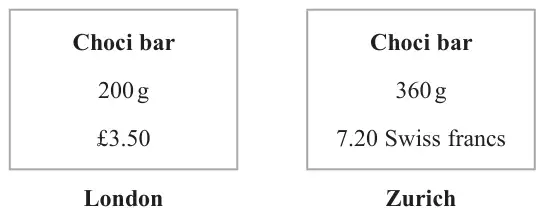
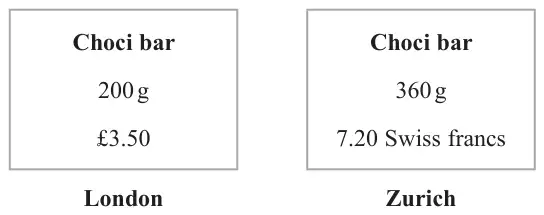
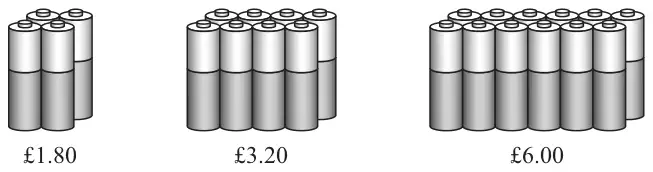
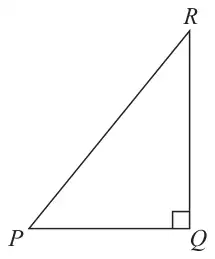

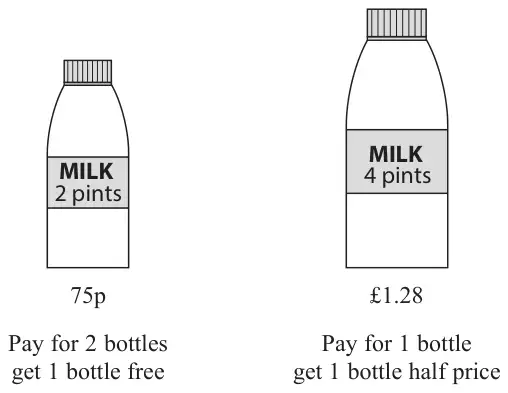
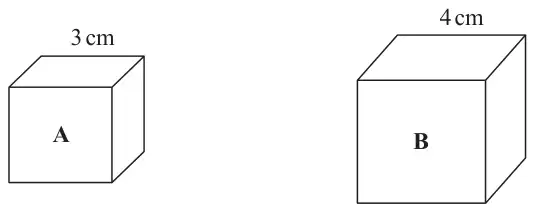
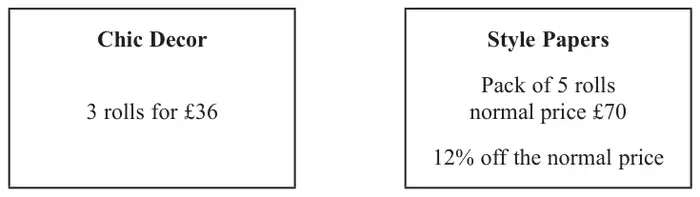
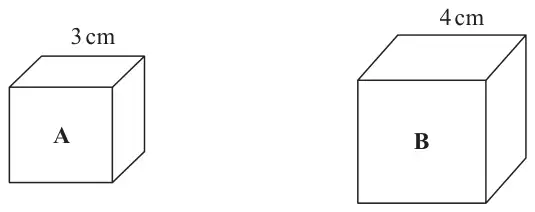
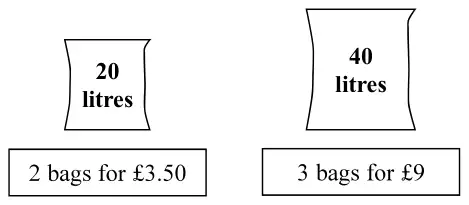
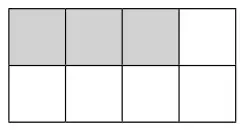

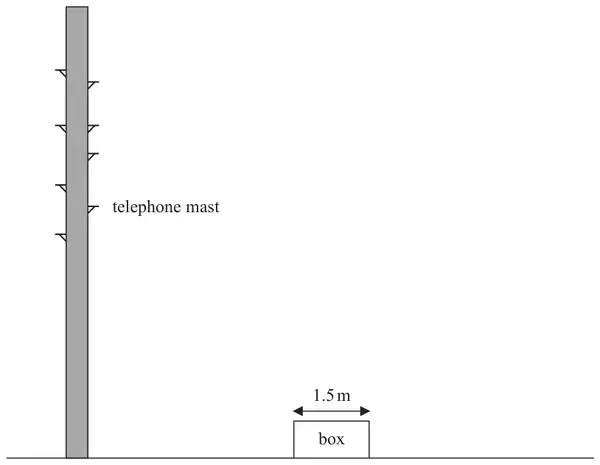
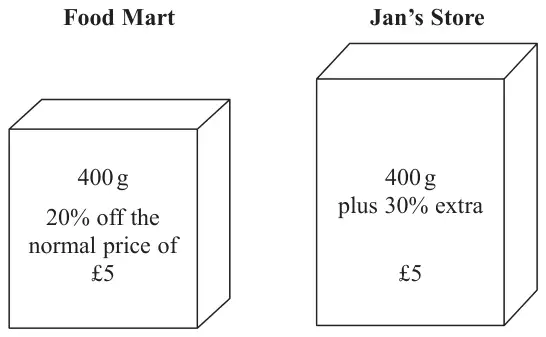
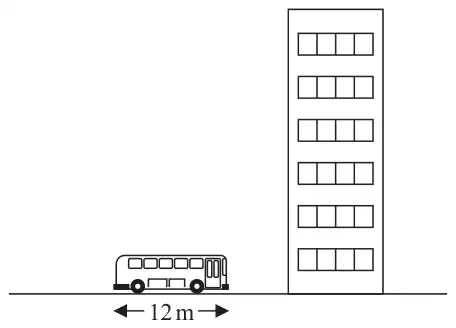
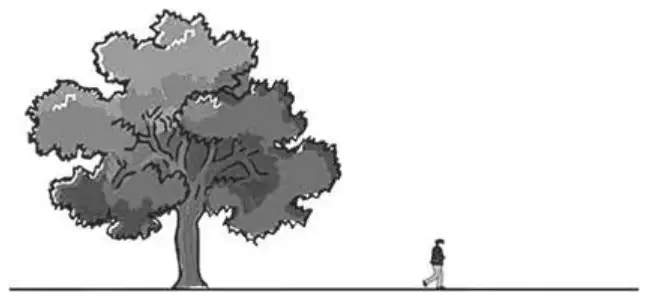

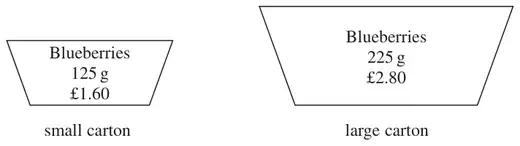
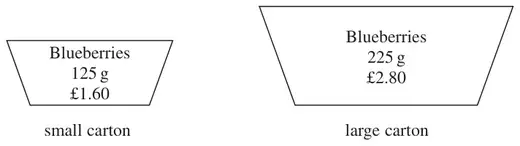
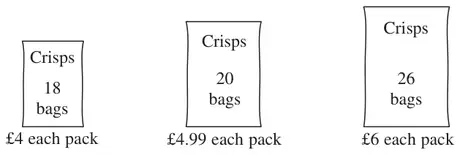
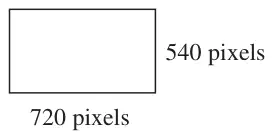
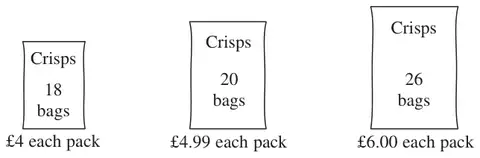
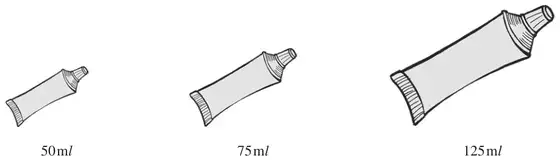
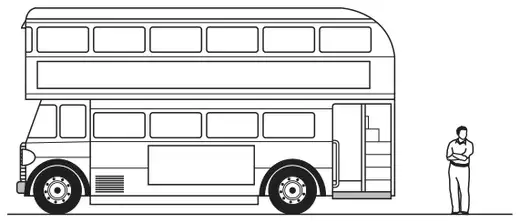
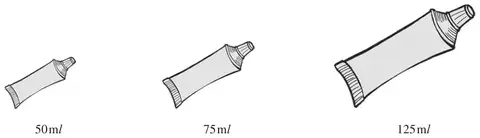
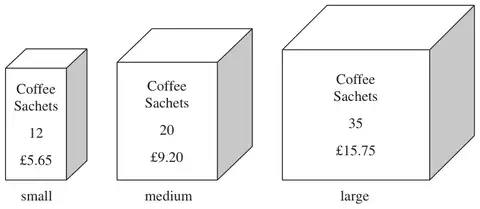
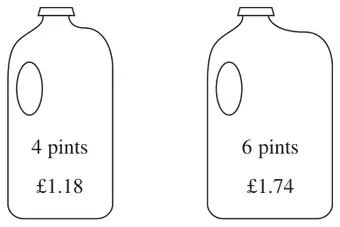
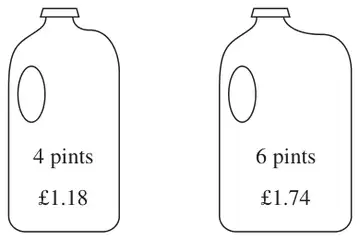
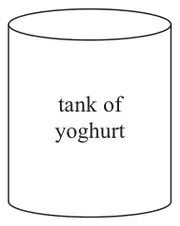
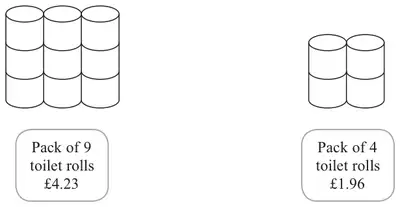
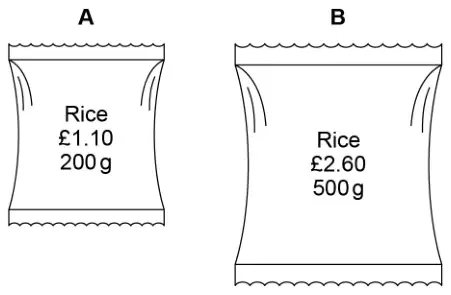
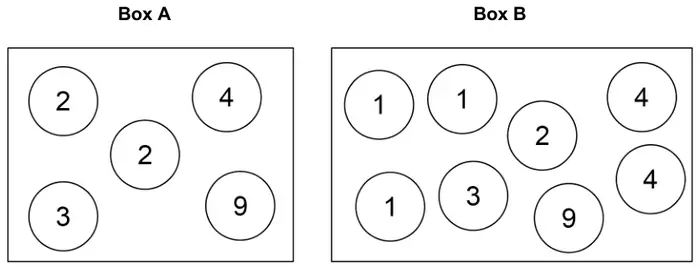
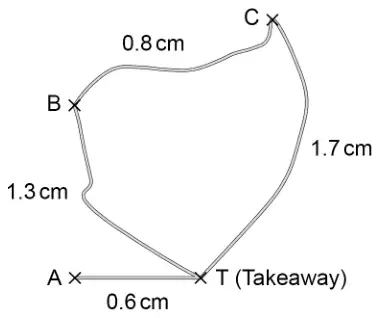
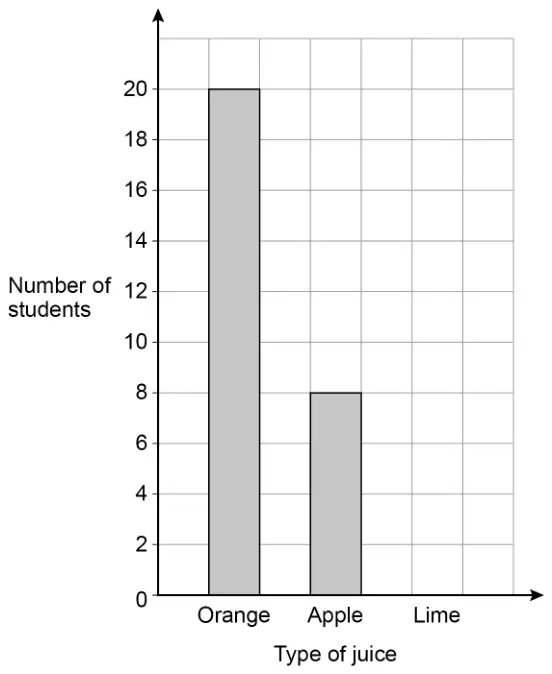
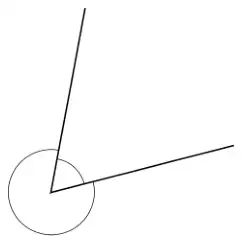
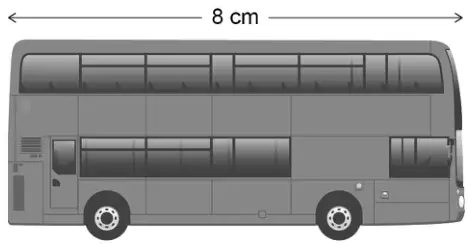
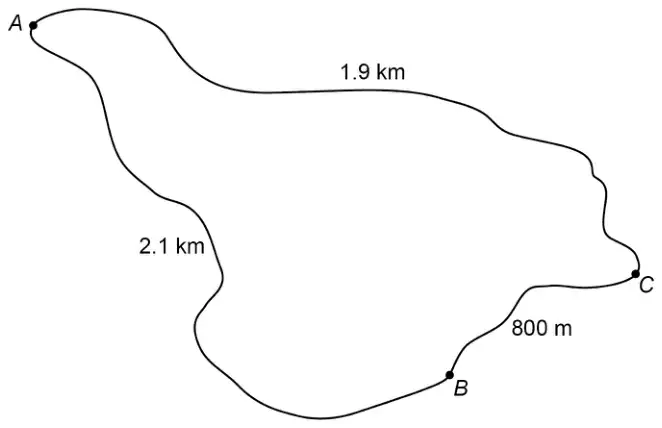

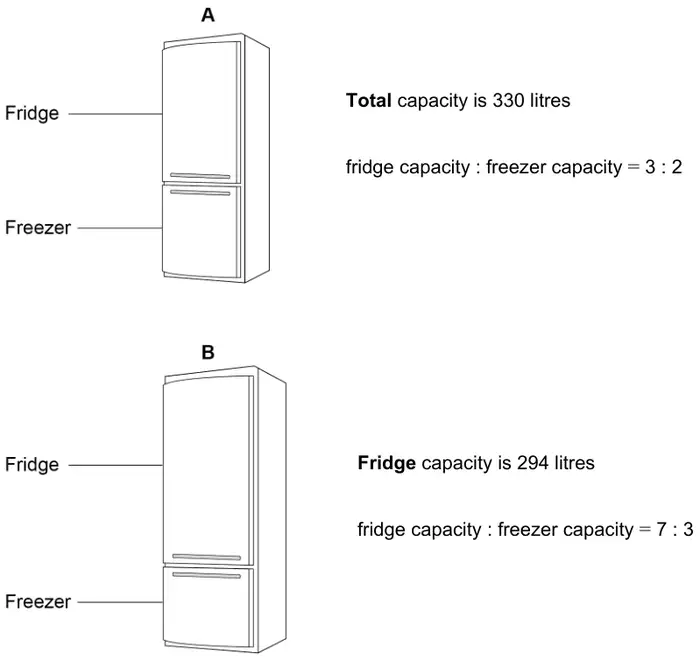
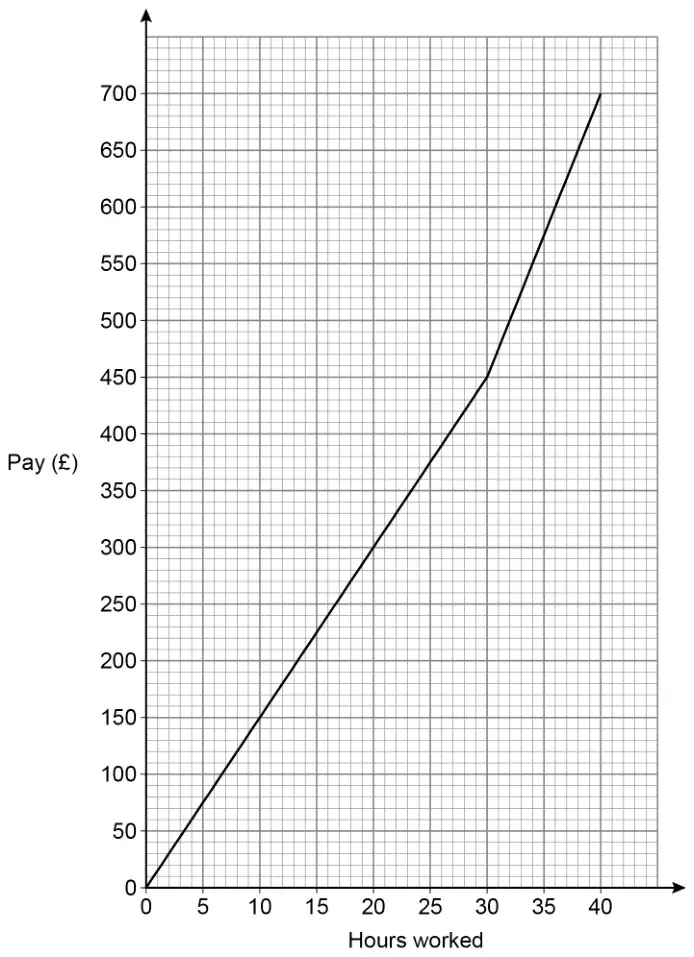
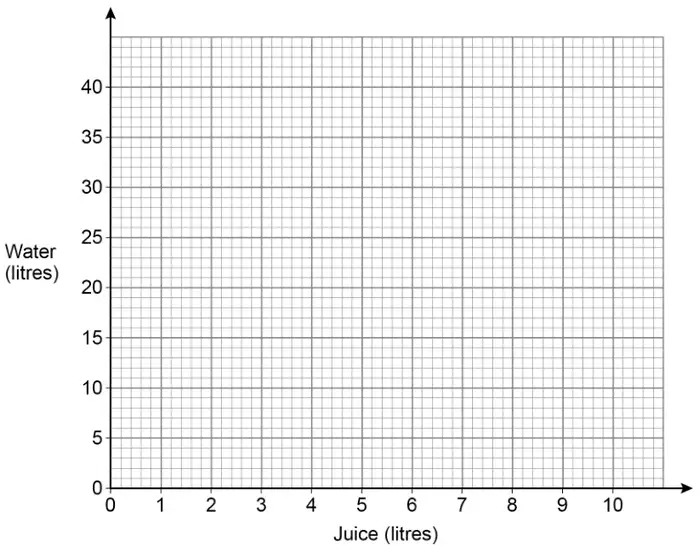
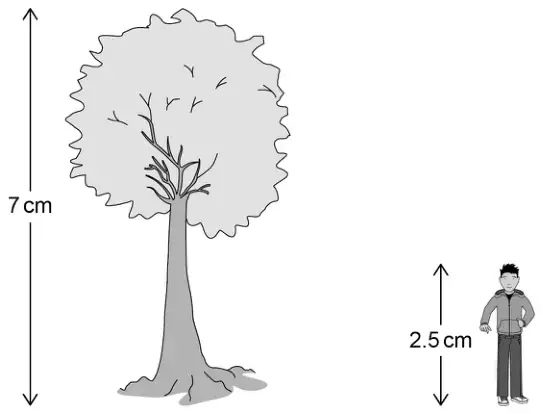
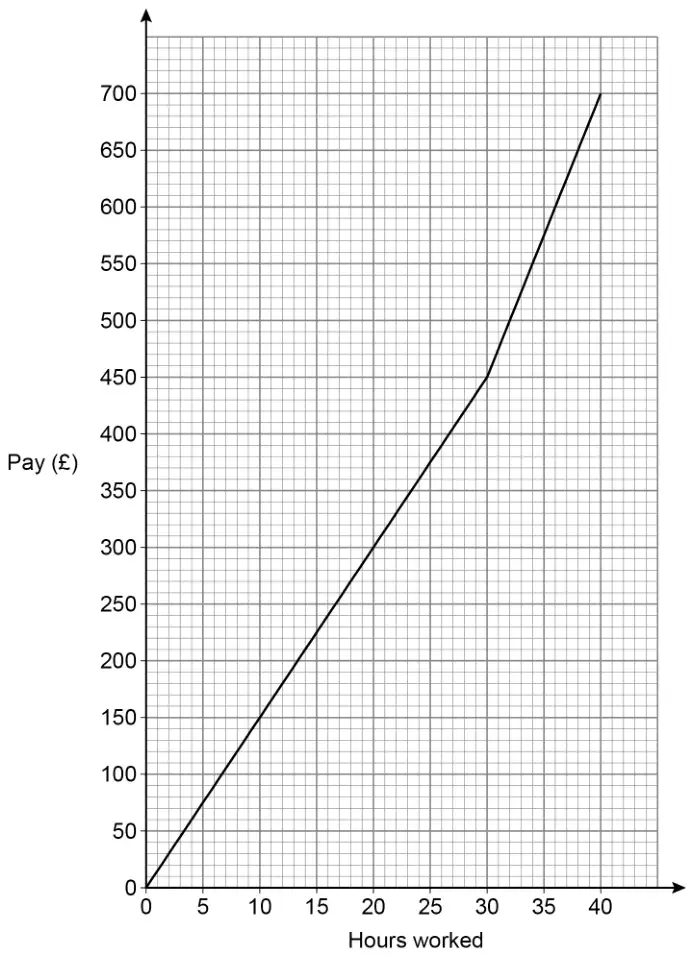
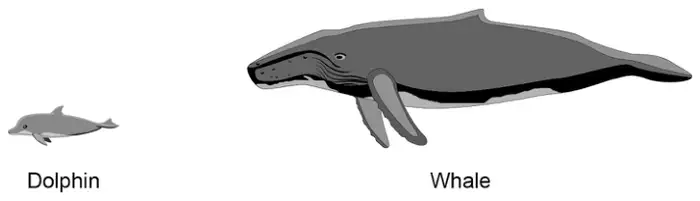
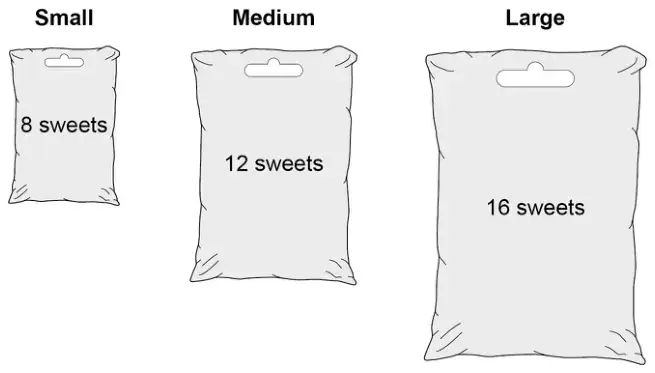
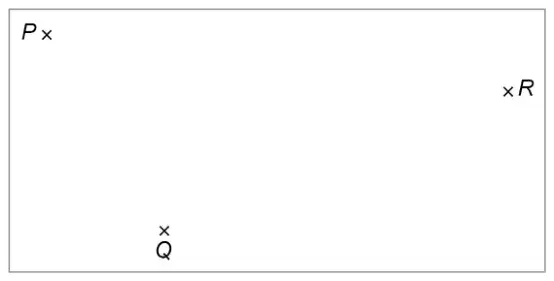
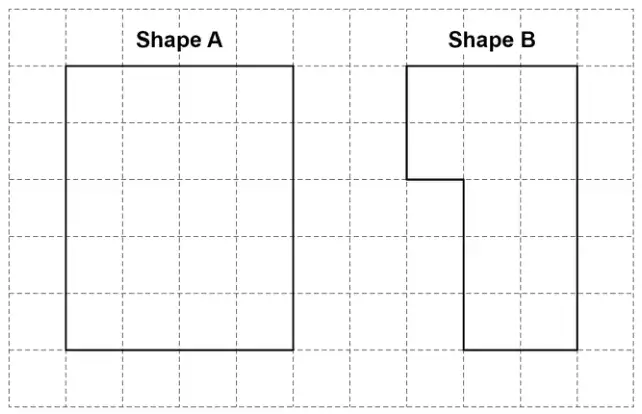
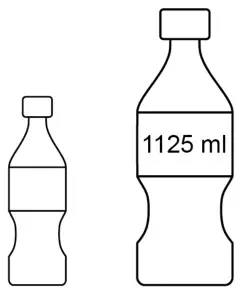
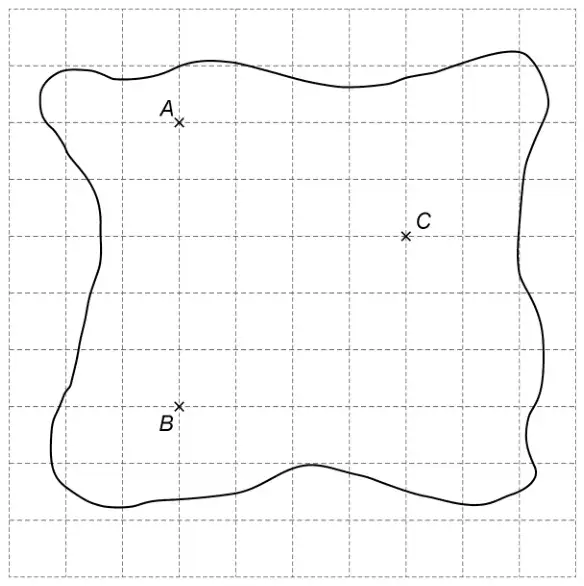
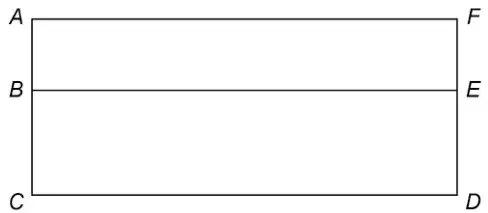
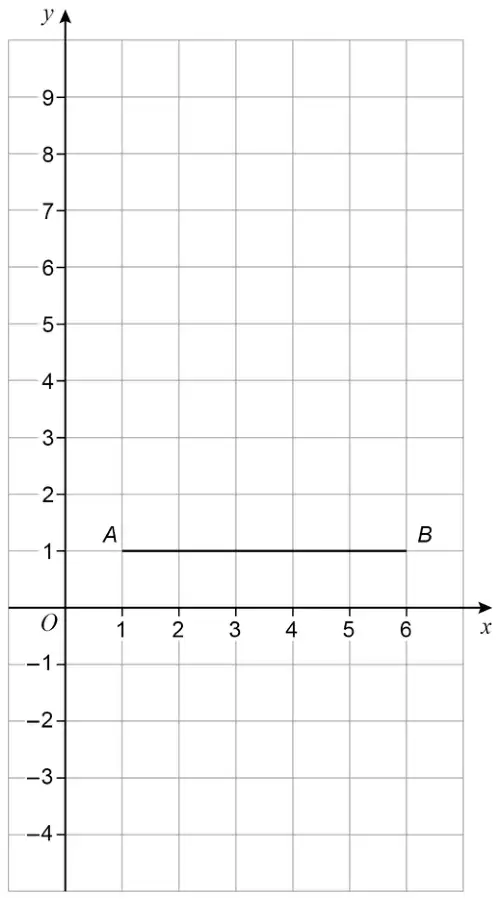
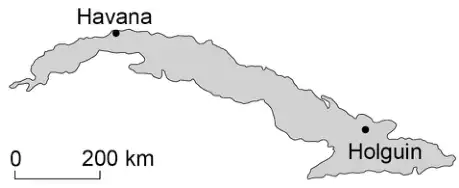
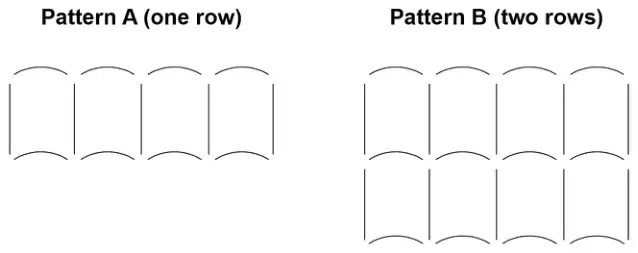
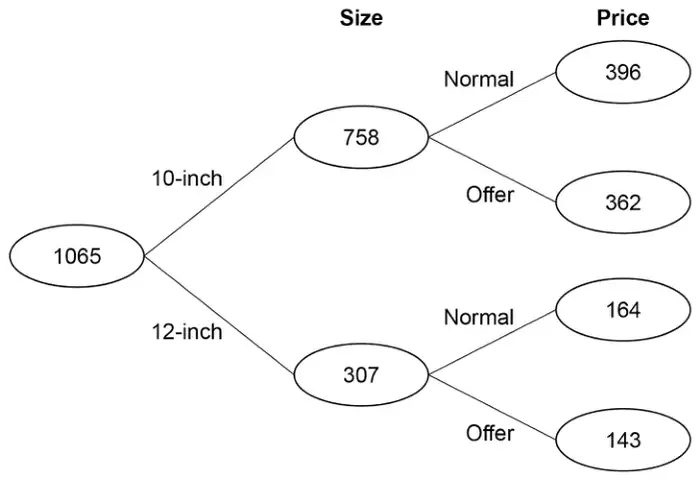
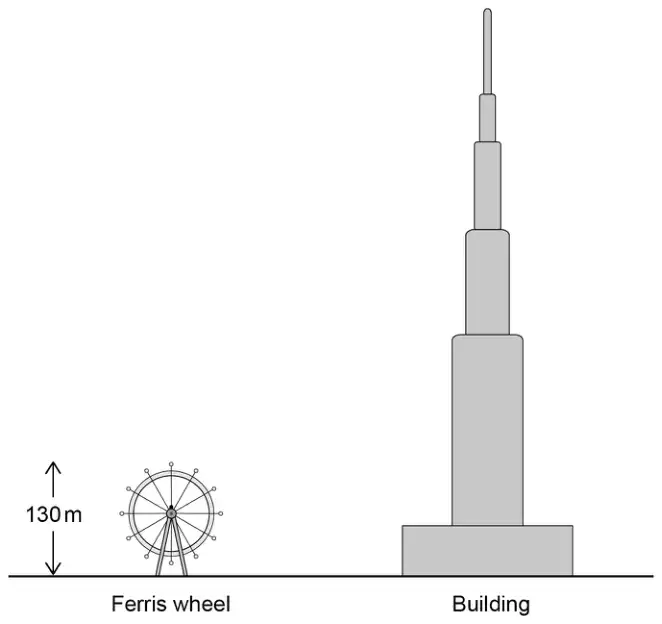
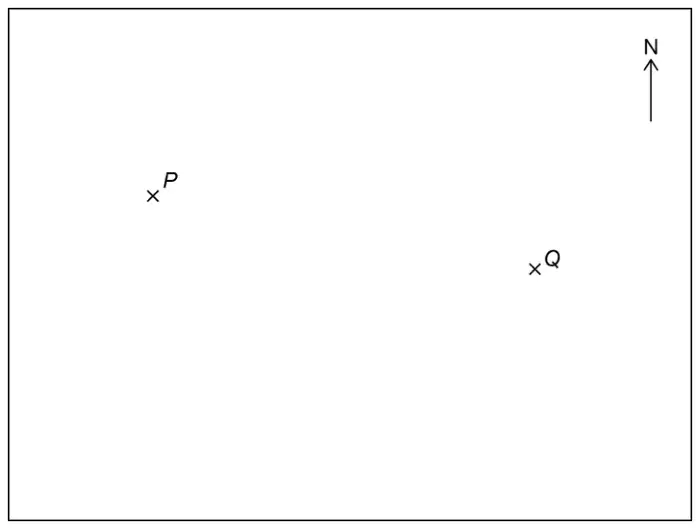
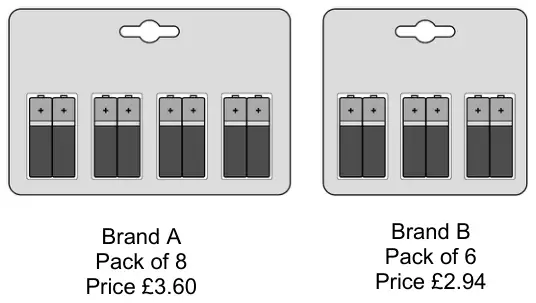


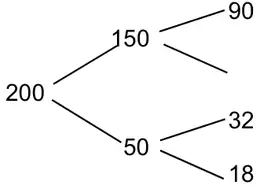

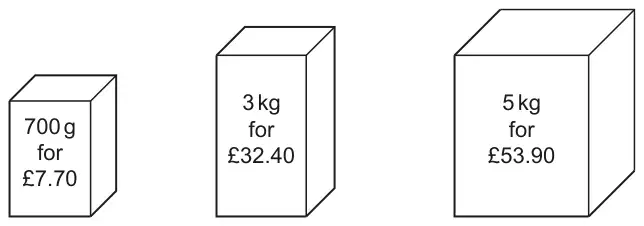

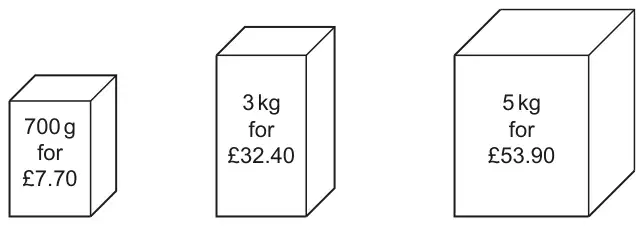
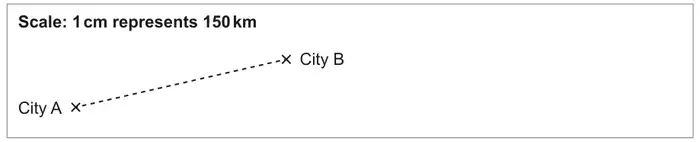
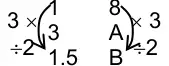
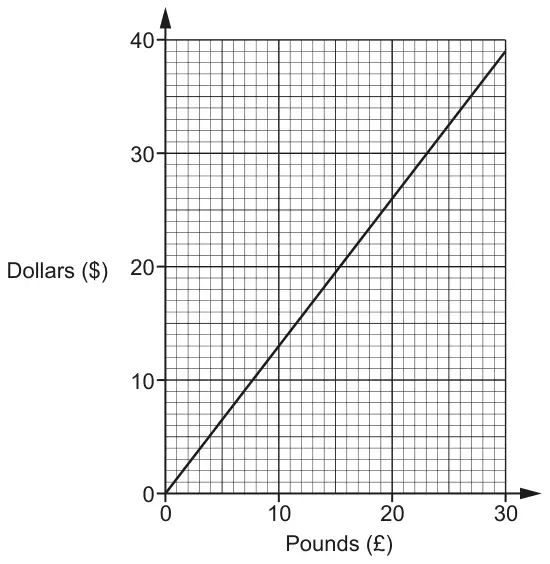
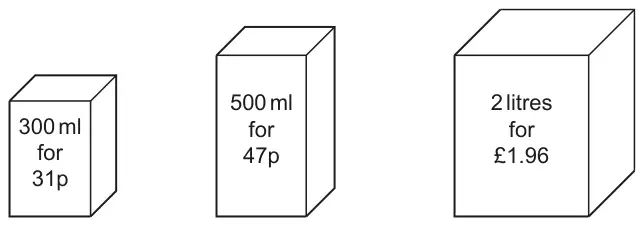
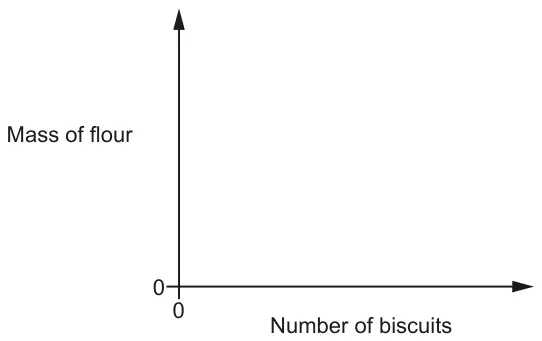
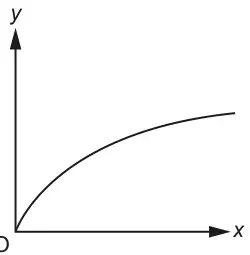
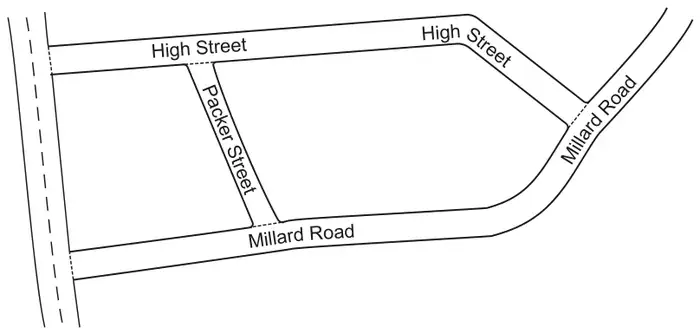
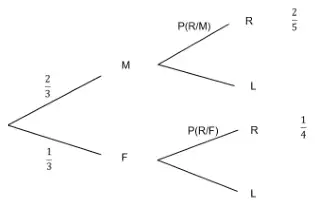
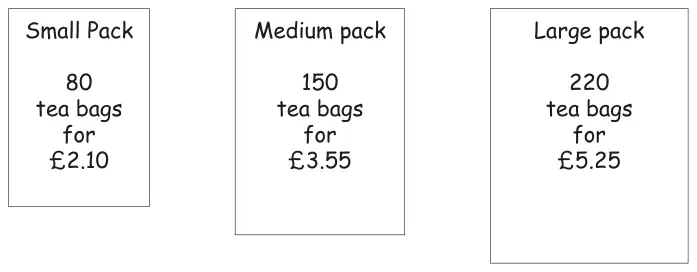
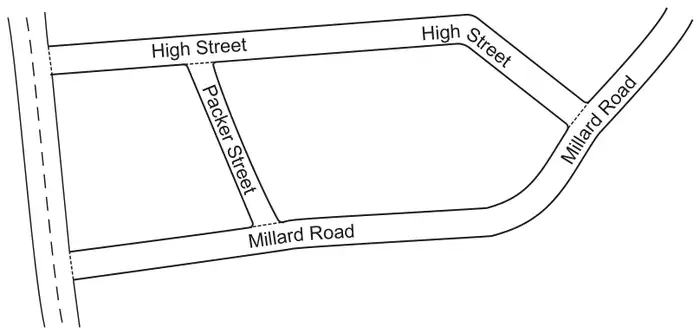
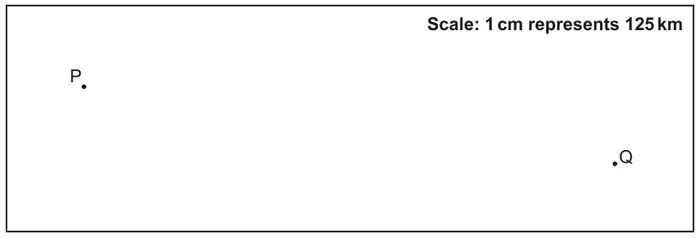
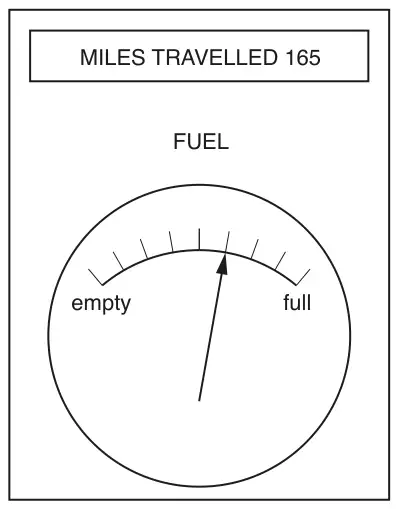
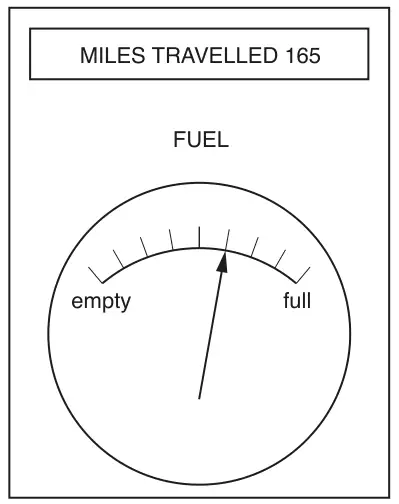
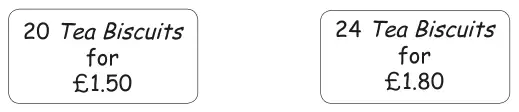
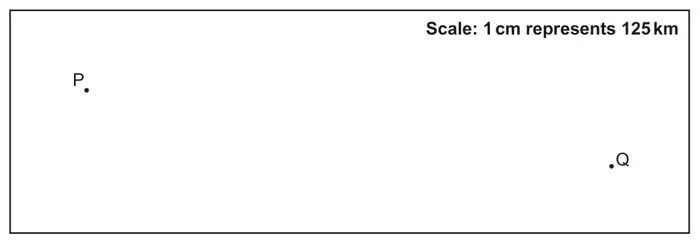
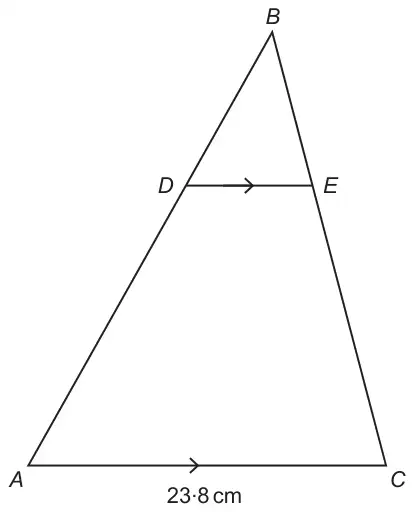
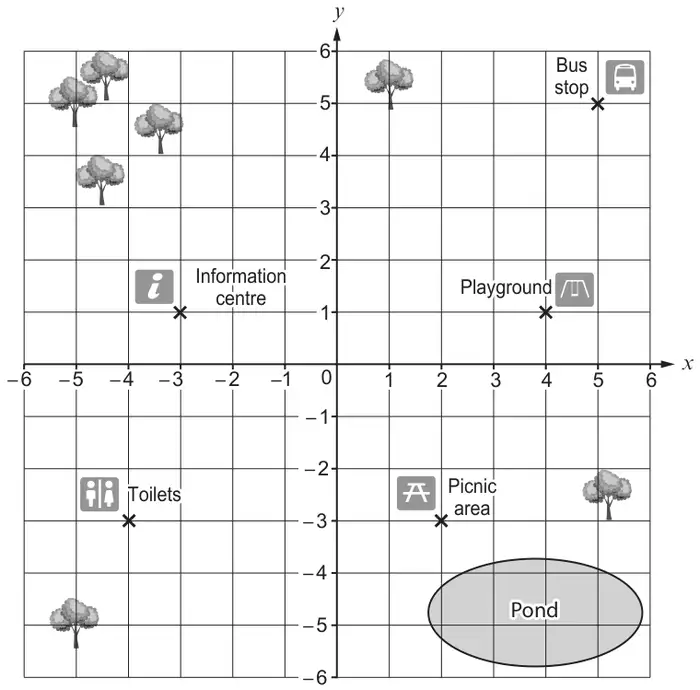
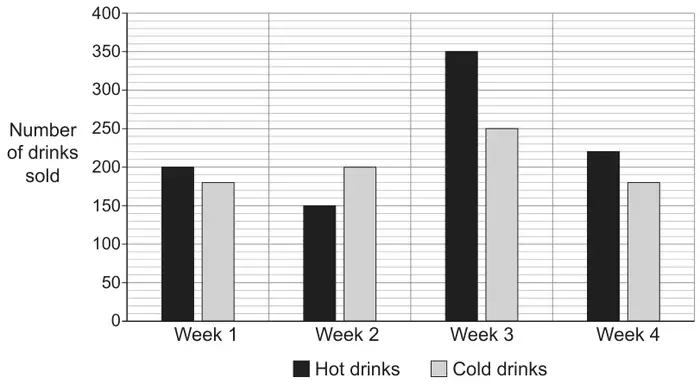
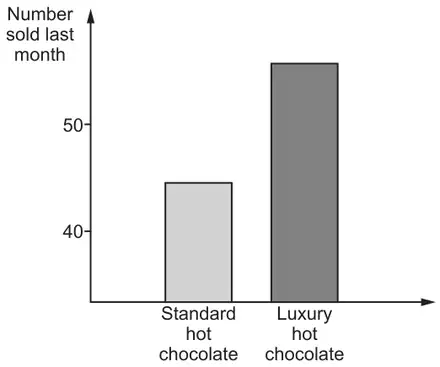

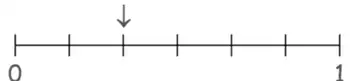
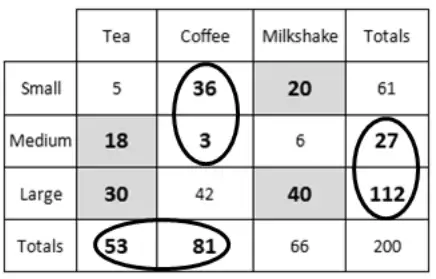
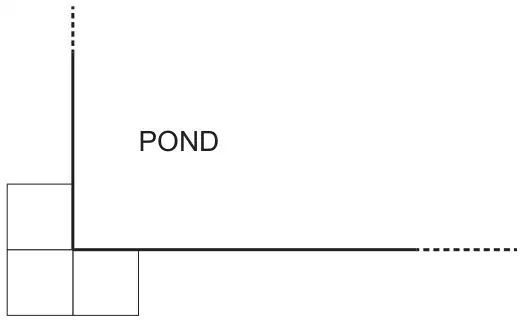

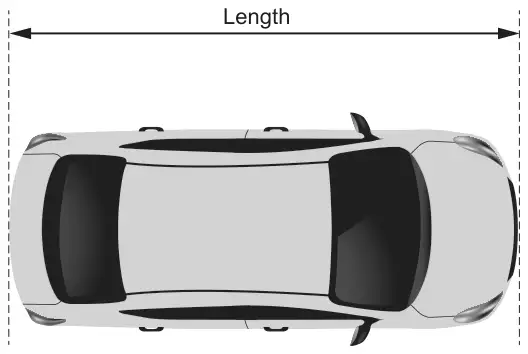
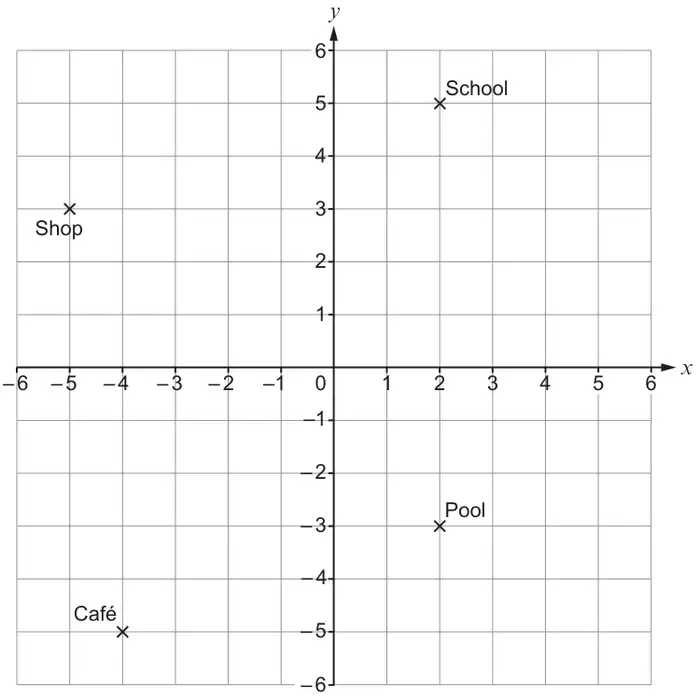
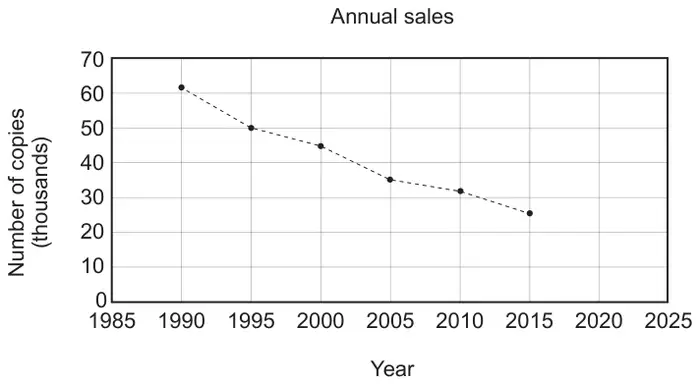
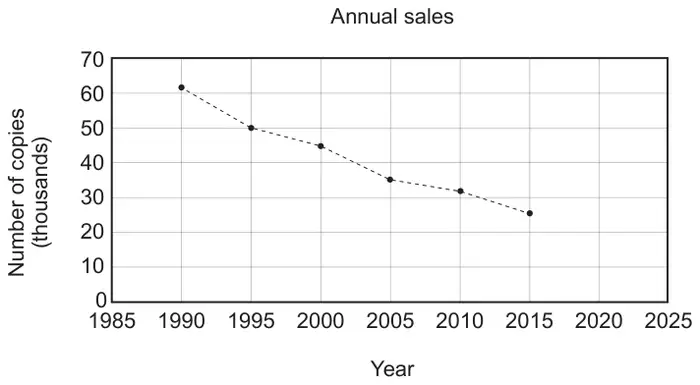
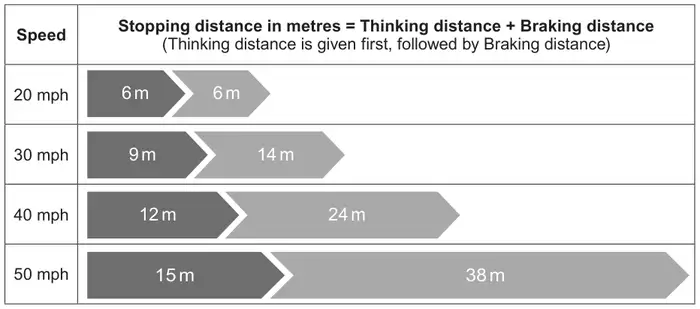
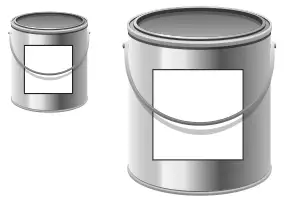
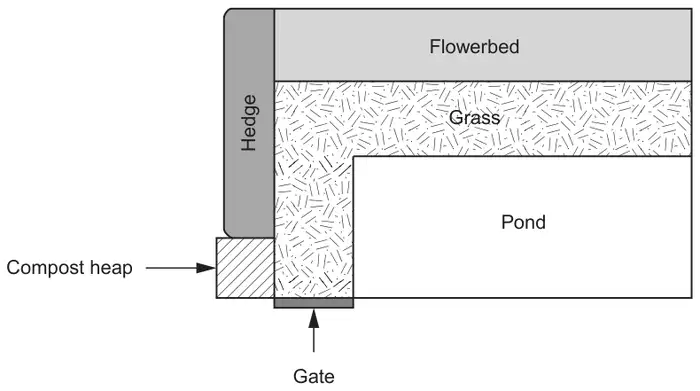
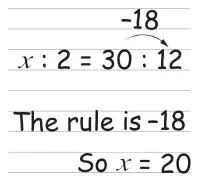

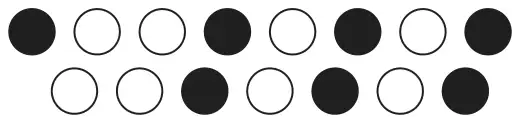
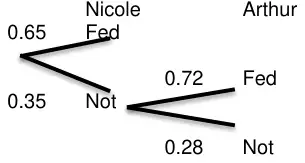
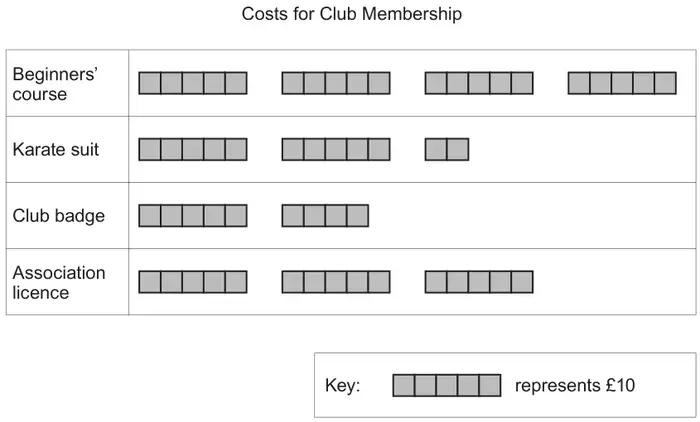
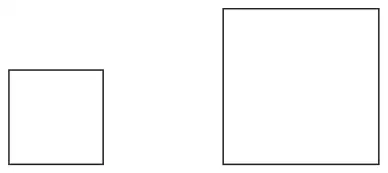
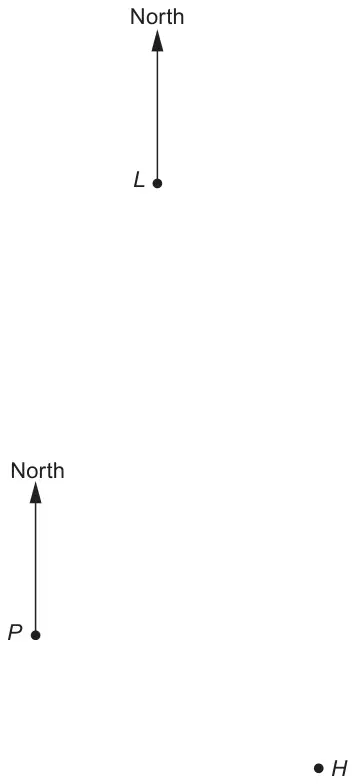
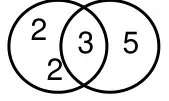
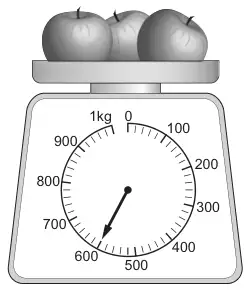
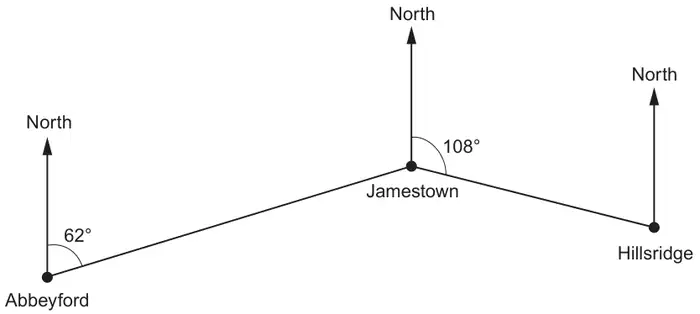
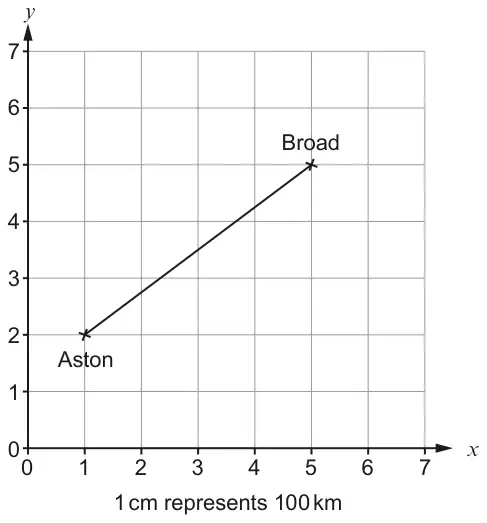
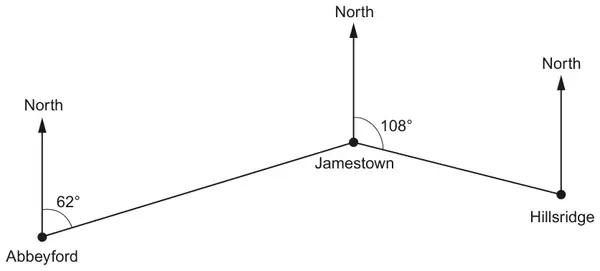
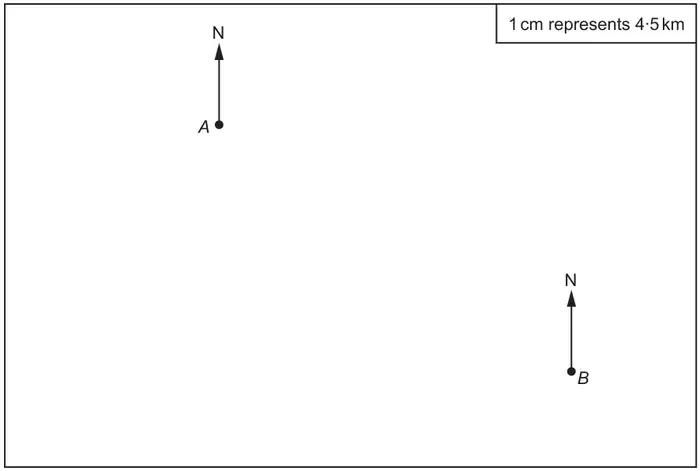
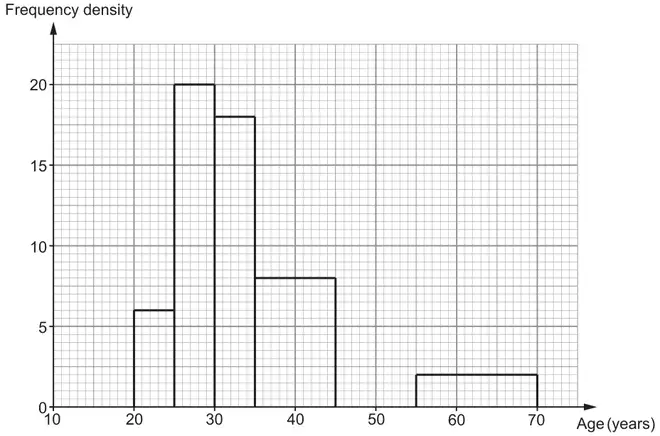
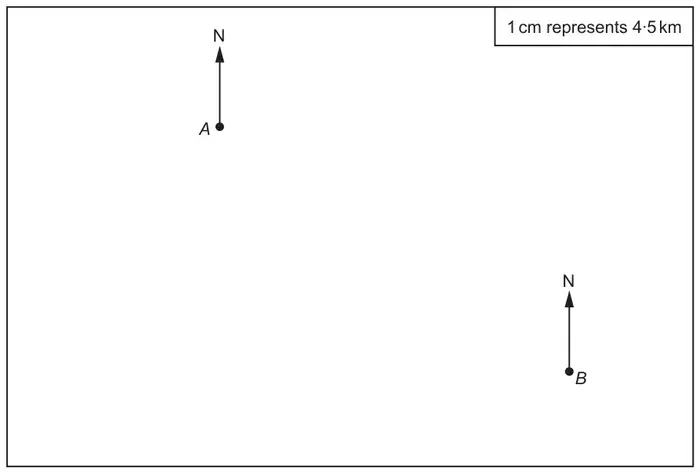
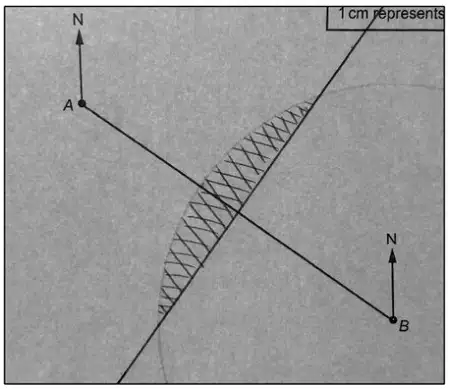
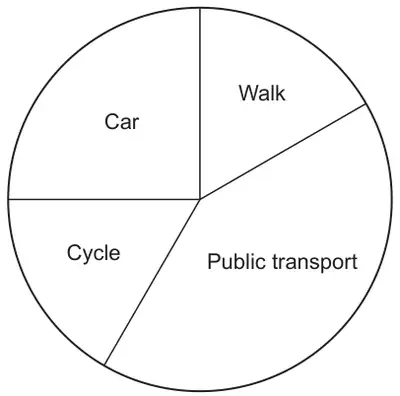
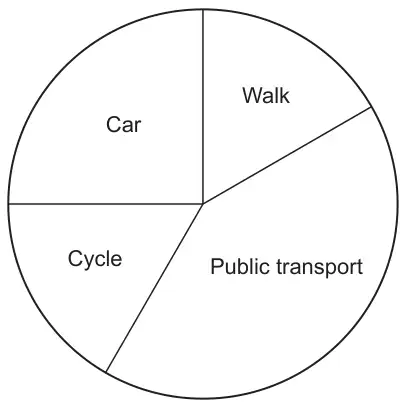
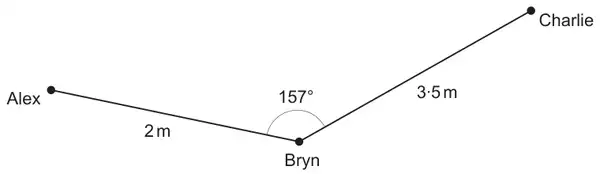
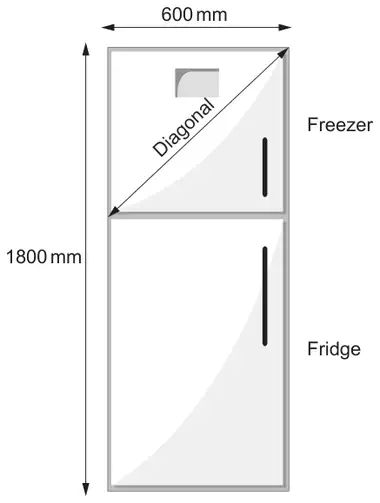

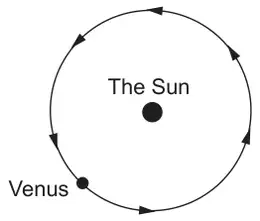
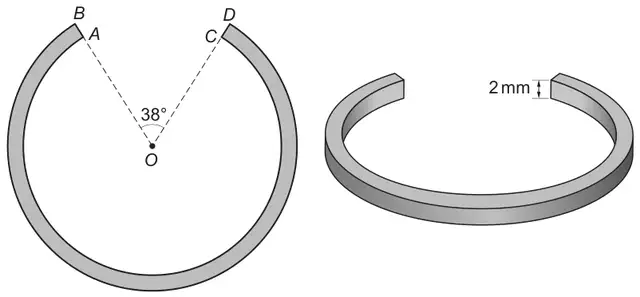
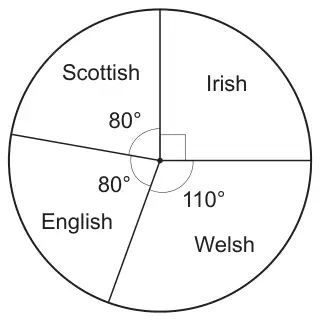
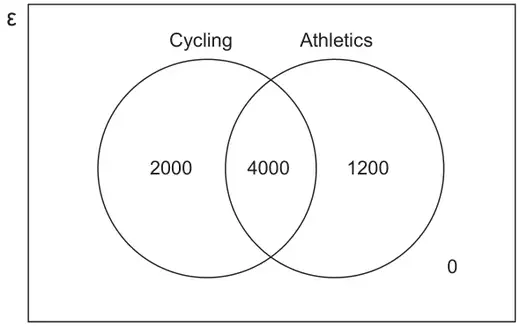
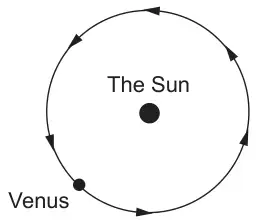

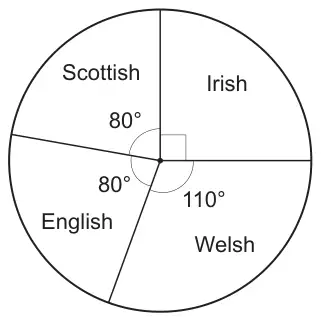
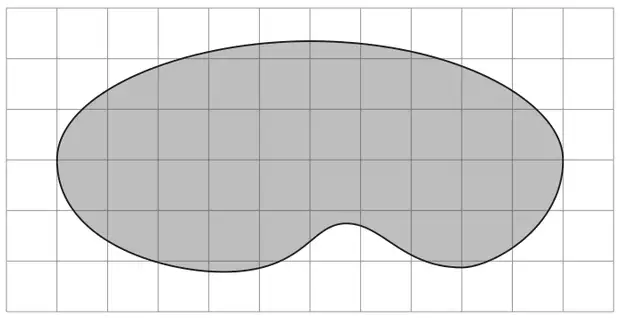

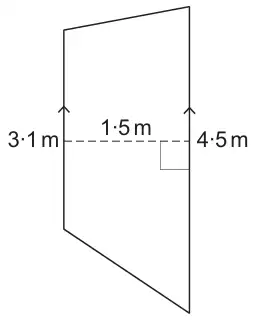
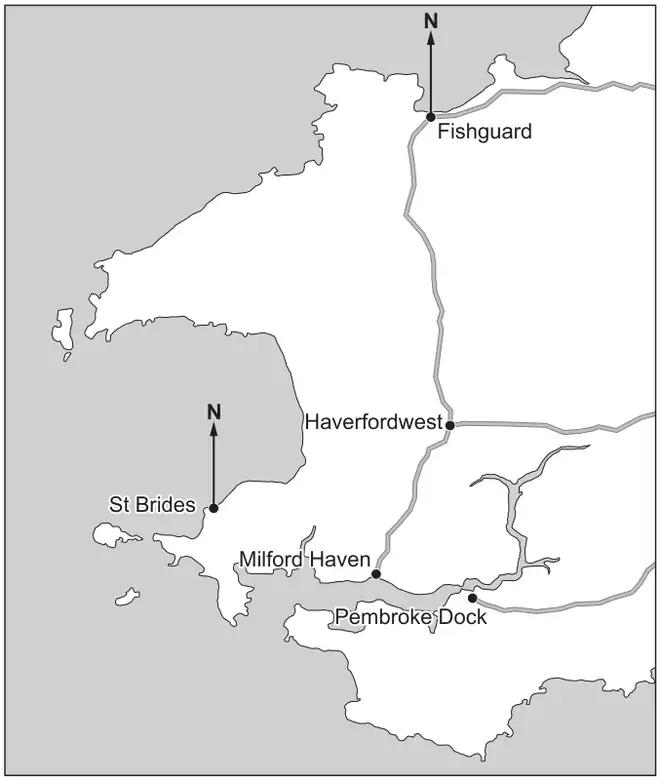

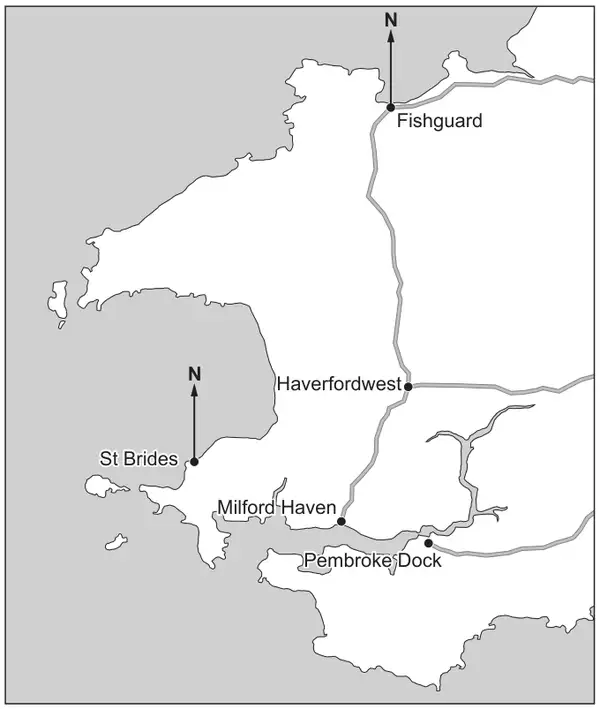
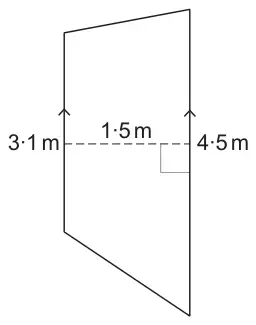
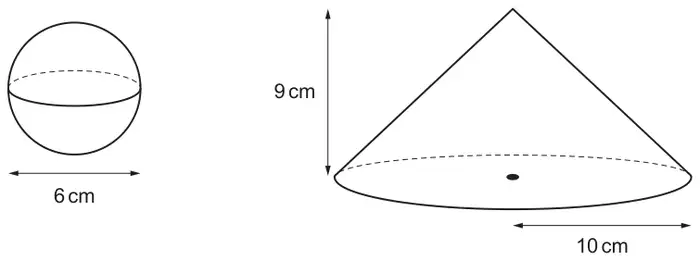
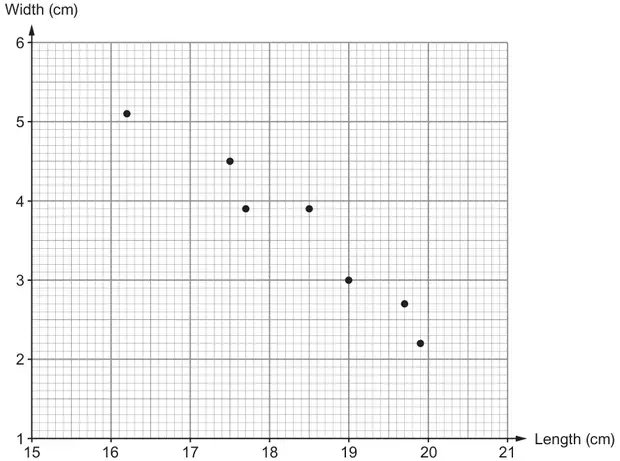
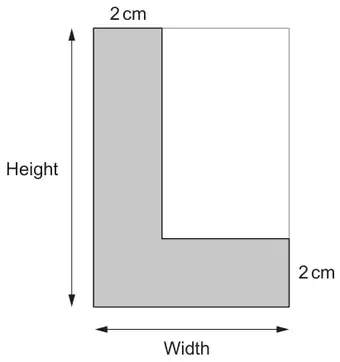
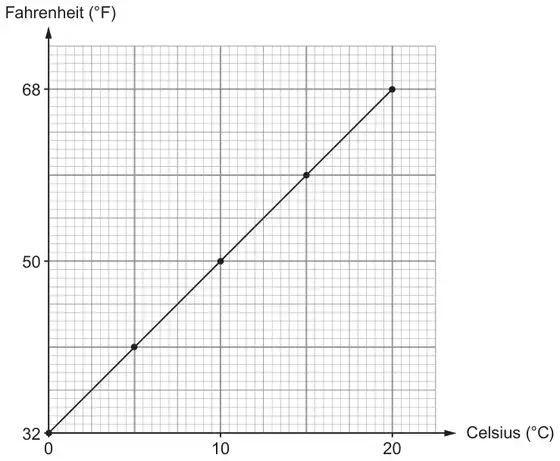
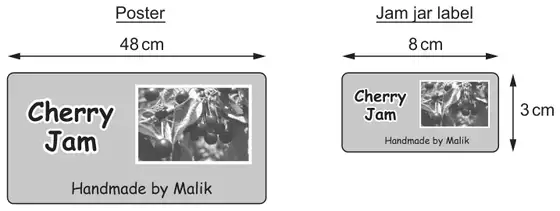
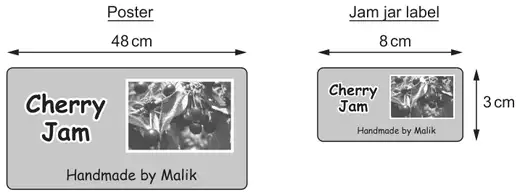

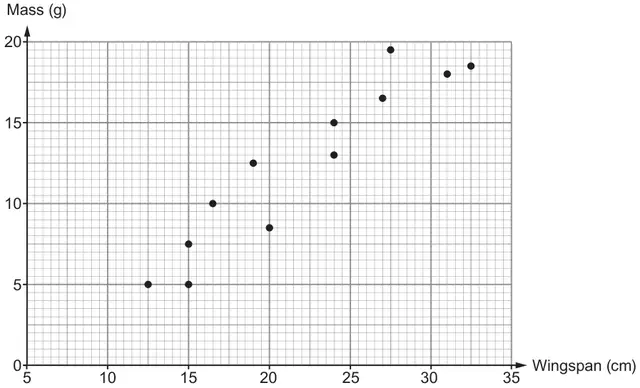
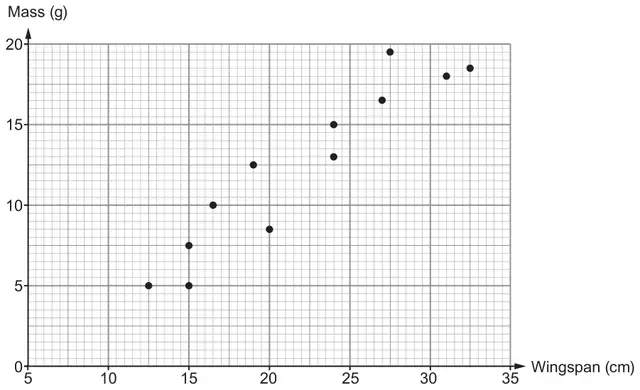
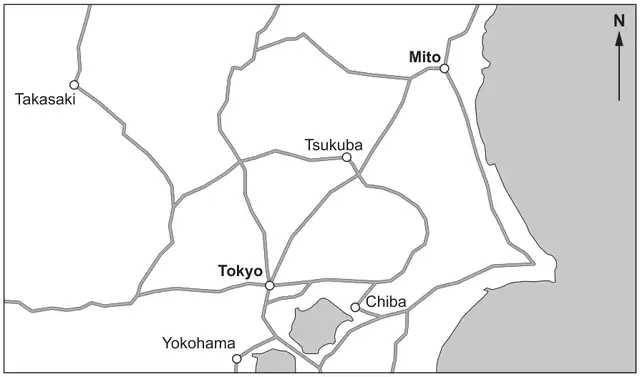
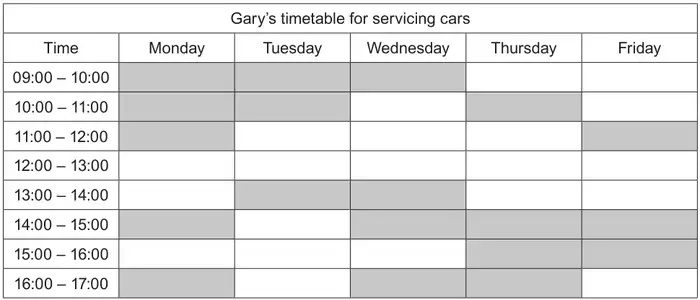
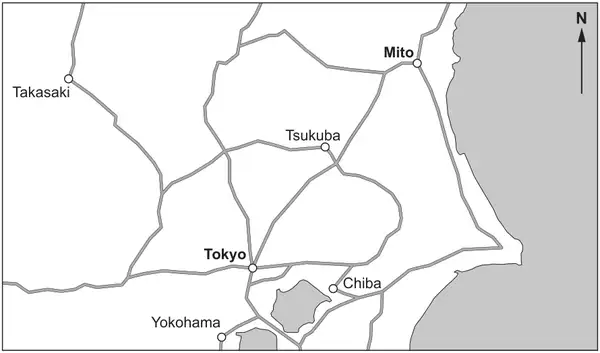

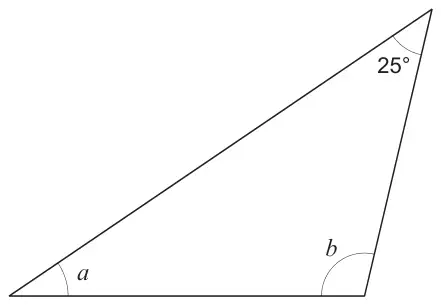
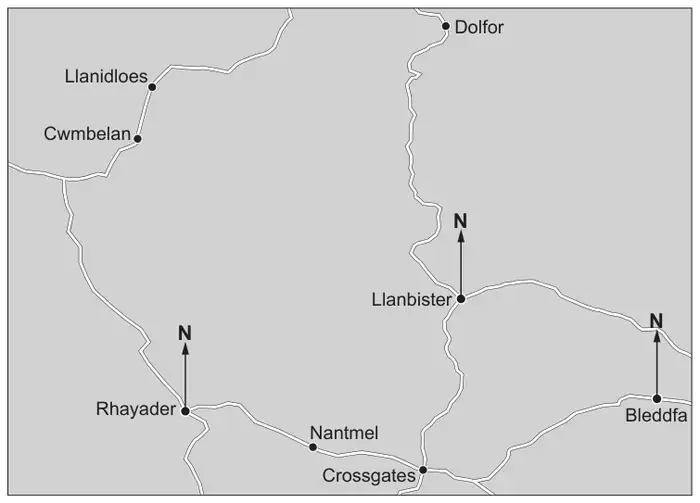
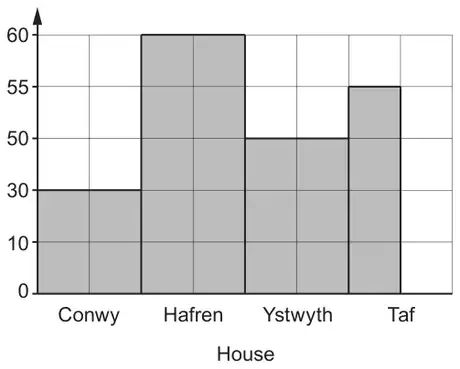
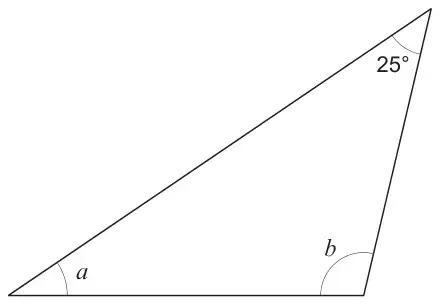
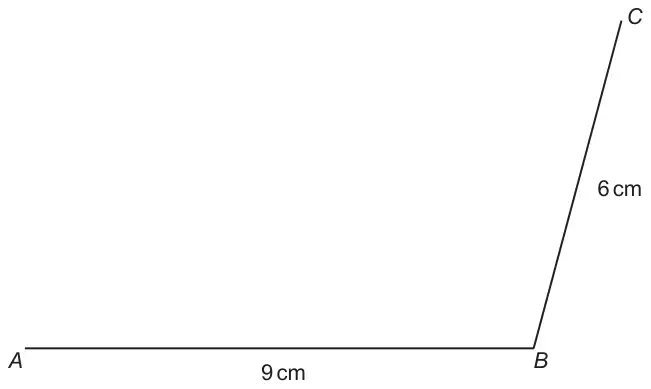

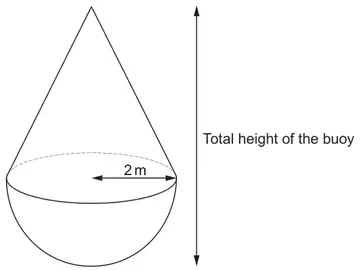
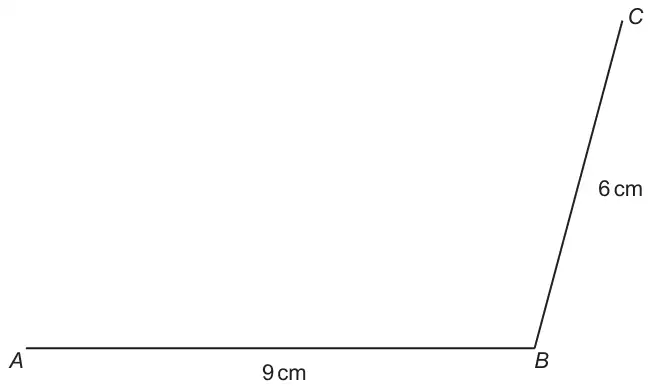

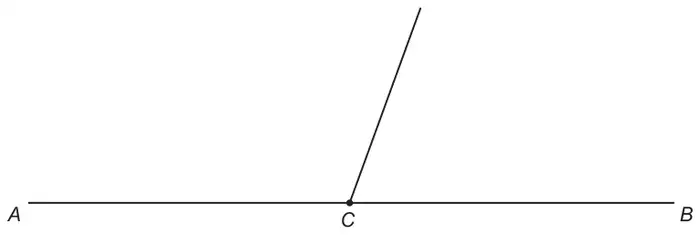
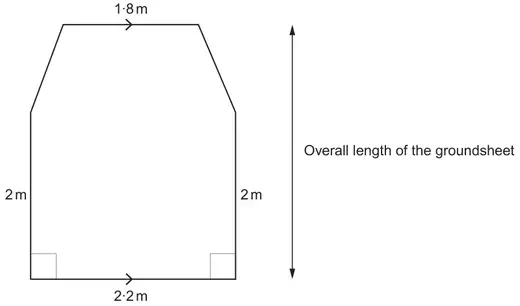
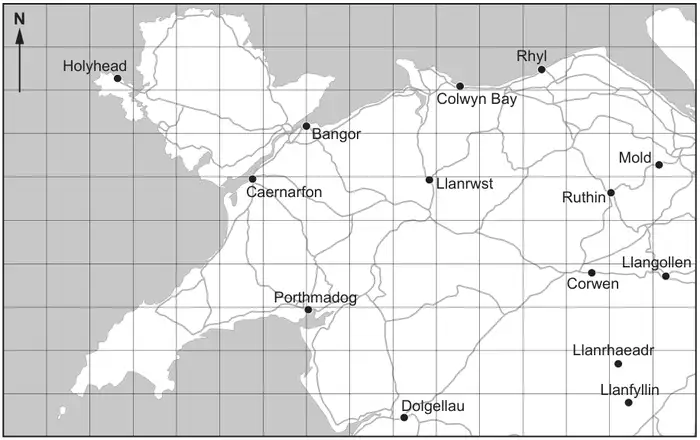
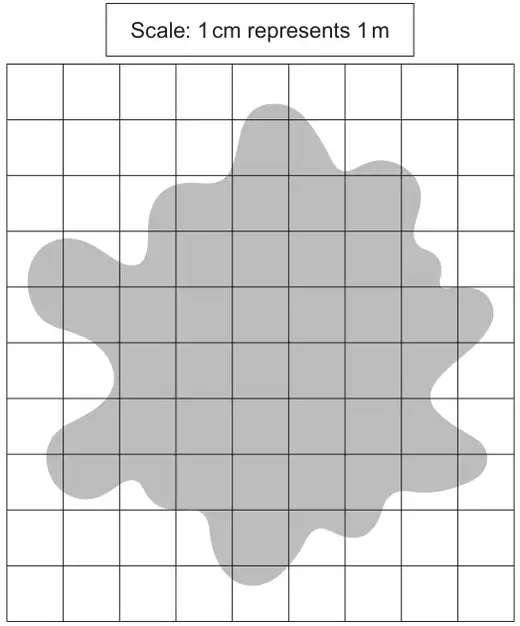
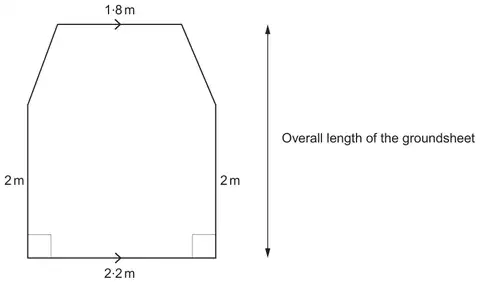

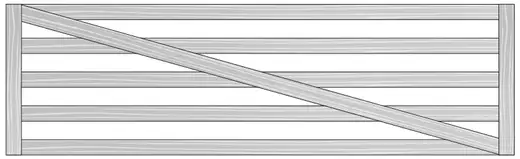
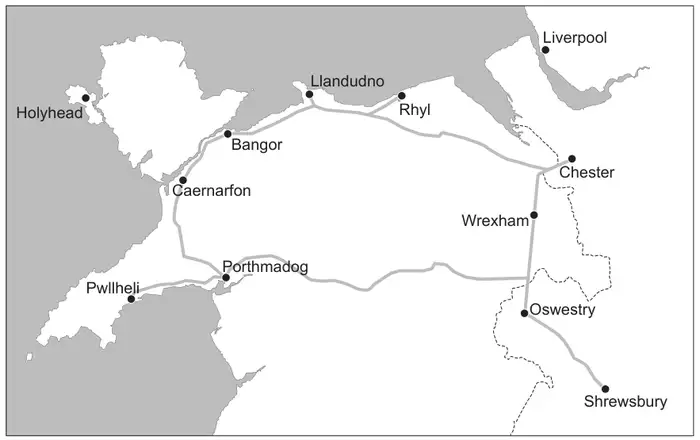

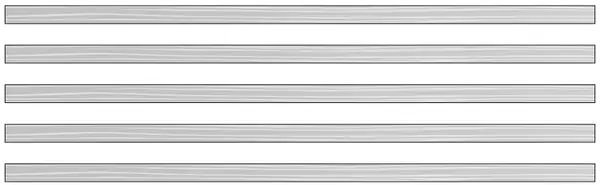
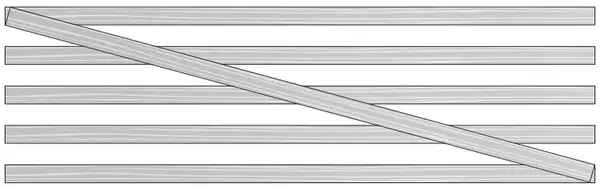
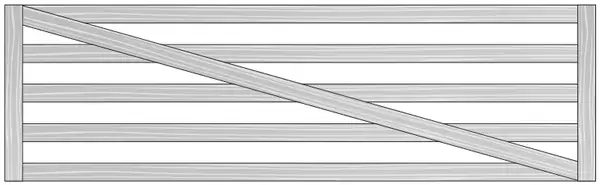
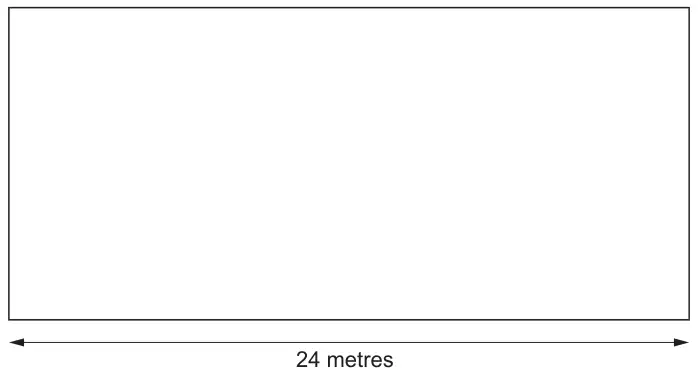
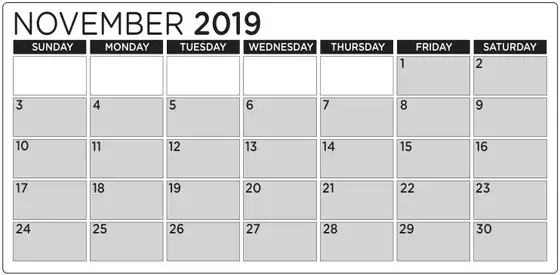
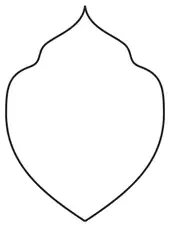
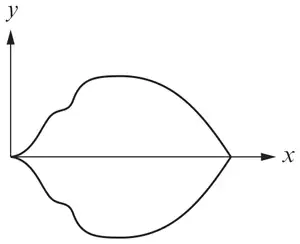
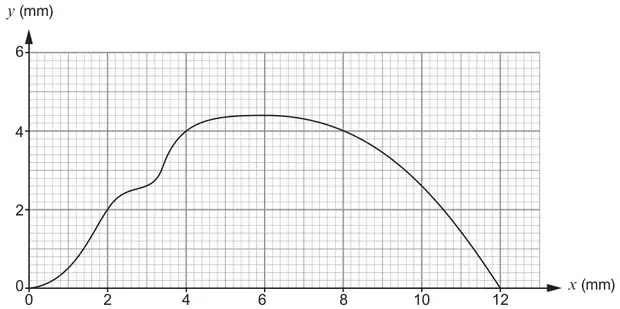
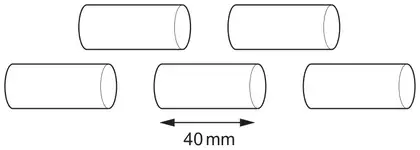
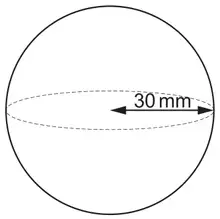
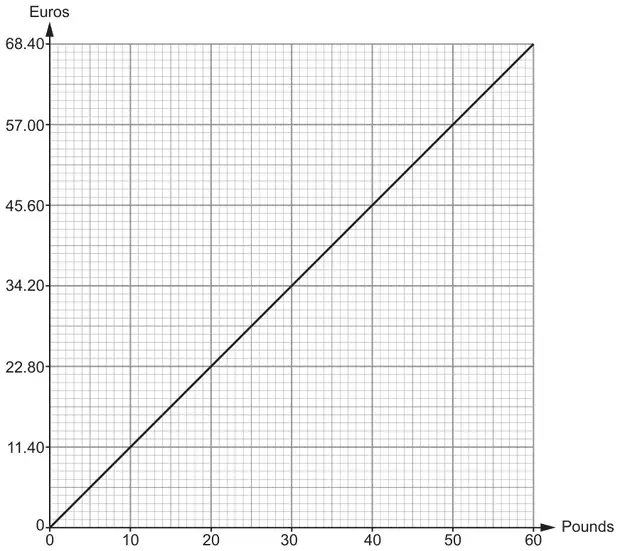
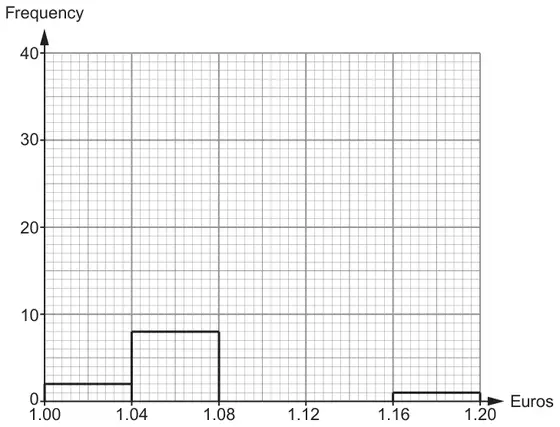
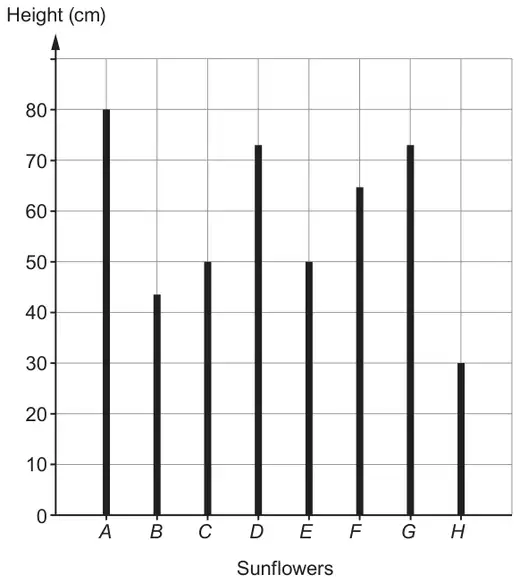
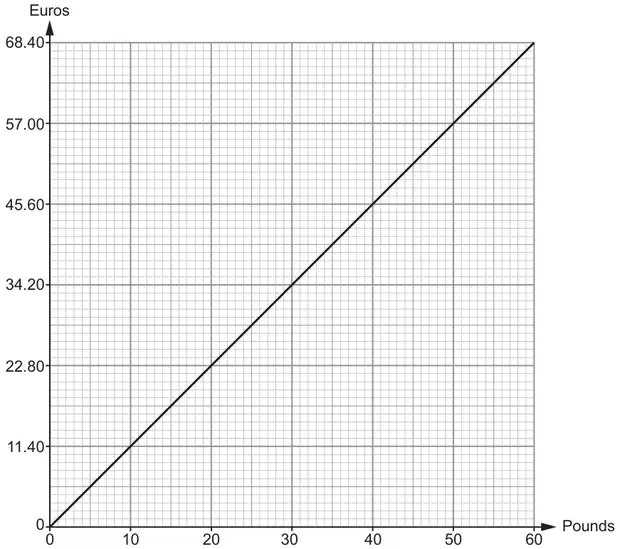
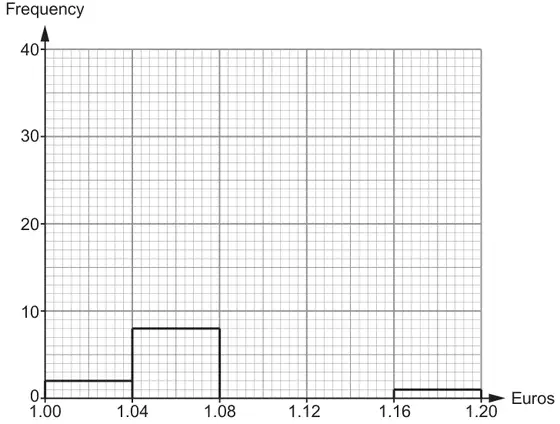
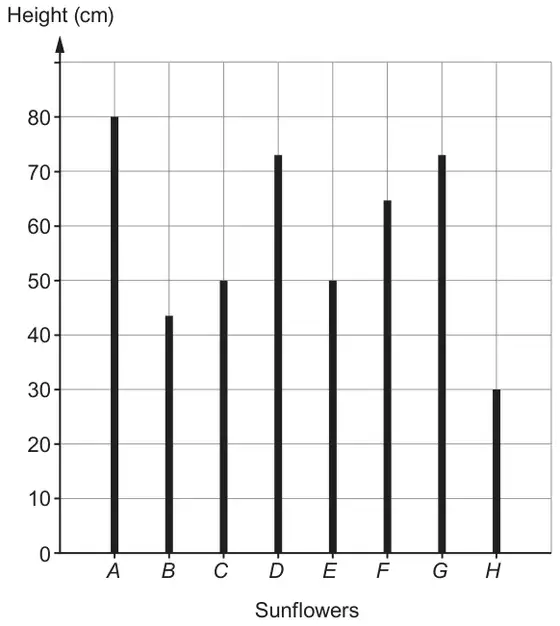
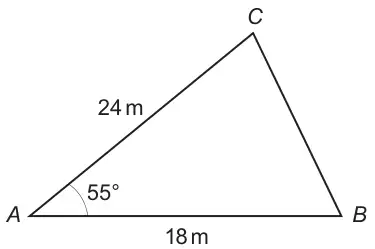
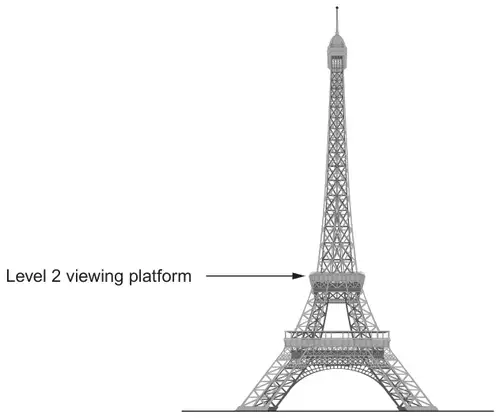
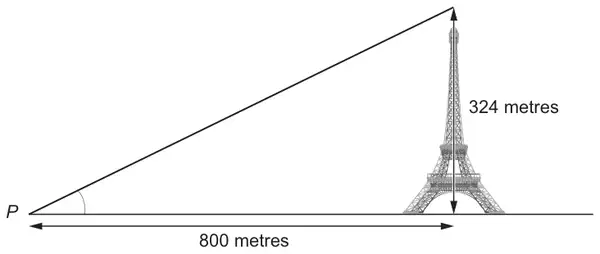
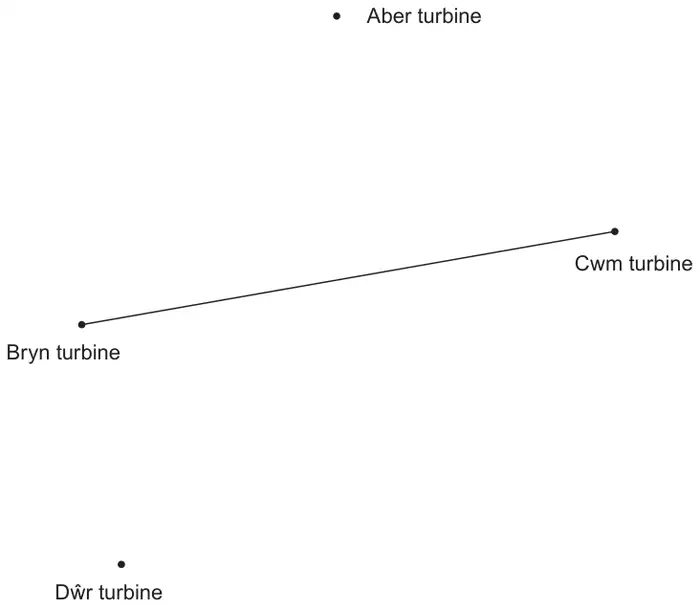
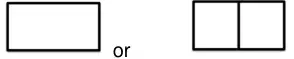
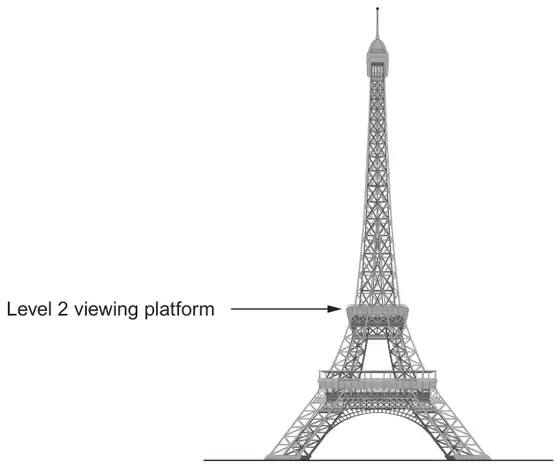
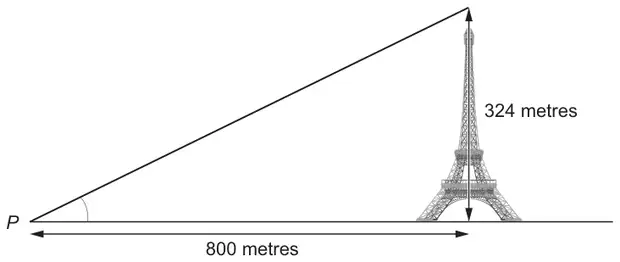
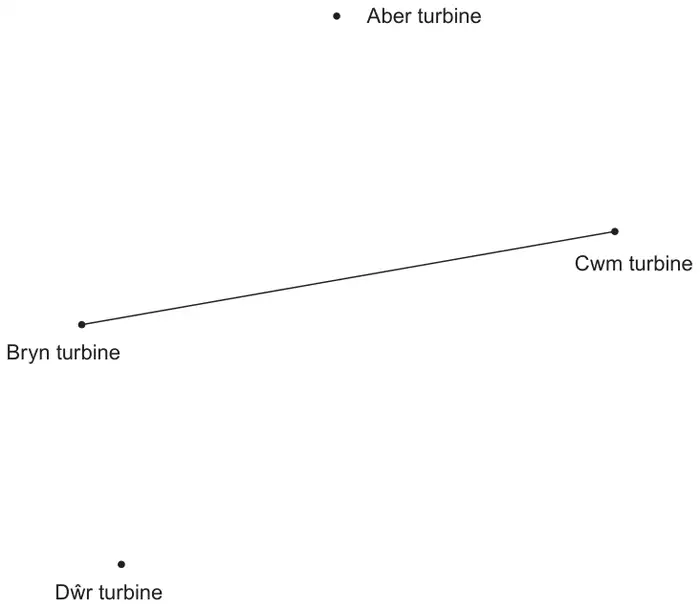
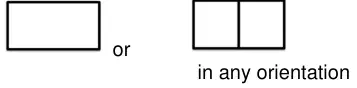
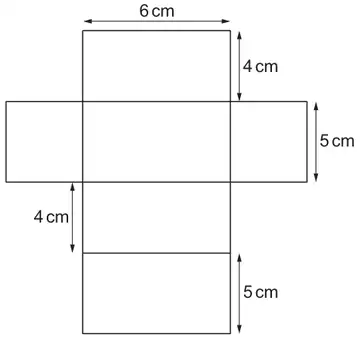
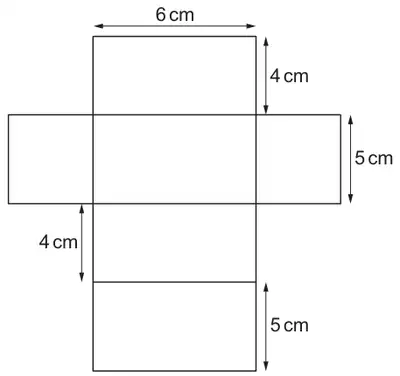
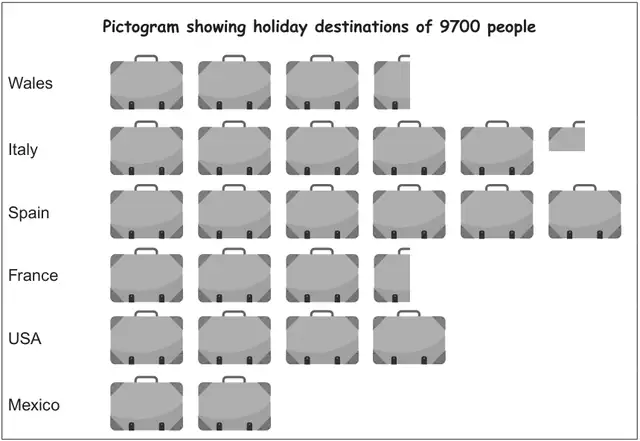
 represents …………… people
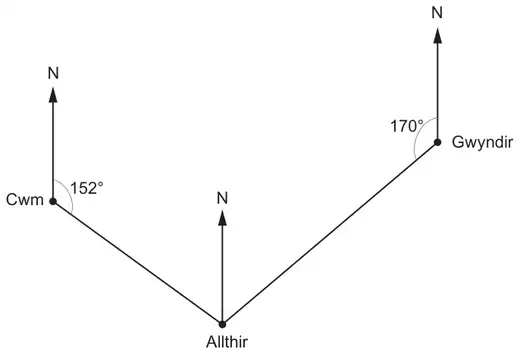
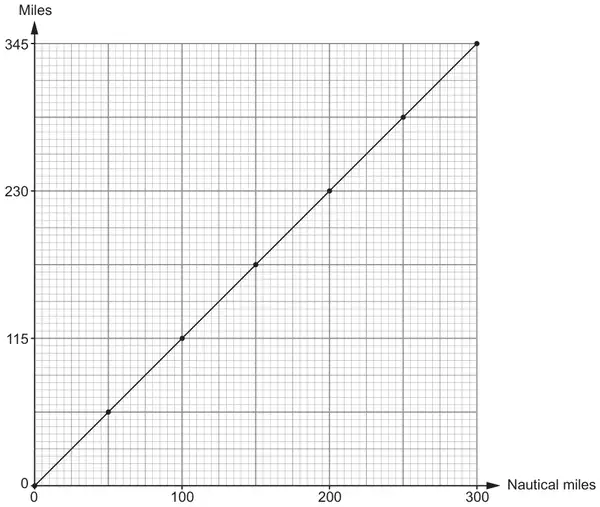
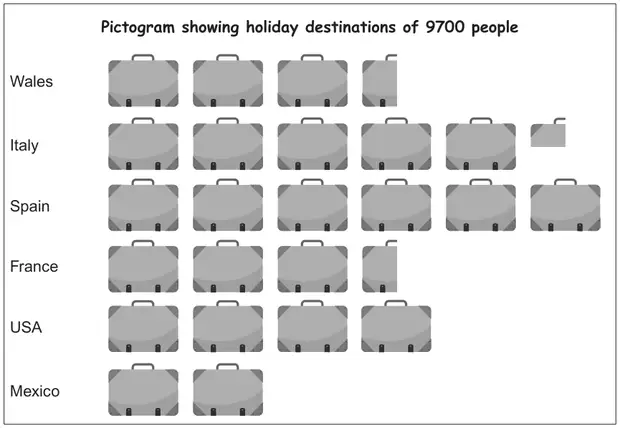
 represents …………… people