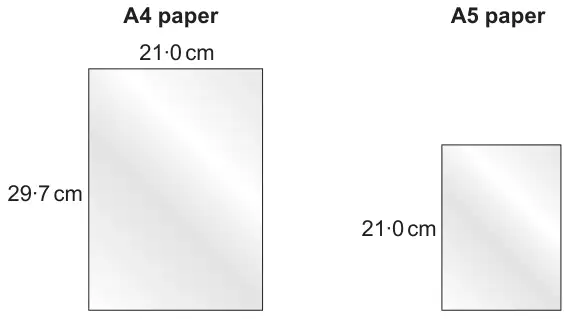
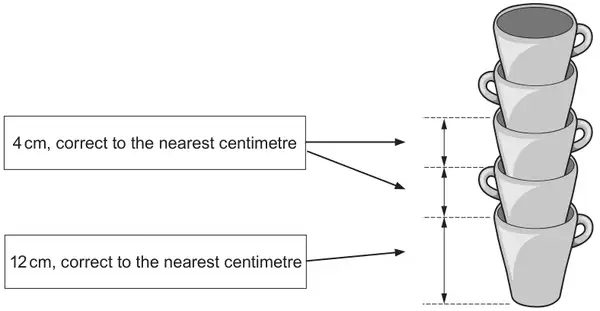
The height of the pile is 10.4 cm, correct to the nearest mm. The thickness of each sheet of paper is 0.17 mm, correct to 2 significant figures.
Calculate the upper bound for the number of sheets of paper in the pile. You must show all your working. (3)
Mark scheme
Answer
Mark
Mark scheme
633
B1
for stating any correct bound, eg 10.35 or 10.45 or 103.5 or 104.5 or 0.165 or 0.175 or 0.0165 or 0.0175
P1
for process to find the upper bound, eg [UB of height] \(\div\) [LB of thickness] or \(104.5 \div 0.165\) or \(10.45 \div 0.0165\)
or eg [UB of height] \(\div\) [LB of thickness] \(\times\ 10\) or \(10.45 \div 0.165 \times 10\)
A1
(dep on all previous marks) for an answer of 633 or 633(.33…) clearly coming from working with correct values eg \(104.5 \div 0.165 = 633\)
Additional guidance
Accept \(10.44\dot{9}\) or 10.4499(9…) for 10.45
Accept \(0.174\dot{9}\) or 0.17499(9…) for 0.175
\(104 \lt [\text{UB of height}] \leqslant 104.5\) and \(0.165 \leqslant [\text{LB of thickness}] \lt 0.17\) or \(10.4 \lt [\text{UB of height}] \leqslant 10.45\) and \(0.0165 \leqslant [\text{LB of thickness}] \lt 0.017\)
or \(10.4 \lt [\text{UB of height}] \leqslant 10.45\) and \(0.165 \leqslant [\text{LB of thickness}] \lt 0.17\)
Condone 630 from a correct calculation If correct answer is seen and then incorrectly rounded award full marks Award 0 marks for a correct answer with no (or incorrect) supportive working
\(w = 435\) correct to the nearest 5 \(a = 9.8\) correct to 2 significant figures. \(c = 2.5\) correct to 2 significant figures.
By considering bounds, calculate the value of \(T\) to a suitable degree of accuracy. You must show all your working and give a reason for your final answer. (5)
Mark scheme
Answer
Mark
Mark scheme
60 and reason
B1
for 432.5 or 437.5 or 9.75 or 9.85 or 2.45 or 2.55
M1
for a correct process to find a bound for \(T\) eg [LB of \(w\)] \(\div\) [UB of \(a\) – LB of \(c\)] where \(432.5 \leqslant\) [LB of \(w\)] \(\lt 435\) and \(9.8 \lt \) [UB of \(a\)] \(\leqslant 9.85\) and \(2.45 \leqslant\) [LB of \(c\)] \(\lt 2.5\)
or [UB of \(w\)] \(\div\) [LB of \(a\) – UB of \(c\)] where \(435 \lt \) [UB of \(w\)] \(\leqslant 437.5\) and \(9.75 \leqslant\) [LB of \(a\)] \(\lt 9.8\) and \(2.5 \lt \) [UB of \(c\)] \(\leqslant 2.55\)
M1
for a correct process to find both LB and UB bound for \(T\) eg [LB of \(w\)] \(\div\) [UB of \(a\) – LB of \(c\)] where \(432.5 \leqslant\) [LB of \(w\)] \(\lt 435\) and \(9.8 \lt \) [UB of \(a\)] \(\leqslant 9.85\) and \(2.45 \leqslant\) [LB of \(c\)] \(\lt 2.5\)
and [UB of \(w\)] \(\div\) [LB of \(a\) – UB of \(c\)] where \(435 \lt \) [UB of \(w\)] \(\leqslant 437.5\) and \(9.75 \leqslant\) [LB of \(a\)] \(\lt 9.8\) and \(2.5 \lt \) [UB of \(c\)] \(\leqslant 2.55\)
A1
(dep on all previous marks) for 58.44(5...) and 60.76(3...) with both values clearly coming from working with correct values
C1
for 60 from 58.44... and 60.76... and statement that both LB and UB round to 60
Additional guidance
Letter
Given
LB
UB
\(w\)
435
432.5
437.5
\(a\)
9.8
9.75
9.85
\(c\)
2.5
2.45
2.55
UB
Letter
Given
LB
UB
\(w\)
435
432.5
437.5
\(a\)
9.8
9.75
9.85
\(c\)
2.5
2.45
2.55
LB
Letter
Given
LB
UB
\(w\)
435
432.5
437.5
\(a\)
9.8
9.75
9.85
\(c\)
2.5
2.45
2.55
Accept bounds rounded or truncated to at least 4 sf
The materials to make all the bracelets cost £190, correct to the nearest £5 Ebony sells all the bracelets for a total of £875, correct to the nearest £5
The total time taken to make and sell all these bracelets was 72 hours, correct to the nearest hour.
Ebony uses this method to calculate her hourly rate of pay
\[\text{Hourly rate of pay} = \frac{\text{total selling price} - \text{total cost of materials}}{\text{total time taken}}\]
The minimum hourly rate of pay for someone of Ebony’s age is £8.20
By considering bounds, determine if Ebony’s hourly rate of pay was definitely more than £8.20 You must show all your working. (4)
Mark scheme
Answer
Mark
Mark scheme
(£)9.37(9…) and conclusion
B1
for stating at least one bound 187.5 or 192.5 or 192.499… or 872.5 or 877.5 or 877.499… or 71.5 or 72.5 or 72.499…
P1
for correct use of LB and UB find the lower bound for profit, eg [LB of selling price] – [UB of costs] \((= 872.5 - 192.5\ (= 680))\)
P1
(dep P1) for correct use of LB and UB to find the lower bound for hourly rate, eg [LB of profit] ÷ [UB of hours]
C1
for (£)9.37(9…) and conclusion that Ebony does earn more than minimum wage with value from working with correct bounds
Additional guidance
May be seen in calculations Accept 192.499... or \(192.4\dot{9}\) or 877.499... \(877.4\dot{9}\) or 72.499… or \(72.4\dot{9}\)
23 A race is measured to have a distance of 10.6 km, correct to the nearest 0.1 km.
Sam runs the race in a time of 31 minutes 48 seconds, correct to the nearest second.
Sam’s average speed in this race is \(V\) km/hour.
By considering bounds, calculate the value of \(V\) to a suitable degree of accuracy. You must show all your working and give a reason for your answer. (5)
Mark scheme
Answer
Mark
Mark scheme
20
B1
stating bound, eg 10.65 or 10.55 or 31 min 48.5sec or 31 min 47.5sec or 1908.5sec or 1907.5sec
P1
(dep on B1) for a correct bound for time in hours, eg 0.5301(38…) or 0.5298(61…) Or a correct process to find one bound for speed in km per minute, eg [UB of S] = [UB of D]÷[LB of T] or [LB of S] = [LB of D]÷[UB of T] or a correct process to find one bound for speed in km per second, eg [UB of S] = [UB of D]÷[LB of T] or [LB of S] = [LB of D]÷[UB of T]
P1
(dep on P1) for correct process to find one bound for speed in km per hour, eg [UB of S] = [UB of D]÷ 0.5298(61…) or [LB of S] = [LB of D]÷ 0.5301(38…) OR Correct process to convert a bound for speed in km per minute to km per hour eg [UB of S] = [UB of D]÷[LB of T] × 60 or [LB of S] = [LB of D]÷[UB of T] × 60 OR Correct process to convert a bound for speed in km per second to km per hour eg [UB of S] = [UB of D]÷[LB of T] × 60 × 60 or [LB of S] = [LB of D]÷[UB of T] × 60 × 60
A1
for both correct bounds from correct working, 20.099… and 19.900…
C1
for 20 correct to 2 significant figures as both bounds agree
Additional guidance
Bound rounded or truncated to 4 dp Where \(10.6 \lt \) [UB of D] \(\leqslant 10.65\) and 31 min 47.5 sec \(\leqslant\) [LB of T] \(\lt \) 31 min 48 sec Or \(10.55 \leqslant\) [LB of D] \(\lt 10.6\) and 31 min 48 sec \(\lt \) [UB of T] \(\leqslant\) 31 min 48.5 sec Where \(10.6 \lt \) [UB of D] \(\leqslant 10.65\) and 1907.5 sec \(\leqslant\) [LB of T] \(\lt \) 1908 sec Or \(10.55 \leqslant\) [LB of D] \(\lt 10.6\) and 1908 sec \(\lt \) [UB of T] \(\leqslant\) 1908.5 sec
Time used in hours Where \(10.6 \lt \) [UB of D] \(\leqslant 10.65\) and 31 min 47.5 sec \(\leqslant\) [LB of T] \(\lt \) 31 min 48 sec Or \(10.55 \leqslant\) [LB of D] \(\lt 10.6\) and 31 min 48 sec \(\lt \) [UB of T] \(\leqslant\) 31 min 48.5 sec Where \(10.6 \lt \) [UB of D] \(\leqslant 10.65\) and 1907.5 sec \(\leqslant\) [LB of T] \(\lt \) 1908 sec Or \(10.55 \leqslant\) [LB of D] \(\lt 10.6\) and 1908 sec \(\lt \) [UB of T] \(\leqslant\) 1908.5 sec
Work out the upper bound for the value of \(p\). Give your answer correct to 3 significant figures. You must show all your working. (3)
Mark scheme
Answer
Mark
Mark scheme
17.4
B1
for stating any correct bound, eg 6.75 or 6.85 or 0.045 or 0.055
M1
using both UB of \(e\) and LB of \(f\) to work out value of \(2e \div f\), eg 2[UB of \(e\)] \(\div\) [LB of \(f\)] or \(\dfrac{2 \times 6.85}{0.045}\)
A1
for answer in the range 17.4 to 17.5 from correct working
Additional guidance
Accept \(6.84\dot{9}\) or 6.8499... for 6.85 and \(0.054\dot{9}\) or 0.05499.. for 0.055
If an answer is given in the range in working and then rounded incorrectly award full marks. Award 0 marks for a correct answer with no (or incorrect) supportive working
21 The time period, \(T\) seconds, of a simple pendulum of length \(l\) cm is given by the formula
\[T = 2\pi\sqrt{\frac{l}{g}}\]
Katie uses a simple pendulum in an experiment to find an estimate for the value of \(g\).
Here are her results.
\(l = 52.0\) correct to 3 significant figures. \(T = 1.45\) correct to 3 significant figures.
Work out the upper bound and the lower bound for the value of \(g\). Use \(\pi = 3.142\) You must show all your working. (4)
Mark scheme
Answer
Mark
Mark scheme
984.(3677853) and 969.(0181643)
B1
stating bound of 51.95 or 52.05 or 1.445 or 1.455
P1
for process to rearrange formula to give \(g\) as the subject, eg \(g = \dfrac{4\pi^2 l}{T^2}\) oe
P1
for process to use LB of \(l\) and UB of \(T\) in formula for \(g\) or \(T\) or process to use UB of \(l\) and LB of \(T\) in formula for \(g\) or \(T\) eg \(\dfrac{4\pi^2[\text{LB of } l]}{[\text{UB of } T]^2}\) or \(\dfrac{4\pi^2[\text{UB of } l]}{[\text{LB of } T]^2}\)
A1
for upper bound = 984.(3677853) or 984.(1125639..) and lower bound = 969.(0181643) or 968.(7669227..)
Additional guidance
Accept \(52.04\dot{9}\) or 52.0499… for 52.05 Accept \(1.454\dot{9}\) or 1.4549… for 1.455
Rearrangement may occur after substitution, in this case correct bounds are not needed for this mark
\(51.95 \leqslant [\text{LB of } l] \lt 52.0\) \(1.45 \lt [\text{UB of } T] \leqslant 1.455\)
\(52.0 \lt [\text{UB of } l] \leqslant 52.05\) \(1.445 \leqslant [\text{LB of } T] \lt 1.45\) Rearrangement may not be correct
NB: correct answer without supportive working gets 0 marks Accept answers rounded or truncated to 3sf or better
By considering bounds, work out the value of \(d\) to a suitable degree of accuracy. Give a reason for your answer. (4)
Mark scheme
Answer
Mark
Mark scheme
160 (supported)
B1
stating bound of 10.85 or 10.95
M1
using both UB and LB to work out value of \(d\) eg [UB of \(c\)]\(^3 \div 8\) and [LB of \(c\)]\(^3 \div 8\) or gives a bound of 159.66… from correct working or gives a bound of 164.11… from correct working
A1
for 159.66… and 164.11… from correct working
C1
for 160 from 159.66… and 164.11… with a supporting reason eg “since both UB and LB round to 160”
(a) Calculate the upper bound for the value of \(D\). Give your answer correct to 6 significant figures. You must show all your working. (3)
The lower bound for the value of \(D\) is 78.6003 correct to 6 significant figures.
(b) By considering bounds, write down the value of \(D\) to a suitable degree of accuracy. You must give a reason for your answer. (2)
Mark scheme (a)
Answer
Mark
Mark scheme
81.0662
M1
for one of 26.15 or 26.25 or 4.25 or 4.35
M1
for a correct process to find the upper bound for \(D\) [UB of \(u\)]\(^2 \div [2 \times\) LB of \(a\)] eg \(\dfrac{26.25^2}{2 \times 4.25}\) where \(26.2 \lt \) UB of \(u \leqslant 26.25\) and \(4.25 \leqslant\) LB of \(a \lt 4.3\)
A1
for answer given in the range 81.0661 to 81.0662 from correct working
Additional guidance
Accept \(26.24\dot{9}\) for 26.25 and \(4.34\dot{9}\) for 4.35
Award for \(\dfrac{26.25^2}{4.25}\)
Mark scheme (b)
Answer
Mark
Mark scheme
80
explanation
B1
for 80 ft answer to (a) with 78.6003
C1
for explanation relating to the upper bound found in (a) Acceptable examples bounds agree when rounded to 80 bounds agree to nearest 10 Not acceptable examples 80 79.83325 rounded to nearest tenth
18 A high speed train travels a distance of 487 km in 3 hours.
The distance is measured correct to the nearest kilometre. The time is measured correct to the nearest minute.
By considering bounds, work out the average speed, in km/minute, of the train to a suitable degree of accuracy. You must show all your working and give a reason for your answer. (5)
Mark scheme
Answer
Mark
Mark scheme
2.7 with statement
B1
for 179.5 or 180.5 or 180.4999...
B1
for 486.5 or 487.5 or 487.4999...
P1
for a correct process to find a bound for average speed, eg [upper bound of distance] ÷ [lower bound of time] where \(487 \lt\) [UB of distance] \(\leqslant 487.5\) and \(179.5 \leqslant\) [LB of time] \(\lt 180\) or for [lower bound of distance] ÷ [upper bound of time] where \(486.5 \leqslant\) [LB of distance] \(\lt 487\) and \(180 \lt\) [UB of time] \(\leqslant 180.5\)
A1
(dep on all previous marks) for 2.695(2…) and 2.715(8…) with both values clearly coming from working with correct values
C1
for 2.7 from 2.695… and 2.715… and statement that both LB and UB round to 2.7
Additional guidance
Accept bounds truncated or rounded to at least 4 sig fig
21 Jackson is trying to find the density, in g/cm3, of a block of wood. The block of wood is in the shape of a cuboid.
He measures
the length as 13.2 cm, correct to the nearest mm the width as 16.0 cm, correct to the nearest mm the height as 21.7 cm, correct to the nearest mm
He measures the mass as 1970 g, correct to the nearest 5 g.
By considering bounds, work out the density of the wood. Give your answer to a suitable degree of accuracy. You must show all your working and give a reason for your final answer. (5)
Mark scheme
Answer
Mark
Mark scheme
0.43
B1
for one correct bound for mass or length eg 1967.5 or 1972.5 or 13.15 or 15.95 or 21.65 or 13.25 or 16.05 or 21.75
P1
for a correct process to find a bound for the volume, eg \(13.15 \times 15.95 \times 21.65\) (=454(0.925125)) or \(13.25 \times 16.05 \times 21.75\) (=462(5.409375))
P1
for a correct process to find a bound for density, eg [mass LB] \(\div\ \text{``}462(5.409375)\text{''}\) (=0.425(367755)) where \(1965 \leqslant\) mass LB \(\lt 1970\) or [mass UB] \(\div\ \text{``}454(0.925125)\text{''}\) (=0.434(3828506)) where \(1970 \lt\) mass UB \(\leqslant 1975\)
A1
for both correct bounds, 0.425(367755) and 0.434(3828506)
C1
(dep on A1) for a correct statement on degree of accuracy e.g. UB and LB both round to 0.43 to 2 decimal places or 2 significant figures
Additional guidance
B1: Can work in any units
P1 (volume): Accept volumes truncated or rounded to at least 3 sig fig
P1 (density): Accept densities truncated or rounded to at least 3 sig fig
A1: Accept bounds truncated or rounded to at least 3 sig fig At this point correct units must be used
17 A train travelled along a track in 110 minutes, correct to the nearest 5 minutes.
Jake finds out that the track is 270 km long. He assumes that the track has been measured correct to the nearest 10 km.
(a) Could the average speed of the train have been greater than 160 km/h? You must show how you get your answer. (4)
Jake’s assumption was wrong. The track was measured correct to the nearest 5 km.
(b) Explain how this could affect your decision in part (a). (1)
Mark scheme (a)
Answer
Mark
Notes
No (supported)
P1
for 265 or 275 or 274.999... or 107.5 or 112.5 or 112.4999...
P1
process to find \(\dfrac{d}{t}\) where \(270 \lt d \leqslant 275\) and \(107.5 \leqslant t \lt 110\) oe
P1
for process to work in consistent units of time eg \(\dfrac{d}{t} \times 60\) or \(t \div 60\) where \(265 \leqslant d \leqslant 275\) and \(107.5 \leqslant t \lt 110\) oe or \(160 \div 60\ (= 2.666..)\)
C1
Conclusion supported with correct figure(s) given eg No and 153(.488..) or No and 2.66 to 2.7 and 2.5(581..) from correct working
Mark scheme (b)
Answer
Mark
Notes
Statement
C1
e.g. Less distance in the same time so (max) speed would drop
\(v = 37.6\) correct to 3 significant figures. \(u = 11.3\) correct to 3 significant figures. \(t = 8.4\) correct to 2 significant figures.
Work out the upper bound for the value of \(a\). Show your working clearly. (3)
Mark scheme
Answer
Mark
Notes
\(\dfrac{528}{167}\)
3
B1 for 37.55 or 37.65 or 11.25 or 11.35 or 8.35 or 8.45 M1 for \(\dfrac{37.65 - 11.25}{8.35}\) for \(\dfrac{v_{ub} - u_{lb}}{t_{lb}}\) where \(37.6 \lt v_{ub} \leqslant 37.65\) and \(11.25 \leqslant u_{lb} \lt 11.3\) and \(8.35 \leqslant t_{lb} \lt 8.4\) A1 for answer in range 3.16 to 3.162 from correct working
Work out the upper bound for the value of \(I\). You must show your working. (3)
Mark scheme
Answer
Mark
Notes
29.25
3
B1 for one of 14.5, 13.5, 8.75, 8.65
M1 for \(\text{``}v_{\text{UB}}\text{''} - \text{``}u_{\text{LB}}\text{''}\) where \(14 \lt \text{``}v_{\text{UB}}\text{''} \leqslant 14.5\) and \(8.65 \leqslant \text{``}u_{\text{LB}}\text{''} \lt 8.7\) A1 for 29.25 from correct working
24 Steve travelled from Ashton to Barnfield. He travelled 235 miles, correct to the nearest 5 miles. The journey took him 200 minutes, correct to the nearest 5 minutes.
Calculate the lower bound for the average speed of the journey. Give your answer in miles per hour, correct to 3 significant figures.
You must show all your working.(4)
Mark scheme
Working
Answer
Mark
Notes
\(\dfrac{232.5}{202.5} \times 60\)
68.9
4
M1 for 232.5 or 237.5 or 197.5 (=3.29… hours) or 202.5 (= 3.375 hours) M1 for correct conversion of “upper bound of time” from minutes to hours, (202.5 to 205) ÷ 60 M1 for “lower bound of distance” ÷ “upper bound of time” (230 to 232.5) ÷ (3.375 to 3.41(6…)) A1 for 68.8 to 69 from correct working
OR M1 for 232.5 or 237.5 or 197.5 (=3.29… hours) or 202.5 (= 3.375 hours) M1 for “lower bound of distance” ÷ “upper bound of time” (230 to 232.5) ÷ (202.5 to 205) M1 for correct conversion of “lower bound of speed” from miles per minute to miles per hour, ((1.12(1...) to 1.14(8...)) × 60 A1 for 68.8 to 69 from correct working
*23 A road is 4530 m long, correct to the nearest 10 metres. Kirsty drove along the road in 205 seconds, correct to the nearest 5 seconds.
The average speed limit for the road is 80 km/h.
Could Kirsty’s average speed have been greater than 80 km/h? You must show your working. (5)
Mark scheme
Answer
Mark
Notes
Yes, average speed could have been as high as 80.622...
5
B1 for 4535 or 4534.999... or 202.5 M1 for 4535 (oe) ÷ 202.5 M1 for ×3600 and ÷1000 A1 for 80.622... C1 (dep on first M1) for correct conclusion from their calculations
B1 for any one correct bound quoted M1 for \(170.5 \div 53.5\) or \(169.5 \div 54.5\) A1 for UB = answer in range 3.18 to 3.19 from correct working A1 for LB = 3.11.. from correct working
\(s = 3.47\) correct to 2 decimal places \(t = 8.132\) correct to 3 decimal places
By considering bounds, work out the value of \(m\) to a suitable degree of accuracy. You must show all your working and give a reason for your final answer. (5)
Mark scheme
Answer
Mark
Notes
0.229 because the LB and UB agree to that number of figures
5
B1 for 3.465 or 3.475 or 3.474999… B1 for 8.1315 or 8.1325 or 8.132499… M1 for \(\dfrac{\sqrt{3.475}}{8.1315}\) as UB OR \(\dfrac{\sqrt{3.465}}{8.1325}\) as LB C1 (dep on all previous marks) for 0.2292… and 0.2288… both values must clearly come from working with correct values C1 for 0.229 from 0.2292… and 0.2288… and ‘both LB and UB round to 0.229’
M1 may be awarded for correct work with no answer or incorrect answer, even if this is seen amongst multiple attempts
Accept rounding or truncating of \(2.0\dot{6}\) or \(206.\dot{6}\) to at least 4 sf Accept rounding or truncating of \(2.0\dot{6}\) to 3 sf only if \(6.2 \div 3\) is seen Accept rounding or truncating of \(206.\dot{6}\) to 3 sf only if \(620 \div 3\) is seen
Accept \(2.04\dot{9}\) for 2.05
Ignore any reference to lower bounds
Ignore reference to units
2.05 or 205 may be embedded eg \(2.05 + 2.06 + 2.09 = 6.2\) with no further work or explanation
M1A0
\(2.06 + 2.06 + 2.08 = 6.2\) with no further work or explanation \(2.06 + 2.06 + 2.06 = 6.18\) with a clear reference to 2.05 and a full explanation
the mass of the empty plane is 800 kg, to the nearest 100 kg
the mass of fuel is 190 kg, to the nearest 5 kg
the mass of the passengers is 163 kg, to the nearest kg
The total mass of a plane is calculated by adding these three masses.
The maximum mass for the plane to take off safely is 1200 kg
Can this plane definitely take off safely?
Tick a box.
Yes
No
Show working to support your answer. [4 marks]
(b) A different plane travels 1250 miles in 2 hours 30 minutes at a constant speed.
On the grid, draw a speed/time graph to represent this information. [3 marks]
Mark scheme (a)
Answer
Mark
Comments
Alternative method 1: uses the upper bounds
750 or 850 or 187.5 or 192.5 or 162.5 or 163.5
B1
condone 849.99… for 850
condone 192.49… for 192.5
condone 163.49… for 163.5
850 and 192.5 and 163.5
B1
(800, 900] + (190, 195] + (163, 164]
M1
1206 and No
A1
oe 6 kg too heavy and No
Alternative method 2: uses other values
Correct sum of three possible values that exceeds 1200 and No
B4
possible values must lie between the bounds, on the lower bound or on the upper bound eg \(849 + 192 + 163 = 1204\) and No
Additional guidance
Units not required
850 and 195 and 163.5 with answer 1208.5
B1B0M1A0
900 and 195 and 164 with answer 1259
B0B0M1A0
There are no part marks for Alt method 2
Mark to the Alt method which favours the student eg 849 and 192 and 163.5 with answer 1204.5 and ‘No’ could score B1B0M1A0 using Alt method 1, but scores B4 using Alt method 2
\(845 + 194 + 163 = 1202\) and No does not score using either Alt method
Mark scheme (b)
Answer
Mark
Comments
(Speed =) 500
B1
implied by 500 as highest point plotted or marked accept 8.33… with correct units miles per minute stated or implied
Vertical axis labelled ‘Speed’ with a linear scale to at least their 500 and Horizontal axis labelled ‘Time’ with a linear scale to at least 2 hours 30 minutes or 150 minutes
B1ft
ft their 500 which must not be 1250 accept their speed as the only value on the vertical axis and 2 hours 30 minutes as the only value on the horizontal axis ignore all units shown on their graph
Horizontal line from (0, their 500) stopping at (2 hours 30 minutes, their 500) or (150 minutes, their 500)
B1ft
ft their 500 which must not be 1250 ignore any vertical line at 2 hours 30 minutes
Additional guidance
‘Speed’ and ‘Time’ are the only acceptable labels
Use of a distance/time graph is a maximum of B1 for 500 seen
1250/150 = 8.33… miles per minute and correctly plotted with correct labelling and scales
B1B1ftB1ft
\(1250 \div 2.3 = 543\ldots\), with horizontal line from (0, 543) to (2 hours 30 minutes, 543) with correct labelling and scales
M1 may be awarded for correct work with no answer or incorrect answer, even if this is seen amongst multiple attempts
Accept rounding or truncating of \(2.0\dot{6}\) or \(206.\dot{6}\) to at least 4 sf Accept rounding or truncating of \(2.0\dot{6}\) to 3 sf only if \(6.2 \div 3\) is seen Accept rounding or truncating of \(206.\dot{6}\) to 3 sf only if \(620 \div 3\) is seen
Accept \(2.04\dot{9}\) for 2.05
Ignore any reference to lower bounds
Ignore reference to units
2.05 or 205 may be embedded eg \(2.05 + 2.06 + 2.09 = 6.2\) with no further work or explanation
M1A0
\(2.06 + 2.06 + 2.08 = 6.2\) with no further work or explanation \(2.06 + 2.06 + 2.06 = 6.18\) with a clear reference to 2.05 and a full explanation
allow \(65.4\dot{9}\) or \(34.\dot{9}\) implied by 4160.25 or 4290.25 or 8320.5 or 8580.5 or 625 or 1225
\(2 \times\) their \(65.5^2 -\) their \(25^2\) or \(2 \times 4290.25 - 625\) or \(8580.5 - 625\)
M1
their 65.5 must be (65, 66] their 25 must be [20, 30)
65.5 and 25 and 7955.5
A1
Additional guidance
Up to M2 may be awarded for correct work with no answer or incorrect answer, even if this is seen amongst multiple attempts
If multiple attempts are seen and one is fully correct, the correct one must be unambiguously selected (eg ticked or circled) to award A1 if the answer line is blank
Note that M0M1A0 is possible eg \(2 \times 66^2 - 21^2\)
27 To be rented, a bedroom must have a floor area of at least 6.51 m2
A bedroom has a rectangular floor.
The floor measures 2.4 m by 2.9 m, each correct to 2 significant figures.
Show that the bedroom can be rented. [3 marks]
Mark scheme
Answer
Mark
Comments
Alternative method 1
Sight of at least one of 2.35 or 2.45 or 2.85 or 2.95
M1
allow \(2.44\dot{9}\) for 2.45 and \(2.94\dot{9}\) for 2.95
their \(2.35 \times\) their 2.85
M1
\(2.3 \leqslant\) their \(2.35 \lt 2.4\) \(2.8 \leqslant\) their \(2.85 \lt 2.9\)
\(2.35 \times 2.85\) selected and 6.6(975)
A1
accept 6.7(0) or 6.698 with \(2.35 \times 2.85\) selected
Alternative method 2
Sight of at least one of 2.35 or 2.45 or 2.85 or 2.95
M1
allow \(2.44\dot{9}\) for 2.45 and \(2.94\dot{9}\) for 2.95
\(6.51 \div\) their 2.35 or \(6.51 \div\) their 2.85
M1
\(2.3 \leqslant\) their \(2.35 \lt 2.4\) \(2.8 \leqslant\) their \(2.85 \lt 2.9\)
\(6.51 \div 2.35\) and 2.7(7…) and 2.85 or \(6.51 \div 2.85\) and 2.2(8…) and 2.35
A1
Additional guidance
Alt 1 \(2.35 \times 2.85\) amongst other calculations eg \(2.45 \times 2.95\) and/or \(2.35 \times 2.95\) can still score the second M1 but it must be clear that they are considering \(2.35 \times 2.85 = 6.6(975)\) to show that the bedroom can be rented
28 The length of each side of a regular pentagon is 8.4 cm to 1 decimal place.
(a) Complete the error interval for the length of one side. [2 marks]
\(\ldots\ldots\ldots\) cm \(\leqslant\) length \(<\) \(\ldots\ldots\ldots\) cm
(b) Complete the error interval for the perimeter. [1 mark]
\(\ldots\ldots\ldots\) cm \(\leqslant\) perimeter \(<\) \(\ldots\ldots\ldots\) cm
Mark scheme (a)
Answer
Mark
Comments
8.35 and 8.45 in the correct order
B2
B1 8.35 on the left or 8.45 on the right or 8.45 and 8.35 in the wrong order accept \(8.44\dot{9}\) for 8.45
Additional guidance
Do not accept 8.449… for \(8.44\dot{9}\)
Mark scheme (b)
Answer
Mark
Comments
41.75 and 42.25
B1ft
correct or ft their two different values from (a) their 8.35 must be in the range (8.3, 8.4] their 8.45 must be in the range (8.4, 8.5] correct order or ft order accept \(42.24\dot{9}\) for 42.25
Additional guidance
(8.3, 8.4] does not include 8.3 but does include 8.4 (8.4, 8.5] does not include 8.4 but does include 8.5
Answer of 8.35 and 8.44 in part (a) leading to 41.75 and 42.2
B1ft
Answer of 8 and 9 in part (a) leading to 40 and 45
24 A tank is a cuboid measuring 50 cm by 35 cm by 20 cm
All lengths are to the nearest centimetre.
A container has a capacity of exactly 34 litres.
1 litre = 1000 cm\(^3\)
Which has the greater capacity?
Tick one box.
Tank
Container
Cannot tell
Show working to support your answer. [4 marks]
Mark scheme
Answer
Mark
Comments
Alternative method 1
Any product of three valid dimensions that would give a volume \(\lt\) 34 000 or any product of three valid dimensions that would give a volume \(\gt\) 34 000
M1
eg \(49.5 \times 34.5 \times 19.5\) or \(50.5 \times 35.5 \times 20.5\) or \(50 \times 35 \times 20\) ignore any evaluations of products
Any product of three valid dimensions that would give a volume \(\lt\) 34 000 and any product of three valid dimensions that would give a volume \(\gt\) 34 000
M1dep
eg \(49.5 \times 34.5 \times 19.5\) and \(50.5 \times 35.5 \times 20.5\) ignore any evaluations of products
\(34 \times 1000\) or 34 000
M1
converts to cm\(^3\)
their volume \(\lt\) 34 000 and their volume \(\gt\) 34 000 and 34 000 and ticks Cannot tell
A1
both volumes in cm\(^3\) must see working for M3 answers for their volumes must be seen and be correct or rounded or truncated to at least 2 sf (unless 34 000 to 2 sf when must be to at least 3 sf)
Alternative method 2
Any product of three valid dimensions that would give a volume \(\lt\) 34 000 or any product of three valid dimensions that would give a volume \(\gt\) 34 000
M1
eg \(49.5 \times 34.5 \times 19.5\) or \(50.5 \times 35.5 \times 20.5\) or \(50 \times 35 \times 20\) ignore any evaluations of products
Any product of three valid dimensions that would give a volume \(\lt\) 34 000 and any product of three valid dimensions that would give a volume \(\gt\) 34 000
M1dep
eg \(49.5 \times 34.5 \times 19.5\) and \(50.5 \times 35.5 \times 20.5\) ignore any evaluations of products
one of their volumes \(\div\) 1000
M1dep
dep on first M1 converts to litres
their volume \(\lt\) 34 and their volume \(\gt\) 34 and ticks Cannot tell
A1
both volumes in litres must see working for M3 answers for their volumes must be seen and be correct or rounded or truncated to at least 2 sf (unless 34 000 to 2 sf when must be to at least 3 sf)
Additional guidance
There are an infinite number of sets of three valid dimensions Valid dimensions for 50 are [49.5, 50.5] for 35 are [34.5, 35.5] for 20 are [19.5, 20.5]
\(49.5 \times 34.5 \times 19.5 = 33\,301.(\ldots)\) or 33 000 or 33 300 \(49.6 \times 34.6 \times 19.6 = [33\,636, 33\,637]\) or 33 000 or 33 600 or 33 630 or 33 640 \(49.7 \times 34.7 \times 19.7 = 33\,974.(\ldots)\) or 33 000 or 33 900 or 33 970 \(49.8 \times 34.8 \times 19.8 = 34\,314.(\ldots)\) or 34 300 or 34 310 \(49.9 \times 34.9 \times 19.9 = 34\,656.(\ldots)\) or 34 600 or 34 700 or 34 650 or 34 660 \(50 \times 35 \times 20 = 35\,000\) \(50.1 \times 35.1 \times 20.1 = 35\,346.(\ldots)\) or 35 000 or 35 300 or 35 340 or 35 350 \(50.2 \times 35.2 \times 20.2 = 35\,694.(\ldots)\) or 35 000 or 36 000 or 35 600 or 35 700 or 35 690 \(50.3 \times 35.3 \times 20.3 = 36\,044.(\ldots)\) or 36 000 or 36 040 \(50.4 \times 35.4 \times 20.4 = [36\,396, 36\,397]\) or 36 000 or 36 300 or 36 400 or 36 390 \(50.5 \times 35.5 \times 20.5 = 36\,751.(\ldots)\) or 36 000 or 37 000 or 36 700 or 36 800 or 36 750
Three valid dimensions do not have to follow a pattern eg \(49.6 \times 35 \times 20.4\) (\(= 35\,414.(\ldots)\) or 35 000 or 35 400 or 35 410)
M1
49.5 34.5 19.5 and 33 301 (answer implies multiplication signs)
M1
49.5 34.5 19.5 (no answer so multiplication signs not implied)
9 The length of each side of a regular pentagon is 8.4 cm to 1 decimal place.
(a) Complete the error interval for the length of one side. [2 marks]\[\ldots\ldots\ldots \text{ cm} \leqslant \text{length} \lt \ldots\ldots\ldots \text{ cm}\]
(b) Complete the error interval for the perimeter. [1 mark]\[\ldots\ldots\ldots \text{ cm} \leqslant \text{perimeter} \lt \ldots\ldots\ldots \text{ cm}\]
Mark scheme (a)
Answer
Mark
Comments
8.35 and 8.45 in the correct order
B2
B1 8.35 on the left or 8.45 on the right or 8.45 and 8.35 in the wrong order accept \(8.44\dot{9}\) for 8.45
Additional guidance
Do not accept 8.449… for \(8.44\dot{9}\)
Mark scheme (b)
Answer
Mark
Comments
41.75 and 42.25
B1ft
correct or ft their two different values from (a) their 8.35 must be in the range (8.3, 8.4] their 8.45 must be in the range (8.4, 8.5] correct order or ft order accept \(42.24\dot{9}\) for 42.25
Additional guidance
(8.3, 8.4] does not include 8.3 but does include 8.4 (8.4, 8.5] does not include 8.4 but does include 8.5
Answer of 8.35 and 8.44 in part (a) leading to 41.75 and 42.2
B1ft
Answer of 8 and 9 in part (a) leading to 40 and 45
(a) The width, \(w\), of the space is 70 cm, correct to the nearest centimetre.
Complete the error interval for the width, \(w\).
\[\ldots\ldots\ldots\ldots \leqslant w < \ldots\ldots\ldots\ldots\]
[2]
(b) A fridge is advertised as having a width of 69.5 cm, correct to 1 decimal place.
Show that this fridge may not fit in the space. [2]
Mark scheme (a)
Answer
Marks
Part marks and guidance
69.5 [\(\leqslant w <\)] 70.5
2
B1 for each
If 0 scored SC1 for
correct but reversed or
69.50 [\(\leqslant w <\)] 70.50
Mark scheme (b)
Answer
Marks
Part marks and guidance
Accept any correctly matched pair of values in which space < fridge from these ranges \(69.5 \leqslant\) space \(< 69.55\) and \(69.5 <\) fridge \(< 69.55\) e.g. s = 69.5 and f = 69.54
2
B1 for one value for space or fridge where \(69.5 \leqslant\) space \(< 69.55\) e.g s = 69.5 or \(69.5 <\) fridge \(< 69.55\) e.g. f = 69.51
Error interval (e.g. ...\(\leqslant\) space < ...) alone scores 0 Only mark candidate’s chosen value(s) Measurements used must be clearly associated with space and/or fridge Space < fridge does not need to be stated For B1 if one or multiple values for fridge/space seen and no clear choice all must be in correct ranges
(a) The width, \(w\), of the space is 70 cm, correct to the nearest centimetre.
Complete the error interval for the width, \(w\).
\(\ldots\ldots \leqslant w \lt \ldots\ldots\) [2]
(b) A fridge is advertised as having a width of 69.5 cm, correct to 1 decimal place.
Show that this fridge may not fit in the space. [2]
Mark scheme (a)
Answer
Marks
Part marks and guidance
69.5 [\(\leqslant w \lt\)] 70.5
2
B1 for each
If 0 scored SC1 for
correct but reversed or
69.50 [\(\leqslant w \lt\)] 70.50
Mark scheme (b)
Answer
Marks
Part marks and guidance
Accept any correctly matched pair of values in which space < fridge from these ranges 69.5 ≤ space < 69.55 e.g. s = 69.5 and 69.5 < fridge < 69.55 e.g. f = 69.54
2
B1 for one value for space or fridge where 69.5 ≤ space < 69.55 e.g s = 69.5 or 69.5 < fridge < 69.55 e.g. f = 69.51
Error interval (e.g. ...≤ space < ...) alone scores 0 Only mark candidate’s chosen value(s) Measurements used must be clearly associated with space and/or fridge Space < fridge does not need to be stated For B1 if one or multiple values for fridge/space seen and no clear choice all must be in correct ranges
13 A water company is laying pipes to cover a distance of 37 metres, correct to the nearest metre. Each pipe has a length of 2.3 metres, correct to 1 decimal place. Assume the pipes are laid end to end with no gaps or overlaps.
Work out the minimum number of pipes the water company needs to be sure of covering that distance. You must show your working. [4]
Mark scheme
Answer
Marks
Part marks and guidance
17 with correct working
4
B1 for 37.5 selected or 37.49[9…] B1 for 2.25 selected
M1 for (36.5 to 37.5) ÷ (2.25 to 2.35)
If 0 scored, instead award SC1 for an answer of 17 with no working or insufficient working or SC1 for either 36.5 and 37.49[9…]/37.5 or 2.25 and 2.349[9…]/2.35
“Correct working” requires evidence of at least B1B1
alt. method B1 for 2.25 selected B1 for 37.5 selected M1 for 2.25 × 16 = 36 M1 for 2.25 × 17 = 38.25 Max. 3 marks unless the answer is 17 Note : 37 ÷ 2.3 = 16.08… with answer 17 scores M1
23 A garage is 5 metres long, correct to the nearest metre. A car is 4.5 metres long, correct to 1 decimal place.
Show that the car may not fit in the garage. [3]
Mark scheme
Answer
Marks
Part marks and guidance
Accept any correctly matched pair where car > garage matched pair of values or non-overlapping ranges and the values quoted are \(4.5 \leqslant \text{garage} \lt 4.55\) \(4.5 \lt \text{car} \lt 4.55\)
3
B1 for a value in \(4.5 \leqslant \text{garage} \lt 5\) B1 for a value in \(4.5 \lt \text{car} \lt 4.55\)
Ranges must not overlap for 3 marks
Values must be clearly associated with garage (or 5) or car (or 4.5) as appropriate.
For B1 if choice of values given all must be in range, unless acceptable value(s) indicated
16 A lift can travel at a maximum speed of 9.83 m / s, correct to 3 significant figures. The lift travels a distance of 174 m, correct to the nearest metre, between the ground floor and the top floor of a building.
(a) Use the above information to work out the shortest possible time for the lift to travel between the ground floor and the top floor. You must show your working. [4]
(b) Explain why your answer to part (a) may not be possible to achieve. [1]
Mark scheme (a)
Answer
Marks
Part marks and guidance
17.6[4…] with correct working
4
B2 for 173.5 and 9.835 or 9.8349[9..] selected or B1 for one of these or M1 for 173.5 to 174.5/174.49[9..] and 9.825 to 9.835/9.8349[9..]
M1 for (173.5 to 174.5) ÷ (9.825 to 9.835)
If 0 or 1 scored, instead award SC2 for answer 17.6[4…] with no working or insufficient working
“Correct working” requires evidence of the selection of 173.5 and 9.835 or 9.8349[9..]
Mark scheme (b)
Answer
Marks
Part marks and guidance
Any viable reason e.g. lift has to speed up and slow down
1
see appendix
Appendix: exemplar responses for Q16(b)
Response
Mark
lift has to speed up and slow down
1
it will take time to reach this speed
1
It will not travel at the maximum speed all the way
1
the distance could be greater than 173.5 (e.g. 174.3) and the speed may be less than 9.835 (e.g. 9.826) therefore the time will be greater than the shortest time oe
1
We are using the bounds so it may not be accurate/achievable
1
The figure for the height has been rounded down which may not be the height of the building
1
The figure for the speed has been rounded up which may not be the actual speed
1
It makes other stops on the way
1
Extra weight may slow it down
1
Technical fault may occur
1
May not be a constant speed
1
Lift gets stuck
1
Lift may not be able to reach that speed
1
Weight on the lift is a factor [so may slow it down]
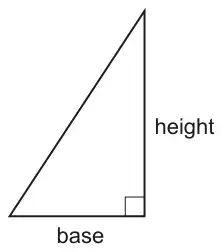
The area of the triangle is 100 cm2, correct to the nearest 10 cm2. The length of the base of the triangle is 8 cm, correct to the nearest cm.
Calculate the largest possible height of the triangle. [4]
Mark scheme
Answer
Marks
Part marks and guidance
28 nfww
4
B1 for 105 B1 for 7.5 M1 for \(\dfrac{\textit{their}\ (95 \text{ to } 105)}{\frac{1}{2} \times \textit{their}\ (7.5 \text{ to } 8.5)}\) but not \(\dfrac{100}{\frac{1}{2} \times 8}\)
17 The number of people watching a football match is 30 000, correct to the nearest thousand.
(a) Complete the error interval for \(n\), the number of people watching the football match.\[\ldots\ldots\ldots \leqslant n \lt 30\,500\] [1]
(b) The number of people watching a rugby match is 30 500, correct to the nearest hundred.
Show that fewer people could be watching the rugby match than the football match. [2]
Mark scheme (a)
Answer
Marks
Part marks and guidance
29 500
1
Mark scheme (b)
Answer
Marks
Part marks and guidance
Accept any correctly matched pair of values in which rugby < football from these ranges rugby: 30 450 to 30 498 and football: 30 451 to 30 499
2
B1 for one value for rugby or football in these ranges rugby from 30 450 to 30 498 or football from 30 451 to 30 499
Error interval alone scores 0 Only mark candidate’s chosen value(s) Rugby < football does not need to be stated If a pair of values and rugby or football not stated assume the value on the left or below another is rugby
For B1 if one or multiple values seen and no clear choice/designation all must be in range 30 451 to 30 498
12 A box contains 200 matches, correct to the nearest ten matches.
(a) Complete the error interval for \(n\), the number of matches in the box.\[\ldots\ldots \leqslant n \leqslant \ldots\ldots\] [2]
(b) The box is a cuboid with
length 7 cm, correct to the nearest cm
width 5 cm, correct to the nearest cm
volume 248 cm3, correct to the nearest cm3.
Show that the smallest possible height of the box is 6 cm. [3]
Mark scheme (a)
Answer
Marks
Part marks and guidance
195 [\(\leqslant n \leqslant\)] 204
2
B1 for 195 or 204 in correct position or for both 195 and 204 but in wrong position
Do not accept < 205 where \(\leqslant\) has been crossed out and replaced
Mark scheme (b)
Answer
Marks
Part marks and guidance
\(\frac{247.5}{7.5 \times 5.5} = 6\)
3
Max 2 marks if answer is incorrect
B1 for 247.5
B1 for 7.5 and 5.5
M1 for \(\frac{their\ 247.5}{their\ 7.5 \times their\ 5.5}\) where \(247.5 \leqslant their\ 247.5 \leqslant 248.5\), \(6.5 \leqslant their\ 7.5 \leqslant 7.5\) and \(4.5 \leqslant their\ 5.5 \leqslant 5.5\)
May be done in stages. 6 must not come from a rounded answer or other wrong working.
If choice, mark the bounds used in the calculation. If no calculation, then 0 each time upper and lower bounds are both given
7.5 × 5.5 × 6 = 247.5 scores just the second mark. If they then explicitly state that 247.5 is the lower bound of 248 they also get the first mark but not for “247.5 rounds to 248”
16 A plane flies from London to Tokyo. The distance is 9600 km, correct to the nearest 100 km. The plane travels at an average speed of 820 km/h, correct to the nearest 10 km/h.
Calculate the shortest possible flight time of the plane. Give your answer in hours and minutes, correct to the nearest minute. You must show your working. [5]
Mark scheme
Answer
Marks
Part marks and guidance
11 [hours] 35 [mins] with correct working
5
B4 for answers 11 [hours] 34 [mins] or 11 [hours] 34.5[…] to 34.8 [mins], with correct working
OR
B1 for 9550 B1 for 825 M1 for (9550 to 9650) ÷ (815 to 825) M1 for their 0.57… × 60 oe
If 0, 1 or 2 scored, instead award SC3 for answer 11 [hours] 35 [mins] with no working or insufficient working
If 0 or 1 scored, instead award SC2 for answer 11 [hours] 34 [mins] or 11 [hours] 34.5[…] to 34.8 [mins] with no working or insufficient working
If 0 scored, instead award SC1 for 11.57[…] or 11.58 with no working or insufficient working
“Correct working” requires evidence of at least B1B1M1
Allow 824.9[9…] for 825 With no contradictory choice With no contradictory choice Do not imply this first M1 mark. their 0.57 following from distance ÷ speed implied by 11.57 to 11.85
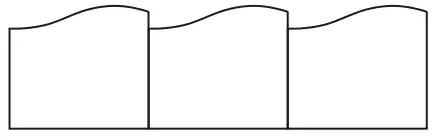
11 Jamie buys fence panels that fit tightly together.
Not to scale
Each panel has a length of 1.8 m, correct to 1 decimal place. Jamie measures the length of a garden as 42 m, correct to the nearest metre.
Work out the minimum number of panels Jamie should buy in order to be certain that there are enough panels for the length of the garden. Show how you decide. [4]
Mark scheme
Answer
Marks
Part marks and guidance
42.5 or 42.49[9..] ÷ 1.75
M3
B1 for 1.75 B1 for 42.5 or 42.49[9…]
B1 seen anywhere and mark figures crossed out if you think they have been “rejected” for use
25
A1
If 0 scored award B3 for 24.29 or 24.28[5…]
or if 0 or 1 scored award SC1 as well for their 24.29 seen and correctly rounded up
9 The width, \(w\), of a kitchen cupboard is 60 cm, correct to the nearest centimetre.
(a) Complete the error interval for the width, \(w\).\[\ldots\ldots \leqslant w < \ldots\ldots\]
[2]
(b) Six of these kitchen cupboards are to be placed side by side along a kitchen wall. The wall is 363 cm long, correct to the nearest centimetre.
(i) Show that the six cupboards may not fit along the wall. [3]
(ii) Find the upper bound of the space remaining if six cupboards do fit along the wall. [3]
Mark scheme (a)
Answer
Marks
Part marks and guidance
59.5 60.5
2
B1 for either one correct or both correct but reversed
Mark scheme (b)(i)
Answer
Marks
Part marks and guidance
Accept any correctly matched wall and 6 × cupboard where values quoted satisfy:
wall < 6 × cupboard where 362.5 ⩽ wall < 363 and 362.5 < 6 × cupboard ⩽ 363
OR wall ÷ 6 < cupboard where 362.5 ⩽ wall < 363 and \(60.41\dot{6}\) to 60.42 < cupboard ⩽ 60.5
OR wall ÷ cupboard < 6 where 362.5 ⩽ wall < 363 and \(60.41\dot{6}\) to 60.42 < cupboard ⩽ 60.5
3
B1 for 362.5 ⩽ wall value < 363 B1 for 362.5 < 6 × cupboard value ⩽ 363 or 60.416 to 60.42 < cupboard value ⩽ 60.5
Example: [lower bound of] wall is 362.5 [upper bound of] cupboard is 60.5 362.5 ÷ 60.5 = 5.9[9…] < 6
Mark scheme (b)(ii)
Answer
Marks
Part marks and guidance
6.5
3
M2 for 363.5 – 6 × their lower bound of cupboard or 363.5 – 357 or M1 for [upper bound of wall =] 363.5 or for 6 × their lower bound of cupboard or [6 cupboards =] 357
(a) The length, \(d\), of Jamal’s car is 4.72 m, correct to 2 decimal places.
Complete the error interval for the length, \(d\).
.................... \(\leqslant d \lt\) .................... [2]
(b) Jamal travels 430 km, correct to the nearest 10 km. His average speed is 57.3 km / h, correct to 1 decimal place.
Calculate the shortest possible time for Jamal’s journey. Give your answer correct to the nearest minute. [5]
Mark scheme (a)
Answer
Marks
Part marks and guidance
4.715 4.725
2
B1 for each or both correct and reversed
Mark scheme (b)
Answer
Marks
Part marks and guidance
7 25
5
B4 for 7.41[0...] or 7.411 OR B1 for 425 used B1 for 57.35 or 57.349[9...] used If B0 then B1 for 425 and 57.35 seen AND M2 for 425 ÷ 57.35 or M1 for use of distance ÷ speed e.g 430 ÷ 57.3
If 4 or 5 not scored SC1 for correctly changing their part hour to minutes
Condone use of 57.349[9...] for M2 and for M1 420 ≤ distance ≤ 440 and 56 ≤ speed ≤ 58
15 Andrea is 165 cm tall, correct to the nearest cm. Joel is 170 cm tall, correct to the nearest 10 cm.
Show that Andrea could be taller than Joel. [3]
Mark scheme
Answer
Marks
Part marks and guidance
Accept any correctly matched pair where Andrea > Joel and values quoted are \(165 \lt \text{Andrea} \lt 165.5\) \(165 \leqslant \text{Joel} \lt 165.5\)
3
B1 for value \(165 \lt \text{Andrea} \lt 165.5\) B1 for value \(165 \leqslant \text{Joel} \lt 170\)
For B1 if choice of values given all must be in range, unless acceptable value(s) indicated Values must be clearly associated with either Andrea or Joel as appropriate.
11 The area of a rectangle is 56 m\(^2\), correct to the nearest m\(^2\). The length of the rectangle is 9.2 m, correct to the nearest 0.1 m.
Calculate the smallest possible width of the rectangle. [4]
Mark scheme
Answer
Marks
Part marks and guidance
[55.5 ÷ 9.25 or \(9.24\dot{9}\) =] 6
4
6 must not come from a rounded answer B1 for 55.5 B1 for 9.25 condone 9.2499 or better M1 for their 55.5 ÷ their 9.25 \((55.5 \leqslant\) their \(55.5 \leqslant 56.5\) and \(9.15 \leqslant\) their \(9.25 \leqslant 9.25)\)
16 A £1 coin weighs 8.75 g, correct to the nearest 0.01 g.
Mitul weighs the contents of a large bag of £1 coins. The coins weigh 2.63 kg, correct to the nearest 10 g.
Mitul says
I am sure that the bag contains exactly £300 because, using bounds, 2625 ÷ 8.755 = 299.8 to 1 decimal place.
Show that Mitul may not be correct. [3]
Mark scheme
Answer
Marks
Part marks and guidance
There could be £301 e.g. because 2635 ÷ 8.745 = 301[.3…]
3
M2 for a calculation of (2625 to 2635) ÷ (8.745 to 8.755) oe correctly evaluated to an answer of 301(….) or for a calculation of (2632.245 to 2635) ÷ 301 oe correctly evaluated to an answer of 8.745 to 8.755 or for a calculation of 301 × (8.745 to 8.7541528…) oe correctly evaluated to an answer of 2625 to 2635 or M1 for any further calculation of (2625 to 2635) ÷ (8.745 to 8.755) or (2625 to 2635) ÷ 301 or 301 × (8.745 to 8.755) but not 2625 ÷ 8.755 or 2630 ÷ 8.75 or B1 for 2635, 2.635, 8.745 or 8745 seen
For full marks, their conclusion must follow from a relevant calculation which shows that 301 is a possible answer (either use of 301 and two weights in range, or an answer of more than 301 rounded down, and not an answer of less than 301 rounded up)
Calculations may be done in grams as shown, or converted to kg.
Common calculations for at least M2 include: 2635 ÷ 8.75 = 301.1(…) 2635 ÷ 8.745 = 301.3(…)
Common calculations scoring only M1 include: 2625 ÷ 8.75 (= 300) 2630 ÷ 8.745 = 300.7(…)
Note the first method does not require a comparison against 1 (km)
4
B1 for (minimum length =) 21.45 seen
Allow access to all marks if brick and 1 km are in consistent units.
B1 for 1 km = 100 000 cm soi oe such as ÷ 100 then ÷ 1000 or use of 1m = 100cm and 1km = 1000m if working in metres.
Allow these conversions even with their volume or surface area. eg 21.5 × 10.3 × 6.5 = 1439.425 cm/cm\(^2\)/cm\(^3\) = 0.014 394 25 km
M1 for their 21.45 × 4663 (÷ 100 000) or 100 000 ÷ their 21.45 or 100 000 ÷ 4663
their 21.45 must be in the range 21.45 to 21.55 but accept equivalent if attempting the unit conversion first eg B0B0M1 for 21.5 cm = 0.0215 km followed by 0.0215 × 4663
If M0 scored, allow SC1 for \(k\) × 4663 (÷ 100 000) or 100 000 ÷ \(k\) with \(k\) in the range 10.25 to 10.35 or 6.45 to 6.55
Thus, use of width or height of the brick may score B0,B1,SC1 whereas use of volume may score B0/1,B1,SC0
Accept equivalent if working in m or km
Mark scheme (b)
Answer
Marks
Part marks and guidance
(i) 7017 to 7020
3
B1 for 20 000 or 2.849[…] or 2.85 or 0.0028[…] seen
M1 for their 20 000 ÷ their 2.85 or 20 ÷ their 0.00285
Ignore other bound
ie a division after an attempt to reach consistent units their 2.85 must be in the range 2.75 to 2.85 inc.; their 0.00285 must be in the range 0.00275 to 0.00285. B0M0 for 20 ÷ 2.8 as no attempt to reach consistent units
(ii) The truck may not have enough room oe Safety regulations may not allow it
1
Mark their best reason. 0 for we do not know the exact weight of the bricks oe 0 for because the truck may need to carry other loads 0 there may not be enough bricks available
(a) The mass, \(m\) tonnes, of a girder is 12.7, correct to 1 decimal place.
Complete the error interval for the mass, \(m\).
\[\ldots\ldots\ldots\ldots \leqslant m \lt \ldots\ldots\ldots\ldots\]
[2]
(b) The length of a piece of wood is given as 8 metres, correct to the nearest metre. The length of a metal rod is given as 8.5 metres, correct to 1 decimal place.
Show that the piece of wood could be longer than the metal rod. [2]
Mark scheme (a)
Answer
Marks
Part marks and guidance
12.65 12.75
2
B1 for one correct or both correct and reversed
For B1, correct value must be in correct place
Mark scheme (b)
Answer
Marks
Part marks and guidance
Accept any correctly matched pair in which wood > metal
from \(8.45 \lt \text{wood} \leqslant 8.49[9\ldots]\) and \(8.45 \leqslant \text{metal} \leqslant 8.49[9\ldots]\)
2
Wood > metal does not need to be stated but it must be clear which measurement refers to wood and which to metal
B1 for one measurement in range \(8.45 \lt \text{wood} \leqslant 8.49[9\ldots]\) seen or \(8.45 \leqslant \text{metal} \leqslant 8.49[9\ldots]\) seen
Eg “Wood 8.46 [m] but Metal 8.45 [m]” scores 2 marks
Wood or 8 Metal or 8.5
For B1, measurement must be correctly associated with either wood or metal, as appropriate
8.45 seen as end of range Eg \(8.45 \leqslant 8.5 \lt 8.55\) scores 1 mark
11 Sunil makes 7.5 litres of soup, correct to the nearest 0.5 litre. He serves the soup in 300 ml portions, correct to the nearest 10 ml. 24 people order this soup.
Does Sunil definitely have enough soup to serve the 24 people? Show how you decide. [4]
Mark scheme
Answer
Marks
Part marks and guidance
No, with correct calculation leading to 23.77 to 23.8 identified or with 7.32 compared with 7.25 oe or 302 compared with 305 oe
4
B1 for 7250 or 7.25 seen B1 for 305 or 0.305 seen
M1 for their 7.25 ÷ their 0.305 with consistent units and at least one attempted bound or for their 0.305 × 24 oe or their 7250 ÷ 24 oe
Ignore upper bound Ignore lower bound
Their 7.25 in range 7 to 8, their 0.305 in range 0.29 to 0.31 or equivs. Ignore other divisions or products M0 for 7500 ÷ 300 or 7.5 ÷ 0.3
15. Paint is stored in large tanks. The volume of paint in each tank is 1500 litres, correct to the nearest 20 litres.
The paint from the tank is poured into tins. Each tin has a capacity of 10 litres, correct to the nearest 0·1 litre.
Calculate the maximum number of tins that can be filled using paint from one of the tanks. [4]
Mark scheme
Scheme
Marks
Comments
\(1510 \div 9.95\)
M2
Allow 1509.999.. for 1510, must clearly be a recurring 9. The calculation must be unambiguously selected for the award of M2.
M1 for ‘their 1510’ \(\div\) ‘their 9.95’ provided \(1500 \lt\) ‘their 1510’ \(\leqslant 1520\) AND \(9.9 \leqslant\) ‘their 9.95’ \(\lt 10\) or ‘their 9.95’ \(= 9.5\)
= 151 (tins)
A2
From M2 award for A1 for 151.7(5….) or 151.76 or 151.8 or on FT from M1 award A1 for their correctly evaluated answer rounded down to the nearest integer.
Award M2 for \(\dfrac{170 - 8.5}{170}(\times 100) - \dfrac{175 - 13}{175}(\times 100)\) \((= 95 - 92.57..)(\%)\)
M1 for either \(\dfrac{8.5}{170}(\times 100)\) OR \(\dfrac{13}{175}(\times 100)\) provided unambiguous or used to obtain the final answer May be seen as \(170 \times 0.05 = 8.5\)
If B0, FT for M2 or M1 provided unambiguous or used to obtain the final answer provided: for M2: \(8 \leqslant\) ‘their 8.5’ \(\lt 9\) AND \(12 \lt\) ‘their 13’ \(\leqslant 14\). for M1: \(8 \leqslant\) ‘their 8.5’ \(\lt 9\) OR \(12 \lt\) ‘their 13’ \(\leqslant 14\).
Award M1 for \(\dfrac{170 - a}{170}(\times 100) - \dfrac{175 - b}{175}(\times 100)\) provided \(8 \leqslant a \lt 9\) OR \(12 \lt b \leqslant 14\)
\(= 2.4(2\ldots)\) or \(2\frac{3}{7}\) (%) oe
A1
CAO
Allow 2(%) from correct working.
If no marks, award SC1 for an answer of 0.697(5..)% or 0.7% from: \(\dfrac{11}{175}(\times 100) - \dfrac{9.5}{170}(\times 100)\) \((= 6.286...\% - 5.588\ldots\%)\)
(4)
Corrected by Westie's Workshop
The board's mark scheme printed “their 8.5’”. Changed to “‘their 8.5’” because the opening quotation mark was missing (in both the M2 and M1 lines).
Original: see the board's mark scheme PDF (link above).
18. Kian went for a run. The route he runs is 3000 metres, correct to the nearest 100 metres. He ran the route in a time of 720 seconds, correct to the nearest 10 seconds.
Calculate Kian’s greatest possible average speed for this run. Give your answer in metres per second. You must show all your working.[3]
Mark scheme
Scheme
Marks
Comments
\(3050 \div 715\)
M2
Answer line takes precedence. Allow 3049.999.. for 3050, must clearly be a recurring 9.
14. The area of country \(A\) is 1 078 000 km2, correct to 4 significant figures. The area of country \(B\) is 249 300 km2, correct to 4 significant figures. The two countries merge to form country C.
(a) Calculate the upper bound of the area of country C. [2]
(b) The population density of a country is the number of people per km2. Country \(C\) has a population of 82 000 000, correct to the nearest million.
Calculate the least possible value of the population density for country \(C\). You must show all your working. [3]
Mary’s time is between 14 and 15 seconds inclusive. Paul’s time is between 12 and 13 seconds inclusive.
Complete the inequality to show the least and greatest possible difference between the times of these two runners. [2]
............ \(\leqslant\) time difference \(\leqslant\) ............
(b)
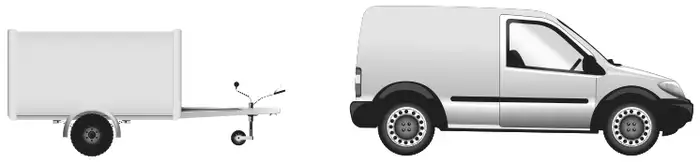
Peter wants to go by ferry to France. He is taking a van and a small trailer. He knows:
the van is 590 centimetres long, correct to the nearest 10 cm
the trailer is 200 centimetres long, correct to the nearest 10 cm.
The ferry company uses the following rules for the length of vehicles.
Small trailer: maximum length 2 m
Van: maximum length 6 m
Peter thinks that the length of his van and the length of his trailer will both fit the rules.
Use lengths to give one example to show how Peter may be correct, and one example to show how Peter may not be correct. [2]
May be correct ............
May not be correct ............
Mark scheme (a)
Scheme
Marks
Comments
\(1 \leqslant\) time difference \(\leqslant 3\)
B2
Not from wrong working
B1 for one end correct in the inequality or for sight of both values
Mark scheme (b)
Scheme
Marks
Comments
Accept a statement such as ‘The van is always less than 6 m long/the maximum length acceptable’ stated once only; may be written anywhere If lengths are given, they must be within the appropriate limits.
Valid example for may be correct e.g. Van 590 cm AND trailer 198 cm
E1
For the van accept any statement such as ‘The van is always less than 6 m long/the maximum length acceptable’ or any values satisfying: 585 cm \(\leqslant\) length of the van < 595 cm AND 195 cm \(\leqslant\) length of the trailer \(\leqslant\) 200 cm Allow e.g. ‘The trailer could be less than 200 (cm).’ Example might use the values given in the question (590 cm and 200 cm) and not consider the values are rounded to the nearest 10 cm.
Valid example for may not be correct e.g. (Van 590 cm and) trailer 201 cm
E1
(For the van accept any statement such as ‘The van is always less than 6 m long’ or any values satisfying: 585 cm \(\leqslant\) length of the van < 595 cm AND) 200 cm < length of the trailer < 205 cm Allow e.g. ‘The trailer could be more than 200 (cm)/the maximum length acceptable’ or ‘the length of the trailer could be 205 (cm)’.
Mary’s time is between 14 and 15 seconds inclusive. Paul’s time is between 12 and 13 seconds inclusive.
Complete the inequality to show the least and greatest possible difference between the times of these two runners. [2]
…………………… \(\leqslant\) time difference \(\leqslant\) ……………………
(b) Peter wants to go by ferry to France. He is taking a van and a small trailer. He knows:
the van is 590 centimetres long, correct to the nearest 10 cm
the trailer is 200 centimetres long, correct to the nearest 10 cm.
The ferry company uses the following rules for the length of vehicles.
Diagram not drawn to scale
Small trailer: maximum length 2 m Van: maximum length 6 m
Peter thinks that the length of his van and the length of his trailer will both fit the rules.
Use lengths to give one example to show how Peter may be correct, and one example to show how Peter may not be correct. [2]
Mark scheme (a)
Scheme
Marks
Comments
\(1 \leqslant\) time difference \(\leqslant 3\)
B2
Not from wrong working
B1 for one end correct in the inequality or for sight of both values
Mark scheme (b)
Scheme
Marks
Comments
Accept a statement such as ‘The van is always less than 6 m long/the maximum length acceptable’ stated once only; may be written anywhere. If lengths are given, they must be within the appropriate limits.
Valid example for may be correct e.g. Van 590 cm AND trailer 198 cm
E1
For the van accept any statement such as ‘The van is always less than 6 m long/the maximum length acceptable’ or any values satisfying: 585 cm ≤ length of the van < 595 cm AND 195 cm ≤ length of the trailer ≤ 200 cm Allow e.g. ‘The trailer could be less than 200 (cm).’ Example might use the values given in the question (590 cm and 200 cm) and not consider the values are rounded to the nearest 10 cm.
Valid example for may not be correct e.g. (Van 590 cm and) trailer 201 cm
E1
(For the van accept any statement such as ‘The van is always less than 6 m long’ or any values satisfying: 585 cm ≤ length of the van < 595 cm AND) 200 cm < length of the trailer < 205 cm Allow e.g. ‘The trailer could be more than 200 (cm)/the maximum length acceptable’ or ‘the length of the trailer could be 205 (cm)’.
Jim squeezes 1 pink grapefruit. He obtains 250 ml of juice, correct to the nearest 50 ml.
Jim thinks he will obtain a maximum of 900 ml of juice if he squeezes 3 pink grapefruit.
Assuming each pink grapefruit is the same size, is Jim likely to be correct?
Yes ☐ No ☐
Show how you decide. [2]
(b)
The mass of a red grapefruit is 150 grams, correct to the nearest 5 grams. The mass of a lemon is 85 grams, correct to the nearest 5 grams.
The total mass, correct to the nearest 5 grams, of this red grapefruit, lemon and an orange is 370 grams.
Calculate the minimum mass of the orange. [3]
Mark scheme (a)
Scheme
Marks
Comments
No seen or implied and \(275 \times 3\) or \(900 \div 275\) or \(900 \div 3\) and 275 seen
M1
Allow use of \(274.\dot{9}\) or 274.999.. but not 274.9 or 274.99
Sight of 825 or 3.2(727...) and No indicated
A1
Allow \(3 \times 275 \lt 900\) and No indicated
Mark scheme (b)
Scheme
Marks
Comments
367.5 – 152.5 – 87.5
M2
M1 for one of:
a calculation (min – max – max) with all values in the ranges \(365 \lt a \lt 370,\ 150 \lt b \lt 155,\ 85 \lt c \lt 90\) e.g. 367.5 –152.5 –86.5 or 369 –152.5 –87.5
a calculation with two correct values and the third in the ranges \(365 \leqslant a \lt 375,\ 145 \lt b \leqslant 155,\ 80 \lt c \leqslant 90\) e.g. 367.5 –152.5 – 82.5 or 365 -152.5 – 87.5
Allow M1 for 365 – 155 – 90 or 365 – 245 (= 120)
If no marks award SC1 for sight of 152.5, 87.5 and 367.5
(a) Emily walks to school. She measures her speed, \(s\), as 1·4 metres per second, correct to 1 decimal place.
Write an inequality to show the range of possible values for her speed. [2]
(b) After school, Emily goes to her grandmother’s house by car. It takes 25 minutes to travel the 15 miles.
What is the average speed for the car journey? Give your answer in miles per hour. [3]
………………………… mph
Mark scheme (a)
Scheme
Marks
Comments
\(1.35 \leqslant s \lt 1.45\)
B2
Allow e.g. \(1.35 \leqslant \text{speed} \lt 1.45\) or \(1.35 \leqslant x \lt 1.45\) B1 for sight of 1.35 and 1.45 or for appropriate sight of one of these in an inequality of the form \(\ldots \leqslant s \lt \ldots\) NB \(1.35 \leqslant 1.4 \lt 1.45\) is B1 only
Mark scheme (b)
Scheme
Marks
Comments
\(\dfrac{15}{25} \times 60\) or equivalent
M2
May be in stages; Accept a correct and complete build-up method for M2 e.g. 25 mins for 15 miles ÷5 ÷5 5 mins for 3 miles ×12 ×12
M1 for a correct distance ÷ time calculation e.g. \(\dfrac{15}{25}\) seen or for one correct stage in a build-up method e.g. 25 mins for 15 miles ÷5 ÷5 5 mins for 3 miles
36 (mph)
A1
(5)
Corrected by Westie's Workshop
The board's mark scheme printed “distance ÷ speed”. Changed to “distance ÷ time” because speed is found by dividing distance by time, which is what the example \(\frac{15}{25}\) (miles ÷ minutes) does.
Original: see the board's mark scheme PDF (link above).
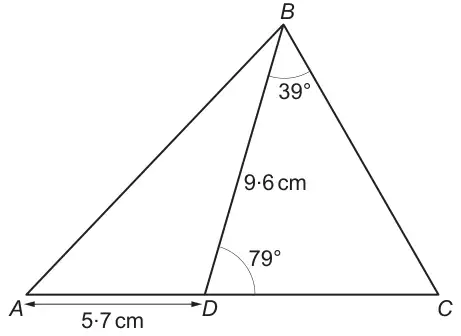
In the diagram, \(AD\) = 5·7 cm, \(BD\) = 9·6 cm, \(B\hat{D}C=79^\circ\) and \(D\hat{B}C=39^\circ\).
\(ADC\) is a straight line.
(a) Calculate the length of \(DC\). [3]
(b) Mona assumes that the values in the diagram are all exact and uses these to work out the area of triangle \(ABD\). In fact, the lengths are correct but \(B\hat{D}C\) has been rounded up to the nearest whole number.
Is Mona’s answer too large or too small? Use calculations to justify your decision. [3]
M1 for \(\dfrac{\mathrm{DC}}{\sin39}=\dfrac{9.6}{\sin(180-(79+39))}\)
6.8(…) (cm)
A1
Mark scheme (b)
Scheme
Marks
Comments
\(A\hat{D}B \gt 101\)
B1
Accept example of \(101\lt A\hat{D}B\lt101.5\)
\(\sin A\hat{D}B \lt \sin101\)
B1
Accept FT example of \(0.9799\lt\sin A\hat{D}B\lt0.9816\)
Mona’s area is \(\tfrac{1}{2}\times9.6\times5.7\sin A\hat{D}B\) and is too large or \(\tfrac{1}{2}\times AD\times BD\times\sin A\hat{D}B\) is too large
B1
Need both ‘too big’ and sight of \(\tfrac{1}{2}ab\sin C\). Accept calculation using \(\tfrac{1}{2}\times AD\times BD\times\sin A\hat{D}B\) e.g. \(26.810\lt\text{area}\lt26.857\) If no marks award SC1 for a convincing explanation without calculations, e.g. by drawing B3 for Area = \(\tfrac{1}{2}\times9.6\times5.7\sin A\hat{D}B\) and \(\sin101\gt\sin A\hat{D}B\)
(a) In 2015, the average price of coal sold by a mine in the USA was $31.83 per ton. This coal was then delivered to power stations. The power stations paid $42.58 per ton for this coal. The difference in price was the delivery cost.
What percentage of the original price of the coal was this delivery cost? Give your answer correct to 3 significant figures. [3]
(b) In the USA and the UK the word ‘ton’ means different amounts:
a UK ton = 1016 kg,
a USA ton = 907 kg,
a tonne (called a metric ton in the USA) = 1000 kg.
What is the difference between a UK ton and a USA ton? Give your answer in tonnes. [2]
(c) A preformed piece of coal weighs 100 g correct to the nearest 5 g. A bag contains 30 pieces of preformed coal.
Complete the sticker to attach to this bag of coal. [4]
\[\boxed{\begin{matrix}\text{This bag of coal}\\ \text{weighs }\textbf{at least}\\[4pt] \ldots\ldots\ldots\ldots\ \textbf{kg}\end{matrix}}\]
Mark scheme (a)
Scheme
Marks
Comments
\(\dfrac{42.58 - 31.83}{31.83}\ (\times 100)\) or equivalent
M1
(= 10.75/31.83)
33.8 (%)
A2
A1 for 33(.77...%) or 34 (%)
Mark scheme (b)
Scheme
Marks
Comments
\((1016 - 907) \div 1000\) or equivalent
M1
(=109 ÷ 1000)
0.109 (tonnes)
A1
Mark final answer
Mark scheme (c)
Scheme
Marks
Comments
Sight of 97.5 (g)
B1
\(30 \times 97.5\ (\div 1000)\)
M1
FT ‘their 97.5’ provided \(95 \leqslant\) ‘their 97.5’ \(\lt 100\)
21. When Jenna was measured recently she was 127 cm tall, correct to the nearest centimetre.
For safety reasons, the minimum height for a person to ride the Big Coaster at a funfair in the USA is 50 inches.
You are given: 20 inches = 50·8 cm.
(a)
Using the information given, decide whether it might possibly be safe, it is definitely safe, or it is definitely not safe for Jenna to ride the Big Coaster.
Might possibly be safe ☐ Definitely safe ☐ Definitely not safe ☐
Show how you decide. [3]
(b)
(i) State an assumption that you have made in your answer to part (a). [1]
(ii) Comment on the effect that your assumption has had on your decision. [1]
Mark scheme (a)
Scheme
Marks
Comments
50 inches = 127 cm
B2
B1 for e.g. 50.8 + 50.8 + 25.4
Might possibly be safe and use of the limit of accuracy e.g. ‘she could be only 126.9 cm tall’ or ‘Her height could be anywhere between 126.5 and 127.5.’
B1
NB bounds are not required, though could be used. Candidates must indicate they have interpreted the given limit of accuracy correctly in some way. Must not contain contradictions or errors.
Mark scheme (b)
Scheme
Marks
Comments
(i) Valid assumption eg ‘Jenna has not grown since she was last measured’ or ‘Jenna is still 127 cm’ or Jenna has not had a growth spurt.’ or ‘Jenna is wearing the same shoes that she was when she was measured.’
E1
Any valid assumption that indicates that Jenna may no longer be the same height
Not for comments assuming her height is 127 or a rounded version of this, as this is given information
(ii) Valid impact based on their assumption and decision in part (a) e.g. ‘Jenna may now be definitely tall enough to ride.’
E1
Comments such as ‘My answer would be different’ are not acceptable
20. Paula is baking biscuits for a charity fundraiser. She makes biscuits in batches of 12.
Paula’s weighing scales are accurate to the nearest gram. She needs to weigh 8 grams of baking powder to make 12 biscuits.
She has 220 grams of baking powder, correct to the nearest 10 grams. She has plenty of all the other ingredients she needs.
She plans to sell her biscuits at £2 for a pack of 3.
What is the greatest amount of money that Paula could raise for her charity? You must show all your working. [6]
Mark scheme
Scheme
Marks
Comments
Use of 225(g) and 7.5(g)
B1
\(225 \div 7.5\) si
M1
FT provided \(220 \lt\) ‘their 225’ \(\leqslant 225\) and \(7.5 \leqslant\) ‘their 7.5’ \(\lt 8\); may be implied by build up method finding e.g. 225g makes 360 biscuits
Any non-calculator method for division of \(225 \div 7.5\) seen
M1
e.g. \(\dfrac{2250}{75}\) or \(90 \div 3\) or build up method using 15
30 (batches of biscuits)
A1
CAO; si; implied by 360 biscuits
\(30\times12\div3\times2\) oe
M1
FT ‘their 30’ provided it has been derived using both bounds (which need to be in the ranges above); allow rounded or truncated if following through
5. When Jenna was measured recently she was 127 cm tall, correct to the nearest centimetre.
For safety reasons, the minimum height for a person to ride the Big Coaster at a funfair in the USA is 50 inches.
You are given: 20 inches = 50·8 cm.
(a) Using the information given, decide whether it might possibly be safe, it is definitely safe, or it is definitely not safe for Jenna to ride the Big Coaster.
Might possibly be safe ☐ Definitely safe ☐ Definitely not safe ☐
Show how you decide. [3]
(b)
(i) State an assumption that you have made in your answer to part (a). [1]
(ii) Comment on the effect that your assumption has had on your decision. [1]
Mark scheme (a)
Scheme
Marks
Comments
50 inches = 127 cm
B2
B1 for e.g. 50.8 + 50.8 + 25.4
Might possibly be safe and use of the limit of accuracy e.g. ‘she could be only 126.9 cm tall’ or ‘Her height could be anywhere between 126.5 and 127.5.’
B1
NB bounds are not required, though could be used. Candidates must indicate they have interpreted the given limit of accuracy correctly in some way. Must not contain contradictions or errors.
Mark scheme (b)
Scheme
Marks
Comments
(b)(i) Valid assumption eg ‘Jenna has not grown since she was last measured’ or ‘Jenna is still 127 cm’ or Jenna has not had a growth spurt.’ or ‘Jenna is wearing the same shoes that she was when she was measured.’
E1
Any valid assumption that indicates that Jenna may no longer be the same height
Not for comments assuming her height is 127 or a rounded version of this, as this is given information
(b)(ii) Valid impact based on their assumption and decision in part (a) e.g. ‘Jenna may now be definitely tall enough to ride.’
E1
Comments such as ‘My answer would be different’ are not acceptable
21. The density of a piece of stainless steel is 7750 kg/m3, correct to the nearest 5 kg/m3. A block of this stainless steel is in the shape of a cuboid. The dimensions of the cuboid are 0·33 m, 0·22 m and 0·11 m, all given correct to the nearest 1 cm.
Calculate the least possible mass of the block. Give your answer in kg, correct to 1 decimal place. You must show all your working. [4]
Mark scheme
Scheme
Marks
Comments
Sight of least density 7747.5 (kg/m3)
B1
Sight of all least dimensions 0.325(m), 0.215(m) and 0.105(m)
B1
Accept equivalents in cm
Mass \(7747.5 \times 0.325 \times 0.215 \times 0.105\)
M1
FT provided ‘their density’ < 7748, and at least 1 of the least dimensions is correct Must be in the correct units, if cm used throughout need sight of appropriate conversion of each to m, or volume to m3
56.8(kg)
A1
CAO, from correct working and not from premature approximation
13. The mass of an empty crate is 720 g, correct to the nearest 10 g. The crate holds 4 bottles. Each full bottle weighs 310 g, correct to the nearest 10 g.
Calculate the minimum mass of the crate containing 4 full bottles. You must show all your working. [3]
Mark scheme
Scheme
Marks
Comments
Sight of 715 (g) and 305 (g)
B1
\(715 + 4\times305\)
M1
FT ‘their 715’ and ‘their 305’ in working provided <720 and <310 respectively
(a) One Saturday, Alfie records the amount of money each customer spends in a charity shop. He presents his data in a grouped frequency table, as shown below.
Money spent (£)
Frequency
0 to 20
62
20 to 40
8
40 and over
1
State one criticism of the way Alfie has presented his data. [1]
(b) The charity has a Fun Day to raise money.
(i) Alfie is in charge of a game of chance.
A fair spinner is marked with the numbers 1 to 10.
A player spins once and wins £2 if the spinner lands on 6.
Liam plays the game exactly twice. Work out the probability that Liam wins £4. [2]
(ii) Alfie counts the money raised by the cake stall, raffle stall and refreshments stall. He finds an estimate of the takings. To do this, he rounds the total from each stall down to the nearest pound and adds the 3 amounts together.
Alfie’s estimate is £686.
Complete the following inequality to show the interval for the total raised by the three stalls. [1]
£686 \(\leqslant\) total \(\leqslant\) …………
Mark scheme (a)
Scheme
Marks
Comments
Valid comment e.g. ‘The groups overlap so people who spent £20 may be in different groups.’ or ‘His groups are too big.’ or ‘You cannot tell which group 40 is in.’
E1
Do not allow comments such as ‘The ages in the groups are too big’
Mark scheme (b)
Scheme
Marks
Comments
(i) \(\dfrac{1}{100}\) or equivalent
B2
B1 for \(\dfrac{1}{10}\times\dfrac{1}{10}\) or equivalent
25. The table shows the cost of sending items using a delivery service.
Mass less than
Full insurance against being lost:
£250
£750
£1500
100 g
£5
£7
£9
250 g
£7.50
£9.50
£11.50
1000 g
£9.25
£11.25
£13.25
1750 g
£11
£13
£15
2500 g
£13.50
£15.50
£17.50
5000 g
£18
£20
£22
Riley is planning to send two laptops to James using this delivery service. The laptops are to be sent with full insurance against being lost.
Each laptop is worth £700 and has a mass of 1250 g, correct to the nearest 50 g.
Riley says,
The delivery charge is more than £20.
James says,
You can send these for less than £20.
Explain how Riley and James could have come to their conclusions. Show all your working and state any assumption that you make. [4]
Mark scheme
Scheme
Marks
Comments
(Riley, more than £20: Sent separately, Insurance £750 each) Cost £26 seen or (Sent together, Insurance £1500) Cost £22 seen
E1
Not from wrong working
(James, less than £20: Sent together, Insurance £1500) Cost £17.50 seen
E1
Valid statement or example using limit of accuracy. e.g. ‘The masses could both be less than 1250g’, ‘One laptop could weigh 1230g and the other 1250g’ ‘They could have a total mass of 2460’
E1
For recognising that the limit of accuracy has an impact on the problem; allow for a total mass between 2450 and 2550 or individual masses between 1225 and 1275
One valid assumption: ‘Laptops can be sent separately’ ‘Laptops can be sent together’ ‘Packaging does not increase the mass to more than 2500g’
E1
Appropriately stated; allow embedded statements eg ‘If they are sent together then…’ or ‘If they are sent separately then …’ or ‘If both laptops weigh less than 1250 g then …’ or ‘Sent together…’
11. Gabby buys a chest of drawers and a computer desk to fit side by side between two walls in her bedroom.
Diagram not drawn to scale
The width of the chest of drawers is 45 cm, correct to the nearest cm. The width of the computer desk is 60 cm, correct to the nearest cm. The two walls are 1·2 m apart, correct to the nearest 10 cm.
Calculate the least possible width of the gap remaining when Gabby’s furniture is in place. [4]
Mark scheme
Scheme
Marks
Comments
Sight of 45.5 cm 60.5 cm and 115 cm or 1.15 m
B2
If units are given they must be correct. Award B1 for any 1 correct.
\(115 - 45.5 - 60.5\) seen or implied
M1
FT ‘their 45.5, 60.5 and 115’ providing all are in the same units, ‘their 45.5’ > 45, ‘their 60.5’ > 60 and ‘their 115’ <120 and greater than ‘their 45.5 + 60.5’ May be in steps
5. The table shows the cost of sending items using a delivery service.
Mass less than
Full insurance against being lost:
£250
£750
£1500
100 g
£5
£7
£9
250 g
£7.50
£9.50
£11.50
1000 g
£9.25
£11.25
£13.25
1750 g
£11
£13
£15
2500 g
£13.50
£15.50
£17.50
5000 g
£18
£20
£22
Riley is planning to send two laptops to James using this delivery service. The laptops are to be sent with full insurance against being lost.
Each laptop is worth £700 and has a mass of 1250 g, correct to the nearest 50 g.
Riley says,
“The delivery charge is more than £20.”
James says,
“You can send these for less than £20.”
Explain how Riley and James could have come to their conclusions. Show all your working and state any assumption that you make. [4]
Mark scheme
Scheme
Marks
Comments
(Riley, more than £20: Sent separately, Insurance £750 each) Cost £26 seen or (Sent together, Insurance £1500) Cost £22 seen
E1
Not from wrong working
(James, less than £20: Sent together, Insurance £1500) Cost £17.50 seen
E1
Valid statement or example using limit of accuracy. e.g. ‘The masses could both be less than 1250g’, ‘One laptop could weigh 1230g and the other 1250g’ ‘They could have a total mass of 2460’
E1
For recognising that the limit of accuracy has an impact on the problem; allow for a total mass between 2450 and 2550 or individual masses between 1225 and 1275
One valid assumption: ‘Laptops can be sent separately’ ‘Laptops can be sent together’ ‘Packaging does not increase the mass to more than 2500g’
E1
Appropriately stated; allow embedded statements eg ‘If they are sent together then…’ or ‘If they are sent separately then …’ or ‘If both laptops weigh less than 1250 g then …’ or ‘Sent together…’
11. The table below shows the value of \(g\) and the value of \(h\). It also shows the degree of accuracy of each value.
Value
Degree of accuracy
\(g = 8\)
1 significant figure
\(h = 1{\cdot}7\)
1 decimal place
Use the formula
\[f = (g - h)^2\]
to calculate the greatest possible value of \(f\).
You must show all your working. [3]
Mark scheme
Scheme
Marks
Comments
No misreads are allowed in this question.
Use of 8·5 AND 1·65
B1
Allow 8.4999(9….) All four bounds may be seen in calculations but the correct bounds must be clearly identified, used and indicated as their chosen answer.
(8·5 – 1·65)2 or 6·852
M1
If B0, FT their values, provided unambiguously chosen, with \(8 \lt g \leqslant 9\) AND \(1{\cdot}6 \leqslant h \lt 1{\cdot}7\)
= 46·9(225) or \(\dfrac{18769}{400}\)
A1
CAO Allow 47 provided 46·9(225) previously seen.
Check supporting working e.g. note that (8·499 – 1·65)2 = 46·9 gains B0 M1 A0.
A hot air balloon is initially descending at a speed of 3 m/s. A passenger drops their phone out of the balloon. The phone accelerates due to gravity at a rate of 9·8 m/s\(^2\), and hits the ground with a speed of 50 m/s.
The speed, \(v\) m/s, of the phone when it hits the ground is given by the formula,
\[v = \sqrt{u^2 + 2gh}\]
where: \(u\) is the initial speed of the phone, \(g\) is the acceleration due to gravity, \(h\) is the height above the ground from which the phone was dropped.
Use the formula to calculate the height from which the phone was dropped. [4]
(b)
Consider the Earth to be a sphere.
The mass of the Earth is 6·0 × 10\(^{24}\) kg, correct to 2 significant figures. The volume of the Earth is 1·09 × 10\(^{21}\) m\(^3\), correct to 3 significant figures.
Calculate the greatest possible density of the Earth. Give your answer in kg/m\(^3\). [3]
(c)
Diagram not drawn to scale
Here are some approximations about the Earth’s motion around the Sun.
The Earth follows a circular path around the Sun.
The Earth makes 1 complete revolution of the Sun in 365 days.
The speed of the Earth is 29 700 m/s.
Use these approximations to calculate the radius, in metres, of the Earth’s motion around the Sun. Give your answer in standard form. [4]
or equivalent, e.g. 2500 = 9 + 19.6h Do not allow any FT if:
\(50^2 = (3^2 + 2 \times 9.8) \times h\) or
\(\dfrac{50^2}{(3^2 + 2 \times 9.8)} = h\) is their next step
If \(50 = \sqrt{(3^2 + 2 \times 9.8)h}\) is their first step, then first B1 at most could be awarded if they then deal with the square root appropriately
CAO Allow an answer of 5580 provided no incorrect work seen ISW
Mark scheme (c)
Scheme
Mark
Comments
(Distance travelled by the Earth in 1 year =) 29700 × 365 × 24 × 60 × 60 or 29700 × 31536000
(= 936 619 200 000 or 9.366192 × 10\(^{11}\))
M2
Allow use of 365.25 for all marks M1 for correct use of 29700 with any 3 of 365, 24, 60 and 60, which may be embedded in further incorrect working If no evidence of 29700 × 365, allow M1 to be implied by a value in the range 9 × 10\(^{11}\) to 9.7 × 10\(^{11}\)
(Radius of Earth’s motion around the Sun =) \(\dfrac{29700 \times 365 \times 24 \times 60 \times 60}{(2 \times)\ \pi}\) or \(\dfrac{936\,619\,200\,000}{(2 \times)\ \pi}\)
M1
FT ‘their 936 619 200 000‘ provided it comes from a calculation that includes 29700 × 365 OR FT if no evidence of 29700 × 365 but ‘their 936 619 200 000‘ is in the range 9 × 10\(^{11}\) to 9.7 × 10\(^{11}\) Do not award this M1 if this calculation is then square rooted Accept values of \(\pi\) from 3.14 to 3.142
= 1.49 × 10\(^{11}\) to 1.5 × 10\(^{11}\) (m)
A1
FT from M1M1 Must be correct for \(\dfrac{\text{‘their }936\,619\,200\,000\text{’}}{2 \times \pi}\) AND be written in standard form On FT, accept truncation or rounding of the mantissa
Allow place value errors in writing the given standard form numbers in full for M2 and M1 only M1 for any one of the following calculations or evaluations:
\(\dfrac{1.2 \times 10^{8}}{2 \times 10^{7}}\) (= 0.6 × 10 (× 100) or 6(× 100) or 600(%))
500 (%)
A1
CAO Answer space completing the statement takes precedence Accept equivalents \(0.5 \times 10^{3}\) or \(5 \times 10^{2}\) Accept an unsupported correct answer or a correct answer from reverse calculations
Allow place value errors in writing given standard form numbers in full for M2 and M1 only M1 for any one of the following calculations or evaluations:
1.2 × 10⁸ – 2 × 10⁷ (= 1 × 108 = 100 000 000)
\(\dfrac{1.2 \times 10^{8}}{2 \times 10^{7}}\) (= 0.6 × 10(× 100) or 6(× 100) or 600(%))
500 (%)
A1
CAO Answer space completing the statement takes precedence Accept equivalents 0.5 × 10³ or 5 × 10² Accept an unsupported correct answer or a correct answer from reverse calculations
6. Teifion is going to paint the front of his bungalow. He will not be painting the roof, door or window. A diagram of the front of Teifion’s bungalow is shown below.
Diagram not drawn to scale
All the measurements on the diagram are correct to the nearest 10 cm. A litre of paint will cover 50 000 cm\(^2\), correct to the nearest 10 000 cm\(^2\).
For a good finish, Teifion needs to paint the front of the bungalow 3 times. Calculate the smallest possible number of litres of paint that Teifion could use to paint the front of his bungalow 3 times. [7]
Smallest possible number of litres of paint that Teifion could use to paint the front of his bungalow 3 times is …………… litres
Mark scheme
Scheme
Marks
Comments
Accept use of upper bounds e.g. 104.999… with a clear recurring digit. Do not accept use of e.g. 104.99
(Smallest possible area =) 605×295 − 105×205 − 225×145 or equivalent or 178475 − 21525 − 32625 or equivalent or 178475 − 54150
M4
M3 for an appropriate calculation using 3 products with any 2 correct M2 for ‘their 605×295’ − ‘their 105×205’ − ‘their 225×145’ where 600 \(\leqslant\) ‘their 605’ < 610 and 290 \(\leqslant\) ‘their 295’ < 300 and 100 < ‘their 105’ \(\leqslant\) 110 and 200 < ‘their 205’ \(\leqslant\) 210 and 140 < ‘their 145’ \(\leqslant\) 150 and 220 < ‘their 225’ \(\leqslant\) 230
M1 for use of 605×295 OR 105×205 OR 225×145
= 124 325 (cm\(^2\))
A1
CAO May be implied by (3 × 124325 =) 372975
(Least number of litres Teifion could possibly use =) 3 × 124 325 ÷ 55000 or 372975 ÷ 55000
M1
FT ‘their derived 124325’ Allow M1 for 3 × ‘their 124325’ ÷ ‘their 55000’ where 50000 < ‘their 55000’ \(\leqslant\) 60000
= 6.78(13…) or 6.8 (litres)
A1
Allow an answer of 6.7 or 7 from correct working On FT, accept rounding up to nearest whole number On FT, allow truncation to 1 d.p. or better
If no marks awarded, and from a misinterpretation of the question, SC3 for an answer of 9.335 or 9.3 or 9.33 or 9.34 or 9.4 or 10 (litres) from \(\dfrac{3 \times (615\times 305 - 95\times 195 - 215\times 135)}{45000}\) or \(\left[\dfrac{3\times(187575-18525-29025)}{45000}\right]\) OR
SC2 for any one of the following:
\(\dfrac{3 \times (615\times 305 - 95\times 195 - 215\times 135)}{45000}\) or \(\left[\dfrac{3\times(187575-18525-29025)}{45000}\right]\) but not evaluated correctly
correct evaluation (unrounded, rounded or truncated) from 3 × (‘their 615×305’ − ‘their 95×195’ − ‘their 215×135’) ÷ ‘their 45000’ where 610 < ‘their 615’ \(\leqslant\) 620 and 300 < ‘their 305’ \(\leqslant\) 310 and 90 \(\leqslant\) ‘their 95’ < 100 and 190 \(\leqslant\) ‘their 195’ < 200 and 210 \(\leqslant\) ‘their 215’ < 220 and 130 \(\leqslant\) ‘their 135’ < 140 and 40000 \(\leqslant\) ‘their 45000’ < 50000
OR SC1 for 3 × (‘their 615×305’ − ‘their 95×195’ − ‘their 215×135’) ÷ ‘their 45000’ using values in the same ranges as SC2, but not evaluated correctly
15. The values \(e\) = 7·1, \(f\) = 73·9 and \(g\) = 65·7 are each given correct to 1 decimal place.
The value of \(h\) is found using the formula \(h = \dfrac{e}{f - g}\).
Calculate the greatest value of \(h\). Give your answer correct to four decimal places.
You must show all your working.[3]
Mark scheme
Scheme
Marks
Comments
\(\dfrac{7{\cdot}15}{73{\cdot}85 - 65{\cdot}75}\) or \(\dfrac{7{\cdot}15}{8{\cdot}1}\)
M2
If many attempts are offered without a method/answer being identified then mark final attempt. Award M2 for sight of 143/162 if clearly identified as ‘their final attempt’. Accept 7·14999… or 65·74999… (or using recurring dot notation). Do not accept truncated values of 7·149 or 7·1499 or 65·749 or 65·7499. Award M1 for correct use of values 7·1 < e ≤ 7·2, 73·8 ≤ f < 73·9 and 65·7 < g ≤ 65·8 OR award M1 for correct use of 2 of the 3 correct bounds, 7·15, 73·85 and 65·75.
= 0·8827
A1
CAO. Must be correct to 4 decimal places. Only award A1 if M2 gained. If no marks gained award SC1 for an unsupported answer of 0·8827(16…).
(a) Geraint has bought a new front cog for his bike.
The cog has a mass of 150 g, correct to the nearest 10 g. The cog has been made from a metal that has a density of 3 g/cm3, correct to the nearest g/cm3. Calculate the maximum possible volume of the cog. [3]
(b) This picture shows part of Geraint’s bike.
A simplified diagram of the cogs and the chain is shown below.
Diagram not drawn to scale
X and Y are the centres of the cogs and XY is a line of symmetry. BC and AD are straight sections of the chain.
The larger cog has a radius of 12 cm. The smaller cog has a radius of 2 cm.
(i) Use Pythagoras’ theorem to show that the length of AD is \(10\sqrt{15}\) cm. You must show all your working. [3]
(ii)
Diagram not drawn to scale
\(A\hat{X}B\) = 150º, reflex \(C\hat{Y}D\) = 210º, BC = AD = \(10\sqrt{15}\) cm.
Calculate the total length of the chain.
Give your answer in the form \(a\sqrt{15} + b\pi\), where \(a\) and \(b\) are rational numbers. [5]
Mark scheme (a)
Scheme
Marks
Comments
Use of Volume = \(\dfrac{\text{Mass}}{\text{Density}}\)
B1
(Maximum possible volume =) \(\dfrac{155}{2.5}\)
M1
FT ‘their 155’ provided 150 < mass < 160 AND ‘their 2.5’ provided 2 < density < 3
= 62 (cm3)
A1
CAO
If no marks awarded, SC1 for use of 155 AND 2.5
Mark scheme (b)
(i)
Scheme
Marks
Comments
Identification of correct right-angled triangle
B1
May be implied by sight of 40 AND (12 – 2) or 10 in working
(AD2 =) 402 – (12 – 2)2 or (AD2 =) 402 – 102
M1
AD2 = 1500 OR (AD =) \(\sqrt{1500}\) AND (AD =) \(10\sqrt{15}\) (cm)
A1
Sight of AD2 = 1500 OR (AD =)\(\sqrt{1500}\) AND \(10\sqrt{15}\) need to be seen
Allow values of π from 3.14 to 3.142 for M marks only
Or equivalent M1 for \(\dfrac{150}{360}\) × 2 × π × 2 OR \(\dfrac{210}{360}\) × 2 × π × 12 or equivalents
= \(15\frac{2}{3}\pi\) or \(\dfrac{5640\pi}{360}\) or \(\dfrac{47\pi}{3}\) (cm) or equivalent
A2
CAO. Allow 15.66π, 15.67π or 15.7π A1 for any one of the following:
AB = 600π/360 or equivalent (= 5π/3 or 12/3π), allowing 1.66π, 1.67π or 1.7π
CD = 5040π/360 or equivalent (=14π or 42π/3)
On FT from M1 for a correct evaluation of ‘their \(\dfrac{150}{360}\)×2×π×2 + \(\dfrac{210}{360}\)×2×π×12’ with 1 correct term, accepting similar notation possibilities as A2
(Total length of chain =) \(20\sqrt{15}\) + \(\dfrac{5640\pi}{360}\) (cm) or equivalent
B1
ISW Accept use of \(15\frac{2}{3}\pi\) Allow use of 15.66π, 15.67π or 15.7π FT ‘their 5640π/360’ provided at least 2 marks previously awarded
If no marks awarded, and from using π × radius in their calculations, i.e. using the method 2×\(10\sqrt{15}\) + \(\dfrac{150}{360}\)×π×2 + \(\dfrac{210}{360}\)×π×12 SC3 for an answer of \(20\sqrt{15}\) + \(\dfrac{5640\pi}{720}\) (cm) or equivalent, allowing use of 7.83(…)π OR SC2 for … + \(\dfrac{5640\pi}{720}\) (cm) or equivalent, allowing use of 7.83(…)π OR SC1 for use of 2×\(10\sqrt{15}\) + \(\dfrac{150}{360}\)×π×2 + \(\dfrac{210}{360}\)×π×12
A survey was carried out to find the total time people took to read the book ‘Wales is a Celtic Country’. The results are shown in the frequency polygon below.
(i)
Which is the modal group? Circle your answer. [1]
18 to 24 hours21 hours12 to 18 hours34 hours30 to 36 hours
(ii)
How many people took part in the survey? Circle your answer. [1]
34303397108
(iii)
How many of the people in the survey took 24 hours or more to read this book? Circle your answer. [1]
1334472484
(iv)
Did any of the people in the survey take less than 6 hours to read this book?
Yes ☐ No ☐ Can’t tell ☐
You must give a reason for your answer. [1]
(b)
Four books are placed in a stack.
The thickness of each of the books is as follows:
22 mm25 mm29 mm31 mm
The thickness of each book is measured correct to the nearest mm.
Show that the total height of the stack of these four books cannot be more than 109 mm. [3]
Mark scheme (a)
Scheme
Marks
Comments
(i) 18 to 24 hours
B1
(ii) 97
B1
(iii) 13
B1
(iv) States or unambiguously implies ‘No’ with a reason, e.g. ‘no people in group 0 to 6 hours’
E1
Allow ‘No’ with e.g. ‘the point before 6 hours is at zero’
Do not allow ‘Can’t tell’ with e.g. ‘it is grouped data’
Do not accept “No’ with e.g. ‘it is grouped data’ (unless explaining why) ‘there is no point at 6’ ‘6 hours has a frequency of 0’ ‘it does not match a group of people’ ‘the first point is at 0 and the second one is at 20’ ‘the first plot is at 20’ ‘the first plot is at 9 hours’ ‘the first plot above 0 is at 9 hours’ ‘there is no information at 6 hours, it starts at 9 hours’ ‘the shortest time is 9 hours’
Mark scheme (b)
Scheme
Marks
Comments
Sight of 22.5, 25.5, 29.5 and 31.5 (mm)
B1
Award B1 for sight of 4 × 0.5 in an appropriate calculation Allow 0.4999(….) for 0.5, must clearly be a recurring 9 digit
22.5 + 25.5 + 29.5 + 31.5 or 22+25+29+31 + 4 × 0.5 or equivalent
A survey was carried out to find the total time people took to read the book ‘Wales is a Celtic Country’. The results are shown in the frequency polygon below.
(i)
Which is the modal group? Circle your answer. [1]
18 to 24 hours 21 hours 12 to 18 hours 34 hours 30 to 36 hours
(ii)
How many people took part in the survey? Circle your answer. [1]
34 30 33 97 108
(iii)
How many of the people in the survey took 24 hours or more to read this book? Circle your answer. [1]
13 34 47 24 84
(iv)
Did any of the people in the survey take less than 6 hours to read this book?
Yes ☐ No ☐ Can’t tell ☐
You must give a reason for your answer. [1]
(b)
Four books are placed in a stack.
The thickness of each of the books is as follows:
22 mm 25 mm 29 mm 31 mm
The thickness of each book is measured correct to the nearest mm.
Show that the total height of the stack of these four books cannot be more than 109 mm. [3]
Mark scheme (a)
Scheme
Mark
Comments
(i) 18 to 24 hours
B1
(ii) 97
B1
(iii) 13
B1
(iv) States or unambiguously implies ‘No’ with a reason, e.g. ‘no people in group 0 to 6 hours’
E1
Allow ‘No’ with e.g. ‘the point before 6 hours is at zero’
Do not allow ‘Can’t tell’ with e.g. ‘it is grouped data’
Do not accept “No’ with e.g. ‘it is grouped data’ (unless explaining why) ‘there is no point at 6’ ‘6 hours has a frequency of 0’ ‘it does not match a group of people’ ‘the first point is at 0 and the second one is at 20’ ‘the first plot is at 20’ ‘the first plot is at 9 hours’ ‘the first plot above 0 is at 9 hours’ ‘there is no information at 6 hours, it starts at 9 hours’ ‘the shortest time is 9 hours’
Mark scheme (b)
Scheme
Mark
Comments
Sight of 22.5, 25.5, 29.5 and 31.5 (mm)
B1
Award B1 for sight of 4 × 0.5 in an appropriate calculation Allow 0.4999(….) for 0.5, must clearly be a recurring 9 digit
22.5 + 25.5 + 29.5 + 31.5 or 22+25+29+31 + 4 × 0.5 or equivalent
15. The values \(b\) = 23, \(c\) = 0·73 and \(d\) = 8·3 are each given correct to 2 significant figures.
Use the formula
\[a = b - \frac{c}{d}\]
to calculate the greatest possible value of \(a\). Give your answer correct to 2 decimal places. You must show all your working. [3]
Mark scheme
Scheme
Marks
Comments
\(23{\cdot}5 - \dfrac{0{\cdot}725}{8{\cdot}35}\)
M2
If many attempts are offered without a method/answer being identified then mark final attempt. Accept 23·4999… or 8·34999… (or using recurring dot notation). Do not accept truncated values of 23·49 or 23·499 or 8·349 or 8·3499.
Award M1 for correct use of values \(23 \lt b \leqslant 24\), \(0{\cdot}72 \leqslant c \lt 0{\cdot}73\) and \(8{\cdot}3 \lt d \leqslant 8{\cdot}4\) OR award M1 for correct use of 2 of the 3 correct limits. Allow sight of 23·413(…) for M2.
8. Form-A-Part is a company that makes metal parts for use in engineering.
(a)
A metal part is made from a circular disc with a piece cut out. The part has uniform thickness, a diameter of 60 mm, and centre O. The diagram below shows the cross-section of the metal part.
Diagram not drawn to scale
Calculate the perimeter of the cross-section of this metal part. Give your answer correct to the nearest millimetre. [3]
Perimeter of the metal part is …………… mm, correct to the nearest millimetre.
(b)
The diagram below shows a metal part made by Form-A-Part. Each part consists of a cone sitting on top of a hemisphere. The diameter of the base of the cone and the diameter of the hemisphere are equal.
Diagram not drawn to scale
A customer has ordered 20 000 of these parts.
Form-A-Part has guaranteed that they will make all of the parts with the measurements shown in the diagram being correct to the nearest mm.
All 20 000 parts will be given a protective coating that comes in tins. Each tin covers an area of 4 000 000 mm\(^2\), correct to the nearest 100 000 mm\(^2\).
Form-A-Part must guarantee that they have enough tins of protective coating to coat all 20 000 parts. Calculate the minimum number of tins they will need. You must show all your working. [6]
Minimum number of tins needed to guarantee having enough coating = ……………
(c)
Form-A-Part has decided to randomly sample these 20 000 metal parts to check their quality.
Use the following list of random numbers to select the first 5 parts for the sample. You must start with the first number in the list. Explain clearly how you are using the numbers to select the sample. [3]
66923
01325
58552
86923
48925
72712
58033
18266
95775
51056
01325
81036
05929
10429
26883
45630
88925
24800
02891
38441
The 5 parts selected will be
1st …………… 2nd …………… 3rd …………… 4th …………… 5th ……………
From the formula list: Surface area of sphere \(= 4\pi r^2\); Curved surface area of cone \(= \pi r l\)
Mark scheme (a)
Scheme
Marks
Comments
\(\dfrac{360 - 15}{360}\) × π × 60 (+60)
M1
= 241 (mm)
A2
A1 for any one of the following:
answer of 240.5(5) to 240.7
answer of \(\dfrac{115\pi}{2}\) + 60 or 57.5π + 60
sight of (180.5(5) to 180.7) + ‘their 60’ correctly rounded to the nearest mm
sight of 181
Mark scheme (b)
Scheme
Marks
Comments
An answer of 68 tins does not imply full marks should be awarded, as it can be a result of inaccuracy in workings
(Greatest possible area of a part = ) \(\pi \times 80.5 \times 30.25 \;+\; \dfrac{4 \times \pi \times 30.25^2}{2}\) (7646.2 to 7651.2) (5746.59 to 5750.3)
πבtheir 80.5’×’their 30.25’ + \(\dfrac{4 \times \pi \times \text{’their } 30.25^{2}\text{’}}{2}\) where 80 < ‘their 80.5’ ≤ 81 and 30 < ‘their 30.25’ ≤ 30.5 and where ‘their 30.25’ could have different values in the two terms, but both have to be in the range shown
M1 for
the sum of 2 terms with 1 correct and with bounds in the same ranges as for M2 OR
CAO. May be implied by sight of 267 857 600 to 268 028 400 (total surface area of 20 000 parts)
(Minimum number of tins needed =) 20 000 × 13399.678.. ÷ 3 950 000
M1
FT ‘their 13399.678…’ provided it has come from the use of ‘their upper bounds’ of 80mm and 60mm if bounds used Allow M1 only for 20 000 × 13399.678.. ÷ ‘their 3 950 000’ where 3 900 000 ≤ ‘their 3 950 000’ < 4 000 000
= 68 (tins)
A1
A0 for 67.8…tins
If no marks awarded, and from a misinterpretation of the question, SC3 for an answer of 65 tins from 20000×(π×79.5×29.75 + \(\dfrac{4 \times \pi \times 29.75^2}{2}\)) ÷ 4 050 000 OR SC2 for an answer of 64(.1...) tins from 20000×(π×79.5×29.75 + \(\dfrac{4 \times \pi \times 29.75^2}{2}\)) ÷ 4 050 000 OR SC1 for a correct evaluation (rounded, truncated or unrounded) of the calculation 20000×(π×79.5×29.75 + \(\dfrac{4 \times \pi \times 29.75^2}{2}\)) ÷ 4 050 000 where 79 ≤ ‘their 79.5’ < 80 and 29.5 ≤ ‘their 29.75’ < 30 and 4 000 000 < ‘their 4 050 000’ ≤ 4 100 000 OR If no marks awarded, SC1 for use of 80.5 and 30.25
Corrected by Westie's Workshop
The board's mark scheme printed “π×79.5×.29.75”. Changed to “π×79.5×29.75” because the stray full stop before 29.75 is a misprint; the other two lines of the scheme show the same calculation as π×79.5×29.75.
Original: see the board's mark scheme PDF (link above).
Mark scheme (c)
Scheme
Marks
Comments
Statements required:
E2
All 4 needed for E2 E1 for any 2 or 3 correct statements
• Number the parts from (0000)1 to 20000
Allow an equivalent numbering system e.g. (0000)0 to 19 999 Their numbering system can be implied by the range of numbers they state they will choose from
• Consider successive 5-digit numbers
Allow the 2nd statement to be implied by their numbering of the parts (from 00001) AND their use of 5-digit numbers in their answer OR 5-digit numbers used in their answer and e.g. 01325 seen
• Use numbers in the range e.g. Use numbers from (0000)1 to 20000 or Do not use 0000 or numbers > 20000
Do not allow ‘Use numbers less than 20000’ if they have numbered the parts from 00001 to 20000
• Ignore repeats
(Working in rows would give parts) (0)1325, 18266, (0)1325, (0)5929, 10429, (0)2891 OR (Working in columns would give parts) (0)5929, (0)1325, 10429, (0)1325, (0)2891, 18266
B1
ISW. Part numbers can be given in any order
Alternative
8(c) Alternative method:
Scheme
Marks
Comments
Statements required:
E2
All 4 needed for E2 E1 for any 2 or 3 correct statements
• Number the parts from (0000)1 to 20000
Allow an equivalent numbering system e.g. (0000)0 to 19 999 Their numbering system can be implied by the range of numbers they state they will choose from
• Consider successive 5-digit numbers
Allow the 2nd statement to be implied by their numbering of the parts (from 00001) AND their use of 5-digit numbers in their answer OR 5-digit numbers used in their answer and e.g. 06923 seen
• Divide each number by 20000 and use the remainder to choose a part
• If the 5-digit number is 00000, then part 20000 is chosen, and ignore repeats.
If (0000)0 to 19 999 used, when the remainder is 0, part (0000)0 is selected
(Working in rows would give parts) (0)6923, (0)1325, 18552, (0)6923, (0)8925, 12712 OR (Working in columns would give parts) (0)6923, (0)8925, 15775, (0)5929, (0)8925, (0)1325
B1
ISW
Struck-through numbers are struck through in the original mark scheme (repeats).
(a) It rained on each of the last 10 days. Each day, Anwen recorded the amount of rainfall and the number of cups of coffee she sold. The scatter diagram below shows her results.For the last 10 days:
the mean number of cups of coffee sold per day was 42
the total rainfall was 25 mm.
(i) Give the coordinates of the point through which a line of best fit should be drawn. Hence, draw a line of best fit on the scatter diagram. [2]
Coordinates of the point are ( …………… , …………… )
(ii) Estimate the number of cups of coffee that Anwen expects to sell on a day when the rainfall is 2·0 mm. Use your line of best fit to find your estimate. [1]
Number of cups of coffee is ……………
(b) Anwen buys her coffee beans in tins. Each tin has a height of 18 cm, correct to the nearest 1 cm.
Calculate the maximum height of a stack of 5 of these tins. [2]
(c) The height of the storage space under Anwen’s serving counter is 97·5 cm, correct to the nearest 0·5 cm.
Anwen is going to buy a recycling bin of height exactly 97·3 cm. Can Anwen be certain that she can fit this bin under her serving counter?
Yes ☐ No ☐ Can’t decide ☐
You must show working to support your answer. [1]
Mark scheme (a)
Scheme
Marks
Comments
(i) (2.5, 42) stated with a suitable line of best fit drawn through this point
B2
For B2 do not ignore the answer space stating an incorrect point, or giving reverse coordinates
Conditions of a suitable line of best fit:
The straight line (accept intention if a ruler is not used) must have points above and below it
The line must be of sufficient length, to illustrate trend for at least 6 points
The trend shows that there are points above and below the line towards each end of the line
For B2 the point (2.5, 42) must be stated or plotted with a suitable line of best fit through this point. If (2.5, 42) is not stated or plotted, then it is only possible to award a maximum of B1
Allow B2 for one of the following:
a blank answer space with (2.5, 42) plotted with a suitable line of best fit through (2.5, 42)
(2.5, 42) stated in the answer space, but not plotted, with suitable line of best fit passing through (2.5, 42)
B1 for sight of any one of the following:
(2.5, 42) stated in the answer space
blank answer space with (2.5, 42) indicated by a correct plot
A suitable line of best fit for the given points:
with no additional point plotted
passing through ‘their additional incorrect point’ (plotted)
suitable if ‘their additional incorrect point’ plotted is ignored
(ii) Reading from line of best fit for number of cups (tolerance to the nearest gridline) for rainfall of 2.0 mm
B1
Answer space takes precedence STRICT FT from (a)(i) ‘their line of best fit’ which must be drawn for negative correlation No mark is awarded if no line of best fit drawn in (a)(i)
Mark scheme (b)
Scheme
Marks
Comments
5 × 18 + 5 × 0.5 or 18.5 × 5
M1
Allow for 18 < ‘their 18.5’ ≤ 19
92.5 (cm)
A1
CAO
If no marks, award SC1 for sight of 18.5 (cm) or 18.4999(... cm) provided clearly a recurring 9 digit
Mark scheme (c)
Scheme
Marks
Comments
Selects or unambiguously implies ‘No’ with a reason, e.g. ’(Space) minimum 97.25 (cm) (which is less than 97.3 cm)’
E1
Allow ‘No’ with a reason, e.g. ‘97.25 (cm)’ ‘(least) 97.25 and (greatest) 97.75’
Do not accept ‘No’ with the reason, e.g. ‘97.75 (cm)’
(a) It rained on each of the last 10 days. Each day, Anwen recorded the amount of rainfall and the number of cups of coffee she sold. The scatter diagram below shows her results.
For the last 10 days:
the mean number of cups of coffee sold per day was 42
the total rainfall was 25 mm.
(i) Give the coordinates of the point through which a line of best fit should be drawn. Hence, draw a line of best fit on the scatter diagram. [2]
Coordinates of the point are ( …………… , …………… )
(ii) Estimate the number of cups of coffee that Anwen expects to sell on a day when the rainfall is 2·0 mm. Use your line of best fit to find your estimate. [1]
Number of cups of coffee is ……………
(b) Anwen buys her coffee beans in tins. Each tin has a height of 18 cm, correct to the nearest 1 cm.
Calculate the maximum height of a stack of 5 of these tins. [2]
(c) The height of the storage space under Anwen’s serving counter is 97·5 cm, correct to the nearest 0·5 cm.
Anwen is going to buy a recycling bin of height exactly 97·3 cm. Can Anwen be certain that she can fit this bin under her serving counter?
Yes ☐ No ☐ Can’t decide ☐
You must show working to support your answer. [1]
Mark scheme (a)
Scheme
Marks
Comments
(i) (2.5, 42) stated with a suitable line of best fit drawn through this point
B2
For B2 do not ignore the answer space stating an incorrect point, or giving reverse coordinates
Conditions of a suitable line of best fit:
The straight line (accept intention if a ruler is not used) must have points above and below it
The line must be of sufficient length, to illustrate trend for at least 6 points
The trend shows that there are points above and below the line towards each end of the line
For B2 the point (2.5, 42) must be stated or plotted with a suitable line of best fit through this point. If (2.5, 42) is not stated or plotted, then it is only possible to award a maximum of B1
Allow B2 for one of the following:
a blank answer space with (2.5, 42) plotted with a suitable line of best fit through (2.5, 42)
(2.5, 42) stated in the answer space, but not plotted, with suitable line of best fit passing through (2.5, 42)
B1 for sight of any one of the following:
(2.5, 42) stated in the answer space
blank answer space with (2.5, 42) indicated by a correct plot
A suitable line of best fit for the given points:
with no additional point plotted
passing through ‘their additional incorrect point’ (plotted)
suitable if ‘their additional incorrect point’ plotted is ignored
(ii) Reading from line of best fit for number of cups (tolerance to the nearest gridline) for rainfall of 2.0 mm
B1
Answer space takes precedence STRICT FT from (a)(i) ‘their line of best fit’ which must be drawn for negative correlation No mark is awarded if no line of best fit drawn in (a)(i)
Mark scheme (b)
Scheme
Marks
Comments
5 × 18 + 5 × 0.5 or 18.5 × 5
M1
Allow for 18 < ‘their 18.5’ ≤ 19
92.5 (cm)
A1
CAO
If no marks, award SC1 for sight of 18.5 (cm) or 18.4999(... cm) provided clearly a recurring 9 digit
Mark scheme (c)
Scheme
Marks
Comments
Selects or unambiguously implies ‘No’ with a reason, e.g. ’(Space) minimum 97.25 (cm) (which is less than 97.3 cm)’
E1
Allow ‘No’ with a reason, e.g. ‘97.25 (cm)’ ‘(least) 97.25 and (greatest) 97.75’
Do not accept ‘No’ with the reason, e.g. ‘97.75 (cm)’
Which paper size has an area of approximately 500 000 mm\(^{2}\)? Circle your answer. [1]
A0 A1 A2 A3 A4
(b)
The mass of paper is measured in grams. The quality of paper is given by its mass per square metre of paper.
The quality of a sheet of A2 paper used for printing is stated as 120 g/m\(^{2}\). Complete the following statement. [4]
‘This sheet of A2 paper has a mass of …………………… g.’
(c)
Sheets of A4 and A5 paper are mathematically similar.
Diagram not drawn to scale
Calculate the length of the diagonal of a sheet of A5 paper. You must show all your working. [5]
(d)
The measurements for the A1 sheet of paper in the table are correct to the nearest mm. Calculate the greatest possible perimeter of an A1 sheet of paper. [3]
Mark scheme (a)
Scheme
Marks
Comments
A1
B1
Mark scheme (b)
Scheme
Marks
Comments
59.4 × 42(.0) ÷ (100 × 100) or 0.594 × 0.42
M2
For a product using the correct place value in the conversion of units (= 0.249(48 m\(^{2}\)) or 0.25 (m\(^{2}\))) Do not accept use of 59 instead of 59.4 for M2
M1 for a calculation including the product of digits 59(.4) and 42(.0), which may include error(s) due to place value
× 120
m1
FT from M2 or M1
29.9376(g) or 29.94(g) or an answer in the range 29.8 (g) to 30 (g)
A1
CAO. Statement answer space takes precedence
If incorrect size of paper selected, award SC2 for the following answers, allow suitable rounding, or truncation at 1 or more decimal place(s):
A0*
A1
A3
A4
119.993..(g)*
59.946…(g)
14.9688(g)
7.4844(g)
*Paper size A0 appropriate working or 119.9(…) must be seen OR Award SC1 for the appropriate digits with a place value error
Mark scheme (c)
Scheme
Marks
Comments
(Diagonal A4\(^{2}\) =) 21\(^{2}\) + 29.7\(^{2}\)
M1
May be shown in further working
Diagonal\(^{2}\) = 1323.09 or (Diagonal =) √1323.09
A1
(Diagonal A4 =) 36 (cm) or 36.3(7... cm) or 36.4 (cm)
A1
FT from M1 for the correctly evaluated square root of ‘their 1323.09’ provided ‘their answer’ > 29.7 (cm) Must be from correct working
(Diagonal A5) 36.37... × 21(.0) ÷ 29.7 or 36.37... × 0.7(0....) or 36.37... ÷ (29.7 ÷ 21(.0)) or 36.37… ÷ 1.4(1…)
M1
FT ‘their derived diagonal’ or ‘their stated diagonal’ provided ≠ 21 or ≠ 29.7
Answer in the range 25.2 (cm) to 26(cm)
A1
Answer must be from correct working.
Alternative
8(c) Alternative method:
Scheme
Marks
Comments
(Side of A5) 21(.0) × 21(.0) ÷ 29.7 or 21 × 0.7(0...) or 21 ÷ 1.4(1...) or 29.7 ÷ 2
(a) Cartons of soft drink are filled using an automated system.
(i) Each carton is a cuboid that has:
a base area of exactly 40 cm2,
a height of 13 cm, correct to the nearest cm.
Calculate the least possible volume of a carton. [2]
(ii) The empty cartons, moving on a conveyor belt, pass under a filling gun that pours soft drink into the cartons until they are full.
Drink is poured into each carton at a rate of 8000 cm3 per minute, correct to the nearest 1000 cm3 per minute.
Diagram not drawn to scale
Calculate the greatest possible number of cartons that the automated system could fill in an hour. You can ignore the time taken in moving from one full carton to the next empty one. [3]
(b) Cartons of a different size are also filled using the same system. Each of these cartons has:
a square base,
a height of exactly 20 cm,
a volume of exactly 960 cm3.
Calculate the length of the side of the base of one of these cartons. Give your answer in the form \(a\sqrt{b}\), where \(a\) and \(b\) are integers and \(b\) is as small as possible. [4]
Mark scheme (a)
(i)
Scheme
Marks
Comments
(Least possible volume of a carton =) 40 × 12.5 = 500 (cm3)
M1 A1
Allow use of 12 < h < 13 for M1 only CAO
If no marks awarded, SC1 for use of 12.5
(ii)
Scheme
Marks
Comments
Use of 8500
B1
Allow 8499.999(…) for 8500
\(\dfrac{8500}{500}\) (× 60)
M1
FT ‘their 500’ from (a)(i) If B0, FT provided unambiguously chosen: 8000 < ‘their 8500’ < 9000
Mark final answer Accept 40√3 mm, but not 0.04√3 m
For B2, FT ‘their derived 48’ provided of equivalent difficulty (it has a square number as one of its factors)
For B1, FT 'their derived 48' B1 for writing 48 as a product of 2 or more factors where one of the factors OR the product of 2 of their factors is a square number e.g. 16 × 3 or 4 × 4 × 3 or 4 × 12 or 2 × 2 × 12 OR B1 for writing \(\sqrt{48}\) as a product of 2 or more factors where one of the factors OR the product of 2 of their factors gives a whole number e.g. \(\sqrt{16} \times \sqrt{3}\) or \(\sqrt{2} \times \sqrt{2} \times \sqrt{12}\) or \(2\sqrt{12}\)
Which paper size has an area of approximately 500 000 mm\(^2\)? Circle your answer. [1]
A0 A1 A2 A3 A4
(b)
The mass of paper is measured in grams. The quality of paper is given by its mass per square metre of paper.
The quality of a sheet of A2 paper used for printing is stated as 120 g/m\(^2\). Complete the following statement. [4]
‘This sheet of A2 paper has a mass of …………………………… g.’
(c)
Sheets of A4 and A5 paper are mathematically similar.
Diagram not drawn to scale
Calculate the length of the diagonal of a sheet of A5 paper. You must show all your working. [5]
(d)
The measurements for the A1 sheet of paper in the table are correct to the nearest mm. Calculate the greatest possible perimeter of an A1 sheet of paper. [3]
Mark scheme (a)
Scheme
Marks
Comments
A1
B1
Mark scheme (b)
Scheme
Marks
Comments
59.4 × 42(.0) ÷ (100 × 100) or 0.594 × 0.42
M2
For a product using the correct place value in the conversion of units (= 0.249(48 m\(^{2}\)) or 0.25 (m\(^{2}\))) Do not accept use of 59 instead of 59.4 for M2
M1 for a calculation including the product of digits 59(.4) and 42(.0), which may include error(s) due to place value
× 120
m1
FT from M2 or M1
29.9376(g) or 29.94(g) or an answer in the range 29.8 (g) to 30 (g)
A1
CAO. Statement answer space takes precedence
If incorrect size of paper selected, award SC2 for the following answers, allow suitable rounding, or truncation at 1 or more decimal place(s):
A0*
A1
A3
A4
119.993..(g)*
59.946…(g)
14.9688(g)
7.4844(g)
*Paper size A0 appropriate working or 119.9(…) must be seen OR Award SC1 for the appropriate digits with a place value error
Mark scheme (c)
Scheme
Marks
Comments
(Diagonal A4\(^{2}\) =) 21\(^{2}\) + 29.7\(^{2}\)
M1
May be shown in further working
Diagonal\(^{2}\) = 1323.09 or (Diagonal =) \(\sqrt{1323.09}\)
A1
(Diagonal A4 =) 36 (cm) or 36.3(7... cm) or 36.4 (cm)
A1
FT from M1 for the correctly evaluated square root of ‘their 1323.09’ provided ‘their answer’ > 29.7 (cm) Must be from correct working
(Diagonal A5) 36.37... × 21(.0) ÷ 29.7 or 36.37... × 0.7(0....) or 36.37... ÷ (29.7 ÷ 21(.0)) or 36.37… ÷ 1.4(1…)
M1
FT ‘their derived diagonal’ or ‘their stated diagonal’ provided ≠ 21 or ≠ 29.7
Answer in the range 25.2 (cm) to 26(cm)
A1
Answer must be from correct working.
Alternative
4(c) Alternative method:
Scheme
Marks
Comments
(Side of A5) 21(.0) × 21(.0) ÷ 29.7 or 21 × 0.7(0...) or 21 ÷ 1.4(1...) or 29.7 ÷ 2
FT ‘their derived side of A5’ or ‘their stated side of A5’ provided ≠ 21 or ≠ 29.7
Diagonal\(^{2}\) = 661.4775.... or (Diagonal =) \(\sqrt{661.4775...}\)
A1
(Diagonal A5) Answer in the range 25.2 (cm) to 26(cm)
A1
Answer must be from correct working. FT from M1 for the correctly evaluated square root of ‘their 661.4775...’ provided ‘their answer’ > 21 (cm)
Note:
Side A5
Diagonal\(^{2}\)
Answer, in cm
14
637
25.23…
14.7
657.09
25.63…
14.8
660.04
25.69.. or 25.7
14.84
661.2256
25.71...
14.85
661.5225
25.72…
14.9
663.01
25.748… or 25.75
15
666
25.8…
Mark scheme (d)
Scheme
Marks
Comments
Sight of 84.15(cm) or 841.5(mm) and 59.45 (cm) or 594.5(mm) or equivalents in m
B1
Penalise incorrect unit -1 once (withhold B or A mark) Award B1 for sight of 4 × 0.05 in an appropriate calculation Allow 0.04999(....) for 0.05, must clearly be a recurring 9 digit
2 × (84.15 + 59.45) or 2 × (84.1 + 59.4) + 4 × 0.05 or equivalent
M1
Or equivalent in mm or m If B0, FT provided unambiguously chosen: 84.1 < ‘their 84.15’ ≤ 84.2 and 59.4 < ‘their 59.45’ ≤ 59.5
2872 (mm) or 287.2 (cm) or 2.872 (m)
A1
CAO. Allow 287.1999 (cm) or equivalent (Note: Not using bounds leads to an incorrect answer of 287cm B0 M0 A0)
If incorrect size of paper selected, award SC1 for the following answers, or equivalents:
Award M2 for USE of the correct bounds. If many attempts are offered without a method/answer being identified, then mark the final attempt. If M2 not gained, award M1 A0 for correct USE of values 12·3 ≤ t < 12.4 and 25.5 < t ≤ 25·6. [Note: \(25{\cdot}54\dot{9}\) is equivalent to 25·55 and with an answer of 13.2 (seconds) gains all 3 marks]
= 13·2 (seconds)
A1
CAO. Mark final answer. Unsupported 13·2 is awarded M2 A1.
10 years ago, Matteo bought a car for £4500. His car depreciated in value by 20% in the first year. In each of the following years, his car depreciated by 14% of its previous year’s value.
Show that the value of Matteo’s car is now less than £950.
You must show all your working. [3]
(b)
Matteo’s car insurance has increased by 25% from the amount he paid last year. His car insurance is £750 this year.
Calculate the amount Matteo paid for his car insurance last year. [2]
Matteo paid £ ………………………… for his car insurance last year.
(c)
The diagram below shows the front of Matteo’s garage.
Diagram not drawn to scale
Calculate the width of Matteo’s garage. [5]
(d)
The length of Matteo’s car is 400 cm, correct to the nearest 10 cm. The length of his garage is 550 cm, correct to the nearest 10 cm.
When Matteo parks his car, he leaves exactly 70 cm between the car and the back wall of the garage.
Calculate the maximum length of the space between Matteo’s car and the garage door. [3]
Diagram not drawn to scale
Mark scheme (a)
Scheme
Marks
Comments
4500 × (1 - 0.2(0)) × (1 - 0.14)9 or 4500 × 0.8(0) × 0.869 or equivalent
M2
For M2, do not ignore any additional years considered, unless 10 years selected or implied in later working
M1 for equivalent of one of the following (which may be embedded in other working):
4500 × (1 - 0.2(0)) (= 3600)
4500 × 0.8(0) (= 3600)
4500 × (1 - 0.14)9 (= 1157.97...)
4500 × 0.869 (= 1157.97...)
An answer in the range (£)926.35 to (£)926.40
A1
An answer for 10 years (not beyond) must be selected Allow an answer of (£)926 provided not from rounding an amount outside the range given
Award M1, SC1 for an answer (4500 × 0.8 × 0.8610 =) (£)796.68(5.... ) or (£)796.69 or (£)796.70 or (£)797
Mark scheme (b)
Scheme
Marks
Comments
100 × 750 ÷ 125 or 100 × \(\dfrac{750}{125}\) or equivalent
M1
(£) 600
A1
Answer space takes precedence
Mark scheme (c)
Scheme
Marks
Comments
Accept equivalents using the sine rule throughout ‘½ width’ may be referred to by any unknown
Sight of appropriate 80 (cm) (height of triangle)
B1
Check if indicated on the diagram
(½ width =) \(\dfrac{80}{\tan 33^\circ}\) or (½ width =) 80 × tan (90° – 33°)
M2
(= 123.189... cm or 123.2 cm) FT ‘their 80’ provided ≤ 120 and ≠ 90
M1 for sight of tan 33° = \(\dfrac{80}{\tfrac{1}{2}\text{ width}}\) or tan (90° – 33°) = \(\dfrac{\tfrac{1}{2}\text{width}}{80}\)
× 2
m1
FT provided at least M1 previously awarded, i.e. for intention to double ‘their ½ width’
(Width of garage is) 246(cm) to 246.4(cm)
A1
CAO. ISW
Mark scheme (d)
Scheme
Marks
Comments
(Maximum space =) 555 – 395 – 70 or 550 – 400 + 2 × 5 – 70 or equivalent
M2
Check the diagram M1 for any of the following:
use of 550 < ‘their 555’ ≤ 560 AND 390 ≤ ‘their 395’ < 400
for sight of 555 and 395
for sight of 550 – 400 + 2 × 5
90 (cm)
A1
CAO
Award M1 and SC1 for an answer of (555 – 395 =) 160 (cm)
6. Luke wants to lay wooden flooring in the living room of his house. The plan view of his living room floor is shown below.
Diagram not drawn to scale
All the measurements shown on the diagram are correct to the nearest 0·2 m.
Luke knows that:
each pack of wooden flooring covers exactly 3 m2
10% needs to be added to the area of the floor that is to be covered, to ensure he has enough wooden flooring.
Calculate the minimum number of packs needed to guarantee that Luke has enough wooden flooring to cover his living room floor. You must show all your working. [6]
Number of packs is ……………
Mark scheme
Scheme
Marks
Comments
(Area of floor =) length × width + ½ × base × height
M1
Must be from working with bounds If lower bounds used, they must be in a similar range to those shown for M1 below Use of any formula to calculate the complete area of the floor
M1 for ‘their 4.5 × 8.1 + \(\dfrac{5.1 \times (5.5 - 4.5)}{2}\)’ where 4.4 < ‘their 4.5’ \(\leqslant\) 4.6 and 8 < ‘their 8.1’ \(\leqslant\) 8.2 and 5(.0) < ‘their 5.1’ \(\leqslant\) 5.2 and 5.4 < ‘their 5.5’ \(\leqslant\) 5.6
If using ½ × base × height, allow 0.8 \(\leqslant\) height \(\leqslant\) 1.2
= 39 (m2)
A1
CAO
(Amount of flooring needed =) 39 + 0.1 × 39 or equivalent
M1
FT ‘their 39’ provided 1 mark previously awarded Accept 39/3 + 0.1×39/3
= 42.9 (m2) AND 15 packs needed
A1
Accept 43 (m2) AND 15 packs needed Accept 14.3 AND 15 packs needed On FT, accept the amount of flooring correct to 1 d.p. or rounded up to the nearest whole number for ‘their 39 + 0.1 × 39’
Allow M1A1 for an answer of 15 packs from an area of 39 (m2) provided no incorrect work seen FT ‘their 39’
If no marks awarded, SC1 for sight of 4.5, 8.1, and 5.1
Alternative method for first 4 marks:
Scheme
Marks
Comments
(Area of floor =) length × width + ½×(sum of parallel sides)×height
M1
Must be from working with bounds If lower bounds used, they must be in a similar range to those shown for M1 below Use of any formula to calculate the complete area of the floor
Award M2 for USE of the correct bounds. If many attempts are offered without a method/answer being identified, then mark the final attempt. If M2 not gained, award M1 A0 for correct USE of values 12·3 ≤ t < 12.4 and 25.5 < t ≤ 25·6. [Note: \(25{\cdot}54\dot{9}\) is equivalent to 25·55 and with an answer of 13.2 (seconds) gains all 3 marks]
= 13·2 (seconds)
A1
CAO. Mark final answer. Unsupported 13·2 is awarded M2 A1.
10 years ago, Matteo bought a car for £4500. His car depreciated in value by 20% in the first year. In each of the following years, his car depreciated by 14% of its previous year’s value.
Show that the value of Matteo’s car is now less than £950.
You must show all your working. [3]
(b)
Matteo’s car insurance has increased by 25% from the amount he paid last year. His car insurance is £750 this year.
Calculate the amount Matteo paid for his car insurance last year. [2]
Matteo paid £ …………… for his car insurance last year.
(c)
The diagram below shows the front of Matteo’s garage.
Diagram not drawn to scale
Calculate the width of Matteo’s garage. [5]
(d)
The length of Matteo’s car is 400 cm, correct to the nearest 10 cm. The length of his garage is 550 cm, correct to the nearest 10 cm.
When Matteo parks his car, he leaves exactly 70 cm between the car and the back wall of the garage.
Calculate the maximum length of the space between Matteo’s car and the garage door. [3]
Diagram not drawn to scale
Mark scheme (a)
Scheme
Marks
Comments
4500 × (1 - 0.2(0)) × (1 - 0.14)\(^9\) or 4500 × 0.8(0) × 0.86\(^9\) or equivalent
M2
For M2, do not ignore any additional years considered, unless 10 years selected or implied in later working
M1 for equivalent of one of the following (which may be embedded in other working):
4500 × (1 - 0.2(0)) (= 3600)
4500 × 0.8(0) (= 3600)
4500 × (1 - 0.14)\(^9\) (= 1157.97...)
4500 × 0.86\(^9\) (= 1157.97...)
An answer in the range (£)926.35 to (£)926.40
A1
An answer for 10 years (not beyond) must be selected Allow an answer of (£)926 provided not from rounding an amount outside the range given
Award M1, SC1 for an answer (4500 × 0.8 × 0.86\(^{10}\) =) (£)796.68(5.... ) or (£)796.69 or (£)796.70 or (£)797
Mark scheme (b)
Scheme
Marks
Comments
100 × 750 ÷ 125 or 100 × \(\dfrac{750}{125}\) or equivalent
M1
(£) 600
A1
Answer space takes precedence
Mark scheme (c)
Scheme
Marks
Comments
Accept equivalents using the sine rule throughout ‘½ width’ may be referred to by any unknown
Sight of appropriate 80 (cm) (height of triangle)
B1
Check if indicated on the diagram
(½ width =) \(\dfrac{80}{\tan 33^\circ}\) or (½ width =) 80 × tan (90° – 33°)
M2
(= 123.189... cm or 123.2 cm) FT ‘their 80’ provided ≤ 120 and ≠ 90
M1 for sight of \(\tan 33^\circ = \dfrac{80}{\frac{1}{2}\text{ width}}\) or \(\tan (90^\circ - 33^\circ) = \dfrac{\frac{1}{2}\text{ width}}{80}\)
× 2
m1
FT provided at least M1 previously awarded, i.e. for intention to double ‘their ½ width’
(Width of garage is) 246(cm) to 246.4(cm)
A1
CAO. ISW
Mark scheme (d)
Scheme
Marks
Comments
(Maximum space =) 555 – 395 – 70 or 550 – 400 + 2 × 5 – 70 or equivalent
M2
Check the diagram M1 for any of the following
use of 550 < ‘their 555’ ≤ 560 AND 390 ≤ ‘their 395’ < 400
for sight of 555 and 395
for sight of 550 – 400 + 2 × 5
90 (cm)
A1
CAO
Award M1 and SC1 for an answer of (555 – 395 =) 160 (cm)
10. The value of \(y\) is found using the formula \(y = \dfrac{t}{w}\).
\(t\) = 98, correct to 2 significant figures. \(w\) = 0·5, correct to 1 significant figure.
Calculate the least value of \(y\). Give your answer correct to 1 decimal place. You must show all your working. [3]
Least value of \(y\) = ……………
Mark scheme
Scheme
Marks
Comments
\(\dfrac{97{\cdot}5}{0{\cdot}55}\)
M2
If many attempts are offered without a method/answer being identified, then mark the final attempt. If M2 not gained, award M1 A0 for correct use of values 97·5 ≤ t < 98 and 0·5 < w ≤ 0·55.
= 177·3
A1
CAO. Must be to 1 decimal place. Mark final answer. An unsupported answer of 177·3 gains full marks. SC2 for an unsupported answer of 177·27(2727…), fractional equivalent = 1950/11 SC1 for an unsupported answer of 177 or 177·2 or for sight of 97·5 and 0·55 used within the same calculation.
(a) Gwyn is making some packs. Each pack contains one nut, one bolt and one washer.
To make up these packs, Gwyn buys:
some boxes that contain 30 nuts each
some boxes that contain 5 bolts each
some boxes that contain 25 washers each.
Gwyn wants to buy the least possible number of boxes so that, in making up the packs, he uses all of the nuts, bolts and washers he has bought.
Complete the table below to show the number of boxes of each item that Gwyn needs to buy. You must show all your working. [3]
Number of boxes needed
Nuts (30 in each box)
…………… boxes
Bolts (5 in each box)
…………… boxes
Washers (25 in each box)
…………… boxes
(b) Each washer has a thickness of 2 mm, correct to the nearest 0·5 mm. Calculate the greatest possible thickness of a stack of 6 washers. [2]
Mark scheme (a)
Scheme
Marks
Comments
Lowest common multiple of 2 × 3 × 5 × 5 or 150 seen or implied, e.g. listing multiples to 150 for nuts and washers and sight of 30 boxes of bolts, sight of 5 × 30 = 150, 6 × 25 = 150 and sight of 30 boxes of bolts,
M2
M1 for a method looking at factors or multiples, e.g.
sight of 2 × 3 × 5 and 5 × 5
sight of 6 × 5 and 5 × 5
30 with factors 5, 6 and 25 with factors 5, 5
listing 30, 60, 90 and 25, 50, 75
a common multiple of 150 (not the lowest) seen or implied, e.g. 300, 450, 600, ...
Table completed correctly, or sight of correct number of boxes in working, e.g.
Nuts
5 boxes
Bolts
30 boxes
Washers
6 boxes
A1
Answers in the table take precedence, e.g. if correct number of boxes 5 for nuts, 30 for bolts and 6 for washers in working but table incorrect, award M2 A0
If no marks, award SC1 for an answer with whole numbers of nuts, bolts and washers in the ratio 5:30:6, e.g. answers of 10, 60 and 12 respectively
Mark scheme (b)
Scheme
Marks
Comments
13.5(0 mm)
B2
B1 for sight of any one of:
6 × (2 + 0.25)
6 × 2 + 6 × 0.25
sight of 2.25 (mm)
correct evaluation of ‘6 × (2 + their 0.25)’ provided 0 < ‘their 0.25’ ≤ 0.5
They are using fence boards that overlap each other. The diagrams below show the first 3 boards in position, and how the boards overlap.
Plan view of how the boards overlap
Diagrams not drawn to scale
The fence needs to cover a length of 5700 mm, correct to the nearest 100 mm. When in position, each board has a width of 100 mm, correct to the nearest 5 mm. Each overlap is exactly 20 mm, as shown in the diagram above.
Calculate the minimum number of boards that Dewi and Cai need to buy to guarantee that they have enough to build the fence. You must show all your working. [6]
Mark scheme
Scheme
Marks
Comments
M marks may be awarded from working with multiples of e.g. 77.5 and/or 97.5 to reach e.g. 5750
\(\dfrac{5750}{97.5 - 20}\) or \(\dfrac{5750}{77.5}\)
M3
M2 for \(\dfrac{\text{length}}{\text{width} - 20}\), where 5700 < length ≤ 5800 and 95 ≤ width < 100 M1 for \(\dfrac{5750}{97.5}\)
\(-\dfrac{97.5}{97.5 - 20}\) or \(-\dfrac{97.5}{77.5}\)
m1
FT from M2 for ‘their 97.5’
(May be seen as \(\dfrac{5750 - 97.5}{97.5 - 20}\) or \(\dfrac{5652.5}{77.5}\))
= 72.9(3…) or 73
A1
FT is possible from m0 provided M3 or M2 previously awarded From M3, 5750 ÷ 77.5 = 74.19(3…) rounded down to 74 (boards) is awarded M3m0A1 unless further correct working seen
(Number of boards needed =) 74 (boards)
A1
FT from M2m1A1 for a correct evaluation using their bounds, rounded up and +1
If no marks awarded, and from a misinterpretation of the question, SC4 for an answer of 69 boards from \(\dfrac{5650}{102.5 - 20} - \dfrac{102.5}{102.5 - 20} + 1\) or \(\dfrac{5547.5}{82.5} + 1\) OR
SC3 for an answer of 67(.242…) or 68 from \(\dfrac{5650}{102.5 - 20} - \dfrac{102.5}{102.5 - 20}\) or \(\dfrac{5547.5}{82.5}\) OR
SC2 for a correct evaluation (rounded, truncated or unrounded) of the calculation \(\dfrac{\text{length – width}}{\text{width} - 20}\), where 5600 ≤ length < 5700 and 100 < width ≤ 105 OR SC1 for an answer of 68(.484…) or 69 boards from \(\dfrac{5650}{102.5 - 20}\) or \(\dfrac{5650}{82.5}\) OR If no marks awarded, SC1 for sight of 97.5 and 5750
Alternative
6. Alternative method:
Scheme
Marks
Comments
M marks may be awarded from working with multiples of e.g. 77.5 and/or 97.5 to reach e.g. 5750
\(\dfrac{5750}{97.5 - 20}\) or \(\dfrac{5750}{77.5}\)
M3
M2 for \(\dfrac{\text{length}}{\text{width} - 20}\), where 5700 < length ≤ 5800 and 95 ≤ width < 100 M1 for \(\dfrac{5750}{97.5}\)
\(-\dfrac{20}{97.5 - 20}\) or \(-\dfrac{20}{77.5}\)
m1
FT from M2 for ‘their 97.5’
(May be seen as \(\dfrac{5750 - 20}{97.5 - 20}\) or \(\dfrac{5730}{77.5}\))
(Number of boards needed =) 74 (boards)
A2
FT from M2m1 for a correct evaluation using their bounds, rounded up
A1 for 73(.9354…) OR A1 on FT from M3m0 for 74.19(3…) or 75 An answer of 74.19(3…) rounded down to 74 (boards) is awarded M3m0A1 unless further correct working seen OR A1 on FT from M2m1 for an unrounded correct evaluation using their bounds
If no marks awarded, and from a misinterpretation of the question, SC4 for an answer of 69 boards from \(\dfrac{5650}{102.5 - 20} - \dfrac{20}{102.5 - 20}\) or \(\dfrac{5630}{82.5}\) OR
SC3 for an answer of 68(.2424…) boards from \(\dfrac{5650}{102.5 - 20} - \dfrac{20}{102.5 - 20}\) or \(\dfrac{5630}{82.5}\) OR
SC2 for a correct evaluation (rounded, truncated or unrounded) of the calculation \(\dfrac{\text{length – 20}}{\text{width} - 20}\), where 5600 ≤ length < 5700 and 100 < width ≤ 105 OR SC1 for an answer of 68(.484…) or 69 boards from \(\dfrac{5650}{102.5 - 20}\) or \(\dfrac{5650}{82.5}\) OR If no marks awarded, SC1 for sight of 97.5 AND 5750
(a) Gwyn is making some packs. Each pack contains one nut, one bolt and one washer.
To make up these packs, Gwyn buys:
some boxes that contain 30 nuts each
some boxes that contain 5 bolts each
some boxes that contain 25 washers each.
Gwyn wants to buy the least possible number of boxes so that, in making up the packs, he uses all of the nuts, bolts and washers he has bought.
Complete the table below to show the number of boxes of each item that Gwyn needs to buy. You must show all your working. [3]
Number of boxes needed
Nuts (30 in each box)
…………………… boxes
Bolts (5 in each box)
…………………… boxes
Washers (25 in each box)
…………………… boxes
(b) Each washer has a thickness of 2 mm, correct to the nearest 0·5 mm. Calculate the greatest possible thickness of a stack of 6 washers. [2]
Mark scheme (a)
Scheme
Marks
Comments
Lowest common multiple of 2 × 3 × 5 × 5 or 150 seen or implied, e.g. listing multiples to 150 for nuts and washers and sight of 30 boxes of bolts, sight of 5 × 30 = 150, 6 × 25 = 150 and sight of 30 boxes of bolts,
M2
M1 for a method looking at factors or multiples, e.g.
sight of 2 × 3 × 5 and 5 × 5
sight of 6 × 5 and 5 × 5
30 with factors 5, 6 and 25 with factors 5, 5
listing 30, 60, 90 and 25, 50, 75
a common multiple of 150 (not the lowest) seen or implied, e.g. 300, 450, 600, ...
Table completed correctly, or sight of correct number of boxes in working, e.g.
Nuts
5 boxes
Bolts
30 boxes
Washers
6 boxes
A1
Answers in the table take precedence, e.g. if correct number of boxes 5 for nuts, 30 for bolts and 6 for washers in working but table incorrect, award M2 A0
If no marks, award SC1 for an answer with whole numbers of nuts, bolts and washers in the ratio 5:30:6, e.g. answers of 10, 60 and 12 respectively
Mark scheme (b)
Scheme
Marks
Comments
13.5(0 mm)
B2
B1 for sight of any one of:
6 × (2 + 0.25)
6 × 2 + 6 × 0.25
sight of 2.25 (mm)
correct evaluation of ‘6 × (2 + their 0.25)’ provided 0 < ‘their 0.25’ ≤ 0.5
11. The table below shows the value of \(d\) and the value of \(e\). It also shows the degree of accuracy of each value.
Value
Degree of accuracy
\(d = 64\)
Nearest whole number
\(e = 8{\cdot}6\)
1 decimal place
Use the formula
\[c = \frac{d^2}{e}\]
to calculate the least possible value of \(c\).
You must show all your working. [3]
Mark scheme
Scheme
Marks
Comments
\(\dfrac{63{\cdot}5^2}{8.65}\)
M2
If many attempts are offered without a method/answer being identified, then mark the final attempt. If M2 not gained, award M1 for correct use of values \(63 \leqslant d \lt 64\) AND \(8{\cdot}6 \lt e \leqslant 8{\cdot}7\)
\(= 466(\cdot156\ldots)\) or 466·16 or 466·2
A1
Mark final answer. M2 required for A1. Fractional equivalent \(466(\cdot156\ldots) = 80645/173\) Allow this A1 for an answer of 470 only from correct unambiguous working seen. If no marks gained, award SC1 for sight of 63·5 and 8·65 used within the same calculation.
16. An amount written correct to the nearest £10 is £7180. This amount is increased by 23·5%, correct to the nearest 0·1%. Calculate the least possible value of the increased amount. Give your answer correct to the nearest pound. [3]
Mark scheme
Scheme
Marks
Comments
Use of 7175 AND (1)·2345 or (1)23·45(÷100)
B1
7175 × 1·2345
M1
Or equivalent complete method. FT for ‘their 7175’ provided \(7170 \leqslant x \lt 7180\) and ‘their 1·2345’ provided \(1{\cdot}234 \leqslant y \lt 1{\cdot}235\) Sight of (£)8857·53(75) or (£)8857·54 implies B1M1.
10. Ruth measures the lengths of 5 square pictures. The measurements she records are as follows.
21 cm 22 cm 23 cm 24 cm 26 cm
Each of these measurements is correct to the nearest cm.
She plans to display all 5 pictures in a line, edge to edge, on a shelf of a bookcase. The length of the shelf is 120 cm, correct to the nearest 5 cm.
Show that the shelf could be 1 cm too short to display all 5 of these pictures. You must show all your working. [4]
Mark scheme
Scheme
Marks
Comments
Allow 0.4999(....) for 0.5 throughout, must clearly be a recurring 9 digit
(Greatest total length of pictures) 21.5 + 22.5 + 23.5 + 24.5 + 26.5 or 21 + 22 + 23 + 24 + 26 + 5 × 0.5
M1
Allow for sight of upper bounds of pictures: 21.5(cm), 22.5(cm), 23.5(cm), 24.5(cm), 26.5(cm)
(=) 118.5 (cm)
A1
(Lower bound of shelf) 117.5(cm)
B1
Difference of 1 cm stated or sight of 118.5 – 117.5 = 1(cm)
B1
CAO from use of appropriate correct upper bounds and lower bound Accept FT from clearly recurring 9s, as 0.9999999…. is considered as equivalent to 1 Accept 117.5 – 118.5 = -1(cm) Allow 117.5 – 118.5 = 1(cm difference)
If no marks, award SC1 for correct sum of ‘their upper bounds’ provided they are all increased but less than 0.5cm greater than the measurements given in the question
4. Ruth measures the lengths of 5 square pictures. The measurements she records are as follows.
21 cm 22 cm 23 cm 24 cm 26 cm
Each of these measurements is correct to the nearest cm.
She plans to display all 5 pictures in a line, edge to edge, on a shelf of a bookcase. The length of the shelf is 120 cm, correct to the nearest 5 cm.
Show that the shelf could be 1 cm too short to display all 5 of these pictures. You must show all your working. [4]
Mark scheme
Scheme
Marks
Comments
Allow 0.4999(....) for 0.5 throughout, must clearly be a recurring 9 digit
(Greatest total length of pictures) 21.5 + 22.5 + 23.5 + 24.5 + 26.5 or 21 + 22 + 23 + 24 + 26 + 5 × 0.5
M1
Allow for sight of upper bounds of pictures: 21.5(cm), 22.5(cm), 23.5(cm), 24.5(cm), 26.5(cm)
(=) 118.5 (cm)
A1
(Lower bound of shelf) 117.5(cm)
B1
Difference of 1 cm stated or sight of 118.5 – 117.5 = 1(cm)
B1
CAO from use of appropriate correct upper bounds and lower bound Accept FT from clearly recurring 9s, as 0.9999999…. is considered as equivalent to 1 Accept 117.5 – 118.5 = -1(cm) Allow 117.5 – 118.5 = 1(cm difference)
If no marks, award SC1 for correct sum of ‘their upper bounds’ provided they are all increased but less than 0.5cm greater than the measurements given in the question
The height of his garage is 2·5 m, correct to the nearest 10 cm. 5 of Gwilym’s boxes each have a height of 40 cm, correct to the nearest 10 cm. The other box has a height of 55 cm, correct to the nearest 5 cm.
Calculate the maximum possible gap between the stack of 6 boxes and the garage ceiling. [4]
(b) Inside one of the boxes is an old clock. Gwilym takes the clock to be valued. It is valued at £56. The clock has decreased in value by 30% from last year.
Calculate how much the clock was worth last year. [2]
Mark scheme (a)
Scheme
Marks
Comments
Sight, for the garage, of 2.55(m) or 255(cm)
B1
Provided not from incorrect working (i.e. 40 × 5 + 55 = 255 is awarded B0)
Sight ,for the boxes, of 35(cm) and 52.5(cm)
B1
255 – (5 × 35 + 52.5) or 255 – 175 – 52.5 or 255 – 227.5 or equivalent
M1
FT provided 250 <‘their 255’≤ 260 or 2.5<‘their 2.55’≤ 2.6 and provided 30 ≤ ‘their 35’ <40 and 50 ≤ ‘their 52.5’ <55 FT from consistent place value error for a similar range for ‘their bounds’
The height of his garage is 2·5 m, correct to the nearest 10 cm. 5 of Gwilym’s boxes each have a height of 40 cm, correct to the nearest 10 cm. The other box has a height of 55 cm, correct to the nearest 5 cm.
Calculate the maximum possible gap between the stack of 6 boxes and the garage ceiling. [4]
(b)
Inside one of the boxes is an old clock. Gwilym takes the clock to be valued. It is valued at £56. The clock has decreased in value by 30% from last year.
Calculate how much the clock was worth last year. [2]
Mark scheme (a)
Scheme
Marks
Comments
Sight, for the garage, of 2.55(m) or 255(cm)
B1
Provided not from incorrect working (i.e. 40 × 5 + 55 = 255 is awarded B0)
Sight, for the boxes, of 35(cm) and 52.5(cm)
B1
255 – (5 × 35 + 52.5) or 255 – 175 – 52.5 or 255 – 227.5 or equivalent
M1
FT provided 250 <‘their 255’≤ 260 or 2.5<‘their 2.55’≤ 2.6 and provided 30 ≤ ‘their 35’ <40 and 50 ≤ ‘their 52.5’ <55 FT from consistent place value error for a similar range for ‘their bounds’
13. A car travels 300 km, measured correct to the nearest 5 km. It travels this distance in 6 hours, measured correct to the nearest hour.
Calculate the least possible average speed of the car. Give your answer in km/h, correct to 2 decimal places. [3]
Mark scheme
Scheme
Marks
Comments
Sight of 297.5 AND 6.5
B1
Accept 6 hours 30 minutes, but not 6.3 hours.
297.5 ÷ 6.5
M1
If other calculations shown, then the relevant calculation must be identified. Award M1 for their values provided 295≤d<300 AND 6<t≤7 (but not 6 hours 30 minutes).
Rhian carried out a survey before an international rugby match. She asked a number of Wales supporters how they travelled to the match.
Rhian displayed her results in a Venn diagram, as shown below.
(i)
How many of these supporters’ journeys included travel by both train and taxi? Circle your answer. [1]
1 3 7 8 10
(ii)
How many of these supporters’ journeys included travel by car? Circle your answer. [1]
19 78 102 180 195
(iii)
Calculate the percentage of the number of supporters in the survey whose journeys did not include any travel by car, bus, train, or taxi. Give your answer correct to 1 decimal place. [4]
(b)
There were 71 532 supporters in the stadium watching the match. A newspaper headline writes this number of supporters correct to 2 significant figures. Which of the following numbers should appear in this headline? Circle your answer. [1]
72 71 000 71 400 71 500 72 000
(c)
The rugby pitch at the stadium is measured. On the diagram below, each measurement is given correct to the nearest 10 centimetres.
Diagram not drawn to scale
What is the least possible length of AB? Give your answer in metres. You must show all your working. [3]
Mark scheme (a)
Scheme
Marks
Comments
(i) 8
B1
(ii) 180
B1
(iii) Sight of total 403
B1
FT ‘their 180’ + 223
(100 ×) \(\dfrac{15}{403}\) or (100 ×) 15 ÷ 403
M1
FT correctly evaluated ‘their 180’ + 223
3.7 (%)
A2
Mark final answer A1 for 3.72(...%) or from correct working 4(%)
If no marks, award SC1 for 100 ×15 ÷‘their total’ correctly evaluated or SC2 for this answer rounded correctly to 1 decimal place
(Note: SC1 for 100 × 15 ÷ 388 = 3.8(6...%) or SC2 if rounded to 3.9(%))
Mark scheme (b)
Scheme
Marks
Comments
72 000
B1
Mark scheme (c)
Scheme
Marks
Comments
Sight of 9.95 (m) or 99.95(m) or 995 (cm) or 9995 (cm)
B1
If units are given they must be correct
(Least length) 9.95 + 99.95 + 9.95 or equivalent in cm
M1
FT ‘their least measurements’ x and y, provided 9.9 (m) ≤ x <10(m) and 99.9 (m) ≤ y <100(m) as appropriate
119.85 (m)
A1
CAO Award all 3 marks for a correct response
If no marks, award SC1 for an answer of 118.5(m) or 119.985(m) or (9.95 + 9.95 + 99.5 =) 119.4(m)
Alternative
6(c) Alternative method:
Scheme
Marks
Comments
100 + 10 + 10 – 3 × 0.05 or equivalent in cm
M2
M1 for sight of - 5 cm or -0.05 (m) used
119.85 (m)
A1
CAO If no marks, award SC1 for an answer of 119.7.(m)
FT ‘their 192·5’ provided 190 \(\leqslant\) s < 195, and ‘their 5·5’ provided 5 < u \(\leqslant\) 6, and ‘their 14·5’ provided 14 < v \(\leqslant\) 15
= 19·25 (s)
A1
CAO
Mark scheme (b)
Scheme
Marks
Comments
Use of 14·5, 8·5 and 21·5
B1
In their final calculation
Use or sight of t(u + v)
B1
In their final calculation Use of t = 14, u=8, v=21, ‘their upper bounds’ of t, u and v OR ‘their lower bounds of u, v and t in this expression implies this B1 mark
13. The values \(a\) = 27, \(b\) = 1·9 and \(c\) = 0·81 are each correct to 2 significant figures.
Use the formula \(d = \dfrac{a - b}{c}\) to calculate the least value of \(d\).
You must show all your working.[3]
Mark scheme
Scheme
Marks
Comments
\(\dfrac{26.5 - 1.95}{0.815}\) or \(\dfrac{24.55}{0.815}\)
M2
If many attempts are offered without a method/answer being identified then mark final attempt. Award M1 for correct use of values 26.5 ≤ a < 27, 1.9 < b ≤ 1.95 and 0.81 < c ≤ 0.815. OR award M1 for use of 2 of the 3 correct limits.
= 30(.12…)
A1
Mark final answer. Only award A1 if M2 gained. If no marks gained award SC1 for an unsupported answer of 30.12(…). Unsupported 30 or 30.1 gains no marks.
12. Michelle owns a café. She stacks coffee mugs as shown in the diagram below.
Michelle measures the height of each coffee mug as 12 cm, correct to the nearest centimetre. Each stacked coffee mug creates 4 cm extra height, correct to the nearest centimetre.
Diagram not drawn to scale
Michelle knows that the vertical height between two shelves is exactly 39 cm, as shown below.
Diagram not drawn to scale
Can Michelle be certain that she will be able to place one stack of 7 coffee mugs between the two shelves? Give a reason for your answer. You must show all your working. [5]
Mark scheme
Scheme
Marks
Comments
(Maximum cup height )12.5 (cm) AND (Maximum gap) 4.5 (cm) OR For use of 12.43 to 12.499... AND 4.43 to 4.499...
B1
For sight of 12.5 and 4.5 (ignoring any least measures given)
8. The Headteacher of Ysgol Castell Gwyn wants to display pictures, drawn by pupils, along one side of a corridor. The pictures are to be in one row with no gaps between them, as shown in the diagram below.
Diagram not drawn to scale
The pictures are all square, with sides of length 15 cm, correct to the nearest 0·5 cm. The length of the corridor wall is 2010 cm, correct to the nearest 10 cm.
Calculate the smallest number of pictures and the greatest number of pictures that can be fitted in the row. [5]
Smallest number of pictures
Greatest number of pictures
……………………
……………………
Mark scheme
Scheme
Marks
Comments
Sight of 14·75 (cm) and 15·25 (cm) OR sight of 2005 (cm) and 2015 (cm)
B1
Accept use of \(15 \cdot 24\dot{9}\) and \(2014 \cdot \dot{9}\) throughout, but do not accept use of 15·249 and 2014·9
(Smallest number of pictures =) \(\dfrac{2005}{15{\cdot}25}\)
M1
FT ‘their 2005 cm’ provided 2000 ≤ l < 2010 cm, and ‘their 15·25 cm’ provided 15 < w ≤ 15·5 cm
= 131
A1
CAO Accept unsupported 131 provided 2005 (cm) and 15·25 (cm) seen
(Greatest number of pictures =) \(\dfrac{2015}{14{\cdot}75}\)
M1
FT ‘their 2015 cm’ provided 2010 < l ≤ 2020 cm, and ‘their 14·75 cm’ provided 14·5 ≤ w < 15 cm
= 136
A1
CAO Accept unsupported 136 provided 2015 (cm) and 14·75 (cm) seen
5. Michelle owns a café. She stacks coffee mugs as shown in the diagram below.
Michelle measures the height of each coffee mug as 12 cm, correct to the nearest centimetre. Each stacked coffee mug creates 4 cm extra height, correct to the nearest centimetre.
Diagram not drawn to scale
Michelle knows that the vertical height between two shelves is exactly 39 cm, as shown below.
Diagram not drawn to scale
Can Michelle be certain that she will be able to place one stack of 7 coffee mugs between the two shelves? Give a reason for your answer. You must show all your working. [5]
Mark scheme
Scheme
Marks
Comments
(Maximum cup height )12.5 (cm) AND (Maximum gap) 4.5 (cm) OR For use of 12.43 to 12.499... AND 4.43 to 4.499...
B1
For sight of 12.5 and 4.5 (ignoring any least measures given)
12. The area of a rectangle is 137 cm2, correct to the nearest cm2. Its width is 11 cm, correct to the nearest cm. Calculate the greatest possible length of the rectangle. Give your answer correct to 3 significant figures. [2]
Mark scheme
Scheme
Marks
Comments
137.5 ÷ 10.5
M1
Use of 137.4 and 137.49 gains M0, but the correct use of \(137.4\dot{9}\) (with only the 9 recurring) can gain M1. If other calculations shown, then the relevant calculation must be identified.
9. An engineering company employs 85 staff. The company plans to carry out a survey on staff health. It will conduct the survey using a sample of 15 of its staff, stratified by job type.
(a) Circle either TRUE or FALSE for each statement given below. [2]
STATEMENT
Choosing every 4th person on an alphabetical list of office staff is a suitable method of randomly choosing the office staff required for the sample.
TRUE
FALSE
Numbering the cleaning staff, placing the numbers in a hat and drawing out numbers at random is a suitable method of choosing the cleaners required for the sample.
TRUE
FALSE
There are 9 managers employed by the company. The calculation to find the number of managers in the sample is \(\dfrac{9}{85} \times 15 = 1{\cdot}59\). This answer means there will definitely be 2 managers in the sample.
TRUE
FALSE
The proportion of the staff in each job type in the sample will be exactly the same as the proportion of the staff in each job type in the company as a whole.
TRUE
FALSE
(b) 50 engineers are employed by the company. Use the following extract from a table of random digits to choose 9 engineers for the sample. You must start with the first number in the list. Describe clearly how you are using the numbers to select the sample. [3]
29974 55479 07248 33999 17038 02475 49979 01218
(c) The engineering company has a storage building, as shown below. The building is in the form of half a cylinder, with half a hemisphere attached at one end.
Diagrams not drawn to scale
The company needs to paint all the exterior surfaces of the building, including the doors.
The measurements on the diagram are given correct to the nearest metre. The paint comes in tins that cover an area of 40 m2, correct to the nearest m2.
From the formula list: Surface area of sphere \(= 4\pi r^2\)
Calculate the smallest number of tins that would guarantee having enough paint to cover these exterior surfaces. [8]
Mark scheme (a)
Scheme
Marks
Comments
False True False False
B2
B1 for 3 correct
Mark scheme (b)
Scheme
Marks
Comments
Number the engineers from 01 to 50
Consider successive 2-digit numbers
Use numbers in the range 1 to 50
Ignore repeats
E2
All 4 needed for E2
Allow an equivalent numbering system e.g. 00 to 49.
E1 for any 2 or 3 correct statements.
(The engineers chosen would be) 29, 45, 07, 24, 39, 17, 03, 24, 49, 12 ISW
B1
Needs to be written in this order Alternative method:
Number the engineers from 01 to 50
Consider successive 2-digit numbers
Divide each number by 50 and use the remainder to choose an engineer
Ignore repeats. When the remainder is 0, engineer 50 is selected
E2 for all 4 statements E1 for any 2 or 3 statements B1 for 29, 47, 45, 04, 29, 07, 24, 33, 39, 49 ISW
Mark scheme (c)
Scheme
Marks
Comments
Sight of 24·5 or 12·25 AND 43·5
B1
Accept use of ·49 repeated and 12·249 repeated throughout, but not ·49 and 12·249
(S.area of half-hemisphere =) (4 × π × 12·252) ÷ 4 or equivalent
B1
(= 471 to 471·6… (m2)) FT ‘their 12·25’ provided it is > 11·5 and < 12·5
(Curved surface area of cylinder =) (π × 24·5 × 43·5) ÷ 2 or equivalent
B1
(= 1673 to 1674·75 (m2)) FT ‘their 24·5’ or ‘their 12·25’ and ‘their 43·5’ including use of 24 or 12, 43 and their lower bounds.
(Total surface area =) (4×π×12·252)÷4 + (π×24·5×43·5)÷2 + (π×12·252)÷2
M2
(Area of semicircle 235·5 to 235·8…) Upper bounds need to be correct. M1 for summing 3 terms, with 2 being correct.
= 2379·5 to 2382 (m2)
A1
CAO
(Number of tins needed =) (2379·5 to 2382) ÷ 39·5
M1
(= 60·2… to 60·3) FT their total area provided at least M1 awarded.
= 61
A1
FT a correctly rounded up answer to their calculation.
14. The region between two rectangles is shaded, as shown in the diagram below. All of the measurements shown are given correct to the nearest cm.
Diagram not drawn to scale
Calculate the greatest possible area of the shaded region. [3]
Mark scheme
Scheme
Marks
Comments
(Greatest area =) 31.5 x 23.5 – 20.5 x 12.5 (= 740.25 – 256.25)
M2
Award M1 for correct use of values 31< l ≤ 31.5, 23<w≤23.5, 20.5≤ l < 21, 12.5≤w<13. OR M1 for 31.5 x 23.5 – ‘area of inner rectangle’ OR M1 for ‘area of outer rectangle’ – 20.5 x 12.5
= 484 (cm2)
A1
CAO
Alternative examples for method marks (adding up split areas of the shaded region).
Scheme
Marks
Comments
1. Horizontal split 2 x 31.5 x 5.5 + 2 x 12.5 x 5.5 ,
M2
OR 2. Vertical split 2 x 23.5 x 5.5 + 2 x 20.5 x 5.5 ,
M2
Award M1 for correct use of values 31< l ≤ 31.5, 23<w≤23.5, 20.5≤ l < 21, 12.5≤w<13 and ‘their 5.5’ adjusted accordingly to their values.
Note that the ‘shaded width’ need not be consistent around the inner rectangle.
All the measurements are correct to the nearest 10 cm.
(a) Calculate the greatest possible area of Lowri’s garden. [4]
(b) Lowri plans to spread grass seed over her garden using a spreading tool. Over each square metre, the spreading tool spreads 30 g of grass seed, correct to the nearest 5 g.
Lowri has exactly 1·5 kg of grass seed. Can she be certain that she has enough grass seed? You must show all your calculations. [3]
Mark scheme (a)
Scheme
Marks
Comments
Sight of 805 (cm) or 405 (cm)
B1
Do not accept 804∙9 or 404∙9, but allow 804∙9 recurring or 404∙9 recurring
(805 × 405) + (405 × 400) OR a consistent attempt at converting these into metres
M2
FT their upper bounds M1 for 805×405 + (400<n≤405 × 405) (Note: use of 805×405 + 405×405 leads to 490 050)
= 488 025 (cm2)
A1
OR 48∙8(025) m2. Allow 488 000 (cm2) CAO. Ignore attempts to convert into m2.
Alternative method: M2 for 8052 − 4002 Allow M1 for 8052 – (395≤n<400)2 A1 for 488 025 (cm2) CAO. Ignore attempts to convert into m2.
Mark scheme (b)
Scheme
Marks
Comments
Conversion 48∙8(025) (m2) OR 0∙00325 (g/cm2)
B1
FT ‘their 488 025’ OR ‘their 32∙5’ (805 × 405 + 405 × 405 = 490 050 (cm2) or 49(∙0050) m2)
32∙5 × 48∙8(025) OR 0∙00325 × 488 025
M1
FT ‘their 32∙5’ provided it is greater than 30 and ≤35, and FT their area provided an attempt made at converting into g/cm2 or m2
= 1586(∙08125) (g) AND Statement e.g. ‘No, more than 1∙5 kg (could be) needed’
A1
Accept 1∙6 kg from correct working FT 32∙5 × ‘their area’ correctly converted into m2
Alternative method: M1 for 0∙0325×48∙8(025) OR 3∙25×10-6×488 025 (kg/m2 × m2) (kg/cm2 × cm2) FT ‘their 32∙5’ provided it is greater than 30 and ≤35, and FT their area A1 for 1∙58(60…) or 1∙6 (kg) AND Statement e.g. ‘No, more than 1∙5 kg (could be) needed’ FT 32∙5 × ‘their area’ correctly converted into m2
OR
For candidates clearly considering the smallest area that could be seeded B1 for 1500 (g) OR 0∙0325 (kg) FT ‘their 32∙5’ M1 for 1500 ÷ 32∙5 OR 1∙5 ÷ 0∙0325 FT ‘their 32∙5’ provided it is greater than 30 and ≤35 for M1 only A1 for 46(∙15…) (m2) AND Statement e.g. ‘No, more than 1∙5 kg (could be) needed’ FT their area, Only award A1 if their area has been correctly converted into m2 for comparison
11. Sanjay stacks three boxes in a pile. The heights of the boxes are 25 cm, 36 cm and 47 cm. They are all measured correct to the nearest centimetre. What is the greatest possible height of the stack of the three boxes? [2]
Greatest possible height of the stack of three boxes is …………… cm
Mark scheme
Scheme
Marks
Comments
Sight of any 2 of: 25.5, 36.5, 47.5 OR sight of 25 + 36 + 47 + 1.5 or equivalent
B1
Do not accept ‘.49’ instead of ‘.5’, but allow ‘.49 recurring’
Greatest 109.5 (cm) or 109.499999... (cm)
B1
CAO, must be from correct working, or unsupported Allow an answer of 110(cm) from sight of 109.5(cm) Do not accept 109.49 (cm)
2. Sanjay stacks three boxes in a pile. The heights of the boxes are 25 cm, 36 cm and 47 cm. They are all measured correct to the nearest centimetre. What is the greatest possible height of the stack of the three boxes? [2]
Greatest possible height of the stack of three boxes is …………………… cm
Mark scheme
Scheme
Marks
Comments
Sight of any 2 of: 25.5, 36.5, 47.5 OR sight of 25 + 36 + 47 + 1.5 or equivalent
B1
Do not accept ‘.49’ instead of ‘.5’, but allow ‘.49 recurring’
Greatest 109.5 (cm) or 109.499999... (cm)
B1
CAO, must be from correct working, or unsupported Allow an answer of 110(cm) from sight of 109.5(cm) Do not accept 109.49 (cm)
The desk is to fit on the straight wall between his wardrobe and his bookcase.
Diagram not drawn to scale
Luc has measured the length of
the wall, which is 600 cm, correct to the nearest 10 cm,
the bookcase, which is 147 cm, correct to the nearest 1 cm,
the wardrobe, which is 250 cm, correct to the nearest 1 cm.
(a) What is the greatest possible length of the wall? Circle your answer. [1]
600 cm 605 cm 645 cm 610 cm 650 cm
(b) What is the least possible length of the wardrobe? Circle your answer. [1]
249 cm 249·45 cm 249·49 cm 249·5 cm 250 cm
(c) Can Luc be certain that this desk will fit in the space available?
You must
show all your calculations,
give the greatest or least bounds of any measurements used in calculations or comparisons,
give a reason for your answer. [5]
Mark scheme (a)
Scheme
Marks
Comments
605 cm
B1
Mark scheme (b)
Scheme
Marks
Comments
249.5 cm
B1
Mark scheme (c)
Scheme
Marks
Comments
Consistent use of units for comparison, e.g. desk 200cm if another measure is given in cm
B1
Penalise -1 only the use of the ‘their desk’ ≠ 200 Accept comparison with one other length, e.g. sight of 2000mm = 200cm is sufficient if any other working seen in cm (irrespective of use of bounds)
Use of 147.5 (cm) or 250.5 (cm) or 595(cm)
B2
‘Use of’ can be any of these values used within a length calculation (including the bookcase, the wardrobe and either the wall or the desk), or 595(cm) used in the interpretation within a conclusion Allow \(147.4\dot{9}\)(cm) or \(250.4\dot{9}\)(cm) respectively throughout (Otherwise award:) B1 for sight of 147.5 (cm), 250.5 (cm) or 595(cm)
Correctly evaluated calculation which could be interpreted to show the desk (200cm) would not fit, i.e. a counter example showing the desk can not fit
B1
Interpretation is not required for this B1, it is a calculation (showing that the wall or the gap is of insufficient length, i.e.) with an answer >595(cm) or <200(cm) as appropriate Examples (In cm, but working in m or mm is also accepted) Giving an answer >595: 147.5 + 250.5 + 200 = 598, or 147 + 250 + 200 = 597, or 146.5 + 249.5 + 200 = 596 OR Giving an answer <200: 595 – 250.5 – 147.5 = 197, or 595 – 250 – 147 = 198, or 595 – 249.5 – 146.5 = 199 i.e. working with lengths in the inclusive ranges 146.5 to 147.5 and 249.5 to 250.5 is accepted, condoning mix of upper and lower bounds provided the calculation leads to >595 or <200 appropriately
Conclusion from a correct interpretation of a correctly evaluated calculation, e.g. ‘no, not certain as greater than the least length of the wall which is 595(cm)’, 'no, 197(cm) is less than the length of the desk which is 200(cm)', ‘no, 598(cm) > 595(cm)’
E1
This E1 depends on the award of the previous B1 Sight of 200(cm) or 595(cm) as appropriate for the comparison is required, i.e. ‘no, not certain as greater than the least length of the wall’ or 'no, 197 cm is less than the length of the desk’ would only be awarded E1 if 595(cm) or 200(cm) respectively, has been seen previously
The desk is to fit on the straight wall between his wardrobe and his bookcase.
Diagram not drawn to scale
Luc has measured the length of
the wall, which is 600 cm, correct to the nearest 10 cm,
the bookcase, which is 147 cm, correct to the nearest 1 cm,
the wardrobe, which is 250 cm, correct to the nearest 1 cm.
(a)
What is the greatest possible length of the wall? Circle your answer. [1]
600 cm 605 cm 645 cm 610 cm 650 cm
(b)
What is the least possible length of the wardrobe? Circle your answer. [1]
249 cm 249·45 cm 249·49 cm 249·5 cm 250 cm
(c)
Can Luc be certain that this desk will fit in the space available?
You must
show all your calculations,
give the greatest or least bounds of any measurements used in calculations or comparisons,
give a reason for your answer. [5]
Mark scheme (a)
Scheme
Marks
Comments
605 cm
B1
Mark scheme (b)
Scheme
Marks
Comments
249.5 cm
B1
Mark scheme (c)
Scheme
Marks
Comments
Consistent use of units for comparison, e.g. desk 200cm if another measure is given in cm
B1
Penalise -1 only the use of the ‘their desk’ ≠ 200 Accept comparison with one other length, e.g. sight of 2000mm = 200cm is sufficient if any other working seen in cm (irrespective of use of bounds)
Use of 147.5 (cm) or 250.5 (cm) or 595(cm)
B2
‘Use of’ can be any of these values used within a length calculation (including the bookcase, the wardrobe and either the wall or the desk), or 595(cm) used in the interpretation within a conclusion Allow \(147.4\dot{9}\)(cm) or \(250.4\dot{9}\)(cm) respectively throughout (Otherwise award:) B1 for sight of 147.5 (cm), 250.5 (cm) or 595(cm)
Correctly evaluated calculation which could be interpreted to show the desk (200cm) would not fit, i.e. a counter example showing the desk can not fit
B1
Interpretation is not required for this B1, it is a calculation (showing that the wall or the gap is of insufficient length, i.e.) with an answer >595(cm) or <200(cm) as appropriate Examples (In cm, but working in m or mm is also accepted) Giving an answer >595: 147.5 + 250.5 + 200 = 598, or 147 + 250 + 200 = 597, or 146.5 + 249.5 + 200 = 596 OR Giving an answer <200: 595 – 250.5 – 147.5 = 197, or 595 – 250 – 147 = 198, or 595 – 249.5 – 146.5 = 199 i.e. working with lengths in the inclusive ranges 146.5 to 147.5 and 249.5 to 250.5 is accepted, condoning mix of upper and lower bounds provided the calculation leads to >595 or <200 appropriately
Conclusion from a correct interpretation of a correctly evaluated calculation, e.g. ‘no, not certain as greater than the least length of the wall which is 595(cm)’, 'no, 197(cm) is less than the length of the desk which is 200(cm)', ‘no, 598(cm) > 595(cm)’
E1
This E1 depends on the award of the previous B1 Sight of 200(cm) or 595(cm) as appropriate for the comparison is required, i.e. ‘no, not certain as greater than the least length of the wall’ or 'no, 197 cm is less than the length of the desk’ would only be awarded E1 if 595(cm) or 200(cm) respectively, has been seen previously
We'd like to use Google Analytics cookies to count visits and see which pages help most. They're optional, and the site works exactly the same either way. Privacy policy