(a) Use your calculator to work out the value of \[\dfrac{42.1 - 29.53}{9.82 + 37.6}\]Give your answer as a decimal. Write down all the figures on your calculator display. (2)
(b) Write your answer to part (a) correct to 2 significant figures. (1)
Mark scheme (a)
Answer
Mark
Mark scheme
0.265(0780261)
M1
for 12.57 or 47.42 or 0.2 or 0.26 or 0.27 or 0.3 or \(\dfrac{1257}{4742}\) oe
A1
for 0.265(0780261)
Additional guidance
Answer must be given to at least 3 decimal places rounded or truncated Check first 3 decimal places only
Mark scheme (b)
Answer
Mark
Mark scheme
0.27
B1
for 0.27 or ft from part (a) provided answer to (a) has at least 3 sf
(b) Work out an estimate for the value of \(5.9 \times 98.1\) (2)
Mark scheme (a)
Answer
Mark
Mark scheme
24 000
B1
Mark scheme (b)
Answer
Mark
Mark scheme
600
M1
for 6 or 100 or 98 used in a calculation
A1
for 600 (from \(6 \times 100\)) or 588 (from \(6 \times 98\)) or 590 (from \(5.9 \times 100\)) or 588.6 (from \(6 \times 98.1\))
Additional guidance
578.2 from \(5.9 \times 98\) scores M1A0
M0A0 for working with unrounded figures with answer rounded to 600 ISW rounding of an estimated answer e.g. rounding 588 to 600
Subtraction of additional products after a rounded calculation may score the M mark for 6 or 100 or 98, but will not score the A mark unless one of the acceptable answers is reached.
22 A car travelled 4.96 miles at an average speed of 30.4 miles per hour.
(a) Work out an estimate for the time taken by the car. Give your answer in minutes. (3)
(b) Is your answer to part (a) an underestimate or an overestimate? Give a reason for your answer. (1)
Mark scheme (a)
Answer
Mark
Mark scheme
Estimated time
P1
for rounding of distance = 5 (miles) or speed = 30 (mph)
P1
(dep) for using time = distance/speed eg \(5 \div 30\)
or for a complete process, eg \(30 \div 60\ (= 0.5)\) and \(5 \div \text{``}0.5\text{''}\) or \(30 \div 5\ (= 6)\) and \(60 \div \text{``}6\text{''}\) or \(4.96 \times \dfrac{60}{30}\)
A1
for a correct answer following through their correct rounded distance and/or speed
Mark scheme (b)
Answer
Mark
Mark scheme
Overestimate with reason
C1
ft from (a) for decision with correct reasoning, eg overestimate as dividing a larger number by a smaller number or overestimate as miles rounded up and speed rounded down
Additional guidance
Ft the rounding and process from (a) Must relate to estimation and not rounding of their final answer and they must have a final answer to part (a)
5 A car travelled 4.96 miles at an average speed of 30.4 miles per hour.
(a) Work out an estimate for the time taken by the car. Give your answer in minutes. (3)
(b) Is your answer to part (a) an underestimate or an overestimate? Give a reason for your answer. (1)
Mark scheme (a)
Answer
Mark
Mark scheme
Estimated time
P1
for rounding of distance = 5 (miles) or speed = 30 (mph)
P1
(dep) for using time = distance/speed eg \(5 \div 30\)
or for a complete process, eg \(30 \div 60\ (= 0.5)\) and \(5 \div \text{``}0.5\text{''}\) or \(30 \div 5\ (= 6)\) and \(60 \div \text{``}6\text{''}\) or \(4.96 \times \dfrac{60}{30}\)
A1
for a correct answer following through their correct rounded distance and/or speed
Mark scheme (b)
Answer
Mark
Mark scheme
Overestimate with reason
C1
ft from (a) for decision with correct reasoning, eg overestimate as dividing a larger number by a smaller number or overestimate as miles rounded up and speed rounded down
Additional guidance
Ft the rounding and process from (a) Must relate to estimation and not rounding of their final answer and they must have a final answer to part (a)
24 Sophie drives a distance of 513 kilometres on a motorway in France.
She pays 0.81 euros for every 10 kilometres she drives.
(a) Work out an estimate for the total amount that Sophie pays. (3)
(b) Is your answer to part (a) an underestimate or an overestimate? Give a reason for your answer. (1)
Mark scheme (a)
Answer
Mark
Mark scheme
Estimated value
P1
for using a value rounded to 1sf in a calculation eg \(500 \div 10\) or \(500 \times 0.8\) or \(510 \times 0.8\) or \(513 \times 0.8\) or \(500 \times 0.81\)
P1
for a full process to find the total amount eg \(500 \div 10 \times 0.8\ (= 40)\) or \(510 \div 10 \times 0.8\ (= 40.8)\) or \(500 \div 10 \times 0.81\ (= 40.5)\) or [distance] \(\div\, 10 \times\) [amount] oe
A1
for a correct answer following through their correct rounded value(s)
Additional guidance
Their rounded value must be used in a calculation
Rounding may occur after a correct process, eg \(513 \div 10 = 51.3 \approx 50\) and \(50 \times 0.81\) \(513 \div 10 = 51.3 \approx 51\) and \(51 \times 0.8\) scores P1P1
Accept 0.81 rounded to 0.80 for this mark Condone 0.81 rounded to 1 for this mark.
Where [distance] is their rounded 513 or 513 and [amount] is their rounded 0.81 or 0.81 Accept \(513 \div 10 \times 0.81\) for this mark.
Do not award this mark if 0.81 is rounded to 1
Mark scheme (b)
Answer
Mark
Mark scheme
underestimate with reason
C1
ft from (a) eg underestimate as numbers rounded down
Additional guidance
Must relate to estimation and not rounding of their final answer and they must have a final answer to part (a)
9 A number \(N\) is rounded to 2 significant figures. The result is 7.3
(a) Write down the least possible value of \(N\). (1)
Leila says,
“The value of \(N\) cannot be greater than 7.349 because 7.350 would round up to 7.4”
(b) Is Leila correct? You must give a reason for your answer. (1)
Mark scheme (a)
Answer
Mark
Mark scheme
7.25
B1
oe
Mark scheme (b)
Answer
Mark
Mark scheme
No with supporting reason
C1
No with supporting reason Acceptable reasons: No, the 9 should be recurring No, 7.3491 is greater No, there are numbers between 7.349 and 7.350
Not acceptable reasons: Yes with any reason given Leila is correct … 7.350 would round down She has rounded to 3sf and should only round to 2sf 7.349 rounds to 7.4
5 Sophie drives a distance of 513 kilometres on a motorway in France. She pays 0.81 euros for every 10 kilometres she drives.
(a) Work out an estimate for the total amount that Sophie pays. (3)
(b) Is your answer to part (a) an underestimate or an overestimate? Give a reason for your answer. (1)
Mark scheme (a)
Answer
Mark
Mark scheme
Estimated value
P1
for using a value rounded to 1sf in a calculation eg \(500 \div 10\) or \(500 \times 0.8\) or \(510 \times 0.8\) or \(513 \times 0.8\) or \(500 \times 0.81\)
P1
for a full process to find the total amount eg \(500 \div 10 \times 0.8\) oe (= 40) or \(510 \div 10 \times 0.8\) oe (= 40.8) or \(500 \div 10 \times 0.81\ (= 40.5)\) or \([\text{distance}] \div 10 \times [\text{amount}]\) oe
A1
for a correct answer following through their correct rounded value(s)
Additional guidance
Their rounded value must be used in a calculation
Rounding may occur after a correct process, eg \(513 \div 10 = 51.3 \approx 50\) and \(50 \times 0.81\) \(513 \div 10 = 51.3 \approx 51\) and \(51 \times 0.8\) scores P1P1
Accept 0.81 rounded to 0.80 for this mark Condone 0.81 rounded to 1 for this mark
Where [distance] is their rounded 513 or 513 and [amount] is their rounded 0.81 or 0.81
Accept \(513 \div 10 \times 0.81\) for this mark
Do not award this mark if 0.81 is rounded to 1
Mark scheme (b)
Answer
Mark
Mark scheme
underestimate with reason
C1
ft from (a) eg underestimate as numbers rounded down
Additional guidance
Must relate to estimation and not rounding of their final answer and they must have a final answer to part (a)
11 A total of 700 tickets were on sale for a football match.
452 of the tickets were sold.
(a) How many tickets were not sold? (2)
For a different football match,
297 tickets were sold for £9.50 each. 399 tickets were sold for £19.50 each.
(b) Work out an estimate for the total amount of money paid for these tickets. You must show all your working. (3)
(c) Is your answer to part (b) an underestimate or an overestimate? Give a reason for your answer. (1)
Mark scheme (a)
Answer
Mark
Mark scheme
248
P1
for \(700 - 452\)
A1
cao
Mark scheme (b)
Answer
Mark
Mark scheme
11000
P1
for evidence of rounding values to 1 significant figure, eg 300 or 400 or 10 or 9 or 20
P1
(dep on P1) for beginning a process to work with ticket sales, eg. \(300 \times 10\ (= 3000)\) or \(290 \times 10\ (= 2900)\) or \(297 \times 10\ (= 2970)\) or \(300 \times 9\ (= 2700)\) or \(300 \times 9.5\ (= 2850)\) or \(290 \times 9\ (= 2610)\) or \(297 \times 9\ (= 2673)\) OR \(400 \times 20\ (= 8000)\) or \(390 \times 20\ (= 7800)\) or \(399 \times 20\ (= 7980)\) or \(400 \times 19.5\ (= 7800)\) or \(400 \times 19\ (= 7600)\)
A1
for using correct values giving an answer in the range 10 200 to 11 000 from calculations using their rounded values
Additional guidance
Note: not \(290 \times 9.5\ (= 2755)\) or \(297 \times 9.5\ (= 2821.5)\)
Note: not \(390 \times 19\ (= 7410)\) or \(390 \times 19.5\ (= 7605)\) or \(399 \times 19\ (= 7581)\) or \(399 \times 19.5\ (= 7780.5)\)
Award 0 marks for an answer in the range with no supportive working
Mark scheme (c)
Answer
Mark
Mark scheme
Overestimate with reason
C1
(dep on P2 in (b)) for overestimate and reason, eg (ft from (b)) true total amount of money paid will be less as all values were rounded up
Additional guidance
Must relate to estimation and not to rounding of their final answer and they must have a final answer to part (b)
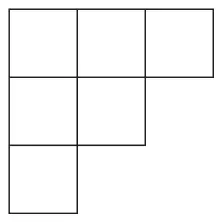
10 The diagram shows a shape made from 6 identical squares.
The total area of the shape is 5406 cm2
(a) Find an estimate for the length of one side of each square. Give your answer correct to the nearest whole number. (3)
(b) Is your answer to part (a) an underestimate or an overestimate? You must give a reason for your answer. (1)
Mark scheme (a)
Answer
Mark
Mark scheme
30
P1
for a start to the process, eg \(5406 \div 6\ (= 901)\) or \(5400 \div 6\ (= 900)\) or \(5000 \div 6\ (= 833.33..)\) or \(5410 \div 6\ (= 901.66..)\)
P1
for a process to find the length of one side, eg \(\sqrt{\text{``}901\text{''}}\) or \(\sqrt{\text{``}900\text{''}}\) or \(\sqrt{\text{``}833.33..\text{''}}\) or \(\sqrt{\text{``}901.66..\text{''}}\)
A1
for 30
Mark scheme (b)
Answer
Mark
Mark scheme
Explanation
C1
for a correct explanation based on their working in (a), eg underestimate because I rounded the total area down
Additional guidance
Must be based on the use of a rounded value in a calculation
(a) Use your calculator to work out \(\dfrac{29^2 - 4.6}{\sqrt{35 - 1.9^3}}\) Write down all the figures on your calculator display. (2)
(b) Write your answer to part (a) correct to 4 significant figures. (1)
Mark scheme (a)
Answer
Mark
Mark scheme
157.668(255)
M1
for 836.4 or 5.304(809139) or 28.141 or a truncated or rounded version of 157.668255 to no less than 3 sf
A1
for 157.668(255)
Additional guidance
Answer must be given to at least 3 decimal places rounded or truncated Accept a clear indication of the decimal point. Check first 3 decimal places only
Mark scheme (b)
Answer
Mark
Mark scheme
157.7
B1
ft from part (a) provided answer to (a) has at least 5 sf
(a) Has Rehan got enough money to buy the jacket? You must show how you get your answer. (3)
The trainers cost $60 The exchange rate is $1 = £0.749
Rehan says, “The trainers cost less than £40”
Rehan is wrong.
(b) Using a suitable approximation, show working to explain why. (2)
Mark scheme (a)
Answer
Mark
Mark scheme
No from correct figures
P1
for first step in process to solve the problem, eg find cost of 3 T-shirts, \(25 \times 3\ (= 75)\) or eg find remaining money after just one purchase, eg \(200 - 60\ (= 140)\) or \(200 - 25\ (= 175)\)
P1
for process to find total cost of trainers and T-shirts, eg \(60 + \text{``}75\text{''}\ (= 135)\) or find total cost including cost of jacket, eg. \(60 + \text{``}75\text{''} + 80\ (= 215)\) or find the change after buying all 4 items, eg. \(200 - 60 - 3 \times 25\ (= 65)\) oe
C1
for No from correct figures Acceptable examples No, needs 215 No, only has 65 left No, needs 15 more Not acceptable examples Yes ....
Additional guidance
Award this mark for addition of 2 or more items or for subtraction of one item or more from 200 eg \(200 - 50\ (= 150)\) etc.
Figures can be given without units ($)
Mark scheme (b)
Answer
Mark
Mark scheme
Explanation
P1
for a start to a method, eg. approximating 0.749 to 0.7, 0.74, 0.75 or 0.8
C1
for explanation Acceptable examples \(0.7 \times 60 = 42\) [is an underestimate] \(0.74 \times 60 = 44.4(0)\) [is an underestimate] Not acceptable examples \(0.75 \times 60 = 45\) [is an overestimate] \(0.8 \times 60 = 48\) [is an overestimate]
Additional guidance
For full marks, any calculations must be correct. No statement in words is needed.
11 The table shows the costs of sending a parcel by the Express service and by the Rapid service.
Type of service
Cost
Express
£15.25
Rapid
£35.38
Brendan has to send 12 parcels. It will be cheaper to send the parcels by the Express service than by the Rapid service.
(a) How much cheaper? (3)
Luke wants to send 21 parcels by the Express service.
He does the calculation 20 × £15 = £300 to estimate the cost.
(b) Explain why Luke’s calculation shows the actual cost will be more than £300 (1)
Mark scheme (a)
Answer
Mark
Mark scheme
241.56
P1
for difference for 1 parcel eg \(35.38 - 15.25\ (= 20.13)\) OR for total cost for 12 parcels by either service eg \(35.38 \times 12\ (= 424.56)\) or \(15.25 \times 12\ (= 183)\)
P1
for a complete process eg \(\text{``}20.13\text{''} \times 12\) or \(\text{``}424.56\text{''} - \text{``}183\text{''}\)
A1
cao
Mark scheme (b)
Answer
Mark
Mark scheme
Explanation
C1
for explanation Acceptable examples both figures rounded down (refers to both figures) 20 is less than 21 and 15 is less than 15.25 Not acceptable examples both figures rounded (up); rounded down either 20 is less than 21 or 15 is less than 15.25 (refers to just one figure) the cost is 320.25 (more than 300); multiplying with bigger numbers
24 A plane travels at a speed of 213 miles per hour.
(a) Work out an estimate for the number of seconds the plane takes to travel 1 mile. (3)
(b) Is your answer to part (a) an underestimate or an overestimate? Give a reason for your answer. (1)
Mark scheme (a)
Answer
Mark
Mark scheme
16 to 20
P1
for using \(\text{time} = \dfrac{\text{distance}}{\text{speed}}\), eg \(\dfrac{1}{200}\) or \(\dfrac{1}{213}\) or for 1 hour \(= 60 \times 60\ (= 3600)\) seconds
(dep on correct use of \(\text{time} = \dfrac{\text{distance}}{\text{speed}}\)) for reason related to their response to part(a), eg overestimate as speed rounded down
(a) Write 7357 correct to 3 significant figures. (1)
(b) Work out \(\dfrac{\sqrt{17 + 4^2}}{7.3^2}\) Write down all the figures on your calculator display. (2)
Mark scheme (a)
Answer
Mark
Mark scheme
7360
B1
cao
Mark scheme (b)
Answer
Mark
Mark scheme
0.1077981356
B2
for 0.1077(981…)
(B1
for 5.74(45626…) or 53.29 or 0.11 or 0.107 or 0.108 )
Additional guidance
Answer must be given to at least 4 decimal places rounded or truncated Accept a clear indication of the decimal point. Check first four decimal places only
5 A plane travels at a speed of 213 miles per hour.
(a) Work out an estimate for the number of seconds the plane takes to travel 1 mile. (3)
(b) Is your answer to part (a) an underestimate or an overestimate? Give a reason for your answer. (1)
Mark scheme (a)
Answer
Mark
Mark scheme
16 to 20
P1
for using \(\text{time} = \dfrac{\text{distance}}{\text{speed}}\), eg \(\dfrac{1}{200}\) or \(\dfrac{1}{213}\) or for 1 hour \(= 60 \times 60\ (= 3600)\) seconds
(dep on correct use of \(\text{time} = \dfrac{\text{distance}}{\text{speed}}\)) for reason related to their response to part(a), eg overestimate as speed rounded down
(a) Write 7357 correct to 3 significant figures. (1)
(b) Work out \(\dfrac{\sqrt{17 + 4^2}}{7.3^2}\) Write down all the figures on your calculator display. (2)
Mark scheme (a)
Answer
Mark
Mark scheme
7360
B1
cao
Mark scheme (b)
Answer
Mark
Mark scheme
0.1077981356
B2
for 0.1077(981…)
(B1
for 5.74(45626…) or 53.29 or 0.11 or 0.107 or 0.108 )
Additional guidance
Answer must be given to at least 4 decimal places rounded or truncated Accept a clear indication of the decimal point. Check first four decimal places only
22 A cycle race across America is 3069.25 miles in length.
Juan knows his average speed for his previous races is 15.12 miles per hour. For the next race across America he will cycle for 8 hours per day.
(a) Estimate how many days Juan will take to complete the race. (3)
Juan trains for the race. The average speed he can cycle at increases. It is now 16.27 miles per hour.
(b) How does this affect your answer to part (a)? (1)
Mark scheme (a)
Answer
Mark
Mark scheme
Estimated value
P1
for using a rounded value in a correct process eg \(3000 \div 15\) or \(15 \times 8\) or \(20 \times 8\)
P1
for a full process to find the number of days eg \(\text{``}3000\text{''} \div \text{``}15\text{''} \div \text{``}10\text{''}\ (= 20)\) or \(\text{``}3000\text{''} \div \text{``}15\text{''} \div 8\ (= 25)\)
A1
for a correct answer following through their rounded values
Additional guidance
Their rounded value must be used in a calculation
Rounding may appear after a correct process eg \(15.12 \times 8 = 120.96 \approx 100\) followed by eg \(3069.25 \div 100\)
Accept \(3069.25 \div 15.12 \div 8\) oe
Mark scheme (b)
Answer
Mark
Mark scheme
Explanation
C1
eg less days required or it doesn’t affect the answer because I would still round 16.27 down to 15 (or up to 20)
4 A cycle race across America is 3069.25 miles in length.
Juan knows his average speed for his previous races is 15.12 miles per hour. For the next race across America he will cycle for 8 hours per day.
(a) Estimate how many days Juan will take to complete the race. (3)
Juan trains for the race. The average speed he can cycle at increases. It is now 16.27 miles per hour.
(b) How does this affect your answer to part (a)? (1)
Mark scheme (a)
Answer
Mark
Mark scheme
Estimated value
P1
for using a rounded value in a correct process eg \(3000 \div 15\) or \(15 \times 8\) or \(20 \times 8\)
P1
for a full process to find the number of days eg \(\text{``}3000\text{''} \div \text{``}15\text{''} \div \text{``}10\text{''}\ (= 20)\) or \(\text{``}3000\text{''} \div \text{``}15\text{''} \div 8\ (= 25)\)
A1
for a correct answer following through their rounded values
Additional guidance
Their rounded value must be used in a calculation
Rounding may appear after a correct process eg \(15.12 \times 8 = 120.96 \approx 100\) followed by eg \(3069.25 \div 100\)
Accept \(3069.25 \div 15.12 \div 8\) oe
Mark scheme (b)
Answer
Mark
Mark scheme
Explanation
C1
eg less days required or it doesn’t affect the answer because I would still round 16.27 down to 15 (or up to 20)
20 Ami and Josh use a calculator to work out \(\dfrac{595}{4.08^2 + 5.3}\)
Ami’s answer is 27.1115 Josh’s answer is 271.115
One of these answers is correct.
Use approximations to find out which answer is correct. (3)
Mark scheme
Answer
Mark
Notes
Ami with estimate
M2
for an approximate calculation eg \(\dfrac{600}{16+5}\) or \(\dfrac{600}{21}\) or \(\dfrac{600}{20}\) or \(\dfrac{600}{20+5}\) or \(\dfrac{600}{25}\) or \(\dfrac{600}{25+5}\) or \(\dfrac{600}{30}\) or \(\dfrac{595}{20}\)
(M1
for using 600 or 5 or 4)
C1
Ami’s answer /27.1115 is closest with accurately calculated figure from approximation
Each T-shirt costs £5.80 Berenika does the calculation \(40 \times 6 = 240\) to estimate the cost of 35 T-shirts.
(a) Explain how Berenika’s calculation shows the actual cost will be less than £240 (1)
There is a special offer.
T-shirts £5.80 each.
Buy 30 or more T-shirts. Get 10% off the total cost.
(b) Work out the actual cost of buying 35 T-shirts using the special offer. (4)
Mark scheme (a)
Answer
Mark
Notes
Explanation
C1
eg States over-estimated for both values
Mark scheme (b)
Answer
Mark
Notes
182.7(0)
P1
for a process to find 10% of a value stated in the question eg \(\dfrac{10}{100} \times 5.80\ (= 0.58)\) or \(\dfrac{10}{100} \times 35\ (= 3.5)\) oe or \(35 \times 5.80\ (= 203)\), allow \(30 \times 5.80\ (= 174)\) or \(35 \times\) [reduced price]
P1
for a process to find 90% of a value stated in the question eg \(35 - \text{``}3.5\text{''}\ (= 31.5)\) or \(0.9 \times 5.80\ (= 5.22)\) oe or \(\dfrac{10}{100} \times \text{``}203\text{''}\ (= 20.3)\) or \(\dfrac{10}{100} \times \text{``}174\text{''}\ (= 17.4)\) oe
P1
for a complete process to find actual cost of 35 eg \(0.9 \times 5.80 \times 35\) oe
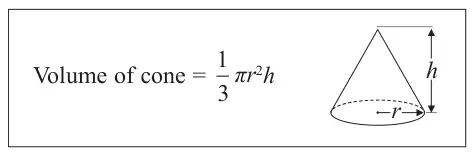
15 A cone has a volume of 98 cm3. The radius of the cone is 5.13 cm.
(a) Work out an estimate for the height of the cone. (3)
John uses a calculator to work out the height of the cone to 2 decimal places.
(b) Will your estimate be more than John’s answer or less than John’s answer? Give reasons for your answer. (1)
Mark scheme (a)
Answer
Mark
Notes
3.5 to 4.5
M1
substitution into formula \(\dfrac{1}{3}\pi r^2 h\) of chosen values for \(r\) and \(V\) (accept \(r = 5.13\) and \(V = 98\)) and starts rearrangement e.g. multiplies by 3, divides by \(\pi\) or divides by \(r^2\) (both sides)
M1
uses estimates in calculation e.g. \(\dfrac{3 \times 100}{3 \times 25}\) (or in rearranged formula) or \(\dfrac{12}{\pi}\)
A1
arrives at a single value from estimate in the range 3.5 to 4.5
Mark scheme (b)
Answer
Mark
Notes
more
C1
ft e.g. more since number in numerator goes up; numbers in denominator go down.
In a competition, a prize is won every 2014 seconds.
Work out an estimate for the number of prizes won in 24 hours. You must show your working. (4)
Mark scheme
Answer
Mark
Notes
Answer in range 35 – 50
4
M1 for a method to either find the exact or approximate number of seconds in one day, e.g. \(24 \times 60 \times 60\) (=86400) or the number of minutes in 2014 seconds, e.g. \(2014 \div 60\) or \(2000 \div 60\) (≈30) M1 for a correct method to find the number of prizes; eg. ‘\(24 \times 60 \times 60\)’ \(\div 2014\) oe or \(60 \div \text{``}30\text{''} \times 24\) oe B1 for rounding at least one appropriate value in the working to 1 sf, e.g. 24 rounded to 20 or 2014 rounded to 2000 or 86400 rounded to 90000 C1 (dep on M2) for answer in 35 – 50 clearly identified
(i) Use your calculator to work out \(\sqrt{500} + 12.8\) Write down all the figures on your calculator display. You must give your answer as a decimal.
(ii) Write your answer to part (i) correct to 1 decimal place.
(2)
Mark scheme (a)
Answer
Mark
Notes
34.81
1
B1 cao
Mark scheme (b)
Answer
Mark
Notes
(i) 35.1606....
2
B1 for 35.1606(7977...)
(ii) 35.2
B1 ft from (i) provided (i) has more than one decimal place
(a) Use your calculator to work out \[\frac{\sqrt{7056}}{0.35 \times 12.8}\] Write down all the figures on your calculator display. You must give your answer as a decimal. (2)
(b) Write your answer to part (a) correct to 1 significant figure. (1)
Mark scheme (a)
Answer
Mark
Notes
18.75
2
M1 for 84 or 4.48 or \(\dfrac{112}{25}\) or 18.7 or 18.8 or 19 or 20 or \(\dfrac{75}{4}\) A1 cao
Mark scheme (b)
Answer
Mark
Notes
20
1
B1 for 20 or ft from their answer to (a) provided (a) is written to 2 or more significant figures
17 A ticket for a seat at a school play costs £2.95
There are 21 rows of seats. There are 39 seats in each row.
The school will sell all the tickets.
Work out an estimate for the total money the school will get. (3)
Mark scheme
Answer
Mark
Notes
2400
3
B1 for one of 20, 40, 3 or 300 M1 for “20” × “40” × “3” or “20” × “40” × “300” (values do not need to be rounded) A1 for answer in range 2280 − 2520 SC : Award B3 for an answer of 2400 if no working seen NB. An answer of 2416.05 implies B0 M1 A1
8 Margaret has some goats. The goats produce an average total of 21.7 litres of milk per day for 280 days.
Margaret sells the milk in \(\dfrac{1}{2}\) litre bottles.
Work out an estimate for the total number of bottles that Margaret will be able to fill with the milk. You must show clearly how you got your estimate. (3)
Mark scheme
Working
Answer
Mark
Notes
\(\dfrac{20 \times 300}{0.5}\)
12000
3
B1 for 20 or 300 used M1 for \(\text{``}20\text{''} \times \text{``}300\text{''}\) or \(\dfrac{\text{``}20\text{''}}{0.5}\) or \(\dfrac{\text{``}300\text{''}}{0.5}\), values do not need to be rounded A1 for answer in the range 11200 –13200 SC B3 for 12000 with or without working
(a) Write the number seven thousand and twenty five in figures. (1)
(b) Write the number 9450 in words. (1)
(c) Write the number 28.75 to the nearest whole number. (1)
(d) Write the number 7380 to the nearest thousand. (1)
Mark scheme (a)
Answer
Mark
Notes
7025
1
B1 cao
Mark scheme (b)
Answer
Mark
Notes
Nine thousand four hundred (and) fifty
1
B1 for Nine thousand four hundred (and) fifty Accept ‘nine thousand’ written as ‘9 thousand’, ‘four hundred’ written as ‘4 hundred’ and ‘fifty’ written as ‘5 tens’ or any mixture of these. Do not penalise poor spelling.
5 Work out an estimate for \(\dfrac{31 \times 9.87}{0.509}\) (3)
Mark scheme
Answer
Mark
Notes
600
3
(M2 for 300 ÷ 0.5 or 60 × 10 or 30 × 20) M1 for at least two of 30, 10 and 0.5 or sight of 300 or 60 or 20 A1 for 600 – 620 but not 601.1(198428…) OR (M2 for 310 ÷ 0.5 or 62 × 10 or 31 × 20) M1 for at least two of 31, 10 and 0.5 or sight of 310 or 62 or 20 A1 for 600 – 620 but not 601.1(198428…)
(a) Use your calculator to work out \(\dfrac{38.5 \times 14.2}{18.4 - 5.9}\) Write down all the figures on your calculator display. You must give your answer as a decimal. (2)
(b) Write your answer to part (a) correct to 1 significant figure. (1)
Mark scheme (a)
Working
Answer
Mark
Notes
\(\dfrac{546.7}{12.5} =\)
43.736
2
B2 for 43.736 (B1 for 546.7 or \(\frac{5467}{10}\) or \(\frac{5467}{125}\) or 12.5 or \(\frac{25}{2}\) or 43.7 or 43.8 or 43.73 or 43.74 or 40 or 44)
Mark scheme (b)
Answer
Mark
Notes
40
1
B1 for 40 or ft from their answer to (a) provided (a) is written to 2 or more significant figures
M1 may be awarded for correct work with no answer or incorrect answer, even if this is seen amongst multiple attempts
Accept rounding or truncating of \(2.0\dot{6}\) or \(206.\dot{6}\) to at least 4 sf Accept rounding or truncating of \(2.0\dot{6}\) to 3 sf only if \(6.2 \div 3\) is seen Accept rounding or truncating of \(206.\dot{6}\) to 3 sf only if \(620 \div 3\) is seen
Accept \(2.04\dot{9}\) for 2.05
Ignore any reference to lower bounds
Ignore reference to units
2.05 or 205 may be embedded eg \(2.05 + 2.06 + 2.09 = 6.2\) with no further work or explanation
M1A0
\(2.06 + 2.06 + 2.08 = 6.2\) with no further work or explanation \(2.06 + 2.06 + 2.06 = 6.18\) with a clear reference to 2.05 and a full explanation
The cube root of \(k\) is 3, to the nearest whole number.
Work out the largest possible value of \(k\). [2 marks]
(b) Fay tries to solve \(\quad x^2 = 100\)
She says,
“The only possible value of \(x\) is 10”
Give a reason why she is not correct. [1 mark]
Mark scheme (a)
Answer
Mark
Comments
Correct evaluation of the cube root of an integer \([40, 50]\) or correct evaluation of the cube of a decimal or fraction \((3, 3.5]\)
M1
eg \(\sqrt[3]{40} = 3.4\) or \(40 \to 3.4\) eg \(3.5^3 = 42.8\) or \(3.5 \to 42.8\)
42
A1
SC1 answer given as \(\sqrt[3]{42}\)
Additional guidance
Up to M1 may be awarded for correct work with no answer, or incorrect answer, even if this is seen amongst multiple attempts
Condone eg \(40 = 3.4\) or \(\sqrt{40} = 3.4\) to mean \(\sqrt[3]{40} = 3.4\)
Answer only 42
M1A1
Must select 42 as final answer for M1A1 ie 42 as the last in a list with a blank answer line is not enough for A1 unless 42 selected
If \(\sqrt[3]{42}\) or \(3.5^3\) is evaluated then it must be correct to award the A1 for 42
NB 42 only from incorrect method eg listing multiples of 3 or \(42 \div 3\) seen or 42 is divisible by 3 as the working
M0A0
Acceptable values for cube roots of integers in range
40
3.4(19…) or 3.42(0)
41
3.4(48…) or 3.45
42
3.4(76…) or 3.48 or 3.5
43
3.5(03…)
44
3.5(30…)
45
3.5(56…) or 3.557 or 3.56 or 3.6
46
3.5(83…) or 3.6
47
3.6(08…) or 3.609 or 3.61
48
3.6(34…)
49
3.6(59…) or 3.66 or 3.7
50
3.6(84…) or 3.7
Examples of cubes of numbers in range with their acceptable values
3.1
29(.791) or 29.8 or 30
3.2
32(.768) or 32.77 or 32.8 or 33
3.3
35(.937) or 35.94 or 36
3.4
39(.304)
3.5 or \(3.4\dot{9}\)
42(.875) or 42.88 or 42.9 or 43
Mark scheme (b)
Answer
Mark
Comments
Valid response that indicates there is one (negative) answer missing
B1
eg −10 (is also an answer) or there is a negative value as well or square roots have two answers or answer is 10 and −10
Additional guidance
\(-10 \times -10\;(= 100)\)
B1
Another number can square to make 100 (implies exactly two)
B1
She has forgotten the other value (implies exactly two)
B1
There is another value it could be (implies exactly two)
B1
It could be a different number (implies exactly two)
B1
It could be negative (bod means 10 could be −10)
B1
\(-10^2\;(= 100)\) (condone missing brackets around −10)
B1
\(\pm\sqrt{100}\)
B1
Indication that there might be more than two possible values for \(x\) eg There are other possible numbers eg There could be other values eg Other numbers square to make 100 eg She hasn’t included negatives
B0 B0 B0 B0
Repeating the question eg There is more than 1 possible value eg 10 is not the only possible value eg More than 1 number works
B0 B0 B0
A partially correct statement eg \(x\) could be negative or decimal eg \(-10 \times -10 = -100\) eg \(x^2 = -10\)
The cube root of \(k\) is 3, to the nearest whole number.
Work out the largest possible value of \(k\). [2 marks]
(b) Fay tries to solve \(\quad x^2 = 100\)
She says,
“The only possible value of \(x\) is 10”
Give a reason why she is not correct. [1 mark]
Mark scheme (a)
Answer
Mark
Comments
Correct evaluation of the cube root of an integer [40, 50] or correct evaluation of the cube of a decimal or fraction (3, 3.5]
M1
eg \(\sqrt[3]{40} = 3.4\) or \(40 \to 3.4\) eg \(3.5^3 = 42.8\) or \(3.5 \to 42.8\)
42
A1
SC1 answer given as \(\sqrt[3]{42}\)
Additional guidance
Up to M1 may be awarded for correct work with no answer, or incorrect answer, even if this is seen amongst multiple attempts
Condone eg \(40 = 3.4\) or \(\sqrt{40} = 3.4\) to mean \(\sqrt[3]{40} = 3.4\)
Answer only 42
M1A1
Must select 42 as final answer for M1A1 ie 42 as the last in a list with a blank answer line is not enough for A1 unless 42 selected
If \(\sqrt[3]{42}\) or \(3.5^3\) is evaluated then it must be correct to award the A1 for 42
NB 42 only from incorrect method eg listing multiples of 3 or \(42 \div 3\) seen or 42 is divisible by 3 as the working
M0A0
Acceptable values for cube roots of integers in range
40
3.4(19…) or 3.42(0)
46
3.5(83…) or 3.6
41
3.4(48…) or 3.45
47
3.6(08…) or 3.609 or 3.61
42
3.4(76…) or 3.48 or 3.5
48
3.6(34…)
43
3.5(03…)
49
3.6(59…) or 3.66 or 3.7
44
3.5(30…)
50
3.6(84…) or 3.7
45
3.5(56…) or 3.557 or 3.56 or 3.6
Examples of cubes of numbers in range with their acceptable values
3.1
29(.791) or 29.8 or 30
3.4
39(.304)
3.2
32(.768) or 32.77 or 32.8 or 33
3.5 or \(3.4\dot{9}\)
42(.875) or 42.88 or 42.9 or 43
3.3
35(.937) or 35.94 or 36
Mark scheme (b)
Answer
Mark
Comments
Valid response that indicates there is one (negative) answer missing
B1
eg \(-10\) (is also an answer) or there is a negative value as well or square roots have two answers or answer is 10 and \(-10\)
Additional guidance
\(-10 \times -10\ (= 100)\)
B1
Another number can square to make 100 (implies exactly two)
B1
She has forgotten the other value (implies exactly two)
B1
There is another value it could be (implies exactly two)
B1
It could be a different number (implies exactly two)
B1
It could be negative (bod means 10 could be \(-10\))
B1
\(-10^2\ (= 100)\) (condone missing brackets around \(-10\))
B1
\(\pm\sqrt{100}\)
B1
Indication that there might be more than two possible values for \(x\) eg There are other possible numbers eg There could be other values eg Other numbers square to make 100 eg She hasn’t included negatives
B0 B0 B0 B0
Repeating the question eg There is more than 1 possible value eg 10 is not the only possible value eg More than 1 number works
B0 B0 B0
A partially correct statement eg \(x\) could be negative or decimal eg \(-10 \times -10 = -100\) eg \(x^2 = -10\)
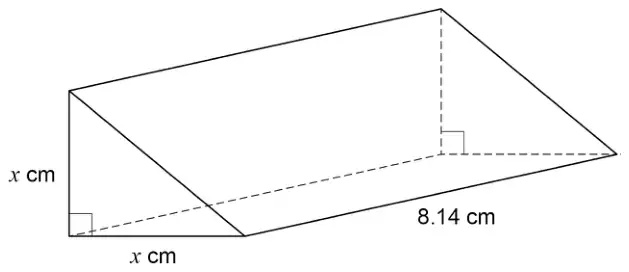
13 The triangular cross section of a prism is an isosceles right-angled triangle.
The volume of the prism is 102 cm3
Use approximations to estimate the value of \(x\).
You must show your working. [3 marks]
Mark scheme
Answer
Mark
Comments
One of \((102 \to)\ 100\) \((8.14 \to)\ 8\)
M1
their \(100 = 0.5 \times x^2 \times\) their 8 or \((x^2 =)\) their \(100 \div 8 \times 2\) or \((x^2 =)\ 100 \div\) their \(8 \times 2\) or 25 or their \(8 \times 5 \times 5 \times 0.5 = 100\) or \(8 \times 5 \times 5 \times 0.5 =\) their 100
M1dep
oe must have used at least one correct 1 sf value
5 with M2 seen
A1
Additional guidance
If working is done with approximations and with the given values ignore the working with the given values and mark the working with approximations
(a) Use your calculator to work out \(\quad \dfrac{9.75^3}{1.875} + 6.4^2\)
Give your answer as a decimal. Write down your full calculator display. [2 marks]
(b) Is your answer to part (a) sensible?
Check by rounding each of 9.75, 1.875 and 6.4 to the nearest whole number. You must show your working. [3 marks]
Tick a box.
Sensible
Not sensible
Mark scheme (a)
Answer
Mark
Comments
494.325 or \(\dfrac{19\,773}{40}\) or \(494\dfrac{13}{40}\) or 40.96 or \(\dfrac{1024}{25}\) or \(40\dfrac{24}{25}\) or 535.29 or 535.3 or \(\dfrac{107\,057}{200}\) or \(535\dfrac{57}{200}\)
M1
535.285
A1
Additional guidance
Ignore any subsequent truncation or rounding if 535.285 seen in working
M1A1
Mark scheme (b)
Answer
Mark
Comments
\(10^3\) and 2 and \(6^2\) and 536 and indicates Sensible
B3ft
ft correct decision for comparing 536 with their 535.285 B2 \(10^3\) and 2 and \(6^2\) seen B1 any two of 10, 2 and 6 seen allow 1000 to imply 10 or \(10^3\) and 36 to imply 6 or \(6^2\) for B1 or B2 only
Additional guidance
Students must give the correct ft decision for part (a) for B3
Correct decision for their (a) should be Sensible if their 535.285 is 530 or 540 to 2 sf. Otherwise they should indicate Not sensible
the 240 cows produce milk for 10 months each year each cow produces an average of 25 litres of milk per day.
Estimate the total milk production, in litres, of the 240 cows in one year.
You must show your working. [4 marks]
Mark scheme (a)
Answer
Mark
Comments
8
B1
Additional guidance
Ignore mention of bulls or cows eg condone 8 cows
B1
Condone an answer of 8 : 240
B1
8 : 240 followed by 1 : 30
B0
8 : 30
B0
Do not accept 8 from an incorrect method eg \(240 \div 31 = 7.7\ldots\) and answer 8
B0
Mark scheme (b)
Answer
Mark
Comments
Alternative method 1
\([28, 31] \times 10\) or [280, 310]
M1
appropriate days in 10-month year
their \([280, 310] \times 25\) or [7000, 7750] or their \([280, 310] \times 240\) or [67 200, 74 400]
M1dep
litres per year per cow
milkings per year for 240 cows
their \([7000, 7750] \times 240\) or their \([67\,200, 74\,400] \times 25\)
M1dep
[1 680 000, 1 860 000] with correct working
A1
accept to 1 or 2 sf with correct working
SC2 answer of [2 016 000, 2 232 000] with the only error using 12 months and working shown
Alternative method 2
\(25 \times 240\) or 6000
M1
litres per day for 240 cows may be seen embedded in a product eg \(25 \times 10 \times 240\)
their \(6000 \times [28, 31]\) or [168 000, 186 000] or \(25 \times 240\) or 6000 and \([28, 31] \times 10\) or [280, 310]
M1dep
litres per month for 240 cows
litres per day for 240 cows and appropriate days in 10-month year
their \([168\,000, 186\,000] \times 10\) or \(25 \times 240 \times [28, 31] \times 10\) or their \(6000 \times\) their [280, 310]
M1dep
[1 680 000, 1 860 000] with correct working
A1
accept to 1 or 2 sf with correct working
SC2 answer of [2 016 000, 2 232 000] with the only error using 12 months and working shown
Alternative method 3
\([28, 31] \times 25\) or [700, 775]
M1
litres per month per cow
their \([700, 775] \times 10\) or [7000, 7750] or their \([700, 775] \times 240\) or [168 000, 186 000]
M1dep
litres per year per cow
litres per month for 240 cows
their \([7000, 7750] \times 240\) or their \([168\,000, 186\,000] \times 10\)
M1dep
[1 680 000, 1 860 000] with correct working
A1
accept to 1 or 2 sf with correct working
SC2 answer of [2 016 000, 2 232 000] with the only error using 12 months and working shown
Alternative method 4
\([28, 31] \times 240\) or [6720, 7440]
M1
milkings per month for 240 cows
their \([6720, 7440] \times 10\) or [67 200, 74 400] or their \([6720, 7440] \times 25\) or [168 000, 186 000]
M1dep
milkings per year for 240 cows
litres per month for 240 cows
their \([67\,200, 74\,400] \times 25\) or their \([168\,000, 186\,000] \times 10\)
M1dep
[1 680 000, 1 860 000] with correct working
A1
accept to 1 or 2 sf with correct working
SC2 answer of [2 016 000, 2 232 000] with the only error using 12 months and working shown
Additional guidance
Use the scheme that awards the most marks and ignore choice
A value in the range [280, 310] may come from subtracting two months from a year eg uses 303 (may come from 365 – 31 – 31)
M1
The special case allows 2 marks for those using 12 months or using [336, 372] days
Allow consistent use of approximations to 1 sf throughout (this leads to an answer in the given range) ie \(30 \times 10 \times 30 \times 200 = 1\,800\,000\)
M3A1
Mark inconsistent use of approximations to 1sf as the scheme
Their final answer must be in range and correct for their product but may be given to 1 or 2 sf eg 280 days: \(28 \times 10 \times 25 \times 240 = 1\,680\,000\) 300 days: \(30 \times 10 \times 25 \times 240 = 1\,800\,000\) 310 days: \(31 \times 10 \times 25 \times 240 = 1\,860\,000\) 303 days: \(303 \times 25 \times 240 = 1\,818\,000\) 304 days: \(304 \times 25 \times 240 = 1\,824\,000\) 305 days: \(305 \times 25 \times 240 = 1\,830\,000\)
(a) Use your calculator to work out the exact value of \(\quad \dfrac{18\,953 \times 437}{11}\) [1 mark]
(b) Use approximations to 1 significant figure to check if your answer to part (a) is sensible. [3 marks]
Mark scheme (a)
Answer
Mark
Comments
752 951 or 752951 or 752,951
B1
Allow commas even if positioning incorrect eg 75,2951 or 752’951 B1
Additional guidance
752.951
B0
Mark scheme (b)
Answer
Mark
Comments
20 000 and 400 and 10 and 800 000 and Yes
B3ft
ft correct decision for their answer to (a) oe decision eg it is sensible
B2 20 000 and 400 and 10
B1 20 000 or 400 or 10
Additional guidance
800 000 (and Yes) with no other values
B0
If answer to (a) is 800 000 to 1sf then the correct ft decision in (b) is Yes eg1 (a) 770 000 (b) decision should be Yes eg2 (a) 1762 (b) decision should be No eg3 (a) 752.951 (b) allow decision to be Yes or No
12 Use approximations to 1 significant figure to estimate the value of
\[\frac{0.526 \times 39.6^2}{\sqrt{97.65}}\]
You must show your working. [3 marks]
Mark scheme
Answer
Mark
Comments
Any two of 0.5, 40 and 100
M1
1600 implies 40 10 implies 100
(\(40^2 =\)) 1600 or (\(0.5 \times 40^2 =\)) 800 or (\(\sqrt{100} =\)) 10
M1
80 with correct working
A1
Additional guidance
\(\dfrac{0.5 \times 1600}{\sqrt{100}}\) or \(\dfrac{0.5 \times 40^2}{10}\) or \(\dfrac{1 \times 1600}{10}\) or \(\dfrac{800}{\sqrt{100}}\) or \(\dfrac{800}{10}\)
M1M1
80 with no or incorrect working, eg attempt at actual calculation and then rounding to 80
M0M0A0
Condone 0.50(0) for 0.5, 40.0(0) for 40 and 100.0(0) for 100 etc
Rounding 0.526 to 1, but otherwise correct, with answer 160
(a) Heidi and Ben both work with the same positive number \(N\).
Heidi works out \(\dfrac{5}{8} \times N\).
Ben works out \(0.63 \times N\).
Tick (✓) the correct statement.
Heidi gets a larger answer than Ben
Heidi gets a smaller answer than Ben
Heidi gets the same answer as Ben
Give a reason why you ticked the statement. [2]
(b) Heidi correctly works out the area of a circle with radius 10 cm. Heidi uses the formula \(A = \pi r^2\).
Heidi’s answer is 314.1592654 cm\(^2\).
Ben correctly works out the area of the same circle using the same formula. Ben’s answer is bigger than Heidi’s answer.
Show how this can happen. [2]
Mark scheme (a)
Answer
Marks
Part marks and guidance
Correct row only
Heidi gets a larger answer than Ben
Heidi gets a smaller answer than Ben
✓
Heidi gets the same answer as Ben
2
B1 for correct statement only selected
Accept any clear indication
and \(\left[\dfrac{5}{8} =\right]\) 0.625
B1 for correct conversion isw
or
correctly finding 0.63 and \(\dfrac{5}{8}\) of the same amount isw
For second B1 Mark converted value(s) on the answer line first If insufficient converted value(s) on line, mark converted value(s) in body
Accept both converted to comparable form e.g. 63% and 62.5% or \(\dfrac{630}{1000}\) and \(\dfrac{625}{1000}\). Condone \(\dfrac{63}{100}\) and \(\dfrac{62.5}{100}\) condone rounding/truncation to a level to compare quantities
Mark scheme (b)
Answer
Marks
Part marks and guidance
\(k \times 10^2\) where \(k\) is one from 3.1415927, 3.141593, 3.1416, 3.142 leading to 314.15927, 314.1593, 314.16, 314.2
2
B1 for \(k \times 10^2\) where \(k\) is one from 3.1415927, 3.141593, 3.1416, 3.142
For 1 or 2 marks
Accept 100 for \(10^2\)
must see value of \(\pi\) not just \(\pi \times 10^2\)
Do not accept answer giving rounded value from use of accurate \(\pi\) e.g 314.1592654 = 314.2 [to 1dp]
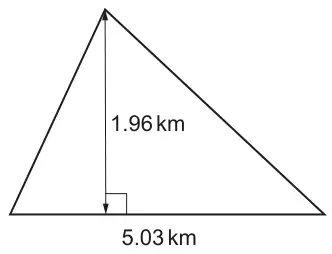
12 A housing estate is built on a triangular piece of land.
Not to scale
There are 3951 people living on the estate.
Work out an estimate of the population density of the estate in people per km2. [4]
Mark scheme
Answer
Marks
Part marks and guidance
Answer 800 with 2, 5 and 4000 seen
4
B1 for at least two of the values 5, 2 and 4000 M2 for \(\frac{\textit{their } 4000}{0.5 \times \textit{their } 5 \times \textit{their } 2}\) oe or M1 for \(\frac{1}{2} \times \textit{their } 5 \times \textit{their } 2\)
For B1 condone trailing zeros
For M2 and M1 their values can be 3951, 5.03, 1.96 or other rounded relatable values
(a) By rounding each value to one significant figure, estimate the cost of 4.9 kg of carrots at 73p per kg. [2]
(b) A student works out an estimate for this calculation.\[\dfrac{13.7 + 1.28}{5.099}\]
Their method is to:
round each number correct to the same number of significant figures and
work out the approximation.
The student writes
\[\dfrac{14 + 1}{5} = \dfrac{15}{5} = 3.\]
What error has the student made in using their method? [1]
Mark scheme (a)
Answer
Marks
Part marks and guidance
\(5\ [\times]\ 70\) or \(5\ [\times]\ 0.7\)
M1
Not from \(73 \times 4.9\) and rounded to 360 or truncated 350 Accept e.g. 70+70+70+70+70 for M1 Condone units included in product Condone answer 350p with £ crossed through or £3.50p
and 3.5[0]
A1
Mark scheme (b)
Answer
Marks
Part marks and guidance
Recognition that the figures are not all to the same number of sig fig e.g. They’re not all the same accuracy oe
1
See appendix
Allow complete and correct example(s)
Appendix
Question 6b
Response
Mark
13.7 rounded to the same number of significant figures would be 10
Mentions “same number of sig fig” and the correct number chosen with correct example
1
1.28 and 5.099 have not been rounded to the same number of sig fig as 13.7
Correct, but only because of the mention of 13.7 (because they have been rounded to the same number of sig fig as each other)
1
They should have rounded 13.7 to 10
Accept correct example as illustrating the error
1
They should have rounded 1.28 to 1.3 and 5.099 to 5.1
Accept the two correct examples as illustrating the error
1
They should have rounded 1.28 to 1.30 and 5.099 to 5.1
Condone the use of 1.30 for 1.3
1
He should have rounded 13.7 to the first significant figure
Condone “first” for “1”
1
They should have rounded 1.28 to 1.3
Recognises only one of the incorrectly rounded figures. If using 1.28 and 5.099 must describe both
0
The numerator is bigger than the denominator
Not a comment on the method
0
He did not round each number to its correct significant figure
A comment about the method BUT does not mention the same number of significant figures
0
They did not round each number to the correct amount of significant figures
A comment about the method BUT does not mention the same number of significant figures
0
1.28 rounded to the same number of significant figures would be 2
Does mention same number of sig fig but the wrong figure chosen and example is incorrect
0
They have rounded 13 wrong
Not explained what “wrong” means
0
He didn’t round 1.28 and 5.099 down properly
Does not explain the error. Might just be suggesting an arithmetic error
One week Amaya works for \(40\frac{1}{3}\) hours between Monday and Friday and then for \(4\frac{1}{4}\) hours on Saturday.
(a) Amaya says
I will earn at least £900 for my work this week.
By rounding each value to the nearest integer, use estimation to show that Amaya may be correct. [5]
(b) Give one reason why your working in part (a) shows that Amaya can be certain of earning at least £900 for her work in this week. [1]
Mark scheme (a)
Answer
Marks
Part marks and guidance
Three of 20[.00], 30[.00], 40 and 4 seen
B1
B1 seen as rounding
\(40 \times 20\)
M1
for their 40 x their 20
their 40 can be \(40\frac{1}{3}\), \(40.\dot{3}\), 40.33[3…] or 41 their 20 can be 20.15 or 21 their 4 can be \(4\frac{1}{4}\), 4.25 or 5 their 30 can be 30.23 or 31
\(4 \times 30\)
M1
for their 4 x their 30
920 or 800 and 120
A2
A2 dep on B1M1M1 or A1 dep on B1M1 for 800 or 120
Mark scheme (b)
Answer
Marks
Part marks and guidance
The calculation is an underestimate
1
All values were rounded down oe
Mark best response as long as not contradictory or incorrect
See Appendix 1
Appendix
APPENDIX 1 Question 16(b)
We want the candidate to say WHY they are certain of the figure being at least £900. If TOTAL is used then this MUST be £920. IF rounded figures are used then all four must be rounded down correctly (20,30,40,4)
Response
Mark
1
It is an Underestimate
1
2
All Values were rounded down
1
3
This is correct because at minimum she will make 920 (‘at minimum’ implies rounding and is correct)
1
4
The values are rounded down meaning she earnt more than this
1
5
(40 x 20) + (4 x 30) already equal over £900
1
6
The underestimation is over £900
1
7
If you round the earnings you get over £900 (this is true for rounding both up and down)
1BOD
8
Because in my working not adding the minutes, it’s still over £900 as it’s £928.80 (incorrect)
0
9
Because I estimated it meaning she’d probably got more (probably does not mean certain)
0
10
As it has gone over £900 (not describing rounding or underestimate)
0
11
This is correct because she will make 920 (the candidate is not telling us WHY they are certain)
0
12
Because £20.15x40=£806 and £30.23 x4=120.92 + them = 926.92 not including the minimum (All rounded values not used)
0
13
If you added everything without a fraction it adds up to almost £900 (incorrect)
0
14
Because it works out that all of her work will add to over 900 (no reference to underestimate)
0
15
Because it’s over 900 (not enough, need to say WHY it is certainly over £900)
0
16
The estimation is over £900 (not enough, need to say WHY estimation is certainly over £900)
0
17
Because I rounded down (not enough- needs to be e.g. rounded all numbers down)
17 The number of people watching a football match is 30 000, correct to the nearest thousand.
(a) Complete the error interval for \(n\), the number of people watching the football match.\[\ldots\ldots\ldots \leqslant n \lt 30\,500\] [1]
(b) The number of people watching a rugby match is 30 500, correct to the nearest hundred.
Show that fewer people could be watching the rugby match than the football match. [2]
Mark scheme (a)
Answer
Marks
Part marks and guidance
29 500
1
Mark scheme (b)
Answer
Marks
Part marks and guidance
Accept any correctly matched pair of values in which rugby < football from these ranges rugby: 30 450 to 30 498 and football: 30 451 to 30 499
2
B1 for one value for rugby or football in these ranges rugby from 30 450 to 30 498 or football from 30 451 to 30 499
Error interval alone scores 0 Only mark candidate’s chosen value(s) Rugby < football does not need to be stated If a pair of values and rugby or football not stated assume the value on the left or below another is rugby
For B1 if one or multiple values seen and no clear choice/designation all must be in range 30 451 to 30 498
8 A block made of iron is in the shape of a cuboid. The block is 3.1 cm by 4.9 cm by 2.2 cm. The density of iron is 7.87 g / cm3.
Sam thinks that the mass of the block is about 2.4 kg.
Use estimation to decide if Sam’s answer is reasonable. Show how you decide. [5]
Mark scheme
Answer
Marks
Part marks and guidance
[Vol of block ≈ 3 × 5 × 2 = ] 30 or [3 × 4.9 × 2 =] 29[.4] or [ 3 × 4.9 × 2 =] 31 or [ 3 × 5 × 2.2 = ] 33
M2
M1 for 3.1 × 4.9 × 2.2 or with one rounded value[s]
Throughout question if the candidate attempts to convert to different units this must be done correctly for method marks
their 30 × their 8
or 2400 ÷ their 30
or 2400 ÷ their 8
M1
Dep on at least M1or for 2400 and their 8 used If M0M0, SC1 for two of 3, 5, 2 and 8 used
their 8 is 7.87, 7.9 or 8
Accept 2.4 ÷ their 30
their 8 is 7.87, 7.9 or 8 If these calculations are not shown they may be implied by correct figures for the answers
240 or 80 or 300
A1
Accept e.g. 0.24 kg
Accept e.g. 0.08 kg/cm3
Not reasonable oe and 2400 g or 0.24[0] kg shown oe
or Not reasonable oe and 80 or 0.08 kg/cm3 shown
or Not reasonable oe and 300 and 30 shown
A1
Dep on M2M1A1
Allow e.g. wrong/not correct for not reasonable Accept implicit comparison with 2.4 kg if 2400 g or 0.24 kg not shown e.g. it should be 10 times heavier
(a) By writing each number correct to 1 significant figure, find an estimate for \(79.8 \times 3.1\). [2]
(b) Jamie works out \(79.8 \times 3.1\) on a calculator. Jamie’s answer is 2473.8.
Do you think Jamie has used their calculator correctly? Explain why.
.................... because ........................................ [1]
Mark scheme (a)
Answer
Marks
Part marks and guidance
240 with working
2
B1 for rounded value of 80 or 3 If 0 scored SC1 for 80.0 and 3.0 and 240.0 as answer
For 2 marks 80 and 3 must be seen
Mark scheme (b)
Answer
Marks
Part marks and guidance
No oe and [because] the answer should be close to 240 oe
1
Eg No his answer is ten times too big No the decimal point is in the wrong place
See AG
Appendix
Appendix Q9b
Response
Mark
No
1
The answer should be 247.38
1
2
The decimal point should be between the 7 and 3
1
3
The number is a lot higher than my estimate. I think she placed a decimal point wrong (The first part is not enough without seeing what their estimate is, ‘placed decimal point wrong’ scores the mark)
1
4
His answer should be in 200s not 2000s he must have placed decimal incorrectly
1
5
There should be 2 numbers behind the decimal place and not one
1
6
Because if you do \(80 \times 3\) you’ll get 240 (implies the answer is 10 times too big)
1
7
it should be closer to 240 (This is the correct estimate, so no need for calculation to be shown here)
1
8
His answer was in thousands which is too large (with it should be in the hundreds would have scored the mark)
0
9
Has not put decimals in
0
10
His answer is too high and shouldn’t have a decimal at the end (First part of answer is not enough to score and ‘shouldn’t have a decimal at the end’ is incorrect)
0
11
The answer that Jamie got is bigger than the estimate by 1 significant figure
0
12
There is only one two digit number so it cannot be above 1000
0
13
It would be less than 2473.8 due to \(80 \times 3\) (if the candidate had written = 240, this would be enough)
0
14
his answer is significantly larger
0
15
there is no way it can be higher than 300 (not enough as we need to see the calculation of their ‘estimate’ of 300)
0
16
The place value is not in the correct position (‘place value’ not an equivalent for decimal point)
16 Last year, Katie earned £16 200. Her total loan repayments were £6400.
Katie estimates that the ratio of her loan repayments to her earnings is approximately 3 : 8.
Is she correct? Show your reasoning. [3]
Mark scheme
Answer
Marks
Part marks and guidance
A - Yes with appropriate reasoning involving rounding and correct simplification to 3 : 8 or 3 : 11 or 8 : 11 or ratios reversed OR B - Yes it is approximately correct oe and simplification of 6400 : 16200 to 32 : 81 OR C - Yes with a correctly evaluated calculation using e.g. ratio 3 : 8 with a comparison comment
OR
D - Yes and e.g. \(16200 \div 8\) and \(6400 \div 3\) correctly evaluated
3
M2 eg for showing 6000 : 16000 and reducing to 3 : 8 or for appropriate rounding at some stage in correctly simplifying ratio leading to 3 : 8 isw
or reduces 6400 : 16200 to 32 : 81 isw or reduces 6400 : 22600 to 32 : 113 isw
or for ratio calculation leading to one of the following values seen 6075, 6163 to 6165, 16436 to 16440, 17066 to 17067 or 22 275 or 23 463 to 23 467 seen isw
or for 2025 and 2133 to 2134 seen isw or 2025 and 2054 to 2055 seen isw or 2133 to 2134 and 2054 to 2055 seen isw
Or M1 for 6000 or 16 000 or 20 000 or 22 000 or 23 000 seen or for appropriate rounding of one number at some stage in simplifying ratio or for intention to find \(\dfrac{3}{8}\) of 16 200 or for \(\dfrac{8}{3}\) of 6400 or \(\dfrac{3}{11}\) of (16 200 + 6400) or \(\dfrac{8}{11}\) of (16 200 + 6400) isw
or for \(6400 \div 3\) and one of \(16\,200 \div 8\) or \((6400 + 16\,200) \div 11\) seen isw or \(16\,200 \div 8\) and \((6400 + 16\,200) \div 11\) seen isw
For all marks accept method with equivalent fractions or decimals [3sf or better] Allow equivalent methods working with the totals e.g. 3 : 11, condone 22600 rounded to 22000 For 3 or M2, allow clear ‘reverse’ methods working from e.g. 3 : 8 to 6000 and 16000 Accept clear working if not in ratio form e.g. 3.2 and 8.1 shown not in ratio
The figures in the part marks column are guidance on accuracy required for 3 marks or M2
SEE APPENDIX B
Appendix B
Exemplar responses for Q16
Response
Mark
6400 : 16200 = 64 : 162 = 32 : 81 which is roughly 30 : 80 = 3 : 8 so yes
3B
6000 + 16000 = 22000, 22000 ÷ (3 + 8) = 2000 3 × 2000 = 6000 , 8 × 2000 = 16 000 so yes she is correct Method C but better
3C
3.2 and 8.1 in working. Close as he can round the decimals to nearest whole number. Decision not clear
M2B
3 : 8 = 6 : 16 = 6000 : 16000 yes Katie is correct if she rounds to the nearest 1000 Reverse method
3A
16 200 ÷ 8 = 2040, 2040 × 3 = 6120 she is not correct Error made in calculation M2 not available
M1C
16 200 ÷ 8 = 2025, 2025 × 3 = 6075 which is close to 6400 so yes she is approximately correct
3C
16200 + 6400 = 22600, 22600 ÷ 11 =2540, 2540 × 3 Intention to find 3/11 with errors
M1C
16200 + 6400 = 22600 = 22000, 22000 ÷ 11 = 2000 M1 for one correct rounding
M1D
16200 ÷ 8 × 3 = 6075 No it is not correct Correctly evaluated calculation with ratio 3 : 8
M2C
16200 : 6400 = 81 : 32 = 8.1 : 3.2 which is approximately 8 : 3 so she is correct
3B
6000 ÷ 3 = 2000 and 16000 ÷ 8 = 2000 so yes Equivalent to 4th the method but better
3D
16000÷8 = 2000, 6400÷3 = 2138.3×11 = 23466. Approximately 400 off so No. Error in calculation
M1C/D
16200 × 3/8 =6075. No not correct as for ratio to be correct her loan would have to be £6075.
M2C
6400÷3 = 2133.33, 16200÷8 = 2025. Not correct as ratio parts are not equal.
(a) The mass, \(m\) tonnes, of a girder is 12.7, correct to 1 decimal place.
Complete the error interval for the mass, \(m\).
\[\ldots\ldots\ldots\ldots \leqslant m \lt \ldots\ldots\ldots\ldots\]
[2]
(b) The length of a piece of wood is given as 8 metres, correct to the nearest metre. The length of a metal rod is given as 8.5 metres, correct to 1 decimal place.
Show that the piece of wood could be longer than the metal rod. [2]
Mark scheme (a)
Answer
Marks
Part marks and guidance
12.65 12.75
2
B1 for one correct or both correct and reversed
For B1, correct value must be in correct place
Mark scheme (b)
Answer
Marks
Part marks and guidance
Accept any correctly matched pair in which wood > metal
from \(8.45 \lt \text{wood} \leqslant 8.49[9\ldots]\) and \(8.45 \leqslant \text{metal} \leqslant 8.49[9\ldots]\)
2
Wood > metal does not need to be stated but it must be clear which measurement refers to wood and which to metal
B1 for one measurement in range \(8.45 \lt \text{wood} \leqslant 8.49[9\ldots]\) seen or \(8.45 \leqslant \text{metal} \leqslant 8.49[9\ldots]\) seen
Eg “Wood 8.46 [m] but Metal 8.45 [m]” scores 2 marks
Wood or 8 Metal or 8.5
For B1, measurement must be correctly associated with either wood or metal, as appropriate
8.45 seen as end of range Eg \(8.45 \leqslant 8.5 \lt 8.55\) scores 1 mark
3 Last year, Katie earned £16 200. Her total loan repayments were £6400.
Katie estimates that the ratio of her loan repayments to her earnings is approximately 3 : 8.
Is she correct? Show your reasoning. [3]
Mark scheme
Answer
Marks
Part marks and guidance
A - Yes with appropriate reasoning involving rounding and correct simplification to 3 : 8 or 3 :11 or 8 : 11 or ratios reversed OR B - Yes it is approximately correct oe and simplification of 6400 : 16200 to 32 : 81 OR C - Yes with a correctly evaluated calculation using e.g. ratio 3 : 8 with a comparison comment OR D - Yes and e.g. 16200 ÷ 8 and 6400 ÷ 3 correctly evaluated
3
M2 eg for showing 6000 : 16000 and reducing to 3 : 8 or for appropriate rounding at some stage in correctly simplifying ratio leading to 3 : 8 isw
or reduces 6400 : 16200 to 32 : 81 isw or reduces 6400 : 22600 to 32 : 113 isw
or for ratio calculation leading to one of the following values seen 6075, 6163 to 6165, 16436 to16440, 17066 to 17067 or 22 275 or 23 463 to 23 467 seen isw
or for 2025 and 2133 to 2134 seen isw or 2025 and 2054 to 2055 seen isw or 2133 to 2134 and 2054 to 2055 seen isw
Or M1 for 6000 or 16 000 or 20 000 or 22 000 or 23 000 seen or for appropriate rounding of one number at some stage in simplifying ratio or for intention to find \(\frac{3}{8}\) of 16 200 or for \(\frac{8}{3}\) of 6400 or \(\frac{3}{11}\) of (16 200 + 6400) or \(\frac{8}{11}\) of (16 200 + 6400) isw
or for 6400 ÷ 3 and one of 16 200 ÷ 8 or (6400 + 16 200) ÷ 11 seen isw or 16 200 ÷ 8 and (6400 + 16 200)÷ 11 seen isw
For all marks accept method with equivalent fractions or decimals [3sf or better] Allow equivalent methods working with the totals e.g. 3 : 11, condone 22600 rounded to 22000 For 3 or M2, allow clear ‘reverse’ methods working from e.g. 3 : 8 to 6000 and 16000 Accept clear working if not in ratio form e.g. 3.2 and 8.1 shown not in ratio
The figures in the part marks column are guidance on accuracy required for 3 marks or M2
SEE APPENDIX
Appendix: Exemplar responses for Q3
Response
Mark
1
6400 : 16200 = 64 : 162 = 32 : 81 which is roughly 30 : 80 = 3 : 8 so yes
3B
2
6000 + 16000 = 22000, 22000 ÷ (3 + 8) = 2000 3 × 2000 = 6000 , 8 × 2000 = 16 000 so yes she is correct
Method C but better
3C
3
3.2 and 8.1 in working. Close as he can round the decimals to nearest whole number.
Decision not clear
M2B
4
3 : 8 = 6 : 16 = 6000 : 16000 yes Katie is correct if she rounds to the nearest 1000
Reverse method
3A
5
16 200 ÷ 8 = 2040, 2040 × 3 = 6120 she is not correct
Error made in calculation M2 not available
M1C
6
16 200 ÷ 8 = 2025, 2025 × 3 = 6075 which is close to 6400 so yes she is approximately correct
3C
7
16200 + 6400 = 22600, 22600 ÷ 11 =2540, 2540 × 3
Intention to find 3/11 with errors
M1C
8
16200 + 6400 = 22600 = 22000, 22000 ÷ 11 = 2000
M1 for one correct rounding
M1D
9
16200 ÷ 8 × 3 = 6075 No it is not correct
Correctly evaluated calculation with ratio 3 : 8
M2C
10
16200 : 6400 = 81 : 32 = 8.1 : 3.2 which is approximately 8 : 3 so she is correct
3B
11
6000 ÷ 3 = 2000 and 16000 ÷ 8 = 2000 so yes
Equivalent to 4th the method but better
3D
12
16000÷8 = 2000, 6400÷3 = 2138.3×11 = 23466. Approximately 400 off so No.
Error in calculation
M1C/D
13
16200 × 3/8 =6075. No not correct as for ratio to be correct her loan would have to be £6075.
M2C
14
6400÷3 = 2133.33, 16200÷8 = 2025. Not correct as ratio parts are not equal.
M2D
15
16200 – 6400 = 9800, 9800 ÷ 5 × 3 = 5880 No
M2C
16
6400 × 8 = 51200, 16200 x 3 = 48600 No they are different
19. The density of copper is \(8{\cdot}96\,\text{g}/\text{cm}^3\). A solid copper statue has a volume of \(1540\,\text{cm}^3\). Calculate its mass in kilograms. Give your answer correct to two significant figures. [4]
Mass = ………… kg
Mark scheme
Scheme
Marks
Comments
8.96 × 1540 ÷ 1000
M2
Answer space takes precedence
M1 for 8.96 × 1540 ( = 13798.4) Allow M1 for digits 896 × 1540 if incorrect mass unit conversion seen first
= 14 (kg)
A2
A1 for 13.7(98…) or 13.8 (kg)
FT from M1 to award: A2 for an answer of 14000 Allow A2 for a correct FT answer with 14 as the only non-zero digits from a seen incorrect unit conversion
A1 for an answer of 13798(.4) or 13800 Allow A1 for either of the following:
13798(.4) seen and then spoiled e.g 13000
a correct FT answer with 1379(84) or 138 as the only non-zero digits e.g. 138, 0.01379 from a seen incorrect unit conversion
If no marks award SC1 for a calculation of: a number with only non-zero digits of 896 × a number with only non-zero digits of 154 e.g. 0.0896 × 1.54
8. The surface area of the Earth is \(5{\cdot}101 \times 10^{8}\) km2. The Earth’s oceans are 70·9% of this surface area.
Estimate the surface area of the Earth’s oceans. Give your answer in standard form. [3]
Mark scheme
Scheme
Marks
Comments
Sight of 70% and \(5 \times 10^{8}\) OR 71% and \(5 \times 10^{8}\) OR 70% and \(5{\cdot}1 \times 10^{8}\)
B1
Not for sight of 71% and \(5{\cdot}1 \times 10^{8}\)
\(0{\cdot}7 \times 5 \times 10^{8}\) oe OR \(0{\cdot}71 \times 5 \times 10^{8}\) oe OR \(0{\cdot}7 \times 5{\cdot}1 \times 10^{8}\) oe
M1
Allow for \(0{\cdot}71 \times 5{\cdot}1 \times 10^{8}\) If \(5 \times 10^{8}\) or \(5.1 \times 10^{8}\) is written in ordinary form, condone a slip by a power of 10 for M1. e.g. \(0{\cdot}7 \times 50\,000\,000\)
\(3{\cdot}5 \times 10^{8}\) (km2) ISW OR \(3{\cdot}55 \times 10^{8}\) ISW OR \(3{\cdot}57 \times 10^{8}\) ISW
A1
CAO
Award B1 M1 A1 for an unsupported answer of \(3{\cdot}5 \times 10^{8}\) (km2).
There are five children in the Cooke family. Two of the children are the same age, the other children are different ages.
The range of their ages is 5 years. The mode of their ages is 14 years. The youngest child is 12 years old.
Find one possible solution for the ages of the other four children. [2]
The ages could be 12, ……… , ……… , ……… , ………
(b)
Mr Cooke takes his children out for lunch. The list below shows the food they order.
1 Mega Burger
£8.99
1 Vegan Burger
£7.25
1 Chicken Burger
£8.99
1 Regular Burger
£6.30
1 Fish Pie
£9.90
1 Vegetarian Lasagne
£6.80
When he pays the bill, Mr Cooke uses this special offer.
Buy any 4 burgers and get the 2 cheapest free
Estimate the total amount of Mr Cooke’s bill. Give your answer correct to the nearest pound. You must show all your working. [3]
Mark scheme (a)
Scheme
Marks
Comments
12, 13, 14, 14, 17 OR 12, 14, 14, 15, 17 OR 12, 14, 14, 16, 17
B2
Ages can be in any order for B2
B1 for a correct interpretation of the range or mode si e.g. eldest child 17 indicated and no child younger than 12 given (range) or more than 1 child aged 14 indicated and no other mode (mode)
Mark scheme (b)
Scheme
Marks
Comments
Uses only the cost of 1 Mega Burger, 1 Chicken Burger 1 Fish Pie, 1 Vegetarian Lasagne
B1
e.g. does not include the £7(.25) and £6(.30) in their calculation for the bill
Uses an appropriate calculation e.g. 9 + 9 + 10 + 7 or 48 – 7 – 6 or 50 – 8 – 7
M1
FT ‘their 4 list choices’;
allow one incorrect estimate out of 4 or 6 e.g. 9 + 9 + 9 + 7 or 9 + 7.20 + 9 + 6.30 + 9.90 + 6.80
allow e.g. 9 + 7 + 9 + 6 + 10 + 7 OR rounding to the nearest 10p e.g. 9 + 9 + 9.9 + 6.8 or 9 + 7.30 + 9 + 6.30 + 9.90 + 6.80 OR rounding to the nearest 50p e.g. 9 + 7.50 + 9 + 6.50 + 10 + 7
(£)35(.00)
A1
CAO; does not imply M1; not from wrong working if B0 M1 award SC1 for (£)35(.00) (from e.g. 9 + 7 + 9 + 10 discarding the two cheapest items) or for (£)48(.00) (from e.g. 9 + 7 + 9 + 6 + 10 + 7) or for (£)49(.00) (from 9 + 7.50 + 9 + 6.50 + 10 + 7)
Put one pair of brackets in each calculation to make it correct.
(i) \(3 \times 4 + 1 \times 2 = 30\) [1]
(ii) \(50 - 36 \div 2 \times 3 = 21\) [1]
(b)
Callum is working out \((41 - 29{\cdot}5)^2\).
He estimates the answer to be 700.
Is Callum’s answer a good estimate?
Yes ☐ No ☐
Show how you decide. [2]
Mark scheme (a)
Scheme
Marks
Comments
(i) \(3 \times (4 + 1) \times 2 = 30\)
B1
(ii) \((50 - 36) \div 2 \times 3 = 21\)
B1
Mark scheme (b)
Scheme
Marks
Comments
No and valid supporting evidence e.g. ‘(40 – 30)2 is about 100’ or ‘41 – 29.5 = 11.5 ≈ 12 so it is about 144’ or ‘112 is 121’
E2
Allow e.g. ‘No and the answer is about 100’ for 2 marks
E1 for No and partial evidence which includes both the difference and squaring e.g. sight of (40 – 30)2 or ‘41 – 29.5 = 11.5 and 11.52 is a lot less than 700.’ NB if ‘yes’ is indicated then E0
9. Chris and Sue are buying some items for their vegetable garden.
(a)
Vegetable Plants £1.99 for a single strip OR £7.50 for a box of 5 strips
Chris buys a box of vegetable plants.
How much money does he save compared to buying 5 single strips? [3]
(b)
Sue buys 20 bags of compost costing £6.99 each and some packets of seed costing £2.89 each.
She correctly estimates her bill to be £170.
How many packets of seed did she buy? [3]
Mark scheme (a)
Scheme
Marks
Comments
5 × 1.99 – 7.50 or 5 × (1.99 – 7.50 ÷ 5) si
M2
9.95 – 7.50 or 5(1.99 – 1.50); may be in stages May be in £ or p but must be consistent
M1 for 5 × 1.99 oe; implied by e.g. 9.95 or for (1.99 – 7.50 ÷ 5) oe; implied by e.g. 49p
(£) 2.45 or 245 (p)
A1
Allow £2.45p but not 2.45p
If no marks award SC1 for 5 × 2 – 7.50 or for use of 5 × 2 – \(k\) – 7.50, where \(0 \lt k \leqslant 0.1\) (but not 0.05); method must be seen for SC1 to be awarded
Mark scheme (b)
Scheme
Marks
Comments
(170 – 20 × 7) ÷ 3 or 20 × 7 + 10 × 3 (= 170) or 20 × 7 + 10 × 2.89 = 168.90 or 20 × 7 + 11 × 2.89 = 171.79 or 20 × 6.99 + 10 × 2.89 = 168.70 or 20 × 6.99 + 11 × 2.89 = 171.59 or 170 − 20 × 7 = 30 and 10 × 3 = 30 oe or 170 − 20 × 6.99 = 30.2 and 10 × 2.89 = 28.90 oe or 170 − 20 × 6.99 = 30.2 and 11 × 2.89 = 31.79 oe
M2
M1 for 170 – 20 × 7 oe; implied by 30; may be embedded in e.g. (170 – 20 × 7) ÷ 2.89
or (170 – 20 × 6.99) ÷ 3
or for attempting to find multiples of 3 or 2.89 to make approximately 170 using e.g. 20 × 7 + ….. × 3 (= 170) or 20 × 6.99 + ….. × 3 (= 170) or 20 × 7 + ….. × 2.89 (= 170) or 20 × 6.99 + … × 2.89 (=170) or 170 − 20 × 7 and ….. × 3 or 170 − 20 × 6.99 and ….. × 2.89
10 or 11
A1
implies M2 if not from clearly wrong working but may not have working
If no marks allow SC1 for (170 – 20 × 6.99) ÷ 2.89 seen; may be in stages
3. In 2018, the total volume of ice in the Greenland ice sheet was \(2{\cdot}99 \times 10^{6}\) km3. The total surface area of the ice sheet was \(1{\cdot}799 \times 10^{6}\) km2.
Assuming that the depth of the ice was constant for the whole ice sheet, estimate the depth of the ice in 2018. You must state the units of your answer. [3]
Mark scheme
Scheme
Marks
Comments
\((3 \times 10^{6}) \div (2 \times 10^{6})\) oe
M1
Allow for \((3 \times 10^{6}) \div (1.8 \times 10^{6})\)
1.5
A1
FT ‘their estimate’ If M0 then allow SC1 for sight of \((2.99 \times 10^{6}) \div (1.799 \times 10^{6})\)
km
B1
Appropriate unit for their answer e.g. 1500 m gets M1 A1 B1; allow for ‘km’ even if no calculation attempted
24. Gary measures the depth of a river in 6 places between two bridges. The depths are as follows:
48·8 cm 55·1 cm 34·6 cm 75·2 cm 85·7 cm 96·1 cm
Gary decides to write each of the 6 depths correct to the nearest 10 cm. He states that the median depth of the river between the two bridges is 70 cm.
Give two reasons why the method Gary used to obtain this median depth leads to an inaccurate result. [2]
Reason 1:
Reason 2:
Mark scheme
Scheme
Marks
Comments
Two unique possible reasons: • Didn’t use raw data
E1
E1 for any 1 possible reason
Didn’t use raw data includes, e.g.
‘median is (actually) 65(.15 cm)’
‘used rounded results’
‘depths were to the nearest 10 cm’
• Insufficient data
E1
Insufficient data includes, e.g.
‘needs to take more readings of depth’
‘only recorded at one time of the day’
‘may only have taken readings near the banks of the river’
If the actual median is calculated it must be correct or approximately 65 (cm)
Depths recorded in order are 30, 50, 60, 80, 90, 100
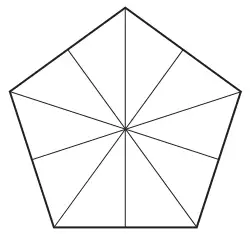
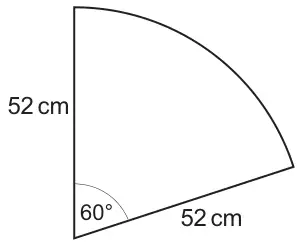
8. David is laying a small circle of paving stones in his garden. The diagram shows the shape of each paving stone.
Diagram not drawn to scale
(a) How many paving stones will David need to make a circle? [1]
(b)
David wants his circle to be at least 1 metre in diameter.
Will David’s circle be the size he wants? [1]
Yes ☐ No ☐
Explain how you decide.
(c)
David is going to fill the space around the paving stones with gravel. He works out that he needs 18 small bags of gravel.
Green Garden Centre Offer of the week Any small bag of gravel £7.19 Buy 3 bags for the price of 2
(i)Estimate how much David will have to pay in total for his gravel from Green Garden Centre. You must show all your working. [3]
(ii)
Is your answer to part (i) an over-estimate or an under-estimate of the cost of David’s gravel?
Over-estimate ☐ Under-estimate ☐
Give a reason for your decision. [1]
Mark scheme (a)
Scheme
Marks
Comments
6
B1
Mark scheme (b)
Scheme
Marks
Comments
Yes with valid explanation e.g. ‘because 52cm × 2 = 104 cm’ or ‘the diameter will be 104 cm = 1.04 m’ or ‘the diameter is more than 100.’
B1
Mark scheme (c)
Scheme
Marks
Comments
(i) Use of 12 or 10 bags
M1
Suitable calculation e.g. (£)7[.00] × 12 or (£)7.2[0] × 12 or (£)7[.00] × 10 or (£)7.2[0] × 10 or (£)7.19 × 10
M1
or equivalent; allow (£)7.5[0] × 12 or (£)7.5[0] × 10
or a less accurate rounding e.g. (£)10 × 12 or (£)10 × 10
Correct evaluation e.g. (£)84[.00] or (£)86.4[0] or (£)70[.00] or (£)72[.00] or (£)71.9[0]
A1
Method must be shown; allow (£)90[.00] or (£)75.00
If first M0, allow M1 for (£)7[.00] × 18 or (£)7[.00] × 20 or (£)7.2[0] × 18 or (£)7.2[0] × 20 or (£)7.19 × 20 or (£)7.5[0] × 18 or (£)7.5[0] × 20 or equivalent or for a less accurate rounding e.g. 10 × 20
and A1 for correct evaluation e.g. (£)126[.00] or (£)140[.00] or (£)129.6[0] or (£)144[.00] or (£)143.80 or (£)135[.00] or (£)150[.00]
If M1 M0, allow SC1 for [12 × 7.19 =] £86.28 rounded to £86[.00] or £90[.00]
(ii) Appropriate answer e.g. ‘Under-estimate as I rounded down.’
E1
Dependent on their calculation for (c)(i); cannot be awarded if (c)(i) is not attempted.
5. Gary measures the depth of a river in 6 places between two bridges. The depths are as follows:
48·8 cm 55·1 cm 34·6 cm 75·2 cm 85·7 cm 96·1 cm
Gary decides to write each of the 6 depths correct to the nearest 10 cm. He states that the median depth of the river between the two bridges is 70 cm.
Give two reasons why the method Gary used to obtain this median depth leads to an inaccurate result. [2]
Mark scheme
Scheme
Marks
Comments
Two unique possible reasons: • Didn’t use raw data
E1
E1 for any 1 possible reason
Didn’t use raw data includes, e.g.
‘median is (actually) 65(.15 cm)’
‘used rounded results’
‘depths were to the nearest 10 cm’
• Insufficient data
E1
Insufficient data includes, e.g.
‘needs to take more readings of depth’
‘only recorded at one time of the day’
‘may only have taken readings near the banks of the river’
If the actual median is calculated it must be correct or approximately 65 (cm)
Depths recorded in order are 30, 50, 60, 80, 90, 100
10. Donna wants to take 3 guinea pigs and 2 rabbits to the vet.
To be safe, Donna’s pet carrier must not carry pets with a total mass greater than 7 kilograms.
Donna weighs one guinea pig and overestimates the total mass of her 3 guinea pigs to be 3000 grams.
She weighs her rabbits and writes her results in this table.
Snowy
Sooty
1986 grams
1834 grams
Write down a calculation to estimate the total mass of Donna’s rabbits.
Using the information in the question, decide whether Donna can safely take all her pets to the vet in her pet carrier. Show how you decided. [4]
Mark scheme
Scheme
Marks
Comments
2 × 2000 or 1990 + 1800 or 2000 + 1800 or 2000 + 1900 or equivalent
B1
Allow any reasonable calculation with at least one correctly rounded value and no incorrect rounding in each case. NB1 the question requires a calculation so sight of 2000 and 1800 followed by a total of 3800 without the + seen is B0
NB2 It is acceptable to round up in both cases because of the context of the question.
Ignore consistent place value errors from converting to kg for M1 A1
Attempts to calculate e.g. 2 × 2000 + 3000 (= 7000) or 1990 + 1800 + 3000 (= 6790) or 2000 + 1800 + 3000 (=6800) 2000 + 1900 + 3000 (= 6900) or 1986 + 1834 + 3000 (= 6820) or equivalent or 7000 – 2 × 2000 ( = 3000) or 7000 – 1990 – 1800 (= 3210) or 7000 – 2000 – 1800 (= 3200) 7000 – 2000 – 1900 (= 3100) 7000 – 1986 – 1834 (= 3180)
M1
‘their estimate for the total mass’ + 3000 or ‘the actual total mass + 3000’; or 7000 – ‘their estimate for the total mass’ or 7000 – ‘the actual total mass’
Accept all masses in kilograms
Allow 7000 – 3000 (= 4000) with sight of the total mass of the rabbits
Evaluates correctly
A1
FT their sum or difference of masses; implies M1
Yes stated or implied following a correctly-evaluated, valid calculation and with evidence of an appropriate correct conversion from grams to kilograms or kilograms to grams seen or implied at some stage
e.g. 1986 (g) \(\approx\) 2 (kg) or 1834 (g) \(\approx\) 1.8 (kg) 7000 (g) = 7(kg) or 6790(g) = 6.79(0) (kg) or 6900 (g) = 6.9(00) (kg)
A1
Dep on previous M1 A1
Conversion may be implied by e.g. 6800 g is less than 7 kg or by 4000 + 3000 = 7000 g so yes but NOT by e.g. 6800 is less than 7 or 4000 + 3000 = 7000
Allow further rounding when grams converted to kg e.g. 6900 (grams) = 7 kg
NB Sight of 1000 g = 1 kg only, is not sufficient to earn the mark. The conversion must be for a mass relating to the context of the question.
15. A pack of 500 sheets of paper is called a ream.
A ream of paper has a height of 5·3 cm.
Diagram not drawn to scale
(a)
Jazmin would like to stack as many reams as possible in a space that is 1·25 metres high.
How many complete reams of paper could she stack in this space? [3]
(b)
Harry needs 6530 sheets of paper. He calculates how many reams of paper he needs as follows:
Calculation:
6530 ÷ 500 = 13.06
Conclusion:
I need 13 reams of paper.
Is Harry’s conclusion correct? You must justify your decision. [1]
Mark scheme (a)
Scheme
Marks
Comments
1.25(m) = 125(cm) or 5.3(cm) = 0.053(m)
B1
Seen or implied
125 ÷ 5.3 or 1.25 ÷ 0.053 or equivalent (=23.58)
M1
Allow M1 for ‘their height’ ÷ 5.3 with place value errors.
23 (reams)
A1
CAO
Alternative
Alternative build up method:
Scheme
Marks
Working with consistent units (cm or m)
B1
Attempts to work in multiples of 5.3 to at least 125(cm)
M1
23 (reams)
A1
Mark scheme (b)
Scheme
Marks
Comments
States or implies ‘No’, with a reason, e.g. No, he needed 14 reams. No, he should have rounded up. No, he hasn’t got enough paper. No, 13 reams is only 6500 sheets. No, he is 30 sheets short.
12. Gwilym is giving a talk about the amount of food that was wasted in 2019.
(a)
In 2019, the world produced 931 million tonnes of food waste. Of this:
569 million tonnes was from households
243 million tonnes was from food services
119 million tonnes was from retail sectors.
Gwilym wants to draw a pie chart to display this information.
Complete the table below. Then complete Gwilym’s pie chart. You must show all your working. [4]
Food waste
Angle in a pie chart
Household
220°
Food service
……………… °
Retail sector
……………… °
Gwilym has found some further details of food waste in 2019.
Country
Total food waste in kilograms
Population
China
91 646 213 000
1 440 000 000
France
5 522 358 000
65 400 000
United Kingdom
5 199 825 000
67 600 000
(b)
(i)
The population data seems to be given correct to a certain number of significant figures. To how many significant figures does the data seem to be given? Circle your answer. [1]
Three One Ten Eight Two
(ii)
Use the data from the table above to complete the following statements. You must show all your working. [4]
‘On average, a person in France produced …………… kilograms of food waste.
This was …………… times the average amount of food waste per person in China.’
(c)
The area of the United Kingdom is 242 500 km\(^2\). Use this information and the information in the table above to answer the following questions about 2019.
(i) What was the population density of the UK? [2]
…………… people per km\(^2\)
(ii) What was the average food waste per km\(^2\) in the UK? Give your answer in tonnes. [3]
…………… tonnes
Mark scheme (a)
Scheme
Mark
Comments
For an appropriate method to calculate a missing angle: \(\dfrac{243}{931}\) × 360 or \(\dfrac{243}{362}\) × 140 or \(\dfrac{243}{569}\) × 220 \(\dfrac{119}{931}\) × 360 or \(\dfrac{119}{362}\) × 140 or \(\dfrac{119}{569}\) × 220
M1
Or equivalent with consistent place value when attempting to write in millions in full In the calculations shown on the left, allow appropriate sight of the following:
243 + 119 for 362
360 – 220 for 140
If no working shown, M1 may be implied by the appropriate sight of correct (or allowed) angles
(Food service) 93.9(663...°) or 94(°) AND (Retail sector) 46(.015...°)
A1
Do not award A mark from incorrect method, M0 A0, (e.g. 140 ÷ 3 = 46.66….°) Allow A1 for
Food service
Retail sector
93(°)
and
46(°)
93(°)
and
47(°)
93.4(°) to 94.2(°)
and
45.7(°) to 46.2(°) *
*from premature approximation of 1° represents 2.58(…), 2.59 or 2.6 million tonnes
Award M1 A0 A0 for 97.2° and 47.6° (from premature approximation of 1° represents 2.5 million tonnes, 243 ÷ 2.5 and 119 ÷ 2.5)
Award M0 A0 A0 for 94.5° and 46.277..° (from \(\dfrac{140}{360}\) × 243 and \(\dfrac{140}{360}\) × 119 )
Pie chart completed correctly with labels for Food service AND Retail sector
A2
Tolerance for angles ± 2° For A2 or A1 FT ‘their derived angles’ provided the sum of ‘their derived angles’ = 140° ± 2° (and at least M1 previously awarded)
A1 for the pie chart completed correctly without labels
An unsupported correct pie chart, with no angles stated in the table, is awarded SC2 with labels, or SC1 without labels, not from sight of incorrect angles in the table
Corrected by Westie's Workshop
The board's mark scheme printed “1° represents 2.58(…), 2.59 or 2.6 million people” and “1° represents 2.5 million people”. Changed “people” to “tonnes” in both places because the pie chart shows food waste in millions of tonnes (931 ÷ 360 = 2.586… million tonnes per degree).
Original: see the board's mark scheme PDF (link above).
Mark scheme (b)
Scheme
Mark
Comments
(i) Three
B1
(ii) (France per person) answer in the range 84(kg) to 85 (kg)
Accept an equivalent fraction in this range FT provided at least B1 previously awarded, for ‘their France per person’ ÷ China per person accurately evaluated, provided 61 ≤ ‘their China per person’ ≤ 66
In this question, if 1 of the 2 numbers shown in an appropriate division has an initial ‘factor of 10’ place value error, treat this as a misread allowing a possible B1 (rather than B2) in either stage, may be implied by ‘their answer’
Mark scheme (c)
Scheme
Mark
Comments
(i) Answer in the range 278 to 284 (people per km\(^2\))
B2
B1 for appropriate sight of any one of the following:
67 600 000 ÷ 242 500
use of approximations, e.g.
67 600 000 ÷ 243 000 (= 278.18...)
68 000 000 ÷ 243 000 (= 279.8...)
68 000 000 ÷ 240 000 (= 283.3...)
70 000 000 ÷ 200 000 (= 350)
The answer in the statement takes precedence
In this question, if one of the two numbers shown has an initial ‘factor of 10’ place value error, treat this as a misread, allowing possible B1 (for appropriate division), may be implied by ‘their answer’
(ii) 5 199 825 000
Allow suitable approximation, e.g. 5 200 000 000 or 5 000 000 000 Method marks may be awarded in either order
÷ 1000
M1
May be implied in working, e.g. starting 5 199 825
÷ 242 500
M1
Allow suitable approximation, e.g. 200 000 or 240 000 or 242 000 or 243 000
Answer in the range 21 to 22 (tonnes)
A1
Only accept answers in the range, however allow 20 (tonnes) provided not from incorrect working
Answer space takes precedence
If no marks, award SC1 for an unsupported answer with digits 214(4…)
In this question, excluding 1000, if one of the other 2 numbers shown has an initial ‘factor of 10’ place value error, treat this as a misread
5. Gwilym is giving a talk about the amount of food that was wasted in 2019. He has found some details of food waste in 2019.
Country
Total food waste in kilograms
Population
China
91 646 213 000
1 440 000 000
France
5 522 358 000
65 400 000
United Kingdom
5 199 825 000
67 600 000
(a)
(i)
The population data seems to be given correct to a certain number of significant figures. To how many significant figures does the data seem to be given? Circle your answer. [1]
Three One Ten Eight Two
(ii)
Use the data from the table above to complete the following statements. You must show all your working. [4]
‘On average, a person in France produced …………… kilograms of food waste.
This was …………… times the average amount of food waste per person in China.’
(b)
The area of the United Kingdom is 242 500 km\(^2\). Use this information and the information in the table above to answer the following questions about 2019.
(i) What was the population density of the UK? [2]
…………… people per km\(^2\)
(ii) What was the average food waste per km\(^2\) in the UK? Give your answer in tonnes. [3]
…………… tonnes
Mark scheme (a)
Scheme
Mark
Comments
(i) Three
B1
(ii) (France per person) answer in the range 84(kg) to 85 (kg)
Accept an equivalent fraction in this range FT provided at least B1 previously awarded, for ‘their France per person’ ÷ China per person accurately evaluated, provided 61 ≤ ‘their China per person’ ≤ 66
In this question, if 1 of the 2 numbers shown in an appropriate division has an initial ‘factor of 10’ place value error, treat this as a misread allowing a possible B1 (rather than B2) in either stage, may be implied by ‘their answer’
Mark scheme (b)
Scheme
Mark
Comments
(i) Answer in the range 278 to 284 (people per km\(^2\))
B2
B1 for appropriate sight of any one of the following:
67 600 000 ÷ 242 500
use of approximations, e.g.
67 600 000 ÷ 243 000 (= 278.18...)
68 000 000 ÷ 243 000 (= 279.8...)
68 000 000 ÷ 240 000 (= 283.3...)
70 000 000 ÷ 200 000 (= 350)
The answer in the statement takes precedence
In this question, if one of the two numbers shown has an initial ‘factor of 10’ place value error, treat this as a misread, allowing possible B1 (for appropriate division), may be implied by ‘their answer’
(ii) 5 199 825 000
Allow suitable approximation, e.g. 5 200 000 000 or 5 000 000 000 Method marks may be awarded in either order
÷ 1000
M1
May be implied in working, e.g. starting 5 199 825
÷ 242 500
M1
Allow suitable approximation, e.g. 200 000 or 240 000 or 242 000 or 243 000
Answer in the range 21 to 22 (tonnes)
A1
Only accept answers in the range, however allow 20 (tonnes) provided not from incorrect working
Answer space takes precedence
If no marks, award SC1 for an unsupported answer with digits 214(4…)
In this question, excluding 1000, if one of the other 2 numbers shown has an initial ‘factor of 10’ place value error, treat this as a misread
3.Estimate the value of 89 × 6349. You must show all your working. [2]
Mark scheme
Scheme
Marks
Comments
89 × 6000 =
534 000
90 × 6000 =
540 000
90 × 6300 =
567 000
90 × 6350 =
571 500
90 × 6500 =
585 000
100 × 6000 =
600 000
100 × 6300 =
630 000
100 × 6350 =
635 000
100 × 6500 =
650 000
M1
A1
May be seen in stages. Award M1 for any one of the products shown in the table. Do not award M1 if 89 × 6000 = 534 000 is seen with other products where 89 × 6349 is attempted to be evaluated.
Award A1 for the corresponding approximation. ISW
Award M1 A1, for example, sight of 90 and 6000 (but not in a product) AND 540 000 (must be unambiguous).
Unsupported answers will get M0A0.
An answer of (89 × 6349 = ) 565 061 or 565 061 approximated is awarded M0A0.
If no marks, award SC1 for one of the following as a final answer:
The map below shows part of the coastline and some islands off the coast of Gwynedd.
On screen this diagram may not be shown at actual size. To measure it, use the question paper (PDF) printed at 100%.
(i) Write down the bearing of Aberdaron from Bardsey Island lighthouse. [1]
…………… °
(ii) Write down the bearing of Bardsey Island lighthouse from Ynys Gwylan-bach. [1]
…………… °
(iii) Huw can see Bardsey Island lighthouse from Ynys Gwylan-bach. How far is the lighthouse from Ynys Gwylan-bach? Give your answer in kilometres. You must show all your working. [2]
(b)
The candela and the lumen are units that can be used to measure light intensity.
Below is a conversion graph. You can use this graph to make approximate conversions between candelas and lumens for a particular type of light.
For this type of light, complete each of the following statements.
(i) 1·15 candelas is approximately equal to …………… lumens. [1]
(ii) 13·5 lumens is approximately equal to …………… candelas. [1]
(c)
The light from Bardsey Island lighthouse has an intensity of approximately 52 000 candelas. The light from Strumble Head lighthouse in Pembrokeshire has an intensity of approximately 1 000 000 candelas.
By estimating, complete the following statement. You must show all your working. [2]
‘The light from Strumble Head lighthouse is approximately …………… times as intense as the light from Bardsey Island lighthouse.’
Mark scheme (a)
Scheme
Marks
Comments
(i) 045(°) (± 3°)
B1
Do not accept 45(°) (± 3°)
(ii) 243(°) (± 3°)
B1
(iii) An unambiguous answer of 8 (km) or an answer in the range 7.68 (km) to 8.32 (km)
B2
This must be an unambiguous answer, do not award if another distance is also given as a final answer, e.g.
5 miles = 8 km final answer 7 km
5 miles = 8 km with final answer 8 ÷ 5 = 1.6
B1 for any one of the following:
(5 cm =) 5 miles = 8 km with a further incorrect calculation or distance
5 (± 0.2) × 1.6
5 (± 0.2) × 8 ÷ 5
5 (± 0.2) × 1.609
5 (± 0.2) × 1.61
B0 for 5 (± 0.2) × 1.5
Mark scheme (b)
Scheme
Marks
Comments
(i) Answer in the inclusive range 14.45 (lumens) to 14.5 (lumens)
B1
(ii) Answer in the inclusive range 1.07 (candelas) to 1.075 (candelas)
B1
Mark scheme (c)
Scheme
Marks
Comments
Any value in the range 19 to 20
B2
Accept from reverse working Answer space takes precedence, if blank allow an unambiguous embedded answer in the range
B1 for sight of unambiguous appropriate working, e.g. any of the following examples or similar:
(b) Estimate the value of \(\dfrac{79{\cdot}34}{40{\cdot}1 \times 0{\cdot}48}\). You must show all your approximations in your working. [2]
(c) Evaluate \[1\frac{5}{7} + 2\frac{11}{14}.\] Give your answer in its simplest form. [3]
Mark scheme (a)
Scheme
Marks
Comments
0·25
B1
Mark scheme (b)
Scheme
Marks
Comments
\(\dfrac{80}{40 \times 0.5}\)
4
\(\dfrac{2}{0.5}\)
4
\(\dfrac{80}{20}\)
4
\(\dfrac{79}{40 \times 0.5}\)
3·95 or 4 or \(3\frac{19}{20}\)
\(\dfrac{79}{20}\)
3·95 or 4 or \(3\frac{19}{20}\)
\(\dfrac{79.3}{20}\)
3·965 or 3·97 or 4
\(\dfrac{79.34}{20}\)
3·967 or 3·97 or 4
M1
A1
May be seen in stages.
Award M1 for appropriate calculation seen.
Award A1 for the correct estimate for the calculation seen.
An unsupported answer is M0A0.
Mark scheme (c)
Scheme
Marks
Comments
\(4\frac{1}{2}\) or 4·5 or \(\dfrac{9}{2}\)
B3
Mark final answer. Award B2 for an unsimplified evaluation as a single fraction or mixed number e.g.
\(4\frac{7}{14}\)
\(3\frac{21}{14}\)
\(\dfrac{63}{14}\)
\(\dfrac{441}{98}\) or equivalent
4 + ½.
FT for one of the following:
adding ‘their improper fractions’ (which incorporate the entire numbers) provided fractions have a common denominator (one numerator must be correct) and answer given in a (proper or improper) simplified form
3 + ‘their fractions’ evaluated correctly and in a simplified form, provided fractions have a common denominator (one numerator must be correct)
‘their 3’ + 1·5 (or equivalent) in a simplified form
\(a\) + ½ (or equivalent in its simplified form) evaluated provided ½ has come from two fractions with a common denominator (e.g. \(\frac{10}{14} + \frac{11}{14} = \frac{21}{14} = 1\frac{7}{14} + 3 = 3\frac{1}{2}\)).
Award B1 for sight of two fractions with a common denominator (allow an error in one numerator) e.g.
(1) \(\dfrac{10}{14}\) + (2) \(\dfrac{11}{14}\)
\(\dfrac{24}{14} + \dfrac{39}{14}\)
\(\dfrac{168}{98} + \dfrac{273}{98}\) or equivalent.
An unsupported answer of \(4\frac{1}{2}\) or 4·5 or \(\dfrac{9}{2}\) is awarded B3.
(b) Estimate the value of \(\dfrac{79{\cdot}34}{40{\cdot}1 \times 0{\cdot}48}\). You must show all your approximations in your working. [2]
(c) Evaluate \[1\tfrac{5}{7} + 2\tfrac{11}{14}\ .\] Give your answer in its simplest form. [3]
Mark scheme (a)
Scheme
Marks
Comments
0·25
B1
Mark scheme (b)
Scheme
Marks
Comments
\(\dfrac{80}{40 \times 0.5}\)
4
\(\dfrac{2}{0.5}\)
4
\(\dfrac{80}{20}\)
4
\(\dfrac{79}{40 \times 0.5}\)
3·95 or 4 or \(3\tfrac{19}{20}\)
\(\dfrac{79}{20}\)
3·95 or 4 or \(3\tfrac{19}{20}\)
\(\dfrac{79.3}{20}\)
3·965 or 3·97 or 4
\(\dfrac{79.34}{20}\)
3·967 or 3·97 or 4
M1
A1
May be seen in stages.
Award M1 for appropriate calculation seen.
Award A1 for the correct estimate for the calculation seen.
An unsupported answer is M0A0.
Mark scheme (c)
Scheme
Marks
Comments
\(4\tfrac{1}{2}\) or 4·5 or \(\dfrac{9}{2}\)
B3
Mark final answer. Award B2 for an unsimplified evaluation as a single fraction or mixed number e.g.
\(4\tfrac{7}{14}\)
\(3\tfrac{21}{14}\)
\(\dfrac{63}{14}\)
\(\dfrac{441}{98}\) or equivalent
4 + ½.
FT for one of the following:
adding ‘their improper fractions’ (which incorporate the entire numbers) provided fractions have a common denominator (one numerator must be correct) and answer given in a (proper or improper) simplified form
3 + ‘their fractions’ evaluated correctly and in a simplified form, provided fractions have a common denominator (one numerator must be correct)
‘their 3’ + 1·5 (or equivalent) in a simplified form
\(a\) + ½ (or equivalent in its simplified form) evaluated provided ½ has come from two fractions with a common denominator (e.g. \(\dfrac{10}{14} + \dfrac{11}{14} = \dfrac{21}{14} = 1\dfrac{7}{14} + 3 = 3\dfrac{1}{2}\)).
Award B1 for sight of two fractions with a common denominator (allow an error in one numerator) e.g.
(1) \(\dfrac{10}{14}\) + (2) \(\dfrac{11}{14}\)
\(\dfrac{24}{14} + \dfrac{39}{14}\)
\(\dfrac{168}{98} + \dfrac{273}{98}\) or equivalent.
An unsupported answer of \(4\tfrac{1}{2}\) or 4·5 or \(\dfrac{9}{2}\) is awarded B3.
11. An old postage stamp has a width of 2 cm and a height of 2·4 cm. Frank makes a poster that is mathematically similar to the postage stamp, as shown below.
Diagrams not drawn to scale
He places a thin tape along the four edges of the poster. Calculate the total length of this tape, correct to 1 significant figure. You must show all your working. [4]
Mark scheme
Scheme
Marks
Comments
(Width of poster) 2 × \(\frac{26.4}{2.4}\) or 2 × 11 or equivalent
M1
22 (cm)
A1
Mark final answer for the width of the poster
(Perimeter of poster 2 × (22 + 26.4) =) 96.8 (cm)
A1
FT ‘their 22’ provided M1 previously awarded
100 (cm)
B1
FT provided 95 < ‘their 96.8’ <100, as 100 correct to 1 significant figure
Accept working in mm or m, units must then be given in the final answer
Do not accept an unsupported answer of 100 (cm)
Alternative method
Scheme
Marks
Comments
(Perimeter of stamp) 8.8 (cm) AND sight of \(\frac{26.4}{2.4}\) (= 11) or \(\frac{2.4}{26.4}\) (= \(\frac{1}{11}\))
B1
(Perimeter of poster) (2 + 2.4 + 2 + 2.4) × \(\frac{26.4}{2.4}\) or 8.8 × \(\frac{26.4}{2.4}\) or 8.8 × 11 or equivalent
M1
FT ‘their 2 + 2.4 + 2 + 2.4’
96.8 (cm)
A1
100 (cm)
B1
FT provided 95 < ‘their 96.8’ <100, as 100 correct to 1 significant figure
Accept working in mm or m, units must then be given in the final answer
Do not accept an unsupported answer of 100 (cm)
The alternative method is printed in italics in the original.
6.In this question, you will be assessed on the quality of your organisation, communication and accuracy in writing.
An old postage stamp has a width of 2 cm and a height of 2·4 cm. Frank makes a poster that is mathematically similar to the postage stamp, as shown below.
Diagrams not drawn to scale
He places a thin tape along the four edges of the poster. Calculate the total length of this tape, correct to 1 significant figure. You must show all your working. [4 + 2 OCW]
Mark scheme
Scheme
Marks
Comments
(Width of poster) 2 × \(\frac{26.4}{2.4}\) or 2 × 11 or equivalent
M1
22 (cm)
A1
Mark final answer for the width of the poster
(Perimeter of poster 2 × (22 + 26.4) =) 96.8 (cm)
A1
FT ‘their 22’ provided M1 previously awarded
100 (cm)
B1
FT provided 95 < ‘their 96.8’ <100, as 100 correct to 1 significant figure
Accept working in mm or m, units must then be given in the final answer
Do not accept an unsupported answer of 100 (cm)
Organisation and communication
OC1
For OC1, candidates will be expected to: • present their response in a structured way • explain to the reader what they are doing at each step of their response • lay out their explanations and working in a way that is clear and logical • write a conclusion that draws together their results and explains what their answer means
Writing
W1
For W1, candidates will be expected to: • show all their working • make few, if any, errors in spelling, punctuation and grammar • use correct mathematical form in their working • use appropriate terminology, units, etc.
6. Alternative method
Scheme
Marks
Comments
(Perimeter of stamp) 8.8 (cm) AND sight of \(\frac{26.4}{2.4}\) (= 11) or \(\frac{2.4}{26.4}\) (= \(\frac{1}{11}\))
B1
(Perimeter of poster) (2 + 2.4 + 2 + 2.4) × \(\frac{26.4}{2.4}\) or 8.8 × \(\frac{26.4}{2.4}\) or 8.8 × 11 or equivalent
M1
FT ‘their 2 + 2.4 + 2 + 2.4’
96.8 (cm)
A1
100 (cm)
B1
FT provided 95 < ‘their 96.8’ <100, as 100 correct to 1 significant figure
Accept working in mm or m, units must then be given in the final answer
(a) Arwyn doubles the number fifty-three thousand. Write Arwyn’s answer in figures. [2]
(b) Write 3572 correct to the nearest 100. [1]
(c) Calculate \(6 + 4 \times 9\). [1]
(d) Estimate \(103 \times 9{\cdot}8\). [2]
(e) Can 626 be divided exactly by 3? You must show working to support your answer. [1]
Yes ☐ No ☐
Mark scheme (a)
Scheme
Marks
Comments
106 000
B2
B1 for one of the following:
sight of 53000
one hundred and six thousand
correctly doubling ‘their 53 000’ if it is first written in figures, provided ‘their 53 000’ is at least four figures and starts with the digits 5 and 3 (i.e. a place value error).
106 followed by a minimum of two zeros
Mark scheme (b)
Scheme
Marks
Comments
3600
B1
Mark scheme (c)
Scheme
Marks
Comments
42
B1
Mark scheme (d)
Scheme
Marks
Comments
1000 OR 980 OR 1030
B2
B1 for 100 × 10 OR 100 × 9·8 OR 103 × 10
Mark scheme (e)
Scheme
Marks
Comments
No, with appropriate working e.g.
(626 ÷ 3 =) 208 r.2
(626 ÷ 3 =) 208·6(6…)
6 + 2 + 6 = 14 AND 14 is not a multiple of 3
3 × 208 = 624 AND 3 × 209 = 627
B1
Allow No with 208·2 Arithmetic seen must be correct and show a remainder of 2 or first decimal place.
Glen works every day from Monday to Friday. He sets himself two targets for these days. The targets are to walk:
at least 10 000 steps every day from Monday to Friday
at least 50 000 steps in total from Monday to Friday.
He records the number of steps he takes each day from Monday to Friday.
Day
Number of steps
Monday
10 672
Tuesday
13 586
Wednesday
12 341
Thursday
11 932
Friday
9754
(a) Has Glen achieved his target to walk at least 10 000 steps every day? Give a reason for your answer. [1]
Yes ☐ No ☐
(b) Glen’s second target was to walk at least 50 000 steps from Monday to Friday. By how many steps did he beat this target? [2]
(c) Approximately how many steps did Glen walk on Tuesday? Give your answer correct to the nearest 100. [1]
Mark scheme (a)
Scheme
Marks
Comments
No and suitable reason given e.g. ‘because on Friday he walked less than 10000 steps’ ‘because Friday is (only) 9754’ ‘because Friday is below 10000’
E1
Ignore spurious comments if No indicated and an appropriate reason is given.
Allow the following with no indicated:
‘because Friday is less’ ‘didn't walk 10000 on Friday’ ‘Friday didn't walk to 10000’ ‘Friday didn't achieve 10000’ ‘The first 4 days he did but the last day he only got a 4-digit number’ ‘because Friday was 9000’
Do not allow ‘Yes’ indicated with a reason e.g. ‘Glen has achieved his target’ ‘Friday is nearly 10000’ ‘he has achieved at least 10000 steps because 9754 is closer to 10000 than 9000 if rounded up’
Mark scheme (b)
Scheme
Marks
Comments
8285 (steps)
B2
Allow embedded answers such as 58285 – 8285 = 50000 Award B1 for any one of the following:
10672 + 13586 + 12341 + 11932 + 9754 – 50000
subtracting 50000 from an attempt at adding the 5 given values
3. The table below shows the number of passengers flying from Cardiff Airport from May to September in 2017 and 2018.
Number of Passengers
Month
2017
2018
May
147 521
165 364
June
185 787
181 564
July
172 117
192 257
August
182 424
202 638
September
166 636
178 681
(a) In which month and year did the greatest number of passengers fly from Cardiff Airport? [1]
Month …………… Year ……………
(b) Calculate the difference between the number of passengers flying from Cardiff Airport in May 2018 and those in May 2017. Give your answer to the nearest 1000. You must show all your working. [2]
(c) Compare the information for 2017 with the information for 2018. In which 2 months has the number of passengers increased by more than 20 000? [2]
Months: …………… and ……………
(d) Teleri has carried out a survey to find out which holiday destination is the most popular out of Tenerife, Majorca, Corfu and Benidorm. Design a tally chart that Teleri could have used to collect her data and to show her results. [3]
Mark scheme (a)
Scheme
Marks
Comments
August and 2018
B1
Allow 2018 and August Allow August with 18 used to represent 2018
Mark scheme (b)
Scheme
Marks
Comments
165 364 – 147 521
M1
Allow 147 521 – 165 364 as evidence of subtraction Allow 165 – 147 as evidence of subtraction for M1 Allow adding on methods eg: 479 +17364 OR 2479 + 15364 OR equivalent
= 17 843 and 18 000
A1
If no marks, award SC1 for:
an answer of 17000 seen from 165000 – 148000
answer of 18000 with no workings shown
Mark scheme (c)
Scheme
Marks
Comments
July and August
B2
Award B1 for each. Accept in any order.
Mark scheme (d)
Scheme
Marks
Comments
Table set up with rows or columns:
Do not award any marks if only a bar chart, graph or axes seen.
• Places - with all 4 places listed correctly
B1
Accept other places also listed and/or use of “other”. Accept abbreviations.
• Tallies - Labelled with ‘tallies’ or ‘number of tallies’
B1
Allow tallies drawn. Do not accept title of row or column as:
number of people unless tallies shown
number of most popular (place) unless tallies shown
• Frequency - Labelled with ‘frequency’ or equivalent as a heading
B1
Accept ‘total’ or ‘number of people’ or ‘vote’ for frequency. Do not accept number of most popular (place) for this column or row.
2. The table below shows the number of visitors to some of the top attractions in Wales in 2017 and 2018. The table also shows the percentage change in the number of visitors from 2017 to 2018.
Attraction
Number of visitors 2017
Number of visitors 2018
Percentage change
Folly Farm
480 000
455 428
–5·1%
Cardiff Castle
319 131
452 007
+41·6%
Bodnant Garden
255 949
260 153
+1·6%
Caernarfon Castle
204 675
205 009
+0·2%
Conwy Castle
221 652
201 961
–8·9%
Zip World Slate Caverns
190 000
195 000
+2·6%
Use the information in the table above to answer the following questions.
(a)
Zip World Slate Caverns had 195 000 visitors in 2018. Write this number in words. [1]
(b)
Which attraction had the smallest percentage change from 2017 to 2018? [1]
(c)
Calculate the total number of visitors to Bodnant Garden in 2017 and 2018. [2]
(d)
Calculate the difference between the number of visitors to Cardiff Castle in 2017 and the number of visitors to Cardiff Castle in 2018. [2]
(e)
Ian looks at the data and says,
“In 2018, Folly Farm had about half a million visitors.”
Is Ian correct? Give a reason for your answer. [1]
Yes ☐ No ☐
(f)
A new visitor attraction, Tailspin, wants to use the tail of the dragon from the Welsh flag as its logo.
The tail is drawn on the centimetre square grid below. Each square on the grid represents an area of 4 cm2.
Tailspin is planning to make flyers to advertise the attraction. To print the flyers, the area of the tail must be less than 48 cm2.
The manager of Tailspin thinks that the area of the tail is greater than 48 cm2.
Decide whether or not the manager is correct. You must show all your working. [3]
The manager is:
Correct ☐ Not correct ☐
Mark scheme (a)
Scheme
Marks
Comments
one hundred and ninety-five thousand
B1
Do not accept
one hundred thousand and ninety-five thousand
195 thousand
Mark scheme (b)
Scheme
Marks
Comments
Caernarfon Castle
B1
Allow (+)0.2(%) as indication of Caernarfon Castle
Mark scheme (c)
Scheme
Marks
Comments
255949 + 260153
M1
516 102
A1
Mark scheme (d)
Scheme
Marks
Comments
452 007 – 319 131
M1
Allow 319 131 – 452 007 Allow -132 876
132 876
A1
Mark scheme (e)
Scheme
Marks
Comments
Yes and valid reason given e.g.
‘Yes, because 455 428 is nearly 500 000’ ‘Yes, because if you round up 455 428 to the nearest hundred thousand it is 500 000’ ‘Yes, as 455 428 is closer to half a million than 400 000’ ‘Yes, because rounding to the nearest 100 000 would give you half a million’
E1
Allow e.g. ‘Yes, because they had over 450 000’ ‘Yes, as only about 50 000 away from half a million’ ‘Yes, because 455 428 is nearly half a million’ 'Yes, as you would round up to the nearest 50 000' ‘Yes, as half a million is 500 000’ ‘No because it is nearly 45 000 short’ ‘No as it was only 455 428 so that’s not quite half a million’ ‘No, because it is closer to 450 000’ ‘No because it is 460 000’ ‘No, because it is about 50 000 below’ 'No, because it is just over 450 000' 'No, because the number is below 500 000 so it isn't half a million' 'No, because half a million is 500 000 but the number is 455 428' 'No because it would be in the 500 000 so he is wrong because 455 428 is less than half a million’
Do not accept e.g. ‘Yes, because 455 428 is about half a million’ – this is the statement given ‘No, because it’s only 455 428’ 'No because 455 428 isn't close to half a million as it is in the 4s' 'No, because they got 455 428'
Mark scheme (f)
Scheme
Marks
Comments
Evidence of counting squares inside shape
M1
Answer in range 14 to 20
A1
Correct evaluation of ‘their area’ × 4 and manager correct Or 48 ÷ 4 = 12 and manager correct
E1
FT if M1 awarded for a correct evaluation of ‘their area’ × 4 and conclusion made consistent with their answer OR ‘their area’ is in the range 13 to 22 with ‘their area’ × 4 correct and manager correct
Alternative method
Scheme
Marks
Comments
Evidence of splitting each square into 4
M1
Or for counting up in 4s up to at least 20
Answer in range 56 to 80
A1
Must not come from incorrect work
Correct evaluation (conclusion) of the area with manager correct
E1
FT if M1 awarded with conclusion made consistent for ‘their area’ OR ‘their area’ is in the range 52 to 88 with correct conclusion
(a) Write the number sixty-three thousand and twenty-nine in figures. [1]
(b) Write 2481 correct to the nearest 10. [1]
(c) Multiply 291 by 7. [1]
(d) Subtract 513 from 842. [1]
(e) A number is multiplied by 4 and then doubled. The answer is 56. What is the number? [2]
The number is ……………
Mark scheme (a)
Scheme
Marks
Comments
63 029
B1
Mark scheme (b)
Scheme
Marks
Comments
2480
B1
Mark scheme (c)
Scheme
Marks
Comments
2037
B1
Mark scheme (d)
Scheme
Marks
Comments
329
B1
Mark scheme (e)
Scheme
Marks
Comments
7
B2
B1 for sight of 28 OR 14 OR sight of 56 ÷ 8 OR sight of 56 ÷ 2 ÷ 4. Allow B2 for correct embedded answer, but only B1 if contradicted by a number ≠ 7 on the answer line.
3. Rhodri is organising his son’s birthday party. He decides to give every child a party bag.
There will be 19 children at the party. A party bag costs £2.98 to produce.
(a)Estimate how much Rhodri will spend on producing party bags. [2]
(b) Is your estimate an underestimate or an overestimate?
Underestimate ☐ Overestimate ☐ Can’t tell ☐
Give a reason for your answer. [1]
Mark scheme (a)
Scheme
Marks
Comments
20×(£)3 OR 19×(£)3 OR 20× (£)2.98
M1
Allow 20 ×(£)2.95 OR 20 × (£)2.90 (£)59 OR (£)58
(£)60 OR (£)57 OR (£)59.60
A1
Ignore Subsequent working if an estimate is seen
Mark scheme (b)
Scheme
Marks
Comments
Overestimate indicated and correct suitable reason given e.g.
‘Because 20 is more than 19 and (£)3 is more than (£)2.98’ ‘Because I rounded 2.98 up to 3’ ‘Because I rounded it up’ ‘Rounded 98p to £1’ ‘Rounded it up to the nearest whole number’ ‘Because I rounded both numbers up’ ‘Because the real numbers are less than the ones I used’ ‘Because my bags are 2p more than the party bags’ ‘There are only 19 bags and I used 20’
E1
Allow ‘because you estimate to nearest 10’
FT appropriate judgement based on their estimate seen in (a) e.g., 20 × (£)2.50 and underestimate given with reason as ‘2.50 is less than 2.98’, award M0 A0 in (a) and E1 in (b)
Allow statements that only refer to one value being estimated where both values have been rounded up.
Do not accept ‘Because I am over the real price’
FT from allowed estimates in part (a) with ‘can’t tell’ and a suitable reason given e.g., ‘one is rounded up and the other rounded down.’
If (a) is not attempted but a correct estimate for (a) is seen in (b) with appropriate judgement indicated and correct reason award E1
3. The height of a cylinder is 24·8 cm. The ratio of the diameter of the cylinder to the height of the cylinder is 3 : 2.
Find the volume of the cylinder. Give your answer correct to 2 significant figures. You must show all your working. [5]
Mark scheme
Scheme
Marks
Comments
(Diameter =) 24·8 ÷ 2 × 3 OR (Radius =) 24·8 ÷ 2 × 3 ÷ 2 or equivalent
M1
(Diameter =) 37·2 (cm) OR (Radius =) 18·6 (cm)
A1
Sight of 1086 to 1087 (cm2) (base area calculated with radius 18·6 ) OR 4345 to 4348 (cm2) (base area calculated with diameter) implies first M1 A1. If diameter AND radius given and radius ≠ 18·6 either:
award M1A0 (for sight of diameter = 37·2) if their stated radius is then used to find the volume of the cylinder (2nd M mark is awarded) or
award M1A1 (for sight of diameter = 37·2) if their incorrect radius is not used to find the volume of the cylinder (2nd M mark is not awarded).
May be seen in parts. Accept 3·14 × 18·62 × 24·8 or equivalent. FT ‘their stated radius’ OR ‘their stated diameter’, provided it is halved at the appropriate stage.
= 27 000 (cm3)
A2
For A2, must be correct to 2sf. A1 for an answer between 26 940 and 26 960 (cm3) inclusive.
12. A company produces 440 boxes of paper clips each day. Each box contains between 320 and 330 paper clips.
Calculate the approximate total number of paper clips produced in 200 days. Give your answer to the nearest ten million. You must show all your working. [4]
Mark scheme
Scheme
Marks
Comments
(Total number of paper clips =) 200 × 440 × n where 320 ≤ n ≤ 330.
M2
M1 for 200 × n OR 440 × n where 320 ≤ n ≤ 330. Allow use of 400 or 450 for 440. Note If n taken to be 225 or 425 treat as a misread and allow M2 but penalise −1 from any further A1, B1 marks gained.
Correct evaluation.
A1
CAO from their numbers if M2 gained. (n=320 gives 28 160 000, n=325 gives 28 600 000, n=330 gives 29 040 000.)
(To the nearest ten million) 30 000 000 (paper clips)
B1
FT ‘their evaluation’ if greater than 5 million. A final answer of 30 million implies M2A1B1. Allow M2A0B0 for an unsupported final answer of 28 000 000 or 29 000 000.
3.In this question, you will be assessed on the quality of your organisation, communication and accuracy in writing.
A company produces 440 boxes of paper clips each day. Each box contains between 320 and 330 paper clips.
Calculate the approximate total number of paper clips produced in 200 days. Give your answer to the nearest ten million. You must show all your working.[4 + 2 OCW]
Mark scheme
Scheme
Marks
Comments
(Total number of paper clips =) 200 × 440 × n where 320 ≤ n ≤ 330.
M2
M1 for 200 × n OR 440 × n where 320 ≤ n ≤ 330. Allow use of 400 or 450 for 440. Note If n taken to be 225 or 425 treat as a misread and allow M2 but penalise −1 from any further A1, B1 marks gained.
Correct evaluation.
A1
CAO from their numbers if M2 gained. (n=320 gives 28 160 000, n=325 gives 28 600 000, n=330 gives 29 040 000.)
(To the nearest ten million) 30 000 000 (paper clips)
B1
FT ‘their evaluation’ if greater than 5 million. A final answer of 30 million implies M2A1B1. Allow M2A0B0 for an unsupported final answer of 28 000 000 or 29 000 000.
OCW Organisation and Communication.
OC1
For OC1, candidates will be expected to:
present their response in a structured way
explain to the reader what they are doing at each step of their response
lay out their explanation and working in a way that is clear and logical
write a conclusion that draws together their results and explains what their answer means
Accuracy of writing.
W1
For W1, candidates will be expected to:
show all their working
make few, if any, errors in spelling, punctuation and grammar
Sight of any TWO of 30, 2 or 0·5 OR Sight of any TWO of 30, 8 or 0·5 as appropriate approximations.
B1
Allow 30·2 for 30.
\(\dfrac{30 \times 8}{0{\cdot}5}\) or equivalent.
M1
Equivalent e.g. \(\dfrac{30 \times 2 \times 2 \times 2}{\tfrac{1}{2}}\) or \(\dfrac{30 \times 2^3}{0{\cdot}5}\) Must be seen, but allow if attempted calculation done in steps. M0 for exact calculation.
Rhian carried out a survey before an international rugby match. She asked a number of Wales supporters how they travelled to the match.
Rhian displayed her results in a Venn diagram, as shown below.
(i)
How many of these supporters’ journeys included travel by both train and taxi? Circle your answer. [1]
1 3 7 8 10
(ii)
How many of these supporters’ journeys included travel by car? Circle your answer. [1]
19 78 102 180 195
(iii)
Calculate the percentage of the number of supporters in the survey whose journeys did not include any travel by car, bus, train, or taxi. Give your answer correct to 1 decimal place. [4]
(b)
There were 71 532 supporters in the stadium watching the match. A newspaper headline writes this number of supporters correct to 2 significant figures. Which of the following numbers should appear in this headline? Circle your answer. [1]
72 71 000 71 400 71 500 72 000
(c)
The rugby pitch at the stadium is measured. On the diagram below, each measurement is given correct to the nearest 10 centimetres.
Diagram not drawn to scale
What is the least possible length of AB? Give your answer in metres. You must show all your working. [3]
Mark scheme (a)
Scheme
Marks
Comments
(i) 8
B1
(ii) 180
B1
(iii) Sight of total 403
B1
FT ‘their 180’ + 223
(100 ×) \(\dfrac{15}{403}\) or (100 ×) 15 ÷ 403
M1
FT correctly evaluated ‘their 180’ + 223
3.7 (%)
A2
Mark final answer A1 for 3.72(...%) or from correct working 4(%)
If no marks, award SC1 for 100 ×15 ÷‘their total’ correctly evaluated or SC2 for this answer rounded correctly to 1 decimal place
(Note: SC1 for 100 × 15 ÷ 388 = 3.8(6...%) or SC2 if rounded to 3.9(%))
Mark scheme (b)
Scheme
Marks
Comments
72 000
B1
Mark scheme (c)
Scheme
Marks
Comments
Sight of 9.95 (m) or 99.95(m) or 995 (cm) or 9995 (cm)
B1
If units are given they must be correct
(Least length) 9.95 + 99.95 + 9.95 or equivalent in cm
M1
FT ‘their least measurements’ x and y, provided 9.9 (m) ≤ x <10(m) and 99.9 (m) ≤ y <100(m) as appropriate
119.85 (m)
A1
CAO Award all 3 marks for a correct response
If no marks, award SC1 for an answer of 118.5(m) or 119.985(m) or (9.95 + 9.95 + 99.5 =) 119.4(m)
Alternative
6(c) Alternative method:
Scheme
Marks
Comments
100 + 10 + 10 – 3 × 0.05 or equivalent in cm
M2
M1 for sight of - 5 cm or -0.05 (m) used
119.85 (m)
A1
CAO If no marks, award SC1 for an answer of 119.7.(m)
Sight of any TWO of 30, 2 or 0·5 OR Sight of any TWO of 30, 8 or 0·5 as appropriate approximations.
B1
Allow 30·2 for 30.
\(\dfrac{30 \times 8}{0{\cdot}5}\) or equivalent.
M1
Equivalent e.g. \(\dfrac{30 \times 2 \times 2 \times 2}{\frac{1}{2}}\) or \(\dfrac{30 \times 2^3}{0{\cdot}5}\) Must be seen, but allow if attempted calculation done in steps. M0 for exact calculation.
2. In 2011, the number of people able to speak Welsh, and the number of people not able to speak Welsh, in each local authority in Wales were recorded. The table below shows some of this information.
Local authority
Able to speak Welsh
Not able to speak Welsh
Total
Isle of Anglesey
38 568
28 835
67 403
Gwynedd
77 000
40 789
117 789
Denbighshire
22 236
68 291
90 527
Flintshire
19 343
127 597
Powys
23 990
105 093
129 083
Ceredigion
34 964
38 883
73 847
Pembrokeshire
22 786
95 606
118 392
Swansea
204 823
231 155
Cardiff
36 735
295 538
332 273
Caerphilly
19 251
152 721
171 972
Newport
13 002
126 847
139 849
(a)
What is the number of people not able to speak Welsh in Ceredigion written correct to the nearest thousand? Circle your answer. [1]
40 000 39 000 38 900 38 000 38 800
(b) How many people were able to speak Welsh in Caerphilly? Write your answer in words. [2]
(c)
How many people were able to speak Welsh in Swansea? Circle your answer. [1]
435 978 204 823 231 155 26 332 22 786
(d)
In total, how many people lived in Flintshire? Circle your answer. [1]
127 597 129 083 19 343 108 254 146 940
(e)
The Welsh Government wants to increase the number of people able to speak Welsh. Its target is one million people by the year 2050. In 2011, it was recorded that there were 562 016 people able to speak Welsh in Wales.
How many more people able to speak Welsh are needed in Wales by 2050 for the Welsh Government to hit this target? [2]
Mark scheme (a)
Scheme
Marks
Comments
39 000
B1
Mark scheme (b)
Scheme
Marks
Comments
nineteen thousand, two hundred and fifty-one
B2
B1 for identification of or use of correct value (e.g. sight of 19 251, or words resembling 19 251 with incorrect place value) Allow B1 for one hundred and fifty-two thousand, seven hundred and twenty-one
Mark scheme (c)
Scheme
Marks
Comments
26 332
B1
If no number circled, accept 26 332 in correct place in table
Mark scheme (d)
Scheme
Marks
Comments
146 940
B1
If no number circled, accept 146 940 in correct place in table
Mark scheme (e)
Scheme
Marks
Comments
1 000 000 – 562 016
M1
M1 for intention of finding the difference. Allow 1 × 10n - 562 016 (providing n ≥ 5)
8. Amrit and Gareth are planning to go to Switzerland. The table below shows the rates for exchanging British pounds (£) and Swiss francs (CHF) at a money exchange shop.
Buy Swiss francs (CHF)
£1 buys 1.24 CHF
Sell Swiss francs (CHF)
1.28 CHF buys £1
The exchange shop:
has all possible British notes and coins,
sells and buys CHF notes only (no coins are available or accepted),
has 10 CHF, 20 CHF, 50 CHF, 100 CHF, 200 CHF and 1000 CHF notes.
(a) Amrit has £480 to buy Swiss francs. Calculate
the maximum number of Swiss francs that Amrit can buy, and
how much, to the nearest penny, this will cost him.
You must show all your working. [5]
(b) Gareth paid £250 to buy 310 CHF. Unfortunately, he is now unable to go to Switzerland. How much will Gareth lose in selling 310 CHF back to buy pounds? [3]
Mark scheme (a)
Scheme
Marks
Comments
(Change to CHF) 480 × 1.24
M1
(= 595.2 CHF)
(No coins, so can buy only) 590 (CHF)
A2
A1 for an answer of 595(.2 CHF)
(Cost to Amrit for 590 CHF is ) 590 ÷ 1.24 OR 480 - (595.2 – 590) ÷ 1.24
M1
FT ‘their whole number multiple of 10 CHF’ ÷ 1.24 or 595 ÷ 1.24
(£) 475.81
A1
Depends only on previous M1 awarded Do not FT from 595 ÷ 1.24 Must be to the nearest penny, do not accept (£)475.8(0)
If no marks, due to consistent use of 1.28 then SC1 for sight of 610 CHF AND SC1 for (£)476.56
Mark scheme (b)
Scheme
Marks
Comments
310 ÷ 1.28
M1
(£) 242.19 or (£) 242.18(75)
A1
Do not accept (£) 242.2(0)
(Loss £250 - (£) 242.19 =) (£) 7.81(25)
A1
FT 250 – ‘their (£) 242.19’ (use of £242.18 leads to £7.82) Mark final answer, i.e. not accepting rounding final answer to (£)7.80
Alternative
8(b) Alternative method:
Scheme
Marks
Comments
250 × (1.28 – 1.24) (= 10 CHF)
M1
÷ 1.28
m1
(£) 7.81(25)
A1
Mark final answer, i.e. not accepting rounding final answer to (£)7.80
Gary Smith buys a car from Rob Marsh. Look at the cheque below. It is from Gary Smith to Rob Marsh.
(i)
Write the number four thousand and thirty five, in figures. Write it in the box on the cheque. [1]
(ii)
Rob Marsh estimates this amount to be ten thousand pounds. Is this a good estimate?
Yes ☐ No ☐
Give a reason for your answer. [1]
(b)
Rob Marsh’s last statement of his bank account is shown below.
Bank of Wales
Account Details 008881122
Mr R Marsh
Date
Description
Money out
Money in
Balance
15 Oct
Cash
£50.00
£75.00
17 Oct
The House Cafe
£6.45
£68.55
21 Oct
Petrol Garage
£35.00
£33.55
22 Oct
Janet Williams
£45.00
£78.55
28 Oct
LocalFood.com
£72.26
£6.29
29 Oct
GM Shoes
£27.29
–£21.00
(i)
The balance of the account on 29th October is –£21.00. Explain what this means. [1]
(ii)
Rob Marsh expects £50.00 to go into his account on 30th October. What will be the new balance of his bank account? [2]
Mark scheme (a)
Scheme
Marks
Comments
(i) 4035(.00)
B1
Answer may be written on the lines. Answer in the box takes precedence to one on lines. Accept 4,035 Ignore other commas Do not allow 4.035
(ii) No indicated and correct reason given, e.g. ‘It should be four thousand not ten thousand.’ ‘He rounded it up when it should be rounded down.’ ‘No, not correct to the nearest ten thousand’ ‘No, it is less than ½ of 10000’ ‘No it is (about) 6000 short’
E1
Allow ‘It should be five thousand not ten thousand.’ ‘Much too big’ ‘Too far away’ ‘No, it is not near ten thousand’ ‘No he needs 5965 to reach ten thousand’ ‘No, because it is 5965 off’ ‘No, it is nowhere near ten thousand pounds’ ‘No because it’s nearer 5000’ No, it’s below 5000’ ‘No, it is under 5 so would round lower’ ‘10000 is not near 4035’ ‘No, 4035 is not close enough to 10000’
Do not allow ‘No, the amount is 4035’ ‘No, the number is below 10000 so is not a good estimate’
Mark scheme (b)
Scheme
Marks
Comments
(i) Suitable explanation given, e.g. ‘It means that he is in debt (by £21.00).’ ‘He owes the bank (£21).’ The account is overdrawn (by £21) ‘He borrowed £21 from the bank’ ‘He took too much money out of the bank so is in debt’
E1
Allow ‘He's used money he hasn't got’ ‘He used more than what was in his bank’ ‘He was overdue by £21’ ‘This means Rob has to pay back the (-)£21’ ‘It means that that is how much under zero he has.’ ‘Has withdrawn money out of his account but now has to pay it back’ ‘Has gone below his balance and has to pay it back’ ‘He has spent more money than he had in his bank’ ‘Not enough money to pay’ ‘he has spent £21 more than he has got’
Do not accept ‘He has gone below his balance’ ‘Every time there’s a new date the balance is decreasing’ ‘Money not fully paid’ ‘Has gone under budget’ ‘He went over his limit’ ’21 has been taken out’ ‘He has nothing in his bank’ ‘If the balance is a -, it means that all the money in the account has been spent’ ‘This means he has -21 out if his account’ ‘He owes 21 to GM Shoes as he had only 6.29 in his account’
(ii) -21 + 50 or 50 - 21
M1
Clear indication that they are adding 50 to -21 or subtracting 21 from 50
10. Astronomers use astronomical units (AU) to describe distances in our solar system. The distance between the Sun and the Earth is 1 AU. 1 AU is 1·496 × 108 km, correct to 4 significant figures.
(a) The distance of Pluto from the Sun is 5·913 × 109 km, correct to 4 significant figures.
Diagram not drawn to scale
Siôn says that the distance of Pluto from the Sun is less than 50 AU.
Using suitable approximations, estimate the distance of Pluto from the Sun, in AU, to show that Siôn is correct. You must show all your working. [2]
(b)
A light year is the distance light travels in one year.
1 light year is approximately 63 000 AU.
Estimate the length of a light year in km. Give your answer in standard form. [3]
Mark scheme (a)
Scheme
Marks
Comments
\(\dfrac{6 \times 10^{9}}{1{\cdot}5 \times 10^{8}}\) or equivalent
M1
A calculation, using approximations, that would lead to an answer of < 50
40 or 4 × 101
A1
FT their calculation e.g. \(\dfrac{5{\cdot}9 \times 10^{9}}{1{\cdot}5 \times 10^{8}}\) leads to an answer of 39·33
Mark scheme (b)
Scheme
Marks
Comments
63000 × 1·5 × 108 OR 60000 × 1·496 × 108 OR 60000 × 1·5 × 108
M2
Acceptable options for M2 and A1 Award M1 only for 63000 × 1·496 × 108 Or M1 for 1 slip in the power of 10, but otherwise correct
= 9·4(5) × 1012 (km) OR 8·9(76) × 1012 (km) OR 9 × 10¹² (km)
A1
FT from M2 only If no marks awarded, SC1 for 6(·3) × 1012 (km)
(a) Circle the best approximate value for the following calculation. [1]\[\dfrac{596{\cdot}3}{38{\cdot}2 + 11{\cdot}5}\]
110 12 11 120 10
(b) A number is increased by 4% of its value. This is done 7 times, each time increasing the previous value by 4%. Circle the multiplier that you would use to find the value after the 7 increases. [1]
× 1·047 × 1·47 × 0·047 × 1·046 × 1·28
(c) Calculate \(\dfrac{4}{5} \div \dfrac{1}{4}\). Circle the correct answer. [1]
7. In October 2011, a charge of 5p for a carrier bag was introduced in Wales. Money raised from this charge is given to charity.
For the period 1st October 2011 to 31st January 2015, it was estimated that a total of between £16.8 million and £21.9 million was donated to charity. This is as a result of people buying 5p carrier bags.
(a)
Calculate an estimate of how much per month was given to charity between 1st October 2011 and 31st January 2015. You must show all your working. [4]
(b)
Over time, there has been a reduction in the use of 5p carrier bags. This is because more people are using their own bags.
What impact might this have had on the amount given to charity for the month of September 2014 when compared with September 2012? [1]
Mark scheme (a)
Scheme
Marks
Comments
(Period of time is) 3 years 4 months or 40 months
B1
No marks if no working shown Accept 3 years 3 months 30 days or 3 years 3 months 29 days
Use of an amount between £16.8 and £22 million inclusive (£19.35 million being the mean of the values given in the question)
M1
Ignore incorrect interpretation of ‘million’, including omission of ‘million’ Accept sight of an amount in this range used in any calculation
(Amount given to charity per month is) An amount between (£)16.8 and (£)22 million inclusive divided by (number of months) 40
M1
FT from M1 FT 'their 40' provided it is within the inclusive range of 36 to 52 months Ignore incorrect interpretation of ‘million’, including omission of ‘million’
From correct calculation, an answer in the range (£)0.4 to (£)0.55 million inclusive or (£)400 000 to (£)550 000 inclusive
A1
Do not accept omission of the word ‘million’ FT depends on M1, M1 previously awarded If working shown, this must be from correct calculation Ignore any additional rounding Accept a range given as an answer provided it falls within the answer range given Accept an answer rounded as an estimate, from working, provided it falls within the range given
(FT within the inclusive range of 36 to 52 months gives an answer in the inclusive range £0.32 to £0.62 million)
Mark scheme (b)
Scheme
Marks
Comments
Impact, e.g. ‘more in September 2012 than in September 2014 as the number of 5p bags bought is falling over time’, 'less given to good causes', ‘decreases’, ‘less (given)’
(a) Circle the best approximate value for the following calculation. [1]\[\frac{596{\cdot}3}{38{\cdot}2 + 11{\cdot}5}\]
110 12 11 120 10
(b) A number is increased by 4% of its value. This is done 7 times, each time increasing the previous value by 4%. Circle the multiplier that you would use to find the value after the 7 increases. [1]
1. In April 2017, Matthew bought a second-hand car. Exactly one year later, in April 2018, Matthew sold the car.
(a)
When Matthew bought the car, the mileage was 52 907.
5
2
9
0
7
When Matthew sold the car, the mileage was 61 814.
6
1
8
1
4
How many miles did Matthew’s car travel in the year? [1]
(b) In April 2018, Matthew bought a new car. Matthew thinks he will drive about the same number of miles each year as he did in his old car. Use your answer to part (a) to estimate the number of miles that Matthew’s new car will travel in 3 years. Give your answer correct to the nearest thousand miles. [3]
Mark scheme (a)
Scheme
Marks
Comments
8907 (miles)
B1
Mark scheme (b)
Scheme
Marks
Comments
8907 × 3 OR 8900 × 3 OR 8910 ×3 26721 or 26700 or 26730 27000(miles)
M1 A1 B1
FT ‘their 8907’ or ‘their 8907’ rounded
FT rounding ‘their 26721’ if equivalent difficulty. Alternative: 8907 rounds to 9000 B1 FT ‘their 8907’rounded to the nearest thousand. 9000 × 3 M1 27000(miles) A1 If no marks awarded, SC1 for a final answer in the range 26000 to 27000 that is a multiple of 10.
1. Owen buys houses in Wales. He then rents them out to people. He uses a website to find the average price for a detached house in 6 different counties.
Average House Prices (November 2015)
County
Average house price (£)
Anglesey
171 684
Carmarthenshire
158 973
Powys
199 998
Cardiff
269 885
Neath Port Talbot
144 762
Ceredigion
182 852
(a) Calculate the difference between the average house price in the most expensive county and least expensive county. Give your answer correct to the nearest £1000. [2]
(b) Owen says,
“The average house price in four of the counties is less than £180 000.”
Is Owen correct? Give a reason for your answer. [1]
(c) Which of the following is the best approximation for the average house price in Powys? Circle your answer. [1]
£199 990 £199 900 £199 000 £190 000 £200 000
Mark scheme (a)
Scheme
Marks
Comments
(£)125000
B2
Award B1 for sight of 125123
For B1: FT their answer to 269885 - 144762 correctly rounded to the nearest 1000
Allow B1 for sight of 270000 and 145000
Mark scheme (b)
Scheme
Marks
Comments
No stated or implied with correct reason given, e.g. ‘No because (only) Anglesey, Carmarthenshire and Neath Port Talbot are less than £180000’ ‘No because (only) £171684, £158973 and £144762 are less than £180000’ ‘No because there are (only) 3 prices less than £180000’ ‘No because there are 3 prices more than £180000’ ‘No because there are 3 prices less than £180000 and 3 prices more than £180000’ ‘No because ½ of them are more than £180000’ ‘No because ½ of them are less than £180000’ ‘No Cardiff, Powys and Ceredigion are more than £180000’
E1
The statement given must imply 3 or ½
Allow e.g. ‘No only 3 countries are less than £180000’
If yes stated or implied E1 may be awarded provided reason clearly implies ‘no’. e.g. ‘He is correct because ½ the houses are less than £180000’ (contradiction)
Do not allow ‘Owen correct because average house price in Neath Port Talbot is £144762’ ‘No Owen not correct because some of the houses are over £180000 like Cardiff and some are less than’
Note: Candidates may refer to the counties as houses, prices, countries……..
8. Ewan is going on holiday to India. He has saved £450 to exchange for Indian rupees.
(a) The exchange rate on the internet last week was £1 = 99.40 rupees. Had Ewan been going on holiday last week, how many rupees could he have bought? [2]
(b) Ewan exchanges his money on arrival in India. The exchange rate is now £1 = 99.72 rupees. The exchange bureau only has 500 rupee notes. Ewan wants to buy as many rupees as possible with his £450 savings.
How much of his £450 will Ewan spend buying rupees? Give your answer correct to the nearest penny. You must show all your working. [4]
Mark scheme (a)
Scheme
Marks
Comments
450 × 99.4(0)
M1
44 730 (rupees)
A1
If units are given they must be correct
If no marks, award SC1 for sight of digits 4473(0) irrespective of place value
Mark scheme (b)
Scheme
Marks
Comments
(450 × 99.72 =) 44 874 (rupees)
B1
B1 for sight of (500 ÷ 99.72 =) (£)5.01(40…)
Means he can buy 44 500 (rupees) or 89 (500 rupee notes)
B1
OR B1 for sight of 44 874 ÷ 500 (=89.748…) AND 89 × 500 = 44 500 OR B1 for sight of 450 ÷ 5.01(40…) (=89.748…) AND 89 × 500 = 44 500 or 89 notes
44 500 ÷ 99.72 or 450 – (44 874 – 44 500) ÷ 99.72
M1
FT rounding down to nearest 500 rupees provided 450 × 99.72 attempted
OR M1 for sight of 446.25 × 99.72 = 44500 from trial & improvement FT ‘their 44 500’ provided it is a multiple of 500 provided at least B1 previously awarded
(£) 446.25
A1
CAO
Use of 99.40 rupees in (b)
Scheme
Marks
Comments
(450 × 99.40 =) 44 730 (rupees)
B0
Means he can buy 44 500 (rupees) or 89 (500 rupee notes)
We'd like to use Google Analytics cookies to count visits and see which pages help most. They're optional, and the site works exactly the same either way. Privacy policy