27 Metal rods are made from steel with density 8 g/cm3 Each metal rod has a volume of 1500 cm3
The maximum mass of metal rods that can be put on a trolley is 300 kg.
Work out the greatest number of metal rods that can be put on the trolley. (3)
Mark scheme
Answer
Mark
Mark scheme
25
P1
for working with density, eg \(8 \times 1500\ (= 12\,000)\) or [density] \(\times\, 1500\)
P1
for a correct conversion, eg \(\text{``}12\,000\text{''} \div 1000\ (= 12)\) or \(\dfrac{8}{1000}\ (= 0.008)\) or \(300 \times 1000\ (= 300\,000)\) or [mass] \(\div\, 1000\)
A1
cao
Additional guidance
P marks can be awarded in either order [density] is \(8 \times 10^n\) Condone \(8 \times 1500 \times 300\) for this mark only
P marks can be awarded in either order [mass] must be what they believe to be mass following a calculation that uses 8 and 1500 but not 300
OR for using distance \(\div\) time, eg \(1512 \div [\text{time}]\) oe or \([\text{distance}] \div [\text{time}]\) oe
M1
for a complete method using distance \(\div\) time, eg \(1512 \div \text{``}2.4\text{''}\) or \(1512 \div \text{``}2\tfrac{2}{5}\text{''}\) or \(1512 \div \text{``}144\text{''} \times 60\) oe or \(1512 \div \text{``}8640\text{''} \times 60 \times 60\) oe
A1
cao
Additional guidance
10.5 or 0.175 imply M1
[distance] can be 1512 or the result of an attempt to convert 1512 km to a different unit, it must have the digits 1512 eg 151.2 or 1 512 000
[time] can be any value they believe to be the time the plane takes to fly
11 Jamie drives his van for 150 minutes. He stops for a rest. Jamie then drives for a further 75 minutes.
(a) Show that Jamie drives for less than 4 hours in total. (2)
A car travels for 2 hours at a steady speed of 65 mph.
(b) Work out the distance the car travels. (2)
Mark scheme (a)
Answer
Mark
Mark scheme
Shown
M1
for a correct first step, eg method to convert, \(4 \times 60\ (= 240)\) or \(75 \div 60\ (= 1.25)\) or \(150 \div 60\ (= 2.5)\) or accurate converted time shown, eg 1(hr) 15(mins) oe or 2(hrs) 30(mins) oe or adding the two required times \(150 + 75\ (= 225)\)
C1
for accurate figures to compare, eg 240 and 225 (mins) or 3.75(hrs) or 3(hrs) 45(mins) or 15 mins spare (from \(240 - 150 - 75\))
Additional guidance
Units not required but if stated they must be correct.
Units not required but if stated they must be correct. An incorrect conversion will score C0, eg 3.75 incorrectly converted to 3hrs 75mins Figures are enough and a direct comparison to 4 hrs is not needed
8 Metal rods are made from steel with density 8 g/cm3 Each metal rod has a volume of 1500 cm3
The maximum mass of metal rods that can be put on a trolley is 300 kg.
Work out the greatest number of metal rods that can be put on the trolley. (3)
Mark scheme
Answer
Mark
Mark scheme
25
P1
for working with density eg \(8 \times 1500\ (= 12\,000)\) or [density] \(\times\, 1500\)
P1
for a conversion, eg \(\text{``}12\,000\text{''} \div 1000\ (= 12)\) or \(\dfrac{8}{1000}\ (= 0.008)\) or \(300 \times 1000\ (= 300\,000)\) or [mass] \(\div\, 1000\)
A1
cao
Additional guidance
P marks can be awarded in either order [density] is \(8 \times 10^n\) Condone \(8 \times 1500 \times 300\) for this mark only
P marks can be awarded in either order [mass] must be what they believe to be mass following a calculation that uses 8 and 1500 but not 300
OR for using distance \(\div\) time, eg \(1512 \div [\text{time}]\) oe or \([\text{distance}] \div [\text{time}]\) oe
M1
for a complete method using distance \(\div\) time, eg \(1512 \div \text{``}2.4\text{''}\) or \(1512 \div \text{``}2\tfrac{2}{5}\text{''}\) or \(1512 \div \text{``}144\text{''} \times 60\) oe or \(1512 \div \text{``}8640\text{''} \times 60 \times 60\) oe
A1
cao
Additional guidance
10.5 or 0.175 imply M1
[distance] can be 1512 or the result of an attempt to convert 1512 km to a different unit, it must have the digits 1512 eg 151.2 or 1 512 000
[time] can be any value they believe to be the time the plane takes to fly
22 A car travelled 4.96 miles at an average speed of 30.4 miles per hour.
(a) Work out an estimate for the time taken by the car. Give your answer in minutes. (3)
(b) Is your answer to part (a) an underestimate or an overestimate? Give a reason for your answer. (1)
Mark scheme (a)
Answer
Mark
Mark scheme
Estimated time
P1
for rounding of distance = 5 (miles) or speed = 30 (mph)
P1
(dep) for using time = distance/speed eg \(5 \div 30\)
or for a complete process, eg \(30 \div 60\ (= 0.5)\) and \(5 \div \text{``}0.5\text{''}\) or \(30 \div 5\ (= 6)\) and \(60 \div \text{``}6\text{''}\) or \(4.96 \times \dfrac{60}{30}\)
A1
for a correct answer following through their correct rounded distance and/or speed
Mark scheme (b)
Answer
Mark
Mark scheme
Overestimate with reason
C1
ft from (a) for decision with correct reasoning, eg overestimate as dividing a larger number by a smaller number or overestimate as miles rounded up and speed rounded down
Additional guidance
Ft the rounding and process from (a) Must relate to estimation and not rounding of their final answer and they must have a final answer to part (a)
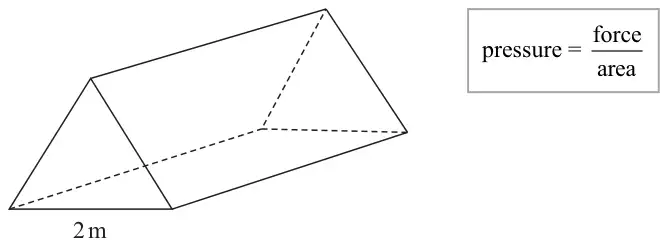
8 The diagram shows a solid triangular prism on a horizontal floor.
The face in contact with the floor is a rectangle of width 2 m.
The pressure on the floor due to the prism is 80 newtons/m2 The force exerted by the prism on the floor is 720 newtons.
Work out the length of the prism. (3)
Mark scheme
Answer
Mark
Mark scheme
4.5
P1
for process to find the area, eg \(80 = \dfrac{720}{A}\) or (area =) \(\dfrac{720}{80}\ (= 9)\) or \(80 = \dfrac{720}{2x}\) or \(2x = \dfrac{720}{80}\)
P1
for complete process to find the length, eg \(\text{``}9\text{''} \div 2\) or \(720 \div (2 \times 80)\)
5 A car travelled 4.96 miles at an average speed of 30.4 miles per hour.
(a) Work out an estimate for the time taken by the car. Give your answer in minutes. (3)
(b) Is your answer to part (a) an underestimate or an overestimate? Give a reason for your answer. (1)
Mark scheme (a)
Answer
Mark
Mark scheme
Estimated time
P1
for rounding of distance = 5 (miles) or speed = 30 (mph)
P1
(dep) for using time = distance/speed eg \(5 \div 30\)
or for a complete process, eg \(30 \div 60\ (= 0.5)\) and \(5 \div \text{``}0.5\text{''}\) or \(30 \div 5\ (= 6)\) and \(60 \div \text{``}6\text{''}\) or \(4.96 \times \dfrac{60}{30}\)
A1
for a correct answer following through their correct rounded distance and/or speed
Mark scheme (b)
Answer
Mark
Mark scheme
Overestimate with reason
C1
ft from (a) for decision with correct reasoning, eg overestimate as dividing a larger number by a smaller number or overestimate as miles rounded up and speed rounded down
Additional guidance
Ft the rounding and process from (a) Must relate to estimation and not rounding of their final answer and they must have a final answer to part (a)
(a) On Monday, Larrs swims 50 metres in 40 seconds at a constant speed.
On Tuesday, Larrs swims 1.5 kilometres.
Assume he swims at the same constant speed as on Monday.
How many minutes does he swim for on Tuesday? [5 marks]
(b) In fact, on Tuesday Larrs swims at a slower constant speed than on Monday.
What does this mean about the number of minutes he swims for on Tuesday?
Tick the correct box. [1 mark]
It is less than the answer to part (a)
It is the same as the answer to part (a)
It is greater than the answer to part (a)
It is not possible to say
Mark scheme (a)
Answer
Mark
Comments
Alternative method 1: working in metres per second or kilometres per second
1500 (metres) or 0.05 (km)
B1
implied by 30 or 1200
their \(1500 \div 50 \times 40\) or \(1.5 \div\) their \(0.05 \times 40\) or 1200
M2
oe M1 their \(1500 \div 50\) or 30 oe or \(50 \div 40\) or 1.25 oe or \(1.5 \div\) their 0.05 oe their 1500 must be using digits 15 (and zeros) their 0.05 must be using single digit 5 (and zeros)
their \(1200 \div 60\)
M1dep
oe dep on M2
20
A1ft
ft their 1500 or their 0.05
Alternative method 2: working in metres per minute or kilometres per minute
1500 (metres) or 0.05 (km)
B1
implied by 0.075
\(40 \div 60\) or \(\dfrac{2}{3}\)
M1
oe accept [0.66, 0.67]
\(50 \div (40 \div 60)\) or 75 or \(\dfrac{\text{their } 0.05}{(40 \div 60)}\) or 0.075 or their \(1500 \times (40 \div 60)\)
M1dep
oe calculation their 1500 must be using digits 15 (and zeros) their 0.05 must be using single digit 5 (and zeros)
their \(1500 \div\) their 75 or \(1.5 \div\) their 0.075 or their \(1500 \times (40 \div 60) \div 50\)
M1dep
oe
20
A1ft
ft their 1500 or their 0.05
Additional guidance
\(1500 \div 1.25\)
B1M2
\(1.5 \div 50 \times 40\) their 1500 must be using digits 15 (and zeros)
B0M2
\(1.5 \div 0.5 \times 40\) their 0.05 must be using single digit 5 (and zeros)
B0M2
\(150 \div 50\) their 1500 must be using digits 15 (and zeros)
(a) Use \(\quad 8\text{ km/h} = 5\text{ mph} \quad\) to convert 96 km/h to mph [2 marks]
(b) \(x\text{ km/h} = y\text{ mph}\)
Use \(\quad 8\text{ km/h} = 5\text{ mph} \quad\) to write a formula for \(y\) in terms of \(x\). [2 marks]
Mark scheme (a)
Answer
Mark
Comments
\(96 \div 8\) or 12 or \(8 \times 12 = 96\) or \(96 \times 5\) or 480 or \(96 \div 8 \times 5\) or \(8 \div 5\) or 1.6 or \(\dfrac{8}{5}\) or \(5 \div 8\) or 0.625 or \(\dfrac{5}{8}\)
M1
oe
60
A1
Additional guidance
Build up method must be complete at least as far as, and must include, 96, but allow one error in the build up of 5s (oe) for M1
eg
8
16
24
32
40
48
56
64
72
80
88
96
5
10
15
20
25
30
35
45
50
55
60
65
M1 A0
Mark scheme (b)
Answer
Mark
Comments
\(\dfrac{y}{x} = \dfrac{5}{8}\) or \(\dfrac{x}{y} = \dfrac{8}{5}\) or \(8y = 5x\) or \(\dfrac{5x}{8}\) or \(0.625x\) or \((x =)\, \dfrac{8y}{5}\) or \((x =)\ 1.6y\) or \(y = kx\) and \(k = \dfrac{5}{8}\) or \(8 \div 5\) incorrectly evaluated and then \(y = \dfrac{x}{\text{their incorrect evaluation}}\)
M1
oe
\(y = \dfrac{5x}{8}\)
A1
oe in form \(y = \mathrm{f}(x)\) eg \(\;y = 0.625x\;\) or \(\;y = \dfrac{x}{1.6}\;\) or \(\;y = 5x \div 8\) or \(\;y = x \div (8 \div 5)\;\) or \(\;y = x \div 8 \times 5\)
Additional guidance
\(y = \dfrac{5}{8} \times x\;\) or \(\;y = \dfrac{x}{8} \times 5\;\) or \(\;y = x \div 1.6\)
M1A1
\((y =)\, \dfrac{x5}{8}\;\) or \(\;(y =)\ x\dfrac{5}{8}\;\) or \(\;y = \dfrac{5}{8}\) of \(x\)
M1A0
Condone units for M1 only
Do not ignore further work eg \(\;y = x \div (8 \div 5)\;\) then \(\;y = x \div 8 \div 5\)
He drives the first 9 miles in 9 minutes. He then drives at an average speed of 70 miles per hour for 1 hour 36 minutes.
He finds this information about his car.
Average speed
Miles travelled per gallon
65 miles per hour or less
50
More than 65 miles per hour
40
Use the information to show that his car uses less than 3 gallons of petrol for the drive. [5 marks]
Mark scheme
Answer
Mark
Comments
Alternative method 1
1 mile per minute or 60 miles per hour or 0.15 (hours) or 1.6 (hours) or \(1\dfrac{36}{60}\) (hours)
B1
\(9 \div 50\) or 0.18
M1
oe
\(70 \times 1\dfrac{36}{60}\) or \(70 \times 1.6\) or 112
M1
oe
their \(112 \div 40\) or 2.8
M1dep
dep on 2nd M1
2.98 or 2.8 and (3 – 0.18 =) 2.82 or 0.18 and (3 – 2.8 = ) 0.2
A1
Ignore fw
Alternative method 2
1 mile per minute or 60 miles per hour or 0.15 (hours) or 1.6 (hours) or \(1\dfrac{36}{60}\) (hours)
B1
\(9 \div 50\) or 0.18
M1
oe
\(70 \times 1\dfrac{36}{60}\) or 112 or \(70 \times 1.6\) or 112
M1
\(40 \times (3 -\) their \(0.18)\) or 112.8
M1dep
dep on 1st M1
112.8 and 112
A1
Ignore fw
Alternative method 3
1 mile per minute or 60 miles per hour or 0.15 (hours) or 1.6 (hours) or \(1\dfrac{36}{60}\) (hours)
B1
\(9 \div 50\) or 0.18
M1
oe
\(70 \div 40\) or 1.75
M1
\(70 \div 40 \times 1.6\) or 2.8 or their \(1.75 \times 1.6\)
M1dep
oe eg 1.75 + 0.875 + 0.175 dep on 2nd M1
2.98 or 2.8 and (3 – 0.18 =) 2.82 or 0.18 and (3 – 2.8 = ) 0.2
A1
Ignore fw
Additional guidance
Key facts are :
First stage: Distance travelled 9 miles (given) Time taken 9 minutes (given) or 0.15 hours Average speed 60 mph Miles per gallon 50 mpg (given), Amount of petrol \(\;9 \div 50 = 0.18\) gallons
Second stage: Distance travelled \(\;70 \times 1.6 = 112\) miles Time taken 1 hour 36 minutes (given) or 1.6 hours Average speed 70 mph (given) Miles per gallon 40 mpg (given), Amount of petrol \(\;112 \div 40 = 2.8\) gallons
An incorrect conversion of 1 hour 36 minutes to 1.36 can score: eg \(70 \times 1.36 = 95.2,\ 95.2 \div 40 = 2.38\) \(70 \times 1.36 = 95.2,\ 95.2 \div 40 = 2.38,\ 0.18 + 2.38 = 2.56\)
Use \(\quad 8\) km/h \(= 5\) mph \(\quad\) to write a formula for \(y\) in terms of \(x\). [2 marks]
Mark scheme
Answer
Mark
Comments
\(\dfrac{y}{x} = \dfrac{5}{8}\) or \(\dfrac{x}{y} = \dfrac{8}{5}\) or \(8y = 5x\) or \(\dfrac{5x}{8}\) or \(0.625x\) or \((x =)\ \dfrac{8y}{5}\) or \((x =)\ 1.6y\) or \(y = \mathrm{k}x\) and \(\mathrm{k} = \dfrac{5}{8}\) or \(8 \div 5\) incorrectly evaluated and then \(y = \dfrac{x}{\text{their incorrect evaluation}}\)
M1
oe
\(y = \dfrac{5x}{8}\)
A1
oe in form \(y = f(x)\) or \(f(x) = y\) eg \(y = 0.625x\) or \(y = \dfrac{x}{1.6}\) or \(y = 5x \div 8\) or \(y = x \div (8 \div 5)\) or \(y = x \div 8 \times 5\)
Additional guidance
\(y = \dfrac{5}{8} \times x\) or \(y = \dfrac{x}{8} \times 5\) or \(y = x \div 1.6\)
M1A1
\(y8 = x5\) or \((y =)\ \dfrac{x5}{8}\) or \((y =)\ x\dfrac{5}{8}\) or \(y = \dfrac{5}{8}\) of \(x\)
M1A0
Condone units for M1 only
Do not ignore further work eg \(y = x \div (8 \div 5)\) then \(y = x \div 8 \div 5\)