for isolating \(k\) terms, eg \(5k = 26 + 4\) or \(5k = 30\) or \(k - \dfrac{4}{5} = \dfrac{26}{5}\) oe or \(26 + 4 \div 5\)
A1
cao
Additional guidance
For M mark step must be carried out not just intention shown. For example, if you see \(5k - 4 = 26\) \(+4 \qquad +4\) award M1 for \(5k = r\) where \(r \gt 26\)
for a correct first step eg \(\dfrac{14 - x}{3} \times 3 = 3x \times 3\) or \(\dfrac{14}{3} - \dfrac{1}{3}x + \dfrac{1}{3}x = 3x + \dfrac{1}{3}x\) oe
A1
oe, eg \(\dfrac{14}{10}\)
Additional guidance
For M mark, step must be carried out not just intention shown. For example if you see \[\begin{array}{ccc} \dfrac{14 - x}{3} &=& 3x \\ \times 3 && \times 3 \end{array}\] Only award M1 when you see \(14 - x = kx\) where \(k \gt 3\)
or dividing throughout by 2 as a first step to solve equation, eg \(4x - 5 = 9\)
M1
for isolating terms in \(x\), eg \(8x = 18 + 10\) or \(4x = 9 + 5\)
A1
for 3.5 or \(3\dfrac{1}{2}\) oe or \(\dfrac{7}{2}\) oe
Additional guidance
For M marks step must be carried out not just intention shown.
For example, if you see\[\begin{array}{c} 2(4x - 5) = 18 \\ \div 2 \qquad\qquad \div 2 \end{array}\]Award M1 for:\[4x - 5 = k \quad \text{with } k \ne 18, 36\]
ft their equation of the form \(ax \pm b = c\)
For example, if you see\[\begin{array}{c} 8x - 10 = 18 \\ +10 \qquad\qquad +10 \end{array}\]Award M1 for:\[8x \quad = k \quad \text{with } k \ne 8, 18\]
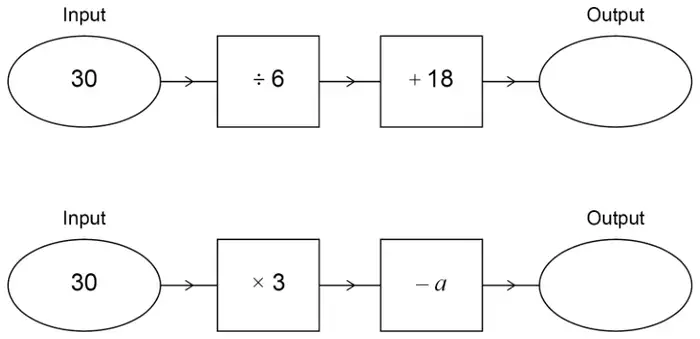
(c) Show that there is a number for which the output is the same as the input. (2)
Mark scheme (a)
Answer
Mark
Mark scheme
16
B1
cao
Mark scheme (b)
Answer
Mark
Mark scheme
19
M1
starts method to find input using inverse operations eg \(28 + 10\ (=38)\) or sight of \(+10\) and \(\div 2\)
A1
cao
Additional guidance
\(+10\) and \(\div 2\) could be seen in a flow diagram Working may be next to number machine.
Mark scheme (c)
Answer
Mark
Mark scheme
Shown
M1
for carrying out at least one trial or for forming a suitable equation, eg \(2x - 10 = x\) or for identifying 10
C1
for showing that an input of 10 gives an output of 10
Additional guidance
Trial can be for any value, must be correctly evaluated. Accept correct inverse function trial, correctly evaluated. If working seen on the number machine provided in the question allow for a trial other than input 13 or output 28.
for one correct step to isolate \(x\) term or constant term on one side, eg adds \(x\) to both sides to get \(5x - 14 + x = 52 - x + x\) or adds 14 to both sides to get \(5x - 14 + 14 = 52 - x + 14\) oe
M1
for both correct steps to isolate terms in \(x\) on one side and constant term on one side, eg \(\text{``}6x\text{''} - 14 + 14 = 52 + 14\), or \(5x + x = \text{``}66\text{''} + x - x\)
A1
cao
Additional guidance
May be seen in different equivalent forms but must be carried out, not just intention seen. Can be implied by eg \(4x = 66\) or \(6x = 38\)
(i) Work out the value of \(P\) when \(g = 3\) and \(h = 5\) (2)
(ii) Work out the value of \(g\) when \(P = 38\) and \(h = 3\) (2)
\(V = 3r - q\)
(b) Work out the value of \(V\) when \(r = -3\) and \(q = 2\) (2)
Mark scheme (a)(i)
Answer
Mark
Mark scheme
26
M1
for substitution eg \(2 \times 3 + 4 \times 5\) or \(6 + 20\)
A1
cao
Mark scheme (a)(ii)
Answer
Mark
Mark scheme
13
M1
for substitution eg \(38 = 2g + 4 \times 3\)
or a complete numerical method eg \((38 - 4 \times 3) \div 2\) or for a correct first step to rearrange eg \(P - 4h = 2g\) or \(\dfrac{P}{2} = g + \dfrac{4h}{2}\) oe
for one correct step to isolate \(x\) term or constant term on one side, eg adds \(x\) to both sides to get \(5x - 14 + x = 52 - x + x\) or adds 14 to both sides to get \(5x - 14 + 14 = 52 - x + 14\) oe
M1
for both correct steps to isolate terms in \(x\) on one side and constant term on one side, eg \(\text{``}6x\text{''} - 14 + 14 = 52 + 14\), or \(5x + x = \text{``}66\text{''} + x - x\)
A1
cao
Additional guidance
May be seen in different equivalent forms but must be carried out, not just intention seen. Can be implied by eg \(4x = 66\) or \(6x = 38\)
24 Rick, Selma and Tony are playing a game with counters.
Rick has some counters. Selma has twice as many counters as Rick. Tony has 6 counters less than Selma.
In total they have 54 counters.
the number of counters Rick has : the number of counters Tony has \(= 1 : p\)
Work out the value of \(p\). (5)
Mark scheme
Answer
Mark
Mark scheme
1.5
P1
for process to develop 3 algebraic expressions, eg (\(R =\)) \(n\), (\(S =\)) \(2n\), (\(T =\)) \(2n - 6\), oe, at least two must be correct. or for selecting 3 values satisfying the given criteria, eg (\(R =\)) 10, (\(S =\)) 20, (\(T =\)) 14
P1
for process to sum 3 algebraic expressions and equating to 54, eg \(n + \text{``}2n\text{''} + \text{``}2n - 6\text{''} = 54\) or for finding the correct sum of their values eg \(\text{``}10\text{''} + \text{``}20\text{''} + \text{``}14\text{''} = 44\)
P1
for start of process to solve the correct linear equation, eg \(5n = 54 + 6\ (n = 12)\) or for 12, 24, 18
P1
for \(\text{``}12\text{''} : 2 \times \text{``}12\text{''} - 6\) oe eg \(12 : 18\) oe or \(18 : 12\) linked to \(T\), \(R\)
for a correct first stage eg expanding the brackets, \(2 \times 5x - 2 \times 4\ (= 10x - 8)\) or division of both sides by 2, eg \(\dfrac{2(5x - 4)}{2} = \dfrac{21}{2}\)
M1
for isolating terms in \(x\) eg \(10x = 21 + 8\)
A1
oe
Mark scheme (d)
Answer
Mark
Mark scheme
\(20e^3f^4\)
M1
for any two of \(4 \times 5\ (= 20)\), \(e^{2+1}\ (= e^3)\), \(f^{1+3}\ (= f^4)\) in a product or written as individual terms
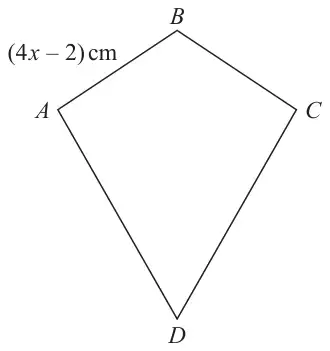
for explanation, eg \(AB\) cannot be zero (cm) or shows \(AB\) to be zero, eg \(4 \times 0.5 - 2 = 0\)
Additional guidance
Accept say ‘\(AB\) would then be 0’
Mark scheme (b)
Answer
Mark
Mark scheme
2.5
P1
for a correct expression for \(AD\), eg \(3(4x - 2)\) or \(12x - 6\) OR \(2(3AB + AB) = 64\) oe or \(3AB + AB = 32\) oe or \(AB = 8\) OR for an equation with mixed variables, eg \(6AB + 2(4x - 2) = 64\)
P1
for forming a correct equation in \(x\), eg \(4x - 2 + 4x - 2 + 3(4x - 2) + 3(4x - 2) = 64\) or \(4x - 2 = 8\) or \(4x - 2 + 3(4x - 2) = 32\)
for isolating \(x\) terms, eg \(4x = 37 + 7\) or \(4x = 44\) or for \(x - \frac{7}{4} = \frac{37}{4}\) or for \(37 + 7 = 44\) followed by \(\text{``}44\text{''} \div 4\ (= 11)\)
for correctly expanding the bracket, as part of an equation to get \(4x - 24 = 44\) or for dividing both sides of the equation by 4 as a first step, eg \(\frac{4(x-6)}{4} = \frac{44}{4}\) oe
A1
cao
Additional guidance
Award M1 for an embedded value of 17 if not identified as the answer
15 You can use this rule to work out the total hire charge, in pounds (£), for hiring a 3D printer for a number of weeks.
Total hire charge (£) \(=\) number of weeks \(\times\ 70 + 50\)
Mia wants to hire a 3D printer for 4 weeks.
(a) Work out the total hire charge. (2)
Zahir hires a 3D printer. The total hire charge is £680
(b) For how many weeks does Zahir hire the 3D printer? (2)
Mark scheme (a)
Answer
Mark
Mark scheme
330
M1
for \(4 \times 70 + 50\) oe
A1
cao
Additional guidance
May be seen as sum of four 70s and a 50 \(n \times (70 + 50)\) or ambiguous working gets 0 marks
Mark scheme (b)
Answer
Mark
Mark scheme
9
M1
for use of inverse operations eg \((680 - 50) \div 70\) OR rearranges an equation to solve eg \(70x + 50 = 680\) rearranged to isolate \(x\) term. OR ft (a) eg \(((680 - \text{``}330\text{''}) \div 70) + 4\)
A1
cao or ft their (a)
Additional guidance
Need not have brackets; can be written in an incorrect order if the intention is clear A correct but embedded answer gets 1 mark
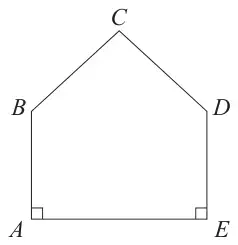
17 The diagram shows a pentagon. The pentagon has one line of symmetry.
\(AE = 4x\) \(AB = 2x + 1\) \(BC = x + 2\)
All these measurements are given in centimetres.
The perimeter of the pentagon is 18 cm.
(a) Show that \(10x + 6 = 18\) (3)
(b) Find the value of \(x\). (2)
Mark scheme (a)
Answer
Mark
Mark scheme
Full working seen
M1
for an initial step with the expressions eg doubling \(2x + 1\) or \(x + 2\) or halving \(4x\) or for identifying \(CD\) as \(x + 2\) or for identifying \(DE\) as \(2x + 1\)
M1
for an expression for the total perimeter, eg \(4x + 2 \times (2x + 1) + 2 \times (x + 2)\)
C1
for full simplification and equating to 18
Additional guidance
May be seen in working or on diagram
Mark scheme (b)
Answer
Mark
Mark scheme
1.2
M1
for isolating terms in \(x\) can ft an equation stated in (a) provided in form \(ax + b = c\)
for \(4 \times 5\) and \(3 \times -2\), the substitution may be seen in two separate calculations, eg \(4 \times 5\ (= 20)\) and \(3 \times -2\ (= -6)\)
A1
cao
Mark scheme (b)
Answer
Mark
Mark scheme
\(4e^2 + 8e\)
B2
for \(4e^2 + 8e\)
(B1
for \(4e^2\) or \(8e\))
Additional guidance
Note: \(4e^2 + 8e = 12e^3\) for example gets B1 only
Mark scheme (c)
Answer
Mark
Mark scheme
11
M1
for a correct first step eg \(3 \times m - 3 \times 4 = 21\) oe or \(m - 4 = 21 \div 3\ (= 7)\) oe
A1
cao
Additional guidance
Showing \(\div 3\) by each side of equation is sufficient
for correct expansion of the bracket or dividing all terms by 3 as a first step eg \(3x - 3\) or \((5x - 6)/3 = 3(x - 1)/3\)
M1
for isolating terms in \(x\) on one side of an equation eg \(5x - 6 - 3x = -3\) or both constants on one side of an equation, eg \(5x = 3x - 3 + 6\), ft \(5x - 6 = 3x - 1\)
for correct expansion of the bracket or dividing all terms by 3 as a first step eg \(3x - 3\) or \((5x - 6)/3 = 3(x - 1)/3\)
M1
for isolating terms in \(x\) on one side of an equation eg \(5x - 6 - 3x = -3\) or both constants on one side of an equation, eg \(5x = 3x - 3 + 6\), ft \(5x - 6 = 3x - 1\)
for writing at least 2 fractions with a common denominator eg. \(\dfrac{3(3x - 2)}{12}\), \(\dfrac{4(2x + 5)}{12}\), \(\dfrac{2(1 - x)}{12}\) with at least one correct numerator or for \(\dfrac{3x}{4} - \dfrac{2}{4} - \dfrac{2x}{3} - \dfrac{5}{3} = \dfrac{1}{6} - \dfrac{x}{6}\) (accept \(+\dfrac{5}{3}\) instead of \(-\dfrac{5}{3}\))
M1
(dep) for a method to eliminate all fractions in an equation, ignore errors in any expanded terms eg. \(3(3x - 2) - 4(2x + 5) = 2(1 - x)\) or \(6 \times [3(3x - 2) - 4(2x + 5)] = 12 \times [1 - x]\) or \(3 \times 3x - 3 \times 2 - 4 \times 2x - 4 \times 5 = 2 \times 1 - 2 \times x\) OR for the correct expansion of brackets leading to \(\dfrac{9x - 6 - 8x - 20}{12} = \dfrac{2 - 2x}{12}\)
M1
(dep on M2) for correctly isolating terms in \(x\) and number terms of their linear equation e.g. \(9x - 8x + 2x = 2 + 6 + 20\)
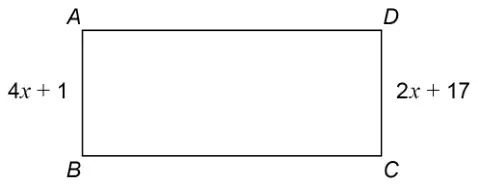
\(4x - 2x = 17 - 1\) or \(1 - 17 = 2x - 4x\) or \((x =)\ 8\)
M1dep
oe collection of terms
Correctly substitutes their 8 into a correct expression for the length or width of the rectangle
M1
their \(8 \gt 0\) and their \(8 \ne 1\)
Correct method for both the length and the width of the rectangle using their 8
M1dep
their \(8 \gt 0\) and their \(8 \ne 1\) dep on 3rd M
3267
A1
SC1 \(12x + 3\) or \(6x + 51\)
Additional guidance
The first M1 or SC1 may be awarded for correct work with no answer or incorrect answer, even if this is seen amongst multiple attempts
Trial and improvement to find \((x =)\ 8\) is M2
Using an incorrect value of \(x\) for 3rd and 4th marks eg when \(x = 10\) \(4 \times 10 + 1 = 41\) and \(41 \times 3 = 123\) or \(12 \times 10 + 3 = 123\) and \(123 \div 3 = 41\) or \(2 \times 10 + 17 = 37\) and \(6 \times 10 + 51 = 111\)
\(7x - 4x\) or \(3x\) or \(4x - 7x\) or \(-3x\) or \(-22 - 29\) or \(-51\) or \(22 + 29\) or 51
M1
\(3x = 51\) or \(-3x = -51\)
A1
\(\dfrac{51}{3}\) or \(\dfrac{-51}{-3}\) implies M1A1 implied by correct answer
17
A1ft
ft M1A0 from an equation of the form \(\pm 3x = a\) or \(bx = \pm 51\)
Additional guidance
Trial and improvement scores 0 or 3
If a follow through answer does not simplify to an integer, accept it as a fraction, mixed number or decimal to at least 1dp. eg from \(3x = 7\) accept \(\dfrac{7}{3}\) or \(2\dfrac{1}{3}\) or 2.3 or better Ignore any attempt to convert a correct ft fraction
\(7x - 4x\) or \(3x\) or \(4x - 7x\) or \(-3x\) or \(-22 - 29\) or \(-51\) or \(22 + 29\) or 51
M1
\(3x = 51\) or \(-3x = -51\)
A1
\(\dfrac{51}{3}\) or \(\dfrac{-51}{-3}\) implies M1A1 implied by correct answer
17
A1ft
ft M1A0 from an equation of the form \(\pm 3x = a\) or \(bx = \pm 51\)
Additional guidance
Trial and improvement scores 0 or 3
If a follow through answer does not simplify to an integer, accept it as a fraction, mixed number or decimal to at least 1dp. eg from \(3x = 7\) accept \(\dfrac{7}{3}\) or \(2\dfrac{1}{3}\) or 2.3 or better Ignore any attempt to convert a correct ft fraction
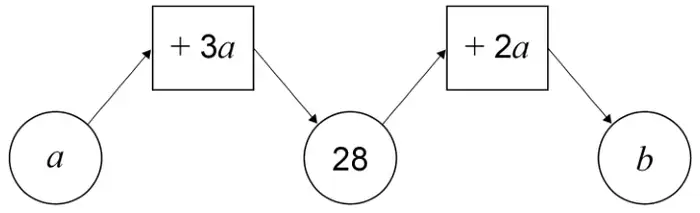
When \(\quad x = 5 \quad y = 13\) and when \(\quad x = 10 \quad y = 28\)
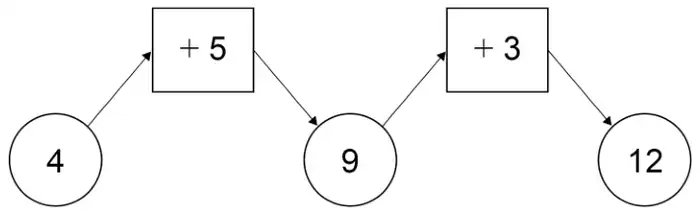
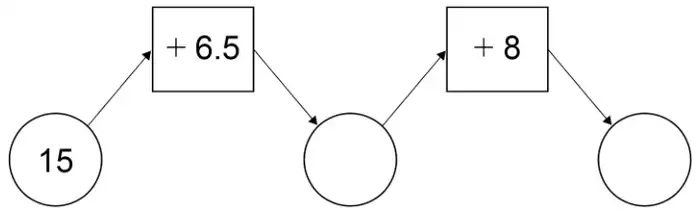
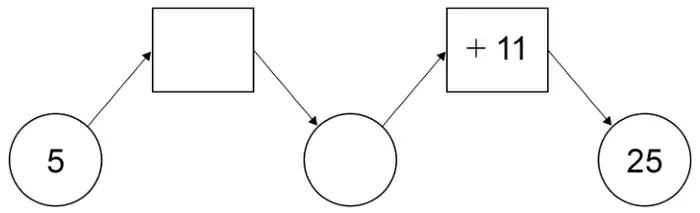
Complete the number machine. [2 marks]
Mark scheme (a)
Answer
Mark
Comments
40 in correct position in number machine
B1
Mark scheme (b)
Answer
Mark
Comments
\(+\,11\) in correct position in number machine
B1
oe operation to reach 18 eg \(-\,-11\) or \(\times\,\dfrac{18}{7}\)
Mark scheme (c)
Answer
Mark
Comments
3 and 2 in correct positions in number machine
B2
B1 correct operations for input 5, output 13 or correct operations for input 10, output 28
Additional guidance
B1 may be awarded for correct work, with no or incorrect answer, even if this is seen amongst multiple attempts
Examples of correct operations for input 5, output 13 include \(\times\,2.6\) and \(-\,0\) or \(\times\,4\) and \(-\,7\) or \(\times\,5\) and \(-\,12\)
B1
Examples of correct operations for input 10, output 28 include \(\times\,2.8\) and \(-\,0\) or \(\times\,4\) and \(-\,12\) or \(\times\,5\) and \(-\,22\)
13 Multiplying \(y\) by 6 gives the same result as adding 15 to \(y\)
(a) Write this as an equation. [2 marks]
(b) Show that the value of \(y\) is not 4 [1 mark]
Mark scheme (a)
Answer
Mark
Comments
\(6y = y + 15\)
B2
correct single equation with \(6y\) and \(y + 15\) eg \(15 + y = y \times 6\)
B1 \(6y\) or \(y + 15\) or rearranged equation eg \(6y - 15 = y\) or \(5y = 15\) but not \(y = 3\) only
Additional guidance
B1 may be awarded for a correct term even if this is seen amongst multiple attempts or embedded in an incorrect equation or incorrect term eg \(6y + 15\) or \(6y + 15y\) or \(6(y + 15)\)
Allow any variable for B1 but must be consistent for B2
Allow unprocessed terms for B1 or B2 eg \(6 \times y\) or \(y6\)
\(6y = y + 15\) seen, but then correctly simplified or solved
B2
\(6y = y + 15\) seen, but then incorrectly simplified or solved
B1
\(6y = 18\) or \(y + 15 = 18\) or both (unless combined to a single equation)
B1
No work worth B2 or B1 and answer \(y = 3\)
B0
Mark scheme (b)
Answer
Mark
Comments
Alternative method 1: substitutes \(y = 4\) into both sides
\((6y =)\ 24\) and \((y + 15 =)\ 19\)
B1ft
oe eg \(4 \times 6 = 24\) and \(4 + 15 = 19\) correct or ft their equation if their equation has a term in \(y\) on each side
Alternative method 2: solves equation
\((y =)\ 3\)
B1ft
oe eg \(3 \times 6 = 18\) and \(3 + 15 = 18\) correct or ft their equation if their equation has a term in \(y\) on each side
Additional guidance
Allow any variable
Only allow \((y =)\ 3\) seen in (a) if referenced in (b) and not contradicted
B1
For Alt 1, accept substituting into one side and then equating and solving the other eg \(4 \times 6 = 24\) and \(24 - 15 = 9\)
\(\dfrac{3}{10}x = \dfrac{20}{5} - \dfrac{29}{5}\) or \(\dfrac{3}{10}x = -\dfrac{9}{5}\)
M1
oe eg \(0.3x = -1.8\) terms must be collected
\(-6\)
A1ft
ft M1A0M1
Additional guidance
Accept decimal answers for follow through correct to 1 dp or better
Apply the principles of alt 1 for any use of other common denominators eg common denominator of 20 (or multiplication through by 20)
\(10(x + 8) + 4(9 - x) = 6x + 116\)
M1A1
\(6x + 116 = 80 \qquad x = -6\)
M1A1
An incorrect simplification of \(5x + 40 + 18 - 2x\) may still gain the third and fourth marks
eg \(5x + 40 + 18 - 2x = 3x + 68\) followed by \(3x + 68 = 40\) and \(x = -\dfrac{28}{3}\)
M1A0M1A1ft
eg \(5x + 40 + 18 - 2x = 2x + 68\) followed by \(2x + 68 = 40\) and \(x = -14\)
M1A0M1A1ft
An incorrect denominator may still gain the third and fourth marks \(\dfrac{5x + 40 + 18 - 2x}{7}\) followed by \(5x + 40 + 18 - 2x = 28\) and \(x = -10\)
M1A0M1A1ft
Denominator not processed \(3x + 58 = 4\) followed by \(3x = -54\) and \(x = -18\)
M1A1M0A0
\((x + 8) + (9 - x) = 40\)
M0A0M1A0
Two errors in the expansion but with brackets seen may go on to get the third and fourth marks \(5(x + 8) + 2(9 - x) = 5x + 8 + 18 - x\)
1st M1A0
Two errors in the expansion and no brackets seen, no follow through allowed \(5x + 8 + 18 - x\) followed by \(4x + 26 = 40\) and \(x = \dfrac{14}{4}\)
their \(10x - 6x = 9 +\) their 5 or \(4x = 14\) or \(14 \div 4\) or \(7 \div 2\)
M1
oe eg their \(-5 - 9 = 6x -\) their \(10x\) or \(4x - 14 = 0\) collecting two terms in \(x\) and two constant terms correctly
\(\dfrac{14}{4}\) or \(3\dfrac{2}{4}\) or \(\dfrac{7}{2}\) or \(3\dfrac{1}{2}\) or 3.5
A1ft
oe ft M1M0 or M0M1 with exactly one error
Alternative method 2
\(\dfrac{6x}{5} + \dfrac{9}{5}\)
M1
oe two terms eg \(1.2x + 1.8\)
\(2x -\) their \(\dfrac{6x}{5} =\) their \(\dfrac{9}{5} + 1\) or \(\dfrac{4x}{5} = \dfrac{14}{5}\)
M1
oe eg \(-1 -\) their \(\dfrac{9}{5} =\) their \(\dfrac{6x}{5} - 2x\) or \(\dfrac{4x}{5} - \dfrac{14}{5} = 0\) collecting two terms in \(x\) and two constant terms correctly
\(\dfrac{14}{4}\) or \(3\dfrac{2}{4}\) or \(\dfrac{7}{2}\) or \(3\dfrac{1}{2}\) or 3.5
A1ft
oe ft M1M0 or M0M1 with exactly one error
Additional guidance
Ignore simplification or conversion if correct answer seen
Correct answer from trial and improvement
M1M1A1
Correct equation with terms collected or division with no or incorrect answer
M1M1A0
Embedded 3.5 with no or incorrect answer
M1M1A0
\(10x - 5 = 6x + 9\) \(10x - 6x = 9 - 5\) \(x = 1\) (exactly one error in line 2)
M1 M0 A1ft
\(7x - 5 = 6x + 9\) \(7x - 6x = 9 + 5\) \(x = 14\) (exactly one error in line 1)
\(2w = \dfrac{4}{5} \times 15\) or \(2w = \dfrac{60}{5}\) or \(2w = 12\) or \(\dfrac{2w}{15} = \dfrac{12}{15}\) or \(\dfrac{w}{3} = \dfrac{2}{1}\) or \(\dfrac{w}{2} = \dfrac{3}{1}\) or \(\dfrac{w}{15} = \dfrac{4}{5} \div 2\) or \(\dfrac{w}{15} = \dfrac{2}{5}\) or \(2w \times 5 = 4 \times 15\) or \(10w = 60\) or \(\dfrac{4}{5} \div \dfrac{2}{15}\)
M1
oe in the form \(aw = n\) where \(a\) is an integer and \(n\) is an integer, fraction or decimal oe in the form \(\dfrac{bw}{x} = \dfrac{c}{x}\) where \(x\) is a common denominator oe calculation
their \(10x - 6x = 9 +\) their 5 or \(4x = 14\) or \(14 \div 4\) or \(7 \div 2\)
M1
oe eg their \(-5 - 9 = 6x -\) their \(10x\) or \(4x - 14 = 0\) collecting two terms in \(x\) and two constant terms correctly
\(\dfrac{14}{4}\) or \(3\dfrac{2}{4}\) or \(\dfrac{7}{2}\) or \(3\dfrac{1}{2}\) or 3.5
A1ft
oe ft M1M0 or M0M1 with exactly one error
Alternative method 2
\(\dfrac{6x}{5} + \dfrac{9}{5}\)
M1
oe two terms eg \(1.2x + 1.8\)
\(2x -\) their \(\dfrac{6x}{5} =\) their \(\dfrac{9}{5} + 1\) or \(\dfrac{4x}{5} = \dfrac{14}{5}\)
M1
oe eg \(-1 -\) their \(\dfrac{9}{5} =\) their \(\dfrac{6x}{5} - 2x\) or \(\dfrac{4x}{5} - \dfrac{14}{5} = 0\) collecting two terms in \(x\) and two constant terms correctly
\(\dfrac{14}{4}\) or \(3\dfrac{2}{4}\) or \(\dfrac{7}{2}\) or \(3\dfrac{1}{2}\) or 3.5
A1ft
oe ft M1M0 or M0M1 with exactly one error
Additional guidance
Ignore simplification or conversion if correct answer seen
Correct answer from trial and improvement
M1M1A1
Correct equation with terms collected or division with no or incorrect answer
M1M1A0
Embedded 3.5 with no or incorrect answer
M1M1A0
\(10x - 5 = 6x + 9\) \(10x - 6x = 9 - 5\) \(x = 1\) (exactly one error in line 2)
M1 M0 A1ft
\(7x - 5 = 6x + 9\) \(7x - 6x = 9 + 5\) \(x = 14\) (exactly one error in line 1)
Award the mark for an embedded answer only if the answer is selected eg1 \(7 \times 8 = 56\) with no answer or with incorrect answer eg2 \(7 \times 8 = 56\) (with 8 circled) with no contradictory answer
B0 B1
Mark scheme (b)
Answer
Mark
Comments
7
B1
Additional guidance
\(25 - 18 = 7\)
B1
\(18 - 25 = 7\) (allow recovery)
B1
Answer of \(\;-7\) (unless recovered)
B0
Answer of \(\;7y\) (unless recovered)
B0
Award the mark for an embedded answer only if the answer is selected eg1 \(25 - 7 = 18\) with no answer or with incorrect answer eg2 \(25 - 7 = 18\) (with 7 circled) with no contradictory answer
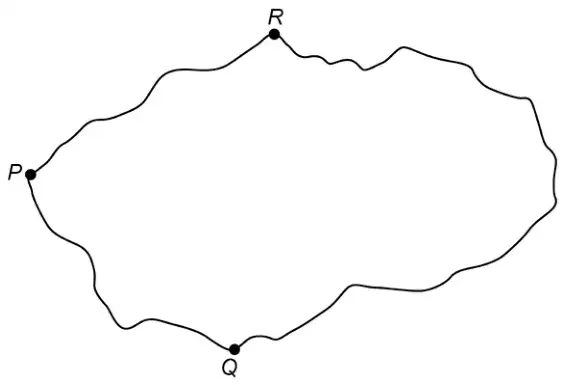
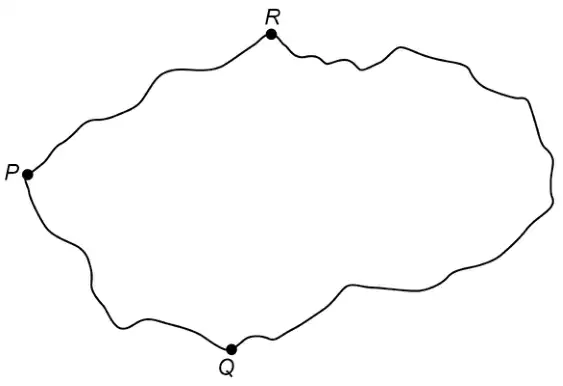
25 Towns \(P\), \(Q\) and \(R\) are connected by roads \(PQ\), \(PR\) and \(QR\).
\(PR\) is 10 km longer than \(PQ\). \(QR\) is twice as long as \(PR\). The total length of the three roads is 170 km
Not drawn accurately
Work out the length of \(PQ\). [4 marks]
Mark scheme
Answer
Mark
Comments
Alternative method 1 – PQ as the unknown
\(x + 10\) or \(2(x + 10)\)
M1
any unknown
\(x + x + 10 + 2(x + 10) = 170\)
M1dep
oe any consistent unknown \(x\) + their two expressions (with at least one correct) = 170
\(4x + 30 = 170\)
M1dep
oe \(4x = 140\) must be correct
35
A1
Alternative method 2 – PR as the unknown
\(x - 10\) or \(2x\)
M1
any unknown
\(x + x - 10 + 2x = 170\)
M1dep
oe any consistent unknown \(x\) + their two expressions (with at least one correct) = 170
\(4x - 10 = 170\) or \(x = 45\)
M1dep
oe \(4x = 180\) must be correct
35
A1
Alternative method 3 – QR as the unknown
\(\dfrac{x}{2}\) or \(\dfrac{x}{2} - 10\)
M1
any unknown
\(x + \dfrac{x}{2} + \dfrac{x}{2} - 10 = 170\)
M1dep
oe any consistent unknown \(x\) + their two expressions (with at least one correct) = 170
\(2x - 10 = 170\) or \(x = 90\)
M1dep
oe \(2x = 180\) must be correct
35
A1
Alternative method 4 – trial and improvement with addition of three lengths
A correctly evaluated trial with a difference of 10 (km) between the two shorter lengths and the longest length twice the length of the middle length
M1
may be seen as a subtraction of three numbers from 170
A different correctly evaluated trial with a difference of 10 (km) between the two shorter lengths and the longest length twice the length of the middle length
M1dep
may be seen as a subtraction of three numbers from 170
35, 45 and 90
A1
35
A1
Alternative method 5 – trial and improvement with subtraction from 170
A correctly evaluated trial of two lengths subtracted from 170 with a difference of 10 (km) between the two lengths or one length twice the length of the other
M1
A different correctly evaluated trial of two lengths subtracted from 170 with a difference of 10 (km) between the two lengths or one length twice the length of the other
M1dep
35, 45 and 90
A1
35
A1
Additional guidance
If the student attempts more than one method, mark each method and award the highest mark
Alt 1 \(\quad PQ + PQ + 10 + 2(PQ + 10) = 170\)
M1M1
Alt 1 \(\quad PQ + PQ + 10 + 2PR = 170\)
M1
Alt 2 \(\quad x\), \(x + 10\) and \(2x\) seen on diagram, \(4x + 10 = 170\)
M1M1M0A0
Alt 4 \(\quad 35 + 45 + 90\) with no choice made
M1M1A1A0
Alt 4 \(\quad 170 - 30 - 40 - 80 = 20\)
M1
Alt 4 \(\quad 170 - 30 - 40 - 60 = 40\) incorrect number is doubled
17 In a bag there are 10p coins, 20p coins and 50p coins.
There are two fewer 20p coins than 10p coins. There are five more 50p coins than 10p coins.
(a) Complete the table. [1 mark]
Coin
Number of coins
10p
\(n\)
20p
\(n - 2\)
50p
(b) Altogether, there are 60 coins.
Work out the total value of the 20p coins. [4 marks]
Mark scheme (a)
Answer
Mark
Comments
\(n + 5\) or \(5 + n\)
B1
oe eg \(N - 2 + 7\)
Additional guidance
Letters other than \(n\) or \(N\) eg \(x + 5\)
B0
Mark scheme (b)
Answer
Mark
Comments
\(n + n - 2 +\) their \((n + 5)\) or \(3n + 3\)
M1
condone any letter ft their algebraic expression in (a)
\(3n + 3 = 60\) or \((n =)\ 19\) or \((n - 2 =)\ 17\)
M1dep
ft their algebraic expression in (a) correct ft equation with terms on LHS collected 19 10p coins or 17 20p coins or 19, 17, 24 chosen implies M2
(their \(19 - 2) \times 0.2\) or their \(17 \times 0.2\) or 3.4 or (their \(19 - 2) \times 20\) or their \(17 \times 20\) or 340
M1dep
ft their algebraic expression in (a) 3.4 or 340 implies M3
3.40
A1
condone 3.40p SC2 answer 17
Additional guidance
Allow a restart in this part ie answer £3.40 scores full marks
Working may be seen by the table
Answer 340p
M1M1M1A0
£3.40 with answer eg £17.30 (total of all coins)
M1M1M1A0
Only follow through their algebraic expression from (a) if an expression and / or equation for the total number of coins is used in this part
Award the M mark(s) for a correct ft expression or equation even if not subsequently used
The solution to an equation derived from an incorrect expression in (a) can score the first three marks eg answer in (a) \(n - 5\) then working in (b) \(\quad n + n - 2 + n - 5 = 60 \quad n = [22, 23]\) \(([22, 23] - 2) \times 0.2 = [4, 4.20]\)
9 Towns \(P\), \(Q\) and \(R\) are connected by roads \(PQ\), \(PR\) and \(QR\).
\(PR\) is 10 km longer than \(PQ\). \(QR\) is twice as long as \(PR\). The total length of the three roads is 170 km
Not drawn accurately
Work out the length of \(PQ\). [4 marks]
Mark scheme
Answer
Mark
Comments
Alternative method 1 – PQ as the unknown
\(x + 10\) or \(2(x + 10)\)
M1
any unknown
\(x + x + 10 + 2(x + 10) = 170\)
M1dep
oe any consistent unknown \(x\) + their two expressions (with at least one correct) = 170
\(4x + 30 = 170\)
M1dep
oe \(4x = 140\) must be correct
35
A1
Alternative method 2 – PR as the unknown
\(x - 10\) or \(2x\)
M1
any unknown
\(x + x - 10 + 2x = 170\)
M1dep
oe any consistent unknown \(x\) + their two expressions (with at least one correct) = 170
\(4x - 10 = 170\) or \(x = 45\)
M1dep
oe \(4x = 180\) must be correct
35
A1
Alternative method 3 – QR as the unknown
\(\dfrac{x}{2}\) or \(\dfrac{x}{2} - 10\)
M1
any unknown
\(x + \dfrac{x}{2} + \dfrac{x}{2} - 10 = 170\)
M1dep
oe any consistent unknown \(x\) + their two expressions (with at least one correct) = 170
\(2x - 10 = 170\) or \(x = 90\)
M1dep
oe \(2x = 180\) must be correct
35
A1
Alternative method 4 – trial and improvement with addition of three lengths
A correctly evaluated trial witha difference of 10 (km) between the two shorter lengthsandthe longest length twice the length of the middle length
M1
may be seen as a subtraction of three numbers from 170
A different correctly evaluated trial witha difference of 10 (km) between the two shorter lengthsandthe longest length twice the length of the middle length
M1dep
may be seen as a subtraction of three numbers from 170
35, 45 and 90
A1
35
A1
Alternative method 5 – trial and improvement with subtraction from 170
A correctly evaluated trial of two lengths subtracted from 170 witha difference of 10 (km) between the two lengthsorone length twice the length of the other
M1
A different correctly evaluated trial of two lengths subtracted from 170 witha difference of 10 (km) between the two lengthsorone length twice the length of the other
M1dep
35, 45 and 90
A1
35
A1
Additional guidance
If the student attempts more than one method, mark each method and award the highest mark
Alt 1 \(\ PQ + PQ + 10 + 2(PQ + 10) = 170\)
M1M1
Alt 1 \(\ PQ + PQ + 10 + 2PR = 170\)
M1
Alt 2 \(\ x,\ x + 10\) and \(2x\) seen on diagram, \(4x + 10 = 170\)
M1M1M0A0
Alt 4 35 + 45 + 90 with no choice made
M1M1A1A0
Alt 4 170 – 30 – 40 – 80 = 20
M1
Alt 4 170 – 30 – 40 – 60 = 40 incorrect number is doubled
their \(12x - 2x = -5 +\) their 8 or \(10x = 3\) or their \(-8 + 5 = 2x -\) their \(12x\) or \(-3 = -10x\)
M1
Collecting two terms in \(x\) and two constant terms correctly oe eg \(10x - 3 = 0\)
0.3 or \(\dfrac{3}{10}\)
A1ft
ft M1M0 or M0M1 with exactly one error
Alternative method 2
\(\dfrac{x}{2} - \dfrac{5}{4}\)
M1
\(3x -\) their \(\dfrac{x}{2}\) = their \(-\dfrac{5}{4} + 2\) or \(\dfrac{5}{2}x = \dfrac{3}{4}\) or \(-2 +\) their \(\dfrac{5}{4}\) = their \(\dfrac{x}{2} - 3x\) or \(-\dfrac{3}{4} = -\dfrac{5}{2}x\)
M1
Collecting two terms in \(x\) and two constant terms correctly oe eg \(\dfrac{5}{2}x - \dfrac{3}{4} = 0\)
their \(12x - 2x = -5 +\) their 8 or \(10x = 3\) or their \(-8 + 5 = 2x -\) their \(12x\) or \(-3 = -10x\)
M1
Collecting two terms in \(x\) and two constant terms correctly oe eg \(10x - 3 = 0\)
0.3 or \(\dfrac{3}{10}\)
A1ft
ft M1M0 or M0M1 with exactly one error
Alternative method 2
\(\dfrac{x}{2} - \dfrac{5}{4}\)
M1
\(3x -\) their \(\dfrac{x}{2} =\) their \(-\dfrac{5}{4} + 2\) or \(\dfrac{5}{2}x = \dfrac{3}{4}\) or \(-2 +\) their \(\dfrac{5}{4} =\) their \(\dfrac{x}{2} - 3x\) or \(-\dfrac{3}{4} = -\dfrac{5}{2}x\)
M1
Collecting two terms in \(x\) and two constant terms correctly oe eg \(\dfrac{5}{2}x - \dfrac{3}{4} = 0\)