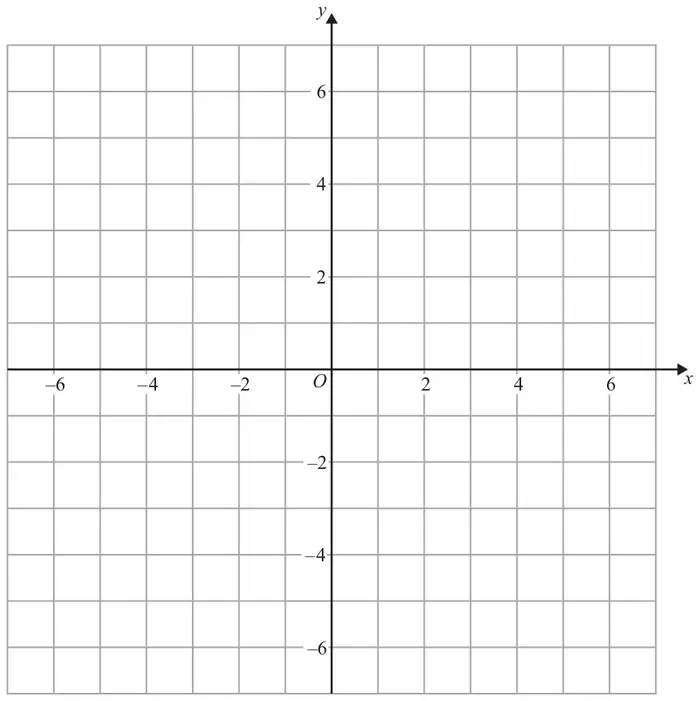
(a) On the grid, show by shading, the region that satisfies all of these inequalities.\[x + y \lt 5 \qquad y \gt 1 \qquad x \gt 2 \qquad y \lt 3x - 2\]Label the region R.(4)
Ron says,
“I can remove one of the four inequalities from the grid so that the region R will not change.”
Ron is correct.
(b) Which inequality can be removed so that the region R will not change? (1)
Mark scheme (a)
Answer
Mark
Mark scheme
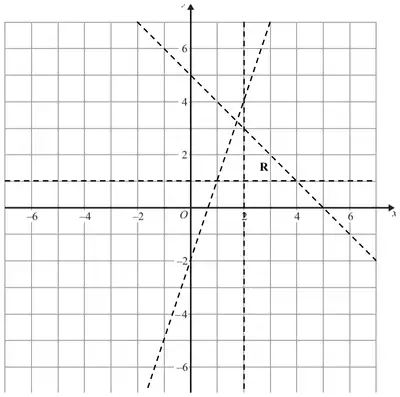
Region shown
B4
for a fully correct region identified
(B3
for drawing three correct lines)
(B2
for drawing two correct lines, must include at least one of \(x + y = 5\) or \(y = 3x - 2\))
(B1
for drawing \(x = 2\) and \(y = 1\) correctly OR for drawing \(x + y = 5\) correctly OR for drawing \(y = 3x - 2\) correctly)
Additional guidance
See diagram at end of mark scheme Can exclude \(y = 3x - 2\) for B4 Condone solid lines for all marks Region can be identified by shading in or shading out Lines need to be long enough to enclose the region
Mark scheme (b)
Answer
Mark
Mark scheme
\(y \lt 3x - 2\)
B1
(dep on B1 in (a)) for \(y \lt 3x - 2\) or ft their diagram if 1 line is redundant
Additional guidance
Condone use of ‘=’ or ‘\(\leqslant\)’ and \(3x - 2\)
(b) Solve \(7 + x \leqslant \dfrac{5x}{2} - 8\) (3)
(c) Solve \(9 \lt 2y + 4 \lt 12\) (2)
Mark scheme (a)
Answer
Mark
Mark scheme
\(6 - 3m\)
B1
for \(6 - 3m\) oe
Additional guidance
Accept \(3(2 - m)\)
Mark scheme (b)
Answer
Mark
Mark scheme
\(x \geqslant 10\)
M1
for a correct first step working with an inequality or an equation, eg \(7 + x + 8 \leqslant \dfrac{5x}{2} - 8 + 8\) or \(15 + x \leqslant \dfrac{5x}{2}\) or \(7 + x - x \leqslant \dfrac{5x}{2} - 8 - x\) or \(7 \leqslant \dfrac{3x}{2} - 8\) or \(7 \times 2 + x \times 2 \leqslant \dfrac{5x}{2} \times 2 - 8 \times 2\) or \(14 + 2x \leqslant 5x - 16\)
M1
(dep M1) for a correct second step, eg subtracts \(x\) from both sides or adds 8 to both sides or subtracts \(2x\) from both sides or multiplies both sides by 2
or gives the critical value of 10
A1
for \(x \geqslant 10\) as final answer
Additional guidance
Can work with an equation or incorrect inequality symbol for both M marks
For M marks step must be carried out not just intention shown. For example, if you see \[\begin{array}{ccc} 7 + x &\leqslant& \dfrac{5x}{2} - 8 \\ +8 && +8 \end{array}\] award M1 for \(k + x \leqslant \dfrac{5x}{2}\) where \(k \gt 7\) or indicating \(-x\) and reaching \(7 \leqslant kx - 8\) where \(k \lt \dfrac{5}{2}\) or indicating multiplying by 2 and obtaining an equation or inequality with no more than one term incorrect and no term unchanged.
The first 2 marks can be awarded for critical value of 10, eg \(x = 10\)
Accept \(10 \leqslant x\)
Mark scheme (c)
Answer
Mark
Mark scheme
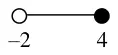
\(2.5 \lt y \lt 4\)
M1
for a correct first step, eg \(9 - 4 \lt 2y \lt 12 - 4\) or \(5 \lt 2y \lt 8\) or \(9 \div 2 \lt y + 2 \lt 12 \div 2\) or \(4.5 \lt y + 2 \lt 6\) or showing 2.5 and 4 as the critical values
A1
for \(2.5 \lt y \lt 4\) oe as final answer
Additional guidance
For M mark condone use of “=” and incorrect inequality signs
For M mark step must be carried out not just intention shown. For example, if you see \[\begin{array}{ccccc} 9 &\lt & 2y + 4 &\lt & 12 \\ -4 && -4 && -4 \end{array}\] award M1 for \(a \lt 2y \lt b\) where \(a \lt 9\) and \(b \lt 12\)
or if you see \[\begin{array}{ccccc} 9 &\lt & 2y + 4 &\lt & 12 \\ \div 2 && \div 2 && \div 2 \end{array}\] award M1 for \(a \lt y + 2 \lt b\) where \(a \lt 9\) and \(b \lt 12\)
6 How are the whole number solutions to A and B different?
A
Solve
\(3 \leqslant 3x \lt 18\)
B
Solve
\(3 \lt 3x \leqslant 18\)
[2 marks]
Mark scheme
Answer
Mark
Comments
Alternative method 1
A includes 1 or B does not include 1
B1
oe Correct statement about 1 without contradiction
A does not include 6 or B includes 6
B1
oe Correct statement about 6 without contradiction
Alternative method 2
\(1 \leqslant x \lt 6\) or \(\;1 \lt x \leqslant 6\) or \(1 \leqslant x\;\) and \(\;1 \lt x\) or \(x \lt 6\;\) and \(\;x \leqslant 6\) or A is 1, 2, 3, 4, 5 or B is 2, 3, 4, 5, 6
M1
oe eg \(x \geqslant 1\) and \(x \lt 6\) for 1st statement A includes 3 and B includes 18 A is 3, … 17 and B is 4, … 18
A is 1, 2, 3, 4, 5 and B is 2, 3, 4, 5, 6
A1
oe eg A = 1 to 5 and B = 2 to 6
Additional guidance
For 2 marks, must have clearly indicated both sets of integer solutions
M1A1
For 2 marks, must have clearly indicated both differences
B1B1
A could be 1 but not 6, B could be 6 but not 1
B1B1
A is \(x = 1\) and B is \(x = 6\)
B1B1
A: 3, 6, 9, 12, 15 and B: 6, 9, 12, 15, 18
M1A0
Comment that inequality signs are switched with no other working
B0B0
‘1 and 6 don’t appear in both’ – need to be correctly linked to A and B