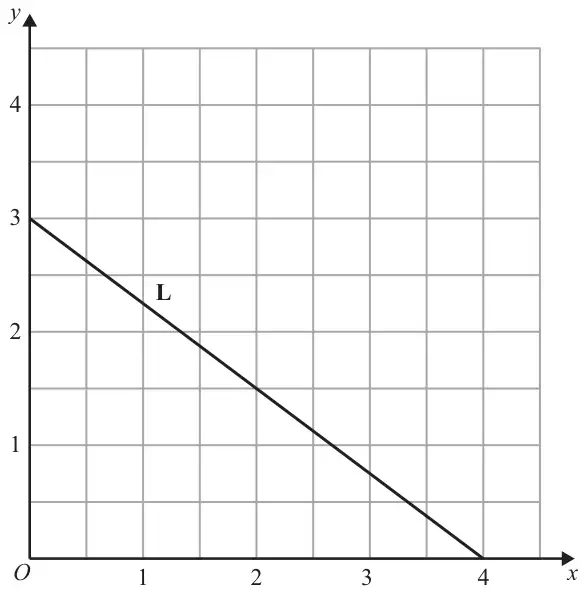
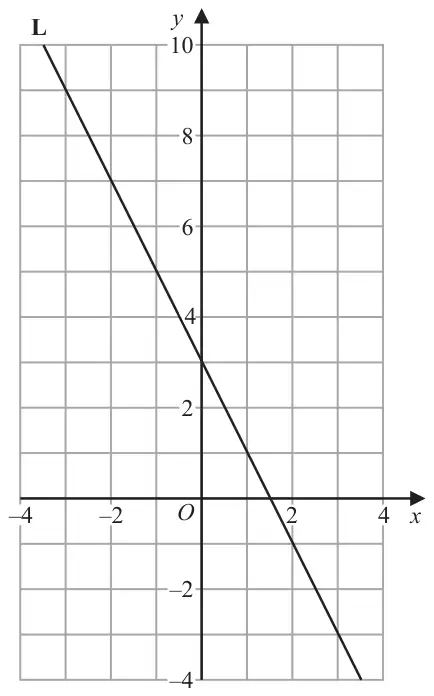
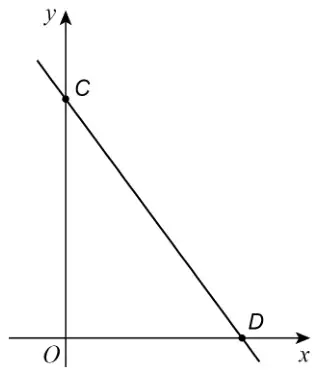
Find an equation for L. Give your answer in the form \(y = mx + c\) (3)
Mark scheme
Answer
Mark
Mark scheme
\(y = -\dfrac{3}{4}x + 3\)
M1
for a correct method to find the gradient of the line, eg \(\dfrac{3-0}{0-4}\ \left(= -\dfrac{3}{4}\right)\) or identifies 3 as the intercept in words or in a partial equation or for \(y = \left[-\dfrac{3}{4}\right]x + c\) or for \(y - b = \left[-\dfrac{3}{4}\right](x - a)\) where \((a, b)\) is a correct coordinate
M1
for \(y = -\dfrac{3}{4}x\ (+\ c)\) oe or for \(y = \text{``}{-}\dfrac{3}{4}\text{''}x + 3\), \(m \neq 0\) or (L =) \(-\dfrac{3}{4}x + 3\) or \(y - y_1 = -\dfrac{3}{4}(x - x_1)\) or \(y - b = \text{``}{-}\dfrac{3}{4}\text{''}(x - a)\) where \((a, b)\) is a correct coordinate or for an answer of \(y = \dfrac{3}{4}x + 3\) oe
A1
for \(y = -\dfrac{3}{4}x + 3\) oe provided the equation in the required form
Additional guidance
Just circling 3 is insufficient
\(\left[-\dfrac{3}{4}\right]\) must be identifiable as their gradient \(c\) must be seen either as a letter or a number
Allow eg \(y = 3 - \dfrac{3}{4}x\) A correct equation not in the required form scores M1M1A0
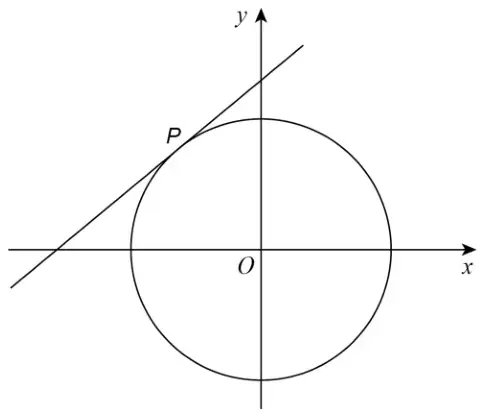
22 \(\mathbf{C}\) is a circle with centre \((0, 0)\) The straight line with equation \(3x - 2y = 52\) is the tangent to \(\mathbf{C}\) at the point \(P\).
Find the coordinates of \(P\). (4)
Mark scheme
Answer
Mark
Mark scheme
(12, −8)
P1
for process to rearrange the equation to give \(y\) in terms of \(x\), eg \(y = \dfrac{3x - 52}{2}\) or \(y = \dfrac{3}{2}x - 26\) or \(m = \dfrac{3}{2}\)
P1
for process to find gradient of \(OP\), eg \(-1 \div \text{``}\dfrac{3}{2}\text{''}\ \left(= -\dfrac{2}{3}\right)\) or \(-1 \div [m]\)
P1
(dep on equation of the form \(y = \dfrac{-1}{[m]}x\) for the radius may be implied in subsequent working) for starting to solve \(3x - 2y = 52\) with \(y = \dfrac{-1}{[m]}x\) simultaneously to find the value of \(x\) or \(y\) eg substituting \(y = \dfrac{-2}{3}x\) or \(y = \dfrac{-1}{[m]}x\) into \(y = \dfrac{3}{2}x - 26\) or \(3x - 2y = 52\) or an equation of the form \(y = \dfrac{3}{2}x + c\) eg \(-\dfrac{2}{3}x = \dfrac{3}{2}x - 26\) or \(3x - 2\left(-\dfrac{2}{3}x\right) = 52\) or \(-\dfrac{2}{3}x = \dfrac{3}{2}x + c\) or \(-\dfrac{1}{[m]}x = \dfrac{3}{2}x - 26\) or \(3x - 2\left(-\dfrac{1}{[m]}x\right) = 52\) or \(-\dfrac{1}{[m]}x = \dfrac{3}{2}x + c\)
A1
cao
Additional guidance
Condone an incorrect value for the \(y\) intercept (\(= c\))
Where \([m]\) is clearly identified as the gradient of the straight line \(3x - 2y = 52\) Allow 0.66(6…) or 0.67 for \(\dfrac{2}{3}\) throughout
Where \([m]\) is clearly identified as the gradient of the straight line \(3x - 2y = 52\)
Can be done by elimination Award P1 for a correct method to eliminate \(x\) or \(y\): coefficient of \(x\) or \(y\) the same and correct operator to eliminate selected variable eg
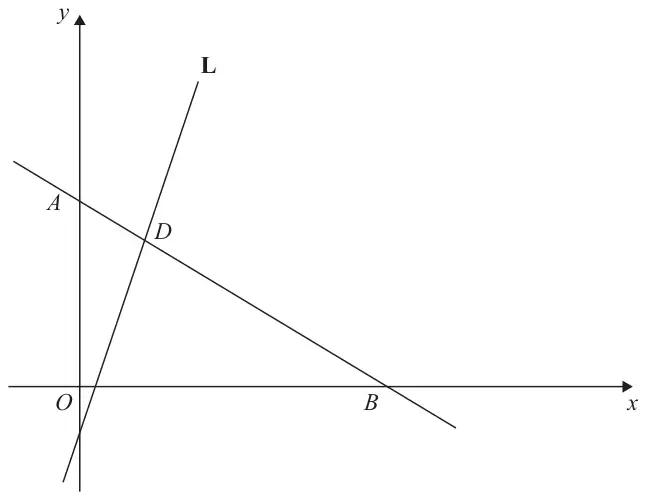
In the diagram \(A\) is the point \((0, 8)\) \(B\) is the point \((16, 0)\)
The point \(D\) divides the line segment \(AB\) in the ratio 1 : 3 The line L passes through \(D\). The gradient of L is \(\sqrt{3}\)
L passes through the point with coordinates \((-2, f)\)
Show that \(f \lt -4\) (5)
Mark scheme
Answer
Mark
Mark scheme
Shown
M1
for the method to find a coordinate of the point \(D\) eg \(\dfrac{1}{1 + 3} \times 16\ (= 4)\) or \(\dfrac{3}{1 + 3} \times 8\ (= 6)\) or (4, 6) labelled
M1
for a correct form for L, eg \(y = \sqrt{3}x + c\) OR a correct equation for the gradient of L, eg \(\dfrac{[6] - f}{[4] - -2} = \sqrt{3}\)
M1
for correct substitution to find \(c\) eg \([6] = \sqrt{3} \times [4] + c\) or \(y - [6] = \sqrt{3}(x - [4])\) or \(c = [6] - [4]\sqrt{3}\ (= -0.928\ldots)\) OR starts to rearrange equation for gradient, eg \([6] - f = ([4] - -2)\sqrt{3}\)
M1
(dep on previous M1) for the method to substitute in \(-2\), eg \(\sqrt{3} \times (-2) + [6] - \sqrt{3} \times [4]\) or \(\sqrt{3} \times (-2) + [c]\) OR a correct unevaluated expression for \(f\), eg \(f = [6] - ([4] - -2)\sqrt{3}\)
C1
accurate figure eg \(f = -4.39\ldots\) or \(-4.39\ldots \lt -4\)
Additional guidance
First two marks may be seen in either order Accept 4 or 6 stated or (6, 4)
Condone incorrect value for \(c\) when awarding this mark
[4] must be clearly identified as the \(x\)-coordinate of \(D\) if incorrect Award of this mark implies the previous mark [6] must be clearly identified as the \(y\)-coordinate of \(D\) if incorrect
[\(c\)] must be clearly what they have found to be the \(y\)-intercept of Land must have come from correct processes to evaluate
\(-4.39\ldots\) must come from correct working Accept \(-4.4\) or better
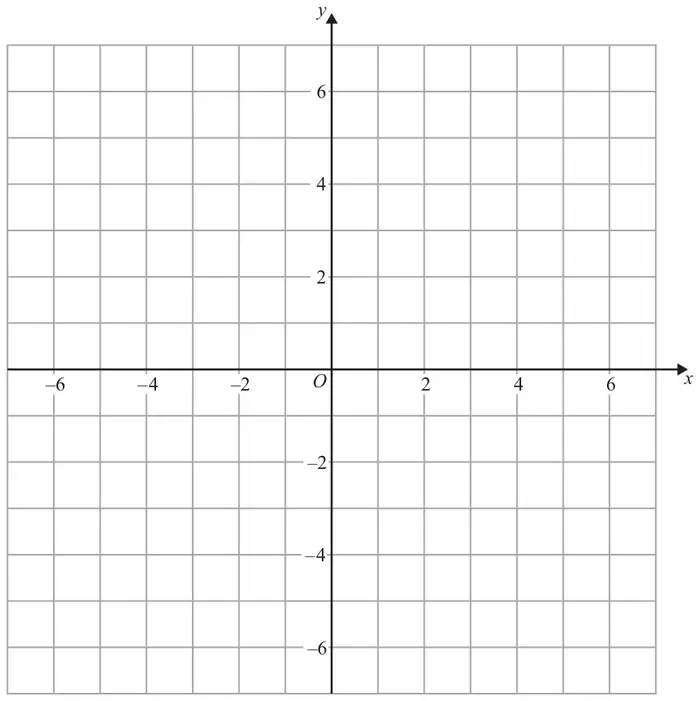
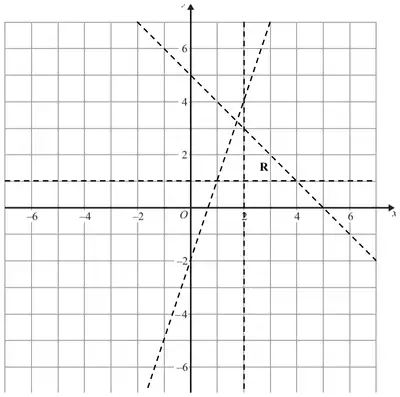
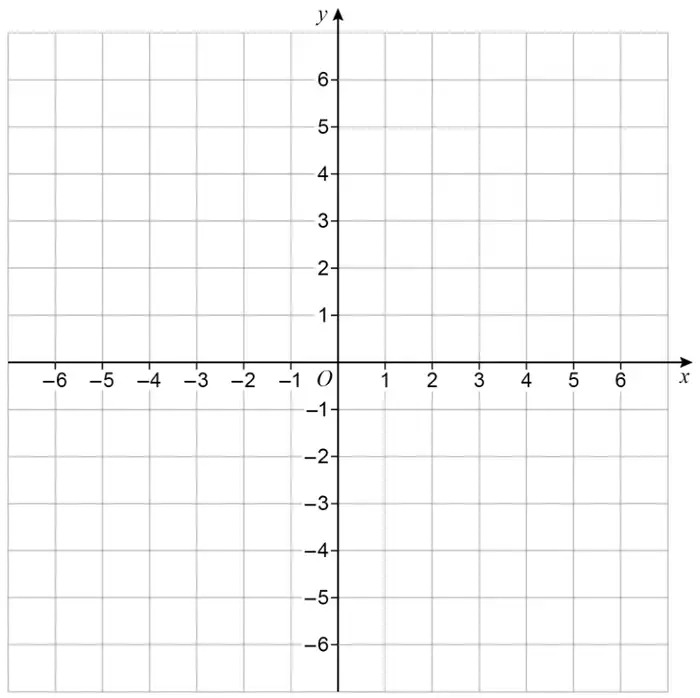
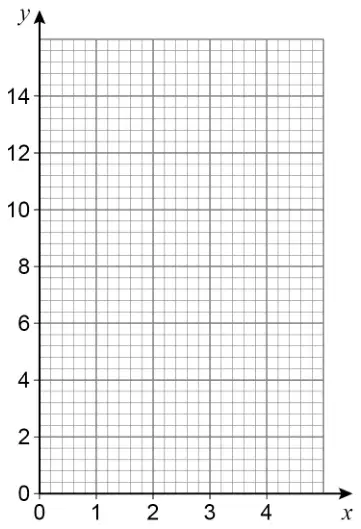
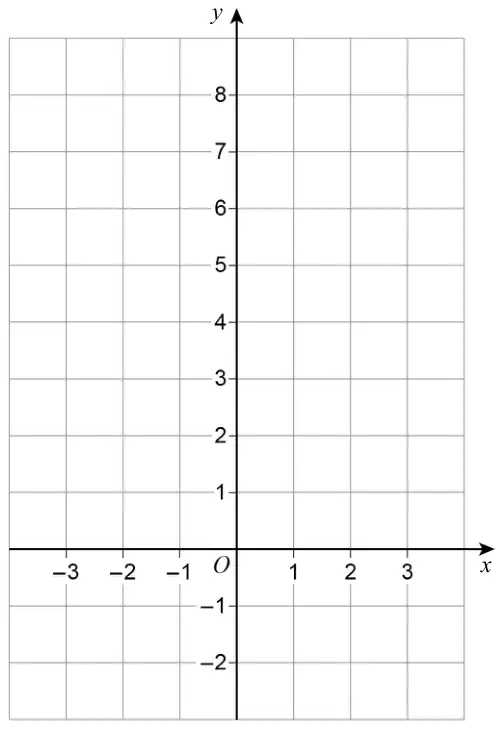
(a) On the grid, show by shading, the region that satisfies all of these inequalities.\[x + y \lt 5 \qquad y \gt 1 \qquad x \gt 2 \qquad y \lt 3x - 2\]Label the region R.(4)
Ron says,
“I can remove one of the four inequalities from the grid so that the region R will not change.”
Ron is correct.
(b) Which inequality can be removed so that the region R will not change? (1)
Mark scheme (a)
Answer
Mark
Mark scheme
Region shown
B4
for a fully correct region identified
(B3
for drawing three correct lines)
(B2
for drawing two correct lines, must include at least one of \(x + y = 5\) or \(y = 3x - 2\))
(B1
for drawing \(x = 2\) and \(y = 1\) correctly OR for drawing \(x + y = 5\) correctly OR for drawing \(y = 3x - 2\) correctly)
Additional guidance
See diagram at end of mark scheme Can exclude \(y = 3x - 2\) for B4 Condone solid lines for all marks Region can be identified by shading in or shading out Lines need to be long enough to enclose the region
Mark scheme (b)
Answer
Mark
Mark scheme
\(y \lt 3x - 2\)
B1
(dep on B1 in (a)) for \(y \lt 3x - 2\) or ft their diagram if 1 line is redundant
Additional guidance
Condone use of ‘=’ or ‘\(\leqslant\)’ and \(3x - 2\)
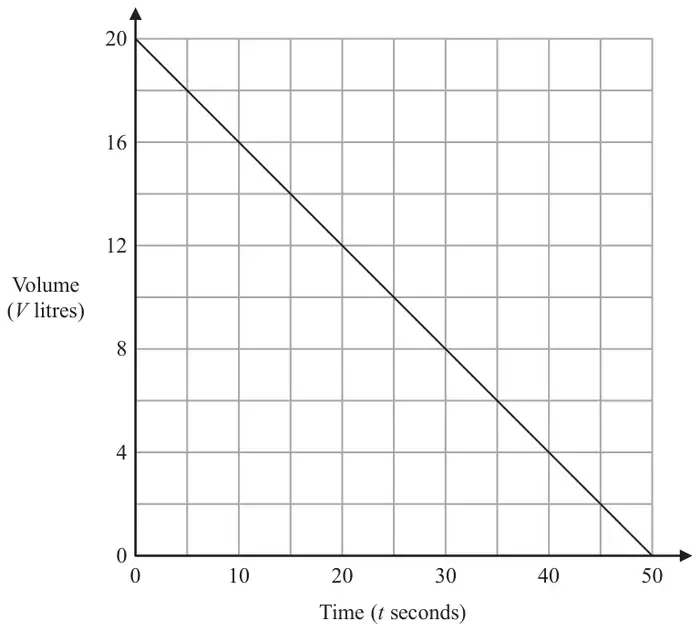
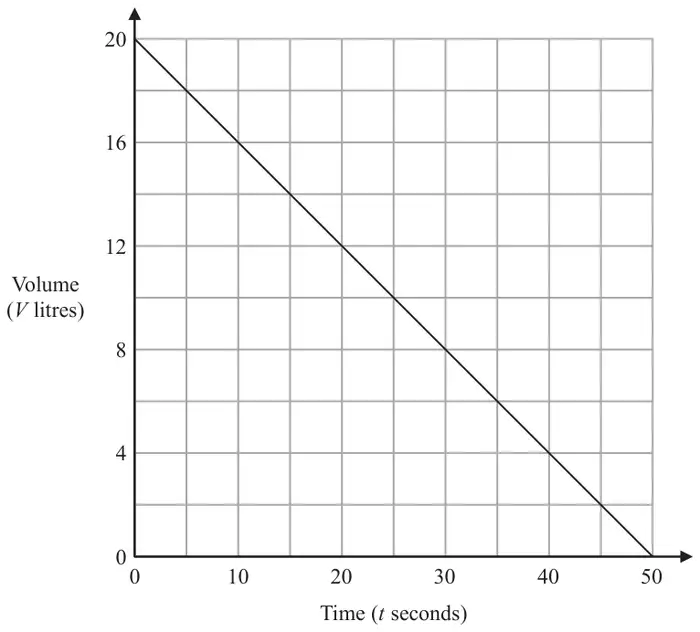
24 The graph shows the volume of water, \(V\) litres, in a tank at time \(t\) seconds.
What does the gradient of this graph represent? (1)
Mark scheme
Answer
Mark
Mark scheme
Rate of change of volume
C1
for a correct explanation
Acceptable examples The rate of water poured Speed of pouring water out from the tank How fast the water is being used (in the tank over time) Amount of water decreasing in the tank each second
Not acceptable examples Negative correlation / negative gradient Amount of water decreasing in the tank in seconds As time increases the volume of water in the tank decreases It is negative, the volume of litres is going down It represents the deceleration or changing speed
Additional guidance
Allow amount of water increasing in the tank each second
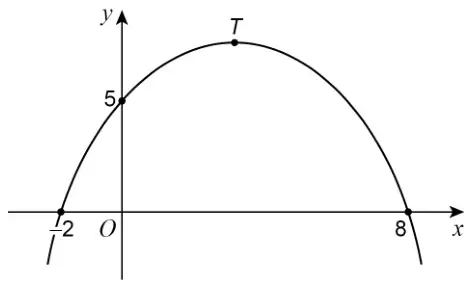
Find an equation of the tangent to C at the point \((p, 1)\) where \(p \gt 0\) Give your answer in the form \(y + \sqrt{a}x = b\) where \(a\) and \(b\) are integers. You must show all your working. (4)
Mark scheme
Answer
Mark
Mark scheme
\(y + \sqrt{3}x = 4\)
P1
for process to find the value of \(p\), eg \(\sqrt{4 - 1^2}\ (= \sqrt{3})\)
P1
for a start of a process to find gradient of tangent, eg gradient of normal/radius \(= \dfrac{1}{p}\) or \(\dfrac{1}{\text{``}\sqrt{3}\text{''}}\) or \(\dfrac{1}{[p]}\) or for gradient of tangent \(= -p\) or \(-\text{``}\sqrt{3}\text{''}\) or \(-[p]\)
P1
(dep P1) for substituting \((\text{``}\sqrt{3}\text{''}, 1)\) into \(y = \text{``}{-}\sqrt{3}\text{''}x + c\) or for \(y - 1 = \text{``}{-}\sqrt{3}\text{''}(x - \text{``}\sqrt{3}\text{''})\) oe or for \(1 = -p \times p + c\) or for substituting \(([p], 1)\) into \(y = -[p]x + c\) or for substituting \((\text{``}\sqrt{3}\text{''}, 1)\) into \(y = -\dfrac{1}{[m]}x + c\)
A1
for \(y + \sqrt{3}x = 4\)
Additional guidance
May occur later in the process
Where \([p]\) is their stated value of \(p\)
Where \([m]\) is clearly their gradient of the normal/radius
A correct answer with no supportive working gets 0 marks
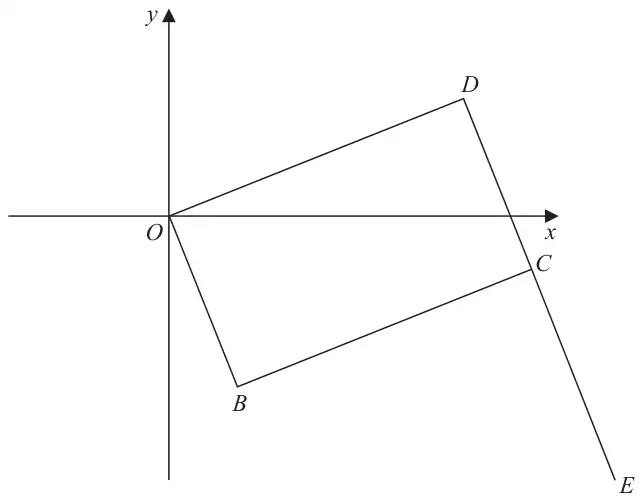
16 \(OBCD\) is a rectangle. \(DCE\) is a straight line.
\(B\) has coordinates \((2, -4)\) \(E\) has coordinates \((12, -6.5)\)
Work out the coordinates of \(D\). You must show all your working. (5)
Mark scheme
Answer
Mark
Mark scheme
(7, 3.5)
P1
process to find the gradient of \(OB\), eg \(\dfrac{-4 - 0}{2 - 0}\ (= -2)\)
P1
process to find the equation of \(DE\), eg substitutes \((12, -6.5)\) into \(y = \text{``}{-}2\text{''}x + c\) or \(y = [-2]x + c\) or \(y - -6.5 = \text{``}{-}2\text{''}(x - 12)\) or \(y - -6.5 = [-2](x - 12)\)
P1
process to find the equation of \(OD\), eg substitutes \((0, 0)\) into \(y = \dfrac{-1}{\text{``}{-}2\text{''}}x + c\) or \(y = \dfrac{-1}{[-2]}x + c\) or \(y - 0 = \dfrac{-1}{\text{``}{-}2\text{''}}(x - 0)\) or \(y - 0 = \dfrac{-1}{[-2]}(x - 0)\)
P1
(dep P3) forms an equation that can be solved to find \(x\) coordinate of \(D\), eg \(\text{``}{-}2x + 17.5\text{''} = \text{``}\dfrac{1}{2}x\text{''}\)
A1
cao
Additional guidance
Equation of \(DE\) is \(y = -2x + 17.5\) Where [−2] can be \(\dfrac{-1}{2}\) or 2 or \(\dfrac{1}{2}\) and must be labelled as the gradient of \(OB\)
Equation of \(OD\) is \(y = \dfrac{1}{2}x\) Where [−2] can be \(\dfrac{-1}{2}\) or 2 or \(\dfrac{1}{2}\) and must be labelled as the gradient of \(OB\)
A correct answer with no supportive working gets 0 marks
7 The graph shows the volume of water, \(V\) litres, in a tank at time \(t\) seconds.
What does the gradient of this graph represent? (1)
Mark scheme
Answer
Mark
Mark scheme
Rate of change of volume
C1
for a correct explanation
Acceptable examples The rate of water poured Speed of pouring water out from the tank How fast the water is being used (in the tank over time) Amount of water decreasing in the tank each second
Not acceptable examples Negative correlation / negative gradient Amount of water decreasing in the tank in seconds As time increases the volume of water in the tank decreases It is negative, the volume of litres is going down It represents the deceleration or changing speed
Additional guidance
Allow amount of water increasing in the tank each second
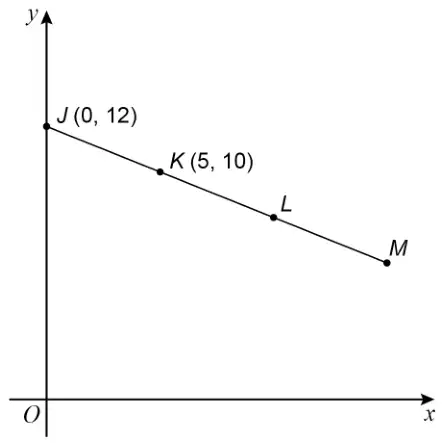
18 \(J\,(0, 12)\) and \(K\,(5, 10)\) are points on the straight line \(JKLM\).
Not drawn accurately
\(JK = KL = LM\)
Work out the coordinates of \(M\). [3 marks]
Mark scheme
Answer
Mark
Comments
\(x\)-coordinate of \(L = 10\) or \(y\)-coordinate of \(L = 8\) or 10 marked on \(x\)-axis below \(L\) and 8 marked on \(y\)-axis left of \(L\) or (\(x\)-coordinate of \(M =\)) \(5 + 5 + 5\) or (\(y\)-coordinate of \(M =\)) \(12 - 2 - 2 - 2\) or 15 marked on \(x\)-axis below \(M\) or 6 marked on \(y\)-axis left of \(M\)
M1
oe
(\(L\)) (10, 8) or (\(M\)) (15, …) or (…, 6) or 15 marked on \(x\)-axis below \(M\) and 6 marked on \(y\)-axis left of \(M\)
A1
condone missing brackets if intention is clear
15, 6
A1
SC2 (6, 15)
Additional guidance
(10, 8, 15, 6) (ie both sets of coordinates on answer line) correctly assigned to \(L\) and \(M\) previously (10, 8, 15, 6) on answer line not correctly assigned to \(L\) and \(M\) previously
M1A1A1 M1A1A0
Accept correct working on diagram and/or correct answer on diagram if not contradicted by answer line
11 Here is a table of values for the equation \(\quad y = 3x + 1\)
\(x\)
1
2
3
4
\(y\)
4
7
10
13
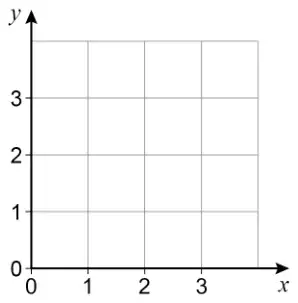
(a) Draw the graph of \(\quad y = 3x + 1 \quad\) for values of \(x\) from 1 to 4 [2 marks]
(b) Work out the value of \(y\) when \(\; x = 2.5\) [2 marks]
Mark scheme (a)
Answer
Mark
Comments
All 4 points plotted correctly with a straight line joining them
B2
\(\pm\)\(\dfrac{1}{2}\) square B1 at least two correct points plotted mark intention for straight line
Additional guidance
Ignore additional or incorrect points for B2 or B1
Ignore any line or curve extended outside the range
The correct position of the line implies correctly plotted points
Mark scheme (b)
Answer
Mark
Comments
Alternative method 1: uses the graph
Vertical line from \(x = 2.5\) to their straight line
M1
\(\pm\)\(\dfrac{1}{2}\) square implied by mark at correct point on graph or on vertical axis
their 8.5
A1ft
\(\pm\)\(\dfrac{1}{2}\) square ft their straight line graph if at least B1 awarded in (a)
Alternative method 2: substitutes into the equation
\(3 \times 2.5 + 1\)
M1
oe
8.5
A1
Alternative method 3: uses values from the table
\(\dfrac{7 + 10}{2}\)
M1
oe eg \(\dfrac{4 + 7 + 10 + 13}{4}\)
8.5
A1
Additional guidance
Alternative method 1 – must have a line in part (a)
Alternative method 1 A vertical line from the \(x\)-axis does not need to be drawn if the reading from the graph is correct within tolerance for their graph
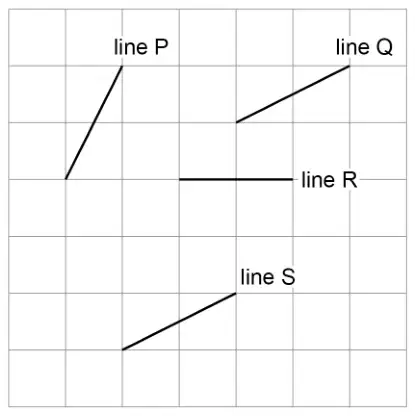
line \(\ldots\ldots\ldots\) and line \(\ldots\ldots\ldots\)
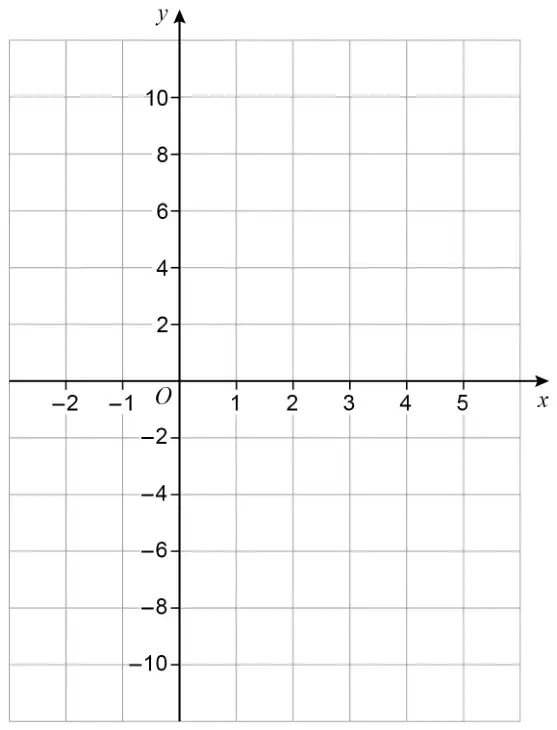
(b) Here is a different grid.
There are four points on this grid that each have
both coordinates that are whole numbers and \(x\)-coordinate \(+\) \(y\)-coordinate \(= 3\)
Plot the four points on the grid. [2 marks]
Mark scheme (a)
Answer
Mark
Comments
line Q and line S
B1
either order, may be indicated on the diagram
Mark scheme (b)
Answer
Mark
Comments
(0, 3), (1, 2), (2, 1) and (3, 0) plotted with no other points plotted on the grid
B2
B1 at least two of (0, 3), (1, 2), (2, 1) and (3, 0) plotted with up to two other points plotted on the grid or at least four points plotted that would lie on the line \(x + y = 3\) where each \(x\) and \(y\) are not all integers, with no other points plotted on the grid or all four correct coordinates given but not plotted, with no additional coordinates
Additional guidance
Mark intention
Line joining the four correct points with only the four correct points plotted
B2
Line connecting the four correct points but without points plotted
\(14 =\) their \(2 \times 3 + c\) or \(32 =\) their \(2 \times 12 + c\) or \((m =)\ 2\) and \(c = 8\) or \(y - 14 =\) their \(2(x - 3)\) or \(y - 32 =\) their \(2(x - 12)\)
M1dep
oe
\(y = 2x + 8\)
A1
Alternative method 2
\(14 = 3m + c\) and \(32 = 12m + c\) and \(32 - 14 = 12m - 3m\) or \(m = 2\) or \(56 = 12m + 4c\) and \(32 = 12m + c\) and \(56 - 32 = 4c - c\) or \(c = 8\)
M1
oe correct method to work out \(m\) or \(c\) using simultaneous equations implied by \(y = 2x \ldots\) or \(y = mx + 8\)
Correct substitution of their \(m\) into one of the original equations or correct substitution of their \(c\) into one of the original equations or \(m = 2\) and \(c = 8\)
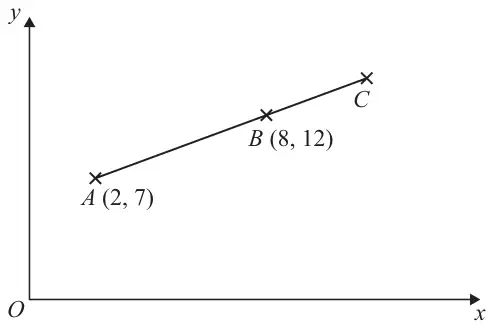
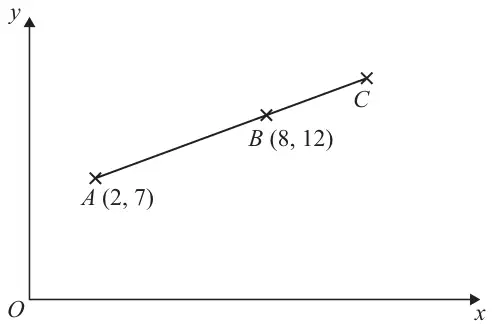
(a) Show that the gradient of the straight line passing through A and B is \(-2\) [2 marks]
(b)C is the point \((-301, 601)\)
Does C lie on the straight line passing through A and B?
You must show your working. [2 marks]
Mark scheme (a)
Answer
Mark
Comments
Alternative method 1
\(\dfrac{-9 - -5}{4 - 2}\) or \(\dfrac{-5 - -9}{2 - 4}\) or \((2, -5) - (4, -9) = (-2, 4)\) or \((4, -9) - (2, -5) = (2, -4)\) or \(\dfrac{\text{change in } y}{\text{change in } x}\) or \(\dfrac{\Delta y}{\Delta x}\) or triangle drawn with points A and B and side lengths of 4 and (–)2 identified or correct explanation of pattern of graph and \(\dfrac{-4}{2}\) \(= -2\) or \(\dfrac{4}{-2}\) \(= -2\)
B2
oe fraction eg \(\dfrac{-9 + 5}{4 - 2}\) or \(\dfrac{-5 + 9}{2 - 4}\) B1 for \(\dfrac{-9 - -5}{4 - 2}\) or \(\dfrac{-5 - -9}{2 - 4}\) or \((2, -5) - (4, -9) = (-2, 4)\) or \((4, -9) - (2, -5) = (2, -4)\) or \(\dfrac{\text{change in } y}{\text{change in } x}\) or \(\dfrac{\Delta y}{\Delta x}\) or triangle drawn with points A and B and side lengths of 4 and (–)2 identified or correct explanation of pattern of graph or \(\dfrac{-4}{2}\) \(= -2\) or \(\dfrac{4}{-2}\) \(= -2\)
Alternative method 2
Gives \(y = -2x + c\) and substitutes \((2, -5)\) or \((4, -9)\) to find \(c = -1\) or \(y - -5 = -2(x - 2)\) or \(y + 5 = -2(x - 2)\) or \(y - -9 = -2(x - 4)\) or \(y + 9 = -2(x - 4)\) and gives \(y = -2x - 1\) and correctly substitutes and evaluates with the other pair of coordinates to check
B2
B1 for \((2, -5)\) or \((4, -9)\) to find \(c = -1\) or \(y - -5 = -2(x - 2)\) or \(y + 5 = -2(x - 2)\) or \(y - -9 = -2(x - 4)\) or \(y + 9 = -2(x - 4)\) or gives \(y = -2x - 1\) and correctly substitutes and evaluates with one or both pair(s) of coordinates
Alternative method 3
\(-5 = 2m + c\) and \(-9 = 4m + c\) and works out \(m = -2\) using a correct algebraic method
B2
oe equations B1 for \(-5 = 2m + c\) and \(-9 = 4m + c\)
Alternative method 4
\(-5 = -2(2) + c\) and \(-9 = -2(4) + c\) and works out \(c = -1\) for both
B2
oe equations B1 for \(-5 = -2(2) + c\) and \(-9 = -2(4) + c\)
Additional guidance
In alt 1, examples of correct explanation are: 2 left and 4 up 2 right and 4 down
In alt 1, points A and B can be identified on a diagram by their coordinates
In alt 2, accept rearrangements of \(y = -2x - 1\) eg \(\;2x + y = -1\)
\(\dfrac{-5 - 9}{2 - 4}\) or \(\dfrac{-9 - 5}{4 - 2}\) \(\;(= -2\) or \(= 2)\)
B0
Mark scheme (b)
Answer
Mark
Comments
Alternative method 1 – uses given point with one from (a) to show gradient \(= -2\)
at least two correct points correctly plotted or their two points, from (a), correctly plotted or if they restart with a table of values, at least two of their points correctly plotted
M1
may be from a table of values may be implied by their line tolerance \(\pm\) 2mm ignore incorrect points
Straight, ruled line from \((-3,\ 7.5)\) to \((3,\ -1.5)\)
A1
Additional guidance
If their points in (a) give a line which cannot be drawn from \(x = -3\) to \(x = 3\) allow the line drawn to be between the possible integer values of \(x\)
If they restart with a table of values and achieve M1, the only way to achieve M1A1 is for the line to be the correct one i.e. \(y = 3 - 1.5x\)
No tolerance on length of line, it must reach at least from \(-3\) to 3 on \(x\)-axis
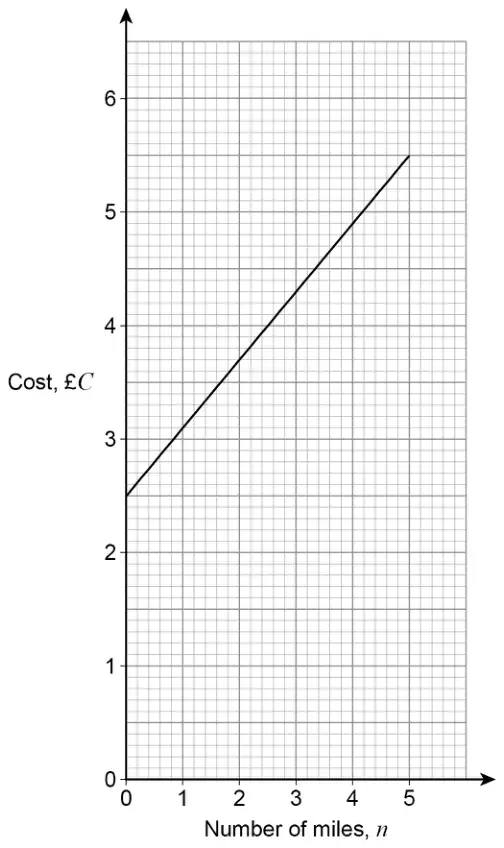
14 The graph shows the cost of some taxi journeys.
Work out a formula for \(C\) in terms of \(n\). [3 marks]
Mark scheme
Answer
Mark
Comments
\(C = 0.6(0)n + 2.5(0)\)
B3
oe Must have \(C =\) for B3 B2 \(C = 0.6n + k\ (k \ne 0)\) or \(C = an + 2.5\ (a \ne 0)\) or \(0.6n + 2.5\) B1 \(0.6n\) or \(an + 2.5\ (a \ne 0)\) or \(C = 60n + 250\)
Additional guidance
Allow correct fractions eg \(\dfrac{3}{5}\) or \(\dfrac{1}{1.\dot{6}}\) for 0.6 and/or \(\dfrac{5}{2}\) for 2.5
Allow \(0.6 \times n\) or \(n \times 0.6\) for \(0.6n\) eg \(C = 0.6 \times n + 2.5\) \(n \times 0.6 + 2.5\) \(0.6 \times n\)
B3 B2 B1
Penalise by one mark the use of \(n0.6\) for \(0.6n\) eg \(C = n0.6 + 2.5\) \(n0.6 + 2.5\) \(n0.6\)
B2 B1 B0
Penalise by one mark the use of different letters eg \(y = 0.6x + 2.5\) \(0.6x + 2.5\) \(2p + 2.5\)
B2 B1 B0
Transposing 0.6 and 2.5 scores zero \(\;\) eg \(C = 2.5n + 0.6\)