for substitution of a rearranged equation into a correct equation to form an equation in one variable. eg \(3x^2 + 2(2 - 3x)^2 = 44\) or \(3\left(\dfrac{2 - y}{3}\right)^2 + 2y^2 = 44\)
M1
(dep on first M1) for multiplying out all brackets and collecting terms to form a simplified three term quadratic in any form of \(ax^2 + bx + c\ (= 0)\) where at least 2 coefficients (\(a\), \(b\), \(c\)) are correct
(dep on first M1) for a suitable method to solve their 3 term quadratic using any correct method,
for factorising, eg \((7x + 6)(x - 2)\) or \((7x + 6)(3x - 6)\) or \((21x + 18)(x - 2)\) or \((7y - 32)(y + 4)\)
or correct use of formula, eg \(\dfrac{8 \pm \sqrt{(-8)^2 - 4 \times 7 \times -12}}{2 \times 7}\) or \(\dfrac{4 \pm \sqrt{(-4)^2 - 4 \times 7 \times -128}}{2 \times 7}\) or completing the square
M1
(dep on first M1) for substituting their 2 found values of \(x\) or \(y\) in a suitable equation or (dep on first M1) for one correct pair of values following from a correct quadratic
A1
for \(x = -\dfrac{6}{7}\) oe, \(y = \dfrac{32}{7}\) oe and \(x = 2\), \(y = -4\)
Additional guidance
Allow \((\pm 2 \pm 3x)\) for \((2 - 3x)\) (or \(\left(\dfrac{\pm 2 \pm y}{3}\right)\) for \(\left(\dfrac{2 - y}{3}\right)\)) Implied by a correct equation (simplified or unsimplified) in terms of \(x\) or \(y\) eg \(3x^2 + 2(4 - 12x + 9x^2) = 44\) or \(3x^2 + 8 - 24x + 18x^2 = 44\) or \(21x^2 - 24x = 36\)
Look out for signs reversed The quadratic does not have to equal 0, ie accept \(21x^2 - 24x = 36\)
Can be implied by both \(x\) values or both \(y\) values correct (condone incorrect labelling) if the quadratic is correct If using the quadratic formula (condone one sign error, omission of brackets around the \(b\) in the \(b^2 - 4ac\) and the fraction line not being under the \(-\) in the \(-b\). Allow some simplification – as far as eg \(\dfrac{8 \pm \sqrt{64 + 336}}{14}\) or if factorising allow brackets which expand to give 2 out of 3 terms correct for their quadratic
Condone substitution into their \((\pm 2 \pm 3x)\) or \(\left(\dfrac{\pm 2 \pm y}{3}\right)\)
Allow \(-0.85(7\ldots)\) or \(-0.86\) for \(-\dfrac{6}{7}\) Allow 4.57(1…) for \(\dfrac{32}{7}\) If values of \(x\) or \(y\) are incorrect then working must be shown
Accept as coordinates Assume correct pairing unless clearly incorrect eg \(\left(-\tfrac{6}{7}, -4\right), \left(2, \tfrac{32}{7}\right)\) Allow \(-0.85(7\ldots)\) or \(-0.86\) for \(-\dfrac{6}{7}\) Allow 4.57(1…) for \(\dfrac{32}{7}\) If an answer is shown in the range in working and then incorrectly rounded award full marks
A correct answer with no supportive working gets 0 marks
for correct substitution for \(y^2\) or \(x^2\), eg \((7 - 2x)^2 = 3x^2 + 4\) OR for correct rearrangement and expansion of \((7 - 2x)^2\) to obtain 4 terms with all correct without considering signs or for 3 terms out of 4 correct with correct signs and substitution eg \((7 - 2x)^2 = 49 - 14x - 14x + 4x^2\) and \(49 - 14x - 14x + 4x^2 = 3x^2 + 4\)
M1
for method to write a correct simplified equation eg \(x^2 - 28x + 45\ (= 0)\)
M1
for a method to solve a correct quadratic eg \(\dfrac{28 \pm \sqrt{(-28)^2 - 4 \times 1 \times 45}}{2 \times 1}\) or \(\dfrac{28 \pm \sqrt{604}}{2}\) or \(14 \pm \sqrt{151}\) or \((x - 14)^2 - 14^2 + 45 = 0\) oe
A1
\(x = 26.2\) to 26.3, \(y = -45.6\) to \(-45.5\) and \(x = 1.7\) to 1.712, \(y = 3.5\) to 3.6
Additional guidance
NB \(49 - 28x\) or \(-28x + 4x^2\) can be considered 3 terms out of 4 correct with correct signs
The quadratic does not have to equal 0, ie accept \(x^2 - 28x = -45\)
Can be implied by both \(x\) values correct or both \(y\) values correct
Answers must be correctly paired (May be in the body of the working) If answers are given in the range in working and then rounded incorrectly award full marks
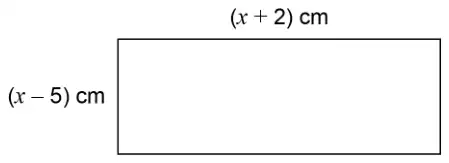
oe with brackets expanded four terms in any order with three correct from \(x^2 \quad (+)2x \quad -5x \quad -10\) terms may be seen in a grid implied by \(x^2 - 3x + k \quad (k \ne 0)\) or \(ax^2 - 3x - 10 \quad (a \ne 0)\)
For their three-term quadratic, correctly factorises or correctly substitutes into the quadratic formula or correctly completes the square to the form \(x = \ldots\) for their quadratic or \(-10\) and 13
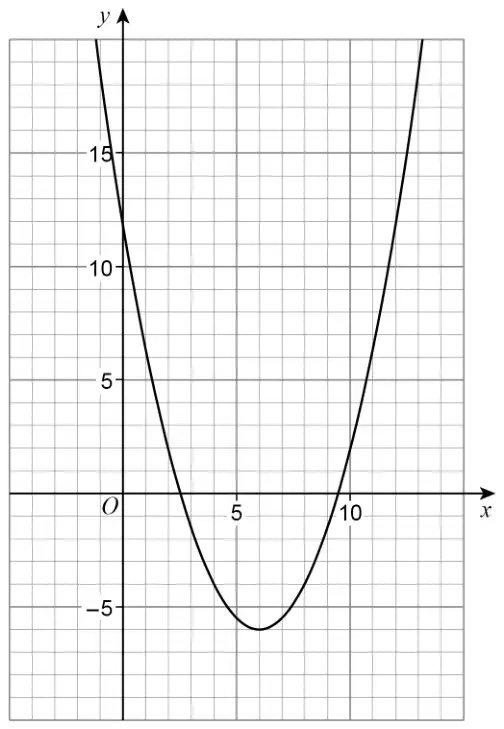
26 Here is the graph of \(\quad y = 0.5x^2 - 6x + 12\)
Use the graph to estimate the solutions of \(\quad 0.5x^2 - 6x + 12 = 0\) [2 marks]
Mark scheme
Answer
Mark
Comments
\((x =)\ [2.25, 2.75]\) and \((x =)\ [9.25, 9.75]\)
B2
B1 \((x =)\ [2.25, 2.75]\) or \((x =)\ [9.25, 9.75]\) or one or both values identified but not given in correct notation eg (2.5, 0) and/or (9.5, 0) or \(2.5 \lt x \lt 9.5\) or 2.5 and/or 9.5 written on the graph or in working
Additional guidance
\(x =\) can be \(x \approx\)
[2.25, 2.75] and/or [9.25, 9.75] with one extra value
B1
[2.25, 2.75] and/or [9.25, 9.75] with more than one extra value
B0
Answer from use of formula or completing the square
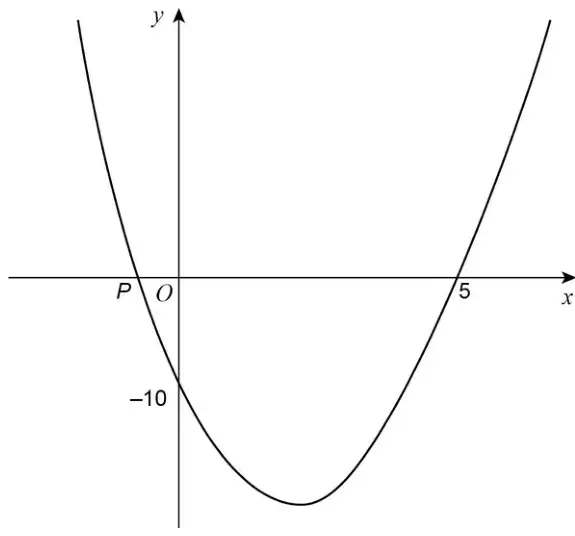
the \(x\)-axis at (5, 0) and point P the \(y\)-axis at (0, \(-10\))
Not drawn accurately
Work out the \(x\)-coordinate of the turning point of the graph. [4 marks]
Mark scheme
Answer
Mark
Comments
\(0 = 5^2 + 5b + c\) or \(-10 = 0^2 + b(0) + c\) or \(c = -10\)
M1
oe
\(b = -3\) or \(\;x^2 - 3x + c\) or (\(y =\)) \(x^2 - 3x - 10\)
M1dep
oe \((x - 5)(x + k)\) and \(-5k = -10\)
\((x - 5)(x + 2)\) or \(\dfrac{--3 \pm \sqrt{(-3)^2 - 4 \times 1 \times -10}}{2 \times 1}\) or \(\dfrac{3 \pm \sqrt{49}}{2}\) or \(\left(x - \dfrac{3}{2}\right)^2 + \ldots\) or \(2x - 3 = 0\) or \(\;x\)-coordinate of P = \(-2\) or two symmetrical coordinates eg (1, −12) and (2, −12)
M1dep
oe Correctly factorises the 3-term quadratic expression or correctly substitutes into quadratic formula for the 3-term quadratic dep on M1 M1
\(1\dfrac{1}{2}\) or \(\dfrac{3}{2}\) with no incorrect working
ft their 3-term quadratic (equation) seen Allow one sign error Allow \(10^2\) for \((-10)^2\) (do not count as a sign error) Allow recovery of invisible brackets Conceptual error (omission of square root, incomplete square root symbol, \(\pm\) not included, short fraction line) is M0 unless recovered
\(\dfrac{--10 \pm \sqrt{(-10)^2 - 4 \times 5 \times -4}}{2 \times 5}\) or \(\dfrac{10 \pm \sqrt{100 + 80}}{10}\) or \(\dfrac{10 \pm \sqrt{180}}{10}\) or \(\dfrac{10 \pm 6\sqrt{5}}{10}\) or 2.341(…) or 2.342 and \(-0.341(\ldots)\) or \(-0.342\)
A1ft
Fully correct substitution ft their 3-term quadratic (equation) seen oe eg \(\dfrac{5 \pm 3\sqrt{5}}{5}\) Allow \(10^2\) for \((-10)^2\) Allow recovery of invisible brackets Two correct solutions > 2 dp for their 3-term quadratic equation
2.34 and \(-0.34\)
A1ft
ft B0M1A1ft ft answers must be rounded to 2 dp
Alternative method 2
\(5\left(x^2 - 2x - \dfrac{4}{5}\right)\ (= 0)\) or \(x^2 - 2x - \dfrac{4}{5}\ (= 0)\) or \(5(x^2 - 2x) = 4\) or \(x^2 - 2x = \dfrac{4}{5}\)
ft their 3-term quadratic (equation) seen Allow one sign error but \((x - 1)^2\) must be correct
\(1 \pm \sqrt{1^2 + \dfrac{4}{5}}\) or 2.341(…) or 2.342 and \(-0.341(\ldots)\) or \(-0.342\)
A1ft
Fully correct ft their 3-term quadratic (equation) seen oe eg \(\dfrac{5 \pm 3\sqrt{5}}{5}\) Two correct solutions > 2 dp for their 3-term quadratic equation seen
2.34 and \(-0.34\)
A1ft
ft B0M1A1ft ft answers must be rounded to 2 dp
Additional guidance
Do not count a sign error in \(a\) (or \(b\)) as two sign errors eg If \(a\) should be \(-5\) but \(a = 5\) is used in both \(4ac\) and \(2a\), only count as one sign error
Final A1 mark can be awarded if both answers seen in working but only one is written on answer line
\(5x^2 + 10x - 4\ (= 0)\) seen with solutions \(-2.34\) and 0.34 (no incorrect method seen)
B0M1A1ftA1ft
\(5x^2 - 10x + 4\ (= 0)\) seen with solutions 0.55 and 1.45 (no incorrect method seen)
B0M1A1ftA1ft
\(5x^2 + 10x + 4\ (= 0)\) seen with solutions \(-0.55\) and \(-1.45\) (no incorrect method seen)
B0M1A1ftA1ft
Note that the pairs of solutions seen in the three rows above can come from incorrect method so will not always score 3 marks