29 The first three terms of a Fibonacci sequence are
\(a\) \(3a\) \(4a\)
The 5th term of this sequence is 286
Work out the value of \(a\). (3)
Mark scheme
Answer
Mark
Mark scheme
26
M1
for continuing the sequence to find the 5th term, eg \(3a + 4a + 4a\ (= 11a)\)
M1
(dep M1) for equating the fifth term with 286, eg \(3a + 4a + 4a = 286\) oe or \(286 \div \text{``}11\text{''}\)
A1
cao
Additional guidance
May be seen next to sequence Award M2 for a correct numerical statement relating 26, 11 and 286
An answer of 26 coming from an incorrect method, eg \(a + 3a + 4a + 7a + 11a = 26a\) scores M1 only unless numerical statement relating 26, 11 and 286 with no \(a\) is seen
16 1 cup of tea and 1 cup of coffee cost £4.50 3 cups of tea and 1 cup of coffee cost £8.50
Work out the total cost of 4 cups of tea and 3 cups of coffee. You must show all your working. (5)
Mark scheme
Answer
Mark
Mark scheme
15.5(0)
P1
for a correct process to find the cost of some teas only or some coffees only eg (2 teas =) \(8.50 - 4.50\ (= 4)\) or (2 coffees =) \(3 \times 4.50 - 8.50\ (= 5)\)
P1
for a process to find the cost of one tea or four teas, eg (1 tea =) \(\text{``}4\text{''} \div 2\ (= 2)\) or (4 teas =) \(\text{``}4\text{''} \times 2\ (= 8)\)
P1
for a process to find cost of one coffee or three coffees, eg (1 coffee =) \(4.50 - \text{``}2\text{''}\ (= 2.50)\) or \(8.50 - \text{``}2\text{''} \times 3\ (= 2.50)\) or \(1.5 \times \text{``}5\text{''}\ (= 7.50)\)
P1
for a complete process, eg \(\text{``}2\text{''} \times 4 + \text{``}2.50\text{''} \times 3\)
A1
cao
Additional guidance
Use of simultaneous equations – marks awarded at the stages shown in the scheme.
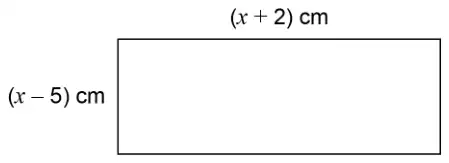
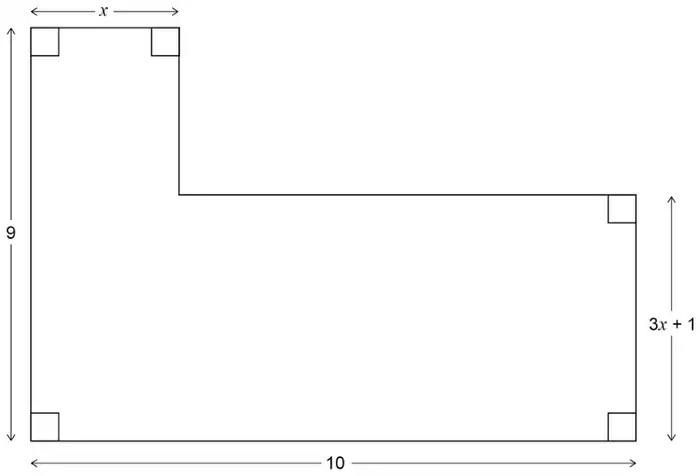
oe with brackets expanded four terms in any order with three correct from \(x^2 \quad (+)2x \quad -5x \quad -10\) terms may be seen in a grid implied by \(x^2 - 3x + k \quad (k \ne 0)\) or \(ax^2 - 3x - 10 \quad (a \ne 0)\)
For their three-term quadratic, correctly factorises or correctly substitutes into the quadratic formula or correctly completes the square to the form \(x = \ldots\) for their quadratic or \(-10\) and 13
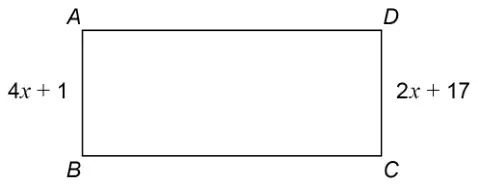
\(4x - 2x = 17 - 1\) or \(1 - 17 = 2x - 4x\) or \((x =)\ 8\)
M1dep
oe collection of terms
Correctly substitutes their 8 into a correct expression for the length or width of the rectangle
M1
their \(8 \gt 0\) and their \(8 \ne 1\)
Correct method for both the length and the width of the rectangle using their 8
M1dep
their \(8 \gt 0\) and their \(8 \ne 1\) dep on 3rd M
3267
A1
SC1 \(12x + 3\) or \(6x + 51\)
Additional guidance
The first M1 or SC1 may be awarded for correct work with no answer or incorrect answer, even if this is seen amongst multiple attempts
Trial and improvement to find \((x =)\ 8\) is M2
Using an incorrect value of \(x\) for 3rd and 4th marks eg when \(x = 10\) \(4 \times 10 + 1 = 41\) and \(41 \times 3 = 123\) or \(12 \times 10 + 3 = 123\) and \(123 \div 3 = 41\) or \(2 \times 10 + 17 = 37\) and \(6 \times 10 + 51 = 111\)
13 Multiplying \(y\) by 6 gives the same result as adding 15 to \(y\)
(a) Write this as an equation. [2 marks]
(b) Show that the value of \(y\) is not 4 [1 mark]
Mark scheme (a)
Answer
Mark
Comments
\(6y = y + 15\)
B2
correct single equation with \(6y\) and \(y + 15\) eg \(15 + y = y \times 6\)
B1 \(6y\) or \(y + 15\) or rearranged equation eg \(6y - 15 = y\) or \(5y = 15\) but not \(y = 3\) only
Additional guidance
B1 may be awarded for a correct term even if this is seen amongst multiple attempts or embedded in an incorrect equation or incorrect term eg \(6y + 15\) or \(6y + 15y\) or \(6(y + 15)\)
Allow any variable for B1 but must be consistent for B2
Allow unprocessed terms for B1 or B2 eg \(6 \times y\) or \(y6\)
\(6y = y + 15\) seen, but then correctly simplified or solved
B2
\(6y = y + 15\) seen, but then incorrectly simplified or solved
B1
\(6y = 18\) or \(y + 15 = 18\) or both (unless combined to a single equation)
B1
No work worth B2 or B1 and answer \(y = 3\)
B0
Mark scheme (b)
Answer
Mark
Comments
Alternative method 1: substitutes \(y = 4\) into both sides
\((6y =)\ 24\) and \((y + 15 =)\ 19\)
B1ft
oe eg \(4 \times 6 = 24\) and \(4 + 15 = 19\) correct or ft their equation if their equation has a term in \(y\) on each side
Alternative method 2: solves equation
\((y =)\ 3\)
B1ft
oe eg \(3 \times 6 = 18\) and \(3 + 15 = 18\) correct or ft their equation if their equation has a term in \(y\) on each side
Additional guidance
Allow any variable
Only allow \((y =)\ 3\) seen in (a) if referenced in (b) and not contradicted
B1
For Alt 1, accept substituting into one side and then equating and solving the other eg \(4 \times 6 = 24\) and \(24 - 15 = 9\)