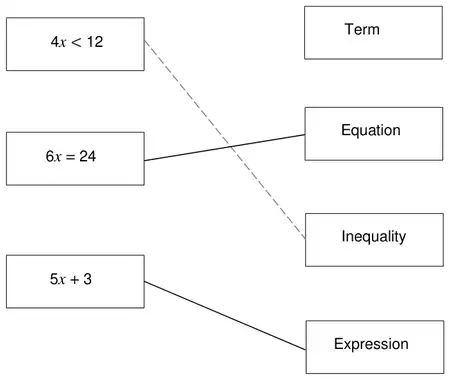
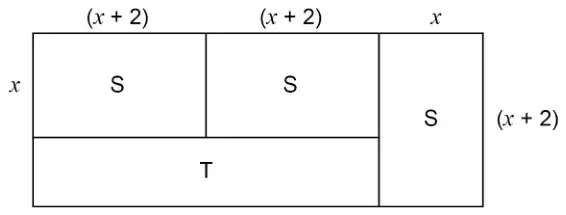
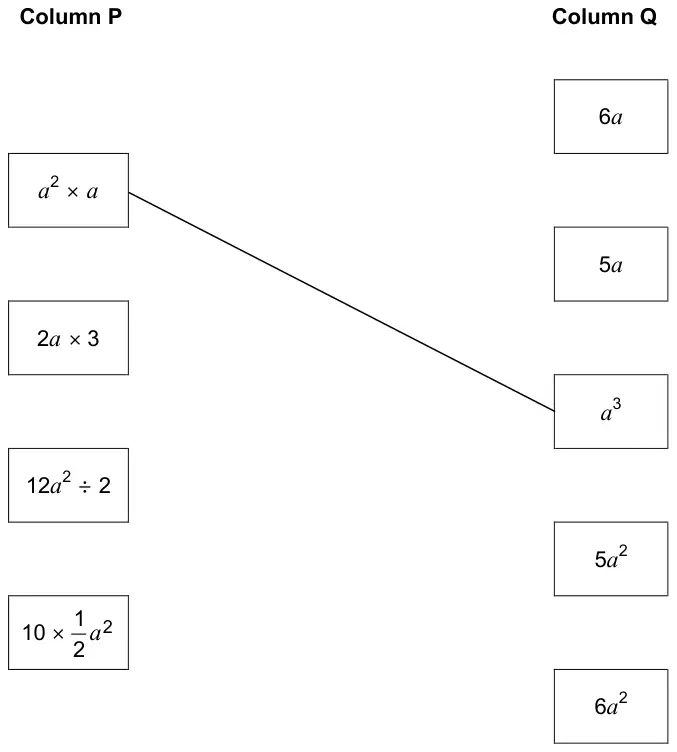
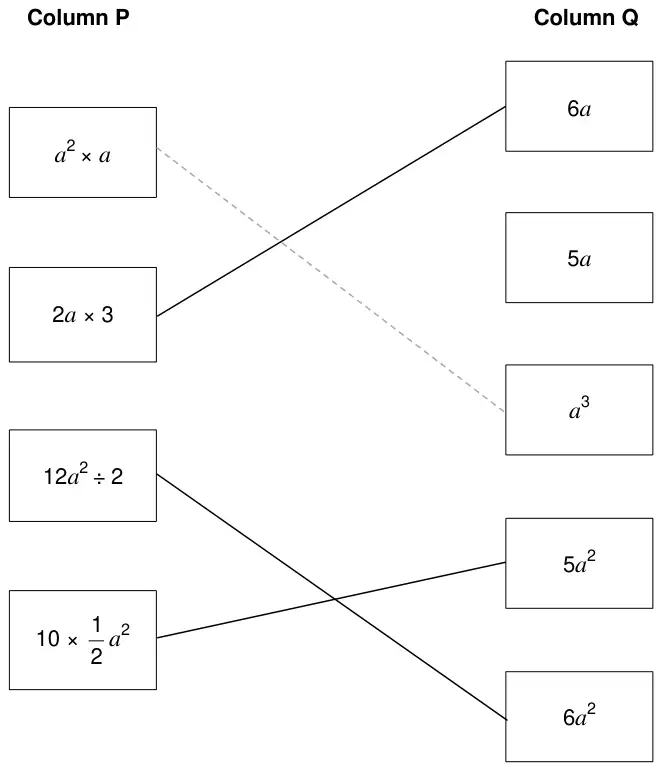
for isolating \(k\) terms, eg \(5k = 26 + 4\) or \(5k = 30\) or \(k - \dfrac{4}{5} = \dfrac{26}{5}\) oe or \(26 + 4 \div 5\)
A1
cao
Additional guidance
For M mark step must be carried out not just intention shown. For example, if you see \(5k - 4 = 26\) \(+4 \qquad +4\) award M1 for \(5k = r\) where \(r \gt 26\)
11 Write \(\dfrac{(6x^5y^3)^2}{3x^2y^7 \times 4xy^{-3}}\) in the form \(ax^by^c\) where \(a\), \(b\) and \(c\) are integers. (3)
Mark scheme
Answer
Mark
Mark scheme
\(3x^7y^2\)
M1
for full evaluation of numerator or denominator with at least 2 of 3 terms correct in a product, eg \(36x^{10}y^6\) or \(12x^3y^4\)
or full evaluation of \(\dfrac{6x^5y^3}{3x^2y^7}\) or \(\dfrac{6x^5y^3}{4xy^{-3}}\) with at least 2 of 3 terms correct in a product, eg \(2x^3y^{-4}\) or \(1.5x^4y^6\)
M1
for correct evaluation of numerator and denominator,
eg \(36x^{10}y^6\) and \(12x^3y^4\)
or for full evaluation of numerator and denominator with no more than one error and a final answer of the form \(ax^by^c\) with two of \(a\), \(b\) and \(c\) correct or for correct evaluation of \(\dfrac{6x^5y^3}{3x^2y^7}\) and \(\dfrac{6x^5y^3}{4xy^{-3}}\) eg \(2x^3y^{-4}\) and \(1.5x^4y^6\)
or for full evaluation of \(\dfrac{6x^5y^3}{3x^2y^7}\) and \(\dfrac{6x^5y^3}{4xy^{-3}}\) with no more than one error and a final answer of the form \(ax^by^c\) with two of \(a\), \(b\) and \(c\) correct
for any two of \(12 \div 6\ (= 2)\), \(x^{7-3}\ (= x^4)\), \(y^{3-1}\ (= y^2)\) in a single product or written as a fraction with complete and correct cancelling of at least two terms
(c) Simplify fully \(\dfrac{e \times e \times e \times f}{e \times e \times f \times f}\) (2)
Mark scheme (a)
Answer
Mark
Mark scheme
\(7ab\)
B1
for \(7ab\)
Mark scheme (b)
Answer
Mark
Mark scheme
\(y^3\)
B1
cao
Mark scheme (c)
Answer
Mark
Mark scheme
\(\dfrac{e}{f}\)
M1
for a correct first step, eg. numerator of \(e^3 \times f\) or denominator of \(e^2 \times f^2\) OR \(e \div f\) or \(e \times f^{-1}\) OR relevant crossings out for all the \(e\)’s and all the \(f\)’s
Work out the values of \(a\), \(b\) and \(c\). [3 marks]
Mark scheme
Answer
Mark
Comments
\(2ax^3 + 2x^2 + 4x - 10\) and \(bx^2 + cx\) or \(2ax^3 + (2 + b)x^2 + (4 + c)x - 10\) or \(2a = 12\) or \(a = 6\)
M1
oe correct expansions
allow \(2ax^3 = 12x^3\)
\(2 + b = 7\) or \(b = 5\) or \(4 + c = 3\) or \(c = -1\)
M1
oe equation
\(a = 6\) and \(b = 5\) and \(c = -1\)
A1
SC2 any two of \(a = 6\) and \(b = 5\) and \(c = -1\)
Additional guidance
One correct value without working only scores one mark eg \(a = 6\) and \(b = -5\) and \(c = 1\) with no working eg \(a = -6\) and \(b = 5\) and \(c = 1\) with no working
M1M0A0 M0M1A0
Condone an incorrect \(-10\) in the expansion if A1 is awarded
(a) Write down the value of \(\quad 2a - b\) [1 mark]
(b) Write down the value of \(\quad 2b - 4a\) [1 mark]
(c) You are given that \(\quad 4a - 2b = 10 \quad\) and \(\quad a + c = 3\)
Write an expression in \(a\), \(b\) and \(c\) that is equal to 23
Give your answer in its simplest form.
You must show your working. [2 marks]
Mark scheme (a)
Answer
Mark
Comments
5
B1
Additional guidance
Condone \(10 - 5 = 5\)
B1
Condone \(x = 5\)
B1
\(\dfrac{10}{2}\)
B0
Mark scheme (b)
Answer
Mark
Comments
\(-10\)
B1
Mark scheme (c)
Answer
Mark
Comments
Unsimplified expression in \(a\), \(b\) and \(c\) which would evaluate to 23
M1
eg \(2(4a - 2b) + a + c\) or \(8a - 4b + a + c\) or \(11(a + c) - (4a - 2b)\) or \(11a + 11c - 4a + 2b\)
Simplified expression in \(a\), \(b\) and \(c\) which would evaluate to 23
A1
eg \(9a - 4b + c\) \(7a + 2b + 11c\) SC2 Values assigned to \(a\), \(b\) and \(c\) which satisfy original equations and expression given which has value 23 eg \(a = 3, b = 1, c = 0\) and \(7a + 2b + c\)
Additional guidance
There are infinitely many correct solutions. Allow solutions where the coefficients are not integers if initial working is shown. eg \(3(4a - 2b) - \dfrac{7}{3}(a + c) = \dfrac{29}{3}a - 6b - \dfrac{7}{3}c\)
M1A1
\(5a - 2b + c + 10 = 23\)
M1A1
Condone ‘= 23’ after the expression
Answer using only two variables eg \(2.3(4a - 2b)\)
Do not ignore further incorrect algebraic simplification for B3 \(2a^2 + 15a - 1 = 17a - 1\)
B2
Do not ignore further incorrect algebraic simplification for B2 \(2a + 15a - 1 = 17a - 1 = 16a\) \(2a^2 + 15a - 1 = 17a - 1 = 16a\)
B1
Mark scheme (b)
Answer
Mark
Comments
\(4y(6y - 5)\) or \(-4y(5 - 6y)\)
B2
B1 \(2y(12y - 10)\) or \(-2y(10 - 12y)\) or \(y(24y - 20)\) or \(-y(20 - 24y)\) or \(4(6y^2 - 5y)\) or \(-4(5y - 6y^2)\) or \(2(12y^2 - 10y)\) or \(-2(10y - 12y^2)\)
Additional guidance
Ignore any ‘solutions’ seen eg \(4y(6y - 5)\) in working with 0 and \(\dfrac{5}{6}\) on answer line
B2
Condone \(4y \times (6y - 5)\)
B2
Condone \(y \times (24y - 20)\)
B1
\((4y + 0)(6y - 5)\)
B1
Do not ignore further incorrect algebraic simplification for B2
(a) Write an expression for \(e\) in terms of \(d\). [1 mark]
(b) Write an expression for \(f\) in terms of \(d\). [1 mark]
(c) Work out \(\quad e - f\)
Simplify your answer. [2 marks]
Mark scheme (a)
Answer
Mark
Comments
\(d + 3\) or \(3 + d\)
B1
must be seen in (a)
Additional guidance
Condone \(e = d + 3\) or \(e = 3 + d\)
B1
\(d = e - 3\)
B0
Mark scheme (b)
Answer
Mark
Comments
\(d - 5\)
B1
must be seen in (b)
Additional guidance
Condone \(f = d - 5\)
B1
\(d = f + 5\)
B0
Mark scheme (c)
Answer
Mark
Comments
their \((d + 3) -\) their \((d - 5)\) or \(3 - -5\) or chooses values for \(d\), \(e\) and \(f\) with \(e\) 3 more than \(d\) and \(f\) 5 less than \(d\) and subtracts \(f\) from \(e\) or chooses values for \(e\) and \(f\) with \(e\) 8 more than \(f\) and subtracts \(f\) from \(e\)
M1
oe eg \(d + 3 - d + 5\) or \(3 + d + 5 - d\) ft their expressions in (a) and (b) if both in terms of \(d\) and at least one has a numerical term may be implied by eg \(f = e - 8\)
8
A1ft
correct or ft their expressions in (a) and (b) if both in terms of \(d\) and at least one has a numerical term
Additional guidance
8
M1A1
\((d = 10,)\ e = 13\) and \(f = 5\) and \(13 - 5\)
M1
Only condone missing brackets if recovered
\(d + 3 - d - 5\) and no recovery
M0
\(d + 3 - d - 5\) and answer 8
M1A1
\(d + 3\) in (a), \(5 - d\) in (b) and \(2d - 2\) in (c)
(B1B0)M1A1ft
\(3d\) in (a), \(d - 5\) in (b) and \(2d + 5\) in (c)
(a) For each of the algebraic statements below decide whether it is an equation or an identity.
\((x - 1)(x - 2) = 12\)
is an ..........................
\((x - 1)(x - 2) = x^2 - 3x + 2\)
is an ..........................
\(x^2 = 3x + 10\)
is an ..........................
[1]
(b) A straight line is parallel to \(y = 3x\) and passes through the point \((2, 11)\).
Find the equation of the line in the form \(y = mx + c\). [3]
Mark scheme (a)
Answer
Marks
Part marks and guidance
Equation Identity Equation
1
Mark scheme (b)
Answer
Marks
Part marks and guidance
\(y = 3x + 5\) as final answer
3
B2 for final answer \(3x + 5\) or for a correct equation but not in required form isw
OR
M2 for using \((2, 11)\) correctly in \(y = 3x + c\) oe or M1 for “\(y = 3x + c\)” or for \(y = 3x + k\) oe where \(k\) is any numerical value except 0 or 5 or for correctly substituting \((2, 11)\) in \(y = mx + c\) oe \((m \ne 3)\)
B2 for e.g. \((y - 11) = 3(x - 2)\) or \(y - 3x = 5\) or \(3x - y + 5 = 0\) as the answer B2 for \(y = 3x + 5\) seen in working and subsequently spoilt (excluding changing to a perpendicular gradient)
(a) For each of the algebraic statements below decide whether it is an equation or an identity. [1]
\((x - 1)(x - 2) = 12\)
is an
\((x - 1)(x - 2) = x^2 - 3x + 2\)
is an
\(x^2 = 3x + 10\)
is an
(b) A straight line is parallel to \(y = 3x\) and passes through the point (2, 11).
Find the equation of the line in the form \(y = mx + c\). [3]
Mark scheme (a)
Answer
Marks
Part marks and guidance
Equation Identity Equation
1
Mark scheme (b)
Answer
Marks
Part marks and guidance
\(y = 3x + 5\) as final answer
3
B2 for final answer \(3x + 5\) or for a correct equation but not in required form isw
B2 for e.g. \((y - 11) = 3(x - 2)\) or \(y - 3x = 5\) or \(3x - y + 5 = 0\) as the answer B2 for \(y = 3x + 5\) seen in working and subsequently spoilt (excluding changing to a perpendicular gradient)
OR
M2 for using (2, 11) correctly in \(y = 3x + c\) oe or M1 for “\(y = 3x + c\)” or for \(y = 3x + k\) oe where \(k\) is any numerical value except 0 or 5 or for correctly substituting (2, 11) in \(y = mx + c\) oe \((m \ne 3)\)
e.g. \(11 = 3 \times 2 + c\) e.g. \(11 = \frac{1}{3} \times 2 + c\)
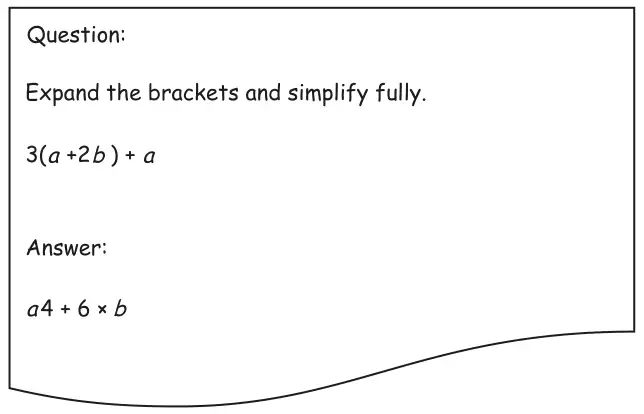
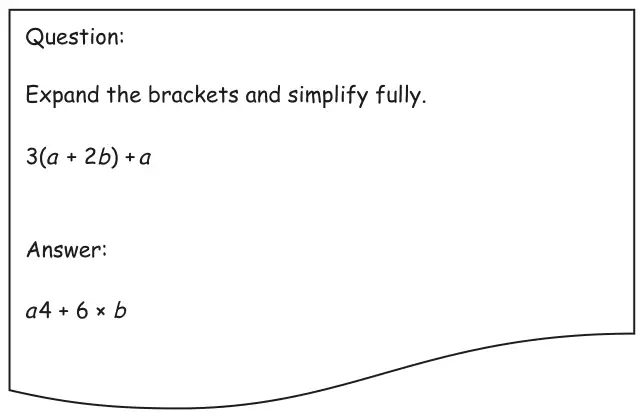
Reason includes a4 should be written as \(4a\) oe or the 4 is written after the \(a\) oe
and
\(6 \times b\) should be written as \(6b\) oe or the 6 and \(b\) should not be separated oe
2
B1 for correct explanation for one term a4 should be written as \(4a\) oe or the 4 is written after the \(a\) oe
or
\(6 \times b\) should be written as \(6b\) oe or the 6 and b should not be separated oe
or
correct expression written \(4a + 6b\)
Must refer to error in each term for 2 marks Incorrect statements apply penalty 1 mark if 2 marks earned
See appendix 3
Appendix
APPENDIX 3 Question 20
Answers that imply the brackets have been multiplied incorrectly treat as incorrect statements Do not accept for 2 marks \(4a + 6b\) alone without some explanation but allow for B1
Response
Mark
A
He didn’t put the 6 and the \(b\) together to show it is multiplied. He put the 4 after the \(a\) when it should be before (oe)
2
B
Because they separated the \(b\) from the 6 and put the a in front of the 4
2
C
In algebra the 4 should come before the a so it is \(4a\), the multiplication sign is not needed so it should be \(6b\) \(4a + 6b\) should not be simplified so the answer is \(2a + 3b\) (penalty 1 after correct explanation for 2 marks then incorrect statement)
1
D
It is correct \(4a + 6b\)
B1
E
It is not written correctly, it should be \(4a + 6b\) (B1 for \(4a + 6b\))
B1
F
The answer is \(4a + 6b\)
B1
G
Because numbers have to be placed in front of letters BOD for term in \(a\) term in \(b\) not explained
B1
H
Shows \(4a + 6b\) in working and then ‘because they can further simplify the answer by \(2(2a + 3b)\)’
B1
I
It should be \(4a + 6b\), the student has not timesed the 6 and the b together
B1
J
It is \(6b\) not \(6 \times b\) – it has not been fully simplified
B1
K
a4 is incorrect as 4 is the coefficient – it should be \(4a\)
B1
L
The answer should be \(4a + 6b\), he did the \(2b\) calculation wrong he should have multiplied them together by 3 to get the answer
B1
M
The number must be before the letter \(4a + 6b\)
B1
N
\(4a + 6b\) written above answer lines and answer line blank
B1
O
She has put 4 after the \(a\) and has only multiplied the number 2 by 3 without the \(b\) (one correct statement about \(a\))
B1
P
He has put \(4a\) as a power and \(6 \times b\) should be \(6b\), should be \(4a + 6b\) (B1 for \(4a + 6b\))
B1
Q
They should not be separating the 6 and the \(b\) it should be \(6b\)
B1
R
The contents of the bracket were not expanded correctly it should be \(2 \times 3b = 6b\) (not explained error how term is written)
0
S
He has written \(a\)4 and \(6 \times b\) (further explanation about the error needed)
Reason includes \(a4\) should be written as \(4a\) oe or the 4 is written after the \(a\) oe
and
\(6 \times b\) should be written as \(6b\) oe or the 6 and \(b\) should not be separated oe
2
B1 for correct explanation for one term \(a4\) should be written as \(4a\) oe or the 4 is written after the \(a\) oe
or
\(6 \times b\) should be written as \(6b\) oe or the 6 and b should not be separated oe
or
correct expression written \(4a + 6b\)
Must refer to error in each term for 2 marks Incorrect statements apply penalty 1 mark if 2 marks earned
See appendix 2
Appendix 2: Question 8
Answers that imply the brackets have been multiplied incorrectly treat as incorrect statements Do not accept for 2 marks 4a + 6b alone without some explanation but allow for B1
Response
Mark
A
He didn’t put the 6 and the b together to show it is multiplied. He put the 4 after the a when it should be before (oe)
2
B
Because they separated the b from the 6 and put the a in front of the 4
2
C
In algebra the 4 should come before the a so it is 4a, the multiplication sign is not needed so it should be 6b 4a + 6b should not be simplified so the answer is 2a + 3b (penalty 1 after correct explanation for 2 marks then incorrect statement)
1
D
It is correct 4a + 6b
B1
E
It is not written correctly, it should be 4a + 6b (B1 for 4a + 6b)
B1
F
The answer is 4a + 6b
B1
G
Because numbers have to be placed in front of letters (BOD for term in a, term in b not explained)
B1
H
Shows 4a + 6b in working and then ‘because they can further simplify the answer by 2(2a + 3b)’
B1
I
It should be 4a + 6b, the student has not timesed the 6 and the b together
B1
J
It is 6b not 6 x b – it has not been fully simplified
B1
K
a4 is incorrect as 4 is the coefficient – it should be 4a
B1
L
The answer should be 4a + 6b, he did the 2b calculation wrong he should have multiplied them together by 3 to get the answer
B1
M
The number must be before the letter 4a + 6b
B1
N
4a + 6b written above answer lines and answer line blank
B1
O
She has put 4 after the a and has only multiplied the number 2 by 3 without the b (one correct statement about a)
B1
P
He has put 4a as a power and 6 x b should be 6b, should be 4a + 6b (B1 for 4a + 6b)
B1
Q
They should not be separating the 6 and the b it should be 6b
B1
R
The contents of the bracket were not expanded correctly it should be 2 x 3b = 6b (not explained error how term is written)
0
S
He has written a4 and 6 × b (further explanation about the error needed)
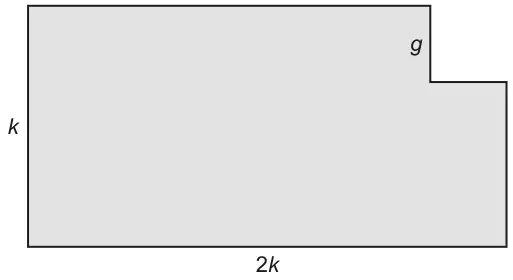
15 In this question all measurements are in centimetres.
The shaded shape is made by cutting a square from the corner of a rectangle.
The width of the rectangle is \(k\). The length of the rectangle is \(2k\). Each side of the square is \(g\).
(a) Write down the relationship between the length and the width of the rectangle. [1]
(b) Find an expression for the area of the shaded shape. Give your answer in its simplest form. [2]
(c)
(i) Find an expression for the perimeter of the shaded shape. Give your answer in its simplest form. [3]
(ii) Find the value of \(k\) when the perimeter of the shaded shape is 62.4. [2]
Mark scheme (a)
Answer
Marks
Part marks and guidance
The length is twice the width oe or The width is half the length
1
“Twice” or “double” or “half” is not enough unless it is clear that length = 2 × width
Accept \(2k\) is double \(k\) oe or \(L = 2W\) oe
Do not accept values or length = \(2 \times k\)
Mark the best response as long as it is not contradictory or has an incorrect statement
Mark scheme (b)
Answer
Marks
Part marks and guidance
\(2k^2 - g^2\) final answer
2
M1 for \(2k \times k - g \times g\) oe
Ignore units if included oe for M1 may be e.g. \(2k \times k - g^2\)
Mark scheme (c)
Answer
Marks
Part marks and guidance
(i) \(6k\) final answer
3
B2 for correct answer unsimplified or B2 for \(6k - 2g\) [\(+ g + g\)] or M2 for \(2k + k + 2k - g + k - g\) [\(+ g + g\)] oe or M1 for [height =] \(k - g\) or [length =] \(2k - g\)
Condone \(6k + 0\)[\(g\)] for 3 marks Accept in any order Accept e.g. \(2g\) for \(g + g\)
Identified or seen on diagram in correct position
(ii) 10.4 nfww
2
M1 for their part (i) = 62.4 or \(\frac{62.4}{6}\)
Their part (i) must be algebraic in terms of \(k\) or \(k\) and \(g\) Their (a) can be rearranged
Note: \(6k - 2g = 62.4\) scores M1 but does not score the second mark as from wrong working
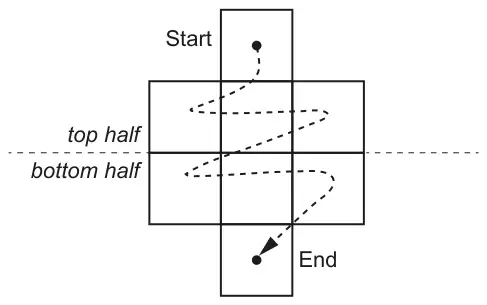
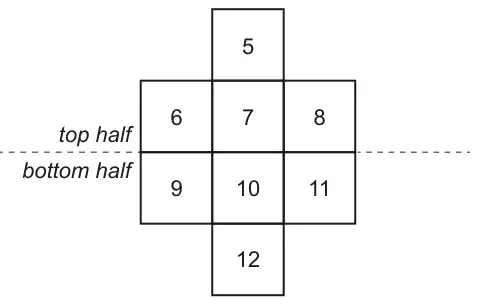
10 Eight consecutive numbers are written in ascending order in this grid, starting from the top and working left to right.
(a) Kareem writes the numbers 5 to 12 in the grid.
Show that for Kareem’s grid, the sum of the numbers in the top half of the grid is 16 less than the sum of the numbers in the bottom half of the grid. [1]
(b)Use algebra to prove that for any set of eight consecutive numbers written in this grid in the same way, the sum of the numbers in the top half of the grid is 16 less than the sum of the numbers in the bottom half of the grid. [5]
Mark scheme (a)
Answer
Marks
Part marks and guidance
(9 + 10 + 11 + 12) – (5 + 6 + 7 + 8) = 16
1
May be shown in stages Accept 42 – 26 = 16
May be explained via sum of differences of paired cells eg 4 × 4 from (9 – 5), (10 – 6) etc
For M2 and M1 FT expressions of form \(an + b\), \(b \ne 0\) eg. Top half: \(2n + (2n + 1) + (2n + 2) + (2n + 3) = 8n + 6\) Bottom half: \((2n + 4) + (2n + 5) + (2n + 6) + (2n + 7) = 8n + 22\) Accept unsimplified or simplified for M marks
M2 for algebraic sums for top half and bottom half of grid or M1 for algebraic sum for top half or bottom half of grid
AND
A1dep for sum of bottom half – sum of top half = 16 shown algebraically or explained from correct working.
A1 is dep on B2M2 scored Condone \(\begin{array}{r} 4n + 22 \\ [-]\ 4n + 6 \\ \hline 16 \end{array}\) A0 for \(4n + 22 - 4n + 6\) or for just 22 – 6 or for use of \(2n\), \(2n + 1\), \(2n + 2\) etc as their algebraic terms
Alternative method for pairs of numbers B2 as above AND M2 for the difference of four pairs of algebraic terms from top and bottom calculated or M1 for the one pair of algebraic terms from top and bottom calculated AND A1dep for all four differences summed to 16 shown numerically or explained from correct working
eg. “difference between \(n\)+4 and \(n\) is 4”
If 0 scored, allow SC1 for a correct numerical or described example showing an overall difference of 16
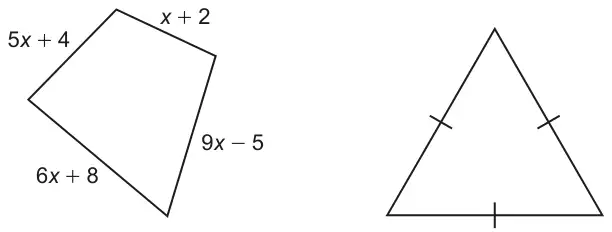
16 The diagram shows a quadrilateral and an equilateral triangle. The perimeter of the quadrilateral is equal to the perimeter of the equilateral triangle.
Not to scale
Find an expression for the length of one side of the equilateral triangle. Give your answer in terms of \(x\) in its simplest form. [4]
Mark scheme
Answer
Marks
Part marks and guidance
\(7x + 3\) final answer
4
M2 for \(21x + 9\) isw or M1 for \(5x + 4 + x + 2 + 9x - 5 + 6x + 8\)
M1 for their \((21x + 9) \div 3\)
Must be an algebraic expression in the form \(ax + b\) \(b \ne 0\)
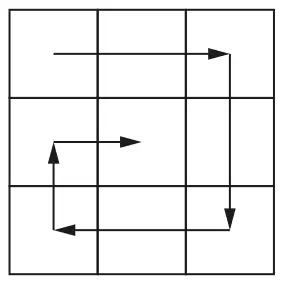
10 Nine consecutive numbers are written on a 3-by-3 grid. They are arranged, in ascending order, in a spiral as shown.
(a) Karen writes the numbers 3 to 11 on her grid.
3
4
5
10
11
6
9
8
7
The total of the first column is \(3 + 10 + 9 = 22\).
Karen says
The total of the first column is one less than the total of the second column.
Show that this is correct for Karen’s grid. [1]
(b) Victor says
If any nine consecutive numbers are arranged in ascending order in this spiral on a 3-by-3 grid, the total of the first column will always be one less than the total of the second column.
Prove that Victor is correct. [5]
Mark scheme (a)
Answer
Marks
Part marks and guidance
4 + 11 + 8 = 23 seen
1
Accept written as a sum in a column
Mark scheme (b)
Answer
Marks
Part marks and guidance
e.g. First column: \(n + (n + 7) + (n + 6) = 3n + 13\)
B2 for consistent algebraic terms for at least first two columns of the grid or B1 for at least 3 algebraic terms for consecutive numbers seen
AND
M1 for algebraic sum of first or second column shown M1 for algebraic sum of first and second columns shown and correctly simplified A1 for sum of second column – sum of first column = 1 calculated or explained from correct working
or
M1 for difference of one pair of algebraic terms from first and second column shown M1 for differences of two further pairs of algebraic terms from first and second column, with all three pairs correctly simplified A1 for each difference found as +1 or –1 oe and summed/explained to a difference of +1. Correct algebra and reasoning throughout
If 0 scored, allow SC1 for a correct numerical or descriptive example using either method and stating an overall difference of 1
e.g. \(n\), \((n + 7)\), \((n + 6)\) and \((n + 1)\), \((n + 8)\), \((n + 5)\)
e.g. \(n\), \((n + 1)\), \((n + 2)\)
e.g. \(n + (n + 7) + (n + 6)\) or in column e.g. \(n + (n + 7) + (n + 6) = 3n + 13\)
A1 for e.g. \(3n + 14\) and \(3n + 13\) and “second column is 1 more than the first” but A0 for e.g. \(3n + 14\) and \(3n + 13\) and “difference of 1” or for \((3n + 14) - 3n + 13 = 1\)
e.g. “the difference between \(n + 1\) and \(n\) is 1” e.g. “\(n + 1\) is 1 more than \(n\)”
13 Prove that the mean of any four consecutive even integers is an integer. [4]
Mark scheme
Answer
Marks
Part marks and guidance
\(\dfrac{(2x) + (2x + 2) + (2x + 4) + (2x + 6)}{4}\) \(= \dfrac{8x + 12}{4}\) \(= 2x + 3\) which is an integer
OR
\((2x) + (2x + 2) + (2x + 4) + (2x + 6)\) \(= 8x + 12\) \(= 4(2x + 3)\) which is divisible by 4 oe
4
M1 for \(2x\), \(2x + 2\), \(2x + 4\) and \(2x + 6\) seen and M1 for adding their four terms in \(x\), e.g. \((2x) + (2x + 2) + (2x + 4) + (2x + 6)\) and M1 for their \((8x + 12) \div 4\) or better, condoning lack of brackets, or for \(4(2x + 3)\) and A1dep (dep on M0M1M1 or M1M1M1) for correct algebraic mean for their four terms and conclusion, e.g. \(2x + 3\) is an integer or \(4(2x + 3)\) which is divisible by 4
If 0 scored, allow SC1 for a numerical example with any 4 consecutive even integers with mean correctly calculated
Or equivalent algebraic representations of 4 consecutive even numbers. In this case, \(x\) does not need to be defined as being an integer.
Using \(x\), \(x + 2\), \(x + 4\), \(x + 6\) oe does not score the first M mark unless \(x\) stated as even integer, but can score up to 3 marks for \((x) + (x + 2) + (x + 4) + (x + 6)\), their \((4x + 12) \div 4\) or better, or for \(4(x + 3)\) and the relevant conclusion
Using \(x + 1\), \(x + 3\), \(x + 5\), \(x + 7\) oe does not score the first M mark unless \(x\) stated as odd integer but can score up to 3 marks similar to above.
13 In this question, assume all dimensions are in centimetres.
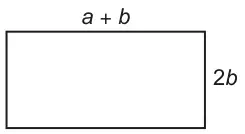
Jess and Pete have many rectangular tiles. Each tile has length \(a + b\) and width \(2b\).
Not to scale
(a) Jess joins three tiles together to make a larger rectangle, as shown.
Not to scale
(i) Write an expression for the perimeter of her rectangle. Give your answer in its simplest form. [2]
(ii) An expression for the area of her rectangle is \(6ab + 6b^2\).
Factorise this expression fully. [2]
(b) Pete joins some tiles together to make a different rectangle. The area of his rectangle is \(8ab + 8b^2\).
Draw a possible arrangement of tiles for Pete’s rectangle. Write down expressions for the length and for the width of the rectangle. [5]
Mark scheme (a)
Answer
Marks
Part marks and guidance
(i) \(6a + 10b\) or \(2(3a + 5b)\) final answer
2
M1 for \(6(a + b) + 2 \times 2b\) oe
If 0 scored SC1 for \(3a + 5b\) as final answer
M1 for EG \(a + b + a + b + a + b + a + b + a + b + a + b + 2b + 2b\) or \(2 \times (3a + 3b + 2b)\) etc
(ii) \(6b(a + b)\) final answer
2
B1 for \(6(ab + b^2)\) or \(b(6a + 6b)\) or \(3(2ab + 2b^2)\) or \(3b(2a + 2b)\) or \(2(3ab + 3b^2)\) or \(2b(3a + 3b)\)
Mark scheme (b)
Answer
Marks
Part marks and guidance
4 by 1 rectangle with \(4a + 4b\) and \(2b\) or 2 by 2 rectangle with \(2a + 2b\) and \(4b\) or 1 by 4 rectangle with \(a + b\) and \(8b\) stated or marked on rectangle
5
B4 for \(4a + 4b\) and \(2b\) or \(2a + 2b\) and \(4b\) or \(a + b\) and \(8b\) or B3 for rectangle drawn as (4 by 1) or (2 by 2) or (1 by 4) or B2 for one of \(2a + 2b\) or \(4a + 4b\) or \(4b\) or \(8b\) or
B1 for any rectangle of 3 or more tiles drawn with \(a+b\) or \(2b\) marked on individual tiles
Accept unsimplified throughout Once correct expression(s) seen, ignore incorrect simplification to answer line In answer space or intended as final length and width
Must clearly be answer
May be in attempt to factorise EG \(4b(2a + b)\) Accept unsimplified EG \(a+b + a+b\)
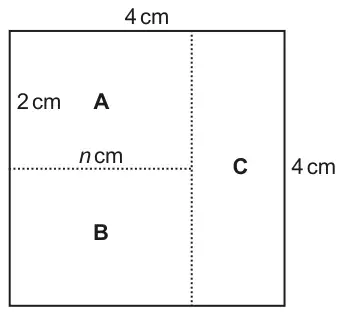
\(\dfrac{16}{6}\) or \(\dfrac{8}{3}\) or \(2\dfrac{4}{6}\) or \(2\dfrac{2}{3}\) or 2.6[6…] or 2.7
3
M1 for \(4(4 - n)\) oe or \(4 \times 4 \div 3\) or better And M1 for their \(4(4 - n) = 2n\) or better or \(2n = \dfrac{16}{3}\) oe or \(4(4 - n) = \dfrac{16}{3}\) oe
Isw Accept eg \(5\dfrac{1}{3}\) or 5.33[…] for \(\dfrac{16}{3}\)
When the INPUT is 22, the OUTPUT is 37·5. Find the value of \(a\). [2]
(b) The original price of a toy is £\(t\). In a sale, the toy is one third of its original price. Write down, in terms of \(t\), the sale price of the toy. [1]
(c) A bag contains \(x\) sweets. Rona buys 8 of these bags. She also has 5 sweets left from a previous bag of sweets. Write down, in terms of \(x\), the total number of sweets Rona has. Simplify your answer. [2]
(d) Simplify \(5f + 16f \times 7\). [2]
(e) Expand \(8(9p - 3)\). [1]
(f) Solve \(5x - 2 = 11\). [2]
(g) What is the square root of 31? Give your answer correct to 2 decimal places. [2]
Mark scheme (a)
Scheme
Marks
Comments
(i) 13
B1
May be seen on the number machine or in a calculation.
(ii) (\(a\) = ) 1.1
B2
May be seen on the number machine or embedded in a calculation. Award B2 unless contradicted by \(a \neq 1.1\).
B1 for one of the following:
22 ÷ (37.5 – 17.5)
22 ÷ \(a\) = 20
20 × \(a\) = 22
\(a\) = 22 ÷ 20
Mark scheme (b)
Scheme
Marks
Comments
(£) \(\frac{t}{3}\) or \(\frac{1}{3}t\) or \(0.\dot{3}t\)
B1
Allow \(t/3\) and \(0.33(\ldots)t\) and \(t\frac{1}{3}\). Allow use of \(T\) for \(t\).
Do not allow \(t \div 3\) or \(t \times \frac{1}{3}\) or \(\frac{t}{3} = t\) or \(0.3t\)
Mark scheme (c)
Scheme
Marks
Comments
\(8x + 5\)
B2
Mark final answer
B1 for one of the following:
\(8 \times x + 5\) or equivalent unsimplified expression
\(x8 + 5\)
\(8x + 5\) seen and then spoilt e.g. \(8x + 5 = 13x\)
Mark scheme (d)
Scheme
Marks
Comments
\(117f\)
B2
B1 for sight of \(112f\) or \(117f^2\)
Mark scheme (e)
Scheme
Marks
Comments
\(72p - 24\)
B1
Mark final answer
Mark scheme (f)
Scheme
Marks
Comments
\(5x = 13\)
B1
(\(x\) =) \(\frac{13}{5}\) or \(2\frac{3}{5}\) or 2.6 ISW
B1
Allow an embedded answer provided it is not contradicted.
FT from \(5x = k\) but if on FT it simplifies to an integer the answer must be given as an integer.
Note:An answer of 2.6 is awarded B1 B1.
If no marks, award SC1 for (\(x\) = ) (11 + 2) ÷ 5 not 11 + 2 ÷ 5
(a) Tick (✓) the two correct statements about \(3xy(y + 2) \equiv 3xy^2 + 6xy\). [2]
It is an equation.
It is true for all values of \(x\) and \(y\).
It is an identity.
It is only true for certain values of \(x\) and \(y\).
It is an inequality.
It is true for only one value of \(x\) and one value of \(y\).
(b) In this part of the question all lengths are in centimetres.
Diagram not drawn to scale
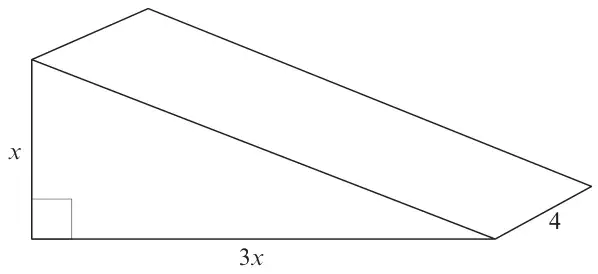
The diagram shows a prism. The cross-section of the prism is a triangle with height \(x\) and base \(3x\). The volume of the prism is 216 cm3.
Use an algebraic method to find the height of the triangle. [5]
Mark scheme (a)
Scheme
Marks
Comments
Second and third statements indicated and no others
B2
Award B1 for one of the following:
One correct statement and up to one incorrect statement indicated
Two correct statements and exactly one incorrect statement indicated
Mark scheme (b)
Scheme
Marks
Comments
May be done in parts
(Area of cross-section =) \(\tfrac12 \times 3x \times x\)
M1
Accept ½ base x height oe
(Volume =) \(\tfrac12 \times 3x \times x \times 4\)
M1
FT ‘their \(\tfrac12 \times 3x \times x\)’ \(\times\, 4\), provided at least two terms in \(x\).
\(\tfrac12 \times 3x \times x \times 4 = 216\) oe
A1
CAO
\(x^2 = 216 \times 2 \div 4 \div 3\ (= 36)\)
M1
FT ‘their \(k\)’\(\times x^2 = 216\)
6 (cm)
A1
Mark final answer. FT Final 2 marks can be awarded if trials used on an equation of the form ‘their \(k\)’\(\times x^2 = 216\) to find a correct or correct FT answer. If \(x^2\) is a square number, \(x\) must be given as a whole number. Otherwise, it may be written as an unsimplified surd.
Alternative method
Scheme
Marks
Comments
(Area of cross-section =) \(216 \div 4\ (=54)\)
B1
(Area of cross-section =) \(\tfrac12 \times 3x \times x\)
M1
Accept ½ base x height oe
\(\tfrac12 \times 3x \times x = 54\) oe,
A1
CAO
\(x^2 = 54 \times 2 \div 3\ (= 36)\)
M1
FT ‘their \(k\)’\(\times x^2 =\) ‘their 54’
6 (cm)
A1
Mark final answer. FT Final 2 marks can be awarded if trials used on an equation of the form ‘their \(k\)’\(\times x^2 =\) ‘their 54’ to find a correct or correct FT answer If \(x^2\) is a square number, \(x\) must be given as a whole number. Otherwise, it may be written as an unsimplified surd.
Notes
If no marks award SC3 for a complete correct method using trials leading to an answer of 6 OR SC2 for a correct trial with height > 3, e.g. \(\tfrac12 \times 15 \times 5 \times 4\) (and comparison with 216) si OR a correct trial with height > 3. e.g. \(\tfrac12 \times 15 \times 5\) and comparison with 54 si
(c) Find the value of \(6x + 3y\) when \(x = 5{\cdot}2\) and \(y = 0{\cdot}4\). [2]
(d) Solve \(\dfrac{e}{2} - 4 = 6\). [2]
(e)
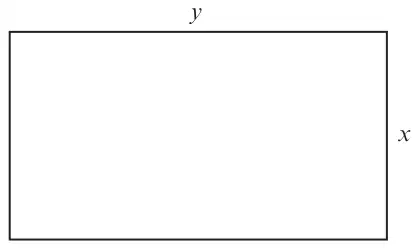
The rectangle below has length \(y\) and width \(x\).
Diagram not drawn to scale
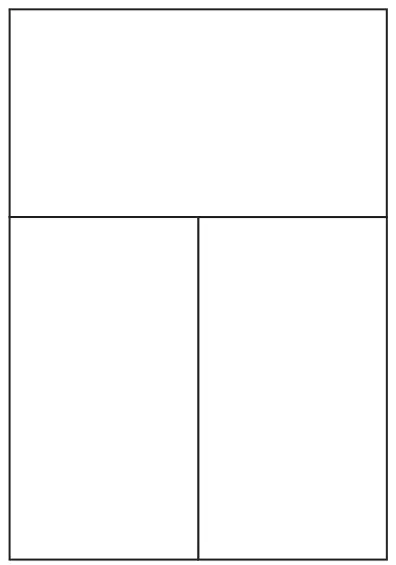
Three rectangles congruent to the one above are arranged, without overlapping, to create the large rectangle below.
Diagram not drawn to scale
Find an expression for the perimeter of this large rectangle in terms of \(x\). Simplify your answer. [3]
Mark scheme (a)
Scheme
Marks
Comments
8f – 3g
B2
B1 for sight of 8f or -3g. Mark final answer.
Mark scheme (b)
Scheme
Marks
Comments
5m – 15
B1
Mark scheme (c)
Scheme
Marks
Comments
32.4 as their final answer
B2
B1 for 31.2 or 1.2 or 6 x 5.2 + 3 x 0.4 Do not allow 31.2x or 1.2y or 32.4xy or x = 31.2 or y = 1.2 Mark final answer.
Mark scheme (d)
Scheme
Marks
Comments
\(\frac{e}{2} = 10\) or e - 8 = 12
B1
e = 20
B1
FT from e/2 = k OR e – m = 12 OR e - 8 = n Allow 2 marks for an embedded answer BUT only 1 mark if contradicted by e ≠ 20
If no marks, then award SC1 for e/2 = 6 + 4 and e = 6 + 4 x 2 (=14) seen.
Mark scheme (e)
Scheme
Marks
Comments
10x
B3
Award B2 for 3y + 4x OR 4y + 2x OR for a correct answer in terms of x that is not fully simplified e.g. 2x + x + 2x + x + x + x + 2x
Award B1 for any one of:
a correct answer in terms of x and y that is not fully simplified e.g. y + x + y + x + x + y + x
for recognising that y = 2x, may be shown on the diagram e.g. y = x + x or x = 0.5y
An answer of 5y is awarded 2 marks (B3 MR -1) An answer in terms of y that is not fully simplified e.g. y + y + y + 4 × 0.5y is awarded 1 mark (B2 MR -1)
A can contains \(w\) ml of lemonade. Taka drinks 15 ml of lemonade from the can.
Write an expression, in terms of \(w\), for the amount of lemonade that is left in the can. [1]
(ii)
In the first week of April, Johan made \(r\) bird boxes. In the second week of April, Johan made half as many bird boxes as he did the week before.
Write an expression, in terms of \(r\), for the number of bird boxes Johan made in the second week of April. [1]
Mark scheme (a)
Scheme
Marks
Comments
(i) \(4x - 9y\)
B2
Mark final answer B1 for an expression either \(4x + \ldots\) or \(\ldots - 9y\) or for a correct answer seen then spoiled
(ii) \(7x + 9\)
B2
Mark final answer B1 for sight of \(7x + 14\); allow for e.g. \(7x + 14 - 35\) or for a correct answer seen then spoiled
(iii) \(10x^2\)
B2
B1 for either \(10x^k\) where \(k \neq 2\) or 0 OR \(kx^2\) where \(k\) could be any value other than 0 or 1 e.g. allow for \(\frac{20x^2}{2}\) or \(20x^2 \div 2\)
Mark scheme (b)
Scheme
Marks
Comments
(i) \(w - 15\)
B1
Allow for e.g. \(w - 15 = x\) ml; ignore any units Do not allow for \(w - 15 = -15w\) or \(w - 15 = 45\) or \(w - 15 = w\) etc
(ii) \(\dfrac{r}{2}\) or \(\dfrac{1}{2}r\) or \(0.5r\)
B1
Allow \(r \div 2\) or \(\frac{1 \times r}{2}\) or \(r \times \frac{1}{2}\) e.g. \(r \div 2 = x\) or \(\frac{r}{2}\) bird boxes; do not allow \(\frac{r \text{ bird boxes}}{2}\) or \(r \div 2 = r\) or \(r : 2\)
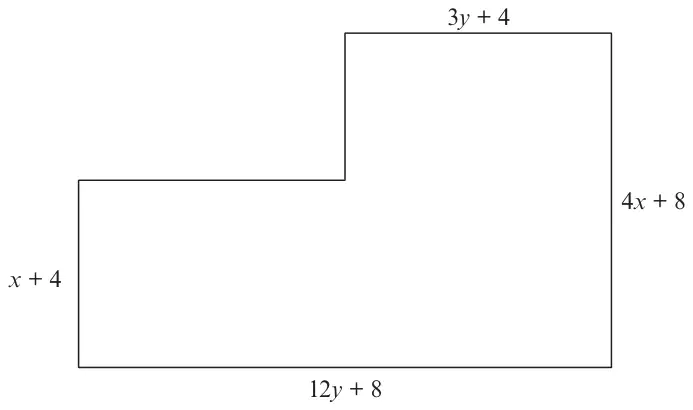
15. The shape below is made from two rectangles. All the lengths are in cm.
Diagram not drawn to scale
(a) Write an expression for the perimeter of the shape. Simplify your expression. [3]
(b)
Use the highest possible number to complete the following sentence. [1]
‘The expression for the perimeter is a multiple of ………… .’
Mark scheme (a)
Scheme
Marks
Comments
\(8x + 24y + 32\)
B3
Accept any correct factorised expression
B2 for a correct but unsimplified answer, e.g. \(2(4x + 8) + 2(12y + 8)\) or \(\underline{x + 4}\) + \(\underline{12y + 8}\) + \(\underline{4x + 8}\) + \(\underline{3y + 4}\) + \(\underline{3x + 4}\) + \(\underline{9y + 4}\)
B2 for a correctly simplified answer with an error in one of the ‘missing’ sides
B1 for an unsimplified answer with an error in one of the ‘missing’ sides, or sight of \(3x + 4\) AND \(9y + 4\) Or correctly simplified expression with one ‘missing’ side omitted.
Mark scheme (b)
Scheme
Marks
Comments
8
B1
Strictly FT ‘their perimeter’ providing a multiple > 1 exists
(i) Fabian’s brother, Ben, is half Fabian’s age. Write an expression for Ben’s age. ……………… [1]
(ii) Write an expression to give Ben’s age in five years time. [1]
Mark scheme (a)
Scheme
Marks
Comments
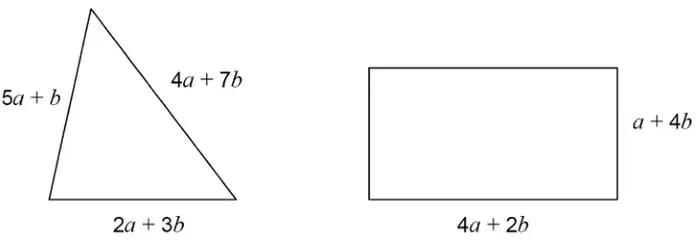
\(4a + 7b\) or equivalent
B2
B1 for \(4a\) or \(7b\) For B2, an expression must be given.
Mark scheme (b)
Scheme
Marks
Comments
\(3x + 15\)
B1
Mark scheme (c)
Scheme
Marks
Comments
No AND an acceptable explanation, e.g. ‘if \(c\) = 5 then \(5c^2\) = 125. \(c^2 + 4c\) = 45. (They are not the same)’, or ‘c and \(c^2\) are different and cannot be added’, or 'Can only collect like terms'
E1
Mark scheme (d)
Scheme
Marks
Comments
(i) \(\frac{f}{2}\), or \(\frac{1}{2}f\)
B1
Allow \(f \div 2\) or \(0.5f\)
(ii) \(\frac{f}{2} + 5\) or \(\frac{1}{2}f + 5\) or \((f + 10)/2\)
B1
FT ‘their \(\frac{f}{2}\)’ + 5 provided it is using algebra.
Unsupported answer of 9 is awarded B1B1. \(x = \dfrac{27}{3}\) is awarded B1B0. If FT leads to a whole number answer, it must be shown as a whole number. Otherwise accept a fraction (e.g. if \(3x = 7\), then \(x = \dfrac{7}{3}\) is awarded B0B1, but \(x = 7 \div 3\) is awarded B0B0).
Allow B1B1 for a correct embedded answer BUT B1B0 if contradicted by \(x \ne 9\).
Mark scheme (b)
Scheme
Marks
Comments
\(8f - 13g\)
B2
Mark final answer. Must be an expression for B2. Award B1 for one of the following:
Mark final answer. Allow B1 for a correct embedded answer BUT B0 if contradicted by \(x \neq 24\).
(ii) \(3x = 27\)
B1
Mark final answer.
\((x =)\ 9\)
B1
FT from \(3x = k\). Unsupported answer of 9 is awarded B1B1. \(x = \dfrac{27}{3}\) is awarded B1B0. If FT leads to a whole number answer, it must be shown as a whole number. Otherwise accept a fraction (e.g. if \(3x = 7\), then \(x = \dfrac{7}{3}\) is awarded B0B1, but \(x = 7 \div 3\) is awarded B0B0).
Allow B1B1 for a correct embedded answer BUT B1B0 if contradicted by \(x \neq 9\).
Mark scheme (b)
Scheme
Marks
Comments
\(8f - 13g\)
B2
Mark final answer. Must be an expression for B2. Award B1 for one of the following:
Mark final answer. Award B1 for one of the following:
\(6 \times p^7 \times q^8\)
\(6p^7 \times q^8\)
\(6{\times}p^7q^8\)
\(6p^7q^{\cdots\cdots}\)
\(6p^{\cdots\cdots}q^8\)
\(kp^7q^8\) (\(k \ne 0\) or 6)
Sight of \(6p^7\) AND \(q^8\) in an expression (e.g. \(6p^7 + q^8\)).
Mark scheme (b)
Scheme
Marks
Comments
\(7a^2 + 35a - 6a^2 - 12a + 14\)
B2
Award B1 for one of the following:
sight of \(7a^2 + 35a\)
sight of \(-\,6a^2 - 12a + 14\) (brackets must be removed).
Note: If \(7a^2 + 35a \;\; - \;\; 6a^2 + 12a - 14 = a^2 + 23a + 14\) is seen, then award B2 B2 (brackets implied).
\(= a^2 + 23a + 14\)
B2
FT for B2 if at least two \(a^2\) terms AND at least two \(a\) terms to be simplified. FT for B1 if at least two \(a^2\) terms OR at least two \(a\) terms to be simplified.
Award B2 for \(1a^2 + 23a + 14\).
If B2 not awarded, award B1 for one of the following:
correct collection of ‘\(a^2\) terms’ (1)\(a^2\)
correct collection of ‘\(a\) terms’ (+23\(a\)).
This 2nd B2 (or B1) is for their final answer. A correct answer must come from correct workings seen, however \(7a^2 + 35a \;\; - \;\; 6a^2 + 12a - 14 = a^2 + 23a + 14\) is awarded B2 B2 (brackets implied).
Mark final answer. Penalise −1 from the final B1 or B2 mark for any one of the following:
incorrect subsequent working
any attempt to equate their expression to zero (and attempting to solve)
FT from \(7p = k\). Unsupported answer of 9 is awarded B1B1. \(p\) = 63/7 is awarded B1B0. If FT leads to a whole number answer, it must be shown as a whole number. Otherwise accept a fraction (e.g. if \(7p = 60\), then \(p\) = 60/7 is awarded B0B1, but \(p\) = 60÷7 is awarded B0B0)
Allow B1B1 for a correct embedded answer BUT only B1B0 if contradicted by \(p \ne 9\). Mark final answer.
Mark scheme (b)
Scheme
Marks
Comments
\(4a - 15b\)
B2
Must be an expression for B2. Award B1 for one of the following:
Unsupported answer of 9 is awarded B1B1. \(p\) = 63/7 is awarded B1B0. If FT leads to a whole number answer, it must be shown as a whole number. Otherwise accept a fraction (e.g if \(7p = 60\), then \(p\) = 60/7 is awarded B0B1, but \(p\) = 60÷7 is awarded B0B0).
Allow B1B1 for a correct embedded answer BUT only B1B0 if contradicted by \(p \ne 9\). Mark final answer.
Mark scheme (b)
Scheme
Marks
Comments
\(4a - 15b\)
B2
Must be an expression for B2. Award B1 for one of the following:
Mark final answer Award B1 for one of the following:
\(6 \times p^7 \times q^8\)
\(6p^7 \times q^8\)
\(6{\times}p^7q^8\)
\(6p^7q^{\cdots\cdots}\)
\(6p^{\cdots}q^8\)
\(kp^7q^8\) (\(k \neq 0\) or 6)
Sight of \(6p^7\) AND \(q^8\) in an expression (e.g. \(6p^7 + q^8\)).
Mark scheme (b)
Scheme
Marks
Comments
\(7a^2 + 35a - 6a^2 - 12a + 14\)
B2
Award B1 for one of the following:
sight of \(7a^2 + 35a\).
sight of \(-\,6a^2 - 12a + 14\) (brackets must be removed)
Note: If \(7a^2 + 35a \;-\; 6a^2 + 12a - 14 = a^2 + 23a + 14\) is seen, then award B2 B2 (brackets implied).
\(= a^2 + 23a + 14\)
B2
FT for B2 if at least two \(a^2\) terms AND at least two \(a\) terms to be simplified. FT for B1 if at least two \(a^2\) terms OR at least two \(a\) terms to be simplified.
Award B2 for \(1a^2 + 23a + 14\)
If B2 not awarded, award B1 for one of the following:
correct collection of ‘\(a^2\) terms’ \((1)a^2\)
correct collection of ‘\(a\) terms’ \((+23a)\).
This 2nd B2 (or B1) is for their final answer. A correct answer must come from correct workings seen, however \(7a^2 + 35a \;-\; 6a^2 + 12a - 14 = a^2 + 23a + 14\) is awarded B2 B2 (brackets implied).
Mark final answer Penalise −1 from the final B1 or B2 mark for any one of the following:
incorrect subsequent working
any attempt to equate their expression to zero (and attempting to solve)
(a) Simplify the expression \(9g - 5g + 12g\). [1]
(b) Solve the equation \(5y = 45\). [1]
(c) Solve the equation \(w - 16 = 14\). [1]
(d) Solve the equation \(4x + 7 = 10\). [2]
Mark scheme (a)
Scheme
Marks
Comments
\(16g\)
B1
Mark scheme (b)
Scheme
Marks
Comments
(\(y\) =) 9
B1
Accept embedded answers. Mark final answer.
Mark scheme (c)
Scheme
Marks
Comments
(\(w\) =) 30
B1
Accept embedded answers. Mark final answer.
Mark scheme (d)
Scheme
Marks
Comments
\(4x = 10 - 7\) (=3)
B1
\(x = \dfrac{3}{4}\) or equivalent.
B1
FT from \(4x = b\). Integer answer required if b is a multiple of 4 Mark final answer. Allow an embedded answer eg 4 × 0·75 + 7 = 10 for B2, but penalise −1 if contradicted by \(x \ne 0{\cdot}75\)
FT from 4x = b. Integer answer required if b is a multiple of 4 Mark final answer. Allow an embedded answer eg 4 × 0·75 + 7 = 10 for B2, but penalise −1 if contradicted by x ≠ 0·75
Mark scheme (b)
Scheme
Marks
Comments
5d – 2e
B2
Must be an expression for B2. B1 for sight of (+)5d OR sight of – 2e. B1 for 5d + – 2e. Mark final answer.
B1 for sight of −18 (not −18x) OR B1 for sight of (+)20 ( not 20y and not −20) Mark final answer.
Mark scheme (b)
Scheme
Marks
Comments
6g – 9f
B2
Must be an expression for B2. B1 for sight of (+)6g OR sight of – 9f. B1 for 6g + – 9f. Mark final answer.
Mark scheme (c)
Scheme
Marks
Comments
3m = 15
B1
m = 5
B1
FT from 3m = k. Accept m = k/3 (but, if on FT k is a multiple of 3, final answer must be given as a whole number.) B1B0 for ‘m = 15/3’ Mark final answer. Allow 2 marks for embedded answer BUT only 1 mark if contradicted by m ≠ 5. Allow change of letter.
Mark scheme (d)
Scheme
Marks
Comments
12x −20
B1
Must be shown as an expression. C.A.O. Mark final answer.
(c) Calculate the value of \(5f + 3g\) when \(f = -4\) and \(g = 7\). [2]
Mark scheme (a)
Scheme
Marks
Comments
8x − 6y or 2(4x – 3y)
B2
Must be in an expression for B2. B1 for sight of (+)8x or −6y. B1 for 8x + −6y Mark final answer.
Mark scheme (b)
Scheme
Marks
Comments
2m = 19
B1
m = 9½ or 19/2 or 9·5
B1
FT from 2m = k. Accept m = k/2 (but, if on FT k is even, final answer must be given as a whole number.) B0 for ‘9 rem 1’. Mark final answer. Allow 2 marks for embedded answer BUT only 1 mark if contradicted by m ≠ 9½.
Mark scheme (c)
Scheme
Marks
Comments
1
B2
B1 for sight of −20 or sight of (+) 21. But not – 20f (+) 21g. Mark final answer.
(a) One of the values below is the solution to \(k + 3 = 6{\cdot}9\) Circle the correct answer. [1]
2·3 20·7 3·9 9·9 207
(b) Simplify the expression \(12w + 15w - w\). [1]
(c) Write down the next term in the following sequence. [1]
14, 20, 26, 32, ……………
(d) Describe in words the rule for continuing the following sequence. [1]
4, 12, 36, 108, …
Rule: ………………………………………
(e) Look at the sequence:
8, 16, 24, 32, …
Will any of the first 100 terms of this sequence be a prime number? Explain how you know. [1]
Mark scheme (a)
Scheme
Marks
Comments
3.9
B1
Mark scheme (b)
Scheme
Marks
Comments
26w
B1
Mark final answer.
Mark scheme (c)
Scheme
Marks
Comments
38
B1
Mark scheme (d)
Scheme
Marks
Comments
Multiply (the previous term) by 3
B1
Allow ×3 or equivalent.
Mark scheme (e)
Scheme
Marks
Comments
Any suitable reason e.g. “8 is a factor of every number (in the sequence)” or “All numbers (in the sequence) are even (and 2 is the only even prime)” or “There are no primes in the 8 times table”.
(c) Calculate the value of \(5f + 3g\) when \(f = -4\) and \(g = 7\). [2]
Mark scheme (a)
Scheme
Marks
Comments
8x − 6y or 2(4x – 3y)
B2
Must be in an expression for B2. B1 for sight of (+)8x or −6y. B1 for 8x + −6y Mark final answer.
Mark scheme (b)
Scheme
Marks
Comments
2m = 19
B1
m = 9½ or 19/2 or 9·5
B1
FT from 2m = k. Accept m = k/2 (but, if on FT k is even, final answer must be given as a whole number.) B0 for ‘9 rem 1’. Mark final answer. Allow 2 marks for embedded answer BUT only 1 mark if contradicted by m ≠ 9½.
Mark scheme (c)
Scheme
Marks
Comments
1
B2
B1 for sight of −20 or sight of (+)21. But not −20f (+)21g. Mark final answer.
(c) Use the formula \(5p + 2q = t\) to find the value of \(q\) when \(p\) = 4 and \(t\) = 24·6. [3]
Mark scheme (a)
Scheme
Marks
Comments
28
B1
Mark final answer. Allow embedded answer. B1 for 28/4 or 28/4 = 7 with no further work. B0 for 28/4 followed by ‘x ≠ 28’.
Mark scheme (b)
Scheme
Marks
Comments
4f + 3g
B2
Must be in an expression for B2. B1 for sight of (+)4f OR B1 for sight of (+)3g. Mark final answer.
Mark scheme (c)
Scheme
Marks
Comments
5 x 4 +2q = 24.6 or equivalent.
M1
2q = 4.6
A1
Implies M1.
( q =) 2.3
A1
FT only from 2q = k. Mark final answer. Allow 3 marks for embedded answer BUT Only two marks if contradicted by ‘q ≠ 2·3’. If no marks gained, allow SC1 for sight of 20 (not 20p) from 5x4 OR allow SC1 for q = 22·3
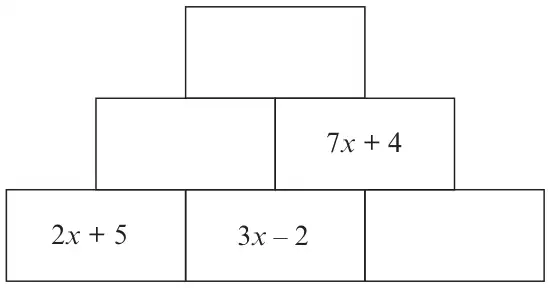
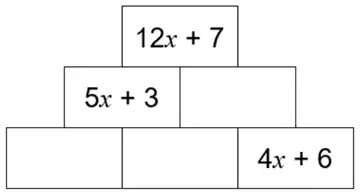
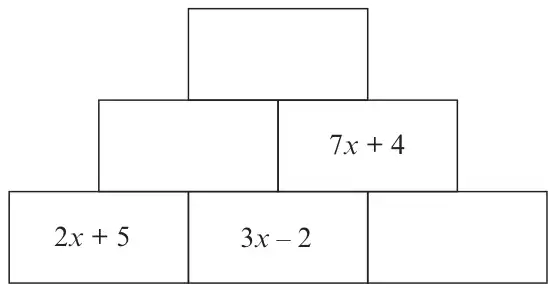
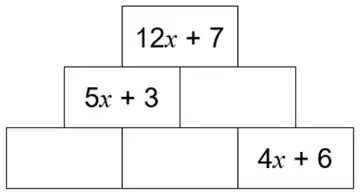
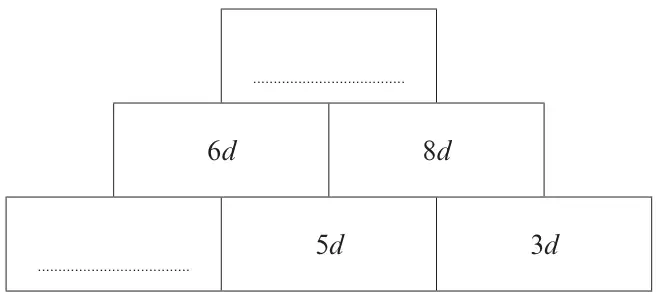
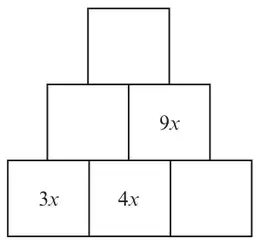
8. Look at the diagram below. The term in each square in the top two rows is found by using the following rule:
The term in any square is the sum of the terms in the two squares below it.
Some terms are already shown. Use the rule to write down the missing terms in the three empty squares. [3]
Mark scheme
Scheme
Marks
Comments
16x 7 x 5 x
B1 B1 B1
FT from middle row to top row
If no marks, award SC1 for 16 and 7 and 5 in correct places.
In the scheme the answers are laid out in the pyramid positions: 16x in the top square, 7x in the middle-row left square, 5x in the bottom-row right square.
(c) Use the formula \(5p + 2q = t\) to find the value of \(q\) when \(p = 4\) and \(t = 24{\cdot}6\). [3]
Mark scheme (a)
Scheme
Marks
Comments
28
B1
Mark final answer. Allow embedded answer. B1 for 28/4 or 28/4 = 7 with no further work. B0 for 28/4 followed by ‘x ≠ 28’.
Mark scheme (b)
Scheme
Marks
Comments
4f + 3g
B2
Must be in an expression for B2. B1 for sight of (+)4f OR B1 for sight of (+)3g. Mark final answer.
Mark scheme (c)
Scheme
Marks
Comments
5 x 4 +2q = 24.6 or equivalent.
M1
2q = 4.6
A1
Implies M1.
( q =) 2.3
A1
FT only from 2q = k. Mark final answer. Allow 3 marks for embedded answer BUT Only two marks if contradicted by ‘q ≠ 2·3’. If no marks gained, allow SC1 for sight of 20 (not 20p) from 5x4 OR allow SC1 for q = 22·3
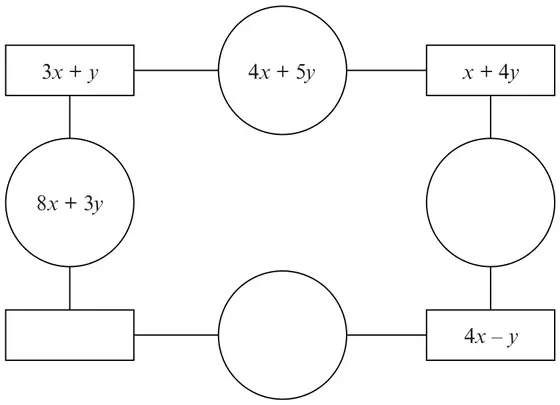
9. Look at the diagram below. The expression in each circle is found by adding the expressions in the rectangles on either side of the circle. Complete the diagram by writing expressions in the blank circles and the blank rectangle. You must simplify your expressions. [3]
Mark scheme
Scheme
Marks
Comments
B3
B1 for 5x + 3y B1 for 5x + 2y Bottom circle F.T. ‘their 5x + 2y’ + 4x – y for B1.
Penalise ‘correct’ but unsimplified expressions −1 once only.
(c) Using the formula \(2T = M + 3K\), find the value of \(K\) when \(T = 11\) and \(M = 4\). [2]
Mark scheme (a)
Scheme
Marks
Comments
5 −2
B2
B1 for 5. B1 F.T. for ‘their 5’ – 7 if negative.
Mark scheme (b)
Scheme
Marks
Comments
7g – 2f
B2
Must be an expression for B2. B1 for sight of (+)7g OR – 2f. B1 for 7g + – 2f. Mark final answer.
Mark scheme (c)
Scheme
Marks
Comments
For sight of 22 = 4 + 3K OR 18 = 3K OR \(\dfrac{22-4}{3}\) (=K)
B1
‘2 × 11’ must be shown to be 22 and used at some stage.
(K=) 6
B1
An answer of 6 gains both B1 marks. Allow an embedded answer e.g. 2×11 = 4 + 3 ×6 gains B2. BUT 22 = 4 + 18 alone is B0. B1B0 for 18/3 as a final answer.
We'd like to use Google Analytics cookies to count visits and see which pages help most. They're optional, and the site works exactly the same either way. Privacy policy