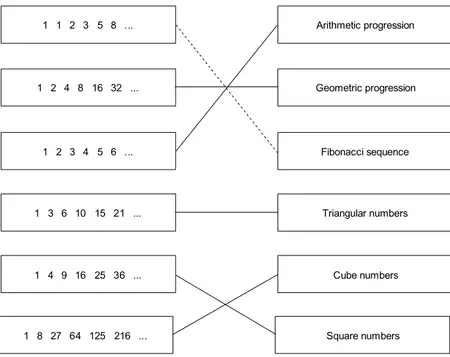
29 The first three terms of a Fibonacci sequence are
\(a\) \(3a\) \(4a\)
The 5th term of this sequence is 286
Work out the value of \(a\). (3)
Mark scheme
Answer
Mark
Mark scheme
26
M1
for continuing the sequence to find the 5th term, eg \(3a + 4a + 4a\ (= 11a)\)
M1
(dep M1) for equating the fifth term with 286, eg \(3a + 4a + 4a = 286\) oe or \(286 \div \text{``}11\text{''}\)
A1
cao
Additional guidance
May be seen next to sequence Award M2 for a correct numerical statement relating 26, 11 and 286
An answer of 26 coming from an incorrect method, eg \(a + 3a + 4a + 7a + 11a = 26a\) scores M1 only unless numerical statement relating 26, 11 and 286 with no \(a\) is seen
Here are the first four terms of a different sequence.
9 15 21 27
(b) Is 63 a number in this sequence? You must give a reason for your answer. (2)
Mark scheme (a)
Answer
Mark
Mark scheme
11
B1
cao
Mark scheme (b)
Answer
Mark
Mark scheme
Yes (supported)
M1
for method to show that 63 is in the sequence, eg starts to list terms of the sequence, with at least 3 correct or \(6n + 3 = 63\) or \((63 - 3) \div 6\ (= 10)\) or \(6 \times 10 + 3\) or \((63 - 27) \div 6\) or \(27 + 6 + 6 + 6 + 6 + 6 + 6\)
A1
eg Yes and 33, 39, 45, 51, 57, 63 Yes and \(n = 10\) Yes and \((63 - 3) \div 6\) is a whole number Yes and \(6 \times 10 + 3 = 63\) Yes and \(63 - 27\) is divisible by 6, and the sequence goes up in 6’s Yes and \(27 + 6 + 6 + 6 + 6 + 6 + 6 = 63\) OR Like all the other terms in the sequence, it is in the 3 times table but not the 6 times table It’s the 10th term / 63 is the 10th term
Additional guidance
33, 39, 45, 51, 57, 63
‘Yes’ can be implied by an equivalent statement eg ‘63 is in the sequence’
Ignore additional incorrect statements but if the statement contradicts award A0 eg ‘33, 39, 45, 51, 57, 63, and yes and it’s the 11th term’ would be M1A0
20 \(x - 4\), \(x + 2\) and \(3x + 1\) are three consecutive terms of an arithmetic sequence.
(a) Find the value of \(x\). (2)
\(y - 4\), \(y + 2\) and \(3y + 1\) are three consecutive terms of a geometric sequence.
(b) Find the possible values of \(y\). (5)
Mark scheme (a)
Answer
Mark
Mark scheme
3.5
P1
for process to find the common difference between the first and second and the common difference between the third and second term eg \((3x + 1) - (x + 2)\ (= 2x - 1)\) and \((x + 2) - (x - 4)\ (= 6)\)
or for process to write a correct equation in \(x\), eg \((3x + 1) - (x + 2) = (x + 2) - (x - 4)\) or \(2x - 1 = 6\) oe
A1
for 3.5 oe eg \(\dfrac{7}{2}\)
Mark scheme (b)
Answer
Mark
Mark scheme
\(-0.5\), 8
P1
for process to write a correct equation in terms of the common ratio and \(y\) eg \(r(y - 4) = y + 2\) or \(r(y + 2) = 3y + 1\)
P1
for process to write a correct equation in \(y\) eg \(\dfrac{3y + 1}{y + 2} = \dfrac{y + 2}{y - 4}\) oe
P1
for process to write a correct equation without fractions eg \((3y + 1)(y - 4) = (y + 2)(y + 2)\) oe
P1
for process of writing a correct simplified equation eg \(2y^2 - 15y - 8\ (= 0)\)
A1
cao
Additional guidance
\(r\) can be any letter apart from \(y\)
The quadratic does not have to equal 0, ie accept \(2y^2 - 15y = 8\)
17 A ball is thrown upwards and reaches a maximum height. The ball then falls and bounces repeatedly.
After the \(n\)th bounce, the ball reaches a height of \(h_n\) After the next bounce, the ball reaches a height given by \(h_{n + 1} = 0.55h_n\)
After the 1st bounce, the ball reaches a height of 8 metres.
What height does the ball reach after the 4th bounce? (3)
Mark scheme
Answer
Mark
Mark scheme
1.331
M1
for method to find height after 2nd bounce, eg \(0.55 \times 8\ (= 4.4)\)
M1
for method to find height after 3rd bounce, eg \(0.55 \times \text{``}4.4\text{''}\ (= 2.4(2))\) or for method to find height after 4th bounce, eg \(0.55^3 \times 8\) or for method to find height after 5th bounce, eg \(0.55^4 \times 8\ (= 0.73(205))\)
A1
for 1.331, accept 1.33, 1.3 oe mixed number
Additional guidance
Award this mark for \(0.55^n \times 8\) where \(n \gt 1\)
If a correct answer is shown and then incorrectly rounded award full marks
16 At the start of year \(n\) the population of a species is \(P_n\)
At the start of the following year the population of the species is given by
\[P_{n + 1} = kP_n \quad \text{where } k \text{ is a positive constant.}\]
The population of the species at the start of year 1 is 8 million. The population of the species at the start of year 2 is 6 million.
(a) Work out the population of the species at the start of year 3 (3)
At the start of year 5 the value of \(k\) is increased by 0.3 to a new constant value.
Louise thinks that from the start of year 5 the population of the species would increase year on year.
(b) Is Louise correct? You must give a reason for your answer. (1)
Mark scheme (a)
Answer
Mark
Mark scheme
4.5
P1
for initial use of formula, eg \(6 = 8k\)
P1
for a full process to find \(P_3\) eg \(\text{``}\dfrac{6}{8}\text{''} \times 6\)
A1
oe
Mark scheme (b)
Answer
Mark
Mark scheme
Explanation
C1
for explanation Acceptable examples Yes, the population will increase as \(k\) is over 1 She is correct because \(1.05 \gt 1\) Yes, each year the population will increase by 5% Yes, because \(0.75 + 0.3 = 1.05\) Yes, a 0.3 increase is greater than the current 0.25 decrease
Not acceptable examples Yes, the population will increase each year Yes, because there is an increase in \(k\) No because 0.3 is less than 0.75
Additional guidance
If figures are given as part of the answer they must be correct, but can allow ft
8 Here are the first four terms of a number sequence.
97 91 85 79
(a) Explain how to work out the next number of the sequence. (1)
(b) Work out the difference between the 5th term and the 7th term of the sequence. (2)
(c) Explain why 52 is not a number in this sequence. (1)
Mark scheme (a)
Answer
Mark
Mark scheme
Explanation
C1
for explanation, eg subtract 6, decrease by 6, going down by 6
Mark scheme (b)
Answer
Mark
Mark scheme
12
M1
for \(73 - 61\) or \(6 \times 2\)
A1
cao
Additional guidance
At least one term must be correct and intention to subtract shown
Accept \(-12\)
Mark scheme (c)
Answer
Mark
Mark scheme
Explanation
C1
for explanation relating to odd and/or even numbers Acceptable 52 is even the sequence is odd numbers it goes to 55 (and you cannot reach 52) it goes to 49 (which has gone past 52) \(n\)th term is \(103 - 6n = 52\) which has no integer solutions 52 is between the 8th and 9th terms
Not acceptable subtracting 6 each time will not lead to 52 it goes past 52
The 4th term of a different geometric sequence is \(\dfrac{5\sqrt{2}}{4}\)
The 6th term of this sequence is \(\dfrac{5\sqrt{2}}{8}\)
Given that the terms of this sequence are all positive,
(b) work out the first term of this sequence. You must show all your working. (3)
Mark scheme (a)
Answer
Mark
Mark scheme
4000
P1
for process to identify the common ratio, eg \(400\sqrt{5} \div 200\ (= 2\sqrt{5})\) or \(200 \div 400\sqrt{5}\ \left(= \dfrac{1}{2\sqrt{5}}\right)\) or for a process to find the next term of the sequence, eg \(200 \times (200 \div 10)\)
A1
cao
Additional guidance
May use any 2 consecutive terms
Mark scheme (b)
Answer
Mark
Mark scheme
5
P1
for process to find the ratio of the 4th and 6th terms, eg \(\dfrac{5\sqrt{2}}{8} \div \dfrac{5\sqrt{2}}{4}\ \left(= \dfrac{1}{2}\right)\) or \(\dfrac{5\sqrt{2}}{4} \div \dfrac{5\sqrt{2}}{8}\ (= 2)\) or for finding that the 2nd term is \(\dfrac{5\sqrt{2}}{2}\)
P1
for complete process to find 1st term, eg \(\dfrac{5\sqrt{2}}{4} \div \left(\dfrac{1}{\sqrt{2}}\right)^3\)
A1
cao
Additional guidance
Award 0 marks for a correct answer with no supportive working
(i) Write down two numbers that could be the 4th and 5th terms of this sequence. (1)
(ii) Write down the rule you used to get your numbers. (1)
Mark scheme
Answer
Mark
Mark scheme
(i) terms given
B1
states two terms eg 11, 10 or 9, 6
(ii) explanation
C1
explanation
Acceptable examples Take away 2 then 1; take away 4 then 3 The difference goes down by 1 each time \(-4, -3;\ -2, -1\) The differences are 4 and 3; the differences are 2 and 1
Not acceptable examples It goes down by 1 each time An algebraic rule
Additional guidance
(i) May be written on the sequence with no contradiction elsewhere
8 Here are the first five terms of a number sequence.
3 8 13 18 23
(a) Write down the next two terms of this sequence. (1)
Jim says that 50 is a term in this sequence. Jim is wrong.
(b) Explain why. (1)
Mark scheme (a)
Answer
Mark
Mark scheme
28 33
B1
cao
Mark scheme (b)
Answer
Mark
Mark scheme
Explanation
C1
for explanation Acceptable examples all terms end in 3 or 8 there are no terms that end in 0 50 does not end in 3 or 8 48 and 53 are both in the sequence (could be shown) 48 is in the sequence and 50 is 2 more \(5n - 2 = 50\) so \(n\) is not a whole number. if it started at 0 then it would but it starts at 3 so it never will or shows sequence continuing up to and beyond 50 Not acceptable examples adding 5 each time will not lead to 50 (insufficient) it goes past 50 the closest number to 50 is 48
Additional guidance
One correct, one incorrect statement gets C1 as long as they are not contradictory.
Here are the first four terms of the sequence of triangle numbers.
1 3 6 10
(b) Find the 8th term of this sequence. (2)
Mark scheme (a)
Answer
Mark
Mark scheme
Explanation
C1
for explanation Acceptable examples the sequence is going +1, +2 so the next term is +3 \(1 + 1 = 2,\ 2 + 2 = 4,\ 4 + 3 = 7\) add the current term position to the term to get the next term add the two previous terms and add 1 Not acceptable examples you add 1 each time the number goes up by 3 7 is wrong it should be 8 because you double each time
Additional guidance
The pattern may be just seen on the sequence given
Mark scheme (b)
Answer
Mark
Mark scheme
36
M1
for finding the next term of \(10 + 5\ (= 15)\) or for \(\frac{1}{2} \times 8 \times (8 + 1)\) oe
13 The first term of a sequence of numbers is 24 The term-to-term rule of this sequence is ‘add 8’
Josie says,
“No number in this sequence is in the 5 times table.”
(a) Give an example to show that Josie is wrong. (1)
(b) Is 85 a number in this sequence? Give a reason for your answer. (1)
Mark scheme (a)
Answer
Mark
Mark scheme
example
C1
example given eg 40, 80, etc.
Mark scheme (b)
Answer
Mark
Mark scheme
No with reason
C1
for No with reason Acceptable examples 80 and 88 are both in the sequence 80 is in the sequence and 85 is 5 more 24, 32, ..... 80, 88, .... 85 is not in the 8 times table 85 is an odd number \(8n+16=85\) so \(n\) is not a whole number. Not acceptable examples adding 8 each time will not lead to 85 (insufficient) it goes past 85 Yes .....
(a) The \(n\)th term of a sequence is \(3n + 4\) Explain why 21 is not a term of this sequence. (2)
(b) Here are the first three terms of a different sequence.
1 2 4
Write down two numbers that could be the 4th term and the 5th term of this sequence. Give the rule you have used to get your numbers. (2)
Mark scheme (a)
Answer
Mark
Mark scheme
Explanation
C2
full explanation eg explains that both 19 and 22 are terms in the sequence or solves \(3n + 4 = 21\) to find \(n = 17/3\) oe
Acceptable examples 19 is in the sequence and 19 + 3 is more than 21 The 5th term is 19 and the 6th term is 22 7, 10, 13, 16, 19, 22 17 is not in the 3 times table Because 21 is in the 3 times table and the sequence is plus 4
(C1
for substituting to find a term in the sequence or forming an equation eg \(3n + 4 = 21\) or for a partial explanation or an explanation with some ambiguity)
Acceptable examples The closest number is 22 \(3 \times 6 = 18\), 18 + 4 is higher than 21 19 is in the sequence so 21 can’t be in the sequence. Starting at 7 and adding 3 each time won’t lead to 21 It’s the 3 times table plus 4 21 is in the 3 times table
Not acceptable examples Adding 4 each time won’t lead to 21 It doesn’t end up at 21, it goes past it
Additional guidance
7, 10, 13, 16, 19, 22, ...
Mark scheme (b)
Answer
Mark
Mark scheme
terms given
B1
states two terms eg 7,11 or 8,16 or 5, 7
explanation
C1
explanation eg add one more each time, doubling
Acceptable examples Add 3 and add 4 The difference goes up by one each time It doubles +1, +2, +1, +2 or indicates +1, +2 repeats itself
Not acceptable examples It goes up by 1 each time It doubles so \(2n\) +1, +2, +3, +4 so \(2n + 1\)
Additional guidance
May be indicated on the sequence with no contradictory statement made
16 The \(n\)th term of a sequence is given by \(an^2 + bn\) where \(a\) and \(b\) are integers.
The 2nd term of the sequence is \(-2\) The 4th term of the sequence is 12
(a) Find the 6th term of the sequence. (4)
Here are the first five terms of a different quadratic sequence.
0 2 6 12 20
(b) Find an expression, in terms of \(n\), for the \(n\)th term of this sequence. (2)
Mark scheme (a)
Answer
Mark
Mark scheme
42
P1
for process to find an equation in \(a\) and \(b\), eg \(a \times 2^2 + b \times 2 = -2\) (\(4a + 2b = -2\)) or \(a \times 4^2 + b \times 4 = 12\) (\(16a + 4b = 12\))
P1
for process to find a pair of simultaneous equations and eliminate one unknown, eg \(16a + 8b = -8\) and \(16a + 4b = 12\) and subtraction or \(16a + 4b = 12\) and \(8a + 4b = -4\) and subtraction
A1
for \(a = 2\) and \(b = -5\)
A1
cao
Additional guidance
Allow one arithmetic error in elimination, eg \(16a + 8b = -8\) and \(16a + 4b = 12\) leading to \(4b = 20\) but no subtraction sign seen
(a) Given that \((\sqrt{x} - 1)\), 1 and \((\sqrt{x} + 1)\) are the first three terms of S, find the value of \(x\). You must show all your working. (3)
(b) Show that the 5th term of S is \(7 + 5\sqrt{2}\) (2)
Mark scheme (a)
Answer
Mark
Notes
2
M1
for start to express the common ratio algebraically, eg \(1/(\sqrt{x} - 1)\) or \((\sqrt{x} + 1)/1\) or \(\sqrt{x} + 1 = k \times 1\) or \(1 = k \times (\sqrt{x} - 1)\)
M1
for setting up an appropriate equation in \(x\), eg \(1/(\sqrt{x} - 1) = (\sqrt{x} + 1)/1\)
C1
for convincing argument to show \(x = 2\)
Mark scheme (b)
Answer
Mark
Notes
Shown
M1
for expressing the relationship between the common ratio, one of the first three terms of the sequence and the fifth term, eg 5th term = 3rd term × (common ratio)²
C1
for a complete explanation to include eg, \((\sqrt{2} + 1)(\sqrt{2} + 1)^2 = 7 + 5\sqrt{2}\)
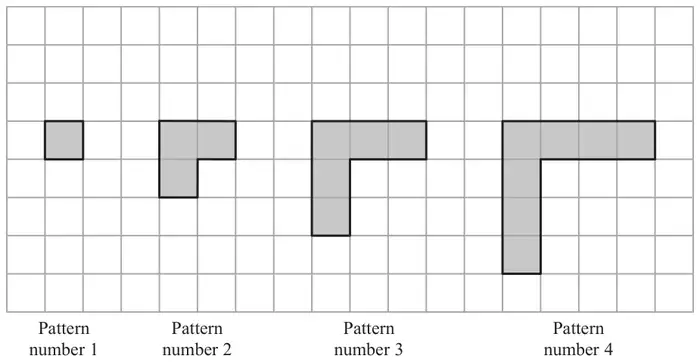
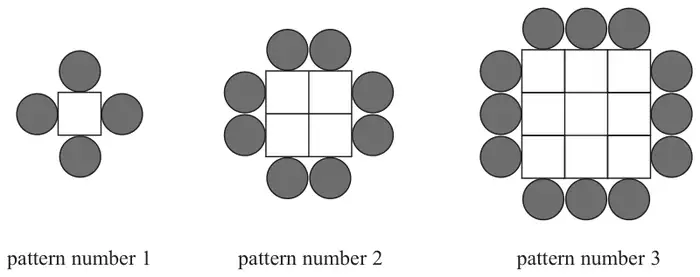
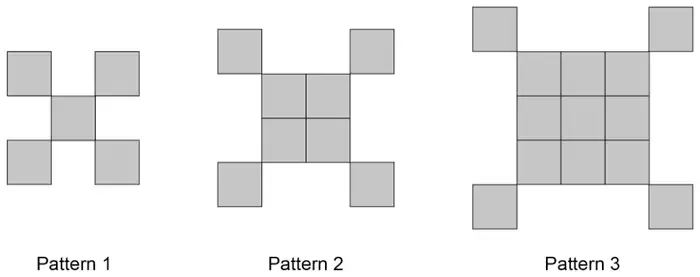
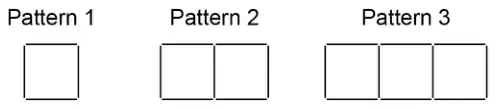
18 Here is a sequence of patterns made with counters.
(a) Find an expression, in terms of \(n\), for the number of counters in pattern number \(n\). (2)
Bayo has 90 counters.
(b) Can Bayo make a pattern in this sequence using all 90 of his counters? You must show how you get your answer. (2)
Mark scheme (a)
Answer
Mark
Notes
\(3n + 1\)
M1
for a method to deduce the \(n\)th term, eg. \(3n + k\), where \(k\) is an integer or \(k\) is omitted or for \(n = 3n + 1\)
A1
for \(3n + 1\) oe (accept \(n\) replaced by another letter)
Mark scheme (b)
Answer
Mark
Notes
No (supported)
C1
for using (their expression in (a)) = 90 or shows that 88 or 91 is in the sequence
C1
for an answer of “No” and a convincing argument eg. pattern number 30 has 91 counters or \((90 - 1) \div 3\ (= 29.66\ldots)\) or shows that the next term after 88 is 91 Note: no ft from (a)
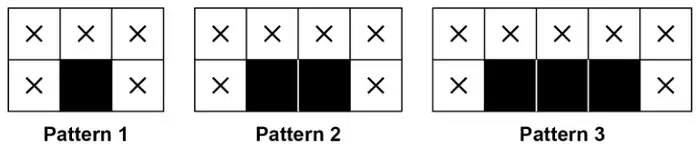
11 A sequence of patterns is made from circular tiles ● and square tiles □
Here are the first three patterns in the sequence.
(a) How many square tiles are needed to make pattern number 6? (2)
(b) How many circular tiles are needed to make pattern number 20? (2)
Derek says,
“When the pattern number is odd, an odd number of square tiles is needed to make the pattern.”
(c) Is Derek right? You must give reasons for your answer. (2)
Mark scheme (a)
Answer
Mark
Notes
36
M1
demonstrates the start of a method that could lead to the answer, eg recognition of square numbers, or use of differences, or diagrams
A1
cao
Mark scheme (b)
Answer
Mark
Notes
80
M1
demonstrates the start of a method that could lead to the answer, eg repeated addition of 4, or \(20 \times 4\)
A1
cao
Mark scheme (c)
Answer
Mark
Notes
C2
conclusion with supportive evidence, eg odd \(\times\) odd = odd, or all odd numbers squared will be odd.
(C1)
(e.g. starts to work with (generate) square numbers for odd patterns or \((2n + 1)^2\) eg \(1 \times 1 = 1\), or generates sequence for squares using differences)
(b) A sequence has \(n\)th term \(\quad 3n^2 + 5n + 2\)
Are any of the terms in the sequence a prime number?
Tick a box.
Yes
No
Give a reason for your answer. [1 mark]
Mark scheme (a)
Answer
Mark
Comments
\((3n + 2)(n + 1)\)
B2
oe product of brackets any consistent letter condone = 0 ignore any attempt to solve B1 \((3n + 2)\) or \((n + 1)\) seen in a product of 2 linear brackets or \(3n(n + 1) + 2(n + 1)\) or \(n(3n + 2) + (3n + 2)\)
Additional guidance
\((3n + 2)(n + 1) + k\)
B1
Mark scheme (b)
Answer
Mark
Comments
No and valid reason
B1
valid reasons include the sequence is always even and greater than 2 \(n + 1\) and \(3n + 2\) cannot be equal to 1 each term can be made by multiplying (whole) numbers together not equal to 1 \(n + 1\) and \(3n + 2\) are factors not equal to 1
Additional guidance
Yes ticked
B0
No reason given
B0
No ticked, and every term in the sequence is even and the first term is 10
B1
No ticked, and odd + odd + 2 is even, even + even + 2 is even and first term is 10
Work out an expression for the \(n\)th term. [3 marks]
Mark scheme
Answer
Mark
Comments
\(2n^2 + 3n + 1\) or \(a = 2\) and \(b = 3\) and \(c = 1\)
B3
B2 \(2n^2 + 3n\ (+\,c)\) or \(a = 2\) and \(b = 3\) or \(2n^2\ (+\,bn) + 1\) or \(a = 2\) and \(c = 1\) B1 \(2n^2\ (+\,bn + c)\) or \(a = 2\) or \(an^2\ (+\,bn) + 1\) with \(a \ne 0\) or \(c = 1\) or second difference = 4
Additional guidance
Terms may be in any order
Second difference = 4 scores B1 even if used incorrectly eg answer \(8n\)
4 must be the second difference to score B1 eg answer \(5n + 4\) with no working or statement that 4 is the second difference
may be embedded in or implied by an inequality or equation eg \((n - 15)^2 - 15^2 + 236 = 10\) \((n - 15)^2 - 15^2 + 236 \gt 10\) \((n - 15)^2 \gt -1\)
Valid explanation with M1 seen
A1
eg M1 seen and all the terms must be 11 or more or \((n - 15)^2 \geqslant 0\) and 11 is added
Additional guidance
Condone a different letter used eg \(x\)
M2 and all the terms must be greater than 11
M2A0
M2 and the 15th term is the smallest
M2A0
Least term is 11 with no working for completing the square
M0
M2 and squaring a bracket always has two digits then adding 11 means it has at least two digits
M2A0
\((n - 15)(n - 15)\) is equivalent to \((n - 15)^2\)
\((n - 15n)^2\)
M0
Ignore incorrect work after M2 eg \((n - 15)^2 + 11 = 0\)
M2
Condone \((n - 15)^2\) is positive and 11 is added
oe \(39 - 10 - 10\) implies M1M1 (3rd term \(=\)) 48 implies M1M1 may be implied by the difference, after their 2nd term, consistently being the correct 19 \(19n\) may be seen as part of \(19n + b\)
their \(29 + 3 \times\) their 19 or \(10 + 4 \times\) their 19 or substitutes \(n = 5\) into expression of the form their \(19n + b\)
M1dep
oe (4th term \(=\)) 67 implies M1M1M1 \(b\) must be an integer
86
A1
SC1 107 or 137 using Fibonacci SC1 126 using difference of 29
Additional guidance
3rd mark must be a correct method for working out the 5th term
Going past the 5th term eg 10, 29, 48, 67, 86, 105, without answer 86
M1M1M1A0
\(10 + 19 = 39\) 10, 39, 58, 77, 96 (not the correct 19 being added)
25 The \(n\)th term of a geometric progression is \(\quad r^n \quad\) where \(\quad r \gt 0\)
The second term is \(\dfrac{8}{9}\)
Work out the third term.
Give your answer in the form \(\quad \dfrac{c\sqrt{2}}{d} \quad\) where \(c\) and \(d\) are integers. [2 marks]
Mark scheme
Answer
Mark
Comments
\(r^2 = \dfrac{8}{9}\) or \(\sqrt{\dfrac{8}{9}}\) or \(\dfrac{2\sqrt{2}}{\sqrt{9}}\) or \(\dfrac{\sqrt{8}}{3}\) or \(\dfrac{2\sqrt{2}}{3}\) or \(\left(\sqrt{\dfrac{8}{9}}\right)^3\) or \(\dfrac{8\sqrt{8}}{27}\)
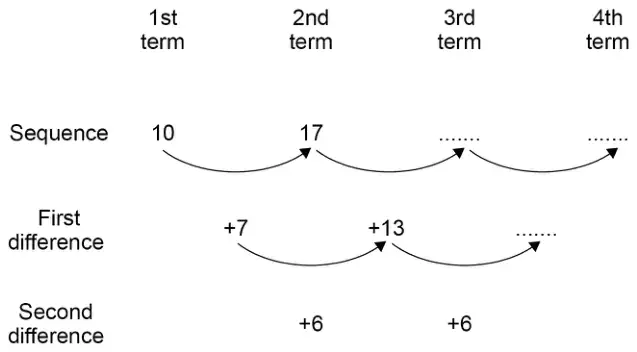
19 Here are the first four terms of a quadratic sequence.
\[3 \qquad 20 \qquad 47 \qquad 84\]
Work out an expression for the \(n\)th term of the sequence. [4 marks]
Mark scheme
Answer
Mark
Comments
Alternative method 1 \(n\)th term \(= an^2 + bn + c\)
(second differences =) 10 or \(a = 5\) or \(5n^2\)
M1
second difference seen at least once and not contradicted by a different value unless recovered may be seen by the sequence
\(3 - 5 \times 1^2\) and \(20 - 5 \times 2^2\) or \(-2\) and 0 or \(b = 2\) or \(2n\)
M1dep
oe subtraction of \(5n^2\) from any two consecutive terms eg \(47 - 5 \times 3^2\) and \(84 - 5 \times 4^2\) or 2 and 4 implied by \(5n^2 + 2n \ldots\)
\(5 \times 1^2 + 2 \times 1 + c = 3\) or \(5 + 2 + c = 3\) or (\(2n + c\) and) \(2 \times 1 + c = -2\)
M1dep
oe substitution of \(a = 5\) and \(b = 2\) eg \(5 \times 2^2 + 2 \times 2 + c = 20\) or oe use of \(2n + c\) and another term eg (\(2n + c\) and) \(2 \times 2 + c = 0\)
\(5n^2 + 2n - 4\)
A1
terms in any order SC2 \(a = 5\) and \(c = -4\) SC1 \(c = -4\)
Alternative method 2 \(n\)th term \(= an^2 + bn + c\)
(second differences =) 10 or \(a = 5\) or \(5n^2\)
M1
second difference seen at least once and not contradicted by a different value unless recovered may be seen by the sequence
\(3 \times 5 + b = 17\) or \(b = 2\) or \(2n\)
M1dep
oe substitution of \(a = 5\) eg \(5 \times 5 + b = 27\) implied by \(5n^2 + 2n \ldots\)
\(5 \times 1^2 + 2 \times 1 + c = 3\) or \(5 + 2 + c = 3\)
M1dep
oe substitution of \(a = 5\) and \(b = 2\) eg \(5 \times 2^2 + 2 \times 2 + c = 20\)
\(5n^2 + 2n - 4\)
A1
terms in any order SC2 \(a = 5\) and \(c = -4\) SC1 \(c = -4\)
Alternative method 3 \(n\)th term \(= an^2 + bn + c\)
Any 3 of \(a + b + c = 3\) \(4a + 2b + c = 20\) \(9a + 3b + c = 47\) \(16a + 4b + c = 84\)
M1
oe 3 equations
\(3a + b = 17\) and \(5a + b = 27\) or \(a = 5\) and \(b = 2\)
M1dep
oe pair of equations in \(a\) and \(b\) eg \(8a + 2b = 44\) and \(15a + 3b = 81\) implied by \(5n^2 + 2n \ldots\)
\(5 \times 1^2 + 2 \times 1 + c = 3\) or \(5 + 2 + c = 3\)
M1dep
oe substitution of \(a = 5\) and \(b = 2\) eg \(5 \times 2^2 + 2 \times 2 + c = 20\)
\(5n^2 + 2n - 4\)
A1
terms in any order SC2 \(a = 5\) and \(c = -4\) SC1 \(c = -4\)
Additional guidance
Up to M3 may be awarded for correct work with no answer or incorrect answer, even if this is seen amongst multiple attempts
Second differences = 10 scores M1 even if used incorrectly eg \(10n \ldots\)
The \(x\)-values in the table make a linear sequence.
The \(y\)-values in the table make a different linear sequence.
(a) Complete the table. [2 marks]
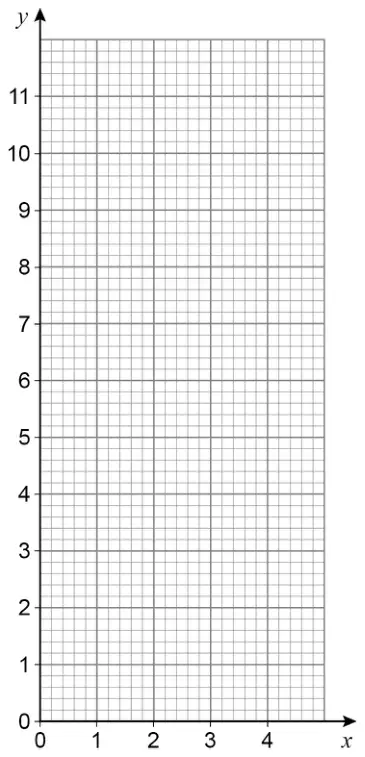
(b) Draw a straight line passing through the points (0, 3), (2, 7) and (4, 11) [2 marks]
(c) Use the graph to work out the value of \(y\) when \(\;x = 3\) [1 mark]
Mark scheme (a)
Answer
Mark
Comments
\((x =)\) 10 and \((y =)\) 15
B2
B1 \((x =)\) 10 or \((y =)\) 15
Additional guidance
\(x\)
0
2
4
6
8
10
\(y\)
3
7
11
15
19
23
B2
Mark scheme (b)
Answer
Mark
Comments
Straight line from (0, 3) to (4, 11)
B2
B1 at least two of (0, 3), (2, 7) and (4, 11) plotted or straight line from (0, 3) to (2, 7) or straight line from (2, 7) to (4, 11) \(\pm\dfrac{1}{2}\) square
Additional guidance
B2 or B1 may be awarded for a straight line without points plotted
Mark intention
Ignore line drawn after (4, 11)
Two points plotted with the same \(x\)-coordinate is choice unless the line is drawn through one of the points
Mark scheme (c)
Answer
Mark
Comments
9
B1ft
correct or ft their line in (b) \(\pm\dfrac{1}{2}\) square
(b) The term-to-term rule for a different sequence is
subtract \(k\)
The 1st term is 34 The 4th term is 10
Work out the value of \(k\). [3 marks]
Mark scheme (a)
Answer
Mark
Comments
\(46 \div 2\) or 23 or \(4x = 46\)
M1
oe
their \(23 \div 2\) or \(46 \div 2 \div 2\) or \(46 \div 4\)
M1dep
oe may be seen as a fraction eg \(\dfrac{23}{2}\) or \(11\dfrac{1}{2}\) or \(\dfrac{46}{4}\) or \(11\dfrac{2}{4}\)
11.5
A1
SC2 5.75 or 11 remainder 1
Additional guidance
\(46 \div 2 = 25\), (\(25 \div 2 =\)) 12.5
M1M1A0
\(46 \div 2 = 24\), followed by 11
M1M0A0
11.5 in working, different answer on answer line (do not ignore further work)
M1M1A0
Mark scheme (b)
Answer
Mark
Comments
Alternative method 1
\(34 - k\) or \(34 - 10\) or 24
M1
oe implied by \(34 - 2k\) or \(34 - 3k\)
\(3k = 34 - 10\) or \(3k =\) their 24 or \(\dfrac{34 - 10}{3}\) or \(\dfrac{\text{their } 24}{3}\)
M1dep
oe
8
A1
SC2 \(-8\) or all terms seen 34, 26, 18, 10 SC1 6
Alternative method 2
\(10 + k\) or \(34 - 10\) or 24
M1
oe implied by \(10 + 2k\) or \(10 + 3k\)
\(10 + 3k = 34\) or \(3k =\) their 24 or \(\dfrac{34 - 10}{3}\) or \(\dfrac{\text{their } 24}{3}\)
M1dep
oe
8
A1
SC2 \(-8\) or all terms seen 34, 26, 18, 10 SC1 6
Alternative method 3
One correct trial
M1
a correct trial is either a subtraction of the same value, exactly three times, from 34 and evaluated correctly or addition of the same value, exactly three times, from 10 and evaluated correctly
22 A sequence of patterns is made using horizontal sticks and vertical sticks.
The table shows the number of horizontal sticks and vertical sticks in each pattern.
Pattern
Number of horizontal sticks
Number of vertical sticks
1
2
2
2
4
3
3
6
4
What fraction of the total number of sticks in Pattern \(n\) are horizontal?
Give your answer in terms of \(n\). [3 marks]
Mark scheme
Answer
Mark
Comments
\(\dfrac{2n}{3n + 1}\)
B3
oe eg \(\dfrac{2n}{2n + (n + 1)}\) B2 any two correct \(n\)th terms from \(2n\) or \(n + 1\) or \(3n + 1\) B1 any one correct \(n\)th term from \(2n\) or \(n + 1\) or \(3n + 1\)
Additional guidance
May be seen in a fraction or added eg \(2n + (n + 1)\)
B2
Do not accept \(2n\) embedded in an incorrect expression eg \(2n - 2\)
21 The first two terms of a quadratic sequence are 10 and 17
Here is some information about the sequence.
Work out an expression for the \(n\)th term of the sequence. [4 marks]
Mark scheme
Answer
Mark
Comments
Alternative method 1: using the left hand values
(\(a\) =) \(6 \div 2\) or (\(a\) =) 3
M1
implied by \(3n^2 \ldots\)
\(3 \times\) their \(3 + b = 7\) or \(b = -2\)
M1dep
oe \(3n^2 - 2n \ldots\) implies M1M1
\(3 +\) their \(-2 + c = 10\) or \(c = 9\)
M1dep
oe
\(3n^2 - 2n + 9\)
A1
SC1 30 and 49 as the next two terms
Alternative method 2: subtracting \(3n^2\) to get a linear sequence
(\(a\) =) \(6 \div 2\) or (\(a\) =) 3
M1
implied by \(3n^2 \ldots\)
\(10 -\) their \(3 \times 1^2\) or 7 and \(17 -\) their \(3 \times 2^2\) or 5 or \(b = -2\)
M1dep
oe using any two terms \(3n^2 - 2n \ldots\) implies M1M1
(their 5 − their 7) (\(\times\) 1) \(+ c = 7\) or \(-2\) (\(\times\) 1) \(+ c = 7\) or \(c = 9\)
M1dep
oe equation using any term
\(3n^2 - 2n + 9\)
A1
SC1 30 and 49 as the next two terms
Alternative method 3: simultaneous equations
Simultaneous equations leading to a fully correct method to work out \(a\) or \(b\) or \(a = 3\) or \(b = -2\)
M1
eg \(a + b + c = 10\) and \(4a + 2b + c = 17\) and \(9a + 3b + c = 30\) and \(3a + b = 7\) and \(5a + b = 13\) and \(2a = 6\) and (\(a\) =) 3 implied by \(3n^2 \ldots\) or \(\ldots -2n \ldots\)
Substitutes for \(a\) or \(b\) in one or two of the simultaneous equations with fully correct method to work out the other value
M1dep
eg \(3 \times\) their \(3 + b = 7\) or \(b = -2\) \(3n^2 - 2n \ldots\) implies M1M1
Substitutes for \(a\) & \(b\) to work out \(c\) or \(c = 9\)
M1dep
any term eg \(3 - 2 + c = 10\)
\(3n^2 - 2n + 9\)
A1
SC1 30 and 49 as the next two terms
Alternative method 4: Using the ‘0th’ term to get \(c\)
(\(a\) =) \(6 \div 2\) or (\(a\) =) 3
M1
implied by \(3n^2 \ldots\)
\(0n^2 + 0n + c = 9\) or \(c = 9\)
M1
their \(3 + b +\) their \(9 = 10\) or \(b = -2\)
M1dep
oe dep on M2
\(3n^2 - 2n + 9\)
A1
SC1 30 and 49 as the next two terms
Additional guidance
In all cases \(a\), \(b\) and \(c\) refer to the general expression for the \(n\)th term of a quadratic sequence \(an^2 + bn + c\)
Condone \(n = 3n^2 - 2n + 9\) and accept any letter for \(n\)
Note that \(b = -2\) does not imply a specific number of marks
(a) All the terms of a geometric progression are positive.
The second and fourth terms are shown.
………. 4 ………. 16
Work out the first and third terms. [2 marks]
(b) The first two terms of an arithmetic progression are shown.
\(p\) \(5p\) …..
The sum of the first three terms is 90
Work out the value of \(p\). [3 marks]
Mark scheme (a)
Answer
Mark
Comments
First term 2 and Third term 8
B2
B1 one correct or First term \(2^1\) or Third term \(2^3\) or First term \(-2\) and Third term \(-8\) or \(4x^2 = 16\) (any letter) oe equation or \(ar = 4\) and \(ar^3 = 16\)
Additional guidance
If answer lines are blank, mark progression first and then working lines
Correct answer for 1st term or 3rd term in the progression, but incorrect numerical term on answer line
B0 for that term
Correct answer for 1st term or 3rd term in the progression, with non-contradictory algebraic term on answer line
B1 for that term
Correct answers for 1st term and 3rd term in the progression, with non-contradictory algebraic terms on answer lines
B2
First term 2 Third term \(2^3\)
B1
First term \(-2\) Third term 10
B0
\(4x = \dfrac{16}{x}\) (any letter)
B1
Mark scheme (b)
Answer
Mark
Comments
Alternative method 1
3rd term \(= 9p\)
M1
oe implied by a total of \(15p\)
\(p + 5p +\) their 3rd term \(= 90\) or \(15p = 90\)
M1
oe their 3rd term must be a linear expression in terms of \(p\) \(90 \div 15\) implies M1M1
6
A1ft
ft their 3rd term, which must be a linear expression in \(p\), or their equation in the form sum of 3 linear terms in \(p = 90\) allow ft answers rounded to 1dp or better
Alternative method 2
\(90 \div 3\) or 30
M1
oe
\(5p =\) their 30
M1dep
oe
6
A1
Additional guidance
For A1ft, if not an integer, the answer must be given as a decimal, fully simplified fraction or fully simplified mixed number Once awarded, ignore further incorrect conversions eg \(p + 5p + 25p = 90\), \(31p = 90\), \(p = \dfrac{90}{31}\), \(p = 3\) (ignore conversion)
M0M1A1ft
Their 3rd term may first appear in their addition, eg \(p + 5p + 10p = 90\) implies that \(10p\) is their 3rd term
Sum \(15p\) and/or answer 6 may come from incorrect 3rd term, eg eg1 (3rd term \(10p\)), \(p + 5p + 10p = 15p\), \((15p = 90)\), \(p = 6\) receives 2nd mark only; they have an incorrect 3rd term and an incorrect total for their 3 terms, but their answer is correct for their total, so equating to 90 is implied even if not seen eg2 (3rd term \(10p\)), \(p\), \(5p\), \(10p\), \(15p = 90\), \(p = 6\)
M0M1A0ft M0M0A0ft
If their 3rd term has an algebraic coefficient the 2nd mark can be awarded for a correct equation, but A1 cannot be awarded eg (3rd term \(np\)), \(p + 5p + np = 90\)
(b) The first two terms of an arithmetic progression are shown.\[p \qquad 5p \qquad \ldots\]
The sum of the first three terms is 90
Work out the value of \(p\). [3 marks]
Mark scheme (a)
Answer
Mark
Comments
First term 2 and Third term 8
B2
B1 one correct or First term \(2^1\) or Third term \(2^3\) or First term \(-2\) and Third term \(-8\) or \(4x^2 = 16\) (any letter) oe equation or \(ar = 4\) and \(ar^3 = 16\)
Additional guidance
If answer lines are blank, mark progression first and then working lines
Correct answer for 1st term or 3rd term in the progression, but incorrect numerical term on answer line
B0 for that term
Correct answer for 1st term or 3rd term in the progression, with non-contradictory algebraic term on answer line
B1 for that term
Correct answers for 1st term and 3rd term in the progression, with non-contradictory algebraic terms on answer lines
B2
First term 2 Third term \(2^3\)
B1
First term \(-2\) Third term 10
B0
\(4x = \dfrac{16}{x}\) (any letter)
B1
Mark scheme (b)
Answer
Mark
Comments
Alternative method 1
3rd term \(= 9p\)
M1
oe implied by a total of \(15p\)
\(p + 5p +\) their 3rd term \(= 90\) or \(15p = 90\)
M1
oe their 3rd term must be a linear expression in terms of \(p\) \(90 \div 15\) implies M1M1
6
A1ft
ft their 3rd term, which must be a linear expression in \(p\), or their equation in the form sum of 3 linear terms in \(p = 90\) allow ft answers rounded to 1dp or better
Alternative method 2
\(90 \div 3\) or 30
M1
oe
\(5p =\) their 30
M1dep
oe
6
A1
Additional guidance
For A1ft, if not an integer, the answer must be given as a decimal, fully simplified fraction or fully simplified mixed number Once awarded, ignore further incorrect conversions eg \(p + 5p + 25p = 90\), \(31p = 90\), \(p = \dfrac{90}{31}\), \(p = 3\) (ignore conversion)
M0M1A1ft
Their 3rd term may first appear in their addition, eg \(p + 5p + 10p = 90\) implies that \(10p\) is their 3rd term
Sum \(15p\) and/or answer 6 may come from incorrect 3rd term, eg eg1 (3rd term \(10p\)), \(p + 5p + 10p = 15p\), \((15p = 90)\), \(p = 6\) receives 2nd mark only; they have an incorrect 3rd term and an incorrect total for their 3 terms, but their answer is correct for their total, so equating to 90 is implied even if not seen eg2 (3rd term \(10p\)), \(p\), \(5p\), \(10p\), \(15p = 90\), \(p = 6\)
M0M1A0ft
M0M0A0ft
If their 3rd term has an algebraic coefficient the 2nd mark can be awarded for a correct equation, but A1 cannot be awarded eg (3rd term \(np\)), \(p + 5p + np = 90\)
Work out the 100th term of the sequence. [3 marks]
Mark scheme
Answer
Mark
Comments
Alternative method 1
\(21 - 17\) or \(17 - 21\) or \(17 + 4\) or \(21 - 4\) or (difference is) 4 or (7th term =) \(21 + 4\) or 25 or (4th term =) \(17 - 4\) or 13
M1
may be seen as 17 21 with 4 between allow (difference is) \(-4\)
\(17 + (100 - 5) \times 4\) or \(17 + 95 \times 4\) or 17 + 380 or \(21 + (100 - 6) \times 4\) or \(21 + 94 \times 4\) or 21 + 376 or \(17 - 4 \times 4 + 99 \times 4\) or \(1 + 99 \times 4\) or 1 + 396 or \(17 - 5 \times 4 + 100 \times 4\) or \(-3 + 100 \times 4\) or \(-3 + 400\)
M1dep
must be using 4 oe calculation that would evaluate to 397 5th term \(+ 95 \times 4\) 6th term \(+ 94 \times 4\) 1st term \(+ 99 \times 4\) 0th term \(+ 100 \times 4\)
397
A1
Alternative method 2
\(4n\)
M1
oe eg \(n \times 4\)
\(4n - 3\)
A1
oe
397
A1
Additional guidance
Term to term rule described eg Add on 4 each time
M1
\(a + 5d = 21\), \(a + 4d = 17\) only
M0
Difference shown as 4 then eg \(n + 4\)
M1
Only eg \(n + 4\) or \(3n + 4\)
M0
\(4n - 3\) seen even if not subsequently used
M1A1
\(4n\) seen eg \(4n + 13\) even if not subsequently used
M1
Correct list going up in 4s stopping at 397
M1M1A1
List going up in 4s with an error or not reaching 397
M1M0A0
No subtraction seen and incorrect difference eg 17 21 with +3 between
13 The \(n\)th term of a sequence is \(\quad \dfrac{n(n - 4)}{\sqrt{n + 3}}\)
Work out the sum of the 1st and 6th terms. [3 marks]
Mark scheme
Answer
Mark
Comments
\(\dfrac{1(1 - 4)}{\sqrt{1 + 3}}\) or \(\dfrac{-3}{\sqrt{4}}\) or \(\dfrac{6(6 - 4)}{\sqrt{6 + 3}}\) or \(\dfrac{6 \times 2}{\sqrt{9}}\) or \(\dfrac{12}{3}\) or \(\dfrac{4}{1}\)
Work out the 100th term of the sequence. [3 marks]
Mark scheme
Answer
Mark
Comments
Alternative method 1
\(21 - 17\) or \(17 - 21\) or \(17 + 4\) or \(21 - 4\) or (difference is) 4 or (7th term =) \(21 + 4\) or 25 or (4th term =) \(17 - 4\) or 13
M1
may be seen as 17 21 with 4 between them allow (difference is) \(-4\)
\(17 + (100 - 5) \times 4\) or \(17 + 95 \times 4\) or \(17 + 380\) or \(21 + (100 - 6) \times 4\) or \(21 + 94 \times 4\) or \(21 + 376\) or \(17 - 4 \times 4 + 99 \times 4\) or \(1 + 99 \times 4\) or \(1 + 396\) or \(17 - 5 \times 4 + 100 \times 4\) or \(-3 + 100 \times 4\) or \(-3 + 400\)
M1dep
must be using 4 oe calculation that would evaluate to 397 5th term \(+ 95 \times 4\) 6th term \(+ 94 \times 4\) 1st term \(+ 99 \times 4\) 0th term \(+ 100 \times 4\)
397
A1
Alternative method 2
\(4n\)
M1
oe eg \(n \times 4\)
\(4n - 3\)
A1
oe
397
A1
Additional guidance
Term to term rule described eg Add on 4 each time
M1
\(a + 5d = 21\), \(a + 4d = 17\) only
M0
Difference shown as 4 then eg \(n + 4\)
M1
Only eg \(n + 4\) or \(3n + 4\)
M0
\(4n - 3\) seen even if not subsequently used
M1A1
\(4n\) seen eg \(4n + 13\) even if not subsequently used
M1
Correct list going up in 4s stopping at 397
M1M1A1
List going up in 4s with an error or not reaching 397
M1M0A0
No subtraction seen and incorrect difference eg 17 21 with +3 between them
29 The \(n\)th term of a sequence is \(\qquad 12n - 5\)
Work out the numbers in the sequence that
have two digits and are not prime. [3 marks]
Mark scheme
Answer
Mark
Comments
55 and 91
B3
B2 for (7), 19, 31, 43, 55, 67, 79, 91 or 55 identified with 0 or 1 incorrect answer or 91 identified with 0 or 1 incorrect answer or 55 and 91 identified with 1 incorrect answer
B1 at least 2 correct two-digit numbers from the sequence seen
Additional guidance
The correct sequence is (7), 19, 31, 43, 55, 67, 79, 91 Ignore continuation of sequence beyond 91
Ignore further working unless contradictory
55 and 91 identified and 5th and 8th terms stated (ignore fw)
B3
55 and 91 identified and answer 2 (or there are 2) (ignore fw)
B3
55 identified and 5th stated (ignore fw)
B2
Condone 5 or 5th as final answer provided there is a clear link to 55 eg \(12 \times 5 = 60 - 5 = 55\) \(55 \div 11 = 5\) 5 on answer line
B2
Condone 8 or 8th as final answer provided there is a clear link to 91 eg \(12 \times 8 = 96 - 5 = 91\) 8 on answer line
10 The \(n\)th term of a sequence is \(\quad 12n - 5\)
Work out the numbers in the sequence that
have two digits and are not prime. [3 marks]
Mark scheme
Answer
Mark
Comments
55 and 91
B3
B2 for (7), 19, 31, 43, 55, 67, 79, 91 or 55 identified with 0 or 1 incorrect answer or 91 identified with 0 or 1 incorrect answer or 55 and 91 identified with 1 incorrect answer
B1 at least 2 correct two-digit numbers from the sequence seen
Additional guidance
The correct sequence is (7), 19, 31, 43, 55, 67, 79, 91 Ignore continuation of sequence beyond 91
Ignore further working unless contradictory
55 and 91 identified and 5th and 8th terms stated (ignore fw)
B3
55 and 91 identified and answer 2 (or there are 2) (ignore fw)
B3
55 identified and 5th stated (ignore fw)
B2
Condone 5 or 5th as final answer provided there is a clear link to 55 eg \(12 \times 5 = 60 - 5 = 55\) \(55 \div 11 = 5\) 5 on answer line
B2
Condone 8 or 8th as final answer provided there is a clear link to 91 eg \(12 \times 8 = 96 - 5 = 91\) 8 on answer line
\(10 \qquad 15 \qquad 20 \qquad\) is an arithmetic progression.
Use three of the numbers to make a different arithmetic progression.
Describe the rule. [2 marks]
Mark scheme
Answer
Mark
Comments
13 20 27 and Add 7 or 15 27 39 and Add 12 or 20 15 10 and Subtract 5 or 27 20 13 and Subtract 7 or 39 27 15 and Subtract 12
B2
oe rule B1 one correct arithmetic progression (using numbers from the list) with no or incorrect rule ie 13 20 27 or 15 27 39 or 20 15 10 or 27 20 13 or 39 27 15
Additional guidance
Accept the expression for the \(n\)th term as the rule 13 20 27 and \(7n + 6\) or eg \(\times 7 + 6\) or 15 27 39 and \(12n + 3\) or 20 15 10 and \(25 - 5n\) or 27 20 13 and \(34 - 7n\) or 39 27 15 and \(51 - 12n\)
B2
Ignore incorrect expression for the \(n\)th term alongside a correct rule eg 13 20 27 and Add 7 so \(n + 7\)
B2
13 20 27 and +7 or 7 more or going up in 7s
B2
20 15 10 and five times table (scores for the arithmetic progression)
B1
13 20 27 and \(n + 7\) (scores for the arithmetic progression)