Question Bank › GCSE Algebra › Expanding Brackets
Expanding Brackets Topic Simplifying Basic Expressions (17) Expanding Brackets (13) Substitution (10) Drawing & Using Graphs (34) Solving Simple Equations (21) Factorising (9) Algebraic Fractions (4) Linear Graphs & Gradients (26) Forming Equations (15) Solving Quadratics (10) Quadratic Inequalities (2) Linear Inequalities (9) Simultaneous Equations (9) Completing the Square (2) Functions (9) Graphical Transformations (2) Indices (14) Manipulating Formulae/ Changing the Subject (9) Sequences (19) Iterations (1) Current PowerPoint version
All boards Edexcel AQA All specs Current spec All series June 2025 November 2024 June 2024 November 2023 June 2017 Any marks 1 to 4 marks 5 to 8 marks 9+ marks
Questions Step through List
‹ Previous All questions Next ›
Foundation June 2025 Paper 3 Q21 21
(a) Simplify \(y^{10} \div y^2\) (1)
(b) Simplify \((e^3)^2\) (1)
(c) Expand \(x(3x^2 + 5)\) (1)
(d) Expand and simplify \((n + 5)(n - 2)\) (2)
Mark scheme (a) Mark scheme (b) Mark scheme (c) Mark scheme (d)
Mark scheme (a) Answer Mark Mark scheme \(y^8\) B1 cao
Mark scheme (b) Answer Mark Mark scheme \(e^6\) B1 cao
Mark scheme (c) Answer Mark Mark scheme \(3x^3 + 5x\) B1 cao
Mark scheme (d) Answer Mark Mark scheme \(n^2 + 3n - 10\) M1 for 3 out of no more than 4 terms correct with correct signs or 4 correct terms ignoring signs A1 cao
Additional guidance \(n^2 - 2n + 5n - 10\)
Higher June 2025 Paper 2 Q13 13 Show that \((2x + 3)(x - 1)(x + 2)\) can be written in the form \(ax^3 + bx^2 + cx + d\) where \(a\), \(b\), \(c\) and \(d\) are integers. (3)
Mark scheme
Mark scheme Answer Mark Mark scheme Shown M1 for a method to find the product of any two linear expressions (3 out of 4 terms correct or 4 terms ignoring signs)or \(x^2 - x + 2x - 2\ (= x^2 + x - 2)\) or M1 (dep on M1) for a complete method to obtain all terms, half of which are corrector \(2x^3 - 2x^2 + 4x^2 - 4x + 3x^2 - 3x + 6x - 6\)or \(2x^3 + 4x^2 + 3x^2 + 6x - 2x^2 - 4x - 3x - 6\)or \(2x^3 + 4x^2 + x^2 - 3x + 2x - 6\)or \(2x^3 + 2x^2 + 3x^2 - 4x + 3x - 6\)or \(2x^3 - 2x^2 + 7x^2 - 7x + 6x - 6\) C1 for \(2x^3 + 5x^2 - x - 6\) from correct working
Additional guidance Note that, for example, \(2x^2 + x\) in the expansion of \((2x + 3)(x - 1)\) is regarded as 3 correct terms
First product must be quadratic with at least 3 terms but need not be simplified or may be simplified incorrectly
Accept \(a = 2, b = 5, c = -1, d = -6\)
Higher June 2025 Paper 1 Q10 10 Prove that the difference in the squares of two consecutive even numbers is always a multiple of 4 (3)
Mark scheme
Mark scheme Answer Mark Mark scheme Proof M1 for writing expressions for two consecutive even numbers, M1 (dep M1) for correctly expanding the squares of both expressions,or for a correct expression using the difference of two squares C1 for a complete proof without any errors leading to eg \(4(2n + 1)\) or \(4(2n - 1)\) or to a statement that eg \(8n + 4\) is a multiple of 4 because \(8n\) and 4 are both multiples of 4
Additional guidance For both M marks accept use of linear expressions with a difference of 2,
Expressions need not be simplified for this mark
\(4n^2 + 8n + 4 - 4n^2 = 8n + 4\)
Accept eg \[\begin{aligned}(2n)^2 - (2n + 2)^2 &= 4n^2 - (4n^2 + 4n + 4n + 4)\\ &= -8n - 4\\ &= 4(-2n - 1)\end{aligned}\]
A proof using eg \(n\) and \(n + 2\) must include a statement that \(n\) is even for the C mark to be awarded and a proof using eg \(n + 1\) and \(n + 3\) must include a statement that \(n\) is odd
Higher June 2025 Paper 2 Q9 9 \(3x^{-1}(4x - x^3) = a + bx^n\) for all the values of \(x\) that are not zero.
Find the value of \(a\), the value of \(b\) and the value of \(n\). (2)
Mark scheme
Mark scheme Answer Mark Mark scheme \(12, -3, 2\) B2 all correct (B1 for one or two correct)
Additional guidance \(12 - 3x^2\) seen in working space gets B2 unless contradicted
May be seen in an expression of the correct form, eg \(a + bx^n\)
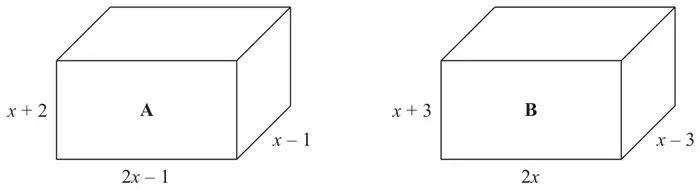
Higher November 2024 Paper 1 Q13 13 Here are two cuboids.
All lengths are measured in centimetres.
The volume of cuboid A is 142 cm3 greater than the volume of cuboid B .
Work out the value of \(x\). (5)
Mark scheme
Mark scheme Answer Mark Mark scheme 7 P1 for setting up an equation using volumes, P1 for process to find an expanded expression for the area of one face, P1 for a complete process to find a fully expanded expression for the volume of one cuboid,or \(2x^3 + 6x^2 - 6x^2 - 18x\) or \(2x^3 - 18x\) P1 (dep P3) for correct rearrangement of the expanded terms in their equation leading to a 3-term quadratic A1 cao
Additional guidance May occur later in the process
Condone one incorrect term in expansion of two brackets
Expression need not be fully simplified, but must be correct
Foundation June 2025 Paper 2 Q11 11 Here are two expressions, A and B.
A B \(7(x - 2) + 4x + 6\) \(5(3x + 2) - 4x - 18\)
Show that A and B are equivalent. [3 marks]
Mark scheme
Mark scheme Answer Mark Comments Alternative method 1: expands brackets and simplifies \(7x - 14\) or \(15x + 10\) M1 \(7x - 14\ (+ 4x + 6)\) and \(11x - 8\) M1dep A or B fully correct \(7x - 14\ (+ 4x + 6)\) and \(11x - 8\) A1 A and B fully correct Alternative method 2: shows the \(x\) terms and constant terms are the same Any one of M1 Any two of M1dep \(7x + 4x = 11x\) and \(15x - 4x = 11x\) A1 SC1 \(11x - 8\) for one or both of A and B with no working seen
Additional guidance M1 may be awarded for correct work with no answer or incorrect answer, even if this is seen amongst multiple attempts Use the scheme that favours the student Alt 2: \(7x + 4x = 11x\) and \(-14 + 6 = -8\) M1M1 Alt 2: \(7x + 4x = 11x\) and \(15x - 4x = 11x\) M1M1 Alt 2: \(11x\) only M0 Alt 2: \(-8\) only M0 Do not ignore subsequent incorrect work such as \(11x - 8 = 3\), which may be awarded up to M2 if working shown Substituting values into the two expressions M0
Foundation November 2024 Paper 2 Q12 12
(a) Work out the value of \(\quad x^2 + 7x \quad\) when \(\quad x = -4\) [2 marks]
(b) Rearrange \(\quad y = w - 1 \quad\) to make \(w\) the subject. [1 mark]
(c) Simplify fully \(\quad 4(a + 2) + a\) [2 marks]
Mark scheme (a) Mark scheme (b) Mark scheme (c)
Mark scheme (a) Answer Mark Comments \((-4)^2 + 7 \times -4\) or \(-4(-4 + 7)\) M1 oe eg \((-4)^2 + 7(-4)\) \(-12\) A1 SC1 \(-44\)
Additional guidance SC is for \(-4^2 + 7 \times -4 = -16 - 28 = -44\) Embedded 16 or \(-28\) seen eg \(16 + 7x\) without correct answer M1A0 Values may be implied Further correct work eg \(16 - 28 = -12\), Answer \(3x\) M1A1 Further incorrect work eg \(16 - 28 = -12\), Answer \(-12x\) M1A0 \(+-28\) is the same as \(-28\) M1 Only \(-4^2 + 7 \times -4\) M0A0 \(-4^2 + 7 \times -4 = -16 + 28 = 12\) M0A0 \(16x\) does not imply 16 M0A0
Mark scheme (b) Answer Mark Comments \(y + 1\) or \(1 + y\) B1
Mark scheme (c) Answer Mark Comments \(4a + 8\) or \(8 + 4a\) or \(5a\) M1 \(5a + 8\) or \(8 + 5a\) A1
Additional guidance Further incorrect work or simplification eg \(5a + 8\), Answer \(13a\) M1A0
Foundation November 2024 Paper 3 Q10 10
(a) Solve \(\quad \dfrac{c}{3} = 15\) [1 mark]
(b) Solve \(\quad 4(2d - 5) = 28\) [3 marks]
Mark scheme (a) Mark scheme (b)
Mark scheme (a) Mark scheme (b) Answer Mark Comments Alternative method 1: Expands bracket first \(8d - 20\) M1 oe expression eg \(8 \times d - 20\) their \(8d = 28 + \text{their } 20\) or \(8d = 48\) M1 their 20 cannot be zero 6 A1ft ft M0M1 or M1M0 Alternative method 2: Divides by 4 first \(2d - 5 = \dfrac{28}{4}\) or \(2d - 5 = 7\) M1 \(2d =\) their \(7 + 5\) or \(2d = 12\) M1 their 7 cannot be 28 6 A1ft ft M0M1 or M1M0
Additional guidance Alt 1 Alt 2 Answer 6 from trial M1M1A1 Embedded answer \(4(2 \times 6 - 5) = 28\) M1M1A0 ft answers correct to 1 dp or better
Foundation June 2024 Paper 3 Q21 21 \(3(x - 1) \equiv 3x - 3 \quad\) is an identity.
Tick one box. [1 mark]
It is true for all values of \(x\) It is true for some values of \(x\) It is true for no values of \(x\) Mark scheme
Mark scheme Answer Mark Comments It is true for all values of \(x\) B1
Foundation June 2024 Paper 3 Q14 14 Multiply out \(\quad 3(2x + 8)\) [2 marks]
Mark scheme
Mark scheme Answer Mark Comments \(6x + 24\) B2 B1 \(6x\) or \((+)\,24\)
Additional guidance \(24 + 6x\) B2 Ignore any attempt to solve \(6x + 24 = 0\) \(6x + 24\) in working with answer \(30x\) B1 \(6x + 25\) in working with answer \(31x\) B1
Foundation November 2023 Paper 1 Q6 6
(a) Simplify fully \(\quad a + a + a + a\) [1 mark]
(b) Factorise \(\quad 5a + 10\) [1 mark]
(c) Multiply out \(\quad 4(10 - x)\) [2 marks]
Mark scheme (a) Mark scheme (b) Mark scheme (c)
Mark scheme (a) Answer Mark Comments \(4a\) B1
Additional guidance \(a4\) or \(4 \times a\) B0
Mark scheme (b) Answer Mark Comments \(5(a + 2)\) B1 oe
Additional guidance \(5(1a + 2)\) B1 Condone missing final bracket and/or multiplication sign between 5 and bracket Ignore an attempt to solve \(5(a + 2) = 0\)
Mark scheme (c) Answer Mark Comments \(40 - 4x\) or \(-4x + 40\) B2 B1 40 or \(-4x\)
Additional guidance Condone \(40 - 4 \times x\) for B2
Do not condone further work for B2
Higher June 2017 Paper 1 Q26 26 Expand and simplify \(\qquad (x - 4)(2x + 3y)^2\) [4 marks]
Mark scheme
Mark scheme Answer Mark Comments Alternative method 1 \(4x^2 + 6xy + 6xy + 9y^2\) M1 oe Allow one error \(4x^2 + 6xy + 6xy + 9y^2\) A1 oe Fully correct \(4x^3 + 6x^2y + 6x^2y + 9xy^2\) M1dep oe \(4x^3 + 12x^2y + 9xy^2 - 16x^2 - 48xy - 36y^2\) A1ft ft M1A0M1 if their first expansion has at least 3 terms after simplification Alternative method 2 \(2x^2 + 3xy - 8x - 12y\) M1 oe Allow one error \(2x^2 + 3xy - 8x - 12y\) A1 oe Fully correct \(4x^3 + 6x^2y - 16x^2 - 24xy\) M1dep oe ft correct multiplication of their expansion by \(2x\) or by \(3y\) if their expansion for first M1 has at least 3 terms after simplification \(4x^3 + 12x^2y + 9xy^2 - 16x^2 - 48xy - 36y^2\) A1ft ft M1A0M1 if their first expansion has at least 3 terms after simplification
Additional guidance Terms and variables may be in any order for M and A marks For M1 A1 M1dep terms may be seen in a grid \(4x^3 - 16x^2 + 9xy^2 - 36y^2\) from \((x - 4)(4x^2 + 9y^2)\) M0A0M0A0 In alt 2, condone \((2x^2 + 3xy - 8x - 12y)^2\) for M1A1 only One error can be one incorrect term or a missing or extra term Do not ignore fw when awarding the final A mark If \((x - 4)(2x + 3y)\) and \((2x + 3y)^2\) are both attempted and no answer is given, mark both and award the better mark
Foundation June 2017 Paper 3 Q5 5
(a) Simplify \(\qquad a \times a \times a + b + b\) [2 marks]
(b) Simplify \(\qquad 5(x + 3) - x + 2\) [3 marks]
Mark scheme (a) Mark scheme (b)
Mark scheme (a) Answer Mark Comments \(a^3 + 2b\) B2 B1 for \(a^3\) (+) or (+) \(2b\)
Additional guidance Do not accept \(2 \times b\) or \(b2\) for \(2b\) Do not accept \({}^3a\) for \(a^3\) Do not accept further working for B2 B1 Do not accept further working for B1 B0 \(a^3 + b^2\) B1 \(3a + 2b\) B1 \(a^3 \quad 2b\) B1 \(a^3 \quad 2b = a^32b\) B1 \(a^3 \times 2b\) or \(a^32b\) without working for B1 B0 \(a^3 \times b^2\) or \(a^3b^2\) B0 \(3a \times 2b\) B0 \(3a - 2b\) B0
Mark scheme (b) Answer Mark Comments \(5x\) (+) 15 B1 Implied by correct answer \(4x + 17\) B2ft B2ft their \(5x + 15\) in the form \(5x + b\) or \(ax + 15\), both their terms with correct ft in final answer
Additional guidance ft \(4x\) or (+)17 or must use \(5x + b - x + 2\) or \(ax + 15 - x + 2\) \(4x + 17\) with no expansion seen B1B2 Ignore further working with an attempt to solve after their \(4x + 17\) B1B2 Do not ignore further working with an attempt to simplify after their \(4x + 17\) B1B1 \(5x + 15 - x + 2\) followed by \(4x + 15 = -2\) B1B1 \(5x + 3\) followed by \(4x + 5\) also \(5x - 15\) followed by \(4x - 13\) B0B2ft Ignore further working after \(5x + 15\) for first B1 B1B0 \(5x \quad 15\) B1 \(4x + k,\ k \ne 17\), with no expansion seen B0B1ft \(kx + 17,\ k \ne 4\), with no expansion seen B0B1ft \(5x + 15 - 5x + 10\) followed by 25 B1B0 \(5x + 3\) followed by \(4x + 1\) B0B1ft \(5x^2 + 15\) followed by \(5x^2 - x + 17\) B0B1ft \(5x + 3\) followed by \(4x + 1\) followed by \(5x\) B0B0ft \(5x + 3\) followed by \(6x + 1\) B0B0ft \(5x^2 + 3\) followed by \(5x^2 - x + 5\) B0B0ft
No questions match these filters.