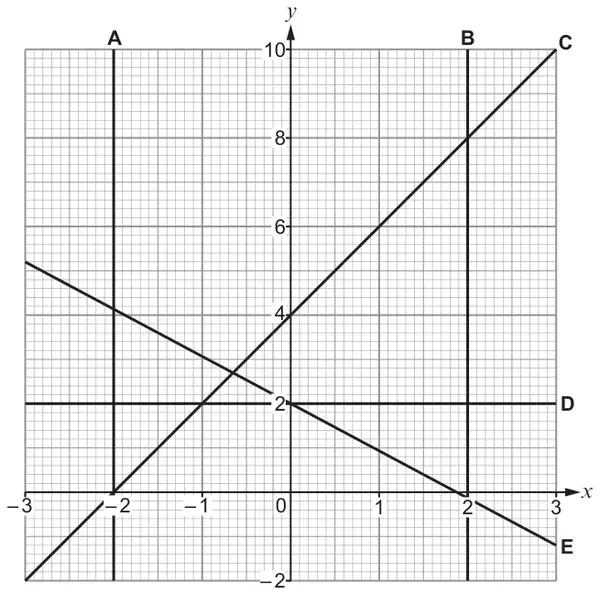
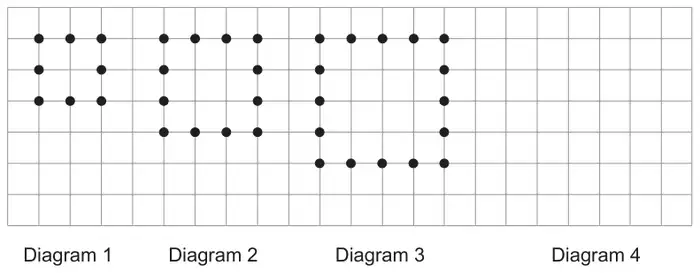
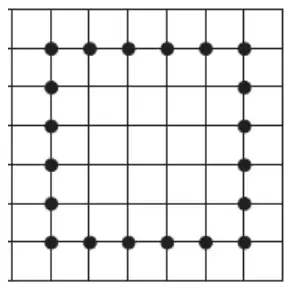
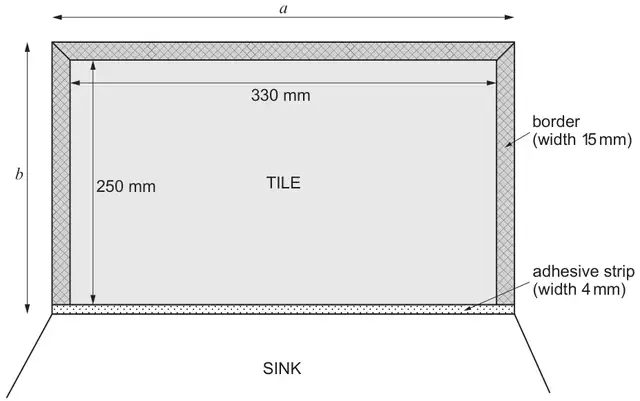
(i) Work out the value of \(P\) when \(g = 3\) and \(h = 5\) (2)
(ii) Work out the value of \(g\) when \(P = 38\) and \(h = 3\) (2)
\(V = 3r - q\)
(b) Work out the value of \(V\) when \(r = -3\) and \(q = 2\) (2)
Mark scheme (a)(i)
Answer
Mark
Mark scheme
26
M1
for substitution eg \(2 \times 3 + 4 \times 5\) or \(6 + 20\)
A1
cao
Mark scheme (a)(ii)
Answer
Mark
Mark scheme
13
M1
for substitution eg \(38 = 2g + 4 \times 3\)
or a complete numerical method eg \((38 - 4 \times 3) \div 2\) or for a correct first step to rearrange eg \(P - 4h = 2g\) or \(\dfrac{P}{2} = g + \dfrac{4h}{2}\) oe
28 The number of days, \(d\), that it will take to build a house is given by
\[d = \frac{720}{n}\]
where \(n\) is the number of workers used each day.
Ali’s company will take 40 days to build the house. Hayley’s company will take 30 days to build the house.
Hayley’s company will have to use more workers each day than Ali’s company.
How many more? (3)
Mark scheme
Answer
Mark
Mark scheme
6
M1
for \(720 \div 40\ (= 18)\) or \(720 \div 30\ (= 24)\)
M1
for a complete process eg \((720 \div 30) - (720 \div 40)\) or \(\text{``}18\text{''} \times 4/3 - \text{``}18\text{''}\) or \(\text{``}24\text{''} - \text{``}24\text{''} \times 3/4\)
15 You can use this rule to work out the total hire charge, in pounds (£), for hiring a 3D printer for a number of weeks.
Total hire charge (£) \(=\) number of weeks \(\times\ 70 + 50\)
Mia wants to hire a 3D printer for 4 weeks.
(a) Work out the total hire charge. (2)
Zahir hires a 3D printer. The total hire charge is £680
(b) For how many weeks does Zahir hire the 3D printer? (2)
Mark scheme (a)
Answer
Mark
Mark scheme
330
M1
for \(4 \times 70 + 50\) oe
A1
cao
Additional guidance
May be seen as sum of four 70s and a 50 \(n \times (70 + 50)\) or ambiguous working gets 0 marks
Mark scheme (b)
Answer
Mark
Mark scheme
9
M1
for use of inverse operations eg \((680 - 50) \div 70\) OR rearranges an equation to solve eg \(70x + 50 = 680\) rearranged to isolate \(x\) term. OR ft (a) eg \(((680 - \text{``}330\text{''}) \div 70) + 4\)
A1
cao or ft their (a)
Additional guidance
Need not have brackets; can be written in an incorrect order if the intention is clear A correct but embedded answer gets 1 mark
for \(4 \times 5\) and \(3 \times -2\), the substitution may be seen in two separate calculations, eg \(4 \times 5\ (= 20)\) and \(3 \times -2\ (= -6)\)
A1
cao
Mark scheme (b)
Answer
Mark
Mark scheme
\(4e^2 + 8e\)
B2
for \(4e^2 + 8e\)
(B1
for \(4e^2\) or \(8e\))
Additional guidance
Note: \(4e^2 + 8e = 12e^3\) for example gets B1 only
Mark scheme (c)
Answer
Mark
Mark scheme
11
M1
for a correct first step eg \(3 \times m - 3 \times 4 = 21\) oe or \(m - 4 = 21 \div 3\ (= 7)\) oe
A1
cao
Additional guidance
Showing \(\div 3\) by each side of equation is sufficient
23 The body mass index, \(B\), for a person of mass \(m\) kg and height \(h\) metres is given by the formula
\[B = \frac{m}{h^2}\]
Usman has a mass of 50 kg. He has a height of 1.57 m.
(a) Work out Usman’s body mass index. Give your answer correct to one decimal place. (2)
Tom’s height is 1.80 m. He wants his body mass index to be 21
(b) Work out the mass that will give Tom a body mass index of 21 (2)
Tom is a ski jumper. The maximum length of skis he can use is 145% of his height. Tom’s height is 1.80 m.
(c) Work out the maximum length of skis Tom can use. (3)
Mark scheme (a)
Answer
Mark
Notes
20.3
2
M1 for \(\dfrac{50}{1.57^2}\) oe A1 for answer in range 20.2 to 20.3
Mark scheme (b)
Answer
Mark
Notes
68.04
2
M1 for \((m =)\ 1.8^2 \times 21\) oe A1 cao
Mark scheme (c)
Answer
Mark
Notes
2.61
3
M2 for a complete method to find 145% of 1.8, eg. \(\frac{145}{100} \times 1.80\) oe (M1 for a method to find 45% of 1.8, eg. \(\frac{45}{100} \times 1.80\) (= 0.81) or for a multiplication factor of 1.45) A1 cao
6 The body mass index, \(B\), for a person of mass \(m\) kg and height \(h\) metres is given by the formula \[B = \frac{m}{h^2}\]
Usman has a mass of 50 kg. He has a height of 1.57 m.
(a) Work out Usman’s body mass index. Give your answer correct to one decimal place. (2)
Tom’s height is 1.80 m. He wants his body mass index to be 21
(b) Work out the mass that will give Tom a body mass index of 21 (2)
Tom is a ski jumper.
The maximum length of skis he can use is 145% of his height. Tom’s height is 1.80 m.
(c) Work out the maximum length of skis Tom can use. (3)
Mark scheme (a)
Answer
Mark
Notes
20.3
2
M1 for \(\dfrac{50}{1.57^2}\) oe A1 for answer in range 20.2 to 20.3
Mark scheme (b)
Answer
Mark
Notes
68.04
2
M1 for (\(m\) =) \(1.8^2 \times 21\) oe A1 for 68.04
Mark scheme (c)
Answer
Mark
Notes
2.61
3
M2 for a complete method to find 145% of 1.8, eg. \(\dfrac{145}{100} \times 1.80\) oe (M1 for a method to find 45% of 1.8, eg. \(\dfrac{45}{100} \times 1.80\) (= 0.81) or for a multiplication factor of 1.45) A1 cao
M1 for collecting the terms in \(x\) or the number terms in an equation, eg. \(5x - x + 4 = 14\) or \(5x = 14 - 4 + x\) A1 for 2.5 oe (accept \(\tfrac{10}{4}\))
(a) \(L = 3a + 2c\) \(a = 5\) \(c = 8\) Work out the value of \(L\). (2)
(b) Kirsty buys some buns. She buys \(x\) packs of currant buns and \(y\) boxes of iced buns. There are 6 currant buns in a pack of currant buns. There are 8 iced buns in a box of iced buns. Write down an expression, in terms of \(x\) and \(y\), for the total number of buns Kirsty buys. (2)
Mark scheme (a)
Answer
Mark
Notes
31
2
M1 for \(3 \times 5 + 2 \times 8\) or 15 and 16 A1 cao
Mark scheme (b)
Answer
Mark
Notes
\(6x + 8y\)
2
M1 for \(6x\) or \(8y\) A1 for \(6x + 8y\) oe as final answer
12 You can change temperatures from °F to °C by using the formula \[C = \frac{5(F - 32)}{9}\]
\(F\) is the temperature in °F. \(C\) is the temperature in °C.
The minimum temperature in an elderly person’s home should be 20°C.
Mrs Smith is an elderly person. The temperature in Mrs Smith’s home is 77°F.
*(a) Decide whether or not the temperature in Mrs Smith’s home is lower than the minimum temperature should be. (3)
(b) Make \(F\) the subject of the formula \[C = \frac{5(F - 32)}{9}\] (3)
Mark scheme (a)
Answer
Mark
Notes
No, temp is 25°C
3
M1 for substitution of 77 into the RHS of the formula A1 for 25 cao or for 225/9 and 180/9 cao C1 (dep on M1) for conclusion (ft) following from working shown
OR
M1 for substitution of 20 into LHS of formula and correct process to find F A1 for 68 cao C1 (dep on M1) for conclusion (ft) following from working shown
Mark scheme (b)
Answer
Mark
Notes
\(F = \dfrac{9}{5}C + 32\)
3
M1 for expansion of the brackets (eg \(5 \times F - 5 \times 32\)) or an attempt to multiply both sides by 9, or divide both sides by 5 as the first step. M1 (dep) for a correct second step A1 for \(F = \dfrac{9}{5}C + 32\) oe
10 You can use these rules to change temperatures from \(^\circ\)C to \(^\circ\)F.
approximate rule
Multiply the \(^\circ\)C temperature by 2 and then add 30
exact rule
Multiply the \(^\circ\)C temperature by 1.8 and then add 32
Amy uses the approximate rule to change 20\(^\circ\)C to \(^\circ\)F. Dan uses the exact rule to change 20\(^\circ\)C to \(^\circ\)F.
(a) Work out the difference between Amy’s result and Dan’s result. (4)
Jade uses the approximate rule to change a temperature from \(^\circ\)C to \(^\circ\)F. The result is 110\(^\circ\)F.
(b) What \(^\circ\)C temperature did Jade change to \(^\circ\)F? (3)
Mark scheme (a)
Answer
Mark
Notes
2
4
M1 for 20 × 2 + 30 (=70) M1 for 20 × 1.8 + 32 (=68) M1 (dep on M1) for “70” – “68” A1 cao
Mark scheme (b)
Answer
Mark
Notes
40
3
M1 for 110 – 30 ÷ 2 or 110 = ? × 2 + 30 or 110 – 30 or ÷ 2 seen as second operation M1 for “(110 – 30)” ÷ 2 A1 cao NB accept reverse flowcharts for inverse operations SC if exact rule used: B2 for “(110 – 32)” ÷ 1.8
*14 Angela and Michelle both work as waitresses at the same restaurant.
This formula is used to work out the total amount of money each waitress gets.
Total amount = £6.50 × number of hours worked + tips
The table shows the number of hours Angela and Michelle each worked last Saturday. It also shows the tips they got.
Number of hours worked
Tips
Angela
8
£12
Michelle
7
£15
Who got the higher total amount of money last Saturday?
You must show clearly how you got your answer. (4)
Mark scheme
Answer
Mark
Notes
Correct statement
4
M1 for 6.50 × 8 + 12 or 6.50 × 7 + 15 M1 for 6.50 × 8 + 12 and 6.50 × 7 + 15 A1 for 64 and 60.5(0) C1 (dep on first M1) for correct statement ft their figures OR M1 for 6.50 × (8−7) or 15−12 M1 for 6.50 × (8−7) and 15−12 A1 for 6.5(0) and 3 C1 (dep on first M1) for correct statement ft their figures [SC If no working shown B1 for 64 and 60.5(0) or B1 for 6.5(0) and 3]
M1 for correct method to clear fraction or remove square root sign M1 (dep) for a fully correct method to both clear fraction and remove square root sign A1 for \(k = 4m^2 - 1\) or \(k = (2m + 1)(2m - 1)\)
13 You can use this rule to work out the total cost of hiring a car.
Total cost = £4 per hour plus £12
Arun hires a car for 5 hours.
(a) Work out the total cost. (2)
Raj hires a car. The total cost is £40
(b) Work out how many hours Raj hires the car for. (3)
Mark scheme (a)
Answer
Mark
Notes
32
2
M1 for \(4 \times 5 + 12\) oe A1 cao
Mark scheme (b)
Answer
Mark
Notes
7
3
M1 for \(40 - 12\) or 28 seen M1 (dep) for \('28' \div 4\) A1 cao OR M1 for \(12 + 4 + 4 + \ldots\) M1 for \(12 + 7 \times 4\) oe A1 cao OR M1 for \(12 + 4x = 40\) oe M1 for \(4x = 40 - 12\) oe A1 cao NOTE: A correct embedded answer scores M2 A0 OR M1 ft for \('32' + 4\ldots\) or \(40 - '32'\) M1 ft for \(5 + 1 \ldots\) oe A1 ft Note: Do not follow through from part a an answer of 40
M1 for \(110 - 30\) (=80) M1 (dep) for \(\text{`}80\text{'} \div 8\) or A1 cao OR M1 for \(110 - 62\) (= 48) M1(dep) for \(\text{`}48\text{'} \div 8 = 6\) A1 cao
15 The table shows the minimum distance and the maximum distance people should sit from different sized TV screens when watching TV.
TV screen size (inches)
Minimum distance (feet)
Maximum distance (feet)
28
3.5
7
30
3.75
7.5
32
4
8
36
4.5
9
38
4.75
9.5
40
5
10
42
5.25
10.5
James has a TV with a screen size of 32 inches. He is going to watch his TV.
(a) What is the minimum distance James should sit from the screen? feet (1)
Sheraz has a TV with a screen size of 38 inches. He is going to watch his TV.
(b) Work out the difference between the minimum distance and the maximum distance Sheraz should sit from the screen. feet (2)
You can use this rule to work out the maximum distance to sit from a TV screen.
Maximum distance in feet = screen size in inches \(\div\) 4
Clare has a TV with a screen size of 24 inches. She is going to watch her TV.
(c) Use the rule to work out the maximum distance Clare should sit from the screen. feet (1)
Richard should sit a maximum distance of 12 feet from his screen.
(d) Work out the screen size of Richard’s TV. inches (2)
Mark scheme (a)
Answer
Mark
Notes
4
1
B1 cao
Mark scheme (b)
Working
Answer
Mark
Notes
\(9.5 - 4.75 =\) OR \(9.5 \div 2 =\)
4.75
2
M1 for \(9.5 - 4.75\) or \(9.5 \div 2\) or \(4.75 - 9.5\) A1 cao
Mark scheme (c)
Answer
Mark
Notes
6
1
B1 cao
Mark scheme (d)
Working
Answer
Mark
Notes
\(12 \times 4 =\)
48
2
M1 for \(\times 4\) seen or identifying \(+ 0.5\) for every 2 inches or \(12 + 12 + 12 + 12\) oe or build up method eg 12, 24, 36, 48 allow one error A1 cao
explain why there is only one value of \(x\) for which \(y\) is negative. [3 marks]
Mark scheme
Answer
Mark
Comments
When \(x = 2\), \((y =)\ 24\) or when \(x = 2\), negative (\(\times\)) negative (\(\times\)) positive = positive
B1
oe
When \(x = 4\), \((y =)\ {-10}\) or when \(x = 4\), positive (\(\times\)) negative (\(\times\)) positive = negative
B1
oe
When \(x = 6\), \((y =)\ 36\) or when \(x = 6\), positive (\(\times\)) positive (\(\times\)) positive = positive
B1
oe SC1 correct value of \(y\) for any positive even value of \(x\) greater than 6
Additional guidance
SC1 should only be considered when the response scores B0B0B0
Ignore any other evaluation attempts or written statements alongside correct responses
A value of \(x\) may be implied by consistent substitution into the equation eg \((2 - 3)(2 - 5)(2 + 6) = 24\) implies \(x = 2\)
B1
For any response using negative/positive, \(x = 2\) can be implied by stating ‘below 4’ and \(x = 6\) can be implied by stating ‘above 4’, or equivalent
For any response using negative/positive, multiplication must be shown, referred to or implied, and the sign of the result must be stated
\(5^2 + 7 \times 5 - c\) or \(60 - c\) and \(3 \times 5 + d\) or \(15 + d\)
M1
oe
\(25 + 35 - c = 15 + d\) or \(60 - c = 15 + d\) or \(c = 60 - y\) and \(d = y - 15\) and \(c + d = 60 - y + y - 15\)
M1dep
oe equation with squaring and multiplications correctly completed
45
A1
Alternative method 2
\(x^2 + 7x - c = 3x + d\) or \(x^2 + 7x - c - (3x + d) = 0\) or \(x^2 + 7x - c - 3x - d = 0\) or \(3x + d - (x^2 + 7x - c) = 0\) or \(3x + d - x^2 - 7x + c = 0\)
26 Given that \(\quad a \times 60 = b \quad\) work out the value of \(\quad \dfrac{4b}{a}\) [2 marks]
Mark scheme
Answer
Mark
Comments
\(60 \times 4\) or \(4(a \times 60)\) or \(4a \times 60\) or \(\dfrac{b}{a} = 60\) or \(\dfrac{4b}{b/60}\) or \(4b = 240a\) or \(\dfrac{240a}{a}\)
M1
accept any multiplication signs
240
A1
Condone \(\dfrac{240}{1}\)
Additional guidance
Correct answer found by substituting appropriate values for \(a\) and \(b\)
M1A1
Incorrect answer found by substituting appropriate values for \(a\) and \(b\)
M0A0
Award M1 for \(60 \times 4\) or 240 in working, either as individual expressions or as part of longer expressions eg \(4 \times 60 = 240\), answer \(240b\) eg \(\dfrac{4 \times 60 \times a}{4b}\)
M1A0 M1A0
Do not award M1 for 240 within a list of multiples of 60 that continues beyond 240
7 Given that \(\quad a \times 60 = b \quad\) work out the value of \(\quad \dfrac{4b}{a}\) [2 marks]
Mark scheme
Answer
Mark
Comments
\(60 \times 4\) or \(4(a \times 60)\) or \(4a \times 60\) or \(\dfrac{b}{a} = 60\) or \(\dfrac{4b}{b/60}\) or \(4b = 240a\) or \(\dfrac{240a}{a}\)
M1
accept any multiplication signs
240
A1
Condone \(\dfrac{240}{1}\)
Additional guidance
Correct answer found by substituting appropriate values for \(a\) and \(b\)
M1A1
Incorrect answer found by substituting appropriate values for \(a\) and \(b\)
M0A0
Award M1 for \(60 \times 4\) or 240 in working, either as individual expressions or as part of longer expressions eg \(4 \times 60 = 240\), answer \(240b\) eg \(\dfrac{4 \times 60 \times a}{4b}\)
M1A0 M1A0
Do not award M1 for 240 within a list of multiples of 60 that continues beyond 240
(a) Write down the value of \(\quad 2a - b\) [1 mark]
(b) Write down the value of \(\quad 2b - 4a\) [1 mark]
(c) You are given that \(\quad 4a - 2b = 10 \quad\) and \(\quad a + c = 3\)
Write an expression in \(a\), \(b\) and \(c\) that is equal to 23
Give your answer in its simplest form.
You must show your working. [2 marks]
Mark scheme (a)
Answer
Mark
Comments
5
B1
Additional guidance
Condone \(10 - 5 = 5\)
B1
Condone \(x = 5\)
B1
\(\dfrac{10}{2}\)
B0
Mark scheme (b)
Answer
Mark
Comments
\(-10\)
B1
Mark scheme (c)
Answer
Mark
Comments
Unsimplified expression in \(a\), \(b\) and \(c\) which would evaluate to 23
M1
eg \(2(4a - 2b) + a + c\) or \(8a - 4b + a + c\) or \(11(a + c) - (4a - 2b)\) or \(11a + 11c - 4a + 2b\)
Simplified expression in \(a\), \(b\) and \(c\) which would evaluate to 23
A1
eg \(9a - 4b + c\) \(7a + 2b + 11c\) SC2 Values assigned to \(a\), \(b\) and \(c\) which satisfy original equations and expression given which has value 23 eg \(a = 3, b = 1, c = 0\) and \(7a + 2b + c\)
Additional guidance
There are infinitely many correct solutions. Allow solutions where the coefficients are not integers if initial working is shown. eg \(3(4a - 2b) - \dfrac{7}{3}(a + c) = \dfrac{29}{3}a - 6b - \dfrac{7}{3}c\)
M1A1
\(5a - 2b + c + 10 = 23\)
M1A1
Condone ‘= 23’ after the expression
Answer using only two variables eg \(2.3(4a - 2b)\)
Work out the value of \(\quad \dfrac{a}{b} - a^b\) [3 marks]
Mark scheme
Answer
Mark
Comments
3.5 or \(3\dfrac{1}{2}\) or 49 or \((49 =)\ \dfrac{98}{2}\)
M1
\(3.5 - 49\) or \(49 - 3.5\) or \(3\dfrac{1}{2} - 49\) or \(49 - 3\dfrac{1}{2}\) or \(\dfrac{7}{2} - \dfrac{98}{2}\) or \(\dfrac{98}{2} - \dfrac{7}{2}\)
M1dep
45.5 (oe) implies M2
\(-45.5\) or \(-45\dfrac{1}{2}\) or \(-\dfrac{91}{2}\)
15 A company uses this formula to work out the cost, £\(A\), of a taxi ride.
\[A = 4 + 1.8m + b\]
£4 is a fixed charge \(m\) is the number of miles travelled £\(b\) is a charge for booking online
(a) Clare books a taxi online and travels 8 miles.
She pays £20 altogether.
How much is the charge for booking online? [3 marks]
(b) A different company
has a fixed charge of £3 charges £1.90 per mile has no charge for booking online.
Write a formula for the cost, £\(C\), of a taxi ride with this company. [1 mark]
Mark scheme (a)
Answer
Mark
Comments
Alternative method 1
\(1.8(0) \times 8\) or 14.4(0)
M1
implied by 5.6(0) or 18.4(0)
\(20 -\) their \(14.4(0) - 4\) or \(20 - 18.4(0)\) or 1.6
M1dep
1.60
A1
condone £1.60p
Alternative method 2
\(b = A - 4 - 1.8m\)
M1
oe correct formula with \(b\) as the subject
\(20 - 4 - 1.8(0) \times 8\) or 1.6
M1dep
1.60
A1
condone £1.60p
Additional guidance
\(1.8(0) \times 8\) may be within an incorrect calculation eg \(4 + 1.8(0) \times 8 + 20\)
M1
Mark scheme (b)
Answer
Mark
Comments
\(C = 3 + 1.9(0)m\)
B1
oe formula with \(C\) as subject accept \(C = 3 + 1.9(0) \times m\) condone \(+ 0\) or \(+ 0b\)
Additional guidance
\(3 + 1.9m\)
B0
Do not accept eg \(A = \ldots\) for \(C = \ldots\)
B0
Allow \(m\) to be \(\times\) mile(s) but not a different letter unless defined eg1 \(C = 3 + 1.9(0) \times\) miles eg2 \(C = 3 + 1.9(0)\) miles eg3 \(C = 3 + 1.9(0)\) per mile or \(C = 3 + 1.9(0)\)pm eg4 \(C = 3 + 1.9(0)x\)
B1 B0 B0 B0
Ignore £ inserted in part or all of equation eg \(C = 3 + £1.90m\)
B1
Correct formula followed by substitution (and evaluation)
\(\dfrac{2 - 12}{2}\) or one correctly evaluated trial with correct substitutions for \(x = 2\) or 5 and \(y = 3\) or 12 or two correct values from \(-\dfrac{10}{2},\ -\dfrac{1}{2},\ -\dfrac{7}{5},\ \dfrac{2}{5}\) oe or two correct values from \(-5,\ -0.5,\ -1.4,\ 0.4\) oe
M1
\(\dfrac{2 - 3}{2} = -\dfrac{1}{2}\) oe or \(\dfrac{5 - 12}{5} = -\dfrac{7}{5}\) oe or \(\dfrac{5 - 3}{5} = \dfrac{2}{5}\) oe
\(-\dfrac{10}{2}\) or \(-5\)
A1
Additional guidance
Two separate correct values can be in either fraction or decimal form
\(2 - 12 \div 2 = -5\) (recovered)
M1A1
\(2 - 12 \div 2\)
M0A0
An example of an incorrect substitution with different values of \(x\) eg \(\dfrac{5 - 12}{2} = -\dfrac{7}{2}\)
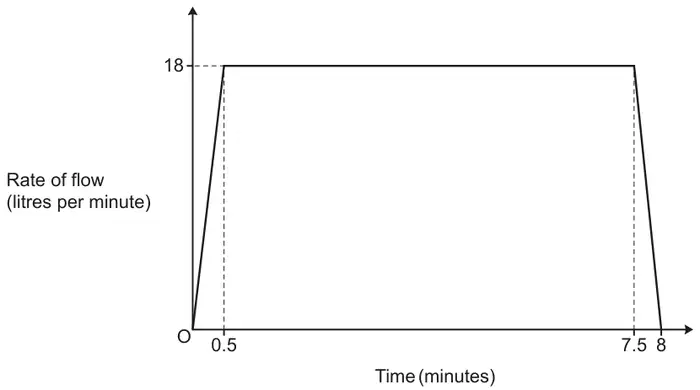
20 A container takes 8 minutes to be filled with water.
The graph shows the rate of flow, in litres per minute, of the water into the container during the 8 minutes.
Not to scale
(a) Show that 126 litres of water flows into the container between 0.5 minutes and 7.5 minutes. [1]
(b) Work out the average rate of flow, in litres per minute, of water into the container during the 8 minutes. [4]
Mark scheme (a)
Answer
Marks
Part marks and guidance
18 × (7.5 – 0.5) or 18 × 7
1
126/18 = 7 only scores if 7 is related to the context 126/7 = 18 only scores if 18 is related to the context
Mark scheme (b)
Answer
Marks
Part marks and guidance
16.87[5] or 16.88 or 16.9 oe
4
M3 for \(\frac{126 + 2 \times \frac{1}{2} \times 0.5 \times 18}{8}\) oe or M2 for \(126 + 2 \times \frac{1}{2} \times 0.5 \times 18\) oe may be implied by 135 or M1 for \([2\ \times]\ \frac{1}{2} \times 0.5 \times 18\) oe may be implied by 4.5 for one triangle or 9 for two triangles
If 0 scored, SC1 for \(\frac{126 + 2 \times 9}{8}\) or \(\frac{126 + 18}{8}\)
e.g. \(\frac{\frac{1}{2} \times (7 + 8) \times 18}{8}\)
e.g. \(\frac{1}{2} \times (7 + 8) \times 18\) or \(18 \times 8 - 2 \times \frac{1}{2} \times 0.5 \times 18\)
12 You may use these kinematics formulae to answer this question.
\(v = u + at\) \(s = ut + \frac{1}{2}at^2\)
where \(a\) is the constant acceleration, \(u\) is the initial velocity, \(v\) is the final velocity, \(s\) is the displacement and \(t\) is the time taken.
A particle has an initial velocity of 2 m/s. After 6 seconds the particle has a velocity of 11 m/s. The particle had constant acceleration.
Work out the distance the particle has travelled in the 6 seconds. [4]
Mark scheme
Answer
Marks
Part marks and guidance
39
4
B2 for [\(a\) =] 1.5 oe or M1 for \(11 = 2 + 6a\) or better
M1 for \(2 \times 6 + \frac{1}{2} \times\) their a \(\times 6^2\) or better
(a) Show that the formula \(v = u + at\) can be rearranged to \(a = \dfrac{v - u}{t}\). [1]
(b) Use the formula \(a = \dfrac{v - u}{t}\) to find the acceleration, \(a\) m/s\(^2\), when a particle takes 4 seconds to increase from an initial velocity of 3 m/s to a final velocity of 9 m/s. [2]
Mark scheme (a)
Answer
Marks
Part marks and guidance
\(v - u = at\) seen as single statement
1
Accept e.g. \(-v + u = -at\) but not e.g. \(\dfrac{v - u}{t} = at \div t\)
Mark scheme (b)
Answer
Marks
Part marks and guidance
1.5 oe
2
M1 for correct substitution \(\dfrac{9 - 3}{4}\) oe
e.g. \(1\frac{1}{2}\) or \(\frac{6}{4}\) or \(\frac{3}{2}\)
For M1 accept a two-step evaluation with an arithmetic slip eg \(9 - 3 = 5\) followed by \(5 \div 4\) Do not accept \(\dfrac{3 - 9}{4}\) for M1
Use of (0, 2) scores 0 but may be replaced with another point (ie do not treat as a choice)
Examples of intermediate steps
\(4 = 2k - 2^2 + 2\) then \(4 = 2k - 4 + 2\) is a sufficient int step or \(4 = 2k - 2\) is a sufficient int step or \(6 = 2k\) is a sufficient int step \(3 = k\)
Mark scheme (b)
Answer
Marks
Part marks and guidance
0.4 and 2.6
2
B1 for 0.4 or 2.6
or
M1 for line \(y = 3\) drawn or for (0.4, 3) and (2.6, 3) indicated
Line to cut curve twice Treat \(x = 3\) drawn or multiple horizontal lines as choice unless \(y = 3\) clearly chosen Condone good freehand line eg circled or lines drawn down to \(x\)-axis
(a) Rearrange this formula to make \(u\) the subject.\[v^2 = u^2 + 2as\] [2]
(b) A rocket accelerates at 90 m / s2 and travels 270 km. The rocket’s final velocity is 8000 m / s.
Using part (a), or otherwise, calculate the rocket’s initial velocity in m / s. [3]
Mark scheme (a)
Answer
Marks
Part marks and guidance
\(u = [\pm]\sqrt{v^2 - 2as}\) as final answer
2
M1 for [\(u^2\) =] \(v^2 - 2as\)
Mark scheme (b)
Answer
Marks
Part marks and guidance
3924 to 3924.3
3
M2 for \(\sqrt{8000^2 - 2 \times 90 \times 270000}\)
or
M1 for \(\sqrt{8000^2 - 2 \times 90 \times \text{figs } 27}\) or \(8000^2 - 2 \times 90 \times 270000\) or \(8000^2 = u^2 + 2 \times 90 \times 270000\) or for correct substitution seen of \(v = 8000\), \(a = 90\) and \(s\) = figs 27 in their final answer to part (a)
If 0 scored SC1 for 7996 to 7997 as final answer
Condone 3920 as final answer for full marks, following M2
14 The number of bees, \(P\), in a colony is given by the formula
\[P = ab^x\]
where \(x\) is the number of months after the start of July.
At the start of July, there were 25 000 bees in the colony. After one month, there were 23 500 bees in the colony.
Find the value of \(a\) and the value of \(b\). Give the value of \(b\) as a decimal. [4]
Mark scheme
Answer
Marks
Part marks and guidance
[\(a\) = ] 25 000 [\(b\) = ] [0].94
4
B1 for 25 000
AND
B3 for 0.94 oe or B2 for \(\frac{23500}{25000}\) or 94% oe or \(\frac{25000 - 23500}{25000}\) or 0.06 oe or M1 for 23500 = \(ab^{[1]}\) or 23500 = \(25000b^{[1]}\)
(a) A car accelerates at 4.06 m/s2 for 10.1 seconds from an initial velocity of 2.93 m/s.
Harper rounds each value to 1 significant figure. Harper uses the rounded values and the formula
\[s = ut + \tfrac{1}{2}at^2\]
to estimate the distance travelled in the 10.1 seconds. Harper’s answer is 430 metres.
Using Harper’s method, show that their answer is wrong. [4]
(b) Rearrange this formula to make \(t\) the subject.\[s = \tfrac{1}{2}at^2\]
[3]
Mark scheme (a)
Answer
Marks
Part marks and guidance
\(s = 230\) with 4, 3 and 10 or 100 seen
4
B2 for 4, 3 and 10 or 100 or B1 for two correct
For all marks condone e.g. 3.00, 4.0, 10.0 used These values may be written in the stem of the question
AND M1 for \((3 \times 10) + \tfrac{1}{2}(4 \times 10^2)\) or correct substitution of unrounded or incorrectly rounded values
If 0 scored then SC1 for sight of 230
For M1 e.g. allow a mixture \((2.93 \times 10.1) + \tfrac{1}{2}(4.1 \times 10^2)\)
Mark scheme (b)
Answer
Marks
Part marks and guidance
\(t = [\pm]\sqrt{\dfrac{2s}{a}}\) oe final answer
3
Square root must dip below fraction line in final answer unless \(\left(\frac{2s}{a}\right)\) bracketed For 3 marks oe e.g. \(t = [\pm]\sqrt{\dfrac{2 \times s}{a}}\), \(t = \sqrt{\dfrac{s}{\frac{1}{2}a}}\)
M2 for first two steps correctly completed e.g. \(\frac{2s}{a} = t^2\) or answer \([\pm]\sqrt{\dfrac{2s}{a}}\) (no \(t =\) )
M2 for e.g. \(\dfrac{s}{\frac{a}{2}} = t^2\), \(\dfrac{s}{\frac{1}{2}a} = t^2\), \(\dfrac{s}{0.5a} = t^2\)
or M1 for first step correctly completed e.g. \(2s = at^2\) or \(\frac{s}{a} = \frac{1}{2}t^2\)
Allow M1 for \(\frac{s}{0.5} = at^2\) oe
If 0 scored, SC1 for final answer \(t = [\pm]\sqrt{\dfrac{\frac{1}{2}s}{a}}\) oe
Write \(z\) in terms of \(x\). Give your answer in its simplest form. [4]
Mark scheme
Answer
Marks
Part marks and guidance
\(z = 17 - 2x^2\) final answer
4
B3 for answer \(17 - 2x^2\) OR M3 for \(7 = 4\left(\dfrac{x^2 - 5}{2}\right) + z\) oe or \(2x^2 + z = 17\) oe or \(x^2 - 2\left(\dfrac{7 - z}{4}\right) = 5\) or better
Correct unsimplified formula in \(x\) and \(z\)
or M2 for \(y = \dfrac{2x^2 - 10}{4}\) oe or \(y = \dfrac{7 - z}{4}\) oe or \(4y = 2x^2 - 10\) or \((2x^2 - 4y) + (4y + z) = 10 + 7\) oe
M2 sets up for substitution with \(y\) explicit or for method for elimination by equating coefficients of \(y\) and correct method to eliminate \(y\)
or M1 for \(2x^2 - 4y = 10\) or \(-2y = 5 - x^2\) or \(4y = 7 - z\) or better
M1 equates coefficients of \(y\) or first step in rearrangement to eliminate
16 The following kinematics formulas may be used in this question.
\[v = u + at \qquad s = ut + \tfrac{1}{2}at^2 \qquad v^2 = u^2 + 2as\]
The initial velocity of a particle is 20 m/s. The acceleration of the particle is −8 m/s². After \(t\) seconds, the particle has travelled 25 m.
(a) Show that \(4t^2 - 20t + 25 = 0\). [3]
(b) Solve \(4t^2 - 20t + 25 = 0\). [3]
(c) Show that the particle is stationary when it has travelled 25 m. [3]
Mark scheme (a)
Answer
Marks
Part marks and guidance
Subst into correct formula (may be implied) and partial simplification
2
B2 for \(25 = 20t - \frac{1}{2} \times 8 \times t^2\) oe or \(25 = 20t + (-4)t^2\) or B1 for subst eg \(25 = 20t + \frac{1}{2}(-8)t^2\)
Only accept \(25 = 20t - 4t^2\) if subst seen For B1 condone ambiguity caused by missing brackets
\(25 = 20t - 4t^2\) seen and correct completion to \(4t^2 - 20t + 25 = 0\)
1dep
Dep on previous 2 marks
Mark scheme (b)
Answer
Marks
Part marks and guidance
2.5 oe
3
M2 for \((2t - 5)(2t - 5)\) or M1 for any two factors that give two correct terms when expanded or for partial factorisation \(2t(2t - 5) - 5(2t - 5)\)
OR M2 for [\(t =\)] \(\dfrac{20 \pm \sqrt{400 - 400}}{8}\) or better or M1 for [\(t =\)] \(\dfrac{-(-20) \pm \sqrt{(-20)^2 - 4 \times 4 \times 25}}{2 \times 4}\) with at most one error
eg a sign error, short fraction line, short root, but condone missing brackets
Mark scheme (c)
Answer
Marks
Part marks and guidance
Shows \(v = 0\) and concludes “stationary”
3
M1 for [\(v^2 =\)] \(20^2 + 2(-8)25\) or [\(v =\)] \(20 + (-8) \times\) their (b) A1 \(v = 0\)
If 0 scored, instead award SC2 for \(v = 0\) and other values substituted into a relevant equation as a correct check or SC1 for \(v = 0\)
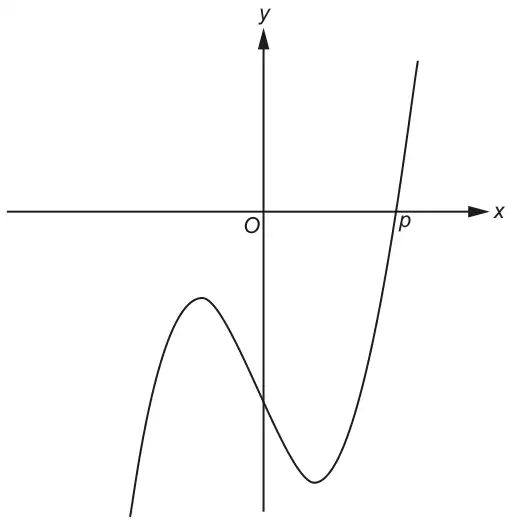
9 The graph of \(y = x^3 - 7x - 12\) is shown below. The root of the equation \(x^3 - 7x - 12 = 0\) is \(p\).
(a) Calculate \(y\) when \(x = 3\). [1]
(b) Show that \(3 \lt p \lt 4\). [2]
(c) Find a smaller interval that contains the value of \(p\). You must show calculations to support your answer. [3]
Mark scheme (a)
Answer
Marks
Part marks and guidance
−6
1
Mark scheme (b)
Answer
Marks
Part marks and guidance
[\(x = 4\),] \(y = 24\)
Change of sign, so \(p\) lies between 3 and 4 oe
2
B1 for 24 seen
If using \(3.27 \lt x \lt 4\) rather than 4: SC2 evaluate \(y\) correctly (see table in (c)), state change of sign oe and that because \(3 \lt p \lt\) their \(x\)-value, then so \(3 \lt p \lt 4\). 0 for just evaluating y.
After \(x = 4\), \(y = 24\) scored: Examples just sufficient for second mark include: change of sign \(-6 \lt 0 \lt 24\) \(x = 3\) gives an answer < 0 and \(x = 4\) gives an \(\gt 0\) Examples insufficient for second mark: so \(p\) lies between 3 and 4
Mark scheme (c)
Answer
Marks
Part marks and guidance
Examples: when \(x = 3.5\), \(y = 6.4\), so \(3 \lt p \lt 3.5\) when \(x = 3.1\), \(y = -3.9\), so \(3.1 \lt p \lt 4\) when \(x = 3.1\), \(y = -3.9\) and when \(x = 3.5\), \(y = 6.4\), so \(3.1 \lt p \lt 3.5\)
3
M2 for one further value of \(y\) evaluated correctly, possibly rot to 2 or more sf, for a value of \(x\) such that \(3 \lt x \lt 4\)
OR
M1 for working shown to calculate one further value of \(y\) for a value of \(x\) such that \(3 \lt x \lt 4\)
Note after SC considered in (b): if SC2 was awarded then they must use a value of \(x\) that produces a smaller interval than \(3 \lt x \lt\) their x-value in (b); if SC2 was not awarded then \(3 \lt x \lt 4\) applies
If 0 scored, award SC1 or SC2 if evidence for M1 or M2 has not yet been credited in (b)
Solution is approx. 3.2670
Common values:
\(x\)
\(y\)
3.1
−3.909
3.2
−1.632
3.25
−0.422
3.26
−0.174
3.27
0.0758
3.3
0.837
3.4
3.504
3.5
6.375
3.6
9.456
3.7
12.75
3.75
14.48
3.8
16.27
3.9
20.02
A correct narrower range scores 0 unless accompanied by the relevant correct calculation(s). eg M2 only for when \(x = 3.1\), \(y = -3.9\) so \(3.1 \lt p \lt 3.5\) (as 3.5 has not been correctly justified) Calculations in support of \(x = 3\) or \(x = 4\) need not be repeated from parts (a) or (b).
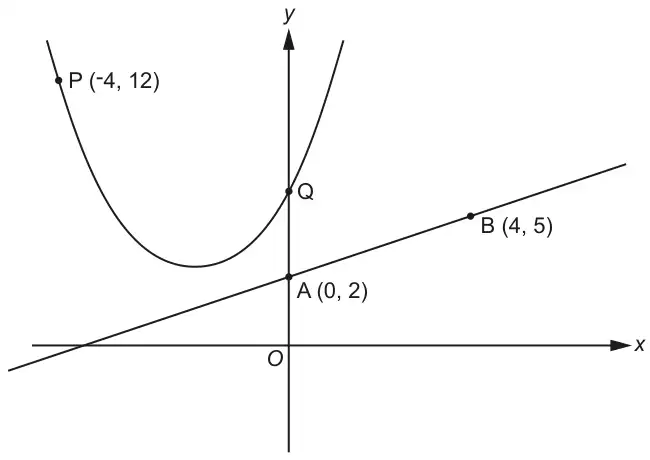
5 The diagram shows a straight line that passes through points A and B, and a curve that passes through points P and Q.
Not to scale
(a) Find the equation of the straight line. [3]
(b) The equation of the curve is \(y = x^2 + kx + 8\).
Find the value of \(k\). [3]
(c) Diann draws line BQ. She says
Triangle ABQ is isosceles.
Is Diann correct? You must show all your working. [4]
Mark scheme (a)
Answer
Marks
Part marks and guidance
\(y = 0.75x + 2\) oe
3
B2 for \(y = 0.75x\) [\(+ c\)] or answer \(0.75x + 2\)
OR
ISW after a correct equation if attempting rearrangement
Accept oe throughout eg B2 for \(4y = 3x\)
M1 for attempt at \(\dfrac{\text{change in } y}{\text{change in } x}\) soi by \(\dfrac{\pm(5 - 2)}{\pm(4 - 0)}\) or ±0.75
and
B1 for \(y = kx + 2\) with \(k \ne 0\)
Examples: M1B1 for \(y = -0.75x + 2\) M1B0 for 0.75, \(0.75x\), −0.75, \(-0.75x\) If gradient inverted: M0B1 for \(y = 1.3x + 2\) M0B0 for \(1.3x + 2\), \(y = 1.3x\)
Condone poorly written \(\frac{3}{4}x\) unless clearly 3 over \(4x\).
Mark scheme (b)
Answer
Marks
Part marks and guidance
3 nfww
3
M2 for \(12 = 16 - 4k + 8\) or better
OR
M1 for \(12 = -4^2 + -4 \times k + 8\) or sign errors in \(12 = 16 - 4k + 8\) or better or \(k = \dfrac{y - x^2 - 8}{x}\)
Condone −4 not in brackets but \(12 = -4^2 + k - 4 + 8\) with no times sign or dot between \(k\) and −4 scores 0 unless subsequently clarified.
Mark scheme (c)
Answer
Marks
Part marks and guidance
Using symmetry:
Q is (0, 8)
1
dep mark is always dependent on 3 marks being achieved
For first mark in all methods, condone [Q =] 8 or [QA =] 8-2 or 6, seen in working or on diagram.
Midpoint, M, of AQ is at (0, 5)
1
Accept implied symmetry
eg 8 – 5 = 3 and 5 – 2 = 3 so B is in the middle of A and Q May see “midpoint” or any other letter for M
MB is perpendicular to QA
1
So isosceles/Diann is correct
1dep
OR
Using Pythagoras:
Q is (0, 8)
1
\(\text{AB}^2 = 4^2 + 3^2\) oe or AB = 5 nfww or \(\text{QB}^2 = 4^2 + (\textit{their } 8 - 5)^2\) or QB = 5 nfww
1
AB = 5 and QB = 5 or \(\text{AB}^2 = 25\) and \(\text{QB}^2 = 25\)
1
AB = QB or “two sides are equal” oe so isosceles/Diann is correct
1dep
OR
Using trig:
Q is (0, 8)
1
tan BAQ = 4/3 [=53.1]
1
tan BQA = 4/3 [= 53.1]
1
BAQ = BQA or “two angles are equal” oe so isosceles/Diann is correct
1dep
Alternative: using gradients, vectors or descriptions of translations
1 for Q is (0, 8)
1 for gradients/vectors/descriptions of translations for both AB and QB (must be seen together in part (c)): eg gradients: AB = 3/4 and QB = −3/4 (may be implied from the equations of the two lines) descriptions: AB is 4 along (treat as in positive sense) and 3 up and QB is 4 along and 3 down oe
To score more than 2 marks, the approach needs to be developed to justify isosceles, such as by switching to the 3rd and 4th marks of the Pythagoras or trig methods.
Condone poor notation, such as missing vector brackets or fraction lines in vectors if intention is clear.
eg gradient AB = ¾ and gradient QB = −3/4 scores a max of 1 1 0 0 eg gradient AB = ¾ and gradient QB = −3/4, so triangle is isosceles also scores a max of 1 1 0 0
Warnings: dimensions of triangle shown as (8 – 2), 4, 4 and isosceles stated is B1 only; blank answer space but BQ drawn on diagram is 0 not NR.
(b) Use the formula \(\mathrm{S} = 5\mathrm{R} + 2\mathrm{T}\) to find the value of \(\mathrm{R}\) when \(\mathrm{S} = 28{\cdot}5\) and \(\mathrm{T} = -4\). [3]
(c) Expand \(5(9 - 13y)\). [1]
(d) Factorise \(mt - 3t\). [1]
(e) Solve \(x^2 = 58\). Give your answer correct to two decimal places. [2]
Mark scheme (a)
Scheme
Marks
Comments
-4x
B1
Mark scheme (b)
Scheme
Marks
Comments
28.5 = 5R + 2 × -4
B1
Allow for 28.5 = 5R + -8 or 28.5 = 5R + 2(-4)
36.5 = 5R
B1
(R = ) 36.5 ÷ 5 is awarded B1 B1
R = 7.3 or \(\frac{73}{10}\) or \(7\frac{3}{10}\)
B1
Allow an embedded answer provided not contradicted by R ≠ 7.3. FT from 5R = a, but if on FT it simplifies to an integer then it must be written as an integer.
If rearranged first, allow FT from one error for a maximum of two marks.
If no marks award SC1 for sight of 36.5 provided not from incorrect work.
a correct explanation e.g ‘one should be positive, and one should be negative’. ‘0 is not between 0.119.. and 0.03..’ ‘0.119… and 0.03.. are both positive’
B2
Allow for 0.03 seen and an explanation saying that 1.82 will lead to a greater answer that is not negative.
Award B1 for one of the following:
0.03(1….) and 0.1(19…) seen with a correct explanation but with yes indicated.
a correct explanation following an error in their substitution.
0.03(1….) and 0.1(19…).
Alternative method
Scheme
Marks
Comments
No indicated or implied with
\((2 \times 1.81^3 - 3 \times 1.81^2 =)\ 2.03(1….)\) AND \((2 \times 1.82^3 - 3 \times 1.82^2 =)\ 2.1(19…)\) AND
a correct explanation e.g
‘one should be more than 2, and one should be less than 2’. ‘2 is not between 2.119.. and 2.03..’ ‘2.119… and 2.03.. are both more than 2’
B2
Allow for 2.03 seen and an explanation saying that 1.82 will lead to a greater answer that is not negative.
Award B1 for one of the following:
2.03(1….) and 2.1(19…) seen with a correct explanation but with yes indicated.
a correct explanation following an error in their substitution.
2.03(1….) and 2.1(19…).
(2)
Corrected by Westie's Workshop
The board's mark scheme printed “‘0 is not between 0.119.. and 0.03..’ and ‘0.119… and 0.03.. are both positive’”. Changed to “‘2 is not between 2.119.. and 2.03..’ and ‘2.119… and 2.03.. are both more than 2’” because in this method the values are 2.03… and 2.119…, so they are compared with 2, not 0.
Original: see the board's mark scheme PDF (link above).
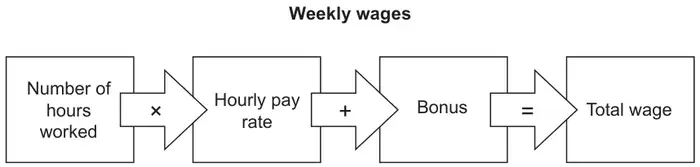
9. The manager of a shop calculates the wages of her staff at the end of each week. She uses this diagram.
Hourly pay rates
Junior sales assistant
£10.42
Senior sales assistant
£11.50
(a)
Hamza is a junior sales assistant. Last week he worked for 25 hours and had a bonus of £80.
What was Hamza’s total wage last week? [2]
(b)
Julie is a senior sales assistant. Last week her total wage was £271 including a bonus of £64.
How many hours did Julie work last week? [2]
Mark scheme (a)
Scheme
Marks
Comments
25 × 10.42 + 80
M1
May be seen in stages.
= (£)340.5(0) ISW
A1
Unsupported (£)341 is awarded M1A0.
If no marks, award SC1 for an answer of (£)367.50 (from use of £11.50 not £10.42)
Mark scheme (b)
Scheme
Marks
Comments
(271 – 64) ÷ 11.5(0)
M1
May be seen in stages.
= 18 (hours)
A1
Allow an embedded answer.
If no marks, award SC1 for an answer of 265.43… (from 271 – 64 ÷ 11.5(0)) If no marks, award SC1 for an answer of 19.86, 19.9 or 20 (from use of £10.42 not £11.50)
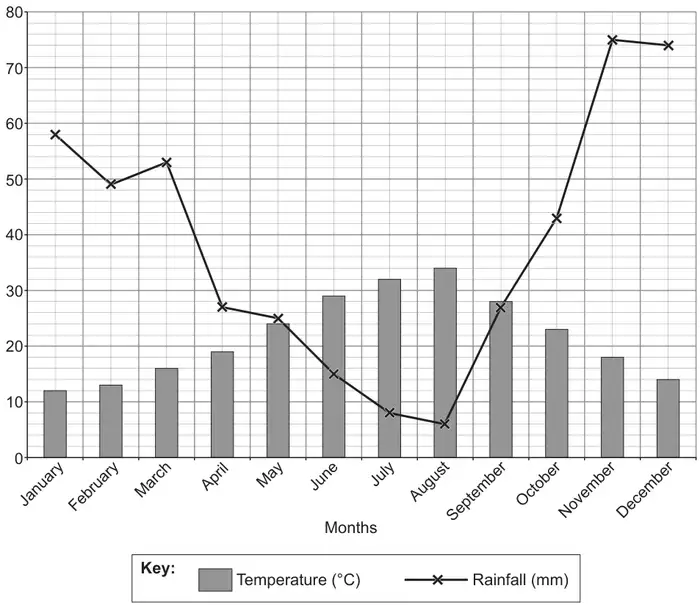
7. The graph below shows the average maximum daily temperature (°C) and the average monthly rainfall (mm) in Greece.
(a)
(i) Which month has the highest rainfall? [1]
(ii) Calculate the difference in average maximum daily temperature between the warmest month and the coolest month. [2]
(iii)
Courtney wants to go on holiday to Greece. She does not want the average maximum daily temperature to be over 30°C and hopes for as little rain as possible.
Which month would be the most suitable for Courtney to go to Greece? [1]
(b)
The formula shown below can be used to convert between temperatures in degrees Fahrenheit (F) and temperatures in degrees Celsius (C).
F = 1·8C + 32
On a particular day in Greece, the temperature was 25°C. Use the formula to convert this temperature to degrees Fahrenheit (F). [2]
Mark scheme (a)
Scheme
Marks
Comments
(i) November
B1
(ii) 22 (°C)
B2
B1 for 34 – 12 or for a correct evaluation of 34 – \(a\) where \(11 \leqslant a \leqslant 13\) or \(b\) – 12 where \(32 \leqslant b \leqslant 34\)
(iii) June
B1
Mark scheme (b)
Scheme
Marks
Comments
1.8 × 25 + 32
M1
May be seen in stages.
= 77 (°F)
A1
If no marks, award SC1 for sight of 45 (from 1.8 × 25)
Find the value of \(x\) when \(w = 3\) and \(y = 24\). [2]
Mark scheme (a)
Scheme
Marks
Comments
7x + 24
B2
Mark final answer B1 for expanding bracket correctly 4x + 24 or B1 for 7x + k providing k ≠ 0
Mark scheme (b)
Scheme
Marks
Comments
(f = ) 15·3
B1
Allow embedded answer
Mark scheme (c)
Scheme
Marks
Comments
(x = ) 9·75 or 9 ¾ or 39/4
B2
B1 for \(\frac{3\times(24+2)}{8}\) or \(\frac{3\times26}{8}\) or \(\frac{78}{8}\) or \(\frac{3\times24\,+\,3\times2}{8}\) or \(\frac{72+6}{8}\) may be seen in stages
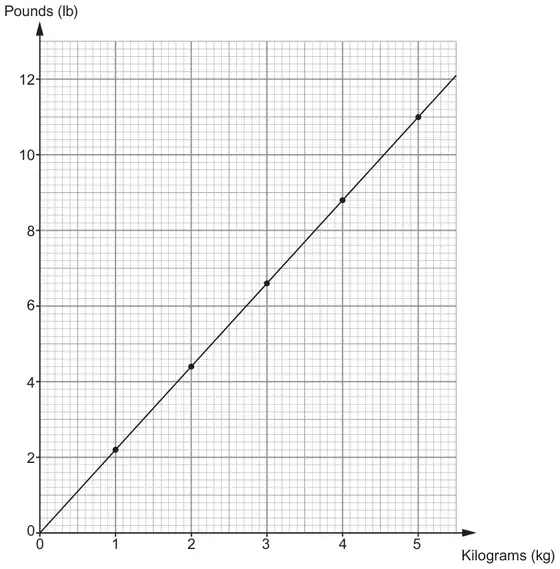
7. Georgia is going on holiday to France. She takes one large suitcase and one piece of hand luggage.
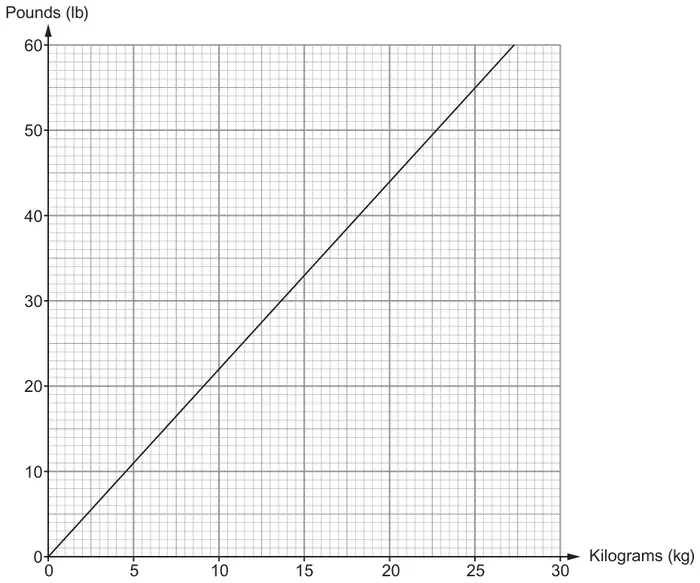
The graph below can be used to convert between kilograms and pounds.
(a)
(i) Georgia’s suitcase has a mass of 24 kg. What is the mass of the suitcase in pounds? [1]
(ii) Her hand luggage has a mass of 13 pounds. What is the mass of her hand luggage in kilograms? [1]
(b)
A car hire company in France uses the following formula to calculate costs in euros (€).
Car hire cost = €11.25 x number of days car hire + insurance
(i)
Georgia decides to hire a car for 8 days. Insurance will cost her €95.
Calculate the cost of Georgia’s car hire. [2]
(ii)
Meena is also hiring a car from the same company. She has €270 to spend on car hire. Insurance will cost her €126. She wants to hire the car for as many days as possible.
For how many whole days can Meena afford to hire the car? [3]
Mark scheme (a)
Scheme
Marks
Comments
(i) 53 (pounds)
B1
Allow 52.66.. to 53 inclusive (pounds)
(ii) 6 (kg)
B1
Allow 5.7 to 6 inclusive (kg)
Mark scheme (b)
Scheme
Marks
Comments
(i) 11.25 x 8 + 95
M1
May be seen in stages
(€)185
A1
(ii) (270 – 126) ÷ 11.25
M2
May be seen in stages M2 may be implied by each of the following:
144 ÷ 11.25
126 + 11.25 × 12 = 261
126 + 11.25 × 12 AND 126 + 11.25 × 13
270 – 126 = 144 with 11.25 × 12 = 135
M1 for 126 + 11.25 × \(n\) where \(n\) > 1 or M1 for 270 – 126 ( = 144) M1 for 270 – 126 ÷ 11.25 ( = 258.8 )
12
A1
CAO
An answer of 12.8 implies M2 A0 Award zero marks for an unsupported answer of 13.
(c) Find the value of \(6x + 3y\) when \(x = 5{\cdot}2\) and \(y = 0{\cdot}4\). [2]
(d) Solve \(\dfrac{e}{2} - 4 = 6\). [2]
(e)
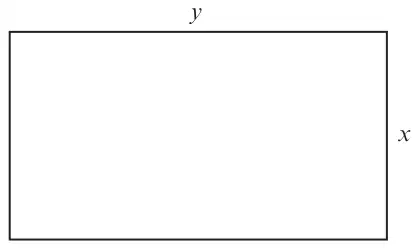
The rectangle below has length \(y\) and width \(x\).
Diagram not drawn to scale
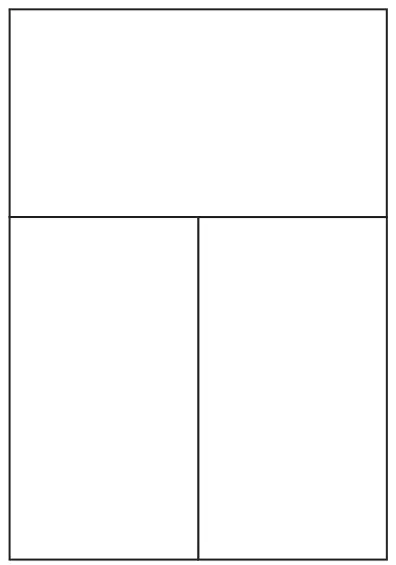
Three rectangles congruent to the one above are arranged, without overlapping, to create the large rectangle below.
Diagram not drawn to scale
Find an expression for the perimeter of this large rectangle in terms of \(x\). Simplify your answer. [3]
Mark scheme (a)
Scheme
Marks
Comments
8f – 3g
B2
B1 for sight of 8f or -3g. Mark final answer.
Mark scheme (b)
Scheme
Marks
Comments
5m – 15
B1
Mark scheme (c)
Scheme
Marks
Comments
32.4 as their final answer
B2
B1 for 31.2 or 1.2 or 6 x 5.2 + 3 x 0.4 Do not allow 31.2x or 1.2y or 32.4xy or x = 31.2 or y = 1.2 Mark final answer.
Mark scheme (d)
Scheme
Marks
Comments
\(\frac{e}{2} = 10\) or e - 8 = 12
B1
e = 20
B1
FT from e/2 = k OR e – m = 12 OR e - 8 = n Allow 2 marks for an embedded answer BUT only 1 mark if contradicted by e ≠ 20
If no marks, then award SC1 for e/2 = 6 + 4 and e = 6 + 4 x 2 (=14) seen.
Mark scheme (e)
Scheme
Marks
Comments
10x
B3
Award B2 for 3y + 4x OR 4y + 2x OR for a correct answer in terms of x that is not fully simplified e.g. 2x + x + 2x + x + x + x + 2x
Award B1 for any one of:
a correct answer in terms of x and y that is not fully simplified e.g. y + x + y + x + x + y + x
for recognising that y = 2x, may be shown on the diagram e.g. y = x + x or x = 0.5y
An answer of 5y is awarded 2 marks (B3 MR -1) An answer in terms of y that is not fully simplified e.g. y + y + y + 4 × 0.5y is awarded 1 mark (B2 MR -1)
6. A grill is large enough to cook 20 kebabs. The following formula is used to calculate the amount of time, in minutes, it takes to prepare and cook kebabs on this grill.
Time = 2·5 × Number of kebabs + 16
(a) How long does it take to prepare and cook 10 kebabs? [2]
(b) How many kebabs can be prepared and cooked in 26 minutes? [2]
Mark scheme (a)
Scheme
Marks
Comments
2.5 × 10 + 16 oe, si
M1
41 (minutes)
A1
Mark scheme (b)
Scheme
Marks
Comments
(26 – 16) ÷ 2.5 oe, si
M1
implied by e.g. ‘26 – 16 = 10, 2.5 × 4 = 10’ or ‘2.5 × 4 = 10, 10 + 16 = 26’; build-up method may be used to find 10
4 (kebabs)
A1
Accept 26 = 2.5 × 4 + 16 for A1 provided there is no contradiction of 4
Explain why neither \(x\) nor \(y\) can be zero. [1]
(ii)
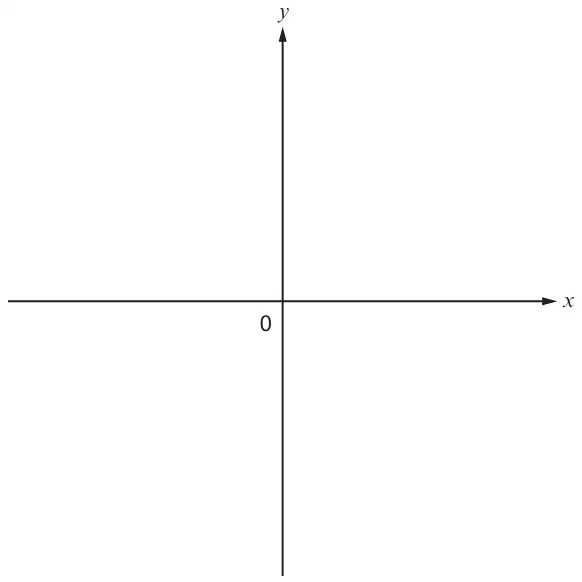
On the axes below, sketch the graph of \(y = \dfrac{1}{x}\). [2]
(iii)
Complete this sentence about the graph you have drawn. [1]
The graph shows ‘\(y\) is ……………… proportional to \(x\)’.
(b)
The variables \(V\) and \(p\) are connected by the equation \(\dfrac{V}{p^2} = 5\).
Find the value of \(V\) when \(p\) = 0·1. [2]
Mark scheme (a)
Scheme
Marks
Comments
(i) Valid explanation e.g. ‘There is no value for which 0 × .... = 1’ or ‘1 cannot be divided by 0’ or ‘Because if one of them is zero, the product would be zero not 1’.
E1
Allow e.g. ‘\(x = \frac{1}{y}\), \(y = \frac{1}{x}\) if \(x\) or \(y\) can be zero these have no value’
Do not allow e.g. ‘Because then the value could not be 1’ without further explanation
(ii) Correct graph: One branch in 1st quadrant, not touching either axis and correct shape One branch in 3rd quadrant, not touching either axis and correct shape
B2
For 2 marks, must be 2 distinct curves; allow some slight curving back at ends B1 for either branch correct
If no marks, SC1 for both branches correct but joined e.g. with a straight line.
(iii) inversely
B1
allow poor spelling; allow ‘inverse’ or ‘not directly’ or ‘not in direct’ or ‘not direct’ or ‘not’ or ‘indirectly’
Do not allow e.g. ‘invertional’ or ‘inversamental’
Mark scheme (b)
Scheme
Marks
Comments
\(5 \times 0.1^2\) oe, si
M1
Substitutes and rearranges; may be in stages; implied by e.g. \(\frac{V}{0.1^2} = 5\), \(\frac{V}{0.2} = 5\), \(V = 5 \times 0.2\) (must be clear that ‘0.2’ is what they think is \(0.1^2\))
13. This formula can be used to find the time it takes to cook a joint of meat.
\[t = 25p + 20\]
where \(t\) is the time in minutes, \(p\) is the mass of the meat in pounds.
(a)
When \(p = 0\), \(t = 20\).
Explain whether the formula is valid when \(p = 0\). [1]
(b)
(i)
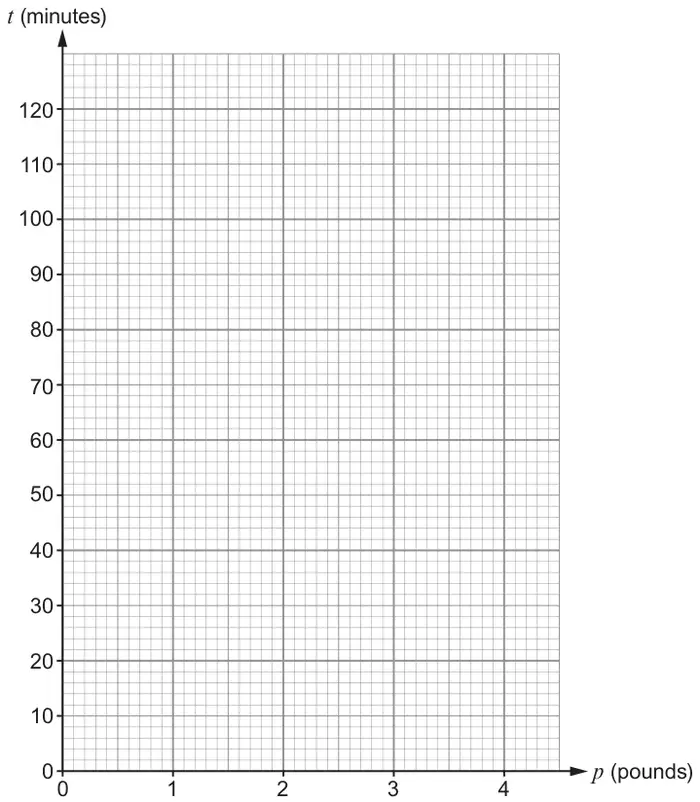
Complete the table below, then draw the graph of \(t = 25p + 20\) for \(1 \leqslant p \leqslant 4\) on the graph paper below. [3]
\(p\)
1
2
3
4
\(t\)
(ii) Find the mass of a joint of meat that takes 1 hour 30 minutes to cook. [1]
(c)
Tasniah wants to cook a joint of meat that has a mass of 2 pounds. She also wants to bake some potatoes.
She knows the potatoes will take \(\dfrac{3}{4}\) of an hour to bake.
When the meat has finished cooking, it must be taken out of the oven and left for 15 minutes before it is ready to be served.
She wants to serve the potatoes at the same time as the meat.
How long after Tasniah puts the meat in the oven should she put the potatoes in the oven to bake? [2]
Mark scheme (a)
Scheme
Marks
Comments
No and valid explanation e.g. ‘According to the formula, it takes 20 minutes to cook no meat.’ or ‘\(t\) should be 0 when \(p\) is 0.’
E1
Allow e.g. ‘No because if p = 0 then the meat wouldn’t exist and would not need cooking.’
Do not allow e.g. ‘It is not valid as there would be no pounds.’
Mark scheme (b)
Scheme
Marks
Comments
(i) Completes table correctly.
\(p\)
1
2
3
4
\(t\)
45
70
95
120
B1
May be implied by correct line drawn, even if it extends outside the given domain.
Plots all four points correctly
P1
May be implied FT their points if possible for P1 and L1
Draws a single, straight line through their points
L1
May not be ruled; tolerance 1 small square in all directions.
(ii) 2.8 (pounds)
B1
FT their graph or accept answers in the range 2.75 to 2.85 (pounds).
Mark scheme (c)
Scheme
Marks
Comments
(When \(p = 2\), \(t = 70\), so required time is 70 + 15 – 45 =) 40 (minutes)
B2
FT their value of \(t\) when \(p = 2\) from their graph or their table; for B2 their value of \(t\) must be greater than 45
B1 for the calculation ‘their 70’ + 15 – 45 or equivalent, seen or implied or SC1 for a final answer of 25 (minutes) or equivalent (ignoring the 15 minutes extra for the meat)
2. A company uses the following formula to work out weekly pay.
Pay = £7.50 x number of hours worked + £30
(a) Terry worked for 28 hours last week. How much was he paid? [2]
(b)
(i) The company only pays for whole numbers of hours worked. Explain why it is not possible for an employee to be paid exactly £100 in a week. [1]
(ii) Last week, Jo was paid just under £100. What is the greatest whole number of hours that Jo could have worked? [1]
……………… hours
Mark scheme (a)
Scheme
Marks
Comments
28 x 7.50 + 30 = (£) 240
M1 A1
Mark scheme (b)
Scheme
Marks
Comments
(i) Suitable explanation e.g. ‘£100 - £30 is £70 which does not divide by 7.50 to give a whole number of hours’, or ‘9 x £7.50 = £67.50 and £67.50 + £30 = £97.50’, and ‘10 x £7.50 = £75 and £75 + £30 = £105’, (so £100 can’t come from a whole number multiple of £7.50), or ‘No multiple of £7.50 + 30 makes £100’, or ‘The pay for 9 hours is £97.50, another £7.50 makes £105, so £100 not possible’, or ‘\(9\frac{1}{3}\) hours makes £100, but the company only pays for whole number of hours’, or ‘There is no whole number that multiplies by £7.50 to give £70’.
11. Use the formula \(18x + 5y = t\) to find the value of \(y\) when \(x = 2{\cdot}5\) and \(t = 60\). [3]
Mark scheme
Scheme
Marks
Comments
\(18 \times 2{\cdot}5 + 5\ (\times)\ y = 60\) or equivalent
M1
\((45 + 5y = 60)\)
\(5y = 15\) or \(y = \dfrac{15}{5}\)
A1
Implies M1A1. Award A1 for the appropriate sight of \(5y\) and 15 (or equivalent) but not in an equation. Sight of \(5y + 15\) is awarded M1 A0.
(60 – 45 =) 15 or equivalent implies M1 but not M1A1. (60 – 45 =) 15 then 15 ÷ 5 or equivalent implies M1A1.
\((y =)\ 3\)
A1
FT only from \(5y = k\) and provided M1 awarded. Mark final answer.
An unsupported answer of 3 is awarded M1A1A1.
Allow M1A1A1 for a correct embedded answer BUT only M1A1A0 if contradicted by \(y \neq 3\).
If FT leads to a whole number answer, it must be shown as a whole number. Otherwise, accept a fraction or decimal.
If no marks gained, award SC1 for one of the following:
unsupported \(y = 21\) (from \(y = 105 \div 5\))
sight of \(105 = 5\ (\times)\ y\).
Alternative method
Scheme
Marks
Comments
\(y = \dfrac{t - 18x}{5}\)
B1
\(y = \dfrac{60 - 18 \times 2{\cdot}5}{5}\)
M1
\(= \dfrac{60 - 45}{5}\) If B0 awarded, FT for one slip in their rearrangement.
\((y =)\ 3\)
A1
Allow M1A1 for a correct embedded answer BUT only M1A0 if contradicted by \(y \neq 3\). If FT leads to a whole number answer, it must be shown as a whole number. Otherwise, accept a fraction or decimal.
If no marks gained, award SC1 for any one of the following:
The length, width and height are the external measurements in metres.
Calculate the delivery cost for the new water trough. [2]
Mark scheme (a)
Scheme
Marks
Comments
(Sean Sheep Mix) (£)11.9(0)
B2
For B2, if units are given they need to be correct Award B1 for any one of the following or equivalent:
14 – 0.15 × 14
14 – 1.4(0) – 0.7(0)
(£)14 – 140(p) – 70(p)
(0.15 × 14.00 =) 2.1(0) or 210
(Rugged Sheep Mix) (£)9
B2
For B2, if units are given they need to be correct Award B1 for any one of the following or equivalent:
24 - ⅝ × 24
⅜ × 24
(24 ÷ 8) × 3
(⅝ × 24 =) 15
Conclusion ‘Rugged (Sheep Mix)’ (by) (£)2.9(0)
B1
Answer spaces take precedence FT provided at least B1(Sean) and B1 (Rugged) previously awarded for appropriate conclusion from a comparison and the correct evaluation of the difference in ‘their derived sheep mix costs’, including £15 – £2.10 = (£)12.9(0) with Sean (Sheep Mix)
Mark scheme (b)
Scheme
Marks
Comments
\(\dfrac{5}{26}\)
B1
Mark scheme (c)
Scheme
Marks
Comments
(Cost of 1.5 litres ice cream =) 18.50 – 2 × 3.25
M1
(= 18.50 – 6.50) Allow 18.50 – 3.25 – 3.25 provided not contradicted in further working
(£)12
A1
Allow an embedded 12, e.g. 6.50 + 12 = 18.50, provided not contradicted in further working
(Cost of 1 litre ice cream =) (12 ÷ 3) × 2 or 12 ÷ 1.5
M1
FT provided 6.50 ≤ ‘their cost of 1.5 litres ice cream’ ≤ 18.50 May be shown in stages
(£)8
A1
Answer space takes precedence FT provided ‘their cost of 1.5 litres ice cream’ derived from a calculation involving 18.50 – (2 ×) 3.25 On FT allow rounding or truncation
If M1A1M0A0, award SC1 for (0.5 litres is) (£)4 provided not from incorrect working or appropriate sight of 12 ÷ 3 = (£)4 or 4 + 4 + 4 = (£)12, or equivalent on FT, allowing actual values, truncation or rounding to a penny
Mark scheme (d)
Scheme
Marks
Comments
(i) 1.6 (m3)
B2
Mark final answer
B1 for appropriate sight of any one of the following or equivalent, that may be seen or implied in stages:
4 × 0.5 × 0.8
attempt to evaluate the product of three numbers with digits 4, 5 and 8 with place value errors
final answer (including in the answer space) with digits 16 but incorrect place value (other digits would be zero)
(ii) (Delivery cost £ =) 5 × (4.1 + 0.6 + 0.9) or 5 × 5.6 or 5 × 5 + 5 × 0.6
M1
(£)28(.00)
A1
Ignore incorrect units given
If no marks, award SC1 for an answer of (£)26.5(0) provided it is from use of internal measurements (5 × (4 + 0.5 + 0.8))
2. Use the formula \(18x + 5y = t\) to find the value of \(y\) when \(x\) = 2·5 and \(t\) = 60. [3]
Mark scheme
Scheme
Marks
Comments
18 × 2·5 + 5 (×) \(y\) = 60 or equivalent
M1
(45 + 5\(y\) = 60)
5\(y\) = 15 or \(y = \dfrac{15}{5}\)
A1
Implies M1A1. Award A1 for the appropriate sight of 5\(y\) and 15 (or equivalent) but not in an equation. Sight of 5\(y\) + 15 is awarded M1 A0.
(60 – 45 =) 15 or equivalent implies M1 but not M1A1. (60 – 45 =) 15 then 15 ÷ 5 or equivalent implies M1A1.
(\(y\) =) 3
A1
FT only from 5\(y\) = \(k\) and provided M1 awarded. Mark final answer.
An unsupported answer of 3 is awarded M1A1A1.
Allow M1A1A1 for a correct embedded answer BUT only M1A1A0 if contradicted by \(y \neq 3\).
If FT leads to a whole number answer, it must be shown as a whole number. Otherwise, accept a fraction or decimal.
If no marks gained, award SC1 for any one of the following:
unsupported \(y\) = 21 (from \(y\) = 105 ÷ 5)
sight of 105 = 5 (×) \(y\).
2. Alternative method:
Scheme
Marks
Comments
\(y = \dfrac{t - 18x}{5}\)
B1
\(y = \dfrac{60 - 18 \times 2{\cdot}5}{5}\)
M1
\(= \dfrac{60 - 45}{5}\) If B0 awarded, FT for one slip in their rearrangement.
(\(y\) =) 3
A1
Allow M1A1 for a correct embedded answer BUT only M1A0 if contradicted by \(y \neq 3\). If FT leads to a whole number answer, it must be shown as a whole number. Otherwise, accept a fraction or decimal.
If no marks gained, award SC1 for any one of the following:
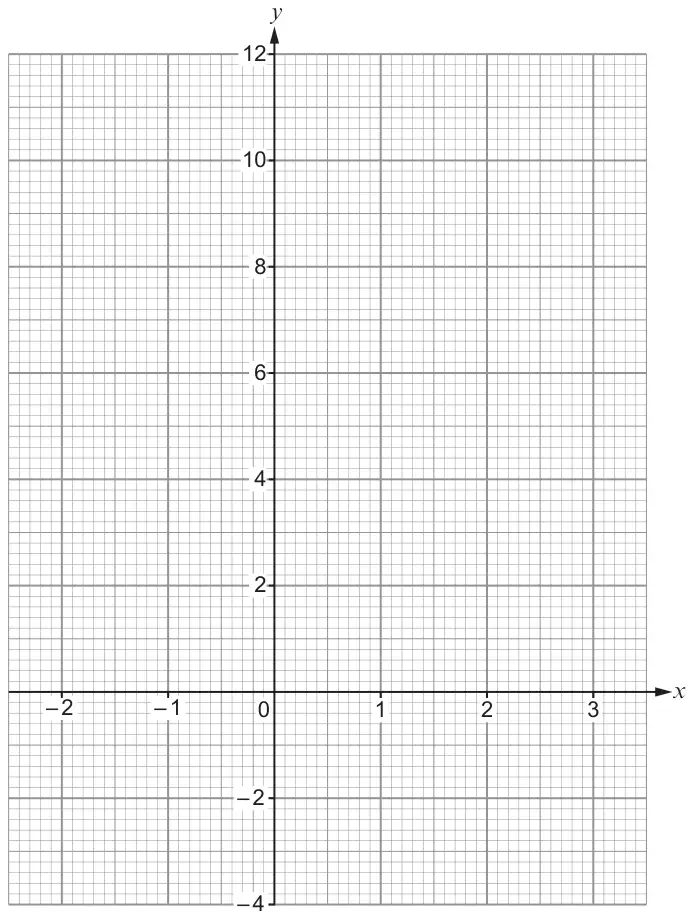
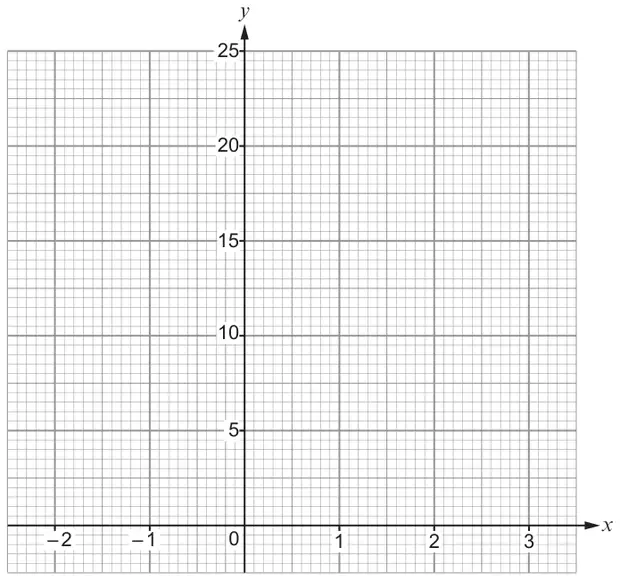
11. The table below shows some of the values of \(y = 2x^2 + x + 3\) for values of \(x\) from –2 to 3.
\(x\)
–2
–1
0
1
2
3
\(y = 2x^2 + x + 3\)
4
3
6
24
(a) Complete the table by finding the values of \(y\) for \(x\) = –2 and for \(x\) = 2. [2]
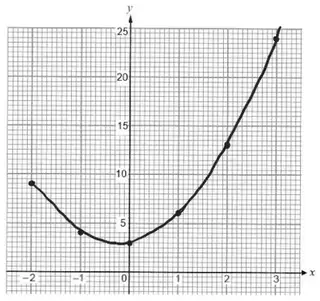
(b) On the graph paper below, draw the graph of \(y = 2x^2 + x + 3\) for values of \(x\) from –2 to 3. [2]
Mark scheme (a)
Scheme
Marks
Comments
9 13
B2
Answers in table take precedence. B1 for each.
Mark scheme (b)
Scheme
Marks
Comments
At least 4 correct plots and no incorrect plot.
P1
FT ‘their (–2,9)’ and ‘their (2,13)’ OR (–2,9) and (2,13) plotted (even when not shown in the table or contradicted). Allow ± ‘½ a small square’.
A smooth curve drawn through their plots.
C1
FT ‘their 6 plots’ OR a curve through the 4 given points AND (–2,9) and (2,13). Clear intention to draw a curve through ‘their plotted points’(± 1 small square horizontally or vertically).
Dafydd is working on his fitness. Dafydd uses this formula to calculate his Body Mass Index (BMI):
BMI = mass ÷ height2
where mass is in kilograms and height is in metres
Football players should have a BMI between 18 and 24·9.
Dafydd’s mass is 79 kg and his height is 1·8 m.
Calculate Dafydd’s BMI. [2]
(b)
Dafydd’s first game of football was on Saturday. The match started at 3 p.m.
The playing time of the match was \(1\frac{1}{2}\) hours.
Half time was 15 minutes long.
After the game, the players completed cool-down exercises and stretching for 20 minutes.
Dafydd took 25 minutes to shower and change.
The journey home took 45 minutes.
At what time did Dafydd arrive home? You must show all your working. [3]
(c)
The list below shows the number of goals that Dafydd’s football team scored in each of their last 7 games.
3 1 6 3 1 1 2
The football coach looks at this data.
(i)
The coach says,
“The median number of goals scored per game is three.”
Show that the coach is not correct. [2]
(ii) What is the mode of the number of goals scored per game for the team? [1]
(iii) Calculate the range of the number of goals scored per game. [1]
Mark scheme (a)
Scheme
Marks
Comments
79 ÷ 1.82 24(.3827…)
M1 A1
Ignore subsequent rounding if 24(.3827…. ) seen. Accept rounded or truncated answers e.g. 24.3 or 24.4 Do not accept an answer of 25 unless 24(.3827…) seen If correct answer seen with 79 ÷ 1.8 award M1A1
Mark scheme (b)
Scheme
Marks
Comments
(Time taken =) 3 hours 15 mins or 195 mins
B2
B1 any one of the following:
clearly calculating 1½ hrs + 15 mins + 20 mins + 25 mins + 45 mins
Allow use of 01:30 + 00:15 + 00:20 + 00:25 + 00:45
1 hour 45 mins or 105 mins (1 ½ hours omitted)
3 hours or 180 mins (15 mins omitted)
2 hours 55 mins or 175 mins (20 mins omitted)
2 hours 50 mins or 170 mins (25 mins omitted)
2 hours 30 mins or 150 mins (45 mins omitted)
(Earliest arrival home is) 6:15 (pm) or 18(:)15
B1
Award B2 B0 for 6:15 am FT ‘their 3 hours 15 mins’ or ‘their 195 mins’ provided B1 awarded
Alternative
The alternative method is printed in italics in the mark scheme.
3(b) Alternative method – adding times to 3 p.m.
Scheme
Marks
Comments
(Earliest arrival home is) 6:15 (pm) or 18(:)15
B3
B2 for:
an answer of 6:15 am
an answer that includes correct step-by-step calculations with at most one error or omission. FT from their one error or omission
B1 for
an answer that includes correct step-by-step calculations with at most two errors or omissions. FT from their 2 errors or omissions
3 correctly calculated steps. FT from their 2 errors or omissions
Mark scheme (c)
Scheme
Marks
Comments
(i) (size order) 1, 1, 1, 2, 3, 3, 6 (median=) 2
M1 A1
Accept indication of median is 2 e.g. circling of 2 when numbers are in size order. Do not award M1A1 for an unsupported answer of 2.
9. During the 30 days in the month of September, Andras used 138 m3 of gas. The cost of this gas was 12p per kWh.
The formula used to calculate the number of kWh for the gas used is as follows:
Number of kWh = number of m3 of gas × 39·5 × 1·02264 ÷ 3·6
The standing charge was 32p per day. VAT at 5% was payable on the sum of the cost of the gas used and the standing charge.
Calculate Andras’s gas bill for September. You must show all your working. [7]
Mark scheme
Scheme
Mark
Comments
Penalise incorrect units -1 only on first occurrence, by withholding A or B mark, not M marks
(Number of kWh =) 138 × 39·5 × 1.02264 ÷ 3.6 (Cost of gas = Number of kWh) × 0(.)12
M1 m1
(= 1548.4474 kWh)
(£)185.76 to (£)185.82 or 18576(p) to 18582(p)
A1
(1548.4474 × 0.12 = £185.813688)
(Standing charge 30 × (0.)32 =) (£)9.6(0) or 960(p)
B1
CAO
(Total of gas and standing charge) *(£)195.36 to (£)195.42 or 19536(p) to 19542(p)
B1
FT ‘their derived cost of gas’ + ‘their 30 × (0.)32’ correctly evaluated, provided ‘their derived cost of gas’ ≠ ‘their 138 × 39·5 × 1.02264 ÷ 3.6’ or 1548.4474 kWh May be implied in later working
(Total including VAT =) 1.05 × 195(.)36 to 1.05 × 195(.)42
M1
FT ‘their derived total cost of gas + ‘their standing charge’
*(£)205.12 to (£)205.19(1) or 20512(p) to 20519(.1p)
A1
ISW further rounding, e.g. (£)205, (£)205.20
If final B0 B0 M0 A0, award SC1 for correctly evaluated final answer of 1.05 × ‘derived cost of gas’ having omitted the standing charge, provided ‘their derived cost of gas’ ≠ ‘their 138 × 39·5 × 1.02264 ÷ 3.6’ or 1548.4474 kWh
*Allow answers in these ranges that may include unseen rounding or truncation from a previously written value
Alternative
Alternative method: Gas per day(printed in italics in the mark scheme)
Scheme
Mark
Comments
Penalise incorrect units -1 only on first occurrence, by withholding A or B mark, not M marks
(Number of kWh =) 138 × 39·5 × 1.02264 ÷ 3.6 (Number of kWh per day) ÷ 30 (Cost of gas per day) × 0(.)12
M1 m1 m1
(= 1548.4474 kWh) (= 51.6149133…kWh)
(Cost of gas per day =) (£)6.19(…) or 619(...p)
A1
CAO
(Total of gas and standing charge) 6.51(…) or 651.(…p)
B1
FT ‘their derived cost of gas per day’ + (0.)32 correctly evaluated May be implied in later working
(Total including VAT =) 1.05 × 6.51(…) × 30
M1
(= 6.83(94…) × 30 or 6.84 × 30) FT ‘their derived cost of gas per day + (0.)32, provided ‘their derived cost of gas’ ≠ ‘their 138 × 39·5 × 1.02264 ÷ 3.6’ or 1548.4474 kWh
*(£)205.12 to (£)205.19(1) or 20512(p) to 20519(.1p)
A1
ISW further rounding, e.g. (£)205, (£)205.20
If final B0 M0 A0, award SC1 for correctly evaluated final answer of 1.05 × ‘derived cost of gas per day’ × 30 having omitted the standing charge, provided ‘their cost of gas’ ≠ ‘their 138 × 39·5 × 1.02264 ÷ 3.6’ or 1548.4474 kWh
*Allow answers in these ranges that may include unseen rounding or truncation from a previously written value
Use of accurate values of (£)362.05 and/or (£)400.81 can be accepted
= (£)484.12
A2
FT if more accurate values used e.g.
(£)484.17 or (£)484.16(8755) from use of accurate Option B monthly payment
(£)483.95 or (£)483.94(84006) from use of both accurate monthly payments
A1 for sight of any one of the following:
an answer of (£)484 to (£)485 as a result of premature rounding
(£) 2484.12
(£)2484.17 or (£)2484.16(8755) from use of accurate Option B monthly payment
(£)2483.95 or (£)2483.94(84006) from use of both accurate monthly payments
Corrected by Westie's Workshop
The board's mark scheme printed “(£)484.94(84006)” and “(£)2484.94(84006)”. Changed to “(£)483.94(84006)” and “(£)2483.94(84006)” because using both accurate monthly payments gives a saving of £483.9484006… (or £2483.9484006… if the £2000 deposit is not taken off), as the rounded values £483.95 and £2483.95 next to them show.
Original: see the board's mark scheme PDF (link above).
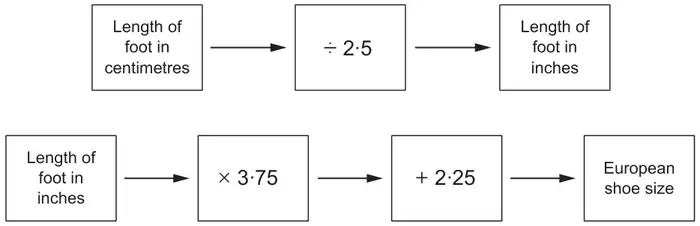
4. Alys is buying a pair of shoes online from a company in Italy. The shoes are labelled with European sizes. Alys uses the rules below to calculate her European shoe size.
Alys measures the length of her foot as 22·5 cm.
Alys thinks that she will be a European shoe size 37.
Is Alys correct?
Give a reason for your answer. [3]
Yes ☐ No ☐
Mark scheme
Scheme
Marks
Comments
(22.5 (cm) ÷ 2·5) 9 (inches)
B1
Ignore any incorrect units given. Workings may be on the diagram. May be implied
9 × 3.75 + 2.25 36 and no indicated
M1 A1
FT ‘their derived 9’ provided ≠ 22.5 FT appropriate response from ‘their 9’ Allow rounded or truncated answers on FT with the appropriate response.
Alternative
The alternative method is printed in italics in the mark scheme.
4. Alternative method
Scheme
Marks
Comments
((37 – 2.25) ÷ 3.75 =) 9.2(6…..)
B1
Ignore any incorrect units given. Workings may be on the diagram. May be implied. Rounded or truncated
9.2(6..) × 2.5 23(.16666….) and no indicated
M1 A1
FT ‘their derived 9.2(6….).’ provided ≠ 37 Accept answers in the range 23 to 23.25
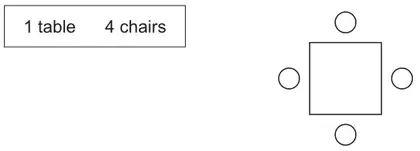
4. A restaurant uses square tables to seat customers. Four chairs fit around one table, as shown in the diagram below.
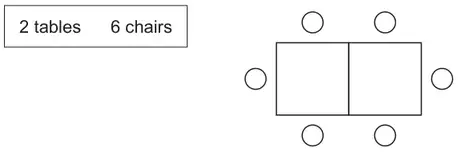
For groups of more than four customers, tables are arranged in a line. For example, six chairs fit around two tables, as shown in the diagram below.
The total cost of buying new tables and chairs can be calculated using the formula:
Total cost (£) = number of tables × 17.84 + number of chairs × 9.47
Four new tables are to be arranged in a line. Calculate the total cost of buying the four tables and the chairs needed for these tables. You must show all your working. [5]
Mark scheme
Scheme
Marks
Comments
Sight of 10 (chairs)
B1
May be implied in later working Award B1 for correct diagram drawn with 4 tables and 10 chairs shown
4 × 17.84 + 10 × 9.47
M2
FT for M2 for 4 tables AND ‘their 10 chairs’ where the number of chairs > 6 e.g. use of 4 tables and 8 chairs
Award M1 for:
4 × 17.84 (= (£)71.36))
10 × 9.47 (= (£)94.7(0))
‘their number of chairs > 6’ × 9.47
(£)166.06
A2
Only award A2 if 4 tables have been considered with their chairs > 6 Award A1 for
(£)71.36
(£)94.7(0)
‘their number of chairs > 6’ × 9.47 correctly evaluated
Note: A total cost needs to be checked as it may imply M1 A1 Note: common incorrect totals are: 4 × 17.84 + 12 × 9.47 = £185 4 × 17.84 + 16 × 9.47 = £222.88 4 × 17.84 + 24 × 9.47 = £298.64 These are awarded B0M2A2
6. Rebecca needs to save £10 000 for the deposit to buy a new house. She has opened a savings account with Dragon Building Society. The account has a nominal annual rate of 5·4%, with interest paid on the last day of every month.
The formula for calculating the amount of money in the account at the end of every month is:
\(A\) is the amount of money in the account at the end of every month, \(M\) is the amount deposited into the account on the 1st day of each month, \(r\) is the monthly interest rate written as a decimal, \(n\) is the number of months the account has been open.
Rebecca opened the account on 1st August 2022, depositing £335 into the account. She will deposit £335 into the account on the 1st day of every month.
(a)
At the end of which month, and in which year, will Rebecca have the £10 000 she needs? You must show all your working. [4]
Rebecca will have the £10 000 at the end of …………… in the year ……………
(b)
Calculate the AER for Rebecca’s savings account. Give your answer as a percentage, correct to 2 decimal places. [2]
(c)
Rebecca’s friend, Seren, opened a similar savings account with Dragon Building Society on 1st June 2020, depositing £300. Seren then deposited £300 into the account on the 1st day of every month. By 30th November 2021, Seren had £5636.84 in the account.
How much interest had Seren received? Circle your answer. [1]
£236.84 £636.84 £836.84 £3836.84 £4136.84
From the formula list: Annual Equivalent Rate (AER): AER, as a decimal, is calculated using the formula \(\left(1+\dfrac{i}{n}\right)^{n}-1\), where \(i\) is the nominal interest rate per annum as a decimal and \(n\) is the number of compounding periods per annum.
Mark scheme (a)
Scheme
Marks
Comments
For all the amounts of money shown below, accept other reasonable approximations e.g. nearest 10p, rounded or truncated Only allow a misread of the amount deposited, not of the nominal annual rate
\(335\left(\dfrac{\left(\left(1+\frac{5.4/100}{12}\right)^{n}-1\right)\left(1+\frac{5.4/100}{12}\right)}{\frac{5.4/100}{12}}\right)\) or \(335\left(\dfrac{((1+0.0045)^{n}-1)(1+0.0045)}{0.0045}\right)\)
B1
For any value of n
\(335\left(\dfrac{\left(\left(1+\frac{5.4/100}{12}\right)^{28}-1\right)\left(1+\frac{5.4/100}{12}\right)}{\frac{5.4}{12\times 100}}\right)\) or \(335\left(\dfrac{((1+0.0045)^{28}-1)(1+0.0045)}{0.0045}\right)\)
M1
OR \(335\left(\dfrac{\left(\left(1+\frac{5.4/100}{12}\right)^{n}-1\right)\left(1+\frac{5.4/100}{12}\right)}{\frac{5.4/100}{12}}\right)\) = 10000 (or ≥ 10000)
May be implied by amounts of (£)9259.52(1991) for n=26 AND (£)9637.69(734) for n=27
= (£) 10 017(.57…) or (£) 10 018
A1
Or evidence that n = 28 An answer of 28 months with no incorrect work seen can be awarded B1M1A1 and possible final A1
(Date when Rebecca has £10 000) November 2024
A1
CAO If first B1 only awarded, SC1 for a correct evaluation of the formula for any value of n from 20 to 30
n=20 leads to (£)7025(.78…) or (£)7026
n=21 leads to (£)7393(.906…) or (£)7394
n=22 leads to (£)7763(.686..) or (£)7764
n=23 leads to (£)8135(.13…)
n=24 leads to (£)8508(.246…)
n=25 leads to (£)8883(.04…)
n=26 leads to (£)9259(.52…) or (£)9260
n=27 leads to (£)9637(.697…) or (£)9638
n=29 leads to (£)10399(.16…)
n=30 leads to (£)10782(.46…)
If no marks awarded and from using a rate of 5.4/12 = 0.45, SC2 for (£)13467(.65…) or (£)13468 AND Feb 2023 from \(335\left(\dfrac{((1+0.45)^{7}-1)(1+0.45)}{0.45}\right)\), or SC1 for (£)13467(.65) or (£)13468
If no marks awarded and from using a rate of 0.045, SC2 for (£)10174(.426…) AND February 2024 from \(335\left(\dfrac{((1+0.045)^{19}-1)(1+0.045)}{0.045}\right)\), or SC1 for (£)10174(.426...)
If no marks awarded and from using a rate of 0.054, SC2 for (£)10312(.178…) AND January 2024 from \(335\left(\dfrac{((1+0.054)^{18}-1)(1+0.054)}{0.054}\right)\), or SC1 for (£)10312(.178…)
Mark scheme (b)
Scheme
Marks
Comments
(AER =) \(\left(1+\dfrac{5.4/100}{12}\right)^{12}-1\) or equivalent = 5.54(%)
M1 A1
Sight of an answer of 5.53(5675…%) is awarded M1A0
(a) Find a whole number value of \(n\), so that \(7n - 9\) is a multiple of 4. You must show all your working. [2]
When \(n\) = ……………………, \(7n - 9\) is a multiple of 4.
(b) Find a whole number value of \(n\), so that \(3n - 5\) is a prime number. You must show all your working. [2]
When \(n\) = ……………………, \(3n - 5\) is a prime number.
Mark scheme (a)
Scheme
Marks
Comments
Any \(n\), as a whole number, which results in \(7n - 9\) being a multiple of 4
B2
Answer space takes precedence and must not be from incorrect working. Do not ignore crossed-out work for this question. Award B1 for any one of:
any 2 correctly evaluated terms in the sequence \(7n - 9\) (i.e. not leading to, or not recognised as leading to, a multiple of 4 for their choice of \(n\)) or
setting up an equation \(7n - 9 = 4 \times k\) (where \(k \geq 1\) and a whole number) and attempt to solve
a correct value of \(n\) substituted in \(7n - 9\), but contradiction or no answer given on answer line (e.g. 7×3 – 9 = 12 and 12 written on answer line or answer line left blank)
\(n\)
1
2
3
4
5
6
7
8
9
10
11
……
\(7n\) - 9
-2
5
12
19
26
33
40
47
54
61
68
……
Note: Award B0 for a correct value of \(n\) from incorrect working e.g. if 7 × 4 – 9 = 19, then \(n\) = 19 on the answer line.
The shaded cells were shaded in the original. In the original this table and note are part of the Comments column.
Mark scheme (b)
Scheme
Marks
Comments
Any \(n\), as a whole number, which results in \(3n - 5\) being a prime number
B2
Answer space takes precedence and must not be from incorrect working. Do not ignore crossed-out work for this question. Award B1 for any one of:
any 2 correctly evaluated terms in the sequence \(3n - 5\) (i.e. not leading to, or not recognised as leading to, a prime number for their choice of \(n\)) or
setting up an equation \(3n - 5\) = a prime number and attempt to solve
a correct value of \(n\) substituted in \(3n - 5\), but contradiction or no answer given on answer line (e.g. 3×4 – 5 = 7 and 7 written on answer line or answer line left blank)
a correct value of \(n\) substituted in \(3n - 5\), but \(n\) contradicted for their workings (but \(n\) still leads to a prime number) given on answer line (e.g. 3×4 – 5 = 7 and 12 written on answer line or answer line left blank).
\(n\)
1
2
3
4
5
6
7
8
9
10
11
……
\(3n\) - 5
-2
1
4
7
10
13
16
19
22
25
28
……
Note: Award B0 for a correct value of \(n\) from incorrect working e.g. if 3 × 4 – 5 = 13, then \(n\) = 13 on the answer line.
The shaded cells were shaded in the original. In the original this table and note are part of the Comments column.
(a) Find a whole number value of \(n\), so that \(7n - 9\) is a multiple of 4. You must show all your working. [2]
When \(n =\) ………………, \(7n - 9\) is a multiple of 4.
(b) Find a whole number value of \(n\), so that \(3n - 5\) is a prime number. You must show all your working. [2]
When \(n =\) ………………, \(3n - 5\) is a prime number.
Mark scheme (a)
Scheme
Marks
Comments
Any \(n\), as a whole number, which results in \(7n - 9\) being a multiple of 4
B2
Answer space takes precedence and must not be from incorrect working. Do not ignore crossed-out work for this question. Award B1 for any one of:
any 2 correctly evaluated terms in the sequence \(7n - 9\) (i.e. not leading to, or not recognised as leading to, a multiple of 4 for their choice of \(n\)) or
setting up an equation \(7n - 9 = 4 \times k\) (where \(k \geqslant 1\) and a whole number) and attempt to solve
a correct value of \(n\) substituted in \(7n - 9\), but contradiction or no answer given on answer line (e.g. 7×3 – 9 = 12 and 12 written on answer line or answer line left blank).
Note: Award B0 for a correct value of \(n\) from incorrect working e.g. if 7 × 4 – 9 = 19, then \(n\) = 19 on the answer line.
Table
n
1
2
3
4
5
6
7
8
9
10
11
……
\(7n\) - 9
-2
5
12
19
26
33
40
47
54
61
68
……
(This table is printed in the comments column, after the list above. The highlighted columns were shaded in the original.)
Mark scheme (b)
Scheme
Marks
Comments
Any \(n\), as a whole number, which results in \(3n - 5\) being a prime number
B2
Answer space takes precedence and must not be from incorrect working. Do not ignore crossed-out work for this question. Award B1 for any one of:
any 2 correctly evaluated terms in the sequence \(3n - 5\) (i.e. not leading to, or not recognised as leading to, a prime number for their choice of \(n\)) or
setting up an equation \(3n - 5\) = a prime number and attempt to solve
a correct value of \(n\) substituted in \(3n - 5\), but contradiction or no answer given on answer line (e.g. 3×4 – 5 = 7 and 7 written on answer line or answer line left blank)
a correct value of \(n\) substituted in \(3n - 5\), but \(n\) contradicted for their workings given on answer line (but \(n\) still leads to a prime number) (e.g. 3×4 – 5 = 7 and 12 written on answer line).
Note: Award B0 for a correct value of \(n\) from incorrect working e.g. if 3 × 4 – 5 = 13, then \(n\) = 13 on the answer line.
Table
n
1
2
3
4
5
6
7
8
9
10
11
……
\(3n\) - 5
-2
1
4
7
10
13
16
19
22
25
28
……
(This table is printed in the comments column, after the list above. The highlighted columns were shaded in the original.)
(a)In this part of the question, you will be assessed on the quality of your linguistic and mathematical accuracy in writing.
Solve \(7x - 3 = 11\). [2 + 1 W]
(b) Find the value of \(3f + 2g\) when \(f\) = 5·8 and \(g\) = −3·7. [2]
Mark scheme (a)
Scheme
Marks
Comments
7x =14
B1
x = 2
B1
FT from 7x = k. Accept x = k/7 (but, if on FT k is a multiple of 7, final answer must be given as a whole number.) B1B0 for ‘x = 14/7’
An evaluated FT for k ÷ 7 must be rounded or truncated to at least 2dp. e.g. 7x = 8 (B0) followed by, x = 8 ÷ 7 (B0) x = 8/7 (B1), x = 11/7 (B1), x = 1·14 (B1), x = 1·1 (B0)
Mark final answer. Allow 2 marks for embedded answer BUT only 1 mark if contradicted by x ≠ 2.
W Accuracy of writing.
W1
For W1, candidates will be expected to:
show all their working
make few, if any, errors in spelling, punctuation and grammar
use correct mathematical form in their working
use appropriate terminology, units, etc
Mark scheme (b)
Scheme
Marks
Comments
10
B2
C.A.O. B1 for sight of 17·4 OR −7·4 Do not accept 17·4f nor −7·4g Do not treat the use of 3·7 for −3·7 as a misread.
where, \(r\) is the monthly interest rate written as a decimal, \(L\) is the loan amount, and \(n\) is the number of months required to pay off the loan.
Calculate the difference in the monthly payments if the loan is taken out over 4 years rather than 5 years. [4]
Mark scheme
Scheme
Marks
Comments
(Difference in monthly payments =) \(\dfrac{0.0025 \times 17000}{1 - (1 + 0.0025)^{-48}}\) or \(\dfrac{0.0025 \times 17000}{1 - (1 + 0.0025)^{-60}}\)
Accept (£)70.82 or (£)70.815(8…) if accurate monthly payments used
If no marks awarded, SC1 for a final answer of (£)0.08 or (£)0.09 or (£)0.088(2…) from using 0.25 instead of 0.0025 OR SC1 for a final answer of (£)62.09 or (£)62.094(…) from using 0.025 instead of 0.0025 OR SC1 for a final answer of (£)851.05 or (£)851.06 or (£)851.053(…) from using the correct rate with n = 4 and n = 5
(a) Arwel is tiling an area behind his bathroom sink. He uses one large rectangular tile with length 330 mm and width 250 mm.
(i) Find the area of the rectangular tile. State the units of your answer. [3]
(ii) Arwel puts a 15 mm wide border around three sides of the tile. He puts a 4 mm wide strip of adhesive between the tile and the sink.
This is shown below.
Diagram not drawn to scale
The length \(a\) on the diagram is the total length of the tile and borders. The width \(b\) on the diagram is the total width of the tile, border and adhesive strip.
Find the length \(a\) and the width \(b\). Give your answers in cm. [3]
Length \(a\) = …………………… cm Width \(b\) = …………………… cm
(b) Arwel employs a tiler to do more tiling work in his house.
The tiler uses the following formula when preparing the bill for Arwel.
Total cost = £23 × number of hours worked + cost of materials
Calculate the total cost when the tiler works for 15 hours and 30 minutes and the cost of materials is £237.60. [3]
Mark scheme (a)
Scheme
Marks
Comments
(i) 330 × 250
M1
Award M1 for 33 × 25 OR 0·33 × 0·25
82 500
A1
Mark final answer If change of units (cm or m), then method must match answer (825 or 0·0825) e.g. 330 × 250 = 825 is awarded M1A0U0 but, if correct units included e.g. 330 × 250 = 825 cm2 M1A1U1 can be awarded.
mm2
U1
FT correct unit for their calculation. Unsupported incorrect answers are awarded U1 for mm2 only
(ii) (\(a\) = ) 36(·0 cm) (cm) AND (\(b\) = ) 26·9
B3
B2 for
\(a\) = 360 (mm) AND \(b\) = 269 (mm)
\(a\) = 26·9 (cm) AND \(b\) = 36(·0cm)
\(a\) = 36(·0 cm)
\(b\) = 26·9 (cm)
330 + 15 + 15 AND 250 + 15 + 4
33 + 1·5 + 1·5 AND 25 + 1·5 + 0·4
Otherwise B1 for sight of
269 OR 26·9
360 OR 36(·0)
330 + 15 + 15 OR 250 + 15 + 4
33 + 1·5 + 1·5 OR 25 + 1·5 + 0·4
If no marks awarded, SC1 for sight of 34·5 or 25·4 or 26·5 (one length omitted)
Mark scheme (b)
Scheme
Marks
Comments
23 × 15·5 + 237.6(0)
M2
Allow M1 for substitution of their attempt at 15 hours 30 minutes e.g. 23 × 15·3 + 237.6(0) 23 × 930 + 237.6(0)
(£) 594.1(0)
A1
Allow FT from 15·3 but not 930 i.e. award M1A1 for 23 × 15·3 + 237.6(0) = (£)589.5(0)
If no marks award SC1 for
an answer of (£)356.5(0) (from 23 × 15·5)
an answer of (£)582.6(0) (from 23 × 15 + 237.6(0))
(b) Find the value of \(3f + 2g\) when \(f = 5{\cdot}8\) and \(g = -3{\cdot}7\). [2]
Mark scheme (a)
Scheme
Marks
Comments
7x =14
B1
x = 2
B1
FT from 7x = k. Accept x = k/7 (but, if on FT k is a multiple of 7, final answer must be given as a whole number.) B1B0 for ‘x = 14/7’
An evaluated FT for k ÷ 7 must be rounded or truncated to at least 2dp. e.g. 7x = 8 (B0) followed by, x = 8 ÷ 7 (B0) x = 8/7 (B1), x = 11/7 (B1), x = 1·14 (B1), x = 1·1 (B0)
Mark final answer. Allow 2 marks for embedded answer BUT only 1 mark if contradicted by x ≠ 2.
Mark scheme (b)
Scheme
Marks
Comments
10
B2
C.A.O. B1 for sight of 17·4 OR −7·4 Do not accept 17·4f nor −7·4g Do not treat the use of 3·7 for −3·7 as a misread.
14. The table below shows some of the values of \(y = x^2 - 4x - 3\) for values of \(x\) from –2 to 5.
\(x\)
−2
–1
0
1
2
3
4
5
\(y = x^2 - 4x - 3\)
2
−3
−6
−6
−3
2
(a) Complete the table by finding the value of \(y\) for \(x = -2\) and the value of \(y\) for \(x = 2\). [2]
(b) On the graph paper below, draw the graph of \(y = x^2 - 4x - 3\) for values of \(x\) from –2 to 5. [2]
(c) Draw the line \(y = 1\) on the graph paper. Write down the values of \(x\) where the line \(y = 1\) cuts the curve \(y = x^2 - 4x - 3\). [2]
Values of \(x\) are …………………… and ……………………
Mark scheme (a)
Scheme
Marks
Comments
9 −7
B2
B1 for each.
Mark scheme (b)
Scheme
Marks
Comments
At least 6 correct plots and no incorrect plot.
P1
FT ‘their (−2,9)’ and ‘their (2,−7)’ Allow ± ‘½ a small square’.
A smooth curve drawn through their plots.
C1
FT ‘their 8 plots’. OR a curve through the 6 given points and (−2,9) and (2,−7). Allow intention to pass through their plots. (± 1 small square horizontal or vertical.)
Mark scheme (c)
Scheme
Marks
Comments
Line y = 1 drawn
B1
Must be at least 2cm long.
−0·8 AND 4·8
B1
FT intersection of ‘their curve’ with ‘their \(y\) = 1’ only if exactly two points of intersection and y ≠ 0.
If curve drawn, but no line drawn, allow a FT from intersection of ‘their curve’ with line \(y\) = 1 only if exactly two points of intersection for B0B1. Allow ± ‘1 small square’.
10. Dafydd has bought a new van. To pay for the van, he has taken out a loan for £18 000. The loan has an APR of 3%, and will be repaid by monthly payments of £237.84.
The amount that is still to be repaid on a loan is known as the remaining balance. The formula below can be used to calculate the remaining balance on a loan after a period of time from the start date of the loan:
\(r\) is the monthly interest rate written as a decimal, \(L\) is the loan amount in pounds, \(M\) is the monthly payment in pounds, \(n\) is the number of months after the start date of the loan.
Dafydd plans to sell the van in 5 years’ time for £5000. Will he have enough money from the sale of the van to pay off the remaining balance on the loan? You must show all your working. [4]
(= (£) 20 909.10(…) – (£) 15 375.57(…)) Each expression may be seen in stages M1 for a subtraction involving 1 correct expression, OR for a subtraction with only one consistently substituted incorrect value
= (£)5533.52(7…) AND e.g. ‘No, Dafydd would not have enough to pay off the loan’
A2
CAO Accept rounded answers e.g. (£)5533 or (£)5534 A1 for (£)5533.52(7…) or rounded answers without a correct conclusion, OR A1 for a correct calculation of (£)15 375.57(…)
(a) It is said that, in 1823, a schoolboy called William Webb Ellis caught the ball during a game of football and ran with it. He created a new sport called rugby. How many years ago did William Webb Ellis catch the ball? [1]
(b) The total number of points scored by a team in a rugby game can be calculated using the following formula.
Total points =
number of tries scored × 5 + number of conversions kicked × 2 + number of penalties kicked × 3 + number of drop goals kicked × 3
At the end of the game, the team with the most points is the winner. Two schools, Ysgol Abergwyn and Ysgol Llanbro, played a rugby game. Ysgol Abergwyn scored 6 tries and kicked 4 conversions and 2 penalties. Ysgol Llanbro scored 7 tries and kicked 3 conversions, 1 penalty and 1 drop goal.
Using the formula above, calculate how many points each team scored. Write down which team won the game and by how many points. [5]
Ysgol Abergwyn scored …………… points
Ysgol Llanbro scored …………… points
Ysgol …………… won the game by …………… points
Mark scheme (a)
Scheme
Marks
Comments
197 (years)
B1
Mark scheme (b)
Scheme
Marks
Comments
(Abergwyn =) 6 × 5 + 4 × 2 + 2 × 3
M1
M1 for sight of the values 30, 8 and 6, together with the intention to add
44 (points)
A1
CAO
(Llanbro =) 7 × 5 + 3 × 2 + (1 ×) 3 + (1 ×) 3
M1
M1 for sight of at least three of the values 35, 6, 3 and 3, together with the intention to add
47 (points)
A1
CAO
(Ysgol)Llanbro(won the game by)3(points)
B1
FT correct conclusion using their scores. FT ‘their 47’ – ‘their 44’
If no marks awarded, award SC1 for sight of 30,8, 6 and 35, 6, 3, 3
12. The table below shows some of the values of \(y = x^2 - 2x - 4\) for values of \(x\) from –3 to 4.
\(x\)
−3
−2
−1
0
1
2
3
4
\(y = x^2 - 2x - 4\)
11
4
−1
−4
−4
–1
4
(a) Complete the table by finding the value of \(y\) when \(x\) = 1. [1]
(b) On the graph paper below, draw the graph of \(y = x^2 - 2x - 4\) for values of \(x\) from –3 to 4. [2]
(c)
(i) Draw the line \(y + x = 4\) on the graph paper. [2]
(ii) Write down the values of \(x\) where the line \(y + x = 4\) cuts the curve \(y = x^2 - 2x - 4\). [1]
Values of \(x\) are ……………… and ………………
Mark scheme (a)
Scheme
Marks
Comments
–5
B1
Mark scheme (b)
Scheme
Marks
Comments
At least 7 correct plots and no incorrect plot.
P1
F.T. ‘their (1,−5)’ Allow ± ‘½ a small square’.
A smooth curve drawn through their plots.
C1
F.T. ‘their 8 plots’. OR a curve through the 7 given points and (1,−5) Allow intention to pass through their plots. (± 1 small square horizontal or vertical.)
Mark scheme (c)
Scheme
Marks
Comments
(i) Line y + x = 4 drawn.
B2
B1 for a straight line going through(0,4) or (4,0) BUT NOT line y = 4 nor line x = 4
(ii) −2·4 AND 3·4
B1
F.T. intersection of ‘their curve’ with ‘their y + x = 4 ’ (even for line y = 4) only if exactly two points of intersection. Must be seen to intersect their curve at two points. Allow ± ‘1 small square’.
12. Laura and Matthew are buying a house priced at £150 000. In order to buy the house, they will need to have a mortgage.
A mortgage is a loan that is paid back over a number of years.
They have saved a deposit of £15 000. They need a mortgage of £135 000.
A bank has offered them a mortgage of £135 000 at an interest rate of 2·4% per annum, with interest added monthly.
To calculate the monthly payments needed in order to pay back the mortgage, they use the following formula:
\[M = \frac{r \times P}{1-(1+r)^{-12n}}\]
where:
\(M\) is the amount of each monthly payment, \(P\) is the mortgage needed, \(r\) is the monthly interest rate as a decimal, \(n\) is the number of years taken to pay back the mortgage.
(a) The annual interest rate is 2·4%. What is the monthly rate, as a decimal? Circle your answer. [1]
0·24 0·024 0·00002 0·002 0·2
(b) Laura and Matthew are considering whether to take out a mortgage over 25 years or 30 years.
They have correctly calculated their monthly payments to be £598.86 when paying back the mortgage over 25 years.
How much more will it cost in total to pay back the mortgage over 30 years than over 25 years? [5]
FT from (a) M1 for one error in substitution OR for 1 slip in the formula, but ‘their 0.002’ must be correctly substituted The use of 25 instead of 30 is M0 as this is a check for the monthly payments for 25 years
= (£) 526.42(08…)
A1
ISW FT from M2 only Rate of 0.24 leads to (£) 32 400 Rate of 0.024 leads to (£) 3240.63(4…) Rate of 0.00002 leads to (£) 376.35(5…) Rate of 0.2 leads to (£) 27 000
526.42 × 360 – 598.86 × 300
M1
(£)189511.2(0) – (£)179658 FT ‘their (£)526.42’
= (£) 9853.2(0)
A1
Only FT provided their answer > 0 Allow the following Use of unrounded 526.42(0..) leads to (£)9853.50(4..) Use of unrounded 526.42(0…) AND 598.85(6…) leads to (£)9854.61(5…)
6. Every year, Aber Young Farmers club organises a sponsored walk.
(a) This year, the length of the walk is 20 miles. Calculate the length of the walk in km. [2]
(b) Last year, the walk raised a total of £3600. It cost £180 to organise the walk last year. Give the cost of organising the walk as a percentage of the total raised. [2]
(c)
This year, walkers will be charged to take part. Aber Young Farmers decided that:
charge in pence = 3 × height of the walker in cm
What is the height of the shortest walker who will need to pay a charge of more than £5? Give your answer correct to the nearest cm. You must show all your working. [3]
Mark scheme (a)
Scheme
Marks
Comments
8 × 20 ÷ 5 or 1.6 × 20 or equivalent 32 (km)
M1 A1
Allow calculation 1.5 × 20 or 1.61 × 20 Allow FT answer (1.5 × 20 =) 30 (km) or (1.61 × 20 =) 32.2 (km)
If no workings shown accept an answer of 32 (km) and allow an answer of 30 (km) or 32.2 (km)
Mark scheme (b)
Scheme
Marks
Comments
(100 ×) 180 ÷ 3600 or \(\dfrac{180}{3600}\) or 1/20 or equivalent
M1
M0 for 3600 ÷ 180 unless sight of 1/20 or equivalent Allow M1 for sight of 180 ÷ 3600 (= 20 or 30 or ....) Accept ‘10% = 360, 5% = 180’ for M1 A1
5 (%)
A1
Allow M1 A1 form sight of 3600/180 = 5(%)
If no marks, award SC1 for an answer of 95%
Mark scheme (c)
Scheme
Marks
Comments
5 ÷ 3 or 500 ÷ 3 1.6(66...) or 166(.66...)
M1 A1
Accept 501 ÷ 3 Ignore further incorrect digits beyond either 1.6 or 166 Accept 1.67 or 167. Allow 160,170 or 1.7
167 (cm) or 1.67 (m)
A1
CAO Do not accept 1.67 cm or 167 m (units incorrect)
6(c) Alternative method using trials
Scheme
Marks
Comments
Charge for 1(.)66 is (£)4(.)98(p) or 1(.)67 is (£)5(.)01
M2
M1 for correctly evaluated charge for at least 2 heights, provided trial is 184 ≥ h ≥ 150
167 (cm) or 1.67 (m)
A1
CAO Do not accept 1.67 cm or 167 m (units incorrect)
B1 for sight of −18 (not −18x) OR B1 for sight of (+)20 ( not 20y and not −20) Mark final answer.
Mark scheme (b)
Scheme
Marks
Comments
6g – 9f
B2
Must be an expression for B2. B1 for sight of (+)6g OR sight of – 9f. B1 for 6g + – 9f. Mark final answer.
Mark scheme (c)
Scheme
Marks
Comments
3m = 15
B1
m = 5
B1
FT from 3m = k. Accept m = k/3 (but, if on FT k is a multiple of 3, final answer must be given as a whole number.) B1B0 for ‘m = 15/3’ Mark final answer. Allow 2 marks for embedded answer BUT only 1 mark if contradicted by m ≠ 5. Allow change of letter.
Mark scheme (d)
Scheme
Marks
Comments
12x −20
B1
Must be shown as an expression. C.A.O. Mark final answer.
For OC1, candidates will be expected to: • present their response in a structured way • explain to the reader what they are doing at each step of their response • lay out their explanations and working in a way that is clear and logical • write a conclusion that draws together their results and explains what their answer means
Writing
W1
For W1, candidates will be expected to: • show all their working • make few, if any, errors in spelling, punctuation and grammar • use correct mathematical form in their working • use appropriate terminology, units, etc.
Mark scheme (c)
Scheme
Marks
Comments
51 cm
B1
Mark scheme (d)
Scheme
Marks
Comments
B2
Award B1 for 1 or 2 correct nets indicated with no more than 1 incorrect net indicated E.g. Award B1ororAward B0 for
8. Bronwen is investigating the increase in the growth of algae on the surface of a pond. The surface area covered by the algae is measured in cm2. She finds the surface area covered by the algae \(t\) days after the start of her investigation is given by the following expression.
\[400 + 4^{\frac{t}{2}}\]
(a) What surface area was covered by algae at the start of her investigation? Circle your answer. [1]
404 cm2 401 cm2 4 cm2 402 cm2 400 cm2
(b) Bronwen calculated the surface area covered by the algae 5 days after the start of the investigation. She also calculated the surface area 7 days after the start of the investigation. By how much did the surface area covered by the algae increase between these two times? [3]
Mark scheme (a)
Scheme
Marks
Comments
401 (cm2)
B1
Mark scheme (b)
Scheme
Marks
Comments
A correct evaluation of (47/2 =) 128 OR (45/2 =) 32
B1
or sight of appropriate 528 OR 432
(400 + 47/2) – (400 + 45/2) OR 47/2 – 45/2 or equivalent
(a) The designer has drawn a sketch of a new label to stick on the shoeboxes.
Diagram not drawn to scale
From the formula list: Area of trapezium \(= \dfrac{1}{2}(a+b)h\)
She takes the sketch to the printers. The table shows the costs for printing 100 labels.
Area of label, to the nearest cm2
Cost to print 100 labels
Up to 80 cm2
£1.15
81 cm2 to 85 cm2
£1.25
86 cm2 to 89 cm2
£1.50
90 cm2 or more
£1.75
How much will it cost to have 500 of the designer’s label printed? You must show all your working. [4]
(b) Pairs of shoes are packed in shoeboxes. The dimensions of the shoebox used are given on the diagram below.
Diagram not drawn to scale
(i) What is the area of the smallest face of the shoebox? Circle your answer. [1]
40 cm2 225 cm2 375 cm2 800 cm2 1000 cm2
(ii) A customer orders 2 pairs of shoes. The package for sending the shoes to the customer is made by:
placing one box on top of the other, and
taping the two boxes together.
This is shown in the diagram.
The cost for sending the package is calculated using the formula below. All dimensions are measured in cm.
Cost in £ = \(\dfrac{1}{5}\) × (S + F) × 0·02
S = value of the sum of the 3 dimensions of the package F = value of the area of one of the largest faces of the package
How much does it cost Rupert Shoes to send the package? Give your answer in pounds. You must show all your working. [5]
Mark scheme (a)
Scheme
Marks
Comments
(Area) ½ × 8 × (10 + 12) or 10 x 8 + ½ × 8 × (12-10)
M1
88 (cm2)
A1
(Cost) 5 × 1.5(0)
M1
Strict FT for ‘their derived area’ used with the table of charges A ‘derived area’ is a value obtained form any calculation which a candidate considers as ‘their area’
(£)7.5(0)
A1
FT for ‘their derived area’ used to select the charge
Area of label, to the nearest cm2
Cost to print 500 labels
Up to 80 cm2
(£) 5.75
81 cm2 to 85 cm2
(£) 6.25
86 cm2 to 89 cm2
(£) 7.5(0)
90 cm2 or more
(£) 8.75
Mark scheme (b)
Scheme
Marks
Comments
(i) 375 (cm2)
B1
(ii) (Value sum dimensions) 40+25+30 (S = 95)
B1
(Value area largest face) 30 × 40 (F = 1200)
B1
For sight of any 1 of the following:
(Sum of values S + F =) 1295
⅕ × (95 + 1200) × 0(.)02
⅕ × 95 × 0(.)02
⅕ × 1200 ×0(.)02
B1
Not a FT mark
Any correct substitution into the given formula, e.g. (Cost) 1/5 × (95 + 1200) × 0.02 (= 259 × 0.02) or ⅕ × 95 × 0.02 + ⅕ × 1200 ×0.02 (= 0.38 + 4.8(0))
M1
FT ‘their derived S’ + ‘their derived F’ (‘derived’ meaning not taken from the diagram) Allow intention of brackets, provided not contradicted For a single calculation or may be seen in stages
Allow M1 for ⅕ ×1295 × 2 or ⅕ × 95 × 2 + ⅕ × 1200 ×2
\(S\) = value of the sum of the 3 dimensions of the package \(F\) = value of the area of one of the largest faces of the package
How much does it cost Rupert Shoes to send the package? Give your answer in pounds. You must show all your working. [5]
Mark scheme
Scheme
Marks
Comments
(Value sum dimensions) 40+25+30 (S = 95)
B1
(Value area largest face) 30 × 40 (F = 1200)
B1
For sight of any 1 of the following:
(Sum of values S + F =) 1295
⅕ × (95 + 1200) × 0(.)02
⅕ × 95 × 0(.)02
⅕ × 1200 ×0(.)02
B1
Not a FT mark
Any correct substitution into the given formula, e.g. (Cost) 1/5 × (95 + 1200) × 0.02 (= 259 × 0.02) or ⅕ × 95 × 0.02 + ⅕ × 1200 ×0.02 (= 0.38 + 4.8(0))
M1
FT ‘their derived S’ + ‘their derived F’ (‘derived’ meaning not taken from the diagram) Allow intention of brackets, provided not contradicted For a single calculation or may be seen in stages
Allow M1 for ⅕ × 1295 × 2 or ⅕ × 95 × 2 + ⅕ × 1200 ×2
(c) Calculate the value of \(5f + 3g\) when \(f = -4\) and \(g = 7\). [2]
Mark scheme (a)
Scheme
Marks
Comments
8x − 6y or 2(4x – 3y)
B2
Must be in an expression for B2. B1 for sight of (+)8x or −6y. B1 for 8x + −6y Mark final answer.
Mark scheme (b)
Scheme
Marks
Comments
2m = 19
B1
m = 9½ or 19/2 or 9·5
B1
FT from 2m = k. Accept m = k/2 (but, if on FT k is even, final answer must be given as a whole number.) B0 for ‘9 rem 1’. Mark final answer. Allow 2 marks for embedded answer BUT only 1 mark if contradicted by m ≠ 9½.
Mark scheme (c)
Scheme
Marks
Comments
1
B2
B1 for sight of −20 or sight of (+) 21. But not – 20f (+) 21g. Mark final answer.
FT ‘their 192·5’ provided 190 \(\leqslant\) s < 195, and ‘their 5·5’ provided 5 < u \(\leqslant\) 6, and ‘their 14·5’ provided 14 < v \(\leqslant\) 15
= 19·25 (s)
A1
CAO
Mark scheme (b)
Scheme
Marks
Comments
Use of 14·5, 8·5 and 21·5
B1
In their final calculation
Use or sight of t(u + v)
B1
In their final calculation Use of t = 14, u=8, v=21, ‘their upper bounds’ of t, u and v OR ‘their lower bounds of u, v and t in this expression implies this B1 mark
(c) Calculate the value of \(5f + 3g\) when \(f = -4\) and \(g = 7\). [2]
Mark scheme (a)
Scheme
Marks
Comments
8x − 6y or 2(4x – 3y)
B2
Must be in an expression for B2. B1 for sight of (+)8x or −6y. B1 for 8x + −6y Mark final answer.
Mark scheme (b)
Scheme
Marks
Comments
2m = 19
B1
m = 9½ or 19/2 or 9·5
B1
FT from 2m = k. Accept m = k/2 (but, if on FT k is even, final answer must be given as a whole number.) B0 for ‘9 rem 1’. Mark final answer. Allow 2 marks for embedded answer BUT only 1 mark if contradicted by m ≠ 9½.
Mark scheme (c)
Scheme
Marks
Comments
1
B2
B1 for sight of −20 or sight of (+)21. But not −20f (+)21g. Mark final answer.
(c) Use the formula \(5p + 2q = t\) to find the value of \(q\) when \(p\) = 4 and \(t\) = 24·6. [3]
Mark scheme (a)
Scheme
Marks
Comments
28
B1
Mark final answer. Allow embedded answer. B1 for 28/4 or 28/4 = 7 with no further work. B0 for 28/4 followed by ‘x ≠ 28’.
Mark scheme (b)
Scheme
Marks
Comments
4f + 3g
B2
Must be in an expression for B2. B1 for sight of (+)4f OR B1 for sight of (+)3g. Mark final answer.
Mark scheme (c)
Scheme
Marks
Comments
5 x 4 +2q = 24.6 or equivalent.
M1
2q = 4.6
A1
Implies M1.
( q =) 2.3
A1
FT only from 2q = k. Mark final answer. Allow 3 marks for embedded answer BUT Only two marks if contradicted by ‘q ≠ 2·3’. If no marks gained, allow SC1 for sight of 20 (not 20p) from 5x4 OR allow SC1 for q = 22·3
\(C\) is the additional volume of water that feeds into the cylinder, in litres. \(H\) is the volume of hot water that the cylinder holds, in litres. \(M\) is the temperature of the water in the shower, in °C. \(X\) is the temperature of the hot water in the cylinder, in °C. \(Y\) is the temperature of the cold water that feeds into the cylinder, in °C. \(T\) is the time spent using the shower before the water runs cold, in minutes. \(F\) is the rate of flow of water in the shower, in litres per minute.
Daisy’s cylinder holds 300 litres of hot water. The temperature of the hot water in her cylinder is 60°C. The temperature of the cold water that feeds into Daisy’s cylinder is 8°C.
The water in Daisy’s shower is set at a temperature of 32°C. Her shower has a rate of flow of 26 litres per minute.
Use the formulae to calculate
the additional volume of water that feeds into Daisy’s cylinder, in litres,
the number of minutes Daisy’s shower will run continuously before the water runs cold.
[5]
Mark scheme
Scheme
Marks
Comments
C = \(\dfrac{300 \text{ x } (60 - 32)}{32 - 8}\)
M2
M1 for any 3 or 4 values substituted correctly
= 350 (litres)
A1
CAO
T = \(\dfrac{350 + 300}{26}\)
M1
FT ‘their derived 350’ and ‘their 300’ (used as H)
= 25 (minutes)
A1
If no marks, award SC1 for all 5 of the following correctly matched, i.e. H = 300, M = 32, X = 60, Y = 8, F = 26
6. A department store employs trainee and qualified sales staff.
Trainee staff work less than 19 hours per week.
Qualified staff work 19 hours or more per week.
(a)
A formula is used to calculate the week’s wage for a trainee.
Trainee staff wage = number of hours worked per week × £7.75
(i) Joe is a trainee who worked for 18 hours last week. Calculate Joe’s wage for last week. [1]
(ii)
A different formula is used to calculate the week’s wage for qualified staff.
Qualified staff wage = number of hours worked per week × £10.60 – deductions
Ryan is a qualified member of staff who worked for 23 hours last week. His deductions for last week were £21.39. Calculate Ryan’s wage for last week. [2]
(iii) How much more did Ryan earn than Joe last week? [1]
(b)
Ashton is a member of staff who works the same hours every week.
Day
Start time
Finish time
Mon
10 a.m.
3 p.m.
Wed
10 a.m.
3 p.m.
Fri
2 p.m.
6:30 p.m.
Sun
10 a.m.
3:30 p.m.
Use this information to decide if Ashton is a trainee or a qualified member of staff.
Put a tick in the correct box Give a reason for your answer. You must show all your working. [2]
Trainee ☐ Qualified ☐
(c) Elena is a manager at the department store who is paid £1760 every month. She invests 8% of her monthly pay into a pension fund. How much does she invest into her pension fund every month? [2]
Mark scheme (a)
Scheme
Marks
Comments
(a)(i) (£) 139.5(0)
B1
(a)(ii) 23 × 10.60 – 21.39 (£)222.41
M1 A1
Treat 19 × 10.60 – 21.39 = (£)180.01 as a misread
(a)(iii) (£222.41− £139.50=) (£)82.91
B1
FT ‘their £222.41' and 'their £139.50'.
Mark scheme (b)
Scheme
Marks
Comments
(Total hours worked) 5 + 5 +4½ +5½
M1
20 (hours) AND Qualified box ticked.
A1
Accept a convincing reasoned argument for 20 (hours) and Trainee. e.g. lunch breaks each day means they actually work for less than 19 hours.
If no marks, award SC1 for one identifiable slip in hours worked leading to a consistent conclusion.
Mark scheme (c)
Scheme
Marks
Comments
8/100 × 1760 (£) 140.8(0)
M1 A1
Or equivalent method Ignore subsequent working such as (£)1760 – (£)140.8(0) = (£)1619.2(0) Or (£)1760 + (£)140.8(0) = (£)1900.8(0) M1 A0 for unsupported or correctly supported answer of (£)1619.2(0) or (£)1900.8(0)
Where: \(C\) is the additional volume of water that feeds into the cylinder, in litres. \(H\) is the volume of hot water that the cylinder holds, in litres. \(M\) is the temperature of the water in the shower, in °C. \(X\) is the temperature of the hot water in the cylinder, in °C. \(Y\) is the temperature of the cold water that feeds into the cylinder, in °C. \(T\) is the time spent using the shower before the water runs cold, in minutes. \(F\) is the rate of flow of water in the shower, in litres per minute.
Daisy’s cylinder holds 300 litres of hot water. The temperature of the hot water in her cylinder is 60°C. The temperature of the cold water that feeds into Daisy’s cylinder is 8°C.
The water in Daisy’s shower is set at a temperature of 32°C. Her shower has a rate of flow of 26 litres per minute.
Use the formulae to calculate
the additional volume of water that feeds into Daisy’s cylinder, in litres,
the number of minutes Daisy’s shower will run continuously before the water runs cold.
[5]
Mark scheme
Scheme
Marks
Comments
\(C = \dfrac{300 \text{ x } (60 - 32)}{32 - 8}\)
M2
M1 for any 3 or 4 values substituted correctly
= 350 (litres)
A1
CAO
\(T = \dfrac{350 + 300}{26}\)
M1
FT ‘their derived 350’ and ‘their 300’ (used as H)
= 25 (minutes)
A1
If no marks, award SC1 for all 5 of the following correctly matched, i.e. H = 300, M = 32, X = 60, Y = 8, F = 26
(c) Use the formula \(5p + 2q = t\) to find the value of \(q\) when \(p = 4\) and \(t = 24{\cdot}6\). [3]
Mark scheme (a)
Scheme
Marks
Comments
28
B1
Mark final answer. Allow embedded answer. B1 for 28/4 or 28/4 = 7 with no further work. B0 for 28/4 followed by ‘x ≠ 28’.
Mark scheme (b)
Scheme
Marks
Comments
4f + 3g
B2
Must be in an expression for B2. B1 for sight of (+)4f OR B1 for sight of (+)3g. Mark final answer.
Mark scheme (c)
Scheme
Marks
Comments
5 x 4 +2q = 24.6 or equivalent.
M1
2q = 4.6
A1
Implies M1.
( q =) 2.3
A1
FT only from 2q = k. Mark final answer. Allow 3 marks for embedded answer BUT Only two marks if contradicted by ‘q ≠ 2·3’. If no marks gained, allow SC1 for sight of 20 (not 20p) from 5x4 OR allow SC1 for q = 22·3
(a) Sara hires a cement mixer for 5 days and a jet washer for 7 days from Truetool. How much change would she get from £200? [3]
(b)
Geraint hired a cement mixer for a number of days. Lois hired a jet washer for the same number of days. They each paid the same amount of money.
For how many days did they each hire these tools from Truetool? You must show all your working. [3]
Number of days ……………………
Mark scheme (a)
Scheme
Marks
Comments
5 × 13 + 26 + 9 × 7 + 38 ( 91 + 101) (£)192
M1
A1
Attempt to add must be implied, not for sight of 5 × 13 + 26 and 9 × 7 + 38 CAO If units are given they must be correct
(Change) (£) 8
B1
FT 200 - ‘their £192’ provided ≤ £200 and either
(£)91 or (£)101 seen in a sum of two amounts, or
M1 previously awarded
Do not accept either 5 × 13 + 26 + 9 × 5 + 38 (= £174) or 7 × 13 + 26 + 9 × 7 + 38 (= £218) as misreads, however award of B1 may be possible
Mark scheme (b)
Scheme
Marks
Comments
Equating 13x + 26 with 9x + 38 or sight of a correct evaluated trial of the same number of days for cement mixer and jet washer
B1
Formal notation is not required Sight of 13x + 26 with 9x + 38 is insufficient without further correct working
13x – 9x = 38 – 26 or 4x = 12 or x = 12/4 or trial & improvement (i.e. testing for a number of days with a 2nd trial getting closer to 3 days unless original trial is 3 days)
M1
FT equivalent level of difficulty Method to solve may be informal
3 (days)
A1
CAO. Some relevant working must be seen to award all 3 marks Do not award all 3 marks for an unsupported correct response, however award SC2
Sight of both costing (£)65 is B1, M1, but A0 if 3 days not seen in working A final answer of 65 (days) is B1, M1, A0
(a) Sara hires a cement mixer for 5 days and a jet washer for 7 days from Truetool. How much change would she get from £200? [3]
(b) Geraint hired a cement mixer for a number of days. Lois hired a jet washer for the same number of days. They each paid the same amount of money.
For how many days did they each hire these tools from Truetool? You must show all your working. [3]
Number of days ……………
Mark scheme (a)
Scheme
Marks
Comments
5 × 13 + 26 + 9 × 7 + 38 ( 91 + 101) (£)192
M1
A1
Attempt to add must be implied, not for sight of 5 × 13 + 26 and 9 × 7 + 38 CAO If units are given they must be correct
(Change) (£) 8
B1
FT 200 - ‘their £192’ provided ≤ £200 and either
(£)91 or (£)101 seen in a sum of two amounts, or
M1 previously awarded
Do not accept either 5 × 13 + 26 + 9 × 5 + 38 (= £174) or 7 × 13 + 26 + 9 × 7 + 38 (= £218) as misreads, however award of B1 may be possible
Mark scheme (b)
Scheme
Marks
Comments
Equating 13x + 26 with 9x + 38 or sight of a correct evaluated trial of the same number of days for cement mixer and jet washer
B1
Formal notation is not required Sight of 13x + 26 with 9x + 38 is insufficient without further correct working
13x – 9x = 38 – 26 or 4x = 12 or x = 12/4 or trial & improvement (i.e. testing for a number of days with a 2nd trial getting closer to 3 days unless original trial is 3 days)
M1
FT equivalent level of difficulty Method to solve may be informal
3 (days)
A1
CAO. Some relevant working must be seen to award all 3 marks Do not award all 3 marks for an unsupported correct response, however award SC2
Sight of both costing (£)65 is B1, M1, but A0 if 3 days not seen in working A final answer of 65 (days) is B1, M1, A0
2. Declan has two pet rabbits. He wants to buy a new rabbit hutch.
Declan finds a rule to work out the amount of floor space that each rabbit should have in the hutch.
Floor space needed = mass of rabbit × 1800
Floor space is measured in cm2. Mass is measured in kg.
(a) Declan’s larger rabbit weighs 3·2 kg. What floor space should this rabbit have in the hutch? [2]
(b) Declan works out that his smaller rabbit needs 4860 cm2 of floor space. What is the mass of the smaller rabbit? [2]
(c) Declan sees a hutch with a rectangular floor that measures 150 cm by 80 cm. Show that this hutch has enough floor space for the two rabbits. You must show all your working. [3]
Mark scheme (a)
Scheme
Marks
Comments
3·2 ×1800 5760 (cm2)
M1 A1
Mark final answer.
Mark scheme (b)
Scheme
Marks
Comments
4860 ÷ 1800 2.7 (kg)
M1 A1
Allow embedded answer
Mark scheme (c)
Scheme
Marks
Comments
(area of hutch 150 ×80 =)12 000(cm2)
B1
Ignore irrelevant calculations
(area needed=) 4860 + 5760 OR (area left for large rabbit =)12000 – 4860 (=7140) OR (area left for small rabbit =)12000 – 5760 (=6240) OR (area left over =)12000 – 4860 – 5760 (=1380)
M1
FT ‘their 5760’ FT ‘their 12 000’ where subtraction leads to a positive answer.
10620(cm2) (so the area is smaller than 12 000cm2) OR 7140 is greater than 5760 OR 6240 is greater than 4860 OR 1380 (is left over)
Gustav is making some scones for his sister’s birthday party.
Recipe to make 12 scones
450 g self raising flour 2 teaspoons of baking powder 75 g butter 50 g caster sugar 2 eggs 225 ml milk
Bake at 428°F for 10 to 15 minutes
(i)
How much self raising flour will Gustav need to make 30 scones? Circle your answer. [1]
900 g1000 g1100 g1125 g1350 g
(ii)
In the recipe, the temperature of the oven is given in degrees Fahrenheit, F. The temperature gauge on Gustav’s oven shows degrees Celsius, C.
The formula below is used to convert Fahrenheit into Celsius.
\[C = \frac{5F - 160}{9}\]
At what temperature should Gustav bake the scones? Give your answer in degrees Celsius. [2]
…………… °C
(b)
Gustav also makes a birthday cake for his sister. The top face of the cake is in the shape of a trapezium.
Diagram not drawn to scale
Gustav plans to ice the top face of the cake. Each packet of icing costs £1.35 and is enough to cover 65 cm2. He has to buy complete packets of icing.
(i)
Calculate the area of the top face of the cake Gustav has made. [2]
From the formula list: Area of trapezium \(= \dfrac{1}{2}(a+b)h\)
(ii)
How much will it cost Gustav to ice the top face of the cake? You must show all your working. [3]
(iii)
Gustav also plans to decorate the cake with small pieces of marzipan shaped as shown below. The top face of each piece of marzipan is a rhombus. Will these pieces of marzipan tessellate?
Yes ☐ No ☐
Draw a simple diagram to support your answer. [1]
Corrected by Westie's Workshop
The board's question paper printed “Give you answer in degrees Celsius.”. Changed to “Give your answer in degrees Celsius.” because “you” is a misprint for “your”.
Original: see the board's question paper PDF (link above).
Mark scheme (a)
Scheme
Marks
Comments
(i) 1125 g
B1
(ii) \(\dfrac{5 \times 428\ - 160}{9}\)
M1
Needs to show intention to calculate 5×428
These answers imply M0, A0
((5428 – 160) ÷ 9 =) 585.33...
(5428 – 160 ÷ 9 =) 5410.22...
220 (°C)
A1
CAO
Mark scheme (b)
Scheme
Marks
Comments
(i) ½ × 12 × (15 + 20) 210 (cm2)
M1 A1
Accept working seen in (b)(ii)
(ii) 210 ÷ 65 (=3.23…) OR 4 × 65 (= 260) OR 65 + 65 + 65 + 65 (= 260) OR equivalent
M1
Accept working may be seen in (b)(i) FT ‘their 210’ provided > 130
Sight of 3 × 65 = 195 and 4 packets is selected implies M1
4 (packets) × 1.35
m1
Depends on the award of the previous M1 FT ‘their 210’÷ 65 provided
≠ whole number and
evaluation rounded up to a whole number
(£)5.4(0)
A1
FT provided rounding up was necessary for the number of packets Allow £5.4(0)p
(iii) Yes (indicated or implied) AND showing at least 4 of the given shape to make 360°
E1
The 4 shapes may include the one given
Accept intention of congruent shapes and straight lines (use of a ruler is not required) Allow if intention is clear, but free hand size of the congruent shapes changes, or if shapes don’t quite touch (as it is being shown how they would be placed, i.e. slight gaps as if the shapes were tiles with grouting), or showing intention of 4 shapes meeting at a point (allow some drift in adding extra tiles)
Do not accept a line of shapes without the 360°
The shape must clearly not be a square or rectangle.
3. Delyth runs her own business making and selling candles. She makes and sells four types of candle.
Type
Diagram
Name of the 3-D solid
Volume of candle (cm3)
A
……………
240
B
……………
283
C
CONE
270
D
CUBE
120
(a) Fill in the names of the 3-D solids in the table above. [2]
(b)
Delyth uses a formula to work out the mass of wax that is needed to make one candle.
Mass of wax in grams = \(\dfrac{3 \times \text{volume of candle}}{5}\)
(i)
What mass of wax will be needed to make a candle of type C? [2]
Mass of the wax of a candle of type C is …………… grams
(ii) Delyth has enough wax to make 50 candles of type A. How many type D candles can she make with the same amount of wax? [2]
(c)
Delyth also makes small candles. One of these candles fits in a box with a lid. The box is a cube with sides of length 3 cm. Use the centimetre squared paper to draw a net of the box, including the lid. [2]
(d)
In this part of the question, you will be assessed on the quality of your organisation, communication and accuracy in writing.
It costs Delyth £2.35 to make each small candle. It costs 15p to make each box.
Delyth sells 20 candles, each in a separate box, for a total of £84. How much profit does Delyth make? You must show all your working. [3 + 2 OCW]
If no marks awarded SC1 for (3×270)= 810 or \(\left(\frac{270}{5}\right)\) = 54
(b)(ii) 100
B2
Award B1 for 2×120 or 240÷2 or use of 50 and a relationship between 120 and 240 e.g. 50÷2=25. Do not award B1 for 25 unsupported.
Mark scheme (c)
Scheme
Marks
Comments
A correct net of a cube with 6 faces. Lengths of sides of squares 3cm
B1 B1
SC1 for the net of an open box. 5 faces of correct size. Ignore the inclusion of ‘tabs’.
Mark scheme (d)
Scheme
Marks
Comments
(Total cost of 20 candles and boxes) (2.35 + (0.)15) × 20= (£)50
M1 A1
Or equivalent CAO May be implied in further work.
(Profit is £84 − £50=) (£) 34.
B1
Or equivalent FT ‘their (£)50’ provided 20 is used with candles or boxes and ‘their (£)50 < (£)84.
Organisation and communication
OC1
For OC1, candidates will be expected to: • present their response in a structured way • explain to the reader what they are doing at each step of their response • lay out their explanations and working in a way that is clear and logical • write a conclusion that draws together their results and explains what their answer means
Writing
Consistent use of £ and p.
Correct use of = sign.
W1
For W1, candidates will be expected to: • show all their working • make few, if any, errors in spelling, punctuation and grammar • use correct mathematical form in their working • use appropriate terminology, units, etc.
(ii) The Headteacher is given a formula for working out the number of bikes, \(b\), that can be stored in a bike shed that has a base of width \(x\) metres and length \(y\) metres.
He is told the formula only works when • \(x\) and \(y\) are whole numbers • \(x\) is greater than 3 • \(y\) is greater than 5
The formula is as follows:
\[b = \frac{6xy}{5}\]
According to the formula, how many bikes can be stored in a bike shed 5 metres wide and 8 metres long? Circle your answer. [1]
3 7 42 48 240
A bike shed \(x\) metres wide and \(y\) metres long can hold \(b\) bikes. According to the details the Headteacher has been given, what is the formula for calculating the length, \(y\) metres? Circle your answer. [1]
5. Dafydd plans to hire a van. He can only hire the van for a whole number of days. The cost of hiring the van is given by the formula:
hire cost = £42 × number of days + booking fee
(a) Circle either TRUE or FALSE for each of the following statements. [2]
When the booking fee is £18, the hire cost for 2 days is £102.
TRUE
FALSE
The hire cost is always greater than the booking fee.
TRUE
FALSE
When the van is hired for one extra day, the hire cost will be an extra £42.
TRUE
FALSE
The hire cost for 2 days is double the hire cost for 1 day.
TRUE
FALSE
(b) Explain why the hire cost cannot be £124 when the booking fee is £18. You must show all your working. [2]
Mark scheme (a)
Scheme
Marks
Comments
True True True False
B2
B1 for any three correct.
Mark scheme (b)
Scheme
Marks
Comments
Engaging in appropriate calculations using the formula, sufficient to draw a conclusion. e.g. Hire cost for 2 days = £102 AND hire cost for 3 days = £144.
B1
The working and the explanation need to be considered together for the award of B1 E1.
OR e.g. Hire cost for 2 days = (£)102 Each extra day costs £42 (£124) is only (£)22 more and so is not enough for an extra day.
Appropriate explanation e.g.£124 is between £102 and £144 so the number of days is between 2 and 3 so it is not a whole number
E1
Alternative:
Scheme
Marks
Comments
Number of days = (124 − 18) /42 (=2·5238095…)
B1
The number of days must be a whole number so the number of days cannot be a decimal
(c) Using the formula \(2T = M + 3K\), find the value of \(K\) when \(T = 11\) and \(M = 4\). [2]
Mark scheme (a)
Scheme
Marks
Comments
5 −2
B2
B1 for 5. B1 F.T. for ‘their 5’ – 7 if negative.
Mark scheme (b)
Scheme
Marks
Comments
7g – 2f
B2
Must be an expression for B2. B1 for sight of (+)7g OR – 2f. B1 for 7g + – 2f. Mark final answer.
Mark scheme (c)
Scheme
Marks
Comments
For sight of 22 = 4 + 3K OR 18 = 3K OR \(\dfrac{22-4}{3}\) (=K)
B1
‘2 × 11’ must be shown to be 22 and used at some stage.
(K=) 6
B1
An answer of 6 gains both B1 marks. Allow an embedded answer e.g. 2×11 = 4 + 3 ×6 gains B2. BUT 22 = 4 + 18 alone is B0. B1B0 for 18/3 as a final answer.
We'd like to use Google Analytics cookies to count visits and see which pages help most. They're optional, and the site works exactly the same either way. Privacy policy