(a) Express 250 as a product of its prime factors. (2)
(b) Find the lowest common multiple (LCM) of 30 and 25 (2)
Mark scheme (a)
Answer
Mark
Mark scheme
\(2 \times 5^3\)
M1
for a complete method to find prime factors; could be shown on a complete factor tree with no more than one arithmetic error or by division by prime factors with no more than one error or for 2, 5, 5, 5
A1
accept \(2 \times 5 \times 5 \times 5\) oe
Additional guidance
Condone the inclusion of 1s for this mark
Mark scheme (b)
Answer
Mark
Mark scheme
150
M1
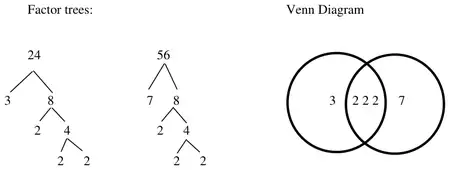
for at least 3 multiples of both 30 and 25 (can include 30 and 25) or for the prime factors 2, 3, 5 and 5, 5 (could be shown in a factor tree with no more than 1 arithmetic error or Venn diagram or table) or identifies the factors 5, 5 and 6 (may be seen in a grid) or for a different common multiple, eg 300
A1
150 or \(2 \times 3 \times 5 \times 5\) oe
Additional guidance
30, 60, 90, 120, 150, 180, 210, 240 25, 50, 75, 100, 125, 150, 175 \(30 = 2 \times 3 \times 5\) \(25 = 5 \times 5\) Condone the inclusion of 1s for this mark
19 Find the highest common factor (HCF) of 54 and 120 (2)
Mark scheme
Answer
Mark
Mark scheme
6
M1
for a complete factor tree for 54 or 120 with no more than one arithmetic error or for listing at least 4 correct factors (with no more than 1 incorrect) of 54 or 120, could be in factor pairs or for the prime factors of 54 (2, 3, 3, 3) or 120 (2, 2, 2, 3, 5)
A1
cao
SCB1 for an answer of 2 or 3 or \(2 \times 3\) if M0 scored
“The cube root of 27 is 9 because 27 divided by 3 is 9”
Is Jason correct? You must give a reason for your answer. (1)
Mark scheme
Answer
Mark
Mark scheme
No with reason
C1
No with reason
Acceptable reasons: No, the cube root of 27 is 3 (not 9) No, the answer is 3 No, \(9 \times 9 \times 9\) is not 27 No, \(9 \times 9 \times 9\) is 729 No, \(3 \times 3 \times 3\) is 27 No, \(27 \div 3 = 9\) and \(9 \div 3 = 3\) No, he needs to divide by 3 again No, because you don’t divide by 3 for cube root No, \(9 \times 9\) is 81 which is already more than 27
Not acceptable reasons: No, the cube root is not 9 3 divided by 27 is 9 No because a cube number is a number times by itself 3 times No, because you don’t divide by 3 Yes…
Additional guidance
‘No’ may be implied by an equivalent statement eg ‘Jason is wrong’ or ‘He is not correct’
1 Find the highest common factor (HCF) of 54 and 120 (2)
Mark scheme
Answer
Mark
Mark scheme
6
M1
for a complete factor tree for 54 or 120 with no more than one arithmetic error or for listing at least 4 correct factors (with no more than 1 incorrect) of 54 or 120, could be in factor pairs or for the prime factors of 54 (2, 3, 3, 3) or 120 (2, 2, 2, 3, 5)
A1
cao
SCB1 for an answer of 2 or 3 or \(2 \times 3\) if M0 scored
(a) Express 250 as a product of its prime factors. (2)
(b) Find the lowest common multiple (LCM) of 30 and 25 (2)
Mark scheme (a)
Answer
Mark
Mark scheme
\(2 \times 5^3\)
M1
for a complete method to find prime factors; could be shown on a complete factor tree with no more than one arithmetic error or by division by prime factors with no more than one error or for 2, 5, 5, 5
A1
accept \(2 \times 5 \times 5 \times 5\)
Additional guidance
Condone the inclusion of 1s for this mark
Mark scheme (b)
Answer
Mark
Mark scheme
150
M1
for at least 3 multiples of both 30 and 25 (can include 30 and 25) or for the prime factors 2, 3, 5 and 5, 5 (could be shown in a factor tree with no more than 1 arithmetic error or Venn diagram or table) or identifies the factors 5, 5 and 6 (may be seen in a grid) or for a different common multiple, eg 300
A1
150 or \(2 \times 3 \times 5 \times 5\) oe
Additional guidance
30, 60, 90, 120, 150, 180, 210, 240 25, 50, 75, 100, 125, 150, 175 \(30 = 2 \times 3 \times 5\) \(25 = 5 \times 5\) Condone the inclusion of 1s for this mark
8 Junaid says that 20 is a square number because \(10^2 = 20\)
(a) Is Junaid correct? Give a reason for your answer. (1)
Chloe says,
“When you divide an even number by an even number the answer is always an even number.”
(b) Write down an example to show that Chloe is wrong. (1)
Mark scheme (a)
Answer
Mark
Mark scheme
No and reason
C1
No and reason
Acceptable examples No, because \(10^2 = 100\) or \(10^2\) is \(10 \times 10\) \(4^2 = 16\) and \(5^2 = 25\) so 20 is not a square number Junaid is wrong because \(\sqrt{20} \neq 10\) or \(\sqrt{20} = 4.47\ldots\) Incorrect because 20 is \(2 \times 10\) not \(10 \times 10\) No she multiplied by 2 instead of squaring or \(10^2\) is not \(10 \times 2\) Wrong as she added instead of multiplying
Not acceptable examples Yes…. No because 20 is \(10 \times 2\) Incorrect because 20 is not a square number No because \(10^2\) is not 20 No because she added No because a square number is when a number is multiplied by itself
Mark scheme (b)
Answer
Mark
Mark scheme
example
C1
for a correctly evaluated example, eg \(12 \div 4 = 3\) or \(10 \div 2 = 5\) or \(2 \div 4 = 0.5\)
(a) Find the highest common factor (HCF) of \(A\) and \(B\). (1)
(b) Find the lowest common multiple (LCM) of \(A\) and \(B\). (2)
Mark scheme (a)
Answer
Mark
Mark scheme
63
B1
for 63, accept \(3 \times 3 \times 7\) or \(3^2 \times 7\)
Mark scheme (b)
Answer
Mark
Mark scheme
15 876
M1
for at least two of \(2^2\), \(3^4\), \(7^2\) or shows at least 3 multiples of 2268, eg 2268, 4536, 6804 and at least 3 multiples of 441, eg 441, 882, 1323
21 Write 60 as a product of its prime factors. (2)
Mark scheme
Answer
Mark
Mark scheme
\(2 \times 2 \times 3 \times 5\)
M1
for a complete method to find prime factors, could be shown on a complete factor tree, with no more than one error or by division by prime factors with no more than one error
19 Write 500 as a product of powers of its prime factors. (3)
Mark scheme
Answer
Mark
Mark scheme
\(2^2 \times 5^3\)
M1
for a complete method to find prime factors; could be shown on a complete factor tree with no more than one error or by division by prime factors with no more than one error
24 Write 124 as a product of its prime factors. (2)
Mark scheme
Answer
Mark
Mark scheme
\(2 \times 2 \times 31\)
M1
for a complete method to find prime factors; could be shown on a complete factor tree with no more than one error or by division by prime factors with no more than one error or for 2, 2, 31, (1)
(a) Find the Highest Common Factor (HCF) of 60 and 84 (2)
(b) Find the Lowest Common Multiple (LCM) of 24 and 40 (2)
Mark scheme (a)
Answer
Mark
Mark scheme
12
M1
for a correct factor tree for either 60 or 84 with no more than one arithmetic error or for listing factors of 60 or 84, at least 4 correct for either (with no more than 1 incorrect in either list), could be in factor pairs or for the prime factors of 60 (2, 2, 3, 5) or 84 (2, 2, 3, 7)
A1
for 12 or \(2 \times 2 \times 3\) oe SC B1 for answer of 4 or 6, if M0 scored
Additional guidance
Condone the use of 1 in any factor tree 60: 1, 2, 3, 4, 5, 6, 10, 12, 15, 20, 30, 60 84: 1, 2, 3, 4, 6, 7, 12, 14, 21, 28, 42, 84
2, 2, 3 is not enough, it must be a product
Mark scheme (b)
Answer
Mark
Mark scheme
120
M1
for a correct factor tree for either 24 or 40 with no more than one arithmetic error or for at least 3 multiples of both 24 and 40 (can include 24 and 40) or for the prime factors of either 24 (2, 2, 2, 3) or 40 (2, 2, 2, 5) or for a common multiple from their lists (≠ 120)
A1
for 120 or \(2 \times 2 \times 2 \times 3 \times 5\) oe
Additional guidance
Condone the use of 1 in any factor tree 24: 24, 48, 72, 96, 120, … 40: 40, 80, 120, … For the list not containing 120, accept the first 3 correct multiples or one error in the first 4 multiples
10 Rachel records the temperature in her garden at noon each day.
On Monday, the temperature was 5 °C. On Tuesday, the temperature was 10° less than the temperature on Monday. On Wednesday, the temperature was 3° greater than the temperature on Tuesday.
Find the difference between the temperature on Monday and the temperature on Wednesday. You must show all your working. (2)
Mark scheme
Answer
Mark
Mark scheme
7
P1
for process to find temperature on Wednesday, eg \(5 - 10 + 3\ (= -2)\) or \(-10 + 3\) or \(10 - 3\)
(a) The square of a whole number is a two-digit number.
Work out
the smallest number that could have been squared and the largest number that could have been squared. [3 marks]
(b) Which has the larger value \(\quad 0.8^2 \quad\) or \(\quad 0.8^3\) ?
Tick a box.
\(0.8^2\)
\(0.8^3\)
Give a reason for your answer. [1 mark]
Mark scheme (a)
Answer
Mark
Comments
4 and 9 in correct positions
B3
B2 9 in smallest position and 4 in largest position or only 4 in correct position or only 9 in correct position or \(4^2\) in smallest position and \(9^2\) in largest position or 16 or \(\sqrt{16}\) in smallest position and 81 or \(\sqrt{81}\) in largest position B1 \(4^2\) or 16 or \(\sqrt{16}\) or \(9^2\) or 81 or \(\sqrt{81}\)
Additional guidance
\(4^2 = 16\) in smallest position and \(9^2 = 81\) in largest position
B2
16, 4 in smallest position and 81, 9 in largest position
B2
\(2^2 = 4\) in smallest position is not 4 in smallest position \(3^2 = 9\) in largest position is not 9 in largest position
Mark scheme (b)
Answer
Mark
Comments
\(0.8^2\) ticked with either 0.64 and 0.512 or \(\dfrac{64}{100}\) and \(\dfrac{64}{125}\) or \(0.8 \lt 1\) or suitable worded reason
B1
oe in comparable form fractions must have same numerator or same denominator eg multiplying by decimals below 1 makes numbers smaller
Additional guidance
Ignore further work after correct values in comparable form
Condone 0.51 for 0.512
\(\dfrac{16}{25}\) and \(\dfrac{64}{125}\) (fractions do not have same numerator or denominator)
B0
\(0.8^2\) ticked and squaring makes numbers bigger
“When two multiples of 5 are added, the answer is always a multiple of 10”
Give one example to show that he is wrong. [1 mark]
Mark scheme (a)
Answer
Mark
Comments
1, 2, 4, 5, 10, 20
B2
any order B1 5 or 6 correct values with up to 2 incorrect values or 4 correct values with 0 or 1 incorrect values or 3 correct values with 0 incorrect values
(a) At a restaurant, vegan pizzas have two different toppings.
The toppings are
sweetcorn (S) mushrooms (M) peppers (P)
Complete the table to list all the possible pairs of toppings. [1 mark]
SM
(b) At the restaurant, dough balls can be ordered in small portions and large portions.
Small portion 6 dough balls
Large portion 10 dough balls
A group of people want to order exactly 44 dough balls.
Show how they can do this. [2 marks]
Number of Small portions \(\ldots\ldots\ldots\) Number of Large portions \(\ldots\ldots\ldots\)
Mark scheme (a)
Answer
Mark
Comments
SP MP with no others
B1
oe accept in words
Additional guidance
Any indication, any order
Do not ignore repeats
Mark scheme (b)
Answer
Mark
Comments
A trial of at least 3 portions involving small and large with correct total seen or 24 and 20 chosen or \(4 \times 6\) (\(= 24\)) and \(2 \times 10\) (\(= 20\))
M1
eg \(2 \times 6 + 10 = 22\) or 3S and 2L is 38
4 small and 2 large
A1
Additional guidance
Ignore incorrect trials if a correct trial or the correct answer is seen
numbers in the boxes on the right side of calculation can be in any order SC2 \(27 = 2 + 2 + 23\) or \(27 = 5 + 5 + 17\) or \(27 = 7 + 7 + 13\) or \(27 = 5 + 11 + 11\)
Additional guidance
SC2 is for using a repeated prime number
\(27 = 3 + 5 + 17\)
B1M1A0
\(27 = 7 + 11 + 9\)
B1M0A0
\(27 = 1 + 3 + 23\)
B1M0A0
List of prime numbers with right side boxes empty or incorrect
or 2 or 3 mathematically correct sums and both of:
only uses integers 1-12
no repeated numbers
B1 2 or 3 mathematically correct sums with one of:
only uses integers 1-12
no repeated numbers
or only 4 mathematically correct sums
Additional guidance
Allow negative or decimal numbers for up to B2
For a row to be mathematically correct, there must be three numbers Blank boxes should not be treated as zeros
Any box that is not crossed out must be considered when checking the conditions regarding integers 1-12 and repeated numbers If a number is crossed out, but still legible, judge in favour of the student to give the best mark
A completed row takes precedence over working space If a row is blank, check working space for that calculation and award a mark based on the work that benefits the student most Working outside of boxes must be evaluated
any order B1 5 or 6 correct values with up to 2 incorrect values or 4 correct values with 0 or 1 incorrect values or 3 correct values with 0 incorrect values
Additional guidance
Allow values given in products or ‘coordinates’ eg1 \(1 \times 45,\ 3 \times 15,\ 5 \times 9\) eg2 (1, 45), (3, 15)
B2 B1
Lists with repeated values cannot score B2, but ignore repeated values in any format for B1 eg1 1, 3, 5, 9, 9 eg2 \(1 \times 45,\ 3 \times 15,\ 5 \times 9,\ 45 \times 1,\ 15 \times 3,\ 9 \times 5\)
13 To make one cheese sandwich, Gina uses one bread roll and two cheese slices.
Pack of 15 bread rolls £1.88
Pack of 20 cheese slices £2.15
She is going to buy enough packs to
have exactly twice as many cheese slices as bread rolls
make more than 100 cheese sandwiches.
Work out the least amount she can spend. [4 marks]
Mark scheme
Answer
Mark
Comments
Alternative method 1
Valid number of bread rolls and cheese slices
M1
eg 30 bread and 60 cheese or 60 bread and 120 cheese or 90 bread and 180 cheese or 120 bread and 240 cheese Valid number means ratio 1 : 2 and can be bought in exact numbers of packs May be implied by valid number of packs
Valid number of packs of bread rolls and cheese slices
M1dep
eg 2 packs bread and 3 packs cheese or 4 packs bread and 6 packs cheese or 6 packs bread and 9 packs cheese or 8 packs bread and 12 packs cheese Valid number of packs means ratio 2 : 3
their number of packs of bread \(\times\) 1.88 and their number of packs of cheese \(\times\) 2.15
M1dep
eg 15.04 and 25.8(0)
40.84
A1
SC2 27.94 or 42.98
Alternative method 2
Valid number of sandwiches
M1
eg Common multiple of 15 and 20 identified eg 15 30 45 60 75 and 20 40 60 Valid number means can be bought in exact numbers of packs
\(1.88 \div 15 + 2.15 \div 10\) or \(0.125(\ldots) + 0.215\) or 0.34(0…)
M1
oe Cost of one sandwich
their 0.34(0…) \(\times\) their number of sandwiches
M1dep
dep on M2
40.84
A1
SC2 27.94 or 42.98
Additional guidance
Alt 1 3rd M1 Allow working in pence
Alt 2 2nd M1 Allow working in pence
30 bread and 60 cheese/2 packs bread and 3 packs cheese \(2 \times 1.88\) or 3.76 and \(3 \times 2.15\) or 6.45 (Answer £10.21)
M3 A0
60 bread and 120 cheese/4 packs bread and 6 packs cheese \(4 \times 1.88\) or 7.52 and \(6 \times 2.15\) or 12.9(0) (Answer £20.42)
M3 A0
90 bread and 180 cheese/6 packs bread and 9 packs cheese \(6 \times 1.88\) or 11.28 and \(9 \times 2.15\) or 19.35 (Answer £30.63)
M3 A0
150 bread and 300 cheese/10 packs bread and 15 packs cheese \(10 \times 1.88\) or 18.8(0) and \(15 \times 2.15\) or 32.25 (Answer £51.05)
M3 A0
SC2 from 120 bread and 120 cheese or 240 bread and 120 cheese
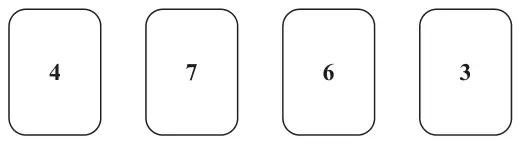
6 Twelve cards numbered 1 to 12 are put into six pairs.
Each pair has a total.
Complete the table to show the pairs and their totals. [4 marks]
Cards
Total
1 and 2
3
\(\underline{\qquad\quad}\) and \(\underline{\qquad\quad}\)
9
\(\underline{\qquad\quad}\) and \(\underline{\qquad\quad}\)
11
\(\underline{\qquad\quad}\) and \(\underline{\qquad\quad}\)
14
\(\underline{\qquad\quad}\) and \(\underline{\qquad\quad}\)
19
\(\underline{\qquad\quad}\) and \(\underline{\qquad\quad}\)
22
Mark scheme
Answer
Mark
Comments
Cards
Total
1 and 2
3
3 and 6
9
4 and 7
11
5 and 9
14
8 and 11
19
10 and 12
22
B4
B3 for any three or four pairs giving the correct totals B2 for any two pairs giving the correct totals B1 for any one pair giving the correct total
Additional guidance
Mark pairs from top down and mark table only
Numbers in pairs can be reversed eg 6 and 3 Total 9
Accept first use of a number, in a correct or incorrect pair, but discount further use of the same number in a subsequent pair
Do not accept repeated numbers eg 7 and 7 or 11 and 11 as a correct pair (this is incorrect, not discounted)
Do not accept use of other numbers eg 9 and 13 is not a correct pair
4 and 5 Total 9 correct 5 and 6 Total 11 discount (5 already used in a correct pair) 6 and 8 Total 14 correct (first use of 6 as 5 and 6 discounted) 8 and 11 Total 19 discount (8 already used in a correct pair) 10 and 12 Total 22 correct
3 correct B3
3 and 6 Total 9 correct 7 and 4 Total 11 correct (order reversed) 7 and 7 Total 14 discount (7 already used in a correct pair) 7 and 12 Total 19 discount (7 already used in a correct pair) 10 and 12 Total 22 correct (first use of 12 as 7 and 12 discounted)
3 correct B3
2 and 7 Total 9 discount (2 already used in correct pair) 5 and 6 Total 11 correct 4 and 10 Total 14 correct 9 and 10 Total 19 discount (10 already used in a correct pair) 11 and 11 Total 22 incorrect (11 is a repeated number in a pair)
2 correct B2
3 and 3 Total 9 incorrect (3 is a repeated number in a pair) 3 and 8 Total 11 discount (3 already used in an incorrect pair) 6 and 8 Total 14 correct (first use of 8 as 3 and 8 discounted) 9 and 10 Total 19 correct 7 and 15 Total 22 incorrect (15 is not a card number)
2 correct B2
3 and 5 Total 9 incorrect 3 and 8 Total 11 discount (3 already used in an incorrect pair) 7 and 7 Total 14 incorrect (7 is a repeated number in a pair) 7 and 12 Total 19 discount (7 already used in an incorrect pair) 10 and 12 Total 22 correct (first use of 12 as 7 and 12 discounted)