13 There are 30 students in a class. A teacher is going to choose at random 2 of the students.
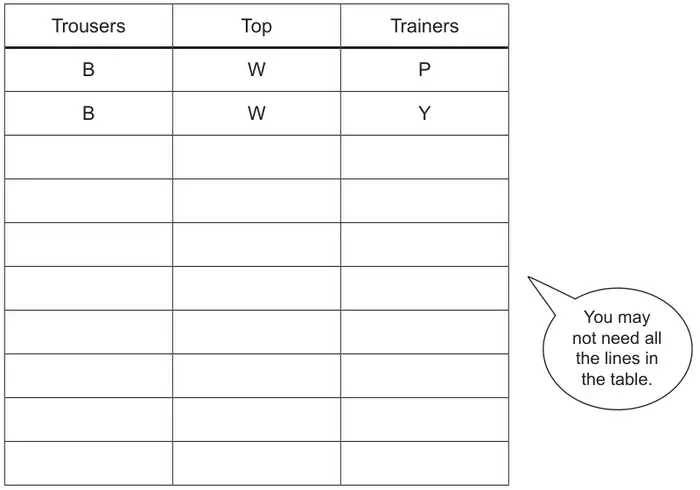
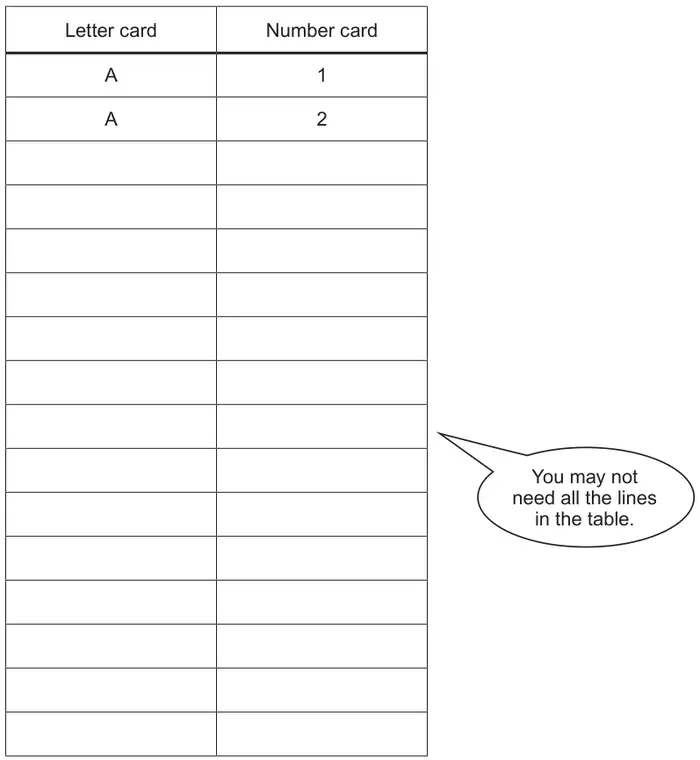
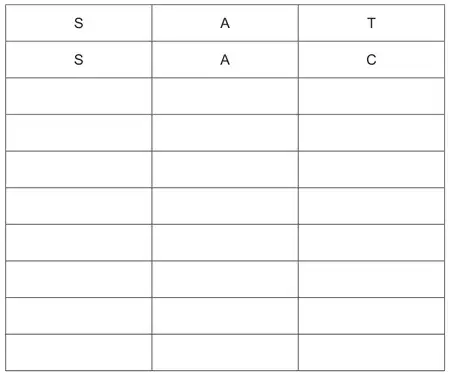
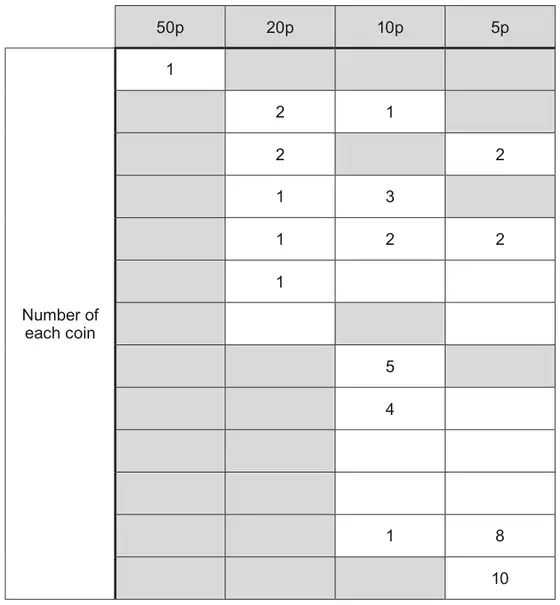
Work out the number of different pairs of students that the teacher can choose. (2)
Mark scheme
Answer
Mark
Mark scheme
435
M1
for start to method of finding the number of pairs, eg \(30 \times 29\ (= 870)\) oe or \(\dfrac{30 \times 29}{2}\) or clear intention to sum the integers from 1 to 29 eg \(29 + 28 + \ldots + 2 + 1\)
16 Zia has to set a 4-digit security passcode on her phone.
Each digit of the passcode is a number from 1 to 9 She can use each number more than once.
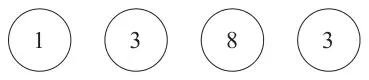
Zia tells her friend Amber that the first digit is a cube number the second digit is a prime number the third digit is greater than 6 the fourth digit is an odd number.
The diagram shows one possible 4-digit passcode.
Amber is going to have one attempt at guessing Zia’s passcode.
Work out the probability that Amber guesses Zia’s passcode on the first attempt. (3)
Mark scheme
Answer
Mark
Mark scheme
\(\dfrac{1}{120}\)
P1
for correctly identifying at least two of the number of options, eg 2 options for 1st digit, 4 options for 2nd digit
P1
for process to multiply the four numbers of options with at least three correct, eg \(2 \times 4 \times 3 \times 5\ (= 120)\)
or
for process to multiply 4 fractions with at least 3 correct \(\dfrac{1}{2} \times \dfrac{1}{4} \times \dfrac{1}{3} \times \dfrac{1}{5}\) oe
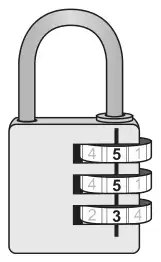
16 There are three dials on a combination lock. Each dial can be set to one of the numbers 1, 2, 3, 4, 5 The three digit number 553 is one way the dials can be set, as shown in the diagram.
(a) Work out the number of different three digit numbers that can be set for the combination lock. (2)
(b) How many of the possible three digit numbers have three different digits? (2)
Mark scheme (a)
Answer
Mark
Mark scheme
125
M1
for method to find the number of 3 digit combinations, eg \(5^3\) or \(5^3 - 1\)
A1
for 125 or 124
Mark scheme (b)
Answer
Mark
Mark scheme
60
M1
for method to find the number of combinations with 3 different digits eg \(5 \times 4 \times 3\) or finds there are 65 combinations that do not have 3 different digits
14 There are 16 hockey teams in a league. Each team played two matches against each of the other teams.
Work out the total number of matches played. (2)
Mark scheme
Answer
Mark
Mark scheme
240
M1
for start to method to find total number of matches, eg \(16 \times 15\) or \(16^2 - 16\) or \(16 \times 15 \times 2\) (= 480) or \(\dfrac{16 \times 15}{2}\) (= 120)
7 Mohsin, Yusuf and Luke are going to play a game. At the end of the game, one of them will be in First place, one of them will be in Second place and one of them will be in Third place.
Use the table below to list all the possible outcomes of the game. (2)
First place
Second place
Third place
Mark scheme
Answer
Mark
Mark scheme
(MYL) (MLY) (YML) (YLM) (LMY) (LYM)
M1
for at least 3 correct different combinations
A1
fully correct list with no extras or repeats
Additional guidance
for M1 ignore extras or repeats; accept words or unambiguous abbreviations
11 Jeff is choosing a shrub and a rose tree for his garden. At the garden centre there are 17 different types of shrubs and some rose trees.
Jeff says,
“There are 215 different ways to choose one shrub and one rose tree.”
Could Jeff be correct? You must show how you get your answer. (2)
Mark scheme
Answer
Mark
Notes
No (supported)
P1
Process to find number of rose trees e.g. \(215 \div 17\ (= 12.647\ldots)\) or show number of choices with 12 and 13 eg \(17 \times 12 = 204\) and \(17 \times 13 = 221\)
C1
No with interpretation that 12.6.. is not a whole number or a whole number of plants must be bought or number of plants would have to be between 12 and 13 which is not possible
M1 for \(7 \times 30\) (= 210) or \(3 \times 45\) (= 135) M1 (dep on previous M1) for £5 – their total of \(7 \times 30\) and \(3 \times 45\) or digits 155 seen A1 for 1.55 cao
(a) At a restaurant, vegan pizzas have two different toppings.
The toppings are
sweetcorn (S) mushrooms (M) peppers (P)
Complete the table to list all the possible pairs of toppings. [1 mark]
SM
(b) At the restaurant, dough balls can be ordered in small portions and large portions.
Small portion 6 dough balls
Large portion 10 dough balls
A group of people want to order exactly 44 dough balls.
Show how they can do this. [2 marks]
Number of Small portions \(\ldots\ldots\ldots\) Number of Large portions \(\ldots\ldots\ldots\)
Mark scheme (a)
Answer
Mark
Comments
SP MP with no others
B1
oe accept in words
Additional guidance
Any indication, any order
Do not ignore repeats
Mark scheme (b)
Answer
Mark
Comments
A trial of at least 3 portions involving small and large with correct total seen or 24 and 20 chosen or \(4 \times 6\) (\(= 24\)) and \(2 \times 10\) (\(= 20\))
M1
eg \(2 \times 6 + 10 = 22\) or 3S and 2L is 38
4 small and 2 large
A1
Additional guidance
Ignore incorrect trials if a correct trial or the correct answer is seen
12 Here are the subjects available in year 12 at a school.
Block 1
Block 2
Block 3
Block 4
Maths (M)
Geography (G)
English (E)
Spanish (S)
History (H)
Drama (D)
Physics (P)
Biology (B)
French (F)
Chemistry (C)
ICT (I)
Art (A)
Students choose three subjects.
They cannot choose more than one subject from a block.
Lian decides
to study Maths
not to study Geography, Chemistry, Physics or ICT.
By listing, show that there are seven groups of three subjects that Lian could choose. [3 marks]
Subject 1
Subject 2
Subject 3
Mark scheme
Answer
Mark
Comments
Maths Drama English (MDE) Maths Drama Spanish (MDS) Maths Drama Biology (MDB) Maths Drama Art (MDA) Maths English Spanish (MES) Maths English Biology (MEB) Maths English Art (MEA)
B3
any order of subjects and/or rows B2 5 or 6 rows correct B1 3 or 4 rows correct
Liam tries at random a code that matches the rule.
Work out the probability that this is the correct code. [4 marks]
Mark scheme
Answer
Mark
Comments
Alternative method 1
All three of 1, 8 and 1, 2, 4, 8 and 1, 3, 5, 7, 9 or all three of 2, 4 and 5
B2
B1 any two correct do not allow 2, 4 or 5 from an incorrect list of numbers
their 2 \(\times\) their 4 \(\times\) their 5 or 40
M1
working out the number of possible codes ft their non-zero number of options for each digit implied by \(\dfrac{1}{\text{their } 2} \times \dfrac{1}{\text{their } 4} \times \dfrac{1}{\text{their } 5}\)
\(\dfrac{1}{40}\)
A1ft
oe fraction, decimal or percentage ft their non-zero number of options for each digit
Alternative method 2
All three of \(\dfrac{1}{2}\) and \(\dfrac{1}{4}\) and \(\dfrac{1}{5}\)
B2
B1 any two correct oe fractions, decimals or percentages do not allow \(\dfrac{1}{2}\), \(\dfrac{1}{4}\) or \(\dfrac{1}{5}\) from an incorrect list of numbers
their \(\dfrac{1}{2}\) \(\times\) their \(\dfrac{1}{4}\) \(\times\) their \(\dfrac{1}{5}\)
M1
oe fractions, decimals or percentages allow their \(\dfrac{1}{2}\) to be 1 their \(\dfrac{1}{4}\) must be \(\lt 1\) their \(\dfrac{1}{5}\) must be \(\lt 1\)
\(\dfrac{1}{40}\)
A1ft
oe fraction, decimal or percentage ft their probabilities
Additional guidance
If 0 is taken to be a cube number, \(\dfrac{1}{3} \times \dfrac{1}{4} \times \dfrac{1}{5} = \dfrac{1}{60}\)
B1M1A1ft
If they only have one cube number, \(1 \times \dfrac{1}{4} \times \dfrac{1}{5} = \dfrac{1}{20}\)
B1M1A1ft
8, 9 and 1, 2, 4, 8 and 1, 3, 5, 7, 9 \(\dfrac{1}{2} \times \dfrac{1}{4} \times \dfrac{1}{5} = \dfrac{1}{40}\)
B1 M1A1ft
Ignore conversion attempt after correct answer seen
22 main dishes, of which \(\dfrac{4}{11}\) are gluten-free 7 rice dishes, which are all gluten-free 5 naan breads, of which 40% are gluten-free.
This Meal Deal is on the menu.
Choose one main dish, one rice dish and one naan bread
How many of the possible Meal Deals are totally gluten-free? [3 marks]
Mark scheme
Answer
Mark
Comments
\(\dfrac{4}{11} \times 22\) or 8 or \(\dfrac{40}{100} \times 5\) or 2 or \(22 \times 7 \times 5\) or 770 or \(\dfrac{4}{11} \times \dfrac{40}{100}\) or \(\dfrac{160}{1100}\) or \(\dfrac{8}{55}\)
M1
oe accept \(\dfrac{8}{22}\) for 8 accept \(\dfrac{2}{5}\) for 2
8 A team of two players is picked from these people.
Female
Amy (A) Laura (L)
Male
Erik (E) Rob (R) Tim (T)
The team must have one female player and one male player.
Complete this list to show all of the possible teams. [2 marks]
Female player
Male player
A
E
Mark scheme
Answer
Mark
Comments
A
E
A
R
A
T
L
E
L
R
L
T
with no extras
B2
B1 three additional correct teams with no errors or repetitions or four additional correct teams with at most one error or repetition or five additional correct teams with one or two errors or repetitions SC1
She will use each of these pieces of equipment once.
Rowing machine (R) Stepper (S) Treadmill (T) Bike (B)
Lena will use the rowing machine first.
List all the possible orders in which she could use the four pieces of equipment. [2 marks]
(b) The table shows how long Lena spends on each piece of equipment.
Rowing machine
15 minutes
Stepper
13 minutes
Treadmill
35 minutes
Bike
1 hour 30 minutes
Lena starts on the rowing machine at 1.50 pm
She has a break for 4 minutes between pieces of equipment.
What time does she finish on her last piece of equipment? [3 marks]
Mark scheme (a)
Answer
Mark
Comments
R S T B R S B T R T S B R T B S R B S T R B T S
B2
may be presented vertically
B1 4 or 5 correct orders and 0, 1 or 2 incorrect orders or the 6 correct orders and 1 or 2 incorrect orders or 24 possible orders with R in any place or STB, SBT, TSB, TBS, BTS, BST
Additional guidance
Correct orders start with R
Ignore repeated orders for both marks
Mark scheme (b)
Answer
Mark
Comments
Alternative method 1
1.50 + 15 (mins) or 13.50 + 15 (mins) or 2.05 (pm) or 14.05 as end of rowing machine or 2.09 (pm) or 14.09 as start of second piece of equipment
M1
oe condone starting on a different piece of equipment if equipment clearly stated
1.50 (pm) + their 2 (hours) 33 (mins) + \(3 \times 4\) (mins) or 1.50 (pm) + their 2 (hours) 45 (mins) or 4.23 (pm) + \(3 \times 4\) (mins)
M1dep
oe
their 153 or their 165 must be correctly converted to hours and minutes
calculation(s) shown that would lead to 4.35 if evaluated correctly
4.35 (pm) or 16.35
A1
SC2 4.39 (pm) or 16.39 from 4 breaks
Additional guidance
RSTB
RSBT
RTSB
RTBS
RBST
RBTS
End 1st
2.05
2.05
2.05
2.05
2.05
2.05
Start 2nd
2.09
2.09
2.09
2.09
2.09
2.09
End 2nd
2.22
2.22
2.44
2.44
3.39
3.39
Start 3rd
2.26
2.26
2.48
2.48
3.43
3.43
End 3rd
3.01
3.56
3.01
4.18
3.56
4.18
Start 4th
3.05
4.00
3.05
4.22
4.00
4.22
End 4th
4.35
4.35
4.35
4.35
4.35
4.35
Having 0, 1 or 2 breaks will score a maximum of M1
Having 4 breaks may score the special case if evaluated correctly
Condone using decimal time for a maximum of M1 (unless recovered) eg1 in alt 2, 0.15 + 0.13 + 0.35 + 1.3 = 2 h 33 min (recovered) eg2 in alt 2, 0.15 + 0.13 + 0.35 + 1.3 (= 1.93) eg3 in alt 1, 1.5 + 15 = 1.65 eg4 in alt 1, 2.26 pm + 90 = 3.16 pm (has added 0.9)
at least M1 max M1 max M1 max M1
Condone 16.35pm
May work in 24-hour clock throughout
Times may just be listed as in the table in the AG but if an error is made they must have shown the amount of time intended to be added eg1 2.09, 2.22, 2.26, 3.02, 3.06, 4.36 (error seen at 3.01, time not shown) eg2 2.09, 13 mins, 2.22, 2.26, 35 mins, 3.02, 3.06, 4.36 (error seen at 3.01 but intention to add 35 implied)
bread (B) or a roll (R) and ham (H) or cheese (C) and salad (S) or pickle (P)
(a) List all the possible types of sandwich Gina could make.
One has been done for you. [2 marks]
B H S
(b) What fraction of the possible types of sandwich have cheese and pickle? [1 mark]
Mark scheme (a)
Answer
Mark
Comments
BHS RHS BHP RHP BCS RCS BCP RCP
B2
B1 for four additional correct combinations with no errors or repetitions or five additional correct combinations with at most one error or repetition or six or seven additional correct combinations with at most two errors or repetitions
Additional guidance
Do not allow repetition of BHS for B2
Ingredients may be written as full words
Accept letters or words in any order eg BPC for BCP
Do not accept tree diagrams without combinations listed
Mark scheme (b)
Answer
Mark
Comments
\(\dfrac{2}{8}\) or \(\dfrac{1}{4}\)
B1ft
ft their (a) with at least three additional combinations, at least one of which contains cheese and pickle ignore further working if attempting to simplify
Additional guidance
\(\dfrac{2}{8}\) or \(\dfrac{1}{4}\) is B1, if not \(\dfrac{2}{8}\) or \(\dfrac{1}{4}\) refer to (a) for possible ft
BHS, BHS, BHP, BCS, BCP, RHS, RHP, RCS and RCP in (a) with answer \(\dfrac{2}{9}\)
What is the probability that she chooses the correct number? [1 mark]
(b) The 4-digit code is changed to an even number.
The first digit is 3
How many possible codes are there? [2 marks]
Mark scheme (a)
Answer
Mark
Comments
\(\dfrac{1}{4}\) or 0.25 or 25%
B1
oe
Additional guidance
Ratio eg 1 : 4 or 1 : 3
B0
\(\dfrac{1}{4}\) seen and answer 1 : 4
B1
Expressed only in words eg 1 out of 4
B0
1 out of 4 and \(\dfrac{1}{4}\)
B1
\(\dfrac{1}{4}\) seen with change to incorrect decimal or incorrect percentage eg \(\dfrac{1}{4}\) and answer 0.4
B1
Ignore chance words if \(\dfrac{1}{4}\) seen eg \(\dfrac{1}{4}\) and answer Likely
B1
Mark scheme (b)
Answer
Mark
Comments
\((1 \times)\ 10\ (\times)\ 10\ (\times)\ 5\) or \(\dfrac{10 \times 10 \times 10}{2}\) or \(\dfrac{1000}{2}\)
M1
oe
500
A1
SC1 5 or 324 or 400 or 405
Additional guidance
\(10 + 10 + 5\)
M0A0
SCs are for the answers from not including zero at least once ie \(9 \times 9 \times 4\) or \(10 \times 10 \times 4\) or \(9 \times 9 \times 5\) or from a misread ie \(1 \times 1 \times 1 \times 5\)
18 Sasha creates a four-digit passcode. They use four digits from 0 to 9. They do not use any digit more than once.
Work out how many of the possible four-digit passcodes are even. [4]
Mark scheme
Answer
Marks
Part marks and guidance
2520
4
M3 for (10 × 9 × 8 × 7) ÷ 2 oe or M2 for 10 × 9 × 8 × 7 oe may be implied by 5040
e.g. 5040 ÷ 2 or 5 × 9 × 8 × 7
For M2 they must be working in whole numbers not fractions apart from probabilities as below 5040 in body via whole numbers subsequently spoilt: M2 for 5040/n, otherwise M1
or
M1 for \(\frac{a}{10} \times \frac{b}{9} \times \frac{c}{8} \times \frac{d}{7}\) may be implied by \(\frac{k}{5040}\) or \(\frac{10}{a} \times \frac{9}{b} \times \frac{8}{c} \times \frac{7}{d}\) may be implied by \(\frac{5040}{k}\) where \(a\), \(b\), \(c\), \(d\) and \(k \ne 1\)
Condone answers and working in probabilities to a max of M3: e.g. M3 for answer \(\frac{1}{2520}\) e.g. M2 for \(\frac{1}{10} \times \frac{1}{9} \times \frac{1}{8} \times \frac{1}{7}\) or \(\frac{1}{5040}\) e.g. SC1 for \(\frac{1}{9} \times \frac{1}{8} \times \frac{1}{7} \times \frac{1}{6}\) [× 2]
If 0 scored, instead award SC1 for (10 × 10 × 10 × 10) ÷ 2 oe or for 9 × 8 × 7 × 6 [÷ 2] oe or for 9 × 9 × 8 × 7 [÷ 2] oe or for 10 × 9 × 8 × 5 or for 10 × 9 × 8 × 4
17 An app’s passcode consists of three digits. Each of the digits is a number from 0 to 9. A digit can be used more than once.
Find the fraction of the possible passcodes that contain at least one 5. [4]
Mark scheme
Answer
Marks
Part marks and guidance
\(\frac{271}{1000}\) or 0.271
4
B3 for 271 OR B2 for 1000 or 729 OR M1 for 10 × 10 × 10 or 9 × 9 × 9
Accept any correct method e.g. M3 for 1 × 10 × 10 + 9 × 1 × 10 + 9 × 9 × 1 or 271 or M2 for two of these three terms correct or M1 for one of these three terms correct
24 A restaurant menu has 4 main courses and 3 side dishes. For their meal, each customer chooses 1 main course and 1 side dish.
Main course
Beef burger
£6
Lasagna
£7
Veggie burger
£5
Turkey stew
£6
Side dish
Salad
£2
Chips
£3
Garlic bread
£1
Work out the percentage of possible meals that cost less than £8. [4]
Mark scheme
Answer
Marks
Part marks and guidance
33[.3…][%] oe nfww
4
M3 for \(\frac{4}{12}\) [\(\times 100\)]
OR
M1 for 12 correct combinations shown and no repeats or for \(4 \times 3\) or 12 [combinations]
M1 for BG (£7), VS (£7), VG (£6), TG (£7) only or 4 [combinations less than £8]
M1 for \(\dfrac{\text{their number of combinations}}{\text{their number of meals}}\) [\(\times 100\)]
Accept combinations of meals in any order or total costs shown. Combinations: BS, BC, BG, LS, LC, LG, VS, VC, VG, TS, TC, TG 12 used as denominator scores M1 Corresponding costs: 8, 9, 7, 9, 10, 8, 7, 8, 6, 8, 9, 7 4 used as numerator scores M1
2 A restaurant menu has 4 main courses and 3 side dishes. For their meal, each customer chooses 1 main course and 1 side dish.
Main course
Beef burger
£6
Lasagna
£7
Veggie burger
£5
Turkey stew
£6
Side dish
Salad
£2
Chips
£3
Garlic bread
£1
Work out the percentage of possible meals that cost less than £8. [4]
Mark scheme
Answer
Marks
Part marks and guidance
33[.3…]% oe nfww
4
M3 for \(\frac{4}{12}\) [× 100]
OR
M1 for 12 correct combinations shown and no repeats or for 4 × 3 or 12 [combinations]
Accept combinations of meals in any order or total costs shown. Combinations: BS, BC, BG, LS, LC, LG, VS, VC, VG, TS, TC, TG 12 used as denominator scores M1
M1 for BG (£7), VS (£7), VG (£6), TG (£7) only or 4 [combinations less than £8]
Corresponding costs: 8, 9, 7, 9, 10, 8, 7, 8, 6, 8, 9, 7 4 used as numerator scores M1
M1 for \(\dfrac{\textit{their}\ \text{number of combinations}}{\textit{their}\ \text{number of meals}}\) [× 100]
14 A college offers 41 different subjects including 9 different languages. Students are asked to choose one subject from Option A, one subject from Option B and one subject from Option C.
Each of the 41 different subjects appears only once, either in Option A, or in Option B or in Option C.
Option A : 14 subjects including 2 languages Option B : 12 subjects including 3 languages Option C : 15 subjects including 4 languages
Work out the proportion of all the possible subject combinations that include at least one language. You must show your working. [5]
Mark scheme
Answer
Marks
Part marks and guidance
\(\frac{1332}{2520}\) oe or 0.53 or 0.529 or 0.5286 or 0.52857… or 53% or 52.9%, 52.86% or 52.857% with correct working
5
M4 for \(1 - \frac{12}{14} \times \frac{9}{12} \times \frac{11}{15}\) oe OR M3 for \(\frac{12}{14} \times \frac{9}{12} \times \frac{11}{15}\) OR M1 for \(\frac{2}{14} \times \frac{3}{12} \times \frac{4}{15}\) OR
M1 for [total choices=] 14 × 12 × 15 implied by 2520 and M3 for (2 × 12 × 15) + (12 × 3 × 15) + (12 × 9 × 4) or 360 + 540 + 432 implied by 1332 or M2 for (2 × 12 × 15) + (14 × 3 × 15) + (14 × 12 × 4) or 360 + 630 + 672 implied by 1662 or M1 for one bracketed term correct from the M3 expression e.g 2 × 12 × 15
OR
M1 for [total choices=] 14 × 12 × 15 implied by 2520 and M2 for [choices no languages=] (14 – 2) × (12 – 3) × (15 – 4) implied by 1188 or M1 for this expression with one error and M1 for their 2520 − their 1188 or 1332
If 0 or M1 scored SC2 for correct answer with no or insufficient working Note : For MR see appendix
“Correct working requires evidence of at least M3 or M1M1M1 Equivs. Include \(\frac{666}{1260}, \frac{333}{630}, \frac{111}{210}, \frac{37}{70}\)
condone \(\frac{1}{14} \times \frac{1}{12} \times \frac{1}{15} \left[= \frac{1}{2520}\right]\) for M1 [total choices] Alternative equivalent methods M4 for fully correct method leading to their 2520 and their 1332 or M1 for [total choices=] 14 × 12 × 15 implied by 2520 and M3 for (2×3×4) + (12×3×4+2×9×4+2×3×11) + (2×9×11+12×3×11+12×9×4) or (24) + (144 + 72 + 66) + (198 + 396 + 432) implied by 1332 or M2 for this expression with at least two of the bracketed terms correct or M1 for at least one of the bracketed terms correct or any three of the individual terms correct e.g 2 × 3 × 4 Use of tree diagrams See appendix
Appendix: Question 14
Using tree diagrams : M4 for method A: \(1 - \frac{12}{14} \times \frac{9}{12} \times \frac{11}{15}\) oe e.g. method B : \(\frac{2}{14} \times \frac{3}{12} \times \frac{4}{15} + \frac{2}{14} \times \frac{3}{12} \times \frac{11}{15} + \frac{2}{14} \times \frac{9}{12} \times \frac{4}{15} + \frac{12}{14} \times \frac{3}{12} \times \frac{4}{15} + \frac{2}{14} \times \frac{9}{12} \times \frac{11}{15} + \frac{12}{14} \times \frac{3}{12} \times \frac{11}{15} + \frac{12}{14} \times \frac{9}{12} \times \frac{4}{15}\) M3 for \(\frac{12}{14} \times \frac{9}{12} \times \frac{11}{15}\) or method B with at least five relevant branches correct or M2 for method B with at least four relevant branches correct or M1 for method B with at least one relevant branch correct
Misreads Some candidates read this as 16, 15 and 19 subjects. Treat this as a misread (MR) so the mark scheme for them will be (max. of 4 marks): M4 for \(1 - \frac{14}{16} \times \frac{12}{15} \times \frac{15}{19}\) oe implied by answer \(\frac{2040}{4560} = \frac{102}{228} = \frac{51}{114} = \frac{17}{38}\) or 0.447368…..etc rot to at least 3 s.f. OR M3 for \(\frac{14}{16} \times \frac{12}{15} \times \frac{15}{19}\) oe implied by \(\frac{2520}{4560} = \frac{126}{228} = \frac{63}{114} = \frac{21}{38}\) or 0.55263…etc rot to at least 3 s.f. OR M1 for [total choices=] 16 × 15 × 19 implied by 4560 AND M3 for 2 × 15 × 19 + 14 × 3 × 19 + 14 × 12 × 4 or 570 + 798 + 672 implied by 2040 or M2 for 2 × 15 × 19 + 16 × 3 × 19 + 16 × 15 × 4 or 570 + 912 + 960 implied by 2442 or M1 for this expression with one term correct or at least 5 numbers correct
OR M1 for [total choices=] 16 × 15 × 19 implied by 4560 M2 for [choices no langs =] (16 – 2) × (15 – 3) × (19 – 4) implied by 2520 or M1 for this expression with one error and M1 for their 4560 − their 2520 Alternative equivalent methods M4 for fully correct method leading to their 4560 and their 2040 or M1 for [total choices=] 16 × 15 × 19 implied by 4560 and M3 for (2×3×4) + (14×3×4 + 2×12×4 + 2×3×15) + (2×12×15 + 14×3×15 + 14×12×4) or (24) + (168 + 96 + 90) + (360 + 630 + 672) or 2040 or M2 for two of the bracketed terms or M1 for one of the bracketed terms or any three of the individual terms correct
(a) Write down all of the possible orders for Sasha’s 4-digit pin number. [2]
(b) Sasha tries one of these orders at random.
Write down the probability that the last digit of the pin number that Sasha tries is 2. [1]
Mark scheme (a)
Answer
Marks
Part marks and guidance
9 3 2 7 9 3 7 2 9 7 3 2 9 7 2 3 9 2 3 7 9 2 7 3
2
B1 for at least 5 out of 6 correct with maximum 1 repeat/extra or for 4 out of 6 correct (no repeats/extras)
If 9 3 2 7 is omitted allow 2 marks for 5 correct or B1 for at least 4 out of 5 correct with maximum 1 repeat/extra or for 3 out of 5 correct (no repeats/extras)
Mark scheme (b)
Answer
Marks
Part marks and guidance
\(\dfrac{2}{6}\) oe
1
FTtheir (a)
Mark to candidate’s advantage. Allow for FT either their total written combinations or their combinations including the given combination. Allow 0.33 [3….] or 33.[3….]%
Do not accept ratio or words
isw attempts to convert to decimals or percentages when acceptable fraction seen
20 Mrs Sweet has 8 different milk chocolates and 9 different plain chocolates.
Her daughter chooses one of the milk chocolates. Her son then chooses one of the plain chocolates. Mrs Sweet then chooses one of the remaining chocolates.
Work out how many different combinations of three chocolates they can choose. [3]
Mark scheme
Answer
Marks
Part marks and guidance
1080
3
M2 for 8 × 9 × 15 or M1 for 8 × 9 × 15 with at most one error If 0 scored award SC2 for \(\frac{1}{8} \times \frac{1}{9} \times \frac{1}{15}\) or \(\frac{1}{1080}\) or SC1 for 1 × 1 × 2 = 2
e.g. M1 for 8 × 9 × 17 or 1224 condone 8 × 9 × 1 for M1 not 8 × 9
Strict FT of their table including the three given combinations
FT allow repeats and misplaced letters Accept 3 sf answers if decimal or percentage e.g. 0.333[...] or 33.3[...]% If (a) is not attempted, allow \(\dfrac{4}{12}\) or \(\dfrac{2}{6}\) or \(\dfrac{1}{3}\)
(a) A 3-course meal consists of one starter, one main and one dessert. Work out how many different 3-course meals can be chosen from the menu. [2]
(b) Find the fraction of the 3-course meals which are completely vegetarian (V). [2]
Mark scheme (a)
Answer
Marks
Part marks and guidance
280
2
M1 for 5 × 8 × 7 or 5 × 56 or 40 × 7 or 35 × 8 If 0 scored SC1 for 6 × 8 × 7
Condone for M1 e.g. \(\frac{12}{280}\)
Mark scheme (b)
Answer
Marks
Part marks and guidance
\(\frac{12}{280}\) oe
2
M1 for 2 × 3 × 2 or 12 or \(\frac{2}{5} \times \frac{3}{8} \times \frac{2}{7}\) FT 280 from their answer to (a) for 2 marks i.e \(\frac{12}{\textit{their } 280}\) If 0 scored SC2 for \(\frac{18}{336}\)
Equivs. include \(\frac{6}{140}\), \(\frac{3}{70}\), 0.043, 0.0429, 0.04286 and 0.04285… and allow percentages with sign e.g 4.3%, isw changing form after correct answer seen
5 Lev (L), Maria (M) and Nicholas (N) sit in a row of three seats.
(a) Use the table to list all the different orders in which they could sit. One possible order is already shown in the table. You may not need to use all the rows in the table.
Seat 1
Seat 2
Seat 3
L
M
N
[2]
(b) All possible orders in which they could sit are equally likely.
What is the probability that Lev (L) sits next to Maria (M)? [1]
Mark scheme (a)
Answer
Marks
Part marks and guidance
L N M, M L N, M N L, N M L, N L M
2
No repeats for 2 marks B1 for 4 or more additional entries including no more than 1 error or repeat or 3 additional entries with no errors or repeats
23. Adina has 5 wooden blocks. Each block is a different colour.
Blue
Red
Green
Yellow
Purple
Adina selects 3 of these wooden blocks at random. Each time she does this, she places them on top of each other. Two ways of arranging the blocks are shown below.
Blue
Green
Yellow
Red
Red
Purple
(a) Calculate the number of different ways of arranging the blocks. [2]
(b) How many arrangements are there where the middle block is either blue or red? [2]
Mark scheme (a)
Scheme
Marks
Comments
\(5\times4\times3\)
M1
60
A1
Mark scheme (b)
Scheme
Marks
Comments
\(4\times1\times3\times2\) or \(2\times60\div5\)
M1
May be seen in stages FT ‘their 60’ Allow 2/5 of 60.
4. Miss Watkins picks a team of one girl and one boy to take part in a competition.
She chooses the team from these students.
Girls:
Poppy (P)
Ruby (R)
Sally (S)
Zoe (Z)
Boys:
Tariq (T)
Will (W)
(a)
Complete the list to show all the different options that Miss Watkins has. The first two have been completed for you. [2]
Girl
Boy
P
T
P
W
You may not need all the lines.
(b)
Miss Watkins is equally likely to choose any of the possible options.
What is the probability that she chooses Sally and Tariq? [1]
Mark scheme (a)
Scheme
Marks
Comments
Girl
Boy
P
T
P
W
R
T
R
W
S
T
S
W
Z
T
Z
W
B2
Rows could be in any order; letters could be lower case
B1 for any 4 or 5 of the remaining 6 rows with no incorrect rows; OR for all 6 remaining rows with extra rows;
For B2 they must only have the correct 6 expected rows except B2 can also be awarded if all 6 correct expected rows are given and the 2 given rows are repeated AND 8 outcomes indicated in (b) e.g. by a fraction with denominator 8.
Mark scheme (b)
Scheme
Marks
Comments
\(\frac{1}{8}\) oe
B1
FT ‘their \(\frac{1}{8}\)’ provided they have at least 4 correct added rows;
Allow e.g. 0.125 or 12.5% but B0 for e.g. 1 in 8 or 1 : 8
(a) How many 8-digit numbers can be made using the digits 2, 3, 4, 5, 6, 7, 8, 9 when each digit is used once? [2]
(b) How many 6-digit numbers which start with a prime number can be made using the digits 2, 3, 4, 5, 6, 7, 8, 9 when each digit may be used at most once? [2]
Mark scheme (a)
Scheme
Marks
Comments
40 320
B2
B1 for sight of 8! or equivalent product
Mark scheme (b)
Scheme
Marks
Comments
10 080
B2
B1 for sight of 4 × 7 × 6 × 5 × 4 × 3 or equivalent
10. Jack sells ice-cream cones at a beach cafe. Each ice-cream cone has two scoops of ice cream.
(a)
The scoops can be the same or different flavours.
There are three possible flavours to choose from:
chocolate (C),
vanilla (V),
strawberry (S).
List all the possible flavour combinations for two scoops of ice cream. [2]
(b)
Two scoops of vanilla ice cream is the most popular. Jack gets 125 single scoops of vanilla ice cream from one tub. Each tub costs £43.50. Jack needs to buy enough tubs to make 1300 of his two-scoop vanilla ice-cream cones.
What is the least amount Jack will need to pay? [5]
Mark scheme (a)
Scheme
Marks
Comments
CC CV CS SS SV VV oe
B2
B1 for 4 or 5 correct Ignore inclusion of VC, SC and VS oe
Mark scheme (b)
Scheme
Marks
Comments
1300 × 2
M1
Method marks may be awarded in any order (= 2600)
÷ 125
M1
(= 20.8)
× 43.5(0)
M1
(21 × 43.50 = ) (£)913.5(0)
A2
CAO Award M3 A1 for (£)904.8(0) (from 20.8 × 43.50) Award M2 SC2 for (£)478.5(0) (from 11 × 43.50) Award M2 SC1 for (£)452.4(0) (from 10.4×43.50)
(7)
Alternative
Alternative method finding t, the number of tubs using trial(s)
Scheme
Marks
Comments
Use of trial(s) of 125 × \(t\) OR 125 ÷ 2 × \(t\) where \(t \gt 8\)
M1
\(t\) = 21 from correct calculations in relevant trial(s) seen 125 × 20 = 2500, 125 × 21 = 2625, OR 62.5 × 20 = 1250, OR 62.5 × 21 = 1312.5
A2
A1 if \(t\) = 21 but an error in the relevant calculation(s) seen
If M1 A0 award SC1 for \(t\) = 11 with no errors in relevant calculation(s) seen 125 × 10 = 1250, 125 × 11 = 1375
Calculating the cost 21 × 43.5(0) =
M1
FT ‘their t’ for M1 only
(£)913.5(0)
A1
CAO If M1 A0 award SC1 for (£)478.5(0) (from 11 × 43.50)
Award M1 A1 M1 A1 for (£)904.8(0) (from trial(s) with an error) Award M1 SC1 M1 SC1 for (£)478.5(0) (from trial(s) with no error) Award M1 SC0 M1 SC1 for (£)478.5(0) (from trial(s) with an error)
Corrected by Westie's Workshop
The board's mark scheme printed “0R”. Changed to “OR” because the board typed a zero instead of the letter O in the word “OR”.
Original: see the board's mark scheme PDF (link above).
(a) A 5-course banquet has 3 options for each course. The number of possible 5-course meals is \(m\).
Find the value of \(m\). [2]
(b) The caterer for the banquet decides to change the menu so that there are only 2 options for the first course. The options for the other courses remain the same.
The number of possible 5-course meals is now \(pm\).
Find the value of \(p\). [2]
Mark scheme (a)
Scheme
Marks
Comments
243
B2
B1 for \(3^5\) oe
Mark scheme (b)
Scheme
Marks
Comments
\(\dfrac{2}{3}\) oe
B2
B1 for \(p \times\) ‘their \(m\)’ = \(2 \times 3^4\) oe or for sight of \(\dfrac{3^4 \times 2}{3^5}\) or \(\dfrac{3^5 \times 2}{3}\) oe
4. The timetable shows some train times from Newport to Barry Island.
Newport (South Wales)
dep.
10:00
10:32
10:40
11:01
11:32
12:00
Cardiff Central
arr.
10:18
C
10:46
C
10:56
C
11:15
C
11:46
C
12:18
C
Cardiff Central
dep.
10:25
10:55
11:10
11:25
11:55
12:25
Barry Island
arr.
10:55
11:25
11:40
11:55
12:25
12:55
Key: C Change train.
(a)
Ade wants to arrive in Barry Island by 12 noon.
What is the time of the latest train he can take from Newport? [1]
(b)
Sanjeet takes the 10:32 train from Newport.
How long does it take Sanjeet to get from Newport to Barry Island? [2]
(c)
(i)
Sanjeet is choosing what to take for lunch. He chooses from the following options.
Sandwich (S) or Pasty (P) and Apple (A) or Banana (B) and Tea (T) or Coffee (C)
Complete the table to show all the different choices that Sanjeet has. The first two have been completed for you. You may not need all the lines in the table. [2]
(ii)
Sanjeet is equally likely to choose any of the possible options.
What is the probability that he chooses a sandwich, a piece of fruit and a coffee? [1]
Mark scheme (a)
Scheme
Marks
Comments
11:01
B1
Any clear notation; may be identified in table
Mark scheme (b)
Scheme
Marks
Comments
Attempts to find 11:25 – 10:32
M1
May be in steps; allow for sight of 28 and 25 (minutes)
53 (minutes)
A1
If M0 then SC1 for an answer of 44 mins (from summing the 2 train journeys)
Mark scheme (c)
Scheme
Marks
Comments
(i)
S
A
T
S
A
C
S
B
T
S
B
C
P
A
T
P
A
C
P
B
T
P
B
C
B2
Allow either of the first two rows to be repeated for B2
B1 for any 4 or 5 correct rows, ignoring any repeated rows
Mary’s lunch menu is for two courses, a main course and a dessert.
Lunch Menu – 2 courses for £10
Main Courses
Desserts
Fish Curry Pizza Salad
Apple pie Toffee pudding
(i)
How many different two-course meals is it possible to order for lunch? You must show all your working. [2]
(ii)
Mary says,
‘If a customer has a dessert, the probability they choose apple pie is \(\frac{1}{2}\) because there are 2 desserts.’
Explain why Mary may not be correct. [1]
(b)
Mary also serves drinks.
Drinks Menu
Hot drinks
Tea or Coffee
per cup
£2
Cold drinks
Juice or Milkshake
per glass
£3
One Friday lunchtime, 40% of her customers order a hot drink.
(i) What proportion of her customers do not order a hot drink? [1]
(ii)
On this Friday lunchtime, Mary has 120 customers. Each customer orders one drink.
How much money does Mary take from selling drinks? [4]
(c)
Mary is thinking about selling smoothies for £1.75 per glass. The smoothie would cost Mary £1 per glass to make.
How many smoothies would Mary need to sell, to make £15 profit just from selling smoothies? [2]
Mark scheme (a)
Scheme
Marks
Comments
(i) 8
B2
Not from wrong working
B1 for 4 × 2 or equivalent or for a complete list or for a list of at least 6 distinct correct options with a numerical answer or a complete possibility space e.g.
F
C
P
S
A
T
(ii) Valid explanation e.g. ‘Half the people may not choose apple pie.’ or ‘Toffee may be more popular than apple.’ or ‘We do not know if they are equally likely to be chosen.’
E1
Mark scheme (b)
Scheme
Marks
Comments
(i) 60(%)
B1
Or equivalent fraction or decimal
(ii) (40% of 120 =) 48 or (60% of 120 =) 72
B1
seen or implied
(120 – 48) × 3 + 48 × 2 or equivalent or 72 × 3 + (120 – 72) × 2 or equivalent or
M2
FT ‘their 48’ or ‘their 72’ (120 – ‘their 48’) × 3 + ‘their 48’ × 2 or ‘their 72’ × 3 + (120 – ‘their 72’) × 2
or M1 for either product in the sum seen or implied
‘their 48’ must be an attempt at finding 40% of 120; ‘their 72’ must be an attempt at finding 60% of 120; if finding 40% of 120 and 60% of 120 independently, ‘their 72’ + ‘their 48’ must total 120.
(£) 312(.00) CAO
A1
Mark scheme (c)
Scheme
Marks
Comments
20
B2
B1 for \(\dfrac{15}{0.75}\) or equivalent seen; may be in steps
Allow B1 for e.g. repeated addition of 75p to try to make £15
FT ‘their 12.10’ in £ or p but units must be consistent
24
A1
CAO
Any valid assumption stated e.g. ‘The fewest number of people possible overpaid’ or ‘Only one person overpaid’ or ‘The machine always dispensed a drink when money was inserted’ ‘The machine broke down after 10p had been inserted’
E1
Allow eg ‘Someone paid more than 50p for a drink.’ Or ‘Someone paid with three 20p coins’
(ii) Any valid impact based on their stated assumption e.g. ‘The number of drinks sold may be lower’
E1
(8)
Alternative
Alternative Method for (b)(i)
Scheme
Marks
Comments
Appropriate strategy eg working with multiples of 50p or attempting to work out the subtotal amount taken for each type of coin
S1
Working out the number of drinks bought using the 50ps and at least one of the other coins seen or implied or for using any two of the other coins eg 10 and 7 or 10 and 6 or 10 and 2
M1
Summing ‘their numbers of drinks’ found from all the coins eg 10 + 7 + 5 + 2 or 10 + 7 + 1 + 4 + 2 or 10 + 6 + 6 + 2
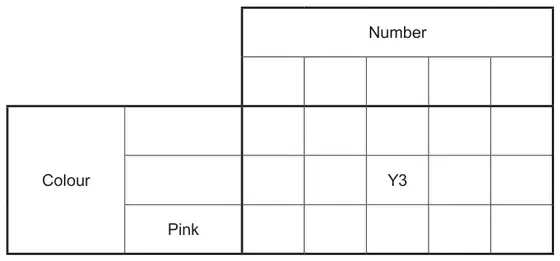
The cards are all placed in a box. One card is chosen at random from the box.
(a) The grid below is used to show all the possible outcomes. Fill in all the spaces with a label or an outcome. Some of the spaces have already been filled in. [2]
(b) What is the probability that the card chosen at random is a pink card showing a number greater than 3? [2]
Mark scheme (a)
Scheme
Marks
Comments
All labels correctly inserted
(Number)
1
2
3
4
5
Red
(Colour)
Yellow
(Pink)
B1
Must be inserted in the table and not simply inferred from the outcomes.
Accept ‘R’ for Red and ‘Y’ for Yellow.
All outcomes correctly inserted
B1
Allow ‘Red’ for ‘R’ etc. Allow ‘1R’ for ‘R1’ etc.
Mark scheme (b)
Scheme
Marks
Comments
\(\dfrac{2}{15}\) or equivalent ISW.
B2
(No FT from an incorrect grid in 4a) B1 for a numerator of 2 in a fraction < 1. B1 for a denominator of 15 in a fraction < 1. Allow B2 for 0·13… Penalise −1 for incorrect notation eg ‘2 out of 15’, ‘2 : 15’ etc.
14. A travel company offers the following holiday options.
Time
Accommodation
Transport
Summer or Winter
Cottage or Hotel
Train or Bus or Car
(a) List all the possible different combinations of holiday options that the company offers. One has been done for you. [3]
Time
Accommodation
Transport
Summer
Cottage
Train
(b) A holiday is chosen at random from all the different combinations on offer. P is the probability that the chosen holiday is a
Summer holiday, staying in a Cottage and travelling by Train.
Mark the point P on the probability scale shown below. [1]
Mark scheme (a)
Scheme
Marks
Comments
(Summer Cottage Train)
Summer
Cottage
Bus
Summer
Cottage
Car
Summer
Hotel
Train
Summer
Hotel
Bus
Summer
Hotel
Car
Winter
Cottage
Train
Winter
Cottage
Bus
Winter
Cottage
Car
Winter
Hotel
Train
Winter
Hotel
Bus
Winter
Hotel
Car
B3
For all other 11 different combinations. Ignore repeats. B2 for 8, 9 or 10 other different combinations. B1 for 5, 6 or 7 other different combinations.
The given combination (Summer Cottage Train) is shaded in the original mark scheme.
Mark scheme (b)
Scheme
Marks
Comments
B1
P must be positioned strictly > 0 and < 0·25. C.A.O. Accept any indication for position of P.
3. A travel company offers the following holiday options.
Time
Accommodation
Transport
Summer or Winter
Cottage or Hotel
Train or Bus or Car
(a) List all the possible different combinations of holiday options that the company offers. One has been done for you. [3]
Time
Accommodation
Transport
Summer
Cottage
Train
(b) A holiday is chosen at random from all the different combinations on offer. P is the probability that the chosen holiday is a
Summer holiday, staying in a Cottage and travelling by Train.
Mark the point P on the probability scale shown below. [1]
Mark scheme (a)
Scheme
Marks
Comments
(Summer Cottage Train)
Summer
Cottage
Bus
Summer
Cottage
Car
Summer
Hotel
Train
Summer
Hotel
Bus
Summer
Hotel
Car
Winter
Cottage
Train
Winter
Cottage
Bus
Winter
Cottage
Car
Winter
Hotel
Train
Winter
Hotel
Bus
Winter
Hotel
Car
B3
For all other 11 different combinations. Ignore repeats. B2 for 8, 9 or 10 other different combinations. B1 for 5, 6 or 7 other different combinations.
The given combination (Summer Cottage Train) is shaded in the original.
Mark scheme (b)
Scheme
Marks
Comments
B1
P must be positioned strictly > 0 and < 0·25. C.A.O. Accept any indication for position of P.
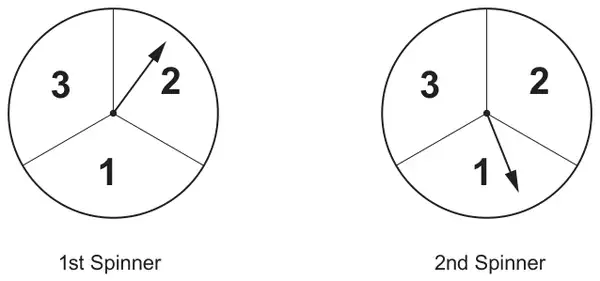
17. Sara is in charge of a game at her school’s Christmas party.
Two fair spinners are spun as shown in the example below.
People can make a two-digit number using the numbers shown on the spinners using the following rule:
Multiply the number on the first spinner by 10 and then add the number on the second spinner.
One example, as shown above, makes the number 21, because 2 × 10 + 1 = 21.
(a) How many different numbers can be made playing this game? [1]
(b) Write down all the prime numbers that can be made playing this game. [2]
(c) What is the probability that a person makes a prime number when playing the game once? [2]
(d) Sara charges each person £1 to play the game once. Each player who makes a prime number from their spins wins £2. How much profit would the school expect to make when 180 people play the game? [4]
Mark scheme (a)
Scheme
Marks
Comments
9
B1
Allow a list of all 9 numbers (no repeats or extras).
Mark scheme (b)
Scheme
Marks
Comments
11, 13, 23, 31.
B2
All correct with no incorrect numbers. B1 for all correct with at most 2 incorrect. B1 for three correct and at most 1 incorrect. B1 for two correct and 0 incorrect.
Mark scheme (c)
Scheme
Marks
Comments
4/9 ISW
B2
Correct answer OR F.T. ‘their number of primes’ / ‘their (a)’, provided the resulting fraction is between 0 and 1. B1 4/x with x>4 OR y/9 with y<9 or equivalent for FT Penalise -1 if incorrect notation used e.g. ‘4 out of 9’
Mark scheme (d)
Scheme
Marks
Comments
(Number of winners =) \(\dfrac{4}{9}\) × 180
M1
F.T. ‘their 4/9’ if less than 1. M0 for ‘4/9 of 180’ unless correct evaluation shown.
= 80
A1
A0 if incorrect reduction in (c) is used.
(Expected profit =) (£)180 – 80 × (£)2
M1
F.T. ‘their stated 80’.
= (£)20
A1
If the FT results in a loss then ‘Loss’ must be stated or the answer left as a negative.
16. David, Jane and Mary are beach inspectors. Three beaches, Harlech, Rhyl and Porthcawl, are all to be inspected on a certain day. It is decided to share the work so that the inspectors will visit one beach each, chosen at random.
List all the possible different ways they could share the work. One has been done for you. [2]
David ⟶ Harlech, Jane ⟶ Rhyl and Mary ⟶ Porthcawl
Corrected by Westie's Workshop
The board's question paper printed “Porhcawl”. Changed to “Porthcawl” because the beach is Porthcawl, as spelt in the example underneath the question.
Original: see the board's question paper PDF (link above).
Mark scheme
Scheme
Marks
Comments
( David – Hr Jane – Rh Mary – P )
David – Hr Jane – P Mary – Rh David – Rh Jane – Hr Mary – P David – Rh Jane – P Mary – Hr David – P Jane – Hr Mary – Rh David – P Jane – Rh Mary – Hr
B2
Allow any unambiguous notation e.g. ‘DH’.
For all other 5 different combinations. Do not penalise repeats. B1 for 3 or 4 other different combinations. B0 otherwise.
6. David, Jane and Mary are beach inspectors. Three beaches, Harlech, Rhyl and Porthcawl, are all to be inspected on a certain day. It is decided to share the work so that the inspectors will visit one beach each, chosen at random.
(a) List all the possible different ways they could share the work. One has been done for you. [2]
David ⟶ Harlech, Jane ⟶ Rhyl and Mary ⟶ Porthcawl
(b) What is the probability that one of the female inspectors will visit Rhyl? [2]
Mark scheme (a)
Scheme
Marks
Comments
( David – Hr Jane – Rh Mary – P )
David – Hr Jane – P Mary – Rh David – Rh Jane – Hr Mary – P David – Rh Jane – P Mary – Hr David – P Jane – Hr Mary – Rh David – P Jane – Rh Mary – Hr
B2
Allow any unambiguous notation e.g. ‘DH’.
For all other 5 different combinations. Do not penalise repeats. B1 for 3 or 4 other different combinations. B0 otherwise.
Mark scheme (b)
Scheme
Marks
Comments
\(\dfrac{4}{6}\) or equivalent. ISW
B2
2/3 or 4/6 gains B2 regardless of their list. B1 for x/6 (x<6) OR 4/y (y>4) F.T. ‘their list’ (using different combinations) if at least 4 to choose from for B2 or B1 as appropriate.
We'd like to use Google Analytics cookies to count visits and see which pages help most. They're optional, and the site works exactly the same either way. Privacy policy