18 Magda carried out a survey to find out the drinks that people like.
She asked 100 people if they like coffee (\(C\)) or tea (\(T\)) or hot chocolate (\(H\)).
32 people like all three drinks. 15 people like coffee and hot chocolate but not tea. 43 people like coffee and tea. 39 people like tea and hot chocolate. 67 people like coffee. 58 people like hot chocolate. 5 people like only tea.
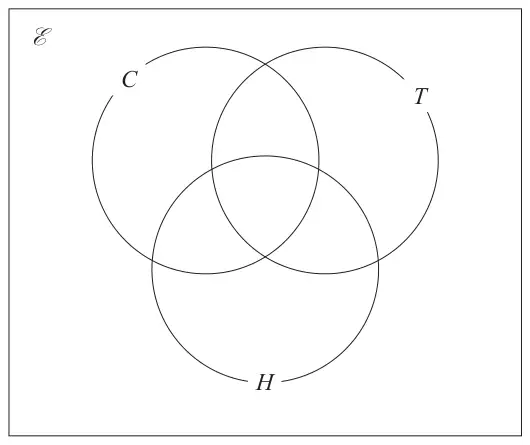
(a) Complete the Venn diagram for this information.(4)
One of the people is chosen at random.
Given that this person likes coffee,
(b) find the probability that this person also likes hot chocolate. (2)
Mark scheme (a)
Answer
Mark
Mark scheme
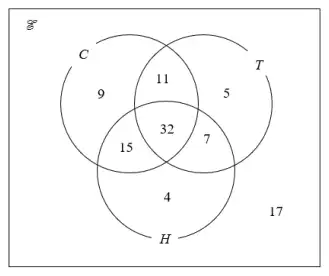
Venn diagram
C4
fully correct Venn diagram
(C3
6 or 7 of the 8 regions correct)
(C2
4 or 5 of the 8 regions correct)
(C1
2 or 3 of the 8 regions correct)
Additional guidance
Ignore all entries except the region you are marking for each C mark
Repeated digits in the diagram should be counted as 2 elements
Mark scheme (b)
Answer
Mark
Mark scheme
\(\dfrac{47}{67}\)
M1
for \(\dfrac{47}{b}\) where \(b \gt 47\) or ft \(\dfrac{\text{``}47\text{''}}{b}\) where \(b \gt \text{``}47\text{''}\)
or \(\dfrac{a}{67}\) where \(0 \lt a \lt 67\) or ft \(\dfrac{a}{\text{``}67\text{''}}\) where \(0 \lt a \lt \text{``}67\text{''}\)
A1
for \(\dfrac{47}{67}\) oe or ft \(\dfrac{\text{``}47\text{''}}{\text{``}67\text{''}}\) oe
Additional guidance
Need not be written in correct form at this stage eg could be a ratio 47 : 67 \(\text{``}47\text{''} = \text{``}15\text{''} + \text{``}32\text{''}\) \(\text{``}67\text{''} = \text{``}9\text{''} + \text{``}11\text{''} + \text{``}32\text{''} + \text{``}15\text{''}\)
Accept any equivalent fraction, decimal form 0.70(14..) or percentage form 70(.14…)%
There are 6 blue buttons 9 green buttons 5 red buttons.
Jai puts 12 more buttons in the box. These buttons are either blue buttons or red buttons.
Jai is going to pick at random one button from the box. The probability that this button will be blue is \(\dfrac{1}{4}\)
How many more red buttons did Jai put in the box? You must show all your working. (4)
Mark scheme
Answer
Mark
Mark scheme
10
P1
for process to find total number of buttons \(20 + 12\ (= 32)\)
P1
for process to work with probability, eg \(\text{``}32\text{''} \div 4\ (= 8)\) or \(\text{``}32\text{''} \div 4 \times 3\ (= 24)\)
P1
for process to find number of extra blue buttons required, eg \(\text{``}8\text{''} - 6\ (= 2)\) or for process to find number of extra reds, eg \(12 - (\text{``}8\text{''} - 6)\) or for process to find new total number of red buttons, eg \((6 + 5 + 12) - \text{``}8\text{''}\ (= 15)\) or \(\text{``}32\text{''} - \text{``}8\text{''} - 9\ (= 15)\) or \(\text{``}24\text{''} - 9\ (= 15)\)
A1
(dep P2) cao
Additional guidance
May be implied by \(\dfrac{\text{``}8\text{''}}{\text{``}32\text{''}}\)
May be implied by 8 : 9 : 15 or \(\dfrac{\text{``}10\text{''}}{\text{``}32\text{''}}\)
19 The table shows the probabilities that a biased dice will land on 3, on 4, on 5 and on 6
Number on dice
1
2
3
4
5
6
Probability
0.10
0.30
0.05
0.25
Karim assumes that the probabilities that the dice will land on 1 and on 2 are the same.
Karim rolls the biased dice 500 times.
(a) Assuming Karim is right, work out an estimate for the number of times the dice will land on 2 (3)
Karim is wrong. The probability that the dice will land on 2 is greater than the probability that the dice will land on 1
(b) How does this information affect your answer to part (a)? (1)
Mark scheme (a)
Answer
Mark
Mark scheme
75
P1
for process to find sum of unknown probabilities eg \(1 - (0.10 + 0.30 + 0.05 + 0.25)\ (= 0.3)\) oe
or for process to find number of times dice lands on 3, 4, 5 or 6 eg \((0.10 + 0.30 + 0.05 + 0.25) \times 500\ (= 350)\) oe
P1
for a complete process, eg \((\text{``}0.3\text{''} \div 2) \times 500\) oe
or \((500 - \text{``}350\text{''}) \div 2\) oe
A1
cao
Additional guidance
Award mark for any two probabilities that sum to 0.3 eg in the table or probability of 2 = 0.15
P1P1A0 for answer of 75:500 or \(\dfrac{75}{500}\)
Mark scheme (b)
Answer
Mark
Mark scheme
Answer to part (a) will be greater
C1
for an explanation that the answer will be greater
Acceptable examples It makes the answer an underestimate The number will be higher The answer will increase / will go up The number of 2’s will increase It would be more than [75]
Not acceptable examples My answer will change My answer is incorrect The calculation will change The probability will change It would make the probability of 2 go up My answer won’t change
16 Aisha has two boxes of sweets, box A and box B.
In box A, there are only 10 red sweets and 30 green sweets. In box B, there are only 7 red sweets and 18 green sweets.
Aisha is going to take at random a sweet from box A and a sweet from box B.
Which box gives Aisha the greater probability of taking a red sweet, box A or box B? You must show how you get your answer. (3)
Mark scheme
Answer
Mark
Mark scheme
Box B and correct figures
P1
for process to find one probability or proportion, eg \(\dfrac{10}{10 + 30}\left(= \dfrac{10}{40}\right)\) or \(\dfrac{7}{7 + 18}\left(= \dfrac{7}{25}\right)\)
P1
(dep P1) for process to find figures to compare using a common format, eg \(10 \div [40]\ (= 0.25)\) and \(7 \div [25]\ (= 0.28)\) or \(10 \div [40] \times 100\ (= 25)\) and \(7 \div [25] \times 100\ (= 28)\) or \(\dfrac{10}{[40]} = \dfrac{25}{100}\) oe and \(\dfrac{7}{[25]} = \dfrac{28}{100}\) oe or \(\dfrac{10 \div 10}{[40] \div 10}\left(= \dfrac{1}{4}\right)\) and \(\dfrac{7 \div 7}{[25] \div 7}\left(= \dfrac{1}{3.57\ldots}\right)\)
C1
(dep on P2) for Box B and correct comparative figures, eg 0.25 and 0.28 or 25% and 28%
Additional guidance
Accept 10 : 30 or 7 : 18
Accept eg 30 : 90 and 35 : 90 [40] is any value >10 [25] is any value >7 but one probability or proportion must be correct from previous P1
Comparative figures may be probabilities, ratios or comparative proportions eg box A: 70R and 210G and box B: 70R and 180G
2 The table shows the probabilities that a biased dice will land on 3, on 4, on 5 and on 6
Number on dice
1
2
3
4
5
6
Probability
0.10
0.30
0.05
0.25
Karim assumes that the probabilities that the dice will land on 1 and on 2 are the same.
Karim rolls the biased dice 500 times.
(a) Assuming Karim is right, work out an estimate for the number of times the dice will land on 2 (3)
Karim is wrong. The probability that the dice will land on 2 is greater than the probability that the dice will land on 1
(b) How does this information affect your answer to part (a)? (1)
Mark scheme (a)
Answer
Mark
Mark scheme
75
P1
for process to find sum of unknown probabilities eg \(1 - (0.10 + 0.30 + 0.05 + 0.25)\ (= 0.3)\) oe
or for process to find number of times dice lands on 3, 4, 5 or 6 eg \((0.10 + 0.30 + 0.05 + 0.25) \times 500\ (= 350)\) oe
P1
for a complete process, eg \((\text{``}0.3\text{''} \div 2) \times 500\) oe
or \((500 - \text{``}350\text{''}) \div 2\) oe
A1
cao
Additional guidance
Award mark for any two probabilities that sum to 0.3 eg in the table or probability of 2 = 0.15
P1P1A0 for answer of 75:500 or \(\dfrac{75}{500}\)
Mark scheme (b)
Answer
Mark
Mark scheme
Answer to part (a) will be greater
C1
for an explanation that the answer will be greater
Acceptable examples It makes the answer an underestimate The number will be higher The answer will increase / will go up The number of 2s will increase It would be more than [75]
Not acceptable examples My answer will change My answer is incorrect The calculation will change The probability will change It would make the probability of 2 go up My answer won’t change
(a) Work out the relative frequency of Heads for the 200 throws. [2 marks]
(b) Which results would give the best estimate of the probability of Heads?
Tick one box.
Sid’s 80 throws
Zak’s 120 throws
All 200 throws
Give a reason for your answer. [1 mark]
Mark scheme (a)
Answer
Mark
Comments
\(0.75 \times 80\) or 60
M1
oe implied by 132
0.66 or \(\dfrac{132}{200}\) or \(\dfrac{66}{100}\) or \(\dfrac{33}{50}\)
A1
oe fraction, decimal or percentage
Additional guidance
Ignore simplification or conversion attempts after correct answer
60 from \(\dfrac{72}{120} = 0.60\)
M0
\(\dfrac{80}{120} = 0.66\)
M0
Mark scheme (b)
Answer
Mark
Comments
Ticks All 200 throws and valid reason
B1
eg ticks All 200 throws and more throws
Additional guidance
Valid reason with non-contradictory work
B1
No box ticked but clear indication of correct box stated in working lines or implied within valid reason
B1
Incorrect box ticked
B0
Examples of valid reasons 200 is the most Bigger number of trials (gives a more accurate result) Both sets of results is more More data Shows us how much they both got (referring to both people) How many times it landed for both (referring to both people) Better result by adding (implies better is more) Examples of invalid reasons More possibility it will land on heads Amount of heads out of 200 More accurate
20 Beth and Lynn each spin the same biased coin a number of times.
The table shows information about the results.
Beth
Lynn
Number of spins
125
80
Relative frequency of Heads
0.32
0.35
(a) How many more Heads did Beth spin than Lynn? [2 marks]
(b) Lynn says,
“My estimate of the probability of the coin landing on Heads must be the best, because 0.35 is greater than 0.32”
Is she correct?
Tick a box.
Yes
No
Give a reason for your answer. [1 mark]
Mark scheme (a)
Answer
Mark
Comments
\(125 \times 0.32\) or 40 or \(80 \times 0.35\) or 28
M1
oe
12
A1
Additional guidance
M1 may be awarded for correct work with no answer or incorrect answer, even if this is seen amongst multiple attempts
\(80 \times 0.5 = 40\)
M0
Mark scheme (b)
Answer
Mark
Comments
No and valid reason involving the number of trials
B1
eg reasons she didn’t do the most she did fewer spins Beth did more they should use all 205 spins
Additional guidance
Ignore irrelevant or incorrect statements alongside a correct statement as long as not contradictory eg1 No and Beth did most but she could have done more eg2 No and Beth has more number of spins so there is a higher probability of landing on heads eg3 No and Beth did most spins but Lynn did more
B1 B1 B0
Allow ‘she’ to refer to Lynn unless clearly referring to Beth eg No and Because she tried 125 times however Lynn tried only 80 times
B1
No and She did not do as many spins so her answer is less accurate than Beth’s
B1
No and Beth spun the wheel more times. Therefore her probability would be lower
B1
No and Beth spun more times so her final outcome will be higher
B1
No and Beth did 125 spins and Lynn did 80 spins
B0
No and Beth did 125 spins so she has more chance of being accurate
9 A number is picked at random from the first three positive odd numbers.
A number is picked at random from the first four prime numbers.
The two numbers are multiplied to get a score.
(a) Complete the table. [4 marks]
prime
\(\times\)
2
3
7
odd
1
5
15
(b) What is the probability that the score is a square number?
Give your answer as a fraction. [2 marks]
Mark scheme (a)
Answer
Mark
Comments
3 in left column
B1
5 in top row
B1
All products correct
B2ft
ft their 3 and their 5 B1ft 3 to 10 correctly evaluated products
Additional guidance
If their 3 is 0, 1 or 5, do not consider those products If their 5 is 0, 2, 3 or 7, do not consider those products
Mark scheme (b)
Answer
Mark
Comments
\(\dfrac{\text{their number of square numbers}}{\text{their number of completed cells}}\)
B2ft
oe fraction ft their table even if incomplete B1ft their number of square numbers as a numerator or their number of completed cells as a denominator or square numbers identified on their grid or in working
Additional guidance
ft must produce a non-zero probability to score
Ignore attempt to simplify or convert if correct fraction seen
M1 may be awarded for correct work with no answer or incorrect answer, even if this is seen in multiple attempts
15 and answer 15 out of 24
M1M1A1
15 and answer \(\dfrac{15}{24}\) or \(\dfrac{3}{8}\)
M1M1A0
Answer \(\dfrac{15}{24}\)
M1M1A0
80 seen embedded in a fraction
M1
Answer \(\dfrac{3}{8}\) with no other creditworthy work
M0M0A0
Condone \(80 \times 40\%\)
M1M1
40% of 80 is 2nd M0 unless recovered
Build up methods for finding 40% of 80 must be completed to be awarded the M mark eg 80 followed by 10% \(= 8\) and \(4 \times 8 = 32\) eg \(0.1 \times 80 = 6\) and \(4 \times 6 = 24\) eg 80 followed by 10% \(= 6\) and \(4 \times 6 = 24\)
The chocolates are milk or dark and have hard or soft centres.
\(\dfrac{4}{9}\) of the chocolates have soft centres.
There are twice as many milk chocolates as dark. 5 of the dark chocolates have soft centres.
(a) Complete the two-way table. [4 marks]
Hard centre
Soft centre
Milk
Dark
5
One chocolate is chosen at random.
(b) What is the probability that it is a dark chocolate with a soft centre? [1 mark]
(c) What is the probability that it has a hard centre? [1 mark]
Mark scheme (a)
Answer
Mark
Comments
\(36 \times \dfrac{4}{9}\) or 16 (Soft) or \(36 \times \dfrac{5}{9}\) or 20 (Hard) or \(36 \times \dfrac{1}{3}\) or 12 (Dark) or \(36 \times \dfrac{2}{3}\) or 24 (Milk)
M1
oe implied by the numbers in the relevant row or column making the correct total accept 16 seen in Milk Soft accept 12 in Dark Hard
Hard
Soft
Milk
13
11
Dark
7
5
A3
A2 two of Milk Soft \(= 11\), Dark Hard \(= 7\) and Milk Hard \(= 13\)
A1 Milk Soft \(= 11\) or Dark Hard \(= 7\)
Additional guidance
Hard
Soft
Milk
10
11
Dark
7
5
M1A2
Hard
Soft
Milk
10
11
Dark
10
5
M1A1
For M1 the values must be seen outside the table or implied by the table but also accept 16 seen in Milk Soft or 12 in Dark Hard
Hard
Soft
Milk
10
16
Dark
5
5
M1
Mark scheme (b)
Answer
Mark
Comments
\(\dfrac{5}{36}\) or \(0.13\dot{8}\) or \(13.\dot{8}\%\)
B1
oe fraction, decimal or percentage accept rounding to 2 sf or better
Additional guidance
Ignore incorrect simplification or conversion attempt to fraction, decimal or percentage (but not ratio) after correct probability seen
Do not allow eg 5 in 36 or 5 out of 36 unless the correct probability seen
Do not allow ratio
Ignore words if correct probability seen
Mark scheme (c)
Answer
Mark
Comments
\(\dfrac{\text{their } 20}{36}\) or \(\dfrac{5}{9}\) or \(0.\dot{5}\) or \(55.\dot{5}\%\)
B1ft
oe fraction, decimal or percentage correct or ft their Hard total from the table accept rounding to 2 sf or better
Additional guidance
Ignore incorrect simplification or conversion attempt to fraction, decimal or percentage (but not ratio) after correct probability seen
Do not allow eg 20 in 36 or 20 out of 36 unless the correct probability seen
(a) The probability that the student is taking a GCSE resit is 0.09
How many of the students are taking a GCSE resit? [2 marks]
(b) The probability that the student is studying
A-levels is 0.67
Core Maths is 0.48
Show that some students are studying A-levels and Core Maths. [2 marks]
Mark scheme (a)
Answer
Mark
Comments
\(0.09 \times 1400\)
M1
oe
126
A1
Additional guidance
M1 may be awarded for correct work, with no answer or incorrect answer, even if this is seen amongst multiple attempts
Do not ignore further working after 126 seen
Do not allow a misread of 0.9 for 0.09
\(1400 - 126 = 1274\) in working
M1
\(\dfrac{126}{1400}\) in working
M1
\(\dfrac{126}{1400}\) on answer line
M1A0
Mark scheme (b)
Answer
Mark
Comments
Alternative method 1
\(0.67 + 0.48 = 1.15\) and the sum (of the probabilities) is greater than 1 or \(0.67 + 0.48 = 1.15\) and 0.15 study both or \(0.67 + 0.48 = 1.15\) and more than the total number of students at school
B2
oe B1 1.15 oe or the sum (of the probabilities) is greater than 1 or 0.15 oe
Alternative method 2
\(938 + 672 = 1610\) and more than the total number of students at school or \(938 + 672 = 1610\) and the total (number of students) is greater than 1400 or 938 and 672 and 210 study both
B2
oe B1 \(0.67 \times 1400\) oe and \(0.48 \times 1400\) oe or 938 and 672 or 1610 or the total (number of students) is greater than 1400 or 210
Additional guidance
B1 may be awarded for correct work, with no answer or incorrect answer, even if this is seen amongst multiple attempts
\(938 + 672 = 1610\) and \(1610 \gt 1400\)
B2
\(938 + 672 = 1610\) and students doing both as more than the total
B2
\(0.67 + 0.48 = 1.15\) and \(1.15 \gt 1\)
B2
\(67 + 48 = 115\) and students doing both as over 100
B2
\(67 + 48 = 115\) and 15% doing both
B2
\(67 + 48 = 115\) and 15 doing both
B1
\(0.67 + 0.48 = 1.15\) and needs to add to one
B1
\(67 + 48 = 115\)
B1
\(0.67 + 0.48 = 1.15\) and students doing both as over 100 (must be consistent form for comparison)
\(2 + x + 2x + 5 =\) their 40 or \(3x + 7 =\) their 40 or (their \(40 - 2 - 5) \div 3\) or \(33 \div 3\)
M1
oe equation eg \(\;3x + 5 = 38\) (scores B1M1) their 40 must be an integer
\((x =)\ 11\)
A1ft
ft B0M1 Does not have to be an integer Accept answer rounded or truncated to at least 2 sf
\(\dfrac{27}{40}\) or 0.675 or 67.5%
B1ft
Only ft evaluation of \(\dfrac{2 \times \text{their integer } x + 5}{40}\) and \(0 \lt\) answer \(\lt 1\) Denominator must be 40 (may subsequently be simplified)
Alternative method 2
\(\dfrac{2}{2 + x + 2x + 5} = \dfrac{1}{20}\) or \(\dfrac{x + 2x + 5}{2 + x + 2x + 5} = \dfrac{19}{20}\)
M2
oe equation
\((x =)\ 11\)
A1
\(\dfrac{27}{40}\) or 0.675 or 67.5%
B1ft
Only ft evaluation of \(\dfrac{2 \times \text{their integer } x + 5}{40}\) and \(0 \lt\) answer \(\lt 1\) Denominator must be 40 (may subsequently be simplified)
14 A number is picked at random from the first four prime numbers.
A number is picked at random from the first four square numbers.
The two numbers are added to get a score.
(a) Complete the table. [4 marks]
Square numbers
+
1
4
9
Prime numbers
2
3
12
7
(b) What is the probability that the score is a prime number? [1 mark]
Mark scheme (a)
Answer
Mark
Comments
16 in top row
B1
5 in left column
B1
All totals correct or All totals correct including for their 16 and their 5
B2ft
B1ft for seven or more correct totals for the given numbers and their 16 and their 5 (if present) If their 16 is 0, 1, 4 or 9, do not consider those totals If their 5 is 0, 2, 3 or 7, do not consider those totals
Additional guidance
Fully correct table
+
1
4
9
16
2
3
6
11
18
3
4
7
12
19
5
6
9
14
21
7
8
11
16
23
B4
Mark scheme (b)
Answer
Mark
Comments
\(\dfrac{\text{their correct number of primes}}{\text{their number of completed cells}}\) \(\dfrac{6}{16}\) or \(\dfrac{3}{8}\) if (a) fully correct
B1ft
oe ft their table even if incomplete but must be attempted
Additional guidance
Correct decimal and percentage values are 0.375 and 37.5% Do not accept truncated or rounded values unless the correct value has been seen Do not accept ratios or words
\(2 + x + 2x + 5 =\) their 40 or \(3x + 7 =\) their 40 or (their \(40 - 2 - 5) \div 3\) or \(33 \div 3\)
M1
oe equation eg \(3x + 5 = 38\) (scores B1M1) their 40 must be an integer
\((x =)\ 11\)
A1ft
ft B0M1 Does not have to be an integer Accept answer rounded or truncated to at least 2 sf
\(\dfrac{27}{40}\) or 0.675 or 67.5%
B1ft
Only ft evaluation of \(\dfrac{2 \times \text{their integer } x + 5}{40}\) and \(0 \lt\) answer \(\lt 1\) Denominator must be 40 (may subsequently be simplified)
Alternative method 2
\(\dfrac{2}{2 + x + 2x + 5} = \dfrac{1}{20}\) or \(\dfrac{x + 2x + 5}{2 + x + 2x + 5} = \dfrac{19}{20}\)
M2
oe equation
\((x =)\ 11\)
A1
\(\dfrac{27}{40}\) or 0.675 or 67.5%
B1ft
Only ft evaluation of \(\dfrac{2 \times \text{their integer } x + 5}{40}\) and \(0 \lt\) answer \(\lt 1\) Denominator must be 40 (may subsequently be simplified)