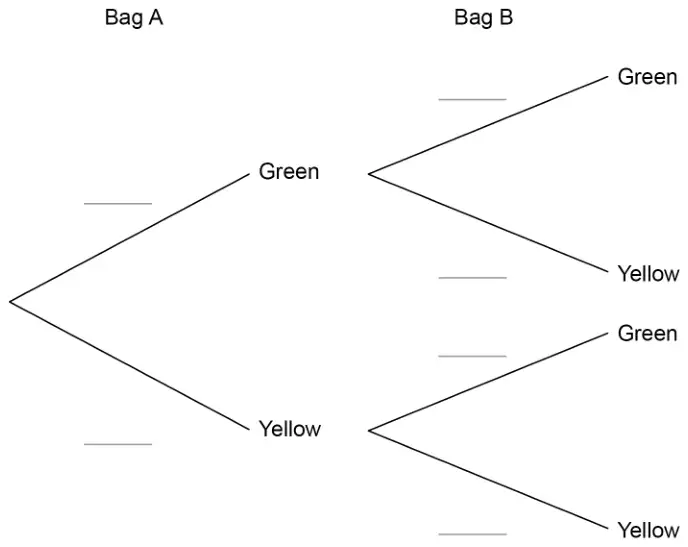
15 There are only 7 blue pens and 3 red pens in a box.
Raja takes at random one of the pens. He notes the colour of the pen and puts the pen back into the box.
Raja does this two more times.
Show that the probability that Raja takes at least two blue pens is \(\dfrac{98}{125}\) (4)
Mark scheme
Answer
Mark
Mark scheme
Shown
M1
for one correct product eg \(\dfrac{7}{10} \times \dfrac{7}{10} \times \dfrac{7}{10}\ \left(= \dfrac{343}{1000}\right)\) oe or \(\dfrac{7}{10} \times \dfrac{7}{10} \times \dfrac{3}{10}\ \left(= \dfrac{147}{1000}\right)\) oe or \(\dfrac{3}{10} \times \dfrac{3}{10} \times \dfrac{3}{10}\ \left(= \dfrac{27}{1000}\right)\) oe or \(\dfrac{3}{10} \times \dfrac{3}{10} \times \dfrac{7}{10}\ \left(= \dfrac{63}{1000}\right)\) oe or \(\dfrac{7}{10} \times \dfrac{7}{10}\ \left(= \dfrac{49}{100}\right)\) oe or \(\dfrac{3}{10} \times \dfrac{3}{10}\ \left(= \dfrac{9}{100}\right)\) oe
M1
for \(\dfrac{7}{10} \times \dfrac{7}{10} \times \dfrac{7}{10}\ \left(= \dfrac{343}{1000}\right)\) oe and \(\dfrac{7}{10} \times \dfrac{7}{10} \times \dfrac{3}{10}\ \left(= \dfrac{147}{1000}\right)\) oe or \(\dfrac{3}{10} \times \dfrac{3}{10} \times \dfrac{3}{10}\ \left(= \dfrac{27}{1000}\right)\) oe and \(\dfrac{3}{10} \times \dfrac{3}{10} \times \dfrac{7}{10}\ \left(= \dfrac{63}{1000}\right)\) oe or \(\dfrac{7}{10} \times \dfrac{7}{10}\ \left(= \dfrac{49}{100}\right)\) oe and \(\dfrac{7}{10} \times \dfrac{7}{10} \times \dfrac{3}{10}\ \left(= \dfrac{147}{1000}\right)\) oe or \(\dfrac{3}{10} \times \dfrac{3}{10}\ \left(= \dfrac{9}{100}\right)\) oe and \(\dfrac{3}{10} \times \dfrac{3}{10} \times \dfrac{7}{10}\ \left(= \dfrac{63}{1000}\right)\) oe
M1
for \(\dfrac{7}{10} \times \dfrac{7}{10} \times \dfrac{7}{10}\) oe and \(3 \times \dfrac{7}{10} \times \dfrac{7}{10} \times \dfrac{3}{10}\) oe or \(\dfrac{3}{10} \times \dfrac{3}{10} \times \dfrac{3}{10}\) oe and \(3 \times \dfrac{3}{10} \times \dfrac{3}{10} \times \dfrac{7}{10}\) oe or \(\dfrac{7}{10} \times \dfrac{7}{10}\) oe and \(2 \times \dfrac{7}{10} \times \dfrac{7}{10} \times \dfrac{3}{10}\) oe or \(\dfrac{3}{10} \times \dfrac{3}{10}\) oe and \(2 \times \dfrac{3}{10} \times \dfrac{3}{10} \times \dfrac{7}{10}\) oe
C1
for a complete method and chain of reasoning leading to \(\dfrac{98}{125}\) eg \(\dfrac{7}{10} \times \dfrac{7}{10} \times \dfrac{7}{10} + 3 \times \dfrac{7}{10} \times \dfrac{7}{10} \times \dfrac{3}{10} = \dfrac{98}{125}\) or \(1 - \dfrac{3}{10} \times \dfrac{3}{10} \times \dfrac{3}{10} - 3 \times \dfrac{3}{10} \times \dfrac{3}{10} \times \dfrac{7}{10} = \dfrac{98}{125}\) or \(\dfrac{7}{10} \times \dfrac{7}{10} + 2 \times \dfrac{7}{10} \times \dfrac{7}{10} \times \dfrac{3}{10} = \dfrac{98}{125}\) or \(1 - \dfrac{3}{10} \times \dfrac{3}{10} - 2 \times \dfrac{3}{10} \times \dfrac{3}{10} \times \dfrac{7}{10} = \dfrac{98}{125}\)
Additional guidance
Throughout accept probabilities given as decimals or percentages Condone sampling without replacement for the first method mark only provided it is in the form \(\dfrac{a}{10} \times \dfrac{b}{9} \times \dfrac{c}{8}\) where \(a\), \(b\), \(c\) are integers and \(a \lt 10\) and \(b \lt 9\) and \(c \lt 8\)
Condone any labelling, even if incorrect for the method marks
“The probability that the sum of the numbers on the two balls will be an even number is greater than the probability that the product of the numbers will be an even number.”
Is Lee correct? You must show how you get your answer. (5)
Mark scheme
Answer
Mark
Mark scheme
No (supported)
P1
for P(OO) = \(\dfrac{5}{9} \times \dfrac{4}{8}\ \left(= \dfrac{20}{72}\right)\) or P(OE) = \(\dfrac{5}{9} \times \dfrac{4}{8}\ \left(= \dfrac{20}{72}\right)\) or P(EO) = \(\dfrac{4}{9} \times \dfrac{5}{8}\ \left(= \dfrac{20}{72}\right)\) or P(EE) = \(\dfrac{4}{9} \times \dfrac{3}{8}\ \left(= \dfrac{12}{72}\right)\)
P1
for P(OO) = \(\dfrac{5}{9} \times \dfrac{4}{8}\ \left(= \dfrac{20}{72}\right)\) and P(EE) = \(\dfrac{4}{9} \times \dfrac{3}{8}\ \left(= \dfrac{12}{72}\right)\) OR for P(OE) = \(\dfrac{5}{9} \times \dfrac{4}{8}\ \left(= \dfrac{20}{72}\right)\) and P(EO) = \(\dfrac{4}{9} \times \dfrac{5}{8}\ \left(= \dfrac{20}{72}\right)\) and P(EE) = \(\dfrac{4}{9} \times \dfrac{3}{8}\ \left(= \dfrac{12}{72}\right)\)
P1
for a process to find probability of sum being even, eg P(OO) + P(EE) = \(\dfrac{5}{9} \times \dfrac{4}{8} + \dfrac{4}{9} \times \dfrac{3}{8}\ \left(= \dfrac{32}{72}\right)\)
P1
for a process to work with probability of product being even, eg P(EO) + P(OE) + P(EE) = \(\dfrac{4}{9} \times \dfrac{5}{8} + \dfrac{5}{9} \times \dfrac{4}{8} + \dfrac{4}{9} \times \dfrac{3}{8}\ \left(= \dfrac{52}{72}\right)\) or 1 – P(OO) = \(1 - \dfrac{5}{9} \times \dfrac{4}{8}\ \left(= \dfrac{52}{72}\right)\)
C1
for No supported by correct probabilities, eg \(\dfrac{32}{72}\) and \(\dfrac{52}{72}\)
SC B2 for \(\dfrac{41}{81}\) and \(\dfrac{56}{81}\) and No SC B1 for \(\dfrac{41}{81}\) and \(\dfrac{56}{81}\) with no decision or incorrect decision
Additional guidance
Accept equivalent probabilities throughout
Sample space diagram or listing: Award P3 for P(sum even) = \(\dfrac{32}{72}\) or P(product even) = \(\dfrac{52}{72}\), P4 for both
12 A factory makes mountain bikes and road bikes. Each bike has disc brakes or rim brakes or caliper brakes.
In June the factory makes a total of 240 bikes.
102 of the bikes are mountain bikes. 75 of the 110 bikes with disc brakes are mountain bikes. 105 bikes have rim brakes. 20 of the mountain bikes have caliper brakes.
Use this information to complete the two-way table. (3)
22 There are only red counters and yellow counters in a box. \(\dfrac{3}{5}\) of the counters are red.
Sophie takes at random two counters from the box.
The probability that the two counters are the same colour is \(\dfrac{41}{80}\)
Work out the number of yellow counters in the box. You must show all your working. (5)
Mark scheme
Answer
Mark
Mark scheme
26
P1
for a correct 2nd probability, eg \(\dfrac{2x - 1}{5x - 1}\) or \(\dfrac{3x - 1}{5x - 1}\) or \(\dfrac{2x}{5x - 1}\) or \(\dfrac{3x}{5x - 1}\) or \(\dfrac{\frac{3}{5}n - 1}{n - 1}\) or \(\dfrac{\frac{2}{5}n - 1}{n - 1}\)
P1
for a correct product, eg \(\dfrac{3x}{5x} \times \dfrac{3x - 1}{5x - 1}\) or \(\dfrac{2x}{5x} \times \dfrac{2x - 1}{5x - 1}\) or \(\dfrac{3}{5} \times \dfrac{2x}{5x - 1}\) or \(\dfrac{2}{5} \times \dfrac{3x}{5x - 1}\) or \(\dfrac{3}{5} \times \dfrac{\frac{3}{5}n - 1}{n - 1}\) or \(\dfrac{2}{5} \times \dfrac{\frac{2}{5}n - 1}{n - 1}\) oe
P1
for process to form equation, eg \(\dfrac{3x}{5x} \times \dfrac{3x - 1}{5x - 1} + \dfrac{2x}{5x} \times \dfrac{2x - 1}{5x - 1} = \dfrac{41}{80}\) or \(2 \times \dfrac{3}{5} \times \dfrac{2x}{5x - 1} = \dfrac{39}{80}\) or \(\dfrac{3}{5} \times \dfrac{\frac{3}{5}n - 1}{n - 1} + \dfrac{2}{5} \times \dfrac{\frac{2}{5}n - 1}{n - 1}\) oe
P1
for process to eliminate fractions and reduce equation to linear or quadratic form, eg \(1040x - 400 = 1025x - 205\) or \(960x = 975x - 195\) or \(1040x^2 - 400x = 1025x^2 - 205x\) or \(960x^2 = 975x^2 - 195x\) or \(\dfrac{208}{5}n - 80 = 41n - 41\) or \(x = 13\) or \(n = 65\)
19 In the semi-finals of a chess tournament, player A will play player B and player C will play player D.
The two winners will then play each other in the final.
The probability that player A will win against player B is 0.6 The probability that player A will win against player C is 0.5 The probability that player A will win against player D is 0.3 The probability that player C will win against player D is 0.2
Work out the probability that player A will win the chess tournament. (4)
Mark scheme
Answer
Mark
Mark scheme
0.204
P1
for a process to find a correct product,
eg P(A plays C in the final) \(= 0.6 \times 0.2\ (= 0.12)\) or P(A plays D in the final) \(= 0.6 \times 0.8\ (= 0.48)\)
or P(A wins against B and C) \(= 0.6 \times 0.5\ (= 0.3)\) or P(A wins against B and D) \(= 0.6 \times 0.3\ (= 0.18)\)
P1
for a process to find the probability of A winning against C or winning against D in the final,
eg P(A wins against C in the final) \(= \text{``}0.12\text{''} \times 0.5\ (= 0.06)\) or P(A wins against D in the final) \(= \text{``}0.48\text{''} \times 0.3\ (= 0.144)\)
or P(A wins against C in the final) \(= \text{``}0.3\text{''} \times 0.2\ (= 0.06)\) or P(A wins against D in the final) \(= \text{``}0.18\text{''} \times 0.8\ (= 0.144)\)
P1
for a complete process,
eg P(A wins the tournament) \(= \text{``}0.06\text{''} + \text{``}0.144\text{''}\)
11 500 people were asked what type of film they liked best.
280 of the 500 people were adults. 100 of the adults said they liked action films best. 80 of the children said they liked thriller films best.
150 of the people said they liked action films best. 200 of the people said they liked comedy films best.
(a) Complete the two-way table.
Comedy
Thriller
Action
Total
Adults
Children
Total
500
(3)
One of these 500 people is chosen at random.
(b) Find the probability that this person is an adult who said they liked action films best. (2)
Mark scheme (a)
Answer
Mark
Mark scheme
110
70
100
280
90
80
50
220
200
150
150
500
C3
for a fully correct table
(C2
for 6 or 7 or 8 or 9 or 10 correct entries)
(C1
for 3 or 4 or 5 correct entries)
Mark scheme (b)
Answer
Mark
Mark scheme
\(\dfrac{100}{500}\)
M1
for \(\dfrac{a}{500}\) where \(0 \lt a \lt 500\) or for \(\dfrac{100}{b}\) where \(100 \lt b \leqslant 500\) or ft their table
A1
for \(\dfrac{100}{500}\) oe or ft their table
Additional guidance
100:500 scores M1A0
For M1 ft their table this is for \(\dfrac{\textit{their}\text{ value of adult action from table}}{c}\) where their value of action adult \(\lt c \leqslant 500\)
For A1 ft their table is for \(\dfrac{\textit{their}\text{ value of adult action from table}}{500}\)
9 A number is picked at random from the first three positive odd numbers.
A number is picked at random from the first four prime numbers.
The two numbers are multiplied to get a score.
(a) Complete the table. [4 marks]
prime
\(\times\)
2
3
7
odd
1
5
15
(b) What is the probability that the score is a square number?
Give your answer as a fraction. [2 marks]
Mark scheme (a)
Answer
Mark
Comments
3 in left column
B1
5 in top row
B1
All products correct
B2ft
ft their 3 and their 5 B1ft 3 to 10 correctly evaluated products
Additional guidance
If their 3 is 0, 1 or 5, do not consider those products If their 5 is 0, 2, 3 or 7, do not consider those products
Mark scheme (b)
Answer
Mark
Comments
\(\dfrac{\text{their number of square numbers}}{\text{their number of completed cells}}\)
B2ft
oe fraction ft their table even if incomplete B1ft their number of square numbers as a numerator or their number of completed cells as a denominator or square numbers identified on their grid or in working
Additional guidance
ft must produce a non-zero probability to score
Ignore attempt to simplify or convert if correct fraction seen
14 A number is picked at random from the first four prime numbers.
A number is picked at random from the first four square numbers.
The two numbers are added to get a score.
(a) Complete the table. [4 marks]
Square numbers
+
1
4
9
Prime numbers
2
3
12
7
(b) What is the probability that the score is a prime number? [1 mark]
Mark scheme (a)
Answer
Mark
Comments
16 in top row
B1
5 in left column
B1
All totals correct or All totals correct including for their 16 and their 5
B2ft
B1ft for seven or more correct totals for the given numbers and their 16 and their 5 (if present) If their 16 is 0, 1, 4 or 9, do not consider those totals If their 5 is 0, 2, 3 or 7, do not consider those totals
Additional guidance
Fully correct table
+
1
4
9
16
2
3
6
11
18
3
4
7
12
19
5
6
9
14
21
7
8
11
16
23
B4
Mark scheme (b)
Answer
Mark
Comments
\(\dfrac{\text{their correct number of primes}}{\text{their number of completed cells}}\) \(\dfrac{6}{16}\) or \(\dfrac{3}{8}\) if (a) fully correct
B1ft
oe ft their table even if incomplete but must be attempted
Additional guidance
Correct decimal and percentage values are 0.375 and 37.5% Do not accept truncated or rounded values unless the correct value has been seen Do not accept ratios or words