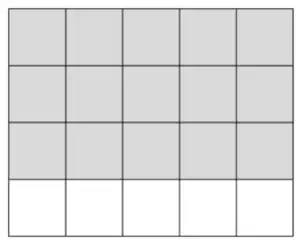
\(\dfrac{2}{5}\) of the people are children. The rest of the people are adults.
35% of the children are vegetarian. 45% of the adults are vegetarian.
How many of the people are not vegetarian? (5)
Mark scheme
Answer
Mark
Mark scheme
118
P1
for a correct first step, eg \(200 \times 2 \div 5\ (= 80)\) or \(200 \times 3 \div 5\ (= 120)\) or \(1 - \dfrac{2}{5}\left(= \dfrac{3}{5}\right)\) oe eg \(100 - 40\ (= 60(\%))\)
P1
for a process to find the number of child vegetarians or number of child non-vegetarians, eg \(\text{``}80\text{''} \times 0.35\ (= 28)\) or \(\text{``}80\text{''} \times (1 - 0.35)\ (= 52)\)
P1
for a process to find the number of adult vegetarians or number of adult non-vegetarians, eg \((200 - \text{``}80\text{''}) \times 0.45\ (= 54)\) or \((200 - \text{``}80\text{''}) \times (1 - 0.45)\ (= 66)\)
P1
for a complete process to find the total number of non-vegetarians, eg \(200 - \text{``}28\text{''} - \text{``}54\text{''}\) or \((\text{``}80\text{''} - \text{``}28\text{''}) + (200 - \text{``}80\text{''} - \text{``}54\text{''})\) oe eg \(\text{``}52\text{''} + (\text{``}120\text{''} - \text{``}54\text{''})\) or \(\text{``}80\text{''} \times (1 - 0.35) + (200 - \text{``}80\text{''}) \times (1 - 0.45)\)
Up to M3 may be awarded for correct work, with no or incorrect answer, even if this is seen amongst multiple attempts
Note that the third mark is independent
Equivalent methods may be used following 780 and 9 in order to work out the number of paying adults eg \((780 + 9 \times 24.5 - 927) \div 24.5 + 3 = 6\)
M1M1M1
SC3 is the total number of people in the group SC2 is the total number of students plus either the free or paying adults
9 The table shows information about two workers on one day.
Total working time (hours)
Working time spent online (minutes)
Zeke
8
200
Margot
4
110
(a) Margot started work at 10:30am
What time did she finish? [1 mark]
(b) Zeke says he spent more than one quarter of his total working time online.
Is he correct? [3 marks]
Tick a box.
Yes
No
Show working to support your answer.
Mark scheme (a)
Answer
Mark
Comments
2:30pm or 14:30
B1
Additional guidance
Condone 14:30 pm or half past two in the afternoon
B1
2:30 am or 2:30 or half past two
B0
Mark scheme (b)
Answer
Mark
Comments
Alternative method 1
\(8 \div 4\) or 2
M1
oe may be seen by the table
their \(2 \times 60\) or 120
M1dep
oe may be seen by the table
120 and Yes
A1
oe eg Yes and 80 minutes more
Alternative method 2
\(8 \times 60\) or 480
M1
oe may be seen by the table
\(\dfrac{1}{4} \times\) their 480 or 120
M1dep
oe may be seen by the table
120 and Yes
A1
oe eg Yes and 80 minutes more
Alternative method 3
\(8 \times 60\) or 480
M1
oe may be seen by the table
\(\dfrac{200}{8 \times 60}\) or \(\dfrac{200}{480}\)
M1dep
oe fraction, decimal or percentage eg \(0.41\dot{6}\)
\(\dfrac{5}{12}\) and \(\dfrac{3}{12}\) and Yes
A1
oe fractions with common denominator or decimals or percentages eg \(0.41\dot{6}\) and 0.25
Alternative method 4
\(8 \times 60\) or 480
M1
oe may be seen by the table
\(200 \times 4\) or 800
M1
oe may be seen by the table
480 and 800 and Yes
A1
oe
Alternative method 5
\(8 \div 4\) or 2
M1
oe may be seen by the table
\(200 \div 60\) or \(3\dfrac{1}{3}\) or 3.(…)
M1
oe eg 3 hours 20 minutes may be seen by the table
2 and 3.(…) and Yes or 2 and \(3\dfrac{1}{3}\) and Yes
A1
oe eg Yes and 2 hrs and 3 hrs 20 mins eg Yes and 80 minutes more
Additional guidance
Lists: 1h \(=\) 60, 2h \(=\) 120, 3h \(=\) 180, 4h \(=\) 240 … up to 8h \(=\) 480 would gain M1 from alts 2, 3, or 4 for converting 8h to 480 minutes 2h \(=\) 120 needs to be chosen from the list or at the end of the list to gain M2 from alt 1
Accept any unambiguous indication for ticking a box
Ignore any reference to Margot
Accept \(0.41\dot{6}\) and \(41.\dot{6}\) rounded or truncated to at least 2 sf
Alts 4 and 5 the second method mark is independent
(b) In fact, the offer is only for 1 week and there are no new offers.
What does this mean about the number of Saturdays he needs to save for?
Tick one box. [1 mark]
It is less than the answer to part (a)
It is the same as the answer to part (a)
It is greater than the answer to part (a)
It is not possible to tell
Mark scheme (a)
Answer
Mark
Comments
\(25 \div 2\) or 12.5
M1
oe implied by 37.5
\((25 \div 2 + 25) \div 8\) or 4(.6) or better or \((25 \div 2 + 25)\) evaluated and sight of the nearest multiple of 8 under/over their evaluation or 2.5
M1dep
oe multiple may be seen in a list
5 with M2 awarded and no errors
A1
SC1 50 and 7
Additional guidance
SC1 is for two full-priced records
37.5 or 2.5 may be implied, eg 4 Saturdays is 32, need 5.5 more answer 5 (37.5 implied)
5 Put these values in order of size, starting with the smallest. [2 marks]
80% 0.7 \(\dfrac{3}{4}\)
Mark scheme
Answer
Mark
Comments
0.7 \(\dfrac{3}{4}\) 80% with no incorrect working seen
B2
oe B1 at least one correct conversion comparable with another value SC1 reverse order with no incorrect working seen
Additional guidance
Condone missing percentage signs, eg allow 70 for 70%
Correct answer with no working shown
B2
Accept equivalent forms to the given numbers on the answer line eg 70% 75 80% eg 70 75 80 eg 0.7 \(\dfrac{3}{4}\) \(\dfrac{8}{10}\) eg 7% 75% 80%
B2 B2 B2 B1
For B1, to be comparable, fractions must have the same denominator or numerator eg \(\dfrac{7.5}{10}\) \(\dfrac{8}{10}\) eg \(\dfrac{3}{4}\) \(\dfrac{8}{10}\) with no further correct work
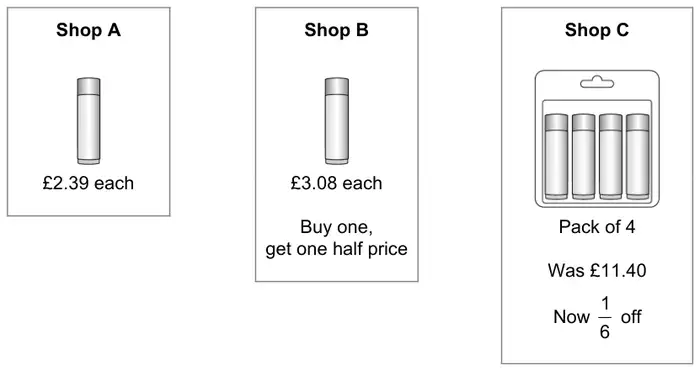
23 Three shops sell the same type and size of lip balm stick.
Which shop is the best value for 8 sticks and what is the total cost in that shop?
Show working to support your answer. [5 marks]
Shop \(\ldots\ldots\ldots\) Total cost £ \(\ldots\ldots\ldots\)
Mark scheme
Answer
Mark
Comments
Alternative method 1: price of buying 8 from each shop
\(2.39 \times 8\) or 19.12
M1
oe shop A
\(3.08 \times 4 + 3.08 \div 2 \times 4\) or 18.48
M1
oe shop B
\(11.4 \div 6\) or 1.9(0) or \(11.4 \times 2 \div 6\) or 3.8(0)
M1
oe shop C
\(11.4 \times 2 -\) their \(1.9(0) \times 2\) or \(11.4 \times 2 -\) their 3.8(0) or 19(.00)
M1dep
oe dep on previous mark \(11.4 \times \dfrac{5}{6} \times 2\) oe scores 3rd & 4th marks
B and 18.48 with 19.12 and 19(.00) seen
A1
Alternative method 2: compares price of individual sticks first
\(3.08 \times 1.5 \div 2\) or 2.31
M1
oe shop B
\((11.4 \div 4) \div 6\) or 0.47(5) or 0.48
M1
oe shop C
\(11.4 \div 4 -\) their 0.475 or 2.37(5) or 2.38
M1dep
oe dep on previous mark \(11.4 \times \dfrac{5}{6} \div 4\) oe scores 2nd & 3rd marks
their \(2.31 \times 8\) or 18.48 with M3 awarded
M1dep
oe
B and 18.48 with 2.31 and 2.37(5) or 2.38 seen
A1
Alternative method 3: compares the price of 4 sticks first
\(2.39 \times 4\) or 9.56 and \(3.08 \times 1.5 \times 2\) or 9.24
M1
oe shops A and B
\(11.4 \div 6\) or 1.9(0)
M1
oe shop C
\(11.4 -\) their 1.9(0) or 9.5(0)
M1dep
dep on previous mark \(11.4 \times \dfrac{5}{6}\) oe scores 2nd & 3rd marks
their \(9.24 \times 2\) or 18.48 with M3 awarded
M1dep
oe
B and 18.48 with 9.56 and 9.24 and 9.5(0) seen
A1
Alternative method 4: compares the price of 2 sticks first
\(2.39 \times 2\) or 4.78 and \(3.08 \times 1.5\) or 4.62
M1
oe shops A and B
\((11.4 \div 2) \div 6\) or 0.95
M1
oe shop C
\(11.4 \div 2 -\) their 0.95 or 4.75
M1dep
dep on previous mark \(11.4 \times \dfrac{5}{6} \div 2\) oe scores 2nd & 3rd marks
their \(4.62 \times 4\) or 18.48 with M3 awarded
M1dep
oe
B and 18.48 with 4.78 and 4.62 and 4.75 seen
A1
Additional guidance
Up to M4 may be awarded for correct work with no answer or incorrect answer, even if this is seen amongst multiple attempts
Use the scheme which gives the highest mark
NB The 4th mark in Alts 2, 3 and 4 does not imply any earlier marks Either the method or values must have been seen and awarded for the first 3 marks in order to give this mark However 18.48 always implies M1 by Alt 1
If students use different numbers of sticks for different shops do not combine marks from different schemes but note that there are possible valid methods that compare eg 2 sticks from A and B and then 4 sticks from B and C (escalate if seen)
All schemes can be oe in pence and allow work in a mix of pounds or pence for up to M4
Allow \(\times\, 0.16(6\ldots)\) or \(\times\, 16(.6\ldots)\%\) or \(\times\, 0.167\) or \(\times\, 16.7\%\) or \(\times\, 0.17\) or \(\times\, 17\%\) if seen for method for one sixth for shop C but must recover to given values for A mark
Allow \(\times\, 0.83(3\ldots)\) or \(\times\, 83(.3\ldots)\%\) if seen for method for five sixths for shop C but must recover to given values for A mark
28% of the total profit the company makes from her sales
a £250 bonus if she sells at least 15 cars.
The table shows information about the cars she sold last year.
Total cost to the company
Total income for the company
Number of months when she sold at least 15 cars
£464 500
£538 000
3
Was Ellen’s total pay for the year more than £40 000?
You must show your working. [6 marks]
Mark scheme
Answer
Mark
Comments
\(3 \times 250\) or 750
M1
\(1470 \times 12\) or 17 640
M1
\(538\,000 - 464\,500\) or 73 500
M1
their 73 500 \(\times\) 0.28 or 20 580
M1dep
oe dep on 3rd M1
their 17 640 \(+\) their 20 580 \(+\) their 750 or 38 970
M1dep
dep on 3rd and 4th M1 Must be adding salary, profit share and bonus
38 970 and No
A1
Additional guidance
For the last method mark, the 3rd and 4th M must have been awarded, but allow the addition of any number of months’ salary and any number of £250 bonuses (at least one month of salary and at least one month of bonus)
\(1470 + 20\,580 + 250\)
M0M0M1 M1dep M1depA0
20 580
3rdM1 4thM1dep
Build up method for 28% must be correct or method shown for incorrect parts eg1 1% of 73 500 = 730, 28% = 20 440 (will also lose the 5th Mdep) eg2 1% of 73 500 = \(73\,500 \div 100\) = 730, 28% = 20 440 eg3 10% of 73 500 = 7350, 1% = 73.5, 28% = 2058 (and 5th Mdep0) eg4 10% of 73 500 = 7350, 1% = \(7350 \div 10\) = 73.5, 28% = 7350 + 7350 + 588 = 15 288
The normal price of a bottle is the same at each shop.
Shop A Buy 1 bottle Get 2 more bottles at half price
Shop B Buy 2 bottles Get 3 more bottles at half price
Shop C 30% off a bottle
What is the cheapest way to buy exactly 8 bottles?
You can buy from more than one shop.
You must show your working. [3 marks]
Mark scheme
Answer
Mark
Comments
Alternative method 1 – price for 8 bottles
Any two (including at least one combination) of Single shops Method to work out cost using one shop Shop A \(3 \times 1 + 5 \times 0.5\) or 5.5 or \(4 \times 1 + 4 \times 0.5\) or 6 or Shop B \(4 \times 1 + 4 \times 0.5\) or 6 or \(5 \times 1 + 3 \times 0.5\) or 6.5 or Shop C \(8 \times 0.7\) or 5.6 Combinations Method to work out cost using two shops A and B \((1 + 2 \times 0.5) + (2 \times 1 + 3 \times 0.5)\) or 5.5 or B and C \((2 \times 1 + 3 \times 0.5) + (3 \times 0.7)\) or 5.6 or A and C \((2 \times 1 + 4 \times 0.5) + (2 \times 0.7)\) or 5.4 or \((1 \times 1 + 2 \times 0.5) + (5 \times 0.7)\) or 5.5
M2
oe Values may be in £ throughout M1 for any one single shop or combination
6 bottles from A and 2 bottles from C with M2 awarded
A1
Condone 2 from A and 2 from C with M2 awarded SC2 6 bottles from A and 2 bottles from C with M1M0 awarded SC1 6 bottles from A and 2 bottles from C with M0M0 awarded
Alternative method 2 – best average cost per bottle
A is \(\dfrac{2}{3}\) or B is 0.7 or C is 0.7
M1
Accept 0.66 or 66(p) or better truncation or rounding or 0.67 or 67(p)
A is \(\dfrac{2}{3}\) and B is 0.7 and C is 0.7
M1
6 bottles from A and 2 bottles from C with M2 awarded
A1
Condone 2 from A and 2 from C with M2 awarded SC2 6 bottles from A and 2 bottles from C with M1M0 awarded SC1 6 bottles from A and 2 bottles from C with M0M0 awarded
Additional guidance
In both methods, if a price or variable is chosen, values would be the respective multiples of that price or variable
For SC2, the M1 may have been awarded for the correct method or price for a different selection of 8 bottles or for the 6 from A and 2 from C eg only working is 6 from A and 2 from C and £5.40
SC2
Calculations or total costs may not be labelled, but shops may be implied by prices
An incorrect evaluation of the total cost of 6 from A and 2 from C leads to a maximum of M1M1A0 Ignore other incorrect evaluations which do not affect the award of marks
The table shows the midday temperature and his sales for five days.
Day 1
Day 2
Day 3
Day 4
Day 5
Temperature (°C)
30
26
17
22
20
Sales (£)
180
150
80
130
120
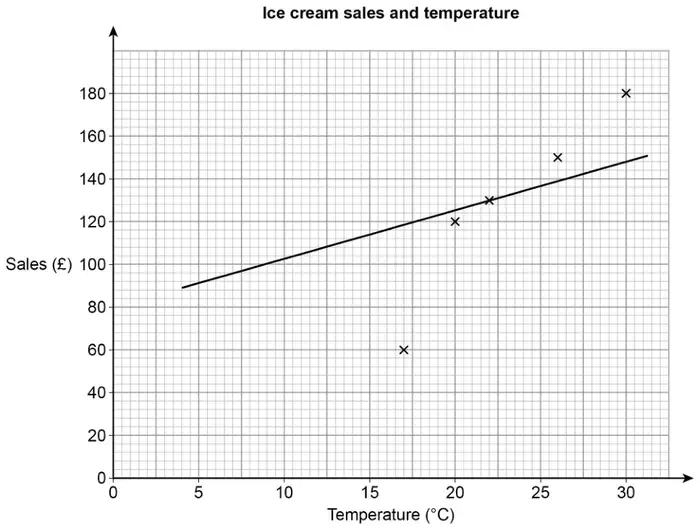
(a) He draws this scatter graph and line of best fit.
Write down two mistakes he has made. [2 marks]
(b) Lee wants to work out the range of the five temperatures.
His calculation is \(\quad 30 - 20 = 10\)
Is his method correct?
Tick a box. [1 mark]
Yes
No
Give a reason to support your answer.
(c) The table shows Lee’s costs.
Ingredients
15% of sales
Fuel
£7 per day
Work out his total profit for the five days. [5 marks]
Mark scheme (a)
Answer
Mark
Comments
Correct criticisms about any two of the incorrect plotting of (17, 80) at (17,60) the incorrect position of the line of best fit the incorrect length of the line of best fit (outside the range of the data)
B2
B1 for one correct comment about point, position or length
Allow reference to a better line of best fit drawn eg The line should look like mine
Additional guidance
A comment about the incorrect point must refer to the specific point
One of the points is wrong and point at (17, 60) circled on graph
B1
Not plotted (17, 80) correctly
B1
x on 60 should be on 80
B1
Point at 60 is wrong
B1
Day 3 is wrong/ there is no day 3 on the graph
B1
17 is plotted at 60/ 17 should be plotted at 80
B1
One of the points is wrong
B0
Points on the graph don’t match the table
B0
Not put all the points in the correct place
B0
A comment about the line of best fit must not have any misconception
The line is not steep enough/ at wrong angle/ should be more vertical
B1
The line isn’t a line of best fit/ the line doesn’t fit the points
B1
The line of best fit goes below 17/ condone past 30 (implies outside range)
B1
The line of best fit is wrong/ not drawn accurately/ not drawn properly
B0
It isn’t a line of best fit because it doesn’t start at 0
B0
The line of best fit is wrong it should go through (0, 0)
B0
The line of best fit doesn’t go through the points
B0
The line is wrong it only goes through one cross
B0
The line of best fit doesn’t go to the axis (implies it’s too short)
B0
Mark scheme (b)
Answer
Mark
Comments
Ticks No and explanation that it should be the highest value – the lowest value
B1
Allow any unambiguous indication of No, if boxes blank may be in the reason oe eg No, it should be the hottest – the coldest
Additional guidance
Does not tick or say No
B0
Ticks No and It should be \(30 - 17\)
B1
Ticks No and It should be 13
B1
Ticks No and He hasn’t subtracted the lowest value
B1
Ticks No and It should be \(17 - 30 = 13\)
B1
Ticks No and Range = biggest – smallest
B1
Ticks No and The lowest temperature is 17 not 20
B1
Ticks No and He hasn’t used the lowest temperature
B1
Ticks No and The lowest temperature is not 20
B1
Ticks No and The lowest temperature is 17
B1
Ticks No and The numbers range from 17 to 30
B1
Ticks No and It should be \(30 - 17 = 23\)
B0
Ticks No and It should be \(17 - 30\)
B0
Ticks No and You should take the smallest from the largest \(30 - 26\)
B0
Ticks No and You should take the smallest from the largest \(180 - 17\)
B0
Ticks No and It should be the smallest – the largest
B0
Ticks Yes and It should be the highest value – the lowest value
B0
Mark scheme (c)
Answer
Mark
Comments
Alternative method 1
\(180 + 150 + 80 + 130 + 120\) or 660
M1
their \(660 \times 0.15\) or 99 or their \(660 \times 0.85\) or 561
M1dep
oe
\(7 \times 5\) or 35
M1
their 660 \(-\) their 99 \(-\) their 35 or their 561 \(-\) their 35
M1dep
dep on M1M1M1
526(.00)
A1
SC4 509
Alternative method 2
\(180 \times 0.15\) or 27 and \(150 \times 0.15\) or 22.5(0) and \(80 \times 0.15\) or 12 and \(130 \times 0.15\) or 19.5(0) and \(120 \times 0.15\) or 18
M1
oe
their 27 \(+\) their 22.5(0) \(+\) their 12 \(+\) their 19.5(0) \(+\) their 18 or 99
M1dep
\(7 \times 5\) or 35
M1
\(180 + 150 + 80 + 130 + 120 -\) their 99 \(-\) their 35
M1dep
dep on M1M1M1
526(.00)
A1
SC4 509
Alternative method 3
\(180 \times 0.15\) or 27 and \(150 \times 0.15\) or 22.5(0) and \(80 \times 0.15\) or 12 and \(130 \times 0.15\) or 19.5(0) and \(120 \times 0.15\) or 18
M1
oe
180 \(-\) their 27 or 153 and 150 \(-\) their 22.5(0) or 127.5(0) and 80 \(-\) their 12 or 68 and 130 \(-\) their 19.5(0) or 110.5(0) and 120 \(-\) their 18 or 102
M1dep
Working out 85% of all five sales scores M1M1dep
\(7 \times 5\) or 35 or their 153 \(-\) 7 or 146 and their 127.5(0) \(-\) 7 or 120.5(0) and their 68 \(-\) 7 or 61 and their 110.5(0) \(-\) 7 or 103.5(0) and their 102 \(-\) 7 or 95
M1
Subtracting five 7s
their 153 \(+\) their 127.5(0) \(+\) their 68 \(+\) their 110.5(0) \(+\) their 102 \(-\) their 35 or their 146 \(+\) their 120.5(0) \(+\) their 61 \(+\) their 103.5(0) \(+\) their 95
M1dep
dep on M1M1M1
526(.00)
A1
SC4 509
Alternative method 4
\(180 \times 0.15\) or 27 and \(150 \times 0.15\) or 22.5(0) and \(80 \times 0.15\) or 12 and \(130 \times 0.15\) or 19.5(0) and \(120 \times 0.15\) or 18
M1
oe
their 27 \(+\) 7 or 34 and their 22.5(0) \(+\) 7 or 29.5(0) and their 12 \(+\) 7 or 19 and their 19.5(0) \(+\) 7 or 26.5(0) and their 18 \(+\) 7 or 25
M1
Adding five 7s
their 34 \(+\) their 29.5(0) \(+\) their 19 \(+\) their 26.5(0) \(+\) their 25 or 134 or 180 \(-\) their 34 or 146 and 150 \(-\) their 29.5(0) or 120.5(0) and 80 \(-\) their 19 or 61 and 130 \(-\) their 26.5(0) or 103.5(0) and 120 \(-\) their 25 or 95
M1dep
dep on M1M1
\(180 + 150 + 80 + 130 + 120 -\) their 134 or their 146 \(+\) their 120.5(0) \(+\) their 61 \(+\) their 103.5(0) \(+\) their 95
M1dep
dep on M1M1M1
526(.00)
A1
SC4 509
Additional guidance
509 comes from using 60 from the incorrect point on the scatter graph
Build up method for 15% must be correct or method shown for incorrect parts eg 10% of 660 = 60, 5% = 30, 15% = 90 eg 10% of 660 = \(660 \div 10\) = 60, 5% = 30, 15% = 90
“I will buy 15 pencils. Then I will buy as many rulers as possible. With my change I will buy more pencils.”
How many pencils and how many rulers does she buy? [6 marks]
Mark scheme
Answer
Mark
Comments
Alternative method 1
\(15 \times 8\) or 120
M1
500 \(-\) their 120 or 380
M1dep
their 380 \(\div\) 30 or 12(…)
M1dep
oe builds up in 30s to at least their 380 \(-\) 30 or builds up in 30s from their 120 to at least 470 allow one error in any build up method
their \(12 \times 30\) or 360 or their 12 chosen from a build up
M1dep
oe their 12 must either come from rounding down their 12.(…) or from choosing their 12 out of a build up or because they had an exact answer of their 12 from a correct method for the third mark
their 380 \(-\) their 360 or 20 or 500 \(-\) (their 360 \(+\) their 120) or their 360 \(+ 8 + 8\) (their correct number of 8s) or 376 or their 360 \(+\) their 120 \(+ 8 + 8\) (their correct number of 8s) or 496
M1dep
their 20 must be \(0 \lt\) their \(20 \lt 30\)
17 pencils, 12 rulers
A1
Alternative method 2
\(15 \times 0.08\) or 1.2(0)
M1
5 \(-\) their 1.2(0) or 3.8(0)
M1dep
their 3.8(0) \(\div\) (0).3(0) or 12(...)
M1dep
oe builds up in (0).3(0)s to at least their 3.8(0) \(-\) (0).3(0)* allow one error or builds up in (0).3(0)s from their 1.2(0) to at least 4.7(0) allow one error
their \(12 \times 0.3(0)\) or 3.6(0) or their 12 chosen from a build up
M1dep
dep on previous mark their 12 must either come from rounding down their 12.(…) or from choosing their 12 out of a build up or because they had an exact answer of their 12 from a correct method for the third mark
their 3.8(0) \(-\) their 3.6(0) or (0).2(0) or 5 \(-\) (their 3.6(0) \(+\) their 1.2(0)) or their 3.6(0) \(+\) (0).08 \(+\) (0).08 (their correct number of (0).08s) or 3.76 or their 3.6(0) \(+\) their 1.2(0) \(+\) (0).08 \(+\) (0).08 (their correct number of (0).08s) or 4.96
M1dep
their 0.20 must be \(0 \lt\) their \(0.20 \lt 0.30\)
17 pencils, 12 rulers
A1
Additional guidance
Do not allow mixed units in working unless recovered
For build-up, one arithmetic mistake counts as one error, even though more than one value may be affected eg, 30, 60, 90, 130, 160, 190, 220, 250, 280, 310, 340, 370 gets 3rd mark in alternative method 1 (error from 90 to 130, but 30 then added correctly throughout)
If there is no change possible, or change is not considered after rulers are bought, it is maximum M4
Example \(\;15 \times 8 = 120 \qquad 500 - 120 = 360\) \(360 \div 30 = 12\) then 12 chosen as number of rulers but no further work (4th mark awarded despite no “remainder” but 5th mark has to consider change)
M1M1M1M1M0A0
Example \(\;15 \times 8 = 120 \qquad 500 - 120 = 380\) \(380 \div 30 = 9.2\) and 9 chosen as the number of rulers (no further work)
M1M1M1M1A0A0
Notes
* Corrected from the printed mark scheme, which says “their 3.8(0) \(-\) 30”.