24 This year the total weight of potatoes grown on a farm is \(\dfrac{1}{5}\) less than last year.
This year the total weight of potatoes grown is 8000 tonnes.
Work out the total weight of potatoes grown last year. (3)
Mark scheme
Answer
Mark
Mark scheme
10 000
M1
for recognising 8000 is \(\dfrac{4}{5}\), eg \(8000 \div 4\ (= 2000)\) or \(\dfrac{4}{5} = 8000\) or 8000 = 80% or \(8000 \div 80\ (= 100)\) or \(x \times 0.8 = 8000\) oe
M1
for a complete method, eg \(\text{``}2000\text{''} \times 5\) or \(8000 \times \dfrac{5}{4}\) or \(\text{``}100\text{''} \times 100\) or \(\dfrac{8000}{0.8}\)
22 There are 280 chocolates in a box. There are only dark chocolates, milk chocolates and white chocolates.
\(\dfrac{1}{7}\) of the 280 chocolates are dark chocolates.
The number of milk chocolates : the number of white chocolates = 1 : 3
The number of white chocolates : the number of dark chocolates = \(n : 1\)
(a) Work out the value of \(n\). You must show all your working. (5)
10 milk chocolates from the box are eaten.
(b) Does this affect your answer to part (a)? Give a reason for your answer. (1)
Mark scheme (a)
Answer
Mark
Mark scheme
4.5
P1
for a process to find the number of dark chocolates, eg \(280 \times \dfrac{1}{7}\) oe (= 40)
P1
for a process to find one part of the ratio for milk chocolates to white chocolates eg \((280 - \text{``}40\text{''}) \div (1 + 3)\ (= 60)\)
P1
for process to find the number of white chocolates, eg \(\text{``}60\text{''} \times 3\ (= 180)\) or \(280 - \text{``}40\text{''} - \text{``}60\text{''}\ (= 180)\)
P1
for a ratio of white chocolates : dark chocolates eg \(\text{``}180\text{''} : \text{``}40\text{''}\) oe or for a process to find the value of \(n\) eg \(\text{``}180\text{''} \div \text{``}40\text{''}\)
A1
(dep P3) for 4.5 oe
Additional guidance
Condone milk, white incorrectly labelled
Labels not required for this mark, but if seen must be correct Must be a 2-part ratio. Allow \(\text{``}40\text{''} : \text{``}180\text{''}\) if labelled as dark chocolate : white chocolate oe
A correct answer with no supportive working gets 0 marks Condone answer of 4.5:1
Mark scheme (b)
Answer
Mark
Mark scheme
No with reason
C1
for No with reason Acceptable examples No, the number of dark chocolates and white chocolates has not changed No, the ratio of \(n\):1 only involved white and dark chocolates No, eating milk chocolates doesn’t change the rest No, the ratio of dark to white chocolates doesn’t change. Not acceptable examples Yes,… No, it doesn’t matter how many milk chocolates are eaten No, the number of white chocolates doesn’t change No, the number of dark chocolates doesn’t change
Additional guidance
Reason must refer to or imply both dark and white chocolates
The number of games the team loses is the same as the number of games the team draws.
Work out the number of games the team loses. (3)
Mark scheme
Answer
Mark
Mark scheme
15
P1
for process to find the number of games won, eg \(48 \div 8 \times 3\ (= 18)\) oe or \(48 -\) [games won] or for process to find the fraction of games drawn and lost or lost only, eg \(1 - \dfrac{3}{8}\left(= \dfrac{5}{8}\right)\) oe eg \(1 - 0.375\ (= 0.625)\) or \(\left(1 - \dfrac{3}{8}\right) \div 2\left(= \dfrac{5}{16}\right)\) oe eg \(\dfrac{2.5}{8}\) or for representing the games in a ratio eg 3 : 2.5 : 2.5 oe
P1
for a correct next step, eg \(48 - \text{``}18\text{''}\ (= 30)\) or \(\text{``}\dfrac{5}{8}\text{''} \times 48\ (= 30)\) oe eg \(\text{``}0.625\text{''} \times 48\ (= 30)\) or \(\text{``}\dfrac{2.5}{8}\text{''} \times 48\) or \(48 \div 8 \times 2.5\) oe or 18 : 15 : 15
A1
cao
Additional guidance
[games won] needs to be clearly stated and must be an integer less than 48 and not \(48 \div 8 \times 3\ (= 18)\) oe
Work out the value of \(xy\). Give your answer as a fraction in its simplest form. (5)
Mark scheme
Answer
Mark
Mark scheme
\(\dfrac{5}{33}\)
M1
for \(10x = 2.\dot{2}\) or 2.22… or \((10x - x =)\ 2.\dot{2} - 0.\dot{2}\ (= 2)\) or \(2.22\ldots - 0.22\ldots\ (= 2)\) or \(\dfrac{2}{9}\) oe fraction
M1
for a method using two recurring decimals that leads to a terminating decimal difference, using correct multiples of \(y\) eg \((1000y - 10y =)\ 681.\dot{8}\dot{1} - 6.\dot{8}\dot{1}\ (= 675)\) or \(681.81\ldots - 6.81\ldots\ (= 675)\) or \(\dfrac{675}{990}\) or \((100y - y) = 68.\dot{1}\dot{8} - 0.6\dot{8}\dot{1}\ (= 67.5)\) or \(68.181\ldots - 0.681\ldots\ (= 67.5)\) or \(\dfrac{67.5}{99}\)
A1
for \((x =)\ \dfrac{2}{9}\) oe and \((y =)\ \dfrac{675}{990}\) oe
M1
for \(\text{``}\dfrac{2}{9}\text{''} \times \text{``}\dfrac{675}{990}\text{''}\)
A1
cao
Additional guidance
eg \(\dfrac{20}{90}, \dfrac{22}{99}\)
Accept \((y =)\ \dfrac{67.5}{99}\)
Award 4 marks for an answer equivalent to \(\dfrac{5}{33}\), eg \(\dfrac{15}{99}, \dfrac{135}{891}, \dfrac{1350}{8910}\) unless from incorrect working
for method to subtract using a correct common denominator, with at least one correct numerator, eg. \(\dfrac{5}{8} - \dfrac{2}{8}\) or \(\dfrac{10}{16} - \dfrac{4}{16}\) or \(\dfrac{20}{32} - \dfrac{8}{32}\) or for correct method to convert both fractions to decimals and subtract, eg \(0.625 - 0.25\)
A1
for \(\dfrac{3}{8}\) oe, eg \(\dfrac{6}{16}\), \(\dfrac{9}{24}\), \(\dfrac{12}{32}\), 0.375
Additional guidance
Do not condone working with fractions with decimal numerators unless it leads to a fraction or fractions where both numerator and denominator are integers.
Ignore errors in cancelling after sight of an equivalent fraction to \(\dfrac{3}{8}\)
Mark scheme (b)
Answer
Mark
Mark scheme
16
M1
for dividing by 5 and multiplying by 2, in any order or for \(0.4 \times 40\) oe
A1
cao
Additional guidance
Accept \(\dfrac{2}{5} \times 40\) or \(\dfrac{2}{5} \times \dfrac{40}{1}\)
5 This year the total weight of potatoes grown on a farm is \(\dfrac{1}{5}\) less than last year.
This year the total weight of potatoes grown is 8000 tonnes.
Work out the total weight of potatoes grown last year. (3)
Mark scheme
Answer
Mark
Mark scheme
10 000
M1
for recognising 8000 is \(\dfrac{4}{5}\) eg \(8000 \div 4\ (= 2000)\) or \(\dfrac{4}{5} = 8000\) or 8000 = 80% or \(8000 \div 80\ (= 100)\) or \(x \times 0.8 = 8000\)
M1
for a complete method, eg \(\text{``}2000\text{''} \times 5\) or \(8000 \times \dfrac{5}{4}\) or \(\text{``}100\text{''} \times 100\) or \(\dfrac{8000}{0.8}\)
4 There are 280 chocolates in a box. There are only dark chocolates, milk chocolates and white chocolates.
\(\dfrac{1}{7}\) of the 280 chocolates are dark chocolates.
The number of milk chocolates : the number of white chocolates = 1 : 3
The number of white chocolates : the number of dark chocolates = \(n : 1\)
(a) Work out the value of \(n\). You must show all your working. (5)
10 milk chocolates from the box are eaten.
(b) Does this affect your answer to part (a)? Give a reason for your answer. (1)
Mark scheme (a)
Answer
Mark
Mark scheme
4.5
P1
for a process to find the number of dark chocolates, eg \(280 \times \dfrac{1}{7}\) oe (= 40)
P1
for a process to find one part of the ratio for milk chocolates to white chocolates eg \((280 - \text{``}40\text{''}) \div (1 + 3)\ (= 60)\)
P1
for a process to find the number of white chocolates, eg \(\text{``}60\text{''} \times 3\ (= 180)\) or \(280 - \text{``}40\text{''} - \text{``}60\text{''}\ (= 180)\)
P1
for a ratio of white chocolates : dark chocolates eg \(\text{``}180\text{''} : \text{``}40\text{''}\) oe or for a process to find the value of \(n\) eg \(\text{``}180\text{''} \div \text{``}40\text{''}\)
A1
(dep P3) for 4.5 oe
Additional guidance
Condone milk, white incorrectly labelled
Labels not required for this mark, but if seen must be correct Must be a 2-part ratio Allow \(\text{``}40\text{''} : \text{``}180\text{''}\) if labelled as dark chocolate : white chocolate oe
A correct answer with no supportive working gets 0 marks Condone answer of 4.5 : 1
Mark scheme (b)
Answer
Mark
Mark scheme
No with reason
C1
for No with reason Acceptable examples No, the number of dark chocolates and white chocolates has not changed No, the ratio of \(n\):1 only involved white and dark chocolates No, eating milk chocolates doesn’t change the rest No, the ratio of dark to white chocolates doesn’t change Not acceptable examples Yes,… No, it doesn’t matter how many milk chocolates are eaten No, the number of white chocolates doesn’t change No, the number of dark chocolates doesn’t change
Additional guidance
Reason must refer to or imply both dark and white chocolates
(a) Work out \(3\dfrac{1}{2} - 1\dfrac{1}{6}\) Give your answer as a mixed number. (2)
(b) Show that \(5\dfrac{1}{4} \div 2\dfrac{1}{3} = 2\dfrac{1}{4}\) (3)
Mark scheme (a)
Answer
Mark
Mark scheme
\(2\dfrac{1}{3}\)
M1
for a method to subtract by writing both fractions with a common denominator with at least one correct numerator, eg \(3\dfrac{3}{6} - 1\dfrac{1}{6}\) or \(\dfrac{3}{6} - \dfrac{1}{6}\ \left(= \dfrac{2}{6}\right)\) or \(\dfrac{21}{6} - \dfrac{7}{6}\ \left(= \dfrac{14}{6}\right)\) or \(\dfrac{42}{12} - \dfrac{14}{12}\ \left(= \dfrac{28}{12}\right)\)
A1
for \(2\dfrac{1}{3}\) or an equivalent mixed number
Additional guidance
Do not ISW incorrect further work from correct equivalent mixed number
Mark scheme (b)
Answer
Mark
Mark scheme
Shown
M1
for conversion to improper fractions, eg \(\dfrac{21}{4}\) or \(\dfrac{7}{3}\) or \(\dfrac{9}{4}\)
M1
(dep) for method to divide by a fraction, eg \(\dfrac{21}{4} \times \dfrac{3}{7}\) or \(\dfrac{63}{12} \div \dfrac{28}{12}\)
C1
for complete work showing each stage as far as \(\dfrac{9}{4}\) or \(2\dfrac{7}{28}\)
Additional guidance
Must see an intermediate step, eg \(\dfrac{63}{28}\) must be seen and then cancelled or correct cancelling seen before the multiplication
14 Harry works in a shop. From Monday to Friday his basic rate of pay is £8 per hour.
On Saturday and Sunday, Harry’s rate of pay is \(1\dfrac{1}{2}\) times his basic rate of pay.
The table shows the number of hours Harry worked each day last week.
Day
Mon
Tue
Wed
Thu
Fri
Sat
Sun
Hours worked
6
6
6
6
6
4
3
Work out Harry’s total pay last week. (4)
Mark scheme
Answer
Mark
Mark scheme
324
P1
for a process to work out daily pay on a weekday, eg \(8 \times 6\ (= 48)\)
or a process to work out the number of hours of pay for weekdays, eg \(6 \times 5\ (= 30)\)
or the number of hours of pay for Saturday and Sunday, eg \((4 + 3) \times 1.5\ (= 10.5)\)
or a process to work out rate of pay for Saturday or Sunday, eg \(8 \times 1.5\ (= 12)\)
P1
for a process to work out the total pay from Monday to Friday, eg \(\text{``}48\text{''} \times 5\ (= 240)\) or \(\text{``}30\text{''} \times 8\ (= 240)\)
or for a process to work out the total pay from Saturday and Sunday, eg \(\text{``}10.5\text{''} \times 8\ (= 84)\) or \(\text{``}12\text{''} \times (4 + 3)\ (= 84)\)
or a process to work out the total number of hours of pay, eg \(\text{``}30\text{''} + \text{``}10.5\text{''}\ (= 40.5)\)
P1
for a complete process, eg \(\text{``}240\text{''} + \text{``}84\text{''}\) or \(\text{``}40.5\text{''} \times 8\)
(a) Work out \(3\dfrac{1}{2} - 1\dfrac{1}{6}\) Give your answer as a mixed number. (2)
(b) Show that \(5\dfrac{1}{4} \div 2\dfrac{1}{3} = 2\dfrac{1}{4}\) (3)
Mark scheme (a)
Answer
Mark
Mark scheme
\(2\dfrac{1}{3}\)
M1
for a method to subtract by writing both fractions with a common denominator with at least one correct numerator, eg \(3\dfrac{3}{6} - 1\dfrac{1}{6}\) or \(\dfrac{3}{6} - \dfrac{1}{6}\ \left(= \dfrac{2}{6}\right)\) or \(\dfrac{21}{6} - \dfrac{7}{6}\ \left(= \dfrac{14}{6}\right)\) or \(\dfrac{42}{12} - \dfrac{14}{12}\ \left(= \dfrac{28}{12}\right)\)
A1
for \(2\dfrac{1}{3}\) or an equivalent mixed number
Additional guidance
Do not isw incorrect further work from correct equivalent mixed number
Mark scheme (b)
Answer
Mark
Mark scheme
Shown
M1
for conversion to improper fractions, eg \(\dfrac{21}{4}\) or \(\dfrac{7}{3}\) or \(\dfrac{9}{4}\)
M1
(dep) for method to divide by a fraction, eg \(\dfrac{21}{4} \times \dfrac{3}{7}\) or \(\dfrac{63}{12} \div \dfrac{28}{12}\)
C1
for complete work showing each stage as far as \(\dfrac{9}{4}\) or \(2\dfrac{7}{28}\)
Additional guidance
Must see an intermediate step, eg \(\dfrac{63}{28}\) must be seen and then cancelled or correct cancelling seen before the multiplication
9 The table shows information about two workers on one day.
Total working time (hours)
Working time spent online (minutes)
Zeke
8
200
Margot
4
110
(a) Margot started work at 10:30am
What time did she finish? [1 mark]
(b) Zeke says he spent more than one quarter of his total working time online.
Is he correct? [3 marks]
Tick a box.
Yes
No
Show working to support your answer.
Mark scheme (a)
Answer
Mark
Comments
2:30pm or 14:30
B1
Additional guidance
Condone 14:30 pm or half past two in the afternoon
B1
2:30 am or 2:30 or half past two
B0
Mark scheme (b)
Answer
Mark
Comments
Alternative method 1
\(8 \div 4\) or 2
M1
oe may be seen by the table
their \(2 \times 60\) or 120
M1dep
oe may be seen by the table
120 and Yes
A1
oe eg Yes and 80 minutes more
Alternative method 2
\(8 \times 60\) or 480
M1
oe may be seen by the table
\(\dfrac{1}{4} \times\) their 480 or 120
M1dep
oe may be seen by the table
120 and Yes
A1
oe eg Yes and 80 minutes more
Alternative method 3
\(8 \times 60\) or 480
M1
oe may be seen by the table
\(\dfrac{200}{8 \times 60}\) or \(\dfrac{200}{480}\)
M1dep
oe fraction, decimal or percentage eg \(0.41\dot{6}\)
\(\dfrac{5}{12}\) and \(\dfrac{3}{12}\) and Yes
A1
oe fractions with common denominator or decimals or percentages eg \(0.41\dot{6}\) and 0.25
Alternative method 4
\(8 \times 60\) or 480
M1
oe may be seen by the table
\(200 \times 4\) or 800
M1
oe may be seen by the table
480 and 800 and Yes
A1
oe
Alternative method 5
\(8 \div 4\) or 2
M1
oe may be seen by the table
\(200 \div 60\) or \(3\dfrac{1}{3}\) or 3.(…)
M1
oe eg 3 hours 20 minutes may be seen by the table
2 and 3.(…) and Yes or 2 and \(3\dfrac{1}{3}\) and Yes
A1
oe eg Yes and 2 hrs and 3 hrs 20 mins eg Yes and 80 minutes more
Additional guidance
Lists: 1h \(=\) 60, 2h \(=\) 120, 3h \(=\) 180, 4h \(=\) 240 … up to 8h \(=\) 480 would gain M1 from alts 2, 3, or 4 for converting 8h to 480 minutes 2h \(=\) 120 needs to be chosen from the list or at the end of the list to gain M2 from alt 1
Accept any unambiguous indication for ticking a box
Ignore any reference to Margot
Accept \(0.41\dot{6}\) and \(41.\dot{6}\) rounded or truncated to at least 2 sf
Alts 4 and 5 the second method mark is independent
24 Work out \(\quad 1\dfrac{1}{5} - \dfrac{3}{10}\)
Give your answer as a fraction. [2 marks]
Mark scheme
Answer
Mark
Comments
Correct conversion of or correct method to convert \(1\dfrac{1}{5}\) to \(\dfrac{12}{10}\) or \(1\dfrac{2}{10}\) with no incorrect conversion of \(\dfrac{3}{10}\) or correct method for or correct result of conversion of both fractions to a common denominator \(\ne 10\) or \(1 - \dfrac{1}{10}\) or \(1.2 - 0.3\) or 0.9
M1
\(\dfrac{9}{10}\)
A1
oe fraction eg \(\dfrac{45}{50}\)
Additional guidance
Ignore attempt to simplify if correct fraction seen
Accept correct conversions to equivalent fractions or decimals eg 0.25, \(\dfrac{4}{8}\), \(\dfrac{7}{8}\), \(3\dfrac{1}{10}\)
B2
Do not accept any incorrect working or incorrect conversions for B2 eg1 \(\dfrac{1}{4}\), \(\dfrac{1}{2}\), \(\dfrac{7}{8}\), \(3\dfrac{1}{10}\) with 3.01 seen in working eg2 \(\dfrac{1}{4}\), \(\dfrac{1}{2}\), \(\dfrac{7}{8}\), 3.01
B1 B1
Condone any incorrect working or incorrect conversions for B1 eg \(\dfrac{1}{4}\), 0.3, \(\dfrac{1}{2}\), \(\dfrac{7}{8}\)
B1
Condone correct percentage value without percentage sign for B2 eg \(\dfrac{1}{2} = 50\) is condoned as not incorrect working
12 Two bags, X and Y, each contain coloured discs.
In bag X, \(\dfrac{7}{20}\) of the discs are red. In bag Y, \(\dfrac{2}{5}\) of the discs are red.
Which bag has the greater proportion of red discs, X or Y?
You must show your working. [2 marks]
Mark scheme
Answer
Mark
Comments
Two comparable values and Y
B2
B1 attempts to convert both to comparable form with at least one non-given value correct eg \(\left(\dfrac{7}{20} \text{ and}\right) \dfrac{8}{20}\) or \(\dfrac{1.75}{5} \left(\text{and } \dfrac{2}{5}\right)\) or 0.35 and 0.4 or 35% and 40% or two values in the ratio 7 : 8
Additional guidance
Accept two comparable values for “not red” \(\dfrac{13}{20}\) and \(\dfrac{12}{20}\) and Y \(\dfrac{13}{20}\) and \(\dfrac{12}{20}\) \(\dfrac{13}{20}\) only
B2 B1 B0
Two comparable values and \(\dfrac{2}{5}\) on answer line 35% and 40%, answer 40% (implies bag Y)
B2 B2
8 and Y
B2
200 discs in each bag, 70 and 80, answer Y 200 discs in each bag, 70 (one non-given value correct) 70 and 50 (number of discs in each bag not specified)
B2 B1 B0
35% and 20% (attempt to convert each to a percentage) 35% only
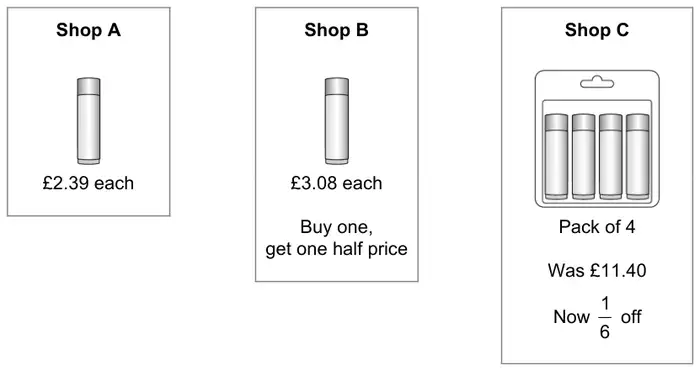
23 Three shops sell the same type and size of lip balm stick.
Which shop is the best value for 8 sticks and what is the total cost in that shop?
Show working to support your answer. [5 marks]
Shop \(\ldots\ldots\ldots\) Total cost £ \(\ldots\ldots\ldots\)
Mark scheme
Answer
Mark
Comments
Alternative method 1: price of buying 8 from each shop
\(2.39 \times 8\) or 19.12
M1
oe shop A
\(3.08 \times 4 + 3.08 \div 2 \times 4\) or 18.48
M1
oe shop B
\(11.4 \div 6\) or 1.9(0) or \(11.4 \times 2 \div 6\) or 3.8(0)
M1
oe shop C
\(11.4 \times 2 -\) their \(1.9(0) \times 2\) or \(11.4 \times 2 -\) their 3.8(0) or 19(.00)
M1dep
oe dep on previous mark \(11.4 \times \dfrac{5}{6} \times 2\) oe scores 3rd & 4th marks
B and 18.48 with 19.12 and 19(.00) seen
A1
Alternative method 2: compares price of individual sticks first
\(3.08 \times 1.5 \div 2\) or 2.31
M1
oe shop B
\((11.4 \div 4) \div 6\) or 0.47(5) or 0.48
M1
oe shop C
\(11.4 \div 4 -\) their 0.475 or 2.37(5) or 2.38
M1dep
oe dep on previous mark \(11.4 \times \dfrac{5}{6} \div 4\) oe scores 2nd & 3rd marks
their \(2.31 \times 8\) or 18.48 with M3 awarded
M1dep
oe
B and 18.48 with 2.31 and 2.37(5) or 2.38 seen
A1
Alternative method 3: compares the price of 4 sticks first
\(2.39 \times 4\) or 9.56 and \(3.08 \times 1.5 \times 2\) or 9.24
M1
oe shops A and B
\(11.4 \div 6\) or 1.9(0)
M1
oe shop C
\(11.4 -\) their 1.9(0) or 9.5(0)
M1dep
dep on previous mark \(11.4 \times \dfrac{5}{6}\) oe scores 2nd & 3rd marks
their \(9.24 \times 2\) or 18.48 with M3 awarded
M1dep
oe
B and 18.48 with 9.56 and 9.24 and 9.5(0) seen
A1
Alternative method 4: compares the price of 2 sticks first
\(2.39 \times 2\) or 4.78 and \(3.08 \times 1.5\) or 4.62
M1
oe shops A and B
\((11.4 \div 2) \div 6\) or 0.95
M1
oe shop C
\(11.4 \div 2 -\) their 0.95 or 4.75
M1dep
dep on previous mark \(11.4 \times \dfrac{5}{6} \div 2\) oe scores 2nd & 3rd marks
their \(4.62 \times 4\) or 18.48 with M3 awarded
M1dep
oe
B and 18.48 with 4.78 and 4.62 and 4.75 seen
A1
Additional guidance
Up to M4 may be awarded for correct work with no answer or incorrect answer, even if this is seen amongst multiple attempts
Use the scheme which gives the highest mark
NB The 4th mark in Alts 2, 3 and 4 does not imply any earlier marks Either the method or values must have been seen and awarded for the first 3 marks in order to give this mark However 18.48 always implies M1 by Alt 1
If students use different numbers of sticks for different shops do not combine marks from different schemes but note that there are possible valid methods that compare eg 2 sticks from A and B and then 4 sticks from B and C (escalate if seen)
All schemes can be oe in pence and allow work in a mix of pounds or pence for up to M4
Allow \(\times\, 0.16(6\ldots)\) or \(\times\, 16(.6\ldots)\%\) or \(\times\, 0.167\) or \(\times\, 16.7\%\) or \(\times\, 0.17\) or \(\times\, 17\%\) if seen for method for one sixth for shop C but must recover to given values for A mark
Allow \(\times\, 0.83(3\ldots)\) or \(\times\, 83(.3\ldots)\%\) if seen for method for five sixths for shop C but must recover to given values for A mark
25 In an office there are twice as many females as males.
\(\dfrac{1}{4}\) of the females wear glasses.
\(\dfrac{3}{8}\) of the males wear glasses.
84 people in the office wear glasses.
Work out the number of people in the office. [4 marks]
Mark scheme
Answer
Mark
Comments
Alternative method 1 – based on a fraction of the number of males
\(\dfrac{1}{4} \times 2x\ (+)\ \dfrac{3}{8} \times x\) or \(\dfrac{7}{8}x\) where \(x\) is the number of males
M1
\(\dfrac{1}{4} \times 2\ (+)\ \dfrac{3}{8}\ (\times 1)\) or \(\dfrac{7}{8}\)
\(\dfrac{1}{4} \times 2x + \dfrac{3}{8} \times x = 84\) or \(\dfrac{7}{8}x = 84\) or \(7x = 672\)
M1dep
oe \(\dfrac{1}{4} \times 2 + \dfrac{3}{8}\ (\times 1)\) linked to 84 or \(\dfrac{7}{8}\) linked to 84
\(x = 84 \div\) their \(\dfrac{7}{8}\) or \(x = 84 \times\) their \(\dfrac{8}{7}\) or \(x = 96\)
M1dep
oe dep on M1M1 \(84 \div\) their \(\dfrac{7}{8}\) or \(84 \times\) their \(\dfrac{8}{7}\) or 96
288
A1
Alternative method 2 - based on a fraction of the number of females
\(\dfrac{1}{4} \times y\ (+)\ \dfrac{3}{8} \times \dfrac{y}{2}\) or \(\dfrac{7}{16}y\) where \(y\) is the number of females
M1
\(\dfrac{1}{4}\ (\times 1)\ (+)\ \dfrac{3}{8} \times \dfrac{1}{2}\) or \(\dfrac{7}{16}\)
\(\dfrac{1}{4} \times y + \dfrac{3}{8} \times \dfrac{y}{2} = 84\) or \(\dfrac{7}{16}y = 84\) or \(7y = 1344\)
M1dep
oe \(\dfrac{1}{4}\ (\times 1) + \dfrac{3}{8} \times \dfrac{1}{2}\) linked to 84 or \(\dfrac{7}{16}\) linked to 84
\(y = 84 \div\) their \(\dfrac{7}{16}\) or \(y = 84 \times\) their \(\dfrac{16}{7}\) or \(y = 192\)
M1dep
oe dep on M1M1 \(84 \div\) their \(\dfrac{7}{16}\) or \(84 \times\) their \(\dfrac{16}{7}\) or 192
288
A1
Alternative method 3 – based on a fraction of the total number of people
\(\dfrac{1}{4} \times \dfrac{2}{3} \times z\) or \(\dfrac{4z}{24}\) or \(\dfrac{3}{8} \times \dfrac{1}{3} \times z\) or \(\dfrac{3z}{24}\) where \(z\) is the number of people in the office
M1
oe \(\dfrac{1}{4} \times \dfrac{2}{3}\) or \(\dfrac{4}{24}\) or \(\dfrac{3}{8} \times \dfrac{1}{3}\) or \(\dfrac{3}{24}\)
\(\dfrac{1}{4} \times \dfrac{2}{3} \times z + \dfrac{3}{8} \times \dfrac{1}{3} \times z = 84\) or \(\dfrac{7z}{24} = 84\)
M1dep
oe \(\;\dfrac{3}{8} \times \dfrac{1}{3} + \dfrac{1}{4} \times \dfrac{2}{3}\) linked to 84 or \(\dfrac{7}{24}\) linked to 84
\(z = 84 \div\) their \(\dfrac{7}{24}\) or \(z = 84 \times\) their \(\dfrac{24}{7}\) or \(7z = 2016\)
M1dep
oe dep on M1M1 \(84 \div\) their \(\dfrac{7}{24}\) or \(84 \times\) their \(\dfrac{24}{7}\)
288
A1
Alternative method 4 – chooses numbers of females and males and factors up or down
Chooses numbers for females and males in the ratio 2 : 1 and works out the numbers of females and males wearing glasses (which should be in the ratio 4 : 3)
M1
eg 32 females and 16 males and \(\dfrac{1}{4} \times 32\ (+)\ \dfrac{3}{8} \times 16\) or 8 and 6 or 14
Works out multiplying factor by \(84 \div\) their total number of people wearing glasses
Multiplies their total of females and males by their multiplying factor
M1dep
eg \(32 \times\) their \(6 + 16 \times\) their 6 or \((32 + 16) \times\) their 6
288
A1
Additional guidance
If more than one method is attempted: if an answer is given, mark the method leading to that answer if no answer is given, mark each method and award the best mark
ft their improper fraction correctly converted to a mixed number answer only of \(4\dfrac{1}{8}\) scores B1B1
Additional guidance
If their initial answer is a proper fraction they cannot access the second mark eg \(\dfrac{3}{8} \times 11 = \dfrac{33}{88}\)
B0B0ft
If their ft mixed number can be simplified, the simplification is not required for the second mark eg \(\dfrac{3}{8} \times 11 = \dfrac{44}{8} = 5\dfrac{4}{8}\)
B0B1ft
\(0.375 \times 11 = 4.125\)
B1B0
\(33 \div 8\)
B0B0
\(33 \div 8 = 4\dfrac{1}{8}\)
B1B1
\(\dfrac{11}{8} = 1\dfrac{3}{8}\) then \(1\dfrac{3}{8} \times 3 = 3\dfrac{9}{8}\) (this gets first B1) \(= 4\dfrac{1}{8}\)