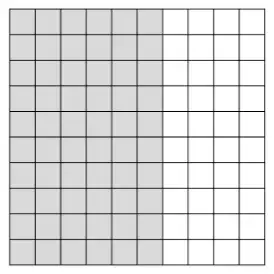
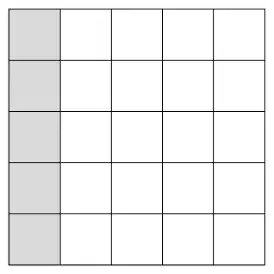
Mia puts the oranges into bags. She puts 5 oranges into each bag.
Mia sells all the bags of oranges for £1 each bag.
Work out Mia’s percentage profit. (3)
Mark scheme
Answer
Mark
Mark scheme
60
P1
for process to find SP of 200 oranges or number of bags, eg \(200 \div 5\ (= 40)\) oe or for process to find the overall profit, eg \(200 \div 5 - 25\ (= 15)\) oe or for process to find CP of 1 orange, eg \(25 \div 200\ (= 0.125)\) oe or SP of 1 orange, eg \(1 \div 5\ (= 0.2)\) oe or for process to find CP of 5 oranges, eg \(25 \div (200 \div 5)\ (= 0.625)\) oe or for process to find number of oranges bought per £, eg \(200 \div 25\ (= 8)\)
P1
(dep) for start to a process to find percentage profit, eg \(\dfrac{\text{``}40\text{''} - 25}{25}\ (= 0.6)\) oe or \(\dfrac{\text{``}15\text{''}}{25}\ (= 0.6)\) oe or \(\dfrac{\text{``}40\text{''}}{25} \times 100\ (= 160)\) oe or \(\dfrac{\text{``}0.2\text{''} - \text{``}0.125\text{''}}{\text{``}0.125\text{''}}\ (= 0.6)\) oe or \(\dfrac{1}{\text{``}0.625\text{''}} \times 100\ (= 160)\) oe or \(\dfrac{1 - \text{``}0.625\text{''}}{\text{``}0.625\text{''}}\ (= 0.6)\) oe or \(\dfrac{\text{``}8\text{''} - 5}{5}\ (= 0.6)\) oe or \(\dfrac{\text{``}8\text{''}}{5} \times 100\ (= 160)\) oe or \(\dfrac{\text{``}8\text{''} \times \text{``}15\text{''}}{200}\ (= 0.6)\) oe
A1
cao
Additional guidance
Working can be in either pounds or pence SP = Selling Price
Amy pays a deposit of 20% of the cost. She pays the rest of the cost in 24 equal monthly payments.
Amy says that each monthly payment is less than £450
Is Amy correct? You must show how you get your answer. (3)
Mark scheme
Answer
Mark
Mark scheme
Yes (supported)
P1
for process to decrease \(12\,000\) by 20%, eg \(12\,000 - 12\,000 \times 0.2\) oe \((= 9600)\) or \(12\,000 \times 0.8\) oe \((= 9600)\) or for process to find the value of 24 monthly payments of £450, eg \(450 \times 24\ (= 10\,800)\) or for process to split the cost of the car over 24 months, eg \(12\,000 \div 24\ (= 500)\)
P1
for process to find comparable values, eg \(\text{``}9600\text{''} \div 24\ (= 400)\) or eg \(12\,000 \times 0.8\) oe \((= 9600)\) and \(450 \times 24\ (= 10\,800)\) or \(12\,000 - \text{``}10\,800\text{''}\ (= 1200)\) or \(\text{``}9600\text{''} \div 450\ (= 21\ldots)\) or \(\text{``}10\,800\text{''} + 12\,000 \times 0.2\) oe \((= 13\,200)\) or eg \(\text{``}500\text{''} \times 0.8\ (= 400)\) oe
C1
for Yes and correct comparable value(s), eg Yes and 400 or Yes and 9600 and \(10\,800\) or Yes and 10% = 1200 where 1200 comes from \(12\,000 - \text{``}10\,800\text{''}\) or Yes and 21… or Yes and \(13\,200\)
Additional guidance
Build up processes are allowed. Condone one error in the build-up process.
Award P0 for 1200 coming from \(12\,000 \times 0.1\) oe
Award no marks for correct decision with no supportive working
‘Yes’ may be implied by an equivalent statement eg ‘Amy is right’ or ‘She is correct’
12 The price of a holiday is increased by 10% After the increase, the price of the holiday is £440
Jim says,
“10% of £440 is £44 so the price of the holiday before the increase was £396”
(a) Is Jim correct? Explain your answer. (1)
Tina sells bikes.
In November, Tina sold 25% fewer bikes than she sold in October. In December, Tina sold 50% more bikes than she sold in November.
In December, Tina sold 180 bikes.
(b) How many bikes did Tina sell in October? (3)
Mark scheme (a)
Answer
Mark
Mark scheme
No with reason
C1
No with reason
Acceptable examples It’s 10% of the original price, not 10% of 440 He found the percentage of the new amount not the original amount He found 10% of the increased value The original price is £400 100% is £400 / 100% is not £440 / 110% is £440 10% is £40 / 10% is not £44 / 11% is £44 99% is 396 10% of 396 is 39.6(0) 110% of 396 is 435.6(0) He should have divided by 1.1
Not acceptable examples No, 440 minus 10% is not 396 100% is not £396 £440 is the price after the increase / The original price is not £440 He has to find 90% of 440 He has to find 110% of 440 It should be £484 Jim is correct / Yes ……
Mark scheme (b)
Answer
Mark
Mark scheme
160
P1
for process to find the number sold in November, eg \(180 \div 150 \times 100\) or \(180 \div 1.5\ (= 120)\) oe
or for \(0.75 \times 1.5\ (= 1.125)\) oe or for \(75 \times 1.5\ (= 112.5)\) oe
P1
for a process to find the number sold in October, eg \(\text{``}120\text{''} \div 75 \times 100\) oe eg \(\text{``}120\text{''} \div 0.75\) or \(180 \div \text{``}1.125\text{''}\) oe eg \(180 \div \text{``}112.5\text{''} \times 100\) or \([\text{value}] \div 0.75\) oe
A1
cao
Additional guidance
[value] can be any value they believe to be the number of bikes sold in November or 180
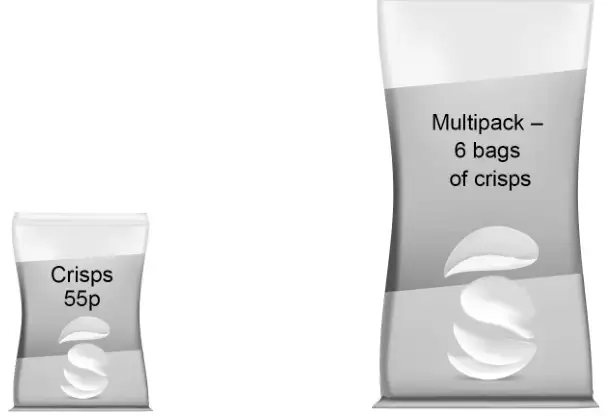
Mia puts the oranges into bags. She puts 5 oranges into each bag.
Mia sells all the bags of oranges for £1 each bag.
Work out Mia’s percentage profit. (3)
Mark scheme
Answer
Mark
Mark scheme
60
P1
for process to find SP of 200 oranges or number of bags, eg \(200 \div 5\ (= 40)\) oe or for process to find the overall profit, eg \(200 \div 5 - 25\ (= 15)\) oe or for process to find CP of 1 orange, eg \(25 \div 200\ (= 0.125)\) oe or SP of 1 orange, eg \(1 \div 5\ (= 0.2)\) oe or for process to find CP of 5 oranges, eg \(25 \div (200 \div 5)\ (= 0.625)\) oe or for process to find number of oranges bought per £, eg \(200 \div 25\ (= 8)\)
P1
(dep) for start to a process to find percentage profit, eg \(\dfrac{\text{``}40\text{''} - 25}{25}\ (= 0.6)\) oe or \(\dfrac{\text{``}15\text{''}}{25}\ (= 0.6)\) oe or \(\dfrac{\text{``}40\text{''}}{25} \times 100\ (= 160)\) oe or \(\dfrac{\text{``}0.2\text{''} - \text{``}0.125\text{''}}{\text{``}0.125\text{''}}\ (= 0.6)\) oe or \(\dfrac{1}{\text{``}0.625\text{''}} \times 100\ (= 160)\) oe or \(\dfrac{1 - \text{``}0.625\text{''}}{\text{``}0.625\text{''}}\ (= 0.6)\) oe or \(\dfrac{\text{``}8\text{''} - 5}{5}\ (= 0.6)\) oe or \(\dfrac{\text{``}8\text{''}}{5} \times 100\ (= 160)\) oe or \(\dfrac{\text{``}8\text{''} \times \text{``}15\text{''}}{200}\ (= 0.6)\) oe
A1
cao
Additional guidance
Working can be in either pounds or pence SP = Selling Price
26 Peter invests £4500 in a savings account for 3 years. He gets 1.8% per year compound interest.
Work out the total amount of interest Peter gets. (3)
Mark scheme
Answer
Mark
Mark scheme
247.4(0)
M1
for a method to find the value of the investment or interest after 1 year, eg \(4500 \times 1.018\ (= 4581)\) or \(4500 \times 0.018\ (= 81)\)
M1
for a method to find the value of the investment after 3 years, eg \(4500 \times 1.018^3\ (= 4747.4\ldots)\) or \(\text{``}4581\text{''} \times 1.018\ (= 4663.45\ldots)\) and \(\text{``}4663.45\ldots\text{''} \times 1.018\ (= 4747.4\ldots\) or \(4747.39\ldots)\)
A1
accept 247.39
SCB1 for 243 or 4743 if M0 scored
Additional guidance
May be seen in more than one calculation Award of this mark implies the first M1 Sight of 83.94... implies M2
25 The cost of a first class stamp increased from 76p to 85p. The cost of a second class stamp increased from 65p to 66p.
Filip says,
“The percentage increase in the cost of a first class stamp is more than 7 times the percentage increase in the cost of a second class stamp.”
Is Filip correct? You must show all your working. (4)
Mark scheme
Answer
Mark
Mark scheme
Yes (supported)
P1
for start to a process to find a percentage increase, eg \(85 - 76\ (= 9)\) or \(66 - 65\ (= 1)\) or \(\dfrac{85}{76}\ (= 1.118\ldots)\) or \(\dfrac{66}{65}\ (= 1.015\ldots)\)
P1
for process to find a % increase, eg \(\dfrac{\text{``}9\text{''}}{76} \times 100\ (= 11.84\ldots)\) or \(\dfrac{\text{``}1\text{''}}{65} \times 100\ (= 1.53\ldots)\) or \(\dfrac{85}{76} \times 100 - 100\ (= 11.84\ldots)\) oe or \(\dfrac{66}{65} \times 100 - 100\ (= 1.53\ldots)\) oe
P1
for processes to find both % increases, eg \(\dfrac{\text{``}9\text{''}}{76} \times 100\ (= 11.84\ldots)\) and \(\dfrac{\text{``}1\text{''}}{65} \times 100\ (= 1.53\ldots)\) or \(\dfrac{85}{76} \times 100 - 100\ (= 11.84\ldots)\) oe and \(\dfrac{66}{65} \times 100 - 100\ (= 1.53\ldots)\) oe
C1
for Yes supported by correct figures, eg \(11(.842\ldots) \div 1.5(38\ldots) = 7.3\) to 8 or \(11(.842\ldots)\) and \(1.5(38\ldots) \times 7 = 10(.766\ldots)\) or \(11(.842\ldots) \div 7 = 1.57\) to 1.7 and \(1.5(3\ldots)\) or \(0.11(842\ldots)\) and \(0.10(766\ldots)\)
Additional guidance
Accept use of rounded and truncated figures for all marks.
May work in decimals or equivalent proportions throughout
21 Robyn buys a total of 240 pens and pencils, where
number of pens : number of pencils = 3 : 5
Robyn pays 9p for each pen. She sells each pen for 11p.
Robyn pays 6p for each pencil. She sells each pencil for 10p.
Robyn sells all of the pens and pencils.
Work out Robyn’s percentage profit. Give your answer correct to 1 decimal place. You must show all your working. (5)
Mark scheme
Answer
Mark
Mark scheme
45.6
P1
for a process to start to work with the ratio, eg \(240 \div (3 + 5)\ (= 30)\) or pens \(= 3n\) and pencils \(= 5n\) where \(n\) is a positive integer
P1
for a complete process to find the number of pens and pencils, eg \(\text{``}30\text{''} \times 3\ (= 90)\) and \(\text{``}30\text{''} \times 5\ (= 150)\) OR for process to find one cost or amount to sell for one item eg \([\text{pens}] \times 9\ (= 810)\) or \([\text{pens}] \times 11\ (= 990)\) or \([\text{pencils}] \times 6\ (= 900)\) or \([\text{pencils}] \times 10\ (= 1500)\) OR for process to find the profit for one pen or one pencil eg \(11 - 9\ (= 2)\) or \(10 - 6\ (= 4)\)
P1
for a process to find the total cost to buy or the total amount to sell for both, eg \([\text{pens}] \times 9 + [\text{pencils}] \times 6\ (= 1710)\) or \([\text{pens}] \times 11 + [\text{pencils}] \times 10\ (= 2490)\) OR process to find the profit for one item eg \([\text{pens}] \times 11 - [\text{pens}] \times 9\ (= 180)\) or \([\text{pens}] \times (11 - 9)\ (= 180)\) or \([\text{pencils}] \times 10 - [\text{pencils}] \times 6\ (= 600)\) or \([\text{pencils}] \times (10 - 6)\ (= 600)\)
P1
for a complete process to find the profit as a percentage or a decimal, eg \(\dfrac{[2490] - [1710]}{[1710]} \times 100\) or \(\dfrac{[2490] - [1710]}{[1710]}\ (= 0.456\ldots)\) or for a process to find the amount to sell as a percentage of the cost eg \(\dfrac{[2490]}{[1710]} \times 100\ (= 145.6\ldots)\)
A1
answer in the range 45.6 to 45.62
Additional guidance
Can work in £ or pence but must be consistent, 90 or 150 imply P1 This mark can be awarded at any stage
[pens] could be \(\text{``}30\text{''} \times 3\) or their number of pens [pencils] could be \(\text{``}30\text{''} \times 5\) or their number of pencils [pens], [pencils] \(\neq 1\)
180 or 600 or 780 implies P3
[2490] is their amount to sell for both pens and pencils [1710] is their cost of pens and pencils [2490] – [1710] may be [180] + [600]
If an answer is given in the range in working and then rounded incorrectly award full marks. A correct answer with no supportive working gets 0 marks
60% of the tickets are child tickets. The rest of the tickets are adult tickets.
The total cost of the 180 tickets is £1944 Each child ticket costs £8
Work out the cost of each adult ticket. (4)
Mark scheme
Answer
Mark
Mark scheme
15
P1
for process to find number of child tickets, eg \(180 \div 100 \times 60\ (= 108)\) oe
P1
for process to find total cost of child tickets, eg \(\text{``}108\text{''} \times 8\ (= 864)\) or \([108] \times 8\) OR for process to find number of adult tickets, eg \(180 - [108]\ (= 72)\) or \(180 \div 5 \times 2\ (= 72)\) oe or \(180 \times \dfrac{100 - 60}{100}\)
P1
for a complete process, eg \((1944 - \text{``}864\text{''}) \div \text{``}72\text{''}\) or \((1944 - [108] \times 8) \div (180 - [108])\)
A1
cao
Additional guidance
Where [108] is what they clearly think is 60% of 180 but can’t be greater than 180
(a) Work out the value of Rudi’s investment at the end of 3 years. (3)
Bruna buys a car for £7500
The value of the car depreciates by \(x\)% each year. At the end of 2 years the value of the car is £4107
(b) Work out the value of \(x\). (3)
Mark scheme (a)
Answer
Mark
Mark scheme
4775.38
M1
for a method to find the value after 1 year, eg \(4500 \times 1.024\ (= 4608)\) oe
M1
for a complete method to find the value after 3 years, eg \(\text{``}4608\text{''} \times 1.018^2\) or \(\text{``}4608\text{''} \times 1.018\ (= 4690.944)\) and \(\text{``}4690.944\text{''} \times 1.018\) oe
A1
accept 4775.37
SCB1 for 4770 or 4824 if M0 scored
Additional guidance
Award of this mark implies the first M1 May be seen in more than 1 calculation M2A0 is implied by 275.37 or 275.38 Correct answer not rounded to 2dp gains M2A0
Mark scheme (b)
Answer
Mark
Mark scheme
26
P1
for a start to the process, eg \(4107 \div 7500\ (= 0.5476)\)
P1
for a process to find percentage change eg \(\sqrt{\text{``}0.5476\text{''}} \times 100\ (= 74)\) or \(\left(\sqrt{\text{``}0.5476\text{''}} - 1\right) \times 100\ (= -26)\) or \(1 - \sqrt{\text{``}0.5476\text{''}}\ (= 0.26)\)
10 In a sale, the normal prices are reduced by 15% Amina buys a dress in the sale for £46.75
Work out the normal price of the dress. (2)
Mark scheme
Answer
Mark
Mark scheme
55
M1
for a complete method eg \(46.75 \div 0.85\) oe or for a correct equation eg \(0.85x = 46.75\) oe or 55 seen, then used as part of an extended method eg 8.25 or 101.75
6 The cost of a first class stamp increased from 76p to 85p. The cost of a second class stamp increased from 65p to 66p.
Filip says,
“The percentage increase in the cost of a first class stamp is more than 7 times the percentage increase in the cost of a second class stamp.”
Is Filip correct? You must show all your working. (4)
Mark scheme
Answer
Mark
Mark scheme
Yes (supported)
P1
for start to a process to find a percentage increase, eg \(85 - 76\ (= 9)\) or \(66 - 65\ (= 1)\) or \(\dfrac{85}{76}\ (= 1.118\ldots)\) or \(\dfrac{66}{65}\ (= 1.015\ldots)\)
P1
for process to find a % increase, eg \(\dfrac{\text{``}9\text{''}}{76} \times 100\ (= 11.84\ldots)\) or \(\dfrac{\text{``}1\text{''}}{65} \times 100\ (= 1.53\ldots)\) or \(\dfrac{85}{76} \times 100 - 100\ (= 11.(84\ldots))\) oe or \(\dfrac{66}{65} \times 100 - 100\ (= 1.53\ldots)\) oe
P1
for processes to find both % increases, eg \(\dfrac{\text{``}9\text{''}}{76} \times 100\ (= 11.84\ldots)\) and \(\dfrac{\text{``}1\text{''}}{65} \times 100\ (= 1.53\ldots)\) or \(\dfrac{85}{76} \times 100 - 100\ (= 11.84\ldots)\) oe and \(\dfrac{66}{65} \times 100 - 100\ (= 1.53\ldots)\) oe
C1
for Yes supported by correct figures, eg \(11(.842\ldots) \div 1.5(38\ldots) = 7.3\) to 8 or \(11(.842\ldots)\) and \(1.5(38\ldots) \times 7 = 10(.766\ldots)\) or \(11(.842\ldots) \div 7 = 1.57\) to 1.7 and \(1.5(3\ldots)\) or \(0.11(842\ldots)\) and \(0.10(766\ldots)\)
Additional guidance
Accept use of rounded and truncated figures for all marks
May work in decimals or equivalent proportions throughout
5 Robyn buys a total of 240 pens and pencils, where
number of pens : number of pencils = 3 : 5
Robyn pays 9p for each pen. She sells each pen for 11p.
Robyn pays 6p for each pencil. She sells each pencil for 10p.
Robyn sells all of the pens and pencils.
Work out Robyn’s percentage profit. Give your answer correct to 1 decimal place. You must show all your working. (5)
Mark scheme
Answer
Mark
Mark scheme
45.6
P1
for a process to start to work with the ratio, eg \(240 \div (3 + 5)\ (= 30)\) or pens \(= 3n\) and pencils \(= 5n\) where \(n\) is a positive integer
P1
for a complete process to find the number of pens and pencils, eg \(\text{``}30\text{''} \times 3\ (= 90)\) and \(\text{``}30\text{''} \times 5\ (= 150)\) OR for process to find one cost or amount to sell for one item eg \([\text{pens}] \times 9\ (= 810)\) or \([\text{pens}] \times 11\ (= 990)\) or \([\text{pencils}] \times 6\ (= 900)\) or \([\text{pencils}] \times 10\ (= 1500)\) OR process to find the profit for one pen or one pencil eg \(11 - 9\ (= 2)\) or \(10 - 6\ (= 4)\)
P1
for a process to find the total cost to buy or the total amount to sell for both, eg \([\text{pens}] \times 9 + [\text{pencils}] \times 6\ (= 1710)\) or \([\text{pens}] \times 11 + [\text{pencils}] \times 10\ (= 2490)\) OR process to find the profit for one item eg \([\text{pens}] \times 11 - [\text{pens}] \times 9\ (= 180)\) or \([\text{pens}] \times (11 - 9)\ (= 180)\) or \([\text{pencils}] \times 10 - [\text{pencils}] \times 6\ (= 600)\) or \([\text{pencils}] \times (10 - 6)\ (= 600)\)
P1
for a complete process to find the profit as a percentage or a decimal, eg \(\dfrac{[2490] - [1710]}{[1710]} \times 100\) or \(\dfrac{[2490] - [1710]}{[1710]}\ (= 0.456\ldots)\) or for a process to find the amount to sell as a percentage of the cost eg \(\dfrac{[2490]}{[1710]} \times 100\ (= 145.6\ldots)\)
A1
answer in the range 45.6 to 45.62
Additional guidance
Can work in £ or pence but must be consistent, 90 or 150 imply P1 This mark can be awarded at any stage
[pens] could be \(\text{``}30\text{''} \times 3\) or their number of pens [pencils] could be \(\text{``}30\text{''} \times 5\) or their number of pencils [pens], [pencils] \(\neq 1\)
180 or 600 or 780 implies P3
[2490] is their amount to sell for both pens and pencils [1710] is their cost of pens and pencils [2490] – [1710] may be [180] + [600]
If an answer is given in the range in working and then rounded incorrectly award full marks. A correct answer with no supportive working gets 0 marks
He buys 6 plates for each table plus an extra 70% for spares.
Work out how many plates Paul buys in total. [3 marks]
Mark scheme
Answer
Mark
Comments
\(0.7 \times 6 \times 20\) or 84 or \(1.7 \times 6 \times 20\)
M2
oe M1 \(6 \times 20\) or 120 oe or \(0.7 \times 6\) or 4.2 oe or \(0.7 \times 20\) or 14 oe or \(1.7 \times 6\) or 10.2 oe or \(1.7 \times 20\) or 34 oe
204
A1
SC2 200 or 220
Additional guidance
SC2 is from working with 10 or 11 as a whole number of plates per table
15% in the first year then 10% in the second year.
Work out the value of the car after these two years. [3 marks]
Mark scheme
Answer
Mark
Comments
\(8600 \times 0.15\) or 1290 or \(8600 \times 0.85\) or 7310 or \(0.85 \times 0.9\) or 0.765 or \(8600 \times 0.1\) or 860 or \(8600 \times 0.9\) or 7740
M1
oe
\((8600 - \text{their } 1290) \times 0.9\) or their \(7310 \times 0.9\) or \(0.85 \times 0.9 \times 8600\) or \((8600 - \text{their } 860) \times 0.85\) or their \(7740 \times 0.85\)
M1dep
oe
6579
A1
SC1 10 879
Additional guidance
SC1 10 879 is for correctly calculating a repeated increase
\(1.7 \times 0.9\) or 1.53 or \(1.7 \times 6\) or 10.2
M1
oe eg \(1.7 - 0.1 \times 1.7\)
\(1.7 \times 0.9 \times 6\) or 9.18
M1dep
oe eg \(10.2 - 0.1 \times 10.2\) dep on 2nd M1
their \(9.18 + 2 \times 0.62\) or 10.42
M1
oe their 9.18 must be 6 times their pack price
Shop A Cheaper by £0.82
A1
oe eg Shop A Cheaper by 82p
Additional guidance
Accept working in pounds or pence
Mixed units in the 4th M1 mark must be recovered with a correct value for their calculation 960 and \(9.18 + 2 \times 62\) 960 and \(9.18 + 2 \times 62\) and 10.42
M1M1M1M0 M1M1M1M1
\(10.20 + 2 \times 0.62\) or 11.44 score the 2nd and 4th M1 mark
Work out the percentage change in her total annual pay.
State whether it is an increase or a decrease. [4 marks]
Mark scheme
Answer
Mark
Comments
Method to calculate the increase on the salary or the decrease to the bonus or decimal multiplier 1.06 or 0.91
M1
eg \(26\,000 \times 0.06\) or 1560 or \(4000 \times 0.09\) or 360 oe fraction
Method to calculate the value of the increased salary or the decreased bonus or Method to calculate the difference between the increase on the salary and the decrease to the bonus
M1dep
eg \(26\,000 \times 1.06\) or 27 560 or \(4000 \times 0.91\) or 3640 eg their \(1560 -\) their 360 or 1200 31 200 implies M2
Method to calculate the decimal multiplier or percentage of the total annual pay or 1.04 or 104(%) or Method to calculate the decimal multiplier or percentage change in the total annual pay or 0.04 or 4(%)
4 adult tickets at £15 each 2 child tickets at £10 each
A 10% booking fee is added to the ticket price.
3% is then added for paying by credit card.
Work out the total charge for these tickets when paying by credit card. [5 marks]
Mark scheme
Answer
Mark
Comments
Alternative method 1
\(4 \times 15\) or 60 or \(2 \times 10\) or 20 or 80
M1
oe
\(\dfrac{10}{100} \times\) their 80 or 8 or 1.1 and working for first M1 seen
M1dep
oe \(\dfrac{10}{100} \times\) their 60 or 6 or 66 or \(\dfrac{10}{100} \times\) their 20 or 2 or 22
their 80 \(+\) their 8 or \(1.1 \times\) their 80 or 88
M1dep
oe their 60 \(+\) their 6 \(+\) their 20 \(+\) their 2 or \(1.1 \times\) their 60 \(+ \ 1.1 \times\) their 20 or their 66 \(+\) their 22
\(0.03 \times\) their 88 or 2.64 or their \(88 \times 1.03\)
M1dep
oe
90.64(p)
A1
Alternative method 2
\(\dfrac{10}{100} \times 15\) or 1.5(0) and \(\dfrac{10}{100} \times 10\) or 1 or 1.1 seen
M1
oe
15 \(+\) their 1.5(0) or \(15 \times 1.1\) or 16.5(0) and 10 \(+\) their 1 or \(10 \times 1.1\) or 11
M1dep
oe 27.5(0) implies M2
their 16.5(0) \(\times\) 0.03 or 0.495 and their 11 \(\times\) 0.03 or 0.33 or their 16.5(0) \(\times\) 1.03 or 16.995 and their 11 \(\times\) 1.03 or 11.33
M1dep
oe \(4 \times\) their 16.5(0) \(+ \ 2 \times\) their 11 or their 66 \(+\) their 22 or 88
their 0.495 \(\times 4 +\) their 0.33 \(\times 2\) or \(1.98 + 0.66\) or 2.64 or their 16.995 \(\times\) 4 or 67.98 and their 11.33 \(\times\) 2 or 22.66
M1dep
oe \(0.03 \times\) their 88 or 2.64 or their \(88 \times 1.03\)
90.64(p)
A1
Alternative method 3
\(4 \times 15\) or 60 or \(2 \times 10\) or 20 or 80
M1
oe
\(\dfrac{10}{100} \times\) their 80 or 8 or \(\dfrac{13}{100} \times\) their 80 or 10.4(0) or 1.13 and working for first M1 seen
M1dep
oe \(\dfrac{13}{100} \times\) their 60 or 7.8(0) or \(\dfrac{13}{100} \times\) their 20 or 2.6(0)
their 80 \(+\) their 10.4(0) or \(1.13 \times 80\) or 90.4(0) or \(0.03 \times\) their 8 or 0.24
M1dep
oe 60 \(+\) their 7.8(0) \(+\) 20 \(+\) their 2.6(0) or 67.8(0) \(+\) 22.6(0)
their 80 \(+\) their 10.4(0) or \(1.13 \times 80\) or 90.4(0) and \(0.03 \times\) their 8 or 0.24
28% of the total profit the company makes from her sales
a £250 bonus if she sells at least 15 cars.
The table shows information about the cars she sold last year.
Total cost to the company
Total income for the company
Number of months when she sold at least 15 cars
£464 500
£538 000
3
Was Ellen’s total pay for the year more than £40 000?
You must show your working. [6 marks]
Mark scheme
Answer
Mark
Comments
\(3 \times 250\) or 750
M1
\(1470 \times 12\) or 17 640
M1
\(538\,000 - 464\,500\) or 73 500
M1
their 73 500 \(\times\) 0.28 or 20 580
M1dep
oe dep on 3rd M1
their 17 640 \(+\) their 20 580 \(+\) their 750 or 38 970
M1dep
dep on 3rd and 4th M1 Must be adding salary, profit share and bonus
38 970 and No
A1
Additional guidance
For the last method mark, the 3rd and 4th M must have been awarded, but allow the addition of any number of months’ salary and any number of £250 bonuses (at least one month of salary and at least one month of bonus)
\(1470 + 20\,580 + 250\)
M0M0M1 M1dep M1depA0
20 580
3rdM1 4thM1dep
Build up method for 28% must be correct or method shown for incorrect parts eg1 1% of 73 500 = 730, 28% = 20 440 (will also lose the 5th Mdep) eg2 1% of 73 500 = \(73\,500 \div 100\) = 730, 28% = 20 440 eg3 10% of 73 500 = 7350, 1% = 73.5, 28% = 2058 (and 5th Mdep0) eg4 10% of 73 500 = 7350, 1% = \(7350 \div 10\) = 73.5, 28% = 7350 + 7350 + 588 = 15 288
The normal price of a bottle is the same at each shop.
Shop A Buy 1 bottle Get 2 more bottles at half price
Shop B Buy 2 bottles Get 3 more bottles at half price
Shop C 30% off a bottle
What is the cheapest way to buy exactly 8 bottles?
You can buy from more than one shop.
You must show your working. [3 marks]
Mark scheme
Answer
Mark
Comments
Alternative method 1 – price for 8 bottles
Any two (including at least one combination) of Single shops Method to work out cost using one shop Shop A \(3 \times 1 + 5 \times 0.5\) or 5.5 or \(4 \times 1 + 4 \times 0.5\) or 6 or Shop B \(4 \times 1 + 4 \times 0.5\) or 6 or \(5 \times 1 + 3 \times 0.5\) or 6.5 or Shop C \(8 \times 0.7\) or 5.6 Combinations Method to work out cost using two shops A and B \((1 + 2 \times 0.5) + (2 \times 1 + 3 \times 0.5)\) or 5.5 or B and C \((2 \times 1 + 3 \times 0.5) + (3 \times 0.7)\) or 5.6 or A and C \((2 \times 1 + 4 \times 0.5) + (2 \times 0.7)\) or 5.4 or \((1 \times 1 + 2 \times 0.5) + (5 \times 0.7)\) or 5.5
M2
oe Values may be in £ throughout M1 for any one single shop or combination
6 bottles from A and 2 bottles from C with M2 awarded
A1
Condone 2 from A and 2 from C with M2 awarded SC2 6 bottles from A and 2 bottles from C with M1M0 awarded SC1 6 bottles from A and 2 bottles from C with M0M0 awarded
Alternative method 2 – best average cost per bottle
A is \(\dfrac{2}{3}\) or B is 0.7 or C is 0.7
M1
Accept 0.66 or 66(p) or better truncation or rounding or 0.67 or 67(p)
A is \(\dfrac{2}{3}\) and B is 0.7 and C is 0.7
M1
6 bottles from A and 2 bottles from C with M2 awarded
A1
Condone 2 from A and 2 from C with M2 awarded SC2 6 bottles from A and 2 bottles from C with M1M0 awarded SC1 6 bottles from A and 2 bottles from C with M0M0 awarded
Additional guidance
In both methods, if a price or variable is chosen, values would be the respective multiples of that price or variable
For SC2, the M1 may have been awarded for the correct method or price for a different selection of 8 bottles or for the 6 from A and 2 from C eg only working is 6 from A and 2 from C and £5.40
SC2
Calculations or total costs may not be labelled, but shops may be implied by prices
An incorrect evaluation of the total cost of 6 from A and 2 from C leads to a maximum of M1M1A0 Ignore other incorrect evaluations which do not affect the award of marks
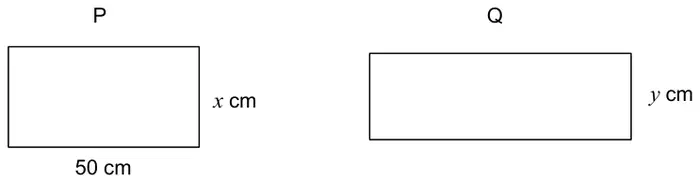
17 P is a rectangle with length 50 cm and width \(x\) cm
Q is a rectangle with width \(y\) cm
Not drawn accurately
The length of Q is 20% more than the length of P.
The area of Q is 10% less than the area of P.
Work out the ratio \(\quad x : y\)
Give your answer in its simplest form. [4 marks]
Mark scheme
Answer
Mark
Comments
Alternative method 1
\(50 \times 1.2\) or 60
M1
oe length of Q May be on the diagram
\(50 \times x \times 0.9\) or \(45 \times x\)
M1
oe area of P reduced by 10% May be on the diagram
their \(60 \times y =\) their \(45 \times x\) or \(\dfrac{y}{x} = \dfrac{\text{their } 45}{\text{their } 60}\) or \(y : x =\) their 45 : their 60 or equivalent ratio to 4 : 3 not in simplest form or equivalent fraction to \(\dfrac{4}{3}\) not in simplest form
M1dep
oe dep on M2 M3 \(\dfrac{1.2}{0.9}\)
4 : 3 or \(1 : \dfrac{3}{4}\) or 1 : 0.75 or \(\dfrac{4}{3} : 1\)
A1
Alternative method 2
\(50 \times 1.2\) or 60
M1
oe length of Q May be on the diagram
Chooses a value for \(x\) and reduces area of P by 10%
M1
oe eg \((x = 8)\ \; 50 \times 8 \times 0.9\)
their \(60 \times y =\) their area of P reduced by 10% or equivalent ratio to 4 : 3 not in simplest form or equivalent fraction to \(\dfrac{4}{3}\) not in simplest form
M1dep
oe eg \(60y = 50 \times 8 \times 0.9\) or \(60y = 360\) or \((y =)\ 360 \div 60\) or 6 dep on M2 M3 \(\dfrac{1.2}{0.9}\)
4 : 3 or \(1 : \dfrac{3}{4}\) or 1 : 0.75 or \(\dfrac{4}{3} : 1\)
A1
Additional guidance
Allow 1.33(…) for \(\dfrac{4}{3}\)
4 : 3 in working with 3 : 4 on answer line
M3A0
\(1 : \dfrac{45}{60}\)
M3A0
(Alt 1) \(\;50x = 60y \times 0.9\)
M1M0M0A0
(Alt 1) \(\;50x = 60y \times 1.1\)
M1M0M0A0
(Alt 1) \(\;45x : 60y\) Answer 3 : 4
M1M1 M0A0
(Alt 1) \(\;y : x = 3 : 4\) Answer 3 : 4
M3A0
Alt 2 example \(50 \times 10 = 500\) (working not seen for reduction by 10% but completed correctly in next line) \(450 \div 60 = 7.5\) (60 here gains first M1) \(10 : 7.5 = 20 : 15\)
M1M1 M1A0
Do not allow misreads eg increases length of P by 10% (instead of 20%)
The table shows the midday temperature and his sales for five days.
Day 1
Day 2
Day 3
Day 4
Day 5
Temperature (°C)
30
26
17
22
20
Sales (£)
180
150
80
130
120
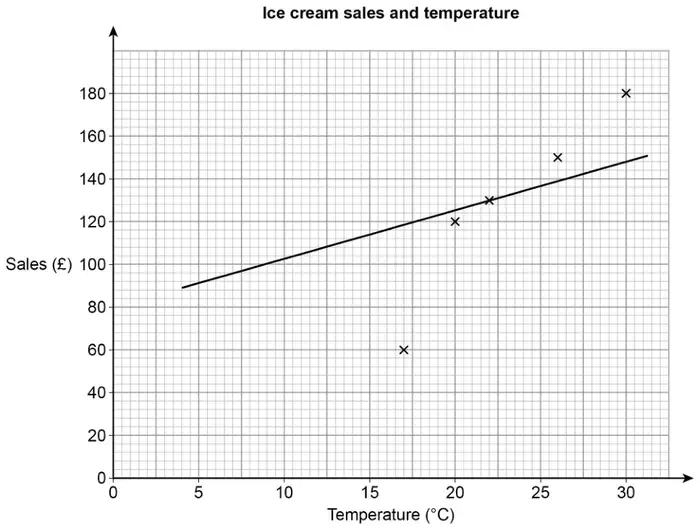
(a) He draws this scatter graph and line of best fit.
Write down two mistakes he has made. [2 marks]
(b) Lee wants to work out the range of the five temperatures.
His calculation is \(\quad 30 - 20 = 10\)
Is his method correct?
Tick a box. [1 mark]
Yes
No
Give a reason to support your answer.
(c) The table shows Lee’s costs.
Ingredients
15% of sales
Fuel
£7 per day
Work out his total profit for the five days. [5 marks]
Mark scheme (a)
Answer
Mark
Comments
Correct criticisms about any two of the incorrect plotting of (17, 80) at (17,60) the incorrect position of the line of best fit the incorrect length of the line of best fit (outside the range of the data)
B2
B1 for one correct comment about point, position or length
Allow reference to a better line of best fit drawn eg The line should look like mine
Additional guidance
A comment about the incorrect point must refer to the specific point
One of the points is wrong and point at (17, 60) circled on graph
B1
Not plotted (17, 80) correctly
B1
x on 60 should be on 80
B1
Point at 60 is wrong
B1
Day 3 is wrong/ there is no day 3 on the graph
B1
17 is plotted at 60/ 17 should be plotted at 80
B1
One of the points is wrong
B0
Points on the graph don’t match the table
B0
Not put all the points in the correct place
B0
A comment about the line of best fit must not have any misconception
The line is not steep enough/ at wrong angle/ should be more vertical
B1
The line isn’t a line of best fit/ the line doesn’t fit the points
B1
The line of best fit goes below 17/ condone past 30 (implies outside range)
B1
The line of best fit is wrong/ not drawn accurately/ not drawn properly
B0
It isn’t a line of best fit because it doesn’t start at 0
B0
The line of best fit is wrong it should go through (0, 0)
B0
The line of best fit doesn’t go through the points
B0
The line is wrong it only goes through one cross
B0
The line of best fit doesn’t go to the axis (implies it’s too short)
B0
Mark scheme (b)
Answer
Mark
Comments
Ticks No and explanation that it should be the highest value – the lowest value
B1
Allow any unambiguous indication of No, if boxes blank may be in the reason oe eg No, it should be the hottest – the coldest
Additional guidance
Does not tick or say No
B0
Ticks No and It should be \(30 - 17\)
B1
Ticks No and It should be 13
B1
Ticks No and He hasn’t subtracted the lowest value
B1
Ticks No and It should be \(17 - 30 = 13\)
B1
Ticks No and Range = biggest – smallest
B1
Ticks No and The lowest temperature is 17 not 20
B1
Ticks No and He hasn’t used the lowest temperature
B1
Ticks No and The lowest temperature is not 20
B1
Ticks No and The lowest temperature is 17
B1
Ticks No and The numbers range from 17 to 30
B1
Ticks No and It should be \(30 - 17 = 23\)
B0
Ticks No and It should be \(17 - 30\)
B0
Ticks No and You should take the smallest from the largest \(30 - 26\)
B0
Ticks No and You should take the smallest from the largest \(180 - 17\)
B0
Ticks No and It should be the smallest – the largest
B0
Ticks Yes and It should be the highest value – the lowest value
B0
Mark scheme (c)
Answer
Mark
Comments
Alternative method 1
\(180 + 150 + 80 + 130 + 120\) or 660
M1
their \(660 \times 0.15\) or 99 or their \(660 \times 0.85\) or 561
M1dep
oe
\(7 \times 5\) or 35
M1
their 660 \(-\) their 99 \(-\) their 35 or their 561 \(-\) their 35
M1dep
dep on M1M1M1
526(.00)
A1
SC4 509
Alternative method 2
\(180 \times 0.15\) or 27 and \(150 \times 0.15\) or 22.5(0) and \(80 \times 0.15\) or 12 and \(130 \times 0.15\) or 19.5(0) and \(120 \times 0.15\) or 18
M1
oe
their 27 \(+\) their 22.5(0) \(+\) their 12 \(+\) their 19.5(0) \(+\) their 18 or 99
M1dep
\(7 \times 5\) or 35
M1
\(180 + 150 + 80 + 130 + 120 -\) their 99 \(-\) their 35
M1dep
dep on M1M1M1
526(.00)
A1
SC4 509
Alternative method 3
\(180 \times 0.15\) or 27 and \(150 \times 0.15\) or 22.5(0) and \(80 \times 0.15\) or 12 and \(130 \times 0.15\) or 19.5(0) and \(120 \times 0.15\) or 18
M1
oe
180 \(-\) their 27 or 153 and 150 \(-\) their 22.5(0) or 127.5(0) and 80 \(-\) their 12 or 68 and 130 \(-\) their 19.5(0) or 110.5(0) and 120 \(-\) their 18 or 102
M1dep
Working out 85% of all five sales scores M1M1dep
\(7 \times 5\) or 35 or their 153 \(-\) 7 or 146 and their 127.5(0) \(-\) 7 or 120.5(0) and their 68 \(-\) 7 or 61 and their 110.5(0) \(-\) 7 or 103.5(0) and their 102 \(-\) 7 or 95
M1
Subtracting five 7s
their 153 \(+\) their 127.5(0) \(+\) their 68 \(+\) their 110.5(0) \(+\) their 102 \(-\) their 35 or their 146 \(+\) their 120.5(0) \(+\) their 61 \(+\) their 103.5(0) \(+\) their 95
M1dep
dep on M1M1M1
526(.00)
A1
SC4 509
Alternative method 4
\(180 \times 0.15\) or 27 and \(150 \times 0.15\) or 22.5(0) and \(80 \times 0.15\) or 12 and \(130 \times 0.15\) or 19.5(0) and \(120 \times 0.15\) or 18
M1
oe
their 27 \(+\) 7 or 34 and their 22.5(0) \(+\) 7 or 29.5(0) and their 12 \(+\) 7 or 19 and their 19.5(0) \(+\) 7 or 26.5(0) and their 18 \(+\) 7 or 25
M1
Adding five 7s
their 34 \(+\) their 29.5(0) \(+\) their 19 \(+\) their 26.5(0) \(+\) their 25 or 134 or 180 \(-\) their 34 or 146 and 150 \(-\) their 29.5(0) or 120.5(0) and 80 \(-\) their 19 or 61 and 130 \(-\) their 26.5(0) or 103.5(0) and 120 \(-\) their 25 or 95
M1dep
dep on M1M1
\(180 + 150 + 80 + 130 + 120 -\) their 134 or their 146 \(+\) their 120.5(0) \(+\) their 61 \(+\) their 103.5(0) \(+\) their 95
M1dep
dep on M1M1M1
526(.00)
A1
SC4 509
Additional guidance
509 comes from using 60 from the incorrect point on the scatter graph
Build up method for 15% must be correct or method shown for incorrect parts eg 10% of 660 = 60, 5% = 30, 15% = 90 eg 10% of 660 = \(660 \div 10\) = 60, 5% = 30, 15% = 90
Work out the total charge for these tickets when paying by credit card. [5 marks]
Mark scheme
Answer
Mark
Comments
Alternative method 1
\(4 \times 15\) or 60 or \(2 \times 10\) or 20 or 80
M1
oe
\(\dfrac{10}{100}\) \(\times\) their 80 or 8 or 1.1 and working for first M1 seen
M1dep
oe \(\dfrac{10}{100}\) \(\times\) their 60 or 6 or 66 or \(\dfrac{10}{100}\) \(\times\) their 20 or 2 or 22
their 80 \(+\) their 8 or \(1.1 \times\) their 80 or 88
M1dep
oe their 60 \(+\) their 6 \(+\) their 20 \(+\) their 2 or \(1.1 \times\) their 60 \(+\ 1.1 \times\) their 20 or their 66 \(+\) their 22
\(0.03 \times\) their 88 or 2.64 or their 88 \(\times\ 1.03\)
M1dep
oe
90.64(p)
A1
Alternative method 2
\(\dfrac{10}{100}\) \(\times\ 15\) or 1.5(0) and \(\dfrac{10}{100}\) \(\times\ 10\) or 1 or 1.1 seen
M1
oe
15 \(+\) their 1.5(0) or \(15 \times 1.1\) or 16.5(0) and 10 \(+\) their 1 or \(10 \times 1.1\) or 11
M1dep
oe 27.5(0) implies M2
their 16.5(0) \(\times\ 0.03\) or 0.495 and their 11 \(\times\ 0.03\) or 0.33 or their 16.5(0) \(\times\ 1.03\) or 16.995 and their 11 \(\times\ 1.03\) or 11.33
M1dep
oe \(4 \times\) their 16.5(0) \(+\ 2 \times\) their 11 or their 66 \(+\) their 22 or 88
their 0.495 \(\times\ 4\ +\) their 0.33 \(\times\ 2\) or \(1.98 + 0.66\) or 2.64 or their 16.995 \(\times\ 4\) or 67.98 and their 11.33 \(\times\ 2\) or 22.66
M1dep
oe \(0.03 \times\) their 88 or 2.64 or their 88 \(\times\ 1.03\)
90.64(p)
A1
Alternative method 3
\(4 \times 15\) or 60 or \(2 \times 10\) or 20 or 80
M1
oe
\(\dfrac{10}{100}\) \(\times\) their 80 or 8 or \(\dfrac{13}{100}\) \(\times\) their 80 or 10.4(0) or 1.13 and working for first M1 seen
M1dep
oe \(\dfrac{13}{100}\) \(\times\) their 60 or 7.8(0) or \(\dfrac{13}{100}\) \(\times\) their 20 or 2.6(0)
their 80 \(+\) their 10.4(0) or \(1.13 \times 80\) or 90.4(0) or \(0.03 \times\) their 8 or 0.24
M1dep
oe 60 \(+\) their 7.8(0) \(+\) 20 \(+\) their 2.6(0) or 67.8(0) \(+\) 22.6(0)
their 80 \(+\) their 10.4(0) or \(1.13 \times 80\) or 90.4(0) and \(0.03 \times\) their 8 or 0.24