(i) Write \(\ 5.3 \times 10^4\ \) as an ordinary number. (1)
(ii) Write \(\ 7.4 \times 10^{-5}\ \) as an ordinary number. (1)
(b) Calculate the value of \(\quad 9.7 \times 10^6 + 2.45 \times 10^7\) Give your answer in standard form. (2)
Mark scheme (a)(i)
Answer
Mark
Mark scheme
53 000
B1
cao
Mark scheme (a)(ii)
Answer
Mark
Mark scheme
0.000 074
B1
cao
Mark scheme (b)
Answer
Mark
Mark scheme
\(3.42 \times 10^7\)
M1
for \(9\,700\,000 + 24\,500\,000\ (= 34\,200\,000)\) or \(3.42 \times 10^n\ (n \ne 7)\) oe or \(3.4 \times 10^7\) or correct answer in incorrect form eg \(34.2 \times 10^6\) or both in a form ready for addition, eg \(9.7 \times 10^6 + 24.5 \times 10^6\)
(i) Write \(5.3 \times 10^4\) as an ordinary number. (1)
(ii) Write \(7.4 \times 10^{-5}\) as an ordinary number. (1)
(b) Calculate the value of \(9.7 \times 10^6 + 2.45 \times 10^7\) Give your answer in standard form. (2)
Mark scheme (a)
Answer
Mark
Mark scheme
(i) 53 000
B1
cao
(ii) 0.000 074
B1
cao
Mark scheme (b)
Answer
Mark
Mark scheme
\(3.42 \times 10^7\)
M1
for \(9\,700\,000 + 24\,500\,000\ (= 34\,200\,000)\) or \(3.42 \times 10^n\ (n \neq 7)\) oe or \(3.4 \times 10^7\) or correct answer in incorrect form eg \(34.2 \times 10^6\) or both in a form ready for addition, eg \(9.7 \times 10^6 + 24.5 \times 10^6\)
(a) Write \(\quad (9 \times 10^4) : (4.5 \times 10^6) \quad\) in the form \(1 : n\) where \(n\) is an integer. (2)
(b) Write the following numbers in order of size. Start with the smallest number.\[5.625 \times 10^4 \qquad 5625 \qquad 56\,250 \times 10^{-3} \qquad 0.005\,625 \times 10^5\] (2)
Mark scheme (a)
Answer
Mark
Mark scheme
1 : 50
M1
for an equivalent ratio eg 9 : 450 or \(9 : 4.5 \times 10^2\) or 90000 : 4500000 oe or for \(4500000 \div 90000\) or \(\dfrac{4500000}{90000}\ (=50)\)
(a) Write \(\;6.75 \times 10^{-4}\;\) as an ordinary number. (1)
(b) Work out \(\quad \dfrac{2.56 \times 10^{6} \times 4.12 \times 10^{-3}}{1.6 \times 10^{-2}}\) Give your answer in standard form. (2)
Mark scheme (a)
Answer
Mark
Mark scheme
0.000675
B1
cao
Mark scheme (b)
Answer
Mark
Mark scheme
\(6.592 \times 10^5\)
M1
for \(10.5472 \times 10^3\) oe or \(1.6 \times 10^8\) oe or \(2.575 \times 10^{-1}\) oe or for \(6.592 \times 10^n\) where \(n \neq 5\) or for \(6.59 \times 10^5\) or for \(6.6 \times 10^5\) or for 659200 oe
A1
cao
Additional guidance
If the answer (for 2 marks) is seen in working and then rounded or truncated, award full marks.
“6.212 is bigger than 4.73 so \(A\) is bigger than \(B\).”
(c) Is Asma correct? You must give a reason for your answer. (1)
Mark scheme (a)
Answer
Mark
Mark scheme
\(3.246 \times 10^7\)
B1
cao
Mark scheme (b)
Answer
Mark
Mark scheme
0.00496
B1
cao
Mark scheme (c)
Answer
Mark
Mark scheme
No with explanation
C1
No and explanation that B is bigger as the power of 10 is bigger. Acceptable examples She is incorrect as \(10^8\) is smaller than \(10^9\) No, because B has more digits than A No, A is millions but B is billions No, if you subtract A from B the answer is positive (but if you subtract B from A the answer is negative) A= 621200000, B=4730000000, B is bigger No because she did not take into account standard form No as when you find the ordinary number B is greater than A
Not acceptable examples Yes... A = 5 zeros after the number where as B = 7 zeros after the number No as \(4.73 \times 10^9\) is one more than \(6.212 \times 10^8\) 6.212 is to the power of 8 and 4.73 is to the power of 9 so there is an extra digit Asma is wrong because she has more numbers behind the decimal point which means that it will be bigger than A No B has more zeros
Additional guidance
Decision eg “No” may be seen by the question. “She is incorrect” is equivalent to “no”
27 Work out \((3.42 \times 10^{-7}) \div (7.5 \times 10^{-6})\) Give your answer in standard form. (2)
Mark scheme
Answer
Mark
Mark scheme
\(4.56 \times 10^{-2}\)
M1
for \(0.000000342 \div 0.0000075\) OR for 0.0456 oe eg \(0.456 \times 10^{-1}\) or \(45.6 \times 10^{-3}\) or \(\dfrac{57}{1250}\) OR for an answer of \(4.56 \times 10^n\)
7 Work out \((3.42 \times 10^{-7}) \div (7.5 \times 10^{-6})\) Give your answer in standard form. (2)
Mark scheme
Answer
Mark
Mark scheme
\(4.56 \times 10^{-2}\)
M1
for \(0.000000342 \div 0.0000075\) OR for 0.0456 oe eg \(0.456 \times 10^{-1}\) or \(45.6 \times 10^{-3}\) or \(\dfrac{57}{1250}\) OR for an answer of \(4.56 \times 10^n\)
“6.212 is bigger than 4.73 so A is bigger than B.”
(c) Is Asma correct? You must give a reason for your answer. (1)
Mark scheme (a)
Answer
Mark
Mark scheme
\(3.246 \times 10^7\)
B1
cao
Mark scheme (b)
Answer
Mark
Mark scheme
0.00496
B1
cao
Mark scheme (c)
Answer
Mark
Mark scheme
No with explanation
C1
No and explanation that B is bigger as the power of 10 is bigger.
Additional guidance
Acceptable examples She is incorrect as \(10^8\) is smaller than \(10^9\) No, because B has more digits than A No, A is millions but B is billions No, if you subtract A from B the answer is positive (but if you subtract B from A the answer is negative) A = 621200000, B = 4730000000, B is bigger No because she did not take into account standard form No as when you find the ordinary number B is greater than A
Not acceptable examples Yes… A = 5 zeros after the number where as B = 7 zeros after the number No as \(4.73 \times 10^9\) is one more than \(6.212 \times 10^8\) 6.212 is to the power of 8 and 4.73 is to the power of 9 so there is an extra digit Asma is wrong because she has more numbers behind the decimal point which means that it will be bigger than A No B has more zeros
Decision eg “No” may be seen by the question. “She is incorrect” is equivalent to “no”
11 In May 2019, the distance between Earth and Mars was \(3.9 \times 10^7\) km.
In May 2019, a signal was sent from Earth to Mars. Assuming that the signal sent from Earth to Mars travelled at a speed of \(3 \times 10^5\) km per second,
(a) how long did the signal take to get to Mars? (2)
The speed of the signal sent from Earth to Mars in May 2019 was actually less than \(3 \times 10^5\) km per second.
(b) How will this affect your answer to part (a)? (1)
Mark scheme (a)
Answer
Mark
Mark scheme
130
P1
for process to divide eg \((3.9 \times 10^7) \div (3 \times 10^5)\)
A1
cao
Additional guidance
Condone missing brackets
Accept \(1.3 \times 10^2\)
Mark scheme (b)
Answer
Mark
Mark scheme
Explanation
C1
Explanation referring to the time Acceptable examples The time will be more It will take longer The answer will be bigger Not acceptable examples The answer will be wrong The answer will be different
(a) Write the number 0.000 086 23 in standard form. (1)
(b) Work out \(\dfrac{3.2 \times 10^3 + 5.1 \times 10^{-2}}{4.3 \times 10^{-4}}\) Give your answer in standard form, correct to 3 significant figures. (2)
Mark scheme (a)
Answer
Mark
Mark scheme
\(8.623 \times 10^{-5}\)
B1
cao
Mark scheme (b)
Answer
Mark
Mark scheme
\(7.44 \times 10^6\)
M1
for \(\dfrac{3200 + 0.051}{0.00043}\) or \(\dfrac{3200.051}{0.00043}\) or performs an operation eg shows 163.2, 7441860.5, 118.6(…) or an answer or \(7.44(\ldots.) \times 10^n\) where \(n \neq 6\) or 7441979(….) or an answer of \(7.4 \times 10^6\)
A1
for \(7.44(1979\ldots) \times 10^6\)
Additional guidance
7441979.0689…
If a correct answer is shown in working and then rounded incorrectly, award full marks. Answer need only be given correctly to 3 sig fig; if following digits are incorrect ignore them.
(a) Work out the value of \(T\). Give your answer in standard form correct to 3 significant figures. (2)
\(w\) is increased by 10% \(d\) is increased by 5%
Lottie says,
“The value of \(T\) will increase because both \(w\) and \(d\) are increased.”
(b) Lottie is wrong. Explain why. (2)
Mark scheme (a)
Answer
Mark
Mark scheme
\(4.52 \times 10^3\)
M1
for \(2.04.... \times 10^7\) oe eg \(2.04.... \times 10^{-5} \div 10^{-12}\) or \(20.4... \times 10^6\) or 204(08163.27) or for correct value of \(T\), 4517.(53....), not written in standard form, eg 4520
A1
for answer in the range \(4.51 \times 10^3\) to \(4.52 \times 10^3\)
(SC B1 for \(6.32... \times 10^{-1}\))
Additional guidance
May be given correct to 3 sig figs or more
Mark scheme (b)
Answer
Mark
Mark scheme
Explanation
M1
for method to find the scale factor or decreased value in \(T\), eg \(\sqrt{\dfrac{1.1}{1.05^3}}\) (= 0.97......) oe or \(\sqrt{\dfrac{5.6 \times 10^{-5} \times 1.1}{(1.4 \times 10^{-4} \times 1.05)^3}}\) (\(= 4.40.... \times 10^3\)) oe
C1
(dep M1) for explanation eg value of scale factor less than 1, so a decrease in \(T\) OR compares \(4.40... \times 10^3\) with their value of \(T\) from (a) provided answer to (a) is greater
Additional guidance
Award mark for a correct method to calculate the scale factor or the percentage increases in \(w\) and \(d^3\) or the decreased value of \(T\)
This mark may only be awarded if supported by numerical evidence
for \(\dfrac{6 \times 10^{-2} \times 3 \times 10^{-4}}{1 \times 10^{-2}}\) or \(18 \times 10^{-4}\) or 0.0018 as the answer
(M1
for \(6 \times 0.0003\) or \(0.06 \times 0.03\) or \(1.8 \times 10^{n}\ (n \neq -3)\) or \(0.000018 \div 0.01\) or rewriting one number in standard form)
(a) Write \(7.97 \times 10^{-6}\) as an ordinary number. (1)
(b) Work out the value of \((2.52 \times 10^{5}) \div (4 \times 10^{-3})\) Give your answer in standard form. (2)
Mark scheme (a)
Answer
Mark
Notes
0.00000797
B1
cao
Mark scheme (b)
Answer
Mark
Notes
\(6.3 \times 10^{7}\)
M1
for partial calculation involving powers of 10 e.g. \(0.63 \times 10^{5 - -3}\) or \(6.3 \times 10^{n}\) where \(n \ne 7\) or for \(n \times 10^{8}\) or for 63000000
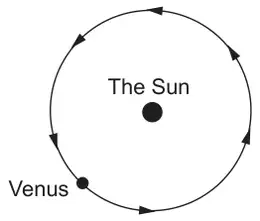
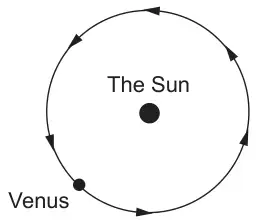
20 William is building a planetary path for people to walk along. The planetary path will have a model of the Sun and models of the planets.
William uses two different scales. He uses
1 cm to 1000 km for the diameter of each planet 1 m to 1 000 000 km for the distance from the Sun to each planet
William makes a model of the planet Venus. The model has a diameter of 12.1 cm.
(a) Work out the real diameter of the planet Venus. Give your answer in standard form. (2)
William works out the distance from the model of the Sun to the model of the planet Neptune.
The real distance from the Sun to the planet Neptune is \(4.503 \times 10^9\) km.
(b) Work out the distance from the model of the Sun to the model of the planet Neptune. Give your answer in km, correct to 1 decimal place. (3)
Mark scheme (a)
Answer
Mark
Notes
\(1.21 \times 10^4\)
2
M1 for \(12.1 \times 1000\) (= 12100) oe A1 cao
Mark scheme (b)
Answer
Mark
Notes
4.5
3
M1 for \(4.503 \times 10^9 \div 10^6\) (= 4503) oe or for \(4.503 \times 10^9 \div 10^3\) (= 4503000) oe M1 for \(4.503 \times 10^9 \div 10^6 \div 10^3\) (=4.503 with no other digits) A1 for cao
M1 for converting all numbers to same form with at least one conversion correct A1 for fully correct order with correct numbers in any correct form (SC B1 if one number incorrectly placed or all 4 numbers listed in reverse order)
*15 One sheet of paper is \(9 \times 10^{-3}\) cm thick.
Mark wants to put 500 sheets of paper into the paper tray of his printer. The paper tray is 4 cm deep.
Is the paper tray deep enough for 500 sheets of paper? You must explain your answer. (3)
Mark scheme
Answer
Mark
Notes
No + explanation
3
M1 for \(500 \times 9 \times 10^{-3}\) oe A1 for 4.5 C1 (dep M1) for correct decision based on comparison of their paper height with 4
OR
M1 for \(4 \div 500\) oe A1 for 0.008 C1 (dep M1) for correct decision based on comparison of their paper thickness with 0.009
OR
M1 for \(4 \div (9 \times 10^{-3})\) oe A1 for 444(.4...) C1 (dep M1) for correct decision based on comparison of their number of sheets of paper with 500
Rob makes a model of the Sun. He also makes a model of the planet Jupiter.
Rob is going to hang the two models in the school hall. Rob wants a distance of 16 m between the two models.
The real distance between the planet Jupiter and the Sun is \(8 \times 10^8\) km.
Work out the scale Rob should use. Give your answer in the form \(1 : n\) (3)
Mark scheme
Working
Answer
Mark
Notes
16 metres : \(8 \times 10^8\) km. 16 : \(8 \times 10^8 \times 1000\) 16 : \(8 \times 10^{11}\) 1 : \(5 \times 10^{10}\) OR 2 m to \(10^8\) km 2m to 100 000 000 000m 1m to 50 000 000 000m
1 : \(5 \times 10^{10}\)
3
M1 (indep) correct method to convert to consistent units M1 \(\dfrac{\text{‘}8 \times 10^8\text{’}}{\text{‘16’}}\) (units may not be consistent) or \(5 \times 10^{10}\) oe or \(5 \times 10^7\) oe A1 1: \(5 \times 10^{10}\) or 1: 50 000 000 000 OR M1 (indep) correct method to convert to consistent units M1 \(\dfrac{\text{‘16’}}{8}\) to ‘\(10^8\)’ A1 1: \(5 \times 10^{10}\) or 1: 50 000 000 000
B3 for \(4.88 \times 10^{-5}\) to \(4.9 \times 10^{-5}\) (B2 for digits 238(23529) or 24 or 488(09353) or 49) (B1 for digits 81 or 34) OR B3 for \(4.88 \times 10^{-5}\) to \(4.9 \times 10^{-5}\) (B2 for digits 238(23529) or 24 or 488(09353) or 49) (B1 for digits 25 or 117(647))
(b) Write \(6.7 \times 10^{-5}\) as an ordinary number. (1)
(c) Work out the value of \((3 \times 10^7) \times (9 \times 10^6)\) Give your answer in standard form. (2)
Mark scheme (a)
Answer
Mark
Notes
1
1
B1 cao
Mark scheme (b)
Answer
Mark
Notes
0.000067
1
B1 cao
Mark scheme (c)
Answer
Mark
Notes
\(2.7 \times 10^{14}\)
2
M1 for \(27 \times 10^{7 + 6}\) or \(27 \times 10^{13}\) oe or an answer of \(2.7 \times 10^n\) where \(n\) is an integer or an answer of \(a \times 10^{14}\) where \(1 \leqslant a \lt 10\) A1 cao
condone extra zeros which do not affect the value eg \(6.0 \times 10^{-3}\) B1 correct value not in standard form (allow value written as \(a \times 10^n\)) eg 0.006 or \(0.6 \times 10^{-2}\) or given calculation with 0.6 written as \(6 \times 10^{-1}\) eg \(6 \times 10^{-1} \div 100\) or value whose only non-zero digit is 6 correctly converted to standard form answer eg \(0.0006 = 6 \times 10^{-4}\)
Additional guidance
\(6 \times 10^{-1} \div 10^2\)
B1
Mark scheme (b)
Answer
Mark
Comments
\(1.2 \times 10^8\)
B2
condone extra zeros which do not affect the value eg \(1.20 \times 10^8\) B1 120 000 000 or 120 million or \(12 \times 10^7\) or \(120 \times 10^6\) or \(1.2 \times 10^a \times 10^b\) where \(a + b = 8\) or value whose only non-zero digits are 12 correctly converted to standard form answer eg \(12\,000\,000 = 1.2 \times 10^7\)
B1 400 000 oe correct answer not in standard form eg \(40 \times 10^4\) or \(8 \times 10^7\) or \(2 \times 10^2\) or \(8 \times 10^5 \div 2\) or \(4 \times 10^7 \div 100\) or any value seen and then correctly converted to standard form eg 4 000 000 and \(4 \times 10^6\) 40 000 and \(4 \times 10^4\)
Additional guidance
Ignore incorrect position of commas or spacing in long numbers
Condone 400 000 and \(4 \times 10^5\) on the answer line, in either order Condone 40 000 and \(4 \times 10^4\) on the answer line, in either order
B2 B1
400 000 only on the answer line
B1
Do not award both marks for the correct answer from incorrect working but B1 can be awarded for one or both numbers incorrectly converted to standard form and the result of their division given correctly in standard form
(b) Work out \(\quad \dfrac{1.8 \times 10^2}{3 \times 10^{-1}}\)
Give your answer as an ordinary number. [2 marks]
Mark scheme (a)
Answer
Mark
Comments
\(2 \times 10^3\) or \(7 \times 10^4\) or 140 000 000
M1
oe correct value not in standard form eg \(14 \times 10^7\)
\(1.4 \times 10^8\)
A1
SC1 Correctly converts an ordinary number with at least four digits to standard form
Additional guidance
Condone extra zeros on 1.4 eg \(1.40\,000\,000 \times 10^8\)
M1A1
\(1.4 \times 10^8\) from 1 400 000 000
M0A0
\(2 \times 10^3\) is implied by \((2 \times 7) \times (10^3 \times 10^a)\) \(7 \times 10^4\) is implied by \((2 \times 7) \times (10^b \times 10^4)\)
M1
1 400 000 000 converted to \(1.4 \times 10^9\)
SC1
Mark scheme (b)
Answer
Mark
Comments
180 or 0.3 or \((1.8 \div 3 =)\) 0.6 or \((10^2 \div 10^{-1} =)\ 10^3\) or calculation which would have the outcome 600 or correct value not given as an ordinary number
M1
eg \(1800 \div 3\) eg \(6 \times 10^2\)
600
A1
Additional guidance
\(1800 \div 0.3 = 600\) scores M1 only, as 600 comes from incorrect working
M1A0
\(1800 \div 30 = 600\) scores zero, as 600 comes from incorrect working
(b) Work out \(\quad \dfrac{1.8 \times 10^2}{3 \times 10^{-1}}\)
Give your answer as an ordinary number. [2 marks]
Mark scheme (a)
Answer
Mark
Comments
\(2 \times 10^3\) or \(7 \times 10^4\) or 140 000 000
M1
oe correct value not in standard form eg \(14 \times 10^7\)
\(1.4 \times 10^8\)
A1
SC1 Correctly converts an ordinary number with at least four digits to standard form
Additional guidance
Condone extra zeros on 1.4 eg \(1.40\,000\,000 \times 10^8\)
M1A1
\(1.4 \times 10^8\) from 1 400 000 000
M0A0
\(2 \times 10^3\) is implied by \((2 \times 7) \times (10^3 \times 10^a)\) \(7 \times 10^4\) is implied by \((2 \times 7) \times (10^b \times 10^4)\)
M1
1 400 000 000 converted to \(1.4 \times 10^9\)
SC1
Mark scheme (b)
Answer
Mark
Comments
180 or 0.3 or (\(1.8 \div 3\) =) 0.6 or (\(10^2 \div 10^{-1}\) =) \(10^3\) or calculation which would have the outcome 600 or correct value not given as an ordinary number
M1
eg \(1800 \div 3\) eg \(6 \times 10^2\)
600
A1
Additional guidance
\(1800 \div 0.3 = 600\) scores M1 only, as 600 comes from incorrect working
M1A0
\(1800 \div 30 = 600\) scores zero, as 600 comes from incorrect working
(a) Write \(\quad 0.000\,97 \quad\) in standard form. [1 mark]
(b) Work out \(\quad \dfrac{3 \times 10^5}{4 \times 10^3}\)
Give your answer as an ordinary number. [2 marks]
Mark scheme (a)
Answer
Mark
Comments
\(9.7 \times 10^{-4}\)
B1
Additional guidance
Condone \(9.7\,.\,10^{-4}\) or \(9.7 \cdot 10^{-4}\)
B1
Ignore zeroes before the ‘9’ eg \(00009.7 \times 10^{-4}\)
B1
\(9.7 \times 10^{4-}\)
B0
Mark scheme (b)
Answer
Mark
Comments
300 000 and 4000 or \((10^5 \div 10^3 =)\ 10^2\) or \((10^5 \div 10^3 =)\ 100\) or \(7.5 \times 10^{(1)}\) or \(75 \times 10^0\) or \(\dfrac{3 \times 10^2}{4}\) or \(\dfrac{300}{4}\)
M1
75
A1
Additional guidance
If the answer is given in standard form and as 75 the student must indicate that 75 is their chosen answer or it must be the final answer given eg1 \(7.5 \times 10^{(1)} = 75\) on the answer line eg2 \(75 = 7.5 \times 10^{(1)}\) on the answer line
M1A1 M1A0
\(\dfrac{300}{4}\) or 75 from incorrect working scores zero eg1 \(3 \times 10^5 = 30\,000\) and \(4 \times 10^3 = 400\) and \(30\,000 \div 400 = \dfrac{300}{4} = 75\) eg2 \(\dfrac{30\,000}{400} = 75\)
M0A0 M0A0
For the method mark, ignore incorrect work from a correct expression eg \(0.75 \times 10^2 = 7.5 \times 10^3\)
M1A0
If the student attempts two methods (simplifying the powers and attempting to convert to ordinary numbers) mark both methods and award the higher mark
One correct conversion to a comparable form \(0.08 \times 10^{-2}\) or 0.0008 \(400 \times 10^{-4}\) or 0.04 \(0.06 \times 10^{-2}\) or 0.0006 \(7 \times 10^{-2}\) or \(700 \times 10^{-4}\)
M1
\(6 \times 10^{-4}\) \(8 \times 10^{-4}\) \(4 \times 10^{-2}\) 0.07 with no clearly incorrect working
A1
oe accept in converted form
Additional guidance
Correct answer from clearly incorrect working
A0
Accept numbers with two decimal points if it is clear that the point has been moved to the correct place eg 0.0008.0 with curved lines between each place value between the decimal points
If the numbers are converted into fractions, at least two must be given correctly with common denominators to score the first mark
eg \(\dfrac{4}{100}\) and \(\dfrac{7}{100}\)
M1
eg \(\dfrac{6}{1000}\) and \(\dfrac{8}{1000}\) only
M0
eg \(\dfrac{6}{10\,000}\) and \(\dfrac{7}{100}\) only
\(9.56 \times 3^{10} \quad 9563 \quad 9.56 \times 10^3\) or 564 508 (.44) \(\quad\) 9563 \(\quad\) 9560 with no incorrect evaluations seen
B2
B1 \(9.563 \times 10^3\) or 9560 or 564 508 (.44) or \(5.6(450844) \times 10^5\) SC1 \(9.56 \times 10^3 \quad 9563 \quad 9.56 \times 3^{10}\) with no incorrect evaluations seen
Additional guidance
Allow numbers to be written in original or converted form or as a mixture for B2 or SC1
(b) A country consists of a south island and a north island. The table below shows the population and area of each island in June 2023.
Population
Area (km\(^2\))
South island
\(1.2 \times 10^6\)
\(1.5 \times 10^5\)
North island
\(4.0 \times 10^6\)
\(1.1 \times 10^5\)
Work out the overall population density of the country in June 2023. [4]
Mark scheme (a)
Answer
Marks
Part marks and guidance
\(3.7 \times 10^{-3}\)
1
Condone trailing zeros
Mark scheme (b)
Answer
Marks
Part marks and guidance
20 or \(2 \times 10^1\) or \(2 \times 10\) nfww
4
M1 for \(1.2 \times 10^6 + 4[.0] \times 10^6\) or \(5.2 \times 10^6\) oe M1 for \(1.5 \times 10^5 + 1.1 \times 10^5\) or \(2.6 \times 10^5\) oe
M1 for \(\dfrac{\textit{a population value}}{\textit{an area value}}\)
may be implied by figs 52 may be implied by figs 26
Award M marks even if not used to find final answer as long as it is not contradicted.
Population and area values must be consistent eg both south island, both north island or their summed population and area e.g. M1 implied by 8 or 36.36 to 36.4 or 44.36 or 44.4
(b) A country consists of a south island and a north island. The table below shows the population and area of each island in June 2023.
Population
Area (km\(^2\))
South island
\(1.2 \times 10^6\)
\(1.5 \times 10^5\)
North island
\(4.0 \times 10^6\)
\(1.1 \times 10^5\)
Work out the overall population density of the country in June 2023. [4]
Mark scheme (a)
Answer
Marks
Part marks and guidance
\(3.7 \times 10^{-3}\)
1
Condone trailing zeros
Mark scheme (b)
Answer
Marks
Part marks and guidance
20 or \(2 \times 10^1\) or \(2 \times 10\) nfww
4
M1 for \(1.2 \times 10^6 + 4[.0] \times 10^6\) or \(5.2 \times 10^6\) oe M1 for \(1.5 \times 10^5 + 1.1 \times 10^5\) or \(2.6 \times 10^5\) oe
may be implied by figs 52 may be implied by figs 26
M1 for \(\dfrac{\textit{a population value}}{\textit{an area value}}\)
Award M marks even if not used to find final answer as long as it is not contradicted.
Population and area values must be consistent eg both south island, both north island or their summed population and area e.g. M1 implied by 8 or 36.36 to 36.4 or 44.36 or 44.4
\(1.655 \times 10^{12}\) raindrops fall in a storm
the mass of each raindrop is \(6 \times 10^{-5}\) grams.
Calculate the total mass of all of the raindrops that fall in the storm. Give your answer in standard form in kilograms. [4]
Mark scheme (a)
Answer
Marks
Part marks and guidance
\(1.025 \times 10^{-3}\)
1
Mark scheme (b)
Answer
Marks
Part marks and guidance
\(9.93 \times 10^4\)
4
B3 for 99 300 or B2 for figs 993 or M2 for \(\dfrac{1.655 \times 10^{12} \times 6 \times 10^{-5}}{1000}\) oe or M1 for \(1.655 \times 10^{12} \times 6 \times 10^{-5}\) oe
May be in stages
May be seen as product of two st form numbers converted
B3 for all 4 expressed in an equivalent comparable form
or
B2 for 3 expressed in an equivalent comparable form
or
B1 for 2 expressed in an equivalent comparable form
Equivalent comparable form is either decimal, percentage or standard index form. Fractions only acceptable as comparable form with common denominators.
For final answer, accept some or all given as equivalent form on answer line. eg. Full marks for 0.003[003…], 0.0031, 0.0036, 0.03 or \(\frac{1}{333}\), \(\frac{31}{10\,000}\), \(\frac{9}{2500}\), \(\frac{3}{100}\)
Where choice of comparable form, mark to candidate’s advantage.
Likely comparable form (award best row):
0.36%
\(\frac{1}{333}\)
0.03
\(3.1 \times 10^{-3}\)
0.36[%]
0.3[003…][%]
3[%]
0.31[%]
0.0036
0.003[003…]
0.03
0.0031
\(3.6 \times 10^{-3}\)
\(3[.003\ldots] \times 10^{-3}\)
\(3 \times 10^{-2}\)
\(3.1 \times 10^{-3}\)
\(\frac{11\,988}{3\,330\,000}\)
\(\frac{10\,000}{3\,330\,000}\)
\(\frac{99\,900}{3\,330\,000}\)
\(\frac{10\,323}{3\,330\,000}\)
Notes
In the percentage row of the table, \(\frac{1}{333}\) is printed in the mark scheme as 0.00003[003…][%]; it has been corrected here to 0.3[003…][%].
Mark the answer line and look for order of indices –1, 1, 2, 3 Condone TE if unambiguous If answer given as ordinary numbers must be correct 0.49, 95, 240, 1300
(b) The speed of sound is \(3.43 \times 10^{-1}\) km/s. An object is travelling at the speed of sound.
Work out how far the object travels in one day. [2]
(c) In a science fiction story, a spacecraft travelling faster than the speed of light is said to be travelling at ‘warp \(n\)’ where \(n\) is an integer.
Warp \(n\) is defined as \(n^3 \times\) the speed of light.
In the story, a spacecraft needs to travel from Earth to Neptune in less than 2 minutes.
The speed of light is \(3.00 \times 10^5\) km/s.
The distance from Earth to Neptune is \(4.41 \times 10^9\) km.
Find the smallest possible warp \(n\) at which the spacecraft can travel. You must show your working. [3]
Mark scheme (a)
Answer
Marks
Part marks and guidance
\(3.86 \times 10^{-3}\)
1
Condone trailing zeros
Mark scheme (b)
Answer
Marks
Part marks and guidance
29 635[.2] or 29 640 or 29 600
2
M1 for \(3.43 \times 10^{-1} \times 60^2 \times 24\) oe If 0 scored SC1 for 14 817.6, 14 818, 14 820 or 14 800
Note: \(60^2 \times 24 = 86\,400\)
Mark scheme (c)
Answer
Marks
Part marks and guidance
5 with correct working
3
M2 for \(\sqrt[3]{\frac{4.41 \times 10^9}{120 \times 3.00 \times 10^5}}\) oe
OR
M1 for \(\frac{4.41 \times 10^9}{3.00 \times 10^5}\) oe or \(\frac{4.41 \times 10^9}{120}\) oe or \(120 \times 3.00 \times 10^5\) oe
If 0 scored SC1 for answer 5 with no or insufficient working
“Correct working” requires evidence of at least M1 or M2 if trials are used M2 implied by 4.966… or 4.97 or \(\sqrt[3]{122.5}\) or \(n^3 = 122.5\) condone use of a value \(119 \leqslant\) value \(\leqslant 120\) instead of 120 which should lead to 4.98
M1 may be seen within a larger calculation e.g. \(\frac{4.41 \times 10^9}{120 \times 3.00 \times 10^5}\) or \(\sqrt[3]{\frac{4.41 \times 10^9}{3.00 \times 10^5}}\) M1 implied by 14 700 or \(3.675 \times 10^7\) oe or \(3.6 \times 10^7\) oe or 122.5
use of trials M1 for each correct trial using integer values of \(n\) up to a maximum of M2 e.g. \(\frac{their\ 14700}{5^3}\) oe and 117 to 118 or 1.95 to 1.97 \(\frac{their\ 14700}{4^3}\) oe and 229[. ..] or 3.8[…] their 14 700 comes from \(3 \times 10^5\) and \(4.41 \times 10^9\) (see appendix for more examples)
Appendix: Question 5(c)
Other trials, condone rot : \(\frac{their\ 14700}{2^3}\) oe and 1837[.5…] or 30[.6…] \(\frac{their\ 14700}{3^3}\) oe and 544[.4….] or 9[.07…] \(\frac{their\ 14700}{6^3}\) oe and 68[.05…] or 1[.1…]
Or they might try to see how far they go at each warp speed in 2 minutes (rot at least 2 figures):
21 The table below shows the approximate population of three countries in 2020.
Country
Population
China
\(1.44 \times 10^9\)
Kiribati
\(1.19 \times 10^5\)
Tuvalu
\(1.18 \times 10^4\)
(a) Calculate the approximate total population of Kiribati and Tuvalu in 2020.
Give your answer in standard form, correct to 3 significant figures. [4]
(b) Show that in 2020 the population of China was approximately 120 000 times the population of Tuvalu. [2]
Mark scheme (a)
Answer
Marks
Part marks and guidance
\(1.31 \times 10^5\)
4
B3 for 131000 or \(131 \times 10^3\) oe or \(1.3 \times 10^5\) or \(1.30[8] \times 10^5\) or B2 for 130800 or \(1308 \times 10^2\) oe or M1 for figs 119 + figs 118
If 0 scored SC1 for their value correctly rounded to 3 sf
Addition may be implied by figs 131 or 1308, Must clearly be their answer from attempt at addition
The unrounded value must be seen
Mark scheme (b)
Answer
Marks
Part marks and guidance
\(\dfrac{1.44 \times 10^9}{1.18 \times 10^4}\)
M1
Accept in ordinary numbers e.g. \(\dfrac{1440000000}{11800} =\)
12 Dinosaurs first appeared on Earth \(2.4 \times 10^8\) years ago. Dinosaurs became extinct on Earth \(7 \times 10^7\) years ago.
(a) Explain why it is appropriate to use standard form for these numbers. [1]
(b) Use the given information to work out how long dinosaurs existed on Earth. Give your answer in standard form. [3]
Mark scheme (a)
Answer
Marks
Part marks and guidance
Correct comment about large numbers or too many zeros oe
1
e.g. Standard form is used for [very] large/long numbers [or very small numbers] Writing out all the zeros may lead to errors
See Appendix
Appendix
Exemplar responses for Question 12a
Response
Mark
1
Writing all the 0’s out is very long/difficult to read/may lead to errors
1
2
As they contain a lot of 0s
1
3
Because there are too many zeros
1
4
Because the numbers are extremely long/high/large, shortening the number.
1
5
Because of how long/high/large the number will be
1
6
The numbers are too long to write down e.g. \(7 \times 10^7 = 70\,000\,000\)
1
7
It shortens the numbers due to them having so many 0s
1
8
Because they’re too big (Given the wording of the demand – refers to numbers)
1
9
It takes too long to write it all out
1
10
Because the digits will be too long (BOD infers numbers are too long)
BOD 1
11
Wastes time writing out the digits, this is simple shorthand (similar to above)
BOD 1
12
To makes it easier to read (no reason given as to why)
0
13
To make the numbers more simpler (no reason given e.g. numbers too large, too many zeros)
0
14
Its easier to understand (no reason given as to why)
0
15
Because otherwise you need to write 2.4 billion years ago so \(2.4 \times 10^8\) is easier to say in standard form (Contains error in number, if 240 million years this would be OK)
0
16
Because the numbers are billions so it’s easier to read them in standard form (see above)
0
17
It shortens the numbers (no reason given why e.g. too large, too many zeros)
0
Mark scheme (b)
Answer
Marks
Part marks and guidance
\(1.7 \times 10^8\)
3
M2 for figs 17 in final answer or B1 for 240 000 000 or 70 000 000 or \(24 \times 10^7\) or \(0.7 \times 10^8\)
or M1 for \(2.4 \times 10^8 - 7 \times 10^7\) oe
Accept both converted to same power of 10 e.g. \(240 \times 10^6\) and \(70 \times 10^6\)
For M1, if standard form subtraction written correctly, isw incorrect conversion to values
3 Dinosaurs first appeared on Earth \(2.4 \times 10^8\) years ago. Dinosaurs became extinct on Earth \(7 \times 10^7\) years ago.
(a) Explain why it is appropriate to use standard form for these numbers. [1]
(b) Use the given information to work out how long dinosaurs existed on Earth. Give your answer in standard form. [3]
Mark scheme (a)
Answer
Marks
Part marks and guidance
Correct comment about large numbers or too many zeros oe
1
e.g. Standard form is used for [very] large/long numbers [or very small numbers] Writing out all the zeros may lead to errors See Appendix
Appendix: additional guidance for Q3(a)
Response
Mark
1
Writing all the 0’s out is very long/difficult to read/may lead to errors
1
2
As they contain a lot of 0s
1
3
Because there are too many zeros
1
4
Because the numbers are extremely long/high/large, shortening the number.
1
5
Because of how long/high/large the number will be
1
6
The numbers are too long to write down eg \(7 \times 10^7\) = 70 000 000
1
7
It shortens the numbers due to them having so many 0s
1
8
Because they’re too big (Given the wording of the demand – refers to numbers)
1
9
It takes too long to write it all out
1
10
Because the digits will be too long (BOD infers numbers are too long)
BOD 1
11
Wastes time writing out the digits, this is simple shorthand (similar to above)
BOD 1
12
To makes it easier to read (no reason given as to why)
0
13
To make the numbers more simpler (no reason given e.g. numbers too large, too many zeros)
0
14
Its easier to understand (no reason given as to why)
0
15
Because otherwise you need to write 2.4 billion years ago so \(2.4 \times 10^8\) is easier to say in standard form (Contains error in number, if 240 million years this would be OK)
0
16
Because the numbers are billions so it’s easier to read them in standard form (see above)
0
17
It shortens the numbers (no reason given why e.g. too large, too many zeros)
0
Mark scheme (b)
Answer
Marks
Part marks and guidance
\(1.7 \times 10^8\)
3
M2 for figs 17 in final answer or B1 for 240 000 000 or 70 000 000 or \(24 \times 10^7\) or \(0.7 \times 10^8\)
Accept both converted to same power of 10 e.g. \(240 \times 10^6\) and \(70 \times 10^6\)
or M1 for \(2.4 \times 10^8 - 7 \times 10^7\) oe
For M1, if standard form subtraction written correctly, isw incorrect conversion to values
17 The table below shows the number of barrels of oil produced per day by some countries.
Country
Barrels of oil produced per day
USA
\(1.17 \times 10^{7}\)
China
\(3.98 \times 10^{6}\)
UK
\(9.39 \times 10^{5}\)
Cameroon
\(9.32 \times 10^{4}\)
Japan
\(3.92 \times 10^{3}\)
(a) Write the number of barrels of oil produced per day by Cameroon as an ordinary number. [1]
(b) How many more barrels of oil per day did China produce than the UK? Give your answer in standard form, correct to 3 significant figures. [4]
(c) Jamal says the USA produced approximately three times more barrels of oil than Japan.
Is he correct? Show how you decide.
Jamal is .................. because .................. [2]
Mark scheme (a)
Answer
Marks
Part marks and guidance
93 200
1
Mark scheme (b)
Answer
Marks
Part marks and guidance
\(3.04 \times 10^{6}\)
4
B3 for 3 040 000 or \(3.041[0..] \times 10^6\) or \(30.4 \times 10^5\) oe rounded to 3sf OR B2 for 3 041 000 or \(30.41[0..] \times 10^5\) oe index form OR M1 for \((3.98 \times 10^6) - (9.39 \times 10^5)\) or 3 980 000 – 939 000 and M1 for their final value correctly rounded to 3sf
M1 may be implied by figs 3041….
The unrounded value must be seen
Mark scheme (c)
Answer
Marks
Part marks and guidance
Wrong/Incorrect it is 3 000 or 2 984 to 2 985 times bigger
or No, difference is [order of] \(3 \times 10^3\) which is 3 000
or Incorrect 11 760 is 3 times bigger than 3 920 or 3 900 000 is 3 times smaller than 11 700 000
or Incorrect and evaluates USA’s production ÷ 3 or Japan’s production × 3 with comment comparing the values
2
M1 for difference is [order of] \(10^3\)
or \(\dfrac{1.17 \times 10^7}{3.92 \times 10^3}\)
or \((1.17 \times 10^7) \div 3 = 3.9 \times 10^6\)
or 11 700 000 ÷ 3 = 3 900 000
or \((3.92 \times 10^3) \times 3 = 1.176 \times 10^4\) or \(1.18 \times 10^4\)
or 3 920 × 3 = 11 760
Wrong/Incorrect and a comment for 2 marks to answer the question Condone No
Give your answer in standard form, correct to 2 significant figures. [4]
Mark scheme
Answer
Marks
Part marks and guidance
\(1.5 \times 10^3\)
4
B3 for 1500 or 1.50[0] × 103 or 1.48[9..] × 103 or 1.49 × 10³ or B2 for 1489.1… or M1 for \(\frac{5.8 \times 10^6}{\sqrt{4.1 \times 10^8 \times 3.7 \times 10^{-2}}}\) and M1 for writing their answer correct to 2s.f. and in standard form
implied by 3894.8… or 3894.9
need to see where their answer comes from e.g. longer figure or a simple fraction
One sesame seed weighs \(3.64 \times 10^{-6}\) kilograms.
Write the three types of seed in order according to the weight of one seed. Write the lightest type of seed first. You must show how you decide.[4]
Mark scheme
Answer
Marks
Part marks and guidance
Poppy, Sesame, Pumpkin with correct comparable values shown
4
B3 for all 3 quantities seen correct in comparable form or B2 for \(8.4 \times 10^{-5}\) or \(8.4 \times 10^{-2}\) seen or seen correct in comparable form: pumpkin with poppy, e.g. implied by [250 poppy =] 0.075 or pumpkin with sesame, e.g. implied by [250 sesame =] 0.91 or B1 poppy and sesame seen correct in comparable form or [pumpkin =] 0.084 or 0.000 084 seen or [250 poppy =] 0.000 075 oe seen or [250 sesame =] 0.000 91 oe seen
Condone weights as answer Quantities given in the question need not be rewritten
Comparable forms include:
In kilograms
In grams
Poppy
0.000 000 3 \(3 \times 10^{-7}\)
0.000 3 \(3 \times 10^{-4}\)
Pumpkin
0.000 084 \(8.4 \times 10^{-5}\)
0.084 \(8.4 \times 10^{-2}\)
Sesame
0.000 003 64 \(3.64 \times 10^{-6}\)
0.003 64 \(3.64 \times 10^{-3}\)
Must not be a mix of standard and ordinary form
Accept consistent multiples for full marks, e.g. 250 poppy = 0.075 and 250 sesame seeds = 0.91
22 A newborn baby has an approximate mass of 3.5 kilograms.
A human cell has an approximate mass of \(2.7 \times 10^{-11}\) grams.
Use these values to estimate the number of human cells in a newborn baby. Give your answer in standard form, correct to 2 significant figures. [5]
Mark scheme
Answer
Marks
Part marks and guidance
\(1.3 \times 10^{14}\)
5
B4 for \(1.30 \times 10^{14}\) or \(1.29[6\ldots] \times 10^{14}\) or 130 000 000 000 000 as final answers
or B3 for \(1.3 \times 10^n\) (\(n \ne 0\)) or \(1.29[6\ldots] \times 10^{14}\) written in full or M3 for 3500 \(\div\) \((2.7 \times 10^{-11})\) oe or B2 for \(1.29[6\ldots] \times 10^n\) (\(n \ne 0\)) or figs 13
OR
M1 for figs 35 \(\div\) figs 27 soi by figs 129[6…]
B1 for 3500 or \(2.7 \times 10^{-14}\) oe or \(3.5 \times 10^3\) seen
For 5 marks and M marks, condone use of correctly rounded values in correct calculations
3 A newborn baby has an approximate mass of 3.5 kilograms. A human cell has an approximate mass of \(2.7 \times 10^{-11}\) grams.
Use these values to estimate the number of human cells in a newborn baby. Give your answer in standard form, correct to 2 significant figures. [5]
Mark scheme
Answer
Marks
Part marks and guidance
\(1.3 \times 10^{14}\)
5
B4 for \(1.30 \times 10^{14}\) or \(1.29[6\ldots] \times 10^{14}\) or 130 000 000 000 000 as final answers or B3 for \(1.3 \times 10^{n}\) (\(n \ne 0\)) or \(1.29[6\ldots] \times 10^{14}\) written in full or M3 for \(3500 \div (2.7 \times 10^{-11})\) oe or B2 for \(1.29[6\ldots] \times 10^{n}\) (\(n \ne 0\)) or figs 13 OR M1 for figs 35 ÷ figs 27 soi by figs 129[6…] B1 for 3500 or \(2.7 \times 10^{-14}\) oe or \(3.5 \times 10^{3}\) seen
For 5 marks and M marks, condone use of correctly rounded values in correct calculations
(b) \(4.3 \times 10^5 + 3.8 \times 10^4\) Give your answer in standard form. [3]
Mark scheme (a)
Answer
Marks
Part marks and guidance
2
2
B1 for [\(\sqrt[3]{64} =\)] 4 or for ½ oe
Accept \(4^3 = 64\) for B1
Mark scheme (b)
Answer
Marks
Part marks and guidance
\(4.68 \times 10^5\) final answer
3
B2 for 468 000 or answer \(4.7 \times 10^5\) or B1 for 430 000 or \(43 \times 10^4\) or 38 000 or \(0.38 \times 10^5\) seen M1 for figs 468 oe in final answer
13 A company makes sweets. The sweets are put into packets.
Here are some facts.
\(1.47 \times 10^7\) sweets are made every day
\(3.5 \times 10^5\) packets of sweets are produced every day
(a) Calculate the mean number of sweets in one packet. [2]
(b) Sweets are made on 288 days each year.
Calculate the number of sweets made each year. Give your answer in standard form. [3]
(c) The company has 152 machines making the sweets. Each machine operates for 15 hours each day.
(i) Calculate the number of sweets made by one machine each hour. Give your answer as an ordinary number correct to the nearest 10. [3]
(ii) State one assumption you have made in part (c)(i). [1]
Mark scheme (a)
Answer
Marks
Part marks and guidance
42
2
M1 for \(\dfrac{1.47 \times 10^7}{3.5 \times 10^5}\) oe
If 0 scored SC1 for figs 42 in answer
Eg. \(\dfrac{14\,700\,000}{350\,000}\)
Mark scheme (b)
Answer
Marks
Part marks and guidance
\(4.2[3\ldots] \times 10^9\)
3
B2 for 4 233 600 000 oe as answer or M1 for their \(1.47 \times 10^7 \times 288\)
If 0 scored SC1 for figs 423[…] in answer
Eg. \(423.[36] \times 10^7\)
their \(1.47 \times 10^7\) converted from info in (a)
Mark scheme (c)
Answer
Marks
Part marks and guidance
(i) 6450
3
B2 for 6447 to 6448 or M1 for \(\dfrac{1.47 \times 10^7}{(152 \times 15)}\) oe or figs 6447 in answer
May be in stages. NB: 152 \(\times\) 15 = 2280
(ii) Each machine makes the same amount of sweets. or There are no breakdowns oe or Machines running at same rate oe or All machines run for the same time oe
5 A company makes sweets. The sweets are put into packets.
Here are some facts.
(a) Calculate the mean number of sweets in one packet. [2]
(b) Sweets are made on 288 days each year.
Calculate the number of sweets made each year. Give your answer in standard form. [3]
(c) The company has 152 machines making the sweets. Each machine operates for 15 hours each day.
(i) Calculate the number of sweets made by one machine each hour. Give your answer as an ordinary number correct to the nearest 10. [3]
(ii) State one assumption you have made in part (c)(i). [1]
Mark scheme (a)
Answer
Marks
Part marks and guidance
42
2
M1 for \(\dfrac{1.47 \times 10^7}{3.5 \times 10^5}\) oe
If 0 scored SC1 for figs 42 in answer
Eg. \(\dfrac{14\,700\,000}{350\,000}\)
Mark scheme (b)
Answer
Marks
Part marks and guidance
\(4.2[3\ldots] \times 10^9\)
3
B2 for 4 233 600 000 oe as answer or M1 for their \(1.47 \times 10^7 \times 288\)
If 0 scored SC1 for figs 423[...] in answer
Eg. \(423.[36] \times 10^7\)
their \(1.47 \times 10^7\) converted from info in (a)
Mark scheme (c)
Answer
Marks
Part marks and guidance
(i) 6450
3
B2 for 6447 to 6448 or M1 for \(\dfrac{1.47 \times 10^7}{(152 \times 15)}\) oe or figs 6447 in answer
May be in stages. NB: 152 × 15 = 2280
(ii) Each machine makes the same amount of sweets or There are no breakdowns oe or Machines running at same rate oe or All machines run for the same time oe
1 This table shows the populations of the four countries of the UK in 2012. All values are given correct to 3 significant figures.
Country
Population
England
\(5.35 \times 10^7\)
Wales
\(3.07 \times 10^6\)
Scotland
\(5.31 \times 10^6\)
Northern Ireland
\(1.82 \times 10^6\)
(a) Write the population of England as an ordinary number. [1]
(b) Work out the total population of Wales, Scotland and Northern Ireland. Give your answer in standard form. [2]
(c) The total population of the UK is predicted to reach 73.3 million in 2037.
Calculate the predicted percentage increase in the UK population from 2012 to 2037. Give your answer correct to 2 significant figures. [4]
Mark scheme (a)
Answer
Marks
Part marks and guidance
53 500 000
1
Mark scheme (b)
Answer
Marks
Part marks and guidance
\(1.02 \times 10^7\)
2
B1 for answer figs102
Mark scheme (c)
Answer
Marks
Part marks and guidance
15 nfww
4
B3 for 15.07 to 15.1 nfww
OR
B1 for figs 637 and M1 for \(\dfrac{73.3 \times 10^6 - \mathit{their}\,63.7 \times 10^6}{\mathit{their}\,63.7 \times 10^6}\) oe or \(\dfrac{73.3 \times 10^6}{\mathit{their}\,63.7 \times 10^6}\) oe and M1dep interpretation of answer to division as a percentage increase soi by answer
their \(63.7 \times 10^6\) can be an error from their sum, their (b) or one of the country populations
(a) Write 882 as a product of its prime factors in index form. [3]
(b) Two numbers, \(S\) and \(T\), have been written as a product of prime factors in index form:\[\begin{aligned} S &= a^3\times b\times c^2 &\qquad T &= a^2\times b^3\times c^3\\ &= a^3bc^2 & &= a^2b^3c^3 \end{aligned}\]
(i) Circle the correct expression for the highest common factor of \(S\) and \(T\). [1]
\(\dfrac{9\times10^8}{3\times10^2}\) or \(\dfrac{900\,000\,000}{300}\)
M2
M1 for \(\dfrac{9\times10^8}{300}\) or \(\dfrac{9\times10^8}{298}\) or \(\dfrac{8{\cdot}85\times10^8}{300}\) or \(\dfrac{8{\cdot}9\times10^8}{298\text{ or }300}\) or \(\dfrac{2\times10^8 + 7\times10^8}{3\times10^2}\) or \(\dfrac{2\times10^8 + 7\times10^8}{300}\)
23. The surface area of the Earth is \(5{\cdot}101 \times 10^8\) km\(^2\). The Earth’s oceans are 70·9% of this surface area.
Estimate the surface area of the Earth’s oceans. Give your answer in standard form. [3]
Mark scheme
Scheme
Marks
Comments
Sight of 70% and \(5 \times 10^8\) OR 71% and \(5 \times 10^8\) OR 70% and \(5{\cdot}1 \times 10^8\)
B1
Not for sight of 71% and \(5{\cdot}1 \times 10^8\)
\(0{\cdot}7 \times 5 \times 10^8\) oe OR \(0{\cdot}71 \times 5 \times 10^8\) oe OR \(0{\cdot}7 \times 5{\cdot}1 \times 10^8\) oe
M1
Allow for \(0{\cdot}71 \times 5{\cdot}1 \times 10^8\) If \(5 \times 10^8\) or \(5.1 \times 10^8\) is written in ordinary form, condone a slip by a power of 10 for M1. e.g. 0·7 × 50 000 000
\(3{\cdot}5 \times 10^8\) (km\(^2\)) ISW OR \(3{\cdot}55 \times 10^8\) ISW OR \(3{\cdot}57 \times 10^8\) ISW
A1
CAO
Award B1 M1 A1 for an unsupported answer of \(3{\cdot}5 \times 10^8\) (km\(^2\)).
8. The surface area of the Earth is \(5{\cdot}101 \times 10^{8}\) km2. The Earth’s oceans are 70·9% of this surface area.
Estimate the surface area of the Earth’s oceans. Give your answer in standard form. [3]
Mark scheme
Scheme
Marks
Comments
Sight of 70% and \(5 \times 10^{8}\) OR 71% and \(5 \times 10^{8}\) OR 70% and \(5{\cdot}1 \times 10^{8}\)
B1
Not for sight of 71% and \(5{\cdot}1 \times 10^{8}\)
\(0{\cdot}7 \times 5 \times 10^{8}\) oe OR \(0{\cdot}71 \times 5 \times 10^{8}\) oe OR \(0{\cdot}7 \times 5{\cdot}1 \times 10^{8}\) oe
M1
Allow for \(0{\cdot}71 \times 5{\cdot}1 \times 10^{8}\) If \(5 \times 10^{8}\) or \(5.1 \times 10^{8}\) is written in ordinary form, condone a slip by a power of 10 for M1. e.g. \(0{\cdot}7 \times 50\,000\,000\)
\(3{\cdot}5 \times 10^{8}\) (km2) ISW OR \(3{\cdot}55 \times 10^{8}\) ISW OR \(3{\cdot}57 \times 10^{8}\) ISW
A1
CAO
Award B1 M1 A1 for an unsupported answer of \(3{\cdot}5 \times 10^{8}\) (km2).
Must involve \(\pi\) for B2 or B1; allow B2 for e.g. \(13(24\pi)\) or for \(312\pi \div 13\pi = 24\) B1 for (surface area cone =) \(\pi \times 6 \times 52\) or \(312\pi\)
Mark scheme (c)
Scheme
Marks
Comments
\(4\pi(7 \times 10^4)^2\) si
B1
Missing brackets may be recovered in further correct work
\(4\pi(49 \times 10^8)\) or \(4\pi(4\,900\,000\,000)\) oe
M2
M1 for \(4\pi(49 \times 10^n),\ n \ne 8\) or for \(4\pi(m \times 10^8),\ m \ne 49\)
\((1.96 \times 10^{10})\pi\)
A1
Allow \(1.96\pi \times 10^{10}\) If no marks, award SC1 for \(k\pi(49 \times 10^8),\ k \ne 4\)
(i) Write \(4{\cdot}8 \times 10^{-3}\) as an ordinary number. [1]
(ii) Work out the value of \((2{\cdot}5 \times 10^{20}) + (9 \times 10^{20})\). Give your answer in standard form. [2]
(b)
In 2018, the total volume of ice in the Greenland ice sheet was \(2{\cdot}99 \times 10^{6}\ \text{km}^3\). The total surface area of the ice sheet was \(1{\cdot}799 \times 10^{6}\ \text{km}^2\).
Assuming that the depth of the ice was constant for the whole ice sheet, estimate the depth of the ice in 2018. You must state the units of your answer. [3]
Mark scheme (a)
Scheme
Marks
Comments
(i) 0.0048
B1
(ii) \(1.15 \times 10^{21}\)
B2
B1 for correct answer in incorrect form e.g. \(11.5 \times 10^{20}\)
Mark scheme (b)
Scheme
Marks
Comments
\((3 \times 10^{6}) \div (2 \times 10^{6})\) oe
M1
Allow for \((3 \times 10^{6}) \div (1.8 \times 10^{6})\)
1.5
A1
FT ‘their estimate’ If M0 then allow SC1 for sight of \((2.99 \times 10^{6}) \div (1.799 \times 10^{6})\)
km
B1
Appropriate unit for their answer e.g. 1500 m gets M1 A1 B1; allow for ‘km’ even if no calculation attempted
3. In 2018, the total volume of ice in the Greenland ice sheet was \(2{\cdot}99 \times 10^{6}\) km3. The total surface area of the ice sheet was \(1{\cdot}799 \times 10^{6}\) km2.
Assuming that the depth of the ice was constant for the whole ice sheet, estimate the depth of the ice in 2018. You must state the units of your answer. [3]
Mark scheme
Scheme
Marks
Comments
\((3 \times 10^{6}) \div (2 \times 10^{6})\) oe
M1
Allow for \((3 \times 10^{6}) \div (1.8 \times 10^{6})\)
1.5
A1
FT ‘their estimate’ If M0 then allow SC1 for sight of \((2.99 \times 10^{6}) \div (1.799 \times 10^{6})\)
km
B1
Appropriate unit for their answer e.g. 1500 m gets M1 A1 B1; allow for ‘km’ even if no calculation attempted
1 AU is 1 astronomical unit. 1 AU = \(1{\cdot}496\times10^8\) km, which is the distance from the Sun to Earth.
The distance between the planet Mercury and Earth can vary from 0·515 AU to 1·48 AU.
Complete the statement below. Use kilometres written in standard form correct to 2 significant figures.
‘The distance between the planet Mercury and Earth can vary from ………………… km to ………………… km.’ [3]
Mark scheme
Scheme
Marks
Comments
\(7.7\times10^7\) AND \(2.2\times10^8\)
B3
B2 for sight of either \(7.7\times10^7\) OR \(2.2\times10^8\), or for sight of 77 000 000 AND 220 000 000, or for sight of \(7.704(4)\times10^7\) AND \(2.21(408)\times10^8\)
B1 for sight of \(0.515\times1.496\times10^8\ (= 7.7044\times10^7)\) OR \(1.48\times1.496\times10^8\ (= 2.21408\times10^8)\)
(a) Write 360 as a product of prime factors using index notation. [3]
(b) In index notation, \(315 = 3^2 \times 5 \times 7\). Find the highest common factor of 315 and 360. [2]
(c)
(i) Write \(5{\cdot}4 \times 10^{-4}\) in decimal notation. [1]
(ii) Find the value of \(\dfrac{1{\cdot}6 \times 10^{7}}{2 \times 10^{2}}\). Give your answer in standard form. [2]
Mark scheme (a)
Scheme
Marks
Comments
\(2^3 \times 3^2 \times 5\)
B3
B2 for \(2\times2\times2\times3\times3\times5\) or B1 for an attempt at the factors (list, repeated division or factor tree) with two correct factors seen before the first error
Mark scheme (b)
Scheme
Marks
Comments
45
B2
FT the HCF of \(3^2 \times 5 \times 7\) and ‘their \(2^3 \times 3^2 \times 5\)’
B1 for \(3^2\times5\) or for any common factor of 315 and 360 which is greater than 1
Mark scheme (c)
Scheme
Marks
Comments
(i) 0.00054
B1
(ii) \(8 \times 10^4\)
B2
B1 for \(0.8 \times 10^5\) seen or for a final answer of 80 000
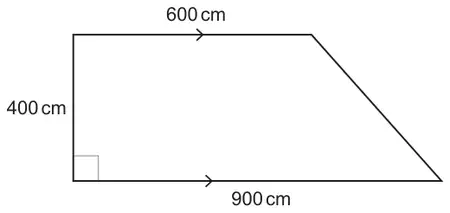
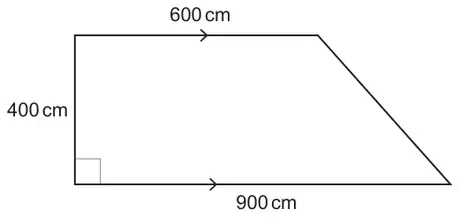
Davina wants to put a 5 cm layer of topsoil on her garden.
What volume of topsoil will Davina need for her garden? Give your answer in cm3 in standard form. [5]
(b) Topsoil is sold in \(1{\cdot}5 \times 10^{4}\) cm3 bags. Calculate the number of bags of topsoil that Davina needs to buy. You must show all your working. [1]
From the formula list: Area of trapezium \(= \dfrac{1}{2}(a+b)h\)
Mark scheme (a)
Scheme
Marks
Comments
(Volume of topsoil) ½ × 400 × (600 + 900) × 5 or 300 000 × 5
or 400 × 600 × 5 + ½ × 400 × (900 – 600) × 5 or 240 000 × 5 + 60 000 × 5
(This block is printed in a box in the scheme column of the original.)
Mark scheme (b)
Scheme
Marks
Comments
100 (bags)
B1
Allow an answer of (1 ×) 102 FT ‘their (a)’ ÷ (1.5 × 10⁴)’ correctly evaluated, rounded up to a whole number of bags provided ‘their (a)’ > 3 × 10⁴ Allow FT from ‘their (a)’ as ‘their final answer’ using: either ‘their final answer’ expressed as digits or ‘their final answer’ in standard form
A hot air balloon is initially descending at a speed of 3 m/s. A passenger drops their phone out of the balloon. The phone accelerates due to gravity at a rate of 9·8 m/s\(^2\), and hits the ground with a speed of 50 m/s.
The speed, \(v\) m/s, of the phone when it hits the ground is given by the formula,
\[v = \sqrt{u^2 + 2gh}\]
where: \(u\) is the initial speed of the phone, \(g\) is the acceleration due to gravity, \(h\) is the height above the ground from which the phone was dropped.
Use the formula to calculate the height from which the phone was dropped. [4]
(b)
Consider the Earth to be a sphere.
The mass of the Earth is 6·0 × 10\(^{24}\) kg, correct to 2 significant figures. The volume of the Earth is 1·09 × 10\(^{21}\) m\(^3\), correct to 3 significant figures.
Calculate the greatest possible density of the Earth. Give your answer in kg/m\(^3\). [3]
(c)
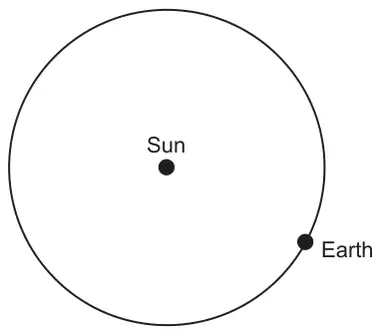
Diagram not drawn to scale
Here are some approximations about the Earth’s motion around the Sun.
The Earth follows a circular path around the Sun.
The Earth makes 1 complete revolution of the Sun in 365 days.
The speed of the Earth is 29 700 m/s.
Use these approximations to calculate the radius, in metres, of the Earth’s motion around the Sun. Give your answer in standard form. [4]
or equivalent, e.g. 2500 = 9 + 19.6h Do not allow any FT if:
\(50^2 = (3^2 + 2 \times 9.8) \times h\) or
\(\dfrac{50^2}{(3^2 + 2 \times 9.8)} = h\) is their next step
If \(50 = \sqrt{(3^2 + 2 \times 9.8)h}\) is their first step, then first B1 at most could be awarded if they then deal with the square root appropriately
CAO Allow an answer of 5580 provided no incorrect work seen ISW
Mark scheme (c)
Scheme
Mark
Comments
(Distance travelled by the Earth in 1 year =) 29700 × 365 × 24 × 60 × 60 or 29700 × 31536000
(= 936 619 200 000 or 9.366192 × 10\(^{11}\))
M2
Allow use of 365.25 for all marks M1 for correct use of 29700 with any 3 of 365, 24, 60 and 60, which may be embedded in further incorrect working If no evidence of 29700 × 365, allow M1 to be implied by a value in the range 9 × 10\(^{11}\) to 9.7 × 10\(^{11}\)
(Radius of Earth’s motion around the Sun =) \(\dfrac{29700 \times 365 \times 24 \times 60 \times 60}{(2 \times)\ \pi}\) or \(\dfrac{936\,619\,200\,000}{(2 \times)\ \pi}\)
M1
FT ‘their 936 619 200 000‘ provided it comes from a calculation that includes 29700 × 365 OR FT if no evidence of 29700 × 365 but ‘their 936 619 200 000‘ is in the range 9 × 10\(^{11}\) to 9.7 × 10\(^{11}\) Do not award this M1 if this calculation is then square rooted Accept values of \(\pi\) from 3.14 to 3.142
= 1.49 × 10\(^{11}\) to 1.5 × 10\(^{11}\) (m)
A1
FT from M1M1 Must be correct for \(\dfrac{\text{‘their }936\,619\,200\,000\text{’}}{2 \times \pi}\) AND be written in standard form On FT, accept truncation or rounding of the mantissa
(a) Davina wants to put a 5 cm layer of topsoil on her garden.
What volume of topsoil will Davina need for her garden? Give your answer in cm3 in standard form. [5]
(b) Topsoil is sold in \(1{\cdot}5 \times 10^{4}\) cm3 bags. Calculate the number of bags of topsoil that Davina needs to buy. You must show all your working. [1]
From the formula list: Area of trapezium \(= \dfrac{1}{2}(a+b)h\)
Mark scheme (a)
Scheme
Marks
Comments
(Volume of topsoil) ½ × 400 × (600 + 900) × 5 or 300 000 × 5 or 400 × 600 × 5 + ½ × 400 × (900 – 600) × 5 or 240 000 × 5 + 60 000 × 5
***must be from a sum of products for rectangle and ‘triangle’, not for 400 × 900 × 5
1.5 × 10⁶ (cm3)
A3
From M2 for volume or M1 awarded for correct area calculation A2 for any of the following:
(volume) 1 500 000 (cm3)
single error in the evaluation of the volume but this volume is written correctly in standard form
(area) 3 × 10⁵ (cm2)
A1 for any of the following:
(area) 300 000 (cm2)
area incorrectly evaluated but this area is written correctly in standard form
volume incorrectly evaluated but this volume is written correctly in standard form
From M1 awarded for volume calculation ½ omitted A3 for ‘their volume’ correctly evaluated in standard form
A2 for any of the following:
‘their volume’ correctly evaluated
single error in evaluation of ‘their volume’ but this volume is written correctly in standard form
‘their area’ correctly evaluated in standard form
A1 for any of the following:
‘their area’ correctly evaluated
‘their area’ incorrectly evaluated but this area is written correctly in standard form
‘their volume’ incorrectly evaluated but this volume is written correctly in standard form
If no marks, award SC marks for any one of the following:
SC2 for volume 400 × 600 × 5 = 1.2 × 10⁶
SC1 for volume 400 × 600 × 5 = 1 200 000
SC1 for area 400 × 600 = 2.4 × 10⁵
SC2 for volume 400 × 900 × 5 = 1.8 × 10⁶
SC1 for volume 400 × 900 × 5 = 1 800 000
SC1 for area 400 × 900 = 3.6 × 10⁵
SC1 for ‘their derived answer’ not in standard form that is then clearly shown expressed correctly in standard form
Working in metres (may include incorrect conversion to cm3 in further working)
Award any one of the following M marks: M2 volume ½ × 4 × (6 + 9) × 0.05 (= 1.5 m3) M1 area ½ × 4 × (6 + 9) (= 30 m2) M1 volume calculation ‘½ omission’ in m3
Award any one of the following A marks, with units stated: A2 volume 1.5 × 100 m3 A2 volume ‘½ omission’ correctly evaluated in standard form A1 volume 1.5m3 A1 volume ‘½ omission’ correctly evaluated
Mark scheme (b)
Scheme
Marks
Comments
100 (bags)
B1
Allow an answer of (1 ×) 102 FT ‘their (a)’ ÷ (1.5 × 10⁴)’ correctly evaluated, rounded up to a whole number of bags provided ‘their (a)’ > 3 × 10⁴ Allow FT from ‘their (a)’ as ‘their final answer’ using: either ‘their final answer’ expressed as digits or ‘their final answer’ in standard form
17. Convert \(3{\cdot}2 \times 10^4\) metres into miles. [3]
\(3{\cdot}2 \times 10^4\) metres is ………… miles
Mark scheme
Scheme
Marks
Comments
3·2 × 104 ÷ 1000 ÷ 8 × 5 or equivalent
M2
Answer line takes precedence. Operations can be made in any order.
Award M1 for sight of one of the following:
3·2 × 10(1) (km)
3·2 × 104 ÷ 1000 or answer of 32
3·2 × 104 ÷ 1000 ÷ 8 or answer of 4
3·2 × 104 ÷ 1000 × 5 or answer of 160
3·2 × 104 ÷ 8 × 5 or answer of 20 000
3·2 × 104 ÷ 1·6 or answer of 20 000
One place value error (e.g. 2 × 10x, 3·2÷1·6).
20 or equivalent
A1
CAO.
Corrected by Westie's Workshop
The board's mark scheme printed “Award M1 for sight of one the following”. Changed to “Award M1 for sight of one of the following” because the word “of” was missing.
Original: see the board's mark scheme PDF (link above).
Allow place value errors in writing the given standard form numbers in full for M2 and M1 only M1 for any one of the following calculations or evaluations:
\(\dfrac{1.2 \times 10^{8}}{2 \times 10^{7}}\) (= 0.6 × 10 (× 100) or 6(× 100) or 600(%))
500 (%)
A1
CAO Answer space completing the statement takes precedence Accept equivalents \(0.5 \times 10^{3}\) or \(5 \times 10^{2}\) Accept an unsupported correct answer or a correct answer from reverse calculations
Delia invests £4000 in an account that pays 3% compound interest per annum. She does not withdraw money or make any other payments into her account.
How much will Delia have in her account after two years? [3]
Amount in Delia’s account after two years £ ……………
(b)
Delia bought a gold bracelet at a car boot sale a few years ago.
(i)
Delia’s bracelet has increased in value by 40%. Her gold bracelet is now worth £42.
Calculate how much Delia paid for the bracelet in the car boot sale. [2]
Delia paid £ ……………
(ii)
The density of the gold in Delia’s bracelet is 20 g/cm3. The bracelet has a mass of \(6 \times 10^{-3}\) kilograms.
Calculate the volume of Delia’s bracelet. Give your answer in cm3. [3]
Mark scheme (a)
Scheme
Marks
Comments
0.03 × 4000 + 4000 or 1.03 × 4000 (= £4120) or equivalent
M1
Allow for sight of one of the following:
4120 (irrespective of labelling)
4240 (simple interest)
0.03 × 4120 + 4120 or 1.03 × 4120 or equivalent
M1
FT ‘their 4120’ (the mark is for the method) (= £123.6(0) + £4120)
(£)4243.6(0)
A1
CAO. Answer space takes precedence if completed, otherwise mark final answer for the amount
If no marks, award SC1 for (£)3763.6(0) (from depreciation)
Alternative method
Scheme
Marks
Comments
Sight of \(1.03^{2} \times 4000\)
M1
1.0609 × 4000
A1
(£)4243.6(0)
A1
CAO. Answer space takes precedence if completed, otherwise mark final answer for the amount
If no marks, award SC1 for (£)3763.6(0) (from depreciation)
The alternative method is printed in italics in the original.
Mark scheme (b)
Scheme
Marks
Comments
(i) 100 × 42 ÷ (100 + 40) or 42 ÷ 1.4 or equivalent
M1
(£) 30
A1
CAO. Answer space takes precedence Accept a correct answer from trial and improvement
(ii) (Volume of gold = mass ÷ density =) \(6 \times 10^{-3} \times 1000 \div 20\) or 6 ÷ 20 or \(6 \times 10^{-3} \div (20 \div 1000)\) or \(6 \times 10^{-3} \div 0.02\) or equivalent
M2
Must be dimensionally correct
M1 for any one of the following:
sight of \(6 \times 10^{-3} \times 1000\) (= 6 g)
sight of 20 ÷ 1000 (= 0.02 kg/cm3)
method with incorrect place value, ‘their mass’ ÷ ‘their density’ provided that
Allow place value errors in writing given standard form numbers in full for M2 and M1 only M1 for any one of the following calculations or evaluations:
1.2 × 10⁸ – 2 × 10⁷ (= 1 × 108 = 100 000 000)
\(\dfrac{1.2 \times 10^{8}}{2 \times 10^{7}}\) (= 0.6 × 10(× 100) or 6(× 100) or 600(%))
500 (%)
A1
CAO Answer space completing the statement takes precedence Accept equivalents 0.5 × 10³ or 5 × 10² Accept an unsupported correct answer or a correct answer from reverse calculations
(a) Delia invests £4000 in an account that pays 3% compound interest per annum. She does not withdraw money or make any other payments into her account.
How much will Delia have in her account after two years? [3]
Amount in Delia’s account after two years £ ……………
(b) Delia bought a gold bracelet at a car boot sale a few years ago.
(i) Delia’s bracelet has increased in value by 40%. Her gold bracelet is now worth £42.
Calculate how much Delia paid for the bracelet in the car boot sale. [2]
Delia paid £ ……………
(ii) The density of the gold in Delia’s bracelet is 20 g/cm3. The bracelet has a mass of \(6 \times 10^{-3}\) kilograms.
Calculate the volume of Delia’s bracelet. Give your answer in cm3. [3]
Mark scheme (a)
Scheme
Marks
Comments
0.03 × 4000 + 4000 or 1.03 × 4000 (= £4120) or equivalent
M1
Allow for sight of one of the following:
4120 (irrespective of labelling)
4240 (simple interest)
0.03 × 4120 + 4120 or 1.03 × 4120 or equivalent
M1
FT ‘their 4120’ (the mark is for the method) (= £123.6(0) + £4120)
(£)4243.6(0)
A1
CAO. Answer space takes precedence if completed, otherwise mark final answer for the amount
If no marks, award SC1 for (£)3763.6(0) (from depreciation)
Alternative method
Scheme
Marks
Comments
Sight of 1.032 × 4000
M1
1.0609 × 4000
A1
(£)4243.6(0)
A1
CAO. Answer space takes precedence if completed, otherwise mark final answer for the amount
If no marks, award SC1 for (£)3763.6(0) (from depreciation)
Mark scheme (b)
Scheme
Marks
Comments
(i) 100 × 42 ÷ (100 + 40) or 42 ÷ 1.4 or equivalent
M1
(£) 30
A1
CAO. Answer space takes precedence Accept a correct answer from trial and improvement
(ii) (Volume of gold = mass ÷ density =) 6 × 10-3 × 1000 ÷ 20 or 6 ÷ 20 or 6 × 10⁻³ ÷ (20 ÷ 1000) or 6 × 10⁻³ ÷ 0.02 or equivalent
M2
Must be dimensionally correct
M1 for any one of the following:
sight of 6 × 10-3 × 1000 (= 6 g)
sight of 20 ÷ 1000 (= 0.02 kg/cm3)
method with incorrect place value, ‘their mass’ ÷ ‘their density’ provided that
A volcano is an opening in the Earth’s crust, through which molten lava, hot ash and gases escape into the air.
(i)
An estimated 500 000 000 people live near active volcanoes. What is 500 000 000 written in standard form? [1]
(ii)
The teragram is a unit of mass. 1 teragram = \(10^9\) kg
Last year, a volcano released a total of 140 teragrams of carbon dioxide in 300 days.
Calculate the average number of kilograms of carbon dioxide that were released by this volcano per hour. Give your answer correct to 3 significant figures. You must show all your working. [5]
(b)
(i)
The planet Venus orbits the Sun. Its orbit can be considered to be circular.
The distance between Venus and the Sun is \(1.08 \times 10^8\) km.
Venus orbits the Sun once every 224.7 days.
Calculate the distance Venus travels in 1 day. Give your answer in standard form. [4]
(ii)
The surface area of Venus is 460 234 320 km\(^{2}\). The surface of Venus is wrinkled-volcanic, smooth-volcanic or non-volcanic. The areas of these three different types of surface are in the ratio 7 : 1 : 2.
Calculate the total surface area of Venus that is volcanic. You must show all your working. [3]
Mark scheme (a)
Scheme
Marks
Comments
(i) \(5 \times 10^8\) or \(5.0 \times 10^8\)
B1
(ii) 140
Method marks can be awarded in any order but the operation must be unique (not contradicted or repeated in the working)
× \(10^9\)
M1
÷ 300
M1
÷ 24
M1
‘÷ 7200’ implies final M1 M1
Award M3 for sight of \(\dfrac{140 \times 10^9}{300 \times 24}\) or \(\dfrac{1.4 \times 10^{11}}{7.2 \times 10^3}\) or equivalent
19 400 000 (kg per hour)
A2
ISW, accept 19.4 million or \(1.94 \times 10^7\) or equivalent
A1 for sight of 19 444 444(.44…) or for incorrect rounding or truncation of this answer
FT, for A1, from M1 M0 M1 or M1 M1 M0, including if an incorrect 3rd term is included, for correct evaluation of ‘their calculation’ and expressing ‘their final answer’ correct to 3 significant figures provided rounding is required, e.g.
FT, for A1, from M0 M1 M1 for an answer of 194 000, 1 940 000, 194 000 000, or 1 940 000 000, provided it is from a correct evaluation of ‘their calculation’
If no marks, award SC1 for equivalent operations used without 140, i.e. \(\dfrac{10^9}{300 \times 24}\) or \(10^9\) ÷ 300 ÷ 24 or equivalent
Mark scheme (b)
Scheme
Marks
Comments
(i) (Venus orbit) 2 × π × \(1.08 \times 10^8\) or 678 000 000 to 680 000 000 or \(6.78 \times 10^8\) to \(6.8 \times 10^8\)
M1
(To find distance travelled in one day) ÷ 224.7
M1
FT ‘their derived orbit’ provided π is involved in ‘their calculation of Venus orbit’
If no marks, award SC1 for an answer of 4.8(0…) × \(10^5\) (from \(1.08 \times 10^8\) ÷ 224.7) or 9.6(1…) × \(10^5\) (from 2 × \(1.08 \times 10^8\) ÷ 224.7)
(ii) 368 187 456 (km\(^{2}\))
B3
ISW Allow appropriate rounding from correct working, such as 368 187 500 or 368 000 000 or 370 000 000
B2 for any one of the following:
8 × 460 234 320 ÷ 10
7 × 460 234 320 ÷ 10 + 460 234 320 ÷ 10
460 234 320 – 2 × 460 234 320 ÷ 10
(2 × 460 234 320 ÷ 10 =) 92 046 864
(7 × 460 234 320 ÷ 10 =) 322 164 024
B1 for any one of the following, including embedded in other working:
460 234 320 ÷ 10
(460 234 320 ÷ 10 =) 46 023 432
If errors in calculating 1 + 7 or 1 + 2 + 7 are seen, then award B2 or B1 as appropriate e.g.
A volcano is an opening in the Earth’s crust, through which molten lava, hot ash and gases escape into the air.
(i)
An estimated 500 000 000 people live near active volcanoes. What is 500 000 000 written in standard form? [1]
(ii)
The teragram is a unit of mass. 1 teragram = 10\(^9\) kg
Last year, a volcano released a total of 140 teragrams of carbon dioxide in 300 days.
Calculate the average number of kilograms of carbon dioxide that were released by this volcano per hour. Give your answer correct to 3 significant figures. You must show all your working. [5]
(b)
(i)
The planet Venus orbits the Sun. Its orbit can be considered to be circular.
The distance between Venus and the Sun is 1·08 × 10\(^8\) km.
Venus orbits the Sun once every 224·7 days.
Calculate the distance Venus travels in 1 day. Give your answer in standard form. [4]
(ii)
The surface area of Venus is 460 234 320 km\(^2\). The surface of Venus is wrinkled-volcanic, smooth-volcanic or non-volcanic. The areas of these three different types of surface are in the ratio 7 : 1 : 2.
Calculate the total surface area of Venus that is volcanic. You must show all your working. [3]
Mark scheme (a)
Scheme
Mark
Comments
(i) 5 × 10\(^8\) or 5.0 × 10\(^8\)
B1
(ii) 140 × 10\(^9\)
M1
Method marks can be awarded in any order but the operation must be unique (not contradicted or repeated in the working)
÷ 300
M1
÷ 24
M1
‘÷ 7200’ implies final M1 M1
Award M3 for sight of \(\dfrac{140 \times 10^9}{300 \times 24}\) or \(\dfrac{1.4 \times 10^{11}}{7.2 \times 10^3}\) or equivalent
19 400 000 (kg per hour)
A2
ISW, accept 19.4 million or 1.94 × 10\(^7\) or equivalent
A1 for sight of 19 444 444(.44…) or for incorrect rounding or truncation of this answer
FT, for A1, from M1 M0 M1 or M1 M1 M0, including if an incorrect 3rd term is included, for correct evaluation of ‘their calculation’ and expressing ‘their final answer’ correct to 3 significant figures provided rounding is required, e.g.
FT, for A1, from M0 M1 M1 for an answer of 194 000, 1 940 000, 194 000 000, or 1 940 000 000, provided it is from a correct evaluation of ‘their calculation’
If no marks, award SC1 for equivalent operations used without 140, i.e. \(\dfrac{10^9}{300 \times 24}\) or 10\(^9\) ÷ 300 ÷ 24 or equivalent
Mark scheme (b)
Scheme
Mark
Comments
(i) (Venus orbit) 2 × π × 1.08 × 10\(^8\) or 678 000 000 to 680 000 000 or 6.78 × 10\(^8\) to 6.8 × 10\(^8\)
M1
(To find distance travelled in one day) ÷ 224.7
M1
FT ‘their derived orbit’ provided π is involved in ‘their calculation of Venus orbit’
(Distance in one day) 3.(0....) × 10\(^6\)
A2
CAO
A1 for any one of the following answers:
(not in standard form) 3 000 000 (km)
(incorrect standard form) e.g. 30 × 10\(^5\)
(in the range) 3 017 000 (km) to 3 026 300 (km)
(in terms of π) e.g. 961 281.7089π (km)
(π × 1.08 × 10\(^8\) ÷ 224.7 =) 1.5(…) × 10\(^6\)
If no marks, award SC1 for an answer of 4.8(0…) × 10\(^5\) (from 1.08 × 10\(^8\) ÷ 224.7) or 9.6(1…) × 10\(^5\) (from 2 × 1.08 × 10\(^8\) ÷ 224.7)
(ii) 368 187 456 (km\(^2\))
B3
ISW Allow appropriate rounding from correct working, such as 368 187 500 or 368 000 000 or 370 000 000
B2 for any one of the following:
8 × 460 234 320 ÷ 10
7 × 460 234 320 ÷ 10 + 460 234 320 ÷ 10
460 234 320 – 2 × 460 234 320 ÷ 10
(2 × 460 234 320 ÷ 10 =) 92 046 864
(7 × 460 234 320 ÷ 10 =) 322 164 024
B1 for any one of the following, including embedded in other working:
460 234 320 ÷ 10
(460 234 320 ÷ 10 =) 46 023 432
If errors in calculating 1 + 7 or 1 + 2 + 7 are seen, then award B2 or B1 as appropriate e.g.
7. Trains using electrified railway tracks produce fewer emissions than other trains.
In 2020, the USA had the longest total length of railway track of any country in the world.
Approximate length of electrified railway track (km)
Approximate total length of railway track (km)
USA
\(2 \times 10^{3}\)
\(2 \times 10^{5}\)
Rest of the world
\(3{\cdot}98 \times 10^{5}\)
\(1{\cdot}2 \times 10^{6}\)
Answer the following questions using information from the table.
(a) Calculate the percentage of track in the USA that was electrified in 2020. [2]
(b) Calculate the fraction of the whole world’s railway track that was electrified in 2020. Give your answer in its simplest form. [5]
Mark scheme (a)
Scheme
Marks
Comments
\(\dfrac{2 \times 10^{3}}{2 \times 10^{5}}\) (× 100) or equivalent
M1
e.g. \(\dfrac{2000}{200\,000}\) (× 100)
= 1 (%)
A1
Mark scheme (b)
Scheme
Marks
Comments
(0.02 × 10⁵) + (3.98 × 10⁵) or 2000 + 398 000 OR (0.2 × 10⁶) + (1.2 × 10⁶) or 200 000 + 1 200 000
M1
Or equivalents
= 400 000 AND 1 400 000
A2
Or equivalents e.g. (4 × 10⁵) AND (1.4 × 10⁶) Note: these do not need to be in correct standard form notation A1 for each
(Fraction that was electrified =) \(\dfrac{400\,000}{1\,400\,000}\) or equivalent
B1
e.g. \(\dfrac{4 \times 10^{5}}{1.4 \times 10^{6}}\) Must not involve sums within the numerator or denominator FT ‘their 400 000’ and ‘their 1 400 000’ provided not the USA figures e.g. for use of the rest of the world’s data B1 for \(\dfrac{3.98 \times 10^{5}}{1.2 \times 10^{6}}\) or equivalent
= \(\dfrac{2}{7}\)
B1
Mark final answer FT ‘their 400 000’ and ‘their 1 400 000’ provided equivalent level of difficulty e.g. for use of the rest of the world’s data B1 for \(\dfrac{199}{600}\) Ignore attempt to convert to a %
The conversion rate at the exchange shop is £1 = $1.25. The exchange shop only has $10 notes and $50 notes.
Jac has exactly £350. He wants to exchange as close to £350 as possible for US dollars ($). He asks for as few notes as possible.
Calculate:
how many $10 notes and how many $50 notes Jac gets
how much he pays for his currency.
You must show all your working. [6]
Mark scheme (a)
Scheme
Marks
Comments
8 × 1172 ÷ 5 or 1172 × 1.6
M1
Do not allow 1172 × 1.5
1875.2 (km)
A1
Accept 1875 (km) from correct working Answer space takes precedence
Mark scheme (b)
Scheme
Marks
Comments
0.366 × 1000 ÷ 60
M1
6.1 (m/s)
A1
Accept 6 (m/s) from correct working Answer space takes precedence
Mark scheme (c)
Scheme
Marks
Comments
(Difference 60 million – 41 000 000 =) 19 000 000 or 19 million
B1
May be implied in further working Allow 19 m(il)
(Underspend) \(\dfrac{19\,000\,000}{60\,000\,000}\) (× 100) or equivalent
M1
FT ‘their 60 million – 41 000 000’ including if a place value error made
31.67(%)
A1
CAO (must be 2 d.p.)
Answer space takes precedence
Alternative
7(c) Alternative method
Scheme
Marks
Comments
(Underspend) (100 –) \(\dfrac{41\,000\,000}{60\,000\,000}\) (× 100) or equivalent
M1
Allow place value error
31.67(%)
A2
CAO (must be 2 d.p.) Answer space takes precedence
A1 for 31.6(6…%), 31.7(%), 32(%) or 68.33(%)
Mark scheme (d)
Scheme
Marks
Comments
\(4 \times 10^{6}\)
B1
Mark scheme (e)
Scheme
Marks
Comments
Do not penalise slips in giving incorrect use of £ for $
(Change to $) 350 × 1.25
M1
($)437.5(0)
A1
(Only $10 and $50 notes available so he can buy) ($)430
A1
FT ‘their ($)437.5(0)’ (provided not a multiple of 10) rounded down to nearest multiple of 10 Accept stated or implied as ($)7.50 can’t be converted ($)430 implies previous M1 A1, provided not from incorrect working
(Fewest number of notes making up $430) 8 $50 (notes) and 3 $10 (notes)
A1
FT ‘their $430’ provided it is a multiple of 10 (and provided M1 previously awarded) Must be fewest number of notes, that may be listed Sight of correct number of notes with no incorrect working implies previous A1, unless contradicted
(Cost in £ to buy $430 is) 430 ÷ 1.25 or 350 – 7.5(0) ÷ 1.25 (= 350 – 6)
M1
FT ‘their whole number multiple of $10’ ÷ 1.25 Ignore attempt at any further calculation if 430 ÷ 1.25 seen
(£)344
A1
Must be <(£)350 and depends on M1 M1 previously awarded Mark final answer
If final M0 A0, then award SC1 for (£) 6 (left) or similar on FT, provided not from incorrect or inappropriate working
Alternative
7(e) Alternative method
Scheme
Marks
Comments
£40 = $50 and £8 = $10
M1
8 $50 notes, 3 $10 notes
A3
A2 for 8 $50 notes and sight of 350 – 8 × 40 or equivalent OR A1 for 8 $50 notes
A single tree can absorb 48 pounds of carbon dioxide per year. Calculate the carbon dioxide absorbed per year by a forest of 440 of these trees. Give your answer in kilograms. [2]
Carbon dioxide absorbed per year is …………… kg
(ii)
A forest of trees absorbs \(2{\cdot}3 \times 10^{11}\) grams of carbon dioxide per year. Which of the following is \(2{\cdot}3 \times 10^{11}\)? Circle your answer. [1]
230 000 000 000 23 000 000 000 2 300 000 000 000
0·000 000 000 002 3 0·000 000 000 023
(b)
Remember: 10 000 m\(^2\) ≈ 2·47 acres
A report states that a fire in a forest has a high risk of spreading when there are more than 60 trees per acre.
There are 615 trees in Grancwm Forest. The forest covers an area of 40 000 m\(^2\).
Would a fire in Grancwm Forest have a high risk of spreading?
Yes ☐ No ☐
You must show all your working to support your answer. [4]
(c)
A vertical pine tree stands on horizontal ground. From a point on the ground 21 metres from its base, the angle of elevation of the top of the pine tree is 39°.
Diagram not drawn to scale
(i)
Show that the pine tree has a vertical height of 17 metres. [3]
(ii)
A cylindrical log is cut from this pine tree. The circumference of the cross-section of the log is 1·75 m. The length of the log is half the height of the tree.
Calculate the volume of the log. Give your answer in m\(^3\). You must show all your working. [5]
Volume of the log is …………… m\(^3\)
Mark scheme (a)
(i)
Scheme
Marks
Comments
440 × 48 ÷ 2.2
M1
May be seen in stages
9600 (kg)
A1
Mark final answer Allow answers in the inclusive range 9588 to 9601 from premature approximation Answer space takes precedence
(ii)
Scheme
Marks
Comments
230 000 000 000
B1
Mark scheme (b)
Scheme
Marks
Comments
Throughout, if 4 marks are awarded, penalise -1 if conclusion ‘Yes’ is not indicated On FT the conclusion may be different to ‘Yes’
(Area) 2.47 × 40000 ÷ 10000 or equivalent 9.88 (acres)
M1 A1
May be implied in further working Allow 9.8 (acres), 9.9 (acres) or 10 (acres)
(Density of trees) 615 ÷ 9.88 62(.2...trees per acre) (>60)
May be implied in further working Allow 9.8 (acres), 9.9 (acres) or 10 (acres)
(Minimum area) 615 ÷ 60 10.25 (acres) (> 9.88)
M1 A1
Do not allow embedded in further working Allow rounded to 10 (acres) provided ‘their area’ (9.88 acres) has not been rounded to 10
Alternative
4(b) Alternative method 3
Scheme
Marks
Comments
(Minimum area) 615 ÷ 60 10.25 (acres)
M1 A1
May be implied in further working Allow 10 (acres)
(Convert to m\(^2\)) 10 000 × 10.25 ÷ 2.47 41 497(.97 m\(^2\)) or 41 498(m\(^2\)) (>40 000)
m1 A1
Depends on M1 m1 previously awarded Accept suitable rounding, e.g. 41 000 or 41 500
Alternative
4(b) Alternative method 4
Scheme
Marks
Comments
(Trees in 2.47 acres) 615 ÷ (40 000 ÷ 10 000) or equivalent
M1
153.75 (trees)
A1
May be implied in further working Allow 153, 153.8 or 154 (trees)
(Density of trees) 153.75 ÷ 2.47 62(.2...trees per acre) (> 60)
m1 A1
Depends on M1 m1 previously awarded
Alternative
4(b) Alternative method 5
Scheme
Marks
Comments
(Forest area per tree) 40 000 ÷ 615 65(.0406.. m\(^2\))
M1 A1
Do not allow embedded in further working
(Fire risk, area per tree) 10 000 ÷ (60 × 2.47) 67(.476…m\(^2\)) (> 65)
M1 A1
Corrected by Westie's Workshop
The board's mark scheme printed “‘their area’ (9.88m²)”. Changed to “(9.88 acres)” because the area was worked out in acres (9.88 acres), not square metres.
Original: see the board's mark scheme PDF (link above).
Mark scheme (c)
(i)
Scheme
Marks
Comments
(Height of the tree =) 21 × tan 39
M2
OR alternative full method M1 for tan 39 = \(\dfrac{\text{height of tree}}{21}\)
M1 for Hypotenuse = 21/cos39 (= 27.02…) AND Height\(^2\) = 27(.02)\(^2\) – 21\(^2\)
16.9(7…) (m) to 17.(0..m)
A1
CAO
Alternative
4(c)(i) Alternative method 2
Scheme
Marks
Comments
(Angle of elevation) \(\tan^{-1}\dfrac{17}{21}\)
M2
M1 tan (elevation) = \(\dfrac{17}{21}\)
38.9(9...°) or 39(°)
A1
CAO
Alternative
4(c)(i) Alternative method 3
Scheme
Marks
Comments
(Horizontal distance) \(\dfrac{17}{\tan 39}\)
M2
M1 for tan 39 = \(\dfrac{17}{\text{distance}}\)
20.9(98…m) or 21m
A1
CAO
(ii)
Scheme
Marks
Comments
diameter = \(\dfrac{1.75}{\pi}\) or (radius =) \(\dfrac{1.75}{2 \times \pi}\)
M2
M1 for any one of the following:
1.75 = π × diameter
1.75 = 2 × π × radius
(Note: radius = \(\dfrac{7}{8\pi}\) m, radius ≈ 0.28m)
(Area of cross section =) π × (1.75 ÷ 2π)\(^2\)
M1
FT for ‘their derived radius’ provided it is from a calculation involving the use of π (Note: area of cross section = \(\dfrac{49}{64\pi}\) m\(^2\) area of cross section ≈ 0.24 m\(^2\))
× 17 ÷ 2
m1
FT provided previous M1 awarded
(Volume) answer in the range 2.07 (m\(^3\)) to 2.15 (m\(^3\))
A1
CAO, accept an answer of 2 (m\(^3\)) from correct working without sight of premature approximation leading to an answer outside the range
In this part of the question, you will be assessed on the quality of your organisation, communication and accuracy in writing.
The conversion rate at the exchange shop is £1 = $1.25. The exchange shop only has $10 notes and $50 notes.
Jac has exactly £350. He wants to exchange as close to £350 as possible for US dollars ($). He asks for as few notes as possible.
Calculate:
how many $10 notes and how many $50 notes Jac gets
how much he pays for his currency.
You must show all your working. [6 + 2 OCW]
Mark scheme (a)
Scheme
Marks
Comments
(Difference 60 million – 41 000 000 =) 19 000 000 or 19 million
B1
May be implied in further working Allow 19 m(il)
(Underspend) \(\dfrac{19\,000\,000}{60\,000\,000}\) (× 100) or equivalent
M1
FT ‘their 60 million – 41 000 000’ including if a place value error made
31.67(%)
A1
CAO (must be 2 d.p.)
Answer space takes precedence
Alternative
3(a) Alternative method
Scheme
Marks
Comments
(Underspend) (100 -) \(\dfrac{41\,000\,000}{60\,000\,000}\) (× 100) or equivalent
M1
Allow place value error
31.67(%)
A2
CAO (must be 2 d.p.) Answer space takes precedence
A1 for 31.6(6…%), 31.7(%), 32(%) or 68.33(%)
Mark scheme (b)
Scheme
Marks
Comments
\(4 \times 10^{6}\)
B1
Mark scheme (c)
Scheme
Marks
Comments
(Change to $) 350 × 1.25 ($)437.5(0)
M1 A1
Do not penalise slips in giving incorrect use of £ for $
(Only $10 and $50 notes available so he can buy) ($)430
A1
FT ‘their ($)437.5(0)’ (provided not a multiple of 10) rounded down to nearest multiple of 10 Accept stated or implied as ($)7.50 can’t be converted ($)430 implies previous M1 A1, provided not from incorrect working
(Fewest number of notes making up $430) 8 $50 (notes) and 3 $10 (notes)
A1
FT ‘their $430’ provided it is a multiple of 10 (and provided M1 previously awarded) Must be fewest number of notes, that may be listed Sight of correct number of notes with no incorrect working implies previous A1, unless contradicted
(Cost in £ to buy $430 is) 430 ÷ 1.25 or 350 – 7.5(0) ÷ 1.25 (= 350 – 6)
M1
FT ‘their whole number multiple of $10’ ÷ 1.25 Ignore attempt at any further calculation if 430 ÷ 1.25 seen
(£)344
A1
Must be <(£)350 and depends on M1 M1 previously awarded Mark final answer
If final M0 A0, then award SC1 for (£) 6 (left) or similar on FT, provided not from incorrect or inappropriate working
Alternative
3(c) Alternative method
Scheme
Marks
Comments
£40 = $50 and £8 = $10 8 $50 notes, 3 $10 notes
M1 A3
A2 for 8 $50 notes and sight of 350 – 8 × 40 or equivalent OR A1 for 8 $50 notes
(Cost to buy £350 is) 8 × 40 + 3 × 8 (£)344
M1 A1
Scheme
Marks
Comments
Organisation and communication
OC1
For OC1, candidates will be expected to: • present their response in a structured way • explain to the reader what they are doing at each step of their response • lay out their explanations and working in a way that is clear and logical • write a conclusion that draws together their results and explains what their answer means
Writing
W1
For W1, candidates will be expected to: • show all their working • make few, if any, errors in spelling, punctuation and grammar • use correct mathematical form in their working • use appropriate terminology, units, etc.
8. The mass of an atom of hydrogen is about \(1{\cdot}7 \times 10^{-24}\) g. The mass of an atom of oxygen is about \(2{\cdot}7 \times 10^{-23}\) g.
(a) Using a suitable approximation, estimate how many atoms of hydrogen there are in 1000 g of hydrogen. Give your answer in standard form. [3]
(b) A molecule of water consists of two atoms of hydrogen and one atom of oxygen.
Calculate the mass of a molecule of water. Give your answer in standard form. [3]
Mark scheme (a)
Scheme
Marks
Comments
\(\dfrac{1000}{2\times10^{-24}}\) OR \(\dfrac{1000}{1.5\times10^{-24}}\) OR \(\dfrac{1000}{1.6\times10^{-24}}\)
M1
Or equivalents
= \(5 \times 10^{26}\) OR \(6.6(66\ldots) \times 10^{26}\) OR \(6.25 \times 10^{26}\) or \(6.7 \times 10^{26}\) or \(6.3 \times 10^{26}\) or \(7 \times 10^{26}\) or \(6 \times 10^{26}\)
A2
A1 for equivalent values but not in standard form e.g. \(500 \times 10^{24}\) or \(0.5 \times 10^{27}\) or their equivalent ordinary numbers
Alternative method
Scheme
Marks
Comments
\(\dfrac{1020}{1.7\times10^{-24}}\)
M1
Allow M1 for 1000/\(1.7\times10^{-24}\) provided their answer has a leading digit of 6
= \(6 \times 10^{26}\)
A2
A1 for equivalent value but not in standard form e.g. \(600 \times 10^{24}\) or \(0.6 \times 10^{27}\) or the equivalent ordinary number
If M0A0, award SC1 for an answer of \(5.8(\ldots)\times 10^{26}\) or \(5.9 \times 10^{26}\) from 1000/\(1.7\times10^{-24}\)
If a candidate adds the mass of 2 atoms of oxygen and 1 atom of hydrogen, treat as a misread (Answer will be \(5.57\times 10^{-23}\))
A1 for the equivalent of \(3.04 \times 10^{-23}\) but not in standard form e.g. \(30.4 \times 10^{-24}\) or the equivalent ordinary number, OR A1 for \(3 \times 10^{-23}\)
If no marks, award SC1 for an answer of \(2.87 \times 10^{-23}\) (using one atom of hydrogen)
6. Whales are sometimes spotted in the Irish Sea, off the west coast of Wales.
A minke whale was spotted on a bearing of:
010° from Aberporth
280° from Aberystwyth.
(a) Scientists decide to search for other whales in the Irish Sea. The search area is the region within 20 km of the position where the minke whale was spotted.
Using the scale given, show this search area on the map above. [4]
(b) This minke whale has a length of 20 feet.
Remember: 1 inch ≈ 2·5 cm, 1 foot = 12 inches
Use these facts to complete the following statement. [3]
The minke whale has a length of …………… metres.
(c) The brain of a minke whale has 12·8 billion neocortical neurons. A female human brain has 19 billion neocortical neurons.
Remember: 1 billion = 1000 million
(i) Calculate an estimate for the number of neurons in a minke whale brain expressed as a percentage of the number of neurons in a female human brain. You must show all your working. [2]
Approximately …………… %
(ii) 10% of all neocortical neurons are lost over a human lifespan. Calculate the number of neocortical neurons in a female human brain at the end of a lifespan. Give your answer in standard form. [4]
Mark scheme (a)
Scheme
Marks
Comments
Whale indicated or implied on bearing 010° from Aberporth and 280° from Aberystwyth.
B2
Accept indication from one bearing line drawn with the second bearing shown on this line, including one line terminating at the correct intersection point
B1 for either of the bearings correctly shown or unambiguously indicated, e.g. by an unambiguous mark on the correct bearing
Region in the sea inside a circle, centred at the whale, of correct (4cm) radius ± 2mm
B2
FT ‘their position of the whale’ For B2 the region must be entirely within the sea or on FT indicated as a region within the sea Allow intention of circle provided it lies completely within the tolerance given by the overlay B1 for (intention of a) circle, radius out of tolerance but within ± 4 mm, centred at the whale including any region on the land
Mark scheme (b)
Scheme
Marks
Comments
20 × 12 × 2.5 ÷ 100
M2
M1 for any 3 of these 4 terms correct in a calculation which may be shown in stages
6 (m)
A1
CAO Answer given within the statement takes precedence Sight of 600 is awarded M1 and also SC1 provided not from incorrect working
Mark scheme (c)
Scheme
Marks
Comments
(i) \(\frac{13}{20}\) (× 100) or \(\frac{12.5}{20}\) (× 100) or \(\frac{12.8}{19}\) (× 100) or \(\frac{12}{20}\) (× 100) or \(\frac{12}{19}\) (× 100) or \(\frac{12.8}{20}\) (× 100) or \(\frac{13}{19}\) (× 100) or equivalent OR A trial and improvement method, considering percentages or decimals of 19 or 20 with a correct calculation shown between (60% of 19) 0.6 × 19 (= 11.4) and (70% of 20) 0.7 × 20 (= 14) inclusive
B1
Allow:
fraction written as division, e.g. 13 ÷ 20
inclusion of consistent change of place value
a similar suitable fraction, e.g. 12/18
An answer in the inclusive range 60(%) to 70(%)
B1
Only award if B1 previously awarded, however allow B2 for an unsupported answer in this range.
If no marks, award SC1 for any of the following answers:
50(%) from \(\frac{10}{20}\) (× 100) or equivalent
52(%) to 53(%) from \(\frac{10}{19}\) (× 100) or equivalent
(ii) (19 – 0.1 × 19) × 1000 000 000 or (19 – 0.1 × 19) × (1) × 109 or 0.9 × 19 × 1000 000 000 or 1.9 × 1010 × 9 × 10-1 or equivalent
M2
M1 for any one of the following:
for sight of digits 171 irrespective of place value
19 – 0.1 × 19
19 billion – 0.1 × 19 billion
(19 – 0.1 × 19) × 1000 million
0.9 × 19
1.9 × 10¹⁰ (19 billion in standard form)
1.9 × 10⁹ only if clearly calculated from 10% of 19 billion
1.71 × 10¹⁰
A2
A1 for any of the following:
17 100 000 000
1.71 × 10⁴ million
equivalent correct value not given correctly in standard form, e.g. 17.1 × 10⁹
an answer of 1.7 × 10¹⁰
OR A1 for FT from M1 or M2
‘their number’ given correctly in standard form provided it is > 1.71 × 10⁶ (including for the number in the last bullet point listed for M1)
A0 for 17.1 billion or 17 100 million (M1 A0)
Treat use of an estimate of 19 as a MR-1 from an accuracy mark, e.g. use of 20 gives an answer of 1.8 × 10¹⁰, award (M2 A2 MR-1) 3 marks
2. Whales are sometimes spotted in the Irish Sea, off the west coast of Wales.
A minke whale was spotted on a bearing of:
010° from Aberporth
280° from Aberystwyth.
On screen this diagram may not be shown at actual size. To measure it, use the question paper (PDF) printed at 100%.
(a) Scientists decide to search for other whales in the Irish Sea. The search area is the region within 20 km of the position where the minke whale was spotted.
Using the scale given, show this search area on the map above. [4]
(b) This minke whale has a length of 20 feet.
Remember: 1 inch ≈ 2·5 cm, 1 foot = 12 inches
Use these facts to complete the following statement. [3]
The minke whale has a length of …………… metres.
(c) The brain of a minke whale has 12·8 billion neocortical neurons. A female human brain has 19 billion neocortical neurons.
Remember: 1 billion = 1000 million
(i) Calculate an estimate for the number of neurons in a minke whale brain expressed as a percentage of the number of neurons in a female human brain. You must show all your working. [2]
Approximately …………… %
(ii) 10% of all neocortical neurons are lost over a human lifespan. Calculate the number of neocortical neurons in a female human brain at the end of a lifespan. Give your answer in standard form. [4]
Mark scheme (a)
Scheme
Marks
Comments
Whale indicated or implied on bearing 010° from Aberporth and 280° from Aberystwyth.
B2
Accept indication from one bearing line drawn with the second bearing shown on this line, including one line terminating at the correct intersection point
B1 for either of the bearings correctly shown or unambiguously indicated, e.g. by an unambiguous mark on the correct bearing
Region in the sea inside a circle, centred at the whale, of correct (4cm) radius ± 2mm
B2
FT ‘their position of the whale’ For B2 the region must be entirely within the sea or on FT indicated as a region within the sea Allow intention of circle provided it lies completely within the tolerance given by the overlay B1 for (intention of a) circle, radius out of tolerance but within ± 4 mm, centred at the whale including any region on the land
Mark scheme (b)
Scheme
Marks
Comments
20 × 12 × 2.5 ÷ 100
M2
M1 for any 3 of these 4 terms correct in a calculation which may be shown in stages
6 (m)
A1
CAO Answer given within the statement takes precedence Sight of 600 is awarded M1 and also SC1 provided not from incorrect working
Mark scheme (c)
Scheme
Marks
Comments
(i) \(\dfrac{13}{20}\) (× 100) or \(\dfrac{12.5}{20}\) (× 100) or \(\dfrac{12.8}{19}\) (× 100) or \(\dfrac{12}{20}\) (× 100) or \(\dfrac{12}{19}\) (× 100) or \(\dfrac{12.8}{20}\) (× 100) or \(\dfrac{13}{19}\) (× 100) or equivalent OR A trial and improvement method, considering percentages or decimals of 19 or 20 with a correct calculation shown between (60% of 19) 0.6 × 19 (= 11.4) and (70% of 20) 0.7 × 20 (= 14) inclusive
B1
Allow:
fraction written as division, e.g. 13 ÷ 20
inclusion of consistent change of place value
a similar suitable fraction, e.g. 12/18
An answer in the inclusive range 60(%) to 70(%)
B1
Only award if B1 previously awarded, however allow B2 for an unsupported answer in this range.
If no marks, award SC1 for any of the following answers:
50(%) from \(\dfrac{10}{20}\) (× 100) or equivalent
52(%) to 53(%) from \(\dfrac{10}{19}\) (× 100) or equivalent
(ii) (19 – 0.1 × 19) × 1000 000 000 or (19 – 0.1 × 19) × (1) × 109 or 0.9 × 19 × 1000 000 000 or 1.9 × 1010 × 9 × 10-1 or equivalent
M2
Must have engaged with at least one stage of interpretation of the size of ‘billion’ in figures
M1 for any one of the following:
for sight of digits 171 irrespective of place value
19 – 0.1 × 19
19 billion – 0.1 × 19 billion
(19 – 0.1 × 19) × 1000 million
0.9 × 19
1.9 × 10¹⁰ (19 billion in standard form)
1.9 × 10⁹ only if clearly calculated from 10% of 19 billion
1.71 × 10¹⁰
A2
A1 for any of the following:
17 100 000 000
1.71 × 10⁴ million
equivalent correct value not given correctly in standard form, e.g. 17.1 × 10⁹
an answer of 1.7 × 10¹⁰
OR A1 for FT from M1 or M2
‘their number’ given correctly in standard form provided it is > 1.71 × 10⁶ (including for the number in the last bullet point listed for M1)
A0 for 17.1 billion or 17 100 million (M1 A0)
Treat use of an estimate of 19 as a MR-1 from an accuracy mark, e.g. use of 20 gives an answer of 1.8 × 10¹⁰, award (M2 A2 MR-1) 3 marks
10. The surface area of the Earth is 510 million km2. Write this area in standard form. [2]
…………… km2
Mark scheme
Scheme
Marks
Comments
\(5.1 \times 10^{8}\)
B2
Allow \(5.10(00....) \times 10^{8}\) B1 for the correct value written in index form, e.g. \(51 \times 10^{7}\) or \(510 \times 10^{6}\) or B1 for the sight of either of the following
6. The surface area of the Earth is 510 million km2. Write this area in standard form. [2]
…………………… km2
Mark scheme
Scheme
Marks
Comments
\(5.1 \times 10^{8}\)
B2
Allow \(5.10(00....) \times 10^{8}\) B1 for the correct value written in index form, e.g. \(51 \times 10^{7}\) or \(510 \times 10^{6}\) or B1 for the sight of either of the following
16. Calculate the value of \((3{\cdot}2 \times 10^{7}) \times (8{\cdot}3 \times 10^{-2})\). Give your answer in standard form. [2]
Mark scheme
Scheme
Marks
Comments
2·656 × 106
B2
B1 for a correct value but not in standard form. Mark final answer. B1 for sight of 2 656 000. SC1 for 2·66 × 106 or 2·7 × 106 or 2·6 × 106 or 2·65 × 106
Calculate the area of this piece of card. Give your answer in standard form in mm2. [2]
…………… mm2
(b) Some fabric shrinks when it is washed.
A piece of fabric is washed twice.
After the first wash, the area of the fabric is 75% of the area of the original piece of fabric. After the second wash, the area of the fabric is 90% of the area of the fabric after the first wash.
After these two washes, the area of the fabric is 2700 cm2.
Calculate the area of the original piece of fabric. [4]
Mark scheme (a)
Scheme
Marks
Comments
\(1 \times 10^{6}\) (mm2)
B2
Allow \(10^{6}\) (mm2) B1 for any one of the following
a calculated area 1 000 000 (mm2), \(1000^{2}\), \((10^{3})^{2}\) or equivalent
‘their clearly written number’ written correctly in standard form
Mark scheme (b)
Scheme
Marks
Comments
2700 ÷ (0.)9(0) or equivalent ÷ (0.)75 or equivalent
M1 M1
M marks can be awarded in either order
Sight of 2700 ÷ (0.9 × 0.75) is awarded M2
4000 (cm2)
A2
A1 for 2700 ÷ 0.9 = 3000 or 2700 ÷ 0.75 = 3600 or for 2700 ÷ 0.675 or for an appropriate FT division correctly evaluated
7. Calculate the value of \((3{\cdot}2 \times 10^{7}) \times (8{\cdot}3 \times 10^{-2})\). Give your answer in standard form. [2]
Mark scheme
Scheme
Marks
Comments
\(2{\cdot}656 \times 10^{6}\)
B2
B1 for a correct value but not in standard form. Mark final answer. B1 for sight of 2 656 000. SC1 for \(2{\cdot}66 \times 10^{6}\) or \(2{\cdot}7 \times 10^{6}\) or \(2{\cdot}6 \times 10^{6}\) or \(2{\cdot}65 \times 10^{6}\)
Calculate the area of this piece of card. Give your answer in standard form in mm2. [2]
…………………… mm2
(b) Some fabric shrinks when it is washed.
A piece of fabric is washed twice.
After the first wash, the area of the fabric is 75% of the area of the original piece of fabric. After the second wash, the area of the fabric is 90% of the area of the fabric after the first wash.
After these two washes, the area of the fabric is 2700 cm2.
Calculate the area of the original piece of fabric. [4]
Mark scheme (a)
Scheme
Marks
Comments
1 × 10⁶ (mm2)
B2
Allow 106 (mm2) B1 for any one of the following
a calculated area 1 000 000 (mm2), 10002, (103)2 or equivalent
‘their clearly written number’ written correctly in standard form
Mark scheme (b)
Scheme
Marks
Comments
2700 ÷ (0.)9(0) or equivalent
M1
M marks can be awarded in either order
÷ (0.)75 or equivalent
M1
Sight of 2700 ÷ (0.9 × 0.75) is awarded M2
4000 (cm2)
A2
A1 for 2700 ÷ 0.9 = 3000 or 2700 ÷ 0.75 = 3600 or for 2700 ÷ 0.675 or for an appropriate FT division correctly evaluated
(a) Waldo doesn’t mind which type of pasta he buys.
In the supermarket, Waldo sees the three packets of pasta shown below.
Strozzapreti pasta
500g for £1.25
Fusilli pasta
400g for 96p
Rigatoni pasta
250g for 65p
Which pasta offers Waldo the best value for money? You must show all your working. [3]
(b) An old recipe is given below.
Arrabiata pasta sauce Serves 4 people
1 onion 2 × 0·88 lb tins of tomatoes 3 chillies
(i) How many chillies would be needed to make Arrabiata pasta sauce for 48 people? [2]
(ii) How many kilograms of tinned tomatoes are needed to make Arrabiata pasta sauce to serve 20 people? [3]
(c) A pasta factory in Italy produces 5 km of spaghetti per day. How many centimetres of spaghetti will this factory produce in 7 days? Give your answer in standard form. [3]
Mark scheme (a)
Scheme
Marks
Comments
Method of comparison, e.g.
per 50g
for 2000g
M1
Needs to show attempt to compare at least 2 of the 3, e.g. comparing 500g Allow for sight of 2 × (0.)65
Correctly evaluated comparison for 2 of the 3 sizes
A1
Allow for sight of (£)1.3(0) or 130(p) Ignore incorrect units
50g
100 g
1 kg
2000g
Str 500g
12.5 p
25p
£2.50
£5
Fus 400g
12 p
24p
£2.40
£4.80
Rig 250g
13 p
26p
£2.60
£5.20
g per p
g per £
Str 500g
4 g
400 g
Fus 400g
4.166... g
416.66... g
Rig 250g
3.846... g
384.61... g
Correctly evaluated comparison for all sizes, may be different methods for different stages, AND conclusion ‘(400g) Fusilli is best value for money’
A1
Consistent units that are not obviously incorrect are required, or allow no units given
Examples:
Comparison of 500g with 250g then 250g with 400g not a full comparison of all 3 sizes
Comparison of 500g and 250g at 500g and then 500g and 400g at 2000g, possible M1, A1, A1
Mark scheme (b)
Scheme
Marks
Comments
(i) 3 × 48 ÷ 4
M1
36 (chillies)
A1
(ii) 0.88 (× 2) × 20 ÷ 4
M1
M marks can be awarded in either order (= (2 ×) 4.4 ) Or equivalent full method that could lead to a correct answer (Note: 2 × 0.88 × 20 ÷ 4 = 2 × 4.4 or 5 × 1.76)
÷ 2.2
M1
4 (kg)
A1
CAO If no marks, award SC1 for sight of (2 × 0.88 =) 1.76 (lbs)
Mark scheme (c)
Scheme
Marks
Comments
Conversion to cm, e.g. 5 × 1000 × 100 (× 7)
M1
( = 500 000 (× 7))
3.5 × 10⁶ (cm)
A2
A1 for any one of the following:
an answer of 3 500 000 (cm)
3 500 000 (cm) implied by incorrect standard form, e.g. 35 × 105
for correct expression of ‘their 3 500 000’ in standard form provided from 5 × 1000 × 100 × 7
if 7 has been omitted, for an answer of 5 × 10⁵
If no marks, award SC1 for ‘their number of cm’, n, provided n < 0.001 (n < 1 × 10⁻³) or n >1000 (n > 1 × 10³) , correctly written in standard form
How many kilograms of tinned tomatoes are needed to make Arrabiata pasta sauce to serve 20 people? [3]
(b)
A pasta factory in Italy produces 5 km of spaghetti per day. How many centimetres of spaghetti will this factory produce in 7 days? Give your answer in standard form. [3]
Mark scheme (a)
Scheme
Marks
Comments
0.88 (× 2) × 20 ÷ 4
M1
M marks can be awarded in either order (= (2 ×) 4.4 ) Or equivalent full method that could lead to a correct answer (Note: 2 × 0.88 × 20 ÷ 4 = 2 × 4.4 or 5 × 1.76)
÷ 2.2
M1
4 (kg)
A1
CAO If no marks, award SC1 for sight of (2 × 0.88 =) 1.76 (lbs)
Mark scheme (b)
Scheme
Marks
Comments
Conversion to cm, e.g. 5 × 1000 × 100 (× 7)
M1
( = 500 000 (× 7))
3.5 × 10⁶ (cm)
A2
A1 for any one of the following:
an answer of 3 500 000 (cm)
3 500 000 (cm) implied by incorrect standard form, e.g. 35 × 105
for correct expression of ‘their 3 500 000’ in standard form provided from 5 × 1000 × 100 × 7
if 7 has been omitted, for an answer of 5 × 10⁵
If no marks, award SC1 for ‘their number of cm’, n, provided n < 0.001 (n < 1 × 10⁻³) or n >1000 (n > 1 × 10³) , correctly written in standard form
(ii) Which is the best estimate for the volume of water passing through the underground pipes per hour? Circle your answer. [1]
8500 m3 9600 m3 10 040 m3 10 400 m3 11 000 m3
(b) Lake Vyrnwy has a surface area of approximately 4 540 000 m2. Lake Vyrnwy contains 59·7 gigalitres of water.
Calculate an estimate of the average depth of the lake. Give your answer in metres. [3]
Estimate of average depth is …………… m
Mark scheme (a)
Scheme
Marks
Comments
(i) 2.5 × 10⁷
B1
(ii) 9600 m3
B1
Mark scheme (b)
Scheme
Marks
Comments
(Volume seen or implied) 59 700 000 (m3) or 60 000 000 (m3) OR (Surface area seen or implied, used as) 4.5(4) or 5
B1
Accept using index notation or standard form, e.g. 59.7 × 10⁶, 5.97 × 10⁷, 60 × 106, 6 × 10⁷ Accept exact or correctly rounded volume written in m3, i.e. do not accept, e.g. 59 000 000
Ignore any units given
Average depth calculation, e.g.
59 700 000 ÷ 4 540 000
60 000 000 ÷ 4 500 000
6000 ÷ 450
600 ÷ 45
60 000 000 ÷ 5 000 000
60 ÷ 5
OR sight of a trial and improvement method with suitable correct calculation(s):
4.54 × 12 = 54.48 and 4.54 × 13 = 59.02
4.54 × 13 = 59.02 and 4.54 × 14 = 63.56
single calculation (not × 13) between 4.54 × 12.1 = 54.934 and 4.54 × 13.1 = 59.474
4.5 × 12 = 54 and 4.5 × 13 = 58.5
4.5 × 13 = 58.5 and 4.5 x 14 = 63
single calculation between 4.5 × 13.1 = 58.95 and 4.5 × 13.4 = 60.3
5 × 12 = 60
M1
FT e.g. 'their volume' ÷ 4 540 000 Accept written as a fraction Accept exact or rounded values provided estimates are reasonable
(ii) Which is the best estimate for the volume of water passing through the underground pipes per hour? Circle your answer. [1]
8500 m3 9600 m3 10 040 m3 10 400 m3 11 000 m3
(b) Lake Vyrnwy has a surface area of approximately 4 540 000 m2. Lake Vyrnwy contains 59·7 gigalitres of water.
Calculate an estimate of the average depth of the lake. Give your answer in metres. [3]
Estimate of average depth is …………………… m
Mark scheme (a)
(i)
Scheme
Marks
Comments
\(2.5 \times 10^{7}\)
B1
(ii)
Scheme
Marks
Comments
9600 m3
B1
Mark scheme (b)
Scheme
Marks
Comments
(Volume seen or implied) 59 700 000 (m3) or 60 000 000 (m3) OR (Surface area seen or implied, used as) 4.5(4) or 5
B1
Accept using index notation or standard form, e.g. 59.7 × 10⁶, 5.97 × 10⁷, 60 × 106, 6 × 10⁷ Accept exact or correctly rounded volume written in m3, i.e. do not accept, e.g. 59 000 000
Ignore any units given
Average depth calculation, e.g.
59 700 000 ÷ 4 540 000
60 000 000 ÷ 4 500 000
6000 ÷ 450
600 ÷ 45
60 000 000 ÷ 5 000 000
60 ÷ 5
OR sight of a trial and improvement method with suitable correct calculation(s):
4.54 × 12 = 54.48 and 4.54 × 13 = 59.02
4.54 × 13 = 59.02 and 4.54 × 14 = 63.56
single calculation (not × 13) between 4.54 × 12.1 = 54.934 and 4.54 × 13.1 = 59.474
4.5 × 12 = 54 and 4.5 × 13 = 58.5
4.5 × 13 = 58.5 and 4.5 x 14 = 63
single calculation between 4.5 × 13.1 = 58.95 and 4.5 × 13.4 = 60.3
5 × 12 = 60
M1
FT e.g. 'their volume' ÷ 4 540 000 Accept written as a fraction Accept exact or rounded values provided estimates are reasonable
8. Heledd is the captain of a cargo ship. She is planning her next voyage.
(a) Heledd has been employed to deliver 3 × 10⁵ tonnes of sand.
Heledd needs to know the volume of the sand before the sand can be loaded on to the ship. She has been given the following information about the sand:
Mass of a grain of sand
Volume of a grain of sand
1·2 × 10−3 grams
0·32 mm3
(i) Calculate the number of grains of sand in 3 × 10⁵ tonnes of sand. Give your answer in standard form. [3]
(ii) Calculate the volume of the 3 × 10⁵ tonnes of sand in m3. [3]
…………… m3
(b) Heledd has been given the following instructions for her voyage:
From port A, sail 200 km due south to port B.
From port B, sail due east to port C.
From port C, sail on a bearing of 318º back to port A.
Use the space below to draw a sketch of the ship’s voyage.
Calculate the distance from port C directly back to port A. [4]
(c) The last time the cargo ship was unloading sand in port B, it took 3 cranes 45 hours to unload 250 000 tonnes of sand.
Port B now has 5 cranes. Calculate the time it will take 5 cranes to unload 300 000 tonnes of sand.
You can assume that all cranes unload sand at the same rate, and that all other conditions remain the same.
Give your answer in hours and minutes. You must show all your working. [4]
Time it will take is …………… hours and …………… minutes
Mark scheme (a)
Scheme
Marks
Comments
(i) (Number of grains of sand =) \(\underset{\text{g}}{\dfrac{3 \times 10^{11}}{1{\cdot}2 \times 10^{-3}}} \;\text{ or }\; \underset{\text{kg}}{\dfrac{3 \times 10^{8}}{1{\cdot}2 \times 10^{-6}}} \;\text{ or }\; \underset{\text{t}}{\dfrac{3 \times 10^{5}}{1{\cdot}2 \times 10^{-9}}}\)
M2
Or equivalent M1 for 3/1∙2 with inconsistent place value
\(= 2{\cdot}5 \times 10^{14}\)
A1
CAO
(ii) (Vol of sand =) \(2{\cdot}5 \times 10^{14} \times 0{\cdot}32 \div 10^9\) or equivalent
M2
FT ‘their \(2{\cdot}5 \times 10^{14}\)’ from (a)(i) M1 for \(2{\cdot}5 \times 10^{14} \times 0{\cdot}32\) with place value errors M1 for \(0{\cdot}32 \div 10^9\)
= 80 000 or equivalent (m3)
A1
FT from M2 only Be aware of 80 000 coming from incorrect workings
Mark scheme (b)
Scheme
Marks
Comments
Sight or use of a correctly placed 48º or 42º
B1
Either in their diagram OR in their sin equation OR in their cos equation
(distance =) \(\dfrac{200}{\sin48(^\circ)}\) OR \(\dfrac{200}{\cos42(^\circ)}\)
M2
FT 'their 48' or 'their 42' provided <90 AND clearly indicated on their diagram or stated M1 for \(\sin48(^\circ) = \dfrac{200}{x}\) OR \(\cos42(^\circ) = \dfrac{200}{x}\) OR M2 for alternative full method (trigonometry followed by Pythagoras) M1 for trigonometry followed by Pythagoras with values substituted correctly
= 269(∙126… km)
A1
FT from M2 only Allow 270 (km) from correct workings
If no marks, and no diagram seen, or a correct diagram with no angles seen, SC1 for sight of \(\dfrac{200}{\sin42(^\circ)}\) OR \(\dfrac{200}{\cos48(^\circ)}\)
10. Astronomers use astronomical units (AU) to describe distances in our solar system. The distance between the Sun and the Earth is 1 AU. 1 AU is 1·496 × 108 km, correct to 4 significant figures.
(a) The distance of Pluto from the Sun is 5·913 × 109 km, correct to 4 significant figures.
Diagram not drawn to scale
Siôn says that the distance of Pluto from the Sun is less than 50 AU.
Using suitable approximations, estimate the distance of Pluto from the Sun, in AU, to show that Siôn is correct. You must show all your working. [2]
(b)
A light year is the distance light travels in one year.
1 light year is approximately 63 000 AU.
Estimate the length of a light year in km. Give your answer in standard form. [3]
Mark scheme (a)
Scheme
Marks
Comments
\(\dfrac{6 \times 10^{9}}{1{\cdot}5 \times 10^{8}}\) or equivalent
M1
A calculation, using approximations, that would lead to an answer of < 50
40 or 4 × 101
A1
FT their calculation e.g. \(\dfrac{5{\cdot}9 \times 10^{9}}{1{\cdot}5 \times 10^{8}}\) leads to an answer of 39·33
Mark scheme (b)
Scheme
Marks
Comments
63000 × 1·5 × 108 OR 60000 × 1·496 × 108 OR 60000 × 1·5 × 108
M2
Acceptable options for M2 and A1 Award M1 only for 63000 × 1·496 × 108 Or M1 for 1 slip in the power of 10, but otherwise correct
= 9·4(5) × 1012 (km) OR 8·9(76) × 1012 (km) OR 9 × 10¹² (km)
A1
FT from M2 only If no marks awarded, SC1 for 6(·3) × 1012 (km)
(b) A piece of card is 1 mm thick. A stack of these pieces of card is \(3 \times 10^{-2}\) metres high.
(i) Calculate how many pieces of card there are in the stack. [2]
(ii) What assumption have you made in answering (b)(i)? [1]
(c) In 2012 it was recorded that
the total mass of the paper used for printing newspapers, in the world, was \(2{\cdot}88 \times 10^{7}\) tonnes,
the world population was approximately \(7{\cdot}2 \times 10^{9}\) people.
Use this information to calculate the mass of paper per person used to print newspapers in 2012. Give your answer in kg per person. [4]
Mass of paper: …………… kg per person
Mark scheme (a)
Scheme
Marks
Comments
8 × 10⁻⁵
B1
Mark scheme (b)
Scheme
Marks
Comments
(i) 30 (pieces of card)
B2
If working is shown, it needs to be correct for the award of B2 Do not accept final answer of 30mm for B2
B1 for: 3 × 10⁻² written as 0.03 (metres) or 3 cm or (0.03m =) 30mm OR for a calculation that could lead to a correct response, e.g. 3 × 10⁻² ÷ 0.001 or (3 × 10⁻²) ÷ (1×10⁻³) or 3 × 10-2 ×1000
(Watch for compensating errors such as 3 × 10-2 = 0.003, 0.003 × 1000 = 30, this is awarded B1 for intention of 3 × 10-2 ×1000)
(ii) Assumption, e.g. ‘no gaps between pieces of card’, ‘all pieces of card completely touch’, ‘all pieces of card are (exactly) 1 mm thick’
E1
Allow e.g. ‘the thickness of each piece of card is the same’, ‘none of them are folded’
For M2 any calculations used by the candidate (which may be seen in stages) need to be correct, unless replaced with a correct calculation, perhaps e.g. reverting back to correct standard form FT ‘their 1000’, provided a power of 10 and ≠ 1 M1 for (2.88 × 10⁷ (tonnes)) ÷ (7.2 × 10⁹), or 28 800 000 ÷ 7 200 000 000, including no attempt to change tonnes to kg or possible place value errors in converting from standard form, this could be implied within working
(a) A standard piece of A4 paper is usually 0·08 mm thick. What is 0.08 mm written in metres in standard form? Circle your answer. [1]
8 × 10⁴ 8 × 10⁻⁴ 8 × 10⁻³ 8 × 10³ 8 × 10⁻⁵
(b) A piece of card is 1 mm thick. A stack of these pieces of card is 3 × 10⁻² metres high.
(i) Calculate how many pieces of card there are in the stack. [2]
(ii) What assumption have you made in answering (b)(i)? [1]
(c)
In 2012 it was recorded that
the total mass of the paper used for printing newspapers, in the world, was 2·88 × 107tonnes,
the world population was approximately 7·2 × 109 people.
Use this information to calculate the mass of paper per person used to print newspapers in 2012. Give your answer in kg per person. [4]
Mass of paper: …………………… kg per person
Mark scheme (a)
Scheme
Marks
Comments
8 × 10‑5
B1
Mark scheme (b)
Scheme
Marks
Comments
(i) 30 (pieces of card)
B2
If working is shown, it needs to be correct for the award of B2 Do not accept final answer of 30mm for B2
B1 for: 3 × 10‑2 written as 0.03 (metres) or 3 cm or (0.03m =) 30mm OR for a calculation that could lead to a correct response, e.g. 3 × 10‑2 ÷ 0.001 or (3 × 10‑2) ÷ (1×10‑3) or 3 × 10‑2 ×1000
(Watch for compensating errors such as 3 × 10‑2 = 0.003, 0.003 × 1000 = 30, this is awarded B1 for intention of 3 × 10‑2 ×1000)
(ii) Assumption, e.g. ‘no gaps between pieces of card’, ‘all pieces of card completely touch’, ‘all pieces of card are (exactly) 1 mm thick’
E1
Allow e.g. ‘the thickness of each piece of card is the same’, ‘none of them are folded’
For M2 any calculations used by the candidate (which may be seen in stages) need to be correct, unless replaced with a correct calculation, perhaps e.g. reverting back to correct standard form FT ‘their 1000’, provided a power of 10 and ≠ 1 M1 for (2.88 × 10⁷ (tonnes)) ÷ (7.2 × 10⁹), or 28 800 000 ÷ 7 200 000 000, including no attempt to change tonnes to kg or possible place value errors in converting from standard form, this could be implied within working
If B2 not awarded, B1 for sight of 1500. OR B1 for 1·5 × 10n from a denominator of 5 × 10³ seen. OR B1 for a × 103 with 1 ≤ a < 10 from a denominator of 5 × 10³ seen.
Mark scheme (b)
Scheme
Marks
Comments
\(6{\cdot}63 \times 10^4\)
B2
B1 for 6·6(….)× 104 if B2 not awarded. B1 for any correct answer but not in standard form.
If B2 not awarded, B1 for sight of 1500 OR B1 for \(1{\cdot}5 \times 10^n\) from a denominator of \(5 \times 10^3\) seen OR B1 for \(a \times 10^3\) with \(1 \leqslant a \lt 10\) from a denominator of \(5 \times 10^3\) seen.
Mark scheme (b)
Scheme
Marks
Comments
\(6{\cdot}63 \times 10^4\)
B2
B1 for \(6{\cdot}6(\ldots) \times 10^4\). B1 for any correct value but not in standard form
We'd like to use Google Analytics cookies to count visits and see which pages help most. They're optional, and the site works exactly the same either way. Privacy policy