Work out the value of \(xy\). Give your answer as a fraction in its simplest form. (5)
Mark scheme
Answer
Mark
Mark scheme
\(\dfrac{5}{33}\)
M1
for \(10x = 2.\dot{2}\) or 2.22… or \((10x - x =)\ 2.\dot{2} - 0.\dot{2}\ (= 2)\) or \(2.22\ldots - 0.22\ldots\ (= 2)\) or \(\dfrac{2}{9}\) oe fraction
M1
for a method using two recurring decimals that leads to a terminating decimal difference, using correct multiples of \(y\) eg \((1000y - 10y =)\ 681.\dot{8}\dot{1} - 6.\dot{8}\dot{1}\ (= 675)\) or \(681.81\ldots - 6.81\ldots\ (= 675)\) or \(\dfrac{675}{990}\) or \((100y - y) = 68.\dot{1}\dot{8} - 0.6\dot{8}\dot{1}\ (= 67.5)\) or \(68.181\ldots - 0.681\ldots\ (= 67.5)\) or \(\dfrac{67.5}{99}\)
A1
for \((x =)\ \dfrac{2}{9}\) oe and \((y =)\ \dfrac{675}{990}\) oe
M1
for \(\text{``}\dfrac{2}{9}\text{''} \times \text{``}\dfrac{675}{990}\text{''}\)
A1
cao
Additional guidance
eg \(\dfrac{20}{90}, \dfrac{22}{99}\)
Accept \((y =)\ \dfrac{67.5}{99}\)
Award 4 marks for an answer equivalent to \(\dfrac{5}{33}\), eg \(\dfrac{15}{99}, \dfrac{135}{891}, \dfrac{1350}{8910}\) unless from incorrect working
14 Prove algebraically that \(0.4\dot{6}\dot{2}\) can be written as \(\dfrac{229}{495}\) (3)
Mark scheme
Answer
Mark
Mark scheme
Shown
M1
for start to find multiples of \(x\) with the same recurring pattern eg for \((10x =)\ 4.626262\ldots\) or \((100x =)\ 46.262626\ldots\) or \((1000x =)\ 462.626262\ldots\)
M1
(dep on M1) for a correct subtraction that would lead to a terminating decimal, eg \((1000x - 10x) = 462.6262\ldots - 4.6262\ldots\ (= 458)\) or \((100x - x) = 46.2626\ldots - 0.4626\ldots\ (= 45.8)\)
C1
for correct working leading to the correct answer
Additional guidance
Any recurring notation acceptable throughout. Proofs with terminating decimals (at least 5 figures) score M1M1C0
18 Show that \(0.\dot{1}\dot{5} + 0.2\dot{2}\dot{7}\) can be written in the form \(\dfrac{m}{66}\) where \(m\) is an integer. (3)
Mark scheme
Answer
Mark
Mark scheme
Shown
M1
for \(0.1515\ldots + 0.22727\ldots\ (= 0.37878\ldots\) or \(0.3\dot{7}\dot{8})\)
M1
for finding two correct recurring decimals that when subtracted would result in a terminating decimal or integer, eg \((1000x - 10x =)\ 378.7878\ldots - 3.7878\ldots\ (= 375)\) or \(\dfrac{375}{990}\) or \((100x - x =)\ 37.8787\ldots - 0.37878\ldots\ (= 37.5)\) or \(\dfrac{37.5}{99}\)
C1
for correct working leading to \(\dfrac{25}{66}\)
OR
M1
for start of a method to convert \(0.1515\ldots\) or \(0.22727\ldots\) to a fraction, eg \(100x = 15.1515\ldots\) or \(\dfrac{15}{99}\) or \(\dfrac{5}{33}\) oe or \(10y = 2.2727\ldots\) or \(100y = 22.7272\ldots\) or \(1000y = 227.2727\ldots\) or \(\dfrac{225}{990}\) or \(\dfrac{22.5}{99}\) or \(\dfrac{5}{22}\) oe
M1
for a method to convert \(0.1515\ldots\) and \(0.22727\ldots\) to fractions, eg \((100x - x =)\ 15.1515\ldots - 0.1515\ldots\ (= 15)\) or \(\dfrac{15}{99}\) or \(\dfrac{5}{33}\) oe and \((1000y - 10y =)\ 227.2727\ldots - 2.2727\ldots\ (= 225)\) or \((100y - y =)\ 22.7272\ldots - 0.22727\ldots\ (= 22.5)\) or \(\dfrac{225}{990}\) or \(\dfrac{22.5}{99}\) or \(\dfrac{5}{22}\) oe
C1
for correct working leading to \(\dfrac{25}{66}\)
Additional guidance
Recurring decimal notation acceptable for this mark
Recurring decimal notation acceptable for both M marks
20 Prove algebraically that \(0.1\dot{2}\dot{3}\) can be written as \(\dfrac{61}{495}\) (3)
Mark scheme
Answer
Mark
Mark scheme
Proof
M1
for \((10x =)\ 1.2323\ldots\) or \((100x =)\ 12.323\ldots\) or \((1000x =)\ 123.23\ldots\)
M1
(dep M1) for a method using two recurring decimals that leads to a terminating decimal difference, using correct multiples of \(x\) eg \((1000x - 10x =)\ 123.23\ldots - 1.23\ldots\ (= 122)\) or \(\dfrac{122}{990}\) or \((100x - x =)\ 12.323\ldots - 0.123\ldots\ (= 12.2)\) or \(\dfrac{12.2}{99}\)
C1
for completing algebra to \(\dfrac{61}{495}\)
Additional guidance
Any recurring notation acceptable throughout. Proofs with terminating decimals (at least 5 figures) score M1M1C0
14 Using algebra, prove that \(1.06\dot{2}\) can be written as \(1\dfrac{14}{225}\) (3)
Mark scheme
Answer
Mark
Mark scheme
Shown
M1
for \((x =)\ 1.0622\ldots\) or \((10x =)\ 10.622\ldots\) or \((100x =)\ 106.22\ldots\) or \((1000x =)\ 1062.2\ldots\)
OR
for \((x =)\ 0.0622\ldots\) or \((10x =)\ 0.622\ldots\) or \((100x =)\ 6.22\ldots\) or \((1000x =)\ 62.2\ldots\)
M1
(dep M1) for a method using two recurring decimals that leads to a terminating decimal difference, using correct multiples of \(x\) eg \((1000x - 100x =)\ 1062.2\ldots - 106.22..\ (= 956)\) or \(\dfrac{956}{900}\)
OR
(dep M1) for a method using two recurring decimals that leads to a terminating decimal difference, using correct multiples of \(x\) eg \((1000x - 100x =)\ 62.2\ldots - 6.22...\ (= 56)\) or \(\dfrac{56}{900}\)
12 Express \(0.1\dot{1}\dot{7}\) as a fraction. You must show all your working. (3)
Mark scheme
Answer
Mark
Mark scheme
\(\dfrac{116}{990}\)
M1
for \((x =)\ 0.11717\ldots\) or \((10x =)\ 1.\dot{1}\dot{7}\) or \(1.1717\ldots\) or \((100x =)\ 11.\dot{7}\dot{1}\) or \(11.7171\ldots\) or \((1000x =)\ 117.\dot{1}\dot{7}\) or \(117.1717\ldots\)
M1
(dep M1) for a method using two recurring decimals that leads to a terminating decimal difference, using correct multiples of \(x\) eg \((1000x - 10x =)\ 117.\dot{1}\dot{7} - 1.\dot{1}\dot{7}\ (= 116)\) or \(117.1717\ldots - 1.1717\ldots\ (= 116)\)
A1
for \(\dfrac{116}{990}\) oe, eg \(\dfrac{58}{495}\)
Additional guidance
Accept \((100x - x =)\ 11.\dot{7}\dot{1} - 0.1\dot{1}\dot{7}\) or \(11.7171\ldots - 0.11717\ldots\ (= 11.6)\)
\(\dfrac{11.6}{99}\) must be written in the form \(\dfrac{a}{b}\) where \(a\) and \(b\) are integers to gain the accuracy mark
Acceptable examples he should have used \(100(x)\) rather than \(10(x)\) he should have used \(1000x\) and \(10x\) Ted’s working does not eliminate the recurring decimals the recurring numbers after the decimal point have to be in the same sequence he should have multiplied by 100 to subtract easier after the decimal point he should have multiplied by 100 because two numbers are recurring
Not acceptable examples it is not correct the method is not complete he should have used \(1000x\) he should have multiplied by 100 he should have multiplied by 100 and then done \(100x - 10x\) to give 43/90
15 Express \(0.4\dot{1}\dot{8}\) as a fraction. You must show all your working. (3)
Mark scheme
Answer
Mark
Mark scheme
\(\dfrac{414}{990}\)
M1
for (\(x =\)) 0.41818… or (\(10x =\)) \(4.\dot{1}\dot{8}\) or 4.1818… or (\(100x =\)) \(41.\dot{8}\dot{1}\) or 41.818… or (\(1000x =\)) \(418.\dot{1}\dot{8}\) or 418.18…
M1
for using two recurring decimals with a terminating decimal difference, eg. (\(1000x - 10x =\)) \(418.\dot{1}\dot{8} - 4.\dot{1}\dot{8}\) or \(418.18\ldots - 4.1818\ldots\ (= 414)\)
A1
for \(\dfrac{414}{990}\) oe, eg \(\dfrac{23}{55}\)
Additional guidance
Accept (\(100x - x =\)) \(41.\dot{8}\dot{1} - 0.4\dot{1}\dot{8}\) or \(41.818\ldots - 0.41818\ldots\ (= 41.4)\)
\(\dfrac{41.4}{99}\) must be simplified to gain the accuracy mark
16 Prove algebraically that \(0.2\dot{5}\dot{6}\) can be written as \(\dfrac{127}{495}\) (3)
Mark scheme
Answer
Mark
Mark scheme
Proof with \(\dfrac{127}{495}\)
M1
0.25656... or 0.2 + 0.05656.. or \((10 \times 0.2\dot{5}\dot{6} =)\ 2.\dot{5}\dot{6}\) or 2.5656… or \((100 \times 0.2\dot{5}\dot{6} =)\ 25.\dot{6}\dot{5}\) or 25.6565…or \((1000 \times 0.2\dot{5}\dot{6} =)\ 256.\dot{5}\dot{6}\) or 256.5656…
M1
for finding two correct recurring decimals that when subtracted would result in a terminating decimal or integer, eg. 256.5656….. – 2.5656….. or 25.6565….. – 0.25656….. or \(256.\dot{5}\dot{6} - 2.\dot{5}\dot{6}\) or \(25.\dot{6}\dot{5} - 0.2\dot{5}\dot{6}\) or for \(\dfrac{254}{990}\) or \(\dfrac{25.4}{99}\)
16 Using algebra, prove that \(0.1\dot{3}\dot{6} \times 0.\dot{2}\) is equal in value to \(\dfrac{1}{33}\) (3)
Mark scheme
Answer
Mark
Notes
M1
for the start of a method to convert \(0.22\ldots\) to a fraction, eg \(10y = 2.22\ldots\) or \((y =)\ \dfrac{2}{9}\)
M1
for the start of a method to convert \(0.13636\ldots\) to a fraction, \(10x = 1.3636\ldots\) or \(100x = 13.6363\ldots\) or \(1000x = 136.3636\ldots\) or \((x =)\ \dfrac{13.5}{99}\) or \((x =)\ \dfrac{135}{990}\)
C1
for correct arithmetic and concluding the proof
OR
M1
for \(0.1\dot{3}\dot{6} \times 0.\dot{2} = 0.\dot{0}\dot{3}\ (= z)\)
M1
for complete method to find two appropriate recurring decimals the difference of which is a rational number, eg. \(100z = 3.0303\ldots\), \((z =)\ 0.0303\ldots\) or \(\dfrac{3}{99}\)
Prove algebraically that \(x\) can be written as \(\dfrac{1}{22}\) (3)
Mark scheme
Answer
Mark
Notes
Proof
3
M1 for \((x =)\) 0.04545(...) or \(1000x = 45.4545(...)\), accept \(1000x = 45.\dot{4}\dot{5}\) or \(100x = 4.54545(...)\), accept \(100x = 4.\dot{5}\dot{4}\) or \(10x = 0.4545(...)\), accept \(10x = 0.\dot{4}\dot{5}\) M1 for finding the difference between two correct, relevant recurring decimals for which the answer is a terminating decimal A1 (dep on M2) for completing the proof by subtracting and cancelling to give a correct fraction eg \(\dfrac{45}{990} = \dfrac{1}{22}\) or \(\dfrac{4.5}{99} = \dfrac{1}{22}\)
M1 for 0.28181(...) or 0.2 + 0.08181(...) or evidence of correct recurring decimal eg. 281.81(...) M1 for two correct recurring decimals that, when subtracted, would result in a terminating decimal, and attempting the subtraction eg. \(100x = 28.1818\ldots\), \(x = 0.28181\ldots\) and subtracting eg. \(1000x = 281.8181\ldots\), \(10x = 2.8181\ldots\) and subtracting OR \(\dfrac{27.9}{99}\) or \(\dfrac{279}{990}\) oe A1 cao
If the answer is given as 2.4545… there must be at least four digits after the decimal point and at least two dots
eg 2.454545..
M1A1
eg 2.4545
M1A0
Mark scheme (b)
Answer
Mark
Comments
Alternative method 1: using \(x = 0.155\ldots\)
Multiplication by a power of 10 with correct result
M1
eg \(10x = 1.55\ldots\) or \(100x = 15.55\ldots\) or \(1000x = 155.55\ldots\) any or no letter
Correct equation formed from subtraction of two equations to eliminate recurring digits or correct fraction with a decimal numerator
M1dep
eg \(9x = 1.4\) or \(90x = 14\) or \(99x = 15.4\) eg \(\dfrac{15.4}{99}\)
\(\dfrac{7}{45}\)
A1
oe fraction eg \(\dfrac{14}{90}\) or \(\dfrac{154}{990}\)
Alternative method 2: using \(x = 0.055\ldots\)
Correct equation formed from subtraction of two equations to eliminate recurring digits or correct fraction, which may include a decimal numerator
M1
eg \(9x = 0.5\) or \(90x = 5\) or \(99x = 5.5\) eg \(\dfrac{55}{990}\) or \(\dfrac{5.5}{99}\)
\(\dfrac{1}{10}\) + their correct fraction, which may include a decimal numerator
M1dep
eg \(\dfrac{1}{10} + \dfrac{5}{90}\)
\(\dfrac{7}{45}\)
A1
oe fraction eg \(\dfrac{14}{90}\) or \(\dfrac{154}{990}\)
Additional guidance
Up to M2 may be awarded for correct work with no answer or incorrect answer, even if this is seen amongst multiple attempts
Ignore incorrect simplifying if correct fraction seen
Unless recovered, recurring decimals must be in correct notation or denoted by at least two repeated digits after the decimal point with at least two dots
21 Prove algebraically that \(\quad 1.0\dot{1}\dot{8} = \dfrac{56}{55}\) [3 marks]
Mark scheme
Answer
Mark
Comments
Alternative method 1: using \(x = 1.018\ldots\)
Multiplication by power of 10
M1
eg \(10x = 10.18\ldots\) or \(100x = 101.81\ldots\) or \(1000x = 1018.18\ldots\) any or no letter
Correct equation formed from subtraction of two equations to eliminate recurring digits
M1dep
eg \(99x = 100.8\) or \(990x = 1008\) or \(x = \dfrac{1008}{990}\)
\((x =)\ \dfrac{1008}{990}\) and \(\dfrac{56}{55}\) with no incorrect working
A1
oe from using different powers of 10
Alternative method 2: using \(x = 0.018\ldots\)
Multiplication by power of 10
M1
eg \(10x = 0.1818\ldots\) or \(100x = 1.818\ldots\) or \(1000x = 18.18\ldots\) any or no letter
Correct equation formed from subtraction of two equations to eliminate recurring digits
M1dep
eg \(99x = 1.8\) or \(990x = 18\) or \(x = \dfrac{1.8}{99}\)
\((x =)\ \dfrac{1.8}{99}\) or \(\dfrac{18}{990}\) and \((x =)\ \dfrac{1}{55}\) and \(\dfrac{56}{55}\) or \(\dfrac{100.8}{99}\) or \(\dfrac{1008}{990}\) and \(\dfrac{56}{55}\) with no incorrect working
A1
oe from using different powers of 10
Alternative method 3: using \(x = 1.018\ldots\) and addition
Multiplication by power of 10
M1
eg \(10x = 10.18\ldots\) or \(100x = 101.81\ldots\) or \(1000x = 1018.18\ldots\) any or no letter
Correct addition of two correct equations leading to 0.9 recurring
M1dep
eg \(110x = 111.99\ldots\) or \(1100x = 1119.99\ldots\)
\((x =)\ \dfrac{112}{110}\) and \(\dfrac{56}{55}\) with no incorrect working
A1
oe from using different powers of 10
Additional guidance
Up to M2 may be awarded for correct work with no answer or incorrect answer if this is seen amongst multiple attempts
For all marks, numbers must be correct
Working with 1.018018018… scores 0
Recurring decimals should be denoted by correct notation or at least two of the recurring digits followed by at least two dots
In alt1 and alt2 condone incorrect recurring notation if the result of the subtraction is a correct equation
19 When converted to a fraction \(\quad 0.\dot{7} = \dfrac{7}{9}\)
Work out \(\quad 0.\dot{4} + 0.0\dot{7}\)
Give your answer as a fraction. [3 marks]
Mark scheme
Answer
Mark
Comments
Alternative method 1
\((0.\dot{4} =)\ \dfrac{4}{9}\) or \(10x - x = 4\) or \(9x = 4\)
M1
oe eg \(100x - x = 44\) or \(99x = 44\) or \(100x - 10x = 40\) or \(90x = 40\) any letter
\(\dfrac{7}{9} \div 10\) or \(\dfrac{7}{90}\) or \(10y - y = 0.7\) or \(9y = 0.7\)
M1
oe eg \(100y - y = 7.7\) or \(99y = 7.7\) or \(100y - 10y = 7\) or \(90y = 7\) any letter
\(\dfrac{47}{90}\)
A1
oe single fraction
Alternative method 2
\(0.5\dot{2}\)
M1
oe
\(10x - x = 4.7\) or \(9x = 4.7\)
M1dep
oe eg \(100x - x = 51.7\) or \(99x = 51.7\) or \(100x - 10x = 47\) or \(90x = 47\) any letter
\(\dfrac{47}{90}\)
A1
oe single fraction
Additional guidance
For M marks, allow fractions with decimal numerator or denominator eg in alt 1, \(\dfrac{0.7}{9}\) scores M1 and in alt 2, \(\dfrac{4.7}{9}\) scores M2
23 Write \(0.1\dot{3}\) as a fraction in its simplest form. [3 marks]
Mark scheme
Answer
Mark
Comments
Alternative method 1 – subtracting powers of 10 algebraically
Denotes the given recurring decimal by a letter and multiplies by one of 10, 100, etc
M1
eg \(10x = 1.33\ldots\) or \(100x = 13.3\ldots\)
Denotes the given recurring decimal by a letter and multiplies by one or two of 10, 100, etc and subtracts accordingly
M1dep
eg \(10x - x = 1.333\ldots - 0.1333\ldots\) or \(9x = 1.2\) or \(\dfrac{1.2}{9}\) or \(100x - x = 13.333\ldots - 0.1333\ldots\) or \(99x = 13.2\) or \(\dfrac{13.2}{99}\) or \(100x - 10x = 13.333\ldots - 1.333\ldots\) or \(90x = 12\) or \(\dfrac{12}{90}\)
\(\dfrac{2}{15}\)
A1
Alternative method 2 – subtracting powers of 10 numerically
Multiplies the given decimal by one of 10, 100, etc
M1
eg \(0.1\dot{3} \times 10 = 1.\dot{3}\)
Multiplies the given decimal by one or two of 10, 100, etc and subtracts appropriately in fraction form
M1dep
eg \(0.1\dot{3} \times 100 = 13.\dot{3}\) and \(0.1\dot{3} \times 10 = 1.\dot{3}\) and \(\dfrac{13.3 - 1.3}{100 - 10}\) or \(\dfrac{12}{90}\)
\(\dfrac{2}{15}\)
A1
Alternative method 3 – splitting into a known fraction and a recurring decimal
Splits into 0.1 and \(0.0\dot{3}\) and uses a correct first step from alt 1 or alt 2 with \(0.0\dot{3}\)
M1
eg \(10x = 0.33\ldots\) or \(0.0\dot{3} \times 100 = 3.33\ldots\) 0.1 does not need to be seen separately at this stage
Correct method to evaluate \(0.0\dot{3}\) as a fraction and addition to \(\dfrac{1}{10}\) or \(\dfrac{1}{30} + \dfrac{1}{10}\) or \(\dfrac{4}{30}\)
M1dep
oe fraction
\(\dfrac{2}{15}\)
A1
Additional guidance
Condone decimals within fractions up to M2 eg \(\dfrac{1.2}{9}\)
M2
Equals signs may be implied throughout
Subtraction signs must be seen or the results correct
Recurring decimals should be denoted by correct notation or at least two of the recurring digits followed by at least two dots. However, condone missing dots if the result is, or would be, correct eg condone \(13.3 - 1.3 = 100x - 10x\)
21 Convert \(\quad 0.6\dot{1} \quad\) to a fraction. [3 marks]
Mark scheme
Answer
Mark
Comments
Alternative method 1
\(10x = 6.11\ldots\) and \(x = 0.61\ldots\) or \(100x = 61.11\ldots\) and \(10x = 6.11\ldots\)
M1
oe two powers of 10
\(10x - x = 6.11\ldots - 0.61\ldots\) or \(9x = 5.5\)
M1dep
oe subtraction of powers of 10 eg \(100x - 10x = 61.1\ldots - 6.1\ldots\)
\(\dfrac{11}{18}\) or \(\dfrac{55}{90}\) or \(\dfrac{605}{990}\)
A1
oe fraction
Alternative method 2
\((0.6\dot{1} =)\ 0.6 + 0.0\dot{1}\) and \(10x = 0.11\ldots\) and \(x = 0.01\ldots\) or \(100x = 1.11\ldots\) and \(10x = 0.11\ldots\)
M1
oe two powers of 10
\(10x - x = 0.11\ldots - 0.01\ldots\) or \(9x = 0.1\) and \(\dfrac{6}{10} +\) their \(\dfrac{1}{90}\)
M1dep
oe subtraction of powers of 10, with \(x\) evaluated as a fraction and added to \(\dfrac{6}{10}\) eg \(1000x - 10x = 11.11\ldots - 0.11\ldots\) or \(990x = 11\) and \(\dfrac{3}{5} + \dfrac{11}{990}\) sum of correct fractions implies M1M1
\(\dfrac{11}{18}\) or \(\dfrac{55}{90}\) or \(\dfrac{605}{990}\)
A1
oe fraction
Additional guidance
Ignore incorrect simplification of a correct fraction eg \(\dfrac{605}{990}\) and \(\dfrac{121}{190}\)
M1M1A1
Otherwise correct fraction with fraction(s) or decimal(s) as the numerator and/or denominator, eg \(\dfrac{5.5}{9}\)
13 Convert \(\quad \dfrac{5}{6} \quad\) to a recurring decimal. [2 marks]
Mark scheme
Answer
Mark
Comments
\(5 \div 6\) attempted with at least 0.8 shown and a carry of any integer from 1 to 7 or \(0.1\dot{6} \times 5\) or \(1.\dot{6} \div 2\) or \(1 - 0.1\dot{6}\)
M1
oe calculation involving a correct recurring decimal which would give an outcome of \(0.8\dot{3}\)
\(0.8\dot{3}\)
A1
condone any number of 3s immediately before the recurring 3
Additional guidance
Condone other recurring symbols or repeated dots eg \(0.83^{\text{r}}\) or 0.83…
26 Prove algebraically that \(\quad 3.4\dot{7} = \dfrac{313}{90}\) [3 marks]
Mark scheme
Answer
Mark
Comments
Alternative method 1 Working with \(3.47\ldots\)
\(10x = 34.7\ldots\) or \(100x = 347.7\ldots\)
M1
oe multiplication by a power of 10 eg \(1000x = 3477.7\ldots\) any letter
\(10x - x = 34.7\ldots - 3.47\ldots\) or \(9x = 31.3\) with \(10x = 34.7\ldots\) seen or \(100x - 10x = 347.7\ldots - 34.7\ldots\) or \(90x = 313\) with \(100x = 347.7\ldots\) and \(10x = 34.7\ldots\) seen or \(100x - x = 347.7\ldots - 3.47\ldots\) or \(99x = 344.3\) with \(100x = 347.7\ldots\) seen
M1dep
oe subtraction to eliminate recurring digits eg \(1000x - 10x = 3477.7\ldots - 34.7\ldots\) or \(990x = 3443\) with \(1000x = 3477.7\ldots\) and \(10x = 34.7\ldots\) seen numbers must all be correct
\(x = 3.47\ldots\) stated and M2 scored and \(9x = 31.3\) and \((x =)\ \dfrac{31.3}{9}\) and \(\dfrac{313}{90}\) or \(x = 3.47\ldots\) stated and M2 scored and \(90x = 313\) and \((x =)\ \dfrac{313}{90}\) or \(x = 3.47\ldots\) stated and M2 scored and \(99x = 344.3\) and \((x =)\ \dfrac{344.3}{99}\) and \(\dfrac{313}{90}\)
A1
oe eg \(x = 3.47\ldots\) stated and M2 scored and \(990x = 3443\) and \((x =)\ \dfrac{3443}{990}\) and \(\dfrac{313}{90}\)
Alternative method 2 Working with \(0.47\ldots\)
\(10x = 4.7\ldots\) or \(100x = 47.7\ldots\)
M1
oe multiplication by a power of 10 eg \(1000x = 477.7\ldots\) any letter
\(10x - x = 4.7\ldots - 0.47\ldots\) or \(9x = 4.3\) with \(10x = 4.7\ldots\) seen or \(100x - 10x = 47.7\ldots - 4.7\ldots\) or \(90x = 43\) with \(100x = 47.7\ldots\) and \(10x = 4.7\ldots\) seen or \(100x - x = 47.7\ldots - 0.47\ldots\) or \(99x = 47.3\) with \(100x = 47.7\ldots\) seen
M1dep
oe subtraction to eliminate recurring digits eg \(1000x - 10x = 477.7\ldots - 4.7\ldots\) or \(990x = 473\) with \(1000x = 477.7\ldots\) and \(10x = 4.7\ldots\) seen numbers must all be correct
\(x = 0.47\ldots\) stated and M2 scored and \(9x = 4.3\) and \((x =)\ \dfrac{4.3}{9}\) and \(3\dfrac{4.3}{9}\) and \(\dfrac{313}{90}\) or \(x = 0.47\ldots\) stated and M2 scored and \(90x = 43\) and \((x =)\ \dfrac{43}{90}\) and \(3\dfrac{43}{90}\) and \(\dfrac{313}{90}\) or \(x = 0.47\ldots\) stated and M2 scored and \(99x = 47.3\) and \((x =)\ \dfrac{47.3}{99}\) and \(3\dfrac{47.3}{99}\) and \(\dfrac{313}{90}\)
A1
oe eg \(x = 0.47\ldots\) stated and M2 scored and \(990x = 473\) and \((x =)\ \dfrac{473}{990}\) and \(3\dfrac{473}{990}\) and \(\dfrac{313}{90}\)
Alternative method 3 Working with \(0.07\ldots\)
\(10x = 0.7\ldots\) or \(100x = 7.7\ldots\)
M1
oe multiplication by a power of 10 eg \(1000x = 77.7\ldots\) any letter
\(10x - x = 0.7\ldots - 0.07\ldots\) or \(9x = 0.7\) with \(10x = 0.7\ldots\) seen or \(100x - 10x = 7.7\ldots - 0.7\ldots\) or \(90x = 7\) with \(100x = 7.7\ldots\) and \(10x = 0.7\ldots\) seen or \(100x - x = 7.7\ldots - 0.07\ldots\) or \(99x = 7.7\) with \(100x = 7.7\ldots\) seen
M1dep
oe subtraction to eliminate recurring digits eg \(1000x - 10x = 77.7\ldots - 0.7\ldots\) or \(990x = 77\) with \(1000x = 77.7\ldots\) and \(10x = 0.7\ldots\) seen numbers must all be correct
\(x = 0.07\ldots\) stated and M2 scored and \(9x = 0.7\) and \((x =)\ \dfrac{0.7}{9}\) and \(3.4 + \dfrac{0.7}{9}\) and \(\dfrac{313}{90}\) or \(x = 0.07\ldots\) stated and M2 scored and \(90x = 7\) and \((x =)\ \dfrac{7}{90}\) and \(3.4 + \dfrac{7}{90}\) and \(\dfrac{313}{90}\) or \(x = 0.07\ldots\) stated and M2 scored and \(99x = 7.7\) and \((x =)\ \dfrac{7.7}{99}\) and \(3.4 + \dfrac{7.7}{99}\) and \(\dfrac{313}{90}\)
A1
oe eg \(x = 0.07\ldots\) stated and M2 scored and \(990x = 77\) and \((x =)\ \dfrac{77}{990}\) and \(3.4 + \dfrac{77}{990}\) and \(\dfrac{313}{90}\)
Additional guidance
\(313 \div 90 = 3.47\ldots\)
M0M0A0
Alt 1 M1dep oe subtraction to eliminate recurring decimals includes \(100x - 10x = 313\) with \(100x = 347.7\ldots\) and \(10x = 34.7\ldots\) seen or \(90x = 347.7\ldots - 34.7\ldots\) with \(100x = 347.7\ldots\) and \(10x = 34.7\ldots\) seen (apply same principle in Alt 2 and Alt 3)
Alt 2 equivalents for final part of A1 eg For \(3\dfrac{43}{90}\) and \(\dfrac{313}{90}\) allow \(3 + \dfrac{43}{90}\) and \(\dfrac{313}{90}\)
Alt 3 equivalents for final part of A1 eg For \(3.4 + \dfrac{7}{90}\) and \(\dfrac{313}{90}\) allow \(3 + \dfrac{4}{10} + \dfrac{7}{90}\) and \(\dfrac{313}{90}\)
27 Prove algebraically that \(\; 2.7\dot{5} \;\) converts to the fraction \(\dfrac{124}{45}\) [3 marks]
Mark scheme
Answer
Mark
Comments
Alternative method 1 Working with 2.75…..
\(10x = 27.5\)… or \(100x = 275.5\)…
M1
oe multiplication by a power of 10 eg \(1000x = 2755.5\)… any letter
\(10x - x = 27.5\)… \(-\) 2.75… or \(9x = 24.8\) with \(10x = 27.5\)… seen or \(100x - 10x = 275.5\)… \(-\) 27.5… or \(90x = 248\) with \(100x = 275.5\)… and \(10x = 27.5\)… seen or \(100x - x = 275.5\)… \(-\) 2.75… or \(99x = 272.8\) with \(100x = 275.5\)… seen
M1dep
oe subtraction to eliminate recurring digits eg \(1000x - 10x = 2755.5\)… \(-\) 27.5… or \(990x = 2728\) with \(1000x = 2755.5\)… and \(10x = 27.5\)… seen numbers must all be correct
\(x = 2.75\)… stated and M2 scored and \(9x = 24.8\) and \(x = \dfrac{24.8}{9} = \dfrac{124}{45}\) or \(x = 2.75\)… stated and M2 scored and \(90x = 248\) and \(x = \dfrac{248}{90} = \dfrac{124}{45}\) or \(x = 2.75\)… stated and M2 scored and \(99x = 272.8\) and \(x = \dfrac{272.8}{99} = \dfrac{124}{45}\)
A1
oe eg \(x = 2.75\)… stated and M2 scored and \(990x = 2728\) and \(x = \dfrac{2728}{990} = \dfrac{124}{45}\)
Alternative method 2 Working with 0.75…..
\(10x = 7.5\)… or \(100x = 75.5\)…
M1
oe multiplication by a power of 10 eg \(1000x = 755.5\)… any letter
\(10x - x = 7.5\)… \(-\) 0.75… or \(9x = 6.8\) with \(10x = 7.5\)… seen or \(100x - 10x = 75.5\)… \(-\) 7.5… or \(90x = 68\) with \(100x = 75.5\)… and \(10x = 7.5\)… seen or \(100x - x = 75.5\)… \(-\) 0.75… or \(99x = 74.8\) with \(100x = 75.5\)… seen
M1dep
oe subtraction to eliminate recurring digits eg \(1000x - 10x = 755.5\)… \(-\) 7.5… or \(990x = 748\) with \(1000x = 755.5\)… and \(10x = 7.5\)… seen numbers must all be correct
\(x = 0.75\)… stated and M2 scored and \(9x = 6.8\) and \(x = \dfrac{6.8}{9}\) and \(2\dfrac{6.8}{9} = \dfrac{124}{45}\) or \(x = 0.75\)… stated and M2 scored and \(90x = 68\) and \(x = \dfrac{68}{90}\) and \(2\dfrac{68}{90} = \dfrac{124}{45}\) or \(x = 0.75\)… stated and M2 scored and \(99x = 74.8\) and \(x = \dfrac{74.8}{99}\) and \(2\dfrac{74.8}{99} = \dfrac{124}{45}\)
A1
oe eg \(x = 0.75\)… stated and M2 scored and \(990x = 748\) and \(x = \dfrac{748}{990}\) and \(2\dfrac{748}{990} = \dfrac{124}{45}\)
Alternative method 3 Working with 0.05…..
\(10x = 0.5\)… or \(100x = 5.5\)…
M1
oe multiplication by a power of 10 eg \(1000x = 55.55\)… any letter
\(10x - x = 0.5\)… \(-\) 0.05… or \(9x = 0.5\) with \(10x = 0.5\)… seen or \(100x - 10x = 5.5\)… \(-\) 0.5… or \(90x = 5\) with \(100x = 5.5\)… and \(10x = 0.5\)… seen or \(100x - x = 5.5\)… \(-\) 0.05… or \(99x = 5.5\) with \(100x = 5.5\)… seen
M1dep
oe subtraction to eliminate recurring digits eg \(1000x - 10x = 55.5\)… \(-\) 0.5… or \(990x = 55\) with \(1000x = 55.5\)… and \(10x = 0.5\)… seen numbers must all be correct
\(x = 0.05\)… stated and M2 scored and \(9x = 0.5\) and \(x = \dfrac{0.5}{9}\) and \(2.7 + \dfrac{0.5}{9} = \dfrac{124}{45}\) or \(x = 0.05\)… stated and M2 scored and \(90x = 5\) and \(x = \dfrac{5}{90}\) and \(2.7 + \dfrac{5}{90} = \dfrac{124}{45}\) or \(x = 0.05\)… stated and M2 scored and \(99x = 5.5\) and \(x = \dfrac{5.5}{99}\) and \(2.7 + \dfrac{5.5}{99} = \dfrac{124}{45}\)
A1
oe eg \(x = 0.05\)… stated and M2 scored and \(990x = 55\) and \(x = \dfrac{55}{990}\) and \(2.7 + \dfrac{55}{990} = \dfrac{124}{45}\)
Additional guidance
\(124 \div 45 = 2.75\)…
M0M0A0
Alt 1 M1dep oe subtraction to eliminate recurring decimals includes \(100x - 10x = 248\) with \(100x = 275.5\)… and \(10x = 27.5\)… seen or \(90x = 275.5\)… \(-\) 27.5… with \(100x = 275.5\)… and \(10x = 27.5\)… seen (apply same principle in Alts 2 and 3)
Alt 2 equivalents for final part of A1 eg For \(2\dfrac{68}{90} = \dfrac{124}{45}\) allow \(2 + \dfrac{68}{90} = \dfrac{124}{45}\)
Alt 3 equivalents for final part of A1 eg For \(2.7 + \dfrac{5}{90} = \dfrac{124}{45}\) allow \(2 + \dfrac{7}{10} + \dfrac{5}{90} = \dfrac{124}{45}\)
Use this fact to show that \(\quad 0.0\dot{7} = \dfrac{7}{90}\) [1 mark]
(b) Using part (a) or otherwise, convert \(\quad 0.2\dot{7} \quad\) to a fraction.
Give your answer in its simplest form. [3 marks]
Mark scheme (a)
Answer
Mark
Comments
\(0.\dot{7} \div 10 = 0.0\dot{7}\) and \(\dfrac{7}{9} \div 10 = \dfrac{7}{90}\) or \(0.0\dot{7} \times 10 = 0.\dot{7}\) and \(\dfrac{7}{90} \times 10 = \dfrac{7}{9}\) or \(0.\dot{7} \div 10 = 0.0\dot{7}\) and \(\dfrac{7}{90} \times 10 = \dfrac{7}{9}\) or because the decimal is divided by 10 the 9 has to be multiplied by 10
B1
oe
Additional guidance
Algebraic methods
B0
Division of 7 by 90
B0
Mark scheme (b)
Answer
Mark
Comments
Alternative method 1
\(0.2 + 0.0\dot{7}\) or \(\dfrac{2}{10} + \dfrac{7}{90}\)
M1
\(\dfrac{18}{90} + \dfrac{7}{90}\) or \(\dfrac{25}{90}\)
M1dep
\(\dfrac{5}{18}\)
A1
Alternative method 2
\(10x = 2.777\)… or \(100x = 27.777\)…
M1
Any letter
\(10x - x = 2.777\)… \(-\) 0.277… or \(9x = 2.5\) or \(\dfrac{2.5}{9}\) or \(100x - x = 27.777\)… \(-\) 0.277… or \(99x = 27.5\) or \(\dfrac{27.5}{99}\) or \(100x - 10x = 27.777\)… \(-\) 2.777… or \(90x = 25\) or \(\dfrac{25}{90}\)
Give your answer as a mixed number in its simplest form.
You must show your working. [5]
Mark scheme
Answer
Marks
Part marks and guidance
\(6\frac{2}{5}\) final answer with correct working
5
Correct working requires \(\frac{2}{9}\) oe fraction seen and \(\frac{128}{90}\) oe fraction seen or alternate convincing approach
B4 for \(\frac{64}{10}\) oe with correct working isw cancelling
e.g. B4 for \(6\frac{4}{10}\), \(\frac{32}{5}\), \(\frac{576}{90}\), \(\frac{1152}{180}\) with correct working
OR
B1 for \([0.\dot{2} =]\ \frac{2}{9}\) oe fraction
B2 for \(\frac{128}{90}\) oe fraction
For B2 condone e.g. \(\frac{12.8}{9}\)
or M1 for [\(n\) =1.422….] and [100\(n\) =] 142.2… oe or better or [\(n\) =] 1.422…. and [10\(n\) =] 14.22… or better
oe any correct approach that allows elimination of the recurring decimal Implied by e.g. 90\(n\) = 128 , 9\(n\) = 12.8
or shows e.g. [\(n\) = 0.422….] and [100\(n\) =] 42.2… oe or better
implied by [1]\(\frac{38}{90}\) oe seen
If 0, 1 or 2 scored, instead award SC3 for \(6\frac{2}{5}\) with no or insufficient working If 0 or 1 scored, instead award SC2 for answer \(\frac{64}{10}\) oe with no or insufficient working
Find the value of R. Give your answer as a mixed number in its simplest form. You must show your working. [5]
Mark scheme
Answer
Marks
Part marks and guidance
\(2\frac{1}{9}\) final answer with correct working
5
Correct working requires evidence of at least M2 M1 or other alternate correct approach leading to \(2\frac{1}{9}\), correct working may be shown on a diagram
M2 for \(0.\dot{4}\) or 0.44[4…] oe or M1 for \(1.\dot{6} - 1.\dot{2}\) oe seen
For M1 accept 1.66[6…] – 1.22[2…] or better
M2 for \(2.\dot{1}\) oe or M1 for \(1.\dot{6} + 0.\dot{4}\) oe
If 0 or 1 scored, instead award SC2 for answer \(2\frac{1}{9}\)
For M2, accept any clear indication that the decimal figure 1 recurs e.g. 2.1r, 2.111… For M1 accept 1.66[6…] + 0.44[4…] or better Accept oe e.g. \(1.\dot{2} + 2(0.\dot{4})\)
Alt method M2 for \(\frac{11}{9}\) oe fraction or M1 for \(1.\dot{2}\) and \(12.\dot{2}\) oe seen
Allow oe for any pair allowing ‘recurrence’ to be removed, accept e.g. 1.22… and 12.22…
M2 for \(\frac{15}{9} + \left(\frac{15}{9} - \textit{their } \frac{11}{9}\right)\) oe
For M2 and M1 must be using a common denominator for FT and could work with mixed numbers . The method must be shown for FT e.g. M2 for their \(\frac{11}{9} + 2\left(\frac{15}{9} - \textit{their } \frac{11}{9}\right)\) oe
or M1 for \(\left(\frac{15}{9} - \textit{their } \frac{11}{9}\right)\) oe
If 0 or 1 scored, instead award SC2 for answer \(2\frac{1}{9}\)
M1 for \(100x - x = 18.1818\ldots - 0.1818\ldots\) or better
For full marks, clear step by step process must be evident \(x\) and \(100x\) to same number of dp (min of 2dp) or both to min of 4dp or accept \(x = 0.\dot{1}\dot{8}\) and \(100x = 18.\dot{1}\dot{8}\)
Apply marks in a similar way to other methods eg M1 and M1 for \(10000x - 100x\) etc
If attempting non-calculator 2÷11: For full marks, need to see all “carry-overs” of 9 and 2 and answer to division of 0.181… M2 for “carry-over” of 9 and 2 and answer to division of 0.18 or M1 for “carry-over” of 9 and answer 0.1…
Mark scheme (b)
Answer
Marks
Part marks and guidance
\(0.\dot{1}\dot{8} \times 5\) or \(\frac{2}{11} \times 5\) or ‘multiply by 5’ oe
1
Accept equivalent calculations or words e.g. \(0.\dot{1}\dot{8} \div 2 = 0.\dot{0}\dot{9}\) and \(0.\dot{0}\dot{9} \times 10\) ‘divide by 2 and then multiply by 10’ Working may be to min of 4dp but answer must use recurring notation
where \(\frac{p}{q}\) is a fraction in its lowest terms.
Find the value of \(p\) and the value of \(q\). [4]
Mark scheme (a)
Answer
Marks
Part marks and guidance
16
2
M1 for \(\left[\sqrt[3]{64} =\right]\) 4 or [\(64^2\) =] 4096
M1 implied by answer \(\frac{1}{16}\)
Mark scheme (b)
Answer
Marks
Part marks and guidance
[\(p\) = ] 14 [\(q\) = ] 33
4
B3 for 42 and 99 OR B2 for \(\frac{13}{99}\) or 0.4242…. or M1 for [\(100x\) = ] 13.13….. or 0.555…
M1 for \(\frac{55}{99} - \frac{13}{99}\) FT their fraction converted to common denominator (dep on a conversion needed of their fraction or \(\frac{5}{9}\))
B3 for \(\frac{42}{99}\)
or any pair that allow elimination of recurring decimal
M1 may be implied from the value of their p and their q
16 Work out \(0.\dot{6} \times 0.\dot{5}\dot{4}\) giving your answer as a fraction in its simplest form. You must show your working. [5]
Mark scheme
Answer
Marks
Part marks and guidance
\(\frac{4}{11}\) final answer with correct working
5
“Correct working” requires \(\frac{6}{9}\) oe fraction seen and \(\frac{54}{99}\) oe fraction seen or B1 and B2 if alt method
B4 for \(\frac{324}{891}\) oe with correct working isw cancelling or B1 for [\(0.\dot{6}\) =] \(\frac{6}{9}\) oe fraction B2 for \(\frac{54}{99}\) oe fraction or M1 for [100\(n\) =] 54.54… oe or better
e.g. \(\frac{36}{99}\) with correct working gets B4
oe any correct method for conversion
Alternative method: B4 for \(\frac{324}{891}\) oe with correct working or B1 for [\(0.\dot{6}\) =] \(\frac{6}{9}\) oe fraction B2 for [100\(n\) =] 36.36… or better or M1 for [\(\frac{2}{3} \times 0.\dot{5}\dot{4}\) =] \(0.\dot{3}\dot{6}\)
e.g. \(\frac{36}{99}\) with correct working gets B4
If 0, 1 or 2 scored, instead award SC3 for \(\frac{4}{11}\) with no or insufficient working If 0 or 1 scored, instead award SC2 for answer \(\frac{324}{891}\) oe with no or insufficient working
18 Write \(0.4\dot{1}\dot{6}\) as a fraction in its simplest form. You must show full working in support of your answer. [3]
Mark scheme
Answer
Marks
Part marks and guidance
\(\frac{412}{990} = \frac{206}{495}\) with correct working
or
\(\frac{41.2}{99} = \frac{206}{495}\) with correct working
3
M2 for \(1000x\) [–] \(10x\) = 416.16[1...] [–] 4.16[1...] leading to \(990x = 412\) or for \(100x\) [–] \(x\) = 41.616[1...] [–] 0. 416[1...] leading to \(99x = 41.2\)
or M1 for \(10x\) = 4.16[1...] or \(100x\) = 41.616[1...] or \(1000x\) = 416.16[1...] seen
(a) Write \(\frac{1}{6}\) as a recurring decimal. [2]
(b) Elsa divides a two-digit number by another two-digit number. She gets the answer \(0.1\dot{5}\).
She says that there is only one possible pair of numbers that will give this answer. Is she correct? Show how you decide. [4]
Mark scheme (a)
Answer
Marks
Part marks and guidance
\(0.1\dot{6}\) final answer
2
B1 for 0.16….
Accept unambiguous alternate notation for the recurring decimal e.g. B1 for 0.166, 0.168, \(0.\dot{1}\dot{6}\)
Mark scheme (b)
Answer
Marks
Part marks and guidance
She is correct oe OR She is not correct oe AND 7 [and] 45 and 14 [and] 90 or 14 [and] 90 and \(14k\) [and] \(90k\) shown
4
B3 for \(\frac{7}{45}\) and \(\frac{14}{90}\) or for \(\frac{14}{90}\) and \(\frac{14k}{90k}\) or B2 for \(\frac{14}{90}\) oe fraction or M1 for 1.5... [× 10n] and 15.5… [× 10n] seen
For 4 marks there must be no incorrect fractions shown Accept yes for she is correct and no for she is not correct
Where \(k\) is a positive integer For B2 and B3 accept as pairs of values instead of fractions
Where \(n\) is an integer e.g. allow M1 for 0.15… and 1.5… or for 15.5.. and 155.5…
(a) Calculate the value of \(144^{0{\cdot}5} \times 6^{-2}\). Give your answer as a fraction in its simplest form. [3]
(b) Write \(\dfrac{430}{33}\) as a recurring decimal. [1]
(c) Expand and simplify \(\left(9 + 2\sqrt{5}\right)\left(4 - 3\sqrt{5}\right)\). [2]
(d) Find the mean of \(4\sqrt{75}\) and \(3\sqrt{48}\).
Give your answer in the form \(a\sqrt{b}\) where \(b\) is as small as possible. [3]
Mark scheme (a)
Scheme
Marks
Comments
\((144^{0{\cdot}5} =)\ 12\)
B1
\((6^{-2} =)\ \frac{1}{36}\)
B1
\(\frac{1}{3}\)
B1
Provided B1 awarded, FT ‘their values’ that will lead to a fully correct simplified fraction as a final answer. Do not award if this simplifies to a whole number.
An unsupported answer of \(0{\cdot}\dot{3}\) or 0·33… is awarded B1B1B0 An unsupported answer of \(0{\cdot}3\) is awarded B0B0B0
Corrected by Westie's Workshop
The board's mark scheme printed “An unsupported answer of answer of 0·3”. Changed to “An unsupported answer of 0·3” because the words “answer of” were printed twice.
Original: see the board's mark scheme PDF (link above).
Mark scheme (b)
Scheme
Marks
Comments
\(13{\cdot}\dot{0}\dot{3}\)
B1
Accept 13.0303…. or better
Accept \(13.0\dot{3}\dot{0}\) or \(13.03\dot{0}\dot{3}\)
Do not accept \(13.0\dot{3}\)
Mark scheme (c)
Scheme
Marks
Comments
\(6 - 19\sqrt{5}\)
B2
Mark final answer If not B2, award B1 for at least 3 out of 4 terms, from \(36 - 27\sqrt{5} + 8\sqrt{5} - 30\)
Mark scheme (d)
Scheme
Marks
Comments
\(20\sqrt{3}\)
B1
\(12\sqrt{3}\)
B1
\(16\sqrt{3}\)
B1
FT provided ‘their \(20\sqrt{3}\)’ and ‘their \(12\sqrt{3}\)’ are both multiples of \(\sqrt{3}\) and one is correct
9. Hang-Up is a company that makes clothes hangers. One type of hanger is made from a single length of metal wire that is bent to form the hanger.
(a)
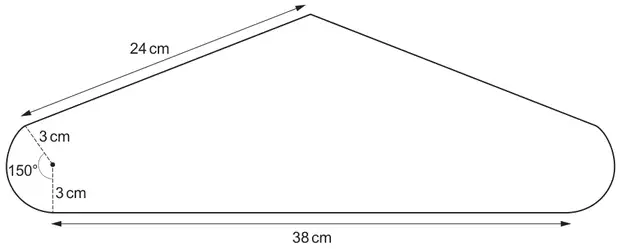
(i) The design for the main part of the hanger is shown below. This part of the hanger is symmetrical. It has straight sections of length 24 cm and 38 cm. It also has curved sections that are arcs of a circle of radius 3 cm.
Diagram not drawn to scale
Calculate the length of metal wire needed for the main part of the hanger. Give your answer in terms of \(\pi\) in its simplest form. [4]
(ii) The length of wire needed for the hooked part of this hanger is \(0{\cdot}1\dot{3}\) of the total length of wire needed for a hanger.
Write \(0{\cdot}1\dot{3}\) as a fraction in its simplest form. [3]
(b) Hang-Up makes metal hangers in batches of 80. Every 3 hours, it randomly samples 8 hangers from one batch of 80 for quality assurance.
The following numbers are taken from a table of random digits.
299986 890791 810130 955579 268884 301244
Use these numbers to choose 8 hangers from a batch of 80 hangers. You must start with the first number in the list. Describe clearly how you use the numbers to select the sample. [3]
Hangers chosen:
(c) Hang-Up also makes plastic hangers of various sizes. Two of its plastic hangers have main parts that are mathematically similar. These are shown below.
Diagram not drawn to scale
The total surface area of the larger hanger is 1·44 times the total surface area of the smaller hanger.
The height of the smaller hanger is 9 cm. Calculate the height of the larger hanger. [3]
Mark scheme (a)
Scheme
Marks
Comments
(i) Sight of \(\dfrac{150{\times}2{\times}\boldsymbol{\pi}{\times}3}{360}\) OR \(\dfrac{300{\times}2{\times}\boldsymbol{\pi}{\times}3}{360}\) (= 2.5\(\boldsymbol{\pi}\)) (= 5\(\boldsymbol{\pi}\))
B1
Or equivalents
(Length of wire =) (2 ×) \(\dfrac{150{\times}2{\times}\boldsymbol{\pi}{\times}3}{360}\) + (2 ×) 24 + 38 or equivalent
M1
= 5\(\boldsymbol{\pi}\) + 86 (cm)
A2
CAO Mark final answer A1 for sight of any one of the following:
\(\dfrac{1800\boldsymbol{\pi}}{360}\) + 86 or equivalent
5\(\boldsymbol{\pi}\) + ….
2.5\(\boldsymbol{\pi}\) + …. or 5\(\boldsymbol{\pi}\)/2 + …. provided an attempt has been made to add the 3 straight pieces
(ii) e.g. 10x = 1.333…, 100x = 13.333… AND an attempt to subtract both sides
M1
= \(\dfrac{12}{90}\) or \(\dfrac{132}{990}\) or \(\dfrac{1332}{9990}\) or equivalent
A1
Allow A1 for e.g. 1.2/9
= \(\dfrac{2}{15}\)
A1
FT from M1A0 provided of equivalent difficulty
Alternative method (a)(ii)
Scheme
Marks
Comments
\(\dfrac{1}{10}\) + \(\dfrac{3}{90}\) or equivalent
M1
= \(\dfrac{12}{90}\) or equivalent
A1
= \(\dfrac{2}{15}\)
A1
FT from M1A0 provided of equivalent difficulty
Mark scheme (b)
Scheme
Marks
Comments
Statements required:
Number the hangers from (0)1 to 80
Consider successive 2-digit numbers
Do not use numbers outside the range e.g. Do not use 00 and 81 – 99, OR Use the numbers (0)1 to 80
Ignore repeats
E2
All 4 needed for E2 E1 for any 2 or 3 correct statements
Allow an equivalent numbering system e.g. (0)0 to 79 Their numbering system can be implied by the range of numbers they state they will choose from
Allow the 2nd statement to be implied by their numbering of the hangers (from 01) AND their use of 2-digit numbers in their answer OR 2-digit numbers used in their answer with 07 and 01 seen
Do not allow ‘Use numbers less than 81’ if they have numbered the hangers from 01 to 80, without stating that 00 will not be used
6. Most aircraft are held together with metal rivets.
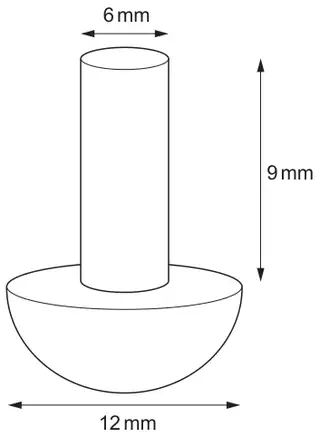
(a) The rivet used on one type of aircraft is shown below. It can be thought of as a cylinder connected to a hemisphere.
Diagram not drawn to scale
The cylinder has a diameter of 6 mm and a length of 9 mm. The hemisphere has a diameter of 12 mm.
(i) Calculate the volume of the rivet. Give your answer in terms of π in its simplest form. [4]
(ii) The manufacturer plans to reduce the length of the cylindrical part of the rivet from 9 mm to 8 mm. Calculate the fractional reduction in the volume of a rivet this would produce. [2]
Fractional reduction in the volume of a rivet = ……………
(b) For another type of rivet, the manufacturer plans to reduce the volume by \(0{\cdot}16\dot{1}\) of its original volume. Write \(0{\cdot}16\dot{1}\) as a fraction. Give your answer in its simplest form. [3]
From the formula list: Volume of sphere \(= \dfrac{4}{3}\pi r^3\)
Allow values of π from 3.14 to 3.142 for M marks only
M1 for \(\dfrac{2}{3}\) × π × 63 (+ ….) Allow M1 for \(\dfrac{4}{3}\) × π × 63 + π × 32 × 9 or equivalent
= 225π (mm3)
A2
CAO A1 for sight of 144π OR A1 for an answer of 369π (from use of 4/3×π×63) OR A1 for a fully correct method but with an answer of 225 (omitting π)
If no marks awarded, SC2 for an answer of 1476π from consistent use of diameters as their radii OR SC1 for \(\dfrac{2}{3}\) × π × 123 + π × 62 × 9 or equivalent OR SC1 for ( \(\dfrac{1}{3}\) × π × 63 + π × 32 × 9 = ) 153π
(ii)
Scheme
Marks
Comments
(Reduction in volume =) 9π (mm3)
B1
from π × 32 × (9 – 8) OR π×32×9 − π×32×8 or 81π − 72π
(Fractional reduction =) \(\dfrac{9(\pi)}{225(\pi)}\) or \(\dfrac{1}{25}\) or equivalent
B1
Implies previous B1 ISW FT ‘their 225π’ and ‘their π×32×9 − π×32×8’ and both are multiples of π
If no marks awarded, SC1 for a numerator of ‘their 225π’ − 9π, which may be embedded in a final answer of e.g. 216/225 or 24/25 if correct work seen in part (a)(i) Must be from a reduction of 9π in their volume. ISW
Mark scheme (b)
Scheme
Marks
Comments
Complete method e.g. 100x = 16.111…, 1000x = 161.111… AND an attempt to subtract both sides
M1
\(\dfrac{145}{900}\) or \(\dfrac{1595}{9900}\) or \(\dfrac{16095}{99900}\) or equivalent
A1
Allow A1 for e.g. (10x – x =) 1.45/9, (100x – x =) 15.95/99 etc
\(\dfrac{29}{180}\)
A1
FT from M1A0 provided at least 1 stage of simplification required
CAO. If 23·54 is seen, but then a rounded or truncated (e.g. 23·5) value is given award M1A1. Do not ignore any other subsequent work (e.g. 23·54 seen but then 66·34 given as a final answer is awarded M1A0).
(b) Express \(0{\cdot}07\dot{1}\dot{4}\) as a fraction. [2]
(c) Simplify \(\sqrt{11\tfrac{1}{4}}\). Give your answer in the form \(\dfrac{a\sqrt{5}}{b}\), where \(a\) and \(b\) are integers. [2]
(d) Give an example of an irrational number that lies between 6 and 7. [1]
My example of an irrational number is ……………………
Mark scheme (a)
Scheme
Marks
Comments
(i) 16
B1
(ii) \(\dfrac{1}{100}\)
B1
Mark scheme (b)
Scheme
Marks
Comments
\(100x\) = 7·141414..... and \(10000x\) = 714·1414.... with an attempt to subtract on both sides
M1
Or \(x\) and \(100x\), or equivalent. Or a complete alternative method. The multiplied decimals must be correct.
\(\dfrac{707}{9900}\)
A1
An answer of \(\dfrac{7{\cdot}07}{99}\) gains M1 only. ISW
16. (b) Alternative method
Scheme
Marks
Comments
0·07 + 0·00141414….. = \(\dfrac{7}{100} + \dfrac{14}{9900}\) or equivalent
M1
\(\dfrac{707}{9900}\)
A1
ISW
Mark scheme (c)
Scheme
Marks
Comments
\(\dfrac{3\sqrt{5}}{2}\)
B2
B1 for one of the following:
a numerator of \(3\sqrt{5}\)
\(\dfrac{\sqrt{45}}{\sqrt{4}}\) or \(\dfrac{\sqrt{9} \times \sqrt{5}}{\sqrt{4}}\) i.e. for one step of simplification of surds (but not for \(\sqrt{\dfrac{45}{4}}\) )
sight of \(1 \cdot 5\sqrt{5}\) (from \(\sqrt{2 \cdot 25}\,\sqrt{5}\)).
Mark scheme (d)
Scheme
Marks
Comments
An appropriate irrational number within the required range
B1
e.g. \(2\pi\), \(\pi + 3\), \(\sqrt{40}\), \(3\sqrt{5}\), \(8 - \sqrt{2}\). Ignore additional irrational numbers within range. B0 for multiple answers, unless all are irrational numbers within the required range.
10. A train completed a 16 000 m journey between two stations.
(a) Here is a description of the journey.
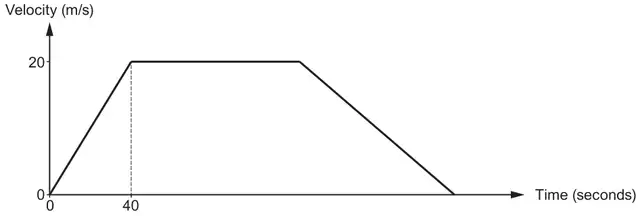
The train accelerated uniformly from rest to 20 m/s in 40 seconds.
It then remained at a constant speed of 20 m/s for a period of time.
The train then decelerated uniformly for 80 seconds until it stopped.
A sketch of the velocity-time graph that represents this journey is shown below.
Diagram not drawn to scale
(i) Calculate the distance the train travelled in the first 40 seconds of the journey. [2]
(ii) Calculate the total time for this 16 000 m journey. Give your answer in seconds. [5]
Total time for this 16 000 m journey is …………… seconds.
(b) When the train begins its next journey, it accelerates uniformly at \(1{\cdot}0\dot{8}\dot{1}\) m/s2. Write this acceleration as a mixed number in its simplest form. [3]
Mark scheme (a)
(i)
Scheme
Marks
Comments
½ × 40 × 20 = 400 (m)
M1 A1
(ii)
Scheme
Marks
Comments
(time at 20 m/s =) \(\dfrac{16000 - 400 - 0.5{\times}80{\times}20}{20}\) OR \(\dfrac{16000 - 400 - 2{\times}400}{20}\)
ISW. FT ‘their 740’ provided at least M2 previously awarded
Alternative method 1 (a)(ii)
Scheme
Marks
Comments
\(\dfrac{1}{2}\) ((time at 20) + 120 + (time at 20)) × 20 = 16000
M2
FT ‘their 400’ from (a)(i) Or equivalent e.g. only considering the journey from t=40 \(\dfrac{1}{2}\) ((time at 20)+80 + (time at 20))×20 = 16000 − 400 M1 for one of:
\(\dfrac{1}{2}\) ((time at 20) + 120 + (time at 20))×20
\(\dfrac{1}{2}\) ((time at 20) + 80 + (time at 20))×20
(time at 20m/s =) \(\dfrac{16000 \times 2 - 2400}{40}\) or equivalent (=29600/40)
(a) Express \(0{\cdot}6\dot{5}\dot{4}\) as a fraction. [2]
(b) Evaluate \(27^{-\frac{2}{3}}\). [2]
Mark scheme (a)
Scheme
Marks
Comments
\(x = 0{\cdot}6545454\ldots\ldots\) and \(100x = 65{\cdot}45454\ldots\) with an attempt to subtract
M1
Complete method. Or \(10x\) and \(1000x\), or equivalent. Or a complete alternative method. x and 10 000x gives an answer of 65448 / 99990.
648/990 (= 324/495 = 108/165 = 36/55 or equivalent)
A1
An answer of 64·8/99 gains M1 only. ISW
15.(a) Alternative method
Scheme
Marks
Comments
0·6 + 0·0545454..... = 6/10 + 54/990 or equivalent
M1
648/990 (= 36/55 or equivalent)
A1
An answer of 64·8/99 gains M1 only. ISW
Mark scheme (b)
Scheme
Marks
Comments
1/9
B2
B1 for \(9^{-1}\) or \(1/3^2\) or \((1/3)^2\) or \(1/\sqrt[3]{729}\) or \(1/729^{1/3}\) or \((1/729)^{1/3}\) or \(\sqrt[3]{(1/729)}\) Mark final answer.
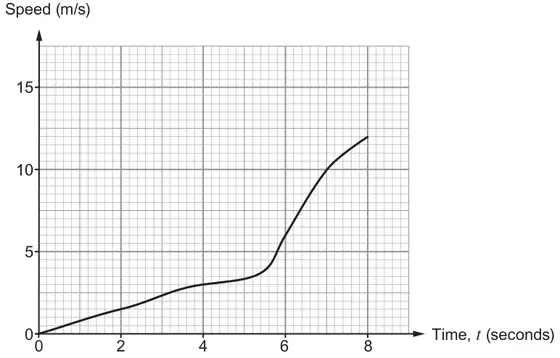
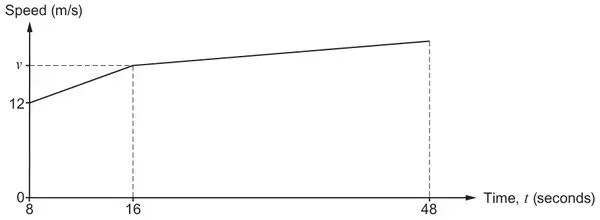
10. Eliska competed in an indoor cycle race. The speed-time graph below shows Eliska’s speed during the first 8 seconds of her race.
(a) Estimate the greatest acceleration that Eliska achieved during the first 8 seconds of her race. Give your answer in its simplest form. [4]
(b) Eliska’s initial acceleration was \(0{\cdot}\dot{7}\dot{2}\) m/s2. Write \(0{\cdot}\dot{7}\dot{2}\) as a fraction. [2]
(c) Use the trapezium rule with exactly 4 strips of equal width to estimate the distance Eliska travelled during the first 8 seconds of the race. [3]
(d) The speed-time graph below shows Eliska’s speed from \(t\) = 8 seconds to \(t\) = 48 seconds. The graph shows that her speed increased at a constant rate from \(t\) = 8 to \(t\) = 16, and at a different constant rate from \(t\) = 16 to \(t\) = 48.
Diagram not drawn to scale
Eliska’s speed at \(t\) = 48 was 1 m/s faster than her speed at \(t\) = 16. From \(t\) = 8 to \(t\) = 48, Eliska travelled 550 m. Form and solve an equation to calculate Eliska’s speed at time \(t\) = 16 seconds. [4]
Eliska’s speed at time \(t\) = 16 seconds is …………………… m/s
From the formula list: Area of trapezium \(= \dfrac{1}{2}(a+b)h\)
Mark scheme (a)
Scheme
Marks
Comments
Appropriate tangent drawn at a time between t=5.7 and t=5.9 seconds
M2
Note: A tangent that follows the curve between t=6 and t=7 is not appropriate i.e. it should not pass through (7, 10) or below M1 for a tangent drawn at any other time
Difference in y ÷ difference in x
m1
FT from M1 previously awarded Award m1A0 if only 1 correct difference in the division
Correctly evaluated gradient from a tangent drawn at a time between t=5.7 and t=5.9 seconds, given in its simplest form
A1
FT for a tangent drawn at any time from t=5.6 onwards Mark final answer Accept a correct improper fraction (unless it gives a whole number), mixed number or decimal If a decimal answer is given, it needs to be correctly evaluated to at least 1 decimal place, rounded or truncated
If no marks awarded, SC1 for a final answer of 3/2 or \(1\frac{1}{2}\) or 1.5 from convincing work that they are calculating the average acceleration (12/8) over the 8 seconds
Mark scheme (b)
Scheme
Marks
Comments
e.g. x = 0.72727… and 100x = 72.72727… or equivalent AND an attempt to subtract
M1
(x =) \(\dfrac{72}{99}\) or \(\dfrac{7272}{9999}\) or \(\dfrac{8}{11}\) or equivalent
Allow use of 5.7 < speed < 6.3 for 6, leading to e.g. : use of 5.7 leads to 32.4 (m) use of 5.8 leads to 32.6 (m) use of 5.9 leads to 32.8 (m) use of 6.1 leads to 33.2 (m) use of 6.2 leads to 33.4 (m) use of 6.3 leads to 33.6 (m)
Allow use of 5.7 < speed < 6.3 for 6 leading to e.g.: use of 5.7 leads to (1.5 + 4.5 + 8.7 + 17.7 =) 32.4 (m) use of 5.8 leads to (1.5 + 4.5 + 8.8 + 17.8 =) 32.6 (m) use of 5.9 leads to (1.5 + 4.5 + 8.9 + 17.9 =) 32.8 (m) use of 6.1 leads to (1.5 + 4.5 + 9.1 + 18.1 =) 33.2 (m) use of 6.2 leads to (1.5 + 4.5 + 9.2 + 18.2 =) 33.4 (m) use of 6.3 leads to (1.5 + 4.5 + 9.3 + 18.3 =) 33.6 (m)
M1 for the sum of these 4 areas with one error (possibly repeated) in reading the scale OR M1 for 3 of the 4 areas (1.5, 4.5, 9, 18) shown in a sum where not all calculations shown
= 33 (m)
A1
FT from M1
Mark scheme (d)
Scheme
Marks
Comments
\(\dfrac{1}{2}\)×(12 + v)×(16−8) + \(\dfrac{1}{2}\)×(v + v + 1)×(48−16) = 550 or equivalent
M2
Accept any letter or symbol for v v is speed at t = 16 seconds M1 for
½×(12 + v)×8 (+ ….) = 550 OR
(…. +) ½×(v + v + 1)×32 = 550 OR
½×(12 + v)×8 + ½×(v + v + 1)×32
48 + 4v + 16v + 16v + 16 = 550 or equivalent
m1
e.g. 96 + 8v + 32v + 32v + 32 = 1100 FT from M1 For appropriately expanding the brackets, and dealing with the fractions
(Speed at t = 16 seconds is) 13.5 or 131/2 (m/s)
A1
CAO. An unsupported answer of 13.5 (m/s) is awarded M0m0A0
(b) Evaluate \(\dfrac{1}{3} + 0{\cdot}0\dot{2}\). Express your answer as a fraction. [3]
Mark scheme (a)
Scheme
Marks
Comments
\(\dfrac{1}{8}\)
B2
B1 for \(8^{-1}\) or \(\dfrac{1}{2^3}\) or \(\left(\tfrac{1}{2}\right)^3\) or \(\dfrac{1}{\sqrt{64}}\) or \(\sqrt{\dfrac{1}{64}}\) or \(\dfrac{1}{64^{\frac{1}{2}}}\) or \(\left(\dfrac{1}{64}\right)^{\frac{1}{2}}\)
Mark scheme (b)
Scheme
Marks
Comments
\(x = 0{\cdot}02222.....\) \(10x = 0{\cdot}2222.....\) with an attempt to subtract
M1
Or \(10x\) and \(100x\), or equivalent. Or an alternative method.
\(\left(\tfrac{1}{3}\,+\right) \tfrac{2}{90}\) OR \(\left(\tfrac{1}{3}\,+\right) \tfrac{1}{45}\)
Mark final answer. Accept \(11 + 1\sqrt{5}\). If no marks awarded, SC1 for 3 correctly simplified terms i.e. 21, \(7\sqrt{5}\), \(-6\sqrt{5}\), \(-10\).
(a) After owning the car for a year, Carwyn had the car valued. He calculated that the car had lost \(0{\cdot}13\dot{8}\) of its value at the start of the year.
Express \(0{\cdot}13\dot{8}\) as a fraction in its lowest terms. [3]
(b) Carwyn bought the motorcycle for £9600. At the end of each year of owning the motorcycle, Carwyn had the motorcycle valued. Each year the motorcycle lost \(\frac{1}{5}\) of its value at the start of the year.
(i) Carwyn used the method \(9600\times\frac{1}{5}\times\frac{1}{5}\) to calculate the value of the motorcycle after 2 years. Explain why Carwyn’s method is incorrect. [1]
(ii) Write down a formula for the value \(V\), in pounds, of Carwyn’s motorcycle after he has owned the motorcycle for \(t\) years. [3]
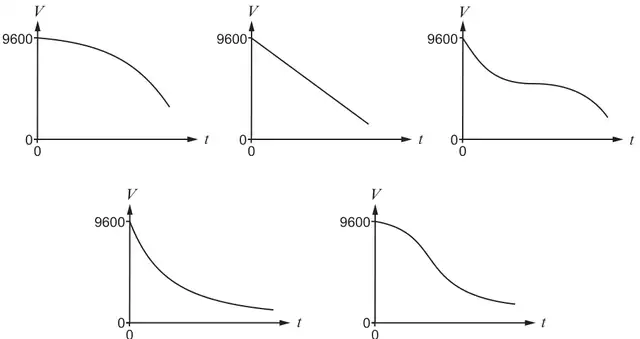
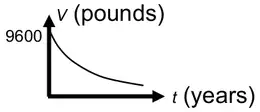
(iii) Which one of the following best represents the graph of \(V\) against \(t\)? Circle your answer. [1]
Mark scheme (a)
Scheme
Marks
Comments
e.g. 100x = 13.888… and 1000x = 138.888… or equivalent AND an attempt to subtract both sides
M1
(x =) \(\dfrac{125}{900}\) or \(\dfrac{1375}{9900}\) or \(\dfrac{13875}{99900}\) or equivalent
A1
Accept e.g. \(\dfrac{1.25}{9}\)
(x =) \(\dfrac{5}{36}\)
A1
FT ‘their 125/900’ provided of equivalent difficulty
Mark scheme (b)
(i)
Scheme
Marks
Comments
Appropriate explanation e.g. ‘It should be 4/5 × 4/5’, or ‘It should be × 0.82’, or ‘Each year it would be valued at 4/5 of the previous year’s value’, or ‘Each year he should be taking 1/5 off the value’
E1
Allow sight of correct calculation only Allow incorrect notation e.g. 9600 × \(\dfrac{4^{2}}{5}\) Do not accept e.g. ‘Because this calculates the amount lost’
(ii)
Scheme
Marks
Comments
\(V = 9600 \times 0{\cdot}8^{t}\) or \(V = 9600 \times (4/5)^{t}\) or equivalent
B3
Allow pound signs in their formula
B2 for \(9600 \times 0{\cdot}8^{t}\) or \(9600 \times (4/5)^{t}\) or \(V = 9600 \times \dfrac{4^{t}}{5}\) or \(V = \text{initial price} \times 0{\cdot}8^{t}\) or \(V = \text{initial price} \times (4/5)^{t}\)
B1 for sight of \(0{\cdot}8^{t}\) or \((4/5)^{t}\) or \(9600 \times \dfrac{4^{t}}{5}\) or \(V = (9600 \times 0{\cdot}8)^{t}\) or \(\text{initial price} \times 0{\cdot}8^{t}\) or \(\text{initial price} \times (4/5)^{t}\) or \(V = \text{initial price} \times \dfrac{4^{t}}{5}\)
If no marks awarded: SC1 for \(V = 9600\times 0{\cdot}2^{t}\) or \(V = 9600\times(1/5)^{t}\) or SC1 for \(V = 9600\times a^{t}\), where \(0{\cdot}5 \lt a \lt 1\)
12. A new athletics stadium is to be built in Alltycapel.
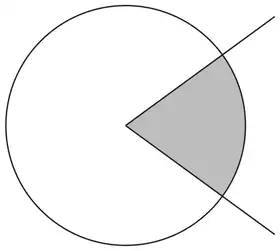
(a) A throwing circle is to be built for the shot put and discus events. There are lines drawn from the centre of the circle. They show the athletes where the boundaries are for their throws. The lines form a sector of the circle. This sector is to be painted, as shown in the diagram.
Diagram not drawn to scale
The radius of the throwing circle is 120 cm.
The area of the sector is \(0{\cdot}08\dot{3}\) of the area of the circle.
(i) Write \(0{\cdot}08\dot{3}\) as a fraction in its simplest form. [3]
(ii) Use your answer to (i) to calculate the area to be painted. Give your answer in terms of π in its simplest form. [2]
(b) A new running track is to be built at the stadium.
Athletes in a 200-metre race run in lanes. The inside line of one of the lanes is shown below.
The inside line consists of:
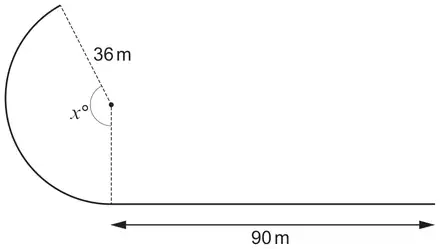
a straight section of length 90 m,
an arc of a circle with radius 36 m.
The length of this inside line is 200 m.
Diagram not drawn to scale
Show that the value of \(x\) is \(\dfrac{550}{\pi}\). [5]
Mark scheme (a)
(i)
Scheme
Marks
Comments
e.g. 100x = 8.333…, 1000x = 83.333… AND an attempt to subtract both sides
M1
= \(\dfrac{75}{900}\) or \(\dfrac{825}{9900}\) or \(\dfrac{8325}{99900}\) or equivalent
A1
Allow A1 for e.g. 7.5/90
= \(\dfrac{1}{12}\)
A1
FT from M1A0 provided of equivalent difficulty
(ii)
Scheme
Marks
Comments
(Area =) \(\dfrac{1}{12}\) × π × 1202 or equivalent
M1
FT ‘their 1/12’ from (i) throughout
= 1200π (cm2)
A1
If no marks awarded, SC1 for (11/12 × π × 1202 or equivalent =) 13200π (cm2)
Mark scheme (b)
Scheme
Marks
Comments
Sight of \(\dfrac{x}{360}\) × 2 × π × 36 or equivalent
B1
e.g. \(\dfrac{x}{5}\) × π. Accept any symbol for x
\(\dfrac{x}{360}\) × 2×π×36 + 90 = 200 or equivalent
M1
\(\dfrac{x}{360}\) × 2×π×36 = 200 ─ 90 or equivalent
m1
These two m1 marks can be done in any order For isolating the x term
For fully simplifying the fraction correctly OR for isolating x
\(x\) = \(\dfrac{550}{\pi}\)
A1
Needs to come from convincing work from M1m1m1 e.g. \(\dfrac{39600}{72\pi}\) or \(\dfrac{110 \times 360}{72\pi}\)
If no marks awarded or B1 only awarded, then SC1 for \(\dfrac{550 \times 2 \times \pi \times 36}{360\pi}\) or equivalent AND possibly another SC1 for convincing work showing that this simplifies to 110, and that 110 + 90 = 200
(ii) Calculate \(\dfrac{\sqrt{6} \times \sqrt{20}}{\sqrt{3}}\). Give your answer in the form \(a\sqrt{b}\), where \(a\) and \(b\) are integers, and \(b\) is as small as possible. [2]
(c) Evaluate \(16^{-\frac{3}{2}}\). [2]
Mark scheme (a)
Scheme
Marks
Comments
\(x = 0{\cdot}37777\)….. \(10x = 3{\cdot}7777\)….. with an attempt to subtract
M1
Or \(10x\) and \(100x\), or equivalent. Or an alternative method.
34/90 or 17/45 or equivalent e.g. 374/990
A1
An answer of 3·4/9 gains M1 only. Mark final answer. Do not ignore incorrect cancelling.
Alternative method
Scheme
Marks
Comments
0·3 + 0·07777….. = 3/10 + 7/90 or equivalent
M1
34/90 or 17/45 or equivalent
A1
Mark final answer. Do not ignore incorrect cancelling.
6. Daniel has made a pizza to share with some friends.
After he has taken his share, he calculates that he has \(0{\cdot}8\dot{3}\) of the pizza left. Daniel shares what he has left equally between 3 of his friends. Calculate the fraction of the whole pizza that each of these 3 friends will have. Give your answer as a fraction in its lowest terms. [4]
Mark scheme
Scheme
Marks
Comments
e.g. 10x = 8·333… and 100x = 83·333… and attempt to subtract
M1
Or equivalent
75/90 or equivalent
A1
e.g. 825/990 or 5/6. Allow e.g. 7∙5/9
(Fraction of pizza each of the 3 friends receive =) 5/18 (ISW)
A2
FT ‘their 75/90’ provided M1 awarded A1 for 75/270 or equivalent, e.g. 275/990, 7∙5/27
Alternative method: M1 for 0·2777… (showing that the 7 repeats; from 0·8333÷3) M1 for e.g. 10x=2·777… and 100x=27·777… and attempt to subtract A2 for 5/18 A1 for e.g. 25/90 or 275/990 or 2∙5/9
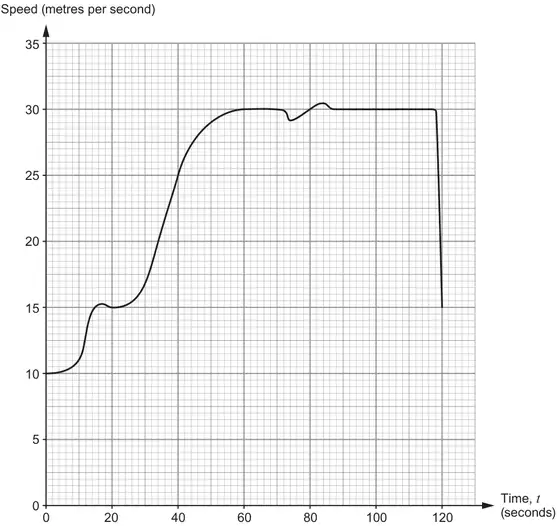
10. The graph below shows a 120-second section of Iestyn’s car journey to work this morning.
(a)
(i) At \(t\) = 50 seconds, estimate the acceleration of Iestyn’s car in m/s2. Leave your answer as a fraction. [3]
(ii) At another time, Iestyn calculated the acceleration of the car to be \(0{\cdot}2\dot{4}\) m/s2. Write this recurring decimal as a fraction. [2]
(b)
(i) Calculate an estimate of the distance travelled by Iestyn’s car in the first 80 seconds of his journey. You must consider the speed of the car when \(t\) = 0, 20, 40, 60 and 80 seconds. [4]
(ii) Hence, calculate an estimate of the average speed of Iestyn’s car for this entire 120-second section of his car journey. Give your answer in m/s. [4]
Mark scheme (a)
Scheme
Marks
Comments
(i) Tangent drawn at t = 50
S1
Idea of increase in speed ÷ increase in time
M1
Ignore signs for M1 only Allow 1 slip in reading the scale for M1 only
Reasonable approximation for the gradient
A1
Only award if S1 awarded Accept a fraction not in its lowest terms Mark final answer
(ii) e.g. 10x = 2·444… and 100x = 24·444… and attempt to subtract
M1
OR x = 0·2444… and 10x = 2·444…
22/90 (ISW)
A1
M1A0 for 2·2/9 100x – x leads to 242/990 (which simplifies to 22/90). ISW
Mark scheme (b)
Scheme
Marks
Comments
(i) Sight of speeds of 10, 15, 25, 30
B1
Split into at least 4 areas and attempt to sum
M1
(Area =) ½×20×(10+30 + 2(15 + 25 + 30))
M1
Or equivalent. (Areas of 250, 400, 550, 600) (If 8 areas used, areas of 110, 135, ≈160, ≈210, 270, 295, 300, 300) Allow 1 slip in reading the scale
= 1800 (m)
A1
CAO. A1 for an answer of ≈1780 (m) if 8 areas used. CAO.
(ii) (Total distance =) 1800 + 30 × (38 to 40 inclusive)
We'd like to use Google Analytics cookies to count visits and see which pages help most. They're optional, and the site works exactly the same either way. Privacy policy