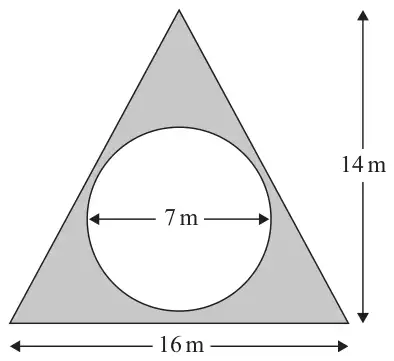
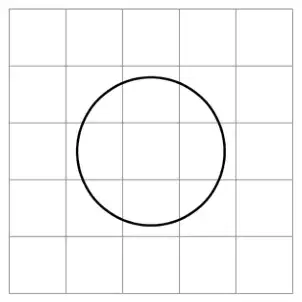
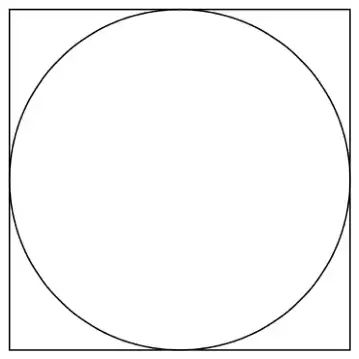
There is a circle inside a triangle. The circle has a diameter of 7 m.
Macsen will cover the shaded area with gravel.
Gravel is sold in bags. Each bag of gravel covers an area of 12.5 m2
(a) Work out the number of bags of gravel Macsen will need. (4)
Macsen finds that each bag of gravel only covers an area of 11 m2
(b) How does this affect your answer to part (a)? (1)
Mark scheme (a)
Answer
Mark
Mark scheme
6
P1
for process to find a relevant area, eg \(16 \times 14 \div 2\ (= 112)\) or \(\pi \times \left(\dfrac{7}{2}\right)^2\ (= 38.4\ldots)\)
P1
for process to find the shaded area, eg \(\text{``}112\text{''} - \text{``}38.4\ldots\text{''}\ (= 73.51\ldots)\) or \(\text{``}8.96\text{''} - \text{``}3.07\ldots\text{''}\ (= 5.88\ldots)\)
P1
for a process to find the number of bags required for a full or partial area, eg \(\text{``}73.51\ldots\text{''} \div 12.5\ (= 5.88\ldots)\) or \(\text{``}112\text{''} \div 12.5\ (= 8.96)\) or \(\text{``}38.4\ldots\text{''} \div 12.5\ (= 3.07\ldots)\) or [area] \(\div\, 12.5\) or uses 12.5 in a build up method to exceed [area], eg \(12.5 \times 6\ (= 75)\) oe
A1
cao
Additional guidance
May be implied by \(\dfrac{49}{4}\pi\)
[area] can be any area but cannot be a length
Mark scheme (b)
Answer
Mark
Mark scheme
Statement
C1
for a valid statement relating to effect on number of bags needed, eg Acceptable examples Will need more bags It will increase Will need an extra bag or will now need 7 bags He won’t have enough There is no change (ft their [area] but must be supported by calculation)
Not acceptable examples Will cover less area Needs to change the number of bags needed There is no change (unsupported or incorrect ft their [area]) He may need more bags Calculation using 11 with no supporting statement
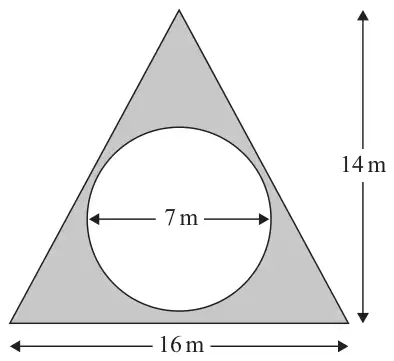
There is a circle inside a triangle. The circle has a diameter of 7 m.
Macsen will cover the shaded area with gravel.
Gravel is sold in bags. Each bag of gravel covers an area of 12.5 m2
(a) Work out the number of bags of gravel Macsen will need. (4)
Macsen finds that each bag of gravel only covers an area of 11 m2
(b) How does this affect your answer to part (a)? (1)
Mark scheme (a)
Answer
Mark
Mark scheme
6
P1
for a process to find a relevant area, eg \(16 \times 14 \div 2\ (= 112)\) or \(\pi \times \left(\dfrac{7}{2}\right)^2\ (= 38.4\ldots)\)
P1
for a process to find the shaded area, eg \(\text{``}112\text{''} - \text{``}38.4\ldots\text{''}\ (= 73.51\ldots)\) or \(\text{``}8.96\text{''} - \text{``}3.07\ldots\text{''}\ (= 5.88\ldots)\)
P1
for a complete process to find the number of bags required for a full or partial area, eg \(\text{``}73.51\ldots\text{''} \div 12.5\ (= 5.88\ldots)\) or \(\text{``}112\text{''} \div 12.5\ (= 8.96)\) or \(\text{``}38.4\ldots\text{''} \div 12.5\ (= 3.07\ldots)\) or [area] \(\div\, 12.5\) or uses 12.5 in a build up method to exceed [area], eg \(12.5 \times 6\ (= 75)\) oe
A1
cao
Additional guidance
May be implied by \(\dfrac{49}{4}\pi\)
[area] can be any area but cannot be a length.
Mark scheme (b)
Answer
Mark
Mark scheme
Statement
C1
for a valid statement relating to effect on number of bags needed, eg Acceptable examples Will need more bags It will increase Will need an extra bag or will now need 7 bags He won’t have enough There is no change (ft their [area] but must be supported by calculation)
Not acceptable examples Will cover less area Needs to change the number of bags needed There is no change (unsupported or incorrect ft their [area]) He may need more bags A calculation using 11 with no supporting statement
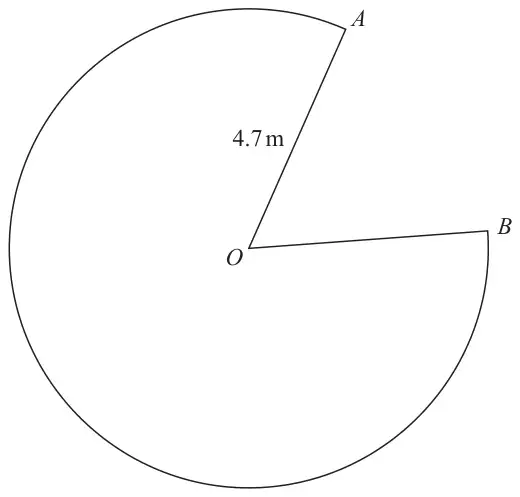
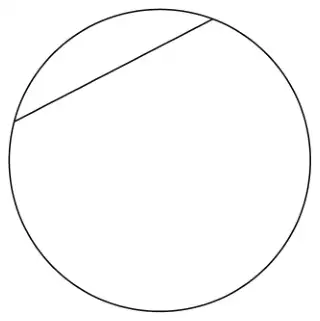
11 \(OAB\) is a sector of a circle with centre \(O\) and radius 4.7 m.
The sector has a perimeter of 34.3 m.
Find the size of the reflex angle \(AOB\). Give your answer correct to the nearest degree. (3)
Mark scheme
Answer
Mark
Mark scheme
304
P1
for start of process to find the arc length eg \(34.3 - 2 \times 4.7\ (= 24.9)\) or for forming a suitable equation eg \(\dfrac{\angle AOB}{360} \times \pi \times 2 \times 4.7 + 2 \times 4.7 = 34.3\)
P1
for process to isolate the arc length in an equation eg \(\dfrac{\angle AOB}{360} \times \pi \times 2 \times 4.7 = \text{``}24.9\text{''}\) or for complete process to find \(AOB\) eg \(\angle AOB = \dfrac{\text{``}24.9\text{''} \times 360}{\pi \times 2 \times 4.7}\)
A1
answer in the range 303 to 304
Additional guidance
Condone omission of the addition of 2 radii in the equation for this mark only eg \(\dfrac{\angle AOB}{360} \times \pi \times 2 \times 4.7 = 34.3\)
If an answer is given in the range in working and then rounded incorrectly award full marks
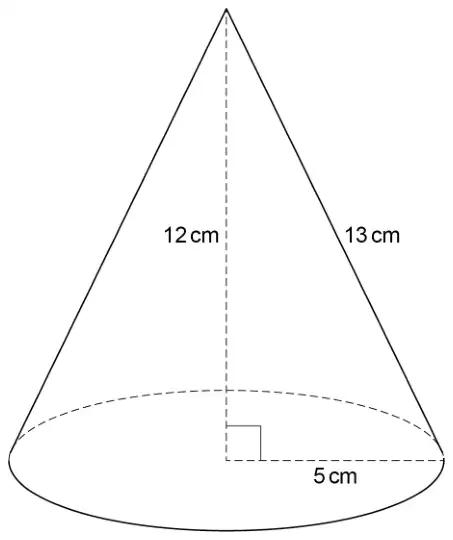
Curved surface area of a cone \(= \pi r l\) where \(r\) is the radius and \(l\) is the slant height
Beth tries to work out the curved surface area in terms of \(\pi\)
Curved surface area of the cone \(= \pi \times 5 \times 12\) \(= 60\pi\) cm\(^2\)
What mistake has she made? [1 mark]
(b) Adam uses \(\pi = 3\) to estimate the area of the base of the cone.
Work out his estimate. [2 marks]
(c) Beth uses \(\pi = 3.14\) to estimate the area of the base of the cone.
Is Beth’s estimate more than or less than Adam’s estimate?
Tick a box.
More than
Less than
Give a reason for your answer. [1 mark]
Mark scheme (a)
Answer
Mark
Comments
Correct statement
B1
eg she used the height instead of the slant height or she used the vertical height or she used 12 (instead of 13)
Additional guidance
Check diagram
For ‘vertical’ accept anything that implies she has used the wrong height
Condone ‘length’ to mean ‘height’ or ‘slant height’
12 or 13 circled on the diagram must be accompanied by a supporting statement
Indicates ‘12’ in the calculation
B1
She should have done \(\pi \times 5 \times 13\)
B1
It should be \(65\pi\)
B1
She used the wrong height / the (value of) \(l\) is wrong
B1
She hasn’t used the slant height (she used the (vertical) height)
B1
She hasn’t used the 13
B1
She hasn’t used the 13 and should be \(5 \times 12 \times 13 \times \pi\)
B0
The multiplication used the wrong number(s)
B0
She hasn’t used a value for \(\pi\)
B0
An incorrect statement with a correct statement eg she used 13 instead of 12 and didn’t square the radius
B0
Mark scheme (b)
Answer
Mark
Comments
\(\pi \times 5 \times 5\) or \(25\pi\) or \(3 \times 5 \times 5\)
M1
oe accept [3.14, 3.142] or \(\dfrac{22}{7}\) for \(\pi\)
75
A1
Additional guidance
\(\pi 25\)
M1
Mark scheme (c)
Answer
Mark
Comments
‘More than’ indicated or implied by statement and valid reason
B1
eg valid reasons 3.14 is greater (than 3) Beth’s number is bigger (than Adam’s) (the correct answer is) 78.5 (with their answer to (b) less than 78.5)
Additional guidance
If calculations are used, the outcomes must be correct
Accept 78 or 79 for 78.5 unless from incorrect working
‘Less than’ indicated
B0
Do not penalise use of the same incorrect formula in (b) and (c) eg \(3 \times 10 = 30\) in (b) and \(3.14 \times 10 = 31.4\) in (c) with ‘More than’ ticked
B1
Ignore a non-contradictory reason with a correct reason eg 3.14 is bigger than 3 and nearer the true value of pi
B1
Acceptable reasons
Adam has rounded (pi) down / Adam only used 3
B1
There is an extra 0.14 to multiply by
B1
Her number has decimal places
B1
Her number is to more significant figures
B1
Non-acceptable reasons
3.14 will give a bigger answer / 3.14 is more accurate
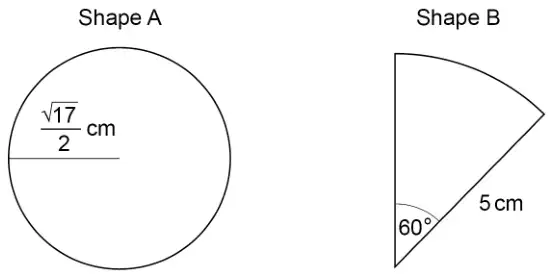
\(\dfrac{17}{4}(\pi)\) or \(4\dfrac{1}{4}(\pi)\) or \(4.25(\pi)\)
A1
oe fraction, mixed number or decimal
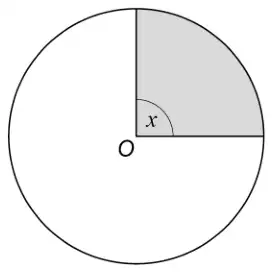
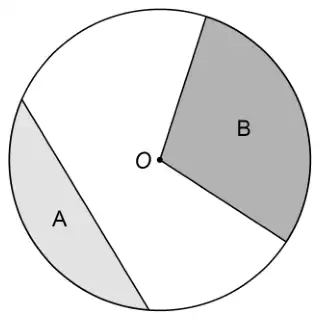
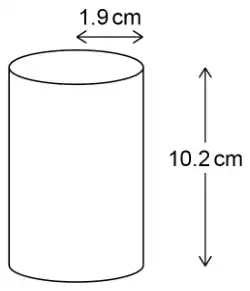
\((\pi \times) 5^2\) or \((\pi \times) 25\) or \(\dfrac{60}{360}\) used
M1
oe
\(\dfrac{25}{6}(\pi)\) or \(4\dfrac{1}{6}(\pi)\) or \(4.1(6\ldots)(\pi)\) or \(4.17(\pi)\)
A1
oe fraction, mixed number or decimal
A with values in comparable form or A by \(\dfrac{1}{12}(\pi)\) or A by \(0.08(3\ldots)(\pi)\)
A1
eg values \(\dfrac{51}{12}(\pi)\) and \(\dfrac{50}{12}(\pi)\) \(4\dfrac{1}{4}(\pi)\) and \(4\dfrac{1}{6}(\pi)\) \(4.2(5)(\pi)\) and \(4.1(6\ldots)(\pi)\) \(4.2(5)(\pi)\) and \(4.17(\pi)\) accept ‘circle’ for A allow comparison of fraction or decimal parts only if integer parts shown as equal
Additional guidance
For the final mark, presence or absence of \(\pi\) must be the same for both values
Accept consistent use of a numerical value of \(\pi\) throughout. The value can be 3 or 3.1 or 3.14 or 3.142 or better
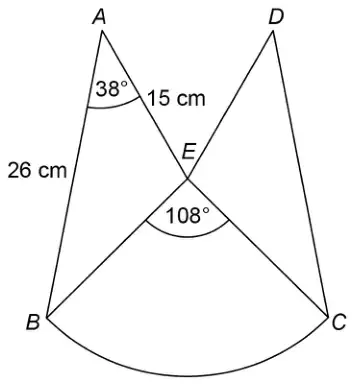
If (sector) 270 and (2 triangles) 240 followed by \(270 + 240 = 510\)
M4A1
Working back from 510. Apply scheme but maximum mark is M4A0
Assuming angle AEB = 72 and then using sine rule to work out BE does lead to area = 510 to 2sf but can score a maximum of M0M1M0M1depA0 \(BE = \dfrac{26}{\sin 72} \times \sin 38 = 16.8\) (or 17) \(\dfrac{108}{360} \times \pi \times 16.8^2 = 266 \qquad 2 \times \dfrac{1}{2} \times 15 \times 26 \times \sin 38 = 240.2\) \(506.2 \to 510\)
M0 M1M0depM1 A0
BE = [16.9, 17] seen with no working scores first M1 (and possibly all other marks)
\(BE = 35 \div 2 = 17.5 \to 17\) does not score first M1