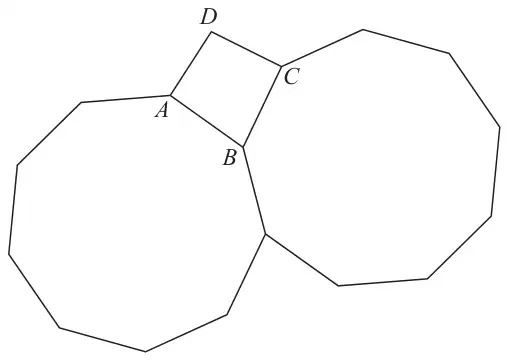
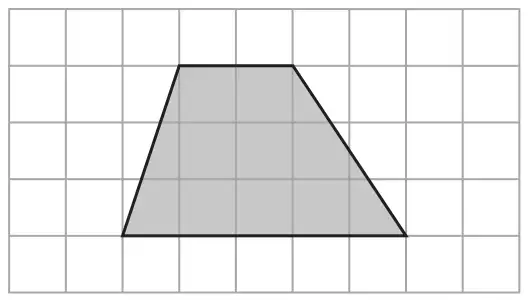
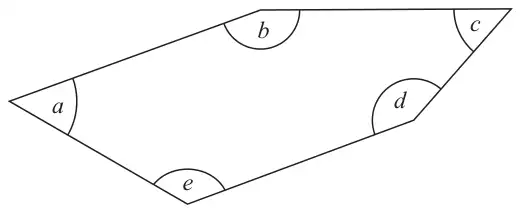
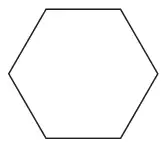
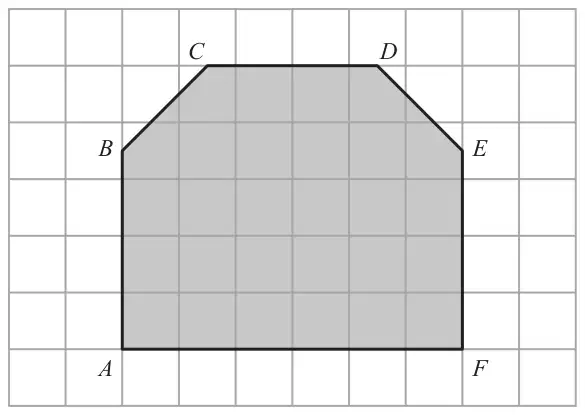
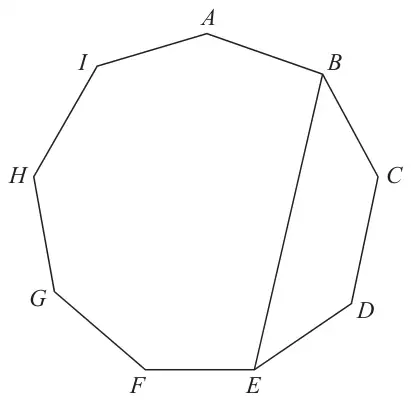
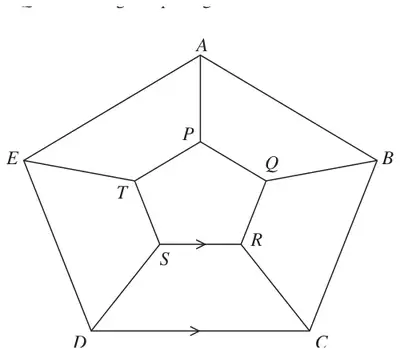
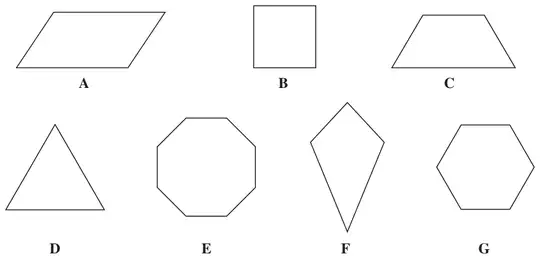
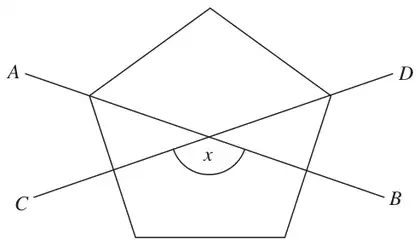
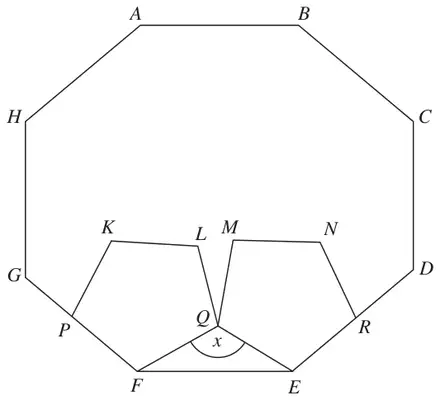
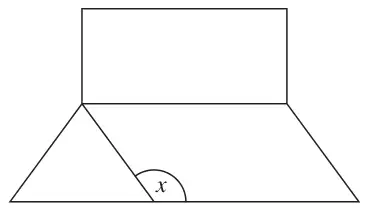
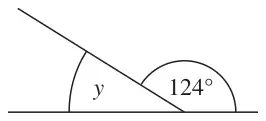
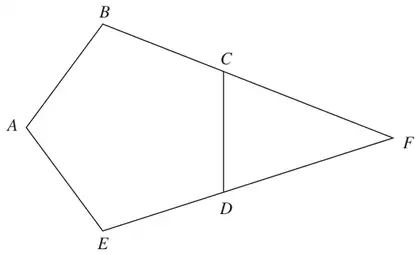
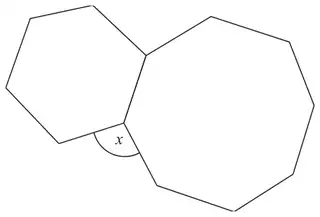
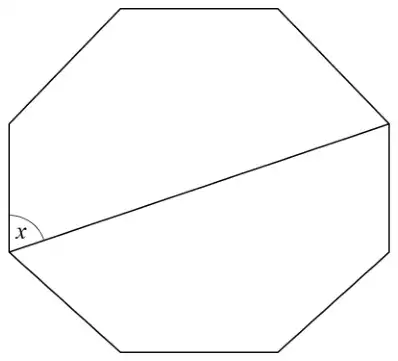
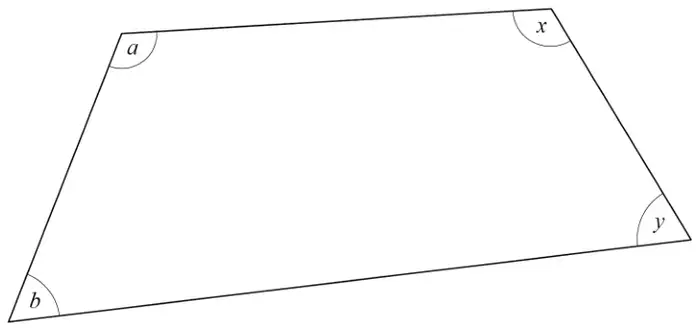
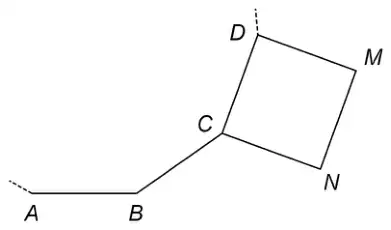
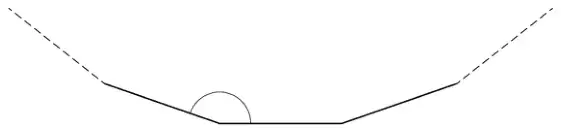
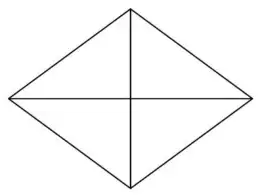
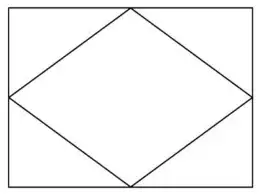
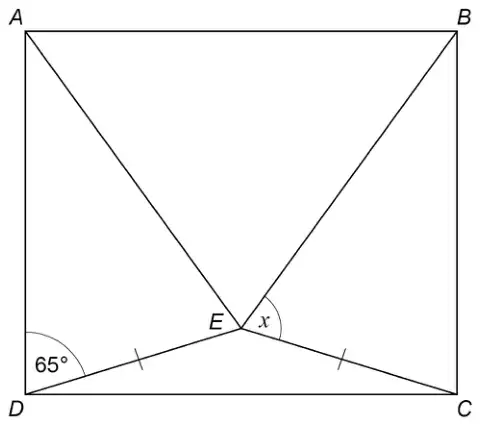
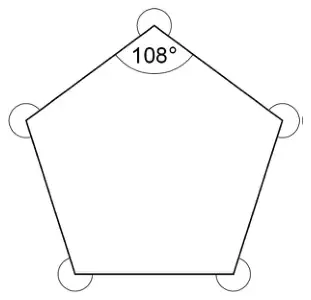
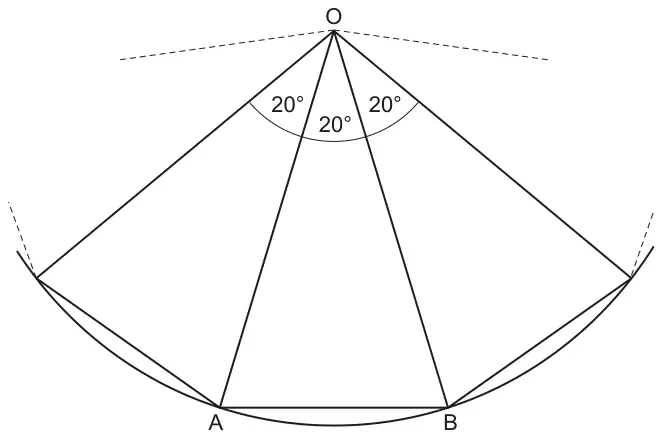
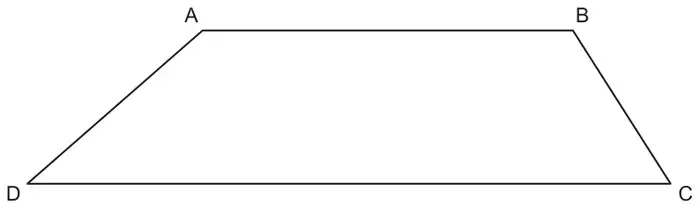
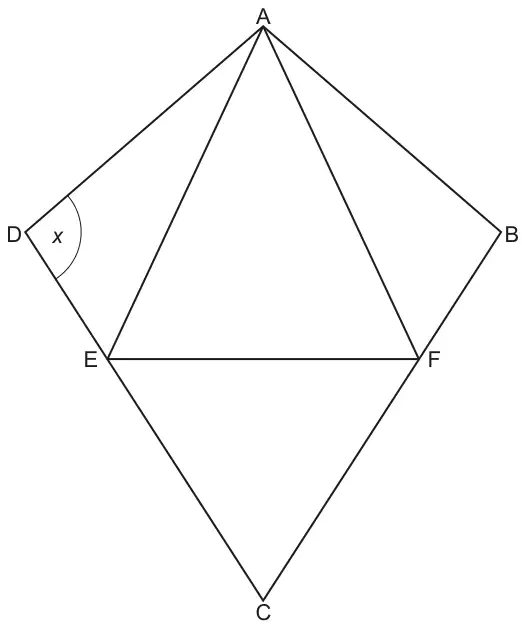
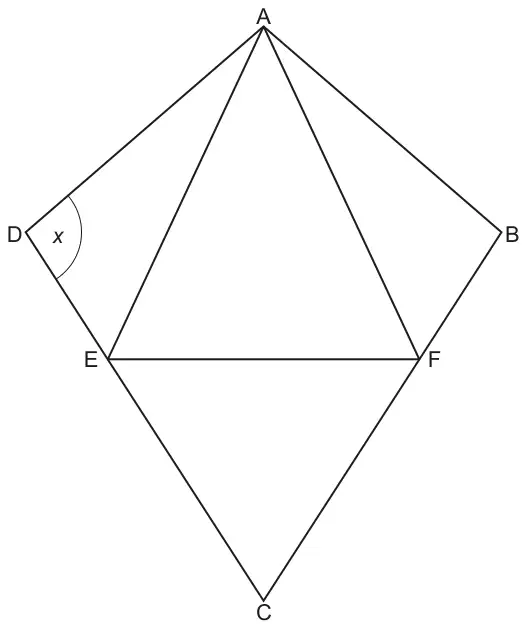
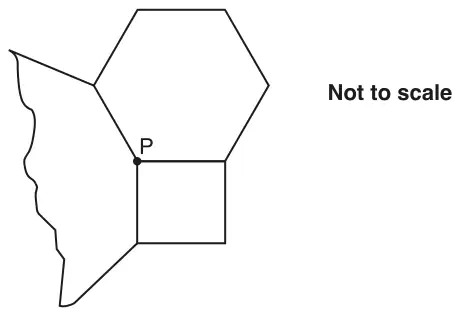
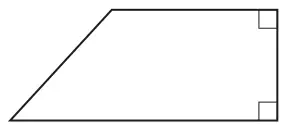
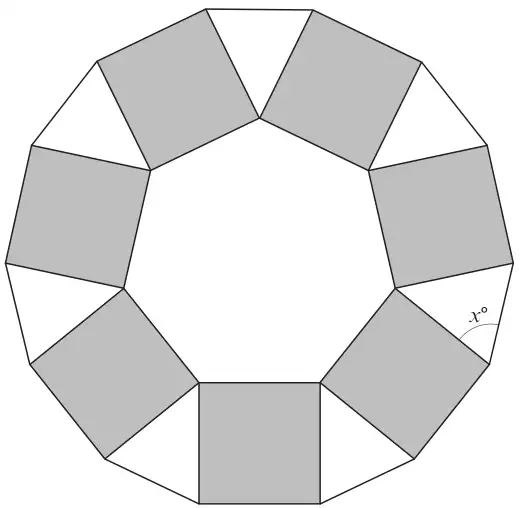
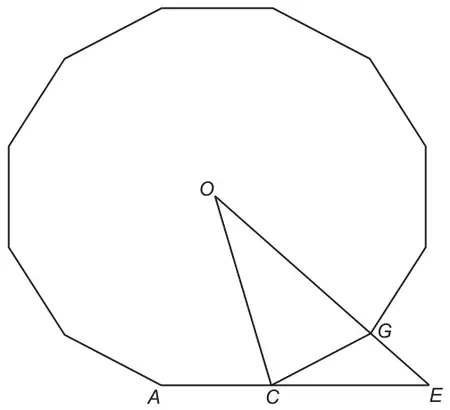
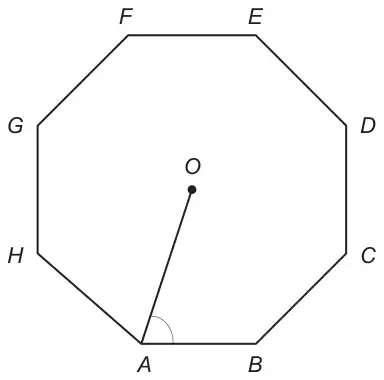
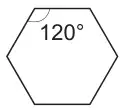
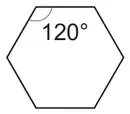
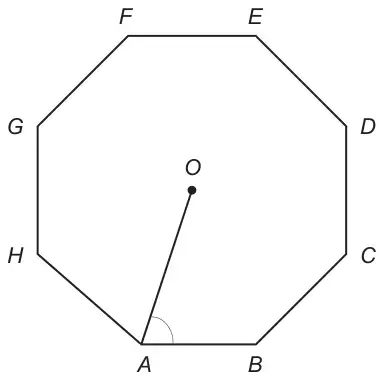
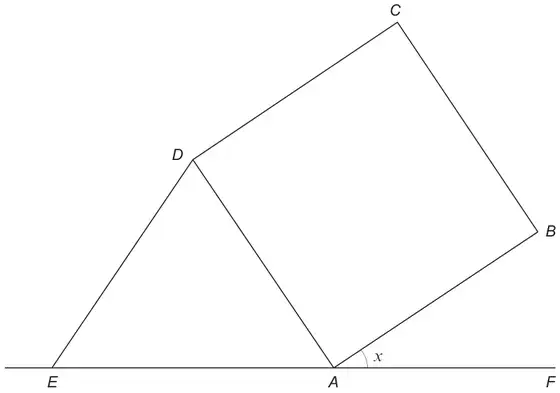
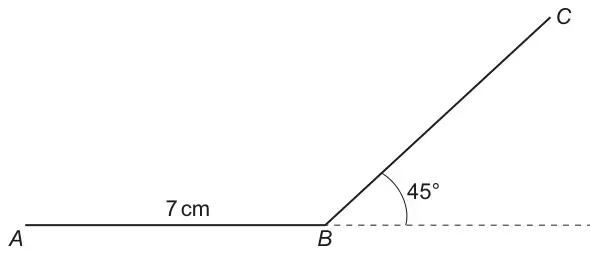
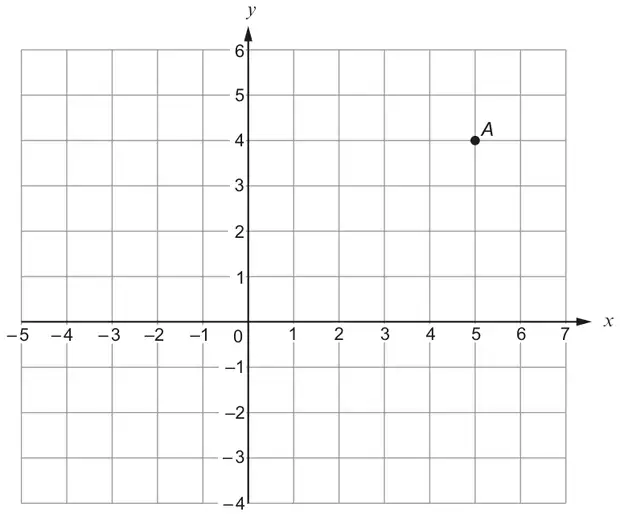
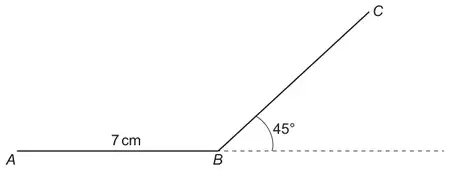
9 The diagram shows two congruent regular 9-sided polygons. \(ABCD\) is a quadrilateral.
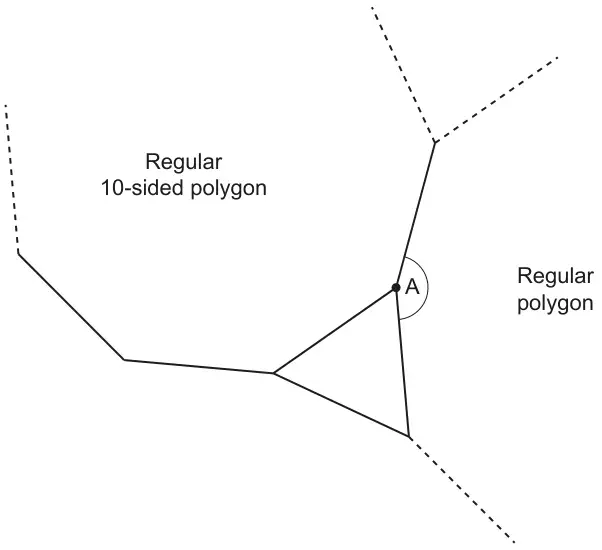
Show that \(ABCD\) is not a square. (3)
Mark scheme
Answer
Mark
Mark scheme
shown
M1
for method to find the interior angle eg \((9 - 2) \times 180 \div 9\ (= 140)\) or exterior angle eg \(360 \div 9\ (= 40)\) of a regular nonagon
M1
for a complete method to find the interior angle \(ABC\), eg \(360 - \text{``}140\text{''} - \text{``}140\text{''}\ (= 80)\) or \(\text{``}40\text{''} \times 2\ (= 80)\) or finds the angle sum assuming a square, eg \(90 + \text{``}140\text{''} + \text{``}140\text{''}\ (= 370)\)
A1
for complete solution with correct conclusion, eg interior angle of a square is 90, not 80 or angles around a point sum to 360 not 370
Additional guidance
Angles may be shown on the diagram Any angle labelled correctly as 140 or 40 and not contradicted scores this mark
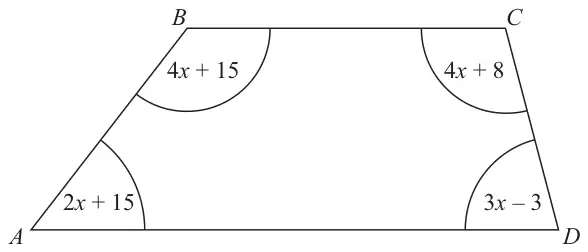
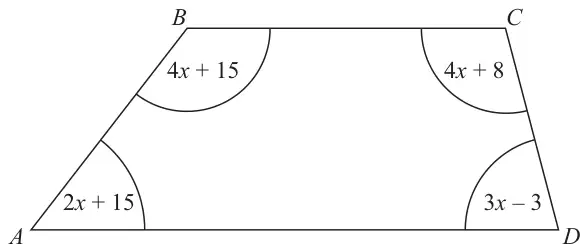
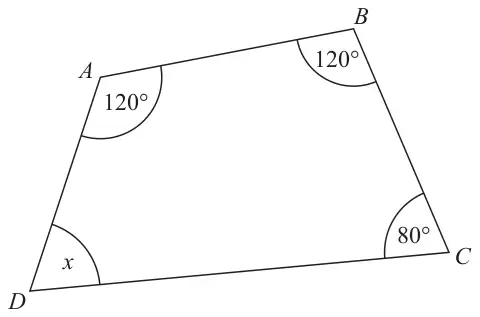
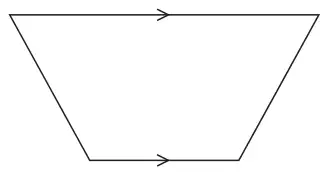
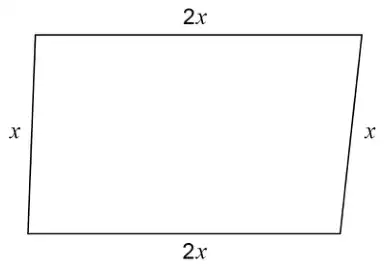
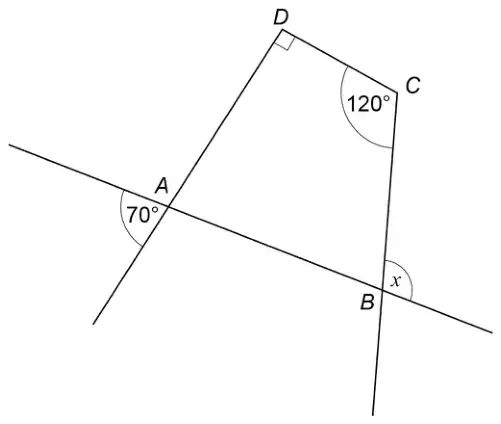
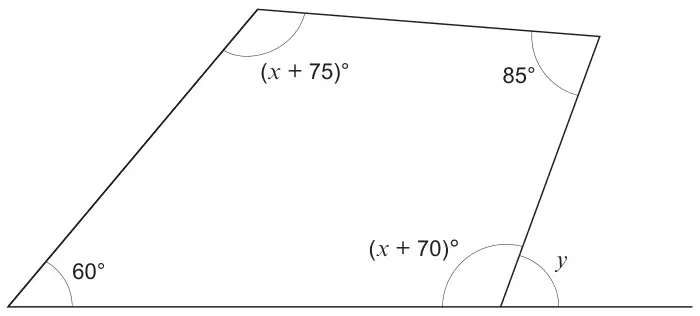
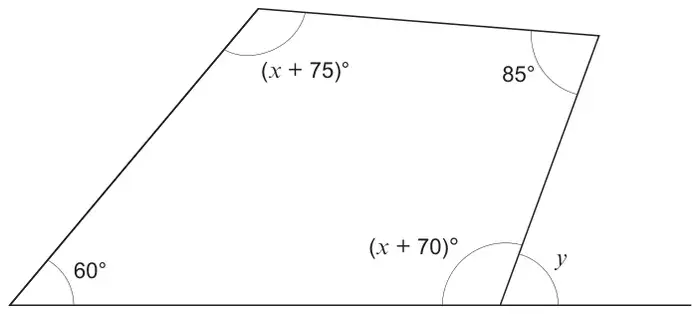
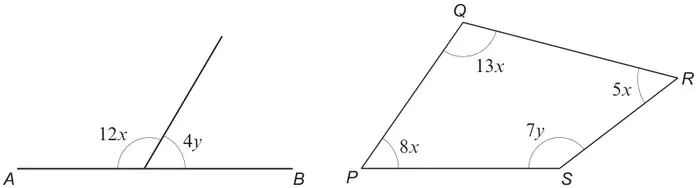
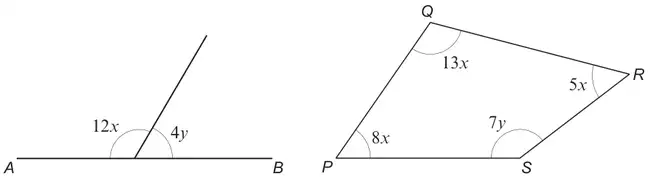
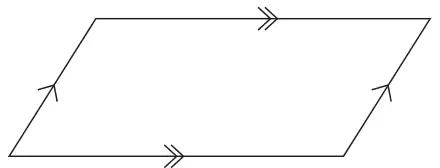
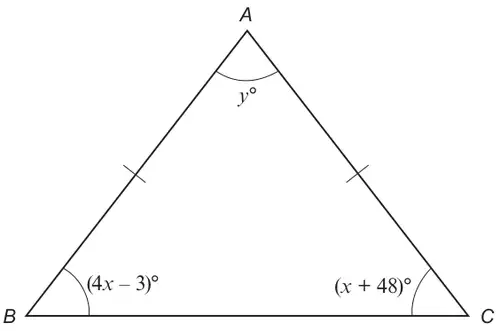
for deriving a suitable equation, eg \(4x + 15 + 2x + 15 + 4x + 8 + 3x - 3 = 360\) or \(13x + 35 = 360\) or \(4x + 15 + 2x + 15 = 180\) or \(6x + 30 = 180\) or \(4x + 8 + 3x - 3 = 180\) or \(7x + 5 = 180\)
M1
(dep) for a method to isolate terms in \(x\), eg \(4x + 2x + 4x + 3x = 360 - 15 - 15 - 8 + 3\) or \(4x + 2x = 180 - 15 - 15\) or \(4x + 3x = 180 - 8 + 3\)
A1
for solving equation to \(x = 25\)
C1
for substituting \(x = 25\) into \(A + B\) or \(C + D\) and showing \(= 180\), and gives a suitable statement, eg co-interior/allied angles (sum to 180), or since \(A + B = 180\) the lines are parallel
Additional guidance
May be seen in an equation
If starting with an equation = 180 need to substitute into the opposite pair.
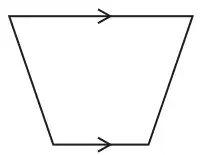
Alternative solution assuming it is a trapezium
Answer
Mark
Mark scheme
Shown
M1
for deriving a suitable equation, eg \(4x + 15 + 2x + 15 = 4x + 8 + 3x - 3\) or \(6x + 30 = 7x + 5\)
M1
(dep) for a method to isolate terms in \(x\), eg \(15 + 15 - 8 + 3 = 4x + 3x - 4x - 2x\)
A1
for solving equation to \(x = 25\)
C1
for a fully correct statement, eg since \(A + B = 180\) the lines are parallel
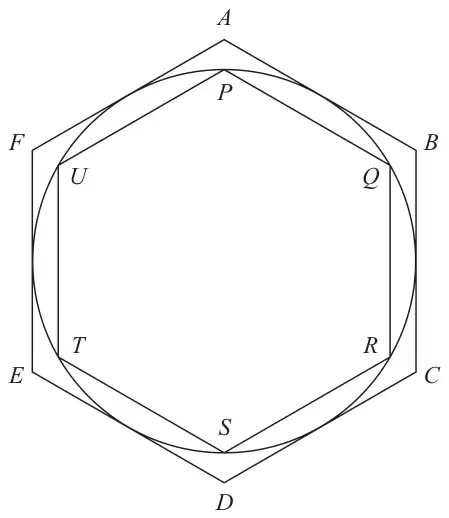
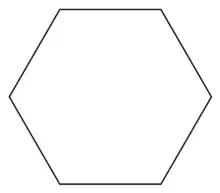
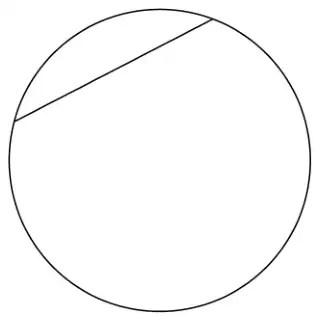
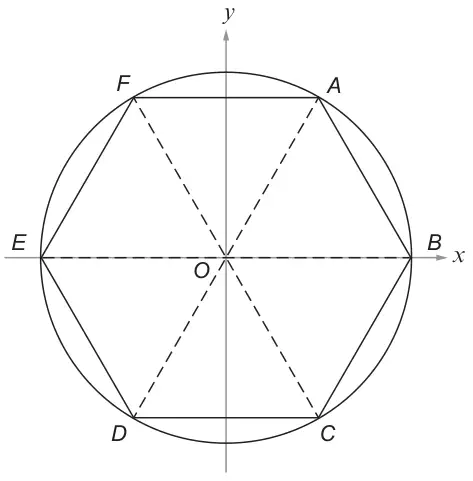
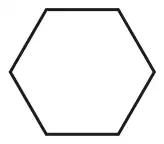
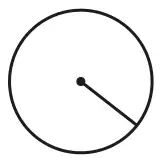
21 The diagram shows a circle, radius \(r\) cm and two regular hexagons.
Each side of the larger hexagon \(ABCDEF\) is a tangent to the circle. Each side of the smaller hexagon \(PQRSTU\) is a chord of the circle.
By considering perimeters, show that
\[3 \lt \pi \lt 2\sqrt{3}\]
(4)
Mark scheme
Answer
Mark
Mark scheme
Result shown
P1
for process to find the length of half a side or a side or the perimeter of the smaller hexagon \(PQRSTU\), eg \(r\sin 30\ \left(= \dfrac{r}{2}\right)\) oe or \(2r\sin 30\ (= r)\) oe or \(6 \times 2r\sin 30\ (= 6r)\) oe
P1
for process to find the length of half a side or a side or the perimeter of the larger hexagon \(ABCDEF\) eg Length of half side \(= r\tan 30\) or \(\dfrac{r}{\tan 60}\ \left(= \dfrac{\sqrt{3}r}{3}\right)\) oe or Length of side \(= 2r\tan 30\) or \(\dfrac{2r}{\tan 60}\) or \(\dfrac{r}{\sin 60}\) or \(\dfrac{r}{\cos 30}\ \left(= \dfrac{2\sqrt{3}r}{3}\right)\) oe or Length of perimeter \(= 6 \times 2r\tan 30\) or \(6 \times \dfrac{2r}{\tan 60}\) oe
P1
(dep P2) for process of forming a correct inequality, eg using half lengths eg \(\dfrac{r}{2} \lt \dfrac{2\pi r}{12} \lt r\tan 30\) oe or using lengths eg \(r \lt \dfrac{2\pi r}{6} \lt 2r\tan 30\) oe or using perimeters eg \(6 \times r \lt 2\pi r \lt 6 \times 2r\tan 30\) oe
C1
(dep P2) correct algebra leading to given result, \(3 \lt \pi \lt 2\sqrt{3}\)
Additional guidance
May use Sine Rule or cos60 instead of sin30
May use Sine Rule Note this mark is not for just the sight of \(\dfrac{\sqrt{3}r}{3}\) or \(\dfrac{2\sqrt{3}r}{3}\) or \(\dfrac{12\sqrt{3}r}{3}\) oe, they need to be associated with the correct length Perimeter \(= 4\sqrt{3}r\) alone does not get this mark
(dep) for a method to isolate terms in \(x\), eg \(4x + 2x + 4x + 3x = 360 - 15 - 15 - 8 + 3\) or \(4x + 2x = 180 - 15 - 15\) or \(4x + 3x = 180 - 8 + 3\)
A1
for solving equation to \(x = 25\)
C1
for substituting \(x = 25\) into \(A + B\) or \(C + D\) and showing = 180, and gives a suitable statement, eg co-interior/allied angles (sum to 180), or since \(A + B = 180\) the lines are parallel
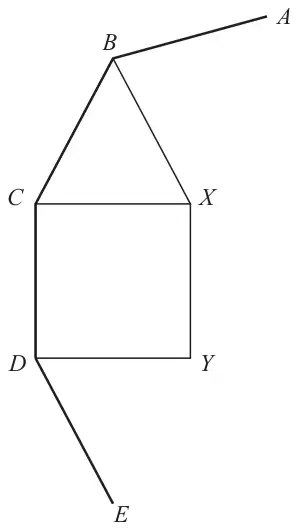
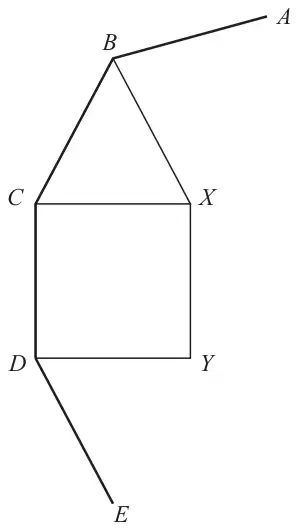
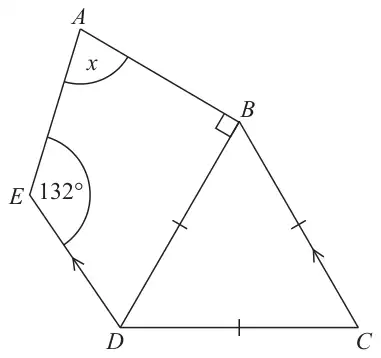
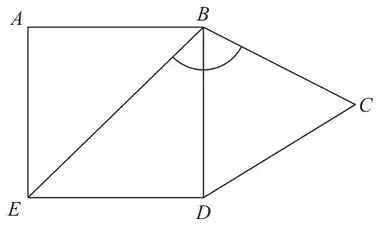
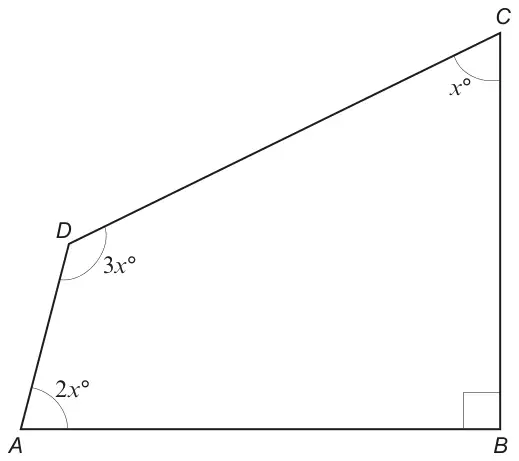
19 The diagram shows a quadrilateral \(ABDE\) and an equilateral triangle \(BCD\).
\(CB\) is parallel to \(DE\).
Angle \(AED\) = 132°
Work out the size of the angle marked \(x\). You must give a reason for each stage of your working. (4)
Mark scheme
Answer
Mark
Mark scheme
78
M1
for finding one angle within the triangle is \(180 \div 3\ (= 60)\)
M1
for method to use parallel lines, eg \(BDE = DBC\) or \(BCD + CDE = 180\)
C2
(dep M2) for (\(x =\)) 78 with a correct reason relating to parallel lines and one other correct reason given, with no unused reasons.
(C1
(dep M1) for one correct reason given for their chosen method,
angles in an equilateral triangle are equal alternate angles are equal angles in a quadrilateral add up to 360 angles in a triangle add up to 180 Allied angles / Co-interior angles add up to 180
Additional guidance
Angles must be clearly labelled on the diagram or otherwise identified. Correct method can be implied from angles on the diagram if no ambiguity or contradiction. If \(x\) is clearly identified as 78 award M2 (implied)
Underlined words need to be shown; reasons need to be linked to their method, which can be implied from correctly identified angles (stated or written on the diagram).
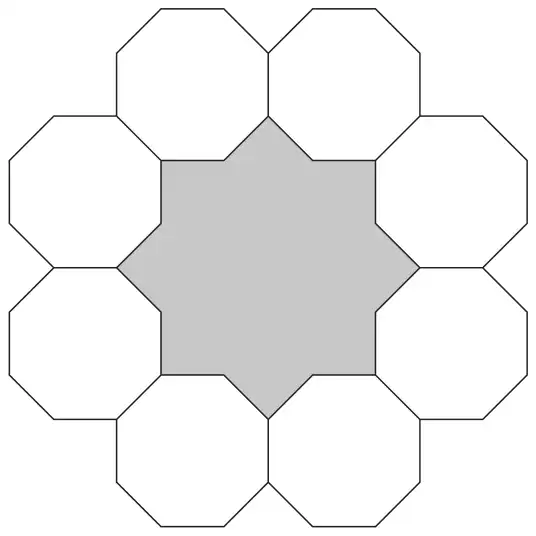
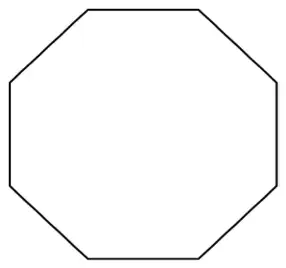
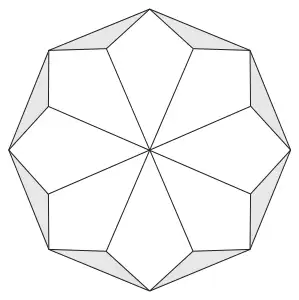
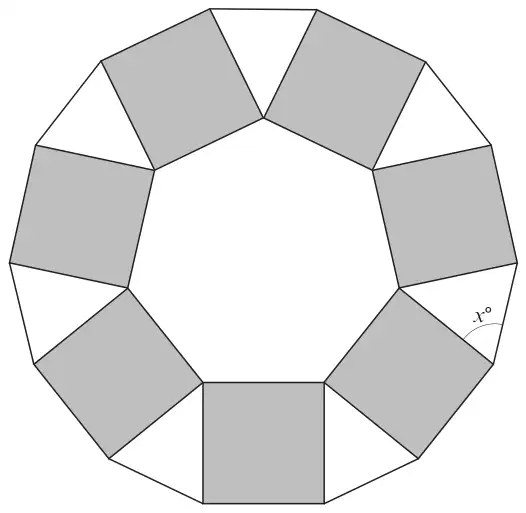
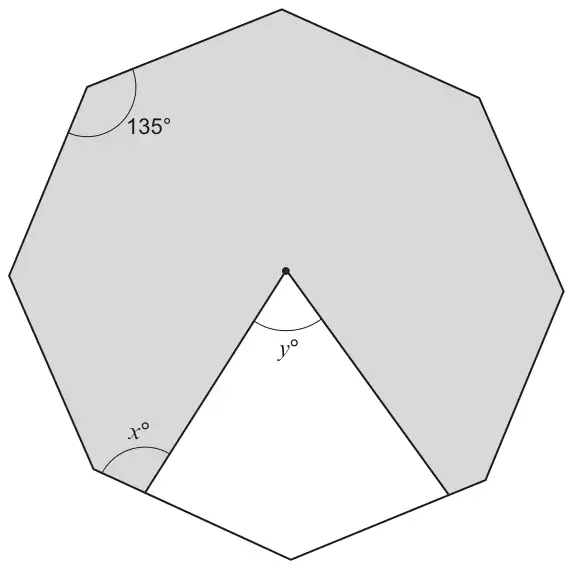
24 The diagram shows 8 identical regular octagons joined to enclose a shaded shape.
Each octagon has sides of length \(a\).
Find, in terms of \(a\), an expression for the area of the shaded shape. Give your answer in the form \(p\left(2 + \sqrt{2}\right)a^2\) where \(p\) is an integer. You must show all your working. (5)
Mark scheme
Answer
Mark
Mark scheme
\(4\left(2 + \sqrt{2}\right)a^2\)
P1
for process to find area required and identifying \(135^\circ\) or \(45^\circ\) or \(90^\circ\) angle(s), eg splitting shape into square and 4 triangles and an angle relevant to the triangle clearly identified.
P1
for process to find the area of a relevant triangle using \(45^\circ\), eg \(\dfrac{1}{2} \times a \times \left(2 \times \dfrac{a}{\sqrt{2}}\right) \times \dfrac{1}{\sqrt{2}}\ \left(= \dfrac{a^2}{2}\right)\) or using \(90^\circ\), eg \(\dfrac{1}{2} \times a \times a\ \left(= \dfrac{a^2}{2}\right)\) or process to find the area of a square made from 2 small triangles, eg \(a \times a\ (= a^2)\)
P1
for process to find the length of the square, eg \(a + a + \sqrt{a^2 + a^2}\ \left(= 2a + a\sqrt{2}\right)\)
P1
for process to find the total area, eg \(\left(\text{``}2a + a\sqrt{2}\text{''}\right)^2 + 4 \times \text{``}\dfrac{a^2}{2}\text{''}\)
A1
(dep on P3) for \(4\left(2 + \sqrt{2}\right)a^2\)
Additional guidance
\(90^\circ\) must be in a triangle to gain credit. May be seen on diagram.
Accept \(0.49\ldots a^2\)
May be seen as the area of 2 squares (from 4 small triangles)
Accept \(3.41a\)
Accept \((11.655 + 4 \times 0.49)a^2\)
Answer only award no marks. If working in decimals accept \(\dfrac{13.656}{2 + \sqrt{2}}\) leading to 4 Accept \(p = 4\) if supported by correct working
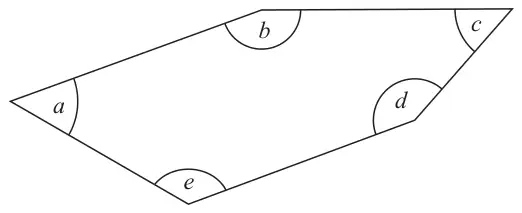
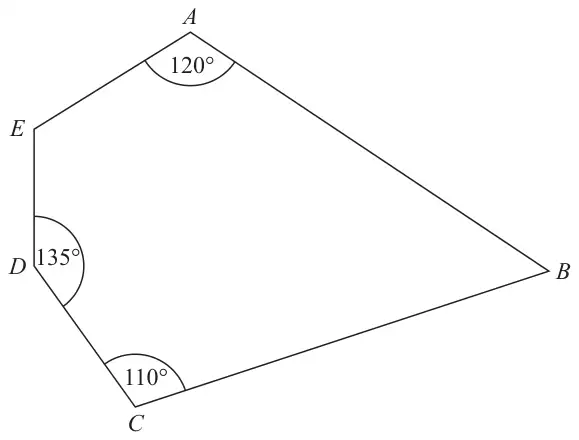
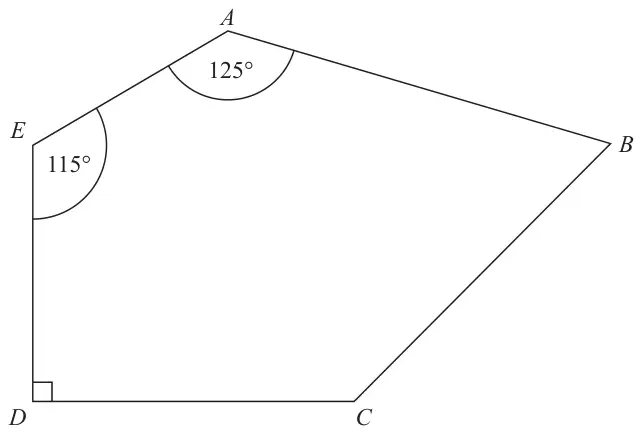
Work out the size of angle \(AED\). You must show all your working. (4)
Mark scheme
Answer
Mark
Mark scheme
140
P1
for process to find sum of the interior angles of a pentagon eg \(180 \times (5 - 2)\ (= 540)\) oe
P1
(dep P1) for process to use ratio 4 : 1, eg labels as \(4x\) and \(x\) or as \(x\) and \(\dfrac{1}{4}x\) or \(110 + 135 + 120 + 4x + x = \text{``}540\text{''}\)
or for \(\text{``}540\text{''} - 110 - 135 - 120\ (= 175)\)
P1
for process to find angle \(ABC\) or angle \(AED\)
Angles must be clearly labelled on the diagram or otherwise identified. Correct method can be implied from angles on the diagram if no ambiguity or contradiction.
Ratio must be used correctly if awarded for diagram
A correct answer with no supportive working gets 0 marks
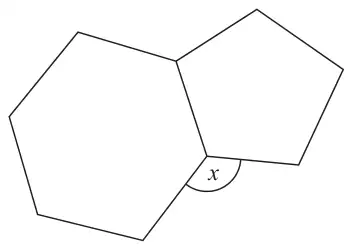
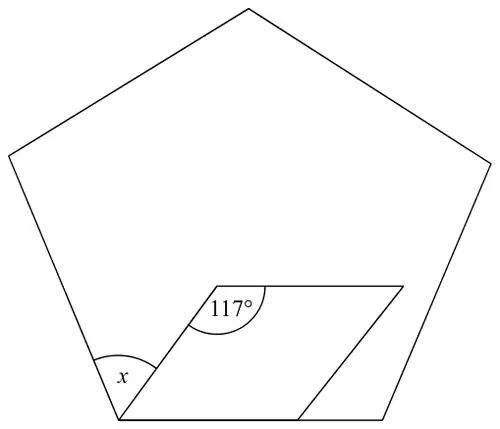
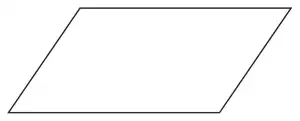
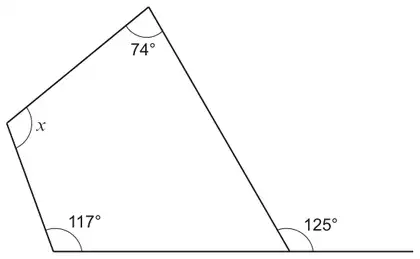
29 The diagram shows a regular pentagon and a parallelogram.
Work out the size of the angle marked \(x\). You must show all your working. (4)
Mark scheme
Answer
Mark
Mark scheme
45
P1
for \(180 - 117\ (=63)\) or states, or uses, exterior angle \(+\ x = 117\)
P1
for process to find the exterior or the interior angle of the pentagon, eg \(360 \div 5\ (=72)\) or \(180 - (360 \div 5)\ (=108)\) or \(((5-2) \times 180) \div 5\ (=108)\)
P1
for a complete process to find \(x\), eg \(180 - \text{``}72\text{''} - \text{``}63\text{''}\) or \(\text{``}108\text{''} - \text{``}63\text{''}\) or \(117 - \text{``}72\text{''}\)
A1
cao
Additional guidance
For the first P1: Angles may be shown on the diagram. Any angle labelled correctly as 63 and not contradicted scores this mark
For the second P1: Exterior = 108 or interior = 72 does not score the mark
An answer of 45 with no supporting working scores 0
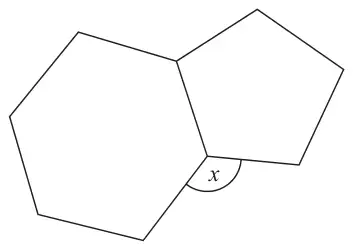
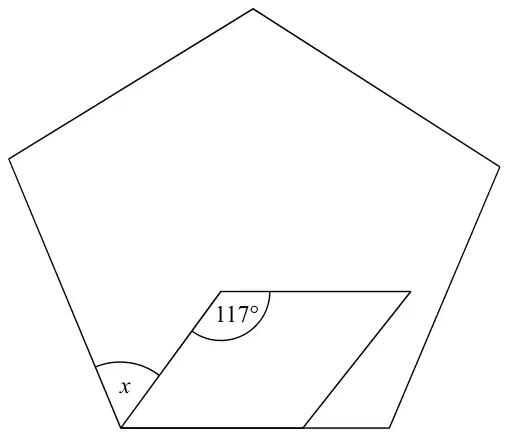
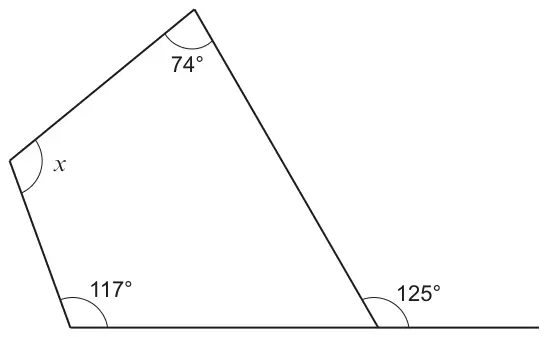
8 The diagram shows a regular pentagon and a parallelogram.
Work out the size of the angle marked \(x\). You must show all your working. (4)
Mark scheme
Answer
Mark
Mark scheme
45
P1
for \(180 - 117\ (= 63)\) or states, or uses, exterior angle + \(x = 117\)
P1
for process to find the exterior or the interior angle of the pentagon, eg \(360 \div 5\ (= 72)\) or \(180 - (360 \div 5)\ (= 108)\) or \(((5 - 2) \times 180) \div 5\ (= 108)\)
P1
for a complete process to find \(x\), eg \(180 - \text{``}72\text{''} - \text{``}63\text{''}\) or \(\text{``}108\text{''} - \text{``}63\text{''}\) or \(117 - \text{``}72\text{''}\)
A1
cao
Additional guidance
Angles may be shown on the diagram. Any angle labelled correctly as 63 and not contradicted scores this mark
Exterior = 108 or interior = 72 does not score the mark
An answer of 45 with no supporting working scores 0
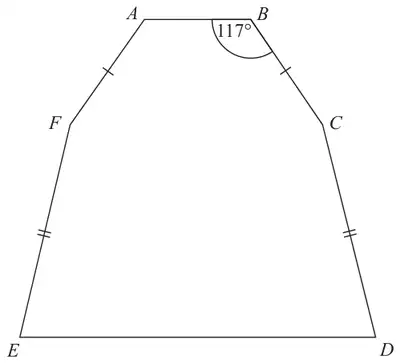
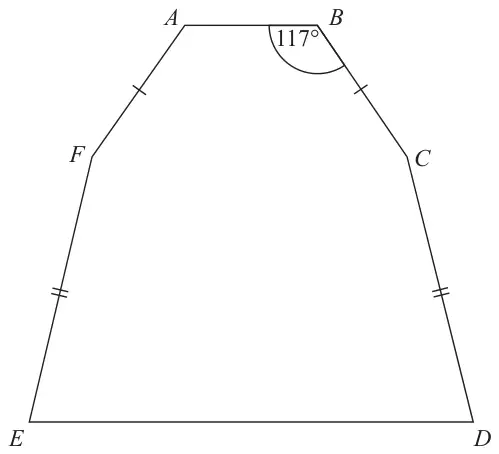
28 The diagram shows a hexagon. The hexagon has one line of symmetry.
\(FA = BC\) \(EF = CD\) Angle \(ABC = 117^\circ\)
Angle \(BCD = 2 \times\) angle \(CDE\)
Work out the size of angle \(AFE\). You must show all your working. (4)
Mark scheme
Answer
Mark
Mark scheme
162 supported
M1
for method to find sum of the interior angles of a hexagon eg \((6 - 2) \times 180\ (= 720)\) oe OR for method to find sum of the interior angles of a pentagon, eg \((5 - 2) \times 180\ (= 540)\) OR for method to find angle \(AFC\) or \(BCF\), eg \((360 - 2 \times 117) \div 2\ (= 63)\) OR for dropping a perpendicular from \(A\) or \(B\) to \(ED\) with 90° marked on \(ED\) and 27° at the top
M1
for method to use ratio 2 : 1 eg marks as \(2x\) and \(x\) or as \(x\) and \(\frac{1}{2}x\) on diagram OR for ([angle sum of hexagon] \({} - 2 \times 117) \div 6\ (= 81)\) oe or ([angle sum of hexagon] \({} \div 2 - 117) \div 3\ (= 81)\) oe or \(117 + 117 + 2x + 2x + x + x =\) [angle sum of hexagon] oe OR eg ([angle sum of pentagon] \({} - 117 - 180) \div 3\ (= 81)\) oe or \(117 + 180 + 2x + x =\) [angle sum of pentagon] oe
M1
for finding angle \(FED = 81\) or for finding angle \(CDE = 81\) OR for complete process to find angle \(AFE\) eg ([angle sum of hexagon] \({} - 2 \times 117) \div 6 \times 2\) oe OR ([angle sum of pentagon] \({} - 117 - 180) \div 3 \times 2\) oe
C1
for accurate working leading to angle \(AFE = 162\)
Additional guidance
For the first M1: Must be a complete process that would lead to a figure of 720 if evaluated correctly. For a pentagon there must be an indication that they have divided the hexagon into two halves. 63 may be shown on the diagram for angle \(AFC\) or angle \(BCF\)
For the second M1: Ratio must be used correctly if awarded for diagram Award provided [angle sum of hexagon] is greater than 700 or [angle sum of pentagon] is greater than 500 Algebraic route needs to show both sides of the equation. LHS of equation may be simplified.
For the third M1: This may be shown by solving a correct equation to find the value of \(x\).
For the C1: Award marks for 162 on the diagram with working and not contradicted by the answer line. Award 0 marks for 162 without working.
20 The diagram shows a square \(ABDE\) and an equilateral triangle \(BCD\).
Work out the size of angle \(EBC\). (2)
Mark scheme
Answer
Mark
Mark scheme
105
M1
for evidence of understanding the angle properties of a square or equilateral triangle, eg stating angle \(DBC = 60\) or angle \(EBD = 45\) or angle \(BAE = 90\)
A1
cao
Additional guidance
For the M1: Accept on the diagram with no contradiction in working, or no contradiction or ambiguity on the diagram; 90 can be shown as a right angle
For the A1: Could be shown on the diagram or in working, but do not accept contradiction or ambiguity.
5 The diagram shows a hexagon. The hexagon has one line of symmetry.
\(FA = BC\) \(EF = CD\) Angle \(ABC = 117^\circ\)
Angle \(BCD = 2 \times\) angle \(CDE\)
Work out the size of angle \(AFE\). You must show all your working. (4)
Mark scheme
Answer
Mark
Mark scheme
162 supported
M1
for method to find sum of the interior angles of a hexagon eg \((6 - 2) \times 180\ (= 720)\) oe OR for method to find sum of the interior angles of a pentagon, eg \((5 - 2) \times 180\ (= 540)\) OR for method to find angle \(AFC\) or \(BCF\), eg \((360 - 2 \times 117) \div 2\ (= 63)\) OR for dropping a perpendicular from \(A\) or \(B\) to \(ED\) with 90° marked on \(ED\) and 27° at the top
M1
for method to use ratio 2 : 1 eg marks as \(2x\) and \(x\) or as \(x\) and \(\tfrac{1}{2}x\) on diagram OR for ([angle sum of hexagon] \(- 2 \times 117) \div 6\ (= 81)\) oe or ([angle sum of hexagon] \(\div 2 - 117) \div 3\ (= 81)\) oe or \(117 + 117 + 2x + 2x + x + x =\) [angle sum of hexagon] oe OR eg ([angle sum of pentagon] \(- 117 - 180) \div 3\ (= 81)\) oe or \(117 + 180 + 2x + x =\) [angle sum of pentagon] oe
M1
for finding angle \(FED = 81\) or for finding angle \(CDE = 81\) OR for complete process to find angle \(AFE\) eg ([angle sum of hexagon] \(- 2 \times 117) \div 6 \times 2\) oe OR ([angle sum of pentagon] \(- 117 - 180) \div 3 \times 2\) oe
C1
for accurate working leading to angle \(AFE = 162\)
Additional guidance
Must be a complete process that would lead to a figure of 720 if evaluated correctly. For a pentagon there must be an indication that they have divided the hexagon into two halves. 63 may be shown on the diagram for angle \(AFC\) or angle \(BCF\)
Ratio must be used correctly if awarded for diagram Award provided [angle sum of hexagon] is greater than 700 or [angle sum of pentagon] is greater than 500 Algebraic route needs to show both sides of the equation. LHS of equation may be simplified.
This may be shown by solving a correct equation to find the value of \(x\).
Award marks for 162 on the diagram with working and not contradicted by the answer line. Award 0 marks for 162 without working.
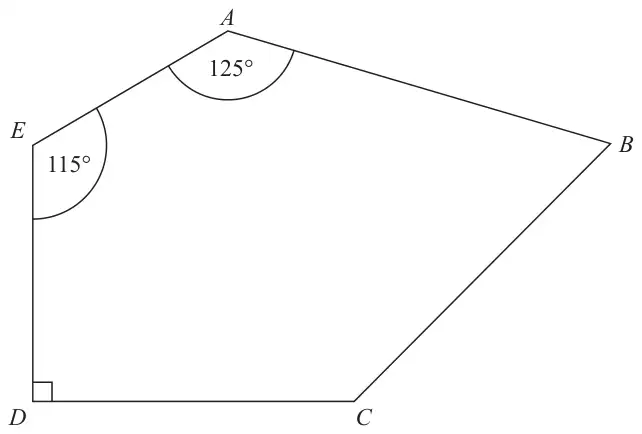
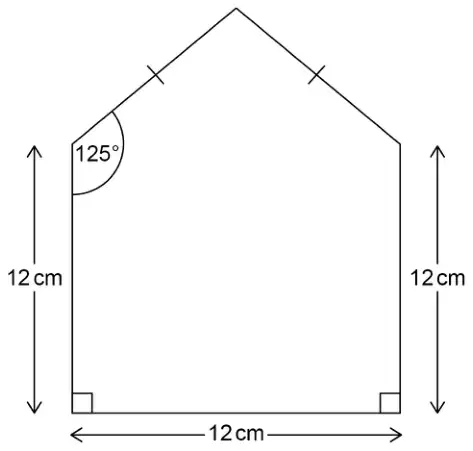
Work out the size of angle \(BCD\). You must show all your working. (5)
Mark scheme
Answer
Mark
Mark scheme
140
P1
for complete process to find sum of the interior angles of a pentagon eg \((5 - 2) \times 180\) or exterior \(360 \div 5 = 72\), interior \(180 - 72 = 108\), \(108 \times 5\) OR for complete process to find sum of the exterior angles of the pentagon eg \((180 - x) + (180 - 2x) + (180 - 125) + (180 - 115) + (180 - 90)\)
A1
for sum of interior angles is 540 OR for sum of exterior angles is 360
P1
for start to process to find angle \(ABC\) eg [angles in a pentagon] \(-\ 115 - 125 - 90\ (= 210)\) or \(115 + 125 + 90 + x + 2x =\) [angles in a pentagon] OR \((180 - x) + (180 - 2x) + (180 - 125) + (180 - 115) + (180 - 90) = 360\)
P1
for process to find angle \(ABC\) eg \(\text{``}210\text{''} \div 3\ (= 70)\), “210” divided in the ratio 2 : 1 or for process to find angle \(BCD\) eg \(\dfrac{2}{3} \times \text{``}210\text{''}\) or for \(3x = \text{``}210\text{''}\) or \(-3x = -\text{``}210\text{''}\)
A1
cao
Additional guidance
Must be a complete process that could lead to a figure of 540 if that process is evaluated incorrectly
360 must be identified as the sum of the exterior angles
Award provided [angles in a pentagon] is greater than 400 Algebraic route needs to show both sides of the equation. LHS of equation may be simplified
Award if 70 is given for either \(ABC\) or \(BCD\) on the diagram
Award marks for 140 on the diagram with working and not contradicted by the answer line. Award 0 marks for 140 without working.
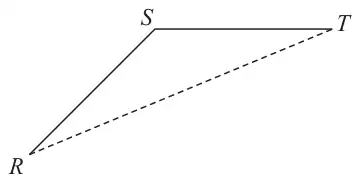
\(RS\) and \(ST\) are 2 sides of a regular 12-sided polygon. \(RT\) is a diagonal of the polygon.
Work out the size of angle \(STR\). You must show your working. (3)
Mark scheme
Answer
Mark
Notes
15
P1
for a process to find the interior or exterior angle of a regular 12 sided polygon e.g. \(\dfrac{10 \times 180}{12}\ (= 150)\) or \(\dfrac{360}{12}\ (= 30)\), must be no contradictions
P1
for process to find angle \(STR\), eg \(\dfrac{180 - \text{``}150\text{''}}{2}\) or \(\dfrac{\text{``}30\text{''}}{2}\)
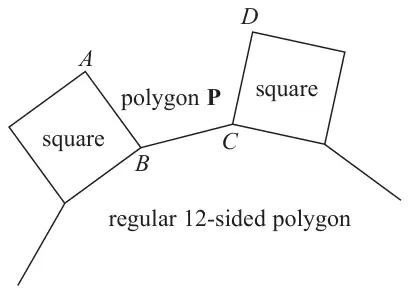
19 In the diagram, \(AB\), \(BC\) and \(CD\) are three sides of a regular polygon P.
Show that polygon P is a hexagon. You must show your working. (4)
Mark scheme
Answer
Mark
Notes
Shows polygon is a hexagon
M1
for a complete method to find the interior or exterior angle of the dodecagon eg \(180 - \dfrac{360}{12}\), \(\dfrac{180}{12}(12 - 2)\) oe \((= 150)\), \(360 \div 12\ (=30)\)
M1
for a complete method to find the interior angle of polygon P eg at \(B\) or \(C\): \(360 - \text{``}150\text{''} - 90\ (= 120)\) or \(\text{``}30\text{''} + 90\ (= 120)\) or for a complete method to find the interior or exterior angle of the hexagon eg \(180 - \dfrac{360}{6}\), \(\dfrac{180}{6}(6 - 2)\) oe \((= 120)\), \(360 \div 6\ (= 60)\)
A1
for 30 and 120 or 30 and 60 or 120 and 150 or 60 and 150
C1
complete solution, fully supported by accurate figures
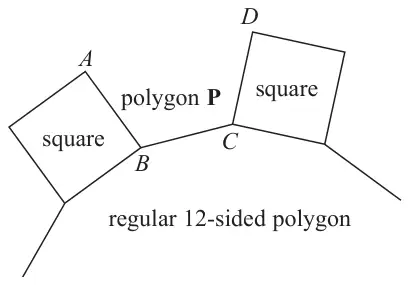
5 In the diagram, \(AB\), \(BC\) and \(CD\) are three sides of a regular polygon P.
Show that polygon P is a hexagon. You must show your working. (4)
Mark scheme
Answer
Mark
Notes
Shows polygon is a hexagon
M1
for a complete method to find the interior or exterior angle of the dodecagon eg \(180 - \dfrac{360}{12}\), \(\dfrac{180}{12}(12 - 2)\) oe \((= 150)\), \(360 \div 12\ (=30)\)
M1
for a complete method to find the interior angle of polygon P eg at \(B\) or \(C\): \(360 - \text{``}150\text{''} - 90\ (= 120)\) or \(\text{``}30\text{''} + 90\ (= 120)\) or for a complete method to find the interior or exterior angle of the hexagon eg \(180 - \dfrac{360}{6}\), \(\dfrac{180}{6}(6 - 2)\) oe \((= 120)\), \(360 \div 6\ (= 60)\)
A1
for 30 and 120 or 30 and 60 or 120 and 150 or 60 and 150
C1
complete solution, fully supported by accurate figures
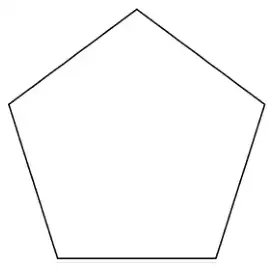
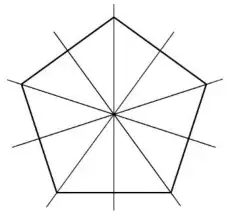
The diagram shows a regular pentagon. \(AB\) and \(CD\) are two of the lines of symmetry of the pentagon.
Work out the size of the angle marked \(x\). You must show all your working. (4)
Mark scheme
Answer
Mark
Notes
144
4
M1 for method to find the interior angle of a regular pentagon, eg. \(180 \times (5 - 2) \div 5\) (= 108) oe M1 (indep) for using a line of symmetry to find an angle, eg. “interior angle” \(\div\) 2 (half an interior angle) or 90 between line and side M1 (dep on M2) for complete method to find angle \(x\), eg. \(90 + \text{``}54\text{''}\) or \(\text{``}108\text{''} \times 5 - \text{``}108\text{''} \times 2 - 90 \times 2\) A1 for 144 supported by working
OR
M1 for considering all 5 lines of symmetry or angle vertically opposite \(x\) with angle bisector drawn M1 for \(360 \div 10\) (= 36) or \(360 \div 5\) (= 72) M1 for \((360 \div 10) \times 4\) or \((360 \div 5) \times 2\) A1 for 144 supported by working
OR
M1 for method to find the exterior angle of a regular pentagon (72°), eg. \(360 \div 5\) (= 72) oe M1 (indep) for using a line of symmetry to find an angle, eg. “interior angle” \(\div\) 2 (half an interior angle) or 90 between line and side M1 (dep on M2) for complete method to find angle \(x\), eg. \(180 - 2(180 - 90 - 72)\) A1 for 144 supported by working
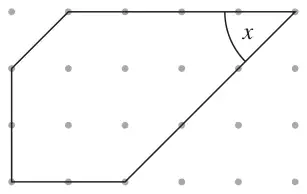
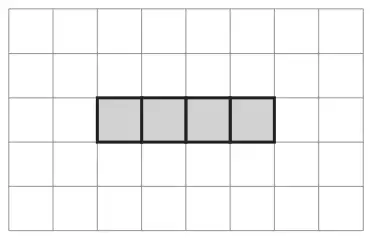
(*a) Explain why the angle marked \(x\) cannot be a right angle. (3)
(b) On the grid below, show how the shape tessellates. You should draw at least 6 shapes. (2)
Mark scheme (a)
Answer
Mark
Notes
Explanation
3
M1 for recognition of sum to \(360^\circ\) A1 for eg sum to 350 or subtraction to 100 or difference of 10 C1 (dep on at least M1) for correct explanation supported by their figures and working
Mark scheme (b)
Answer
Mark
Notes
Tessellation
2
B2 for at least 6 correct shapes (including the initial shape) correctly tessellating (B1 for at least 4 correct shapes, including initial shape, correctly tessellating ignore any additional sections attempted, gaps or incorrectly shaped tiles)
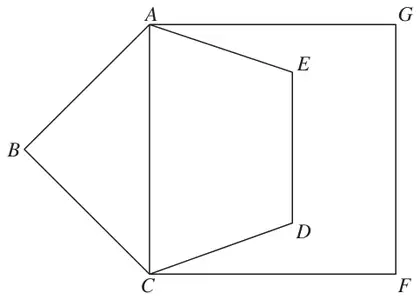
\(ABCDE\) is a regular pentagon. \(ACFG\) is a square.
Work out the size of angle \(DCF\).
You must show all your working.(4)
Mark scheme
Answer
Mark
Notes
18
4
M1 for a method to find the exterior angle of a pentagon eg. \(360 \div 5\) (=72) or the interior angle of a pentagon, eg. \(180 - 360 \div 5\) (= 108) A1 for 72 or 108 M1 (dep M1) for a fully complete method to find the required angle, \(DCF\) A1 for 18 or ft their interior or exterior angle
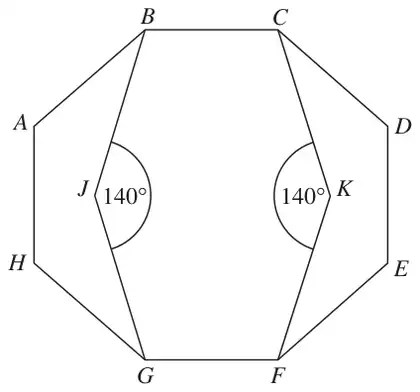
\(ABCDEFGH\) is a regular octagon. \(BCKFGJ\) is a hexagon. \(JK\) is a line of symmetry of the hexagon.
Angle \(BJG\) = angle \(CKF = 140^\circ\)
Work out the size of angle \(KFE\).
You must show all your working.(4)
Mark scheme
Answer
Mark
Notes
25
4
M1 for complete method to work out interior angle of a regular octagon or \(135^\circ\) identified as an interior angle of the octagon M1 for complete method to work out angle \(KFG\) or angle \(KFG\) identified as \(110^\circ\) M1 (dep on M2) for complete method to work out angle \(KFE\), eg \(\text{``}135\text{''} - \text{``}110\text{''}\) or \((8 \times \text{``}135\text{''} - 4 \times \text{``}135\text{''} - 4 \times \text{``}110\text{''}) \div 4\) or \((3 \times 180 - 2 \times \text{``}135\text{''} - 2 \times \text{``}110\text{''}) \div 2\) A1 for 25 with supporting working
OR M1 for complete method to work out the exterior angle of a regular octagon or \(45^\circ\) identified as an exterior angle of the octagon M1 for complete method to work out angle \(KFG\) or angle \(KFG\) identified as \(110^\circ\) M1 (dep on M2) for complete method to work out angle \(KFE\), eg \(180 - \text{``}45\text{''} - \text{``}110\text{''}\) A1 for 25 with supporting working
OR M1 for complete method to work out the exterior angle of a regular octagon or \(45^\circ\) identified as an exterior angle of the octagon M1 for complete method to work out angle \(JKF\) or angle \(JKF\) identified as \(70^\circ\) M1 (dep on M2) for complete method to work out angle \(KFE\), eg \(\text{``}70\text{''} - \text{``}45\text{''}\) A1 for 25 with supporting working
\(ABCDE\) is a regular pentagon. \(BCF\) and \(EDF\) are straight lines.
Work out the size of angle \(CFD\). You must show how you got your answer. (3)
Mark scheme
Answer
Mark
Notes
36
3
M1 for a correct method to find either an interior or an exterior angle; eg. \((180 \times 3) \div 5\) or \(540 \div 5\) (=108) or \(360 \div 5\) (=72) M1 (dep) for a complete method to find angle \(CFD\). A1 cao
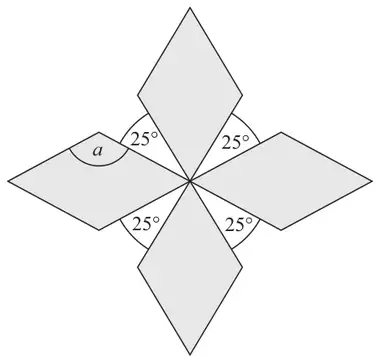
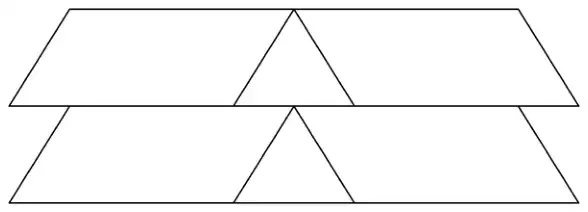
24 The diagram shows a pattern using four identical rhombuses.
Diagram NOT accurately drawn
Work out the size of the angle marked \(a\).
You must show your working.(4)
Mark scheme
Answer
Mark
Notes
115
4
M1 for 360 − 4 × 25 (=260) M1 (dep) for “260” ÷ 4 (= 65) M1 for 180 – “65” or (360 − 2 × “65”) ÷ 2 A1 for 115 with working OR M1 for 360 ÷ 4 (= 90) M1 (dep) for “90” − 25 (=65) M1 for 180 – “65” or (360 – 2 × “65”) ÷ 2 A1 for 115 with working
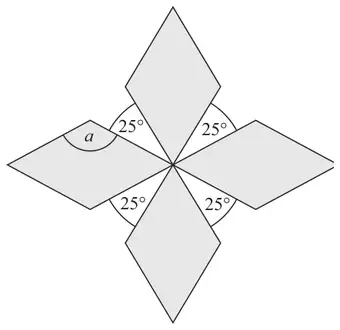
9 The diagram shows a pattern using four identical rhombuses.
Diagram NOT accurately drawn
Work out the size of the angle marked \(a\). You must show your working. (4)
Mark scheme
Answer
Mark
Notes
115
4
M1 for \(360 - 4 \times 25\) (=260) M1 (dep) for ‘260’ \(\div 4\) (=65) M1 for 180 − ‘65’ or \((360 - 2 \times\) ‘65’\() \div 2\) A1 for 115 with working
OR
M1 for \(360 \div 4\) (=90) M1 (dep) for ‘90’ − 25 (=65) M1 for 180 − ‘65’ or \((360 - 2 \times\) ‘65’\() \div 2\) A1 for 115 with working
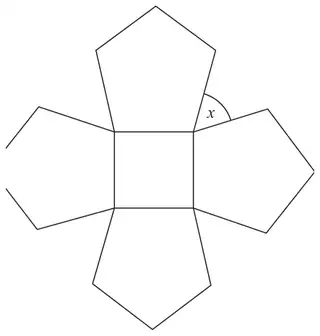
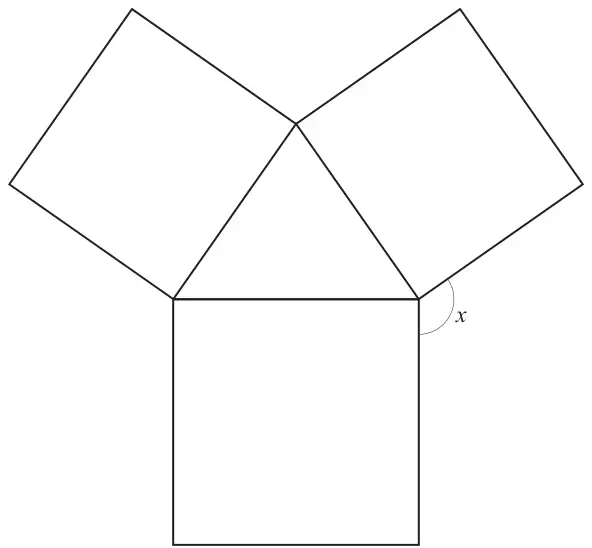
The diagram shows a square and 4 regular pentagons.
Work out the size of the angle marked \(x\). (3)
Mark scheme
Answer
Mark
Notes
54
3
M1 for 180 – 360 ÷ 5 or 108 seen as the interior angle of a pentagon M1 (dep on previous M1) for 360 – 2 × ‘108’ – 90 A1 for 54 cao OR M1 for 180 × (5 – 2) (= 540) ÷ 5 or 108 given as the interior angle of a pentagon M1 (dep on previous M1) for 360 – 2 × ‘108’ – 90 A1 for 54 cao
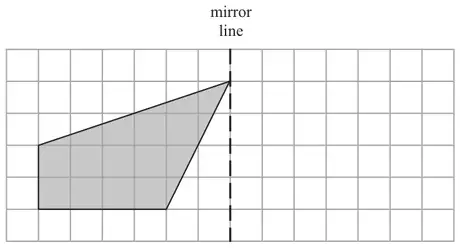
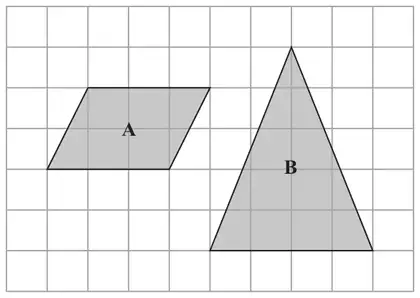
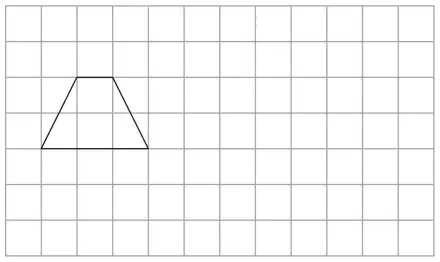
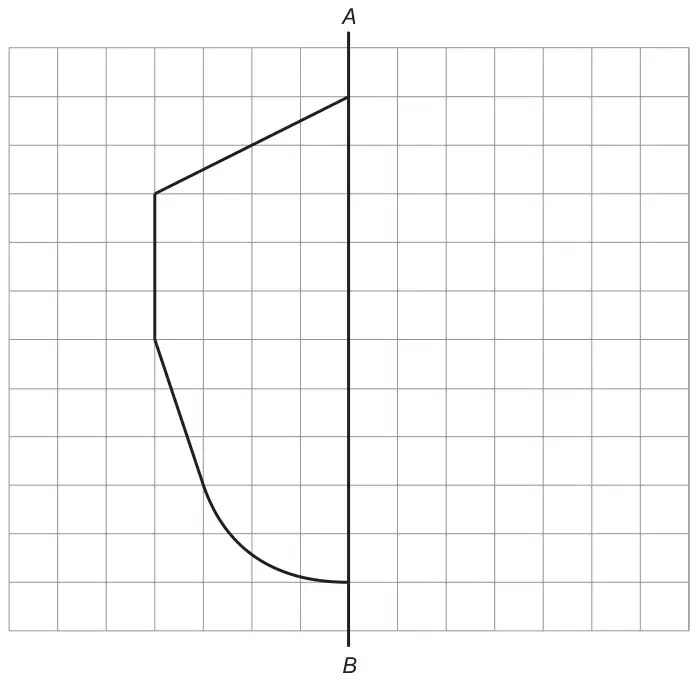
(a) Reflect the shaded shape in the mirror line. (2)
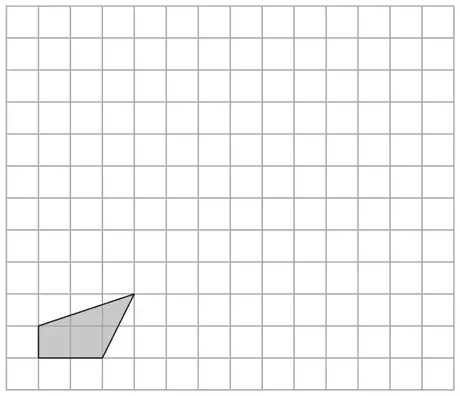
(b) On the grid, enlarge the shaded shape using a scale factor of 3 (2)
Here is a different shape.
Diagram NOT accurately drawn
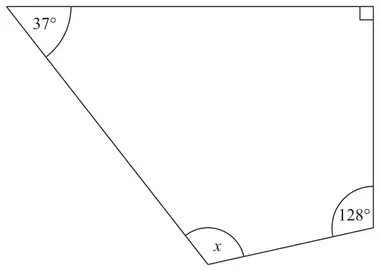
(c) Work out the size of angle \(x\). (2)
Mark scheme (a)
Answer
Mark
Notes
reflection
2
B2 for correct reflection in correct position (B1 for at least 2 vertices in the correct position)
Mark scheme (b)
Answer
Mark
Notes
enlargement
2
B2 for correct enlargement scale factor 3 (B1 for at least 2 lines correctly enlarged or any enlargement using an incorrect scale factor, sf \(\ne 1\))
Mark scheme (c)
Answer
Mark
Notes
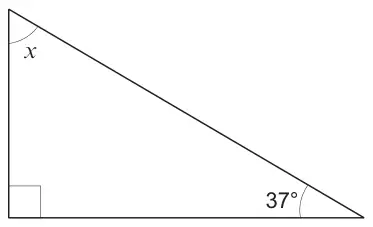
105
2
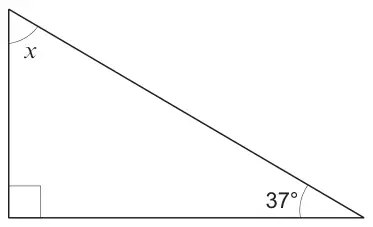
M1 for \(360 - (90 + 128 + 37)\) oe or \(x + 90 + 128 + 37 = 360\) A1 cao
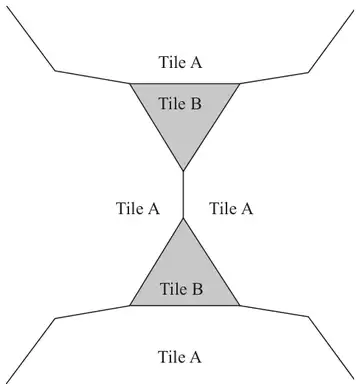
18 The diagram shows part of a pattern made from tiles.
Diagram NOT accurately drawn
The pattern is made from two types of tiles, tile A and tile B.
Both tile A and tile B are regular polygons.
Work out the number of sides tile A has. (4)
Mark scheme
Answer
Mark
Notes
12
4
B1 for 60 seen M1 for (360 – 60) ÷ 2 (=150) M1 for 360 ÷ (180 – 150) or 150×n=180(n-2) oe A1 cao OR B1 for 60 seen M1 for 60 ÷ 2 (=30) M1 for 360 ÷ (60÷2) A1 cao OR M2 for 30 seen M1 for 360 ÷ 30 A1 cao
NB. Do remember to look at the diagram when marking this question. Looking at the complete method should confirm if interior or exterior angles are being calculated M1 for a correct method to work out the interior angle of a regular hexagon eg. 180 – (360 ÷ 6) oe or (6 - 2)×180 ÷ 6 oe or 120 as interior angle of the hexagon M1 for a correct method to work out the interior angle of a regular octagon 180 – (360 ÷ 8) oe or (8 - 2)×180 ÷ 8 oe or 135 as interior angle of the octagon M1 (dep on at least M1) for a complete method eg. 360 – “120” – “135” A1 cao OR M1 for a correct method to work out an exterior angle of a regular hexagon eg. 360 ÷ 6 or 60 as exterior angle of the hexagon M1 for a correct method to work out an exterior angle of a regular octagon 360 ÷ 8 or 45 as exterior angle of the octagon M1 (dep on at least M1) for a complete method eg. “60” + “45” A1 cao SC : B1 for answer of 255
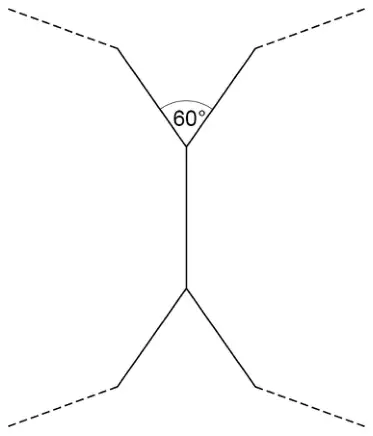
28 \(AB\), \(BC\) and \(CD\) are sides of a regular 12-sided polygon.
\(CDMN\) is a square.
Not drawn accurately
Prove that points \(A\), \(B\) and \(N\) lie on a straight line. [4 marks]
Mark scheme
Answer
Mark
Comments
interior angle = 150 or exterior angle = 30 or angle \(BCN\) = 120
B1
method not required may be seen on diagram
interior angle = 150 with a valid method shown or exterior angle = 30 with a valid method shown or angle \(BCN\) = 120 with a valid method shown
B1dep
angles may be seen on diagram but methods will be in working lines eg \(180 - \dfrac{360}{12} = 150\) or \(\dfrac{1800}{12} = 150\) or \(360 - 120 - 90 = 150\) or \(\dfrac{360}{12} = 30\) or \(\dfrac{180 - 120}{2} = 30\) or \(180 - 150 = 30\) or \(360 - 150 - 90 = 120\) or \(360 - 240 = 120\) or \(180 - 2 \times 30 = 120\)
interior angle = 150 with a valid method shown and exterior angle = 30 with a valid method shown and angle \(BCN\) = 120 with a valid method shown
B1dep
angles may be seen on diagram but methods will be in working lines eg \(\dfrac{1800}{12} = 150\) and \(\dfrac{180 - 120}{2} = 30\) and \(360 - 240 = 120\) angles worked out in any order
Fully correct working that must show correct progression and show all valid methods Valid methods shown must be appropriate for the approach used A reason must be included in the final step
B1dep
examples of the final step are (i) angle \(ABC\) + angle \(CBN\) = 180 (ii) interior angle = 150 in two different ways (iii) exterior angle = 30 in two different ways (iv) angle \(BCN\) = 120 in two different ways (v) sum of three angles at \(C\) = 360 (vi) sum of angles of triangle \(BCN\) = 180
interior angle may be seen as angle \(ABC\) or angle \(BCD\) exterior angle may be seen as angle \(CBN\)
It must be clear which angle they are working out eg1 Do not accept 150 if it is not correctly identified or not in the correct position on diagram eg2 Do accept 150 if it is identified as an interior angle or angle \(ABC\) or is in the correct position on the diagram
Do not accept incorrect statements eg1 exterior angle = 150 (even if 150 in correct position on the diagram) eg2 angle \(ACB\) = 150 (even if 150 in correct position on the diagram)
Ignore reasons for the first three marks
Angles on the diagram with no valid methods can score a maximum of B1B0B0B0
For the 2nd and 3rd marks the methods shown do not have to show progression
Example of fully correct working for (i)
interior angle \(= \dfrac{1800}{12} = 150\)
B1B1
angle \(BCN = 360 - 150 - 90 = 120\)
angle \(CBN = \dfrac{180 - 120}{2} = 30\)
B1
\(150 + 30 = 180 \quad\) angles on a (straight) line
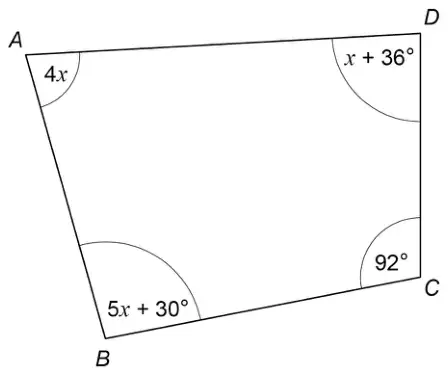
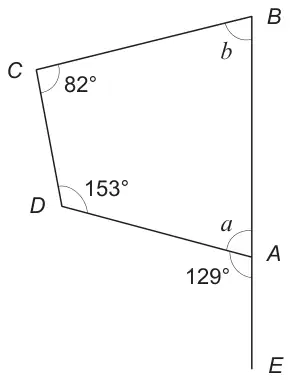
Prove that \(ABCD\) is not a cyclic quadrilateral. [4 marks]
Mark scheme
Answer
Mark
Comments
Alternative method 1: works out the value of \(x\) using two different methods and shows they are different
Any one of \(4x + 92 = 180\) or \(5x + 30 + x + 36 = 180\) or \(6x + 66 = 180\) or \(4x + x + 36 + 5x + 30 + 92 = 360\) or \(10x + 158 = 360\)
M1
oe
\((x =)\) 22 with M1 seen or \((x =)\) 19 with M1 seen or \((x =)\) 20.2 with M1 seen
A1
must be correct value for corresponding equation
A different one of \(4x + 92 = 180\) or \(5x + 30 + x + 36 = 180\) or \(6x + 66 = 180\) or \(4x + x + 36 + 5x + 30 + 92 = 360\) or \(10x + 158 = 360\)
M1
oe
Any two of \((x =)\) 22 with M1 seen or \((x =)\) 19 with M1 seen or \((x =)\) 20.2 with M1 seen and should be equal
A1
must be correct values for corresponding equations
oe statement
Alternative method 2: uses angle sum of quadrilateral to work out \(x\) and then shows opposite angles do not sum to 180°
\(4x + x + 36 + 5x + 30 + 92 = 360\) or \(10x + 158 = 360\)
M1
oe
\((x =)\) 20.2 with M1 seen
A1
\(4 \times\) their \(20.2 + 92\) or \(5 \times\) their \(20.2 + 30 +\) their \(20.2 + 36\)
M1dep
oe
\(4 \times 20.2 + 92 = 172.8\) and should be 180 or \(5 \times 20.2 + 30 + 20.2 + 36 = 187.2\) and should be 180
A1
oe oe statement
oe oe statement
Alternative method 3: uses angle sum of \(4x\) and 92° to work out \(x\) and then shows other angles do not sum to 180° or all angles do not sum to 360°
\(4x + 92 = 180\)
M1
oe
\((x =)\) 22 with M1 seen
A1
\(5 \times\) their \(22 + 30 +\) their \(22 + 36\) or \(4 \times\) their \(22 + 92 + 5 \times\) their \(22 + 30 +\) their \(22 + 36\)
M1dep
oe
\(5 \times 22 + 30 + 22 + 36 = 198\) and should be 180 or \(4 \times 22 + 92 + 5 \times 22 + 30 + 22 + 36 = 378\) and should be 360
A1
oe oe statement
oe oe statement
Alternative method 4: uses angle sum of \(5x + 30\) and \(x + 36\)° to work out \(x\) and then shows other angles do not sum to 180° or all angles do not sum to 360°
\(5x + 30 + x + 36 = 180\) or \(6x + 66 = 180\)
M1
oe
\((x =)\) 19 with M1 seen
A1
\(4 \times\) their \(19 + 92\) or \(5 \times\) their \(19 + 30 +\) their \(19 + 36 + 4 \times\) their \(19 + 92\)
M1dep
oe
\(4 \times 19 + 92 = 168\) and should be 180 or \(5 \times 19 + 30 + 19 + 36 + 4 \times 19 + 92 = 348\) and should be 360
A1
oe oe statement
oe oe statement
Additional guidance
Alts 1 and 2 \(x = 20.2\) with M1 not seen
Zero
Alts 1 and 3 \(x = 22\) with M1 not seen
Zero
Alts 1 and 4 \(x = 19\) with M1 not seen
Zero
Allow \(20\dfrac{1}{5}\) or \(\dfrac{101}{5}\) for 20.2, but do not allow other improper fractions for 20.2, 22 or 19 unless recovered
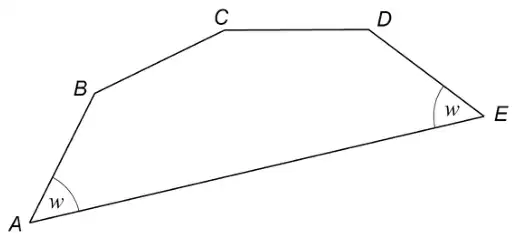
20 \(AB\), \(BC\), \(CD\) and \(DE\) are four of the sides of a regular decagon.
Not drawn accurately
Work out the size of angle \(w\). [3 marks]
Mark scheme
Answer
Mark
Comments
\(180 - \dfrac{360}{10}\) or \(180 - 36\) or \(1440 \div 10\) or 144
M1
oe eg \((10 - 2) \times 180 \div 10\) may be seen on diagram
\(\dfrac{540 - 3 \times \text{their } 144}{2}\) or \(\dfrac{540 - 432}{2}\) or \(\dfrac{108}{2}\) or \(360 - 90 -\) their \(144 - \dfrac{\text{their } 144}{2}\) or their \(144 - 90\)
Alternative method 2: assumes both angles are equal and uses sum of angles in a quadrilateral
\((b =)\ 90 \div 5 \times 3\) or 54
M1
oe may be on diagram for \(b\) or \(x\)
90 + their 54 + their 54 + \(3 \times\) their 54 or 360 – 90 – their 54 – their 54 and either \(3 \times\) their 54 or their \(162 \div 3\) or their \(162 \div 54\)
M1dep
oe addition of the four angles in the quadrilateral or subtraction of 90 and the two equal angles from 360 and multiplication to work out the fourth angle or division of the fourth angle by 3 or 54 to act as a check
90 + 54 + 54 + 162 = 360 and \(54 \times 3 = 162\) or 360 – 90 – 54 – 54 = 162 and \(162 \div 3 = 54\) or \(162 \div 54 = 3\)
A1
oe
Alternative method 3: assumes both angles are equal and uses ratio to check 90°
28 The sum of the angles in any quadrilateral is \(360^\circ\)
For example, in a rectangle \(\;4 \times 90^\circ = 360^\circ\)
Zak writes,
\(5 \times 90^\circ = 450^\circ\) \(\;\) so the sum of the angles in any pentagon must be \(450^\circ\)
Is he correct?
Tick a box.
Yes
No
Show working to support your answer. [2 marks]
Mark scheme
Answer
Mark
Comments
Alternative method 1
\((5 - 2) \times 180\) or \(3 \times 180\) or 540 or \(180 - (360 \div 5)\) or \((180 - 72)\) or 108
M1
oe
Ticks ‘No’ and 540 or Ticks ‘No’ and 108
A1
Alternative method 2
States that a pentagon cannot have five (or all) right angles or states that a pentagon can have five (or all) obtuse angles or states that the maximum number of right angles is three or draws a pentagon with exactly three right angles shown
M1
Ticks ‘No’ and states that a pentagon cannot have five (or all) right angles or states that the maximum number of right angles is three or states that a pentagon can have five (or all) obtuse angles and draws a correct diagram of an attempted pentagon with four right angles shown or draws a pentagon with exactly three right angles shown or draws a pentagon with five obtuse angles
A1
Additional guidance
If comparing \(72^\circ\) to \(90^\circ\), they must state that they are referring to the exterior angles
If ‘Yes’ is ticked, M1 can still be scored
If neither box is ticked, ‘No’ must be implied by the explanation for M1A1
7 The sum of the angles in any quadrilateral is 360°
For example, in a rectangle 4 × 90° = 360°
Zak writes,
5 × 90° = 450° so the sum of the angles in any pentagon must be 450°
Is he correct?
Tick a box.
Yes
No
Show working to support your answer. [2 marks]
Mark scheme
Answer
Mark
Comments
Alternative method 1
\((5 - 2) \times 180\) or \(3 \times 180\) or 540 or \(180 - (360 \div 5)\) or \((180 - 72)\) or 108
M1
oe
Ticks ‘No’ and 540 or Ticks ‘No’ and 108
A1
Alternative method 2
States that a pentagon cannot have five (or all) right angles or states that a pentagon can have five (or all) obtuse angles or states that the maximum number of right angles is three or draws a pentagon with exactly three right angles shown
M1
Ticks ‘No’ and states that a pentagon cannot have five (or all) right angles or states that the maximum number of right angles is three or states that a pentagon can have five (or all) obtuse angles and draws a correct diagram of an attempted pentagon with four right angles shown or draws a pentagon with exactly three right angles shown or draws a pentagon with five obtuse angles
A1
Additional guidance
If comparing 72° to 90°, they must state that they are referring to the exterior angles
If ‘Yes’ is ticked, M1 can still be scored
If neither box is ticked, ‘No’ must be implied by the explanation for M1A1
(b) Amba is working out the size of an interior angle of a regular octagon.
Not drawn accurately
Her method is \(\qquad\) Interior angle \(= 360 \div 8\)
Is her method correct?
Tick a box.
Yes
No
Give a reason for your answer. [1 mark]
Mark scheme (a)
Answer
Mark
Comments
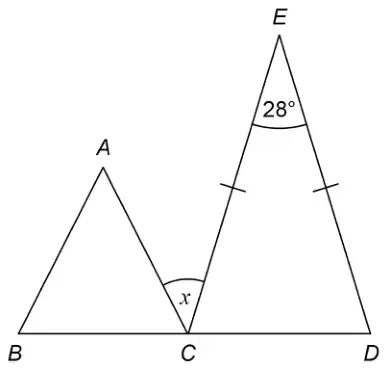
\(180 \div 3\) or 60
M1
oe eg \(60 + 60 + 60 = 180\)
\((180 - 28) \div 2\) or \(152 \div 2\) or 76
M1
oe eg \(76 + 76 + 28 = 180\)
\(180 -\) their \(60 -\) their 76
M1dep
oe eg \(44 + 60 + 76 = 180\) dep on M1M1
44
A1
Additional guidance
60 or 76 seen in appropriate place on diagram or in working scores one mark for each
Answer 44 not from wrong working
M3A1
\(180 - 28 \div 2\) unless recovered
2nd M0
Mark scheme (b)
Answer
Mark
Comments
No and gives correct reason
B1
eg it should be \(180 - (360 \div 8)\) it should be \(1080 \div 8\) this gives the exterior (not the interior) angle it should be obtuse not acute accept any unambiguous indication of No
Additional guidance
A correct reason may be
showing a correct method
correction of her method (error and replacement shown)
correction of her answer (answer and replacement shown)
No, It should be 135 not 45 (3)
B1
No, It should be 1080 not 360 (2)
B1
No, because the interior angles should be 1080 not 360 (2)
B1
No, she needs to subtract her answer from 180 (1)
B1
No, \(((8 - 2) \times 180) \div 8\) (1)
B1
No, It should be \(((n - 2) \times 180) \div 8\) (doesn’t use \(n = 8\))
B0
Any numbers quoted must be correct but ignore other non-contradictory statements
eg No, It should be 720. She’s worked out the exterior angle
B0
No, There’s not 360 in an octagon or No, Angles in an octagon do not add up to 360
M2 for \(\dfrac{360}{180 - \textit{their}\,160}\) oe or M1 for \(180 -\) their160 may be implied by 20
Alternative method 1: M1 for 160 as before M2 for \(180n -\) their\(160n = 360\) or M1 for \(\dfrac{(n - 2)180}{n} =\) their160 oe Alternative method 2: M2 for \(92 - 72\) or 20 M1dep for \(\dfrac{360}{\textit{their}\,20}\) dep. on M2 Trials: M1 for \(360 - 108 - 92\) or 160 M1 for each different value for the number of sides and the correct internal angle calculated to a maximum of M2
see appendix for values
Appendix: exemplars for Q7(b)
Formula = \(180 - \frac{360}{n}\) where \(n\) is the number of sides
Condone poor spelling Do not allow e.g. hectagon or hectogon
(ii) 2
1
Mark scheme (b)
Answer
Marks
Part marks and guidance
1
No contradictions If sides and angles indicated mark the worst Use of arrows on sides is 0 marks The number of “lines” on equal sides must be the same. Allow 70, 70, 40 labelled as angles with correct notation. 70, 70, 40 alone is 0 marks Ignore all other additions e.g. numbers for length/angles and lines of reflection and apply the scheme
6 A regular polygon has \(n\) sides. The interior angle of the polygon is 15 times its exterior angle.
Find the value of \(n\). [4]
Mark scheme
Answer
Marks
Part marks and guidance
32 nfww
4
B2 for 11.25 M1 for 360 ÷ their 11.25 seen OR B1 for \(15a\) and \(a\) or \(16a\) M1 for \(15a + a = 180\) oe M1 for 360 ÷ their 11.25 seen
\(a\) = exterior angle and allow any consistent single letter
B1 M1 implied by \(16a = 180\) or \(\frac{180}{15 + 1}\) oe
Alternative for number of sides: e.g. M1 for \(\frac{180(n - 2)}{n} = 180 -\) their11.25
Alternative method 1: M2 for \(15 \times 360 = 180(n - 2)\) or better or M1 for \(\frac{180(n - 2)}{n} = 15 \times \frac{360}{n}\) and M1 for \(180n = 5400 + 360\) oe
Alternative method 2: Use of trials by choosing a value for \(n\). M1 for each correct trial up to a maximum of M3 for using two of these [exterior angle] = \(\frac{360}{n}\) (formula A) [interior angle] = \(\frac{180(n - 2)}{n}\) (formula B) interior + exterior = 180 and for checking that interior = 15 × exterior
if 0 scored SC1 for one of formula A or B seen or used
If they get 32 from any number of trials they score 4 marks. Trials can be seen from a calculation or a list.
25 A student draws two different regular polygons. The exterior angle of one polygon is \(p^\circ\). The exterior angle of the other polygon is \(q^\circ\). The sum of \(p\) and \(q\) is \(112^\circ\). The difference between \(p\) and \(q\) is \(32^\circ\).
Find the number of sides of each polygon. You must show your working. [6]
Mark scheme
Answer
Marks
Part marks and guidance
5 and 9 with correct working
6
M3 for 72 and 40 or M2 for 72 or 40 or B1 for \(p + q = 112\) oe B1 for \(p - q = 32\) oe or \(q - p = 32\) oe
AND
M1 for \(360 \div\) their \(p\) or \(360 \div\) their \(q\) oe or \(\dfrac{180(n-2)}{n} = 180 -\) their \(p\) or \(\dfrac{180(n-2)}{n} = 180 -\) their \(q\) oe
A1 for one correct answer
If 0 or 1 scored, instead award SC2 for both answers correct with no or insufficient working If 0 scored award SC1 for one correct answer with no or insufficient working
10 A student draws two different regular polygons. The exterior angle of one polygon is \(p\)°. The exterior angle of the other polygon is \(q\)°.
The sum of \(p\) and \(q\) is 112°. The difference between \(p\) and \(q\) is 32°.
Find the number of sides of each polygon. You must show your working. [6]
Mark scheme
Answer
Marks
Part marks and guidance
5 and 9 with correct working
6
M3 for 72 and 40 OR M2 for 72 or 40 OR B1 for \(p + q = 112\) oe B1 for \(p - q = 32\) or \(q - p = 32\) oe
AND
M1 for 360 ÷ their p or 360 ÷ their qoe or \(\frac{180(n - 2)}{n}\) = 180 – their p or \(\frac{180(n - 2)}{n}\) = 180 – their qoe
A1 for one correct answer
If 0 or 1 scored, instead award SC2 for both answers correct with no or insufficient working If 0 scored award SC1 for one correct answer with no or insufficient working
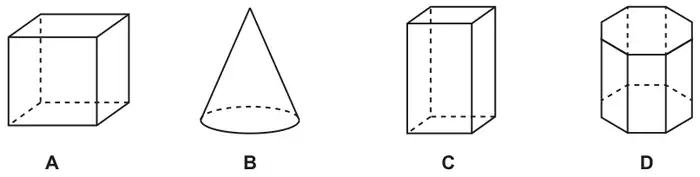
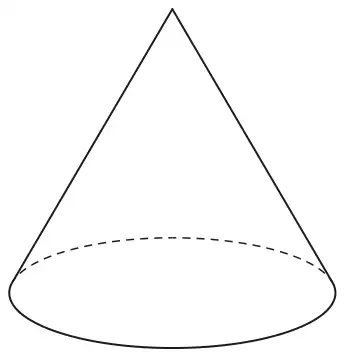
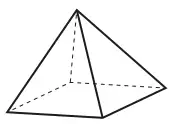
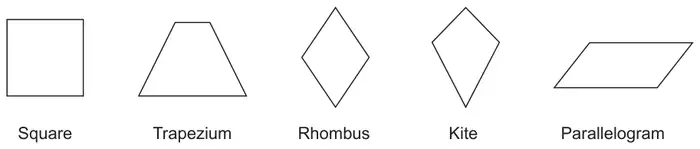
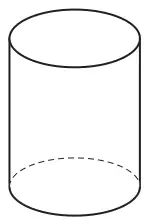
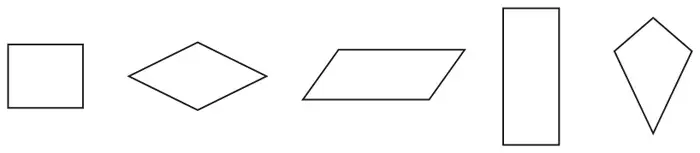
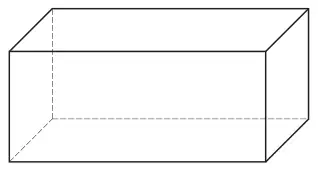
Write down the letter of the solid that is not a prism. [1]
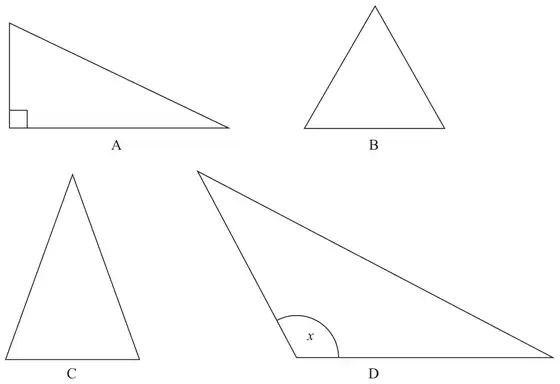
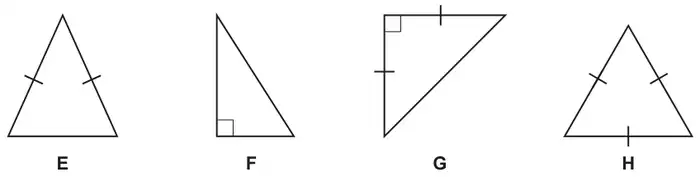
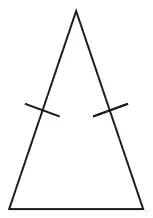
(b) These four triangles are labelled E, F, G and H.
Write down the letter of the right-angled isosceles triangle. [1]
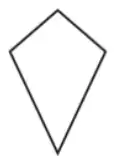
(c) A quadrilateral has
exactly one line of symmetry and
each angle is either acute or obtuse.
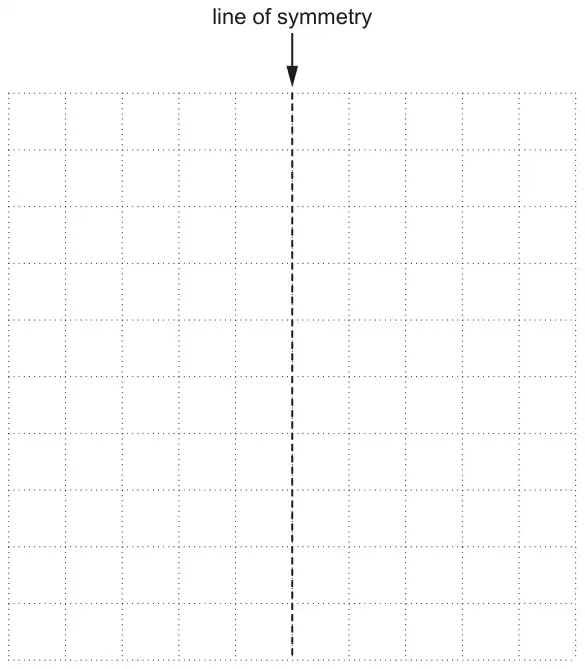
Draw a possible quadrilateral on this grid. The dashed line must be the line of symmetry.
[2]
Mark scheme (a)
Answer
Marks
Part marks and guidance
B
1
Accept any clear indication e.g. the cone or the second one May be on diagram
Mark scheme (b)
Answer
Marks
Part marks and guidance
G
1
Accept any clear indication e.g the third one May be on diagram
Mark scheme (c)
Answer
Marks
Part marks and guidance
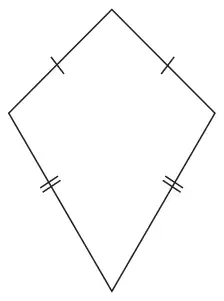
Kite or isosceles trapezium with only the given line of symmetry and no right angles
2
B1 for correct shape but inaccurate or • kite with right angle • arrowhead without right angle • rhombus
B0 for • square • rectangle • non-isosceles trapezium • arrowhead with right angle • parallelogram • triangle or shape with 5 or more sides
Mark intention: accept vertices \(\pm\) 2mm and freehand for 2 marks If in doubt, use overlay as guide. Place so the correct point would be in the centre of the square and their point must be in, or on, square formed by red lines within overlay Condone slight extensions, gaps and wobbles
If more than 1 drawing and no clear choice mark the worst
16 The diagram shows part of a regular 12-sided polygon.
Not to scale
For this polygon, find the ratio of the size of one exterior angle to the size of one interior angle. Give your answer in its simplest form. You must show your working.
.................... : .................... [5]
Mark scheme
Answer
Marks
Part marks and guidance
1 : 5 with correct working
5
M1 for \(360 \div 12\) or \(\dfrac{(12 - 2) \times 180}{12}\) oe A1 for 30 or 150
AND
M1 for their interior + their exterior = 180 A1 for 30 and 150
If 0 or 1 scored, instead award SC2 for answer 1 : 5 with no or insufficient working If 0 scored, instead award SC1 for \(k : 5k\) or for answer 5 : 1 or for 30 and 150 with no or insufficient working
“Correct working” requires evidence of at least one pair of M1A1
Find the number of sides of the third polygon. You must show your working. [6]
Mark scheme
Answer
Marks
Part marks and guidance
10 with correct working
6
“correct working” requires at least M1M1 or M2
M2 for a correct method to find the interior angle of a pentagon e.g. \(180 - \frac{360}{5}\) or \(\frac{(5 - 2) \times 180}{5}\) or M1 for partial method e.g. \(\frac{360}{5}\) or \((5 - 2) \times 180\)
M2 implied by 108
M1 implied by 72 or 540
AND
M1 for 360 – 2 × their 108
M3 implied by 144
AND
M2 for \(\dfrac{360}{180 - \textit{their } 144}\) or M1 for 180 − their 144
M1 for \((n - 2)180 = \textit{their } 144n\) oe and M1 for a correct rearrangement e.g. \(36n = 360\)
Alternative method as the third angle is the sum of the two exteriors of the pentagons M3 for \(2 \times \frac{360}{5}\) [ = 144] or M1 for \(\frac{360}{5}\) and M2 for \(\dfrac{360}{360 - \textit{their } 144 - 180}\) oe or M1 for 360 – their 144 – 180 oe
If 0, 1 or 2 scored, instead award SC3 for answer 10 with no working or insufficient working
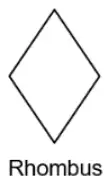
(a) Write down the mathematical name of each of these shapes.
(i) A triangle with 3 equal sides.
.................. triangle [1]
(ii) A quadrilateral with 4 equal sides and no right angles. [1]
(b) Here is a rectangle.
(i) On the diagram, draw the rectangle’s two lines of symmetry. [1]
(ii) The rectangle has rotation symmetry of order 2.
Amaya says
A rectangle is the only quadrilateral that has rotation symmetry of order 2.
Is she correct? Show how you decide. [2]
(c) Add the correct symbols to this diagram to show that line AB is parallel to line DC.
[1]
Mark scheme (a)
Answer
Marks
Part marks and guidance
(i) Equilateral
1
(ii) Rhombus
1
Mark scheme (b)
Answer
Marks
Part marks and guidance
(i) Draws both lines of symmetry correctly
1
Mark intention
(ii) She is incorrect oe and gives rhombus or parallelogram as the other quadrilateral
2
M1 for correct description of RS of any other quadrilateral e.g square has order 4
For M1 ISW other comments that do not refer to symmetry
See AG
Exemplar responses
Exemplar responses for Q5bii
Response
Mark
A rhombus has symmetry of order 2. (No decision).
1
No, other polygons have rotation symmetry of 2 eg rhombus, kite.
1
Diagram of square drawn and 4 written by the side (BOD 1 as they haven’t contradicted that the 4 isn’t order of rotation)
1
No because if you take a square or a rhombus you can also have rotation symmetry of 2 (not a completely correct statement for both marks but M1 scored for ‘rhombus….symmetry of 2’)
1
No because other quadrilaterals have rotational symmetry 2
0
No because a square has rotational symmetry 2
0
Amaya is not correct because a rectangle is not the only quadrilateral that has rotational symmetry 2. A square also has it.
0
She isn’t correct because there are a few shapes with it
0
Yes because a square is a quadrilateral but has 4 lines of symmetry
0
Squares do not have a rotational symmetry of order 2.
0
Rhombus drawn in the space provided with the correct lines of symmetry
0
No because some irregular quadrilaterals have 4 – depends on the shape if it is irregular shape
0
This because most other quadrilaterals don’t have the same sides as the others, leaving no symmetry (correct description of a scalene quadrilateral but they need to specify the shape by name)
0
Mark scheme (c)
Answer
Marks
Part marks and guidance
Arrows facing the same way added to AB and DC
1
Condone more than one arrow facing the same way on AB and DC
11 A regular polygon has \(n\) sides. The polygon’s interior angle is 5 times the size of its exterior angle.
Find \(n\). [5]
Mark scheme
Answer
Marks
Part marks and guidance
12 nfww
5
B1 for 5x and xsoi and M1 for 6x = 180 oe and A1 for x = 30 and M1 for [n =] \(\dfrac{360}{\textit{their}\ 30}\)
Alternative M1 for xn = 360 oe and M1 for 5xn = 180(n – 2) oe and M1 for 5×360 = 180(n – 2) oe and M1 for 10 = n – 2
Alternative M2 for use of two of [exterior angle =] 360/n [interior angle =] 180(n – 2)/n interior + exterior = 180 or M1 for use of one of the above AND M1dep for checking interior = 5 × exterior A1 for interior = 150 and exterior = 30 identified
For first M1 allow exterior = 360/n but not just 360/n
Eliminates x
Can be implied from a seen calculation or a list showing results of at least two trials (see the table of trials below)
Dependent on M2 For full marks allow 12 as final answer from trial and improvement, provided interior angle = 150 and exterior angle = 30 are identified in working
Condone omission of diagonal Mark clear intention Kite or Rectangle must be joined along longest side Parallelogram must be joined along a shorter side Allow as additions to the given triangles
7 Angle BAE is part of a regular 18-sided polygon. Angle CAD is part of a regular 10-sided polygon. The dashed line through A is a line of symmetry of both polygons.
Not to scale
Work out angle BAC. [5]
Mark scheme
Answer
Marks
Part marks and guidance
8
5
B3 for 20 and 36 M1 for (36 – 20) ÷ 2
OR
M2 for 180 − (360 ÷18) soi by 160 or M1 for 360 ÷ 18 soi 20
and
M2 for 180 − (360 ÷10) soi by 144 or M1 for 360 ÷ 10 soi 36
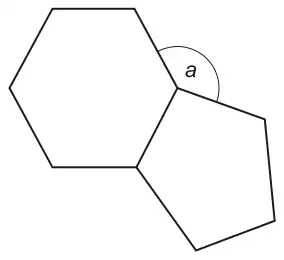
8 Imran joins two tiles together as shown below. One tile is a regular hexagon and the other tile is a regular pentagon.
Not to scale
(a) Show that angle \(a\) is 132°. [3]
(b) Imran thinks that another tile in the shape of a regular polygon will fit exactly into angle \(a\).
Is Imran correct? Show your reasoning. [3]
Mark scheme (a)
Answer
Marks
Part marks and guidance
360 ÷ 5 and 360 ÷ 6
M1
or for ((5 – 2) × 180) ÷ 5 oe and ((6 – 2) × 180) ÷ 6 oe
M1 allow 540 ÷ 5 and 720 ÷ 6 but not for just 108 and 120 Allow recovery of missing brackets from answers nfww for B1 do not allow if e.g. 60 is shown as int angle of hexagon
The exterior angle of a regular polygon is \(24^\circ\).
(i) How many sides does it have? [2]
(ii) Calculate the sum of all the interior angles of this polygon. [2]
(b)
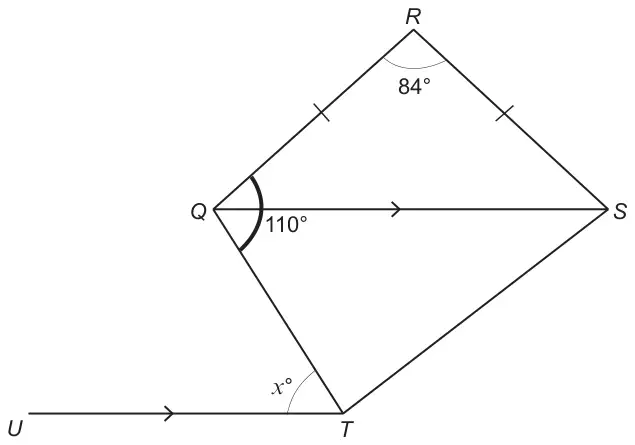
The diagram below shows a quadrilateral QRST. QS is parallel to UT. \(Q\hat{R}S = 84^\circ\), \(R\hat{Q}T = 110^\circ\) and QR = RS.
Diagram not drawn to scale
Calculate the value of \(x\). Give a reason for each step of your answer. [4]
Mark scheme (a)
Scheme
Marks
Comments
(i) 360 ÷ 24
M1
= 15 (sides)
A1
(ii) (180 – 24) × 15 oe
M1
FT ‘their number of sides’ if > 4
= 2340(°)
A1
FT
Alternative
Alternative Method for (ii)
Scheme
Marks
Comments
(15 – 2) × 180 oe
M1
FT ‘their number of sides’ if > 4
= 2340(°)
A1
FT
Mark scheme (b)
Scheme
Marks
Comments
Answers may be seen on the diagram
(RSQ or RQS =) 48 (°)
B2
B1 for (180 – 84) ÷ 2 oe
\(x = 62\)
B1
FT ‘their 48’ provided B1 previously awarded
At least two reasons given, including (SQT = QTU) alternate angles AND base angles in an isosceles triangle are equal.
E1
Dependent on at least B1 B1 previously awarded.
(8)
Alternative
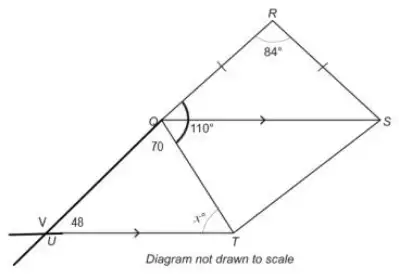
Alternative method (extending RQ and UT to meet at a point V)
Scheme
Marks
Comments
(RSQ or RQS =) 48 (°)
B2
B1 for (180 – 84) ÷ 2 oe
\(x = 62\)
B1
FT ‘their 48’ provided B1 previously awarded
At least two reasons given, including (RQS = QVT) corresponding angles or (SQV + QVT = 180) co-interior angles AND base angles in an isosceles triangle are equal.
23.In this question, all lengths are in centimetres.
Diagram not drawn to scale
The diagram shows a sketch of a circle, centre O. Points A, B, C, D, E and F lie on the circumference of the circle. Triangles AOB, BOC, COD, DOE, EOF and FOA are congruent.
The circle has equation \(x^2 + y^2 = \dfrac{25}{4}\).
Calculate the perimeter of the hexagon ABCDEF. You must justify any decisions that you make.[4]
Mark scheme
Scheme
Marks
Comments
\(\left(x^2 + y^2 = \dfrac{25}{4}\right)\ r^2 = \dfrac{25}{4}\) si
M1
Allow for \(x^2 = \dfrac{25}{4}\) or \(x = \pm\dfrac{5}{2}\) but not for \(x + y = \dfrac{5}{2}\)
\(r = \dfrac{5}{2}\) (cm) si
A1
Justifies each congruent triangle being equilateral e.g. ‘The 6 triangles are congruent so the hexagon is regular and the 6 triangles are equilateral.’ or ‘The 6 triangles are congruent, so each angle at O is 60° and as they are all isosceles triangles (each side from O is a radius) then they must be equilateral.’
E1
Allow if e.g. OA and OB are indicated as being the same length on the diagram and the two base angles calculated as 60 after e.g. OAB or an exterior angle found as 360 ÷ 6
\(\left(6\times\dfrac{5}{2} =\right) 15\) (cm)
B1
FT ‘their derived \(\dfrac{5}{2}\)’ provided it is not \(\dfrac{25}{4}\)
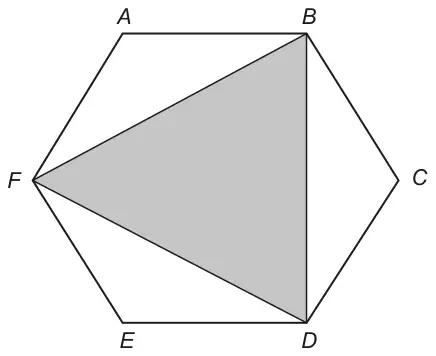
27. In the diagram below, ABCDEF is a regular hexagon.
Explain why triangle BDF is equilateral. [3]
Diagram not drawn to scale
Mark scheme
Scheme
Marks
Comments
(Hexagon is regular so) all sides equal or interior angles 120° or equivalent or it has (6) lines of symmetry
B1
Angles may be marked on diagram
May be implied by use of isosceles triangles later.
Triangles ABF, BCD, DEF are congruent or ABF = 30° or valid comment such as ‘Three of the lines of symmetry are also lines of symmetry of the triangle’
B1
Allow “the same” or equivalent for “congruent”.
Valid explanation e.g. ‘The 3 sides BF, BD and DF are the same length’ or ‘Each interior angle of the triangle is 120° – 2 × 30° = 60°’
Do not allow \(1080 \div 8 = 135\) only, there must be evidence to support 1080
Allow SC2 for (exterior angle is) \(180 - 135 = 45\) and (exterior angle is) \(360 \div 8 = 45\) or for exterior angle sum is 360 oe (exterior angle is) \(180 - 135 = 45\) \(45 \times 8 = 360\)
Mark scheme (b)
Scheme
Marks
Comments
\(y + 180 - x + 180 - x + 135 = 360\) or \(x = \dfrac{y}{2} + \dfrac{135}{2}\) or \(\dfrac{y}{2} + 180 - x + \dfrac{135}{2} = 180\)
M1
Accept in any correct form
Convincing working leading to \(y = 2x - 135\)
A1
Given answer obtained without any wrong working seen
If M0 then award SC1 for verification that \(y = 2x - 135\) leads to eg \(2x - 135 + 2(180 - x) + 135 = 360\)
One correct reason e.g. Angles on a straight line (add up to \(180^\circ\)), Angle sum of a quadrilateral (\(=360^\circ\)), Symmetry of kite or equivalent
E1
Allow for one correct statement Stated appropriately NB SC1 E1 is possible
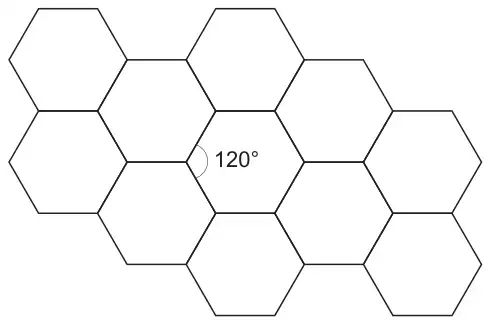
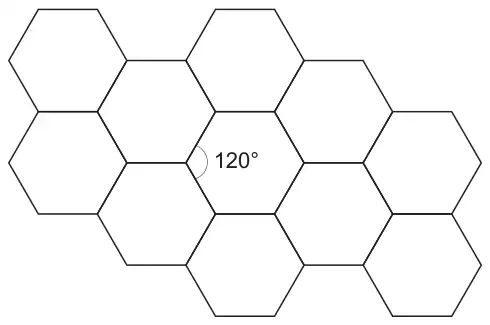
(a) The diagram below shows some tiles in part of a tessellation. The tiles are all identical regular hexagons. Each of the interior angles is 120°.
Explain why the tiles tessellate. You must give a reason, based on angle facts, for your answer. [1]
(b) Explain why tiles that are identical regular pentagons will not tessellate. You must show working to support your explanation. [4]
Mark scheme (a)
Scheme
Marks
Comments
Valid explanation which refers to use of angles at a point 360° e.g. “three (interior) angles can be added together to make 360°” “120 is a factor of 360” “360 is a multiple of 120” “360 ÷ 3 = 120” or equivalent “120 × 3 = 360” or equivalent
E1
Do not accept “they fit together” “they all add up to 360” (unless ‘they’ are identified as the three (interior) angles – could be on diagram) “all exterior angles add up to 360”
May be seen in stages. Award M1 for any one of the following:
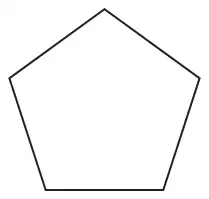
(Exterior angle =) 360 ÷ 5
(Exterior angle =) 72
(Sum of the interior angles =) (5 – 2) × 180
(Sum of the interior angles =) 540.
108(°)
A1
CAO.
Valid explanation which refers to 108(°) AND 360 (°) e.g. “108 is not a factor of 360” “360 is not a multiple of 108” “360 ÷ 108 is not a whole number” or equivalent.
E1
Dependent on M2 previously awarded. FT ‘their 108’.
18. The diagram below is a sketch of a regular 12-sided polygon, with centre \(O\). The polygon has sides of length 5 cm. \(AE\) and \(OE\) are straight lines.
Diagram not drawn to scale
(a) Calculate the length of \(CE\). You must show all your working. [6]
(b) Hence, calculate the area of triangle \(CGE\). [2]
From the formula list: In any triangle \(ABC\): Sine rule \(\dfrac{a}{\sin A} = \dfrac{b}{\sin B} = \dfrac{c}{\sin C}\); Area of triangle \(= \dfrac{1}{2}ab\sin C\)
Mark scheme (a)
Scheme
Marks
Comments
\(E\hat{C}G\) = 30(°)
B1
Angles must be clearly stated or seen on the diagram.
Sight of \(C\hat{E}G\) = 45(°) AND \(C\hat{G}E\) = 105(°)
B2
B1 for \(C\hat{E}G\) = 45(°) OR \(C\hat{G}E\) = 105(°) Sight of \(C\hat{E}G\) = 45(°) implies previous B1. FT ‘their \(E\hat{C}G\) = 30’ to calculate:
\(C\hat{G}E\) = ‘their 30’/2 + 90
\(C\hat{E}G\) = 90 – ‘their 30’ × 3/2
\(CE = \dfrac{5 \times \sin 105}{\sin 45}\)
M2
Use of correct angles implies B1B2. FT ‘their \(C\hat{G}E\) = 105’ AND ‘their \(C\hat{E}G\) = 45’. M1 for \(\dfrac{CE}{\sin 105} = \dfrac{5}{\sin 45}\) Award M2 for a correct use of ‘two-step’ trigonometric relationship. M0 otherwise.
= 6·8(3…cm) or \(\dfrac{5 + 5\sqrt{3}}{2}\) (cm)
A1
Allow 7(cm) from correct working.
18(a) Alternative version to find OC first and then use triangle OCE
Scheme
Marks
Comments
\(C\hat{O}E\) = 30(°)
B1
Angles must be clearly stated or seen on the diagram.
Sight of \(C\hat{E}G\) = 45(°)
B1
Sight of \(C\hat{E}G\) = 45(°) implies previous B1 FT ‘their \(E\hat{C}G\) = 30’ to calculate: \(C\hat{E}G\) = 90 – ‘their 30’ × 3/2
\(\left(OC = \dfrac{2{\cdot}5}{\sin(15)} = \right)\) 9·6(5…cm) or 9·7(cm) or \(\dfrac{5\sqrt{6} + 5\sqrt{2}}{2}\) (cm)
B1
Or equivalent e.g. using the sine rule in triangle OCG FT ‘sin (½ of ‘their \(C\hat{O}E\) = 30’)’
Use of correct side and angles implies B1B1B1. FT ‘their derived OC’ AND ‘their \(C\hat{O}E\) = 30’ AND ‘their \(C\hat{E}G\) = 45’. M1 for \(\dfrac{CE}{\sin 30} = \dfrac{9{\cdot}6(5\ldots)}{\sin 45}\) Award M2 for a correct use of ‘two-step’ trigonometric relationship. M0 otherwise.
= 6·8(3…cm) or \(\dfrac{5 + 5\sqrt{3}}{2}\) (cm)
A1
Allow an answer of 7(cm) from correct working.
Corrected by Westie's Workshop
The board's mark scheme printed “FT ‘sin (½ of ‘their \(C\hat{O}E\) = 30’)”. Changed to “FT ‘sin (½ of ‘their \(C\hat{O}E\) = 30’)’” because a closing quotation mark was missing at the end of the phrase.
Original: see the board's mark scheme PDF (link above).
Mark scheme (b)
Scheme
Marks
Comments
½×5×6·8(3…)×sin30
M1
FT their solution in (a), provided it does not refer to a side other than CE AND ‘their \(E\hat{C}G\) = 30(°)’.
= 8·5(…cm2) or \(\dfrac{25 + 25\sqrt{3}}{8}\) (cm2)
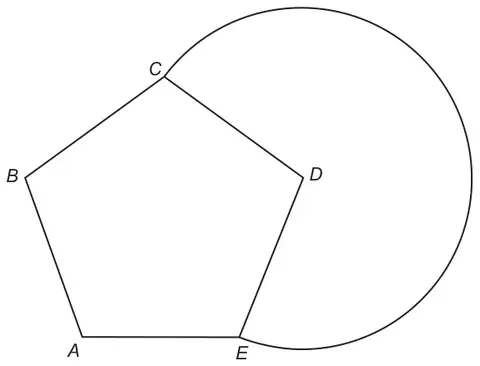
10.ABCDE is a regular pentagon with sides of length 11 cm. CDE is a sector of a circle with centre D and radius 11 cm. The two shapes are joined together, as shown below.
Diagram not drawn to scale
(a)In this part of the question, you will be assessed on the quality of your organisation, communication and accuracy in writing.
Calculate the length of the arc CE shown in the diagram. You must show all your working. [4 + 2 OCW]
(b) In a shape similar to the one shown above, the regular pentagon has sides of length 671 cm.
Complete the following statement.
Total area of new shape = ………………………… × total area of original shape
You must show all your working. [2]
Mark scheme (a)
Scheme
Marks
Comments
(Reflex angle D = ) 180 + 360/5 OR 360 – 3×180/5
M1
Or any other complete method. May be seen in stages.
= 252(°)
A1
Award for sight of 252(°) if not contradicted by further incorrect work.
(Arc length CE = ) 252/360 × \(\pi\) × 2 ×11
M1
FT for M1 for ‘their derived angle’.
48·3(…) OR 48·4 OR 77π/5 OR \(15\tfrac{2}{5}\)π OR 15·4π(cm) o.e.
A1
ISW Accept 48(cm) from correct working. 12089/250 from using 3·14 Allow a FT for this mark provided the angle used is >180°. If no marks award SC1 for sight of 108(°) OR 72(°)
Organisation and Communication
OC1
For OC1, candidates will be expected to:
present their response in a structured way
explain to the reader what they are doing at each step of their response
lay out their explanation and working in a way that is clear and logical
write a conclusion that draws together their results and explains what their answer means
Accuracy of writing
W1
For W1, candidates will be expected to:
show all their working
make few, if any, errors in spelling, punctuation and grammar
use correct mathematical form in their working
use appropriate terminology, units, etc.
Mark scheme (b)
Scheme
Marks
Comments
\(\left(\frac{671}{11}\right)^2\) (= 450241/121 ) OR \(61^2\)
M1
= 3721
A1
Answer in the sentence takes precedence. If no marks, allow SC1 for 3721/25 OR \(148\frac{21}{25}\) OR 148·84 [from (671/55)2].
12.In this question, you will be assessed on the quality of your organisation and communication.
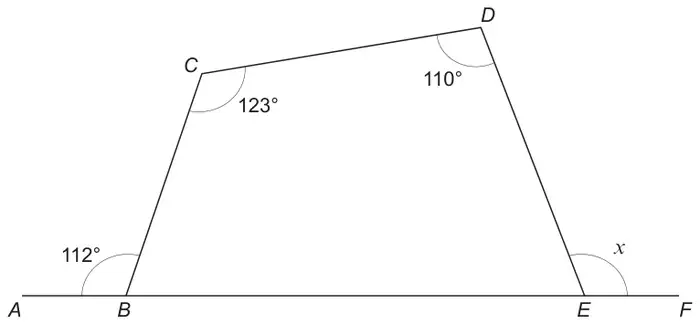
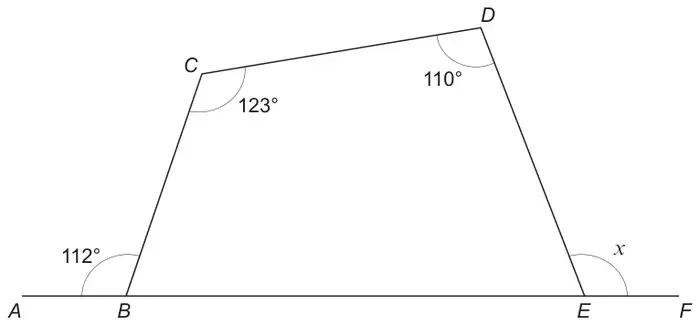
In the diagram below, AF is a straight line.
Diagram not drawn to scale
Calculate the size of angle \(x\). You must show all your working. [4 + 1 OC]
Mark scheme
Scheme
Marks
Comments
(Angle EBC = 180 – 112 = ) 68 (°)
B1
Check diagram for answers.
(Angle BED or Angle AED =) 360 – (123 + 110 + 68) or equivalent
M1
Award M1 for complete method to find Angle BED or intention of complete method provided not contradicted e.g. 360 – 123 + 110 + 68 with 123 + 110 + 68 added incorrectly but attempt to subtract from 360. FT 360 – (123 + 110 + ‘their 68’), provided ‘their 68’:
≠ 112
and < 127.
59 (°)
A1
\(x\) = 121 (°)
B1
FT 180(°) – ‘their derived 59(°)’, provided < 180
Unsupported answer (may be on diagram) is awarded B1M1A1B1.
Organisation and Communication.
OC1
For OC1, candidates will be expected to:
present their response in a structured way
explain to the reader what they are doing at each step of their response
lay out their explanation and working in a way that is clear and logical
write a conclusion that draws together their results and explains what their answer means
3.In this question, you will be assessed on the quality of your organisation, communication and accuracy in writing.
In the diagram below, AF is a straight line.
Diagram not drawn to scale
Calculate the size of angle \(x\). You must show all your working.[4 + 2 OCW]
Mark scheme
Scheme
Marks
Comments
(Angle EBC = 180 – 112 = ) 68 (°)
B1
Check diagram for answers.
(Angle BED or Angle AED =) 360 – (123 + 110 + 68) or equivalent
M1
Award M1 for complete method to find Angle BED or intention of complete method provided not contradicted e.g. 360 – 123 + 110 + 68 with 123 + 110 + 68 added incorrectly but attempt to subtract from 360. FT 360 – (123 + 110 + ‘their 68’), provided ‘their 68’:
≠ 112
and < 127.
59 (°)
A1
\(x\) = 121 (°)
B1
FT 180(°) – ‘their derived 59(°)’, provided < 180
Unsupported answer (may be on diagram) is awarded B1M1A1B1.
Organisation and Communication.
OC1
For OC1, candidates will be expected to:
present their response in a structured way
explain to the reader what they are doing at each step of their response
lay out their explanation and working in a way that is clear and logical
write a conclusion that draws together their results and explains what their answer means
Accuracy of writing.
W1
For W1, candidates will be expected to:
show all their working
make few, if any, errors in spelling, punctuation and grammar
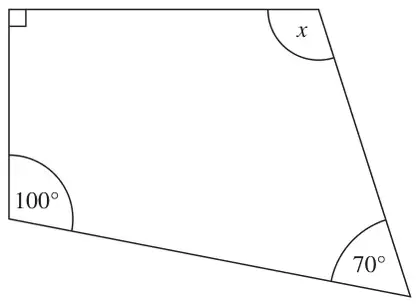
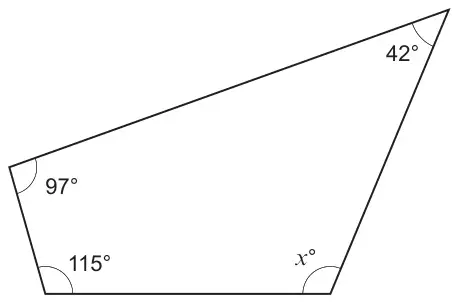
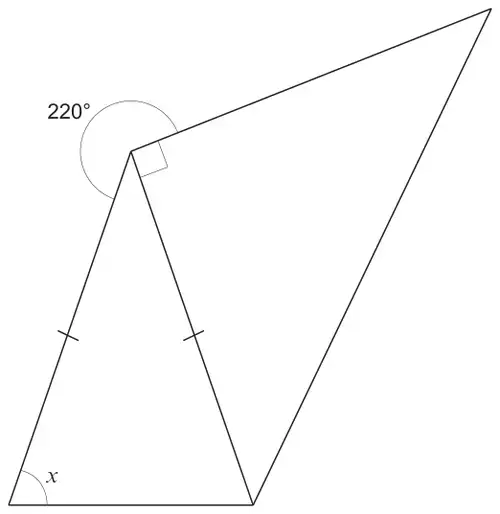
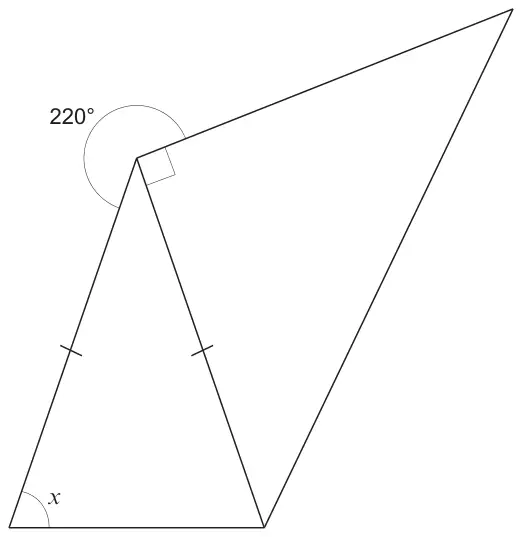
Calculate the size of angle \(x\). You must show all your working. [4]
\(x\) = …………………… °
Mark scheme
Scheme
Marks
Comments
360 – 90 – 220 or equivalent
M1
Answer line takes precedence. Note: 360 – 310 or 270 – 220 or 140 – 90 Award M1 for complete method or intention of complete method provided not contradicted e.g. brackets missing 360 - 90 + 220
= 50(°)
A1
May be seen in later working
(\(x\) = ) (180 - 50) ÷ 2 or equivalent
M1
May be seen in stages FT (180 – ‘their 50’) ÷ 2
= 65(°)
A1
Alternative
14. Alternative method
Scheme
Marks
Comments
(Exterior angle = sum of the two opposite interior angles =) 220 – 90(=) 130(°)
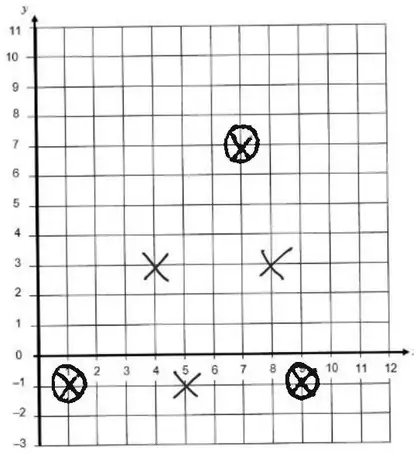
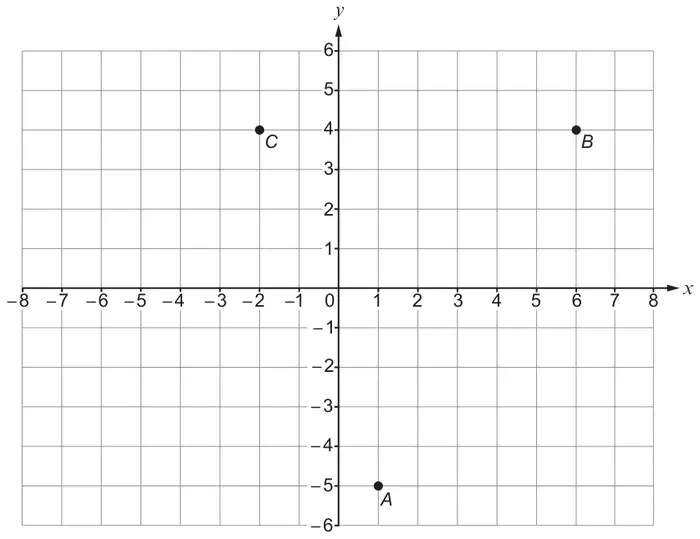
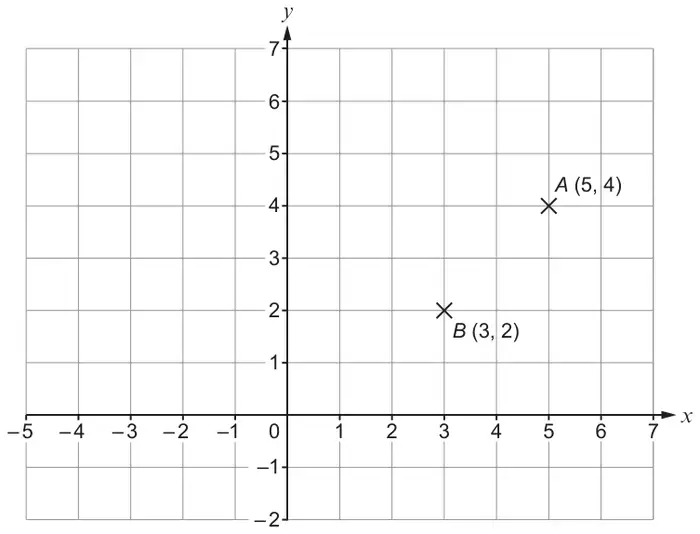
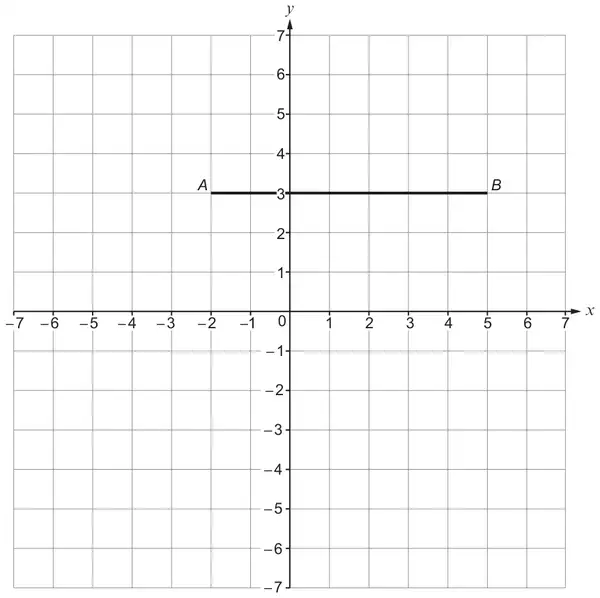
(a)B is the midpoint of the line AC. Find the coordinates of C. [2]
C (…………… , ……………)
(b)A and B are two vertices of a right-angled triangle. Point D is to be plotted on the grid above so that the triangle ABD is a right-angled triangle. The \(x\)-coordinate of D is negative. Give the coordinates of a possible position of the point D that can be plotted on the grid above. [2]
D (…………… , ……………)
Mark scheme (a)
Scheme
Marks
Comments
(1, 0)
B2
Award B1 for one of the following:
if C clearly identified on grid but coordinates not given or are incorrect
for an answer of (4, 3) (midpoint of AB)
for an answer of (1\(x\), 0\(y\)) and point not identified.
Mark scheme (b)
Scheme
Marks
Comments
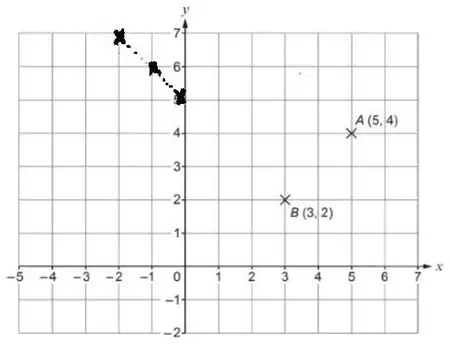
(-1, 6) OR (-2,7)
B2
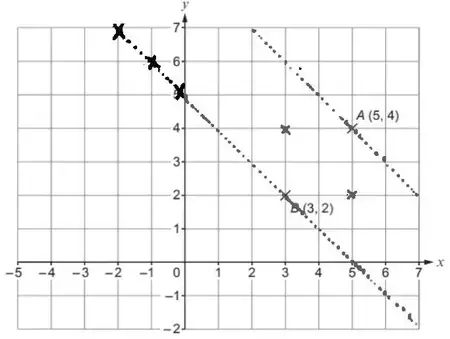
Award B2 for any point that satisfies the conditions e.g. (-1.5, 6.5) Award B1 for one of the following:
if D identified on grid in a correct position but coordinates not given or are incorrect OR
for the coordinates of any point that creates a right-angled triangle with AB as one side
e.g.
(0,5)
(1,4)
(2,3)
(4,1)
(5,0)
(6,-1)
(7,-2)
(3,4)
(5,2)
(2,7)
(3,6)
(4,5)
(6,3)
(7,2)
Notes
In the original, the crosses and dotted line at negative x (the B2 answers) are green and the other crosses and dotted lines are red. Here they are shown in black and dark grey.
Calculate the size of angle \(x\). You must show all your working. [4]
\(x =\) ……………………………… °
Mark scheme
Scheme
Marks
Comments
360 – 90 – 220 or equivalent
M1
Answer line takes precedence. Note: 360 – 310 or 270 – 220 or 140 – 90. Award M1 for complete method or intention of complete method provided not contradicted e.g. brackets missing 360 - 90 + 220.
= 50(°)
A1
May be seen in later working. May be seen in stages.
(\(x\) = ) (180 - 50) ÷ 2 or equivalent
M1
FT (180 – ‘their 50’) ÷ 2
= 65(°)
A1
Alternative method
Scheme
Marks
Comments
(Exterior angle = sum of the two opposite interior angles =) 220 – 90(=) 130(°)
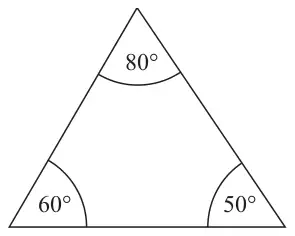
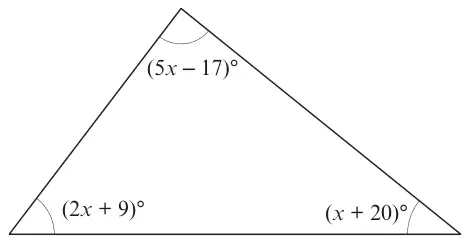
13. Show that the triangle below is not a right-angled triangle. [5]
Diagram not drawn to scale
Mark scheme
Scheme
Marks
Comments
5x − 17 + 2x + 9 + x + 20 = 180
M1
8x = 168
A1
x = 21
A1
F.T. from ax = b. Allow all 3 marks for x = 21.
Substituting x = 21 into at least one expression.
M1
If x ≠ 21 FT ‘their derived value of x’.
(5x – 17 =) 88(°) (2x + 9 =) 51(°) (x + 20 =) 41(°) (So not a right-angled triangle)
A1
F.T. for this A1 if x ≥ 4. Any two of these expressions correctly evaluated with no incorrect evaluation, provided the sum of the two found is > 90. (statement not required). Note If further work indicates that the values found are not treated as angles (e.g. showing 512 +412 ≠ 882) then award final M0A0.
Alternative method
Scheme
Marks
Comments
5x − 17 = 90 OR 2x + 9 = 90 OR x + 20 = 90
M1
x = 21·4 AND x = 40·5 AND x = 70
A2
Award A1 for any one of these: x = 21·4 OR x = 40·5 OR x = 70
Then verifying: If x = 21·4: 5x − 17 + 2x + 9 + x + 20 = 183.2 AND If x = 40·5: 5x − 17 + 2x + 9 + x + 20 = 336 AND If x = 70: 5x − 17 + 2x + 9 + x + 20 = 572 (So not a right-angled triangle)
A2
Award A1 for any one of these: If x = 21·4: 5x − 17 + 2x + 9 + x + 20 = 183.2 OR If x = 40·5: 5x − 17 + 2x + 9 + x + 20 = 336 OR If x = 70: 5x − 17 + 2x + 9 + x + 20 = 572
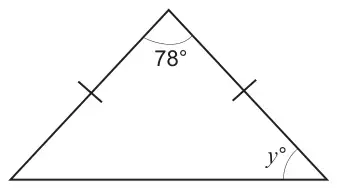
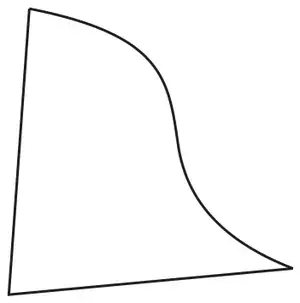
Maisie has been asked to design a new shape of chip. One of her designs is shown below.
Maisie thinks that the angle between the two straight edges is an obtuse angle. Do you agree? You must use the diagram to give a reason for your answer. [1]
Yes ☐ No ☐
(c)
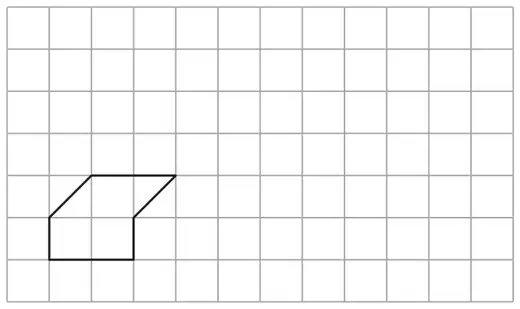
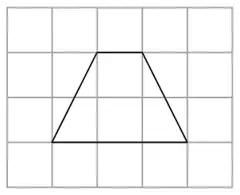
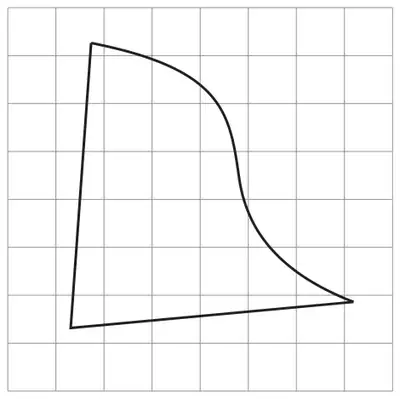
Maisie’s design is shown on the centimetre-squared grid below.
The face of one of the original chips has an area of 13 cm2.
Maisie thinks her new design has a greater area than the original.
Decide whether or not Maisie is correct. You must show all your working. [3]
Mark scheme (a)
Scheme
Marks
Comments
Equilateral
B1
Mark scheme (b)
Scheme
Marks
Comments
No and a valid reason e.g. ‘No because the angle is 78(±2˚) (which is less than 90(˚))’ ‘No as the angle is smaller than a right angle’ ‘No because an obtuse angle is greater than 90 (but less than 180)’ ‘No because it’s less than 90’ ‘No, it’s below 90’ ‘No, obtuse is over 90’ ‘No because it is an acute angle’
E1
Reasons may be indicated on the diagram.
Do not accept ‘No because they are not straight lines’ ‘Yes because it is an angle below 90’ ‘Yes because obtuse angles are 90’ ‘No, it is over 90’
Mark scheme (c)
Scheme
Marks
Comments
Evidence of counting squares inside shape
M1
Answer in range 14 – 22
A1
Answers may be on diagram
Maisie correct (accept yes)
E1
This mark is dependent on ‘their area’ FT ‘their area’ Award E1 if there is clearly enough working for area to be able to decide whether Maisie is correct or not. Award E0 for explanations clearly based on perimeters. Must clearly indicate that Maisie is correct but may be implied in their statement eg there are more than 13 cm2, there are approximately 18.
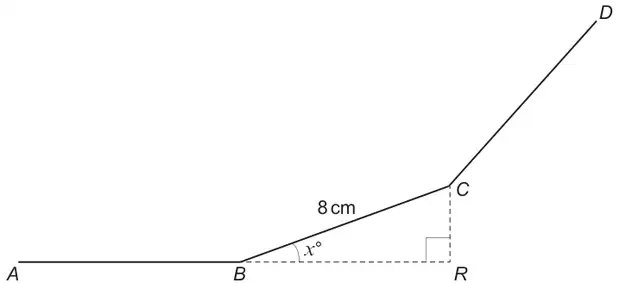
15. In the diagram below, AB, BC and CD are three sides of a regular polygon. The polygon has 15 sides. The length of each side is 8 cm.
The exterior angle of the polygon is \(x^\circ\). BRC is a right-angled triangle.
Diagram not drawn to scale
Calculate the length of BR. [5]
Mark scheme
Scheme
Marks
Comments
( x =) \(\dfrac{360}{15}\) or 180 – \(\dfrac{(15 - 2) \times 180}{15}\) or equivalent
M1
May be seen in parts.
= 24(°)
A1
(BR =) 8 × cos 24 or 8 × sin (90 – 24)
M2
FT ‘their stated value for x’ ( x < 90°) M1 for \(\dfrac{\text{BR}}{8}\) = cos 24 or \(\dfrac{\text{BR}}{8}\) = sin (90 – 24) Accept equivalent of using sin rule (as sin 90 = 1).
= 7·3(0…)(cm) or 7·31(cm)
A1
Alternative method to find BR
Scheme
Marks
Comments
A correct and complete method (using two trigonometric relationships and possibly Pythagoras’s theorem)
M2
BR = 7·3(0…)(cm) or 7·31(cm)
A1
In the original the alternative method is printed in the Comments column.
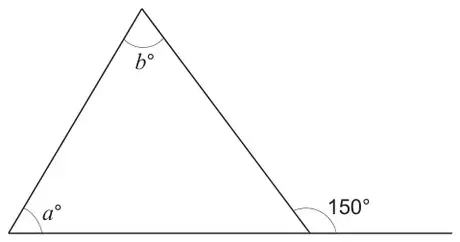
(a) Is it possible for an isosceles triangle to have an angle of 140°? Circle your answer. You must give an explanation for your answer. [1]
YES NO
(b)
Diagram not drawn to scale
Which of the following equations is correct for the diagram shown above? Circle your answer. [1]
\(a + b = 30\) \(a + b = 210\) \(b - a = 150\)
\(a - b = 150\) \(a + b = 150\)
Mark scheme (a)
Scheme
Marks
Comments
YES AND a valid explanation. e.g. ‘ the other two angles would be (both) 20(°)’ e.g. diagram showing (isosceles) triangle with angles of 140°, 20° and 20°.
E1
A valid explanation implies YES circled if not otherwise contradicted (by circling NO).
Explanations must engage with the specific triangle given (with an angle of 140°) and not isosceles triangles in general.
(a) Draw the line \(x = -4\) on the grid below. [1]
(b)C is a point on the grid below so that:
\(B\hat{A}C\) = 90°,
AC = AB.
(i) Show the position of point Con the grid. [2]
(ii) Write down the coordinates of point C. [1]
Mark scheme (a)
Scheme
Marks
Comments
Line \(x = -4\) drawn
B1
Line must be at least 2 units long. B0 if ‘extra’ lines drawn unless correct line unambiguously identified.
Mark scheme (b)
Scheme
Marks
Comments
(i) Point C shown at (−2,−4)
B2
Allow B2 if point C not labelled but is unambiguously at the correct position (eg ‘end of line’). Otherwise, B1 if Point C at (−2,y) y≠3. (BÂC = 90° ) SC1 for point C at (5,−4).
(ii) (−2,−4)
B1
FT ‘their unambiguously identified position of point C’. Allow missing brackets.
(a) Is it possible for an isosceles triangle to have an angle of 140°? Circle your answer. You must give an explanation for your answer. [1]
YES NO
(b) Is it possible for a rhombus to have an angle of 120° and an angle of 30°? Circle your answer. You must give an explanation for your answer. [1]
YES NO
(c)
Diagram not drawn to scale
Which of the following equations is correct for the diagram shown above? Circle your answer. [1]
\(a + b = 30\) \(a + b = 210\) \(b - a = 150\)
\(a - b = 150\) \(a + b = 150\)
Mark scheme (a)
Scheme
Marks
Comments
YES AND a valid explanation. e.g. ‘ the other two angles would be (both) 20(°)’ e.g. diagram showing (isosceles) triangle with angles of 140°, 20° and 20°.
E1
A valid explanation implies YES circled if not otherwise contradicted (by circling NO).
Explanations must engage with the specific triangle given (with an angle of 140°) and not isosceles triangles in general.
Mark scheme (b)
Scheme
Marks
Comments
NO AND a valid explanation. e.g. ‘120(°) + 30(°) ≠ 180(°)’ ‘the two angles add to 150(°), not 180(°) ‘120(°) + 30(°) + 120(°) + 30(°) ≠ 360(°)’ ‘the four angles add to 300(°), not 360(°)
E1
Allow ‘the two angles must equal 180°’. Do not accept ‘the four angles must equal 360°’ unless it is made clear that the rhombus has two pairs of equal angles. A valid explanation implies NO circled if not otherwise contradicted (by circling YES).
FT ‘their stated value for \(x\)’ (\(x \lt 90^\circ\)) M1 for \(\dfrac{BR}{8} = \cos 24\) or \(\dfrac{BR}{8} = \sin (90 - 24)\) Accept equivalent of using sin rule (as sin 90 = 1).
= 7·3(0…)(cm) or 7·31(cm)
A1
Alternative method to find BR
Scheme
Marks
Comments
A correct and complete method (using two trigonometric relationships and possibly Pythagoras’s theorem)
3.In this question, you will be assessed on the quality of your organisation, communication and accuracy in writing.
A regular octagon with centre \(O\) is shown below.
Diagram not drawn to scale
Calculate the exact size of \(O\hat{A}B\). You may choose to draw additional lines on the diagram to help you. You must show all your working. [4 + 2 OCW]
Mark scheme
Scheme
Marks
Comments
Answers/working may be seen on diagram.
(Angle AÔB or exterior angle =) \(\dfrac{360}{8}\)(°)
M1
= 45(°)
A1
Sight of 45 (even e.g. OÂB = 45) gains M1A1.
(OÂB =) \(\dfrac{180 - 45}{2}\)
M1
FT ‘their 45’ (but not 60°).
= 67·5(°)
A1
Organisation and Communication.
OC1
For OC1, candidates will be expected to:
present their response in a structured way
explain to the reader what they are doing at each step of their response
lay out their explanation and working in a way that is clear and logical
write a conclusion that draws together their results and explains what their answer means
Accuracy of writing.
W1
For W1, candidates will be expected to:
show all their working
make few, if any, errors in spelling, punctuation and grammar
use correct mathematical form in their working
use appropriate terminology, units, etc
3. Alternative method 1
Scheme
Marks
Comments
(Sum of interior angles =)(8 – 2)×180° or equivalent
Tref-tiles sells boxes of small wall tiles. Three different boxes are available.
Box of 25 tiles for £7.50
Box of 40 tiles for £11.20
Box of 100 tiles for £29
Catrin is buying a very large quantity of these small tiles to cover all the walls in her bathroom. Which box offers the best value for money? You must show all your working. [4]
(b)
Tref-tiles has 5 boxes of tiles on special offer. All the tiles in each box are identical.
Box
A
B
C
D
E
Shape of tile
Square
Rhombus
Regular pentagon
Right-angled triangle
Circle
3 of these boxes contain tiles that tessellate. Manon is asked to select these 3 boxes. Which 3 boxes should Manon select? [2]
Box ................, box ................ and box ................
Mark scheme (a)
Scheme
Marks
Comments
Method of comparison, e.g. per 1 tile or for 5 tiles, or similar
M1
Needs to show attempt to compare at least 2 of the 3 packages, e.g. Comparing 100 tiles: 100 tiles for £29 with
40 tiles: £11.20 × 2.5 (= £28), or
25 tiles: £7.50 × 4 (= £30)
Correctly evaluated comparison for 2 of the 3 packages
A1
Ignore incorrect units
Number of tiles
per 1 tile
per 5 tiles
per 200 tiles
25
30 p
£1.50
£60
40
28 p
£1.40
£56
100
29 p
£1.45
£58
Number of tiles
Tiles per pence
25
25/750
1/30
0.0333...
40
40/1120
1/28
0.0357...
100
100/2900
1/29
0.03448...
(× 100 for tiles per £)
Correctly evaluated comparison for all packages, may be different methods for different stages
A1
If units are given they must be correct Consistent units that are not obviously incorrect are required, or allow no units given Depends on at least M1, A1 previously awarded
Conclusion ‘(box of) 40 (middle) is best value for money’
E1
FT provided all three boxes are appropriately compared (all three or as two pairs) and at least M1 A1 previously awarded
Sight of looking at the difference in costs is likely to be M0 A0 A0
Corrected by Westie's Workshop
The board's mark scheme printed “0.3448...”. Changed to “0.03448...” because 1/29 = 0.03448..., so the decimal was wrongly placed (the other rows start 0.03...).
Original: see the board's mark scheme PDF (link above).
Mark scheme (b)
Scheme
Marks
Comments
Selecting the 3 boxes: A (Square) B (Rhombus) D (Right-angled triangle)
B2
In any order B1 for selecting 2 of the 3 correct boxes
In this part of the question, you will be assessed on the quality of your organisation, communication and accuracy in writing.
Tref-tiles sells boxes of small wall tiles. Three different boxes are available.
Box of 25 tiles for £7.50
Box of 40 tiles for £11.20
Box of 100 tiles for £29
Catrin is buying a very large quantity of these small tiles to cover all the walls in her bathroom. Which box offers the best value for money? You must show all your working. [4 + 2 OCW]
(b)Tref-tiles sells a wall tile measuring 10 cm by 20 cm. How many of these tiles would be needed to cover a wall measuring 3 m by 4 m? You can assume there are no gaps between the tiles. You must show all your working. [3]
Number of tiles is ……………
(c)Tref-tiles has 5 boxes of tiles on special offer. All the tiles in each box are identical.
Box
A
B
C
D
E
Shape of tile
Square
Rhombus
Regular pentagon
Right-angled triangle
Circle
3 of these boxes contain tiles that tessellate. Manon is asked to select these 3 boxes. Which 3 boxes should Manon select? [2]
Box ……………, box …………… and box ……………
Mark scheme (a)
Scheme
Marks
Comments
Method of comparison, e.g. per 1 tile or for 5 tiles, or similar
M1
Needs to show attempt to compare at least 2 of the 3 packages, e.g. Comparing 100 tiles: 100 tiles for £29 with
40 tiles: £11.20 × 2.5 (= £28), or
25 tiles: £7.50 × 4 (= £30)
Correctly evaluated comparison for 2 of the 3 packages
A1
Ignore incorrect units
Number of tiles
per 1 tile
per 5 tiles
per 200 tiles
25
30 p
£1.50
£60
40
28 p
£1.40
£56
100
29 p
£1.45
£58
Number of tiles
Tiles per pence
25
25/750
1/30
0.0333...
40
40/1120
1/28
0.0357...
100
100/2900
1/29
0.03448...
(× 100 for tiles per £)
Correctly evaluated comparison for all packages, may be different methods for different stages
A1
If units are given they must be correct Consistent units that are not obviously incorrect are required, or allow no units given Depends on at least M1, A1 previously awarded
Conclusion ‘(box of) 40 (middle) is best value for money’
E1
FT provided all three boxes are appropriately compared (all three or as two pairs) and at least M1 A1 previously awarded
Sight of looking at the difference in costs is likely to be M0 A0 A0
Organisation and communication
OC1
For OC1, candidates will be expected to: • present their response in a structured way • explain to the reader what they are doing at each step of their response • lay out their explanations and working in a way that is clear and logical • write a conclusion that draws together their results and explains what their answer means
Writing
W1
Do not penalise incorrect units, only consider if units are not given
For W1, candidates will be expected to: • show all their working • make few, if any, errors in spelling, punctuation and grammar • use correct mathematical form in their working • use appropriate terminology, units, etc.
Mark scheme (b)
Scheme
Marks
Comments
Working with 3m by 4m:
30 tiles by 20 tiles, or
15 tiles by 40 tiles
M2
Ignore further inappropriate working
M1 clearly showing (accepting shown on a diagram) any one of
300 ÷ 10 = 30
300 ÷ 20 = 15
400 ÷ 10 = 40
400 ÷ 20 = 20
600 (tiles)
A1
CAO
If no marks, award SC1 for a misuse of units with
division of 10 and 20 by 3 and 4 in either order, or
10 × 20 divided by 3 × 4
3(b) Alternative method
Scheme
Marks
Comments
12 (m\(^2\)) ÷ 0.02 (m\(^2\)) or 120000 (cm\(^2\)) ÷ 200 (cm\(^2\)) or \(\dfrac{300 \times 400}{10 \times 20}\)
M2
Change areas to consistent units M1 for 10 × 20 = 200 AND 3(00) × 4(00) = 12(0000) or 3 × 4 = 12 AND 0.1 × 0.2 = 0.02
600 (tiles)
A1
CAO
Mark scheme (c)
Scheme
Marks
Comments
Selecting the 3 boxes: A (Square) B (Rhombus) D (Right-angled triangle)
B2
In any order B1 for selecting 2 of the 3 correct boxes
18.ABCD is a quadrilateral. \(A\hat{B}C\) = 93°, \(B\hat{C}D\) = 122° and \(A\hat{D}C\) = 85°. Points P and Q lie on the quadrilateral as shown, such that AP = AQ.
Prove that triangle APQ is an equilateral triangle. You must show all your working. [5]
Diagram not drawn to scale
Mark scheme
Scheme
Marks
Comments
This is a ‘proof’ question so the work for the M1 mark must be seen before the A1 mark can be awarded.
(\(B\hat{A}D\) =) 360 – ( 85 + 122 + 93)
M1
= 60(°)
A1
(APQ = AQP = ) \(\dfrac{180 - 60}{2}\)
M1
F.T. ‘their 60’ only if previous M1 awarded Allow reference to isosceles triangle
= 60(°)
A1
A convincing statement AND the three angles shown as, or stated to be 60(°)
E1
Independent of previous marks. Must refer to three (all) angles being equal. Three angles of 60° must be shown or stated as part of a convincing statement. Reference to equal sides alone is E0.
F.T. from ax = b. a ≠ 1. Unsupported x = 17 gains M1A1A1
ABC (or/and ACB) = 65(°)
B1
F.T. using ‘their derived or stated value for x’ substituted in either (4x – 3) or (x + 48).
y = 180 – 2 × 65
M1
F.T. 180 – 2 × ‘their 65’ derived using ‘their x’ in either angle’. OR F.T. 180 – ‘their derived ABC’ – ‘their derived ACB’ (Must be using a consistent value for x.)
= 50(°)
A1
A0 if error in either ‘deriving ABC’ or ‘deriving ACB’. A0 if ‘y’ is negative on FT.
7. \(ABCD\) is a quadrilateral. \(A\hat{B}C = 93^\circ\), \(B\hat{C}D = 122^\circ\) and \(A\hat{D}C = 85^\circ\). Points \(P\) and \(Q\) lie on the quadrilateral as shown, such that \(AP = AQ\).
Prove that triangle \(APQ\) is an equilateral triangle. You must show all your working.[5]
Diagram not drawn to scale
Mark scheme
Scheme
Marks
Comments
This is a ‘proof’ question so the work for the M1 mark must be seen before the A1 mark can be awarded.
(BÂD =) 360 – ( 85 + 122 + 93)
M1
= 60(°)
A1
(APQ = AQP = ) \(\dfrac{180 - 60}{2}\)
M1
F.T. ‘their 60’ only if previous M1 awarded. Allow reference to isosceles triangle.
= 60(°)
A1
A convincing statement AND the three angles shown as, or stated to be 60(°)
E1
Independent of previous marks. Must refer to three (all) angles being equal. Three angles of 60° must be shown or stated as part of a convincing statement. Reference to equal sides alone is E0.
3. \(ABC\) is an isosceles triangle with \(AB = AC\).
Diagram not drawn to scale
Calculate the value of \(y\). [6]
Mark scheme
Scheme
Marks
Comments
4x – 3 = x + 48
M1
Look at diagram.
3x = 51
A1
x = 17
A1
F.T. from ax = b. a ≠ 1. Unsupported x = 17 gains M1A1A1
ABC (or/and ACB) = 65(°)
B1
F.T. using ‘their derived or stated value for x’ substituted in either (4x – 3) or (x + 48).
y = 180 – 2 × 65
M1
F.T. 180 – 2 × ‘their 65’ derived using ‘their x’ in either angle’. OR F.T. 180 – ‘their derived ABC’ – ‘their derived ACB’ (Must be using a consistent value for x.)
= 50(°)
A1
A0 if error in either ‘deriving ABC’ or ‘deriving ACB’. A0 if ‘y’ is negative on FT.
(b) Each side of this regular polygon is 7 cm. A sketch of two sides, AB and BC, of the polygon is shown below.
Diagram not drawn to scale
Using only a ruler and a pair of compasses, construct an accurate drawing that shows these two sides of the polygon. The point A has been given. You must show your construction arcs. [4]
Mark scheme (a)
Scheme
Marks
Comments
\(\dfrac{360}{45}\)
M1
For a clear intention of finding how many 45s in 360.
= 8 (sides)
A1
Accept embedded answers e.g. 360/8 =45 or 45 × 8 = 360 for M1A1.
Mark scheme (b)
Scheme
Marks
Comments
Correct construction of 90°.
B2
Do not penalise if they use their own point A. Use overlay but arcs required for the 3 ‘angle marks’. With sight of accurate ‘method arcs’. For this B2 the construction need not be at point B. (Final B1 will not then be awarded) B1 for sight of ‘method arcs’ but perpendicular line not drawn (Unless intersection of construction arcs for 90° are correctly used to construct the 45° angle. In this case the B2 and B1 are gained)
Correct bisector of 90°.
B1
With sight of accurate ‘method arcs’. F.T. ‘their 90°’.
AB = 7cm AND BC = 7cm
B1
Allow ± 0·2cm. Do not penalise if the line AB is extended as long as the position of point B is unambiguous. (Allow labelling of points B and C to be missing if end points are unambiguously identifiable.) If all marks gained but angle ABC = 45°, penalise −1.
(b) Each side of this regular polygon is 7 cm. A sketch of two sides, AB and BC, of the polygon is shown below.
Diagram not drawn to scale
Using only a ruler and a pair of compasses, construct an accurate drawing that shows these two sides of the polygon. The point A has been given. You must show your construction arcs. [4]
Mark scheme (a)
Scheme
Marks
Comments
\(\dfrac{360}{45}\)
M1
For a clear intention of finding how many 45s in 360.
= 8 (sides)
A1
Accept embedded answer e.g. 360/8 = 45 or 45 × 8 = 360 for M1A1.
Mark scheme (b)
Scheme
Marks
Comments
Do not penalise if they use their own point A. Use overlay but arcs required for the 3 ‘angle marks’.
Correct construction of 90°.
B2
With sight of accurate ‘method arcs’. For this B2 the construction need not be at point B. (Final B1 will not then be awarded) B1 for sight of ‘method arcs’ but perpendicular line not drawn (unless intersection of construction arcs for 90° are correctly used to construct the 45° angle. In this case the B2 and B1 are gained).
Correct bisector of 90°.
B1
With sight of accurate ‘method arcs’. F.T. ‘their 90°’.
AB = 7cm AND BC = 7cm
B1
Allow ± 0·2cm. Do not penalise if the line AB is extended as long as the position of point B is unambiguous. (Allow labelling of points B and C to be missing if end points are unambiguously identifiable.) If all marks gained but angle ABC = 45°, penalise −1.
We'd like to use Google Analytics cookies to count visits and see which pages help most. They're optional, and the site works exactly the same either way. Privacy policy