(a) Is it possible for an isosceles triangle to have an angle of 140°? Circle your answer. You must give an explanation for your answer. [1]
YES NO
(b) Is it possible for a rhombus to have an angle of 120° and an angle of 30°? Circle your answer. You must give an explanation for your answer. [1]
YES NO
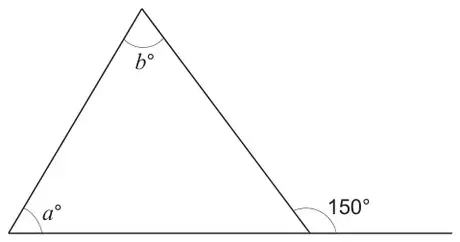
(c)
Diagram not drawn to scale
Which of the following equations is correct for the diagram shown above? Circle your answer. [1]
\(a + b = 30\) \(a + b = 210\) \(b - a = 150\)
\(a - b = 150\) \(a + b = 150\)
Mark scheme (a)
Scheme
Marks
Comments
YES AND a valid explanation. e.g. ‘ the other two angles would be (both) 20(°)’ e.g. diagram showing (isosceles) triangle with angles of 140°, 20° and 20°.
E1
A valid explanation implies YES circled if not otherwise contradicted (by circling NO).
Explanations must engage with the specific triangle given (with an angle of 140°) and not isosceles triangles in general.
Mark scheme (b)
Scheme
Marks
Comments
NO AND a valid explanation. e.g. ‘120(°) + 30(°) ≠ 180(°)’ ‘the two angles add to 150(°), not 180(°) ‘120(°) + 30(°) + 120(°) + 30(°) ≠ 360(°)’ ‘the four angles add to 300(°), not 360(°)
E1
Allow ‘the two angles must equal 180°’. Do not accept ‘the four angles must equal 360°’ unless it is made clear that the rhombus has two pairs of equal angles. A valid explanation implies NO circled if not otherwise contradicted (by circling YES).
We'd like to use Google Analytics cookies to count visits and see which pages help most. They're optional, and the site works exactly the same either way. Privacy policy