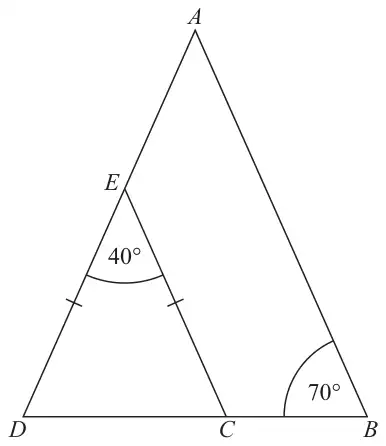
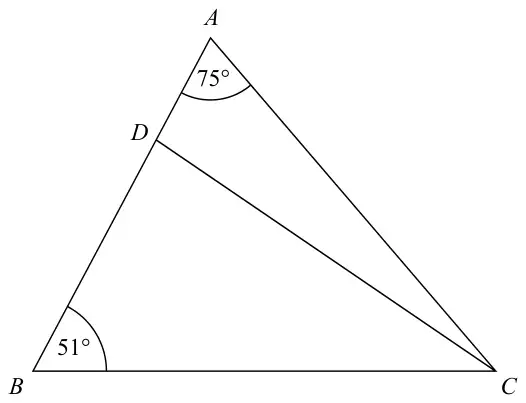
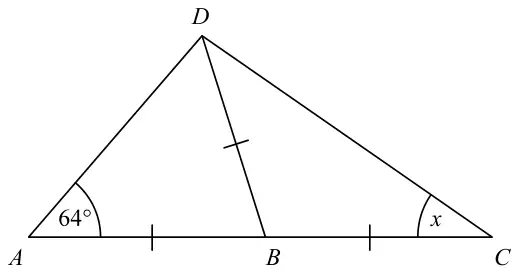
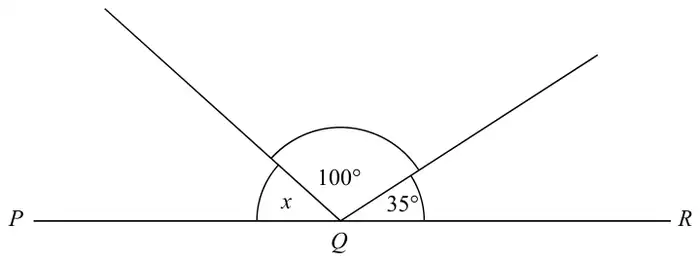
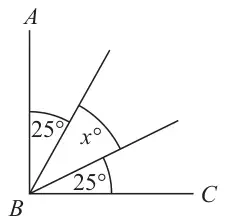
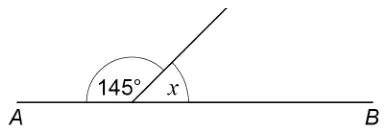
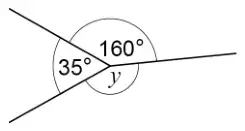
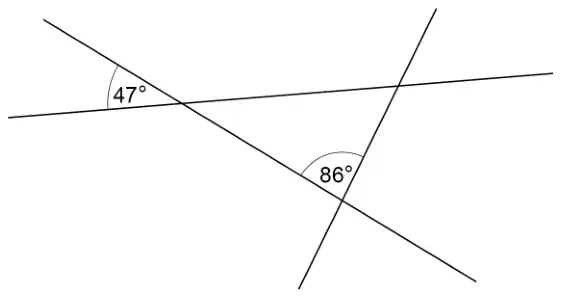
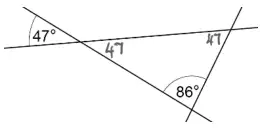
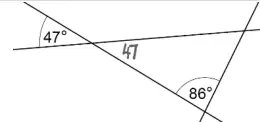
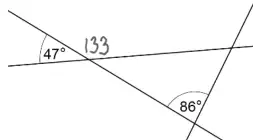
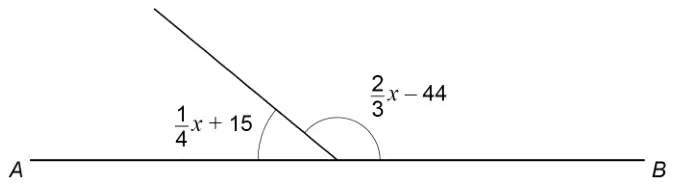
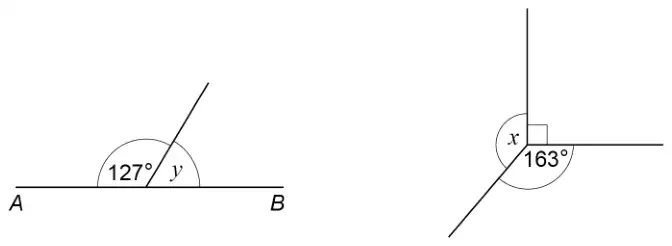
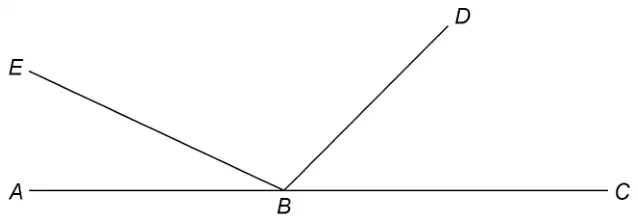
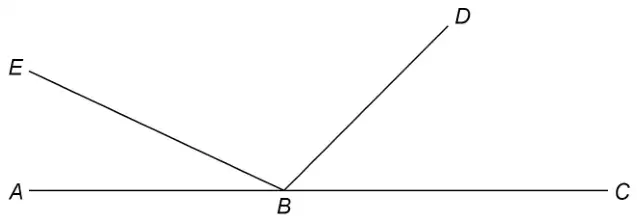
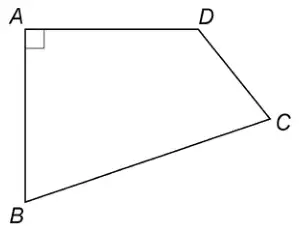
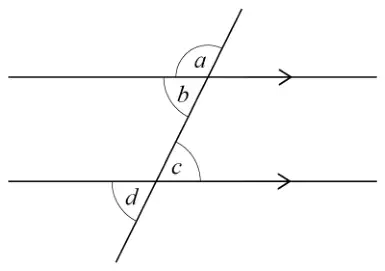
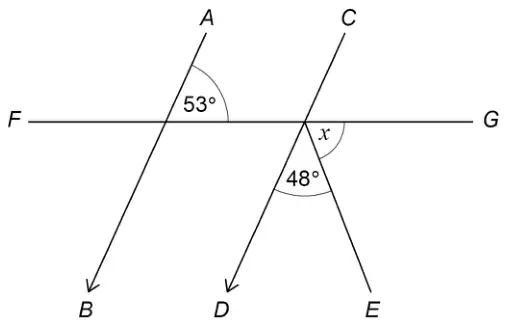
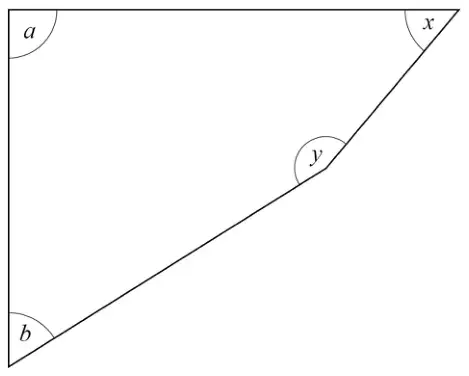
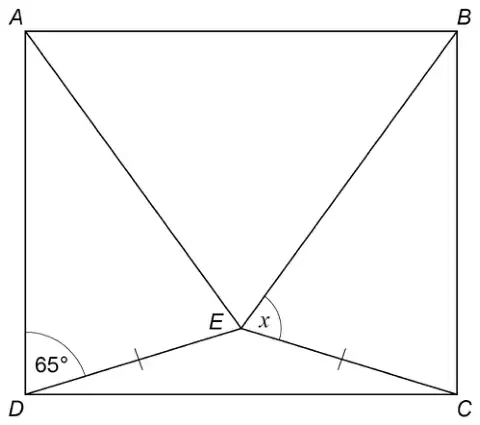
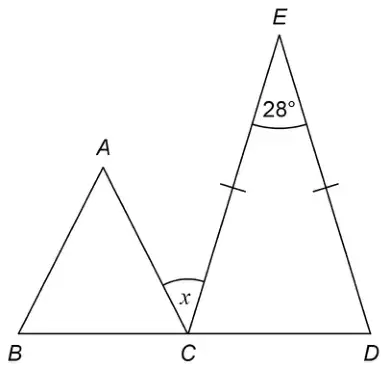
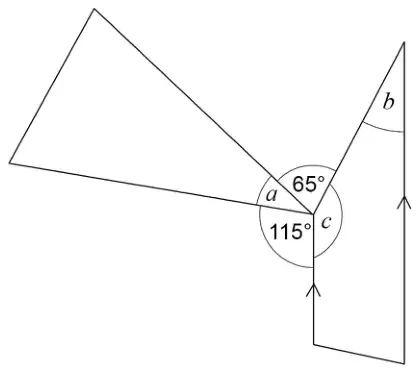
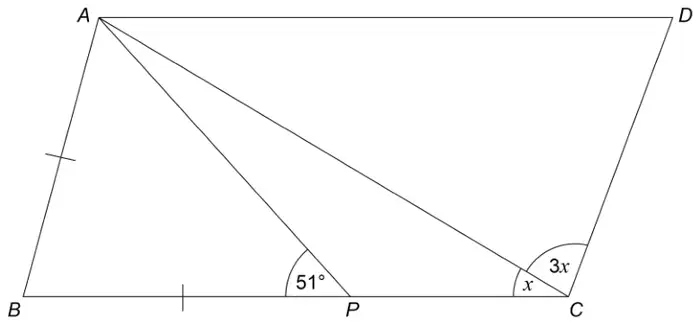
\(AED\) and \(BCD\) are straight lines. \(ED = EC\)
Show that \(EC\) is parallel to \(AB\). Give a reason for each stage of your working. (4)
Mark scheme
Answer
Mark
Mark scheme
Shown
C1
for angle \(ECD = 70\) or for angle \(ADB = 70\) and angle \(DAB = 40\)
C1
for a correct relevant reason relating to finding an angle in a triangle, eg • base angles of an isosceles triangle are equal • sum of angles in a triangle is 180
C1
for comparison of angles which would show that \(EC\) is parallel to \(AB\), eg • angle \(ECD\) = angle \(ABC\) (= 70) • angle \(BAD\) = angle \(CED\) (= 40) • angle \(BCX\) = angle \(ABC\) (= 70) • angle \(AEY\) = angle \(BAD\) (= 40) • angle \(ECB = 110\) and angle \(ECB\) + angle \(CBA = 180\) • angle \(AEC = 140\) and angle \(BAD\) + angle \(AEC = 180\) • angle \(ECD\) = angle \(ABD\) (= 70) and angle \(DAB\) = angle \(DEC\) (= 40)
C1
for a correct reason relating to angles in parallel lines which would show that \(EC\) is parallel to \(AB\), eg • corresponding angles are equal with angle \(ECD\) = angle \(ABC\) (= 70) • corresponding angles are equal with angle \(BAD\) = angle \(CED\) (= 40) • alternate angles are equal with angle \(BCX\) = angle \(ABC\) (= 70) • alternate angles are equal with angle \(AEY\) = angle \(BAD\) (= 40) • co-interior angles add to 180 with angle \(ECB\) + angle \(CBA = 180\) • co-interior angles add to 180 with angle \(BAD\) + angle \(AEC = 180\) • similar triangleswith angle \(ECD\) = angle \(ABD\) (= 70) and angle \(DAB\) = angle \(DEC\) (= 40)
Additional guidance
May be seen on the diagram
Do not award if an incorrect statement about angles in triangles seen.
Allow alternative correct labelling of angles eg angle \(ABD\) for angle \(ABC\) Must be identified in some way, not just angles written on diagram. Angles must be unambiguously identified. Where \(X\) is a point on \(EC\) extended. Where \(Y\) is a point on \(CE\) extended.
Reason must be consistent with their method. If superfluous reasons seen then we need the correct appropriate reason to be linked to the comparison of angles. Incorrect statement(s) seen is maximum 3 marks.
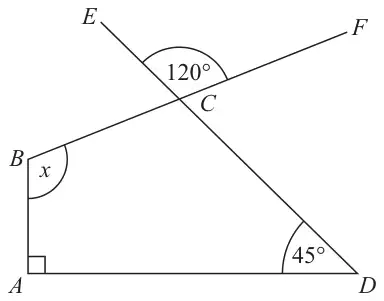
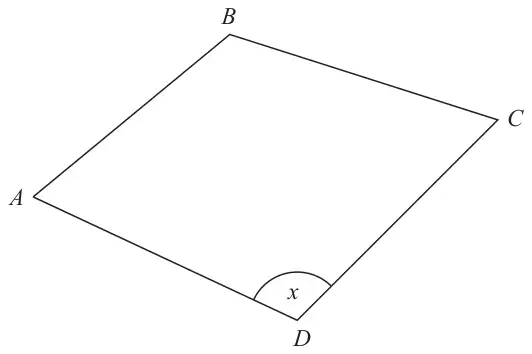
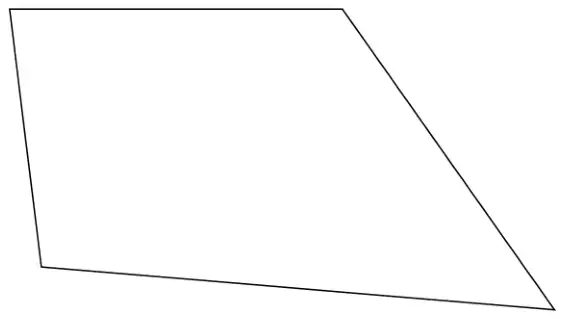
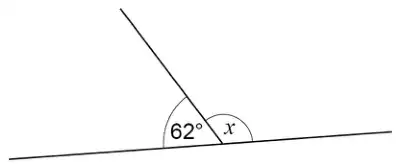
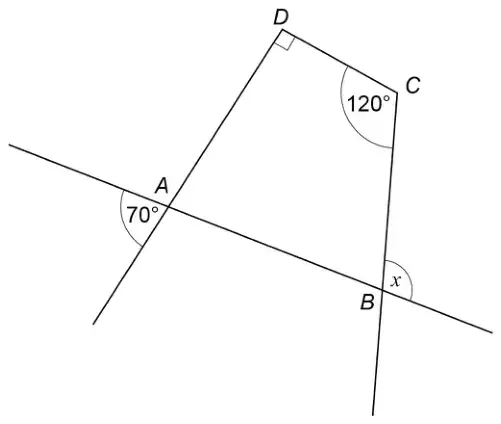
13 \(ABCD\) is a quadrilateral. \(BCF\) and \(DCE\) are straight lines.
Work out the size of the angle marked \(x\). Give a reason for each stage of your working. (4)
Mark scheme
Answer
Mark
Mark scheme
105
M1
for a method to find an unknown angle, eg angle \(BCD = 120\) or angle \(BCD = 360 - 120 - 2 \times (180 - 120)\ (= 120)\) or angle \(BCE = 180 - 120\ (= 60)\) or angle \(DCF = 180 - 120\ (= 60)\)
M1
for a complete method to find the value of \(x\), eg \((x =)\ 360 - \text{``}120\text{''} - 45 - 90\ (= 105)\)
C2
for 105 as the answer and full reasons for their method, eg vertically opposite angles are equal OR vertically opposite angles are equal angles in a quadrilateral add up to 360 or angles on a straight line add up to 180 angles at a point add up to 360 angles in a quadrilateral add up to 360 or angles on a straight line add up to 180 angles in a quadrilateral add up to 360
(C1
(dep M1) for one correct reason)
Additional guidance
Angles may be seen on diagram. Angles must be clearly labelled on the diagram or otherwise identified.
Underlined words need to be shown; reasons need to be linked to their method; if student gives any reasons not linked to their method, award maximum C1 only
Accept “\(\angle\)s” for “angles” Accept “4-sided shape” for “quadrilateral”
For C1, ignore any reasons not linked to their method
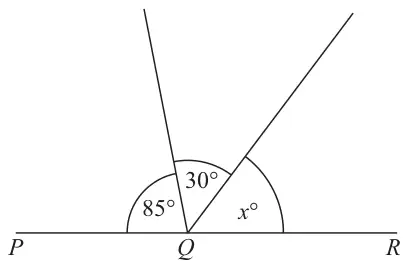
for a complete method eg \(180 - 85 - 30\) or \(360 - 180 - 85 - 30\)
A1
cao
(ii) Reason
C1
for Angles on a straight line add up to 180 orAngles at a point add up to 360
Additional guidance
(i) May be seen on the diagram \(85 + 30 + 65 = 180\) scores M1A0 unless 65 clearly identified
(ii) Reason must be for their chosen method If M0 awarded in (i) answer must be in the range 35 to 95 to award C1 Underlined words must be seen Condone use of \(\angle\)s for angles
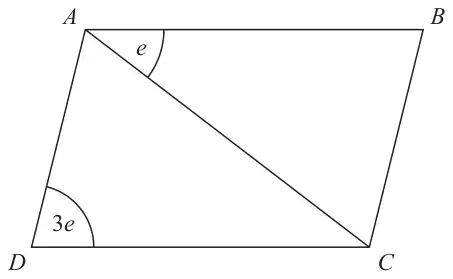
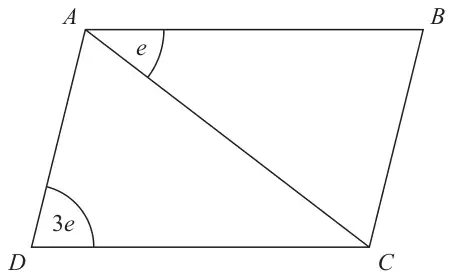
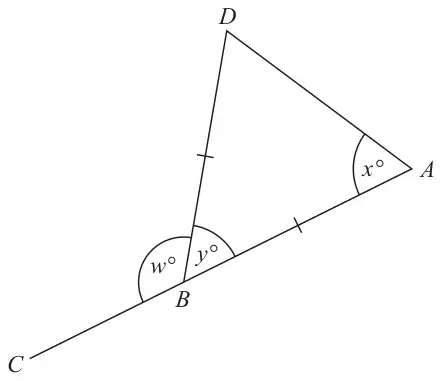
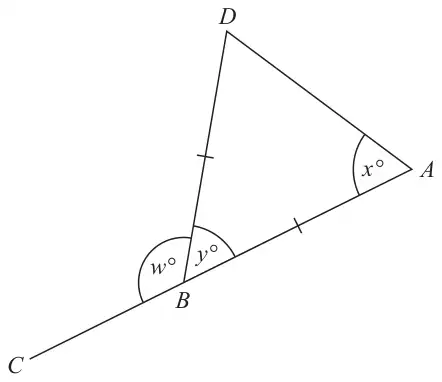
Find an expression, in terms of \(e\), for the size of angle \(CAD\). Give a reason for each stage of your working. (3)
Mark scheme
Answer
Mark
Mark scheme
\(180 - 4e\) and reason
M1
for angle \(ACD = e\)
or for angle \(ADC\) + angle \(BAD = 180\)
or for angle \(BAX = 3e\) (where \(X\) lies on \(DA\) extended)
A1
for \(180 - 4e\) oe
C1
(dep M1) for an appropriate reason relating to parallel lines from alternate angles are equal or allied angles / co-interior angles add up to 180 or for corresponding angles are equal
Additional guidance
Angles must be clearly labelled on the diagram or otherwise identified
May be unsimplified
Underlined words need to be shown Reason needs to be linked to their method, which can be implied from correctly identified angles (stated or written on the diagram)
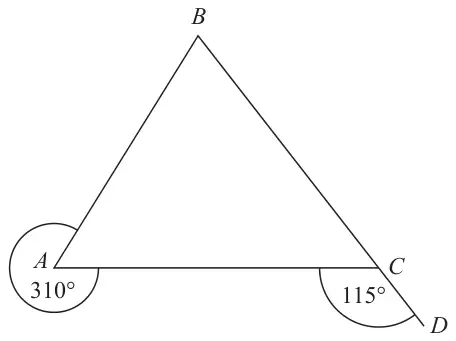
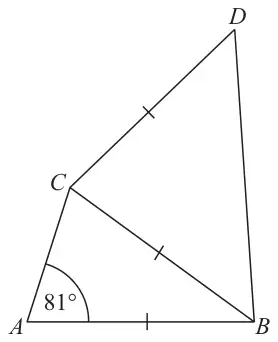
Show that triangle \(ABC\) is isosceles. Give a reason for each stage of your working. (4)
Mark scheme
Answer
Mark
Mark scheme
Shown
M1
for a method leading to the evaluation of another angle, (\(BAC =\)) \(360 - 310\ (= 50)\) or (\(ACB =\)) \(180 - 115\ (= 65)\)
M1
for a method to find at least 2 angles, eg (\(BAC =\)) \(360 - 310\ (= 50)\) and (\(ACB =\)) \(180 - 115\ (= 65)\)
C2
(dep M2) \(CBA = 65^\circ\) and statement and appropriate angle reasons, eg statement \(ACB = CBA\ (= 65^\circ)\) or two angles are equal (so it is isosceles) and angles at a point add up to 360, angles on a straight line add up to 180, angles in a triangle add up to 180,
OR (dep M2) \(CBA = 65^\circ\) and statement and appropriate angle reasons, eg statement \(ACB = CBA\ (= 65^\circ)\) or two angles are equal (so it is isosceles) and the exterior angle of a triangle is equal to the sum of the interior opposite anglesandangles on a straight line add up to 180 orangles in a triangle add up to 180
(C1
(dep on M1) for any one appropriate reason related to method shown)
Additional guidance
Angles may be seen on diagram
Underlined words need to be shown; reasons need to be linked to their method.
Find an expression, in terms of \(e\), for the size of angle \(CAD\). Give a reason for each stage of your working. (3)
Mark scheme
Answer
Mark
Mark scheme
\(180 - 4e\) and reason
M1
for angle \(ACD = e\)
or for angle \(ADC\) + angle \(BAD = 180\)
or for angle \(BAX = 3e\) (where \(X\) lies on \(DA\) extended)
A1
for \(180 - 4e\) oe
C1
(dep M1) for an appropriate reason relating to parallel lines from eg alternate angles are equal or allied angles / co-interior angles add up to 180 or for corresponding angles are equal
Additional guidance
Angles must be clearly labelled on the diagram or otherwise identified
May be unsimplified
Underlined words need to be shown Reason needs to be linked to their method, which can be implied from correctly identified angles (stated or written on the diagram)
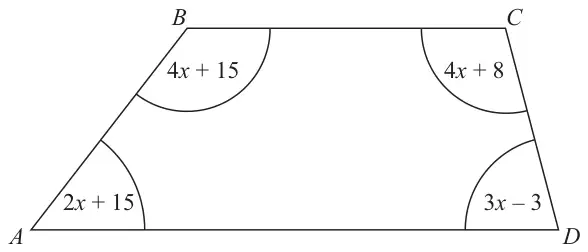
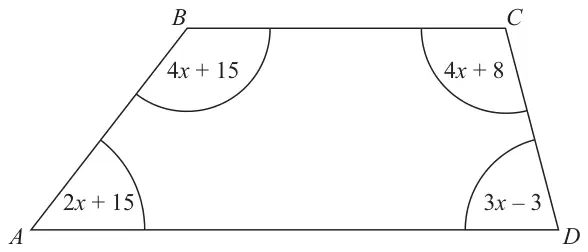
for deriving a suitable equation, eg \(4x + 15 + 2x + 15 + 4x + 8 + 3x - 3 = 360\) or \(13x + 35 = 360\) or \(4x + 15 + 2x + 15 = 180\) or \(6x + 30 = 180\) or \(4x + 8 + 3x - 3 = 180\) or \(7x + 5 = 180\)
M1
(dep) for a method to isolate terms in \(x\), eg \(4x + 2x + 4x + 3x = 360 - 15 - 15 - 8 + 3\) or \(4x + 2x = 180 - 15 - 15\) or \(4x + 3x = 180 - 8 + 3\)
A1
for solving equation to \(x = 25\)
C1
for substituting \(x = 25\) into \(A + B\) or \(C + D\) and showing \(= 180\), and gives a suitable statement, eg co-interior/allied angles (sum to 180), or since \(A + B = 180\) the lines are parallel
Additional guidance
May be seen in an equation
If starting with an equation = 180 need to substitute into the opposite pair.
Alternative solution assuming it is a trapezium
Answer
Mark
Mark scheme
Shown
M1
for deriving a suitable equation, eg \(4x + 15 + 2x + 15 = 4x + 8 + 3x - 3\) or \(6x + 30 = 7x + 5\)
M1
(dep) for a method to isolate terms in \(x\), eg \(15 + 15 - 8 + 3 = 4x + 3x - 4x - 2x\)
A1
for solving equation to \(x = 25\)
C1
for a fully correct statement, eg since \(A + B = 180\) the lines are parallel
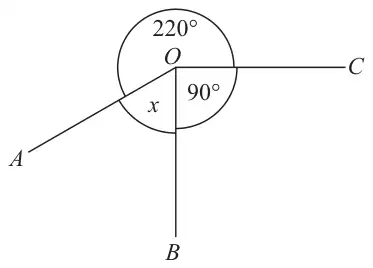
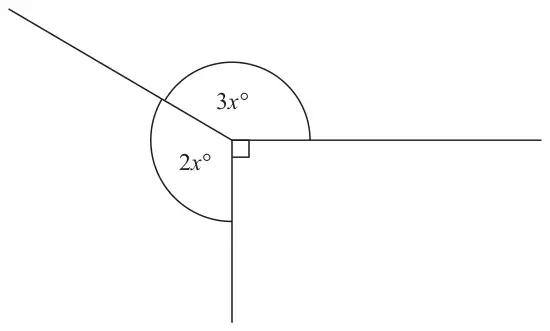
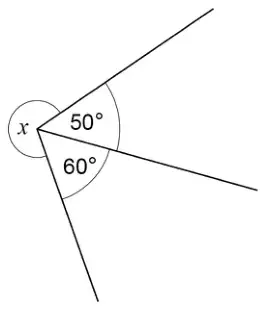
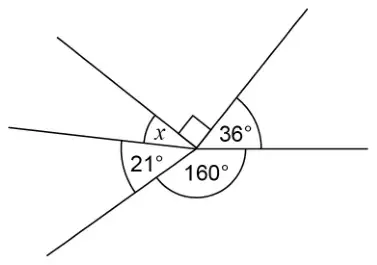
8 \(OA\), \(OB\) and \(OC\) are three straight lines.
(i) Work out the size of the angle marked \(x\). (2)
(ii) Give a reason for your answer. (1)
Mark scheme (i)
Answer
Mark
Mark scheme
50
M1
for \(360 - 220 - 90\) oe
A1
cao
Mark scheme (ii)
Answer
Mark
Mark scheme
Reason
C1
for angles at a point add up to 360
Acceptable examples • A full turn adds up to 360 • Full rotation is 360
Not acceptable examples • Angles in a circle add to 360 • A whole circle adds up to 360 • It must add up to 360 degrees • \(220 + 90 = 310,\ 360 - 310\) • Angles at a point add up to 180 • Angles on a straight line add to 180
Additional guidance
Underlined words need to be shown
Note: If line \(AO\) or \(OC\) or \(BO\) is extended and used to find \(x\) in (i) then allow C1 for angles on a straight line add to 180
(dep) for a method to isolate terms in \(x\), eg \(4x + 2x + 4x + 3x = 360 - 15 - 15 - 8 + 3\) or \(4x + 2x = 180 - 15 - 15\) or \(4x + 3x = 180 - 8 + 3\)
A1
for solving equation to \(x = 25\)
C1
for substituting \(x = 25\) into \(A + B\) or \(C + D\) and showing = 180, and gives a suitable statement, eg co-interior/allied angles (sum to 180), or since \(A + B = 180\) the lines are parallel
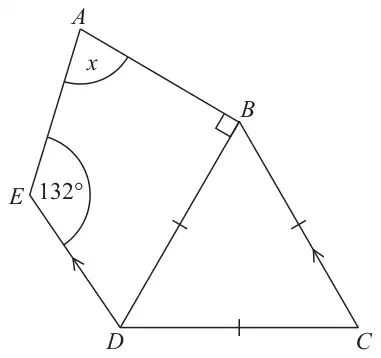
19 The diagram shows a quadrilateral \(ABDE\) and an equilateral triangle \(BCD\).
\(CB\) is parallel to \(DE\).
Angle \(AED\) = 132°
Work out the size of the angle marked \(x\). You must give a reason for each stage of your working. (4)
Mark scheme
Answer
Mark
Mark scheme
78
M1
for finding one angle within the triangle is \(180 \div 3\ (= 60)\)
M1
for method to use parallel lines, eg \(BDE = DBC\) or \(BCD + CDE = 180\)
C2
(dep M2) for (\(x =\)) 78 with a correct reason relating to parallel lines and one other correct reason given, with no unused reasons.
(C1
(dep M1) for one correct reason given for their chosen method,
angles in an equilateral triangle are equal alternate angles are equal angles in a quadrilateral add up to 360 angles in a triangle add up to 180 Allied angles / Co-interior angles add up to 180
Additional guidance
Angles must be clearly labelled on the diagram or otherwise identified. Correct method can be implied from angles on the diagram if no ambiguity or contradiction. If \(x\) is clearly identified as 78 award M2 (implied)
Underlined words need to be shown; reasons need to be linked to their method, which can be implied from correctly identified angles (stated or written on the diagram).
6 The bearing of port \(B\) from port \(A\) is 147°
Work out the bearing of port \(A\) from port \(B\). (2)
Mark scheme
Answer
Mark
Mark scheme
327
M1
for \(147 + 180\) or for \(360 - (180 - 147)\), or for drawing a suitable diagram with 147 in the correct position and with the bearing of A from B indicated
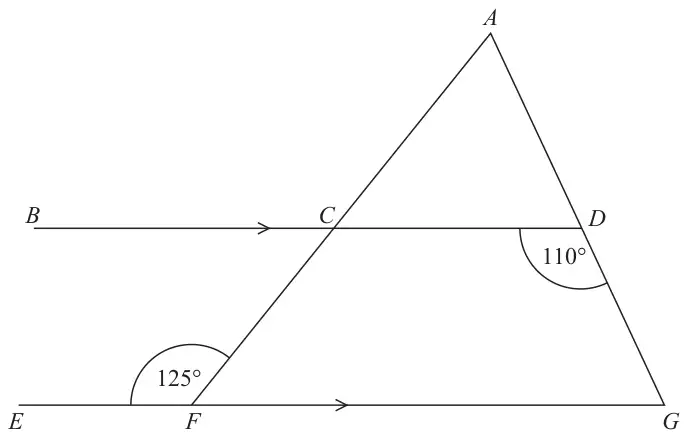
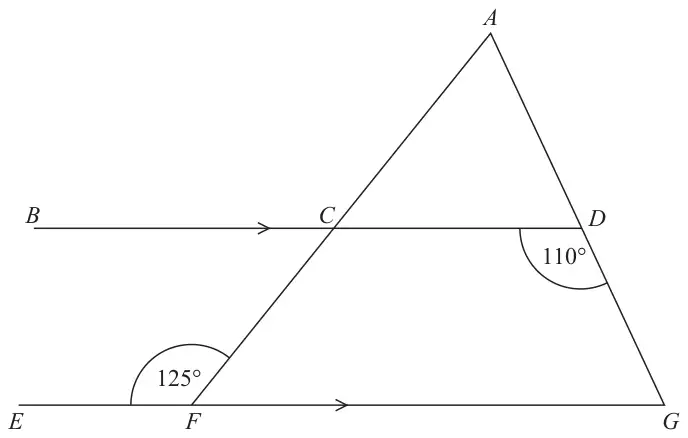
22 \(ACF\) and \(ADG\) are straight lines. \(BCD\) and \(EFG\) are parallel lines.
Show that triangle \(ACD\) is isosceles. Give a reason for each stage of your working. (5)
Mark scheme
Answer
Mark
Mark scheme
Shown with reasons
M1
for method to find \(ACD\) using parallel lines eg \(BCA = 125\) and \(ACD = 180 - 125\ (= 55)\) or \(BCF = 180 - 125\ (= 55) = ACD\) or \(FCD = 125\) and \(ACD = 180 - 125\ (= 55)\) or \(CFG = 180 - 125\ (= 55) = ACD\)
M1
for method to find \(ADC\) eg \(180 - 110\ (= 70)\) or for method to find \(CAD\) eg \(180 - (\text{``}70\text{''} + \text{``}55\text{''})\ (= 55)\) or \(110 - \text{``}55\text{''}\ (= 55)\)
A1
for \(ACD = 55\) and \(CAD = 55\)
C1
for one correct parallel lines reason linked to their method eg Corresponding angles are equal Allied angles / Co-interior angles add up to 180 Alternate angles are equal
C1
for one other reason stated linked to their method eg Angles on a straight line add up to 180 Angles in a triangle add up to 180 Vertically opposite angles are equal OR Vertically opposite angles are equal The exterior angle of a triangle is equal to the sum of the interior opposite angles. Angles in a quadrilateral add up to 360. Accept “4-sided shape”
Additional guidance
Angles must be clearly labelled on the diagram or otherwise identified. Correct method can be implied from angles on the diagram if no ambiguity or contradiction.
Underlined words need to be shown; reasons need to be linked to their method, which can be implied from correctly identified angles (stated or written on the diagram).
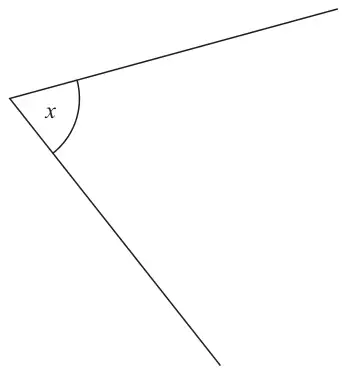
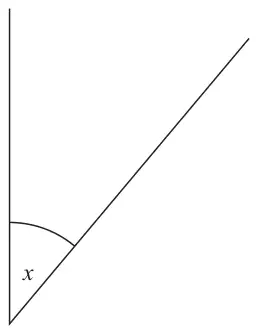
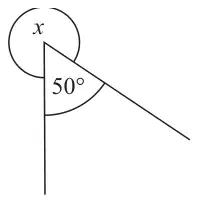
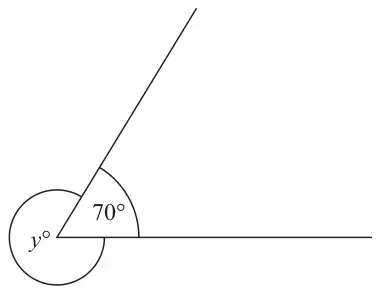
(a) Work out the size of the angle marked \(x\). (2)
A student says that an angle of \(50^\circ\) is an obtuse angle.
The student is wrong.
(b) Explain why. (1)
Mark scheme (a)
Answer
Mark
Mark scheme
310
M1
for \(360 - 50\)
A1
cao
Mark scheme (b)
Answer
Mark
Mark scheme
Explanation
C1
for explanation relating to the type of angle \(50^\circ\) is, or an explanation why it is not an obtuse angle
Acceptable examples It’s \((50^\circ)\) an acute angle an angle below 90 is acute because it \((50^\circ)\) is less than 90 It \((50^\circ)\) is too small to be an obtuse angle an obtuse angle is greater than 90 (but less than 180) an obtuse angle is greater than 50
Not acceptable examples because \(50^\circ\) is not an obtuse angle an angle of \(50^\circ\) is a reflex angle an obtuse angle is all angles greater than 90 an obtuse angle is an angle greater than 120 an obtuse angle is 90 or more
Additional guidance
Do not accept contradictions in the answer, eg. “an obtuse angle is greater than 180 so 50 is an acute angle” or “an obtuse angle is greater than 90 and less than 270”
3 \(ACF\) and \(ADG\) are straight lines. \(BCD\) and \(EFG\) are parallel lines.
Show that triangle \(ACD\) is isosceles. Give a reason for each stage of your working. (5)
Mark scheme
Answer
Mark
Mark scheme
Shown with reasons
M1
for method to find \(ACD\) using parallel lines eg \(BCA = 125\) and \(ACD = 180 - 125\ (= 55)\) or \(BCF = 180 - 125\ (= 55) = ACD\) or \(FCD = 125\) and \(ACD = 180 - 125\ (= 55)\) or \(CFG = 180 - 125\ (= 55) = ACD\)
M1
for method to find \(ADC\) eg \(180 - 110\ (= 70)\) or for method to find \(CAD\) eg \(180 - (\text{``}70\text{''} + \text{``}55\text{''})\ (= 55)\) or \(110 - \text{``}55\text{''}\ (= 55)\)
A1
for \(ACD = 55\) and \(CAD = 55\)
C1
for one correct parallel lines reason linked to their method eg Corresponding angles are equal Allied angles / Co-interior angles add up to 180 Alternate angles are equal
C1
for one other reason stated linked to their method eg Angles on a straight line add up to 180 Angles in a triangle add up to 180 Vertically opposite angles are equal OR Vertically opposite angles are equal The exterior angle of a triangle is equal to the sum of the interior opposite angles. Angles in a quadrilateral add up to 360. Accept “4-sided shape”
Additional guidance
Angles must be clearly labelled on the diagram or otherwise identified. Correct method can be implied from angles on the diagram if no ambiguity or contradiction.
Underlined words need to be shown; reasons need to be linked to their method, which can be implied from correctly identified angles (stated or written on the diagram).
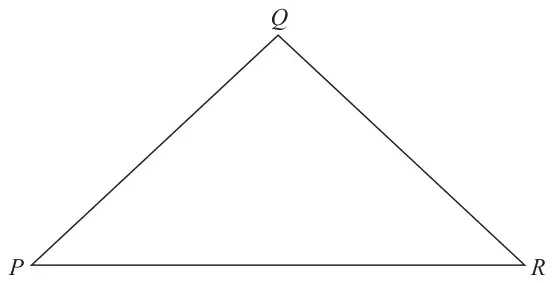
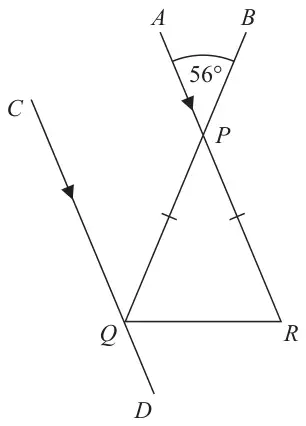
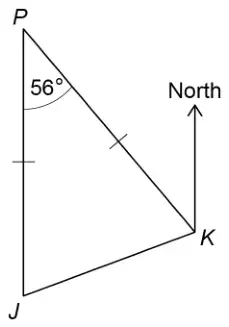
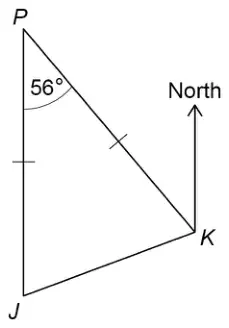
20 In the diagram, \(PQR\) is an isosceles triangle with \(PQ = PR\).
\(APR\) and \(CQD\) are parallel lines. \(BPQ\) is a straight line.
Angle \(APB = 56^\circ\)
Work out the size of angle \(CQR\). Give a reason for each stage of your working. (5)
Mark scheme
Answer
Mark
Mark scheme
118 with reasons
M1
for angle \(QPR = 56\) or \(CQP = 56\)
M1
for angle \(PQR = (180 - 56) \div 2\ (= 62)\)
C1
(dep on a previous M1) for giving a reason relating to parallel lines: angle \(CQR = 180 - \text{``}62\text{''}\) (Allied angles / Co-interior angles add up to 180) or angle \(CQP = 56\) (corresponding angles are equal) or use “angle \(QPR\)” (alternate angles are equal)
C1
(dep on a previous M1) for at least one reason given from: vertically opposite angles are equal OR vertically opposite angles are equal or base angles of an isosceles triangle are equal orAngles in a triangle add up to 180
A1
for 118
Additional guidance
Angles must be clearly labelled on the diagram or otherwise identified. Full solution must be seen. Correct method can be implied from angles on the diagram if no ambiguity or contradiction.
When reasons are given the key words underlined must be present. Reasons need to be linked to their method; any reasons not linked, do not credit. There should be no incorrect reasons given.
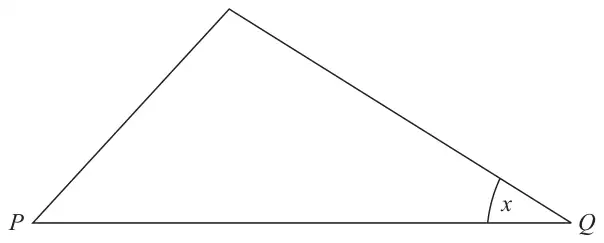
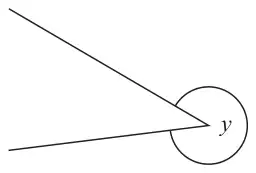
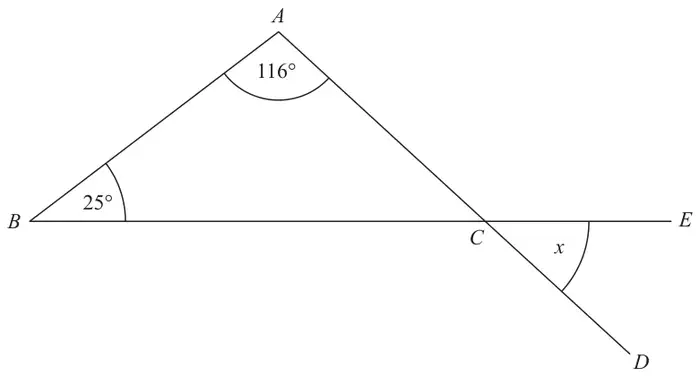
Work out the size of the angle marked \(x\). Give a reason for each stage of your working.(3)
Mark scheme
Answer
Mark
Mark scheme
39 with reasoning
M1
for a method to find angle \(ACB\) eg \(180 - 116 - 25\)
A1
for 39
C1
for \(x = 39\) with reasoning eg Angles in a triangle add up to 180 and Vertically opposite angles are equal or Verticallyopposite angles are equal or Angles on a straight line add up to 180 OR The exteriorangle of a triangle is equal to the sum of theinterioroppositeanglesandAngles on a straight line add up to 180
Additional guidance
\(ACB = 39\) or \(x = 39\) or \(C = 39\) or just 39 is acceptable for this accuracy mark
Angle may be shown on diagram if no ambiguity or contradiction The key words underlined must be present. There should be no incorrect reasons given. All reasons given should be used, not just a list of angle facts.
15 Jenna measures all the angles around a point. Her results are 23°, 145°, 23° and 69°
Explain why these results cannot be true. (1)
Mark scheme
Answer
Mark
Mark scheme
Explanation
C1
for explanation Acceptable examples They do not add to 360 They add to 100 too least It is missing a 100 angle / It needs 100 more Because the total has to be 360 A whole circle is 360 Not acceptable examples They add up to 260 One of the angles is wrong A shape with 4 angles adds up to 360
(dep on first M1) for two correct reasons appropriate to their method from
base angles of isosceles triangle are equal sum of angles in a triangle = 180 sum of angles on a straight line = 180 the exterior angle of a triangle is equal to the sum of the interior opposite angles
Additional guidance
May be shown on the diagram
Correct method can be implied from angles on the diagram if no ambiguity or contradiction.
Underlined words need to be shown; reasons need to be linked to their method; any reasons not linked, do not credit. There should be no incorrect reasons given.
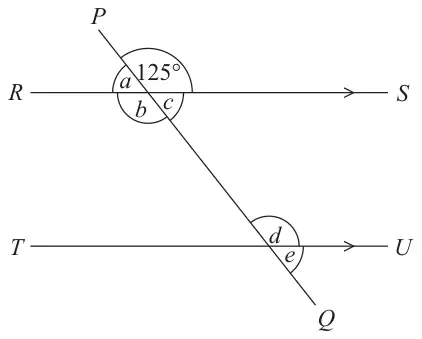
\(RS\) and \(TU\) are parallel lines. \(PQ\) is a straight line.
An angle of size 125° is shown on the diagram.
(b)
(i) Write down the letter of one other angle of size 125° Give a reason for your answer. (2)
(ii) Explain why \(a + b + c = 235^\circ\) (1)
Mark scheme (a)
Answer
Mark
Mark scheme
40
M1
for using 90, eg \(90 - 25 - 25\)
A1
cao
Additional guidance
\(90 - 25\) is enough for this mark
Mark scheme (b)(i)
Answer
Mark
Mark scheme
b or d with reason
B1
for \(b\) or \(d\) (or both)
C1
(dep) for appropriate reason(s) vertically opposite angles are equal vertically opposite angles are equal corresponding angles are equal alternate angles are equal angles on a straight line add up to 180
Additional guidance
For the B1: A correct answer can be implied by writing 125 immediately next to \(b\) or \(d\) (or both) as long as 125 is not written next to an incorrect angle.
For the C1: Underlined words need to be shown; reasons need to be linked to their method; any reasons not linked, do not credit. There should be no incorrect reasons given.
Mark scheme (b)(ii)
Answer
Mark
Mark scheme
reason
C1
for correct explanation using 360 or a full explanation using angles around a point Acceptable examples Because 360 around a point \(360 - 125 = 235\) \(125 + 235 = 360\) Because they add to 360 Not acceptable examples Because b is 125
Additional guidance
Using 360 appropriately and not in an incorrect setting
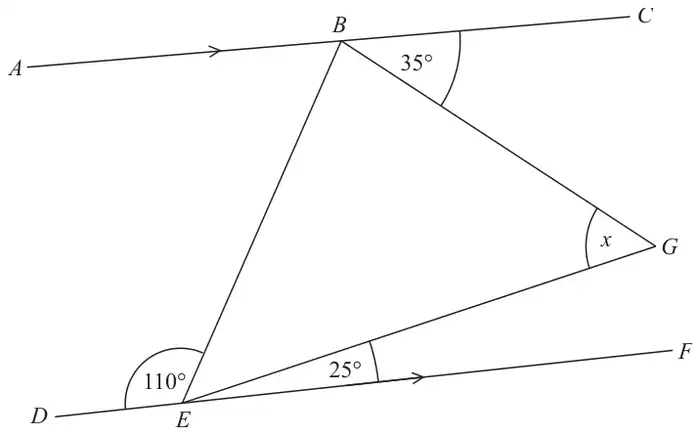
Work out the size of angle \(x\). Give a reason for each stage of your working. (4)
Mark scheme
Answer
Mark
Mark scheme
60
M1
use of parallel lines to find an angle eg \(ABE = 70\) or \(EBG = 75\) or \(EBC = 110\) or shows parts of \(x\) as 35 or 25
M1
for a complete method to find angle \(x\); could be in working or on the diagram
A1
for \(x = 60\)
C1
(dep on M1) for one reason linked to parallel lines and one other reason, supported by working taken from: alternate angles are equal, allied angles / co-interior angles add up to 180, angles on a straight line add up to 180, angles in a triangle add up to 180°
Additional guidance
Parts of \(x\) should be identified on the diagram by the insertion of a dividing line through angle \(x\) (need not be identified or drawn parallel).
Correct method can be implied from angles on the diagram if no ambiguity or contradiction.
Underlined words need to be shown; reasons need to be linked to their method; any reasons not linked do not credit. There should be no incorrect reasons given.
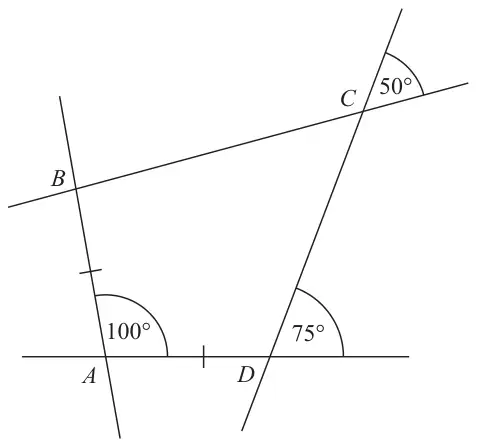
14 The diagram shows quadrilateral \(ABCD\) with each of its sides extended.
\(AB = AD\)
Show that \(ABCD\) is a kite. Give a reason for each stage of your working. (4)
Mark scheme
Answer
Mark
Mark scheme
shown
M1
for method to find angle \(ADC\), eg \(180 - 75\ (= 105)\)
M1
for angle \(BCD = 50\)
M1
for method to find angle \(ABC\), eg \(360 - 100 - 50 - \text{``}105\text{''}\)
C1
(dep M3) for angles \(ADC\), \(BCD\) and \(ABC\) correct and at least 2 appropriate reasons, eg vertically oppositeangles are equal or verticallyopposite angles are equal, angles on a straight line add to 180°, angles in a quadrilateral/kite add up to 360°; angles at a point add up to 360°
Additional guidance
Must be clear link to angle \(ADC\), may be marked on diagram
Must be clear method/explanation shown. Angle marked on diagram is not sufficient.
Underlined words need to be shown; reasons need to be linked to their method
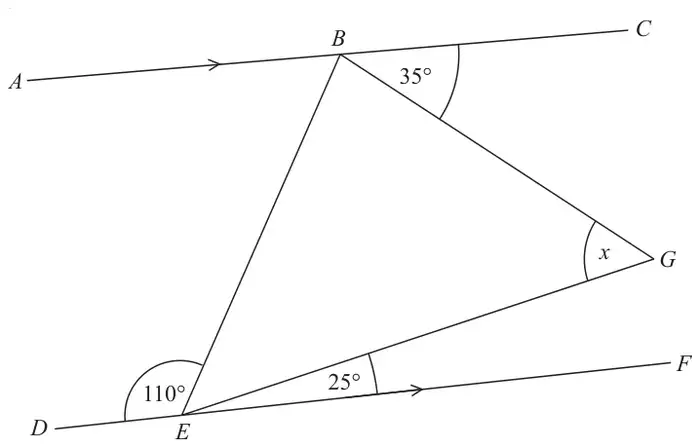
Work out the size of angle \(x\). Give a reason for each stage of your working. (4)
Mark scheme
Answer
Mark
Mark scheme
60
M1
use of parallel lines to find an angle eg \(ABE = 70\) or \(EBG = 75\) or \(EBC = 110\) or shows parts of \(x\) as 35 or 25
M1
for a complete method to find angle \(x\); could be in working or on the diagram
A1
for \(x = 60\)
C1
(dep on M1) for one reason linked to parallel lines and one other reason, supported by working taken from: alternate angles are equal, allied angles / co-interior angles add up to 180, angles on a straight line add up to 180, angles in a triangle add up to 180°
Additional guidance
Parts of \(x\) should be identified on the diagram by the insertion of a dividing line through angle \(x\) (need not be identified or drawn parallel).
Correct method can be implied from angles on the diagram if no ambiguity or contradiction.
Underlined words need to be shown; reasons need to be linked to their method; any reasons not linked do not credit. There should be no incorrect reasons given.
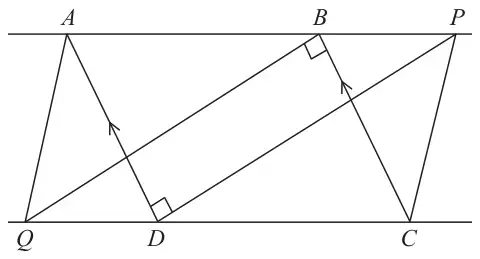
\(ABCD\) is a parallelogram. \(ABP\) and \(QDC\) are straight lines. Angle \(ADP\) = angle \(CBQ = 90^\circ\)
(a) Prove that triangle \(ADP\) is congruent to triangle \(CBQ\). (3)
(b) Explain why \(AQ\) is parallel to \(PC\). (2)
Mark scheme (a)
Answer
Mark
Mark scheme
Proof
C1
for starting the proof, identifying a pair of relevant equal sides or angles with reasons from \(AD = BC\) (opposite sides of a parallelogram are equal) angle \(PAD\) = angle \(QCB\) (opposite angles of a parallelogram are equal) angle \(ADP\) = angle \(CBQ\) (given or both 90°)
C1
(dep C1) for complete identification of all three equal aspects with reasons
C1
(dep C2) for conclusion of congruency proof
Additional guidance
Congruency conclusion must include a reference to ASA
Mark scheme (b)
Answer
Mark
Mark scheme
Explanation
C1
for identifying a pair of equal sides or angles in \(APCQ\), with reason, eg \(AP = QC\) since triangle \(ADP\) is congruent to triangle \(CBQ\)
C1
(dep C1) for reasoning that \(APCQ\) is a parallelogram so opposite sides of a parallelogram are parallel
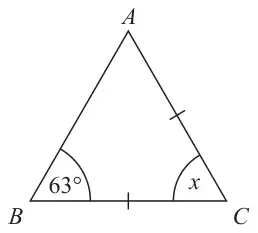
15 Mary needs to work out the size of angle \(x\) in this diagram.
She writes
\(x = 63^\circ\) because base angles of an isosceles triangle are equal.
Mary is wrong.
(a) Explain why. (1)
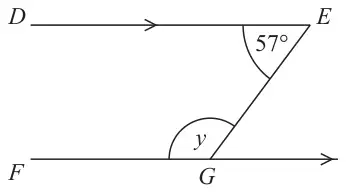
William needs to work out the size of angle \(y\) in this diagram.
William writes
Working
Reason
angle \(EGH = 57^\circ\)
because corresponding angles are equal
\(y = 180^\circ - 57^\circ\) \(y = 123^\circ\)
because angles on a straight line add up to \(180^\circ\)
One of William’s reasons is wrong.
(b) Write down the correct reason. (1)
Mark scheme (a)
Answer
Mark
Mark scheme
Correct evaluation
C1
for explanation eg \(x\) is not a base angle or states \(x = 54^\circ\)
Mark scheme (b)
Answer
Mark
Mark scheme
Correct or corrected reasoning given
C1
eg (because) alternate angles are equal, or Allied angles / Co-interior angles add up to 180 or they are not corresponding (they are alternate) OR selects correct reason used by William
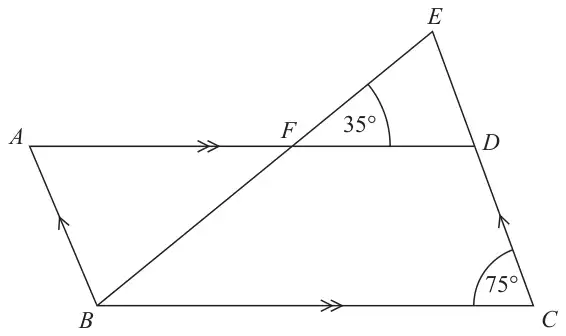
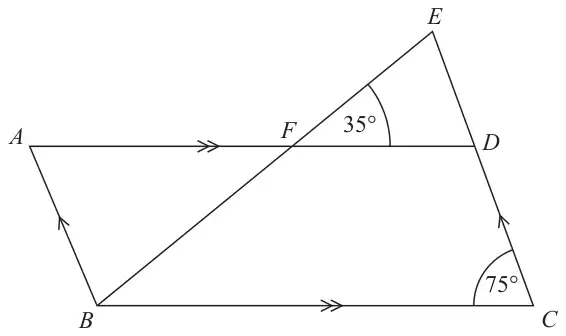
\(ABCD\) is a parallelogram. \(EDC\) is a straight line. \(F\) is the point on \(AD\) so that \(BFE\) is a straight line.
Angle \(EFD = 35^\circ\) Angle \(DCB = 75^\circ\)
Show that angle \(ABF = 70^\circ\) Give a reason for each stage of your working. (4)
Mark scheme
Working
Answer
Mark
Notes
\(CB\) extended to form \(CG\)
Reasoning
B1
for 35 or 75 or 145 or 105 or \(DEF = 70\), marked on the diagram or 3 letter description
M1
for \(180 - 70 - 35\) or \(180 - 75 - 35\) or a correct pair of angles that would lead to 75 or 70, eg \(AFB = 35\) and \(FAB = 75\) or \(AFB = 35\) and \(ABG = 75\) or \(FBC = 35\) and \(ABG = 75\) or \(EDF = 75\) and \(DEF = 70\) or \(FDC = 105\) and \(FBC = 35\) or \(ABC = 105\) and \(FBC = 35\)
C2
(dep on B1M1) All figures correct with all appropriate reasons stated. Angles must be clearly labelled or on the diagram. Full solution must be seen
(C1
(dep on B1 or M1) for one reason clearly used and stated.) Corresponding angles are equal, alternate angles are equal, opposite angles in a parallelogram are equal, angles in a triangle sum to 180, angles on a straight line sum to 180, vertically oppositeangles are equal, vertically opposite angles are equal, angles in a quadrilateral sum to 360, co-interior angles sum to 180, allied angles sum to 180, angles around a point sum to 360
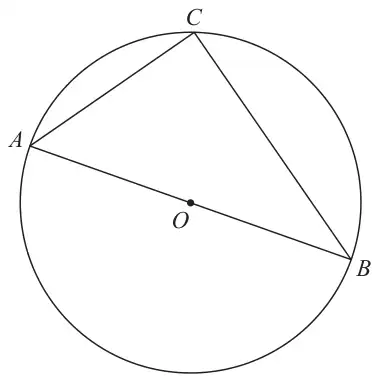
\(A\), \(B\) and \(C\) are points on the circumference of a circle, centre \(O\). \(AOB\) is a diameter of the circle.
Prove that angle \(ACB\) is \(90^\circ\) You must not use any circle theorems in your proof. (4)
Mark scheme
Answer
Mark
Notes
Proof
C1
draws \(OC\) and considers angles in an isosceles triangle (algebraic notation may be used, eg two angles labelled \(x\))
C1
finds sum of angles in triangle \(ABC\), eg \(x + x + y + y = 180\), or sum of angles at \(O\), eg \(180 - 2x + 180 - 2y\)
C1
complete method leading to \(ACB = 90\)
C1
complete proof with all reasons given, eg base angles of an isoscelestriangle are equal, angles in a triangle add up to \(180^\circ\), angles on a straight line add up to \(180^\circ\)
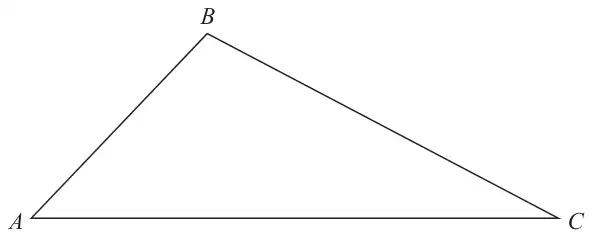
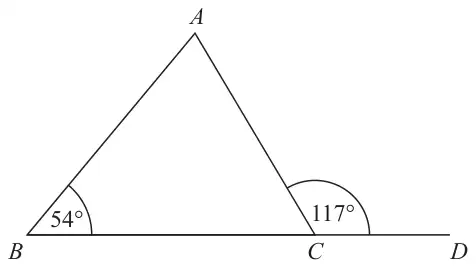
\(BCD\) is a straight line. \(ABC\) is a triangle.
Show that triangle \(ABC\) is an isosceles triangle. Give a reason for each stage of your working. (4)
Mark scheme
Answer
Mark
Notes
shown
M1
for (angle \(BCA\)) \(= 180 - 117\ (= 63)\)
M1
for (angle \(CAB\)) \(= 180 - \text{``}63\text{''} - 54\ (= 63)\) or (angle \(CAB\)) \(= 117 - 54\ (= 63)\)
C2
for statement, eg. isosceles since angle \(BCA =\) angle \(CAB = 63\) with fully correct reasons, from: angles on a straight line add up to 180° angles in a triangle add up to 180° exterior angle of a triangle is equal to sum of interior opposite angles
[C1
for angle \(BCA = 63\) and angle \(CAB = 63\) and one of the above reasons]
OR
M1
for \(\dfrac{(180 - 54)}{2}\ (= 63)\)
M1
for identification of two angles in triangle \(ABC\) being “63”
C2
for statement, eg. isosceles since angle \(BCA =\) angle \(CAB = 63\) andangles on a straight line add up to 180°and fully correct reasons: base angles of an isosceles triangle are equal and angles in a triangle add up to 180°
[C1
for angle \(BCA = 63\) and angle \(CAB = 63\) and one reason from: base angles of an isosceles triangle are equal angles in a triangle add up to 180°]
\(ABCD\) is a parallelogram. \(EDC\) is a straight line. \(F\) is the point on \(AD\) so that \(BFE\) is a straight line.
Angle \(EFD = 35^\circ\) Angle \(DCB = 75^\circ\)
Show that angle \(ABF = 70^\circ\) Give a reason for each stage of your working. (4)
Mark scheme
Working
Answer
Mark
Notes
\(CB\) extended to form \(CG\)
Reasoning
B1
for 35 or 75 or 145 or 105 or \(DEF = 70\), marked on the diagram or 3 letter description
M1
for \(180-70-35\) or \(180-75-35\) or a correct pair of angles that would lead to 75 or 70, eg \(AFB = 35\) and \(FAB = 75\) or \(AFB = 35\) and \(ABG = 75\) or \(FBC = 35\) and \(ABG = 75\) or \(EDF = 75\) and \(DEF = 70\) or \(FDC = 105\) and \(FBC = 35\) or \(ABC = 105\) and \(FBC = 35\)
C2
(dep on B1M1) All figures correct with all appropriate reasons stated. Angles must be clearly labelled or on the diagram. Full solution must be seen
(C1
(dep on B1 or M1) for one reason clearly used and stated.) Corresponding angles are equal, alternate angles are equal, opposite angles in a parallelogram are equal, angles in a triangle sum to 180, angles on a straight line sum to 180, vertically oppositeangles are equal, vertically opposite angles are equal, angles in a quadrilateral sum to 360, co-interior angles sum to 180, allied angles sum to 180, angles around a point sum to 360
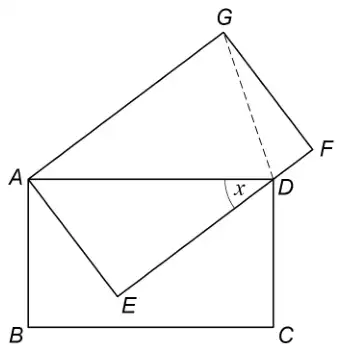
\(ABCD\) and \(AEFG\) are congruent rectangles \(D\) lies on \(EF\) angle \(ADE = x\)
Not drawn accurately
Prove that \(GD\) bisects angle \(ADF\). [4 marks]
Mark scheme
Answer
Mark
Comments
Response showing that \(GD\) bisects angle \(ADF\) and all reasons
B4
B3 response showing that \(GD\) bisects angle \(ADF\) B2 correct expressions for two angles in terms of \(x\) (angles must be above \(AD\)) or two correct statements about a pair of angles (angles must be above \(AD\)) B1 correct expression for one angle in terms of \(x\) (angle must be above \(AD\)) or one correct statement about a pair of angles (angles must be above \(AD\))
Additional guidance
Correct expressions for angles (which may be seen on the diagram) include angle \(DAG = x\) angle \(ADF = 180 - x\) angle \(ADG = \dfrac{180 - x}{2}\) or \(90 - \dfrac{x}{2}\) angle \(AGD = \dfrac{180 - x}{2}\) or \(90 - \dfrac{x}{2}\) angle \(GDF = 180 - x - \dfrac{180 - x}{2}\) or \(\dfrac{180 - x}{2}\) or \(90 - \dfrac{x}{2}\) angle \(DGF = \dfrac{x}{2}\)
Expressions must be explicit eg do not accept angle \(ADF + x = 180\) unless recovered
Correct statements about a pair of angles include angle \(AGD\) = angle \(GDF\) angle \(AGD\) = angle \(ADG\) angle \(ADG\) = angle \(GDF\) angle \(AGD = 90 -\) angle \(DGF\) angle \(GDF = 90 -\) angle \(DGF\)
Accept eg angle \(AGD\) and angle \(ADG\) both labelled \(y\) as a correct statement about a pair of angles
Accept eg \(\widehat{DAG}\) for angle \(DAG\)
Do not accept a single upper case letter for an angle unless shown on the diagram
For up to B2 allow assumption that \(GD\) bisects angle \(ADF\)
Reasons needed will depend on the approach used and will include some of alternate angles (are equal) (base) angles of isosceles triangle (are equal) angles in rectangle are 90 angles of triangle (add up to 180) (adjacent) angles on a (straight) line (add to 180)
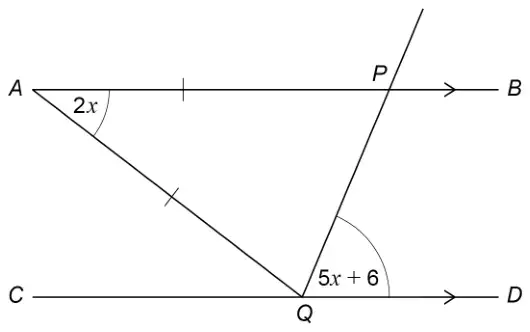
15 \(AB\) and \(CD\) are straight, parallel lines.
\(P\) is a point on \(AB\).
\(Q\) is a point on \(CD\).
\(AP = AQ\)
Not drawn accurately
Work out the value of \(x\). [4 marks]
Mark scheme
Answer
Mark
Comments
14
B4
B3 correct equation eg \(2x + 5x + 6 + 5x + 6 = 180\) or \(5x + 6 = 90 - x\) or \(2x + 90 - x + 5x + 6 = 180\) or \(5x + 6 = 174 - 7x\) B2 correct expressions for two angles or two different correct expressions for the same angle B1 correct expression for one angle
Additional guidance
Correct expressions for angles (which may be seen on the diagram) include angle \(AQC = 2x\) angle \(APQ = 5x + 6\) angle \(AQP = 5x + 6\) angle \(APQ = \dfrac{180 - 2x}{2}\) or \(90 - x\) angle \(AQP = \dfrac{180 - 2x}{2}\) or \(90 - x\) angle \(APQ = 180 - 2x - (5x + 6)\) or \(174 - 7x\) angle \(AQP = 180 - 2x - (5x + 6)\) or \(174 - 7x\) angle \(QPB = 180 - (5x + 6)\) or \(174 - 5x\) angle \(ZPB = 5x + 6\) (\(Z\) is the end of line \(QP\) produced) angle \(ZPA = 180 - (5x + 6)\) or \(174 - 5x\) (\(Z\) is the end of line \(QP\) produced)
B2 may be awarded for the same expression for two different angles eg angle \(APQ = 5x + 6\) and angle \(AQP = 5x + 6\)
B2
Accept eg \(\widehat{AQP}\) for angle \(AQP\)
Do not accept eg (angle) \(P\) for angle \(APQ\) unless shown on the diagram
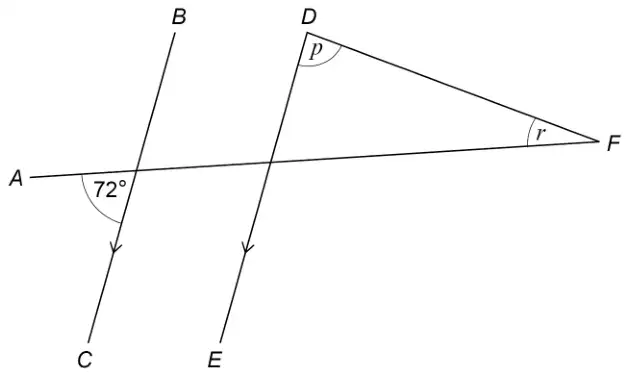
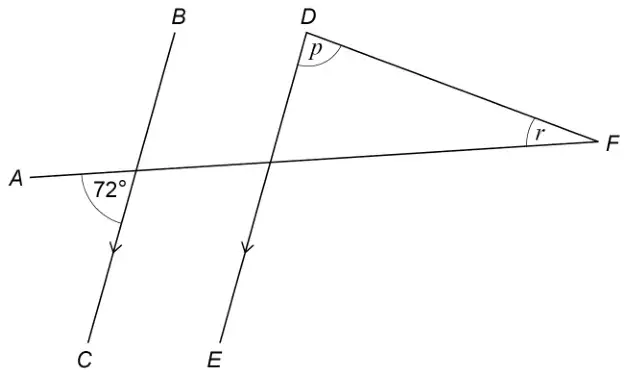
27 \(AF\), \(BC\), \(DE\) and \(DF\) are straight lines.
\(BC\) and \(DE\) are parallel.
Not drawn accurately
\(p\) is three times \(r\).
Work out the size of angle \(p\). [3 marks]
Mark scheme
Answer
Mark
Comments
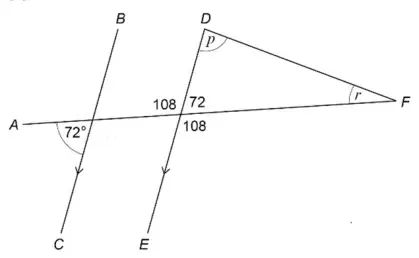
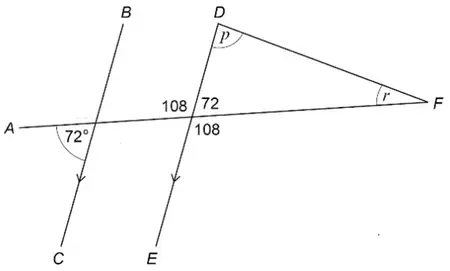
Angle labelled as 72 for the correct interior angle of the triangle or angle labelled as 108 for a correct exterior angle of the triangle or \(3r + r + 72 = 180\) or \(4r = 180 - 72\) or \(4r = 108\)
M1
oe
\(\dfrac{180 - 72}{3 + 1}\) or \(\dfrac{108}{4}\) or 27 or \(108 \times \dfrac{3}{4}\) or \(\dfrac{4p}{3} = 108\)
12 \(AF\), \(BC\), \(DE\) and \(DF\) are straight lines.
\(BC\) and \(DE\) are parallel.
Not drawn accurately
\(p\) is three times \(r\).
Work out the size of angle \(p\). [3 marks]
Mark scheme
Answer
Mark
Comments
Angle labelled as 72 for the correct interior angle of the triangle or angle labelled as 108 for a correct exterior angle of the triangle or \(3r + r + 72 = 180\) or \(4r = 180 - 72\) or \(4r = 108\)
M1
oe
\(\dfrac{180 - 72}{3 + 1}\) or \(\dfrac{108}{4}\) or 27 or \(108 \times \dfrac{3}{4}\) or \(\dfrac{4p}{3} = 108\)
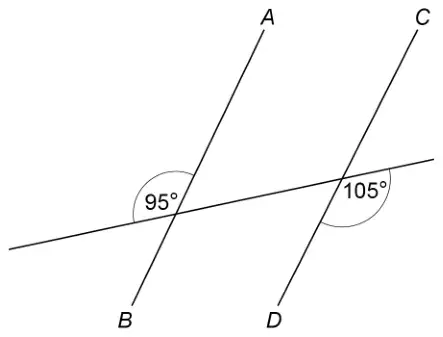
No ticked and appropriate working to show \(AB\) and \(CD\) are not parallel
B2
B1 any correct angle on the diagram eg 105 opposite the 105 given eg 85 written next to the 95 given or any correct angle which assumes lines are parallel eg 95 written opposite the 105 given or any correct angle evaluation seen in working eg \(180 - 105 = 75\)
Additional guidance
Angles must be shown on diagram or clearly identified to score B2
Ignore any incorrect or irrelevant terminology alongside correct working
“No” may be implied
Condone an incorrect angle if not subsequently used
Crossed out angles on diagram may be used to support working
No and 95 should be 105
B2
No and 95 written opposite the given 95 and 95 is not equal to 105
B2
No and 105 opposite the given 105 and 85 next to the 95 and \(105 + 85 = 190\) (or should be 180)
B2
No and 85 written next to the given 95 and 75 written next to the given 105 and \(85 \neq 75\)
B2
No and 75 written alongside 105 and 75 written underneath 95 and \(95 + 75 = 170\) (or should be 180)
B2
No and 95 written opposite 105 and the other two angles 75 and \(95 + 75 + 75 + 105 = 350\) (or should be 360)
B2
\(95 + 105 = 200\) is not a correct angle evaluation No and \(95 + 105 = 200\) and if it is 180 they will be parallel
9 For each statement, tick the correct box. [3 marks]
Always true
Sometimes true
Never true
One of the three angles of a triangle is \(90^\circ\)
One of the three angles of a triangle is obtuse
One of the three angles of a triangle is reflex
Mark scheme
Answer
Mark
Comments
One of the three angles of a triangle is \(90^\circ\): Sometimes true One of the three angles of a triangle is obtuse: Sometimes true One of the three angles of a triangle is reflex: Never true
B3
B1 for each
Additional guidance
Allow any unambiguous indication
eg if a cross is the only indication in a row, take that as the answer
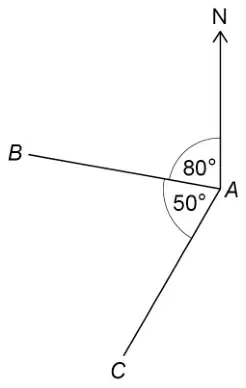
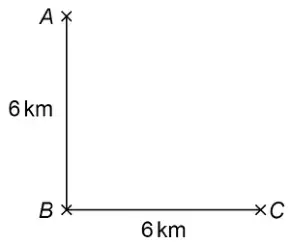
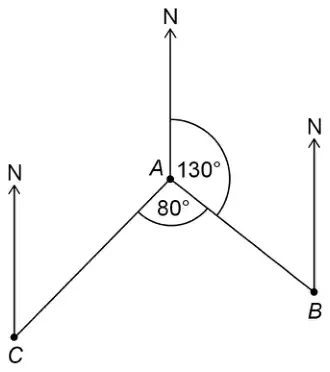
6 km due South of \(A\) and 6 km due West of \(C\).
Not drawn accurately
Work out the bearing of \(A\) from \(C\). [2 marks]
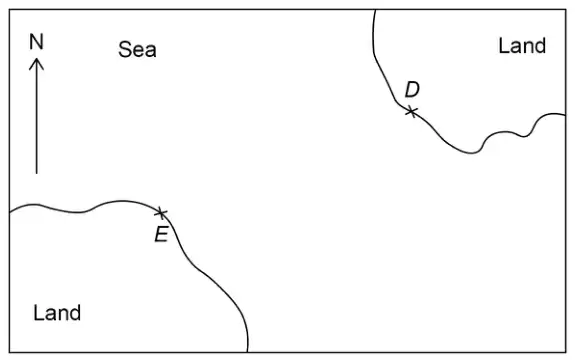
(b) Here is a scale drawing.
A ship is going to sail from \(D\) to \(E\).
Mia works out that the ship needs to sail on a bearing of 068°
Why must Mia be wrong? [1 mark]
Mark scheme (a)
Answer
Mark
Comments
\(\dfrac{180 - 90}{2}\) or \(\tan^{-1} \dfrac{6}{6}\) or 45
M1
oe may be seen on diagram eg \(\sin^{-1}\left(\dfrac{6}{\sqrt{72}}\right)\)
315
A1
SC1 answer of 135 (bearing of \(C\) from \(A\))
Additional guidance
\(\tan \dfrac{6}{6}\) unless recovered
M0
Mark scheme (b)
Answer
Mark
Comments
Correct explanation that the ship would be on land or 068° is the bearing of \(D\) from \(E\) or the bearing must be over 180° or the actual bearing is [246, 250]°
B1
eg that would take the ship over land 068° is from \(E\) 068° is the bearing from \(E\) to \(D\) the bearing is 248°
Additional guidance
Ignore irrelevant statements and compass points eg bearings go clockwise, bearings are measured from north, NE, south west
Do not accept incorrect statement or bearing alongside a correct statement
Bearings measured or stated outside of [246, 250]° range
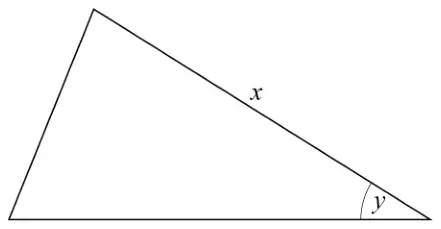
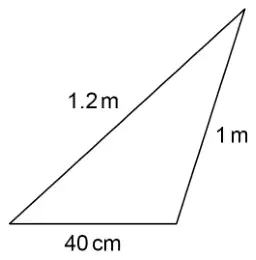
Work out \(\dfrac{\text{length of shortest side}}{\text{length of longest side}}\)
Give your answer as a fraction in its simplest form. [2 marks]
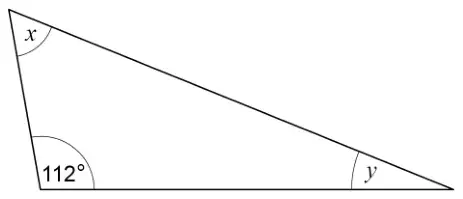
(b) Here is a different triangle.
Not drawn accurately
\(x = 3y\)
Work out the size of angle \(y\). [3 marks]
Mark scheme (a)
Answer
Mark
Comments
\(\dfrac{1}{3}\)
B2
B1 (may be seen in diagram) 120 or 100 or 0.4(0) may be seen in a fraction eg \(\dfrac{120}{40}\) or \(\dfrac{0.4}{1.2}\) or correct, but unsimplified fraction eg \(\dfrac{20}{60}\) or their fraction written in simplest form
SC1 1 : 3
Additional guidance
Ignore units on answer line
Do not ignore further work after \(\dfrac{1}{3}\) seen
If converting to mm both values must be correct
\(\dfrac{1}{3}\) given as a decimal or percentage must be correct to 2sf or better
B1
B1 for simplifying their fraction can only be awarded from the use of digits 1, 12 and 4, eg \(\dfrac{40}{1200}\), answer \(\dfrac{1}{30}\) \(\dfrac{1200}{40}\), answer 30 \(\dfrac{40}{1200}\), answer \(\dfrac{1}{3}\) \(\dfrac{2}{4}\), answer \(\dfrac{1}{2}\)
B1 B1 B0 B0
\(\dfrac{0.04}{1.2}\), answer \(\dfrac{1}{30}\)
B1
\(\dfrac{1}{40}\) or \(\dfrac{40}{1} = 40\)
B0
Mark scheme (b)
Answer
Mark
Comments
\(180 - 112\) or 68 or \(3y + y + 112 = 180\)
M1
oe
their 68 \(\div (3 + 1)\) or their 68 \(\div\) 4 or \(y = \dfrac{\text{their } 68}{4}\) or 51 or \(x = 17\)
M1
oe their 68 must be \(\lt 180\) but not 112 51 or \(x = 17\) imply M1M1
17
A1
Additional guidance
Check diagram for workings and answer
17 seen in diagram or working and 51 on answer line
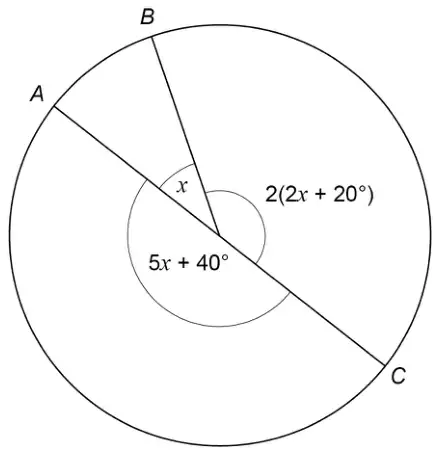
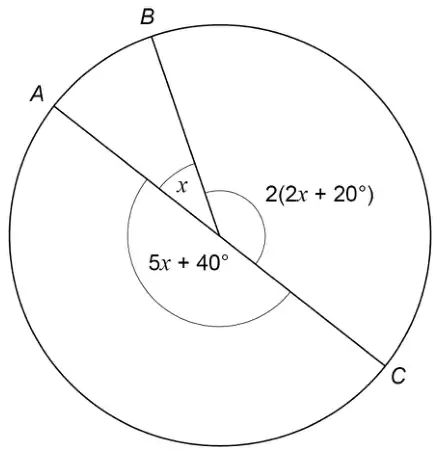
oe equation eg \(10x + 80 = 360\) \((x =)\) 28 may be on the diagram
\(140 + 40 = 180\) and Yes or \(28 + 152 = 180\) and Yes
A1
oe must obtain \((x =)\) 28 from one expression and substitute \((x =)\) 28 into a different expression
Alternative method 3 Assumes line is a diameter. Derives and solves an equation for angles on a line using \(5x + 40\) and substitutes into \(x + 2(2x + 20)\) or \(x + 2(2x + 20) + 5x + 40\)
\(5x + 40 = 180\)
M1
\((x =)\ (180 - 40) \div 5\) or \((x =)\) 28
M1dep
oe \((x =)\) 28 may be on the diagram
\(28 + 152 = 180\) and Yes or \(28 + 152 + 140 + 40 = 360\) and Yes
A1
oe must obtain \((x =)\) 28 from one expression and substitute \((x =)\) 28 into a different expression
Alternative method 4 Assumes line is a diameter. Derives and solves an equation for angles on a line using \(x + 2(2x + 20)\) and substitutes into \(5x + 40\) or \(x + 2(2x + 20) + 5x + 40\)
\(x + 2(2x + 20) = 180\) or \(x + 4x + 40 = 180\)
M1
\((x =)\ (180 - 40) \div 5\) or \((x =)\) 28
M1dep
oe \((x =)\) 28 may be on the diagram
\(140 + 40 = 180\) and Yes or \(28 + 152 + 140 + 40 = 360\) and Yes
A1
oe must obtain \((x =)\) 28 from one expression and substitute \((x =)\) 28 into a different expression
Alternative method 5 Assumes line is a diameter. Derives and solves two equations for angles on a line/angles at a point
Obtains \((x =)\) 28 from two equations for angles on a line/angles at a point and Yes
A1
Additional guidance
Choose the scheme that favours the student
Up to M2 may be awarded for correct work, with no or incorrect answer, even if this is seen amongst multiple attempts
Correct response with other incorrect work
M1M1A0
Alt 1 \(2(2x + 20) = 4x + 20\) followed by \(x + 4x + 20\) Alt 1 \(x + 4x + 20\) with \(2(2x + 20) = 4x + 20\) not seen Apply marks in a similar way in alts 2, 4 and 5
M0M1 M0M0
\((x =)\) 28
M1M1
Allow \((x =)\) 28 to be embedded
M1M1
No method marks scored with a value of \(x\) \((\ne 28)\) substituted into \(5x + 40\) and \(x + 2(2x + 20)\) giving the same value
M0M0A0
Yes can be implied eg Alt 1 \(x + 4x + 40 = 5x + 40\) and It is a diameter
oe equation eg \(10x + 80 = 360\) \((x =)\ 28\) may be on the diagram
\(140 + 40 = 180\) and Yes or \(28 + 152 = 180\) and Yes
A1
oe must obtain \((x =)\ 28\) from one expression and substitute \((x =)\ 28\) into a different expression
Alternative method 3 Assumes line is a diameter. Derives and solves an equation for angles on a line using \(5x + 40\) and substitutes into \(x + 2(2x + 20)\) or \(x + 2(2x + 20) + 5x + 40\)
\(5x + 40 = 180\)
M1
\((x =)\ (180 - 40) \div 5\) or \((x =)\ 28\)
M1dep
oe \((x =)\ 28\) may be on the diagram
\(28 + 152 = 180\) and Yes or \(28 + 152 + 140 + 40 = 360\) and Yes
A1
oe must obtain \((x =)\ 28\) from one expression and substitute \((x =)\ 28\) into a different expression
Alternative method 4 Assumes line is a diameter. Derives and solves an equation for angles on a line using \(x + 2(2x + 20)\) and substitutes into \(5x + 40\) or \(x + 2(2x + 20) + 5x + 40\)
\(x + 2(2x + 20) = 180\) or \(x + 4x + 40 = 180\)
M1
\((x =)\ (180 - 40) \div 5\) or \((x =)\ 28\)
M1dep
oe \((x =)\ 28\) may be on the diagram
\(140 + 40 = 180\) and Yes or \(28 + 152 + 140 + 40 = 360\) and Yes
A1
oe must obtain \((x =)\ 28\) from one expression and substitute \((x =)\ 28\) into a different expression
Alternative method 5 Assumes line is a diameter. Derives and solves two equations for angles on a line/angles at a point
Obtains \((x =)\ 28\) from two equations for angles on a line/ angles at a point and Yes
A1
Additional guidance
Choose the scheme that favours the student
Up to M2 may be awarded for correct work, with no or incorrect answer, even if this is seen amongst multiple attempts
Correct response with other incorrect work
M1M1A0
Alt 1 \(2(2x + 20) = 4x + 20\) followed by \(x + 4x + 20\) Alt 1 \(x + 4x + 20\) with \(2(2x + 20) = 4x + 20\) not seen Apply marks in a similar way in alts 2, 4 and 5
M0M1 M0M0
\((x =)\ 28\)
M1M1
Allow \((x =)\ 28\) to be embedded
M1M1
No method marks scored with a value of \(x\ (\ne 28)\) substituted into \(5x + 40\) and \(x + 2(2x + 20)\) giving the same value
M0M0A0
Yes can be implied eg Alt 1 \(x + 4x + 40 = 5x + 40\) and It is a diameter
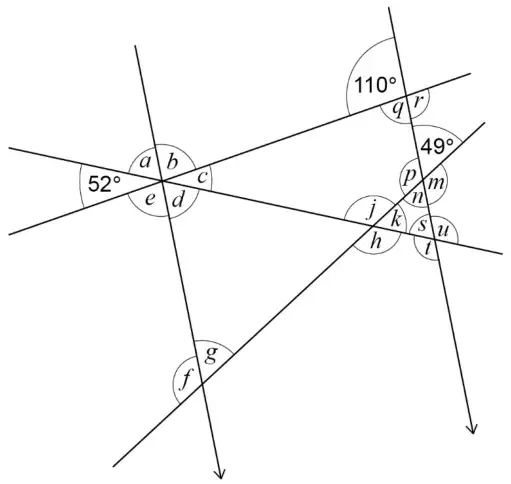
B2 \(180 - 110 + 52 - 49\) oe calculation or \(h = 107\) or \(j = 107\) or \(k = 73\) or \(g = 49\) and \(d = 58\) or \(g = 49\) and \(e = 70\) or \(f = 131\) and \(d = 58\) B1 any angle correct (others may be incorrect)
Additional guidance
Angles will usually be seen on the diagram
Angles must be unambiguously linked to the correct position eg 131 seen in working but not on the diagram or in wrong position
B0
\(a = 58 \quad b = 70 \quad c = 52 \quad d = 58 \quad e = 70\) \(f = 131 \quad g = 49 \quad h = 107 \quad j = 107 \quad k = 73\) \(m = 131 \quad n = 49 \quad p = 131 \quad q = 70 \quad r = 110\) \(s = 58 \quad t = 122 \quad u = 122\)
Alternative method 2: assumes both angles are equal and uses sum of angles in a quadrilateral
\((b =)\ 90 \div 5 \times 3\) or 54
M1
oe may be on diagram for \(b\) or \(x\)
90 + their 54 + their 54 + \(3 \times\) their 54 or 360 – 90 – their 54 – their 54 and either \(3 \times\) their 54 or their \(162 \div 3\) or their \(162 \div 54\)
M1dep
oe addition of the four angles in the quadrilateral or subtraction of 90 and the two equal angles from 360 and multiplication to work out the fourth angle or division of the fourth angle by 3 or 54 to act as a check
90 + 54 + 54 + 162 = 360 and \(54 \times 3 = 162\) or 360 – 90 – 54 – 54 = 162 and \(162 \div 3 = 54\) or \(162 \div 54 = 3\)
A1
oe
Alternative method 3: assumes both angles are equal and uses ratio to check 90°
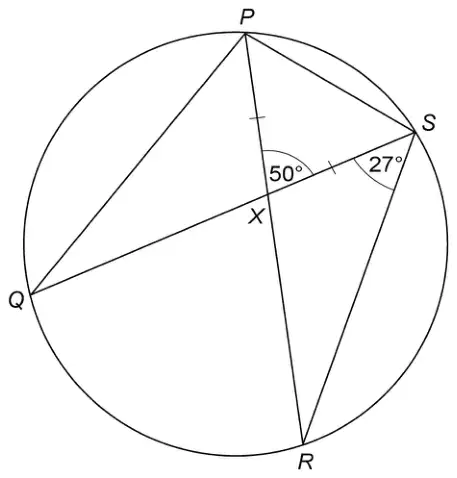
20 \(P\), \(Q\), \(R\) and \(S\) are points on a circle.
\(PXR\) and \(QXS\) are straight lines.
\(PX = SX\)
Not drawn accurately
Prove that \(QS\) is not a diameter of the circle. [4 marks]
Mark scheme
Answer
Mark
Comments
Alternative method 1
angle \(QPR = 27\)
M1
may be seen on diagram
angle \(XPS = \dfrac{180 - 50}{2}\) or 65
M1
may be seen on diagram
angle \(QPR = 27\) and angle \(XPS = 65\) and angle \(QPS = 92\) and angle in a semicircle is a right angle
A1
oe accept \(92 \ne 90\)
all reasons for angle facts: angles in same segment (are equal) and angle sum of triangle (is 180) and base angles of isosceles triangle (are equal)
A1
oe
Alternative method 2
angle \(SXR = 180 - 50\) or 130 and angle \(XRS = 180 -\) their \(130 - 27\) and angle \(PQS =\) their 23
M1
may be seen on diagram angle \(XRS = 23\)
angle \(XSP = \dfrac{180 - 50}{2}\) or 65
M1
may be seen on diagram
angle \(SXR = 130\) and angle \(XRS = 23\) and angle \(PQS = 23\) and \(XSP = 65\) and angle \(QPS = 92\) and angle in a semicircle is a right angle
A1
oe accept \(92 \ne 90\)
all reasons for angle facts: angles on a straight line (add up to 180) and angle sum of triangle (is 180) and angles in same segment (are equal) and base angles of isosceles triangle (are equal)
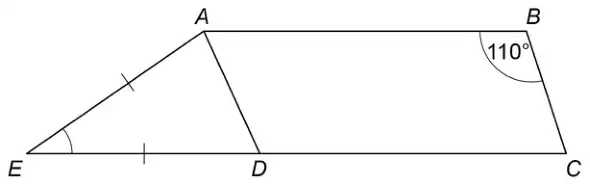
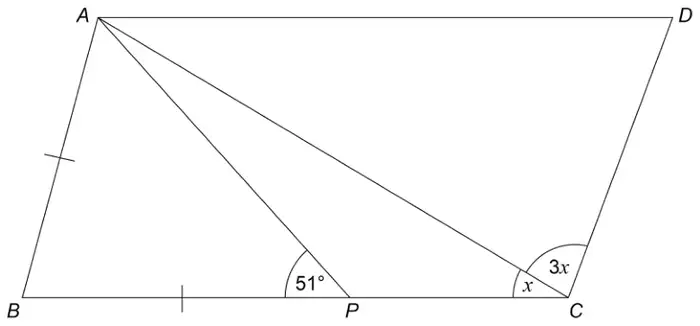
15 Trapezium \(ABCE\) is made from parallelogram \(ABCD\) and isosceles triangle \(ADE\).
\(AE = DE\)
Not drawn accurately
Work out the size of angle \(AED\). [3 marks]
Mark scheme
Answer
Mark
Comments
\(ADC = 110\) or \(BAD = 180 - 110\) or \(BAD = 70\) or \(BCD = 180 - 110\) or \(BCD = 70\) or any indication that angle \(EAD\) = angle \(EDA\) or any indication that angle \(BCD\) = angle \(ADE\)
M1
may be seen on diagram
eg both written as \(x\) or both having the same value
\(EDA = 180 - 110\) or \(EDA = 70\) or \(EAD = 180 - 110\) or \(EAD = 70\)
M1dep
may be seen on diagram
40
A1
Additional guidance
Angle values must be identified with the correct angle, either by notation or use of the diagram Notation such as \(D = 110\) or \(C = 70\) is not acceptable (although marks may still be awarded for correct position of angles on diagram)
Work on the diagram can score up to M2
Subject to the previous comment, award the higher mark for work seen on diagram and work seen in working space
Ignore incorrect angles when awarding up to M2, but any incorrect work cannot score M2A1
40 marked as angle \(AED\) on diagram but :- 180 on answer line or no sign of 40 as final answer in working
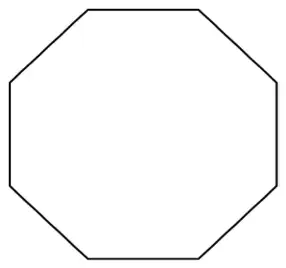
(b) Amba is working out the size of an interior angle of a regular octagon.
Not drawn accurately
Her method is \(\qquad\) Interior angle \(= 360 \div 8\)
Is her method correct?
Tick a box.
Yes
No
Give a reason for your answer. [1 mark]
Mark scheme (a)
Answer
Mark
Comments
\(180 \div 3\) or 60
M1
oe eg \(60 + 60 + 60 = 180\)
\((180 - 28) \div 2\) or \(152 \div 2\) or 76
M1
oe eg \(76 + 76 + 28 = 180\)
\(180 -\) their \(60 -\) their 76
M1dep
oe eg \(44 + 60 + 76 = 180\) dep on M1M1
44
A1
Additional guidance
60 or 76 seen in appropriate place on diagram or in working scores one mark for each
Answer 44 not from wrong working
M3A1
\(180 - 28 \div 2\) unless recovered
2nd M0
Mark scheme (b)
Answer
Mark
Comments
No and gives correct reason
B1
eg it should be \(180 - (360 \div 8)\) it should be \(1080 \div 8\) this gives the exterior (not the interior) angle it should be obtuse not acute accept any unambiguous indication of No
Additional guidance
A correct reason may be
showing a correct method
correction of her method (error and replacement shown)
correction of her answer (answer and replacement shown)
No, It should be 135 not 45 (3)
B1
No, It should be 1080 not 360 (2)
B1
No, because the interior angles should be 1080 not 360 (2)
B1
No, she needs to subtract her answer from 180 (1)
B1
No, \(((8 - 2) \times 180) \div 8\) (1)
B1
No, It should be \(((n - 2) \times 180) \div 8\) (doesn’t use \(n = 8\))
B0
Any numbers quoted must be correct but ignore other non-contradictory statements
eg No, It should be 720. She’s worked out the exterior angle
B0
No, There’s not 360 in an octagon or No, Angles in an octagon do not add up to 360
13 Tick all the statements that are true for any rhombus. [1 mark]
The diagonals are lines of symmetry
The diagonals bisect each other
The diagonals are perpendicular
The diagonals are equal in length
Mark scheme
Answer
Mark
Comments
The diagonals are lines of symmetry ✓ The diagonals bisect each other ✓ The diagonals are perpendicular ✓ The diagonals are equal in length (not ticked)
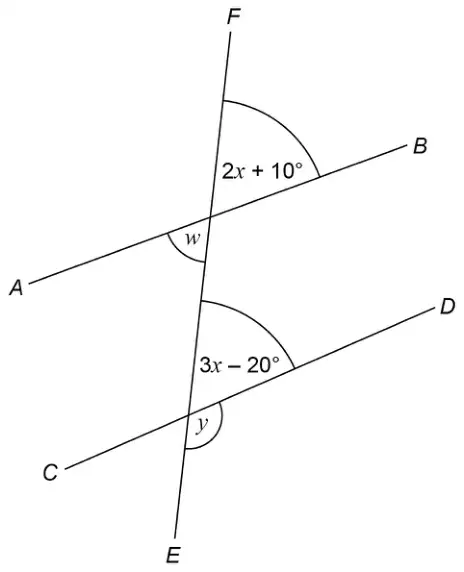
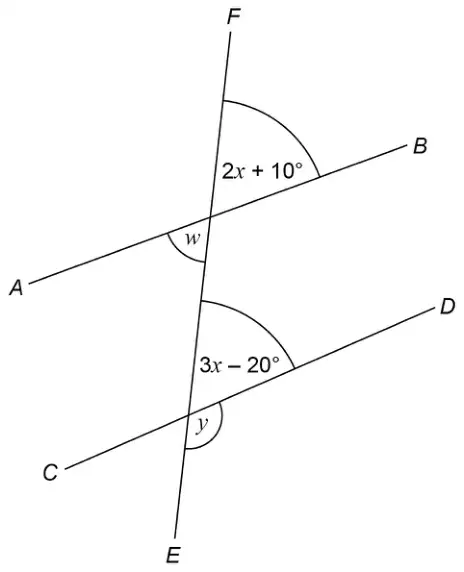
\(2x + 10 = 60\) or \(2x = 60 - 10\) or \(2x = 50\) or \(x = 25\)
M1
\(3 \times\) their \(25 - 20\) or 55 or \(180 - 55\) or 125
M1dep
oe
\((y =)\) 125 and bigger or (\(y\) is) 15 bigger
A1ft
oe ft their (a)
Additional guidance
Note: A complete logical explanation of the effect of lines not being parallel eg \(w\) is smaller so \(2x + 10\) is smaller so \(x\) is smaller so \(3x - 20\) is smaller so \(y\) is bigger
\(2x + 10 = 60\) or \(2x = 60 - 10\) or \(2x = 50\) or \(x = 25\)
M1
\(3 \times\) their \(25 - 20\) or 55 or \(180 - 55\) or 125
M1dep
oe
(\(y =\)) 125 and bigger or (\(y\) is) 15 bigger
A1ft
oe ft their (a)
Additional guidance
Note: A complete logical explanation of the effect of lines not being parallel eg \(w\) is smaller so \(2x + 10\) is smaller so \(x\) is smaller so \(3x - 20\) is smaller so \(y\) is bigger