
Foundation June 2023 Paper 3 Q22
22 \(ACF\) and \(ADG\) are straight lines.
\(BCD\) and \(EFG\) are parallel lines.
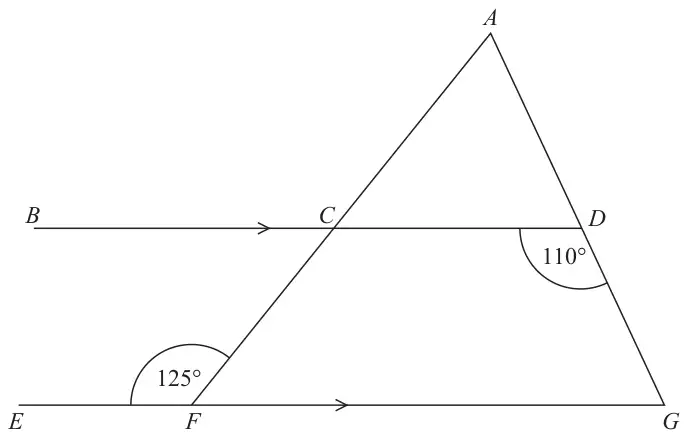
Show that triangle \(ACD\) is isosceles.
Give a reason for each stage of your working. (5)
| Answer | Mark | Mark scheme |
|---|---|---|
| Shown with reasons | M1 | for method to find \(ACD\) using parallel lines eg \(BCA = 125\) and \(ACD = 180 - 125\ (= 55)\) or \(BCF = 180 - 125\ (= 55) = ACD\) or \(FCD = 125\) and \(ACD = 180 - 125\ (= 55)\) or \(CFG = 180 - 125\ (= 55) = ACD\) |
| M1 | for method to find \(ADC\) eg \(180 - 110\ (= 70)\) or for method to find \(CAD\) eg \(180 - (\text{``}70\text{''} + \text{``}55\text{''})\ (= 55)\) or \(110 - \text{``}55\text{''}\ (= 55)\) | |
| A1 | for \(ACD = 55\) and \(CAD = 55\) | |
| C1 | for one correct parallel lines reason linked to their method eg Corresponding angles are equal Allied angles / Co-interior angles add up to 180 Alternate angles are equal | |
| C1 | for one other reason stated linked to their method eg Angles on a straight line add up to 180 Angles in a triangle add up to 180 Vertically opposite angles are equal OR Vertically opposite angles are equal The exterior angle of a triangle is equal to the sum of the interior opposite angles. Angles in a quadrilateral add up to 360. Accept “4-sided shape” |
Additional guidance
Angles must be clearly labelled on the diagram or otherwise identified.
Correct method can be implied from angles on the diagram if no ambiguity or contradiction.
Underlined words need to be shown; reasons need to be linked to their method, which can be implied from correctly identified angles (stated or written on the diagram).