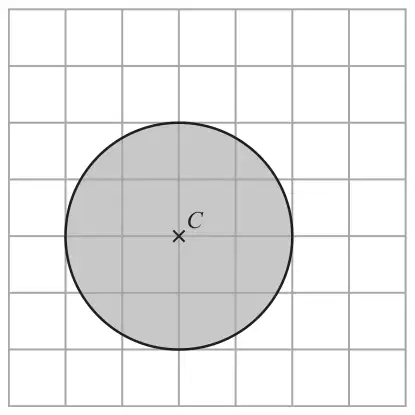
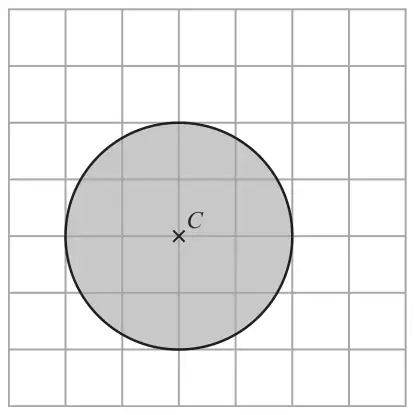
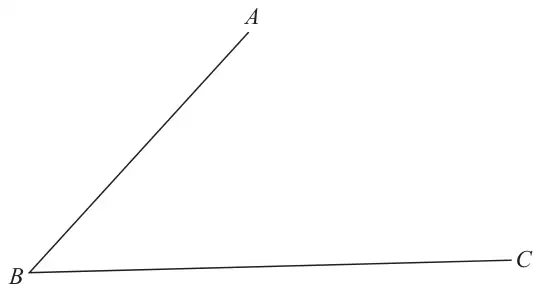
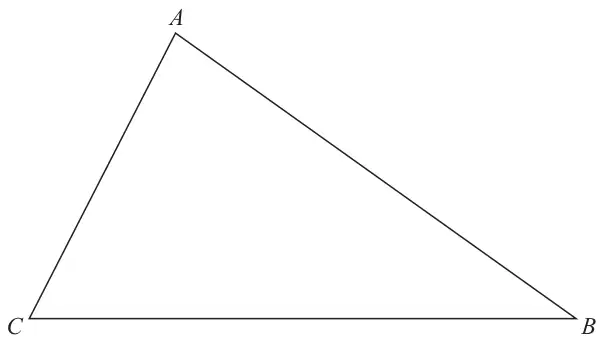
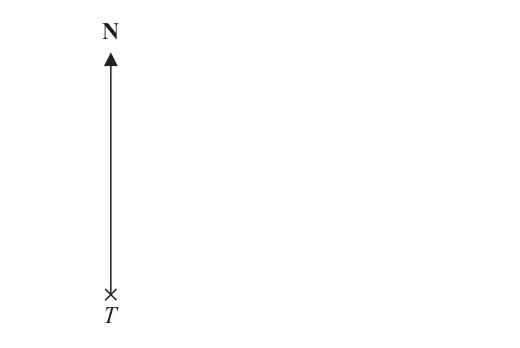
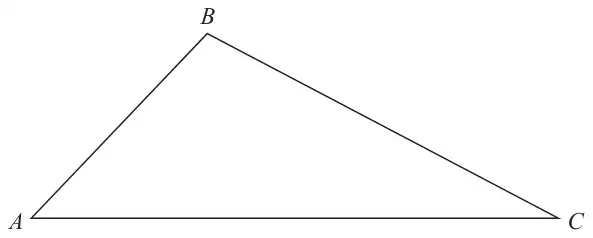
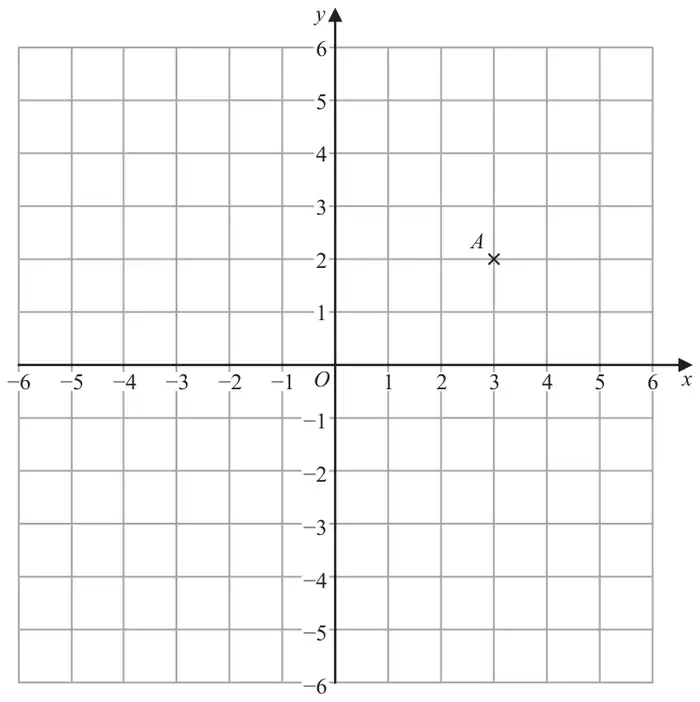
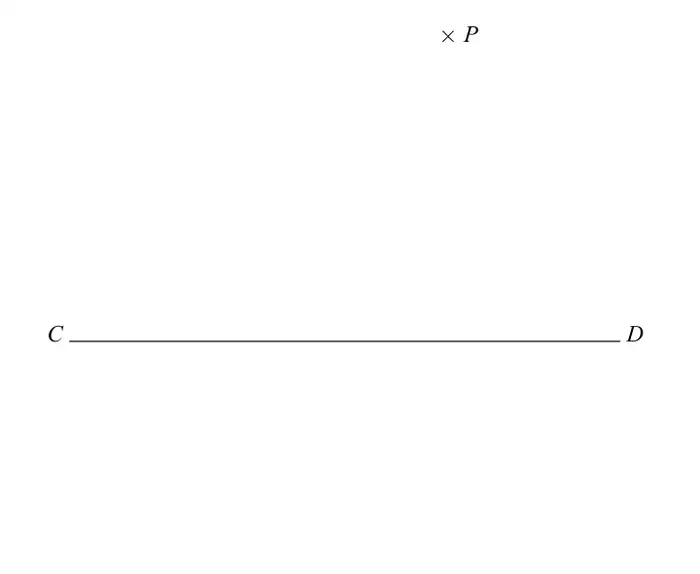
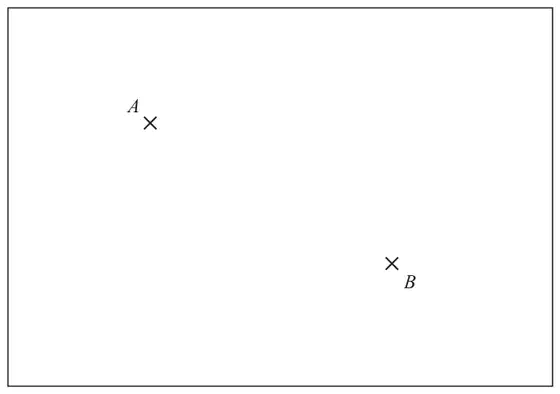
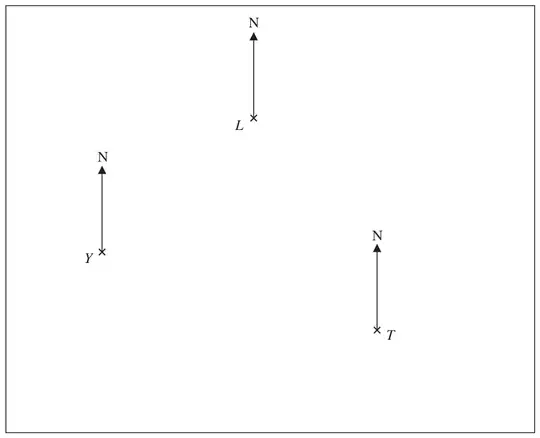
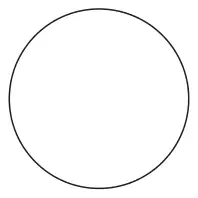
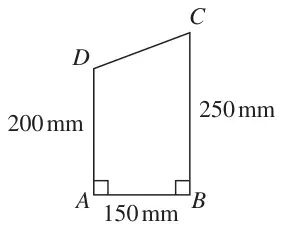
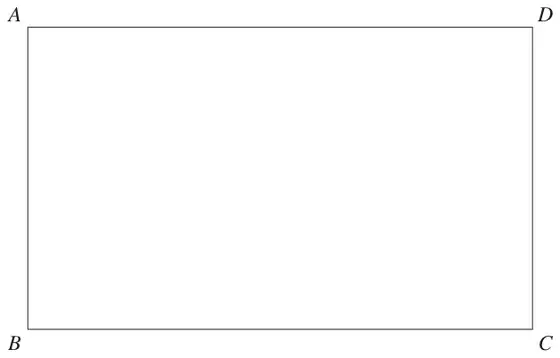
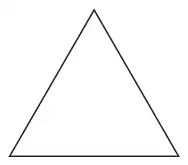
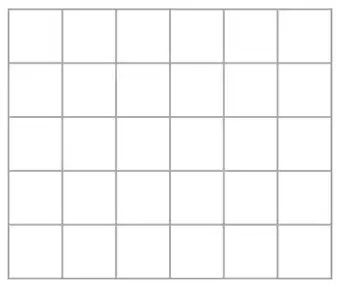
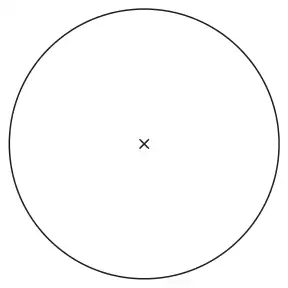
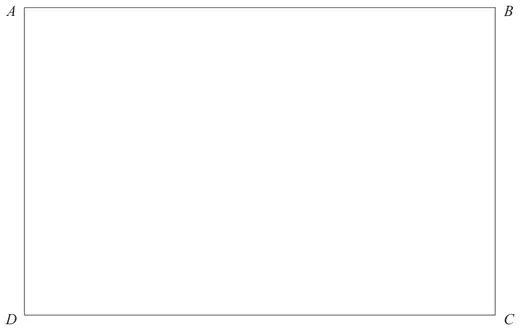
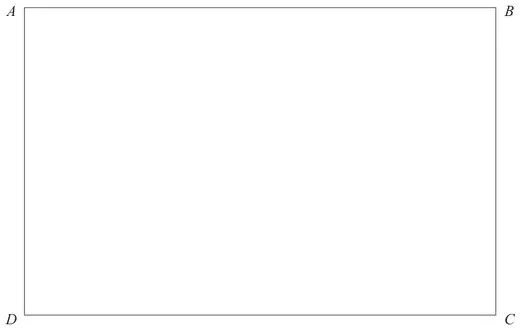
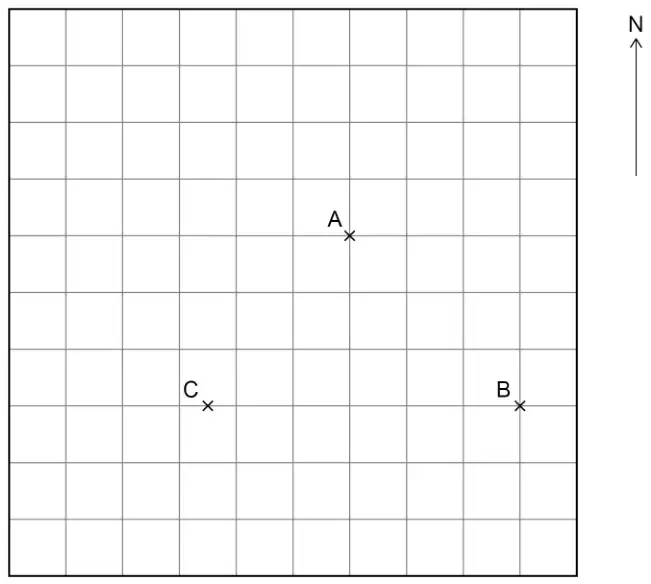
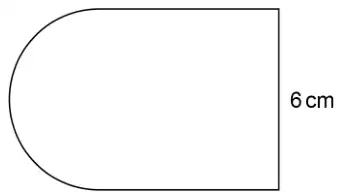
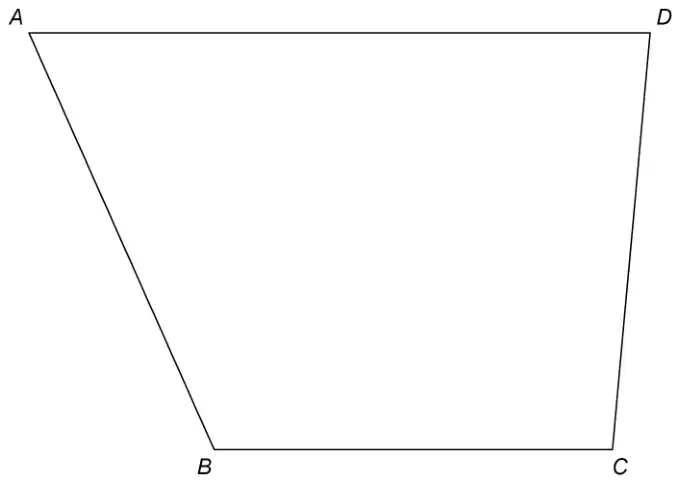
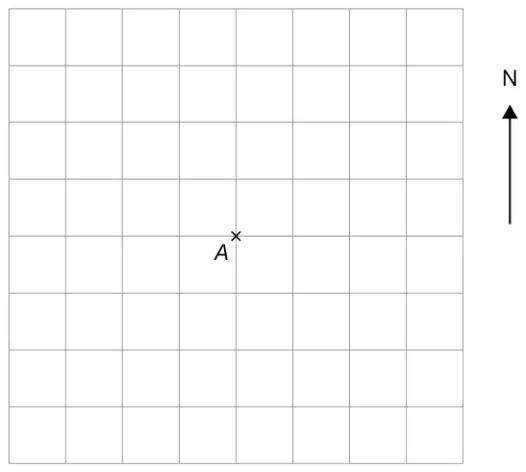
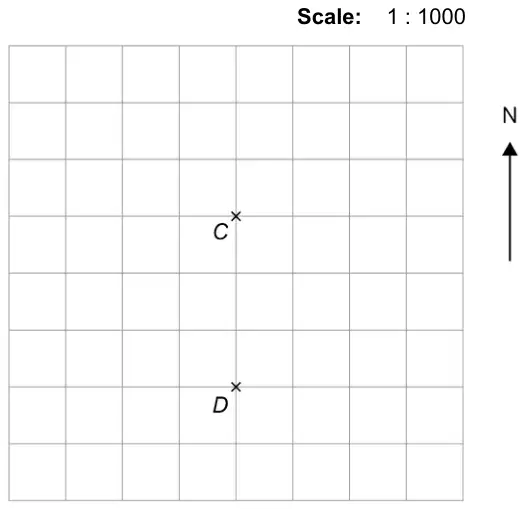
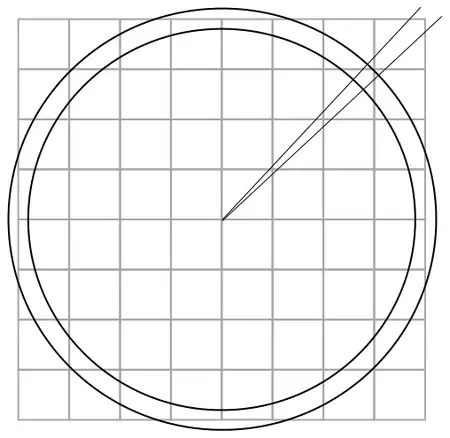
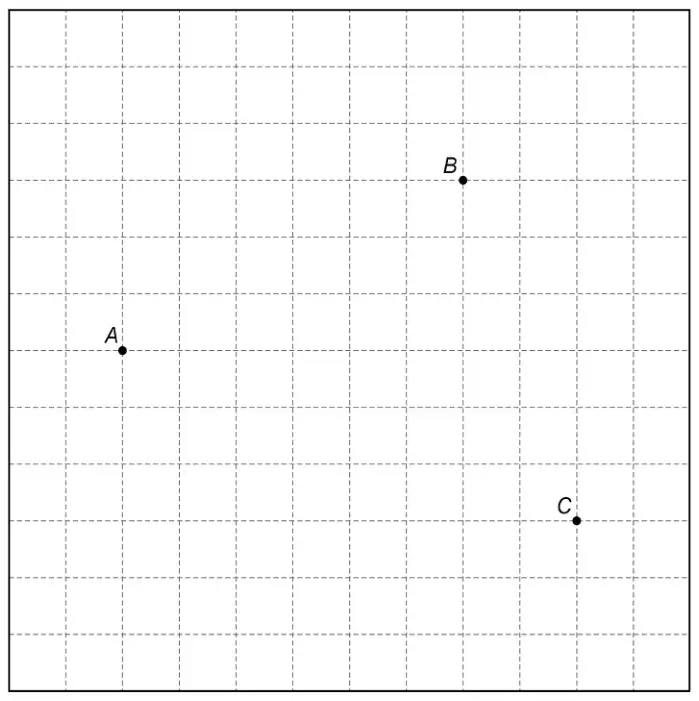
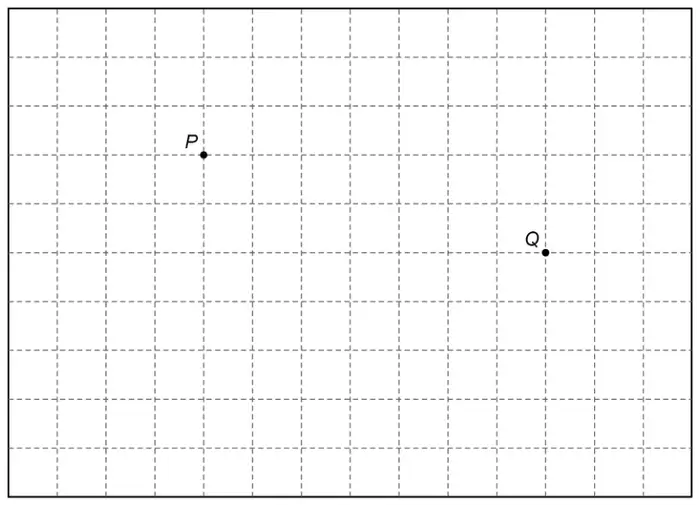
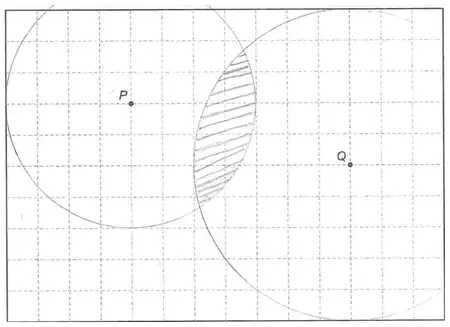
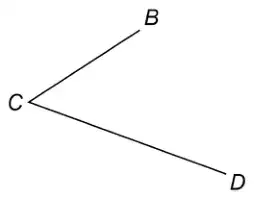
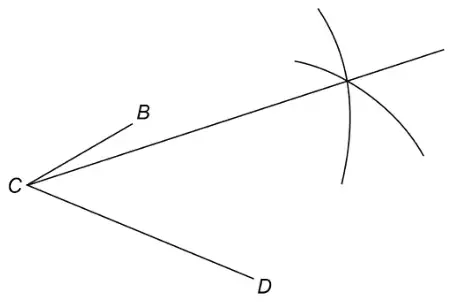
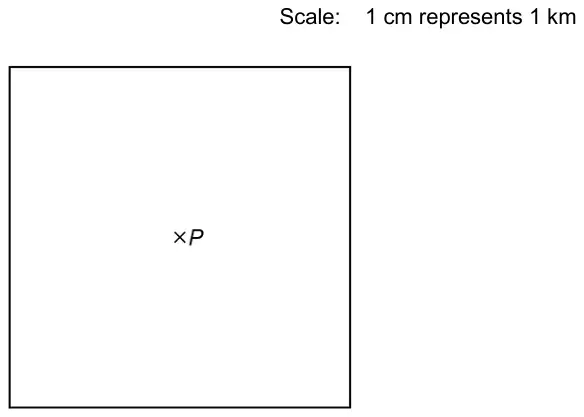
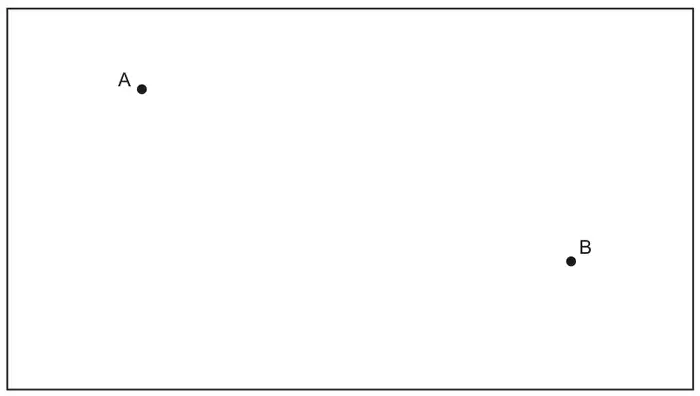
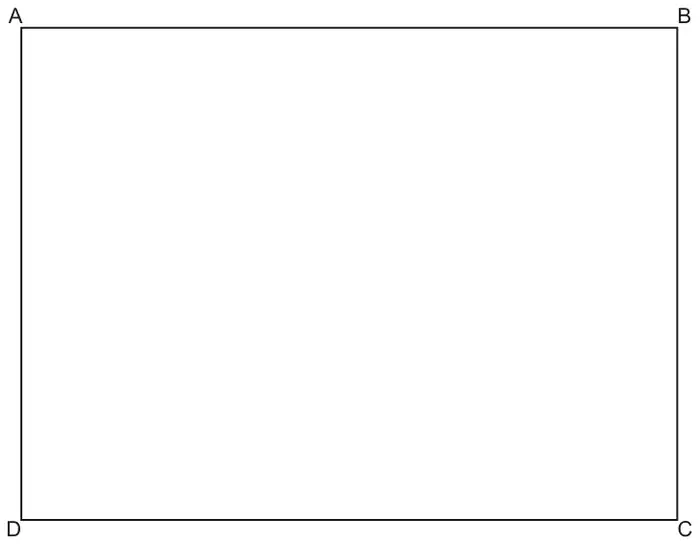
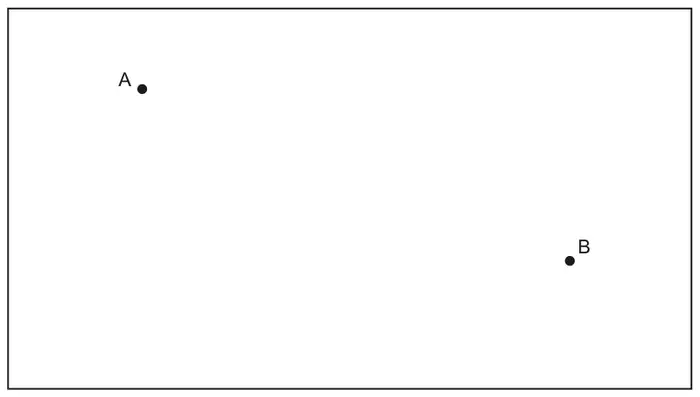
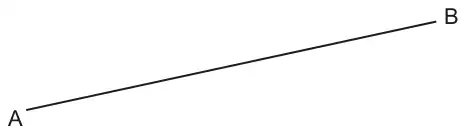
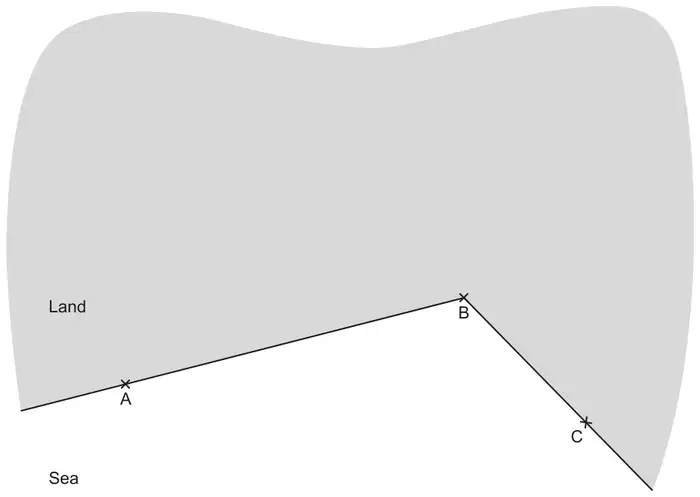
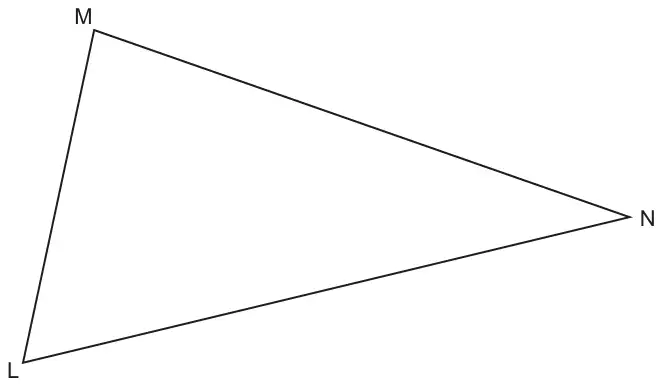
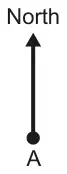
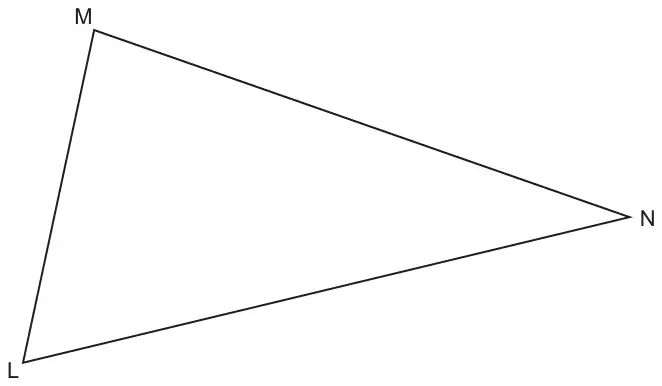
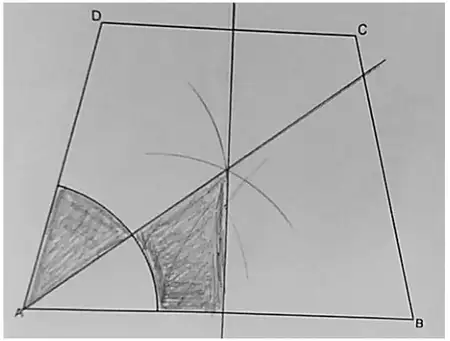
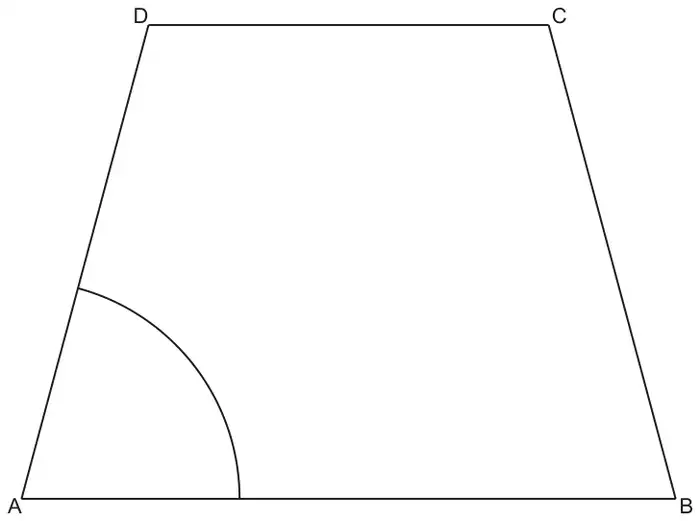
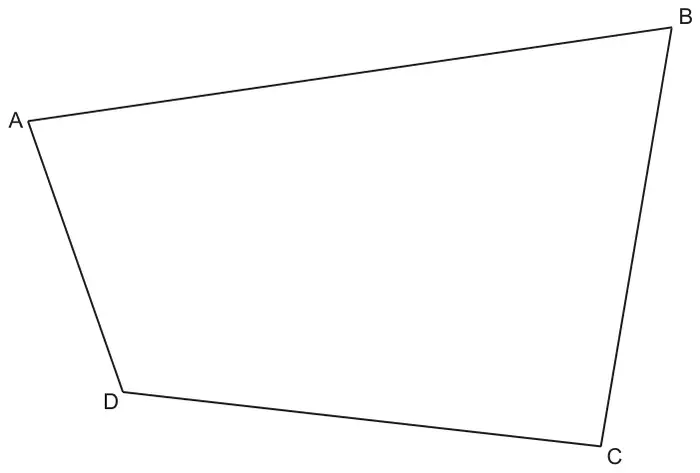
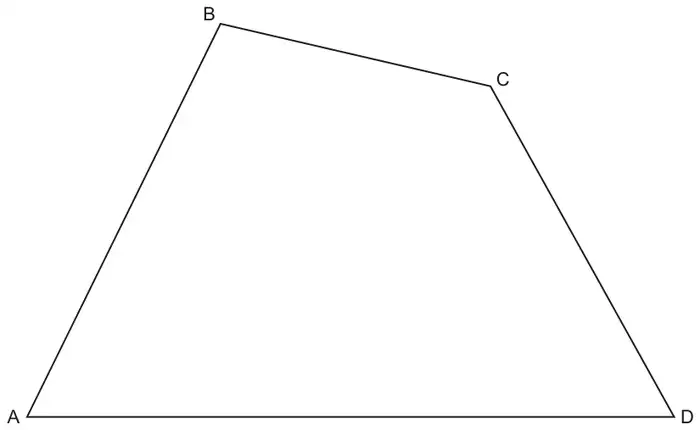
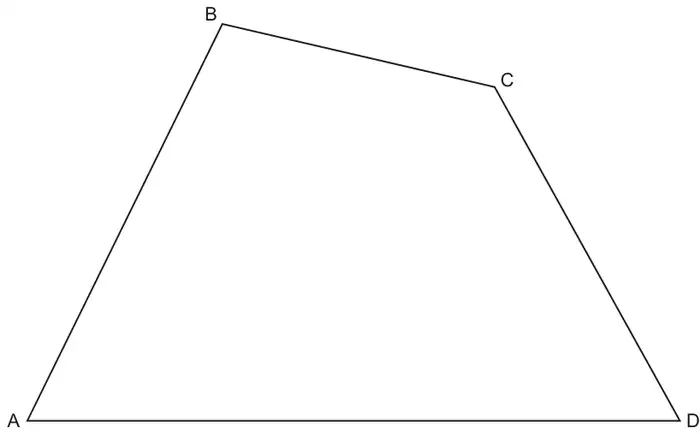
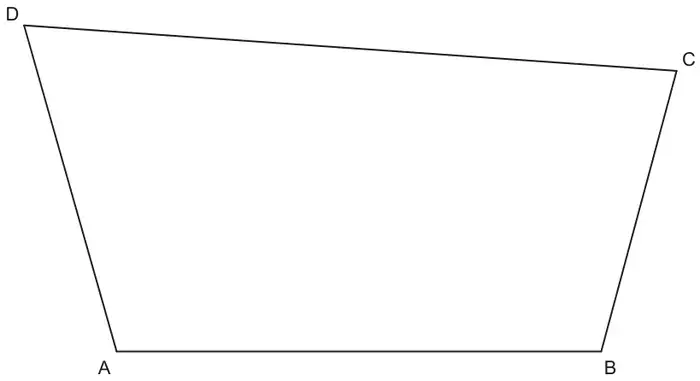
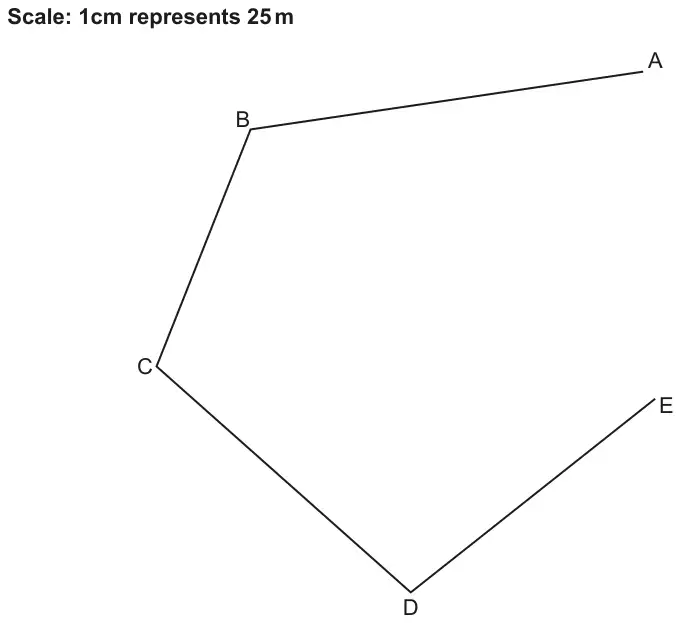
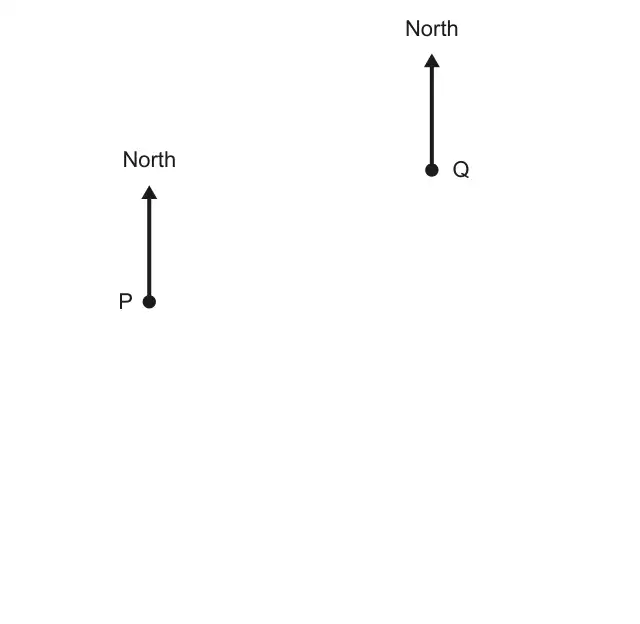
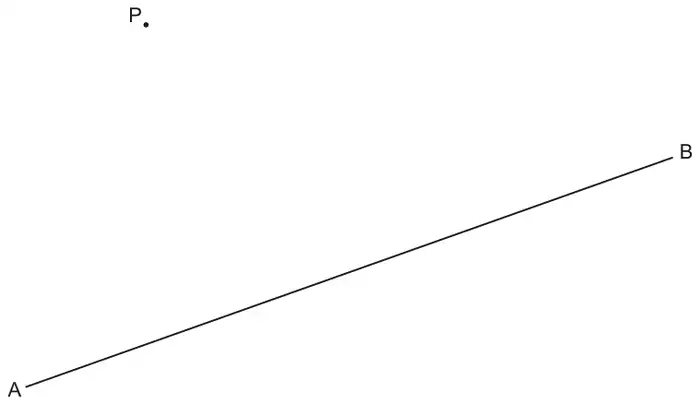
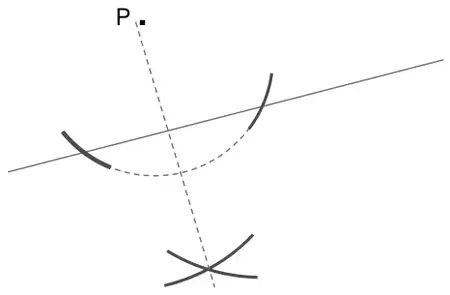
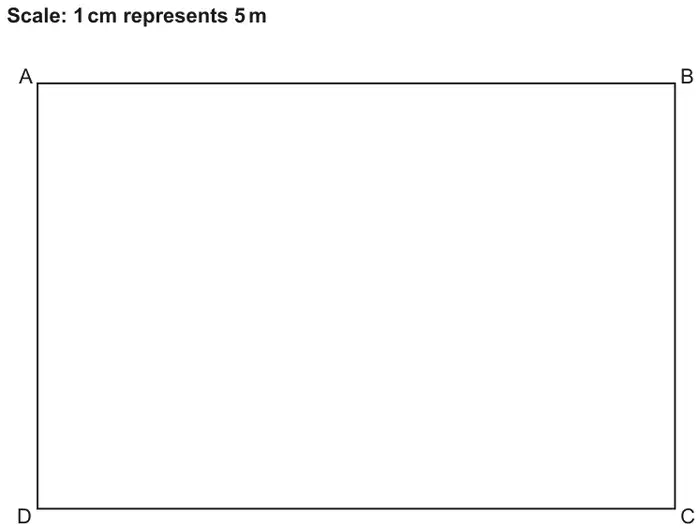
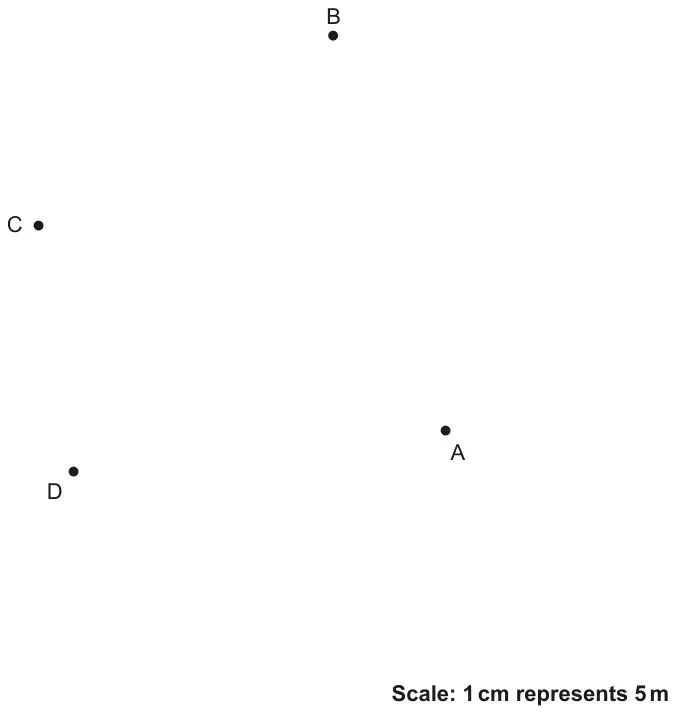
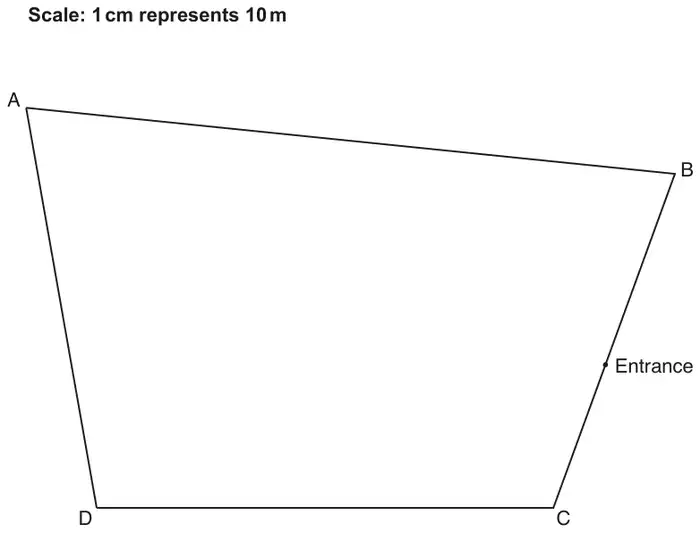
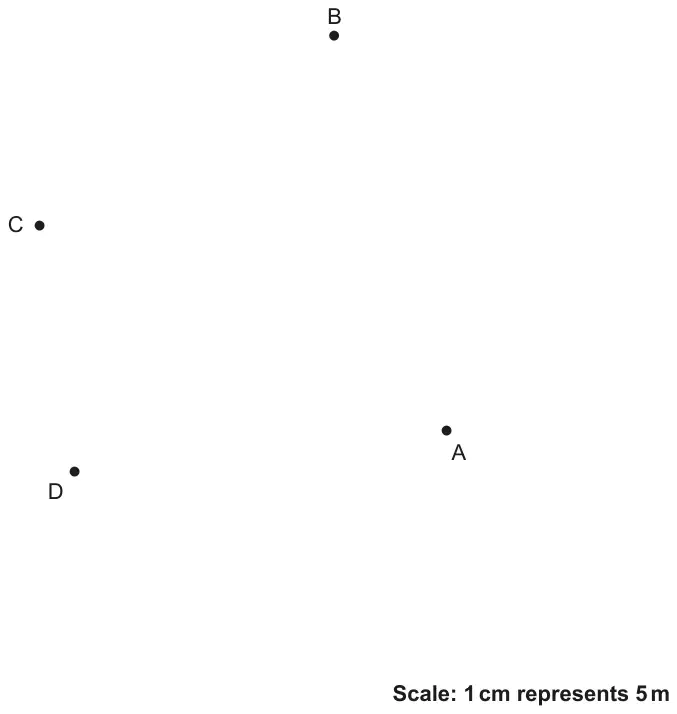
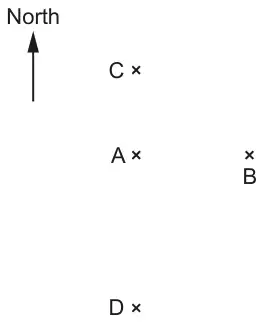
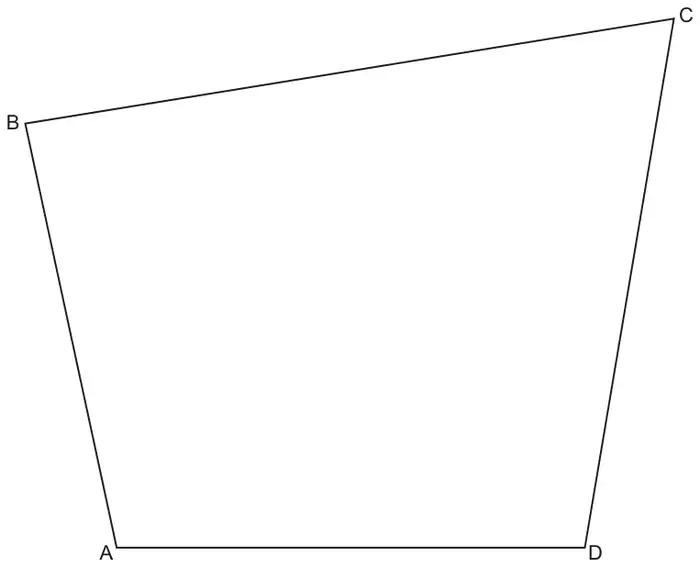
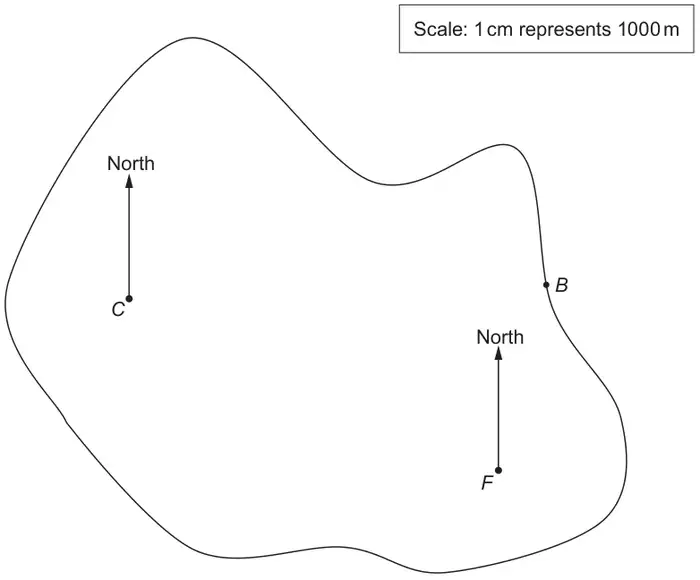
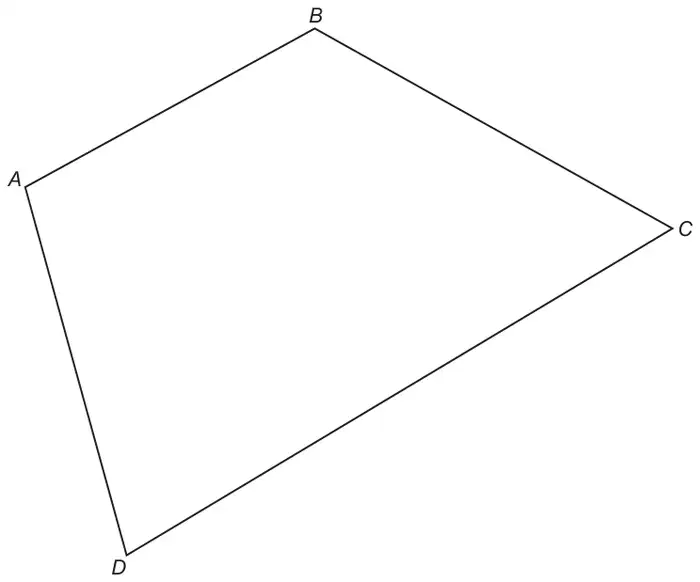
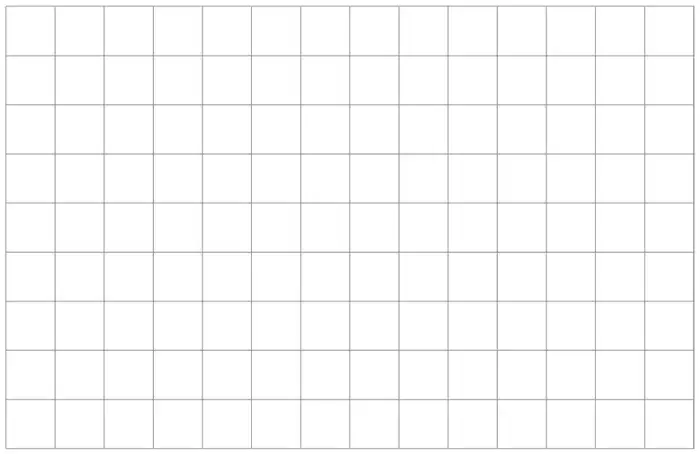
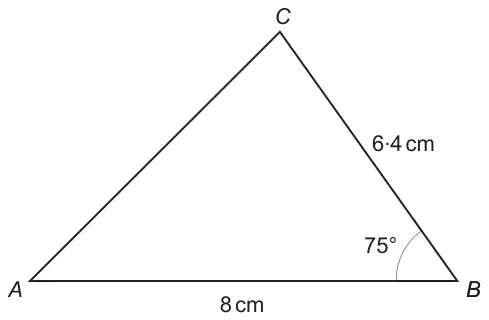
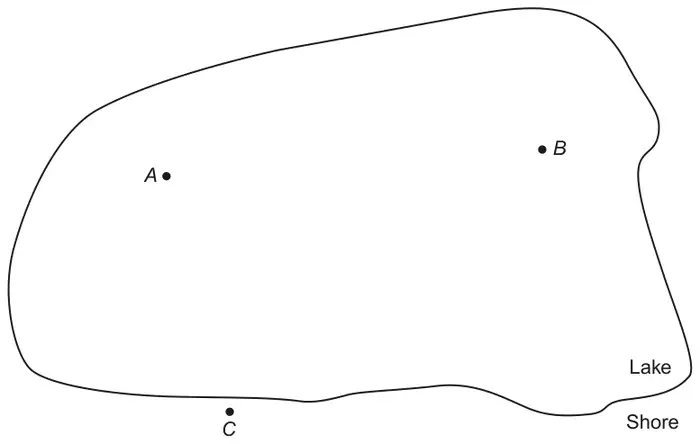
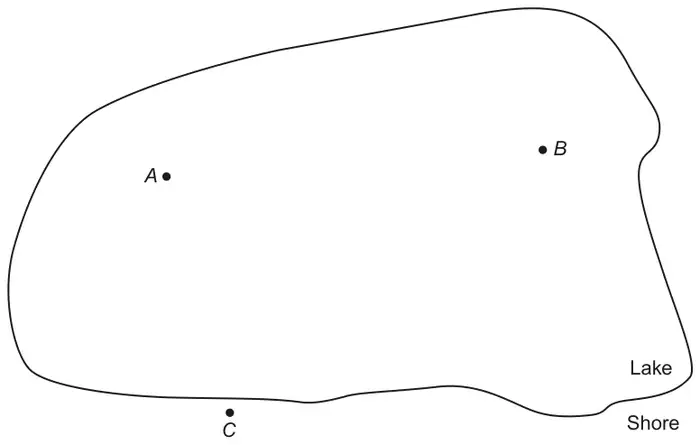
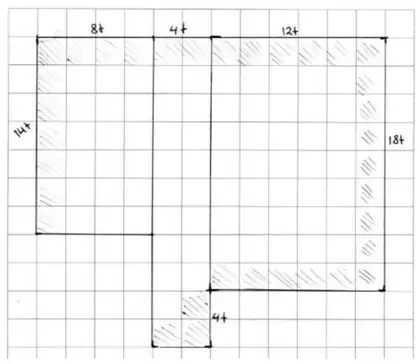
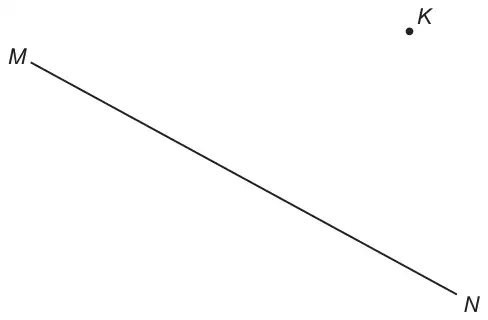
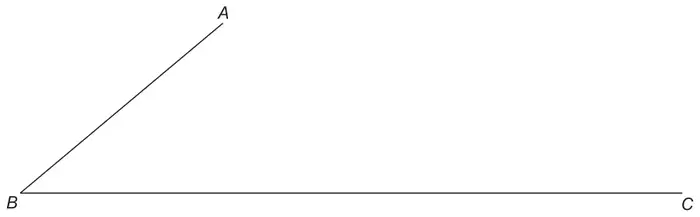
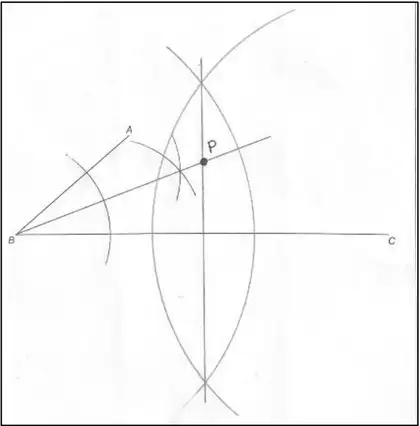
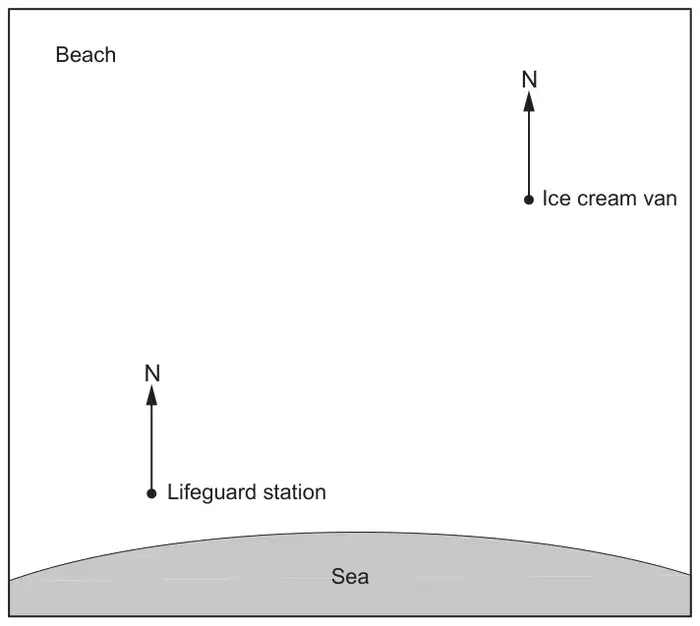
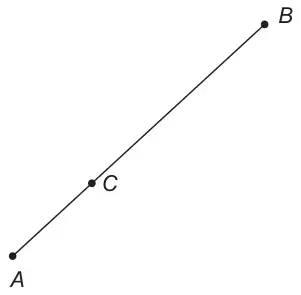
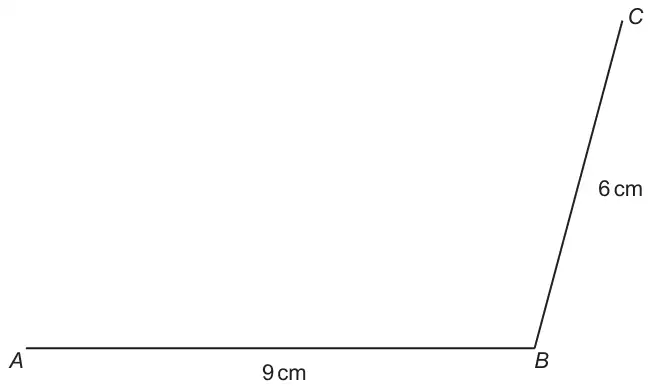
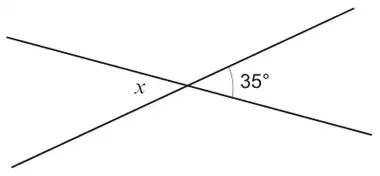
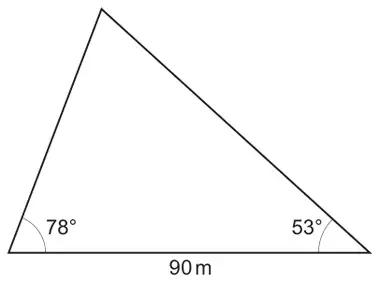
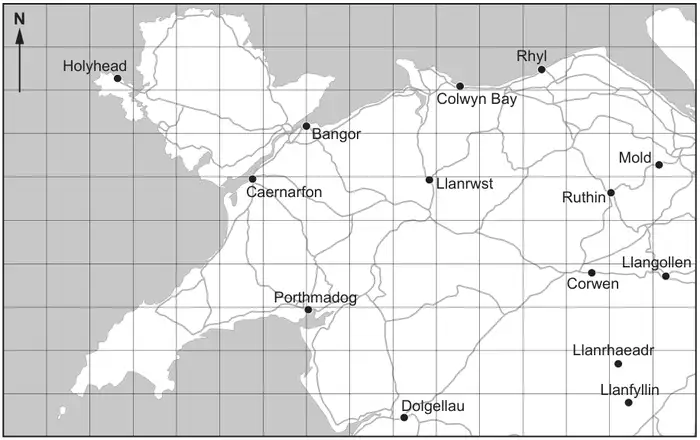
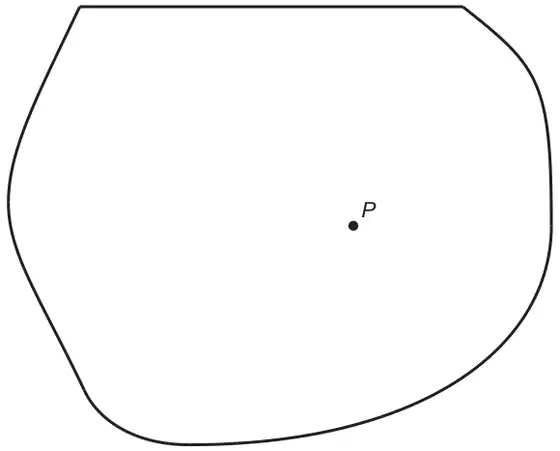
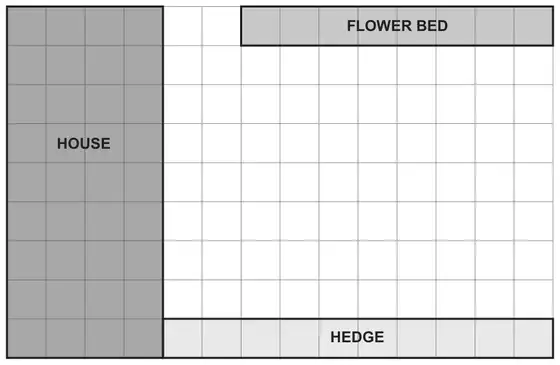
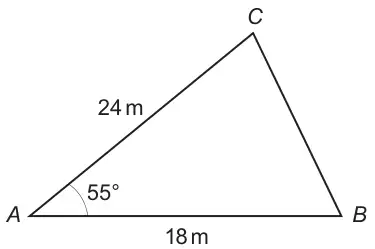
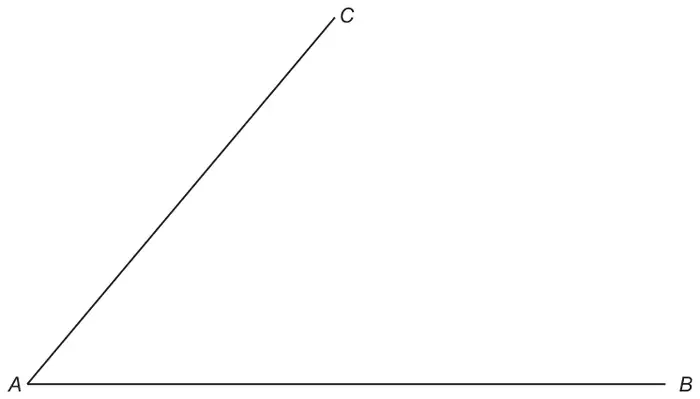
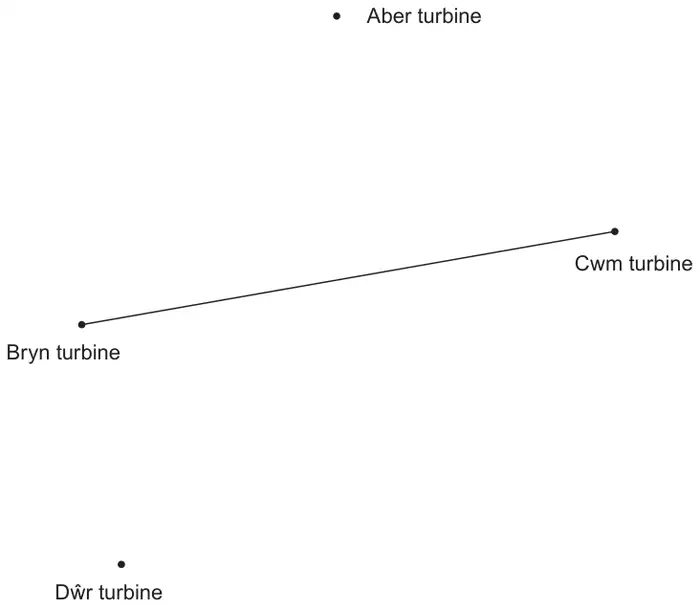
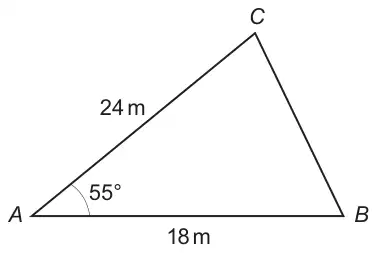
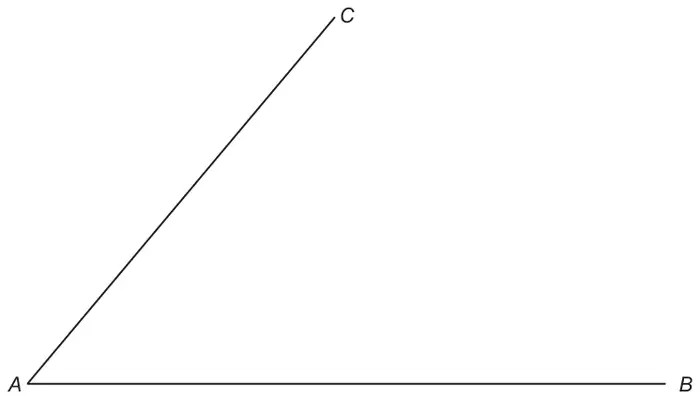
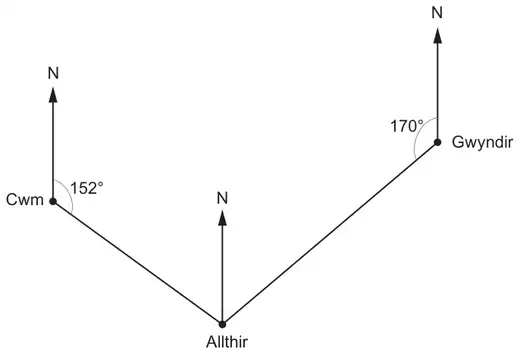
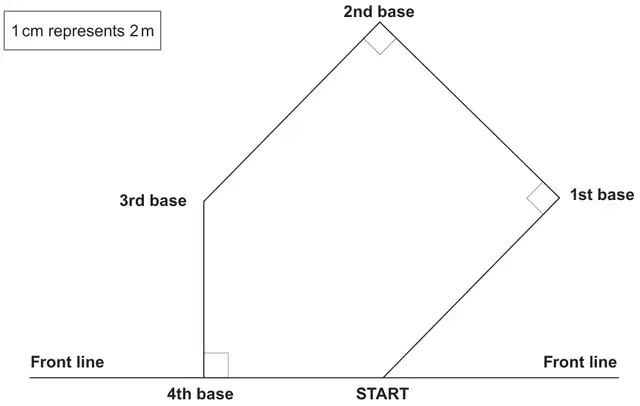
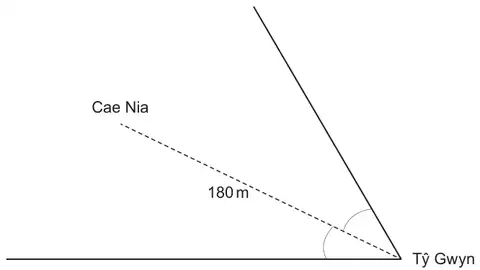
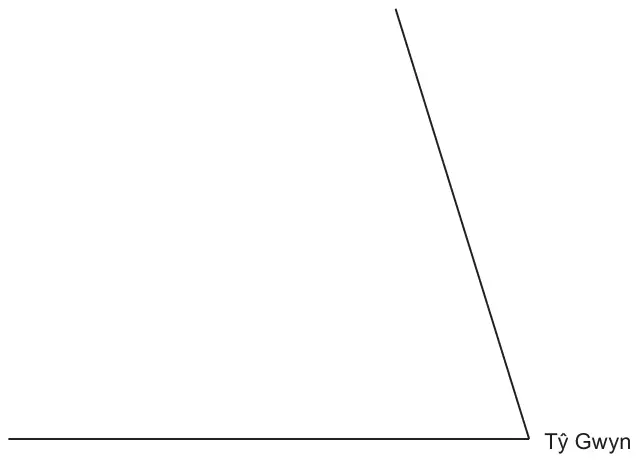
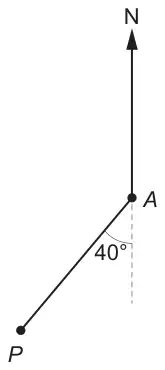
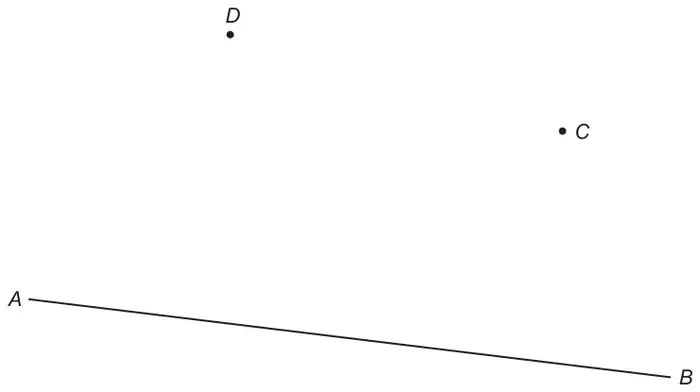
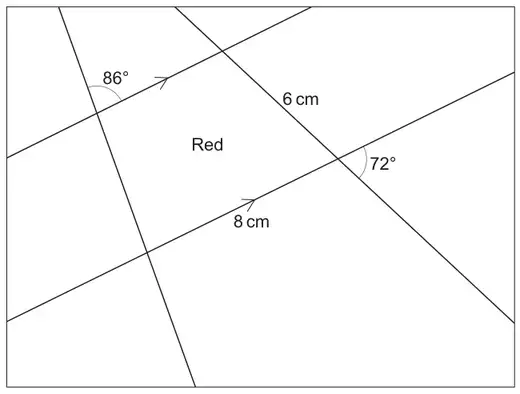
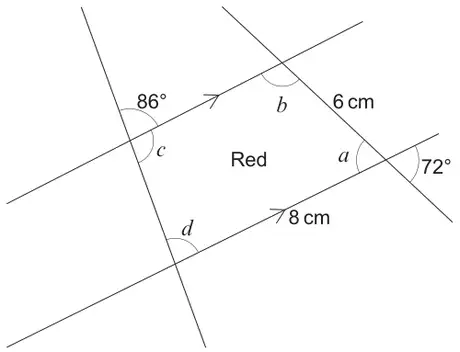
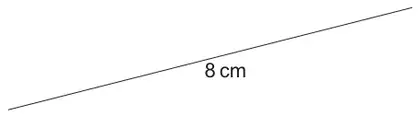
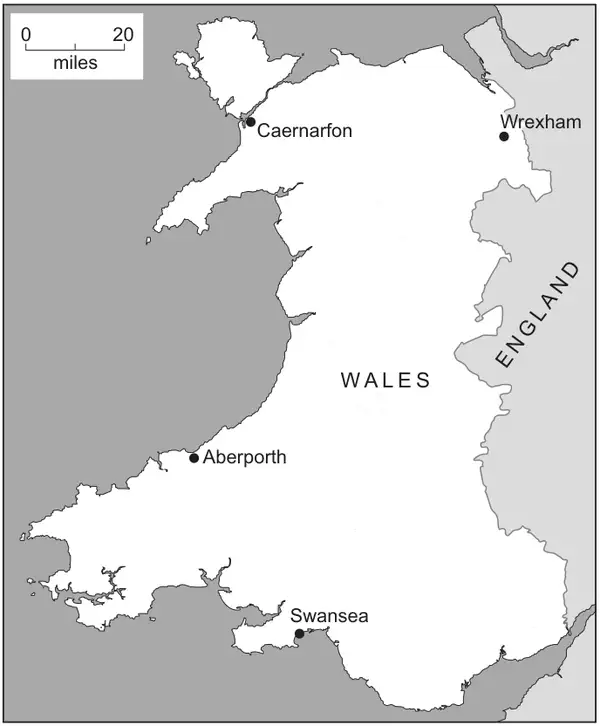
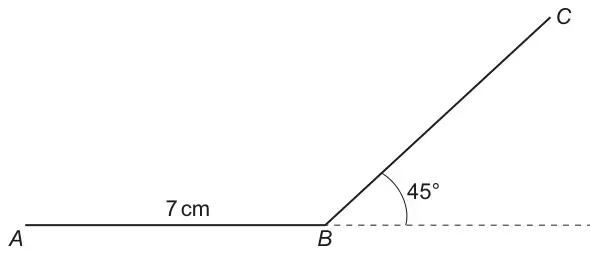
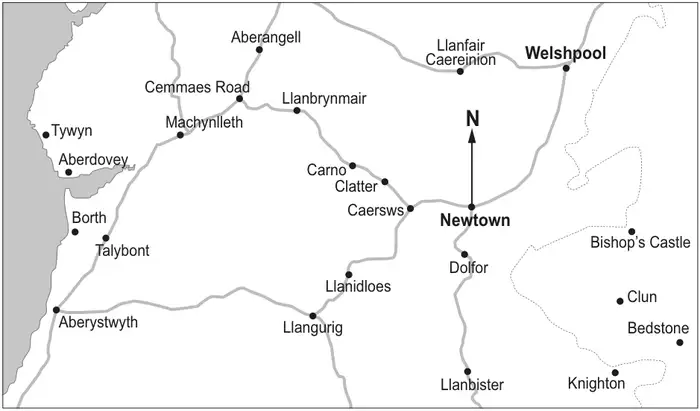
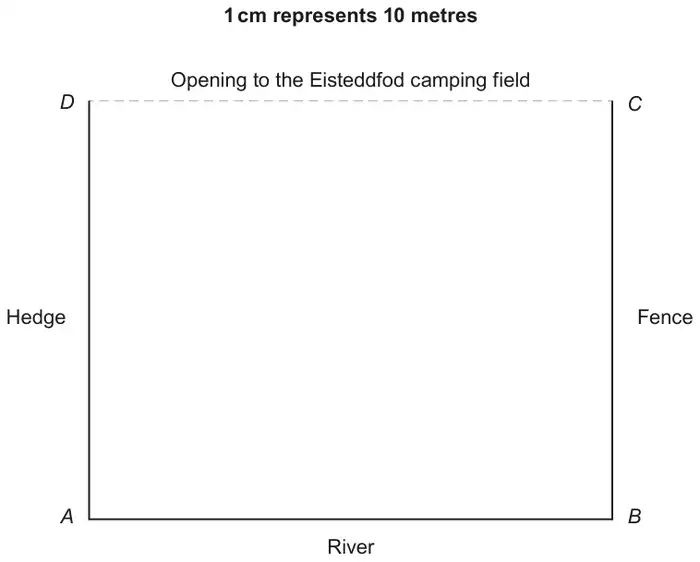
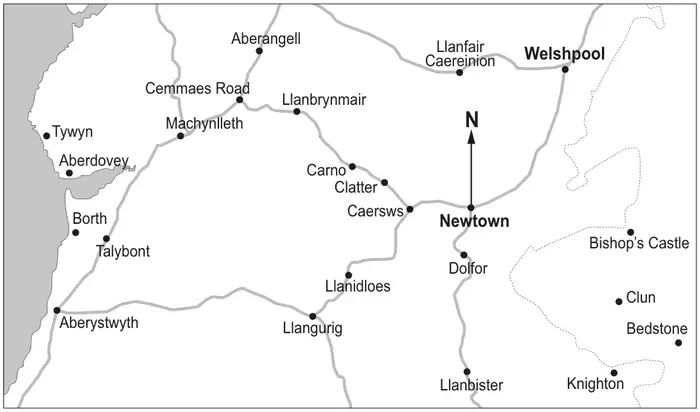
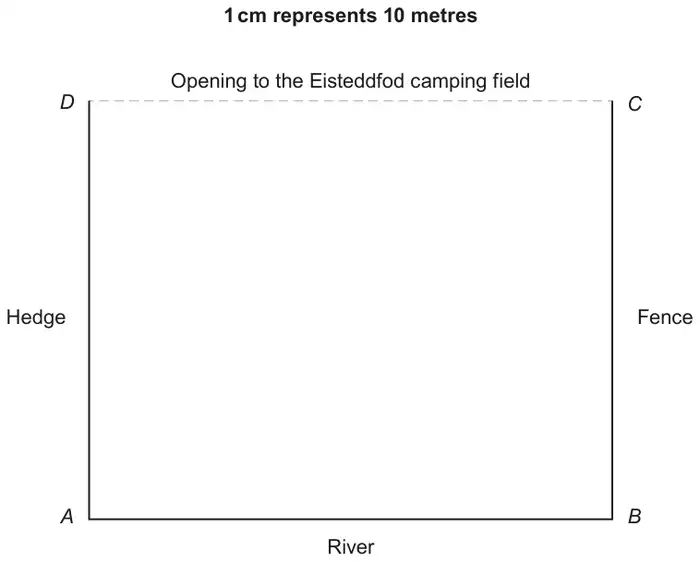
A point \(P\) is at least 2 cm from the point \(C\). Nadia is asked to shade the region where point \(P\) could be.
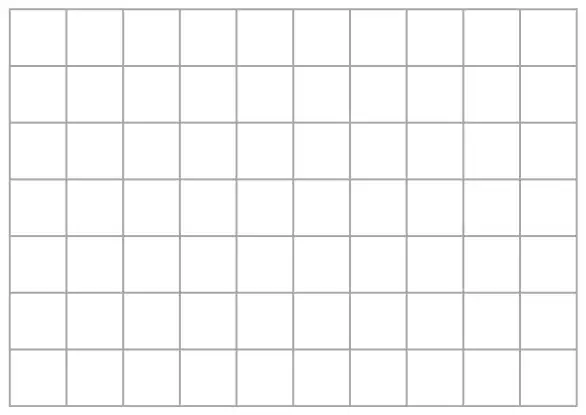
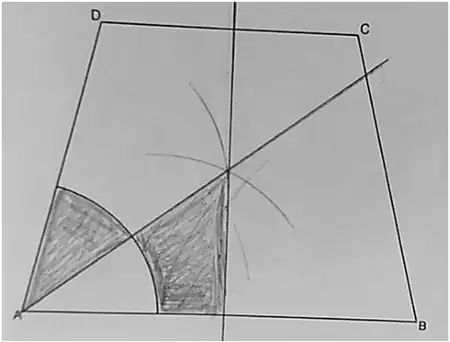
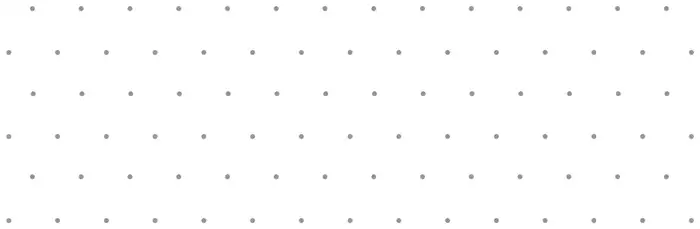
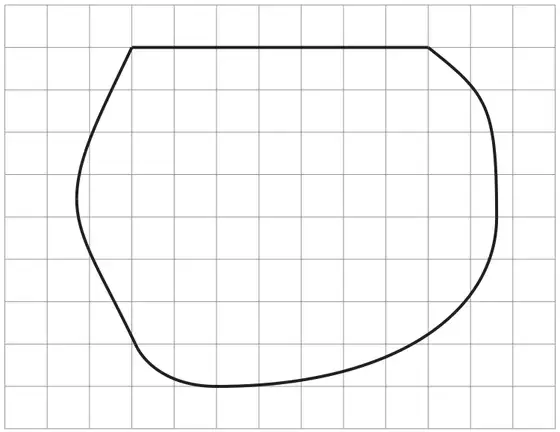
Her answer is shown on the grid.
Explain the mistake Nadia has made. (1)
Mark scheme
Answer
Mark
Mark scheme
Explanation
C1
for valid explanation identifying mistake,
Acceptable examples It’s on the wrong side of circle She shaded inside the circle (but should be outside) Shaded where \(P\) can’t be She shaded/drew less than 2cm She shaded at most 2 cm \(P\) should be outside (or on) the circle \(P\) should be anywhere outside the 2cm radius She shaded around point \(C\) not (at least) 2cm from point \(C\) Nadia should have shaded away from the circle
Not acceptable examples Shading is wrong or she shaded it incorrectly Region is in the wrong place Doesn’t fit inside the circle She shaded all the points between \(C\) and where all the points \(P\) could be The question says at least 2cm and not only 2cm away She shaded in too close She shaded a circle not a square or should’ve drawn/shaded a square
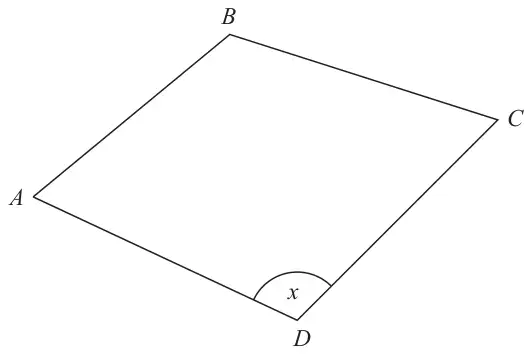
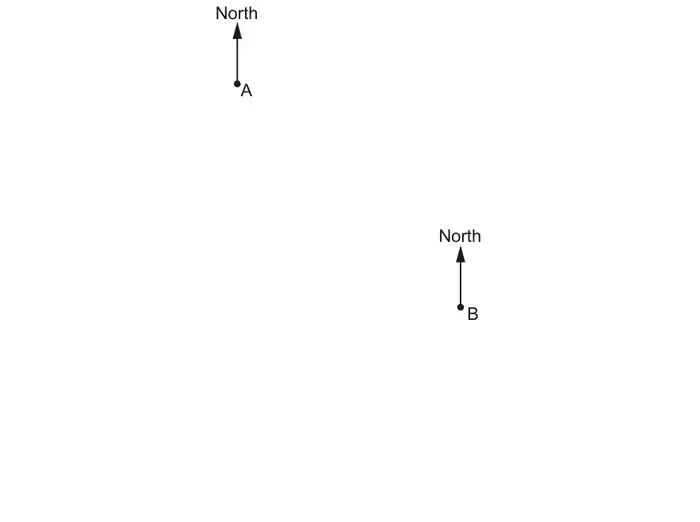
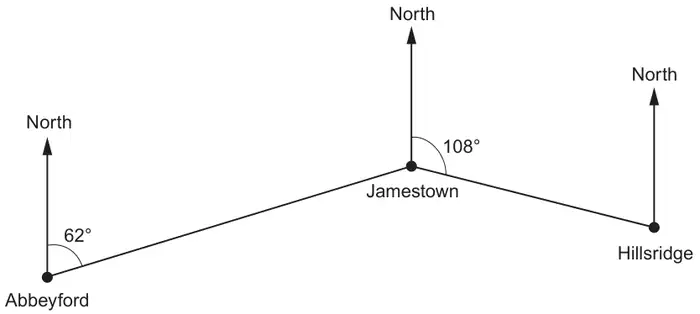
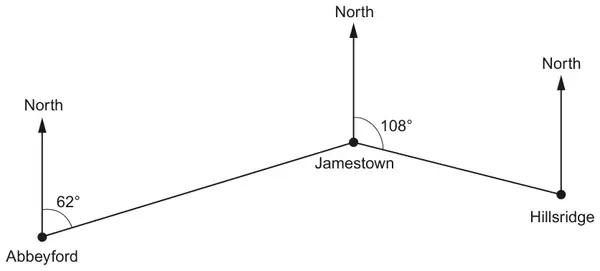
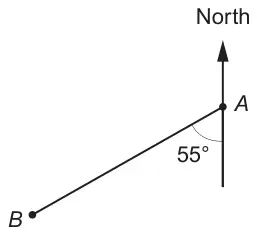
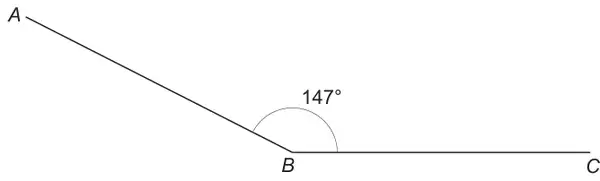
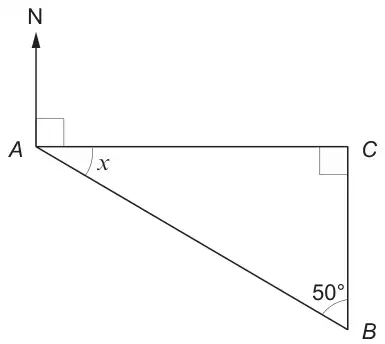
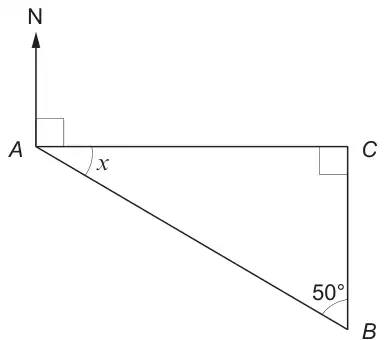
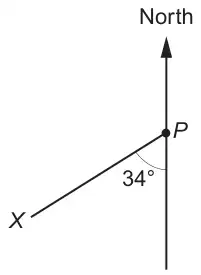
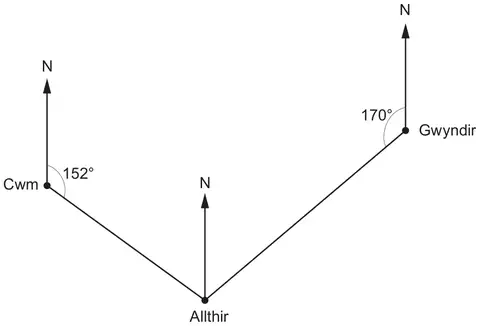
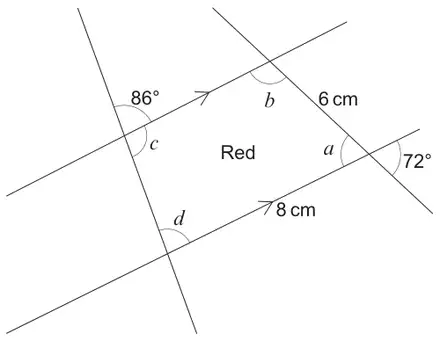
for \(147 + 180\) or for \(360 - (180 - 147)\), or for drawing a suitable diagram with 147 in the correct position and with the bearing of A from B indicated
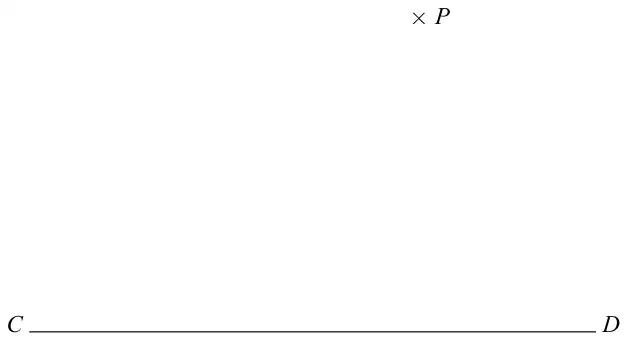
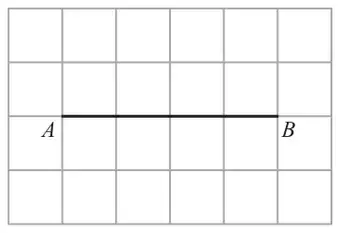
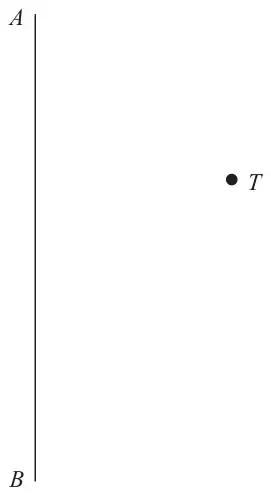
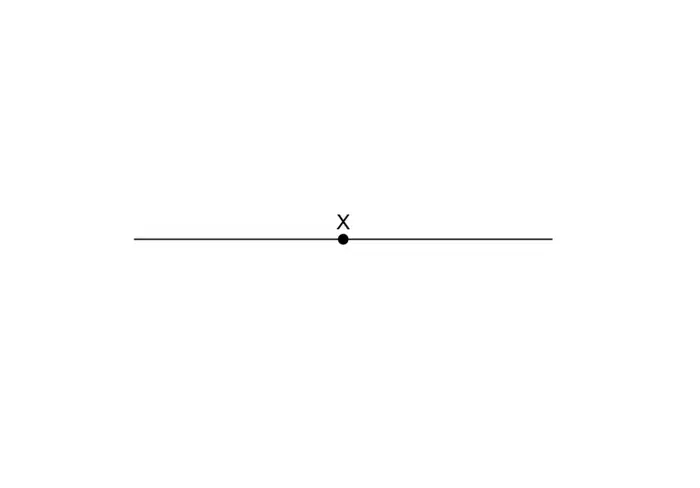
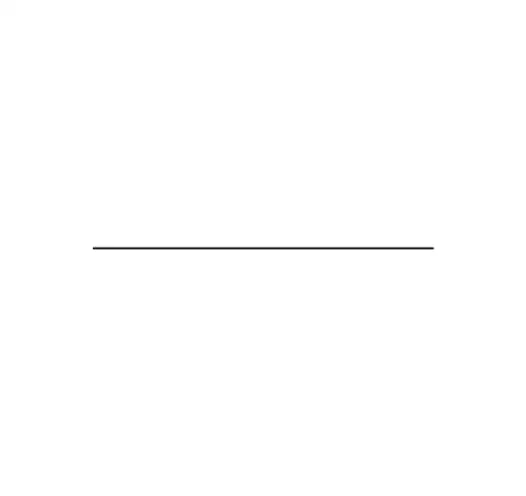
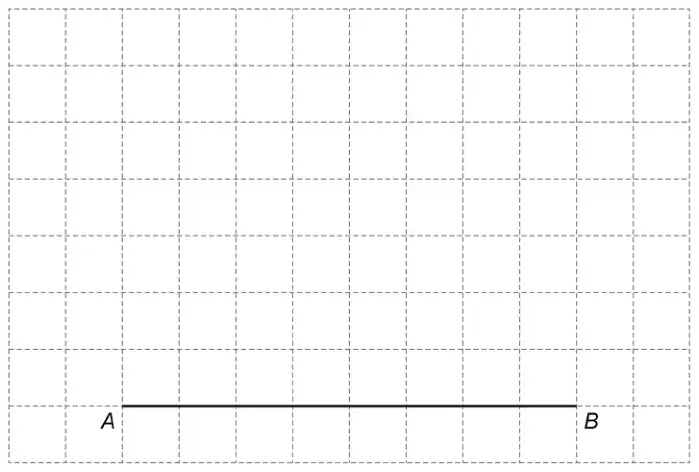
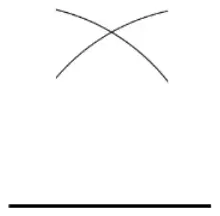
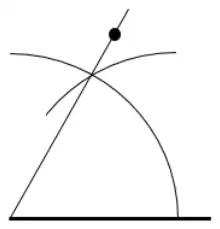
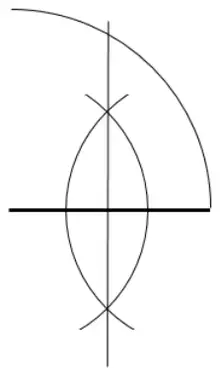
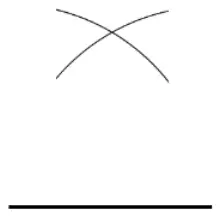
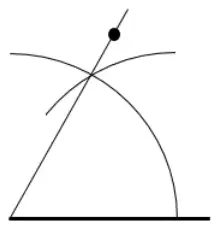
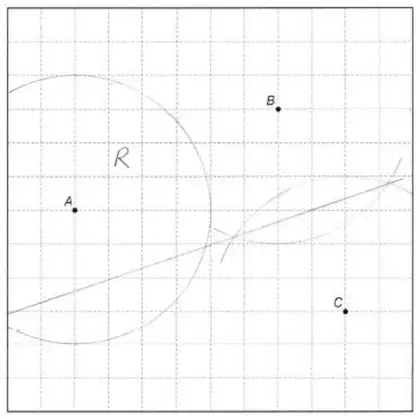
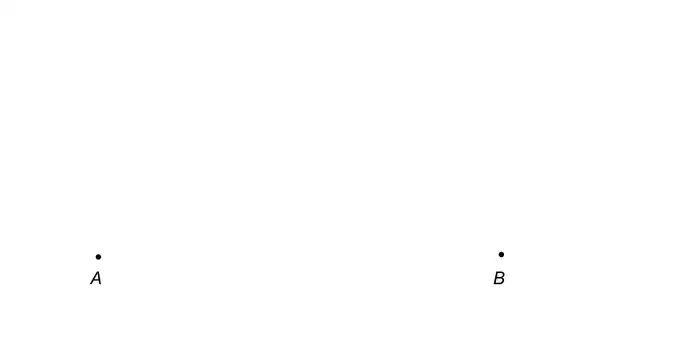
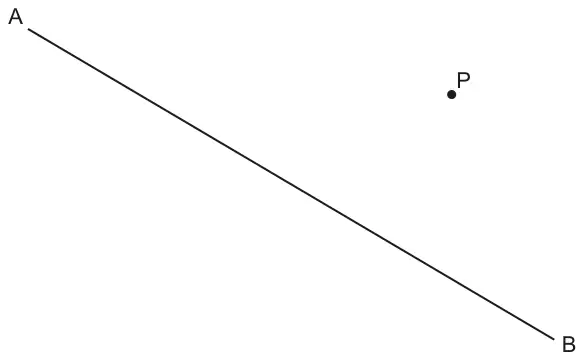
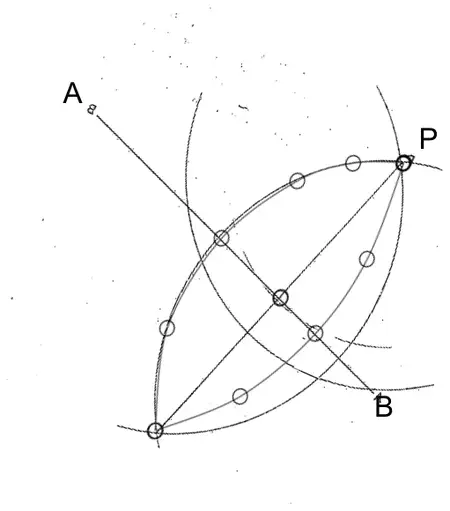
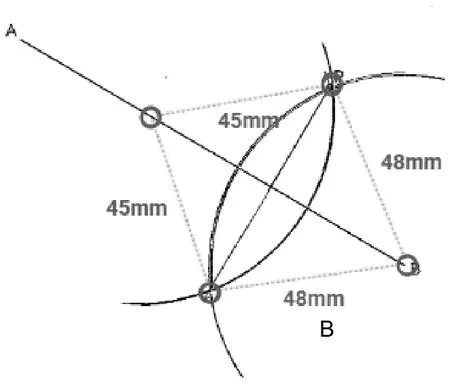
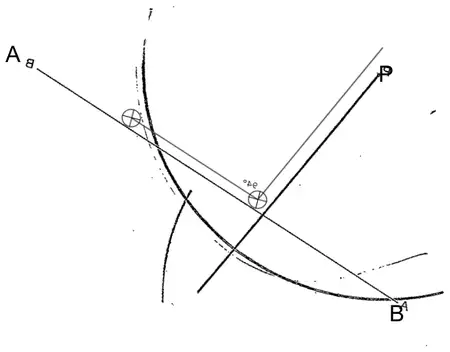
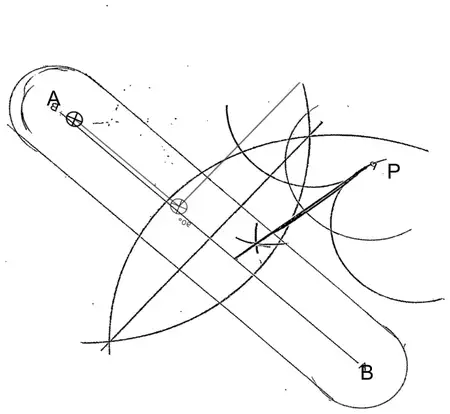
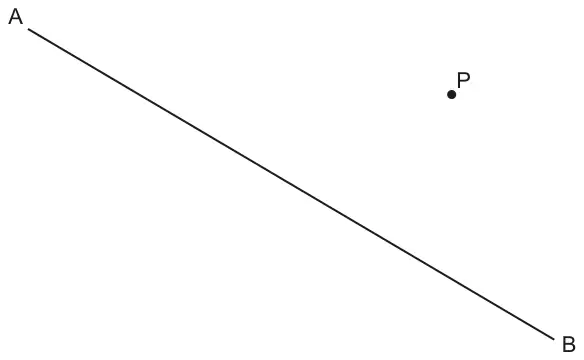
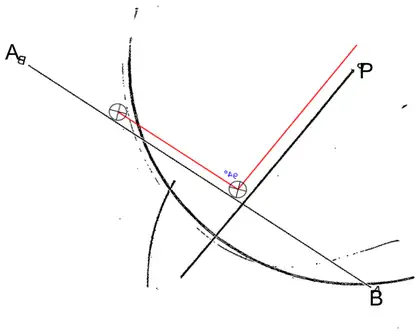
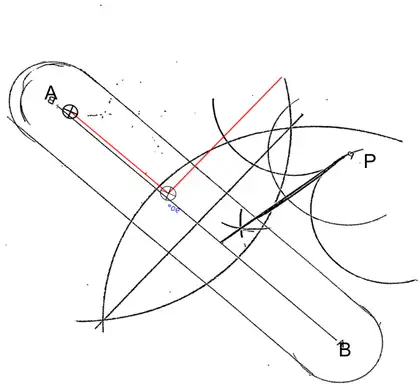
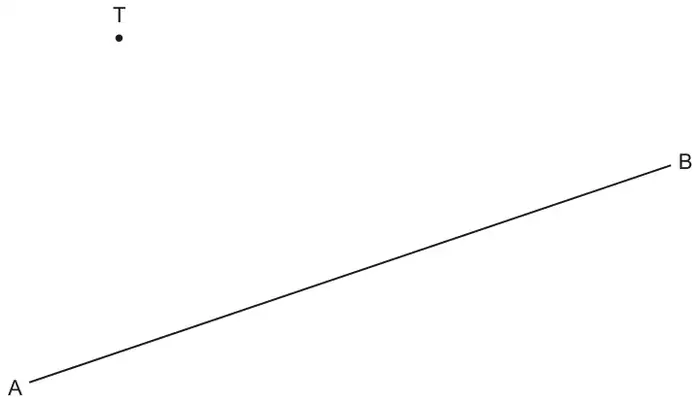
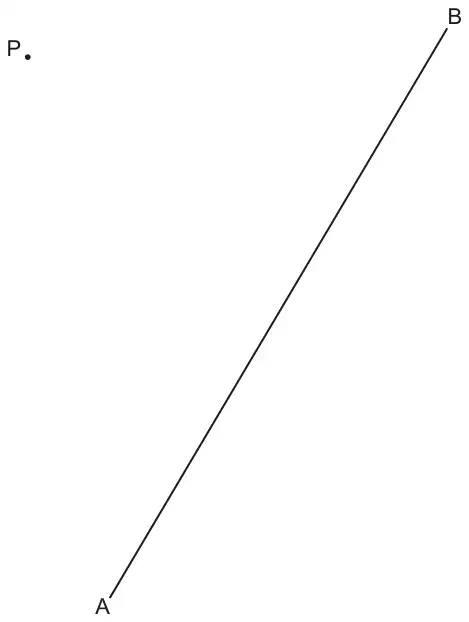
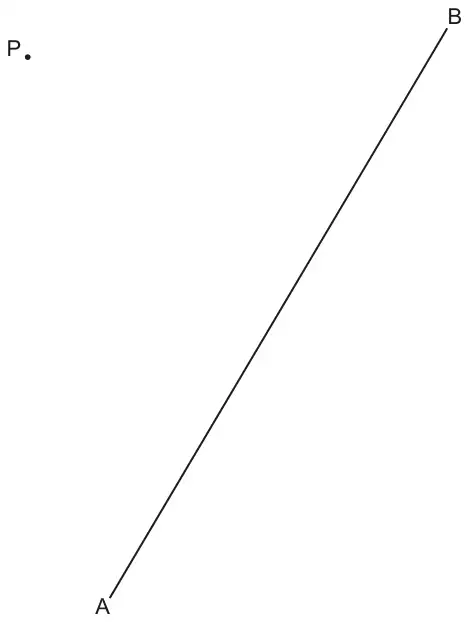
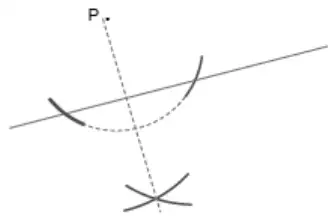
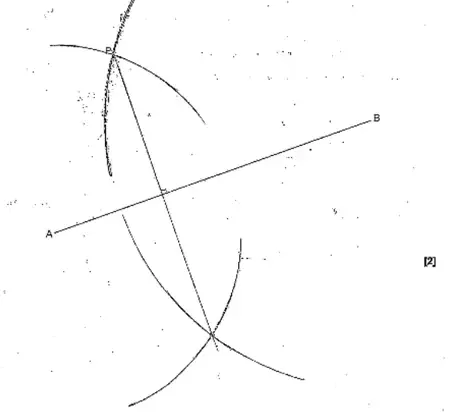
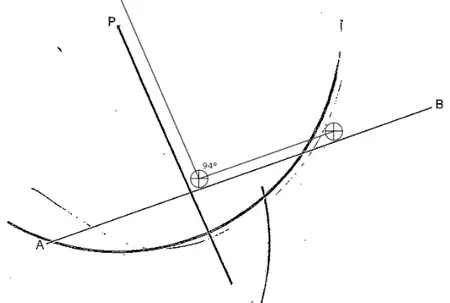
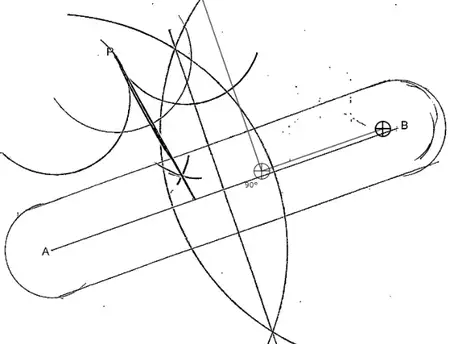
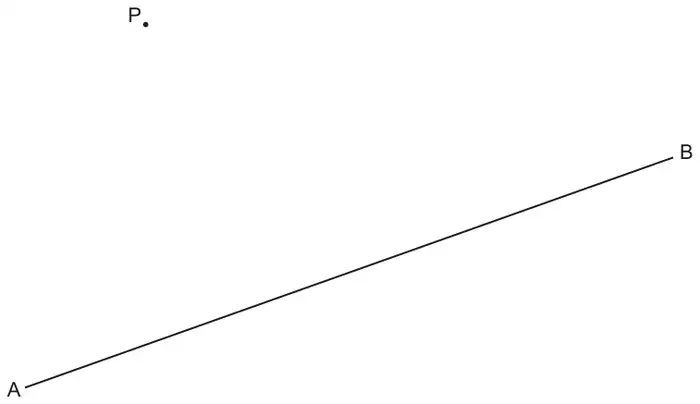
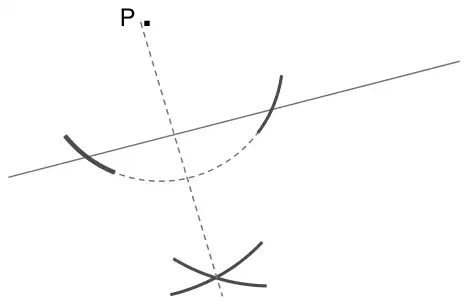
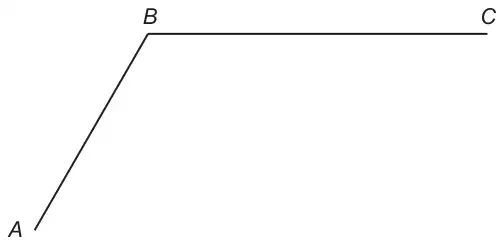
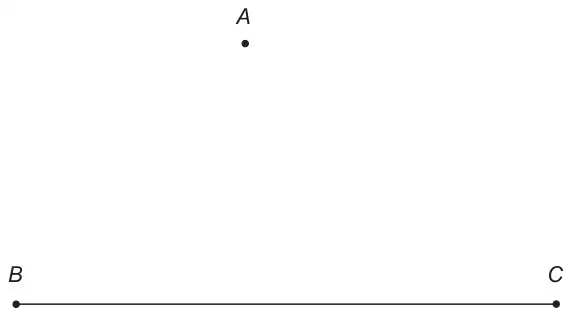
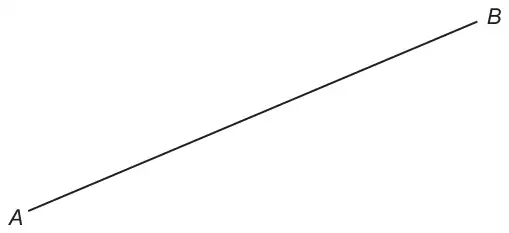
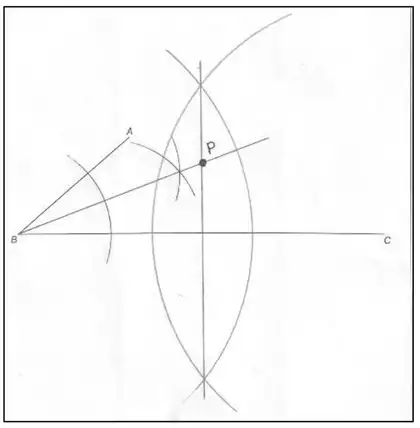
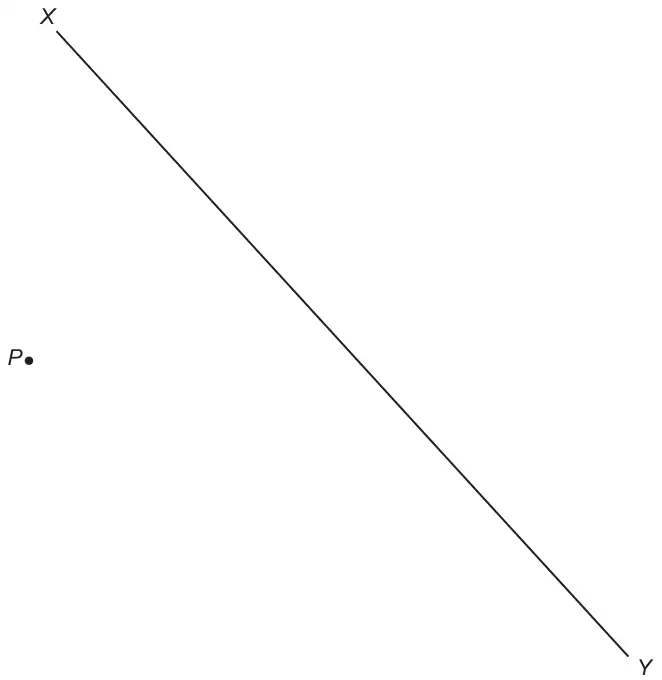
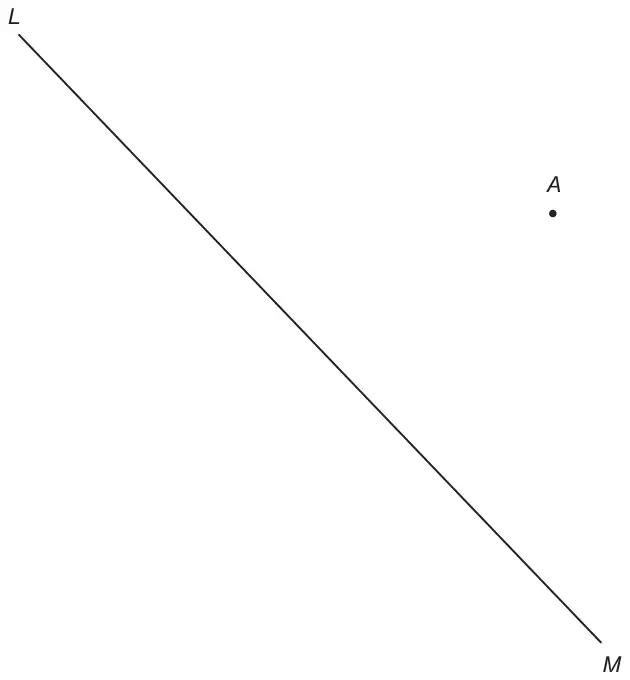
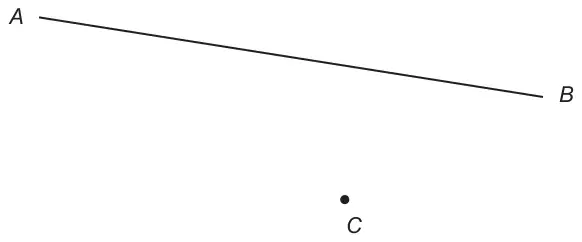
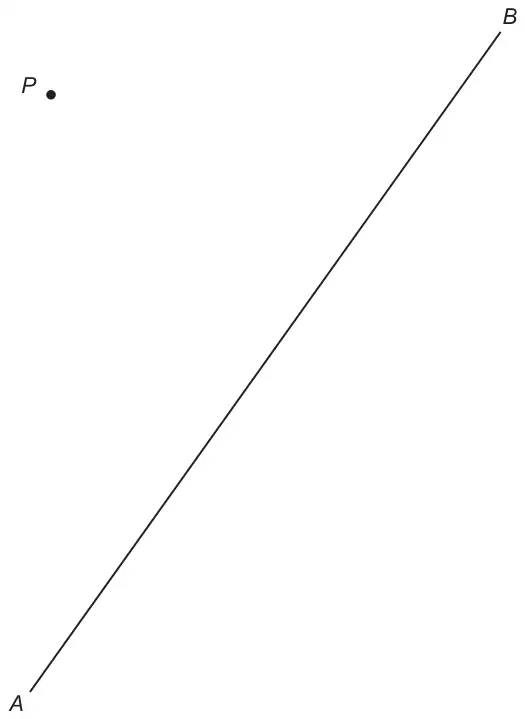
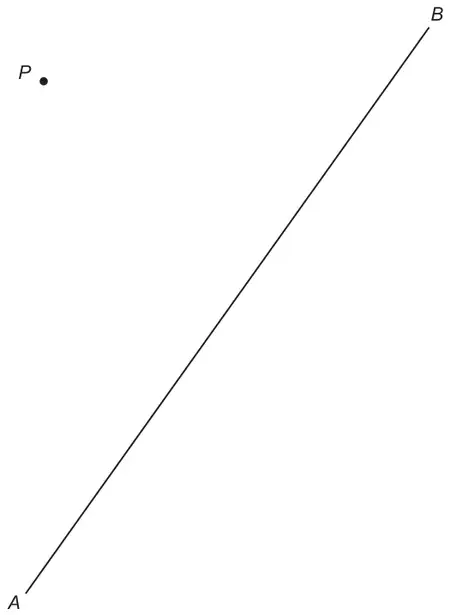
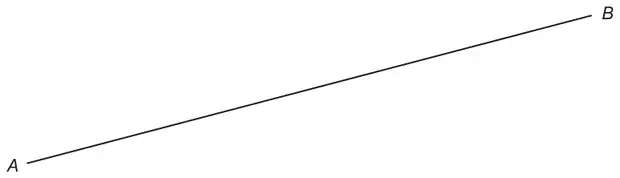
22 The point \(P\) lies on the line \(AB\). Use ruler and compasses to construct an angle of 90° at \(P\). You must show all your construction lines.(2)
Mark scheme
Answer
Mark
Mark scheme
Angle constructed
C2
for fully correct construction with all arcs drawn
(C1
for line drawn within guidelines with no (or incorrect) construction arcs or correct arcs drawn and no line seen)
Additional guidance
Full marks cannot be awarded if no construction lines are seen
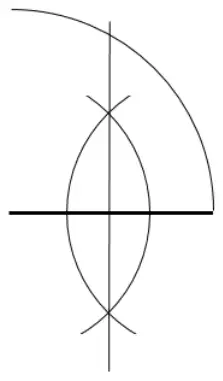
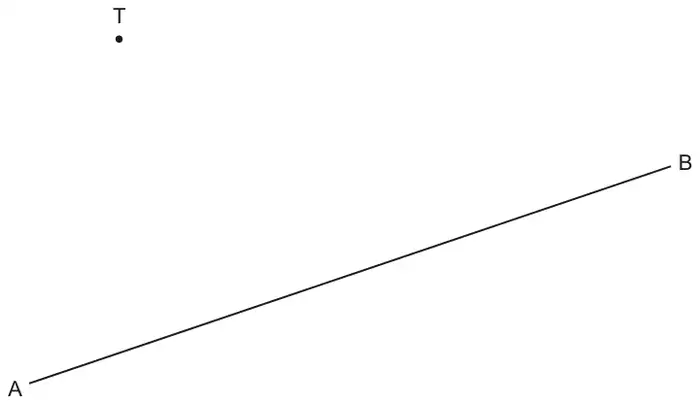
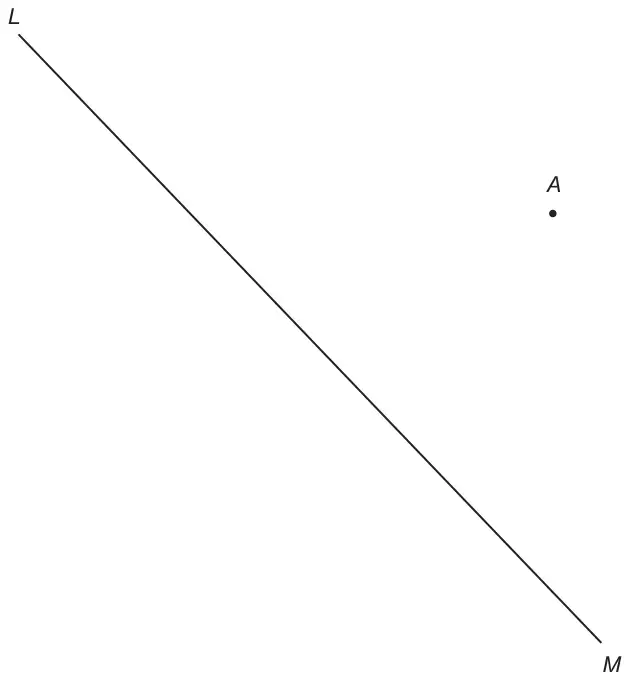
5 The point \(P\) lies on the line \(AB\). Use ruler and compasses to construct an angle of 90° at \(P\). You must show all your construction lines. (2)
Mark scheme
Answer
Mark
Mark scheme
Angle constructed
C2
for fully correct construction with all arcs drawn
(C1
for line drawn within guidelines with no (or incorrect) construction arcs or correct arcs drawn and no line seen)
Additional guidance
Full marks cannot be awarded if no construction lines are seen
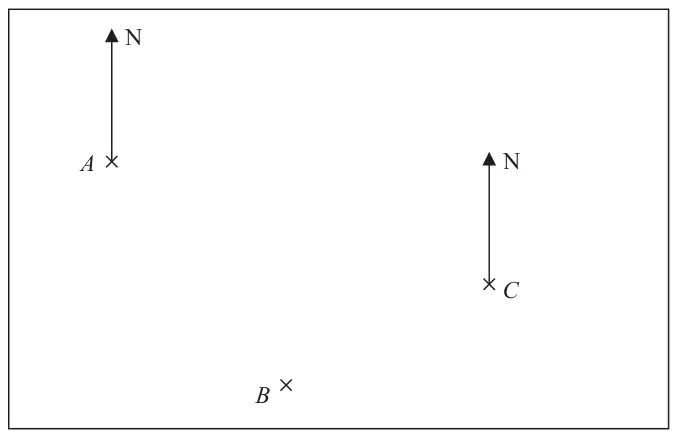
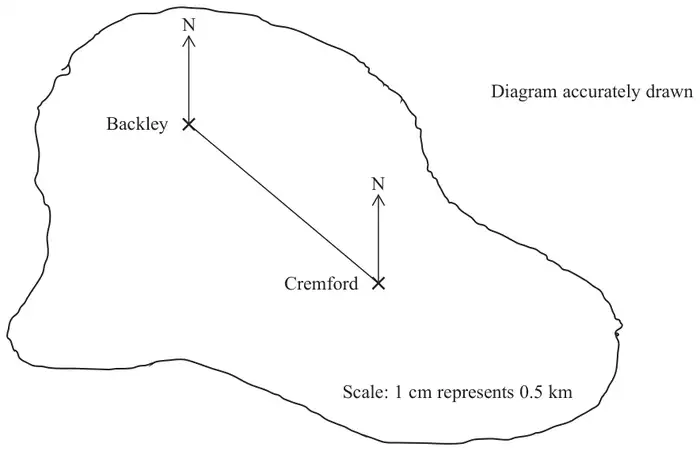
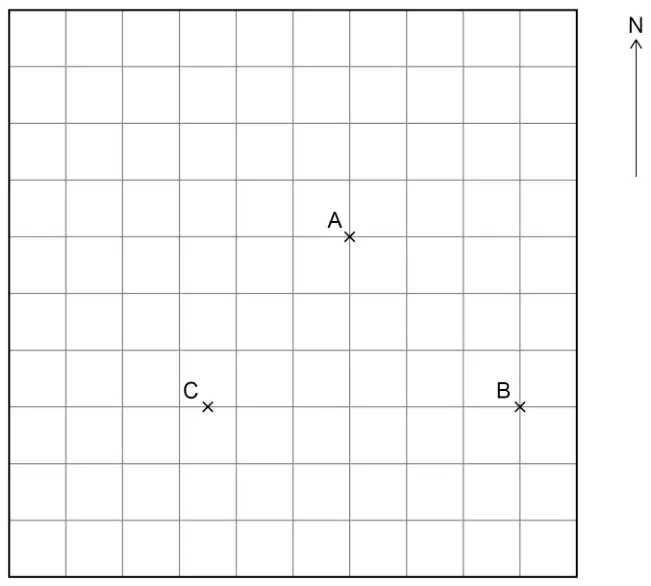
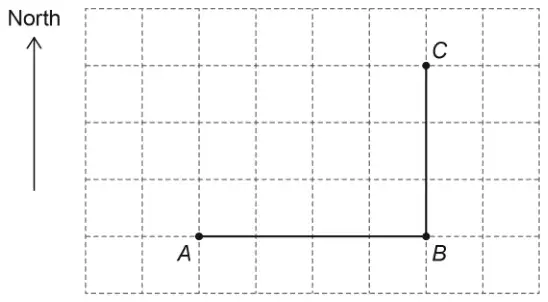
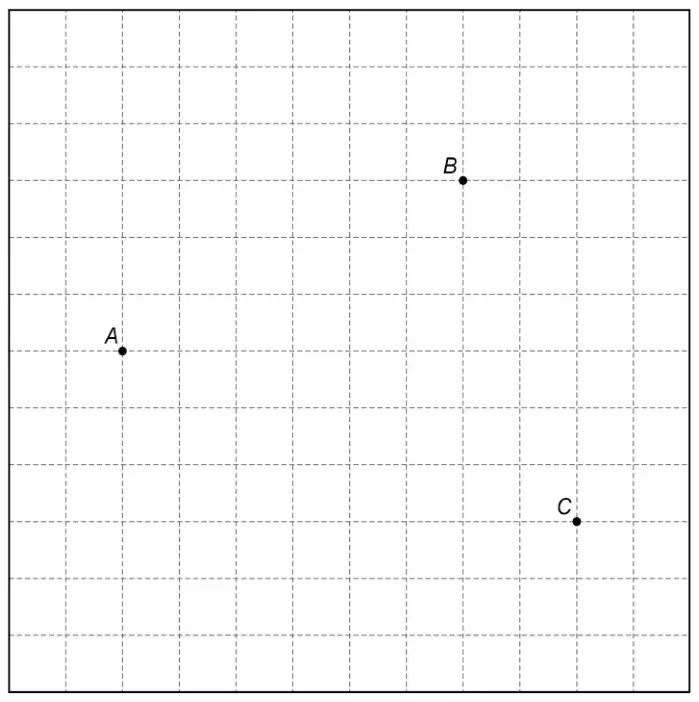
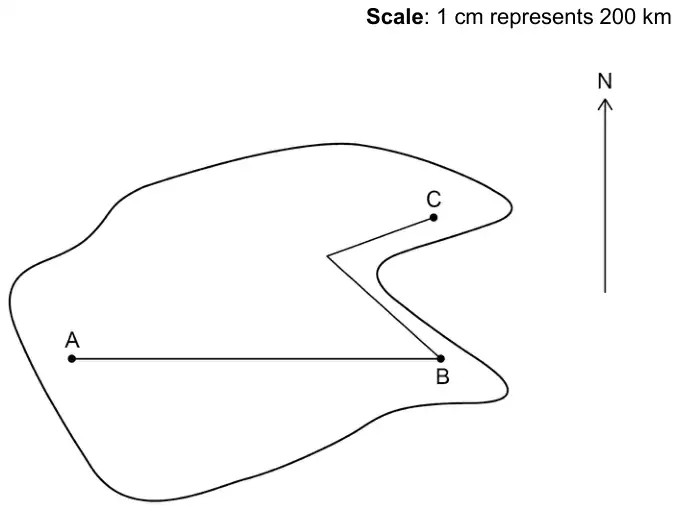
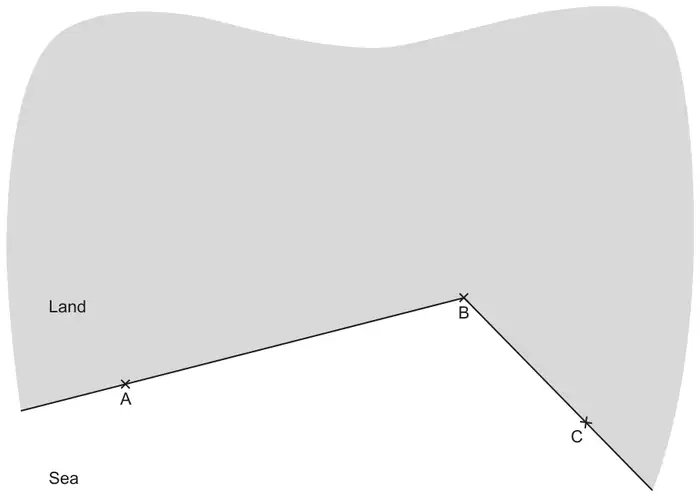
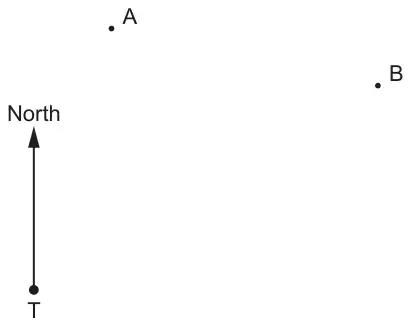
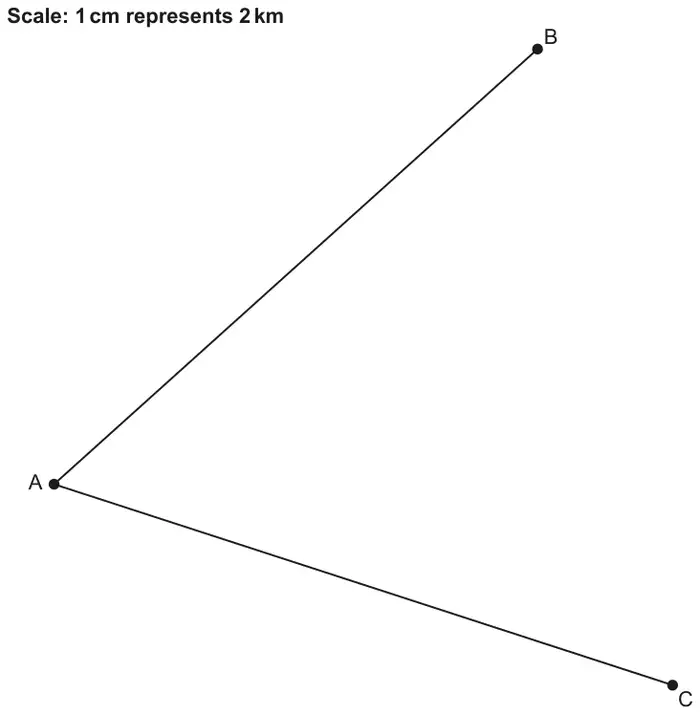
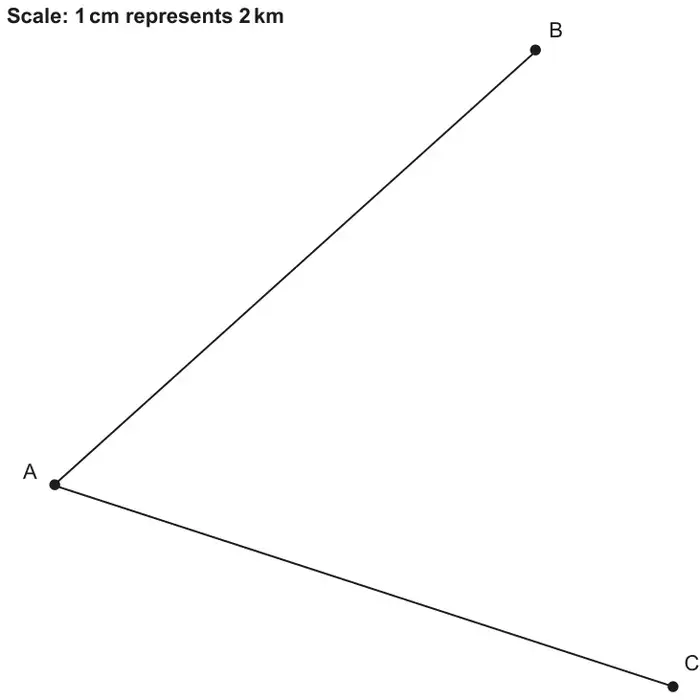
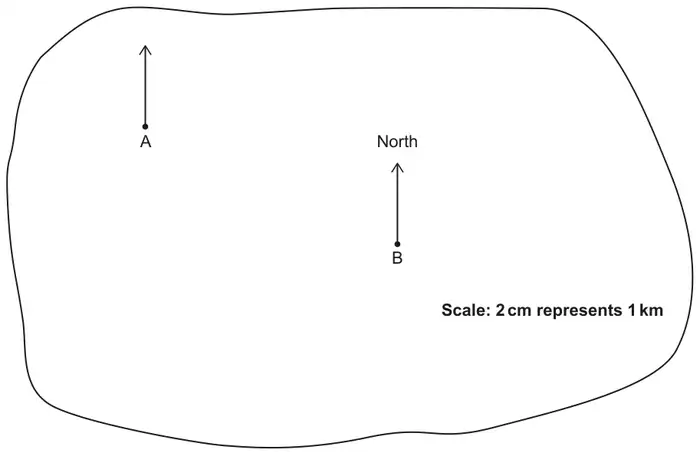
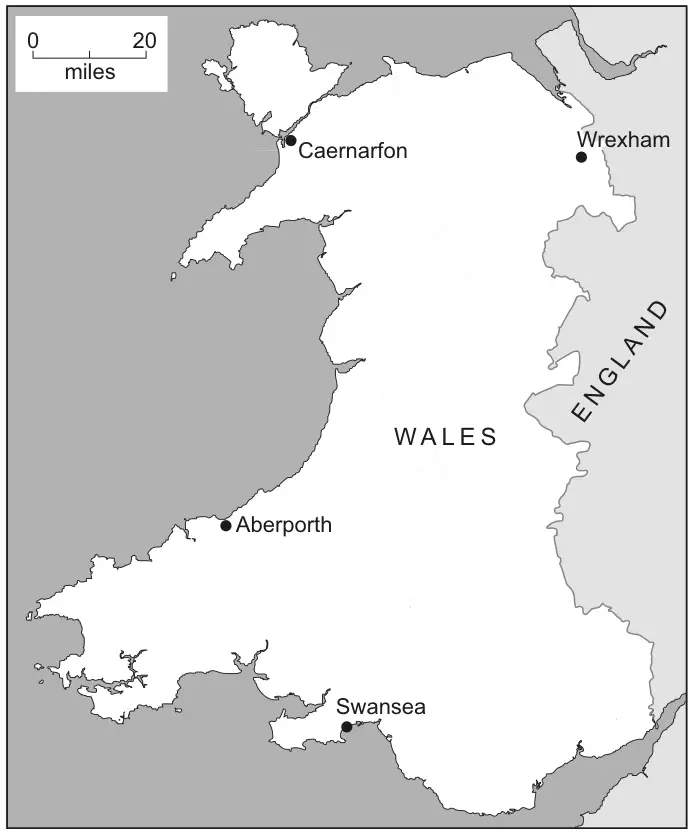
13 The accurately drawn map shows the positions of three points, \(A\), \(B\) and \(C\), in a field.
Scale: 1 cm represents 150 metres
Parveen walks in a straight line from \(A\) to \(B\). She then walks in a straight line from \(B\) to \(C\).
Susan walks in a straight line from \(A\) to \(C\).
Parveen walks more metres than Susan.
(a) How many more? (3)
(b) Find by measurement the bearing of \(A\) from \(C\). (1)
Mark scheme (a)
Answer
Mark
Mark scheme
300
M1
for a correct method to measure and convert one line to a distance in metres, eg (\(AB =\)) \(5 \times 150\) (= 750 or in the range 720 to 780) or (\(BC =\)) \(4 \times 150\) (= 600 or in the range 570 to 630) or (\(AC =\)) \(7 \times 150\) (= 1050 or in the range 1020 to 1080) or for \(5 + 4 - 7\) (= 2 or in the range 1.4 to 2.6)
M1
for a complete method, eg \(\text{``}750\text{''} + \text{``}600\text{''} - \text{``}1050\text{''}\) or \(\text{``}2\text{''} \times 150\)
A1
for answer in the range 210 to 390
Additional guidance
Accept measurements given in mm instead of cm for the first mark. Accept measurements given to a tolerance of ±2 mm
Where “750”, “600”, “1050” and “2” have come from their measurements
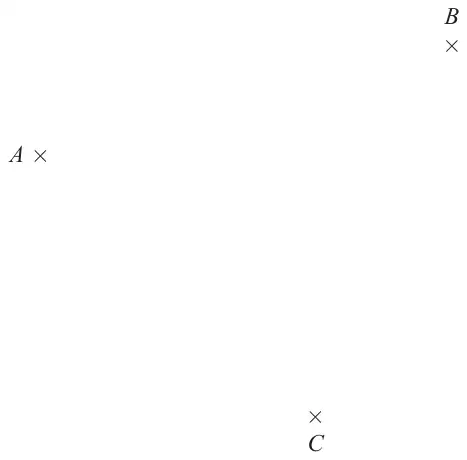
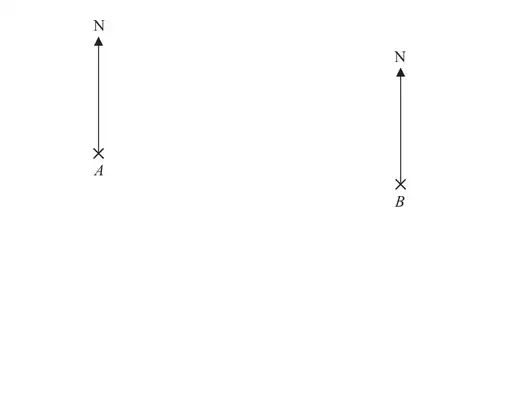
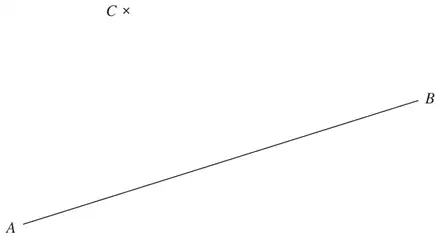
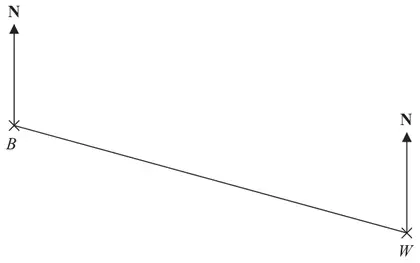
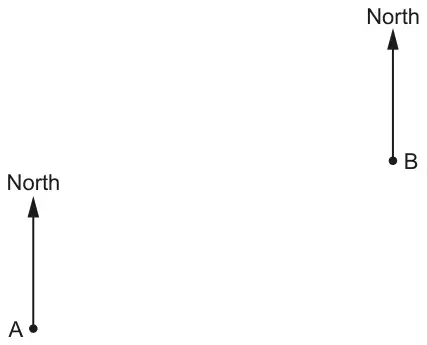
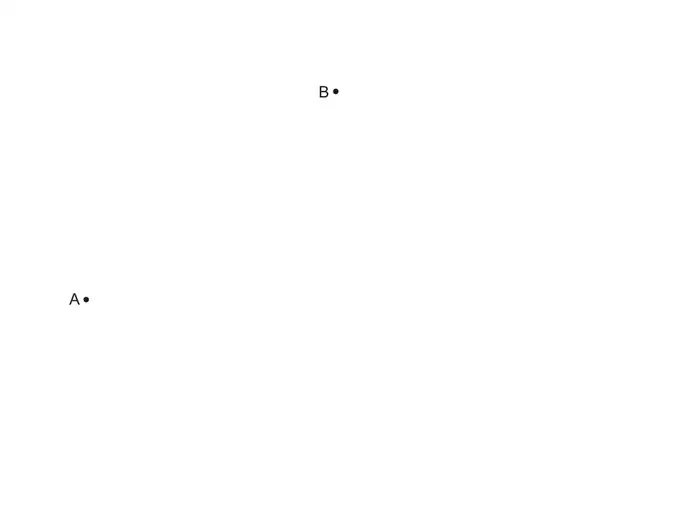
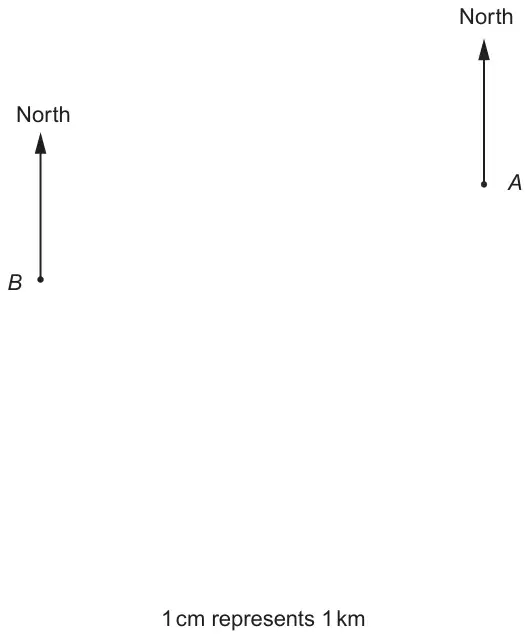
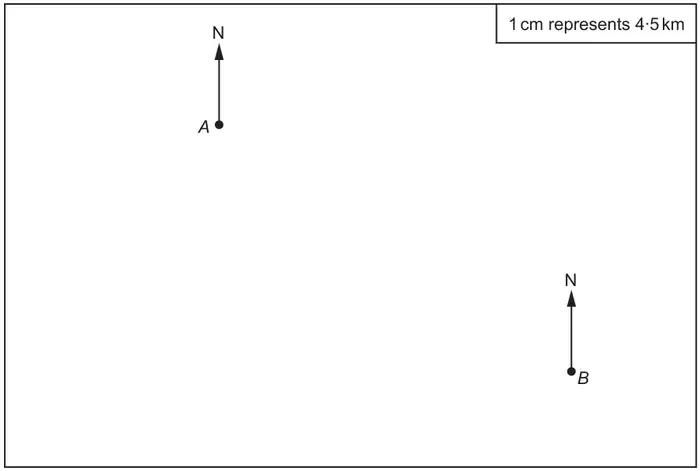
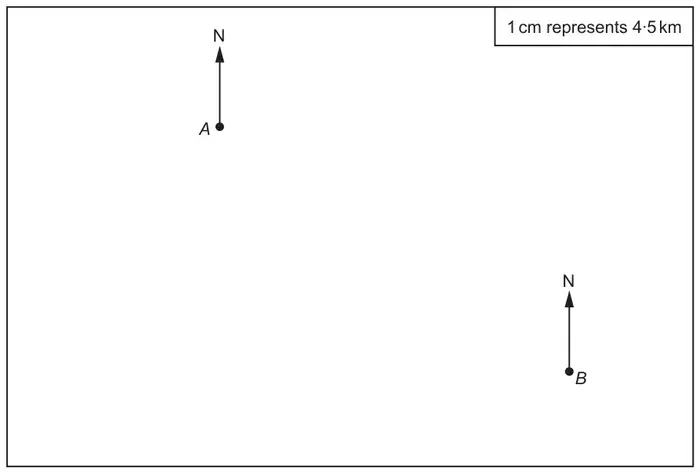
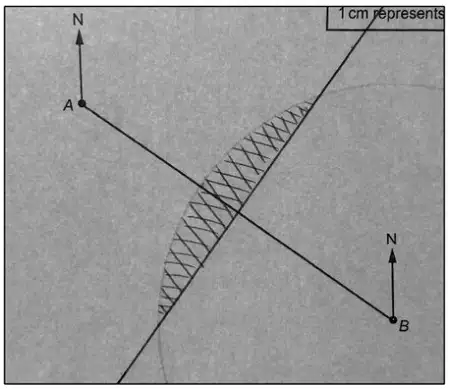
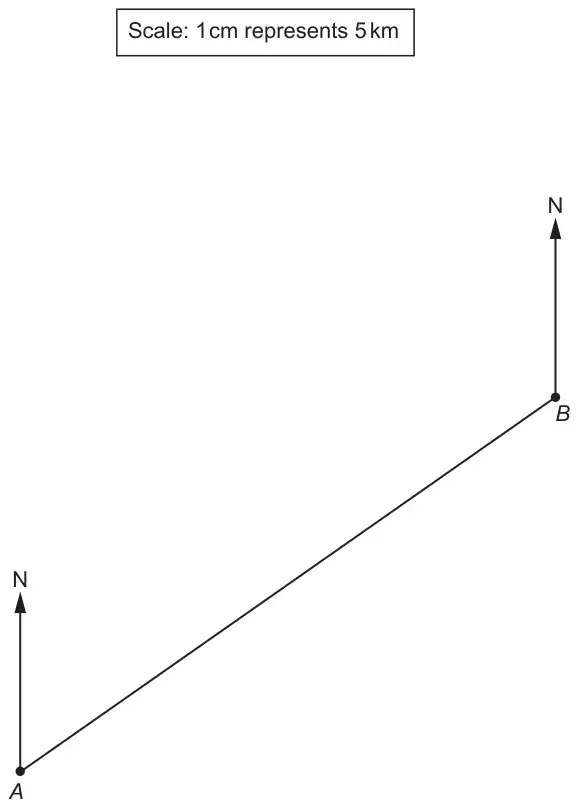
9 The diagram shows the position of two churches, \(A\) and \(B\).
Church \(C\) is on a bearing of \(130^\circ\) from church \(A\). Church \(C\) is on a bearing of \(245^\circ\) from church \(B\).
In the space above, draw an accurate diagram to show the position of church \(C\).
Mark the position of church \(C\) with a cross (\(\times\)). Label it \(C\). (3)
Mark scheme
Answer
Mark
Notes
Correct position of \(C\)
3
M1 for line drawn or point marked on a bearing of \(130^\circ\) from \(A\) M1 for line drawn or point marked on a bearing of \(245^\circ\) from \(B\) A1 for correct position of \(C\)
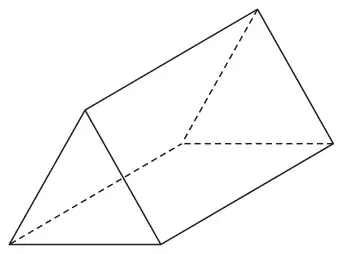
(a) Write down the number of vertices of the prism. (1)
The cross section of the prism is an equilateral triangle.
(b) In the space below, draw a sketch of a net for this prism. (2)
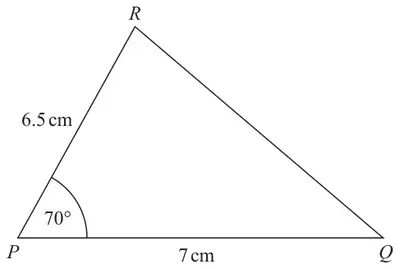
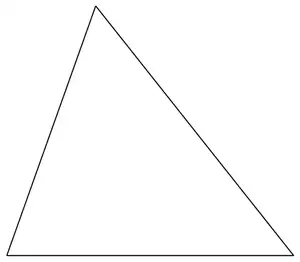
(c) In the space below, draw accurately an equilateral triangle of side 6.5 cm. (2)
Mark scheme (a)
Answer
Mark
Notes
6
1
B1 cao
Mark scheme (b)
Answer
Mark
Notes
sketch of net
2
B2 for a correct sketch of a possible net. (B1 for between 3 and 5 faces (of which at least one must be a rectangle and no more than two triangles) with adjoining edges)
Mark scheme (c)
Answer
Mark
Notes
triangle drawn
2
M1 for line length 6.5 cm drawn (\(\pm\) 2mm) A1 for accurately drawn triangle (within overlay)
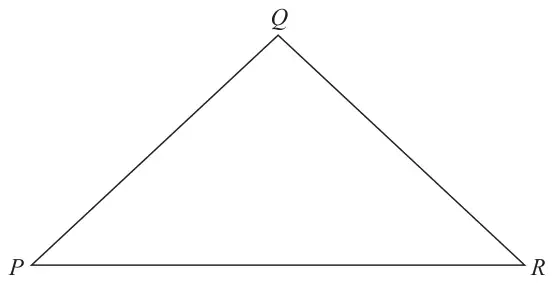
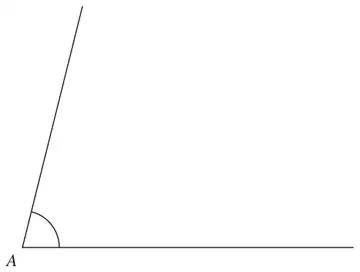
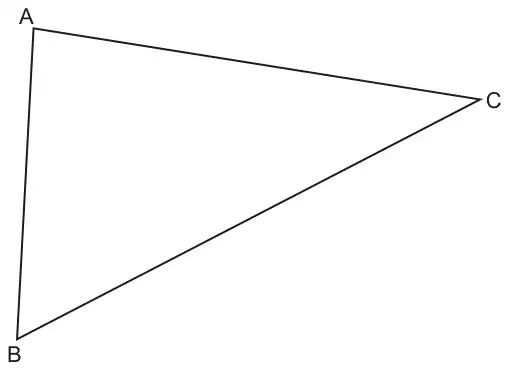
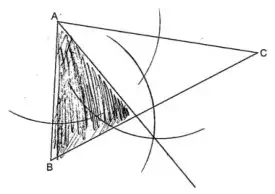
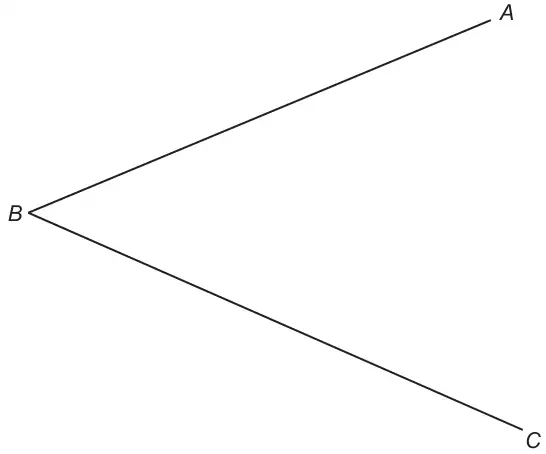
(a) Use ruler and compasses to bisect the angle at \(A\). You must show all your construction lines.(2)
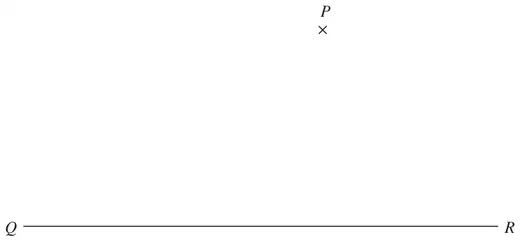
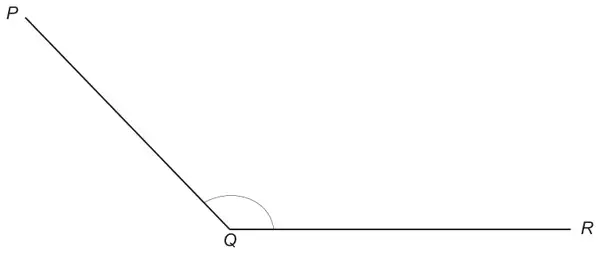
(b) Use ruler and compasses to construct the perpendicular from the point \(P\) to the line \(QR\). You must show all your construction lines.(2)
Mark scheme (a)
Answer
Mark
Notes
Correct construction
2
M1 for correct construction arcs or bisector within guidelines but no (or incorrect) construction arcs A1 for bisector within guidelines with correct arcs shown
Mark scheme (b)
Answer
Mark
Notes
Correct construction
2
M1 for correct construction arcs or perpendicular within guidelines but no (or incorrect) construction arcs A1 for perpendicular within guidelines with correct arcs shown
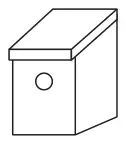
Tina has marked the six parts she needs on a piece of wood, as shown in the diagram below.
Diagram NOT accurately drawn
(a) Work out the total length of the six parts. (2)
Tina is going to cut a circular hole in the front of the nest box. She makes this accurate full size drawing to represent the hole.
(b) Measure the diameter of the hole. (1)
Here is a sketch of one side of the nest box.
Diagram NOT accurately drawn
(c) In the space below, make an accurate scale drawing of this side of the nest box. Use a scale of 1 cm to 20 mm. The line AB has been drawn for you.(3)
Mark scheme (a)
Answer
Mark
Notes
1270 or 1320
2
M1 for adding the six lengths or an answer of digits 127(0) or digits 132(0) A1 for 1270 or 1320
Mark scheme (b)
Answer
Mark
Notes
32 mm or 3.2 cm
1
B1 for answer in range 30 mm to 34 mm or in range 3 cm to 3.4 cm
Mark scheme (c)
Answer
Mark
Notes
Drawing
3
M1 for at least one right angle M1 for 10cm line or 12.5cm line A1 for fully correct drawing
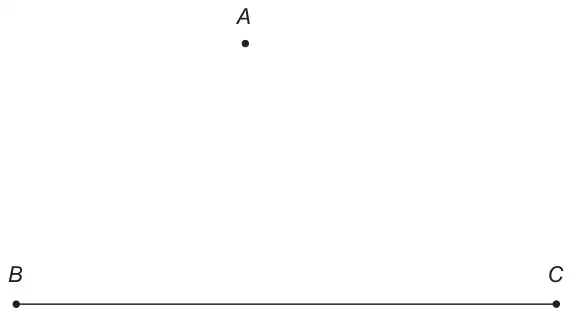
24 Here is a scale drawing of an office. The scale is 1 cm to 2 metres.
A photocopier is going to be put in the office. The photocopier has to be closer to \(B\) than it is to \(A\). The photocopier also has to be less than 8 metres from \(C\).
Show, by shading, the region where the photocopier can be put. (3)
Mark scheme
Answer
Mark
Notes
Loci drawn
3
B1 line parallel to \(BC\) and 3 cm from \(BC\) B1 arc drawn centre \(C\) with radius 4 cm B1 ft for shading a region below their horizontal line and inside their arc
(a) On the triangle, draw all the lines of symmetry. (2)
(b) In the space below, use ruler and compasses to construct an equilateral triangle with sides of length 6 centimetres. You must show all your construction lines. (2)
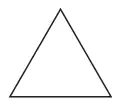
Here is an equilateral triangle.
Diagram NOT accurately drawn
The perimeter of this equilateral triangle is 24 cm.
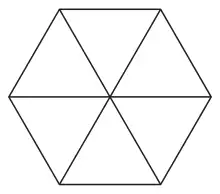
The hexagon below is made from 6 of these triangles.
(c) Work out the perimeter of this hexagon. (2)
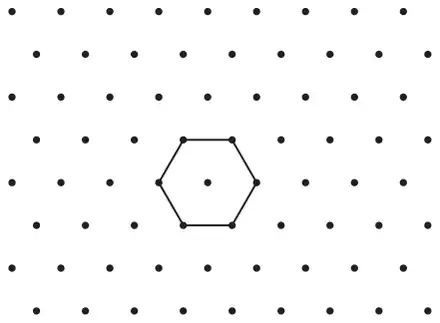
(d) On the grid below, show how the hexagon tessellates. You should draw at least 6 hexagons. (2)
Mark scheme (a)
Answer
Mark
Notes
2
M1 for any 1 correct line of symmetry, allow extras A1 for all 3 lines and no extras
Mark scheme (b)
Answer
Mark
Notes
Triangle drawn
2
M1 for intersecting arcs of radii 6cm or an accurate triangle with no arcs A1 for a fully correct triangle with arcs
Mark scheme (c)
Answer
Mark
Notes
48
2
M1 for \(24 \div 3\) (= 8) A1 cao
Mark scheme (d)
Answer
Mark
Notes
Tessellation
2
B2 for correct tessellation (at least 5 more shapes) (B1 for at least 4 shapes, including initial shape, correctly tessellating)
10 Here is a scale drawing of an office. The scale is 1 cm to 2 metres.
A photocopier is going to be put in the office. The photocopier has to be closer to \(B\) than it is to \(A\). The photocopier also has to be less than 8 metres from \(C\).
Show, by shading, the region where the photocopier can be put. (3)
Mark scheme
Answer
Mark
Notes
Loci drawn
3
B1 for line parallel to BC and 3 cm from BC B1 for arc drawn, centre C, with radius 4 cm B1 ft for shading a region below their horizontal line and inside their arc
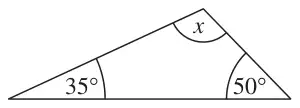
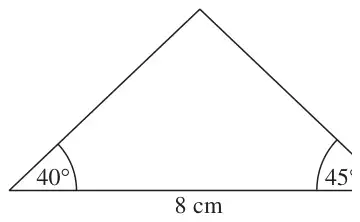
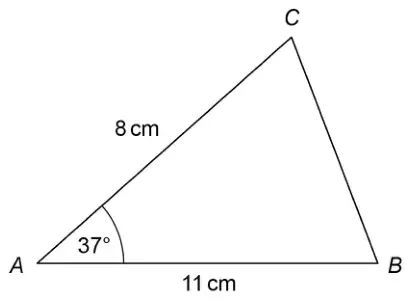
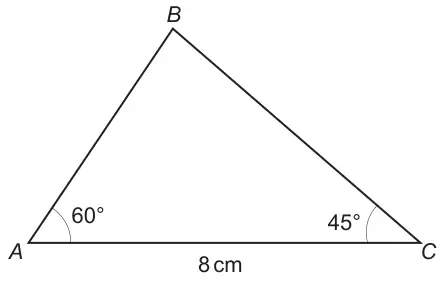
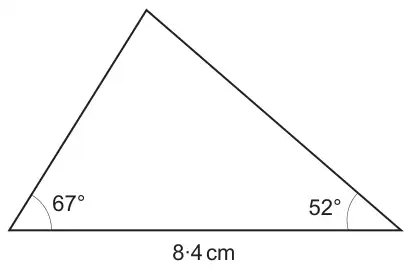
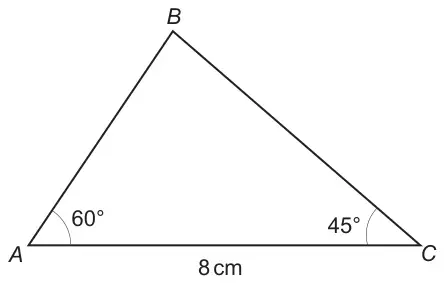
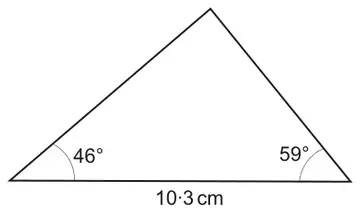
(b) In the space below, make an accurate drawing of this triangle. (3)
Mark scheme (a)
Answer
Mark
Notes
(i) 95
2
B1 cao
(ii) Reason
B1 angles in a triangle add to \(180^\circ\)
Mark scheme (b)
Answer
Mark
Notes
Drawing
3
B3 for a fully correct triangle (B2 for a triangle with 2 of the 3 aspects: line of 8cm; angle of \(40^\circ\); angle of \(45^\circ\)) (B1 for 1 of the 3 aspects)
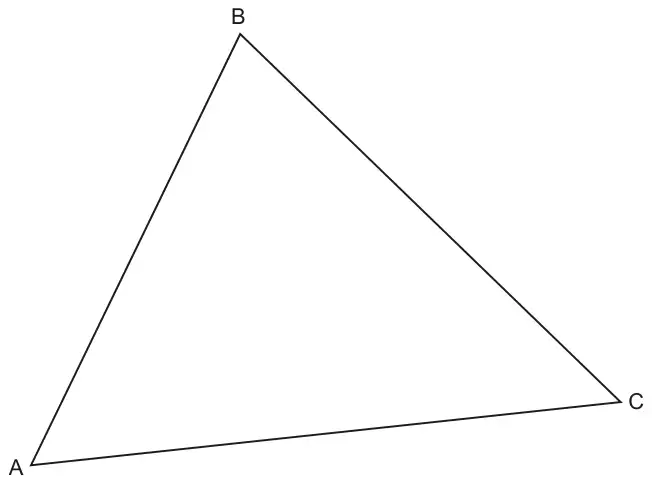
10 Use ruler and compasses to construct the perpendicular from point \(C\) to the line \(AB\).
You must show all your construction lines.
(2)
Mark scheme
Answer
Mark
Notes
construction
2
M1 for a pair of arcs or a single arc, centre C, that cut line AB and at least one pair of arcs not at C within guidelines A1 for perpendicular within guidelines with appropriate construction arcs
OR M1 for an arc, centre A radius AC and an arc centre B radius BC. The two arcs must intersect below AB A1 for perpendicular within guidelines with appropriate construction arcs (SC If M0 scored, B1 for correct perpendicular line within guidelines)
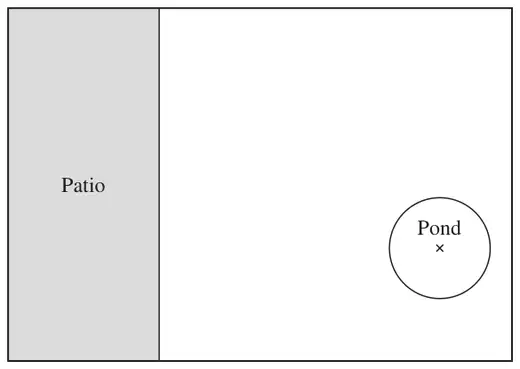
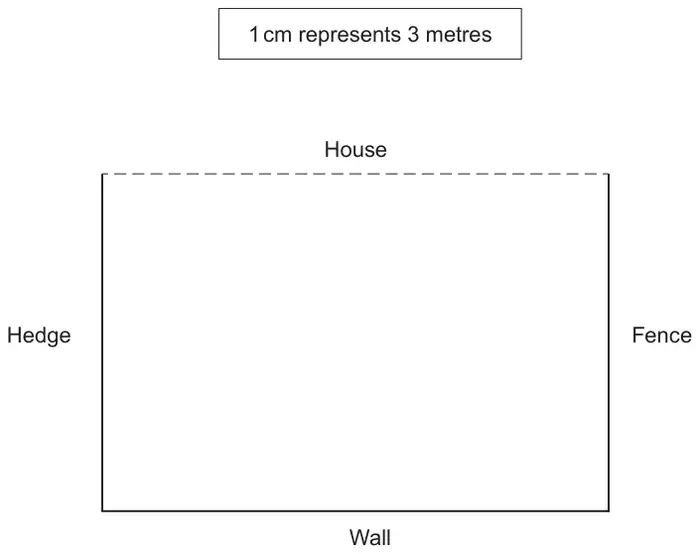
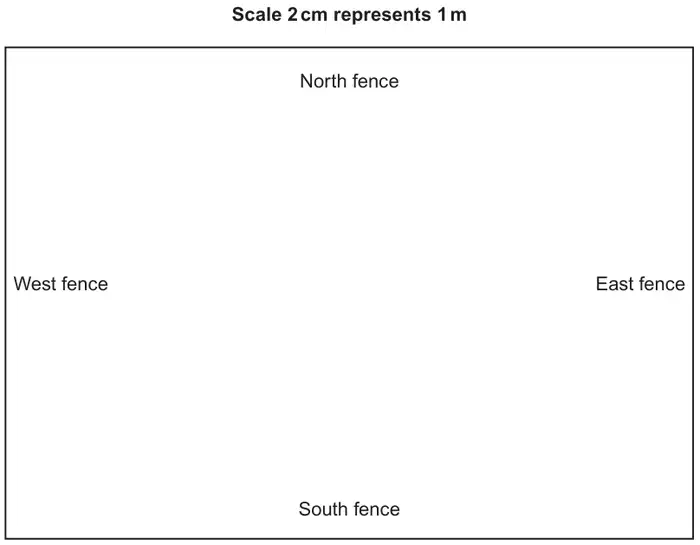
8 The diagram shows a garden in the shape of a rectangle. The scale of the diagram is 1 cm represents 2 m.
Scale: 1 cm represents 2 m
Irfan is going to plant a tree in the garden. The tree must be
more than 3 metres from the patio and more than 6 metres from the centre of the pond.
On the diagram, shade the region where Irfan can plant the tree. (3)
Mark scheme
Answer
Mark
Notes
Correct region
3
B1 for full line drawn 1.5 cm from edge of patio and parallel to it B1 for full arc of circle radius 3 cm centre the centre of the pond B1 ft for shading region to the right of their vertical line and outside the arc of their circle with correct centre
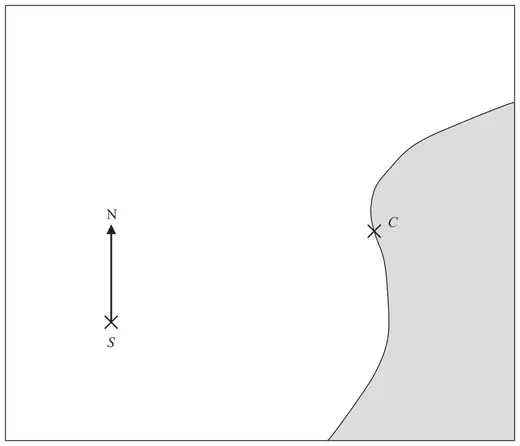
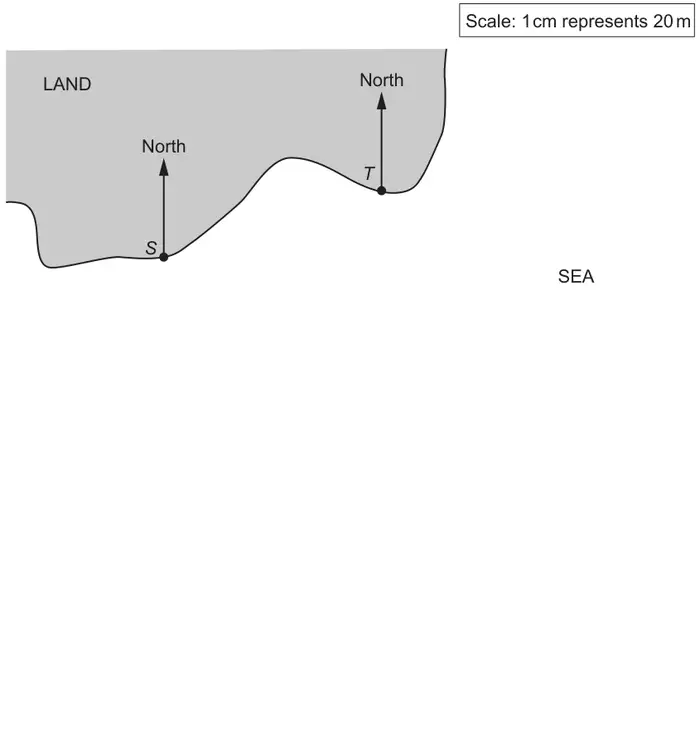
*13 Here is a map. The position of a ship, \(S\), is marked on the map.
Scale 1 cm represents 100 m
Point \(C\) is on the coast. Ships must not sail closer than 500 m to point \(C\).
The ship sails on a bearing of 037°
Will the ship sail closer than 500 m to point \(C\)? You must explain your answer. (3)
Mark scheme
Answer
Mark
Notes
Yes with explanation
3
M1 for bearing \(\pm 2^\circ\) within overlay M1 for use of scale to show arc within overlay or line drawn from \(C\) to ship’s course with measurement C1(dep M1) for comparison leading to a suitable conclusion from a correct method
20 The diagram shows the positions of two villages, Beckhampton (\(B\)) and West Kennett (\(W\)).
Scale: 4 cm represents 1 km.
(a) Work out the real distance, in km, of Beckhampton from West Kennett. (2)
The village, Avebury (\(A\)), is on a bearing of 038° from Beckhampton.
On the diagram, \(A\) is 6 cm from \(B\).
(b) On the diagram, mark \(A\) with a cross (\(\times\)). Label the cross \(A\). (2)
Mark scheme (a)
Answer
Mark
Notes
2.5
2
M1 for 10 (cm) or “10” \(\div\) 4 A1 for 2.45 – 2.55
Mark scheme (b)
Answer
Mark
Notes
A marked on diagram
2
M1 for a point marked (or line drawn) on a bearing of \(038^\circ\) from either point \(B\) or point \(W\), OR for a point marked (or arc drawn) 6 cm from \(B\) A1 for the position of Avebury marked (accept without label if not ambiguous)
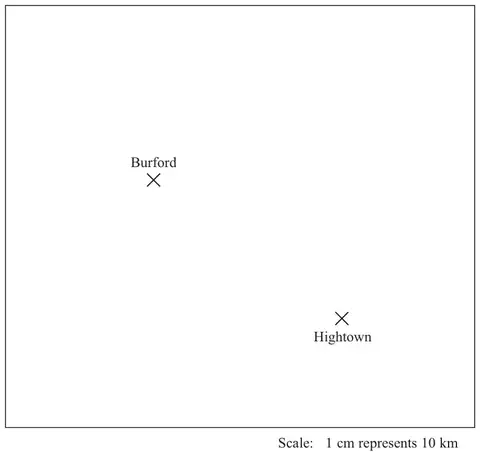
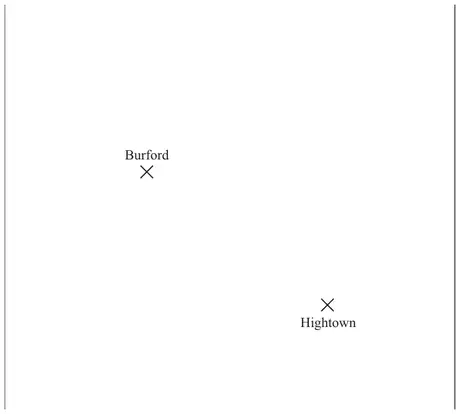
28 Here is a map. The map shows two towns, Burford and Hightown.
A company is going to build a warehouse. The warehouse will be less than 30 km from Burford and less than 50 km from Hightown.
Shade the region on the map where the company can build the warehouse. (3)
Mark scheme
Answer
Mark
Notes
Region shaded
3
B1 for circle arc of radius 3cm (± 2mm) centre Burford B1 for circle arc of radius 5 cm (± 2mm) centre Hightown B1 for overlapping regions of circle arcs shaded
14 The bearing of a ship from a lighthouse is \(050^\circ\)
Work out the bearing of the lighthouse from the ship. (2)
Mark scheme
Answer
Mark
Notes
230
2
M1 for 180 + 50 A1 cao OR M1 for 360 – (180 – 50) or 360 – 130 A1 cao OR M1 for 50 + (90 – 50) + 90 + 50 or 50 + 40 + 90 + 50 A1 cao OR M1 for a suitable diagram (sketch) with bearing of lighthouse from ship indicated and 50° marked at lighthouse; diagram only intended to indicate position of 50°; ignore other labels and markings unless they create ambiguity. A1 cao
The warehouse will be less than 30 km from Burford and less than 50 km from Hightown.
Shade the region on the map where the company can build the warehouse. (3)
Mark scheme
Answer
Mark
Notes
Region shaded
3
B1 for circle arc of radius 3cm (± 2mm) centre Burford B1 for circle arc of radius 5 cm (± 2mm) centre Hightown B1 for overlapping regions of circle arcs shaded
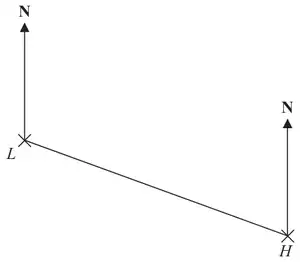
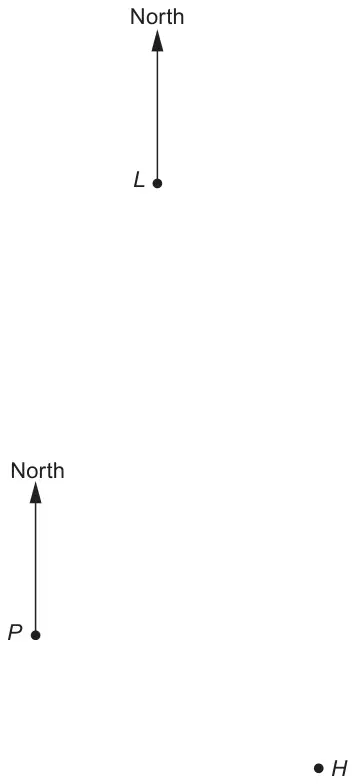
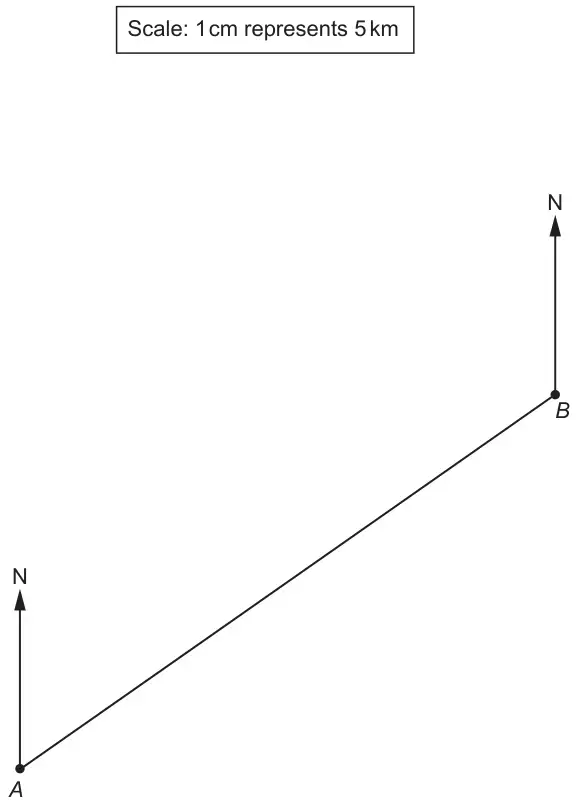
14 The diagram shows the position of a lighthouse \(L\) and a harbour \(H\).
The scale of the diagram is 1 cm represents 5 km.
(a) Work out the real distance between \(L\) and \(H\). (1)
(b) Measure the bearing of \(H\) from \(L\). (1)
A boat \(B\) is 20 km from \(H\) on a bearing of \(040^\circ\)
(c) On the diagram, mark the position of boat \(B\) with a cross (×). Label it \(B\). (2)
Mark scheme (a)
Answer
Mark
Notes
35
1
B1 for 34 – 36
Mark scheme (b)
Answer
Mark
Notes
110
1
B1 for 108 – 112
Mark scheme (c)
Answer
Mark
Notes
Position of B marked
2
B1 for a point marked on a bearing of 40° (±2°) from H or for a line on a bearing of 40° (±2°) (use straight line guidelines on overlay) B1 for a point 4 cm (± 0.2cm) from H or for a line of length 4 cm (± 0.2cm) from H (use circular guidelines on overlay) NB. No label needed for point
11 Construct the region that lies within 4 cm of the line. [3 marks]
Mark scheme
Answer
Mark
Comments
Circles or at least semicircular arcs, radius 4 cm, at both ends connected by horizontal lines at top and bottom
B3
B2 semicircles or at least semicircular arcs, radius 4 cm, at both ends B1 semicircle or at least semicircular arc, radius 4 cm, at one end or correct shape for region with incorrect measurements
Additional guidance
Condone parts of circles within the region not erased
Condone dotted lines used for (part of) the perimeter
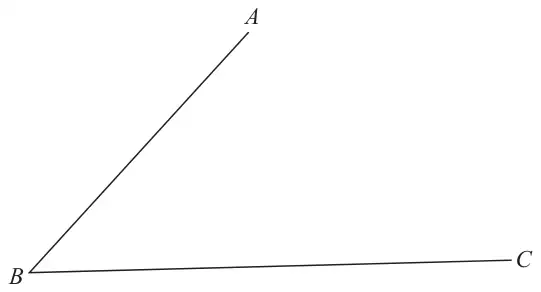
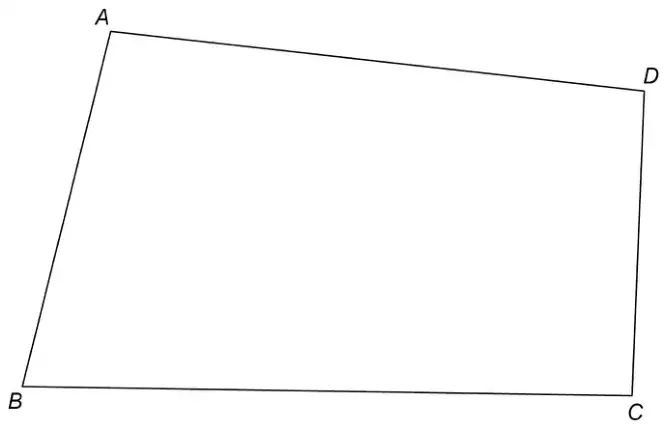
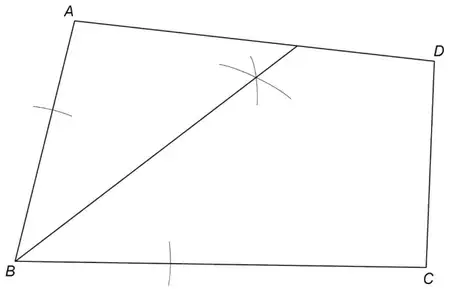
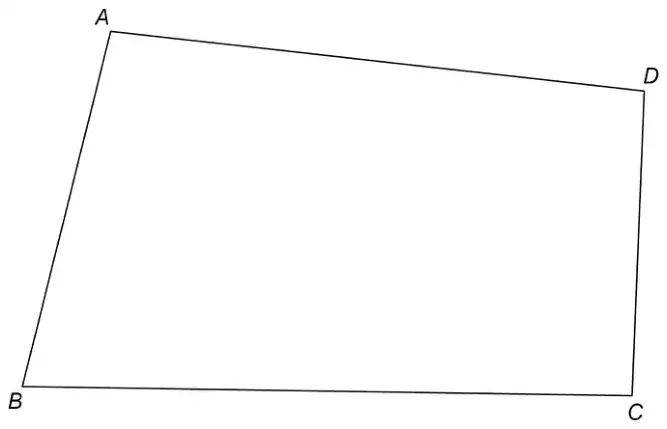
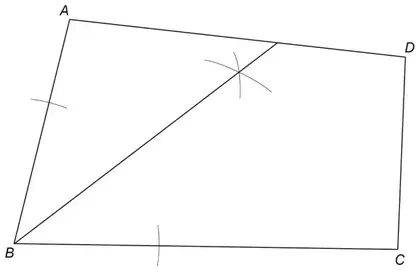
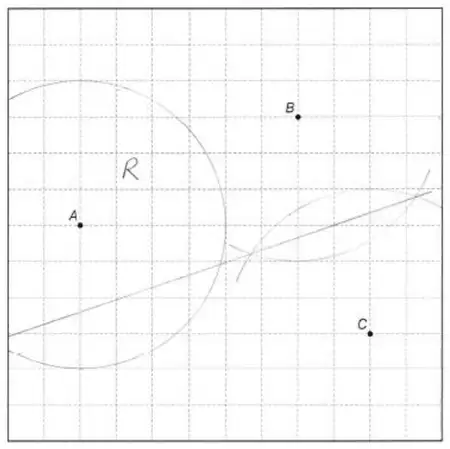
The tree will be in the region that is closer to \(AB\) than to \(BC\).
Label the region, R, where the tree could be planted.
Show all your construction lines. [3 marks]
Mark scheme
Answer
Mark
Comments
Alternative method 1
Pair of arcs, equal radii (\(\pm\) 2 mm), centre \(B\), intersecting \(AB\) and \(BC\)
M1
oe eg single arc, centre \(B\), intersecting \(AB\) and \(BC\) or single arc, centre \(B\), radius \(BC\) (\(\pm\) 2 mm), intersecting \(AB\)
Pair of intersecting arcs, equal radii (\(\pm\) 2 mm), centres the intersections on \(AB\) and \(BC\) and angle bisector drawn from \(B\) at least to the intersection of their arcs
A1
dashed line or condone solid line
Correct region R shown as the area between \(AB\) and a straight line from \(B\) to within 2mm of \(AD\)
B1
R may be labelled or shaded arcs not required for this mark only SC1 angle bisector for a different angle correctly constructed with arcs
Alternative method 2
Concentric arcs from \(B\), each intersecting \(AB\) and \(BC\)
M1
intersections with \(AB\) and \(BC\) must be seen, but full arcs are not necessary
Two lines from the \(AB\) intersection of one arc to the \(BC\) intersection of the other arc and angle bisector drawn from \(B\) at least to the intersection of their lines
A1
dashed line or condone solid line
Correct region R shown as the area between \(AB\) and a straight line from \(B\) to within 2mm of \(AD\)
B1
R may be labelled or shaded arcs not required for this mark only SC1 angle bisector for a different angle correctly constructed with arcs
Additional guidance
Mark any correct construction, ignoring incorrect attempts
Unless shaded incorrectly, ignore construction arcs or other lines in the region labelled
Bisector drawn with no construction arcs, but region correctly identified
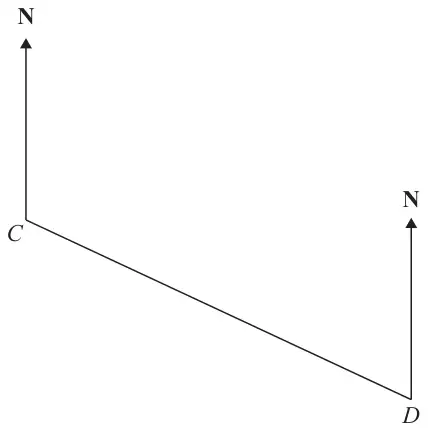
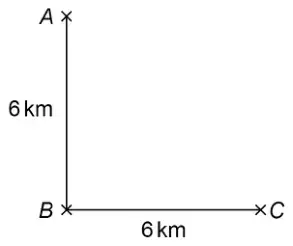
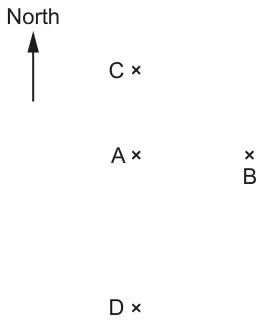
6 km due South of \(A\) and 6 km due West of \(C\).
Not drawn accurately
Work out the bearing of \(A\) from \(C\). [2 marks]
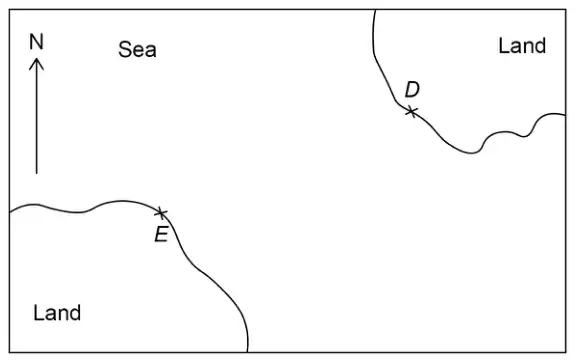
(b) Here is a scale drawing.
A ship is going to sail from \(D\) to \(E\).
Mia works out that the ship needs to sail on a bearing of 068°
Why must Mia be wrong? [1 mark]
Mark scheme (a)
Answer
Mark
Comments
\(\dfrac{180 - 90}{2}\) or \(\tan^{-1} \dfrac{6}{6}\) or 45
M1
oe may be seen on diagram eg \(\sin^{-1}\left(\dfrac{6}{\sqrt{72}}\right)\)
315
A1
SC1 answer of 135 (bearing of \(C\) from \(A\))
Additional guidance
\(\tan \dfrac{6}{6}\) unless recovered
M0
Mark scheme (b)
Answer
Mark
Comments
Correct explanation that the ship would be on land or 068° is the bearing of \(D\) from \(E\) or the bearing must be over 180° or the actual bearing is [246, 250]°
B1
eg that would take the ship over land 068° is from \(E\) 068° is the bearing from \(E\) to \(D\) the bearing is 248°
Additional guidance
Ignore irrelevant statements and compass points eg bearings go clockwise, bearings are measured from north, NE, south west
Do not accept incorrect statement or bearing alongside a correct statement
Bearings measured or stated outside of [246, 250]° range
The tree will be in the region that is closer to \(AB\) than to \(BC\).
Label the region, R, where the tree could be planted.
Show all your construction lines. [3 marks]
Mark scheme
Answer
Mark
Comments
Alternative method 1
Pair of arcs, equal radii (\(\pm\) 2 mm), centre \(B\), intersecting \(AB\) and \(BC\)
M1
oe eg single arc, centre \(B\), intersecting \(AB\) and \(BC\) or single arc, centre \(B\), radius \(BC\) (\(\pm\) 2 mm), intersecting \(AB\)
Pair of intersecting arcs, equal radii (\(\pm\) 2 mm), centres the intersections on \(AB\) and \(BC\) and angle bisector drawn from \(B\) at least to the intersection of their arcs
A1
dashed line or condone solid line
Correct region R shown as the area between \(AB\) and a straight line from \(B\) to within 2 mm of \(AD\)
B1
R may be labelled or shaded arcs not required for this mark only SC1 angle bisector for a different angle correctly constructed with arcs
Alternative method 2
Concentric arcs from \(B\), each intersecting \(AB\) and \(BC\)
M1
intersections with \(AB\) and \(BC\) must be seen, but full arcs are not necessary
Two lines from the \(AB\) intersection of one arc to the \(BC\) intersection of the other arc and angle bisector drawn from \(B\) at least to the intersection of their lines
A1
dashed line or condone solid line
Correct region R shown as the area between \(AB\) and a straight line from \(B\) to within 2 mm of \(AD\)
B1
R may be labelled or shaded arcs not required for this mark only SC1 angle bisector for a different angle correctly constructed with arcs
Additional guidance
Mark any correct construction, ignoring incorrect attempts
Unless shaded incorrectly, ignore construction arcs or other lines in the region labelled
Bisector drawn with no construction arcs, but region correctly identified
24 An equilateral triangle has side length 16 metres.
Using ruler and compasses only, construct a scale drawing of the triangle.
Use the scale 1 centimetre represents 2 metres. [3 marks]
Scale: 1 cm represents 2 m
Mark scheme
Answer
Mark
Comments
Side of length [7.8, 8.2] cm drawn
B1
Correct construction with intersecting arcs, same radius as their base ± 2 mm to identify the third vertex or correct construction with intersecting arcs, equal radii ± 2 mm, line drawn at 60° and third vertex correctly positioned or correct construction with intersecting arcs, equal radii ± 2 mm and construction arc drawn to correctly identify the third vertex
M1
Triangle with equal sides [7.8, 8.2], with correct construction seen
A1ft
ft B0M1 triangle with equal sides ± 2 mm, with correct construction seen
Additional guidance
No construction arcs drawn can score a maximum of B1
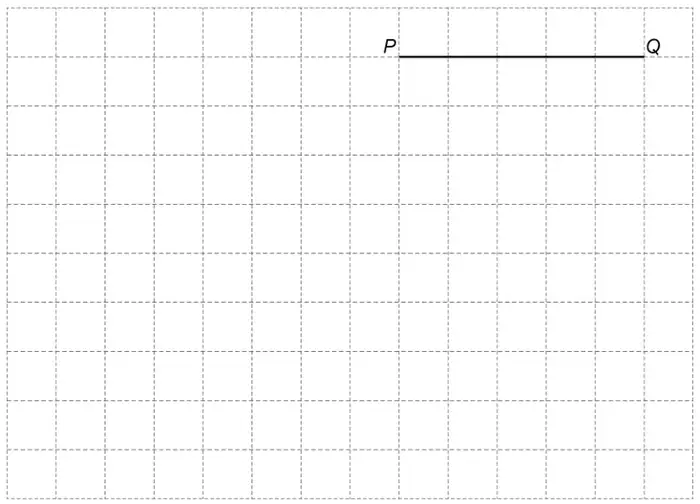
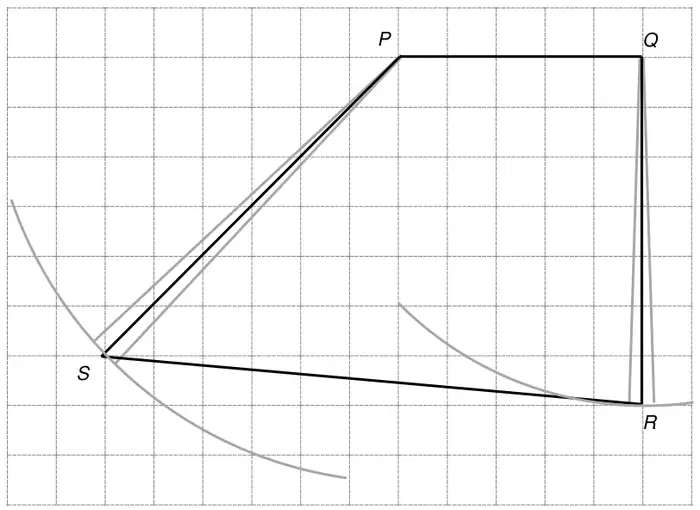
\(PQ = 5\) cm \(QR\) perpendicular to \(PQ\) \(QR = 7\) cm angle \(QPS = 135^\circ\) \(PS = 8.5\) cm
On the grid, draw the quadrilateral \(PQRS\).
\(PQ\) has been drawn for you. [4 marks]
Mark scheme
Answer
Mark
Comments
Angle \(PQR = [88^\circ, 92^\circ]\) and line from \(Q = [6.8, 7.2]\) cm and angle \(QPS = [133^\circ, 137^\circ]\) and line from \(P = [8.3, 8.7]\) cm and complete quadrilateral
B4
B3 at least three of the four measuring criteria met B2 any two of the measuring criteria met B1 any one of the measuring criteria met Length of \(QR\) must be within 2 mm of the right-hand arc shown below Length of \(PS\) must be within 2 mm of the left-hand arc shown below
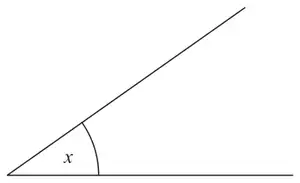
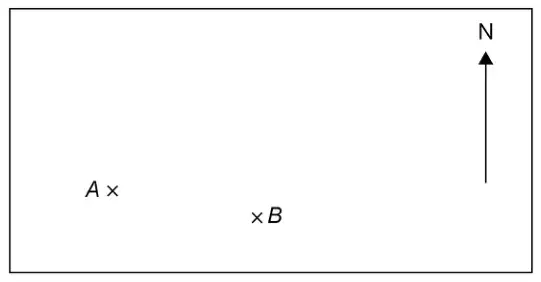
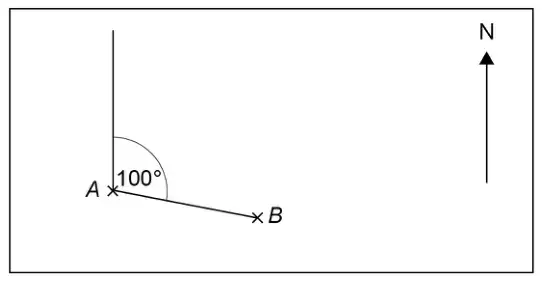
He draws two lines and measures the angle between them.
Kemal says that the bearing of \(A\) from \(B\) is \(100^\circ\)
Is his method correct?
Give a reason for your answer. [1 mark]
(b) On a different map, the bearing of \(D\) from \(C\) is \(045^\circ\)
Nina says,
“\(D\) is North West of \(C\).”
Is Nina correct?
Give a reason for your answer. [1 mark]
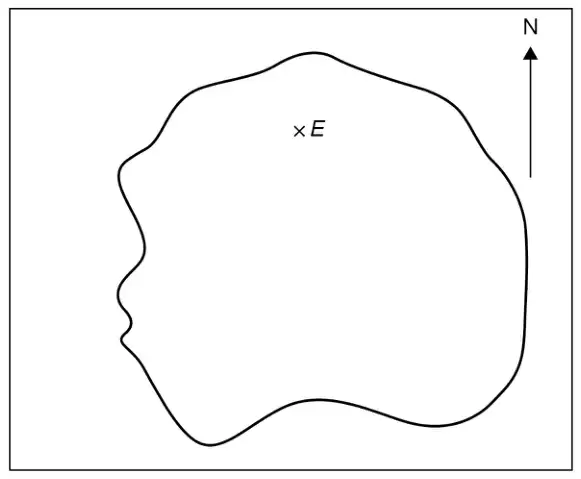
(c) This map shows an airport, \(E\), on an island.
Scale: 1 cm represents 100 km
A plane flies due South from the airport.
How far does it fly until it reaches the sea? [3 marks]
Mark scheme (a)
Answer
Mark
Comments
No and correct reason or No and correct description of correct method or No and 280(°)
B1
eg No, he has done B from A No, the North line should go from B
Additional guidance
Ignore non-contradictory, irrelevant responses alongside a correct response
Answer must either include ‘No’ or ‘Kemal is wrong’ oe
Ignore diagram if B1 scored from answer lines
No, it is 280
B1
No, should start / measure from B
B1
No, it’s from the wrong point
B1
Kemal is wrong, he started from A (and went to B)
B1
No and a correct method/drawing shown in either box
B1
No, the bearing should be reflex
B1
No, he did A to B (not A from B)
B1
No, should be anticlockwise
B0
No, measured the wrong way around
B0
No, bearing would be 260
B0
(It should be) 280 (not sufficient to imply ‘no’)
B0
No, he measured from A which is 100 but you’re meant to measure from B which is 170
B0
Bearing should start from B (should is not sufficient to imply ‘no’)
B0
Not measured from B
B0
Started from A (and went to B)
B0
No, it’s from the wrong place
B0
Mark scheme (b)
Answer
Mark
Comments
No and correct reason
B1
eg No, it’s North East No, NW is 315(°)
Additional guidance
Reasoning may be seen on diagram. The angles do not need to be accurate if intention is clear.
No, you’ve gone anticlockwise
B1
No, NW lies between 270 and 360 (but 045 is between 0 and 90)
B1
No, D is NE of C
B1
Do not accept incorrect statements eg No, North West is 225°
B0
No, C is SW of D (true but not referencing what Nina says)
B0
045 is NE
B0
D is NE of C
B0
No, it will be larger
B0
Mark scheme (c)
Answer
Mark
Comments
Line drawn due South from \(E\) (any length) or [4.3, 5.1]
M1
mark intention on ‘south’ mark intention on ‘line’ accept a cross on coast roughly south of E
their value \(\times\) 100
M1
[430, 510] implies M2 eg \(1.3 \times 100\)
[450, 490] and correct for their value
A1
SC1 600 [450, 490] scores M1M1A1 unless error seen
Additional guidance
Line drawn or no line drawn and \(4.6 \times 100 = 465\) (within range but not correct for their value)
M1M1A0
No line drawn and \(4.2 \times 100 = 420\)
M0M1A0
600 may score up to M2, only award SC1 if M0 scored
If line goes North as well as South of E, working must choose the South direction length (in range) for at least 1st M1 (but 2nd M1 could still be scored)
If line does not reach coast or goes beyond coast, full marks can still be awarded for a correct method with correct answer within range
Ignore units throughout eg \(4.8 \times 100 = 480\) cm
17 Here is a map of an island with cities A, B and C.
The straight lines represent roads.
(a) A is due West of B.
Write down the bearing of A from B. [1 mark]
(b) Umar drives from A to B on the route shown.
Kaz drives from B to C on the route shown.
Use the map to work out how much further Umar drives than Kaz.
You must show your working. [5 marks]
Mark scheme (a)
Answer
Mark
Comments
270
B1
Mark scheme (b)
Answer
Mark
Comments
Alternative method 1 (working in cm)
[6.3, 6.7]
B1
implied by 1300
[2.5, 2.9] and [1.8, 2.2] or [4.5, 4.9]
B1
implied by 540 and 400
implied by 940
their \(6.5 \times 200\) or 1300 and their \(2.7 \times 200\) or 540 and their \(2 \times 200\) or 400 or their \(6.5 \times 200\) or 1300 and (their 2.7 + their 2) \(\times 200\) or 940 or their \(6.5 \times 200\) or 1300 and their \(4.7 \times 200\) or 940
M1
oe 1300 and 540 and 400 implies B2M1 1300 and 940 implies B2M1 distances must be exact if measurements not shown
if only one value used for BC from the start, their 4.7 must be \(> 4\) and \(< 6\)
their \(1300 -\) their \(540 -\) their 400 or their \(1300 -\) their 940
M1dep
oe may be implied by correct answer for their distances their 940 must be \(> 800\) and \(< 1200\)
Correct answer for their 6.5 and their 2.7 and their 2 with all measurements seen or Correct answer for their 6.5 and their 4.7 with all measurements seen
A1ft
ft their measurements
their 4.7 must be \(> 4\) and \(< 6\)
Alternative method 2 (working in cm)
[6.3, 6.7]
B1
[2.5, 2.9] and [1.8, 2.2] or [4.5, 4.9]
B1
their \(6.5 -\) their \(2.7 -\) their 2 or their \(6.5 -\) their 4.7 or 1.8
M1
oe if only one value used for BC from the start, their 4.7 must be \(> 4\) and \(< 6\)
their \(1.8 \times 200\)
M1dep
oe may be implied by correct answer
Correct answer for their 6.5 and their 2.7 and their 2 with all measurements seen or Correct answer for their 6.5 and their 4.7 with all measurements seen
A1ft
ft their measurements
their 4.7 must be \(> 4\) and \(< 6\)
Additional guidance
Allow work in mm but note that they must multiply by 20 for the M1
Working may be on diagram
Must show measurements to score the A mark and answer must be correct for their original measurements
\(1300 - 940\) and answer 360 (no measurements)
B1B1M1M1A0
\(1300 - 920\) and answer 380 (no measurements)
B1B0M0M0A0
6.5, 4.6, \(1300 - 920\) and answer 380
B1B1M1M1A1ft
6.5, 4.2, \(1300 - 840\) and answer 460
B1B0M1M1A1ft
6.5, 2.6, 2 on diagram, \(1300 - 5 \times 200\) (5 wrong for their values and addition not shown)
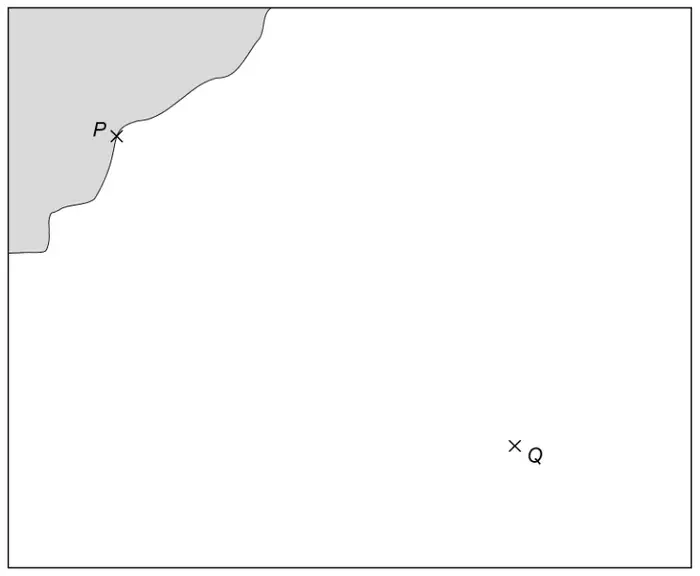
Water from a sprinkler at \(P\) reaches up to 20 metres from \(P\). Water from a sprinkler at \(Q\) reaches up to 25 metres from \(Q\).
Scale: 1 cm represents 5 m
Using a pair of compasses,
show the region that water from both sprinklers reaches. [2 marks]
Mark scheme
Answer
Mark
Comments
Arc radius [3.8, 4.2] cm centre \(P\) or arc radius [4.8, 5.2] cm centre \(Q\)
M1
only need arcs within tolerance for the correct region ignore other lines M1 arc radius [3.8, 4.2] cm centre \(Q\) and arc radius [4.8, 5.2] cm centre \(P\) and correct ft region identified
Arc radius [3.8, 4.2] cm centre \(P\) and arc radius [4.8, 5.2] cm centre \(Q\) and region identified
A1
only need arcs within tolerance for the correct region ignore other lines
Additional guidance
Arcs may go outside the rectangle
Allow any unambiguous indication of the region eg labelled R or appropriate shading
Do not accept highlighting the perimeter of the region for identification of the region
Use a pair of compasses to draw arcs of the same radius from B and D. Draw a straight line from C through the intersection of the arcs.
Write down the error in his method. [1 mark]
(b) Kay wants to show all the points 3 km from point P.
Here is her answer.
What is wrong with her answer? [1 mark]
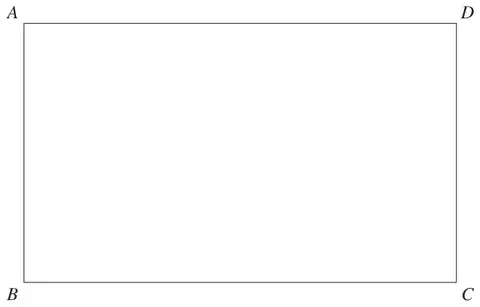
(c) Here is a rectangle.
Using a pair of compasses and a straight edge, construct one line of symmetry.
Show clearly your construction arcs. [2 marks]
Mark scheme (a)
Answer
Mark
Comments
The arcs should be drawn from C or from points the same distance from C or The lines are different lengths, so you can’t go from the ends
B1
oe
Additional guidance
CB ≠ CD
B1
Not drawn an arc from C
B1
He put compass in wrong place. He should have started at C but he started at B and D
B1
Should be an arc on each line CB and CD
B0
Arcs in wrong place
B0
Arcs aren’t equal
B0
His line isn’t in the centre of B and D
B0
D has a longer line than B
B0
Arcs aren’t the same radius
B0
Should be an arc from B to D
B0
Should be an arc from B to the line CD
B0
Should be an intersection on CB and CD
B0
Mark scheme (b)
Answer
Mark
Comments
It should be a circle, (not a square) or The corners are too far away
B1
oe eg accept circle constructed inside square, touching at midpoints of square to within 2mm
Additional guidance
A correct diagram takes precedence over statements, otherwise ignore diagram
Any distances if quoted, eg to corners, should be accurate to within 2mm
Ignore any reference to the top point P
The corners are more than 3 (km or cm) away from the point
B1
Some points are more than 3 (km or cm) away
B1
It isn’t 3 (km or cm) to the corners
B1
Each corner is [4.1, 4.5] (km or cm) from P (values represent tolerance)
B1
Each corner is more than 4 away
B1
It should be a circle
B1
Each point is 4.2 km from P (not true)
B0
The corners of the square are 4 km (out of tolerance)
B0
The corners of the square are 4 km while the rest are 3 km
B0
Each corner will be more than 1 km away
B0
She’s measured 3 cm from P without checking the corners
B0
It is not supposed to be this shape (but what should it be?)
B0
She has measured 4.3 km not 3 (not stated corners)
B0
She hasn’t shown all the points that represent 3 km
B0
She hasn’t plotted where all the 3 km points are
B0
It shouldn’t be a square
B0
Mark scheme (c)
Answer
Mark
Comments
One pair of equal, intersecting arcs from the vertices of one side of the rectangle
M1
tolerance \(\pm\) 1 mm
Fully correct construction of line of symmetry with either two pairs of equal, intersecting arcs from the vertices of the same side of the rectangle or one pair of equal, intersecting arcs from the vertices of one side of the rectangle and the diagonals drawn
A1
tolerance \(\pm\) 1 mm
line of symmetry may be solid or dashed but must touch opposite sides of rectangle
Additional guidance
Correct line with no appropriately constructed arcs
Answer [1.12, 1.2] km with or without [1120, 1200] seen
B1M1A0
Mark scheme (d)
Answer
Mark
Comments
Valid reason
B1
Indication that the shortest distance between two points is a straight line, but you can’t generally walk in a straight line between two places in a town
Additional guidance
You would have to walk along the streets
B1
There wouldn’t be a straight road between them
B1
You would have to walk along and then down
B1
There might be buildings in the way
B1
You can’t go as the crow flies
B1
There may be obstacles in the way
B1
It isn’t a straight path in real life
B1
Can’t go directly
B1
There might be buildings in the way such as the library
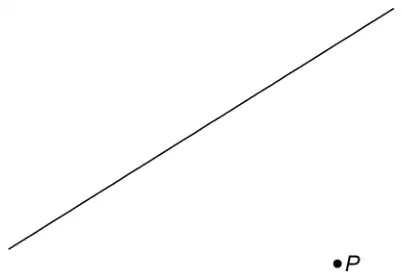
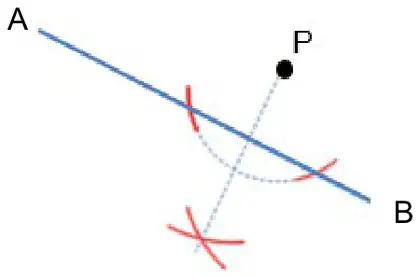
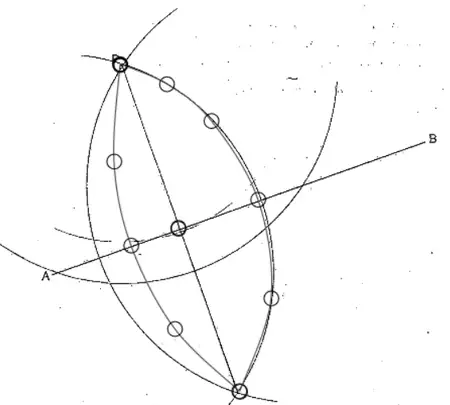
25 Construct the perpendicular from the point P to the line AB. Show all of your construction lines.
[2]
Mark scheme
Answer
Marks
Part marks and guidance
Ruled line through P and perpendicular to AB constructed with correct arcs (one pair intersecting AB)
2
B1 for correct arcs (one pair intersecting AB) only but no line or for correct ruled line but no, or incomplete, construction arcs
Condone dotted lines Set protractor to \(90^\circ\) and check \(88^\circ\) to \(92^\circ\) at AB Correct construction arcs as shown (may be two pairs of arcs used to draw line through P) Ignore other arcs if correct arcs clearly used to construct line Condone perpendicular extending beyond AB but must pass through P and reach AB (no daylight) Alternative (eg constructing a kite) Arc centred on A length AP and arc centred on B length BP meeting below AB (may also pass through P). Candidates may use points on AB other than A and B for this construction. In such cases check radii of arcs using on-line ruler to judge.
See appendix for exemplars
Appendix
Question 25
Response
Mark
A
Scores 2 This is a correct alternative method for arcs centred on A and B Use overlay to see arcs lie within circles (We can also check using on-line ruler) Candidates may use points on AB other than A and B for this construction. In such cases check radii of arcs using on-line ruler to judge.
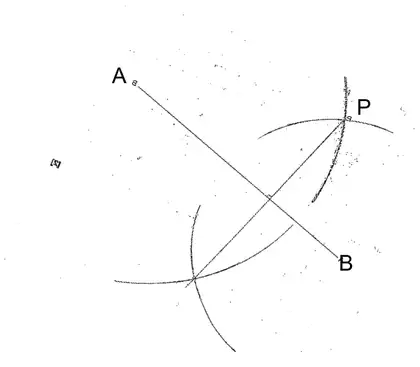
B
Scores 2 This is the main method not the alternative. Arc from P intersects AB at B and another point. Red arc from B intersects the arc from that other point.
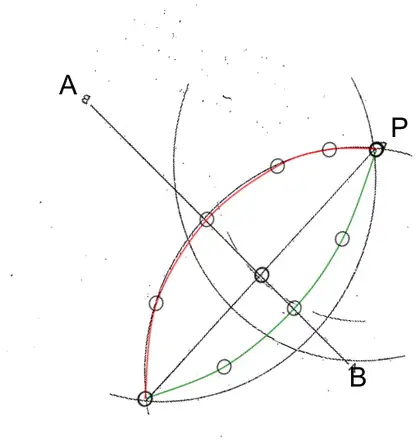
C
Scores 2 There is an arc from B through P. Another arc passes through P but its centre on AB is not identified - perhaps a small compass hole on the hard copy? This arc should have symmetry in line AB. This may need to be confirmed using the ruler tool.
D
0 marks Only one correct (pair of) arcs (One arc centred on P and cutting AB twice) and inaccurate line.
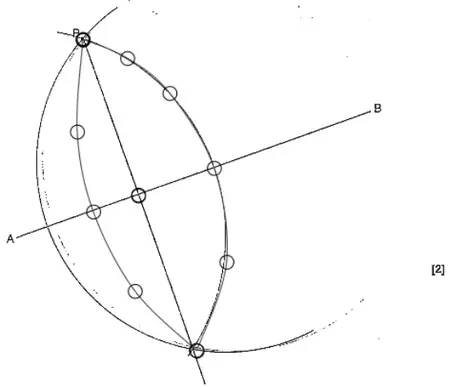
8 Construct the perpendicular from the point P to the line AB. Show all of your construction lines. [2]
Mark scheme
Answer
Marks
Part marks and guidance
Ruled line through P and perpendicular to AB constructed with correct arcs (one pair intersecting AB)
2
B1 for correct arcs (one pair intersecting AB) only or for correct ruled line but no, or incomplete, construction arcs
Condone dotted lines Set protractor to 90° and check 88° to 92° at AB Correct construction arcs as shown (may be two pairs of arcs used to draw line through P) Ignore other arcs if correct arcs clearly used to construct line Condone perpendicular extending beyond AB but must pass through P and reach AB (no daylight) Alternative (eg constructing a kite) Arc centred on A length AP and arc centred on B length BP meeting below AB (may also pass through P). Candidates may use points on AB other than A and B for this construction. In such cases check radii of arcs using on-line ruler to judge
See appendix for exemplars
Appendix: Question 8
Response
Mark
A
Scores 2 This is a correct alternative method for arcs centred on A and B Use overlay to see arcs lie within circles (We can also check using on-line ruler) Candidates may use points on AB other than A and B for this construction. In such cases check radii of arcs using on-line ruler to judge.
B
Scores 2 This is the main method not the alternative. Arc from P intersects AB at B and another point. Red arc from B intersects the arc from that other point.
C
Scores 2 There is an arc from B through P. Another arc passes through P but its centre on AB is not identified - perhaps a small compass hole on the hard copy? This arc should have symmetry in line AB. This may need to be confirmed using the ruler tool.
D
0 marks Only one correct (pair of) arcs (One arc centred on P and cutting AB twice) and inaccurate line.
Using a ruler and compasses only, construct and shade the region which is closer to AB than AC. [3]
Mark scheme
Answer
Marks
Part marks and guidance
acceptable bisector of angle A with two pairs of supporting arcs
M2
M1 for acceptable bisector of angle A with no or incorrect arcs
Tolerance ± 2° Use overlay Accept dashed or solid line for bisector If additional incorrect bisectors are drawn then this is choice and M0 unless the shading indicates they have chosen the correct bisector
23 The diagram shows a town T and a straight road AB.
Scale: 2 cm represents 1 km
A new straight road is built from town T to the road AB. The road is the shortest possible distance from town T to the road AB.
(a)Using ruler and compasses only, construct the road from town T to the road AB. [2]
(b) The new road costs £200 000 per kilometre to build. The road constructor says
The new road will cost over £600 000 to build.
Show that the road constructor is incorrect. [3]
Mark scheme (a)
Answer
Marks
Part marks and guidance
Accurate ruled perpendicular from T to AB with correct construction arcs
2
B1 for accurate ruled perpendicular from T to AB with no/incorrect construction arcs \(\pm 2^\circ\)
For 2 marks or B1 must reach/cross AB
Correct arcs could be e.g. Kite method Condone dashed/dotted lines Multiple lines treat as choice
Mark scheme (b)
Answer
Marks
Part marks and guidance
520 000 to 560 000 with correct working oe OR that would be 6 cm on the map but it only measures 5.2 to 5.6 cm oe OR This money would build 3 km but it only measures 2.6 to 2.8 km oe
3
B1FT for [road =] 5.2 to 5.6 [cm] or 2.6 to 2.8 [km] or for their (a) measured ± 2mm M1FT for (their 5.2 to 5.6) \(\div 2 \times 200\,000\) oe or for \(600\,000 \div 200\,000 \times 2\)
For 3 marks accept e.g. it will be 40 000 to 80 000 less than this
B1 may be seen on the diagram Accept FT given in km as their (a) \(\div 2\)
M1 implied by 6 cm or 3 km Method can be implied by correct figures
For 3 marks accept e.g. \(3 \times 200000\) is greater than \(2.7 \times 200000\)
Using a ruler and compasses only, construct the position of the boat. Label the position of the boat clearly. [5]
Mark scheme
Answer
Marks
Part marks and guidance
Accurate ruled perpendicular bisector of AB with two correct pairs of supporting arcs
2
B1 for accurate ruled perpendicular bisector of AB with no or incorrect arcs
Use overlay as a guide Put ruler on screen to check 2 cm if needed Tolerance \(\pm\)2 mm and \(\pm 2^\circ\). Line length at least 2 cm Bisector crosses between circles of overlay but does not cut them and perpendicular by eye
Accurate ruled bisector of angle ABC with two correct pairs of supporting arcs
2
B1 for accurate ruled bisector of angle ABC with no or incorrect arcs
Tolerance \(\pm 2^\circ\). Line length at least 2 cm Bisector between or on red lines of overlay arcs.
Correct position of boat clearly identified at point of intersection of two straight lines
Using a ruler and compasses only, construct the position of the boat. Label the position of the boat clearly. [5]
Mark scheme
Answer
Marks
Part marks and guidance
Accurate ruled perpendicular bisector of AB with two correct pairs of supporting arcs
2
B1 for accurate ruled bisector perpendicular bisector of AB with no or incorrect arcs
Use overlay as a guide Put ruler on screen to check 2 cm if needed Tolerance ±2 mm and ±2°. Line length at least 2 cm Bisector crosses between circles of overlay but does not cut them and perpendicular by eye
Accurate ruled bisector of angle ABC with two correct pairs of supporting arcs
2
B1 for accurate ruled bisector of angle ABC with no or incorrect arcs
Tolerance ±2°. Line length at least 2 cm Bisector between or on red lines of overlay arcs
Correct position of boat clearly identified at point of intersection of two straight lines
(a) Construct the perpendicular from the point P to the line AB.
[2]
(b) The diagram shows a field LMN.
A tree is to be planted in the field so that it is
the same distance from the fences MN and ML
and
the same distance from corner M as from corner N.
Show, by construction, whether this can be done or cannot be done.
This .................... be done. [5]
Mark scheme (a)
Answer
Marks
Part marks and guidance
Ruled line through P and perpendicular to AB constructed with correct arcs (one pair intersecting AB)
2
B1 for correct arcs (one pair intersecting AB) only but no line or correct ruled line but no, or incomplete, construction arcs
Condone dotted lines Set protractor to 90° and check 88° to 92° at AB
Correct construction arcs as shown (may be two pairs of arcs used to draw line through P) Ignore other arcs if correct arcs clearly used to construct line
Condone perpendicular extending beyond AB but must pass through P and reach AB (no daylight)
Alternative arcs (eg a kite construction) One centred on A length AP and one centred on B length BP meeting below AB (may also pass through P). Candidates may use points on AB other than A and B for this construction. In such cases check radii of arcs using on-line ruler to judge
See appendix for exemplars (marked diagrams in the published mark scheme)
Mark scheme (b)
Answer
Marks
Part marks and guidance
accurate and correct ruled angle bisector of angle M with supporting arcs and accurate and correct ruled perpendicular bisector of MN with supporting arcs and ‘cannot’ with full evidence
5
B2 for accurate and correct ruled angle bisector of angle M with supporting arcs or B1 for accurate and correct ruled angle bisector of angle M
B2 for accurate and correct ruled perpendicular bisector of MN with supporting arcs or B1 for accurate and correct ruled perpendicular bisector of MN
B1 dep for correct decision (No) with full evidence dep on at least B1 B1
tolerance on angles \(\pm\) 2° and on radius of arcs \(\pm\) 2mm
For 5 marks the diagram must be fully correct with no extra constructions and lines touching the opposite sides of the triangle.
Bisectors to be at least 2cm long
full evidence means two correct ruled lines within tolerance
C is south-east of A and on a bearing of 225° from B.
Complete the diagram to show the positions of A, B and C. Show clearly the values of all three angles in triangle ABC.
Scale: 1 cm represents 2 km
[4]
Mark scheme
Answer
Marks
Part marks and guidance
Accurate and correct isosceles triangle with A, B and C points labelled and angles 45°, 45° and 90° correctly labelled
4
B1 for B 6 cm (\(\pm\) 2 mm) due east of A (\(\pm\) 2˚) B1 for C from A B1 for C from their B
For those who put B due west of A, award the second B1 if their C is marked at 225 \(\pm\) 2˚ from A and the third B1 if their C is marked at 135 \(\pm\) 2˚ from B
Condone dotted lines and accept symbol for 90º
line accurately drawn or point B marked 6 cm (\(\pm\)2 mm) and east (90 \(\pm\) 2˚) from A
line accurately drawn or C marked at 135 \(\pm\) 2˚ from A
line accurately drawn or C marked at 225 \(\pm\) 2˚ from B
(a) Construct the perpendicular from the point P to the line AB.[2]
(b) The diagram shows a field LMN.
A tree is to be planted in the field so that it is
the same distance from the fences MN and ML
and
the same distance from corner M as from corner N.
Show, by construction, whether this can be done or cannot be done.
This …………… be done. [5]
Mark scheme (a)
Answer
Marks
Part marks and guidance
Ruled line through P and perpendicular to AB constructed with correct arcs (one pair intersecting AB)
2
B1 for correct arcs (one pair intersecting AB) only but no line or correct ruled line but no, or incomplete, construction arcs
Condone dotted lines Set protractor to 90° and check 88° to 92° at AB Correct construction arcs as shown (may be two pairs of arcs used to draw line through P) Ignore other arcs if correct arcs clearly used to construct line Condone perpendicular extending beyond AB but must pass through P and reach AB (no daylight) Alternative arcs (eg a kite construction) One centred on A length AP and one centred on B length BP meeting below AB (may also pass through P). Candidates may use points on AB other than A and B for this construction. In such cases check radii of arcs using on-line ruler to judge
See appendix for exemplars
Appendix: Question 7(a)
The overlay only shows one solution.
Response
Comment
Mark
A
This is the a correct alternative method for arcs centred on A and B
Use overlay to see arcs lie within circles
(We can also check using on-line ruler)
Candidates may use points on AB other than A and B for this construction. In such cases check radii of arcs using on-line ruler to judge.
Scores 2
B
This is the main method not the alternative. Arc from P intersects AB at A and another point. Red arc from A intersects the arc from that other point.
Scores 2
C
Looks similar to Exemplar B but shows why the overlay must be used with caution.
Overlay shows red arc is centred at A.
The other arc is centred elsewhere on the line AB, but there is no evidence of where it is centred. This is checked by eye.
This is a valid alternative method.
Scores 2
D
Only one correct (pair of) arcs (One arc centred on P and cutting AB twice) and inaccurate line.
0 marks
E
No valid sets of arcs nor a correct line
0 marks
Mark scheme (b)
Answer
Marks
Part marks and guidance
accurate and correct ruled angle bisector of angle M with supporting arcs and accurate and correct ruled perpendicular bisector of MN with supporting arcs and ‘cannot’ with full evidence
5
B2 for accurate and correct ruled angle bisector of angle M with supporting arcs or B1 for accurate and correct ruled angle bisector of angle M
B2 for accurate and correct ruled perpendicular bisector of MN with supporting arcs or B1 for accurate and correct ruled perpendicular bisector of MN
B1 dep for correct decision (No) with full evidence dep on at least B1 B1
tolerance on angles ± 2° and on radius of arcs ± 2mm
For 5 marks the diagram must be fully correct with no extra constructions and lines touching the opposite sides of the triangle.
Bisectors to be at least 2 cm long
full evidence means two correct ruled lines within tolerance
5 B is 12 km due east of A. C is south-east of A and on a bearing of 225° from B.
Complete the diagram to show the positions of A, B and C. Show clearly the values of all three angles in triangle ABC.
Scale: 1 cm represents 2 km
[4]
Mark scheme
Answer
Marks
Part marks and guidance
Accurate and correct isosceles triangle with A, B and C points labelled and angles 45°, 45° and 90° correctly labelled
4
B1 for B 6 cm (± 2 mm) due east of A (± 2°)
B1 for C from A
B1 for C from their B
For those who put B due west of A, award the second B1 if their C is marked at 225 ± 2° from A and the third B1 if their C is marked at 135 ± 2° from B
condone dotted lines and accept symbol for 90°
line accurately drawn or point B marked 6 cm (±2 mm) and east (90 ± 2°) from A
line accurately drawn or C marked at 135 ± 2° from A
line accurately drawn or C marked at 225 ± 2° from B
22 The diagram shows the scale drawing of a sandpit, ABCD. It also shows the arc of all points in the sandpit that are 80 cm from corner A.
Scale: 1 cm represents 20 cm
A game is played by throwing a ball into the sandpit. Points may be scored when the ball lands in the sandpit.
1 point if the ball lands within 80 cm of corner A, and
1 point if the ball is closer to side AB than side AD, and
1 point if the ball is closer to corner A than corner B.
By completing the construction, find and shade the regions where 2 points can be scored. Show all your construction lines. [6]
Mark scheme
Answer
Marks
Part marks and guidance
Accurate ruled angle bisector with two pairs of supporting arcs isw
B2
B1 for accurate angle bisector at least 2 cm long with no/incorrect arcs isw
Use overlay as a guide, bisectors should lie within or on the lines For B2 allow use of the arc around A as one pair – at least 2 cm long for B2 Tolerance \(\pm 2^\circ\)
Accurate ruled perpendicular bisector with two correct pairs of intersecting arcs isw
B2
B1 for accurate perpendicular bisector at least 2 cm long with no/incorrect arcs isw
Tolerance \(\pm 2^\circ\) and \(\pm 2\) mm At least 2 cm long for B2 but must remain in tolerance if extended within shape for B1 and B2
2 correct regions shaded/clearly indicated with no extras
B2 dep
Dep on at least B1B1 B1dep for 1 correct region with no extras or 2 correct regions and one extra
B1dep on B1 for angle bisector for region bounded by angle bisector or dep on B1B1 for region bounded by both bisectors and arc
9 The diagram shows the scale drawing of a sandpit, ABCD. It also shows the arc of all points in the sandpit that are 80 cm from corner A.
Scale: 1 cm represents 20 cm
A game is played by throwing a ball into the sandpit. Points may be scored when the ball lands in the sandpit.
1 point if the ball lands within 80 cm of corner A, and
1 point if the ball is closer to side AB than side AD, and
1 point if the ball is closer to corner A than corner B.
By completing the construction, find and shade the regions where 2 points can be scored. Show all your construction lines. [6]
Mark scheme
Answer
Marks
Part marks and guidance
Accurate ruled angle bisector with two pairs of supporting arcs isw
B2
B1 for accurate angle bisector at least 2 cm long with no/incorrect arcs isw
Use overlay as a guide, bisectors should lie within or on the lines For B2 allow use of the arc around A as one pair – at least 2 cm long for B2 Tolerance ±2°
Accurate ruled perpendicular bisector with two correct pairs of intersecting arcs isw
B2
B1 for accurate perpendicular bisector at least 2 cm long with no/incorrect arcs isw
Tolerance ±2° and ±2 mm At least 2 cm long for B2 but must remain in tolerance if extended within shape for B1 and B2
2 correct regions shaded/clearly indicated with no extras
B2 dep
Dep on at least B1B1 B1dep for 1 correct region with no extras or 2 correct regions and one extra
B1dep on B1 for angle bisector for region bounded by angle bisector or dep on B1B1 for region bounded by both bisectors and arc
(a) Construct the bisector of angle ABC. Show all your construction lines. [2]
(b) Construct the perpendicular bisector of BC. Show all your construction lines. [2]
(c) Shade the region which is
nearer to BC than to AB
and
nearer to B than to C.
[1]
Mark scheme (a)
Answer
Marks
Part marks and guidance
Accurate ruled angle B bisector with two pairs of correct arcs
2
B1 for accurate ruled angle B bisector
Tolerance \(\pm 2^\circ\) e.g. one angle \(49^\circ\) to \(53^\circ\) and the line can be any length, must touch B and condone dotted line
Mark scheme (b)
Answer
Marks
Part marks and guidance
Accurate ruled perpendicular bisector of BC with two pairs of correct arcs
2
B1 for accurate ruled perpendicular bisector of BC
Tolerance \(\pm 2^\circ\) e.g. angle \(88^\circ\) to \(92^\circ\) and \(\pm\) 2mm e.g. 27mm to 31 mm and line can be any length, must touch BC and condone dotted line
Mark scheme (c)
Answer
Marks
Part marks and guidance
Correct region shaded
1 dep
dep on at least B1 and B1 and both bisectors intersecting
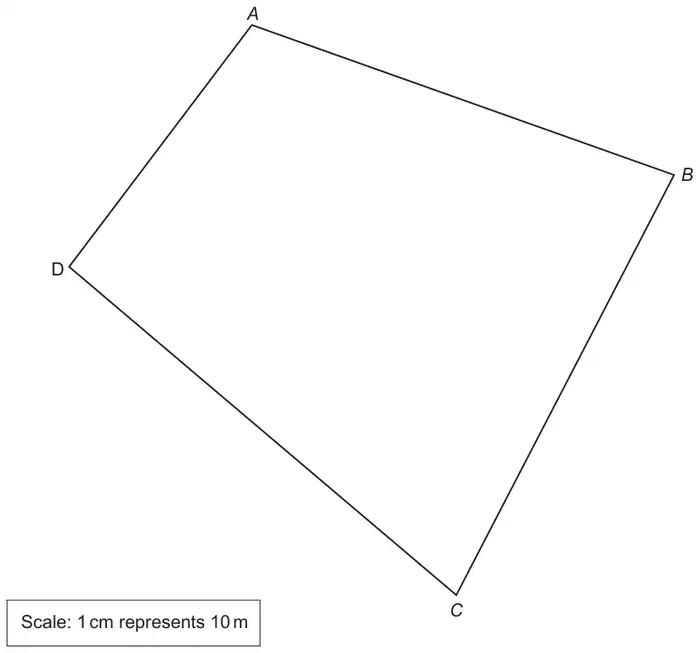
17 The diagram shows the scale drawing of a garden ABCD.
Scale: 1 cm represents 5 m
A tree is to be planted in the garden so that it is
at least 10 m from AB
and
closer to CD than CB
and
at least 15 m from D.
Using a ruler and compasses only, construct and shade the region in which the tree can be planted. [6]
Mark scheme
Answer
Marks
Part marks and guidance
Line drawn parallel to AB, 1.8 to 2.2 cm away that meets AD and their bisector of angle BCD
M1
Condone dotted lines throughout Use overlay as a guide If no angle bisector their horizontal line must at least touch the left hand boundary of angle bisector overlay
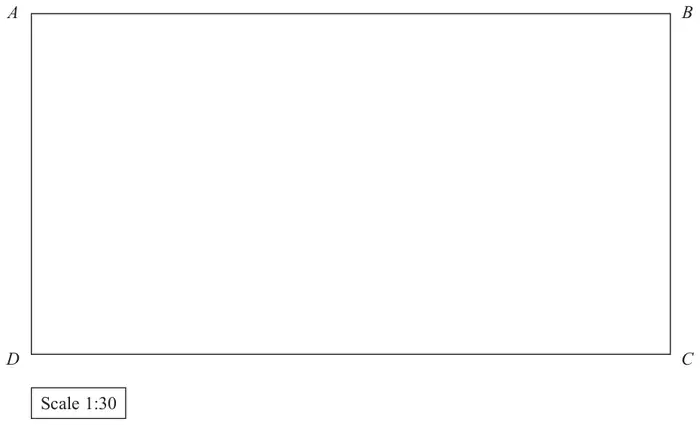
(a) The scale 1 cm represents 25 m can be written in the form \(1 : k\).
Find the value of \(k\). [1]
(b) The scale drawing represents a harbour.
A boat leaves the harbour from point C and sails on a path that is equidistant from BC and CD. The harbour rules do not allow boats to sail within 75 m of point E.
Find by construction whether the path of the boat will follow the harbour rules. Show all your construction lines. [5]
Mark scheme (a)
Answer
Marks
Part marks and guidance
2500
1
Ignore units
Mark scheme (b)
Answer
Marks
Part marks and guidance
Bisector of angle BCD accurate with pairs of correct arcs
M2
B1 for accurate bisector of angle BCD with no/incorrect arcs
Tol ± 2º use overlay Condone solid/broken lines bisector
Arc centre E radius 3 cm with length fit for purpose
M2
B1 for arc centre E
Tol ± 2 mm For B1 accept 5 correctly marked points in tolerance
No oe with correct constructions
B1
Dep on at least B1M2
Accept the boat will travel within 75 m
Notes
The drawing on this page is not printed at its original size, so measurements taken from it on screen will not match the 1 cm to 25 m scale.
22 Construct the perpendicular from the point P to the line AB.
Show all of your construction lines.
[2]
Mark scheme
Answer
Marks
Part marks and guidance
Ruled perpendicular constructed with correct arcs (one pair intersecting AB)
2
Condone dashed line B1 for correct arcs (one pair intersecting AB) only but no line or correct ruled line but no, or incomplete construction arcs
Set protractor to \(90^\circ\) and check \(88^\circ\) to \(92^\circ\) at AB
Correct construction arcs as shown (may be two pairs of arcs used to draw line through P) Ignore other arcs if correct arcs clearly used to construct line
Condone perpendicular extending beyond AB but must pass through P and reach AB (no daylight)
Alternative arcs. One centred on A length AP and one centred on B length BP meeting below AB (may also pass through P). Use overlay as check
Candidates may use points on AB other than A and B for this construction. In such cases check radii of arcs using on-line ruler to judge.
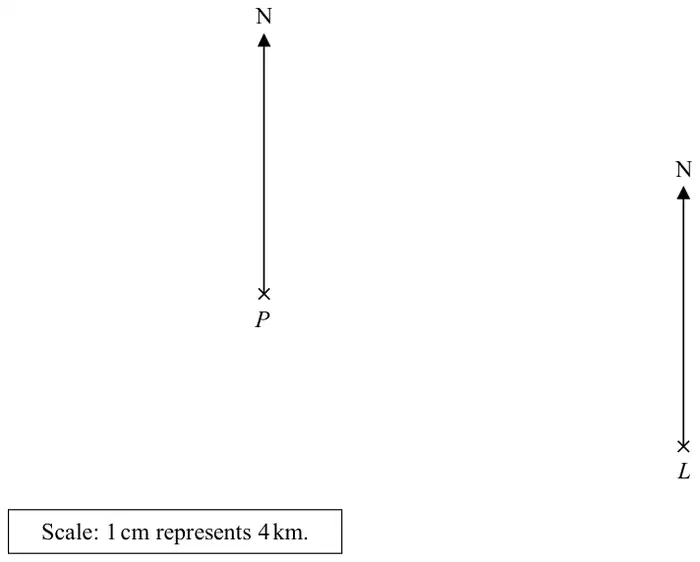
aircraft B is 4960 km from T on a bearing of 057°.
Not to scale
(a) Aircraft A flies directly towards radar tower T at a speed of 890 km/h.
At what time will the aircraft pass over radar tower T? Give your answer to the nearest minute. [4]
(b) Calculate the distance that was between aircraft A and aircraft B at 3pm. [4]
Mark scheme (a)
Answer
Marks
Part marks and guidance
6.39 [pm] or 1839
4
B3 for 39 or answer rounding to 39.1 or 3°39 to 3°39′6.07″ or 6°39 to 6°39′6.07″ or 219 or answer rounding to 219.1 OR M1 for [\(t =\)] \(\dfrac{3250}{890}\) oe soi by 3.65(…) and M1FT for 60 × (their time) soi or evidence from their answer by using calculator key
Alternative method (converting speed to km/min) M1 for 890 ÷ 60 soi by \(\dfrac{89}{6}\) or \(14\frac{5}{6}\) oe or 14.8[3…] and M1FT for [\(t =\)] 3250 ÷ their 14.8[3…]
Condone 1839pm for full marks
e.g. \(3\frac{58}{89}\)
their time could be fraction or decimal and could be just the non-integer part (check using calculator)
Mark scheme (b)
Answer
Marks
Part marks and guidance
3345 to 3350 nfww
4
B1 for 42 seen AND M2 for [\(x^2 =\)] \(3250^2 + 4960^2 - 2 \times 3250 \times 4960 \cos\theta\) oe soi by [\(x^2 =\)] 11205110 to 11205111 or M1 for correct cosine rule with \(x^2\) not as subject
Alternative method (using horizontal/vertical components and Pythagoras) M3 for \(\sqrt{(4960\sin 57 - 3250\sin 15)^2 + (3250\cos 15 - 4960\cos 57)^2}\) or M2 for 4960sin57 – 3250sin15 or 3250cos15 – 4960cos57 or M1 for two of 4960sin57, 3250sin15, 3250cos15 or 4960cos57
May be seen on sketch diagram
For M2 or M1, \(\theta\) is a number in the range \(15 \leqslant \theta \leqslant 57\)
7 Construct the perpendicular from the point P to the line AB. Show all of your construction lines.
[2]
Mark scheme
Answer
Marks
Part marks and guidance
Ruled perpendicular constructed with correct arcs (one pair intersecting AB)
2
Condone dashed line B1 for correct arcs (one pair intersecting AB) only but no line or correct ruled line but no, or incomplete construction arcs
Set protractor to 90° and check 88° to 92° at AB
Correct construction arcs as shown (may be two pairs of arcs used to draw line through P) Ignore other arcs if correct arcs clearly used to construct line
Condone perpendicular extending beyond AB but must pass through P and reach AB (no daylight)
Alternative arcs. One centred on A length AP and one centred on B length BP meeting below AB (may also pass through P). Use overlay as check
Candidates may use points on AB other than A and B for this construction. In such cases check radii of arcs using on-line ruler to judge.
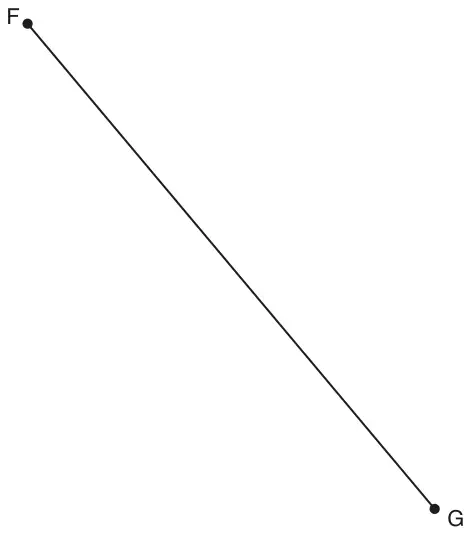
Using ruler and compasses only, construct the perpendicular bisector of FG.
[2]
Mark scheme
Answer
Marks
Part marks and guidance
Correct ruled line with two pairs of correct arcs
2
B1 for correct ruled line but no or wrong arcs or correct intersecting arcs no line
Arcs may be two continuous arcs centred at F and G with two intersections Anchor overlay on G. Line to be within overlay throughout. May be all on one side of FG only
20 The scale diagram below shows towns, A, B and C. Line AB represents the road from A to B and line AC represents the road from A to C.
A shopping centre is to be built so that it is
nearer to the road from A to B than the road from A to C,
less than 14 km from town C.
(a) Using construction, shade the region where the shopping centre could be built. Show all your construction lines.
[5]
(b) Explain why the region found in part (a) may not be an appropriate site for the shopping centre. [1]
Mark scheme (a)
Answer
Marks
Part marks and guidance
Accurate angle bisector with 2 pairs of correct arcs
2
B1 for correct bisector with no arcs or incorrect arcs
The bisector does not have to go through A but if extended it must go through A and it must lie within green lines in overlay. For 2 marks condone intersecting arcs of equal radius, one centre B and the other centre C for the construction with bisector drawn.
Arc centre C radius 7cm
2
B1 for arc centre C with incorrect radius
For arc, measure radius using ruler.
tolerance \(\pm\) 2 mm and \(\pm\) 2° for both constructions
Correct region indicated
1Dep
Dependent on at least B1 for bisector and B2 for arc
Mark scheme (b)
Answer
Marks
Part marks and guidance
accept any correct assumption e.g. Road[s] is not/are not straight, road AB is busier than road AC, land is not suitable for construction
1
If more than one choose the best one see list of exemplars
7 The scale diagram below shows towns, A, B and C. Line AB represents the road from A to B and line AC represents the road from A to C.
A shopping centre is to be built so that it is
nearer to the road from A to B than the road from A to C,
less than 14 km from town C.
(a) Using construction, shade the region where the shopping centre could be built. Show all your construction lines.[5]
(b) Explain why the region found in part (a) may not be an appropriate site for the shopping centre. [1]
Mark scheme (a)
Answer
Marks
Part marks and guidance
Accurate angle bisector with 2 pairs of correct arcs
2
B1 for correct bisector with no arcs or incorrect arcs
The bisector does not have to go through A but if extended it must go through A and it must lie within green lines in overlay. For 2 marks condone intersecting arcs of equal radius, one centre B and the other centre C for the construction with bisector drawn.
Arc centre C radius 7cm
2
B1 for arc centre C with incorrect radius
For arc, measure radius using ruler.
Correct region indicated
1Dep
Dependent on at least B1 for bisector and B2 for arc
tolerance ± 2 mm and ± 2° for both constructions
Mark scheme (b)
Answer
Marks
Part marks and guidance
accept any correct assumption e.g. Road[s] is not/are not straight, road AB is busier than road AC, land is not suitable for construction
1
If more than one choose the best one see list of exemplars
Appendix: exemplar responses for Q7(b)
Response
Mark
Road[s] are/are not straight
1
Land is not suitable for construction [ e.g. it may be a lake]
1
The land may flood
1
Site is too small for centre
1
Site is too steep for construction
1
Land lies in a AONB/National Park
1
Too far from the towns (A/B/C)
1
The roads may not be able to cope with the increased traffic
20 Four points A, B, C and D are shown on the scale diagram below.
(a) On the diagram, construct and mark the two points that are
the same distance from A and B
and
15 m from C.
Show all your construction lines. [5]
(b) The points A, B, C and D represent the four corners of Monty’s garden. His garden is bounded by four straight fences A to B, B to C, C to D and D to A.
Monty wants to plant a tree in his garden at a place that satisfies the two conditions in part (a).
Explain why there is only one position where Monty can plant his tree. [1]
Mark scheme (a)
Answer
Marks
Part marks and guidance
Accurate perpendicular bisector from at least AB passing within 3 cm of C with two pairs of correct arcs
2
B1 for accurate perpendicular bisector
Tolerance \(\pm\) 2 mm
Arc centre C, at least from BC to CD with radius 3 cm
2
B1 for any arc centre C
Two correct points marked intersecting the line and the arc
1
Dep on B1 (bisector) and B2 (arc) scored above
Mark scheme (b)
Answer
Marks
Part marks and guidance
One of the points is not in his garden or only one is in his garden
1
Accept any correct reason e.g. one point is behind the CD fence
3 Four points A, B, C and D are shown on the scale diagram below.
(a) On the diagram, construct and mark the two points that are
the same distance from A and B and
15 m from C.
Show all your construction lines. [5]
(b) The points A, B, C and D represent the four corners of Monty’s garden. His garden is bounded by four straight fences A to B, B to C, C to D and D to A.
Monty wants to plant a tree in his garden at a place that satisfies the two conditions in part (a).
Explain why there is only one position where Monty can plant his tree. [1]
Mark scheme (a)
Answer
Marks
Part marks and guidance
accurate perpendicular bisector at least from AB passing within 3 cm of C with two pairs of correct arcs
2
B1 for accurate perpendicular bisector
tolerance ± 2 mm
arc centre C, at least from BC to CD, with radius 3 cm
2
B1 for any arc centre C
two points marked intersecting the arc and line
1
Dep on B1(bisector) and B2(arc) scored above
Mark scheme (b)
Answer
Marks
Part marks and guidance
One of the points is not in his garden or only one is in his garden
1
accept any correct reason e.g. one point is behind the CD fence
Notes
(corrected from the printed mark scheme: the appendix heading for these exemplars is printed as “Q6(b)”)
B is 25 kilometres due East of A. C is 25 kilometres due North of A. D is 45 kilometres due South of A.
Not to scale
(a) Work out the bearing of B from C. [2]
(b) Calculate the bearing of D from B. [4]
Mark scheme (a)
Answer
Marks
Part marks and guidance
135
2
B1 for angle 45
e.g 45 marked at ACB or ABC or 180 – 45 or 90 + 45
Mark scheme (b)
Answer
Marks
Part marks and guidance
209 to 209.1
4
M2 for \(\tan^{-1}(45 \div 25)\) or \(\tan^{-1}(25 \div 45)\) soi by 61, 60.94 to 60.95 or 29[.1], 29.05...
or
M1 for \(\tan\) [=] \(45 \div 25\) or \(\tan\) [=] \(25 \div 45\)
AND
M1 for 270 – their angleABD or 180 + their angleADB
Accept longer methods but they must get to the equivalent point to gain credit e.g. if they find the hypotenuse, they score M0 until they start to use sin or cos.
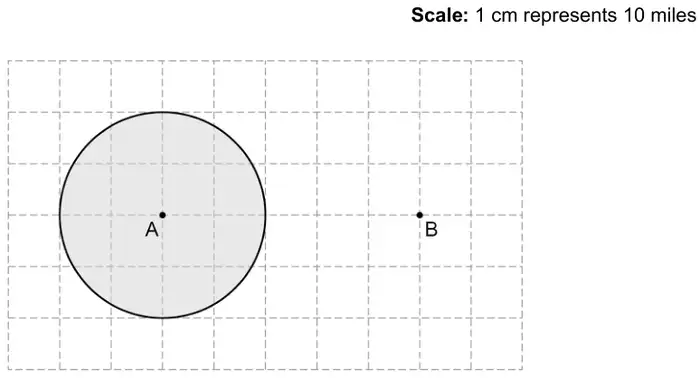
16 The scale diagram shows the positions of town A and town B.
Scale: 1 cm represents 10 miles
Lucy’s house is nearer to town A than to town B. Her house is exactly 50 miles from town B.
On the scale diagram show all the possible positions of Lucy’s house. You must show all your construction lines. [5]
Mark scheme
Answer
Marks
Part marks and guidance
Complete correct arc centred at B identified with full construction shown including either perpendicular bisector of AB (including arcs and intersecting the arc centred at B) or arc(s) of 5cm radius centred at A and intersecting the arc from B at 2 points
5
B4 5cm arc centred at B with full construction shown including either perpendicular bisector of AB (including arcs and intersecting the arc centred at B) or arc(s) of 5cm (\(\pm 0.2\) cm) radius centred at A and intersecting the arc from B at 2 points
OR
B2 for complete arc 5cm (\(\pm 0.2\) cm) centred at B or B1 for arcs 5cm (\(\pm 0.2\) cm) radius centred at B or continuous arc 5cm (\(\pm 0.2\) cm) radius centred at B, but not covering the whole of the required region, minimum span \(30^\circ\)
AND
B1 for arc[s] centred at A radius 5cm (\(\pm 0.2\) cm) or a perpendicular bisector of AB
OR
B1 for minimum of 3 points in the correct position without arc from B
B4 is fully correct without the correct locus identified
B is 25 kilometres due East of A. C is 25 kilometres due North of A. D is 45 kilometres due South of A.
Not to scale
(a) Work out the bearing of B from C. [2]
(b) Calculate the bearing of D from B. [4]
Mark scheme (a)
Answer
Marks
Part marks and guidance
135
2
B1 for angle 45
e.g. 45 marked at ACB or ABC, 180 – 45, 90 + 45
Mark scheme (b)
Answer
Marks
Part marks and guidance
209 to 209.1
4
M2 for \(\tan^{-1}(45 \div 25)\) or \(\tan^{-1}(25 \div 45)\) soi by 61, 60.94 to 60.95 or 29[.1], 29.05...
or
M1 for tan [=] 45÷25 or tan [=] 25÷45
Accept longer methods but they must get to the equivalent point to gain credit e.g. if they find the hypotenuse, they score M0 until they start to use sin or cos.
Can be implied by their answer
AND
M1 for 270 – their angleABD or 180 + their angleADB
(i) The distance from A to B is .............................. km. [2]
(ii) The bearing of B from A is .............................. \(^\circ\). [1]
(b) C is another farm. C is 2.5 km from B on a bearing of \(230^\circ\).
Mark and label the position of C on the map with a cross. [2]
Mark scheme (a)
Answer
Marks
Part marks and guidance
(i) 3.2
2
Accept 3.1 to 3.3 M1 for 6.2 to 6.6 [cm] seen or 62 to 66 [mm] seen
May be seen on diagram or on the answer line
(ii) 115
1
Accept 113 to 117
Mark scheme (b)
Answer
Marks
Part marks and guidance
C marked 5 cm from B C marked on bearing of \(230^\circ\) from B
2
Accept 4.8 to 5.2 cm Accept \(226^\circ\) to \(234^\circ\) B1 for one correct
Condone C not labelled if clear indication is given eg marked with a cross If C not indicated, an arc radius 5cm, centre B scores B1 with no other arcs Use overlay as a guide for 2 marks or use on screen ruler and protractor to confirm B1. Protractor reading \(126^\circ\) to \(134^\circ\)
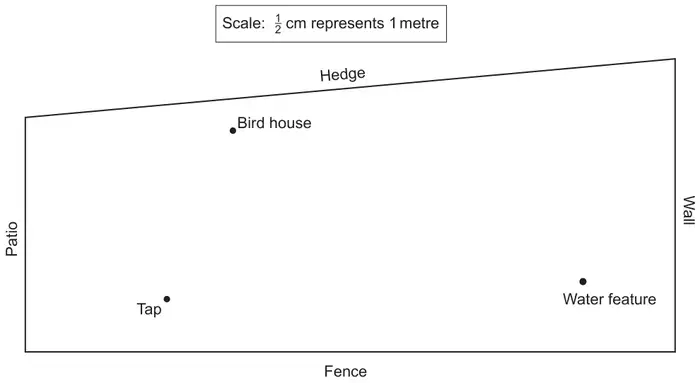
9. The diagram below shows a scale drawing of Amy’s garden. The garden is enclosed by a fence, a patio, a hedge, and a wall. In Amy’s garden there is a tap, a bird house and a water feature.
On screen this diagram may not be shown at actual size. To measure it, use the question paper (PDF) printed at 100%.
Amy is going to spread grass seed on part of her garden.
The grass seed will be spread over the region that satisfies the following conditions:
at least 8 metres from the water feature
nearer to the bird house than the tap
nearer to the hedge than the wall.
On the diagram, clearly indicate the region that is to be spread with grass seed. You must use a ruler and a pair of compasses to construct suitable arcs and lines.[6]
Mark scheme
Scheme
Marks
Comments
A circle with a radius of 4 cm centred at the water feature.
B1
Correct perpendicular bisector construction with appropriate arcs.
B2
B1 for perpendicular bisector within tolerance (\(\pm\,2^\circ\)) without arcs or with invalid arcs or for a correct pair of arcs that intersect twice.
Correct angle bisector construction with appropriate arcs.
B2
B1 for angle bisector within tolerance (\(\pm\,2^\circ\)) without arcs or with invalid arcs or for a correct pair of arcs.
Correct area clearly indicated.
B1
FT provided at least B1, B1, B1 previously awarded.
7. The diagram shows a small park with gates at \(A\), \(B\), \(C\) and \(D\). The scale is 1 cm represents 10 m.
On screen this diagram may not be shown at actual size. To measure it, use the question paper (PDF) printed at 100%.
A new outdoor gym is to be built in the park.
This should be:
at least 55 m from the gate at \(A\)
nearer to the gate at \(B\) than the gate at \(C\).
Use a ruler and a pair of compasses to show accurately on the diagram the region of the park where the outdoor gym can be built. Indicate clearly the region that is your answer. [4]
Mark scheme
Scheme
Marks
Comments
Arc (of circle) centre \(A\) radius 5.5 cm
B1
\(\pm\) 2mm
Correct perpendicular bisector construction with appropriate arcs
B2
B1 for perpendicular bisector within tolerance (\(\pm\) 2°) without arcs or with invalid arcs
Correct area shaded or indicated
B1
FT provided at least B1 previously awarded for a closed region bounded by an attempt at a perpendicular bisector, with or without arcs, and the arc of a circle centre \(A\)
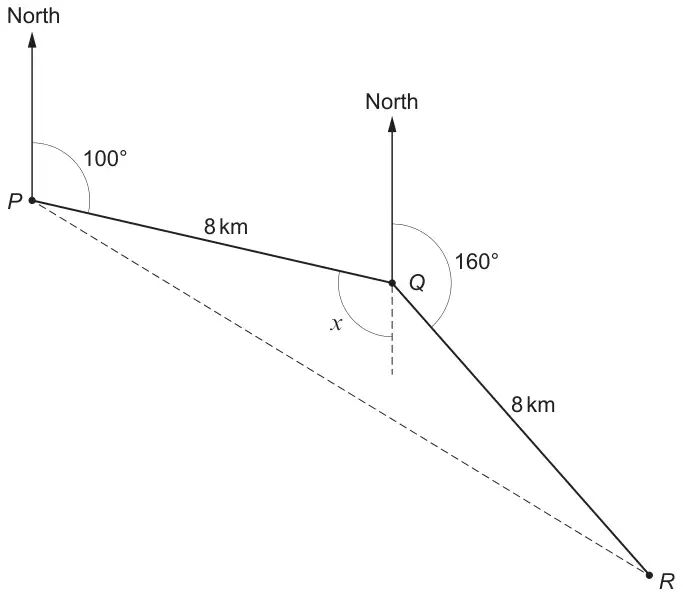
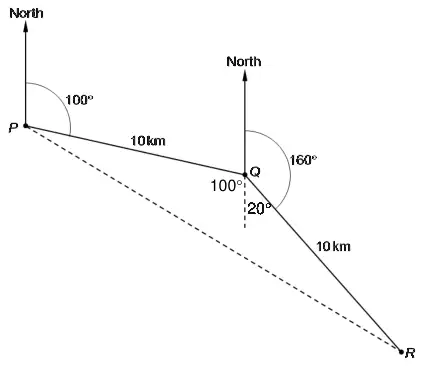
16. The diagram shows a ship’s journey from P to Q to R.
Diagram not drawn to scale
The ship travels on a bearing of 100° for 8 km from P to Q. It then travels on a bearing of 160° for 8 km from Q to R.
(a) Explain why the angle \(x\) is 100°. [1]
(b) Work out the bearing of R from P. Give a reason for each step of your answer. [4]
Mark scheme (a)
Scheme
Marks
Comments
Valid explanation e.g. ‘Alternate angles (between parallel lines)’
E1
Allow ‘Alt’ but not ‘Alternative’, not ‘Alternating’; ignore correct embellishments such as Z angles; do not ignore incorrect embellishments
E0 for e.g. ‘It is congruent to angle P’ without any justification
Mark scheme (b)
Scheme
Marks
Comments
Angles may be seen on the diagram; degrees symbol may be omitted
\(P\hat{Q}R\) = (100° + 20° =) 120° (Angles on a straight line (sum to 180))
B1
\(Q\hat{P}R\) = 30° (Base angles of an isosceles triangle (are equal))
B1
FT ‘their \(P\hat{Q}R\)’
(Bearing =) 130°
B1
At least one correct reason stated appropriately
E1
(5)
Corrected by Westie's Workshop
The board's mark scheme diagram shows “10 km” on both legs. It should say “8 km” because the question says each leg is 8 km. The lengths do not change the answer.
Original: see the board's mark scheme PDF (link above).
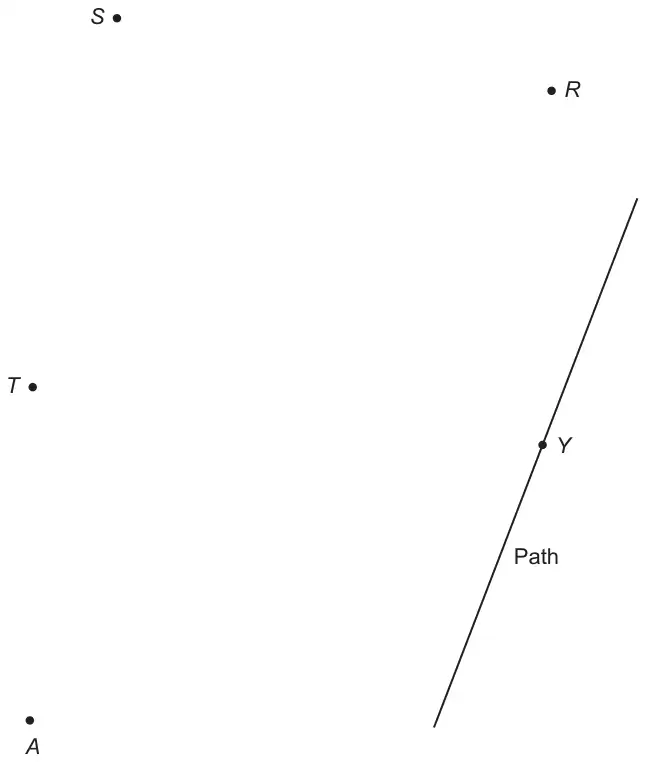
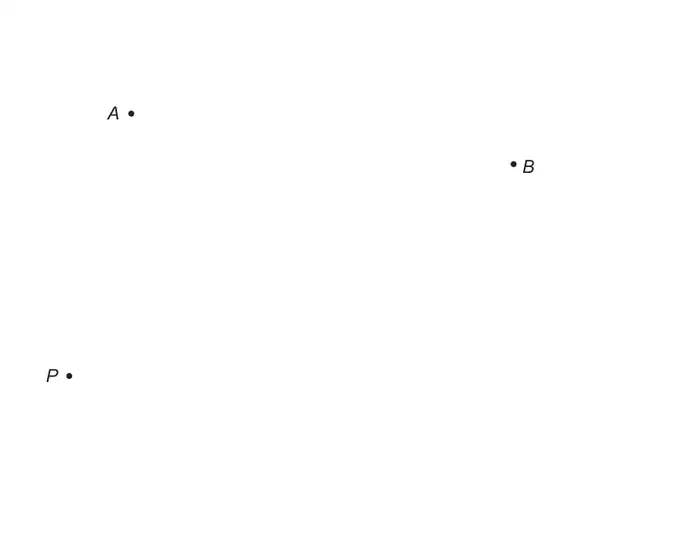
David is trying archery for the first time. He stands at A and tries to shoot an arrow at the target T but misses.
The arrow lands at a point X such that:
X is equidistant from S and R,
XY is perpendicular to the path.
Construct accurately the position of X and measure by how many degrees David’s shot is inaccurate. You must use a ruler and a pair of compasses to construct suitable arcs and lines. [5]
David’s shot is inaccurate by ……………… °
Mark scheme
Scheme
Marks
Comments
Correct perpendicular bisector construction of SR with appropriate arcs
B2
B1 for perpendicular bisector within tolerance (± 2°, ± 2mm) without arcs or with invalid arcs
Correct perpendicular to the path through Y with appropriate arcs
B2
B1 for perpendicular though Y within tolerance (± 2°) without arcs or with invalid arcs
Correct angle
B1
FT provided at least B1 B1 awarded tolerance (± 2°); if correct 34°, allow e.g. 034°
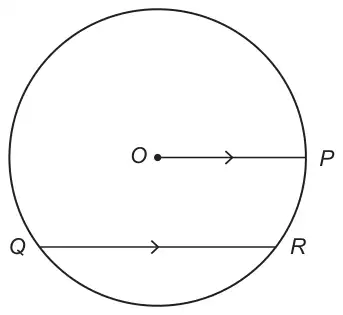
The diagram shows a circle with centre \(O\). \(P\), \(Q\) and \(R\) are points on the circle.
tangent
radius
area
chord
diameter
circumference
parallel
perpendicular
Choose words from the box to complete these sentences.
(i) Line \(OP\) is a ………………
(ii) Line \(QR\) is a ………………
(iii) Lines \(OP\) and \(QR\) are ……………… . [2]
(b)
\(ABC\) is a right-angled triangle in which:
\(AB\) = 8 cm,
angle \(A = 90^\circ\),
\(AC\) = 6·5 cm.
Complete an accurate drawing of triangle \(ABC\). \(AB\) has been drawn for you. [2]
On screen this diagram may not be shown at actual size. To measure it, use the question paper (PDF) printed at 100%.
Mark scheme (a)
Scheme
Marks
Comments
(i) Radius (ii) Chord (iii) Parallel
B2
B2 for all three correct B1 for any two correct
Mark scheme (b)
Scheme
Marks
Comments
Draws an accurate triangle, with angle BAC = 90° ± 2° and line AC = 6.5cm ± 0.2cm
B2
The triangle must be ‘closed’ to gain B2. Candidates are not expected to use compasses. Award B1 if one error, e.g. line or angle out of tolerance or BC not drawn.
12. The diagram shows the position of two points, A and B. The scale is 1 cm represents 1 km.
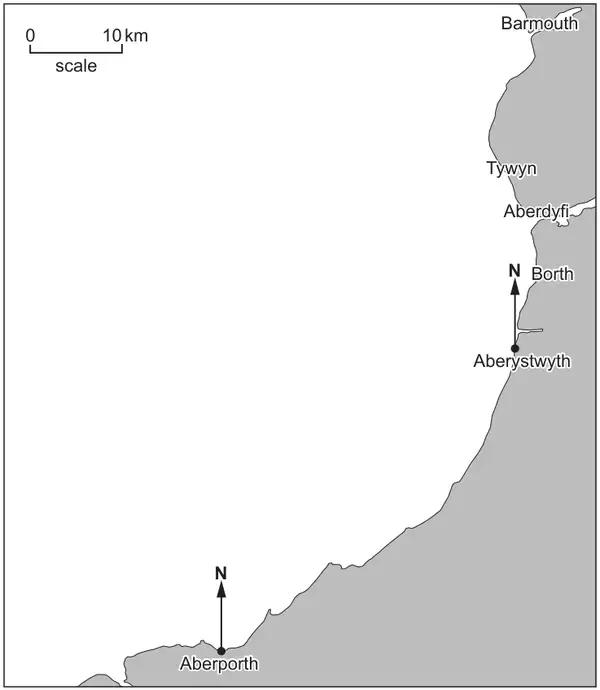
On screen this diagram may not be shown at actual size. To measure it, use the question paper (PDF) printed at 100%.
(a) Measure and write down the bearing of B from A. [1]
(b)
Point C is 5 km from A and 6 km from B. The bearing of C from B is an acute angle.
Complete the diagram to find the position of point C. [3]
Mark scheme (a)
Scheme
Marks
Comments
\(258^\circ \pm 2^\circ\)
B1
Mark scheme (b)
Scheme
Marks
Comments
Arc centre A radius 5 cm ± 2 mm
B1
Use overlay
Arc centre B radius 6 cm ± 2 mm
B1
If no arcs shown, but single point indicated as C, then allow either or both of the first 2 marks if it satisfies one or both criteria; may be below AB
If two points are drawn, each of which satisfies only one condition, then no marks
Position of C unambiguously identified
B1
FT ‘their 5 cm ± 2 mm from A’ OR ‘their 6 cm ± 2 mm from B’ provided at least B1 already awarded; must be above AB
The scale drawing shows the positions of a lighthouse (L), a port (P) and a harbour (H).
A boat (B) is at sea on a bearing of 135° from the lighthouse (L) and 064° from the port (P).
Mark the position of the boat on the drawing. [3]
On screen this diagram may not be shown at actual size. To measure it, use the question paper (PDF) printed at 100%.
Scale: 1 cm represents 10 km
(b)
(i)
In normal conditions, the boat uses 1 litre of fuel to travel 5 km.
Work out how many litres of fuel the boat will use to get to the harbour (H). The scale is 1 cm represents 10 km. [3]
(ii) State any assumption you have made in answering part (b)(i). How would your answer to part (b)(i) change if you did not make this assumption? [2]
Mark scheme (a)
Scheme
Marks
Comments
Indication of bearing 135° ± 2° from L
B1
Indication of bearing 064° ± 2° from P
B1
Position of the boat marked
B1
Position may be implied by intersection of straight lines for bearings
Mark scheme (b)
Scheme
Marks
Comments
(i) 6 × 10 ÷ 5
M2
Or equivalent full method
STRICT FT ‘their position of the boat’, so ‘their 6’ × 10 ÷ 5 Tolerance ± 2 mm
M1 for ‘their 6’ in cm × 10 or ‘their 6’ in mm × 10 ÷ 5
12 (litres)
A1
FT; must follow correct use of ‘their 6’ in cm
If there is no ‘position of the boat’ marked in (a) allow SC2 for ‘a number of litres’ correctly found from ‘a length in cm’ × 10 ÷ 5 or SC1 for ‘a length in cm’ × 10 ÷ 5
(ii) Valid assumption about the conditions or straight line of the journey e.g. ‘The conditions were normal so the boat travelled 5km per litre.’ or ‘The weather was normal.’ or ‘The sea was normal.’ or ‘The weather conditions were unusually good.’ or ‘The boat travelled in a straight line to H.’
E1
Valid impact based on their assumption e.g. ‘The boat would use more fuel.’ or ‘The boat would use less fuel.’ or ‘The amount of fuel used to travel 5 km would be different, so the total amount needed would be different.’
9. The scale diagram below shows a railway station P and two hilltops, A and B. Two new stations are to be built at R and S.
(a) Station R is to be
no more than 6 km from P and
the same distance away from A as it is from B.
Using a ruler and a pair of compasses, show accurately on the diagram all the positions where station R may be built.
Scale: 1 cm represents 1 km. [4]
On screen this diagram may not be shown at actual size. To measure it, use the question paper (PDF) printed at 100%.
(b) A train travelling between station R and station S will always be the same distance away from A as it is from B. When the train arrives at station S, it will be as near as possible to hilltop A.
Mark the position of station S on the diagram in part (a). [1]
Mark scheme (a)
Scheme
Marks
Comments
Arc, centre P, radius 6 cm
B1
Allow ±2mm
Correct perpendicular bisector of AB with appropriate arcs
B2
B1 for correct arcs
NB No arcs, no marks; if two full arcs used there must be daylight between the overlapping sections Tolerance ±2°
Correct line segment indicated
B1
FT provided at least the first B1 awarded and a perpendicular bisector attempted (may not have arcs)
Draw a hexagon that has exactly one line of symmetry on the grid below. [2]
(b)
The diagram accurately shows two lines \(AB\) and \(BC\). These lines are part of a quadrilateral, \(ABCD\). Point \(D\) is missing.
On screen this diagram may not be shown at actual size. To measure it, use the question paper (PDF) printed at 100%.
(i)
Use this information to complete the quadrilateral \(ABCD\): \(AD\) is parallel to \(BC\), Angle \(BCD = 60^\circ\), \(CD\) is the same length as \(AB\). [2]
(ii) Write down the name of the quadrilateral \(ABCD\). [1]
Mark scheme (a)
Scheme
Marks
Comments
Any six-sided closed shape with exactly one line of symmetry
B2
B1 for any hexagon, or for any shape with greater than 4 sides with exactly one line of symmetry
If more than one shape has been drawn and not all are hexagons, it must be clear which shape is the answer.
Mark scheme (b)
Scheme
Marks
Comments
(i) Shape completed correctly.
B2
Must be a closed shape for B2
B1 for angle BCD measuring 60° (±2°) or for side CD = 4 cm (±2mm). or for side AD parallel to BC.
(i) What is the bearing of Jamestown from Abbeyford? [1]
(ii) What is the bearing of Jamestown from Hillsridge? [1]
(b)
The actual distance between Abbeyford and Jamestown is 20 km. On the map the distance between Abbeyford and Jamestown is 8 cm. Work out the scale of the map.
Give your answer in the form 1 : ……………… [2]
Scale of map 1 : ………………
Mark scheme (a)
Scheme
Marks
Comments
(i) 062°
B1
Do not accept 62°
(ii) 288°
B1
Mark scheme (b)
Scheme
Marks
Comments
1 : 250 000
B2
Allow 1 : 250 000 cm B1 for 1 cm represents 2.5 km or 2500 m, OR 8cm represents 2 000 000cm, or equivalent, correct units must be given, or 8 : 2 000 000 or equivalent
Allow B1 for an answer of 1 : 2.5 km B0 for 1 : 2.5
(i) What is the bearing of Jamestown from Abbeyford? [1]
(ii) What is the bearing of Jamestown from Hillsridge? [1]
(b) The actual distance between Abbeyford and Jamestown is 20 km. On the map the distance between Abbeyford and Jamestown is 8 cm. Work out the scale of the map.
Give your answer in the form 1 : ……… [2]
Mark scheme (a)
Scheme
Marks
Comments
(i) 062°
B1
Do not accept 62°
(ii) 288°
B1
Mark scheme (b)
Scheme
Marks
Comments
1 : 250 000
B2
Allow 1 : 250 000 cm B1 for 1 cm represents 2.5 km or 2500 m, OR 8cm represents 2 000 000cm, or equivalent, correct units must be given, or 8 : 2 000 000 or equivalent
Allow B1 for an answer of 1 : 2.5 km B0 for 1 : 2.5
11. The diagram below shows two towns, A and B, on a map. The scale of the map is 1 cm represents 4·5 km.
On screen this diagram may not be shown at actual size. To measure it, use the question paper (PDF) printed at 100%.
(a) Find the straight-line distance from town A to town B. Give your answer in kilometres. [2]
The straight-line distance from A to B = ………………………… km
(b) Find the bearing of town A from town B. [1]
(c) On the map, shade the region containing all the points that are:
closer to town A than to town B, and
less than 27 km from town B. [4]
Mark scheme (a)
Scheme
Marks
Comments
43·2 ± 0·9 (km)
B2
Answer line takes precedence. Accept an answer 42·3 (km) to 44·1 (km) inclusive. If units are given, they must be correct for B2.
Award B1 for any one of the following:
4·5 × [9·6 ± 0·2] (km)
for correctly evaluating ‘their 9·6’ × 4·5 provided ‘their 9·6’ is between 9 and 10 exclusive.
Mark scheme (b)
Scheme
Marks
Comments
305(°) ± 2(°)
B1
Accept an answer between 303(°) to 307(°) inclusive.
Mark scheme (c)
Scheme
Marks
Comments
Use tolerances ± 2 mm
Perpendicular bisector of the line AB
B1
For B1, the bisector must be of sufficient length that crosses AB so as not to be considered a ‘point’ or a ‘notch’ i.e. at least 2 cm.
Arc of radius 6 cm from B
B2
For B2 or B1, the arc must be of sufficient length so as not to be considered a ‘point’ or a ‘notch’ i.e. for a sector of at least 10° at B.
Award B1 for the appropriate sight of one of the following:
6 (cm)
27 (km) ÷ 4·5
arc of radius 6 cm from A
arc of radius ‘their 27 (km) ÷ 4·5’ from B provided ‘their 27 (km) ÷ 4·5’ has been seen.
Correct region identified within the map
B1
Ignore shading outside map.
Strict FT for a suitable region bounded by a line crossing AB and an arc from either A or B but outside of tolerances and provided at least B1 previously awarded.
7. The scale drawing below shows a plan of a stage in a theatre. The stage measures 10 metres by 6 metres.
The scale used is 1 cm represents 1 metre.
An ‘X’ will be marked on the stage where a microphone is to be placed.
The ‘X’ must be:
equidistant from the front of the stage and the right wing
2 metres from the front of the stage.
Draw suitable lines on the plan and show where the ‘X’ will be marked. [3]
On screen this diagram may not be shown at actual size. To measure it, use the question paper (PDF) printed at 100%.
Mark scheme
Scheme
Marks
Comments
Unambiguous correct position of X
B3
X must be shown within the tolerance ± 2mm, ± 2°, not for the sight of the intersection of lines within tolerance ± 2mm or ± 2° or a dot
B2 for the any one of the following:
unambiguous intersection of 2 appropriate lines within tolerance ± 2mm or ± 2°, but the position of X is not indicated, e.g.
unambiguous angle bisector between front and right wing ± 2° AND unambiguous horizontal line 2cm ± 2mm from the front
a horizontal line 2cm ± 2mm from the front AND a vertical line 2cm ± 2mm from the right wing
a horizontal line 2cm ± 2mm from the front AND an intersecting arc radius 2cm± 2mm with centre on the right wing 2cm ± 2mm from the front
Position of X indicated with one line (seen or implied) within tolerance and the other line (seen or implied) very slightly out of tolerance (≈ ± 4mm, ≈ ± 4°)
B1 for appropriate sight of any one of the following:
unambiguous angle bisector between front and right wing ± 2°
unambiguous horizontal line 2cm ± 2mm from the front
unambiguous vertical line of length 2cm ± 2mm that is 2cm ± 2mm from the right wing
position of X indicated but both lines, seen or implied, slightly out of tolerance (≈ ± 4mm, ≈ ± 4°)
exactly two X positions marked, one X meeting both criteria and the other X meeting one criterion
B0 for the following:
X meeting one criterion but no suitable line indicated
a vertical line of length 2cm from the front but not 2cm from the right, with X meeting one criterion
FT 466 – ‘their stated or derived 125.40’ – ‘their stated or derived 97.5(0)’ – ‘their stated or derived 72’ provided at least B1 previously awarded and not using the given values alone May be seen in stages
(£)171.1(0)
A1
(Each adult: 171.10 ÷ 2 =) (£)85.55
B1
FT ‘their 171.1(0)’ ÷ 2 correctly evaluated
Alternative
The alternative methods are printed in italics in the mark scheme.
Alternative method 1 (children 1st)
Scheme
Mark
Comments
May be implied within further working
(Cost of children’s travel: 3 × 41.80 =) (£)125.4(0)
B1
(Cost of children’s entry to London eye: 3 × 32.50=) (£)97.5(0)
FT 466 – ‘their stated or derived 125.40’ – ‘their stated or derived 97.5(0)’ – ‘their stated or derived 72’ provided at least B1 previously awarded and not using the given values
(£)171.1(0)
A1
CAO
(Each adult: 171.10 ÷ 2 =) (£)85.55
B1
FT ‘their 171.1(0)’ ÷ 2 correctly evaluated
Scheme
Mark
Comments
Organisation and communication
OC1
For OC1, candidates will be expected to: • present their response in a structured way • explain to the reader what they are doing at each step of their response • lay out their explanations and working in a way that is clear and logical • write a conclusion that draws together their results and explains what their answer means
Writing
W1
For W1, candidates will be expected to: • show all their working • make few, if any, errors in spelling, punctuation and grammar • use correct mathematical form in their working • use appropriate terminology, units, etc.
Mark scheme (b)
Scheme
Mark
Comments
9(cm) (±2mm)
B1
(8.8 (cm) to 9.2(cm))
9 × 15
M1
FT ‘their height (9)’ Ignore any attempt to change units if 9 × 15 seen
Award B1 M1 A0 for example: 9 × 15 = 135 then 135 × 100 = 13500 (cm)
135 (metres)
A1
Measurements of: 8.8 cm gives 132 m 8.9 cm gives 133.5 m 9 cm gives 135 m 9.1 cm gives 136.5 m 9.2 cm gives 138 m
Only award B1M1A1 for an unsupported correct answer
3. The pictogram shows information about the number of houses that are for sale on a new housing estate.
(a)
(i) How many 4-bedroom houses are there for sale on the new housing estate? [1]
(ii) Calculate the total number of bedrooms in all the 3-bedroom houses for sale on the estate. [2]
(b)
The selling price of each type of house is given below.
Type of house
Selling price
2-bedroom house
£145 000
3-bedroom house
£179 000
4-bedroom house
£226 000
(i) All the houses were sold at the selling prices shown in the table above. Calculate the total amount of money paid for all the houses on the housing estate. [3]
(ii) What is the range of the selling prices of these houses? [1]
(c)
The diagram below shows the ground-floor plan of a 3-bedroom house.
Diagram not drawn to scale
(i) What is the total area of the ground floor of the 3-bedroom house? Give your answer in square feet. [3]
Total area = …………… square feet
(ii) On the 1 cm grid below, make an accurate scale drawing of the ground-floor plan of the 3-bedroom house. Use a scale of 1 cm to represent 2 feet. [3]
Mark scheme (a)
Scheme
Mark
Comments
(i) 5
B1
(ii) 33
B2
Look at pictogram Award B1 for any one of the following
FT ‘their number of houses’ in (a)(i) and number of houses used or ‘their 33’ ÷ 3 which can be rounded or truncated in (a)(ii)
Award M1 for any one of the following:
sight of the sum of any 2 correct products
sight of the 3 products but not added
3.5×145000 + 5.5×179000 + 2.5×226000
sight of 2 of 1015000, 1969000 or 1130000 but not added
(£)4114000 or (£)4.114 million
A1
CAO If 4114000 seen but further working completed, award M2A0
(ii) (226000 – 145000=) (£)81000
B1
Do not allow -81000 Do not accept 145000 to 226000
Mark scheme (c)
Scheme
Mark
Comments
(i) Using the 3 given rectangles: 8 × 14 + 4 × (18 + 4) + 12 × 18 or (8 × 14) + (4 × 22) + (12 × 18) (112 + 88 + 216)
OR
Using a rectangle with the whole width of the plan of the house with 2 smaller rectangles: 14 × (8 + 4 + 12) + 4 × (18 – 14 + 4) + 12 × (18 – 14) or (14 × 24) + (4 × 8) + (12 × 4) (336 + 32 + 48)
OR Using a large rectangle and subtracting 2 smaller rectangles: (8 + 4 + 12) × (18 + 4) – 4 × 12 – 8 × (18 – 14 + 4) or (24 × 22) – (4 × 12) – (8 × 8) (528 – 48 – 64)
or equivalent
M2
Check diagram Award M1 for any one of the following:
sight of the sum of any 2 correct products
sight of the 3 correct products 8 × 14 and 4 × (18 + 4) and 12 × 18 (but not added)
sight of any 2 of 112, 88 or 216
sight of the 3 correct products 14 × 24 and 4 × 8 and 12 × 4 (but not added)
sight of any 2 of 336, 32 or 48
sight of 14 × 24 + 4 × 8 (May be embedded)
sight of 14 × 24 + 12 × 4 (May be embedded)
sight of the 3 correct products 24 × 22 and 4 × 12 and 8 × 8
sight of any 2 of 528, 48 or 64
sight of 24 × 22 – 4 × 12 (May be embedded)
sight of 24 × 22 – 8 × 8 (May be embedded)
416 (square feet)
A1
CAO Answer line takes precedence
(ii) Correct diagram drawn
B3
Use of overlay Mark intention For B3 the diagram can be in any orientation, but the rooms must be defined but ignore any other interior lines within rooms such as a line drawn at the bottom of the hall across from the kitchen diner
Award B2 for any one of the following:
2 of the 3 rooms drawn accurately
2 or 3 of the rooms drawn accurately but using a different floor plan with each room in any orientation and not necessarily joined
A correct perimeter of the ground floor without some or all of the separate rooms shown
Award B1 for any one of the following:
1 room drawn accurately in any orientation
3 rooms drawn with correct widths, but lengths have a consistent error (e.g. all being 1 square less in length)
3 rooms drawn with correct lengths, but widths have a consistent error (e.g. all being 1 square less in width)
A perimeter of the ground floor without the separate rooms shown with at most 2 errors
1. The scale drawing below shows a plan of a stage in a theatre. The stage measures 10 metres by 6 metres.
The scale used is 1 cm represents 1 metre.
An ‘X’ will be marked on the stage where a microphone is to be placed.
The ‘X’ must be:
equidistant from the front of the stage and the right wing
2 metres from the front of the stage.
Draw suitable lines on the plan and show where the ‘X’ will be marked. [3]
Scale: 1 cm represents 1 metre
On screen this diagram may not be shown at actual size. To measure it, use the question paper (PDF) printed at 100%.
Mark scheme
Scheme
Marks
Comments
Unambiguous correct position of X
B3
X must be shown within the tolerance ± 2mm, ± 2°, not for the sight of the intersection of lines within tolerance ± 2mm or ± 2° or a dot
B2 for the any one of the following:
unambiguous intersection of 2 appropriate lines within tolerance ± 2mm or ± 2°, but the position of X is not indicated, e.g.
unambiguous angle bisector between front and right wing ± 2° AND unambiguous horizontal line 2cm ± 2mm from the front
a horizontal line 2cm ± 2mm from the front AND a vertical line 2cm ± 2mm from the right wing
a horizontal line 2cm ± 2mm from the front AND an intersecting arc radius 2cm± 2mm with centre on the right wing 2cm ± 2mm from the front
Position of X indicated with one line (seen or implied) within tolerance and the other line (seen or implied) very slightly out of tolerance (≈ ± 4mm, ≈ ± 4°)
B1 for appropriate sight of any one of the following:
unambiguous angle bisector between front and right wing ± 2°
unambiguous horizontal line 2cm ± 2mm from the front
unambiguous vertical line of length 2cm ± 2mm that is 2cm ± 2mm from the right wing
position of X indicated but both lines, seen or implied, slightly out of tolerance (≈ ± 4mm, ≈ ± 4°)
exactly two X positions marked, one X meeting both criteria and the other X meeting one criterion
B0 for the following:
X meeting one criterion but no suitable line indicated
a vertical line of length 2cm from the front but not 2cm from the right, with X meeting one criterion
1. The diagram below shows two towns, \(A\) and \(B\), on a map. The scale of the map is 1 cm represents 4·5 km.
On screen this diagram may not be shown at actual size. To measure it, use the question paper (PDF) printed at 100%.
On the map, shade the region containing all the points that are:
closer to town \(A\) than to town \(B\), and
less than 27 km from town \(B\).
[4]
Mark scheme
Scheme
Marks
Comments
Use tolerances ± 2 mm
Perpendicular bisector of the line \(AB\)
B1
For B1, the bisector must be of sufficient length that crosses \(AB\) so as not to be considered a ‘point’ or a ‘notch’ i.e. at least 2 cm.
Arc of radius 6 cm from \(B\)
B2
For B2 or B1, the arc must be of sufficient length so as not to be considered a ‘point’ or a ‘notch’ i.e. for a sector of at least 10° at B.
Award B1 for the appropriate sight of one of the following:
6 (cm)
27 (km) ÷ 4·5
arc of radius 6 cm from \(A\)
arc of radius ‘their 27 (km) ÷ 4·5’ from \(B\) provided ‘their 27 (km) ÷ 4·5’ has been seen.
Correct region identified within the map
B1
Ignore shading outside map.
Strict FT for a suitable region bounded by a line crossing \(AB\) and an arc from either \(A\) or \(B\) but outside of tolerances and provided at least B1 previously awarded.
15. Line AB is drawn below. Point C lies below the line AB. The region in which point C is located is such that:
\(A\hat{B}C \leqslant 30^\circ\)
line BC \(\leqslant\) 5 cm.
Use a ruler and a pair of compasses to construct suitable arcs and lines to show this region. You must show your construction arcs. Shade the region in which point C is located. [4]
On screen this diagram may not be shown at actual size. To measure it, use the question paper (PDF) printed at 100%.
Mark scheme
Scheme
Marks
Comments
Allow a tolerance of ± 2° and ± 2 mm. The construction need not be below the line for the B2 and the first B1 (but the final B1 won’t be awarded).
Correct bisector of 60°
B2
Allow at A or B. Correct construction arcs (initial and secondary) must be seen or an alternative valid method. The angle must be formed for the bisector and the line must reach the intersection of the arcs.
Award B1 for one of the following:
correct construction of 60° at A or B. The initial and secondary construction arcs must be seen but line forming the angle may not need to be seen (depending on method)
correct bisector of ‘their acute angle’ at A or B. The initial and secondary construction arcs and bisector line must be seen and reach the intersection of the arcs.
Arc of radius 5 cm, centre B.
B1
For B1, the arc must be of sufficient length so as not to be considered a ‘point’ or a ‘notch’ i.e. for a sector of at least 10° at B.
6. Line \(AB\) is drawn below. Point \(C\) lies below the line \(AB\). The region in which point \(C\) is located is such that:
\(A\hat{B}C \leqslant 30^\circ\)
line \(BC \leqslant 5\) cm.
Use a ruler and a pair of compasses to construct suitable arcs and lines to show this region. You must show your construction arcs. Shade the region in which point \(C\) is located. [4]
On screen this diagram may not be shown at actual size. To measure it, use the question paper (PDF) printed at 100%.
Mark scheme
Scheme
Marks
Comments
Allow a tolerance of ± 2° and ± 2 mm. The construction need not be below the line for the B2 and the first B1 (but the final B1 won’t be awarded).
Correct bisector of 60°
B2
Allow at A or B. Correct construction arcs (initial and secondary) must be seen or an alternative valid method. The angle must be formed for the bisector and the line must reach the intersection of the arcs.
Award B1 for one of the following:
correct construction of 60° at A or B. The initial and secondary construction arcs must be seen but line forming the angle may not need to be seen (depending on method)
correct bisector of ‘their acute angle’ at A or B. The initial and secondary construction arcs and bisector line must be seen and reach the intersection of the arcs.
Arc of radius 5 cm, centre B.
B1
For B1, the arc must be of sufficient length so as not to be considered a ‘point’ or a ‘notch’ i.e. for a sector of at least 10° at B.
The map below shows part of the coastline and some islands off the coast of Gwynedd.
On screen this diagram may not be shown at actual size. To measure it, use the question paper (PDF) printed at 100%.
(i) Write down the bearing of Aberdaron from Bardsey Island lighthouse. [1]
…………… °
(ii) Write down the bearing of Bardsey Island lighthouse from Ynys Gwylan-bach. [1]
…………… °
(iii) Huw can see Bardsey Island lighthouse from Ynys Gwylan-bach. How far is the lighthouse from Ynys Gwylan-bach? Give your answer in kilometres. You must show all your working. [2]
(b)
The candela and the lumen are units that can be used to measure light intensity.
Below is a conversion graph. You can use this graph to make approximate conversions between candelas and lumens for a particular type of light.
For this type of light, complete each of the following statements.
(i) 1·15 candelas is approximately equal to …………… lumens. [1]
(ii) 13·5 lumens is approximately equal to …………… candelas. [1]
(c)
The light from Bardsey Island lighthouse has an intensity of approximately 52 000 candelas. The light from Strumble Head lighthouse in Pembrokeshire has an intensity of approximately 1 000 000 candelas.
By estimating, complete the following statement. You must show all your working. [2]
‘The light from Strumble Head lighthouse is approximately …………… times as intense as the light from Bardsey Island lighthouse.’
Mark scheme (a)
Scheme
Marks
Comments
(i) 045(°) (± 3°)
B1
Do not accept 45(°) (± 3°)
(ii) 243(°) (± 3°)
B1
(iii) An unambiguous answer of 8 (km) or an answer in the range 7.68 (km) to 8.32 (km)
B2
This must be an unambiguous answer, do not award if another distance is also given as a final answer, e.g.
5 miles = 8 km final answer 7 km
5 miles = 8 km with final answer 8 ÷ 5 = 1.6
B1 for any one of the following:
(5 cm =) 5 miles = 8 km with a further incorrect calculation or distance
5 (± 0.2) × 1.6
5 (± 0.2) × 8 ÷ 5
5 (± 0.2) × 1.609
5 (± 0.2) × 1.61
B0 for 5 (± 0.2) × 1.5
Mark scheme (b)
Scheme
Marks
Comments
(i) Answer in the inclusive range 14.45 (lumens) to 14.5 (lumens)
B1
(ii) Answer in the inclusive range 1.07 (candelas) to 1.075 (candelas)
B1
Mark scheme (c)
Scheme
Marks
Comments
Any value in the range 19 to 20
B2
Accept from reverse working Answer space takes precedence, if blank allow an unambiguous embedded answer in the range
B1 for sight of unambiguous appropriate working, e.g. any of the following examples or similar:
Magic Johnson is one of the greatest basketball players of all time.
He first played for the LA Lakers in 1979.
His height is 206 cm.
His salary in 1989 was $3 142 000.
(i) How many years ago did Magic Johnson first play for the LA Lakers? [1]
(ii) What is Magic Johnson’s height in metres? [1]
(iii) Write his salary of $3 142 000 in words. [1]
(b)
Which of the following is the best description for the shape of a basketball? Circle your answer. [1]
Sphere Cylinder Cuboid Cone Cube
(c)
A local basketball club trains on a basketball court each week.
The basketball court is rectangular.
The diagram below is a scale drawing of the basketball court.
On screen this diagram may not be shown at actual size. To measure it, use the question paper (PDF) printed at 100%.
The actual length of the basketball court is 28 metres. Use the scale drawing to find the actual width of the basketball court. [3]
Actual width of the basketball court is …………… metres
(d)
The diagram below represents the positions of three players on a basketball court.
Diagram not drawn to scale
(i)
Bryn faces Alex. Bryn then turns clockwise to face Charlie.
Charlie thinks that Bryn has turned through an acute angle. Do you agree? Give a reason for your answer. [1]
Yes ☐ No ☐
(ii)
In the space below, complete an accurate scale drawing to show Charlie’s position.
The positions of Alex and Bryn are shown.
Use the scale: 1 cm represents 0·5 m. [2]
Mark scheme (a)
Scheme
Marks
Comments
(i) 45 (years)
B1
(ii) 2.06 (metres)
B1
Do not accept 2m 6cm
(iii) three million (and) one hundred (and) forty-two thousand (dollars)
B1
Ignore spelling and the units given
Mark scheme (b)
Scheme
Marks
Comments
Sphere
B1
Mark scheme (c)
Scheme
Marks
Comments
15 (metres)
B3
Answer space takes precedence Answers and/or workings may be seen on the diagram
For B3, allow answers in the inclusive range 14.4 (metres) to 15.6 (metres)
Award B2 for any one of the following:
Scale factor of 2
Scale factor of ½
(×) 2
(×) 200
(28 ÷ 14 =) 2
28 ÷ 2 = 14 (embedded scale factor of 2)
14 × 2 = 28 (embedded scale factor of 2)
Implied scale factor of 2 e.g. double ‘their 7.5’
1(cm) is 2(m) or equivalent
Do not award B2 if 28 × 2 = 56 alone is seen as this does not indicate a scale factor of 2
Award B1 for any one of the following:
One correct measurement seen or implied.
7.5 (cm) ± 2 mm
14 (cm) ± 2 mm
Allow 7.5 m
Allow 14 m
Mark scheme (d)
Scheme
Marks
Comments
(i) No and a valid reason e.g. ‘No, because the angle is more than 90(˚)’ ‘No, as the angle is bigger than a right angle’ No, acute is less than 90 (˚)’ ‘No, angle is obtuse’ ‘No, it’s obtuse’
E1
Reasons may be indicated on the diagram.
Allow 'No, angle is too big to be an acute angle' 'No, angle is larger than an acute angle' No, angle is greater than an acute angle' ‘No, an acute angle is smaller’,
Do not allow ‘No, because an acute angle is 70(˚)’ ‘No, because it’s not an acute angle’ ‘No because an acute angle is not 157’
The map below shows part of the coastline and some islands off the coast of Gwynedd.
On screen this diagram may not be shown at actual size. To measure it, use the question paper (PDF) printed at 100%.
(i) Write down the bearing of Aberdaron from Bardsey Island lighthouse. [1]
…………… °
(ii) Write down the bearing of Bardsey Island lighthouse from Ynys Gwylan-bach. [1]
…………… °
(iii) Huw can see Bardsey Island lighthouse from Ynys Gwylan-bach. How far is the lighthouse from Ynys Gwylan-bach? Give your answer in kilometres. You must show all your working. [2]
(b)
The candela and the lumen are units that can be used to measure light intensity.
Below is a conversion graph. You can use this graph to make approximate conversions between candelas and lumens for a particular type of light.
For this type of light, complete each of the following statements.
(i) 1·15 candelas is approximately equal to …………… lumens. [1]
(ii) 13·5 lumens is approximately equal to …………… candelas. [1]
(c)
The light from Bardsey Island lighthouse has an intensity of approximately 52 000 candelas. The light from Strumble Head lighthouse in Pembrokeshire has an intensity of approximately 1 000 000 candelas.
By estimating, complete the following statement. You must show all your working. [2]
‘The light from Strumble Head lighthouse is approximately …………… times as intense as the light from Bardsey Island lighthouse.’
Mark scheme (a)
Scheme
Marks
Comments
(i) 045(°) (± 3°)
B1
Do not accept 45(°) (± 3°)
(ii) 243(°) (± 3°)
B1
(iii) An unambiguous answer of 8 (km) or an answer in the range 7.68 (km) to 8.32 (km)
B2
This must be an unambiguous answer, do not award if another distance is also given as a final answer, e.g.
5 miles = 8 km final answer 7 km
5 miles = 8 km with final answer 8 ÷ 5 = 1.6
B1 for any one of the following:
(5 cm =) 5 miles = 8 km with a further incorrect calculation or distance
5 (± 0.2) × 1.6
5 (± 0.2) × 8 ÷ 5
5 (± 0.2) × 1.609
5 (± 0.2) × 1.61
B0 for 5 (± 0.2) × 1.5
Mark scheme (b)
Scheme
Marks
Comments
(i) Answer in the inclusive range 14.45 (lumens) to 14.5 (lumens)
B1
(ii) Answer in the inclusive range 1.07 (candelas) to 1.075 (candelas)
B1
Mark scheme (c)
Scheme
Marks
Comments
Any value in the range 19 to 20
B2
Accept from reverse working Answer space takes precedence, if blank allow an unambiguous embedded answer in the range
B1 for sight of unambiguous appropriate working, e.g. any of the following examples or similar:
Using only a ruler and a pair of compasses, construct suitable lines and arcs to show the position of point P.
Construction arcs must be clearly shown. [3]
Mark scheme
Scheme
Marks
Comments
Correct construction of bisector of angle ABC
B1
Correct construction arcs (initial and secondary) and a line joining B to the point of intersection of the arcs must be seen or an alternative valid method.
Correct construction of perpendicular bisector of BC
B1
Two correct pairs of intersecting construction arcs and a line joining both of these points of intersection must be seen.
Correct position of point P
B1
CAO. Award B1 for the correct point of intersection and not labelled P, provided no other incorrect points are indicated. (May be awarded from previous B0B0.)
On Monday, Siôn sold three times as many ice creams as cold drinks. He sold 50 cold drinks on Monday. Siôn sells ice creams for £1.80 each.
Calculate the amount of money Siôn took from selling ice creams on Monday. [4]
(b)
Siôn keeps ice cream in a freezer in his van. Every hour he checks the temperature in his freezer. He turns on his freezer at 8 a.m. The readings he takes from 8 a.m. to 3 p.m. are listed below.
10°C 2°C –5°C –12°C –12°C –12°C –13°C –14°C
(i) Calculate the mean of these temperatures. [3]
(ii) At 4 p.m. the temperature in Siôn’s freezer was recorded as –16°C. Calculate the mean of the temperatures recorded in Siôn’s freezer from 8 a.m. to 4 p.m. [2]
(c)
Siôn parks his ice cream van on the beach, as shown on the map below.
Scale: 1 cm represents 20 metres
On screen this diagram may not be shown at actual size. To measure it, use the question paper (PDF) printed at 100%.
(i)
How far is Siôn’s ice cream van from the lifeguard station? [2]
…………… metres
(ii)
Complete the following statement.
‘The bearing of the lifeguard station from Siôn’s ice cream van is ……………°.’ [1]
Mark scheme (a)
Scheme
Marks
Comments
50 × 3 × 1.8(0) or 50 × 3 × 180
M2
M1 for any of the following:
50 × 3
50 × 1.8(0)
50 × 180
3 × 1.8(0)
3 × 180
(£) 270 or 27000(p)
A2
For A2, if units are given, they must be correct, otherwise A1 for 270p or £27000
Ignoring units, A1 for any of the following:
(50 × 3 =) 150
(50 × 1.8(0) =) 90
(50 × 180 =) 9000
(3 × 1.8(0) =) 5.4(0)
(3 × 180 =) 540
Mark scheme (b)
Scheme
Marks
Comments
(i) (Mean of 8 temperatures is -56 ÷ 8 =) -7 (°C)
B3
Must not be from incorrect working, other than allowing from 56 ÷ 8
B2 for any one of the following:
-56 ÷ 8
56 ÷ 8 = 7
B1 for any one of the following:
(sum of temperatures) -56
(sum of temperatures) 56
sight of ‘their sum of temperatures’ ÷ 8, provided the summation is not from a sum involving all positive integers or all negative integers, with or without a negative sign inserted. If ‘÷ 8’ is not seen, it may be implied from ‘their sum’ and ‘their mean’ (rounded or truncated)
(ii) (-56 + -16) ÷ 9 or -72 ÷ 9
M1
FT ‘their -56’ from (b)(i)
-8 (°C)
A1
On FT allow a rounded or truncated answer Allow a correctly rounded or truncated answer, to 1d.p. for ‘(‘their -56’ + -16) ÷ 9’ to imply M1 A1
Mark scheme (c)
Scheme
Marks
Comments
(i) 20 × (8.6 (± 0.2))
M1
172 (± 4 m)
A1
Do not award from sight of an incorrect evaluation of ‘their 8.6’ × 20
(a) Josif produces a scale drawing to show where he wants a tree planted in his garden.
Scale: 1 cm represents 0·5 m
On screen this diagram may not be shown at actual size. To measure it, use the question paper (PDF) printed at 100%.
He writes out instructions to show where the tree is to be planted.
Which two of the following instructions describe where the tree is to be planted?
A. The tree must be 2 m from the hedge. B. The tree must be 1 m from the hedge. C. The tree must be 6 m from the hedge. D. The tree must be 3 m from the hedge. E. The tree must be 1 m from the wall.
F. The tree must be equidistant from the hedge and the fence. G. The tree must be equidistant from the hedge and the wall. H. The tree must be equidistant from the wall and the house. I. The tree must be equidistant from the hedge and the house. J. The tree must be equidistant from the wall and the fence. [2]
The two instructions are …………… and ……………
(b) A garden centre buys trees from a grower for £30 each. The garden centre sells the trees for £42 each.
(i) Calculate the percentage profit the garden centre makes from buying and selling one tree. [2]
(ii) The garden centre buys 10 of these trees to sell. One of the trees gets damaged and cannot be sold. The other 9 trees are sold.
Calculate the overall percentage profit or loss the garden centre makes from selling these trees. You must state whether your answer is a profit or a loss. You must show all your working. [4]
(iii) Of the 10 trees bought by the garden centre, what is the minimum number that need to be sold to ensure that the garden centre makes a profit? Circle your answer. [1]
20% of £30 is 30 ÷ 5 = £6, with either 6 × 2 = (£)12 or 6 × 7 = (£)42
10% of £30 is 30 ÷ 10 = £3, with either 3 × 4 = (£)12 or 3 × 14 = (£)42
40 (%)
A1
Allow an answer of £40 from correct working
If no marks, award SC1 for an answer of 140(%)
(ii) (Percentage profit is) \(\dfrac{9 \times 42-10 \times 30}{10 \times 30}\) (× 100) or \(\dfrac{9 \times 12-30}{10 \times 30}\) (× 100) or \(\dfrac{9 \times 42}{10 \times 30}\) (× 100) – 1 (× 100) or \(\dfrac{378}{300}\) (× 100) – 1 (× 100) or 1.26 (× 100) – 1 (× 100) or equivalent
M2
Allow a reverse method of finding percentages of 300 used, these percentages must be correct and when added (or subtracted) could lead to an answer of 26% e.g. (2 × 10% =) 20% of 300 is 60 and 6% of 300 is 18
M1 for any one of the following:
(difference between sales and costs) 9 × 42 – 10 × 30 (= 378 – 300)
(sales) (£) 378 AND (cost) (£) 300
(difference between sales and costs) (£) 78
26 (%) AND states ‘profit’
A2
Mark final answer A1 for any one of the following:
26(%)
\(\dfrac{78}{300}\) (× 100) or equivalent
\(\dfrac{378}{300}\) × 100 = 126 (%)
\(\dfrac{378}{300}\) = 1.26
\(\dfrac{(\text{‘their }9{\times}42\text{’} - 10 \times 30)}{10 \times 30}\) × 100 correctly evaluated and given as a percentage, allow if an error in the decimal part of their answer
On Monday, Siôn sold three times as many ice creams as cold drinks. He sold 50 cold drinks on Monday. Siôn sells ice creams for £1.80 each.
Calculate the amount of money Siôn took from selling ice creams on Monday. [4]
(b) Siôn keeps ice cream in a freezer in his van. Every hour he checks the temperature in his freezer. He turns on his freezer at 8 a.m. The readings he takes from 8 a.m. to 3 p.m. are listed below.
10°C 2°C –5°C –12°C –12°C –12°C –13°C –14°C
(i) Calculate the mean of these temperatures. [3]
(ii) At 4 p.m. the temperature in Siôn’s freezer was recorded as –16°C. Calculate the mean of the temperatures recorded in Siôn’s freezer from 8 a.m. to 4 p.m. [2]
(c) Siôn parks his ice cream van on the beach, as shown on the map below.
Scale: 1 cm represents 20 metres
On screen this diagram may not be shown at actual size. To measure it, use the question paper (PDF) printed at 100%.
(i) How far is Siôn’s ice cream van from the lifeguard station? [2]
…………… metres
(ii) Complete the following statement.
‘The bearing of the lifeguard station from Siôn’s ice cream van is ……………°.’ [1]
Mark scheme (a)
Scheme
Marks
Comments
50 × 3 × 1.8(0) or 50 × 3 × 180
M2
M1 for any of the following:
50 × 3
50 × 1.8(0)
50 × 180
3 × 1.8(0)
3 × 180
(£) 270 or 27000(p)
A2
For A2, if units are given, they must be correct, otherwise A1 for 270p or £27000
Ignoring units, A1 for any of the following:
(50 × 3 =) 150
(50 × 1.8(0) =) 90
(50 × 180 =) 9000
(3 × 1.8(0) =) 5.4(0)
(3 × 180 =) 540
Mark scheme (b)
Scheme
Marks
Comments
(i) (Mean of 8 temperatures is -56 ÷ 8 =) -7 (°C)
B3
Must not be from incorrect working, other than allowing from 56 ÷ 8
B2 for any one of the following:
-56 ÷ 8
56 ÷ 8 = 7
B1 for any one of the following:
(sum of temperatures) -56
(sum of temperatures) 56
sight of ‘their sum of temperatures’ ÷ 8, provided the summation is not from a sum involving all positive integers or all negative integers, with or without a negative sign inserted. If ‘÷ 8’ is not seen, it may be implied from ‘their sum’ and ‘their mean’ (rounded or truncated)
(ii) (-56 + -16) ÷ 9 or -72 ÷ 9
M1
FT ‘their -56’ from (b)(i)
-8 (°C)
A1
On FT allow a rounded or truncated answer Allow a correctly rounded or truncated answer, to 1d.p. for ‘(‘their -56’ + -16) ÷ 9’ to imply M1 A1
Mark scheme (c)
Scheme
Marks
Comments
(i) 20 × (8.6 (± 0.2))
M1
172 (± 4 m)
A1
Do not award from sight of an incorrect evaluation of ‘their 8.6’ × 20
In this part of the question, you will be assessed on the quality of your organisation, communication and accuracy in writing.
Mari is buying a new mobile phone. She sees two deals for the same phone, as shown below.
DEAL A PAY £19.99 NOW and then £28.99 a month for 24 months
DEAL B PAY £100 NOW and then £24.36 a month for 24 months
Which deal is the cheaper for Mari over 24 months? How much cheaper is this deal? You must show all your working. [5 + 2 OCW]
(b)
The screen size of a mobile phone is given as the length of the diagonal of the screen.
Mari is trying to find the screen size of the new phone. This phone has a rectangular screen with height 12·8 cm and width 6·3 cm. Mari has started to draw an accurate diagram below. She has drawn a line for the width of the phone.
Complete the diagram to find the screen size. Give your answer in cm, correct to 1 decimal place. [3]
On screen this diagram may not be shown at actual size. To measure it, use the question paper (PDF) printed at 100%.
Screen size of the new phone (correct to 1 decimal place) = …………… cm
Mark scheme (a)
Scheme
Mark
Comments
(Deal A = ) (£)19.99 + (£)28.99 × 24 AND (Deal B = ) (£)100(.00) + (£)24.36 × 24
M3
Award M2 for any one of the following
(Deal A = ) (£)19.99 + 28.99 × 24
(Deal B = ) (£)100(.00) + 24.36 × 24
Award M1 for any one of the following:
Sight of (£)28.99 × 24 or (£)695.76
Sight of (£)24.36 × 24 or (£)584.64
Sight of (£)1175.52 (BIDMAS error Deal A)
Sight of (£)2984.64 (BIDMAS error Deal B)
(Deal A = ) (£)715.75 AND (Deal B = ) (£)684.64
A1
CAO
If M0A0 awarded, award SC1 for any one of the following: (19.99 + 29 × 24=) (£)715.99 (20 + 28.99 × 24=) (£)715.76 (20 + 29 × 24=) (£)716 (100 + 24.4(0 )× 24=) (£)685.6(0) (100 + 24 × 24=) (£)676
Deal B (is cheaper by) AND (£)31.11
B1
FT the difference between ‘their derived Deal A’ and ‘their derived Deal B’ with ‘their cheaper’ deal stated provided at least one mark previously awarded. Note: For use of 12 months instead of 24 months award: SC1 for sight of (19.99 + 28.99 x 12 =) (£)367.87 SC1 for sight of (100 + 24.36 x 12 =) (£)392.32. B1 for the correct conclusion with the correct difference on follow-through (Deal A AND (£)24.45) provided at least one mark awarded.
Alternative
4(a) Alternative method for difference(printed in italics in the mark scheme)
Scheme
Mark
Comments
(Monthly payments difference =) [(£)28.99-(£)24.36] × 24 or equivalent
M1
(695.76 – 584.64)
(Deal B cheaper by = ) (£)111.12
A1
(One off payments difference=) (£)100(.00) - (£)19.99
M1
(Deal A is cheaper by = ) (£)80.01
A1
If M0A0 M0A0 awarded, award SC1 for any one of the following: (£) 31.35 from (29 – 24.36) × 24 - (100 – 19.99) (£) 31.36 from (29 – 24.36) × 24 - (100 – 20) (£) 30.15 from (28.99 – 24.40) × 24 - (100 – 19.99) (£) 30.16 from (28.99 – 24.40) × 24 - (100 – 20) (£) 39.75 from (28.99 – 24) × 24 - (100 – 19.99) (£) 39.76 from (28.99 – 24) × 24 - (100 – 20) (£) 39.99 from (29 – 24) × 24 - (100 – 19.99) (£) 40 from (29 – 24) × 24 - (100 – 20) (£) 30.39 from (29 – 24.40) × 24 - (100 – 19.99) (£) 30.4(0) from (29 – 24.40) × 24 - (100 – 20)
Deal B (is cheaper by) AND (£)31.11
B1
FT the difference between ‘their derived monthly payments difference’ and ‘their derived one-off payment difference’ with correct conclusion provided at least one mark previously awarded. Note: For use of 12 months instead of 24, award: M1 for 100 – 19.99 A1 for (£)80.01 SC1 for sight of (28.99 x 12 - 24.36 x 12) (£)55.56 and the correct conclusion with the correct difference on follow-through (Deal A and 24.45)
Scheme
Mark
Comments
Organisation and communication
OC1
For OC1, candidates will be expected to: • present their response in a structured way • explain to the reader what they are doing at each step of their response • lay out their explanations and working in a way that is clear and logical • write a conclusion that draws together their results and explains what their answer means
Writing
W1
For W1, candidates will be expected to: • show all their working • make few, if any, errors in spelling, punctuation and grammar • use correct mathematical form in their working • use appropriate terminology, units, etc.
Mark scheme (b)
Scheme
Mark
Comments
A line of 12·8cm ( ±2mm) (or a point) in a correct position drawn within the angle tolerance ( ±2°)
B2
If 2 ‘vertical lines’ given, mark the line that gains the most marks from the first B2
Award B1 for any one of the following:
a line drawn (or point indicated) of length 12·8cm ( ±2mm) in a correct position but out of the angle tolerance ( ±2°)
a line drawn from the given line (or point indicated) of length 12·8cm ( ±2mm) within the angle tolerance ( ±2°) but not in a correct position
Screen size = 14·3 cm ( ±2mm) OVERLAY
B1
Strict FT from their diagram. If B2 previously awarded, then award the final B1 provided:
‘their diagonal’ is measured correctly (± 2 mm) (may need to check both diagonals) AND
this measurement lies between 13.9 and 14.7 cm (i.e. 14.3 cm ± 4 mm).
If B1 or B0 previously awarded, award the final B1 for ‘their diagonal’ measured correctly ( ±2mm) (may need to check both diagonals)
Answer must be given in cm and to 1 decimal place for B1
Award SC1 for an answer of 14.3 (cm) from use of Pythagoras’ Theorem.
(a) Josif produces a scale drawing to show where he wants a tree planted in his garden.
Scale: 1 cm represents 0·5 m
On screen this diagram may not be shown at actual size. To measure it, use the question paper (PDF) printed at 100%.
He writes out instructions to show where the tree is to be planted.
Which two of the following instructions describe where the tree is to be planted?
A.
The tree must be 2 m from the hedge.
B.
The tree must be 1 m from the hedge.
C.
The tree must be 6 m from the hedge.
D.
The tree must be 3 m from the hedge.
E.
The tree must be 1 m from the wall.
F.
The tree must be equidistant from the hedge and the fence.
G.
The tree must be equidistant from the hedge and the wall.
H.
The tree must be equidistant from the wall and the house.
I.
The tree must be equidistant from the hedge and the house.
J.
The tree must be equidistant from the wall and the fence. [2]
The two instructions are …………… and ……………
(b) A garden centre buys trees from a grower for £30 each. The garden centre sells the trees for £42 each.
(i) Calculate the percentage profit the garden centre makes from buying and selling one tree. [2]
(ii) The garden centre buys 10 of these trees to sell. One of the trees gets damaged and cannot be sold. The other 9 trees are sold.
Calculate the overall percentage profit or loss the garden centre makes from selling these trees. You must state whether your answer is a profit or a loss. You must show all your working. [4]
(iii) Of the 10 trees bought by the garden centre, what is the minimum number that need to be sold to ensure that the garden centre makes a profit? Circle your answer. [1]
20% of £30 is 30 ÷ 5 = £6, with either 6 × 2 = (£)12 or 6 × 7 = (£)42
10% of £30 is 30 ÷ 10 = £3, with either 3 × 4 = (£)12 or 3 × 14 = (£)42
40 (%)
A1
Allow an answer of £40 from correct working
If no marks, award SC1 for an answer of 140(%)
(ii)
Scheme
Marks
Comments
(Percentage profit is) \(\dfrac{9 \times 42-10 \times 30}{10 \times 30}\) (× 100) or \(\dfrac{9 \times 12-30}{10 \times 30}\) (× 100) or \(\dfrac{9 \times 42}{10 \times 30}\) (× 100) – 1 (× 100) or \(\dfrac{378}{300}\) (× 100) – 1 (× 100) or 1.26 (× 100) – 1 (× 100) or equivalent
M2
Allow a reverse method of finding percentages of 300 used, these percentages must be correct and when added (or subtracted) could lead to an answer of 26% e.g. (2 × 10% =) 20% of 300 is 60 and 6% of 300 is 18
M1 for any one of the following:
(difference between sales and costs) 9 × 42 – 10 × 30 (= 378 – 300)
(sales) (£) 378 AND (cost) (£) 300
(difference between sales and costs) (£) 78
26 (%) AND states ‘profit’
A2
Mark final answer A1 for any one of the following:
26(%)
\(\dfrac{78}{300}\) (× 100) or equivalent
\(\dfrac{378}{300}\) × 100 = 126 (%)
\(\dfrac{378}{300}\) = 1.26
\(\dfrac{(\text{‘their }9\times 42\text{’} - 10 \times 30)}{10 \times 30}\) × 100 correctly evaluated and given as a percentage, allow if an error in the decimal part of their answer
Using only a ruler and a pair of compasses, construct suitable lines and arcs to show the position of point \(P\).
Construction arcs must be clearly shown. [3]
Mark scheme
Scheme
Marks
Comments
Correct construction of bisector of angle ABC.
B1
Correct construction arcs (initial and secondary) and a line joining B to the point of intersection of the arcs must be seen or an alternative valid method.
Correct construction of perpendicular bisector of BC.
B1
Two correct pairs of intersecting construction arcs and a line joining both of these points of intersection must be seen.
Correct position of point P
B1
CAO. Award B1 for the correct point of intersection and not labelled \(P\), provided no other incorrect points are indicated. (May be awarded from previous B0B0.)
(a) Find the bearing of St Brides from Fishguard. [1]
…………… °
(b) The distance by road from Haverfordwest to Milford Haven is 12 km.
(i) Estimate the distance by road from Haverfordwest to Fishguard. [1]
…………… km
(ii) Owain has a different map that has a scale of 1 : 25 000. Owain measures the distance by road from Haverfordwest to Milford Haven on his map. Complete Owain’s statement below.
“On my map, the distance by road from Haverfordwest to Milford Haven is represented by a length of …………… cm.”[3]
Mark scheme (a)
Scheme
Marks
Comments
209° ± 2°
B1
Answer space takes precedence
Mark scheme (b)
Scheme
Marks
Comments
(i) Answer in the range 21 (km) to 25 (km)
B1
Answer space takes precedence
(ii) Correct interpretation of the map scale, e.g.
1 cm represents 25 000 cm or 250 m
2 cm represents 50 000 cm or 500 m or 0.5 km
4 cm represents 100 000 cm or 1 000 m or 1 km
OR Correct conversion 12 km to cm, 25 000 cm to km or equivalent, e.g.
(12 km =) 1 200 000 (cm)
(25 000 cm =) 0.25 (km)
sight of 1200 and 25
sight of 12 and 0.25
B1
12 ÷ 0.25 or 12 × 4 or 1 200 000 ÷ 25 000 or 1 200 ÷ 25 or equivalent
M1
Ignore place value error, e.g. 12 ÷ ‘their number with digits 25’, 12 × ‘their number with digit 4’
48 (cm)
A1
CAO
Alternative method (b)(ii)
Scheme
Marks
Comments
(Original map scale is 3 cm : 12 km =) 3 : 1 200 000 or 1 : 400 000 or equivalent
B1
\(\frac{400\,000}{25\,000}\) × 3 or 16 × 3 or equivalent
M1
Ignore errors in place value
48 (cm)
A1
CAO
The alternative method is printed in italics in the original.
Division may be seen as repeated addition/subtraction or repeated trials. Allow 348 × 13 (= 4524) Allow 348 × 16 (= 5568) FT ‘their derived perimeter’ including partial perimeter but not use of 106 or 68 Use of area gains no marks
15 (laps)
A2
Accept a unique embedded answer for A2 or A1 e.g. Award A2 if only 348 × 15 = 5220 seen e.g. Award A1 if only 348 × 14 = 4872 seen
Award A1 if both 348 × 15 = 5220 AND 348 × 14 = 4872 seen with no final answer given for the number of laps.
Award A1 for 14 or 14.4 or 14.37 or 14.3(6…..) or 14.5 seen.
FT 5000 ÷ ‘their 348’ for possible A2 or A1. On FT, award A2 provided they have rounded up to the nearest whole number. Otherwise award A1 for a correctly evaluated answer for 5000 ÷ ‘their 348’ without rounding up.
If on FT the answer is a whole number with no rounding required award A1 only.
For use of partial perimeter of 174m 5000 ÷ 174 = 29 laps award M0A0M1A2 5000 ÷ 174 = 28.7… award M0A0M1A1 If trials used (apply in line with the MS above):
For 174 × 29 = 5046 Award M0A0M1A2
For 174 × 28 = 4872 Award M0A0M1A1
For 174 × 27 (= 4698) Award M0A0M1A0
For 174 × 30 (= 5220) Award M0A0M1A0
Note: if 4872 seen from repeated addition but 28 laps not seen award M0A0M1A0 (need a value for the number of laps or an embedded value of the number of laps)
Corrected by Westie's Workshop
The board's mark scheme printed “partial perimeter of 174cm”. Changed to “partial perimeter of 174m” because the pitch is 106 m by 68 m, so the half-perimeter is 174 m, not 174 cm.
Original: see the board's mark scheme PDF (link above).
1. The scale drawing below shows a plan of Amir’s garden. It shows the position of the shed, flower bed, play area and the back of the house.
(a)
Amir wants to put a hot tub in his garden.
The base of Amir’s hot tub is rectangular. It is 3 m long and 2 m wide.
(i)
Amir wants the rectangular hot tub to be:
at least 2 m from the back of the house
at least 1 m from everything else.
Draw a possible position for the hot tub on the scale drawing above. [2]
(ii)
What is the area of the base of the hot tub? Circle your answer. [1]
6 m2 6 m 5 m2 10 m 10 m2
(b)
Amir is building a swing for the play area.
The 2 long posts that meet at the top at each end of the swing need to be at an angle of 42°.
(i)
What type of angle is 42°? Circle your answer. [1]
an acute angle a right angle a straight line an obtuse angle a reflex angle
(ii)
Amir is joining 2 long posts together. One post is lying on horizontal ground. Draw an angle of 42° at point T. [1]
(iii)
Each long post makes an angle of 69° with the horizontal ground. The diagram below shows one of these posts. Calculate the size of angle \(x\). [2]
Diagram not drawn to scale
Mark scheme (a)
Scheme
Marks
Comments
(i) A 3cm by 2cm rectangle drawn so that it is
at least 2cm from the back of the house
B1
Penalise -1 once only if the diagram is not a 3cm by 2cm rectangle but is another sized square or rectangle.
at least 1cm from everything else.
B1
(ii) 6 m2
B1
Do NOT FT from ‘their rectangle’ drawn in (a)(i)
Mark scheme (b)
Scheme
Marks
Comments
(i) an acute angle
B1
(ii) 42° (±2°) drawn at T
B1
Use of overlay
NOTE: The angle drawn must be drawn at point T, using the given horizontal line.
However, do award B1 if they redraw the given diagram and the angle of 42° (±2°) is correct. Award B1 for an angle of 42° (±2°) clearly indicated if they use a vertical line at T or have extended the horizontal line to the left of T (i.e. drawn 138° and then indicated 42°).
(a) Line AB is shown below. Using only a ruler and a pair of compasses, construct an angle of 60° at point B. [1]
(b)R is a point on the line LM. Using only a ruler and a pair of compasses, construct an angle of 90° at point R. [1]
(c) Using only a ruler and a pair of compasses, construct a perpendicular line from the point P to the line XY. [2]
Mark scheme (a)
Scheme
Marks
Comments
Correct construction of 60°
B1
Must be at point B. Correct construction arcs (two or three) must be seen (initial and secondary). B0 if 60° and 30° drawn. Ignore additional lines provided intended 60° is clear (e.g any triangle, including equilateral ABC). For example:
In the original the labels and arrows in the example (‘secondary arc’, ‘inital arcs’) are in red.
Mark scheme (b)
Scheme
Marks
Comments
Correct construction of 90°
B1
Must be at point R above or below LM. Correct construction arcs (initial and secondary) must be seen.
Mark scheme (c)
Scheme
Marks
Comments
All correct construction arcs shown
M1
Arc, centre P, intersecting XY at two points. (X may be one of the points with no arc seen at point X) [Note to markers: These arcs may be identified by the fact that they will ‘cross the line XY at an acute angle’. Arcs ‘crossing the line at 90°’ is evidence of an inappropriate method.] AND Intersecting arcs (equal radii) using the above two points as centres. Ignore line extended above XY for M1.
Line drawn
A1
Ignore line extended above XY for M1A1.
Alternative method
Scheme
Marks
Comments
(Using the properties of a kite.) All correct construction arcs shown.
M1
Intersecting arcs whose centres are any two points on the line XY and respective radii equal in length to the distance from the points to the point P.
[Note to markers: The arcs will always intersect at a point that is a ‘reflection of point P’ in the line XY.]
(a) Hesta and Walt hire a canal boat in Llangollen for their holiday.
Hesta records their distance along the canal from Llangollen between 8 a.m. and 4 p.m. This is shown in the travel graph below.
(i) During the day, Hesta and Walt made stops by the side of the canal. At what time did Hesta and Walt first stop at the side of the canal? [1]
(ii) Between which two times were Hesta and Walt travelling the fastest? Circle your answer. [1]
08:00 and 08:30 08:30 and 09:00 10:00 and 11:00
12:30 and 14:00 15:00 and 16:00
(iii) What is the total distance Hesta and Walt travelled in the boat between 8 a.m. and 4 p.m.? Circle your answer. [1]
3 km 9 km 12 km 15 km 18 km
(b) Hesta and Walt visit Chirk Castle.
(i) Which is the best estimate for the bearing of Llangollen from Chirk Castle? Circle your answer. [1]
060° 240° 120° 340° 300°
(ii) The direct straight-line distance between Llangollen and the Pontcysyllte Aqueduct is 5·6 km. On the map this distance is 5·6 cm. What is the scale of the map? Circle your answer. [1]
(c) The Pontcysyllte Aqueduct was built to carry the Llangollen canal over a valley.
The following facts about the section of the canal over the aqueduct were found on the internet.
It has a rectangular uniform cross-section.
It is 300 m in length.
It holds 1 500 000 litres of water.
It takes 2 hours to drain the water.
(i) The section of the canal over the aqueduct is to be drained.
Calculate the number of litres of water that drain from this section of the canal per minute. You may assume that the water drains from the canal at a constant rate. You must show all your working. [3]
(ii) Calculate the area of the canal’s uniform cross-section. Give your answer in cm2. [3]
Mark scheme (a)
Scheme
Marks
Comments
(i) 11 (:00 am)
B1
Allow 11(:00 am) – 12(:)30 or 11(:00 am) to 12(:)30
Do not accept 11(:)00 pm or an incorrect time period for the first stop
(ii) 08:00 and 08:30
B1
(iii) 15 km
B1
Mark scheme (b)
Scheme
Marks
Comments
(i) 300°
B1
(ii) 1 : 100 000
B1
Mark scheme (c)
Scheme
Marks
Comments
(i) 1 500 000 ÷ (2 × 60)
M2
With no other further working May be shown in stages
M1 for any one of the following, that may be embedded in further incorrect working:
1 500 000 ÷ 2 (or 750 000)
1 500 000 ÷ 60 (or 25 000)
12500 (litres/min)
A1
CAO
(ii) Sight of 30 000 (cm) AND 1 500 000 000 (cm3)
B1
Or two values of the correct comparative order, not for 1 500 000 and 300
1 500 000 000 ÷ 30 000 or equivalent
M1
For the intention of this division, allow with place value error (including 1 500 000 ÷ 300) for M1 only
(a) Line \(AB\) is shown below. Using only a ruler and a pair of compasses, construct an angle of 60° at point \(B\). [1]
(b) \(R\) is a point on the line \(LM\). Using only a ruler and a pair of compasses, construct an angle of 90° at point \(R\). [1]
(c) Using only a ruler and a pair of compasses, construct a perpendicular line from the point \(P\) to the line \(XY\). [2]
Mark scheme (a)
Scheme
Marks
Comments
Correct construction of 60°
B1
Must be at point \(B\). Correct construction arcs (two or three) must be seen (initial and secondary). B0 if 60° and 30° drawn. Ignore additional lines provided intended 60° is clear (e.g any triangle, including equilateral \(ABC\)). For example:
Mark scheme (b)
Scheme
Marks
Comments
Correct construction of 90°
B1
Must be at point \(R\) above or below \(LM\). Correct construction arcs (initial and secondary) must be seen.
Mark scheme (c)
Scheme
Marks
Comments
All correct construction arcs shown
M1
Arc, centre P, intersecting \(XY\) at two points. (\(X\) may be one of the points with no arc seen at point \(X\).) [Note to markers: These arcs may be identified by the fact that they will ‘cross the line \(XY\) at an acute angle’. Arcs ‘crossing the line at 90°’ is evidence of an inappropriate method.] AND Intersecting arcs (equal radii) using the above two points as centres. Ignore line extended above \(XY\) for M1.
Line drawn
A1
Ignore line extended above \(XY\) for M1A1.
Alternative method
Scheme
Marks
Comments
(Using the properties of a kite.) All correct construction arcs shown.
M1
Intersecting arcs whose centres are any two points on the line XY and respective radii equal in length to the distance from the points to the point P.
[Note to markers: The arcs will always intersect at a point that is a ‘reflection of point P’ in the line XY.]
15. Triangle \(ABC\) is shown in the diagram below. Using only a ruler and a pair of compasses, construct an accurate drawing of triangle \(ABC\). Side \(AC\) has been drawn for you. All construction lines and arcs must be shown. [3]
Diagram not drawn to scale
On screen this diagram may not be shown at actual size. To measure it, use the question paper (PDF) printed at 100%.
Mark scheme
Scheme
Marks
Comments
OVERLAY Treat reversed angles at A and C MR-1. Correct construction arcs must be seen and angle drawn. If B3, penalise -1 if triangle not completed.
Correct construction of 60° at A
B1
Correct construction of angle 45° at C
B2
Award B1 for one of the following:
correct construction of angle 90° at C
correct bisection of 90° at C, but their own perpendicular line at C drawn
11. Use a ruler and a protractor to make an accurate drawing of this triangle in the space below. [3]
Diagram not drawn to scale
Mark scheme
Scheme
Marks
Comments
8·4 cm
B1
Accept 8·2 cm to 8·6 cm
67°
B1
Accept 65° to 69°
52°
B1
Accept 50° to 54° If B1 B1 B1 awarded, penalise –1 if the triangle is incomplete or if a ruler is not used, or if the triangle is a reflection of the correct triangle.
6. Whales are sometimes spotted in the Irish Sea, off the west coast of Wales.
A minke whale was spotted on a bearing of:
010° from Aberporth
280° from Aberystwyth.
(a) Scientists decide to search for other whales in the Irish Sea. The search area is the region within 20 km of the position where the minke whale was spotted.
Using the scale given, show this search area on the map above. [4]
(b) This minke whale has a length of 20 feet.
Remember: 1 inch ≈ 2·5 cm, 1 foot = 12 inches
Use these facts to complete the following statement. [3]
The minke whale has a length of …………… metres.
(c) The brain of a minke whale has 12·8 billion neocortical neurons. A female human brain has 19 billion neocortical neurons.
Remember: 1 billion = 1000 million
(i) Calculate an estimate for the number of neurons in a minke whale brain expressed as a percentage of the number of neurons in a female human brain. You must show all your working. [2]
Approximately …………… %
(ii) 10% of all neocortical neurons are lost over a human lifespan. Calculate the number of neocortical neurons in a female human brain at the end of a lifespan. Give your answer in standard form. [4]
Mark scheme (a)
Scheme
Marks
Comments
Whale indicated or implied on bearing 010° from Aberporth and 280° from Aberystwyth.
B2
Accept indication from one bearing line drawn with the second bearing shown on this line, including one line terminating at the correct intersection point
B1 for either of the bearings correctly shown or unambiguously indicated, e.g. by an unambiguous mark on the correct bearing
Region in the sea inside a circle, centred at the whale, of correct (4cm) radius ± 2mm
B2
FT ‘their position of the whale’ For B2 the region must be entirely within the sea or on FT indicated as a region within the sea Allow intention of circle provided it lies completely within the tolerance given by the overlay B1 for (intention of a) circle, radius out of tolerance but within ± 4 mm, centred at the whale including any region on the land
Mark scheme (b)
Scheme
Marks
Comments
20 × 12 × 2.5 ÷ 100
M2
M1 for any 3 of these 4 terms correct in a calculation which may be shown in stages
6 (m)
A1
CAO Answer given within the statement takes precedence Sight of 600 is awarded M1 and also SC1 provided not from incorrect working
Mark scheme (c)
Scheme
Marks
Comments
(i) \(\frac{13}{20}\) (× 100) or \(\frac{12.5}{20}\) (× 100) or \(\frac{12.8}{19}\) (× 100) or \(\frac{12}{20}\) (× 100) or \(\frac{12}{19}\) (× 100) or \(\frac{12.8}{20}\) (× 100) or \(\frac{13}{19}\) (× 100) or equivalent OR A trial and improvement method, considering percentages or decimals of 19 or 20 with a correct calculation shown between (60% of 19) 0.6 × 19 (= 11.4) and (70% of 20) 0.7 × 20 (= 14) inclusive
B1
Allow:
fraction written as division, e.g. 13 ÷ 20
inclusion of consistent change of place value
a similar suitable fraction, e.g. 12/18
An answer in the inclusive range 60(%) to 70(%)
B1
Only award if B1 previously awarded, however allow B2 for an unsupported answer in this range.
If no marks, award SC1 for any of the following answers:
50(%) from \(\frac{10}{20}\) (× 100) or equivalent
52(%) to 53(%) from \(\frac{10}{19}\) (× 100) or equivalent
(ii) (19 – 0.1 × 19) × 1000 000 000 or (19 – 0.1 × 19) × (1) × 109 or 0.9 × 19 × 1000 000 000 or 1.9 × 1010 × 9 × 10-1 or equivalent
M2
M1 for any one of the following:
for sight of digits 171 irrespective of place value
19 – 0.1 × 19
19 billion – 0.1 × 19 billion
(19 – 0.1 × 19) × 1000 million
0.9 × 19
1.9 × 10¹⁰ (19 billion in standard form)
1.9 × 10⁹ only if clearly calculated from 10% of 19 billion
1.71 × 10¹⁰
A2
A1 for any of the following:
17 100 000 000
1.71 × 10⁴ million
equivalent correct value not given correctly in standard form, e.g. 17.1 × 10⁹
an answer of 1.7 × 10¹⁰
OR A1 for FT from M1 or M2
‘their number’ given correctly in standard form provided it is > 1.71 × 10⁶ (including for the number in the last bullet point listed for M1)
A0 for 17.1 billion or 17 100 million (M1 A0)
Treat use of an estimate of 19 as a MR-1 from an accuracy mark, e.g. use of 20 gives an answer of 1.8 × 10¹⁰, award (M2 A2 MR-1) 3 marks
2. Whales are sometimes spotted in the Irish Sea, off the west coast of Wales.
A minke whale was spotted on a bearing of:
010° from Aberporth
280° from Aberystwyth.
On screen this diagram may not be shown at actual size. To measure it, use the question paper (PDF) printed at 100%.
(a) Scientists decide to search for other whales in the Irish Sea. The search area is the region within 20 km of the position where the minke whale was spotted.
Using the scale given, show this search area on the map above. [4]
(b) This minke whale has a length of 20 feet.
Remember: 1 inch ≈ 2·5 cm, 1 foot = 12 inches
Use these facts to complete the following statement. [3]
The minke whale has a length of …………… metres.
(c) The brain of a minke whale has 12·8 billion neocortical neurons. A female human brain has 19 billion neocortical neurons.
Remember: 1 billion = 1000 million
(i) Calculate an estimate for the number of neurons in a minke whale brain expressed as a percentage of the number of neurons in a female human brain. You must show all your working. [2]
Approximately …………… %
(ii) 10% of all neocortical neurons are lost over a human lifespan. Calculate the number of neocortical neurons in a female human brain at the end of a lifespan. Give your answer in standard form. [4]
Mark scheme (a)
Scheme
Marks
Comments
Whale indicated or implied on bearing 010° from Aberporth and 280° from Aberystwyth.
B2
Accept indication from one bearing line drawn with the second bearing shown on this line, including one line terminating at the correct intersection point
B1 for either of the bearings correctly shown or unambiguously indicated, e.g. by an unambiguous mark on the correct bearing
Region in the sea inside a circle, centred at the whale, of correct (4cm) radius ± 2mm
B2
FT ‘their position of the whale’ For B2 the region must be entirely within the sea or on FT indicated as a region within the sea Allow intention of circle provided it lies completely within the tolerance given by the overlay B1 for (intention of a) circle, radius out of tolerance but within ± 4 mm, centred at the whale including any region on the land
Mark scheme (b)
Scheme
Marks
Comments
20 × 12 × 2.5 ÷ 100
M2
M1 for any 3 of these 4 terms correct in a calculation which may be shown in stages
6 (m)
A1
CAO Answer given within the statement takes precedence Sight of 600 is awarded M1 and also SC1 provided not from incorrect working
Mark scheme (c)
Scheme
Marks
Comments
(i) \(\dfrac{13}{20}\) (× 100) or \(\dfrac{12.5}{20}\) (× 100) or \(\dfrac{12.8}{19}\) (× 100) or \(\dfrac{12}{20}\) (× 100) or \(\dfrac{12}{19}\) (× 100) or \(\dfrac{12.8}{20}\) (× 100) or \(\dfrac{13}{19}\) (× 100) or equivalent OR A trial and improvement method, considering percentages or decimals of 19 or 20 with a correct calculation shown between (60% of 19) 0.6 × 19 (= 11.4) and (70% of 20) 0.7 × 20 (= 14) inclusive
B1
Allow:
fraction written as division, e.g. 13 ÷ 20
inclusion of consistent change of place value
a similar suitable fraction, e.g. 12/18
An answer in the inclusive range 60(%) to 70(%)
B1
Only award if B1 previously awarded, however allow B2 for an unsupported answer in this range.
If no marks, award SC1 for any of the following answers:
50(%) from \(\dfrac{10}{20}\) (× 100) or equivalent
52(%) to 53(%) from \(\dfrac{10}{19}\) (× 100) or equivalent
(ii) (19 – 0.1 × 19) × 1000 000 000 or (19 – 0.1 × 19) × (1) × 109 or 0.9 × 19 × 1000 000 000 or 1.9 × 1010 × 9 × 10-1 or equivalent
M2
Must have engaged with at least one stage of interpretation of the size of ‘billion’ in figures
M1 for any one of the following:
for sight of digits 171 irrespective of place value
19 – 0.1 × 19
19 billion – 0.1 × 19 billion
(19 – 0.1 × 19) × 1000 million
0.9 × 19
1.9 × 10¹⁰ (19 billion in standard form)
1.9 × 10⁹ only if clearly calculated from 10% of 19 billion
1.71 × 10¹⁰
A2
A1 for any of the following:
17 100 000 000
1.71 × 10⁴ million
equivalent correct value not given correctly in standard form, e.g. 17.1 × 10⁹
an answer of 1.7 × 10¹⁰
OR A1 for FT from M1 or M2
‘their number’ given correctly in standard form provided it is > 1.71 × 10⁶ (including for the number in the last bullet point listed for M1)
A0 for 17.1 billion or 17 100 million (M1 A0)
Treat use of an estimate of 19 as a MR-1 from an accuracy mark, e.g. use of 20 gives an answer of 1.8 × 10¹⁰, award (M2 A2 MR-1) 3 marks
In this part of the question, you will be assessed on the quality of your organisation, communication and accuracy in writing.
Mrs Smith is planning to hold a tea party in her garden.
The costs for the party are shown in the table below.
Item
Cost
36 scones
52 pence each
4 pots of cream
£1.27 per pot
3 jars of strawberry jam
£2.16 per jar
9 plates of sandwiches
£7.98 per plate
Drinks and decorations
£230
Mrs Smith has already saved £250 towards the cost of the party.
How much more money does Mrs Smith need for the party? You must show all your working. [6 + 2 OCW]
(b)
Mrs Smith wants to make her own bunting to decorate the garden.
The triangles for the bunting are in the shape of isosceles triangles.
A sketch of the pattern that Mrs Smith is going to use to make her bunting is shown below.
Diagram not drawn to scale
Make an accurate drawing of the pattern for the bunting. One side has already been drawn for you. [3]
On screen this line may not be shown at actual size. To draw on it, use the question paper (PDF) printed at 100%.
(c)
Mrs Smith is planning to use a number of identical rectangular tables for her party. There will be 18 people at the party, including Mrs Smith.
Six chairs fit around one table, as shown in the diagram below.
She would like all the tables to be joined together.
All the tables must be joined together either:
with their shorter sides touching or
with their longer sides touching.
Mrs Smith wants to use the least number of tables possible. Draw a diagram in the space below to show how the tables and chairs for the 18 people at the party should be arranged. [2]
Mark scheme (a)
Scheme
Marks
Comments
(Cost of fruit scones 36 × 52p=) 1872(p) or (£)18.72 (Cost of cream 4 × 1.27 =) (£)5.08 (Cost of jam 3 × 2.16 =) (£)6.48 (Cost of sandwiches 9 × 7.98=)(£)71.82
B3
Ignore incorrect units for the first B3 marks Award B3 for all 4 costs correct Award B2 for any 3 costs correct Award B1 for any 2 costs correct
FT ‘their costs’ provided B1 previously awarded and 5 costs, all in consistent units, added
(Needs to save) (£)332.1(0) - (£)250
M1
FT ‘their derived’ total costs providing greater than (£)250
(£)82.1(0)
A1
If units given they must be correct. Allow £82.1(0)p
If no marks awarded, award SC1 for an answer of £241.93 for ‘their total costs’
Alternative
In the mark scheme the heading and the last three rows of the alternative method are printed in italics; the first row is not.
Alternative method
Scheme
Marks
Comments
(Cost of fruit scones 36 × 52p=) 1872(p) or (£)18.72 (Cost of cream 4 × 1.27 =) (£)5.08 (Cost of jam 3 × 2.16 =) (£)6.48 (Cost of sandwiches 9 × 7.98=)(£)71.82
B3
Ignore incorrect units for the first B3 marks Award B3 for all 4 costs correct Award B2 for any 3 costs correct Award B1 for any 2 costs correct
FT ‘their food costs’ provided B1 previously awarded and 4 costs, all in consistent units, added
(Needs to save) 102.1(0) – (250 – 230)
M1
FT ‘their derived’ total food costs
(£)82.1(0)
A1
Scheme
Marks
Comments
Organisation and communication
OC1
For OC1, candidates will be expected to: • present their response in a structured way • explain to the reader what they are doing at each step of their response • lay out their explanations and working in a way that is clear and logical • write a conclusion that draws together their results and explains what their answer means
Writing
W1
For W1, candidates will be expected to: • show all their working • make few, if any, errors in spelling, punctuation and grammar • use correct mathematical form in their working • use appropriate terminology, units, etc.
Mark scheme (b)
Scheme
Marks
Comments
Correct completed triangle drawn within tolerance. (Use overlay)
B3
Allow if triangle is reflected. B3 or B2 can only be awarded if the measurements are from the given14cm base line or a new 14cm base line is drawn on the page. Award B2 for
40° (±2°) and 14 cm (±2mm) correct but triangle not completed
Either 40° (±2°) or 14 cm (±2mm) correct in a completed triangle
If B2 not awarded, award B1 for
Either 40° (±2°) or 14 cm (±2mm) (not the base line) correct in a triangle not completed or using a new base line drawn of any size.
Mark scheme (c)
Scheme
Marks
Comments
Diagram showing 4 tables with 18 chairs around the edges with 2 chairs on each of the longer sides and 1 chair on each of the shorter sides.
B2
Award B1 for sight of 4 tables in this format with or without chairsOR Award B1 for 7 tables with the longer sides touching with 18 chairsOr B1 for a combination of tables set out with all 18 chairs correctly placed with 2 chairs on each long side and 1 chair on each short side eg
2. Triangle ABC is shown in the diagram below. Using only a ruler and a pair of compasses, construct an accurate drawing of triangle ABC. Side AC has been drawn for you. All construction lines and arcs must be shown. [3]
Diagram not drawn to scale
On screen this diagram may not be shown at actual size. To measure it, use the question paper (PDF) printed at 100%.
Mark scheme
Scheme
Marks
Comments
Treat reversed angles at A and C MR-1. Correct construction arcs must be seen and angle drawn. If B3, penalise -1 if triangle not completed.
Correct construction of 60° at A
B1
Correct construction of angle 45° at C
B2
Award B1 for one of the following:
correct construction of angle 90° at C
correct bisection of 90° at C, but their own perpendicular line at C drawn
The road distance from Mito to Tokyo is 114 km. Anzu travelled by car from Mito to Tokyo in 1 hour 27 minutes.
Calculate the average speed of Anzu’s journey. Give your answer in km/h. [3]
(c)
Tilly is travelling to Mito. She wants to exchange no more than £800 into Japanese yen.
The exchange rate is £1 = 135.72 Japanese yen.
On the day Tilly exchanges her money, the exchange shop only has 1000 Japanese yen notes and 5000 Japanese yen notes available.
Calculate:
the maximum number of Japanese yen Tilly can buy
how much, to the nearest penny, this will cost her.
You must show all your working. [5]
(d)
Mito has a population of 270 400.
25% of Mito’s population is aged 65 or over. The ratio of the number of people aged 0 to 14 to the number of people aged 15 to 64 is 9 : 41.
Calculate the number of people aged 0 to 14. [4]
Mark scheme (a)
Scheme
Marks
Comments
219(°) (± 2°)
B1
Mark scheme (b)
Scheme
Marks
Comments
\(\dfrac{114}{1.45}\) or 114 ÷ (87/60) or 114 × \(\dfrac{60}{87}\) or equivalent
M2
M1 for one of the following:
idea of distance/time, e.g. 114/1.27, 114/87, 114/5220, 114/1hr 27 minutes, including approximated as 114/1.5, may be implied by answers to these calculations (see note) provided not from incorrect working
sight of 1.45 (hours)
78.6(2…) (km/h)
A1
Accept 79 (km/h) provided not from incorrect working Do not FT from M1
Mark scheme (c)
Scheme
Marks
Comments
(Conversion to Japanese yen) 800 × 135.72 108 576 (Japanese yen)
M1 A1
(Can buy) 108 000 (Japanese yen)
B1
Allow for an equivalent amount given using the notes available, e.g. 21 × 5000 (yen) and 3 × 1000 (yen), or equivalent using only 5000 and 1000 yen notes FT ‘their derived 108 576’ provided evidence of rounding down to nearest 1000
(Cost in pounds is) 108 000 ÷ 135.72 or (800 –) 576 ÷ 135.72
M1
FT ‘their derived 108 576’ and ‘their derived 108 000’ provided ‘their 108 000’ in whole number of 1000s (including from rounding 108 576 up)
(£) 795.76
A1
ISW. Allow (£)795.75 Allow on FT rounded or truncated to a penny
Corrected by Westie's Workshop
The board's mark scheme printed “21 5000 (yen) and 3 1000 (yen) (with a blank gap)”. Changed to “21 × 5000 (yen) and 3 × 1000 (yen)” because the multiplication signs are missing from the printed scheme (there is just a blank gap); 21 notes of 5000 yen and 3 notes of 1000 yen is what is meant.
Original: see the board's mark scheme PDF (link above).
Mark scheme (d)
Scheme
Marks
Comments
(Number of 0-to-64-year olds) 0.75 × 270400 or 270400 – 0.25 × 270400
M1
202800
A1
May be implied in further working
(Number of 0-to-14-year olds) 9 × 202800 ÷ (9+41) or 9 × 4056
M1
FT ‘their derived 202800’, not 270400
36504
A1
Alternative
7(d) Alternative method 1
Scheme
Marks
Comments
(Proportion) 9 × 270400 ÷ (9+41)
M1
48672
A1
May be implied in further working
(Number of 0-to 14-year olds) 0.75 × 48672 or 48672 – 0.25 × 48672 or 48672 – 12168
M1
FT ‘their derived 48672’, not 270400
36504
A1
Alternative
7(d) Alternative method 2
Scheme
Marks
Comments
(Overall ratio) (9 : 41 :) \(\dfrac{9 + 41}{3}\)
M1
(9 : 41 :) 16.66666....
A1
Allow 16.6(...) or 16.7 May be implied in further working
9. Use this section of a map of Wales to answer this question. The map is drawn to scale.
On screen this diagram may not be shown at actual size. To measure it, use the question paper (PDF) printed at 100%.
(a)
Complete each of the following statements.
(i) ‘The bearing of Llanbister from Rhayader is ……………………°. ‘ [1]
(ii) ‘The bearing of Bleddfa from Llanbister is ……………………°.’ [1]
(b)
Cwmbelan is 2 miles from Llanidloes.
Sioned travelled from Rhayader to Crossgates in 30 minutes. Calculate her approximate average speed. Give your answer in miles per hour (mph). You must show all your working. [4]
Mark scheme (a)
Scheme
Marks
Comments
(i) 068(°) ± 2 (°)
B1
(ii) 117(°) ± 2 (°)
B1
Mark scheme (b)
Scheme
Marks
Comments
Distance in the range 8 (miles) to 12 (miles)
B1
Average speed = \(\dfrac{8\text{ to }12}{0.5}\) or \(\dfrac{8\text{ to }12}{\tfrac{1}{2}}\) or 2 ×(8 to 12)
M2
For M2 or M1, FT ‘their distance’ provided it is in the range 7 to 13 miles M1 for \(\dfrac{8\text{ to }12}{30}\)
Average speed in the range 16 (mph) to 24 (mph)
A1
Correct for ‘their distance’ Do not accept an unsupported answer in this range FT from M2 only
If no marks, award SC1 for any of the following:
‘their distance’ ÷ 0.5 correctly evaluated, including
2 miles read from the question, divided by 0.5 to give an answer of 4 (mph)
4. Use this section of a map of Wales to answer this question. The map is drawn to scale.
(a) Complete each of the following statements.
(i)‘The bearing of Llanbister from Rhayader is ………………°. ’[1]
(ii)‘The bearing of Bleddfa from Llanbister is ………………°.’[1]
(b)
Cwmbelan is 2 miles from Llanidloes.
Sioned travelled from Rhayader to Crossgates in 30 minutes. Calculate her approximate average speed. Give your answer in miles per hour (mph). You must show all your working. [4]
Mark scheme (a)
Scheme
Marks
Comments
(i) 068(°) ± 2 (°)
B1
(ii) 117(°) ± 2 (°)
B1
Mark scheme (b)
Scheme
Marks
Comments
Distance in the range 8 (miles) to 12 (miles)
B1
Average speed = \(\dfrac{8\text{ to }12}{0.5}\) or \(\dfrac{8\text{ to }12}{\frac{1}{2}}\) or 2 ×(8 to 12)
M2
For M2 or M1, FT ‘their distance’ provided it is in the range 7 to 13 miles M1 for \(\dfrac{8\text{ to }12}{30}\)
Average speed in the range 16 (mph) to 24 (mph)
A1
Correct for ‘their distance’ Do not accept an unsupported answer in this range FT from M2 only
If no marks, award SC1 for any of the following:
‘their distance’ ÷ 0.5 correctly evaluated, including
2 miles read from the question, divided by 0.5 to give an answer of 4 (mph)
(a) Two sides of a parallelogram ABCD are drawn accurately below. Using only a ruler and a pair of compasses, complete an accurate drawing of the parallelogram. You must show all your construction arcs. [2]
On screen this diagram may not be shown at actual size. To measure it, use the question paper (PDF) printed at 100%.
(b) The line XY below forms part of a scale drawing of a garden. The scale drawing has a scale of 1:200.
What is the actual distance between point X and point Y in the garden? Give your answer in metres. [3]
On screen this diagram may not be shown at actual size. To measure it, use the question paper (PDF) printed at 100%.
Actual distance between point X and point Y = …………… metres
Mark scheme (a)
Scheme
Marks
Comments
Correct construction method. e.g. (i) intersecting arcs of radii 6cm and 9cm with centres A and C respectively. OR (ii) copying the angle at B at the point A (will require AB or BA to be extended).
M1
Relevant construction arcs must be seen.
Completed parallelogram.
A1
Mark scheme (b)
Scheme
Marks
Comments
‘measured length’ × 200
M1
Allow for error in measuring line XY.
= 1520 (cm)
A1
Accept only in range 1480 to 1560 inclusive.
= 15·2 metres
B1
FT ‘their 1520’ ÷ 100. Unsupported 14·8 to 15·6 inclusive gains all 3 marks.
(a) Two sides of a parallelogram ABCD are drawn accurately below. Using only a ruler and a pair of compasses, complete an accurate drawing of the parallelogram. You must show all your construction arcs. [2]
On screen this diagram may not be shown at actual size. To measure it, use the question paper (PDF) printed at 100%.
(b) The line XY below forms part of a scale drawing of a garden. The scale drawing has a scale of 1:200.
What is the actual distance between point X and point Y in the garden? Give your answer in metres. [3]
On screen this diagram may not be shown at actual size. To measure it, use the question paper (PDF) printed at 100%.
Actual distance between point X and point Y = …………………… metres
Mark scheme (a)
Scheme
Marks
Comments
Correct construction method. e.g. (i) intersecting arcs of radii 6cm and 9cm with centres A and C respectively. OR (ii) copying the angle at B at the point A (will require AB or BA to be extended).
M1
Relevant construction arcs must be seen.
Completed parallelogram.
A1
Mark scheme (b)
Scheme
Marks
Comments
‘measured length’ × 200
M1
Allow for error in measuring line XY.
= 1520 (cm)
A1
Accept only in range 1480 to 1560 inclusive.
= 15·2 metres
B1
FT ‘their 1520’ ÷ 100. Unsupported 14·8 to 15·6 inclusive gains all 3 marks.
Alternative
Alternative method
Scheme
Marks
Comments
Sight of scale is 1cm represents 2m
B1
‘measured length’ × 2
M1
Allow for error in measuring line XY.
= 15·2 metres
A1
Accept only in range 14.8 to 15.6 inclusive.
The scheme prints this alternative method in italics.
A plan for a new housing estate includes 2 roads crossing, as shown below. One of the angles is 35°.
Diagram not drawn to scale
What is the size of angle \(x\)? [1]
\(x\) = …………………… °
(b)
The housing estate includes a park for children. This park is triangular in shape. A sketch of the park is shown below.
Diagram not drawn to scale
Complete a scale drawing of the park. Use a scale of 1 cm represents 10 m. The 90 m line has been drawn for you. Use your scale drawing to find the actual length of the other 2 sides of the park. [6]
1 cm represents 10 m
On screen this diagram may not be shown at actual size. To measure it, use the question paper (PDF) printed at 100%.
Actual lengths of the other 2 sides of the park are:
…………………… m and …………………… m
Mark scheme (a)
Scheme
Marks
Comments
35˚
B1
Mark scheme (b)
Scheme
Marks
Comments
53˚ drawn (±2˚) in correct place 78˚ drawn (±2˚) in correct place
B1 B1
If B0, B0 but 53˚ (±2˚) and 78˚ (±2˚) swapped, award SC1
Triangle completed
B1
Award this B1 provided at least one previous B1 or SC1 awarded
Two sides measured correctly (9.5 cm and 11.7 cm)
B2
B1 for each line. Allow ±2 mm. (Range is: 9.3cm to 9.7cm and 11.5cm to 11.9cm) FT their completed triangle This may be implied by their final answers
95 (m) and 117 (m)
B1
(Range is 93m to 97m and 115m to 119m) FT ‘their measurements’ provided a triangle drawn
If previous B2 is awarded B0 or B1 then FT for the final B1 for at least one of ‘their measurements’ × 10 or at least one of ‘their measurements rounded to the nearest whole number of cms’ × 10
eg for 8.4cm award final B1 for 80 or 82 to 86
Note: the 2 answers given must correspond in size to the sides of the triangle.
Corrected by Westie's Workshop
The board's mark scheme printed “115m to 117m”. Changed to “115m to 119m” because the line above gives 11.5 cm to 11.9 cm, and ten times that is 115 to 119, so the upper end must be 119.
Original: see the board's mark scheme PDF (link above).
(a) Using only a ruler and a pair of compasses, construct a triangle PQR, so that it satisfies both of the following conditions:
\(P\hat{Q}R = 60^\circ\),
PQ = 7 cm.
Side QR has been drawn for you. [2]
On screen this diagram may not be shown at actual size. To measure it, use the question paper (PDF) printed at 100%.
(b) Using only a ruler and a pair of compasses, construct a line from the point A that is perpendicular to the line LM. [2]
Mark scheme (a)
Scheme
Marks
Comments
Correct construction of angle PQR = 60°.
M1
Correct construction arcs must be seen and angle drawn.
Correct triangle PQR drawn,
A1
PQ = 7 cm (±2mm) and triangle drawn. Allow non labelling of point P (unless position contradicted). Ignore extension of line QP if correct triangle drawn.
Mark scheme (b)
Scheme
Marks
Comments
Arc, centre A, intersecting LM at two points AND Intersecting arcs (equal radii) using the above two points as centres.
M1
[Note to markers: These arcs may be identified by the fact that they will ‘cross the line LM at an acute angle’. Arcs ‘crossing the line at 90°’ is evidence of an inappropriate method.]
Line drawn
A1
Alternative method.
Scheme
Marks
Comments
Using the properties of a kite. Intersecting arcs whose centres are any two points on the line LM and respective radii equal in length to the distance from the points to the point A.
M1
[Note to markers: The arcs will always intersect at a point that is a ‘reflection of point A’ in the line LM.]
P is a point such that \(A\hat{B}P\) = 115° and BP = 400 metres.
The line AB shown below is part of an accurate scale drawing to show the positions of points A, B and P.
Complete the scale drawing to show the two possible positions of P. [4]
On screen this diagram may not be shown at actual size. To measure it, use the question paper (PDF) printed at 100%.
Mark scheme
Scheme
Marks
Comments
Both points in correct position.
B4
Tolerance of ±2° and ± 2mm Allow ‘end of line’ to indicate position(s) of point(s) P. B3 for one point in correct position. B2 for one or two point(s) within ‘distance’ tolerance. B1 for one or two point(s) within ‘angle’ tolerance.
If no marks gained allow SC1 for sight of 8 cm (≡) 400m OR 2 cm (≡) 100m OR 1 cm (≡) 50m OR (scale =) 1 : 50
(a) Using only a ruler and a pair of compasses, construct a triangle \(PQR\), so that it satisfies both of the following conditions:
\(P\widehat{Q}R = 60^\circ\),
\(PQ = 7\,\text{cm}\).
Side \(QR\) has been drawn for you. [2]
(b) Using only a ruler and a pair of compasses, construct a line from the point \(A\) that is perpendicular to the line \(LM\). [2]
Mark scheme (a)
Scheme
Marks
Comments
Correct construction of PQR = 60°.
M1
Correct construction arcs must be seen and angle drawn.
Correct triangle PQR drawn.
A1
PQ = 7 cm (±2mm) and triangle drawn. Allow non labelling of point P (unless position contradicted). Ignore extension of line QP if correct triangle drawn.
Mark scheme (b)
Scheme
Marks
Comments
Arc, centre A, intersecting LM at two points AND Intersecting arcs (equal radii) using the above two points as centres.
M1
[Note to markers: These arcs may be identified by the fact that they will ‘cross the line LM at an acute angle’. Arcs ‘crossing the line at 90°’ is evidence of an inappropriate method.]
Line drawn
A1
Alternative method
Scheme
Marks
Comments
Using the properties of a kite. Intersecting arcs whose centres are any two points on the line LM and respective radii equal in length to the distance from the points to the point A.
M1
[Note to markers: The arcs will always intersect at a point that is a ‘reflection of point A’ in the line LM.]
P lies on the perpendicular bisector of the line AB,
\(B\hat{A}P = 30^\circ\).
Using only a ruler and a pair of compasses, show one of the possible positions of P. All construction lines and arcs must be shown. [4]
Mark scheme
Scheme
Marks
Comments
Correct construction method for perpendicular bisector with line drawn.
B1
Correct construction arcs must be seen for the first three B1 marks. Two pairs of Intersecting arcs (centres at A and B)
Correct construction method for 60° at point A.
B1
Allow if drawn at point B. Allow B1 for correct method (tolerance will be penalised with final B0).
Correct construction method for bisecting an angle with line drawn.
B1
FT ‘their angle of 60°’ drawn at point A or point B.
Point P clearly identified
B1
C.A.O. within tolerance. Intersecting lines alone with no indication that this is point P is not sufficient for this B1. Do not penalise if both possible positions shown. Final B1 may be awarded after B0B0B0.
Alternative method
Scheme
Marks
Comments
Correct construction method for 60° at point A (or B).
B1
Correct construction arcs must be seen for the first three B1 marks Allow B1 for correct method (tolerance will be penalised with final B0).
Correct construction method for bisecting the angle at A (or B) with line drawn.
B1
Repeating the above two stages at B (or A)
B1
Point P clearly identified
B1
C.A.O. within tolerance. Intersecting lines alone with no indication that this is point P is not sufficient for this B1. Do not penalise if both possible positions shown. Final B1 may be awarded after B0B0B0.
(The alternative method is printed in italics in the original.)
10. A helicopter pilot is planning a route from Milford Haven to Ruabon and then on to Swansea. To plan the flights, the pilot needs to find the bearings from a map.
(a) Find the bearing of Ruabon from Milford Haven. [1]
(b) Find the bearing of Swansea from Ruabon. [1]
Mark scheme (a)
Scheme
Marks
Comments
045(°) ± 2°
B1
Ignore any additional direction included, such as N(orth) E(ast) (or an incorrect direction) B0 for 45° ± 2° and/or N(orth) E(ast)
8. A helicopter pilot is planning a route from Milford Haven to Ruabon and then on to Swansea.
(a) To plan the flights, the pilot needs to find the bearings from a map.
(i) Find the bearing of Ruabon from Milford Haven. [1]
(ii) Find the bearing of Swansea from Ruabon. [1]
(b) The plan for the flight is shown below.
Journey
Average speed
Time
Milford Haven to Ruabon
90 mph
1 hour 20 minutes
Ruabon to Swansea
80 mph
1 hour 15 minutes
(i) Calculate the total distance of the flight. Give your answer in miles. You must show all your working. [4]
Total distance is …………… miles
(ii) On average, the helicopter uses 0·4 gallons of fuel per minute.
Remember: 1 gallon = 4·55 litres
Use this information to calculate how many litres of fuel the helicopter would be expected to use for the flight planned in (b)(i). You must show all your working. [5]
Fuel = …………… litres
Mark scheme (a)
Scheme
Marks
Comments
(i) 045(°) ± 2°
B1
Ignore any additional direction included, such as N(orth) E(ast) (or an incorrect direction) B0 for 45° ± 2° and/or N(orth) E(ast)
(ii) 202(°) ± 2°
B1
Mark scheme (b)
Scheme
Marks
Comments
(i) Sight of (Milford Haven to Ruabon) 90 × 1⅓ OR (Ruabon to Swansea) 80 × 1¼
M1
For the appropriate idea of speed × time. Allow sight of
90 × 80 (minutes)
80 × 75 (minutes)
90 × 1.3(3)
90 × 1.2(0)
80 × 1.15
(Milford Haven to Ruabon) 120 (miles) AND (Ruabon to Swansea) 100 (miles)
A2
CAO A1 for 90 + 30 or 80 + 20 or equivalent only provided there is no evidence of any misconception, e.g. (80 + 35)
(Total distance) 220 (miles)
B1
FT provided at least M1, A1 previously awarded
(ii) (Total time is) 155 (minutes), or for sight of 80 (minutes) and 75 (minutes)
6. A builder has drawn a plan for building 3 office blocks on a plot of land. They are numbered 1, 2 and 3, as shown below.
The scale of the plan is 1 cm represents 20 m.
On screen this diagram may not be shown at actual size. To measure it, use the question paper (PDF) printed at 100%.
(a) The builder is planning to plant a tree so that it is:
the same distance from Block 1 as it is from Block 2,
80 metres from the top left hand corner of Block 3.
Mark the position for the planting of the tree. [3]
(b) What is the shortest possible distance between Block 2 and Block 3? [1]
…………… metres
Mark scheme (a)
Scheme
Marks
Comments
Correct position indicated
B3
Allow ±2 mm and ±2° throughout Irrespective of any indication of construction correct or otherwise If not indicated, allow for the correct and unambiguous intersection of the perpendicular bisector and the arc
If not B3, award: B1 for an arc of radius 4cm in the correct position AND B1 for perpendicular bisector between Block 1 and Block 2 drawn (accept bisector indicated as a short vertical indication at the midpoint between Block 1 and Block 2)
\(P\) lies on the perpendicular bisector of the line \(AB\),
\(B\hat{A}P = 30^\circ\).
Using only a ruler and a pair of compasses, show one of the possible positions of \(P\). All construction lines and arcs must be shown. [4]
Mark scheme
Scheme
Marks
Comments
Correct construction arcs must be seen for the first three B1 marks.
Correct construction method for perpendicular bisector with line drawn.
B1
Two pairs of intersecting arcs (centres at A and B).
Correct construction method for 60° at point A.
B1
Allow if drawn at point B. Allow B1 for correct method (tolerance will be penalised with final B0).
Correct construction method for bisecting an angle with line drawn.
B1
FT ‘their angle of 60°’ drawn at point A or point B.
Point P clearly identified
B1
C.A.O. within tolerance. Intersecting lines alone with no indication that this is point P is not sufficient for this B1. Do not penalise if both possible positions shown. Final B1 may be awarded after B0B0B0.
4. Alternative method
Scheme
Marks
Comments
Correct construction arcs must be seen for the first three B1 marks
Correct construction method for 60° at point A (or B).
B1
Allow B1 for correct method (tolerance will be penalised with final B0).
Correct construction method for bisecting the angle at A (or B) with line drawn.
B1
Repeating the above two stages at B (or A)
B1
Point P clearly identified
B1
C.A.O. within tolerance. Intersecting lines alone with no indication that this is point P is not sufficient for this B1. Do not penalise if both possible positions shown. Final B1 may be awarded after B0B0B0.
The shape below is the outline of Mr Owen’s garden drawn to scale on a square grid. The scale of the drawing is 1 cm represents 1 m.
Scale: 1 cm represents 1 m
Mr Owen pays a gardener £12.50 per m2 to prepare the garden. Calculate how much Mr Owen pays the gardener. [4]
Mr Owen pays the gardener £ ……………
(b)
Mr Owen wants a circular patio in his garden. The radius of the patio is 3 m. P is the centre of the patio.
Using a pair of compasses, draw the patio on the scale drawing of the garden below. [2]
Scale: 1 cm represents 1 m
On screen this diagram may not be shown at actual size. To measure it, use the question paper (PDF) printed at 100%.
(c)
What is the diameter of the patio? Circle your answer. [1]
1·5 m 12 m 3 m 6 m 9 m
Mark scheme (a)
Scheme
Marks
Comments
Evidence of counting area Area in range 64 to 71 (cm2 or m2)
M1 A1
Look at diagram
Area × (£)12.50 Answer in range (£)800(.00) – (£)887.5(0)
M1 A1
F.T ‘their area’ × (£)12.50 If units are given than they must be correct.
64 × 12.50 = 800
65 × 12.50 = 812.50
66 × 12.50 = 825
67 × 12.50 = 837.50
68 × 12.50 = 850
69 × 12.50 = 862.50
70 × 12.50 = 875
71 × 12.50 = 887.50
Mark scheme (b)
Scheme
Marks
Comments
Circle with radius 3cm centred at P OVERLAY
B2
Allow radius ± 2mm B1 for circle of radius of 3cm not centred at P B1 for circle of diameter of 3cm centred at P B1 for partially completed circle within the tolerance ‘Freehand circle’ B0 unless within the tolerance on the overlay
2. A builder has drawn a plan for building 3 office blocks on a plot of land. They are numbered 1, 2 and 3, as shown below.
The scale of the plan is 1 cm represents 20 m.
On screen this diagram may not be shown at actual size. To measure it, use the question paper (PDF) printed at 100%.
(a) The builder is planning to plant a tree so that it is:
the same distance from Block 1 as it is from Block 2,
80 metres from the top left hand corner of Block 3.
Mark the position for the planting of the tree. [3]
(b) What is the shortest possible distance between Block 2 and Block 3? [1]
…………………… metres
Mark scheme (a)
Scheme
Marks
Comments
Correct position indicated
B3
Allow ±2 mm and ±2° throughout Irrespective of any indication of construction correct or otherwise If not indicated, allow for the correct and unambiguous intersection of the perpendicular bisector and the arc
If not B3, award: B1 for an arc of radius 4cm in the correct position AND B1 for perpendicular bisector between Block 1 and Block 2 drawn (accept bisector indicated as a short vertical indication at the midpoint between Block 1 and Block 2)
(a) The diagram below shows a plan of his garden. The scale is 1 cm represents 1 m. It shows the position of the house, the hedge and the flower bed.
Scale: 1 cm represents 1 m
The base of Elwyn’s shed is rectangular. It is 4 m long and 3 m wide.
He wants the shed to be:
at least 3 m from the house,
at least 1 m from the hedge,
exactly 2 m from the flower bed.
Draw a possible position for the shed on the diagram. [3]
(b) Elwyn wants to cover the base of the shed with carpet tiles. The carpet tiles cost £15 for each 1 m2. Calculate the total cost of the carpet tiles. [3]
(c) This is a picture of Elwyn’s hedge.
Which of the words below best describes the shape of the hedge? Circle your answer. [1]
sphere cylinder cone cube cuboid
Mark scheme (a)
Scheme
Marks
Comments
Rectangle 4cm by 3cm drawn
B1
Rectangle drawn at least 3cm from the house AND at least 1 cm from the hedge
B1
FT ‘their rectangle’
Rectangle drawn exactly 2 cm from the flower bed
B1
FT ‘their rectangle’
Mark scheme (b)
Scheme
Marks
Comments
12 (m2)
B1
FT ‘their rectangle’. It must be a rectangle or square. This may be seen or implied in a calculation for costs.
15 × 12
M1
FT ‘their 12’ or their derived area.
(£)180
A1
FT ‘their 12’ × 15 correctly evaluated provided ‘their 12’ is 6 or more.
What is the bearing of X from point P? Circle the correct answer. [1]
146° 326° 214° 034° 234°
(b) The diagram below shows 6 points on a map. The diagram is drawn to scale.
(i) A ship sails from point P on a bearing of 107°. It sails towards one of the five points A, B, C, D or E. Which of the five points is the ship sailing towards? Circle the correct answer. [1]
ABCDE
(ii) A second ship sails from point P for a number of miles on a bearing of 070°. It then changes direction and sails on a bearing of 270°. It is possible for the ship to reach only one of the five points A, B, C, D or E. Which point can the ship reach? Circle the correct answer. [1]
(a) Draw an accurate scale drawing of the triangle shown above. Use the scale: [3]
1 centimetre represents 3 metres.
(b) Use your scale drawing to calculate the actual length of side BC. Give your answer in metres. [2]
Actual length of BC = …………… metres
Mark scheme (a)
Scheme
Marks
Comments
Correct scale drawing
Allow tolerance of ±2mm and ±2°. Labelling need not be shown if vertices can be unambiguously identified.
BAC = 55°
B1
AB = 6cm AND AC = 8cm AND triangle drawn
B2
B1 for AB = 6cm OR AC = 8cm.
Mark scheme (b)
Scheme
Marks
Comments
Length of ‘their BC’ × 3
M1
Allow tolerance of ±2mm for ‘their BC’.
= 20·1
A1
FT from ‘their BC’. ISW if correct evaluation seen (eg 20·1 rounded to 20) If no attempt at 15(a) then allow SC1 for an answer between 10·2 and 11·4 inclusive.
11. Two straight lines, AB and AC, are shown below.
The point P is
equidistant from line AB and line AC,
6 cm from point B,
more than 10 cm from point A.
Show clearly the position of point P. [3]
On screen this diagram may not be shown at actual size. To measure it, use the question paper (PDF) printed at 100%.
Mark scheme
Scheme
Marks
Comments
Allow ± 2° and ± 2mm
Angle BAC bisected OR Unique point P shown within tolerance of angle bisector
B1
Accept correct construction or use of protractor.
Arc, radius 6 cm, centre B OR Unique point P shown 6 cm (± 2mm) from B
B1
Of sufficient length to be identified.
Correct point P shown.
B1
Allow FT from any previous B0 if equivalent decision required for identifying position of P. i.e. An arc, centre B, intersects a straight line drawn from A at two points, with only one of these points over 10 cm from A. A correct point P gains all 3 marks.
(a) Draw a sketch of the plan view of the mountain hut. [1]
(b) This mountain hut is shown on a map. The scale of the map is 1 : 50 000. On the map the mountain hut is 4·2 cm from a farmhouse. How far away is the hut from the farmhouse? Give your answer in km. [3]
Distance is …………… km
(c) The map below shows the placement of four wind turbines, and a road connecting two of the turbines.
A new wind turbine, Efail, is to be built. It is to be placed
on the road connecting Bryn turbine and Cwm turbine, and
on the perpendicular from Aber turbine to the road.
The map is drawn using a scale of 2 cm represents 1 km.
How far will Efail turbine be from Dŵr turbine? You must use constructions to answer this question, using only a pair of compasses and a ruler. [4]
Scale 2 cm represents 1 km
On screen this diagram may not be shown at actual size. To measure it, use the question paper (PDF) printed at 100%.
Distance is …………… km
Mark scheme (a)
Scheme
Marks
Comments
in any orientation
B1
Allow intention of straight lines and right angles Do not accept if clearly two parallelograms attached rather than rectangles If the roof is split into two rectangles, they must meet along one side and intention must be to draw two identical rectangles (or squares)
Mark scheme (b)
Scheme
Marks
Comments
Sight of any of the following:
4.2 × 50000(cm)
210 000
4.2 × 500 (m)
1 cm = 0.5 km
2cm = 1 km
an answer to a product involving 4.2× ... with leading digits ‘21’
B1
Ignore inclusion of incorrect units, allow intention of × 4.2 by 50000 given, i.e. allow if leading digits ‘21’ seen
210 000 (cm) ÷ 100 ÷ 1000 or 4.2 × 0.5 or equivalent calculation that would lead to a correct answer (2.1km)
What is the bearing of X from point P? Circle the correct answer. [1]
146° 326° 214° 034° 234°
(b) The diagram below shows 6 points on a map. The diagram is drawn to scale.
(i) A ship sails from point P on a bearing of 107°. It sails towards one of the five points A, B, C, D or E. Which of the five points is the ship sailing towards? Circle the correct answer. [1]
ABCDE
(ii) A second ship sails from point P for a number of miles on a bearing of 070°. It then changes direction and sails on a bearing of 270°. It is possible for the ship to reach only one of the five points A, B, C, D or E. Which point can the ship reach? Circle the correct answer. [1]
5. In some schools, pupils complete a cycling test. This involves cycling around cones and knowing how you should ride safely on the road.
The diagram shows part of the route that cyclists follow.
Diagram not drawn to scale
(a)
What is the special name given to the angle marked as 210° in the diagram? Circle your answer. [1]
acute right angle obtuse reflex straight line
(b)
Draw an accurate scale diagram of the route shown above. Use the space below. Use the scale: 1 cm represents 10 m. The first part of the diagram has been drawn for you. [3]
On screen this diagram may not be shown at actual size. To measure it, use the question paper (PDF) printed at 100%.
(c)
Of a class of 27 pupils, \(\dfrac{2}{9}\) did not complete their cycling test.
How many pupils did complete their cycling test? [3]
Mark scheme (a)
Scheme
Marks
Comments
Reflex
B1
Mark scheme (b)
Scheme
Marks
Comments
For 100˚ (± 2˚) in the correct place
B1
Measurements must be seen in the correct order
For 210˚ (± 2˚) in the appropriate place (at the end of ‘their 6cm’ line)
B1
For 6cm (± 2mm) AND 5cm (± 2mm) lines in the correct place (with 6cm 1st and 5cm 2nd)
Draw a sketch of the plan view of the mountain hut. [1]
(b)
This mountain hut is shown on a map. The scale of the map is 1 : 50 000. On the map the mountain hut is 4·2 cm from a farmhouse. How far away is the hut from the farmhouse? Give your answer in km. [3]
Distance is …………… km
(c)
The map below shows the placement of four wind turbines, and a road connecting two of the turbines.
A new wind turbine, Efail, is to be built. It is to be placed
on the road connecting Bryn turbine and Cwm turbine, and
on the perpendicular from Aber turbine to the road.
The map is drawn using a scale of 2 cm represents 1 km.
How far will Efail turbine be from Dŵr turbine? You must use constructions to answer this question, using only a pair of compasses and a ruler. [4]
Scale 2 cm represents 1 km
On screen this diagram may not be shown at actual size. To measure it, use the question paper (PDF) printed at 100%.
Distance is …………… km
Mark scheme (a)
Scheme
Marks
Comments
B1
Allow intention of straight lines and right angles Do not accept if clearly two parallelograms attached rather than rectangles If the roof is split into two rectangles, they must meet along one side and intention must be to draw two identical rectangles (or squares)
Mark scheme (b)
Scheme
Marks
Comments
Sight of any of the following:
4.2 × 50000(cm)
210 000
4.2 × 500 (m)
1 cm = 0.5 km
2cm = 1 km
an answer to a product involving 4.2× ... with leading digits ‘21’
B1
Ignore inclusion of incorrect units, allow intention of × 4.2 by 50000 given, i.e allow if leading digits ‘21’ seen
210 000 (cm) ÷ 100 ÷ 1000 or 4.2 × 0.5 or equivalent calculation that would lead to a correct answer (2.1km)
2. Two straight lines, \(AB\) and \(AC\), are shown below.
The point \(P\) is
equidistant from line \(AB\) and line \(AC\),
6 cm from point \(B\),
more than 10 cm from point \(A\).
Show clearly the position of point \(P\). [3]
On screen this diagram may not be shown at actual size. To measure it, use the question paper (PDF) printed at 100%.
Mark scheme
Scheme
Marks
Comments
Angle BAC bisected OR Unique point P shown within tolerance of angle bisector
B1
Allow ± 2° and ± 2mm Accept correct construction or use of protractor.
Arc, radius 6 cm, centre B OR Unique point P shown 6 cm (± 2mm) from B
B1
Of sufficient length to be identified.
Correct point P shown.
B1
Allow F.T. from any previous B0 if equivalent decision required for identifying position of P i.e. an arc, centre B, intersects a straight line drawn from A at two points, with only one of these points over 10 cm from A. A correct point P gains all 3 marks.
17. The line AB is drawn below. The point P lies above the line AB.
The region in which P is located is such that
P is nearer to point A than to point B,
\(B\hat{A}P \leqslant 60^\circ\),
\(AP \geqslant 6\) cm.
Using a ruler and a pair of compasses, construct suitable lines and arcs to represent these conditions. Construction arcs must be clearly shown.
Shade the region in which the point P is located. [5]
On screen this diagram may not be shown at actual size. To measure it, use the question paper (PDF) printed at 100%.
Mark scheme
Scheme
Marks
Comments
Correct construction of perpendicular bisector of line AB.
B2
Allow ± 2° and ± 2 mm B1 for a perpendicular bisector with no arcs or only one pair of intersecting arcs (above or below) shown. B1 for two pairs of correct arcs, with no line or an incorrect line.
Correct construction of 60° at A.
B1
Must show relevant arcs.
Arc of radius 6 cm, centre A.
B1
Must be of sufficient length so as not to be considered a ‘point’ or a ‘notch’.
Correct region identified.
B1
FT for similar viable region (a straight line intersecting AB, an angle at point A and an arc with centre A) even if no previous marks gained.
8. The line \(AB\) is drawn below. The point \(P\) lies above the line \(AB\).
The region in which \(P\) is located is such that
\(P\) is nearer to point \(A\) than to point \(B\),
\(B\hat{A}P \leqslant 60^\circ\),
\(AP \geqslant 6\text{ cm}\).
Using a ruler and a pair of compasses, construct suitable lines and arcs to represent these conditions. Construction arcs must be clearly shown.
Shade the region in which the point \(P\) is located. [5]
On screen this diagram may not be shown at actual size. To measure it, use the question paper (PDF) printed at 100%.
Mark scheme
Scheme
Marks
Comments
Correct construction of perpendicular bisector of line AB.
B2
Allow ± 2° and ± 2 mm. B1 for a perpendicular bisector with no arcs or only one pair of intersecting arcs (above or below) shown. B1 for two sets of correct arcs, with no line or an incorrect line.
Correct construction of 60° at A.
B1
Must show relevant arcs.
Arc of radius 6 cm, centre A.
B1
Must be of sufficient length so as not to be considered a ‘point’ or a ‘notch’.
Correct region identified.
B1
FT for similar viable region (a straight line intersecting AB, an angle at point A and an arc with centre A) even if no previous marks gained.
4. The diagram below shows a scale drawing of the pitch used in a game of rounders. The scale of the drawing is 1 cm represents 2 m.
On screen this diagram may not be shown at actual size. To measure it, use the question paper (PDF) printed at 100%.
(a) Use the scale drawing above. Measure and write down the length of the line from the START to 1st base. [1]
(b)
Calculate the actual distance from the START to 1st base, in metres. [1]
Distance is …………… m
(c)
The caretaker of a sports ground uses the scale drawing to plan how to mark out the lines of a rounders pitch. The START and the first three bases are the four corners of a square.
The caretaker marks the lines from the START to 1st base, then to 2nd base, then to 3rd base and finally to 4th base.
What is the total actual length of the lines he marks? [3]
Mark scheme (a)
Scheme
Marks
Comments
6 ± 0.2 (cm) or 60 ± 2 (mm)
B1
Units need not be stated but if given, must be correct.
Mark scheme (b)
Scheme
Marks
Comments
12 ± 0.4 (m)
B1
FT ‘their 6 ± 0.2’ × 2 provided answer (a) in cm. Do not FT from an answer in mm unless the scale is correctly applied i.e. 10 mm is 2m
If no units stated in (a), FT ‘their (a)’ provided ≤ 8.
Mark scheme (c)
Scheme
Marks
Comments
[(6 ± 0.2) ×3 + (4.2 ± 0.2)] ×2
M2
Measurements could be seen on the diagram FT from (a) or (b) for M2 or M1 M1 for (6 ± 0.2) ×3 + (4.2 ± 0.2) (cm) provided consistent units used. Or M1 for sight of (6 ± 0.2) ×3 ×2 (cm) Or M1 for sight of (4.2 ± 0.2) ×2 (cm) Or M1 for (6 ± 0.2) ×4 ×2 (cm) (6 ± 0.2) ×3 could be the sum of different measurements each within tolerance.
44.4 ± 1.6 (m)
A1
FT for A1 only if M1 involves the total of four lengths.
If no marks, award SC1 for an unsupported answer of 22.2 ± 0.8
12. Using only a ruler and a pair of compasses, construct a perpendicular line from the point \(P\) to the line \(AB\). [3]
Mark scheme
Scheme
Marks
Comments
Arc, centre P, intersecting AB at two points. (B may be one of the points with no arc seen at point B)
M1
[Note to markers: These arcs may be identified by the fact that they will ‘cross the line AB at an acute angle’. Arcs ‘crossing the line at 90°’ is evidence of an inappropriate method.]
Intersecting arcs (equal radii) using the above two points as centres.
m1
Line drawn
A1
M1 and m1 must be gained before A1 is awarded.
Alternative method.
Using the properties of a kite.
Scheme
Marks
Comments
Intersecting arcs whose centres are any two points on the line AB and respective radii equal in length to the distance from the points to the point P.
M2
[Note to markers: The arcs will always intersect at a point that is a ‘reflection of point P’ in the line AB.]
12. The diagram below shows a sketch of the existing gas pipes that run to and from Tŷ Gwyn. It also shows a proposed 180 m gas pipe which is to be laid to provide gas to Cae Nia. The proposed pipe bisects the angle formed by the existing pipes at Tŷ Gwyn.
Diagram not drawn to scale
Complete the scale drawing below to show the proposed pipe.
You must use a pair of compasses to construct the angle bisector.
Use a scale of 1 cm to represent 20 metres. [3]
On screen this diagram may not be shown at actual size. To measure it, use the question paper (PDF) printed at 100%.
Mark scheme
Scheme
Marks
Comments
A line from Ty Gwyn of 9cm ± 2mm or an unambiguous point within tolerance (indication of 9cm ± 2mm)
B1
Showing arcs for bisection of the angle Correct bisection of the angle ± 2°, with the line shown
(a) Bronwen and Alvaro decide to keep some alpacas on their farm in Patagonia.
Alvaro knows it is possible to keep between 4 and 6 alpacas on each acre of suitable farmland. They have 13 hectares of farmland that they want to use to keep the alpacas. Bronwen knows that 1 acre is 4046·86 m2 and that 10 000 m2 = 1 hectare.
Use this information to advise Bronwen and Alvaro on the number of alpacas they could keep on their farmland. State any assumption that you make. You must show all your working. [6]
Assumption:
(b) Bronwen decides to place a cylindrical water container in the small paddock on the farm.
The water container has a diameter of 1·4 metres.
(i) The scale diagram below shows the small paddock on the farm. The small paddock is rectangular, measuring 7 metres by 5 metres.
Scale 2 cm represents 1 m
On screen this diagram may not be shown at actual size. To measure it, use the question paper (PDF) printed at 100%.
Bronwen decides to place the centre of the water container so that it is:
equidistant from the south fence and the east fence,
3 metres from the south fence.
Show the placement of the water container on the scale diagram of the small paddock above. Your diagram should include an accurate plan view of the water container. [4]
(ii) The water container holds 900 litres of water when full. Calculate the height of the water container in centimetres. [4]
The height of the water container is …………… cm
(c) The currency widely used in Patagonia is the Argentine peso.
Alvaro sells alpaca fleeces from Patagonia. His fleeces are priced in Argentine pesos. Tom lives in Wales and buys fleeces from Alvaro. Tom pays for the fleeces in pounds.
Tom’s purchases are shown in the table below.
Number of fleeces bought
Price per fleece, in Argentine pesos
Exchange rate
January 2015
80
19.20
£1 = 15.47 Argentine pesos
March 2016
20
22.30
£1 = 15.21 Argentine pesos
April 2017
100
24.50
£1 = 14.93 Argentine pesos
For each of Tom’s 3 purchases he paid correct to the nearest penny.
How much did Tom pay for these 200 fleeces, in pounds? Give your answer correct to the nearest penny. You must show all your working. [4]
Tom paid £ …………… , correct to the nearest penny
Mark scheme (a)
Scheme
Marks
Comments
An appropriate calculation that could lead to an answer of approximately 32 (acres), e.g. 13 × 10000 ÷ 4046.86 (=32.12367…) 13 × 10000 ÷ 4050 (=32.098…) 10000 ÷ 4046.8 (≈ 2.5), 2.5 × 13 (= 32.5) 13 × 10000 ÷ 4000 ( = 32.5) 13 ÷ 0.4 ( = 32.5)
M2
M1 for a calculation such as
13 ÷ 4046.86 (=0.0032…)
13 ÷ 4050 (=0.0032…)
13 × 10000 (=130000)
10000 ÷ 4046.8 (≈ 2.5)
× any number between 4 and 6 inclusive
m1
FT from M2 only
Number of alpacas from appropriate correct calculation: Answer given as a whole number of alpacas in the inclusive range 128 to 195
A2
Must be correct working FT from rounding to 32 (acres) Accept an answer as a range with bounds given as whole numbers
Award A1 for
4 and 6 used, leading to one correct and one incorrect answer
a non-whole number answer in the range 128 to 195
an answer as a range with bounds not given as whole numbers
Note: Only accept answers outside the given range if fully justified, e.g. 32.5 rounded to 33 with use of 6 alpacas to give 198 alpacas
Statement of their assumption, e.g. ‘used the mid number 5 alpacas’, ‘used a range of numbers of alpacas’, ‘used the least number of alpacas per acre’, ‘used the greatest number of alpacas per acre’, ‘all the 13 hectares are suitable for keeping alpaca’, 'used 1 acre as 4000m2', ‘they left 6 alpacas in every acre’, ‘they would keep as many alpacas in every acre as they could’ (following use of ‘6’), 'not all their land is suitable'
E1
The assumption must match their working
Allow, e.g. ‘as they could have many small fields, not possible to fit all the alpacas in’ (with 4 alpacas used) (fields not being hectares implied)
Do not accept, e.g. ‘all alpacas weigh the same’, ‘they will be able to keep .... alpacas on 13 acres’, 'alpacas not all the same size', ‘they can afford all the alpacas’, ‘same amount of alpacas on each bit of land’ (unless accompanied by further explanation)
Corrected by Westie's Workshop
The board's mark scheme printed “128 to195”. Changed to “128 to 195” because a space is missing between “to” and the number.
Original: see the board's mark scheme PDF (link above).
Mark scheme (b)
Scheme
Marks
Comments
(i) Line 6 cm ± 2mm from the south fence AND Bisector from south and east fences (±2º), or Line 6cm ± 2mm from the east fence
B2
Mark intention Any lines must be of sufficient length to find the intersection for B2 Award B2 for the unsupported or unambiguous correct location indicated provided not from incorrect working, such as spurious or incorrect arcs
B1 for sight of one of the following:
Line 6 cm ± 2mm from the south fence
Bisector from south and east fences (±2º)
Line 6cm ± 2mm from the east fence
Circle with radius 1.4cm ± 2mm centred at the intersection of the 2 lines
B2
FT ‘their intersection’ of two straight lines B1 for sight of one of the following:
a circle centred at the intersection of the 2 lines (outside tolerance)
a circle of the correct radius seen (anywhere)
(ii) (900 litres = 900 000 cm3) 900 000 = π × 702 × height or 0.9 = π × 0.72 × height or equivalent
M2
May be shown in stages M1 for sight of any 1 of the following:
π × 702 (× height)
π × 0.72 (× height)
900 000 = π × 1402 × height
0.9 = π × 1.42 × height
900 000 = π × 702 × height or 0.9 = π × 0.72 × height with place value errors with digits 9 and/or 7
(Height =) \(\dfrac{900\,000}{\pi \times 70^{2}}\) or \(\dfrac{0.9}{\pi \times 0.7^{2}}\)
m1
FT from M1 or M2 Allow for correct rearrangement (intended calculation) including place value error with digits 9 and/or 7 and use of diameter as radius
Answers in the range 58.4 to 58.5 (cm)
A1
CAO, must be in centimetres Accept 58(cm) from correct working
7. The diagram below shows a sketch of the existing gas pipes that run to and from Tŷ Gwyn. It also shows a proposed 180 m gas pipe which is to be laid to provide gas to Cae Nia. The proposed pipe bisects the angle formed by the existing pipes at Tŷ Gwyn.
Diagram not drawn to scale
Complete the scale drawing below to show the proposed pipe.
You must use a pair of compasses to construct the angle bisector.
Use a scale of 1 cm to represent 20 metres. [3]
On screen this diagram may not be shown at actual size. To measure it, use the question paper (PDF) printed at 100%.
Mark scheme
Scheme
Marks
Comments
A line from Ty Gwyn of 9cm ± 2mm or an unambiguous point within tolerance (indication of 9cm ± 2mm)
B1
Showing arcs for bisection of the angle Correct bisection of the angle ± 2°, with the line shown
6. Using only a ruler and a pair of compasses, construct a perpendicular line from the point \(P\) to the line \(AB\). [3]
Mark scheme
Scheme
Marks
Comments
Arc, centre P, intersecting AB at two points. (B may be one of the points with no arc seen at point B)
M1
[Note to markers: These arcs may be identified by the fact that they will ‘cross the line AB at an acute angle’. Arcs ‘crossing the line at 90°’ is evidence of an inappropriate method.]
Intersecting arcs (equal radii) using the above two points as centres.
m1
Line drawn
A1
M1 and m1 must be gained before A1 is awarded.
Alternative method
Scheme
Marks
Comments
Using the properties of a kite. Intersecting arcs whose centres are any two points on the line AB and respective radii equal in length to the distance from the points to the point P.
M2
[Note to markers: The arcs will always intersect at a point that is a ‘reflection of point P’ in the line AB.]
(a) How would the direction due west be written as a three-figure bearing? Circle your answer. [1]
360° 180° 090° 270° 000°
(b) There are 360° in a full turn. A pointer facing due south is spun clockwise through \(3\tfrac{3}{4}\) full turns. In which direction will the pointer now face? Circle your answer. [1]
north south west east none of these directions
(c)What is the bearing of point P from point A? Circle your answer. [1]
(a) Bronwen and Alvaro decide to keep some alpacas on their farm in Patagonia.
Alvaro knows it is possible to keep between 4 and 6 alpacas on each acre of suitable farmland. They have 13 hectares of farmland that they want to use to keep the alpacas. Bronwen knows that 1 acre is 4046·86 m2 and that 10 000 m2 = 1 hectare.
Use this information to advise Bronwen and Alvaro on the number of alpacas they could keep on their farmland. State any assumption that you make. You must show all your working. [6]
Assumption:
(b) Bronwen decides to place a cylindrical water container in the small paddock on the farm.
The water container has a diameter of 1·4 metres.
(i) The scale diagram below shows the small paddock on the farm. The small paddock is rectangular, measuring 7 metres by 5 metres.
On screen this diagram may not be shown at actual size. To measure it, use the question paper (PDF) printed at 100%.
Bronwen decides to place the centre of the water container so that it is:
equidistant from the south fence and the east fence,
3 metres from the south fence.
Show the placement of the water container on the scale diagram of the small paddock above. Your diagram should include an accurate plan view of the water container. [4]
(ii) The water container holds 900 litres of water when full. Calculate the height of the water container in centimetres. [4]
The height of the water container is …………… cm
(c) The currency widely used in Patagonia is the Argentine peso.
Alvaro sells alpaca fleeces from Patagonia. His fleeces are priced in Argentine pesos. Tom lives in Wales and buys fleeces from Alvaro. Tom pays for the fleeces in pounds.
Tom’s purchases are shown in the table below.
Number of fleeces bought
Price per fleece, in Argentine pesos
Exchange rate
January 2015
80
19.20
£1 = 15.47 Argentine pesos
March 2016
20
22.30
£1 = 15.21 Argentine pesos
April 2017
100
24.50
£1 = 14.93 Argentine pesos
For each of Tom’s 3 purchases he paid correct to the nearest penny.
How much did Tom pay for these 200 fleeces, in pounds? Give your answer correct to the nearest penny. You must show all your working. [4]
Tom paid £ …………… , correct to the nearest penny
Mark scheme (a)
Scheme
Marks
Comments
An appropriate calculation that could lead to an answer of approximately 32 (acres), e.g. 13 × 10000 ÷ 4046.86 (=32.12367…) 13 × 10000 ÷ 4050 (=32.098…) 10000 ÷ 4046.8 (≈ 2.5), 2.5 × 13 (= 32.5) 13 × 10000 ÷ 4000 ( = 32.5) 13 ÷ 0.4 ( = 32.5)
M2
M1 for a calculation such as
13 ÷ 4046.86 (=0.0032…)
13 ÷ 4050 (=0.0032…)
13 × 10000 (=130000)
10000 ÷ 4046.8 (≈ 2.5)
× any number between 4 and 6 inclusive
m1
FT from M2 only
Number of alpacas from appropriate correct calculation: Answer given as a whole number of alpacas in the inclusive range 128 to195
A2
Must be correct working FT from rounding to 32 (acres) Accept an answer as a range with bounds given as whole numbers
Award A1 for
4 and 6 used, leading to one correct and one incorrect answer
a non-whole number answer in the range 128 to 195
an answer as a range with bounds not given as whole numbers
Note: Only accept answers outside the given range if fully justified, e.g. 32.5 rounded to 33 with use of 6 alpacas to give 198 alpacas
Statement of their assumption, e.g. ‘used the mid number 5 alpacas’, ‘used a range of numbers of alpacas’, ‘used the least number of alpacas per acre’, ‘used the greatest number of alpacas per acre’, ‘all the 13 hectares are suitable for keeping alpaca’, 'used 1 acre as 4000m2', ‘they left 6 alpacas in every acre’, ‘they would keep as many alpacas in every acre as they could’ (following use of ‘6’), 'not all their land is suitable'
E1
The assumption must match their working
Allow, e.g. ‘as they could have many small fields, not possible to fit all the alpacas in’ (with 4 alpacas used) (fields not being hectares implied)
Do not accept, e.g. ‘all alpacas weigh the same’, ‘they will be able to keep .... alpacas on 13 acres’, 'alpacas not all the same size', ‘they can afford all the alpacas’, ‘same amount of alpacas on each bit of land’ (unless accompanied by further explanation)
Mark scheme (b)
Scheme
Marks
Comments
(i) Line 6 cm ± 2mm from the south fence AND Bisector from south and east fences (±2º), or Line 6cm ± 2mm from the east fence
B2
Mark intention Any lines must be of sufficient length to find the intersection for B2 Award B2 for the unsupported or unambiguous correct location indicated provided not from incorrect working, such as spurious or incorrect arcs
B1 for sight of one of the following:
Line 6 cm ± 2mm from the south fence
Bisector from south and east fences (±2º)
Line 6cm ± 2mm from the east fence
Circle with radius 1.4cm ± 2mm centred at the intersection of the 2 lines
B2
FT ‘their intersection’ of two straight lines B1 for sight of one of the following:
a circle centred at the intersection of the 2 lines (outside tolerance)
a circle of the correct radius seen (anywhere)
(ii) (900 litres = 900 000 cm3) 900 000 = π × 702 × height or 0.9 = π × 0.72 × height or equivalent
M2
May be shown in stages M1 for sight of any 1 of the following:
π × 702 (× height)
π × 0.72 (× height)
900 000 = π × 1402 × height
0.9 = π × 1.42 × height
900 000 = π × 702 × height or 0.9 = π × 0.72 × height with place value errors with digits 9 and/or 7
(Height =) \(\dfrac{900\,000}{\pi \times 70^2}\) or \(\dfrac{0.9}{\pi \times 0.7^2}\)
m1
FT from M1 or M2 Allow for correct rearrangement (intended calculation) including place value error with digits 9 and/or 7 and use of diameter as radius
Answers in the range 58.4 to 58.5 (cm)
A1
CAO, must be in centimetres Accept 58(cm) from correct working
15. Construct an accurate drawing of triangle ABC, where AB = 7 cm, \(A\widehat{B}C\) = 90° and \(B\widehat{A}C\) = 60°. Use only a ruler and a pair of compasses. The side AB has been drawn for you. You must show your construction arcs. [3]
On screen this diagram may not be shown at actual size. To measure it, use the question paper (PDF) printed at 100%.
Mark scheme
Scheme
Marks
Comments
Correct construction of 90° at point B.
B2
With sight of accurate ‘method arcs’. e.g . (i) AB extended with arcs either side of B on extended line AB (or line AB extended by 7cm) AND arcs above or below point B). (ii) construction of 60°, 120° and a bisection. B1 for complete method but line not drawn.
Correct construction of angle BAC = 60°.
B1
With sight of accurate ‘method arcs’ and line drawn. If all three marks gained but triangle not completed penalise −1 mark. (Treat reversal of angles as a misread.)
9. Use a ruler and a protractor to make an accurate drawing of this triangle. [3]
Diagram not drawn to scale
Mark scheme
Scheme
Marks
Comments
10.3 cm 46° 59°
B1 B1 B1
± 2 mm ± 2° ± 2° If B3 awarded, penalise -1 if the triangle is incomplete OR if a ruler is not used
Corrected by Westie's Workshop
The board's mark scheme printed “59”. Changed to “59°” because it is an angle (59° on the question paper), and the ± 2° tolerance beside it confirms degrees.
Original: see the board's mark scheme PDF (link above).
Organics4U is planning to have its headquarters in Wales. The manager has instructed Ffion to look for a site for the headquarters.
Here are the instructions that Ffion has been given by her manager.
‘Find the point that is
an equal distance between Wrexham and Aberporth, and
an equal distance between Caernarfon and Swansea.
The new headquarters needs to be within 20 miles of this point.’
On the map below, shade the region, in Wales, that Ffion should identify for her manager. [4]
On screen this diagram may not be shown at actual size. To measure it, use the question paper (PDF) printed at 100%.
(b)
In this part of the question, you will be assessed on the quality of your organisation, communication and accuracy in writing.
Organics4U has 16 vehicles on the road every working day. The company has 6 vans and 10 trucks.
Ffion has the following information for each type of vehicle.
Type of vehicle
Average distance travelled per litre (km per litre)
Average distance travelled per day (km per day)
Van
8
256
Truck
5·5
704
The fuel used by all of the 16 vehicles costs £1.10 per litre. Use this information to calculate the total fuel bill for 1 working day. You must show all your working. [6 + 2 OCW]
Mark scheme (a)
Scheme
Marks
Comments
Perpendicular bisector drawn: Wrexham and Aberporth Caernarfon and Swansea
B1 B1
Tolerance ±2mm and ±2° Tolerance ±2mm and ±2°
Circle with radius 2cm ±2mm (20 miles) centred at the intersection of the perpendicular bisectors
B1
Independent mark FT from the intersection of ‘their 2 straight lines’, i.e. following previous B0 B0
Correct region in Wales identified, from arc radius equivalent to 2cm ±2mm (20 miles)
B1
Independent mark FT provided 'their region' (arc of a circle) spans Wales and England to give a similar region which excludes England The region should not include England, shading or indicating the full circle is B0
(Common incorrect response: A circle of the correct radius drawn with the centre at the intersection of straight lines joining Wrexham with Aberporth and Caernarfon with Swansea is awarded B0 B0 B1 B0)
Mark scheme (b)
Scheme
Marks
Comments
(Each van uses) 256 ÷ 8 (= 32 litres per day) OR (Each truck uses) 704 ÷ 5.5 (= 128 litres per day)
B1
May be embedded in further working
(Cost for 6 vans) 1.1(0) × 6 × 256÷8 (= £211.20) AND (Cost for 10 trucks) 1.1(0) × 10 × 704÷5.5 (= £1408)
M3
May be shown in stages Award of any M mark implies award of previous B1
M2 for either of the 6 vans or 10 trucks full calculations (shown opposite), or
M2 for both 6 vans and 10 trucks calculations with ‘×1.1(0)’ omitted, i.e. (total number of litres of fuel) 6 × 256÷8 (= 192 litres) AND 10 × 704÷5.5 (= 1280 litres)
M1 for either 6 vans or 10 trucks calculations with ‘×1.1(0)’ omitted, i.e. 6 × 256÷8 (= 192 litres) OR 10 × 704÷5.5 (= 1280 litres), or
M1 for fuel 1 van and 1 truck, i.e. (256÷8 =) 32 AND (704÷5.5 =) 128
Sight of (£)35.2(0) and (£)140.8(0) or (£)176 is award B1, M1 (from 1.1 × 32 and 1.1 × 128)
(Total cost of fuel is) (£) 1619(.20)
A2
CAO Depends on M3 or M2 previously awarded, award A1 for any 1 of:
the cost for 6 vans (£)211(.20)
the cost for 10 trucks (£)1408
total fuel used 1472 (litres)
Organisation and communication
OC1
For OC1, candidates will be expected to:
present their response in a structured way
explain to the reader what they are doing at each step of their response
lay out their explanations and working in a way that is clear and logical
write a conclusion that draws together their results and explains what their answer means
Writing
W1
For W1, candidates will be expected to:
show all their working
make few, if any, errors in spelling, punctuation and grammar
9. Kari is making a jigsaw puzzle. She has designed the pattern on a piece of paper. Kari plans to make each piece of the jigsaw a different colour.
Part of her plan is shown below.
Diagram not drawn to scale
Kari now sketches a diagram of the red piece of the jigsaw, which is shown below. She shows some extended lines and indicates all the angles she needs to find.
Diagram not drawn to scale
Find the 4 missing angles in the red piece of the jigsaw. Draw the red piece of Kari’s jigsaw accurately. One side has been drawn for you. [6]
7. Kari is making a jigsaw puzzle. She has designed the pattern on a piece of paper. Kari plans to make each piece of the jigsaw a different colour.
Part of her plan is shown below.
Diagram not drawn to scale
Kari now sketches a diagram of the red piece of the jigsaw, which is shown below. She shows some extended lines and indicates all the angles she needs to find.
Diagram not drawn to scale
Find the 4 missing angles in the red piece of the jigsaw. Draw the red piece of Kari’s jigsaw accurately. One side has been drawn for you. [6]
5. Construct an accurate drawing of triangle ABC, where AB = 7 cm, \(A\hat{B}C = 90^\circ\) and \(B\hat{A}C = 60^\circ\). Use only a ruler and a pair of compasses. The side AB has been drawn for you. You must show your construction arcs. [3]
On screen this diagram may not be shown at actual size. To draw on it, use the question paper (PDF) printed at 100%.
Mark scheme
Scheme
Marks
Comments
Correct construction of 90° at point B.
B2
With sight of accurate ‘method arcs’. e.g . (i) AB extended with arcs either side of B on extended line AB (or line AB extended by 7cm) AND arcs above or below point B). (ii) construction of 60°, 120° and a bisection. B1 for complete method but line not drawn.
Correct construction of angle BAC = 60°.
B1
With sight of accurate ‘method arcs’ and line drawn. If all three marks gained but triangle not completed penalise −1 mark. (Treat reversal of angles as a misread.)
3.Organics4U is planning to have its headquarters in Wales. The manager has instructed Ffion to look for a site for the headquarters.
Here are the instructions that Ffion has been given by her manager.
‘Find the point that is
an equal distance between Wrexham and Aberporth, and
an equal distance between Caernarfon and Swansea.
The new headquarters needs to be within 20 miles of this point.’
On the map below, shade the region, in Wales, that Ffion should identify for her manager. [4]
On screen this diagram may not be shown at actual size. To measure it, use the question paper (PDF) printed at 100%.
Mark scheme
Scheme
Marks
Comments
Perpendicular bisector drawn: Wrexham and Aberporth Caernarfon and Swansea
B1 B1
Tolerance ±2mm and ±2° Tolerance ±2mm and ±2°
Circle with radius 2cm ±2mm (20 miles) centred at the intersection of the perpendicular bisectors
B1
Independent mark FT from the intersection of ‘their 2 straight lines’, i.e. following previous B0 B0
Correct region in Wales identified, from arc radius equivalent to 2cm ±2mm (20 miles)
B1
Independent mark FT provided 'their region' (arc of a circle) spans Wales and England to give a similar region which excludes England The region should not include England, shading or indicating the full circle is B0
(Common incorrect response: A circle of the correct radius drawn with the centre at the intersection of straight lines joining Wrexham with Aberporth and Caernarfon with Swansea is awarded B0 B0 B1 B0)
(b) Each side of this regular polygon is 7 cm. A sketch of two sides, AB and BC, of the polygon is shown below.
Diagram not drawn to scale
Using only a ruler and a pair of compasses, construct an accurate drawing that shows these two sides of the polygon. The point A has been given. You must show your construction arcs. [4]
Mark scheme (a)
Scheme
Marks
Comments
\(\dfrac{360}{45}\)
M1
For a clear intention of finding how many 45s in 360.
= 8 (sides)
A1
Accept embedded answers e.g. 360/8 =45 or 45 × 8 = 360 for M1A1.
Mark scheme (b)
Scheme
Marks
Comments
Correct construction of 90°.
B2
Do not penalise if they use their own point A. Use overlay but arcs required for the 3 ‘angle marks’. With sight of accurate ‘method arcs’. For this B2 the construction need not be at point B. (Final B1 will not then be awarded) B1 for sight of ‘method arcs’ but perpendicular line not drawn (Unless intersection of construction arcs for 90° are correctly used to construct the 45° angle. In this case the B2 and B1 are gained)
Correct bisector of 90°.
B1
With sight of accurate ‘method arcs’. F.T. ‘their 90°’.
AB = 7cm AND BC = 7cm
B1
Allow ± 0·2cm. Do not penalise if the line AB is extended as long as the position of point B is unambiguous. (Allow labelling of points B and C to be missing if end points are unambiguously identifiable.) If all marks gained but angle ABC = 45°, penalise −1.
8. The scale diagram below shows an Eisteddfod camping field.
The camping field is 100 metres long and 80 metres wide.
A river runs along the side AB. There is a hedge along AD. There is a fence along BC. DC is an opening with access to the Eisteddfod camping field.
The scale used is 1 cm represents 10 metres.
A barbecue area is to be built on the camping field.
The barbecue area must be
nearer to the river than to the opening to the Eisteddfod camping field,
nearer to the river than to the hedge,
more than 30 metres from the corner of the field where the hedge meets the river.
Draw suitable lines on the diagram and shade the region where the barbecue area could be built. [5]
On screen this diagram may not be shown at actual size. To measure it, use the question paper (PDF) printed at 100%.
Mark scheme
Scheme
Marks
Comments
All lines and arcs must be of sufficient length to be able to select the correct region
Unambiguous straight line from midpoint, ± 2mm, AD towards BC
B1
Intention of straight line with or without a ruler
Unambiguous angle bisector of DÂB ± 2°
B1
Arc centre A with radius 3cm ± 2mm
B2
B1 for arc centre A of either insufficient length or tolerance > ± 2mm but <± 5mm, or for an arc with correct radius but centred at B Do not accept if arcs are included at C or D
Correct region indicated
B1
FT provided similar region with an attempt at the horizontal line and the sloping straight line from A, and provided at least B1 awarded for the arc
4. The map shows a part of Wales. The position of Newtown is shown on the map.
(a) Write down the bearing of Welshpool from Newtown. [1]
…………… °
(b) Name the place on the map that is on a bearing of 235° from Newtown. [2]
(c) The distance from Newtown to Welshpool is approximately 14 miles by road.
(i)Estimate the distance by road from Welshpool to Llanfair Caereinion in miles. [1]
…………… miles
(ii) Megan lives in Cemmaes Road. To travel to work, she starts by heading towards Machynlleth. Her journey to work is approximately 40 km.
Convert 40 km to miles. [2]
…………… miles
In which town or village could Megan work? [1]
(d) A different map has a scale of 1 : 10 000. Megan measures 3 cm on this map. What distance does this represent in metres? [2]
…………… metres
Mark scheme (a)
Scheme
Marks
Comments
034° ± 2°
B1
Do not accept 34° ± 2° Allow N34°E ± 2°
Mark scheme (b)
Scheme
Marks
Comments
Llangurig
B2
B1 for an answer of Llanidloes
Mark scheme (c)
Scheme
Marks
Comments
(i) An answer in the range 8 to 11 miles inclusive
B1
(ii) 5 × 40 ÷ 8
M1
Accept evidence of 40 ÷ 1.6 For this question accept use of 3 miles is approximately 5km, with an equivalent calculation 3 × 8
25 miles
A1
For this question FT from 3 miles is approximately 5km to give an answer of 24(miles) Accept unsupported answers of 24(km) and 25(km)
Aberystwyth
A1
Unsupported answer of Aberystwyth is M0, A0, A0 It is possible to award the final A1 from M1, A0, but not from M0
Corrected by Westie's Workshop
The board's mark scheme printed “Unsupported answer of Aberyswyth”. Changed to “Unsupported answer of Aberystwyth” because the town is spelled Aberystwyth, as in the answer column.
Original: see the board's mark scheme PDF (link above).
Mark scheme (d)
Scheme
Marks
Comments
3 cm represents 30 000 cm or 3 : 30 000 or sight of 3×100
(b) Each side of this regular polygon is 7 cm. A sketch of two sides, AB and BC, of the polygon is shown below.
Diagram not drawn to scale
Using only a ruler and a pair of compasses, construct an accurate drawing that shows these two sides of the polygon. The point A has been given. You must show your construction arcs. [4]
Mark scheme (a)
Scheme
Marks
Comments
\(\dfrac{360}{45}\)
M1
For a clear intention of finding how many 45s in 360.
= 8 (sides)
A1
Accept embedded answer e.g. 360/8 = 45 or 45 × 8 = 360 for M1A1.
Mark scheme (b)
Scheme
Marks
Comments
Do not penalise if they use their own point A. Use overlay but arcs required for the 3 ‘angle marks’.
Correct construction of 90°.
B2
With sight of accurate ‘method arcs’. For this B2 the construction need not be at point B. (Final B1 will not then be awarded) B1 for sight of ‘method arcs’ but perpendicular line not drawn (unless intersection of construction arcs for 90° are correctly used to construct the 45° angle. In this case the B2 and B1 are gained).
Correct bisector of 90°.
B1
With sight of accurate ‘method arcs’. F.T. ‘their 90°’.
AB = 7cm AND BC = 7cm
B1
Allow ± 0·2cm. Do not penalise if the line AB is extended as long as the position of point B is unambiguous. (Allow labelling of points B and C to be missing if end points are unambiguously identifiable.) If all marks gained but angle ABC = 45°, penalise −1.
1. The scale diagram below shows an Eisteddfod camping field.
The camping field is 100 metres long and 80 metres wide.
A river runs along the side AB. There is a hedge along AD. There is a fence along BC. DC is an opening with access to the Eisteddfod camping field.
The scale used is 1 cm represents 10 metres.
A barbecue area is to be built on the camping field.
The barbecue area must be
nearer to the river than to the opening to the Eisteddfod camping field,
nearer to the river than to the hedge,
more than 30 metres from the corner of the field where the hedge meets the river.
Draw suitable lines on the diagram and shade the region where the barbecue area could be built. [5]
On screen this diagram may not be shown at actual size. To measure it, use the question paper (PDF) printed at 100%.
Mark scheme
Scheme
Marks
Comments
All lines and arcs must be of sufficient length to be able to select the correct region
Unambiguous straight line from midpoint, ± 2mm, AD towards BC
B1
Intention of straight line with or without a ruler
Unambiguous angle bisector of DÂB ± 2°
B1
Arc centre A with radius 3cm ± 2mm
B2
B1 for arc centre A of either insufficient length or tolerance > ± 2mm but <± 5mm, or for an arc with correct radius but centred at B Do not accept if arcs are included at C or D
Correct region indicated
B1
FT provided similar region with an attempt at the horizontal line and the sloping straight line from A, and provided at least B1 awarded for the arc
We'd like to use Google Analytics cookies to count visits and see which pages help most. They're optional, and the site works exactly the same either way. Privacy policy