
Foundation June 2022 Paper 1 Q16
16. The diagram shows a ship’s journey from P to Q to R.
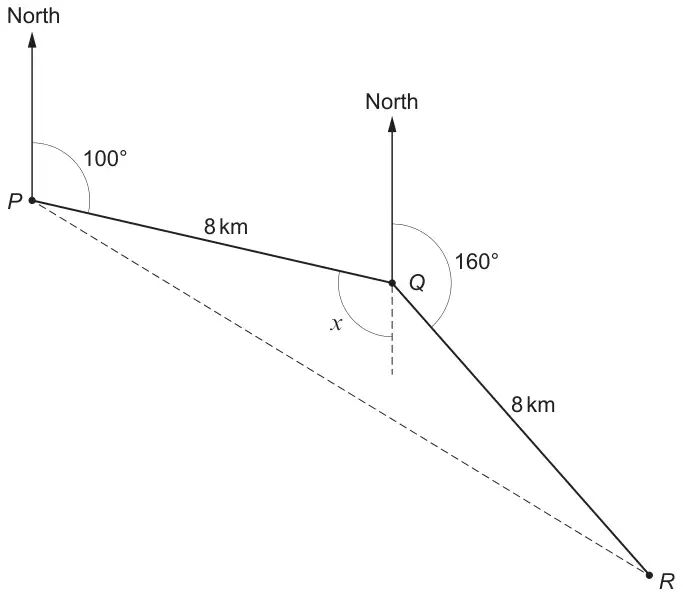
Diagram not drawn to scale
The ship travels on a bearing of 100° for 8 km from P to Q.
It then travels on a bearing of 160° for 8 km from Q to R.
(a) Explain why the angle \(x\) is 100°. [1]
(b) Work out the bearing of R from P.
Give a reason for each step of your answer. [4]
Give a reason for each step of your answer. [4]
| Scheme | Marks | Comments |
|---|---|---|
| Valid explanation e.g. ‘Alternate angles (between parallel lines)’ | E1 | Allow ‘Alt’ but not ‘Alternative’, not ‘Alternating’; ignore correct embellishments such as Z angles; do not ignore incorrect embellishments E0 for e.g. ‘It is congruent to angle P’ without any justification |
| Scheme | Marks | Comments |
|---|---|---|
| Angles may be seen on the diagram; degrees symbol may be omitted | ||
| \(P\hat{Q}R\) = (100° + 20° =) 120° (Angles on a straight line (sum to 180)) | B1 | 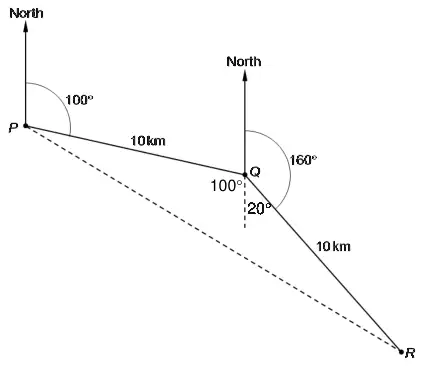 |
| \(Q\hat{P}R\) = 30° (Base angles of an isosceles triangle (are equal)) | B1 | FT ‘their \(P\hat{Q}R\)’ |
| (Bearing =) 130° | B1 | |
| At least one correct reason stated appropriately | E1 | |
| (5) |
Corrected by Westie's Workshop
- The board's mark scheme diagram shows “10 km” on both legs. It should say “8 km” because the question says each leg is 8 km. The lengths do not change the answer.
Original: see the board's mark scheme PDF (link above).