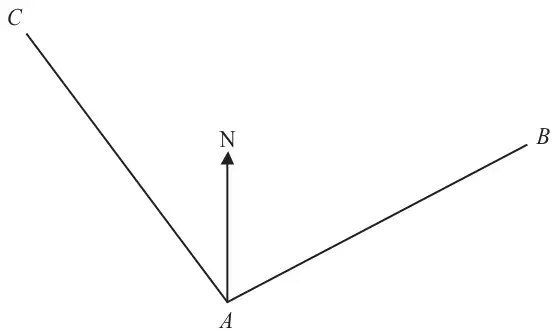
Past Paper Questions by Topic › IGCSE Maths › Shape & Space › Constructions & Bearings
Constructions & Bearings Topic Angles (Including Parallel Lines) (169) Angles in Polygons (185) Constructions & Bearings (113) Circle Theorems (110) Volume & Surface Area (92) Prisms (102) 2D Area & Perimeter (208) Circles & Sectors (170) Similar Shapes (116) Transformations of Shapes (191) Vectors (66) Basic Trigonometry (148) Advanced Trigonometry (145) Pythagoras (192) Plans, Elevations & Nets (41) Course Support Current PowerPoint version
More questions on this topic: GCSE Shape & Space: Constructions (270)
Your progress
0 of 110 done
What do the colours mean? Save code Ticks are kept only in this browser : clearing your browsing data or changing device loses them. Get a free save code · I have a code · Keep them in this browser only
All tiers Higher Foundation All specs Current spec Old spec All series June 2025 November 2024 June 2024 November 2023 June 2023 January 2023 June 2022 January 2022 November 2021 June 2021 January 2021 November 2020 January 2020 June 2019 January 2019 June 2018 January 2018 June 2017 January 2017 January 2016 June 2015 January 2015 June 2014 January 2014 June 2013 January 2013 June 2012 January 2012 June 2011 June 2010 November 2009 November 2008 June 2008 November 2007 November 2006 November 2005 June 2005 November 2004 Any marks 1 to 4 marks 5 to 8 marks 9+ marks
Questions Step through List
‹ Previous All questions Next ›
Foundation June 2025 Paper 2 Q21
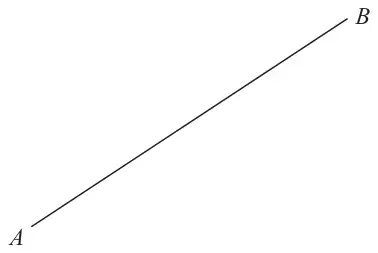
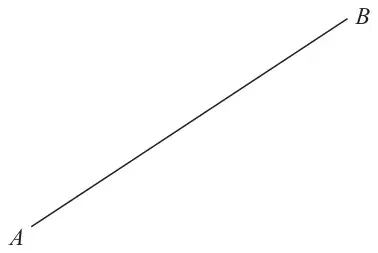
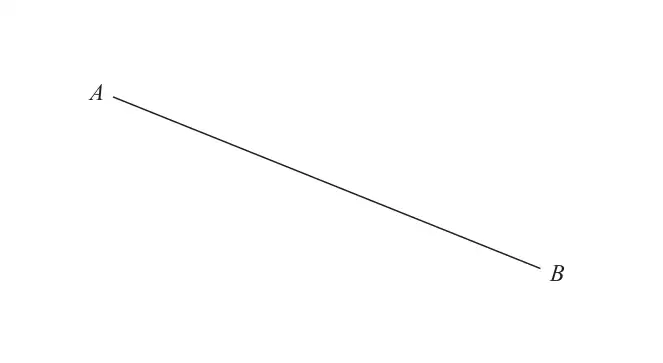
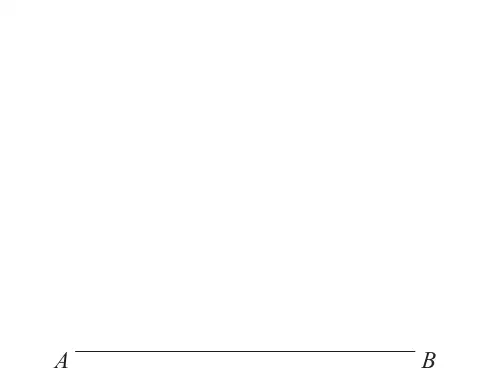
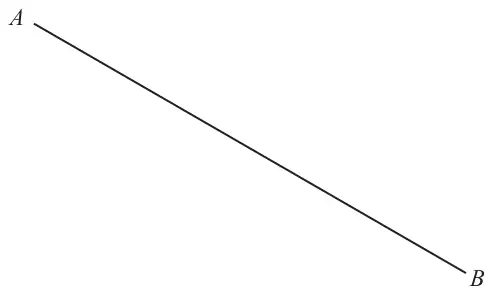
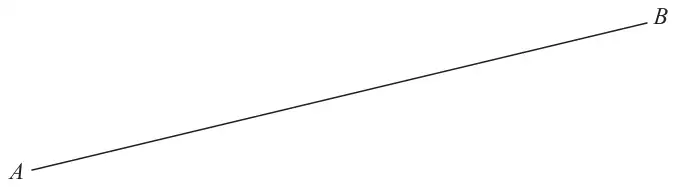
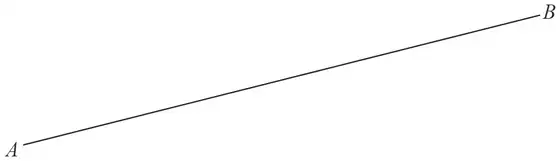
21 Using ruler and compasses only, construct the perpendicular bisector of the line \(AB\)
(2)
Mark scheme
Mark scheme Scheme Marks Bisector with construction arcs B2 (2) (2 marks)
Notes B2: B2 for a fully correct perpendicular bisector with 2 pairs of intersecting arcs shown
Foundation June 2025 Paper 2 Q16
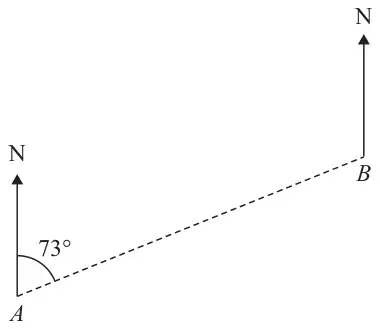
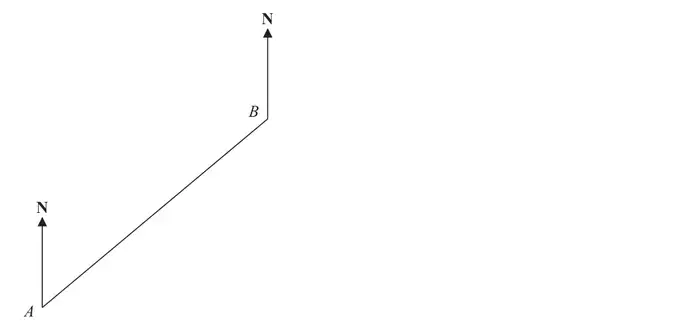
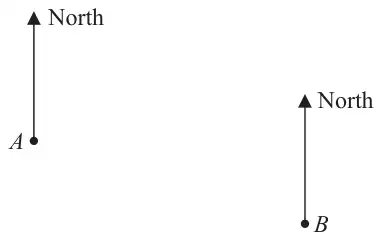
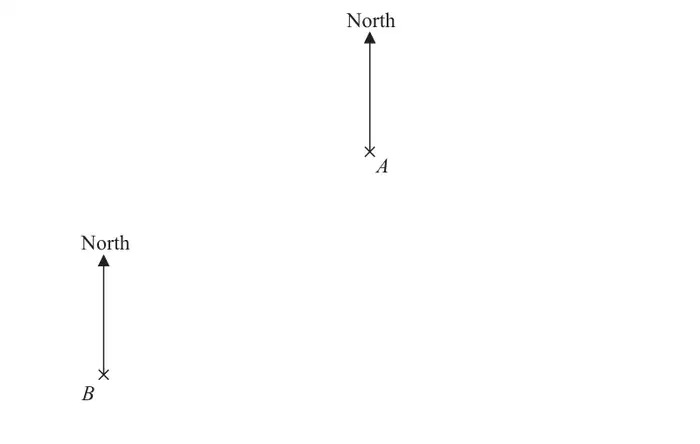
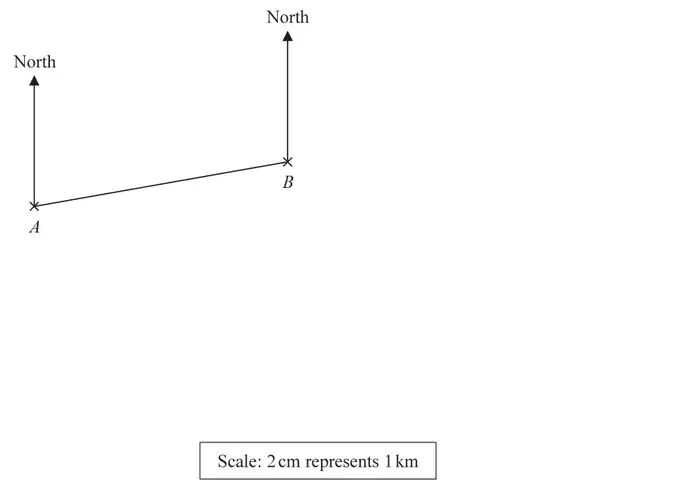
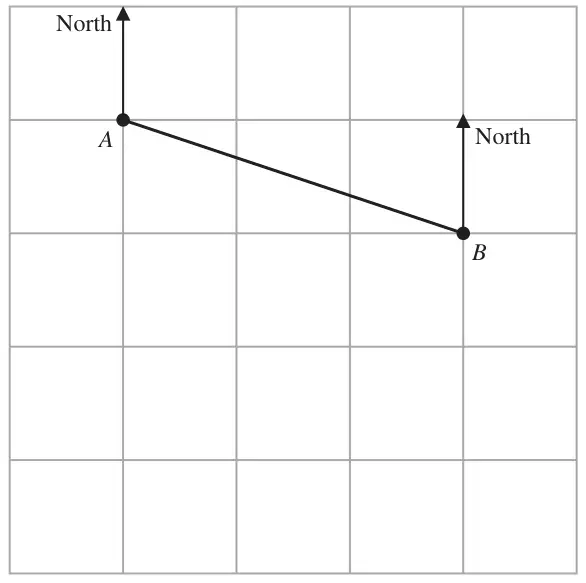
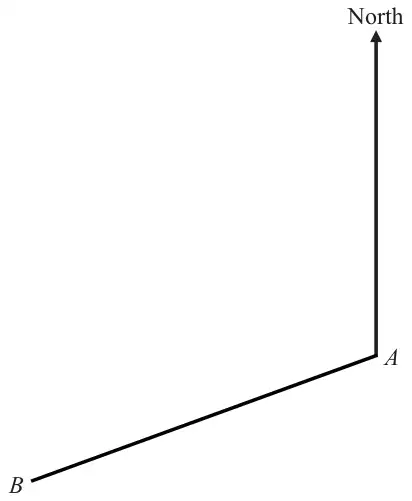
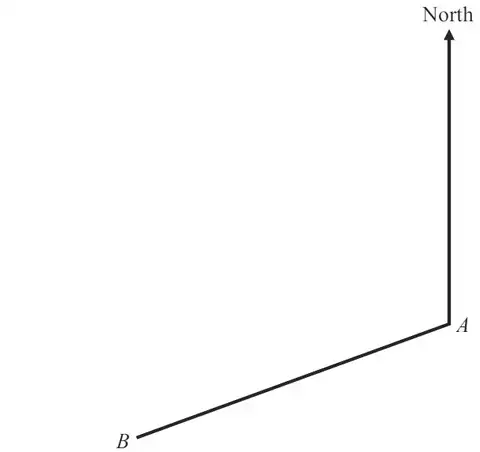
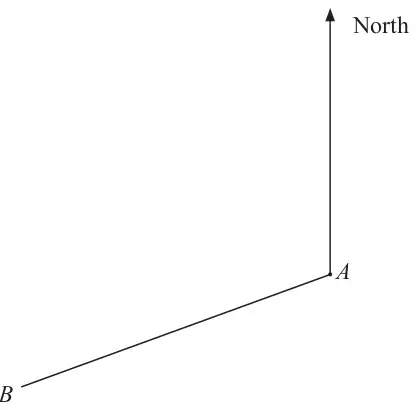
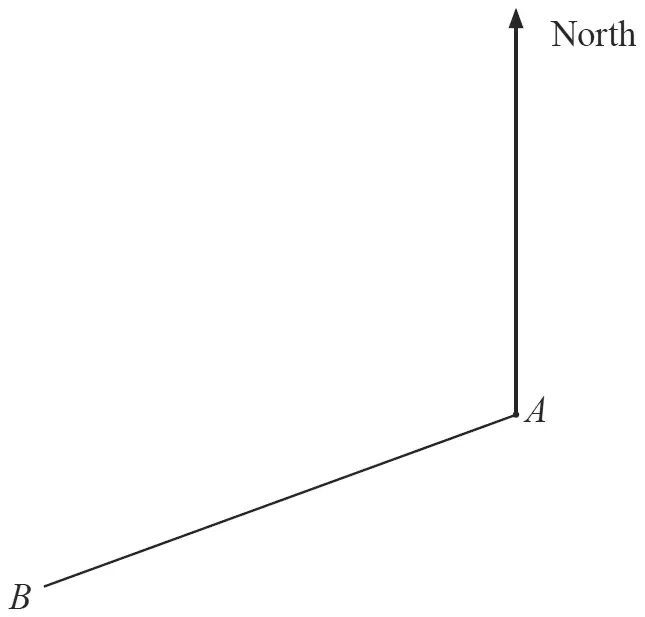
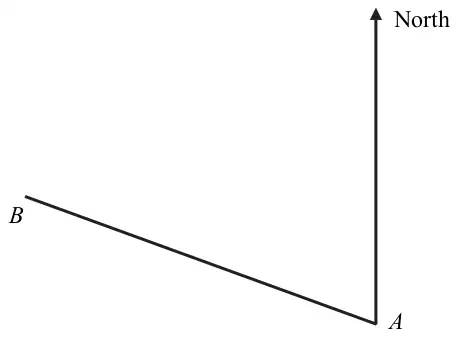
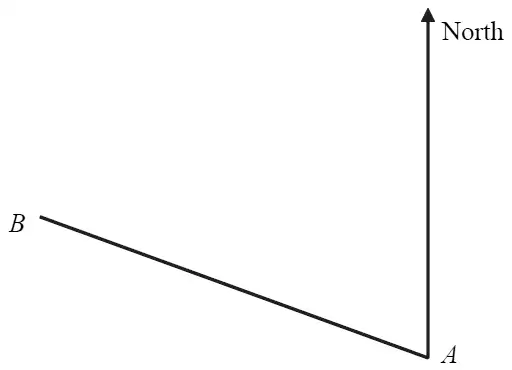
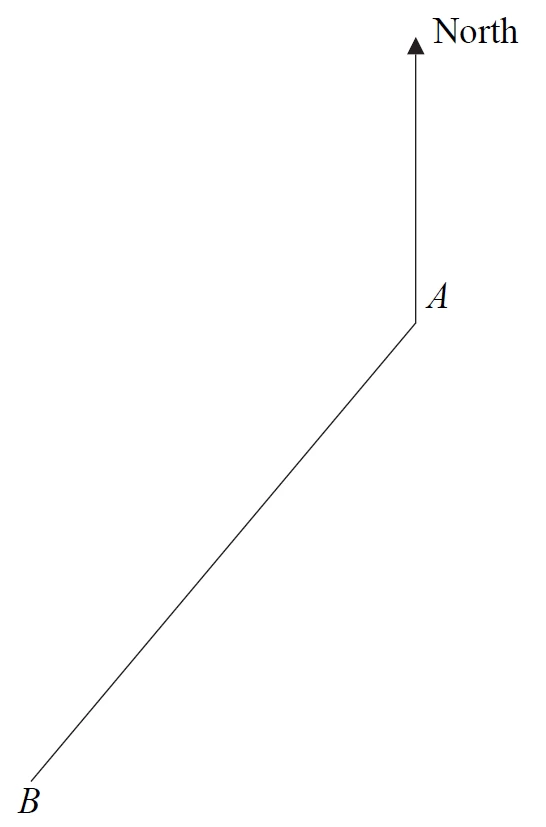
16 The diagram shows the positions of two villages, \(A\) and \(B\)
Diagram NOT accurately drawn
The bearing of \(B\) from \(A\) is 073°
Work out the bearing of \(A\) from \(B\)
(2)
Mark scheme
Mark scheme Scheme Marks 180 + 73 or M1 Working not required, so correct answer scores full marks (unless from obvious incorrect working) A1 (2) (2 marks)
Notes M1: or for 73 or for 107 or for 253 seen in the correct place on the diagram by point \(B\) or correctly identified by labelling
Foundation June 2025 Paper 2R Q12
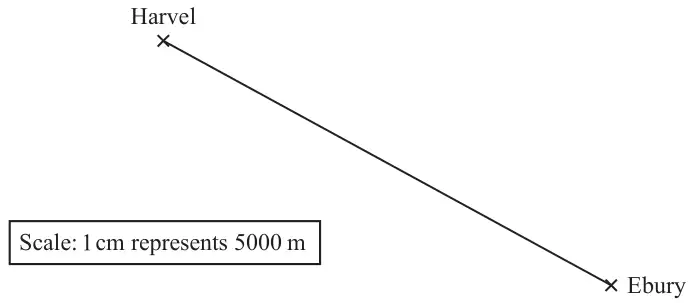
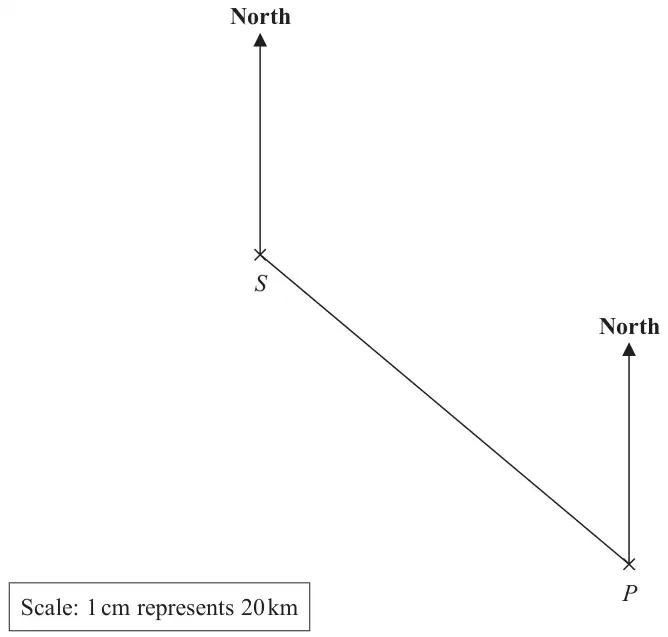
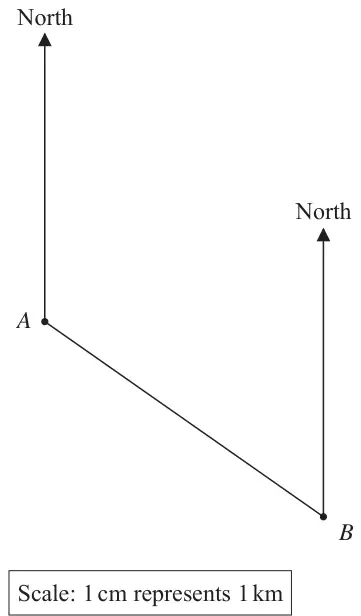
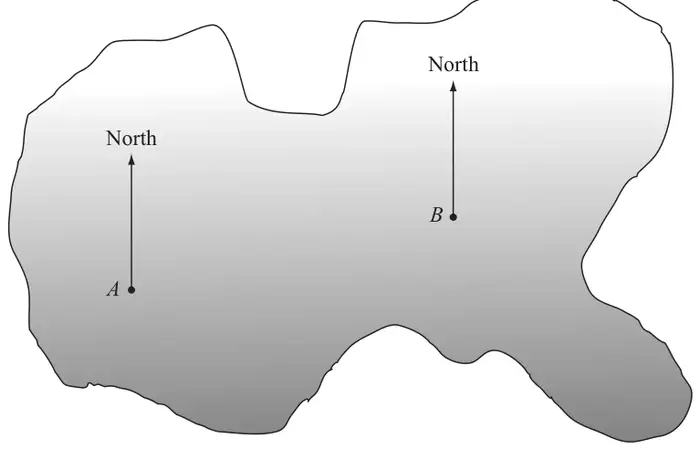
12 The scale drawing shows the positions of two towns, Harvel and Ebury.
(a) Work out the real distance, in kilometres, between Harvel and Ebury. (3)
On Saturday, Luisa cycles directly from Harvel to Ebury.
Luisa leaves Harvel at 12 50
(b) Work out the time Luisa takes to cycle directly from Harvel to Ebury.
…………… hours …………… minutes
(2) Mark scheme (a) Mark scheme (b)
Mark scheme (a) Scheme Marks [8.8, 9.2] × 5000 (= [44 000, 46 000])or or M1 [“44 000”, “46 000”] ÷ 1000 or [8.8, 9.2] × “5” M1 Correct answer scores full marks (unless from obvious incorrect working) A1 (3)
Notes M1: for measuring the line (±0.2cm tolerance, 8.8 cm to 9.2 cm) and using the scaleor for an attempt to convert a value into kilometres
M1: for use of scale and conversion
A1: allow 44 – 46, must agree with their measurement
Mark scheme (b) Scheme Marks 4 (hours) 25 (minutes) B2 (2) (5 marks)
Notes B2: for 4 (hours) and 25 (minutes)or 25 (minutes))
Higher June 2025 Paper 2 Q4
4 Using ruler and compasses only, construct the perpendicular bisector of the line \(AB\)
(2)
Mark scheme
Mark scheme Scheme Marks Bisector with construction arcs B2 (2) (2 marks)
Notes B2: B2 for a fully correct perpendicular bisector with 2 pairs of intersecting arcs shown
Higher November 2024 Paper 2 Q24
24 \(A\), \(B\) and \(C\) are three points on horizontal ground.
\(AB = 8.4\) metres \(BC = 9.2\) metres
\(B\) is on a bearing of 067° from \(A\)
Calculate the bearing of \(A\) from \(C\)
(6)
Mark scheme
Mark scheme Scheme Marks 67 + 51 (= 118) or angle split into 67 and 51 M1 \(AC^2 = 8.4^2 + 9.2^2 - 2 \times 8.4 \times 9.2 \times \cos\text{``}{118}\text{''}\;(= 227.(7615))\) M1 \(AC = \sqrt{8.4^2 + 9.2^2 - 2 \times 8.4 \times 9.2 \times \cos\text{``}{118}\text{''}}\;(= 15.(09\ldots))\)
(15 – 15.1)
M1 \(\dfrac{\sin ACB}{8.4} = \dfrac{\sin\text{``}{118}\text{''}}{\text{``}{15.09\ldots}\text{''}}\) or
\(\dfrac{\sin BAC}{9.2} = \dfrac{\sin\text{``}{118}\text{''}}{\text{``}{15.09\ldots}\text{''}}\) or
\(\cos ACB = \dfrac{9.2^2 + \text{``}{15.09}\text{''}^2 - 8.4^2}{2 \times 9.2 \times \text{``}{15.09}\text{''}}\) or \(\cos BAC = \dfrac{8.4^2 + \text{``}{15.09}\text{''}^2 - 9.2^2}{2 \times 8.4 \times \text{``}{15.09}\text{''}}\)
M1 \((ACB =)\sin^{-1}\left(\dfrac{8.4\sin\text{``}{118}\text{''}}{\text{``}{15.09\ldots}\text{''}}\right)\) or \(\cos^{-1}\left(\dfrac{9.2^2 + \text{``}{15.09}\text{''}^2 - 8.4^2}{2 \times 9.2 \times \text{``}{15.09}\text{''}}\right)\;(= 29.(43\ldots))\)
(29 – 30)
\((BAC =)\sin^{-1}\left(\dfrac{9.2\sin\text{``}{118}\text{''}}{\text{``}{15.09\ldots}\text{''}}\right)\) or \(\cos^{-1}\left(\dfrac{8.4^2 + \text{``}{15.09}\text{''}^2 - 9.2^2}{2 \times 8.4 \times \text{``}{15.09}\text{''}}\right)\;(= 32.(56\ldots))\)
(32 – 33)
M1 Correct answer scores full marks (unless from obvious incorrect working) Look for angles and lengths on their diagram A1 (6) (6 marks)
Notes M1: A diagram showing 118 or use of 118 in further calculations
M1: a correct method to find length \(AC^2\)
M1: a correct method to find length \(AC\)
M1: dep on previous method marks
M1: a completely correct statement for angle \(ACB\) or angle \(BAC\)
A1: allow 279 – 280
Foundation November 2024 Paper 1 Q19
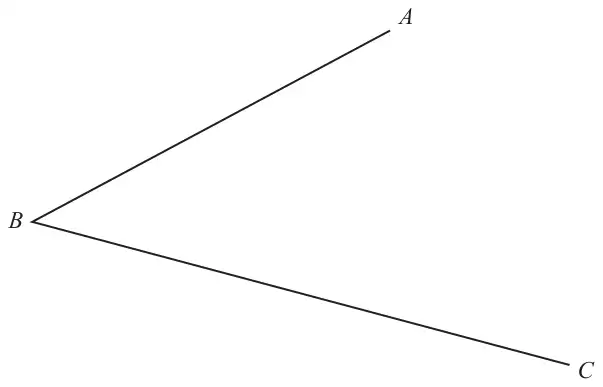
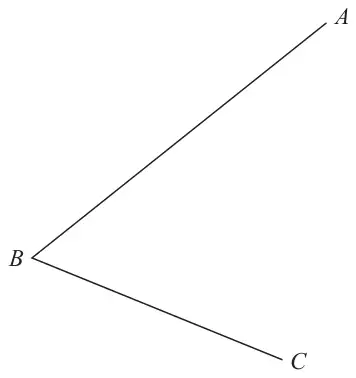
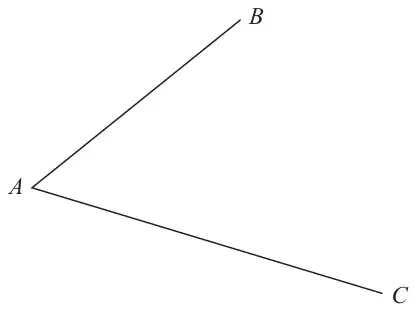
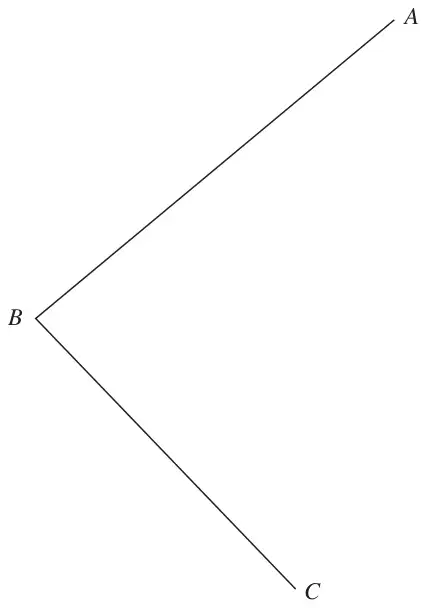
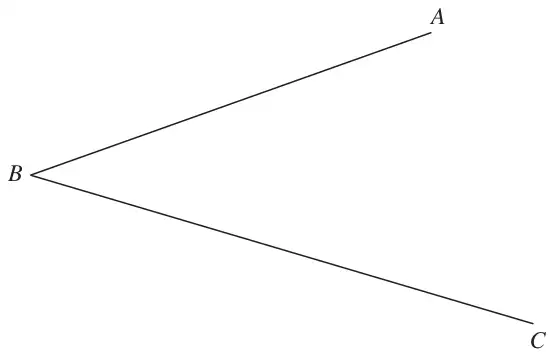
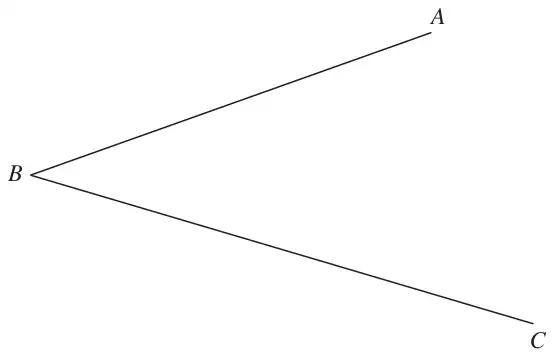
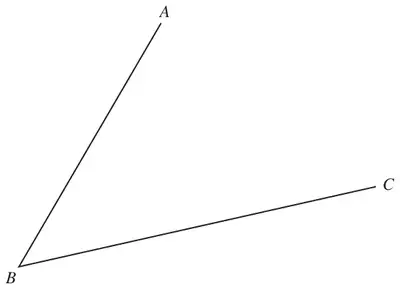
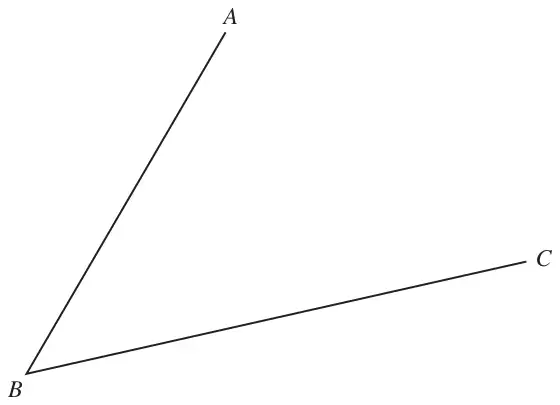
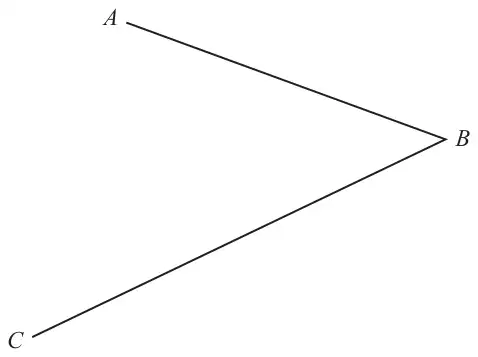
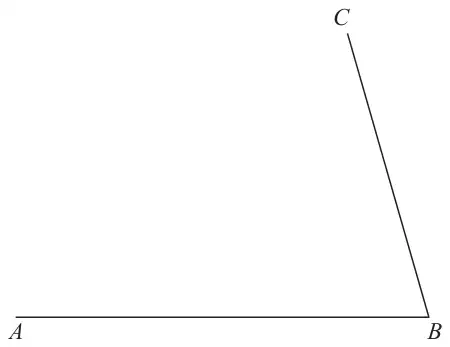
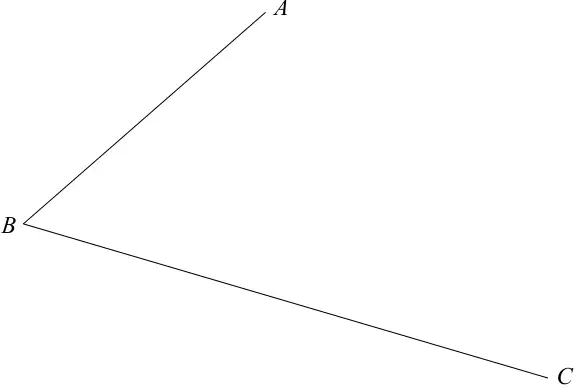
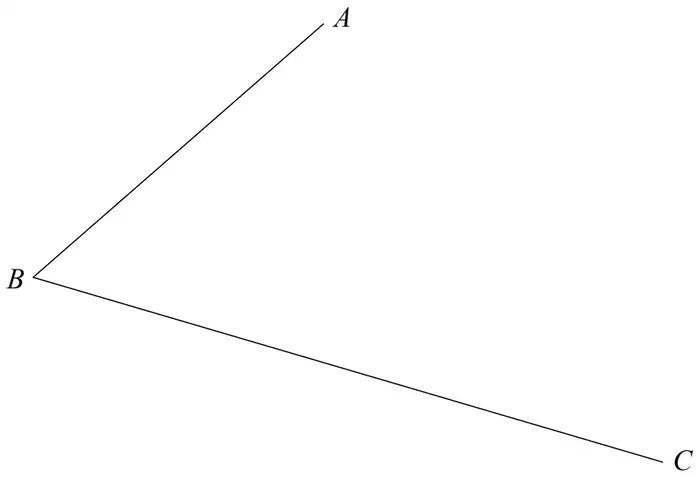
19 Use ruler and compasses only to construct the bisector of angle \(ABC\)
(2)
Mark scheme
Mark scheme Scheme Marks Fully correct angle bisector with all relevant arcs B2 (2) (2 marks)
Notes B2: for a fully correct angle bisector with all arcs shown (the line and the arcs can intersect on or within the overlay guidelines)
Higher November 2024 Paper 1 Q2
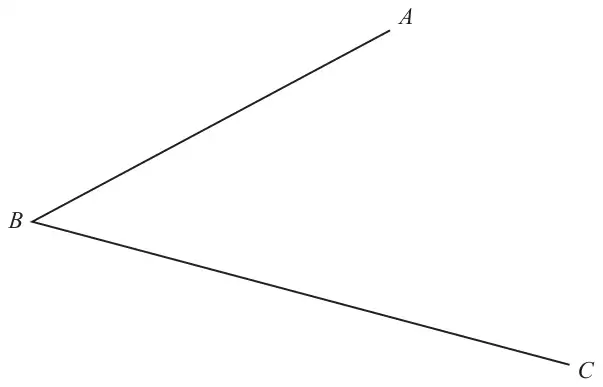
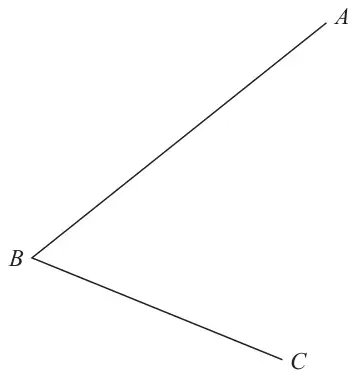
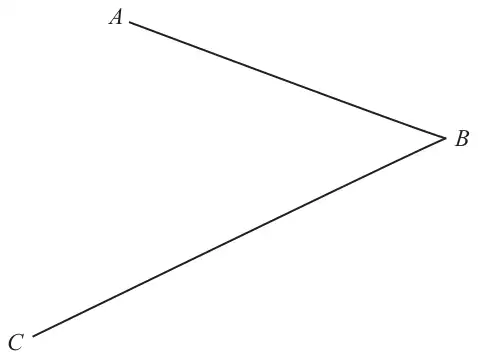
2 Use ruler and compasses only to construct the bisector of angle \(ABC\)
(2)
Mark scheme
Mark scheme Scheme Marks Fully correct angle bisector with all relevant arcs B2 (2) (2 marks)
Notes B2: for a fully correct angle bisector with all arcs shown (the line and the arcs can intersect on or within the overlay guidelines)
Foundation June 2024 Paper 2R Q10
10 Use a ruler and compasses only to construct a square with sides of length 7 cm.
Two sides of the square have been drawn for you.
(2)
Mark scheme
Mark scheme Scheme Marks Correct square B2 (2) (2 marks)
Notes B2: For a fully correct square with arcs shownor for an incorrect quadrilateral with arcs of equal radius shown or correct arcs not joined – all within or on the guidelines of the overlay
Foundation June 2024 Paper 1 Q9
9 \(ABC\) is an equilateral triangle with sides of length 9 cm.
Use a ruler and compasses only to construct the triangle \(ABC\)
(2)
Mark scheme
Mark scheme Scheme Marks Triangle drawn with correct intersecting arcs 9 cm from \(A\) and 9 cm from \(B\) B2 Working required (2) (2 marks)
Notes B2: for triangle drawn with correct intersecting arcs 9 cm from \(A\) and 9 cm from \(B\) within or on the guidelines of the overlayor accurate triangle drawn with no arcs)
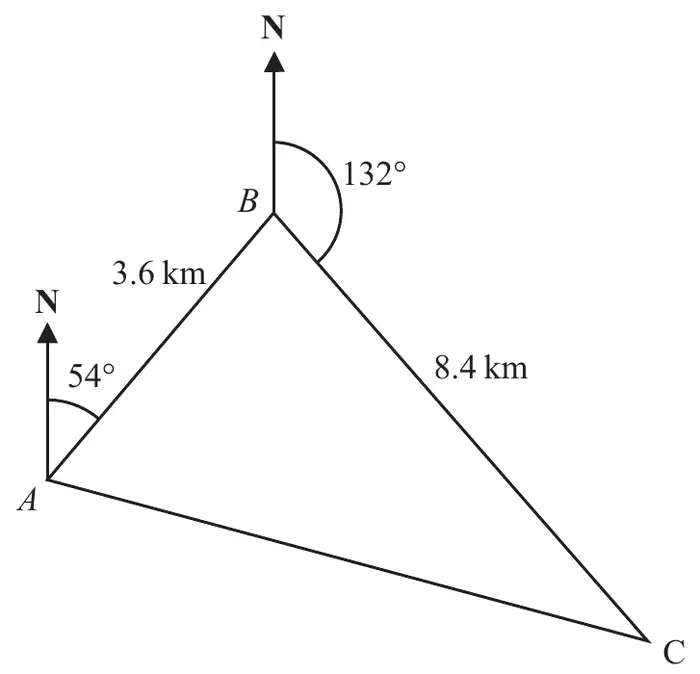
Higher November 2023 Paper 1 Q18 18 The diagram shows the positions of three villages, \(A\), \(B\) and \(C\)
Diagram NOT accurately drawn
The bearing of \(B\) from \(A\) is 054°
Melur walks from \(A\) to \(B\)
Melur walks at an average speed of 6 km/h
Work out the total time Melur takes.
(5)
Mark scheme
Mark scheme Scheme Marks (angle \(ABC =\)) 54 + (180 – 132) (= 102) M1 \(AC^2 = 3.6^2 + 8.4^2 - 2 \times 3.6 \times 8.4 \times \cos 102\) M1 \(AC = \sqrt{3.6^2 + 8.4^2 - 2 \times 3.6 \times 8.4 \times \cos 102}\) or \(\sqrt{96.094...}\) or 9.8(02…) M1 (“9.8” + 8.4 + 3.6) ÷ 6 (= 3.63(3…)) or M1 Working not required, so correct answer scores full marks (unless from obvious incorrect working) A1 (5 marks)
Notes M1: (first) for finding angle \(ABC\)
M1: (second) for applying the cosine rule correctly
M1: (third) for finding \(AC\)
M1: (fourth) dep on previous M1M1 for finding the time taken to complete the journey (may be done in parts)
A1: Allow 3 hours and (37 – 38) minutes
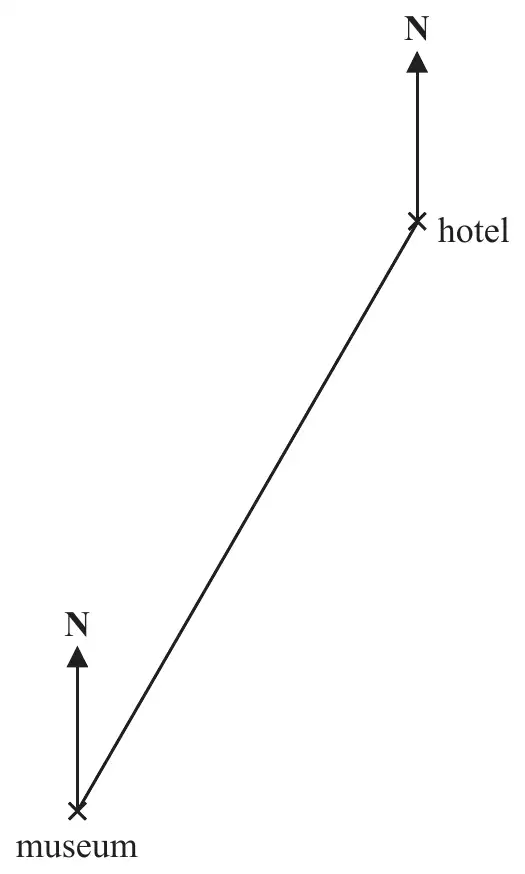
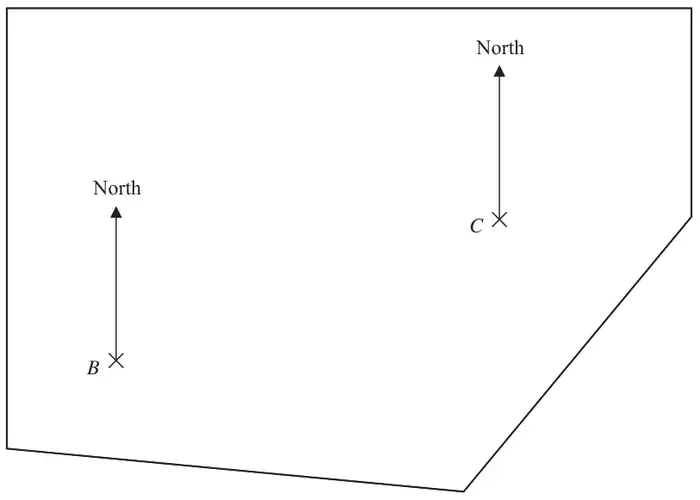
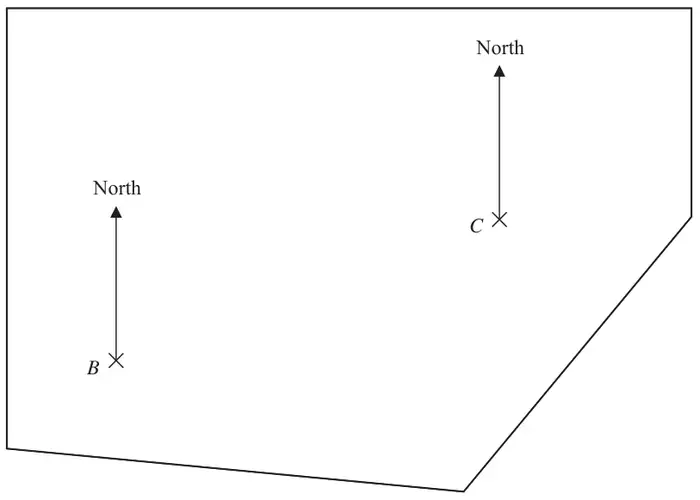
Foundation November 2023 Paper 1 Q14 14 Here is an accurate scale drawing showing the positions of a hotel and a museum.
Scale: 1 cm represents 4.5 km
Note: the drawing on screen is not to scale; use the PDF to measure.
(a) Find, by measuring, the bearing of the hotel from the museum. (1)
(b) Work out the real distance between the hotel and the museum. (2)
Mark scheme (a) Mark scheme (b)
Mark scheme (a) Mark scheme (b) Scheme Marks [7.8, 8.2] × 4.5 M1 Answer: 36 A1 (2) (3 marks)
Notes M1: allow 7.8 – 8.2
A1: allow 35 – 37
Foundation June 2023 Paper 2 Q16
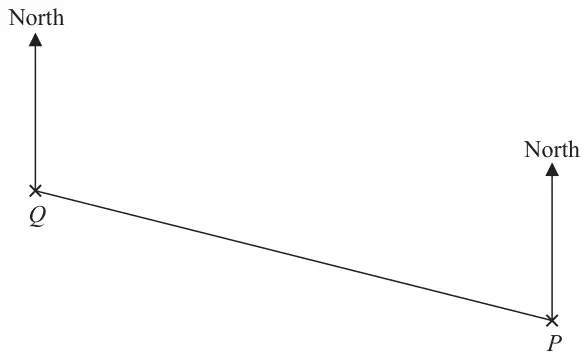
16 The scale drawing shows the positions of two airports \(P\) and \(Q\)
scale: 1 cm represents 50 km
(a) Find, by measuring, the bearing of \(P\) from \(Q\) (1)
A small plane flies directly from \(P\) to \(Q\)
(b) Work out the average speed of the plane.(3)
Mark scheme (a) Mark scheme (b)
Mark scheme (a) Notes B1: accept 102 – 106
Mark scheme (b) Scheme Marks eg \(\text{``}{9.4}\text{''} \times 50\) (= 470) [460 – 480] M1 \(\text{``}{9.4}\text{''} \times 50 \div 2\) M1 Correct answer scores full marks (unless from obvious incorrect working) A1 (3) (4 marks)
Notes M1: Their measurement × 50 or ÷2
M1: Their measurement × 50 and ÷2
A1: accept 230 – 240
Foundation June 2023 Paper 2R Q12
12 The scale drawing shows the positions of two boats, \(A\) and \(B\)
Scale: 1 cm represents 3 km
(a) Work out the actual distance, in kilometres, between \(A\) and \(B\) (2)
Boat \(C\) is on a bearing of 110° from \(B\)
(b) On the scale drawing, mark with a cross (×) the position of boat \(C\) (3)
Mark scheme (a) Mark scheme (b)
Mark scheme (a) Scheme Marks [7.3 – 7.7] × 3 M1 Correct answer scores full marks (unless from obvious incorrect working) A1 (2)
Notes A1: accept an answer in the range 21.9 – 23.1
Mark scheme (b) Scheme Marks for stating 8 cm or B1 for × from B with a bearing of 110° or or B1 Correct position B1 (3) (5 marks)
Notes B1: within or on guidelines
Foundation June 2023 Paper 2 Q9
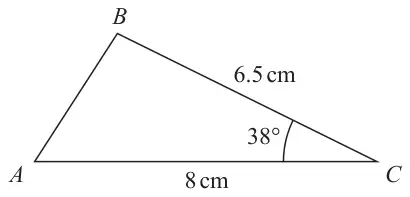
9 Here is a sketch of triangle \(ABC\)
Diagram NOT accurately drawn
\(AC\) = 8 cm \(BC\) = 6.5 cm angle \(ACB\) = 38°
In the space below, make an accurate drawing of triangle \(ABC\)
(2)
Mark scheme
Mark scheme Scheme Marks Correct triangle B2 (2) (2 marks)
Notes B2: Correct triangle within tolerance
Foundation January 2023 Paper 2R Q18
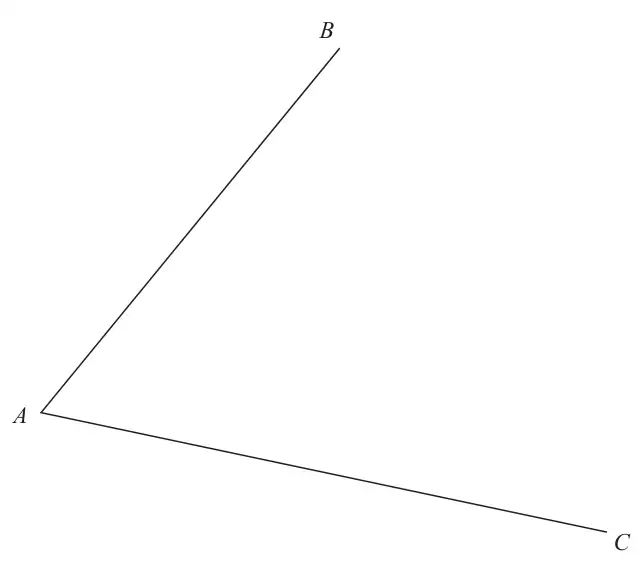
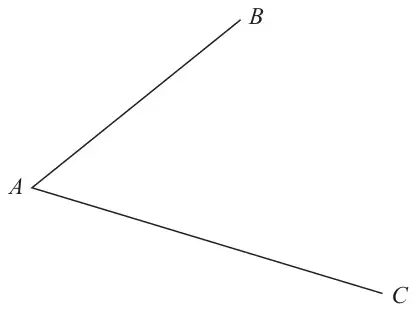
18 Using ruler and compasses only, construct the bisector of angle \(BAC\)
(2)
Mark scheme
Mark scheme Scheme Marks Fully correct angle bisector with all relevant arcs shown B2 (2) (2 marks)
Notes B2: for a fully correct angle bisector with all relevant arcs shown
Foundation January 2023 Paper 1 Q18
18 Use ruler and compasses only to construct the perpendicular bisector of line \(AB\)
(2)
Mark scheme
Mark scheme Scheme Marks Two pairs of intersecting arcs with equal radii centre \(A\) and \(B\)M1 Working required A1 (2) (2 marks)
Notes M1: for arcs that intersect within or on the guidelines or correct perpendicular bisector without arcs.
A1: for a fully correct bisector with two intersecting arcs
Foundation January 2023 Paper 1R Q14
14 The accurate scale drawing shows the positions of two lighthouses, \(S\) and \(T\)
The scale of the drawing is 1 cm to 2 km
(a) Find, by measuring, the bearing of lighthouse \(T\) from lighthouse \(S\) (1)
A boat is on a bearing of 084° from \(S\)
(b) On the diagram, mark with a cross (×) the position of the boat.(3)
Mark scheme (a) Mark scheme (b)
Mark scheme (a) Notes B1: Accept 119 – 123
Mark scheme (b) Scheme Marks Stating 6.5cm or an arc with centre \(T\), radius 6.5 cm B1 Line drawn or × from \(S\), with a bearing of 084° B1 \(B\) correctly indicated B1 (3) (4 marks)
Higher January 2023 Paper 2R Q4
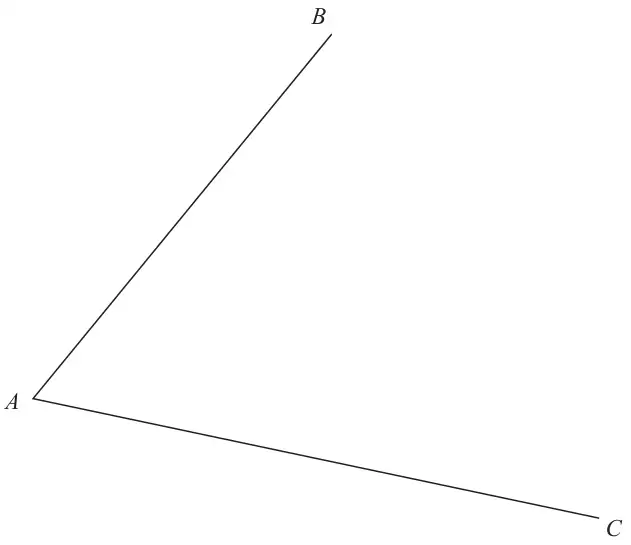
4 Using ruler and compasses only, construct the bisector of angle \(BAC\)
(2)
Mark scheme
Mark scheme Scheme Marks Fully correct angle bisector with all relevant arcs shown B2 (2) (2 marks)
Notes B2: for a fully correct angle bisector with all relevant arcs shown
Foundation January 2023 Paper 2 Q4
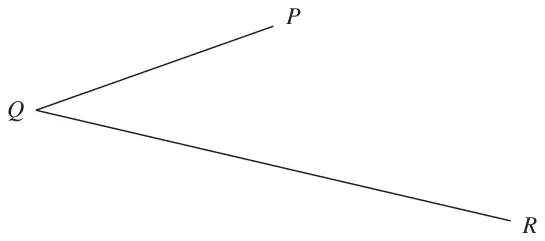
4
(a) In the space below, draw a line of length 6.5 cm (1)
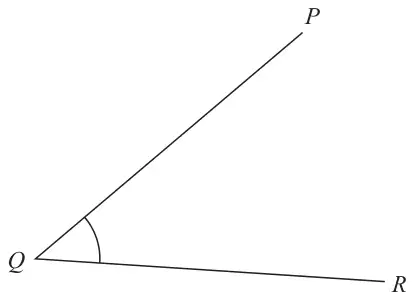
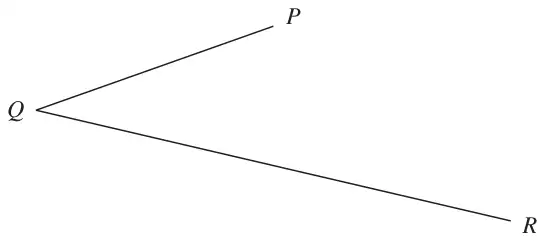
The diagram shows the straight lines \(QP\) and \(QR\)
(b) Measure the size of angle \(PQR\) (1)
Mark scheme (a) Mark scheme (b)
Mark scheme (a) Scheme Marks line of length 6.5 cm drawn B1 (1)
Mark scheme (b) Scheme Marks 44 B1 (1) (2 marks)
Notes B1: Accept answers in the range 42-46 including decimals and fractions
Foundation June 2022 Paper 2R Q11
11 Triangle \(ABC\) is an equilateral triangle of side 6 cm.
Using a ruler and compasses only, construct triangle \(ABC\)
Side \(AB\) has been drawn for you.
On the printed paper AB is 6 cm long; the picture on screen may be a different size.
(2)
Mark scheme
Mark scheme Scheme Marks Correct triangle B2 (2) (2 marks)
Notes B2: For a fully correct triangle with arcs shownor for an incorrectly sized triangle with arcs shown where \(AC = BC\) or correct arcs not joined)
Foundation June 2022 Paper 1 Q9
9 \(ABC\) is a triangle.
Use a ruler and compasses to construct the triangle \(ABC\).
(2)
Mark scheme
Mark scheme Scheme Marks Allow B2 (2) (2 marks)
Notes B2: for triangle drawn with correct intersecting arcs 6 cm from \(A\) and 9 cm from \(B\) within the overlayor accurate triangle drawn with no arcs)
Foundation January 2022 Paper 2 Q20
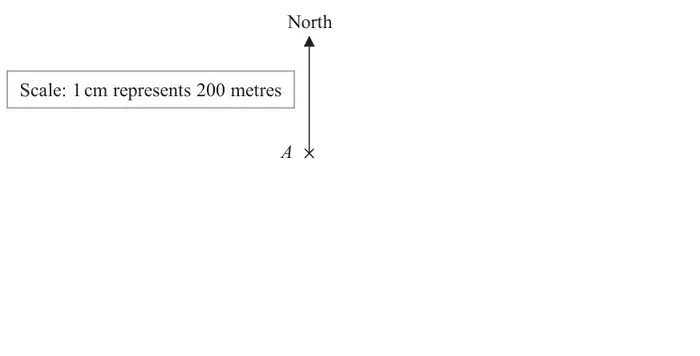
20 The scale diagram shows the position on a map of a house, \(A\)
House \(C\) is on a bearing of 110° from \(A\)
(a) Mark the position of \(C\) on the diagram with a cross (×)(3)
(b) Write the scale of the map in the form \(1 : n\) (1)
Mark scheme (a) Mark scheme (b)
Mark scheme (a) Scheme Marks 700 ÷ 200 (= 3.5) M1 M1 \(C\) indicated in correct position A1 (3)
Notes M1: or 3.5 shown on diagram – within bounds of overlay
M1: for line drawn at correct angle ± 2° within bounds of overlay
A1: for \(C\) drawn within bounds of overlay, inclusive of lines
Mark scheme (b) Scheme Marks (1 :) 20 000 B1 (1) (4 marks)
Foundation January 2022 Paper 2R Q17
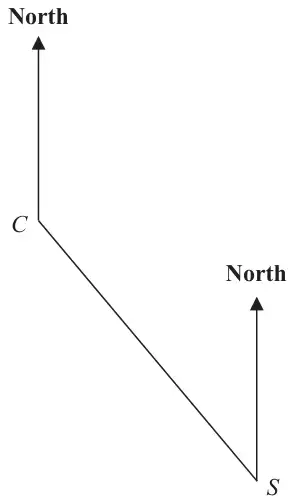
17 The accurate scale drawing shows the position of a college \(C\) and a train station \(S\)
Scale: 1 cm represents 500 m
(a) Find the bearing of \(S\) from \(C\) (1)
For Charles,
(b) Work out the number of steps Charles walks as he goes in a straight line from the college to the train station.(4)
Mark scheme (a) Mark scheme (b)
Mark scheme (a) Notes B1: accept 138 – 142
Mark scheme (b) Scheme Marks [5.8, 6.2] M1 ‘[5.8, 6.2]’ × 500 M1 ft ‘[2900, 3100]’ ÷ 0.44 M1 ft 6818 A1 ft (4) (5 marks)
Notes A1 ft: answer in range 6590-7045 but must be an integer
Higher January 2022 Paper 2 Q5
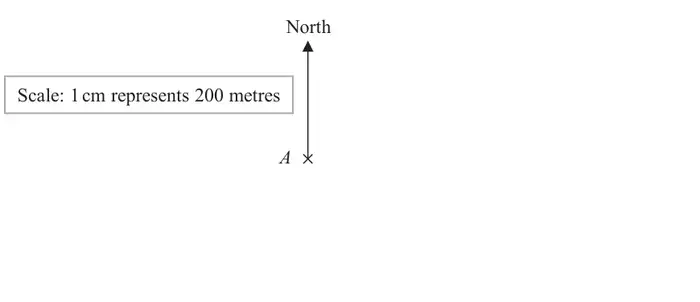
5 The scale diagram shows the position on a map of a house, \(A\)
House \(C\) is on a bearing of 110° from \(A\)
(a) Mark the position of \(C\) on the diagram with a cross (×)(3)
(b) Write the scale of the map in the form 1 : \(n\) (1)
Mark scheme (a) Mark scheme (b)
Mark scheme (a) Scheme Marks 700 ÷ 200 (= 3.5) M1 M1 \(C\) indicated in correct position A1 (3)
Notes M1: or 3.5 shown on diagram – within bounds of overlay
M1: for line drawn at correct angle ± 2° within bounds of overlay
A1: for \(C\) drawn within bounds of overlay, inclusive of lines.
Mark scheme (b) Scheme Marks (1 :) 20 000 B1 (1) (4 marks)
Foundation November 2021 Paper 2 Q11
11 \(ABC\) is a triangle.
\(AB\) = 9 cm, \(AC\) = 5 cm and \(BC\) = 8 cm.
Use ruler and compasses to construct triangle \(ABC\) with \(AB\) as its base.
(2)
Mark scheme
Mark scheme Scheme Marks Triangle drawn with correct intersecting arcs from \(A\) (5 cm) and \(B\) (8 cm) B2 (2) (2 marks)
Notes B2: for arcs intersecting within overlay and triangle drawn
Foundation November 2021 Paper 1 Q6
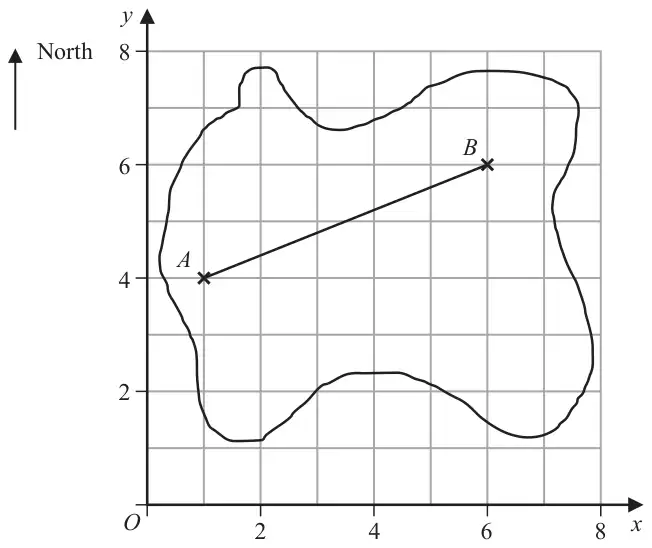
6 The accurate scale diagram shows the map of an island drawn on a centimetre grid.
The position of Aaron’s house is \(A\).
(a) Write down the coordinates of \(A\). (1)
(b) By measurement, find the bearing of \(A\) from \(B\). (2)
(c) Measure the length of the line \(AB\).(1)
Aaron cycled along a straight path from his house to Bharat’s house.
(d) Work out the distance, in kilometres, that Aaron cycled. (1)
Aaron left his house at 10 45 am and arrived at Bharat’s house at 1 05 pm.
(e) How long did Aaron’s cycle ride take him?(2)
Mark scheme (a) Mark scheme (b) Mark scheme (c) Mark scheme (d) Mark scheme (e)
Mark scheme (a) Mark scheme (b) Scheme Marks 180 + “68” or 360 – “112” M1 248 A1 (2)
Notes M1: accept 66° to 70° or 110° to 114° seen or used.
A1: accept 246° to 250°
Mark scheme (c) Notes B1: accept 5.2 cm to 5.6 cm
Mark scheme (d) Notes B1ft: ft “their c” × 5 if B1 awarded in part (c)
Mark scheme (e) Scheme Marks 2 hr 20 min B1 (2) (7 marks)
Notes B1: for 2 hours
B1: for 20 minutes
if no marks awarded, SC B1 for eg 1hr 80min or 140min
Foundation June 2021 Paper 2 Q17
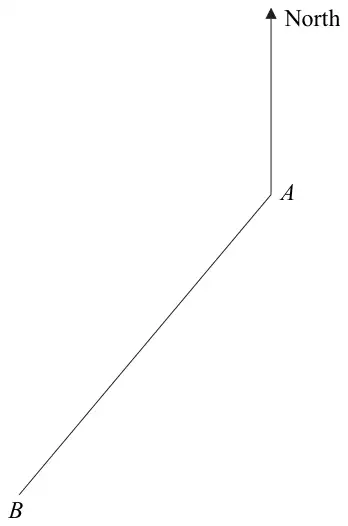
17 The bearing of Paris from London is 149°
Work out the bearing of London from Paris.
(2)
Mark scheme
Mark scheme Scheme Marks 180 + 149 or 360 − 31 M1 Working not required, so correct answer scores full marks A1 (2) (2 marks)
Foundation June 2021 Paper 2 Q10
10 \(ABC\) is a triangle.
Draw accurately the triangle \(ABC\).
(2)
Mark scheme
Mark scheme Scheme Marks Line from \(B\) at 65° ± 2°or arc from \(B\) at 6.2 cm ± 0.2 cm M1 Correct triangle A1 (2) (2 marks)
Notes A1: SCB1 if no marks scored, award if student has used point \(A\) for line and arc, rather than point \(B\)
Higher June 2021 Paper 2 Q3
3 The bearing of Paris from London is 149°
Work out the bearing of London from Paris.
(2)
Mark scheme
Mark scheme Scheme Marks 180 + 149 or 360 − 31 M1 Working not required, so correct answer scores full marks A1 (2) (2 marks)
Higher January 2021 Paper 1 Q16
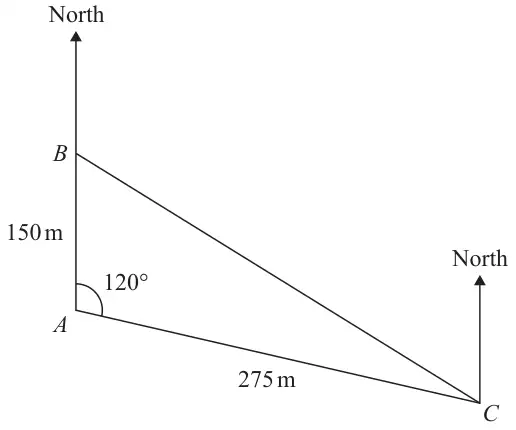
16 The diagram shows the positions of three ships, \(A\), \(B\) and \(C\).
Diagram NOT accurately drawn
Ship \(B\) is due north of ship \(A\).
The bearing of ship \(C\) from ship \(A\) is 120°
Calculate the bearing of ship \(C\) from ship \(B\).
(5)
Mark scheme
Mark scheme Scheme Marks \((BC^2 =)\;150^2 + 275^2 - (2 \times 150 \times 275 \times \cos 120)\) (= 139 375) M1 \((BC =)\;\sqrt{150^2 + 275^2 + 41250}\) oe or \(\sqrt{139375}\)
or \(25\sqrt{223}\) or 373.…
M1 e.g. \(\dfrac{\sin ABC}{275} = \dfrac{\sin 120}{\text{“}373...\text{”}}\)
or \(275^2 = 150^2 + \text{“}373...\text{”}^2 - (2 \times 150 \times \text{“}373...\text{”} \times \cos ABC)\)
or \(\cos ABC = \dfrac{150^2 + \text{“}373...\text{”}^2 - 275^2}{2 \times 150 \times \text{“}373...\text{”}}\)
or \(\dfrac{\sin ACB}{150} = \dfrac{\sin 120}{\text{“}373...\text{”}}\)
or \(150^2 = 275^2 + \text{“}373...\text{”}^2 - (2 \times 275 \times \text{“}373...\text{”} \times \cos ACB)\)
or \(\cos ACB = \dfrac{275^2 + \text{“}373...\text{”}^2 - 150^2}{2 \times 275 \times \text{“}373...\text{”}}\)
M1 \((ABC =)\sin^{-1}\left(\dfrac{\sin 120}{\text{“}373...\text{”}} \times 275\right)\) (= 39.6…)
or \((ABC =)\cos^{-1}\left(\dfrac{150^2 + \text{“}373...\text{”}^2 - 275^2}{2 \times 150 \times \text{“}373...\text{”}}\right)\) (= 39.6…)
or \((ACB =)\sin^{-1}\left(\dfrac{\sin 120}{\text{“}373...\text{”}} \times 150\right)\) (= 20.3…)
or \((ACB =)\cos^{-1}\left(\dfrac{275^2 + \text{“}373...\text{”}^2 - 150^2}{2 \times 275 \times \text{“}373...\text{”}}\right)\) (= 20.3…)
M1 Correct answer scores full marks (unless from obvious incorrect working) A1 (5) (5 marks)
Notes M1: for correct substitution into the cosine rule
M1: for correct order of operations and square root
M1: (dep on 1st M1) ft 373…or angle \(ACB\)
M1: for a complete method to find angle \(ABC\) or angle \(ACB\)
A1: accept 140 – 140.4
Foundation January 2021 Paper 2 Q13
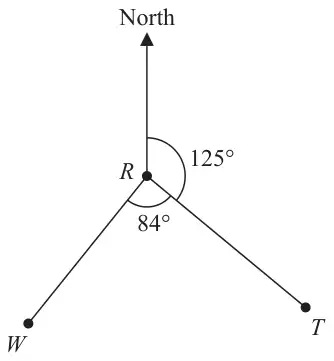
13 The diagram shows the positions of three villages, \(R\), \(T\) and \(W\).
Diagram NOT accurately drawn
(a) Work out the bearing of village \(W\) from village \(R\). (1)
(b) Work out the bearing of village \(R\) from village \(T\). (2)
Mark scheme (a) Mark scheme (b)
Mark scheme (a) Mark scheme (b) Scheme Marks M1 305 A1 (2) (3 marks)
Notes M1: For showing or stating N\(TR\) = 180 – 125 = 55°(where N is North at \(T\)) or
Foundation January 2021 Paper 2R Q9
9 The scale diagram shows the positions of a post office (\(A\)) and a police station (\(B\)) in a town.
(a) Measure the bearing of \(B\) from \(A\). (1)
The town hall is at a position \(C\).
(b) Calculate the bearing of \(C\) from \(A\). (2)
Mark scheme (a) Mark scheme (b)
Mark scheme (a) Notes B1: Accept 105 → 109
Mark scheme (b) Scheme Marks 360 – 135 or 180 + 45 M1 225 A1 (2) (3 marks)
Foundation January 2021 Paper 2 Q6
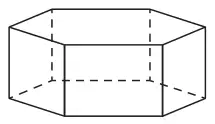
6 The diagram shows a solid prism.
(a) How many vertices has the prism? (1)
(b) How many faces has the prism? (1)
(c) Using ruler and compasses only, in the space below construct the equilateral triangle \(ABC\) with sides of length 7 cm.
You must show all your construction lines.
Side \(AB\) has already been drawn for you.
(2) Mark scheme (a) Mark scheme (b) Mark scheme (c)
Mark scheme (a) Mark scheme (b) Mark scheme (c) Scheme Marks Two intersecting arcs with equal radius M1 Correct equilateral triangle with arcs A1 (2) (4 marks)
Notes M1: For arcs that intersect within guidelines or correct equilateral triangle drawn without arcs
Foundation November 2020 Paper 1R Q18
18 Using ruler and compasses only, construct the bisector of angle \(ABC\).
(2)
Mark scheme
Mark scheme Scheme Marks M1 Correct bisector A1 (2) (2 marks)
Notes M1: Arcs on \(BC\), \(AB\) and arcs from these points meeting or for bisector without arcs
A1: must see correct arcs
Higher November 2020 Paper 1R Q2
2 Using ruler and compasses only, construct the bisector of angle \(ABC\).
(2)
Mark scheme
Mark scheme Scheme Marks M1 Correct bisector A1 (2) (2 marks)
Notes M1: Arcs on \(BC\), \(AB\) and arcs from these points meeting or for bisector without arcs
A1: must see correct arcs
Foundation January 2020 Paper 2 Q21
21 Use ruler and compasses to construct the bisector of angle \(BAC\).
(2)
Mark scheme
Mark scheme Scheme Marks Fully correct angle bisector with all relevant arcs shown B2 (2) (2 marks)
Notes B2: Fully correct angle bisector with all arcs shown.
Foundation January 2020 Paper 1 Q13
13 The scale drawing shows the positions of a ship, \(S\), and a port, \(P\).
(a) Find the bearing of \(S\) from \(P\). (1)
The ship \(S\) now sails directly towards port \(P\).
(b) Work out how long it takes the ship to get to \(P\).(4)
Mark scheme (a) Mark scheme (b)
Mark scheme (a) Mark scheme (b) Scheme Marks [8.3, 8.7] B1 ‘[8.3, 8.7]’ × 20or M1 ‘[166, 174]’ ÷ 24or M1 7 A1 (4) (5 marks)
Foundation January 2020 Paper 1R Q10
10 The accurate scale drawing shows the positions of two mobile phone masts, \(A\) and \(B\).
The scale is 1 cm to 2.5 km.
(a) Find the bearing of \(A\) from \(B\). (1)
(b) Work out the actual distance, in km, between \(A\) and \(B\). (2)
A third mobile phone mast, \(C\), is put up.
(c) Find the position of \(C\).(3)
Mark scheme (a) Mark scheme (b) Mark scheme (c)
Mark scheme (a) Mark scheme (b) Scheme Marks 7 × 2.5 M1 17.5 A1 (2)
Notes M1: allow 6.8 – 7.2 for 7
A1: accept 17 – 18
Mark scheme (c) Scheme Marks M1 M1 \(C\) marked within tolerance A1 (3) (6 marks)
Notes M1: for a bearing of 115 ± 2° from \(A\)
M1: for 20 ÷ 2.5 (= 8) or for an arc drawn 8 cm from \(B\) within tolerance
Higher January 2020 Paper 2R Q6
6 Use ruler and compasses only to construct the perpendicular bisector of the line \(AB\).
(2)
Mark scheme
Mark scheme Scheme Marks Fully correct perpendicular bisector with all relevant arcs shown. B2 (2) (2 marks)
Notes B2: Fully correct bisector with all arcs.
Higher January 2020 Paper 2 Q5
5 Use ruler and compasses to construct the bisector of angle \(BAC\).
(2)
Mark scheme
Mark scheme Scheme Marks Fully correct angle bisector with all relevant arcs shown B2 (2) (2 marks)
Notes B2: Fully correct angle bisector with all arcs shown.
Higher June 2019 Paper 1R Q25
25 A boat sails from point \(X\) to point \(Y\) and then to point \(Z\).
(5)
Mark scheme
Mark scheme Scheme Marks e.g. (220 – 180) + (360 – 280) (= 120) M1 \(XZ = \sqrt{3.5^2 + 6^2 - 2 \times 3.5 \times 6 \times \cos(\text{``}{120}\text{''})}\) (=8.3… or \(\dfrac{\sqrt{277}}{2}\)) M1 \(\dfrac{\sin YXZ}{6} = \dfrac{\sin(\text{``}{120}\text{''})}{\text{``}{8.32…}\text{''}}\) M1 \(YXZ = \sin^{-1}\left(\dfrac{6\sin(\text{``}{120}\text{''})}{\text{``}{8.32…}\text{''}}\right)\) (=38.6…) M1 241.4 A1 (5) (5 marks)
Notes M1: for a method to find angle \(XYZ\).
M1: or \(6^2 = 3.5^2 + \text{``}{8.32}\text{''}^2 - 2 \times 3.5 \times \text{``}{8.32}\text{''} \times \cos YXZ\)
M1: or \(YXZ = \cos^{-1}\left(\dfrac{3.5^2 + \text{``}{8.32}\text{''}^2 - 6^2}{2 \times 3.5 \times \text{``}{8.32}\text{''}}\right)\) (= 38.6…)
A1: accept 241.2 – 241.4
Foundation June 2019 Paper 2 Q21
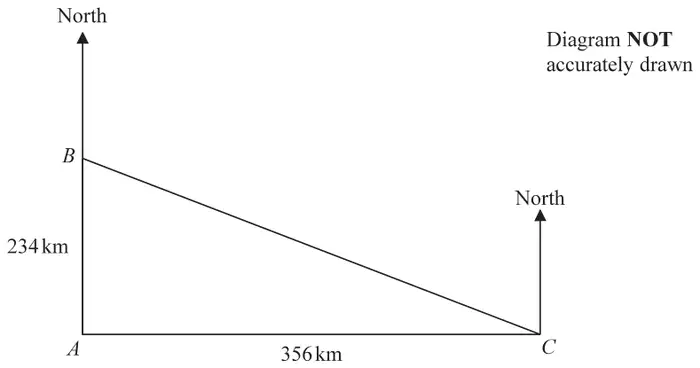
21 The diagram shows the positions of three ships \(A\), \(B\) and \(C\).
\(B\) is 234 km due north of \(A\).
Work out the bearing of \(B\) from \(C\).
(4)
Mark scheme
Mark scheme Scheme Marks \(\tan(BCA) = \dfrac{234}{356}\)
or \(\tan(ABC) = \dfrac{356}{234}\)
M1 (\(BCA =\)) \(\tan^{-1}\left(\dfrac{234}{356}\right)\)
(= 33(.317…))
or (\(ABC =\)) \(\tan^{-1}\left(\dfrac{356}{234}\right)\)
(= 56(.682…))
M1 270 + “33.317…”or M1 303 A1 (4) (4 marks)
Notes M1: candidates that use Pythagoras to find \(BC\) can gain M1 for
\(\cos BCA = \dfrac{356}{\sqrt{234^2 + 356^2}}\) or \(\sin BCA = \dfrac{234}{\sqrt{234^2 + 356^2}}\) or
\(\sin ABC = \dfrac{356}{\sqrt{234^2 + 356^2}}\) or \(\cos ABC = \dfrac{234}{\sqrt{234^2 + 356^2}}\)
M1: (dep) complete method to find angle \(BCA\) or \(ABC\)
M1: complete method
A1: accept 303 – 303.4
Foundation June 2019 Paper 2R Q16
16 The scale diagram shows the position of two statues, \(A\) and \(B\), on a map.
(a) Measure the bearing of \(B\) from \(A\). (1)
Another statue \(C\) is on a bearing of 120° from \(B\).
(b) Mark the position of statue \(C\) with a cross (×).(3)
Mark scheme (a) Mark scheme (b)
Mark scheme (a) Notes B1: 80° ok. Accept 78° → 82°
Mark scheme (b) Scheme Marks M1 M1 (×) in correct position A1 (3) (4 marks)
Notes M1: 9 cm stated or shown on diagram
M1: Correct bearing (118° to 122°)
Foundation June 2019 Paper 2 Q10
10 \(ABC\) is an isosceles triangle.
(a) Use ruler and compasses to construct triangle \(ABC\).
You must show all your construction lines.
The line \(AB\) has been drawn for you.
(2) (b) Use ruler and compasses to construct the perpendicular bisector of the line \(DE\).
You must show all your construction lines.
(2) Mark scheme (a) Mark scheme (b)
Mark scheme (a) Scheme Marks Triangle drawn with correct intersecting arcs 7 cm from \(A\) and 7 cm from \(B\) B2 (2)
Notes B2: for triangle drawn with correct intersecting arcs 7 cm from \(A\) and 7 cm from \(B\) within the overlayor accurate triangle drawn with no arcs)
Mark scheme (b) Scheme Marks Two pairs of intersecting arcs with equal radius centre \(D\) and \(E\) M1 Correct bisector with arcs A1 (2) (4 marks)
Notes M1: for arcs that intersect within guidelines or correct perpendicular bisector without arcs.
Higher June 2019 Paper 2 Q2
2 Use ruler and compasses to construct the perpendicular bisector of the line \(DE\).
(2)
Mark scheme
Mark scheme Scheme Marks Two pairs of intersecting arcs with equal radius centre D and E M1 Correct bisector with arcs A1 (2) (2 marks)
Notes M1: for 2 pairs of arcs that intersect within guidelines or correct perpendicular bisector without arcs.
Foundation January 2019 Paper 2 Q15
15 Use ruler and compasses only to construct the perpendicular bisector of the line \(AB\).
(2)
Mark scheme
Mark scheme Scheme Marks M1 perpendicular bisector drawn A1 (2) (2 marks)
Notes M1: Two pairs of relevant arcs drawn or line within guidelines without arcs
A1: perpendicular bisector drawn within guidelines and with two pairs of relevant arcs present (overlay needed)
Foundation January 2019 Paper 2R Q10
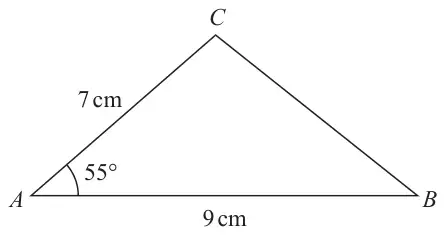
10 Here is a sketch of triangle \(ABC\).
Diagram NOT accurately drawn
In the space below, make an accurate drawing of triangle \(ABC\).
(2)
Mark scheme
Mark scheme Scheme Marks Correct triangle B2 (2) (2 marks)
Notes B2: For a fully correct triangle or
Higher January 2019 Paper 2R Q5
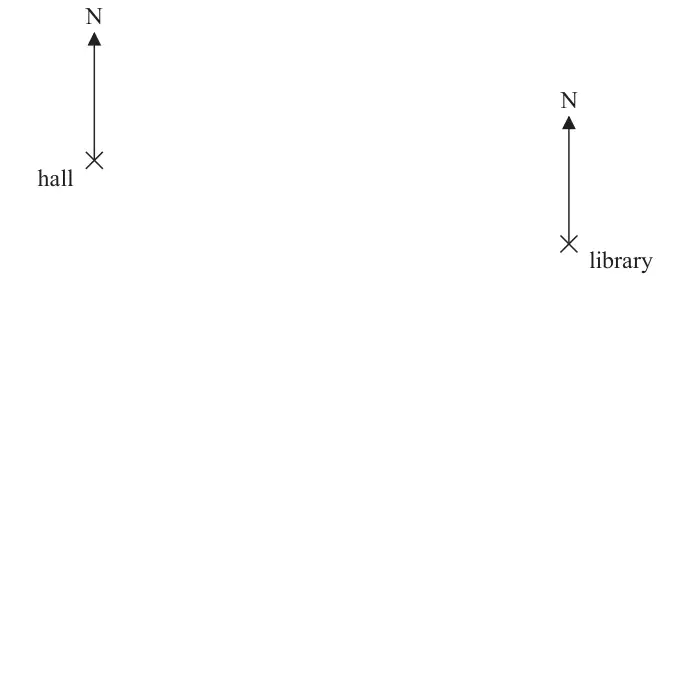
5 The scale drawing shows the position of a hall and the position of a library.
Scale: 1 cm represents 20 metres
A post box is 140 metres from the library on a bearing of 220°
(a) Show the position of the post box on the scale drawing.(2)
(b) Use your scale drawing to find
(i) the real distance, in metres, of the hall from the post box,
(ii) the bearing of the hall from the post box.
(2) Mark scheme (a) Mark scheme (b)
Mark scheme (a) Scheme Marks M1 P in correct region on overlayA1 (2)
Notes M1: Correct bearing (±2°) or correct distance (±2 mm)
A1: Fully correct position for P
Mark scheme (b) Scheme Marks (i) B1 (ii) B1 (2) (4 marks)
Notes B1: 150 – 158 ft from diagram
B1: 330 – 334 ft from diagram
Foundation January 2019 Paper 1R Q3
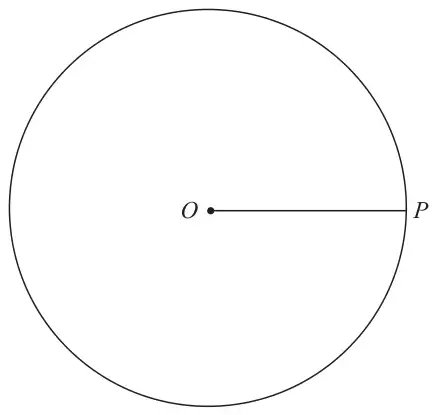
3 Here is a circle, centre \(O\).
(a) Measure the radius, \(OP\), of the circle.(1)
The point \(Q\) is 2 cm from \(O\).
(b) Mark with a cross (×) a possible position of the point \(Q\).(2)
Mark scheme (a) Mark scheme (b)
Mark scheme (a) Mark scheme (b) Scheme Marks \(Q\) marked B2 (2) (3 marks)
Notes B2: for a correct point
Foundation June 2018 Paper 1 Q14
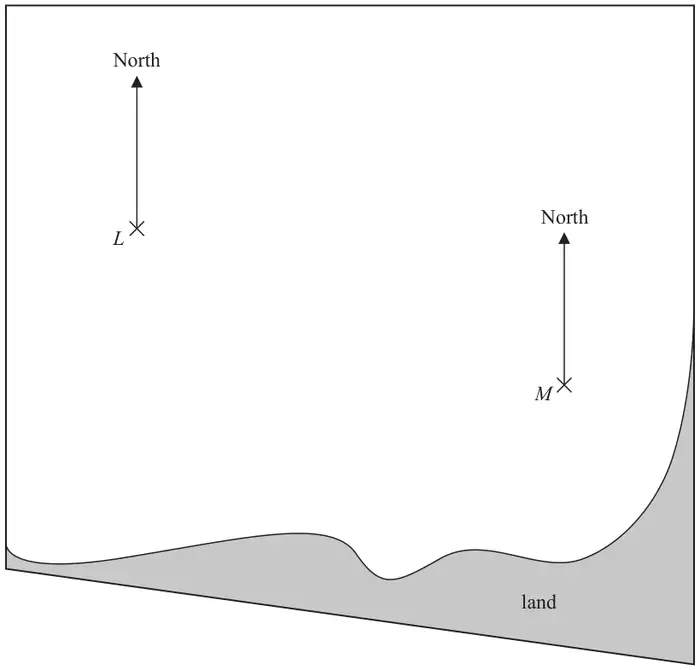
14 The accurate scale drawing shows the positions of two ships, \(L\) and \(M\).
(a) Find the bearing of ship \(M\) from ship \(L\). (1)
The scale of the drawing is 1 cm to 5 km.
Ship \(P\) is 40 km from \(L\) and on a bearing of 240° from \(M\).
(b) On the diagram, mark with a cross (×) the position of ship \(P\). (3)
Mark scheme (a) Mark scheme (b)
Mark scheme (a) Mark scheme (b) Scheme Marks M1 M1 cross marked in correct position A1 (3) (4 marks)
Notes M1: for arc drawn radius 7.8 cm – 8.2 cm centre \(L\) or \(P\) marked 7.8 cm – 8.2 cm from \(L\) or 40 ÷ 5 (= 8)
M1: for bearing of 238° – 242° from \(M\)
A1: Overlay (\(P\) 7.8 cm – 8.2 cm from \(L\) and on a bearing of 238° – 242° from \(M\))
Foundation June 2018 Paper 1R Q4
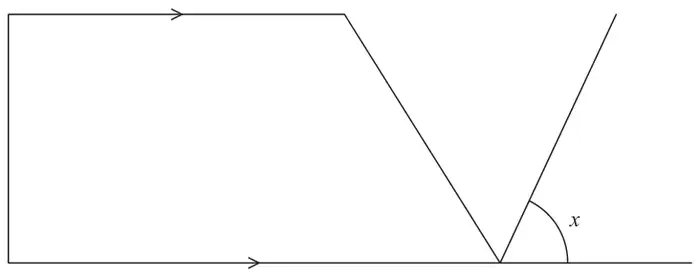
4
(a) On the diagram, mark a right angle with the letter \(R\). (1)
There is a quadrilateral in the diagram.
(b) Write down the mathematical name of this quadrilateral. (1)
(c) Measure the size of angle \(x\). (1)
Mark scheme (a) Mark scheme (b) Mark scheme (c)
Mark scheme (a) Scheme Marks \(R\) marked B1 (1)
Mark scheme (b) Scheme Marks Trapezium B1 (1)
Mark scheme (c) Scheme Marks 65 B1 (1) (3 marks)
Notes B1: accept answer in the range 63 – 67
4MA0 Foundation January 2018 Paper 1 Q24
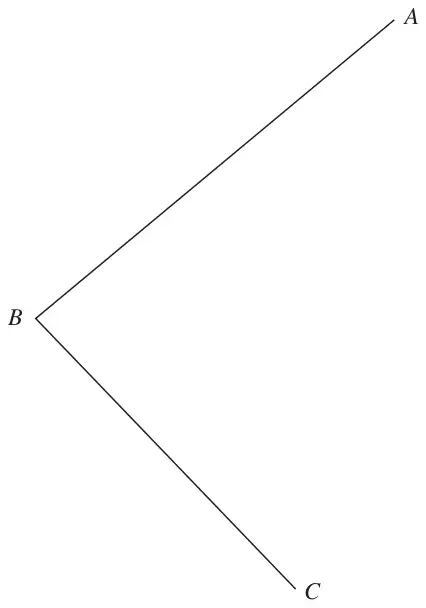
24 Use ruler and compasses only to construct the bisector of angle \(ABC\).
(2)
Mark scheme
Mark scheme Scheme Marks arc centre \(B\) cutting \(BA\) and \(BC\) at (say) \(P\) and \(Q\) AND M1 bisector drawn with all necessary arcs A1 (2)
Notes A1: dep
4MA0 Foundation January 2018 Paper 2 Q17
17 The accurate scale drawing shows the positions of two trees, \(B\) and \(C\), in a field.
The scale of the drawing is 1 cm to 20 m.
A third tree, \(D\), is also in the field.
Find the position of \(D\).
(3)
Mark scheme
Mark scheme Scheme Marks 110 ÷ 20 (= 5.5) M1 Point marked on bearing of 220° from \(C\) M1 \(D\) marked A1 (3)
Notes M1: may be implied by a line of length 5.5 cm or a circle of radius 5.5 cm; allow ±2 mm [or \(D\) marked 5.5 cm from \(B\)]
M1: allow ±2°
A1: \(D\) marked in correct position (overlay)
4MA0 Higher January 2018 Paper 3 Q8
8 Use ruler and compasses only to construct the bisector of angle \(ABC\).
(2)
Mark scheme
Mark scheme Scheme Marks arc centre \(B\) cutting \(BA\) and \(BC\) at (say) \(P\) and \(Q\) AND M1 bisector drawn with all necessary arcs A1 (2)
Notes A1: dep
4MA0 Higher January 2018 Paper 4 Q4
4 The accurate scale drawing shows the positions of two trees, \(B\) and \(C\), in a field.
The scale of the drawing is 1 cm to 20 m.
A third tree, \(D\), is also in the field.
Find the position of \(D\).
(3)
Mark scheme
Mark scheme Scheme Marks 110 ÷ 20 (= 5.5) M1 Point marked on bearing of 220° from \(C\) M1 \(D\) marked A1 (3)
Notes M1: may be implied by a line of length 5.5 cm or a circle of radius 5.5 cm; allow ±2 mm [or \(D\) marked 5.5 cm from \(B\)]
M1: allow ±2°
A1: \(D\) marked in correct position (overlay)
4MA0 Foundation June 2017 Paper 1 Q21
21 Use ruler and compasses to construct the bisector of angle \(PQR\).
(2)
Mark scheme
Mark scheme Scheme Marks Arc centre \(Q\) cutting \(QP\) and \(QR\) at \(A\) and \(B\) with \(AQ = BQ\) and arcs with same radius centre \(A\) and \(B\) intersecting in guidelines M1 Correct angle bisector A1 (2) (2 marks)
Notes M1: for a relevant pair of intersecting arcs within guidelines
A1: dep on M1
4MA0 Foundation June 2017 Paper 2R Q10
10 The scale diagram shows the position of two ships, \(A\) and \(B\).
(a) Measure the bearing of \(B\) from \(A\). (1)
Another ship \(C\) is on a bearing of 070° from \(B\).
(b) Mark the position of ship \(C\) with a cross (×). (2)
Mark scheme (a) Mark scheme (b)
Mark scheme (a) Scheme Marks 123° − 127° B1 (1)
Mark scheme (b) Scheme Marks Bearing of 070° from \(B\) and 7 cm from \(B\) B1 (2) (3 marks)
Notes B1 Correct bearing within overlay
4MA0 Higher June 2017 Paper 3 Q9
9 Use ruler and compasses to construct the bisector of angle \(PQR\).
(2)
Mark scheme
Mark scheme Scheme Marks Arc centre \(Q\) cutting \(QP\) and \(QR\) at \(A\) and \(B\) with \(AQ = BQ\) and arcs with same radius centre \(A\) and \(B\) intersecting in guidelines M1 Correct angle bisector A1 (2) (2 marks)
Notes M1: for a relevant pair of intersecting arcs within guidelines
A1: dep on M1
4MA0 Foundation January 2017 Paper 2R Q24
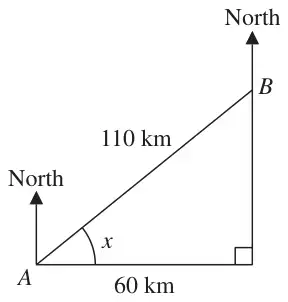
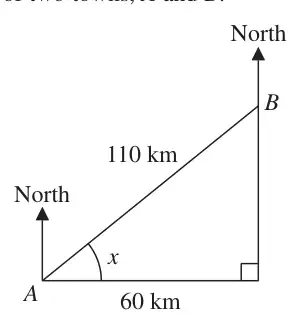
24 The diagram shows the positions of two towns, \(A\) and \(B\).
Diagram NOT accurately drawn
The distance from \(A\) to \(B\) is 110 km.
(a) Work out the size of angle \(x\).(3)
(b) Work out the bearing of \(B\) from \(A\).(2)
The distance from \(A\) to \(B\) is 110 km correct to 2 significant figures.
(c) (i) Write down the lower bound for the distance from \(A\) to \(B\).
(ii) Write down the upper bound for the distance from \(A\) to \(B\).
(2) Mark scheme (a) Mark scheme (b) Mark scheme (c)
Mark scheme (a) Scheme Marks \(\cos x = \dfrac{60}{110}\) or \(\cos x = 0.545(4545\ldots)\) M1 \((x =)\ \cos^{-1}\left(\dfrac{60}{110}\right)\) M1 56.9 A1 (3)
Mark scheme (b) Scheme Marks 90 − 56.9(4426885...) oe M1ft 033 A1ft (2)
Notes M1ft: for complete method, ft from (a) if "(a)" < 90, 90 − their \(x\)
A1ft: accept (0)33 – (0)33.1 or ft
Mark scheme (c) Scheme Marks (i) 105 B1 (ii) 115 B1 (2) (7 marks)
Notes B1: Accept \(114.\dot{9}\)
4MA0 Foundation January 2017 Paper 2 Q19
19
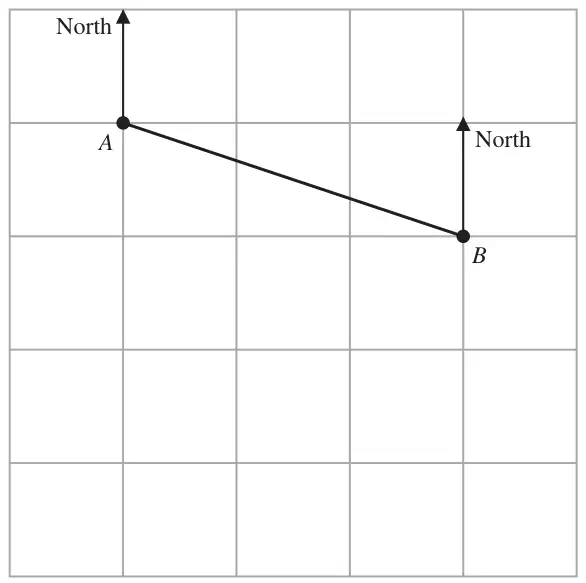
The diagram shows point \(A\) and point \(B\) on a map.
(a) Mark the point \(C\) on the map. (2)
The bearing of a point \(D\) from \(B\) is 168°
(b) Find the bearing of \(B\) from \(D\) (2)
Gordon measures a length on the map as 6.3 cm correct to 1 decimal place.
(c) Write down the lower bound for this length. (1)
Mark scheme (a) Mark scheme (b) Mark scheme (c)
Mark scheme (a) Scheme Marks M1 Correct point A1 (2)
Notes M1: For a point marked due south of \(A\) or on a correct bearing (within overlay) from \(B\).
A1: within overlay
Mark scheme (b) Scheme Marks 168 + 180 or 360 − 12 M1 348 A1 (2)
Notes M1: For a complete method or
A1: cao
Mark scheme (c) Scheme Marks 6.25 B1 (1) (5 marks)
4MA0 Foundation January 2017 Paper 1 Q11
11 \(ABC\) is an isosceles triangle.
Use ruler and compasses to construct triangle \(ABC\).You must show all your construction lines.
The line \(AB\) has been drawn for you.
(2)
Mark scheme
Mark scheme Scheme Marks M1 A correct triangle A1 (2) (2 marks)
Notes M1: for triangle with \(AC = BC\) with relevant arcsor \(AC = 5\) cm or \(BC = 5\) cm with relevant arcsor correct triangle with no arcs
A1: A correctly drawn triangle with relevant arcs at \(C\) (vertex within intersection on overlay)
4MA0 Higher January 2017 Paper 4R Q9
9 The diagram shows the positions of two towns, \(A\) and \(B\).
Diagram NOT accurately drawn
The distance from \(A\) to \(B\) is 110 km.
(a) Work out the size of angle \(x\).(3)
(b) Work out the bearing of \(B\) from \(A\).(2)
The distance from \(A\) to \(B\) is 110 km correct to 2 significant figures.
(c)
(i) Write down the lower bound for the distance from \(A\) to \(B\).
(ii) Write down the upper bound for the distance from \(A\) to \(B\). (2)
Mark scheme (a) Mark scheme (b) Mark scheme (c)
Mark scheme (a) Scheme Marks \(\cos x = \dfrac{60}{110}\) or \(\cos x = 0.545(4545...)\) M1 (\(x =\)) \(\cos^{-1}\left(\dfrac{60}{110}\right)\) M1 56.9 A1 (3)
Mark scheme (b) Scheme Marks 90 – 56.9(4426885...) oe M1ft 033 A1ft (2)
Notes M1ft: for complete method, ft from (a) if “(a)” < 90, 90 – their \(x\)
A1ft: accept (0)33 – (0)33.1 or ft
Mark scheme (c) Scheme Marks (i) B1 (ii) B1 (2) (7 marks)
Notes B1: Accept \(114.\dot{9}\)
4MA0 Higher January 2017 Paper 4 Q8
8
The diagram shows point \(A\) and point \(B\) on a map.
(a) Mark the point \(C\) on the map. (2)
The bearing of a point \(D\) from \(B\) is 168°
(b) Find the bearing of \(B\) from \(D\) (2)
Gordon measures a length on the map as 6.3 cm correct to 1 decimal place.
(c) Write down the lower bound for this length. (1)
Mark scheme (a) Mark scheme (b) Mark scheme (c)
Mark scheme (a) Scheme Marks M1 Correct point A1 (2)
Notes M1: For a point marked due south of \(A\) or on a correct bearing (within overlay) from \(B\).
A1: within overlay
Mark scheme (b) Scheme Marks 168 + 180 or 360 − 12 M1 348 A1 (2)
Notes M1: For a complete method or
A1: cao
Mark scheme (c) Scheme Marks 6.25 B1 (1) (5 marks)
4MA0 Foundation January 2016 Paper 1 Q16
16 Use ruler and compasses only to construct the perpendicular bisector of line AB .
(2)
Mark scheme
Mark scheme Scheme Marks bisector with construction arcs B2 (2)
Notes B2: for bisector within guidelines with two pairs of relevant construction arcs seen
4MA0 Higher January 2016 Paper 3 Q6
6 Use ruler and compasses only to construct the perpendicular bisector of line \(AB\).You must show all your construction lines.
(2)
Mark scheme
Mark scheme Scheme Marks bisector with construction arcs B2 (2)
Notes B2: for bisector within guidelines with two pairs of relevant construction arcs seen
4MA0 Foundation June 2015 Paper 2R Q13
13 \(PQR\) is a triangle.
Draw accurately the triangle \(PQR\) with \(PQ\) as its base.
(2)
Mark scheme
Mark scheme Scheme Marks Line from \(P\) at 60° to base (2° tolerance) or arc from \(Q\) of length 7.3 cm (2 mm tolerance) M1 correct triangle A1 (2) Total 2 marks
4MA0 Higher June 2015 Paper 4R Q7
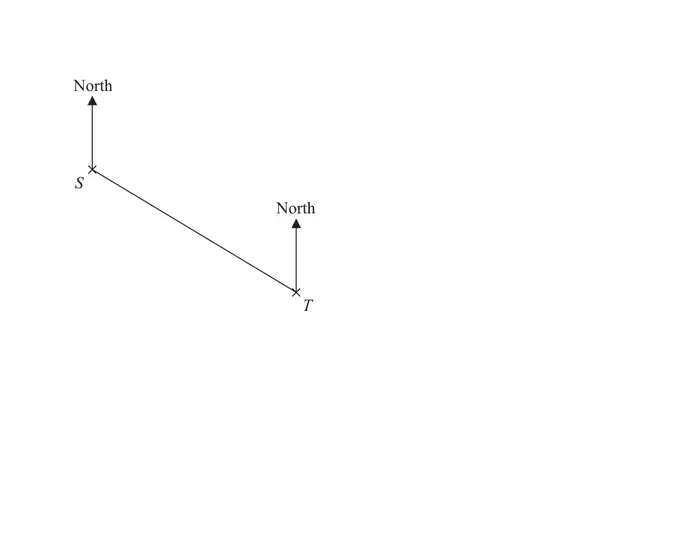
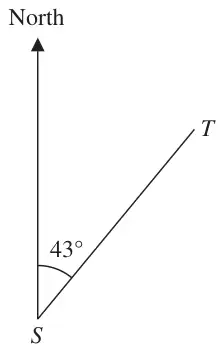
7 The diagram shows two points \(S\) and \(T\).
Diagram NOT accurately drawn
Work out the bearing of \(S\) from \(T\).
(2)
Mark scheme
Mark scheme Scheme Marks \(180 + 43\) or \(360 - (180 - 43)\) or 360 − 137 M1 223 A1 (2)
Notes M1: For a complete method.
4MA0 Foundation January 2015 Paper 1R Q22
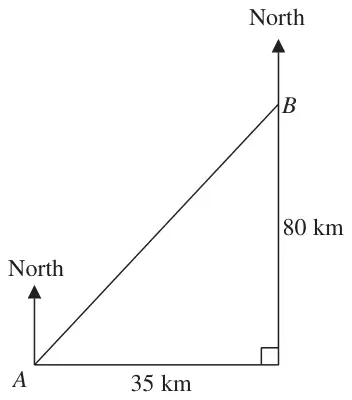
22
Diagram NOT accurately drawn
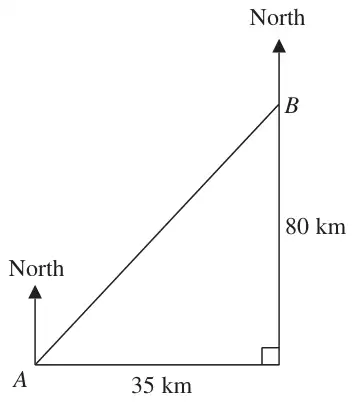
Town \(B\) is 35 km east and 80 km north of town \(A\).
Work out the bearing of town \(A\) from town \(B\).
(4)
Mark scheme
Mark scheme Scheme Marks \(\tan A = \dfrac{80}{35}\) or \(\tan B = \dfrac{35}{80}\) M1 \((A =)\tan^{-1}\left(\dfrac{80}{35}\right)\) or \((B =)\tan^{-1}\left(\dfrac{35}{80}\right)\) M1 (A =) 66.37... or (B =) 23.62... A1 204 B1 (4) (4 marks)
Notes A1: Accept answers that round to 66 or 24(allow answers without labels)
B1: Allow answers in range 203.6 – 204
4MA0 Higher January 2015 Paper 3R Q11
11
Diagram NOT accurately drawn
Town B is 35 km east and 80 km north of town A .
Work out the bearing of A from B .
(4)
Mark scheme
Mark scheme Scheme Marks \(\tan A = \dfrac{80}{35}\) or \(\tan B = \dfrac{35}{80}\) M1 \((A =)\tan^{-1}\left(\dfrac{80}{35}\right)\) or \((B =)\tan^{-1}\left(\dfrac{35}{80}\right)\) M1 (A =) 66.37... or (B =) 23.62... A1 204 B1 (4 marks)
Notes A1: Accept answers that round to 66 or 24 (allow answers without labels)
B1: Allow answers in range 203.6 - 204
4MA0 Foundation January 2015 Paper 2R Q4
4 Draw a circle with a radius of 3 cm.
(2)
Mark scheme
Mark scheme Scheme Marks Correct circle B2 (2) (2 marks)
Notes B2: correct circle
4MA0 Foundation June 2014 Paper 2 Q21
21 Use ruler and compasses to construct the bisector of angle \(ABC\).
(2)
Mark scheme
Mark scheme Scheme Marks Arc centre B cutting BA and BC at P and Q where BP = BQ M1 correct bisector A1 (2) (2 marks)
Notes M1: for arcs within guidelines
A1: dep
4MA0 Higher June 2014 Paper 4R Q19
19
Diagram NOT accurately drawn
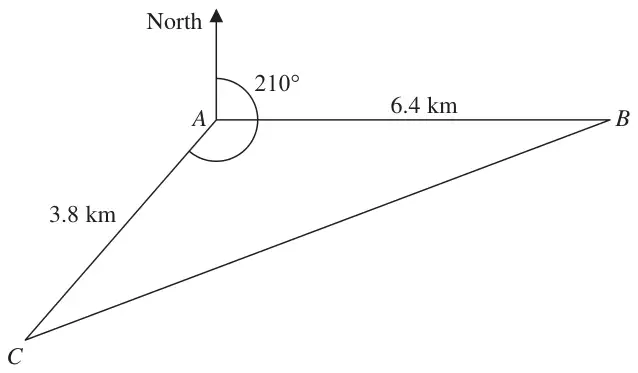
\(A\), \(B\) and \(C\) are 3 villages.
Calculate the bearing of \(B\) from \(C\).
(6)
Mark scheme
Mark scheme Scheme Marks \((BC^2 =)\; 3.8^2 + 6.4^2 - 2 \times 3.8 \times 6.4 \cos 120^\circ\) (= 79.72) M1 \((BC^2 =)\) 14.44 + 40.96 + 24.32 (=79.72) M1 A1 \(\dfrac{\sin C}{6.4} = \dfrac{\sin 120}{\text{“}8.92..\text{”}}\) or
\(6.4^2 = 3.8^2 + \text{“}8.92\text{”}^2 - 2 \times 3.8 \times \text{“}8.92\text{”} \times \cos C\)
M1 \(\sin C = \dfrac{6.4 \times 0.866...}{\text{“}8.92..\text{”}}\) (= 0.62…) or
\(\cos C = \dfrac{3.8^2 + \text{“}8.92\text{”}^2 - 6.4^2}{2 \times 3.8 \times \text{“}8.92\text{”}}\) (=0.78…)
C = 38 – 38.5
M1 068 A1 (6) (6 marks)
Notes M1: correct use of Cosine rule to find BC
M1 A1: M1 correct order of operations
A1 for BC = 8.9 – 8.93 or \(\sqrt{79.72}\) or \(\sqrt{\dfrac{1993}{25}}\) oe
M1: correct use of Sine rule or Cosine rule to find angle C
M1: correct rearrangement
A1: (0)68 – (0)68.4
Award M2 A1 for BC = 8.9 – 8.93 or \(\sqrt{79.72}\) or \(\sqrt{\dfrac{1993}{25}}\) oe
Award M2 for C = 38 – 38.5
Award M2 for B = 21.5 – 22 and C = 180 – 120 – B
Alternative Scheme Marks CD is the perpendicular from C to BA produced.or \(ACD = 30^\circ\) M1 AD = 3.8 cos60° or 3.8sin30 (= 1.9) M1 A1 CD = 3.8sin60 or 3.8cos30 (=3.29)
\(\tan BCD = \dfrac{8.3}{3.8\sin 60}\) oe
M1 M1 068 A1
Notes M1: uses triangle CAD and \(\angle CAD = 60^\circ\) or \(ACD = 30^\circ\)CD may not be drawn in but can be implied
M1 A1: M1 for correct method to find horizontal length
A1: (0)68 – (0)68.4
4MA0 Foundation June 2014 Paper 1 Q18
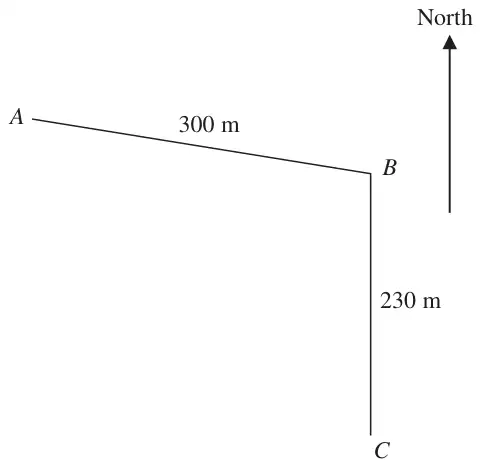
18 The diagram shows an accurate scale drawing of part of the boundary of a field.
\(AB = 300\) metres.
The scale of the diagram is 1 cm to 50 metres.
The bearing of \(D\) from \(C\) is 260°
Complete the scale drawing of the boundary of the field.
(2)
Mark scheme
Mark scheme Scheme Marks one bearing line at 260° ± 2° M1 Intersection of 2 lines in boundary of overlay A1 (2) (2 marks)
Notes A1: condone omission of D label
4MA0 Higher June 2014 Paper 4 Q7
7 Use ruler and compasses to construct the bisector of angle ABC .
(2)
Mark scheme
Mark scheme Scheme Marks Arc centre B cutting BA and BC at P and Q where BP = BQ and arcs drawn from P and Q M1 correct bisector A1 (2 marks)
Notes M1: for all relevant arcs (those drawn from P and Q may fall outside guidelines)
A1: for angle bisector in guidelines with all necessary arcs
4MA0 Higher June 2014 Paper 3 Q6
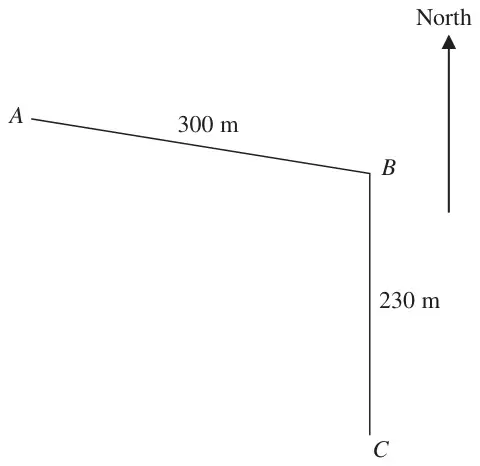
6 The diagram shows an accurate scale drawing of part of the boundary of a field.ABCD .
\(AB = 300\) metres.B is due north of point C .
The scale of the diagram is 1 cm to 50 metres.
The bearing of D from C is 260°
Complete the scale drawing of the boundary of the field.D .
(2)
Mark scheme
Mark scheme Scheme Marks One bearing line at 260° (± 2°) or one 9.6 cm line (± 2mm) from A M1 Intersection of 2 lines in boundary of overlay A1 (2 marks)
Notes A1: Condone omission of \(D\) label
4MA0 Foundation January 2014 Paper 2R Q20
20 Use ruler and compasses to construct the bisector of angle \(ABC\).
(2)
Mark scheme
Mark scheme Scheme Marks Circular arc, centre \(B\), to intersect both lines \(AB\) and \(BC\) B1 Equal length arcs, from intersections on each line, meeting to give a point on the bisector. B1 (2) (Total 2 marks)
4MA0 Higher January 2014 Paper 4R Q10
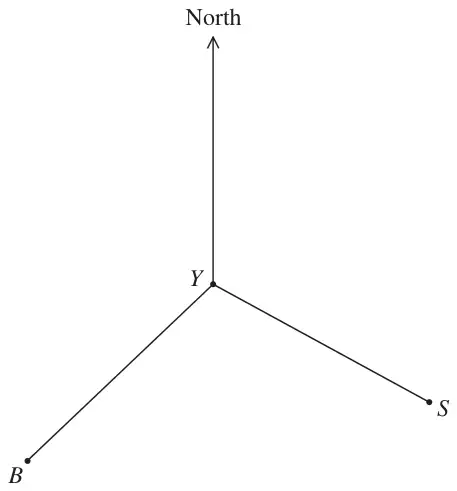
10
Diagram NOT accurately drawn
The diagram shows the positions of a yacht \(Y\), a ship \(S\) and a beacon \(B\).
(a) Find the bearing of \(Y\) from \(B\). (2)
The bearing of \(S\) from \(Y\) is 118°
(b) Find the size of the angle \(BYS\). (1)
(c) Given also that \(BY = SY\), find the bearing of \(S\) from \(B\). (2)
Mark scheme (a) Mark scheme (b) Mark scheme (c)
Mark scheme (a) Scheme Marks 228 – 180 (=48) M1 048 A1 (2)
Notes M1: Can be marked on diagram.
A1: Accept 48
Mark scheme (b) Mark scheme (c) Scheme Marks 228 – 118 (= 110) M1ft 083 A1 (2) (5 marks)
Notes M1ft: bearing from (a) + 35
A1: accept 83
4MA0 Higher January 2014 Paper 4R Q5
5 Use ruler and compasses to construct the bisector of angle \(ABC\).
(2)
Mark scheme
Mark scheme Scheme Marks Circular arc, centre \(B\), to intersect both lines \(AB\) and \(BC\) M1 correct bisector A1 (2) (2 marks)
Notes A1: dep on M1 Full construction shown.
The mark scheme states that for this question the correct answer alone does not imply a correct method.
4MA0 Higher June 2013 Paper 3 Q18
18
Diagram NOT accurately drawn
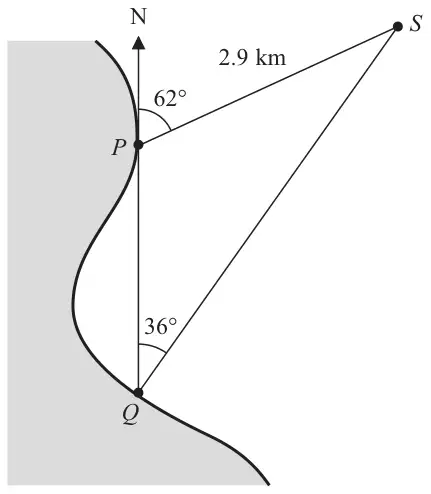
\(P\) and \(Q\) are two points on a coast.
Calculate the distance \(QS\).
(3)
Mark scheme
Mark scheme Scheme Marks \(\dfrac{2.9}{\sin 36^\circ} = \dfrac{QS}{\sin(180 - 62)^\circ}\) M1 \((QS =)\ \dfrac{2.9 \sin \text{“}118\text{”}^\circ}{\sin 36^\circ}\) oe M1 4.36 A1 (3)
Notes M1: for correct substitution into the Sine Rule
M1: for correct rearrangement (there may be partial evaluation)
A1: for awrt 4.36
Condone use of 62 instead of 118
4MA0 Foundation January 2013 Paper 2 Q27
27 Use ruler and compasses to construct the bisector of angle \(ABC\).
(2)
Mark scheme
Mark scheme Scheme Marks arc centre \(B\) cutting \(BA\) and \(BC\) at (say) \(P\) and \(Q\) M1 arcs centres \(P\) and \(Q\) of equal radii which intersect at \(R\) (say) and \(BR\) joined (overlay) A1 (2)
4MA0 Higher January 2013 Paper 4 Q12
12 Use ruler and compasses to construct the bisector of angle \(ABC\).
(2)
Mark scheme
Mark scheme Scheme Marks arc centre \(B\) cutting \(BA\) and \(BC\) at (say) \(P\) and \(Q\) M1 arcs centres \(P\) and \(Q\) of equal radii which intersect at \(R\) (say) and \(BR\) joined (overlay) A1 (2)
4MA0 Foundation June 2012 Paper 2 Q12
12 \(ABC\) is a triangle.
Use a ruler and compasses to construct the triangle \(ABC\) with \(AB\) as its base.
(2)
Mark scheme
Mark scheme Scheme Marks Triangle drawn with correct intersecting arcs from A (4 cm) and B (10 cm) B2 (2) (Total 2 marks)
Notes B2: Arcs intersect within overlay
4MA0 Foundation January 2012 Paper 1 Q15
15 The lengths of the sides of a rhombus are 6 cm.
Construct an accurate, full-size drawing of the rhombus.
(4)
Mark scheme
Mark scheme Scheme Marks Arcs of length 6 cm from A and B M1 Arc of length 10 cm from A or B M1 Arc of length 6 cm from correct top vertex M1 Correct rhombus within overlay tolerance A1 (4) (Total 4 marks)
Notes A1: Dependent on M3sc B1 for correct rhombus with no construction lines.
4MA0 Higher January 2012 Paper 3 Q4
4 The lengths of the sides of a rhombus are 6 cm.Construct an accurate, full-size drawing of the rhombus.
(4)
Mark scheme
Mark scheme Scheme Marks Arcs of length 6cm from A and M1 Arc of length 10 cm from A or M1 Arc of length 6 cm from correct top vertex M1 Correct rhombus within overlay tolerance A1 (Total 4 marks)
Notes A1: Dependent on M3
4MA0 Foundation June 2011 Paper 2 Q16
16 Here is a map of an island.
\(A\) and \(B\) are points on the island.
The scale of the map is 1 cm to 5 km.
(a) Find the real distance, in kilometres, between \(A\) and \(B\). (2)
(b) By measuring, find the bearing of \(B\) from \(A\). (1)
(c) Find the bearing of \(A\) from \(B\). (1)
Treasure is buried at a point on the island.
(d) Find the point on the map where the treasure is buried.(2)
Mark scheme (a) Mark scheme (b) Mark scheme (c) Mark scheme (d)
Mark scheme (a) Scheme Marks 6.3 → 6.5 (inclusive) × 5 M1 31.5 → 32.5 inclusive A1 (2)
Mark scheme (b) Scheme Marks 076 → 080 inclusive B1 (1)
Notes B1: leading zero not necessary
Mark scheme (c) Scheme Marks 256 → 260 inclusive B1 (1)
Notes B1: ft from (b) if (b) is acute {180 + (b) oe}
Mark scheme (d) Scheme Marks 1 bearing line or 1 arc drawn correctly from A or B M1 Cross in correct position A1 (2) (Total 6 marks)
Notes A1: dep on M1 (see overlay)
4MA0 Foundation June 2011 Paper 2 Q14
14 Use compasses and a ruler only to construct the perpendicular bisector of the line \(PQ\).
(2)
Mark scheme
Mark scheme Scheme Marks Intersecting arcs from P and Q B1 Perpendicular bisector joining arcs B1 (2) (Total 2 marks)
Notes B1: arcs must intersect above and below line PQ
B1: dep
4MA0 Higher June 2011 Paper 4 Q8
8 Use compasses and a ruler only to construct the perpendicular bisector of the line \(PQ\).
(2)
Mark scheme
Mark scheme Scheme Marks Intersecting arcs from P and Q B1 Perpendicular bisector joining both arcs B1 dep (Total 2 marks)
Notes B1: arcs must intersect above and below line PQ
4400 Foundation June 2010 Paper 2 Q14
14. The diagram shows two towns, \(A\) and \(B\), on a map.
(a) By measurement, find the bearing of \(B\) from \(A\). (2)
(b) \(C\) is another town.(2)
(c) The scale of the map is 1 cm to 5 km.(3)
Mark scheme (a) Mark scheme (b) Mark scheme (c)
Mark scheme (a) Scheme Marks 360 − (108 to 112) or 180 + (68 to 72) M1 248 to 252 inclusive A1 (2)
Mark scheme (b) Scheme Marks 360 − (180 − 50) (= 360 − 130) M1 230 A1 (2)
Mark scheme (c) Scheme Marks 6.5 \(\pm\) 0.2 seen M1 (6.5 \(\pm\) 0.2) × 5 M1 31.5 – 33.5 inclusive A1 (3) (Total 7 marks)
4400 Higher June 2010 Paper 4 Q2
2 The diagram shows two towns, \(A\) and \(B\), on a map.
(a) By measurement, find the bearing of \(B\) from \(A\). (2)
(b) \(C\) is another town.(2)
Mark scheme (a) Mark scheme (b)
Mark scheme (a) Scheme Marks 360 − (108 to 112) M1 248 to 252 A1 (2)
Mark scheme (b) Scheme Marks 360 − (180 − 50) (= 360 − 130) M1 230 A1 (2) (4 marks)
4400 Foundation November 2009 Paper 2 Q20
20 Use ruler and compasses to construct the perpendicular bisector of the line \(AB\).
(2)
Mark scheme
Mark scheme Scheme Marks Arcs of equal radii > ½\(AB\), centres \(A\), \(B\), which intersect twice M1 Perpendicular bisector within guidelines A1 (2) (Total 2 marks)
4400 Foundation November 2009 Paper 2 Q15
15
Diagram NOT accurately drawn
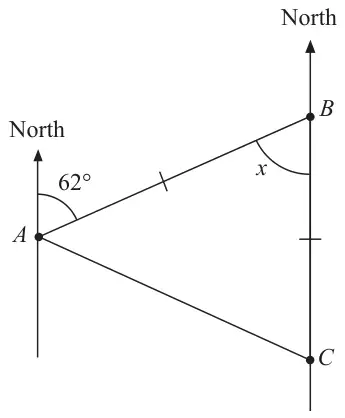
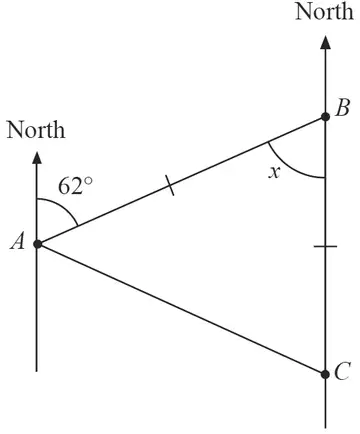
The bearing of \(B\) from \(A\) is 062°.
(a) (i) Find the size of angle \(x\).
(ii) Give a reason for your answer.
(2) (b) Work out the bearing of \(C\) from \(A\). (2)
Mark scheme (a) Mark scheme (b)
Mark scheme (a) Scheme Marks (i) 62 B1 (ii) eg alternate angles B1 (2)
Notes B1: cao
B1: Accept ‘alternate’ but not ‘Z angles’
Mark scheme (b) Scheme Marks \(\dfrac{180 - \text{``}{62}\text{''}}{2}\) or \(\dfrac{180 - 62}{2}\) or 59 M1 121 A1 (2) (Total 4 marks)
4400 Higher November 2009 Paper 4 Q8
8
Use ruler and compasses to construct the perpendicular bisector of the line \(AB\).
(2)
Mark scheme
Mark scheme Scheme Marks Arcs of equal radii \(\gt \frac{1}{2}AB\), centres \(A\), \(B\), which intersect twice M1 Perpendicular bisector within guidelines A1 (2) (2 marks)
4400 Foundation November 2009 Paper 2 Q6
6
(a) Measure the length of \(AB\). (1)
(b) Measure the size of angle \(ABC\). (1)
\(ABCD\) is a quadrilateral.
(c) On the diagram, complete quadrilateral \(ABCD\). (3)
Mark scheme (a) Mark scheme (b) Mark scheme (c)
Mark scheme (a) Notes B1: Accept 7.1-7.5 inc
Mark scheme (b) Notes B1: Accept 72-76 inc
Mark scheme (c) Scheme Marks \(\angle BAD = 117^\circ\) M1 Arc centre \(C\) radius 9.1 cm M1 \(ABCD\) completed A1 (3) (Total 5 marks)
Notes M1: Allow ±2°
M1: Allow ±2 mm
A1: Within tolerance
4400 Higher November 2009 Paper 4 Q3
3
The bearing of \(B\) from \(A\) is 062°.
(a) (i) Find the size of angle \(x\).
(ii) Give a reason for your answer. (2)
(b) Work out the bearing of \(C\) from \(A\). (2)
Mark scheme (a) Mark scheme (b)
Mark scheme (a) Scheme Marks (i) B1 (ii) B1 (2)
Notes B1: cao
B1: Accept ‘alternate’ but not ‘Z angles’
Mark scheme (b) Scheme Marks (180 − “62”)/2 or (180 − 62)/2 or 59 M1 121 A1 (2) (4 marks)
4400 Foundation November 2008 Paper 1 Q14
14
Find, by measurement, the bearing of
(i) \(B\) from \(A\),
(ii) \(C\) from \(A\).
(2)
Mark scheme
Mark scheme Scheme Marks (i) 060-064 B1 (ii) 321-325 B1 (2) (Total 2 marks)
Notes B1: Condone omission of 0
4400 Foundation June 2008 Paper 2 Q15 15 The diagram shows two towns, \(A\) and \(B\), on a map.
(a) Measure the bearing of \(B\) from \(A\). (2)
(b) \(C\) is another town.(2)
Mark scheme (a) Mark scheme (b)
Mark scheme (a) Notes B2: B2 for angle 248 to 252 inclusive.
Mark scheme (b) Scheme Marks M1 305 A1 (2) (Total 4 marks)
Notes M1: 125 + 180 or mark \(C\), bearing 90 to 180
A1: exact
4400 Foundation June 2008 Paper 1 Q12 12 Use ruler and compasses to construct an equilateral triangle with \(AB\) as its base.
Mark scheme
Mark scheme Scheme Marks 2 arcs, radius 6 cm, centres A and B M1 triangle within guidelines A1 (Total 2 marks)
4400 Higher June 2008 Paper 4 Q2
2 The diagram shows two towns, \(A\) and \(B\), on a map.
(a) Measure the bearing of \(B\) from \(A\). (2)
(b) \(C\) is another town.(2)
Mark scheme (a) Mark scheme (b)
Mark scheme (a) Scheme Marks \(250 \pm 2\) B2 (2)
Notes B2: B2 for angle 248 to 252 inclusive.
Mark scheme (b) Scheme Marks \(305 \pm 3\) B2 (2) (4 marks)
Notes B2: Award B1 for a bearing \(270^\circ \lt\) angle \(\lt 360^\circ\)
4400 Foundation November 2007 Paper 2 Q20 20 Use ruler and compasses to construct the bisector of angle \(ABC\).
Mark scheme
Mark scheme Scheme Marks arc centre \(B\) cutting \(AB\) and \(BC\) at (say) \(P\) and \(Q\) B1 arcs centre \(P\) and \(Q\) of equal radii which intersect at \(R\) (say) and \(BR\) joined B1 (Total 2 marks)
Notes B1: (corrected from the printed mark scheme: printed as “cutting AB and AC”; the arc cuts the arms AB and BC)
B1: (dep) bisector within tolerance
4400 Higher November 2007 Paper 4 Q9
9 Use ruler and compasses to construct the bisector of angle \(ABC\).
(2)
Mark scheme
Mark scheme Scheme Marks arc centre \(B\) cutting \(AB\) and \(AC\) at (say) \(P\) and \(Q\) B1 arcs centre \(P\) and \(Q\) of equal radii which intersect at \(R\) (say) and \(BR\) joined B1 (2) (2 marks)
Notes B1: (dep) bisector within tolerance
4400 Foundation November 2006 Paper 1 Q13
13
(a) By measurement, find the bearing of \(B\) from \(A\). (2)
(b) The bearing of another point, \(C\), from \(A\) is 226°.Work out the bearing of \(A\) from \(C\). (2)
Mark scheme (a) Mark scheme (b)
Mark scheme (a) Notes B2: B1 for 290 ± 5 or 360 − 70
Mark scheme taken from the matching question on the Higher paper.
Mark scheme (b) Scheme Marks 226 − 180 M1 046 A1 (2) (Total 4 marks)
Notes A1: Condone omission of 0
Mark scheme taken from the matching question on the Higher paper.
4400 Higher November 2006 Paper 3 Q1
1
(a) By measurement, find the bearing of \(B\) from \(A\). (2)
(b) The bearing of another point, \(C\), from \(A\) is 226°.Work out the bearing of \(A\) from \(C\). (2)
Mark scheme (a) Mark scheme (b)
Mark scheme (a) Notes B2: B1 for 290 ± 5 or 360 − 70
Mark scheme (b) Scheme Marks 226 − 180 M1 046 A1 (2) (4 marks)
Notes A1: Condone omission of 0
4400 Foundation November 2005 Paper 2 Q17
17 The diagram shows two towns, \(A\) and \(B\).
(a) Measure the bearing of \(B\) from \(A\). (2)
(b) A plane flies along the perpendicular bisector of \(AB\).(2)
(c) The bearing of another town, \(C\), from \(A\) is \(120^\circ\).(1)
Mark scheme (a) Mark scheme (b) Mark scheme (c)
Mark scheme (a) Notes B2: B1 for 180 < angle < 270
Mark scheme taken from the matching question on the Higher paper.
Mark scheme (b) Scheme Marks four construction arcs seen B1 line, length > 4 cm B1 (2)
Notes B1: ± 2 mm of correct
Mark scheme taken from the matching question on the Higher paper.
Mark scheme (c) Scheme Marks 300 B1 (1) (5 marks)
Notes Mark scheme taken from the matching question on the Higher paper.
4400 Foundation November 2005 Paper 1 Q15
15 The lengths of two of the sides of a kite are 7.6 cm and 4.3 cm.
In the space below, use ruler and compasses to construct an accurate, full-size drawing of the kite.
(4)
Mark scheme
Mark scheme Scheme Marks Line of 5.2 cm (the shorter diagonal) drawn B1 Arcs of radius 4.3 cm from both ends of the diagonal, intersecting M1 Arcs of radius 7.6 cm from both ends of the diagonal, intersecting on the other side M1 Complete kite with sides 4.3, 4.3, 7.6, 7.6 cm (±2 mm) and construction arcs shown A1 (4) (4 marks)
Notes A1: sides within ±2 mm; construction arcs must be seen
No official mark scheme was available for this paper; this one was written by Westie's Workshop.
4400 Higher November 2005 Paper 4 Q5
5 The diagram shows two towns, \(A\) and \(B\).
(a) Measure the bearing of \(B\) from \(A\). (2)
(b) A plane flies along the perpendicular bisector of the line \(AB\).(2)
(c) The bearing of another town, \(C\), from \(A\) is \(120^\circ\).(1)
Mark scheme (a) Mark scheme (b) Mark scheme (c)
Mark scheme (a) Notes B2: B1 for 180 < angle < 270
Mark scheme (b) Scheme Marks four construction arcs seen B1 line, length > 4 cm B1 (2)
Notes B1: ± 2 mm of correct
Mark scheme (c) Scheme Marks 300 B1 (1) (5 marks)
4400 Higher November 2005 Paper 3 Q3
3 The lengths of two of the sides of a kite are 7.6 cm and 4.3 cm.
In the space below, use ruler and compasses to construct an accurate, full-size drawing of the kite.
(4)
Mark scheme
Mark scheme Scheme Marks Line of 5.2 cm (the shorter diagonal) drawn B1 Arcs of radius 4.3 cm from both ends of the diagonal, intersecting M1 Arcs of radius 7.6 cm from both ends of the diagonal, intersecting on the other side M1 Complete kite with sides 4.3, 4.3, 7.6, 7.6 cm (±2 mm) and construction arcs shown A1 (4) (4 marks)
Notes A1: sides within ±2 mm; construction arcs must be seen
No official mark scheme was available for this question; this one was written by Westie's Workshop.
4400 Foundation June 2005 Paper 1 Q2
2
(a) Measure the length of the line \(AB\).(1)
(b) In the space above, draw the circle which has \(AB\) as a diameter. (2)
Mark scheme (a) Mark scheme (b)
Mark scheme (a) Notes No official mark scheme was available for this paper; this one was written by Westie's Workshop.
B1: Accept 60 – 64 (measured on the printed paper)
Mark scheme (b) Scheme Marks Circle with centre the midpoint of \(AB\), passing through \(A\) and \(B\) (± 2 mm) B2 (2) (Total 3 marks)
Notes No official mark scheme was available for this paper; this one was written by Westie's Workshop.
B2: B1 for a circle with centre the midpoint of \(AB\) or a circle through \(A\) and \(B\)
4400 Foundation November 2004 Paper 1 Q11
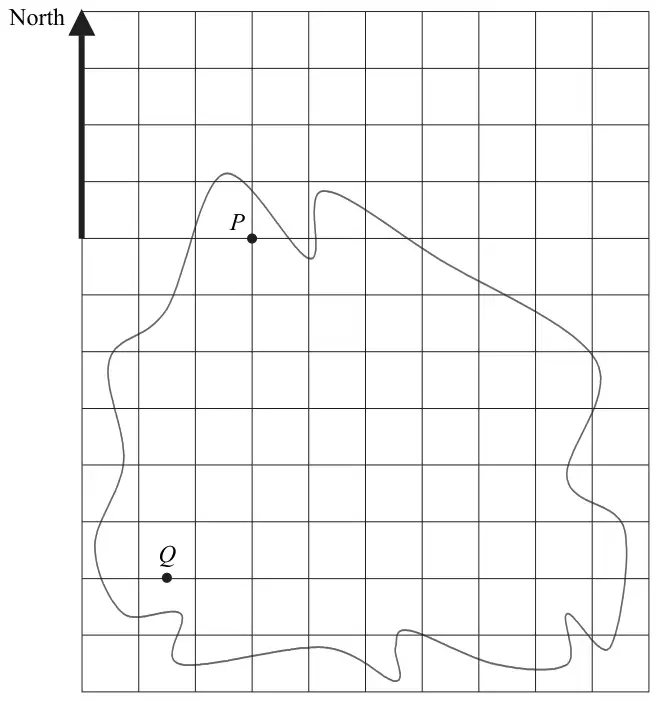
11 The diagram shows a map of an island.
(a) Find the bearing of \(Q\) from \(P\). (2)
The scale of the map is 1 cm to 5 km.
(b) Find the real distance between \(P\) and \(Q\). (2)
Another town, \(R\), is due East of \(Q\).
(c) On the map, mark and label \(R\). (2)
Mark scheme (a) Mark scheme (b) Mark scheme (c)
Mark scheme (a) Scheme Marks 194 ± 2\(^\circ\) B2 (2)
Notes B2: (± 5\(^\circ\): B1)
Mark scheme (b) Scheme Marks 6.2 ± 0.1 or a length x 5 M1 31 ± 0.5 km A1 (2)
Mark scheme (c) Scheme Marks Correct pos’n ± 4mm B2 (2) (Total 6 marks)
Notes B2: (either 135 or 90 ± 2\(^\circ\): B1)
4400 Foundation November 2004 Paper 2 Q9
9
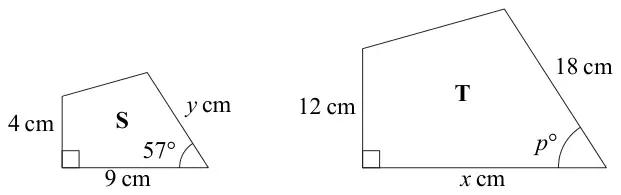
Diagram NOT accurately drawn
Shape \(\mathbf{T}\) is an enlargement of shape \(\mathbf{S}\).
(a) Find the value of \(p\). (1)
(b) Find the scale factor of the enlargement. (1)
(c) Find the value of
(i) \(x\),
(ii) \(y\).
(2) (d) In the space below, make an accurate drawing of shape \(\mathbf{S}\). (2)
Mark scheme (a) Mark scheme (b) Mark scheme (c) Mark scheme (d)
Mark scheme (a) Mark scheme (b) Notes B1: Condone 1:3 or ×3
Mark scheme (c) Scheme Marks (i) B1 (ii) B1 (2)
Mark scheme (d) Scheme Marks drawing B2 (2) (Total 6 marks)
Notes B2: for 9 cm, 4 cm, 90° and 57° ie ignore \(y\)
4400 Higher November 2004 Paper 3 Q1
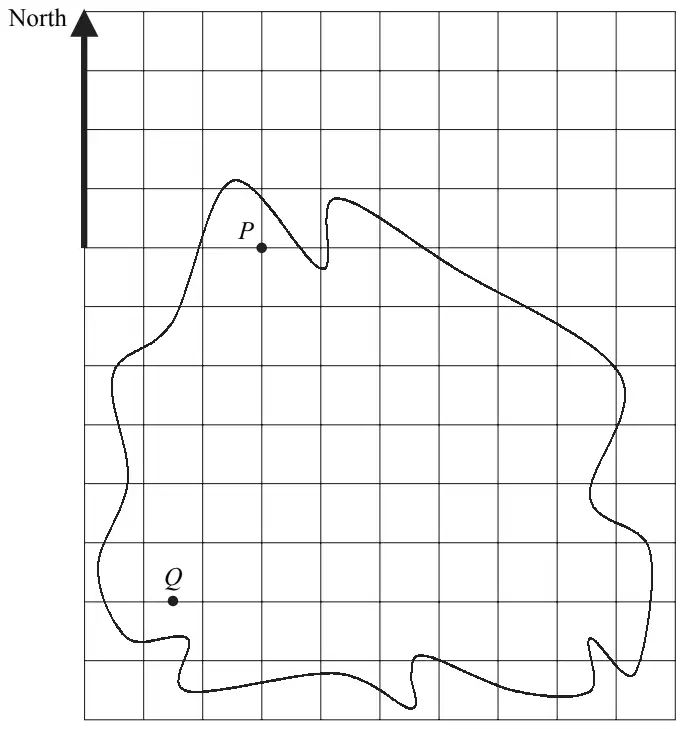
1 The diagram shows a map of an island.
(a) Find the bearing of \(Q\) from \(P\). (2)
The scale of the map is 1 cm to 5 km.
(b) Find the real distance between \(P\) and \(Q\). (2)
Another town, \(R\), is due East of \(Q\).
(c) On the map, mark and label \(R\). (2)
Mark scheme (a) Mark scheme (b) Mark scheme (c)
Mark scheme (a) Mark scheme (b) Scheme Marks 6.2 ± 0.1 or a length × 5 M1 31 ± 0.5 km A1 (2)
Mark scheme (c) Scheme Marks Correct pos’n ± 1 mm B2 (2) (6 marks)
Notes B2: (either 135 or 90 ± 2°: B1)
No questions match these filters.