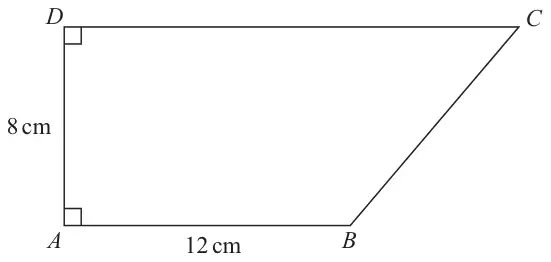
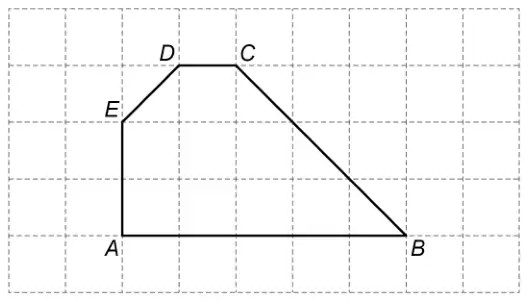
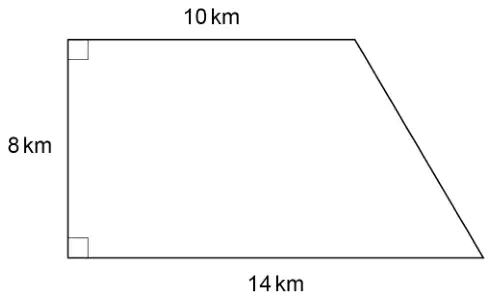
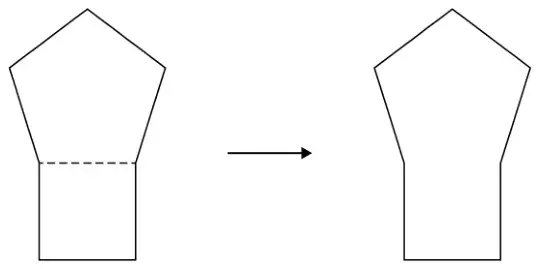
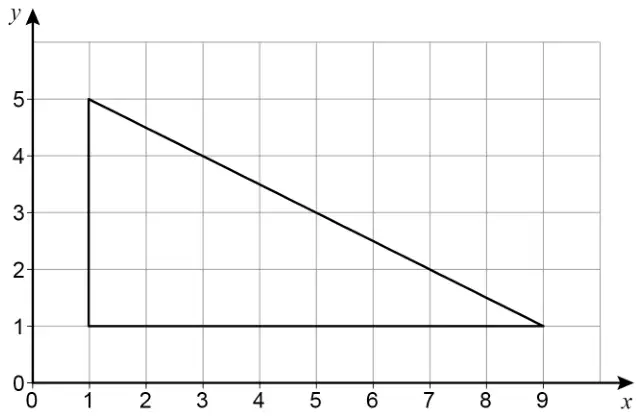
Work out the perimeter of the trapezium. Give your answer correct to 3 significant figures. (5)
Mark scheme
Answer
Mark
Mark scheme
44.9
P1
for process to find an expression for the area of the trapezium, eg \(\tfrac{1}{2}(12 + CD)8\) or \(8 \times 12 + \tfrac{1}{2} \times 8 \times x\)
or for process to find the area of the triangle, eg \(112 - 8 \times 12\ (= 16)\)
P1
for forming an equation and isolating terms in the unknown length, eg \(4CD = 112 - 48\) or \(\tfrac{1}{2} \times 8 \times x = 112 - 8 \times 12\) or \(\tfrac{1}{2} \times 8 \times x = \text{``}16\text{''}\) or \(CD = 16\) or \(x = 4\)
P1
for start of process to find length of \(BC\), eg \(8^2 + \text{``}4\text{''}^2\ (= 80)\) or \(8^2 + [\text{their } x]^2\) or \(\tan^{-1}\left(\dfrac{\text{``}4\text{''}}{8}\right)\ (= 26.5\ldots)\) oe or \(\tan^{-1}\left(\dfrac{8}{\text{``}4\text{''}}\right)\ (= 63.4\ldots)\) where “4” can be [their \(x\)]
P1
for \(\sqrt{8^2 + \text{``}4\text{''}^2}\) or \(\sqrt{64 + \text{``}16\text{''}}\) or \(\sqrt{80}\) or \(4\sqrt{5}\ (= 8.9\ldots)\) oe or \(\sqrt{8^2 + [\text{their } x]^2}\) or \(\dfrac{\text{``}4\text{''}}{\sin \text{``}26.5\ldots\text{''}}\) or \(\dfrac{8}{\cos \text{``}26.5\ldots\text{''}}\) or \(\dfrac{8}{\sin \text{``}63.4\ldots\text{''}}\) or \(\dfrac{\text{``}4\text{''}}{\cos \text{``}63.4\ldots\text{''}}\) where “4” can be [their \(x\)]
A1
for answer in the range 44.9 to 44.95
Additional guidance
\(x\) is the length of the line from \(C\) to where perpendicular from \(B\) meets \(CD\) Allow use of other letters in place of \(CD\) and \(x\) (do not have to be defined unless otherwise stated) Award P1 for \(112 - 8 \times 12\ (= 16)\) even if not used
Award P2 for \(CD = 16\) or \(x = 4\) even if not used unless clearly from incorrect working eg \(12 - 8\ (= 4)\) Only award P2 for 16 if it is clearly identified as \(CD\)
[their \(x\)] can be any value less than 12 or clearly identified as the length of the line from \(C\) to where perpendicular from \(B\) meets \(CD\) (may be seen on the diagram)
Award P4 for (\(BC =\)) \(\sqrt{80}\) or \(4\sqrt{5}\) or 8.9… unless \(x = 4\) is clearly from incorrect working
If an answer is shown in the range in working and then incorrectly rounded award full marks
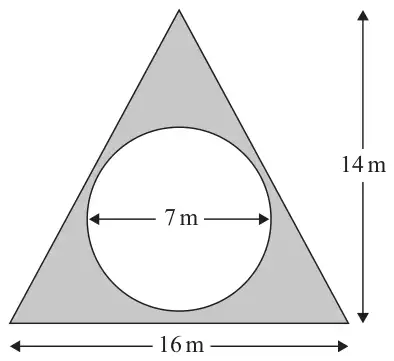
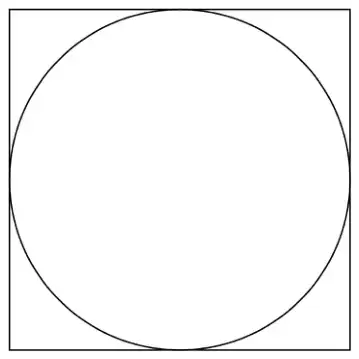
There is a circle inside a triangle. The circle has a diameter of 7 m.
Macsen will cover the shaded area with gravel.
Gravel is sold in bags. Each bag of gravel covers an area of 12.5 m2
(a) Work out the number of bags of gravel Macsen will need. (4)
Macsen finds that each bag of gravel only covers an area of 11 m2
(b) How does this affect your answer to part (a)? (1)
Mark scheme (a)
Answer
Mark
Mark scheme
6
P1
for process to find a relevant area, eg \(16 \times 14 \div 2\ (= 112)\) or \(\pi \times \left(\dfrac{7}{2}\right)^2\ (= 38.4\ldots)\)
P1
for process to find the shaded area, eg \(\text{``}112\text{''} - \text{``}38.4\ldots\text{''}\ (= 73.51\ldots)\) or \(\text{``}8.96\text{''} - \text{``}3.07\ldots\text{''}\ (= 5.88\ldots)\)
P1
for a process to find the number of bags required for a full or partial area, eg \(\text{``}73.51\ldots\text{''} \div 12.5\ (= 5.88\ldots)\) or \(\text{``}112\text{''} \div 12.5\ (= 8.96)\) or \(\text{``}38.4\ldots\text{''} \div 12.5\ (= 3.07\ldots)\) or [area] \(\div\, 12.5\) or uses 12.5 in a build up method to exceed [area], eg \(12.5 \times 6\ (= 75)\) oe
A1
cao
Additional guidance
May be implied by \(\dfrac{49}{4}\pi\)
[area] can be any area but cannot be a length
Mark scheme (b)
Answer
Mark
Mark scheme
Statement
C1
for a valid statement relating to effect on number of bags needed, eg Acceptable examples Will need more bags It will increase Will need an extra bag or will now need 7 bags He won’t have enough There is no change (ft their [area] but must be supported by calculation)
Not acceptable examples Will cover less area Needs to change the number of bags needed There is no change (unsupported or incorrect ft their [area]) He may need more bags Calculation using 11 with no supporting statement
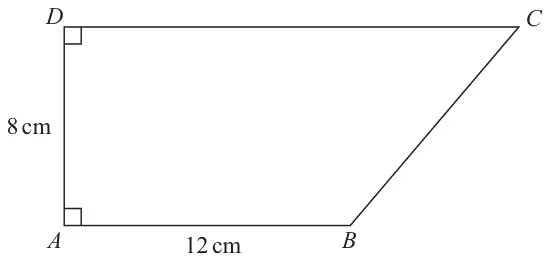
Work out the perimeter of the trapezium. Give your answer correct to 3 significant figures. (5)
Mark scheme
Answer
Mark
Mark scheme
44.9
P1
for process to find an expression for the area of the trapezium, eg \(\tfrac{1}{2}(12 + CD)8\) or \(8 \times 12 + \tfrac{1}{2} \times 8 \times x\)
or for process to find the area of the triangle, eg \(112 - 8 \times 12\ (= 16)\)
P1
for forming an equation and isolating terms in the unknown length, eg \(4CD = 112 - 48\) or \(\tfrac{1}{2} \times 8 \times x = 112 - 8 \times 12\) or \(\tfrac{1}{2} \times 8 \times x = \text{``}16\text{''}\) or \(CD = 16\) or \(x = 4\)
P1
for start of process to find length of \(BC\), eg \(8^2 + \text{``}4\text{''}^2\ (= 80)\) or \(8^2 + [\text{their } x]^2\) or \(\tan^{-1}\left(\dfrac{\text{``}4\text{''}}{8}\right)\ (= 26.5\ldots)\) oe or \(\tan^{-1}\left(\dfrac{8}{\text{``}4\text{''}}\right)\ (= 63.4\ldots)\) where “4” can be [their \(x\)]
P1
for \(\sqrt{8^2 + \text{``}4\text{''}^2}\) or \(\sqrt{64 + \text{``}16\text{''}}\) or \(\sqrt{80}\) or \(4\sqrt{5}\ (= 8.9\ldots)\) oe or \(\sqrt{8^2 + [\text{their } x]^2}\) or \(\dfrac{\text{``}4\text{''}}{\sin \text{``}26.5\ldots\text{''}}\) or \(\dfrac{8}{\cos \text{``}26.5\ldots\text{''}}\) or \(\dfrac{8}{\sin \text{``}63.4\ldots\text{''}}\) or \(\dfrac{\text{``}4\text{''}}{\cos \text{``}63.4\ldots\text{''}}\) where “4” can be [their \(x\)]
A1
for answer in the range 44.9 to 44.95
Additional guidance
\(x\) is the length of the line from \(C\) to where perpendicular from \(B\) meets \(CD\) Allow use of other letters in place of \(CD\) and \(x\) (do not have to be defined unless otherwise stated) Award P1 for \(112 - 8 \times 12\ (= 16)\) even if not used
Award P2 for \(CD = 16\) or \(x = 4\) even if not used unless clearly from incorrect working eg \(12 - 8\ (= 4)\) Only award P2 for 16 if it is clearly identified as \(CD\)
[their \(x\)] can be any value less than 12 or clearly identified as the length of the line from \(C\) to where perpendicular from \(B\) meets \(CD\) (may be seen on the diagram)
Award P4 for (\(BC =\)) \(\sqrt{80}\) or \(4\sqrt{5}\) or 8.9… unless \(x = 4\) is clearly from incorrect working
If an answer is shown in the range in working and then incorrectly rounded award full marks
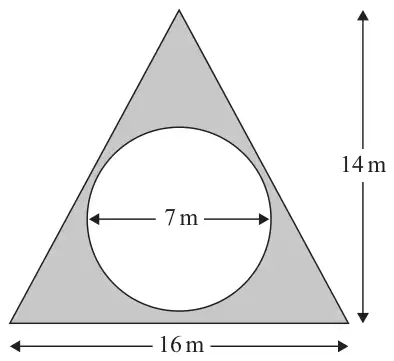
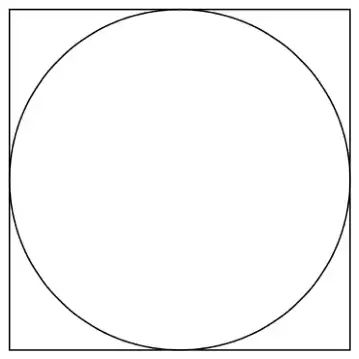
There is a circle inside a triangle. The circle has a diameter of 7 m.
Macsen will cover the shaded area with gravel.
Gravel is sold in bags. Each bag of gravel covers an area of 12.5 m2
(a) Work out the number of bags of gravel Macsen will need. (4)
Macsen finds that each bag of gravel only covers an area of 11 m2
(b) How does this affect your answer to part (a)? (1)
Mark scheme (a)
Answer
Mark
Mark scheme
6
P1
for a process to find a relevant area, eg \(16 \times 14 \div 2\ (= 112)\) or \(\pi \times \left(\dfrac{7}{2}\right)^2\ (= 38.4\ldots)\)
P1
for a process to find the shaded area, eg \(\text{``}112\text{''} - \text{``}38.4\ldots\text{''}\ (= 73.51\ldots)\) or \(\text{``}8.96\text{''} - \text{``}3.07\ldots\text{''}\ (= 5.88\ldots)\)
P1
for a complete process to find the number of bags required for a full or partial area, eg \(\text{``}73.51\ldots\text{''} \div 12.5\ (= 5.88\ldots)\) or \(\text{``}112\text{''} \div 12.5\ (= 8.96)\) or \(\text{``}38.4\ldots\text{''} \div 12.5\ (= 3.07\ldots)\) or [area] \(\div\, 12.5\) or uses 12.5 in a build up method to exceed [area], eg \(12.5 \times 6\ (= 75)\) oe
A1
cao
Additional guidance
May be implied by \(\dfrac{49}{4}\pi\)
[area] can be any area but cannot be a length.
Mark scheme (b)
Answer
Mark
Mark scheme
Statement
C1
for a valid statement relating to effect on number of bags needed, eg Acceptable examples Will need more bags It will increase Will need an extra bag or will now need 7 bags He won’t have enough There is no change (ft their [area] but must be supported by calculation)
Not acceptable examples Will cover less area Needs to change the number of bags needed There is no change (unsupported or incorrect ft their [area]) He may need more bags A calculation using 11 with no supporting statement
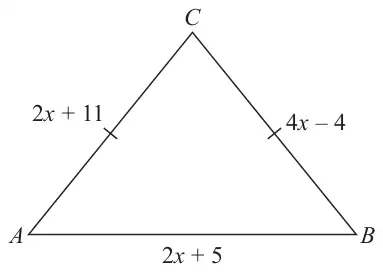
In the diagram, all measurements are in centimetres.
\(AC = BC\)
The perimeter of the triangle is 72 cm.
Work out the area of the triangle. (5)
Mark scheme
Answer
Mark
Mark scheme
240
P1
for forming an appropriate equation, eg \(2x + 11 = 4x - 4\) or \(2x + 11 + 4x - 4 + 2x + 5 = 72\) or \(8x + 12 = 72\)
P1
(dep P1) for process to correctly isolate terms in \(x\), eg \(4x - 2x = 11 + 4\) or \(2x + 4x + 2x = 72 - 11 + 4 - 5\) or \(x = 7.5\) oe
P1
for correct application of Pythagoras, eg \((\text{``}26\text{''})^2 - \left(\dfrac{\text{``}20\text{''}}{2}\right)^2\) or \([AC]^2 - \left(\dfrac{[AB]}{2}\right)^2\) or height = 24 or a complete method to find the height
or for a correct trig statement to find \(CAB\) or \(CBA\) or \(ACB\), eg \(\cos CAB = \cos CBA = \dfrac{\text{``}20\text{''} \div 2}{\text{``}26\text{''}}\) or \(\cos CAB = \cos CBA = \dfrac{20^2 + 26^2 - 26^2}{2 \times 20 \times 26}\) or \(\cos ACB = \dfrac{26^2 + 26^2 - 20^2}{2 \times 26 \times 26}\) or \(CAB = 67.3\ldots\) or \(CBA = 67.3\ldots\) or \(ACB = 45.2\ldots\)
P1
for process to find area of triangle, eg \(\text{``}20\text{''} \times \text{``}24\text{''} \div 2\) or \([AB] \times [\text{height}] \div 2\)
or for process to find area of triangle, eg \(\dfrac{1}{2} \times \text{``}26\text{''} \times \text{``}20\text{''} \times \sin \text{``}67.3\ldots\text{''}\) or \(\dfrac{1}{2} \times \text{``}26\text{''} \times \text{``}26\text{''} \times \sin \text{``}45.2\ldots\text{''}\) or \(\dfrac{1}{2} \times [AB] \times [AC] \times \sin [BAC]\) or \(\dfrac{1}{2} \times [BC] \times [AC] \times \sin [ACB]\)
A1
cao
Additional guidance
\(8x = 60\) or \(2x = 15\) implies P2 A correct length stated or shown on diagram implies P2, eg \(AB = 20\), \(AC = 26\), \(CB = 26\) \([AC]\) \([BC]\) \([AB]\) \([ACB]\) \([CAB]\) and \([BAC]\) must be clearly identified if incorrect. May be on diagram. \(AB = 2 \times \text{``}7.5\text{''} + 5\ (= 20)\) \(AC = 2 \times \text{``}7.5\text{''} + 11\ (= 26)\) \(CB = 4 \times \text{``}7.5\text{''} - 4\ (= 26)\) Alternative scheme not expected on Foundation tier but may be seen.
ft incorrect figures providing at least one previous P1 awarded. [height] is what they clearly think is the height of the triangle but not 26 or 20 or 10
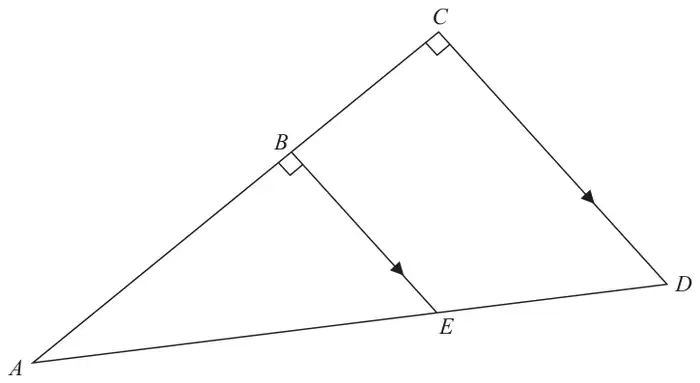
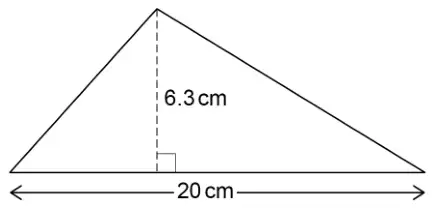
13 \(ABC\) and \(AED\) are straight lines. \(BE\) and \(CD\) are parallel.
\(BE = 4.2\) cm \(CD = 6.3\) cm \(AC = 10.8\) cm
Work out the area of trapezium \(BCDE\). (3)
Mark scheme
Answer
Mark
Mark scheme
18.9
P1
for using length scale factor to find \(AB\), eg \((AB =)\ 10.8 \div \left(\dfrac{3}{2}\right)\) or \((AB =)\ 10.8 \times \left(\dfrac{2}{3}\right)\ (= 7.2)\) or for using length scale factor to find \(BC\), eg \((BC =)\ 10.8 \div \dfrac{6.3}{6.3 - 4.2}\) or \((BC =)\ 10.8 \times \dfrac{6.3 - 4.2}{6.3}\ (= 3.6)\) or finds area scale factor, eg \(\left(\dfrac{3}{2}\right)^2\) or \(\left(\dfrac{2}{3}\right)^2\)
P1
for a complete process to find the area of trapezium, eg \(\dfrac{6.3 + 4.2}{2} \times (10.8 - \text{``}7.2\text{''})\) or \(\dfrac{(6.3 - 4.2) \times \text{``}3.6\text{''}}{2} + \text{``}3.6\text{''} \times 4.2\) or \(\dfrac{10.8 \times 6.3}{2} - \dfrac{7.2 \times 4.2}{2}\) or \(\dfrac{10.8 \times 6.3}{2} - \dfrac{10.8 \times 6.3}{2} \div \left(\text{``}\dfrac{3}{2}\text{''}\right)^2\) or \(\dfrac{10.8 \times 6.3}{2} - \dfrac{10.8 \times 6.3}{2} \times \left(\text{``}\dfrac{2}{3}\text{''}\right)^2\)
A1
accept trailing zeros eg 18.90
Additional guidance
Can use a combination of skills but must have a complete process to find \(AB\) or \(BC\) to score this mark
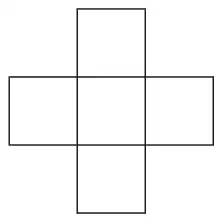
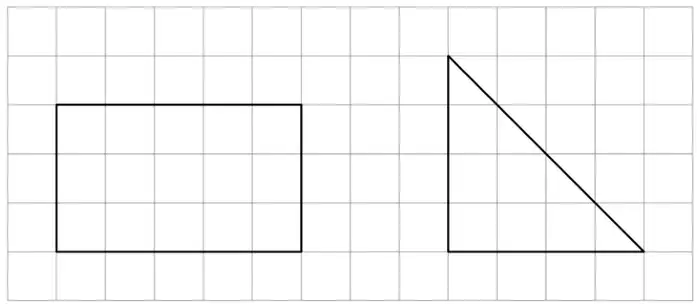
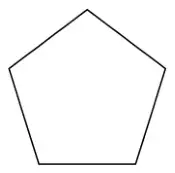
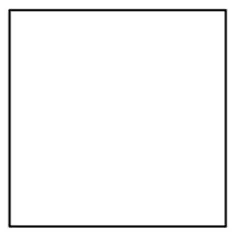
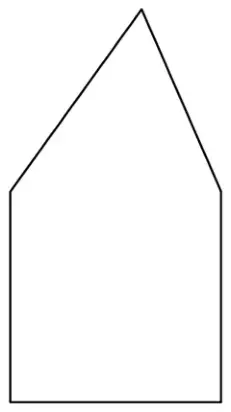
Five of these squares are used to make the shape below.
Work out the perimeter of this shape. (3)
Mark scheme
Answer
Mark
Mark scheme
120
P1
for process to work with length, eg \(40 \div 4\ (= 10)\) or \(40 \times 5\ (= 200)\) or \(40 \div 4 \times 3\ (= 30)\) or \(40 \times 4\ (= 160)\)
P1
for process to work with perimeter, eg \(\text{``}10\text{''} \times 12\) or [square side length] \(\times\, 12\) or [square side length] \(\times\, 11\) or \(\text{``}200\text{''} - 2 \times 40\) or \(\text{``}30\text{''} \times 4\) oe or \(\text{``}160\text{''} - 40\)
A1
cao
Additional guidance
May be shown on the diagram
[square side length] is what they clearly think is the length of one side of the square.
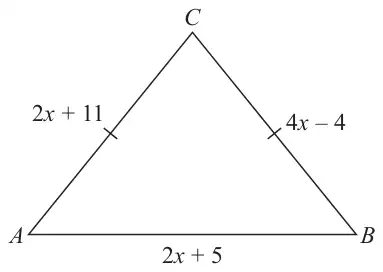
In the diagram, all measurements are in centimetres.
\(AC = BC\)
The perimeter of the triangle is 72 cm.
Work out the area of the triangle. (5)
Mark scheme
Answer
Mark
Mark scheme
240
P1
for forming an appropriate equation, eg \(2x + 11 = 4x - 4\) or \(2x + 11 + 4x - 4 + 2x + 5 = 72\) or \(8x + 12 = 72\)
P1
(dep P1) for process to isolate terms in \(x\) for their equation, eg \(4x - 2x = 11 + 4\) or \(2x + 4x + 2x = 72 - 11 + 4 - 5\) or \(x = 7.5\) oe
P1
for correct application of Pythagoras, eg \((\text{``}26\text{''})^2 - \left(\dfrac{\text{``}20\text{''}}{2}\right)^2\) or \([AC]^2 - \left(\dfrac{[AB]}{2}\right)^2\) or height = 24 or a complete method to find the height
or for a correct trig statement to find \(CAB\) or \(CBA\) or \(ACB\), eg \(\cos CAB = \cos CBA = \dfrac{\text{``}20\text{''} \div 2}{\text{``}26\text{''}}\) or \(\cos CAB = \cos CBA = \dfrac{20^2 + 26^2 - 26^2}{2 \times 20 \times 26}\) or \(\cos ACB = \dfrac{26^2 + 26^2 - 20^2}{2 \times 26 \times 26}\) or \(CAB = 67.3\ldots\) or \(CBA = 67.3\ldots\) or \(ACB = 45.2\ldots\)
P1
for process to find area of triangle, eg \(\text{``}20\text{''} \times \text{``}24\text{''} \div 2\) or \([AB] \times [\text{height}] \div 2\)
or for process to find area of triangle, eg \(\dfrac{1}{2} \times \text{``}26\text{''} \times \text{``}20\text{''} \times \sin \text{``}67.3\ldots\text{''}\) or \(\dfrac{1}{2} \times \text{``}26\text{''} \times \text{``}26\text{''} \times \sin \text{``}45.2\ldots\text{''}\) or \(\dfrac{1}{2} \times [AB] \times [AC] \times \sin [BAC]\) or \(\dfrac{1}{2} \times [BC] \times [AC] \times \sin [ACB]\)
A1
cao
Additional guidance
\(8x = 60\) or \(2x = 15\) implies P2 A correct length stated or shown on diagram implies P2 Eg \(AB = 20\), \(AC = 26\), \(CB = 26\) \([AC]\) \([BC]\) \([AB]\) \([ACB]\) \([CAB]\) and \([BAC]\) must be clearly identified if incorrect. May be on diagram. \(AB = 2 \times \text{``}7.5\text{''} + 5\ (= 20)\) \(AC = 2 \times \text{``}7.5\text{''} + 11\ (= 26)\) \(CB = 4 \times \text{``}7.5\text{''} - 4\ (= 26)\) Alternative scheme not expected on Foundation tier but may be seen.
ft incorrect figures providing at least one previous P1 awarded. [height] is what they clearly think is the height of the triangle but not 26 or 20 or 10
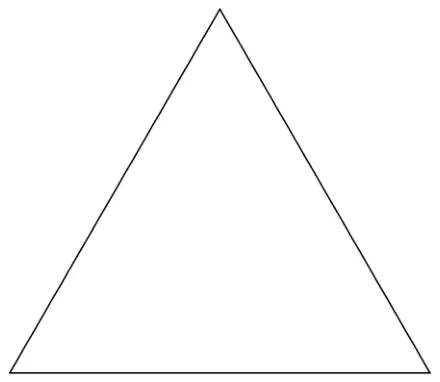
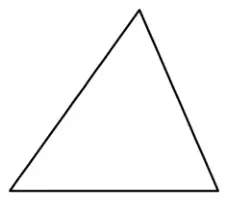
Here is an accurate drawing of an equilateral triangle.
By measuring, work out the perimeter of the triangle.
State the units of your answer. [3 marks]
Mark scheme
Answer
Mark
Comments
Alternative method 1: one side measured
7.4 (cm) or 74 (mm) or 2.9 (inches)
B1
\(\pm\) 2 mm
allow [2.8, 3)
their \(7.4 \times 3\) or their \(74 \times 3\) or their \(2.9 \times 3\) or [21.6, 22.8] or [216, 228] or [8.4, 9)
M1
oe their 7.4 must be [7, 8] their 74 must be [70, 80] their 2.9 must be [2.6, 3.2]
[21.6, 22.8] cm or [216, 228] mm or [8.4, 9) inches
A1ft
ft their 7.4 or their 2.9 with B0M1 awarded
Alternative method 2: more than one side measured
Each side measured as 7.4 (cm) or 74 (mm) or 2.9 (inches)
B1
\(\pm\) 2 mm
allow [2.8, 3)
their \(7.4 +\) their \(7.4 +\) their 7.4 or their \(74 +\) their \(74 +\) their 74 or their \(2.9 +\) their \(2.9 +\) their 2.9 or [21.6, 22.8] or [216, 228] or [8.4, 9)
M1
oe their 7.4 must be [7, 8] their 74 must be [70, 80] their 2.9 must be [2.6, 3.2]
[21.6, 22.8] cm or [216, 228] mm or [8.4, 9) inches
A1ft
ft their 7.4 or their 2.9 with B0M1 awarded
Additional guidance
In alternative method 2 the sides do not have to be equal eg 7.5, 7.5, 7.6 \(= 22.6\) Cannot access the A mark as there are no units.
B1 M1A0ft
eg sides measured as 7.6, 7.6, 7.7 \(7.6 + 7.6 + 7.7\) \(= 22.9\) cm Cannot gain the B mark as 7.7 is out of range
B0 M1 A1ft
eg 75, 80, 80 answer 235 mm 80 is out of range for the B mark but in range for the M mark. Method mark implied by correct answer for their values
B0 M1A1ft
Further work after the correct answer seen eg 7.4 and \(22.2 \div 2 = 11.1\) cm
B1M1A0
Ignore subsequent rounding once correct answer is seen
Accept correct units seen with their answer in the working, even if missing from the answer line, provided they are not contradicted.
Ignore any measurement of the height for the B mark