
Foundation November 2023 Paper 2 Q24
24 The boundaries of a city form a trapezium.
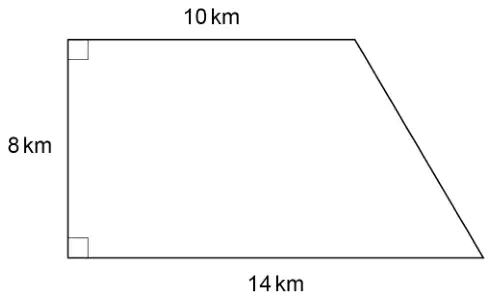
Not drawn accurately
| Population density \(= \dfrac{\text{number of people}}{\text{area}}\) |
The population density of the city is 9450 people per square kilometre.
Work out the number of people who live in the city. [4 marks]
| Answer | Mark | Comments |
|---|---|---|
| \(8 \times 10\) or 80 or \(0.5 \times 8 \times (14 - 10)\) or \(0.5 \times 8 \times 4\) or 16 or \(8 \times 14\) or 112 | M1 | oe may be seen in an incorrect attempt to calculate the population eg \(\dfrac{9450}{112}\) |
| \(8 \times 10 + 0.5 \times 8 \times (14 - 10)\) or \(8 \times 10 + 0.5 \times 8 \times 4\) or \(80 + 16\) or \(8 \times 14 - 0.5 \times 8 \times (14 - 10)\) or \(8 \times 14 - 0.5 \times 8 \times 4\) or \(112 - 16\) or \(0.5 \times (10 + 14) \times 8\) or 96 | M1dep | oe may be seen in an incorrect attempt to calculate the population eg \(\dfrac{9450}{96}\) |
| their \(96 \times 9450\) | M1 | oe their 96 must be from a calculation using at least two of 8, 10 and 14 |
| 907 200 | A1 |
Additional guidance
| The first M1 may be awarded for a correct partial area even if this is seen amongst multiple attempts | |
| eg1 \((8 + 10 + 14) \times 9450 = 302\,400\) eg2 \(32 \times 9450 = 302\,400\) (working not seen) | M0M0M1A0 M0M0M0A0 |