Question Bank › GCSE Shape & Space › Transformations of Shapes
Transformations of Shapes Topic Angles (Including Parallel Lines) (19) Angles in Polygons (12) Constructions (11) Circle Theorems (5) Volume & Surface Area (13) Prisms (8) 2D Area & Perimeter (21) Circles & Sectors (16) Similar Shapes (14) Transformations of Shapes (15) Vectors (7) Basic Trigonometry (10) Advanced Trigonometry (9) Pythagoras (12) Exact Trig & Graphs (6) Plans, Elevations & Nets (6) Current PowerPoint version
All boards Edexcel AQA All specs Current spec All series June 2025 November 2024 June 2024 November 2023 June 2017 Any marks 1 to 4 marks 5 to 8 marks 9+ marks
Questions Step through List
‹ Previous All questions Next ›
Higher June 2025 Paper 1 Q9 9
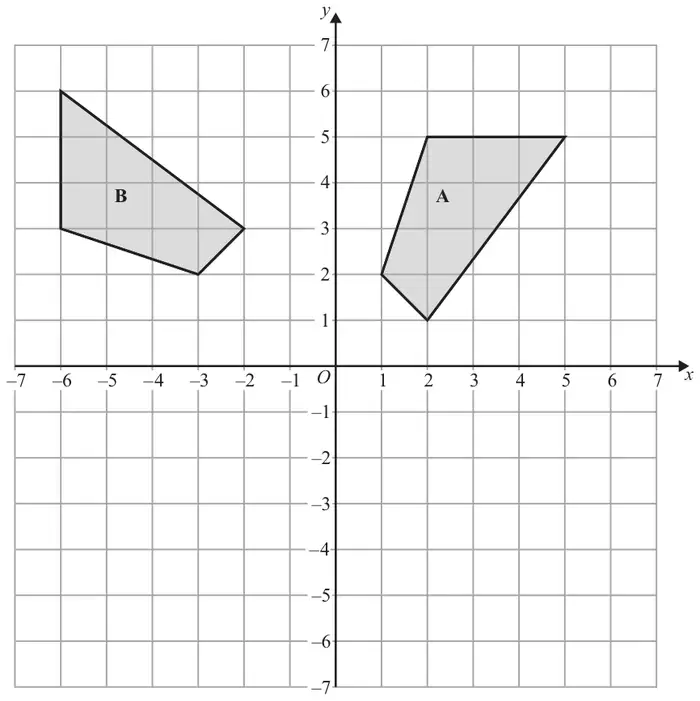
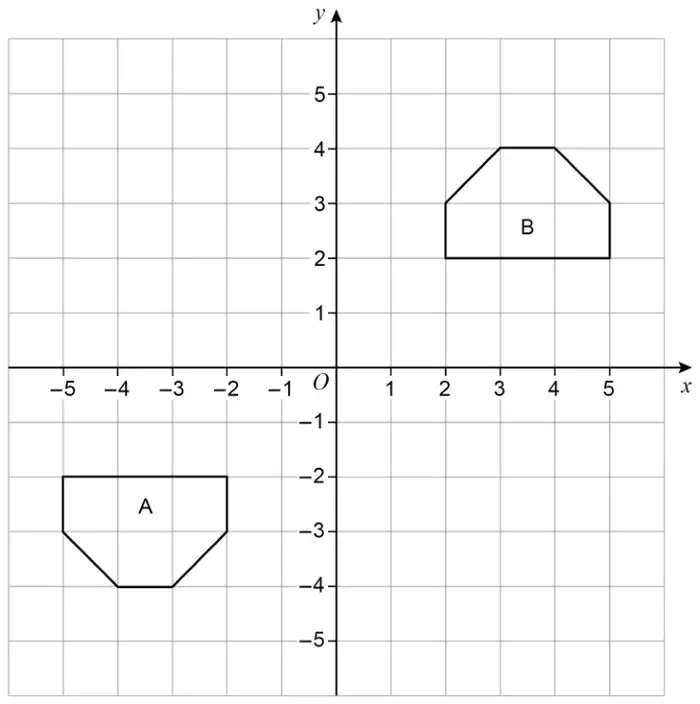
(a) Describe fully the single transformation that maps shape A onto shape B . (2)
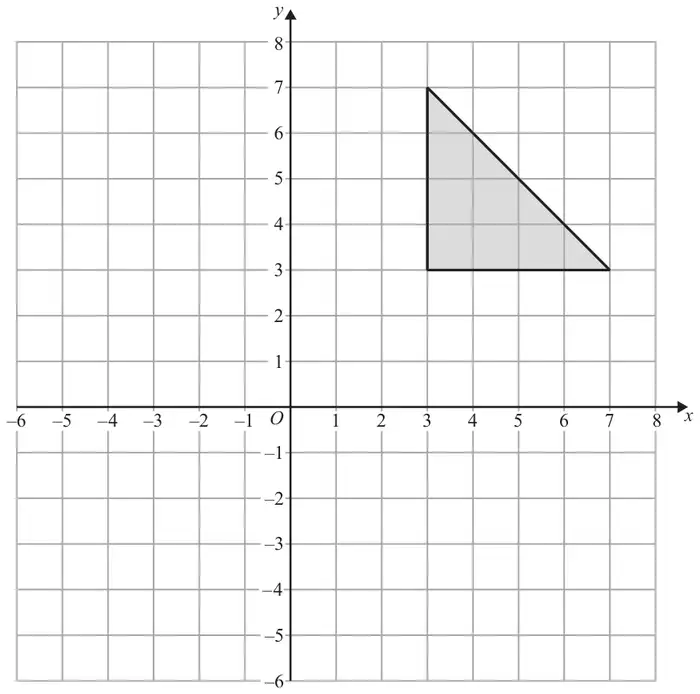
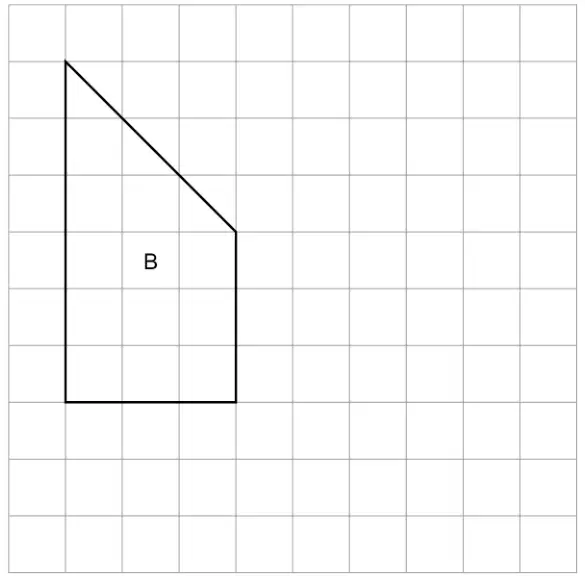
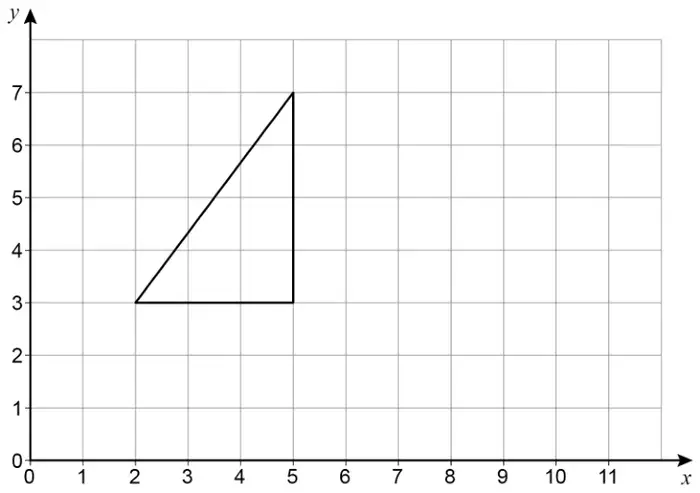
(b) Enlarge the triangle by scale factor \(\dfrac{1}{2}\) centre \((-1, -3)\)
(2) Mark scheme (a) Mark scheme (b)
Mark scheme (a) Answer Mark Mark scheme Rotation B2 for rotation \(90^\circ\) (anticlockwise) about \((-1, 0)\) (B1 for any 2 of the 3 aspects)
Additional guidance Accept \(270^\circ\) clockwise
Award no marks if more than one transformation is given
Mark scheme (b) Answer Mark Mark scheme Enlargement B2 for correct enlargement with vertices at (1,0), (3,0), (1,2) (B1 for correct size and orientation but incorrect positionor 2 out of 3 vertices correctly placed)
Additional guidance Award for clear intention, shading not needed
Foundation November 2024 Paper 2 Q18 18
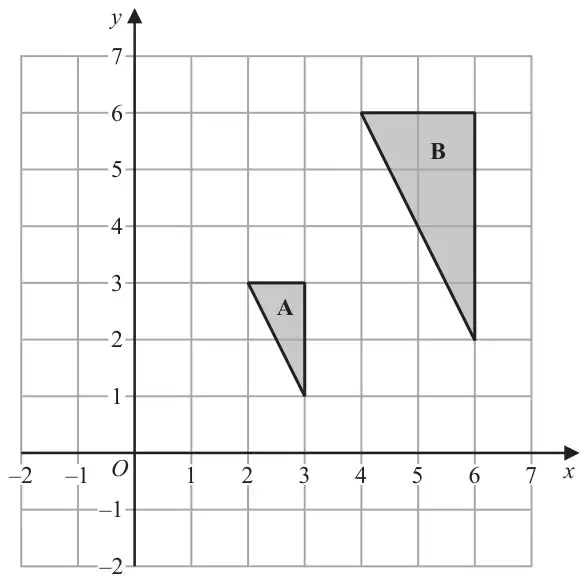
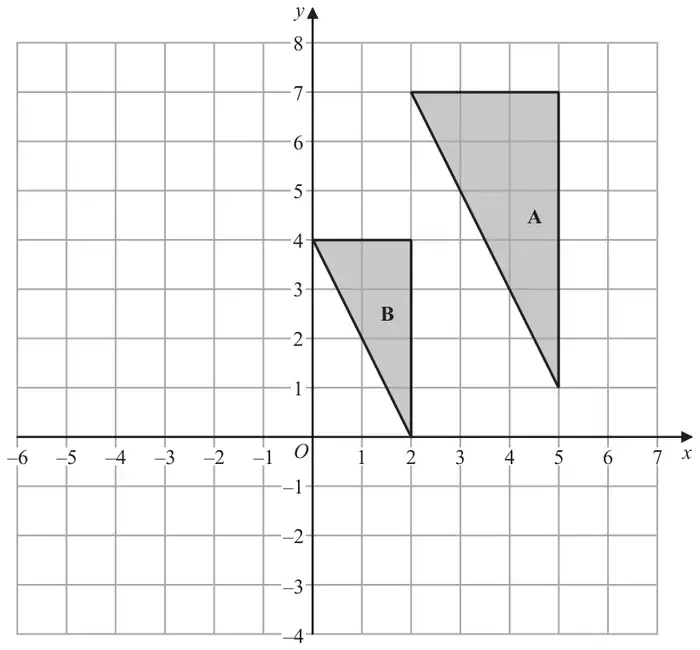
Describe fully the single transformation that maps triangle A onto triangle B . (2)
Mark scheme
Mark scheme Answer Mark Mark scheme enlargement, B2 enlargement, scale factor 2, centre (0, 0) (B1 for 2 correct aspects)
Additional guidance Award no marks if more than one transformation is given
Higher November 2024 Paper 2 Q11 11
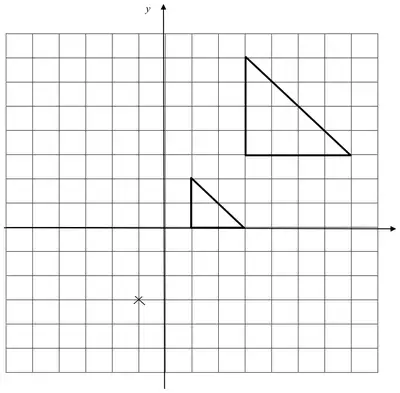
Describe fully the single transformation that maps triangle A onto triangle B . (2)
Mark scheme
Mark scheme Answer Mark Mark scheme enlargement C2 for enlargement, scale factor \(\dfrac{2}{3}\) oe, centre \((-4, -2)\) (C1 for 2 of the 3 aspects)
Additional guidance Award no marks if more than one transformation is given
Foundation November 2024 Paper 1 Q10 10
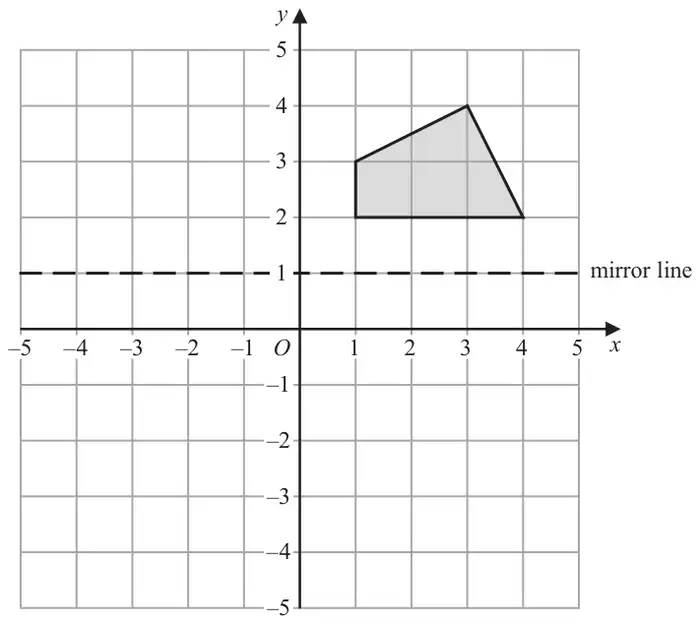
(a) On the grid, reflect the shaded shape in the mirror line. (2)
(b) Write down the equation of the mirror line. (1)
Mark scheme (a) Mark scheme (b)
Mark scheme (a) Answer Mark Mark scheme reflection B2 for a fully correct reflection (B1 for a correct reflection in any single mirror lineor for at least two correct reflected lines)
Mark scheme (b) Answer Mark Mark scheme \(y = 1\) B1 \(y = 1\) oe
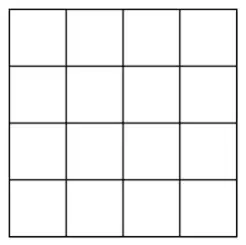
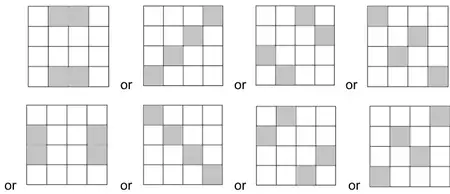
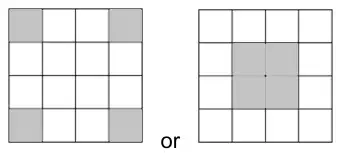
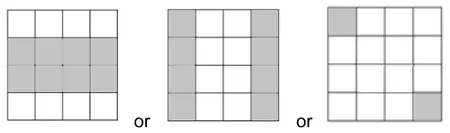
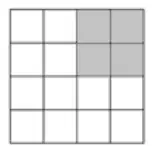
Foundation November 2024 Paper 2 Q16 16 In the grid below, shade one quarter of the squares
so that the grid has exactly two lines of symmetry.
Shade complete squares only. [2 marks]
Mark scheme
Mark scheme Answer Mark Comments 4 squares shaded so that the grid has exactly two lines of symmetry B2 B1 4 squares shaded so that the grid has four lines of symmetry
Additional guidance B2 B1 B1 B0 Mark intention Part squares shaded B0
Foundation November 2024 Paper 1 Q14 14
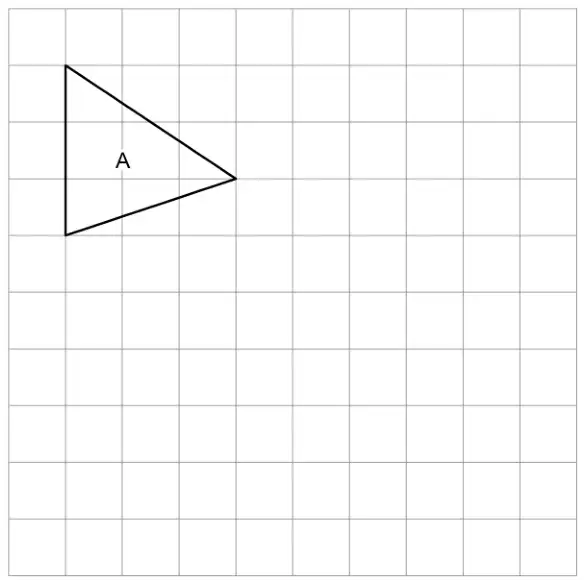
(a) On the grid, draw a shape
congruent to triangle A.
[1 mark] (b) On the grid,
enlarge shape B by scale factor \(\dfrac{1}{3}\)
[2 marks] Mark scheme (a) Mark scheme (b)
Mark scheme (a) Answer Mark Comments Congruent shape drawn B1
Additional guidance Mark intention but whole shape must be on the grid
Shape can be in any orientation
Mark scheme (b) Answer Mark Comments Correct shape drawn B2 B1 two or three correct sides
Additional guidance Mark intention but whole shape must be on the grid
Shape can be in any position or orientation
Foundation November 2024 Paper 3 Q13 13
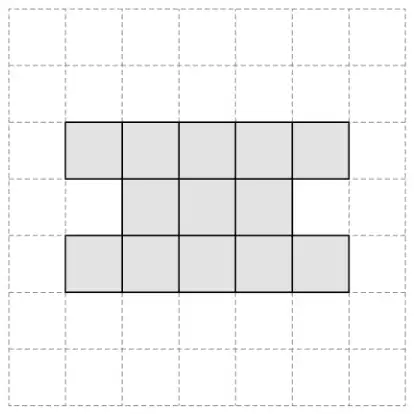
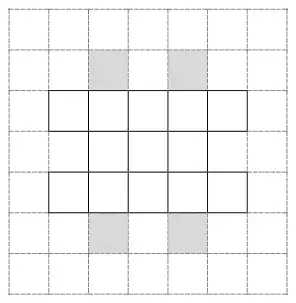
(a) Here is a pattern of squares on a grid.
Draw the two lines of symmetry on the pattern. [2 marks]
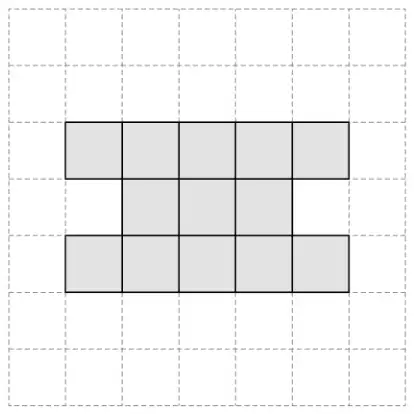
(b) Here is the pattern again.
Shade four more squares so that the pattern has rotational symmetry of order 4 [1 mark]
Mark scheme (a) Mark scheme (b)
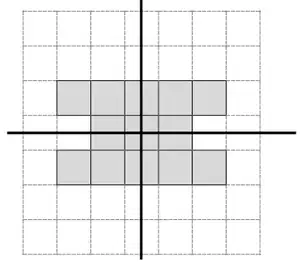
Mark scheme (a) Answer Mark Comments 2 correct lines of symmetry and no incorrect lines B2 B1 for 2 correct lines of symmetry with 1 or 2 incorrect lines
Additional guidance Mark intention
Mark scheme (b) Answer Mark Comments B1
Additional guidance Accept any indication
Ignore any lines of symmetry drawn
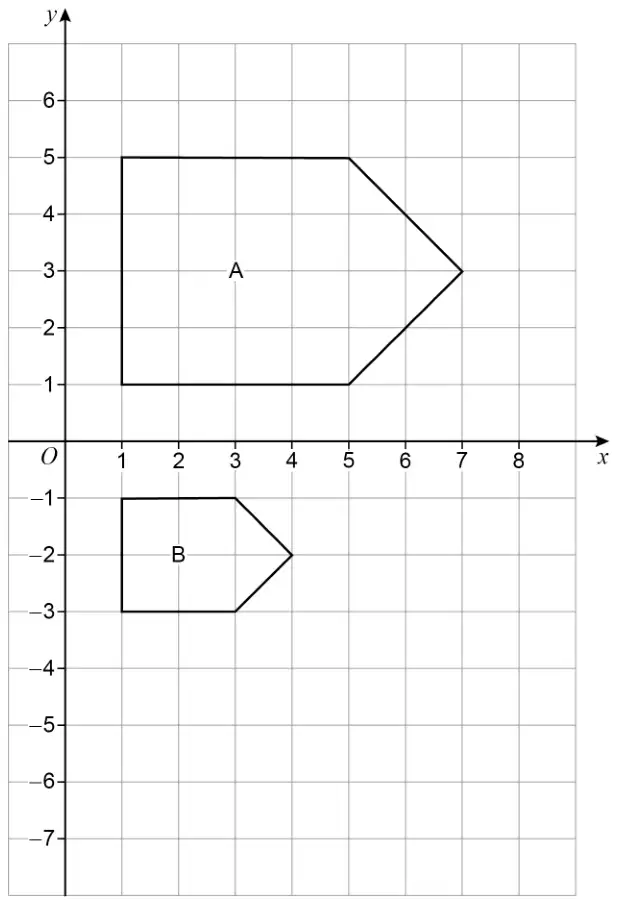
Foundation June 2024 Paper 1 Q27 27
Describe fully the single transformation that maps shape A to shape B. [3 marks]
Mark scheme
Mark scheme Answer Mark Comments Enlarge(ment) B1 \(\dfrac{1}{2}\) B1 oe condone half \((1, -7)\) B1 condone missing bracket(s)
Additional guidance For the third mark, a vector on its own does not imply a translation Do not accept halved or half the size Multiple transformations stated or implied B0B0B0
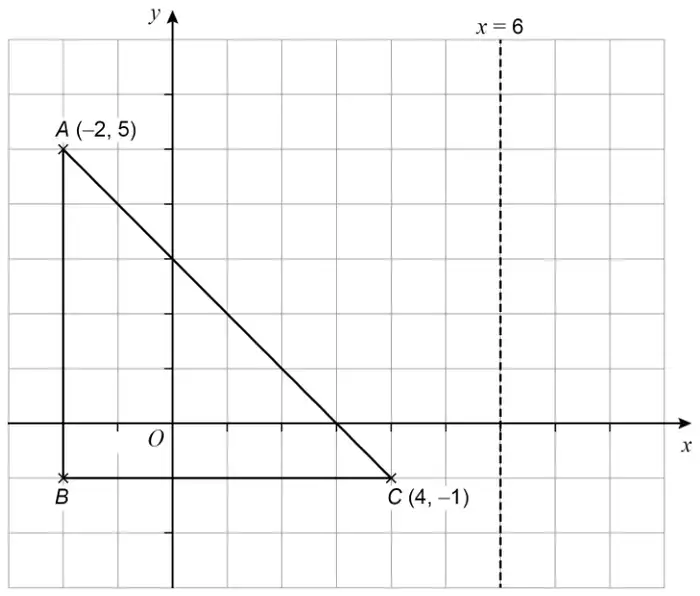
Foundation June 2024 Paper 3 Q11 11
(a) Work out the coordinates of \(B\). [1 mark]
(b) Point \(C\) is reflected in the line \(\;x = 6\;\) to point \(D\).
Work out the coordinates of \(D\). [1 mark]
Mark scheme (a) Mark scheme (b)
Mark scheme (a) Answer Mark Comments \((-2,\ -1)\) B1
Additional guidance Check the diagram if answer line is blank
Mark scheme (b) Answer Mark Comments \((8,\ -1)\) B1 SC1 \((-1,\ -2)\) in (a) and \((-1,\ 8)\) in (b)
Additional guidance Check the diagram if answer line is blank
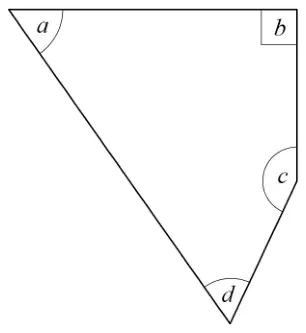
Foundation June 2024 Paper 2 Q3 3 Here is a quadrilateral.
(a) Write down the letter of the obtuse angle. [1 mark]
(b) Write down the letter of an acute angle. [1 mark]
(c) How many lines of symmetry does the shape have? [1 mark]
Mark scheme (a) Mark scheme (b) Mark scheme (c)
Mark scheme (a) Answer Mark Comments \(c\) B1
Mark scheme (b) Answer Mark Comments \(a\) or \(d\) B1 accept \(a\) and \(d\)
Mark scheme (c) Additional guidance Accept none, zero, nought etc
Foundation November 2023 Paper 2 Q19 19 Describe fully the single transformation that maps shape A to shape B. [3 marks]
Mark scheme
Mark scheme Answer Mark Comments Alternative method 1 Rotation B1 180° or half turn B1 ignore clockwise or anticlockwise Origin or (0, 0) or \(O\) B1 Alternative method 2 Enlargement B1 (Scale factor) \(-1\) B1 Origin or (0, 0) or \(O\) B1
Additional guidance Accept eg rotate for rotation and condone rotational symmetry Do not accept turn for first B1 Accept 180 for 180° Accept 0, 0 for origin Do not accept centre of grid for origin Reflection on (0, 0) B0B0B1 Choice of transformations eg rotation (and) \(\begin{pmatrix} 4 \\ 4 \end{pmatrix}\) or rotation (and) flip 1st B0 Combined transformation max B0B1B1
Foundation November 2023 Paper 1 Q16 16 Here is a triangle on a grid.
The triangle is reflected in a vertical line.
Two of the vertices of the reflected triangle are at (7, 3) and (7, 7)
(a) What are the coordinates of the other vertex of the reflected triangle? [1 mark]
(b) What is the equation of the line of reflection? [1 mark]
Mark scheme (a) Mark scheme (b)
Mark scheme (a) Answer Mark Comments (10, 3) B1
Additional guidance Check diagram if answer line blank
Mark scheme (b) Answer Mark Comments \(x = 6\) B1
Additional guidance Check diagram if answer line blank
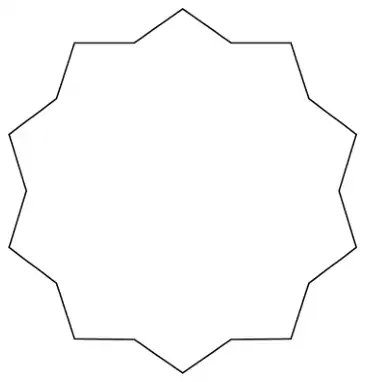
Foundation November 2023 Paper 1 Q5 5 Here is a shape.
Write down the order of rotational symmetry of the shape. [1 mark]
Mark scheme
Mark scheme Higher June 2017 Paper 2 Q26 26
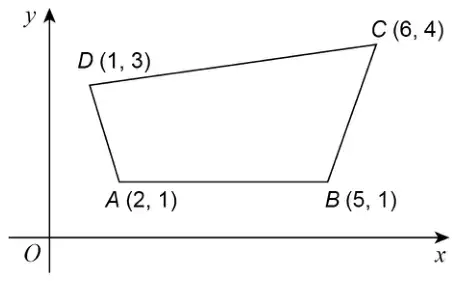
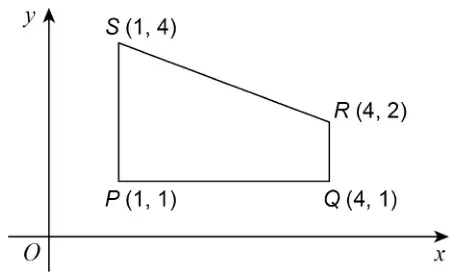
(a) A sketch of a quadrilateral
ABCD is shown.
Not drawn accurately
ABCD is enlarged, centre B , scale factor \(\dfrac{1}{3}\)
Circle the vertex that is invariant. [1 mark]
(b) A sketch of a quadrilateral
PQRS is shown.
Not drawn accurately
PQRS is reflected in the line \(\quad y = x\)
Circle the vertex that is invariant. [1 mark]
Mark scheme (a) Mark scheme (b)
Mark scheme (a) Mark scheme (b) Higher June 2017 Paper 1 Q21 21
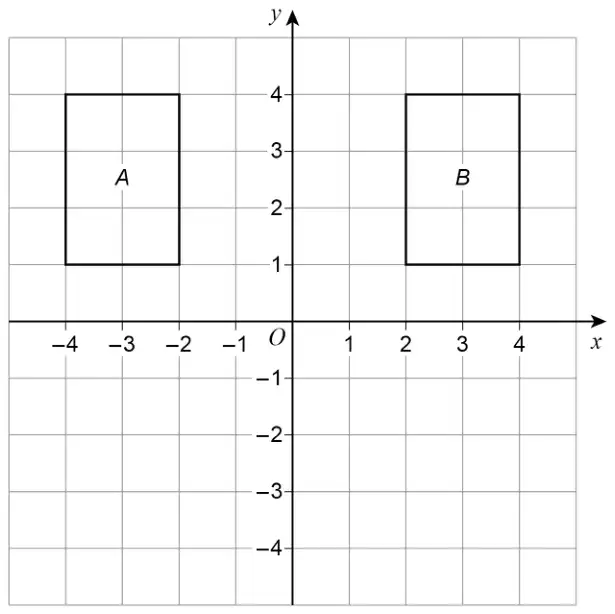
(a) The diagram shows rectangles A and B.
Rectangle A can be mapped to rectangle B by a single transformation.
Javed says,
“The only single transformation is a reflection in the \(y\)-axis because the rectangles are on opposite sides of the \(y\)-axis.”
Is he correct?
Tick a box.
Give a reason for your answer. [1 mark]
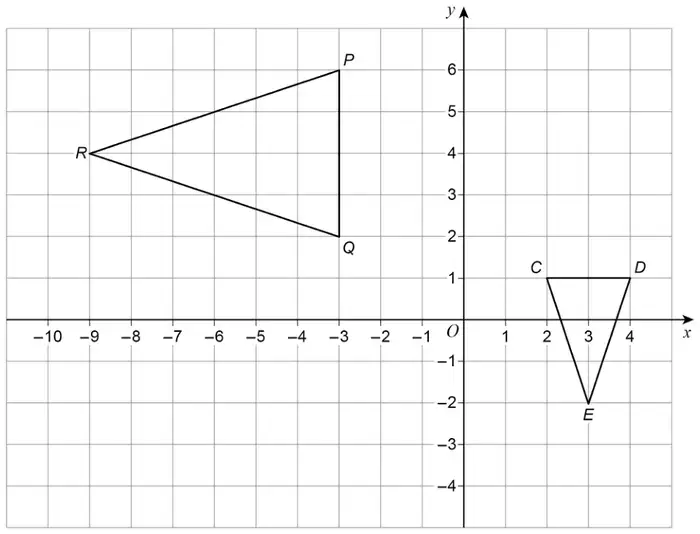
(b) This diagram shows triangles
CDE and
PQR .
CDE is mapped to PQR by combining two single transformations.
The first is a rotation of \(90^\circ\) anticlockwise about E .
Describe fully the second transformation. [3 marks]
Mark scheme (a) Mark scheme (b)
Mark scheme (a) Answer Mark Comments Ticks No and gives valid reason B1 Examples of valid reasons:
Additional guidance Full descriptions are not needed, but if given must be correct Transformation (6, 0) B1 Moved 6 to the right B1 Moved 6 squares B0 Condone ‘turn’ with full description of \(180^\circ\), (centre) (0, 2.5) B1 2 or more single transformations given, with at least 1 correct B1
Mark scheme (b) Answer Mark Comments Enlargement, scale factor \(-2\), B3 B2 Enlargement, scale factor \(-2\)
Additional guidance ‘Scale factor’ and ‘centre’ may be implied B3 Allow ‘\(-1\) on the \(x\)-axis’ for \((-1, 0)\) No triangle on diagram, but vertices stated as coordinates and no other marks awarded B1 A combination of transformations can score a maximum of 1 mark for the triangle drawn or vertices identified Correct triangle drawn and ‘enlargement’, with no other marks awarded B1 Enlargement, (scale factor) \(-\dfrac{1}{2}\), centre \((-1, 0)\) B2
No questions match these filters.