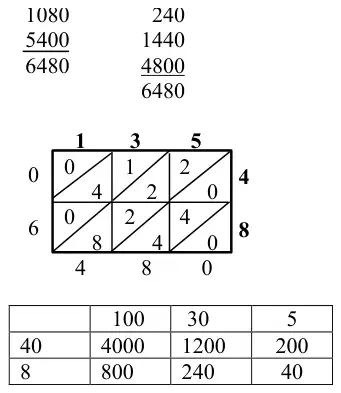
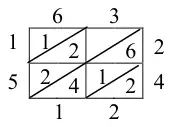
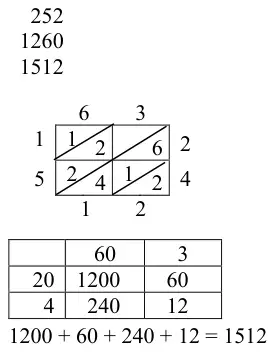
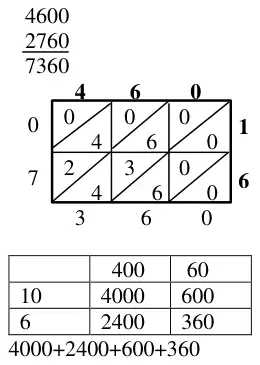
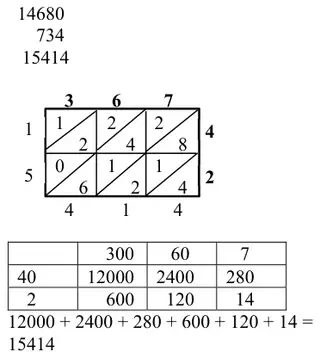
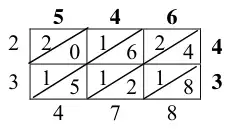
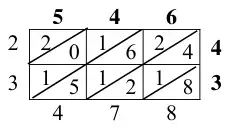
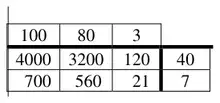
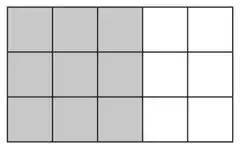
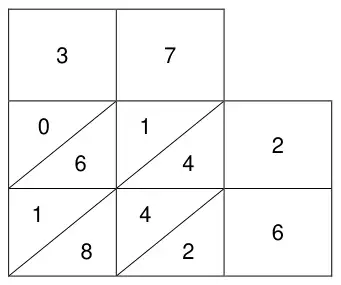
for a complete method with relative place value correct including an intention to add all the appropriate elements of the calculation or for a complete method to find 35% of 48 or 0.48 and add this on eg \(48 \div 10\ (= 4.8)\) and \(\text{``}4.8\text{''} \div 2\ (= 2.4)\) and \(48 + 3 \times \text{``}4.8\text{''} + \text{``}2.4\text{''}\)
A1
for digits 648
A1
ft (dep on M1) for correct placement of the decimal point into their final answer
8 Nina orders some items from a DIY shop. Here is her bill.
Item
Quantity
Cost of each item
Total
Pack of screws
4
£29.99
£119.96
Tin of paint
2
£24.95
£ ..........
Wooden plank
..........
£7.75
£232.50
Delivery charge
£14.95
Total cost
£ ..........
(a) Complete all the missing information in the bill. (3)
At the beginning of January, Jeff had £892.48 in his bank account.
During January, Jeff had £4.47 interest added to his account paid £240 into his account spent £365.50 from his account.
(b) How much money did Jeff have in his account at the end of January? (3)
Mark scheme (a)
Answer
Mark
Mark scheme
49.9(0)
B1
for 49.9(0)
30
B1
for 30
417.31
B1
for 417.31, ft allow 367.41 + [their 49.9(0)] for this mark
Additional guidance
To award B1ft, the total for tin of paint must not be blank or 0
Mark scheme (b)
Answer
Mark
Mark scheme
771.45
M1
for a correct first step, eg \(892.48 + 4.47\ (= 896.95)\) or \(892.48 + 240\ (= 1132.48)\) or \(892.48 - 365.5(0)\ (= 526.98)\) or \(4.47 + 240\ (= 244.47)\)
M1
for a complete method, eg \(892.48 + 4.47 + 240 - 365.5(0)\)
A1
cao
Additional guidance
May be seen embedded in other calculations eg \(4.47 + 240 - 365.5(0)\)
9 Anil has a job as a driver. He is paid for each mile he drives. He is also paid expenses.
One week Anil writes down the distance readings from his car.
Start of week:
4
7
2
4
1
miles
End of week:
4
7
8
7
9
miles
For this week, Anil is paid 47p for each mile he drives. He is also paid expenses of £80
Work out the total amount that Anil is paid. Give your answer in pounds. (4)
Mark scheme
Answer
Mark
Mark scheme
379.86
P1
for process to work with number of miles or cost, eg \(47879 - 47241\ (= 638)\) or \(47879 \times 47\ (= 2250313)\) or \(47241 \times 47\ (= 2220327)\) or [mileage] \(\times\, 47\)
P1
for process to work with miles and cost, eg \(\text{``}638\text{''} \times 47\ (= 29986)\) or \(\text{``}638\text{''} \times 0.47\ (= 299.86)\) or \(\text{``}2250313\text{''} - \text{``}2220327\text{''}\ (= 29986)\)
B1
(indep) for converting between pence and pounds, eg \(\text{``}29986\text{''} \div 100\) or \(47 \div 100\ (= 0.47)\) or \(80 \times 100\) OR miles divided by 100, eg \(\text{``}638\text{''} \div 100\ (= 6.38)\) or \(47879 \div 100\ (= 478.79)\) and \(47241 \div 100\ (= 472.41)\)
A1
for 379.86
Additional guidance
working may be seen in £ or pence throughout
[mileage] is any value they consider to be mileage
The cost of ski hire is £26 per day. The cost of a lift pass is £45 per day. The cost of ski lessons is £23.50 per hour.
Lucia will pay for
ski hire for 5 days a lift pass for 4 days ski lessons for 8 hours.
Lucia has £500
Show that Lucia has enough money to pay for the total cost of ski hire, the lift pass and the ski lessons. (3)
Mark scheme
Answer
Mark
Mark scheme
Shown
P1
for a start to process of finding the total cost, eg \(5 \times 26\ (= 130)\) or \(4 \times 45\ (= 180)\) or \(8 \times 23.50\ (= 188)\) or \(26 + 45 + 23.50\ (= 94.5(0))\) or for a start to process of finding money left after paying costs, eg \(500 - 26\ (= 474)\) or \(500 - 45\ (= 455)\) or \(500 - 23.50\ (= 476.5(0))\) or \(500 - 5 \times 26\ (= 370)\) or \(500 - 4 \times 45\ (= 320)\) or \(500 - 8 \times 23.50\ (= 312)\)
Chloe has a large number of hair bands. Each hair band costs 8p.
She buys 100 g of wool for £3
Chloe uses 1 hair band and 5 g of wool to make each scrunchy. She makes as many scrunchies as she can.
Work out the total cost of each scrunchy that she makes. Give your answer in pence. (4)
Mark scheme
Answer
Mark
Mark scheme
23
P1
for finding the number of scrunchies possible eg \(100 \div 5\ (= 20)\) or the cost of 1 g of wool eg \(300 \div 100\ (= 3)\)
P1
for working out the cost of wool per scrunchie eg \(3 \div \text{``}20\text{''}\ (= 0.15)\) or \(300 \div \text{``}20\text{''}\ (= 15)\) or \(\text{``}3\text{''} \times 5\ (= 15)\) or the cost of all hair bands eg \(\text{``}20\text{''} \times 8\ (= 160)\) or \(\text{``}20\text{''} \times 0.08\ (= 1.6(0))\)
P1
for complete process eg \((\text{``}0.15\text{''} + 0.08) \times 100\) or \(\text{``}15\text{''} + 8\) or \((300 + \text{``}160\text{''}) \div \text{``}20\text{''}\) or \((3 + \text{``}1.6(0)\text{''}) \div \text{``}20\text{''} \times 100\)
A1
accept £0.23
Additional guidance
P1 (cost of wool per scrunchie): award of this mark implies the previous mark 460 implies P2
The cans are sold in packs. There are 12 cans in each pack. Each pack costs £3
(a) Work out the total cost of the cola Asha buys. (3)
Ethan buys a box of 24 cans of lemonade for £7 There are 330 ml of lemonade in each can.
(b) Work out the cost of 100 ml of lemonade. Give your answer correct to the nearest penny. (3)
Mark scheme (a)
Answer
Mark
Mark scheme
45
P1
for a valid start to the process, eg \(180 \div 12\ (= 15)\) or \(3(.00) \div 12\ (= 0.25)\)
P1
for complete process, eg \(\text{``}15\text{''} \times 3(.00)\) or \(180 \times \text{``}0.25\text{''}\)
A1
for 45(.00)
Additional guidance
Calculations can be in £ or p or a combination for both process marks
Mark scheme (b)
Answer
Mark
Mark scheme
9
P1
for a valid start to the process, eg cost of each can, eg \(7(.00) \div 24\ (= 0.2916...)\) or \(700 \div 24\ (= 29.16...)\) or total volume of 24 cans, eg \(330 \times 24\ (= 7920)\) or proportion of ml, eg \(330 \div 100\ (= 3.3)\)
P1
for complete process, eg \(\dfrac{100}{330} \times \text{``}0.2916...\text{''}\ (= 0.08838...)\) or \(\dfrac{100}{330} \times \text{``}29.16...\text{''}\ (= 8.838...)\) or \(\dfrac{100}{\text{``}7920\text{''}} \times 7(.00)\ (= 0.08838...)\) or \(7(.00) \div 24 \div \dfrac{330}{100}\ (= 0.08838...)\) or \(7(.00) \div \dfrac{\text{``}7920\text{''}}{100}\ (= 0.08838...)\)
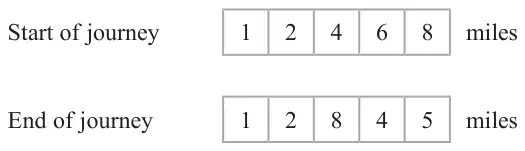
7 Myles writes down the distance readings from his car at the start and end of a journey.
Myles knows that the cost of petrol for this journey is 13p per mile.
Work out the total cost of the petrol used for this journey. Give your answer in pounds. (4)
Mark scheme
Answer
Mark
Mark scheme
49.01
P1
for process to work with the number of miles, eg \(12845 - 12468\ (= 377)\) or \(12845 \times 13\ (= 166985)\) or \(12468 \times 13\ (= 162084)\)
P1
for process to find the cost, eg \(\text{``}377\text{''} \times 13\ (= 4901)\) or \(\text{``}166985\text{''} - \text{``}162084\text{''}\ (= 4901)\)
B1
(indep) for converting from pence to pounds, eg \(\text{``}4901\text{''} \div 100\) or \(13 \div 100\) or miles divided by 100 eg \(\text{``}377\text{''} \div 100\ (= 3.77)\) or \(12845 \div 100\ (= 128.45)\) and \(12468 \div 100\ (= 124.68)\)
A1
49 or 49.01
Additional guidance
The B1 mark can be awarded at any stage in the process
6 Fay is planning a trip to a theme park for 1 adult and 2 children.
These are the costs for the trip.
Total cost of petrol
£23
Tickets to theme park
£33 each adult £24.50 each child
Meals
£15 each adult £10 each child
Fay has £200 to spend. She pays all the costs.
How much money does she have left? (4)
Mark scheme
Answer
Mark
Mark scheme
60
P3
for complete process to find the total costings eg \(23 + 33 + 24.5(0) + 24.5(0) + 15 + 10 + 10\ (= 140)\) or for a complete process to find the total money left, eg. \(200 - 23 - 33 - 24.5(0) - 24.5(0) - 15 - 10 - 10\ (= 60)\), condone one error, eg one omission or one additional cost
(P2
for process to find the total cost of all theme park tickets, eg \(33 + 2 \times 24.5(0)\ (= 33 + 49 = 82)\) or for process to find the total cost of all meals, eg \(15 + 2 \times 10\ (= 15 + 20 = 35)\) or for process to find the total cost for the children, eg \(2 \times 24.5(0) + 2 \times 10\ (= 49 + 20 = 69)\) or for process to find total costs with just one child, eg \(23 + 33 + 24.5(0) + 15 + 10\ (= 105.5(0))\))
(P1
for a start to a correct process, considering at least 2 costs eg \(33 + 24.5(0)\ (= 57.5(0))\) or \(2 \times 24.5(0)\ (= 49)\) or for start to a process to find money left, eg \(200 - 23\ (= 177)\) or \(200 - 33\ (= 167)\))
A1
cao
Additional guidance
All processes may be seen as part of subtractions to find money left
Additions may include other elements for process marks, eg. \(23 + 33 + 2 \times 24.5(0)\)
11 At the end of October, Fiona’s electricity meter reads 88 738 kWh. At the end of November, her electricity meter reads 89 198 kWh.
Each kWh of electricity Fiona uses costs 16p
Work out how much Fiona had to pay for the electricity she used in November. (4)
Mark scheme
Answer
Mark
Mark scheme
£73.60 or 7360p
M1
for \(89198 - 88738\ (= 460)\) OR for showing \(89198 \times 16\) or \(88738 \times 16\) OR for showing \((89198 + 88738) \times 16\)
M1
for showing \(\text{``}460\text{''} \times 16\) OR for showing \(89198 \times 16 - 88738 \times 16\)
M1
(dep on M1) for a complete method of multiplication with relative place value correct including an intention to add all the appropriate elements of the calculation eg, 2 lines of the 1st method, internal numbers of grids, or complete structure shown of partitioning methods.
A1
for £73.6(0) or 7360p SC B3 for an answer with digits 736 with incorrect or missing units
for a complete method with relative place value correct including an intention to add all the appropriate elements of the calculation eg, 2 lines of the 1st method, internal numbers of grids, or complete structure shown of partitioning methods.
A1
for digits 15414
A1
(ft) dep on M1 for correct placement of the decimal point into their final answer
Additional guidance
Mark scheme (b)
Answer
Mark
Mark scheme
37.4
M1
for a start to a method, eg \(598.4 \div 16\) (or \(59.84 \div 1.6\)) = 3 (as a first digit)
A1
for digits 374
A1
(ft) dep on M1 for correct placement of the decimal point into their final answer
Additional guidance
A start to a repeated subtraction method or build-up method is acceptable if a correct first digit of 3 is found
for a complete method with relative place value correct including intention to add all the appropriate elements of the calculation eg 2 lines of the 1st method, internal numbers of grids, or complete structure shown of partitioning methods.
A1
for digits 15414
A1
(ft) dep on M1 for correct placement of the decimal point into their final answer
Additional guidance
Mark scheme (b)
Answer
Mark
Mark scheme
37.4
M1
for a start to a method, eg \(598.4 \div 16\) (or \(59.84 \div 1.6\)) = 3 (as a first digit)
A1
for digits 374
A1
(ft) dep on M1 for correct placement of the decimal point into their final answer
Additional guidance
A start to a repeated subtraction method or build-up method is acceptable if a correct first digit of 3 is found
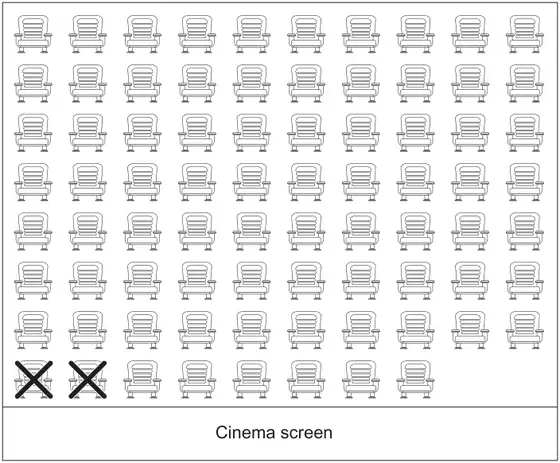
6 There are 14 rows of seats in a cinema. There are 15 seats in each row.
A film was shown in the cinema on Saturday. Each ticket for the film cost £6.50
The tickets that were sold cost a total of £1274
How many tickets were not sold? (3)
Mark scheme
Answer
Mark
Mark scheme
14
P1
for making a start to the process eg \(14 \times 15\ (= 210)\) or \(14 \times 15 \times 6.50\ (= 1365)\) or \(1274 \div 6.50\ (= 196)\) or \(14 \times 15 \times 6.50 - 1274\ (= 91)\)
P1
for a complete process eg \((14 \times 15 \times 6.50 - 1274) \div 6.50\) or \(14 \times 15 - (1274 \div 6.50)\)
11 The table shows the costs of sending a parcel by the Express service and by the Rapid service.
Type of service
Cost
Express
£15.25
Rapid
£35.38
Brendan has to send 12 parcels. It will be cheaper to send the parcels by the Express service than by the Rapid service.
(a) How much cheaper? (3)
Luke wants to send 21 parcels by the Express service.
He does the calculation 20 × £15 = £300 to estimate the cost.
(b) Explain why Luke’s calculation shows the actual cost will be more than £300 (1)
Mark scheme (a)
Answer
Mark
Mark scheme
241.56
P1
for difference for 1 parcel eg \(35.38 - 15.25\ (= 20.13)\) OR for total cost for 12 parcels by either service eg \(35.38 \times 12\ (= 424.56)\) or \(15.25 \times 12\ (= 183)\)
P1
for a complete process eg \(\text{``}20.13\text{''} \times 12\) or \(\text{``}424.56\text{''} - \text{``}183\text{''}\)
A1
cao
Mark scheme (b)
Answer
Mark
Mark scheme
Explanation
C1
for explanation Acceptable examples both figures rounded down (refers to both figures) 20 is less than 21 and 15 is less than 15.25 Not acceptable examples both figures rounded (up); rounded down either 20 is less than 21 or 15 is less than 15.25 (refers to just one figure) the cost is 320.25 (more than 300); multiplying with bigger numbers
6 Dave goes into a cafe and buys 2 cups of coffee and a piece of cake.
Each cup of coffee costs £2.75 The cake costs £2.90
Dave pays with a £10 note.
He thinks he will get more than £1.50 in change.
Is Dave correct? You must show how you get your answer. (3)
Mark scheme
Answer
Mark
Mark scheme
Yes and statement
P1
for a first step towards solution, eg. \(2 \times 2.75\ (= 5.5)\) or \(2.75 + 2.9\ (= 5.65)\) OR \(10 - 1.5\ (= 8.5)\) or \(10 - 2.9\ (= 7.1)\) or \(10 - 2.75\ (= 7.25)\)
P1
for a complete process to find figures to compare eg. \(2 \times 2.75 + 2.9 + 1.5\ (= 9.90)\) or \(10 - (2 \times 2.75 + 2.9)\ (=1.60)\) OR \(2 \times 2.75 + 2.9\ (=8.40)\) and \(10 - 1.5\ (= 8.5)\)
C1
for correct conclusion with accurate figure(s) eg. Yes and (£)1.6(0) or Yes and (£)9.9(0) or Yes and (£)8.4(0) and (£)8.5(0)
8 Neil buys 30 pens, 30 pencils, 30 rulers and 30 pencil cases.
Price list
pens
6 for 82p
pencils
15 for 45p
rulers
10 for £1.25
pencil cases
37p each
What is the total amount of money Neil spends? (5)
Mark scheme
Answer
Mark
Mark scheme
19.85
P1
for a start to the process eg \(30 \div 6\) (=5) or \(30 \div 15\) (=2) or \(30 \div 10\) (=3) OR \(30 \times 37\) (=1110) OR \(82 \div 6\) (=13.6 to 13.7) or \(45 \div 15\) (=3) or \(1.25 \div 10\) (=0.125)
P1
for process to find cost of 30 pens or 30 pencils or 30 rulers eg \(\text{``}5\text{''} \times 82\ (= 410)\) or \(\text{``}2\text{''} \times 45\ (= 90)\) or \(\text{``}3\text{''} \times 1.25\ (= 3.75)\) OR \(\text{``}13.6..\text{''} \times 30\) (=409.8 to 410) or \(\text{``}3\text{''} \times 30\) (=90) or \(\text{``}0.125\text{''} \times 30\) (=3.75)
P1
for a process to find cost of 2 of 30 pens or 30 pencils or 30 rulers eg any 2 of \(\text{``}5\text{''} \times 82\ (= 410)\), \(\text{``}2\text{''} \times 45\ (= 90)\), \(\text{``}3\text{''} \times 1.25\ (= 3.75)\)
P1
for adding at least 3 different costs (units may not be consistent) eg \(\text{``}410\text{''} + \text{``}90\text{''} + \text{``}3.75\text{''}\) or \(\text{``}410\text{''} + \text{``}90\text{''} + \text{``}11.10\text{''}\)
A1
cao
Additional guidance
Work may be in pence or in pounds
Intention to add not necessary eg 410, 3.75 is sufficient, or working leading to these figures Any two correct methods will imply P1P1P1
Correct working for 3 of pens, pencils, rulers and pencil cases with an intention to add, may be in a mixture of money units
for answer in correct notation with correct units, eg. 90p or £0.90 (accept £0.90p and £0.9) [SC: B1 for an answer of £2.90]
Mark scheme (b)
Answer
Mark
Notes
8.27pm
M1
for using 60 mins = 1 hour in the conversion of 102 minutes, eg. 1 h 42 mins or 1.42 or 1.7 or \((60 + 42)\) mins or \(102 - 60\) or \(102 \div 60\) or for an answer of 8.27am or 08.27
for complete method with relative place value correct including addition of all the appropriate elements of the calculation e.g. two lines of 1st method, internal numbers of grids, or complete structure shown of partitioning methods
A1
for digits 23478
A1
(ft dep M1) for correct placement of the decimal point into their final answer
2 packets of bread rolls costing £1.50 for each packet 1 bottle of ketchup costing £1.60 3 packets of sausages
Fahima pays with a £10 note. She gets 30p change.
Fahima works out that one packet of sausages costs £2.30
Is Fahima right? You must show how you get your answer. (3)
Mark scheme
Answer
Mark
Notes
No (supported)
P1
process to work with either cost of 3 sausages e.g. \(3 \times 2.30\ (=6.9(0))\) or division of a cost by 3
P1
process to work with costs of at least 3 of bread rolls, bread rolls, ketchup, change, sausages e.g. \(2 \times 1.50 + 1.60\) or \(1.50 + 1.60 + 0.30\), or \(10 - 1.50 - 1.60 - 0.30\) or \(10 - 1.50 - 1.50 - 1.60\)
C1
E.g. No and (£)5.10 and (£)6.90 No and (£)5.40 and (£)6.90 No and (£)1.70 No and (£)11.50 or (£)11.80 or shows cost of sausages at £2.30 and cost of any 2 other items is greater than (or equal to) £10 NB can work in £ or p throughout. Condone 5.1 etc
for complete method with relative place value correct including addition of all the appropriate elements of the calculation e.g. two lines of 1st method, internal numbers of grids, or complete structure shown of partitioning methods
A1
for digits 23478
A1
(ft dep M1) for correct placement of the decimal point into their final answer
*4 Mr and Mrs Shankara and their 3 children go on a train journey.
Mr Shankara pays for 2 adult tickets and 3 child tickets. The price of an adult ticket is £8.40 The price of a child ticket is half the price of an adult ticket.
Mr Shankara pays for the tickets with 3 ten pound notes.
Work out how much change he should get. (4)
Mark scheme
Answer
Mark
Notes
60p
4
M1 for price of child ticket e.g. \(8.40 \div 2\) (= 4.20) M1 for a method to work out the total cost of the 2 adults e.g. \(2 \times 8.40\) (= 16.80) or of the 3 children e.g. \(\text{``}4.20\text{''} \times 3\) (= 12.60) or of the whole family e.g. \(2 \times 8.40 + 3 \times \text{``}4.20\text{''}\) (= 29.40) M1 for a complete method to work out the change e.g. \(3 \times £10 - \text{``}29.40\text{''}\) = (0.60) or \(3 \times £10 - (2 \times 8.40 + 3 \times \text{``}4.20\text{''})\) (= 0.60) C1 for change with correct money notation 60p or £0.60 (accept £0.60p)
NB candidates may work in pence rather than pounds
Sue worked for 18 days last month. She bought a day return ticket each day she worked.
A monthly saver ticket is cheaper than 18 day return tickets. How much cheaper? (4)
Mark scheme
Answer
Mark
Notes
17.6(0)
4
M1 \(18 \times 6.45\) (= 116.1(0)) or \(18 \times 645\) (= 11610) M1 for \(18 \times 6.45 - 98.50\) in the correct order but units may not be consistent A1 for digits 1760 A1 ft (dep on M2) for correct placement of decimal point after subtraction (of appropriate values)
7 Paula has £10 to spend on music downloads. Each music download costs 84p. Paula buys as many music downloads as possible.
Work out how much money Paula has left. (3)
Mark scheme
Answer
Mark
Notes
76p
3
M1 for \(1000 \div 84\) or \(10 \div 0.84\) (= 11.90…) or \(11 \times 84\) (= 924) or \(11 \times 0.84\) (= 9.24) or 11 given as the answer. M1 for complete method to find the change (showing figures in compatible units) or 76 as the answer no/incorrect units. A1 for 76p or £0.76 or £0.76p
M1 for \(7 \times 30\) (= 210) or \(3 \times 45\) (= 135) M1 (dep on previous M1) for £5 – their total of \(7 \times 30\) and \(3 \times 45\) or digits 155 seen A1 for 1.55 cao
Sue worked for 18 days last month. She bought a day return ticket each day she worked.
A monthly saver ticket is cheaper than 18 day return tickets. How much cheaper? (4)
Mark scheme
Answer
Mark
Notes
17.6(0)
4
M1 \(18 \times 6.45\) (= 116.1(0)) or \(18 \times 645\) = (11610) M1 for \(18 \times 6.45 - 98.50\) in the correct order but units may not be consistent A1 for digits 1760 A1 (dep on M2) for correct placement of decimal point after subtraction (of appropriate values)
M1 for a complete method to find the cost for one company M1 for a complete method to find the cost for both companies and finding the difference A1 cao
OR M1 for a complete method to find the differences in cost for calls or texts M1 for a complete method to find the amount saved and finding the sum A1 cao
(a) Complete the shopping bill by writing in the missing costs. (3)
Pat wants to buy a book. The book costs £5.50
Pat has a voucher for £1.70 She also has 3 pound coins and 3 twenty pence coins. She wants to buy the book with the voucher and the coins.
(b) Is this enough for Pat to buy the book? You must show all your working. (3)
Mark scheme (a)
Answer
Mark
Notes
£1.11 and £2.68
3
B1 for (£)1.11 or 111(p) B1 for (£)2.68 or 268(p) or ft from “£1.11” B1 for correct units
Mark scheme (b)
Answer
Mark
Notes
No (from correct calculations)
3
M1 for finding the value of the coins M1 for a complete method to find the total value of the voucher and coins A1 correct conclusion from correct calculations, eg No, she only has £5.30
Or
M1 for finding the difference between the price of the book and the voucher or the price of the book and the coins M1 for a complete method to find the difference between the book and the voucher AND the coins A1 correct conclusion from correct calculations, eg No, she is 20p short
Work out how much Dani has to pay for the units of electricity she has used. (4)
Mark scheme
Answer
Mark
Notes
£52.74 or 5274p
4
M1 for subtracting to find the units used (= 293) M1 for \(\text{‘}293\text{’} \times 18\) or \(\text{‘}293\text{’} \times 0.18\) A1 for 52.74 or 5274 C1 (dep M2) for identifying their answer with the correct monetary units
OR
M1 for \(2968 \times 18\) (= 53424) or \(2675 \times 18\) (= 48150) or \(2968 \times 0.18\) (= 534.24) or \(2675 \times 0.18\) (= 481.50) M1 for subtracting their two costs (consistent in pence or pounds) A1 for 52.74 or 5274 C1 (dep M2) for identifying their answer with the correct monetary units
9 Here is information about the cost of sending a parcel to Europe by Parcel Link.
Next day delivery
£19.00 plus 70p for each kg more than 5 kg
3 day delivery
£16.00 plus 50p for each kg more than 5 kg
Kate is going to send a parcel to Europe by Parcel Link. The parcel weighs 12 kg.
Kate can send the parcel using next day delivery or using 3 day delivery.
(a) Work out the difference in the two costs. (3)
Adam sends a parcel to Europe by Parcel Link. He uses 3 day delivery. The cost is £25
(b) Work out how many kilograms Adam’s parcel weighs. (3)
Mark scheme (a)
Answer
Mark
Notes
4.40
3
M1 for a method to find the cost for one delivery method eg \(19 + 7 \times 0.7(0)\) (= 23.9(0)) or \(16 + 7 \times 0.5(0)\) (= 19.5(0)) M1 for a method to find the cost for both delivery methods and attempting to subtract eg \(23.90 - 19.50\) A1 cao Accept 4.4
OR
M1 for method to find the difference between the two delivery costs eg \(19 - 16\) (= 3) and \(70 - 50\) (= 20) M1 for a method to find the “cost” using the differences eg \(\text{``}3\text{''} + 7 \times \text{``}20\text{''}\) A1 cao Accept 4.4
Mark scheme (b)
Answer
Mark
Notes
23
3
M1 for \(25 - 16\) (= 9) M1 for a method to divide “9” by 0.50 (= 18) A1 cao
OR
M1 for starting with 16 and a method to add on 0.50s M1 for starting with 16 and adding on 0.50s to within 0.50 of 25 A1 cao
11 Susan and Joe are going on holiday. They can take two cases onto the plane free of charge if the total weight of the two cases is no more than 40 kg.
Susan’s case has a weight of 22.8 kg. Joe’s case has a weight of 19.5 kg.
(*a) Can they take their two cases onto the plane free of charge? (2)
Susan and Joe want to be at the airport terminal at 14 30
It will take 1 hour and 20 minutes to drive from home to the airport. It will then take a total of 30 minutes to park the car and go into the airport terminal.
(b) What is the latest time they can leave home? (3)
Mark scheme (a)
Answer
Mark
Notes
No with working
2
M1 for \(19.5 + 22.8\) (= 42.3) or \(40 - 19.5 - 22.8\) (= \(-2.3\)) or \(22 + 19\) (= 41) C1 for statement with No and 42.3 or ±2.3 or 41 seen
Mark scheme (b)
Answer
Mark
Notes
12 40
3
M1 for correct start eg. addition of two times or subtraction of one time from 1430 M1 for a complete method A1 for 12 40 (pm)
M1 for correct method to find total cost of chairs (and table) for at least one shop M1 for correct method to find total cost of chairs (and table) for at least two shops A1 for 3 comparable totals (eg. chairs £200, £192, £210 or table and chairs £320, £312, £330) C1 (dep on M1) ft for correct statement with shop name from comparable figures
Leah has some lessons with Stan’s Driving School. The total cost of the lessons is £305.50
(b) Work out how many lessons Leah has. (3)
Mark scheme (a)
Answer
Mark
Notes
85.50
2
M1 for \(2 \times 12.75 + 3 \times 20\) or \(12.75 + 3 \times 20\) (= 72.75) A1 for 85.5(0)
Mark scheme (b)
Answer
Mark
Notes
16
3
M1 (ft from (a)) for subtracting cost of 1 or 2 or 5 lessons from 305.50 \(305.50 - \text{“}2 \times 12.75\text{”}\) (= 280) or \(305.50 - \text{“}85.50\text{”}\) (= 220) or \(305.50 - 12.75\) (= 292.75) M1 for \(\text{``}280\text{''} \div 20\) (= 14) or \(\text{``}220\text{''} \div 20\) (= 11) or \(292.75 \div 20\) A1 cao
OR
M1 for adding 20s to cost of 1 or 2 or 5 lessons eg 12.75 or “2×12.75” or “85.50” and intention to add on 20s or \(14 \times 20\) or \(11 \times 20\) M1 for “2×12.75” or “85.50” and adding 20s to within 20 of 305.50 A1 cao
2 fish and chips at £9.25 each 1 chicken and chips at £9.50 1 roast lamb at £10.55 4 puddings at £4.55 each.
Edwin pays for the meals with three £20 notes.
How much change should Edwin get? (3)
Mark scheme
Answer
Mark
Notes
3.25
3
M1 for 2 × 9.25 + 9.50 + 10.55 + 4 × 4.55 (= 56.75) or at least one of each item added M1(dep) for 3 × 20 − “56.75” A1 cao (SC B2 for answer 26.15) (SC B1 for answer of 13.85 or 36.75)
M1 for adding at least 3 of 1.25, 1.15, 85, 85 A1 for 4.1(0) or 410 C1 ft (dep on M1) for correct statement comparing £4 and their total (units must be given and correct) or for correct statement referring to difference eg. 10p short (units must be given and correct) OR M1 for finding at least one difference between coins and costs eg 2 – 0.85 – 0.85 or 1.15 – 1 or 1.25 – 1 A1 for 0.10 or 10 C1 ft (dep on M1) for correct statement referring to total difference units (must be given and correct) (SC : B1 for correct figures with no working eg. £4.10 and £4 or 10p)
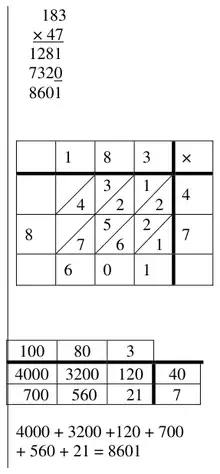
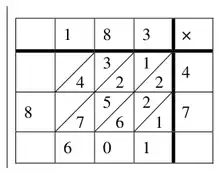
M1 for a complete method to multiply 183 by 47 (condone one multiplication error) A1 for digits 8601 given as the answer B1 (dep on M1) for correctly writing their answer to 2 decimal places
7 Mrs Clark shares £20 between Sally, Bethan, Robert and Tom.
Mrs Clark gives £6.65 to Sally. She shares the rest of the money equally between Bethan, Robert and Tom.
How much money does Mrs Clark give to Bethan? (3)
Mark scheme
Working
Answer
Mark
Notes
\(20 - 6.65\) \(13.35 \div 3\)
4.45
3
M1 for a correct method to find the amount shared by B, R and T M1 (dep) for a correct method of dividing this amount by 3 A1 cao [SC: B1 for an answer of 17.78 (\(20 - 6.65 \div 3\)), if M0 scored, with or without working]
M1 for a complete method to multiply 183 by 47 and attempt at addition (condone one multiplication error) A1 for digits 8601 given as the answer B1 (dep on M1) for correctly writing their answer to 2 decimal places
*12 The table gives information about the costs of posting parcels.
Maximum weight of a parcel
Cost
2 kg
£4.41
4 kg
£7.06
6 kg
£9.58
8 kg
£11.74
10 kg
£12.61
20 kg
£14.69
Umar has to post some parcels.
He has to post 3 parcels with a weight of 6 kg each 1 parcel with a weight of 10 kg 1 parcel with a weight of 3 kg 1 parcel with a weight of 1.2 kg
Umar has £55 to spend on posting the parcels.
Can he post all the parcels? (4)
Mark scheme
Working
Answer
Mark
Notes
\(3 \times 9.58 + 12.61 + 7.06 + 4.41\) (= 52.82)
Yes + working
4
M2 for \(3 \times 9.58\) (=28.74) \(+ 12.61 + 7.06 + 4.41\) or \(55 - 3 \times 9.58\) (=28.74) \(- 12.61 - 7.06 - 4.41\) (M1 for at least 2 correct costs seen) A1 for 52.82 or 2.18 C1 (dep M1) for comparison and correct deduction using their total cost or amount left
M2 for \((5 - 1.18 - 0.94 - 0.30) \div 2\) oe or digits 129 (M1 for \(1.18 + 0.94\) or 2.12 seen or \(1.18 + 0.94 + 0.30\) oe or 2.42 seen or \(5 - 1.18 - 0.94\) oe or 2.88 seen or \((5 - 1.18 - 0.94) \div 2\) or 1.44 seen or \(5 - 1.18 - 0.94 - 0.30\) oe or 2.58 seen ) A1 cao NOTE: Accept working in £ or pence
M1 for \(1000 \div 79\) or \(10 \div 0.79\) (=12.65…) or \(12 \times 79\) or \(12 \times 0.79\) A1 for 9.48 or 948 A1 for 52p or £0.52 or £0.52p (SC if M0 then B2 for 0.52, 0.52p or 52 as answer) (SC if M0 then B1 for 12 as answer)
(a) The square of a whole number is a two-digit number.
Work out
the smallest number that could have been squared and the largest number that could have been squared. [3 marks]
(b) Which has the larger value \(\quad 0.8^2 \quad\) or \(\quad 0.8^3\) ?
Tick a box.
\(0.8^2\)
\(0.8^3\)
Give a reason for your answer. [1 mark]
Mark scheme (a)
Answer
Mark
Comments
4 and 9 in correct positions
B3
B2 9 in smallest position and 4 in largest position or only 4 in correct position or only 9 in correct position or \(4^2\) in smallest position and \(9^2\) in largest position or 16 or \(\sqrt{16}\) in smallest position and 81 or \(\sqrt{81}\) in largest position B1 \(4^2\) or 16 or \(\sqrt{16}\) or \(9^2\) or 81 or \(\sqrt{81}\)
Additional guidance
\(4^2 = 16\) in smallest position and \(9^2 = 81\) in largest position
B2
16, 4 in smallest position and 81, 9 in largest position
B2
\(2^2 = 4\) in smallest position is not 4 in smallest position \(3^2 = 9\) in largest position is not 9 in largest position
Mark scheme (b)
Answer
Mark
Comments
\(0.8^2\) ticked with either 0.64 and 0.512 or \(\dfrac{64}{100}\) and \(\dfrac{64}{125}\) or \(0.8 \lt 1\) or suitable worded reason
B1
oe in comparable form fractions must have same numerator or same denominator eg multiplying by decimals below 1 makes numbers smaller
Additional guidance
Ignore further work after correct values in comparable form
Condone 0.51 for 0.512
\(\dfrac{16}{25}\) and \(\dfrac{64}{125}\) (fractions do not have same numerator or denominator)
B0
\(0.8^2\) ticked and squaring makes numbers bigger
\(1.5 \times 1.5\) or \(\left(\dfrac{3}{2}\right)^2\)
M1
oe oe improper fraction squared
2.25 or \(\dfrac{9}{4}\) or \(2\dfrac{1}{4}\)
A1
oe decimal, improper fraction or mixed number SC1 answer digits 225
Additional guidance
Ignore attempt to simplify or convert if correct fraction seen
Do not allow further work but condone adjusting place value eg \(1.5 \times 1.5 = 2.25\), \(2.25 \div 100 = 0.0225\) (adjusting place value) eg \(1.5 \times 1.5 = 2.25\), \(2.25 \times 1.5\) (cubing not squaring)
Work out the greatest number of notepads he can buy. [2 marks]
Mark scheme
Answer
Mark
Comments
\(20 \div 1.3(0)\) or [15.3, 15.4] or 19.5(0)
M1
oe
15 with no incorrect working
A1
Additional guidance
\(15 \times 1.30 = 19.05\) with answer 15 (incorrect working)
M1A0
\(15 \times 1.30\) without answer 15
M1A0
For build up method allow one error but must get above £18.70 eg1 13 14.30 15.60 17 18.30 19.60 and answer of 15 eg2 13 15.30 16.60 17.90 19.20 For build down method allow one error but must get below £1.30 eg3 20 18.70 17.40 16.10 14.60 \(\ldots\) 5.50 4.20 2.90 1.60 0.30
Accept correct conversions to equivalent fractions or decimals eg 0.25, \(\dfrac{4}{8}\), \(\dfrac{7}{8}\), \(3\dfrac{1}{10}\)
B2
Do not accept any incorrect working or incorrect conversions for B2 eg1 \(\dfrac{1}{4}\), \(\dfrac{1}{2}\), \(\dfrac{7}{8}\), \(3\dfrac{1}{10}\) with 3.01 seen in working eg2 \(\dfrac{1}{4}\), \(\dfrac{1}{2}\), \(\dfrac{7}{8}\), 3.01
B1 B1
Condone any incorrect working or incorrect conversions for B1 eg \(\dfrac{1}{4}\), 0.3, \(\dfrac{1}{2}\), \(\dfrac{7}{8}\)
B1
Condone correct percentage value without percentage sign for B2 eg \(\dfrac{1}{2} = 50\) is condoned as not incorrect working
\(1.5 \times 1.5\) or \(\left(\dfrac{3}{2}\right)^2\)
M1
oe oe improper fraction squared
2.25 or \(\dfrac{9}{4}\) or \(2\dfrac{1}{4}\)
A1
oe decimal, improper fraction or mixed number SC1 answer digits 225
Additional guidance
Ignore attempt to simplify or convert if correct fraction seen
Do not allow further work, but condone adjusting place value eg \(1.5 \times 1.5 = 2.25\), \(2.25 \div 100 = 0.0225\) (adjusting place value) eg \(1.5 \times 1.5 = 2.25\), \(2.25 \times 1.5\) (cubing not squaring)
\(1.7 \times 0.9\) or 1.53 or \(1.7 \times 6\) or 10.2
M1
oe eg \(1.7 - 0.1 \times 1.7\)
\(1.7 \times 0.9 \times 6\) or 9.18
M1dep
oe eg \(10.2 - 0.1 \times 10.2\) dep on 2nd M1
their \(9.18 + 2 \times 0.62\) or 10.42
M1
oe their 9.18 must be 6 times their pack price
Shop A Cheaper by £0.82
A1
oe eg Shop A Cheaper by 82p
Additional guidance
Accept working in pounds or pence
Mixed units in the 4th M1 mark must be recovered with a correct value for their calculation 960 and \(9.18 + 2 \times 62\) 960 and \(9.18 + 2 \times 62\) and 10.42
M1M1M1M0 M1M1M1M1
\(10.20 + 2 \times 0.62\) or 11.44 score the 2nd and 4th M1 mark
\(4095 + 63\) or \(4221 - 63\) or \((4095 + 4221) \div 2\) or \(8316 \div 2\) or Valid attempt to multiply 63 by 66 with no conceptual error
M1
oe from traditional method their \(378 +\) their 3780 or their \(198 +\) their 3960 with at least one correct and placeholder of zero correct or implied
from grid method their \(3600 +\) their \(360 +\) their \(180 +\) their 18 (at least three correct)
from Chinese / Napier’s bones method at least three values correct from 1/8, 1/8, 3/6 and 3/6 and total calculated for each diagonal with at least one carrying figure placed correctly
their \(15 \times 0.4(0) + 3 \times 1.35\) or \(6(.00) + 4.05\)
M1dep
oe working in pence their 15 can be a truncated or rounded up decimal
10.05
A1
SC2 6.05
Alternative method 3
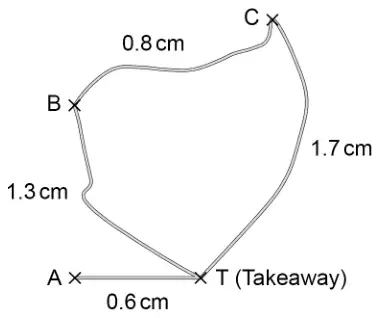
\(0.6 \times 3\) or 1.8 or \(1.2 \times 3\) or 3.6 or \(1.3 \times 3\) or 3.9 or \(0.8 \times 3\) or 2.4 or \(1.7 \times 3\) or 5.1
M1
\(0.6 \times 3 \times 0.4\) or 0.72 or \(1.2 \times 3 \times 0.4\) or 1.44 or \(1.3 \times 3 \times 0.4\) or 1.56 or \(0.8 \times 3 \times 0.4\) or 0.96 or \(1.7 \times 3 \times 0.4\) or 2.04
oe working in pence condone one missing or incorrect distance
10.05
A1
SC2 6.05
Additional guidance
Units must be consistent unless recovered
All correct except for missing the return distance from A eg \(0.6 + 1.3 + 0.8 + 1.7\) or 4.4 \(4.4 \times 3 = 13.2\) \(13.2 \times 0.4 + 3 \times 1.35 = 9.33\)
M1M1M1A0
Example using their 15 truncated or rounded up for each mile \(0.6 + 1.3 + 0.8 + 1.7\) or 4.4 \(4.4 \times 3 = 13.2\) \(13 \times 0.4 + 3 \times 1.35 = 9.25\) or \(14 \times 0.4 + 3 \times 1.35 = 9.65\)
M1M1M1A0
\(3.6 + 3.9 + 5.1\) (BC missing)
M1M1
\(3.9 + 2.4 + 5.1\) without further working (TA and AT missing)
25 hours at £10.20 per hour and extra hours at the weekend at £11.80 per hour.
Here are the extra hours he works at the weekend.
Saturday
7 am to 10 am
Sunday
1 pm to 3 pm
In total, how much is he paid this week? [4 marks]
Mark scheme
Answer
Mark
Comments
\(25 \times 10.2(0)\) or 255
M1
oe
\(10 - 7 + 3 - 1\) or \(3 + 2\) or 5 or \((10 - 7) \times 11.8(0)\) or \(3 \times 11.8(0)\) or 35.4(0) or \((3 - 1) \times 11.8(0)\) or \(2 \times 11.8(0)\) or 23.6(0)
M1
oe
their \(5 \times 11.8(0)\) or their \(35.4(0) +\) their 23.6(0) or 59
M1dep
oe dep on 2nd M their 35.4(0) and their 23.6(0) must both be from correct methods
(b) Work out \(\quad \dfrac{5}{6} \div 3\) [1 mark]
(c) Work out \(\quad 27 \div 0.6\) [1 mark]
Mark scheme (a)
Answer
Mark
Comments
(0).35
B1
oe
Additional guidance
Mark the answer line. If this is blank, mark the working
If values are given in one or more forms, either on the answer line or in working with nothing on the answer line, all values must be correct eg1 \(0.35 = \dfrac{7}{20}\) on answer line eg2 \(\dfrac{35}{100}\) and 3.5 in working with \(\dfrac{35}{100}\) on answer line eg3 \(\dfrac{35}{100}\) and 3.5 in working with 3.5 on answer line eg4 \(\dfrac{35}{100}\) and 3.5 in working with answer line blank
B1 B1 B0 B0
Mark scheme (b)
Answer
Mark
Comments
\(\dfrac{5}{18}\)
B1
oe eg \(\dfrac{10}{36}\)
Additional guidance
Mark the answer line. If this is blank, mark the working
Allow 0.277… (minimum two 7s and two dots) or correct notation for recurring decimals
If values are given in one or more forms, either on the answer line or in working with nothing on the answer line, all values must be correct eg1 \(\dfrac{5}{18} = 0.277\ldots\) on answer line eg2 \(\dfrac{5}{18}\) and 0.518 in working with answer line blank
B1 B0
\(\dfrac{1\frac{2}{3}}{6}\) or \(\dfrac{1.66\ldots}{6}\) without answer in correct form
B0
Mark scheme (c)
Answer
Mark
Comments
45
B1
Additional guidance
Mark the answer line. If this is blank, mark the working
If values are given in one or more forms, either on the answer line or in working with nothing on the answer line, all values must be correct eg1 \(\dfrac{270}{6} = 45\) on answer line eg2 \(\dfrac{270}{6}\) and \(44\dfrac{5}{6}\) in working with answer line blank
B1 B0
Do not allow unprocessed answers eg \(\dfrac{270}{6}\)
Using fractions, digits 962 may be seen as part of a fraction for first A1 For unsimplified fractions, follow appropriate MS for M marks For simplified fractions, please follow the spirit of each MS for M marks
Alt 1 If the 0 is missing or misaligned allow if units digit 2 in their answer for the first M1 If the 0 is missing allow 0 to be replaced by x for the first M1
Alt 2 If numbers are broken down further there can be only one error for the first M1 eg 20 10 7 and 20 6 needs five of 400, 120, 200, 60, 140, 42
Alt 3 Diagonals must slope consistently for M1 unless recovered Diagonals missing is M0 unless recovered
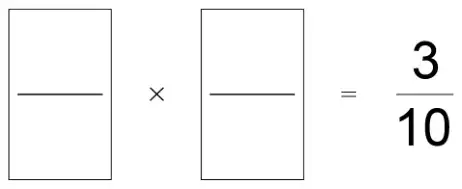
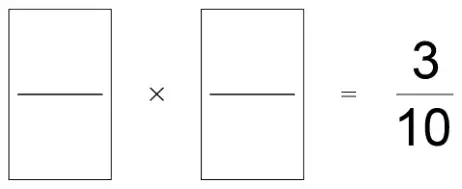
(a) In each box, write a fraction less than 1 to make a correct calculation. [1 mark]
(b) In each box, write a decimal less than 1 to make a correct calculation. [1 mark]
Mark scheme (a)
Answer
Mark
Comments
Two fractions less than 1 with product \(\dfrac{3}{10}\)
B1
eg \(\dfrac{3}{5}\) and \(\dfrac{1}{2}\) or \(\dfrac{6}{10}\) and \(\dfrac{5}{10}\) either order
Additional guidance
Accept negatives if each processed fraction is less than 1 eg \(-\dfrac{3}{2}\) and \(-\dfrac{1}{5}\) eg \(\dfrac{-1}{-2}\) and \(\dfrac{3}{5}\) eg \(\dfrac{-3}{-2}\) and \(\dfrac{1}{5}\)
B1 B1 B0
Do not accept decimals within the fractions eg \(\dfrac{0.6}{1}\) and \(\dfrac{0.5}{1}\)
B0
\(\dfrac{11}{10}\) and \(\dfrac{3}{11}\)
B0
\(\dfrac{3}{10}\) and \(\dfrac{1}{1}\)
B0
0.6 and 0.5
B0
Mark scheme (b)
Answer
Mark
Comments
Two decimals less than 1 with product 0.06
B1
eg 0.3 and 0.2 or 0.60 and 0.10 or 0.5 and 0.12 or 0.75 and 0.08 either order
Correct vertical method of long multiplication with at least one of 1450 and 7250 correct or Correct set up of grid method with at least three products correct or Correct set up of Gelosia method with at least three products correct or \(10 \times 725 = 7250\) and \(2 \times 725 = 1450\) attempted with at least one correct or \(12 \times 700 = 8400\) and \(12 \times 20 = 240\) and \(12 \times 5 = 60\) attempted with at least one correct
M1dep
oe allow a placeholder space to be present instead of a physical zero in vertical method
87(.00)
A1
SC2 103.8(0) or 146.4(0) or 169.2(0) or 190.8(0) or 256.2(0) or 250.2(0) or 315.6(0) SC1 \(8.65 \times 12\) or \(12.2(0) \times 12\) or \(14.1(0) \times 12\) or \(15.9(0) \times 12\) or \(21.35 \times 12\) or \(20.85 \times 12\) or \(26.3(0) \times 12\)
Additional guidance
Condone 87.0
M2A1
Accept answers in pence
Condone p after their final answer eg £87.00p
Method of repeated addition must have no more than one error. If broken down into groups, the one error made may be seen multiple times
(a) In each box, write a fraction less than 1 to make a correct calculation. [1 mark]
(b) In each box, write a decimal less than 1 to make a correct calculation. [1 mark]
Mark scheme (a)
Answer
Mark
Comments
Two fractions less than 1 with product \(\dfrac{3}{10}\)
B1
eg \(\dfrac{3}{5}\) and \(\dfrac{1}{2}\) or \(\dfrac{6}{10}\) and \(\dfrac{5}{10}\) either order
Additional guidance
Accept negatives if each processed fraction is less than 1 eg \(-\dfrac{3}{2}\) and \(-\dfrac{1}{5}\) eg \(\dfrac{-1}{-2}\) and \(\dfrac{3}{5}\) eg \(\dfrac{-3}{-2}\) and \(\dfrac{1}{5}\)
B1 B1 B0
Do not accept decimals within the fractions eg \(\dfrac{0.6}{1}\) and \(\dfrac{0.5}{1}\)
B0
\(\dfrac{11}{10}\) and \(\dfrac{3}{11}\)
B0
\(\dfrac{3}{10}\) and \(\dfrac{1}{1}\)
B0
0.6 and 0.5
B0
Mark scheme (b)
Answer
Mark
Comments
Two decimals less than 1 with product 0.06
B1
eg 0.3 and 0.2 or 0.60 and 0.10 or 0.5 and 0.12 or 0.75 and 0.08 either order
19 Work out which of these fractions is closer in value to 0.5
\(\dfrac{5}{16} \qquad\qquad \dfrac{17}{25}\)
You must show your working. [2 marks]
Mark scheme
Answer
Mark
Comments
Alternative method 1
0.31(25) or 0.68
M1
oe eg 31(.25)% or 68%
0.31(25) and 0.68 and \(\dfrac{17}{25}\)
A1
accept 0.68 as the answer with both values seen
Alternative method 2
Converts both fractions to a valid common denominator with at least one numerator correct
M1
eg \(\dfrac{125}{400}\) and \(\dfrac{272}{400}\) with one numerator correct
Two correct fractions with a common denominator and \(\dfrac{17}{25}\)
A1
accept \(\dfrac{272}{400}\) oe as the answer with both values seen
Alternative method 3
Gives differences from \(\dfrac{1}{2}\) in same form with at least one correct
M1
eg \(\dfrac{75}{400}\) and \(\dfrac{72}{400}\) with one numerator correct or 0.1875 and 0.18 with one correct
Both differences correct and \(\dfrac{17}{25}\)
A1
accept 0.18 as the answer with both values seen
Additional guidance
Accept \(\dfrac{17}{25}\) circled in question with both values seen
Ignore subsequent rounding or truncation once 0.31 and 0.68 seen
Ignore incorrect attempts at differences in Alt 1 and Alt 2 and award up to full marks
Choose the scheme that favours the student
Use of other methods requires comparable forms eg \(0.5 - \dfrac{5}{16} = \dfrac{3}{16}\), \(0.5 + \dfrac{3}{16} = \dfrac{11}{16}\) and compares with \(\dfrac{17}{25}\)
You can use the calculation to help answer the following questions.
(a) Work out \(\quad 2604 \div 84\) [1 mark]
(b) Work out \(\quad 3.1 \times 8.4\) [1 mark]
(c) Work out \(\quad 31 \times 85\) [2 marks]
Mark scheme (a)
Answer
Mark
Comments
31
B1
Mark scheme (b)
Answer
Mark
Comments
26.04
B1
Mark scheme (c)
Answer
Mark
Comments
2604 + 31 or Valid attempt to multiply 31 by 85
M1
from traditional method their 155 + their 2480 or their 85 + their 2550 at least one correct and placeholder of zero correct or implied from grid method their 2400 + their 150 + their 80 + their 5 (at least three correct) from Chinese / Napier’s bones method at least three values correct from 2/4, 1/5, (0)/8 and (0)/5 and total calculated for each diagonal with at least one carrying figure placed correctly
10 Boxes of chocolates each contain 25 chocolates.
One box costs £3.25
A shop has a special offer.
Two boxes for £5
How much cheaper per chocolate is the special offer? [3 marks]
Mark scheme
Answer
Mark
Comments
Alternative method 1
\(3.25 \div 25\) or 0.13 or \(325 \div 25\) or 13 or \(5 \div (2 \times 25)\) or \(5 \div 50\) or 0.1(0) or \(500 \div (2 \times 25)\) or \(500 \div 50\) or 10
M1
oe cost of a chocolate in a single box
cost of a chocolate from special offer
\(3.25 \div 25 - 5 \div (2 \times 25)\) or their 0.13 \(-\) their 0.1(0) or 0.03 or \(325 \div 25 - 500 \div (2 \times 25)\) or their 13 \(-\) their 10
M1dep
oe their 0.13 and their 0.1(0) must come from correct methods
their 13 and their 10 must come from correct methods
3
A1
condone £0.03 on answer line
Alternative method 2
\(2 \times 3.25 - 5\) or \(6.5(0) - 5\) or 1.5(0) or \(2 \times 325 - 500\) or \(650 - 500\) or 150
M1
difference in cost of two boxes
their \(1.5(0) \div (2 \times 25)\) or 0.03 or their \(150 \div (2 \times 25)\)
M1dep
oe \(1.5(0) \div 50\)
oe \(150 \div 50\)
3
A1
condone £0.03 on answer line
Alternative method 3
\(3.25 - 5 \div 2\) or \(3.25 - 2.5(0)\) or 0.75 or \(325 - 500 \div 2\) or \(325 - 250\) or 75
M1
difference in cost of one box
their \(0.75 \div 25\) or 0.03 or their \(75 \div 25\)
Cards take precedence, but if cards or answer line are blank, mark all other working and award the lowest mark unless their choice is unambiguously identified
Mark scheme (b)
Answer
Mark
Comments
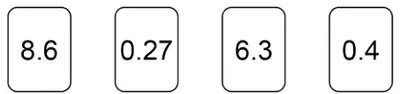
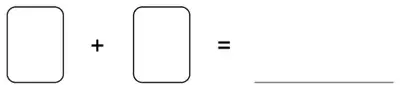
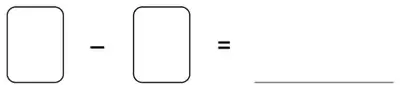
8.6 and 0.27 in this order only
B1
8.33
B1ft
correct or ft their two numbers
Additional guidance
Do not allow misreads of the cards in this question
Examples of follow through (there are many) 0.27 and 8.6 Answer \(-8.33\) 6.3 and 0.4 Answer 5.9
B0B1ft
Cards take precedence, but if cards or answer line are blank, mark all other working and award the lowest mark unless their choice is unambiguously identified
He pays the exact amount with two notes and four coins.
List the notes and coins. [2 marks]
Mark scheme
Answer
Mark
Comments
Notes £10 £5 Coins 50p 50p 50p 5p
B2
either order for notes any order for coins units must be included for all values B1 correct answer with units not included for all values or two notes and four coins totalling [£16.50, £16.60] with correct units or another combination of notes and coins totalling £16.55 with correct units
Additional guidance
Any correct units (may be shown in working) eg 50p may be £0.50, £1 may be 100p, £5 may be 5 pounds Condone £0.50p, £0.05p Condone 10£ for 10 pounds
Accept use of £1 £5 £10 notes Accept use of 1p 2p 5p 10p 20p 50p £1 £2 £5 coins
£5 reduction if you spend more than £100 or £10 reduction if you spend more than £150 or £20 reduction if you spend more than £200
At the shop, dresses cost £42 each.
Amira buys 3 dresses. Bobbi buys 5 dresses.
How much more than Amira does Bobbi pay? [3 marks]
Mark scheme
Answer
Mark
Comments
\(3 \times 42\) or 126 or \(5 \times 42\) or 210
M1
implied by 121 or 190 or 84
\(3 \times 42 - 5\) or 121 or \(5 \times 42 - 20\) or 190
M1dep
oe
69 or 69.00(p)
A1
69p is A0
Additional guidance
121 or 190 seen
M1M1
\(121 \div 3\) or \(190 \div 5\)
M1M1A0
Do not allow a misread of the discounts
Follow through the correct discount for their misread of a dress price eg for a misread of £42 as £24 \(24 \times 3 = 72\) and no discount required so M1 max but \(24 \times 5 = 120\) and \(120 - 5 = 115\) could score M1M1
A misread of the number of dresses must be > 3 for Amira and > 5 for Bobbi
A has 11 tracks. Each track on A costs the same. The total cost of downloading A is £8.80
Josh also downloads album B. B has 14 tracks.
(a) Work out the total cost of downloading B.
Assume each track costs the same as a track on A. [3 marks]
(b) In fact, compared to the cost of each track on A
the cost of 6 tracks on B is more by 5p each the cost of 8 tracks on B is less by 5p each.
What does this tell you about your answer to part (a)?
Tick one box.
The total cost is less than my answer to part (a)
The total cost is more than my answer to part (a)
The total cost is the same as my answer to part (a)
Give a reason for your decision. [2 marks]
Mark scheme (a)
Answer
Mark
Comments
Alternative method 1
\(8.8(0) \div 11\) or (0).8(0) or \(880 \div 11\) or 80
M1
oe \(8.8(0) \times 14\) or 123.2(0) or \(880 \times 14\) or 12320
their \((0).8(0) \times 3\ (+\ 8.8(0))\) or 2.4(0) (+ 8.8(0)) or their \(80 \times 3\ (+\ 880)\) or 240 (+ 880) or their \((0).8(0) \times 14\) or their \(80 \times 14\) or 11.2 or 1120
M1dep
oe their \(123.2(0) \div 11\) or their \(12320 \div 11\)
11.20
A1
Condone (£)11.20p
Alternative method 2
\(11 \div 8.8(0)\) or 1.25 or \(11 \div 880\) or 0.0125
M1
oe
\(14 \div\) their 1.25 or \(14 \div\) their 0.0125 or 11.2 or 1120
M1dep
oe
11.20
A1
Condone (£)11.20p
Additional guidance
\(8.8(0) \times \dfrac{14}{11}\) or \(8.8(0) \times 1.27(\ldots)\)
M1M1
\(\dfrac{56}{5}\) is oe for 11.2
M1M1
\(\dfrac{4}{5}\) is oe for 0.8, \(\dfrac{5}{4}\) is oe for 1.25, \(\dfrac{1}{80}\) is oe for 0.0125
M1
Mark scheme (b)
Answer
Mark
Comments
Alternative method 1 – answer in (a) correct or answer in (a) not used
Ticks the box The total cost is less than my answer to part (a) and correct reason
B2
correct reasons include more tracks cost less 10(p) (less) (costs) (£)11.1(0)
B1 Ticks the box The total cost is less than my answer to part (a)
Alternative method 2 – answer in (a) incorrect and used for comparison
Ticks the box for the correct decision for comparison with their answer in part (a) and correct reason from comparison with their answer in part (a)
B2ft
B1ft Ticks the box for the correct decision for comparison with their answer in part (a)
Additional guidance
Condone irrelevant statements with a correct reason
Do not accept an incorrect reason with a correct reason
Comes out of your account / comes off balance / comes out of the bank
B1
Condone description of direct debit eg amount paid regularly / money withdrawn monthly / paid out each month / paid frequently / money that needs to be paid / money you will have to pay
B1
Do not accept description of debt or use of the word ‘owe’ eg something that you owe, money owed for bills, what you owe the bank, how much you spent on debt
B0
Do not accept description of cost or discount eg how much it costs, something that is taken off the price, money taken off the cost
B0
Other unacceptable answers are eg spending money on a card directly from your bank, borrowed from the bank, your own money that is not borrowed, monthly charge, loss of money
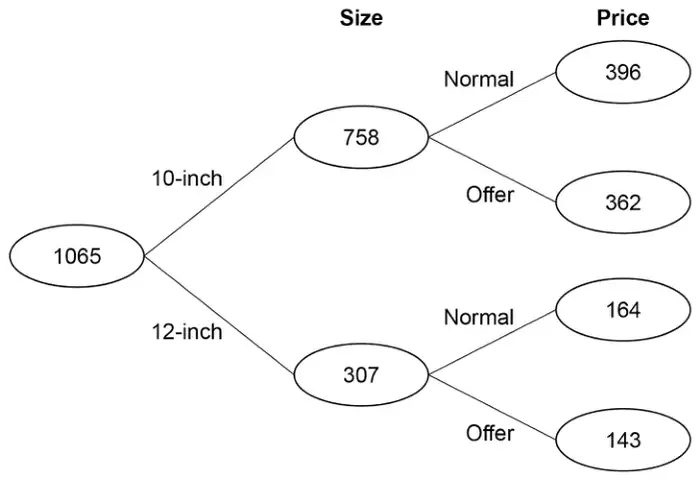
12 A takeaway sells 10-inch pizzas and 12-inch pizzas.
Here is some information about the numbers sold in two weeks.
Week 1
10-inch
512
12-inch
231
Total
743
Week 2
(a) In each week a proportion of the pizzas sold were 10-inch.
In which week was this proportion greater?
Show working to support your answer. [2 marks]
(b) The table shows the profit or loss the takeaway makes on each pizza.
Normal price
Offer price
10-inch
£3.74 profit
51p loss
12-inch
£5.29 profit
4p loss
In week 1 the total profit was £1895.55
At the end of week 1 the takeaway spent £175 on adverts.
Was the increase in profit in week 2 more than the cost of the adverts?
You must show your working. [4 marks]
Mark scheme (a)
Answer
Mark
Comments
Alternative method 1
\(512 \div 743\) or 0.6 or 0.68… or 0.69 or \(758 \div 1065\) or 0.7 or 0.71…
M1
oe
0.6 or 0.68… or 0.69 and 0.7 or 0.71… and Week 2
A1
Alternative method 2
\(512 \div 231\) or 2.2 or 2.21… or 2.22 or \(758 \div 307\) or 2.4 or 2.46… or 2.47 or 2.5
M1
oe
2.2 or 2.21… or 2.22 and 2.4 or 2.46… or 2.47 or 2.5 and Week 2
A1
Alternative method 3
\(\dfrac{512}{743}\) or \(\dfrac{758}{1065}\)
M1
\(\dfrac{512}{231}\) or \(\dfrac{758}{307}\)
\(\dfrac{545280}{791295}\) and \(\dfrac{563194}{791295}\) and Week 2
A1
\(\dfrac{157184}{70917}\) and \(\dfrac{175098}{70917}\) and Week 2
Additional guidance
Accept working in percentages
Proportions can be calculated using reciprocals in both Alternative method 1 and Alternative method 2 eg \(231 \div 512\)
60(%) or 68(%) or 69(%) or 70(%) or 71(%)
M1
(10% = 74.3 followed by) \(\dfrac{512}{74.3} \times 10\) or (10% = 106.5 followed by) \(\dfrac{758}{106.5} \times 10\) is oe for Alternative method 1
M1
Mark scheme (b)
Answer
Mark
Comments
\(396 \times 3.74\) or 1481.04 or \(164 \times 5.29\) or 867.56 or \(362 \times 0.51\) or 184.62 or \(143 \times 0.04\) or 5.72
M1
oe Week 2 profit on 10-inch pizzas Week 2 profit on 12-inch pizzas Week 2 loss on 10-inch pizzas Week 2 loss on 12-inch pizzas
their 1481.04 + their 867.56 or 2348.6(0) or their 184.62 + their 5.72 or 190.34 or their \(1481.04 -\) their 184.62 or 1296.42 or their \(867.56 -\) their 5.72 or 861.84
M1dep
oe Week 2 profit for both pizzas Week 2 loss for both pizzas Week 2 profit – loss on 10-inch pizzas Week 2 profit – loss on 12-inch pizzas
their \(2348.6(0) -\) their 190.34 or their 1296.42 + their 861.84 or 2158.26
M1dep
Total week 2 profit from total profit – total loss
(£)87.71 or (£)262.71 and Yes or (£)1983.26 and Yes or (£) 2158.26 and (£)2070.55 and Yes
A1
Total week 2 profit – (total week 1 profit + cost of adverts) Total week 2 profit – total week 1 profit Total week 2 profit – cost of adverts Condone eg £87.71p
Additional guidance
Accept use of inequality sign or words to imply “Yes” in final answer
Accept –184.62 and –5.72 for first M1
Accept working in pence to calculate losses for M1
2070.55 is total week 1 profit + cost of adverts
Answer of (£)87.71 does not require “Yes” to be stated as the advert cost has been subtracted
(a) Work out \(\quad 16.4 - 3.92 + 7.8\) [2 marks]
(b) Work out \(\quad 2843.61 \div 7\) [2 marks]
Mark scheme (a)
Answer
Mark
Comments
\((16.4 - 3.92 =)\) 12.48 or \((16.4 + 7.8 =)\) 24.2 or \((7.8 - 3.92 =)\) 3.88
B1
20.28
B1ft
ft their \(12.48 + 7.8\) or their \(24.2 - 3.92\) or their \(3.88 + 16.4\) SC1 4.68
Additional guidance
Answer of 20.28
B1B1
4.68 comes from \(16.4 - (3.92 + 7.8)\)
SC1
\(-4.68\)
SC0
Follow through must have at least 1 decimal place eg \(16.4 - 3.92 = 12\) then \(12 + 7.8 = 19.8\) eg \(16.4 - 3.92 = 12.58\) then \(12.58 + 7.8 = 20.38\)
B0B0ft B0B1ft
Mark scheme (b)
Answer
Mark
Comments
406.23
B2
Ignore further work e.g rounding B1 \(400 \leqslant\) answer \(< 410\) B1 digits 40 623 (not 406.23)
Additional guidance
0406.23
B2
Ignore trailing zeros eg 406.230000
B2
406.23 in division calculation and 406 on answer line
B2
406.23 in division calculation and 46.23 on answer line cannot be considered a transcription error and cannot be ignored as further work
Totals either set of coins or Totals all coins or Works out difference
(their 3.97 + their 1.53) \(\div\) 2 or their (£) 5.5(0) \(\div\) 2 or (£)2.75 or (their 3.97 – their 1.53) \(\div\) 2 or their (£) 2.44 \(\div\) 2 or (£)1.22
M1dep
oe Accept incorrect or missing units
£1, 20p and 2p
A1
oe eg £1.00, £0.20, £0.02 Correct units must be given
Alternative method 2
Moves 3 coins from Eve to Ola and correctly evaluates one set of coins
M1
Accept incorrect or missing units
Moves a different set of 3 coins from Eve to Ola and correctly evaluates both sets of coins
M1dep
Accept incorrect or missing units
£1, 20p and 2p
A1
oe eg £1.00, £0.20, £0.02 Correct units must be given
Additional guidance
Answer of 1, 20, 2 with some or all units incorrect or missing
17 Anika has a shelf 79.6 cm long. She has many books, each of width 3.4 cm. Anika puts two paperweights, each of width 5 cm, and the maximum possible number of books on the shelf.
Work out the amount of space on the shelf that is left over. You must show your working. [5]
Mark scheme
Answer
Marks
Part marks and guidance
1.6 with correct working
5
M2 for \(\dfrac{79.6 - 2 \times 5}{3.4}\) oe
“Correct working” requires evidence of at least M2 For M2 allow for use of trials to try to make 69.6 e.g. \(3.4 \times 20\) [= 68] with \(79.6 - 2 \times 5\) oe seen Accept attempt with repeated addition/subtraction of 3.4 for M2 isw using estimation only after correct values shown for M2
or M1 for \(79.6 - 2 \times 5\) oe implied by 69.6
AND
B1 for 20 [. …] or [total length of books = ] 68 [cm]
AND
20[. …] seen or used as max number of books For B1 ignore remainders with 20 68 must be their total length of books and not just a value in working
their 20 must be written and working shown for M1. M1 Dep on answer < 3.4 Could be implied by e.g. repeated subtraction
If 0 or 1 scored, instead award SC2 for answer 1.6 with no working or insufficient working
Alternative method: M2B1M1 or M2B0M1 depending on “20” for \(\left(\dfrac{79.6 - 2 \times 5}{3.4} - \textit{their}\ 20\right) \times 3.4\) Alt scheme if consistent omission of two paperweights or one paperweight with no adjustment later M1 for \(\dfrac{79.6[-5]}{3.4}\) oe B2 for answer 11.6 or B1 for 68 [cm] OR M1 for \(\dfrac{79.6[-5]}{3.4}\) oe B1 for 23.[…] ignore remainders or for 78.2 or 21.[…] ignore remainders or for 71.4 A1 for answer 1.4 or 3.2
5 Anika has a shelf 79.6 cm long. She has many books, each of width 3.4 cm. Anika puts two paperweights, each of width 5 cm, and the maximum possible number of books on the shelf.
Work out the amount of space on the shelf that is left over. You must show your working. [5]
Mark scheme
Answer
Marks
Part marks and guidance
1.6 with correct working
5
M2 for \(\frac{79.6 - 2 \times 5}{3.4}\) oe
or M1 for 79.6 – 2 × 5 oe implied by 69.6
“Correct working” requires evidence of at least M2 For M2 allow for use of trials to try to make 69.6 e.g. 3.4 × 20 [= 68] with 79.6 – 2 × 5 oe seen Accept attempt with repeated addition/subtraction of 3.4 for M2 isw using estimation only after correct values shown for M2
AND
B1 for 20 [. …] or [total length of books = ] 68 [cm]
20[. …] seen or used as max number of books For B1 ignore remainders with 20 68 must be their total length of books and not just a value in working
AND
M1 for 79.6 – (their 20 × 3.4 + 2 × 5)
their 20 must be written and working shown for M1. M1 Dep on answer < 3.4 Could be implied by e.g. repeated subtraction
If 0 or 1 scored, instead award SC2 for answer 1.6 with no working or insufficient working
Alternative method: M2B1M1 or M2B0M1 depending on “20” for \(\left(\frac{79.6 - 2 \times 5}{3.4} - \textit{their } 20\right) \times 3.4\)
Alt scheme if consistent omission of two paperweights or one paperweight with no adjustment later M1 for \(\frac{79.6[-5]}{3.4}\) oe B2 for answer 11.6 or B1 for 68 [cm] OR M1 for \(\frac{79.6[-5]}{3.4}\) oe B1 for 23.[…] ignore remainders or for 78.2 or 21.[…] ignore remainders or for 71.4 A1 for answer 1.4 or 3.2
Accept \(1200 \div 30\), \(\frac{600}{15}\), \(\frac{120}{100} \div \frac{3}{100}\) Do not allow M1 if extra step after \(120 \div 3\) e.g. \(120 \div 3\) then divide by 100
Ivan has a sack containing 50 litres of compost. He uses this compost to fill pots for his plants.
(a) Ivan fills six large pots each holding 7.5 litres.
Work out how much compost is left in the sack. [2]
(b) Ivan uses the remaining compost to fill small pots each holding 400 ml.
Work out the maximum number of small pots Ivan can fill with the remaining compost. [3]
(c) Work out how much compost will then be left in the sack. [2]
Mark scheme (a)
Answer
Marks
Part marks and guidance
5
2
M1 for \(6 \times 7.5\) oe
M1 implied by 45 Repeated addition, we must see their method, allow one arithmetic error. e.g. 7.5, 15 then \(15 \times 3\) [=45]
Mark scheme (b)
Answer
Marks
Part marks and guidance
12
3
B2 for 12.5
or
M2 for their (a) \(\times 1000 \div 400\) or their (a) \(\div\) [0].4
or
M1 for their (a) \(\times\) 1000 or \(400 \div 1000\) or their (a) \(\div\) figs 4
their (a) must be \(\gt\) 0.4
M2 implied by repeated addition or subtraction to one less than their (a) or their (a) \(\times\) 1000 see appendix If their (a) \(\lt\) 1.2 then all multiples must be seen
Appendix
Repeated Addition/Subtraction Methods
This is when division is attempted by listing multiples of a number or by repeated subtraction.
When marking this we need to see at least 3 correct multiples, one of these MUST be the number before reaching the value, in this case 2800.
We allow ONLY one arithmetic error in this method (unless the mark scheme states otherwise) Example 1: 400, 800, 1100 (error), 1500, 1900, 2300, 2700, [3100] – one arithmetic error, but correct FT from the error so M1 awarded.
Example 2: 400, 800, 1100 (error), 1500, 1800 (error), 2200, 2600, [3000] – two arithmetic errors, so M0 awarded.
When marking this we need to see at least 3 correct subtractions, one of these MUST be the number before reaching 0.
We allow ONLY one arithmetic error in this method (unless the mark scheme states otherwise) Example 1: 400, 340, 280, 200 (error), 140, 80, 20, [\(-40\)] – one arithmetic error, but correct FT from the error so M1 awarded.
Example 2: 400, 320(error), 260, 210 (error), 150, 90, 30, [\(-30\)] – two arithmetic errors, so M0 awarded.
Mark scheme (c)
Answer
Marks
Part marks and guidance
200
2
B2FT for their (a) \(\times 1000 -\) their (b) \(\times\) 400 evaluated correctly
or
M1their (a) \(\times 1000 -\) their (b) \(\times\) 400
their (a) must be \(\gt\) 0.4
their (a) \(\times 1000 \geqslant\) their (b) \(\times\) 400 their (b) must be an integer.
Implied by repeated subtraction or addition. Working may be seen in part (b) for M1
Accept \(1200 \div 30\), \(\frac{600}{15}\), \(\frac{120}{100} \div \frac{3}{100}\) Do not allow M1 if extra step after \(120 \div 3\) e.g. \(120 \div 3\) then divide by 100
(b) A carpenter has a plank of wood of length \(w\) metres.
The carpenter cuts \(\frac{3}{5}\) of the plank of wood into 20 equal pieces.
Each piece has length 0.06 metres.
Work out the value of \(w\), the original length of the plank of wood. You must show your working. [4]
Mark scheme (a)
Answer
Marks
Part marks and guidance
200
1
Mark scheme (b)
Answer
Marks
Part marks and guidance
2 with correct working
4
Accept 200 cm with correct working “Correct working” requires evidence of at least M1A1M1 or alternate convincing approach
M1 for 0.06 × 20 or 6 × 20 A1 for 1.2 oe or 120 [cm] M1 for (their 1.2) ÷ \(\frac{3}{5}\) oe
M1 may be done in steps e.g. 60% = 120 cm, 10% = 20 cm, 100% = 200 cm
OR M1 for \(\frac{3}{5} \div 20\) or \(20 \div \frac{3}{5}\) A1 for \(\frac{3}{100}\) or 0.03 or 33 or 33.3… M1 for 0.06 ÷ (their \(\frac{3}{5}\) ÷ 20) or 6 ÷ (their \(\frac{3}{5}\) ÷ 20) [cm] or 0.06 × (their 20 ÷ \(\frac{3}{5}\)) oe
If 0 scored SC1 for answer 2 with no/insufficient working
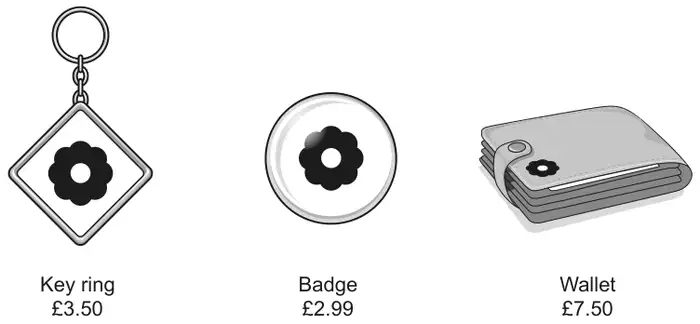
14 A student is buying some gifts for their friends. The gifts are shown below with the prices.
The student has £50 to spend. They first buy 6 key rings and 2 wallets. They then buy badges with the remainder of the money.
(a) Work out the maximum number of badges that the student can buy. You must show your working. [5]
(b) Work out the amount of money they have left over. [2]
Mark scheme (a)
Answer
Marks
Part marks and guidance
4 [badges] with correct working
5
M3 for 50 – \((6 \times 3.50 + 2 \times 7.50)\) oe or M2 for \(6 \times 3.50 + 2 \times 7.50\) oe or M1 for \(6 \times 3.50\) or \(2 \times 7.50\) oe
AND
M1 for their (50 – \((6 \times 3.50 + 2 \times 7.50)) \div 2.99\) oe
If 0 or 1 scored, instead award SC2 for 4 [badges] with no or insufficient working or If 0 scored SC1 for 14 with no or insufficient working
‘Correct working’ requires full evidence of at least M2M1
M3 implied by 14, 15, 21 seen or 14, 36 seen M2 implied by 36 M1 implied by 21 or 15
Accept their (50 – \(6 \times 3.50 + 2 \times 7.50) \div 3\) Implied by list 2.99, 5.98, 8.97, 11.96, [14.95, …….] up to one less than their 14 Condone one arithmetic slip. or 3, 6, 9, 12, [15, ……] up to one less than their 14 or Embedded e.g. 4 x 2.99 = 11.96
Mark scheme (b)
Answer
Marks
Part marks and guidance
2.04
2
M1 for their 14 – their ((a) \(\times\) 2.99) oe
their ((a) \(\times\) 2.99) could be seen in part (a) and must be \(\lt\) their 14
M1 can be implied by a correct FT answer to their 14 – their ((a) \(\times\) 2.99)
Ashley buys 2 pineapples and 3 kilograms of bananas. Ashley spends the remaining money on strawberries.
Work out the mass, in grams, of strawberries that Ashley buys. You must show your working.
.................... g [6]
Mark scheme
Answer
Marks
Part marks and guidance
400 with correct working
6
M1 for \(2 \times 1.15 + 3 \times 0.70\) oe or 2.3[0] + 2.1[0] A1 for 4.4[0] AND M1 for (7 – their 4.4[0]) oe A1 for 2.6[0] AND M1 for their 2.6[0] \(\div\) 1.3[0] [\(\times\) 200] A1FT for their 2.6[0] \(\div\) 1.3[0] rounded down \(\times\) 200
If 0 or 1 scored, instead award SC2 for answer 400 with no or insufficient working If 0 scored, instead award SC1 for 2.6[0] with no or insufficient working
“Correct working” requires evidence of at least two M marks and one A mark
Allow working in pence provided consistent units used
4.4[0] implies M1A1
Could be Implied by their 4.4[0] + their 2.6[0] + their ‘change’ [=7.0[0]]
Implied by list 1.3[0], 2.6[0], [3.9[0], ……] up to one less than their 2.6[0] or Embedded \(2 \times 1.3[0] = 2.6[0]\)
Alternative Method: For first M1A1 M1A1 M1 for \(7 - 2 \times 1.15\) or \(7 - 3 \times 0.70\) A1 for 4.7[0] or 4.9[0] AND M1 for \(7 - 2 \times 1.15 - 3 \times 0.70\) or their 4.7[0] \(- 3 \times 0.70\) or their 4.9[0] \(- 2 \times 1.15\) A1 for 2.6[0]
10 Two supermarkets, A and B, have special offers on the same packet of biscuits.
Supermarket A
Supermarket B
Normal price: £1.50 for each packet
Special offer: Buy two packets at the normal price and get a third packet for half price
Normal price: £1.60 for each packet
Special offer: 10% off the normal price
(a) Dan buys one packet of these biscuits.
Which supermarket is best value for Dan? Show how you decide.
Supermarket .................... because ........................................ [3]
(b) Darcy buys three packets of these biscuits.
Which supermarket is best value for Darcy? Show how you decide.
Supermarket .................... because ........................................ [3]
Mark scheme (a)
Answer
Marks
Part marks and guidance
B and 1.44 is less than 1.5[0] oe or B and ([0].06 or 6p) cheaper oe or B and 1.44 and 1.5[0] seen in final statement
3
M2 for \(1.6[0] \times 0.9\) oe implied by 1.44 or M1 for \(1.6[0] \times 0.1\) oe implied by [0].16
Allow B and “It’s cheaper oe” if only 1.44 [and 1.50] seen in working space Accept all figures in pence May be \(1.6[0] - 1.6[0] \times 0.1\) oe M0 for 10% of 1.6[0] See Appendix B and 3.75 and 4.32 only scores 0 B and 1.44 and 3.75 scores M2 only
Appendix
Appendix for 10a
Working and answer
Mark
Reason
3.75 and 4.32 seen in working Answer: B it is cheaper because 1.44 is cheaper than 1.5
3
Answer uses correct figures
1.44 only seen in working Answer: B it costs less
3
There can be no other figure to compare with so all marks awarded
1.44, 3.75 and 4.32 seen in working Answer: B He only wants one packet so it is cheaper
M2
M2 for 1.44 but no comparison
1.44 and 3.75 seen in working Answer: B even when you buy 2 packets it is cheaper than A
M2
M2 for 1.44 but no comparison
Answer: B and 1.44 cheaper than 3.75
M2
Answer based on incorrect figures but 1.44 seen
16p found and 3.75 seen Answer: B and 3.59 cheaper
M1
16p seen but 3.59 comes from 3.75 – 0.16 so incorrect values. M1 as 16p used
Answer: B and 3.75 lower than 4.32
0
Answer based on incorrect values
Mark scheme (b)
Answer
Marks
Part marks and guidance
A and 3.75 less than 4.32 oe or A and [0].57 saved oe or A and 3.75 and 4.32 seen in final statement OR A and 1.25 less than 1.44 oe or A and 0.19 oe saved or A and 1.25 and 1.44 seen in final statement
3
Method 1 M1 for \(1.5 \times 2.5\) oe or 3.75 oe M1 for their \(1.44 \times 3\) or \((3 \times 1.6) \times 0.9\) oe or 4.32 oe
Method 2 M2 for \(1.5 \times 2.5 \div 3\) oe or 1.25 or M1 for \(1.5 \times 2.5\) oe or 3.75
Ignore other figures/statements that don’t invalidate answer All values may be seen in (a) oe may be \(1.5 + 1.5 + 1.5 \div 2\)
Allow “A because it’s cheaper” oe if 3.75 and 4.32 only seen as final costs in working space for (b)
Allow “A because it’s cheaper” oe if 1.25 and 1.44 only seen as final costs in working space for (b)
12 Frankie goes on holiday. They change £375 into euros (€) at a rate of £1 = €1.15. They spend €217.49 of this money. After the holiday, Frankie changes the remaining euros back into pounds at a rate of £1 = €1.28.
Work out how many pounds Frankie gets back. [4]
Mark scheme
Answer
Marks
Part marks and guidance
167
4
M1 for \(375 \times 1.15\) soi by 431.25
M1 for (their euros) \(-\) 217.49
M1 for their \(213.76 \div 1.28\) oe
213.76 implies M1M1 Must be linked to 375 but do not accept 375 as euros
B2 for figs 45 in final answer or 1.5 oe nfww or \(\left(2.1 - \textit{their}\ \dfrac{3}{5}\right) \times 0.3\) evaluated accurately or \(\textit{their}\,(2.1 - 0.6) \times 0.3\) evaluated accurately
or B1 for [\(\dfrac{3}{5} =\)] 0.6 or \(\left(2.1 - \textit{their}\ \dfrac{3}{5}\right)\) evaluated accurately or the result of \(\textit{their}\left(2.1 - \textit{their}\ \dfrac{3}{5}\right) \times 0.3\) evaluated accurately
i.e. B2 for two accurate processes or B1 for one accurate process
17 The depth of water in a garden pond is 57.8 cm. The depth decreases by 0.3 cm per day.
(a) Assume the depth continues to decrease at the same rate.
After how many days will the depth reach 54.2 cm? [3]
(b) If the depth of water decreases at a slower rate, what effect will this have on your answer to part (a)? [1]
Mark scheme (a)
Answer
Marks
Part marks and guidance
12
3
M2 for \(\dfrac{57.8 - 54.2}{0.3}\) oe or M1 for 57.8 – 54.2 or 3.6 seen or for repeated subtraction of 0.3 from 57.8 or for repeated addition of 0.3 to 54.2
Explain the error that Nathan has made and work out the correct answer. [3]
(b) Four friends buy cinema tickets using this offer.
Cinema tickets
Buy 3 tickets and get a ticket free
They each pay £6.45.
How much does a ticket cost? [3]
Mark scheme (a)
Answer
Marks
Part marks and guidance
When multiplying [12.4] by 10, Nathan has not moved the figures to the left [he has just added a 0]
1
Accept \(12.4 \times 10 = 124\) not 12.40
Condone he has not moved the decimal point to the right soi Accept reference to either first or second line of working See Appendix B
285.2
2
M1 for \(12.4 \times 20 = 248\) or \(124 \times 2 = 248\)
Accept 248 seen If \(12.4 \times 23\) is worked out using grid method, allow M1 if no more than one error. If other long multiplication method used, allow M1 if not more than one arithmetic slip but M0 if error in place value
Appendix B
Exemplar responses for Q3(a) explanation mark
Response
Mark
For 10 × 12.4 Nathan has only times by 1. For 20 × 12.4 he has only times by 2. 10 × 12.4 = 124. Accept identifying that he has timesed by 1 instead of 10, or by 2 instead of 20.
1
10 × 12.4 is not 12.40 it is 124. He didn’t add the 0s onto the numbers. 10 x 124 is not 12.40 it is 124 scores 1, ignore the rest of the explanation because it is unclear rather than being incorrect.
1
He added 0 to 12.4 Explains what he has done wrong.
1
He does not move the decimal place when he x by 10 so it should have been 124.0. Doesn’t need to say where
1
Nathan has got the place value wrong on first answer. They have correctly identified that the error is in the place value
1
10 × 12.4 = 124 so 20 × 12.4 is wrong Allow identification of error in second line
1
Instead of moving the decimal place to the right he just added a zero to the end of the number and instead of multiplying he add. Ignore final part of statement
1
He hasn’t multiplied it he just added a zero that makes no difference. Error identified and ‘makes no difference’ explains error
1
He said that 20 × 12.4 is 24.80 when it is 248 which means the answer is 285.2 Accept reference to second line of working
1
When Nathan done 10 × 12.4 it should equal 124 10 x 12.4 = 124 is not enough. ‘It should equal 124’ is just about enough to identify the error.
1bod
When he multiplied by 10 he didn’t remove the decimal place and same when he multiplied by 20 Multiplying by 10 isn’t the same as removing the decimal place.
0
Nathan kept the decimal in. When calculating a sum with a decimal you take it out as you do the sum then put it back at the end. Too vague.
0
Nathan has divided the 12.4 rather than moving the decimal point to the right (positive/multiplying) Moving the decimal point to the right would score 1, but we can’t ignore the rest of the explanation because it is incorrect rather than unclear.
0
12.40 is wrong Identifies error but doesn’t explain
0
Mark scheme (b)
Answer
Marks
Part marks and guidance
8.60
3
M2 for \(6.45 \times 4 \div 3\) oe Or M1 for \(6.45 \times 4\) oe or 25.8[0] seen
All symbols correctly placed.\[\boxed{\,6\,}\;\boxed{\,\lt\,}\;\boxed{\,15\,}\]\[\boxed{\,0{\cdot}34\,}\;\boxed{\,\lt\,}\;\boxed{\,0{\cdot}7\,}\]\[\boxed{\,\text{-}8\,}\;\boxed{\,\gt\,}\;\boxed{\,\text{-}11\,}\]
15. A shop sells storage boxes. A stack of four of these boxes is shown below.
Diagram not drawn to scale
The height of a single box is 35·2 cm. The height of four of the same boxes when stacked is 52 cm.
A different stack of these boxes has a height of 85·6 cm. How many boxes are in this stack? [5]
Mark scheme
Scheme
Marks
Comments
(52 – 35.2) ÷ 3
M1
May be seen in stages
= 5.6 (cm)
A1
(85.6 – 35.2) ÷ 5.6 or
35.2 + 9 × 5.6 oe
m1
FT ‘their (52 – 35.2) ÷ 3’
Note: If a candidate is awarded M1 A0 and attempts repeated additions with their incorrect 5.6, there needs to be enough additions to get to a value just below or just above 85.6. They may use a mixture of + ‘their 5.6’ (1box) and + ‘their 16.8’ (3boxes) within their additions.
10 (boxes)
A2
Not from incorrect working A1 for 9 (boxes)
If no marks, from a method starting with (52 – 35.2) ÷ 4 = 4.2 award
SC2 for 12 boxes from (85.6 – 52) ÷ 4.2 + 4 or (85.6 – 35.2) ÷ 4.2
SC1 for 8 boxes from (85.6 – 52) ÷ 4.2
(5)
Alternative
Alternative method 1
Scheme
Marks
Comments
(52 – 35.2) ÷ 3
M1
= 5.6 (cm)
A1
(85.6 – 52) ÷ 5.6 or
52 + 5.6 + 5.6 + 5.6 + 5.6 + 5.6 + 5.6 oe or
m1
FT ‘their (52 – 35.2) ÷ 3’
Note: If a candidate is awarded M1 A0 and attempts repeated additions with their incorrect 5.6, there needs to be enough additions to get to a value just below or just above 85.6. They may use a mixture of + ‘their 5.6’ (1box) and + ‘their 16.8’ (3boxes) within their additions.
10 (boxes)
A2
Not from incorrect working A1 for 6 (boxes)
Alternative method 2
Scheme
Marks
Comments
52 – 35.2 = 16.8 with an attempt at repeated additions to get to 85.6. At least 1 addition must be attempted. e.g. 35.2 + 16.8 + ……. or 52 + 16.8 + …….
M2
35.2 + 16.8 + 16.8 + 16.8 ( = 85.6) or
(85.6 – 35.2) ÷ 16.8
OR
52 + 16.8 + 16.8 or
(85.6 – 52) ÷ 16.8
m1
Note: If the answer to 52 – 35.2 is incorrect and they have attempted repeated additions with their incorrect 16.8 onto either 35.2 or 52. Marks can only be awarded if there are enough additions to get to a value just below or just above 85.6. In this case award M1 m1.
Note: (85.6 – 35.2) ÷ 16.8 or (85.6 – 52) ÷ 16.8 implies M2. If the answer to 52 – 35.2 is incorrect but the correct divisions are shown with their incorrect 16.8 then award M1 m1.
10 (boxes)
A2
Not from incorrect working A1 for 1 + 3 + 3 + 3 or 4 + 3 + 3 or 9 boxes or 6 boxes (as appropriate for their method)
Use a value from the box to complete the following statement. [2]
\(\dfrac{3}{10}\) is less than ………
(d) Work out \(\dfrac{5}{12}\) of 24. [2]
Mark scheme (a)
Scheme
Marks
Comments
(i) 600
B1
(ii) 24
B1
Not for 24 × 4 = 96 without indication that 24 is the answer but allow for \(\begin{array}{r}24\\4\overline{)96}\end{array}\)
Mark scheme (b)
Scheme
Marks
Comments
0.03
B1
Must be a decimal point not a comma; do not allow 0.03%
Mark scheme (c)
Scheme
Marks
Comments
0.35
B2
Allow equivalent correct values e.g. 35%; If 0.35 indicated as answer, ignore working B1 for \(\frac{3}{20}\) = 0.15 or for \(\frac{1}{4}\) = 0.25 or for \(\frac{3}{10}\) = 0.3 or for a comparative statement such as ‘\(\frac{3}{20}\) is less than \(\frac{3}{10}\)’ or for two correct percentages from 15%, 35%, -30%, 25%, 3.1% and 30% or for two correct fractions with a common denominator
Mark scheme (d)
Scheme
Marks
Comments
(24 ÷ 12) × 5 oe, si
M1
Not for \(\frac{5}{12} \times 24\) only; \(\frac{10}{24}\) is M0; allow for \(\frac{120}{12}\)
4. Theo and Anya are buying food and drink for a picnic.
(a)
Theo buys a salad and five identical packs of chicken sandwiches. The salad costs £3. Theo’s total bill is £18.03.
Theo says,
‘This bill must be wrong.’
Explain why Theo is correct. [1]
(b)
Cold drink deal. Buy 1 cola get 1 lemon fizz free.
Anya needs 4 bottles of cola and 5 cans of lemon fizz. A can of lemon fizz costs £1.05. She pays £9.45.
How much does a bottle of cola cost? [3]
Mark scheme (a)
Scheme
Marks
Comments
Valid explanation e.g. ‘£15.03 shared between 5 does not give you an answer in pounds and pence’
E1
Allow e.g. ‘You cannot divide 15.03 by 5’ or ‘The sandwiches would be £3 each and that would add up to £15 plus the salad would be £18. He has been charged 3p too much.’ or ‘The sandwiches should all cost the same amount but the bill suggests they do not.’
or showing that (£)3 × 5 + (£)3 = (£)18 and (£)3.01 × 5 + (£)3 = (£)18.05
Mark scheme (b)
Scheme
Marks
Comments
(9.45 − 1.05) ÷ 4
M2
or M1 for 9.45 − 1.05 or for ‘their (9.45 − 1.05)’ ÷ 4
(b) Write down a fraction that is equivalent to \(\dfrac{4}{36}\). [1]
(c) Write \(\dfrac{11}{20}\) as a percentage. [1]
(d) Find \(\dfrac{3}{7}\) of 14. [2]
(e) Work out \(\dfrac{30 \times 0{\cdot}5}{5}\). [2]
Mark scheme (a)
Scheme
Marks
Comments
23
B1
Mark scheme (b)
Scheme
Marks
Comments
Any fraction equivalent to \(\dfrac{4}{36}\)
B1
e.g. \(\dfrac{1}{9}\) or \(\dfrac{2}{18}\)
Mark scheme (c)
Scheme
Marks
Comments
55(%)
B1
Mark scheme (d)
Scheme
Marks
Comments
6
B2
B1 for \(14 \div 7 = 2\) or \(3 \times 14 = 42\) or \(3 \times 14 \div 7\)
Mark scheme (e)
Scheme
Marks
Comments
3
B2
Award B1 for sight of a first correct step. i.e. \((30 \times 0.5 =)\ 15\) or \(\left(\dfrac{0.5}{5} =\right) 0.1\) or \(\left(\dfrac{30}{5} =\right) 6\)
Nina’s friend says that this answer is too small. Explain why Nina’s friend is correct. [1]
Mark scheme (a)
Scheme
Marks
Comments
Valid comment e.g. ‘Incorrect as the answer should be 22’ or ‘Square rooting is not the same as dividing by 2’ or ‘242 squared is not 484’
B1
Allow eg ‘Because to find a square root you need to find the number that multiplies by itself.’
Mark scheme (b)
Scheme
Marks
Comments
Valid comment e.g. ‘The answer should be bigger than 2’ or ‘The answer is 2.77’ or ‘She should have added 2.00 not 0.02’ or ‘The 2 has the wrong place value.’ or ‘The two is in the wrong column.’
Local authorities in Wales recycle household waste. The chart below shows the percentages of waste that some local authorities recycled in 2021 and 2022.
(i) How many of these local authorities recycled a greater percentage of waste in 2022 than they recycled in 2021? [1]
(ii) In 2022, four of the local authorities recycled 70% or more of their household waste. Name these four local authorities. [2]
(iii) In 2022:
65·2% of household waste was recycled in Wales
59·7% of household waste was recycled in Caerphilly.
Calculate the difference between these two percentages. [2]
(b)
This bar chart shows the percentage of waste recycled in the UK in 2020.
Write down two things that are wrong with the bar chart. [2]
(c)
Kristian tries to recycle as much as possible. He had some spare square and rectangular tiles, as shown below.
Diagram not drawn to scale
Rather than replace his garden table, Kristian used his spare tiles to tile the top of the table. The tiled table top is shown below.
Diagram not drawn to scale
Kristian wants to put a border around the perimeter of the table. What length of border will he need? [3]
Mark scheme (a)
Scheme
Marks
Comments
(i) 5
B1
Do not accept local authorities listed unless the number 5 is seen
(ii) Bridgend, Conwy, Pembrokeshire, Vale of Glamorgan
B2
Award B1 for either
4 correct and 1 incorrect
3 correct with 1 incorrect
3 correct with 0 incorrect
(iii) 65.2 – 59.7
M1
5.5 (%)
A1
Mark scheme (b)
Scheme
Marks
Comments
Two different reasons linked to:
Not all bars the same width
Consistent scale not used
No label on the horizontal axis
No title
E2
For any two of these, or equivalent statements. Ignore additional comments. Do not accept repeated reasons
Allow:
‘Scotland wider (or bigger) than the others’
‘Scotland’s bar is different’
‘Scotland’
‘Scotland is too big’
‘Scotland is the biggest and should be the same’
‘Bars are not equal as one is using 2 boxes other using 1 box’
‘The scale should go from 0, then 10, then 20.’
‘The scale has missed out 10’
‘They could have used the 10 times table (up the side)’
‘The numbers are not going up even’
‘Scale (is not right)’
‘Doesn’t start with 10’
‘Scale should go up 20, 40, 60 …’
‘Doesn’t use10’
‘The label ‘Countries’ is missing’
‘No labels on y and x axis’
‘Graph is not labelled correctly’
Do not allow:
‘UK shouldn’t be at the bottom as it is showing places in the UK’
‘The names as the UK has a bar and then has all the countries after it’
‘One bar is the UK, while the others are what make the UK’
‘Not all bars are the same size’
‘The bars are not equal sizes’
‘The gaps are a little too big’
‘The percentage of household waste should be on the side not on the top’
‘Numbers are not accurate’
‘Bar chart numbers are not right’
They have put the wrong amount of numbers on the side’
In this part of the question, you will be assessed on the quality of your organisation, communication and accuracy in writing.
A ticket bought at the cinema costs £4.50.
Kiera decides to buy the 2 tickets online in advance.
When she buys the tickets online:
she is given 10% off the cost of each ticket
she has to pay a total booking fee of £1.40.
How much does Kiera pay in total for the 2 tickets? [4 + 2 OCW]
(b)
The position of each seat in the cinema is given by a code, for example, seat E5. Each row of seats is labelled with a letter, A, B, C, D, E, F, G and H. Each row starts with seat number 1. Seats A1 and A2 have already been booked. This is shown by the crosses on the diagram.
Kiera books seats G9 and G10 for herself and her friend. Draw a cross on each of these 2 seats on the diagram below. [1]
(c)
When Kiera arrives at the cinema, she sees the following prices advertised.
Kiera decides to buy the Deluxe Combo. How much will Kiera save by buying the Deluxe Combo instead of buying a large soft drink and a large popcorn separately? [4]
Mark scheme (a)
Scheme
Marks
Comments
(Amount of discount for 1 ticket =) (£)0.45 or 45(p) OR (Amount of discount for 2 tickets =) (£)0.9(0) or 90(p)
B1
If units are given, they must be correct Workings may be seen in stages
Award B1 for (£)0.9(0) or 90(p) seen as the total discount
FT from M2 or M1 (Answers from M1: (£)8.10, (£)9.95, (£)5, (£)5.45 (£)10.90, (£)10.40)
If the discount is applied at the end: Award M1 for 2 x £4.50 + £1.40 Award A1 for £10.40 Award SC1 for an answer of £9.36 (from £10.40 – 0.1 x £10.40 = £10.40 – £1.04) FT for SC1 for 0.9 × ‘their 10.40’ correctly evaluated provided M1 awarded
If the booking fee is added to the cost of each ticket and the discount is applied at the end: Award M1 for: 2 x (£4.50 + £1.40) – 0.1 x 2 x (£4.50 + £1.40) Or £11.80 - £1.18 Award A1 for £10.62
If no marks awarded, award SC1 for (£)9 seen
Organisation and communication
OC1
For OC1, candidates will be expected to: • present their response in a structured way • explain to the reader what they are doing at each step of their response • lay out their explanations and working in a way that is clear and logical • write a conclusion that draws together their results and explains what their answer means
Writing
W1
For W1, candidates will be expected to: • show all their working • make few, if any, errors in spelling, punctuation and grammar • use correct mathematical form in their working • use appropriate terminology, units, etc.
Corrected by Westie's Workshop
The board's mark scheme printed “2 x (£4.50 + £1.40) – 0.1 x (£4.50 + £1.40)”. Changed to “2 x (£4.50 + £1.40) – 0.1 x 2 x (£4.50 + £1.40)” because the next line, £11.80 - £1.18, takes 10% off both tickets, so the discount term needs “2 x” as well.
Original: see the board's mark scheme PDF (link above).
Mark scheme (b)
Scheme
Marks
Comments
Seats G9 and G10 indicated on diagram
B1
Mark scheme (c)
Scheme
Marks
Comments
(£)3.59 + (£)5.45
M1
No misread allowed
(£)9.04
A1
CAO
(£)9.04 – (£)7.60
M1
FT ‘their derived or stated 9.04’ provided ‘their 9.04’ > 7.60
(b) Estimate the value of \(\dfrac{79{\cdot}34}{40{\cdot}1 \times 0{\cdot}48}\). You must show all your approximations in your working. [2]
(c) Evaluate \[1\frac{5}{7} + 2\frac{11}{14}.\] Give your answer in its simplest form. [3]
Mark scheme (a)
Scheme
Marks
Comments
0·25
B1
Mark scheme (b)
Scheme
Marks
Comments
\(\dfrac{80}{40 \times 0.5}\)
4
\(\dfrac{2}{0.5}\)
4
\(\dfrac{80}{20}\)
4
\(\dfrac{79}{40 \times 0.5}\)
3·95 or 4 or \(3\frac{19}{20}\)
\(\dfrac{79}{20}\)
3·95 or 4 or \(3\frac{19}{20}\)
\(\dfrac{79.3}{20}\)
3·965 or 3·97 or 4
\(\dfrac{79.34}{20}\)
3·967 or 3·97 or 4
M1
A1
May be seen in stages.
Award M1 for appropriate calculation seen.
Award A1 for the correct estimate for the calculation seen.
An unsupported answer is M0A0.
Mark scheme (c)
Scheme
Marks
Comments
\(4\frac{1}{2}\) or 4·5 or \(\dfrac{9}{2}\)
B3
Mark final answer. Award B2 for an unsimplified evaluation as a single fraction or mixed number e.g.
\(4\frac{7}{14}\)
\(3\frac{21}{14}\)
\(\dfrac{63}{14}\)
\(\dfrac{441}{98}\) or equivalent
4 + ½.
FT for one of the following:
adding ‘their improper fractions’ (which incorporate the entire numbers) provided fractions have a common denominator (one numerator must be correct) and answer given in a (proper or improper) simplified form
3 + ‘their fractions’ evaluated correctly and in a simplified form, provided fractions have a common denominator (one numerator must be correct)
‘their 3’ + 1·5 (or equivalent) in a simplified form
\(a\) + ½ (or equivalent in its simplified form) evaluated provided ½ has come from two fractions with a common denominator (e.g. \(\frac{10}{14} + \frac{11}{14} = \frac{21}{14} = 1\frac{7}{14} + 3 = 3\frac{1}{2}\)).
Award B1 for sight of two fractions with a common denominator (allow an error in one numerator) e.g.
(1) \(\dfrac{10}{14}\) + (2) \(\dfrac{11}{14}\)
\(\dfrac{24}{14} + \dfrac{39}{14}\)
\(\dfrac{168}{98} + \dfrac{273}{98}\) or equivalent.
An unsupported answer of \(4\frac{1}{2}\) or 4·5 or \(\dfrac{9}{2}\) is awarded B3.
On Monday, Siôn sold three times as many ice creams as cold drinks. He sold 50 cold drinks on Monday. Siôn sells ice creams for £1.80 each.
Calculate the amount of money Siôn took from selling ice creams on Monday. [4]
(b) Siôn keeps ice cream in a freezer in his van. Every hour he checks the temperature in his freezer. He turns on his freezer at 8 a.m. The readings he takes from 8 a.m. to 3 p.m. are listed below.
10°C 2°C –5°C –12°C –12°C –12°C –13°C –14°C
(i) Calculate the mean of these temperatures. [3]
(ii) At 4 p.m. the temperature in Siôn’s freezer was recorded as –16°C. Calculate the mean of the temperatures recorded in Siôn’s freezer from 8 a.m. to 4 p.m. [2]
(c) Siôn parks his ice cream van on the beach, as shown on the map below.
Scale: 1 cm represents 20 metres
On screen this diagram may not be shown at actual size. To measure it, use the question paper (PDF) printed at 100%.
(i) How far is Siôn’s ice cream van from the lifeguard station? [2]
…………… metres
(ii) Complete the following statement.
‘The bearing of the lifeguard station from Siôn’s ice cream van is ……………°.’ [1]
Mark scheme (a)
Scheme
Marks
Comments
50 × 3 × 1.8(0) or 50 × 3 × 180
M2
M1 for any of the following:
50 × 3
50 × 1.8(0)
50 × 180
3 × 1.8(0)
3 × 180
(£) 270 or 27000(p)
A2
For A2, if units are given, they must be correct, otherwise A1 for 270p or £27000
Ignoring units, A1 for any of the following:
(50 × 3 =) 150
(50 × 1.8(0) =) 90
(50 × 180 =) 9000
(3 × 1.8(0) =) 5.4(0)
(3 × 180 =) 540
Mark scheme (b)
Scheme
Marks
Comments
(i) (Mean of 8 temperatures is -56 ÷ 8 =) -7 (°C)
B3
Must not be from incorrect working, other than allowing from 56 ÷ 8
B2 for any one of the following:
-56 ÷ 8
56 ÷ 8 = 7
B1 for any one of the following:
(sum of temperatures) -56
(sum of temperatures) 56
sight of ‘their sum of temperatures’ ÷ 8, provided the summation is not from a sum involving all positive integers or all negative integers, with or without a negative sign inserted. If ‘÷ 8’ is not seen, it may be implied from ‘their sum’ and ‘their mean’ (rounded or truncated)
(ii) (-56 + -16) ÷ 9 or -72 ÷ 9
M1
FT ‘their -56’ from (b)(i)
-8 (°C)
A1
On FT allow a rounded or truncated answer Allow a correctly rounded or truncated answer, to 1d.p. for ‘(‘their -56’ + -16) ÷ 9’ to imply M1 A1
Mark scheme (c)
Scheme
Marks
Comments
(i) 20 × (8.6 (± 0.2))
M1
172 (± 4 m)
A1
Do not award from sight of an incorrect evaluation of ‘their 8.6’ × 20
1. Morgan wants to buy the following items from a shop.
Shopping List
Cereal
£2.70
Bananas
99p
Milk
£1.30
Eggs
£1.95
Coffee
£7.49
(a)
Morgan uses a calculator to find the total cost of the items.
He thinks the total is £112.44. What mistake has Morgan made? [1]
(b)
Morgan pays for all the items with a £20 note. How much change will he get? [2]
Mark scheme (a)
Scheme
Mark
Comments
Suitable explanation e.g. ‘Morgan has added £99 (and not 99p)’ ‘the units are different’ ‘Morgan has added pence and pounds’ ‘Morgan typed in 99 not 0.99’ ‘Didn’t put 0. in front of 99’
E1
Allow: ‘Morgan has forgotten the decimal point for the 99 pence’ ‘Didn’t put the dot in front of 99’ ‘Adds them all up instead of putting 0 in front of 99p’ ‘he didn’t put decimal place he added as whole numbers’ ‘numbers added together with decimal point after the number (99)’ ‘Morgan added £98.01 onto the actual cost’ ‘2.70 + 0.99 + 1.30 + 1.95 + 7.49 (=14.43)’ ‘he forgot that it was 99p’ ‘didn’t use 99p for bananas’ ‘Morgan has forgotten to put one of the decimal places in’
Do not accept: ‘he added them up incorrectly’ ‘it should be (£)14.43’ ‘he put 99 when it should be 9.9’ ‘2.70 + 99p + 1.30 + 1.95 + 7.49 = £14.43’ ‘he has not made the 99p £1’ ‘he didn’t use his calculator’ ‘he didn’t put the dot in’ ‘he put the decimal in which made it a higher number it = £14.43’ (not clear enough)
(£)20 – (£)14.43 Allow 14.43 - 20 Accept 2.70 + 99 + 1.30 + 1.95 + 7.49 seen if it leads to the correct answer. FT ‘their 14.43’ if clearly stated in (a) and is <20 for M1 only.
(£)5.57
A1
CAO
If no marks awarded, award SC1 for sight of (£)14.43. May be seen on shopping list or in part (a).
6. Miss Jardon’s electricity bill is shown below. Complete the bill to find the total amount that Miss Jardon owes. [7]
Miss Jardon 34 Heol Ysbyty
Period
Previous meter reading
Present meter reading
Number of units of electricity used
July, August and September 2023
68 928
69 658
……………
Charge for electricity: …………………… units at £0.19 per unit
£ ……………………………
Standing charge: 3 months at £6.50 per month
£ ……………………………
Total charges:
£ ……………………………
VAT at 5%:
£ ……………………………
Amount due to pay £ ……………………………
Mark scheme
Scheme
Marks
Comments
Number of units 730
B1
Answer spaces take precedence throughout
Charge for units 730 × (0.)19
M1
For use of 730 or a strict FT ‘their 730’ from the first entry in the bill Award for sight of digits 1387(0)
(£) 138.7(0)
A1
Must be in pounds
Standing charge (3 × £6.50 = ) (£) 19.5(0)
B1
Total charges (£) 158.2(0)
B1
Must be in pounds FT ‘their 138.7(0)’ + ‘their 19.50’ correctly evaluated, i.e. the sum of their 2 previous entries FT if total charges was previously given in the standing charge box, provided ‘their cost of units’ + 19.50 is correctly evaluated
VAT at 5% (£) 7.91
B1
Must be in pounds FT 5% of ‘their 158.2(0)’ correctly evaluated
Amount to pay (£) 166.11
B1
FT provided
B1 for total charges and B1 for VAT are both previously awarded, or
is correctly evaluated ‘their total charges’ × 1.05
On FT throughout, allow rounded or truncated to a penny.
3. Luca always has his eyes tested at the local optician.
(a)
He needs to have an eye test in December.
Luca works from Monday to Saturday every week.
Luca can only go for an eye test after he finishes work at 4 p.m.
Luca cannot go for an eye test on a Tuesday or Friday.
The local optician does not open on Wednesday afternoon or Saturday afternoon.
The local optician is closed every Sunday and on 25th and 26th December.
The calendar below is for December 2023.
December 2023
Sunday
Monday
Tuesday
Wednesday
Thursday
Friday
Saturday
1
2
3
4
5
6
7
8
9
10
11
12
13
14
15
16
17
18
19
20
21
22
23
24
25
26
27
28
29
30
31
What is the latest possible date in December that Luca could have his eye test? [2]
The latest date that Luca could have his eye test is …………………… December
(b)
Luca last had his eyes tested in 2021. In 2021, Luca was given the strength of his left eye and the strength of his right eye. He compares these strengths with those from 2019.
Left eye strength
Right eye strength
2019
+0·75
+1·50
2021
+1·25
+2·25
Which eye changed the most between 2019 and 2021? You must show working to support your answer. [2]
Left ☐ Right ☐
(c)
In this part of the question, you will be assessed on the quality of your organisation, communication and accuracy in writing.
These are the costs of Luca’s eye test and glasses:
£32 for the eye test
£84 for the frames
£39 for the lenses.
The optician gave Luca a discount voucher. With the voucher, Luca gets:
25% off the cost of the eye test
\(\dfrac{1}{3}\) off the cost of the frames.
Calculate the total amount that Luca has to pay. You must show all your working. [6 + 2 OCW]
Mark scheme (a)
Scheme
Marks
Comments
(Thursday) 28th (December)
B2
Answer space takes precedence Award B1 for any one of the following (for missing one criteria):
(Friday) 29th (December)
(Saturday) 30th (December)
(Sunday) 31st (December)
(Monday) 4th (December)(earliest possible date)
Mark scheme (b)
Scheme
Marks
Comments
(left eye) 1.25 – 0.75 or 0.25 + 0.25 OR (right eye) 2.25 – 1.50 or 0.5 + 0.25
M1
Check table for workings. Allow embedded values e.g. 0.75 + 0.5(0) = 1.25 OR 1.50 + 0.75 = 2.25 Allow place value errors e.g. 125 - 75
Right indicated AND 0.5 AND 0.75 seen
A1
Allow M1A1 if right is indicated and 50 and 75 seen (consistent use of non-decimals).
If no marks awarded, award SC2 for right indicated and saying has increased by 0.25 or 25 more (than the left one)
Mark scheme (c)
Scheme
Marks
Comments
(Cost of eye test) 32 – 0.25 × 32 or equivalent
M1
(£)24
A1
If M0A0 award SC1 for (£)8
(Cost of frames) 84 – 1/3 × 84 or equivalent
M1
(£) 56
A1
If M0A0 award SC1 for (£)28
(Total cost =) 24 + 56 + 39
M1
FT ‘their derived 24’ and ‘their derived 56’ including the use of (£)8 and (£)28
(£)119
A1
Award final A1 only if at least one M1 or SC1 has been awarded and there are derived values for both eye test and frames. e.g 8 + 56 + 39 = 103 award M0A0SC1M1A1M1A1.
Use of (£)8 and (£)28: 8 + 28 + 39 (=£75) award SC1 SC1 M1 A1
If M0A0 awarded for the last 2 marks, award SC1 for an answer of (£)80 (cost of lenses not included)
Organisation and communication
OC1
For OC1, candidates will be expected to: • present their response in a structured way • explain to the reader what they are doing at each step of their response • lay out their explanations and working in a way that is clear and logical • write a conclusion that draws together their results and explains what their answer means
Writing
W1
For W1, candidates will be expected to: • show all their working • make few, if any, errors in spelling, punctuation and grammar • use correct mathematical form in their working • use appropriate terminology, units, etc.
10.In this question, you will be assessed on the quality of your organisation and communication.
A bucket can hold 4000 ml of water. A jug can hold 2·5 litres of water. An empty tank has a capacity of 17 litres.
The tank is filled to the top using a combination of full buckets and full jugs of water. How many full buckets and full jugs must be used to fill the tank exactly? You must show all your working. [4 + 1 OC]
Number of full buckets …………………… Number of full jugs ……………………
Mark scheme
Scheme
Marks
Comments
4000 ml = 4 litres OR 2·5 litres = 2500 ml OR 17 litres = 17000 ml
B1
Seen or implied in working
A complete and correct strategy that leads to the correct answer, e.g. 3 × 4 + 2 × 2·5 = 17 OR Strategy to test at least two different combinations of jugs and buckets, e.g. 4 + 4 + 2·5 and 4 + 2·5 + 2.5 OR Strategy to test at least two different combinations of tank and jugs (or buckets), e.g. 17 – 2·5 – 2·5 and 17 – 4 – 4 OR At least one of each strategy.
S2
The numbers of jugs/buckets may be seen or implied e.g. 4 + 4 + 4 + 4 + 2.5 (= 18.5) Allow use of ‘their 2500 ml’ or ‘their 4 litres’ or ‘their 17000 ml’
S1 for one combination of jugs and buckets OR one combination of tank and jugs/buckets OR a multiple of jugs or buckets Each mixed strategy must include at least one of each container.
Number of buckets = 3 AND number of jugs = 2
B1
CAO Must be from a correct 4 litre or 2500 ml AND 17000 ml. Crossed-out working can be included in consideration of strategies. An unsupported answer of buckets = 3 AND jugs = 2 gains 4 marks
Organisation and Communication The steps of the answer must be labelled so that it is clear what the calculations are working out. No final conclusion is necessary as there is an answer space.
OC1
For OC1, candidates will be expected to:
present their response in a structured way
explain to the reader what they are doing at each step of their response
lay out their explanation and working in a way that is clear and logical
write a conclusion that draws together their results and explains what their answer means
Corrected by Westie's Workshop
The board's mark scheme printed “Each mixed strategy much include at least one of each container”. Changed to “Each mixed strategy must include at least one of each container” because “much” is a slip for “must”.
Original: see the board's mark scheme PDF (link above).
1. Simran buys 5 packets of sunflower seeds and 2 packets of cosmos seeds. The sunflower seeds cost a total of £9.30. The total cost of all the packets of seeds that Simran buys is £13.80.
(a) How much does it cost for one packet of sunflower seeds? [2]
(b) How much does it cost for one packet of cosmos seeds? [2]
Mark scheme (a)
Scheme
Marks
Comments
(£)9.30 ÷ 5
M1
Sight of the digits 186 gains M1
(£)1.86 or 186(p)
A1
If units are given they must be correct
Mark scheme (b)
Scheme
Marks
Comments
((£)13.80 – (£)9.30) ÷ 2
M1
Sight of the digits 225 gains M1 FT use of 5 × ‘their (£)1.86’ stated in (a) instead of (£)9.30
2. The table below shows the number of swimming medals won by 5 countries in the 2018 Gold Coast Commonwealth Games.
One entry is missing.
Country
Gold
Silver
Bronze
Total
England
9
10
5
24
South Africa
6
3
3
12
Canada
3
6
20
New Zealand
2
0
1
3
Wales
1
1
3
5
(a)
(i) Complete the table to show the number of Silver medals won by Canada. [1]
(ii) Which country had a quarter of the total number of medals won by Canada? [1]
(b)
Draw a pictogram to represent the total number of medals won by each of the 5 countries. [4]
(c)
Before 2018, the world record for the 100 metres breaststroke was 57·13 seconds. During 2018, Adam Peaty beat this world record by 3 hundredths of a second. What was the new world record? [2]
(d)
Alys Thomas, from Wales, won a Gold medal in the 200 metres butterfly final. Her reaction time was 0·73 seconds and her total time was 2 minutes and 5·45 seconds. The results for the race are shown below.
Results
Position
Lane
Name
Reaction time (in seconds)
Total time (in minutes and seconds)
1
4
WAL
Alys THOMAS
0.73
2:05.45
2
5
AUS
Laura TAYLOR
0.68
2:07.39
3
6
AUS
Emma MCKEON
0.73
2:08.05
4
7
IOM
Charlotte ATKINSON
0.70
2:08.50
5
2
AUS
Brianna THROSSELL
0.68
2:08.82
6
3
CAN
Mabel ZAVAROS
0.70
2:09.20
7
8
ENG
Emily LARGE
0.68
2:10.96
8
1
ENG
Laura STEPHENS
0.68
2:11.46
(i) What is the difference in the total time between 1st and 2nd place? [2]
(ii) What was the modal reaction time? [1]
Mark scheme (a)
Scheme
Marks
Comments
(i) 11
B1
Answer may be seen in table or on the answer line. Answer in the table takes precedence.
(ii) Wales
B1
Mark scheme (b)
Scheme
Marks
Comments
Labels for countries
B1
Correct pictogram drawn
B3
Award B2 for 3 or 4 drawn correctly Award B1 for 2 drawn correctly
Award B0 for incorrect key used (i.e. one small square represents 4)
Penalise -1 only for consistent use of a different symbol. eg ⊕
Mark scheme (c)
Scheme
Marks
Comments
57.1(0) (seconds)
B2
Award B1 for sight of 0.03 (but not 3/100) or 57.16
Mark scheme (d)
Scheme
Marks
Comments
(i) (2:)07.39 – (2:)05.45
M1
Or alternative method e.g. counting on. Must be a full method that leads to correct answer. Award M1 for sight of the digits 194 Award M1 for subtraction of (2:)07.39 and (2:)05.45 implied, including (2:)05.45 - (2:)07.39
Note: answer of 2.06 or 2 mins and 6 seconds implies subtraction so award M1
1.94 (seconds)
A1
ISW. Allow 0:01.94 or 0.01.94
If no marks award SC1 for misreading the decimals eg an answer 1(:) 54 or 1.54 or 1 (minute) 54 (seconds) or 2(:) 34 (from 154 ÷ 60)
M1 for (Blueberries cost) 1.5 × 4 ( =6) Award M2, A1 for appropriate sight of (£)7.2(0) irrespective of any further inappropriate working
(Mass of strawberries) (20 – 6.8(0) − 1.5 × 4) ÷ 3.6 or 7.2(0) ÷ 3.6
M1
In FT allow sight of 14.2(0) as indication of 20 – 6.8(0) attempted Allow convincing appropriate repeated addition
FT provided there has been an attempt at a subtraction of the cost of blueberries from 20 – 6.8(0) (=13.2(0)), 20 or 6.8(0) and provided M1 previously awarded, e.g.
(20 – 1.5 × 4) ÷ 3.6
(6.8(0) – 1.5 × 4) ÷ 3.6
OR FT (20 – 6.8(0) – ‘their cost of blueberries’) ÷ 3.6 provided ‘their cost of blueberries’ > (£)4
2 (kg)
A1
CAO. Must be from correct working
If no marks, award SC1 for an answer of 3.6(6kg) or 3.67(kg) or 3.7(kg) (from (20 – 6.80) ÷ 3.6)
An answer only of 2 kg is awarded all 5 marks (strictly provided no incorrect working seen - this is answer only). Any other answer only, such as ‘2 bags’, is awarded no marks.
4. Maddi went running on three days last week. The diagrams below show information for each of her three runs. They show:
the route taken,
the length of the run in km,
the time taken in minutes and seconds,
the number of calories used.
Use the data from Maddi’s three runs last week to answer the following questions.
(a) What is the total number of calories that Maddi used in her three runs last week? [1]
(b)
Maddi thinks that she ran approximately the same distance each day. Is she correct?
Yes ☐ No ☐
Give a reason for your answer. [1]
(c)
Maddi thinks that her shortest run took the least amount of time. Is she correct?
Yes ☐ No ☐
Give a reason for your answer. [1]
(d) What is the difference between the greatest and least time of her three runs? [2]
Mark scheme (a)
Scheme
Marks
Comments
1140 (calories)
B1
Mark scheme (b)
Scheme
Marks
Comments
Yes and suitable reason given
Eg Yes because 5.02 and 5.07 are 5 when rounded to the nearest whole number. Yes because 5.02 and 5.07 are only just over 5 Yes because all runs are about 5km or just over ‘Yes, they are all about 5km’.
E1
Allow ‘Yes, because they are all under 0.5 and all start with 5’
Do not accept the information in the question just repeated, with no inference made.
Do not accept: ‘No because she ran 3 different routes’ ‘No because there are no distances higher than the number’ ‘Yes because it’s 5.07, then 5, then 5.02’ ‘Yes because they are all somewhere in 5km’
Mark scheme (c)
Scheme
Marks
Comments
No and suitable reason given
Eg ‘No because it took her longer to run 5(km) than it did to run 5.02 (km)’ ‘No, the 5.02km run took the least time’ ‘No, the shortest run took longer than the 5.02km run’ ‘No, the shortest run was on Wednesday but the least time was on Friday’
E1
Allow ‘No, on Friday she ran for longer and took less time’ ‘No, 33:46 is the middle time’ ‘No, 5.02 km is the middle distance’
M1 for (Blueberries cost) 1.5 × 4 ( =6) Award M2, A1 for appropriate sight of (£)7.2(0) irrespective of any further inappropriate working
(Mass of strawberries) (20 – 6.8(0) − 1.5 × 4) ÷ 3.6 or 7.2(0) ÷ 3.6
M1
In FT allow sight of 14.2(0) as indication of 20 – 6.8(0) attempted Allow convincing appropriate repeated addition
FT provided there has been an attempt at a subtraction of the cost of blueberries from 20 – 6.8(0) (=13.2(0)), 20 or 6.8(0) and provided M1 previously awarded, e.g.
(20 – 1.5 × 4) ÷ 3.6
(6.8(0) – 1.5 × 4) ÷ 3.6
OR FT (20 – 6.8(0) – ‘their cost of blueberries’) ÷ 3.6 provided ‘their cost of blueberries’ > (£)4
2 (kg)
A1
CAO. Must be from correct working
If no marks, award SC1 for an answer of 3.6(6kg) or 3.67(kg) or 3.7(kg) (from (20 – 6.80) ÷ 3.6)
An answer only of 2 kg is awarded all 5 marks (strictly provided no incorrect working seen - this is answer only). Any other answer only, such as ‘2 bags’, is awarded no marks.
10. Ms Logan is calculating her next water bill. She knows that her fresh water usage is 20 m3.
On the water company’s website she finds the following:
Water charges
The waste water output is calculated as 80% of the fresh water usage.
Fresh water usage costs £1.10 per m3.
Waste water output costs £1.50 per m3.
Calculate Ms Logan’s water bill. [4]
Mark scheme
Scheme
Marks
Comments
(Fresh water charge £) 20 × 1.1(0)
M1
(= £22)
(Waste water charge £) 0.80 × 20 × 1.50
M2
(= £24) M1 for either 0.80 × 20 (= 16m3) or 20 × 1.50 (= 30)
(Total bill £22 + £24 =) (£) 46
A1
CAO
Award M2 (waste water) and SC1 for an answer of £28.4(0) (from fresh water (4 × 1.10 =) £4.40 + £24 for waste) OR Award M1 and SC1 for any one of the following:
Rowan wants to post a number of packages. He has 10 of each of the following stamps.
1 New Zealand dollar ($1) = 100 cents (100c)
Rowan wants to:
put the correct postage on each package,
use as few of his stamps as possible.
Select the stamps he needs to post each of the following packages.
(i) Documents, postage $3.60 [2]
(ii) Birthday present, postage $7.40 [2]
(b)
Rowan is coming to Wales on holiday. The conversion rate at the exchange shop is $1 = £0.53. The exchange shop only has £10 and £20 notes.
Rowan only has $550 saved. He wants to exchange as close to $550 as possible. He asks for as few notes as possible.
Calculate:
how many of each British note Rowan gets,
how much he pays for his currency, correct to the nearest cent.
You must show all your working. [6]
Mark scheme (a)
Scheme
Marks
Comments
(i) ($)1.80 and ($) 1.80
B2
Ignore units stated in £, p in error Accept giving the names of the stamps
B1 for stamps from those available with sum $3.60, but using 3 stamps, i.e.
($)1.60, ($)1.60 and 40(c)
($)2.80, 40(c) and 40(c)
Do not accept with 4 stamps or more
(ii) ($)2.80, ($)2.80 and ($)1.80 or ($)2.30, ($)2.30 and ($)2.80 in any order
B2
Ignore units stated in £, p in error Accept giving the names of the stamps, e.g. 2 Church of Good Shepherd and 1 Mount Taranaki
B1 for stamps from those available with sum $7.40, but using (4 or) 5 stamps, i.e.
($)2.80, ($)2.30, ($)1.80, 40(c), 10(c)
($)2.80, ($)2.30, ($)1.60, 40(c), 30(c)
2 × ($)2.80, ($)1.60, 2 × 10(c)
3 × ($)2.30, 40(c), 10(c)
3 × ($)1.80, ($)1.60, 40(c)
($)2.30, 3 × ($)1.60, 30(c)
($)2.30, ($)1.80, 2 × ($)1.60, 10(c)
Do not accept with 6 stamps or more, e.g. 4 × ($)1.80 and 2 × 10(c)
Mark scheme (b)
Scheme
Marks
Comments
(Change to £) 550 × 0.53
M1
(£)291.5(0)
A1
(Only £10 and £20 notes available so he can buy) (£)290
A1
FT ‘their (£)291.5(0)’ (provided not a multiple of 10) rounded down to nearest multiple of 10 Accept stated or implied as (£)1.50 can’t be converted Sight of (£)290 with no incorrect working implies previous A1
(Fewest number of notes making up £290,) 14 £20 (notes) and 1 £10 (notes)
A1
FT ‘their £290’ provided it is a multiple of 10 Must be fewest number of notes Sight of correct notes with no incorrect working implies previous A1
(Cost in $ to buy £290 is ) 290 ÷ 0.53 or 550 – 1.5(0) ÷ 0.53 (= 550 – 2.83...)
M1
FT ‘their whole number multiple of £10’ ÷ 0.53 Ignore attempt at any further calculation if 290 ÷ 0.53 seen
($)547.17
A1
Must be <($)550 and depends on M1 M1 previously awarded Must be to the nearest cent Mark final answer
If final M0 A0, then award SC1 for ($)2.83 (left) or similar FT
For OC1, candidates will be expected to: • present their response in a structured way • explain to the reader what they are doing at each step of their response • lay out their explanations and working in a way that is clear and logical • write a conclusion that draws together their results and explains what their answer means
Writing
W1
For W1, candidates will be expected to: • show all their working • make few, if any, errors in spelling, punctuation and grammar • use correct mathematical form in their working • use appropriate terminology, units, etc.
1. Geraint went to a petrol station and put petrol in his car. This was the display on the petrol pump.
Geraint put 30 litres of petrol in his car. The price of petrol was 127.9 pence per litre. The cost of the petrol was £38.37.
(a)
The following week the price of petrol was 128.9 pence per litre. Geraint put 40 litres of petrol in his car. What was the cost of the petrol? Give your answer in pounds (£). [3]
Cost of 40 litres of petrol was £ ……………
(b)
The display below shows the cost of 35 litres of petrol. Calculate the price per litre of petrol. Give your answer in pence. [3]
This Sale £
44.38
Litres
35.00
Pence per litre
……………
Mark scheme (a)
Scheme
Marks
Comments
128.9 (pence) × 40 (litres) = (£)51.56
M1 A2
Allow incorrect place value Allow £51.56p A1 for sight of digits 5156 with incorrect place value or units (e.g. £5156 or 5156p or 51.56p) Unsupported sight of digits 5156 implies M1A1 ISW Treat use of 127.9 as MR (-1 from A marks only)
Alternative
Alternative method(printed in italics in the mark scheme)
Scheme
Marks
Comments
(128.9 (pence) ÷ 100 =) (£)1.289
B1
B0 for (£)1.28 or (£)1.29
(£)1.289 × 40 (litres)
M1
Allow use of (£)1.28 × 40 (litres) or (£)1.29 × 40 (litres)
Allow 44·38 ÷ 35 A1 for sight of the digits 1268 with incorrect place value or units (e.g.£126.8 or (£)1.268 or (£)1.27 or 127(p)) Unsupported sight of digits 1268 implies M1A1 ISW
9. A badge is made using a metal button, a pin and sticky tape.
Lulu’s Craft Shop
Pack of 42 metal buttons, only £2.50
Bag of 24 pins, only £1.10
60 cm roll of sticky tape, 52p
(a)
Elwyn decides to buy metal buttons and pins to make badges, so that there are no metal buttons or pins left over. He wants to buy the least possible number of packs of metal buttons and bags of pins.
(i)
Show that Elwyn should buy 4 packs of metal buttons and 7 bags of pins. You must show all your working. [2]
(ii)
What is the maximum number of badges Elwyn can possibly make using 4 packs of metal buttons and 7 bags of pins? [1]
(b)
Each pin is stuck on to a metal button using approximately 2·5 cm of sticky tape. Elwyn plans to sell the badges to make the maximum profit possible.
(i)
How many rolls of sticky tape should Elwyn buy? [3]
Number of rolls of sticky tape ....................
(ii)
Elwyn sells all the badges he makes for 50p each. Calculate the maximum profit he would make. [5]
Mark scheme (a)
Scheme
Marks
Comments
(i) Listing common multiples showing at least:
42, 84 and
24, 48,72
OR 2×3×7 (=42) AND 2×2×2×3 (=24)
B1
Accept 6 × 7 (=42) AND 4 × 6 (=24), i.e. must have sight of factors which could lead to LCM being given, so do not accept e.g. 2 × 21 and 2 × 12 without further breakdown
8. Miss Price has received her total bill for water. It is based on estimates of how much fresh water is used and how much waste water is produced. Her bill is £58.80.
Miss Price’s actual use of water was as follows:
fresh water used 25·25 m3,
waste water produced 22·31 m3.
Fresh water used costs £1.08 per m3. Waste water produced costs £1.70 per m3.
By how much has Miss Price been overcharged or undercharged? You must show all your working. [4]
Mark scheme
Scheme
Marks
Comments
(Fresh water charge £) 25.25 × 1.08 (= 27.27)
M1
(Waste water charge £) 22.31 × 1.70 (=37.927)
M1
(Total bill £27.27 + £37.927 = £) 65.19(7) or 65.2(0)
A1
CAO
Undercharged (by) (£)6.4(0) or (£)6.39(7)
B1
Must state under charged and the amount, however accept –(£)6.4(0) or –(£)6.39(7) FT difference between ‘their derived total’ and £58.80 with appropriate conclusion, over or under charged
Sight of all three correct evaluations. B1 for any two correct evaluations or B1 for 14 × 8.25 + 9 ×19.95 + 5 × 35 (=470.05)
(£)470.05
B1
May not be seen but implied. FT provided at least one correct calculation seen in a sum of three amounts. Answer of 470 implies B2 B0
(profit) 470.05 – 225
M1
FT ‘their (£)470.05’
(£) 245.05
A1
FT for a loss if indication of loss. Mark final answer If B1 awarded but 470 used in profit calculation, award M1 A0 for answer of (£)245
Organisation and communication
OC1
For OC1, candidates will be expected to: • present their response in a structured way • explain to the reader what they are doing at each step of their response • lay out their explanations and working in a way that is clear and logical • write a conclusion that draws together their results and explains what their answer means
Accuracy of writing
W1
For W1, candidates will be expected to: • show all their working • make few, if any, errors in spelling, punctuation and grammar • use correct mathematical form in their working • use appropriate terminology, units, etc.
Attempt to display any 3 or 4 in a common format. e.g. all decimals or all as percentages or all with a common denominator or calculation using a common value.
M1
Method mark is for the attempt. e.g. attempt to show any three as 0·25, 0·2(0), 0·28, 0·26. OR 25(%), 20(%), 28(%), 26(%) OR 25/100, 20/100, 28/100, 26/100 OR Say, ¼×25=6·25,1/5×25=5,7/25×25=7,13/50×25=6·5
8. Mehmet needs a new fence for one end of his garden. Fences are constructed using panels and posts.
(a) Posts are needed between each fence panel and at both ends. How many posts are needed for a fence made with 34 panels? Circle your answer. [1]
33 35 37 34 36
(b)
Mehmet wants a new 1·5 m high fence for his garden. The fence panels come in different lengths. The posts Mehmet wants to use are all the same size. Mehmet has the following information.
The fence Mehmet wants to make is 8·5 m long, including the posts. He has started to sketch a plan, as shown below.
Diagram not drawn to scale
Mehmet needs to use 5 posts. Work out one possible choice of panels that Mehmet could use. You may use the plan to help you. Calculate the total cost of the posts and panels for this choice of fence. [6]
Total cost of making the 8·5 m fence is £ ……………………
(c) It costs 2p to paint each 100 cm2 of a fence post. How much will it cost to paint the 4 vertical sides of 1 fence post? [3]
Mark scheme (a)
Scheme
Marks
Comments
35
B1
Mark scheme (b)
Scheme
Marks
Comments
Need 8 metres of panels
S1
Stated or implied
Panels, any indication of 1 the following:
4 × 2 (m)
2.5(m), 2(m), 2(m), 1.5(m)
2.5(m), 2.5(m), 2(m), 1(m)
2.5(m), 2.5(m), 1.5(m), 1.5(m)
B2
Posts and panels do not have to be shown in any particular order (also see diagram) FT from 8.5 – ‘their width for post(s)’, provided 4 possible whole panels are selected
B1 for any 1 of the following:
if total length of their 4 panels adds to 8.5 m (posts forgotten)
if total length of their number of panels, ≠4, adds to 8 m
using 4 panels (not adding to 8m)
FT 8.5 – ‘their width for post(s)’ provided 2 or 3 whole panels are selected
Do not accept any panels cut into fractions
Cost for the fence as appropriate:
5 × 14 + 4 × 30
5 × 14 + 40 + 2 × 30 + 26
5 × 14 + 2 × 40 + 30 + 18
5 × 14 + 2 × 40 + 2 × 26
M2
Ignore any incorrect units for M2 or M1 FT provided B1 or S1 previously awarded for M2 or M1 (but A0) M1 for 1 of the following:
calculation costing ‘their panels’ only (posts not included),
cost of posts (5 × 14 =) (£) 70, which may be elicited from within a calculation
(£) 190 OR (£) 196 OR (£) 198 OR (£) 202
A1
CAO Only these answers accepted and must be from correct working. Do not ignore incorrect units, if a unit is given it must be correct
Mark scheme (c)
Scheme
Marks
Comments
1(.)50 × 0(.)10 × 4 × (0.0)2
M2
Allow inconsistent units for M marks Ignore any extra faces painted M1 for 1(.)50 × 0(.)10 with either × 4 or × (0.0)2
120(p) OR (£)1.2(0)
A1
CAO, if units are given they must be correct for A1 Do not ignore further working, such as painting top and/or bottom of the post (for A mark)
Stay 5 nights and get the next night completely free. This means no charge for tents or people on every 6th night.
Rhodri and Lars are planning a camping holiday, staying at Maes Alun Camping. They are going to:
take only one tent between them,
take a tent covering a rectangular ground area, measuring 2·5 metres by 4·4 metres,
both stay for a total of 12 nights.
Their holiday is just 8 weeks away. They each plan to save £15 per week from now until their holiday in 8 weeks’ time.
Will the amount they save be enough to pay for their holiday? You must show all your working. [8]
Mark scheme
Scheme
Marks
Comments
(Tent ground area ) 2.5 × 4.4
M1
Allow for sight of 2(.)5(0) × 4(.)4(0) Working of the ground area must be seen, i.e. sight of 2.5 × 4.4 not 2 × 4 or 3 × 4
= 11 (m2)
A1
CAO, not FT
If no area calculation seen award M0, A0 then FT for M and A marks, final mark E0
(Total cost for 12 nights, pay for 10 nights =) 10×14 + 2×10×4
M2
FT ‘their ground area >12m2 to calculation 10×16 + 2×10×4 (=£240) for M2 or equivalent M1 (see formula below)
If incorrect interpretation of ‘their ground area’, award M1 only for either area ≤12m2 with 10×16 + 2×10×4 (=£240), or area>12m2 with 10×14 + 2×10×4 (=£220),
M1 for a sum of two products: (2 x) a × b + (2 ×) 4 × c where a = 10, 11 or 12 b = 14 or 16 c = 10, 11 or 12 The initial (2 ×) is if the error is 2 tents! For example:
12×14 + 2×10×4 (= £248)
10×14 + 10×4 (= £180)
12×16 + 2×12×4 (= £288)
Ignore further working attempting to subtract discounts Working with the cost of 1 night, e.g. 14 + 2 × 4 or 16 + 2 × 4, ignore errors in calculation and award M2 or M1 as appropriate when attempt to multiply by 10, 11 or 12 is seen, i.e work may be seen in stages
(140 + 80 = £) 220
A1
CAO If previous M0, A0 for costs, award SC1 for sight of 1 night cost (£)22 or for sight of 10×14 and 2×10×4 without indication of addition
(Saving = 2×) 8 × 15 (£) 240
M1 A1
Allow M1 only 1 person saving CAO, not FT
Conclusion, e.g. ‘planned saving is enough to pay for the holiday’
E1
FT comparison for ‘their £240 saved’ with ‘their total cost’, provided at least 2 M marks previously awarded one of which must be for area calculation Allow the conclusion 'yes'
Alternative
Scheme
Marks
(How many weeks of saving) 220 ÷ (2 × 15) (FT ‘their 220’ for M1 only)
M1
7⅓ or 7.3(.....)(weeks)
A1 CAO
If no marks, allow SC1 for 14.6(6... weeks) or 14.7 from 220 ÷ 15
Or equivalent for working with cost per person, i.e. ½ × 10 × 14 + 10 × 4 = £110 and saving 8 × 15 = £120, all previous marks are available
This alternative (printed against the saving marks) was printed in italics in the original.
We'd like to use Google Analytics cookies to count visits and see which pages help most. They're optional, and the site works exactly the same either way. Privacy policy