(a) Use your calculator to work out the value of \[\dfrac{42.1 - 29.53}{9.82 + 37.6}\]Give your answer as a decimal. Write down all the figures on your calculator display. (2)
(b) Write your answer to part (a) correct to 2 significant figures. (1)
Mark scheme (a)
Answer
Mark
Mark scheme
0.265(0780261)
M1
for 12.57 or 47.42 or 0.2 or 0.26 or 0.27 or 0.3 or \(\dfrac{1257}{4742}\) oe
A1
for 0.265(0780261)
Additional guidance
Answer must be given to at least 3 decimal places rounded or truncated Check first 3 decimal places only
Mark scheme (b)
Answer
Mark
Mark scheme
0.27
B1
for 0.27 or ft from part (a) provided answer to (a) has at least 3 sf
The table shows the number of blue pens and the number of red pens Samina sold in each of three months.
Month
Blue pens
Red pens
April
33
20
May
40
14
June
27
15
(a) Work out the total number of blue pens and red pens Samina sold in June. (1)
Samina says,
“In these three months, in total, I sold more than twice as many blue pens as red pens.”
(b) Is Samina correct? You must show how you get your answer. (3)
Mark scheme (a)
Answer
Mark
Mark scheme
42
B1
cao
Mark scheme (b)
Answer
Mark
Mark scheme
Yes (supported)
P1
for a start to a process to find figures to compare, eg \(33 + 40 + 27\ (= 100)\) or \(20 + 14 + 15\ (= 49)\) or \((33 - 20) + (40 - 14) + (27 - 15)\ (= 51)\)
P1
for complete process to give figures to compare, eg \(33 + 40 + 27\ (= 100)\) and \(20 + 14 + 15\ (= 49)\) and \(\text{``}49\text{''} \times 2\ (= 98)\) or \(33 + 40 + 27\ (= 100)\) and \(20 + 14 + 15\ (= 49)\) and \(\text{``}100\text{''} \div 2\ (= 50)\) or \(33 + 40 + 27\ (= 100)\) and \(20 + 14 + 15\ (= 49)\) and \(\text{``}100\text{''} - \text{``}49\text{''}\ (= 51)\) or \(33 + 40 + 27\ (= 100)\) and \(20 \times 2 + 14 \times 2 + 15 \times 2\ (= 98)\) or \((33 - 20) + (40 - 14) + (27 - 15)\ (= 51)\) and \(20 + 14 + 15\ (= 49)\)
C1
for Yes with correct supporting figures, eg 100 and 98 or 50 and 49 or 100 and 49 and 51 or 51 and 49
Write down all the digits on your calculator display. (2)
Mark scheme
Answer
Mark
Mark scheme
4.643(069317)
M1
for 192.6 or 8.934 or 21.558(09268) or answer of 4.64 or digits 4643…
A1
for 4.643(069317)
Additional guidance
Answer must be given to at least 3 decimal places rounded or truncated Check first 3 decimal places only If given to 3 dp or better ignore subsequent rounding
14 Harry works in a shop. From Monday to Friday his basic rate of pay is £8 per hour.
On Saturday and Sunday, Harry’s rate of pay is \(1\dfrac{1}{2}\) times his basic rate of pay.
The table shows the number of hours Harry worked each day last week.
Day
Mon
Tue
Wed
Thu
Fri
Sat
Sun
Hours worked
6
6
6
6
6
4
3
Work out Harry’s total pay last week. (4)
Mark scheme
Answer
Mark
Mark scheme
324
P1
for a process to work out daily pay on a weekday, eg \(8 \times 6\ (= 48)\)
or a process to work out the number of hours of pay for weekdays, eg \(6 \times 5\ (= 30)\)
or the number of hours of pay for Saturday and Sunday, eg \((4 + 3) \times 1.5\ (= 10.5)\)
or a process to work out rate of pay for Saturday or Sunday, eg \(8 \times 1.5\ (= 12)\)
P1
for a process to work out the total pay from Monday to Friday, eg \(\text{``}48\text{''} \times 5\ (= 240)\) or \(\text{``}30\text{''} \times 8\ (= 240)\)
or for a process to work out the total pay from Saturday and Sunday, eg \(\text{``}10.5\text{''} \times 8\ (= 84)\) or \(\text{``}12\text{''} \times (4 + 3)\ (= 84)\)
or a process to work out the total number of hours of pay, eg \(\text{``}30\text{''} + \text{``}10.5\text{''}\ (= 40.5)\)
P1
for a complete process, eg \(\text{``}240\text{''} + \text{``}84\text{''}\) or \(\text{``}40.5\text{''} \times 8\)
Olly wrote \(5 - 3 = 2\) He then worked out \(2 \times 4\)
Explain what is wrong with Olly’s method. (1)
Mark scheme
Answer
Mark
Mark scheme
explanation
C1
for explanation Acceptable examples he should have multiplied first multiplication should be done before subtraction he should have done \(3 \times 4\) first he didn’t use BIDMAS/BODMAS/PEMDAS \(5 - 12 = -7\)
Not acceptable examples he was correct the answer is \(-7\) Olly’s method gives the wrong answer BIDMAS/BODMAS/PEMDAS he should multiply first so \(3 \times 4 = 12\) then \(12 - 5 = 7\) he should have done \(3 \times 4 = 12\) then \(12 - 5 = 7\) he should have done \(2 \times 4\) first
Write down all the digits on your calculator display. (2)
Mark scheme
Answer
Mark
Mark scheme
4.643(069317)
M1
for 192.6 or 8.934 or 21.558(09268) or answer of 4.64 or digits 4643…
A1
for 4.643(069317)
Additional guidance
Answer must be given to at least 3 decimal places rounded or truncated Check first 3 decimal places only If given to 3 dp or better ignore subsequent rounding
10 A shop sells jars of coffee. Each jar of coffee costs £4 Michael has £23
(a) Work out the greatest number of jars of coffee Michael can buy. (2)
In a sale on Wednesday, jars of coffee are sold at half price.
Michael thinks that he can now buy exactly twice the number of jars of coffee for £23
(b) Is Michael correct? You must give a reason for your answer. (1)
Mark scheme (a)
Answer
Mark
Mark scheme
5
P1
for correct process, eg \(23 \div 4\ (= 5.75)\) or adds 4s up to at least 20 or repeatedly subtracts 4 up to a remainder of less than 4
A1
cao
Mark scheme (b)
Answer
Mark
Mark scheme
No (supported)
C1
for No with reason
Acceptable examples Can buy 11 jars Can buy an extra jar (for the £3 extra) Can buy 10 jars for £20 He will have £3 left Because he can buy more than twice the number of jars Because \(23 \div 2 = 11.5\)
Not acceptable examples Yes ….. Can buy 10 / Can buy 12
10 In Norway last year, the lowest temperature was \(-15^\circ\)C. In Norway last year, the highest temperature was \(42^\circ\)C greater than the lowest temperature.
Work out the highest temperature in Norway last year. (2)
9 Alec needs to work out the value of \(2 + 3 \times 4\)
He writes
\(2 + 3 = 5\) and \(5 \times 4 = 20\), so \(2 + 3 \times 4 = 20\)
Alec is wrong. Explain why. (1)
Mark scheme
Answer
Mark
Mark scheme
Explanation
C1
for explanation, Acceptable examples Answer should be 14 Should work out \(3 \times 4\) first Alec should times first instead of adding Not used BIDMAS/BODMAS BIDMAS/BODMAS He has done it in the wrong order Alec needs to use brackets so \(2 + (3 \times 4)\) Because you always do multiplication or division first Not acceptable examples Because the answer is wrong It is \(2 + (3 \times 4) = 15\) It needs brackets Because working out should only be one sum
\(4095 + 63\) or \(4221 - 63\) or \((4095 + 4221) \div 2\) or \(8316 \div 2\) or Valid attempt to multiply 63 by 66 with no conceptual error
M1
oe from traditional method their \(378 +\) their 3780 or their \(198 +\) their 3960 with at least one correct and placeholder of zero correct or implied
from grid method their \(3600 +\) their \(360 +\) their \(180 +\) their 18 (at least three correct)
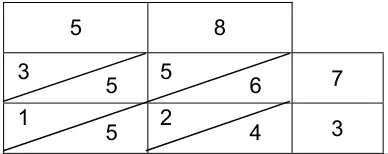
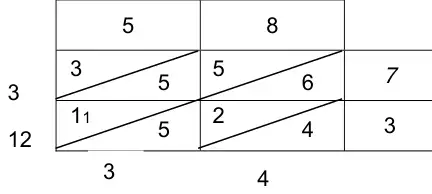
from Chinese / Napier’s bones method at least three values correct from 1/8, 1/8, 3/6 and 3/6 and total calculated for each diagonal with at least one carrying figure placed correctly
In all cases, allow extra pairs of brackets which do not alter the result of the calculation eg in 3rd calculation \(\quad ((2 + 0) \times (1 + 7)) = 2^4\)
B1
Brackets can be used in the place of a multiplication sign eg in 2nd calculation \(\quad 2 \times 0(1 + 7) = 0\)
B1
Each gap must have a bracket or an operator in
Allow additional + or - signs in any gap, if correct eg in 1st calculation \(\quad 2 + 0 + 1 + -7 = -4\)