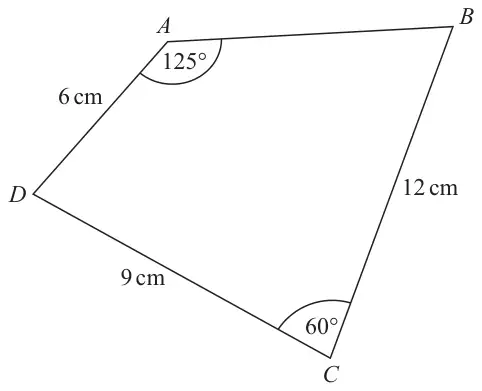
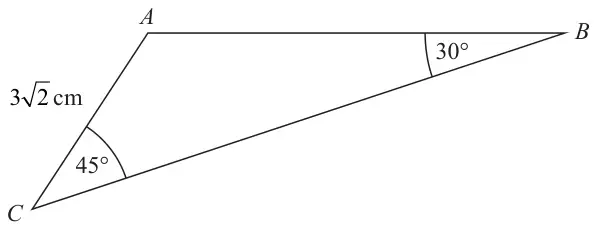
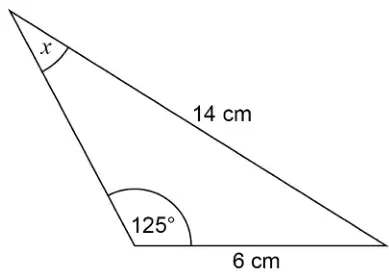
Find the size of angle \(ABC\). Give your answer correct to the nearest degree. (5)
Mark scheme
Answer
Mark
Mark scheme
73
P1
for process to work with cosine eg \((DB^2 =)\ 12^2 + 9^2 - 2 \times 12 \times 9 \times \cos 60\ (= 117)\)
P1
for a correct order of operations to find DB, eg \(\sqrt{225 - 216 \times \cos 60}\) or \(\sqrt{\text{``}117\text{''}}\ (= 10.8\ldots)\)
P1
for working with sine rule and \(60^\circ\) eg \(\dfrac{\sin CBD}{9} = \dfrac{\sin 60}{[DB]}\) or \(\sin CBD = 0.720\ldots\) or \(CBD = 46.10\ldots\)
P1
for working with sine rule and \(125^\circ\) eg \(\dfrac{\sin ABD}{6} = \dfrac{\sin 125}{[DB]}\) or \(\sin ABD = 0.454\ldots\) or \(ABD = 27.02\ldots\)
A1
for answer within the range 72.5 to 73.5
Additional guidance
\(\sqrt{117} = 3\sqrt{13}\) Can be implied by correct use in subsequent calculations
3rd and 4th P1 can be awarded in any order [\(DB\)] must be clearly identified but may not be correct, but cannot be 6 or 9 or 12 \(CBD\) and \(ABD\) may be given as a variable, award marks unless contradicted
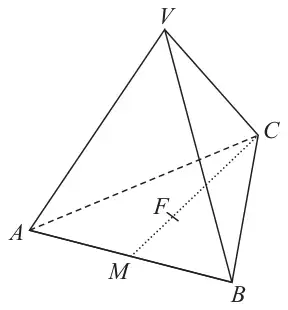
20 \(VABC\) is a solid pyramid. \(ABC\) is an equilateral triangle.
\(M\) is the midpoint of \(AB\). \(F\) is the point on \(MC\) such that \(MF : FC = 1 : 2\)
The vertex \(V\) is vertically above \(F\). \(VA = VB = VC\)
\(VF = 8\) cm Angle \(VCM = 52^\circ\)
Work out the side length of the equilateral triangle \(ABC\). Give your answer correct to 1 decimal place. (3)
Mark scheme
Answer
Mark
Mark scheme
10.8
P1
for process to find \(FC\), eg \(\tan 52 = \dfrac{8}{FC}\) (\(FC = 6.25(028..)\))
P1
for process that will lead to side length of \(ABC\), eg \(\sin 60 = \dfrac{\text{``}6.25\text{''} \times 1.5}{BC}\) or \(\cos 30 = \dfrac{\text{``}6.25\text{''} \times 1.5}{BC}\) or \((\text{``}6.25\text{''} \times 1.5)^2 + (0.5x)^2 = x^2\) oe
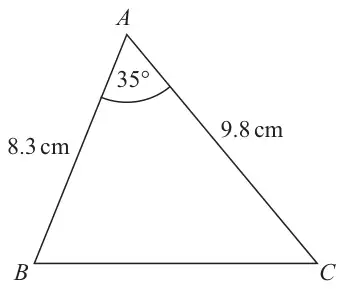
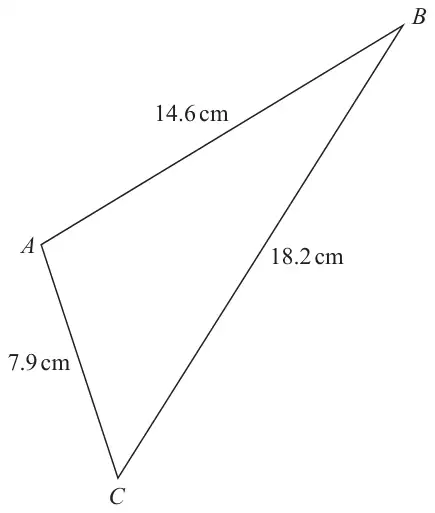
Work out the area of triangle \(ABC\). Give your answer correct to 3 significant figures. (4)
Mark scheme
Answer
Mark
Mark scheme
56.0
P1
for a start to the process by correctly substituting into the cosine rule to find an angle eg, \(18.2^2 = 14.6^2 + 7.9^2 - 2 \times 14.6 \times 7.9 \times \cos A\)
P1
for rearranging to find \(\cos A\), eg \(\cos A = \dfrac{14.6^2 + 7.9^2 - 18.2^2}{2 \times 14.6 \times 7.9}\ (= -0.2413\ldots)\) or \(A = 103.965\ldots\)
P1
for process to find the area of triangle \(ABC\) eg Area \(= \frac{1}{2} \times 7.9 \times 14.6 \times \sin(\text{``}103.965\ldots\text{''})\) or Area \(= \frac{1}{2} \times 7.9 \times 14.6 \times \sin[A]\) Area \(= \frac{1}{2} \times 14.6 \times 18.2 \times \sin(\text{``}24.912\ldots\text{''})\) or Area \(= \frac{1}{2} \times 14.6 \times 18.2 \times \sin[B]\) Area \(= \frac{1}{2} \times 7.9 \times 18.2 \times \sin(\text{``}51.1222\ldots\text{''})\) or Area \(= \frac{1}{2} \times 7.9 \times 18.2 \times \sin[C]\)
A1
for answer in the range 55.96 to 56.0
Additional guidance
\(\cos B = 0.9069\ldots\) \(B = 24.912\ldots\) \(\cos C = 0.6276\ldots\) \(C = 51.1222\ldots\)
[\(A\)], [\(B\)], [\(C\)] must be a numerical value and clearly identified by labelling or on the diagram with no contradiction
If an answer is given in the range in working and then rounded incorrectly award full marks
Correct use of Pythagoras’ theorem using a square root
Alternative method 2
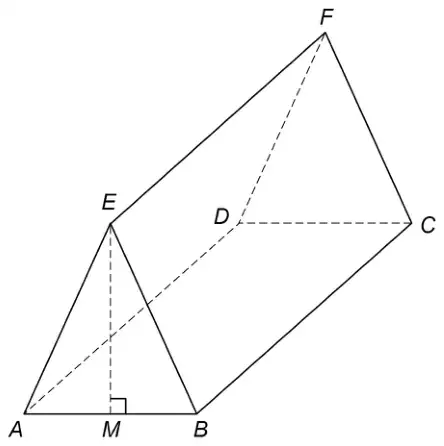
\(\sin E = \dfrac{8}{17}\;\) or \(\;\cos A = \dfrac{8}{17}\) or \(E = 28.(\ldots)\) or \(A = 61.9(\ldots)\) or 62 and \(\cos 28.(\ldots) = \dfrac{EM}{17}\) or \(\tan 28.(\ldots) = \dfrac{8}{EM}\) or \(\sin 61.9(\ldots) = \dfrac{EM}{17}\) or \(\tan 61.9(\ldots) = \dfrac{EM}{8}\)
M1
\(17 \cos 28.(\ldots)\) or \(8 \div \tan 28.(\ldots)\) or \(17 \sin 61.9(\ldots)\) or \(8 \tan 61.9(\ldots)\)
A1
Additional guidance
8, 15, 17 on their own
M0A0
\(EM^2 = 289 - 64 = 225,\ EM = 15\)
M1A0
Mark scheme (b)
Answer
Mark
Comments
Alternative method 1
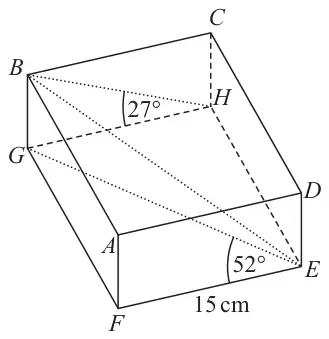
\(30^2 + (16 \div 2)^2\) or \(\;30^2 + 8^2\) or 964
M1
oe
\(\sqrt{\text{their } 964}\) or \(2\sqrt{241}\) or [31, 31.1]
M1dep
oe CM
\(\tan x = \dfrac{15}{\text{their } [31,\ 31.1]}\)
M1dep
oe \(\;\) eg \(\;90 - \tan^{-1} \dfrac{\text{their } [31,\ 31.1]}{15}\) dep on M1 M1
[25.7, 26]
A1
Alternative method 2
\(30^2 + 17^2\) \(\;\) or \(\;\) 1189
M1
oe
\(\sqrt{\text{their } 1189}\) or [34.4, 34.5]
M1dep
oe CE
\(\sin x = \dfrac{15}{\text{their } [34.4,\ 34.5]}\)
M1dep
oe \(\;\) eg \(\;90 - \cos^{-1} \dfrac{15}{\text{their } [34.4,\ 34.5]}\) or \(\dfrac{\sin x}{15} = \dfrac{\sin 90}{\text{their } [34.4,\ 34.5]}\) dep on M1 M1
[25.7, 26]
A1
Alternative method 3
\(30^2 + (16 \div 2)^2\) or 964 or \(\;30^2 + 17^2\) or 1189
M1
oe
\(\sqrt{\text{their } 964}\) or \(2\sqrt{241}\) or [31, 31.1] or \(\sqrt{\text{their } 1189}\) or [34.4, 34.5]
M1dep
oe CM CE
\(\cos x = \dfrac{\text{their } [31,\ 31.1]}{\text{their } [34.4,\ 34.5]}\)
M1dep
oe \(\;\) eg \(\;90 - \sin^{-1} \dfrac{\text{their } [31,\ 31.1]}{\text{their } [34.4,\ 34.5]}\) dep on M1 M1
[25.7, 26]
A1
Alternative method 4
\(17^2 - (16 \div 2)^2\) or 225 or \(30^2 + (16 \div 2)^2\) or 964 or \(30^2 + 17^2\) or 1189
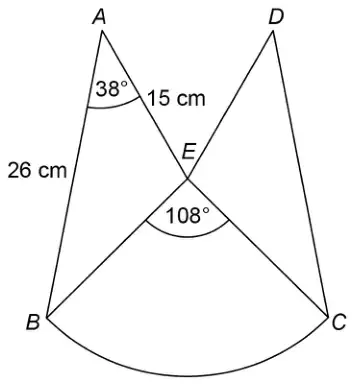
If (sector) 270 and (2 triangles) 240 followed by \(270 + 240 = 510\)
M4A1
Working back from 510. Apply scheme but maximum mark is M4A0
Assuming angle AEB = 72 and then using sine rule to work out BE does lead to area = 510 to 2sf but can score a maximum of M0M1M0M1depA0 \(BE = \dfrac{26}{\sin 72} \times \sin 38 = 16.8\) (or 17) \(\dfrac{108}{360} \times \pi \times 16.8^2 = 266 \qquad 2 \times \dfrac{1}{2} \times 15 \times 26 \times \sin 38 = 240.2\) \(506.2 \to 510\)
M0 M1M0depM1 A0
BE = [16.9, 17] seen with no working scores first M1 (and possibly all other marks)
\(BE = 35 \div 2 = 17.5 \to 17\) does not score first M1