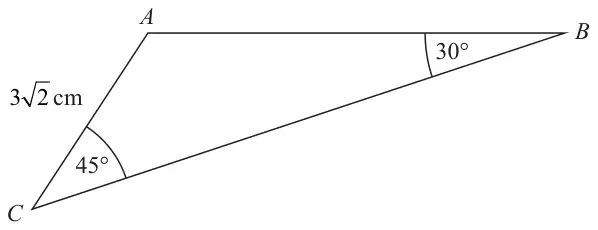
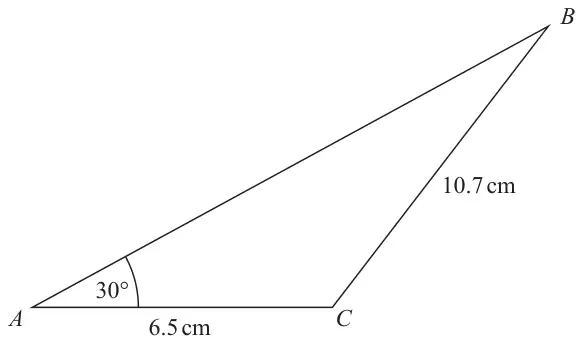
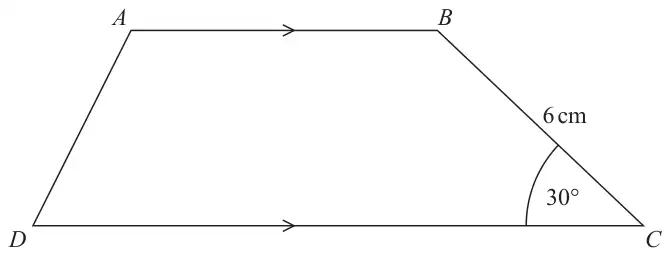
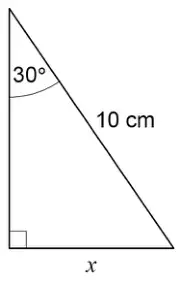
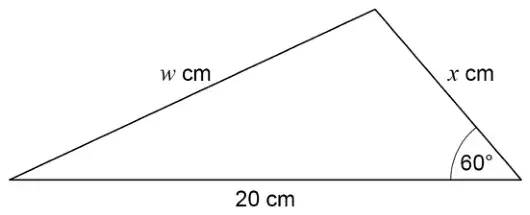
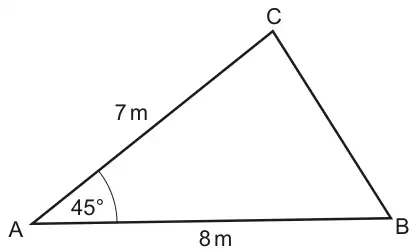
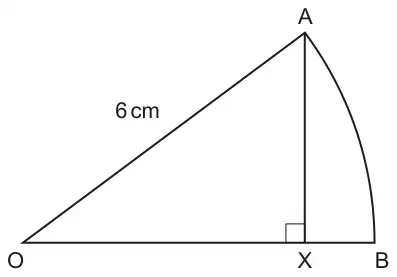
Work out the value of \(\sin ABC\) Give your answer in the form \(\dfrac{m}{n}\) where \(m\) and \(n\) are integers. (4)
Mark scheme
Answer
Mark
Mark scheme
\(\dfrac{65}{214}\)
B1
for \(\sin 30 = 0.5\)
P1
for use of the sine rule with values substituted, eg \(\dfrac{6.5}{\sin ABC} = \dfrac{10.7}{\sin 30}\) oe
P1
for \((\sin ABC =)\ \dfrac{6.5 \times \sin 30}{10.7}\) oe or for a complete process to find \(\sin ABC\), eg \((\sin ABC =)\ \dfrac{6.5 \times [0.5]}{10.7}\) oe
A1
for \(\dfrac{65}{214}\) oe eg \(\dfrac{325}{1070}\)
Additional guidance
Answer of \(\dfrac{3.25}{10.7}\) or \(\dfrac{6.5}{21.4}\) gets 3 marks
Where [0.5] is their value of \(\sin 30\)
Answer must be in the form \(\dfrac{m}{n}\) where \(m\) and \(n\) are integers
the length of \(AB\) : the length of \(CD = 2 : 3\)
Find the length of \(AB\). (5)
Mark scheme
Answer
Mark
Mark scheme
17.6
P1
for correct trig statement, eg \(\sin 30 = \dfrac{h}{6}\)
P1
for complete process to find \(h\), eg \(6 \times \dfrac{1}{2}\ (= 3)\)
P1
for correct substitution into the area of a trapezium formula, eg \(\dfrac{1}{2}(a + b) \times \text{``}3\text{''} = 66\) or \(a + b = 44\) or \(\dfrac{1}{2}(2x + 3x) \times h = 66\)
P1
for complete correct process to find the length of \(AB\), eg \(\left[\dfrac{66 \times 2}{3} \div (2 + \text{``}3\text{''})\right] \times 2\)
14 Find the exact value of \(\tan 30^\circ \times \sin 60^\circ\) Give your answer in its simplest form. (2)
Mark scheme
Answer
Mark
Mark scheme
\(\dfrac{1}{2}\)
M1
for \(\dfrac{1}{\sqrt{3}} \times \dfrac{\sqrt{3}}{2}\) or \(\dfrac{\sqrt{3}}{3} \times \dfrac{\sqrt{3}}{2}\) or \(\left(\dfrac{1}{2} \div \dfrac{\sqrt{3}}{2}\right) \times \dfrac{\sqrt{3}}{2}\) OR \(\tan 30 = \dfrac{1}{\sqrt{3}}\) oe or \(\sin 60 = \dfrac{\sqrt{3}}{2}\)
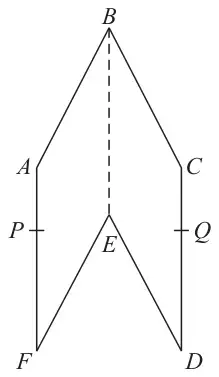
\(ABEF\) and \(CBED\) are congruent parallelograms where \(AB = BC = x\) cm. \(P\) is the point on \(AF\) and \(Q\) is the point on \(CD\) such that \(BP = BQ = 10\) cm.
18 Show that \(\quad \dfrac{\sin 30^\circ \times \cos 45^\circ}{\tan 60^\circ} \quad\) can be written in the form \(\dfrac{\sqrt{a}}{b}\)
where \(a\) and \(b\) are integers. [3 marks]
Mark scheme
Answer
Mark
Comments
\(\sin 30 = \dfrac{1}{2}\) and \(\cos 45 = \dfrac{1}{\sqrt{2}}\) or \(\dfrac{\sqrt{2}}{2}\) and \(\tan 60 = \sqrt{3}\)
M2
oe eg \(\dfrac{\frac{1}{2} \times \frac{1}{\sqrt{2}}}{\sqrt{3}}\) or \(\dfrac{\frac{1}{2} \times \frac{\sqrt{2}}{2}}{\sqrt{3}}\) or \(\dfrac{1}{2\sqrt{6}}\) may be seen in a table implied by position in a calculation eg \(\dfrac{1}{2} \times \dfrac{1}{\sqrt{2}} \times \dfrac{1}{\sqrt{3}}\) is correct for M2 M1 1 or 2 correct values
\(\dfrac{\sqrt{6}}{12}\) with all three correct values seen
A1
oe in the form \(\dfrac{\sqrt{a}}{b}\) eg \(\dfrac{\sqrt{24}}{24}\) condone \(a = 6\) and \(b = 12\) with all three correct values seen
Additional guidance
Allow \(\sqrt{1}\) for 1 throughout
Allow, eg \(\dfrac{\sqrt{3}/2}{1/2}\) for tan 60
Correct answer from \(\dfrac{\frac{1}{\sqrt{2}} \times \frac{1}{2}}{\sqrt{3}}\) scores only M1 for tan 60 unless the correct values are attributed to sin 30 and cos 45 elsewhere in the working
Do not allow further work eg \(\dfrac{\sqrt{6}}{12} = \dfrac{\sqrt{1}}{2}\) (with all three correct values seen)
25 Show that the value of \(\quad 6\sin 30^\circ + 2\cos 30^\circ \times 4\tan 30^\circ \quad\) is an integer. [4 marks]
Mark scheme
Answer
Mark
Comments
Alternative method 1: substitutes values
\((\sin 30^\circ =)\ \dfrac{1}{2}\) or \(6\sin 30^\circ = 3\) or \((\cos 30^\circ =)\ \dfrac{\sqrt{3}}{2}\) or \(2\cos 30^\circ = \sqrt{3}\) or \((\tan 30^\circ =)\ \dfrac{1}{\sqrt{3}}\) or \(\dfrac{\sqrt{3}}{3}\) or \(4\tan 30^\circ = \dfrac{4}{\sqrt{3}}\) or \(\dfrac{4\sqrt{3}}{3}\)
M1
may be seen beside the given expression or in a table
\(6\left(\dfrac{1}{2}\right)\) and \(2\left(\dfrac{\sqrt{3}}{2}\right)\) and \(4\left(\dfrac{1}{\sqrt{3}}\right)\) or \(6\left(\dfrac{1}{2}\right)\) and \(2\left(\dfrac{\sqrt{3}}{2}\right)\) and \(4\left(\dfrac{\sqrt{3}}{3}\right)\) or \(\dfrac{6}{2}\) and \(\dfrac{2\sqrt{3}}{2}\) and \(\dfrac{4\sqrt{3}}{3}\)
M1dep
oe
Processing at least as far as \(\dfrac{6}{2} + \dfrac{8\sqrt{3}}{2\sqrt{3}}\) or \(\dfrac{6}{2} + \dfrac{8\sqrt{3}\sqrt{3}}{6}\) or \(\dfrac{6}{2} + \dfrac{24}{6}\)
25 Show that \(\quad \dfrac{4\sin 30^\circ - \tan 45^\circ}{2\cos 30^\circ} \quad\) can be written as \(\tan x\), where \(x\) is an acute angle. [4 marks]
Mark scheme
Answer
Mark
Comments
\(\sin 30 = \dfrac{1}{2}\) or \(\tan 45 = 1\) or \(\cos 30 = \dfrac{\sqrt{3}}{2}\)
M1
oe eg \(\tan 45 = \dfrac{\sqrt{2}}{\sqrt{2}}\) or \(4\sin 30 = 2\) or \(2\cos 30 = \sqrt{3}\) implied by position in the expression may be seen in a table
substitution of all three correct values
M1dep
eg \(\dfrac{4 \times \frac{1}{2} - 1}{2 \times \frac{\sqrt{3}}{2}}\) or \(\dfrac{2 - 1}{2 \times \frac{\sqrt{3}}{2}}\) or \(\dfrac{2 - 1}{\sqrt{3}}\)
\(\dfrac{1}{\sqrt{3}}\) or \(\dfrac{\sqrt{3}}{3}\)
M1dep
\(\left(\dfrac{1}{\sqrt{3}}\right.\) or \(\left.\dfrac{\sqrt{3}}{3} =\right)\ \tan 30\) or \(x = 30\) with full working seen for M3
A1
Additional guidance
Allow \(\sqrt{1}\) for 1 throughout
Reference to 30° being an acute angle is not required
29 Show that the value of \(\quad 5\sin 30^\circ \times \cos 30^\circ \times 8\tan 30^\circ \quad\) is an integer. [4 marks]
Mark scheme
Answer
Mark
Comments
Alternative method 1
\((\sin 30^\circ =)\ \dfrac{1}{2}\) or \((\cos 30^\circ =)\ \dfrac{\sqrt{3}}{2}\) or \((\tan 30^\circ =)\ \dfrac{1}{\sqrt{3}}\) or \(\dfrac{\sqrt{3}}{3}\) or \(\left(\dfrac{1/2}{\sqrt{3}/2}\right)\)
M1
may be seen beside question
\(5\left(\dfrac{1}{2}\right) \times \dfrac{\sqrt{3}}{2} \times 8\left(\dfrac{1}{\sqrt{3}}\right)\) or \(5\left(\dfrac{1}{2}\right) \times \dfrac{\sqrt{3}}{2} \times 8\left(\dfrac{1/2}{\sqrt{3}/2}\right)\) or \(\dfrac{5}{2} \times \dfrac{\sqrt{3}}{2} \times \dfrac{8\sqrt{3}}{3}\)
M1dep
oe multiplication string with all correct values
\(\dfrac{40\sqrt{3}}{4\sqrt{3}}\) or \(\dfrac{40\sqrt{3}\sqrt{3}}{12}\)
M1dep
oe single fraction with roots rationalised or able to be cancelled
10 from correct working
A1
Alternative method 2: substituting \(\dfrac{\sin}{\cos}\) for tan and cancelling
Allow \(\dfrac{\sqrt{3}}{2} \times \sqrt{3} + \dfrac{1}{2}\) given as \(\dfrac{\sqrt{3}}{2} \times \sqrt{3}\), followed by their \(\dfrac{3}{2} + \dfrac{1}{2}\)
Give your answer in the form \(\qquad \dfrac{\sqrt{a} - \sqrt{b}}{c} \qquad\) where \(a\), \(b\) and \(c\) are integers. [4 marks]
Mark scheme
Answer
Mark
Comments
\(\sin 45 = \dfrac{\sqrt{2}}{2}\) or \(\dfrac{1}{\sqrt{2}}\) or \(\tan 45 = 1\) or \(\dfrac{1}{1}\) or \(\tan 60 = \sqrt{3}\) or \(\dfrac{\sqrt{3}}{1}\)
B1
oe stated or in correct place in expression or implied by multiplier of 2 or 4
\(\sin 45 = \dfrac{\sqrt{2}}{2}\) or \(\dfrac{1}{\sqrt{2}}\) and \(\tan 45 = 1\) or \(\dfrac{1}{1}\) and \(\tan 60 = \sqrt{3}\) or \(\dfrac{\sqrt{3}}{1}\)
B1
oe stated or in correct place in expression or implied by multiplier of 2 or 4 eg \(\;\dfrac{2 \times \dfrac{1}{\sqrt{2}} - 1}{4 \times \dfrac{\sqrt{3}}{1}}\)
oe rationalisation of their denominator eg \(\;\dfrac{\dfrac{2}{\sqrt{2}} - 1}{4\sqrt{3}} \times \dfrac{4\sqrt{3}}{4\sqrt{3}}\)
\(\dfrac{\sqrt{6} - \sqrt{3}}{12}\)
A1
oe in the form \(\dfrac{\sqrt{6a^2} - \sqrt{3a^2}}{12a}\) where \(a\) is a positive integer eg \(\;\dfrac{\sqrt{24} - \sqrt{12}}{24}\) (when \(a = 2\))
Additional guidance
\(\dfrac{2 \times \dfrac{1}{\sqrt{2}} - 1}{4\sqrt{3}}\) or \(\dfrac{\sqrt{2} - 1}{4\sqrt{3}}\) or \(\dfrac{\sqrt{2} - 1}{\sqrt{48}}\)
B1B1
\(\dfrac{\sqrt{48}(\sqrt{2} - 1)}{\sqrt{48}\sqrt{48}}\) or \(\dfrac{\sqrt{48}(\sqrt{2} - 1)}{48}\)
B1B1M1
\(\dfrac{\sqrt{96} - \sqrt{48}}{48}\)
B1B1M1A1
B1B1 awarded, incorrect simplification, then correct method to rationalise
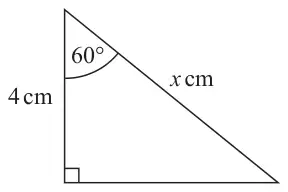
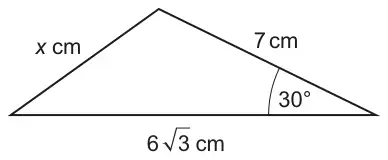
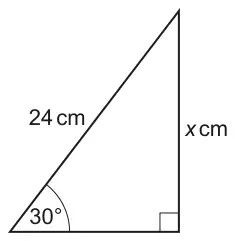
16 Work out the exact value of \(x\) in this triangle. [4]
Not to scale
Mark scheme
Answer
Marks
Part marks and guidance
\(\sqrt{31}\) final answer
4
B3 for answer 31 nfww
OR
B1 for \(\cos 30 = \frac{\sqrt{3}}{2}\)
and
M2 for \(x^2 = (6\sqrt{3})^2 + 7^2 - 2 \times 6\sqrt{3} \times 7\cos 30\) or better or M1 for other correct arrangements of cosine rule where \(x\) or \(x^2\) are not the subject
Do not accept work in decimals rounded to answers of \(\sqrt{31}\) or 31
Award if seen as clear statement of fact or in use; once seen condone replacement by 0.866… or 0.87 in subsequent work Condone missing brackets Condone use of 10.39… or 10.4 and 0.866… or 0.87 in M2 and M1
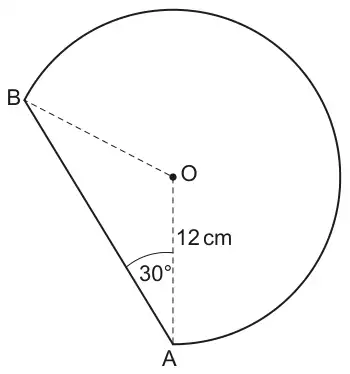
where \(x\) is ½ AB M1 for any correct implicit method for finding AB or ½ AB
B1 for \(\cos 30 = \frac{\sqrt{3}}{2}\) soi
A1 for \(12\sqrt{3}\)
In this method and other methods used, B1 is awarded for the correct trig value[s] associated with their method for find [½]AB, even if their method is incorrect, not just seen in a table of trig values unless selected
Award maximum of 6 marks if answer incorrect
If 0, 1 or 2, scored instead award SC3 for answer \(12\sqrt{3} + 16\pi\) If 0 or 1 scored, instead award SC2 for \(12\sqrt{3}\) or \(16\pi\) in answer
SEE AG
Additional guidance: Question 20
The length AB or \(\frac{1}{2}\) AB (\(12\sqrt{3}\) oe or \(6\sqrt{3}\) oe may be seen unsimplified e.g. \(2\sqrt{108}\) or \(\sqrt{108}\)) can be obtained by a number of different methods. M2 is for the explicit method leading to AB or \(\frac{1}{2}\)AB and examples of this are in the guidance column of the scheme
M1 is for a correct implicit method
The B mark is awarded for a correct trig value[s] for their chosen method
Implicit methods may include
\(\text{AB}^2 + (12\sin 30)^2 = 12^2\) oe or better
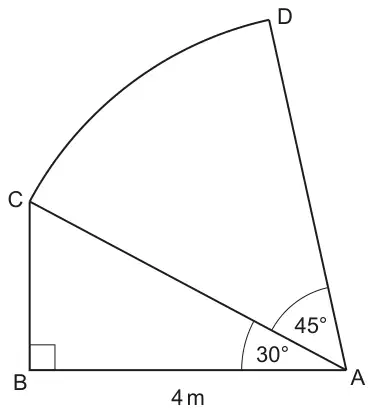
(a) Show that the area of the sector ACD is \(\frac{8}{3}\pi\) m2. [6]
(b) Work out the total area of the shape ABCD.
Give your answer in the form \(\left(\dfrac{a\sqrt{k}}{b} + \dfrac{8}{3}\pi\right)\) m2. [3]
Mark scheme (a)
Answer
Marks
Part marks and guidance
[\(AC =\)] \(\dfrac{4}{\cos 30}\) oe
M2
M1 for \(\frac{4}{AC} = \cos 30\) oe or for \(\frac{\sin 60}{4} = \frac{\sin 90}{AC}\) oe
Accept any variable for AC provided not incorrect length Accept longer methods using 4 tan 30 to find BC then Pythagoras’ or sine rule M2 for AC explicit
M1 for \(\frac{1}{2} \times 4 \times \frac{8}{\sqrt{3}} \times \sin 30\) FT their AC from (a) or for \(\frac{1}{2} \times 4 \times 4 \times \tan 30\) B1 for \(\sin 30 = \frac{1}{2}\) oe or for \(\tan 30 = \frac{\sqrt{3}}{3}\) oe
Accept e.g. \(\frac{16\sqrt{3}}{6} + \frac{8}{3}\pi\) for 3 marks
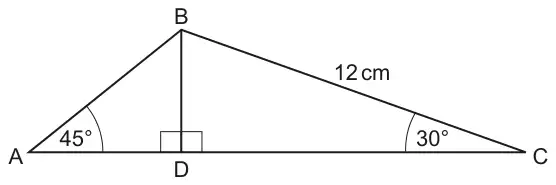
13 The diagram shows a triangle, ABC, with perpendicular height BD.
Not to scale
BC = 12 cm, angle BCD = 30° and angle BAD = 45°.
(a) Work out the length of BD. [3]
(b) Work out the exact length of AB. Give your answer in its simplest form. [3]
Mark scheme (a)
Answer
Marks
Part marks and guidance
6
3
M1 for sin 30 = \(\frac{BD}{12}\) oe B1 for sin 30 = 0.5 oe soi
Accept e.g. sin 30 = \(\frac{\sqrt{1}}{2}\) Do not allow B1 if contradicted
Mark scheme (b)
Answer
Marks
Part marks and guidance
\(6\sqrt{2}\) or \(\frac{12}{\sqrt{2}}\) cao
3
B2 for \(\sqrt{72}\) or better
OR M1 for \(\frac{their(a)}{\sin 45}\) [= \(AB\)] oe or 2(their (a))\(^2\) oe or \(\frac{12 \times \sin 30}{\sin 45}\) [= \(AB\)]
B1 for sin 45 = \(\frac{\sqrt{2}}{2}\) or \(\frac{1}{\sqrt{2}}\) oe soi
For M1, accept \(\frac{their(a)}{\cos 45}\) [= \(AB\)] oe For M1 , accept e.g. \(\frac{their(a) \times \sin 90}{\sin 45}\) [= \(AB\)] M1 implied by e.g. 72
For B1 accept cos 45 = \(\frac{\sqrt{2}}{2}\) or \(\frac{1}{\sqrt{2}}\) oe Do not allow B1 if contradicted
B2FT for final answer \(12\sqrt{3}\), 8, \(8\sqrt{3}\) or 6 if consistent with their (a) or M1 for \(24 \times \dfrac{1}{2}\) or \(24 \times\) their (a)
For 1 or 2 marks, isw attempts to simplify the surds
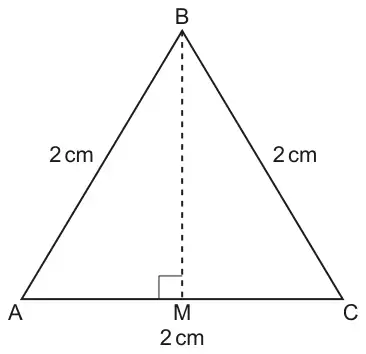
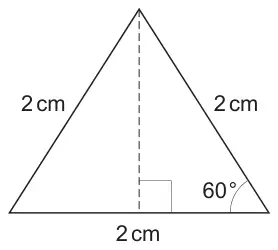
15 ABC is an equilateral triangle of side length 2 cm. M is the midpoint of AC.
Not to scale
Using this diagram, show that \(\tan 30^\circ = \dfrac{1}{\sqrt{3}}\). [4]
Mark scheme
Answer
Marks
Part marks and guidance
Correctly shows \(\tan 30^\circ = \frac{1}{\sqrt{3}}\) with supporting working
4
Using triangle MBC (mark similarly for use of triangle MBA):
B1 for MBC = 30° or MC = 1 [cm] soi by use in Pythagoras
M2 for [BM =] \(\sqrt{2^2 - 1^{[2]}}\) or \(\sqrt{4 - 1}\) [\(= \sqrt{3}\)] or for [BM2 =] \(2^2 - 1^{[2]}\) oe and \(\sqrt{3}\)
or M1 for \(\text{BM}^2 + 1^{[2]} = 2^2\) oe OR B1 for MCB = 60° or MC = 1 [cm] soi by use in cos rule
M2 for \(\sqrt{2^2 + 1^{[2]} - 2 \times 2 \times 1 \times \cos 60}\) and \(\cos 60 = \frac{1}{2}\) soi [\(= \sqrt{3}\)] or M1 for \(2^2 + 1^{[2]} - 2 \times 2 \times 1 \times \cos 60\) OR B1 for MCB = 60° soi by use in sine ratio or sine rule M2 for [\(x\) = ] 2sin 60 oe and \(\sin 60 = \frac{\sqrt{3}}{2}\) soi [\(= \sqrt{3}\)] or M1 for \(\frac{\sin 60}{x} = \frac{\sin 90}{2}\) oe AND A1dep for MBC = 30° stated/on diagram and \(\tan 30^\circ = \frac{1}{\sqrt{3}}\) and with no errors seen leading to the answer
If 0 or 1 scored, SC2 for \(\dfrac{\sin 30}{\cos 30} = \dfrac{\frac{1}{2}}{\frac{\sqrt{3}}{2}}\) and \(\tan 30 = \frac{1}{\sqrt{3}}\) May be on diagram
For M2 must show the subtraction, do not allow \(\text{BM}^2 + 1^{[2]} = 2^2\) and then \(\sqrt{3}\), this gets M1 only
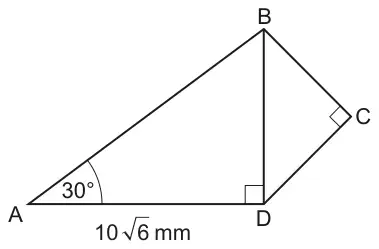
(b) ADB and BCD are right-angled triangles. BC = CD. AD = \(10\sqrt{6}\) mm. Angle BAD = 30°.
\(\tan 30^\circ = \dfrac{1}{\sqrt{3}}\)
Not to scale
Work out the length of BC. [6]
Mark scheme (a)
Answer
Marks
Part marks and guidance
\(\frac{1}{\sqrt{2}}\) or \(\frac{\sqrt{2}}{2}\) final answer
1
Mark scheme (b)
Answer
Marks
Part marks and guidance
10 nfww
6
B3 for BD = \(10\sqrt{2}\) oe or M2 for \(10\sqrt{6} \times \tan 30\) oe or M1 for \(\frac{BD}{10\sqrt{6}} = \tan 30\) oe AND M2 for BC = \(\sqrt{\frac{\textit{their}\ BD^2}{2}}\) oe or their BD × their sin 45 oe or M1 for BC2 + CD2 = (their BD)2 or for \(\frac{BC}{\textit{their}\ BD} = \textit{their}\ \sin 45\)
Allow use of other variables for BC and CD (possibly different)
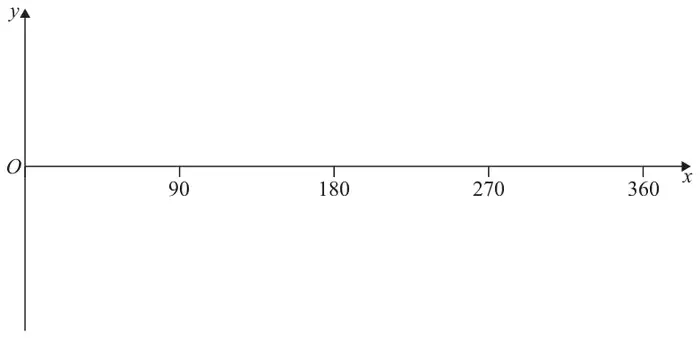
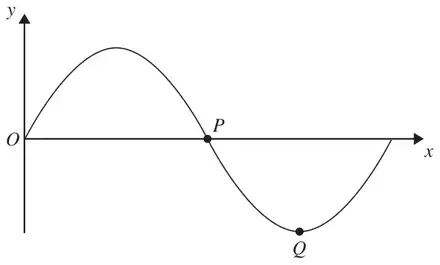
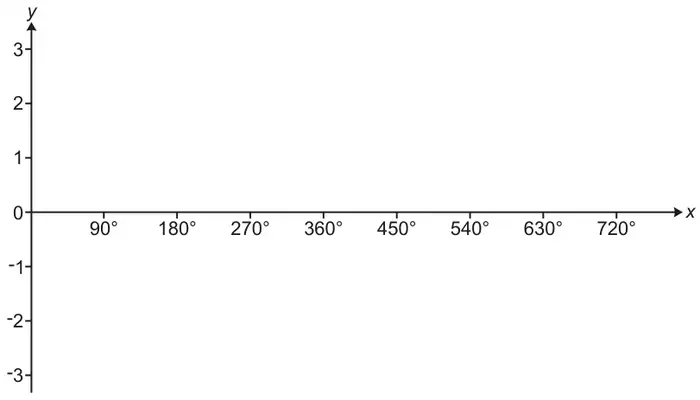
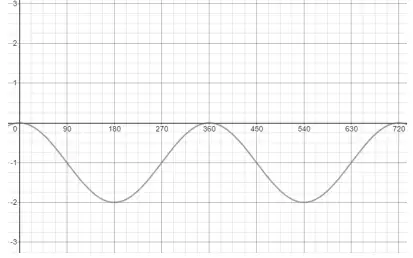
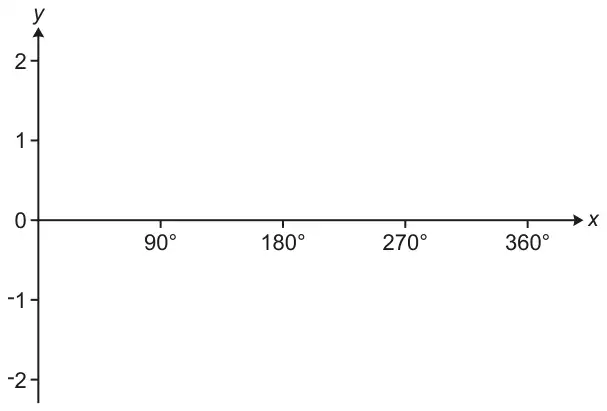
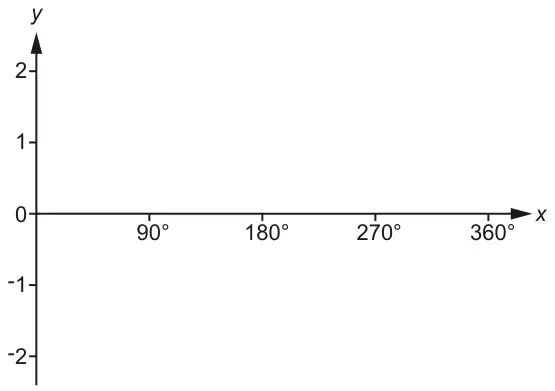
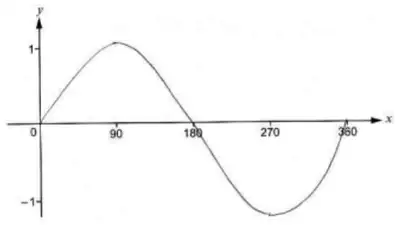
16 Sketch the graph of \(y = -\sin x\) for \(0^\circ \leqslant x \leqslant 360^\circ\).
[3]
Mark scheme
Answer
Marks
Part marks and guidance
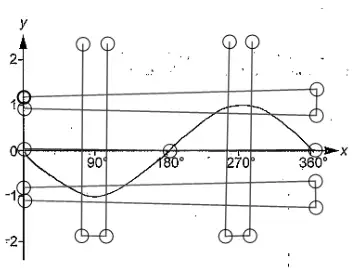
Correct sketch of \(y = -\sin x\)
3
There must be at least one cycle to gain any marks.
B1 for a positive or negative sine curve shape starting at (0, 0) and B1 for maximums at (…, 1) and minimum at (…, –1) and B1 for maximum only at (270, …) and minimum only at (90, …)
e.g. B1B1B0 for \(y = \sin x\) drawn B0B1B0 for \(y = \pm\cos x\) drawn B1B1B0 for \(y = \sin 2x\) drawn
Before using overlay, check the x-axis line All maximums and minimums within the horizontal zones on overlay Maximum and minimum within the vertical zones on overlay
or M1 for \(\sin 60 = \dfrac{\sqrt{3}}{2}\) or \(\cos 30 = \dfrac{\sqrt{3}}{2}\)
To award 6 marks, there must be no errors seen
Beware circular methods using \(3\sqrt{3}\) leading to 60, this can only score M1 maximum for \(\sin 60 = \dfrac{\sqrt{3}}{2}\) but ignore circular methods if alongside a correct method
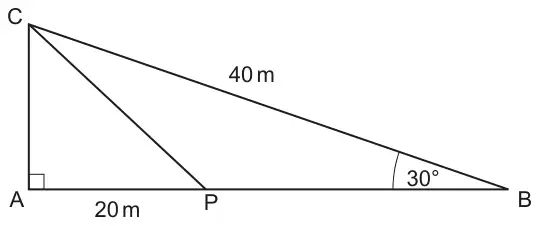
13 In the diagram, ABC is a right-angled triangle. P is a point on AB. BC = 40 m, AP = 20 m and angle ABC = 30°.
Not to scale
(a) Show that AC = 20 m. [3]
(b) Find the length of PB. Give your answer in the form \(a(\sqrt{3} - b)\), where \(a\) and \(b\) are integers. [5]
Mark scheme (a)
Answer
Marks
Part marks and guidance
AC = 40sin30
M2
M1 for \(\dfrac{\text{AC}}{40} = \sin 30\) oe
20 and evidence that sin 30 = 0.5
A1
If 0 scored, B1 for sin 30 = 0.5 oe
Mark scheme (b)
Answer
Marks
Part marks and guidance
\(20(\sqrt{3} - 1)\)
5
B4 for \(20\sqrt{3} - 20\) or \(\sqrt{1200} - 20\) or B3 for \(\sqrt{1200}\) or \(\dfrac{40\sqrt{3}}{2}\) or M2 for 40cos30 oe or M1 for \(\cos 30 = \dfrac{\text{AB}}{40}\) oe
Other methods are possible e.g. Pythag e.g. M2 for [AB =] \(\sqrt{40^2 - 20^2}\) e.g. M1 for AB² + 20² = 40²
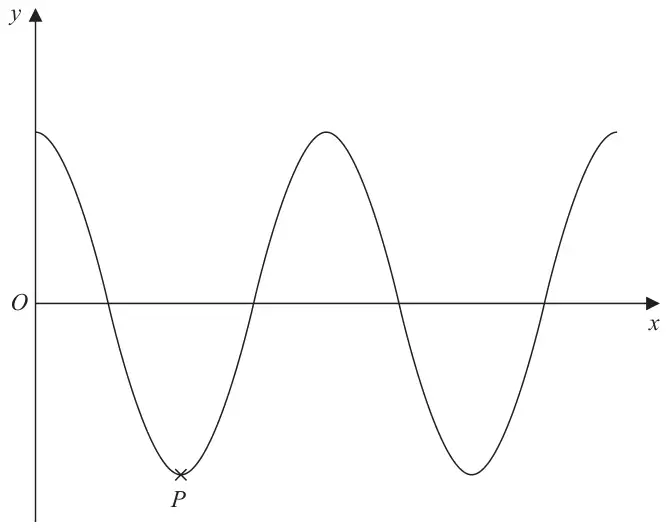
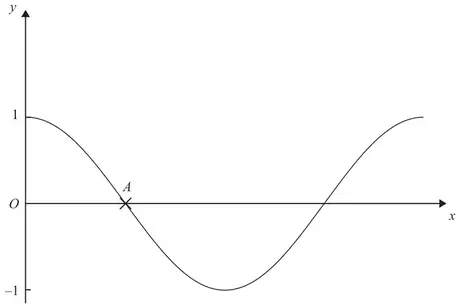
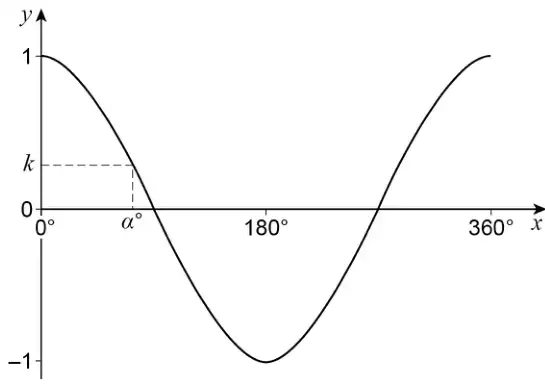
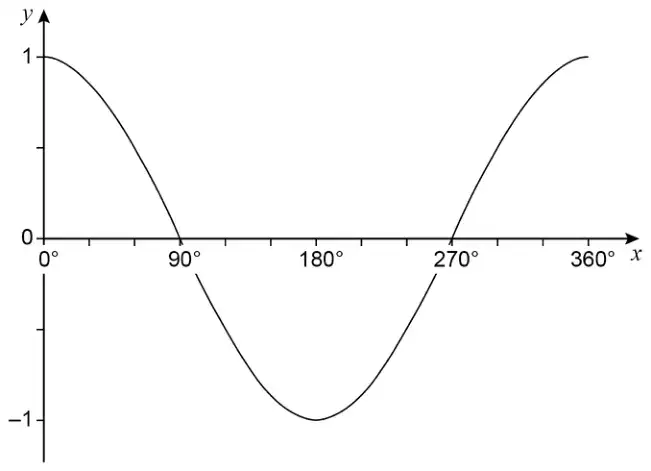
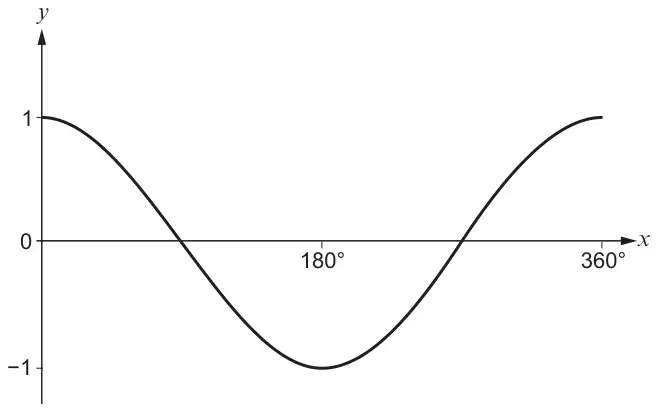
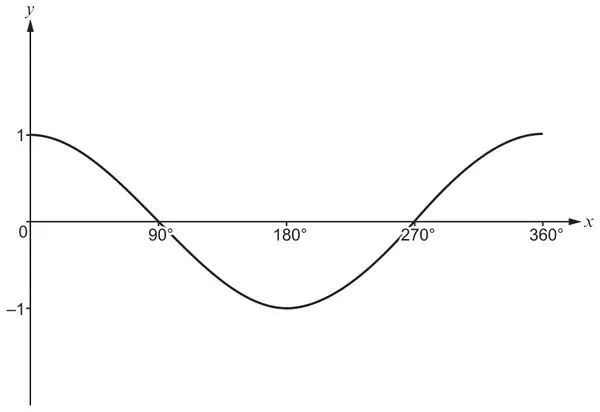
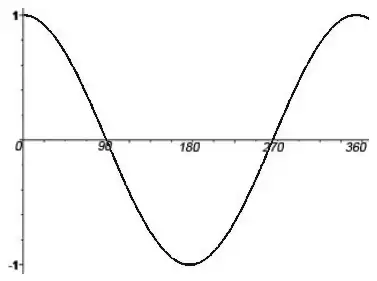
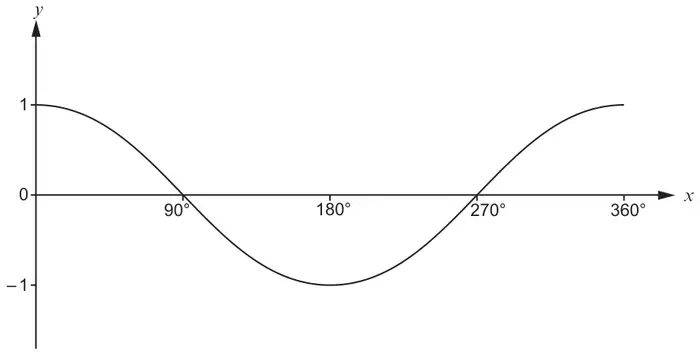
22. The diagram shows a sketch of \(y = \cos x\) for the values of \(x\) from 0° to 360°.
(a) Solve the equation \(\cos x = -0{\cdot}731\) for all values of \(x\) from 0° to 360°. [2]
(b) Draw a sketch of \(y = \cos x - 1\) for the values of \(x\) from 0° to 360°. You must indicate any important values on the axes. [2]
Mark scheme (a)
Scheme
Marks
Comments
\(136.9(7\ldots)\) or \(137(^\circ)\) AND \(223(^\circ)\) with no other values
B2
B1 for either angle. Allow embedded answers. Penalise −1 for each additional incorrect value. Ignore additional correct values outside the range for B2 or B1.
If no marks award SC1 for answers of 136(°) AND 224(°) with no other values
Mark scheme (b)
Scheme
Marks
Comments
A correct translation through \(\begin{pmatrix}0\\-1\end{pmatrix}\) with at least −2 indicated on the \(y\) axis and 180 and 360 indicated on the \(x\) axis.
B2
B1 for a correct translation through \(\begin{pmatrix}0\\-1\end{pmatrix}\) without labels on the axes.
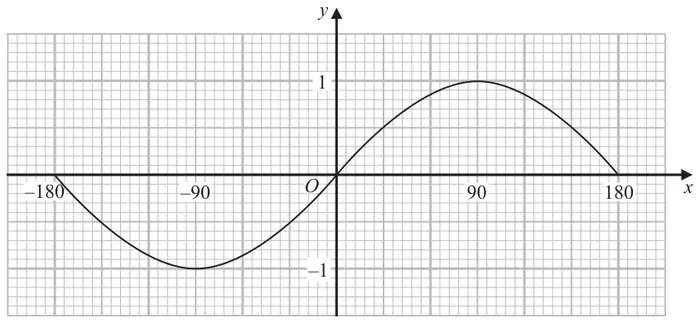
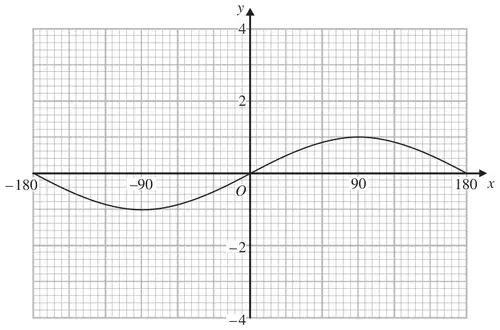
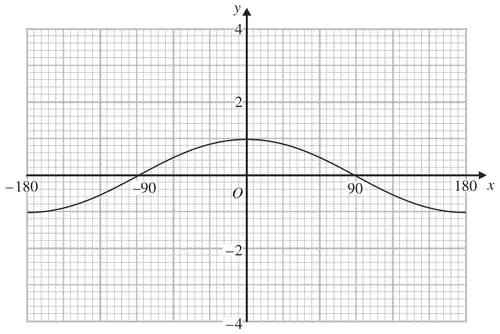
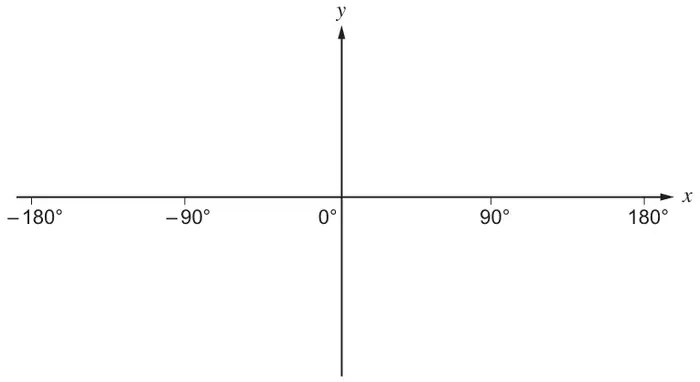
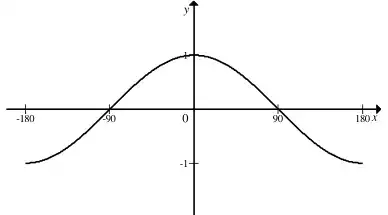
(i) On the axes below, sketch the graph of \(y = \cos x\) for \(-180^\circ \leqslant x \leqslant 180^\circ\). [2]
(ii) Solve \(\cos x = \dfrac{\sqrt{3}}{2}\) for \(-180^\circ \leqslant x \leqslant 180^\circ\). [2]
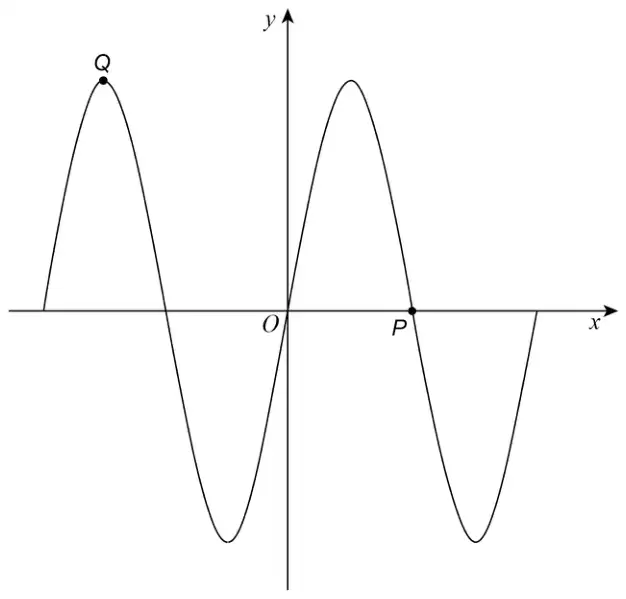
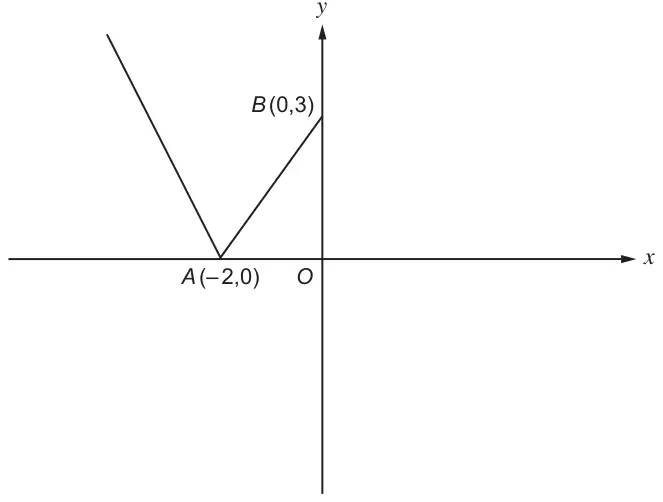
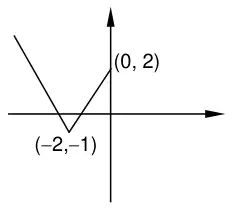
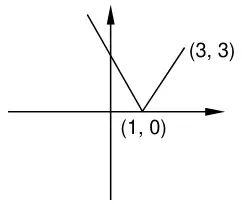
(b) The diagram shows a sketch of the graph of \(y = f(x)\). The point \(A\) has coordinates \((-2, 0)\) and the point \(B\) has coordinates \((0, 3)\).
(i) Sketch the graph of \(y = f(x) - 1\) on the axes below. You must indicate the coordinates of the new positions of the points \(A\) and \(B\). [2]
(ii) Sketch the graph of \(y = f(x - 3)\) on the axes below. You must indicate the coordinates of the new positions of the points \(A\) and \(B\). [2]
Mark scheme (a)
Scheme
Marks
Comments
(a)(i) Correct cosine graph over full domain with minima and maximum at −1 and 1 respectively
B2
B1 for correct shape over full domain but 1 and −1 not marked
OR for correct roots, minima and maximum but incorrect shape e.g. ruled sections
OR for the correct curve from at least 0° to 180° with 1 and −1 marked
(a)(ii) 30° , −30°
B2
And no extras in range B1 for either, ignoring extras; if no marks, award SC1 for stating \(\cos30 = \dfrac{\sqrt{3}}{2}\)
Mark scheme (b)
Scheme
Marks
Comments
(b)(i) Translation through \(\begin{pmatrix}0\\k\end{pmatrix}\), where \(k \lt 0\)
B1
Allow good freehand
Correct coordinates seen or scale marked
B1
(b)(ii) Translation through \(\begin{pmatrix}k\\0\end{pmatrix}\), where \(k \gt 0\)
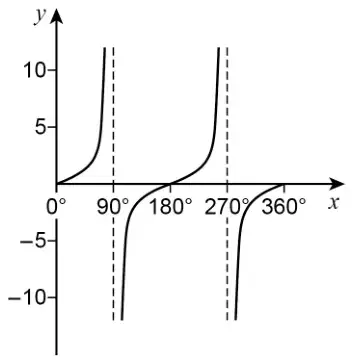
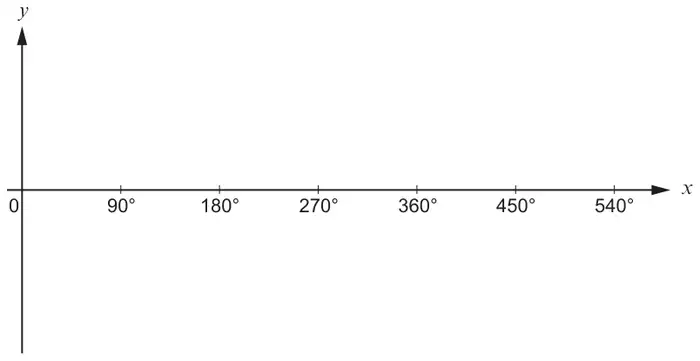
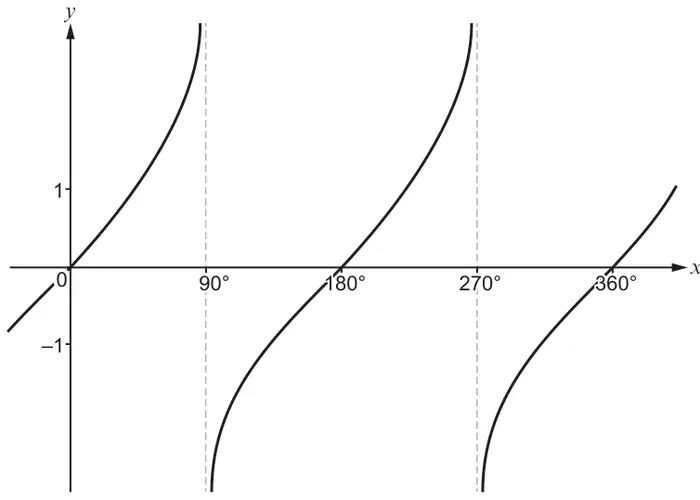
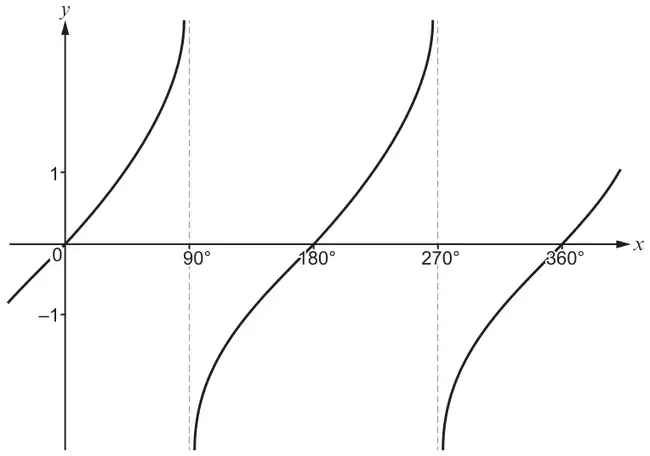
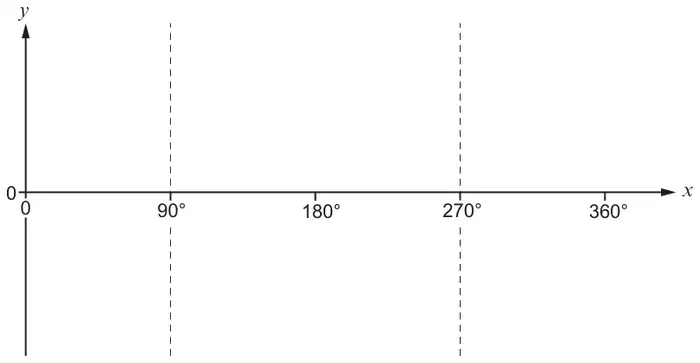
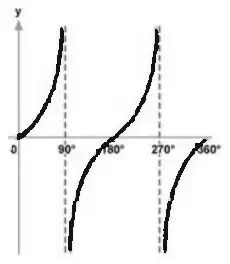
(a) On the axes below, sketch the graph of \(y=\tan x^\circ\) where \(0^\circ\leqslant x\leqslant360^\circ\). [2]
(b) Solve the equation \(\tan x=0{\cdot}8391\) in the range \(0^\circ\leqslant x\leqslant360^\circ\). [2]
Mark scheme (a)
Scheme
Marks
Comments
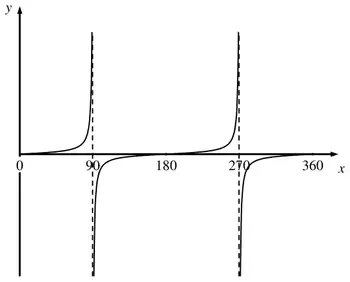
Correct sketch with inflection points at (0,0), (180, 0) and (360,0) AND graph tending towards the vertical asymptotes at x = 90 and x = 270
B2
If vertical asymptotes not seen, they may be implied by a break in the curve of ‘their sketch’ at x = 90 x = 270 provided there is asymptotic behaviour. Graph must be attempted from x = 0 to x = 360. Ignore continuation of sketch beyond these values.
B1 for sketch with inflection points at (0,0), (180, 0) and (360,0) only OR vertical asymptotes seen at 90 and 270 only
18. The following diagram shows a sketch of \(y = \cos x\) for values of \(x\) from 0° to 360°.
(a) Given that \(\cos 58^\circ = 0{\cdot}5299\), correct to 4 decimal places, write down all the solutions of the equation\[\cos x = -0{\cdot}5299\]for values of \(x\) from 0° to 360°. [2]
(b)
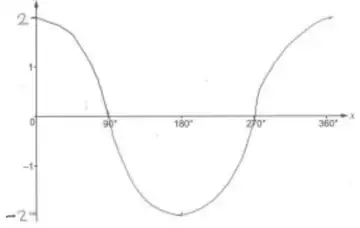
(i) Use the following axes to sketch the graph of \(y = 2\cos x\) for values of \(x\) from 0° to 360°. You must indicate any important values on the \(y\)-axis. [2]
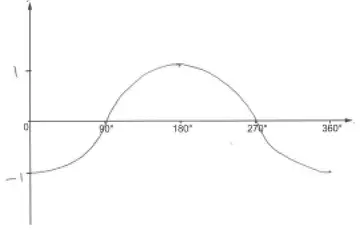
(ii) Use the following axes to sketch the graph of \(y = -\cos x\) for values of \(x\) from 0° to 360°. You must indicate any important values on the \(y\)-axis. [2]
Mark scheme (a)
Scheme
Marks
Comments
122° and 238° with no other values
B2
Check diagram. If B2, penalise –1 for each extra value within range (beyond 2 attempts). Allow embedded answers.
B1 for one of the following:
122°
238°
sight of both 180 – 58 and 180 + 58 or equivalent.
Ignore extra (correct or incorrect) values outside the required range.
Mark scheme (b)
Scheme
Marks
Comments
(i) Vertical stretch (by a factor of 2) Maxima at (0, 2) and (360, 2), Minimum at (180, –2).
B2
Mark clear intention. Must be the correct shape (including curvature), i.e. a single cycle of a cosine curve, with \(y\) = 0 at \(x\) = 90° and \(x\) = 270°.
Accept any clear indication of \(y\)-coordinates.
If not B2, award B1 for one of the following:
Fully correct shape and position (for \(0 \leqslant x \leqslant 360^\circ\)) without correct coordinates indicated
OR
Correct shape and position either for \(0 \leqslant x \leqslant 180^\circ\) or for \(180^\circ \leqslant x \leqslant 360^\circ\) AND indication of \(y = 2\) and \(y = -2\).
OR
A graph which is fully correct (including labelling) other than having pointed minimum and maximum (formed from straight lines).
(ii) Reflection in \(x\)-axis Minima at (0, –1) and (360, –1), Maximum at (180, 1).
B2
Mark clear intention. Must be the correct shape (including curvature), i.e. a single cycle of a negative cosine curve, with \(y\) = 0 at \(x\) = 90° and \(x\) = 270°.
Accept any clear indication of \(y\)-coordinates.
If not B2, award B1 for one of the following:
Fully correct shape and position (for \(0 \leqslant x \leqslant 360^\circ\)) without correct coordinates indicated
OR
Correct shape and position either for \(0 \leqslant x \leqslant 180^\circ\) or for \(180^\circ \leqslant x \leqslant 360^\circ\) AND indication of \(y = 1\) and \(y = -1\).
OR
A graph which is fully correct (including labelling) other than having pointed minimum and maximum (formed from straight lines).
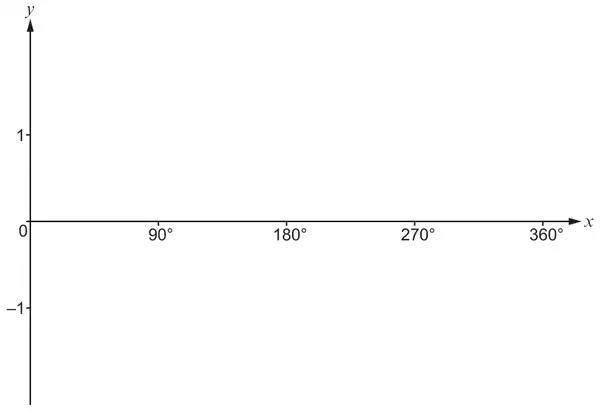
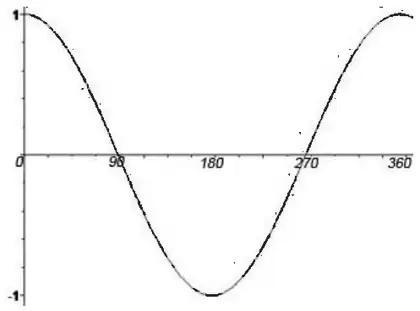
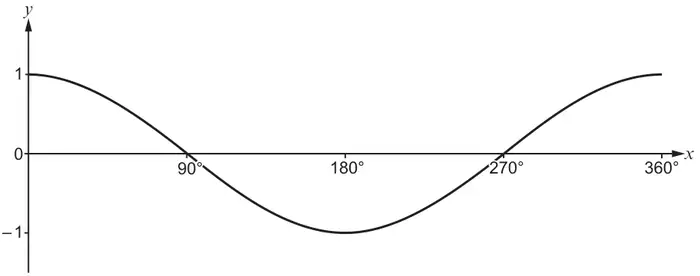
(a) Sketch the curve \(y = \cos x\) on the axes below, for values of \(x\) from 0° to 360°. You must indicate any important values on both axes. [2]
(b) Solve the equation \(2\cos x = 1\). Give all answers in the range \(x\) = 0° to \(x\) = 360°. [2]
Mark scheme (a)
Scheme
Marks
Comments
Cosine curve with appropriate orientation and position AND passing through (0°,1), (90°,0) and (270°,0) and approximately (180°,-1) and (360°,1) AND 90(°), 180(°), 270(°), 360(°) indicated on the x-axis AND -1 and 1 indicated on the y-axis.
B2
Ignore curve shown for values x< 0° or x> 360°. Accept 180° as mid-way between 0° and 360° if unlabelled. Accept 360° as unlabelled provided the sketch does not exceed 360°.
B1 for:
General cosine curve with appropriate orientation and appropriate position (ignore missing or incorrect labelling) OR
A continuous graph passing through (0°,1), (90°,0) and (270°,0) and approximately (180°,-1) and (360°,1) AND 90(°), 270(°), indicated on the x-axis AND -1 and 1 indicated on the y-axis. Accept 180° as mid-way between 0° and 360° if unlabelled. Accept 360° as unlabelled provided the sketch does not exceed 360°.
Mark scheme (b)
Scheme
Marks
Comments
60(°) AND 300(°)
B2
Ignore any angle outside of the range 0° < x < 360°. Note B2 for 60(°) AND 300(°) and no other angle within the range 0° < x < 360°. Allow embedded answers.
If not B2, award B1 for either of the following:
60(°) AND 300(°) and one incorrect angle within the range 0° < x < 360°
60(°) OR 300(°) and up to one incorrect angle within the range 0° < x < 360°
If B2 or B1 awarded, penalise -1 for each further incorrect answer.
19. The following diagram shows a sketch of \(y = \tan x\) for values of \(x\) from 0° to 360°.
Given that \(\tan 71^\circ = 2{\cdot}9042\), correct to 4 decimal places, write down all the solutions of the equation
\[\tan x = -2{\cdot}9042\]
for values of \(x\) from 0° to 360°. [2]
Mark scheme
Scheme
Marks
Comments
109° and 289° with no other values
B2
Check diagram. B1 for either angle. Allow embedded answers. Ignore extra (correct or incorrect) values outside the required range. Penalise –1 for each extra value within range (beyond 2 attempts).
If no marks, award SC1 for sight of 180–71 AND 360–71 (or equivalent).
16. The following diagram shows a sketch of \(y = \sin x\) for values of \(x\) from 0° to 360°.
(a) Given that \(\sin 62^\circ = 0{\cdot}8829\), correct to 4 decimal places, write down all the solutions of the equation\[\sin x = -0{\cdot}8829\]for values of \(x\) from 0° to 360°. [2]
(b)
(i) Use the following axes to sketch the graph of \(y = -\sin x\) for values of \(x\) from 0° to 360°. You must indicate any important values on the \(y\)-axis. [2]
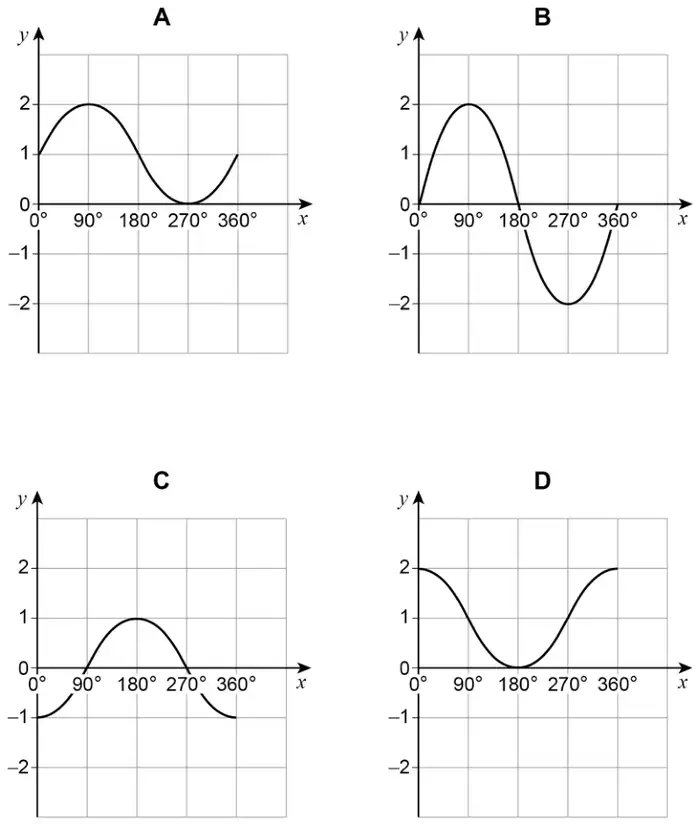
(ii) Use the following axes to sketch the graph of \(y = \sin x + 1\) for values of \(x\) from 0° to 360°. You must indicate any important values on the \(y\)-axis. [2]
Mark scheme (a)
Scheme
Marks
Comments
242° and 298° with no other values
B2
B1 for either angle. Check diagram. Penalise –1 for each extra value within range (beyond 2 attempts). Ignore extra (correct or incorrect) values outside the required range. If only two angles offered and no marks gained, award SC1 for sight of both 180° + 62° and 360° – 62°.
Mark scheme (b)
Scheme
Marks
Comments
(i) Reflection in \(x\)-axis with maximum at (270°, +1), minimum at (90°, –1)
B2
Mark clear intention. Must be the correct shape, i.e. a single cycle of a negative sine curve, with \(x\)-intercepts at \(x\) = 0, \(x\) = 180° and \(x\) = 360°, minimum at \(x\) = 90°, maximum at \(x\) = 270°. Accept any clear indication of \(y\)-coordinates.
If not B2, award B1 for one of the following:
Fully correct shape and position (both for 0 ⩽ \(x\) ⩽ 180° and for 180°⩽ \(x\) ⩽ 360°) without correct coordinates indicated
OR
Correct shape and position either for 0 ⩽ \(x\) ⩽ 180° or for 180°⩽ \(x\) ⩽ 360° (a sine curve entirely between \(y\) = –1 and \(y\) = 1) AND indication of \(y\) = –1 and \(y\) = 1.
SC1 for a graph which is fully correct (including labelling) other than having pointed minimum and maximum (formed from straight lines).
(ii) Vertical translation +1 with maximum at (90°, +2), minimum at (270°, 0), with \(y\)-intercept at +1.
B2
Mark clear intention. Must be the correct shape, i.e. a single cycle of a sine curve, with consistent \(y\) values at \(x\) = 0, \(x\) = 180° and \(x\) = 360°, maximum at \(x\) = 90°, minimum at \(x\) = 270°.
Accept any clear indication of \(y\)-coordinates. Must have correct points for \(x\) = 180° and \(x\) = 360°. 1 and 2 indicated on the \(y\)-axis.
If not B2, award B1 for one of the following:
Fully correct shape and position (both for 0 ⩽ \(x\) ⩽ 180° and for 180°⩽ \(x\) ⩽ 360°) without correct coordinates indicated
OR
Correct shape and position either for 0 ⩽ \(x\) ⩽ 180° or for 180°⩽ \(x\) ⩽ 360° (a sine curve entirely between \(y\) = 0 and \(y\) = 2) AND indication of \(y\) = 1 and \(y\) = 2.
SC1 for a graph which is fully correct (including labelling) other than having pointed minimum and maximum (formed from straight lines).
20. The following diagram shows a sketch of \(y = \cos x\) for values of \(x\) from 0° to 360°.
Given that \(\cos 25^\circ = 0{\cdot}9063\), correct to 4 decimal places, write down all the solutions of the equation
\(\cos x = -0{\cdot}9063\)
for values of \(x\) from 0° to 360°. [2]
Mark scheme
Scheme
Marks
Comments
155° and 205° with no other values
B2
B1 for either angle. Check diagram. Ignore extra (correct or incorrect) values outside the required range Penalise -1 for each extra value within range (beyond 2 attempts).
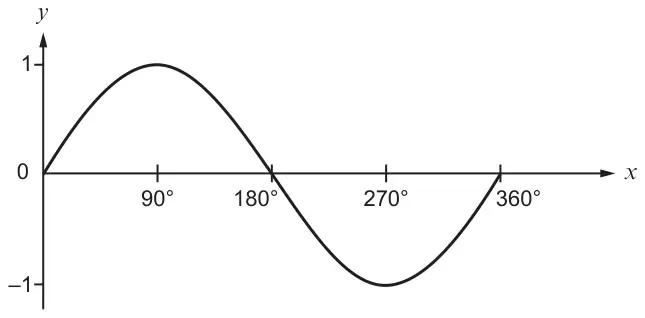
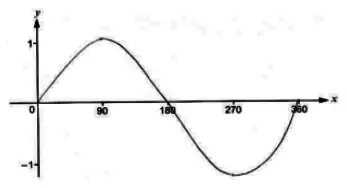
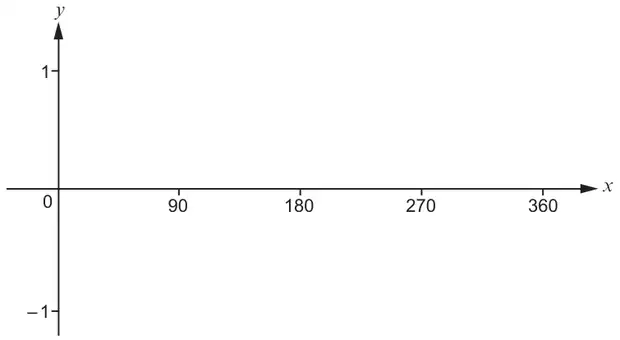
(a) Sketch the curve \(y = \sin x\), for values of \(x\) in the range \(x = 0^\circ\) to \(x = 360^\circ\) . [1]
(b) Sketch the curve \(y = \tan x\), for values of \(x\) in the range \(x = 0^\circ\) to \(x = 360^\circ\) . [1]
Mark scheme (a)
Scheme
Marks
Comments
C1
Clear intention to draw a curve. Curve must pass through (0,0), (180,0) and (360,0). AND intention to have maximum at (90,1) and minimum at (270,-1). Ignore curve shown for values x < 0° or x > 360°.
Mark scheme (b)
Scheme
Marks
Comments
C1
Clear intention to draw a curve with positive gradient. Curve must pass through (0,0), (180,0) and (360,0). AND have inflection point at (180,0). There must be an intention not to cross the asymptotes at x = 90°, x = 270°. Ignore curve shown for values x < 0° or x > 360°.
17. The following diagram shows a sketch of \(y = \sin x\) for values of \(x\) from 0° to 360°.
Given that \(\sin 38^\circ = 0{\cdot}6157\), correct to 4 decimal places, write down all the solutions of the equation
\(\sin x = -\,0{\cdot}6157\)
for values of \(x\) from 0° to 360°. [2]
Mark scheme
Scheme
Marks
Comments
218° and 322° with no other values
B2
B1 for either angle. Check diagram. Ignore extra (correct or incorrect) values outside the required range. Penalise -1 for each extra value within range (beyond 2 attempts).
If no marks, SC1 for accurate evaluations from consistent use of 180+n AND 360-n (with n acute). Method must be seen for this mark.
(a) Sketch the curve \(y = \cos x\), for values of \(x\) in the range \(x\) = 0° to \(x\) = 360°. You must indicate any important values on the axes. [2]
(b) Solve the equation \(\cos x = 0{\cdot}7\). Give all solutions in the range \(x\) = 0° to \(x\) = 360°. [2]
Mark scheme (a)
Scheme
Marks
Comments
General cosine curve with appropriate orientation and position.
M1
Ignore curve shown for values x< 0° or x> 360°.
Correct sketch with curve passing through (0°,1), (90°,0) and (270°,0) and approximately (180°,-1) and (360°,1) AND 90(°), 180(°), 270(°), 360(°) indicated on the x-axis AND -1 and 1 indicated on the y-axis.
A1
Accept 180° as mid-way between 0° and 360° if unlabelled. Accept 360° as unlabelled provided the sketch does not exceed 360°.
Mark scheme (b)
Scheme
Marks
Comments
46(°) AND 314(°) OR 45·6(°) AND 314·4(°) OR 45·57(29…°) AND 314·4(27…°).
B2
B1 for sight of one correct angle. Allow embedded answers. If more than two answers offered award B1 for sight of one correct angle.
If no marks, award SC1 for truncated answers 45(°) AND 315(°) OR 45·5(°) AND 314·5(°).
Corrected by Westie's Workshop
The board's mark scheme printed “If no marks, awarded SC1”. Changed to “If no marks, award SC1” because the instruction to the marker should read “award”, as in the other special-case lines.
Original: see the board's mark scheme PDF (link above).
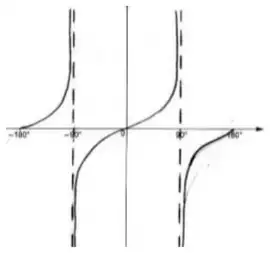
11. Sketch the curve \(y = \tan x\), for values of \(x\) in the range \(x\) = – 180° to \(x\) = 180°. [2]
Mark scheme
Scheme
Marks
Comments
Correct sketch, with inflection points at (-180,0), (0,0) and (180,0) AND graph tending towards the vertical asymptotes at \(x = -90\) and \(x = 90\).
B2
If vertical asymptotes are not seen, they may be implied by a break in the curve of ‘their sketch’ at \(x = -90\) and \(x = 90\) provided there is asymptotic behaviour. Graph must be attempted from \(x = -180\) to \(x = 180\). Ignore continuation of sketch for x<-180 and x>180.
B1 for a sketch with inflection points at (-180,0), (0,0) and (180,0) only OR vertical asymptotes seen at \(x = -90\) and \(x = 90\) only.
18. The following diagram shows a sketch of \(y = \cos x\) for values of \(x\) from 0° to 360°.
(a) Given that \(\cos 21^\circ = 0{\cdot}9336\), correct to 4 decimal places, write down all the solutions of the equation\[\cos x = -\,0{\cdot}9336\]
for values of \(x\) from 0° to 360°. [2]
(b)
(i) Use the following axes to sketch the graph of \(y = 2\cos x\) for values of \(x\) from 0° to 360°. You must indicate any important points on both axes. [2]
(ii) Use the following axes to sketch the graph of \(y = \cos x - 1\) for values of \(x\) from 0° to 360°. You must indicate any important points on both axes. [2]
Mark scheme (a)
Scheme
Marks
Comments
159° and 201° with no other values
B2
B1 for either angle. Check diagram. Penalise -1 for each extra value (beyond 2 attempts). Ignore extra (correct) values outside the required range.
Mark scheme (b)
Scheme
Marks
Comments
18. (b) (i) Vertical enlargement upwards and downwards
B1
Mark clear intention. Must be the correct shape, i.e. a single cycle of a cosine curve, with x-intercepts at x = 90°and x = 270°, minimum at x = 180°, maxima at x = 0 and x = 360°.
Scale factor of 2
B1
Accept any clear indication. Must have correct x and y-intercepts, correct minimum and correct point for x = 360°.
18. (b) (ii) Vertical translation
B1
Mark clear intention. Must be the correct shape, i.e. a single cycle of a cosine curve, with x-intercepts at x = 0°and x = 360°, minimum at x = 180°, maxima at x = 0 and x = 360°.
Vertical –1
B1
Accept any clear indication. Must have correct x and y-intercepts, correct minimum and correct point for x = 360°.
Award SC1 for a fully labelled sketch of y = cos x + 1.
(a) Sketch the curve \(y = \sin x\), for values of \(x\) in the range \(x\) = 0° to \(x\) = 360°. [1]
(b) Solve each of the following equations. Give all answers in the range \(x\) = 0° to \(x\) = 360°.
(i) \(\sin x = 0{\cdot}3\) [2]
(ii) \(\sin x + 1 = 0\) [1]
Mark scheme (a)
Scheme
Marks
Comments
C1
Clear Intention to draw a curve. Curve must pass through (0,0), (180,0) and (360,0) AND intention to have maximum at (90,1) and minimum at (270,-1). Ignore curve shown for values x < 0° or x > 360°.
Mark scheme (b)
Scheme
Marks
Comments
(i) 17 AND 163 OR 17.5 AND 162.5 OR 17.4(576…) AND 162.5(423…)
B2
If more than two answers offered award B1 for sight of one correct angle. Allow embedded answers.
Rounded angles must add up to 180°.
B1 for sight of one correct angle OR, B1 for two angles which total 180°. Allow different degrees of accuracy in rounding.
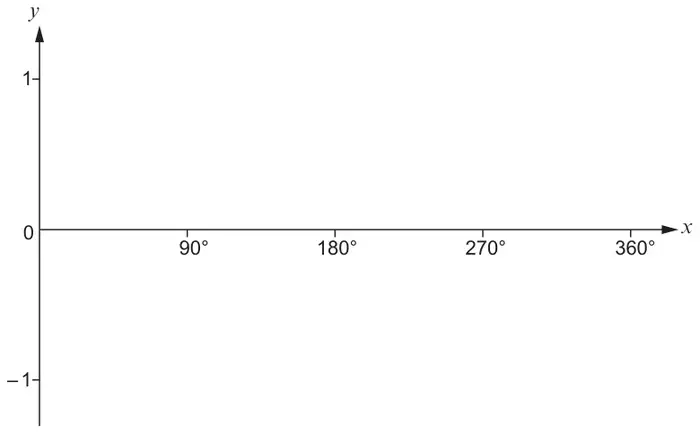
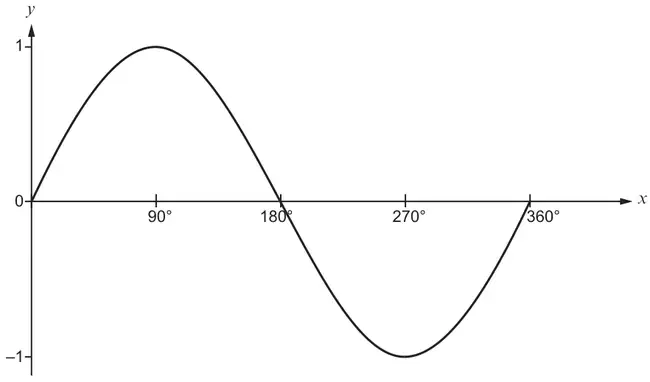
(a) Using the axes below, sketch the graph of \(y = \sin x\) for values of \(x\) from 0° to 360°. You must label any important values on both axes. [2]
(b) Circle the value that is equal to sin 200°. [1]
sin 20° sin 100° sin 160° sin 220° sin 340°
Mark scheme (a)
Scheme
Marks
Comments
Correct sine curve with 1 and −1 shown on the y-axis and 180° and 360° shown on the x-axis.
B2
Multiple cycles gain both marks only if both axes fully correctly labelled for x between 0 and 360.
If B2 not awarded, B1 for a sine curve (single cycle) with missing values on axes OR B1 for multiple cycles with (only) x axis correctly labelled.
We'd like to use Google Analytics cookies to count visits and see which pages help most. They're optional, and the site works exactly the same either way. Privacy policy