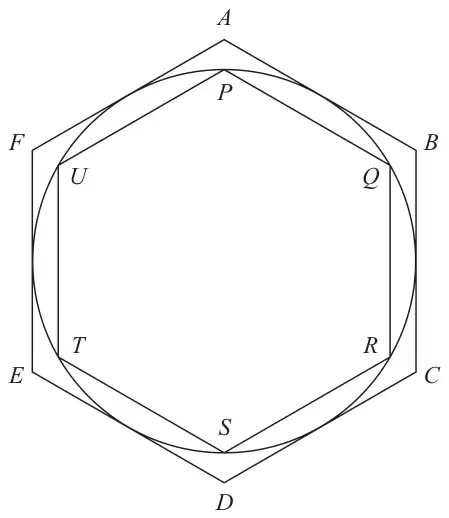
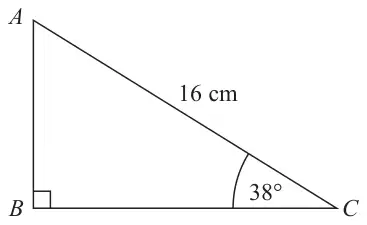
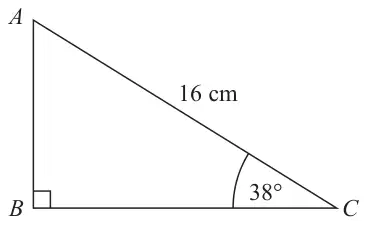
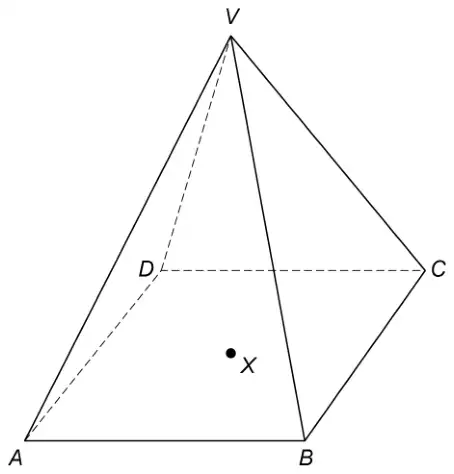
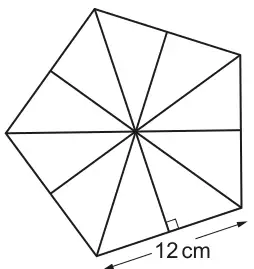
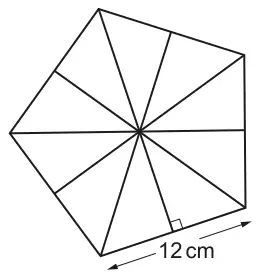
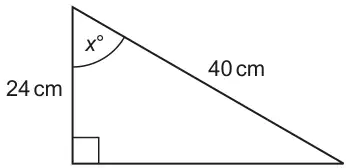
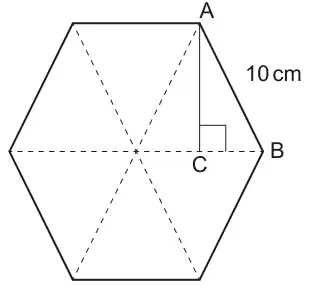
21 The diagram shows a circle, radius \(r\) cm and two regular hexagons.
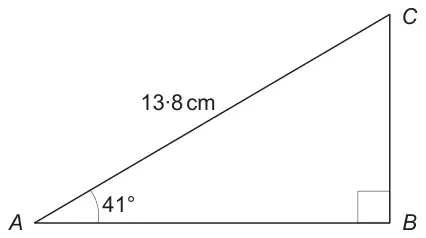
Each side of the larger hexagon \(ABCDEF\) is a tangent to the circle. Each side of the smaller hexagon \(PQRSTU\) is a chord of the circle.
By considering perimeters, show that
\[3 \lt \pi \lt 2\sqrt{3}\]
(4)
Mark scheme
Answer
Mark
Mark scheme
Result shown
P1
for process to find the length of half a side or a side or the perimeter of the smaller hexagon \(PQRSTU\), eg \(r\sin 30\ \left(= \dfrac{r}{2}\right)\) oe or \(2r\sin 30\ (= r)\) oe or \(6 \times 2r\sin 30\ (= 6r)\) oe
P1
for process to find the length of half a side or a side or the perimeter of the larger hexagon \(ABCDEF\) eg Length of half side \(= r\tan 30\) or \(\dfrac{r}{\tan 60}\ \left(= \dfrac{\sqrt{3}r}{3}\right)\) oe or Length of side \(= 2r\tan 30\) or \(\dfrac{2r}{\tan 60}\) or \(\dfrac{r}{\sin 60}\) or \(\dfrac{r}{\cos 30}\ \left(= \dfrac{2\sqrt{3}r}{3}\right)\) oe or Length of perimeter \(= 6 \times 2r\tan 30\) or \(6 \times \dfrac{2r}{\tan 60}\) oe
P1
(dep P2) for process of forming a correct inequality, eg using half lengths eg \(\dfrac{r}{2} \lt \dfrac{2\pi r}{12} \lt r\tan 30\) oe or using lengths eg \(r \lt \dfrac{2\pi r}{6} \lt 2r\tan 30\) oe or using perimeters eg \(6 \times r \lt 2\pi r \lt 6 \times 2r\tan 30\) oe
C1
(dep P2) correct algebra leading to given result, \(3 \lt \pi \lt 2\sqrt{3}\)
Additional guidance
May use Sine Rule or cos60 instead of sin30
May use Sine Rule Note this mark is not for just the sight of \(\dfrac{\sqrt{3}r}{3}\) or \(\dfrac{2\sqrt{3}r}{3}\) or \(\dfrac{12\sqrt{3}r}{3}\) oe, they need to be associated with the correct length Perimeter \(= 4\sqrt{3}r\) alone does not get this mark
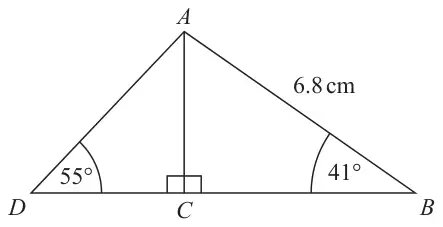
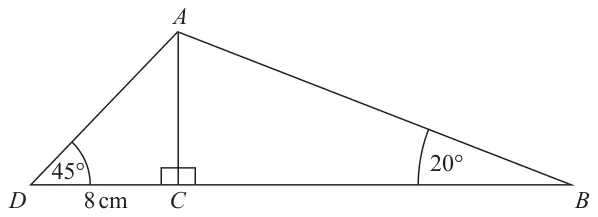
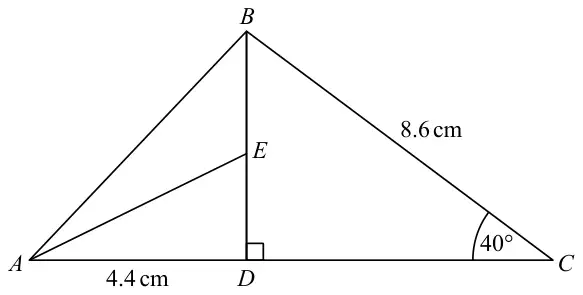
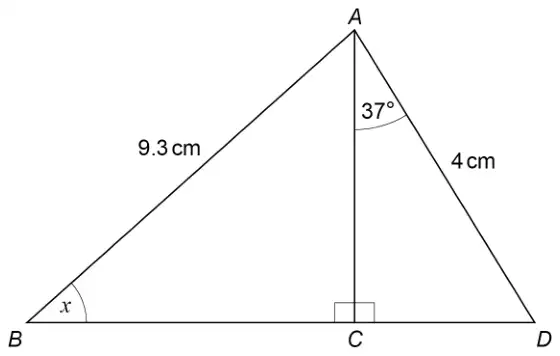
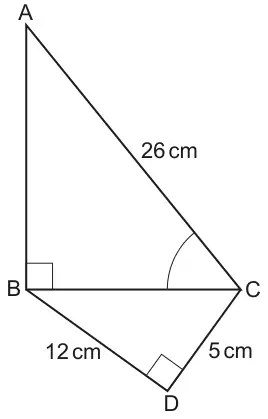
10 \(ABD\) is a triangle. \(C\) is a point on \(BD\).
Work out the length of \(DC\). Give your answer correct to 1 decimal place. (3)
Mark scheme
Answer
Mark
Mark scheme
3.1
P1
for using sin to find length of \(AC\), eg \(6.8 \times \sin 41\) or a full process to find \(AC\) or \((AC =)\ 4.46\ldots\) or a full process to find \(AD\) or \((AD =)\ 5.44\ldots\)
P1
for a complete process to find a relationship involving \(DC\) eg \(\tan 55 = \dfrac{\text{``}4.46\ldots\text{''}}{DC}\) or \((DC =)\ \dfrac{\text{``}4.46\ldots\text{''}}{\tan 55}\) or \(\cos 55 = \dfrac{DC}{\text{``}5.44\ldots\text{''}}\)
A1
answer in the range 3.1 to 3.2
Additional guidance
Accept rounded or truncated figures.
If a correct answer within the range is shown in working but is incorrectly rounded, award full marks.
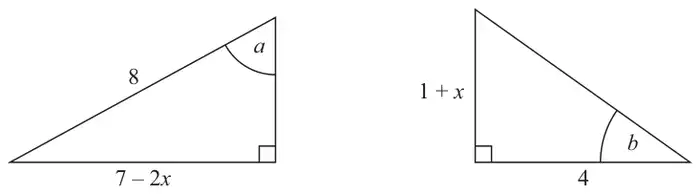
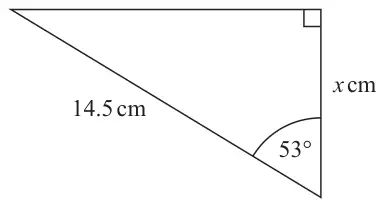
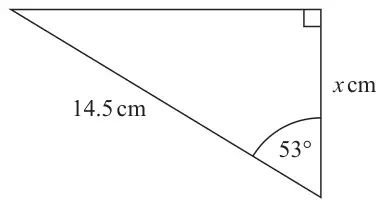
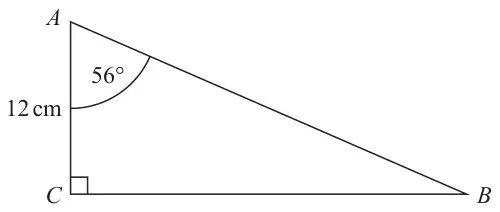
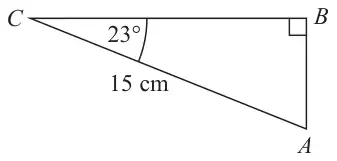
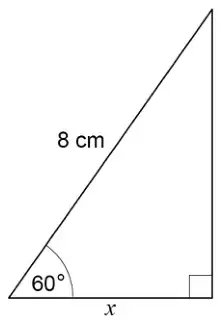
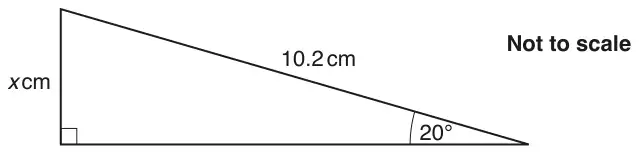
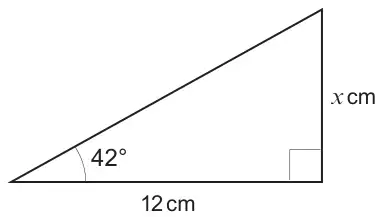
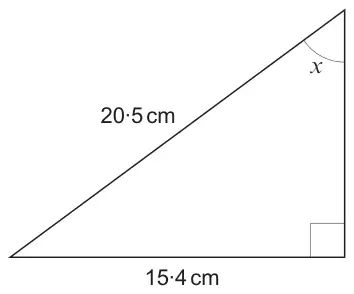
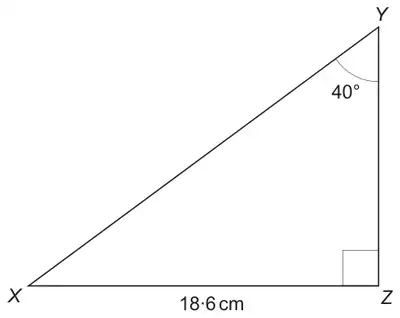
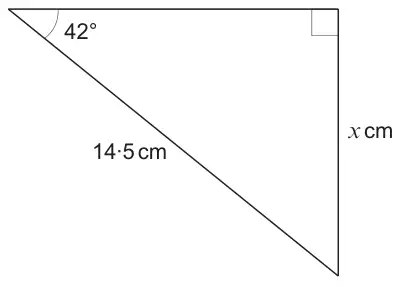
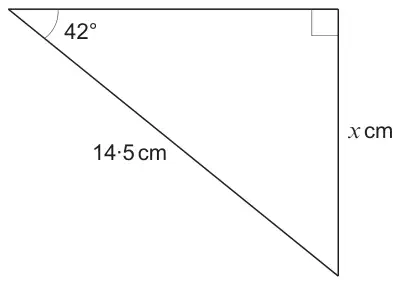
Work out the value of \(x\). Give your answer correct to 3 significant figures. (2)
Mark scheme
Answer
Mark
Mark scheme
8.73
M1
for a correct trig statement, eg \(14.5 \times \cos 53\) or \(\cos 53 = x \div 14.5\)
A1
answer in the range 8.726 to 8.73
Additional guidance
Can use a combination of skills but must have only one unknown in \(x\) to score this mark If an answer is given in the range in working and then rounded incorrectly award full marks.
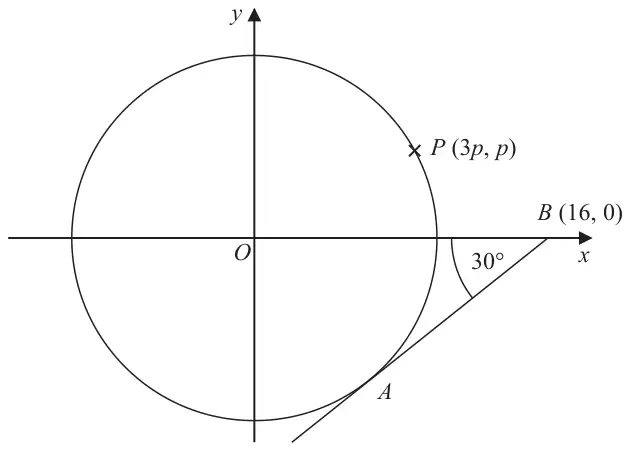
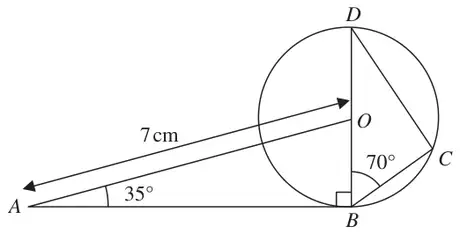
\(AB\) is the tangent to the circle at the point \(A\). Angle \(OBA = 30^\circ\)
Point \(B\) has coordinates \((16, 0)\) Point \(P\) has coordinates \((3p, p)\)
Find the value of \(p\). Give your answer correct to 1 decimal place. You must show all your working. (4)
Mark scheme
Answer
Mark
Mark scheme
2.5
P1
use of \(\sin 30 = \tfrac{1}{2}\) to find \(OA\ (= 8)\) or \(OAB = 90^\circ\) eg \(OA = 16\sin 30^\circ\) or right angle marked on diagram
P1
recognition that equation of circle is \(x^2 + y^2 = r^2\)
P1
Correct substitution of \(p\), \(3p\) and \(r\) in \(x^2 + y^2 = r^2\) eg \(9p^2 + p^2 = OA^2\) or \((3p)^2 + p^2 = \text{``}8^2\text{''}\)
A1
for answer in the range 2.5 to 2.53
Additional guidance
Accept \(3p^2 + p^2 = r^2\) for the award of this mark
Do not accept \(3p^2 + p^2 = 8^2\) for the award of this mark
Accept \(\sqrt{6.4}\) or \(\dfrac{4\sqrt{10}}{5}\) If an answer within the given range is seen in working and rounded incorrectly award full marks. Award 0 marks for the answer without supportive working.
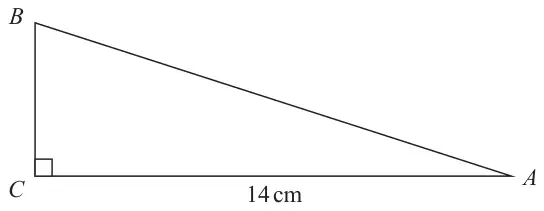
Work out the length of \(AB\). Give your answer correct to 3 significant figures. (4)
Mark scheme
Answer
Mark
Mark scheme
17.3
P1
for full process to find either angle eg \((180 - 90) \div (2 + 3) \times 2\) or for 36 or 54 seen as an angle
P1
for a correct equation using trigonometry eg \(\cos [A] = 14 \div AB\)
P1
(dep previous P mark) for rearranging their trigonometry equation to make \(AB\) the subject eg (\(AB =\)) \(\text{``}14 \div \cos 36\text{''}\)
A1
for an answer in the range 17.3 to 17.4
Additional guidance
May be seen on diagram Condone correct values if incorrectly placed.
This must be shown as an equation with all four elements (eg cos, [\(A\)], 14, \(AB\)) present. [\(A\)] could be 36 or any angle clearly and unambiguously identified as \(A\). This also applies to [\(B\)] with Sine.
If an answer is shown in the range in working and then incorrectly rounded award full marks.
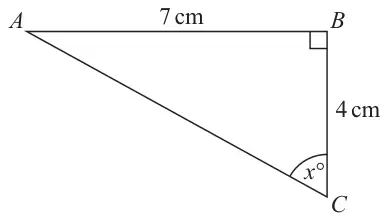
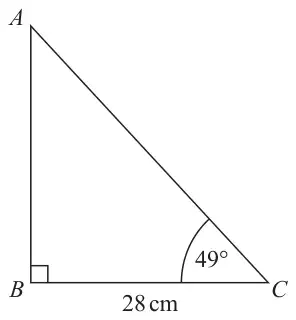
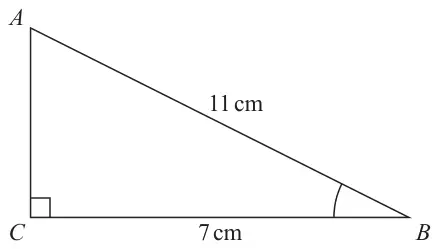
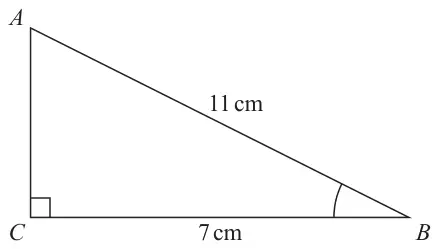
(a) Work out the size of angle \(ABC\). Give your answer correct to 1 decimal place. (2)
The length of the side \(AB\) is reduced by 1 cm.
The length of the side \(BC\) is still 7 cm. Angle \(ACB\) is still \(90^\circ\)
(b) Will the value of \(\cos ABC\) increase or decrease? You must give a reason for your answer. (1)
Mark scheme (a)
Answer
Mark
Mark scheme
50.5
M1
for \(\cos ABC = \dfrac{7}{11}\) (0.63…) oe
A1
for answer in the range 50.4 to 50.51
Additional guidance
Must be a complete statement for cos, sin or tan with all three elements present.
If an answer is in the range 50.4 to 50.51 is given in the working space then incorrectly rounded, award full marks.
Mark scheme (b)
Answer
Mark
Mark scheme
Increase (supported)
C1
States increase with supporting reason eg “\(\dfrac{7}{10}\) is greater than \(\dfrac{7}{11}\)” “0.636 is less than 0.7” ….“cos increases as angle decreases” “decreasing the denominator increases the value of the fraction” “angle is now 45.6” (accept 45.5 – 45.6)
Additional guidance
If figures are given they must be correct (truncated or rounded).
\(AB = 7.3\) cm \(CH = 8.1\) cm Angle \(BCA = 48^\circ\)
Find the size of the angle between \(AH\) and the plane \(ABCD\). Give your answer correct to 1 decimal place. (4)
Mark scheme
Answer
Mark
Mark scheme
39.5
P1
for a start to a process eg, for a correct trigonometric statement, eg \(\sin 48 = \dfrac{7.3}{AC}\) or \(\cos 42 = \dfrac{7.3}{AC}\) or \(\dfrac{AC}{\sin 90} = \dfrac{7.3}{\sin 48}\) OR angle \(CAH\) unambiguously identified on a diagram
P1
for a complete correct process to find \(AC\), eg (\(AC =\)) \(\dfrac{7.3}{\sin(48)}\) (=9.8..) or (\(AC =\)) \(\dfrac{7.3}{\cos(42)}\) (=9.8..) or (\(AC =\)) \(\sin 90 \times \dfrac{7.3}{\sin 48}\) (=9.8..)
P1
for a correct statement using angle \(CAH\), eg \(\tan(CAH) = \dfrac{8.1}{\text{``}9.8...\text{''}}\) OR \(\sqrt{8.1^2 + \text{``}9.8\text{''}^2}\) (=12.7…) and \(\dfrac{\sin CAH}{8.1} = \dfrac{\sin 90}{\text{``}12.7\text{''}}\)
A1
for answer in the range 39.5 – 39.51
Additional guidance
P1 (start): Must include correct values
If an answer is given in the range but then incorrectly rounded award full marks.
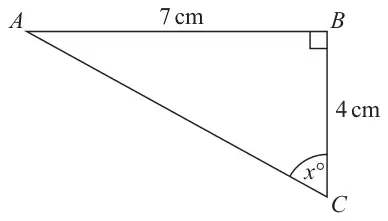
(a) Work out the size of angle \(ABC\). Give your answer correct to 1 decimal place. (2)
The length of the side \(AB\) is reduced by 1 cm.
The length of the side \(BC\) is still 7 cm. Angle \(ACB\) is still \(90^\circ\)
(b) Will the value of \(\cos ABC\) increase or decrease? You must give a reason for your answer. (1)
Mark scheme (a)
Answer
Mark
Mark scheme
50.5
M1
for \(\cos ABC = \dfrac{7}{11}\) (0.63…) oe
A1
for answer in the range 50.4 to 50.51
Additional guidance
Must be a complete statement for cos, sin or tan with all three elements present.
If an answer is in the range 50.4 to 50.51 is given in the working space then incorrectly rounded, award full marks.
Mark scheme (b)
Answer
Mark
Mark scheme
Increase (supported)
C1
States increase with supporting reason eg “\(\dfrac{7}{10}\) is greater than \(\dfrac{7}{11}\)” “0.636 is less than 0.7” ….“cos increases as angle decreases” “decreasing the denominator increases the value of the fraction” “angle is now 45.6” (accept 45.5 – 45.6)
Additional guidance
If figures are given they must be correct (truncated or rounded).
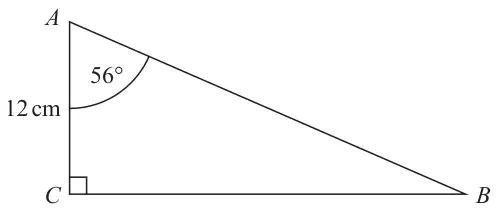
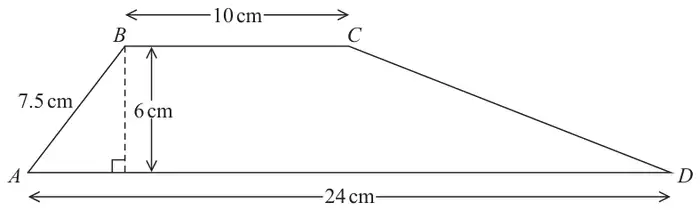
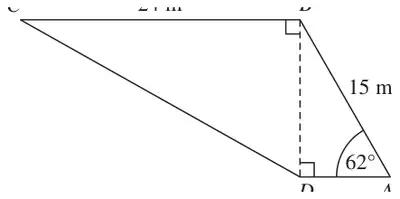
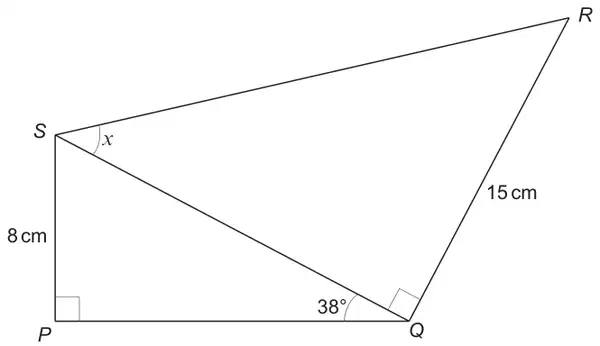
Work out the size of angle \(CDA\). Give your answer correct to 1 decimal place. (5)
Mark scheme
Answer
Mark
Notes
32.3
P1
for using Pythagoras to find length of third side of triangle, eg \(7.5^2 - 6^2\) or \(6^2 + x^2 = 7.5^2\) or uses trigonometry to find angle in triangle eg \(\sin A = \dfrac{6}{7.5}\) or \(\cos B = \dfrac{6}{7.5}\)
P1
(dep P1) for complete process to find length of third side of triangle eg \(\sqrt{7.5^2 - 6^2}\) or \(\sqrt{56.25 - 36}\) or \(\sqrt{20.25}\ (= 4.5)\) or uses trigonometry to find base length of triangle eg \(7.5 \times \cos \text{``}A\text{''}\) or \(7.5 \times \sin \text{``}B\text{''}\) or \(\dfrac{6}{\tan \text{``}A\text{''}}\)
P1
(dep P2) for \(24 - 10 - \text{``}4.5\text{''}\ (= 9.5)\)
P1
(indep) for process to find angle \(CDA\), eg \(\tan CDA = \dfrac{6}{\textit{base}}\) from right-angled triangle
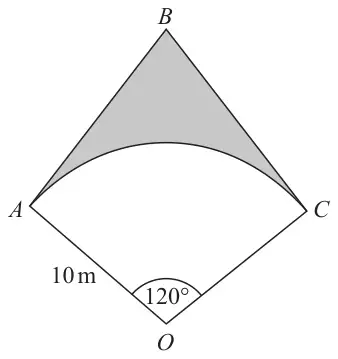
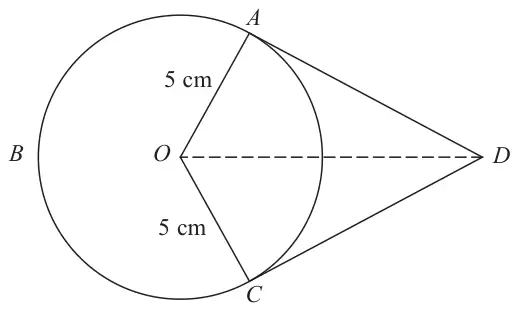
\(OAC\) is a sector of a circle, centre \(O\), radius 10 m.
\(BA\) is the tangent to the circle at point \(A\). \(BC\) is the tangent to the circle at point \(C\).
Angle \(AOC = 120^\circ\)
Calculate the area of the shaded region. Give your answer correct to 3 significant figures. (5)
Mark scheme
Answer
Mark
Notes
68.5
B1
for angle \(OAB = 90^\circ\) or angle \(OCB = 90^\circ\), may be seen on diagram
P1
for a process to find the length of \(AB\) or the length of \(CB\) \((= 10\sqrt{3}\) oe\()\) eg \(10 \times \tan 60^\circ\ (= 17.3\ldots)\) or the length of \(OB\ (= 20)\), eg \(10 \div \cos 60^\circ\)
P1
for a process (dep previous P1) to find the area of the triangle \(OAB\) \((= 50\sqrt{3}\) oe\()\) or area of triangle \(OCB\) \((= 50\sqrt{3}\) oe\()\) or area of kite \(OABC\) \((= 100\sqrt{3}\) oe\()\)
P1
for a process to find the area of the sector \(OAC\) e.g. \(\dfrac{1}{3} \times \pi \times 10^2\ (= 104.7\ldots)\), accept rounded or truncated to 3 significant figures or more
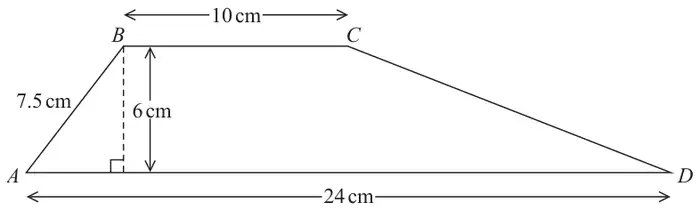
Work out the size of angle \(CDA\). Give your answer correct to 1 decimal place. (5)
Mark scheme
Answer
Mark
Notes
32.3
P1
for using Pythagoras to find length of third side of triangle, eg \(7.5^2 - 6^2\) or \(6^2 + x^2 = 7.5^2\) or uses trigonometry to find angle in triangle eg \(\sin A = \dfrac{6}{7.5}\) or \(\cos B = \dfrac{6}{7.5}\)
P1
(dep P1) for complete process to find length of third side of triangle eg \(\sqrt{7.5^2 - 6^2}\) or \(\sqrt{56.25 - 36}\) or \(\sqrt{20.25}\ (= 4.5)\) or uses trigonometry to find base length of triangle eg \(7.5 \times \cos \text{``}A\text{''}\) or \(7.5 \times \sin \text{``}B\text{''}\) or \(\dfrac{6}{\tan \text{``}A\text{''}}\)
P1
(dep P2) for \(24 - 10 - \text{``}4.5\text{''}\ (= 9.5)\)
P1
(indep) for process to find angle \(CDA\), eg \(\tan CDA = \dfrac{6}{\textit{base}}\) from right-angled triangle
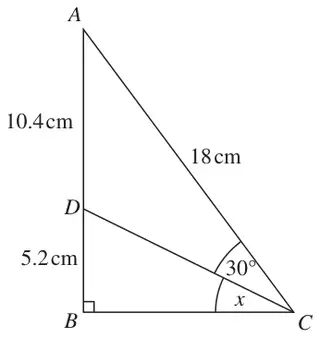
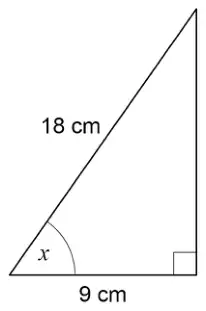
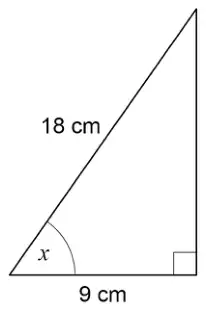
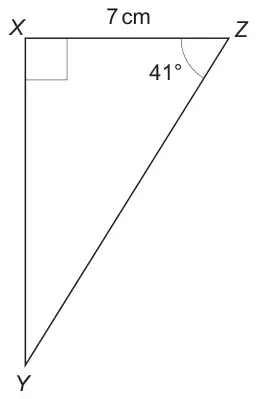
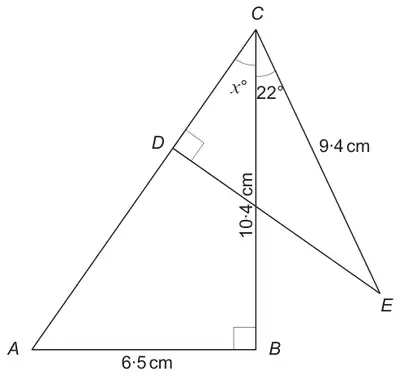
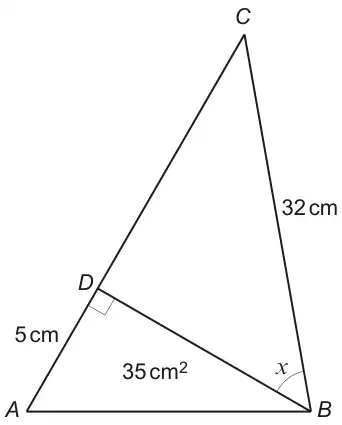
\(ABC\) is a right-angled triangle. \(D\) is a point on \(AB\).
Angle \(ACD = 30^\circ\) \(AD = 10.4\) cm \(DB = 5.2\) cm \(AC = 18\) cm
Work out the size of the angle marked \(x\). Give your answer correct to 1 decimal place. (4)
Mark scheme
Answer
Mark
Notes
30.1
4
M1 for a correct trigonometric statement to find an unknown angle, eg. \(\sin(30 + x)\) or \(\cos A = \dfrac{10.4 + 5.2}{18}\) or \(\dfrac{\sin ADC}{18} = \dfrac{\sin 30}{10.4}\) M1 for a complete method to find the angle, eg. \(\sin^{-1}\left(\dfrac{10.4 + 5.2}{18}\right)\) (= 60.07...) or \(\cos^{-1}\left(\dfrac{10.4 + 5.2}{18}\right)\) (= 29.92..) or \(\sin^{-1}\left(\dfrac{18 \times \sin 30}{10.4}\right)\) (= 59.92.. or 180 – 59.92.. = 120.07..) M1 (dep on M2) for a fully complete method to find angle \(x\), eg. "60.07..". – 30 or 60 – "29.92.." or 90 – "59.92.." A1 for answer in the range 30.07 to 30.1
OR
M1 for \((BC^2 =)\ 18^2 - (10.4 + 5.2)^2\) or \(BC^2 + (10.4 + 5.2)^2 = 18^2\) M1 for \((BC =)\ \sqrt{18^2 - (10.4 + 5.2)^2}\) (= 8.97...) M1 (dep on M2) for a fully complete method to find angle \(x\), eg. \(\tan^{-1}\left(\dfrac{5.2}{\text{``}8.97...\text{''}}\right)\) A1 for answer in the range 30.07 to 30.1
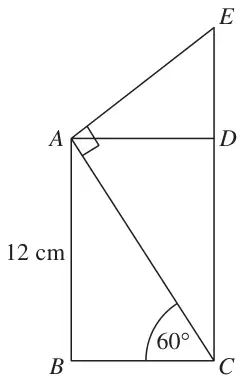
M1 for a method to find \(BC\) or \(AC\) or \(AD\) B1 for angle \(EAD = 30^\circ\) or \(AED = 60^\circ\) or \(ACD = 30^\circ\) or \(CAD = 60^\circ\) M1 for a method to find \(CE\) A1 for 15.9-16.1 with supporting working
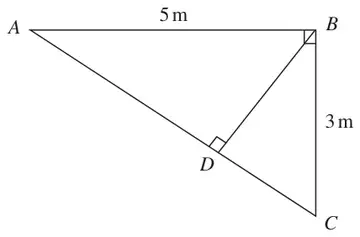
M1 for \((AC^2) = 5^2 + 3^2\) (=34) M1 for \(\sqrt{25 + 9}\) or \(\sqrt{34}\) (=5.83) M1 for \(\dfrac{5}{\text{'}5.83'} = \dfrac{DB}{3}\) or \(DB \times AC = 5 \times 3\) M1 for \((DB =)\ \dfrac{5}{\text{'}5.83'} \times 3\) A1 for 16.4 to 16.41
OR M1 for \((AC^2) = 5^2 + 3^2\) (=34) M1 for \(\sqrt{25 + 9}\) or \(\sqrt{34}\) (=5.83) M1 for using a correct trig ratio in an attempt to find angle \(A\) or angle \(C\), e.g. \(\tan A = \dfrac{3}{5}\), \(\sin A = \dfrac{3}{\text{'}5.83'}\), \(\cos C = \dfrac{3}{\text{'}5.83'}\) M1 for using \(DB\) in a a correct trig ratio, e.g. \(\sin \text{'}30.96\text{'} = \dfrac{DB}{5}\) A1 for 16.4 to 16.41
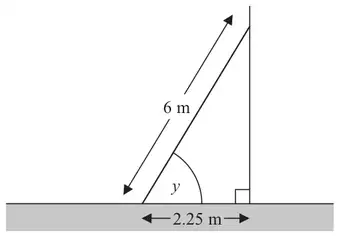
*20 The diagram shows a ladder leaning against a vertical wall.
Diagram NOT accurately drawn
The ladder stands on horizontal ground.
The length of the ladder is 6 m. The bottom of the ladder is 2.25 m from the bottom of the wall.
A ladder is safe to use when the angle marked \(y\) is about \(75^\circ\).
Is the ladder safe to use? You must show all your working. (3)
Mark scheme
Working
Answer
Mark
Notes
\(\cos y = 2.25 \div 6\) \(y = \cos^{-1}(2.25 \div 6)\) OR \(6\cos 75 = 1.55\ldots\)
The ladder is not safe because \(y\) is not near to 75
3
M1 for \(\cos y = 2.25 \div 6\) oe M1 for \(\cos^{-1}(2.25 \div 6)\) C1 for sight of 67-68 and a statement eg this angle is NOT (near to) 75° and so the ladder is not steep enough and so not safe.
OR
M1 for \(\cos 75 = x \div 6\) M1 for \(6\cos 75\) C1 for sight of 1.55(29…) and a statement eg that 2.25 NOT (near to) 1.55 and so the ladder is not steep enough and so not safe.
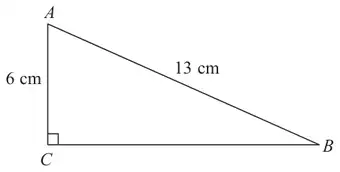
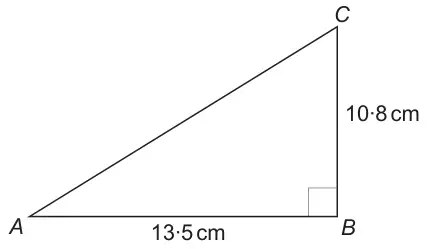
\(ABC\) is a right-angled triangle. \(AC = 6\) cm \(AB = 13\) cm
(a) Work out the length of \(BC\). Give your answer correct to 3 significant figures. (3)
Diagram NOT accurately drawn
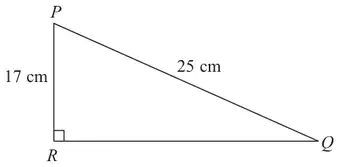
\(PQR\) is a right-angled triangle. \(PR = 17\) cm \(PQ = 25\) cm
(b) Work out the size of angle \(RPQ\). Give your answer correct to 1 decimal place. (3)
Mark scheme (a)
Answer
Mark
Notes
11.5
3
M1 for \(13^2 - 6^2\) or \(169 - 36\) or 133 M1 (dep on M1) for \(\sqrt{13^2 - 6^2}\) or \(\sqrt{133}\) A1 for answer in the range 11.5 − 11.6
Mark scheme (b)
Answer
Mark
Notes
47.2
3
M1 for \(\cos(RPQ) = \frac{17}{25}\) oe OR \(\sin PQR = \frac{17}{25}\) with \(PQR\) clearly identified M1 for (\(RPQ =\)) \(\cos^{-1}\frac{17}{25}\) oe OR \(PQR = \sin^{-1}\frac{17}{25}\) with \(PQR\) clearly identified A1 for answer in the range 47.1 − 47.2 SC : B2 for an answer of 0.823(033...) or 52.3(95...) or 52.4
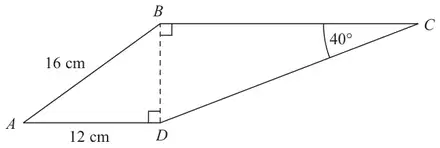
M1 for \(BD^2 + 12^2 = 16^2\) oe or \(16^2 - 12^2\) or 112 seen M1 for \(\sqrt{256 - 144}\) or \(\sqrt{112}\) (=10.58...) M1 for \(\sin 40 = \dfrac{\text{‘}10.58\text{’}}{CD}\) or \(\cos 50 = \dfrac{\text{‘}10.58\text{’}}{CD}\) M1 for (\(CD =\)) \(\dfrac{\text{‘}10.58\text{’}}{\sin 40}\) or \(\dfrac{\text{‘}10.58\text{’}}{\cos 50}\) A1 for 16.4 – 16.5 OR M1 for \(BD^2 + 12^2 = 16^2\) oe or \(16^2 - 12^2\) or 112 seen M1 for \(\sqrt{256 - 144}\) or \(\sqrt{112}\) (=10.58...) M1 for (\(BC =\)) ‘10.58’ × tan 50 or \(\dfrac{\text{‘}10.58\text{’}}{\tan 40}\) (=12.6…) M1 for \(\sqrt{\text{‘}12.6\text{’}^2 + \text{‘}10.58...\text{’}^2}\) A1 for 16.4 – 16.5
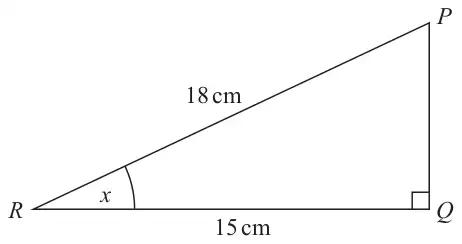
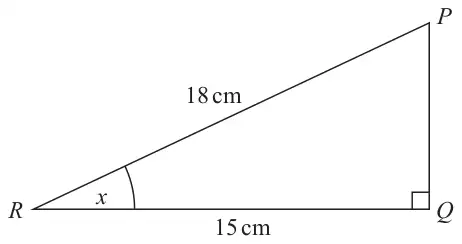
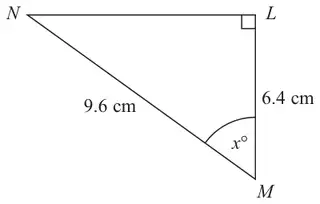
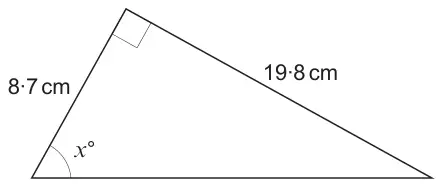
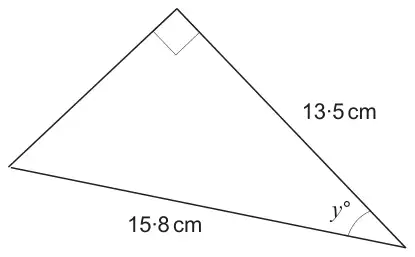
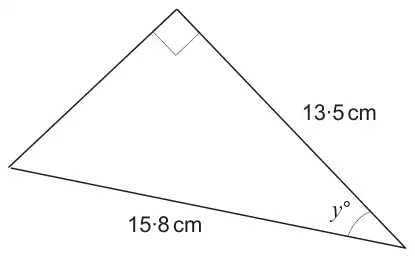
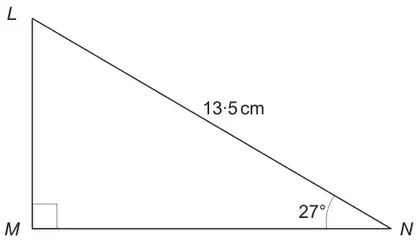
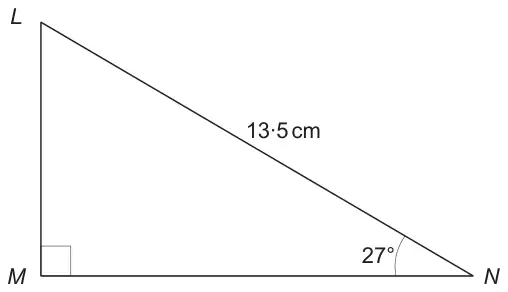
\(LMN\) is a right-angled triangle. \(MN = 9.6\) cm. \(LM = 6.4\) cm.
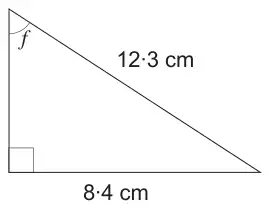
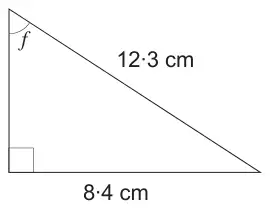
Calculate the size of the angle marked \(x^\circ\). Give your answer correct to 1 decimal place. (3)
Mark scheme
Working
Answer
Mark
Notes
\(\cos x = \dfrac{6.4}{9.6}\) \(x = \cos^{-1}\dfrac{6.4}{9.6} =\)
48.2
3
M1 for \(\cos x = \dfrac{6.4}{9.6}\) or \(\cos x = 0.66(6...)\) or \(\cos x = 0.67\) M1 for \(\cos^{-1}\dfrac{6.4}{9.6}\) or \(\cos^{-1} 0.66(6...)\) or \(\cos^{-1} 0.67\) A1 for 48.1 – 48.2 OR Correct use of Pythagoras and then trigonometry, no marks until M1 for \(\sin x = \dfrac{\text{‘}7.155\text{’}}{9.6}\) or \(\tan x = \dfrac{\text{‘}7.155\text{’}}{6.4}\) or \(\sin x = \dfrac{\text{‘}7.155\text{’}}{9.6} \times \sin 90\) or \(\cos x = \dfrac{6.4^2 + 9.6^2 - \text{‘}7.155\text{’}^2}{2 \times 6.4 \times 9.6}\) M1 for \(\sin^{-1}\dfrac{\text{‘}7.155\text{’}}{9.6}\) or \(\tan^{-1}\dfrac{\text{‘}7.155\text{’}}{6.4}\) or \(\sin^{-1}\left(\dfrac{\text{‘}7.155\text{’}}{9.6} \times \sin 90\right)\) or \(\cos^{-1}\left(\dfrac{6.4^2 + 9.6^2 - \text{‘}7.155\text{’}^2}{2 \times 6.4 \times 9.6}\right)\) A1 for 48.1 – 48.2 SC B2 for 0.841... (using rad) or 53.5... (using grad)
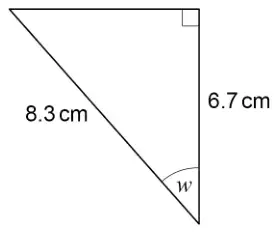
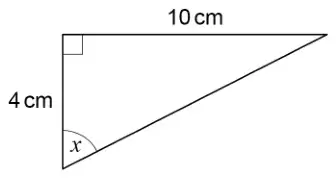
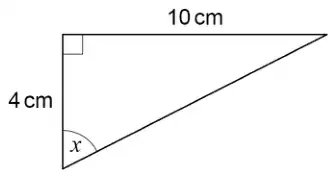
23 Use trigonometry to work out the size of angle \(w\). [3 marks]
Not drawn accurately
Mark scheme
Answer
Mark
Comments
Alternative method 1
cos chosen or used
M1
\(\cos w = \dfrac{6.7}{8.3}\) or \(\cos^{-1} \dfrac{6.7}{8.3}\)
M1dep
any letter or symbol for \(w\) accept 0.807(…) or 0.81 for \(\dfrac{6.7}{8.3}\)
[35.9, 36.2]
A1
Alternative method 2
\(\sin x = \dfrac{6.7}{8.3}\) or \(\sin^{-1} \dfrac{6.7}{8.3}\) or [53.8, 54.1]
M1
any letter or symbol other than \(w\) accept 0.807(…) or 0.81 for \(\dfrac{6.7}{8.3}\)
\(90 -\) their [53.8, 54.1]
M1dep
[35.9, 36.2]
A1
Alternative method 3
\(\sqrt{8.3^2 - 6.7^2}\) or \(\sqrt{68.89 - 44.89}\) or \(\sqrt{24}\) or \(2\sqrt{6}\) or [4.89, 4.9] and \(\sin^{-1} \dfrac{\text{their } [4.89, 4.9]}{8.3}\) or \(\tan^{-1} \dfrac{\text{their } [4.89, 4.9]}{6.7}\)
M2
full method to work out the missing length and use it correctly to work out the value of \(w\) any letter or symbol for \(w\)
[35.9, 36.2]
A1
Additional guidance
Use of sine rule follows Alt method 2
\(\sin w = \dfrac{6.7}{8.3}\) without \(\sin^{-1} \dfrac{6.7}{8.3}\) or [53.8, 54.1]
M0
\(\cos w = 0.807\)
M1M1
\(\cos^{-1} w = \dfrac{6.7}{8.3}\) or \(\cos = \dfrac{6.7}{8.3}\) unless recovered
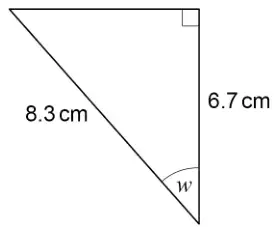
9 Use trigonometry to work out the size of angle \(w\). [3 marks]
Not drawn accurately
Mark scheme
Answer
Mark
Comments
Alternative method 1
cos chosen or used
M1
\(\cos w = \dfrac{6.7}{8.3}\) or \(\cos^{-1} \dfrac{6.7}{8.3}\)
M1dep
any letter or symbol for \(w\) accept 0.807(…) or 0.81 for \(\dfrac{6.7}{8.3}\)
[35.9, 36.2]
A1
Alternative method 2
\(\sin x = \dfrac{6.7}{8.3}\) or \(\sin^{-1} \dfrac{6.7}{8.3}\) or [53.8, 54.1]
M1
any letter or symbol other than \(w\) accept 0.807(…) or 0.81 for \(\dfrac{6.7}{8.3}\)
\(90 -\) their [53.8, 54.1]
M1dep
[35.9, 36.2]
A1
Alternative method 3
\(\sqrt{8.3^2 - 6.7^2}\) or \(\sqrt{68.89 - 44.89}\) or \(\sqrt{24}\) or \(2\sqrt{6}\) or [4.89, 4.9] and \(\sin^{-1} \dfrac{\text{their } [4.89, 4.9]}{8.3}\) or \(\tan^{-1} \dfrac{\text{their } [4.89, 4.9]}{6.7}\)
M2
full method to work out the missing length and use it correctly to work out the value of \(w\) any letter or symbol for \(w\)
[35.9, 36.2]
A1
Additional guidance
Use of sine rule follows Alt method 2
\(\sin w = \dfrac{6.7}{8.3}\) without \(\sin^{-1} \dfrac{6.7}{8.3}\) or [53.8, 54.1]
M0
\(\cos w = 0.807\)
M1M1
\(\cos^{-1} w = \dfrac{6.7}{8.3}\) or \(\cos = \dfrac{6.7}{8.3}\) unless recovered
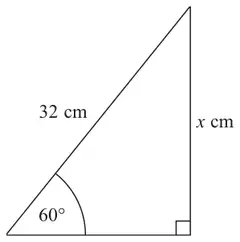
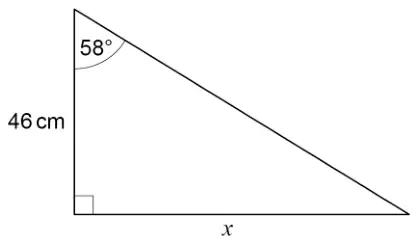
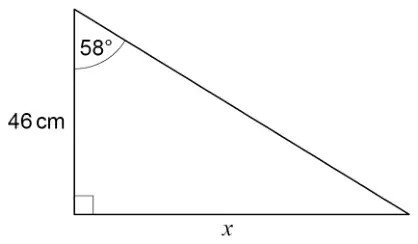
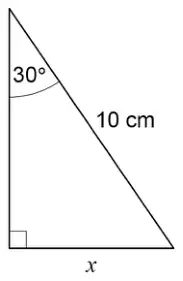
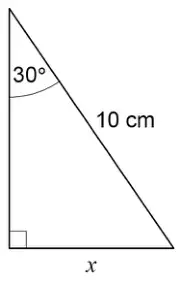
23 Use trigonometry to work out the value of \(x\).
Not drawn accurately
[3 marks]
Mark scheme
Answer
Mark
Comments
Alternative method 1 – using tangent of an angle
tan chosen or used
M1
\(\tan 58 = \dfrac{x}{46}\) or \(46 \times \tan 58\) or \(\tan 32 = \dfrac{46}{x}\) or \(\dfrac{46}{\tan 32}\)
M1dep
oe
[73.6, 74]
A1
Alternative method 2 – finding hypotenuse first
\(\dfrac{46}{\cos 58}\) or \(\dfrac{46}{\sin 32}\) or 86.8(…) or 87
M1
oe
\(\sqrt{(\text{their } 86.8(\ldots))^2 - 46^2}\) or \(\sqrt{5418.(\ldots)}\) or their \(86.8(\ldots) \times \sin 58\) or their \(86.8(\ldots) \times \cos 32\)
10 Use trigonometry to work out the value of \(x\). [3 marks]
Not drawn accurately
Mark scheme
Answer
Mark
Comments
Alternative method 1 – using tangent of an angle
tan chosen or used
M1
\(\tan 58 = \dfrac{x}{46}\) or \(46 \times \tan 58\) or \(\tan 32 = \dfrac{46}{x}\) or \(\dfrac{46}{\tan 32}\)
M1dep
oe
[73.6, 74]
A1
Alternative method 2 – finding hypotenuse first
\(\dfrac{46}{\cos 58}\) or \(\dfrac{46}{\sin 32}\) or 86.8(…) or 87
M1
oe
\(\sqrt{(\text{their } 86.8(\ldots))^2 - 46^2}\) or \(\sqrt{5418.(\ldots)}\) or their \(86.8(\ldots) \times \sin 58\) or their \(86.8(\ldots) \times \cos 32\)
21 Use trigonometry to work out the size of angle \(x\). [3 marks]
Not drawn accurately
Mark scheme
Answer
Mark
Comments
Alternative method 1
tan identified
M1
oe eg \(\tan^{-1}\)
\(\tan x = \dfrac{10}{4}\) or \(\tan x = \dfrac{5}{2}\) or \(\tan x = 2.5\)
M1dep
oe eg \(\tan^{-1} \dfrac{10}{4}\) or \(90 - \tan^{-1} \dfrac{4}{10}\)
[68, 68.2]
A1
SC1 [21.8, 22]
Alternative method 2
\(\sin x = \dfrac{10}{\sqrt{4^2 + 10^2}}\) or \(\cos x = \dfrac{4}{\sqrt{4^2 + 10^2}}\)
M2
oe eg \(\sin x = \dfrac{10}{\sqrt{116}}\) or \(\sin^{-1} \dfrac{10}{\sqrt{4^2 + 10^2}}\) or \(\cos x = \dfrac{4}{\sqrt{116}}\) or \(\cos^{-1} \dfrac{4}{\sqrt{4^2 + 10^2}}\) or \(90 - \sin^{-1} \dfrac{4}{\sqrt{4^2 + 10^2}}\) or \(90 - \cos^{-1} \dfrac{10}{\sqrt{4^2 + 10^2}}\)
[68, 68.2]
A1
SC1 [21.8, 22]
Additional guidance
Accept 10.77 or 10.8 or \(2\sqrt{29}\) for \(\sqrt{116}\)
Tan can be identified by, for example, circling TOA in SOHCAHTOA
Answer from accurate drawing
M0M0A0
\(\sin x = \dfrac{10 \sin 90}{\sqrt{116}}\)
M2
\((x =)\) tan 2.5 or \((x =)\) tan 0.4 or \((x =)\) \(\tan \left(\dfrac{10}{4}\right)^{-1}\) unless recovered
M1M0A0
\(\tan = \dfrac{10}{4}\) or \(\tan = \dfrac{4}{10}\) or \(\tan x = \dfrac{4}{10}\) with no further correct working
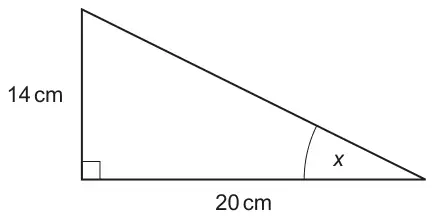
4 Use trigonometry to work out the size of angle \(x\).
Not drawn accurately
[3 marks]
Mark scheme
Answer
Mark
Comments
Alternative method 1
tan identified
M1
oe eg \(\tan^{-1}\)
\(\tan x = \dfrac{10}{4}\) or \(\tan x = \dfrac{5}{2}\) or \(\tan x = 2.5\)
M1dep
oe eg \(\tan^{-1} \dfrac{10}{4}\) or \(90 - \tan^{-1} \dfrac{4}{10}\)
[68, 68.2]
A1
SC1 [21.8, 22]
Alternative method 2
\(\sin x = \dfrac{10}{\sqrt{4^2 + 10^2}}\) or \(\cos x = \dfrac{4}{\sqrt{4^2 + 10^2}}\)
M2
oe eg \(\sin x = \dfrac{10}{\sqrt{116}}\) or \(\sin^{-1} \dfrac{10}{\sqrt{4^2 + 10^2}}\) or \(\cos x = \dfrac{4}{\sqrt{116}}\) or \(\cos^{-1} \dfrac{4}{\sqrt{4^2 + 10^2}}\) or \(90 - \sin^{-1} \dfrac{4}{\sqrt{4^2 + 10^2}}\) or \(90 - \cos^{-1} \dfrac{10}{\sqrt{4^2 + 10^2}}\)
[68, 68.2]
A1
SC1 [21.8, 22]
Additional guidance
Accept 10.77 or 10.8 or \(2\sqrt{29}\) for \(\sqrt{116}\)
Tan can be identified by, for example, circling TOA in SOHCAHTOA
Answer from accurate drawing
M0M0A0
\(\sin x = \dfrac{10 \sin 90}{\sqrt{116}}\)
M2
(\(x\) =) tan 2.5 or (\(x\) =) tan 0.4 or (\(x\) =) \(\tan \left(\dfrac{10}{4}\right)^{-1}\) unless recovered
M1M0A0
\(\tan = \dfrac{10}{4}\) or \(\tan = \dfrac{4}{10}\) or \(\tan x = \dfrac{4}{10}\) with no further correct working
oe eg \(\dfrac{\sin x}{16 \tan 49} = \dfrac{\sin 35}{20}\) dep on 1st M1
\(\sin x = \dfrac{\sin 35}{20} \times \text{their } [18.4, 18.41]\)
M1dep
oe eg \(\sin x = \dfrac{16 \tan 49 \sin 35}{20}\) or \(\sin^{-1}\left(\dfrac{\sin 35}{20} \times \text{their } [18.4, 18.41]\right)\) or \(\sin^{-1}\) [0.527, 0.528] dep on 1st and 3rd M1
\(\tan x = \dfrac{3}{7}\) or \(\tan^{-1} \dfrac{3}{7}\) or \(\sin x = \dfrac{3(\sin 90)}{\sqrt{3^2 + 7^2}}\) or \(\sin x = \dfrac{3(\sin 90)}{\sqrt{58}}\) or \(\cos x = \dfrac{7}{\sqrt{3^2 + 7^2}}\) or \(\cos x = \dfrac{7}{\sqrt{58}}\) or \(90 - \tan^{-1} \dfrac{7}{3}\) or 90 – [66.7, 66.81] or 90 – 67
M1
oe eg \(\cos x = \dfrac{7^2 + \left(\sqrt{7^2 + 3^2}\right)^2 - 3^2}{2 \times \sqrt{3^2 + 7^2} \times 7}\) Any letter
[23, 23.3]
A1
Additional guidance
\(\tan = \dfrac{3}{7}\) or \(\tan \dfrac{3}{7}\) or \(\tan^{-1} = \dfrac{3}{7}\) (unless recovered)
M0
Answer [23, 23.3] (possibly coming from scale drawing)
M1A1
If using sine rule must rearrange to \(\sin x =\) for M1
If using cosine rule must rearrange to \(\cos x =\) for M1
\(\tan x = \dfrac{3}{7}\) or \(\tan^{-1} \dfrac{3}{7}\) or \(\sin x = \dfrac{3(\sin 90)}{\sqrt{3^2 + 7^2}}\) or \(\sin x = \dfrac{3(\sin 90)}{\sqrt{58}}\) or \(\cos x = \dfrac{7}{\sqrt{3^2 + 7^2}}\) or \(\cos x = \dfrac{7}{\sqrt{58}}\) or \(90 - \tan^{-1} \dfrac{7}{3}\) or 90 − [66.7, 66.81] or 90 − 67
M1
oe eg \(\cos x = \dfrac{7^2 + \left(\sqrt{7^2 + 3^2}\right)^2 - 3^2}{2 \times \sqrt{3^2 + 7^2} \times 7}\) Any letter
[23, 23.3]
A1
Additional guidance
\(\tan = \dfrac{3}{7}\) or \(\tan \dfrac{3}{7}\) or \(\tan^{-1} = \dfrac{3}{7}\) (unless recovered)
M0
Answer [23, 23.3] (possibly coming from scale drawing)
M1A1
If using sine rule must rearrange to \(\sin x =\) for M1
If using cosine rule must rearrange to \(\cos x =\) for M1
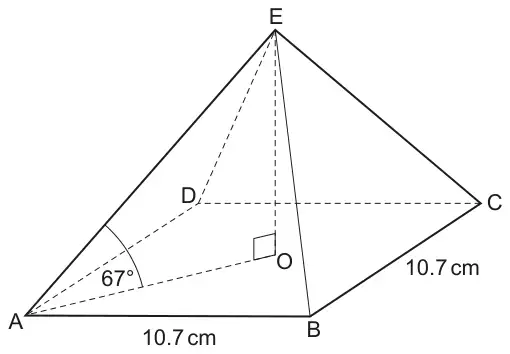
22 The diagram shows a square-based pyramid ABCDE. O is the centre of the base.
The length of the base is 10.7 cm. Angle EAO is 67°.
Calculate the length of AE. You must show your working. [6]
Mark scheme
Answer
Marks
Part marks and guidance
19.3[4…] to 19.3[7…] or 19.4 with correct working
6
M2 for \(\left[\frac{1}{2} \times\right]\sqrt{10.7^2 + 10.7^2}\) or for \(\sqrt{5.35^2 + 5.35^2}\) or for \(\left[\frac{1}{2} \times\right] \frac{10.7}{\cos 45}\) or \(\left[\frac{1}{2} \times\right] \frac{10.7}{\sin 45}\) or for \(\frac{5.35}{\cos 45}\) or \(\frac{5.35}{\sin 45}\) or M1 for \(10.7^2 + 10.7^2\) or \(5.35^2 + 5.35^2\) or for \(\cos 45 = \frac{10.7}{\text{AC}}\) oe or \(\sin 45 = \frac{10.7}{\text{AC}}\) oe or for \(\cos 45 = \frac{5.35}{\text{AO}}\) oe or \(\sin 45 = \frac{5.35}{\text{AO}}\) oe
Correct working requires evidence of at least M1 AND M1 Accept intermediate values rot to at least 3sf.
If M1A1 seen then award M2A1
AO
AE
7.5
19.19478
7.56
19.34834
7.566
19.3637
7.566043
19.36381
7.57
19.37394
7.6
19.45072
A1 for 7.56 to 7.57 or 7.6
AND
M2 for \(\frac{\textit{their } 7.566\ldots}{\cos 67}\) or \(\frac{\textit{their } 7.566\ldots}{\sin 23}\) or \(\frac{\text{AE}}{\sin 90} = \frac{\textit{their } 7.566\ldots}{\sin 23}\) or M1 for \(\cos 67 = \frac{\textit{their } 7.566\ldots}{\text{AE}}\) oe or \(\sin 23 = \frac{\textit{their } 7.566\ldots}{\text{AE}}\) oe or \(\frac{\sin 90}{\text{AE}} = \frac{\sin 23}{\textit{their } 7.566}\) oe
their 7.566…must follow from the award of the first M2
If 0, 1 or 2 scored, instead award SC3 for answer 19.3 to 19.4 with no or insufficient working If 0 or M1 scored, instead award SC2 for 7.56 to 7.57 or 7.6 with no or insufficient working If 0 scored instead award SC1 for 15.1[3…] or 57.2… with no or insufficient working
Mark less efficient methods by considering how many steps remain to reach the correct answer and match against the most comparable stage: eg Assuming AO has been found, then using trig to find EO is unnecessary and inefficient, so no further marks are awarded for just finding EO and stopping. However, if EO is then used in a correct Pythagoras expression with AO or a correct trig expression with 67° that lead directly or indirectly to finding AE, then M2 or M1 may be awarded.
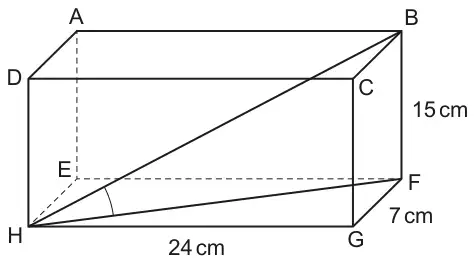
Calculate the angle BHF. You must show your working. [5]
Mark scheme
Answer
Marks
Part marks and guidance
30.9 to 31 with correct working
5
M2 for \(\sqrt{(24^2 + 7^2)}\) or M1 for \([\ldots]^2 = 24^2 + 7^2\)
and
M2 for \(\tan^{-1} \frac{15}{\textit{their } 25}\) oe or M1 for \(\tan(\text{BHF}) = \frac{15}{\textit{their } 25}\) oe
Correct working requires evidence of at least M1M1 Alternative method: M2 for \(\sqrt{(24^2 + 7^2 + 15^2)}\) or M1 for \([\ldots]^2 = 24^2 + 7^2 + 15^2\)
and
M2 for \(\sin^{-1} \frac{15}{\textit{their } \sqrt{850}}\) oe or M1 for \(\sin(\text{BHF}) = \frac{15}{\textit{their } \sqrt{850}}\) oe
Other methods: M2 for a correct expression that would give correct HF or HB or M1 for “one-step away” eg \(\sin\left(\tan^{-1}\left(\frac{7}{24}\right)\right) = \frac{7}{\text{HF}}\) and M2 for correct trig inverse expression with angle BHF or M1 for correct trig expression with angle BHF
If 0 or 1 scored, instead award SC2 for answer 30.9 to 31 with no or insufficient working If 0 scored, instead award SC1 for [HF =] 25 or for [HB =] \(\sqrt{850}\) oe or 29.1 to 29.2
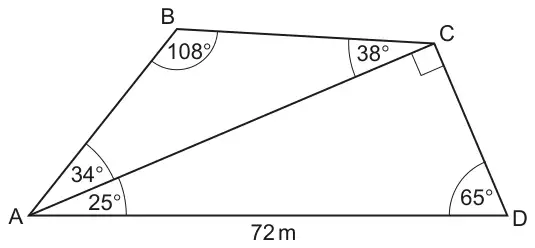
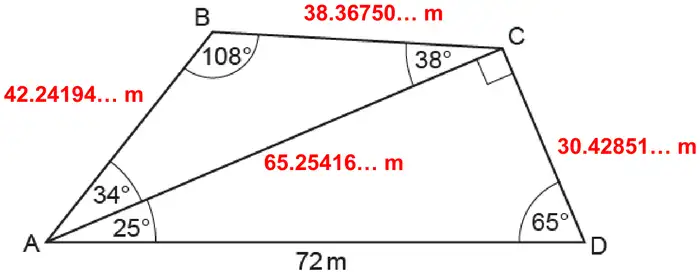
AD = 72 m. Angle ABC = 108°, angle BCA = 38° and angle BAC = 34°. Angle ACD = 90°, angle CDA = 65° and angle CAD = 25°.
Find the area of ABCD. You must show your working. [6]
Mark scheme
Answer
Marks
Part marks and guidance
1763 or 1763.4 to 1763.5 with correct working
6
“Correct working” requires evidence of at least M2 or M1 M1 condone answers in range 1750 – 1780 with full correct working
M2 for \(\frac{1}{2} \times 72 \times\) their 65.25… × sin 25 or M1 for [AC=] 72cos 25 or 72sin 65 oe
M2 implied by 992.79… or 992.8 or maybe by 985 – 999[…] nfww or M1 implied by [AC=] 65.2[5…] or 65.3
M3 for \(\frac{1}{2} \times\) their 65.254 × their 42.24… × sin34 oe or M2 for [AB=] \(\frac{\textit{their } 65.25\ldots \times \sin 38}{\sin 108}\) oe or M1 for \(\frac{\text{AB}}{\sin 38} = \frac{\textit{their } 65.25\ldots}{\sin 108}\) oe
M3 implied by 770.69… or 770.7 or maybe by 760 – 783 nfww
M2 implied by [AB=] 42.2[4…]
If 0, 1 or 2 scored award SC3 for answer 1763 or 1763.4 to 1763.5 with no or insufficient working If 0 or 1 scored award SC2 for 992.79… or 992.8 or 770.69… or 770.7 with no or insufficient working
accept any correct method e.g. M2 for area of triangle ACD = ½ × 72sin25 × 72cos25 oe or M1 for [CD=]72sin25 implied by 30.4…
Appendix: Question 16
Area of ABC = 770.687099… and area of ACD = 992.793598… total area = 1763.480697… Note : condone answers in range 1745 – 1780, area ACD in range 985 – 998 and area ABC in range 760 – 783
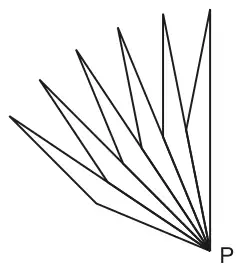
25 Taylor designs a logo using isosceles triangles joined at a central point, P.
This is the start of Taylor’s design.
Not to scale
The completed design will have rotational symmetry, order 60 about point P.
Each triangle has base, \(b\), and height, \(h\), measured in mm.
Not to scale
Calculate \(h\) when \(b = 40\) mm. Give your answer correct to 1 decimal place. [4]
Mark scheme
Answer
Marks
Part marks and guidance
2.1[0…] nfww
4
M1 for \(\dfrac{360}{60}\) oe soi by 6
AND
Method 1 using tan:
M2 for [\(h\) = ] 20 tan(their 6) oe
or
M1 for correct use of tan(their 6) oe
or Method 2 using sine rule:
M2 for [\(h\) = ] \(\dfrac{20\sin(\textit{their}\ 6)}{\sin(90 - \textit{their}\ 6)}\) or M1 for \(\dfrac{\sin(\textit{their}\ 6)}{h} = \dfrac{\sin(90 - \textit{their}\ 6)}{20}\) oe
or Method 3 using cos and Pythagoras:
M2 for \(\sqrt{\left(\dfrac{20}{\cos(\textit{their}\ 6)}\right)^2 - 20^2}\) or M1 for \(\left(\dfrac{20}{\cos(\textit{their}\ 6)}\right)^2 - 20^2\)
May be on diagram
In all methods, if their angle is not 6 then method must be seen, not implied by interim answers unless stated otherwise Accept any acute angle used for their 6
NBs \(\dfrac{\text{approx. circumference}}{60} = \dfrac{40\pi}{60} = 2.1\) scores 0 20sin6 = 2.1 scores M1 for 6 Solution from scale drawing scores a maximum of M1 if 6 seen
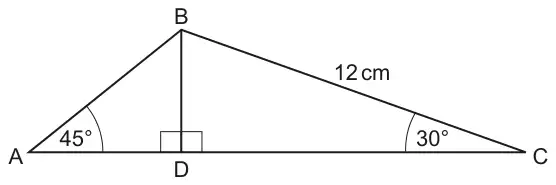
13 The diagram shows a triangle, ABC, with perpendicular height BD.
Not to scale
BC = 12 cm, angle BCD = 30° and angle BAD = 45°.
(a) Work out the length of BD. [3]
(b) Work out the exact length of AB. Give your answer in its simplest form. [3]
Mark scheme (a)
Answer
Marks
Part marks and guidance
6
3
M1 for sin 30 = \(\frac{BD}{12}\) oe B1 for sin 30 = 0.5 oe soi
Accept e.g. sin 30 = \(\frac{\sqrt{1}}{2}\) Do not allow B1 if contradicted
Mark scheme (b)
Answer
Marks
Part marks and guidance
\(6\sqrt{2}\) or \(\frac{12}{\sqrt{2}}\) cao
3
B2 for \(\sqrt{72}\) or better
OR M1 for \(\frac{their(a)}{\sin 45}\) [= \(AB\)] oe or 2(their (a))\(^2\) oe or \(\frac{12 \times \sin 30}{\sin 45}\) [= \(AB\)]
B1 for sin 45 = \(\frac{\sqrt{2}}{2}\) or \(\frac{1}{\sqrt{2}}\) oe soi
For M1, accept \(\frac{their(a)}{\cos 45}\) [= \(AB\)] oe For M1 , accept e.g. \(\frac{their(a) \times \sin 90}{\sin 45}\) [= \(AB\)] M1 implied by e.g. 72
For B1 accept cos 45 = \(\frac{\sqrt{2}}{2}\) or \(\frac{1}{\sqrt{2}}\) oe Do not allow B1 if contradicted
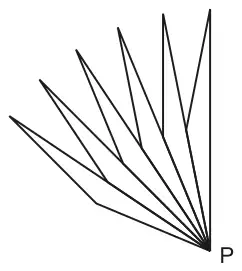
8 Taylor designs a logo using isosceles triangles joined at a central point, P.
This is the start of Taylor’s design.
Not to scale
The completed design will have rotational symmetry, order 60 about point P.
Each triangle has base, \(b\), and height, \(h\), measured in mm.
Not to scale
Calculate \(h\) when \(b = 40\) mm. Give your answer correct to 1 decimal place. [4]
Mark scheme
Answer
Marks
Part marks and guidance
2.1[0…] nfww
4
M1 for \(\frac{360}{60}\) oe soi by 6
AND
Method 1 using tan:
M2 for [\(h\) = ] 20 tan(their 6) oe
or
M1 for correct use of tan(their 6) oe
or Method 2 using sine rule:
M2 for [\(h\) = ] \(\frac{20 \sin(their\ 6)}{\sin(90 - their\ 6)}\) or M1 for \(\frac{\sin(their\ 6)}{h} = \frac{\sin(90 - their\ 6)}{20}\) oe
or Method 3 using cos and Pythagoras:
M2 for \(\sqrt{\left(\frac{20}{\cos(their\ 6)}\right)^2 - 20^2}\) or M1 for \(\left(\frac{20}{\cos(their\ 6)}\right)^2 - 20^2\)
May be on diagram
In all methods, if their angle is not 6 then method must be seen, not implied by interim answers unless stated otherwise Accept any acute angle used for their 6
eg [\(h\) = ] \(\frac{20}{\tan(90 - their\ 6)}\)
eg tan(their 6) = \(\frac{h}{20}\)
NBs \(\frac{\text{approx. circumference}}{60} = \frac{40\pi}{60}\) = 2.1 scores 0 20sin6 = 2.1 scores M1 for 6 Solution from scale drawing scores a maximum of M1 if 6 seen
Calculate the length of BC. You must show your working.
.................... cm [5]
Mark scheme
Answer
Marks
Part marks and guidance
17 or 17.2 to 17.3 with correct working
5
M4 for \((\sin 27 \times 19) \times 2\) or \((\cos 63 \times 19) \times 2\) or M3 for \(\sin 27 \times 19\) or \(\cos 63 \times 19\) or M2 for \(\sin 27 = \dfrac{x}{19}\) oe or \(\cos 63 = \dfrac{x}{19}\) oe or B1 for 27 as angle
If 0 or 1 scored, instead award SC2 for 17.2 to 17.3 with no or insufficient working If 0 scored, instead award SC1 for 8.6 or 8.62 to 8.63 or 17 with no or insufficient working
“Correct working” requires evidence of at least M2
B2FT for final answer \(12\sqrt{3}\), 8, \(8\sqrt{3}\) or 6 if consistent with their (a) or M1 for \(24 \times \dfrac{1}{2}\) or \(24 \times\) their (a)
For 1 or 2 marks, isw attempts to simplify the surds
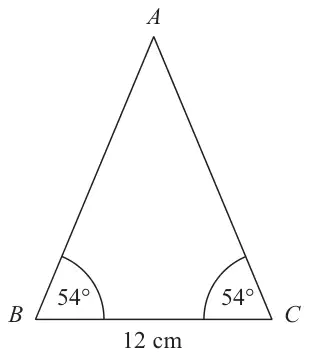
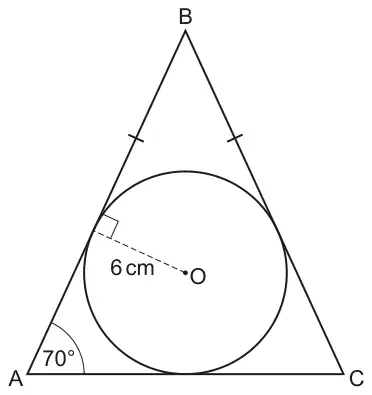
19 ABC is an isosceles triangle. The sides of the triangle ABC are all tangents to a circle of radius 6 cm, centre O.
Not to scale
Angle BAC = 70° and BA = BC.
(a) Show that length BO is 17.54 cm, correct to 2 decimal places. [4]
(b) Find the area of triangle ABC. You must show your working. [5]
Mark scheme (a)
Answer
Marks
Part marks and guidance
complete correct argument e.g.
accept any correct method not using 17.54
angle ABC = 40°
B1
could be on diagram and also accept ABO = 20°, BO’T’ = 70°
[BO = ] e.g. \(\dfrac{6}{\sin 20}\)
M2
M1 for e.g \(\sin 20 = \dfrac{6}{[BO]}\)
i.e BO as subject for M2 and condone sine rule with sin 90° for M2
17.542… or 17.543
A1dep
dep. on at least M1
Mark scheme (b)
Answer
Marks
Part marks and guidance
202 or 201.5 to 201.8 with correct working
5
Accept any correct method e.g. M1 for [height=] 17.54 + 6 or 23.54… M2 for [half base =] \(\dfrac{6}{\tan 35}\) or \(\dfrac{23.54}{\tan 70}\) or M1 for \(\tan 35 = \dfrac{6}{\textit{half base}}\) or \(\tan 70 = \dfrac{23.54}{\textit{half base}}\)
“Correct working” requires evidence of at least M2 or M1M1 Condone use of 8.6 leading to an answer of 202.4… M2 implied by e.g. 8.56 to 8.57 or 17.1 to 17.2
M1 for \(\frac{1}{2}\) × their base × their height oe If 0 scored SC2 for 202 or 201.6 to 201.8 with no working or SC1 for 8.56 to 8.57 or 17.1 to 17.2 with no working
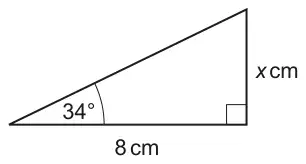
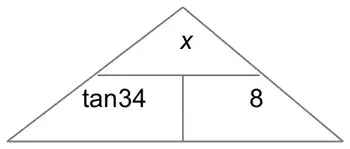
Use trigonometry to work out the value of \(x\). [3]
Mark scheme
Answer
Marks
Part marks and guidance
5.39[6...] or 5.4[0]
3
M2 for \(8 \times \tan 34\) or any complete correct method or M1 for \(\tan 34 = \dfrac{x}{8}\)
e.g. \(\dfrac{8}{\tan(90 - 34)}\)
e.g. \(\tan(90 - 34) = \dfrac{8}{x}\) See appendix
Appendix
Exemplar responses for Q18
Response
Mark
For longest method M1 is for step before explicit calculation for answer \(\cos 34 = \dfrac{8}{y}\) so \(y = \dfrac{8}{\cos 34}\) so \(x^2 = \left(\dfrac{8}{\cos 34}\right)^2 - 8^2\) (corrected from the printed mark scheme, which shows \(\left(\dfrac{y}{\cos 34}\right)^2 - 8^2\))
M1
For longest method M2 is for explicit calculation for answer \(\cos 34 = \dfrac{8}{y}\) so \(y = \dfrac{8}{\cos 34}\) so \(x = \sqrt{\left(\dfrac{8}{\cos 34}\right)^2 - 8^2}\)
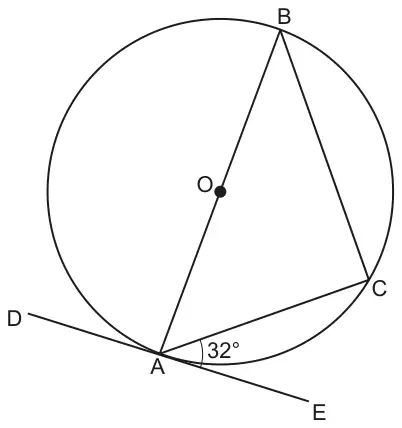
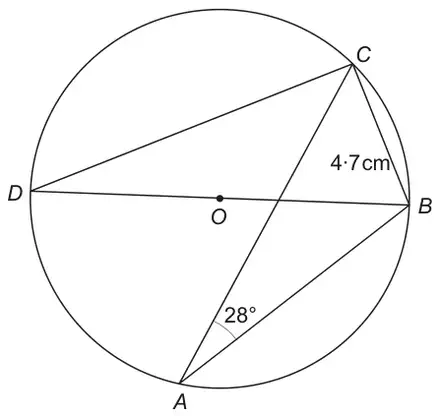
Points A, B and C lie on the circumference of the circle. Line AOB is a diameter. Line DAE is a tangent to the circle. Angle CAE = 32°.
Not to scale
(a) Give a reason why angle ACB is a right angle. [1]
(b) The radius of the circle is 8 cm.
Calculate length BC. [4]
Mark scheme (a)
Answer
Marks
Part marks and guidance
[angle in a] semi-circle oe
1
Accept other reasoning if fully justified
Mark scheme (b)
Answer
Marks
Part marks and guidance
13.5 to 13.6
4
B1 for angle BAC = 58° or angle ABC = 32°
M2 for 16sin(their 58) or 16cos(their 32) or M1 for \(\sin(\textit{their}\ 58) = \frac{BC}{\textit{their}\ 16}\) or \(\cos(\textit{their}\ 32) = \frac{BC}{\textit{their}\ 16}\) or better
If 0 or B1 scored then instead award SC2 for 6.7 to 6.8 as final answer
Grads or rads: If 0, 1 or 2 scored then instead award SC3 for 15.8[8…] to 15.9 or 12.6[4…] as final answer or If 0 scored award SC1 for 7.9[4…] or 6.3[2…]
May be seen on diagram or implied by use of sin58 or cos32
Only award M marks if their angle and trig ratio are consistent ie do not accept 16sin32 unless angle BAC previously seen as 32.
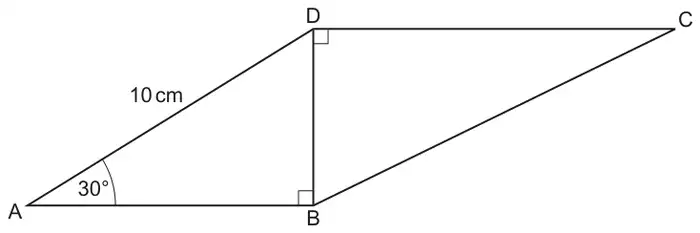
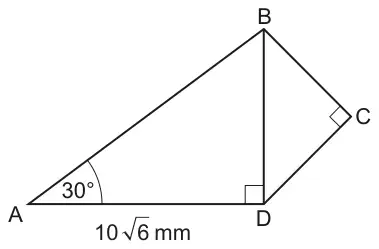
(b) ADB and BCD are right-angled triangles. BC = CD. AD = \(10\sqrt{6}\) mm. Angle BAD = 30°.
\(\tan 30^\circ = \dfrac{1}{\sqrt{3}}\)
Not to scale
Work out the length of BC. [6]
Mark scheme (a)
Answer
Marks
Part marks and guidance
\(\frac{1}{\sqrt{2}}\) or \(\frac{\sqrt{2}}{2}\) final answer
1
Mark scheme (b)
Answer
Marks
Part marks and guidance
10 nfww
6
B3 for BD = \(10\sqrt{2}\) oe or M2 for \(10\sqrt{6} \times \tan 30\) oe or M1 for \(\frac{BD}{10\sqrt{6}} = \tan 30\) oe AND M2 for BC = \(\sqrt{\frac{\textit{their}\ BD^2}{2}}\) oe or their BD × their sin 45 oe or M1 for BC2 + CD2 = (their BD)2 or for \(\frac{BC}{\textit{their}\ BD} = \textit{their}\ \sin 45\)
Allow use of other variables for BC and CD (possibly different)
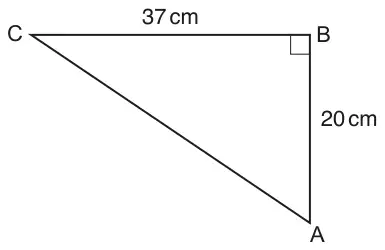
5 ABC is a right-angled triangle. AB = 20 cm and BC = 37 cm.
Not to scale
Calculate angle BAC. [3]
Mark scheme
Answer
Marks
Part marks and guidance
Answer which rounds to 61.6 nfww
3
M2 for \(\tan^{-1}\left(\dfrac{37}{20}\right)\) oe or M1 for tan[x =] \(\dfrac{37}{20}\) oe
If M0 scored then SC1 for answers 28.4, 28 or angles that round to 28.4 if correct working seen.
Condone answer of 62 only if correct working seen Answers of 68.5 or 68.4(5..) [grads] or 1.08 or 1.07(5..) [rads] imply M2
Alternative method After correct method for Pythagoras soi by 42.0 to 42.1 M2 for \(\sin^{-1}\left(\dfrac{37}{\textit{their}\sqrt{20^2 + 37^2}}\right)\) or \(\cos^{-1}\left(\dfrac{20}{\textit{their}\sqrt{20^2 + 37^2}}\right)\) or M1 for sin[x =] \(\dfrac{37}{\textit{their}\sqrt{20^2 + 37^2}}\) or cos[x =] \(\dfrac{20}{\textit{their}\sqrt{20^2 + 37^2}}\) or M0 for just Pythagoras reaching AC = 42.0 to 42.1 Do not condone answer of 62 following an interim answer seen that does not round to 61.6 0 for scale drawing
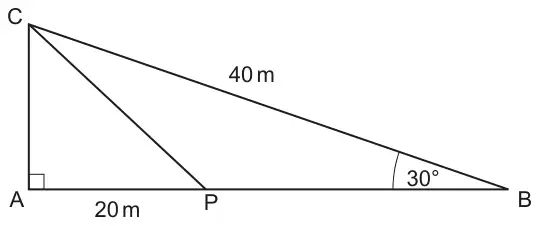
13 In the diagram, ABC is a right-angled triangle. P is a point on AB. BC = 40 m, AP = 20 m and angle ABC = 30°.
Not to scale
(a) Show that AC = 20 m. [3]
(b) Find the length of PB. Give your answer in the form \(a(\sqrt{3} - b)\), where \(a\) and \(b\) are integers. [5]
Mark scheme (a)
Answer
Marks
Part marks and guidance
AC = 40sin30
M2
M1 for \(\dfrac{\text{AC}}{40} = \sin 30\) oe
20 and evidence that sin 30 = 0.5
A1
If 0 scored, B1 for sin 30 = 0.5 oe
Mark scheme (b)
Answer
Marks
Part marks and guidance
\(20(\sqrt{3} - 1)\)
5
B4 for \(20\sqrt{3} - 20\) or \(\sqrt{1200} - 20\) or B3 for \(\sqrt{1200}\) or \(\dfrac{40\sqrt{3}}{2}\) or M2 for 40cos30 oe or M1 for \(\cos 30 = \dfrac{\text{AB}}{40}\) oe
Other methods are possible e.g. Pythag e.g. M2 for [AB =] \(\sqrt{40^2 - 20^2}\) e.g. M1 for AB² + 20² = 40²
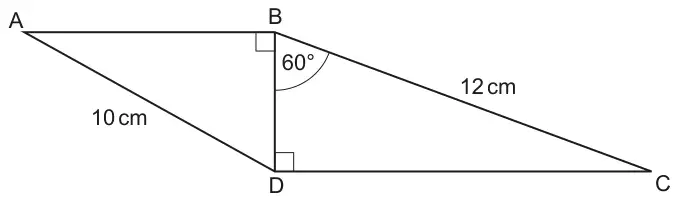
11 The diagram shows two right-angled triangles ABD and BCD, sharing a common side BD. AD = 10 cm, BC = 12 cm and angle DBC = 60°.
Not to scale
Work out the length of AB. [6]
Mark scheme
Answer
Marks
Part marks and guidance
8 nfww
6
nfww - must check method before giving 6 marks must not come from wrong working
B1 for cos 60 = 0.5 oe soi M1 for \(\dfrac{\text{BD}}{12} = \cos 60\) oe A1 for [BD =] 6 AND M2 for \(\sqrt{10^2 - \textit{their}\text{ BD}^2}\) or M1 for their \(\text{BD}^2 + \text{AB}^2 = 10^2\) oe or for \(10^2 -\) their \(\text{BD}^2\)
e.g. sin 30 = 0.5 e.g. \(\dfrac{\text{BD}}{12} = \sin 30\)
For M2 or M1 0 < their BD < 10 and BD must be identified first on diagram or in working
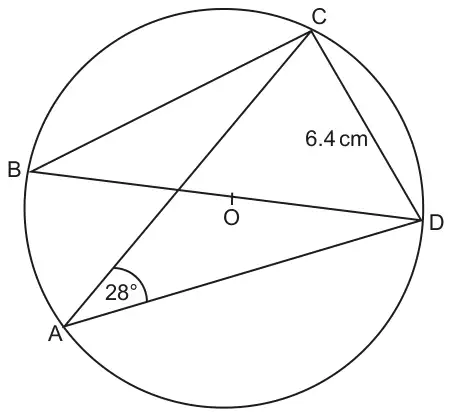
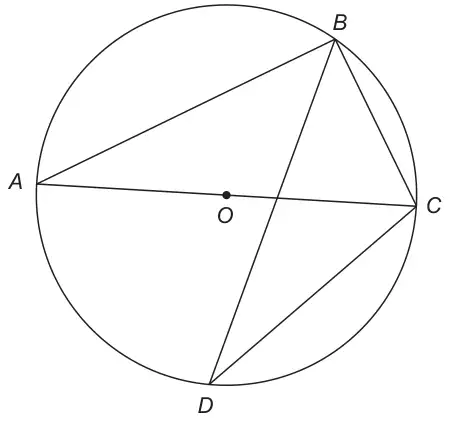
8 A, B, C and D are points on the circumference of a circle, centre O.
Not to scale
Angle CAD = 28° and CD = 6.4 cm. BD is a diameter of the circle.
Calculate the area of the circle. [5]
Mark scheme
Answer
Marks
Part marks and guidance
145.2 to 146.2
5
B1 for angle CBD = 28 soi or for angle BCD = 90 soi and M2 for \(\dfrac{6.4}{\sin 28}\) oe or 13.6[3…] nfww or M1 for \(\sin [28] = \dfrac{6.4}{[..]}\) oe and M1 for \(\pi \times (\textit{their}\text{ radius})^2\)
B1 implied by e.g. 28 or 62 correctly used in trigonometry or 28, 62 or 90 (or symbol) marked in the correct place in the diagram
13.6… can imply B1 however if it is marked on the wrong side, e.g. on AC, then it scores 0 marks
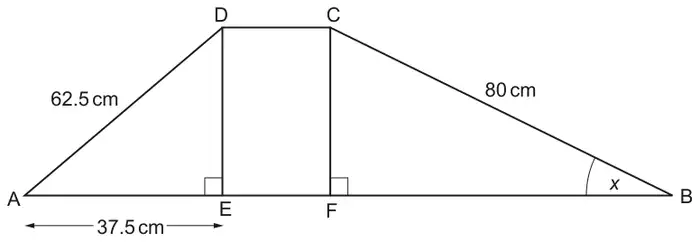
B3 for 50 for DE or CF nfww Or M1 for \(62.5^2 - 37.5^2\) M1 for \(\sqrt{62.5^2 \pm 37.5^2}\)
And
B3 FT for \(\sin^{-1}\left(\dfrac{\textit{their } 50}{80}\right)\) correctly evaluated or M2 FT for \(\sin^{-1}\left(\dfrac{\textit{their } 50}{80}\right)\) or M1 FT for \(\sin\) [\(x\)] = \(\dfrac{\textit{their } 50}{80}\)
Allow 39
May be in correct place on diagram 2500 implies M1
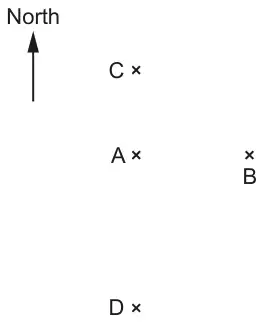
B is 25 kilometres due East of A. C is 25 kilometres due North of A. D is 45 kilometres due South of A.
Not to scale
(a) Work out the bearing of B from C. [2]
(b) Calculate the bearing of D from B. [4]
Mark scheme (a)
Answer
Marks
Part marks and guidance
135
2
B1 for angle 45
e.g 45 marked at ACB or ABC or 180 – 45 or 90 + 45
Mark scheme (b)
Answer
Marks
Part marks and guidance
209 to 209.1
4
M2 for \(\tan^{-1}(45 \div 25)\) or \(\tan^{-1}(25 \div 45)\) soi by 61, 60.94 to 60.95 or 29[.1], 29.05...
or
M1 for \(\tan\) [=] \(45 \div 25\) or \(\tan\) [=] \(25 \div 45\)
AND
M1 for 270 – their angleABD or 180 + their angleADB
Accept longer methods but they must get to the equivalent point to gain credit e.g. if they find the hypotenuse, they score M0 until they start to use sin or cos.
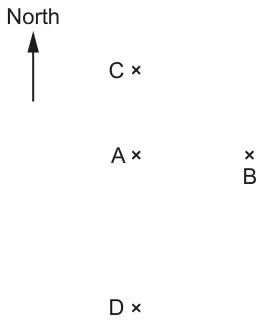
B is 25 kilometres due East of A. C is 25 kilometres due North of A. D is 45 kilometres due South of A.
Not to scale
(a) Work out the bearing of B from C. [2]
(b) Calculate the bearing of D from B. [4]
Mark scheme (a)
Answer
Marks
Part marks and guidance
135
2
B1 for angle 45
e.g. 45 marked at ACB or ABC, 180 – 45, 90 + 45
Mark scheme (b)
Answer
Marks
Part marks and guidance
209 to 209.1
4
M2 for \(\tan^{-1}(45 \div 25)\) or \(\tan^{-1}(25 \div 45)\) soi by 61, 60.94 to 60.95 or 29[.1], 29.05...
or
M1 for tan [=] 45÷25 or tan [=] 25÷45
Accept longer methods but they must get to the equivalent point to gain credit e.g. if they find the hypotenuse, they score M0 until they start to use sin or cos.
Can be implied by their answer
AND
M1 for 270 – their angleABD or 180 + their angleADB
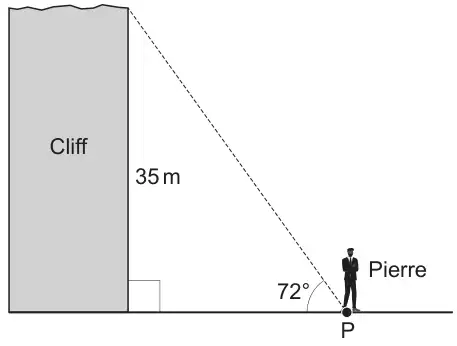
12. The diagram below shows a vertical cliff which is 35 metres high. Pierre is standing at point P. From point P, the angle of elevation to the top of the cliff is 72°.
Diagram not drawn to scale
Pierre sees this warning sign.
Warning! Coastal Erosion. It is not safe to stand within 10 m of the base of the cliff.
Is Pierre standing a safe distance from the base of the cliff? [4]
Yes ☐ No ☐
Show how you decide.
Mark scheme
Scheme
Marks
Comments
\(\dfrac{35}{\tan(72)}\) or \(35\tan(90 - 72)\) or \(\dfrac{35\sin(90-72)}{\sin(72)}\)
or \(\sqrt{\left(\dfrac{35}{\sin(72)}\right)^2 - 35^2}\) or \(\sqrt{(36.8..)^2 - 35^2}\)
M2
Allow an alternative full method
M1 for \(\tan(72) = \dfrac{35}{dist}\) or \(\tan(90-72) = \dfrac{dist}{35}\) or \(\dfrac{dist}{\sin(90-72)} = \dfrac{35}{\sin(72)}\) oe
or \((36.8..)^2 - 35^2\)
11.3(7…) or 11.4 (m) AND Yes, indicated or implied.
A2
A1 for one of the following
11.3(7…) or 11.4 (m) and no decision or incorrect decision
a correct decision FT their incorrect answer from M2
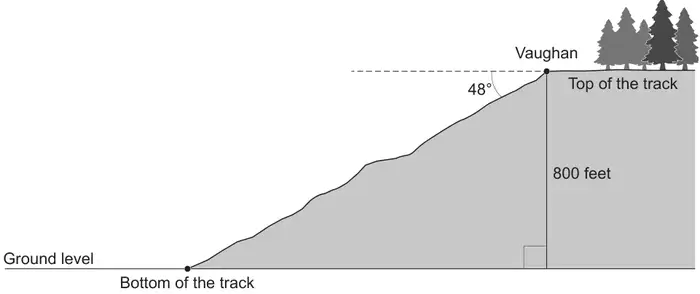
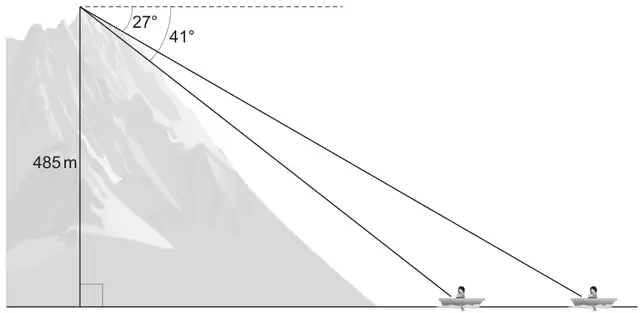
25. Vaughan cycles down a track from the top of a mountain to the bottom. The track goes down at an angle of 48° to the horizontal. Vaughan is 800 feet above ground level.
Diagram not drawn to scale
(a)
Vaughan cycles from the top of the track to the bottom of the track. What distance has he cycled? [4]
(b)
(i) State an assumption you have made in answering part (a). [1]
(ii) If your assumption is not correct, what effect would this have on your answer to part (a)? [1]
Mark scheme (a)
Scheme
Marks
Comments
Use of trigonometry in a right-angled triangle with an angle of 48(°) or 42(°) and a side of 800 (feet)
S1
Trig ratio used may not be correct at this stage.
\((h=)\ \dfrac{800}{\cos(42)}\) or \((h=)\ \dfrac{800}{\sin(48)}\)
M2
Or equivalent full method. M1 for \(\cos(42)=\dfrac{800}{h}\) or \(\sin(48)=\dfrac{800}{h}\)
(\(h\) = ) 1076(.5….) or 1077 (feet)
A1
Allow 1076 from correct working
Corrected by Westie's Workshop
The board's mark scheme printed “800 (m)”. Changed to “800 (feet)” because the question gives the height as 800 feet, not metres.
Original: see the board's mark scheme PDF (link above).
Mark scheme (b)
Scheme
Marks
Comments
(i) A correct assumption e.g.
‘The (surface of) the slope is smooth (and he cycles the shortest distance).’
E1
Allow e.g. ‘He rode in a straight line.’ ‘It was a straight line.’ ‘The track wasn’t bumpy.’ ‘He cycled straight from the top to the bottom.’ ‘He didn’t do any jumps.’ ‘There are no obstructions.’ ‘The surface is flat.’ ‘He cycled the shortest distance.’ ‘That it was 48° the whole way down’. ‘That it is a right-angled triangle’. ‘The track is level’ (assume they mean not bumpy) Do not allow: ‘That it was 48°’
(ii) A correct effect of assumption e.g.
‘If the surface of the slope is not smooth then Vaughan will have cycled further than the calculated value in (a).’
E1
If no valid assumption is made, then this mark cannot be awarded. Cannot award E0 E1.
Allow e.g. ‘He cycled further.’ ‘The answer would be bigger.’
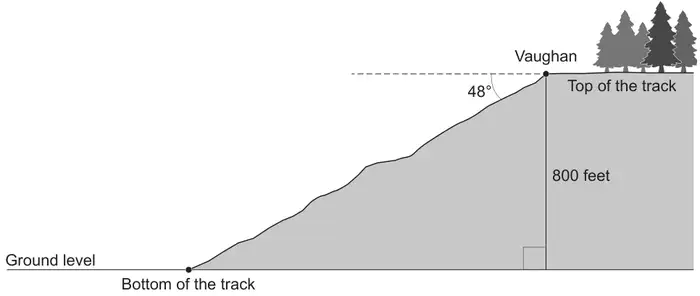
7. Vaughan cycles down a track from the top of a mountain to the bottom. The track goes down at an angle of 48° to the horizontal. Vaughan is 800 feet above ground level.
Diagram not drawn to scale
(a) Vaughan cycles from the top of the track to the bottom of the track. What distance has he cycled? [4]
(b)
(i) State an assumption you have made in answering part (a). [1]
(ii) If your assumption is not correct, what effect would this have on your answer to part (a)? [1]
Mark scheme (a)
Scheme
Marks
Comments
Use of trigonometry in a right-angled triangle with an angle of 48(°) or 42(°) and a side of 800 (feet)
S1
Trig ratio used may not be correct at this stage.
\((h =)\ \dfrac{800}{\cos(42)}\) or \((h =)\ \dfrac{800}{\sin(48)}\)
M2
Or alternative full method M1 for \(\cos(42) = \dfrac{800}{h}\) or \(\sin(48) = \dfrac{800}{h}\)
(h = ) 1076(.5….) or 1077 (feet)
A1
Allow 1076 (feet) from correct working
Corrected by Westie's Workshop
The board's mark scheme printed “800 (m)”. Changed to “800 (feet)” because the question gives the height as 800 feet, not metres.
Original: see the board's mark scheme PDF (link above).
Mark scheme (b)
Scheme
Marks
Comments
(b)(i) A correct assumption e.g.
‘The (surface of) the slope is smooth (and he cycles the shortest distance).’
E1
Allow e.g. ‘He rode in a straight line.’ ‘It was a straight line.’ ‘The track wasn’t bumpy.’ ‘He cycled straight from the top to the bottom.’ ‘He didn’t do any jumps.’ ‘There are no obstructions.’ ‘The surface is flat.’ ‘He cycled the shortest distance.’ ‘That it was 48° the whole way down’. ‘That it is a right-angled triangle’ ‘The track is level’ (assume they mean not bumpy) Do not allow: ‘That it was 48°’
(b)(ii) A correct effect of assumption e.g.
‘If the surface of the slope is not smooth then Vaughan will have cycled further than the calculated value in (a).’
E1
If no valid assumption is made, then this mark cannot be awarded. Cannot award E0 E1.
Allow e.g. ‘He cycled further.’ ‘The answer would be bigger.’
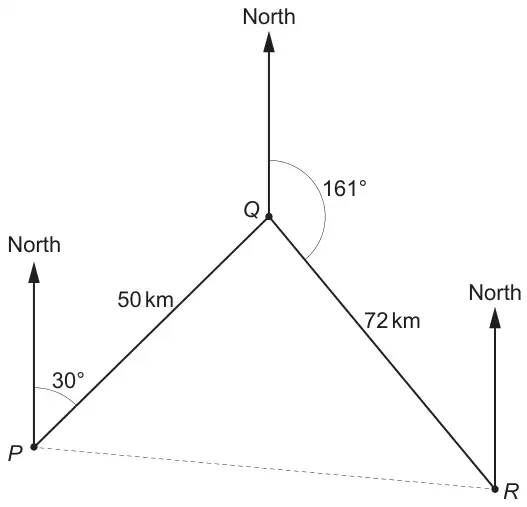
20. The diagram shows the journey of a small boat.
Diagram not drawn to scale
The boat sails from point \(P\) on a bearing of 030° for 50 km. When it reaches point \(Q\), it changes direction and travels to point \(R\) on a bearing of 161° for 72 km.
(a) Show that \(P\hat{Q}R = 49^\circ\). [1]
(b) The triangular area \(PQR\) is to be searched to locate a shipwreck. Calculate this area. [2]
(c) Calculate the bearing of \(P\) from \(R\). Give your answer correct to the nearest degree. [7]
Mark scheme (a)
Scheme
Marks
Comments
Correct justification e.g. 360 – 150 – 161 (= 49°) or 180 – 161 + 30 (= 49°)
B1
or equivalent; check diagram; NB method must be seen as answer is given Allow 30 + 19 (= 49)
M1 for \(50^2 = 54.4…^2 + 72^2 - 2(54.4…)(72)\cos PRQ\) or for \(\dfrac{\sin PRQ}{50} = \dfrac{\sin 49}{54.4…}\) soi; may be inverted or for \(72^2 = 54.4…^2 + 50^2 - 2(54.4…)(50)\cos QPR\) or for \(\dfrac{\sin QPR}{72} = \dfrac{\sin 49}{54.4…}\) soi; may be inverted
\(PRQ = 44^\circ\) or \(QPR = 87^\circ\)
A1
CAO; Accept 43.9(…) or 87.0(…)
Bearing is (360 – 44 – 19 = ) 297° or (180 + 30 + 87 = ) 297°
FT ‘their 1358’ and ‘their 54.4….’ for M2 or M1 M1 for \(\dfrac{1}{2} \times 54.4… \times 72 \times \sin QRP = 1358\) or for \(\dfrac{1}{2} \times 54.4… \times 50 \times \sin QPR = 1358\)
\(PRQ = 44^\circ\) or \(QPR = 87^\circ\)
A1
CAO; Accept 43.9(…) or 87.0(…)
Bearing is (360 – 44 – 19 = ) 297° or (180 + 30 + 87 = ) 297°
A1
FT ‘their derived 44’ or ‘their derived 87’
(10)
Corrected by Westie's Workshop
The board's mark scheme printed “\(2 \times 54.4… \times 72\)”. Changed to “\(2 \times 54.4… \times 50\)” because angle \(QPR\) is between the sides 54.4… km and 50 km, so the cosine rule uses \(2 \times 54.4… \times 50\). This gives the 87° in the mark scheme.
The board's mark scheme printed “\(2(54.4…)(72)\cos QPR\)”. Changed to “\(2(54.4…)(50)\cos QPR\)” because angle \(QPR\) is between the sides 54.4… km and 50 km, so the cosine rule uses \(2(54.4…)(50)\).
Original: see the board's mark scheme PDF (link above).
17. The diagram shows a circle with centre \(O\). Points \(A\), \(B\), \(C\) and \(D\) all lie on the circumference of the circle.
Diagram not drawn to scale
The radius of the circle is 3·6 cm, \(BC = 4{\cdot}1\) cm and \(B\hat{C}D = 93^\circ\).
Prove that \(D\hat{B}C = 52{\cdot}3^\circ\), correct to 3 significant figures. You must show all your working and give a reason for each stage of your proof.[4]
Mark scheme
Scheme
Marks
Comments
\(\sin B\hat{A}C = \dfrac{4.1}{2 \times 3.6}\)
M1
\(180 - 93 - \sin^{-1} 4.1/7.2\) or \(180 - 93 - 34.7(\ldots)\) or equivalent
m1
Convincing 52.3(°)
A1
States: Angle in a semi-circle AND angles in the same segment
E1
If no marks award SC1 for sight of \((\sin^{-1} 4.1/7.2 =)\) 34.7(....)
(4)
Notes
Alternatives:
using angles from the same chord and cos
finding BAC, then CAD = 87 – BAC (cyclic quadrilateral), DBC = CAD (angles on the same arc)
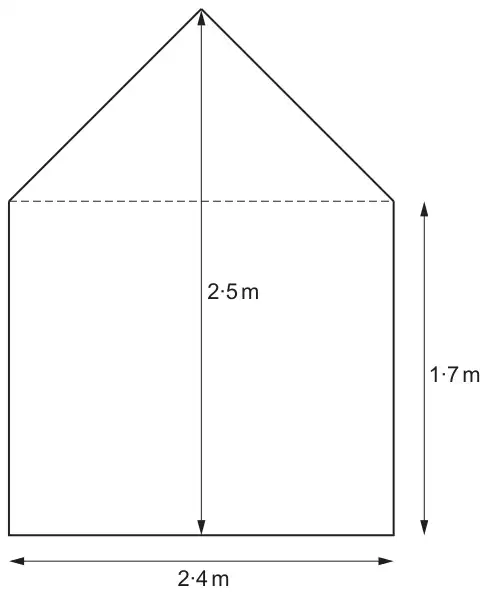
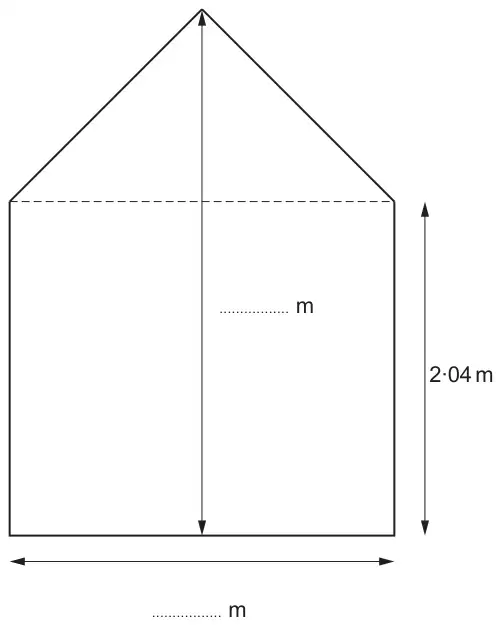
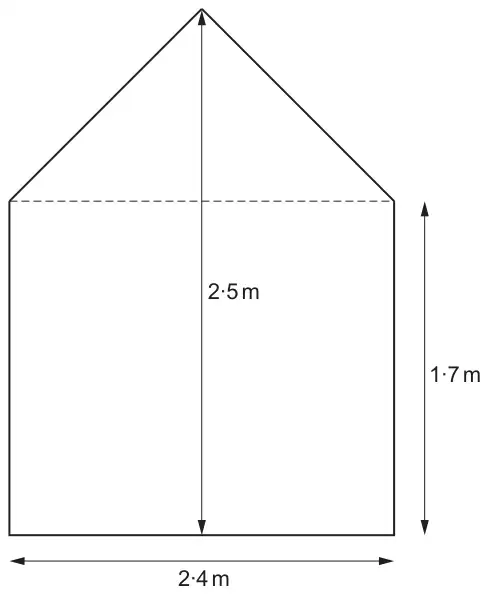
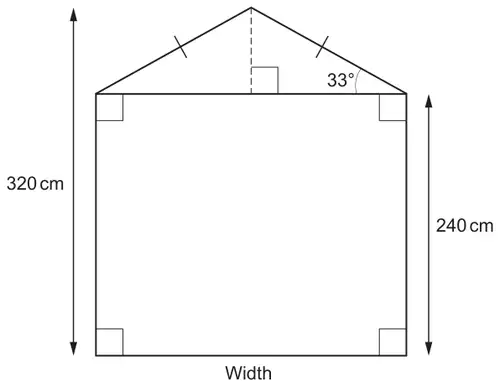
The walls of the shed are vertical. The shed stands on horizontal ground. The uniform cross-section has one line of symmetry.
The diagram below shows some of the measurements of the cross-section.
Diagram not drawn to scale
Calculate the size of the angle between the roof of the shed and the horizontal. [4]
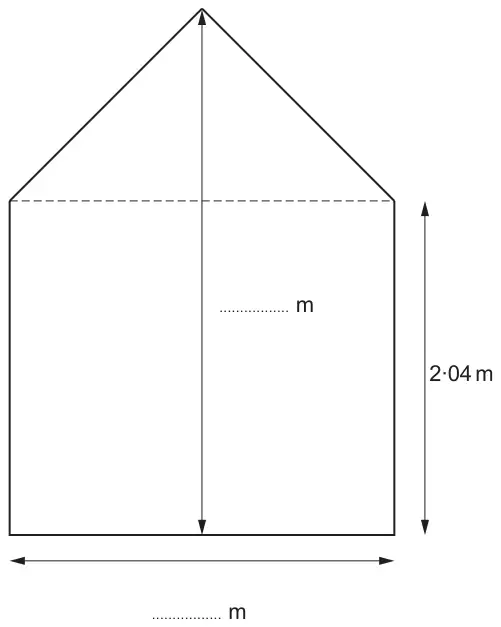
(b) Petra has a mathematically similar shed.
Diagram not drawn to scale
Calculate the two missing measurements on the diagram above. You must show all your working.[3]
Mark scheme (a)
Scheme
Marks
Comments
Sight of appropriate measurements 0.8 (m) and 1.2 (m)
B1
Full method to find the correct angle, e.g. \(\tan x = 0.8 / 1.2\)
M1
FT ‘their 2.5 – 1.7’ and ‘their 2.4 ÷ 2’
\((x =)\ \tan^{-1} 0.8/1.2\)
M1
33.69...(°) or 33.7(°) or 34(°)
A1
If M0, A0 then award SC1 for an answer of 56(.3°) (or equivalent unrounded irrespective of any labelling on the diagram)
Corrected by Westie's Workshop
The board's mark scheme printed “(or equivalent unrounded irrespective of any labelling on the diagram”. Changed to “(or equivalent unrounded irrespective of any labelling on the diagram)” because a closing bracket was missing.
Original: see the board's mark scheme PDF (link above).
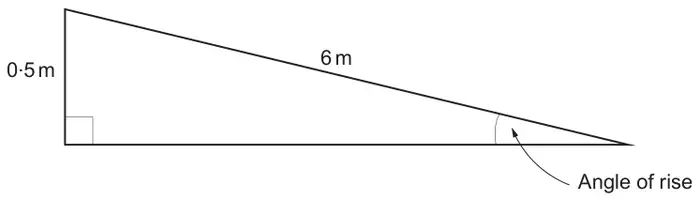
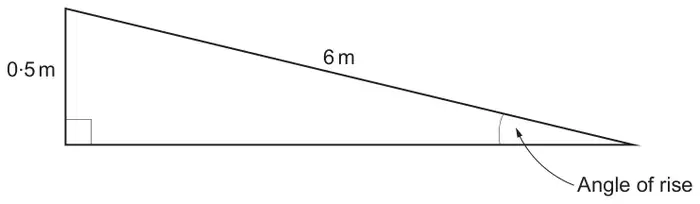
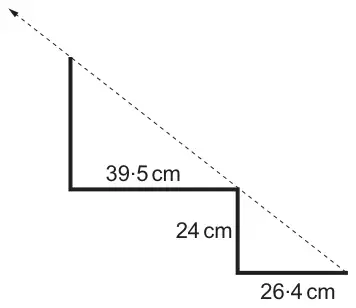
13. Eleri goes on holiday to visit historic gardens in Italy. In many of the gardens she notices irregular staircases. Each staircase has horizontal steps and vertical rises.
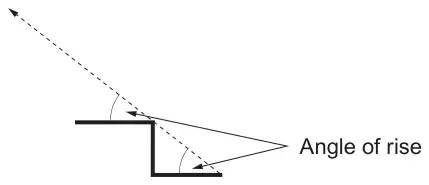
The angle of rise is measured from the horizontal upwards.
(a) The bottom step on a staircase is 26·4 cm wide with a vertical rise of 24 cm. The second step in this staircase is 39·5 cm wide and has the same angle of rise.
Diagram not drawn to scale
(i) Calculate the angle of rise. [2]
(ii) Hence use trigonometry to calculate the vertical rise of the second step in centimetres. Give your answer correct to 2 significant figures. You must show all your working. [2]
(b) Look again at the diagram and your method of using trigonometry, in part (a).
Show how the vertical rise of the second step could be calculated without the use of trigonometry. You must show all your working. (A scale drawing is not acceptable, as you are asked to calculate.)
Evaluate which was the most efficient method of calculating the vertical rise of the second step. [3]
Mark scheme (a)
Scheme
Marks
Comments
(i) \(\tan \text{rise} = 24/26.4\) or angle of rise \(= \tan^{-1} 24/26.4\)
M1
Trigonometry must be used in (a)
\(42(.27\ldots^\circ)\)
A1
(ii) \(\tan 42(.27\ldots^\circ) = 2^{\text{nd}}\text{ rise}/39.5\) or \(2^{\text{nd}}\text{ rise} = 39.5 \times \tan 42(.27\ldots^\circ)\)
M1
FT ‘their angle of rise’ provided M1 previously awarded
(\(2^{\text{nd}}\) rise =) 36 (cm)
A1
Must be 2 sig. figs. Do not accept an unsupported answer of 36 (cm), trigonometry must be seen
Mark scheme (b)
Scheme
Marks
Comments
\(2^{\text{nd}}\text{ rise}/39.5 = 24/26.4\) or \(2^{\text{nd}}\text{ rise} = 39.5 \times 24/26.4\) or \(2^{\text{nd}}\text{ rise} = 39.5 \times 0.9(090\ldots)\) or \(2^{\text{nd}}\text{ rise} = 39.5 \div 1.1\) or equivalent
M1
Must show ratio or similar triangle working, not the use of ‘tan’ Accept use of scale factor method
35.9(... cm) or 36 (cm) AND an evaluation, e.g. ‘similar triangles as fewer stages’, ‘non trigonometry method as few stages, so less chance of making a mistake’
A2
MUST FT from working A1 for 36 (cm) or 35.9(...cm) OR for an evaluation
FT from M1 for the correctly evaluated square root of ‘their 96.05’ provided ‘their answer’ > 8.6 (cm)
Mark scheme (b)
Scheme
Marks
Comments
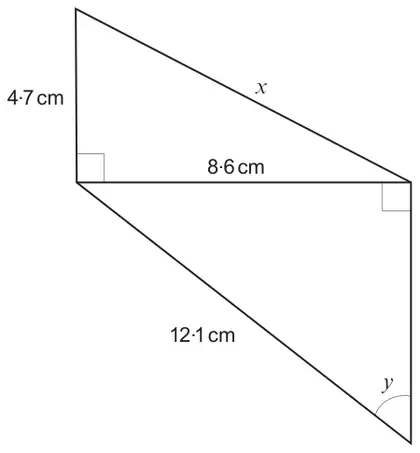
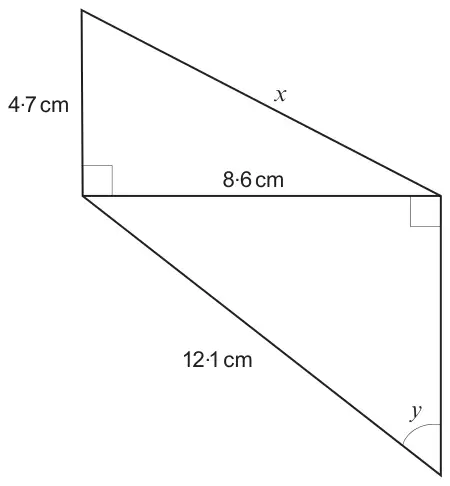
\((y=)\ \sin^{-1}8.6/12.1\) or \(\sin^{-1}0.7107..\)
M2
M1 for \(\sin y = 8.6/12.1\)
\(45(.295\ldots^\circ)\) or \(45.3(^\circ)\)
A1
ISW, i.e. do not accept \(45.2(^\circ)\) unless at least \(45.29(5\ldots^\circ)\) seen previously Do not accept \(45^\circ\) without further explanation
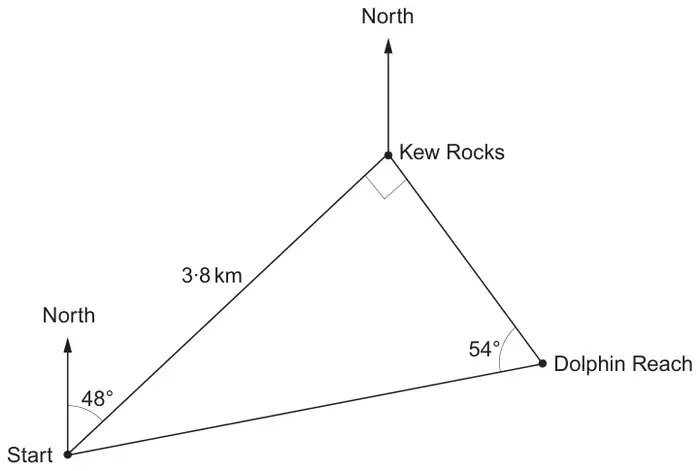
11. A yacht set sail, at the start of its journey, on a bearing of 048°. It sailed on this bearing for 3·8 km to Kew Rocks. At Kew Rocks the yacht changed course and sailed to Dolphin Reach.
A triangle representing the yacht’s journey is shown below. Some angles are given.
Diagram not drawn to scale
(a) Find the bearing on which the yacht sailed from Kew Rocks to Dolphin Reach. [2]
(b) Calculate the distance the yacht would need to travel to go directly from Dolphin Reach back to the start. Give your answer correct to 2 significant figures. [4]
Mark scheme (a)
Scheme
Marks
Comments
138(°)
B2
B1 for sight of an appropriate 48(°) and 42(°), or for 180(°) – 42(°) or 132(°) or 360(°) – 90(°) – 132(°)
Mark scheme (b)
Scheme
Marks
Comments
Start to Dolphin Reach \(= \dfrac{3.8}{\sin 54^\circ}\)
M2
M1 for \(\sin 54^\circ = 3.8/\text{distance}\)
4.7 (km)
A2
A1 for 4.697…(km) rounded or truncated (other than to 2 s.f. as required)
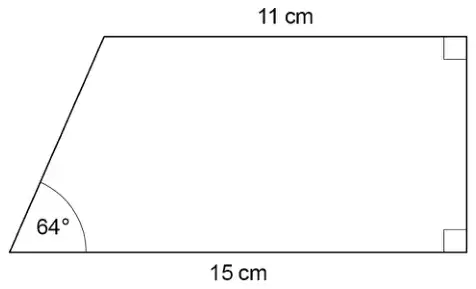
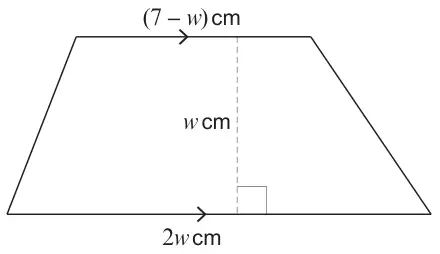
(a) The area of the trapezium shown below is 15 cm2.
Diagram not drawn to scale
(i) Claire is trying to find a value for \(w\) to calculate the lengths of the parallel sides. She has started her work by using the formula for the area of the trapezium.
Claire then plans to
collect like terms within the brackets, and
multiply by 2 throughout.
Complete the next step in Claire’s work in the box below. [1]
Area of the trapezium: \(\dfrac{w \times (7 - w + 2w)}{2} = 15\)
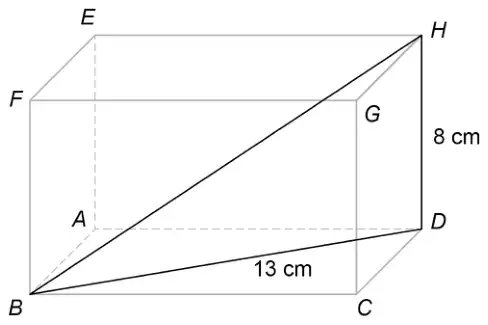
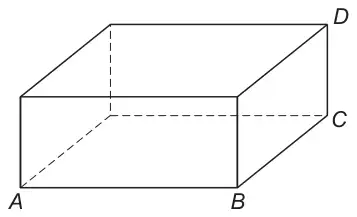
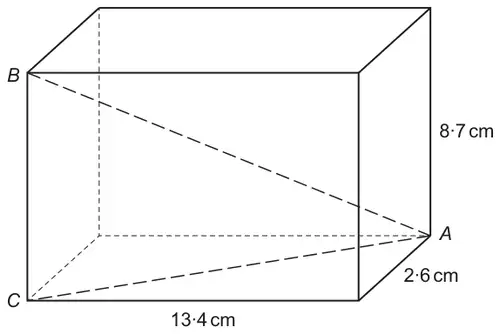
The diagram shows a cuboid. \(A\), \(B\) and \(C\) are all vertices of the cuboid. Calculate the size of \(C\hat{A}B\). Give your answer correct to 3 significant figures. [5]
Mark scheme
Scheme
Marks
Comments
(\(AC^2 =\)) \(2.6^2 + 13.4^2\) OR (\(AC =\)) \(\sqrt{186.32}\) or \(AC^2 = 186.32\)
M1
\(AC = 13.6499\ldots\) (cm)
A1
Accept rounded or truncated May be implied in further calculation
\(\tan A = 8.7/13.6499\ldots\ (=0.637\ldots)\)
M1
FT ‘their derived \(AC\)’ provided M1 previously awarded
\(A = 32.5\)(°)
A2
CAO A1 for \(\tan^{-1}0.637\ldots\) or FT angle correct but not given to 3 sig. figs.
(5)
Alternative
Scheme
Marks
\(AB^2 = 2.6^2 + 13.4^2 + 8.7^2\ (=262.01)\)
M1
\(AB = 16.186\ldots\) (cm)
A1
\(\sin A = 8.7/16.186\ldots\ (=0.537\ldots)\) FT ‘their derived \(AB\)’ provided M1 previously awarded
M1
\(A = 32.5\)(°) CAO with FT and A1 as above
A2
Alternative
Scheme
Marks
\(AB^2 = 2.6^2 + 13.4^2 + 8.7^2\ (=262.01)\)
M1
\(AB = 16.186\ldots\) (cm)
A1
\(\cos A = 13.6499\ldots/16.186\ldots\) \((=0.843\ldots)\) FT ‘their derived \(AB\)’ provided M1 previously awarded and attempt (\(AC^2 =\)) \(2.6^2 + 13.4^2\)
M1
\(A = 32.5\)(°) CAO with FT and A1 as above
A2
Corrected by Westie's Workshop
The board's mark scheme printed “(=0.537…)”. Changed to “(=0.843…)” because 13.6499… ÷ 16.186… = 0.843…; the value 0.537… belongs to the sine method above it.
Original: see the board's mark scheme PDF (link above).
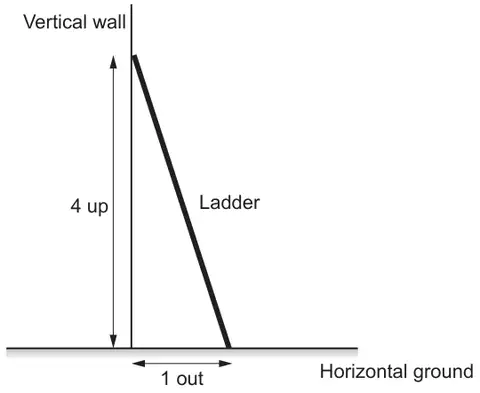
11. A builder wants to put a ladder safely against a wall. The builder should follow the ‘4 up, 1 out’ rule. This means that, for every 4 units of height up the wall that the top of the ladder reaches, the base of the ladder should be 1 unit away from the wall.
The diagram below shows a ladder placed safely against a vertical wall.
Diagram not drawn to scale
Calculate the angle between the horizontal ground and the ladder. [3]
Mark scheme
Scheme
Mark
Comments
(Angle between the ground and the ladder =) \(\tan^{-1}\) 4(/1)
M2
Allow an alternative full method M1 tan (angle between ground and ladder) = 4 (/1)
75.96(...°) or 76(°)
A1
ISW Allow 75(°) or 75.9(°) provided not from incorrect working
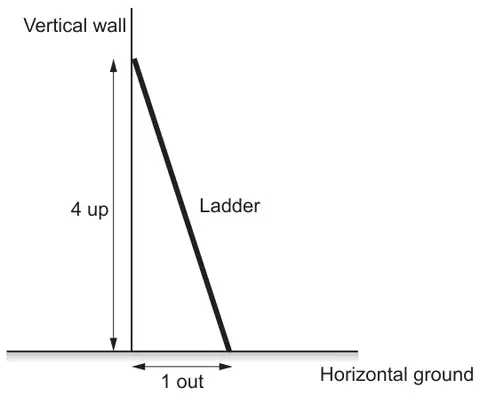
6. A builder wants to put a ladder safely against a wall. The builder should follow the ‘4 up, 1 out’ rule. This means that, for every 4 units of height up the wall that the top of the ladder reaches, the base of the ladder should be 1 unit away from the wall.
The diagram below shows a ladder placed safely against a vertical wall.
Diagram not drawn to scale
Calculate the angle between the horizontal ground and the ladder. [3]
Mark scheme
Scheme
Mark
Comments
(Angle between the ground and the ladder =) \(\tan^{-1}\) 4(/1)
M2
Allow an alternative full method M1 tan (angle between ground and ladder) = 4 (/1)
75.96(...°) or 76(°)
A1
ISW Allow 75(°) or 75.9(°) provided not from incorrect working
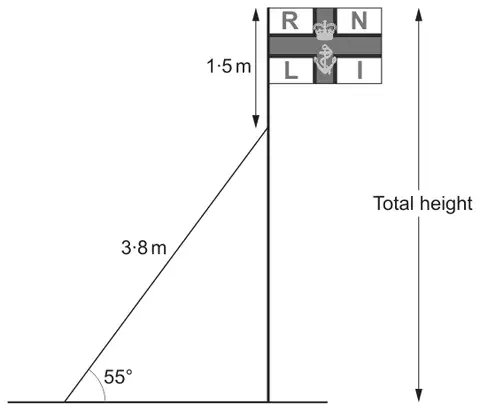
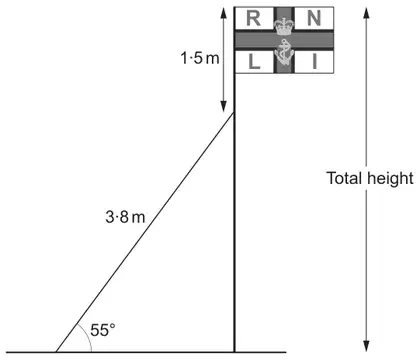
The base of a flagpole is fixed to horizontal ground. It is held vertically by a straight rod of length 3·8 m. The rod is fixed to the ground and to a point 1·5 m from the top of the flagpole. The flagpole and the rod are shown in the diagram below.
Diagram not drawn to scale
Calculate the total height of the flagpole. Give your answer correct to the nearest centimetre. [4]
(b)
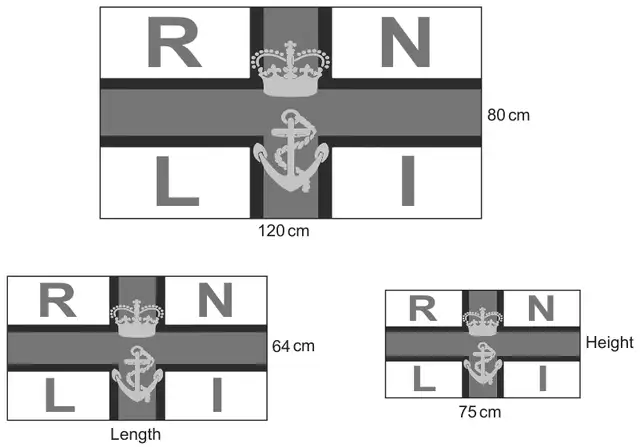
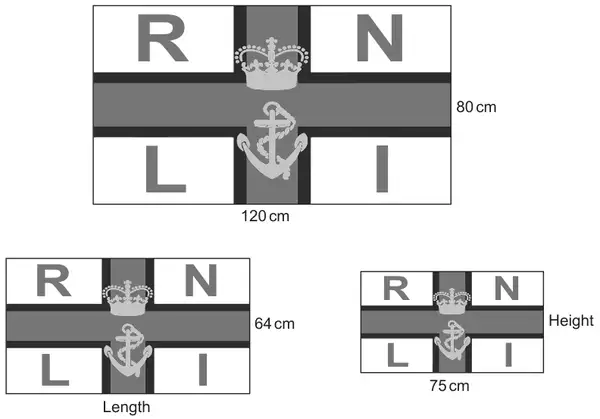
Mathematically similar large, medium and small flags are made.
Diagrams not drawn to scale
(i) Calculate the length of the medium flag. [2]
Length of the medium flag is …………… cm
(ii) Calculate the height of the small flag. [2]
Height of the small flag is …………… cm
Mark scheme (a)
Scheme
Marks
Comments
(Length of the flagpole below the rod =) 3.8 × sin 55° or 3.8 × cos (90° – 55°) or 380 × sin 55° or 380 × cos (90° – 55°)
M2
Or alternative full method M1 for correct working without isolating ‘length’ \(\sin 55^\circ\) = \(\dfrac{\text{length}}{3.8}\) or \(\cos (90^\circ - 55^\circ)\) = \(\dfrac{\text{length}}{3.8}\) or \(\sin 55^\circ\) = \(\dfrac{\text{length}}{380}\) or \(\cos (90^\circ - 55^\circ)\) = \(\dfrac{\text{length}}{380}\)
3.11(2…m) or 311(.2.. cm)
A1
Allow 3.1 (m) or 310 (cm)
(Total length 1.5 + 3.11 =) 4.61 (m) or 461 (cm)
A1
Must be to the nearest cm FT provided at least M1 previously awarded, i.e. for 1.5 + ‘their 3(.)11’ correctly evaluated, to nearest cm, and ‘their 3.11’ is to at least 2 decimal places
If units are given they must be correct
Mark scheme (b)
Scheme
Marks
Comments
(i) 120 × 64 ÷ 80 or 64 × 1.5 or 120 × 0.8 or 120 ÷ 1.25 or 64 ÷ \(\dfrac{2}{3}\) or equivalent
M1
96 (cm)
A1
Answer space takes precedence
(ii) 75 × 80 ÷ 120 or 75 ÷ 1.5 or 75 × \(\dfrac{2}{3}\) or 80 ÷ 1.6 or 80 × 0.625 or 64 × 75 ÷ 96 or equivalent
The base of a flagpole is fixed to horizontal ground. It is held vertically by a straight rod of length 3·8 m. The rod is fixed to the ground and to a point 1·5 m from the top of the flagpole. The flagpole and the rod are shown in the diagram below.
Diagram not drawn to scale
Calculate the total height of the flagpole. Give your answer correct to the nearest centimetre. [4]
(b)
Mathematically similar large, medium and small flags are made.
Diagrams not drawn to scale
(i) Calculate the length of the medium flag. [2]
Length of the medium flag is …………… cm
(ii) Calculate the height of the small flag. [2]
Height of the small flag is …………… cm
Mark scheme (a)
Scheme
Marks
Comments
(Length of the flagpole below the rod =) 3.8 × sin 55° or 3.8 × cos (90° – 55°) or 380 × sin 55° or 380 × cos (90° – 55°)
M2
Or alternative full method M1 for correct working without isolating ‘length’ sin 55° = \(\dfrac{\text{length}}{3.8}\) or cos (90° – 55°) = \(\dfrac{\text{length}}{3.8}\) or sin 55° = \(\dfrac{\text{length}}{380}\) or cos (90° – 55°) = \(\dfrac{\text{length}}{380}\)
3.11(2…m) or 311(.2.. cm)
A1
Allow 3.1 (m) or 310 (cm)
(Total length 1.5 + 3.11 =) 4.61 (m) or 461 (cm)
A1
Must be to the nearest cm FT provided at least M1 previously awarded, i.e. for 1.5 + ‘their 3(.)11’ correctly evaluated, to nearest cm, and ‘their 3.11’ is to at least 2 decimal places
If units are given they must be correct
Mark scheme (b)
Scheme
Marks
Comments
(i) 120 × 64 ÷ 80 or 64 × 1.5 or 120 × 0.8 or 120 ÷ 1.25 or 64 ÷ \(\dfrac{2}{3}\) or equivalent
M1
96 (cm)
A1
Answer space takes precedence
(ii) 75 × 80 ÷ 120 or 75 ÷ 1.5 or 75 × \(\dfrac{2}{3}\) or 80 ÷ 1.6 or 80 × 0.625 or 64 × 75 ÷ 96 or equivalent
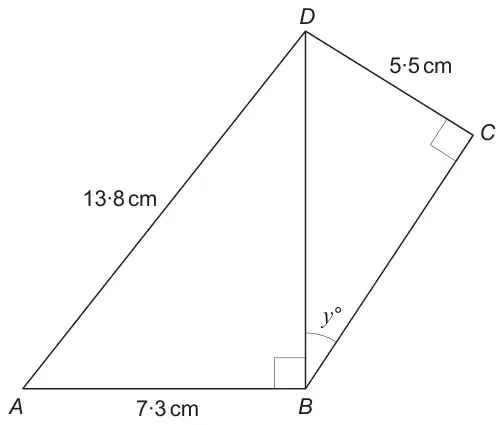
16. In the diagram below, \(ABD\) and \(BCD\) are both right-angled triangles.
Diagram not drawn to scale
\(AB\) = 7·3 cm, \(AD\) = 13·8 cm and \(CD\) = 5·5 cm.
Calculate the value of \(y\). [6]
Mark scheme
Scheme
Marks
Comments
13·82 = \(BD\)2 + 7·32 OR (\(BD\)2 =) 13·82 − 7·32 or equivalent
M1
Check diagram for answers. Note: 190·44 – 53·29 = 137·15
(\(BD\) = ) \(\sqrt{13.8^2 - 7.3^2}\) or equivalent
m1
Note: (\(BD\) =) √137·15 FT √’their 137·15’ for m1 only, provided M1 previously gained.
(\(BD\) =) 11·7(1…..) (cm)
A1
CAO. Final answer of \(BD\) = 137·15 is M1m0A0. Accept an answer rounded or truncated to at least 1 decimal place. If √137.15 is used correctly for \(BD\) in subsequent work, then award this A1 retrospectively. An unsupported answer of 11·7(1…..) (cm) is awarded M1m1A1.
\(y = \sin^{-1}\left(\frac{5.5}{11.7}\right)\) or
\(\sin^{-1} \dfrac{5{\cdot}5 \times \sin 90}{11{\cdot}7}\) or equivalent
M2
Check diagram for answers. FT ‘their stated \(BD\)’ (may be on diagram), provided > 5·5.
Award M1 for one of the following:
\(\sin y = \left(\frac{5.5}{11.7}\right)\) (= 0∙47(0..))
\(\dfrac{\sin y}{5{\cdot}5} = \dfrac{\sin 90}{11{\cdot}7}\) or equivalent
\(y\) = 28(·0..)
A1
Accept an answer rounded or truncated.
An unsupported answer of 28(·0..) is awarded M1m1A1M2A1. Allow correct angles given in radians or gradians:
There are 8 street lights in Ffordd Alwyn. Each light is fitted with an 80 watt light bulb.
Each of the 8 street lights is usually on from 6 p.m. to 6 a.m.
It costs 32.4p per hour for each kilowatt of electricity used.
How much would be saved per week if the 8 street lights were only on from 7 p.m. to 5 a.m.? Give your answer in pounds, correct to the nearest penny. You must show all your working. [5]
(b)
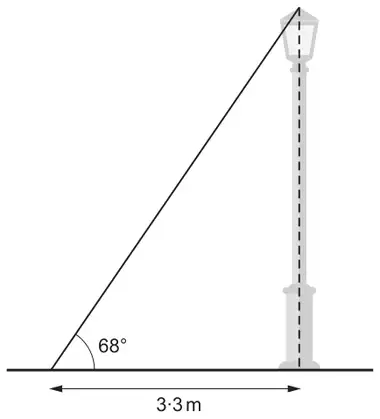
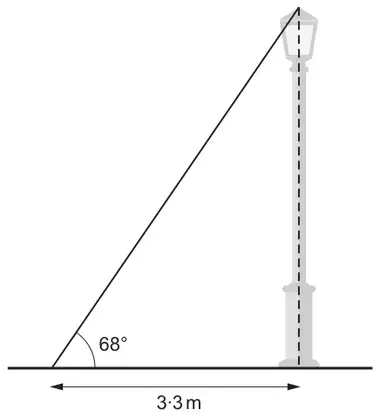
A lamp post is vertical and stands on horizontal ground. The angle of elevation of the top of the lamp post is 68° when measured from a point 3.3 m from the centre of the base of the lamp post.
Diagram not drawn to scale
Calculate the height of the lamp post. [3]
Mark scheme (a)
Scheme
Marks
Comments
Method not directly working with a stated or omitted number of hours difference
Methods may be shown in stages or be embedded Use this method if 2 separate numbers of hours are used, which may not be correct, i.e. ≠12 and ≠10, with or without indication of subtraction
Penalise every additional spurious term by reducing the count of correct terms by 1*
0.324 × 8 × (10 or 12) × 7 × 80 ÷ 1000
M3
Allow ‘× 32.4’ for ‘× 0.324’ M2 for any 4 or 5 correct terms* M1 for any 3 correct terms*
0.324 × 8 × (12 or 10) × 7 × 80 ÷ 1000 with the intention to subtract
m1
Must be an indication of the intention to subtract, in either order FT from 5 (or 6) consistent correct terms for use of
the other value 10 or 12 respectively
‘their number of hours’ are 13 and 11 (incorrect)
Award m0 if inconsistent, i.e. not an equal number of consistent correct terms* between the expressions. Mark ‘their better stated calculation’ first if both are given
(Saving is 17.418… – 14.515…=) (£) 2.90
A1
CAO All working must be checked, do not award 5 marks for £2.90 from incorrect working.
Alternative
Scheme
Marks
Comments
Alternative method: Method directly working with a stated or omitted number of hours difference
Methods may be shown in stages or be embedded Use this method if a single number of hours is used, which may not be correct, i.e. ≠2, or if the number of hours is omitted
Do not allow 2 hours as a correct term from incorrect working, e.g. 13 – 11 = 2
Penalise every additional spurious term by reducing the count of correct terms by 1*
0.324 × 8 × 2 × 7 × 80 ÷ 1000
M4
Allow ‘× 32.4’ for ‘× 0.324’ M3 for any 5 correct terms* M2 for any 4 correct terms* M1 for any 3 correct terms*
(Saving is) (£) 2.90
A1
CAO All working must be checked, do not award 5 marks for £2.90 from incorrect working.
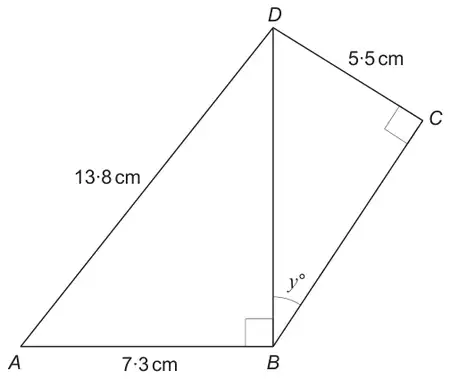
6. In the diagram below, \(ABD\) and \(BCD\) are both right-angled triangles.
Diagram not drawn to scale
\(AB\) = 7·3 cm, \(AD\) = 13·8 cm and \(CD\) = 5·5 cm.
Calculate the value of \(y\). [6]
Mark scheme
Scheme
Marks
Comments
13·82 = \(BD^2\) + 7·32 OR (\(BD^2\) =) 13·82 − 7·32 or equivalent
M1
Check diagram for answers. Note: 190·44 – 53·29 = 137·15
(\(BD\) = ) \(\sqrt{13.8^2 - 7.3^2}\) or equivalent
m1
Note: (\(BD\) =) √137·15 FT √’their 137·15’ for m1 only, provided M1 previously gained.
(\(BD\) =) 11·7(1…..) (cm)
A1
CAO. Final answer of \(BD\) = 137·15 is M1m0A0. Accept an answer rounded or truncated to at least 1 decimal place. If √137.15 is used correctly for \(BD\) in subsequent work, then award this A1 retrospectively. An unsupported answer of 11·7(1…..) (cm) is awarded M1m1A1.
\(y = \sin^{-1}\left(\dfrac{5.5}{11.7}\right)\) or \(\sin^{-1}\dfrac{5{\cdot}5 \times \sin 90}{11{\cdot}7}\) or equivalent
M2
Check diagram for answers. FT ‘their stated \(BD\)’ (may be on diagram), provided > 5·5.
Award M1 for one of the following:
\(\sin y = \left(\dfrac{5.5}{11.7}\right)\) (= 0·47(0..))
\(\dfrac{\sin y}{5{\cdot}5} = \dfrac{\sin 90}{11{\cdot}7}\) or equivalent
\(y\) = 28(·0..)
A1
Accept an answer rounded or truncated.
An unsupported answer of 28(·0..) is awarded M1m1A1M2A1. Allow correct angles given in radians or gradians:
In this part of the question, you will be assessed on the quality of your organisation, communication and accuracy in writing.
Remember: 1 kilowatt (kW) = 1000 watts (W)
There are 8 street lights in Ffordd Alwyn. Each light is fitted with an 80 watt light bulb.
Each of the 8 street lights is usually on from 6 p.m. to 6 a.m.
It costs 32.4p per hour for each kilowatt of electricity used.
How much would be saved per week if the 8 street lights were only on from 7 p.m. to 5 a.m.? Give your answer in pounds, correct to the nearest penny. You must show all your working. [5 + 2 OCW]
(b)
A lamp post is vertical and stands on horizontal ground. The angle of elevation of the top of the lamp post is 68° when measured from a point 3·3 m from the centre of the base of the lamp post.
Diagram not drawn to scale
Calculate the height of the lamp post. [3]
Mark scheme (a)
Scheme
Mark
Comments
2(a) Method not directly working with a stated or omitted number of hours difference
Methods may be shown in stages or be embedded Use this method if 2 separate numbers of hours are used, which may not be correct, i.e. ≠12 and ≠10, with or without indication of subtraction
Penalise every additional spurious term by reducing the count of correct terms by 1*
0.324 × 8 × (10 or 12) × 7 × 80 ÷ 1000
M3
Allow ‘× 32.4’ for ‘× 0.324’ M2 for any 4 or 5 correct terms* M1 for any 3 correct terms*
0.324 × 8 × (12 or 10) × 7 × 80 ÷ 1000 with the intention to subtract
m1
Must be an indication of the intention to subtract, in either order FT from 5 (or 6) consistent correct terms for use of
the other value 10 or 12 respectively
‘their number of hours’ are 13 and 11 (incorrect)
Award m0 if inconsistent, i.e. not an equal number of consistent correct terms* between the expressions. Mark ‘their better stated calculation’ first if both are given
(Saving is 17.418… – 14.515…=) (£) 2.90
A1
CAO All working must be checked, do not award 5 marks for £2.90 from incorrect working.
Alternative
2(a) Alternative method: Method directly working with a stated or omitted number of hours difference
Scheme
Mark
Comments
Methods may be shown in stages or be embedded Use this method if a single number of hours is used, which may not be correct, i.e. ≠2, or if the number of hours is omitted
Do not allow 2 hours as a correct term from incorrect working, e.g. 13 – 11 = 2
Penalise every additional spurious term by reducing the count of correct terms by 1*
0.324 × 8 × 2 × 7 × 80 ÷ 1000
M4
Allow ‘× 32.4’ for ‘× 0.324’ M3 for any 5 correct terms* M2 for any 4 correct terms* M1 for any 3 correct terms*
(Saving is) (£) 2.90
A1
CAO All working must be checked, do not award 5 marks for £2.90 from incorrect working.
Organisation and communication
Scheme
Mark
Comments
Organisation and communication
Organised to include labels, e.g. Number of hours Total number of kWh Cost per day Cost per week
OC1
For OC1, candidates will be expected to: • present their response in a structured way • explain to the reader what they are doing at each step of their response • lay out their explanations and working in a way that is clear and logical • write a conclusion that draws together their results and explains what their answer means
Writing
Units to include, e.g. kW kWh £
W1
For W1, candidates will be expected to: • show all their working • make few, if any, errors in spelling, punctuation and grammar • use correct mathematical form in their working • use appropriate terminology, units, etc.
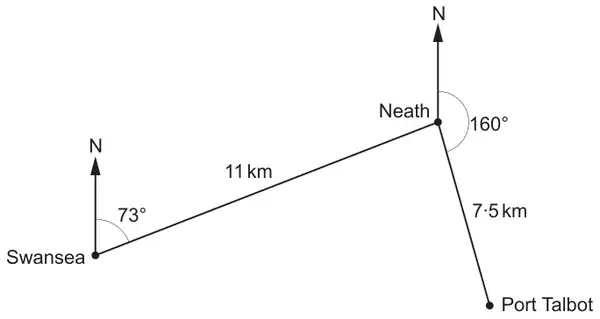
9. A helicopter flies from Swansea to Neath and on from Neath to Port Talbot.
Diagram not drawn to scale
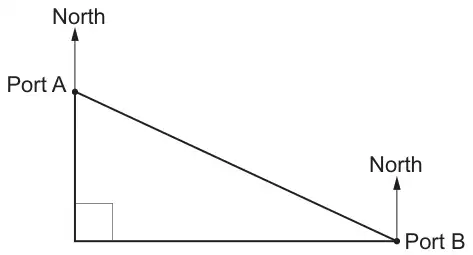
The bearing of Neath from Swansea is 073°. The bearing of Port Talbot from Neath is 160°.
(a)
By calculation, show that the bearing of Swansea from Neath is 253°. [1]
(b)
From Port Talbot, the helicopter flies directly back to Swansea. Calculate the bearing of this flight from Port Talbot to Swansea. [7]
The bearing of the flight from Port Talbot to Swansea is …………… °
From the formula list: In any triangle \(ABC\): Sine rule \(\dfrac{a}{\sin A} = \dfrac{b}{\sin B} = \dfrac{c}{\sin C}\); Cosine rule \(a^2 = b^2 + c^2 - 2bc\cos A\)
Mark scheme (a)
Scheme
Marks
Comments
160 + 20 + 73 or 180 + 73 or 180 – 73 = 107 AND 360 – 107
B1
Allow 160 + 93
Mark scheme (b)
Scheme
Marks
Comments
(Distance Swansea to Port Talbot =) \(\sqrt{11^2 + 7.5^2 - 2 \times 11 \times 7.5 \times \cos 93(^\circ)}\) (=\(\sqrt{185.885\ldots}\))
M2
FT ‘their 93(°)’ M1 for 11\(^2\) + 7.5\(^2\) – 2×11×7.5×cos93(°)
= 13.6(339…) (km)
A1
CAO. Mark final answer
(\(N\hat{S}P\) =) \(\sin^{-1}\left(\dfrac{\sin 93(^\circ)}{13.6(339\ldots)} \times 7.5\right)\) OR (\(N\hat{S}P\) =) \(\cos^{-1}\left(\dfrac{11^2 + 13.6(339\ldots)^2 - 7.5^2}{2 \times 11 \times 13.6(339\ldots)}\right)\) OR
FT ‘their derived 13.6(339…)’ and ‘their 93(°)’ M1 for \(\dfrac{\sin \text{angle}}{7.5} = \dfrac{\sin 93(^\circ)}{13.6(339\ldots)}\) or equivalent OR M1 for 7.5\(^2\) = 11\(^2\)+13.6(339…)\(^2\)−2×11×13.6(339…)×cosNSP or equivalent OR
M1 for \(\dfrac{\sin \text{angle}}{11} = \dfrac{\sin 93(^\circ)}{13.6(339\ldots)}\) or equivalent OR M1 for 11\(^2\) = 7.5\(^2\)+13.6(339…)\(^2\)−2×7.5×13.6(339…)×cosNPS or equivalent
(\(N\hat{S}P\) =) 33(.321…(°)) OR (\(N\hat{P}S\) =) 53.6(781…) or 53.7 or 54(°)
A1
e.g. FT use of 13.6 leads to (\(N\hat{S}P\) =) 33.4(160…(°)) with (\(N\hat{P}S\) =) 53.8(732…(°))
(Bearing =) 286(°)
A1
Accept 286(.32…) (°) FT from second M2 only FT 180 + 73 + ‘their \(N\hat{S}P\)’ OR FT 360 – 20 – ‘their \(N\hat{P}S\)’
(i) A single tree can absorb 48 pounds of carbon dioxide per year. Calculate the carbon dioxide absorbed per year by a forest of 440 of these trees. Give your answer in kilograms. [2]
Carbon dioxide absorbed per year is …………… kg
(ii) A forest of trees absorbs \(2{\cdot}3 \times 10^{11}\) grams of carbon dioxide per year. Which of the following is \(2{\cdot}3 \times 10^{11}\)? Circle your answer. [1]
230 000 000 000 23 000 000 000 2 300 000 000 000
0·000 000 000 002 3 0·000 000 000 023
(b)
Remember: 10 000 m2 ≈ 2·47 acres
A report states that a fire in a forest has a high risk of spreading when there are more than 60 trees per acre.
There are 615 trees in Grancwm Forest. The forest covers an area of 40 000 m2.
Would a fire in Grancwm Forest have a high risk of spreading?
Yes ☐ No ☐
You must show all your working to support your answer. [4]
(c)
A vertical pine tree stands on horizontal ground. From a point on the ground 21 metres from its base, the angle of elevation of the top of the pine tree is 39°.
Diagram not drawn to scale
(i) Show that the pine tree has a vertical height of 17 metres. [3]
(ii) A cylindrical log is cut from this pine tree. The circumference of the cross-section of the log is 1·75 m. The length of the log is half the height of the tree.
Calculate the volume of the log. Give your answer in m3. You must show all your working. [5]
Volume of the log is …………… m3
Mark scheme (a)
Scheme
Marks
Comments
(i) 440 × 48 ÷ 2.2
M1
May be seen in stages
9600 (kg)
A1
Mark final answer Allow answers in the inclusive range 9588 to 9601 from premature approximation Answer space takes precedence
(ii) 230 000 000 000
B1
Mark scheme (b)
Scheme
Marks
Comments
Throughout, if 4 marks are awarded, penalise -1 if conclusion ‘Yes’ is not indicated On FT the conclusion may be different to ‘Yes’
(Area) 2.47 × 40000 ÷ 10000 or equivalent
M1
9.88 (acres)
A1
May be implied in further working Allow 9.8 (acres), 9.9 (acres) or 10 (acres)
(Density of trees) 615 ÷ 9.88
m1
62(.2...trees per acre) (>60)
A1
Depends on M1 m1 previously awarded
Alternative
8(b) Alternative method 1
Scheme
Marks
Comments
(Area) 2.47 × 40 000 ÷ 10 000 or equivalent
M1
9.88 (acres)
A1
May be implied in further working Allow 9.8 (acres), 9.9 (acres) or 10 (acres)
(Maximum number of trees) 9.88 × 60
m1
592(.8) (trees) or 593 (trees) (< 615)
A1
Depends on M1 m1 previously awarded Allow suitable rounding, e.g. 590 or 600
Alternative
8(b) Alternative method 2
Scheme
Marks
Comments
(Area) 2.47 × 40 000 ÷ 10 000 or equivalent
M1
9.88 (acres)
A1
May be implied in further working Allow 9.8 (acres), 9.9 (acres) or 10 (acres)
(Minimum area) 615 ÷ 60
M1
Do not allow embedded in further working
10.25 (acres) (> 9.88)
A1
Allow rounded to 10 (acres) provided ‘their area’ (9.88 acres) has not been rounded to 10
Alternative
8(b) Alternative method 3
Scheme
Marks
Comments
(Minimum area) 615 ÷ 60
M1
10.25 (acres)
A1
May be implied in further working Allow 10 (acres)
(Convert to m2) 10 000 × 10.25 ÷ 2.47
m1
41 497(.97 m2) or 41 498(m2) (>40 000)
A1
Depends on M1 m1 previously awarded Accept suitable rounding, e.g. 41 000 or 41 500
Alternative
8(b) Alternative method 4
Scheme
Marks
Comments
(Trees in 2.47 acres) 615 ÷ (40 000 ÷ 10 000) or equivalent
M1
153.75 (trees)
A1
May be implied in further working Allow 153, 153.8 or 154 (trees)
(Density of trees) 153.75 ÷ 2.47
m1
62(.2...trees per acre) (> 60)
A1
Depends on M1 m1 previously awarded
Alternative
8(b) Alternative method 5
Scheme
Marks
Comments
(Forest area per tree) 40 000 ÷ 615
M1
Do not allow embedded in further working
65(.0406.. m2)
A1
(Fire risk, area per tree) 10 000 ÷ (60 × 2.47)
M1
67(.476…m2) (> 65)
A1
Corrected by Westie's Workshop
The board's mark scheme printed “‘their area’ (9.88m²)”. Changed to “(9.88 acres)” because the area was worked out in acres (9.88 acres), not square metres.
Original: see the board's mark scheme PDF (link above).
Mark scheme (c)
Scheme
Marks
Comments
(i) (Height of the tree =) 21 × tan 39
M2
OR alternative full method M1 for tan 39 = \(\dfrac{\text{height of tree}}{21}\)
17.(…. m)
A1
CAO
(ii) diameter = \(\dfrac{1.75}{\pi}\) or (radius =) \(\dfrac{1.75}{2 \times \pi}\)
M2
M1 for any one of the following:
1.75 = π × diameter
1.75 = 2 × π × radius
(Note: radius = \(\dfrac{7}{8\pi}\) m, radius ≈ 0.28m)
(Area of cross section =) π × (1.75 ÷ 2π)2
M1
FT for ‘their derived radius’ provided it is from a calculation involving the use of π (Note: area of cross section = \(\dfrac{49}{64\pi}\) m2 area of cross section ≈ 0.24 m2)
× 17 ÷ 2
m1
FT provided previous M1awarded
(Volume) answer in the range 2.07 (m3) to 2.15 (m3)
A1
CAO, accept an answer of 2 (m3) from correct working without sight of premature approximation leading to an answer outside the range
A single tree can absorb 48 pounds of carbon dioxide per year. Calculate the carbon dioxide absorbed per year by a forest of 440 of these trees. Give your answer in kilograms. [2]
Carbon dioxide absorbed per year is …………… kg
(ii)
A forest of trees absorbs \(2{\cdot}3 \times 10^{11}\) grams of carbon dioxide per year. Which of the following is \(2{\cdot}3 \times 10^{11}\)? Circle your answer. [1]
230 000 000 000 23 000 000 000 2 300 000 000 000
0·000 000 000 002 3 0·000 000 000 023
(b)
Remember: 10 000 m\(^2\) ≈ 2·47 acres
A report states that a fire in a forest has a high risk of spreading when there are more than 60 trees per acre.
There are 615 trees in Grancwm Forest. The forest covers an area of 40 000 m\(^2\).
Would a fire in Grancwm Forest have a high risk of spreading?
Yes ☐ No ☐
You must show all your working to support your answer. [4]
(c)
A vertical pine tree stands on horizontal ground. From a point on the ground 21 metres from its base, the angle of elevation of the top of the pine tree is 39°.
Diagram not drawn to scale
(i)
Show that the pine tree has a vertical height of 17 metres. [3]
(ii)
A cylindrical log is cut from this pine tree. The circumference of the cross-section of the log is 1·75 m. The length of the log is half the height of the tree.
Calculate the volume of the log. Give your answer in m\(^3\). You must show all your working. [5]
Volume of the log is …………… m\(^3\)
Mark scheme (a)
(i)
Scheme
Marks
Comments
440 × 48 ÷ 2.2
M1
May be seen in stages
9600 (kg)
A1
Mark final answer Allow answers in the inclusive range 9588 to 9601 from premature approximation Answer space takes precedence
(ii)
Scheme
Marks
Comments
230 000 000 000
B1
Mark scheme (b)
Scheme
Marks
Comments
Throughout, if 4 marks are awarded, penalise -1 if conclusion ‘Yes’ is not indicated On FT the conclusion may be different to ‘Yes’
(Area) 2.47 × 40000 ÷ 10000 or equivalent 9.88 (acres)
M1 A1
May be implied in further working Allow 9.8 (acres), 9.9 (acres) or 10 (acres)
(Density of trees) 615 ÷ 9.88 62(.2...trees per acre) (>60)
May be implied in further working Allow 9.8 (acres), 9.9 (acres) or 10 (acres)
(Minimum area) 615 ÷ 60 10.25 (acres) (> 9.88)
M1 A1
Do not allow embedded in further working Allow rounded to 10 (acres) provided ‘their area’ (9.88 acres) has not been rounded to 10
Alternative
4(b) Alternative method 3
Scheme
Marks
Comments
(Minimum area) 615 ÷ 60 10.25 (acres)
M1 A1
May be implied in further working Allow 10 (acres)
(Convert to m\(^2\)) 10 000 × 10.25 ÷ 2.47 41 497(.97 m\(^2\)) or 41 498(m\(^2\)) (>40 000)
m1 A1
Depends on M1 m1 previously awarded Accept suitable rounding, e.g. 41 000 or 41 500
Alternative
4(b) Alternative method 4
Scheme
Marks
Comments
(Trees in 2.47 acres) 615 ÷ (40 000 ÷ 10 000) or equivalent
M1
153.75 (trees)
A1
May be implied in further working Allow 153, 153.8 or 154 (trees)
(Density of trees) 153.75 ÷ 2.47 62(.2...trees per acre) (> 60)
m1 A1
Depends on M1 m1 previously awarded
Alternative
4(b) Alternative method 5
Scheme
Marks
Comments
(Forest area per tree) 40 000 ÷ 615 65(.0406.. m\(^2\))
M1 A1
Do not allow embedded in further working
(Fire risk, area per tree) 10 000 ÷ (60 × 2.47) 67(.476…m\(^2\)) (> 65)
M1 A1
Corrected by Westie's Workshop
The board's mark scheme printed “‘their area’ (9.88m²)”. Changed to “(9.88 acres)” because the area was worked out in acres (9.88 acres), not square metres.
Original: see the board's mark scheme PDF (link above).
Mark scheme (c)
(i)
Scheme
Marks
Comments
(Height of the tree =) 21 × tan 39
M2
OR alternative full method M1 for tan 39 = \(\dfrac{\text{height of tree}}{21}\)
M1 for Hypotenuse = 21/cos39 (= 27.02…) AND Height\(^2\) = 27(.02)\(^2\) – 21\(^2\)
16.9(7…) (m) to 17.(0..m)
A1
CAO
Alternative
4(c)(i) Alternative method 2
Scheme
Marks
Comments
(Angle of elevation) \(\tan^{-1}\dfrac{17}{21}\)
M2
M1 tan (elevation) = \(\dfrac{17}{21}\)
38.9(9...°) or 39(°)
A1
CAO
Alternative
4(c)(i) Alternative method 3
Scheme
Marks
Comments
(Horizontal distance) \(\dfrac{17}{\tan 39}\)
M2
M1 for tan 39 = \(\dfrac{17}{\text{distance}}\)
20.9(98…m) or 21m
A1
CAO
(ii)
Scheme
Marks
Comments
diameter = \(\dfrac{1.75}{\pi}\) or (radius =) \(\dfrac{1.75}{2 \times \pi}\)
M2
M1 for any one of the following:
1.75 = π × diameter
1.75 = 2 × π × radius
(Note: radius = \(\dfrac{7}{8\pi}\) m, radius ≈ 0.28m)
(Area of cross section =) π × (1.75 ÷ 2π)\(^2\)
M1
FT for ‘their derived radius’ provided it is from a calculation involving the use of π (Note: area of cross section = \(\dfrac{49}{64\pi}\) m\(^2\) area of cross section ≈ 0.24 m\(^2\))
× 17 ÷ 2
m1
FT provided previous M1 awarded
(Volume) answer in the range 2.07 (m\(^3\)) to 2.15 (m\(^3\))
A1
CAO, accept an answer of 2 (m\(^3\)) from correct working without sight of premature approximation leading to an answer outside the range
Allow correct angles given in radians or gradians.
Mark scheme (b)
Scheme
Marks
Comments
DBE = (90 – 43) = 47(°) OR BED = 43(°)
B1
Check diagram for answers. Strict FT for DBE = 90 – ‘their \(x\)’ or BED = ‘their \(x\)’, provided ‘their \(x\)’ ≠ 45°. Note: DBE must be acute for B1. May be implied in further work.
If B1 already awarded for ‘their angle DBE’ but then ‘their angle BED’ is incorrect and ‘their BED’ is then used (or vice versa) for either M2 or M1, then award B0 previously.
Or award M2 for correct use of a ‘two-step’ method (e.g. ‘Pythagoras and similar triangles’ or ‘Pythagoras and correct trigonometric relationship’).
FT ‘their angle DBE’ or ‘their angle BED’ provided not 0°, 45°, 90° or 180°.
Award M1 for one of the following:
\(\tan 47 = \dfrac{DE}{13{\cdot}1}\)
\(\tan 43 = \dfrac{13{\cdot}1}{DE}\)
\(\dfrac{DE}{\sin 47} = \dfrac{13{\cdot}1}{\sin 43}\) or equivalent
For all M2 or M1 scenarios, FT their clearly stated or shown angle BED or DBE where appropriate.
For \(\dfrac{13{\cdot}1 \times \sin 47}{\sin 43}\) FT their clearly stated or shown angles BED and DBEonly if BED + DBE = 90°.
DE in the range 14·04 to 14·1 (cm) ISW
A1
Allow 14 from correct workings. FT from M2 only and provided that angle is acute and leads to a positive answer.
Award B1M2A0 for any of the following unsupported answers:
9. The cost of sending a package depends on its volume.
Volume (cm\(^{3}\))
Cost
0 to 1000
£12.55
greater than 1000, up to 2000
£13.60
greater than 2000, up to 4000
£14.85
greater than 4000, up to 10 000
£16.25
Parcels with volume greater than 10 000 cm\(^{3}\) are not accepted
A rectangular ‘HANDLE WITH CARE’ label is stuck on a package. The label measures 17·5 cm by 11·1 cm. The package is a cuboid with height 19 cm and width 6·7 cm. Each vertex of the label touches an edge of the front face of the package.
Diagram not drawn to scale
Calculate the volume of the package and hence find the cost of sending this package. You must show all your working. [7]
The volume of the package is …………………… The cost of sending this package is ……………………
Mark scheme
Scheme
Marks
Comments
(Length of the package, x + y) (x =) 17.5 × cos34° or (x =) 17.5 × sin56° AND (y =) 11.1 × cos56° or (y =) 11.1. × sin34°
M3
Or alternative full method M2 for any 1 of these statements correct or as appropriate from an alternative method OR M1 for .../17.5 = cos34° or .../17.5 = sin56°, or .../11.1 = cos56° or .../11.1 = sin34°
Sight of 14.5(08... cm) and 6.2(07.... cm) or for the sum of these: 20.7(… cm) or 21 (cm)
A2
Must be from correct working (not from 11.1\(^{2}\) + 17.5\(^{2}\)) A1 for 14.5(08... cm) or 6.2(07.... cm)
FT ‘their x + y’ provided some use of trigonometry attempted previously (including incorrect use) and both x > 0 and y > 0. Award M1 for an unsupported correct volume, or ‘their FT volume’ provided FT criteria met
Answer in the range 2635 (cm\(^{3}\)) to 2673.5 (cm\(^{3}\)) AND Cost (£)14.85
A1
Answer space takes precedence FT from truncation or rounding FT for appropriate cost for ‘their volume’ provided it is ≤10 000 (cm\(^{3}\)) FT is 127.3 × ‘their x + their y’ correctly evaluated
If ‘y’ not considered, possible M2, A1 then also award SC1 for a volume of 1845 (cm\(^{3}\)) to 1847.2 (cm\(^{3}\)) AND cost (£)13.6(0)
If ‘x’ not considered, possible M2, A1 then also award SC1 for a volume of 789 (cm\(^{3}\)) to 790.6 (cm\(^{3}\)) AND cost (£)12.55
If no marks, award SC1 for an answer in the range 2635 (cm\(^{3}\)) to 2673.5 (cm\(^{3}\)) AND Cost (£)14.85 from use of 20.7…(cm) from √(11.1\(^{2}\) + 17.5\(^{2}\))
Allow correct angles given in radians or gradians.
Mark scheme (b)
Scheme
Marks
Comments
DBE = (90 – 43) = 47(°) OR BED = 43(°)
B1
Check diagram for answers. Strict FT for DBE = 90 – ‘their \(x\)’ or BED = ‘their \(x\)’, provided ‘their \(x\)’ ≠ 45°. Note: DBE must be acute for B1. May be implied in further work.
If B1 already awarded for ‘their angle DBE’ but then ‘their angle BED’ is incorrect and ‘their BED’ is then used (or vice versa) for either M2 or M1, then award B0 previously.
Or award M2 for correct use of a ‘two-step’ method (e.g. ‘Pythagoras and similar triangles’ or ‘Pythagoras and correct trigonometric relationship’).
FT ‘their angle DBE’ or ‘their angle BED’ provided not 0°, 45°, 90° or 180°.
Award M1 for one of the following:
\(\tan 47 = \dfrac{DE}{13{\cdot}1}\)
\(\tan 43 = \dfrac{13{\cdot}1}{DE}\)
\(\dfrac{DE}{\sin 47} = \dfrac{13{\cdot}1}{\sin 43}\) or equivalent
For all M2 or M1 scenarios, FT their clearly stated or shown angle BED or DBE where appropriate.
For \(\dfrac{13{\cdot}1 \times \sin 47}{\sin 43}\) FT their clearly stated or shown angles BED and DBEonly if BED + DBE = 90°.
DE in the range 14·04 to 14·1 (cm) ISW
A1
Allow 14 from correct workings. FT from M2 only and provided that angle is acute and leads to a positive answer.
Award B1M2A0 for any of the following unsupported answers:
5. The cost of sending a package depends on its volume.
Volume (cm\(^3\))
Cost
0 to 1000
£12.55
greater than 1000, up to 2000
£13.60
greater than 2000, up to 4000
£14.85
greater than 4000, up to 10 000
£16.25
Parcels with volume greater than 10 000 cm\(^3\) are not accepted
A rectangular ‘HANDLE WITH CARE’ label is stuck on a package. The label measures 17·5 cm by 11·1 cm. The package is a cuboid with height 19 cm and width 6·7 cm. Each vertex of the label touches an edge of the front face of the package.
Diagram not drawn to scale
Calculate the volume of the package and hence find the cost of sending this package. You must show all your working. [7]
The volume of the package is …………………………… The cost of sending this package is ……………………………
Mark scheme
Scheme
Marks
Comments
(Length of the package, x + y) (x =) 17.5 × cos34° or (x =) 17.5 × sin56° AND (y =) 11.1 × cos56° or (y =) 11.1. × sin34°
M3
Or alternative full method M2 for any 1 of these statements correct or as appropriate from an alternative method OR M1 for .../17.5 = cos34° or .../17.5 = sin56°, or .../11.1 = cos56° or .../11.1 = sin34°
Sight of 14.5(08... cm) and 6.2(07.... cm) or for the sum of these: 20.7(… cm) or 21 (cm)
A2
Must be from correct working (not from 11.1\(^{2}\) + 17.5\(^{2}\)) A1 for 14.5(08... cm) or 6.2(07.... cm)
FT ‘their x + y’ provided some use of trigonometry attempted previously (including incorrect use) and both x > 0 and y > 0. Award M1 for an unsupported correct volume, or ‘their FT volume’ provided FT criteria met
Answer in the range 2635 (cm\(^{3}\)) to 2673.5 (cm\(^{3}\)) AND Cost (£)14.85
A1
Answer space takes precedence FT from truncation or rounding FT for appropriate cost for ‘their volume’ provided it is ≤10 000 (cm\(^{3}\)) FT is 127.3 × ‘their x + their y’ correctly evaluated
Volume (cm\(^{3}\))
Cost
0 to 1000
£12.55
greater than 1000, up to 2000
£13.60
greater than 2000, up to 4000
£14.85
greater than 4000, up to 10 000
£16.25
If ‘y’ not considered, possible M2, A1 then also award SC1 for a volume of 1845 (cm\(^{3}\)) to 1847.2 (cm\(^{3}\)) AND cost (£)13.6(0)
If ‘x’ not considered, possible M2, A1 then also award SC1 for a volume of 789 (cm\(^{3}\)) to 790.6 (cm\(^{3}\)) AND cost (£)12.55
If no marks, award SC1 for an answer in the range 2635 (cm\(^{3}\)) to 2673.5 (cm\(^{3}\)) AND Cost (£)14.85 from use of 20.7…(cm) from \(\sqrt{(11.1^2 + 17.5^2)}\)
8. Two cruise ships, The Explorer and The Magellan, leave the same port at 06:30. The Explorer sails at a speed of 30 km/h on a bearing of 051°. The Magellan sails at a speed of 35 km/h. The angle between the courses of the two ships when they set sail is 49°.
(a)
At 11:00, The Magellan comes to a stop due to engine failure. The diagram below shows the positions of the two ships at 11:00.
Diagram not drawn to scale
Immediately, The Explorer then heads directly towards The Magellan to pick up its passengers. It travels at a speed of 30 km/h. Calculate the time, to the nearest minute, when The Explorer will reach The Magellan. [7]
Time when The Explorer will reach The Magellan is ……………
(b)
Calculate the bearing The Explorer has to sail on from 11:00 onwards to arrive at The Magellan. [5]
From the formula list: In any triangle \(ABC\): Cosine rule \(a^2 = b^2 + c^2 - 2bc\cos A\)
Mark scheme (a)
Scheme
Marks
Comments
(Distances travelled up to 11:00 =) 135 (km) AND 157.5 (km)
FT their distances for M2 or M1 Allow use of 30 and 35 M1 for 135\(^2\) + 157.5\(^2\) − 2×135×157.5×cos49(º)
= 123(.01…) (km)
A1
Must come from M2 and provided 30 and 35 not used in the cosine rule
(Time taken for Explorer to reach Magellan =) 123(.01…) ÷ 30
M1
Can only be awarded provided at least M1 previously awarded FT ‘their derived 123(.01…)’
= 4.1(…) (hours) or 4 hrs 6 mins
A1
= 15:06 or 3:06 p.m.
A1
FT from M1A0 for ‘their 4.1(…) (hours)’ provided of equivalent difficulty (not quarter or half hours involved) On FT, needs to be correct to the nearest minute, rounded or truncated
If final M0A0A0 awarded, SC2 for an answer of 14:31 or 2:31 p.m. from the division by 35 OR SC1 for 3.5(1…) hours from the division by 35
Mark scheme (b)
Scheme
Marks
Comments
(Angle at top of triangle =) \(\sin^{-1}\left(\dfrac{\sin 49(^\circ)}{123(.01\ldots)} \times 157.5\right)\) OR \(\cos^{-1}\left(\dfrac{135^2 + 123(.01\ldots)^2 - 157.5^2}{2 \times 135 \times 123(.01\ldots)}\right)\)
M2
FT their values consistently used from (a) M1 for \(\dfrac{\sin \text{angle}}{157.5} = \dfrac{\sin 49(^\circ)}{123(.01\ldots)}\) or equivalent OR M1 for 157.5\(^2\) = 135\(^2\)+123(.01)\(^2\) – 2×135×123(.01)×cos angle
75(.08…) to 75.105 (º)
A1
Must come from M2
(Bearing =) 360 – (180 – 51) – 75(.08…) or 180 – (75(.08…) – 51) or 231 – 75(.08…)
M1
FT ‘their derived 75(.08…)’
= 156 (º)
A1
Allow an answer of 155.9(19…)(º)
Alternative
8(b) Alternative method:
Scheme
Marks
Comments
(Angle at right of triangle =) \(\sin^{-1}\left(\dfrac{\sin 49(^\circ)}{123(.01\ldots)} \times 135\right)\) OR \(\cos^{-1}\left(\dfrac{157.5^2 + 123(.01\ldots)^2 - 135^2}{2 \times 157.5 \times 123(.01\ldots)}\right)\)
M2
FT their values consistently used from (a) M1 for \(\dfrac{\sin \text{angle}}{135} = \dfrac{\sin 49(^\circ)}{123(.01\ldots)}\) or equivalent OR M1 for 135\(^2\)=157.5\(^2\)+123(.01)\(^2\) –2×157.5×123(.01)×cos angle
10 years ago, Matteo bought a car for £4500. His car depreciated in value by 20% in the first year. In each of the following years, his car depreciated by 14% of its previous year’s value.
Show that the value of Matteo’s car is now less than £950.
You must show all your working. [3]
(b)
Matteo’s car insurance has increased by 25% from the amount he paid last year. His car insurance is £750 this year.
Calculate the amount Matteo paid for his car insurance last year. [2]
Matteo paid £ ………………………… for his car insurance last year.
(c)
The diagram below shows the front of Matteo’s garage.
Diagram not drawn to scale
Calculate the width of Matteo’s garage. [5]
(d)
The length of Matteo’s car is 400 cm, correct to the nearest 10 cm. The length of his garage is 550 cm, correct to the nearest 10 cm.
When Matteo parks his car, he leaves exactly 70 cm between the car and the back wall of the garage.
Calculate the maximum length of the space between Matteo’s car and the garage door. [3]
Diagram not drawn to scale
Mark scheme (a)
Scheme
Marks
Comments
4500 × (1 - 0.2(0)) × (1 - 0.14)9 or 4500 × 0.8(0) × 0.869 or equivalent
M2
For M2, do not ignore any additional years considered, unless 10 years selected or implied in later working
M1 for equivalent of one of the following (which may be embedded in other working):
4500 × (1 - 0.2(0)) (= 3600)
4500 × 0.8(0) (= 3600)
4500 × (1 - 0.14)9 (= 1157.97...)
4500 × 0.869 (= 1157.97...)
An answer in the range (£)926.35 to (£)926.40
A1
An answer for 10 years (not beyond) must be selected Allow an answer of (£)926 provided not from rounding an amount outside the range given
Award M1, SC1 for an answer (4500 × 0.8 × 0.8610 =) (£)796.68(5.... ) or (£)796.69 or (£)796.70 or (£)797
Mark scheme (b)
Scheme
Marks
Comments
100 × 750 ÷ 125 or 100 × \(\dfrac{750}{125}\) or equivalent
M1
(£) 600
A1
Answer space takes precedence
Mark scheme (c)
Scheme
Marks
Comments
Accept equivalents using the sine rule throughout ‘½ width’ may be referred to by any unknown
Sight of appropriate 80 (cm) (height of triangle)
B1
Check if indicated on the diagram
(½ width =) \(\dfrac{80}{\tan 33^\circ}\) or (½ width =) 80 × tan (90° – 33°)
M2
(= 123.189... cm or 123.2 cm) FT ‘their 80’ provided ≤ 120 and ≠ 90
M1 for sight of tan 33° = \(\dfrac{80}{\tfrac{1}{2}\text{ width}}\) or tan (90° – 33°) = \(\dfrac{\tfrac{1}{2}\text{width}}{80}\)
× 2
m1
FT provided at least M1 previously awarded, i.e. for intention to double ‘their ½ width’
(Width of garage is) 246(cm) to 246.4(cm)
A1
CAO. ISW
Mark scheme (d)
Scheme
Marks
Comments
(Maximum space =) 555 – 395 – 70 or 550 – 400 + 2 × 5 – 70 or equivalent
M2
Check the diagram M1 for any of the following:
use of 550 < ‘their 555’ ≤ 560 AND 390 ≤ ‘their 395’ < 400
for sight of 555 and 395
for sight of 550 – 400 + 2 × 5
90 (cm)
A1
CAO
Award M1 and SC1 for an answer of (555 – 395 =) 160 (cm)
5. Gareth’s living room is rectangular. It has a doorway close to one of the corners of the room.
Diagrams not drawn to scale
Gareth’s living room door is 76 cm wide. The door hinge is 41 cm from the corner of the room. When the door is fully open, it touches the wall 64 cm from the corner.
Diagram not drawn to scale
The shaded region in the diagram is an unusable part of his living room floor.
By first finding the size of angle \(x\), calculate the area of this unusable part of Gareth’s living room floor. [6]
Mark scheme
Scheme
Marks
Comments
(180 −) tan\(^{-1}\) (64/41) or (180 −) cos\(^{-1}\)(41/76) or (180 −) sin\(^{-1}\)(64/76) or equivalent
M2
Note: angle in triangle = 57.3(…) or 57.4 (º) An equivalent method could include Pythagoras followed by trigonometry Allow an angle of 57(º) from correct working M1 for
tan(angle) = 64/41 or
cos(angle) = 41/76 or
sin(angle) = 64/76 or
M1 for unrearranged (or better) correct substitutions into the sine or cosine rules
(\(x\) =) 122.6(…) (º)
A1
Allow an answer of 122.7 (º) or 123(º)
(Unusable area =) \(\dfrac{122.6(\ldots) \times \boldsymbol{\pi} \times 76^2}{360} + \dfrac{41 \times 64}{2}\) (6176.5 to 6201) (1312)
M2
FT ‘their derived 122.6(…)’, but if < 90 then only M2A0 or M1A0 are available
M1 for \(\dfrac{122.6(\ldots) \times \boldsymbol{\pi} \times 76^2}{360}\)
= 7488.5 to 7513 (cm\(^2\))
A1
FT for similar range provided their x > 90 and allowing π = 3.14 to 3.142
10 years ago, Matteo bought a car for £4500. His car depreciated in value by 20% in the first year. In each of the following years, his car depreciated by 14% of its previous year’s value.
Show that the value of Matteo’s car is now less than £950.
You must show all your working. [3]
(b)
Matteo’s car insurance has increased by 25% from the amount he paid last year. His car insurance is £750 this year.
Calculate the amount Matteo paid for his car insurance last year. [2]
Matteo paid £ …………… for his car insurance last year.
(c)
The diagram below shows the front of Matteo’s garage.
Diagram not drawn to scale
Calculate the width of Matteo’s garage. [5]
(d)
The length of Matteo’s car is 400 cm, correct to the nearest 10 cm. The length of his garage is 550 cm, correct to the nearest 10 cm.
When Matteo parks his car, he leaves exactly 70 cm between the car and the back wall of the garage.
Calculate the maximum length of the space between Matteo’s car and the garage door. [3]
Diagram not drawn to scale
Mark scheme (a)
Scheme
Marks
Comments
4500 × (1 - 0.2(0)) × (1 - 0.14)\(^9\) or 4500 × 0.8(0) × 0.86\(^9\) or equivalent
M2
For M2, do not ignore any additional years considered, unless 10 years selected or implied in later working
M1 for equivalent of one of the following (which may be embedded in other working):
4500 × (1 - 0.2(0)) (= 3600)
4500 × 0.8(0) (= 3600)
4500 × (1 - 0.14)\(^9\) (= 1157.97...)
4500 × 0.86\(^9\) (= 1157.97...)
An answer in the range (£)926.35 to (£)926.40
A1
An answer for 10 years (not beyond) must be selected Allow an answer of (£)926 provided not from rounding an amount outside the range given
Award M1, SC1 for an answer (4500 × 0.8 × 0.86\(^{10}\) =) (£)796.68(5.... ) or (£)796.69 or (£)796.70 or (£)797
Mark scheme (b)
Scheme
Marks
Comments
100 × 750 ÷ 125 or 100 × \(\dfrac{750}{125}\) or equivalent
M1
(£) 600
A1
Answer space takes precedence
Mark scheme (c)
Scheme
Marks
Comments
Accept equivalents using the sine rule throughout ‘½ width’ may be referred to by any unknown
Sight of appropriate 80 (cm) (height of triangle)
B1
Check if indicated on the diagram
(½ width =) \(\dfrac{80}{\tan 33^\circ}\) or (½ width =) 80 × tan (90° – 33°)
M2
(= 123.189... cm or 123.2 cm) FT ‘their 80’ provided ≤ 120 and ≠ 90
M1 for sight of \(\tan 33^\circ = \dfrac{80}{\frac{1}{2}\text{ width}}\) or \(\tan (90^\circ - 33^\circ) = \dfrac{\frac{1}{2}\text{ width}}{80}\)
× 2
m1
FT provided at least M1 previously awarded, i.e. for intention to double ‘their ½ width’
(Width of garage is) 246(cm) to 246.4(cm)
A1
CAO. ISW
Mark scheme (d)
Scheme
Marks
Comments
(Maximum space =) 555 – 395 – 70 or 550 – 400 + 2 × 5 – 70 or equivalent
M2
Check the diagram M1 for any of the following
use of 550 < ‘their 555’ ≤ 560 AND 390 ≤ ‘their 395’ < 400
for sight of 555 and 395
for sight of 550 – 400 + 2 × 5
90 (cm)
A1
CAO
Award M1 and SC1 for an answer of (555 – 395 =) 160 (cm)
(a) The diagram below shows a right-angled triangle.
Diagram not drawn to scale
Calculate the value of \(x\). [3]
\(x\) = ……………………
(b) The diagram below shows a different right-angled triangle.
Diagram not drawn to scale
Calculate the value of \(y\). [3]
\(y\) = ……………………
Mark scheme (a)
Scheme
Marks
Comments
(\(x\) =) 14·5 × sin 42
M2
Award M2 for 14·5 × cos 48 or \(\dfrac{14{\cdot}5 \times \sin 42}{\sin 90}\) M1 for \(\sin 42 = \dfrac{x}{14{\cdot}5}\) or \(\cos 48 = \dfrac{x}{14{\cdot}5}\) or \(\dfrac{x}{\sin 42} = \dfrac{14{\cdot}5}{\sin 90}\)
= 9·7(02….)
A1
Allow 10 from correct working. Award M2 A0 for an unsupported answer of –13·2895… (radians) or 8·88715…. (gradians).
Alternative method:
Scheme
Marks
Comments
Correct use of ‘two-step’ method.
M2
A partial trigonometric method is M0.
(\(x\)) = 9·7(02…)(cm)
A1
Accept an answer that rounds to 9·7(cm) Award M2 A0 for an answer of -13·2895… (radians) or 8·88715…. (gradians).
M1 for \(\cos y = \dfrac{13{\cdot}5}{15{\cdot}8}\) (= 0·854..)
Correct evaluation in the range 31·3 to 31·4
A1
Allow 31 from correct working. Allow correct angles given in radians (0·5463..) or gradians (34·7812….) Note: \(\cos y = 0{\cdot}85\) \(y = 31{\cdot}788\)… is awarded M2A0.
Alternative method:
Scheme
Marks
Comments
Correct use of ‘two-step’ method.
M2
A partial trigonometric method is M0.
Correct evaluation in the range 31·3 to 31·4
A1
Allow 31 from correct working. Allow correct angles given in radians (0·5463..) or gradians (34·7812….)
8. A motorcyclist leans into a corner on a motorcycle. The angle of lean is the angle between the vertical and the motorcycle.
When the motorcycle is upright, the centre of the handlebars is 110 cm above the ground. The diagrams below illustrate a front view of a motorbike as its rider goes into a corner.
The motorcycle is vertical to begin with. It then leans 30 cm horizontally into the corner. The motorcycle then leans a further 30 cm into the corner, with a total horizontal lean distance of 60 cm.
Diagrams not drawn to scale
Show that the angle of lean more than doubles as the motorcycle leans from 30 cm horizontally to 60 cm horizontally. You must show all your working. [5]
Mark scheme
Scheme
Marks
Comments
(Let x be the initial angle of lean) (Let y be the final angle of lean)
sin x = 30/110
sin y = 60/110
M1
M1
Allow M marks for
same variable is used for both angles of lean
an appropriate statement of the sine rule, e.g. 30/sin x = 110/sin 90 or sin y/60 = sin 90/110
(x =) sin-1(30/110) or (x =) sin-1 0.2727... OR (y =) sin-1(60/110) or (y =) sin-1 0.5454...
M1
Also implies appropriate previous M1
15.8266...(°) AND 33.0557....(°) (and statement or calculation to show 33.0557....(°) > 2 × 15.8266...(°) )
A2
Accept rounded or truncated angles for A2 or A1 A1 for 15.8266...(°) or 33.0557....(°)
Alternative
8. Alternative method 1
Scheme
Marks
Comments
(To find initial angle of lean) Sin x = 30/110
M1
Allow for an appropriate statement of the sine rule, 30/sin x = 110/sin 90 or sin x/30 = sin 90/110
Also implies previous M1 Accept rounded or truncated angles
(To find horizontal lean if angle of lean was doubled) sin ((2 × 15.8266...(°)) =horizontal lean/110 or (Horizontal lean =) 110 × Sin (2 × 15.8266...(°))
M1
FT rounded or truncated double ‘their derived 15.8266...(°)’
57.725 (cm) (and statement that < 60 cm)
A1
FT answer must be < 60 (cm)
Alternative
8. Alternative method 2
Scheme
Marks
Comments
(To find final angle of lean) Sin y = 60/110
M1
Allow for an appropriate statement of the sine rule, 60/sin y = 110/sin 90 or sin y/60 = sin 90/110
(y =) sin-1(60/110) or (y =) sin-10.5454… (y =) 33.0557...(°)
M1 A1
Also implies previous M1 Accept rounded or truncated angles
(To find horizontal lean if angle of lean was halved) sin (1/2 × 33.0557...(°)) = horizontal lean/110 or (Horizontal lean =) 110 × Sin(1/2 × 33.0557...(°))
M1
FT rounded or truncated ½ ‘their derived 33.0557...(°)
(a) The diagram below shows a right-angled triangle.
Diagram not drawn to scale
Calculate the value of \(x\). [3]
\(x =\) ……………
(b) The diagram below shows a different right-angled triangle.
Diagram not drawn to scale
Calculate the value of \(y\). [3]
\(y =\) ……………
Mark scheme (a)
Scheme
Marks
Comments
\((x = )\) 14·5 × sin 42
M2
Award M2 for 14·5 × cos 48 or \(\dfrac{14{\cdot}5 \times \sin 42}{\sin 90}\) M1 for \(\sin 42 = \dfrac{x}{14{\cdot}5}\) or \(\cos 48 = \dfrac{x}{14{\cdot}5}\) or \(\dfrac{x}{\sin 42} = \dfrac{14{\cdot}5}{\sin 90}\)
= 9·7(02….)
A1
Allow 10 from correct working. Award M2 A0 for an unsupported answer of –13·2895… (radians) or 8·88715…. (gradians).
7. (a) Alternative method:
Scheme
Marks
Comments
Correct use of ‘two-step’ method.
M2
A partial trigonometric method is M0.
\((x)\) = 9·7(02…)(cm)
A1
Accept an answer that rounds to 9·7(cm) Award M2 A0 for an answer of -13·2895… (radians) or 8·88715…. (gradians).
M1 for \(\cos y = \dfrac{13{\cdot}5}{15{\cdot}8}\) (= 0·854..)
Correct evaluation in the range 31·3 to 31·4
A1
Allow 31 from correct working. Allow correct angles given in radians (0·5463..) or gradians (34·7812….) Note: \(\cos y = 0{\cdot}85\) \(y = 31{\cdot}788\ldots\) is awarded M2A0.
7. (b) Alternative method:
Scheme
Marks
Comments
Correct use of ‘two-step’ method.
M2
A partial trigonometric method is M0.
Correct evaluation in the range 31·3 to 31·4
A1
Allow 31 from correct working. Allow correct angles given in radians (0·5463..) or gradians (34·7812….)
Or a complete method to find DB using the vertical height of the triangle and Pythagoras M1 for cos65 = \(\dfrac{3.5}{DB}\) OR \(\dfrac{DB}{\sin 65} = \dfrac{7}{\sin 50}\) or equivalent
= 8.28(1…) or 8.3 (cm)
A1
CAO Award A0 but FT if e.g. 8 or 8.2 used in next step
(AB2 =) 132 + 8.28(1…)2
M1
FT ‘their 8.28(1…)’ provided trigonometry attempted to find DB
AB2 = 237.58(6…) or 237.6 OR (AB =) \(\sqrt{237.58(6\ldots)}\) or \(\sqrt{237.6}\) or 15.4(138…) (cm)
A1
FT for similar accuracy Note: use of DB = 8.2 leads to AB2 = 236.24 OR AB = \(\sqrt{236.24}\) or 15.37(01…) use of DB = 8.3 leads to AB2 = 237.89 OR AB = \(\sqrt{237.89}\) or 15.4(236…)
(Length of tear strip needed =) 37.8(2…) or 37.83 or 38 (cm)
B1
FT the correct evaluation of ‘their \(\sqrt{237.58(6\ldots)}\)’ × 2 + 7 provided previous M1 awarded Note: use of DB = 8.2 leads to an answer of 37.7(40…cm) use of DB = 8.3 leads to an answer of 37.8(47…cm)
Alternative
7. Alternative method:
Scheme
Marks
Comments
Strategy of using trigonometry to find the vertical height of the triangle followed by 3-D Pythagoras
3.In this question, you will be assessed on the quality of your organisation, communication and accuracy in writing.
A motorcyclist leans into a corner on a motorcycle. The angle of lean is the angle between the vertical and the motorcycle.
When the motorcycle is upright, the centre of the handlebars is 110 cm above the ground. The diagrams below illustrate a front view of a motorbike as its rider goes into a corner.
The motorcycle is vertical to begin with. It then leans 30 cm horizontally into the corner. The motorcycle then leans a further 30 cm into the corner, with a total horizontal lean distance of 60 cm.
Diagrams not drawn to scale
Show that the angle of lean more than doubles as the motorcycle leans from 30 cm horizontally to 60 cm horizontally. Your must show all your working. [5 + 2 OCW]
Mark scheme
Scheme
Marks
Comments
(Let x be the initial angle of lean) (Let y be the final angle of lean)
sin x = 30/110
M1
Allow M marks for
same variable is used for both angles of lean
an appropriate statement of the sine rule, e.g. 30/sin x = 110/sin 90 or sin y/60 = sin 90/110
sin y = 60/110
M1
(x =) sin-1(30/110) or (x =) sin-1 0.2727... OR (y =) sin-1(60/110) or (y =) sin-1 0.5454...
M1
Also implies appropriate previous M1
15.8266...(°) AND 33.0557....(°) (and statement or calculation to show 33.0557....(°) > 2 × 15.8266...(°) )
A2
Accept rounded or truncated angles for A2 or A1 A1 for 15.8266...(°) or 33.0557....(°)
Alternative
3. Alternative method 1
Scheme
Marks
Comments
(To find initial angle of lean) Sin x = 30/110
M1
Allow for an appropriate statement of the sine rule, 30/sin x = 110/sin 90 or sin x/30 = sin 90/110
Also implies previous M1 Accept rounded or truncated angles
(To find horizontal lean if angle of lean was doubled) sin ((2 × 15.8266...(°)) = horizontal lean/110 or (Horizontal lean =) 110 × Sin (2 × 15.8266...(°))
M1
FT rounded or truncated double ‘their derived 15.8266...(°)’
57.725 (cm) (and statement that < 60 cm)
A1
FT answer must be < 60 (cm)
Alternative
3. Alternative method 2
Scheme
Marks
Comments
(To find final angle of lean) Sin y = 60/110
M1
Allow for an appropriate statement of the sine rule, 60/sin y = 110/sin 90 or sin y/60 = sin 90/110
(y =) sin-1(60/110) or (y =) sin-10.5454… (y =) 33.0557...(°)
M1 A1
Also implies previous M1 Accept rounded or truncated angles
(To find horizontal lean if angle of lean was halved) sin (1/2 × 33.0557...(°)) = horizontal lean/110 or (Horizontal lean =) 110 × Sin(1/2 × 33.0557...(°))
M1
FT rounded or truncated ½ ‘their derived 33.0557...(°)
31.29…(cm) (and statement that > 30 cm)
A1
FT answer must be > 30 (cm)
Organisation and communication
Scheme
Marks
Comments
Organisation and communication
OC1
For OC1, candidates will be expected to: • present their response in a structured way • explain to the reader what they are doing at each step of their response • lay out their explanations and working in a way that is clear and logical • write a conclusion that draws together their results and explains what their answer means
Writing
W1
For W1, candidates will be expected to: • show all their working • make few, if any, errors in spelling, punctuation and grammar • use correct mathematical form in their working • use appropriate terminology, units, etc.
10. Mr Read is building a shelter against his house.
(a)
The length of the shelter is 6 m.
He has drawn a sketch of the side view of the shelter, as shown below.
Mr Read has started to place some panels on his roof. When fitted to the roof, each panel needs to slightly overlap the next panel. The plan view of placing the first 3 panels is also shown below.
Diagram not drawn to scale
The shelter roof panels are 1 metre wide and can be bought in different lengths.
Length of panel
4·1 m
4·2 m
4·3 m
4·4 m
4·5 m
4·6 m
Cost per panel
£21
£22
£23
£24
£25
£26
Mr Read bought the cheapest suitable panels to build his shelter roof. Calculate the cost of all of the panels Mr Read bought. You must show all your working. [6]
(b)
Diagram not drawn to scale
Calculate the size of the angle between the shelter roof and the outside wall of the house. Give your answer correct to 3 significant figures. [4]
Mark scheme (a)
Scheme
Marks
Comments
(Length2 =) 4.22 + 1.12
M1
Or alternative full method
Length2 = 18.85 or (Length =) √18.85
A1
(Length) 4.3(416…m)
A1
FT from M1, A0 for the correctly evaluated square root of ‘their 18.85’ provided ‘their answer’ > 4.2 (m) If 4.3(4...) not seen, this A1 may be implied by the sight of choice of panel 4.4(m) Do not accept an unsupported answer of 4.3 (m)
Selects 4.4 m length
A1
May be implied by use of £24 in further working FT where possible the length immediately > ‘their 4.3416...’ provided M1 previously awarded and ‘their 4.3416...’ has not been rounded down or truncated to give a different length from the table
(Number of panels needed is ) 7 (panels)
B1
Allow B1 for 8 (panels) (thinking overlap may be as much as approximately ¼ of the width of a panel) Do not award B1 for 7 or 8 panels if incorrect logic from misinterpretation seen, e.g. working with area 26.05m2 so buy 7 of the 4.1m panels with area 28.7m2
(Cost of the shelter roof £24 × 7) (£) 168
B1
FT provided B1 previously awarded FT ‘their derived 4.4’ provided > 4.2 m
4.3 m
23 × 7
(£)161
4.5 m
25 × 7
(£)175
4.6 m
26 × 7
(£)182
Allow for 8 panels:
4.3 m
23 × 8
(£)184
4.4 m
24 × 8
(£)192
4.5 m
25 × 8
(£)200
4.6 m
26 × 8
(£)208
Mark scheme (b)
Scheme
Marks
Comments
tan angle between roof and wall = \(\dfrac{4.2}{1.1}\)
M1
Or alternative full method
75.3(°)
A3
Ignore incorrect units Must be to 3 significant figures A2 for 75.32(3…°) or 75(°) OR A1 for \(\tan^{-1}\dfrac{4.2}{1.1}\)
From an alternative full method, award A2 maximum for ‘their accurate answer’ with errors due to rounding or truncation in stages of working, if the final answer is given correct to 3 significant figures, or A1 otherwise
Note: Use of tan angle between roof and wall = 1.1/4.2 is awarded M0 A0
If no marks, award SC1 for ‘their derived angle’ given correctly to 3 significant figures (tan-1 1.1/4.2 = 14.7(°) to 3 significant figures)
7. From its base on the Isle of Anglesey, an aircraft has to collect emergency hospital equipment from Birmingham to deliver to Cardiff.
Details of the journey are shown in the diagram below.
Diagram not drawn to scale
(a)
On what bearing did the aircraft fly from Birmingham to Cardiff? Circle your answer. [1]
069° 135° 225° 235° 291°
(b)
From Cardiff, the aircraft flies directly back to its base on Anglesey.
(i)
The flight from Cardiff to Anglesey takes 30 minutes. Calculate the average speed of the aircraft from Cardiff to Anglesey. Give your answer in km/h. [5]
(ii) Calculate the bearing of the return journey from Cardiff to Anglesey. [5]
From the formula list: In any triangle \(ABC\): Sine rule \(\dfrac{a}{\sin A} = \dfrac{b}{\sin B} = \dfrac{c}{\sin C}\); Cosine rule \(a^2 = b^2 + c^2 - 2bc\cos A\)
5. Mr Read is building a shelter against his house.
(a)
The length of the shelter is 6 m.
He has drawn a sketch of the side view of the shelter, as shown below.
Mr Read has started to place some panels on his roof. When fitted to the roof, each panel needs to slightly overlap the next panel. The plan view of placing the first 3 panels is also shown below.
Diagram not drawn to scale
The shelter roof panels are 1 metre wide and can be bought in different lengths.
Length of panel
4·1 m
4·2 m
4·3 m
4·4 m
4·5 m
4·6 m
Cost per panel
£21
£22
£23
£24
£25
£26
Mr Read bought the cheapest suitable panels to build his shelter roof. Calculate the cost of all of the panels Mr Read bought. You must show all your working. [6]
(b)
Diagram not drawn to scale
Calculate the size of the angle between the shelter roof and the outside wall of the house. Give your answer correct to 3 significant figures. [4]
Mark scheme (a)
Scheme
Marks
Comments
(Length\(^2\) =) 4.2\(^2\) + 1.1\(^2\)
M1
Or alternative full method
Length\(^2\) = 18.85 or (Length =) √18.85
A1
(Length) 4.3(416…m)
A1
FT from M1, A0 for the correctly evaluated square root of ‘their 18.85’ provided ‘their answer’ > 4.2 (m) If 4.3(4...) not seen, this A1 may be implied by the sight of choice of panel 4.4(m) Do not accept an unsupported answer of 4.3 (m)
Selects 4.4 m length
A1
May be implied by use of £24 in further working FT where possible the length immediately > ‘their 4.3416...’ provided M1 previously awarded and ‘their 4.3416...’ has not been rounded down or truncated to give a different length from the table
(Number of panels needed is ) 7 (panels)
B1
Allow B1 for 8 (panels) (thinking overlap may be as much as approximately ¼ of the width of a panel) Do not award B1 for 7 or 8 panels if incorrect logic from misinterpretation seen, e.g. working with area 26.05m\(^2\) so buy 7 of the 4.1m panels with area 28.7m\(^2\)
(Cost of the shelter roof £24 × 7) (£) 168
B1
FT provided B1 previously awarded FT ‘their derived 4.4’ provided > 4.2 m
4.3 m
23 × 7
(£)161
4.5 m
25 × 7
(£)175
4.6 m
26 × 7
(£)182
Allow for 8 panels:
4.3 m
23 × 8
(£)184
4.4 m
24 × 8
(£)192
4.5 m
25 × 8
(£)200
4.6 m
26 × 8
(£)208
Mark scheme (b)
Scheme
Marks
Comments
tan angle between roof and wall = \(\dfrac{4.2}{1.1}\)
M1
Or alternative full method
75.3(°)
A3
Ignore incorrect units Must be to 3 significant figures A2 for 75.32(3…°) or 75(°) OR A1 for tan\(^{-1}\) \(\dfrac{4.2}{1.1}\)
From an alternative full method, award A2 maximum for ‘their accurate answer’ with errors due to rounding or truncation in stages of working, if the final answer is given correct to 3 significant figures, or A1 otherwise
Note: Use of tan angle between roof and wall = 1.1/4.2 is awarded M0 A0
If no marks, award SC1 for ‘their derived angle’ given correctly to 3 significant figures (tan\(^{-1}\) 1.1/4.2 = 14.7(°) to 3 significant figures)
19. The diagram below shows a circle with centre at point O. A, B, C and D are all points on the circumference of the circle.
AB = 7·5 cm and BC = 4·7 cm.
Diagram not drawn to scale
(a)
(i) Give the reason why \(A\hat{B}C\) is 90°. [1]
(ii) Calculate the size of angle \(x\). [3]
(b) Write down the size of angle \(y\). State the circle theorem you have used to find your answer. [2]
\(y\) = ……………………
Circle theorem used: ……………………
Mark scheme (a)
Scheme
Marks
Comments
(i) Correct reason given. e.g. ‘An angle at the circumference subtended by a diameter is a right angle’. ‘ line AC is a diameter’
E1
Accept any correct unambiguous wording. The key word is ‘diameter’.
Allow eg ‘angle in a semicircle is 90°’, ‘line AC goes through the centre’. ‘opposite a diameter’ Do not accept ‘because it’s a right angle’.
(ii) tan x = \(\dfrac{7{\cdot}5}{4{\cdot}7}\)
M1
x = tan−1 (7·5 / 4·7) or tan−1 1.6 or tan−1 1.59(…)
m1
Implies M1.
= 57·9(…)(°) or 57·8(…)(°) or 58(°)
A1
C.A.O.
Alternative method to find x
Scheme
Marks
Comments
A correct and complete method (using Pythagoras’s theorem and a trigonometric relationship).
M2
x = 57·9(…)(°) or 57·8(…)(°) or 58(°) CAO
A1
In the original the alternative method is printed in the Comments column.
Mark scheme (b)
Scheme
Marks
Comments
(y =) 58(°)
B1
Strict FT of ‘their x’.
Correct circle theorem given. e.g. ‘angles (at the circumference) subtended by the same chord (or arc) are equal’, ‘angles in the same segment (are equal)’.
E1
Accept any correct unambiguous wording. Allow eg ‘angles on the same chord (are equal)’ Do not accept e.g. ‘they are equal’ on its own.
15. In the diagram below, AB, BC and CD are three sides of a regular polygon. The polygon has 15 sides. The length of each side is 8 cm.
The exterior angle of the polygon is \(x^\circ\). BRC is a right-angled triangle.
Diagram not drawn to scale
Calculate the length of BR. [5]
Mark scheme
Scheme
Marks
Comments
( x =) \(\dfrac{360}{15}\) or 180 – \(\dfrac{(15 - 2) \times 180}{15}\) or equivalent
M1
May be seen in parts.
= 24(°)
A1
(BR =) 8 × cos 24 or 8 × sin (90 – 24)
M2
FT ‘their stated value for x’ ( x < 90°) M1 for \(\dfrac{\text{BR}}{8}\) = cos 24 or \(\dfrac{\text{BR}}{8}\) = sin (90 – 24) Accept equivalent of using sin rule (as sin 90 = 1).
= 7·3(0…)(cm) or 7·31(cm)
A1
Alternative method to find BR
Scheme
Marks
Comments
A correct and complete method (using two trigonometric relationships and possibly Pythagoras’s theorem)
M2
BR = 7·3(0…)(cm) or 7·31(cm)
A1
In the original the alternative method is printed in the Comments column.
12. The Leaning Tower of Pisa stands on horizontal ground. The vertical height of the tower on the higher side is 56·7 m. The top of the tower is displaced 3·9 m horizontally.
Diagram not drawn to scale
(a) Calculate the angle, \(x\), at which the tower leans. Give your answer correct to 2 decimal places. You must show all your working. [4]
(b) Ceri plans to make a poster that is mathematically similar to the Leaning Tower of Pisa.
Diagram not drawn to scale
Calculate the height of the poster Ceri plans to make. [2]
Mark scheme (a)
Scheme
Marks
Comments
tan x = \(\dfrac{3.9}{56.7}\)
M1
(x =) tan-1 3.9/56.7 or (x =) tan-1 0.06878....
m1
(x = ) 3.93(°)
A2
A1 for (x = ) 3.9(3...°) from correct working An unsupported answer of 3.9 is M0, m0, A0
Alternative
12(a) Alternative method
Scheme
Marks
Comments
(slant height2 = 3.92 + 56.72, s = √3230.1, leading to) slant height 56.8(33... m) and either sin x = \(\dfrac{3.9}{56.8(33...)}\) or cos x = \(\dfrac{56.7}{56.8(33...)}\)
M1
(x =) sin-1(3.9/56.8(33...)) or cos-1 (56.7/56.8(33...))
m1
(x = ) 3.93(°)
A2
A1 for (x = ) 3.9(3...°) to 3.9(7...°) from correct working An unsupported answer of 3.9 is M0, m0, A0
Mark scheme (b)
Scheme
Marks
Comments
56.7 × 9.36 ÷ 3.9 or 56.7 × 2.4 or equivalent
M1
Ignore place value errors due to change of units for M1 only
136(.08 cm)
A1
If units are given they must be correct, accept answer in metres Allow answers from premature approximation in the range 136 (cm) to 136.1 (cm)
Alternative
12(b) Alternative method
Scheme
Marks
Comments
(Height of poster =) \(\dfrac{9.36}{\tan 3.9(.....^\circ)}\)
M1
FT from (a) M0 for tan 3.9(.....°) = \(\dfrac{9.36}{\text{Height of poster}}\)
Answer in the range 136 (cm) to 137.3 (cm)
A1
If units are given they must be correct, accept answer in metres
10. The diagram below shows a circle with centre at point O. A, B, C and D are all points on the circumference of the circle.
AB = 7·5 cm and BC = 4·7 cm.
Diagram not drawn to scale
(a)
(i) Give the reason why \(A\hat{B}C\) is 90°. [1]
(ii) Calculate the size of angle \(x\). [3]
(b) Write down the size of angle \(y\). State the circle theorem you have used to find your answer. [2]
\(y =\) …………
Circle theorem used: …………
Mark scheme (a)
Scheme
Marks
Comments
(a)(i) Correct reason given. e.g. ‘An angle at the circumference subtended by a diameter is a right angle’. ‘ line AC is a diameter’
E1
Accept any correct unambiguous wording. The key word is ‘diameter’.
Allow eg ‘angle in a semicircle is 90°’, ‘line AC goes through the centre’. ‘opposite a diameter’ Do not accept ‘because it’s a right angle’.
(a)(ii) \(\tan x = \dfrac{7{\cdot}5}{4{\cdot}7}\)
M1
\(x = \tan^{-1}(7{\cdot}5 / 4{\cdot}7)\) or \(\tan^{-1} 1.6\) or \(\tan^{-1} 1.59(\ldots)\)
m1
Implies M1.
= 57·9(…)(°) or 57·8(…)(°) or 58(°)
A1
C.A.O.
Alternative method to find x
Scheme
Marks
Comments
A correct and complete method (using Pythagoras’s theorem and a trigonometric relationship).
M2
x = 57·9(…)(°) or 57·8(…)(°) or 58(°) CAO
A1
Mark scheme (b)
Scheme
Marks
Comments
(y =) 58(°)
B1
Strict FT of ‘their x’.
Correct circle theorem given. e.g. ‘angles (at the circumference) subtended by the same chord (or arc) are equal’, ‘angles in the same segment (are equal)’.
E1
Accept any correct unambiguous wording. Allow eg ‘angles on the same chord (are equal)’ Do not accept e.g. ‘they are equal’ on its own.
6. The Leaning Tower of Pisa stands on horizontal ground. The vertical height of the tower on the higher side is 56·7 m. The top of the tower is displaced 3·9 m horizontally.
Diagram not drawn to scale
(a) Calculate the angle, \(x\), at which the tower leans. Give your answer correct to 2 decimal places. You must show all your working. [4]
(b) Ceri plans to make a poster that is mathematically similar to the Leaning Tower of Pisa.
Diagram not drawn to scale
Calculate the height of the poster Ceri plans to make. [2]
Mark scheme (a)
Scheme
Marks
Comments
tan x = \(\dfrac{3.9}{56.7}\)
M1
(x =) tan-1 3.9/56.7 or (x =) tan-1 0.06878....
m1
(x = ) 3.93(°)
A2
A1 for (x = ) 3.9(3...°) from correct working An unsupported answer of 3.9 is M0, m0, A0
Alternative
6(a) Alternative method
Scheme
Marks
Comments
(slant height2 = 3.92 + 56.72, s = √3230.1, leading to) slant height 56.8(33... m) and either sin x = \(\dfrac{3.9}{56.8(33...)}\) or cos x = \(\dfrac{56.7}{56.8(33...)}\)
M1
(x =) sin-1(3.9/56.8(33...)) or cos-1 (56.7/56.8(33...))
m1
(x = ) 3.93(°)
A2
A1 for (x = ) 3.9(3...°) to 3.9(7...°) from correct working An unsupported answer of 3.9 is M0, m0, A0
Mark scheme (b)
Scheme
Marks
Comments
56.7 × 9.36 ÷ 3.9 or 56.7 × 2.4 or equivalent
M1
Ignore place value errors due to change of units for M1 only
136(.08 cm)
A1
If units are given they must be correct, accept answer in metres Allow answers from premature approximation in the range 136 (cm) to 136.1 (cm)
Alternative
6(b) Alternative method
Scheme
Marks
Comments
(Height of poster =) \(\dfrac{9.36}{\tan 3.9(.....^\circ)}\)
M1
FT from (a) M0 for tan 3.9(.....°) = \(\dfrac{9.36}{\text{Height of poster}}\)
Answer in the range 136 (cm) to 137.3 (cm)
A1
If units are given they must be correct, accept answer in metres
FT ‘their stated value for \(x\)’ (\(x \lt 90^\circ\)) M1 for \(\dfrac{BR}{8} = \cos 24\) or \(\dfrac{BR}{8} = \sin (90 - 24)\) Accept equivalent of using sin rule (as sin 90 = 1).
= 7·3(0…)(cm) or 7·31(cm)
A1
Alternative method to find BR
Scheme
Marks
Comments
A correct and complete method (using two trigonometric relationships and possibly Pythagoras’s theorem)
7. Llinos walks to the summit of Snowdon, passing the lake called Llyn Glaslyn. Her height above sea level increases by 485 m from Llyn Glaslyn to the summit.
From the summit, she sees two small boats on Llyn Glaslyn. Both boats are in the same direction from the summit. The angles of depression of the two boats are 41º and 27º, as shown in the diagram.
Diagram not drawn to scale
Calculate the distance between the boats. [5]
Mark scheme
Scheme
Marks
Comments
\(\dfrac{485}{\tan41(^\circ)}\) or tan49(º) × 485 or \(\dfrac{485 \times \sin49(^\circ)}{\sin41(^\circ)}\)
OR
\(\dfrac{485}{\tan27(^\circ)}\) or tan63(º) × 485 or \(\dfrac{485 \times \sin63(^\circ)}{\sin27(^\circ)}\)
M2
M1 for \(\tan41(^\circ) = \dfrac{485}{d}\) or \(\tan49(^\circ) = \dfrac{d}{485}\) or \(\dfrac{d}{\sin49(^\circ)} = \dfrac{485}{\sin41(^\circ)}\) OR
M1 for \(\tan27(^\circ) = \dfrac{485}{d}\) or \(\tan63(^\circ) = \dfrac{d}{485}\) or \(\dfrac{d}{\sin63(^\circ)} = \dfrac{485}{\sin27(^\circ)}\)
(Horizontal distances from Snowdon =) 557.9(…) or 558 (m) 951.8(…) or 951.9 or 952 (m)
A1 A1
(Distance between boats =) 393.8 to 394.1 (m)
B1
FT ‘their 557.9(…) and ‘their 951.8(…) provided M1 or M2 awarded Answer needs to be correct for their values
Alternative
Alternative method for final 3 marks:
Scheme
Marks
Comments
Distance between boats =) 485(tan63 – tan49) OR \(485\left(\dfrac{1}{tan27} - \dfrac{1}{tan41}\right)\)
M2
FT provided M2 previously awarded
(Distance between boats =) 393.8 to 394.1 (m)
A1
Answer needs to be correct for their values
Alternative
Alternative full method:
Scheme
Marks
Comments
Correct use of sin or cos to find the lengths of 1 or 2 hypotenuse e.g. \(\dfrac{485}{\sin41}\) AND/OR \(\dfrac{485}{\cos63}\) (=739(.26…)) (=1068(.3…))
M2
Only award these M marks if they clearly go on to attempt to calculate the distance between the boats using the sine rule (only 1 needed) or cosine rule or 2 applications of Pythagoras (both needed)
M1 for a correct expression for 1 of the hypotenuse if they go on to use the cosine rule or 2 applications of Pythagoras
\(\dfrac{739(.26…)}{\sin27}\) × sin14 OR \(\dfrac{1068(.3…)}{\sin139}\) × sin14 OR √(739(.26..)2+1068(.3..)2 – 2×739(.26..)×1068(.3..)×cos14) OR \(\sqrt{1068(.3..)^2 - 485^2} - \sqrt{739(.26\ldots)^2 - 485^2}\)
M2
FT from M1 previously awarded if possible M1 for the unrearranged versions of the sine or cosine rule with correct substitution
(Distance between boats =) 393.8 to 394.1 (m)
A1
CAO
Corrected by Westie's Workshop
The board's mark scheme printed “√(739(.26..)²+1068(.3..)² – 2×739(.26..)×(1068(.3..)²×cos14)”. Changed to “… – 2×739(.26..)×1068(.3..)×cos14)” because the cosine rule uses 2ab cos C, with each side once and not squared; the printed version also had an extra bracket. The corrected expression gives 393.9 m, as in the answer line.
Original: see the board's mark scheme PDF (link above).
11. The diagram below is a sketch of the Eiffel Tower. The sketch is drawn to scale. The Eiffel Tower is 324 metres tall. Visitors can climb up to the Level 2 viewing platform using the internal steps.
Diagram is drawn to scale
(a) Which of the following is a reasonable estimate of the number of steps from the ground to the Level 2 viewing platform? [1]
150 650 2500 3500 6500
(b)
Diagram not drawn to scale
Calculate the angle of elevation of the top of the Eiffel Tower from the point P. [3]
Mark scheme (a)
Scheme
Marks
Comments
650 (steps)
B1
Mark scheme (b)
Scheme
Marks
Comments
(x =) \(\tan^{-1}\dfrac{324}{800}\)
M2
OR alternative full method (Pythagoras’ Theorem followed by relevant trigonometry) (Note: Hypotenuse is 863.1... m) M1 for tan x = 324/800 OR for statement of ‘their trig ratio’, with values substituted, from alternative full method
8. Heledd is the captain of a cargo ship. She is planning her next voyage.
(a) Heledd has been employed to deliver 3 × 10⁵ tonnes of sand.
Heledd needs to know the volume of the sand before the sand can be loaded on to the ship. She has been given the following information about the sand:
Mass of a grain of sand
Volume of a grain of sand
1·2 × 10−3 grams
0·32 mm3
(i) Calculate the number of grains of sand in 3 × 10⁵ tonnes of sand. Give your answer in standard form. [3]
(ii) Calculate the volume of the 3 × 10⁵ tonnes of sand in m3. [3]
…………… m3
(b) Heledd has been given the following instructions for her voyage:
From port A, sail 200 km due south to port B.
From port B, sail due east to port C.
From port C, sail on a bearing of 318º back to port A.
Use the space below to draw a sketch of the ship’s voyage.
Calculate the distance from port C directly back to port A. [4]
(c) The last time the cargo ship was unloading sand in port B, it took 3 cranes 45 hours to unload 250 000 tonnes of sand.
Port B now has 5 cranes. Calculate the time it will take 5 cranes to unload 300 000 tonnes of sand.
You can assume that all cranes unload sand at the same rate, and that all other conditions remain the same.
Give your answer in hours and minutes. You must show all your working. [4]
Time it will take is …………… hours and …………… minutes
Mark scheme (a)
Scheme
Marks
Comments
(i) (Number of grains of sand =) \(\underset{\text{g}}{\dfrac{3 \times 10^{11}}{1{\cdot}2 \times 10^{-3}}} \;\text{ or }\; \underset{\text{kg}}{\dfrac{3 \times 10^{8}}{1{\cdot}2 \times 10^{-6}}} \;\text{ or }\; \underset{\text{t}}{\dfrac{3 \times 10^{5}}{1{\cdot}2 \times 10^{-9}}}\)
M2
Or equivalent M1 for 3/1∙2 with inconsistent place value
\(= 2{\cdot}5 \times 10^{14}\)
A1
CAO
(ii) (Vol of sand =) \(2{\cdot}5 \times 10^{14} \times 0{\cdot}32 \div 10^9\) or equivalent
M2
FT ‘their \(2{\cdot}5 \times 10^{14}\)’ from (a)(i) M1 for \(2{\cdot}5 \times 10^{14} \times 0{\cdot}32\) with place value errors M1 for \(0{\cdot}32 \div 10^9\)
= 80 000 or equivalent (m3)
A1
FT from M2 only Be aware of 80 000 coming from incorrect workings
Mark scheme (b)
Scheme
Marks
Comments
Sight or use of a correctly placed 48º or 42º
B1
Either in their diagram OR in their sin equation OR in their cos equation
(distance =) \(\dfrac{200}{\sin48(^\circ)}\) OR \(\dfrac{200}{\cos42(^\circ)}\)
M2
FT 'their 48' or 'their 42' provided <90 AND clearly indicated on their diagram or stated M1 for \(\sin48(^\circ) = \dfrac{200}{x}\) OR \(\cos42(^\circ) = \dfrac{200}{x}\) OR M2 for alternative full method (trigonometry followed by Pythagoras) M1 for trigonometry followed by Pythagoras with values substituted correctly
= 269(∙126… km)
A1
FT from M2 only Allow 270 (km) from correct workings
If no marks, and no diagram seen, or a correct diagram with no angles seen, SC1 for sight of \(\dfrac{200}{\sin42(^\circ)}\) OR \(\dfrac{200}{\cos48(^\circ)}\)
6. The diagram below is a sketch of the Eiffel Tower. The sketch is drawn to scale. The Eiffel Tower is 324 metres tall. Visitors can climb up to the Level 2 viewing platform using the internal steps.
Diagram is drawn to scale
(a) Which of the following is a reasonable estimate of the number of steps from the ground to the Level 2 viewing platform? [1]
150 650 2500 3500 6500
(b)
Diagram not drawn to scale
Calculate the angle of elevation of the top of the Eiffel Tower from the point P. [3]
Mark scheme (a)
Scheme
Marks
Comments
650 (steps)
B1
Mark scheme (b)
Scheme
Marks
Comments
(x =) \(\tan^{-1} \dfrac{324}{800}\)
M2
OR alternative full method (Pythagoras’ Theorem followed by relevant trigonometry) (Note: Hypotenuse is 863.1... m) M1 for tan x = 324/800 OR for statement of ‘their trig ratio’, with values substituted, from alternative full method
11. A sensor can detect any movement up to a distance of 6·5 m.
Diagram not drawn to scale
(a) A storeroom is in the shape of a cuboid, as shown below. The sensor is placed at A, so that
it is aimed directly at B, where BD = 2 m,
the front of the sensor is 20 cm from A along the line AB.
Diagram not drawn to scale
Will the sensor be able to detect movement at B? You must show all your working. [5]
(b) Show that \(B\hat{A}E\) = 61·3°, correct to 1 decimal place. [3]
Mark scheme (a)
Scheme
Marks
Comments
(BE2 =) 22 + 5·52 BE2 = 34·25 or (BE =) √34·25 or (BE =) 5·8(5…)
M1 A1
(AB2 =) 34·25 + 3·22 or 5·8(5…)2 + 3·22
M1
FT ‘their derived BE’
(AB =) 6·67(00..) (m)
A1
Accept an answer that would round to 6·67 (m) Accept an answer of 6·7 (m) provided √44·42(...) to √44·55(...) seen in workings
Alternative method: M1 for (AD2 =) 3·22 + 5·52 A1 for AD2 = 40·49 or (AD =) √40·49 or (AD =) 6·3(6…) M1 for (AB2 =) 40·49 + 22 or 6·3(6…)2 + 22 FT ‘their derived AD’ A1 for (AB =) 6·67(00..) (m) Accept an answer that would round to 6·67 (m) Accept an answer of 6·7 (m) provided √44·42(...) to √44·55(...) seen in workings
(Dist = 6·67(00..) – 0·2 =) 6·47(00..) (m) AND e.g. ‘Yes, it will detect movement at B’
E1
FT correct interpretation of ‘their 6·67(00..)’ – 0.2 provided M1M1 awarded Allow ‘Yes as distance < 6.5 (m)’
Mark scheme (b)
Scheme
Marks
Comments
(BÂE =) cos-1(3.2 ÷ 6·67(00..) or tan−1 (5·8(523…) ÷ 3·2) or sin-1 (5·8(523…) ÷ 6·67(00..))
M2
M1 for cos (BÂE) = (3.2 ÷ 6·67(00…) or tan (BÂE) = (5·8(523..) ÷ 3·2) or sin (BÂE) = (5·8(523..) ÷ 6·67(00..)) FT “their derived 5·8(523..) and 'their derived 6·67(00…)’ Do not allow use of 20 for ‘their 6·67(00…)’
(BÂE =) 61·3(306…) (°)
A1
CAO Accept an answer that rounds to 61·3(°)
Alternative method: M2 for cos-1\(\dfrac{6{\cdot}67(...)^{2} + 3{\cdot}2^{2} - 5{\cdot}8(5\ldots)^{2}}{2 \times 6{\cdot}67(...) \times 3{\cdot}2}\) M1 for cos(angle) = \(\dfrac{6{\cdot}67(...)^{2} + 3{\cdot}2^{2} - 5{\cdot}8(5\ldots)^{2}}{2 \times 6{\cdot}67(...) \times 3{\cdot}2}\) FT “their derived 5·8(523..) and 'their derived 6·67(00…)’ Do not allow use of 20 for ‘their 6·67(00…)’
A1 for (BÂE =) 61·3(306…) (°) CAO Accept an answer that rounds to 61·3(°)
The cross-section of the wedge is shown below. The horizontal length is 12 cm and the vertical height is 3 cm.
Diagram not drawn to scale
(i)
Calculate the length \(x\).
Give your answer correct to 3 significant figures. [4]
\(x\) = …………… cm
(ii)
The wedge must fit under Yared’s door. The angle \(y\) must be less than 15°. Show that this wedge will fit under Yared’s door. You must show all your working. [3]
(b)
Yared decides to make a larger wedge that is mathematically similar to the one shown in part (a). This wedge is to have a vertical height of 4·5 cm.
Diagram not drawn to scale
Calculate the horizontal length of this door wedge. [2]
The wedge will be …………… cm long
Mark scheme (a)
Scheme
Marks
Comments
(i) (x2 =) 32 + 122
M1
Or alternative full method
x2 = 153 or (x =) √153
A1
Or accurate first stage of alternative full method
12.4 (cm)
A2
Must be 3 s.f. A1 for sight of (x =) 12.40 or 12.3(69…cm), NOT for 12 (cm) FT from M1 for the correctly evaluated square root of ‘their 153’ provided ‘their answer’ > 12 (cm)
(ii) (y=) tan-13/12 or tan-1 0.25, or cos-1 12/12.4 or cos-1 0.967.. or cos-1 0.97.., or sin-13/12.4 or sin-10.24…,
M2
FT ‘their 12.4’ provided > 12 (cm) M1 for tany = 3/12 or cosy = 12/12.4 or siny = 3/12.4
(a) The cross-section of the wedge is shown below. The horizontal length is 12 cm and the vertical height is 3 cm.
Diagram not drawn to scale
(i) Calculate the length \(x\).
Give your answer correct to 3 significant figures. [4]
\(x\) = …………………… cm
(ii) The wedge must fit under Yared’s door. The angle \(y\) must be less than 15°. Show that this wedge will fit under Yared’s door. You must show all your working. [3]
(b) Yared decides to make a larger wedge that is mathematically similar to the one shown in part (a). This wedge is to have a vertical height of 4·5 cm.
Diagram not drawn to scale
Calculate the horizontal length of this door wedge. [2]
The wedge will be …………………… cm long
Mark scheme (a)
Scheme
Marks
Comments
(i) (x2 =) 32 + 122 x2 = 153 or (x =) √153
M1 A1
Or alternative full method Or accurate first stage of alternative full method
12.4 (cm)
A2
Must be 3 s.f. A1 for sight of (x =) 12.40 or 12.3(69…cm), NOT for 12 (cm) FT from M1 for the correctly evaluated square root of ‘their 153’ provided ‘their answer’ > 12 (cm)
(ii) (y=) tan-13/12 or tan-1 0.25, or cos-1 12/12.4 or cos-1 0.967.. or cos-1 0.97.., or sin-13/12.4 or sin-10.24…,
M2
FT ‘their 12.4’ provided > 12 (cm) M1 for tany = 3/12 or cosy = 12/12.4 or siny = 3/12.4
(y =)14(.0..°) (which is < 15°)
A1
Accept 14.(59...°) from use of 12.4 cm
Mark scheme (b)
Scheme
Marks
Comments
12 × 4.5 ÷ 3 or 4.5/tan14(.0..°) 18(cm) or 18.0(… cm)
M1 A1
FT ‘their angle y’ ISW to calculate the hypotenuse
7. The diagram shows two right-angled triangles, joined together along a common side. \(S\hat{P}Q\) = 90°, \(S\hat{Q}R\) = 90°, \(S\hat{Q}P\) = 38°, \(PS\) = 8 cm and \(QR\) = 15 cm.
Diagram not drawn to scale
Calculate the size of angle \(x\). [6]
Mark scheme
Scheme
Marks
Comments
QS = \(\dfrac{8}{\sin 38}\)
M2
M1 for \(\dfrac{8}{\text{QS}} = \sin 38\). Accept M1 for \(\dfrac{\text{QS}}{\sin 90} = \dfrac{8}{\sin 38}\) M2 for QS = \(\dfrac{8 \times \sin 90}{\sin 38}\)
= 13 or 12·99(..)
A1
tan x = \(\dfrac{15}{12.99(..)}\)
M1
F.T. ‘their 12.99(..)’, stated or shown on diagram.
x = tan−1 (15/12·99…)
m1
= 49(·098..°)
A1
Mark final answer. If FT leads to a non-integer value, allow to the nearest degree.
6. The diagram below shows the locations of the ports of Lindat, Molk and Nuir. Lindat is due south of Nuir, and Nuir is due west of Molk.
Diagram not drawn to scale
Agnetha lives in Molk. She travels from Molk to Lindat by ship.
Lindat is 24 km due south of Nuir.
The ship sails directly to Lindat on a bearing of 211°.
The ship has an average speed of 20 km/h.
The ship leaves at 11:45 a.m.
Calculate Agnetha’s arrival time in Lindat. [7]
Mark scheme
Scheme
Marks
Comments
Sight of appropriate 31° or 59° in the diagram OR appropriate use of these angles in their calculations
B1
(Distance from Molk to Lindat =) \(\dfrac{24}{\sin 59(^\circ)}\) OR \(\dfrac{24}{\cos 31(^\circ)}\)
M2
FT ‘their 31’ or ‘their 59’ provided the angle <90 for M2 or M1 only.
A correct method for calculating the distance Molk to Nuir using trigonometry, followed by correct use of Pythagoras is awarded M2.
M1 for sin 59(°) = 24/distance OR M1 for cos 31(°) = 24/distance
= 27·9(992…) or 28 (km)
A1
CAO
(Time taken to sail from Molk to Lindat =) 27·9(992…) ÷ 20
M1
FT ‘their derived 27·9(992…)’ from the use of trigonometry.
= 1·4 (hours) (= 1h 24m)
A1
On FT, accept an answer that has been rounded to 1dp, but it needs to be correct to 1dp for ‘their 27·9(9…)’.
(Arrival time =) 1:09pm or 13:09
A1
ISW. (Allow 13:09pm). FT ‘their 1·4 hours’ correctly converted provided of equivalent difficulty. On FT, their answer needs to be correct to the nearest minute for ‘their 1·4’
21. The area of triangle ABD, shown in the diagram below, is 35 cm2. AD = 5 cm and BC = 32 cm. D is on the line AC, and BD is perpendicular to AC.
Diagram not drawn to scale
Calculate the size of angle \(x\). You must show all your working. [5]
Mark scheme
Scheme
Marks
Comments
\(\dfrac{\text{BD} \times 5}{2}\) = 35
M1
BD = 14(cm)
A1
May be seen on the diagram. Note : If they state that AB = 14cm, or indicate on the diagram that AB = 14cm then it is M0A0 as an incorrect method used for area of a right-angled triangle (however an unattached 14cm has to be given the benefit of the doubt and be awarded M1A1).
Cos x = \(\dfrac{14}{32}\)
M1
FT ‘their stated or shown length BD’. FT has to use ‘their BD’ (not CD).
x = cos−1 0·4375
m1
x = 64(°)
A1
Accept answer rounded or truncated. [e.g. if their BD = 7, then accept 77(·36…°)]
16. The diagram below shows where Levi wants to attach a string of lights to his house.
Levi wants to attach a single string of lights from B to A and then from A to C. The diagram below shows the measurements Levi has taken.
Diagram not drawn to scale
He spends £410 at the electrical store buying a string of lights. After putting up the lights, Levi finds he has 6 metres of the string of lights left over at one end.
How much did the electrical store charge Levi, per metre, for the string of lights? [6]
Mark scheme
Scheme
Marks
Comments
AB or AC = 2.5 ÷ cos52° OR AB or AC = 2.5 ÷ sin38° OR AB or AC = 4(.06067… m)
M2
M1 for any of the following
cos52° = 2.5/ AB
cos52° = 2.5/ AC
sin38° = 2.5/AB
sin38° = 2.5/AC
equivalent full method without AB or AC as the subject
Total length 2 × 4(.06067…) (+ 6)
m1
FT ‘their derived AB or AC’ provided M1 awarded
14(.12… metres)
A1
FT from M1, m1 previously awarded
Cost per metre is 410 ÷ 14(.12…)
m1
FT from 'their total length' for m1 only Depends on previous M1
(£)29(.03…)
A1
CAO, i.e. (£)29.(….) (Note: 410 ÷14 = £29(.285…) Accept an answer that would round to (£)29 from correct working
14. The diagram shows a 5 m wide section of road that has a uniform gradient. The shaded area represents level ground. Two cyclists, Delyth and Ioan, approach this section of road.
Diagram not drawn to scale
Delyth cycles straight up the middle of the road as shown by the arrow. Ioan thinks this section of road is too steep to cycle straight up, so he decides to cycle from A to B in a straight line.
(a) How far does Ioan cycle in going from A to B? [6]
(b) Show that Ioan’s route up this section of road is less steep than Delyth’s route. You must show all your working. [3]
Mark scheme (a)
Scheme
Marks
Comments
(Hyp of triangle =) 1 ÷ (sin7∙1(°))
M2
Or equivalent M1 for sin7∙1(°) = 1 ÷ (Hyp of triangle)
= 8∙0(9051…) or 8∙1 (m)
A1
Accept 8 (m) from correct working
(AB2 =) 52 + 8∙0(9051…)2
M1
FT their 8∙0(9051…) provided trigonometry attempted
AB2 = 90∙4(564…) or (AB =) √90∙4(564…)
A1
FT their rounded 8∙0(9051…)
(AB =) 9∙5(108…) (m)
A1
Do not accept 9∙4 (m) from use of 8 (m) Needs to be correct to 1 d.p. FT from previous M1 for the correctly evaluated square root of ‘their 90∙4(564…) ’ provided ‘their answer’ > ‘their 8∙09(051…)’
Alternative method: Base of triangle = 1/tan7∙1 (=8∙0284…) M1 52 + 8∙0(284…)2 (= 89∙456…) M1 Base diagonal = 9∙4(581…) or 9∙5 (m) A1 12 + 9∙4(581…)2 M1 FT ‘their rounded 9∙4(581…)’ AB2 = 90∙4(564…) or (AB =) √90∙4(564…) A1 (AB =) 9∙5(108…) (m) A1 Needs to be correct to 1 d.p. FT from previous M1 for the correctly evaluated square root of ‘their 90∙4(564…)’ provided ‘their answer’ > ‘their 8∙09(051…)’
Mark scheme (b)
Scheme
Marks
Comments
sin−1 (1/9∙5(108…))
M2
FT ‘their 9∙5(108…)’ M1 for sin(angle) = 1/9∙5(108…)
= 6(∙0354…)(°)
A1
Needs to be an answer that is < 7∙1 Needs to be correct to 1 d.p. Do not penalise premature rounding on FT if already penalised in (a)
Alternative method: tan−1 (1/9∙4(581…)) M2 = 6∙0(354…)(°) A1, OR cos−1 (9∙4(581…) / 9∙5(108…)) M2 = 6∙0(354…)(°) A1 OR
Alternative method: B1 for ‘Delyth’s route is going up 1(m) in (travelling) 8∙0(9051… m).’ OR ‘The gradient of Delyth’s route is (1/8∙0(284…)) 0∙12(455..)’ B1 for ‘Ioan’s route is going up 1(m) in (travelling) 9∙5(108…m)’ OR ‘The gradient of Ioan’s route is (1/9∙4(581…)) 0∙10(572…)’ B1 for ‘So Ioan’s route is less steep.’ This B1 is dependent on previous B1B1 being awarded and provided Ioan’s gradient is less steep than Delyth’s FT their values from (a)
12. Ursula is lying on her surfboard 180 metres away from the foot of a vertical cliff. The height of the cliff is 146 metres.
Diagram not drawn to scale
Ursula was told that if the angle of elevation of the top of the cliff from her lying position is between 42° and 45°, it is safe for her to attempt to stand on her surfboard.
Calculate the angle of elevation of the top of the cliff from Ursula’s position lying on her surfboard.
State whether it is
safe for Ursula to attempt to stand, or
not safe as she is too near the cliff, or
not safe as she is too far out at sea. [4]
Mark scheme
Scheme
Marks
Comments
tan-1 0.81(1…) or tan-1 146/180 Angle of elevation is 39.(04…°)
M2 A1
M1 for tan (angle of elevation) = 146/180
Statement e.g. ‘(not safe as) too far (from the foot of the cliff)’, ‘too far out at sea’
E1
FT ‘their acute angle’ provided at least M1 previously awarded, with
<42° being too far out, or
>45° too near the cliff, or
between these angles it is safe
Alternative for M marks, e.g.: sin (elevation) = \(\dfrac{146}{\sqrt{(180^2 + 146^2)}}\) ( = \(\dfrac{146}{231.767..}\)) OR cos (elevation) = \(\dfrac{180}{\sqrt{(180^2 + 146^2)}}\) M1
sin-1 0.62994.... OR cos-1 0.7766... M1
If no marks: Award SC1 for an answer of 50.95…° or 51° AND ‘too near’
11.In this question, you will be assessed on the quality of your organisation, communication and accuracy in writing.
The area of triangle ABD, shown in the diagram below, is 35 cm2. AD = 5 cm and BC = 32 cm. D is on the line AC, and BD is perpendicular to AC.
Diagram not drawn to scale
Calculate the size of angle \(x\). You must show all your working. [5 + 2 OCW]
Mark scheme
Scheme
Marks
Comments
\(\dfrac{\text{BD} \times 5}{2} = 35\)
M1
BD = 14(cm)
A1
May be seen on the diagram. Note : If they state that AB = 14cm, or indicate on the diagram that AB = 14cm then it is M0A0 as an incorrect method used for area of a right-angled triangle (however an unattached 14cm has to be given the benefit of the doubt and be awarded M1A1).
Cos x = \(\dfrac{14}{32}\)
M1
FT ‘their stated or shown length BD’. FT has to use ‘their BD’ (not CD).
x = cos−1 0·4375
m1
x = 64(°)
A1
Accept answer rounded or truncated. [e.g. if their BD = 7, then accept 77(·36…°)]
Organisation and Communication.
OC1
For OC1, candidates will be expected to:
present their response in a structured way
explain to the reader what they are doing at each step of their response
lay out their explanation and working in a way that is clear and logical
Accuracy of writing.
W1
For W1, candidates will be expected to:
show all their working
make few, if any, errors in spelling, punctuation and grammar
8. The diagram below shows where Levi wants to attach a string of lights to his house.
Levi wants to attach a single string of lights from B to A and then from A to C. The diagram below shows the measurements Levi has taken.
Diagram not drawn to scale
He spends £410 at the electrical store buying a string of lights. After putting up the lights, Levi finds he has 6 metres of the string of lights left over at one end.
How much did the electrical store charge Levi, per metre, for the string of lights? [6]
Mark scheme
Scheme
Marks
Comments
AB or AC = 2.5 ÷ cos52° OR AB or AC = 2.5 ÷ sin38° OR AB or AC = 4(.06067… m)
M2
M1 for any of the following
cos52° = 2.5/ AB
cos52° = 2.5/ AC
sin38° = 2.5/AB
sin38° = 2.5/AC
equivalent full method without AB or AC as the subject
Total length 2 × 4(.06067…) (+ 6)
m1
FT ‘their derived AB or AC’ provided M1 awarded
14(.12… metres)
A1
FT from M1, m1 previously awarded
Cost per metre is 410 ÷ 14(.12…)
m1
FT from 'their total length' for m1 only Depends on previous M1
(£)29(.03…)
A1
CAO, i.e. (£)29.(….) (Note: 410 ÷14 = £29(.285…) Accept an answer that would round to (£)29 from correct working
4. Ursula is lying on her surfboard 180 metres away from the foot of a vertical cliff. The height of the cliff is 146 metres.
Diagram not drawn to scale
Ursula was told that if the angle of elevation of the top of the cliff from her lying position is between 42° and 45°, it is safe for her to attempt to stand on her surfboard.
Calculate the angle of elevation of the top of the cliff from Ursula’s position lying on her surfboard.
State whether it is
safe for Ursula to attempt to stand, or
not safe as she is too near the cliff, or
not safe as she is too far out at sea. [4]
Mark scheme
Scheme
Marks
Comments
tan-1 0.81(1…) or tan-1 146/180 Angle of elevation is 39.(04…°)
M2 A1
M1 for tan (angle of elevation) = 146/180
Statement e.g. ‘(not safe as) too far (from the foot of the cliff)’, ‘too far out at sea’
E1
FT ‘their acute angle’ provided at least M1 previously awarded, with
<42° being too far out, or
>45° too near the cliff, or
between these angles it is safe
Alternative for M marks, e.g.: sin (elevation) = \(\dfrac{146}{\sqrt{(180^2 + 146^2)}}\) ( = \(\dfrac{146}{231.767..}\)) OR cos (elevation) = \(\dfrac{180}{\sqrt{(180^2 + 146^2)}}\) M1
sin-1 0.62994.... OR cos-1 0.7766... M1
If no marks: Award SC1 for an answer of 50.95…° or 51° AND ‘too near’
17. Points A, B, C and D lie on the circumference of a circle, centre O. BD is a diameter of the circle. The straight line BC = 4·7 cm and \(B\widehat{A}C\) = 28°.
Diagram not drawn to scale
Write down the size of \(B\widehat{D}C\). Hence, calculate the length BD. [5] You must show all your working.
Mark scheme
Scheme
Marks
Comments
BDC = 28(°)
B1
Angles may be shown on the diagram. Allow D = 28.
BCD = 90(°)
B1
May be implied in later work. (Allow this B1 for any use of a right-angle triangle trigonometric relationship for triangle BCD)
BD = \(\dfrac{4{\cdot}7}{\text{Sin } 28}\)
M2
This implies previous B mark. FT ‘their BDC’. M1 for \(\dfrac{4{\cdot}7}{\text{BD}}\) = sin 28.
BD = 10(·…)(cm)
A1
Alternative method
COB = 56(°)
B1
OB =\(\dfrac{2{\cdot}35}{\sin 28}\) (M1 for \(\dfrac{2{\cdot}35}{\text{OB}}\) =sin 28 )
(a) She keeps a record of her run each day this week.
Day
Sun
Mon
Tues
Wed
Thurs
Fri
Sat
Distance
4·6 km
5·4 km
2·2 km
6·2 km
7·2 km
2·2 km
3·4 km
Time
26 mins
31 mins
12 mins
35 mins
40 mins
14 mins
22 mins
Last week, her average speed for the week was 9·6 kilometres per hour. Calculate Gwenda’s percentage improvement in her average speed from last week to this week. You must show all your working. [6]
Percentage improvement is …………………… %
(b) The diagram shows the cross-section of one part of her run.
Diagram not drawn to scale
Calculate the angle of elevation of the road. [3]
(c)
Diagram not drawn to scale
Gwenda runs on another section of uneven road from A to B. The rise in this section of the road is 300 metres. The angle of elevation of B from A is 10°.
(i) Calculate an estimate of how far Gwenda has run. State any assumption you have made. [4]
Assumption: …………………………………………
(ii) What is the impact of your assumption on your answer? [1]
Mark scheme (a)
Scheme
Marks
Comments
Sight of 31.2 and 3 or 180
B1
\(\dfrac{31.2}{3}\) OR (9.6 km/h =) 0.16 (km/min) with \(\dfrac{31.2}{180}\)
M2
Allow 31.2/7 ÷ 3/7 FT \(\dfrac{\text{‘their total distance’}}{\text{‘their total time in hours’}}\) M1 for \(\dfrac{\text{'their total distance'}}{\text{'their total time in minutes'}}\) allow 31.2/7 ÷ 180/7
10.4 (km/h) OR 0.17(3.. km/min)
A1
FT from 1 arithmetic error in calculating either 31.2 or 3, i.e. one of these values needs to be correct Do not FT from denominator in minutes unless 0.16 (km/min) seen Allow a final answer from a correct method that rounds to 10.4, e.g. 10.3(54..km/h) from PA
8.In this question, you will be assessed on the quality of your organisation, communication and accuracy in writing.
Points \(A\), \(B\), \(C\) and \(D\) lie on the circumference of a circle, centre \(O\). \(BD\) is a diameter of the circle. The straight line \(BC\) = 4·7 cm and \(B\hat{A}C\) = 28°.
Diagram not drawn to scale
Write down the size of \(B\hat{D}C\). Hence, calculate the length \(BD\). You must show all your working.[5 + 2 OCW]
Mark scheme
Scheme
Marks
Comments
BDC = 28(°)
B1
Angles may be shown on the diagram. Allow D = 28.
BCD = 90(°)
B1
May be implied in later work. (Allow this B1 for any use of a right-angle triangle trigonometric relationship for triangle BCD)
BD = \(\dfrac{4{\cdot}7}{\text{Sin } 28}\)
M2
This implies previous B mark. FT ‘their BDC’. M1 for \(\dfrac{4{\cdot}7}{\text{BD}}\) = sin 28.
BD = 10(·…)(cm)
A1
Organisation and Communication
OC1
For OC1, candidates will be expected to:
present their response in a structured way
explain to the reader what they are doing at each step of their response
lay out their explanation and working in a way that is clear and logical
Accuracy of writing
W1
For W1, candidates will be expected to:
show all their working
make few, if any, errors in spelling, punctuation and grammar
use correct mathematical form in their working
use appropriate terminology, units, etc.
Alternative method
Scheme
Marks
Comments
COB = 56(°)
B1
OB = \(\dfrac{2{\cdot}35}{\sin 28}\)
M2
(M1 for \(\dfrac{2{\cdot}35}{\text{OB}}\) =sin 28 )
(a)In this part of the question, you will be assessed on the quality of your organisation, communication and accuracy in writing.
She keeps a record of her run each day this week.
Day
Sun
Mon
Tues
Wed
Thurs
Fri
Sat
Distance
4·6 km
5·4 km
2·2 km
6·2 km
7·2 km
2·2 km
3·4 km
Time
26 mins
31 mins
12 mins
35 mins
40 mins
14 mins
22 mins
Last week, her average speed for the week was 9·6 kilometres per hour. Calculate Gwenda’s percentage improvement in her average speed from last week to this week. You must show all your working. [6 + 2 OCW]
Percentage improvement is ……………… %
(b) The diagram shows the cross-section of one part of her run.
Diagram not drawn to scale
Calculate the angle of elevation of the road. [3]
(c)
Diagram not drawn to scale
Gwenda runs on another section of uneven road from \(A\) to \(B\). The rise in this section of the road is 300 metres. The angle of elevation of \(B\) from \(A\) is 10°.
(i) Calculate an estimate of how far Gwenda has run. State any assumption you have made. [4]
Assumption: ………………………………
(ii) What is the impact of your assumption on your answer? [1]
Mark scheme (a)
Scheme
Marks
Comments
Sight of 31.2 and 3 or 180
B1
\(\dfrac{31.2}{3}\) OR (9.6 km/h =) 0.16 (km/min) with \(\dfrac{31.2}{180}\)
M2
Allow 31.2/7 ÷ 3/7 FT \(\dfrac{\text{‘their total distance’}}{\text{‘their total time in hours’}}\) M1 for \(\dfrac{\text{'their total distance'}}{\text{'their total time in minutes'}}\) allow 31.2/7 ÷ 180/7
10.4 (km/h) OR 0.17(3.. km/min)
A1
FT from 1 arithmetic error in calculating either 31.2 or 3, i.e. one of these values needs to be correct Do not FT from denominator in minutes unless 0.16 (km/min) seen Allow a final answer from a correct method that rounds to 10.4, e.g. 10.3(54..km/h) from PA
If no marks so far, allow SC1 for evaluating ‘a distance ÷ time in hours’ correctly (Sun to Sat : 10.615.., 10.45, 11, 10.6286, 10.8, 9.4286, 9.2727…)
% improvement 100 × (10.4 – 9.6) ÷ 9.6 or 100 × 10.4 ÷ 9.6 - 100 or equivalent
M1
FT ‘their 10.4’ provided it is >9.6 OR FT ‘their 0.17(3…)’ provided it is >0.16
8(.333…%)
A1
(Note: use of 10.354… leads to 7.85%)
If previously M0, A0 for % improvement, allow SC1 for an answer of 108%, or similar from FT
Organisation and communication
OC1
For OC1, candidates will be expected to: • present their response in a structured way • explain to the reader what they are doing at each step of their response • lay out their explanations and working in a way that is clear and logical • write a conclusion that draws together their results and explains what their answer means
Writing
W1
For W1, candidates will be expected to: • show all their working • make few, if any, errors in spelling, punctuation and grammar • use correct mathematical form in their working • use appropriate terminology, units, etc.
Mark scheme (b)
Scheme
Marks
Comments
tan elevation = \(\dfrac{200}{1600}\) or equivalent
M1
Angle of elevation is 7(.125….°)
A2
A1 for tan-1 0.125 or tan-1 (200/1600)
Mark scheme (c)
Scheme
Marks
Comments
(i) run = \(\dfrac{300}{\sin 10^\circ}\) 1727(.631… m) or 1728(m)
M2
A1
M1 for sin10° = 300/run
ISW Accept reasonable estimates (rounding or truncation) following correct working, e.g. 1700, 1730, 1750
Assumption, e.g. ‘road is straight’, ‘used a right-angled triangle’, ‘the road is smooth’, ‘Gwenda runs in a straight line’
E1
Depends on a previous attempt to use right-angled triangle trigonometry or Pythagoras’ theorem
Accept ‘Gwenda doesn’t zigzag up the hill’
(ii) Impact, e.g. ‘run could be longer', 'it is an under estimate', ‘bumps could make it longer’
E1
Independent of (c)(i) Allow ‘it is inaccurate’
Do not accept 'shorter' alone However, accept ‘shorter than the actual length’
We'd like to use Google Analytics cookies to count visits and see which pages help most. They're optional, and the site works exactly the same either way. Privacy policy