
Foundation June 2025 Paper 3 Q13
13 \(ABCD\) is a quadrilateral.
\(BCF\) and \(DCE\) are straight lines.
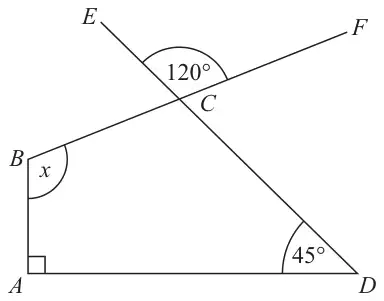
Work out the size of the angle marked \(x\).
Give a reason for each stage of your working. (4)
| Answer | Mark | Mark scheme |
|---|---|---|
| 105 | M1 | for a method to find an unknown angle, eg angle \(BCD = 120\) or angle \(BCD = 360 - 120 - 2 \times (180 - 120)\ (= 120)\) or angle \(BCE = 180 - 120\ (= 60)\) or angle \(DCF = 180 - 120\ (= 60)\) |
| M1 | for a complete method to find the value of \(x\), eg \((x =)\ 360 - \text{``}120\text{''} - 45 - 90\ (= 105)\) | |
| C2 | for 105 as the answer and full reasons for their method, eg vertically opposite angles are equal OR vertically opposite angles are equal angles in a quadrilateral add up to 360 or angles on a straight line add up to 180 angles at a point add up to 360 angles in a quadrilateral add up to 360 or angles on a straight line add up to 180 angles in a quadrilateral add up to 360 | |
| (C1 | (dep M1) for one correct reason) |
Additional guidance
Angles may be seen on diagram.
Angles must be clearly labelled on the diagram or otherwise identified.
Underlined words need to be shown; reasons need to be linked to their method; if student gives any reasons not linked to their method, award maximum C1 only
Accept “\(\angle\)s” for “angles”
Accept “4-sided shape” for “quadrilateral”
For C1, ignore any reasons not linked to their method