
Higher November 2020 Paper 1 Q23
23 \(ABCD\) is a quadrilateral.
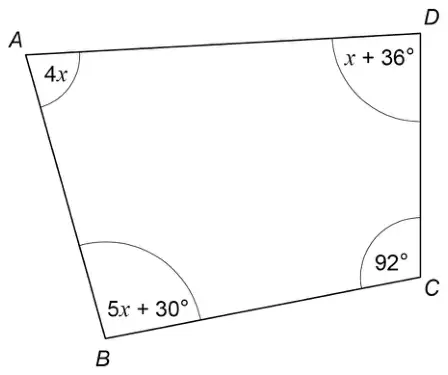
Not drawn accurately
Prove that \(ABCD\) is not a cyclic quadrilateral. [4 marks]
| Answer | Mark | Comments |
|---|---|---|
| Alternative method 1: works out the value of \(x\) using two different methods and shows they are different | ||
| Any one of \(4x + 92 = 180\) or \(5x + 30 + x + 36 = 180\) or \(6x + 66 = 180\) or \(4x + x + 36 + 5x + 30 + 92 = 360\) or \(10x + 158 = 360\) | M1 | oe |
| \((x =)\) 22 with M1 seen or \((x =)\) 19 with M1 seen or \((x =)\) 20.2 with M1 seen | A1 | must be correct value for corresponding equation |
| A different one of \(4x + 92 = 180\) or \(5x + 30 + x + 36 = 180\) or \(6x + 66 = 180\) or \(4x + x + 36 + 5x + 30 + 92 = 360\) or \(10x + 158 = 360\) | M1 | oe |
| Any two of \((x =)\) 22 with M1 seen or \((x =)\) 19 with M1 seen or \((x =)\) 20.2 with M1 seen and should be equal | A1 | must be correct values for corresponding equations oe statement |
| Alternative method 2: uses angle sum of quadrilateral to work out \(x\) and then shows opposite angles do not sum to 180° | ||
| \(4x + x + 36 + 5x + 30 + 92 = 360\) or \(10x + 158 = 360\) | M1 | oe |
| \((x =)\) 20.2 with M1 seen | A1 | |
| \(4 \times\) their \(20.2 + 92\) or \(5 \times\) their \(20.2 + 30 +\) their \(20.2 + 36\) | M1dep | oe |
| \(4 \times 20.2 + 92 = 172.8\) and should be 180 or \(5 \times 20.2 + 30 + 20.2 + 36 = 187.2\) and should be 180 | A1 | oe oe statement oe oe statement |
| Alternative method 3: uses angle sum of \(4x\) and 92° to work out \(x\) and then shows other angles do not sum to 180° or all angles do not sum to 360° | ||
| \(4x + 92 = 180\) | M1 | oe |
| \((x =)\) 22 with M1 seen | A1 | |
| \(5 \times\) their \(22 + 30 +\) their \(22 + 36\) or \(4 \times\) their \(22 + 92 + 5 \times\) their \(22 + 30 +\) their \(22 + 36\) | M1dep | oe |
| \(5 \times 22 + 30 + 22 + 36 = 198\) and should be 180 or \(4 \times 22 + 92 + 5 \times 22 + 30 + 22 + 36 = 378\) and should be 360 | A1 | oe oe statement oe oe statement |
| Alternative method 4: uses angle sum of \(5x + 30\) and \(x + 36\)° to work out \(x\) and then shows other angles do not sum to 180° or all angles do not sum to 360° | ||
| \(5x + 30 + x + 36 = 180\) or \(6x + 66 = 180\) | M1 | oe |
| \((x =)\) 19 with M1 seen | A1 | |
| \(4 \times\) their \(19 + 92\) or \(5 \times\) their \(19 + 30 +\) their \(19 + 36 + 4 \times\) their \(19 + 92\) | M1dep | oe |
| \(4 \times 19 + 92 = 168\) and should be 180 or \(5 \times 19 + 30 + 19 + 36 + 4 \times 19 + 92 = 348\) and should be 360 | A1 | oe oe statement oe oe statement |
Additional guidance
| Alts 1 and 2 \(x = 20.2\) with M1 not seen | Zero |
| Alts 1 and 3 \(x = 22\) with M1 not seen | Zero |
| Alts 1 and 4 \(x = 19\) with M1 not seen | Zero |
| Allow \(20\dfrac{1}{5}\) or \(\dfrac{101}{5}\) for 20.2, but do not allow other improper fractions for 20.2, 22 or 19 unless recovered |