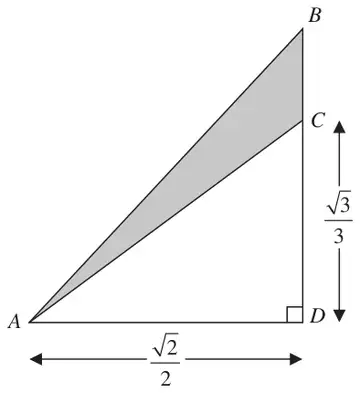
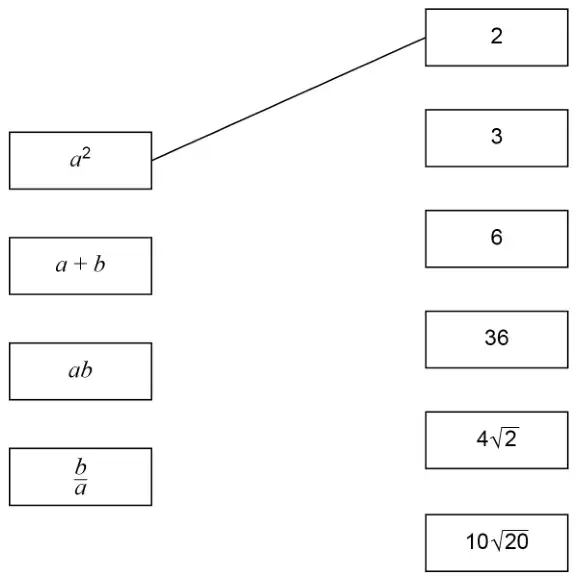
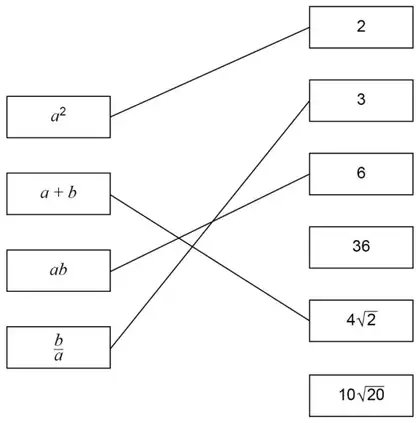
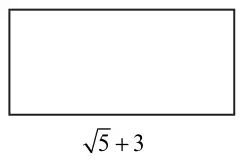
22 The 2nd term of a geometric sequence is \(3 + 2\sqrt{2}\) The 3rd term of the sequence is \(13 + 9\sqrt{2}\)
Find the value of the common ratio of the sequence. Give your answer in the form \(a + \sqrt{b}\) where \(a\) and \(b\) are integers. You must show all your working. (4)
Mark scheme
Answer
Mark
Mark scheme
\(3 + \sqrt{2}\)
P1
for start of process to find the common ratio, eg writes \(\dfrac{13 + 9\sqrt{2}}{3 + 2\sqrt{2}}\)
P1
for process to rationalise the denominator, eg \(\dfrac{13 + 9\sqrt{2}}{3 + 2\sqrt{2}} \times \dfrac{3 - 2\sqrt{2}}{3 - 2\sqrt{2}}\)
P1
(dep P2) for expanding terms, condone one error in expansion of numerator or denominator, eg \(\dfrac{39 + 27\sqrt{2} - 18\sqrt{2}\sqrt{2} - 26\sqrt{2}}{9 + 6\sqrt{2} - 6\sqrt{2} - 4\sqrt{2}\sqrt{2}}\) or \(\dfrac{39 + 27\sqrt{2} - 26\sqrt{2} - 36}{9 - 8}\) oe
A1
cao
Additional guidance
Award P1 for process to rationalise the denominator of \(\dfrac{3 + 2\sqrt{2}}{13 + 9\sqrt{2}}\)
A correct answer with no supportive working gets 0 marks.
23 Write \(\dfrac{3\sqrt{3}}{4 - \sqrt{3}} - \dfrac{2}{\sqrt{3}}\) in the form \(\dfrac{a\sqrt{3} + b}{c}\) where \(a\), \(b\) and \(c\) are integers. (4)
Mark scheme
Answer
Mark
Mark scheme
\(\dfrac{10\sqrt{3} + 27}{39}\)
M1
for method to rationalise one of the fractions, eg \(\dfrac{3\sqrt{3}}{4 - \sqrt{3}} \times \dfrac{4 + \sqrt{3}}{4 + \sqrt{3}}\ \left(= \dfrac{12\sqrt{3} + 9}{16 - 3}\right)\) or \(\dfrac{2}{\sqrt{3}} \times \dfrac{\sqrt{3}}{\sqrt{3}}\ \left(= \dfrac{2\sqrt{3}}{3}\right)\) oe
M1
for method to rationalise both of the fractions eg \(\dfrac{3\sqrt{3}}{4 - \sqrt{3}} \times \dfrac{4 + \sqrt{3}}{4 + \sqrt{3}}\ \left(= \dfrac{12\sqrt{3} + 9}{16 - 3}\right)\) and \(\dfrac{2}{\sqrt{3}} \times \dfrac{\sqrt{3}}{\sqrt{3}}\ \left(= \dfrac{2\sqrt{3}}{3}\right)\) oe
M1
for method to write correct fractions with a common denominator eg \(\dfrac{3(12\sqrt{3} + 9)}{13 \times 3} - \dfrac{13 \times 2\sqrt{3}}{13 \times 3}\) or \(\dfrac{36\sqrt{3} + 27}{39} - \dfrac{26\sqrt{3}}{39}\) oe
A1
for \(\dfrac{10\sqrt{3} + 27}{39}\) oe
Alternative
M1
for method to write fractions with a common denominator, eg \(\dfrac{3\sqrt{3} \times \sqrt{3}}{\sqrt{3}(4 - \sqrt{3})} - \dfrac{2 \times (4 - \sqrt{3})}{\sqrt{3}(4 - \sqrt{3})}\) oe
M1
for writing as a correct single fraction without brackets, eg \(\dfrac{9 - 8 + 2\sqrt{3}}{4\sqrt{3} - 3}\) oe
M1
for method to rationalise a fraction of the form \(\dfrac{a + b\sqrt{3}}{c\sqrt{3} - d}\) where \(a\), \(b\), \(c\) and \(d\) are integers, eg \(\dfrac{1 + 2\sqrt{3}}{4\sqrt{3} - 3} \times \dfrac{4\sqrt{3} + 3}{4\sqrt{3} + 3}\) or \(\dfrac{4\sqrt{3} + 3 + 24 + 6\sqrt{3}}{48 + 12\sqrt{3} - 12\sqrt{3} - 9}\) oe
(a) Rationalise the denominator of \(\dfrac{22}{\sqrt{11}}\) Give your answer in its simplest form. (2)
(b) Show that \(\dfrac{\sqrt{3}}{2\sqrt{3} - 1}\) can be written in the form \(\dfrac{a + \sqrt{3}}{b}\) where \(a\) and \(b\) are integers. (3)
Mark scheme (a)
Answer
Mark
Mark scheme
\(2\sqrt{11}\)
M1
for method to multiply numerator and denominator by \(\sqrt{11}\) or a multiple of \(\sqrt{11}\), eg \(\dfrac{22}{\sqrt{11}} \times \dfrac{\sqrt{11}}{\sqrt{11}}\)
A1
for \(2\sqrt{11}\)
Mark scheme (b)
Answer
Mark
Mark scheme
\(\dfrac{6 + \sqrt{3}}{11}\)
M1
for method to multiply numerator and denominator by \(2\sqrt{3} + 1\) or a multiple of \(2\sqrt{3} + 1\), eg \(\dfrac{\sqrt{3}}{2\sqrt{3} - 1} \times \dfrac{2\sqrt{3} + 1}{2\sqrt{3} + 1}\)
M1
(dep) for \(\sqrt{3} \times 2\sqrt{3} = 6\) or \(2\sqrt{3} \times 2\sqrt{3} = 12\)
A1
for \(\dfrac{6 + \sqrt{3}}{11}\) (accept \(a = 6\) and \(b = 11\))
13 \(\sqrt{5}\left(\sqrt{8} + \sqrt{18}\right)\) can be written in the form \(a\sqrt{10}\) where \(a\) is an integer.
Find the value of \(a\). (3)
Mark scheme
Answer
Mark
Mark scheme
5
M1
for \(\sqrt{40}\) or \(\sqrt{90}\)
OR \(2\sqrt{2}\) or \(3\sqrt{2}\)
M1
for \(2\sqrt{10}\) or \(3\sqrt{10}\) or \(\sqrt{4} \times \sqrt{10}\) or \(\sqrt{9} \times \sqrt{10}\) or \(\sqrt{4 \times 10}\) or \(\sqrt{9 \times 10}\)
OR \(2\sqrt{2} + 3\sqrt{2}\)
A1
cao
Additional guidance
Answer of \(5\sqrt{10}\) from correct working gets M2 A0
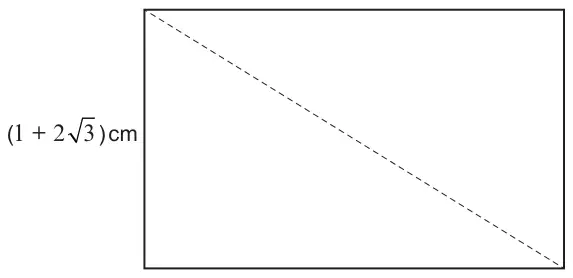
Work out the value of \(T\). Give your answer in the form \(c\sqrt{2}\) where \(c\) is an integer. (4)
Mark scheme
Answer
Mark
Notes
\(16\sqrt{2}\)
4
M1 for method to expand \((\sqrt{8} + 2)^2\) with at least 3 correct terms out of 4 terms M1 for method to expand \((\sqrt{8} - 2)^2\) with at least 3 correct terms out of 4 terms M1 (dep on M2) for a method to subtract the two expressions and use of \(\sqrt{8} = 2\sqrt{2}\) A1 cao
OR
M1 for factorising \(a^2 - b^2 = (a + b)(a - b)\) M1 for substituting for \(a\) and \(b\) with simplification (at least 1 of the two terms correct) M1 (dep on M2) for multiplying the 2 terms together and use of \(\sqrt{8} = 2\sqrt{2}\) A1 cao
M1 for \(\dfrac{5}{\sqrt{2}} \times \dfrac{\sqrt{2}}{\sqrt{2}}\) oe A1 for \(\dfrac{5\sqrt{2}}{2}\) oe
Mark scheme (b)
Answer
Mark
Notes
\(8\sqrt{3}\)
2
M1 for \(2 \times 2 + 2\sqrt{3} + 2\sqrt{3} + \sqrt{3} \times \sqrt{3}\) or \((4 + 4\sqrt{3} + 3) - (4 - 4\sqrt{3} + 3)\) or \(2 \times 2 - 2\sqrt{3} - 2\sqrt{3} + \sqrt{3} \times \sqrt{3}\) at least three terms in either correct; could be in a grid. A1 cao OR Difference of two squares M1 for \(\left((2 + \sqrt{3}) - (2 - \sqrt{3})\right)\left((2 + \sqrt{3}) + (2 - \sqrt{3})\right)\) A1 cao
(a) Show that \(\quad \dfrac{\sqrt{363}}{\sqrt{3}} \quad\) simplifies to an integer. [2 marks]
(b) Rationalise the denominator and simplify \(\quad \dfrac{20}{\sqrt{5}}\) [2 marks]
Mark scheme (a)
Answer
Mark
Comments
\(\dfrac{\sqrt{121}\sqrt{3}}{\sqrt{3}}\) or \(\dfrac{11\sqrt{3}}{\sqrt{3}}\) or \(\sqrt{121}\) or \(\dfrac{\sqrt{363}}{\sqrt{3}} \times \dfrac{\sqrt{3}}{\sqrt{3}}\) or \(\dfrac{\sqrt{363}\sqrt{3}}{3}\) or \(\dfrac{11\sqrt{3}\sqrt{3}}{3}\) or \(\dfrac{\sqrt{1089}}{3}\)
M1
oe with at least partial simplification of the numerator oe with correct method to rationalise the denominator rationalised
11 and \(\dfrac{\sqrt{121}\sqrt{3}}{\sqrt{3}}\) or \(\dfrac{11\sqrt{3}}{\sqrt{3}}\) or \(\sqrt{121}\) or 11 and \(\dfrac{11\sqrt{3}\sqrt{3}}{3}\) or \(\dfrac{\sqrt{1089}}{3}\)
A1
Additional guidance
For M1, allow multiplication or division by \(\sqrt{1}\) throughout
Mark scheme (b)
Answer
Mark
Comments
Correct expression with rationalisation of denominator seen or used
M1
eg \(\dfrac{20}{\sqrt{5}} \times \dfrac{\sqrt{5}}{\sqrt{5}}\) or \(\dfrac{20\sqrt{5}}{5}\) or \(\dfrac{4 \times \sqrt{5} \times \sqrt{5}}{\sqrt{5}}\) or \(\dfrac{4\sqrt{5}}{1}\)
\(\dfrac{7\sqrt{15}}{10}\) or \(\dfrac{14\sqrt{15}}{20}\)
A1
oe in the form \(\dfrac{x\sqrt{15}}{y}\) where \(x\) and \(y\) are integers
Alternative method 3
\(\dfrac{7}{\sqrt{2}} \times \dfrac{\sqrt{2}}{\sqrt{2}}\) or \(\dfrac{7\sqrt{2}}{2}\) or \(\dfrac{\sqrt{3}}{\sqrt{10}} \times \dfrac{\sqrt{10}}{\sqrt{10}}\) or \(\dfrac{\sqrt{30}}{10}\)
M1
oe
\(\dfrac{7\sqrt{2}}{2} \times \dfrac{\sqrt{30}}{10}\) or \(\dfrac{7\sqrt{60}}{20}\)
M1dep
oe rationalised
\(\dfrac{7\sqrt{15}}{10}\) or \(\dfrac{14\sqrt{15}}{20}\)
A1
oe in the form \(\dfrac{x\sqrt{15}}{y}\) where \(x\) and \(y\) are integers
\(\dfrac{7\sqrt{5}}{\sqrt{10}} \times \dfrac{\sqrt{3}}{\sqrt{10}}\) or \(\dfrac{7}{\sqrt{2}} \times \dfrac{\sqrt{15}}{\sqrt{50}}\) or \(\dfrac{7\sqrt{15}}{\sqrt{100}}\)
M1dep
oe one term or product of two terms with numerator \(7\sqrt{15}\)
\(\dfrac{7\sqrt{15}}{10}\) or \(\dfrac{14\sqrt{15}}{20}\)
A1
oe in the form \(\dfrac{x\sqrt{15}}{y}\) where \(x\) and \(y\) are integers
(a) Show that \(\quad \dfrac{14}{\sqrt{7}} \quad\) can be written in the form \(\quad a\sqrt{b} \quad\) where \(a\) and \(b\) are integers. [2 marks]
(b) Work out \(\quad 2\sqrt{10} \times \sqrt{80} \times \sqrt{18}\)
Give your answer as an integer. [3 marks]
Mark scheme (a)
Answer
Mark
Comments
\(\dfrac{14}{\sqrt{7}} \times \dfrac{\sqrt{7}}{\sqrt{7}}\) or \(\dfrac{14\sqrt{7}}{7}\)
M1
\(2\sqrt{7}\)
A1
do not award if further work eg \(\sqrt{14}\)
Additional guidance
Correct answer with no working
M1A1
Mark scheme (b)
Answer
Mark
Comments
240
B3
B2 any correct single value of the form \(a\sqrt{b}\) where \(a \geqslant 2\) eg \(24\sqrt{100}\) or \(12\sqrt{400}\) or \(8\sqrt{900}\) or \(6\sqrt{1600}\) or \(2\sqrt{14\,400}\) or correct product of two or more integers eg \(24 \times 10\) or \(8 \times 30\) or \(6 \times 40\) or \(2 \times 2 \times 5 \times 4 \times 3\) B1 \((\sqrt{80} =)\ 4\sqrt{5}\) or \((\sqrt{18} =)\ 3\sqrt{2}\) or correct product of two surds eg \(2\sqrt{800} \times \sqrt{18}\) or \(2\sqrt{180} \times \sqrt{80}\) or \(2\sqrt{10} \times \sqrt{1440}\) or \(\sqrt{40} \times \sqrt{80} \times \sqrt{18}\) or \(2\sqrt{10 \times 80 \times 18}\) or \(\sqrt{40 \times 80 \times 18}\) or \(2\sqrt{2 \times 5 \times 4 \times 4 \times 5 \times 2 \times 3 \times 3}\) or \(\sqrt{2^8 \times 5^2 \times 3^2}\) or \(\sqrt{57\,600}\)
24 Work out \(\quad \sqrt{18} - \dfrac{28}{\sqrt{50}}\)
Give your answer in the form \(\quad \dfrac{\sqrt{a}}{b} \quad\) where \(a\) and \(b\) are integers. [4 marks]
Mark scheme
Answer
Mark
Comments
Alternative method 1
\((\sqrt{18} =)\ \sqrt{9}\sqrt{2}\) or \(3\sqrt{2}\) or \((\sqrt{50} =)\ \sqrt{25}\sqrt{2}\) or \(5\sqrt{2}\)
M1
oe simplifies one surd implied by \(\dfrac{28}{5\sqrt{2}}\)
\(\dfrac{28}{\sqrt{50}} \times \dfrac{\sqrt{50}}{\sqrt{50}}\) or \(\dfrac{28\sqrt{50}}{50}\)
M1
oe rationalises second term \(\dfrac{28}{5\sqrt{2}} \times \dfrac{5\sqrt{2}}{5\sqrt{2}}\) or \(\dfrac{140\sqrt{2}}{50}\) or \(\dfrac{14\sqrt{2}}{5}\) implies M1M1
\(3\sqrt{2} - \dfrac{140\sqrt{2}}{50}\) or \(\dfrac{150\sqrt{2} - 140\sqrt{2}}{50}\) or \(\dfrac{10\sqrt{2}}{50}\)
M1dep
dep on M2 oe both terms rational with a common surd
\(\dfrac{\sqrt{2}}{5}\) or \(a = 2\), \(b = 5\)
A1
oe in the form \(\dfrac{\sqrt{a}}{b}\) eg \(\dfrac{\sqrt{50}}{25}\) or \(\dfrac{\sqrt{200}}{50}\)
Alternative method 2
\((\sqrt{18} =)\ \sqrt{9}\sqrt{2}\) or \(3\sqrt{2}\) or \((\sqrt{50} =)\ \sqrt{25}\sqrt{2}\) or \(5\sqrt{2}\) or \(\dfrac{\sqrt{18}\sqrt{50}}{\sqrt{50}}\) or \(\dfrac{\sqrt{900}}{\sqrt{50}}\)
M1
oe simplifies one surd implied by \(\dfrac{28}{5\sqrt{2}}\)
or changes first term to match second
\(\dfrac{\sqrt{900}}{\sqrt{50}} - \dfrac{28}{\sqrt{50}}\) or \(\dfrac{3\sqrt{2} \times 5\sqrt{2}}{\sqrt{50}} - \dfrac{28}{\sqrt{50}}\) or \(\dfrac{30 - 28}{\sqrt{50}}\) or \(\dfrac{2}{\sqrt{50}}\)
M1dep
oe common denominator
\(\dfrac{30 - 28}{\sqrt{50}} \times \dfrac{\sqrt{50}}{\sqrt{50}}\) or \(\dfrac{2\sqrt{50}}{50}\)
M1dep
oe rationalisation of a single term
\(\dfrac{\sqrt{2}}{5}\) or \(a = 2\), \(b = 5\)
A1
oe in the form \(\dfrac{\sqrt{a}}{b}\) eg \(\dfrac{\sqrt{50}}{25}\) or \(\dfrac{\sqrt{200}}{50}\)
Additional guidance
Ignore further work after a correct value, eg \(\dfrac{\sqrt{50}}{25} = \sqrt{2}\)
24 Show that \(\quad \dfrac{2\sqrt{6}}{\sqrt{5}} - \dfrac{\sqrt{3}}{\sqrt{10}} \quad\) can be written in the form \(\quad \dfrac{c\sqrt{d}}{10}\)
where \(c\) and \(d\) are integers. [3 marks]
Mark scheme
Answer
Mark
Comments
Alternative method 1
\(\dfrac{2\sqrt{6}}{\sqrt{5}} \times \dfrac{\sqrt{5}}{\sqrt{5}}\) or \(\dfrac{\sqrt{3}}{\sqrt{10}} \times \dfrac{\sqrt{10}}{\sqrt{10}}\)
M1
\(\dfrac{2\sqrt{30}}{5}\) or \(\dfrac{4\sqrt{30}}{10}\) or \(\dfrac{\sqrt{30}}{10}\)
M1dep
\(\dfrac{3\sqrt{30}}{10}\)
A1
Alternative method 2
\(\dfrac{2\sqrt{6}\sqrt{2}}{\sqrt{10}} - \dfrac{\sqrt{3}}{\sqrt{10}}\) or \(\dfrac{2\sqrt{12}}{\sqrt{10}} - \dfrac{\sqrt{3}}{\sqrt{10}}\)
M1
oe common denominator eg \(\dfrac{2\sqrt{60}}{\sqrt{50}} - \dfrac{\sqrt{15}}{\sqrt{50}}\)
\(\dfrac{4\sqrt{3}}{\sqrt{10}} - \dfrac{\sqrt{3}}{\sqrt{10}}\) or \(\dfrac{3\sqrt{3}}{\sqrt{10}}\)
M1dep
oe common denominator and common surd in numerator \(\dfrac{4\sqrt{15}}{\sqrt{50}} - \dfrac{\sqrt{15}}{\sqrt{50}}\) or \(\dfrac{3\sqrt{15}}{\sqrt{50}}\)
\(\dfrac{3\sqrt{30}}{10}\)
A1
Additional guidance
Ignore an attempt at further simplification after \(\dfrac{3\sqrt{30}}{10}\)
29 Work out the value of \(\qquad \left(\sqrt{3}\right)^2 \times \left(\sqrt{2}\right)^2\) [2 marks]
Mark scheme
Answer
Mark
Comments
\(\left(\left(\sqrt{3}\right)^2 =\right)\) 3 and \(\left(\left(\sqrt{2}\right)^2 =\right)\) 2 or \(\left(\sqrt{6}\right)^2\) or \(\sqrt{6^2}\) or \(\sqrt{36}\) or \(\sqrt{9} \times \sqrt{4}\) or \(\sqrt{9 \times 4}\)
M1
6
A1
Additional guidance
\(3 \times 2 = 6\) with answer eg \(\sqrt{6}\) or \(6^4\)
M0A0
Condone \(\sqrt{3} = 1.7\), \(1.7^2 = 3\) and \(\sqrt{2} = 1.4\), \(1.4^2 = 2\), otherwise \(\sqrt{3}\) or \(\sqrt{2}\) or \(3^2\) or \(2^2\) incorrectly evaluated does not score even if answer is 6 eg \(\sqrt{3} = 1.5\), \(1.5^2 = 3\), answer 6 \(\sqrt{2} = 1\), \(1^2 = 2\) \(3^2 = 6\), \(\sqrt{6} = 3\) \(\left(\sqrt{6}\right)^4\) \(\sqrt{2} = 1\)
6 Work out the value of \(\quad \left(\sqrt{3}\right)^2 \times \left(\sqrt{2}\right)^2\) [2 marks]
Mark scheme
Answer
Mark
Comments
\(\left(\left(\sqrt{3}\right)^2 =\right)\) 3 and \(\left(\left(\sqrt{2}\right)^2 =\right)\) 2 or \(\left(\sqrt{6}\right)^2\) or \(\sqrt{6^2}\) or \(\sqrt{36}\) or \(\sqrt{9} \times \sqrt{4}\) or \(\sqrt{9 \times 4}\)
M1
6
A1
Additional guidance
\(3 \times 2 = 6\) with answer eg \(\sqrt{6}\) or \(6^4\)
M0A0
Condone \(\sqrt{3} = 1.7\), \(1.7^2 = 3\) and \(\sqrt{2} = 1.4\), \(1.4^2 = 2\), otherwise \(\sqrt{3}\) or \(\sqrt{2}\) or \(3^2\) or \(2^2\) incorrectly evaluated does not score, even if answer is 6
Give your answer in the form \(a\sqrt{b}\), where \(a\) and \(b\) are integers.
You must show each step in your working. [3]
Mark scheme
Answer
Marks
Part marks and guidance
\(\sqrt{75}\ [-\sqrt{15} + \sqrt{15}] - \sqrt{3}\) or \(\sqrt{5}\sqrt{15}\ [-\sqrt{5}\sqrt{3} + \sqrt{15}] - \sqrt{3}\) or \(5\sqrt{3}\ [-\sqrt{15} + \sqrt{15}] - \sqrt{3}\)
M2
M1 for correct expansion with one error or omission or \(\sqrt{75} = 5\sqrt{3}\) Alternative 1 M2 for \(\sqrt{3}\,(\sqrt{5} - 1)(\sqrt{5} + 1)\) or better or M1 for \(\sqrt{15} - \sqrt{3} = \sqrt{3}\,(\sqrt{5} - 1)\)
Working must be in surds, working can be in tables e.g M2 for
\(\sqrt{15}\)
\(-\sqrt{3}\)
\(\sqrt{5}\)
\(\sqrt{75}\)
\(-\sqrt{15}\)
\(+1\)
\(\sqrt{15}\)
\(-\sqrt{3}\)
\(5\sqrt{3} - \sqrt{3} = 4\sqrt{3}\)
A1
for A1 allow \(5\sqrt{3} - \sqrt{3}\) to be seen in the M2 expression
Find the value of \(a\) and the value of \(b\). You must show each step in your working. [6]
Mark scheme
Answer
Marks
Part marks and guidance
[\(a =\)] 21 [\(b =\)] −31 with correct working
6
“Correct working” requires at least M1M1M1M1
M1 for \(\frac{2 - 3\sqrt{18}}{\sqrt{18} + 4} \times \frac{\sqrt{18} - 4}{\sqrt{18} - 4}\) M1 for multiplying their numerator e.g. \(2\sqrt{18} - 8 - 3 \times 18 + 12\sqrt{18}\) oe or better M1 for simplifying their numerator e.g. \(14\sqrt{18} - 62\) M1 for multiplying their denominator e.g. \(18 + 4\sqrt{18} - 4\sqrt{18} - 16\) oe or better e.g. 18 – 16 or 2 M1 for \(\sqrt{18} = 3\sqrt{2}\) at any stage and may be implied in working A1dep for [a =] 21 or [b =] −31 dep. on only M4 awarded
alternative : M1 for \(\sqrt{18} = 3\sqrt{2}\) M1 for \(\frac{2 - 9\sqrt{2}}{3\sqrt{2} + 4} \times \frac{3\sqrt{2} - 4}{3\sqrt{2} - 4}\) M1 for multiplying their numerator \(6\sqrt{2} - 8 - 3 \times 18 + 36\sqrt{2}\) oe or better M1 for simplifying their numerator e.g. \(42\sqrt{2} - 62\) M1 for \(18 + 12\sqrt{2} - 12\sqrt{2} - 16\) oe or better e.g. 18 – 16 or 2 A1dep for [a =] 21 or [b =] −31 dep. on only M4 awarded
Alternative: M1 for \([2 - 3\sqrt{18} =] (a\sqrt{2} + b)(\sqrt{18} + 4)\) M1 for \(a\sqrt{2}\sqrt{18} + 4a\sqrt{2} + b\sqrt{18} + 4b\) oe or better M1 for \(\sqrt{2}\sqrt{18} = 6\) or \(\sqrt{18} = 3\sqrt{2}\) M1 for \(6a + 4a\sqrt{2} + 3b\sqrt{2} + 4b\) M1 for \(2 = 6a + 4b\) oe and \(-9 = 4a + 3b\) oe A1dep for [a =] 21 or [b =] −31 dep. on only M4 awarded
If 0 scored SC1 for [a =] 21 and [b =] −31
Note : working may be implied by use rather than explicitly seen and follow through from any errors if subsequent working is correct
(a) Show that \(\sqrt{11} \times \sqrt{22} = 11\sqrt{2}\). [1]
(b) Show that \(\frac{\sqrt{11}}{13 + \sqrt{22}}\) can be written in the form \(\frac{a\sqrt{11} - 11\sqrt{2}}{b}\) where \(a\) and \(b\) are integers. [4]
(a) Complete this statement by writing the missing power in the box.\[784 = 2^{\square} \times 7^2\]
[1]
(b) Use your answer to part (a) to find the value of \(\sqrt{784}\). [2]
Mark scheme (a)
Answer
Marks
Part marks and guidance
4
1
Mark scheme (b)
Answer
Marks
Part marks and guidance
28
2
B1 for answer that is a multiple of 7 (not 7 or 14) but not a multiple of 49 and is less than 784
or \(n \times 7\) seen leading to the answer
28 scores 2 marks from any method Allow B1 for a correct equivalent to 28 of form \(a\sqrt{b}\) (\(a \ne 1\)) e.g. \(7\sqrt{16}\), \(4\sqrt{49}\), \(2\sqrt{196}\)
(b) There are two errors in Sam’s method for finding the value of \(64^{-\frac{2}{3}}\) shown below.
Find the cube root of 64 and then multiply by 2. The cube root of 64 is 4 and then 4 x 2 = 8. The negative power makes the answer negative so answer equals –8.
Describe these errors and then give the correct value of \(64^{-\frac{2}{3}}\). [3]
Mark scheme (a)
Answer
Marks
Part marks and guidance
(i) \(6\sqrt{2}\) final answer
2
M1 for \(\sqrt{25 \times 2}\) or better seen
(ii) \(\dfrac{5\sqrt{6}}{3}\) final answer
2
M1 for \(\frac{10}{\sqrt{6}} \times \frac{\sqrt{6}}{\sqrt{6}}\) oe
For 2 marks accept \(1\frac{2}{3}\sqrt{6}\)
Mark scheme (b)
Answer
Marks
Part marks and guidance
Identifies both errors and explains the correct steps e.g. Square not multiply by 2 oe negative power does not make answer negative it should be the reciprocal oe
2
B1 for each with no incorrect statement for either
Accept implication of error by a description of correct step e.g. should be squared should be reciprocal, should be 1/\(n\), should be 1/64 Descriptions must be in words do not accept numeric examples alone
SEE APPENDIX
\(\dfrac{1}{16}\)
1
isw attempt to convert to decimal
Appendix: Exemplar responses for Q15b
Accept reciprocal or one over for description of negative power, must use squared. Descriptions must be in words
Response
Mark
1
Make the fraction reciprocal
(Not clear as the fraction could be the index)
0
2
Negative power means find the inverse
0
3
Make it a reciprocal
1
4
The negative power makes it positive
0
5
Make it one over
1
6
He multiplied the power by 2
0
7
Need to turn into fraction ; The negative makes it a fraction
0
8
The –2 is the power so it must be squared
1
9
Square not times 2
1
10
Cube root should be squared and the negative power is 1 under
‘1 under’ is not quite right
1, 0
11
Top fraction is to square not double, and the negative makes it 1 over
(a) Calculate the value of \(144^{0{\cdot}5} \times 6^{-2}\). Give your answer as a fraction in its simplest form. [3]
(b) Write \(\dfrac{430}{33}\) as a recurring decimal. [1]
(c) Expand and simplify \(\left(9 + 2\sqrt{5}\right)\left(4 - 3\sqrt{5}\right)\). [2]
(d) Find the mean of \(4\sqrt{75}\) and \(3\sqrt{48}\).
Give your answer in the form \(a\sqrt{b}\) where \(b\) is as small as possible. [3]
Mark scheme (a)
Scheme
Marks
Comments
\((144^{0{\cdot}5} =)\ 12\)
B1
\((6^{-2} =)\ \frac{1}{36}\)
B1
\(\frac{1}{3}\)
B1
Provided B1 awarded, FT ‘their values’ that will lead to a fully correct simplified fraction as a final answer. Do not award if this simplifies to a whole number.
An unsupported answer of \(0{\cdot}\dot{3}\) or 0·33… is awarded B1B1B0 An unsupported answer of \(0{\cdot}3\) is awarded B0B0B0
Corrected by Westie's Workshop
The board's mark scheme printed “An unsupported answer of answer of 0·3”. Changed to “An unsupported answer of 0·3” because the words “answer of” were printed twice.
Original: see the board's mark scheme PDF (link above).
Mark scheme (b)
Scheme
Marks
Comments
\(13{\cdot}\dot{0}\dot{3}\)
B1
Accept 13.0303…. or better
Accept \(13.0\dot{3}\dot{0}\) or \(13.03\dot{0}\dot{3}\)
Do not accept \(13.0\dot{3}\)
Mark scheme (c)
Scheme
Marks
Comments
\(6 - 19\sqrt{5}\)
B2
Mark final answer If not B2, award B1 for at least 3 out of 4 terms, from \(36 - 27\sqrt{5} + 8\sqrt{5} - 30\)
Mark scheme (d)
Scheme
Marks
Comments
\(20\sqrt{3}\)
B1
\(12\sqrt{3}\)
B1
\(16\sqrt{3}\)
B1
FT provided ‘their \(20\sqrt{3}\)’ and ‘their \(12\sqrt{3}\)’ are both multiples of \(\sqrt{3}\) and one is correct
FT provided at least B2 previously awarded, the third value of the form \(a\sqrt{3}\) and \(x \gt 0\) Mark the final answer unless \(x\) clearly identified
Alternative method 1 (multiplying by \(\sqrt{3}\))
Scheme
Marks
Comments
(Total of the 3 values =) \(18\sqrt{3}\)
B1
May be seen in later working
\(\sqrt{3}x + 12 + \sqrt{3}^{\,6} = 54\)
B1
FT their \(a\sqrt{3}\) Using \(\left(x + \dfrac{12}{\sqrt{3}} + \sqrt{3}^{\,5} = 18\sqrt{3}\right)\times\sqrt{3}\)
\(\dfrac{9\times10^8}{3\times10^2}\) or \(\dfrac{900\,000\,000}{300}\)
M2
M1 for \(\dfrac{9\times10^8}{300}\) or \(\dfrac{9\times10^8}{298}\) or \(\dfrac{8{\cdot}85\times10^8}{300}\) or \(\dfrac{8{\cdot}9\times10^8}{298\text{ or }300}\) or \(\dfrac{2\times10^8 + 7\times10^8}{3\times10^2}\) or \(\dfrac{2\times10^8 + 7\times10^8}{300}\)
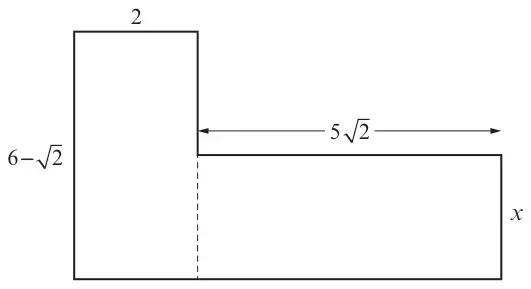
(a) Write \(7\sqrt{3}\left(5\sqrt{3} - 4\right) + \sqrt{27}\) in the form \(a + b\sqrt{3}\), where \(a\) and \(b\) are integers. [3]
(b) In this question all lengths are in centimetres.
Diagram not drawn to scale
This shape is made from two rectangles. The area of this shape is \(33\sqrt{2} - 18\).
Showing all your working, find the value of \(x\). Give your answer in the form \(c + d\sqrt{2}\), where \(c\) and \(d\) are integers. [5]
Mark scheme (a)
Scheme
Marks
Comments
\(35\times3 - 28\sqrt{3} + 3\sqrt{3}\) or better
M2
with at most one sign or arithmetic slip
M1 for any one of 105, \(-28\sqrt{3}\), \(3\sqrt{3}\) si
\(105 - 25\sqrt{3}\)
A1
Allow e.g. \(-25\sqrt{3} + 105\);
Mark scheme (b)
Scheme
Marks
Comments
\(2\left(6 - \sqrt{2}\right) + x\times5\sqrt{2}\) \((= 33\sqrt{2} - 18)\) si
B1
or \(2\left(6 - \sqrt{2} - x\right) + x(5\sqrt{2} + 2)\) \((= 33\sqrt{2} - 18)\) si omitted brackets may be recovered in later work
Forms a correct equation for the area and either isolates \(x\) term: \(5x\sqrt{2} = 33\sqrt{2} - 18 - 12 + 2\sqrt{2}\) or collects terms: \(30 + 5x\sqrt{2} = 35\sqrt{2}\)
M1
FT ‘their \(2\left(6 - \sqrt{2}\right) + x\times5\sqrt{2}\)’ \(= 33\sqrt{2} - 18\) oe providing expression is dimensionally correct for an area and at most one error in the expression;
allow one further error in forming and rearranging the equation e.g. sign, bracketing or arithmetic slip
(a) Write \(\sqrt{245} + \sqrt{80}\) in the form \(a\sqrt{5}\), where \(a\) is an integer. [2]
(b) The length of a thin string is to be divided into two parts so that\[\frac{\text{length of shorter part}}{\textbf{total}\text{ length of string}} = \frac{\sqrt{2}}{5 + 2\sqrt{2}}.\]
(i) Complete the following ratio. [1]
length of shorter part : length of longer part
………………………… : …………………………
(ii) The total length of the string is 17 cm.
Find the length of the shorter part of the string. Give your answer in the form \(b\sqrt{2} + c\), where \(b\) and \(c\) are integers. [5]
(b) The \(n\)th term of a sequence is \(\left(2\sqrt{3}\right)^n\).
Find and simplify the 3rd term of this sequence. [2]
(c) Find the \(n\)th term of this sequence.
1·5, 3, 5·5, 9, 13·5, ... [2]
Mark scheme (a)
Scheme
Marks
Comments
\(\dfrac{243}{32}\)
B2
B1 for a numerator of 243 or a denominator of 32 or for \(-\dfrac{81}{16}\times-\dfrac{3}{2}\) si; implied by e.g. \(-\dfrac{81^{\times-3}}{16_{\times2}}\)
Mark scheme (b)
Scheme
Marks
Comments
\(24\sqrt{3}\)
B2
B1 for \(2^3\times\left(\sqrt{3}\right)^3\) or better
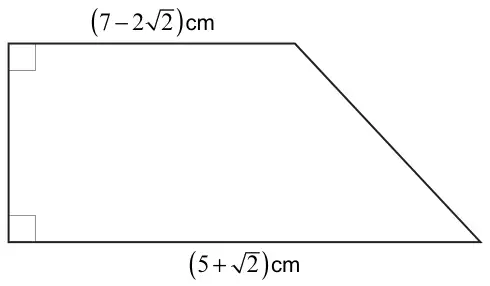
(a) Show that \(\dfrac{\sqrt{63}}{\sqrt7} + \sqrt{147} + \sqrt{48}\) can be written in the form \(a + b\sqrt3\), where \(a\) and \(b\) are integers. [3]
(b)
Diagram not drawn to scale
The area of this trapezium is \((6\sqrt2 - 1)\) cm2.
Find the height of the trapezium. Give your answer in its simplest form. [5]
Mark scheme (a)
Scheme
Marks
Comments
\(3 + 11\sqrt3\)
B3
B2 for \(k + 11\sqrt3\) or for any two correct terms in \(3 + 7\sqrt3 + 4\sqrt3\) or B1 for \(\dfrac{\sqrt7\sqrt9}{\sqrt7}\) oe si or \(7\sqrt3\) or \(4\sqrt3\) seen
Mark scheme (b)
Scheme
Marks
Comments
\(\dfrac12\times(7 - 2\sqrt2 + 5 + \sqrt2)\times h = 6\sqrt2 - 1\) or \(\dfrac12\times h\times(3\sqrt2 - 2) + (7 - 2\sqrt2)\times h = 6\sqrt2 - 1\)
FT \(\text{'their}\left(\dfrac{12 - \sqrt2}{2}\right)\text{'}\,h = 6\sqrt2 - 1\); \(\text{'their}\left(\dfrac{12 - \sqrt2}{2}\right)\text{'}\) must be of the form \(a + b\sqrt2\) where \(a\) and \(b\) are non-zero;
FT \(\dfrac{2(6\sqrt2 - 1)}{\text{'their}(12 - \sqrt2)\text{'}}\times\dfrac{\text{'their}(12 + \sqrt2)\text{'}}{\text{'their}(12 + \sqrt2)\text{'}}\) multiplies out their expression for \(h\) or ½\(h\)
\((h =)\ \sqrt2\)
A1
CAO
Alternative method
Scheme
Marks
Comments
\(\dfrac12\times(7 - 2\sqrt2 + 5 + \sqrt2)\times h = 6\sqrt2 - 1\) or \(\dfrac12\times h\times(3\sqrt2 - 2) + (7 - 2\sqrt2)\times h = 6\sqrt2 - 1\)
“Expanding and simplifying \(\left(a + \sqrt{2}\right)\left(b - \sqrt{2}\right)\), where \(a\) and \(b\) are integers, can never have an integer answer.”
Show that Tom’s statement is incorrect. Give the reasons to support your decision. [3]
Mark scheme (a)
Scheme
Marks
Comments
(a)(i) \(\dfrac{15}{\sqrt5} \times \dfrac{\sqrt5}{\sqrt5}\) or \(\dfrac{15\sqrt5}{5}\) or \(\dfrac{3 \times 5}{\sqrt5}\)
Identifies \(ab\) as an integer and \(\sqrt2 \times \sqrt2\) as an integer
M1
May be implied eg \(ab - 2\) is an integer
(Not correct as ) an integer when \(a = b\) or equivalent
A1
\(a = b\) must be seen or implied at some point
Alternative method 1
Scheme
Marks
Comments
Stating eg ‘difference of two squares if \(a = b\)’
B1
Shows eg \(a^2 - 2\)
M1
Concludes integer
A1
Alternative method 2
Scheme
Marks
Comments
Uses equal numerical values of \(a\) and \(b\) and expands with at most one error eg \(\left(7 + \sqrt2\right)\left(7 - \sqrt2\right) = 7 \times 7 - 7\sqrt2 + 7\sqrt2 - \sqrt2 \times \sqrt2\)
M2
Or M1 for using numerical unequal values of \(a\) and \(b\) and expands with at most one error Or B1 for stating that \(a\) and \(b\) must be the same
appropriate manipulation of both numerator and denominator e.g. \(\dfrac{\sqrt{2} \times \sqrt{125}}{\sqrt{125}}\) or \(\dfrac{\sqrt{25} \times \sqrt{10}}{\sqrt{25} \times \sqrt{5}}\) or \(\dfrac{\sqrt{5} \times \sqrt{5} \times \sqrt{10}}{\sqrt{5} \times \sqrt{5} \times \sqrt{5}}\) or better.
Seen or implied. If not B2, award B1 for 3 or 4 correct terms within \(12 - 4\sqrt{2} + 3\sqrt{2} - 2\) or \(12 - 4\sqrt{2} + 3\sqrt{2} - \sqrt{4}\) (without subsequent correct collection of terms).
10 AND ‘the answer is rational’
B1
Mark final answer. FT for equivalent difficulty, requiring:
correct collection from at least three terms, at least one of which must be a surd) AND
at least B2B0 or B0B2 or B1B1 awarded.
FT for an irrational answer, provided it is in the form \(a + b\sqrt{2}\).
Correct expansion of brackets. B1 for 3 correct terms in an expression (and 1 incorrect or missing term) but not if there is subsequent incorrect evaluation of a term e.g. if \(5\sqrt{3}\) is given as \(\sqrt{15}\). \(\sqrt{9}\) is insufficient for 3 (unless 3 implied by further working).
\((-)\ 9\sqrt{3}\)
B1
\(2 - 13\sqrt{3}\)
B1
Mark final answer. FT for equivalent difficulty (requiring collection of constants and terms in \(\sqrt{3}\)).
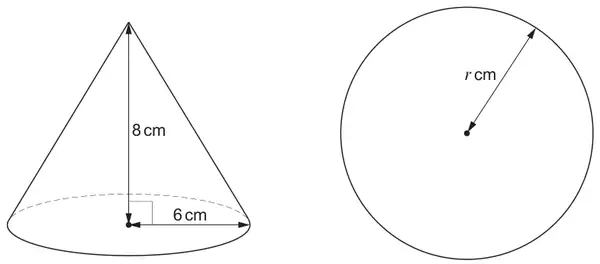
12. The diagrams below show a solid cone and a circle.
Diagrams not drawn to scale
The cone has a base radius of 6 cm and a vertical height of 8 cm. The circle has a radius of \(r\) cm.
The curved surface area of the cone equals the area of the circle.
By expressing any areas in terms of \(\pi\), find the value of \(r\). Give your answer in the form \(a\sqrt{b}\),where \(a\) and \(b\) are integers, and \(b\) is as small as possible. [6]
From the formula list: Curved surface area of cone \(= \pi r l\)
Mark scheme
Scheme
Marks
Comments
(Slant height of cone =) \(\sqrt{6^2 + 8^2}\)
M1
Method for finding hypotenuse. Accept use of (3,4,5) x 2.
= 10 (cm)
A1
(Curved surface area of cone =) \(\pi \times 6 \times 10\)
M1
FT ‘their derived slant height’ (not 8).
= \(60\pi\) (cm2) or equivalent
A1
CAO [For reference, \(60\pi\) = 188.4] \(60\pi\) may be implied by later working (e.g. sight of \(r^2\) = 60)
For calculating the total surface area of the cone, award M1 A1 SC1 for an answer of \(96\pi\) (cm2) [= 301(.44)] (from including the area of the base of the cone)
(\(\pi r^2 = \pi \times 6 \times 10\)) \(r^2\) = 60 or \(r = \sqrt{60}\) or equivalent
M1
Isolating \(r^2\) or \(r\). FT for ‘their \(r^2\) = 60’ or ‘their \(r = \sqrt{60}\)’ from \(\pi r^2\) = ‘their \(60\pi\)’
\((r =)\) \(2\sqrt{15}\)
A1
FT from \(r^2 = k\), provided equivalent difficulty (with \(r\) in the form \(a\sqrt{b}\), where \(a\) and \(b\) are integers, and \(b\) is as small as possible).
SC1 for r = \(\sqrt{6L}\) (where \(L\) = slant height)
Note: after M0A0M0A0 for use of 8 as the slant height \(r^2\) = 48 or \(r = \sqrt{48}\) M1 \((r =)\) \(4\sqrt{3}\) A1
Corrected by Westie's Workshop
The board's mark scheme printed “as small as possible’).”. Changed to “as small as possible).” because there is a stray closing quotation mark before the bracket.
Original: see the board's mark scheme PDF (link above).
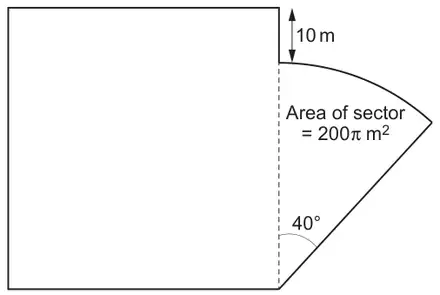
10. Square-Off is a company that has designed new offices for its workers.
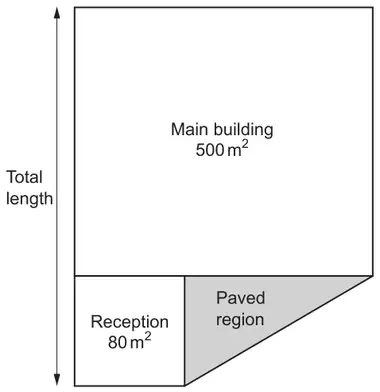
(a) The main building has a square floor with an area of 500 m2. The reception has a square floor with an area of 80 m2. The triangular region outside the buildings is paved. A plan view of the buildings and the paved region is shown below.
Diagram not drawn to scale
(i) Calculate the total length of the two buildings. Give your answer in the form \(a\sqrt{b}\), where \(a\) and \(b\) are integers and \(b\) is a prime number. [3]
(ii) Calculate the area of the paved region. You must show all your working. [2]
(b) Square-Off has designed an entrance to the reception.
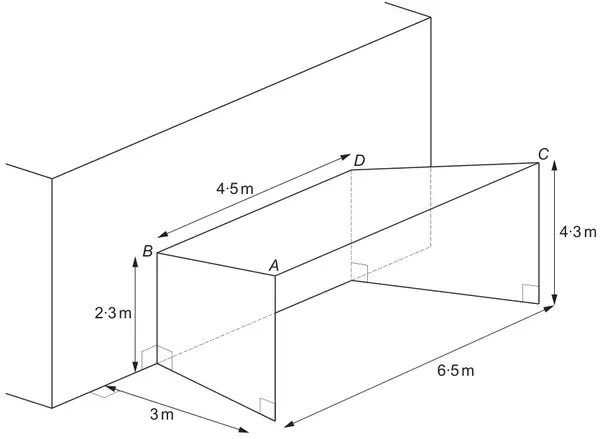
The symmetrical structure is made from 3 connected metal sheets, each in the shape of a trapezium.
Diagrams not drawn to scale
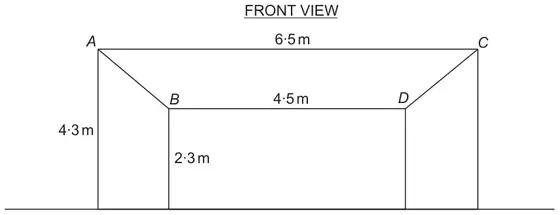
The 3 metal sheets are connected to each other along the edges \(AB\) and \(CD\). Adhesive strips are needed along the entire length of these edges.
Calculate the length of the adhesive strip \(AB\). Leave your answer as a surd. [4]
Mark scheme (a)
Scheme
Marks
Comments
(i) (Total length =) √500 + √80
M1
= 10√5 + 4√5 OR 5√20 + 2√20
m1
= 14√5 (m)
A1
If no marks awarded, SC1 for sight of 10√5 or 5√20 AND 4√5 or 2√20
(ii) (Area of triangle =) e.g. \(\dfrac{(10\sqrt{5} - 4\sqrt{5}) \times 4\sqrt{5}}{2}\) or \(\dfrac{(5\sqrt{20} - 2\sqrt{20}) \times 2\sqrt{20}}{2}\) or \(\dfrac{\sqrt{40000} - \sqrt{6400}}{2}\) or \(\dfrac{200 - 80}{2}\)
M1
FT the simplification of ‘their √500’ and ‘their √80’ provided they are surds For a step of simplification of \(\dfrac{(\sqrt{500} - \sqrt{80}) \times \sqrt{80}}{2}\)
Accept a mixture of the terms shown
= 60 (m2)
A1
CAO
Alternative method 1 (a)(ii): (Using half of (bottom rectangle – square))
Scheme
Marks
Comments
(Area of triangle =) e.g. \(\dfrac{10\sqrt{5} \times 4\sqrt{5} - 80}{2}\) or \(\dfrac{5\sqrt{20} \times 2\sqrt{20} - 80}{2}\) or \(\dfrac{200 - 80}{2}\)
M1
FT the simplification of ‘their √500’ and ‘their √80’ provided they are surds Accept a mixture of the terms shown
= 60 (m2)
A1
CAO
Alternative method 2 (a)(ii): (Using the bottom trapezium)
Scheme
Marks
Comments
(Area of triangle =) e.g. \(\dfrac{(10\sqrt{5} + 4\sqrt{5}) \times 4\sqrt{5}}{2}\) − 80 or \(\dfrac{(5\sqrt{20} + 2\sqrt{20}) \times 2\sqrt{20}}{2}\) − 80 or \(\dfrac{(\sqrt{40000} + \sqrt{6400})}{2}\) – 80 or \(\dfrac{200 + 80}{2}\) – 80
M1
Or equivalent FT the simplification of ‘their √500’ and ‘their √80’ provided they are surds For a step of simplification of \(\dfrac{(\sqrt{500} + \sqrt{80}) \times \sqrt{80}}{2}\) − 80 Accept a mixture of the terms shown
= 60 (m2)
A1
CAO
Mark scheme (b)
Scheme
Marks
Comments
Correct use of Pythagoras in 1 of the planes \(\left(\frac{6{\cdot}5 - 4{\cdot}5}{2}\right)^{2} + (4{\cdot}3 - 2{\cdot}3)^{2}\) or 12 + 22 OR (4·3 – 2·3)2 + 32 or 22 + 32 OR \(\left(\frac{6{\cdot}5 - 4{\cdot}5}{2}\right)^{2} + 3^{2}\) or 12 + 32
M1
Or the square roots of these expressions May be embedded in further working
(AB =) \(\sqrt{\left(\frac{6{\cdot}5 - 4{\cdot}5}{2}\right)^{2} + (4{\cdot}3 - 2{\cdot}3)^{2} + 3^{2}}\) or \(\sqrt{1^{2} + 2^{2} + 3^{2}}\)
M2
May be seen as 2 applications of Pythagoras M1 for \(\left(\frac{6{\cdot}5 - 4{\cdot}5}{2}\right)^{2} + (4{\cdot}3 - 2{\cdot}3)^{2} + 3^{2}\) or 12 + 22 + 32
(b) Express \(0{\cdot}07\dot{1}\dot{4}\) as a fraction. [2]
(c) Simplify \(\sqrt{11\tfrac{1}{4}}\). Give your answer in the form \(\dfrac{a\sqrt{5}}{b}\), where \(a\) and \(b\) are integers. [2]
(d) Give an example of an irrational number that lies between 6 and 7. [1]
My example of an irrational number is ……………………
Mark scheme (a)
Scheme
Marks
Comments
(i) 16
B1
(ii) \(\dfrac{1}{100}\)
B1
Mark scheme (b)
Scheme
Marks
Comments
\(100x\) = 7·141414..... and \(10000x\) = 714·1414.... with an attempt to subtract on both sides
M1
Or \(x\) and \(100x\), or equivalent. Or a complete alternative method. The multiplied decimals must be correct.
\(\dfrac{707}{9900}\)
A1
An answer of \(\dfrac{7{\cdot}07}{99}\) gains M1 only. ISW
16. (b) Alternative method
Scheme
Marks
Comments
0·07 + 0·00141414….. = \(\dfrac{7}{100} + \dfrac{14}{9900}\) or equivalent
M1
\(\dfrac{707}{9900}\)
A1
ISW
Mark scheme (c)
Scheme
Marks
Comments
\(\dfrac{3\sqrt{5}}{2}\)
B2
B1 for one of the following:
a numerator of \(3\sqrt{5}\)
\(\dfrac{\sqrt{45}}{\sqrt{4}}\) or \(\dfrac{\sqrt{9} \times \sqrt{5}}{\sqrt{4}}\) i.e. for one step of simplification of surds (but not for \(\sqrt{\dfrac{45}{4}}\) )
sight of \(1 \cdot 5\sqrt{5}\) (from \(\sqrt{2 \cdot 25}\,\sqrt{5}\)).
Mark scheme (d)
Scheme
Marks
Comments
An appropriate irrational number within the required range
B1
e.g. \(2\pi\), \(\pi + 3\), \(\sqrt{40}\), \(3\sqrt{5}\), \(8 - \sqrt{2}\). Ignore additional irrational numbers within range. B0 for multiple answers, unless all are irrational numbers within the required range.
(a) 5 Akago delivery vans can deliver food to 100 houses in 4 hours.
Akago wants to:
increase the number of deliveries to 240 houses
shorten the total delivery time to 3 hours.
Calculate the number of delivery vans that would be needed to deliver food to 240 houses in 3 hours. You can assume that all vans deliver food to all the houses at the same rate. [3]
Number of delivery vans needed = ……………
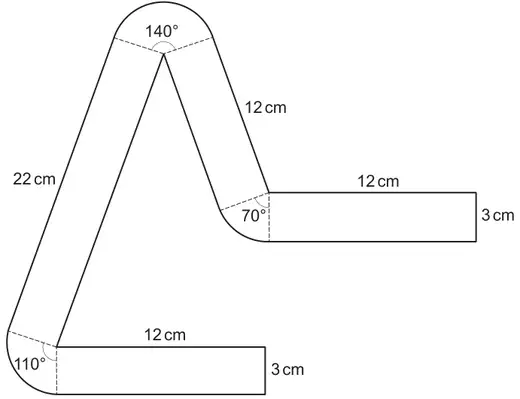
(b) The design of the company’s logo is based on the letter A. It is made from rectangles, connected by sectors of circles. The company prints its logo on its delivery boxes. The logo is shown below.
Diagram not drawn to scale
Calculate the area of the logo that is printed on the company’s delivery boxes. Give your answer in terms of \(\pi\) in its simplest form. [6]
Area of the logo = …………… cm2
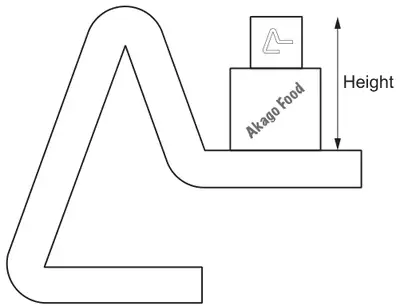
(c) Akago has decided to add two squares to its logo, to represent two stacked food boxes being delivered to your door.
Diagram not drawn to scale
The larger square has an area of 45 cm2. The smaller square has an area of 5 cm2. Calculate the total height of the two stacked food boxes, as shown in the diagram. Give your answer in the form \(a\sqrt{b}\), where \(a\) and \(b\) are integers, and \(b\) is as small as possible. [3]
Mark scheme (a)
Scheme
Marks
Comments
5 × \(\dfrac{240}{100}\) or × 2.4 or equivalent
M1
A table method altering all 3 in the same manner at the same time is M0
M marks may be seen in either order e.g.
Time
Houses
Vans
4
240
12
× \(\dfrac{4}{3}\) or × 1.333… or equivalent
M1
FT from M0 previously awarded Must be from use of 5 e.g. if this calculation is performed first
Time
Houses
Vans
3
100
6.66…
= 16 (delivery vans)
A1
CAO
9(a) Alternative method 1:
Scheme
Marks
Comments
\(\dfrac{100}{4\times5}\) (=5 houses per hour per van)
M1
\(\dfrac{240}{100\div(4\times5)\times3}\) or \(\dfrac{240}{5\times3}\)
m1
= 16 (delivery vans)
A1
CAO
9(a) Alternative method 2:
Scheme
Marks
Comments
Time
Houses
Vans
3
75
5 OR
9.6 (or 9h36m)
240
5
M1
5 × \(\dfrac{240}{75}\) OR 5 × \(\dfrac{9.6}{3}\) or 5 × 3.2 or equivalent
M1
FT from 3 (time), n houses, 5 vans for 5 × \(\dfrac{240}{n}\) FT from n (time), 240 houses, 5 vans for 5 × \(\dfrac{n}{3}\)
= 16 (delivery vans)
A1
CAO
Mark scheme (b)
Scheme
Marks
Comments
Sight of \(\dfrac{\text{angle}}{360}\times\pi\times3^{2}\) or equivalent
B1
Allow use of \(\pi\) = 3.14 to 3.142 for B and M marks, but not for A marks
For any of the angles 140(°), 110(°), 70(°), 140+110+70 or 320
\(\dfrac{140}{360}\times\pi\times3^{2} + \dfrac{110}{360}\times\pi\times3^{2} + \dfrac{70}{360}\times\pi\times3^{2}\) or equivalent (\(7\pi/2\)) (\(11\pi/4\)) (\(7\pi/4\))
M2
e.g. \(\dfrac{(140+110+70)}{360}\times\pi\times3^{2}\) or \(\dfrac{320}{360}\times\pi\times3^{2}\) or \(8\pi\) M1 for the sum of any 2 correct terms OR M1 for \(\dfrac{x}{360}\times\pi\times3^{2}\) where \(300 \leqslant x \lt 360\) if 140+110+70 not seen The award of M2 or M1 implies the previous B1
+ 3×12×3 + 22×3
m1
FT from M1
= \(8\pi + 174\) (cm2)
A2
CAO. Mark final answer A1 (does not depend on m1 being awarded) for any one of the following seen
\(\dfrac{2880\pi}{360}\) + …. or equivalent
\(7\pi/2 \ + \ 11\pi/4 \ + \ 7\pi/4\) + …..
\(3.5\pi + 2.75\pi + 1.75\pi\) + ….
\(8\pi\)
Mark scheme (c)
Scheme
Marks
Comments
\(\sqrt{9}\times\sqrt{5} + \sqrt{5}\) or \(3\sqrt{5} + \sqrt{5}\)
M2
M1 for \(\sqrt{45} + \sqrt{5}\) or M1 for sight of \(3\sqrt{5}\)
(a) Cartons of soft drink are filled using an automated system.
(i) Each carton is a cuboid that has:
a base area of exactly 40 cm2,
a height of 13 cm, correct to the nearest cm.
Calculate the least possible volume of a carton. [2]
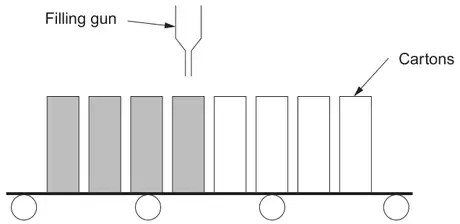
(ii) The empty cartons, moving on a conveyor belt, pass under a filling gun that pours soft drink into the cartons until they are full.
Drink is poured into each carton at a rate of 8000 cm3 per minute, correct to the nearest 1000 cm3 per minute.
Diagram not drawn to scale
Calculate the greatest possible number of cartons that the automated system could fill in an hour. You can ignore the time taken in moving from one full carton to the next empty one. [3]
(b) Cartons of a different size are also filled using the same system. Each of these cartons has:
a square base,
a height of exactly 20 cm,
a volume of exactly 960 cm3.
Calculate the length of the side of the base of one of these cartons. Give your answer in the form \(a\sqrt{b}\), where \(a\) and \(b\) are integers and \(b\) is as small as possible. [4]
Mark scheme (a)
(i)
Scheme
Marks
Comments
(Least possible volume of a carton =) 40 × 12.5 = 500 (cm3)
M1 A1
Allow use of 12 < h < 13 for M1 only CAO
If no marks awarded, SC1 for use of 12.5
(ii)
Scheme
Marks
Comments
Use of 8500
B1
Allow 8499.999(…) for 8500
\(\dfrac{8500}{500}\) (× 60)
M1
FT ‘their 500’ from (a)(i) If B0, FT provided unambiguously chosen: 8000 < ‘their 8500’ < 9000
Mark final answer Accept 40√3 mm, but not 0.04√3 m
For B2, FT ‘their derived 48’ provided of equivalent difficulty (it has a square number as one of its factors)
For B1, FT 'their derived 48' B1 for writing 48 as a product of 2 or more factors where one of the factors OR the product of 2 of their factors is a square number e.g. 16 × 3 or 4 × 4 × 3 or 4 × 12 or 2 × 2 × 12 OR B1 for writing \(\sqrt{48}\) as a product of 2 or more factors where one of the factors OR the product of 2 of their factors gives a whole number e.g. \(\sqrt{16} \times \sqrt{3}\) or \(\sqrt{2} \times \sqrt{2} \times \sqrt{12}\) or \(2\sqrt{12}\)
FT provided B1 already awarded AND provided all terms are of the form \(a\sqrt{5}\) (and the answer is \(b\sqrt{5}\) where b is an integer). \(18\sqrt{5}\) (with no contradictory working) implies B2. \(6\sqrt{5}\) (with no contradictory working) implies B3.
15. Write down an irrational number whose value is between 9 and 10. Write your answer in the box below. [1]
Irrational number is: ☐
Mark scheme
Scheme
Marks
Comments
An irrational number which correctly evaluates to between 9 and 10, for example: \(\sqrt{90},\ \pi^2,\ \sqrt{5} + 7,\ \pi + 6,\ \sqrt{107} - 1,\ \sqrt[3]{823},\ 3\pi\)
B1
Number in the box takes precedence, otherwise the answer must be clearly identified. Allow B1 if the answer in the box is not irrational, but has clearly come from evaluating an irrational number e.g. 9·49(…), from evaluating \(\sqrt{90}\).
State whether the answer is rational or irrational. [5]
The answer is rational ☐ The answer is irrational ☐
Mark scheme
Scheme
Marks
Comments
10
B2
B1 for
(numerator of) \(20\sqrt{2}\) or \(10\times 2\times \sqrt{2}\) or
(denominator of) \(2\sqrt{2}\) or \(\sqrt{8}\) or
appropriate factorisation of both numerator and denominator e.g. \(\dfrac{\sqrt{2} \times \sqrt{2} \times \sqrt{2} \times \sqrt{100}}{\sqrt{2} \times \sqrt{2} \times \sqrt{2}}\) (or \(\sqrt{100}\))
\(16 - 6\sqrt{7}\)
B2
B1 for 3 or 4 correct terms within \(9 - 3\sqrt{7} - 3\sqrt{7} + 7\) (e.g. B0 for ‘2’, from 2 sign errors) \(+\sqrt{49}\) might be seen instead of +7. \(-6\sqrt{7}\) is equivalent to ‘two correct terms’.
\(26 - 6\sqrt{7}\) AND irrational indicated.
B1
Mark final answer. FT for equivalent difficulty (requiring collection of terms) provided either of B2s is awarded AND final answer is irrational AND requires no further simplification.
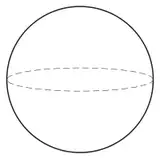
(a) Medi-Cap is a company that makes hollow spherical capsules for medicine.
One of its spherical capsules has a volume of 128π mm3.
Calculate the radius of this capsule. Give your answer in the form \(a\sqrt[3]{12}\), where \(a\) is an integer. You must show all your working. [4]
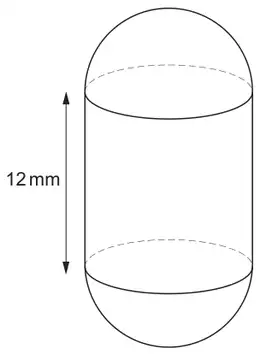
(b) Medi-Cap also makes another shape of capsule, called a Bullet capsule.
These capsules are in the shape of two hollow hemispheres attached to each end of a hollow cylinder, as shown below. The diameter of the cylinder, and of each hemisphere, is 8 mm.
Diagram not drawn to scale
To make a capsule easier to swallow, the exterior surface is coated with a glaze. Calculate the surface area that is covered by the glaze. Give your answer in terms of π in its simplest form. [3]
From the formula list: Volume of sphere \(= \dfrac{4}{3}\pi r^3\); Surface area of sphere \(= 4\pi r^2\)
Mark scheme (a)
Scheme
Marks
Comments
\(\dfrac{4}{3}\) × π × radius3 = 128π or equivalent
M1
If an equation is not seen, only award if appropriate calculations with 128, 4 and 3 seen Note: simplifying the cube root of 128 alone does not imply M1
(radius3 =) \(\dfrac{128\pi \times 3}{4 \times \pi}\) or equivalent
m1
radius3 = 96 OR (radius =) \(\sqrt[3]{96}\)
A1
(radius =) \(2\sqrt[3]{12}\) (mm)
B1
Must be from correct working FT ‘their derived 96’ provided their answer can be written the form \(a\sqrt[3]{12}\) An unsupported \(2\sqrt[3]{12}\) (mm) is awarded M0m0A0B0
Mark scheme (b)
Scheme
Marks
Comments
(Total surface area =) π × 8 × 12 + 2 × \(\dfrac{4 \times \pi \times 4^2}{2}\) or equivalent
6.Bearing-Up is a company that makes steel spheres to be used in bearings.
From the formula list: Volume of sphere \(= \dfrac{4}{3}\pi r^3\); Surface area of sphere \(= 4\pi r^2\)
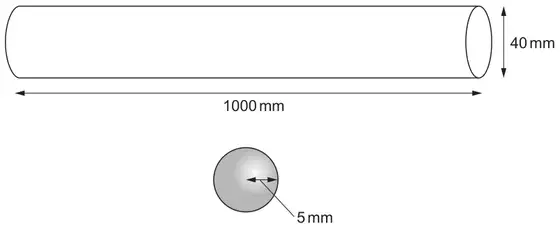
(a)Bearing-Up melts a steel cylinder of diameter 40 mm and length 1000 mm. It recasts all the steel to make spheres of radius 5 mm.
Diagrams not drawn to scale
Calculate how many spheres can be made from the cylinder. [5]
(b)Bearing-Up also makes spheres with a different radius. Each of these spheres has a surface area of 320\(\pi\) mm2. Calculate the radius of one of these spheres.
Give your answer in the form \(a\sqrt{b}\), where \(a\) is an integer and \(b\) is a prime number. [5]
Mark scheme (a)
Scheme
Marks
Comments
(Volume of cylinder =) π×202×1000 (= 400 000π)
B1
(= 1256000 to 1257000) May be implied in further work
(Volume of sphere =) \(\dfrac{4}{3}\) × π × 53
B1
Or \(\dfrac{500\pi}{3}\). (= 523 to 524)
(Number of spheres made =) \(\dfrac{\pi \times 20^{2} \times 1000}{4/3 \times \pi \times 5^{3}}\) or equivalent
M2
e.g. \(\dfrac{400\,000\pi}{166.6(6)\pi}\) or \(\dfrac{100\,000\pi}{41.6(6)\pi}\) or equivalent M1 for 4/3 × π × 53 × number of spheres = π × 202 × 1000
= 2400 (spheres)
A1
CAO
Mark scheme (b)
Scheme
Marks
Comments
4 × π × r2 = 320π
M1
May be implied in further working
r2 = \(\dfrac{320\pi}{4\pi}\) or (r =) \(\sqrt{\dfrac{320\pi}{4\pi}}\) or equivalent
m1
(r =) \(\sqrt{80}\)
A1
May be implied in further working
= \(4\sqrt{5}\) (mm)
B2
For B2, FT ‘their derived 80’ if possible
For B1, FT 'their derived 80' if possible B1 for writing 80 as a product of 2 or more factors where one of the factors OR the product of 2 of their factors is a square number e.g. 16 × 5, 4 × 20, 2 × 8 × 5, OR B1 for writing \(\sqrt{80}\) as a product of 2 or more factors where one of the factors OR the product of 2 of their factors is a whole number e.g. \(\sqrt{16}\) × \(\sqrt{5}\), \(\sqrt{4}\) × \(\sqrt{20}\), \(\sqrt{2}\) × \(\sqrt{8}\) × \(\sqrt{5}\)
Mark final answer. Accept \(11 + 1\sqrt{5}\). If no marks awarded, SC1 for 3 correctly simplified terms i.e. 21, \(7\sqrt{5}\), \(-6\sqrt{5}\), \(-10\).
and indicate whether your answer is rational or irrational. [5]
The answer is: rational ☐ irrational ☐
Mark scheme
Scheme
Marks
Comments
\(9 + 4\sqrt{5}\)
B2
If not B2, award B1 for 3 or 4 correct terms within \(4 + 2\sqrt{5} + 2\sqrt{5} + 5\) or \(4 + 2\sqrt{5} + 2\sqrt{5} + \sqrt{25}\) (without subsequent correct collection of terms) (\(4\sqrt{5}\) is equivalent to ‘two correct terms’)
(–) 2
B2
B1 for (numerator of) \(10\sqrt{5}\) or B1 for (denominator of) \(5\sqrt{5}\) or \(\sqrt{125}\) or B1 for appropriate factorisation of both numerator and denominator e.g. \(\dfrac{\sqrt{5} \times \sqrt{100}}{\sqrt{5} \times \sqrt{25}}\) or \(\dfrac{\sqrt{5} \times \sqrt{5} \times \sqrt{5} \times \sqrt{4}}{\sqrt{5} \times \sqrt{5} \times \sqrt{5}}\)
\(7 + 4\sqrt{5}\) AND irrational
B1
Mark final answer. FT for equivalent difficulty (requiring collection of terms) AND either B2 awarded AND final answer is irrational.
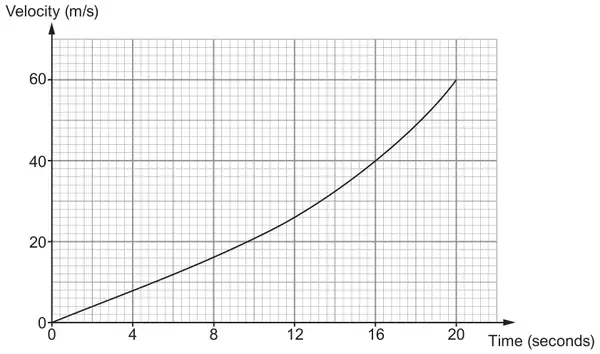
9. The velocity-time graph below shows the velocity of an aircraft for the first 20 seconds of take-off.
(a) Calculate an estimate of the acceleration of the aircraft at time 16 seconds. [3]
(b) Calculate an estimate of the distance travelled by the aircraft during the first 20 seconds of take-off. Use 5 strips of equal width. You must convert your answer into miles. Give your answer as a decimal. [5]
Distance is …………… miles
(c)
The aircraft carries cargo. One customer wants to use the aircraft to transport a new product that is to be packaged in cuboid boxes, as shown below.
Diagram not drawn to scale
The boxes will meet the following conditions:
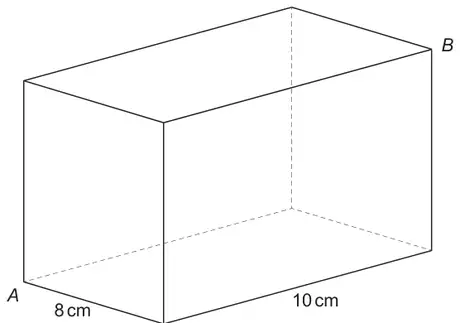
The boxes will be of width 8 cm and length 10 cm.
The length of the diagonal AB will be 14 cm.
Calculate the height of a box. Give your answer in the form \(a\sqrt{b}\) cm, where \(a\) and \(b\) are integers, and \(b\) is as small as possible. [6]
From the formula list: Area of trapezium \(= \dfrac{1}{2}(a+b)h\)
Mark scheme (a)
Scheme
Marks
Comments
Tangent drawn at time 16 seconds
M1
Difference in y ÷ difference in x
m1
M1m1A0 if only 1 correct difference in the division
Correctly evaluated gradient from their tangent
A1
ISW Approximately 4 Accept a correct improper fraction (unless it gives a whole number), mixed number or decimal If they give a decimal answer, it needs to be correct to 1 decimal place, rounded or truncated
Each area may be seen as the sum of the area of a rectangle and triangle M1 for the sum of these 5 areas with one error (possibly repeated) in reading the scale
= 480 (m) or equivalent
A1
FT from M1
(480 ÷ 1000) × 5 ÷ 8 OR (480 ÷ 1000) ÷ 1.6 OR (480 ÷ 1000) × 0.625
M1
FT ‘their 480’ provided an attempt made to sum the area of the 5 trapeziums
= 0.3 (miles)
A1
On FT, needs to be correct to 1 decimal place, rounded or truncated
Mark scheme (c)
Scheme
Marks
Comments
82 + 102 or 142 – 102 or 142 – 82 OR \(\sqrt{8^2+10^2}\) or \(\sqrt{14^2-10^2}\) or \(\sqrt{14^2-8^2}\)
M1
\(\sqrt{14^2-(8^2+10^2)}\)
M2
M1 for 142 – (82 + 102). May be seen in stages. Only award this M1 or M2 if ‘their 142 is greater than ‘their (82 + 102)’
(Height =) √32
A1
May be implied by Height2 = 32
= 4√2 (cm)
B2
For B2, FT ‘their derived 32’ provided they have attempted to work with 2 triangles, is of equivalent difficulty, AND their 'b' is as small as possible when in the form a√b
For B1, FT 'their derived 32' B1 for writing 32 as a product of 2 or more factors where one of the factors OR the product of a pair of their factors is a square number e.g. 16 × 2, 2 × 2 × 8, OR B1 for writing √32 as a product of 2 or more factors where one of the factors OR the product of a pair of their factors gives a whole number e.g. √2 × √2 × √8, 2 × √8
Allow one incorrect term. \(\sqrt{7}\sqrt{7}\) is insufficient for \(\sqrt{49}\). \(\sqrt{3}\sqrt{3}\) is insufficient for \(\sqrt{9}\). Allow \(\sqrt{7}\sqrt{3}\) or \(\sqrt{3}\sqrt{7}\) for \(\sqrt{21}\).
\(31 - 4\sqrt{21}\)
A1
\(\sqrt{7}\sqrt{3}\) or \(\sqrt{3}\sqrt{7}\) is insufficient for \(\sqrt{21}\).
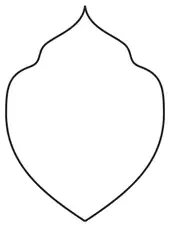
(a) Alun is a jeweller. He is designing a symmetrical pendant, as shown below.
Diagram not drawn to scale
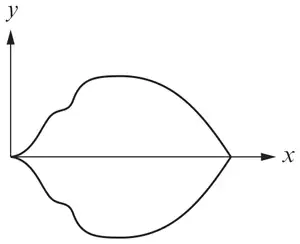
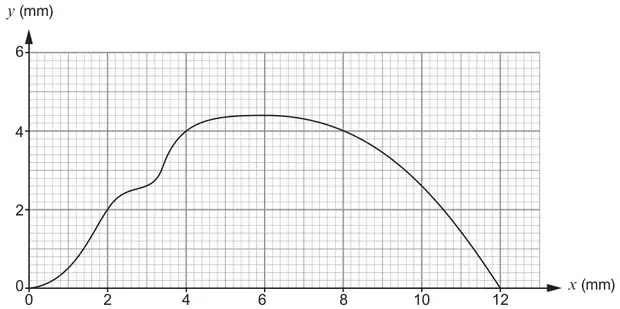
The pendant will be made from solid silver, with a uniform thickness of 3 mm. In order to calculate the cost of making the pendant, Alun wants to calculate an estimate of the volume of the pendant. He has accurately drawn one of the symmetrical halves of the shape on graph paper.
Calculate an estimate of the volume of the whole pendant. Use the graph above, with 6 strips of equal width. [5]
(b) Alun makes pendants that are mathematical shapes. The following table shows the pendants and the number of these pendants that Alun made last month.
Pendant
Triangle
Circle
Rectangle
Trapezium
Number made last month
52
96
30
62
At the end of last month, Alun took a stratified sample of 30 of these 240 pendants to check their quality.
Calculate how many pendants of each shape were in Alun’s sample. You must show all your working. [4]
Pendant
Triangle
Circle
Rectangle
Trapezium
Number in sample
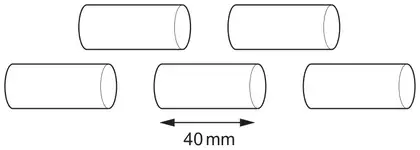
(c) Alun has 5 identical metal cylinders, each of length 40 mm.
Diagram not drawn to scale
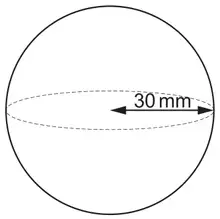
He has been asked to make a solid sphere of radius 30 mm.
Diagram not drawn to scale
He melts the 5 cylinders and recasts all the metal to make the sphere.
Calculate the radius of each of the cylinders.
Give your answer in mm, in the form \(a\sqrt{b}\), where \(a\) and \(b\) are integers, and \(b\) is as small as possible. [6]
From the formula list: Volume of sphere \(= \dfrac{4}{3}\pi r^3\)
FT from M1 or M2 for a possible M1A1 If no marks previously awarded, FT ‘their 34’ provided an attempt made to use the trapezium rule for a possible M1 only
Each area may be seen as the sum of the area of a rectangle and a triangle M1 for the sum of these 6 areas with one error (maybe repeated) in reading the scale OR with 1 incorrect term
= 34 (mm2)
A1
FT from M1 or M2
(Volume =) 34 × 3 (× 2)
M1
FT from M1 or M2 for a possible M1A1 If no marks previously awarded, FT ‘their 34’ provided an attempt made to sum the 6 areas for a possible M1 only
= 204 (mm3)
A1
Mark scheme (b)
Scheme
Marks
Comments
30 × (number of pendants made) ÷ 240 or equivalent
M1
e.g. (number of pendants made) ÷ 8 Sight of this calculation for any shaped pendant
(Number of circular pendants in sample =) 12
A1
Sight of any 2 of 6.5, 3.7(5), 7.7(5) or equivalents
A1
Accept mixed numbers
(Number in sample =) 6, 12, 4, 8
B1
Needs to be from correct working Can come from M1A1A0
An unsupported 6, 12, 4, 8 is awarded M1A1A0B1 An unsupported 7, 12, 4, 8 is awarded M1A1A0B0
e.g. radius2 = \(\dfrac{36000\pi}{\pi \times 40(\times 5)}\)
radius2 = 180 or (radius =) √180
A1
CAO
= 6√5 (mm)
B2
For B2, FT ‘their derived 180’ provided their 'b' is as small as possible and that ‘their derived 180’ can be simplified If ‘their derived 180’ is a square number, then B1 only can be awarded for the correct square root of ‘their 180’
For B1, FT 'their derived 180' B1 for writing 180 as a product of 2 or more factors where one of the factors OR the product of a pair of their factors is a square number e.g. 4 × 45, 3 × 3 × 20, OR B1 for writing √180 as a product of 2 or more factors where one of the factors OR the product of a pair of their factors is a whole number e.g. √5 × √12 × √3
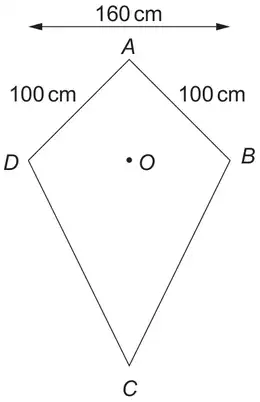
10. A tent company is designing a new 2-person tent. The base of the tent is in the shape of a kite, as shown below. The width of the kite is 160 cm, and the two shorter sides are of length 100 cm. The point where the diagonals of the kite intersect has been marked \(O\) on the diagram below.
Diagram not drawn to scale
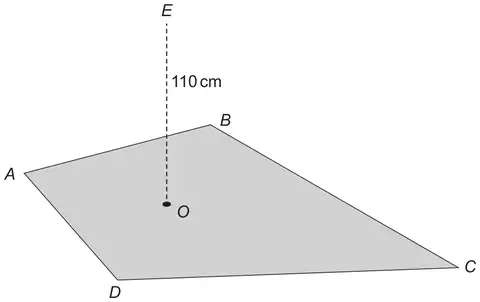
\(E\) is the highest point of the tent, and is 110 cm vertically above \(O\). Part of the frame that supports the tent cover is a straight pole that goes from \(A\) to \(E\).
Diagram not drawn to scale
Calculate the length of pole \(AE\). Give your answer as a surd. You do not need to simplify your answer. [4]
(ii) Calculate \(\dfrac{\sqrt{6} \times \sqrt{20}}{\sqrt{3}}\). Give your answer in the form \(a\sqrt{b}\), where \(a\) and \(b\) are integers, and \(b\) is as small as possible. [2]
(c) Evaluate \(16^{-\frac{3}{2}}\). [2]
Mark scheme (a)
Scheme
Marks
Comments
\(x = 0{\cdot}37777\)….. \(10x = 3{\cdot}7777\)….. with an attempt to subtract
M1
Or \(10x\) and \(100x\), or equivalent. Or an alternative method.
34/90 or 17/45 or equivalent e.g. 374/990
A1
An answer of 3·4/9 gains M1 only. Mark final answer. Do not ignore incorrect cancelling.
Alternative method
Scheme
Marks
Comments
0·3 + 0·07777….. = 3/10 + 7/90 or equivalent
M1
34/90 or 17/45 or equivalent
A1
Mark final answer. Do not ignore incorrect cancelling.
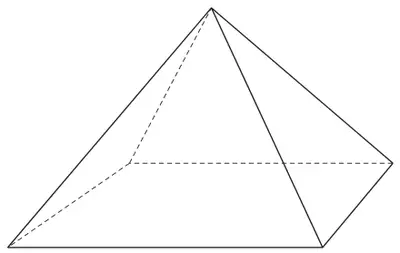
12. An architect has been asked to design a square-based glass pyramid that is to be built in a park. The vertex at the top of the pyramid will be directly above the centre of the square base. The edges of the pyramid will be made from steel. Each sloping face will be made from glass.
Diagram not drawn to scale
(a)
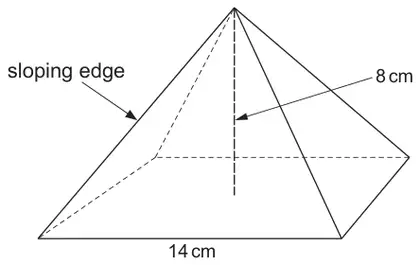
The architect first plans to make a scale model of the pyramid. The scale model will have base sides of length 14 cm and a vertical height of 8 cm.
The architect has drawn the following diagram of the model.
Diagram not drawn to scale
Calculate the length of each sloping edge of the model.
Give your answer in the form \(a\sqrt{b}\), where a is an integer and b is a prime number. [6]
(b)
The area of each glass face on the scale model is 74 cm2. The full-size pyramid is to have a vertical height of 1·6 metres.
Use these values to calculate the area of each glass face on the full-size pyramid. Give your answer in cm2. [5]
Mark scheme (a)
Scheme
Marks
Comments
(Half base diagonal2 =) 72 + 72 OR Half base diagonal2 = 98 OR (Half base diagonal =) \(\sqrt{98}\) OR Half base diagonal = ½ \(\sqrt{14^2 + 14^2}\)
M1
Allow M1 for an appropriate 72 + 82 OR 113 OR \(\sqrt{113}\)
For B2, FT ‘their derived 162’ provided their 'b' is a prime number
For B1, FT 'their derived 162' B1 for writing 162 as a product of 2 or more factors where one of the factors OR the product of a pair of their factors is a square number e.g. 2 × 81, 3 × 3 × 18, OR B1 for writing \(\sqrt{162}\) as a product of 2 or more factors where one of the factors OR the product of a pair of their factors is a whole number e.g. \(\sqrt{2} \times \sqrt{9} \times \sqrt{9}\)
Mark scheme (b)
Scheme
Marks
Comments
(Area factor =) \(\left(\dfrac{160}{8}\right)^2\) or equivalent
M2
M1 for \(\dfrac{160}{8}\) or equivalent OR sight of 20 OR M1 for \(\left(\dfrac{160}{8}\right)^2\) with place value errors e.g. 22 or 0·04
= 400
A1
CAO. May be implied in further working
(Area of glass =) 400 × 74
M1
FT ‘their \(\left(\dfrac{160}{8}\right)^2\)’ or ‘their \(\left(\dfrac{1{\cdot}6}{8}\right)^2\)’ Must be from an area scale factor
(a) Give one example to show that the square of an irrational number is not always rational. [1]
Number = ……………………… Square of the number = ………………………
(b) Find two different irrational numbers to make the answer to the calculation below rational. Complete the calculation by filling in the three boxes. [1]\[\boxed{\rule{0pt}{1.8em}\hspace{3.5em}} \times \boxed{\rule{0pt}{1.8em}\hspace{3.5em}} = \boxed{\rule{0pt}{1.8em}\hspace{3.5em}}\]
Mark scheme (a)
Scheme
Marks
Comments
Appropriate example: E.g. π × π = π2, \((1 + \sqrt{3})^2 = 4 + 2\sqrt{3}\) \((\sqrt[3]{2})^2 = \sqrt[3]{4}\) OR \(2^{\frac{2}{3}}\)
B1
The following can be applied if sight of π in the working lines or answer space: If π or 3.141… (with or without the ‘…’) used AND either π2 or 9.8696… (with or without the ‘…’) seen in the answer space, this will gain the B1. However, watch out for π seen, and e.g. 3.141 and 9.8658 offered in the answer spaces. This gains B0 because 3.1412 has been evaluated (not π2).
Mark scheme (b)
Scheme
Marks
Comments
Two different irrational numbers and the correct rational number as the answer.
Examples:
\(\sqrt{2} \times \sqrt{8} = \sqrt{16}\) (or simplified to 4)
\(\sqrt{12} \times \dfrac{1}{\sqrt{3}} = \dfrac{\sqrt{12}}{\sqrt{3}}\) (or simplified to 2)
\(\pi \times \dfrac{1}{\pi} = 1\)
\(2^{\frac{1}{2}} \times 2^{\frac{3}{2}} = 2^2\) (answer can be simplified to 4)
We'd like to use Google Analytics cookies to count visits and see which pages help most. They're optional, and the site works exactly the same either way. Privacy policy