Explain why neither \(x\) nor \(y\) can be zero. [1]
(ii)
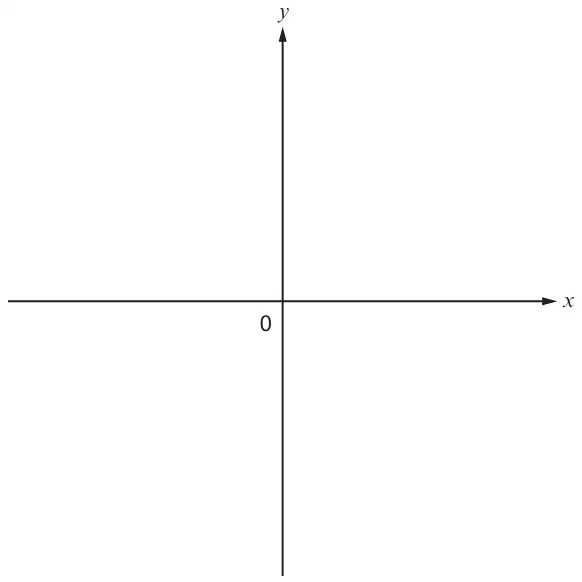
On the axes below, sketch the graph of \(y = \dfrac{1}{x}\). [2]
(iii)
Complete this sentence about the graph you have drawn. [1]
The graph shows ‘\(y\) is ……………… proportional to \(x\)’.
(b)
The variables \(V\) and \(p\) are connected by the equation \(\dfrac{V}{p^2} = 5\).
Find the value of \(V\) when \(p\) = 0·1. [2]
Mark scheme (a)
Scheme
Marks
Comments
(i) Valid explanation e.g. ‘There is no value for which 0 × .... = 1’ or ‘1 cannot be divided by 0’ or ‘Because if one of them is zero, the product would be zero not 1’.
E1
Allow e.g. ‘\(x = \frac{1}{y}\), \(y = \frac{1}{x}\) if \(x\) or \(y\) can be zero these have no value’
Do not allow e.g. ‘Because then the value could not be 1’ without further explanation
(ii) Correct graph: One branch in 1st quadrant, not touching either axis and correct shape One branch in 3rd quadrant, not touching either axis and correct shape
B2
For 2 marks, must be 2 distinct curves; allow some slight curving back at ends B1 for either branch correct
If no marks, SC1 for both branches correct but joined e.g. with a straight line.
(iii) inversely
B1
allow poor spelling; allow ‘inverse’ or ‘not directly’ or ‘not in direct’ or ‘not direct’ or ‘not’ or ‘indirectly’
Do not allow e.g. ‘invertional’ or ‘inversamental’
Mark scheme (b)
Scheme
Marks
Comments
\(5 \times 0.1^2\) oe, si
M1
Substitutes and rearranges; may be in stages; implied by e.g. \(\frac{V}{0.1^2} = 5\), \(\frac{V}{0.2} = 5\), \(V = 5 \times 0.2\) (must be clear that ‘0.2’ is what they think is \(0.1^2\))
We'd like to use Google Analytics cookies to count visits and see which pages help most. They're optional, and the site works exactly the same either way. Privacy policy