11.Môr-Dda is a company that makes buoys for use at sea.
(a)Môr-Dda makes 4 types of buoy. Each week, they make the following numbers of each type of buoy.
Type of buoy
Deep sea
Harbour
Navigation
Shoreline
Number made each week
18
27
23
4
This week, Môr-Dda plans to take a sample of the buoys it makes to check on the quality of their production. It plans to take a stratified sample of 12 buoys, based on the type of buoy.
Calculate the number of each type of buoy that should be included in the sample. You must show all your working. [4]
Type of buoy
Deep sea
Harbour
Navigation
Shoreline
Number in the sample
……
……
……
……
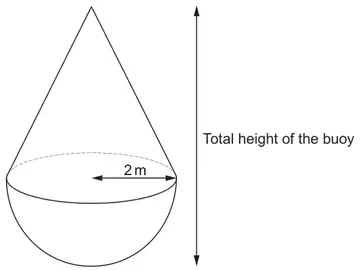
(b) The design for a new buoy is shown below. It is made up of a cone attached to a hemisphere.
The base radius of the cone and the radius of the hemisphere are both 2 m.
Diagram not drawn to scale
From the formula list: Volume of sphere \(= \dfrac{4}{3}\pi r^3\); Volume of cone \(= \dfrac{1}{3}\pi r^2 h\)
The total volume of this new buoy is \(10\pi\) m3. Calculate the total height of the buoy. [5]
Total height of the buoy = …………………… m
Mark scheme (a)
Scheme
Marks
Comments
(Total number made each week =) 72
B1
12 × (number of a type of buoy made) ÷ 72 or (number of a type of buoy made) ÷ 6
M1
Sight of this calculation for any type of buoy FT ‘their 72’
(List of unrounded answers) 3, 4.5, 3.8(…), 0.6(6…) OR 3, 41/2, 35/6, 2/3 or equivalent
A1
OR A1 for 3, 5, 4, 1 Implies the award of M1
(Number in sample =) 3, 4, 4, 1
A1
If M1A0 awarded, FT from their unrounded answers for this A1 provided:
any 2 or 3 unrounded answers are correct, AND
the correct numbers in the sample are given for their unrounded answers (including any decisions regarding rounding down), AND
the sample numbers add to 12
If no working shown, or only B1 awarded SC1 for 3, 4, 4, 1
Mark scheme (b)
Scheme
Marks
Comments
\(\dfrac{2}{3}\times\boldsymbol{\pi}\times 2^{3} \;+\; \dfrac{1}{3}\times\boldsymbol{\pi}\times 2^{2}\times h = 10\boldsymbol{\pi}\) or equivalent
M2
M1 for summing 2 terms and equating to 10\(\boldsymbol{\pi}\), with 1 term being correct
\(\dfrac{4\boldsymbol{\pi}h}{3} = 10\boldsymbol{\pi} - \dfrac{16\boldsymbol{\pi}}{3}\) or equivalent
m1
For isolating the h term FT from M1 All terms may have been multiplied by 3, or \(\boldsymbol{\pi}\) cancelled
(h =) 3.5 or \(\dfrac{7}{2}\) (m)
A1
CAO
(Height of buoy =) 5.5 or \(\dfrac{11}{2}\) (m)
A1
FT for ‘their h’ + 2 provided M1m1 or M2m1 awarded
Alternative method 1:
Scheme
Marks
Comments
\(\dfrac{2}{3}\times\boldsymbol{\pi}\times 2^{3} \;+\; \dfrac{1}{3}\times\boldsymbol{\pi}\times 2^{2}\times (H-2) = 10\boldsymbol{\pi}\) or equivalent
M2
M1 for summing 2 terms and equating to 10\(\boldsymbol{\pi}\), with 1 term being correct
\(\dfrac{16\boldsymbol{\pi}}{3} + \dfrac{4\boldsymbol{\pi}H}{3} - \dfrac{8\boldsymbol{\pi}}{3} = 10\boldsymbol{\pi}\) or equivalent
m1
FT from M1
\(\dfrac{4\boldsymbol{\pi}H}{3} = 10\boldsymbol{\pi} - \dfrac{16\boldsymbol{\pi}}{3} + \dfrac{8\boldsymbol{\pi}}{3}\) or equivalent
m1
For isolating the H term FT from M1m1 All terms may have been multiplied by 3, or \(\boldsymbol{\pi}\) cancelled
(Height of buoy =) 5.5 or \(\dfrac{11}{2}\) (m)
A1
CAO
Alternative method 2:
Scheme
Marks
Comments
\(\dfrac{2}{3}\times\boldsymbol{\pi}\times 2^{3} \;+\; \dfrac{1}{3}\times\boldsymbol{\pi}\times 2^{2}\times (H-2) = 10\boldsymbol{\pi}\) or equivalent
M2
M1 for summing 2 terms and equating to 10\(\boldsymbol{\pi}\), with 1 term being correct
\(\dfrac{4\boldsymbol{\pi}(H-2)}{3} = 10\boldsymbol{\pi} - \dfrac{16\boldsymbol{\pi}}{3}\) or equivalent
m1
For isolating the (H – 2) term FT from M1 All terms may have been multiplied by 3, or \(\boldsymbol{\pi}\) cancelled
(H – 2 =) 3.5 or \(\dfrac{7}{2}\)
A1
CAO
(Height of buoy =) 5.5 or \(\dfrac{11}{2}\) (m)
A1
FT for ‘their h’ + 2 provided M1m1 or M2m1 awarded
We'd like to use Google Analytics cookies to count visits and see which pages help most. They're optional, and the site works exactly the same either way. Privacy policy